Divergent Views

This morning, we all must feel blessed
Nvidia is still the best
Its’s earnings were great
Which opened the gate
For buyers, much more, to invest
 
But contra to that piece of news
The Minutes showed divergent views
On whether to slash
Next month, rates for cash
Or else wait for more weakness clues


Whatever your view of AI and the entire discussion, one must be impressed with Nvidia’s performance as a company, and as an equity.  Last night’s earnings release was clearly better than expected as CEO Jensen Huang indicated that revenues for Q1 should grow to ~$65 billion as there is still significant demand for the buildout of data centers.  He also pushed back on the idea that AI was a bubble.  Of course, he would do that given he is at the center of the discussion.  Nonetheless, after modest gains in US equities yesterday, despite much more hawkish than expected FOMC Minutes (discussed below), US futures are rising sharply this morning, with NASDAQ futures currently higher by 1.6% (6:15) and taking all the indices with it.  Life is good!

Which takes us to the FOMC Minutes and our first look at dissention in the Eccles building.  I think the following paragraph, directly from the Minutes [emphasis added], does a good job in describing the wide range of views that currently exist around the table at the Fed, and make no mistake, I am hugely in favor of a wide range of views as I would contend it has been the groupthink in the past that led us to the current, unfavorable situation.

“In considering the outlook for monetary policy, participants expressed a range of views about the degree to which the current stance of monetary policy was restrictive. Some participants assessed that the Committee’s policy stance would be restrictive even after a potential 1/4 percentage point reduction in the policy rate at this meeting. By contrast, some participants pointed to the resilience of economic activity, supportive financial conditions, or estimates of short-term real interest rates as indicating that the stance of monetary policy was not clearly restrictive. In discussing the near-term course of monetary policy, participants expressed strongly differing views about what policy decision would most likely be appropriate at the Committee’s December meeting.”

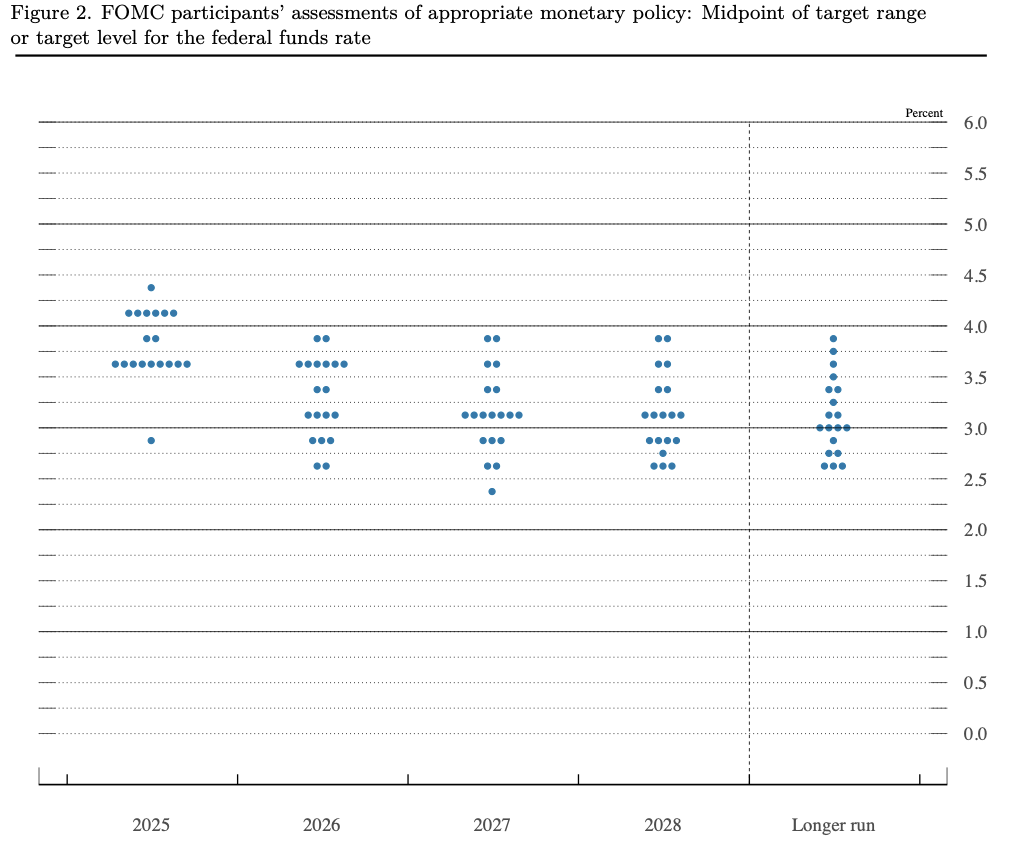
Below I have copied the dot plot from the September meeting, which contra to most previous versions shows a particularly wide range of views regarding the future level of Fed funds.  I have to wonder, though, after reading the Minutes, if those dots will be stretched even wider apart from top to bottom in the December report.
Of course, our interest is how did the market respond to this release?  Well, it can be no surprise that the Fed funds futures market repriced further and is now showing just a 32% probability for a cut next month and 78% probability of the next cut coming in January.  That said, the market remains convinced that rates must go lower over time, something that does not appear in sync with equity market growth expectations and seems to be completely ignoring the announced inward investment flows to the US from around the world.

Source: cmegroup.com

As to the equity market response, the two vertical lines show the release of the Minutes and then the release of Nvidia earnings.  You can see for yourself which matters more to the market.

Source: tradingeconomics.com

Between the GDPNow data, which continues to show growth remains robust, and more announcements of inward investment on the back of trade deals, with the Saudis ostensibly promising $1 trillion after the recent White House dinner, I will take the over on future economic activity.  Remember, too, the government is actively supporting mining, drilling and manufacturing and all of that is going to feed into economic growth here.  My view is the Fed funds futures market is completely wrong, and we will not see rates back at the 3.0% level anytime in the next few years.  I’m not suggesting we won’t see an equity market correction, just that the end is not nigh.

Each day the yen slides
Intervention creeps closer
Yen traders beware

Turning to the dollar, it continues to strengthen across the board with the DXY trading back above 100 this morning, and now that the Fed seems more hawkish, looking like it may have legs.  But let us focus on the yen, quite beleaguered of late, as it appears to be accelerating its downfall.  Not only is this evident on the chart below, but we also have heard concerns for the third time, as per the following quotes from Minoru Kihara, the chief cabinet secretary:

The yen is experiencing sudden, one-way movements that are concerning and which require close monitoring.  Excessive fluctuations and disorderly movements in exchange rates must be monitored with vigilance.  We are concerned about the recent one-way and sudden movements in the foreign exchange market. It’s important for exchange rates to remain stable, reflecting fundamentals.”

In the past six months, the yen has fallen >10% vs. the dollar and is lower by nearly 4% in the past month.  At the same time, JGB yields are starting to accelerate higher, trading to yet another 20-year high at 1.82% and the price action there is remarkably similar to that of USDJPY as per the below chart.  The problem for the JGB market is the BOJ already owns more than 50% of the outstanding debt, so buying more doesn’t seem to be a solution, whereas buying JPY in the FX market will have an impact, albeit short-term if they don’t change policies.   

Source: tradingeconomics.com

The upshot of all this is the world is awash in debt, with global debt/GDP exceeding 3x.  The lesson is that not all this debt will be repaid, in fact probably not that much at all.  Be careful as to what you hold.

Ok, let’s briefly tour the markets I have not yet touched.  Tokyo equities (+2.65%) loved the Nvidia earnings as did Korea (+1.9%), Taiwan (+3.2%) and most of Asia although China (-0.5%) and HK (0.0%) didn’t play along last night.  I guess the ongoing restrictions on sales of Nvidia chips to China is still a negative there, as are recurring concerns over the property market as there is talk of yet another attempt to fix things by the government.  Europe, too, is firmer this morning, although clearly not on tech bullishness given the lack of tech on which to be bullish.  But there is talk of a Russia/Ukraine peace deal which may be a benefit.  At any rate, gains are widespread on the order of +0.6% or so across the board.

In the bond market, Treasury yields rose a couple of ticks yesterday and are higher by 1 more basis point this morning, but still at just 4.14%.  The front of the curve rose by more on the back of the Minutes.  European yields are also higher this morning, between 2bps and 3bps with UK gilts the outlier, unchanged on the day, as softer inflation has traders expecting a rate cut at the next BOE meeting on December 18th.

Oil (+1.0%) has rebounded off its recent lows and is trading back at…$60/bbl, the level at which it is clearly most comfortable these days.  Meanwhile, gold (0.0%) gave back yesterday’s overnight rally to close mostly unchanged with the same true across the other metals although this morning silver (-0.7%) is slipping a bit further.

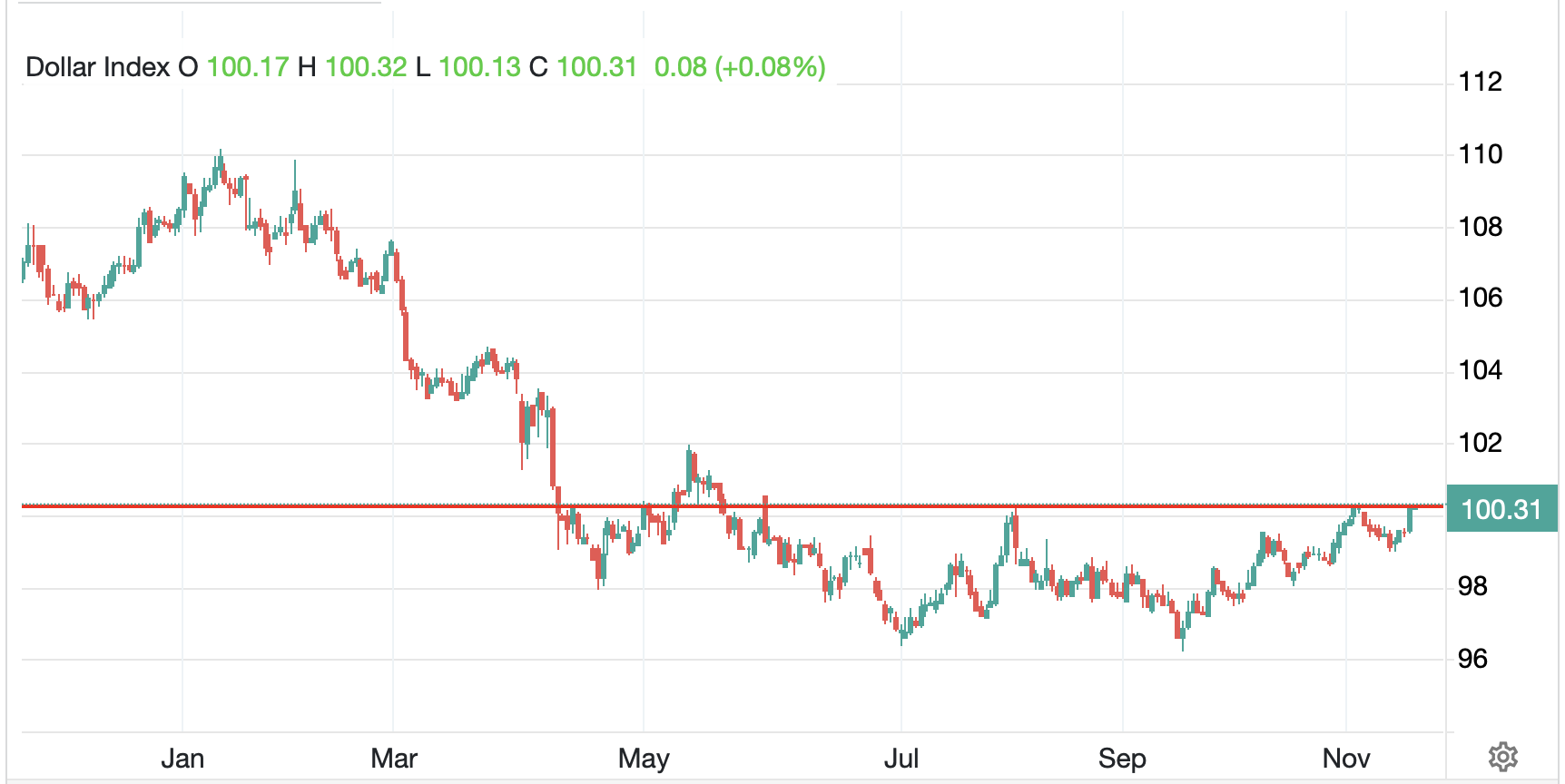
Finally, other currency movements beyond the yen (-0.3% today) are of a similar size across both the G10 and EMG blocs.  Using the DXY as proxy, this is the third test above 100 since August 1st with many analysts are calling for a breakout at last.  
Source: tradingeconomics.com

Perhaps this is true given the word is the Russia/Ukraine peace deal was negotiated entirely between the US and Russia without either Ukraine or Europe involved, demonstrating how insignificant Europe, and by extension the euro, have become.  Just a thought.

On the data front, the big news is the September employment report is going to be released this morning along with some other data:

Nonfarm Payrolls50K
Private Payrolls62K
Manufacturing Payrolls-8K
Unemployment Rate4.3%
Average Hourly Earnings0.3% (3.7% Y/Y)
Average Weekly Hours34.2
Participation Rate62.3%
Philly Fed-3.1
Existing Home Sales4.08M

Source: tradingeconomics.com

On the one hand, the data is stale.  On the other hand, it is all we have, so it will likely have greater importance than it deserves.  I have a hard time looking at the economy and seeing substantial weakness, whether because of corporate earnings, inward investment announcements or the Fed’s growing concern over higher inflation.  All that tells me the dollar is going to be in demand going forward.

Good luck

Adf
A Thirst for Vengeance

The talk of the town ‘bout the Fed
Was not what the Minutes had said
But rather the look
Into Lisa Cook
And whether the rules she did shred
 
It seems now both parties agree
That lawfare is how things should be
Impeachment was first
But now there’s a thirst
For vengeance ‘gainst your enemy


The FOMC Minutes released yesterday were not that informative overall.  After all, the two dissensions by Waller and Bowman have already been dissected for the past 3 weeks and reading through the Minutes, they basically said that most participants had no idea how things would play out.  They couldn’t decide if tariffs would be more inflationary, if the impact would be consistent or a one-off and so doing nothing felt right.  As to the employment situation, there too they had no clarity as to their thoughts, with some positing things could get worse while others thought the employment situation would be fine.  Anyway, with Powell speaking tomorrow, it was all old news.

However, the real Fed news came from the head of the FHFA, Bill Pulte, who revealed that he had forwarded information to the DOJ to investigate potential mortgage fraud by Fed Governor Lisa Cook.  In what has become something of a pattern, Ms Cook appears to have misrepresented the purchase of a secondary home she was planning to rent out as her primary residence in an effort to get a reduced rate on her mortgage.  This is remarkably similar to the case against NY Attorney General Letitia James as well as California Senator Adam Schiff.  While the latter two appear vengeful in that both of those two were instrumental in personal political attacks on President Trump, it is Ms Cook’s situation that may have the bigger impact.  If she is forced to resign, as has already been demanded by President Trump, then that opens another seat on the Fed for Mr Trump to fill.  Based on Trump’s current views, one would anticipate it would turn the Fed that much more dovish if that is the way things evolve.

Sitting here in the bleachers, I have no idea as to the veracity of the claims against any of these three, but it will not be a huge surprise to see charges brought in each case.  It will certainly be a sticky wicket for Chairman Powell if a Fed governor is brought up on charges of mortgage fraud given her role in monetary policy making.  At this stage, my working assumption is we will see all three served and cases brought against them.  If that is the case, we have to assume the Fed is going to become that much more dovish during the rest of the year regardless of the data.

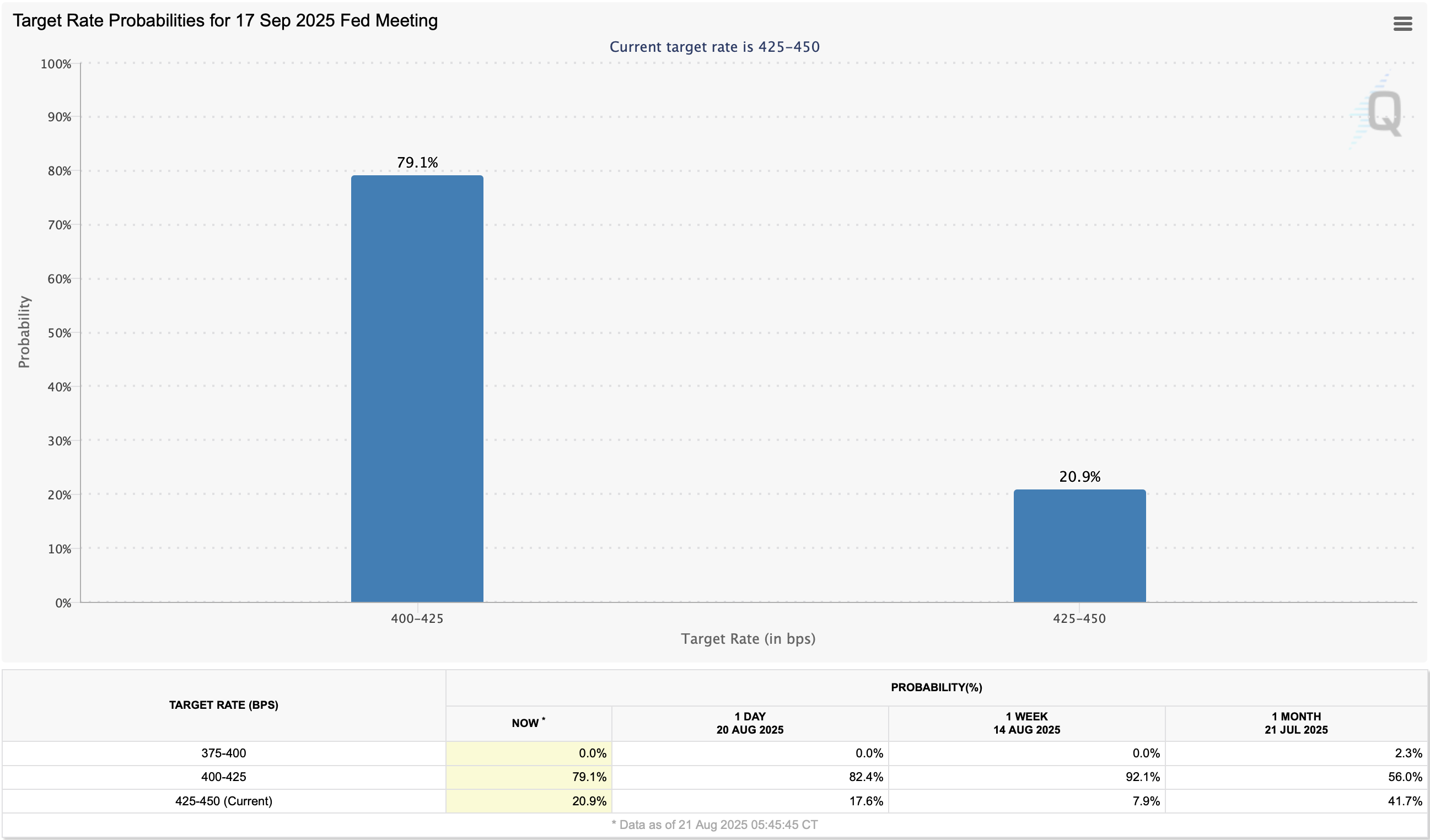
Interestingly, one cannot look at Fed funds futures and conclude this will be the case as the probability of a rate cut next month has actually declined a bit further, now at 79% as per the below chart.  In fact, if you look at the recent history, you can see that just one week ago, that probability was 92% and the week prior to that it was over 100%.

Source: cmegroup.com

There is an irony in the idea that President Trump wants to see the Fed cut rates while describing the economy as doing great.  Arguably, if the economy is doing great with rates where they are, why change them.  The answer, I believe, is the administration’s goal to run the economy as hot as possible with the idea that faster growth in real activity will help overcome the debt problems.  Alas, part of running it hot means that inflation is unlikely to fall much further.  And that, my friends, is the conundrum.  A hot US economy will continue to draw investment and support the dollar’s strength.  While that will help moderate inflation, it will negatively impact manufacturing competitiveness.  And that is the balance that every government wants to control but is impossible to do.  This is the very essence of Triffin’s dilemma.

(PS: if you want to protect against that hotter inflation, a great tool is USDi, the only fully backed, CPI tracking cryptocurrency available.)

Turning from the political, which keeps interfering in the daily financial commentary, to the financial directly, we have continued to see pressure on the semiconductor sector drive US equity markets a bit lower, notably the NASDAQ, which continues to play out elsewhere around the world.  In Asia, the Nikkei (-0.65%) was emblematic of that with the Hang Seng (-0.25%) slipping as well, but in truth, Asia had an overall better performance as Taiwan (+1.4%), Australia (+1.1%) and Korea (+0.4%) all fared well.  I think some of this was a reversal of the previous day’s sharp declines on the semiconductor concerns although Australia was the beneficiary of some solid Flash PMI data.

In Europe, however, all markets are weaker this morning led by the CAC (-0.6%) and IBEX (-0.6%) with the DAX (-0.3%) and FTSE 100 (-0.3%) not quite as badly off after PMI data there showed things were better than last month, but still not particularly great.  It seems the commentary attached to the numbers indicated serious concerns about future activity.  As to US futures, at this hour (7:15) they are modestly lower across the board, on the order of -0.15%.

In the bond market, zzzzzz’s are the story.  While yields have edged slightly higher this morning (+1bp in Treasuries, +2bps to +3bps in Europe), the trend remains a flat line with none of these markets doing anything other than chopping around.

Source: tradingeconomics.com

The one exception here is Japan, which has seen 10-year yields march consistently higher over the past year with the past 10 sessions showing consistently higher yields.  Perhaps their debt chickens are finally coming home to roost.

Source: tradingeconomics.com

Turning to commodities, oil’s (+0.85%) modest bounce continues but it remains nearer the bottom than the top of its recent trading range.  The EIA data yesterday showed a surprisingly large draw in crude oil as well as gasoline stocks with reduced imports, so this does make sense.  In the metals markets, yesterday’s rally is being reversed this morning with the major markets all lower by about -0.4%.

Finally, the dollar remains quite uninteresting excepting two currencies; NOK (+0.6%) which is clearly benefitting from the recent rebound in oil while JPY (-0.4%) is under further pressure as there appears to be an increase in short JPY carry trades being initiated, especially against the dollar as more traders discount the idea the Fed is even going to cut 25bps next month.  Otherwise, there is nothing noteworthy here this morning.

We finally get data this week as follows: Initial (exp 225K) and Continuing (1960K) Claims, Philly Fed (7.0), Flash PMI (Manufacturing 49.5, Services 54.2) and Existing Home Sales (3.92M).  We also hear from Atlanta Fed president Bostic this morning, but I do believe the market remains almost entirely focused on Powell’s speech tomorrow.  Of course, if the semiconductor space continues to underperform, that would be an entirely different kettle of fish and likely create some serious market adjustments.  

Net, it is difficult for me to remain too bearish the dollar overall, especially if the market starts to price out a rate cut in September.

Good luck

Adf

Positioned Quite Well

The Fed is positioned quite well
To leave rates alone for a spell
Employment is stable
Which means they are able
To try, high inflation, to quell


“In discussing the outlook for monetary policy, participants observed that the Committee was well positioned to take time to assess the evolving outlook for economic activity, the labor market, and inflation, with the vast majority pointing to a still-restrictive policy stance. Participants indicated that, provided the economy remained near maximum employment, they would want to see further progress on inflation before making additional adjustments to the target range for the federal funds rate.”

I would say that this paragraph effectively summarizes the Fed’s views during the January FOMC meeting and based on the comments we have heard since, nothing has really changed much.  If anything, there appeared to be more concern over the upside risks to inflation than worries over a much weaker employment picture.  As well, there was some discussion regarding the potential of tariffs impacting prices and economic activity, although they would never be so crass as to actually use the word.

I would argue we don’t know anything more about their views now than we did prior to the Minutes.  Interestingly, they continue to believe that the current policy rate is restrictive even though Unemployment has been sliding, inflation is sticky on the high side and equity and other financial markets continue to make record highs.  Personally, I would have thought the appropriate view would be policy is slightly easy, but then I’m no PhD economist, just a poet.  If we learned anything it is that they are not about to change the way they view the world.  This merely tells me they have the opportunity to double down on previous mistakes.

It’s almost as if
Japanese markets now see
Future yen glory

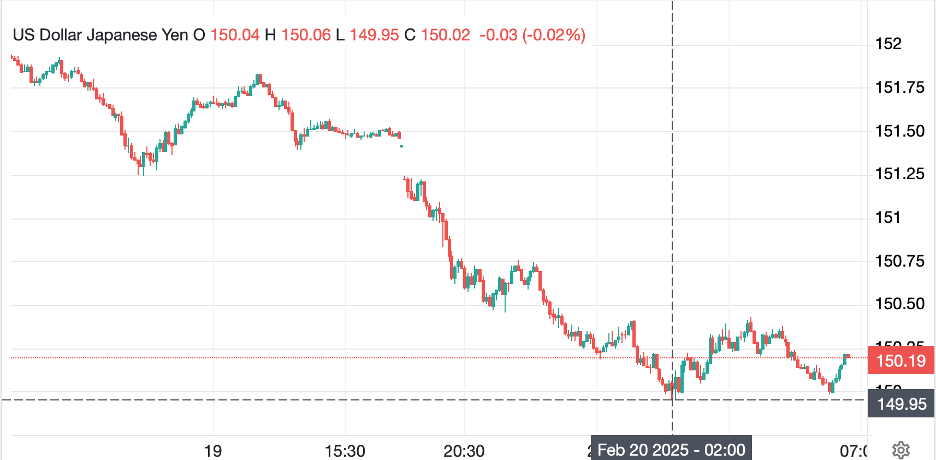
Meanwhile, away from the machinations and procrastinations of the Fed, if we turn East, we can see that last night the yen, for a brief moment, traded through the key 150 psychological level, although it has since edged back higher.  This is the strongest the yen has been in more than two months and, in a way, is somewhat surprising given the strong belief that tariffs imposed against a nation will result in that nation’s currency declining.  But that is not the case right now, where despite mooted tariffs on steel, autos and semiconductors, three things the Japanese export to the US, the yen is climbing again.  

Source: tradingeconomics.com

One of the interesting things about the interest rate market’s response to the FOMC Minutes is that there continues to be an expectation of 39bps of rate cuts this year in the US.  But then, I read the Minutes as somewhat hawkish, obviously a misconception right now.  Meanwhile, in Tokyo, we continue to hear comments from former BOJ members that further rate hikes are coming and the futures market there is pricing 36bps of rate hikes by the end of this year.  So, for now, the direction of travel is diametrically opposed between the Fed and the BOJ.  Last night also saw JGB yields edge higher by another 1bp, to 1.43% and another new high level for this move.  Add it all up and the rate movements are sufficient to be the current FX drivers.

Now, as per my opening discussion regarding the Fed, while I believe that the next move should be a hike, and that gained support from a WSJ article this morning telling us to expect higher rent prices ahead which implies that the shelter portion of US inflation is not going to decline anytime soon, perhaps this is another reason to consider that the dollar may decline.  After all, the textbooks all explain that a high inflation economy results in a weaker currency.  If the Fed is truly going to continue to try to ‘normalize’ rates lower despite rising inflation, that will change my broad view of the dollar, and I suspect it will weaken dramatically.  While the yen is the first place to watch this given the opposing actions by the Fed and BOJ, it could easily spread.

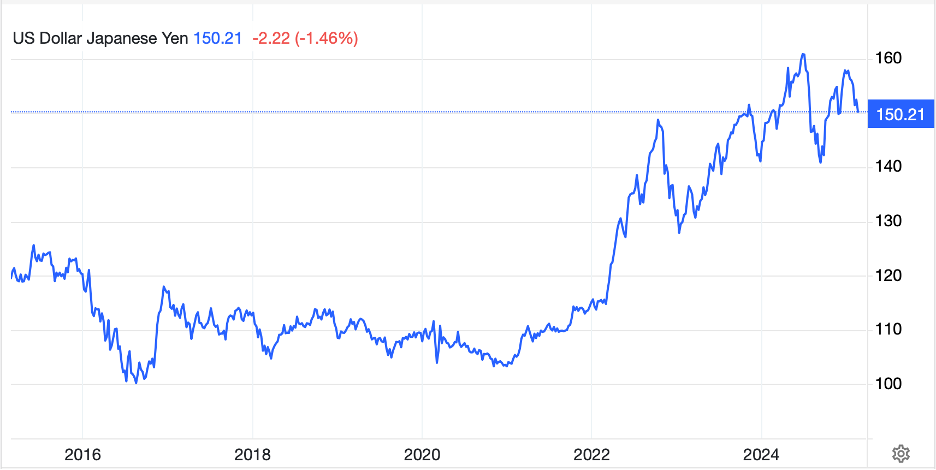
Too, it is important to remember that while we have lately become accustomed to the yen trading in the 140-160 range vs. the dollar, for many years USDJPY traded between 100 and 120 as per the below chart.  While the world has certainly changed, it doesn’t mean that we cannot head back to those levels and spend another decade at 110 give or take a bit.

Source: tradingeconomics.com

Ok, with that in mind, let’s take a look at how markets have handled the new information.  Clearly US equity markets are not concerned about a Fed volte-face as they closed at yet new record highs yesterday, albeit with very modest gains of about 0.2%.  Asian markets, however, were not so sanguine with red the dominant color as the Nikkei (-1.25%) suffered amid that strengthening yen while both the Hang Seng (-1.6%) and mainland (CSI 300 -0.3%) fell despite PBOC promises of more support for the economy and the property market.  If I’m not mistaken, this is the third time the PBOC has said they will be increasing support for property markets and prices there continue to decline.  In fact, every major index in Asia fell overnight, mostly impacted by tariff fears.

Meanwhile, European bourses are all modestly firmer save the UK (-0.4%) as we see a rebound after yesterday’s declines and earnings data from Europe continues to show decent outcomes.  While there is much talk and angst over the Ukraine situation and tariffs, right now given the uncertainty of the timing of any tariffs, as well as the possibility that they may be delayed further or deals may be struck, investors seem to be laying low.  Remember, though, that European equity markets have been outperforming US markets for the past several months, although that could well be because their valuations had become so cheap, we are seeing a rotation into them for now.  As to the US markets, futures are pointing slightly lower at this hour (7:15) down about -0.25%.

In the bond market, yesterday saw Treasury yields cede their early gains and slip 2bps on the session and this morning they have fallen a further 2bps.  Meanwhile, European sovereign yields, after jumping yesterday across the board, are falling back slightly with declines on the order of -1bp or -2bps.

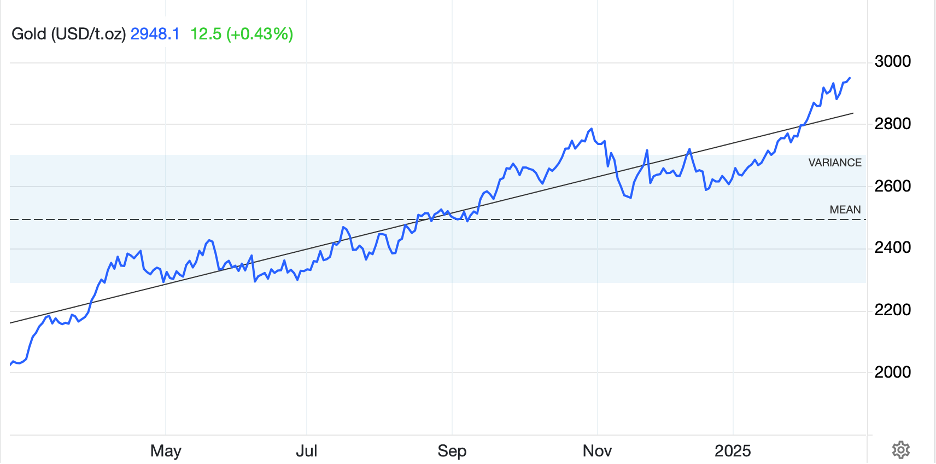
In the commodity market, the one constant is that the price of gold (+0.4%) continues to climb.  Whether it is because of growing global uncertainty, concerns over rising inflation, or technical questions regarding deliveries in NY, it is not clear.  Price action is not volatile, rather it has been a steady climb for more than a year.  just look at the chart below.

Source: tradingeconomics.com

As to the other metals, both silver and copper are also continuing their climb and higher by 1.0% this morning.  Oil (+0.2%) is also edging higher which seems a bit odd given the fundamental news I keep reading.  First, OPEC+ is going to begin increasing production later this year, second, the prospects of a peace deal with Russia seems likely to result in Russian oil coming back on the market sans sanctions, and third, despite talk of Chinese economic stimulus, demand from the Middle Kingdom has not been growing.  Add to this the fact that supply is expected to grow by upwards of 1mm bpd from Guyana, Brazil and Canada, and it seems a recipe for falling prices.  Just goes to show that markets are perverse.

Finally, the dollar is under pressure across the board this morning with the yen (+0.95%) leading the way but commodity currencies (AUD +0.5%, NZD +0.5%, ZAR +0.4%) also showing strength.  In fact, virtually every currency has strengthened vs. the greenback this morning.  Looking at the charts, there is a strong similarity across almost all currencies vs. the dollar and that is the dollar put in a peak back in early January and has been gradually declining since then.  This is true across disparate currencies as seen below and may well represent the market deciding that President Trump would like to see the dollar decline and will enact policies to achieve that end.  (I used USDDKK as a proxy for EURUSD since the two are linked quite closely with a correlation of about 0.99.)

Source: tradingeconomics.com 

As I wrote above, my strong dollar thesis is based on the Fed continuing to fight inflation.  If they abandon that fight, then the dollar will certainly decline!

On the data front, this morning brings Initial (exp 215K) and Continuing (1870K) Claims as well as the Philly Fed (20.0).  In addition to the Minutes yesterday we saw Housing Starts tumble although Permits were solid.  However, there is clearly some concern over the housing market writ large, with fewer first-time buyers able to afford a new home, hence the rent story above.  We have 3 more Fed speakers today but again, I ask, are they going to change their tune?  I don’t think so.  I find it hard to believe that the Fed will allow inflation to rebound sharply, but if they remain focused on rate cuts while inflation continues to creep higher, I fear that will be the outcome.  And that, as I said above, will be a large dollar negative.  We shall see.

Good luck

Adf

Quite a Fuss

Inflation is still somewhat higher
Though currently nor quite on fire
Thus, further reductions
In rates may cause ructions
In markets, which we don’t desire


With regard to the outlook for inflation, participants expected that inflation would continue to move toward 2 percent, although they noted that recent higher-than-expected readings on inflation, and the effects of potential changes in trade and immigration policy, suggested that the process could take longer than previously anticipated. Several observed that the disinflationary process may have stalled temporarily or noted the risk that it could. A couple of participants judged that positive sentiment in financial markets and momentum in economic activity could continue to put upward pressure on inflation.” [emphasis added]

I think this paragraph from the FOMC Minutes was the most descriptive of the evolving thought process from the committee.  Since then, we have heard every Fed speaker discuss the need for caution going forward with regard to further rate reductions although to a (wo)man, they all remain convinced that they will achieve their 2% target while still cutting rates further, just more slowly.  While today is a quasi-holiday, with the Federal government closed along with the stock exchanges, although banks and the Fed are open and making payments, I anticipate activity will be somewhat reduced.  This is especially so given tomorrow brings the NFP data which will be closely monitored given the recent strength seen in other economic indicators.  If that number is strong, I anticipate the market will reduce pricing for future rate cuts towards zero from this morning’s 40bps total for 2025.  This, my friends, will serve to underpin the dollar going forward.

In England, there is quite a fuss
As traders begin to discuss
Can Starmer and Reeves
Address what aggrieves
The nation, or are they now Truss?

The situation in the UK seems to be going from bad to worse.  Even ignoring the horrifying stories regarding the cover-up of immigrant grooming gangs and their actions with young girls, the economic and policy story is a disaster.  While the exact genesis of their fiscal issues may not be certain, the UK’s energy policy, where they have doubled down on achieving Net Zero carbon emissions and continue to remove dispatchable power from their grid, is a great place to start looking.  UK electricity prices are the highest in Europe, even higher than Germany’s, and that is destroying any ability for industry to exist, let alone thrive.  The result has been slowing growth, reduced tax receipts and a growing government budget deficit.

Some of you may remember the Gilt crisis of September/October 2022, when then PM Liz Truss proposed a mini-budget focused on growth but with unfunded aspects.  Confidence in Gilts collapsed and pension funds, who had been seeking sufficient returns during ZIRP to match their liabilities and had levered up their gilt holdings suddenly were facing massive margin calls and insolvency.  The upshot is that the BOE stepped in, bought loads of Gilts to support the price and PM Truss was booted out of office.

While the underlying issues here are somewhat different, the market response has been quite consistent with both Gilts (+5bps this morning, +34bps in past week) and the pound (-0.6% this morning, -2.0% in past week) under significant pressure again this morning.  Unlike the US, with the global reserve currency, the UK doesn’t have the ability to print as much money or borrow as much money as they would like to achieve their political goals.  In fact, the UK is far more akin to an emerging market than a G7 nation at this stage, running a massive fiscal deficit with rising inflation and a sinking currency amid slowing economic growth.  There are no good answers for the BOE to address these problems simultaneously.  Rather, they will need to address one thing (either inflation and the currency by raising rates, or economic activity by cutting them) while allowing the other problem to become worse.  

It is very difficult to view this situation as anything other than a major problem for the UK.  While it occurred before even my time in the markets, back in the 1970’s, the UK was forced to go to the IMF to borrow money to get them through a crisis.  There are some pundits saying they may need to do this again.  For some perspective, the chart below shows GBPUSD over the long-term.

Source: tradingeconomics.com

The history is the pound was fixed at $2.80 at Bretton Woods and then saw several devaluations until 1971 when Nixon closed the gold window, and Bretton Woods fell apart.  The spike lower in the 1970’s was the result of the UK policies driving them to the IMF.  The all-time lows in the pound were reached in 1985, when the dollar topped out against its G10 brethren, and that resulted in the Plaza Accord.  But since then, and in truth since the beginning, the long-term trend has been for the pound to depreciate vs. the dollar.  

It continues to be difficult for me to see a strong bull case for the pound as long as the current government seems intent on destroying the economy.  FX option markets have seen implied volatility spike sharply, with short dates rising from 8% to 13% in the past week while bids for GBP puts have also exploded higher.  Meanwhile, the gilt market cannot find a bid.  Something substantive needs to change and don’t be surprised if it is political, with Starmer or Reeves, the Chancellor of the Exchequer, finding themselves out of office and a new direction in policy.  However, until then, look for both these markets to continue lower.

I apologize for the history lesson, but I thought it best to help understand today’s price action in all things UK.  And that’s really it for discussion.  Yesterday’s mixed US session was followed by weakness in Asia (Nikkei -0.95%, Hang Seng -0.2%, CSI 300 -0.25%) with the rest of the region also lower.  However, this morning in Europe other than the DAX, which is basically unchanged, modest gains are the order of the day.  Surprisingly, the FTSE 100 (+0.55%) is leading the way higher, but given the large majority of companies in this index benefit from a weaker pound, perhaps it is not so surprising after all.

In the bond market, Treasury yields are 3bps lower this morning, although still near recent highs above 4.65%, while European sovereigns continue to rise as the global interest rate structure climbs amid growing concerns nobody is going to adequately address the ongoing inflation.  Even Chinese yields rose 2bps despite CPI data showing deflation at the factory gate continues and consumer demand remains moribund.

Commodity prices are modestly firmer this morning with oil (+0.2%) stabilizing after a sharp decline yesterday on supply concerns after a large build of product inventories in the US.  Metals prices continue to be supported (Au +0.4%, Ag +0.8%, Cu +1.2%) despite the dollar’s ongoing strength as it appears investors want to hold real stuff rather than financial assets these days.

Finally, the dollar continues to climb with most currencies sliding on the order of -0.2% aside from the pound mentioned above and the yen (+0.3%) which seems to be acting as a haven this morning.  Nonetheless, this remains a dollar focused process for now.

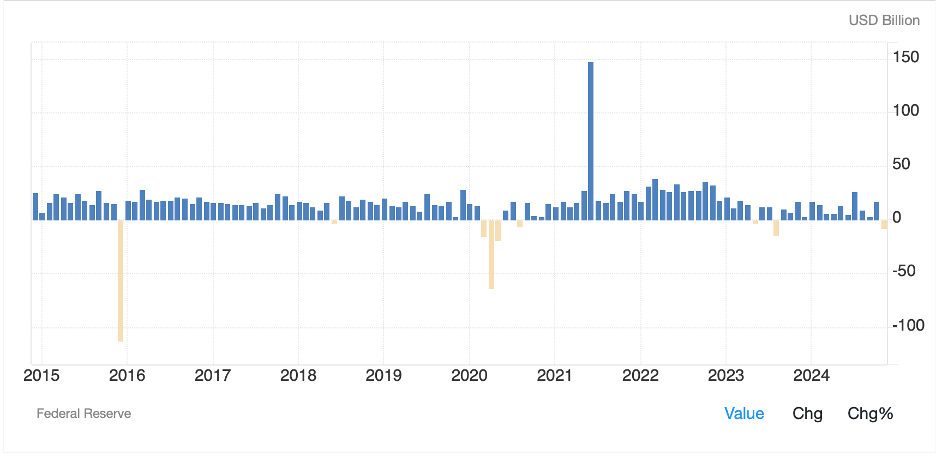
There is no economic data to be released today although I must note that Consumer Credit was released yesterday afternoon and fell -$7.5B, a much worse outcome than expected.  As you can see from the below chart, declining consumer credit, while not completely unheard of, is a pretty rare occurrence.  You can clearly see the Covid period and the best I can determine is the December 2015 decline is a data adjustment, not an actual decline.  The point to note, though, is that despite lots of ostensibly strong economic data, this is a warning.

Source: tradingeconomics.com

I keep looking for something to turn the tables on the dollar, but for now, it is hard to make the case that the greenback is going to suffer in any broad-based manner.  Tomorrow, though, with NFP should be quite interesting.

Good luckAdf

In a Plight

The Minutes explained that the Fed
Is confident, looking ahead
They’ve conquered inflation
Although its duration
May last longer than they had said
 
They still think their policy’s tight
And truthfully, they may be right
But if they are not
And ‘flation’s still hot
They might find themselves in a plight


Below are a couple of key passages from the FOMC Minutes which show that the Fed continues to put on a game face when it comes to their performance.  Although some participants have begun to hedge their bets, it is clear the majority of the committee remains convinced that despite the broad inaccuracies of their models over the past forty four years, they are still on track to achieve their objectives.  

Participants anticipated that if the data came in about as expected, with inflation continuing to move down sustainably to 2% and the economy remaining near maximum employment, it would likely be appropriate to move gradually toward a more neutral stance of policy over time.”

Participants indicated that they remained confident that inflation was moving sustainably toward 2%, although a couple noted the possibility that the process could take longer than previously expected.”  [emphasis added]

And this morning, they will get to see if their confidence has been rewarded with the release of the October PCE data (exp 0.2%, 2.3% Y/Y headline; 0.3%, 2.8% Y/Y core).  One of the tell-tale signs that they are losing confidence is there has been more discussion about the vagaries of where exactly the neutral rate lies as evidenced by the following comment.  

Many participants observed that uncertainties concerning the level of the neutral rate of interest complicated the assessment of the degree of restrictiveness of monetary policy and, in their view, made it appropriate to reduce policy restraint gradually.

Once upon a time, the Fed was the undisputed master of markets, and their actions and words were the key drivers of prices across all asset classes.  However, not dissimilar to what we have seen occur regarding other mainstream institutions and their loss in respect, the same is happening at the Marriner Eccles Building I believe.  Chairman Powell, he of transitory inflation fame, is a far cry from the Maestro, Alan Greenspan, let alone Saint Volcker, and my observation is that more and more market participants listen to, but do not heed, the Fed’s words.

My read is the Fed has it in their mind that they need to continue to cut rates because the committee members have not lived through periods when interest rates were at current levels for any extended length of time.  They still fervently believe that their policy is restrictive, despite all the evidence to the contrary (record high stock prices and GDP expanding above potential) and so seem afraid that if they don’t cut rates they will be blamed for a recession.  I would argue the market interpretation of the Minutes was dovish as shown by the Fed funds futures market increasing the probability of a December cut to 66%.  Remember, Monday it was 52%.  My cynical view is the reason Powell wants to cut is his friends in the Private Equity space are suffering and he wants to help, because really, given both the inflation and economic activity data, it does not appear a cut is warranted.

Turning our attention elsewhere, there is a story going round that China is preparing to fire that bazooka this time…for real.  At least that’s what I keep reading on X, and certainly, Chinese equity markets rallied on something (CSI 300 +1.75%, Hang Seng +2.3%), but I cannot find a news story explaining any of it.  Were there comments from Xi or Li Qiang?  If so, I have not seen them.  While Chinese assets have underperformed lately, that seems to have been a response to the Trump announcements of even more tariff-minded economic cabinet members.  And the currency is essentially unchanged this morning, hanging just above that 7.25 level vs. the dollar which has served as a cap for the past decade.  (see below).

Source: tradingeconomics.com

Keep in mind that the consensus view is if Trump imposes tariffs, the renminbi will weaken enough to offset them very quickly.  Arguably, the dollar’s strength since September, when it briefly traded below 7.00, is a response to first, Trump’s improving prospects to win, and then once he won, his cabinet selections.  Will CNY really decline 5% if tariffs are imposed?  That seems an awful lot, but I guess it’s possible.  It strikes me that hedgers should be looking at CNY puts to manage their risk here.

Finally, a look at Europe shows that the dysfunction on the continent seems to be accelerating.  France is the latest target as the current government is hanging on by a thread with growing expectations that Marine Le Pen’s RN party is going to call for a confidence vote and topple it.  As well, there are growing calls for President Macron to resign as he has clearly lost control.  They are currently running a 6% fiscal deficit (just like the US although without the benefit of the world’s reserve currency) and they already have the highest tax burden in Europe.    With Germany sinking further into its own morass (GfK Consumer Confidence fell to -23.3 and continues to show a nation lacking belief in its future.  Just look at the longer-term chart of this indicator below:

Source: tradingeconomics.com

While Covid was obviously a problem, things seemed to be getting back toward normal until Russia’s invasion of Ukraine in early 2022 sent energy prices higher and laid bare the insanity of their Energiewende policy.  As industry flees the country and politics focuses on the immigration issues ignited by Angela Merkel’s open borders policy, people there truly have little hope that things will get better.  

I cannot look at the situation in both Germany and France, with both nations struggling mightily and conclude anything other than the ECB is going to be cutting rates more aggressively going forward.  Combining that with the ongoing belief that Trump’s policies are going to be dollar positive overall, it seems that the euro has much further to decline.  Do not be surprised to see it break parity sometime early in 2025.

Ok, ahead of the Thanksgiving holiday, let’s look at other markets.  In addition to the gains in Chinese shares, Australia (+0.6%) and New Zealand (+0.7%) had a good session with the latter buoyed by the RBNZ cutting rates the expected 50bps.  However, Japan (-0.8%) was under pressure as the yen (+1.1%) rallied strongly on rumors that the BOJ is getting set to hike rates next month, a bit of a change from the previous viewpoint.  In Europe, the CAC (-1.25%) is the laggard as investors are watching French OATs slide in price (rise in yields) relative to their German Bund counterparts and worrying that if the government does fall, there is no way for things to work without the RN involved.  But the DAX (-0.6%) is also softer as is the rest of the continent.  Only the UK (0.0%) is holding up this morning.   meanwhile, at this hour (7:10), US futures are pointing slightly lower, just -0.15% or so.

In the bond market, Treasury yields (-4bps) continue to slide as investors are going all-in on the idea that proposed Treasury Secretary Bessent will be able to solve the intractable problems current Secretary Yellen is leaving him.  This decline is helping European sovereign yields slide as well, as they decline between -1bp and -3bps.  However, a quick look at the chart below shows the above-mentioned Bund-OAT story and how that spread is the widest it has been in many years.

Source: tradingeconomics.com

In the commodity space, oil (+0.2%) is settling in just below $70/bbl as it becomes clear that OPEC+ is not going to be raising production anytime soon.  NatGas (-4.8%) has suffered this morning on warmer weather in Europe, but the situation there remains dicey at best, and I think this has further to run.  In metals markets, gold (+0.8%) is continuing to rebound from Monday’s wipeout, having recouped about half of the move, and we are also seeing strength in silver and copper on the China stimulus story.

Finally, the dollar is under pressure again this morning with the yen and NZD (+1.1%) leading the way although the euro (+0.3%) and pound (+0.3%) are having solid sessions as well.  In the EMG bloc, MXN (-0.3%) continues to be pressured by the tariff talk although much of the rest of the bloc is following the euro’s lead and edging higher.  My sense here is that there are quite a few crosscurrents pushing the dollar around so on any given day, it is hard to tell what will happen.  However, I still am looking for eventual further dollar strength, especially given the Fed seems to be far less likely to cut aggressively.

On the data front, yesterday’s new Home Sales were horrific, falling -17.3% and indicating the housing market is beginning to struggle.  I think that is one of the reasons the rate cut probability rose.  As to the rest of today’s data beyond PCE we see the following: 

Personal Income0.3%
Personal Spending0.3%
Q2 GDP2.8%
Durable Goods0.5%
-ex Transport0.2%
Initial Claims216K
Continuing Claims1910K
Goods Trade Balance-$99.9B
Chicago PMI44.0

Source: tradingeconomics.com

With the holiday, there are no Fed speakers scheduled and Friday, exchanges are only open for a half-day.  There continues to be a very positive vibe overall, with retail investors the most bullish they have ever been according to several banking surveys.  As well, there continues to be a positive vibe from the Trump cabinet picks which has many people expecting great things.  As I said yesterday, I hope they are correct.

My concerns go back to the fact that I just don’t see inflation declining like the Fed projects and that is going to have some negative market impacts along the way.  The one inflation positive is that I see oil prices with the opportunity to fall further, although demand for NatGas should keep that market underpinned.  As to the dollar, I’m still looking for a reason to sell it and none has been presented.

There will be no poetry on Friday so please have a wonderful Thanksgiving holiday and we get to see how things play out come Monday.

Good luck and good weekend

Adf

Clouded and Blurry

The Minutes explained twenty-five
Would likely still let markets thrive
But Powell demanded
A half, lest they landed
The ‘conomy in a crash dive


Yesterday’s release of the FOMC Minutes was enlightening to the extent it showed Chairman Powell did not have everybody in agreement for his 50bp rate cut last month.  In the Fed’s own words, “…a substantial majority of participants supported lowering the target range for the federal funds rate by 50 basis points to 4-3/4 to 5 percent.  However, noting that inflation was still somewhat elevated while economic growth remained solid and unemployment remained low, some participants observed that they would have preferred a 25 basis point reduction of the target range at this meeting, and a few others indicated that they could have supported such a decision.”  

Remember, too, that this meeting was held two days prior to the NFP report which changed a great deal of thinking on the subject, not least by the Fed funds futures market which as of this morning is pricing a 20% probability of no cut at the November meeting.  Looking at the GDPNow calculation from the Atlanta Fed, that NFP number increased the estimate to 3.4%, although recent inventory data has seen it slip back a tick as you can see below.  

Source: atlantafed.org

Despite that last little dip, though, the estimate remains far stronger than economists’ forecasts and paints a picture of a resilient economy.  (Perhaps adding $1.8 trillion via the budget deficit has something to do with that, but that is a story for a different time.). While the Fed is clearly anxious, if not desperate, to cut rates further, the economic case, with inflation remaining above their targets and the employment situation looking better amid solid economic growth, seems to be waning.

Three weeks ago, Jay and the Fed
Said joblessness was their, flag, red
Explaining inflation
Had taken vacation
So, more cutting rates was ahead
 
This morning we’ll learn if that’s true
Or if, like employment, their view
Is clouded and blurry
Which could cause some worry
For bulls and for Biden’s whole crew

Which leads us to the other key market story today (clearly the devastation from Hurricane Milton is the most important news of the day and my thoughts and prayers go to all those in its path), the CPI report.  Current consensus expectations are for a 0.1% rise in the monthly headline reading which translates to a 2.3% Y/Y increase and a 0.2% rise in the monthly core reading which translates into a 3.2% Y/Y increase.  

Looking at some obvious pieces of the puzzle, gasoline prices fell 8.4% in September, which is one of the reasons the headline number is below the core number.  The thing is, gasoline prices this morning are almost exactly where they were at the beginning of September, which informs us that the headline number could easily retrace somewhat next month.  The point is, we need to keep our eye on the core number (after all, the reason they created it was because food and energy prices were volatile and monetary policy’s impact on them virtually nonexistent, so they needed something that might give them a better feel for the reality elsewhere).  And I don’t know about you, but if the target is 2.0% then 3.2% doesn’t seem that close.  I know they are focused on core PCE, but even that remains well above their target.

One of the stories around this morning is that used car prices have stopped declining and that could have an outsized impact resulting in a higher than otherwise reading.  But in reality, I question whether this matters at all.  What we have learned from the Fed over the past month is that they are going to cut rates no matter what.  While the pace of those cuts may be faster or slower depending on some data, every Fed speaker this week, and even a review of the Minutes, points to the fact that they are all desperate to keep cutting rates.

But you know who is taking exception to that stance?  The bond market.  Perhaps the bond vigilantes of late 90’s fame have been resurrected, or perhaps investors are simply looking at the fiscal situation in the US, where deficit spending continues to increase which means more and more Treasury debt will need to be issued and decided that even 4.0% is no longer a reasonable nominal return on their investment.

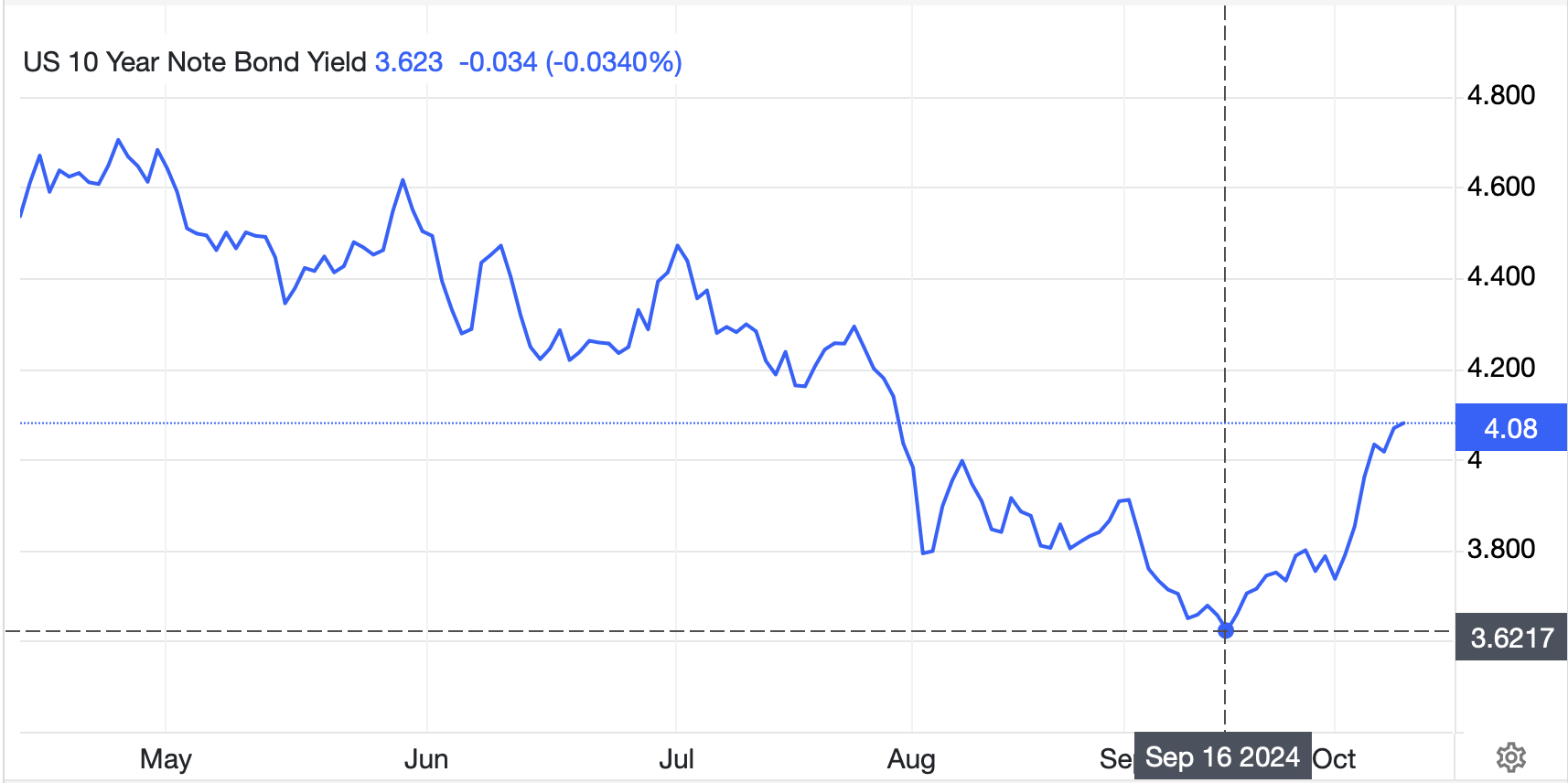
As you can see below, 10-year Treasury yields have risen 46bps since just before the last FOMC meeting as the stronger US data combined with the Fed’s clear focus on cutting rates has made investors nervous.  

Source: tradingeconomics.com

You may recall the discussion about the inverted yield curve, where 2yr yields traded above 10yr yields for more than two full years, a record amount of time.  This fostered many recession calls as historically this has been a harbinger of a future recession.  However, a key question was whether the disinversion would be a bull (falling 2yr yields) or bear (rising 10yr yields) steepener.  Things started as a bull steepener with the Fed cutting rates, but lately, as we watch 10yr yields rise, fears are growing that inflation is making a comeback and the bond bears are going to drive this process.  A bear steepening is not going to be a welcome result for Powell and friends, nor especially for Ms Yellen, as the cost of debt will continue to rise.  It also speaks to concerns that the Fed has lost control of the narrative.  It is still too early to declare the outcome, but the original, widely held view of a bull steepener is fraying at the seams.

Ok, let’s quickly touch on overnight markets.  Yesterday’s US rally saw follow through in Japan (+0.25%) alongside a weakening yen (-0.75% yesterday, +0.2% this morning) and in China (+1.1%) and Hong Kong (+3.0%) after the PBOC detailed the support they would be giving to equity market players and indicated that more could follow.  As to the rest of the region, there were more gainers than laggards but nothing of real note.  In Europe, although most markets are little changed on the day, if leaning slightly lower, Spain’s IBEX (-0.9%) is the outlier on what seems to be profit taking ahead of the US CPI number after a strong 5-day run higher.  And at this hour (7:10) US futures are pointing slightly lower, about -0.2%.

In the bond market, yields continue to climb around the world with Treasuries adding 1bp and most of Europe seeing yields rise 2bps – 3bps.  The largest mover there, though is the UK (+6bps) as the market there prepares for Chancellor Rachel Reeves’ first budget and implies they are not expecting fiscal prudence.  In Japan, JGB yields rose 2bps and are now at 0.94% as given the turnaround in rates globally, expectations are growing for the BOJ to consider another hike.  In fact, ex-BOJ member Kazuo Momma was quoted last night saying that if USDJPY goes back above 150, the BOJ is likely to move before the January meeting currently expected.

Commodity markets are taking a breather from their recent rout with oil (+1.4%) leading the energy group higher while gold (+0.4%) leads the metals complex.  It has been a rough week for commodity bulls (this poet included) but nothing has changed the long-term picture in my view.  This is especially true if the Fed does cut rates regardless of the stronger data.

Finally, the dollar is continuing to show strength with the DXY pushing back to 103 and the euro back down near 1.09.  It seems clear the market is adjusting its views as to how much the Fed is going to cut based on the data, not the Fedspeak, and that turn, from an uber dovish Fed to one less dovish is going to support the greenback.  ZAR (+0.45%) is this morning’s outlier as it follows gold prices higher, but that is the largest movement across either the G10 or EMG blocs.  It seems everybody is awaiting the CPI data.

In addition to the CPI, we see the weekly Initial (exp 230K) and Continuing (1830K) Claims data and we hear from Gvoernor Lisa Cook, one of the more dovish Fed governors.  But for now, it is all CPI all the time.  My take is a soft number will be seen as a signal the Fed will be cutting aggressively and help stocks and commodities while undermining the dollar with a strong number doing the opposite.  Bonds, though, are much trickier here as I think there are a lot of fiscal concerns being priced in, and lower inflation won’t solve that problem in the short run.

Good luck

Adf

Unnerved

The Claims data last week preserved
The markets, which had been unnerved
By thoughts that Japan
Did not have a plan
To exit QE unobserved
 
Now yesterday’s data revisions
To Payrolls cemented decisions
That when Powell speaks
He’ll say, “in four weeks
Rate cuts are quite clear in my visions”


Well, the big news was that the BLS revised down the number of new jobs created between April 2023 and March 2024 by 818K, not far from the extreme calls of 1MM.  Alas, this has become more of a political talking point than an economic one with claims of subterfuge on the part of the current administration in an effort to flatter their record.  From an economic perspective, however, to the extent that we believe this data is accurate, it offers a far greater case for the Fed to cut rates next month.  After all, the strong labor market had been one of the key rationales for the Fed to maintain higher for longer, so if that market is not as strong as previously believed, lower rates would be appropriate.

In addition to the NFP revisions, which had gotten virtually all the press, the FOMC Minutes of the July 31stmeeting were also released.  It turns out that according to those Minutes, the discussions in the room included several members calling for a cut at that meeting, and unanimity in a cut by September.  That feels a bit more dovish than the post-meeting press conference where Powell wouldn’t commit to a September cut, seemingly trying to retain some optionality.  Now, the market has been pricing in a full 25bp cut since a week before the last meeting, so it’s not as though people have been fooled.  And we are still looking at a 30% probability of a 50bp cut in September, but to this poet, absent a negative NFP reading in two weeks’ time, September is going to bring a 25bp cut.

Here’s the thing, though, will it matter?  It certainly won’t have any impact on the economy for any appreciable time (remember those long and variable lags) although it could be a signaling event.  But exactly what does it signal?  If the economy is truly robust, why cut?  If the economy is weakening quickly, or not as strong as previously thought, then why just 25bps?  In the big scheme of things, 25bps has exactly zero marginal impact on economic activity.  If they were to explain they are entering a series of more aggressive rate cuts to accommodate weakening growth, well that seems like a signal they don’t want to send either, especially politically.  One final thought, when things are going well in the economy, nobody is talking about any kind of ‘landing’, whether soft or hard.  The very fact people are discussing a ‘soft-landing’ is recognition that the economy is slowing down.  I believe that most of us understand that is the case, but for the media to inadvertently admit that is the case in this manner speaks either to their stupidity or their cupidity.

Ok, so how did markets respond to these two stories?  The first thing to note is that while the NFP revisions were scheduled to be released at 10:00, they were a bit late.  As you can see in the chart below, there was an immediate jump in the equity market, which slowly retraced until the Minutes were released and then the dovishness was complete, and we saw a steadier appreciation.  

A green line graph with numbers and a black dot

Description automatically generated

Source: Bloomberg.com

Net, the clear belief from the investment community was that the Fed is more dovish than they have been letting on, and so equity markets in the US rallied on the day.  Once again, that followed through in Asia, where pretty much all markets except mainland China (CSI 300 -0.25%) followed suit with the Hang Seng (+1.45%) the leader, but strength throughout the region overall.  In Europe, Flash PMI data was released this morning showing that Germany continues to stumble, especially in the manufacturing sector, and that the whole of Europe is lackluster at best.  While the Olympics seemed to help French services output, net, there is not much excitement.  The upshot is that ECB members are talking up further rate cuts and the result is European bourses are gaining some ground this morning, but only on the order of 0.2%.  As to US futures, they are little changed at this hour (7:15).

In the bond market, yields are edging higher with Treasury yields up by 2bps and similar gains across Europe and the UK.  In truth, I would have expected European yields to slide a bit on the PMI data, but clearly that is not the case.  Interestingly, 10yr JGB yields slipped lower by another 1bp as the market there prepares for testimony by BOJ Governor Ueda tonight.  In a truly unusual event, the Diet (Japan’s congress) called him in to testify before both the Lower and Upper houses even though it is technically not in session.  It seems they are very concerned about his hawkishness and how it impacted Japanese stock markets and the yen two weeks ago.  (As an aside, I cannot imagine something like that happening in the US, it would be extraordinary given the ostensible independence of the Fed.)

Turning to commodity markets, after falling 1% further yesterday, oil (+0.5%) is bouncing slightly, although it remains far closer to the lower end of its trading range than even the center.  Gold (-0.3%) continues to hang around just above $2500/oz but has not made any real headway above since it first broke through that level last Friday.  A very interesting X thread on this subject by Jesse Colombo (@TheBubbleBubble), a pretty well-known commentator on markets (167K followers on X),  highlighted that while gold has made new all-time highs vs. the dollar, it has not done so vs. other currencies and that process needs to be completed to see a more significant move.  I raise this idea because if/when it occurs, it is likely to be a signal of far more distress in the economy and markets than we are currently seeing.  As to the rest of the metals complex, they are having lackluster sessions as well, with copper ceding -1.0% and silver (-0.15%) a touch softer.

Finally, the dollar refuses to collapse completely despite the growing view that the Fed is getting set to embark on a series of rate cuts.  While both the euro (-0.2%) and pound (+0.1%) are little changed this morning, both sit near 1-year highs vs. the dollar.  The thing about both these currencies that has me concerned is that energy policies currently being implemented in both Germany and the UK, with many other continental countries going down the same path, are almost guaranteed to destroy all manufacturing capability and force it to leave for somewhere with lower energy prices.  While both of those economies are clearly services driven, I assure you that the destruction of manufacturing capacity is going to have long-term devastating impacts on those nations, and by extension their currencies.  Just something to keep in mind.  Elsewhere, the yen (-0.6%) is slipping today and has been in a fairly tight range since the pyrotechnics from two weeks ago.  But we are also seeing weakness in ZAR (-0.75%), NOK (-0.5%) and SEK (-0.4%) to name a few, and general weakness, albeit in the -0.2% to -0.3% range across the rest of the G10 and EMG blocs.  The dollar is not dead yet.

On the data front, this morning brings Initial (exp 230K) and Continuing (1870K) Claims as well as the Chicago fed National Activity Index (.03) at 8:30.  Later this morning, Flash PMIs (manufacturing 49.6, services 53.5) are due and then Existing Home Sales (3.93M) finishes things off.  There are no scheduled Fed speakers but then all eyes are on Jackson Hole tomorrow when Chairman Powell speaks.

Given what we learned yesterday regarding both the labor market and the last FOMC meeting, it seems clear the Fed is going to cut 25bps next month.  Of more interest, I believe, will be the way Powell lays out his vision for what needs to occur for the Fed to continue the process and his guideposts.  Remember, they are still shrinking the balance sheet, albeit slowly, but cutting rates and reducing liquidity simultaneously may have unintended consequences.  If they stop shrinking the balance sheet, though, I believe the market will view that as a very dovish signal, and the dollar would fall sharply.  I’m not saying that’s what I expect, just that would be the result.  But for today, it is hard to believe we see a large move ahead of tomorrow’s speech.

Good luck

add

Just Swell!

The markets were truly surprised
As yesterday’s Minutes advised
That higher for longer
Intent was much stronger
Than prior belief emphasized
 
The market response was to sell
Risk assets and thus, prices fell
But after the close
Nvidia rose
And now everything is just swell!


It turns out that Chairman Powell’s press conference had a distinctly more dovish feel to it than the tone of the FOMC meeting at the beginning of the month.  At least that appears to be the situation based on the Minutes of the meeting that were released yesterday afternoon.  In truth, it is somewhat surprising that given all the comments we have heard by virtually every member of the FOMC in the intervening three weeks, a reading of the Minutes resulted in altered opinions of how policy would evolve going forward.

While every Fed speaker has maintained the view that higher for longer remains the baseline, at the press conference, Powell essentially ruled out further rate hikes.  But in the Minutes, it turns out “various” members indicated a willingness to raise rates if necessary.  In addition, “a few” members would have supported continuing the QT process at the previous $60 billion/month runoff rather than adjusting it lower.  Finally, “many” questioned just how restrictive current monetary policy actually is, and whether it is sufficient to drive inflation back to their target.  Net, it appears there was quite a lively discussion in the room and the hawks are not willing to be ignored.

With this more hawkish stance now more widely understood, it cannot be surprising that risk assets sold off yesterday afternoon.  While I grant that the equity declines were modest, between -0.2% and -0.5% in the US, the tone of conversation clearly changed.  Meanwhile, the real damage occurred in the commodity markets where the recent sharp rise in metals prices ran into a proverbial buzzsaw and all of them fell sharply.  For instance, gold fell -1.5% yesterday and is lower by another -0.7% this morning.  Silver was a bit more volatile, losing -3.0% yesterday and down a further -1.25% today and the king of this move was copper, which tumbled more than -4% yesterday although it seems to be basing for now.

While there are several pundits who are describing these commodity price moves as a reaction to the dollar’s rebound, I actually see it more as a response to the idea that the Fed may be willing to fight inflation more aggressively than previously thought.  Remember, a key to the metals markets’ rally is the idea that the Fed is going to allow inflation to run hotter than target going forward, with 3% as the new 2%, and the widely mooted rate cuts would simply hasten that outcome.  In that scenario, ‘real’ stuff will retain its value better than paper assets and metals are as real as it gets.  However, if the Fed is truly going to stay the course and is willing to raise rates further to achieve their 2% goal, that is a very different stance which will support the dollar and paper assets far better.

Of course, none of this really mattered because the most important news yesterday was after the equity market close when Nvidia reported even stronger than expected results and also split their stock 10:1.  And, so, all is now right in the universe because…AI!  

Alas, this poet is not an equity analyst and has no useful opinion on the merits of the current valuations of AI stocks, so I will continue to focus on the macroeconomic story and try to interpret how things may evolve going forward.

Keeping in mind that the Fed may well be more hawkish than previously thought, that is quite a change in mindset compared to most other central banks where rate cuts appear far more likely as the summer progresses.  For instance, yesterday Madame Lagarde explained, “I’m really confident that we have inflation under control. The forecast that we have for next year and the year after that is really getting very, very close to target, if not at target. So, I am confident that we’ve gone to a control phase.”  This is her rationale for essentially promising, once again, that the ECB will cut rates next month.  However, we continue to get pushback from the ECB hawks that a June cut does not mean a July cut or any other cuts afterwards.  Now, I am inclined to believe that while they may skip July, they will cut again in September and probably consistently after that.

Of course, this is a very different stance than what was indicated by the FOMC Minutes, and I expect that there should be a greater divergence between European and US markets going forward because of this.  In fact, I am quite surprised that the FX market has not taken this to heart and that the euro remains as well bid as it is.  While the single currency has slipped about 2% since the beginning of the year, it is higher this morning by 0.2% and well above the lows seen back in mid-April.  Today’s price action has been driven by slightly better than expected Flash PMI data, but the big picture strikes me that there is more room for the euro to fall than rise.

And really, isn’t that the entire discussion overall, relative policy stances by the main central banks?  I continue to see that as the key driving force in markets at this time, and the macro data helps inform what those stances are likely to be.  If the US growth story is accelerating vs. other G7 countries, then we should expect to see continued outperformance by US assets and the dollar.  However, if the rest of the G7 is catching up, perhaps those tables will turn.  While PMI data has not been a particularly good indicator lately, the fact that European data (and Japanese data overnight) were slightly better than forecast may be an indication that things are changing.  Later this morning we will see the US version (exp 50.0 Manufacturing, 51.3 Services, 51.1 Composite) so it will be interesting to see if the market responds to any surprises there.

As to the rest of the overnight session, markets in Asia were mixed with more gainers (Japan, India, South Korea, Taiwan) than laggards (China, Hong Kong, Australia) with the gainers generally benefitting from somewhat better than expected PMI data and the laggards the opposite.  European bourses are mostly higher on the back of that better data as well.  As to US futures, at this hour (7:30) Nvidia has pulled the entire complex higher with the NASDAQ (+1.1%) leading the way.

In the bond markets, most major countries have seen essentially zero movement this morning with the UK (-3bps) the one exception as the PMI data there was a touch softer than expected.  Of course, you may recall that yields rose sharply in the UK yesterday after the hotter than expected CPI data, so this is a bit of a give-back.  JGB yields, interestingly, slipped back 1bp and are now back below 1.00% despite a modestly better than expected PMI reading.

Oil prices (+0.7%) are bouncing slightly after a string of down days and despite slightly larger than expected inventory builds in the US.  But for now, it seems clear there is ample supply.  And, of course, we already discussed the metals markets.

Finally, the dollar is a touch softer overall this morning with most of the movement as you might expect.  For instance, NOK (+0.7%) is rallying alongside oil and adding to the dollar’s broad weakness.  However, ZAR (-0.5%) remains beholden to the metals complex and is still under pressure.  Of minor note is the fact that the CNY fixing last night at 7.1098 was the weakest renminbi fix since January and some are claiming this is a harbinger of the PBOC relaxing its control of the currency.  While that may be true, I suspect it will be extremely gradual.  And the yen continues to tend weaker, not stronger, as the interest rate differential is too wide for traders and investors to ignore.  As well, it is fair to ask if Japan is really concerned about the level of the yen, or if they truly are only concerned with a slow and steady movement.  

Before the PMI data, we see Initial (exp 220K) and Continuing (1799K) Claims and the Chicago Fed National Activity Index (0.16).  Then, at 10:00 we see New Home Sales (680K) which are following yesterday’s much softer than expected Existing Home Sales data.  It seems clear that there is an ongoing problem in the housing market.  Finally, this afternoon, Atlanta Fed president Rafael Bostic speaks, and it will be quite interesting to hear his views now in the wake of the Minutes.

While actions speak louder than words, yesterday’s FOMC Minutes certainly have given me pause regarding my view that they were going to ease policy more quickly than inflation data may warrant.  That should help support the dollar and keep pressure on risk assets.  Of course, given the ongoing euphoria over AI and the Nvidia earnings, I don’t expect equity traders to care much about that at all.

Good luck

Adf

Likely Passé

The markets continue to snooze
Although today we’ll get some news
But Home Sales don’t spark
A narrative arc
About which most folks would enthuse
 
As well, given all that they’ve said
Those dozens of folks from the Fed
The Minutes today
Are likely passé
So, markets will head back to bed


Another very lackluster session yesterday resulting in marginal equity gains in the US as the dearth of new information continues to weigh on trading volumes and overall activity.  Of course, the one thing we did get yesterday was another tsunami of Fedspeak but all of it was the same as what we have already heard.  There is no need to go into details but suffice to say that the theme remains, April’s CPI reading was encouraging, but not nearly enough to consider rate cuts soon.  Instead, while they all believe that inflation will continue to head back to their 2% goal (although none of them have explained why they believe that) it appears that the first cut is not likely to be warranted before the fourth quarter.  In fact, it seems that several FOMC members are lining up with a December cut in mind although the Fed funds futures market continues to price a 60% probability of that first cut coming in September.

But here’s the thing I don’t understand; why are they so keen to cut rates at all?  This is the actual language in the Federal Reserve Act as amended in 1977 [emphasis added]:

“The Board of Governors of the Federal Reserve System and the Federal Open Market Committee shall maintain long run growth of the monetary and credit aggregates commensurate with the economy’s long run potential to increase production, so as to promote effectively the goals of maximum employment, stable prices and moderate long-term interest rates.”

As is typical with legislation, there is no specificity as to what each of these terms mean and thus, they are open to interpretation by each Fed chair.  For instance, prior to 2012, the concept of stable prices did not have a numeric attachment, and, in fact, when Alan Greenspan was Fed chair, he explicitly mentioned that 0% inflation was indicated.  However, Ben Bernanke determined that in the wake of the GFC, a numeric definition would be appropriate and that is how we got the 2% target.

On the employment question, the economic concept of NAIRU (non-accelerating inflation rate of unemployment) had been the north star for the Fed for decades and that number had typically been estimated at 5% +/- a bit.  The concept is that there is a theoretical unemployment rate below which wage pressures will rise and drive inflation higher and above which the opposite will occur.  However, just like the Fed’s other imaginary friend, R*, NAIRU is not observable, and nobody knows where it is.  Recent indications are that it is at a much lower level than previously thought as evidenced by the fact that Unemployment (ignoring the pandemic activity) was able to hover below 4% without any inflationary pressures of note.  At least that was true until the pandemic response flooded the economy with massive amounts of liquidity and funding directly to the population via stimulus checks.  But, as I said, nobody really knows what that level is, and so the concept of maximum employment is extremely nebulous.

Finally, moderate long-term interest rates are another bridge too far for the Fed given its ordinary operations.  While the Fed clearly controls the short end of the curve via the Fed funds markets and its interest payments on reserves, the long end of the interest rate curve is a completely different story.  Certainly, QE was a direct effort to impact long-term interest rates and was quite successful at lowering them, although the definition of moderate remains missing in action.  For instance, a look at the below chart with data from the FRED database shows that the long-term average 10-year yield (my definition of long-term interest rates in this context) is 5.56%.

Source: data FRED database; calculations @fx_poet

With this in mind, the current level of 4.45% or so remains relatively low, not high, and so the idea that rate cuts are necessary to meet the Fed’s mandate seems disingenuous at best.  This is especially true given that inflation is still well above their target of 2%.  Unless there has been a complete sea change of economic theories at the Fed where suddenly higher interest rates are inflationary*, not deflationary, it seems that there is something else at play here.

In the end, my point is that Fedspeak, which is widely followed, usually highlights that there is no guiding star as to what they want to achieve.  As well, their definitions are apt to change quickly if there is a perceived political expedient.  However, I will say that at the current moment, it certainly appears the entire committee is on the same page and wants to cut rates but cannot come up with an excuse they believe the market will accept as real.

Essentially, this was all a preamble to today’s FOMC Minutes release, which given just how much Fedspeak there has been between the meeting and today indicates there is very little new information likely to be revealed.  In the meantime, markets overall remain quiet and rangebound with commodities the lone exception.

Equity markets overnight were mixed in Asia while European bourses are marginally lower (albeit still near all-time highs) and US futures are essentially unchanged yet again.  Bond yields are rising a bit with Treasuries higher by 3bps and European yields higher by 4bps with an outlier UK rise of 10bps after a much hotter than expected inflation reading this morning (3.9% vs. 3.6% expected) reduced the chance of a rate cut next month.  And finally, 10-year JGB yields broke through the 1.00% level last night although the JPY (-0.15%) is actually weaker on the news.

Commodities, though, continue to be the most interesting story around with oil (-0.7%) slipping further after a bigger than expected inventory build from the API data as well as news that the Biden administration is looking to release a portion of gasoline inventories into the market to lower prices ahead of the election.  In the metals markets, the big three are softer again this morning (Au -0.4%, Ag -085%, Cu -2.3%) although on the charts, all remain above key support levels.  It can be no surprise that they are consolidating after their massive runs of the past week or two.

Finally, the dollar is tracking Treasury yields higher with strength almost across the board.  The notable exception is NZD (+0.4%) which has rallied after the RBNZ, while maintaining interest rates unchanged, was far more hawkish in their commentary and indicated they discussed further rate hikes given inflation’s stubbornness overall.  But otherwise, ZAR (-0.8%) is the worst performer, which given the metals market moves should be no surprise, but the dollar’s strength is otherwise universal.

On the data front, as well as the Minutes this afternoon, we see Existing Home Sales (exp 4.21M) at 10:00 and then the EIA oil inventory data at 10:30.  Mercifully, there are no Fed speakers scheduled today, although I wouldn’t be surprised if one gets interviewed somewhere.

Rumors of the dollar’s demise seem badly overblown, and it remains tightly linked to the move in US yields.  Unless we see yields take a serious step lower, I suspect the dollar is likely to remain well bid overall.

Good luck

Adf

*As an aside, several years ago Turkish President Erdogan made this case and kept firing central bankers who wanted to raise interest rates in Turkey to fight their significant inflation problems.  At that time, the economics profession ridiculed the idea completely.  However, lately, there have been a number of articles published that have made the case Erdogan was correct.  Of course, that seems to be an effort to encourage the Fed to cut rates despite high inflation.  As of yet, this brainworm has not infected Chairman Powell, but who knows what will happen as the election approaches.

Bears’ Great Dismay

Their confidence clearly was lacking
So, now on rate cuts they’re backtracking
As well, they’re concerned
Some banks have not learned
To manage their risk and need smacking
 
But really the news of the day
Is AI remains the key play
NVIDIA beat
And all of Wall Street
Is buying to bears’ great dismay
 
Starting with the FOMC Minutes, the two things that stood out to me were these two lines, “The staff provided an update on its assessment of the stability of the U.S. financial system and, on balance, characterized the system’s financial vulnerabilities as notable. The staff judged that asset valuation pressures remained notable, as valuations across a range of markets appeared high relative to fundamentals.”  Arguably, this was why the Fed removed the line from the statement about “The U.S. banking system is sound and resilient,” which had been included since the Silicon Valley Bank debacle.  Perhaps they see something amiss.  As well, there was discussion regarding the timing of the end of QT with July seeming to be the latest thinking for its initial reduction.  But otherwise, as evidenced by the fact that virtually every Fed speaker has indicated they lack confidence inflation is dead, and that while policy is currently restrictive, it is still too soon to think about cutting rates, was clearly the broad theme of the meeting.  Next week we see the PCE data so perhaps that can change some opinions, but right now, given what we have just seen from CPI/PPI, they cannot have gained confidence it is time to cut.
 
As to NVIDIA, huge results, beating expectations and the word from the CEO is that demand will outstrip supply at least through the end of the year.  The market response here has been as one would expect; a big rally in stocks, especially tech.  ‘Nuff said.
 
Nikkei all-time high
Thirty-four years in waiting
Has finally come

Under the heading a picture is worth 1000 words, behold the relationship between NVIDIA and Nikkei 225 (chart from Weston Nakamura’s Across the Spread substack):

Pretty tight correlation, no?  Arguably, the question is which is driving which?  Does a stronger Nikkei drive NVIDIA’s performance or the other way around?  The first thing to note is that breaking down the Nikkei’s performance, similar to the NASDAQ, there are a handful of AI related stocks that have been the drivers of the move.  If you read Nakamura-san’s take, he believes that it is the Nikkei which is driving things, but I would argue while the Nikkei’s move happens earlier in the global day, the reality is that everything is an echo of the current AI craze which NVIDIA started.  

The next question is, just how long can this continue?  Remember two things here; first, trees don’t grow to the sky, and neither will NVIDIA’s stock; and second, new technologies take MUCH longer to assimilate than the initial hype would have you believe.  We are already seeing issues with Google’s Gemini AI with respect to drawing remotely accurate historical images of US presidents, as an example.  We are still in the very early innings of the AI phenomenon and there will be more hiccups along the way.  One last thing regarding AI is its power consumption, which is off the charts high.  If the world is going to be run by AI, we need a lot more electricity than is currently being produced and that alone will slow its incorporation into things.

Ok, on to more macro views, last night and this morning saw the release of the Flash PMI data all around the world.  Of the seven major releases thus far, only India is in expansion with it continuing to motor along in the low 60’s.  Otherwise, everything else (Australia, Japan, Germany, France, the Eurozone and the UK) are all in contraction in manufacturing.  Services is more mixed with several slightly above the 50 boom/bust line, but overall, while things might be seen as slightly improving, they are still pointing to recessions in Europe, Japan and the UK.

Despite this weakening data, virtually every one of these nations’ currencies is stronger vs. the dollar this morning.  In fact, the dollar is having a pretty rough session, down between 0.3% and 0.5% against most G10 counterparts with a slightly smaller decline vs. its EMG counterparts.  One of the odd things about this is that US yields have not really fallen much (Treasuries -1bp) which is right in line with the price action in European sovereigns and what we saw overnight in Asia across the board.

Add to the bond story the message from the Fed of higher for longer and it doesn’t appear that interest rates are today’s driver of the markets.  We already have seen that equity markets are rocking with the Nikkei (+2.2%), Hang Seng (+1.5%), CSI 300 (+0.9%), and most of Europe higher by 0.9% or more.  US futures, of course, are really flying with the NASDAQ (+2.2%) leading the way, but everything in the green.  I grant that a typical risk-on reaction is a weaker dollar but given the amount of funds that are flowing into the US equity markets, it is very hard to understand why the dollar is under pressure.  Something seems amiss.

If we look at the commodity markets, energy is softer across the board with oil (-0.2%) edging lower and basically unchanged on the week, while NatGas (-2.7%) is suffering as well.  As to the metals markets, gold (+0.2%) is edging higher on the back of the weaker dollar but both copper and aluminum are little changed on the day, less than 0.1% different from yesterday’s closing levels.  

Perhaps this is the new risk-on look, strong equity markets, a weak dollar and nobody cares about bonds.  But bonds have been far too important a driver of market activity to suddenly be ignored.  Now, yesterday, the Treasury auctioned some 20-year bonds and it did not go well, with a tail of 3.3bps, implying demand for the long-end remains tepid.  Given my personal view on inflation, that makes perfect sense, but arguably, the longest duration assets around are tech stocks and the divergence between bonds and those stocks is hard to reconcile.  I guess we will learn more as time progresses, but for now, I would be at least a little wary.  Absent a change in the inflation narrative back to the Fed has won, it does feel like there is still some risk to be seen.

On the data front, this morning brings the Chicago Fed National Activity Index (exp -0.15) which is a comprehensive view of financial conditions around the country and closely followed by the Fed.  As well we get Initial (218K) and Continuing (1885K) Claims and the Flash PMI’s (50.5 Manufacturing, 52.0 Services).  We close with Existing Home Sales (3.97M) and the oil inventory data and throughout the day we hear from four different Fed speakers, Jefferson, Harker, Cook and Kashkari.  Will any of this data matter?  I doubt it.  Can we expect anything new from the Fed speakers?  I kind of doubt that as well as there has been exactly zero evidence that the economy is slowing and dragging inflation lower since last week’s CPI and PPI data.   So, look for that lack of confidence in the demise of inflation to be widespread.

As to the dollar, something doesn’t smell right today.  I feel like it should be better bid and expect that by the end of the day, it will see that type of movement.

Good luck

Adf