Like a Fable

It seems there’s a deal on the table
To end the shut down and enable
The chattering classes
To force feed the masses
A story that’s quite like a fable
 
Both sides will claim they have achieved
Their goals, though they were ill-conceived
But markets will love
The outcome above
All else, and we’ll all be relieved


While the shutdown is not technically over as the House of Representatives need to reconvene (they have been out of session since September 19th when they passed the continuing resolution) and adjust the bill so that it matches the one the Senate agreed last night and can be voted on in the House, it certainly appears that the momentum, plus President Trump’s imprimatur, is going to get it completed sometime this week. 

The nature of the deal is unimportant for our purposes here and both sides will continue to claim that they were in the right side of history, but the essence is that there appeared to be some movement on health care funding so, hurray!

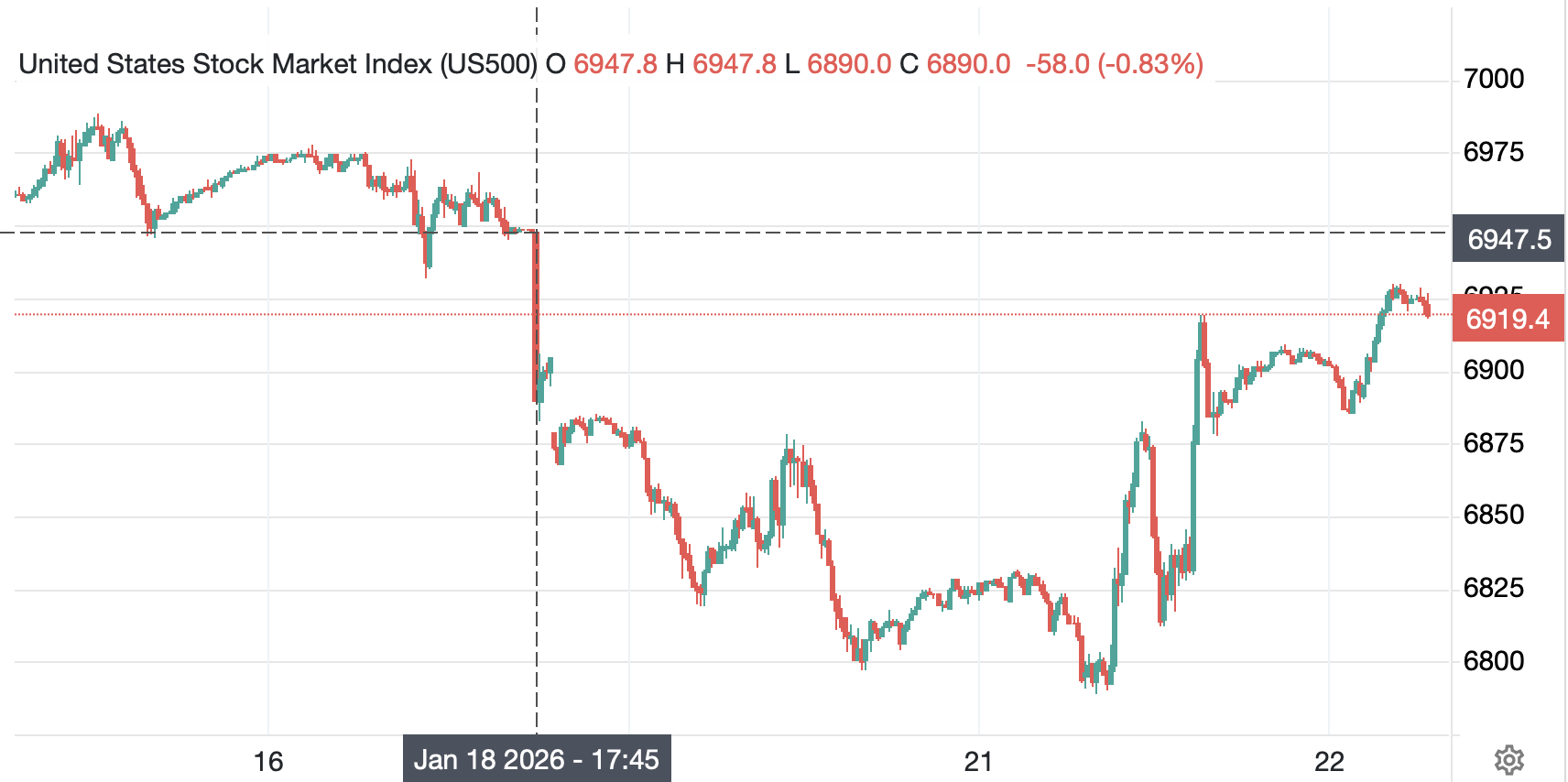
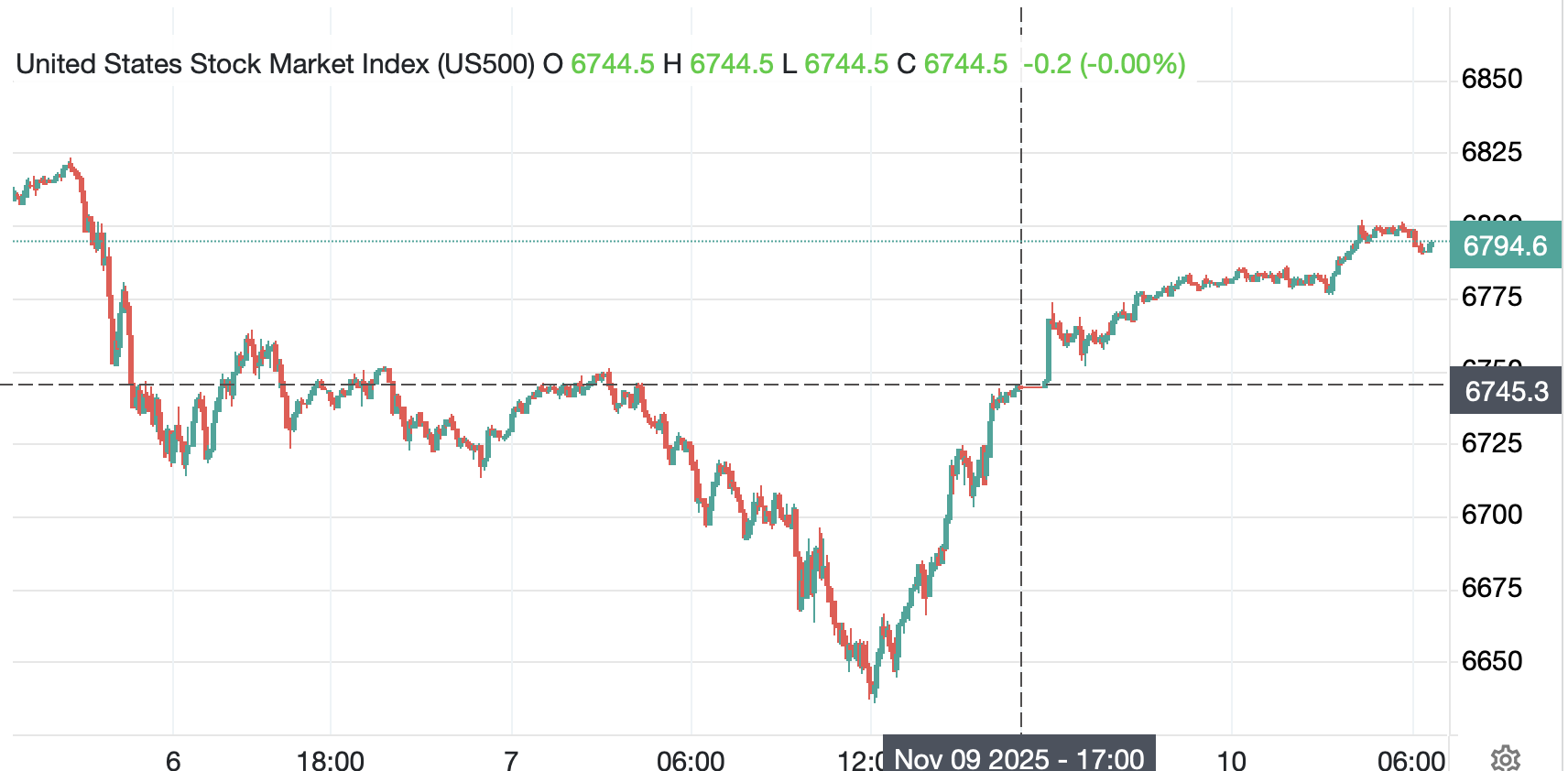
As you can see in the chart below, while the story broke late yesterday afternoon and futures responded on the open in the evening session, the reality is the market sniffed out something was coming around noon on Friday.  In fact, the S&P 500 has rallied 2.4% since noon Friday.

Source: tradingeconomics.com

So, everything is now right with the world, right?  After all, this has been the major topic of conversation, not just by the talking heads on TV, but also in markets as analysts were trying to determine how much damage the shutdown was doing to the economy.  While I have no doubt that there were many people who felt the impact, my take is there were many, many more who felt nothing.  After all, the two main features were air travel and then SNAP benefits.  Let’s face it, on average (according to Grok) about 2.9 million people board airplanes in the US, well less than 1% of the population, although SNAP benefits, remarkably, go to 42 million people.  However, those have only been impacted for the past week, not the entire shutdown.

I’m not trying to make light of the inconveniences that occurred, just point out that from a macroeconomic perspective, despite the fact that the shutdown lasted 6 weeks, it probably didn’t have much of an impact on the statistics as all the money that wasn’t spent last month will be spent next month.  Different analyst estimates claim it will reduce Q4 GDP by between 0.2% and 0.5% with a concurrent impact on the annual result.  I am willing to wager it is much less.  However, it appears it will have ended by the end of the week and so markets are back to focusing on other things like AI, unemployment and QE.

Now, those three things are clearly important to markets, but I don’t think there is anything new to discuss there today.  Rather, I would like to focus on two other issues, one more immediate and one down the road, which may impact the way things evolve going forward.

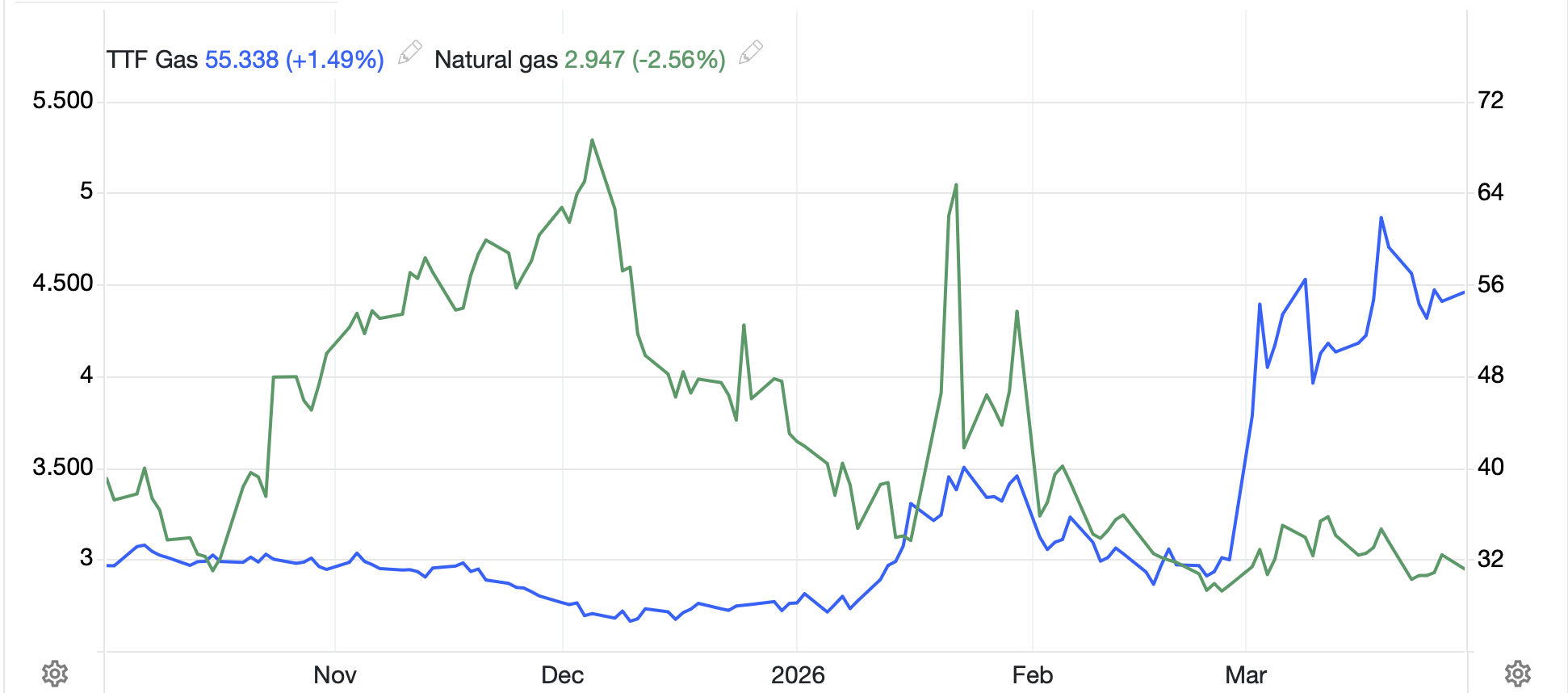
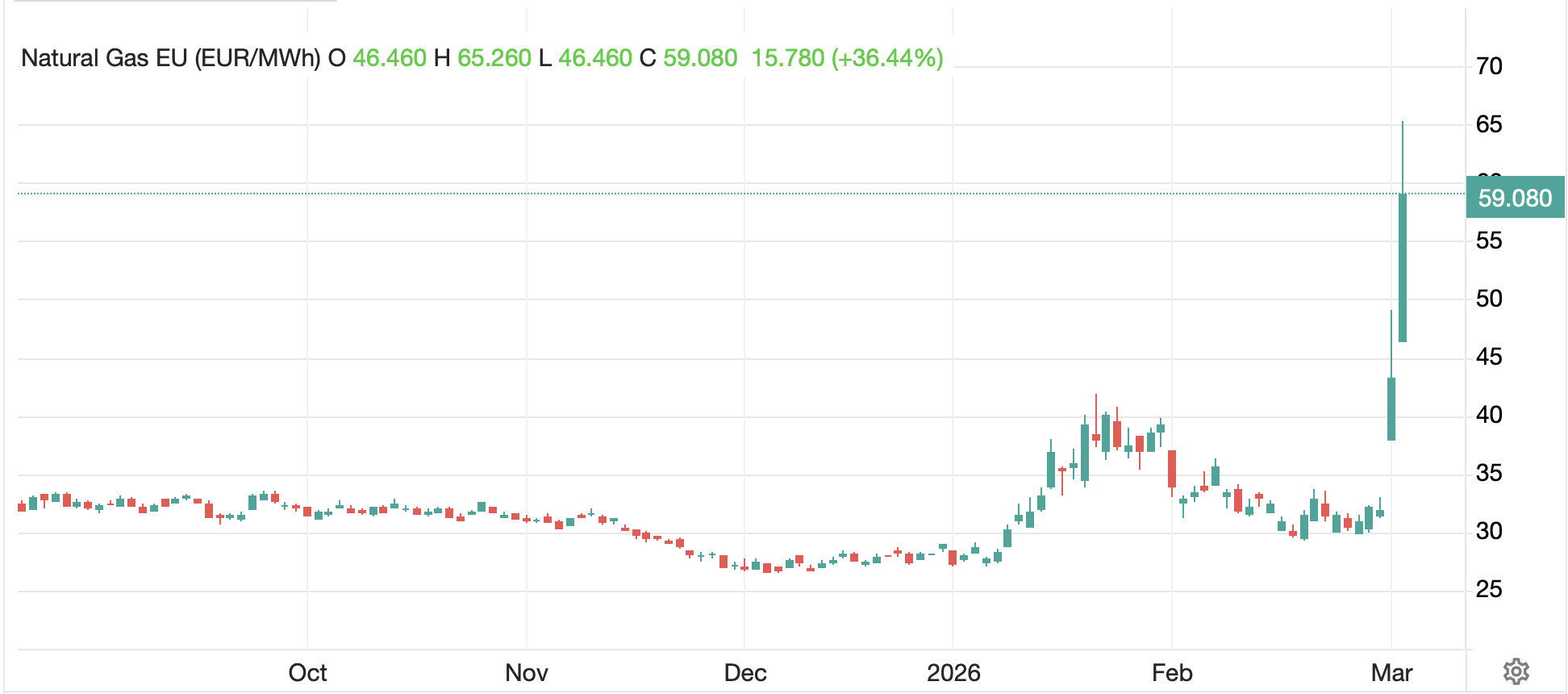
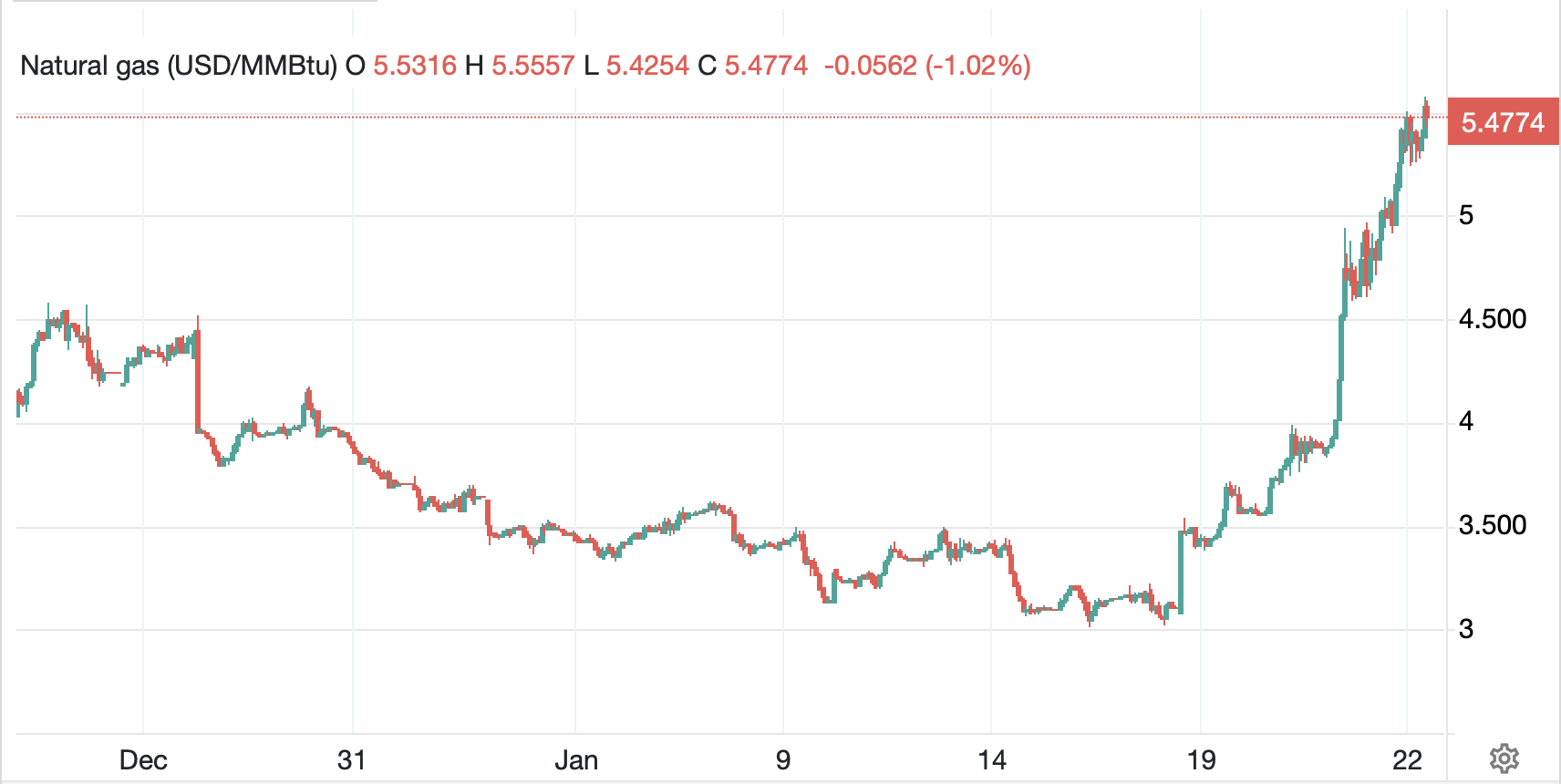
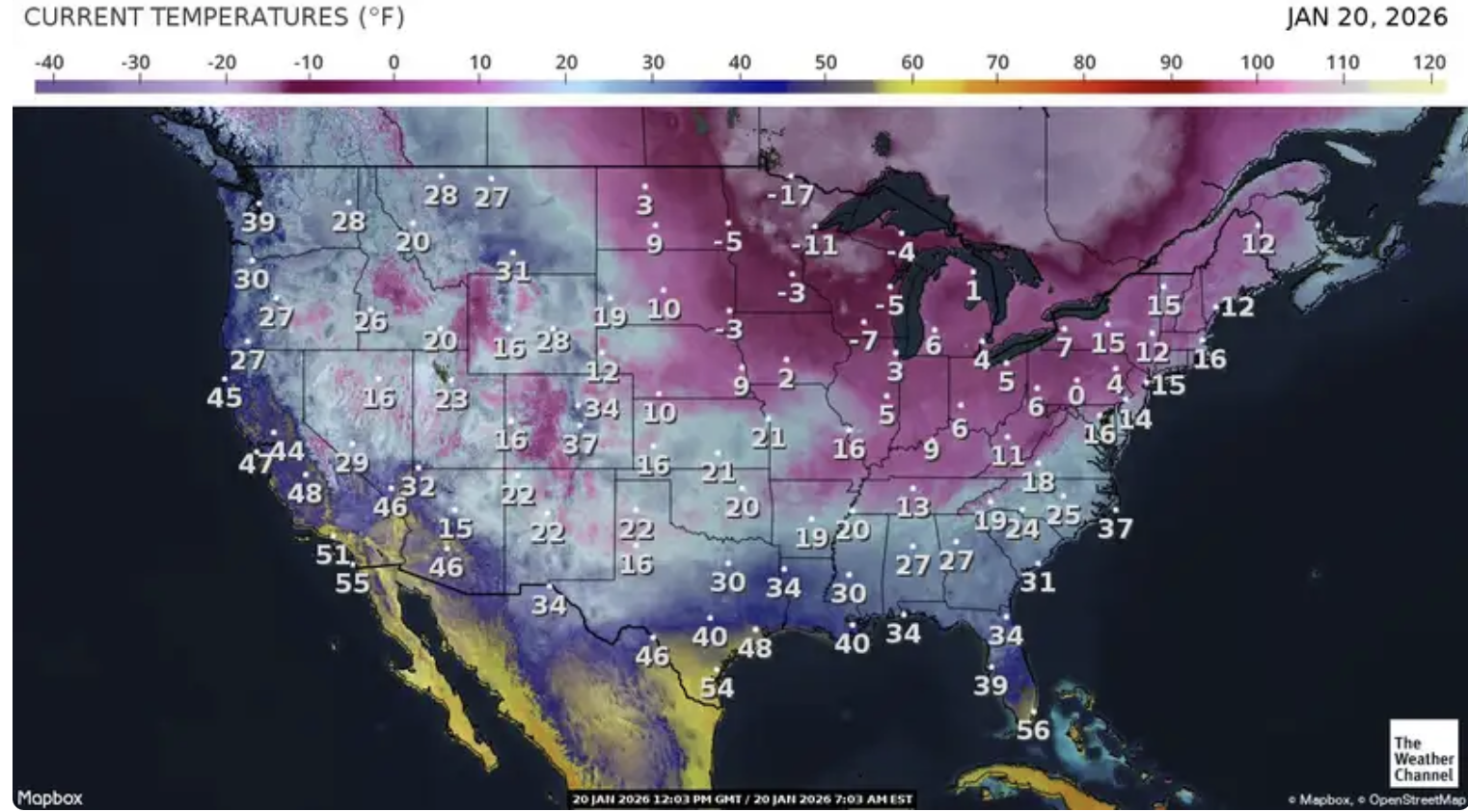
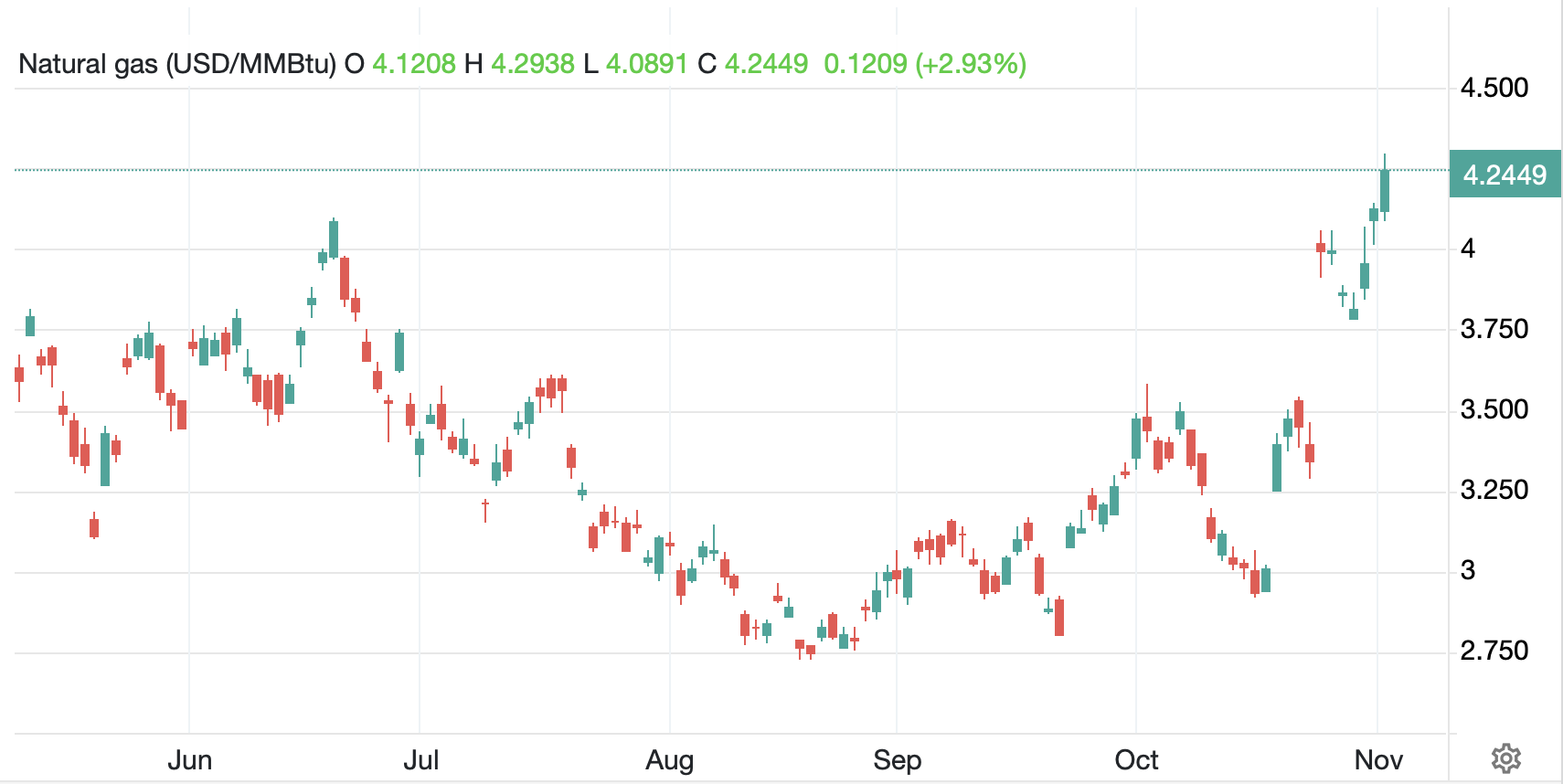
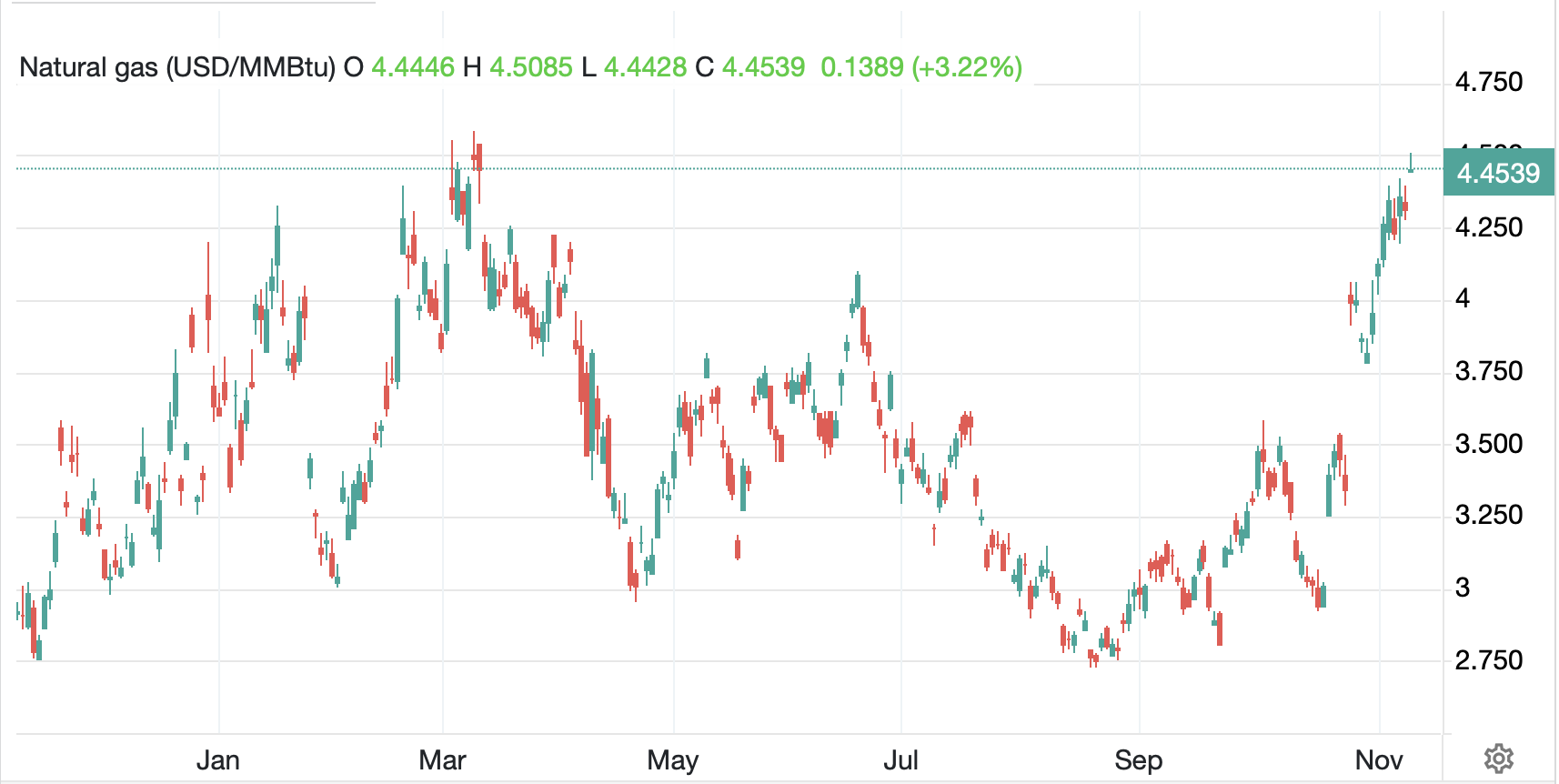
In the near term, as winter approaches, meteorologists are forecasting a much colder winter in the Northern Hemisphere across both North America and Europe, something that is going to have a direct impact on NatGas.  Bloomberg had a long article on the topic this morning with the upshot being that the Polar Vortex may break further south early this year and bring a lot of cold weather along for the ride.  This is clearly not new news to the NatGas market, as evidenced by the fact that its price has exploded (no pun intended) higher by 43% in the past month!

Source: tradingeconomics.com

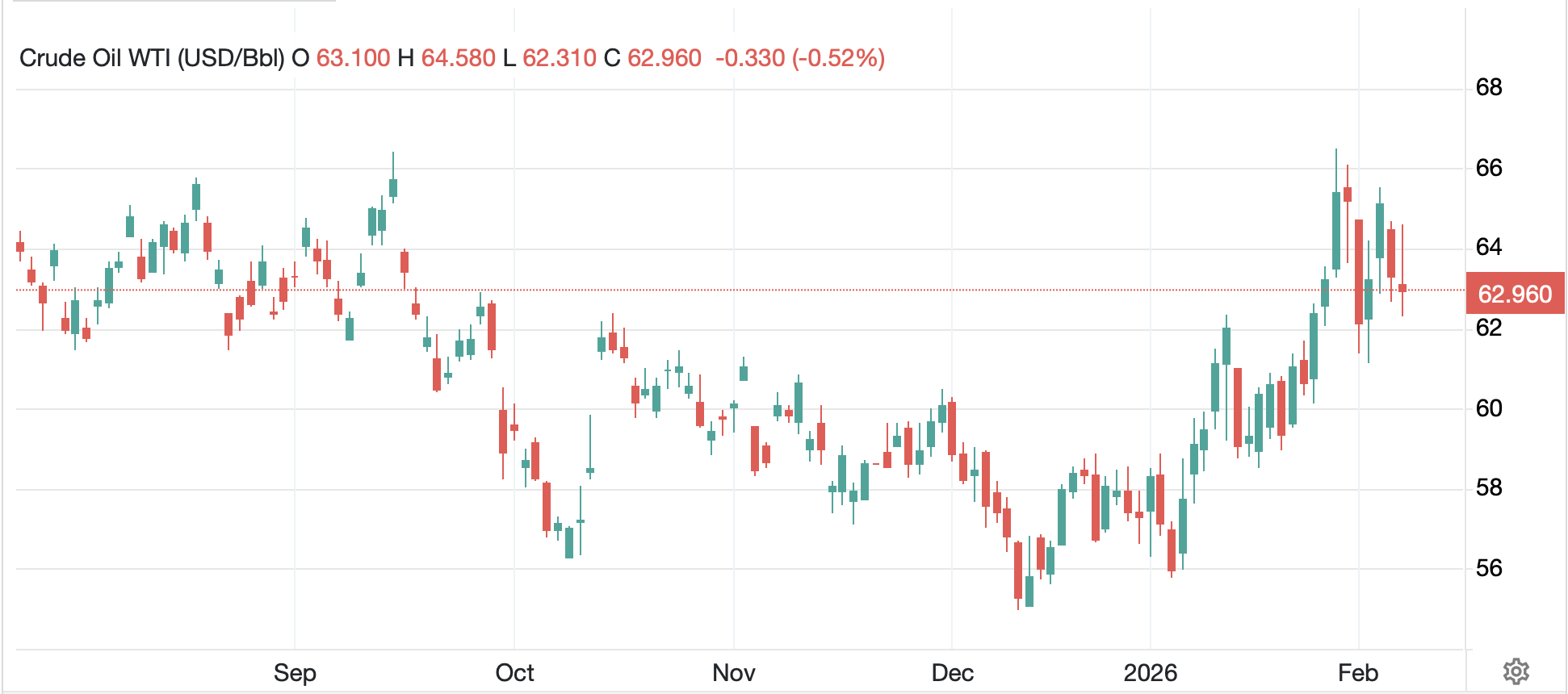
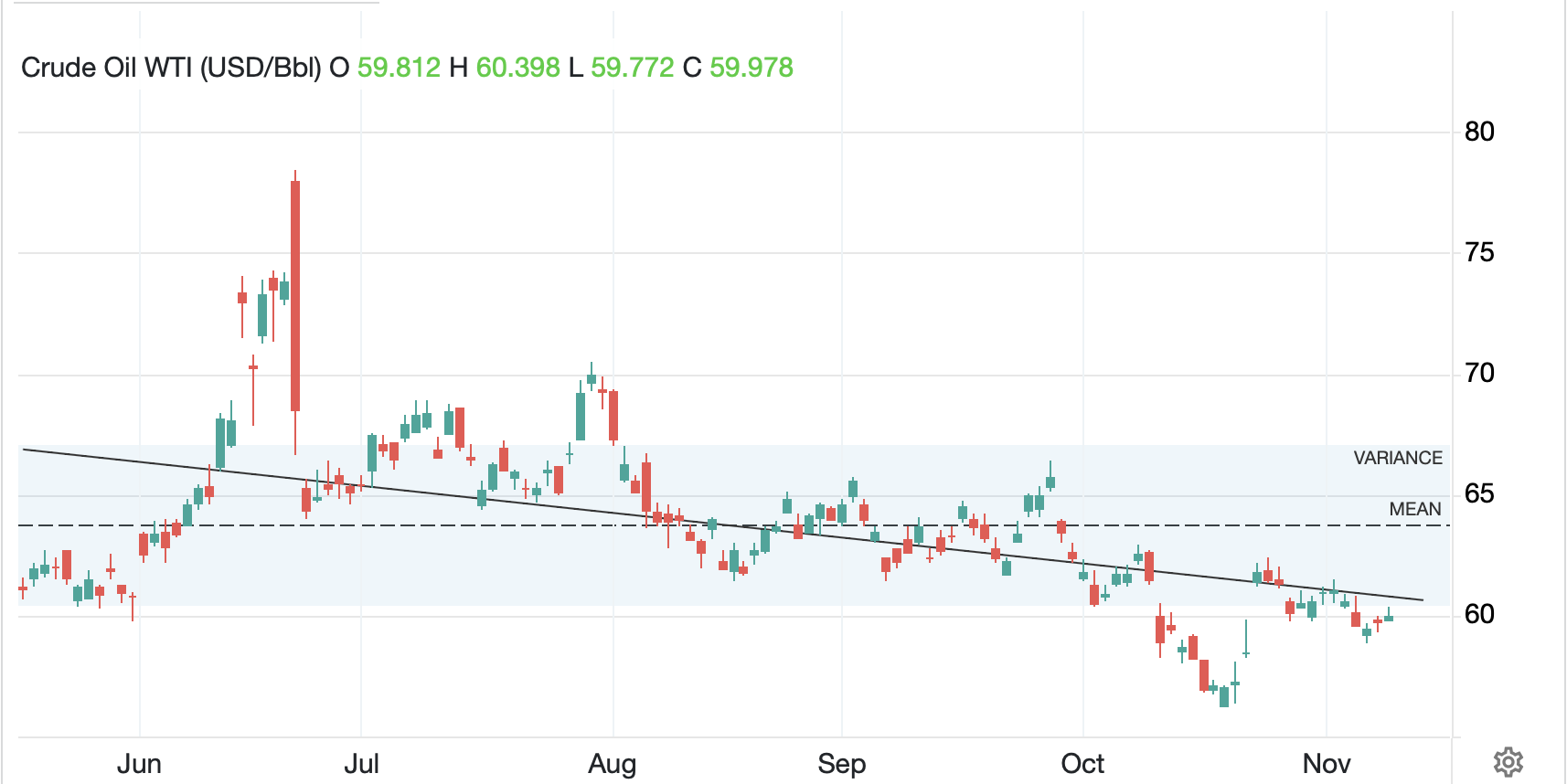
While oil prices have remained stuck in a narrow range, trading either side of $60/bbl for the past 6 weeks amid a longer-term drift lower as you can see in the below chart, oil is only utilized by ~4% of homeowners for heating with 46% using NatGas.

Source: tradingeconomics.com

Ultimately, I suspect that we are going to see this feed through to inflation as not only are there the direct costs of heating homes, but NatGas is also the major source of generating electricity, with 43% of the nation’s electricity using that as its source.  We have already seen electricity prices rise pretty sharply over the past months (I’m sure you have all felt that pain) and if NatGas prices continue to climb, that will continue.  Remember, the current price ~$4.45/MMBtu is nowhere near significant highs like those seen just 3 years ago when it traded as high as $10/MMBtu.  With all this price pressure, will the Fed continue down their path of rate cuts?  Alas, I believe they will, but that doesn’t make our lives any better.

Which takes me to the second, longer term issue I wanted to mention, European legislation that is seeking to effectively outlaw the utilization of cash euros.  This substack article regarding recent Eurozone legislation is eye-opening as the ECB and Europe try to combat the coming irrelevance of the euro.  For everyone who either lives in Europe or does business there, I cannot recommend reading this highly enough.  There are many changes occurring in financial architecture, and by extension financial markets.  Keep informed!

Ok, enough of that, let’s see how markets have responded to the Senate deal.  Apparently, US politics matters to the entire global equity market.  Green is today’s color with Japan (+1.25%), HK (+1.55%) and China (+0.35%) all performing well, although not as well as Korea (+3.0%) which really had a good session.  Pretty much all the other regional markets were also higher.  In Europe, the deal has everyone excited as well with gains across the board (Germany +1.8%, France +1.4%, Spain +1.4%, UK +1.0%).  As to US futures, at this hour (7:45) they are higher by about 1% across the board.

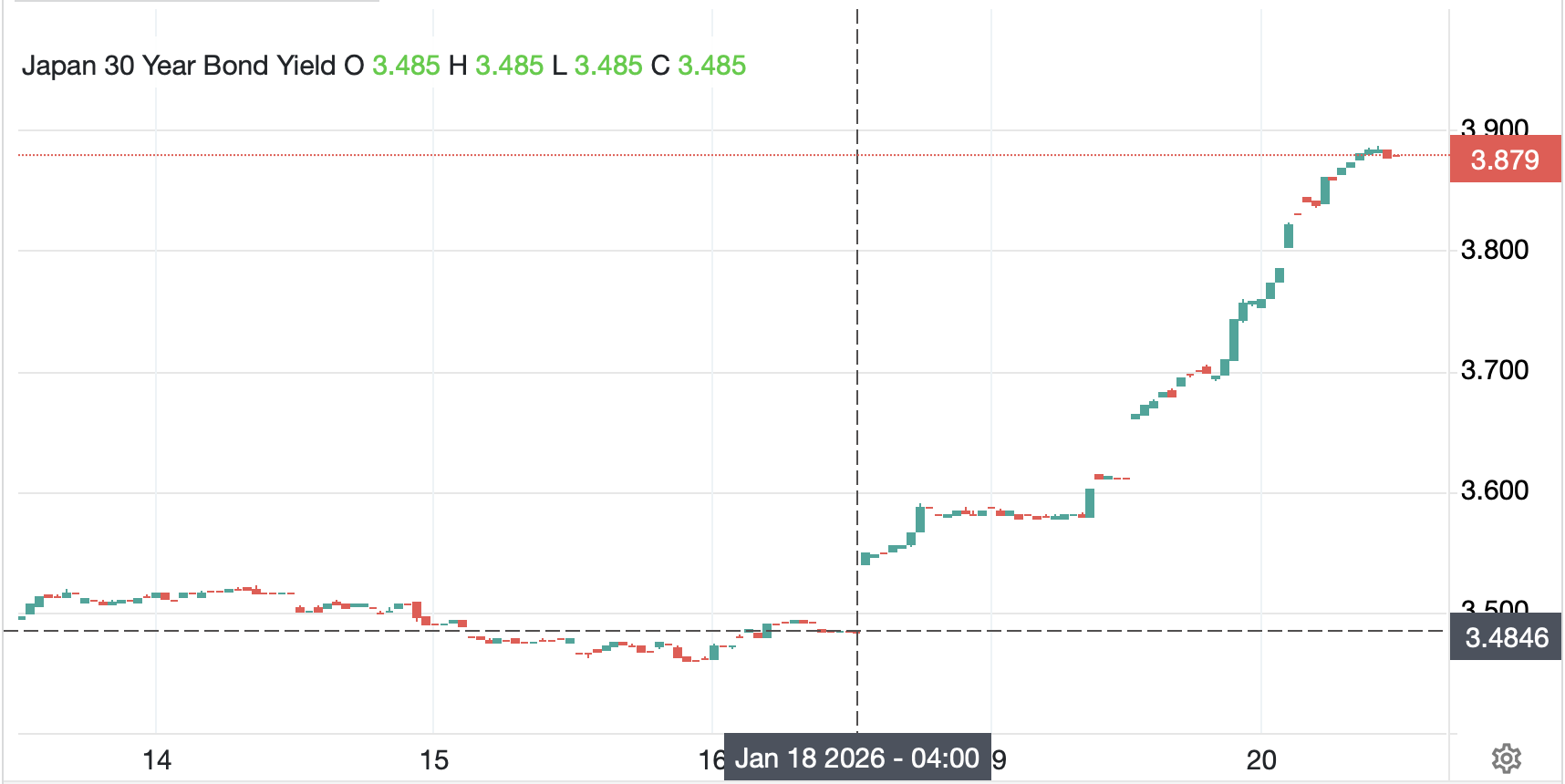
I guess with that much excitement about more government spending, we cannot be surprised the yields have edged higher.  This morning Treasury yields are up by 3bps, which is what we saw from JGB markets last night as well, although European sovereign yields are little changed on the day.  I suspect, though, if equities continue to rally, we will see yields there edge higher.

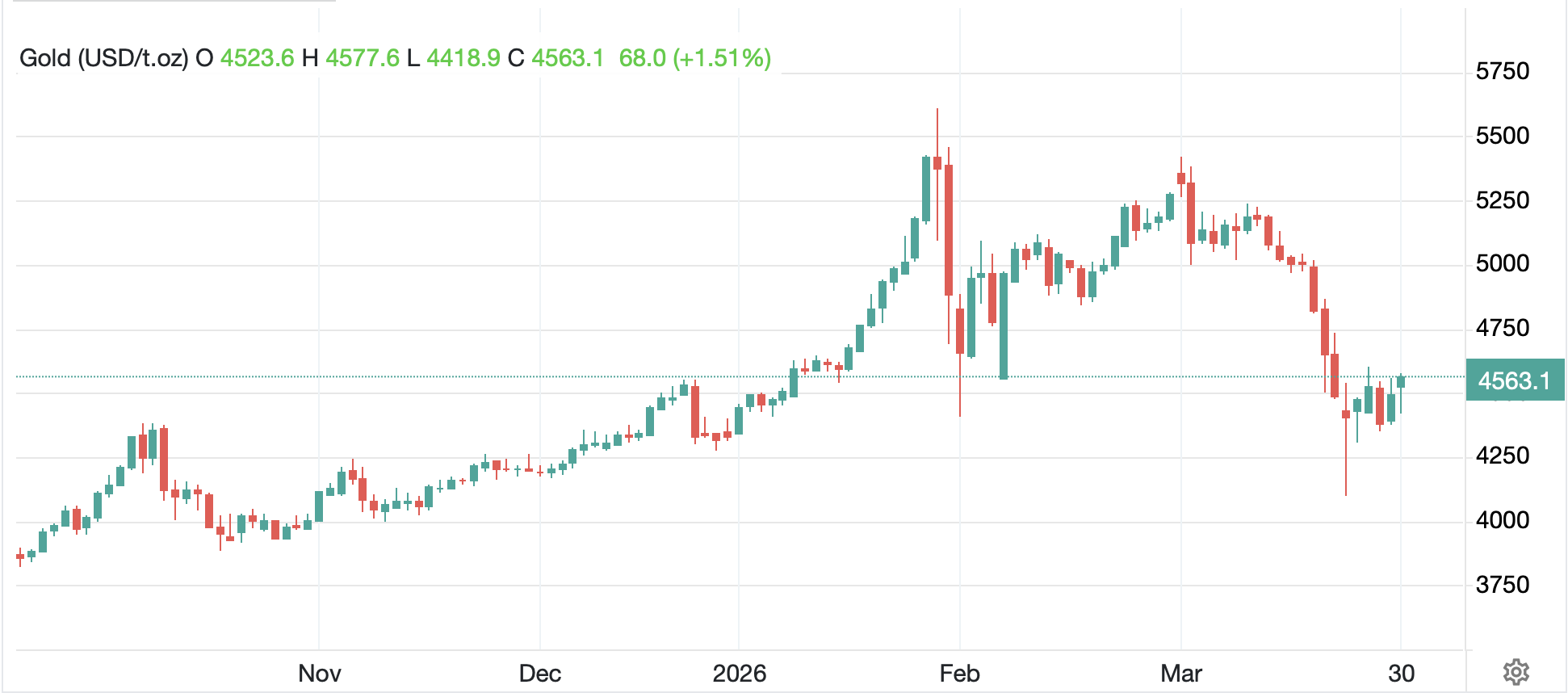
In the commodity space, oil (+0.5%) continues to trade in its recent range.  The most interesting thing I saw here was that the IEA is set to come out with their latest annual assessment of the oil market and for the first time in more than a decade they are not going to claim that peak fossil fuel demand is here or coming soon.  The climate grift is truly breaking down.  But the commodity story of the day is precious metals which are massively higher (Au +2.5%, Ag +3.3%, Pt +2.6%) with copper (+1.6%) coming along for the ride.  The narrative here is that with the government shutdown due to end soon, President Trump talking about $2000 tariff rebate checks and the Fed likely to cut rates in December (65% probability), debasement is with us and metals is the place to be!

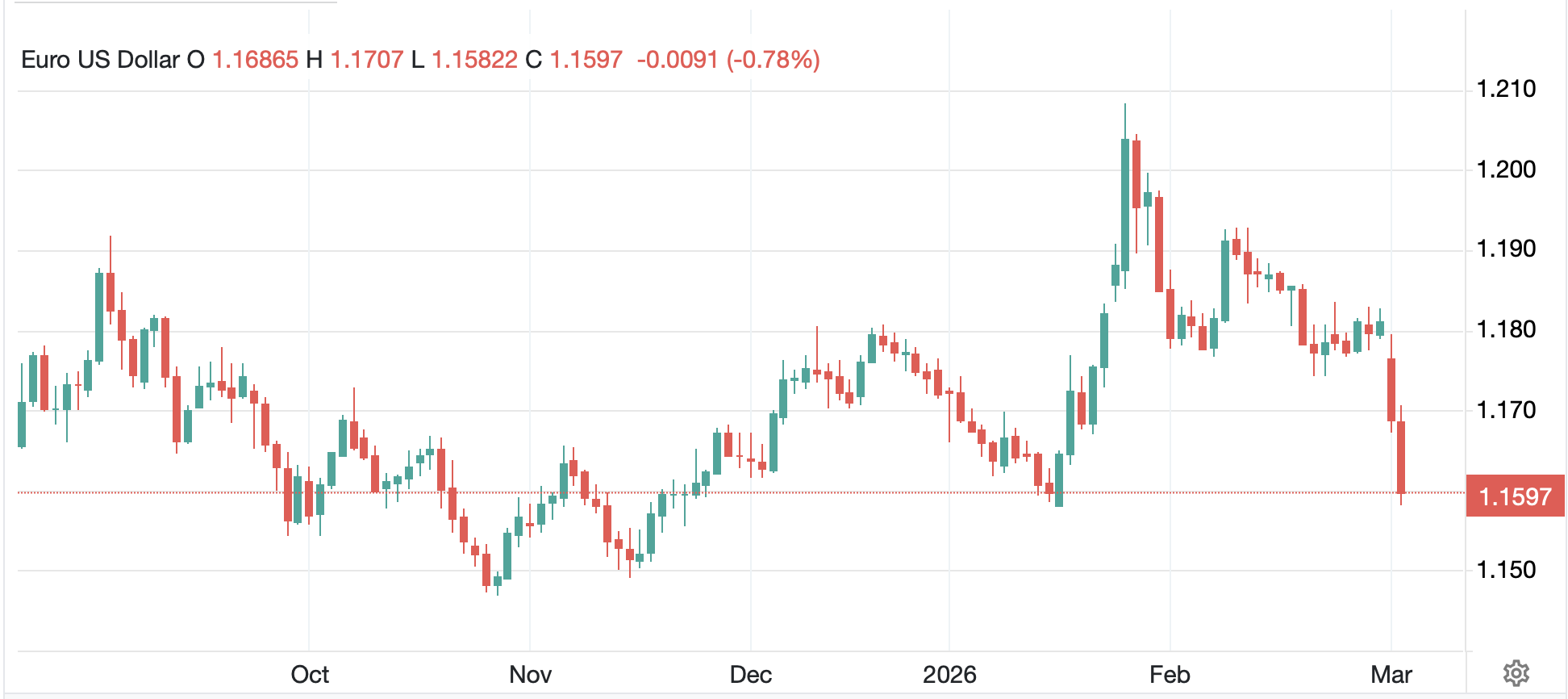
Interestingly, the dollar is not suffering much at all despite the precious metals story.  While AUD (+0.6%), ZAR (+0.6%) and NOK (+0.6%) are all stronger on the commodity story, the euro is unchanged, JPY (-0.4%) continues to decline and the rest of the G10 is not doing enough to matter.  In truth, if I look across the board, there are more currencies strengthening than weakening vs. the greenback, but overall, at least per the DXY, the dollar is little changed.

There is still no data at this point, although it will start up again when the government gets back to work.  Actually, there has been much talk of the weakness in Consumer sentiment based on Friday’s Michigan Index which fell to 50.3, the second lowest in the history of the series with several subindices weakening substantially.  However, that was before the news about the end of the shutdown, so my take is people will regain confidence soon.  As well, we hear from 9 Fed speakers this week, with 5 of them on Wednesday!  Both dissenters from the October meeting will speak, so perhaps things have changed in their eyes, but I doubt it.

At this point, all is right with the world as investors anticipate the US government getting back to work while the Fed will continue to support markets by easing policy further.  In truth, the dollar should not benefit here, but I have a feeling that any weakness will be short-lived at best.  Longer term, I continue to believe the dollar is the place to be.

Good luck

Adf
Woes and Scraps

The PMI data is in
And so far, it’s not really been
A sign of great strength
When viewed from arm’s length
No matter the punditry’s spin
 
That said, we are not near collapse
Despite many trade woes and scraps
And stocks keep on rising
So, t’will be surprising
For all when we see downside gaps


It was a quieter weekend than we have seen recently in the global arena with no new wars, no mega protests and no progress made on any of the major issues outstanding around the world.  Thus, the US government remains shut down, the war in Ukraine remains apace and the AI buzz continues to suck up most of the oxygen when discussing markets.

With this as background, arguably the most interesting market related news has been the manufacturing PMI data released last night and this morning.  starting in Asia, the story was some weakness as Chinese, Korean and Australian data all fell compared to last month, although India and Indonesia continued along well.  Meanwhile, in Europe, the data improved compared to last month, but the problem is it remains at or below 50 virtually across the board, so hardly indicative of strong economic activity.

                                                                                                      Current         Previous               Forecast

Source: tradingeconomics.com

I don’t know about you, but when I look at the releases this morning, I don’t see a European revival quite yet, not even if I squint.

I guess the other thing that has tongues wagging is Election Day tomorrow with three races garnering the focus, gubernatorial contests in New Jersey and Virginia and the mayoral race in New York City.  The first two are often described as harbingers of a president’s first year in office and I think this time will be no different.  But will they impact market behavior?  This I doubt.

So, let’s get right into markets this morning.  Friday’s further new record highs in the US were followed by strength through much of Asia (Tokyo was closed for Culture Day) with China (+0.3%), HK (+1.0%), Korea (+2.8%) and Taiwan (+0.4%) leading the way with only the Philippines (-1.7%) bucking the regional trend as earnings growth in the country continues to disappoint relative to its peers around the region.  Europe, too, has seen broad based gains with the DAX (+1.2%) leading the way higher and gains in the IBEX (+0.45%) and CAC (+0.3%) as well.  I guess the PMI data was sufficient to excite folks and despite Europe’s status as a global afterthought, at least in terms of geopolitical issues, their equity markets have been rising alongside the rest of the world’s all year.  And you needn’t worry, US futures are all higher at this hour (6:50), with the NASDAQ (+0.7%) leading the way.

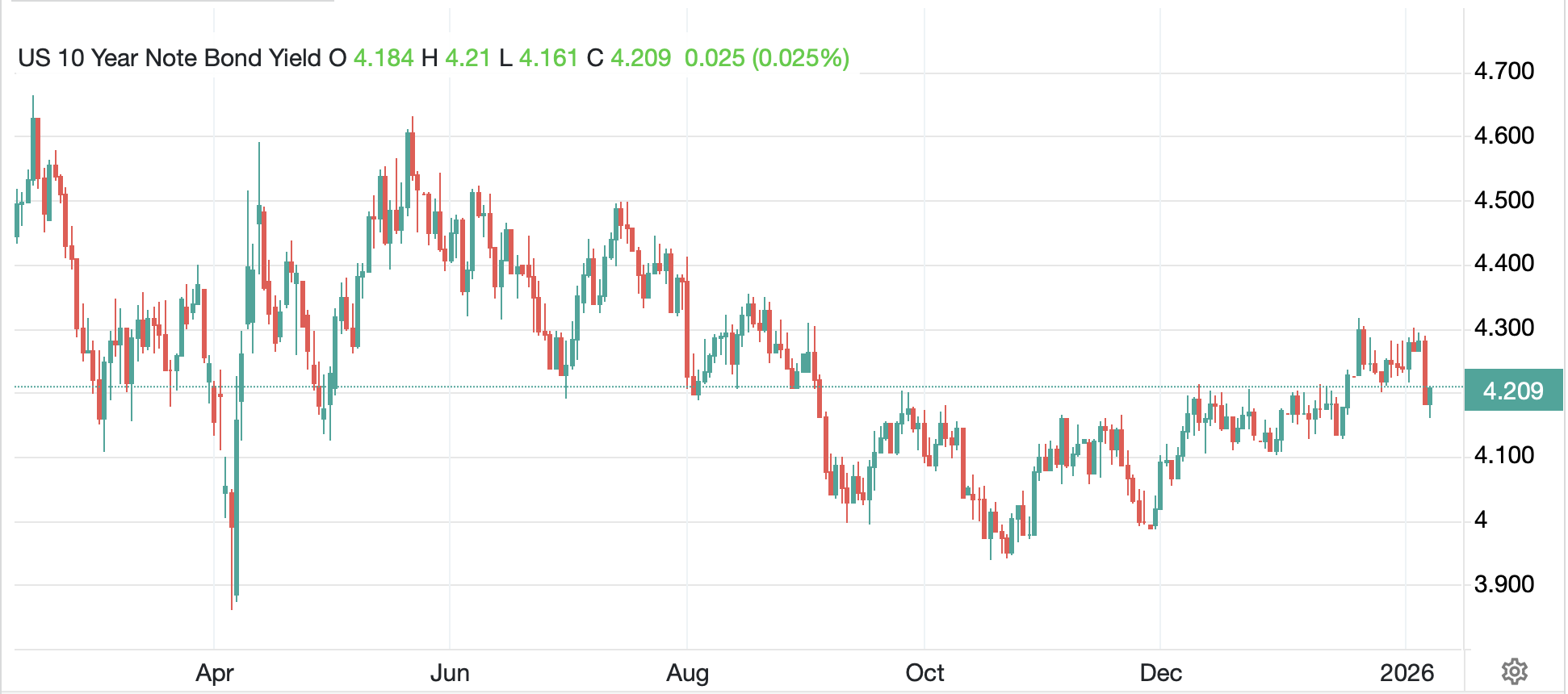
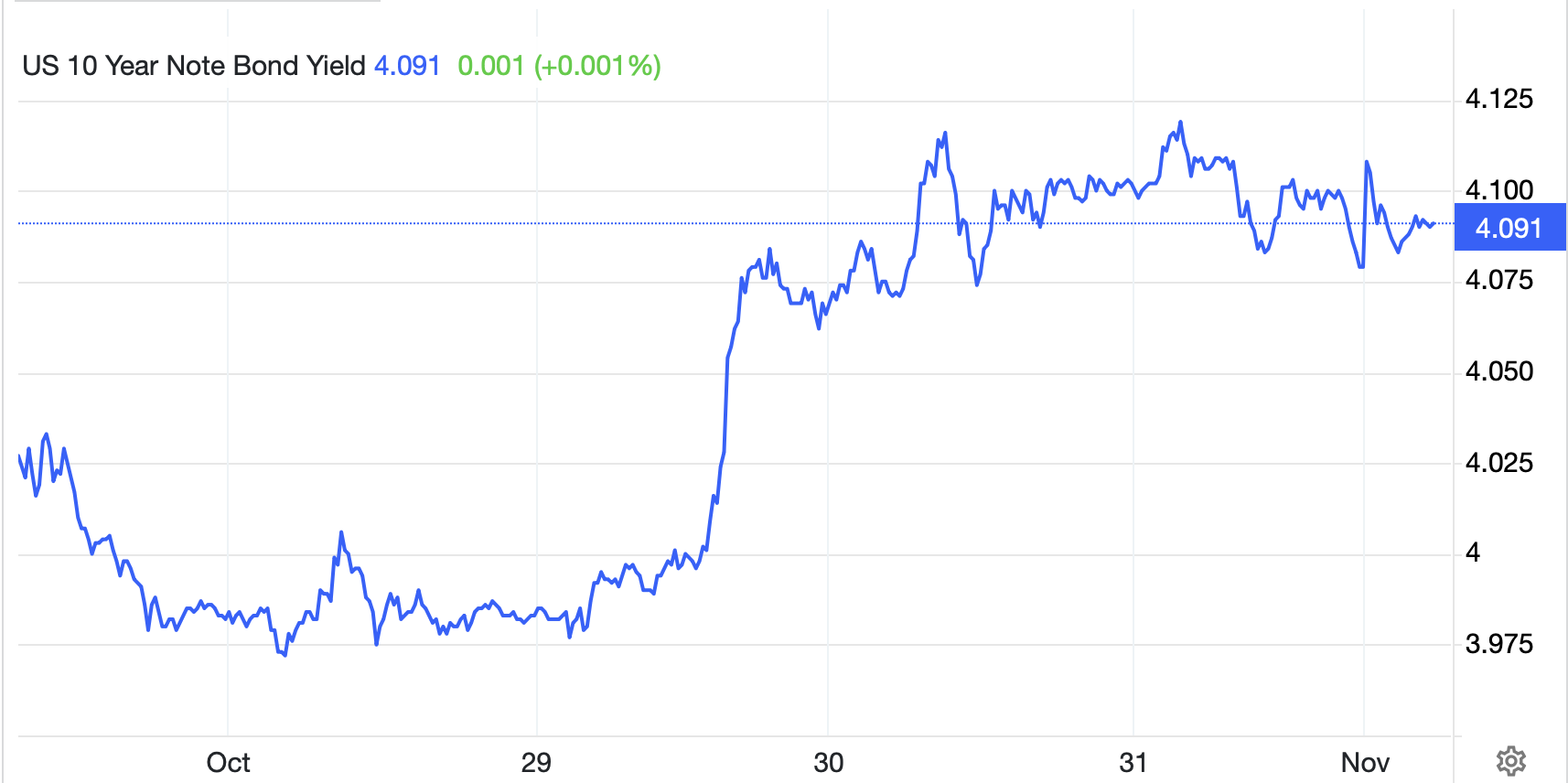
Perhaps more interesting than equities though is the fact that government bond markets are doing so little.  Treasury yields jumped ~10bps in the wake of the FOMC meeting and, more accurately, Chairman Powell’s ostensible hawkishness.  However, as you can see in the below tradingeconomics.com chart, since then, nothing has happened. 

Recall, the probability of a December rate cut by the FOMC also fell from virtual certainty to 69% now.  In fact, if you think about it, that 30% probability decline translates into about 7.5bps, approximately the same amount as 10-year yield’s rose.  It appears that the market is consistent in its pricing at this point, and when (if?) data starts coming back into the picture, we will see both these interest rates rise and fall in sync.  As to European sovereigns, they continue to track the movement in the US and this morning, this morning, the entire bloc has seen yields edge higher by 1bp, exactly like the US.

Commodities remain the most interesting place, although the dollar is starting to perk up a bit.  Oil (-0.3%) slipped overnight after OPEC+ indicated they were increasing production by another 137K bbl/day, although there would be no more increases for at least three months given the seasonality of reduced oil demand at this point on the calendar.  Something I have not touched on lately is NatGas, which traded through $4.00/MMBtu late last Thursday, and is now up to $4.25.  in fact, in the past month it has risen nearly 27%, which given it is massively underpriced compared to oil (on a per unit of energy basis) should not be that surprising.  Nonetheless, sharp movements are always noteworthy, and this is no different.

Source: tradingeconomics.com

Certainly, part of this is the fact that winter is coming and seasonal demand is rising in the US. 

Combine that with the European needs for LNG, of which the US is the largest provider, and you have the makings of a rally.  (I wonder though, did the fact that Bill Gates changed his tune on global warming no longer being an existential threat signal it is now OK to burn more fossil fuels?)

Turning to the metals markets, the ongoing fight between the gold bugs and the powers that be continues as early in the overnight session, gold was lower by nearly -1% but as I type, just past 7:00am, it is slightly higher (+0.1%) compared to Friday’s closing levels.  Silver (+0.1%) has seen similar price action although copper (-0.5%) appears more focused on the economic story than the inflation story.  

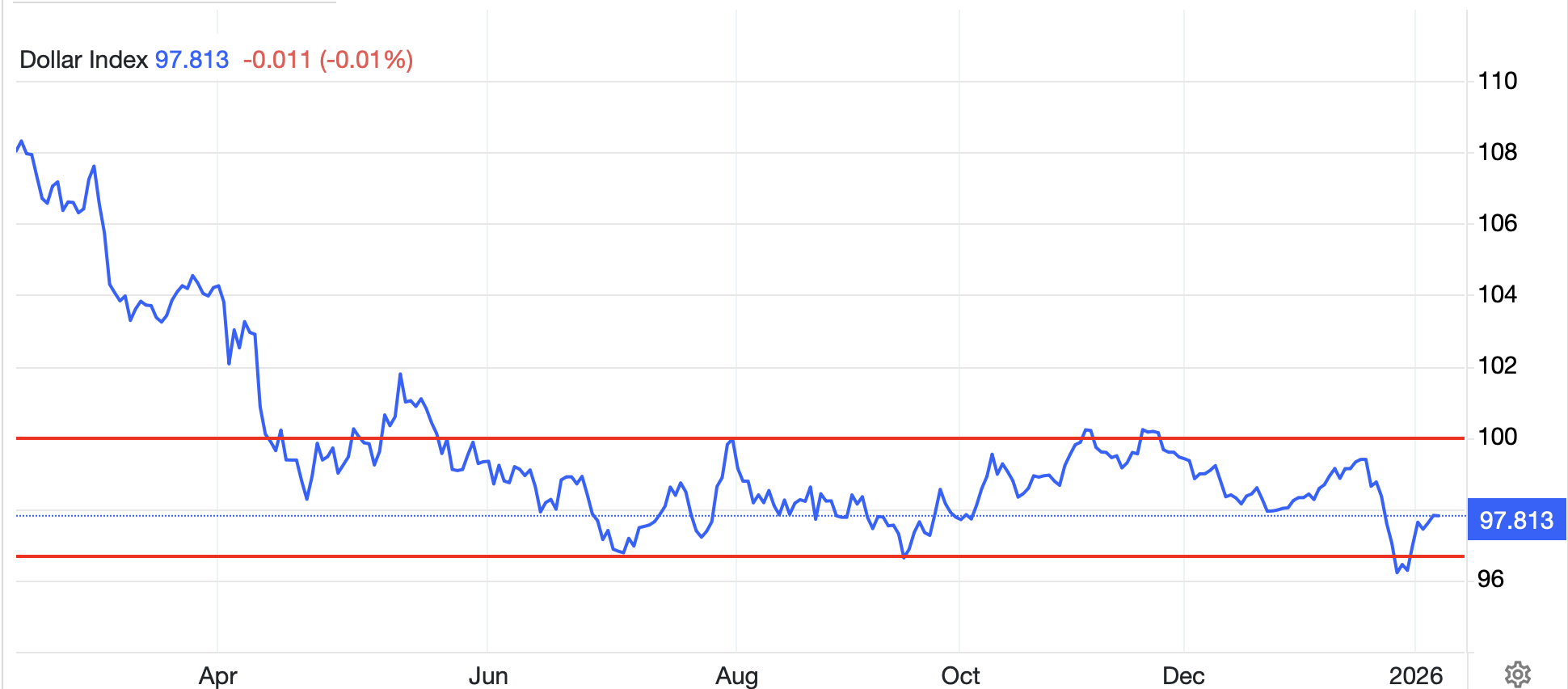
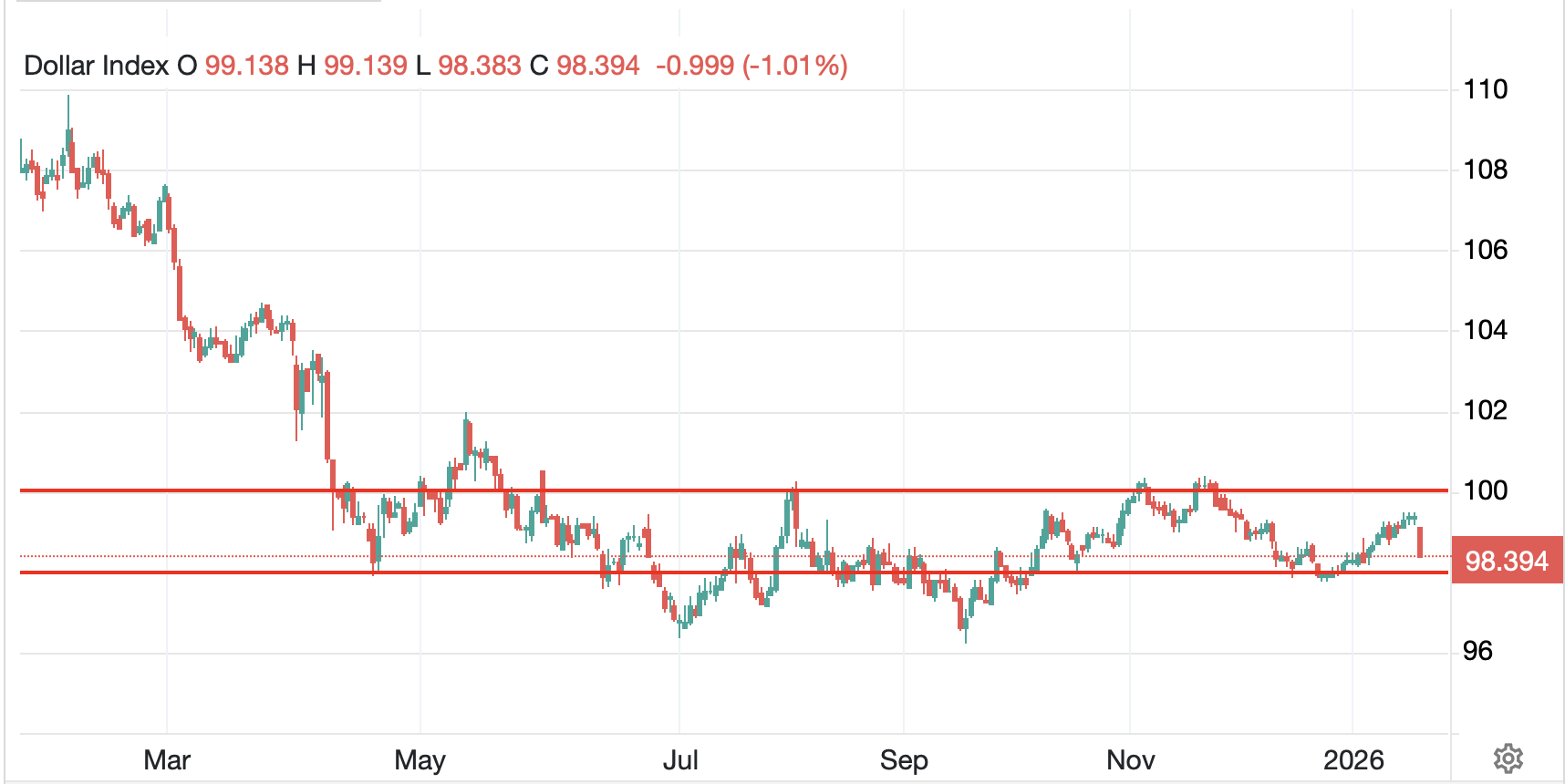
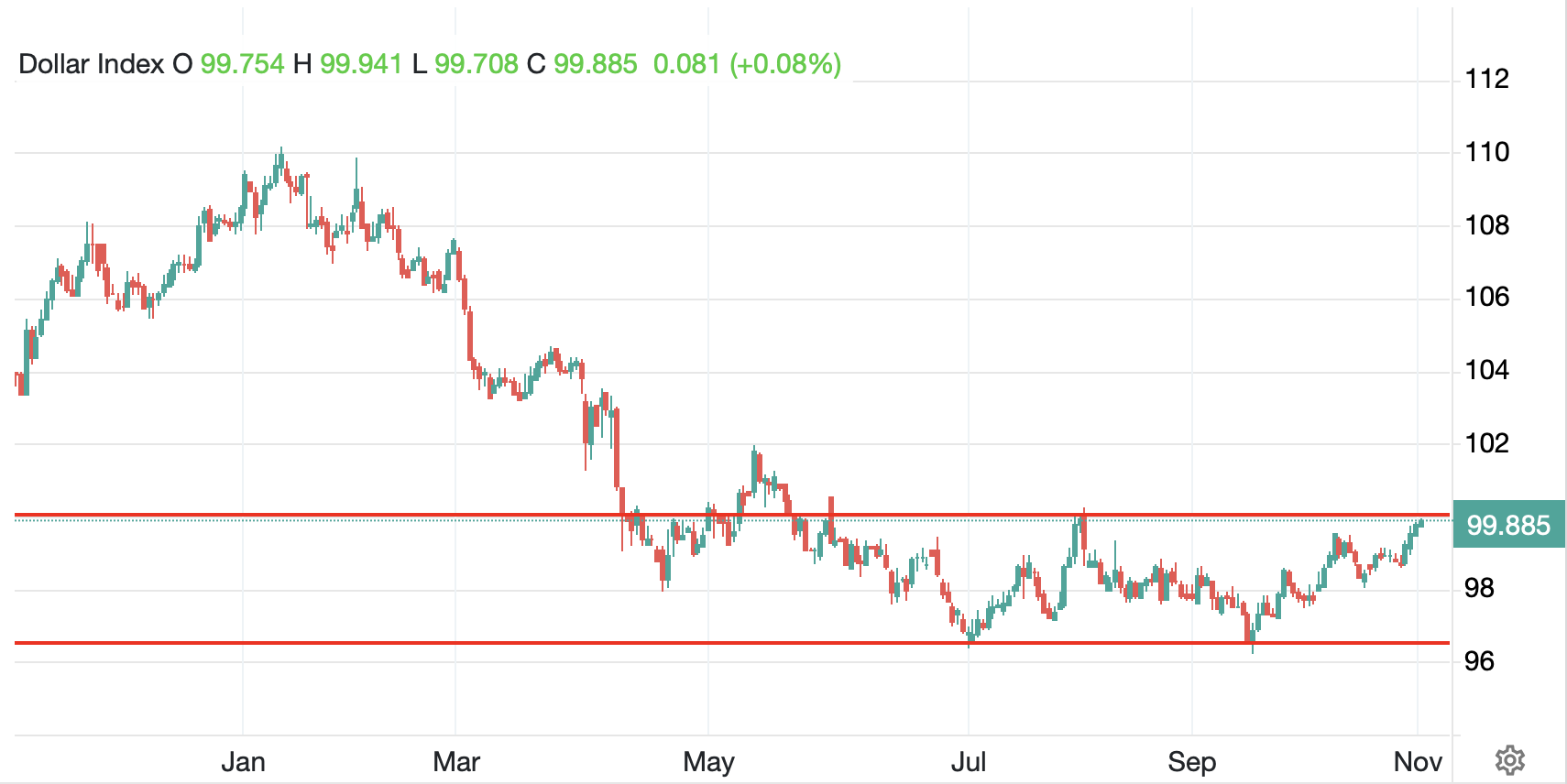
Which takes us to the dollar and its continued rally. Using the DXY (+0.1%) as our proxy, it is higher again this morning and pushing back to the psychological 100.00 level.  Now, I have made the case several times that the dollar has done essentially nothing for the past six months, and the chart below, I believe, bears that out.  We have basically traded between 96.5 and 100 since May.

Source: tradingeconomics.com

You will also recall that there is a narrative around about the end of the dollar’s hegemony and how nations around the world are trying to exit the USD financial system that has been in place since Bretton Woods, or at least since the fiat currency world took off when President Nixon closed the gold window.  And there is no doubt that China is seeking to become the global hegemon and thus wants a renminbi-based system to use to their advantage.  However, let’s run a little thought experiment. 

The Trump administration has embraced the cryptocurrency space, and especially the use of stablecoins.  Legislation has been passed (GENIUS Act) to help clarify the legal framework and the SEC has been solicitous in its willingness to ensure that these creations are not securities, thus placing them outside the SEC’s oversight.  When looking at the world of stablecoins, their current total value is approximately $311 billion (according to Grok) of which only ~$1.2 billion are non-USD.  

Now, if stablecoins represent the payment rails of the future, an idea that is readily believable, and the stablecoin market is virtually entirely USD, with massive first mover advantage, is it not possible that economies around the world are going to find it much easier to dollarize than to maintain their own native currency?  While there are calls for Argentina to dollarize, what would the world look like if the EU fell apart (an entirely possible outcome given the inconsistencies in their current energy and immigration policies and the stress within the bloc) and the euro with it?  Would smaller nations opt for their own currency, or would they see the value of having a dollarized economy given the many efficiencies it would present, especially for their export industries?

While I have no doubt that China will never accept that outcome for themselves, is the future a world where there are two currency blocs, USD and CNY, and everything else simply disappears?  Remember, we are merely spit balling here, but if that is the outcome, demand for dollars will continue to rise, and the value of other currencies will continue to decline until such time as they succumb.

Again, this is a thought experiment, but one that offers intriguing possibilities for the future.  And one where the foreign exchange market may ultimately meet its demise.  After all, if there are only two currencies, that doesn’t make much of a market.

One other thing I must note, in the stablecoin realm, there is a remarkable product, USDi (usdicoin.com), which tracks US CPI exactly, yet can fit within those same payment rails.  If you are looking into this space, USDI is worth a peek.

Ok, back to the markets, looking across the FX space, +/-0.2% is today’s theme virtually across the board, with the more important currencies slipping against the dollar (EUR, GBP, JPY, CHF, CAD) than rising vs the greenback (MXN, CLP, NOK, CZK), although the magnitudes are similar.

With the government still closed, there is no official data, but we do get ISM Manufacturing (exp 49.5) with the Prices Paid subindex (61.7) released at the same time.  There are two Fed speakers today, Daly and Cook, and then 9 more speeches throughout the week.  We also get the ADP Employment data on Wednesday (exp 24K), but I imagine that will get more press after the election results are learned Tuesday evening.

It is hard to get excited about things today, but nothing points to a weaker dollar right now.

Good luck

Adf
Lickspittle

The Fed has a banker named Jay
Who last week was quick to betray
His fervent belief
He can’t come to grief
If Trump wants to force him away
 
This morning his Journal lickspittle
Wrote glowingly ‘bout Jay’s committal
To stand strong and firm
And finish his term
No matter how much he’s belittled


First, on this Veteran’s Day holiday, let us all pause a minute and remember those veterans who gave their lives for our nation.

The reverberations of Donald Trump’s re-election last week continue to be felt around the world with comments from virtually every walk of life explaining their joy/distress at the outcome and trying to prognosticate what will play out in the future.  I will tell you that I have no idea how things will evolve, although I am hopeful that his administration will be able to reduce the size of the federal government as that can only be a benefit.

But one of the things that we learn about people during times of change, especially people who believe they are crucially important to the world, is just how much they believe they are crucially important to the world.  Nothing highlights this quite like the lead article in this morning’s WSJ titled, If Trump Tries to Fire Powell, Fed Chair Is Ready for a Legal Fight.  This is not to say that Powell doesn’t have an important role, he certainly does.  But this pre-emption of the entire question is a testimony of just how important he thinks he is.  

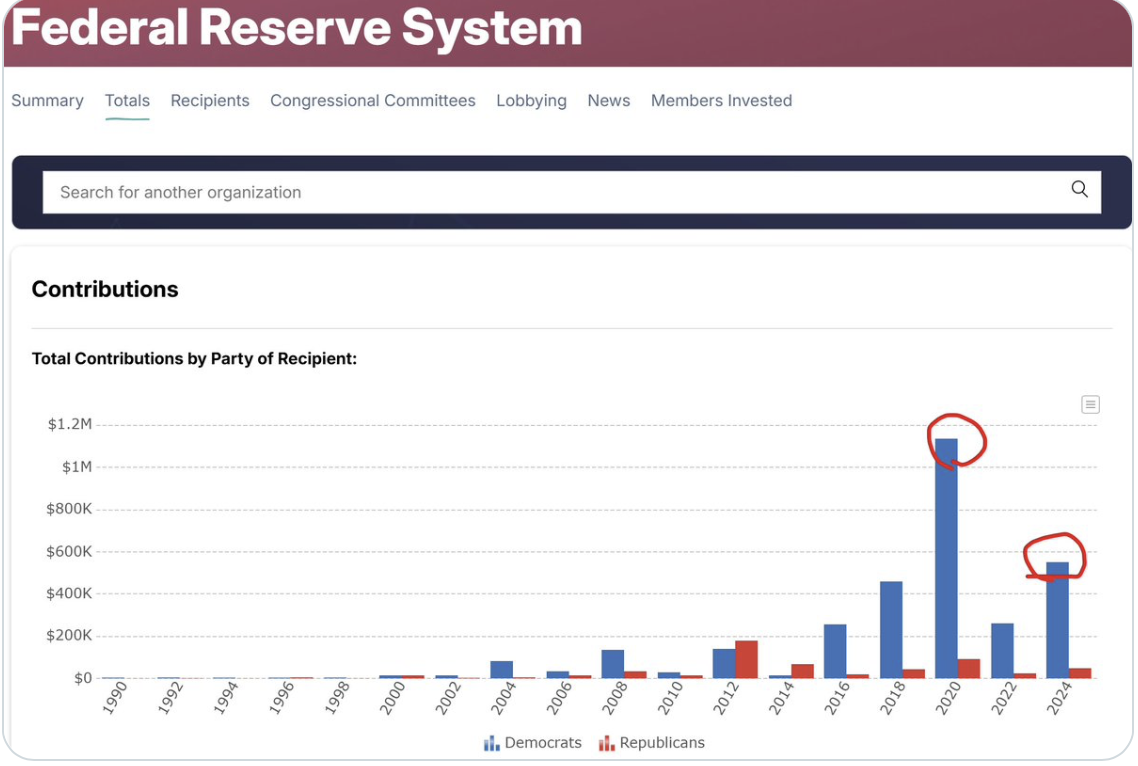
My one observation on this is that despite all the discussion that the Fed isn’t political, it is clearly a very political institution.  Nothing highlights that better than this Tweet from Joseph Wang (aka @FedGuy12), a commentator who spent a dozen years at the Fed and understands its inner workings quite well.  Under the rubric that a picture is worth 1000 words, take a look at Federal Reserve political contributions below and then ask yourself if the Fed is not only political, but partisan.  

Source: X @FedGuy12

It is important to recognize this as it also may help explain why the Fed is cutting interest rates despite GDP (currently 2.8%) and Core PCE (currently 2.7%) running far above their long-term expectations and Unemployment (currently 4.1%) running below their long-term expectations as per the below SEP from the September FOMC meeting.  If anything, I might argue they should be raising interest rates!

Source: fedreserve.gov

At any rate, the ramifications of this election outcome are likely to drive the market narrative for a while yet.

But overnight, there just wasn’t that much of interest, at least not that much new.  So, let’s take a look at overnight market activity.  After Friday’s latest record high closes in the US, the picture in Asia was less robust with Japanese equities basically unchanged on the day after Shigeru Ishiba was elected PM to run a minority government, while Hong Kong (-1.5%) and mainland Chinese (+0.7%) shares went in opposite directions.  Chinese financing data was released that was mildly disappointing, but there are several stories about how the government is going to reacquire land that is currently in private hands but not being used and repurpose it for benefit.  The rest of the region had many more laggards than gainers, perhaps on concerns that Trump will be imposing tariffs throughout the region.  As to Europe, despite all the pearl clutching by the leadership there, equity investors are excited with gains seen across the board (DAX +1.3%, CAC +1.2%, FTSE 100 +0.8%).  US futures at this hour (7:30) are continuing their ride higher, up 0.4%.

In the bond market, Treasuries aren’t really trading today with banks closed.  In Europe, sovereign yields have edged down between 1bp and 2bps, perhaps feeling a little of that equity euphoria, as there was precious little in the way of news or commentary to drive things.

In the commodity space, oil (-1.7%) is under further pressure as broadly slower global growth undermines demand while prospects of the Trump administration fostering significant additional drilling opportunities helps build the supply side.  However, NatGas (+7.0%) is soaring this morning as Europe, notably Germany, is suffering from dunkelflaute (maybe the best word I have ever heard) which means ‘a period of low wind and solar power generation because it is cloudy, foggy and still’, and so they need to buy a lot more NatGas to power the economy.  In fact, NatGas is higher by nearly 15% in the past month although remains substantially cheaper in the US than in Europe and Asia.  My take is this discrepancy cannot last forever.  As to the metals markets, they are under pressure again this morning with both precious (Au -0.9%, Ag -0.3%) and industrial (Cu -0.5%, Al-1.4%) feeling the pain.  

A key driver in the metals space is the dollar, which is rallying against all its counterparts this morning quite robustly.  The euro (-0.6%) is back to levels last briefly touched in April, but where it spent more time a year ago, as it seems to be heading to 1.05 and below.  Meanwhile, JPY (-0.8%) is also feeling the heat while NOK (-0.7%) is pressured by both the dollar’s general strength and the oil weakness.  In the EMG bloc, MXN (-1.3%) is having a rough go as the tariff talk heats up, but we have also seen weakness in EEMEA with ZAR (-1.4%), PLN (-1.0%) and HUF (-1.2%) all under pressure this morning.  Not to be outdone, Asian currencies, too, are selling off with CNY (-0.3%) back above 7.20 for the first time since August while THB (-0.9%), MYR (-0.7%) and SGD (-0.6%) demonstrate the breadth of the move.

With the holiday, there is no data to be released today, but this week brings CPI amongst other things.

TuesdayNFIB Small Biz Optimism91.9
WednesdayCPI0.2% (2.6% Y/Y)
 Ex food & energy0.3% (3.3% Y/Y)
ThursdayPPI0.2% (2.3% Y/Y)
 Ex food & energy0.3% (2.9% Y/Y)
 Initial Claims224K
 Continuing Claims1895K
FridayRetail Sales0.3%
 -ex autos0.3%
 Empire State Mfg-1.4
 IP-0.3%
 Capacity Utilization77.2%

Source: tradingeconomics.com

In addition to this data, we hear from 11 different Fed speakers this week, including Chairman Powell again at 3:00pm on Thursday afternoon.  It is difficult to believe that the message from last week is going to change, but you never know.  However, I expect that every one of them is going to be explaining that things are good, but they are cutting rates to ensure things remain that way as they consistently congratulate themselves on having slain inflation.  I hope they are right…I fear they are not.

For now, though, the US economy remains the strongest in the world (7% budget deficits will help prop up growth after all) and capital continues to flow in this direction.  I see no reason for the dollar to fall anytime soon.  Whatever problems lie ahead, I believe they are over the metaphorical horizon and other than a few doomporn purveyors, not in the market’s view.

Good luck

Adf
Narrative Drift

Today it is more of the same
As energy traders proclaim
No price is too high
For NatGas, to buy
With policy blunders to blame

As such it is not too surprising
Inflation concerns keep on rising
Prepare for a shift
In narrative drift
Which right now CB’s are devising

Perhaps the most interesting feature of markets since the onset of the Covid-19 pandemic is the realization that prices for different things, be they equities, bonds, commodities, or currencies, can move so much faster and so much further than previously understood.  The simple truth is that markets as a price discovery mechanism are unparalleled in their brilliance.  Recall, for instance, back in April 2020, when crude oil traded at a negative price.  The implication was that crude oil holders were willing to pay someone to take it off their hands, something never before seen in a physical commodity market.  (Of course, in the interest rate markets, that had become old hat by then.)  Well, today European natural gas markets have gone the other way, rising 40% in both Amsterdam and London and taking prices to levels previously unseen.  Now, much to the chagrin of European policymakers, there is no upper limit on prices.  As winter approaches, with NatGas inventories currently just 74% of their long-term average, and with most of the EU reliant on Russia for its gas supplies, it is not hard to foresee that these prices will go higher still.

The first issue (a consequence of policy decisions) is that deciding to allow a geopolitical adversary to control your energy supply is looking to be a worse and worse decision every day.  Gazprom’s own data shows that they have reduced the flow of gas to Europe via Belarus and Poland by 70% and via Ukraine by 20% in the past week.  It cannot be surprising that prices in Europe continue to rise.  And the knock-on effects are growing.  You may recall two weeks ago when a fertilizer company in the UK shuttered two plants because the NatGas feedstock became so expensive it no longer made economic sense to produce fertilizer.  One consequence of that was there was a huge reduction in a byproduct of fertilizer production, pure CO2, which is used for refrigeration and has impaired the ability of food processors to ship food to supermarkets and stores.  Empty shelves are a result.  Just today, a major ammonia producer shuttered its plants as the feedstock is too expensive for profitable production as well.  The point is that NatGas is used as more than a heating fuel, it is a critical input for many industrial processes.  Shuttering these processes will have an immediate negative impact on economic activity as well as push prices higher.  If you are wondering why there are concerns over stagflation returning, look no further.

The bigger problem is that there is no reason to believe these prices will sell off anytime soon.  Arguably, we are witnessing the purest expression of supply and demand working itself out.  As a consequence of these earlier decisions, the EU will now be forced to respond by spending more money and reducing tax income in order to support their citizens and businesses who find themselves in more difficult financial straits due to the sharp rise in the price of NatGas.

Now, a trading truth is that nothing goes up (or down) in a straight line, so there will certainly be some type of pullback in prices in the short run.  However, the underlying supply-demand dynamic certainly appears to point to a supply shortage and consistently higher prices for a critical power source in Europe.  Slower economic growth and higher prices are very likely to follow, a combination that the ECB has never before had to address.  It is not clear that they will be very effective at doing so, quite frankly, so beware the euro as further weakness seems to be the base case.

The other main story of note
Concerns a new debt ceiling vote
Majority wailing
The other side’s failing
May yet, a default, soon promote

Alas, we cannot avoid a quick mention of the debt ceiling issue as the clock is certainly winding down toward a point where a technical default has become possible.  Political bickering continues and shows no sign of stopping as neither side wants to take responsibility for allowing more spending, but neither do they want to be responsible for a default.  (Perhaps that sums up politicians perfectly, they don’t want to take responsibility for anything!)  This is more than a technical issue though as financial markets are failing to see the humor in the situation and starting to respond.  Hence, today has seen a broad sell-off in virtually every asset, with equities down worldwide, bonds down worldwide and most commodities lower (NatGas excepted).  In fact, the only thing that has risen is the dollar, versus every one of its main counterparts.

The rundown in equities shows Asia (Nikkei -1.05%, Hang Seng -0.6%, Shanghai closed) failing to take heart from yesterday’s US price action.  European investors are very unhappy about the NatGas situation with the DAX (-2.2%), CAC (-2.15%) and FTSE 100 (-1.8%) all sharply lower.  It certainly hasn’t helped that German Factory Orders fell a much worse than expected -7.7% in August either.  US futures are currently lower by about 1.25% as risk is clearly not today’s flavor.

Funnily enough, bond markets are also under pressure today, with Treasuries (+1.6bps), Bunds (+1.6bps), OATs (+2.2bps) and Gilts (+3.0bps) all seeing heavy selling.  It seems that inflation concerns are a more important determinant than risk concerns as the evidence of rising prices being persistent continues to grow.

In the commodity space, pretty much everything, except NatGas (+0.6% to $6.33/mmBTU) is lower as well, although this appears to be consolidation rather than the beginning of a new trend.  So, oil (-0.6%), gold (-0.5%), copper (-1.0%) and aluminum (-0.85%) are all under pressure.  Given the dollar’s strength, this should not be that surprising, although overall, I continue to expect a rising dollar and rising commodity prices.

As to the dollar, it is king today, rising 1.1% vs NZD, despite a 0.25% interest rate increase by the RBNZ last night, 1.0% vs. NOK and 0.85% vs SEK with the latter seeing a negative monthly GDP outcome in a huge surprise, thus marking down growth expectations significantly for the year.  But the rest of the G10 is much softer save JPY, which is essentially unchanged on the day.  Meanwhile, the euro has fallen a further 0.5% and is now approaching modest support at 1.1500.  Look for further declines there.

As to emerging market currencies, all that were open last night or today are lower with MXN (-1.2%) leading the way on a combination of lower oil and higher inflation, but HUF (-0.9%), ZAR (-0.8%) and CZK (-0.8%) all suffering on either weaker commodity prices are concerns over insufficient monetary tightening in an inflationary economy.  Even INR (-0.7%) is feeling the heat from rising inflationary pressures.  It is universal.

On the data front, only ADP Employment (exp 430K) is due this morning and there are no Fed speakers scheduled.  Right now, it feels like the dollar is primed to continue to move higher regardless of the data, or anything else.  Fear is growing among investors and they are searching for the safest vehicles they can find.  The steepening of the yield curve indicates the demand is in the 2yr, not the 10yr space, which makes sense, as in an inflationary environment, you want to hold the shortest duration possible.  Beware the FAANG stocks as they are very long duration equivalents.  Instead, it feels like the dollar is a good place to hang out.

Good luck and stay safe
Adf

Prices Ascend

As energy prices ascend
More problems they seem to portend
Inflation won’t quit
While growth takes a hit
When will this bad dream ever end?

Another day, another new high in the price of oil.  We have now reached price levels not seen in seven years and there is no indication this trend is going to end anytime soon.  Rather, given the supply and demand characteristics in the marketplace, it is not hard to make a case that we will be seeing $100/bbl oil by Q1 2022, if not sooner.  OPEC+ just met and, not surprisingly, decided that they were quite comfortable with rising oil prices thus saw no reason to increase production at this time.  Meanwhile, Western governments continue to do everything in their power to prevent the expansion of energy production, at least the production of fossil fuels.  This combination of policies seems likely to have some serious side effects, especially as we head into winter.

For instance, while I have highlighted the price of energy in Europe and Asia, which remains far higher than in the US, it is worth repeating the story.  Natural gas in Europe is now trading at $37.28/mmBTU, compared with just under $6/mmBTU in the US.  Storage levels are at 74% of capacity which means that any cold snap is going to put serious pressure on the Eurozone economy as NatGas prices will almost certainly rise further in response.  In addition, Europe remains highly dependent on Russia as a supplier which seems to open them to some geopolitical risk.  After all, Vladimir Putin may not be the friendliest supplier in times of crisis.

China, too, is having problems as not only has the price of oil risen sharply, but so, too, has the price of thermal coal (+5.25% today, +200% YTD).  China still burns a significant amount of coal to produce electricity throughout the country with more than 1000 plants still operating and nearly 200 more under construction.  It is this situation which causes many to question President Xi Jinping’s commitment to reining in carbon emissions.  Unsurprisingly, the inherent conflicts in the desire to reduce carbon, thus capping coal production, while trying to generate enough electricity for a growing economy have resulted in the Chinese abandoning the carbon issues.  Last week, Xi ordered coal mines to produce “all they can” rather than adhere to the strict quotas that had been put in place.  Right now, there is a power crisis as utilities have cut back electricity production reducing service to both industrial and residential users.  Again, winter is coming, and insufficient electricity is not going to be acceptable to President Xi.  When push comes to shove, you can be sure that the primary goal is generating enough electricity for the economy not reducing carbon emissions.

Ultimately, this story is set to continue worldwide, with the tension between those focused on economic activity and growth continually at odds with those focused on carbon dioxide.  Until nuclear power is accepted as the only possible way to create stable baseload power with no carbon emissions, nothing in this story will change.  The implication is that energy prices have further, potentially much further, to run given the inelasticity of demand for power in the short-term.  And this matters for all other markets as it will impact both growth and inflation for years to come.

Consider bond markets and interest rates.  While the Fed and other central banks may choose to ignore energy prices in their policy decisions, the market does not ignore rising energy prices.  The ongoing increase in inflation around the world is going to result in higher interest rates around the world.  While central banks may cap the front end, absent YCC, back end yields will rally.  A rising cost of capital is going to have a negative impact on equity markets as well, as both future earnings are likely to suffer and the discount factor for those who still consider DCF models as part of their equity analysis, is going to reduce the current value of those future cash flows.  The dollar, however, seems likely to benefit from rising oil and energy prices, as most energy around the world (in wholesale markets) is priced in USD.  Essentially, people will need to buy dollars to buy oil or gas.  Adding all this up certainly has the appearance of a more substantial risk-off period coming soon.  We shall see.

This morning, however, that is not entirely clear.  While Asian equity markets saw more red than green (Nikkei -2.2%, Sydney -0.4%, Hang Seng +0.3%, Shanghai closed), Europe is feeling positively giddy with gains across the board (DAX +0.35%, CAC +0.8%, FTSE 100 +0.65%) as PMI data showed more winners than losers although it also showed the highest price pressures seen since 2008, pre GFC.  US futures, after markets had a tough day yesterday, are pointing higher at this hour, with all three main indices higher by about 0.35%.

Bond markets are a bit schizophrenic this morning as Treasury (+1.9bps) and Gilt (+2.0bps) yields climb while we see modest declines in Europe (Bunds -0.2bps, OATs -0.3bps).  While yields remain low on a historic basis, and real yields remain extremely negative, it certainly appears that the trend in yields is higher.  There is every possibility that central banks blink when it comes to fighting inflation and ultimately do prevent yields from rising much further, but so far, they have not felt compelled to do so.  This is something we will be watching closely going forward.

Turning to commodities, oil (WTI +1.05%) shows no signs of slowing down.  Nor does NatGas (+3.0%) or coal (+5.25%).  Energy remains in demand.  Precious metals, on the other hand, continue to flounder with both gold (-0.85%) and silver (-0.7%) under pressure.  Copper (-1.75%) too, is feeling it today along with the rest of the industrial metal space save aluminum (+0.6%).  Ags are softer as well.

The dollar, however, is having a much better day, rallying against most of its major counterparts.  For instance, JPY (-0.3%) continues to suffer as the market demonstrates a lack of excitement over the new PM and his team.  Meanwhile, EUR (-0.2%) has reversed its consolidation gains and appears set to resume its recent downtrend.  Technically, the euro looks pretty bad with a move toward 1.12 quite realistic before the end of the year.  AUD (-0.2%) found no support from the RBA’s message last night as they continue to look toward 2024 before interest rates may start to rise.  On the plus side, only NOK (+0.2%) on the back of oil’s gains, and GBP (+0.2%) on the back of a stronger than expected PMI release are in the green.

EMG currencies have also seen many more laggards than gainers led by HUF (-0.5%) and PLN (-0.3%) both high beta plays on the euro, and MXN (-0.2%) and RUB (-0.2%) both of which are somewhat surprising given oil’s continued rise.  The bulk of the APAC currencies also slid, albeit only in the -0.1% to -0.2% range, with several simply adjusting after several days with local markets closed.  ZAR (+0.35%) is the only gainer of note as the Services PMI data printed at a better than expected 50.7.

On the data front, the Trade Balance (exp -$70.8B) and ISM Services (59.9) are on the slate and we hear from Vice-Chair Quarles on LIBOR transition.  In other words, not much of note here.  While I believe oil prices remain the key driver right now, there is certainly some focus turning to Friday’s payroll data as that is the last big data point before the Fed’s November meeting.

The dollar’s trend remains higher and I see no reason for anything to halt that for now.  My take is the modest correction we saw Friday and Monday is all there is for now, and a test of the recent highs is coming soon to a screen near you.

Good luck and stay safe
Adf

At All Costs#

Ahead of the winter’s white frosts
The Chinese told firms, “at all costs”
Get oil and gas
And coal, so en masse
Our energy never exhausts

In Europe, as prices keep rising
For Nat Gas, most firms are revising
The prices they charge
Which has, by and large
Helped CPI keep on surprising

Ostensibly, the reason that the Fed, and any central bank, looks at prices on an -ex food & energy basis is because they realize that they have very little control over the prices of either one.  The only tool they have to control them is extremely blunt, that of interest rates.  After all, if they raise interest rates high enough to cause a recession, demand for food & energy is likely to decline, certainly that of energy, and so prices should fall.  Of course, precious few central bankers are willing to cause a recession as they know that their own job would be on the line.

And yet, central banks cannot ignore the impact of food & energy prices on the economy.  This is especially so for energy as it is used to make or provide everything else, so rising energy prices eventually feed into rising prices for non-energy products like computers and washing machines and haircuts.  As has become abundantly clear over the past months, energy prices continue to rise sharply and alongside them, we are seeing sharp rises in consumer prices as well.

Protestations by Lagarde and Powell that inflation is transitory do not detract from the fact that energy prices are exploding higher and that those charged with securing energy for their country or company are willing to continue to pay over the odds to do so.  Yesterday, an edict from the Chinese government to all its major companies exhorted them to get energy supplies for the winter “at all costs.”  This morning, they followed up by telling their coal mining companies to produce at maximum levels and ignore quotas.  Clearly, there is concern in Beijing that with winter coming, there will not be enough energy to heat homes and run factories, an unmitigated disaster.  But this price insensitive buying simply drives the price higher.  (see Federal Reserve impact on bonds via QE for an example.)

And higher these prices continue to go.  Nat Gas, which is the preferred form of fossil fuel, continues to rise dramatically in both Europe and Asia.  In both geographies, it has risen to nearly $35.00/mmBTU, almost 6x as expensive as US Nat Gas.  On an energy equivalent basis, that comes out to $190/bbl of oil.  And you wonder why the Chinese want to dig as much coal as possible.  The problem they are already having, which is adding to their overall economic concerns, is that they have run into an energy shortage and have been restricting power availability to the industrial sector in order to ensure that households have enough.  Of course, starving industry is going to have a pretty negative impact on the economy, hence the call for obtaining energy at all costs.  But that has its own problems, as driving prices higher will divert spending to energy from both investment and consumption.  In other words, as is often the case, there is no good answer to this problem.

If you are wondering how this impacts foreign exchange, let me explain.  First, energy is priced in dollars almost everywhere in the world, at least at a wholesale level.  So, buying energy requires having dollars to spend to do so.  I would contend one reason we have seen the dollar maintain its strength recently, and break out of a medium-term range, is because countries are panicking over their winter energy needs and need dollars to secure supplies.  Second, as energy prices rise, so too does inflation.  And while Mr Powell continues to refuse to accept that is the case, the market is not so stubborn on the issue.  We have seen the yield curve steepen sharply over the past several weeks, something which is historically a dollar positive, and with expectations for the taper firmly implanted into the market’s collective conscience, the strong view is interest rates in the US are going higher.  This, too, is very dollar supportive.  While I remain unconvinced that the Fed will ultimately be willing to tighten policy in any significant manner, that remains the current market narrative.  We shall see how things evolve, but for now, the dollar has legs alongside interest rates and energy prices.

Ok, to today’s price action.  The notable thing is the reduction in risk appetite that has been evident for the past several sessions.  For instance, yesterday we finally achieved a 5% correction in the S&P 500 for the first time in more than 200 sessions.  While prices remain extremely overvalued on traditional measures, it is not yet clear if the ‘buy the dip’ mentality will prevail as we enter a new fiscal quarter.  We shall see.

Overnight, Asia was mostly lower (Nikkei -2.3%, Hang Seng -0.4%) but Shanghai (+0.9%) managed to rally.  Of course, remember, Shanghai has been massively underperforming for quite a while.  Other than China, though, the rest of Asia was all red.  Europe, too, is bright red this morning (DAX -0.8%, CAC -0.8%, FTSE 100 -1.0%) as the broad risk-off sentiment combines with modestly weaker than expected PMI data and higher than expected Eurozone CPI data.  As to the latter, the 3.4% headline print is the highest since Sept 2008, right at the beginning of the GFC.  Yesterday, German CPI printed at 4.1%, which is the highest level since the wake of the reunification in 1993.  For a culture that still recalls the Weimar hyperinflation, things must be pretty uncomfortable there.  It is a good thing this inflation is transitory!

Not surprisingly, with risk being jettisoned, bonds are in demand this morning and although Treasuries are unchanged in this session, they did rally all day yesterday with yields declining nearly 5bps.  As to Europe, Bunds (-3.2bps) and OATs (-3.2bps) are firmly higher with the rest of the continent while Gilts (-1.5bps) are not seeing quite as much love despite an underperforming stock market.  I think one reason is that UK PMI data was actually better than expected and higher than last month, an outlier versus the continent.

Commodity prices are mixed this morning as despite my opening monologue, oil (WTI -0.9%) and Nat Gas (-0.7%) are both under pressure.  Of course, both have been rallying sharply for months, so nothing goes up in a straight line.  Precious metals are little changed on the day, but industrial metals are strong (Cu +1.6%, Al +0.5%, Sn +1.2%).  Ags, on the other hand, are mixed with no pattern whatsoever.

As to the dollar, it is under modest pressure this morning in what appears to be a consolidation at the end of the week.  The one noteworthy mover in the G10 is NOK (+0.75%) which is rallying despite oil’s decline as the market reacted to a surprisingly large decline in the Unemployment rate there to 2.4%.  But otherwise, GBP (+0.3%) is the next best performer and the rest of the bloc is +/-0.2%, with CAD (-0.2%) the laggard on weak oil prices.

EMG currencies have many more gainers than losers this morning with only RUB (-0.6%) on oil weakness, and KRW (-0.35%) on a smaller than expected trade surplus, declining of note, while THB (+0.6%), PLN (+0.6%) and HUF (+0.4%) all have shown some strength.  In Bangkok, the central bank vowed to monitor the baht, which has been falling steadily over the past 9 months to its weakest point in more than 4 years.  PLN saw higher than expected CPI data (5.8%) which has the market looking for higher rates from the central bank, while HUF was the beneficiary of central bank comments that the monetary tightening campaign was “far from the end.”

There is a veritable trove of data to be released this morning starting with Personal Income (exp 0.2%), Personal Spending (0.7%) and the Core PCE (3.5%) at 8:30.  Then at 10:00 we see ISM Manufacturing (59.5) and Prices Paid (78.5) as well as Michigan Sentiment (71.0).  If the PCE number prints on plan, the Fed will be crowing about how it, too, is falling and has peaked.  However, that is crow they will ultimately have to eat, as the peak is not nearly in.

The underlying picture for the dollar remains quite positive on both a technical and fundamental basis, but it appears today is a consolidation day.  Perhaps, a good time to buy dollars still needed to hedge.

Good luck, good weekend and stay safe
Adf

More Price Inflation

The story of civilization
Is growth due to carbonization
But fears about warming
Have started transforming
Some policies ‘cross most each nation

Alas, despite recent fixation
On policy coordination
Alternatives to
Nat Gas are too few
Resulting in more price inflation

Perhaps there is no greater irony (at least currently) than the fact that governments around the world must secretly be praying for a very warm winter as their policies designed to forestall global warming have resulted in a growing shortage of fuels for heating and transportation.  Evergrande has become a passé discussion point as the overwhelming consensus is that the Chinese government will not allow things to get out of hand.  (I hope they’re right!)  This has allowed the market to turn its attention to other issues with the new number one concern the rapidly rising price of natural gas.  One of the top stories over the weekend has been the shuttering of petrol stations in the UK as they simply ran out of gasoline to pump.  Meanwhile, Nat Gas prices have been climbing steadily and are now $5.35/mmBTU in the US, up 4.2% today and 110% YTD.  As to the Europeans, they would kill for gas that cheap as it is currently running 3x that, above $16.00/mmBTU.

Apparently, policies designed to reduce the production of fossil fuels have effectively reduced fossil fuel production.  At the same time, greater reliance on less stable energy sources, like wind and solar power, have resulted in insufficient overall energy production.  While during the initial stages of Covid shutdowns, when economic activity cratered, this didn’t pose any problems, now that economies around the world are reopening with substantial pent-up demand for various goods and services, it has become increasingly clear that well-intentioned policies have resulted in dramatically bad outcomes.  While Europe appears to be the epicenter of this problem, it is being felt worldwide and the result is that real economic activity will decline across the board.  Hand-in-hand with that outcome will be even more price pressures higher throughout the world.  Policymakers, especially central bankers, will have an increasingly difficult time addressing these issues with their available toolkits.  After all, central banks cannot print natural gas, only more money to chase after the limited amount available.

The important question for market observers is, how will rising energy prices impact financial markets?  It appears that the first impacts are being felt in the bond markets, where in the wake of the FOMC meeting last week, yields have been climbing steadily around the world.  In the first instance, the belief is that starting in November, the Fed will begin reducing its QE purchases, which will lead to higher yields from the belly to the back of the curve.  But as we continue to see yields climb (Treasuries +3.3bps today), you can be sure the rationale will include rising inflation.  After all, our textbooks all taught us that higher inflation expectations lead to higher yields.

The problem for every government around the world, given pretty much all of them are massively overindebted, is that higher yields are unaffordable.  Consider that, as of the end of 2020, the global government debt / GDP ratio was 105%, while the total debt /GDP ratio was 356% (according to Axios).  That is not an environment into which central banks can blithely raise interest rates to address inflation in the manner then Fed Chair Volcker did in the late 1970’s. In fact, it is far more likely they will do what they can to prevent interest rates from rising too high.  This is the reason I continue to believe that while the Fed may begin to taper at some point, tapering will not last very long.  They simply cannot afford it.  So, while bond markets around the world are under pressure today (Bunds +1.8bps, OATs +2.8bps, Gilts +2.9bps), and by rights should have significant room to decline, this movement will almost certainly be capped.

Equity markets, on the other hand, have room to run somewhat further, as despite both significant overvaluation by virtually every traditional metric, as well as record high margin debt, in an inflationary environment, a claim on real assets is better than a claim on ‘paper’ assets like bonds.  While Asian markets (Nikkei 0.0%, Hang Seng +0.1%, Shanghai -0.8%) have not been amused by the rise in energy prices, European bourses are behaving far better (DAX +0.6%, CAC +0.4%, FTSE 100 +0.2%).  As an aside, part of the German story is clearly the election, where the Social Democrats appear to have won a small plurality of seats, but where there is no obvious coalition to be formed to run the country.  It appears Germany’s role on the global stage will be interrupted as the nation tries to determine what it wants to do domestically over the next few weeks/months.  In the meantime, early session strength in the US futures markets has faded away with NASDAQ futures (-0.4%) now leading the way lower.

Turning to the key driver of markets today, commodity prices, we see oil (WTI +1.25%) continuing its recent rally, and pushing back to $75/bbl.  We’ve already discussed Nat Gas and generally all energy prices are higher.  But this is not a broad-based commodity rally, as we are seeing weakness throughout the metals complex (Au -0.1%, Cu -0.3%, Al -0.2% and Sn -4.8%).  Agricultural prices are slightly softer as well.  It seems that the idea energy will cost more is having a negative impact everywhere.

Finally, the dollar is a beneficiary of this price action on the basis of a few threads.  First, given energy is priced in dollars, they remain in demand given higher prices.  Second, the energy situation in the US is far less problematic than elsewhere in the world, thus on a relative basis, this is a more attractive place to hold assets.  So, in the G10 we see SEK (-0.5%) as the laggard, followed by the traditional havens (CHF -0.25%, JPY -0.2%), as the dollar seems to be showing off its haven bona fides today. In the EMG bloc, THB (-0.8%) leads the way lower followed by ZAR (-0.7%) and PHP (-0.7%), with other currencies mostly softer and only TRY (+0.5%) showing any strength on the day.  The baht has suffered on traditional macro issues with concerns continuing to grow regarding its current account status, with the Philippines seeing the same issues.  Rand appears to have reacted to the metals complex.  As to TRY, part of this is clearly a rebound from an extremely weak run last week, and part may be attributed to news of a Nat Gas find in the Black Sea which is forecast to be able to provide up to one-third of Turkey’s requirements in a few years.

As it is the last week of the month, we do get some interesting data, although payrolls are not released until October 8th.

Today Durable Goods 0.6%
-ex Transportation 0.5%
Tuesday Case Shiller Home Prices 20.0%
Consumer Confidence 115.0
Thursday Initial Claims 330K
Continuing Claims 2805K
GDP Q2 6.6%
Chicago PMI 65.0
Friday Personal Income 0.2%
Personal Spending 0.6%
Core PCE 0.2% (3.5% Y/Y)
Michigan Sentiment 71.0
ISM Manufacturing 59.5
ISM Prices Paid 77.5

Source: Bloomberg

Naturally, all eyes will be on Friday’s PCE data as the Fed will want to be able to show that price pressures are moderating, hence their transitory story is correct (it’s not.) But I cannot help but see the House Price index looking at a 20.0% rise in the past twelve months and think about how the Fed’s inflation measures just don’t seem to capture reality.

Rising yields in the US seem to be beginning to attract international investors, specifically Japanese investors as USDJPY has been moving steadily higher over the past two weeks.  The YTD high has been 111.66, not far from current levels.  Watch that for a potential breakout and perhaps, the beginning of a sharp move higher in the dollar.

Good luck and stay safe
Adf

Reason to Fear

In Europe, the price of Nat Gas
Has risen to new highs, alas
As winter comes near
There’s reason to fear
A rebound will not come to pass

As well the impact on inflation
Is likely to add to frustration
Of Madame Lagarde
As she tries so hard
To hide the debt monetization

Some days are simply less interesting than others, and thus far, today falls into the fairly dull category.  There has been limited new news in financial markets overall.  While the ongoing concerns over the imminent failure of China Evergrande continue to weigh on Asian stocks (Nikkei -0.6%, Hang Seng -1.5%, Shanghai -1.3%), the story that is beginning to see some light in Europe is focused on the extraordinary rise in Natural Gas prices.  As a point of reference, in the US, Nat Gas closed yesterday at $5.34/MMBtu, itself a significant rise in price over the past six months, nearly doubling in that time.  Europeans, however, would give their eye teeth for such a low price as the price in the Netherlands for TTF (a contract standard) is $22.61/MMBtu!  This price has risen nearly fourfold during the past six months and now stands more thar four times as costly as in the US.  Whatever concerns you may have had about your personal energy costs rising in the US, they are dwarfed by the situation in Europe.

This matters for a number of reasons beyond the economic (for instance, how will people in Europe afford to heat their homes in the fast approaching winter and continue to feed their families as well?)  but our focus here is on markets and economics.  Thus, consider the following:  Europe remains a manufacturing and exporting powerhouse and is reliant on stable supply and pricing of natural gas to power their factories.  Obviously, recent price action has been anything but stable, and given the European dependence on Russian gas supplies, there is a geopolitical element overhanging the market as well.  LNG can be a substitute, but Asian buyers have been paying up to purchase most of those cargoes, so Europe is finding itself with reduced supply and correspondingly rising prices.

The first big industrial impact came yesterday when a major manufacturer of fertilizer shut down two UK plants because the cost of Nat Gas had risen too far to allow them to be competitive.  Consider the chain of events here: first, closure of the plant means reduced overall output, as well as furloughed, if not fired, workers. Second, reduction in the supply of fertilizer means that the price for farmers will almost certainly rise higher, thus forcing farmers to either raise their prices or reduce production (or go out of business).  Higher food prices, which have already risen dramatically, will result in reduced non-food consumption and strain family budgets as it feeds into inflation.  Net, slower growth and higher prices are the exact wrong combination for any economy and one to be avoided at all costs.  Alas, this is very likely the type of future that awaits many, if not most, European countries, the dreaded stagflation.  The ECB has its work cut out to combat this issue effectively while the Eurozone economy sits on more than €11.3 trillion in debt.  I don’t envy Madame Lagarde’s current position.

Beyond the macroeconomic issues, what are the potential market impacts?  Here things, as always, are less clear, but thus far, we have seen one impact, and that is a declining euro (-0.4%).  In fact, all European currencies are falling today as it becomes clearer that economic activity across the pond is going to be further impaired by this situation.  It has been sufficient to offset perceived benefits of European economies reopening in the wake of the spread of the delta variant of Covid.  However, the upshot of this currency weakness has been equity market strength.  It seems that any concerns of the ECB considering tighter policy have been pushed even further into the future thus encouraging investors to continue to add risk to their portfolios.  Hence, this morning, in the wake of the ongoing rise in Nat Gas prices, we see European equities all in the green (DAX +0.5%, CAC +1.0%, FTSE 100 +0.45%).  Under the guise of TINA, weaker growth leads to continued low rates and higher stock prices.  What could possibly go wrong?

US markets are biding their time at this hour, with futures essentially unchanged and really, so are bond markets.  Of the major sovereigns, only Gilts (+1.8bps) have moved more than a fraction of a basis point this morning.  While risk may be on, it is not aggressively so.  Either that, or European banks are back to buying more and more of their national bonds tightening the doom loop that ultimately led to the Eurozone crisis in 2012.

Commodities?  Well, as it happens, after a multi-day rally, oil prices are consolidating with WTI (-0.25%) basically holding the bulk of the $10 in gains it has made in the past month.  Nat Gas, too, is consolidating this morning, down $0.16/MMBtu, although that represents 3% (Natty is very, very volatile!)  With the dollar rocking, we are also seeing weakness across the metals’ markets, both precious (gold -0.75%) and industrial (Cu -2.0%, Al -0.6%, Pb -1.6%).  In fact, the only commodity that is performing well today is Uranium, which is higher by a further 8.1%.

Finally, the dollar is king today, rising against 9 of its G10 counterparts with CHF (-0.5%) the laggard and only NZD (+0.1%) able to show any strength today.  The Kiwi story has been a much better than expected GDP print (2.8% vs 1.1% expected) leading to growing expectations of a 0.50% rate hike next month.  Meanwhile, the rest of the bloc is suffering from the aforementioned cracks in the rebound theory as well as broad-based dollar strength.  This strength has been universal in EMG markets, with every currency sliding against the greenback.  Thus far, the worst performer has been PLN (-0.6%) followed by THB (-0.5%) and HUF (-0.5%).  Beyond that, most currencies are down in the 0.2% range.  Interestingly, for both PLN and HUF, the market discussion is about raising interest rates with Hungary looking at 50bps while Poland has called for a “gentle” rise, assumed to be 0.25%.  As to THB, it seems the market has been reacting to a rise in the number of Covid cases which is perpetuating the Asian risk-off theme.

We have a full slate of data today at 8:30 with Initial (exp 323K) and Continuing (2740K) Claims; Philly Fed (19.0) and the biggest of the day, Retail Sales (-0.7%, 0.0% ex autos).  Tuesday’s Empire Manufacturing data was MUCH stronger than expected, so there will be some hope for Philly to beat.  But the Retail Sales data is the key.  Remember, this number started to slide once the stimulus checks stopped, and last month we saw a much worse than expected -1.1% outcome.  Given the uncertainty over the near-term trajectory of the economy, this will be seen as an important number.

Well, the dollar managed to strengthen despite lacking support from yields, certainly a blow to the dollar bears out there.  The thing is, against the G10, I continue to see the dollar in a range (1.17/1.19) and will need to see a break of either side to change views.  If forced to opine, I would say the medium-term trend for the dollar is gradually higher, but would need to see the euro below 1.17, or the DXY above 93.50 before getting too excited.

I will be out of the office tomorrow so no poetry until Monday.

Good luck, good weekend and stay safe
Adf