Positioning’s Fraught

The wonderful thing about Trump
Is traders no longer can pump
A market so high
That it can defy
Reality ere it goes bump
 
Since policies can change so fast
A long-term view just cannot last
So, Fed put or not
Positioning’s fraught
And larger ones won’t be amassed


As we await the NFP report this morning, I couldn’t help but ponder the uptick in complaints and concerns by traders that increased volatility in markets on the back of President Trump’s mercurial announcements has changed the trading game dramatically.  Let me say up front that I think this is a much healthier place to be and explain why.

Pretty much since the GFC and, more importantly, then Chairman Bernanke’s first utilization of QE and forward guidance, the nature of financial markets had evolved into hugely leveraged one-sided views based on whatever the Fed was guiding.  So, the initial idea behind QE and forward guidance was to assure all the traders and investors that make up the market that even though interest rates reached 0.0%, the Fed would continue to ease policy and would do so for as far out in time as you can imagine.  Lower for longer became the mantra and every time there was a hiccup in the market, the Fed rushed in, added yet more liquidity to calm things down, and put the market back on track for further gains.  This was true for both stocks and bonds, despite the fact that the Fed has no business or mandate involving the equity market.

This activity led to the ever-increasing size of trading firms as leverage was cheap and steadily rising securities prices led to lower volatility, both implied and real, in the markets.  Risk managers were comfortable allowing these positions to grow as the calculated risks were minimized by the low vol.  In fact, entire trading strategies were developed to take advantage of the situation with Risk Parity being a favorite.  

However, a negative result of these actions by the Fed was that investors no longer considered the fundamentals or macroeconomics behind an investment, only the Fed’s stance.  The only way to outperform was to take on more leverage than your competitors, and that was great while rates stayed at 0.0%.  Alas, this persisted for so long that many, if not most, traders who learned the business prior to the GFC wound up retiring or leaving the market, and the next generation of traders and investors lived by two credos, number go up and BTFD.

The Fed remained complicit in this process as FOMC members evolved from background players to a constant presence in our daily lives, virtually preening on screens and in front of audiences and reiterating the Fed’s views of what they were going to do, implicitly telling traders that taking large, leveraged bets would be fine because the Fed had their back.

Of course, the pandemic upset that apple cart as the combination of Fed and government response imbued the economy with significantly more inflation than expected and forced the Fed to change their tune.  The market was not prepared for that, hence the outcome in 2022 when both stocks and bonds fell sharply.  But the Fed would not be denied and calmed things down and created a coherent enough message so that markets recovered the past two years.  This has, naturally, led to increased position sizing and more leverage because that’s what this generation of traders understands and has worked.

Enter Donald J Trump as president, elected on a populist manifesto and despite his personal wealth, seemingly focused on Main Street, not Wall Street.  The thing about President Trump is if an idea he proffers doesn’t work, he will drop it in a heartbeat and move on.  As well, by wielding the full power of the United States when dealing in international situations, other nations can quickly find themselves in a difficult spot and, so far, have been willing to bend their knee.  As well, his focus on tariffs as a primary weapon, with little regard for the impact on markets, and the way with which he uses them, threatening to impose them, and holding off at the last minute when other nations alter their policy, has kept markets off-balance.

The result is large leveraged positions are very difficult to hold and manage when markets can move up and down 2% in a day, every day (like the NASDAQ 100 chart below), depending on the headlines.  

Source: tradingeconomics.com

The natural response is to reduce position size and leverage, and that, my friends, is a healthy turn in markets.  This is not to say that there are not still many significant imbalances, just that as they continue to blow up, whether Nvidia, or FX or metals, my take is the next set of positions will be smaller as nimble is more important than large.  It doesn’t matter how smart an algorithm is if there is no liquidity to adjust a position when the world changes.  This poet’s opinion is this is a much healthier place for markets to live.

Ok, let’s see what happened overnight ahead of today’s data.  Mixed is the best description as yesterday’s US closes saw a mixed outcome and overnight the Nikkei (-0.7%) fell while both Hong Kong (+1.2%) and China (+1.3%) gained ground.  Korea and India slid, Taiwan rose, the picture was one of uncertainty about the future.  That also describes Europe, where only Germany and Norway have managed any modest gains at all while the rest of the continent and the UK are all slightly lower.  Apparently, yesterday’s BOE rate cut has not comforted investors in the UK, nor has the talk of more rate cuts by the ECB bolstered attitudes in Europe.  As to US futures, at this hour (7:00) they are basically unchanged.

In the bond market, the biggest mover overnight was in Japan where JGB yields rose 3bps, once again touching that recent 30-year high.  While some BOJ comments indicated inflation remained well-behaved, the market is clearly of the view that Ueda-san is getting set to hike rates further.  In Europe, yields are basically lower by 1bp across the board and Treasury yields are unchanged on the session as investors and traders continue to focus on Treasury Secretary Bessent’s conversation that he cares about 10-year yields, not Fed funds.  Perhaps the Fed will cut rates to recapture the spotlight they have grown to love.

Oil (+0.5%) prices continue to drift lower overall, although this morning they are bouncing from yesterday’s closing levels.  Questions about sanctions policy on Iran, on Russia’s shadow fleet and about the state of the global economy and therefore oil demand remain unanswered.  However, the fact that oil has been sliding tells me that there is some belief that President Trump may get his way regarding a desire for lower oil prices.  In the metals markets, copper (+1.1%) is flying higher again, and seems to be telling us that the economy is in decent shape.  Either that or there is a major supply shortage, although if that is the case, I have not seen any reporting on the subject.  Both gold and silver are very modestly higher this morning after small declines yesterday as the London – NY arbitrage continues to be the hot topic and financing rates for both metals have gone parabolic.

Finally, the dollar is mixed this morning, perhaps slightly firmer as JPY (-0.5%) is actually the worst performer around, despite the rise in JGB yields.  There is a lot of chatter on how the yen is due to trade much higher, and it has rallied over the past month, but it is certainly not a straight line move.  As to the rest of the space, virtually every other currency is +/-0.2% from yesterday’s close with CLP (+0.5%) the lone exception as the Chilean peso benefits from copper’s huge rally.

On the data front, here are the latest expectations for this morning’s employment report:

Nonfarm Payrolls170K
Private Payrolls141K
Manufacturing Payrolls-2K
Unemployment Rate4.1%
Average Hourly Earnings0.3% (3.8% Y/Y)
Average Weekly Hours34.3
Participation Rate62.5%
Michigan Sentiment71.1

Source: tradingeconomics.com

Remember, though, the ADP number on Wednesday was much better than expected at 183K (exp 150K) with a major revision higher by 54K to the previous month).  As well, this month brings the BLS adjustments for 2024 which will not be broken down, just lumped into the data.  Recall, there are rumors of a significant reduction in the number of jobs created in 2024 as well as a significant increase in the population estimates with more complete immigration data, and that has led some pundits to call for a much higher Unemployment Rate.  I have no insight into how those adjustments will play out although the idea they will be large seems highly plausible.

Ahead of the number, nothing will happen.  If the number is strong, so NFP >200K, I expect that bonds will suffer, and the dollar will find some support.  A weak number should bring the opposite, but the revisions are a wild card.  As I stated this morning, the best idea is to maintain the smallest exposures possible for the time being, as volatility is the one thing on which we can count.

Good luck and good weekend

Adf

Run Amok

The price level, sadly, will jump
According to President Trump
Will Canada shrink?
Will Mexico blink?
As tariffs cause things to go thump
 
The first thing that moved was the buck
While stock markets were thunderstruck
So, who will blink first?
And who will hurt worst?
No matter, things have run amok


Whatever you think of the man, you must admit that President Trump knows how to maintain the spotlight on himself and his policies to the exclusion of virtually everything else in the news.  And so, in the wake of two terrible aviation disasters in short order, pretty much all eyes are now focused on the tariffs that Trump imposed this weekend on Canada, Mexico and China.  While there had been a large school of thought that the tariff talk was a cudgel to be used during negotiations but would never actually be imposed as they would be too damaging, that thesis has been destroyed.  It appears that President Trump believes his long-term goals of reshoring significant parts of US industry and leveling the playing field with trade partners is achievable via tariff policy and will more than offset any short-term pain that may come.  We shall see if he is correct, but certainly, the short-term pain is beginning to arrive.

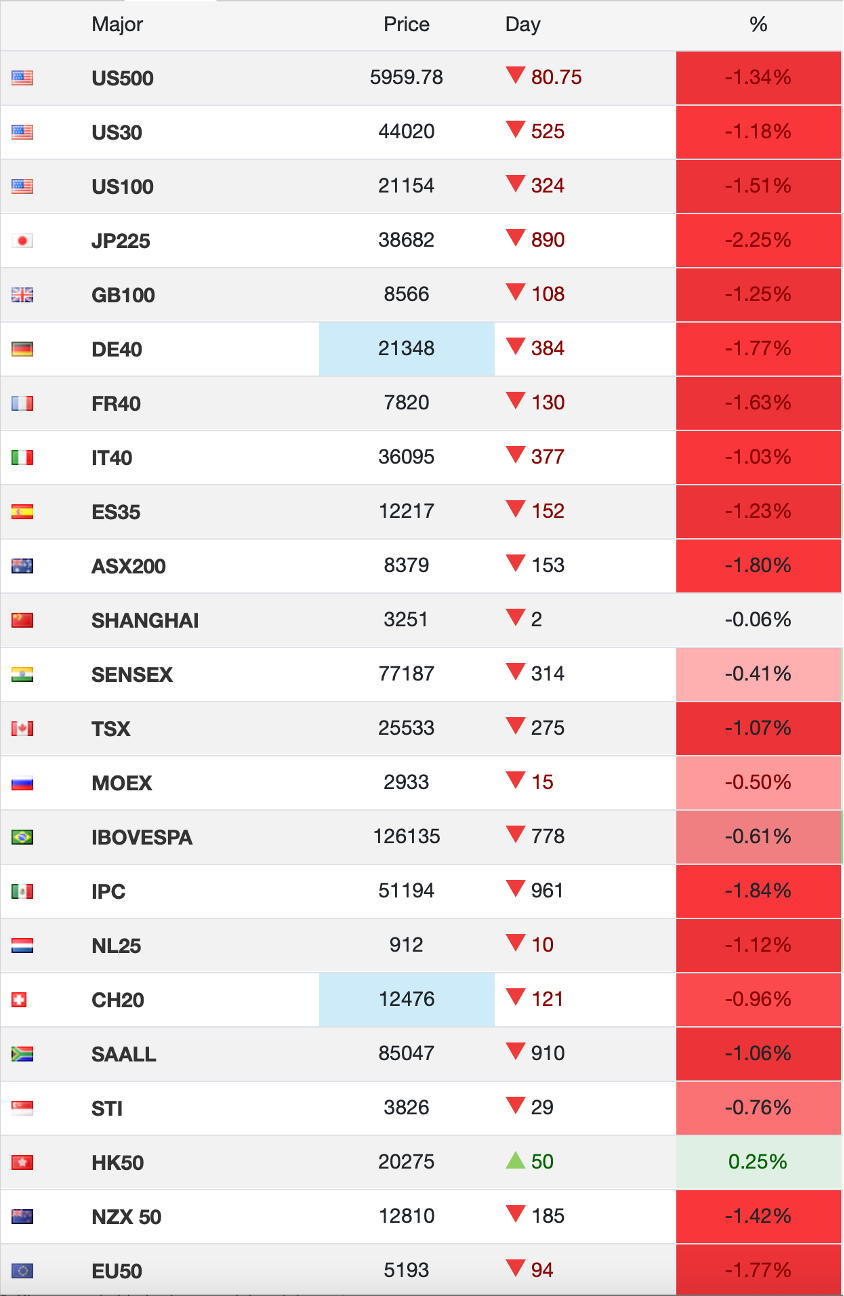
The early movement in equity markets was uniform around the world, and it was not pretty.  The below snapshot of equity futures markets, taken at 6:00am this morning shows that the only two markets that have not fallen are China and Hong Kong, and that is only because they remain closed for the Chinese New Year holidays.  But there is plenty of fear all around the world, especially considering that markets throughout Europe and Japan, as well as other nations that have not been named targets of tariffs, have also fallen sharply.

Source: tradingeconomics.com

Too, the FX markets have also responded dramatically, with the dollar exploding higher vs. virtually all its counterpart currencies this morning as 1% gains are the norm.

Source: tradingeconomics.com

A special shoutout to ZAR (-1.55%) which while not directly impacted by tariffs, caught Trump’s ire by their recently enacted legislation to confiscate property as they deem fit, oftentimes without compensation.  While South African officials have claimed it is akin to eminent domain rules in the US, those require compensation at all times, a not insubstantial difference.  

So, what’s a hedger to do?  Well, this is why you maintain a hedge program in the first place.  Lots of things happen in the world, most of which are beyond any individual or companies’ control, yet the impacts are real.  Some of what I have read this morning highlights the idea that Canada and Europe and Mexico are going to stick together to fight these tariffs.  However, at the end of the day, the US economy, and by extension its market, is the largest by far, and losing the US as an export destination will be a very difficult pill for those nations and their economies to swallow.  

My sense is that Trump, especially if he continues to address the immigration and government waste issues, will have far more runway than most other nations, especially given the precarious situation of many ruling parties right now.   But the other thing to consider is that there is no going back to the way things were in the past.  Alliances and treaties are going to come under much greater scrutiny by all sides as governments everywhere re-evaluate what they are trying to achieve with various policies and how they can partner with other nations to work together.  In fact, I suspect that the EU is going to continue to come under even greater pressure as it becomes more evident that while many countries believe in the trade benefits of the EU, the recent focus by Brussels on other issues like climate activism and immigration run counter to some members’ views.  No matter what, the world is changing dramatically, and my take is the change is going to come faster than many will have anticipated.

OK, there are a thousand stories on how the tariffs are going to impact the US, with initial calculations regarding the negative impact on GDP and how much they are going to raise inflation, so I’m not going to go there.  Needless to say, the universal belief is things will get worse on those metrics.  But here’s something else to consider.  On Friday, the BLS will be revising the 2024 jobs data, including their population estimates and the birth/death model that describes the number of new businesses that are formed, net, each month. Early estimates show that the number of jobs created is going to fall by nearly 1 million while population, now taking into account more immigration, is going to rise.  I have seen estimates that the Unemployment Rate may rise, or be revised, to 4.5% or 4.6%.  If that is the case, it will certainly call into question exactly what the Fed has been doing.  It will also, almost certainly, result in a Trumpian tirade about how the BLS is political and was cooking the books to burnish Biden’s economic record.  I suspect it will not help equity markets if that is the case, but also probably hurt the dollar as the Fed will be right back onto their rate cutting discussions.

As I’ve already shown the equity and FX markets above, a look at bonds shows that Treasury yields are unchanged this morning, as they seem to be caught between concerns of slower growth and higher inflation due to the tariffs.  Remember, too, that Wednesday, the Treasury will issue its Quarterly Borrowing Estimate with all eyes on the mix that new Treasury Secretary Bessent will be seeking as things go forward.  Remember, he was quite vocal, before he took the job, as to the mistakes that Yellen made in not terming out more Treasury debt when rates were at extremely low levels.  Meanwhile, European sovereign yields are all lower this morning, between -2bps (Italy) and -6bps (Germany) as PMI data released showed that though things were better than last month, they remain well below the key 50.0 level.  However, on the inflation front, both Eurozone and Italian data printed higher than expected, clearly not what Madame Lagarde wants to see.

Finally, commodity markets have seen oil prices (+2.6%) rise sharply as the US will be imposing 10% tariffs on imports of Canadian oil products, while NatGas prices have jumped by 9.0% on concerns over supply disruptions from those tariffs.  Like I said, the world is a different place today!  In the metals markets, both gold and silver are little changed this morning although copper (-0.9%) prices are slipping, perhaps on the idea that these tariffs are going to slow economic activity.  And that is one of the key belief sets amongst economists.

As to the data this week, it is reasonably busy, but all eyes will be on Friday’s NFP report, especially with the rumors of a major revision.

TodayISM Manufacturing49.8
 ISM Prices Paid52.6
TuesdayJOLTS Job Openings8.0M
 Factory Orders-0.8%
 -ex Transport+0.6%
WednesdayADP Employment150K
 Trade Balance-$96.5B
 ISM Services54.2
ThursdayInitial Claims215K
 Continuing Claims1855K
 Nonfarm Productivity1.7%
 Unit Labor Costs3.5%
FridayNonfarm Payrolls170K
 Private Payrolls140K
 Manufacturing Payrolls-2K
 Unemployment Rate4.1%
 Average Hourly Earnings 0.3%(3.8% Y/Y)
 Average Weekly Hours34.3
 Participation Rate62.5%
 Michigan Sentiment70.9
 Consumer Credit$10.5B

Source: tradingeconomics.com

In addition to all of this, we will hear from nine different Fed speakers, at least, over 13 different venues this week.  Now, things could get quite interesting here given Chairman Powell did not speak to tariffs as they were not yet implemented when he delivered the FOMC news last week, but all of these speakers will have an opinion.  I wonder if there will be a unified set of talking points or if each one will truly give their own views.  Of course, given that each is a neo-Keynesian economist, I suspect their views will all be aligned anyway.

One other thing from last week that didn’t get much press is that the BOC, after cutting the base rate by 25bps as widely expected, has indicated they will be ending their QT program and, in fact, restarting their QE program over the next several months in order to grow their balance sheet in line with the economy.  Do not be surprised if we see other major central banks go down this road as well, regardless of sticky inflation.  

Summing it all up, the world is very different this morning compared to Friday morning.  Trade and economic disruptions are going to become evident and there is still a great deal of vitriol to be vented at Trump by others, while Trump will continue to decry other nations efforts to weaken the US.  As I have written in the past, volatility will be the main underlying thesis this year.  Meanwhile, the beauty of a good hedge program is it helps through all market conditions.  Do NOT slow things down waiting for a better entry point, be consistent, as that better entry point may not materialize for a long time.  My strongest cue will be the bond market as if yields start to decline in anticipation of a significant economic slump, I expect the dollar will suffer, but if they hold up, then there is nothing to stop the dollar from testing and breaking its recent highs.

Good luck

Adf

Quite Clearly Concerned

The data on Friday exceeded
All forecasts, and has now impeded
The idea the Fed
When looking ahead
Believes further rate cuts are needed
 
Meanwhile from the Chinese we learned
Their exports are still widely yearned
But imports are falling
As growth there is stalling
And Xi is quite clearly concerned


Under the rubric, even a blind squirrel finds an acorn occasionally, my prognostications on Friday morning turned out to be correct as the NFP number was much stronger than expected, the Unemployment Rate fell, and signs of labor market strength were everywhere.  One of the most interesting is the number of quits rose to 13.8%, its highest level in several years and an indication that there is growing confidence amongst the labor force that jobs are available if needed.  As well, as you all are certainly aware, the market responded by selling equities and bonds while reducing the probability of Fed rate cuts this year.  In fact, this morning, the market is pricing in just 24 basis points of cuts for all of 2025, in other words, one cut only.  

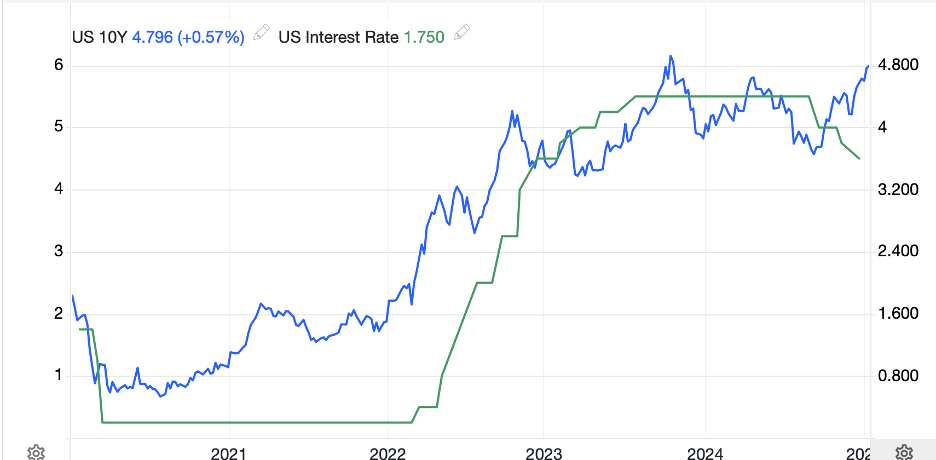
Meanwhile, the bond market continues to sell off with yields rising another 2bps this morning.  the chart below shows the dichotomy between Fed funds and 10-year Treasury yields.  Historically, when the Fed was cutting or raising rates, the bond market followed.  But not this time.

Source: tradingeconomics.com

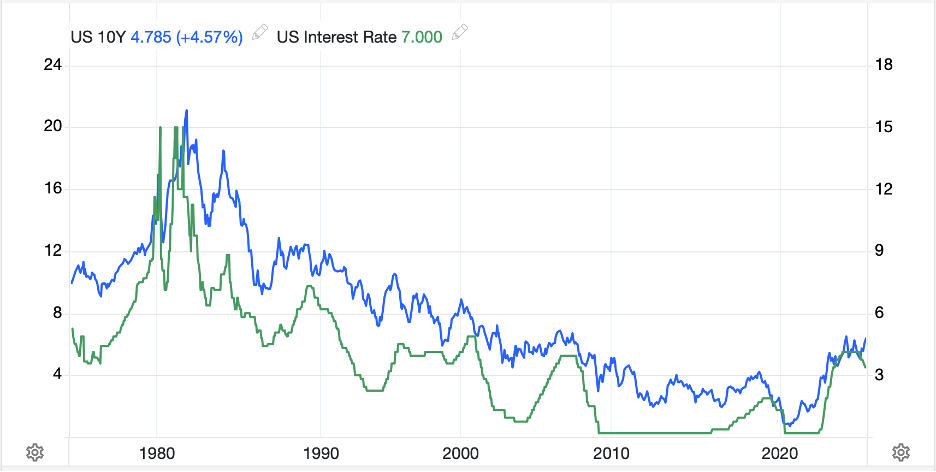
There have been many explanations put forth by analysts as to why this is the case, but to me, the most compelling is that investors disagree with the Fed’s analysis of the economy and, more specifically, with their pollyannaish tone that inflation is going to magically return to 2% because their models say so.  In fact, when looking back over the past 50-years of data, this is the only time that I can see when this dichotomy even existed.

Source: tradingeconomics.com

If I had to guess, there is going to be a lot more volatility coming as previous market signals, and more importantly, Fed market tools, no longer seem to be working as desired.  Nothing has changed my view that 10-year yields head to 5.5%, and if I am correct, look for equity markets to suffer, perhaps quite a bit.

The other story of note overnight was the Chinese trade surplus, which expanded to $104.8 billion in December which took the 2024 surplus to $1.08 trillion.  Now, much of this seems to be preordering of Chinese goods ahead of Trump’s inauguration and the promised tariffs.  But China’s surplus with other Asian economies also grew dramatically last year.  Remember, President Xi is desperate to achieve 5% growth (even on their accounting) and since the Chinese public remains unenthusiastic about spending any money given the $10 trillion hole in their collective savings accounts due to the property market collapse, Xi is reliant on exporting as much as possible.  While this is not making him any friends anywhere else in the world, it is an existential issue for him, so he doesn’t really care.  It will be very interesting to see just how the Trump-Xi relationship moves forward and what concessions are made on either side.

In the end, while the renminbi is basically unchanged this morning, it remains pegged against its 2% limit vs. the CFETS fixing onshore and is 2.35% weaker in the offshore market.  That pressure is going to continue until either the Chinese step up, apply significant stimulus to the domestic economy and start to rebalance the trade process or the PBOC lets the currency go.  Remember, too, Xi is in a tough position because he continuously explained that the renminbi is a good store of value and has been asking his trading partners to use it rather than the dollar.  But if he lets it slide, that will destroy that entire narrative, a real loss of face at the very least, and potentially a much bigger economic problem.  Interesting times.

And so, let us turn to the overnight market activity and see how things are shaping up for today and the rest of the week.  Friday’s sharp decline in US equity indices was followed by similar price action throughout Asia (Nikkei -1.05%, Hang Seng -1.0%, CSI 300 -0.3%, Australia -1.25%) as the narrative is struggling to come up with a positive spin absent further US rate cuts.  European bourses have also come under pressure (DAX -0.7%, CAC -0.8%, IBEX -0.7%, FTSE 100 -0.4%) despite the fact that ECB talking heads continue to explain that more rate cuts are coming, they just won’t be coming quite as quickly as previously expected.  At this point, the market is pricing in 84bps of cuts by the ECB this year.  And yes, US futures are also in the red at this hour (7:00), falling between -0.5% (DJIA) and -1.1% (NASDAQ).

It seems that the narrative writers are struggling to put together a bullish story right now as inflation refuses to fall while growth, at least in Europe, continues to abate.  At least, a bullish story for equities and bonds.  The dollar, on the other hand, has gained many adherents.

Turning to bonds, yields continue to climb across the board with European sovereign yields rising between 2bps (Germany) and 8bps (Greece) and everything in between.  It seems nobody wants to hold bonds right now.  The same was true overnight in Asia where the best performer was the JGB, which was unchanged, but other regional bond markets all saw yields rise between 3bps (Korea) and 9bps (Australia).  Even Chinese yields edged higher by 1bp!

In the commodity space, oil (+2.0%) is en fuego, as the impact of further sanctions on the Russian tanker fleet is being felt worldwide.  It seems the Biden administration has added another 150 Russian tankers to the sanctions list along with insurance companies, and so China and India, who have been the main recipients of Russian oil, are seeking supplies elsewhere.  As long as this continues, it appears oil has further to run.  Meanwhile NatGas (+3.8%) has blasted through $4.00/MMBtu and is now at its highest level since December 2022.  Despite all those global warming fears, the recent arctic blast has increased demand dramatically!

As to the metals markets, the story is different with gold (-0.5%) sliding alongside silver (-2.1%) and copper also trickling lower (-0.15%).  Part of this is clearly the dollar’s strength, which is impressive again today, and part is likely concern over how things are going to play out going forward between the US and China as well as the overall global economy.  Certainly, a case can be made that growth is going to be much slower going forward.

Finally, the dollar is king again, rallying sharply against the euro (-0.5%) and pound (-0.8%) with smaller gains against the rest of the G10 (JPY excepted as it rallied 0.2% on haven flows).  But we are also seeing gains against virtually all EMG currencies (CLP -0.6%, PLN -0.7%, ZAR -0.4%, INR -0.6%) as concerns grow that these other nations will not be able to ably fund their dollar debt as the dollar continues to rise.  FYI, the DXY (+0.35% to 110.07) is at its highest level since October 2022 and looking for all the world like it is going to take out the highs of that autumn at 113.20.

On the data front, this week brings CPI and PPI as well as Retail Sales.  In addition, I was mistaken, and the Fed is not in their quiet period so we will hear a lot more from them this week as well.

TuesdayNFIB Small Biz Optimism100.8
 PPI0.3% (3.4% Y/Y)
 Ex food & energy0.3% (3.7% Y/Y)
WednesdayCPI0.3% (2.8% Y/Y)
 Ex food & energy0.2% (3.3% Y/Y)
 Empire State Manufacturing4.5
 Fed’s Beige Book 
ThursdayInitial Claims214K
 Continuing Claims1870K
 Retail Sales0.5%
 Ex autos0.4%
 Philly Fed-4.0
FridayHousing Starts1.32M
 Building Permits1.46M
 IP0.3%
 Capacity Utilization76.9%

Source: tradingeconomics.com

As well, we hear from five Fed speakers over six venues.  Now, the message from the Fed has been pretty unified lately, that caution and patience are appropriate regarding any further rate cuts but that to a (wo)man they all believe that inflation is heading back down to 2.0%.  I’m not sure why that is the case because if you look at the data, it certainly has the feeling that it has bottomed, and inflation rates are turning higher as you can see from the below chart of core CPI.

Source: tradingeconomics.com

And this is before taking into account that energy prices have been soaring lately!  I realize I’m not smart enough to be an FOMC member, but they certainly seem to be willfully blind on this issue.

At any rate, certainly all things still point to a higher dollar going forward, and I imagine we are going to test some big levels soon enough (parity in the euro, 1.20 in the pound) but I am beginning to get uncomfortable as so many analysts have come around to my view.  Historically, if everybody thinks something is going to happen, typically the opposite occurs.  Remember, markets are perverse!

Good luck

Adf

A Future Quite Noeth

All eyes will be on NFP
As pundits are hoping to see
A modest result
That can catapult
The market to its apogee
 
If strong, the concern is that growth
Will strengthen and Jay will be loath
To cut rates once more
Which bulls will deplore
Implying a future quite noeth
 
If weak, then the problem for stocks
Is earnings will suffer a pox
So even if rates
Are cut in the States
The NASDAQ may still hit the rocks


It’s payroll day and especially after yesterday’s day of respect for the late President Carter closed equity markets in the US, investors are anxious to get back to business.  Here are the latest consensus estimates for the key figures to be released

Nonfarm Payrolls160K
Private Payrolls135K
Manufacturing Payrolls5K
Unemployment Rate4.2%
Average Hourly Earnings0.3% (4.0% Y/Y)
Average Weekly Hours34.3
Participation Rate62.8%
Michigan Sentiment73.8

Source: tradingeconomics.com

As well, there will be annual revisions to the household report today, which is the portion of the process that calculates the Unemployment Rate.  Next month we will see the annual revisions to the NFP, where estimates are already circulating that the number of jobs created in 2024 will be revised down by more than 1 million, nearly one-half of the claimed number (~2.2 million) created.

But ultimately, the reason this data point gets so much press is that it is half of the Fed’s mandate and so is closely watched by the FOMC as they consider any policy stance.  Yesterday, St Louis Fed president Musalem became the seventh or eighth Fed speaker since the last meeting to explain that more caution was warranted as the Fed tries to reduce what they still believe is a modest tightening bias.  “… [rate reductions] have to be gradual – and more gradual than I thought in September,” according to Musalem.  So, caution remains the watchword for every member of the FOMC and accordingly, the market is pricing just a 5% probability of a rate cut later this month.

The thing that has really changed over the past several months is the market’s reaction function to the data.  Part of this is based on the fact that it appears the Fed’s reaction function has changed a bit, and part of this is because the economic situation remains so confusing.

Regarding the Fed, given the fact that the data since they started cutting rates in September has been quite robust and given the fact they no longer have a political/partisan motive to cut rates, it strikes me it will be far harder for Powell and friends to justify further rate cuts from here.  After all, if GDP is growing at 3.0% and inflation is running at 3.3%, absent all other information, that data would truthfully argue for rate hikes.  However, there remains a large camp of analysts that continue to expect a significant slowdown in economic activity, with a number of well-respected voices claiming that we are already in a recession and have been in one since sometime in 2024.  

My view is that this confusion remains best explained by the concept of the K-shaped recovery where a smaller portion of the population, notably those with assets and investments in the markets, have been huge beneficiaries of Fed policies as they not only have seen their portfolios climb in value, but their cash is earning a nice return.  Meanwhile, a much larger percentage of the population, although a group that receives far less press from the financial reporters, continues to struggle given still rising prices and less overall opportunity for advancement.  This is the genesis of the labor strife we have seen, but there are many who remain left behind.  The problem for the Fed is they don’t really see this second cohort as their constituents, at least based on their policy actions.

As to today’s release, if we look at the recent Initial Claims data, it is consistent with a stronger number rather than a weaker one.  However, from a market perspective, I believe that a strong NFP number, something like 200K, will see a risk sell-off as the market continues to remove pricing for any rate cuts in 2025.  This will hurt stocks and likely bonds, although it will help the dollar and, surprisingly, commodities, as the market is likely to see increased demand forthcoming.

Elsewhere, aside from the wildfires in LA, which are a terrible tragedy, the other story in markets today revolves around the ongoing, slow motion disintegration of any remaining credibility in the UK government and its ability to address the many problems there.  Gilt yields continue to rise sharply, although I continue to hear many rationales as to why this is NOT like the October 2022 Gilt crisis.  Alas, while certainly the speed of this decline in Gilts is not quite as dramatic as we saw back then, the duration of the problem is far greater, and we have moved further now than then.  As you can see from the below chart, Gilt yields have risen 110bps since the middle of September, outpacing even Treasury yields and 10yr Gilts now yield 15bps more than Treasuries.  

Source: tradingeconomics.com

In fact, UK 10-year yields are the highest in the G10, although in fairness, they are not yet approaching levels like Mexico (10.6%), Brazil (14.75%) or Turkey (26.4%).  Perhaps Chancellor Reeves has those targets in mind.

OK, let’s see how markets behaved in the lead-up to the data this morning.  There was no joy in Mudville Asia last night as the Nikkei (-1.05%) slid amid new stories that the odds of a BOJ rate hike in two weeks are rising, while Chinese shares (Hang Seng -0.9%, CSI 300 -1.2%) were also under pressure amid news that the PBOC would stop buying bonds (ending QE) and additionally might be selling some to reduce liquidity in Hong Kong as they attempt to slow the decline of the renminbi.  The rest of the region was similarly under pressure across the board. 

In Europe, the picture is more nuanced with the DAX (+0.4%) and CAC +0.3%) showing some modest gains after slightly better than expected French IP data.  However, the FTSE 100 (-0.4%) and other continental bourses (IBEX -0.9%) are not quite as positive, with the FTSE clearly feeling pressure from the overall negative sentiment on the UK, while mixed data elsewhere is undermining any investor sentiment.  US futures at this hour (7:15) are pointing lower by about -0.25% across the board.  Fears of a strong number?

In the bond market, Treasury yields continue to climb, as they are holding onto yesterday’s rise of 5bps and this morning we are seeing European sovereign yields all creep higher by 1bp to 2bps.  JGB yields also rose 2bps overnight as part of that BOJ rate hike story.  In fact, the only market that didn’t see yields rise is China, where they remain within 2bps of their recent all-time lows

In the commodity markets, oil (+3.2%) is skyrocketing as continued cold weather increases heating demand while the reduction in inventories in Cushing, Oklahoma (the main point for NYMEX contract settlements) has raised concern over available supply of crude.  Meanwhile, metals prices continue to climb steadily with gold (+0.3%) continuing its run alongside silver (+0.8%) and copper (+0.45%).  The demand for “stuff” remains strong as nations around the world slowly lose confidence in government bonds as an effective store of value.

Finally, the dollar is, net, little changed this morning with some gains and some losses although few large moves.  On the dollar’s plus side we see KRW (-0.5%), ZAR (-0.55%) and BRL (-0.35%) while the yen and renminbi have both seen modest gains (+0.1%) on the back of the liquidity reduction stories in both nations.  However, we must keep in mind the dollar, as measured by the DXY, remains above 109 and continues to strongly trend higher.  My take is the highs seen in autumn 2022 are the next target, so look for the euro to sink below parity and the pound well below 1.20, probably 1.15, before too long.

There are no Fed speakers on the schedule today, although I imagine we will hear from somebody after the data since they cannot seem to shut up.  However, after today, they head into their quiet period ahead of the next FOMC meeting, so until then we will need to rely on Nick Timiraos from the WSJ to understand what Powell is thinking.

While nothing is that clear, and we could easily see a weak NFP report, my take is we are far more likely to see a strong one with stocks and bonds selling off and the dollar rising further.

Good luck and good weekend

Adf

Boom and Bust

According to people we “trust”
The past which involved boom and bust
Will stay in the past
And now, at long last
The owning of stocks is a must
 
So, whether today’s NFP
Is weak or strong, what we foresee
Can best be expressed
By buying the best
That BlackRock will sell for a fee


Is it different this time?  Have stocks reached a “permanently high plateau”?  Has the global economy exited the cycle of ‘boom and bust’ which has existed since the beginning?  These questions are relevant today after the release of BlackRock’s 2025 Global Outlook which explained that “Historical trends are being permanently broken in real time as mega forces, like the rise of artificial intelligence (AI), transform economies.”

BlackRock’s claim is simply the latest by a well-known investor that stock prices will never retreat again, and the future is unbelievably bright.  “This time is different” has been said about virtually every bull market top, whether the real estate bubble, the tech bubble, the Japanese bubble, the Chinese real estate bubble or even the South Seas bubble hundreds of years ago.  In fact, in order to inflate a bubble, the narrative must be, this time is different.

That permanently high plateau comment came from Irving Fisher, who while a very well-respected economist for his work on debt deflation (which came after the Depression started), famously made that comment on October 21, 1929, just days before the crash that led to the Great Depression.

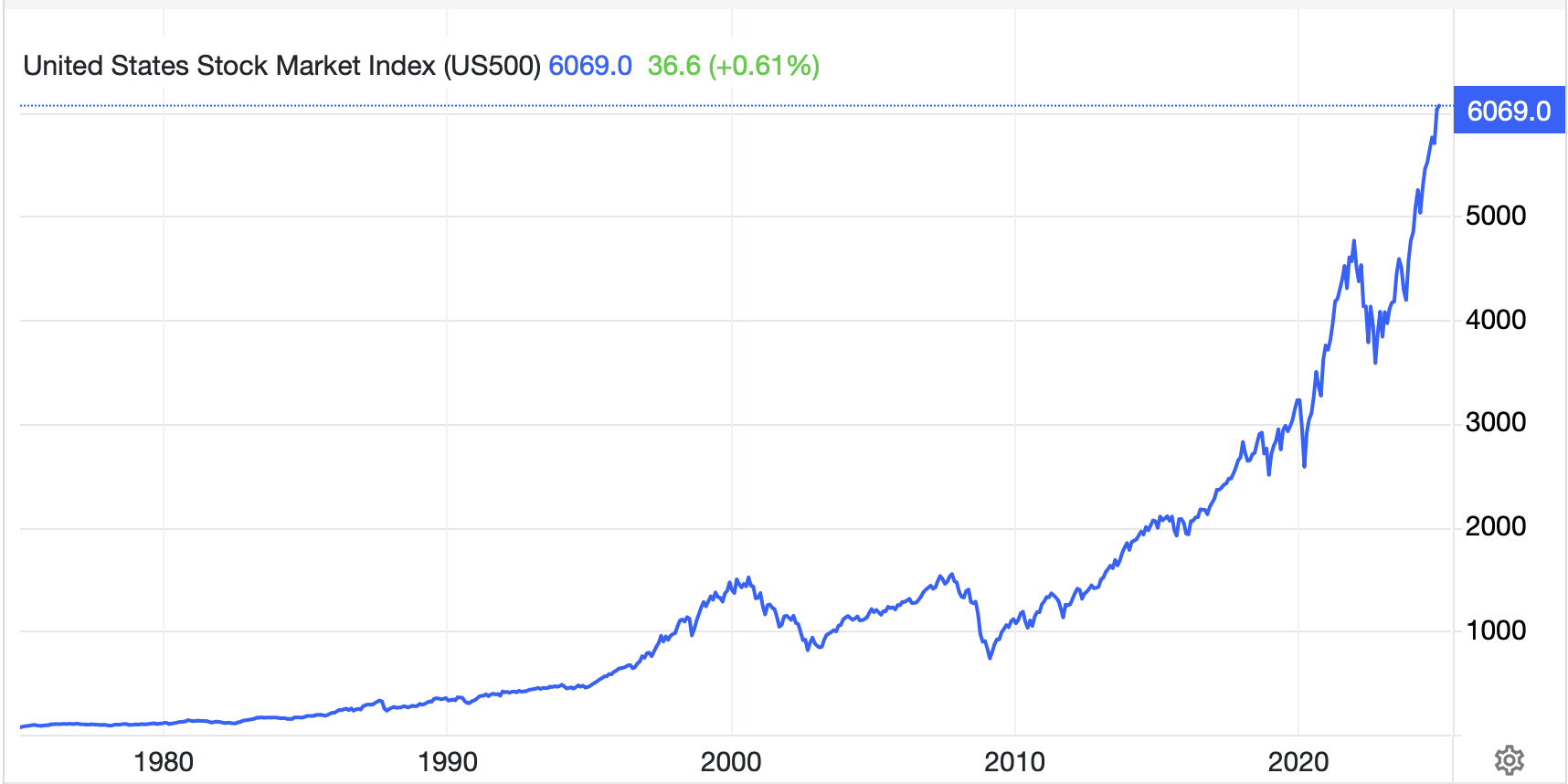
So, the question is, has BlackRock defined the top in equity markets this time?  I think it is worthwhile to take a longer-term perspective on market performance to try to answer that question, and more importantly, figure out what to do if this is the top.  A look at the chart below, the last 50 years of the S&P 500, shows that every one of the major downturns we have seen, at least in my lifetime, has been nothing more than a blip.

Source: tradingeconmics.com

For instance, the tech bubble was an anthill around 2000 on this chart, and the GFC crash, while described as the worst recession since the Great Depression, seems to be a pretty modest dip.  Covid in 2020 was almost nothing and the biggest was really 2022, which saw the index slide 25% through the first 9 months of the year.  Of course, part of this is the number itself.  A 25% decline now would be ~1500 S&P points (or 11,000 Dow points), the type of thing that would freak out nearly everybody.  

Is this possible?  Certainly, it is, 25% declines have occurred pretty regularly through the history of the market.  Is it likely?  This is a much tougher question.  BlackRock’s thesis is that this time is different; that AI is the game changer, and the future will be finally filled with flying cars and robots doing all our chores on the basis of unlimited free energy for everyone.  Ok, that may be a slight exaggeration, but they are extremely optimistic that technology will continue to move forward and solve what currently appear to be intractable problems.

The one thing working in their favor, I think, is that governments and central banks around the world have essentially lost their tolerance for market corrections, whether that is in equity or fixed income markets, and so will do whatever they can to prevent any small slide from becoming a large one.  Of course, the only thing they can do is print money to buy those assets that are falling in price.  If that is the plan of action, then the future will be highly inflationary, that is the only clear outcome.

I have no idea how things will turn out.  Perhaps BlackRock is correct, and we are about to embark on an entirely new segment of economic and financial history.  Perhaps Elon will successfully help restructure the US government so it is efficient and focused on a more limited role, and that process will inspire other nations to follow suit.  Perhaps pigs can fly as well.  I hate to be a curmudgeon, but trees still don’t grow to the sky, whether they are created by AI or nature.  Gravity remains undefeated.  But I am wary when I read reports claiming this time is different.  Forty plus years in the markets has taught me that is never the case.  Tools may change, timelines may change, but ultimate outcomes remain the same.

Ok, as we await this morning’s NFP report, let’s see what happened overnight.  Yesterday’s very modest declines in the US equity markets were followed by a slide in Japan (Nikkei -0.8%) and one in Australia (-0.6%) although this was predicated on weaker than expected GDP data, while Chinese shares (Hang Seng +1.6%, CSI 300 +1.3%) rallied on hopes that the economic conference next week is going to finally fire that long awaited Chinese bazooka!  In Europe, the most interesting aspect is the CAC (+1.4%) is having a wonderful day after the French government fell and prospects for managing the economy there remain extremely uncertain.  Perhaps that represents the idea that if the government is not interfering, French corporates can get on with the business of business unhindered and make more money.  Or perhaps it is an assumption that the ECB will ease more forcefully to prevent a major mishap.  After all, Madame Lagarde is French, so is likely not unbiased in the matter.  As to US futures, at this hour (7:15) they are lower by -0.1% across the board as we await the data.

In the bond market, there is nothing going on at all. Treasury yields are unchanged on the day which is true of virtually every European sovereign with one exception, French OATs which have seen more buying and have slipped 2bps lower in the session.  Here, too, it almost seems as though the market has decided the lack of a working government is better for France’s finances than when there is someone in power.  One other thing to note is that JGB yields have edged lower by 1bp this morning and have fallen 4bps this week as USDJPY has traded higher over the same period.  The most noteworthy thing here is that Toyoaki Nakamura, one of the most dovish BOJ members, explained that he was not against hiking rates, per se, and market participants took that as an opening for the BOJ to do just that and perhaps take a more pronounced stance against the ongoing inflation there.  I’ll believe it when I see it.

In the commodity markets, apparently nobody needs oil (-0.8%) anymore as it continues to sell off.  Remember just a few days ago we breached $70/bbl on the upside.  Well, this morning we are below $68/bbl amid fears(?) that peace is breaking out in the Middle East with talk that Hamas is willing to release the hostages to achieve a cease fire.  Arguably, a bigger issue is that much of the world (mostly China and Europe) have seen slowing economic activity and so demand estimates continue to decline along with the price.  As to the metals markets, they have been bouncing around lately, not making any headway in either direction as it appears traders are waiting for more concrete clues about demand here as well.  Gold (+0.2%) is the exception here, with demand not in question, just the timing of the next wave of central bank purchases.

Finally, the dollar is somewhat stronger overall this morning, notably vs. both AUD (-0.5%) and NZD (-0.4%) on the back of that weak GDP data.  Away from that, the rest of the G10 is mostly a bit softer, but not seeing large moves with NOK (-0.4%) excepted on the weak oil prices.  In the EMG bloc, declines are pretty consistent around the -0.2% range, but nothing really of note.

Now to the NFP data.  Here’s what is forecast:

Nonfarm Payrolls200K
Private Payrolls200K
Manufacturing Payrolls28K
Unemployment Rate4.2%
Average Hourly Earnings0.3% (3.9% y/Y)
Average Weekly Hours34.3
Participation Rate62.6%
Michigan Sentiment73.0

Source: tradingeconomics.com

In addition, we hear from four more Fed speakers (Bowman, Goolsbee, Hammack and Daly) so it will be interesting to see how they perceive the amount of caution that is appropriate going forward.  As a marker, this morning the Fed funds futures market is pricing a 70% probability of a December rate cut, down 4 points.

The big picture remains that the economy continues to outperform the naysayers, at least according to the official data.  The fact that performance is spread unevenly does not matter to markets at this time.  As such, it remains difficult for me to create the scenario where the dollar gives up substantial ground.  If the Fed does cut in two weeks, I think it will be the last for a while unless we start to see some major revisions lower in the data.  Maybe that starts this morning, but until then, you have to like the buck.

Good luck and good weekend

Adf

The Conundrum We Find

Tis nearly a month since the vote
When President Trump, Harris, smote
So maybe it’s time
To sample the clime
Of what all his plans now connote
 
To many, his claims are just talk
With pundits believing he’ll balk
But history shows
That Trump will bulldoze
Detractors as he walks the walk
 
So, tariffs are likely to be
The first part of his strategy
But if that’s the case
The dollar may chase
Much higher than he’d like to see
 
It seems the conundrum we find
Is not all his thoughts are aligned
And this, my good friends
Is why dividends
Are paid to a hedge, well designed


I have tried to stay away from forecasting how things will evolve once Mr Trump is inaugurated, but this weekend, listening to a podcast (Palisades Gold Radio) I got inspired as there was some interesting discussion regarding the dollar.  As I consider the issues, as well as what appears to be the current expectations, I thought it might be worthwhile to note my views, especially in the context of companies considering their hedging needs for 2025 and 2026.

Clearly, the watchword for Trump is tariffs as he has been boasting about implementing significant tariffs on trade counterparties on day 1.  The latest discussion is 25% on Canada and Mexico and 60% on China with Europe in the crosshairs as well.  (Remember, though, many believe these tariff threats are being used to encourage those countries to change their emigration policies and help stop the current influx of illegal immigration.  So, if countries do their part, those tariffs may never materialize.)

The classical economic view is that tariffs are a terrible policy as impeding free trade negatively impacts all players.  As well, you will hear a lot about how the countries in question will not pay them, but rather consumers in the US will pay those tariffs.  As such, there is a great deal of talk about how tariffs will feed immediately into inflation.  (Of course, this is in addition to the inflation that will allegedly come immediately on the heels of Trump’s promise to deport all illegal aliens in the country because it will decimate the workforce.  On this subject, simply remember that the deportation will result in a significant decline in demand for things like housing which remain quite sticky in the pricing process.)

But let’s consider what Trump’ stated goals really are.  I would boil them down to rebuilding America’s industrial capacity and creating good jobs throughout the nation for citizens and legal residents.  If he is successful, the result will be a dramatic reduction in the trade deficit which will reduce the need to import so much foreign capital to fund things.  And what are the knock-on effects there?  Well, classical economics tells us that tariffs will be met with foreign currency depreciation (higher dollar) in an effort to offset the higher prices of those imports.  However, one of Trump’s goals is to reduce the value of the dollar in order to make US exporters more competitive internationally while reducing demand for imports.  Now, it seems that those two goals are at odds.

I think the thing we need to consider, though, is that the timing of these changes is very uncertain.  My guess is Trump is thinking of a 4-year process, or at least a 3-year one, not a 6-month outcome.  After all, these are tectonic shifts which will take time to play out.  Based on his commentary, and I think we must pay it close attention as he is pretty clearly telling us what he wants to do, the market response to any tariffs imposed will likely be weakness in the currencies of the countries affected.  

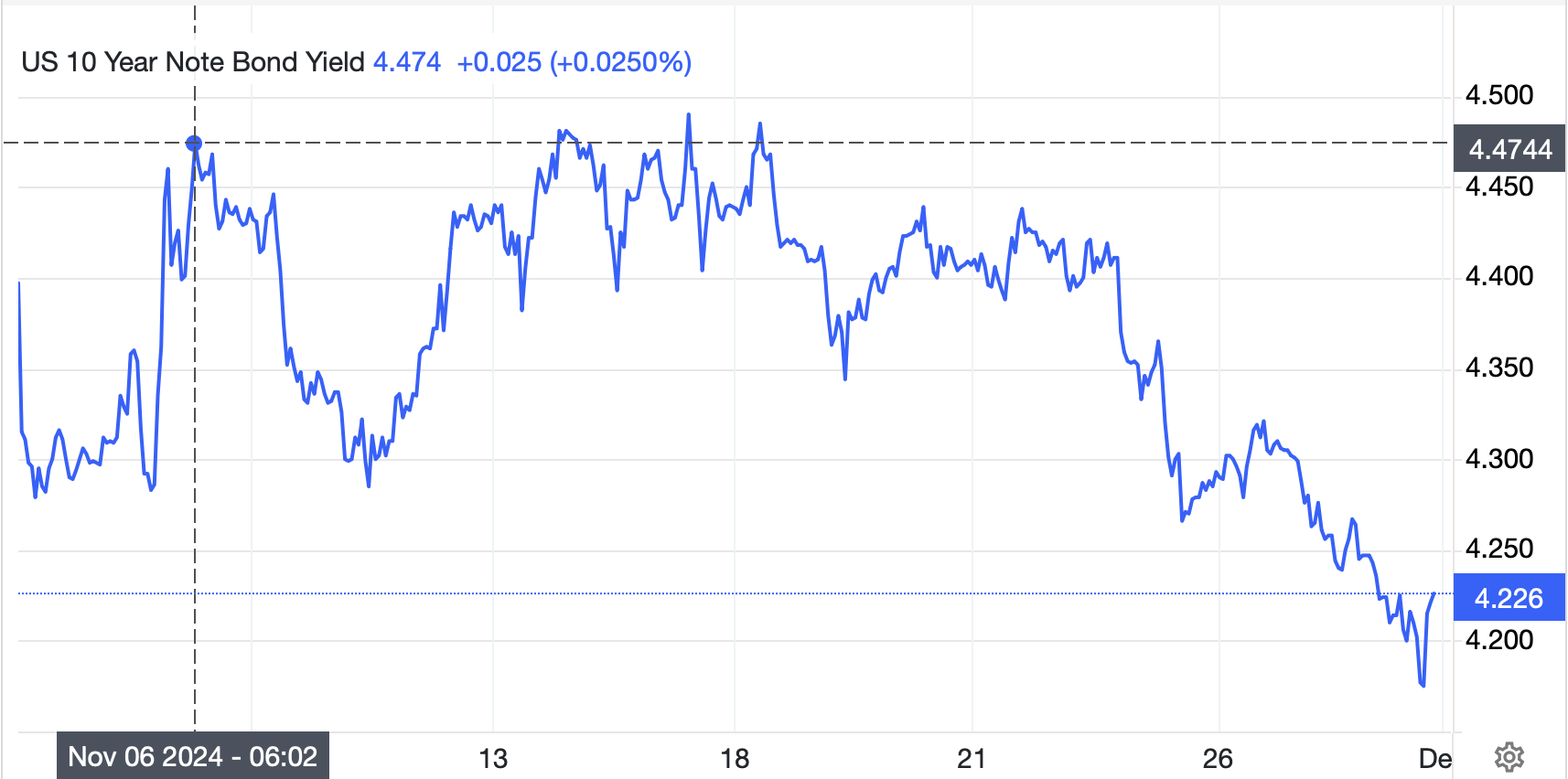
But, over time, it would not be surprising to see Trump lean effectively on the Fed to reduce policy rates (remember, he was quite upset the Fed never went negative).  As well, if there is any success in the DOGE project, with significant reductions in spending and deficits, that seems likely to alleviate some of the concerns over the US fiscal stance.  After all, if debt grows more slowly than the nominal pace of the economy, it remains quite manageable and should help remove some of the current hysteria.  In fact, a look at the 10-year yield over the past month (see chart below) shows that it has fallen 25bps (although they are 4bps higher this morning) and may well be signaling a market that is willing to give DOGE a chance.  If that is the case, it seems quite possible that the dollar will eventually start to recede from its current loftier levels.

Source: tradingeconomics.com

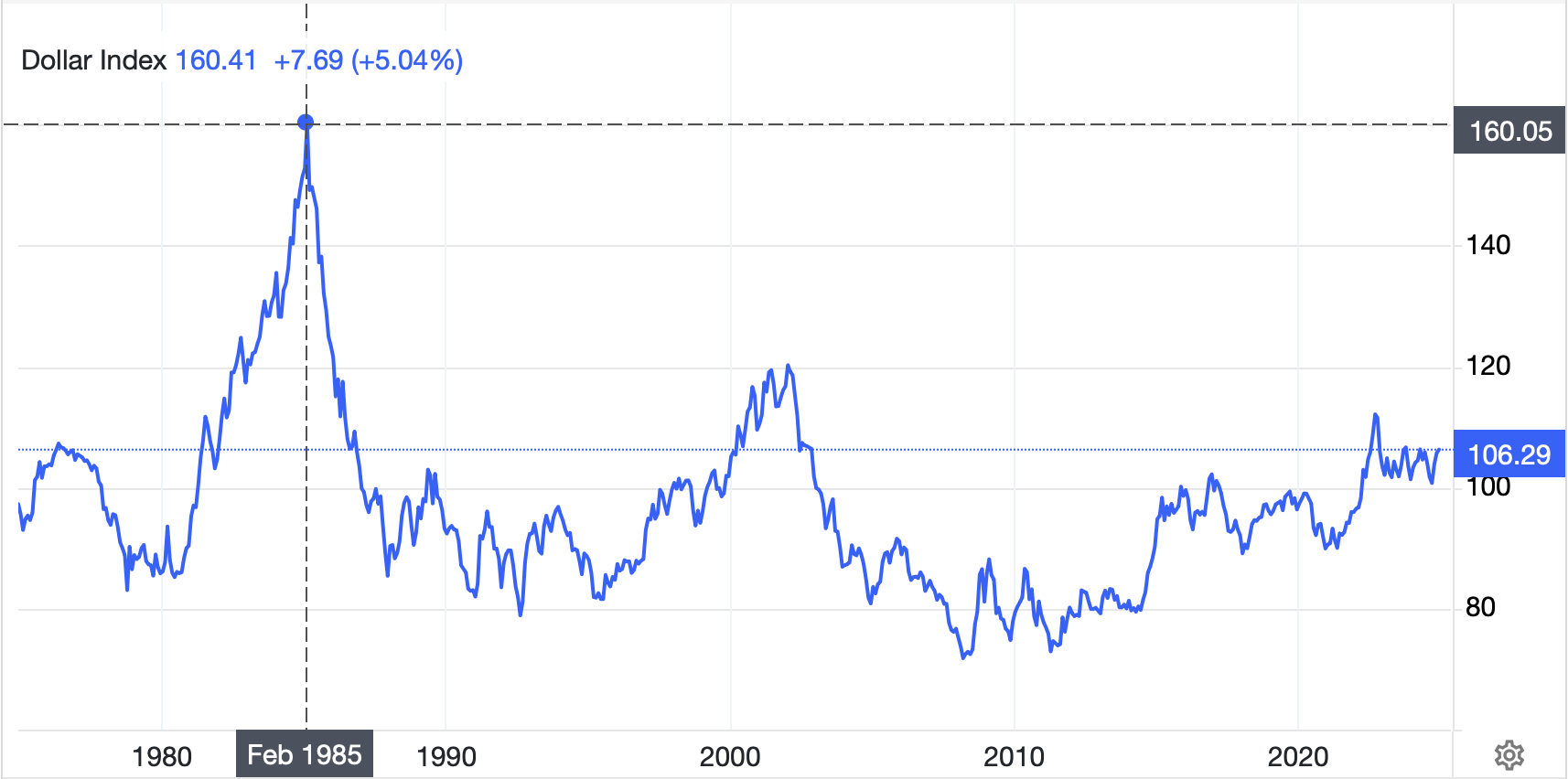
Bringing this back to the hedging issue, I might suggest that given the uncertainty of the timing of any movements, receivables hedgers will be well-served by using optionality here, whether outright purchases or zero-premium structures as they look to address 2025 and 2026 exposures.  While the dollar may well continue its recent strengthening trend with the euro heading to parity or below for a time, and other currencies following, at some point in H2 25 or beyond, it is quite feasible that the dollar reverses course.  Consider what could happen if Trump convenes a Mar-a -Lago accord, similar to the Plaza Accord of 1985, which saw the dollar decline dramatically in the ensuing three years, falling nearly 50% against a broad mix of trading partners’ currencies by the end of 1987.

Source: tradingeconomics.com

In that situation, those out-month hedges will want to have optionality to allow the weaker dollar to benefit the revenue line.  Similarly, for those with payables hedges, care must be taken to hedge effectively there as well given the opportunity for much higher costs due to the potential dollar decline.  Current market pricing (implied volatilities) is quite reasonable from a long-term perspective.  While they are not near the lows seen in the past year, they very likely offer real value for hedgers of either persuasion.

I apologize for the extended opening, but it just seemed to be a good time to review the evolving Trump impact.  Now onto markets. The first thing to recall is that last Wednesday’s PCE data continued to show that inflation, even in this measurement, appears to have stopped declining and is beginning to head higher again.  This will continue to put pressure on the Fed as housing data was pretty dreadful last Wednesday.  Add to the data conundrum the unknown unknowns of a Trump presidency and Chairman Powell will have his hands full until his term ends.

Friday’s abbreviated session in the US saw two of the three major indices trade to new all-time highs (NASDAQ is < 1.0% below its recent high) and that seemed to help support the Asian time zone markets with green outcomes nearly universal.  Japan (+0.8%), China (+0.8%) and Hong Kong (+0.65%) all had solid sessions as did every regional exchange other than Indonesia (-0.95%) which has been suffering for the past several months in contrast to most other nations.  In Europe, the picture is more mixed with most bourses in the green (DAX +0.8%, IBEX +0.9%) although the CAC (-0.35%) is feeling pain from increased worries that the government there will fall, and the fiscal situation will be a disaster going forward.  French yields continue to climb vs. every other European nation as the country is leaderless for now.  For the rest of the continent, slightly softer PMI Manufacturing data seems to have investors increasing their bets that the ECB is going to become even more aggressive in their rate cutting going forward.  As to the US futures market, at this hour (7:00) it is mixed with the SPX (+0.5%) rising but the other indices little changed.

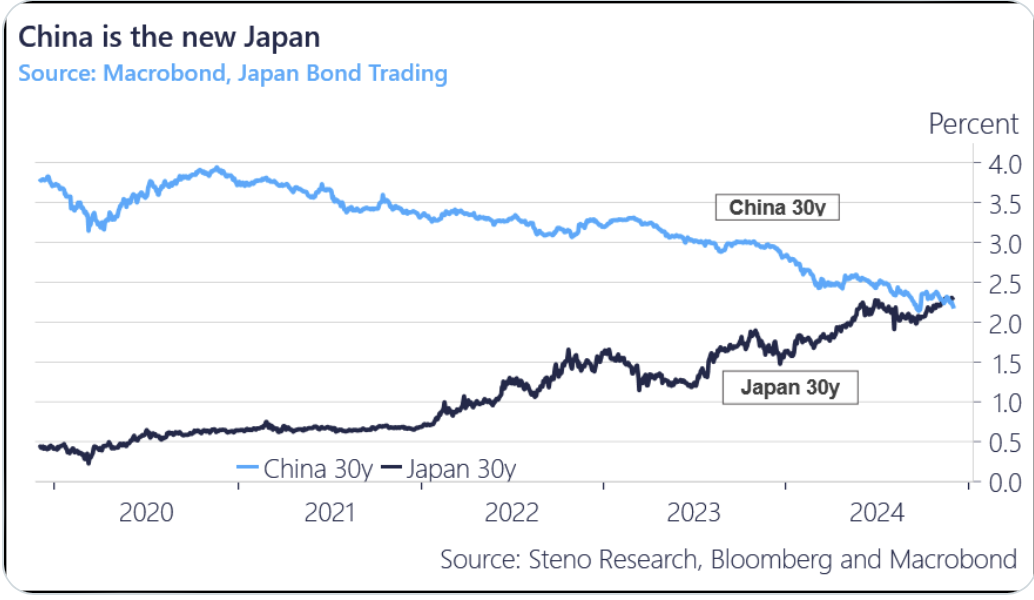
In the bond market, as mentioned above, US yields have rallied a bit although European yields are all lower by between -2bps and -4bps (France excepted at unchanged) as those hopes for an ECB rate cut are manifest here as well.  As to JGB’s, 10yr yields are higher by 2bps this morning as there is increasing chatter that Ueda-san will be hiking rates later this month.  One other interesting note here is that in the 30-year space, Chinese yields have fallen below Japanese yields for the first time ever.  This seems to be an indication that market expectations of a Chinese rebound (despite solid Caixin PMI data overnight at 51.5) are limited at best.

In the commodity markets, oil is little changed on the day, remaining below the $70/bbl level but potentially seeing some support after a story surfaced that China would be reducing its purchases of Iranian oil in an effort to avoid US sanctions and tariffs under the Trump administration.  If Trump is successful in isolating Iran again, that could well support prices.  In the metals markets, this morning is seeing a little profit-taking in the precious space after last week’s late rally, but industrial metals are little changed.

Finally, the dollar is stronger again this morning, rallying against all of its counterparts in various degrees.  The euro (-0.5%) is lagging along with SEK (-0.65%) in the G10 space as concerns over slowing growth weigh on the single currency.  But the dollar is stronger across the board.  In the EMG bloc, BRL (-0.75% and back above 6.00) is leading the way lower but we have seen declines across the board with MXN (-0.4%), KRW (-0.7%), ZAR (-0.6%) and HUF (-1.1%) just some of the examples.  Despite that hotter than expected PCE data last Wednesday, the market is still pricing a nearly 62% probability of a cut by the Fed later this month.

On the data front, there is much to learn this week, culminating in NFP data on Friday.

TodayISM Manufacturing47.5
 ISM Prices Paid55.2
TuesdayJOLTS Job Openings7.48M
WednesdayADP Employment150K
 ISM Services55.6
 Factory Orders0.3%
 Fed’s Beige Book 
ThursdayInitial Claims215K
 Continuing Claims1905K
 Trade Balance-$75.1B
FridayNonfarm Payrolls195K
 Private Payrolls200K
 Manufacturing Payrolls15K
 Unemployment Rate4.2%
 Average Hourly Earnings0.3% (3.9% Y/Y)
 Average Weekly Hours34.3
 Participation Rate62.6%
 Michigan Sentiment73.3

Source: tradingeconomics.com

In addition to all the data, we hear from 10 different Fed speakers, most notably Chairman Powell on Wednesday afternoon.  Given that the recent data does not seem to be going according to their plans, at least not the inflation data, it will be very interesting to hear what Powell has to say about things.

As the end of the year approaches with many changes certain to come alongside the Trump inauguration, I will once again express my view that hedging is crucial for risk managers here.  While I see the dollar benefitting in the near term, as discussed above, the longer-term situation is far less certain.

Good luck

Adf

Fraught

The job growth that everyone thought
Existed, seems like it was fraught
Meanwhile ISM
Showed further mayhem
As growth slowed while prices were hot
 
The funny thing was the reaction
Where stocks were a source of attraction
But at the same time
Bond buys were a crime
With sellers the ones gaining traction


The NFP data was certainly surprising as the headline number fell to its lowest level, 12K, since December 2020 with the worst part, arguably, the fact that government jobs rose 40K, so there were 52K private sector job losses.  That is just not a good look, nor were the revisions to the previous months which saw another 112K jobs reduced from the rolls.  It cannot be surprising that the Fed funds futures market immediately took the probability of a rate cut to 99% this week and raised the December probability to 82%, up more than 10 points in the past week.  After all, Chair Powell basically told us that he has slain inflation, and they are now hyper focused on the employment mandate.  With that in mind, the futures reaction makes perfect sense.

Perhaps even more surprising was the market reaction, or the dichotomy of market reactions, which saw equity markets in the US rally nicely, with gains between 0.4% and 0.8% in the major indices, while Treasury yields spiked 10bps despite the data.  That yield spike helped carry the dollar higher as the greenback rallied smartly against virtually all its counterparts by more than 0.50%, and it undermined commodity prices.  

The most common explanation here, though, had less to do with the NFP data and more to do with the recent polls regarding the US election, where it appeared the former president Trump was gaining an advantage.  Remember, the ‘Trump trade’ is being described as a steeper yield curve with benefits for the dollar and US equities on the back of stronger growth and higher inflation.

There once was a US election
Where both candidates lacked affection
The worry it seems
Is half the world’s dreams
Are likely soon met with dejection
 
Meanwhile for investors worldwide
This week ought to be quite a ride
To all our chagrins
No matter who wins
Look for either outcome denied

However, this morning, the markets have changed their collective mind, with virtually all of Friday’s movement now unwound, at least in the bond and FX markets.  What would have caused such a reversal?  Well, the latest polls show that the race is much tighter than thought on Friday, with VP Harris gaining ground in a number of them, which now has most pundits simply calling for their favored candidate to win, rather than trying to read the polls.  As such, the Trump trade has been partially unwound and my sense is that until there is an outcome, it will be difficult for markets to do more than increase the amplitude of their moves amid less and less actual trading.  At least, that is true in bonds, FX and commodities.  Stocks, as we all know, are legally mandated to rise every day, so are likely to continue to do so. 

And now, despite the fact that the Fed meets on Thursday, with a rate cut all but assured and ostensibly a great deal of interest in Chairman Powell’s press conference, all eyes are on the election.  Remember, too, not only is that the case in the US, but also around the world.  Whether friend or foe of the US, pretty much all 195 nations on the planet are invested in the outcome.

With that in mind, and since this poet has no deep insight into the outcome, let me simply recount the overnight market activity with the understanding that many trends have the opportunity to reverse depending on the results.

Starting with equity markets, Japanese shares (-2.6%) fell sharply as a combination of both their domestic political struggles (remember their government situation is unclear after the recent snap election) and the significant rebound in the yen (+0.9%) weighed on equities there.  India (-1.2%) also struggled but elsewhere in the time zone, stocks rallied nicely led by China (+1.4%) and Korea (+1.8%) as visions of that Chinese fiscal bazooka continue to dance in investors dreams.  Interestingly, the WSJ had an article this morning downplaying the idea, which based on their history makes a great deal of sense to me.  Turning to Europe, most markets there are firmer, albeit only modestly so, with gains from the CAC and IBEX (+0.3% each) outpacing the DAX (0.0%).  Finishing off, US futures are basically unchanged at this hour (7:00).

In the bond markets, while the Treasury move Friday did help drag European yields somewhat higher, it was nothing like seen in the US and this morning, those yields are essentially unchanged, +/- 1bp in most cases.  The only data of note was the final PMI data which confirmed the flash data from last week.  As to JGB yields, they have been stuck in the mud for a while now, still hanging below the 1.0% level with no designs of a large move.

Oil prices (+3.1%) are rebounding nicely on news that OPEC+ has delayed their previous plans to start increasing production as of December this year.  Concerns about oversupply in the global market plus the return of Libyan production and record high US production have convinced them they better leave things as they are.  Metals markets are a bit firmer this morning with gold (+0.2%) actually somewhat disappointing given the magnitude of the dollar’s decline, while both silver (+1.25%) and copper (+1.1%) show nice gains.

Finally, the dollar is under severe pressure across the board.  The biggest gainers are MXN (+1.2%), NOK (+1.2%) and PLN (+1.1%) although most gains are on the order of 0.7% or more.  Certainly, the oil story is helping NOK, and given the concerns that traders have about prospective tariff increases on Mexico if Trump wins, the idea that the race is closer than previously thought has supported the peso.  As to the zloty, it seems that their PMI data, printing at 49.2, a fourth consecutive rise) has traders looking for a more hawkish central bank on the back of stronger economic activity.

On the data front, aside from the election and the Fed, there is other information, although it is not clear that anyone will notice.

TodayFactory Orders-0.4%
TuesdayTrade Balance-$84.1B
 ISM Services53.8
ThursdayBOE Rate Decision4.75% (current 5.00%)
 Initial Claims223K
 Continuing Claims1865K
 Nonfarm Productivity2.5%
 Unit Labor Costs1.1%
 FOMC Rate Decision4.75% (current 5.0%)
FridayMichigan Sentiment71.0

Source: tradingeconomics.com

Of course, the election will dominate everything, and it certainly appears that there will be legal challenges from the losing side regardless of the outcome.  My expectation is that markets will remain jumpy with outsized moves on low volumes until there is more clarity.  It is not often that an FOMC meeting is seen as an afterthought, but much to Chairman Powell’s delight, I sense that is going to be the case this week.  

I have already voted early and I encourage each of you to vote as the more voices heard, the better the case the winner will have at achieving a mandate.  And the reality is, we need a president with a mandate if we are going to see broad-based positive changes in the nation going forward.

Good luck

adf

Looking Elsewhere

The Middle East story is back
With fears that Iran might attack
So, oil is rising
And it’s not surprising
The dollar is leading the pack
 
But til anything happens there
The market is looking elsewhere
The Payrolls report
May well be the sort
That causes Chair Powell to care


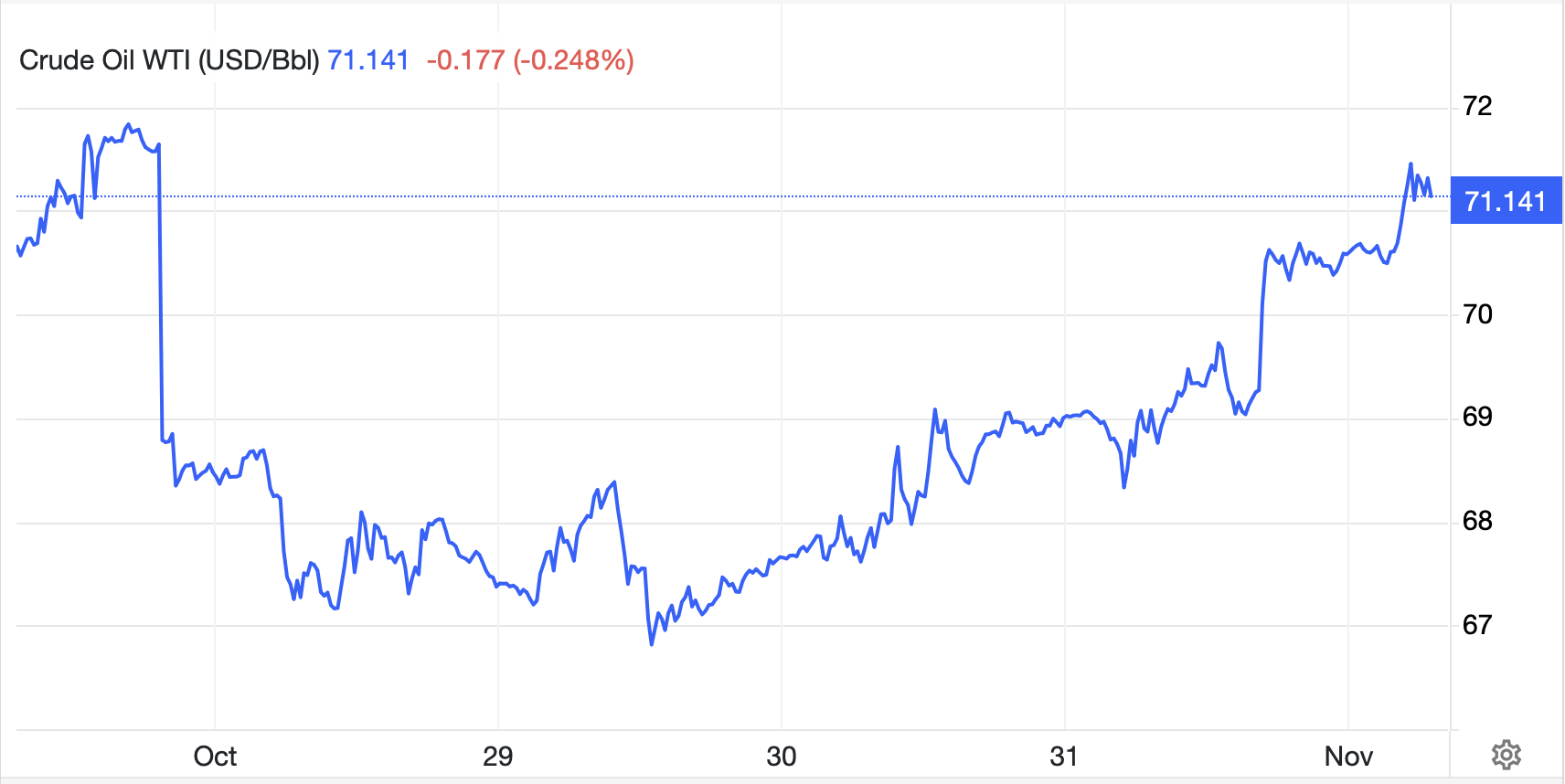
It was only a week ago when the Israeli response to the Iranian missile barrage was seen by market participants as a clear de-escalation of tensions in the Middle East.  The market’s response was to reduce the risk premium in the price of oil which promptly fell $5/bbl amid signs of slowing growth in China as well.  Alas, as can be seen in the chart below, that was Monday’s story and no longer pertains.  Rather, the new concern is that Iran is planning to launch yet another attack, this time via proxies in Iraq, with Israel vowing to respond more severely.  You cannot be surprised that oil has regained its levels prior to Monday’s narrative.

Source: tradingeconomics.com

Adding to the buying pressure for oil has been the better than expected growth data from China (Caixin Mfg PMI printing better than expected 50.3) and solid US GDP data on Wednesday along with stronger Personal Income and Spending data yesterday.  And remember, the market is also looking ahead to the Standing Committee of the National People’s Congress in China to add significant fiscal stimulus there, with CNY 10 trillion (~$1.4 trillion) the most popular number being bandied about.  If that comes to pass, it will seemingly increase demand for oil on China’s part.

Of course, there is another piece of news that the market is awaiting with the potential for a significant impact, today’s Employment Report.  Ahead of the release, these are the current consensus forecasts:

Nonfarm Payrolls113K
Private Payrolls90K
Manufacturing Payrolls-28K
Unemployment Rate4.1%
Average Hourly Earnings0.3% (4.0% Y/Y)
Average Weekly Hours34.2
Participation Rate62.5%
ISM Manufacturing47.6
ISM Prices Paid48.5

Source: tradingeconomics.com

You may remember that last month, the NFP number printed much higher than expected at 233K which began the questioning of the Fed’s expected rate cutting path.  Frankly, the data since then has done very little to argue for much policy ease as Retail Sales have held up, GDP was solid and prices appear to be moving higher, not lower.  In fact, you can see how things have played out over the past month in the chart/table below from the CME showing the market priced probability of future Fed funds rates.  Check out where things were a month ago, just prior to the last NFP report.

The market was pricing a more than 50% probability of at least 75 basis points of rate cuts by December. Obviously, that is no longer the case and if this morning’s data proves stronger than forecast (remember, ADP Employment was significantly stronger than expected) many more people are going to call into question the assumption that the Fed is going to be cutting rates at all.  If you think about it, GDP is growing above trend at 2.8%, inflation remains above target with core CPI 3.3% and Unemployment is at a still historically low 4.1%.  if I look at those three major economic guideposts, the one that stands out to be addressed is inflation, not Unemployment, and that takes tighter policy.

Now, maybe this morning’s data will be awful, with a 50K NFP print and a jump in the UR to 4.3%.  That would certainly bring the doves out more aggressively but absent something like that, I continue to scratch my head as to why the Fed is so keen to cut the Fed funds rate.  Let’s put it this way, if the data surprises to the upside, I expect the December rate cut probability to fall close to 50%.

At any rate, those are the topics du jour, away from the election stories that are suffocating most everything else.  So, let’s see how things behaved overnight.

Well, I guess there has been one other story that has gotten tongues wagging, the fact that US equity markets had their worst session in two months with all three major indices falling sharply.  This was blamed on weaker than forecast earnings releases from several companies in the tech sector, where even if the actual earnings were solid, there were other issues like guidance or breakdowns of revenues, that disappointed.  It is far too early to declare that the love affair with the tech sector, especially AI, is ending, but there are a few names in the sector that are suffering greatly.  This certainly bears close watch going forward, because if this theme starts to lose adherents, even in the short run, it appears there is ample room for a move lower in stocks.

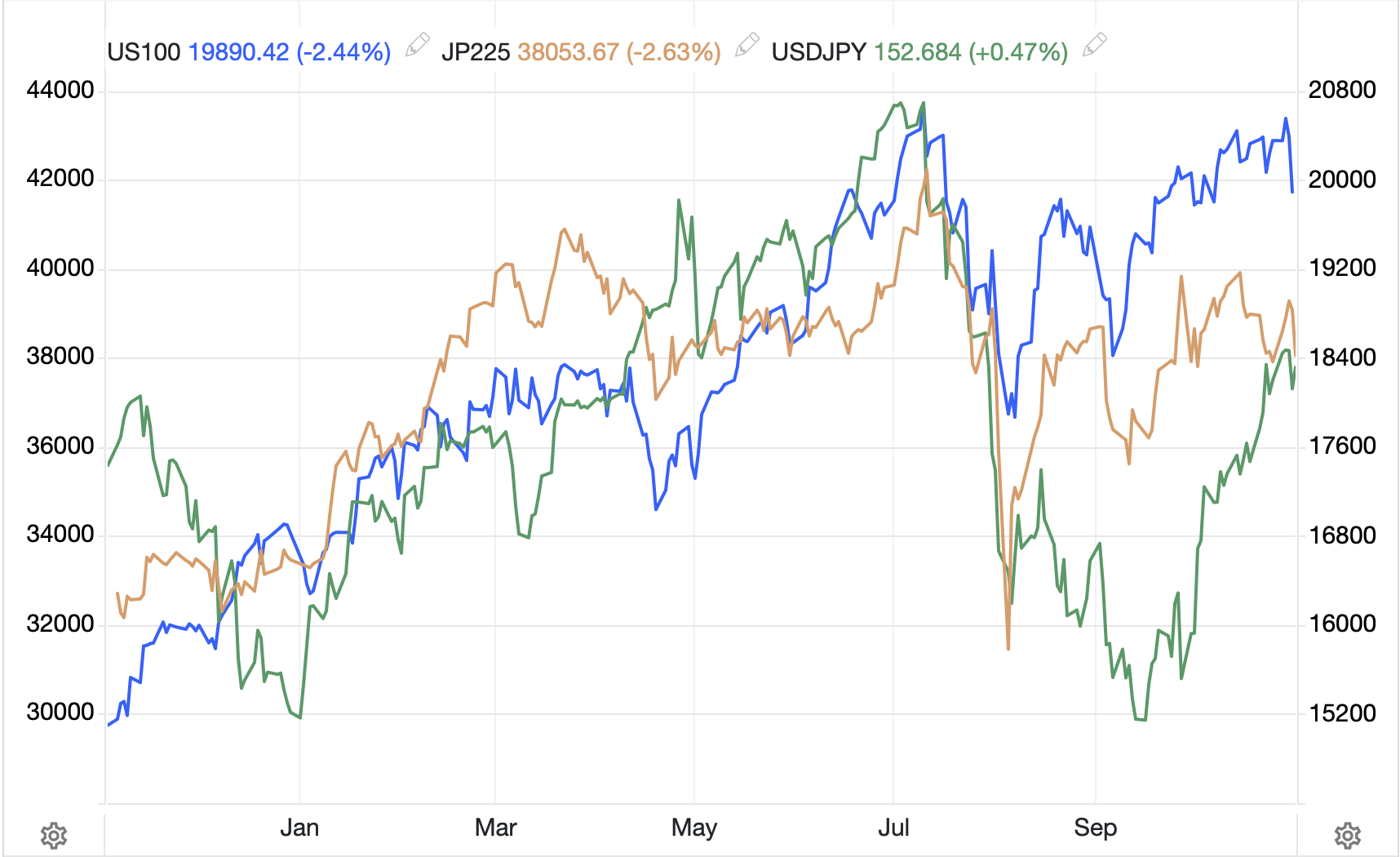
Turning to other markets overnight, Tokyo (-2.6%) led the way lower in Asia with most regional exchanges falling and only Hong Kong (+0.9%) bucking the trend.  There are those who believe there is a causal relationship between the Nikkei, the NASDAQ and USDJPY with one theory that it is the FX rate that drives these movements.  While it is certainly true that we have seen correlation amongst these three markets, I find it difficult to make the case that USDJPY is the driver.   A quick look at all three on the same chart certainly shows that they regularly move in similar directions, but I have a harder time claiming which one is the leader.

Source: tradingeconomics.com

However, despite the negativity from yesterday’s US moves and the overnight sell-off and the sharp rise in oil prices, European bourses are all in the green today, higher by about 0.5% across the board.  In fact, this is in sync with US futures which are also trading higher, by about 0.4%, this morning.

In the bond market, other than UK Gilt yields, which rose 7bps net yesterday although traded as high as 20bps higher than Wednesday’s close during the session, the rest of the bond markets were quiet.  It seems that UK bond investors are not that happy with the recently promulgated budget, and neither are voters as there was a by-election in a “safe” Labour seat that went to Nigel Farage’s Reform UK party.  I have a feeling that bond markets are going to be the epicenter of market activity over the next week or two as huge differences of opinion remain regarding the potential outcomes of the US election.

Away from oil (+1.9%) this morning, the rest of the commodity sector is also doing well today with both precious and base metals all in the green.  But they have not recouped yesterday’s declines which saw gold fall back -1.5% with even larger losses in silver (-3.2%) although copper (-0.6%) didn’t have nearly as bad a day.  This morning, the metals are higher by between 0.2% (gold ) and 0.6% (silver), so it seems like it was a month-end position adjustment and profit-taking exercise.

Finally, the dollar is strong this morning, rallying against most of its G10 counterparts with JPY (-0.4%) the laggard while the pound (+0.1%) seems to be benefitting from higher yields.  Versus the EMG bloc, the dollar is also broadly higher with only MXN (+0.2%) showing any life.  The peso has a number of issues ongoing with concerns that a Trump victory may lead to tariff increases and strain on the economy while domestic issues have arisen over the potential resignation of eight of their Supreme Court Justices which will have a big impact on the judicial system and potentially the Morena party’s ability to rule effectively.  However, after a steady weakening of the peso throughout October, it appears we are seeing a bit of a bounce this morning.

And that’s really what we have today.  At this point, we will all await the NFP and respond accordingly.  Something to keep in mind is that the hurricanes last month could well impact the data, so whatever the outcome, you can be sure that there will be those saying to ignore it as incomplete.  Regarding the dollar, it is still hard to bet against in my mind given the US economic data continues to be the best around.

Good luck and good weekend

Adf

A Trumpian Size

A question on analysts’ lips
Is whether Jay can come to grips
With job growth expanding
While he was demanding
A rate cut of fifty whole bips
 
Concerns are beginning to rise
That voters will soon recognize
Inflation’s returning
And they will be yearning
For change of a Trumpian size


By now, I am guessing you are aware that the payroll report on Friday was significantly better than expected.  Nonfarm Payrolls rose 254K, much higher than the 140K expected, and adding to the gains were revisions higher for the previous three months of 55K.  The Unemployment Rate fell to 4.051%, rounding to 4.1%, lower than expected and another encouraging sign for the economy.  You may remember the discussion of the Sahm Rule, which claims that if the 3-month average Unemployment Rate rises 0.5% from its low in the previous 12 months, history has shown the US is already in recession at that point.  Well, ostensibly that rule was triggered two months ago, and the Unemployment Rate has now fallen 0.25% since then with a gain of over 400K jobs since then.  Those are not recessionary sounding numbers.

The upshot is that the market got busy adjusting its views with the dollar continuing to rebound against most currencies, equity markets rejoicing in the renewed growth story and bond markets getting hammered with 10-year yields rising sharply in the US (10bps Friday and 4bps more this morning) with moves higher everywhere else in the world.  In fact, this morning, European sovereign yields are also higher by between 3bps and 5bps and we saw JGB yields jump 5bps overnight.  The end of inflation story is having a tough time.

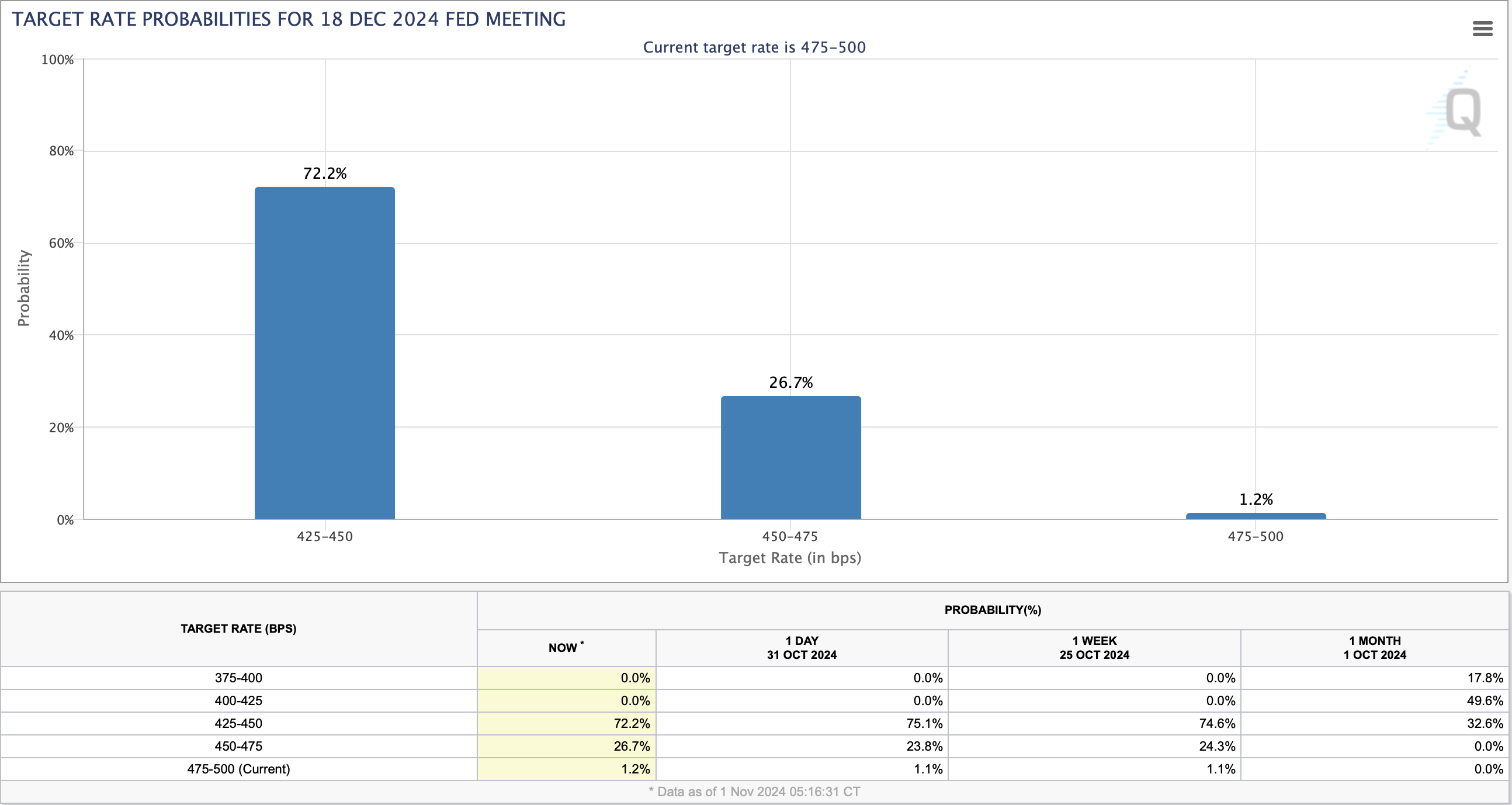
Perhaps the best depiction of things comes from the Fed funds futures markets where now there is only an 85% probability priced for a 25bp cut and a 15% probability of no cut at all.  Look at the table below the bar chart to show how much things have changed in the past week.  Jumbo rate cuts are no longer a consideration.  It will be very interesting to see how the Fed speakers adjust their tone going forward as there were many who seemed all-in on another 50bp cut as soon as next month.

Source: cmegroup.com

So, is this the new reality?  Recession is out and another up-cycle is with us?  Certainly, recent data has been quite positive as evidenced by the Citi Surprise Index, seen below courtesy of cbonds.com, which has shown a positive trend since early July.

This index is a measure of the actual data releases compared to consensus market forecasts ahead of the release.  When it is rising, the implication is that the economy is outperforming expectations and therefore is growing more rapidly than previously priced by markets.  Again, the point is the recessionistas are having a hard time making their case.  However, for the inflationistas, it is a different story.  With the employment situation improving greatly and last week’s Services ISM data showing real strength, the inflation narrative is regaining momentum.  Recall, the Fed’s rationale for cutting 50bps was that they had beaten inflation and were much more concerned about the employment situation where things seemed to be cooling.  That line of reasoning has now been called into question and the market is awaiting Powell’s answers.

Remember the time
The yen carry trade was dead?
Nobody else does!

While it may seem like this is ancient history, it was less than a month ago when the market was convinced that the yen carry trade (shorting yen to go long higher yielding assets) was dead, killed by the combination of a dovish Fed and a hawkish BOJ.  Oops!  It turns out that story may not have been completely accurate, although it was a wonderful discussion at the time.  As you can see from the chart below, the yen peaked two days ahead of the FOMC meeting, as those assumptions about both central banks reached their apex and has been steadily weakening ever since.  In fact, late last week I saw an article somewhere discussing how the carry trade was back!  The thing to understand is the carry trade never left.  It has been a popular hedge fund positioning strategy for a decade, made even more popular by the Fed’s aggressive rate hiking cycle.  While latecomers to the trade may have been forced out in the past several months, I am confident the position remains widely held.  And, based on the recent price action in USDJPY, it is growing again.

Source: tradingeconomics.com

And I believe those are the key drivers of markets this morning.  Fortunately, the Middle East situation does not appear to have gotten worse although oil (+2.6%) is trading like something is about to blow up.  The rest of the noteworthy news shows that Germany remains in a funk with Factory Orders falling sharply, -5.8%, just another indication that growth on the continent is going to struggle going forward.

Ok, let’s tour the markets we have not yet touched upon.  While Chinese markets remain closed (the holiday ended today and markets there reopen tomorrow), the Nikkei (+1.8%) continues to rebound alongside USDJPY and amid stories that new PM Ishiba has dramatically moderated his hawkish views ahead of the snap election called for the end of the month.  The Hang Seng (+1.6%) also had a strong session, with rumors of still more Chinese stimulus to be announced tonight. The combination of positive US growth news and the Chinese stimulus news helped virtually every market in Asia save India (-0.8%), which has been singing a different tune consistently.  In Europe, it should be no surprise the DAX (-0.3%) is softer, although there are some gainers on the continent (Spain +0.4%, Hungary (+0.4%) and other laggards (Norway -0.7%, Netherlands (-0.3%).  Overall, it is hard to get excited about the European scene this morning.  Alas, US futures are pointing lower this morning, down -0.5% at this hour (6:30).

We’ve already discussed the bond market and oil, but metals markets show a split this morning with gold (+0.2%) seeming to find haven support while both silver (-0.7%) and copper (-0.3%) are under modest pressure.  Remember, though, if the economic growth story is real, these metals should climb further.

Finally, the dollar is continuing its climb alongside US rates with the pound (-0.4%) the G10 laggard of note.  Most other G10 currencies are softer by a lesser amount although the yen (+0.1%) and NOK (+0.1%) are pushing slightly the other way, the former on a haven trade with the latter following oil.  The EMG bloc is more mixed with ZAR (+0.5%) actually the biggest mover as investors continue to flock toward the stock market there on the back of positivity of a change in the trajectory of the economy from the new government.

On the data front, the biggest number this week is CPI, but of real note are the 13(!) Fed speakers over 20 different venues this week.  I don’t know if I’ve ever seen that many on the calendar for such a short period.  It strikes me that they understand they need to tweak their message after the recent data.  It will be very interesting to see if they fight the data and stay the course for another cut in November or whether they walk it back completely. After all, they claim to be data dependent, and if the data points to growth, why cut?

Here is the rest of the data:

TodayConsumer Credit$12B
TuesdayNFIB Small Biz Optimism91.7
 Trade Balance-$70.4B
WednesdayFOMC Minutes 
ThursdayInitial Claims230K
 Continuing Claims1829K
 CPI0.1% (2.3% Y/Y)
 -ex food & energy0.2% (3.2% Y/Y)
FridayPPI0.1% (1.6% y/Y)
 -ex food & energy0.2% (2.7% Y/Y)
 Michigan Sentiment71.0

Source: tradingeconomics.com

And that’s how we start the week.  Whatever your personal view of the economy, the recent data certainly points to more strength than had been anticipated previously and markets are responding to that news.  For equities and the dollar, good news is good, but there seems to be a lot of time between now and Thursday’s CPI reading for attitudes to change.

Good luck

Adf

Awakened the Beast

The longshoreman’s union conceded
And ports will now work unimpeded
But is that enough
To make sure that stuff
Gets everywhere that it is needed?


Arguably, one of the biggest stories this morning is that the fears over the longshoreman’s union strike dramatically weakening the US economy while pushing up inflation have passed as there has been a temporary agreement to raise workers’ pay by 62% over the next six years although it seems that the questions over automation remain.  However, the agreement will last until January 15th, so the 3-day work stoppage is unlikely to have a major impact on the US economy, although I’m sure there will be a few hiccups around.  But hey, at least one problem is off the docket.
 
Meanwhile, problems in the Mideast
Continuously have increased
Iran took their shot
And all that it wrought
Was fear they’ve awakened the beast

Which takes us to the next major story, the nature of Israel’s response to Iran’s missile attack from earlier this week.  From what I have read, the US is trying very hard to persuade PM Netanyahu to leave Iran’s nuclear facilities and oil production capabilities alone.  While I understand the latter, given an attack there would likely drive oil prices far higher and not help VP Harris’s election prospects, I cannot understand why the US would be so adamant that Israel not seek to destroy Iran’s nuclear capabilities.  At any rate, the headline in this morning’s WSJ, “Biden Sidelined as Israel Reshapes Middle East”, seems to say it all.  At this point, we can only watch and wait.  

However, consider the benefits of either of those targets.  As it remains unclear whether Iran has achieved the capability to create nuclear weapons, an attack on those facilities, which are hardened and underground, may or may not be effective at preventing a future nuclear Iran.  But an attack on the oil production facilities, which are wide open and not nearly as well-defended, would immediately limit Iran’s income despite the certain rise in oil prices, as they would not be able to sell any.  Starving Iran of capital to continue to run its military and fund its proxies would likely be extremely effective at dramatically reducing threats to Israel.  As well, I’m pretty confident the Saudis would not be unhappy if oil rose to $90 or $100 per barrel.  My point is the latter strategy is likely to be effective at reducing Iranian activities while being quite achievable.  We shall see.

And finally, early today
The payrolls report will hold sway
O’er markets worldwide
As traders decide
If more cuts are soon on their way

Which takes us to the big economic story today, the monthly payroll report.  Wednesday’s ADP Employment data was much better than expected, showing job growth of 143K.  Current expectations are as follows:

Nonfarm Payrolls140K
Private Payrolls125K
Manufacturing Payrolls-5K
Unemployment Rate4.2%
Average Hourly Earnings0.3% (3.8% Y/Y)
Average Weekly Hours34.3
Participation Rate62.9%

Source: tradingeconomics.com

One thing to keep in mind is this is going to be the last meaningful payroll report before the next FOMC meeting because the October report, scheduled to be released on November 1st, is going to be a complete wreck with virtually no information because of the impact of Hurricane Helene.  In fact, it will likely take several months before economic data gets back to whatever its underlying trend may be given the disruption over such a wide swath of the nation.

The question of the economy’s strength continues to be a hotly contested disagreement between those who believe that a recession is coming soon, or has already started, vs. those who believe that there is no recession coming in the near future.  The first group tends to look through the headline data and sees decreasing quit rates and reduced hiring offsetting reduced firing with the lack of hiring seen as an indication business activity is slowing.  They look at high household credit card debt and growing delinquencies and see analogies to past recessions.  Meanwhile, the bulls look at the headline data and say, GDP continues to grow, inflation continues to slide and while manufacturing has been weak for nearly two years, this is a services economy and that has been strong (yesterday’s ISM Services print was a much stronger than expected 54.9).

Now, the very fact that Powell cut rates two weeks ago is indicative of the fact that there is real concern at the FOMC that growth is slowing.  I will not discuss the political question here.  But data like TSA travel clearances and restaurant seatings and the crowds at events show that at least some portion of the economy is still doing well.  Yesterday’s Claims data was 225K, a few thousand more than expected but still nowhere near a level that would indicate there is an employment glut.  

I believe the idea of the K-shaped recovery is the best description of things around.  The top quartile of income earners is doing just fine while the rest of the economy is struggling.  But that top quartile represents an outsized amount of economic activity, so the data continues to be positive.  In fact, if you are looking for a reason that there is so much angst in the electorate, this is it.  With all that in mind, though, my take is this morning’s number is going to be better than expected, somewhere on the 175K – 200K level.

Ok, let’s quickly run through market activity overnight.  Yesterday’s modest decline in US markets did not really give much direction to the overnight session as the Nikkei (+0.2%) managed to continue its recent modest rally and the Hang Seng (+2.8%) continues to benefit from a belief that Chinese stimulus is coming to the rescue.  But the rest of Asia couldn’t make up its mind (China is still closed) with gainers (Korea, New Zealand, Singapore) and laggards (India, Australia , Taiwan).  In Europe, the picture is also mixed ahead of the US data with modest gainers (CAC, DAX) and laggards (FTSE 100, IBEX) as the US data is still the key driver.  One story here is that the EU decided to impose tariffs of as much as 45% on Chinese BEV’s, something that is likely to become problematic for European exporters going forward.  As to US futures, just ahead of the data (8:00) markets are edging higher by 0.2%.

In the bond market, yields are continuing to rise around the world with Treasuries higher by 2bps this morning after a 5bp climb yesterday afternoon.  European sovereign yields are also much firmer, between 3bps and 6bps across the continent as concerns over inflation reignite.  Both the price of oil and the Chinese tariff story are driving this bond move.  As to JGB’s, they jumped 6bps last night, but that was more on the back of the US rise than any domestic news.

Oil (+1.4%) is continuing to rally as fears over an Israeli attack on Iranian assets builds.  This has helped the entire commodities complex with metals markets also firmer this morning, albeit only on the order of +0.25%. Nonetheless, the commodity higher story remains a fundamental one in my world view, especially as food prices are picking back up again around the world.  The UN’s FAO Food price index rose to its highest level in more than a year and looks for all the world like it has based and is now going to trend higher again.

Finally, the dollar is mixed this morning, with no defining theme here.  The pound (+0.35%) and MXN (+0.4%) have rallied while KRW (-0.5%) and AUD (-0.25%) have declined with the euro virtually unchanged.  My point is there is nothing specific to explain the movement.

And that’s really it.  We hear from a couple of more Fed speakers but since Powell on Monday cooled the idea of another quick 50bp cut, they have not given us much new guidance.  If I am correct and the data is strong, I expect bonds to suffer along with commodities while the dollar should gain.  Stocks are a little less clear.  However, if it is a soft number, you can be sure that the 50bp talk will dramatically increase and stocks and commodities will soar as the dollar slides.

Good luck and good weekend

Adf