Splitting More Hairs

The data continues to be
Uncertain, and so what we see
Is both bulls and bears
Just splitting more hairs
Til markets reach their apogee
 
Meanwhile, throughout Europe concern
Is building, that no one did learn
Their energy dreams
Are nought but grift schemes
And growth’s in a long-term downturn


Once again, macroeconomic stories are light on the ground with no overarching theme atop the headlines.  As data continues to be released in the US post the government shutdown, we are seeing a similar pattern as before the shutdown, namely lots of conflicting data.  Yesterday was a perfect example as ADP Employment data was far weaker than expected printing at -32K (exp +10K) and indicative of a slowing economy.  At the same time, ISM Services showed unexpected strength, printing 52.6 with every sub indicator printing higher than last month except prices, which slipped 5 points.  While there was September IP and Capacity Utilization data, given it was so old, it just didn’t seem relevant.  

Depending on your underlying view, it was once again easy to point to recent data and make either the bull case on the economy and stocks or the bear case.  But there’s more.  A look at the last 5 years of ADP data shows a very distinct downward trend in employment as per the below.

Source: tradingeconomics.com

But as with so many things in the economy lately, it is fair to ask if the data we have known in the past is reflective of the current economic situation.  After all, if the Trump administration has deported 500K individuals, and another 1.5 million have self-deported, as the administration claims, it ought not be surprising that employment numbers are declining.  The implication is that population is declining, which would make sense.  So, I ask, does the declining ADP data signal what it did 5 years ago or 10 years ago?  I don’t believe the answer is that straightforward.

One of the things that has concerned me lately is the measurement of GDP.  My thesis has been that counting government spending in Keynes’s equation Y = C + I + G + (X-M) is double counting because, after all, if the government spends money, it goes into the economy and is recorded by the people/companies who receive it.  But perhaps my queasiness over the GDP idea is caused by something else instead, the fact that GDP measures credit creation, not economic activity.  This article by Alasdair Macleod, a pretty well-known economic analyst with a long career observing markets and economies, does an excellent job of identifying some really interesting problems that get accepted and assumed by many in their analysis of the current situation.  

For a while we have all seen, and probably felt, there is a disconnect between the data published and the feeling we get with respect to the current situation.  I highlighted the cost-of-living problem last week with the Michael Green articles.  This is another arrow in the quiver of things are not what they appear and that’s why so many people are so unhappy (even taking away TDS).

For me, where I try to synthesize a market view based on the information available, it is a very difficult time because of all the inconsistencies relative to what I have known in the past.  As well, I am being forced to reconfigure my mental models as the world has changed.  I suggest everyone do the same, as there is no going back to pre-Covid, let alone pre-GFC.

But the US is relatively well-off compared to most of the rest of the G10 as evidenced by this morning’s Eurozone data where Construction PMIs were, in a word, dreadful as can be seen below:

Source: tradingeconomics.com

No matter how you slice it, the fact that every reading is below 50 is a telling statement on the economic situation in Europe.  Adding to this problem is the fact that it appears, the EU, under the guidance(?) of President Ursula von der Leyen, is getting set to force the appropriation of Russian assets that were frozen at the outset of the Ukraine war, an act that Russia has indicated would, itself, be an act of war and they would respond in kind.  The US has unequivocally said they will not defend Europe if that is their decision, although we will continue to sell them weapons.  

For 80 years, NATO has been the defense umbrella allowing Europe to spend their money on butter, not guns.  Despite all the plans of rearmament, if Europe goes down this road, I suspect that there is nothing they can do to defend themselves without the US.  Once again, it is difficult to look at fiat currencies around the world, especially in Europe, and think they have more staying power than the dollar.  

Ok, let’s tour markets.  A solid day in the US was followed by strength virtually across the board in Asia (Japan +2.3%, HK +0.7%, China +0.3%) with the rest of the region +/- 0.3%, so not overwhelmingly positive or negative.  The Japanese outlier was based on news about Fanuc signing a deal with Nvidia to make AI industrial robots and that took the whole tech sector in Tokyo higher.  In Europe, green is also today’s theme as despite the weak data shown above, we started to get the first hints that the ECB may consider rate cuts after all.  While Madame Lagarde has been on her high horse saying there is no need to adjust rates, Piero Cipollone, a board member has highlighted concerns over further potential economic weakness going forward.  I look for others to come to the same conclusion and talk of an ECB cut to start to increase although swaps markets do not yet reflect any changes.  And at this hour (7:40) US futures are pointing slightly higher, 0.15% or so.

In the bond market, Treasury yields are reversing some of yesterday’s modest decline, rising 2bps this morning and that has helped pull European sovereign yields higher by similar amounts across the board.  The one exception here is UK gilts, which given the ongoing weak data seem to be anticipating a greater chance of a BOE cut than before.  in Asia, JGB yields rose 4bps and now sit at 1.93%, a new high for the move, but there is no indication we are near a top.  There is growing confidence the BOJ will hike rates later this month, although I would expect that should help slow the rise as at least it will have a modest impact on inflation readings going forward.

In the commodity markets, oil (+0.5%) continues to chop back and forth making no new ground in either direction.  Stories about peace in Ukraine don’t seem to matter much, nor do stories about a US invasion of Venezuela.  In fact, nothing seems to matter too much to this market other than actual supply and demand, and that seems pretty balanced, at least as evidenced by  the fact that for the past 2+ months, we have gyrated either side of $60/bbl with no impetus in either direction.  (see below)

Source: tradingeconomics.com

Metals markets are slipping a bit this morning (Au -0.25%, Ag -1.8%, Cu -0.6%) but that is simply part of the recent consolidation.  After all, metals have rallied forcefully all year, so taking a breather is no surprise. 

Finally, the dollar is a nonevent today with the most noteworthy story the news that the PBOC fixing last night was 160 pips higher (weaker CNY) than forecast by the market.  As well, there have been several stories that Chinese state-owned banks are buying dollars in the market to help slow down the yuan’s recent appreciation.  I discussed the yuan yesterday so this should be no surprise.  The tension on China to maintain a weak enough currency to support their export industries is huge, so a quick appreciation would be extremely negative for the nation’s trade balance and economic activity.

On the data front, Initial (exp 220K) and Continuing (1960K) Claims lead us off and then Factory Orders from September (0.5%) come at 10:00.  There are still no Fed speakers, so markets remain subject to headline risk, notably from the White House.  As we are in December, my sense is that things will become increasingly uninteresting from a market perspective absent a major new event.  While price action will likely remain choppy, it is hard to see a major directional move until next year.

Good luck

Adf

Woes and Scraps

The PMI data is in
And so far, it’s not really been
A sign of great strength
When viewed from arm’s length
No matter the punditry’s spin
 
That said, we are not near collapse
Despite many trade woes and scraps
And stocks keep on rising
So, t’will be surprising
For all when we see downside gaps


It was a quieter weekend than we have seen recently in the global arena with no new wars, no mega protests and no progress made on any of the major issues outstanding around the world.  Thus, the US government remains shut down, the war in Ukraine remains apace and the AI buzz continues to suck up most of the oxygen when discussing markets.

With this as background, arguably the most interesting market related news has been the manufacturing PMI data released last night and this morning.  starting in Asia, the story was some weakness as Chinese, Korean and Australian data all fell compared to last month, although India and Indonesia continued along well.  Meanwhile, in Europe, the data improved compared to last month, but the problem is it remains at or below 50 virtually across the board, so hardly indicative of strong economic activity.

                                                                                                      Current         Previous               Forecast

Source: tradingeconomics.com

I don’t know about you, but when I look at the releases this morning, I don’t see a European revival quite yet, not even if I squint.

I guess the other thing that has tongues wagging is Election Day tomorrow with three races garnering the focus, gubernatorial contests in New Jersey and Virginia and the mayoral race in New York City.  The first two are often described as harbingers of a president’s first year in office and I think this time will be no different.  But will they impact market behavior?  This I doubt.

So, let’s get right into markets this morning.  Friday’s further new record highs in the US were followed by strength through much of Asia (Tokyo was closed for Culture Day) with China (+0.3%), HK (+1.0%), Korea (+2.8%) and Taiwan (+0.4%) leading the way with only the Philippines (-1.7%) bucking the regional trend as earnings growth in the country continues to disappoint relative to its peers around the region.  Europe, too, has seen broad based gains with the DAX (+1.2%) leading the way higher and gains in the IBEX (+0.45%) and CAC (+0.3%) as well.  I guess the PMI data was sufficient to excite folks and despite Europe’s status as a global afterthought, at least in terms of geopolitical issues, their equity markets have been rising alongside the rest of the world’s all year.  And you needn’t worry, US futures are all higher at this hour (6:50), with the NASDAQ (+0.7%) leading the way.

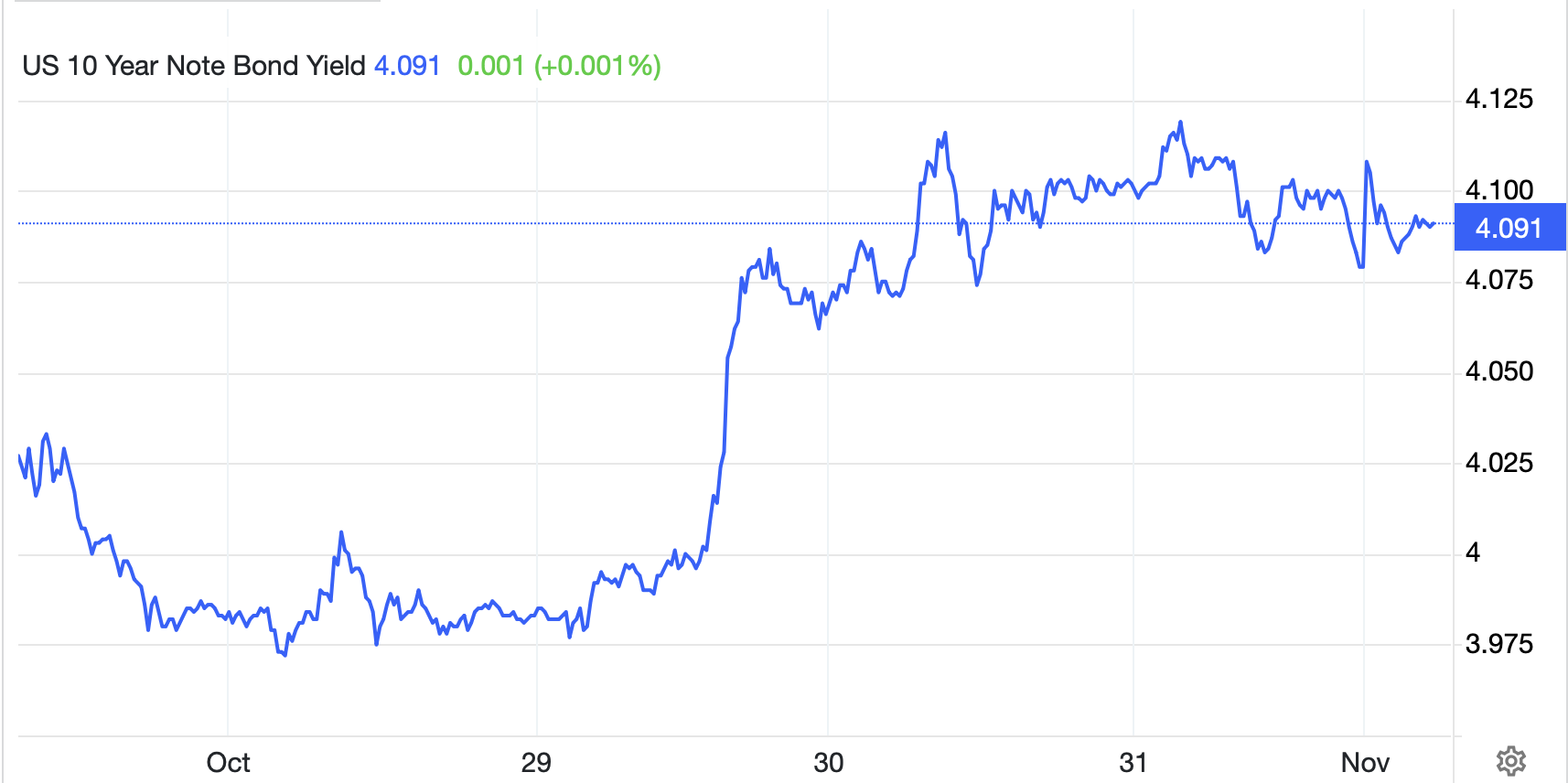
Perhaps more interesting than equities though is the fact that government bond markets are doing so little.  Treasury yields jumped ~10bps in the wake of the FOMC meeting and, more accurately, Chairman Powell’s ostensible hawkishness.  However, as you can see in the below tradingeconomics.com chart, since then, nothing has happened. 

Recall, the probability of a December rate cut by the FOMC also fell from virtual certainty to 69% now.  In fact, if you think about it, that 30% probability decline translates into about 7.5bps, approximately the same amount as 10-year yield’s rose.  It appears that the market is consistent in its pricing at this point, and when (if?) data starts coming back into the picture, we will see both these interest rates rise and fall in sync.  As to European sovereigns, they continue to track the movement in the US and this morning, this morning, the entire bloc has seen yields edge higher by 1bp, exactly like the US.

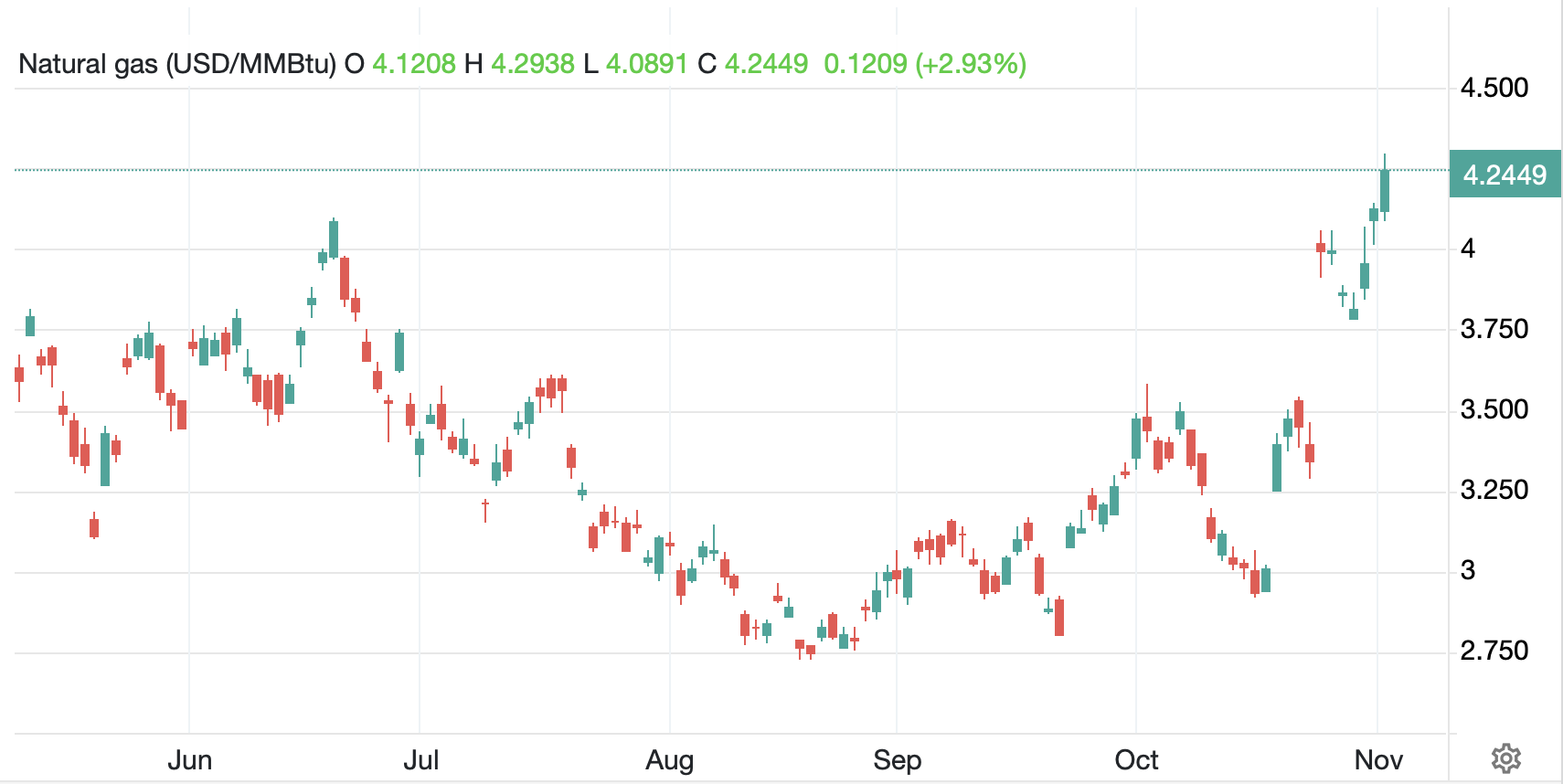
Commodities remain the most interesting place, although the dollar is starting to perk up a bit.  Oil (-0.3%) slipped overnight after OPEC+ indicated they were increasing production by another 137K bbl/day, although there would be no more increases for at least three months given the seasonality of reduced oil demand at this point on the calendar.  Something I have not touched on lately is NatGas, which traded through $4.00/MMBtu late last Thursday, and is now up to $4.25.  in fact, in the past month it has risen nearly 27%, which given it is massively underpriced compared to oil (on a per unit of energy basis) should not be that surprising.  Nonetheless, sharp movements are always noteworthy, and this is no different.

Source: tradingeconomics.com

Certainly, part of this is the fact that winter is coming and seasonal demand is rising in the US. 

Combine that with the European needs for LNG, of which the US is the largest provider, and you have the makings of a rally.  (I wonder though, did the fact that Bill Gates changed his tune on global warming no longer being an existential threat signal it is now OK to burn more fossil fuels?)

Turning to the metals markets, the ongoing fight between the gold bugs and the powers that be continues as early in the overnight session, gold was lower by nearly -1% but as I type, just past 7:00am, it is slightly higher (+0.1%) compared to Friday’s closing levels.  Silver (+0.1%) has seen similar price action although copper (-0.5%) appears more focused on the economic story than the inflation story.  

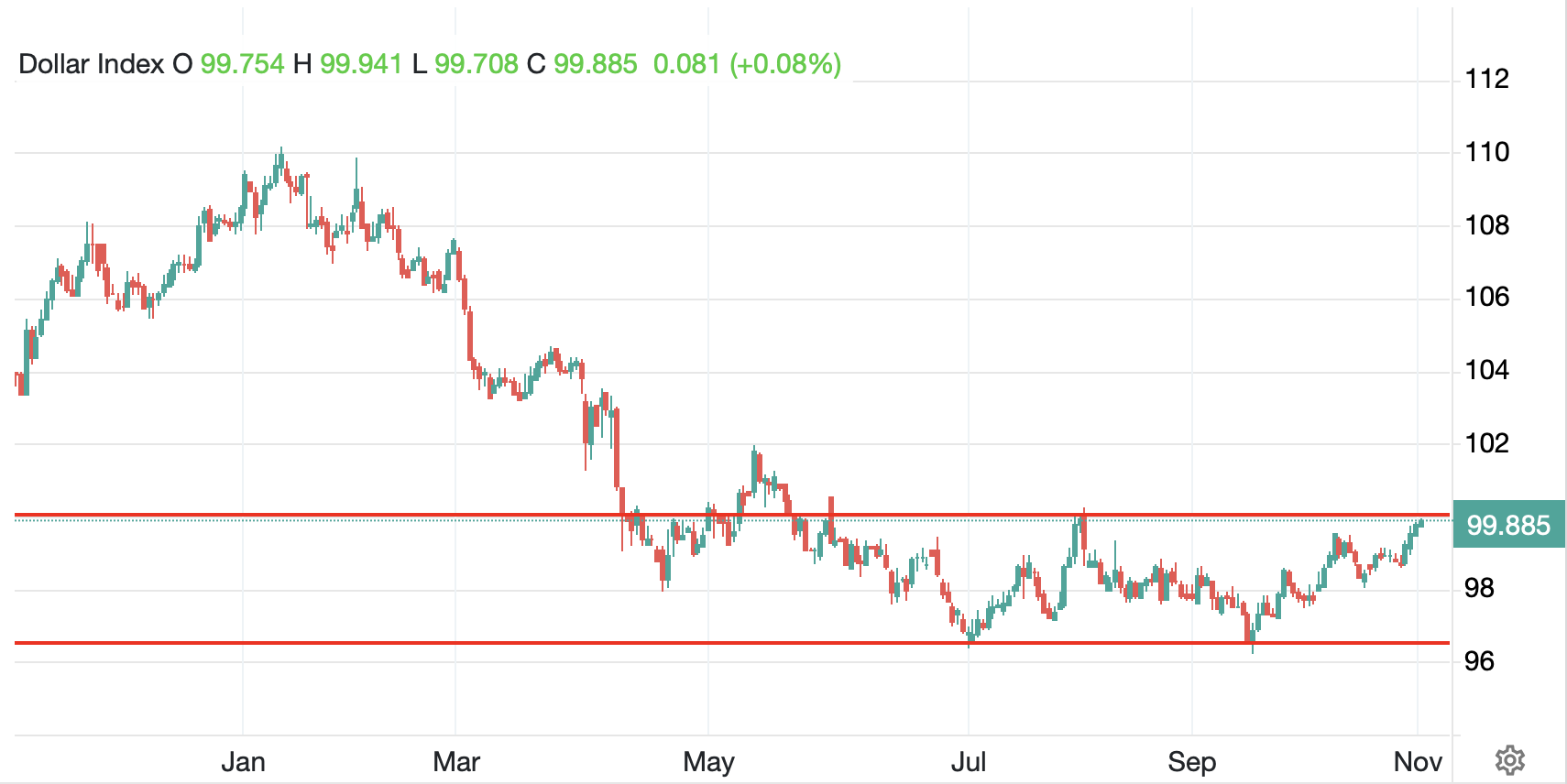
Which takes us to the dollar and its continued rally. Using the DXY (+0.1%) as our proxy, it is higher again this morning and pushing back to the psychological 100.00 level.  Now, I have made the case several times that the dollar has done essentially nothing for the past six months, and the chart below, I believe, bears that out.  We have basically traded between 96.5 and 100 since May.

Source: tradingeconomics.com

You will also recall that there is a narrative around about the end of the dollar’s hegemony and how nations around the world are trying to exit the USD financial system that has been in place since Bretton Woods, or at least since the fiat currency world took off when President Nixon closed the gold window.  And there is no doubt that China is seeking to become the global hegemon and thus wants a renminbi-based system to use to their advantage.  However, let’s run a little thought experiment. 

The Trump administration has embraced the cryptocurrency space, and especially the use of stablecoins.  Legislation has been passed (GENIUS Act) to help clarify the legal framework and the SEC has been solicitous in its willingness to ensure that these creations are not securities, thus placing them outside the SEC’s oversight.  When looking at the world of stablecoins, their current total value is approximately $311 billion (according to Grok) of which only ~$1.2 billion are non-USD.  

Now, if stablecoins represent the payment rails of the future, an idea that is readily believable, and the stablecoin market is virtually entirely USD, with massive first mover advantage, is it not possible that economies around the world are going to find it much easier to dollarize than to maintain their own native currency?  While there are calls for Argentina to dollarize, what would the world look like if the EU fell apart (an entirely possible outcome given the inconsistencies in their current energy and immigration policies and the stress within the bloc) and the euro with it?  Would smaller nations opt for their own currency, or would they see the value of having a dollarized economy given the many efficiencies it would present, especially for their export industries?

While I have no doubt that China will never accept that outcome for themselves, is the future a world where there are two currency blocs, USD and CNY, and everything else simply disappears?  Remember, we are merely spit balling here, but if that is the outcome, demand for dollars will continue to rise, and the value of other currencies will continue to decline until such time as they succumb.

Again, this is a thought experiment, but one that offers intriguing possibilities for the future.  And one where the foreign exchange market may ultimately meet its demise.  After all, if there are only two currencies, that doesn’t make much of a market.

One other thing I must note, in the stablecoin realm, there is a remarkable product, USDi (usdicoin.com), which tracks US CPI exactly, yet can fit within those same payment rails.  If you are looking into this space, USDI is worth a peek.

Ok, back to the markets, looking across the FX space, +/-0.2% is today’s theme virtually across the board, with the more important currencies slipping against the dollar (EUR, GBP, JPY, CHF, CAD) than rising vs the greenback (MXN, CLP, NOK, CZK), although the magnitudes are similar.

With the government still closed, there is no official data, but we do get ISM Manufacturing (exp 49.5) with the Prices Paid subindex (61.7) released at the same time.  There are two Fed speakers today, Daly and Cook, and then 9 more speeches throughout the week.  We also get the ADP Employment data on Wednesday (exp 24K), but I imagine that will get more press after the election results are learned Tuesday evening.

It is hard to get excited about things today, but nothing points to a weaker dollar right now.

Good luck

Adf

What Havoc it Wreaks

Today, for the first time in weeks
Comes news that will thrill data geeks
It’s CPI Day
So, what will it say?
We’ll soon see what havoc it wreaks
 
The forecast is zero point three
Too high, almost all would agree
But Jay and the Fed
When looking ahead
Will cut rates despite what they see


Spare a thought for the ‘essential’ BLS employees who were called back to the office during the shutdown so that they could prepare this month’s CPI report.  The importance of this particular report is it helps define the COLA adjustments to Social Security for 2026, so they wanted a real number, not merely the interpolation that would have otherwise been used.  Expectations for the outcome are Headline (0.4% M/M, 3.1% Y/Y) and Core (0.3% M/M, 3.1% Y/Y) with both still well above the Fed’s 2% target.  As an aside, we are also due Michigan Sentiment (55.0), but I suspect that will have far less impact on markets.

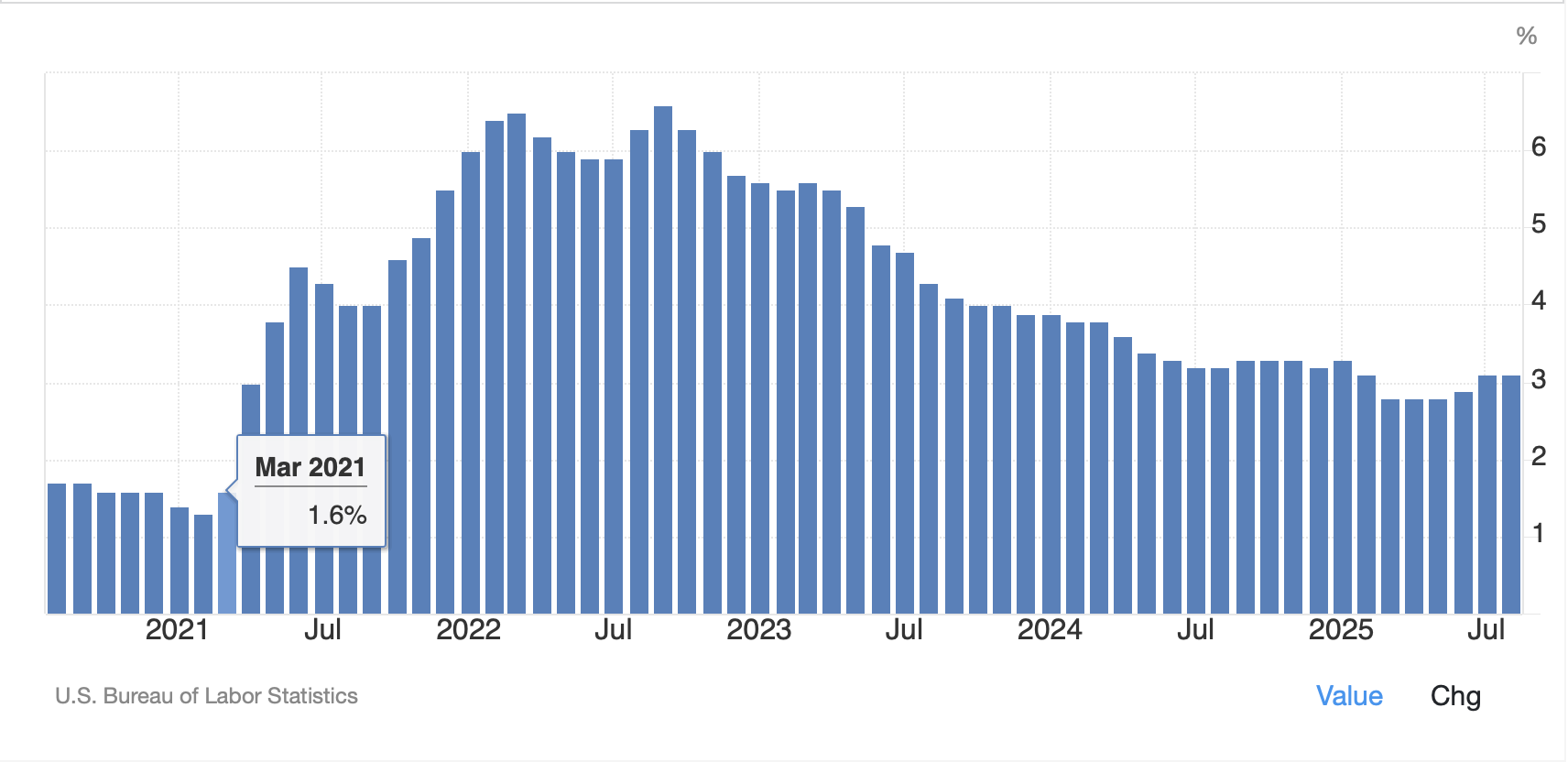
If we consider the Fed and its stable prices mandate, one could fairly make the case that they have not done a very good job, on their own terms, when looking at the chart below which shows that the last time Core CPI was at or below their self-defined target of 2.0% was four and one-half years ago in March 2021.  And it’s not happening this month either.

Source: tradingeconomics.com

Now, when we consider the Fed and its toolkit, the primary monetary policy tool it uses is the adjustment of short-term interest rates.  The FOMC meets next Tuesday and Wednesday and will release its latest statement Wednesday afternoon followed by Chairman Powell’s press conference.  A quick look at the Fed funds futures market pricing shows us that despite the Fed’s singular inability to push inflation back toward its own target using its favorite tool, it is going to continue to cut interest rates and by the end of this year, Fed funds seem highly likely to be 50bps lower than their current level.

Source: cmegroup.com

The other tool that the Fed utilizes to address its monetary policy goals is the size of its balance sheet, as ever since the GFC and the first wave of ‘emergency’ QE, buying (policy ease) and selling (policy tightening) bonds has been a key part of their activities.  As you can see from the chart below, despite the 125bps of interest rate cuts since September of 2024 designed to ease policy, they continue to shrink the balance sheet (tighten policy) which may be why they have had net only a modest impact on things in the economy.  Driving with one foot on the gas and one on the brake tends to impede progress.

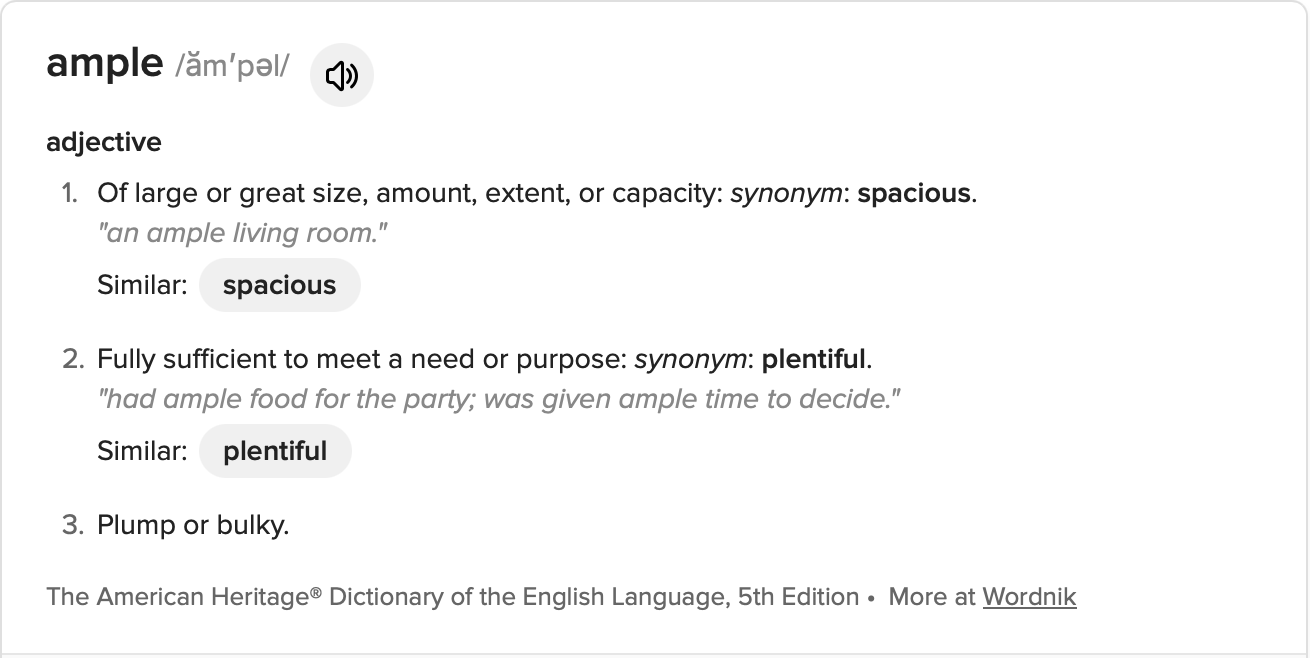
But now, the word is the Fed will completely stop balance sheet shrinkage by the end of the year, something we are likely to hear next Wednesday, as there has been much discussion amongst the pointy-head set about whether the Fed’s balance sheet now contains merely “ample” reserves rather than the previous description of “abundant” reserves.  And this is where it is important to understand Fedspeak, because on the surface, those two words seem awfully similar.  As I sought an official definition of each, I couldn’t help but notice that they both are synonyms of plentiful.

These are the sorts of things that, I believe, reduces the Fed’s credibility.  They sound far more like Humpty Dumpty (“When I use a word, it means just what I choose it to mean – neither more nor less.”) than like a group that analyses data to help in decision making.  

At any rate, no matter today’s result, it is pretty clear that Fed funds rates are going lower.  The thing is, the market has already priced for that outcome, so we will need to see some significant data surprises, either much weaker or stronger, to change views in interest rate sensitive markets like bonds and FX.

As to the shutdown, there is no indication that it is going to end anytime soon.  The irony is that the continuing resolution passed by the House was due to expire on November 21st.  it strikes me that even if they come back on Monday, they won’t have time to do the things that the CR was supposed to allow.  

Ok, let’s look at what happened overnight.  Yesterday’s rally in the US was followed by strength in Japan (+1.35%) after PM Takaichi indicated that they would spend more money but didn’t need to borrow any more (not sure how that works) while both China (+1.2%) and HK (+0.7%) also rallied on the confirmation that Presidents Trump and Xi will be meeting next week.  Elsewhere, Korea and Thailand had strong sessions while India, Taiwan and Australia all closed in the red.  And red is the color in Europe this morning with the CAC (-0.6%) the main laggard after weaker than forecast PMI data, while the rest of Europe and the UK all suffer very modest losses, around -0.1%.  US futures, though, are higher by 0.35% at this hour (7:20).

In the bond market, Treasury yields edged higher again overnight, up 1bp while European sovereigns have had a rougher go of things with yields climbing between 3bps and 4bps across the board.  While the French PMI data was weak, Germany and the rest of the continent showed resilience which, while it hasn’t seemed to help equities, has hurt bonds a bit.  Interestingly, despite the Takaichi comments about more spending, JGB yields slipped -1bp.

In the commodity space, oil (+0.7%) continues its rebound from the lows at the beginning of the week as the sanctions against the Russian oil majors clearly have the market nervous.  Of course, despite the sharp rally this week, oil remains in the middle of its trading range, and at about $62/bbl, cannot be considered rich.  Meanwhile, metals markets continue their recent extraordinary volatility, with pretty sharp declines (Au -1.7%, Ag -0.9%, Pt -2.1%) after sharp rallies yesterday.  There seems to be quite the battle ongoing here with positions being flushed out and delivery questions being raised for both futures and ETFs.  Nothing has changed my long-term view that fiat currencies will suffer vs. precious metals, but the trip can be quite volatile in the short run.

Finally, the dollar continues to creep higher vs. its fiat compatriots, with JPY (-.25%) pushing back toward recent lows (dollar highs) after the Takaichi spending plan announcements.  But, again, while the broad trend is clear, the largest movement is in PLN (-0.4%) hardly the sign of a major move.

And that’s all there is today.  We await the data and then go from there.  Even if the numbers are right at expectations, 0.3% annualizes to about 3.6%, far above the Fed’s target and much higher than we had all become accustomed to in the period between the GFC and Covid.  But remember, central bankers, almost to a wo(man) tend toward the dovish side, so I think we all need to be prepared for higher prices and weaker fiat currencies, although still, the dollar feels like the best of a bad lot.

There will be no poetry Monday as I will be heading to the AFP conference in Boston to present about a systematic way to more effectively utilize FX collars as a hedging tool.  But things will resume on Tuesday.

Good luck and good weekend

Adf

A True F’ing Cluster

Seems everyone just wants to sell
Their equities and bonds as well
But what will they do
With funds they accrue
If everything’s all gone to hell?
 
I guess it’s why gold still has luster
And Bitcoin’s become a blockbuster
The future’s unclear
And there’s growing fear
That this is a true f’ing cluster


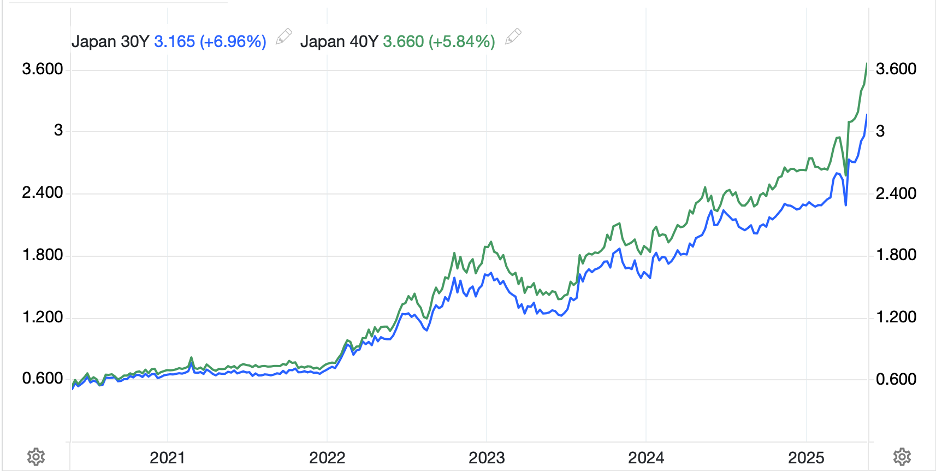
It is difficult to highlight any particular driver of any market movement this morning.  I imagine yesterday’s US equity selloff left a sour taste in the mouths of investors around the world which may help explain why virtually every equity market in Asia (Nikkei -0.85%, Hang Seng -1.2%, Korea -1.2%, India -0.8%) was lower last night or is so (CAC -1.0%, DAX -0.9%, IBEX -0.9%, FTSE 100 -0.65%) this morning.  But bonds are hardly the destination of those funds with yields essentially unchanged this morning after yesterday’s bond sell-off (yield rally).  In fact, in Japan, the long end of the curve, 30-year and 40-year, yields have each traded to new record highs.

Source: tradingeconomics.com

So, if investors are selling stocks and not buying bonds, exactly what are they doing with the funds?  Gold, (-0.5%) which has had a nice run in the past week, is lower this morning, so it doesn’t appear money is heading there.  Too, platinum (-0.3%) is softer this morning after a massive rally this week.  Oil (-1.6%) is lower, NatGas (-1.1%) is lower, and in truth, it is difficult to find anything doing well.  Except perhaps Bitcoin (+1.0%), which has rallied nearly 7% this week and more than 18% in the past month and is trading at new all-time highs.

Source: tradingeconomics.com

It appears that we have reached a point where the market narrative on virtually every asset class (crypto excepted) is that the future is bleak.  There is a bull market in the number of analysts forecasting stagflation because of the US tariff policy and a nascent bull market in the number of analysts calling for much higher US (and by extension other national) yields given the fiscal follies that continue to be evidenced every day.  As much press as the US gets for its massive, peacetime fiscal deficit, in a quieter voice, the IMF just warned France that its fiscal deficits were unsustainable as they, too, are above 7% of GDP.

Our concern should be that central bankers around the world are all going to respond in unison and that response is going to be debt monetization.  Inflation targets are fine as far as they go, but they are not the raison d’etre of central banks.  On a deeper level, central banks, whether independent or not, exist to assure that their respective governments can continue to borrow and fund their expenditures.  Absent a massive fiscal tightening wave around the world, something that seems highly unlikely in our lifetimes, central banks will always be the lender of last resort to their governments.

Now, we already know that fiscal tightening can be accomplished as President Javier Milei in Argentina has accomplished an extraordinary feat down there.  My concern is that it took decades of irresponsible fiscal policy and an almost complete absence of available financing to get the people to vote for change.  Folks, no matter your views about how bad things are in the US or Europe or Japan, we are not even close to the situation there.  So, we know what the future roadmap looks like, Argentina has paved the way, but we are just getting started, I fear.  And in the US, given the advantage of having the global reserve currency, we are much further from a denouement than other Western nations.  

In sum, if you want to know why gold and bitcoin are doing well, I believe they are pointing to the inevitable outcome of global debt monetization, or perhaps debt jubilees.  Owning assets that are a liability of a government that can change the rules if they so desire is not a safe place to be, especially in a fourth turning.  I think this is the message we need to start to understand.  This is not to say things are going to fall apart tomorrow, just that I believe this is the direction of travel.

Well, that was darker than I expected when I started writing this morning, but alas, that is where things lead.  The one thing I haven’t discussed is the dollar and FX markets.  But unlike other markets, FX is a truly relative game, where the dollar’s strength (or weakness) is also manifest as another currency’s weakness (or strength).  A broad-based dollar move, may be a harbinger of other market movements being seen as either better or worse than the US in a macro context, but let’s face it, despite all the angst recently of the dollar’s weakness, the euro is higher by just 4.5% in the past year!  Similarly, the pound (+5.5%) has not moved that far although the yen (+8.5%) has shown more life, albeit from a starting point that was at multi decade lows.  The fact that the dollar is modestly higher this morning, on the order of 0.3%ish across most currencies does not really tell us much.

Let’s take a look at the data we’ve seen so far in the session, with today being Flash PMI day.  In Japan, while Manufacturing edged slightly higher to 49.0, it is still sub-50, and the Services number was weaker taking the Composite below 50.0.  In Europe, France was little changed from last month with all three readings below 50, Germany was much softer than last month with all three readings below 49 and the Eurozone softened, as you would expect, with readings around 49.5.  In fact, as we await US data, India is the only economy showing vibrancy with readings above 60!  (I neglected the UK but alas, they are quickly making themselves irrelevant anyway.  But for good order’s sake, they did manage to tick up from last month, although the Composite is still below 50.)

In the US this morning we get the weekly Initial (exp 230K) and Continuing (1890K) Claims data as well as the Chicago Fed National Activity Index (-0.2) at 8:30.  Then the Flash PMI data (Mfg 50.1, Services 50.8) comes at 9:45 and Existing Home Sales (4.1M) at 10:00.  We also hear from NY Fed President Williams, but is he really going to tell us something new?  I don’t think so.

Sorry to have been so bleak this morning, perhaps the weather has contributed to the mood, but it is hard to find financial positives in the short run.  I was truly excited by the concept of the US cutting spending, but I fear that ship has sailed for now.  If DOGE did nothing else, it opened our eyes to the very specific ways in which government money is being spent on things that had no net benefit for the nation, although obviously the recipients were happy.  Perhaps someday these things will be addressed, but if Argentina is any example, it could still take decades.

Good luck

adf

Growth Stank

Three score and a year have now passed
Since flags in the States flew half-mast
In honor of Jack
Who wouldn’t backtrack
On his goal of world peace at last


It has been sixty-one years since President John F Kennedy was assassinated in Dallas.  This was one of the most dramatic and impactful events in the history of the US with many still of the belief that it was an inside job.  One needn’t wear a tin-foil hat all the time to recognize that the government has done nothing but grow dramatically since then, with the defense complex the leader of the pack.  Perhaps in his second term, President Trump will release the case files in an effort to shine a light on the underbelly of the government.  This poet has no idea what occurred that day (although I did recently visit the 6th floor museum in Dallas, a quite interesting place) and I would guess that all these years later, there are very few, if any, people who may have been involved that are still alive.  Of course, the risk is that powerful organizations like the CIA and FBI could be forever tarred with this if they were involved, and that would have dramatic implications going forward, hence their desire to maintain secrecy.  I highlight this simply as another potential flashpoint in the upcoming Trump presidency.

The data from Europe revealed
That if there is growth, it’s concealed
The PMI’s sank
And German growth stank
Thus Christine, her razor, will wield

Let us now discuss the Eurozone.  Not only do they have an increasingly hot war on their border and not only are they being inundated by a major blizzard interrupting power and transportation throughout France, Germany and Scandinavia, but their economies appear to be slowing down far more rapidly than previously anticipated.  But that inflation was slowing as quickly!

This morning the Flash PMI data was released for Germany, France and the Eurozone as a whole, as well as the UK.  It did not make for happy reading if you are a politician or policymaker in any of these nations.

IndicatorCurrentPrevious
 Germany 
Manufacturing PMI43.243.0
Services PMI49.451.6
Composite PMI47.348.6
 France 
Manufacturing PMI43.244.5
Services PMI45.749.2
Composite PMI44.848.1
 Eurozone 
Manufacturing PMI45.246.0
Services PMI49.251.6
Composite PMI48.150.0
 UK 
Manufacturing PMI48.649.9
Services PMI50.052.0
Composite PMI49.951.6

Source: tradingeconomics.com

One needn’t look too hard to see that the economic situation in Europe is ebbing toward a recession or at least toward much slower growth (German GDP was also released at a slower than expected 0.1% Q/Q, -0.3% Y/Y).  While the ECB is very aware of this situation, the problem is that like most other central banks, their strong belief that inflation is going to reach their 2.0% goal has not yet been realized let alone shown an ability to stay at that level over time.  However, the ongoing comments from ECB members is that more rate cuts are coming with only the timing and size in question.  There is still a strong belief that interest rates in Europe (and the UK) are well above ‘neutral’.

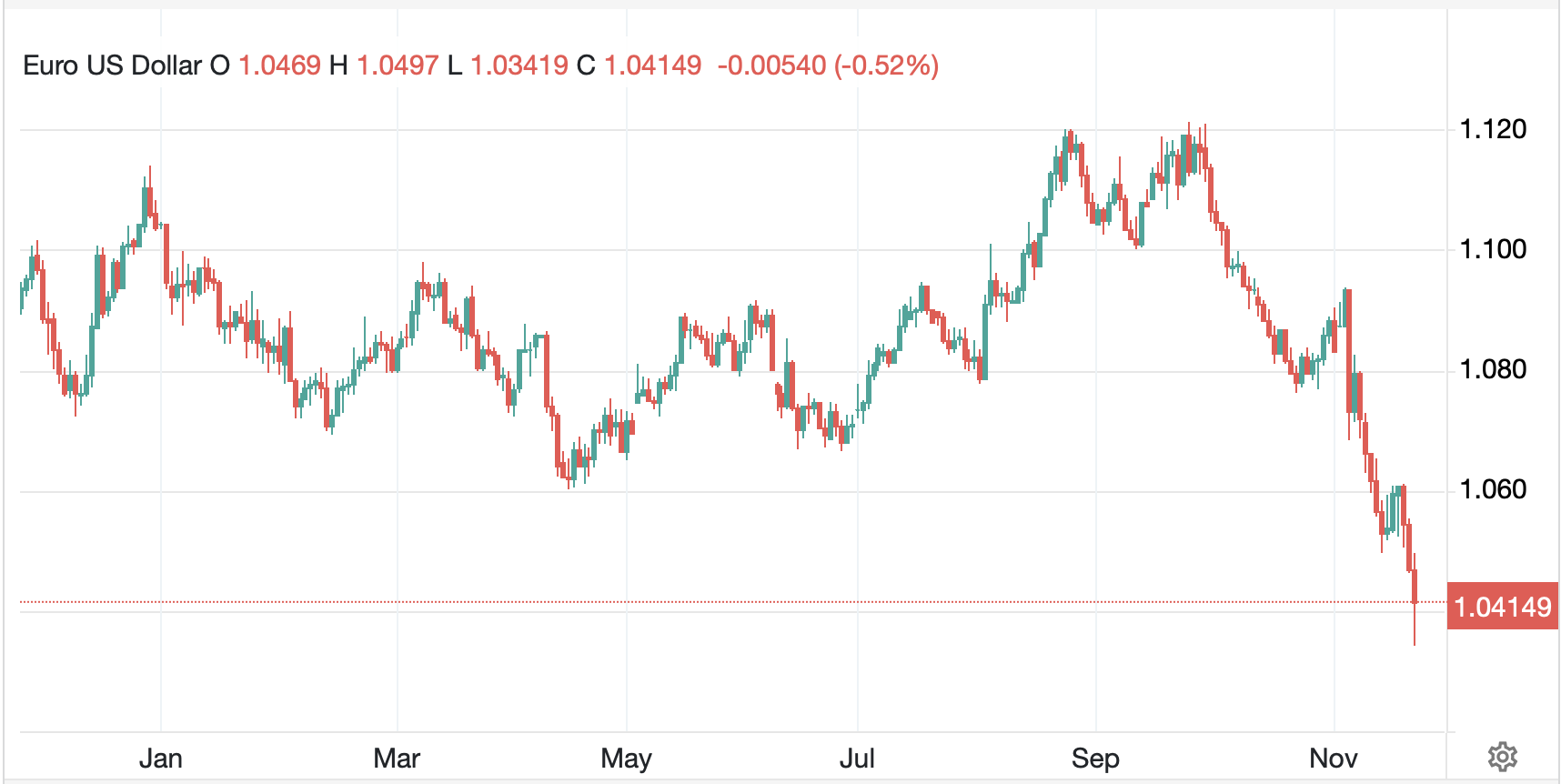
Of course, it will not surprise you to see the chart of the EURUSD exchange rate given this information as the single currency collapses continues its sharp decline.

Source: tradingeconomics.com

Since the end of September, the single currency has declined ~7.0% in a quite steady fashion.  All the technical levels that had been in play have been broken with the next noteworthy level to consider being parity.  I have been clear for a while that I expected the dollar to continue to perform well and nothing has changed that view.  The combination of an increase in fear amid the escalation of tensions in Ukraine and Russia’s intimation that the US and NATO have entered the war already and the very divergent paths of the US and Eurozone economies can only lead to the conclusion that the euro is going to continue to decline for a while.  And remember, this price action has very little to do with potential Trump tariff or other policies as they remain highly uncertain.  The euro is simply a victim of its own leaders’ ineptitude on both the economic and diplomatic/military fronts.  Any Trump tariffs that are imposed on Europe will simply add to the pain.

Before we head to other asset classes, let’s take a quick look beyond the euro in the FX markets.  It should be no surprise that the dollar is broadly higher, although not universally so.  Versus the rest of the G10, even the yen has not been able to find enough haven demand to hold up as the greenback rallies against them all with the euro (-0.6%) and pound (-0.6%) sharing honors as the laggards.  However, in the EMG bloc, the picture is more mixed with CE4 currencies all sliding but ZAR (+0.4%) rallying amid the ongoing rebound in the price of gold (+1.2%) which is also benefitting from increased fear and risk disposition.  As to Asian currencies, most were somewhat weaker but other than KRW (-0.4%) the moves were unimpressive.

On the commodity front, oil (-0.6%) is slipping a bit heading into the weekend but it has had an excellent week, rallying more than 4%.  There are many cross tensions in this market as on one side we have fears that the Russia/Ukraine situation will impact supply, or that Iran will react to Israel’s ongoing campaign in Lebanon and do something about the Strait of Hormuz.  These are obviously bullish for crude.  But the flip side is that Trump has made very clear his desire to open up far more land for drilling and is seeking to increase supply substantially, a negative price signal.  

Turning to bond markets, there is demand everywhere as the combination of risk aversion and weaker Eurozone growth have brought the buyers out of the woodwork.  Treasury yields have slipped -4bps and in Europe, the entire continent is seeing yields decline between -7bps and. -8bps.  After the PMI data this morning, the Euribor futures market upped pricing for a December ECB rate cut from a 15% to a 50% probability.  Add to that comments from ECB members Stournaras and Guindos and it seems quite likely that rates in Europe are going to decline.

Finally, equity markets have shown very little consistency.  Yesterday’s strong US rally was followed by strength in Japan (+0.7%) but massive weakness in China (CSI 300 -3.1%, Hang Seng -1.9%) as concerns over those Trump tariffs continue to weigh on investors there.  However, it was only China that suffered as pretty much every other market in the region saw gains, with some (India +2.55, Taiwan +1.6%, New Zealand +2.1%) quite substantial.  European shares, however, are more mixed with most continental bourses showing modest declines although the UK (+0.8%) has managed to buck that trend despite the weak PMI data and weak Retail Sales data as investors seem to be prepping for a BOE rate cut next month.  As to US futures, at this hour (7:30) they are little changed.

Yesterday’s data showed Initial Claims sliding but Continuing Claims rising to their highest level, above 1.9M, in three years.  It appears that while layoffs aren’t increasing, finding a job once you are unemployed is much tougher.  Philly Fed was also softer than forecast and that seemed to help the Fed funds futures market push up the probability of a December cut to 59% this morning, up from 55% yesterday.  This morning, we see the Flash PMI data here (exp Mfg 48.5, Services 55.0) and then Michigan Sentiment (73.7).  There are no Fed speakers on the schedule so I expect that this morning’s trends may run for a little longer, but as it is Friday, I would not be surprised to see a little reversal amid week ending profit taking.  However, the dollar has further to go, mark my words.

Good luck and good weekend

Adf

Juxtapose

In Europe, the ‘conomy’s woes
Continue while some juxtapose
Their weak PMIs
With US’s rise
Expecting the buck, higher, goes
 
Meanwhile, out of China we learned
The government there is concerned
Again, they cut rates
Which just illustrates
Their efforts, thus far, have been spurned


As we start a new week leading into month and quarter end, the market dialog continues to be about whether a recession is imminent or has been avoided completely.  As we have seen during the past months, it remains easy to choose the data that supports your view, in either direction, and make your case.  Ultimately, my take on that is very few opinions have been changed because as soon as one positive (negative) data point is printed, the opposite arrives within 24 hours.

However, let’s look at what we learned overnight.  The first story is that the PBOC cut their 14-day reverse repo rate by 10bps, another sign that the government there recognizes things are not really up to snuff.  In fact, most pundits were surprised that they didn’t cut the loan prime rates in the wake of the Fed’s rate cut last week.  Overall, this action is not that surprising, and most analysts are anticipating further rate cuts going forward, likely following the Fed lower every step of the way.  Perhaps the best indicator that more policy ease is coming is the fact that the yield on longer-term Chinese government debt has fallen to record lows (30-year at 2.15%, 10-year at 2.045%).

While the CSI 300 (+0.35%) did finally manage a bounce in the wake of the rate cut, perhaps there is no better picture of the situation in China than the chart of that stock index, which has been falling steadily since 2021.  I realize that the stock market is not the economy, especially in a command economy like China’s, but it appears quite clear that the many problems that have manifest themselves in China as the property bubble continues to unwind have been reflected in investor appetite, or lack thereof, to own potential future growth on the mainland.  The below chart speaks volumes I believe.  It ought to be no surprise that the renminbi (-0.25%) suffered a bit after the rate cut as well.

Source: tradingeconomics.com

As to the other noteworthy story, the Flash PMI data out of Europe was, in a word, dreadful.  Both manufacturing and services readings were below last month’s readings and below forecasts as the European growth story continues to suffer.  Given Europe’s reliance on imported energy overall, the recent rebound in oil and product prices are clearly impacting the economies there.  As well, there appears to be a growing divergence of opinion as to how different nations in the Eurozone want to move forward.  

For instance, this weekend’s elections in the German state of Brandenburg once again saw AfD make huge strides and massively complicate the coalition math, the third state to have that outcome this month.  As well, one of the keys to European convergence is the Schengen Agreement which allows for open borders within the EU.  However, the immigration situation there has now resulted in several nations closing their borders, not merely with the outside world, but internally as well as they try to cope with the massive influx of immigrants and asylum seekers that have been coming to the continent.  My point is if nations cannot agree on critical policies of this nature, it will become that much more difficult to arrive at common economic policies that are universally accepted.

Remember, last week Mario “whatever it takes” Draghi released his report on how the Eurozone could improve things with suggestions including more Eurozone debt (as opposed to individual national debt) and more government focused investment in areas where Europe lags, notably technology.  I guess the first step to correcting a problem is recognizing it exists, so credit is due that the Eurozone leadership has figured out things aren’t great for their citizens.  Alas, I fear Signor Draghi’s prescriptions, if enacted, are unlikely to solve many problems.

But that’s really all we have from the weekend, so let’s see how markets fared ahead of the US open.  Japan was closed for Vernal Equinox Day, a delightfully quaint holiday, while we’ve already discussed the mainland. The rest of Asia was generally positive, although Australian shares slid from recent all-time highs as investors await the RBA rate tonight with no change expected.  In Europe, it is a mixed picture, which given the PMI data, is better than I would have expected.  In fact, Germany (+0.5%) is the leading gainer there, although I cannot figure out any sensible catalyst driving that move.  The rest of the continent is +/-0.2%, so nothing really to note.  As to US futures, overall, they are slightly firmer at this hour (7:00), maybe 0.15%.

In the bond market, Treasury yields have edged higher by 1bp, continuing their rise from last week just ahead of the FOMC decision and now 13bps off the lows.  My sense is that yields will continue to slowly grind higher as a more aggressive Fed will open the door for a rebound in inflation.  As to European sovereigns, all are seeing yields slide between 2bps and 4bps this morning as it becomes clearer that the growth situation there is fading.

Oil prices (+0.3%) continue their slow rebound from the lows seen two weeks ago, although this looks much more like market internals and positioning than fundamental news.  Some claim that the escalation between Israel and Hezbollah is behind this, but given how little the market has seemed to care about the entire situation there for the past year, virtually, that doesn’t make much sense to me.  As to the metals markets, gold is unchanged this morning, sitting on its new all-time high although we have seen a retracement in both silver (-1.7%) and copper (-0.7%), though both remain in uptrends for now.

Finally, the dollar is mixed this morning with the euro (-0.4%) feeling the weight of the lousy PMI data but the commodity bloc mostly performing well (AUD +0.3%, NZD +0.25%, CAD +0.2%).  One exception here is NOK (-0.3%) and we are seeing far more weakness in EMG currencies as well (PLN -0.6%, HUF -0.9%, MXN -0.4%, KRW -0.5%).  The outlier here is ZAR (+0.25%) where investors are becoming increasingly comfortable with the pro-business attitude of the recently elected government and inward investment continues to grow.

On the data front this week, there is plenty as well as a number of Fed speakers

TodayChicago Fed Nat’l Activity-0.6
 Flash Manufacturing PMI48.5
 Flash Services PMI55.3
TuesdayCase-Shiller Home Prices5.8%
 Consumer Confidence103.8
WednesdayNew Home Sales700K
ThursdayInitial Claims225K
 Continuing Claims1832K
 Durable Goods-2.6%
 -ex Transport0.1%
 Q2 GDP3.0%
 GDP Final Sales2.2%
FridayPersonal Income0.4%
 Personal Spending0.3%
 PCE0.1% (2.3% Y/Y)
 Core PCE0.2% (2.7% Y/Y)
 Michigan Sentiment69.3

Source: tradingeconomics.com

Given the Fed’s pivot to employment from inflation, I suspect there will be a lot of scrutiny on the Claims data, especially since last week’s numbers were so surprisingly low.  If the labor market is behaving better, the need for rate cuts diminishes.  In addition to the data, we also hear from 7 Fed speakers including Chairman Powell Thursday morning.  As well, Treasury Secretary Yellen speaks on Thursday, no doubt to explain how great a job she has done.

Summing it all up, we continue to see signs of weakness elsewhere in the world while thus far, the headline data in the US continues to hold up reasonably well.  While I have consistently explained that as the Fed starts cutting rates, the dollar would suffer, the decline may be quite gradual if the rest of the world is in worse shape than the US.

Good luck

Adf

Unnerved

The Claims data last week preserved
The markets, which had been unnerved
By thoughts that Japan
Did not have a plan
To exit QE unobserved
 
Now yesterday’s data revisions
To Payrolls cemented decisions
That when Powell speaks
He’ll say, “in four weeks
Rate cuts are quite clear in my visions”


Well, the big news was that the BLS revised down the number of new jobs created between April 2023 and March 2024 by 818K, not far from the extreme calls of 1MM.  Alas, this has become more of a political talking point than an economic one with claims of subterfuge on the part of the current administration in an effort to flatter their record.  From an economic perspective, however, to the extent that we believe this data is accurate, it offers a far greater case for the Fed to cut rates next month.  After all, the strong labor market had been one of the key rationales for the Fed to maintain higher for longer, so if that market is not as strong as previously believed, lower rates would be appropriate.

In addition to the NFP revisions, which had gotten virtually all the press, the FOMC Minutes of the July 31stmeeting were also released.  It turns out that according to those Minutes, the discussions in the room included several members calling for a cut at that meeting, and unanimity in a cut by September.  That feels a bit more dovish than the post-meeting press conference where Powell wouldn’t commit to a September cut, seemingly trying to retain some optionality.  Now, the market has been pricing in a full 25bp cut since a week before the last meeting, so it’s not as though people have been fooled.  And we are still looking at a 30% probability of a 50bp cut in September, but to this poet, absent a negative NFP reading in two weeks’ time, September is going to bring a 25bp cut.

Here’s the thing, though, will it matter?  It certainly won’t have any impact on the economy for any appreciable time (remember those long and variable lags) although it could be a signaling event.  But exactly what does it signal?  If the economy is truly robust, why cut?  If the economy is weakening quickly, or not as strong as previously thought, then why just 25bps?  In the big scheme of things, 25bps has exactly zero marginal impact on economic activity.  If they were to explain they are entering a series of more aggressive rate cuts to accommodate weakening growth, well that seems like a signal they don’t want to send either, especially politically.  One final thought, when things are going well in the economy, nobody is talking about any kind of ‘landing’, whether soft or hard.  The very fact people are discussing a ‘soft-landing’ is recognition that the economy is slowing down.  I believe that most of us understand that is the case, but for the media to inadvertently admit that is the case in this manner speaks either to their stupidity or their cupidity.

Ok, so how did markets respond to these two stories?  The first thing to note is that while the NFP revisions were scheduled to be released at 10:00, they were a bit late.  As you can see in the chart below, there was an immediate jump in the equity market, which slowly retraced until the Minutes were released and then the dovishness was complete, and we saw a steadier appreciation.  

A green line graph with numbers and a black dot

Description automatically generated

Source: Bloomberg.com

Net, the clear belief from the investment community was that the Fed is more dovish than they have been letting on, and so equity markets in the US rallied on the day.  Once again, that followed through in Asia, where pretty much all markets except mainland China (CSI 300 -0.25%) followed suit with the Hang Seng (+1.45%) the leader, but strength throughout the region overall.  In Europe, Flash PMI data was released this morning showing that Germany continues to stumble, especially in the manufacturing sector, and that the whole of Europe is lackluster at best.  While the Olympics seemed to help French services output, net, there is not much excitement.  The upshot is that ECB members are talking up further rate cuts and the result is European bourses are gaining some ground this morning, but only on the order of 0.2%.  As to US futures, they are little changed at this hour (7:15).

In the bond market, yields are edging higher with Treasury yields up by 2bps and similar gains across Europe and the UK.  In truth, I would have expected European yields to slide a bit on the PMI data, but clearly that is not the case.  Interestingly, 10yr JGB yields slipped lower by another 1bp as the market there prepares for testimony by BOJ Governor Ueda tonight.  In a truly unusual event, the Diet (Japan’s congress) called him in to testify before both the Lower and Upper houses even though it is technically not in session.  It seems they are very concerned about his hawkishness and how it impacted Japanese stock markets and the yen two weeks ago.  (As an aside, I cannot imagine something like that happening in the US, it would be extraordinary given the ostensible independence of the Fed.)

Turning to commodity markets, after falling 1% further yesterday, oil (+0.5%) is bouncing slightly, although it remains far closer to the lower end of its trading range than even the center.  Gold (-0.3%) continues to hang around just above $2500/oz but has not made any real headway above since it first broke through that level last Friday.  A very interesting X thread on this subject by Jesse Colombo (@TheBubbleBubble), a pretty well-known commentator on markets (167K followers on X),  highlighted that while gold has made new all-time highs vs. the dollar, it has not done so vs. other currencies and that process needs to be completed to see a more significant move.  I raise this idea because if/when it occurs, it is likely to be a signal of far more distress in the economy and markets than we are currently seeing.  As to the rest of the metals complex, they are having lackluster sessions as well, with copper ceding -1.0% and silver (-0.15%) a touch softer.

Finally, the dollar refuses to collapse completely despite the growing view that the Fed is getting set to embark on a series of rate cuts.  While both the euro (-0.2%) and pound (+0.1%) are little changed this morning, both sit near 1-year highs vs. the dollar.  The thing about both these currencies that has me concerned is that energy policies currently being implemented in both Germany and the UK, with many other continental countries going down the same path, are almost guaranteed to destroy all manufacturing capability and force it to leave for somewhere with lower energy prices.  While both of those economies are clearly services driven, I assure you that the destruction of manufacturing capacity is going to have long-term devastating impacts on those nations, and by extension their currencies.  Just something to keep in mind.  Elsewhere, the yen (-0.6%) is slipping today and has been in a fairly tight range since the pyrotechnics from two weeks ago.  But we are also seeing weakness in ZAR (-0.75%), NOK (-0.5%) and SEK (-0.4%) to name a few, and general weakness, albeit in the -0.2% to -0.3% range across the rest of the G10 and EMG blocs.  The dollar is not dead yet.

On the data front, this morning brings Initial (exp 230K) and Continuing (1870K) Claims as well as the Chicago fed National Activity Index (.03) at 8:30.  Later this morning, Flash PMIs (manufacturing 49.6, services 53.5) are due and then Existing Home Sales (3.93M) finishes things off.  There are no scheduled Fed speakers but then all eyes are on Jackson Hole tomorrow when Chairman Powell speaks.

Given what we learned yesterday regarding both the labor market and the last FOMC meeting, it seems clear the Fed is going to cut 25bps next month.  Of more interest, I believe, will be the way Powell lays out his vision for what needs to occur for the Fed to continue the process and his guideposts.  Remember, they are still shrinking the balance sheet, albeit slowly, but cutting rates and reducing liquidity simultaneously may have unintended consequences.  If they stop shrinking the balance sheet, though, I believe the market will view that as a very dovish signal, and the dollar would fall sharply.  I’m not saying that’s what I expect, just that would be the result.  But for today, it is hard to believe we see a large move ahead of tomorrow’s speech.

Good luck

add

Losing Their Mirth

The data of late round the earth
Is showing, of late, there’s a dearth
Of positive vibes
Which aptly describes
Why people are losing their mirth
 
Last night and this morning we learned
The PMI data has turned
Much lower worldwide
Though many bulls tried
To urge us to not be concerned


Are we in a recession?  That question, which several analysts have already declared to be the case, is being asked more actively of late.  While the official recession call is not made until well after the fact by the National Bureau of Economic Research (NBER), for investing and hedging purposes, that is a little late in the game. Rather, the reason analysts exist at all is to help people understand the situation in real-time, not on a historical basis.  And remember, one of the biggest problems is that, almost by definition, most data are backward looking, describing what happened already, not what will occur going forward.

Now, it is true that when it comes to economic data, it tends to trend so extrapolating that trend makes some sense, but history has shown that the timing of those changes can vary widely.  Alternatively, we can look at the Survey data like PMI, ISM or the regional Fed surveys, to try to get a sense of what business managers are expecting.  This is certainly more forward-looking, but as it is describing expectations rather than actual spending and output, can diverge from what ultimately occurs.  We have seen this frequently over the past several years as several surveys indicated slowing activity while the hard data (payrolls, GDP, Retail Sales, IP, etc.) held up well.

This brings us back to the opening question, are we in a recession?  Well, so far this week the data that has been released is not pointing to strength of economic activity.  In the US, Monday’s Chicago Fed National Activity Index printed at 0.05, down significantly from the May print of 0.23.  Then yesterday, Existing Home Sales fell to 3.89M, far below expectations and pushing back toward levels last seen during the housing crisis in the GFC.  As well, the Richmond Fed Manufacturing Index fell to -17, well below last month and expectations.  

Turning the clock on the global day, we saw Japanese Manufacturing PMI fall to 49.2, well below expectations of 50.5, although the Services PMI held in well at 53.9.  Australian PMI data was soft (47.4) and the same was true in Europe (France 44.1, Germany 42.6, Eurozone 45.6). Again, there can easily be a difference between the survey data and the hard data, but the weight of evidence is starting to lean toward slowing growth.

Another key feature of a growing economy is rising profitability of the corporate sector.  As we have entered Q2 earnings season, it is worth looking at some of the big names that have released already.  Last night, Tesla reported weak earnings, and this morning we heard a similar story from LVMH in Paris and Deutsche Bank.  UPS was weak and Alphabet (Google), even though they beat forecasts, has been punished in the aftermarket because its YouTube data was poor.  In fact, I think that is a critical issue.  The equity market, or at least the large cap space, seems priced for perfection, so even good earnings may not support current pricing.  But more importantly, if large corporations are seeing earnings declines that could well be indicative of weaker economic activity.  And that comes back to that opening question.

To recap, we have recently seen broadly weaker Survey data, the US housing market is clearly struggling, and corporate earnings are not uniformly keeping up with expectations.  Does this mean we are in recession?  Absolutely not, but it has certainly raised the probability that the most widely anticipated recession in history is closer than we would like.

What are the implications of this situation?  Well, this morning we saw Bill Dudley, former NY Fed President, write in Bloomberg that the Fed shouldn’t wait until September to cut rates, but rather should cut them next week.  The market does not believe that will be the case as futures continue to price just a 4.7% probability of such a move, although the September cut is baked in right now.  In fact, dovish analysts and former policymakers are increasingly calling for the Fed to act before it’s too late.  Personally, I don’t see that happening, although if data continues to soften, there will be increasing discussion of a 50bp move in September, mark my words.

There is one other place to look for clues about economic activity as well, the commodity markets.  Consider that slowing economic activity generally leads to reduced demand for inputs like commodities, be they energy, metals or agricultural products.  A quick look at the Goldman Sachs Commodity Index, which is widely followed as a measure of broad commodity activity, shows that throughout Q2, at least, the trend has been down.

Source: tradingeconomics.com

My point is that the odds of a recession seem to be rising and that means we are likely to see weaker equities, weaker commodities, lower yields and a softer dollar, at least at first.  But remember, the dollar is a relative trade.  If the US enters recession, you can bet that so will many other countries, and the reaction functions around the world could well result in currency weakness of even greater magnitude elsewhere and the dollar holding its own.

Ok, I rambled a bit, so let’s quickly see how the overnight session went in markets.  After a very modest sell-off in the US, Asian markets were far more reactive to some negative US earnings reports with the Nikkei (-1.1%) and Hang Seng (-0.9%) leading pretty much all indices lower here.  Adding to the woes of the Nikkei was the further strength in the yen (+0.85%, +3.3% in the past month) as Japanese exporters feel the pain.  European bourses are also under pressure with the DAX (-0.7%) and CAC (-0.9%) leading the way lower after their worse than expected Flash PMI data discussed above.  Finally, US futures are all in the red this morning led by the NASDAQ (-1.0%) at this hour (7:30).

In the bond market, yields are little changed so far this morning despite the weaker data.  In fact, in the past month, 10-year Treasury yields have not moved at all.  There continues to be confusion as to whether inflation or economic activity is going to be the driving force in central bank activities and as long as that is the case, bond traders don’t know which way to jump.  One exception is JGB yields which are creeping higher again, up 2bps overnight.  There is now much discussion that the BOJ is going to raise rates at their meeting next week, as well as start to taper its ongoing QE program.  This is likely supporting the yen (as well as short covering there) but will seemingly undermine the equity markets in Japan if this is the case.  However, I expect this story to gain traction until the BOJ meeting.

In commodity markets, oil (+0.6%) is bouncing after a very rough week as the market awaits the EIA inventory data.  The API data, which is not given as much credence, showed a larger than expected draw yesterday, which seems to be helping crude this morning.  Gold (+0.1%) continues to hold its own but copper (-0.6%) remains under pressure on the weak China and recession stories.  Remember, it is often called Dr. Copper on the theory it has a PhD in economics for its ability to forecast economic activity.

Finally, the dollar is mixed this morning with the yen the notable outlier, but strength, too, in ZAR (+0.5%) on the back of a sharp rise in South African yields this morning.  But there are more laggards, albeit with modest movements in the G10 (EUR -0.1%, AUD -0.25%. SEK -0.2%).  In the EMG bloc, HUF (-0.8%) is the laggard, although we are seeing weakness throughout the CE4 on the back of the euro’s modest decline.  This story continues to be focused on the rate differential.  The more we hear about calls for the Fed to cut sooner or more aggressively, the more likely the dollar will remain under pressure.

On the data front, we see the Goods Trade Balance (exp -$98.0B) as well as the Flash PMI data (Manufacturing 51.7, Services 55.0) and finally New Home Sales (640K).  With no Fed speakers, the data will gain more prominence, especially if it shows up weaker than expected and continues the trend discussed above.  As well, the equity market will continue its importance to overall trading as further earnings reports are released.  Net, it is starting to feel like weaker economic activity is making itself felt.  That should result in a little dollar softness, at least until other countries demonstrate the same traits.  But for today, the one thing I see is further short covering in JPY and a continuation of that trend.

Good luck

Adf

A Quagmire?

For those who believe a recession
Is coming, the data’s digression
From strength’s getting clearer
And rate cuts are nearer
Though maybe that begs a new question
 
Can equity markets go higher
If profits fall in a quagmire?
Though many agree
Rate cuts will bring glee
The past has shown they can be dire


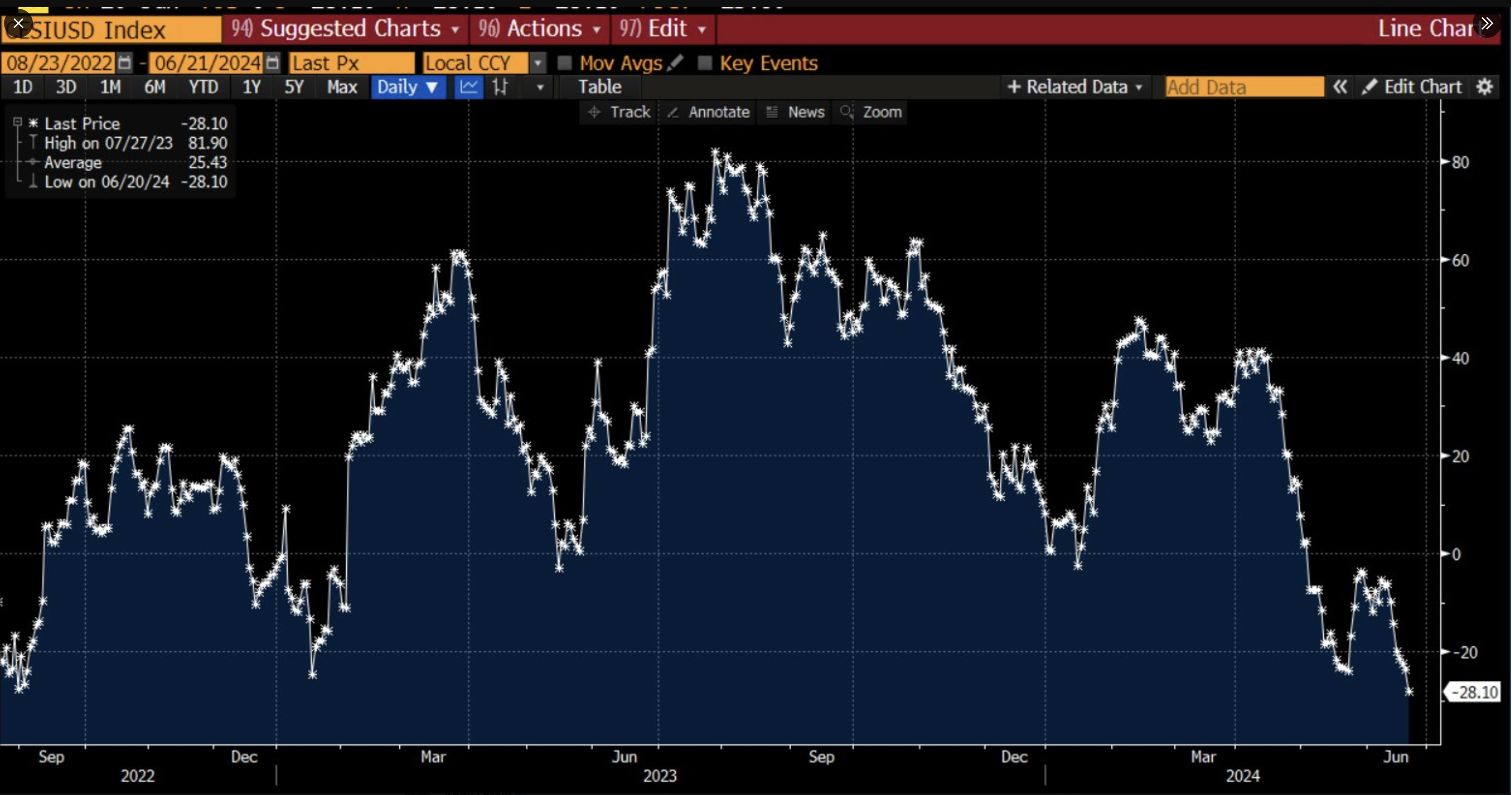
The data of late have not been positive.  Interestingly, this is not simply a US phenomenon, but appears to be spreading elsewhere in the world as evidenced by this morning’s much weaker than expected Flash PMI data out of Australia (Mfg 47.5 vs. 49.7), Japan (50.1 vs. 50.6) and Europe (Germany 43.4/46.4, France 45.3/46.8, Eurozone 45.6/47.9).  This follows the US trend where yesterday we saw the weakest Building Permits and Housing Starts data since the pandemic in June 2020 as well as a weaker than forecast Philly Fed result and higher than forecast Initial Claims data.  Prior to the Juneteenth holiday, Retail Sales were also quite soft, and another harbinger is the Citi Surprise Index, which Citibank created to measure actual data vs. the forecasts ahead of the release.  Typically, as it declines, it indicates weakening growth and vice versa.  As you can see from the below chart, this indicator has fallen to its lowest level in two years.

Source: Bloomberg

Summing it up, the strength of the economy is clearly being called into question by the data releases. However, as we have seen for the past several years, this is not a universal phenomenon.  For instance, who can forget the recent NFP print which beat expectations handily.  As well, the Atlanta Fed’s GDPNow indicator remains at 3.0% after yesterday’s housing data, still far above the forecasts by most economists, and an outcome that would be welcomed by almost everyone.

(As an aside and related to yesterday’s discussion about how politics intrudes on, or at least colors, so much of the financial market commentary, there have been numerous articles ‘blaming’ the weak PMI data on the results of the European Parliament elections and the ensuing call by French President Macron for next week’s snap election.  While one can make the case that is the situation in France, given the inherent uncertainty of the outcome, it seems a stretch to say that is why Germany’s data suffered.  After all, it is possible that all the talk of Eurozone tariffs on Chinese goods and the demonstrated incompetence of the current German government are sufficient to dissuade businesses there from investment and growth.)

So, what are we to believe?  The first thing I would highlight is that the idea of two separate economies seems to gain validity by the day.  For the haves, however you want to describe them but arguably the top 10% of income and wealth, the current situation has been fine.  While inflation is annoying, they can afford the higher prices given their asset portfolios, whether real estate or equities, have risen so dramatically.  The wealth effect for them is quite real.  

However, for the rest of the nation, things are far less positive.  The Retail Sales data tell a tale of reduced purchases of stuff (remember, that data is not inflation adjusted, so higher sales and higher inflation could well indicate less stuff sold but more money paid for it).  Additionally, the employment data is also a mixed bag as although NFP was strong, the household survey indicated less people were working and the trend in the Unemployment Rate is clearly up and to the right as per the chart below.

Source: tradingeconomics.com

Adding to this mix we have the Fed, who continue to look at the inflation data, and while they were pleasantly surprised by the slightly softer tone of the CPI data earlier this month as well as the PCE data last month, are still not prepared to address potential weakness in the economy.  This was made evident again yesterday when Richmond Fed President Barkin said, “my personal view is let’s get more conviction before moving.”  In other words, as we have heard consistently, patience remains a virtue at the Eccles Building.

If pressed, my personal view is that the economy has peaked for this cycle and we are going to start to see more data show weakness going forward, not strength.  The bigger problem with this is that while inflation has ebbed from its highest levels, it appears to me that the idea it will reach, and remain at, the 2.0% target is extremely unlikely.  Rather, I remain in the camp that the new level of inflation is somewhere between 3% and 4% as defined by CPI, and that over time, the Fed is going to bless that as an appropriate description of stable prices.  Given the Fed’s clear desire to cut rates, I fear that they are going to act earlier than would otherwise be prudent and that while economic activity will decline, prices will rebound.  Absent a massive recession, something like we saw in 2008-09, I do not see prices falling back to the current target.

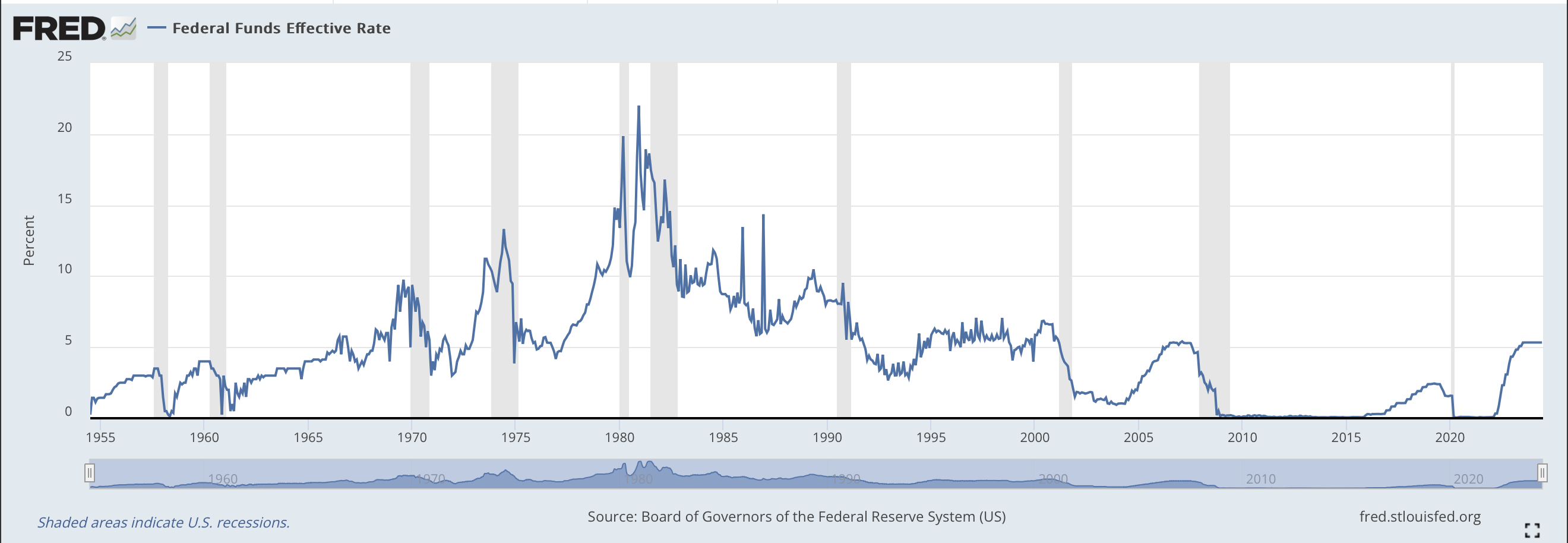
And here’s the problem with that view from a market’s perspective, if the recession comes, the Fed will cut rates and cut them relatively quickly.  This can be seen in the chart below showing Fed funds behavior relative to recessions.

Source FRED data base

Alas, for equity markets, during a recession, equity markets tend to fall, with declines of 30%-50% quite common and much greater as well (NASDAQ fell 88% during 2001-02 recession).  The road ahead appears to be filled with difficulty, so keep that in mind as you go forward.

Ok, sorry that ran on so long, but sometimes it is important to dig a little deeper I feel.  Let’s do a really quick turn of the overnight session.  Japanese equities were little changed but Hong Kong fell sharply (-1.7%) and the mainland drifted lower.  The rest of Asia was broadly under pressure although Australia (+0.35%) managed to eke out small gains.  In Europe, following the weak PMI data red is the color of the day with every market lower on the session, including the UK which released surprisingly positive Retail Sales data, although their PMI data was also soft.  At this hour, US futures are little changed awaiting the Triple Witching Day of expiries of futures, options and options on futures.

In the bond market, yields are lower across the board led by Treasuries (-3bps) and all of Europe as those PMI data are a harbinger of slower growth and will likely be an encouragement for more rate cuts by the ECB.  In fact, Klaas Knot, one of the more hawkish ECB members indicated he could see three more cuts this year, which is even more dovish than the market is pricing.

In the commodity markets, oil is essentially unchanged this morning, maintaining its recent gains as inventory data showed more draws than expected.  In the metals markets, gold (+0.2%) is holding onto its recent rebound, but given the weaker economic data story, both silver and copper are under pressure.

Finally, the dollar is gaining this morning as European currencies suffer from weak data and rate cut dreams, although there are two real outliers, MXN (+0.45%) on the back of surprising strength in recent economic data (Retail Sales and IP) and ZAR (+0.55%) as it appears more investors are turning to the rand as the pre-eminent carry trade earner vs. the yen and reducing their MXN exposures after the recent elections.

On the data front, the Flash PMI’s are due at 9:45 (exp 51.0 Mfg, 53.7 Services) and then at 10:00 we see both Existing Home Sales (4.10M) and Leading Indicators (-0.3%).  While there are no Fed speakers on the calendar, I fully expect to hear from someone before the end of the day as they simply cannot shut up.

Overall, risk is off, and I suspect that we could see some equity selling during today’s session, following yesterday’s moves.  With that, bonds are likely to perform as well as the dollar, and I think gold holds on, though the rest of the commodity complex is likely to suffer further losses.

Good luck and good weekend

Adf

Not Soaring

It seems that prices
In Japan are not soaring
Like the hawks would want


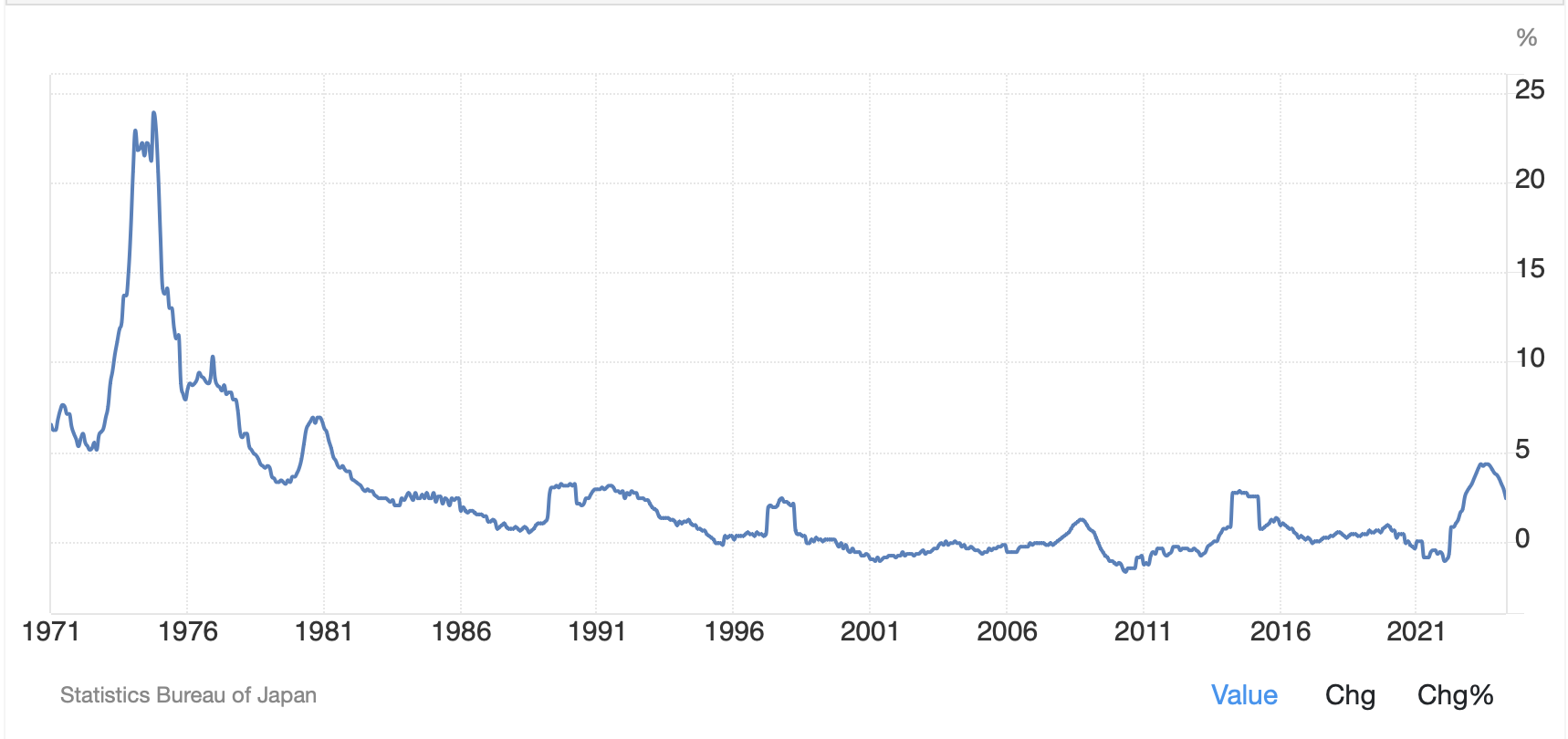
Japanese inflation data last night showed a continued decline as the Core rate fell to 2.2%, and the so-called super core rate slipped to 2.4%, its lowest level since October 2022.  As you can see in the super core chart below, the trend seems clearly to be downward although the current level remains far above inflation rates for most of the past 30 years.

Source: tradingeconomics.com

The irony here is that were this the chart of the inflation rate in any other G7 nation, the central bank would be crowing about how successful they had been at slaying the inflation dragon.  Alas, as the chart demonstrates, Japan’s dragon was a different species, and one that I’m pretty sure the 122 odd million people there were very comfortable having as a “pet”.  After all, I have never met a consumer who was seeking prices to rise before they bought something, have you?

From a market perspective, the continued decline in inflation rates calls into question just how much further Japanese interest rates need to rise in order to achieve the BOJ’s goals.  Again, remember the BOJ’s goals for the past decade has been to RAISE the inflation rate to 2% and their tactic has been to create the largest QE program in the world such that they now own more than 50% of the outstanding Japanese government debt across all maturities.  If inflation continues to decline back to, and below, 2%, while I’m confident the general population there will have no objections, Ueda-san may find himself in a difficult position.  

Arguably, if higher inflation is the goal (and politically that seems nuts) then the most effective tool the nation has is to allow the yen to continue to weaken and import inflation.  I continue to believe that this will be the process going forward, and while very sharp and quick declines will be addressed, a slow erosion will be just fine.  Absent a major change in US monetary policy to something much easier, I still don’t see a case for a much stronger yen.  However, as a hedger, I would continue to consider options to manage the risk of any further bouts of intervention.

While many are still of the view
That rate cuts are long overdue
What yesterday showed
Is growth hasn’t slowed
So, Jay and his friends won’t come through

Back home in the US, yesterday’s data releases did nothing to encourage the large contingent of people who are desperate looking for a rate cut before too long.  While New Home Sales were certainly lousy, falling from the previous month’s downwardly revised level, and the Chicago Fed’s National Activity Index was also quite soft, indicating economic activity had slowed last month, the Flash PMI data got all the attention with both Manufacturing (50.9) and Services (54.8) rising sharply, an indicator that there is still life in the economy yet.  The result was that we saw US yields rise (10yr +7bps), the dollar strengthen, and equity markets give back their early, Nvidia inspired, gains to close lower on the day.  While equity futures are rebounding slightly this morning, confidence that a rate cut is coming soon has clearly been shaken.

Adding to the gloom was a reiteration by Atlanta Fed president Bostic that it is going to take a lot longer for rates to impact inflation than in the past.  In a discussion with Stanford Business School students, he focused on the fact that so many people locked in low mortgage rates during the pandemic and recognized, “the sensitivity to our policy rate — the constraint and the degree of constraint that we’re going to put on is going to be a lot less.” For those reasons, Bostic said, “I would expect this to last a lot longer than you might expect.”  This discussion has been gaining more adherents as the punditry is grudgingly beginning to understand that their previous models are not necessarily relevant given all the changes the pandemic wrought.  Summing up, there continues to be no indication, especially in the wake of the more hawkish tone of the Minutes on Wednesday, that the Fed is going to cut rates soon.

So, with the new slightly less perfect world now coming into view, let’s take a look at market behavior overnight.  Yesterday’s US equity slide was continued everywhere else around the globe with Asian markets (Nikkei -1.2%, Hang Seng -1.4%, CSI 300 -1.1%) under uniform pressure and European bourses, this morning, also in the red, but by a lesser -0.4% or so across the board.  For many of these markets (China excepted) they have recently run to all-time highs, or at least very long-term highs, so it should be no surprise that there is some consolidation.  There is a G7 FinMin meeting this weekend and the comments we have heard so far indicate that the ECB is on track to cut rates next month, but there are no promises for further cuts.  Net, it seems clear that as much as most central banks want to cut interest rates, they are still terrified that inflation will return and then they have an even bigger problem.

In the bond market, it has been a very quiet session after yesterday’s yield rally with Treasury yields unchanged this morning and European sovereign yields similarly unmoved.  Even JGB yields are flat on the day as it appears bond traders and investors started their long weekend a day early.  Remember, not only Is Monday a US holiday, but it is a UK holiday as well, so there will be very little activity then.

In the commodity markets, oil prices remain under pressure and are drifting back toward the low end of their recent trading range.  One story I saw was that there is a renewed effort to get the ceasefire talks in Gaza back on track, but that seems tenuous at best.  Given the strength seen in the PMI data across Europe and the US, it would seem the demand side of the story would improve things here, but not yet.  As to the metals markets, after a serious two-day correction, this morning is bringing a respite with both gold and silver prices bouncing while copper prices remain unchanged.  I remain of the view that the longer-term picture for metals is still intact, so day-to-day trading activity should be taken with a grain of salt.  Ultimately, I continue to believe that the central banking community is going to cut rates before inflation is controlled and that will lead to much bigger problems going forward along with much higher commodity prices.

Finally, the dollar, which rallied alongside yields yesterday, is giving back some of those gains, albeit not very many of them.  The commodity currencies (AUD +0.2%, NZD +0.2%, ZAR +0.4%, NOK +0.6%) are the leading gainers this morning although the euro is also firmer as is the pound despite much weaker than expected UK Retail Sales data.  Alas, the poor yen can find no support and continues to drift a bit lower, with the dollar back above 157 this morning and keep an eye on CNY, which is now back above 7.25 for the first time in a month after Chinese FDI data showed larger than expected -27.9% decline.  It seems that President Xi has successfully scared off most foreign investment which is very likely a long-term problem for the nation.  While it has been very gradual, the fixing rate continues to weaken each day as it appears the PBOC is finally accepting the need for a weaker yuan.

On the data front, we see Durable Goods (exp -0.8%, +0.1% ex-Transports) and then Michigan Confidence (67.5) which continues to be a problem for President Biden’s reelection campaign as the people in this country are just not happy.  We also hear from Governor Waller this morning.  It will be very interesting to hear him as my anecdotal take is that the regional presidents have been much more hawkish than the governors and Chairman Powell, so if he leans dovish, it may demonstrate a bigger split between factions on the board than we have been led to believe.  We shall see.

Net, it remains very difficult for me to make a case for the dollar to weaken substantially at this time.  While it may not power ahead, a decline seems unlikely for as long as higher for longer remains the mantra.

Good luck and good long weekend

Adf

There will be no poetry on Monday due to the holiday.