Quite Excited

The market is now quite excited
As trade talks have been expedited
With Bessent and He
Now speaking, we’ll see
If buyers last night were farsighted
 
However, do not ignore gold
Whose price is a thing to behold
The past several days
There’s been quite a craze
As sellers now rue what they’ve sold


Source: tradingeconomics.com

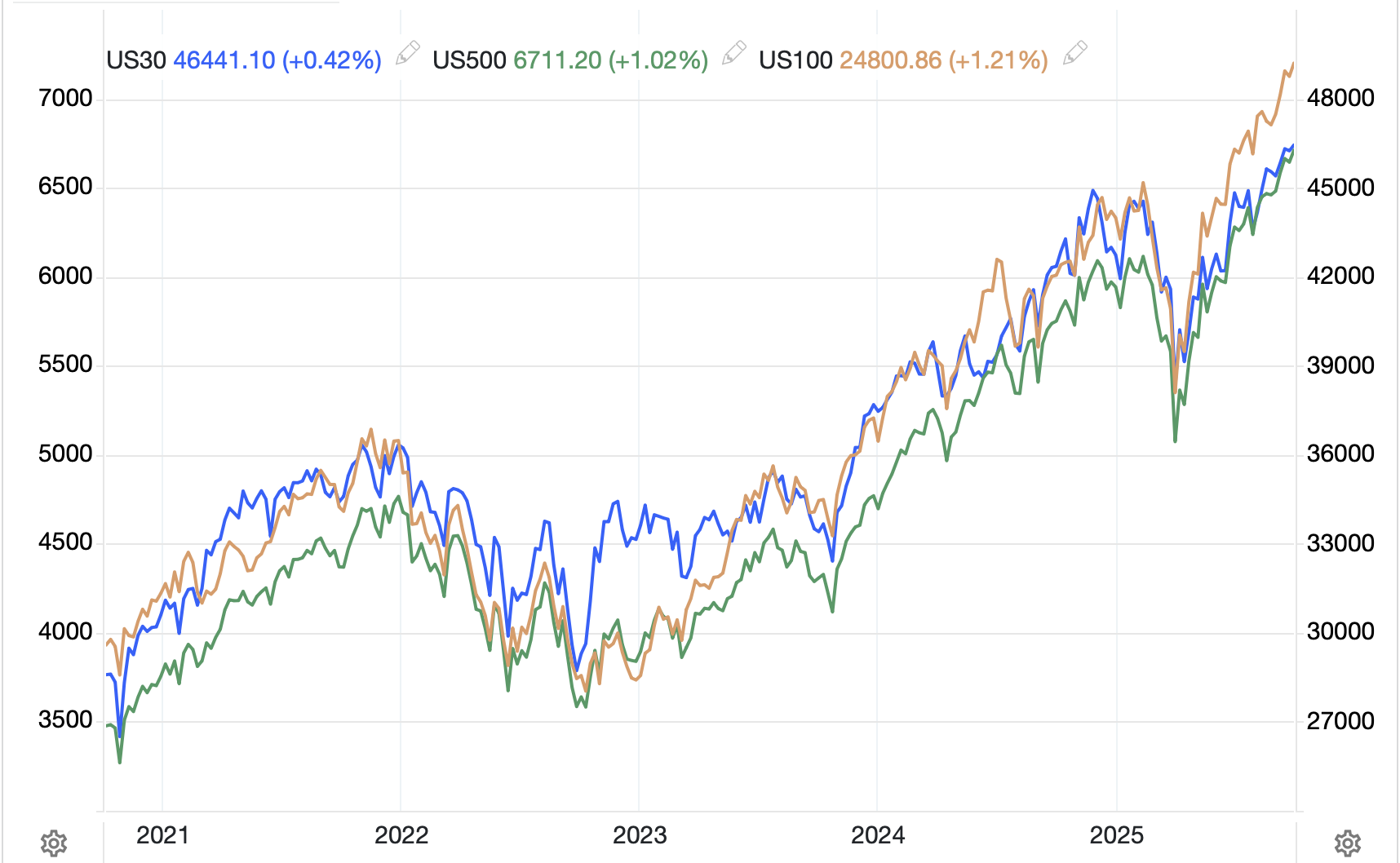
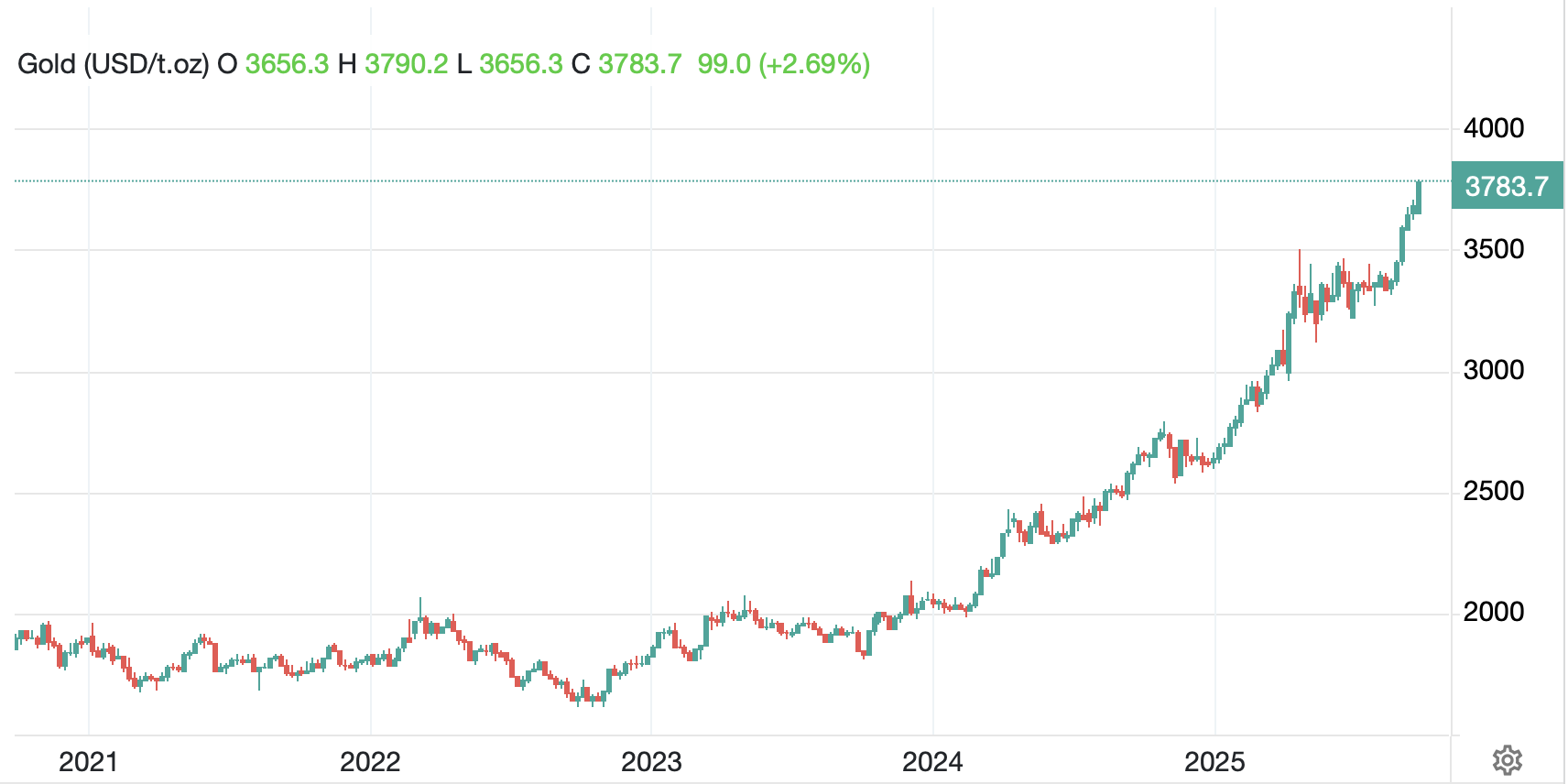
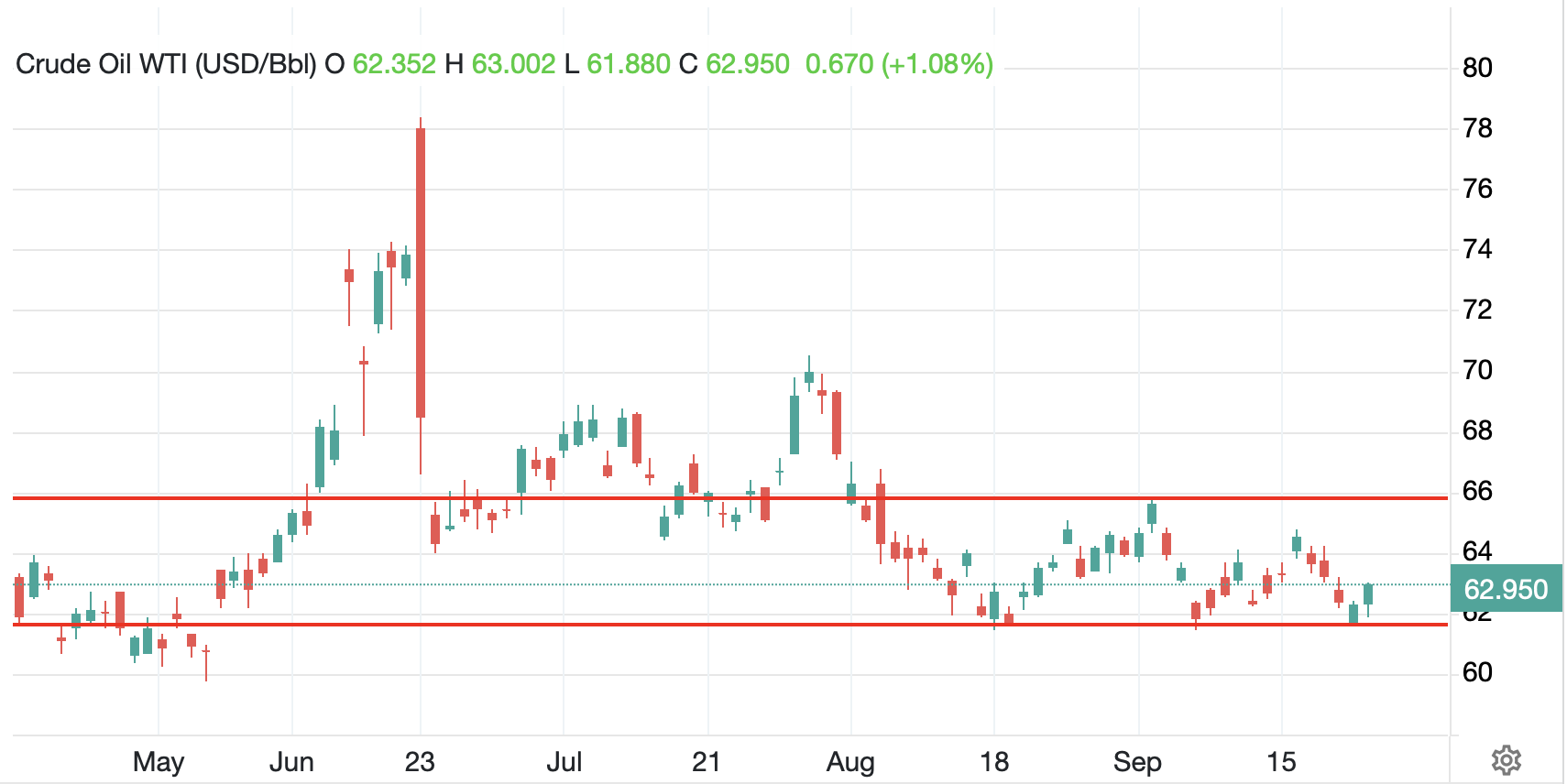
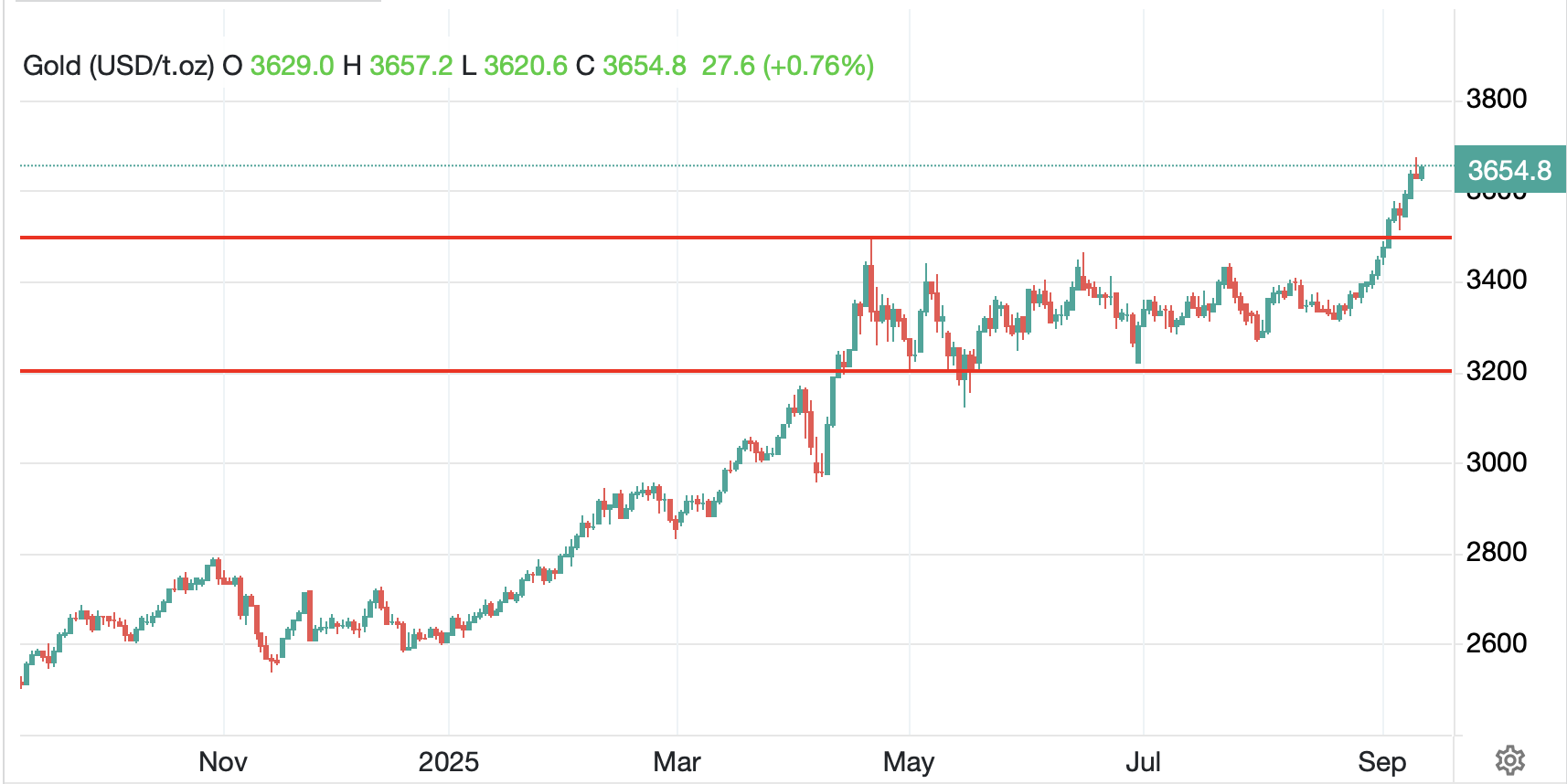
I don’t often lead with a chart, but I think it is worthwhile this morning.  I grabbed this picture at 7:00pm last night, shortly after the news hit that Treasury Secretary Bessent and Trade Representative Greer were heading to Switzerland later this week to sit down with He Lifeng, the Chinese Vice Premier and trade negotiator and begin trade talks.  Prior to that announcement, the barbarous relic had rallied more than $200/oz over the past four sessions, a pretty impressive move for something that has maintained a low overall volatility.  The first explanation of the reversal, which coincided with a sharp gain in equity futures (see chart below) is that all the fear of the world ending with corresponding equity weakness and a need to hold gold, has ended!  Hooray!!!

Source: tradingeconomics.com

Alas, just as I never believed the world was ending before, neither do I believe that everything is suddenly better.  Seemingly, this is all part of the process.  The idea that China could simply accept much of the stuff they produce would not be able to find a home in the US was never going to be the case.  I have no idea how things will work out, and they certainly will take a lot of time to come to some agreement, but it is very positive that the dialog has begun.

On the subject of which side blinked, which is a favorite for the punditry, especially those who despise dislike President Trump and believe this shows weakness on his part, I would note that the Chinese are the ones who have recently reported weaker economic data and last night the PBOC cut their 1-week reverse repo rate by 0.1% and reduced their Reserve Requirement Ratio by 50 basis points, both monetary easing measures to address the ongoing weakness in China.  Neither side benefits from this process in the short-term, but we will need to see the results of the talks, which will take many months I presume, before we know if goals have been achieved.

Away from the story on trade
The Fed story must be portrayed
Alas, it’s quite dull
As Jay and friends mull
The idea rate cuts be delayed

The only other story of note today is the FOMC meeting where they will release their policy statement at 2:00 this afternoon revealing no change in policy, and very likely almost no change in the wording, and then Chairman Powell will face the press at 2:30.  However, given the low probability of any changes, and given nothing regarding trade policy has really changed since they entered their quiet period, it seems unlikely that we will learn anything of consequence from Powell.  Today will be a complete non-event.

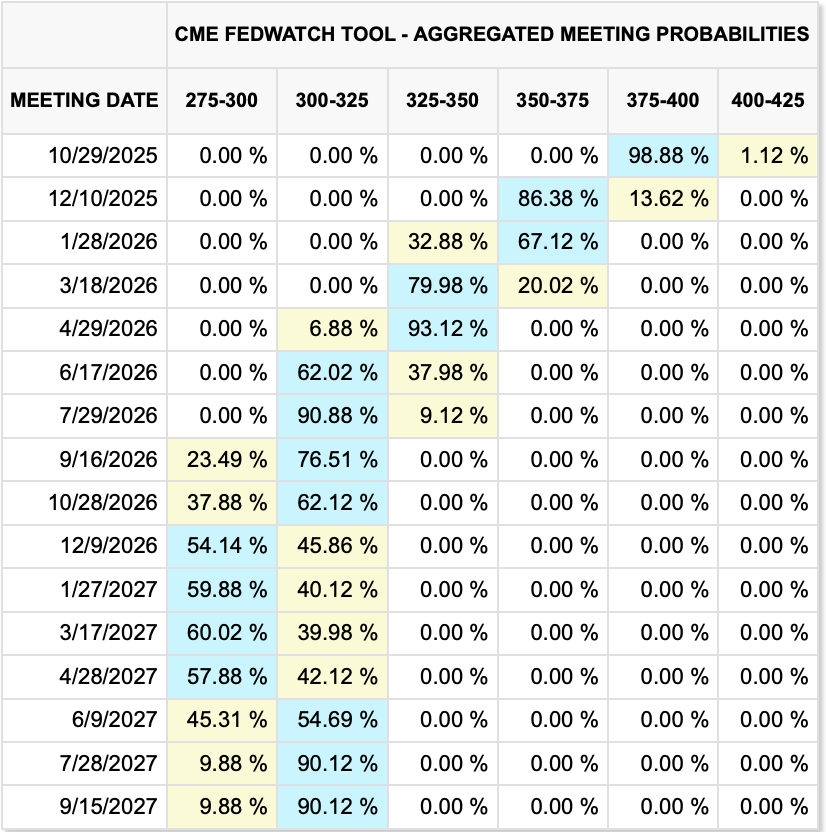
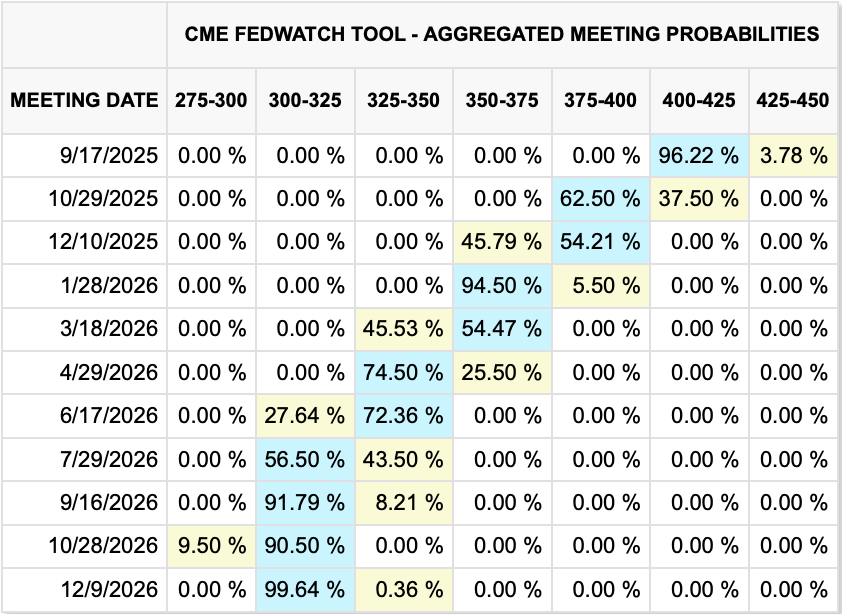
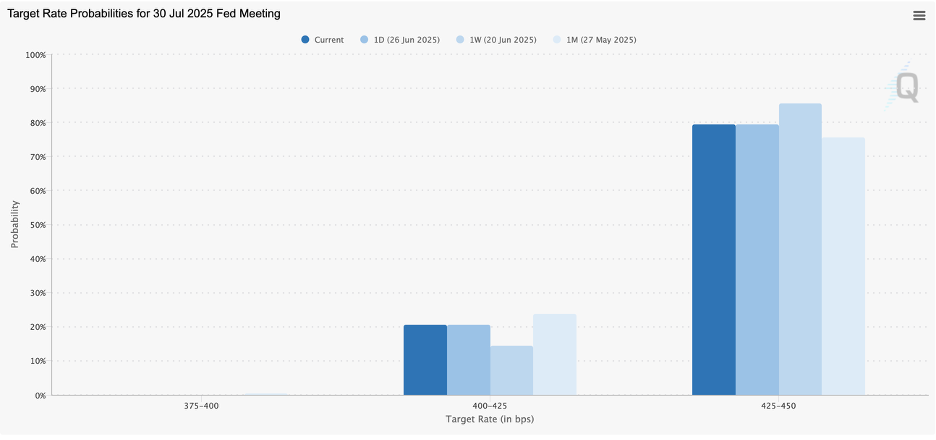
However, I cannot help but consider why the futures market appears so convinced that there are going to be rate cuts going forward this year.  As of this morning, the Fed funds futures are pricing a total of 78 basis points of cuts for the rest of this year, so three 25bp cuts as per the below chart from the CME.

Certainly, the data released thus far this year have not indicated the economy is heading into a tailspin.  Of course, there are many analysts calling for a recession to start in Q2 or Q3 as the tariff impacts ostensibly undermine the economy.  It is important to note, however, that these are the same analysts who have been calling for a recession for the past three years.  The boldest calls are for a period of stagflation, with the tariffs simultaneously killing growth and raising prices.

It is entirely possible that we see a recession this year, especially if government spending decreases given its role in supporting recent growth data.  (According to the BEA, Federal government spending in Q1 declined -5.1% while investment in the economy expanded more than 2%.). If this is the path forward, the long-term benefits will be substantial, but they must be maintained.  As well, if this is the path forward, total economic activity in the US will expand substantially and it is not clear that rate cuts will need to be part of that mix. 

Regardless, it seems that today’s activity is less likely to be impacted by the Fed than by any random headlines regarding trade or other administration maneuvers.  So, let’s see how markets have responded to the US-China trade talk news.

The China news came long after the close yesterday so the US markets closed lower on the session, approaching 1% declines, but US futures are currently higher by around 0.7% at 7:15.  In Asia, however, we did see some modest gains although the Nikkei (-0.15%) faded a bit, both China (0.6%) and Hong Kong (+0.15%) managed to rally.  As to the rest of the region, most markets were modestly higher although in a seeming sympathy move on the China news.  In Europe, bourses are softer this morning with the CAC (-0.7%) leading the way and other key indices falling less.  The data releases show Construction PMI softening on the continent as well as weak Eurozone Retail Sales (-0.1%), so I imagine that is weighing on investors’ minds today.

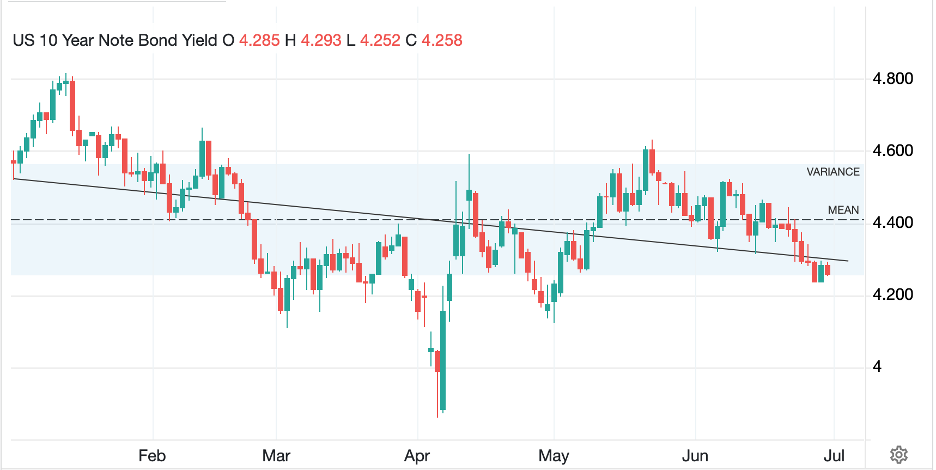
In the bond market, Treasury yields are 2bps firmer this morning but have been trading either side of 4.30% for the past several sessions as traders try to estimate the next big thing.  I see just as many stories about how yields are going to 10% as I do about how they are headed to 2% amid the depression coming, so my take is, we are going to range trade for a while yet.  In Europe, sovereign yields are lower by between -3bps (Germany) and -5bps (Italy) as that softer data is encouraging investors to believe that inflation will continue to decline and the ECB will cut further.

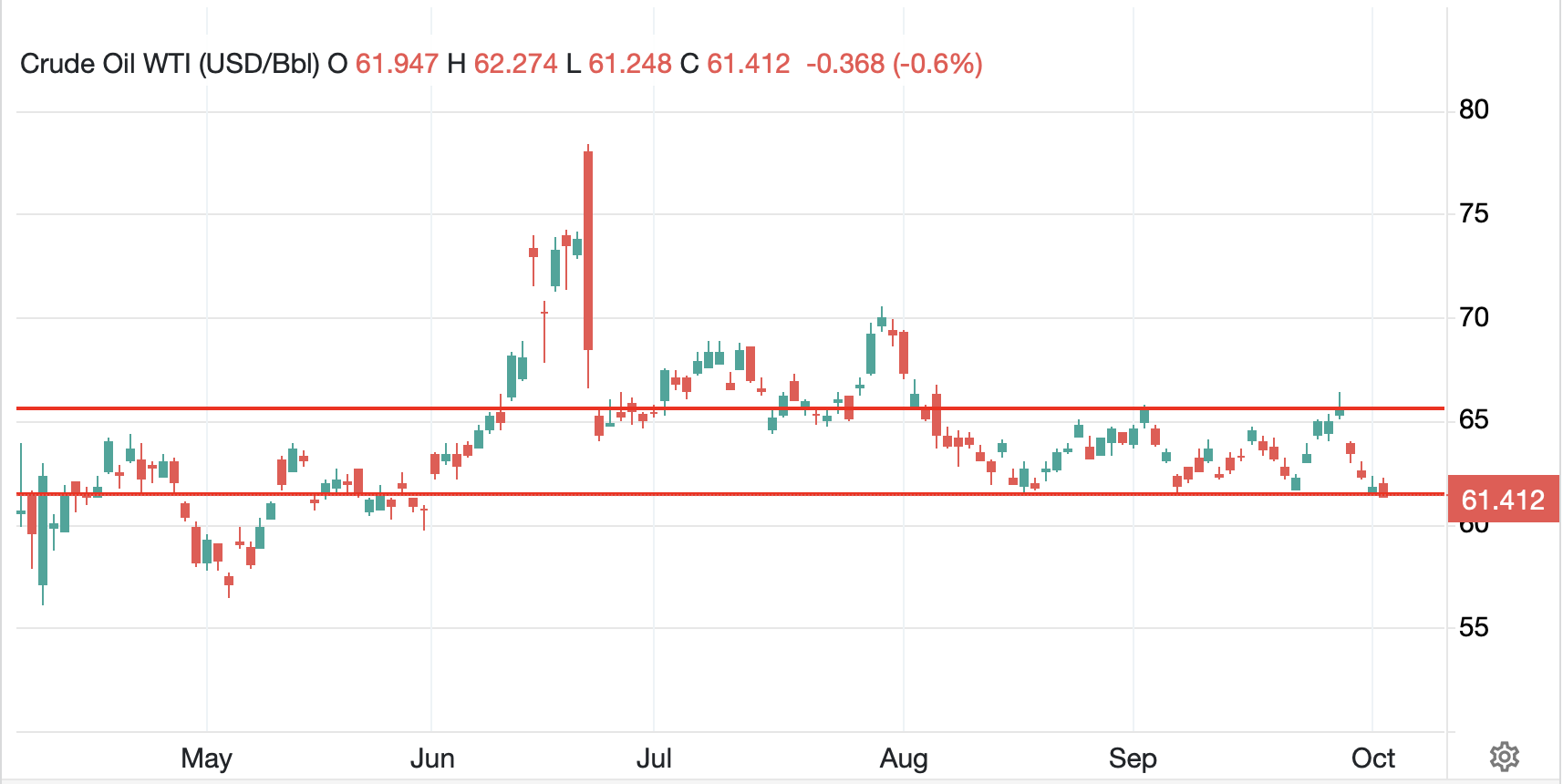
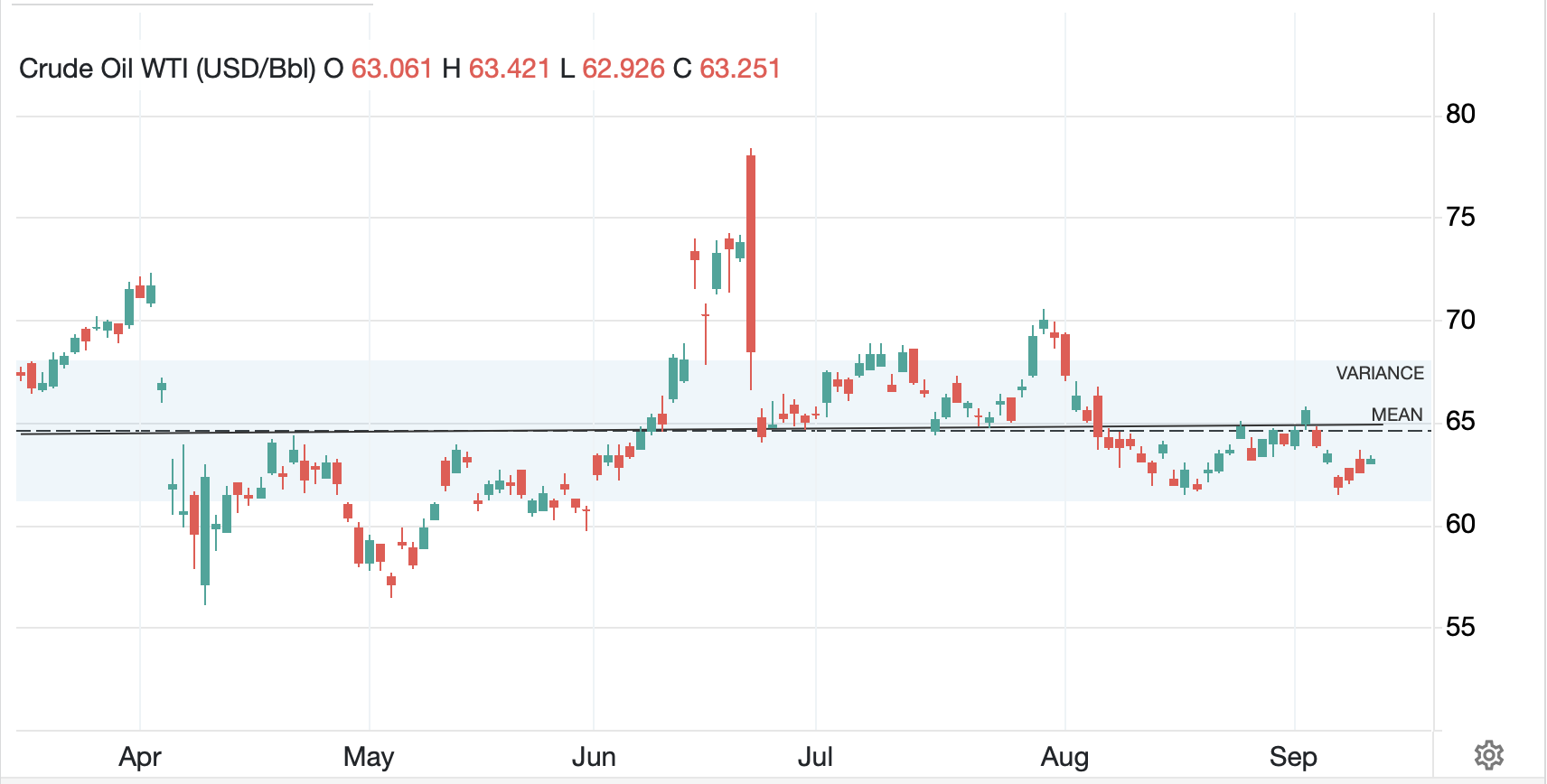
The commodity market has been where the real action is of late with oil (+0.9% today after +2.0% yesterday) rising after comments by two US oil companies that they will not be drilling any more if oil prices stay at these levels.  What I don’t understand is, what will they be doing as they are oil companies?  At any rate, this will be the tension in markets, who can afford to drill and sell oil at lower prices.  I expect we will hear from companies and pundits on both sides of this equation.  I discussed gold above, which has bounced slightly from its lowest levels overnight and I don’t believe anything will derail this train for a while yet.  However, both silver (-0.75%) and copper (-2.6%) are softer this morning, partly based on gold’s slide and partly on the weaker economy story.

Finally, the dollar is modestly firmer this morning, at least against its G10 counterparts with JPY (-0.6%) the weakest of the bunch, followed by SEK (-0.5%) and AUD (-0.3%).  The euro and pound are little changed and NOK (+0.15%) has gained on the back of oil’s strength.  In the EMG block, KRW (-1.1%) and TWD (-1.1%) have both rebounded some from their recent highs (dollar lows) in what seems more like a trading reaction than a change in policies.  Elsewhere in this bloc, though, MXN (+0.2%) is a touch stronger while ZAR (-0.5%) is a touch weaker and CNY is little changed.  There is a story making the rounds today that a well-known currency analyst, Steven Jen, is claiming that there could be as much as $2.5 trillion of excess currency reserves held by Asian nations that they may no longer need.  If this is true and these reserves were sold quickly, it would certainly drive the dollar much lower.  However, it strikes me that given the enormous amount of USD debt that has been issued by Asian companies and countries, and given these countries do not have access to Fed swap lines in emergencies, there is no reason to sell the dollars.  Rather they will simply have a ready supply without having to chase them when repayment and rollovers come due.  I would take this story with a large grain of salt.

Other than the Fed, we see EIA oil inventory data where some drawdowns are anticipated and that is really the day.  We are all awaiting the trade negotiation outcomes and I would say nobody has an inside track there.  Bigger picture, though, I do think the dollar has further to slide.

Good luck

Adf

Very Near Future

The “very near future” is when
The US and China, again
Will restart their talks
Assuming no balks
By either of these august men
 
That’s all that the market required
For buyers to get so inspired
Can this idea last?
Or will it have passed
Ere market resolve has expired


While all and sundry have been very confident that President Trump’s attempt to alter the structure of the global economy and world trade to a more beneficial one, in his view for the US, will fail dismally and that we are doomed to stagflation as prices rise and the economy sinks, it seems these same economic analysts have forgotten that there are two sides to the supply/demand equation.  I have written before that despite all the slings and arrows that have been aimed at Trump, the US has a very strong hand in the trade game given it is THE CONSUMER OF LAST RESORT.  Virtually every nation in the world has built an economy designed to be able to manufacture stuff cheaply and sell it into the largest economy in the world.

And US consumers are remarkable in their ability to continue to consume at high levels despite what appear to be significant headwinds, whether high financing costs, limited savings or slowing economic activity.  But a funny thing is happening on the way to this mooted US stagflation, it’s not happening yet.  In fact, as described by economist Daniel Lacalle in his most recent post, it seems that the biggest problem is not that Americans cannot find what they want to buy, it is that they only bought all this stuff because it was cheap.  They will not accept significant price rises and so inventory is building up at factories while ships are stuck with containers full of stuff nobody wants, at the price.  Could it be that President Trump read the room better than the economists?

I use this as preamble to yesterday’s massive equity rebound which was, ostensibly, triggered by comments from Treasury Secretary Bessent that substantive trade talks with China would begin in the “very near future.”  Subsequent soothing comments by the President indicated that the days of 125% tariffs were numbered but there would be tariffs in place.  As well, Mr Trump explicitly said he has no intention to fire Fed Chair Powell, despite his recent diatribe that Powell is always late to the party and should cut rates.  Certainly, I agree the Fed is, and will always be, late to the party as long as they use a data driven approach.  After all, by the time economic change is reflected in the data, whatever is going to change has already done so.  However, I don’t yet see the rationale for cutting rates given the current economic data and the fact that inflation remains a problem.

As of this morning, following significant equity rallies around the world, one might come to believe that all the world’s problems have been successfully addressed.  The fact that one would be wrong in that belief is the best example of ‘the market is not the economy’.  But, hey, let’s take the rallies when they come!

From a market perspective, that was really the big story yesterday and continuing into today.  Flash PMI data is not that exciting, and all the other headlines revolve around the ongoing immigration/deportation issues plus RFK Jr’s edict to remove petroleum-based food coloring from foods.  So, let’s look at the markets and recap the action.

The 2.5% to 3.0% gains in the US were followed by Tokyo (+1.9%) and Hong Kong (+2.4%) performing well but nothing like Taiwan (+4.5%).  The laggard last night was China (+0.1%) with other regional exchanges showing gains between 0.5% and 1.5%.  Net, I suppose everybody was happy.  In Europe this morning, the screens are green as well, with Germany (+2.6%) leading the way followed by France (+2.2%) and the UK (+1.3%).  Again, the trade story appears to be the leading driver.  And, adding to the joy, US futures are also higher between 2.0% (DJIA) and 3.0% (NASDAQ) this morning as of 6:50.  And to think, just two days ago I was assured that the end was nigh.  A quick look at the S&P 500 chart below does give a flavor for just how much volatility we have seen on a day-to-day basis and how narrative changes continue to have huge impacts.

Source: tradingecomics.com

At the same time, Treasury yields have been retracing, lower by -8bps this morning with UK gilts (-6bps) also performing well, although continental European sovereigns are not seeing the same demand with bunds (+3bps) the laggard despite the weakest PMI readings with both Manufacturing and Services below 50.0, lower than last month and far lower than forecasts.  The narrative of money leaving the US and heading back to Europe is certainly appealing, and seems quite reasonable as a long-term metric, but it is not clear to me that it will be driving daily price action in any market.

In commodities, oil (+1.0%) continues to edge higher although it has not yet come close to filling that massive gap lower from the beginning of the month.  

Source: tradingeconomics.com

From a fundamental perspective, fears of a US recession, which remain high, as well as the IMF recently reducing their global growth forecast seem to be undermining the demand side of the equation.  Meanwhile, the opportunity for significant new supply (Iran deal, Russia peace) seems quite real.  I’m no oil trader but it strikes me the risk-reward here is for a further drop in prices.  As to the metals markets, gold (-0.4%) fell more than $100/oz yesterday, so perhaps my view that the parabolic move was too much was correct.  However, I believe this is a short-term, and much needed, correction with the long-term story fully intact.  Meanwhile, silver (+1.4%) and copper (+0.4%) are modestly higher after quiet sessions yesterday.

Finally, the dollar is firmer this morning against most of its counterparts, but this is not a universal situation.  While both the euro and pound have fallen -0.25%, AUD (+0.6%) is showing some oomph as it figures to be one of the key beneficiaries of a trade agreement between the US and China, no matter how far in the future.  Other key gainers are KRW (+0.6%) and CNY (+0.3%), with both clearly benefitting from that same trade story.  But otherwise, the dollar is mostly ascendent.  

An aside here on the yen (-0.4%) which just two days ago traded below the key psychological level of 140 and this morning is back above 142.  It strikes me that this is the first currency that will be reactive to any trade deal.  As you can see from the below, long-term chart of the yen, it has spent the bulk of its time at far higher (dollar lower) levels.  I suspect that any trade deal will include an effort to revalue the yen higher vs. the dollar, perhaps to its longer-term average of around 120.

Moving on to today’s data, we have New Home Sales (exp 680K) and then the Fed’s Beige Book at 2:00pm. I’m not sure when the surveys were taken for the Beige Book, but you can be sure they will express a great deal of uncertainty and discuss how it will reduce economic activity.  You can also be sure that this will be hyped in the press.  But now that everything is better (just look at the stock market) is this old news?

If we try to look past the daily gyrations to the bigger picture, I would contend the following is the case.  Equity markets remain overvalued and are likely to weaken, the dollar is likely to slide as well as foreign investors slowly reallocate funds away from the US.  Quite frankly, the Treasury story is much harder as the interplay between inflation and potential reduced government expenditure is highly uncertain right now, although one will eventually dominate.  Finally, commodities remain far more important than their current relative weight in the global asset basket and I believe they have much further to climb in price.  One poet’s views.

Good luck

Adf

Their Own Ego Trip

The talk of the town is the “Pause”
Which led to much market applause
Though naysayers still
Say Trump’s actions will
Result in bad outcomes…because


But yesterday saw markets rip
And all those who did buy the dip
Are feeling quite smart
When viewing the chart
Of prices, their own ego trip


See if you can guess when President Trump posted that there would be a 90-day pause on tariffs for everyone but China.

Source: tradingeconomics.com

By now, you are almost certainly aware that equity markets in the US rebounded massively in the US, with one of the biggest gains on record as the S&P 500 rose 9.5% and the NASDAQ 12.2%.  Of course, that merely retraced the bulk of the losses seen since the beginning of the month.  In fact, the S&P 500 is still lower by about 200 points since then.  Regardless, moods are much brighter today than they were yesterday at this hour.  And those equity gains are global.

I’ve seen several interpretations of the sequence of events and like virtually everything these days, it appears to have a partisan bias to people’s views.  There are those who claim President Trump could not stand the pressure of a declining stock market and “blinked” in the game of chicken he was playing.  There are also those who claim this was part of the strategy all along, essentially moving the Overton Window substantially in his preferred direction and now he is ready to reap the benefits of this move.  

Arguably, there is evidence for both sides of this argument and I suggest we will never really know. Remember, Trump is quite comfortable making outlandish pronouncements as he level sets for a negotiation.  But he is also quite the realist and while I do not believe he was concerned with his personal or family fortune, recognized that the speed of the pain inflicted could be damaging overall.  In the end, it is not clear the rationale matters, the action stands on its own merits.  

But remember this, equity valuations were very high before the decline last week, and were still quite high, although obviously less so, after the decline.  The rebound put them back in very high territory, especially with equity analysts revising profit forecasts lower on the back of the still 10% tariffs being imposed.  A truism is that the biggest rallies in the stock market occur during bear markets.  Keep that in mind as you assess risk going forward.

But let us turn our attention to a player who is not getting much attention these days, the Fed.  Many questioned the Fed’s rate cuts back in Q4 and attributed the moves to a partisan effort to help VP Harris get elected.  Certainly, there is no love lost between Chairman Powell and President Trump.  Of late, though, the commentary has focused on patience regarding any further policy ease as the impacts of Trump’s tariff policies are unknown at this stage.  Yet, it is not hard to read these comments and get a sense that the Fed is going to work at cross purposes to Mr Trump.  

For instance, yesterday, Minneapolis Fed President Neel Kashkari released an essay with the following comments, “Given the paramount importance of keeping long-run inflation expectations anchored and thelikely boost to near-term inflation from tariffs, the bar for cutting rates even in the face of a weakening economyand potentially increased unemployment is higher.  The hurdle to change the federal funds rate one way or theother has increased due to tariffs.”  While the words here don’t appear partisan per se, Mr Kashkari is one of the most dovish FOMC members and dismissed inflation concerns regularly for a long time.  This sudden change is interesting, at the least.  

At any rate, the market, which had been pricing a 50% probability of a rate cut next month just a few days ago and a total of at least 4 cuts this year, is back down to a <20% probability of a cut in May and about 3 cuts this year.  Truly the pause that refreshes.

So, let’s look at how other markets responded to the pause.  Markets everywhere, including China, rallied last night and this morning, with Tokyo (+9.1%) and Taiwan (+9.2%) leading the way in Asia although gains were universal.  Hong Kong (+2.1%) and China (+1.3%) were the laggards with gains between 2.5% and 5.0% the norm.  In Europe, too, equities are flying this morning as the threat of much higher tariffs is removed, at least temporarily, with the UK (+4.6%) the laggard and gains between 5.0% and 6.5% the story there.  Alas, futures this morning, at 7:00am, are pointing lower by -2.0% or so.  Is that profit taking or a harbinger of the day to come?

In the bond market, which has expressly been Trump and Bessent’s main concern, yields are a bit lower this morning, -3bps in 10-year Treasuries.  But the story in Europe is confusing to me, or perhaps not.  German bunds (+6bps) have seen the largest rise while UK Gilts (-10bps) have seen a sharp decline.  Too, Italy (-4bps and Greece (-2bps) have seen yields decline.  Could this be an illustration that bunds are a better safe haven than Treasuries? And now that haven status seems less important today, they are being sold off?  JGB yields (+9bps) are also rising, perhaps on the same notion.  The corroborating evidence is that nobody thinks Gilts are a good investment, so with risk back on, they are in demand given their highest yield in the G10.

In the commodity markets, oil rebounded sharply alongside equities yesterday although it has slipped 2.4% this morning.  I have altered the Y-axis on the chart below to percentages to give an idea of the magnitude of these moves in the past days, especially relative to the past 6 months.  Despite being the most liquid commodity market around (both figuratively and literally), it is far less liquid than bonds or FX or even stocks, so as commodities are wont to do, sometimes the moves are breathtaking.

Source: tradingeconomics.com

As to the metals markets, gold (+1.0%) continues its march higher, recovering more than 5% from the lows Tuesday morning.  I maintain that much of that selling was margin based, with positions liquidated to cover margin calls in other markets.  Now that the panic has passed, demand is likely increased given the new uncertainties.  However, both silver (-0.5%) and copper (-1.3%), which rallied sharply yesterday, have slipped back a bit.  These are different stories.

Finally, the dollar is lower this morning, having yo-yoed like every other market on the tariff news.  CHF (+1.9%) and JPY (+1.4%) are the big gainers in the G10 although the euro (+1.2%) is having a day as well.  However, there are currencies with less pizzazz this morning, notably ZAR (-0.9%), KRW (-0.6%) and MXN (-0.5%), as it remains difficult to know how to proceed going forward.  JPMorgan has a global volatility index which is a useful barometer of how things are going.  As you can see below, it is not surprising that volatility in this space has also risen sharply.

Once again, I return to the idea that President Trump is the avatar of volatility, and you must always remember that volatility can happen in both directions.  While financial assets tend to collapse (yesterday being the exception) when things get out of hand, commodities go the other way as supply interruptions are the big risk. Writ large, volatility simply means a lot of movement.

We finally get some meaningful data this morning with headline CPI (exp 0.1%, 2.6% Y/Y) and Core (0.3%, 3.0% Y/Y) along with the weekly Claims data (Initial 223K, Continuing 1880K).  Given all the focus on the tariffs, though, it is not clear to me what this data will imply on a forward-looking basis.  As we have seen with the Fed getting sidelined by Mr Trump, his tariff policies have also served to overshadow economic data, at least for now.  There are a couple of more Fed speakers and a 30-year bond auction as well.  Interestingly, I expect that auction may be the most important outcome of the day.  Will there be real demand or are investors shying away?

I expect that over the next few months, tariffs will be discussed on a nation-by-nation basis as new deals are struck.  But that will impede any medium-term views on the economy as until we have a much better sense of the end results, it will be difficult to assess things.  The upshot is, we may be entering a period where we chop up and down, but don’t go anywhere until the global trade situation is clearer.  Volatility with no direction is great for traders, less so for investors.  Headline bingo is still the game we are playing.

Good luck and good weekend

Adf

Not Fraught

The Retail Sales data did nought
To clarify anyone’s thought
‘Bout growth or inflation
While anticipation
Of Jay, for a change, is not fraught
 
Meanwhile, tariffs are, once again
A question of how much, not when
Just two weeks from now
The president’s vow
For more, has disturbed market zen


In a remarkable situation, at least these days, there is precious little new news impacting financial markets.  Perhaps that is why equities around the world are rallying, the absence of bad news is seen as good.  Here in the States, the biggest story continues to be the controversy over the deportation of several hundred Venezuelan and Salvadorean gang members that some claim ignored a judge’s order.  I’m confident this will get top billing for at least another day, but after that, we will move on.  However, market related stories are sparser.

For instance, we can look at yesterday’s Retail Sales data, which was not terrible, but not great, as the headline number rose a less than expected 0.2%, but that still translated into 3.1% growth Y/Y.  One of the things weighing on the data was the fact that gasoline prices fell, thus despite modest growth in volume, total dollar sales declined.  The same was true with autos, where allegedly prices declined though volumes remained solid.  (Remember, Retail Sales measures the dollar value of sales, not the quantity of items sold.). At any rate, investors absorbed the data and decided that the recent market declines, to the extent they are a reflection of concerns over rapidly slowing economic activity, were overdone.  The result, happily, is that equities rallied most of the day yesterday and that has followed through around the world overnight.

Alas, the other string of stories in headlines today is the Trump administration’s efforts to determine exactly how they want to implement the promised reciprocal tariffs which are due to be put in place on April 2.  It seems the fact the US trades with over 180 nations, each with their own tariff schedules, makes the details of the proposal difficult to shape and implement.  However, my take is, absent some major shifts by other nations, these tariffs will be imposed.

Ultimately, given the US is the ‘buyer of last resort’ for pretty much every other nation on earth with regards to any of their exports, I expect that there will be a number of nations that choose to adjust their own schedules rather than have diminished access to the US market.  But ex ante, there is no way to determine which nations will blink.

As a testament to just how much things have changed in the market, and just as importantly, the market narrative, the fact that three major central banks are meeting this week with the potential to adjust policy, is basically a footnote.  The FOMC starts their meeting today and tomorrow afternoon they will announce rates are unchanged.  Some attention will be paid to the dot plot, to try to see if the recent discussions of patience translate into higher long-term rate expectations, but quite frankly, it is not clear to me that Chairman Powell can say anything that is going to move markets absent a surprise rate adjustment.  The Fed funds futures market continues to price in basically one rate cut each quarter for the rest of the year at this point.

But before that, this evening the BOJ will announce their latest policy updates and, not surprisingly, there is no anticipation of a move there either.  While there has been much discussion in Japan of how companies will be, on average, increasing pay by 5.46% this year, that has not resulted in any expectations for the BOJ to adjust policy in response.  And in fairness to Ueda-san and his crew, the fact that the yen (-0.3% today) has been relatively stable of late, having rebounded from its dramatic lows last summer and held a good portion of those gains, concerns over a much weaker yen have diminished.

Source: tradingeconomics.com

Looking at the chart above, while I am no market technician, there seem to be several overhead resistance levels starting with that recent trend line.  The absence of concern over a declining yen (rising dollar) will leave the BOJ on hold for a while I think.

And let us not forget Thursday morning, where the BOE will convene, also with no policy changes expected. While GDP remains desultory there, printing at 1.0% Y/Y last week for Q4, inflation refuses to fall to their 2% target and so Governor Bailey is caught between that proverbial rock and hard place.  In such a scenario, no action is the most likely outcome.

Ok, let’s turn to the overnight market activity, which has all investors excited given the fact that markets everywhere are embracing risk today.  A solid day in the US was followed by strong gains throughout Asia (Nikkei +1.2%, Hang Seng +2.5%, CSI 300 +0.3%) with the mainland a little disappointing.  There has been more discussion recently that despite some splashy headlines about more Chinese stimulus, it is less than meets the eye.  That is a view with which I agree.  The exception to this rule was Indonesia (-3.9%) which fell after concerns over slowing growth and a widening budget deficit spooked foreign investors.  In Europe, things are also bright with all markets firmly higher led by Germany (+1.2%) as continued belief in the end of the debt brake has investors anxious to take advantage of all the government spending set to come.  We shall see how that works out, but if the US is the template, it probably has some room to run.  However, all these bourses are higher this morning in a general risk-on mood.  The crimp in the story is US indices are all slightly softer this morning ahead of Housing data.

In the bond market, yields are climbing with Treasury yields up by 1bp and European sovereign yields all higher by 3bps.  Again, this seems to be focused on the mooted extra government spending which is coming down the pike, although yields have backed off the levels seen after the initial announcements as per the below.  In fact, I read a forecast this morning about German bund yields rising to 4% by the end of next year after all the borrowing.

Source: tradingeconomics.com

In the commodity bloc, gold (+0.9%) is unstoppable for now, and taking silver (+1.1%) and copper (+0.4%) along for the ride.  Whatever else is ongoing, it appears that more and more investors have decided that having some portion of their portfolios in the barbarous relic is the right trade. After all, it is higher by more than 15% just since the beginning of the year and more than 40% over the past twelve months.  Oil (+1.1%) is also managing to hold above its recent lows but continues to run into resistance below $70/bbl.  The biggest news today is that Saudi Aramco has seen its stock price falling to 5-year lows, down 50% from its highs of 2022 after cutting dividends earlier this month.

Finally, the dollar is little changed at this hour (7:45), rebounding from modest weakness earlier in the session.  The euro and pound are unchanged, and the yen remains slightly softer.  However, MXN (-0.5%) and KRW (-0.5%) are both feeling the heat of the tariff story.  In the opposite camp, CL (+0.6%) continues to benefit from the rally in copper prices.  The big picture here remains unchanged, with the dollar likely to remain on its back foot as capital flows toward Europe’s government spending bonanza and away from the US, which appears to be pushing for fiscal tightness. 

On the data front, this morning we see Housing Starts (exp 1.38M) and Building Permits (1.45M) at 8:30 then at 9:15 we get IP (0.2%) and Capacity Utilization (77.8%).  With the Fed meeting ongoing, the only headlines will come from the White House, and those are virtually random these days.  Tight fiscal and loose monetary policy tends to weaken a currency and given that is the best description of the US these days, it remains my default position.

Good luck

Adf

Boom and Bust

According to people we “trust”
The past which involved boom and bust
Will stay in the past
And now, at long last
The owning of stocks is a must
 
So, whether today’s NFP
Is weak or strong, what we foresee
Can best be expressed
By buying the best
That BlackRock will sell for a fee


Is it different this time?  Have stocks reached a “permanently high plateau”?  Has the global economy exited the cycle of ‘boom and bust’ which has existed since the beginning?  These questions are relevant today after the release of BlackRock’s 2025 Global Outlook which explained that “Historical trends are being permanently broken in real time as mega forces, like the rise of artificial intelligence (AI), transform economies.”

BlackRock’s claim is simply the latest by a well-known investor that stock prices will never retreat again, and the future is unbelievably bright.  “This time is different” has been said about virtually every bull market top, whether the real estate bubble, the tech bubble, the Japanese bubble, the Chinese real estate bubble or even the South Seas bubble hundreds of years ago.  In fact, in order to inflate a bubble, the narrative must be, this time is different.

That permanently high plateau comment came from Irving Fisher, who while a very well-respected economist for his work on debt deflation (which came after the Depression started), famously made that comment on October 21, 1929, just days before the crash that led to the Great Depression.

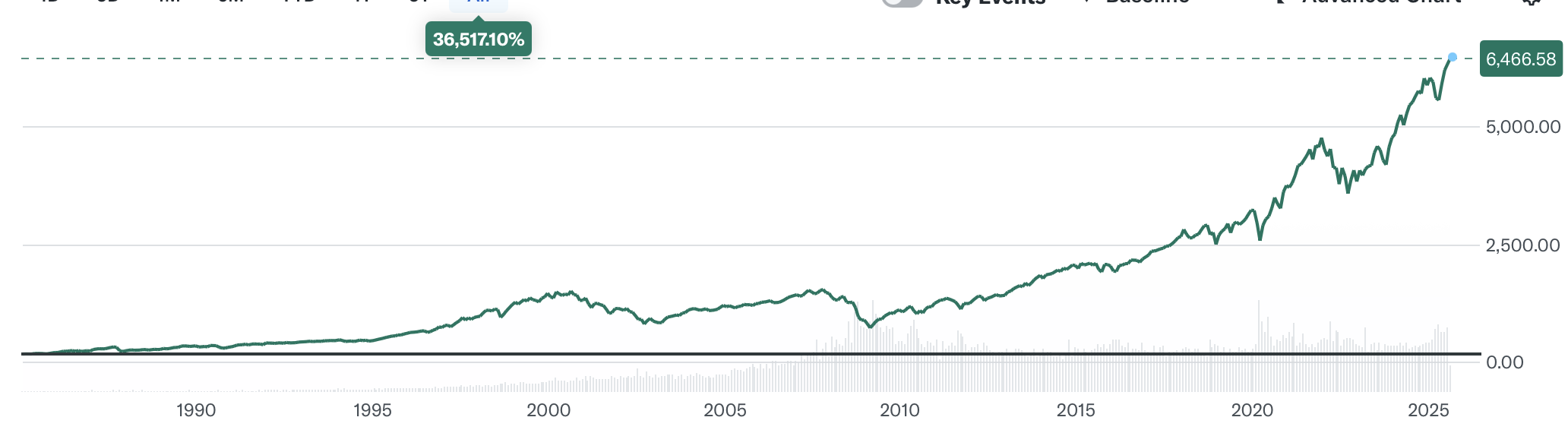
So, the question is, has BlackRock defined the top in equity markets this time?  I think it is worthwhile to take a longer-term perspective on market performance to try to answer that question, and more importantly, figure out what to do if this is the top.  A look at the chart below, the last 50 years of the S&P 500, shows that every one of the major downturns we have seen, at least in my lifetime, has been nothing more than a blip.

Source: tradingeconmics.com

For instance, the tech bubble was an anthill around 2000 on this chart, and the GFC crash, while described as the worst recession since the Great Depression, seems to be a pretty modest dip.  Covid in 2020 was almost nothing and the biggest was really 2022, which saw the index slide 25% through the first 9 months of the year.  Of course, part of this is the number itself.  A 25% decline now would be ~1500 S&P points (or 11,000 Dow points), the type of thing that would freak out nearly everybody.  

Is this possible?  Certainly, it is, 25% declines have occurred pretty regularly through the history of the market.  Is it likely?  This is a much tougher question.  BlackRock’s thesis is that this time is different; that AI is the game changer, and the future will be finally filled with flying cars and robots doing all our chores on the basis of unlimited free energy for everyone.  Ok, that may be a slight exaggeration, but they are extremely optimistic that technology will continue to move forward and solve what currently appear to be intractable problems.

The one thing working in their favor, I think, is that governments and central banks around the world have essentially lost their tolerance for market corrections, whether that is in equity or fixed income markets, and so will do whatever they can to prevent any small slide from becoming a large one.  Of course, the only thing they can do is print money to buy those assets that are falling in price.  If that is the plan of action, then the future will be highly inflationary, that is the only clear outcome.

I have no idea how things will turn out.  Perhaps BlackRock is correct, and we are about to embark on an entirely new segment of economic and financial history.  Perhaps Elon will successfully help restructure the US government so it is efficient and focused on a more limited role, and that process will inspire other nations to follow suit.  Perhaps pigs can fly as well.  I hate to be a curmudgeon, but trees still don’t grow to the sky, whether they are created by AI or nature.  Gravity remains undefeated.  But I am wary when I read reports claiming this time is different.  Forty plus years in the markets has taught me that is never the case.  Tools may change, timelines may change, but ultimate outcomes remain the same.

Ok, as we await this morning’s NFP report, let’s see what happened overnight.  Yesterday’s very modest declines in the US equity markets were followed by a slide in Japan (Nikkei -0.8%) and one in Australia (-0.6%) although this was predicated on weaker than expected GDP data, while Chinese shares (Hang Seng +1.6%, CSI 300 +1.3%) rallied on hopes that the economic conference next week is going to finally fire that long awaited Chinese bazooka!  In Europe, the most interesting aspect is the CAC (+1.4%) is having a wonderful day after the French government fell and prospects for managing the economy there remain extremely uncertain.  Perhaps that represents the idea that if the government is not interfering, French corporates can get on with the business of business unhindered and make more money.  Or perhaps it is an assumption that the ECB will ease more forcefully to prevent a major mishap.  After all, Madame Lagarde is French, so is likely not unbiased in the matter.  As to US futures, at this hour (7:15) they are lower by -0.1% across the board as we await the data.

In the bond market, there is nothing going on at all. Treasury yields are unchanged on the day which is true of virtually every European sovereign with one exception, French OATs which have seen more buying and have slipped 2bps lower in the session.  Here, too, it almost seems as though the market has decided the lack of a working government is better for France’s finances than when there is someone in power.  One other thing to note is that JGB yields have edged lower by 1bp this morning and have fallen 4bps this week as USDJPY has traded higher over the same period.  The most noteworthy thing here is that Toyoaki Nakamura, one of the most dovish BOJ members, explained that he was not against hiking rates, per se, and market participants took that as an opening for the BOJ to do just that and perhaps take a more pronounced stance against the ongoing inflation there.  I’ll believe it when I see it.

In the commodity markets, apparently nobody needs oil (-0.8%) anymore as it continues to sell off.  Remember just a few days ago we breached $70/bbl on the upside.  Well, this morning we are below $68/bbl amid fears(?) that peace is breaking out in the Middle East with talk that Hamas is willing to release the hostages to achieve a cease fire.  Arguably, a bigger issue is that much of the world (mostly China and Europe) have seen slowing economic activity and so demand estimates continue to decline along with the price.  As to the metals markets, they have been bouncing around lately, not making any headway in either direction as it appears traders are waiting for more concrete clues about demand here as well.  Gold (+0.2%) is the exception here, with demand not in question, just the timing of the next wave of central bank purchases.

Finally, the dollar is somewhat stronger overall this morning, notably vs. both AUD (-0.5%) and NZD (-0.4%) on the back of that weak GDP data.  Away from that, the rest of the G10 is mostly a bit softer, but not seeing large moves with NOK (-0.4%) excepted on the weak oil prices.  In the EMG bloc, declines are pretty consistent around the -0.2% range, but nothing really of note.

Now to the NFP data.  Here’s what is forecast:

Nonfarm Payrolls200K
Private Payrolls200K
Manufacturing Payrolls28K
Unemployment Rate4.2%
Average Hourly Earnings0.3% (3.9% y/Y)
Average Weekly Hours34.3
Participation Rate62.6%
Michigan Sentiment73.0

Source: tradingeconomics.com

In addition, we hear from four more Fed speakers (Bowman, Goolsbee, Hammack and Daly) so it will be interesting to see how they perceive the amount of caution that is appropriate going forward.  As a marker, this morning the Fed funds futures market is pricing a 70% probability of a December rate cut, down 4 points.

The big picture remains that the economy continues to outperform the naysayers, at least according to the official data.  The fact that performance is spread unevenly does not matter to markets at this time.  As such, it remains difficult for me to create the scenario where the dollar gives up substantial ground.  If the Fed does cut in two weeks, I think it will be the last for a while unless we start to see some major revisions lower in the data.  Maybe that starts this morning, but until then, you have to like the buck.

Good luck and good weekend

Adf

To Further Debase

Said Jay, “The economy’s strong”
But rate cuts before weren’t wrong
We’re in a good place
To further debase
Your dollars and will before long
As we slow the pace
Of policy ease all year long


Chairman Powell regaled the market for the last time before the Fed’s quiet period begins tomorrow evening and here are the three comments that seem to explain his current views. 

  • We wanted to send a strong signal that we were going to support the labor market if it continued to weaken.”
  • The economy is strong, and it’s stronger than we thought it was going to be in September.”
  • The good news is that we can afford to be a little more cautious as we try to find a rate-setting that neither spurs nor slows growth.”

My read is he was trying to make an excuse for the 50bp cut that started the process in September as there is still no justification for that move.  However, he essentially reiterated his last remarks of the Fed not being in a hurry to cut rates further.  As it happens, SF Fed president Mary Daly also explained, “We do not need to be urgent. There’s no sense of urgency, but we do need to continue to carefully calibrate our policy and make sure it’s in line with the economy we have today the one we expect to have going forward.” 

Now, a funny thing happened to me yesterday as I read those comments, and my expectation was that the Fed funds futures market might reduce the probability of a December rate cut.  After all, we just heard from the Chairman that things are good and they can be cautious about further cuts, while another member expressly said there was no urgency to cut.  But in fact, the 74% probability this morning is unchanged from yesterday’s level and the punditry remains very convinced that they are going to cut next week despite their caution.  It seems that my understanding of caution and Powell’s are somewhat different.  However, his understanding is the one that matters, so it appears absent a major upside surprise in both NFP tomorrow and CPI next week, a cut is coming on the 18th.

The French president, M. Macron
May soon find himself overthrown
His PM is out
And there is great doubt
‘Bout any new views he has shown

The other topic of note this morning is the collapse of Monsieur Macron’s minority government in France.  This was the widely expected outcome that markets had priced in, so there has been little in the way of impact there.  However, the bigger picture impact is about the structure of the Eurozone (and EU) and its rules.  After all, if the second largest economy in the group is not merely floundering economically, but essentially leaderless, the concept of a coherent set of plans to oversee the Eurozone seems a bit of a stretch.

Macron’s term is not up until 2027, and he has consistently maintained he will not step down early, but there are increasing calls for him to do just that.  Members of parliament on both the left and right, although not Marine Le Pen, the RN’s leader, have been vocal on the subject and a recent poll by Cluster17 for Le Point magazine showed that 54% of the French public wanted him to step down as well.  Now, you know as well as I that absent a criminal conviction, the odds of an elected official stepping down anywhere in the world approach zero and I expect nothing less from Macron.  At the same time, French law prevents another parliamentary election for 12 months after the last, which means July.  At that time, one will almost certainly be called, and it will be interesting to see how that plays out.  

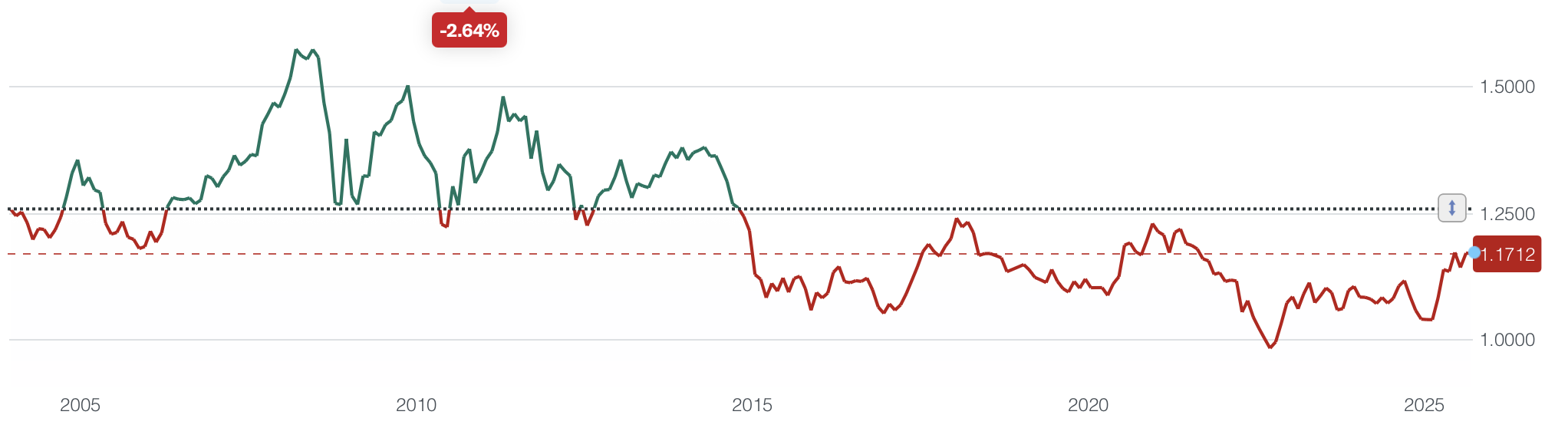
However, in the meantime, it seems likely that France will be floundering with no ability to address fiscal issues, be they spending or deficit focused.  This cannot be a positive for the single currency, especially if France slips into recession.  Again, despite all the concerns over the dollar and the untenable fiscal deficits, things in Europe appear far worse.  Parity in the euro and below seems a far better bet over the next 6 months than the opposite.  While the euro (+0.2%) has bounced slightly this morning, a look at the chart below indicates, at least to me, that the trend is distinctly lower.

Source: tradingeconomics.com

And with that, let’s look at the overnight session in markets.  Continuing in the FX world, that modest euro gain is descriptive of the market as a whole, with the dollar slightly softer this morning, although few currencies showing any notable strength.  I suspect much of this is based on the idea that the Fed will cut rates soon despite the “strong economy”.  In truth, in the G10, no currency has moved more than 0.2% and even in the EMG space, only ZAR (+0.4%) and HUF (+0.5%) have climbed more.  Those moves, which don’t appear to have any fundamental drivers, seem more likely to be expressions of the fact those markets are more volatile than the G10.

In the equity markets, yesterday’s US rally, to new all-time highs across the board, saw a mixed review in Asia with the Nikkei (+0.3%) edging higher but both Hong Kong (-0.9%) and Shanghai (-0.25%) slipping a bit.  The rest of Asia was also mixed with Korea (-0.9%) still suffering from the bizarre happenings there yesterday but other markets performing well (India +1.0%, Singapore +0.6%).  In Europe, only the UK (-0.1%) is under water this morning although the CAC (+0.2%) is the continental laggard.  Spain’s IBEX (+1.2%) is the leader on the back of stronger IP, and although Eurozone Retail Sales were much weaker than expected, it has not seemed to impact investor views.  As to US futures, they are little changed at this hour (7:30).

In the bond market, Treasury yields have backed up 3bps and I am beginning to sense that there is a negative correlation to the probability of a Fed rate cut and the 10-year yield.  As that probability rises, bonds sell off further, but that is merely an anecdotal observation, I have not done the math.  In Europe, yields are mixed, but within 1bp of yesterday’s closing levels with even French yields slipping 1bp. It will be very interesting to see how the European Commission handles the fact that the French budget deficit is so far above the targeted 3% level and now without a government, there is no way to address the situation.  The original idea when the euro was formed was that governments would be fined if they broke the policy caps on debt and deficits.  Of course, no fine has ever been imposed and I don’t suppose one will be now.  (However, if Marine Le Pen’s RN wins the election next summer, you can be sure they will seek to impose fines on her government!)

Finally, in the commodity markets, it is very quiet this morning.  Oil (+0.3%) is edging higher after a big rise and fall yesterday.  The rise was the result of a steep draw in US inventories, but the decline seemed to be a response to OPEC+ confirming they will be increasing production at some point in 2025.  Meanwhile, metals markets are basically unchanged this morning.

One other thing I have not discussed but is obviously getting a lot of press this morning, is Bitcoin which traded through $100K yesterday after President-elect Trump named Paul Atkins to be his new SEC Chair.  Atkins has a very pro crypto bias, and I expect we will see far more impetus in the crypto space going forward, not just in Bitcoin.

On the data front, yesterday’s ISM data was a bit softer than forecast while the Beige Book explained that economic activity rose slightly in the past month along with employment and prices, but all movements were quite modest.  This morning, we see Initial (exp 215K) and Continuing (1910K) Claims as well as the Trade Balance (-$75.0B) and later we hear from Richmond Fed president Barkin.  

Looking at the overall situation, investors continue to ignore any potential problems and run to risk assets, as evidenced by the rally in Bitcoin and new highs in stock prices.  Unless we see some really surprising data, either crazy strong implying the Fed is going to stop easing, or crazy weak implying we are in a recession, I see no reason for this process to end heading into the new year and President Trump’s inauguration.  Again, in that scenario, I think you have to like the dollar higher.

Good luck

Adf

Think More Than Twice

The verdict, as best I can tell
Is Trump and his new personnel
Are being embraced
So, buy risk, post-haste
Lest owners all choose not to sell!
 
And yet there seems always a price
Where owners will sell in a trice
But if it’s that high
It just might imply
It’s worth it to think more than twice


Euphoria is one way to describe what we have seen in markets over the past several sessions, with substantial gains across both equity and bond markets while havens like gold and the dollar have been discarded. Insanity may be a better way to do so.  Regardless of your description, the facts are that risk assets have been consistently higher since the election results and there is a palpable excitement about how the future, at least for markets, will unfold.  I hope all this excitement is not misplaced, but it is still early days.  Just remember, that whatever ideas are currently being bandied about regarding Trumpian policies, it is almost certain that the reality will not quite live up to the hype.

Consider, too, for a moment just how different the impact will be on different markets.  The obvious first thought is China, where we have seen a significant divergence between the S&P 500 and the CSI 300 over the past week as seen in the chart below.  

Source: tradingeconomics.com

My point is all that euphoria is very country specific.  After all, yesterday’s comments by President-elect Trump that on day one he will impose tariffs of 25% on all imports from both Mexico and Canada had the expected impact on their currencies, weakening both substantially.  In fact, it is quite interesting to look at a longer-term chart of USDCAD and see that this is the third time in the past decade the exchange rate has traded above 1.40.  The previous two times were the beginnings of Covid, amid massive risk-off trading…and in 2016 when Mr Trump was previously elected president.

Source: tradingeconomics.com

I assure you that whatever China decides to do, and they have many inherent strengths as well as weaknesses, both Mexico and Canada are going to ultimately concede to whatever Trump wants as they cannot afford to ignore it.  In fact, my take is that the reason so many political leaders around the world are distraught is because they recognize that they are going to have to change their policies to keep in Trump’s good graces.  To me, the implication is that we are due for much more volatility as markets respond to all the changes that are coming.

And that should be our watchword going forward, volatility.  We live in a time where previous theories that led to previous policies are being questioned and upended.  We are also living through what appears to be the end of the Pax Americana era, where the US is turning its focus inward rather than concerning itself with pushing its brand globally.  These realignments are going to be ongoing for quite a while, and as new models will need to be developed and implemented, in both the public and private sectors, outcomes are going to remain quite uncertain for a while.  It is this that will drive all the volatility.  Once again, I urge hedgers to keep this in mind and maintain robust hedging programs as risk mitigation is going to be critical for future performance.

Ok, so let’s look at how things turned out overnight.  While the rally in the US equity market continues, especially in value and small-cap stocks, the story in Asia was far less positive with declines in Japan (-0.9%), China (-0.2%) and Australia (-0.7%) and almost every regional exchange in the red overnight.  This seems a direct response to the resurgence of tariff talk from Trump and I expect may be the guiding force for a while yet, perhaps even until the Inauguration.  Of course, we could also see some nations capitulating quickly in an effort to gain favor and I would expect those markets to reflect a more positive stance in that situation.  Neither is Europe immune from tariff talk as every bourse on the continent is weaker this morning amid concerns that tariffs are coming for them as well.  In addition, Trump has made it clear he is uninterested in supporting the Ukraine effort which means that either Europe will need to spend more money, or the map is going to change in an uncomfortable manner.  As to US futures, at this hour (7:20) they are modestly firmer.

In the bond market, yesterday saw the largest rally (-14bps) since the July NFP report showed Unemployment jumped to 4.3% in early August and triggered all sorts of claims that recession had started.  Yesterday’s catalyst was far more ambitious, ascribing success to Treasury Secretary selection Scott Bessent’s ability to rein in the fiscal deficit.  That bond rally dragged European sovereign yields lower, although a much smaller amount, 3bps-5bps, and this morning things are back to more normal trading with Treasury yields unchanged while Europeans are generally trading with yields lower by -2bps.  Certainly, if fiscal issues are successfully addressed, the opportunity for bond yields to decline exists, but this seems like a lot of hope right now.

In the commodity markets, gold had its worst day in forever, falling $110/oz although it is rebounding a bit this morning, up $21/oz or 0.8%.  That move seemed entirely driven by this same euphoria that has been underpinning both stocks and bonds, namely the future is bright, and havens are no longer needed.  Silver, too, had a rough day yesterday and is rebounding this morning, +1.4%, while copper sits the whole move out.  Oil (+0.8%) sold off yesterday amid the same risk thoughts as well as the news that an Israeli/Hezbollah ceasefire may be coming soon, reducing Middle East risk.  In the short-term, the day-to-day vicissitudes of oil’s price are inscrutable to all but the most connected traders, but nothing has changed my longer term view, which has only been enhanced by Trump’s drill, baby, drill thesis, that there is plenty of oil around and sharp price rises are unlikely going forward.

Finally, the dollar seems to have put in a top last Friday and has been selling off since the Bessent announcement.  I’m not sure I understand the logic here as Bessent is seeking to increase real GDP growth while reducing the deficit, both of which strike me as dollar positives.  Perhaps the idea is interest rates will be able to be lower in that situation, thus undermining the dollar, but again, on a relative basis, it seems quite clear that the US remains in far better macroeconomic condition than virtually every other nation.  So, if the US is cutting rates, others will be cutting even faster.  However, that is where we are this morning, with both the euro (+0.5%) and pound (+0.4%) climbing alongside the yen (+0.7%).  Offsetting that is the Loonie (-0.7%) and MXN (-0.8%) as both are the initial targets of those potential tariffs.  It strikes me that we are likely to see a number of previous relationships break down as the tariff talk adjusts views on different national outcomes.  Once again, volatility seems the watchword.

On the data front, this morning brings Case-Shiller Home Prices (exp 4.8%), Consumer Confidence (111.3) and New Home Sales (730K) and then the FOMC Minutes are released at 2:00.  All eyes will be there as things have so obviously changed since the meeting earlier this month, including Chairman Powell’s downshifting on the rate cutting cycle.  You remember, he is no longer in a hurry to do so.  Interestingly, as of this morning, the futures market is pricing in a 60% chance of a cut next month, up from 52% yesterday morning.  Perhaps that is a result of yesterday’s Chicago Fed National Activity Index, a meta index looking at numerous other indicators, which printed at -0.40, much worse than the expected -0.20, and as can be seen below, has shown a consistent trend that growth may not be what some of the headline data implies.

Source: tradingeconomics.com

Remember, too, with the holiday on Thursday, tomorrow brings a huge data dump so macro models will be waiting to respond.  As well, given the holiday, liquidity is likely to be less robust than normal meaning price dislocations are quite possible.

My sense is the dollar’s decline is more of a profit taking exercise (recall it rallied more than 7% in a few months) than a change in the long-term fundamentals.  But it is always possible that the new administration’s policies will be focused on pushing the dollar down, although funnily enough I don’t think Trump really cares about that this time.  My take is he is far less concerned about growing exports than reducing imports and bringing production home.  We shall see.

Good luck

Adf
Three-Three-Three

Apparently, everyone’s sure
Scott Bessent is wholesome and pure
As well, he will fix
The Treasury’s mix
Of policies for more allure
 
He’s focused on three, three and three
His shorthand for what we will see
The budget he’ll cut
Build up an oil glut
And push up the real GDP


President-elect Trump has named hedge fund manager Scott Bessent to be Treasury Secretary.  This appears to be one of his less controversial selections and has been widely approved by both the punditry and the markets, at least as evidenced by the fact that equity futures are rallying while Treasury yields are sliding.  An article in the WSJ this morning lays out his stated priorities which can be abbreviated as 3-3-3.  The 3’s represent the following:

  • Reduce the budget deficit to 3%
  • Pump an additional 3 million barrels/day of oil
  • Grow GDP at 3% on a real basis

The target is to have these three processes in place by the end of Trump’s term in 2028.  I certainly hope he is successful!  However, while 3-3-3 is a catchy way to define things, it is a heavy lift to achieve these goals.  In the article, he also explains that he will be seeking to make permanent the original Trump tax cuts from 2017 as well as uphold Trump’s promises of no tax on tips, overtime or Social Security.  

Now, the naysayers will claim this is impossible, especially the idea of cutting taxes and reducing the budget deficit, but then, naysayers make their living by saying such things.  While nothing about this will be easy, the one overriding rule, I believe, is that increasing the pace of real GDP growth is the only way to achieve any long-term sustainability.  It is in this space where I believe the synergies between Treasury and the newly created DOGE of Musk and Ramaswamy will be most critical.  Improved government efficiency (I know, that is truly an oxymoron) and reduced regulatory red tape will be what allows the real economy to perform above its currently believed potential growth rate.  And in truth, if Trump and his government are successful at that, the chances of overall success are quite high.  Yes, that’s a big ‘if’ but it’s all we’ve got right now.

And truthfully, this has been the only story of note overnight as the punditry churns out stories about what can be good or why he will fail.  While there was a note that a ceasefire in Lebanon may be close, I don’t believe that has been a major part of the market narrative regarding oil prices for a while.  After all, Lebanon doesn’t have any oil infrastructure and while Iran clearly funds Hezbollah, it doesn’t appear they have been willing to lay it all on the line for Hezbollah’s success.

So, market participants are very busy trying to determine the best investments in the new Trump administration and based on all we have seen so far, it appears that Bitcoin is at the top of the list followed by equities, especially value and small-cap and then the rest of the equity universe.  US markets remain more attractive than foreign markets while commodities, especially haven assets like precious metals, have lost their allure in this shiny new world.  At this point, the big Investment banks are busy increasing their equity market targets for 2025 and beyond with S&P 500 forecasts of 6700 and more already being put in place.

Oh yeah, one other thing is the dollar, which had been on a tear for the past two months, has at the very least paused and some are calling that it has topped.  While it is certainly softer this morning, calling a top may be a bit premature.  At any rate, let’s see how markets around the world have behaved in the wake of the newest US news.

Some are saying that Friday’s US equity rally was in anticipation of the Bessent pick, and certainly his name was on the short-list, but that’s a tough case to make in my eyes.  Nonetheless, rally it did and that was followed by strength in Japan (+1.3%) overnight as well as most of Asia (Korea +1.4%, India +1.25%, Australia +0.3%) although both China (-0.5%) and Hong Kong (-0.4%) lost ground as Bessent is very clear that tariffs are an important part of his strategy.  Meanwhile, in Europe, there are modest gains (DAX +0.1%, FTSE 100 +0.2%, IBEX +0.6%) although the DAX (-0.1%) is softer after weaker than forecast IFO data.  Europe remains stuck in a difficult situation as their energy policy is hamstringing the economy while services inflation remains stickier than they would like to see, thus potentially hindering more aggressive ECB policy.  In the end, though, prospects on the continent are just not as bright as in the US right now.  US futures are quite happy with the Bessent choice, rising 0.5% at this hour (7:30).

In the bond market, investors are also of the belief that Bessent will be able to solve some of the US’s problems and Treasury yields have slipped -4bps this morning, although remain near 4.40%.  However, European sovereign yields are all creeping higher, between 1bp and 3bps, as the prospects there seem less positive.  I would say that investors are willing to give Bessent a chance to try to improve the US fiscal situation and that should help encourage bond buying.

Commodity markets, though, are under pressure generally, although not completely. For instance, oil prices fell $1/bbl upon the Bessent news but have since regained the bulk of that as it appears the growth story is starting to take over.  Nat Gas (+4.8%) is continuing to rally strongly, especially in Europe as cold weather forces rapid inventory drawdowns and supplies remain a political, not market question.  Interestingly, upon inauguration, one of the first things Trump has promised is to take the pause off the LNG terminals which should raise demand in the US as exports increase and potentially reduce prices in Europe.  

However, as mentioned above, precious metals are under pressure (Au -1.2%, Ag -1.9%) as investors believe that a combination of less warmongering and an attack on the fiscal deficit will both reduce the need for a safe haven.  As well, given Trump’s well-known disdain for the climate change hysteria, it seems likely support for wind and solar will be reduced, if not eliminated, and silver is a critical need for solar panels.  

Finally, the dollar is under pressure this morning, lower versus almost all its counterparts, notably the euro (+0.6%), although also seeing losses (currency gains) against the entire G10, more on the order of 0.25% or so.  In the EMG bloc, CLP (+0.9%) is the leader as copper (+0.6%) is the outlier in the metals group gaining on the positive economic story.  But we are seeing strength in MXN (+0.45%), PLN (+0.8%) and CNY (+0.15%) as long dollar positions are reduced.  

On the data front this week, with the Thanksgiving holiday on Thursday, everything is crammed into the beginning of the week as follows:

TodayChicago Fed National Activity-0.15
TuesdayCase-Shiller Home Prices4.9%
 Consumer Confidence111.6
 New Home Sales730K
 FOMC Minutes 
WednesdayPCE0.2% (2.3% Y/Y)
 Core PCE0.3% (2.8% Y/Y)
 GDP2.8%
 Personal Income0.3%
 Personal Spending0.3%
 Durable Goods0.5%
 -ex transports0.2%
 Initial Claims217K
 Continuing Claims1910K
 Real Consumer Spending3.7%
 Chicago PMI44.7

 Source: tradingeconomics.com

Mercifully, the Fed seems to be taking the week off with no scheduled speakers although I suppose if something surprising happens, we will likely hear from someone.  

I guess the question is, does Scott Bessent really change everything by that much?  Obviously, we have no way of knowing until he is in the chair, and that is probably two months away at minimum and then it will take some months before anything of substance actually happens.

But, when I consider my long-term thesis which was that inflation is going to be with us for a while which will result in a steeper yield curve, especially if the Fed continues to cut rates, that would have helped both the dollar and gold while hurting both equities and bonds.  This morning, though, the probability of a December rate cut has fallen to 52%, and I imagine it will continue to decline, especially if the PCE data remains hotter than the Fed keeps expecting.  As well, questions about the Fed’s political bias will be raised again as the rationale for cutting rates 75bps given the headline data remained strong has always been unclear.  So, if the Fed is done cutting, that means the dollar is far more likely to rally from here than fall further, commodity prices will struggle (except maybe NatGas) and bond markets may not anticipate nearly as much future inflation with a tighter Fed and a new administration focused on more fiscal rectitude.  In that situation, equities certainly hold much more appeal, although pricing remains steep no matter how you slice it.

Good luck

Adf
Erring

Excitement does not quite portray
The thirst for risk shown yesterday
Though media cried
Investors took pride
In Trump, sure that he’ll save the day
 
So, next Chairman Jay and the Fed
Will try to explain that instead
Of further rate paring
They might soon be erring
On side that Fed rate cuts are dead


Wow!  That is pretty much all one can say about yesterday’s equity market response to the confirmation that Donald Trump will be the next president of the United States.  The DJIA rose 3.6%, far outpacing both the S&P 500 (+2.5%) and the NASDAQ (+3.0%) but even that paled in comparison to the Russell 2000 small-cap index which jumped nearly 6% on the day!  Investors are all-in on the idea that Trump will seek to bring home as much manufacturing and economic activity as possible via tariff policies and small caps and old-line companies are the ones likely to benefit.

But boy, bonds had a tough day with yields across the curve rising between 10bps (2yr) and 20bps (30yr) with the 10yr gaining 15bps on the day.  It is all part of the same mindset, higher economic activity and no slowdown in spending leading to rising inflation and, correspondingly, rising yields.

The other area that really suffered were the metals markets, with gold (-3.3% or $90/oz), silver (-4.7%) and copper (-5.0%) all getting hammered.  The best explanation for the gold price’s decline I have heard is the idea that with Trump coming into office, the prospects for a nuclear war have greatly diminished.  Certainly, based on the fact that there were no new wars during his last term and one of his promises is to end the Russia/Ukraine war on the first day, perhaps that is correct.  As well, consider that the dollar exploded higher, something which had lately been a benefit for metals, but historically has been a negative, and at least we can make some sense of things here.

So, where do we go from here?  That, of course, is the $64 billion question.  Reactions around the world are still coming in and I would characterize them as a mix of stoicism and fear.  Perhaps a good place to start is Germany where the governing coalition just collapsed as Chancellor Sholz fired the FinMin who was the head of the FDP, one of his coalition’s groups.  Their problem is that the German economic model is crumbling, and the population is unhappy with the current situation.  The former can be demonstrated by today’s data showing the Trade Surplus fell more than expected while IP fell back into negative territory again, an all-too-common occurrence over the past three years as can be seen below, and hardly the best way to improve the productivity of your economy.

Source: tradingeconomics.com

Meanwhile, politically, the country is seeing a widening of views across the spectrum with the combination of the anti-immigration parties, AfD on the right and BSW on the left, garnering support of about 25% of the population and preventing any meaningful coalitions from being formed.  

If Germany continues to lag economically, it will negatively impact the whole of the Eurozone.  The divergence between the US economy, which has all the hallmarks of faster growth ahead, especially under a new administration, and the European economy, which continues to struggle under a suicidal energy policy that undermines any chance of industrial resurgence, and therefore a significant rebound in economic activity could not be greater.  While much ink has been spilled regarding the prospects that the dollar is going to collapse because of the debt situation and the BRICS are going to create something to replace it, the reality is the euro is in far more dire straits.  The ECB is going to be much more aggressive cutting rates than the Fed and the market is starting to price that in.  The below chart from Bloomberg this morning does an excellent job showing the change in market pricing over the past month.  

I find it hard to see how the euro can benefit in this environment regardless of the dollar’s performance against other currencies given the more limited economic prospects on the continent.  They are dealing with an existential crisis because of Russia’s more aggressive stance since the invasion of Ukraine combined with an undermining of their economic model which was based on exporting high value items to China and the rest of the world.  The problem with the latter is China has become a huge competitor and a shrinking market for their wares, and they have limited other markets.  If Trump holds to his word and imposes 20% tariffs on European imports to the US, the euro is likely to fall even further.

That is just a microcosm of one area and its response to the US election, but one that may well be a harbinger for many others.  The US stance in the world is changing and other nations are not really prepared.  Expect more financial market volatility, in both directions, as these changes become more evident and play out over time.

Ok, let’s see how other markets behaved with confirmation of the Trump victory.  In Asia, the Nikkei (-0.25%) slid but other indices rallied indicating a mixed picture.  Meanwhile Chinese shares rallied sharply (CSI 300 +3.0%, Hang Seng +2.0%) as expectations grow that the Standing Committee will expand the stimulus measures in the wake of the election.  Remember, the Chinese had delayed this annual meeting by a week to capture the results of the US election and now traders are betting on a bigger response.  As well, the Chinese Trade Surplus expanded far more than forecast, to its third highest monthly reading of all time at $95.3B.  As to the rest of the region, the picture was very mixed with some gainers (Singapore +1.9%, Taiwan +0.8%) helped by the China story and some laggards (India-1.0%, Philippines -2.1%) with the latter suffering from a much weaker than expected GDP report.

In Europe, interestingly, most markets are performing well this morning led by the DAX (+1.3%) although the rest of the continent’s bourses are only higher by around 0.5% or so.  The laggard here is the FTSE 100 which is unchanged on the day in the wake of the BOE’s widely expected 25bp rate cut.  Although, there were apparently some looking for a 50bp cut as stocks fell a bit in the wake of the news and the pound jumped 0.3%, a clear sign of a minor surprise.

Speaking of currencies, the dollar which has had quite a run in the past two sessions is backing off overall this morning although remains well above the pre-election levels.  In the G10, NOK (+1.3%) is the leader as the Norgesbank left rates on hold and indicated that was likely their stance going forward, while AUD (+1.0%) seems to be benefitting from both the rebound in metals prices and the potential Chinese stimulus.  Otherwise, currencies have rallied between 0.3% and 0.5% in this bloc.  In the EMG space, ZAR (+1.4%) is the biggest gainer, also on the precious metals rebound, while MXN (+1.2%) is next, although that is simply a continuation of the retracement from the post-election decline.  Bigger picture, I think the dollar remains well bid, but not today.

In the bond market, Treasury yields are unchanged this morning, consolidating their gains from the past week and waiting for the Fed this afternoon.  However, European sovereign yields have all rallied substantially, between 6bps and 9bps, which looks, for all intents and purposes, like the continent’s catch-up trade to yesterday’s US movement.  Nothing has changed the view that Treasury yields lead bond market moves in the G10.

Finally, in the commodity space, oil (-1.0%) is a bit lower this morning although yesterday it recouped most of its early losses and closed lower only minimally.  Yesterday also saw a surprising inventory build in the US which would be expected to weigh on prices.  In the metals markets, after a virtual collapse yesterday, this morning is seeing stabilization in precious metals and a sharp rebound in copper (+2.3%) as hopes for that Chinese stimulus spread to this market as well.

In addition to the FOMC meeting this afternoon, we see regular Thursday morning data of Initial (exp 221K) and Continuing (1880K) Claims as well as Nonfarm Productivity (2.3%) and Unit Labor Costs (1.0%).  However, despite all the recent activity, and the fact that a 25bp cut is a virtual certainty, Chairman Powell’s press conference will still have the trading community riveted to see how he describes any potential future paths in the wake of the election results.  Given the recent data and the estimate prospects of a Trump administration’s efforts to goose growth further, it is hard to see how the Fed can really discuss cutting rates much further.  In fact, I will go out on a limb and say I expect forecasts of the neutral rate are going to consistently climb higher and reach 4% before the end of 2025.  And that means, as is evident by both the economy and the stock market, the Fed has not tightened financial conditions very much at all.

Good luck

Adf

The Throes of Anguish

The answer this morning is clear
The president starting next year
Is Donald J Trump
Who always could pump
Excitement when he did appear

The market response has been swift
With equities getting a lift
The dollar, too, rose
But bonds felt the throes
Of anguish while getting short shrift

The punditry was quite convinced that it would be a long time before the results of the election were clear as they anticipated significant delays in the vote count in the battleground states.  Fears were fanned that if Trump were to lose, he wouldn’t accept the election.  As well, virtually every pundit in the mainstream media portrayed the race as “tight as a tick’ (a somewhat odd expression in my mind).

But none of that is what happened at all.  Instead, somewhere around 3:00am NY time, Donald J Trump was called the winner of the presidential election, effectively in a landslide as he appears set to win > 300 electoral votes and, perhaps more importantly as a signal, the popular vote, and will be inaugurated as the 47thpresident of the United States on January 20th, 2025.  Congratulations are in order.

It ought not be surprising that the ‘Trump trade’ is back in full force early on with US equity futures rallying about 2%, Treasury bonds selling off sharply with 10-year yields jumping 20bps and the dollar exploding higher, jumping by about 1.5% as per the DXY, with substantial gains against virtually all its G10 and EMG counterparts.  Oil prices are under pressure as the prospect of ‘drill, baby, drill’ is the future and Bitcoin has exploded higher to new all-time highs amid the prospects of a pro-crypto Trump administration.

Much digital ink will be spilled over the next weeks and months as the punditry first tries to understand how they could have been so wrong, and then tries to create the new narrative.  However, if we learned nothing else from this election it is that the previous narrative writers, especially the MSM, have lost a great deal of sway and that it will be the new narrative writers, those independents on X and Substack and podcasters, who don’t answer to a corporate master, who will be leading the way imparting information and stories.  I’ve no idea how this will play out with respect to financial markets, but I am confident it will have an impact over time.

With all of the votes being tallied
While stocks and the dollar have rallied
We’ll turn to the Fed
Who soon will have said
On rate cuts, we’ve not dilly-dallied

With the election now past, at least as a point of volatility, all eyes will likely turn to the FOMC meeting, which starts this morning and will run until the statement is released tomorrow at 2pm with Chairman Powell’s press conference coming 30 minutes later.  The election result has not changed any views on tomorrow’s rate cut, with futures markets still pricing in a 98% probability, but the pricing as we look further out the curve has changed a bit more.  For instance, the December meeting is now priced at less than a 70% probability for the next 25bps, and if we look out to December 2025, the market has removed at least one 25bp cut from the future.

This makes sense based on the idea that a Trump administration is going to be heavily pro-growth and one consequence will potentially be more inflationary pressures.  Of course, if energy prices decline, that is going to help cap inflation, at least at the headline level, so the impact going forward is very hard to discern at this time.  As well, if that pro-growth agenda helps improve the employment situation, the Fed will be far less compelled to cut rates further.  In fact, the only reason to do so at that time would be to address the massive debt load and that cannot be ruled out, but my take is Powell is not inclined to try to help President Trump in any way, so will likely feign allegiance to the mandate when the situation arises.

But with all the election excitement today, my sense is the Fed is tomorrow’s market discussion, not today’s.  Rather, let’s see how markets around the world have responded to the news.

It seems that yesterday’s US markets foretold the story with a solid rally across the board.  Overnight, Japanese shares (+2.65%) were beneficiaries as the yen (-1.7%) weakened sharply along with all the other currencies.  Elsewhere in the region, China (-0.5%) and Hong Kong (-2.2%) both suffered on prospects of more tariffs coming and Korea (-0.5%) was also under pressure, but almost every other regional exchange rallied nicely.  As to Europe, green is the predominant color with the DAX (+0.9%), CAC (+1.5%) and FTSE 100 (+1.2%) all performing well although Spain’s IBEX (-1.5%) is underperforming allegedly on fears of some tax issues that will impact the Spanish banking sector.  But I would look at Spain’s Services PMI falling short of expectations as a better driver.

In the bond market, while US yields have rocketed higher as discussed above, in Europe, that is not the case at all.  Instead, we are seeing declines of between 4bps and 5bps across the continent as concerns grow that Eurozone economic activity may suffer with Trump in office as threats of tariffs rise.  The market has now priced in further rate cuts by the ECB and that seems to be the driver here.

Aside from oil prices falling, metals, too, are under severe pressure with the dollar’s sharp rally.  So precious (Au -1.3%, Ag-2.3%) and industrial (Cu-2.8%, Al -1.0%) are all selling off.  Now, this space has seen a strong rally overall lately so a correction can be no real surprise.  However, it strikes me that if the growth story is maintained, demand for industrial metals will expand and gold is going to find buyers no matter what.

Finally, the dollar just continues to rock, climbing further since I started writing this morning.  the biggest loser is MXN (-2.9%) which has fallen to multi-year lows amid concerns they will be an early target of tariffs.  While the dollar, writ large, is stronger across the board today, it is only back to levels last seen in July, hardly a massive breakout.  However, do not be surprised if this rally continues over time as investors learn more specifics of how President Trump wants to proceed on all these issues about the economy, taxes and tariffs.

The only meaningful data releases this morning are the EIA Oil inventories, which last week saw a large draw and are expected to see a further one today.  Otherwise, European Services PMI data, aside from Spain’s disappointing showing, was actually better than expected, probably helping equity markets there as well.  Of course, as the Fed doesn’t come out until tomorrow, there is no Fedspeak so traders will likely continue to push the Trump trade for now.  As such, look for the dollar to remain strong until further notice.

Good luck
Adf