Far From It

Ahead of the FOMC
The pundits were sure they would see
A cut come December
As every Fed member
Saw joblessness to some degree
 
But turns out, dissent did abound
And Jay, to the press, did expound
December’s not destined
“Far from it”, when pressed, and
The bond market fell to the ground


The Fed cut the 25bps that were priced and they said they would end QT, the balance sheet runoff beginning December 1st.  As well, they indicated that as MBS matured, they would be replaced with T-bills.  So far, all pretty much as expected.  But…the vote was 7-2 for the cut.  One dissent was Stephen Miran, once again looking for 50bps but the real shocker was KC Fed president Jeffrey Schmid, who wanted to stand pat!  During the press conference, Powell explained [emphasis added], “there were strongly different views about how to proceed in December.  A further reduction in the policy rate at the December meeting is not a foregone conclusion.  Far from it!”

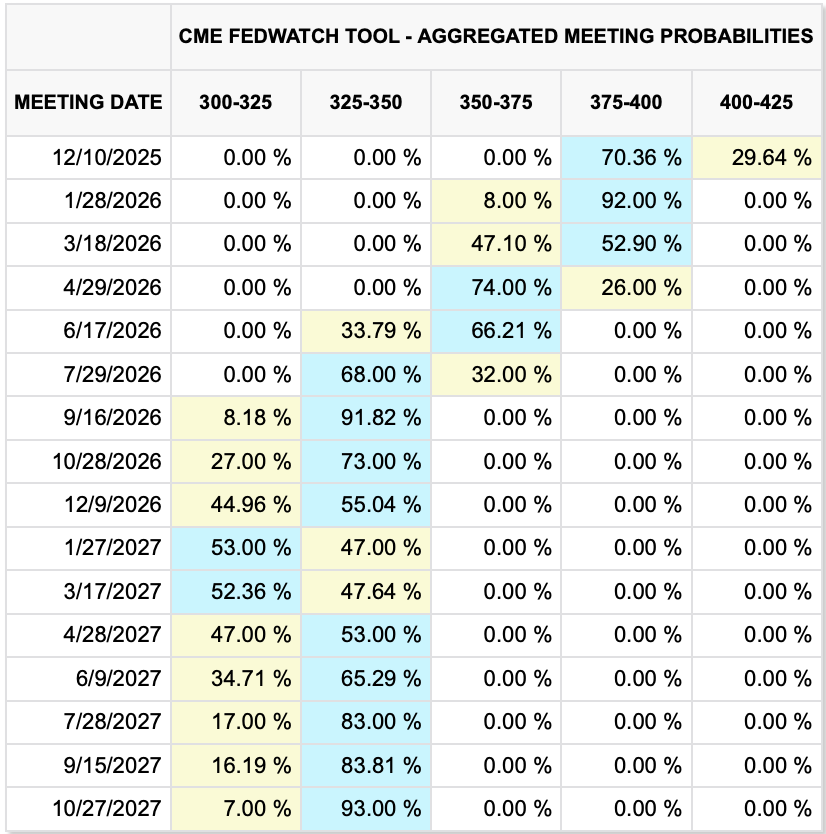
The Fed funds futures market jumped on that comment and as of this morning, the December probability fell from 92% to 70% with only a 3/4 probability of another cut after that by April, down from a near certainty by March previously.  
You won’t be surprised by the fact that the bond market sold off hard, with yields rising 10bps on the day, with seven of those coming in the wake of the press conference.  

Source: tradingeconomics.com

Stocks struggled, with the DJIA under modest pressure and the S&P 500 unchanged although the NASDAQ managed to rise yet again to a new high, as NVDA doesn’t pay attention to gravity.

So much has been written about this that I don’t think it is worth going into more detail.  FWIW, my view is the Fed is still going to cut in December, and that will become clearer as the government reopens (which I think happens by the end of the week) and data starts to trickle out again.  The employment situation remains their main focus, and it just doesn’t seem that positive right now.  I suspect next year, when the OBBB policies begin to be implemented and we see the fruits of the dramatic increase in foreign investment in the US, that situation can change, but things feel slow for now.  

In effect, that is why they are going to run the economy as hot as they can to try to prevent any recession and hopefully make it to the point where the government can back off and the private sector picks up the slack.  At least, that’s my read for now.  For the dollar, that means more support.  For stocks, the same.  And the inflation prospects will keep the precious metals supported.  Bonds feel like the worst place to be.

In other central bank news, the Bank of Canada cut 25bps, as expected, and in their commentary explained rates were now “at about the right level” for the economy based on their projections.  The market demonstrated they cared about this story for about 3 hours, as the initial move was modest CAD strength that evaporated as soon as Powell started speaking.

Source: tradingeconomics.com

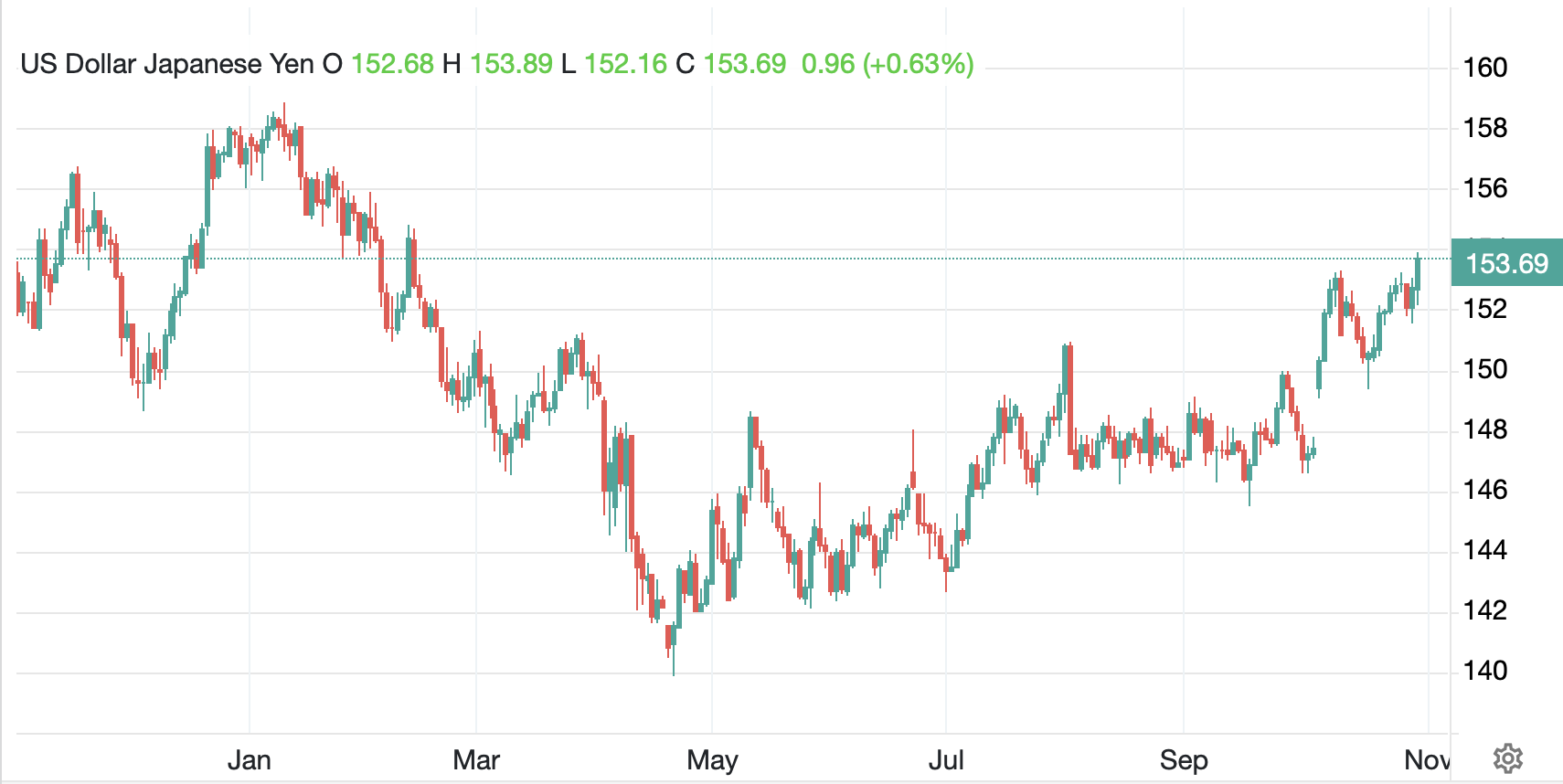
The BOJ also met last night and left rates on hold, as widely expected, with the same two votes for a rate hike as the last meeting.  During the press conference, Ueda-san explained, “We held today as we want to see more data on domestic wage-setting behaviors, while uncertainty remains high in overseas economies. If we’re convinced, we’ll adjust rates regardless of the political situation.”  The yen (-0.6%) fared somewhat poorly, responding to Ueda-san’s comments regarding the relative lack of strength in the Japanese economy.  Ultimately, as you can see in the below chart, the yen fell to its weakest point since last February, although I suspect if I am correct regarding the Fed continuing its policy ease, that weakness will abate somewhat.
Source: tradingeconomics.com

While Spinal Tap got to eleven
Said Trump, t’was a twelve, not a seven
The deal that he struck
To get things unstuck
With China, it’s manna from heaven

The last big story was the long-awaited meeting between Presidents Trump and Xi last night, where the two sat down and agreed to cool the temperature regarding trade.  Key aspects include the US reducing tariffs on China, especially those regarding fentanyl, as well as rolling back the broad restrictions on Chinese companies, while China will purchase “tremendous amounts” of soybeans and pause their restrictions on the sale of rare earth minerals.  Tiktok came up, and that will be settled and overall, it appears that a great deal of progress was made.  This was confirmed by the Chinese as they announced the same things.
 
Clearly, this is an unalloyed positive for the global economy and while the situation is not back to its pre-Trump days, it offers the hope of some stability for the time being.  But the surprising thing about these announcements was how little they seemed to help financial markets.  For instance, both the Hang Seng (-0.25%) and CSI 300 (-0.8%) slipped during the session, as did India (-0.7%) and Australia (-0.5%) with the rest of the region basically unchanged.  That is a disappointing performance for what appears to be a very positive outcome.  I suppose it could be a ‘sell the news’ response, but in today’s markets, especially with the ongoing influx of central bank liquidity, I would have expected more positivity.
 
Turning to European markets, they are lower across the board led by Spain (-1.1%) and France (-0.6%) as the US-China trade deal had little impact, and investors responded to a plethora of data on GDP and inflation.  The odd thing about this is that the Q/Q GDP data was better than expected across the board (France 0.5%, Netherlands 0.4%, Germany 0.0%, Eurozone 0.2%) which was confirmed by positive confidence data and modest inflation.  While those growth numbers are hardly dramatic, at least they are not recessionary.  You just can’t please some people!  Meanwhile, at this hour (6:30) US futures are little changed to slightly softer.
 
If we turn to the bond markets, yesterday’s dramatic rise in Treasury yields is consolidating with the 10-year slipping -1bp this morning.  In Europe, sovereign yields are higher by 3bps across the board as they catch up to yesterday’s Treasury move.  At this hour, though, bond markets are doing little as investors and traders await Madame Lagarde’s announcements at 9:15 EDT although there is no expectation for any rate move.  In fact, looking at the ECB’s own website, there is currently a 5% probability of a rate hike!  (That ain’t gonna happen, trust me.)
 
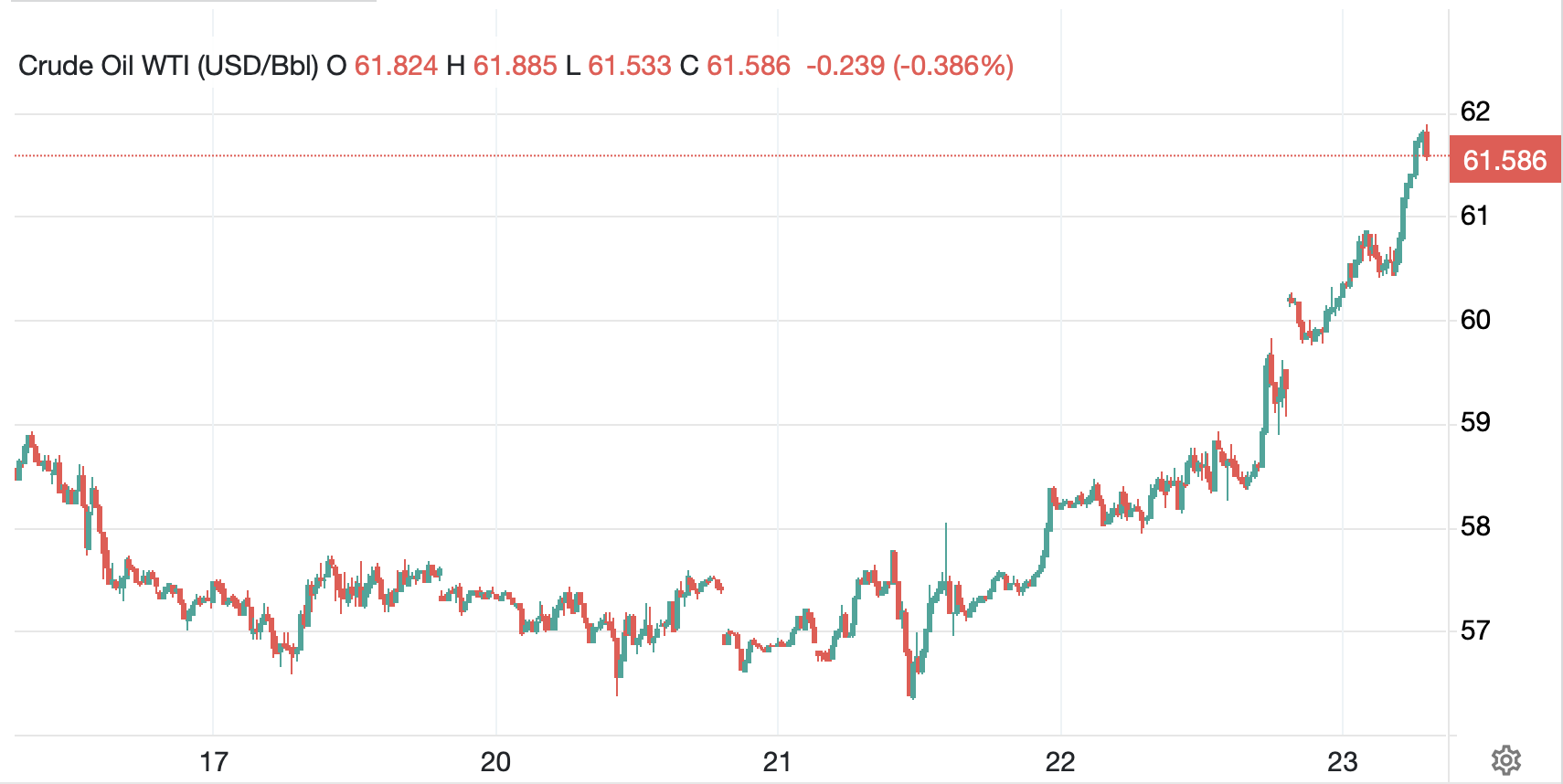
In the commodity markets, oil (-0.5%) is softer this morning but is still right around $60/bbl with yesterday’s EIA inventory data showing a larger draw on inventories than expected.  That is what helped yesterday’s modest gains, but those have since been reversed.  In the metals markets, price action remains quite choppy, but this morning sees gold (+1.3%), silver (+1.0%) and platinum (+0.35%) all bouncing although copper (-0.2%) is a touch softer.  Nothing has changed my longer-term views here, but it does appear that there is a lot more choppiness that we will need to work through before the trend reasserts itself.
 
Finally, the dollar, which rose yesterday on the relatively hawkish Fed commentary is mixed this morning as it shows strength vs. the yen (now -0.8%), ZAR (-0.4%), KRW (-0.35%), and INR (-0.4%) with even CNY (-0.2%) following suit, although the rest of the currency universe has moved only +/-0.1% from yesterday’s closes.  Again, my view is the dollar is confined to a range, has been so for many months, and we will need to see some policy changes to break out in either direction.  Right now, those policy changes don’t seem to be imminent.
 
With data still MIA, the only things to which we can look forward are the ECB and the first post-meeting Fed speak with Governor Bowman and Dallas Fed president Logan up today.  I would have thought risk assets would be in greater demand this morning, but that is clearly not the case.  Perhaps, as we approach month-end, we are seeing some window dressing, but despite the ostensible hawkish outcome from yesterday’s FOMC, I don’t think anything has changed with their future path of more rate cuts no matter what.  As equity markets had a broadly positive October, rebalancing flows would indicate sales, but come Monday, I think the rally continues.  As to the dollar, there is still no reason to sell that I can discern.
 
Good luck
Adf


A Pox

The world is a wonderful place
We know this because of the chase
For more and more risk
Though Washington’s fisc
Continues, more debt, to embrace
 
Investors can’t get enough stocks
And bonds have found buyers in flocks
But havens like gold
Are actively sold
As though they’ve come down with a pox


I’m old enough to remember when there was trouble all around the world; war in Ukraine was escalating, anxiety over a more serious fracture in the trade relationship between the US and China was growing, and President Trump was building a ballroom at the White House!  Ok, the last one is hardly a problem.  But just two weeks ago, risk assets were struggling and havens seemed the best place for investors to hide.  But that is sooooo last week.

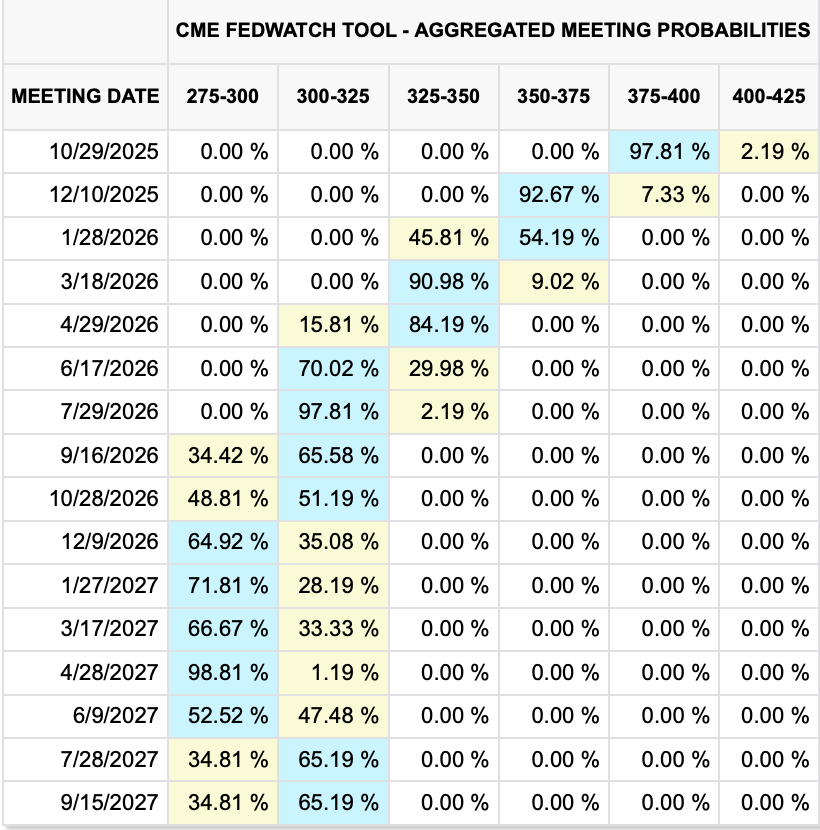
By now you are all aware that the delayed CPI report on Friday came in on the soft side, thus reinforcing the Fed’s plans to cut rates tomorrow.   While Fed funds futures pricing, as seen below, has not changed very much at all, with virtual certainty of cuts tomorrow and in December, plus two more by the April meeting next year, the punditry is starting to float the idea that even more cuts are coming because of concern over the employment situation and the fact that inflation appears under control.

Source: cmegroup.com

Now, it is a viable question, I believe, to ask if inflation is truly under control, but the problem with this concern is that Chairman Powell told us, back in September, that they are not really focused on that anymore.  The fact that the official payroll data has not been released allows the Fed to avoid specific scrutiny, but literally everything I read tells me that the employment situation is getting worse.  The latest highlight was Amazon’s announcement yesterday that they would be reducing corporate staff by about 14,000 folks in the coming months as, apparently, AI is reducing the need for headcount.

In fact, I would contend the answer to the question; if the economy is doing so well, why does the Fed need to cut rates, is there is a growing concern over the employment situation which has been masked by the lack of data.

But we all know that the economy and the stock market behave very differently at times, and this appears to be one of those times.  Yesterday, yet again, equity markets in the US closed at record highs as earnings releases were strong virtually across the board.  Adding to the impetus was the news that Treasury Secretary Bessent announced a framework for trade between the US and China had been reached with the implication that when Presidents Trump and Xi meet later this week, a deal will be signed.

Putting it all together and we see the concerns that were driving the “need” for owning havens last week have virtually all dissipated.  While the Russia/Ukraine situation remains fraught, I don’t believe that equity markets anywhere in the world have paid attention to that war in the past two years.  Oil markets, sure, but not equity markets.

There is a fly in this ointment, though, and one which only infrequently gets much airtime.  The US is continuing to run substantial fiscal deficits.  Lately, as evidenced by the fact that 10-year yields have slipped back to their lowest level this year, and as you can see below, are clearly trending lower, this doesn’t seem to be an issue.  But ever-increasing federal deficits cannot last forever, and if the Trump plans to boost growth significantly does not work out, there will be a comeuppance.  I have described before my view that the plan is to ‘run it hot’ and nothing we have seen lately has changed that sentiment.  I sure hope it works for all our sakes!

Source: tradingeconomics.com

Ok, let’s see if the euphoria evident in the US markets has made its way around the world.  The answer is, no.  Interestingly, despite a high-profile meeting between President Trump and Japanese PM Takaichi, where Trump was effusive in his support for the new PM and her plans to increase defense spending, Japanese equities were under pressure all evening, slipping -0.6%.  Too, both China (-0.5%) and HK (-0.3%) could find no traction despite the news that a trade deal was imminent.  In fact, the entire region was under pressure with losses in Korea, Taiwan, Australia and virtually every market there.  Was this a sell the news event?  That seems unlikely to me, but maybe.  As to Europe, pretty much every major index is modestly softer this morning, down between -0.1% and -0.2%, so not terrible, but clearly not following the US.  As to US futures, at this hour (7:30), they are little changed to slightly higher.

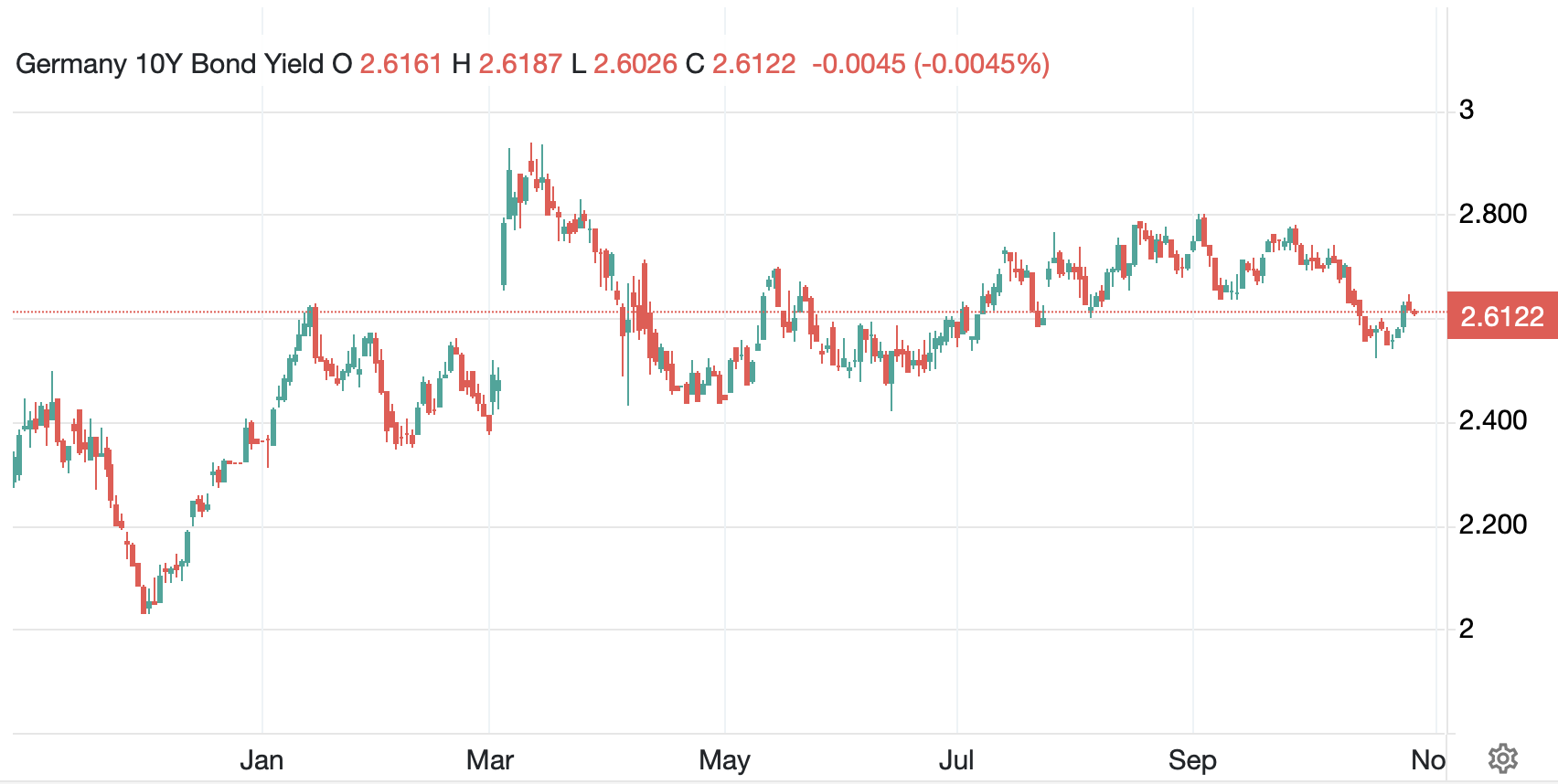
Global bond markets are quiet this morning, with almost all unchanged or seeing yields slip -1bp.  While US yields have been trending lower, in Europe, I would say things are more that yields have stopped rising and, perhaps, topped, but are not yet really declining in any meaningful fashion yet.  Germany’s bund market, pictured below, exemplifies the recent price action.

Source: tradingeconomics.com

One interesting note is that JGB yields slipped -3bps overnight, despite PM Takaichi reaffirming that the defense budget was going up with no funding mentioned.  Like I said, the world is a better place this morning!

In the commodity markets, gold (-1.5%) continues to get punished as all those who were chasing the haven story have been stopped out.  The price went parabolic two weeks ago, and price action like that cannot hold for any length of time.  This has taken silver (-1.1%) and copper (-0.5%) lower as well, and I suspect that there could well be further to decline.  Oil (-1.1%) meanwhile seems far less concerned about the sanctions on Lukoil and Rosneft this morning.  The conundrum here is if the economy is performing well, that would seem to be a positive demand driver.  I have not seen word of major new oil sources being discovered to increase supply dramatically, but if you think back to last week, the narrative was all about a glut.  I guess we will learn more with inventory data this week.

Finally, the dollar… well nobody really seems to care.  As you can see from the below chart of the DXY, it is approaching six months where the index has traded in a very narrow range, and we are pretty close to the middle.  I don’t know the catalyst that will be needed to change this story, but frankly, I suspect that nobody (other than FX traders) is unhappy with the current situation.

Source: tradingeconomics.com

It’s not that there aren’t currencies that move around on a given day, but there is no broad trend in place here.

On the data front, the key release today is the Case-Shiller Home Price Index (exp 1.9%) and then the Richmond Fed Manufacturing Index (-14) is also due later this morning.  However, all eyes are on tomorrow’s FOMC outcome with the focus likely to be more on QT and its potential ending, than on the rate cuts, which are universally expected.  One other thing, with the government shutdown ongoing, GDP and PCE data, which were originally scheduled for this week, will not be released.

Life is good!  That is the only conclusion I can draw right now based on the ongoing strength in risk assets, at least US risk assets.  Keynes was the one who said, markets can remain irrational longer than you can remain solvent, and I have a feeling that we are approaching some irrationality.  But for now, enjoy the ride and if FX is your arena, I just don’t see a reason for any movement.

Good luck

Adf

What Havoc it Wreaks

Today, for the first time in weeks
Comes news that will thrill data geeks
It’s CPI Day
So, what will it say?
We’ll soon see what havoc it wreaks
 
The forecast is zero point three
Too high, almost all would agree
But Jay and the Fed
When looking ahead
Will cut rates despite what they see


Spare a thought for the ‘essential’ BLS employees who were called back to the office during the shutdown so that they could prepare this month’s CPI report.  The importance of this particular report is it helps define the COLA adjustments to Social Security for 2026, so they wanted a real number, not merely the interpolation that would have otherwise been used.  Expectations for the outcome are Headline (0.4% M/M, 3.1% Y/Y) and Core (0.3% M/M, 3.1% Y/Y) with both still well above the Fed’s 2% target.  As an aside, we are also due Michigan Sentiment (55.0), but I suspect that will have far less impact on markets.

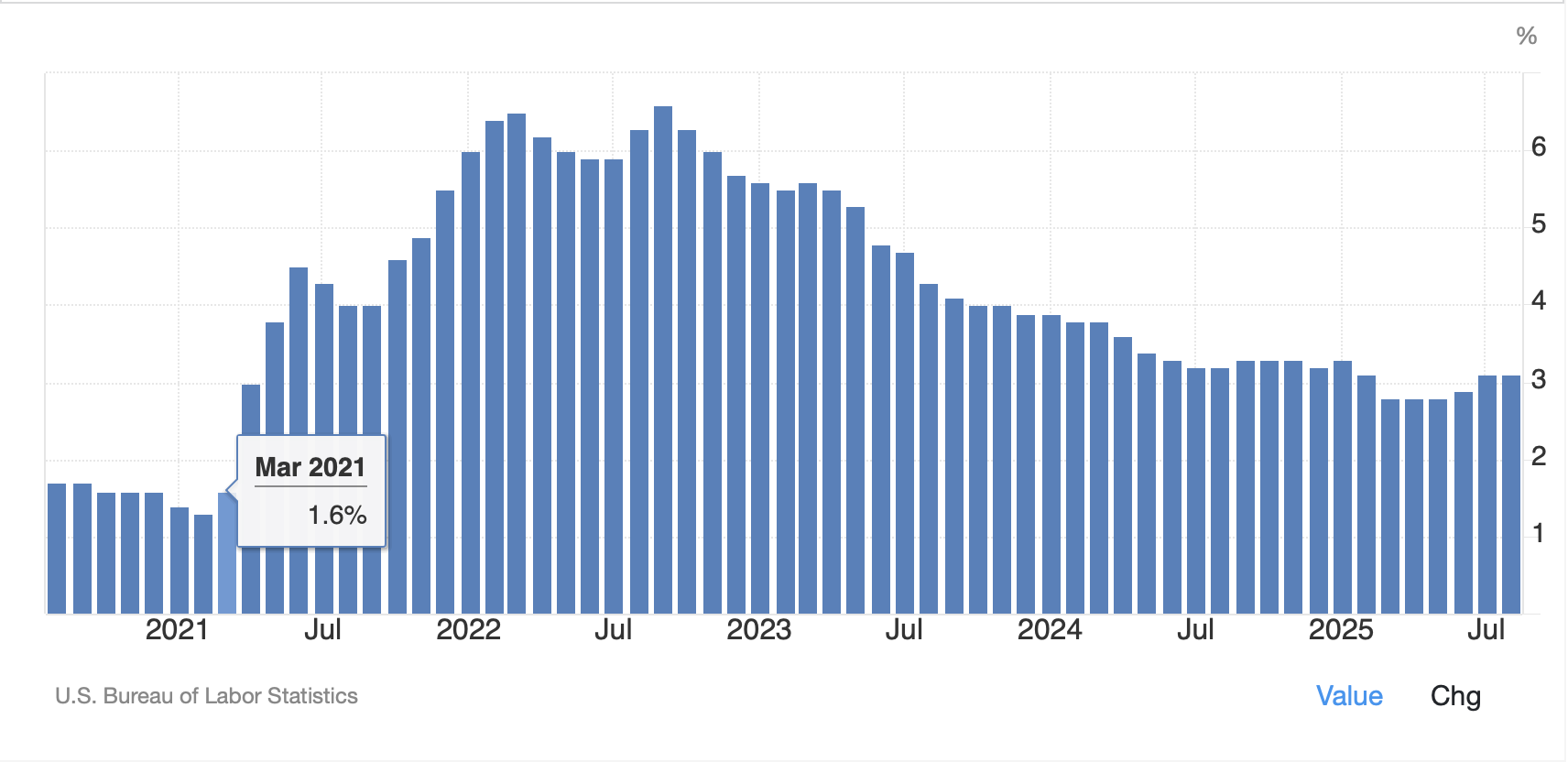
If we consider the Fed and its stable prices mandate, one could fairly make the case that they have not done a very good job, on their own terms, when looking at the chart below which shows that the last time Core CPI was at or below their self-defined target of 2.0% was four and one-half years ago in March 2021.  And it’s not happening this month either.

Source: tradingeconomics.com

Now, when we consider the Fed and its toolkit, the primary monetary policy tool it uses is the adjustment of short-term interest rates.  The FOMC meets next Tuesday and Wednesday and will release its latest statement Wednesday afternoon followed by Chairman Powell’s press conference.  A quick look at the Fed funds futures market pricing shows us that despite the Fed’s singular inability to push inflation back toward its own target using its favorite tool, it is going to continue to cut interest rates and by the end of this year, Fed funds seem highly likely to be 50bps lower than their current level.

Source: cmegroup.com

The other tool that the Fed utilizes to address its monetary policy goals is the size of its balance sheet, as ever since the GFC and the first wave of ‘emergency’ QE, buying (policy ease) and selling (policy tightening) bonds has been a key part of their activities.  As you can see from the chart below, despite the 125bps of interest rate cuts since September of 2024 designed to ease policy, they continue to shrink the balance sheet (tighten policy) which may be why they have had net only a modest impact on things in the economy.  Driving with one foot on the gas and one on the brake tends to impede progress.

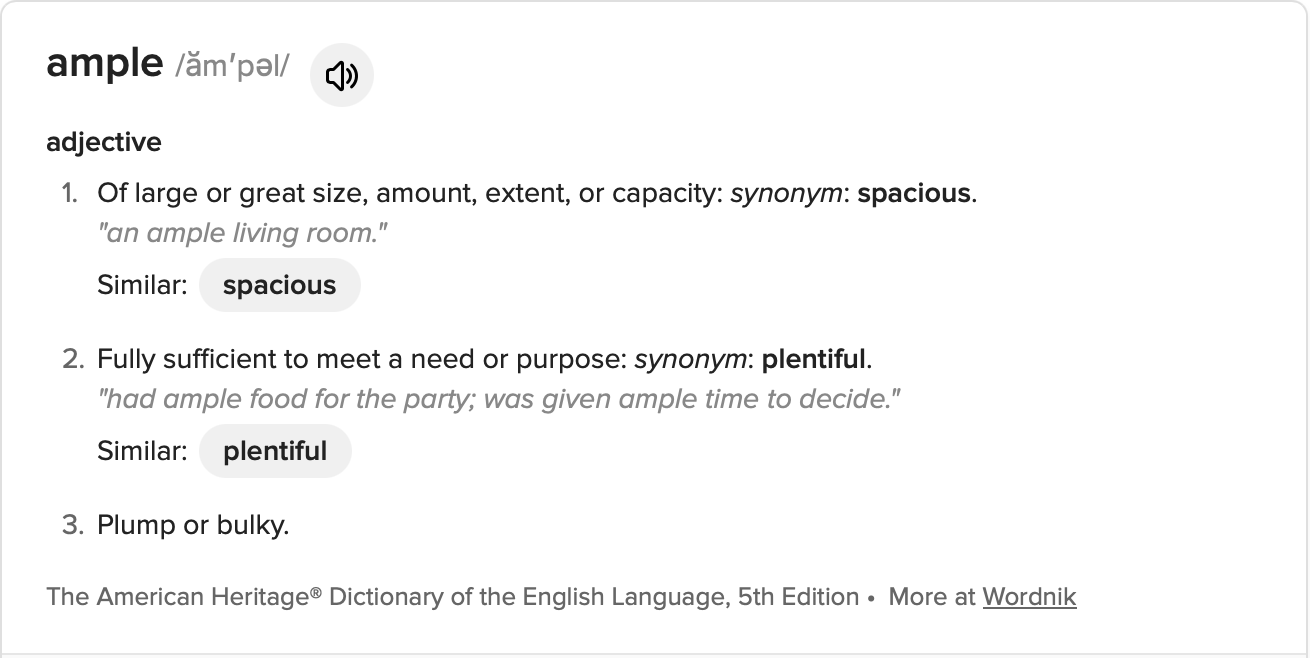
But now, the word is the Fed will completely stop balance sheet shrinkage by the end of the year, something we are likely to hear next Wednesday, as there has been much discussion amongst the pointy-head set about whether the Fed’s balance sheet now contains merely “ample” reserves rather than the previous description of “abundant” reserves.  And this is where it is important to understand Fedspeak, because on the surface, those two words seem awfully similar.  As I sought an official definition of each, I couldn’t help but notice that they both are synonyms of plentiful.

These are the sorts of things that, I believe, reduces the Fed’s credibility.  They sound far more like Humpty Dumpty (“When I use a word, it means just what I choose it to mean – neither more nor less.”) than like a group that analyses data to help in decision making.  

At any rate, no matter today’s result, it is pretty clear that Fed funds rates are going lower.  The thing is, the market has already priced for that outcome, so we will need to see some significant data surprises, either much weaker or stronger, to change views in interest rate sensitive markets like bonds and FX.

As to the shutdown, there is no indication that it is going to end anytime soon.  The irony is that the continuing resolution passed by the House was due to expire on November 21st.  it strikes me that even if they come back on Monday, they won’t have time to do the things that the CR was supposed to allow.  

Ok, let’s look at what happened overnight.  Yesterday’s rally in the US was followed by strength in Japan (+1.35%) after PM Takaichi indicated that they would spend more money but didn’t need to borrow any more (not sure how that works) while both China (+1.2%) and HK (+0.7%) also rallied on the confirmation that Presidents Trump and Xi will be meeting next week.  Elsewhere, Korea and Thailand had strong sessions while India, Taiwan and Australia all closed in the red.  And red is the color in Europe this morning with the CAC (-0.6%) the main laggard after weaker than forecast PMI data, while the rest of Europe and the UK all suffer very modest losses, around -0.1%.  US futures, though, are higher by 0.35% at this hour (7:20).

In the bond market, Treasury yields edged higher again overnight, up 1bp while European sovereigns have had a rougher go of things with yields climbing between 3bps and 4bps across the board.  While the French PMI data was weak, Germany and the rest of the continent showed resilience which, while it hasn’t seemed to help equities, has hurt bonds a bit.  Interestingly, despite the Takaichi comments about more spending, JGB yields slipped -1bp.

In the commodity space, oil (+0.7%) continues its rebound from the lows at the beginning of the week as the sanctions against the Russian oil majors clearly have the market nervous.  Of course, despite the sharp rally this week, oil remains in the middle of its trading range, and at about $62/bbl, cannot be considered rich.  Meanwhile, metals markets continue their recent extraordinary volatility, with pretty sharp declines (Au -1.7%, Ag -0.9%, Pt -2.1%) after sharp rallies yesterday.  There seems to be quite the battle ongoing here with positions being flushed out and delivery questions being raised for both futures and ETFs.  Nothing has changed my long-term view that fiat currencies will suffer vs. precious metals, but the trip can be quite volatile in the short run.

Finally, the dollar continues to creep higher vs. its fiat compatriots, with JPY (-.25%) pushing back toward recent lows (dollar highs) after the Takaichi spending plan announcements.  But, again, while the broad trend is clear, the largest movement is in PLN (-0.4%) hardly the sign of a major move.

And that’s all there is today.  We await the data and then go from there.  Even if the numbers are right at expectations, 0.3% annualizes to about 3.6%, far above the Fed’s target and much higher than we had all become accustomed to in the period between the GFC and Covid.  But remember, central bankers, almost to a wo(man) tend toward the dovish side, so I think we all need to be prepared for higher prices and weaker fiat currencies, although still, the dollar feels like the best of a bad lot.

There will be no poetry Monday as I will be heading to the AFP conference in Boston to present about a systematic way to more effectively utilize FX collars as a hedging tool.  But things will resume on Tuesday.

Good luck and good weekend

Adf

Dark and Cold

When gold was the talk of the town
Most governments just played it down
But now that its oil
That’s gone on the boil
The issue is much more profound
 
Twas Nixon who made sure that gold
Fell out of the government fold
But oil’s essential
In truth, existential
Without it, the world’s dark and cold


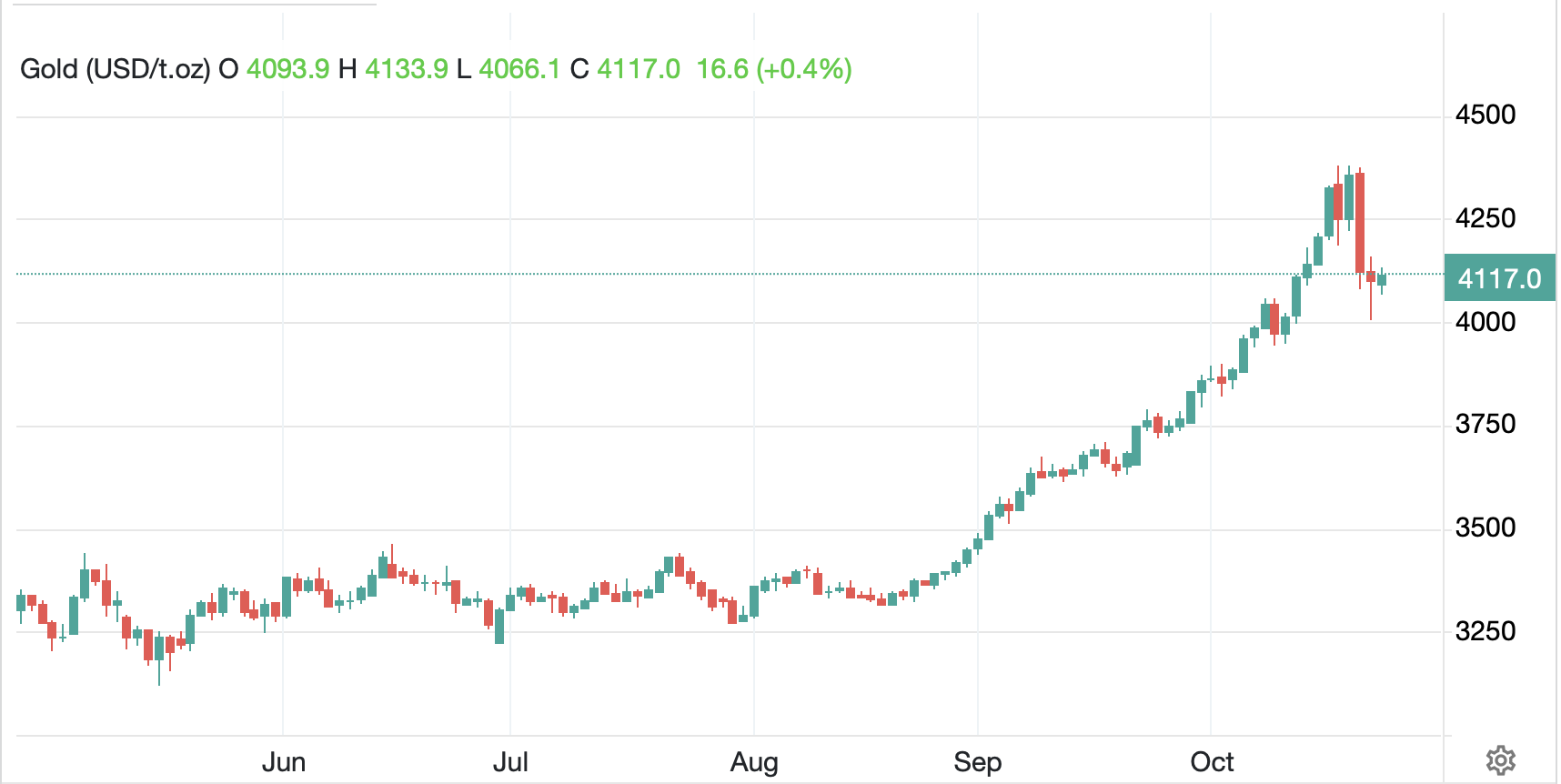
The past several days have seen some substantial moves in the commodity markets, notably the metals markets as I discussed all week.  Precious metals had been on an extraordinary run, with YTD gains in gold (+60%), silver (+80%) and Platinum (+85%) prior to the dramatic declines that began last Friday.  Using gold as our proxy, the chart below shows the nature of the recent price action, something which I believe was driven by liquidity issues as much as anything else.  (As I wrote yesterday, when margin calls come, and in a highly levered market like we currently have, they do come, people sell what they can, not what they want, and they could sell gold.)

Source: tradingeconomics.com

However, missing from that price action, both YTD and in the recent session volatility, was oil, which had been fairly benign, drifting lower on a growing belief that there was a huge glut of the stuff around the market.  But, yesterday afternoon, President Trump announced new sanctions on the Russian oil majors Rosneft and Lukoil to increase pressure on President Putin to come to the table in a serious manner and end the Russia/Ukraine war.  Too, Europe imposed sanctions on the same firms, although clearly it was the US ones that made the difference.

Remember, earlier in the week the Trump administration put out bids to begin refilling the Strategic Petroleum Reserve when the price of WTI fell to ~$55/bbl.  Now, add on the sanctions and we cannot be surprised that oil has rallied sharply, up 5.5% today and more than 9% since Monday as per the below chart from tradingeconomics.com

Aiding the rally here was the EIA data yesterday that showed a net draw of inventories of nearly 4mm barrels vs. an expectation of an inventory build as per the glut narrative.  Now, if I take the story of the US refilling the SPR and add it to the inventory draw, that is probably enough to see a rally ahead of the sanction news.  However, there are several rumors/stories around that there was inside information with some institutions buying oil ahead of the sanctions announcement.  Of course, anytime there is a news story that drives market price action, it is common for there to be complaints of insider trading activity.  And maybe there was some.  But I don’t think you have to stretch your imagination to believe that a combination of short covering and the SPR news got things going without the benefit of inside scoop.

At any rate, financial market attention remains on the commodity space with stocks and bonds garnering a lot less excitement.  While equity markets did fall in the US yesterday, none of the declines were dramatic, with the three major indices slipping between -0.5% and -0.9%.  Compare that movement to what we have seen in commodities and you can see why equities have slipped from the headlines.  But let’s see how things played out overnight.

The Nikkei (-1.35%) had a rocky session, caught between concerns over unfunded fiscal stimulus from the new Takaichi government and the dramatic jump in oil prices on the one hand, and a Trump comment that he will be meeting President Xi next week on the other.  I guess it was the latter story that helped Chinese (+0.3%) and HK (+0.7%) shares.  Elsewhere in the region, Korean and Taiwanese stocks slipped while Indonesia and Thailand saw gains of more than 1% and the rest was little changed.  in Europe, under the guise of bad news is good, UK stocks (+0.6%) have rallied after a weaker than expected CBI Industrial Trends release of -38.  As you can see from the below chart, while this is not the lowest level seen in the past 5 years, it certainly paints a picture of a struggling economy.  Of course, that means the market is increasing its bets the BOE will cut rates next week, hence the lift in the stock market!

Source: tradingeconomics.com

I don’t know about you, but it is hard to look at that chart and feel positive about the UK economy going forward, whether or not the BOE acts!  As to the continent, the DAX (-0.25%) is lagging while the CAC (+0.5%) is rallying with both responding to corporate earnings news rather than macro signals.  US futures are little changed at this hour (7:15).

In the bond market, yields are bouncing off their recent lows with Treasuries adding 4bps, although still just below the 4.00% level.  European sovereign yields have edged higher by 2bps across the board, and we saw JGB yields rise 3bps overnight.  It is difficult to get too excited about this market right now.  All eyes will be on the CPI release tomorrow morning with expectations of a rise of 0.3% M/M, but the general tone of what I continue to read is that the US economy is slowing down which, theoretically, will reduce inflation pressures and encourage bond buying.  Maybe.

We’ve already discussed commodities, although I have to say that the liquidation phase of the metals markets appears to be ending as all three precious metals are higher this morning (Au +0.4%, Ag +1.4%, Pt +2.6%) and copper (+1.8%) is joining in the fun.  It strikes me that copper’s recent performance is at odds with the slowing growth narrative, but then I am just an FX poet, so probably don’t understand.

Finally, the dollar is…still there, but the least interesting part of markets lately.  It is a bit firmer this morning with the yen (-0.5%) the laggard in the G10 space as it appears FX traders are concerned over Takaichi’s plans, even if JGB traders are not.  The outlier in G10 is NOK (+0.4%) which is clearly benefitting from the oil rebound.  In the EMG bloc, KRW (-0.6%) is the worst of the bunch, slipping after the BOK hinted that a rate cut might be in the offing soon.  On the flip side, ZAR (+0.2%) is benefitting from the bounce in metals, but I want to give a shout out here to the rand, which despite the dramatic decline in gold and platinum earlier this week, held in remarkably well and is basically unchanged on the week.

There are actually two data points this morning, the Chicago Fed National Activity Index (exp -.40) and Existing Home Sales (4.1M), as the Fed is not shut down and the existing home data is privately sourced.  Speaking of private data, there is a WSJ story this morning about how ADP has stopped giving the Fed access to anonymized data that they had previously enjoyed.  There are many conspiracy theories as to why this is the case, but I can only report it is the case.

The government has been shut down for more than three weeks, and the story does not have much traction anymore.  I’m no political pundit but it seems to me that this is going to end sooner rather than later, perhaps early next week, as it is very clear President Trump is going to continue his policies and unclear to a growing proportion of the population that the shutdown is helping them.

One final thought.  You know I am involved in a cryptocurrency project called USDi, the only fully backed truly inflation tracking currency that exists.  I strongly believe that we are going to continue to see cryptocurrencies, notably stablecoins expand their usage throughout the economy.  But I couldn’t help but laugh at the following post regarding the jewel heist from the Louvre.  

My mildly informed take is that financial assets are a perfect place for blockchain technology and cryptocurrency products, but maybe the real world is different.

Good luck

Adf

Rare Earths No More

Said Xi, we’ll sell rare earths no more
Said Trump, well that means we’re at war
The stock market puked
As traders got spooked
And Trump imposed tariffs galore
 
The question is just why would Xi
Get feisty when things seemed to be
Improved for both sides
With fewer divides
Did Mideast peace kill his esprit?


Let’s talk about markets for a moment.  Sometimes they go down and go down fast when you’re not expecting it.  That is their very nature, so it is important to understand that Friday’s price action, while dramatic relative to what we have seen over the past 6 months, is not that uncommon at all over time.  It appears the proximate cause of the market decline was the word from China that they would stop selling and exporting rare earth minerals. 

It can be no surprise that President Trump immediately responded by threatening an additional 100% tariffs on all Chinese exports and new controls on software, all to be implemented on November 1st.  There is a lot of tit-for-tat in the dueling messages from China and the Trump administration and it is hard to tell what is real and what isn’t.  However, equity markets clearly weren’t prepared for a break in the previous expectations that the US and China were closing in on a more lasting trade stance.

But weekends are a long time for markets as so much can happen while they are closed.  This weekend was a perfect example.  After the carnage on Friday, we cannot be that surprised that both sides of this new tiff modified their responses.

First we saw this on Truth Social:

Then China backed off clarified that what they are really doing is require licensing for all rare earth minerals and products that contain them in exports.  China claims that applications that meet regulations will be approved although the regulations have not yet been defined. Ostensibly this is for national security reasons, and it is unclear exactly who will receive licenses, but this is clearly not the same as ending exports.  

And just like that, many of the fears that were fomented on Friday have been alleviated as evidenced by this morning’s equity market moves in the futures markets.

Source: tradingeconomics.com

But why did Xi make this move in the first place?  I have no idea, nor does anyone but Xi, although here are two completely different thought processes, one very conspiratorial and one rooted in the broader escalation of geopolitical affairs.

As to the first, (Beware, you will need your tinfoil hat here!) consider if the Israel-Gaza peace settlement, (with the hostages returned as of the time I am writing this morning at 5:30) does not serve China’s interest.  First, the one Middle East nation that will be on the outside is their ally, Iran.  Second, the ongoing problems there were always a distraction for the US, something that clearly suits Xi and China.  After all, if the US is focused there, they will have more difficulty paying attention to things Xi cares about like Taiwan and the South China Sea.  If the peace in Israel-Gaza holds, and the Abraham Accords extend to the bulk of the rest of the region, Xi loses a major distraction that cost him virtually nothing.  Plus, this opens the door for tightening sanctions on Iran even further, which could negatively impact China’s oil flows.  

The second is much more esoteric and I read about it this weekend from Dr Pippa Malmgren, someone who has a deep insight into global politics from her time as a presidential advisor as well as from her father, Harold Malmgren, who advised four presidents.  In her most recent Substack post she explained the importance of Helium-3 (3He), a rare isotope of helium that has major energy and military implications and where the largest deposit of the stuff known to man is on the moon.  Her claim is this is the foundation of the recent acceleration in the space race between the US and China and without rare earth minerals, the US ability to achieve its goals and obtain this element would be greatly hampered opening the door for China to get ahead.

Are either of these correct?  It is not clear, but I would contend each contains some logic.  In the end, though, as evidenced by the quick retreat on both sides, I suspect that the trade situation between the US and China will move forward in a positive manner, although there could well be a few more hiccups along the way.  And those hiccups could easily see equity markets decline such that there is a real correction of 15% to 20%.  Just not today.

So, what is happening today?  Let’s look.  First, I would be remiss if I didn’t highlight the following Bloomberg headline: ‘Buy the Dip’ Call Grows Louder as China Selloff Seen Containedas it perfectly encapsulates the ongoing mindset in equity markets.  At least in US equities.  Asia had a much rougher session despite the backtracking with HK (-1.5%) and China (-0.5%) under pressure and weakness virtually universal in the time zone (Korea -0.7%, India -0.2%, Taiwan -1.4%, Australia -0.8%). Tokyo was closed.  It appears there are either still concerns over the trade situation, or perhaps the fact that globally, markets have had long rallies has led to some profit taking amid rising uncertainties.  

European bourses, though are all in the green, with the continent seeing gains of 0.5% or so across the board although the UK is lagging with a miniscule 0.05% gain at this hour (6:30).  As to US futures, as seen above, gains range from 1.0% (DJIA) to 2.0% (NASDAQ).

Meanwhile, bond yields also saw a dramatic move on Friday, tumbling -8bps and back to their lowest level seen in a month as per the below chart from tradingeconomics.com

This morning, those yields are unchanged.  European sovereign yields, which followed Treasury yields lower on Friday are also little changed at this hour, down another -1bp as concerns begin to arise that economic growth is going to be impaired by the escalation in trade tension between the US and China.  

I would argue that commodities are the one area where the back and forth is raising the most concern.  At least that is true in metals markets, with gold, which rallied 1% Friday amid the equity carnage, higher by another 1.6% this morning, to more new highs and we are seeing silver (+1.6%), copper (+4.2%) and Platinum (+3.6%) all in sync.  To me, this is the clearest indicator that there is an underlying fear pervading markets.  Oil (+1.8%) has rebounded from Friday’s rout as the easing of trade tensions appears to have calmed the market somewhat, although WTI remains just below $60/bbl at this point.  

Finally, the dollar is firmer again this morning as, although it softened slightly Friday, it has since regained most of those losses and is back on its recent uptrend as you can see below.

Source: tradingeconomics.com

While Tokyo was closed overnight, we did see further JPY weakness as the yen retraced most of its Friday gains like the rest of the market.  The biggest G10 mover was CHF (-0.9%) followed by AUD (-0.7%) and JPY (-0.7%) with other currencies less impacted and NOK (+0.2%) benefitting from the oil rally.  However, the EMG bloc has seen a much wider dispersion with MXN (+0.5%), ZAR (+1.1%) and CLP (+0.8%) all rallying sharply on the metals rally while PLN (-0.5%) and CZK (-0.4%) lag as they follow the euro lower.

And that’s enough for today.  With the government still on hiatus, no official statistics will be released although we do get a little bit of stuff as follows:

TuesdayNFIB Small Business Index100.5
WednesdayEmpire State Manufacturing-1.8
 Fed’s Beige Book 
ThursdayPhilly Fed Manufacturing9.1

Source: tradingeconomics.com

But, with the lack of data, it appears Chairman Powell has instructed his minions to flood the airwaves with a virtual cacophony of speeches this week, I count 18 on the calendar including the big man himself on Tuesday afternoon.  It seems difficult to believe that their opinions on the economy will have changed very much given the lack of new data.  The market is still pricing a 98% chance of a cut at the end of this month and another 91% chance of a cut in December.  With the increased trade tension, there is much more discussion regarding a slower economic course ahead, which would play into further rate cuts.  However, while that would clearly help precious metals as it ends any ideas of an inflation fight, it is not clear it will weaken the dollar very much as everybody else will almost certainly follow along.

Good luck

Adf

Feeling the Heat

As tensions continue to flare
Twixt China and Uncle Sam’s heir
The positive feelings
In equity dealings
Could easily turn to a bear

Meanwhile down on Threadneedle Street
The Old Lady’s fairly downbeat
Thus negative rates
Are now on their plates
With bank stocks there feeling the heat

A yoyo may be the best metaphor for market price action thus far in May as we have seen a nearly equal number of up and down days with the pattern nearly perfect of gains followed by losses and vice versa. Today is no different as equity markets are on their back foot, after yesterday’s gains, in response to increasing tensions between Presidents Trump and Xi. Realistically, this is all political, and largely for each President’s domestic audience, but it has taken the form of a blame game, with each nation blaming the other for the instance and severity of the Covid-19 outbreak. What is a bit different this time is that President Trump, who had been quick to condemn China in the past, had also been scrupulous in maintaining that he and President Xi had an excellent working relationship. However, last night’s Twitter tirade included direct attacks on Mr Xi, a new tactic and one over which markets have now shown concern.

Thus, equity markets around the world are lower this morning with modest losses seen in Asia (Nikkei -0.2%, Hang Seng and Shanghai -0.5%) and slightly larger losses throughout the Continent (DAX -1.6%, CAC -1.1%, FTSE 100 -1.0%). US futures are pointing in the same direction with all three indices currently down about 0.7%. Has anything really changed? Arguably not. After all, both broad economic data and corporate earnings numbers remain awful, yet equity market prices, despite today’s dour mood, remain within sight of all-time highs. And of course, the bond market continues to point to a very different future as 10-year Treasury yields (-1bp today) continue to trade near historically low levels. To reiterate, the conundrum between a bond market that is implying extremely slow economic activity for the next decade, with no concomitant inflation seems an odd companion to an equity market where the median P/E ratio has once again moved above 20, well above its long-term average. This dichotomy continues to be a key topic of conversation in the market, and one which history has shown cannot last forever. The trillion-dollar question is, which market adjusts most?

With the increasing dissent between the US and China as a background, we also learned of the specter of the next country to move toward a negative interest rate stance, the UK. When Mark Carney was governor there, he categorically ruled out negative interest rates as an effective tool to help support the economy. He got to closely observe the experiment throughout Europe and concluded the detriments to the banking community outweighed any potential economic positives. (This is something that is gaining more credence within the Eurozone as well although the ECB continues to insist NIRP has been good for the Eurozone.) However, Carney is no longer governor, Andrew Bailey now holds the chair. And he has just informed Parliament, “I have changed my position a bit,” on the subject, and is now willing to consider negative rates after all. This is in concert with other members of the MPC, which implies that NIRP is likely soon to be reality in the UK. It should be no surprise that UK banking stocks are suffering after these comments as banks are the second victims of the process. (Individual savers are the first victims as their savings no longer offer any income, and in extreme cases decline.)

The other natural victim of NIRP is the currency. As discussed earlier this week, there is a pretty solid correlation between negative real rates and a currency’s relative value. Now granted, if real rates are negative everywhere, then we are simply back to the relative amount of negativity that exists, but regardless, this potential policy shift is clearly new, and one would expect the pound to suffer accordingly. Surprisingly, it is little changed this morning, down less than 0.1% amid a modest trading range overnight. However, it certainly raises the question of the future path of the pound.

When the Eurozone first mooted negative interest rates, in 2014, the dollar was already in the midst of a strong rally based on the view that the Fed was getting set to start to raise interest rates at that time. Thus, separating the impact of NIRP from that of expected higher US rates on the EUR/USD exchange rate is no easy task. However, there is no question that the euro’s value has suffered from NIRP as there is limited incentive for fixed income investment by foreigners. It should therefore be expected that the pound will be weaker going forward as foreign investment interest will diminish in the UK. Whether negative rates will help encourage foreign direct investment is another story entirely, and one which we will not understand fully for many years to come. With all this in mind, though, the damage to the pound is not likely to be too great. After all, given the fact that negative real rates are widespread, and already the situation in the UK, a base-rate cut from 0.1% to -0.1% doesn’t seem like that big a deal overall. We shall see how the market behaves.

As to the session today, FX markets have been as quiet as we have seen in several months. In the G10 space, Aussie and Kiwi are the underperformers, but both are lower by a mere 0.35%, quite a small move relative to recent activity, and simply a modest unwind of yesterday’s much more powerful rally in both. But away from those two, the rest of the bloc is less than 0.2% different from the close with both gainers (EUR, DKK) and losers (GBP, JPY) equidistant from those levels.

On the EMG side, there is a bit more constructive performance with oil’s continued rally (+2%) helping RUB (+0.4%) while the CE4 are also modestly firmer simply following the euro higher. APAC currencies seem a bit worse for wear after the Twitter spat between Trump and China, but the losses are miniscule.

Data this morning showed the preliminary PMI data from Europe is still dire, but not quite as bad as last month’s showing. In the US today we see Initial Claims (exp 2.4M), Continuing Claims (24.25M) and Existing Home Sales (4.22M). But as I have been writing all month, at this point data is assumed to be dreadful and only policy decisions seem to have an impact on the market. Yesterday we saw the Minutes of the Fed’s April 29 meeting, where there was a great deal of discussion about the economy’s problems and how they can continue to support it. Ideas floated were firmer forward guidance, attaching rate moves to numeric economic targets, and yield curve control, where the Fed determines to keep the interest rate on a particular tenor of Treasury bonds at a specific level. Both Japan and Australia are currently executing this, and the Fed has done so in its history, keeping long-term yields at 2.50% during WWII. My money is on the 10-year being pegged at 0.25% for as long as necessary. But that is a discussion for another day. For today, the dollar seems more likely to rebound a bit rather than decline, but that, too, is one man’s view.

Good luck and stay safe
Adf

Kind of a Treat

For Boris, what looked like defeat
Is actually kind of a treat
For later today
His bill makes its way
Through Parliament, it to complete

The Brexit drama continues today, but it has become clear that Boris is moving toward a win, politically at least. The schedule today is for Parliament to debate and then hold its first vote on the actual legislation that would put Brexit into law. When Speaker of the House Bercow would not allow a second vote on the broad idea of accepting the new terms, it forced the PM to set out the new law’s details for a vote. And that is exactly what he has done. The goal is to get final approval by Thursday evening in the House of Commons, at which point it will go to the House of Lords for final approval. While the Lords have not been supportive of Brexit overall (after all, they have all benefitted greatly from the current situation) if it passes the House of Commons, it is expected to pass there as well. It is unquestionable that if this schedule holds up, the EU will pass the bill as well, and Brexit will be complete.

While there are still many potential pitfalls, the market has become pretty clear that they no longer believe in the idea of a no-deal Brexit. That is why we remain hovering around the 1.30 level instead of the 1.22 level we saw for most of the summer, when it seemed that all Boris wanted was to leave, and he was willing to leave without a deal. But even if there is a delay, it seems to me that Boris has the upper hand in any election that comes. He has done what he promised, negotiated a new treaty with a substantially better outcome than former PM May’s Irish backstop. The new bill puts the power of remaining tied to the EU in the hands of Northern Ireland, not the EU. There may yet be a second referendum, and there will almost certainly be an election before the end of the year, but at this point, Boris outflanked all the opposition. I strongly believe that a negotiated Brexit is coming to a screen near you before the year ends, and that the pound is going to have an opportunity to rally much further. At this point, a move to between 1.35-1.40 seems quite probable, although eventually I expect the dollar to reassert itself globally.

However, this is all speculation about the future, albeit the near future. For today, though, FX markets have continued to digest the news and the pound has been trading either side of yesterday’s closing levels. Currently, it is unchanged on the day, although there is an opportunity for movement this afternoon as the bill wends its way through Parliament’s byzantine process. At approximately 2:00pm, a vote is expected which will determine if the new bill has a chance to get passed. I think a ‘no’ vote will have a temporary negative impact on the pound, but am hard pressed to see Sterling sink below 1.28. If the vote is yes, then look for the pound to start to appreciate further as the market anticipates a conclusion to the process soon.

Away from Brexit, President Trump hinted that the ongoing trade talks are moving in the right direction and the market has assumed that the “initial phase” deal will be signed at the APEC meeting in Chile next month when presidents Trump and Xi are scheduled to meet.

So combined with the positive Brexit vibes, it appears two of the key geopolitical issues that have been hindering the global economy may be coming to a positive resolution. That certainly bodes well for economic growth, but it is unclear if it will be enough to turn the tide. First, neither one is actually complete yet, so this is all anticipation; and second, we have seen a significant slowdown in global manufacturing that will not simply rebound instantly. Even if business confidence improves sharply, it still takes time to formulate and implement new plans for business expansion. This implies that the current monetary policy framework is not going to be reversed any time soon.

Speaking of monetary policy, Thursday Signor Draghi presides over his last meeting as ECB president. After last month’s rate cut and restarting of QE, there are no expectations for further actions at this meeting. The one thing of which you can be sure is that he will complain about the lack of fiscal stimulus being implemented by the nations that can afford it (read Germany). But you can also be sure that the Germans are not about to change their plans.

But let us discuss one of the key problems in the Eurozone for a moment, the inconsistency between fiscal dogma and political will. While it is now de rigeur to claim that nations need to turn on the fiscal pumps, the European Commission has sent letters to Italy, France, Spain, Belgium and Portugal telling them not to spend so much money next year. In other words, despite desperate pleas to increase spending, they are going to prevent five nations seeking to do so, from accomplishing their goals. If you ever wondered why there is such fundamental bearishness on the euro and its construction, this situation could not be more informative. It is a key reason I believe the long term prospects for the single currency point lower.

To markets: FX has had another generally dull session overnight with the dollar just slightly firmer against most counterparts, but with movements generally less than 0.20%. In other words, there is little if any information in the price movement, which is likely a response to recent dollar weakness. Equity markets in Asia flourished after the US rally yesterday, but in Europe they can only be described as mixed. Meanwhile, US futures are pointing slightly lower, although not enough to imply very much. Treasury yields are a few bps lower, as are Bund yields, but the reality is that they have been pretty stable for the past two weeks and traders seem to be looking for the next real catalyst (FOMC anyone?).

Yesterday’s Canadian election had little impact on the Loonie, although PM Trudeau is returning with a weakened mandate in a minority government. That said, north of the border the economy has been performing pretty well, certainly well enough such that there seems to be no reason for the BOC to follow the Fed and cut rates next week alongside the Fed.

As to data this morning, Existing Home Sales (exp 5.45M) are unlikely to quicken any pulses, and with the Fed in its quiet period, quite frankly, I see a very quiet session until this afternoon, when the results of the first Brexit votes in parliament have an opportunity to spice things up a bit.

Good luck
Adf


Cow’ring In Fear

Tis coming increasingly clear
That growth is at ebb tide this year
The PMI data
When looked at, pro rata
Shows industry cow’ring in fear

Meanwhile in Osaka, the meet
Twixt Trump and Xi lowered the heat
On tariffs and trade
Which most have portrayed
As bullish, though some are downbeat

With all the buildup about the meeting between President’s Trump and Xi, one might have thought that a cure for cancer was to be revealed. In the end, the outcome was what was widely hoped for, and largely expected, that the trade talks would resume between the two nations. Two addenda were part of the discussion, with Huawei no longer being shut out of US technology and the Chinese promising to buy significantly more US agricultural products. Perhaps it was the two addenda that have gotten the market so excited, but despite the results being largely in line with expectations, equity markets around the world have all exploded higher, with both Shanghai and Tokyo rallying more than 2.2%, Europe seeing strong gains, (DAX +1.35%, FTSE + 1.15%) and US futures pointing sharply higher (DJIA +1.1%, NASDAQ +1.75%). In other words, everybody’s happy! Oil prices spiked higher as well, with WTI back over $60 due to a combination of an extension of the OPEC+ production cuts and the boost from anticipated economic growth after the trade truce. Gold, on the other hand, is lower by 1.4% as haven assets have suffered. After all, if the apocalypse has been delayed, there is no need to seek shelter.

But a funny thing happened on the way to market salvation, Manufacturing PMI data was released, and not only was it worse than expected pretty much everywhere around the world, it was also below the 50 level pretty much everywhere around the world. Here are the data for the world’s major nations; China 49.4, Japan 49.3, Korea 47.5, Germany 45.0, and the UK 48.0. We are awaiting this morning’s US ISM report (exp 51.0), but remember, that Friday’s Chicago PMI, often seen as a harbinger of the national scene, printed at a disastrous 49.7, more than 3 points below expectations and down 4.5 points from last month.

Taking all this into account, the most important question becomes, what do you do if you are the Fed? After all, the Fed remains the single most important actor in financial markets, if not in the global economy. Markets are still pricing in a 25bp rate cut at the end of this month, and about 100bps of cuts by the end of the year. In the meantime, the most recent comments from Fed speakers indicate that they may not be that anxious to cut rates so soon. (see Richmond Fed President Thomas Barkin’s Friday WSJ interview.) If you recall, part of the July rate cut story was the collapse of the trade talks and the negative impact that would result accordingly. But they didn’t collapse. Now granted, the PMI data is pointing to widespread economic weakness, which may be enough to convince the Fed to cut rates anyway. But was some of that weakness attributable to the uncertainty over the trade situation? After all, if global trade is shrinking, and it is, then manufacturing plans are probably suffering as well, even without the threat of tariffs. All I’m saying is that now that there is a trade truce, will that be sufficient for the Fed to remain on hold?

Of course, there is plenty of other data for the Fed to study before their next meeting, perhaps most notably this Friday’s payroll report. And there is the fact that with the market still fully priced for a rate cut, it will be extremely difficult for the Fed to stand on the side as the equity market reaction would likely be quite negative. I have a feeling that the markets are going to drive the Fed’s activities, and quite frankly, that is not an enviable position. But we have a long time between now and the next meeting, and so much can, and likely will, change in the interim.

As to the FX market, the dollar has been a huge beneficiary of the trade truce, rallying nicely against most currencies, although the Chinese yuan has also performed well. As an example, we see the euro lower by 0.3%, the pound by 0.45% and the yen by 0.35%. In fact, all G10 currencies are weaker this morning, with the true outliers those most likely to benefit from lessening trade tensions, namely CNY and MXN, both of which have rallied by 0.35% vs. the dollar.

Turning to the data this week, there is plenty, culminating in Friday’s payrolls:

Today ISM Manufacturing 51.0
  ISM Prices Paid 53.0
Wednesday ADP Employment 140K
  Trade Balance -$54.0B
  Initial Claims 223K
  ISM Non-Manufacturing 55.9
  Factory Orders -0.5%
Friday Nonfarm Payrolls 160K
  Private Payrolls 153K
  Manufacturing Payrolls 0K
  Unemployment Rate 3.6%
  Average Hourly Earnings 0.3% (3.2% Y/Y)
  Average Weekly Hours 34.4

So, there will be lots to learn about the state of the economy, as well as the latest pearls of wisdom from Fed members Clarida, Williams and Mester in the first part of the week. And remember, with Thursday’s July 4th holiday, trading desks in every product are likely to be thinly staffed, especially Friday when payrolls hit. Also remember, last month’s payroll data was a massive disappointment, coming in at just 75K, well below expectations of 200K. This was one of the key themes underpinning the idea that the Fed was going to cut in July. Under the bad news is good framework, another weak data point will virtually guaranty that the Fed cuts rates, so look for an equity market rally in that event.

In the meantime, though, the evolving sentiment in the FX market is that the Fed is going to cut more aggressively than everywhere else, and that the dollar will suffer accordingly. I have been clear in my view that any dollar weakness will be limited as the rest of the world follows the Fed down the rate cutting path. Back in the beginning of the year, I was a non-consensus view of lower interest rates for 2019, calling for Treasuries at 2.40% and Bunds at 0.0% by December. And while we could still wind up there, certainly the consensus view is for much lower rates as we go forward. Things really have changed dramatically in the past six months. Don’t assume anything for the next six!

Good luck
Adf

A New Plan

While all eyes are turned toward Japan
Most central banks made a new plan
If there’s no trade truce
They’ll quickly reduce
Their base rates, stock markets, to fan

As the week comes to a close, the G20 Summit, and more importantly, tomorrow’s meeting between President’s Trump and Xi are the primary focus of investors and traders everywhere. While there is still great uncertainty associated with the meeting, at this point I would characterize the broad sentiment as an expectation that the two leaders will agree to resurrect the talks that were abruptly ended last month, with neither side imposing additional tariffs at this time. And quite frankly, that does seem like a pretty reasonable expectation. However, that is not nearly the same thing as assuming that a deal will be forthcoming soon. The negotiations remain fraught based on the simple fact that both nations view the world in very different ways, and what is SOP in one is seen as outside the bounds in the other. But in the meantime, I expect that markets will take the news that the situation did not deteriorate as a massive bullish signal, if only because the market has taken virtually everything that does not guaranty an apocalypse as a massive bullish signal.

At the same time, it has become abundantly clear that the major central banks have prepared for the worst and are all standing by to ease policy further in the event the talks fall apart. Of course, the major central banks have all been pretty clear lately that they are becoming increasingly comfortable with the idea that interest rates can remain much lower than historical levels without stoking inflation. In fact, there are still several central bankers, notably Kuroda-san and Signor Draghi, who feel they are fighting deflation. In fairness, the latest data, released just last night, highlights that runaway inflation is hardly a cause for concern as Japan clocked in at 1.1%, with core at 0.9% and the Eurozone reported inflation at a rip roaring 1.2%, with core at 1.1%. It has been data of this nature that stokes the imagination for further policy ease, despite the fact that both these central banks are already working with negative interest rates.

Now, it must be remembered that there are 18 other national leaders attending the meeting, and many of them have their own concerns over their current relationship with the US. For example, the president has threatened 25% tariffs on imported autos, a move which would have a significantly negative impact on both Germany (and by extension the EU) and Japan. For now, those tariffs are on hold, but it is also clear that because of the intensity of the US-China trade situation, talks about that issue with both the EU and Japan have been relegated to lower level officials. The concern there is that the original six-month delay could simply run out without a serious effort to address the issue. If that were to be the case, the negative consequences on both economies would be significant, however, it is far too soon to make any judgements on the outcome there.

And quite frankly, that is pretty much the entire story for the day. Equity markets remain mixed, with Asia in the red, although the losses were relatively modest at between 0.25% and 0.50%. Europe, meanwhile, has taken a more positive view of the outcome, with markets there rising between 0.2% and 0.5%, which has left US futures pointing to modest, 0.2%, gains at the opening. Bond prices are actually slightly lower this morning (yields higher) but remain within scant basis points of the lows seen recently. For example, Bunds are trading at -0.319%, just 1.5bps from its recent historic low while Treasuries this morning are trading at 2.017%, just 4bps from its recent multi-year lows. Perhaps the most remarkable news from the sovereign bond market was yesterday’s issuance by Austria of 100-year bonds with a coupon of just 1.20%! To my mind, that does not seem like a reasonable return for the period involved, but then, that may be very backwards thinking.

Consider that the acceptance of two policy changes that have been mooted lately, although are still quite controversial, would result in the Austrian issue as being seen as a virtual high-yield bond. Those are the abolition of cash and the acceptance of MMT as the new monetary policy framework. I can assure you that if when cash is abolished, interest rates will turn permanently negative, thus making a yield of 1.20% seem quite attractive, despite the century tenor. As to MMT, it could play out in one of two ways, either government bonds issued as perpetual 0.0% coupons, or the end of issuing debt completely, since the central banks would merely need to print the currency and pay it as directed. In this case too, 1.20% would seem awfully good.

Finally, let’s look at the FX markets this morning, where the dollar is modestly softer against most of its counterparts. But when I say modestly, I am not kidding. Against G10 currencies, the largest movement overnight was NZD’s 0.14% appreciation, with everything else + or – 0.1% or less. In other words, the FX markets are looking at the Trump-Xi meeting and waiting for the outcome before taking a view. Positions remain longer, rather than shorter, USD, but as I have written recently, that view is beginning to change on the back of the idea that the Fed has much further to ease than other central banks. While I agree that is a short-term prospect, I see the losses as limited to the 3%-5% range overall before stability is found.

Turning to the data picture, yesterday saw GDP print as expected at 3.1%. This morning we get Personal Income (exp 0.3%), Personal Spending (0.4%), Core PCE (1.6%). Chicago PMI (53.1) and Michigan Sentiment (98.0). However, barring an outlandish miss in anything, it seems unlikely there will be too much movement ahead of tomorrow’s Trump-Xi meeting. Look for a quiet one.

Good luck and good weekend
Adf


Fear and Greed

The two things most traders concede
That drive markets are fear and greed
So lately there’s fear
That trouble is near
But too, FOMO, bulls do still heed

Another day of waiting as the market sharpens its focus on the Trump-Xi meeting to take place on Saturday during the G20 meetings in Osaka, Japan. Yesterday saw extremely limited activity in equity markets in the US, albeit with a negative bias, and we have seen similar price action overnight. Data releases remain sparse (French Business Confidence fell to 102, but that was all there was), which means that investors and traders have time to become contemplative.

On that note, it is a truism that fear and greed are the two most powerful human emotions when discussing financial markets, and both have a history of forcing bad decisions. However, in the classic telling of the story, fear is when investors flee for safety (generally Treasuries, yen, the dollar and gold) while greed is apparent when equity markets rally, corporate credit spreads compress, and high yield bonds outperform everything. I guess we need to throw in EMG excitement as well.

But lately fear has become the descriptor of both bulls and bears, with bulls now driven by FOMO while bears have the old-fashioned sense of fear. The thing that has been remarkable about markets lately is that both types of fear are in full bloom! I challenge anyone to highlight another time when there was so much angst over the current situation while simultaneously there was so much willingness to add risk to portfolios. How can it be that both the safest and riskiest assets are in such demand?

While I am very interested in hearing opinions (please respond) I will offer my own view up front. Global monetary policy in the wake of the financial crisis in 2008-9 has completely altered both the macroeconomic framework as well as how financial markets respond to signals from the economy. The biggest change, in my view, has been the financialization of every major economy, especially the US, where corporate debt issuance has been utilized primarily for financial engineering (either share repurchases or M&A) with only a secondary concern over the development of new, productive assets. This has resulted in a much weaker growth impulse (weakening productivity) with the concurrent effect of having changed the coefficients on all the econometric models in use. It is the latter outcome that has led central banks to become completely incapable of enacting policies that achieve their stated goals. Their reaction functions are based on faulty equipment (models) and so will rarely, if ever, give the right answer. But they are so invested in the current process, the idea of changing it is too far outside the box to even be considered.

Anyway, on a quiet day, I would love to hear other views on the subject.

In the meantime, a look at the markets shows that nothing is going on. The dollar is slightly higher this morning, but then it was slightly lower yesterday. Equity markets are drifting aimlessly (Nikkei -0.5%, FTSE -0.1%, DAX flat, S&P futures -0.1%) as everyone holds their collective breath for Saturday’s Trump-Xi meeting, and haven assets continue to perform well (Treasuries -1bp, Bunds -1bp and within 1bp of historic lows). Well, it is not completely true that nothing is going on, there is one market that has been on fire: gold.

That ‘barbarous relic’ called gold
Has seen its demand rise threefold
To some it is clear
That risks are severe
Although stocks have yet to be sold

Gold ($1432, +1.0% and + 10% this year) has broken out to levels last seen in 2013, when it was on its way down from the historic run-up in the wake of the financial crisis. This is simply the latest evidence of the ongoing conundrum I highlighted above. But beyond this, it has been remarkably quiet. Later this morning we see Case-Shiller Home Price data (exp 2.6%) and New Home Sales (680K) and we hear from NY Fed President John Williams. Yesterday, Dallas Fed prez Kaplan explained that he was concerned over the current situation, but not yet ready to pull the trigger. However, my gut tells me he was one of the ‘dots’ in the plot calling for two cuts by the end of the year. We will see what Mr Williams has to say later.

There is no reason to think that we are going to break out of the doldrums today, or this week at all, as catalysts are few and far between. So look for another quiet day in all markets.

Good luck
Adf