Nothing is Clear

Though next week the Fed will cut rates
The bond market’s in dire straits
‘Cause nothing is clear
‘Bout growth, and Jay’s fear
Is he’ll miss on both his mandates


In the past week, 10-year Treasury yields have risen 13bps, as per the below chart, even though market pricing of a Fed rate cut continues to hover around 88%.  Much to both the Fed’s and the President’s chagrin, it appears the bond market is less concerned with the level of short-term rates than they are of the macroeconomics of deficit spending, and total debt, as well as the potential for future inflation.
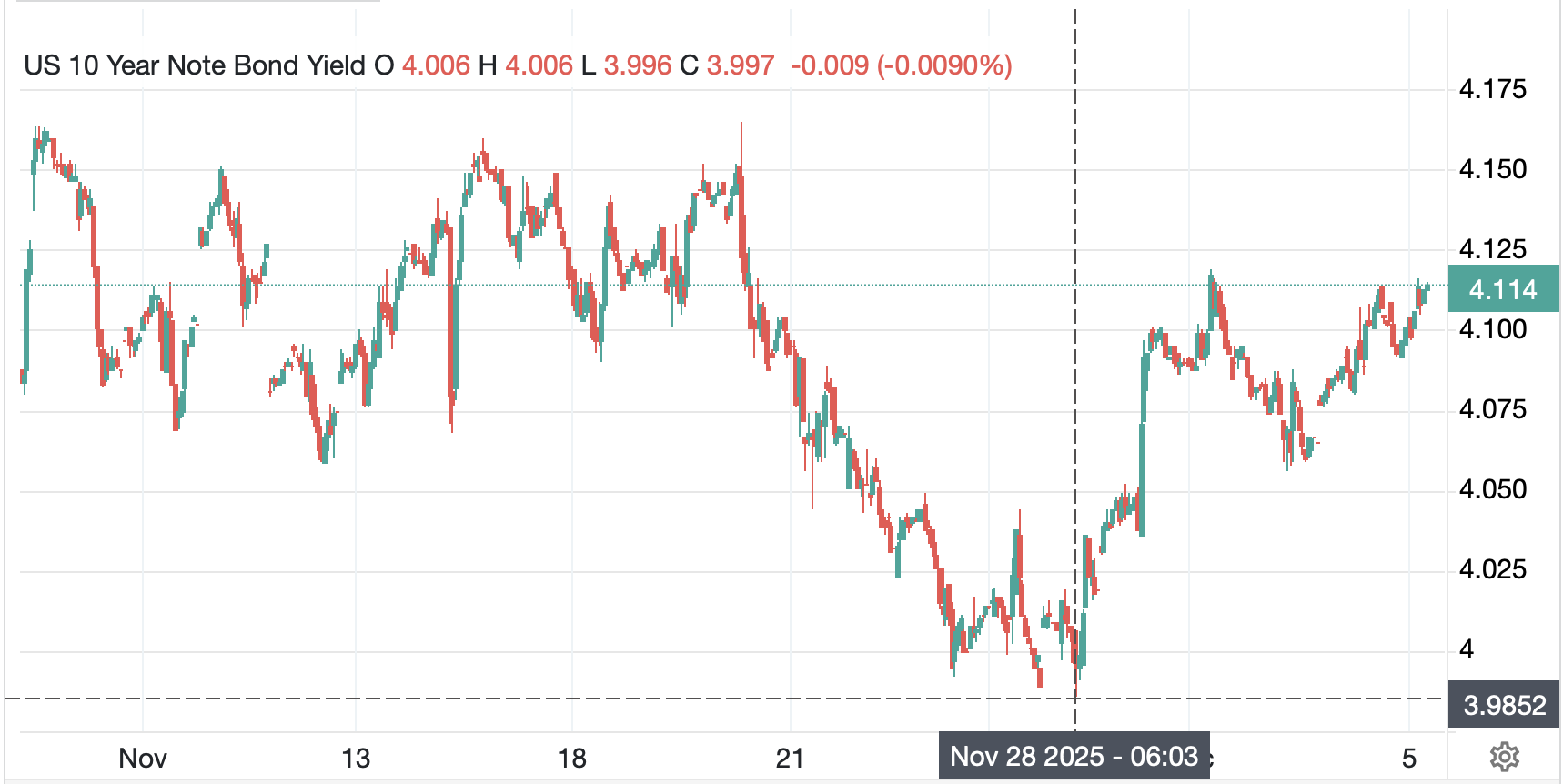
Source: tradingeconomics.com

I don’t think it is appropriate to describe the current bond market as being run by the bond vigilantes, at least not in the US (Japan may be another story) but it is unquestionable that there is a growing level of discomfort in the administration.  This morning, we will see the September PCE data (exp 0.3%, 2.8% Y/Y headline; 0.2% 2.9% Y/Y Core) which will do nothing to comfort those FOMC members who quaintly still believe that inflation matters.

It’s funny, while the President consistently touts how great things are in the economy, both he and Secretary Bessent continue to push hard for lower interest rates, which historically had been a sign of a weak economy.

But as I have highlighted before, the data is so disparate, every analyst can find something to support their pet theory.  For instance, on the employment front, the weak ADP reading on Wednesday indicated that small businesses were under pressure, yet the Initial Claims data yesterday printed at a remarkably low 191K, which on the surface indicates strong labor demand.  Arguably, that print was impacted by the Thanksgiving holiday so some states didn’t get their data in on time, and we will likely see revisions next week.  But revisions are not nearly as impactful as initial headlines.  Nonetheless, for those pushing economic strength, yesterday’s Claims number was catnip.

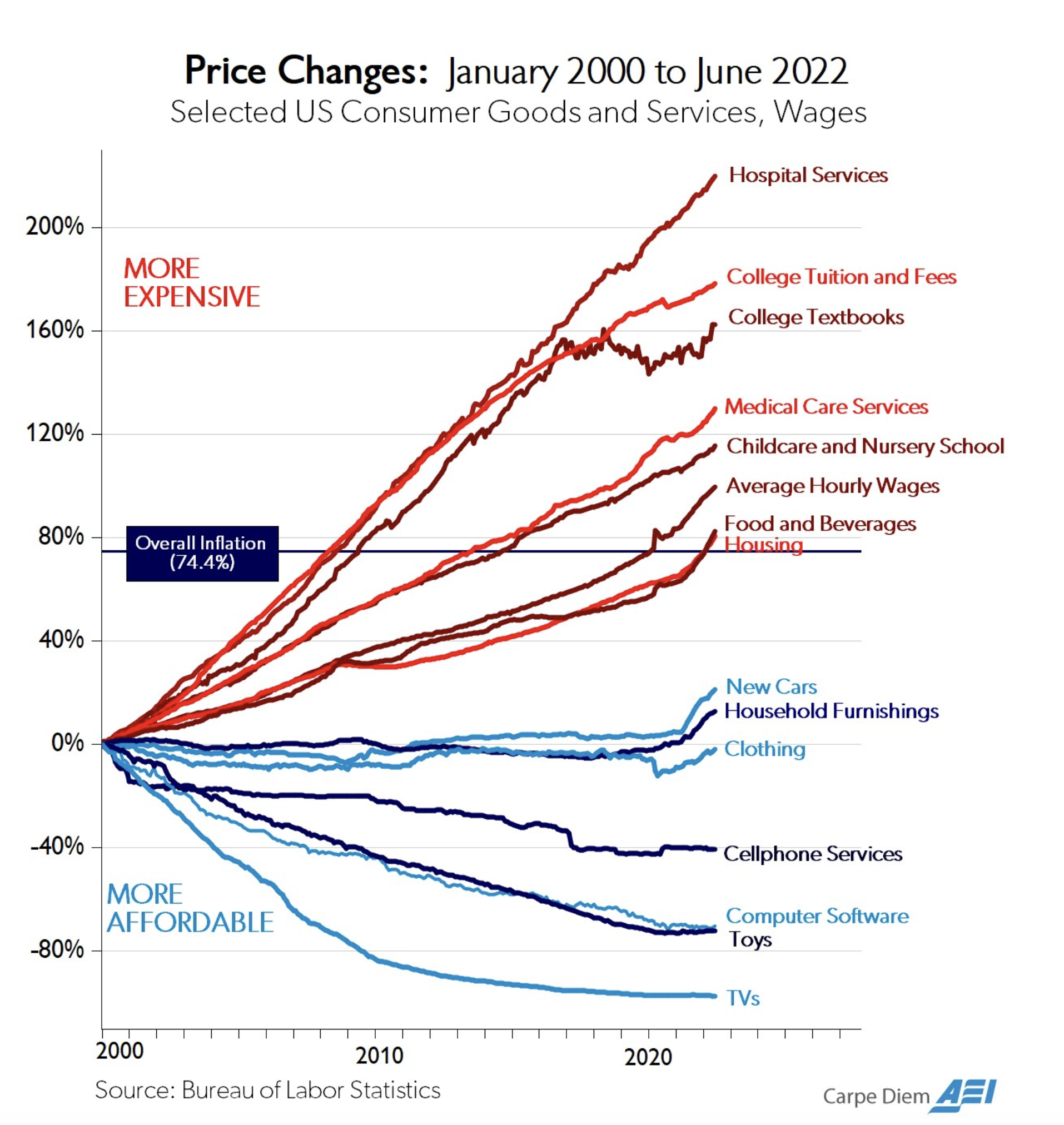
So, which is it?  Is the economy strong or weak?  My amateur observation is that we no longer have an ‘economy’ but rather we have multiple industrial and business sectors, each with its own dynamics and cycles, some of which are related but others which are independent.  And so, similar to the idea that the inflation rate that is reported is an average of subcomponents, each of which can have very different trajectories than the others (as illustrated in the chart below), the economy writ large is exactly the same.  So, an analogy might be that AI is akin to Hospital Services in the below chart while heavy industry is better represented by the TV’s line.
But, when we look at the Atlanta Fed’s GDPNow forecast below, it continues to show a much stronger economic impulse than the pundits expect.
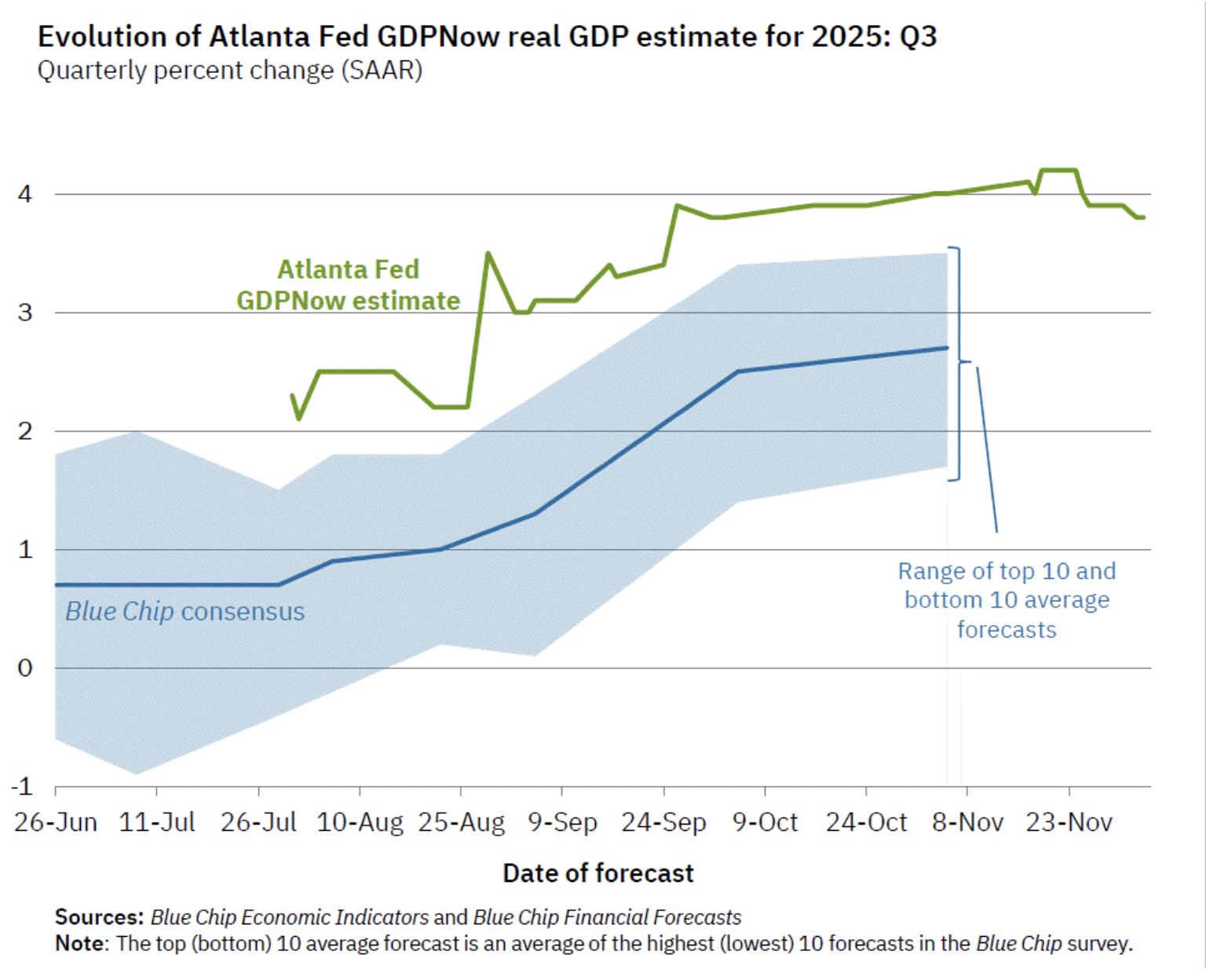
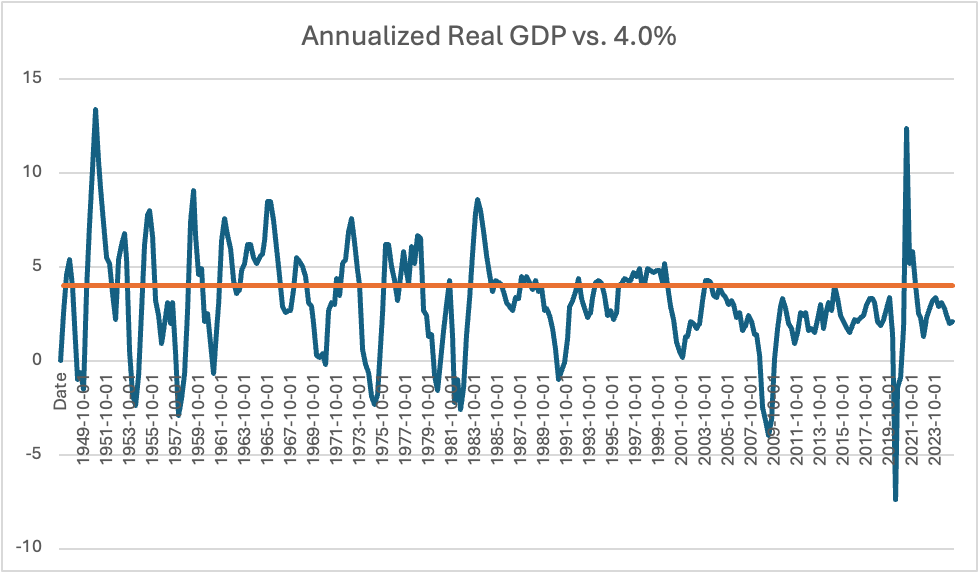
And quite frankly, if 3.8% is the real growth rate, that is quite strong, certainly relative to the last two decades in the US as evidenced by the below chart I created from FRED data.  The orange line represents 4% and you can see that other than the Covid reopening, we haven’t been at that level for quite a while.
What is the reality?  Everybody has their own reality, just like everybody has their own personal inflation rate.  However, markets have been inclined to believe that the future is bright, which given my ongoing view of every nation ‘running it hot’ makes sense, so keep that in mind regardless of your personal situation.

Ok, let’s look at how markets behaved overnight.  Yesterday’s nondescript day in the US was followed by a mixed Asian session with Tokyo (-1.0%) slipping on concerns that the BOJ is going to raise rates.  I’m not sure why that is news suddenly, but there you go.  However, China (+0.8%), HK (+0.6%), Korea (+1.8%), India (+0.5%) and Taiwan (+0.7%) all continued their recent rallies.  The RBI did cut rates by 25bps, as expected, but that doesn’t seem to have been the driver.  Just good vibes for now.

In Europe, screens are also green this morning, albeit not dramatically so.  Frankfurt (+0.6%) leads the way but Paris (+0.3%), Madrid (+0.2%) and London (+0.1%) are all on the right side of the ledger.  Eurozone growth in Q3 was revised up to 0.3% on the quarter, although that translated into an annual rate of 1.4%, lower than Q2, but the positive revision was enough to get the blood flowing.  That and the idea that European defense companies are going to come back into vogue soon.  And as has been their wont, US futures are higher by 0.2% at this hour (7:35).

In the bond market, Treasury yields are higher by 2bps this morning and European sovereign yields are getting dragged along for the ride, up 1bp to 2bps across the board.  JGB yields also continue to climb and show no sign of stopping at any maturity.  A BOJ rate hike of 25bps is not going to be enough to stop the train of spending and borrowing in Japan, so I imagine there is much further to go here.

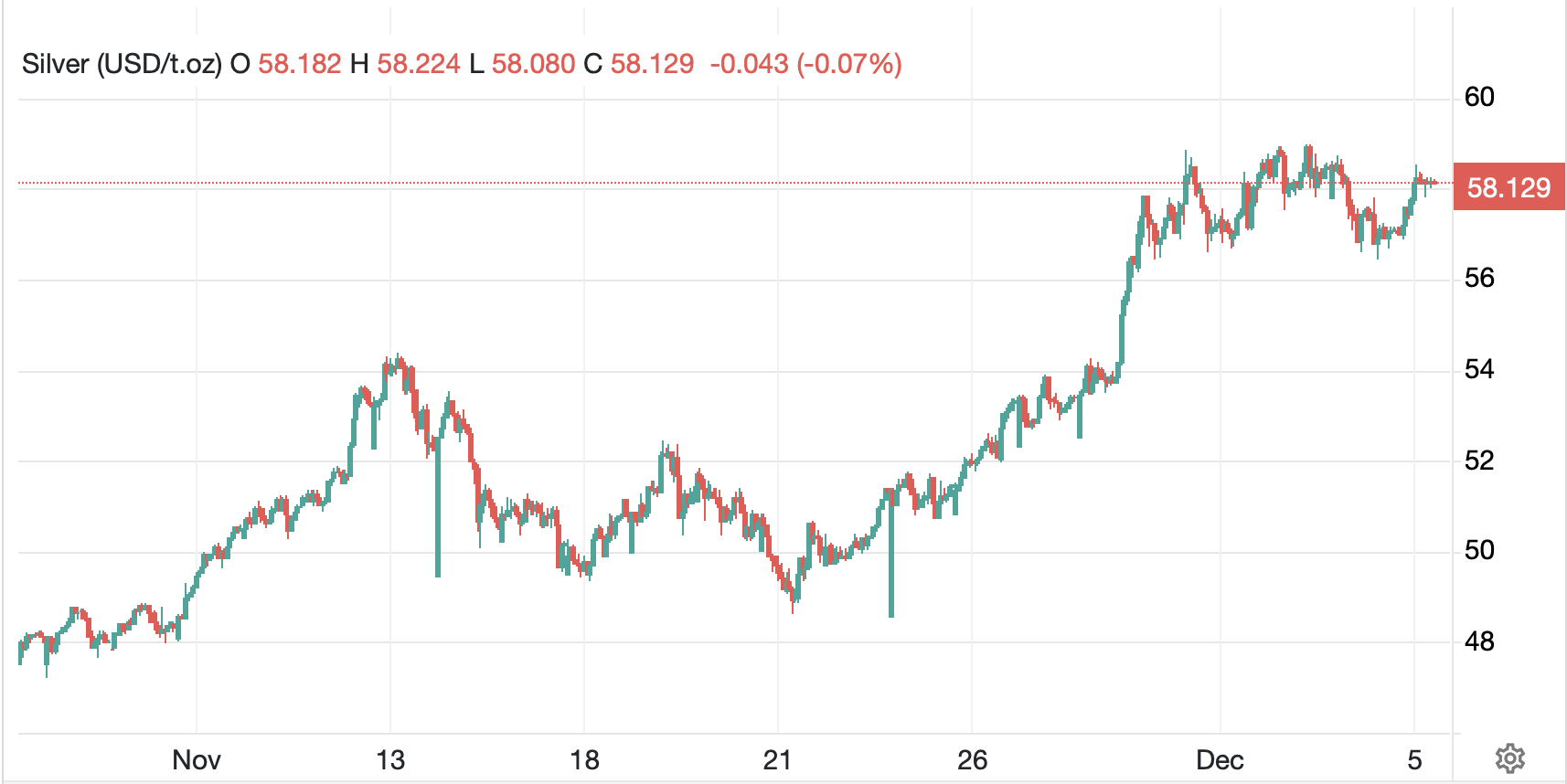
In the commodity space, silver (+1.8%) has been getting a lot more press than gold lately as there are ongoing stories about big banks, notably JPM, having large short futures positions that were designed to keep a lid on prices there, but the structural shortage of the metal has started to cause delivery questions on the exchanges all around the world.  So, while it has not yet breached $60/oz, my take is that is the direction and beyond.
Source: tradingeconomics.com

Gold’s (+0.4%) story has been told so many times, it is not nearly as interesting now, central bank buying and broader fiat debasement concerns continue to be the key here.  Copper (+1.8%) is also trading at new highs in London and the demand story here knows no bounds, at least not as long as AI and electrification are part of the mix.  As to oil (-0.25%), it is a dull and boring market and will need to see something of note (regime change in Venezuela or peace in Ukraine seem the most likely stories) to wake it up.

Finally, the dollar is still there.  The DXY is trading at 99, below its recent highs but hardly collapsing.  Looking for any outliers today ZAR (+0.4%) is benefitting from the gold rally (platinum rallying too) but otherwise there is nothing of note.  INR (-0.2%) continues to trade around its new big figure of 90.00, but has stopped falling for now, and everything else is dull.

As well as the PCE data, we get September Personal Income (exp 0.3%), Personal Spending (0.3%) and Michigan Sentiment (52.0) with only the Michigan number current.  We are approaching the end of the year and while with this administration, one can never rule out a black swan, my take is positions are being lightened up starting now, and when the December futures contracts mature, we may see very little of interest until the new year.  In the meantime, nothing has changed my big picture view.  For now, absent a very aggressive FOMC cutting rates, the dollar is still the best of a bad bunch.

Good luck and good weekend

Adf
Loathing and Fear

On Friday, the jobs situation
Explained there was little causation
For loathing or fear
That later this year
Recession would soon drive deflation
 
Meanwhile, in the Super Bowl’s wake
The president’s set to forsake
Economists’ warning
That tariffs are scorning
Their views, and are quite a mistake


Let’s start with a brief recap of Friday’s employment report which was surprising on several outcomes.  While the headline was a touch softer than forecast, at 143K, revisions higher to the prior two months of >100K assuaged concerns and implied that the job market was still doing well.  You may recall that there were rumors of a much higher Unemployment Rate coming because of the annual BLS revisions regarding total jobs and population, but in fact, Unemployment fell to 4.0% despite an increase in the employed population of >2 million.  Generally, that must be seen as good news all around, even for the Fed because the fact that they have paused their rate cutting cycle doesn’t seem to be having any negative impacts.

Alas for Powell and friends, although a real positive for the rest of us, the Earnings data was much stronger than expected, up 0.5% on the month taking the annual result to a 4.1% increase.  Recall, one of Powell’s key concerns is non-core services inflation, and that is where wages have a big impact.  After this data, it becomes much harder to anticipate much in the way of rate cuts soon by the Fed.  This was made clear by the Fed funds futures market which is now pricing only an 8.5% probability of a rate cut in March, down from 14% prior to the data, and only 36bps of cuts all year, which is down about 12bps from before.

Securities markets didn’t love the data with both stocks and bonds declining in price, although commodities markets continue to rally alongside the dollar, a somewhat unusual outcome, but one that makes sense if you consider the issues.  Inflation is not yet dead, hurting bonds, while the fact the Fed is likely to remain on hold for longer supports the dollar.  Stocks, meanwhile, need to see more economic growth because lower rates won’t support them while commodities are seen as that inflation fighting haven.

Of course, it wouldn’t be a day ending in Y if we didn’t have another discussion on tariffs during this administration.  The word is that the president has two things in mind, first, reciprocal tariffs, meaning the US will simply match the tariff levels of other countries rather than maintaining their current, generally lower, tariff rates.  As an example, I believe the EU imposes a 10% tariff on US automobile imports, while the US only imposes a 2.5% tariff on European imports.  The latter will now rise to 10%.  It will be very interesting to see how the Europeans complain over the US enacting tariffs that are identical to their own.  

A side story that I recall from a G-20 meeting during Trump’s first term was that he offered to cut tariffs to 0% for France if they reciprocated and President Macron refused.  The point is that while there is a great deal of huffing and puffing about free trade and that Trump is wrecking the world’s trading relationships, the reality appears far different.  If I had to summarize most of the world’s view on trade it is, the US should never put tariffs on any other country so they can sell with reckless abandon, while the rest of the world can put any tariffs they want on US stuff to protect their home industries.  This is not to say tariffs are necessarily good or bad, just that perspective matters.

The other Trump tariffs to be announced are on steel and aluminum imports amounting to 25% of the value. This will be impactful for all manufacturing industries in the US, at least initially, so we will see how things progress.  Interestingly, the dollar has not responded much here because these are not country specific, so a broad rise in the dollar may not be an effective mitigant.

Ultimately, as I have been writing for a while, volatility is the one true change in things now compared to the previous administration.  Now, with that as backdrop, and as we look ahead to not only CPI data on Wednesday, but Chair Powell’s semi-annual congressional testimony on Tuesday at the Senate and Wednesday at the House, let’s look at how markets have responded to things.

As mentioned above, US equity markets fell about -1.0% on Friday after digesting the Unemployment data. However, the picture elsewhere, especially after these tariff discussions, was more mixed.  In Asia, Japanese shares were essentially unchanged although Hong Kong (+1.8%) was the big winner in the region.  But Chinese shares (+0.2%) did little, especially after news that the number of marriages in China fell to their lowest since at least 1986, another sign of the demographic decline in the nation.  Elsewhere in the region, there was more red (India, Taiwan, Australia) than green (Singapore).  European shares, though, are holding up well, with modest gains of about 0.2% – 0.4% across the board despite no real news.  US futures are also ticking higher at this hour (7:10), about 0.5% across the board.

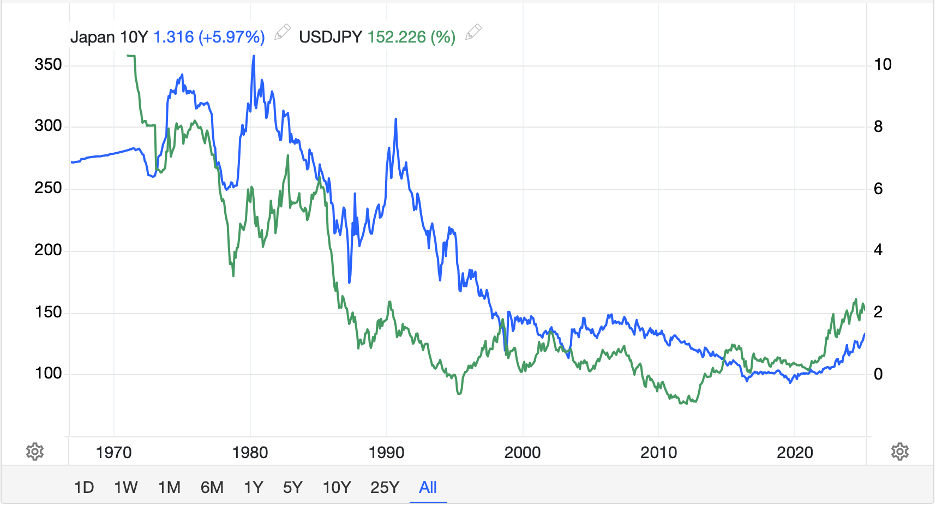
In the bond market, Friday saw Treasury yields jump 6bps with smaller gains seen in Europe.  This morning, though, the market is far quieter with Treasury yields unchanged and European sovereigns similarly situated, with prices between -1bp and +1bp compared to Friday’s closing levels.  Of note, JGB yields have edged higher by 1bp and now sit at 1.31%, their highest level since April 2010.  With that in mind, though, perhaps a little bit of longer-term perspective is in order.  A look at the chart below shows 10-year JGB yields and USDJPY since 1970.  Two things to note are that they have largely moved in sync and that both spent many years above their current levels.  While it has been 15 years since JGB yields were this high, they are still remarkably low, even compared to their own history.  I know that many things have changed over that time driving fundamentals, but nonetheless, this cannot be ignored.

Source: tradingeconomics.com

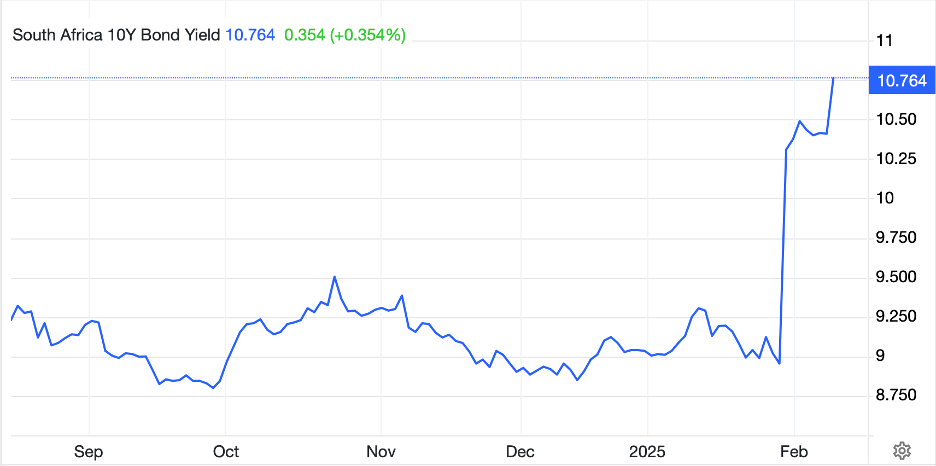
Sticking with the dollar, it has begun to edge higher since I started writing this morning and sits about 0.2% stronger than Friday’s close.  USDJPY (+0.5%) is once again the leader in the G10, although weakness is widespread in that bloc.  In the EMG bloc, there were a few gainers overnight (INR +0.3%, KRW +0.3%) although the rest of the world is mostly struggling.  One interesting note is ZAR (0.0%) which appears to be caught between the massive rally in gold (to be discussed below) and the increased rhetoric about sanctions by the US in the wake of the ruling party’s ostensible call for a genocide of white South Africans to take over their property.  This has not been getting much mainstream media press, but it is clear that Mr Trump is aware, especially given that Elon Musk is South African by birth.  However, there is no confusion in the South African government bond market, which, as you can see below, has seen yields explode higher in the past week since this story started getting any press at all.

Source: tradingeconomics.com

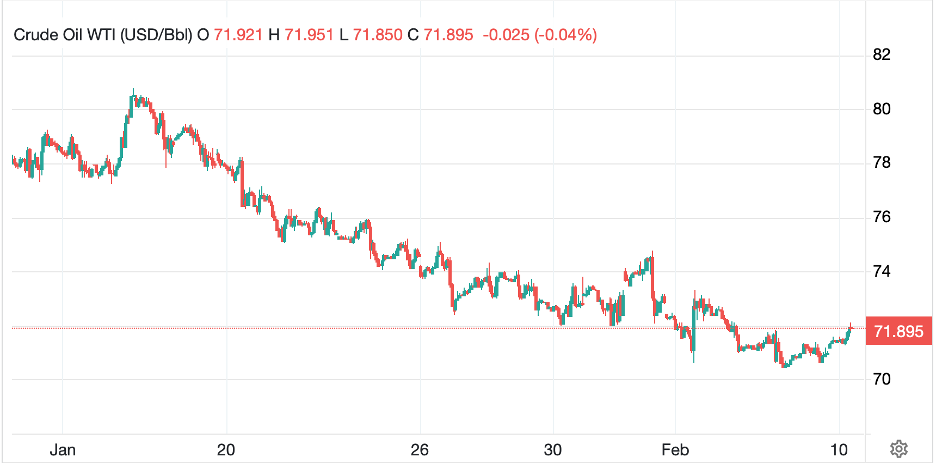
Finally, the commodity markets continue to show significant movement, especially the metals markets.  Gold (+1.6%) is now over $2900/oz, another new all-time high and calling into question if this is just an arbitrage between London and New York deliveries.  Silver (+1.4%) continues to be along for the ride as is copper (+0.6%) which is the biggest gainer of the past week, up more than 7%.  Ironically, aluminum, the only metal where tariffs are involved, is actually a touch softer this morning.  As to oil (+1.2%) while the recent trend remains lower, it does appear to be bottoming, at least if we look at the chart below.

Source: tradingeconomics.com

Turning to the data this week, it will be quite important as CPI headlines, but we also see Retail Sales and other stuff and have lots of Fedspeak.

TuesdayNFIB Small Biz Optimism104.6
 Powell Testimony to Senate 
WednesdayCPI0.3% (2.9% Y/Y)
 -ex food & energy0.3% (3.1% Y/Y)
 Powell Testimony to House 
ThursdayPPI0.3% (3.4% Y/Y)
 -ex food & energy0.3% (3.3% Y/Y)
 Initial Claims216K
 Continuing Claims1875K
FridayRetail Sales-0.1%
 -ex autos0.3%
 IP0.2%
 Capacity Utilization77.7%

Source: tradingeconmics.com

In addition to Powell, we will hear from five more Fed speakers, although with Powell speaking, I imagine their words will largely be ignored.  Overall, the world continues to try to figure out how to deal with Trump and his dramatic policy changes from the last administration.  One thing to keep in mind is that so far, polls show a large majority of the nation remains in support of his actions so it would be a mistake to think that his policy set is going to be altered.  Net, the market continues to believe this will support the dollar, as will the fact that the Fed seems less and less likely to start cutting rates soon.  Keep that in mind as you consider your hedges going forward.

Good luck

Adf

Harshly Depressed

The Payrolls report was a test
That Rorschach would clearly have blessed
The bears saw the data
As proof that the rate-a
Of growth would be harshly depressed
 
The bulls, though saw only the best
Of times and, their narrative, pressed
In their point of view
The Fed will come through
And stick the soft landing unstressed


With the Fed now in its quiet period, the market is trying to come to grips with what to expect going forward.  But before we look there, a quick recap of Friday’s NFP report, dubbed ‘the most important of all time’ by some hysterics, is in order.  By now you almost certainly know that the headline number was modestly weaker than expected, but that the revisions lower in the previous two months weighed on the report.  However, the Unemployment Rate ticked lower to 4.2% and wage growth edged higher by 0.1%.  Perhaps one of the worst pieces of the report was that the Manufacturing payrolls declined by -24K, the second worst outcome in the past 3 years, and hardly a sign of a strong economy.

The point is that depending on one’s underlying predispositions, it would be easy to come away with either a hopeful or dreary perspective after that report.  And, in fact, I would argue that the report changed exactly zero minds as to how the future is going to evolve, at least in the analyst community.  The biggest sentiment change came in the Fed funds futures markets where the probability of a 50bp cut next week fell to just 25%.  You may recall that particular probability has ranged from one-third up to one-half and now down to one-quarter just over the past week.  I think that is an excellent metaphor regarding both the uncertainty and the confidence in the economy’s growth and the Fed’s likely moves.  In other words, nobody has a clue (this poet included.)

One other observation is that reading headlines from various financial writers and publications shows that the world is still virtually split 50:50 on whether we are going to see a recession (with some calling for stagflation) or the Fed is going to stick the soft landing.  FWIW, which is probably not that much, my personal view is the recession is still going to arrive, but given how aggressively the government continues to spend money, we may need to redefine the concept of recession.  Consider if we look at only the private-sector and whether it is in recession and if that is enough to drag the overall economy, including the government spending, down with it.  In fact, given the 6+% deficits that the government is running, it may be realistic to consider this is exactly what is ongoing right now, although not to the extent that the totality of the economy is sinking.

Now that I’ve cleared that up 🤣, let’s look at how markets have been processing the NFP report and what we might expect going forward.  I’m sure you all know how poorly equity markets behaved on Friday, with US markets falling sharply led by the NASDAQ.  That negativity flowed into the Asian session with the Nikkei (-0.5%), Hang Seng (-1.4%) and CSI 300 (-1.2%) all under pressure.  While the Chinese data overnight, showing inflation rising slightly less than expected at 0.6% Y/Y while PPI there fell more than expected at -1.8%, continues to show that the Chinese economy is faltering and there is still no fiscal stimulus on the way, the Japanese data was generally solid with GDP growing 0.7% Q/Q, much higher than Q1 although a tick lower than the initial estimate.  The upshot is there is further slowing in China while Japan is rebounding.  I guess the question is why would both nations’ equity markets decline.  Arguably, the Chinese story is one of lost hope that the economy will be able to rebound in any timely fashion from an investor’s perspective while the Japanese story is that given the rebound in growth, the BOJ is far more likely to continue on the policy tightening path, thus undermining Japanese corporate earnings.

There once was a banker from Rome
Whose tenure preceded Jerome
“Whatever it takes”
Prevented the breaks
In Europe that would have hit home
 
But now he’s an eminence grise
Who answered the Eurozone’s pleas
To write a report
And help to exhort
Investment to beat the Chinese

But that was the Asian story.  In Europe, the story is far more optimistic with gains across the board on the order of 0.6% – 0.8% on all the major bourses.  The big news here is that Mario Draghi, he of “whatever it takes” fame from his time as President of the ECB and his famous comments that save the Eurozone and the euro back in 2012, was asked to evaluate the Eurozone and help come up with a plan to shake the economy from its current lethargy.  As a true technocrat, his view was that more government investment in key areas was critical.  On the positive side, he did suggest a reduction in regulations, although that really goes against the grain in Europe.  However, it appears that equity investors viewed the report positively as there has been no data or other commentary that might have catalyzed a rally there.  As to US futures, they are bouncing this morning after a rough week last week, with all three major indices higher by at least 0.6% at this hour (6:45).

In the bond market, after a week when yields fell around the world, we are seeing a bounce this morning everywhere.  Treasury yields (+4bps) are actually the laggard with European sovereigns all rising between 6pbs and 7bps and even JGB yields jumping 5bps overnight.  Of course, the Japan story is the solid growth numbers encouraging the belief that Ueda-san will raise rates again by December, while the European story is a combination of expectations of more European debt issuance (Draghi called for more European debt, rather than individual national debt) as well as the influence of Treasury yields.

In the commodity markets, oil (+0.8%) is bouncing this morning but remains well below $70/bbl and this looks far more like a trading bounce than a change in perspective.  The weak Chinese economic data continues to weigh on this market and if OPEC changes its stance and decides to restart production again later this year, it does appear that we could have a move much lower still.  As to the metals markets, they are firmer this morning although that is a bit surprising given the generally weak economic sentiment and the fact that the dollar is following yields higher.  Perhaps the biggest surprise is copper (+1.9%) which based on everything else, should be falling today.  Once again, markets are not mechanical and things occur, about which very few know, but have big consequences.

Finally, the dollar is much stronger this morning with the DXY (+0.5%) rejecting the push lower, at least for now.  This strength is broad-based with NOK (-1.1%) and JPY (-1.0%) the worst performers in the G10 despite the higher oil price and growing confidence that the BOJ will raise rates again.  But every G10 currency is weaker as are virtually every EMG currency with only MXN (+0.4%) bucking the trend, although that seems more of a trading response to the fact that the peso fell through 20.00 (dollar rose) for the first time in nearly two years on Friday.

As to the data this week, CPI is the biggest US number although we also hear from the ECB on Thursday.

WednesdayCPI0.2% M/M (2.6% Y/Y)
 -ex food & energy0.2% M/M (3.2% Y/Y)
ThursdayECB rate decision4.0% (current 4.25%)
 Initial Claims230K
 Continuing Claims1850K
 PPI0.1% (1.8% y/Y)
 -ex food & energy0.2% M/M (2.5% Y/Y)
FridayMichigan Sentiment68.0

Source: tradingeconomics.com

I guess the question is, does the CPI matter any more?  Given the Fed has essentially declared victory and turned its focus to employment, Wednesday’s number would have to be MUCH higher to matter.  With that in mind, I suspect that this week in FX will be far more focused on the equity market than on the macro situation.  If the equity rebound continues, I expect that the dollar will start to cede this morning’s gains, but if yields reverse their past two weeks’ sharp decline and the dollar continues this morning’s strength, then equity investors will feel some more pain.

Good luck

Adf

Not Yet Diktat

The punditry’s now all atwitter
That joblessness is a transmitter
Of lower inflation
Thus, Powell’s flirtation
With turning into a rate slitter

But so far, the confidence that
Inflation is falling toward flat
Has not yet arrived
And could be short-lived
So, rate cuts are not yet diktat

As expected, Chairman Powell’s testimony to the Senate Banking Committee was THE story of the day yesterday.  However, it was not that interesting a story despite scads of digital ink spilled on the subject.  What was everybody so excited about?  Well, here are some key quotes and you can be the judge.  In his opening remarks, he explained, “Elevated inflation is not the only risk we face,” and “The latest data show that labor-market conditions have now cooled considerably from where they were two years ago—and I wouldn’t have said that until the last couple of readings.”  Scintillating, I know!

What does it mean?  The quick and dirty is that the Fed has become a bit more evenhanded in their views that the employment side of their mandate may soon force decisions that conflict with the inflation side of their mandate.  So, if the Unemployment Rate continues to rise going forward, even if inflation does not continue its recent downward trajectory, the Fed may decide employment is now more important and respond.

Doves everywhere are clamoring for the Fed to cut before it’s too late and the labor market collapses.  Meanwhile, hawks will explain that at 4.1%, while that is higher than the recent past, the Unemployment Rate remains quite well behaved, especially in the context of NFP results that have averaged 222K over the past six months.

But we really know that this was a nothingburger because a look at markets showed that nothing happened.  The major equity indices all closed +/- 0.15% while 10-year Treasury yields were unchanged from the morning and higher by 2bps from Monday.  Neither did the dollar or commodities move in any substantial way from their early morning levels.   So, now Powell will speak to the House Financial Services Committee today, give identical testimony and fend off whatever inane questions they ask there.  But he was clear that there would be no indications of the timing of any policy changes and that is certain to be true today as well.

And truly, that was the entire session yesterday.  There was no data released and aside from Powell, nobody cared about what other speakers said.  And as you can see above, Powell didn’t really say that much.  So, let’s take a look at the overnight session to see if there was anything interesting at all.

In equity markets, the one place that is trying to hang with the US tech sector is Japan, where the Nikkei rallied another 0.6% overnight and is now higher by 30% this year, second only to the NASDAQ’s 34% rise.  While some of this is excitement about tech, I believe a larger proportion of the gains is due to the yen’s ongoing weakness as many of the companies in the index have their JPY earnings benefit greatly from their export sales.  Elsewhere in the time zone, though, equities were under modest pressure with Chinese, Hong Kong and Australian shares all sliding a bit.  The news of note here was Chinese inflation data, which showed limited price pressures as consumption on the mainland remains lackluster, at best.

Europe, however, is in a much better mood as all the major indices around the continent are higher this morning led by Spain’s 1.0% rise but followed closely by France (+0.9%) and Germany (+0.75%).  Here, too, there has been a lack of data, so I guess the narrative has become that despite the electoral outcomes, investors have overcome their concerns that the new governments will destroy their respective economies.  I guess the one truth is that the new governments will try to spend as much money as possible as quickly as possible, and so support economic activity.  Meanwhile, the recent pattern in the US, higher NASDAQ, lower DJIA and limited movement in the S&P is playing out in the futures this morning as well.

In the bond market, Treasury yields have slipped back 2bps overnight, trading at the same levels as Monday, but there has been a much more aggressive bond rally in Europe with sovereign yields falling between 6bps and 9bps this morning.  It appears that investors are counting on the Fed to maintain its inflation fight, thus helping reduce global inflation pressures, and are responding to declining inflation from China as a rationale to add duration to their portfolios.  While the direction of travel is no surprise given the Treasury yield decline, it is a bit surprising the movement is this large.

In the commodity markets, oil (-0.2%) continues under pressure as the combination of relief that Hurricane Beryl had limited impacts and the potential for a cease-fire in Gaza have oil traders questioning the recent price action.  Arguably, a bigger concern is that slowing economic activity may begin to reduce demand, but that is not the main story today.  In the metals markets, both gold and silver are edging higher this morning while copper is essentially unchanged.  I continue to believe that the Fed is going to be the key driver in this space as if they do cut rates sooner than currently forecast, it seems likely that commodity prices will rise while the dollar declines.

But the dollar is not yet declining in any meaningful way with the DXY still trading above 105.00.  The big outlier today is NOK (-0.95%) which is not only suffering on oil’s recent declines but is also responding to this morning’s inflation data which showed more significant progress on returning it to target.  Core inflation printed at 3.4%, down from 4.1% last month and below the 3.6% estimates.  This has encouraged traders to believe the Norgesbank is going to cut rates sooner than previously expected, hence the krone’s decline.  As to the rest of the G10, NZD (-0.9%) is also under pressure as the RBNZ was less hawkish than anticipated last night, although they did leave rates unchanged.  After those two, though, the G10 is dead.  One thing to note is that USDJPY is back at 161.50, just a few pips below the most recent dollar highs seen last week, although, given the very calm nature of the move, we have not heard much from the MOF on the subject.

As to the EMG bloc, MXN (+0.45%) is continuing its rally after yesterday’s higher than expected CPI data from south of the border has traders looking for continuing policy tightness, pushing back any thoughts of an early ease.  Elsewhere, ZAR (-0.4%) continues its wild back and forth, so much so that it is difficult to pin any fundamentals to the movement.

There is no data of note today so all eyes will be on Chairman Powell when he testifies at 10:00 to the House.  In addition to Powell, we will hear from Governors Bowman and Cook as well as Chicago Fed president Goolsbee.  But really, can anything they say overshadow Powell?  I think not.

It is shaping up as another dull day as it seems unlikely Powell will tell us anything new.  As such, I would look for a quiet session as we all await tomorrow’s CPI data.

Good luck
Adf

A Quagmire?

For those who believe a recession
Is coming, the data’s digression
From strength’s getting clearer
And rate cuts are nearer
Though maybe that begs a new question
 
Can equity markets go higher
If profits fall in a quagmire?
Though many agree
Rate cuts will bring glee
The past has shown they can be dire


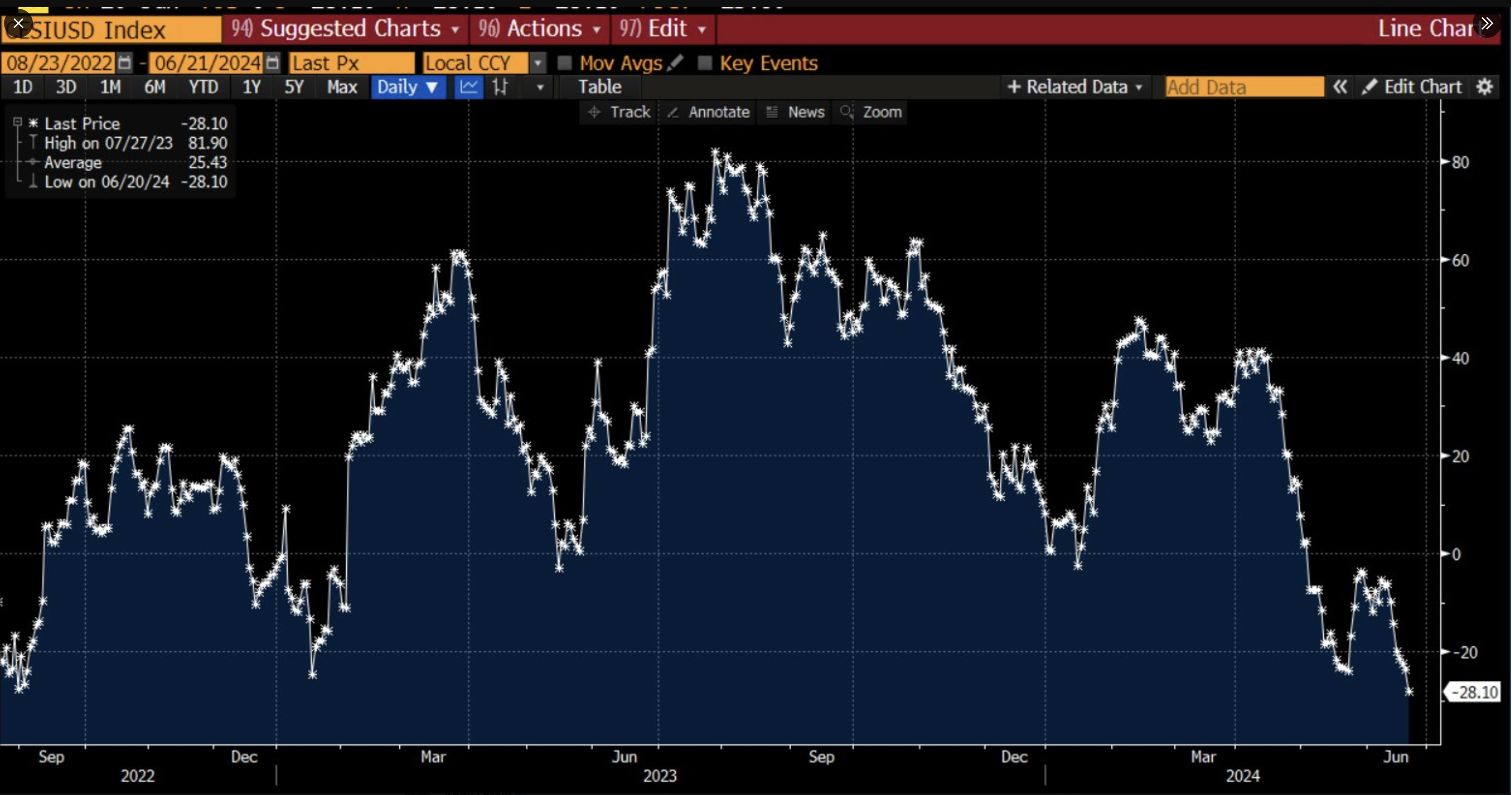
The data of late have not been positive.  Interestingly, this is not simply a US phenomenon, but appears to be spreading elsewhere in the world as evidenced by this morning’s much weaker than expected Flash PMI data out of Australia (Mfg 47.5 vs. 49.7), Japan (50.1 vs. 50.6) and Europe (Germany 43.4/46.4, France 45.3/46.8, Eurozone 45.6/47.9).  This follows the US trend where yesterday we saw the weakest Building Permits and Housing Starts data since the pandemic in June 2020 as well as a weaker than forecast Philly Fed result and higher than forecast Initial Claims data.  Prior to the Juneteenth holiday, Retail Sales were also quite soft, and another harbinger is the Citi Surprise Index, which Citibank created to measure actual data vs. the forecasts ahead of the release.  Typically, as it declines, it indicates weakening growth and vice versa.  As you can see from the below chart, this indicator has fallen to its lowest level in two years.

Source: Bloomberg

Summing it up, the strength of the economy is clearly being called into question by the data releases. However, as we have seen for the past several years, this is not a universal phenomenon.  For instance, who can forget the recent NFP print which beat expectations handily.  As well, the Atlanta Fed’s GDPNow indicator remains at 3.0% after yesterday’s housing data, still far above the forecasts by most economists, and an outcome that would be welcomed by almost everyone.

(As an aside and related to yesterday’s discussion about how politics intrudes on, or at least colors, so much of the financial market commentary, there have been numerous articles ‘blaming’ the weak PMI data on the results of the European Parliament elections and the ensuing call by French President Macron for next week’s snap election.  While one can make the case that is the situation in France, given the inherent uncertainty of the outcome, it seems a stretch to say that is why Germany’s data suffered.  After all, it is possible that all the talk of Eurozone tariffs on Chinese goods and the demonstrated incompetence of the current German government are sufficient to dissuade businesses there from investment and growth.)

So, what are we to believe?  The first thing I would highlight is that the idea of two separate economies seems to gain validity by the day.  For the haves, however you want to describe them but arguably the top 10% of income and wealth, the current situation has been fine.  While inflation is annoying, they can afford the higher prices given their asset portfolios, whether real estate or equities, have risen so dramatically.  The wealth effect for them is quite real.  

However, for the rest of the nation, things are far less positive.  The Retail Sales data tell a tale of reduced purchases of stuff (remember, that data is not inflation adjusted, so higher sales and higher inflation could well indicate less stuff sold but more money paid for it).  Additionally, the employment data is also a mixed bag as although NFP was strong, the household survey indicated less people were working and the trend in the Unemployment Rate is clearly up and to the right as per the chart below.

Source: tradingeconomics.com

Adding to this mix we have the Fed, who continue to look at the inflation data, and while they were pleasantly surprised by the slightly softer tone of the CPI data earlier this month as well as the PCE data last month, are still not prepared to address potential weakness in the economy.  This was made evident again yesterday when Richmond Fed President Barkin said, “my personal view is let’s get more conviction before moving.”  In other words, as we have heard consistently, patience remains a virtue at the Eccles Building.

If pressed, my personal view is that the economy has peaked for this cycle and we are going to start to see more data show weakness going forward, not strength.  The bigger problem with this is that while inflation has ebbed from its highest levels, it appears to me that the idea it will reach, and remain at, the 2.0% target is extremely unlikely.  Rather, I remain in the camp that the new level of inflation is somewhere between 3% and 4% as defined by CPI, and that over time, the Fed is going to bless that as an appropriate description of stable prices.  Given the Fed’s clear desire to cut rates, I fear that they are going to act earlier than would otherwise be prudent and that while economic activity will decline, prices will rebound.  Absent a massive recession, something like we saw in 2008-09, I do not see prices falling back to the current target.

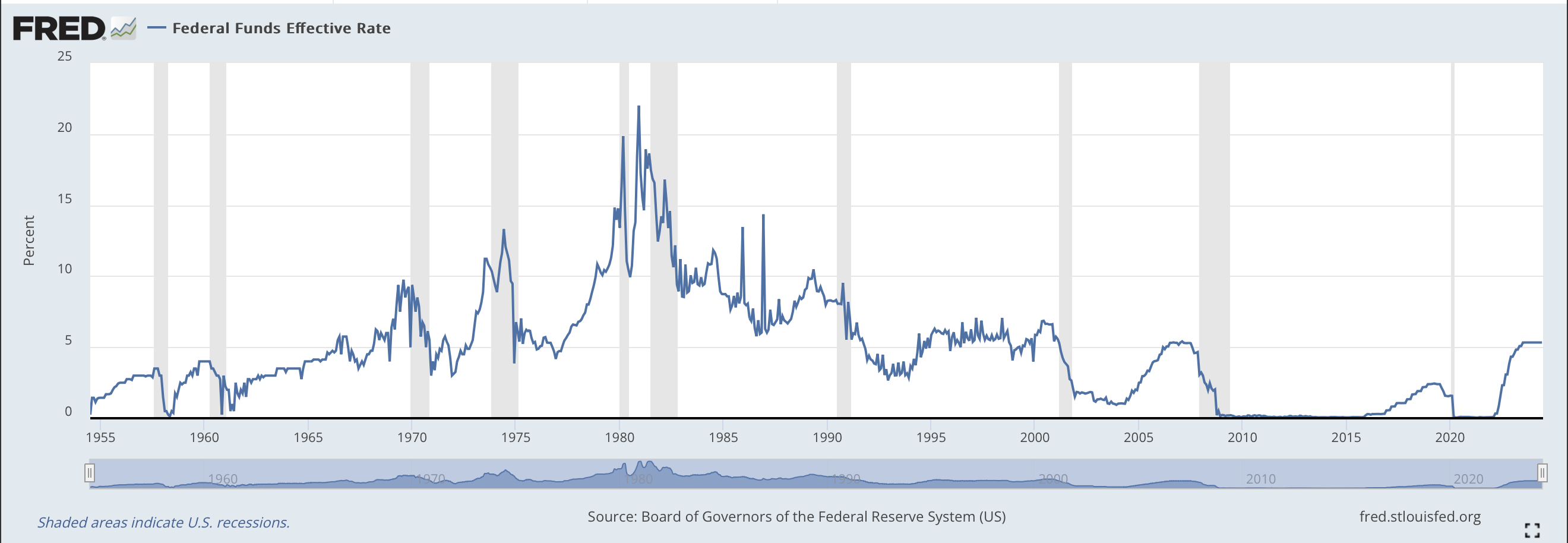
And here’s the problem with that view from a market’s perspective, if the recession comes, the Fed will cut rates and cut them relatively quickly.  This can be seen in the chart below showing Fed funds behavior relative to recessions.

Source FRED data base

Alas, for equity markets, during a recession, equity markets tend to fall, with declines of 30%-50% quite common and much greater as well (NASDAQ fell 88% during 2001-02 recession).  The road ahead appears to be filled with difficulty, so keep that in mind as you go forward.

Ok, sorry that ran on so long, but sometimes it is important to dig a little deeper I feel.  Let’s do a really quick turn of the overnight session.  Japanese equities were little changed but Hong Kong fell sharply (-1.7%) and the mainland drifted lower.  The rest of Asia was broadly under pressure although Australia (+0.35%) managed to eke out small gains.  In Europe, following the weak PMI data red is the color of the day with every market lower on the session, including the UK which released surprisingly positive Retail Sales data, although their PMI data was also soft.  At this hour, US futures are little changed awaiting the Triple Witching Day of expiries of futures, options and options on futures.

In the bond market, yields are lower across the board led by Treasuries (-3bps) and all of Europe as those PMI data are a harbinger of slower growth and will likely be an encouragement for more rate cuts by the ECB.  In fact, Klaas Knot, one of the more hawkish ECB members indicated he could see three more cuts this year, which is even more dovish than the market is pricing.

In the commodity markets, oil is essentially unchanged this morning, maintaining its recent gains as inventory data showed more draws than expected.  In the metals markets, gold (+0.2%) is holding onto its recent rebound, but given the weaker economic data story, both silver and copper are under pressure.

Finally, the dollar is gaining this morning as European currencies suffer from weak data and rate cut dreams, although there are two real outliers, MXN (+0.45%) on the back of surprising strength in recent economic data (Retail Sales and IP) and ZAR (+0.55%) as it appears more investors are turning to the rand as the pre-eminent carry trade earner vs. the yen and reducing their MXN exposures after the recent elections.

On the data front, the Flash PMI’s are due at 9:45 (exp 51.0 Mfg, 53.7 Services) and then at 10:00 we see both Existing Home Sales (4.10M) and Leading Indicators (-0.3%).  While there are no Fed speakers on the calendar, I fully expect to hear from someone before the end of the day as they simply cannot shut up.

Overall, risk is off, and I suspect that we could see some equity selling during today’s session, following yesterday’s moves.  With that, bonds are likely to perform as well as the dollar, and I think gold holds on, though the rest of the commodity complex is likely to suffer further losses.

Good luck and good weekend

Adf

A Crack in the Sheen

Ahead of the holiday flight
The payroll report is in sight
This week we have seen
A crack in the sheen
That everything still is alright

So right now, bad news is all good
But there seems a high likelihood
That worsening data
Could impact the beta
And bad news turn bad, understood?

As we wake up on this Payrolls Friday, the market is biding its time ahead of the release this morning.  As I have been writing for a number of months now, I continue to believe the NFP number is the most important on the Fed’s radar as its continued strength has given Chairman Powell all the cover he needs to continue tightening monetary policy.  If job growth is averaging near 200K per month and the Unemployment Rate has a 3 handle, the doves have no solid case to make that policy is too tight.  With that in mind, here are the current median analyst expectations according to Bloomberg:

Nonfarm Payrolls170K
Private Payrolls148K
Manufacturing Payrolls0K
Unemployment Rate3.5%
Average Hourly Earnings0.3% (4.3% y/Y)
Average Weekly Hours34.3
Participation Rate62.6%
ISM Manufacturing47.0
ISM Prices Paid44.0
Course: Bloomberg

So far this week, we have received three pieces of employment data with a mixed outcome.  JOLTS Job Openings was much lower than expected and that encouraged the bad news is good phenomenon.  ADP Employment was weaker on the headline by a bit but had a very large revision higher to last month, so mixed news.  Meanwhile, Initial Claims were lower than expected and any sense of a trend higher in this series is very difficult to discern.  Anecdotally, I have to say I expect a softer number today, not a firmer one, but I believe it is anybody’s guess.

With that in mind, I believe a weak number, whether lower payrolls or a jump in the Unemployment Rate, will be met with an equity rally into the holiday weekend.  Investors are looking for ‘proof’ that the Fed is done so they can get on with rate cuts and support the stock market.  However, remember, if the data is weak and we are heading into recession sooner rather than later, all that bad news will likely not be taken well by equity investors as money will flow back to bonds as a haven.  At least, that has been the history.  So, a really bad number could well result in ‘bad news is bad’ and an equity market decline.  Alas, nothing is straightforward in markets.

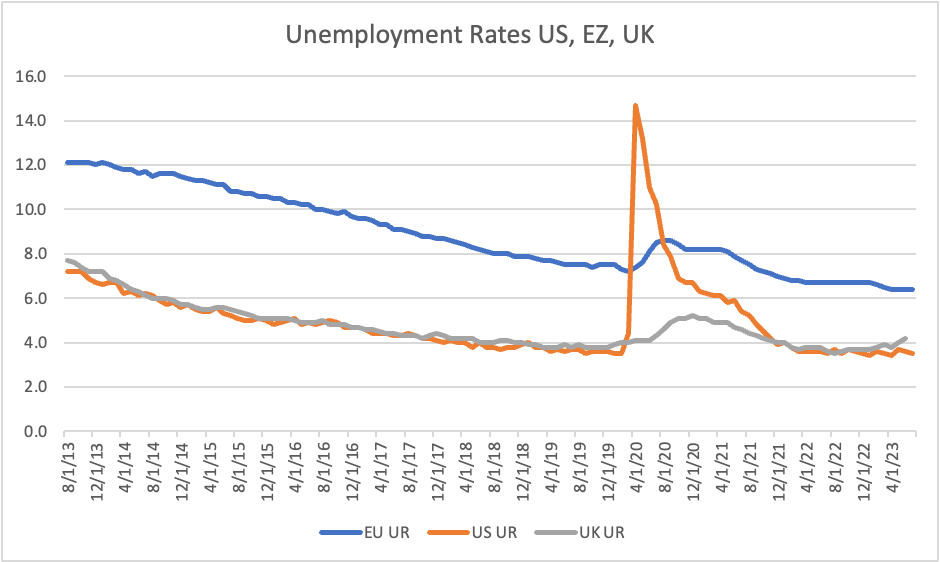
One other thing to keep in mind is the relative Unemployment situation which can be seen below in the chart created with data from Bloomberg.  Structural unemployment in the Eurozone remains substantially higher than in either the US or the UK.  If you are wondering why I continue to have a favorable outlook on the dollar, this is one part of that puzzle.  Despite all the policy blunders questions that have been raised, things in the US remain far better than elsewhere.

In China, despite what they’ve done
To try to support the short-run
It’s not been enough
So, they did more stuff
Last night, though investors still shun

It wouldn’t be a day in the markets if there wasn’t yet another action by the Chinese to try to fix their myriad problems.  Today is not different as last night the PBOC reduced the FX RRR to 4% from its previous level of 6%.  This required reserve ratio defines the amount of reserves Chinese banks need to hold against their FX positions.  Reducing that number effectively boosts the amount of foreign currency available locally, and therefore takes pressure off market participants to horde their dollars, thus weakening the buck.  

And it worked…for about an hour as the renminbi initially rallied about 0.5%.  However, it has since ceded all those gains and is essentially unchanged on the day.  At the same time, the government has reduced the size of the down payment needed to buy a home while encouraging banks to lend more to home buyers to try to support the crumbling property market.  While certainly welcome relief to an extent, it does not appear to be enough to change the current trajectory, which is definitely lower.  At this point, we know that the PBOC is quite concerned over potential renminbi weakness and the central government is quite concerned over broad economic weakness led by the property sector.  We have not seen the last of these moves.

President Xi did, however, get one piece of positive news overnight, the Caixin Manufacturing PMI rose to 51.0, up 2 points from last month and well above expectations.  The combination of those factors helped the CSI 300 gain 0.7% last night, but that seems weak sauce overall.  As to the rest of the market’s risk appetite, I guess you would consider things mildly bullish.  While Hong Kong was weaker, the Nikkei managed a small gain and most of Europe is in the green, notably the UK (+0.7%) after weaker than expected House Price data encouraged belief that inflation may be ebbing sooner than previously expected.  As well, the UK revised higher its GDP data to show that they have, in fact, recovered all the Covid related losses.  US futures, meanwhile, are edging higher at this hour (7:00).

Bond yields are mixed this morning, but the moves have been small, generally +/- 1bp from yesterday’s close.  And yesterday’s closing levels, at least in Treasuries, was little changed from Wednesday.  Granted, European sovereigns saw yields decline yesterday on the order of 5bps, so this morning’s 1bp rise is not that impactful I would contend.

Turning to the commodity markets, they have embraced the Chinese stimulus efforts with oil (+1.5%) rising again and pushing close to $85/bbl, while metals markets are also robust with gold (+0.25%), copper (+1.6%) and aluminum (+1.3%) all seeing demand this morning.  While I have doubts about the effectiveness of the Chinese moves, for now the market is quite pleased.

Finally, the dollar is mixed and little changed net this morning.  In the G10, not surprisingly, NOK (+0.3%) is the leading gainer on the back of oil’s rally, but the rest of the bloc is +/- 0.1% or less, so essentially unchanged.  In the EMG bloc, I guess there are a few more laggards than gainers with HUF (-0.6%) the worst performer as traders prepare for a ratings downgrade from Moody’s after the close today, while MXN (-0.6%) suffered after Banxico indicated it would be winding down its forward FX program where it consistently supplied the market with dollars, buying pesos.  On the plus side, ZAR (+0.8%) is the lone outlier on the back of the commodities rally.

We hear from Bostic and Mester today, with Bostic already having told us he thinks it’s time to pause, although I doubt we will hear the same from Mester.  But in reality, it is all about the employment report.  For now, I believe bad news is good and vice versa, but that is subject to change with enough bad news.

Good luck and have a good holiday weekend.  There will be no poetry on Monday.

Adf

Desperate Straits

Ahead of today’s CPI
Jobs data from England showed why
Inflation remains
The greatest of pains
That central banks can’t wave good-bye

Despite all their hiking of rates
In seeking to reach their mandates
The job market’s growing 
Which seems to be showing 
Their models are in desperate straits

Today’s key feature is the monthly CPI report from the US where expectations are for a 4.1% headline reading and 5.2% core reading, with both still far higher than the Fed’s 2.0% target.  While the headline number is certainly good news, the Fed’s problem is that the core reading continues to bump along pretty steadily above 5.0% and is not showing any indication of a sharp move lower.  While an exceptionally weak headline reading will almost certainly result in a further rally in risk assets on the premise that the Fed’s pause skip is now baked in, the greater question is how long can the Fed tolerate such a high core CPI reading before resuming their rate hikes?  As we head into the data, the Fed funds futures market is currently pricing just under a 25% chance of a hike tomorrow but nearly an 87% chance of at least one hike by July.  However, that is the peak with a cut then assumed by December.


Of course, the thing that is not getting any attention at this point is what happens if the reading is hot?  I have literally not read a single analysis that anticipates a higher outcome showing inflation has become even more intractable than it had seemed for the past several months.  My take is a higher-than-expected reading, especially in the core print, could see the market substantially increase their pricing for a rate hike tomorrow as well as another one or two before the year is over, and that may not be a positive for risk assets.


And that’s where the UK’s employment data comes into the discussion, as it is showing the same characteristics as the US employment data, surprising strength.  Briefly, instead of a rising Unemployment Rate, it fell to 3.8% with wages rising by 6.5% Y/Y, well above last month’s and well above forecasts.  There was a reduction in the number of jobless claims and a significant growth in employment of 250K on a quarterly basis, also far above forecasts.  In other words, despite a lot of doom and gloom regarding the UK economy and the irreparable damage that Brexit has done to the nation, it seems that there is continued economic activity at a decent pace and businesses are still hiring and paying up to do so.  I have to say that sounds suspiciously like the commentary regarding the US economy, where despite an ongoing belief that Unemployment is set to rise, each monthly data point has been surprising on the high side, often by a significant amount.  As I have written before, perhaps it is time for the central banking community to review the efficacy of their models as they no longer seem to represent any sense of reality.


The other noteworthy news overnight was that the PBOC reduced their 7-day Reverse Repo rate by 10bps to 1.90% in a surprising move.  Tomorrow night the PBOC has their monthly meeting and expectations are for a 10bp reduction in their medium-term lending facilities as the Chinese government struggles with a much slower than expected rebound from their latest Covid reopening.  In fairness, it is not just the Chinese government that is surprised as one of the main themes we have seen for the past several months was the expectation that China’s rebound would result in a significant increase in demand for commodities and that has just not occurred.  However, the fact remains that China is easing policy, both fiscal and monetary, while the G7 remains in a tightening phase.  The natural outcome here is that the renminbi has continued to slide.  While the onshore market closed little changed, with CNY -0.1%, the initial reaction upon the announcement of the rate cut was a little more substantial.  Net, though, the renminbi has been weakening steadily all year long and given recent very low inflation data, it is abundantly clear that the PBOC is not concerned at current levels.  I expect that USDCNY and USDCNH have much further to climb as the summer progresses, especially if CPI continues to run hot here in the US.


And those are really the key stories as we await that CPI print shortly.  Asian equity markets followed the US higher last night with the Nikkei continuing its sharp rally, rising 1.8%, and the rest of the markets trailing along behind. Europe, though, is having a less formidable session with minimal movement as the major indices are +/-0.1% from yesterday’s closing levels.  As to US futures, only NASDAQ futures are showing any movement, gaining 0.3% at this hour (7:30).


Bond markets are similarly dull, save the Gilt market which has seen 10yr yields rise 5.7bps, as both Treasuries and the rest of the European sovereign market are within 1bp of yesterday’s prices.  The Fed continues to be active in the Treasury market, taking down a significant portion of the issuance yesterday, albeit not directly as they bought off-the-run bonds instead of the issuances.  However, today’s data could easily have a significant impact as traders try to reassess the Fed’s response to a data surprise.


Oil prices have stopped falling and have bounce 1.8% from yesterday’s lowest levels of just below $67/bbl, although the trend continues to be lower.  As I have repeatedly written, this is the one market that is all-in on the recession call. Gold (+0.4%) has been pretty uninteresting lately as it stopped falling but has basically flat-lined for the past month just below $2000/oz.  Meanwhile, copper has rallied 2% this morning but is still well below highs seen earlier this year.  However, I think a large part of these movements are the fact that the dollar is generally softer this morning.


Versus its G10 counterparts, the dollar is softer across the board with GBP (+0.5%) the leading gainer but decent strength everywhere.  Versus the EMG bloc, there is a bit more variety with KRW (+1.3%) by far the leading gainer on a combination of reported corporate repatriation of overseas cash flows as well as hopes that China’s rate cut will support further growth in Korean exports.  However, after that, the bloc is basically split between gainers and laggards with the biggest moves just 0.3% either way, not enough to get excited about.


And that’s really it for today.  It is all about CPI this morning and depending on the data, we have the opportunity to get a better sense of how the Fed might behave tomorrow.


Good luck

Adf

Kept at Bay

The key for investors today
Is payrolls and how they portray
The jobs situation
Thus, whether inflation
Will rocket, or be kept at bay

It’s Payrolls day, generally a session where there is a great deal of anticipation leading up to the release, often followed by a burst of activity and then a very slow afternoon.  However, given today also happens to be Good Friday, with all European markets closed in observation, as well as US equity markets, it is likely the burst activity, assuming one comes, will be compressed into an even shorter timeline than usual.  Of course, what makes this potentially unnerving is that market liquidity will be significantly impaired relative to most sessions, and any surprising outcome could result in a much larger move than would normally be the case.

It is not a bank holiday, which means the bond market will be trading, and that is, in truth, the market that continues to drive the action.  As evidenced by yesterday’s price action, the bond rally, with 10-year Treasury yields sliding 7 basis points, led to a declining dollar and new record highs in the stock market.  We also saw gold and other commodities rally as the combination of strong data (ISM at 64.7) and lower yields was a double-barreled benefit.

With that in mind, here are the latest expectations:

Nonfarm Payrolls 660K
Private Payrolls 643K
Manufacturing Payrolls 35K
Unemployment Rate 6.0%
Average Hourly Earnings 0.1% (4.5% Y/Y)
Average Weekly Hours 34.7
Participation Rate 61.5%

Source: Bloomberg

All that seems fine, but it is worth a look at the individual forecasts that make up that NFP number.  There is a wide dispersion of views ranging from a gain of just 350K to eight forecasts greater than 900K and three of those at a cool million each.

Let’s consider, for a moment, if the optimists are correct.  Harking back to Chairman Powell’s constant refrain regarding the recovery of the 10 million lost jobs, the expected timeline for that to happen remains sometime in late 2023.  But if this morning’s release is 1000K or more, that would seem to potentially shorten the timeline for those jobs to return.  And following that logic, it seems likely that the Fed may find themselves in a situation where ZIRP is no longer appropriate somewhat earlier in 2023 than currently expected as inflation rises, and unemployment falls back to their new goal of 3.5%-4.0%.  The implication here is that the bond market will anticipate this activity and we could see the 10-year yield break through to new highs quite quickly.  Based on broad market behavior as seen yesterday, a sharp decline in the bond market would likely result in the dollar rebounding sharply and equity futures, which are trading, retreating.  And all this on a day when there is much less liquidity than normal.

Of course, a weak number is likely to have just the opposite effect, with the bond bulls making the case that we have seen the high in yields, and dollar bears back in the saddle making the case the dollar’s run higher has ended.

And that’s really what we have in store for the day.  The two markets that were open overnight saw equities rally on the heels of the US equity rally, with the Nikkei (+1.6%) and Shanghai (+0.5%) both performing well.  Every European market is closed for the holiday and will be on Monday as well.  Meanwhile, US futures are all pointing modestly higher, roughly 0.25%, ahead of the payroll report.

As NY is walking in, we are seeing the first movement in Treasury yields and they have edged higher by 1.1bps at this point.  But as I highlight above, this is all about the data today.

In the commodity markets, only precious metals are trading but both gold and silver are essentially unchanged at this hour ahead of the data.  This follows yesterday’s strong performance with both rallying more than 1% in the session.

And finally, in the FX market, except for TRY (+0.7%) and KRW (+0.4%) there is no movement more than 0.2%, which is indicative of the fact that some positions are being adjusted but there is no news driving things.  In the case of TRY, the new central bank governor, in a speech today, made clear that he was not going to cut rates and that he was likely to raise them again in an effort to combat the rising inflation in the country.  This was well received by the market and has helped TRY recover much of its initial losses upon the sacking of the previous central bank chief.  As to KRW, they released CPI data last night, 1.5%, which was the highest print since January 2020, indicating that growth was persistent, and the BOK would be more vigilant going forward.  This also encouraged equity inflows resulting in the won’s modest appreciation.

So, now we wait for the payroll data.  Based on the releases that we have seen during the past couple of weeks, where the economy is clearly pushing ahead, I suspect this number will be somewhere above 800K, although 1000K is clearly not out of the question.  As such, my view is we will see the bonds sell off and the dollar retest its recent highs, if not break through them.

Good luck, good weekend and stay safe
Adf

Cash Will Be Free

The Chairman was, once again, clear
The theory to which they adhere
Is rates shall not rise
Until they apprise
That joblessness won’t reappear

The market responded with glee
Assured, now, that cash will be free
The dollar got whacked
And traders, bids, smacked
In bonds, sending yields on a spree

It does not seem that Chairman Powell could have been any clearer as to what the future holds in store for the FOMC…QE shall continue, and Fed Funds shall not rise under any circumstance.  And if there was any doubt (there wasn’t) that this was the committee’s view, Governor Brainerd reiterated the story in comments she made yesterday.  The point is that the Fed is all-in on easy money until maximum employment is achieved.

What is maximum employment you may ask?  It is whatever they choose to make it.  From a numerical perspective, it appears that the FOMC is now going to be looking at the Labor Force Participation rate as well as the U-6 Unemployment Rate, which counts not only those actively seeking a job (the familiar U-3 rate), but also those who are unemployed, underemployed or discouraged from looking for a job.  As an example, the current Unemployment Rate, or U-3, is 6.8% while the current U-6 rate is 12.0%.  Given the current estimated labor force of a bit over 160 million people, that difference is more than 8 million additional unemployed.

When combining this goal with the ongoing government lockdowns throughout the country, it would seem that the Fed will not be tightening policy for a very long time to come.  There is, of course, a potential fly in that particular ointment, the inflation rate.  Recall that the Fed’s mandate requires them to achieve both maximum employment and stable prices, something which they have now defined as average inflation, over an indefinite time, of 2.0%.  As I highlighted yesterday, the Fed remains sanguine about the prospects of inflation rising very far for any length of time.  In addition, numerous Fed speakers have explained that they have the tools to address that situation if it should arise.

But what if they are looking for inflation in all the wrong places?  After all, since 1977, when the Fed’s current mandate was enshrined into law, the U-3 Unemployment Rate was the benchmark.  Now, it appears they have determined that no longer tells the proper story, so they have widened their focus.  In the same vein, ought not they ask themselves if Core PCE is the best way to monitor price movement in the economy?  After all, it consistently underreports inflation relative to CPI and has done so 86% of the time since 2000, by an average of almost 0.3%.  Certainly, my personal perspective on prices is that they have been rising smartly for a number of years despite the Fed’s claims.  (I guess I don’t buy enough TV’s or computers to reap the benefits of deflation in those items.)  But the word on the street is that the Fed’s models all “work” better with PCE as the inflation input rather than CPI, and so that is what they use.

Carping by pundits will not change these things, nor will hectoring from Congress, were they so inclined.  In fact, the only thing that will change the current thinking is a new Fed chair with different views, a reborn Paul Volcker type.  Alas, that is not coming anytime soon, so the current Fed stance will be with us for the foreseeable future.  And remember, this story is playing out in a virtually identical manner in every other major central bank.

Which takes us to the market’s response to the latest retelling of, ‘How to Stop Worrying (about prices) and Start Keep Easing.’ (apologies to Dale Carnegie).  It can be no surprise that after the Fed chair reiterated his promise to keep the policy taps wide open that equity markets around the world rallied, that commodity prices continued to rise, and that the dollar has come under pressure.  Oh yeah, bond markets worldwide continue to sell off sharply as yields, from 10 years to 30 years, all rise.

Let’s start this morning’s tour in the government bond market where yields are not merely higher, but mostly a LOT higher in every major country.  The countdown looks like this:

US Treasuries +7.5bps
UK Gilts +7.3bps
German Bunds +5.4bps
French OATs +5.9bps
Italian BTPs +8.0bps
Australian ACGBs +11.8bps
Japanese JGBs +2.5bps

Source: Bloomberg

Folks, those are some pretty big moves and could well be seen as a rejection of the central banks preferred narrative that inflation is not a concern.  After all, even JGB’s, which the BOJ is targeting in the YCC efforts has found enough selling pressure to move the market.  Suffice it to say that current yields are the highest in the post-pandemic markets, although there is no indication that they are topping anytime soon.

On the equity front, Asia looked great (Nikkei +1.7%, Hang Seng +1.2%, Shanghai +0.5%) but Europe, which started off higher, is ceding those early gains and we now see the DAX (-0.4%), CAC (0.0%) and FTSE 100 (+0.2%) with quite pedestrian showings.  Perhaps a bit more ominous is the US futures markets where NASDAQ futures are -1.0%, although the S&P (-0.3%) and DOW (0.0%) are not showing the same concerns.  It seems the rotation from tech stocks to cyclicals is in full swing.

Commodity prices continue to rise generally with oil up, yet again, by a modest 0.25%, but base metals all much firmer as copper leads the way higher there on the reflation inflation trade.  Precious metals, though, are suffering (Gold -1.0%, Silver -0.2%) as it seems investors are beginning to see the value in holding Treasury bonds again now that there is actually some yield to be had.  For the time-being, real yields have been rising as nominal yields rise with no new inflation data.  However, once that inflation data starts to print higher, and it will, look for the precious metals complex to rebound.

Finally, the dollar is…mixed, and in quite an unusual fashion.  In the G10, the only laggard is JPY (-0.25%) while every other currency is firmer.  SEK (+0.55%) leads the way, but the euro (+0.5%) is right behind.  Perhaps the catalyst in both cases were firmer than expected Confidence readings, especially in the industrial space.  You cannot help but wonder if the central banks even understand what the markets are implying, but if they do, they are clearly willing to ignore the signs of how things may unfold going forward.

Anyway, in the G10 space, currencies have a classic risk-on stance.  But in the EMG space, things are very different.  The classic risk barometers, ZAR (-1.8%) and MXN (-1.4%) are telling a very different story, that risk is being shunned.  And the thing is, there is no story that I can find attached to either one.  For the rand, there is concern over government fiscal pledges, but I am confused by why fiscal prudence suddenly matters.  The only Mexican news seems to be a concern that the economy there is slower in Q1, something that I thought was already widely known.  At any rate, there are a number of other currencies in the red, BRL (-0.3%), TRY (-0.9%) that would also have been expected to perform well today.  The CE4 is tracking the euro higher, and Asian currencies were generally modestly upbeat.

As to data today, we see Durable Goods (exp 1.1%, 0.7% ex transport), Initial Claims (825K),  Continuing Claims (4.46M) and GDP (Q4 4.2%) all at 8:30.  Beware on the Claims data as the deep freeze and power outages through the center of the country could easily distort the numbers this week.  On the Fed front, now that Powell has told us the future, we get to hear from 5 more FOMC members who will undoubtedly tell us the same thing.

While the ECB may be “closely monitoring” long-term bond yields, for now, the market does not see that as enough of a threat to be concerned about capping those yields.  As such, all FX eyes remain on the short end of the curve, where Powell’s promises of free money forever are translating into dollar weakness.  Look for the euro to test the top of its recent trading range at 1.2350 in the coming sessions, although I am not yet convinced we break through.

Good luck and stay safe
Adf

QE is Our Fate

The Fed Chair, a banker named Jay
Will meet with his comrades today
Though no one expects
A change, it’s what’s next
That has traders set to make hay

Will guidance be tied to the rate
Of joblessness? Or will they state
Inflation is key
And ‘til there we see
Advances, QE is our fate

Today’s primary feature in the markets is the FOMC meeting where at 2:00 they will release their latest policy statement, and then at 2:30 Chairman Powell will hold a virtual press conference. As is often the case, market activity ahead of the meeting is muted as investors and traders are wary of taking on new positions ahead of a possible change in policy.

However, the punditry is nearly unanimous in its belief that there will be no policy changes today, and that the statement will be nearly identical to the previous version, with just some updates relating to the data that has been released since then. The big question is whether or not Chairman Powell will give an indication of what the next steps by the Fed are likely to be.

A quick review of the current policy shows that the Fed has a half dozen lending programs outstanding, which they extended to run through the end of 2020 in an announcement yesterday, and which are focused on corporate bonds, both IG and junk, municipal securities and small business loans. Of course, they continue to buy both Treasury and mortgage-backed securities as part of their more ordinary QE measures. And the Fed Funds rate remains at the zero bound. Consensus is that none of this will change.

The problem for the Fed is, short of simply writing everyone in the country a check (which is really fiscal policy) they are already buying all the debt securities that exist. While eventually, they may move on to purchasing equities, like the BOJ or SNB, at this point, that remains illegal. So, the thinking now goes that Forward Guidance is the most likely next step, essentially making a set of promises to the market about the future of policy and tying those promises to specific outcomes in the economic data. Given their mandate of full employment and stable prices, it is pretty clear they will tie rate movements to either the Unemployment Rate or the inflation rate. You may recall in the wake of the GFC, then Chairman Bernanke did just this, tying the eventual removal of policy accommodation to the Unemployment Rate. Alas, this did not work as well as the Fed had hoped. The first problem was that as the unemployment rate declined, it did not lead to the expected rise in inflation, so the Fed kept having to move its target lower. This did not inspire credibility in the central bank’s handling of the situation, nor its models. But the bigger problem is that the market became addicted to ZIRP and QE, and when Bernanke mentioned, off hand, in Congressional testimony, that some day the Fed would start to remove accommodation, he inspired what is now called the ‘Taper Tantrum’ where 10-year Treasury yields rose 1.3% in just over three months

You can be certain that Powell does not want to set up this type of situation, but, if anything, I would argue the market is more addicted to QE now than it was back then. At any rate, given the Fed’s need to show they are doing something, you can be sure that tied forward guidance is in our future. The question is, to what statistic will they tie policy? It is here where the pundits differ. There is a range of guesses as follows: policy will be unchanged until, 1) inflation is steadily trending to our 2.0% target, 2) inflation reaches out 2.0% target, or 3) inflation spends time above our 2% target in an effort to ‘catch up’ for previous low readings. This in order of most hawkish to least. Of course, they could focus on the Unemployment rate, and choose a level at which they believe full employment will be reached and thus start to pressure inflation higher.

The problem with the inflation target is that they have been trying to achieve their 2.0% target, based on core PCE, and have failed to do so consistently for the past 10 years. It is not clear why a claim they are going to continue to maintain easy money until they reach it now, let alone surpass that target, would have any credibility. On the Unemployment front, given what are certainly dramatic changes in the nature of the US economy in the wake of Covid-19, it beggars belief that there is any confidence in what the appropriate level of full employment is today. Again, it is hard to believe that their models have any semblance of accuracy in this area either.

And one other thing, most pundits don’t anticipate the announcement of new forward guidance until the September meeting, so this is all anticipation of something unlikely to occur for a while yet. But, as a pundit myself, we do need to have something to discuss on a day when markets remain uninteresting.

So, let’s take a quick look at today’s market activities. Equity markets remain mixed with both gainers (Shanghai +2.1%) and losers (Nikkei -1.2%) in Asia and in Europe (CAC +0.7%, DAX 0.0%, Italy -0.8%). US futures are edging higher, but not with any enthusiasm. Bond markets are all within a basis point of yesterday’s closing levels, although Treasuries did rally in the mild risk-off session we saw Tuesday with 10-year yields back below 0.60%. Yesterday, gold had a wild day, making new highs early in the overnight session and falling back 4% in NY before rebounding to close at $1960/oz. This morning it is little changed, but the trend remains higher.

Finally, the dollar is softer this morning, although yesterday saw a mixed session. The pound (+0.25%) has been a steady performer lately and is pressing toward 1.30 for the first time since early March, pre-Covid. While there was UK data on lending and money supply, this movement appears to be more technical in nature, with the added benefit that the dollar remains under pressure against all currencies. Elsewhere in the G10, oil’s strength this morning is helping NOK (+0.5%), while the rest of the bloc is just marginally firmer vs. the dollar.

In the emerging markets, the big winner today was THB (+0.8%) where the central bank is trying to make a change in the local gold market. Interestingly, gold traded in baht is a huge market, and one where the recent flows have resulted in excess baht strength. As such, the central bank is trying to change the market into a USD based gold market, which should remove upward pressure from the currency. But away from that, while the bulk of the bloc is firmer, the movement is 0.3% or less, hardly the stuff of dreams, and with no coherent message other than the dollar is soft.

And that’s really it for the day. There is no data of note to be released and so all eyes are on the FOMC. My money is on inflation based forward guidance, likely the most dovish type shooting for above target outcomes, but not to be put in place until September. And that means, the dollar’s recent downtrend is likely to continue to be the situation for the immediate future.

Good luck and stay safe
Adf