That Man is Our Bane

Apparently, back in the day
Investors and CEOs say
The future was clear
But now they all fear
Uncertainty is in their way
 
So, they will now clearly explain
When earnings and profits do wane
That they’re not to blame
Instead, they now claim
It’s Trump’s fault, that man is our bane


I’m having some difficulty understanding a number of the concerns about which I read every day as more and more corporate executives and investment managers have suddenly found a new scapegoat, uncertainty.  Apparently, I missed the time when the future was certain, as I have no recollection of that at all.  Perhaps you remember.  If so, could you remind me please?

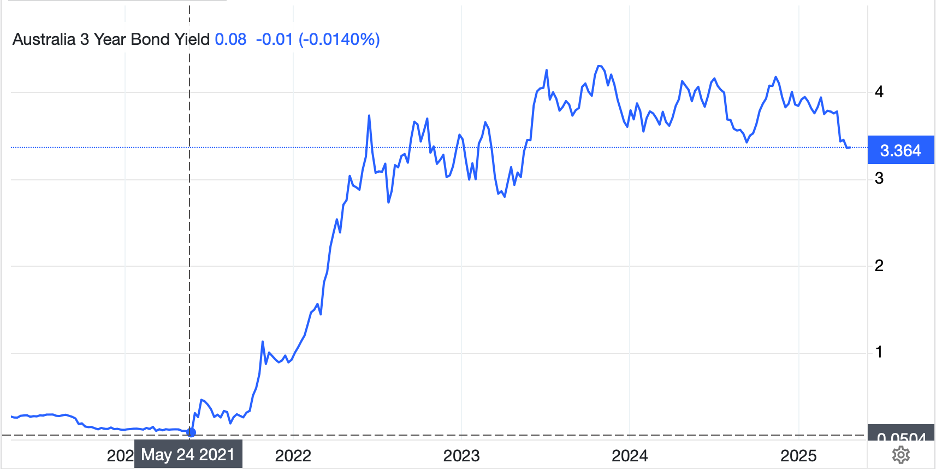
For instance, I remember the certitude of the comments from the RBA back in April 2021 that interest rates would remain lower for longer, and that it would be at least three years before they would need to raise interest rates.  I also remember, as the graph below demonstrates, that certainty was misplaced as less than two months after those comments, the RBA started raising interest rates despite the clear directive they would not need to do so for years.

Source: tradingeconomics.com

While this is just one example, in my experience, certainty is not part of the mix when running a business or a portfolio of assets or a position in any financial market.  So imagine my surprise when reading Bloomberg this morning and finding that suddenly, the world is awash in uncertainty.  Has it ever not been the case?  Pretty much once you get beyond the laws of physics or mathematics, it strikes me that certainty in the future just doesn’t exist. (Even at 4Imprint).  Nonetheless, uncertainty because of President Trump’s trade policies is the latest rationale for every problem at every company right now.  In truth, I suspect that many executives are quite happy with this as the Covid excuse was wearing thin.

In the markets, too, uncertainty is the favored excuse for underperformance as how can anyone manage money with tape bombs constantly appearing.  Powell is a loser one day to I’m not going to fire Powell the next.  Tariffs are forever to a 90-day pause.  And of course, there are many other political stories that have limited impact on markets but seem to change regularly.  While this gets back to my view that President Trump is the avatar of volatility, I seem to recall long before President Trump that there were numerous presidential statements that had major market impacts.  My point is, nothing has really changed folks, other than the media dislikes this president more than any other in my lifetime so amplifies anything they think makes him look bad.

However, the one thing about which we cannot be surprised is that trading activity is waning, at least compared to what we saw since Trump’s inauguration.  Volumes of activity on the exchanges are sliding (see chart of S&P 500 volume below from ycharts.com) which makes perfect sense in a volatile and uncertain market.  

Now, as per the above, I would contend that the future is always uncertain.  Rather the real culprit here is volatility.  My take is that the future is going to continue to be volatile which implies, to me at least, that trading activity is going to remain on the low side and with it, liquidity for those who have significant real flows to transact.  It’s funny, volatility begets lower volumes, and lower volumes beget volatility due to reduced liquidity.  I’m not sure what it will take to break us from this cycle, but I have a sense that it will be with us for a while.

With that in mind, let’s see what happened overnight.  Yesterday’s strength in the US was followed by strength in Tokyo (+1.9%) although both China (+0.1%) and Hong Kong (+0.3%) didn’t really participate.  Interestingly, this morning I read that China was exempting a number of imports from the US from tariffs as apparently, it was hurting their businesses so severely it could cause closures.  Elsewhere in Asia, the picture was mixed although there were more gainers (Korea, Taiwan, Philippines, Thailand) than laggards (India, Singapore).  I do believe the tariff story is impacting these markets more than any as they are directly in the line of fire.

Meanwhile, in Europe, most markets are firmer this morning (DAX +0.6%, CAC +0.4%, IBEX +0.9%) but the UK (-0.1%) is lagging despite much stronger than expected Retail Sales data there this morning.  As to US futures, at this hour (7:00) they are pointing lower by about -0.35%.

In the bond market, Treasury yields continue to slide, down another -3bps this morning although Europe is moving in the opposite direction, with yields climbing between 2bps and 3bps in the session.  It’s odd because I continue to hear about European growth forecasts being cut and the ECB preparing for more rate cuts while the talk around the markets is that the US is going to see inflation from the tariffs.  Today’s bond moves don’t really speak to those narratives, but it is just one day.  I need to mention JGB yields, which rose 3bps overnight after Tokyo CPI came in 2 ticks hotter than forecast at both headline and core levels.  

In the commodity markets, oil (-1.2%) is slipping again and has consistently demonstrated it is unable to make any dent in the major price gap above the market.  To close that gap, WTI will need to rally more than $8/bbl from current levels, something I just don’t see happening in the current environment.  That would require a war in Iran I think.  As to metals, yesterday’s gold rally has been reversed (-1.5%) and today it is impacting both silver (-0.75%) and copper (-2.1%) as is the stronger dollar it seems.

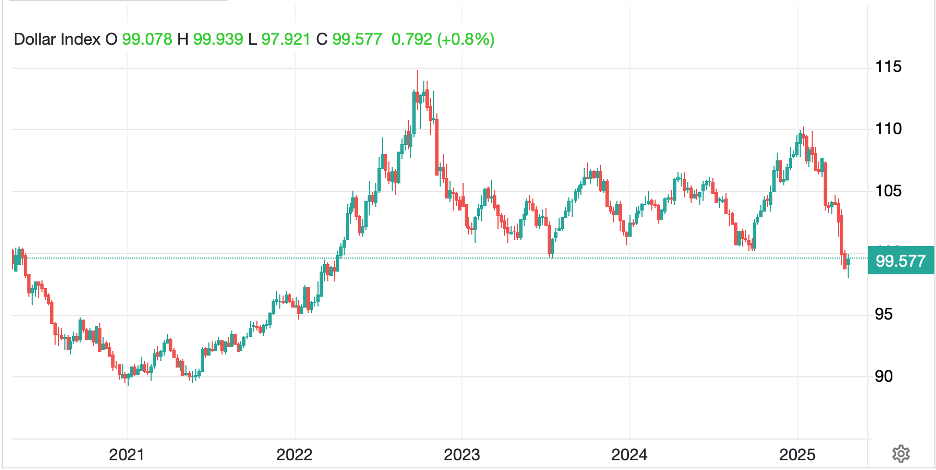
Speaking of the dollar, Monday’s narrative that the dollar was about to collapse will need at least another day to come to fruition as it is modestly higher again this morning.  looking at the DXY as a proxy, it is trading just below 100, a level that many are watching closely.  A quick look at the chart below shows this is the third time in the past two years it has traded to this level, although the first of those times it broke through.  Of course, it was much lower just a couple years earlier.

Source: tradingeconomics.com

Today’s dollar strength is modest but broad-based with only CLP (+0.6%) higher this morning which makes absolutely no sense given copper’s slide today.  The worst performer is SEK (-0.8%) but given it has been the best performer YTD amongst the G10, perhaps this is just corrective.  Otherwise, we are looking at movements on the order of 0.25% to 0.45% across the board.

The only data this morning is Michigan Sentiment (exp 50.8).  We continue to see a dichotomy between the ‘hard’ data, Claims, NFP, CPI, Factory Orders, and the ‘soft’ data, Michigan Sentiment, PMI, inflation expectations with the former holding in well while the latter weakens.  Many analysts believe that recession is coming our way by summer, but these same analysts have been predicting the recession for the past 3 years.  The one thing about the US economy is that it is extraordinarily resilient despite all the things governments try to do to disrupt it.  I understand the concern, at least if you watch/read the news, but I have a sense that many people across the nation do not really do that.  While I believe that equity valuations remain too high to be sustainable, it is not clear to me that the economy is heading into a recession at this time.  As to the dollar, I wouldn’t write its obituary just yet, although I do think it will soften further over time.

Good luck and good weekend

Adf

Demoralizing

Complaints among traders are rising
That markets are demoralizing
Liquidity’s shrinking
And now they are thinking
They might need to alter trade sizing
 
But can anyone be surprised
That markets are not immunized
From ongoing impacts
Of tariffs and new tax
Which President Trump advertised?


While headlines around the world have focused on the ongoing trade war negotiations, and peace talks between Russia and Ukraine and all of the political machinations in the US as President Trump continues to fight both the courts and Democrats to implement his agenda, markets are generally at a loss as to what to do.  Is the news bullish for stocks?  Bearish? What about bonds or the dollar or oil?  I cannot remember a time when there was so little clarity on expected future outcomes.  Well, I can actually, but it was a very long time ago.  Prior to the Black Monday stock market crash in the US in October 1987, the reality was there were many views fighting to be heard, but rarely consensus as to what would happen in markets.  Successful traders were those with trading intuition and positions were sized much smaller because you never knew when you might need to reverse course.

Since then, however, we have seen a steady diet of central bank intervention every time there is an indication that growth may be slowing, or markets may be having a bad day.  This process went into overdrive in the wake of the GFC (which, BTW, was a product of that central bank intervention warping markets) when QE was implemented in the US and then elsewhere throughout the G10.  In fact, then Chairman Bernanke was explicit that this was his goal.  He called it the portfolio rebalance channel and the idea was the Fed would buy all the Treasuries, driving yields lower and promise to keep rates very low for a long time thus forcing encouraging investors to move up the risk scale to corporate debt, high-yield debt and equities.  As well, QE pumped enormous amounts of liquidity into the financial system.  This combination of actions led to a huge expansion of risk taking and the creation of strategies like risk parity which were designed to lever up assets to increase returns.

It was all great as long as the Fed and other central banks kept expanding the available liquidity.  Alas, trees don’t grow to the sky and when the Fed, in 2018/19 tried to finally reduce the balance sheet and initiated their first QT program, things got hairy in September and halted them in their tracks.  It turns out that markets had become addicted to liquidity continually increasing and like any addict, responded negatively to the loss of its fix.

Of course, Covid ensued and the next gusher of liquidity, this time both fiscal and monetary, was initiated by governments and central banks around the world, so any idea that investors and traders were chastised by the events of 2019 were quickly forgotten and position sizes ramped up again along with market performance.

But there is a new sheriff in town, as has been mentioned by many in the Trump administration, and the old rules are not likely to work in the new environment.  As the US government has taken hold of virtually all the market’s bandwidth, relegating the Fed to a sideshow, traders and investors are suddenly finding that the old ways of doing things, buy the dip and lever up, are no longer the best way to get along.  With the ongoing efforts by the Trump administration to shrink the government and reduce flows to financial markets, the lessons of the post-GFC financial market are losing their validity.  

This was perfectly expressed in a Bloomberg article this morning where traders were complaining that when they wanted to adjust a position they had to “wait longer to execute an order until there’s better liquidity in certain instances.”  Of course, we all know how difficult it is to wait so I’m sure that you are just as sympathetic towards these traders as I am.  There was an interesting chart in the article (below) showing that futures liquidity in S&P 500 contracts had fallen to the lowest in two years and was clearly at the lower end of the recent spectrum.  Doesn’t your heart just bleed?

I have been clear that President Trump is the virtual avatar of volatility and one of the key characteristics of a volatile market is that liquidity dries up.  While prices may not move much on a particular day, trends disappear and when moves occur, they tend to be large, and often discontinuous.  This is true in all markets, so be prepared as we go forward.

As it happens, yesterday was a day with very little net movement, although some decent gyrations intraday in some markets.  For instance, in the bond market, yields, which opened the day much higher fell sharply after weaker than anticipated data then rebounded throughout the day finishing little changed from Monday’s levels.  The chart below shows the 7bp range resulting in zero movement net.

Source: tradingeconomics.com

Too, US equity markets traded both sides of unchanged all day, with some choppiness but no net directional movement.

Source: tradingeconomics.com

My point is that this is likely a portent of the future.  There are too many known unknowns for traders and investors to have confidence in taking a side.  Now, we are only two months into the new administration, and they have been working hard to get things done quickly.  It is possible that the fight drags on for the rest of the year or longer, with no clear outcomes on key issues regarding extending the tax cuts and a finalized tariff policy.  In this case, I would anticipate market activity to continue to be lower volumes and choppy price action with a lack of direction.  Or perhaps, lower risk asset prices as investors get scared.  The lesson is the processes that had become normalized in the post GFC world are clearly no longer in play.  Hedge accordingly.

So, as we look at overnight activity, yesterday’s US market activity didn’t inspire much movement in Asia where we saw some gainers (Nikkei +0.65%, Hang Seng +0.6%) and laggards (CSI 300 -0.3%, India -0.9%) but no consistency at all.  The PBOC is subtly altering their monetary policy toolkit which some are seeing as a modest ease, but clearly equity markets didn’t get that message.  Meanwhile, comments from the newest BOJ member, Koeda, explained she was not sure her previous analysis of the economy leaving the zero-rate world is valid now that rates are all the way up to 0.50%!

European shares are softer on the continent, down about -0.5% in most places but UK shares have gained slightly, +0.2%, after inflation data was released a tick lower than expected across both headline and core measures.  While the BOE stood pat last week, as expected, this has encouraged some traders to believe that a cut could come sooner than previously thought.  As to US futures, at this hour (7:45), they are basically unchanged.

Treasury yields, after yesterday’s choppiness, are creeping higher today (+3bps) but that is not following through in Europe, where sovereign yields are all flat to slightly lower today.  It seems difficult for investors to get excited about Germany’s rearming plan if the overall economy remains in the doldrums.  As well, tariff tensions have investors uncertain what to do, so doing nothing is the default.

In the commodity markets, oil (+0.9%) is higher from the close yesterday, but yesterday’s close was slightly softer than when I last wrote.  As such, we have still not quite made it to $70/bbl.  There are many crosscurrents in this market between tariffs, sanctions, potential Ukraine peace and Trump’s goal of drill, baby, drill.  As to metals, the star of the show continues to be copper (+1.5% today, +15% in the past month) which is now trading at all-time highs across the entire curve.  This has helped support both gold (+0.3%) and silver (+0.3%) although the former doesn’t need that much help, I think.

Finally, the dollar is mixed this morning, with the pound (-0.3%) lagging on the idea that the BOE may ease again sooner than previously thought, while AUD (+0.3%), CAD (+0.2%) and CLP (+0.3%) are all firmer on the commodity market strength.  Here, too, I expect that liquidity will diminish and trends will be hard to find until there is more clarity on policy outcomes in the US.

On the data front, this morning brings Durable Goods (exp -1.0%, +0.2% ex Transport) and then the EIA oil inventory data with a small build expected.  We also hear from two more Fed speakers, but they are just not driving markets right now.  Choppiness is the rule here, with short-term direction very difficult to discern.  I am still on board my ultimate lower dollar, higher commodity train, but that is subject to change if policies change as well.

Good luck

Adf

Confusion

Confusion continues to reign
O’er markets though pundits will feign
That they understand
The movements at hand
Despite a quite rocky terrain
 
The speed with which Trump changes views
Can even, the algos, confuse
The pluses, I think
Are traders must shrink
Positions, elsewise pay high dues


For the longest time I believed that the algos were going to usurp all trading activity as their ability to respond to news was so much faster than any human.  Certainly, this has been the key to success for major trading firms like Citadel and Virtu Financial.  And they have been very successful.  I think part of their success has been that we have been in an environment where both implied and actual volatility has declined in a secular manner, so not only could they respond quickly, but they could lever up their positions with impunity as the probability of a large reversal was relatively less.

However, I believe that the algos and their owners may have met their match in Donald Trump.  Never before has someone been so powerful and yet so chaotic in his approach to very important things.  Many pundits complain that even he doesn’t have a plan when he announces a new policy.  But I think that’s his secret, keep everyone else off balance and then he has free reign.  Chaos is the goal.

The market impact of this is that basically, for the past three months since shortly after his election, the major asset classes of stocks, bonds and the dollar, have chopped around a lot, but not moved anywhere at all.  How can they as nobody seems willing to believe that the end game he has explained; reduced deficits, reduced trade balance, lower inflation and a strong military presence throughout the Western Hemisphere, is going to result from his actions.  And in fairness, some of the actions do have a random quality to them.  But if we have learned nothing from President Trump’s time in office, including his first term, it is that he is very willing to tell us what he is going to do.  It just seems that most folks don’t believe he can do it so don’t take it seriously.

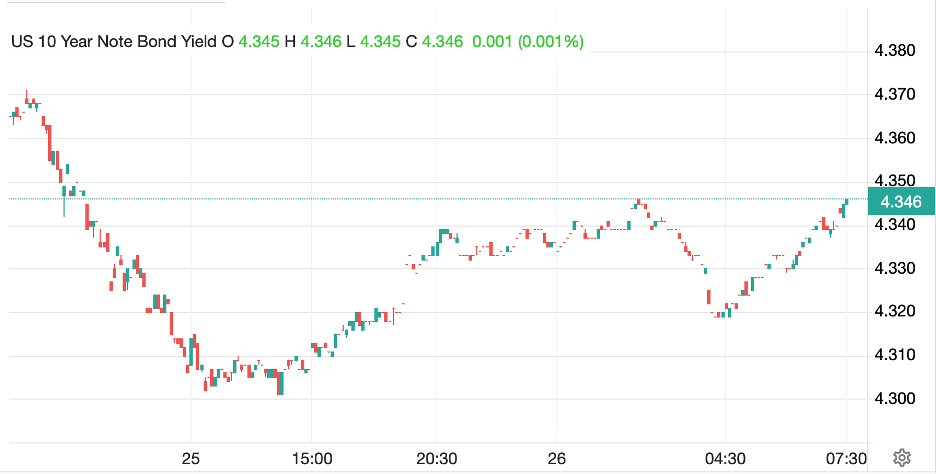
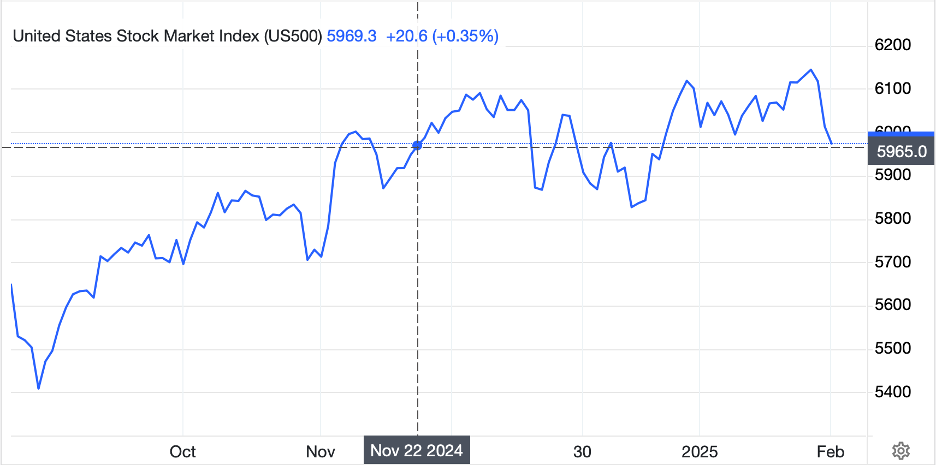
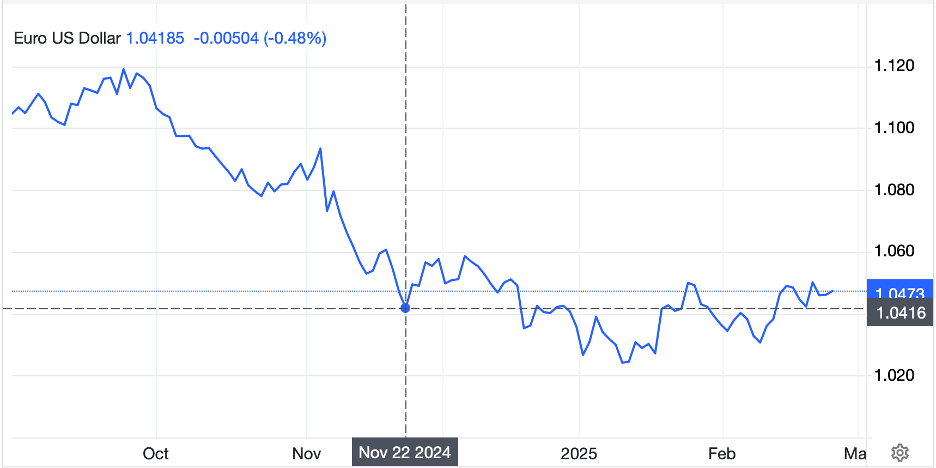
So, let’s look at how markets have behaved in the past three months.  The noteworthy result is that the net movement over that period has been virtually nil.  Look at the charts below from tradingeconomics.com:

S&P 500

10-Year Treasury

EUR/USD

While all these markets have moved higher and lower in the intervening period, they have not gone anywhere at all.  The biggest mover over this time is the euro, which has rallied 0.54% with the other major markets showing far less movement than that.

One interesting phenomenon of this price action is that despite significant uncertainty over policy actions by the President and the implications they may have on markets, and even though recent price action can best be described as choppy rather than trend like, the VIX Index remains in the lowest quartile of its long-term range. Certainly, it has risen slightly over the past few weeks, but to my eye, it looks like it is underpricing the chaos yet to come.  

Source Bloomberg.com

While I have no clearer idea how things will unfold than anyone else, other than I have a certain amount of faith that the President will achieve many of his goals in one way or another, I am definitely of the belief that volatility is going to be the coin of the realm for quite a while going forward.  We have spent the past many years with numerous strategies created to enhance returns via selling volatility, either shorting options or levering up, and that is the trend that seems likely to change going forward.  The implication for hedgers is that maintaining hedge ratios while having a plan in place is going to be more important than any time in the past decade or more.

Ok, let’s take a look at how markets did move overnight.  Yesterday’s net negative session in the US was followed by similar price action in Asia.  Tokyo (-1.4%), Hong Kong (-1.35) and China (-1.1%) all suffered on stories about tariffs and extra efforts by the Trump administration to tighten up export controls on semiconductors.  It should be no surprise that virtually every index in Asia followed suit with losses between -0.3% (Singapore) and -2.4% (Indonesia) and everywhere in between.  Meanwhile, in Europe, the picture is not as dour as there are a few winners (Spain +0.9% and Italy +0.5%) although the rest of the continent is struggling to break even.  The data point that is receiving the most press is Eurozone Negotiated Wage Growth (+4.12%) which rose less than in Q3 and has encouraged many to believe the ECB will be cutting rates next week.  Interestingly, Joachim Nagel, Bundesbank president was on the tape telling the rest of the ECB to shut up about their expectations of future rate moves as there is still far too much uncertainty and decisions need to be made on a meeting-by-meeting basis.  Apparently, oversharing is a general central bank affliction, not merely a Fed problem.  As to US stocks, at this hour (6:50) they are little changed.

In the bond market, yields continue to slide, at least in the US, with Treasury yields down -6bps this morning and back to levels last seen in December.  Apparently, some investors are beginning to believe Secretary Bessent regarding his goal to drive yields lower.  As well, he has reconfirmed that there will be no major increase in the issuance of long-dated paper for now.  European sovereigns, though, are little changed this morning with only UK gilts (-3bps) showing any movement after the CBI Trades report printed at -23, a bit less bad than expected.

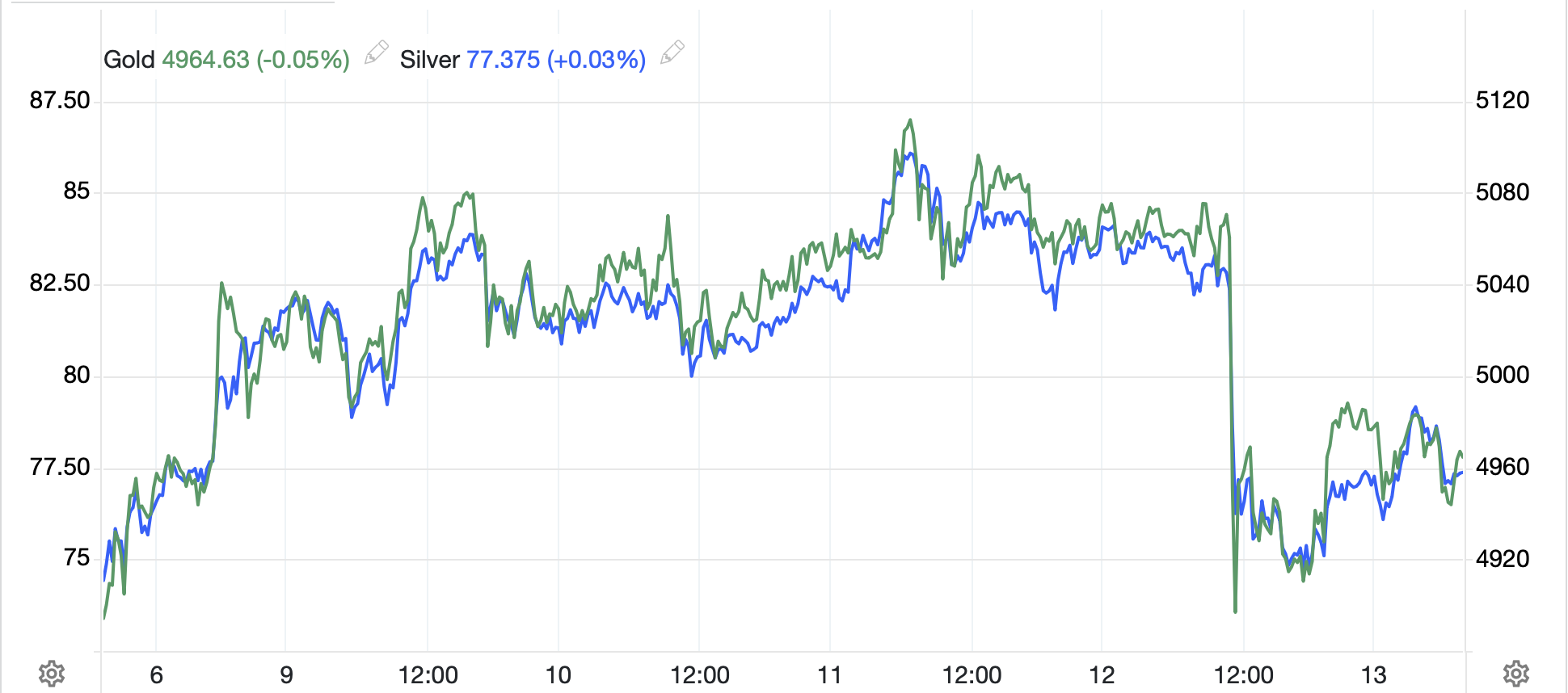
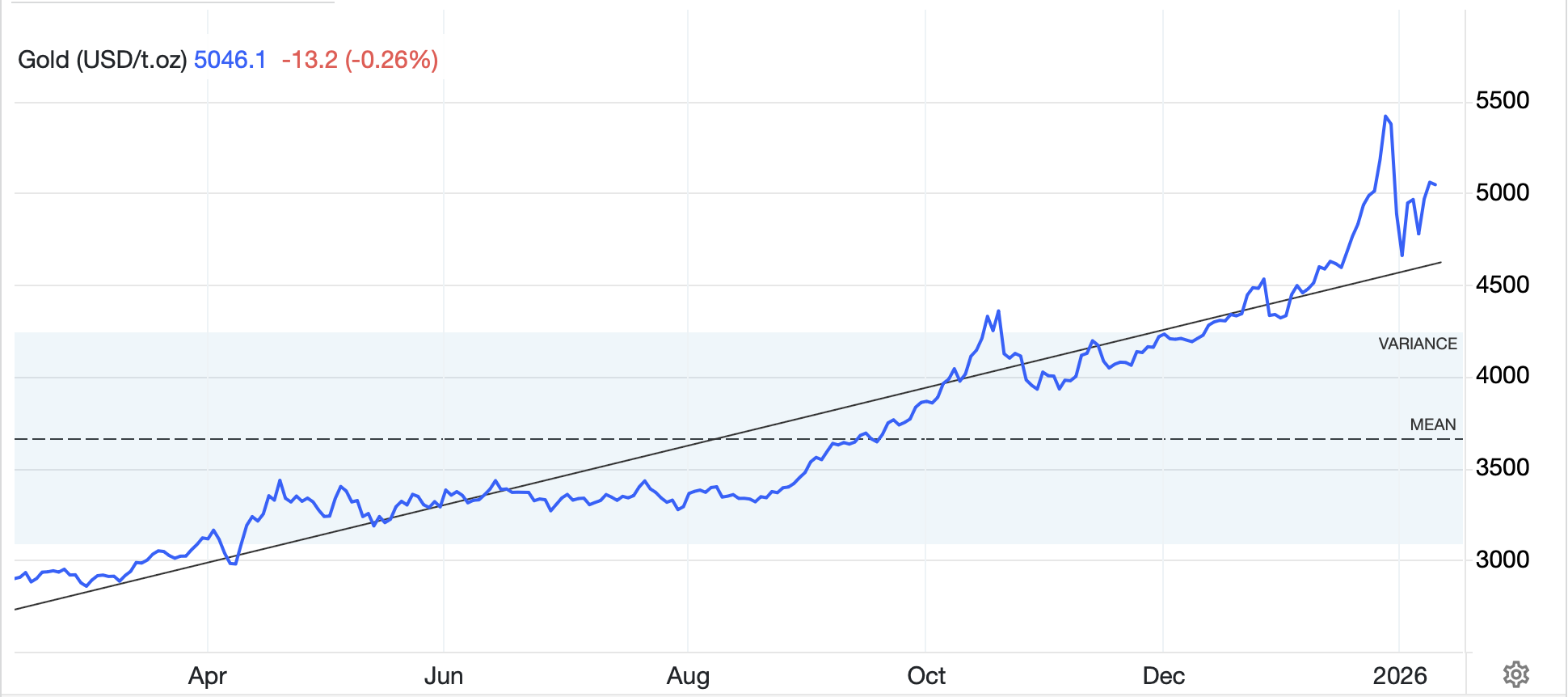
In the commodity markets, oil (-0.15%) is little changed this morning after a very modest rally yesterday.  But the reality here is that oil, like other markets, has been in a trading range rather than trending, although my take is that the longer-term view could be a bit lower.  Gold (-0.35%), though lower this morning, is the one market that has shown a trend since Trump’s election, and truthfully since well before that as you can see in the chart below.

Source: tradingeconomics.com

Finally, the dollar is a touch softer this morning, with both the euro and pound rising 0.3% alongside the CHF (+0.3%) and JPY (+0.2%). Commodity currencies, though, are less robust with very minor losses seen in MXN, ZAR and CLP.  Given the decline in 10-year yields, I am not that surprised at the dollar’s weakness although it is in opposition to the gut reaction that tariffs mean a higher dollar.  This is of interest because yesterday President Trump confirmed that the 25% tariffs on Canada and Mexico were going into effect next week.  As I explained above, it is very difficult to get a sense of short-term price action here although given the clear intent of the president to improve the competitiveness of US exporters, he would certainly like to see the dollar decline further.  

It is very interesting to watch this president reduce the power of the Fed with words and not even have to attack the Chairman like he did in his first term.  It will be very interesting to see how Chair Powell responds to the ongoing machinations.

On the data front, this morning brings only the Case-Shiller Home Price Index (exp +4.4%) and Consumer Confidence (102.5).  We do hear from two Fed speakers, Barr and Barkin, but as I keep explaining, their words matter less each day. (It must be driving them crazy!)

It is hard to get excited about markets here.  There is no directional bias right now and the lack of critical data adds to the lack of information.  As well, given the mercurial nature of President Trump’s activities, we are always one tape bomb away from a complete reversal.  While I don’t see the dollar collapsing, perhaps the next short-term wave is for further dollar weakness.  

Good luck

Adf
Norms to Eschew

For market practitioners, Trump
Is more than a modest speed bump
His willingness to
Most norms to eschew
Can force long-term views to go bump
 
Meanwhile, as the markets prepare
For Powell to sit in his chair
In front of the Senate
A popular tenet
Is more rate cuts he will foreswear


It is very difficult to keep up with the news these days as President Trump really does address so many disparate issues in such short order, it is hard to know which ones will potentially impact markets and which will simply be headline fodder.  Obviously, the tariff discussions remain front and center, but even those plans seem to be evolving at a very fast pace, and while yesterday he did invoke 25% tariffs on steel and aluminum imports, that has literally become old news already.  The next question is what will occur with the latest idea of reciprocal tariffs, where the US will charge the same tariff on imports from other nations as those nations charge on imports from the US.

Generally speaking, US tariffs are the lowest overall around the world, which arguably is exactly what Trump wants to address.  I am not going to argue the merits or detractions of tariffs, that is pointless.  The only thing to consider is if they are implemented, what are the potential impacts.  One of the key things to remember about the effectiveness of tariffs is the price elasticity of the products being tariffed.  If, for instance, a product has substantial competition and is easily replaced, the nation being tariffed is likely going to absorb the bulk of the pain.  Consider Colombia and how quickly they caved regarding the deportations.  While I am not a coffee drinker, and I am sure there are those who believe Colombian coffee is the best, coffee also comes from Brazil, Vietnam, Hawaii and Indonesia, and as none of those nations (and obviously Hawaii) were subject to tariffs, Colombia would have paid the freight had they been implemented.

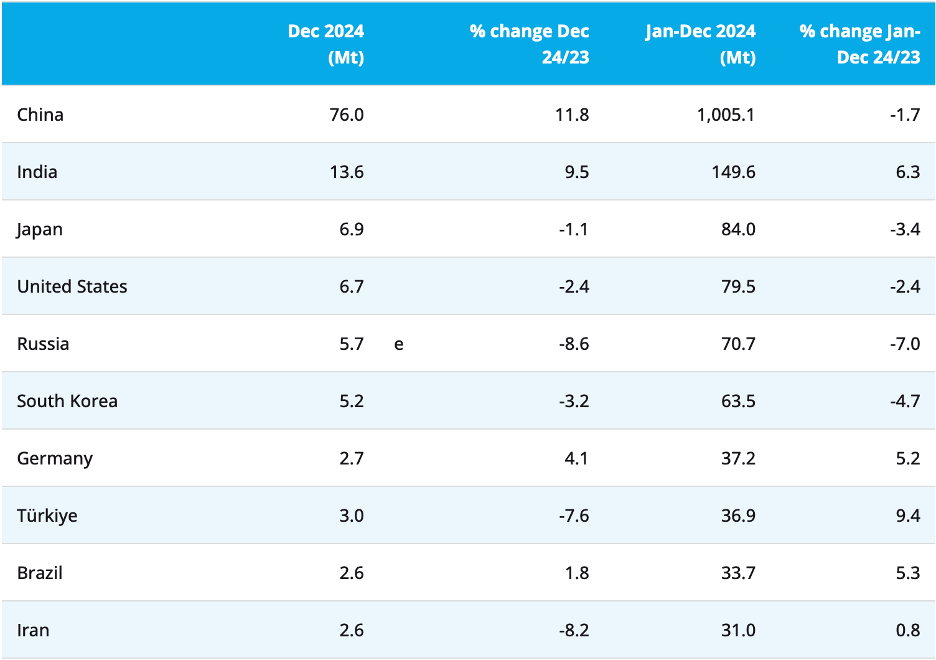
But, for a product like solar panels, where there are few suppliers other than the Chinese, to the extent the demand remained in place, the purchaser would see higher prices.  Turning to steel and aluminum, the below graphic shows the top 10 global steel producing nations and how much they produced in 2024.  This graphic says all you need to know about why President Trump is unhappy with China and their trade policies.  (well, this and the next one)

Source: worldsteel.org

And while this is not an exact apples-to-apples comparison, the below chart shows forecasts for steed demand in 2023 and 2024.  The mismatches are clear as China, South Korea and Japan have a significant surplus to export while the US and India need imports.

Source: mrssteel.com.vn

The point is President Trump is seeking to address that imbalance and is of the mind that the US would be better off if we make our own steel.  In fact, this is simply part of his entire philosophy to reshore US manufacturing capabilities.

Now, steel is a traded commodity, although in financial markets, not so much.  But changes in the flows of imports and exports will have an impact on FX markets, while tariffs could well also impact investment flows. In fact, it is not hard to see why Nippon Steel wants to buy US Steel.  if they own a steel manufacturer in the US, they can increase production with no concerns over tariffs.

Remember, too, this issue is merely a microcosm of the potential chaos that will be seen across industries and nations, both of which will impact financial markets.  Once again, I harp on the idea that a robust hedging program is a necessity these days.

Turning to today’s activities, Chairman Powell will be testifying before the Senate Banking Committee this morning.  On the one hand, I wonder if he is upset by the fact that virtually nobody is concerned about what he says these days as Trump continues to dominate every conversation.  For someone who has become quite accustomed to being the center of attention with respect to markets, this may well be a blow to his vanity and ego.  On the other hand, it is also quite possible that maintaining a low profile is precisely his strategy here, and if that is the case, I expect we will not learn anything new at all.  The Fed mantra is currently that they will be cautious before implementing any further rate cuts.  Remember, CPI is released tomorrow as well, so when he goes before the House, they will have that information in hand.  But to Powell’s benefit, Treasury Secretary Bessent made clear he and President Trump are far more concerned about the 10-year yield than Fed funds.  This may be the most amazing transformation of all, a Fed chair who becomes a wallflower!

Ok, after yesterday’s US equity rally, the story in Asia was far less positive.  Japan and Australia were unchanged while the Hang Seng (-1.1%) and CSI 300 (-0.5%) both suffered, perhaps on the tariff impositions.  Elsewhere in the region, Taiwan and South Korea both had solid sessions while weakness was evident in Indonesia, India and the Philippines.  In fact, all three of those markets have been declining steadily since October, with declines between 15% and 20% as prospects in those economies seem concerning, especially with Trump’s tariff mania.  In Europe, virtually every market is unchanged this morning as the EU quickly explained they would retaliate against any US tariffs.  Of course, that is what makes Trump’s reciprocal tariff structure so interesting.  How can Europe complain that other nations impose the same level of tariffs they do?  Meanwhile, at this hour (7:05), US futures are pointing slightly lower, about -0.25%.

In the bond market, yields are climbing with Treasuries higher by 3bps, now 12bps above the lows seen early last week, while in Europe, yields are substantially higher, with France (+10bps) leading the way, but the rest of the continent showing rises of between 4bps and 6bps.  Part of this move on the continent is driven by a catch up to yesterday afternoon’s US yield rally.  As to the French, seemingly their Unemployment Report, which showed a much better than expected 7.3%, may have investors concerned about quickening growth and inflation.  That feels like a lot, but there are no real explanations I have seen.

In the commodity markets, oil (+1.5%) is continuing to rebound off its recent lows, although still looks like it is in the middle of its trading range.  Gold (-0.7%) and silver (-1.2%) are both finally retracing some of the extraordinary rally that we have been witnessing for the past two months.  Copper (-2.7%), too, is under pressure this morning, unwinding some of its recent spectacular gains.

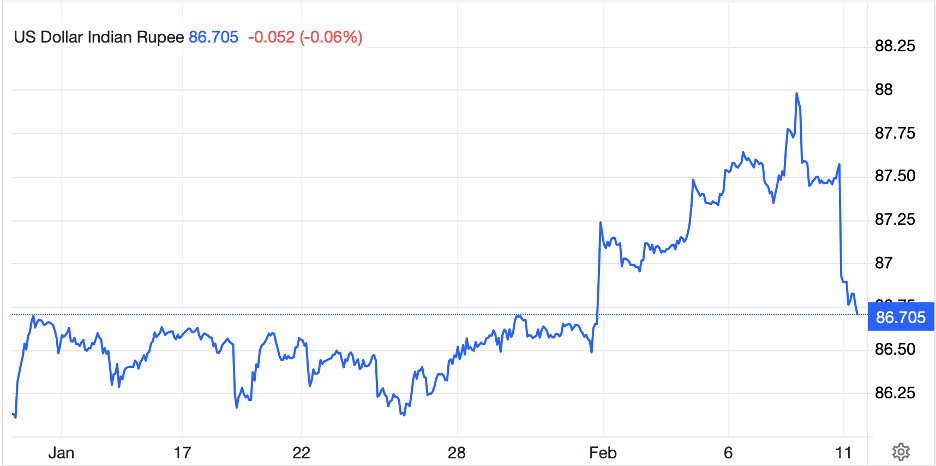
Finally, the dollar is very modestly softer, but not universally so.  For instance, the euro (+0.2%) and yen (-0.2%) seem to offset each other while most other G10 currencies have moved even less.  In the EMG bloc, though, INR (+0.9%) is the biggest gainer as the RBI has been intervening to address what had been an acceleration in the rupees decline in the past few weeks (see below).

Source: tradingeconomics.com

Elsewhere in the space, gains are less impressive, with moves on the order of +0.4% (PLN and HUF) or smaller.

On the data front, the NFIB Small Business Optimism Index was released at a softer than expected 102.8 as it seems the Trumpian chaos is having an effect for now.  Otherwise, the only thing is Powell and three other Fed speakers, but again, given the relative lack of discussion regarding Powell, the other three will get even less press in my view.

It is difficult to claim nothing has changed lately, but perhaps more accurately, there is no clear directional change at this point.  We need to start seeing some consistency in the policy impacts and that is likely to take months.  Until then, volatility is the watchword across all markets.

Good luck

Adf
Positioning’s Fraught

The wonderful thing about Trump
Is traders no longer can pump
A market so high
That it can defy
Reality ere it goes bump
 
Since policies can change so fast
A long-term view just cannot last
So, Fed put or not
Positioning’s fraught
And larger ones won’t be amassed


As we await the NFP report this morning, I couldn’t help but ponder the uptick in complaints and concerns by traders that increased volatility in markets on the back of President Trump’s mercurial announcements has changed the trading game dramatically.  Let me say up front that I think this is a much healthier place to be and explain why.

Pretty much since the GFC and, more importantly, then Chairman Bernanke’s first utilization of QE and forward guidance, the nature of financial markets had evolved into hugely leveraged one-sided views based on whatever the Fed was guiding.  So, the initial idea behind QE and forward guidance was to assure all the traders and investors that make up the market that even though interest rates reached 0.0%, the Fed would continue to ease policy and would do so for as far out in time as you can imagine.  Lower for longer became the mantra and every time there was a hiccup in the market, the Fed rushed in, added yet more liquidity to calm things down, and put the market back on track for further gains.  This was true for both stocks and bonds, despite the fact that the Fed has no business or mandate involving the equity market.

This activity led to the ever-increasing size of trading firms as leverage was cheap and steadily rising securities prices led to lower volatility, both implied and real, in the markets.  Risk managers were comfortable allowing these positions to grow as the calculated risks were minimized by the low vol.  In fact, entire trading strategies were developed to take advantage of the situation with Risk Parity being a favorite.  

However, a negative result of these actions by the Fed was that investors no longer considered the fundamentals or macroeconomics behind an investment, only the Fed’s stance.  The only way to outperform was to take on more leverage than your competitors, and that was great while rates stayed at 0.0%.  Alas, this persisted for so long that many, if not most, traders who learned the business prior to the GFC wound up retiring or leaving the market, and the next generation of traders and investors lived by two credos, number go up and BTFD.

The Fed remained complicit in this process as FOMC members evolved from background players to a constant presence in our daily lives, virtually preening on screens and in front of audiences and reiterating the Fed’s views of what they were going to do, implicitly telling traders that taking large, leveraged bets would be fine because the Fed had their back.

Of course, the pandemic upset that apple cart as the combination of Fed and government response imbued the economy with significantly more inflation than expected and forced the Fed to change their tune.  The market was not prepared for that, hence the outcome in 2022 when both stocks and bonds fell sharply.  But the Fed would not be denied and calmed things down and created a coherent enough message so that markets recovered the past two years.  This has, naturally, led to increased position sizing and more leverage because that’s what this generation of traders understands and has worked.

Enter Donald J Trump as president, elected on a populist manifesto and despite his personal wealth, seemingly focused on Main Street, not Wall Street.  The thing about President Trump is if an idea he proffers doesn’t work, he will drop it in a heartbeat and move on.  As well, by wielding the full power of the United States when dealing in international situations, other nations can quickly find themselves in a difficult spot and, so far, have been willing to bend their knee.  As well, his focus on tariffs as a primary weapon, with little regard for the impact on markets, and the way with which he uses them, threatening to impose them, and holding off at the last minute when other nations alter their policy, has kept markets off-balance.

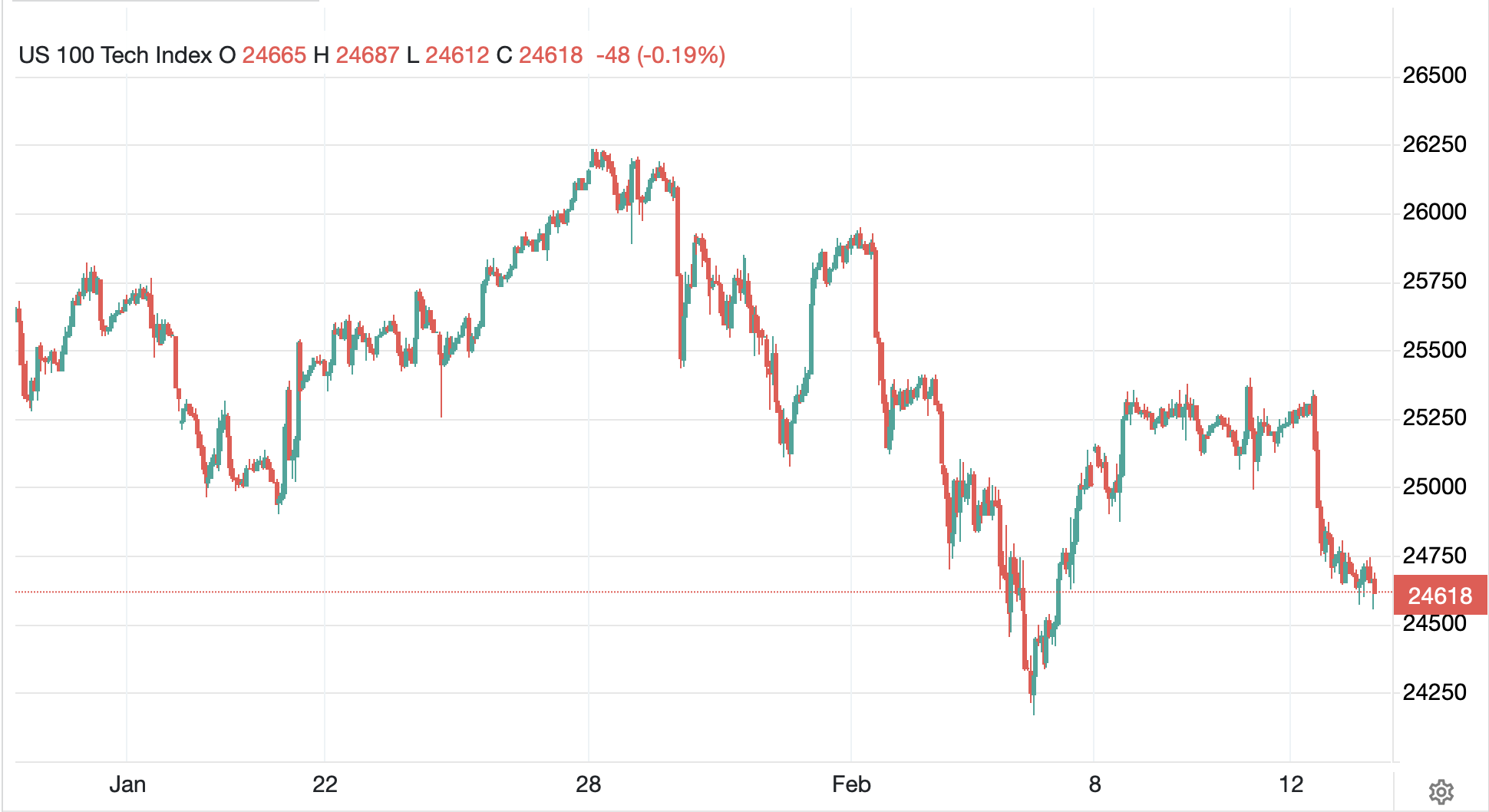
The result is large leveraged positions are very difficult to hold and manage when markets can move up and down 2% in a day, every day (like the NASDAQ 100 chart below), depending on the headlines.  

Source: tradingeconomics.com

The natural response is to reduce position size and leverage, and that, my friends, is a healthy turn in markets.  This is not to say that there are not still many significant imbalances, just that as they continue to blow up, whether Nvidia, or FX or metals, my take is the next set of positions will be smaller as nimble is more important than large.  It doesn’t matter how smart an algorithm is if there is no liquidity to adjust a position when the world changes.  This poet’s opinion is this is a much healthier place for markets to live.

Ok, let’s see what happened overnight ahead of today’s data.  Mixed is the best description as yesterday’s US closes saw a mixed outcome and overnight the Nikkei (-0.7%) fell while both Hong Kong (+1.2%) and China (+1.3%) gained ground.  Korea and India slid, Taiwan rose, the picture was one of uncertainty about the future.  That also describes Europe, where only Germany and Norway have managed any modest gains at all while the rest of the continent and the UK are all slightly lower.  Apparently, yesterday’s BOE rate cut has not comforted investors in the UK, nor has the talk of more rate cuts by the ECB bolstered attitudes in Europe.  As to US futures, at this hour (7:00) they are basically unchanged.

In the bond market, the biggest mover overnight was in Japan where JGB yields rose 3bps, once again touching that recent 30-year high.  While some BOJ comments indicated inflation remained well-behaved, the market is clearly of the view that Ueda-san is getting set to hike rates further.  In Europe, yields are basically lower by 1bp across the board and Treasury yields are unchanged on the session as investors and traders continue to focus on Treasury Secretary Bessent’s conversation that he cares about 10-year yields, not Fed funds.  Perhaps the Fed will cut rates to recapture the spotlight they have grown to love.

Oil (+0.5%) prices continue to drift lower overall, although this morning they are bouncing from yesterday’s closing levels.  Questions about sanctions policy on Iran, on Russia’s shadow fleet and about the state of the global economy and therefore oil demand remain unanswered.  However, the fact that oil has been sliding tells me that there is some belief that President Trump may get his way regarding a desire for lower oil prices.  In the metals markets, copper (+1.1%) is flying higher again, and seems to be telling us that the economy is in decent shape.  Either that or there is a major supply shortage, although if that is the case, I have not seen any reporting on the subject.  Both gold and silver are very modestly higher this morning after small declines yesterday as the London – NY arbitrage continues to be the hot topic and financing rates for both metals have gone parabolic.

Finally, the dollar is mixed this morning, perhaps slightly firmer as JPY (-0.5%) is actually the worst performer around, despite the rise in JGB yields.  There is a lot of chatter on how the yen is due to trade much higher, and it has rallied over the past month, but it is certainly not a straight line move.  As to the rest of the space, virtually every other currency is +/-0.2% from yesterday’s close with CLP (+0.5%) the lone exception as the Chilean peso benefits from copper’s huge rally.

On the data front, here are the latest expectations for this morning’s employment report:

Nonfarm Payrolls170K
Private Payrolls141K
Manufacturing Payrolls-2K
Unemployment Rate4.1%
Average Hourly Earnings0.3% (3.8% Y/Y)
Average Weekly Hours34.3
Participation Rate62.5%
Michigan Sentiment71.1

Source: tradingeconomics.com

Remember, though, the ADP number on Wednesday was much better than expected at 183K (exp 150K) with a major revision higher by 54K to the previous month).  As well, this month brings the BLS adjustments for 2024 which will not be broken down, just lumped into the data.  Recall, there are rumors of a significant reduction in the number of jobs created in 2024 as well as a significant increase in the population estimates with more complete immigration data, and that has led some pundits to call for a much higher Unemployment Rate.  I have no insight into how those adjustments will play out although the idea they will be large seems highly plausible.

Ahead of the number, nothing will happen.  If the number is strong, so NFP >200K, I expect that bonds will suffer, and the dollar will find some support.  A weak number should bring the opposite, but the revisions are a wild card.  As I stated this morning, the best idea is to maintain the smallest exposures possible for the time being, as volatility is the one thing on which we can count.

Good luck and good weekend

Adf

Half-Crazed

The rest of the world is amazed
And frankly, I think, somewhat dazed
The vote in the States
Deteriorates
Each cycle, as folks turn half-crazed
 
But still, everyone cannot wait
To find out if we will be great (again)
Or if we will turn
The page and thus spurn
The chance to encourage debate


By now, I imagine most of you have figured out my preference for the election outcome and whatever your view, I sincerely hope you don’t hold it against me.  However, if that is the case, so be it.  In the meantime, whatever happened in markets yesterday and overnight just doesn’t matter at all as the opportunity for a major revision of perceptions is so large as to make any price information completely useless, at least in the US markets.

I have seen numerous studies showing the history of how markets behave in presidential election cycles, but I think it is a fair assessment that the current cycle is unlike any previous cycle that we have seen since, perhaps, just before the Great Depression.  Simply consider the massive amount of information that is available to the average person from numerous sources these days compared to anytime in the past.  As such, I don’t put much faith in any of those studies.

Which takes us to this morning.  Do we truly have any idea what the outcome will be?  I would argue not although we all have our favored outcomes.  And that bias, I believe, is deeply embedded in virtually every analysis.  As such, I will not try to analyze.  Rather, I will observe.

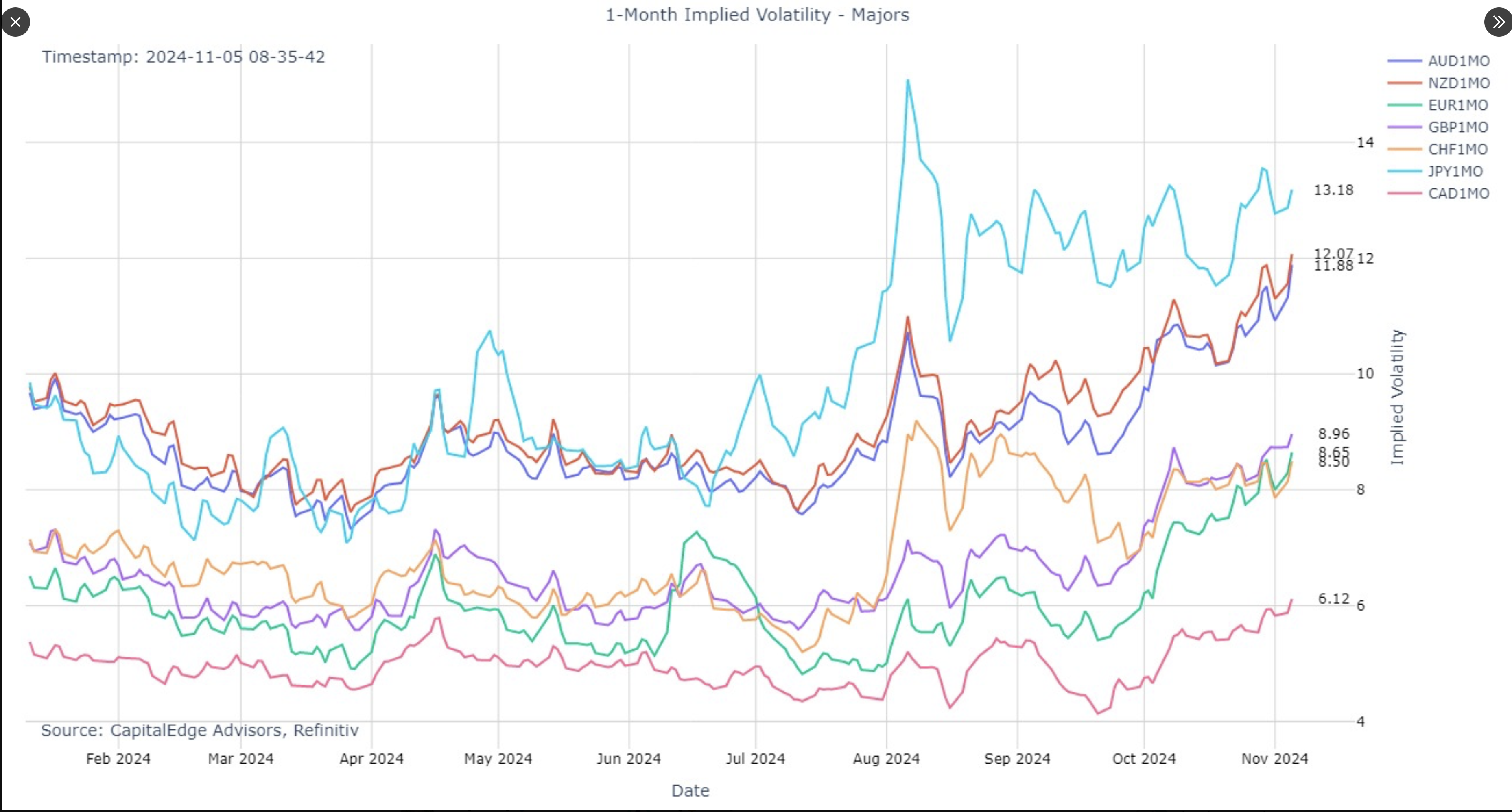
The first observation is that market implied volatility has been rising for the past weeks as the seemingly dramatic differences in policy outcomes depending on the ultimate winner mean market dislocations in either direction are quite possible.  

For example, let’s look at 1-month implied volatility in the major USD currency pairs this year as per the below:

Source: Capital Edge Corner via X

They have been rising steadily since early October as a combination of corporate hedgers trying to protect themselves and hedge funds and traders trying to profit from the dislocation have increased demand steadily.  The one truism here is that upon confirmation of a winner, regardless of the underlying move in the dollar, implied volatility is going to decline.

Much has been made of the ‘Trump trade’ which appears to mean that if Trump wins, the prospects for higher growth and inflation will steepen the yield curve, driving yields higher, while supporting the dollar (much to Trump’s chagrin) as foreign investors flock to US equities.  In fact, the most common explanation for the dollar’s decline over the past several sessions has been that Harris has improved in the polls.  

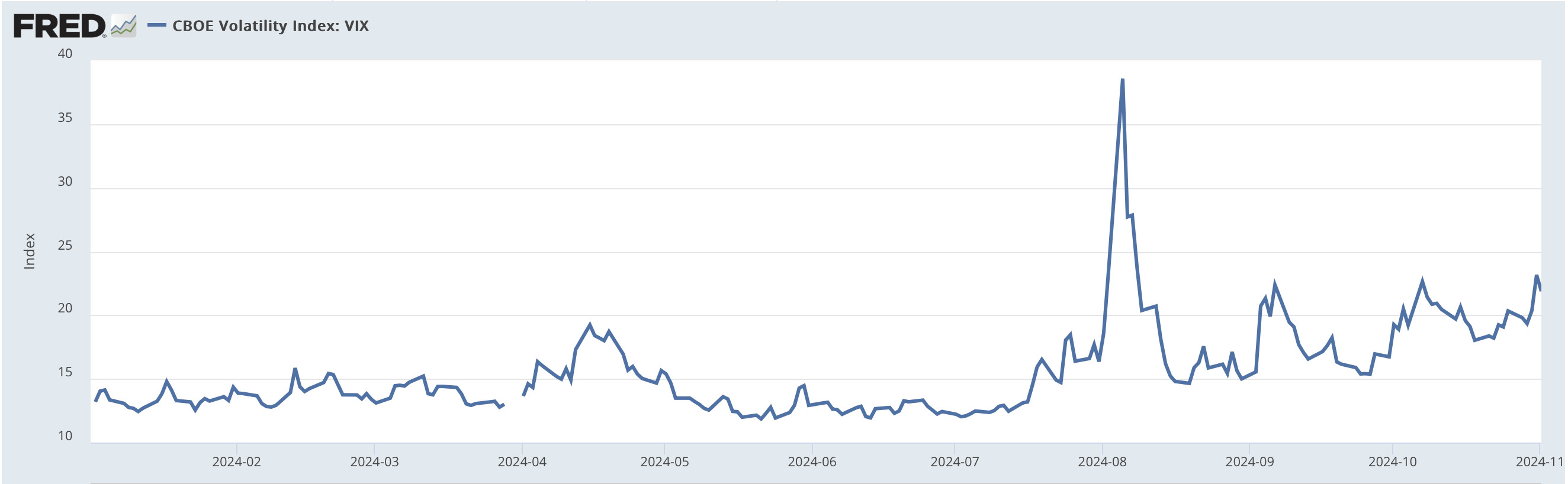
But it is not just the FX markets where implied volatility is rising, look at the VIX below, which is also showing a steady climb over the past two months.

Source: Fred.gov

That spike in August was the almost forgotten market response to the BOJ tightening policy and the -12% decline in the Nikkei just days after the Fed didn’t cut interest rates as many had hoped.  But if you eliminate that event, the trend higher remains intact.

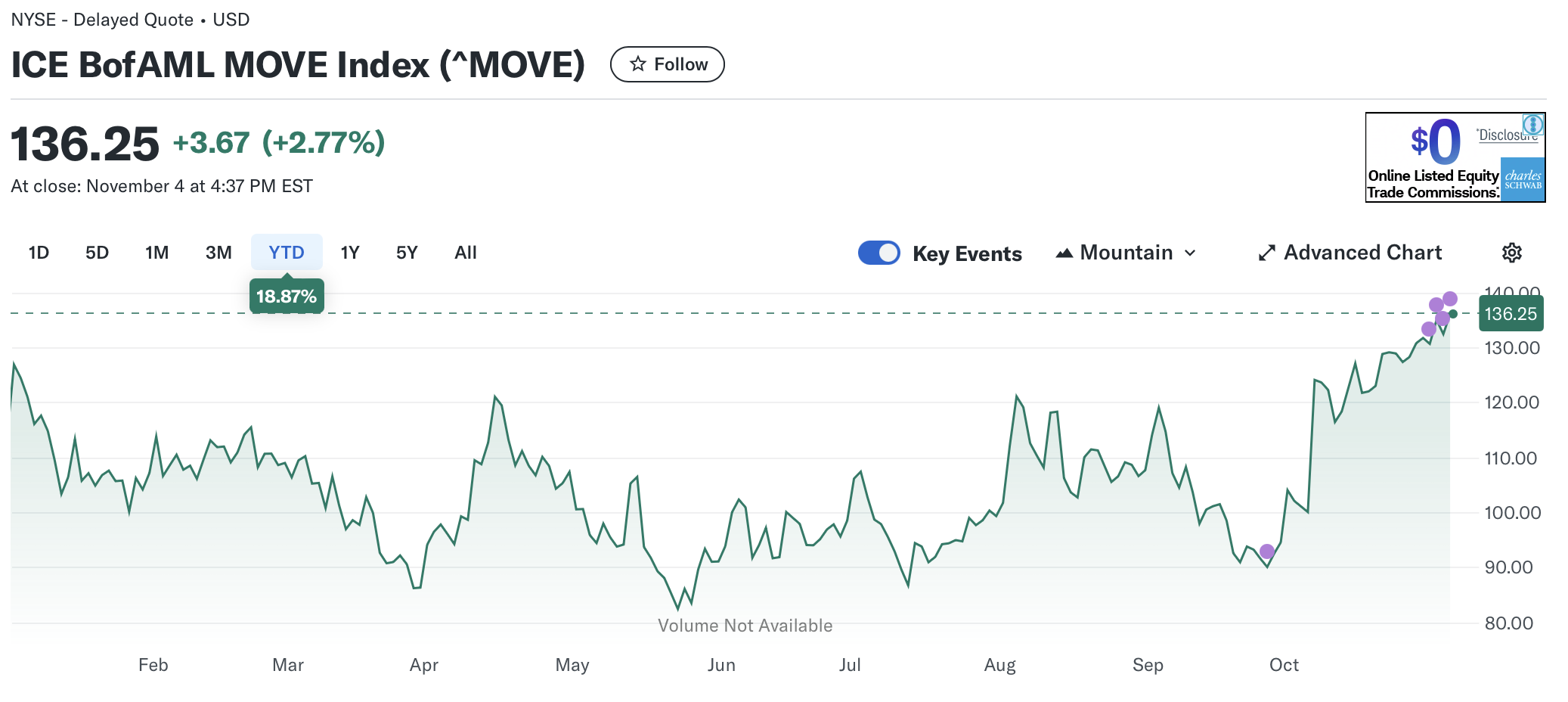
Finally, the MOVE Index, which is the bond market volatility index shows very similar behavior, a steady climb over the past month especially, but truly trending higher since the summer as seen below:

Source: Yahoo Finance

My point is that given the growing uncertainty across all markets as well as the complete inability to, ex ante, determine who is going to win the election, the signal to noise ratio of price movement right now is approximately 100% noise, at least in financial markets.  Commodity markets have a bit of a life away from the election, so price action there is far more representative of true supply and demand issues.  Arguably, this is merely another consequence of the financialization of most things, the loss of market signals as they have been overwhelmed by the flood of liquidity provided by central banks around the world.

At any rate, until we know who wins, it will be difficult to establish a view of the near-term or long-term future of market activity. So, let’s recap the overnight session as its all we have left.

After yesterday’s equity selloff in the US, most Asian exchanges posted gains led by China (+2.5%) and Hong Kong (+2.1%) which responded to comments from Chinese Premier Li Qiang’s comments that, “The Chinese government has the ability to drive sustained economic improvement.”  And perhaps they do, although there are clearly issues regarding the local entities that are willing to gain at the expense of each other in order to demonstrate their own progress.  But Japanese shares (+1.1%) also rallied along with most of the region, perhaps a direct analogy to the US decline as the ‘Trump trade’ has included weakness in markets likely subject to Trump’s promised tariffs.  Meanwhile, in Europe, bourses have edged slightly higher this morning, between 0.1% and 0.2%, with no new data or news of note.  Interestingly, US futures are starting to trade higher at this hour (6:50), perhaps an indication of market beliefs, although just as likely part of the random walk down Wall Street.

In the bond market, Treasury yields (+3bps) are creeping higher again, also in line with the Trump trade, and that seems to be dragging European sovereign yields along for the ride as all those markets have seen yields climb between 4bps and 5bps.  Again, given the lack of new data, and the history of these yields following Treasuries, I see no other strong explanation. 

In the commodity markets, oil (+0.3%) continues its rebound and has now gained more than 6.5% in the past week.  The combination of OPEC+ delaying their planned production increases and seeming hopes for a pickup in Chinese demand on the back of the coming details of the stimulus package seems to have traders in a better mood these days.  As to the metals markets, they are all firmer this morning with gold (+0.2%) mostly biding its time ahead of the election, but both silver (+0.8%) and copper (+0.9%) starting to accelerate a bit.  Nothing has changed my view that regardless of the election outcome, this space is far more dependent on continued central bank policy easing and there is no indication that is going to end soon.

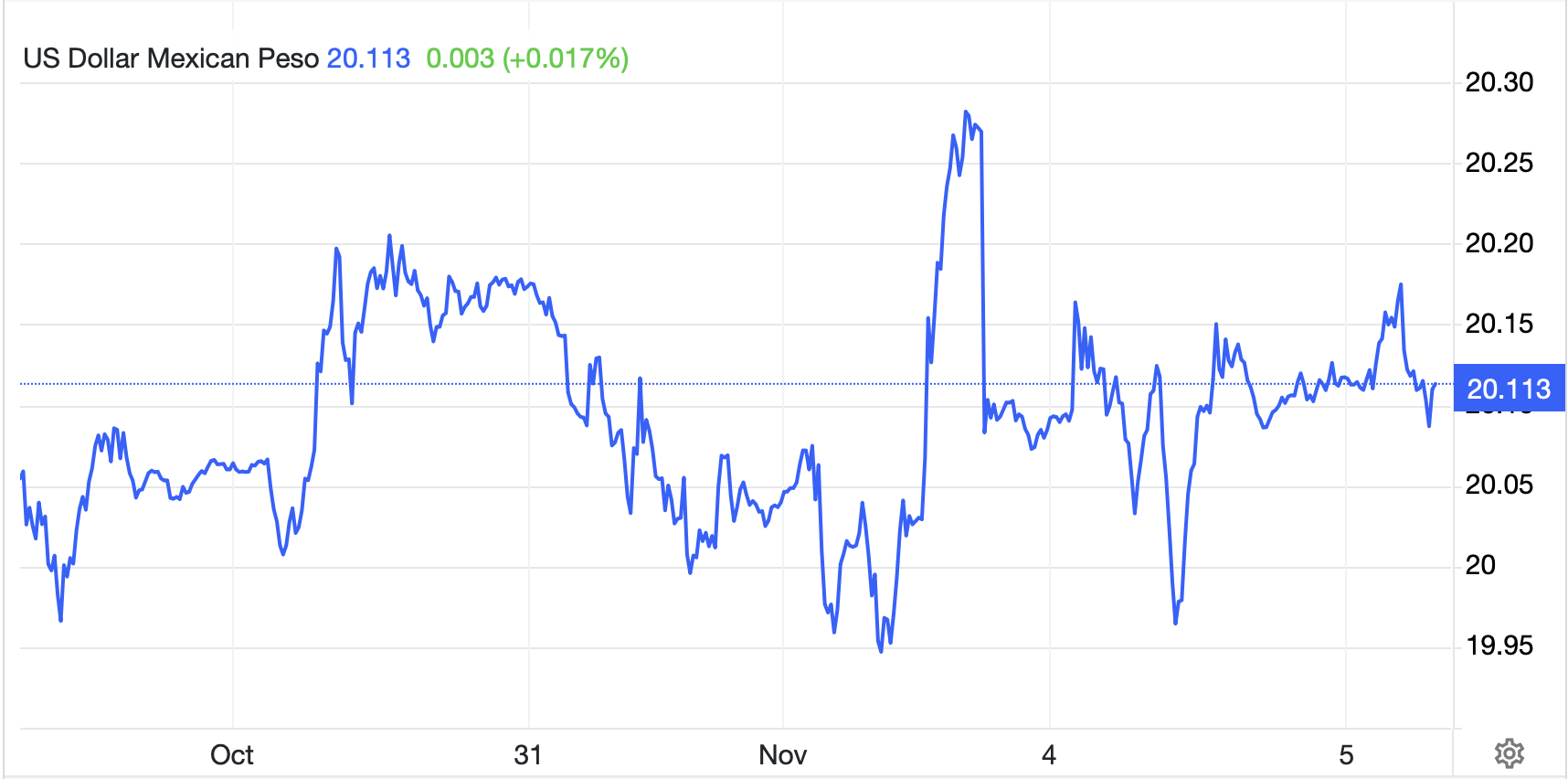
Finally, the dollar is softer again this morning, but in a more muted fashion than the past several sessions.  Although, with that in mind, we still see the euro and pound both climbing a further 0.25% and AUD (+0.6%) today’s leader after the RBA left rates on hold with a more hawkish statement than anticipated.  But the weakness is widespread with NOK (+0.4%) continuing to benefit from oil’s rise while ZAR (+0.6%) gains on the back of the rise in metals.  Of course, the currency that has seen the most discussion ahead of the election is MXN.  It is basically unchanged this morning, a perfect description of the narrative that the election will be extremely close.  However, a quick look at its price movement over the past week shows that it follows every bump in the polls.

Source: tradingeconomics.com

And that’s really it this morning.  We see the Trade Balance (exp -$84.1B) and ISM Services (53.8) but honestly, nobody is going to respond to that data.  Instead, all eyes will be on the early exit polls and the reporting of how the election is going.  No matter what, it seems hard to believe we will really have an idea before 10:00pm this evening, and then only if it is a blowout in either direction, seemingly a low probability.  So, today is a day to watch and wait if you don’t already have hedges in place because honestly, it’s probably too late to do anything now.

Good luck and go vote

Adf

New Shibboleth

A second rate hike
By Japan has resulted
In strong like bull yen


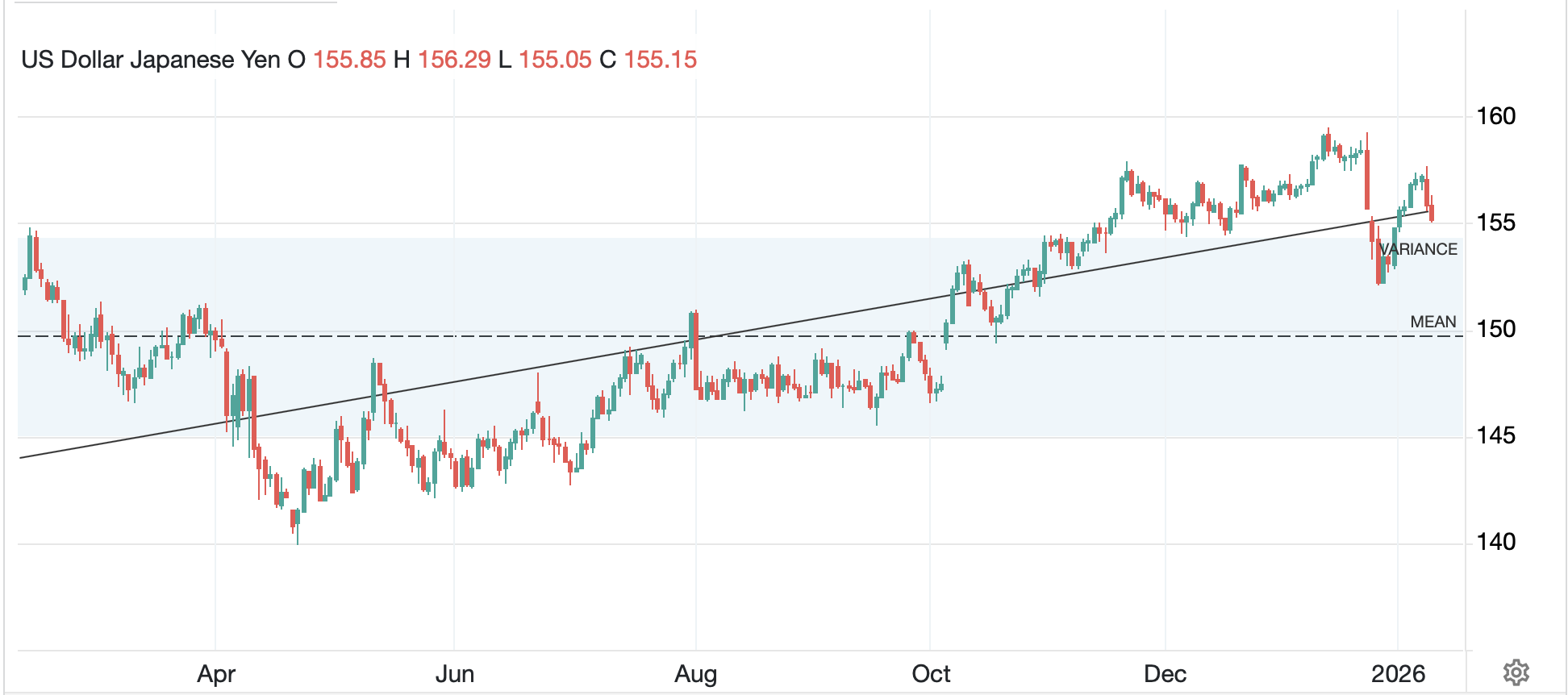
Last night, Governor Kazuo Ueda and the BOJ raised their overnight call rate to 0.25% from the previous level of between 0.00% and 0.10%.  This move was forecast by several analysts but was certainly not the base case for most, nor what this poet expected.  However, it appears that the gradual slowing in inflation in Japan was not seen as sufficient and so they moved.  By far, the biggest reaction came in the FX markets where the yen jumped sharply, now higher by 1.5% compared to yesterday’s NY close.  A look at the longer-term chart of USDJPY below shows that at its current level just above 150.00 (obviously a big round number), the currency has reached a double support level based on its 50-week moving average (the curved line) and the trend line that starts from the time the Fed began raising interest rates in March 2022.

Source: tradingeconomics.com

Surprisingly, given the sharp move seen overnight, there has been virtually no discussion as to whether the MOF asked the BOJ to intervene and further push the yen higher (dollar lower) in concert with its recent strategy of pushing a market that is moving in its favor rather than fighting a market that is moving against its goals.  Regardless, the 150 level is going to be a very important technical support, and any break below may open up another 10 yen decline in the dollar.

What, you may ask, would lead to such a move?  How about the Fed?

The pundits are holding their breath
With “cut Jay” their new shibboleth
But will Chairman Powell
Now throw in the towel
On prices and channel Macbeth?

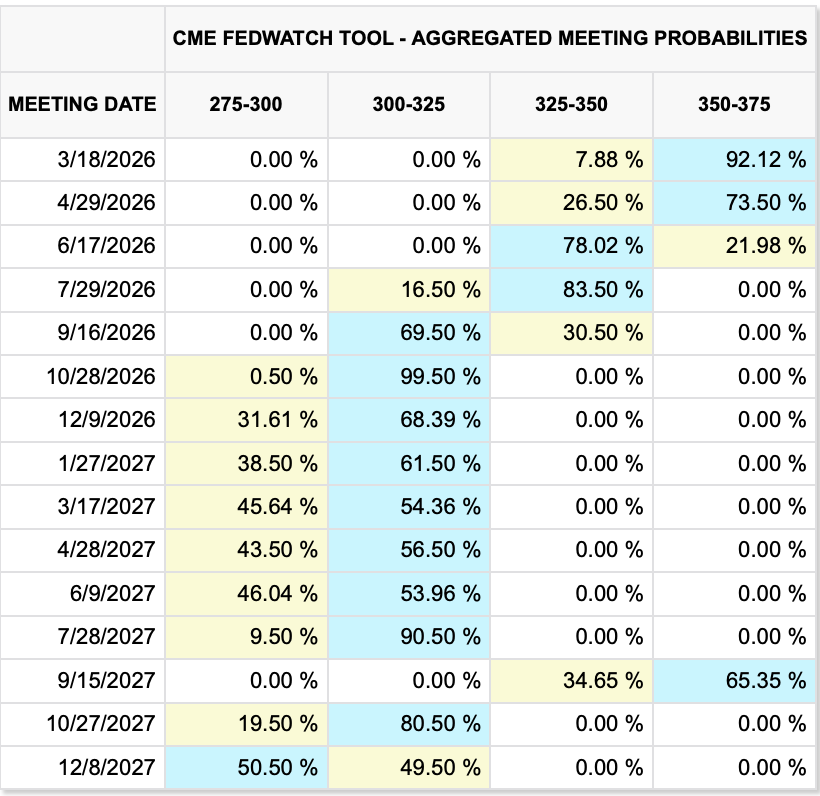
Of course, this afternoon, the big news is the FOMC meeting wraps up and at 2:00 they release their statement which is followed by the Chairman’s press conference at 2:30.  As of this morning, the probability of a cut today is down to 3.1% according to the CME’s futures market.  However, that market has a 25bp cut locked in for September with a further 10% probability of a 50bp cut then and is pricing in a total of 66bps of cuts by the December meeting, so, a bit more than a 60% probability of three 25bp cuts by the end of the year.  That pricing continues to feel aggressive to this poet as the data has not yet shown that the economy is clearly in trouble.  Remember, too, the Fed is always reactive, despite any of their comments on trying to get ahead of the curve.

Continuing our observations of mixed data, yesterday saw that home prices, as per the Case-Shiller Index, remain robust, rising 6.8% in May (this data is always lagging), but there is little indication that the shelter component of the inflation statistics is set to decline sharply.  As well, the JOLTs Job Openings data printed at a higher than expected 8.184M, indicating that there is still labor demand out there.  Finally, the Consumer Confidence number rose a touch more than expected to 100.3.  My point is there continues to be strength in many parts of the economy and prices are nowhere near declining.  Granted, this Friday’s NFP report will take on added importance as if the numbers there start to decline and Unemployment continues its recent trend higher, there will be far more urgency to cut rates.  Perhaps this morning’s ADP Employment report (exp 150K) will help clear up some things, but I’m not confident that is the case.

Interestingly, there are still a number of analysts who are clamoring for the Fed to cut today, claiming they can get ahead of the curve and stick the soft landing.  However, history has shown that the Fed lives its life behind the curve, and there is no indication that is about to change.

There is one other thing to consider, though, and that is the politics of the situation.  While the Fed is adamant they are apolitical and only trying to achieve their mandated goals, we all know that in order to even be considered to reach the FOMC as a named member of the committee, one needs to be highly political.  Does that mean that partisan politics enters the arena?  These days, it is almost impossible for that not to be the case.  

The current narrative on this subject is that a rate cut will help the current administration, and by extension the candidacy of VP Harris.  I’m not sure I understand that given inflation, which remains a major topic of conversation around the country, especially at the proverbial kitchen table, is so widely hated across the board.  The most interesting poll results I saw were that a majority of those questioned indicated they hated inflation far more than a recession.  This surprised the economic PhD set, but as inflation is an insidious cancer on everyone’s wellbeing, it is no surprise to this poet.  My point is that a rate cut now will do exactly zero to help support growth before the election, but it will almost certainly boost the price of commodities, notably energy and gasoline, and that will show up in inflation post haste.  Thus, does the narrative even make sense?  If Powell is truly partisan (and I don’t think that is the case), he would refrain from cutting rates until September as any impact, other than in financial markets, will not be felt until long after the election.  FWIW, I agree with the market there will be no cut today, but absent a major decline in the employment situation by September, I see only 25bps there.

Ok, a bit too long to start today, but obviously there is much of importance to understand.  So, let’s look at how markets have responded to the BOJ while they await the FOMC.  As earnings season continues, the tech sector in the US continues to struggle as evidenced by the sharp decline in the NASDAQ yesterday, although the DJIA managed to gain 0.5%.  In Asia, though, tech concerns were overwhelmed by the excitement of the BOJ’s action and the strength in the yen.  Perhaps the surprising thing is the Nikkei (+1.5%) rose so much given a strong yen generally undermines the index, but the rate hike boosted bank shares by 5% or more across the board.  And that strong yen was welcomed everywhere else in Asia with Chinese shares (Hang Seng +2.0%, CSI 300 +2.2%) and almost every regional exchange gaining real ground on the back of a less competitive Japan given the higher yen.

In Europe, most markets are much firmer as well this morning, led by the CAC (+1.4%) and FTSE 100 (+1.4%) although Spain’s IBEX (-1.0%) is lagging on uninspiring corporate earnings results.  I would contend these markets are being helped by that stronger yen as well, given Japan’s status as a major exporter.  Lastly, US futures are higher at this hour (7:20) after some better-than-expected results from chipmaker AMD, although MSFT’s numbers were less impressive.  Net, though, NASDAQ futures are up 1.6% this morning dragging everything else along for the ride.

In the bond market, Treasury yields continue to edge lower, down -1bp this morning and European sovereign yields are all lower by between -2bps and-3bps.  That is somewhat interesting given the flash Eurozone inflation data printed higher than expected at 2.6% headline, 2.9% core, but the market is clearly going all-in on the rate cutting narrative.  The big moves in this market, though, came in Asia with JGB yields jumping 5bps after the rate hike and the BOJ’s announcement they would be reducing their monthly purchases by 50%…OVER THE NEXT TWO YEARS!  They are not exactly rushing to tighten policy.  However, even more impressive was the -16bp decline in Australian 10yr bond yields after softer than expected inflation data overnight got the market thinking about rate cuts instead of the previous view of rate hikes being the next move.

In the commodity markets, things have really broken out.  Oil (+3.5%) is finally paying attention to the escalation of hostilities in the Middle East after Hamas leader Haniyeh was killed while in Iran.  While Israel has not officially claimed the act, that is the assumption and concerns are elevated that there will be a more dramatic response impacting many oil producing nations.  This has encouraged the rally in precious metals with gold (+0.4%) continuing its rally after a >1% gain yesterday, and support for both silver and copper as well.  Frankly, the copper story doesn’t make that much sense given the ongoing lackluster economic growth story, but with the metal’s recent sharp decline, this could simply be a trading bounce.

Finally, the dollar is all over the place this morning.  As mentioned above, the yen is today’s big winner, but we have seen strength in CNY (+0.25%) and KRW (+0.85%) as well, with both those currencies directly aided by yen strength.  Meanwhile, AUD (-0.5%) has responded to the quickly evolving rate story Down Under and is cementing its position as the worst performing G10 currency in July.  Not surprisingly, the commodity linked currencies are having a good day with ZAR (+0.6%) and NOK (+0.5%) both stronger, but after that, the financially linked currencies are not doing very much, so the euro, pound, Loonie and Swiss franc are all only marginally changed on the day.

In addition to the ADP and the FOMC, this morning also brings the Treasury’s QRA, although there is little interest in that report this time around as expectations remain that there will be no major change to the recent mix of debt, i.e., mostly T-bills.  We also see Chicago PMI (exp 44.5) and get the EIA oil data, although the latter will have a hard time competing with a pending war in the Middle East.

All told, not only has a lot happened, but there is also room for a lot more to occur before we go home today.  Quite frankly, I don’t see anything extraordinary coming from Powell, but the risk, to me, is he is more dovish than required and the dollar falls more broadly while commodity prices rise.  Keep your eye on that 150 level in USDJPY, as a break there can really get things moving.

Good luck

Adf
A Rough Week

Investors have had a rough week
As both stocks and bonds sprung a leak
The hope is, today
The data will say
Inflation is well past its peak

The thing is, Q3’s GDP
Described a robust ‘conomy
Will that push the Fed
When looking ahead
To restart their tightening spree?

I imagine most of us are a little tired of the negativity in markets on a daily basis of late.  Yesterday was just another in a series of negative equity market sessions with the US indices declining between -0.75% (DJIA) and -1.75% (NASDAQ).  And this happened despite (because of?) a significantly higher GDP report than most analysts had forecast.  The print, 4.9%, was truly impressive and it was accompanied by stronger than expected Durable Goods orders (4.7%) and continuing solid Initial Claims data (210K).  In other words, the data points to a robust US economy which, one might conclude, would be a positive for risk assets.  One would be wrong.

It seems there are many possible explanations for this seeming conundrum although I favor the following: ongoing elevated interest rates are putting pressure on earnings multiples and driving them lower.  The fact that GDP growth remains robust implies the Fed will be in no hurry to cut rates thus maintaining its higher for longer attitude for even longer.  In this situation, the discount cash flow model, which underlies much, if not most, stock market analysis, tells us that companies growing at 10% cannot be valued at 50x earnings, the math just doesn’t work.  Hence, despite solid performance, investors are rerating the value of these companies lower.  The bigger problem is that the current market multiple remains well above its long-term average so there is further, potentially, to fall.

One other thing to note regarding the economy is that it is quite common for there to be very strong quarterly GDP prints just before a recession begins.  Clearly yesterday’s number was quite strong, in fact the strongest (excluding the post-covid rebound) since Q1 2014.  However, that does not preclude the fact that we may still be headed toward a recession.  Now, arguably, a recession, or at least if the data starts to look like a recession is upon us, would get the Fed to change their tune and consider relaxing their current policy stance.  However, recessions tend to come with much lower earnings and historically are not that good for risk assets either.  It is this concern that has so many praying calling for a soft landing.  Alas, I would not wager on that outcome.

I think it is important to remember that market movements do not have to be driven by outside catalysts but can happen of their own volition.  In fact, that is my point on the rerating of market multiples.  This can occur regardless of any data, whether good or bad.  If the investor community is becoming nervous, and if there is an alternative like we have today with short-dated Treasuries yielding 5% or more, equity prices can decline much further around the world, whatever their current valuations are.  While we all try to rationalize movements in the markets after the fact, on any given day, no specific catalyst is needed from outside the market itself.

With this in mind, though, the rest of the world has not followed yesterday’s US market lead and instead we have seen a rebound in Asian shares with the Hang Seng (+2.1%) leading the way but the rest of the space mostly higher by at least 1%.  European bourses are more mixed with a combination of mostly small gains and losses although the CAC in Paris is an outlier (-1.0%).  US futures, though, are mostly in the green with the NASDAQ the leader (+0.6%) at this hour (7:45).

The bond story, though, is quite interesting as there has been a great deal of volatility in this space of late.  You may recall that I mentioned the abysmal 5-yr auction on Wednesday.  Well, yesterday the Treasury auctioned 7-year paper and the results were outstanding with the best bid-to-cover ratio since March 2020.  This led to a major rally in the bond market with yields continuing their yoyo movement and falling 14bps although this morning they are bouncing from those levels and are higher by 3bps.  European sovereigns did not come along for the Treasury ride yesterday showing much less movement and this morning they are edging lower by between 1bp and 3bps. This is in the wake of yesterday’s ECB meeting where Madame Lagarde left policy on hold for the first time after eleven consecutive rate hikes, and tried to explain that they would be completely data dependent for the time being.  Not for nothing but the recent data from Europe looks pretty awful, so if that is the case, I would expect to see cuts on the horizon there.

Volatility continues apace in the oil market as well with yesterday’s decline followed by 1.5% rally this morning.  It seems that yesterday’s story about a potential de-escalation of the Israeli-Palestinian crisis was trumped by news that the US had bombed several sites in Syria in response to attacks on US bases in Iraq last week.  Ostensibly these sites are controlled by Iranian proxies indicating the possibility of a widening conflict in the Middle East.  I suspect that we are going to continue to see volatility here, but net, the structural issues remain beneficial for oil in my view.  As to gold, it is little changed this morning and simply maintaining its recent gains as fear continues to be a market driver right now.  Base metals were clearly cheered by the strong US data as both copper (+1.1%) and aluminum (+0.25%) are firmer this morning.

Looking at the dollar, it should be no surprise that it continues to perform well overall.  Between the risk issues and the strong economic data, the US certainly seems a better place to put your money than most others right now.  USDJPY continues to trade above 150 but is not running away and there is no indication the BOJ has been involved at all.  The euro keeps pushing toward 1.05 and the pound looks like it is headed down to 1.20 soon.  USDCNY is back near its recent highs as the perceived benefits of Chinese fiscal stimulus are not seen as yuan positives at this point, especially given the divergence between US and Chinese monetary policy.  It is very difficult, at this time, to come up with a reason for the dollar to decline in any substantial way.

On the data front, this morning brings Personal Income, (exp 0.4%), Personal Spending (0.5%), and the all-important Core PCE (0.3%, 3.7% Y/Y) with Michigan Sentiment (63.0) coming later at 10:00.  At this point, all eyes remain on the FOMC meeting next week where there is essentially no expectation of a rate move.  We would need to see a REALLY hot PCE number this morning to change that.  As such, I expect that a consolidation in risk markets is quite possible with little movement in the dollar overall.  Beware, however, if stocks sell off later today as that could be a tell that there is more pressure to come.  I clearly recall that the Friday before Black Monday in October 1987, stocks sold off aggressively, just not as aggressively as they did on the Monday!.

Good luck and good weekend

Adf

To ZIRP They’ll Adhere

The sides of the battle are set
Will shortfalls, inflation, beget
Or is it the call
That prices will fall
Because of those trillions in debt

In circles, official, it’s clear
That no one believes past this year
Inflation will heighten
And so, they won’t tighten
But rather, to ZIRP they’ll adhere

It appears that the market is arriving at an inflection point of some type as the question of inflation continues to dominate most macroeconomic discussions.  For those in the deflation camp, rising prices are not nearly enough to declare that inflation is either upon us or coming soon, while inflationistas are quite comfortable highlighting the steady drumbeat of rising prices across both commodities and finished products as evidence of the new paradigm.  Both sides of this discussion recognize that the CPI data released last week was juiced by the base effects of the economic impact of last year’s government lockdowns and the ensuing price declines we saw in March, April and May of last year.  Which means that the entire argument is based on dueling forecasts of the future beyond that.  In other words, until we see the CPI print covering June but released in the middle of July, we will only have speculation as to the future impact.

What is transitory?  Ultimately, that becomes the biggest question in markets as the Fed has been harping on that word for months now.  According to Merriam-Webster, it describes something of brief duration or temporary.  Which begs the question, what is brief?  Is 3 months brief?  6 months?  Longer?  Arguably, brief depends on the context involved.  For instance, 3 months is an eternity when considering a spot FX trading position, while it is but a blink of an eye when considering a pension fund’s time horizon for investments.

There continue to be strong arguments in favor of both sides of the argument.  On the deflationist side the main points are; debt, demographics, technology and globalization, all of which have been instrumental in essentially killing inflation over the past 40 years.  No one can argue with the fact that the massive amount of debt outstanding will lead to an increasing utilization of resources to service that debt and prevent spending elsewhere driving up prices.  As nations around the world age, the strong belief is that individuals consume less (except perhaps healthcare) and thus reduce demand for everyday items.  Technology essentially exists to reinvent old processes in a more efficient form, thus reducing the cost of providing them, while globalization has been the underlying cause for the excess supply of labor, capping wages and any wage/price spiral.  In addition, they argue that inflation is not a one-off price rise, but a constant series of rising prices that feeds through to every item over time.

Inflationists see the world in a different manner post-Covid, as they highlight the breakdown of globalization with regulations preventing international travel and efforts to reduce the length of supply chains.  In addition, they point to the extraordinary growth in the money supply, with the added fact that unlike in the wake of the GFC, this time there is significant fiscal spending which is pushing that money beyond the confines of financial markets and manifesting itself as rising prices.  We continue to see company after company announce price hikes of 7%-15% for everyday staples which is exactly they type of situation that gets people talking about inflation.  Inflationists highlight the fact that there are shortages of commodity products worldwide and that because of the dramatic shutdowns last year from Covid, capex in mining and energy exploration was decimated thus delaying any opportunity for supply to catch up to current demand, which, by the way, is growing rapidly amidst the fiscal support.  As they are wont to say, the Fed can’t print copper or corn.  The point is, if there are basic product shortages for more than a year and prices continue to rise, is that still transitory?

Right now, there is no clear answer, which is what makes the discussion both entertaining and crucial to the future direction of financial markets.  By now, you are all aware I remain in the inflationist camp and have been for a while.  I cannot ignore the rising prices I see every time I go into a store.  But the deflationists make excellent points.  This argument discussion will rage for at least another two months and the July CPI release.  Until then, the one thing that seems clear is that market volatility is likely to remain significant.

As to markets today, while Asia had a mixed equity session (Nikkei -0.9%, Hang Seng +0.6%, Shanghai +0.8%), Europe has come under pressure as the morning has progressed.  At this time, we are seeing all red numbers led by the FTSE 100 (-0.7%), with the CAC (-0.4%) and DAX (-0.3%) both slipping as well.  US futures, which had been essentially unchanged all night are starting to slip as well, with all three major indices currently lower by 0.3%.

Interestingly, bond yields are edging higher this morning, at least edging describes Treasury yields (+0.2bps) while in Europe, sovereign markets are selling off pretty aggressively.  Bunds (+2.2bps), OATs (+3.1bps) and Gilts (+2.1bps) are all lower, while Italian BTPs (+5.5bps) continue to see their spread vs. bunds widen rapidly, up more than 20bps in the past 3 months.

Commodity prices are having a more complicated session with oil essentially unchanged, gold (+0.3%) and silver (+0.75%) both firmer along with base metals (Cu +0.5%, Al +0.9%, Sn +0.6%) while agricultural products are more mixed (Soybeans +0.4%, Wheat -0.8%, Corn +0.75%).

Finally, the dollar is mixed with gainers and losers across both G10 and EMG blocs.  Even though commodity prices are holding up reasonably well, the commodity bloc in the G10 is weak this morning, led by NZD (-0.7%), NOK (-0.6%) and AUD (-0.3%).  Much of this movement seems to be on the back of positioning rather than fundamental news.  On the plus side, JPY (+0.2%), and EUR (+0.2%) are the leading gainers, but it is hard to get excited about such small movements.

EMG currencies have seen a bit more variance with APAC currencies under pressure (IDR -0.6%, KRW -0.5%, SGD (-0.3%) as concerns grow over another wave of Covid inspired lockdowns slowing recovery efforts in the economies throughout the region.  CNY is little changed after overnight data showed Retail Sales (17.7%) much weaker than the expected 25.0% gain although the other key data points, Fixed Asset Investment (19.9%) and IP (9.8%) were both pretty much in line.  On the positive side we see TRY (+1.0%) on the back of easing Covid restrictions alongside a healthy C/A surplus in April, and HUF (+0.7%) after a central banker intimated that they could be raising interest rates to fight inflation as soon as next month.

Not a ton of data this week, but here is what we see:

Today Empire Manufacturing 23.9
Tuesday Housing Starts 1705K
Building Permits 1770K
Wednesday FOMC Minutes
Thursday Initial Claims 455K
Continuing Claims 3.64M
Philly Fed 41.9
Friday Existing Home Sales 6.08M

Source: Bloomberg

The Fed speaking calendar is a bit less full this week with only four different speakers although they will speak seven times in total.  Vice-Chair Clarida is the most important voice, but we already know that he is going to simply defend the current policy regardless of data.

With all that in mind, it appears that the dollar remains beholden to the Treasury market, so today’s limited movement, so far, in the 10-year has seen mixed and limited movement in the buck.  This goes back to the opening discussion; if you think inflation is coming, and expect Treasury yields to continue to rise, look for the dollar to follow along.  If you are in the deflationist camp, it’s the opposite.  But remember, at a point in time, inflation will undermine the dollar’s value.  Just not right away.

Good luck and stay safe
Adf

More Terrified

The narrative starting to form
Is bond market vol’s the new norm
But Jay and Christine
Explain they’re serene
Regarding this new firestorm

However, the impact worldwide
Is some nations must set aside
Their plans for more spending
As yields are ascending
And FinMins grow more terrified

Confusion is the new watchword as investors are torn between the old normal of central bank omnipotence and the emerging new normal of unfettered chaos.  Now, perhaps unfettered chaos overstates the new normal, but price action, especially in the Treasury and other major government bond markets, has been significantly more volatile than what we had become used to since the first months of the Covid crisis passed last year.  And remember, prior to Covid’s appearance on the world stage, it was widely ‘known’ that the Fed and its central bank brethren had committed to insuring yields would remain low to support the economy.  Of course, there was the odd hiccup (the taper tantrum of 2013, the repo crisis of 2018) but generally speaking, the bond market was not a very exciting place to be.  Yields were relatively low on a long-term historical basis and tended to grind slowly lower as debt deflation central bank action guided inflation to a low and stable rate.

But lately, that story seems to be changing.  Perhaps it is the ~$10 trillion of pandemic support that has been (or will soon be) added to the global economy, with the US at $5 trillion, including the upcoming $1.9 trillion bill working its way through Congress, the leading proponent.  Or perhaps it is the fact that the novel coronavirus was novel in how it impacted economies, with not only a significant demand shock, but also a significant supply shock.  This is important because supply shocks are what tend to drive inflation with the OPEC oil embargos of 1973 and 1979 as exhibits A and B.

And this matters a lot.  Last week’s bond market price action was quite disruptive, and the terrible results of the US 7-year Treasury auction got tongues wagging even more about how yields could really explode higher.  Now, so far this year we have heard from numerous Fed speakers that higher yields were a good sign as they foretold a strong economic recovery.  However, we all know that the US government cannot really afford for yields to head that much higher as the ensuing rise in debt service costs would become quite problematic.  But when Chairman Powell spoke last week, he changed nothing regarding his view that the Fed was committed to the current level of support for a substantially longer time.

Yesterday, however, we heard the first inkling that the Fed may not be so happy about recent bond market volatility as Governor Brainerd explained that the sharp moves “caught her eye”, and that movement like that was not appropriate.  This is more in sync with what we have consistently heard from ECB members regarding the sharp rise in yields there.  At this point, I count at least five ECB speakers trying to talk down yields by explaining they have plenty of flexibility in their current toolkit (they can buy more bonds more quickly) if they deem it necessary.

But this is where it gets confusing.  Apparently, at least according to a top story in Bloomberg this morning which explains that ECB policymakers see no need for drastic action to address the rapidly rising yields of European government bonds, everything is fine.  But if everything is fine, why the onslaught of commentary from so many senior ECB members?  After all, the last thing the ECB wants is for higher yields to drive the euro higher, which would have the triple negative impact of containing any inflationary impulses, hurting export industries and ultimately slowing growth.  To me, the outlier is this morning’s story rather than the commentary we have been hearing.  Now, last week, because of a large maturity of French debt, the ECB’s PEPP actually net reduced purchases, an odd response to concerns over rising yields.  Watch carefully for this week’s action when it is released next Monday, but my sense is that number will have risen quite a bit.

And yet, this morning, bond yields throughout Europe and the US are strongly higher with Treasuries (+5.3bps) leading the way, but Gilts (+3.6bps), OATs (+2.7bps) and Bunds (+2.4bps) all starting to show a near-term bottom in yields.  The one absolute is that bond volatility continues to be much higher than it has been in the past, and I assure you, that is not the outcome that any central bank wants to see.

And there are knock-on effects to this price action as well, where less liquid emerging and other markets are finding fewer buyers for their paper.  Recent auctions in Australia, Thailand, Indonesia, New Zealand, Italy and Germany all saw much lower than normal bid-to-cover ratios with higher yields and less debt sold.  Make no mistake, this is the key issue going forward.  If bond investors are unwilling to finance the ongoing spending sprees by governments at ultra-low yields, that is going to have significant ramifications for economies, and markets, everywhere.  This is especially so if higher Treasury yields help the dollar higher which will have a twofold effect on emerging market economies and really slow things down.  We are not out of the woods yet with respect to the impact of Covid and the responses by governments.

However, while these are medium term issues, the story today is of pure risk acquisition.  After yesterday’s poor performance by US equity markets, Asia turned things around (Nikkei +0.5%, Hang Seng +2.7%, Shanghai +1.9%) and Europe has followed along (DAX +0.9%, CAC +0.6%, FTSE 100 +0.8%).  US futures are right there with Europe, with all three indices higher by ~0.6%.

As mentioned above, yields everywhere are higher, as are oil prices (+1.5%).  However, metals prices are soft on both the precious and base sides, and agricultural prices are mixed, at best.

And lastly, the dollar, which had been softer all morning, is starting to find it footing and rebound.  CHF (-0.3%) and JPY (-0.25%) are the leading decliners, but the entire G10 bloc is lower except for CAD (+0.1%), which has arguably benefitted from oil’s rally as well as higher yields in its government bond market.  In what cannot be a great surprise, comments from the ECB’s Pablo Hernandez de Cos (Spanish central bank president) expressed the view that they must avoid a premature rise in nominal interest rates, i.e. they will not allow yields to rise unopposed.  And it was these comments that undermined the euro, and the bulk of the G10 currencies.

On the EMG front, overnight saw some strength in Asian currencies led by INR (+0.9%) and IDR (+0.55%) as both were recipients of foreign inflows to take advantage of the higher yield structure available there.  On the downside, BRL (-0.7%) and MXN (-0.5%) are the laggards as concerns grow over both governments’ ongoing response to the economic disruption caused by Covid.  We have seen the Central Bank of Brazil intervening in markets consistently for the past week or so, but that has not prevented the real from declining 5% during that time.  I fear it has further to fall.

On the data front, ADP Employment (exp 205K) leads the day and ISM Services (58.7) comes a bit later.  Then, this afternoon we see the Fed’s Beige Book.  We also hear from three more Fed speakers, but it would be shocking to hear any message other than they will keep the pedal to the metal for now.

Given all the focus on the Treasury market these days, it can be no surprise that the correlation between 10-year yields and the euro has turned negative (higher yields leads to lower euro price) and I see no reason for that to change.  The story about the ECB being unconcerned with yields seems highly unlikely.  Rather, I believe they have demonstrated they are extremely concerned with European government bond yields and will do all they can to prevent them from moving much higher.  While things will be volatile, I have a sense the dollar is going to continue to outperform expectations of its decline for a while longer.

Good luck and stay safe
Adf