Over the Hump

It’s beautiful and it’s quite big
Though more complicated than trig
But President Trump
Got over the hump
Though sans views that he is a Whig
 
As well, Friday’s Canada rift
Has ended, boy that was sure swift
Now, this week we’ll learn
If there’s still concern
‘Bout jobs, or if there’s been a shift


The weekend news revolves around the fact that the Senate has passed the BBB with a 51-49 vote, and it now moves to committee so both Houses of Congress can agree the final details before it gets to President Trump’s desk for signature and enactment.  This is another victory for the President, adding to last week’s wins and remarkably there have been several others as well.  The Supreme Court ended the ability of a single district court judge to injunct the entire nation based on a single case, a move that will prevent judges who disagree with the president from stopping his policy efforts.  Then, Canada announced they were going to impose a tax on US technology companies (the one that the Europeans just killed) and after Mr Trump ended the trade dialog quite vociferously, Canada backed down from that stance and is back at the negotiating table.

I mention this not to be political but as a backdrop to what is helping to drive the improved sentiment in US markets for both equities and bonds.  While a quick look at YTD performances of US equity indices vs. Europeans shows the US still lags, that gap is narrowing as the news cycle continues to point to positive things happening in the US.  Certainly, my understanding of the BBB is that it is quite stimulative, although it is changing priorities from the previous administration.

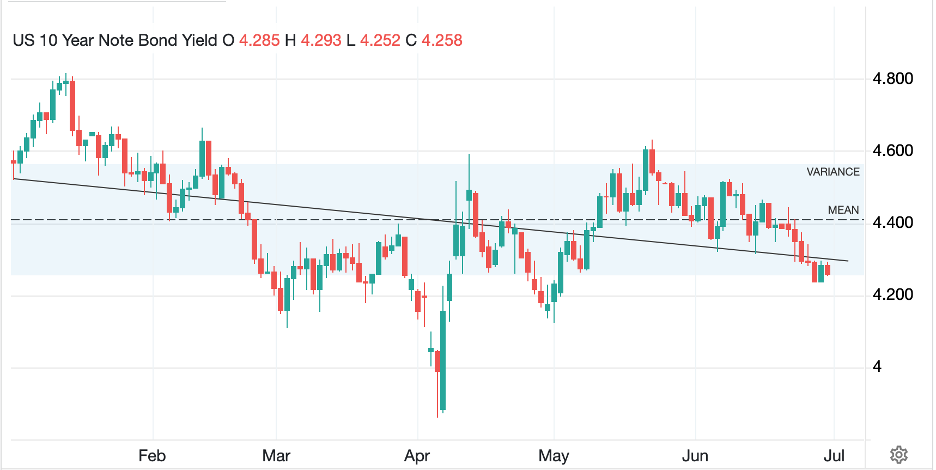
More interestingly, the Treasury market, which has been the subject of many slings and arrows lately from the part of the analyst community that continues to worry about refinancing the growing US debt pile, continues to behave remarkably well.  A quick look at the chart below shows that 10-year yields have been trending lower for the past 6 months, at least, and this morning are continuing that trend, slipping another -3bps.
Source: tradingeconomics.com

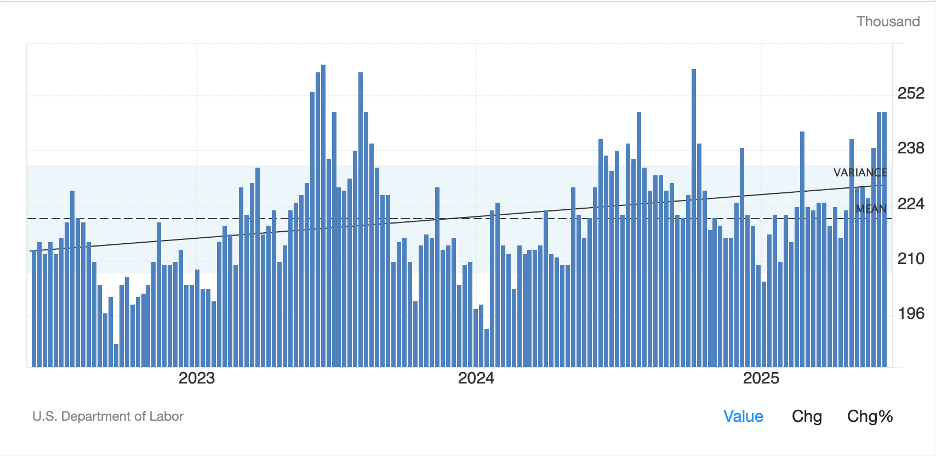
My point is that despite relentless doom porn regarding the economy, the big picture continues to point to ongoing growth in economic activity.  There are many anecdotes regarding the impending weakness, (the latest I saw was the increase in the number of credit card purchases that have been rejected is rising rapidly) and yet, the main data has yet to crack and roll over to point to a clear sign of significant slowing.  Perhaps this week when the NFP report is released on Thursday (Friday is July 4th holiday), we will see that long-awaited decline.  However, as of this morning, the Fed funds futures market continues to price just a 21% probability of a July rate cut as forecasts for NFP show the median to be 110K. 

While I completely understand the concerns that the doomers recite, I have come to understand that the idea of a recession is a policy choice, not a natural phenomenon.  While in the past, the business cycle was more powerful than the government, that is no longer the case.  Rather, what we have observed over the past 15 years at least, since the GFC and the onset of QE, is that the government has become a large enough part of the total economy to drive it at the margin.  And I assure you, if a recession is a policy choice, there is not a politician that is going to choose one.  Perhaps we will reach a point where the imbalances get beyond the control of the central banks and their finance ministries, but we are not there yet.

Ok, let’s take a peek at the overnight price action.  Despite all the spending promises by governments around the world, yields have slipped everywhere with all European sovereigns taking their lead from the US and lower this morning by -2bps to -3bps.  Even JGB yields (-1bp) have managed to decline slightly.  If inflation fears are building, they are not obvious this morning.

In the equity markets, Friday’s US rally was followed by most Asian bourses rising (Nikkei +0.8%, Australia +0.3%, China +0.4%) although HK (-0.9%) slipped after Chinese PMI data was released that indicated things weren’t collapsing, but that future monetary stimulus may not be coming after all.  The worst of both worlds for stocks.  Meanwhile, European exchanges are mostly a touch softer, but only on the order of -0.2%, so really very little changed amid light volume overall.  Interestingly, US futures are solidly higher at this hour (7:00), rising by 0.55% across the board.

In the commodity markets, oil (-0.35%) is slipping a bit, but is basically hanging around near its recent lows as the market remains unconcerned about an escalation of fighting between Iran and Israel and any possible closure of the Strait of Hormuz.  Meanwhile, gold (+0.4%) is bouncing from a weak performance Friday which appears to have been a bit oversold, although copper and silver are not following suit this morning with the former (Cu -0.7%) the laggard.  However, all the metals remain sharply higher this year and in strong up trends.

Finally, the dollar is modestly softer again this morning with KRW (+0.9%) the biggest mover, by far, while the entire G10 complex is showing gains on the order of 0.1% to 0.2%.  This trend lower in the dollar remains strong (see chart below), but as I continue to remind everyone, we are nowhere near an extreme valuation in the dollar.  If, and it’s a big if, we see substantial weakening in the employment data, I think the Fed could decide to act and that would increase the speed of the downtrend (as well as goose inflation higher), but absent that, I do not see a sharp decline, rather a slow descent.  Remember, this is exactly what Trump and Bessent want, a more competitive dollar for the manufacturing sector.

Source: tradingeconomics.com

As it is the first week of the month, there is plenty of data to digest.

TodayChicago PMI43.0
TuesdayISM Manufacturing48.8
 ISM Prices Paid69.0
 JOLTs Job Openings7.3M
WednesdayADP Employment 85K
ThursdayNonfarm Payrolls110K
 Private Payrolls110K
 Manufacturing Payrolls-6K
 Unemployment Rate4.3%
 Average Hourly Earnings0.3% (3.9% y/Y)
 Average Weekly Hours34.3
 Participation Rate62.3%
 Initial Claims240K
 Continuing Claims1960K
 ISM Services50.5
 Factory Orders8.0%
 -ex Transport0.9%

Source: tradingeconomics.com

In addition to the payrolls, we hear from Chairman Powell again on Tuesday and Atlanta Fed president Bostic twice.  I guess the rest of the FOMC took a long holiday week(end).

As it’s a holiday week, I expect that activity will be light, although headline bingo remains a key part of the markets today.  I feel like the trends are well entrenched though, with the dollar slipping, equities and commodities rallying and bonds currently leaning toward lower yields, although that seems out of sync with the other markets.  But in the summer, with less liquidity and activity, anomalies can continue for a while.

Good luck

Adf
Full Schmooze

The temperature’s starting to fall
With Israel and Iran’s brawl
On hold for the moment
Though either could foment
Resumption, and break protocol
 
But that truce combined with the news
That Trump’s team are pushing full schmooze
On trade, has the markets
Increasing their bull bets
While skeptics are singing the blues


President Trump is having a pretty remarkable week.  The successful attack and destruction of Iran’s nuclear enrichment facilities combined with the news that the US and China have agreed the details of the trade framework that was outlined in Geneva and followed up in London has market participants feeling a lot better about the world this morning.  Add to that the news that a particularly onerous part of the BBB, Section 899, which was nicknamed the Revenge clause for its tax targeting anybody from nations that imposed excess taxes on US companies internationally, being stripped after negotiations with European leaders, and the fact that NATO has gone all-in on increasing their spending, and Mr Trump must be feeling pretty good this morning.  Certainly, most markets are feeling that, except those that thrive on chaos and fear, like precious metals.

In fact, this morning it seems that the entire discussion is a rehash of what has occurred all week with very little new added to the mix.  Data from the US yesterday was mixed, with Claims a bit softer and Durable Goods quite strong while the third look at Q1 GDP was revised lower on more trade data showing imports were greater than first measured while Consumer Spending and Final Sales were a bit weaker than expected.  Net, there was not enough to push a view of either substantial strength or weakness in the economy, so investors and their algorithms continue to buy shares.

The other story that continues to get airplay is the pressure on Chairman Powell and questions about whether at the July meeting Fed governors are going to vote against the Chairman.  Apparently, it has been 32 years since that has occurred (and you thought they were actual votes!) and the punditry is ascribing the dissent to politics, not economics.  It should, of course, be no surprise that there is a political angle as there is a political angle to every story these days, but the press is particularly keen to point out that the two most vocal Fed governors discussing rate cuts were appointed by Trump.

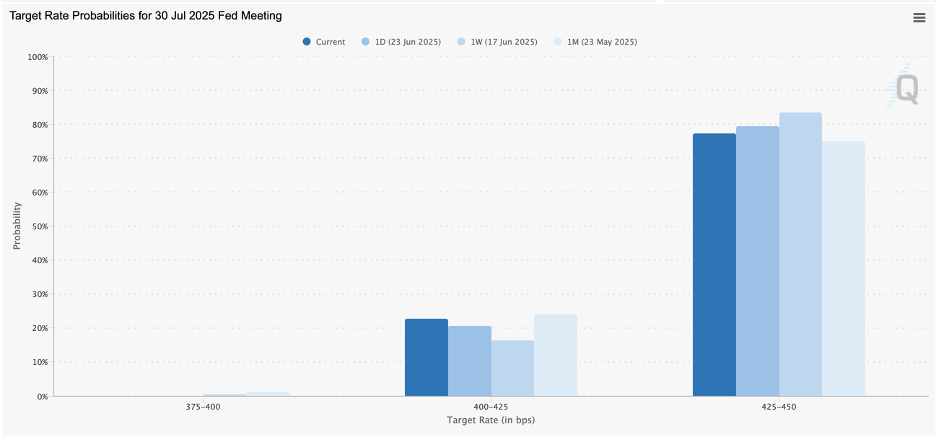
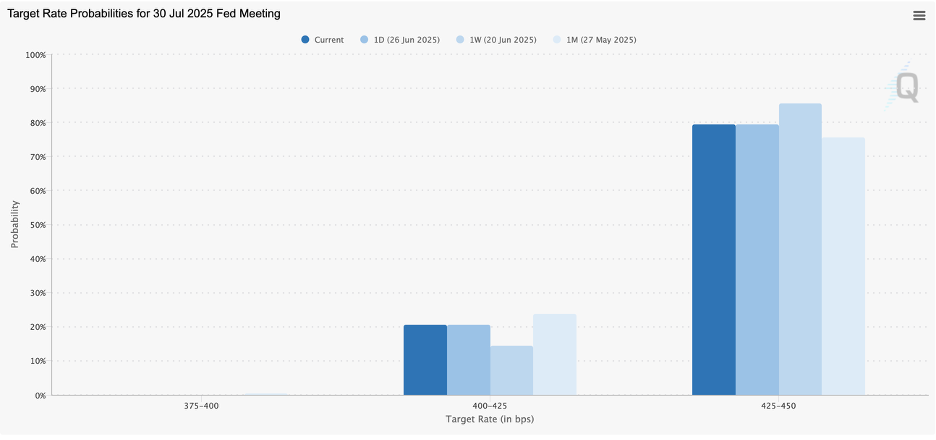
However, despite all the talk, the futures market does not appear to have adjusted its opinion all that much as evidenced by the CME chart of probabilities below.  In fact, over the past month, the probability of a cut has declined slightly.  Rather, I would contend that on a slow news Friday, the punditry is looking for a story to get clicks.

The last story of note is about the dollar and its ongoing weakness.  This is an extension of the Fed story as there is alleged concern that if the Fed is perceived to lose some of its independence, that will be a negative for the dollar in its own right, as well as the fact that the loss of independence would be confirmed by a rate cut when one is not necessary (sort of like last autumn prior to the election.  Interestingly, I don’t recall much discussion about the Fed’s loss of independence then.)

But, in fairness, the dollar has continued to decline with the euro trading to its highest level, above 1.17, in nearly four years.  It is hard to look at the story in Europe and think, damn, what a place to invest with high energy costs and massive regulatory impediments, so it is reasonable to accept that what had been a very long dollar position is getting unwound.  But look at the next two charts (source: tradingeconomics.com) of the euro, showing price action for one year and for five years, and more importantly notice the trend lines that the system has drawn.  There is no doubt the dollar is under pressure right now, but I am not in the camp that believes this is the beginning of the end of the dollar’s global status.  Remember, too, that President Trump would like to see the dollar soften to help the export competitiveness of the US, and so I would not expect to hear anything from the Treasury on the matter.

However, while these medium and long-term trends are clear, the overnight session was far less exciting with the largest move in any major currency the ZAR (+0.5%) which is despite the decline in gold and platinum prices.  Otherwise, today’s movement is basically +/- 0.2% across both G10 and EMG currencies.

Speaking of the metals, though, they are taking it on the chin this morning as we approach month end and futures roll action.  Gold (-1.3%), silver (-1.7%), copper (-0.9%) and platinum (-4.4%) are all under pressure, although all remain significantly higher YTD.  However, to the extent that they represent a haven and the fact that havens seem a little less necessary this morning seems to be the narrative driver adding to the month end positioning.  Meanwhile, oil (+0.5%) continues to bounce ever so slowly off the lows seen immediately in the wake of the bombing attacks.

Circling back to equity markets, after a nice day in the US yesterday, with gains across the board approaching 1% and the S&P 500 pushing to within points of a new all-time high, Japan (+1.4%) followed suit as did much of the region (India, Taiwan, New Zealand, Indonesia) but China (-0.6%) and Hong Kong (-0.2%) didn’t play along.  Europe, though, is having a positive session with gains ranging from 0.65% (DAX) to 1.3% (CAC) and everything in between.  It seems that the NATO spending news continues to support European arms manufacturers and the cooling of tensions in the Middle East has lessened energy concerns.  US futures are also bright this morning, up about 0.5% at this hour (7:40).

Finally, bond markets are selling off slightly after a further rally yesterday and yields since the close have risen basically 3bps in both Treasury and European sovereign markets.  There is still no indication that any government is going to stop spending, rather more increases are on the horizon, but there is also no indication that central banks are going to stop supporting this action.  No central bank is going to allow their nation’s bond market to become unglued, regardless of the theories of what they can do and what they control.  Ultimately, they control the entire yield curve.

On the data front, this morning brings Personal Income (exp 0.3%), Personal Spending (0.1%) the PCE data (Core 0.1%, 2.6% Y/Y; Headline 0.1%, 2.3% Y/Y) and at 10:00 Michigan Consumer Sentiment (60.5) and Inflation Expectations (1yr 5.1%, 5yr 4.1%).  There are several more Fed speakers, including Governor Cook, a Biden appointee who is a very clear dove, but has not yet agreed that rate cuts make sense.  It will be interesting to see what she has to say.

It is a summer Friday toward the end of the month.  Unless the data is dramatically different than forecast, I expect that the dollar will continue to slide slowly for now, although I do expect the metals complex to find a bottom and turn.  As to equities, apparently there is no reason not to buy them!

Good luck and good weekend

Adf

He’s the Worst

The talking points have been disbursed
With narrative writers well-versed
The dollar is falling
‘Cause Trump is now calling
For Powell to leave, “He’s the worst!”
 
The idea is Trump will soon name
The next Fed Chair, turning Jay lame
This shadow Fed Chair
Will have to beware
Since he’ll, for bad outcomes, get blame


The dollar is weaker this morning and if we use the Dollar Index as a proxy, it has fallen to its lowest level since February 2022.  

Source: tradingeconomics.com

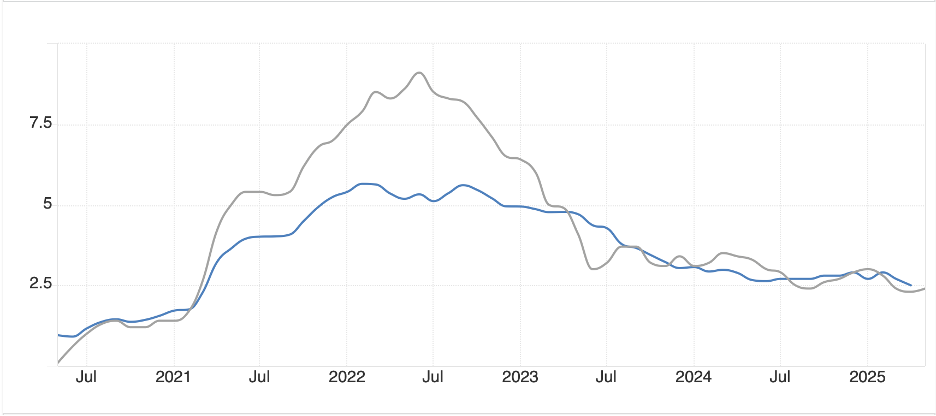
While certainly a part of this movement has been the fact that US yields continue to slide lately, it also seems there is a new narrative that has been distributed to journalists, the dollar is falling because President Trump is considering naming a new Fed Chair much earlier than usual in an effort to undermine Chairman Powell.  We have all heard about the rants the President has had regarding Powell’s unwillingness to cut rates even though inflation readings have been declining for the past two months, and are, on a Y/Y basis back to their lowest level since March 2021 whether measured as CPI (grey line) or Core PCE (blue line).

Source: tradingeconomics.com

But in an exclusive (!) article in the WSJ, which was repeated in Bloomberg, that is the story du jour.  While Bloomberg’s take cannot be a surprise given Mayor Mike’s intense hatred of Trump (after all Trump is the NY billionaire that became president, not Bloomberg), and editorial direction clearly comes from the top, it is more interesting that the Journal is pushing this theme.  Of course, given the Fed whisperer is the article’s writer, it is more than possible that he is simply airing Powell’s views and trying to explain how any move like this would result in chaos, so it’s not Powell’s fault if things go pear-shaped.

Nonetheless, that is today’s story.  In concert with this story, though is another, somewhat more interesting feature, where a really smart analyst, Marko Papic, has broken down the dollar’s movements across different time zones during 2025.  The chart below shows that the dollar selling has been emanating from Asia mostly with Europe having a lesser impact and no substantive change in the NY session.  The implication is that Asian holders of dollars, which tend to be sovereigns rather than other users like investors or corporates, are the ones bailing out.

This activity first became noticeable in early April, right around “Liberation Day” and does fit with the idea that higher US tariffs will result in a smaller US trade deficit.  But as I consider that concept, it strikes me that a smaller US trade deficit will result in fewer dollars around the rest of the world, a reduction in supply, and that would arguably increase the dollar’s value ceteris paribus.  Perhaps this reflects investors selling US assets and converting them to Europe, which has been another theme this year as European companies are set to benefit from a major increase in defense spending by NATO.  However, that doesn’t really sync with the fact that US equities continue to trade near all-time highs.  At this point, I think this is an interesting observation, but am not sure of its meaning.  I’m open to suggestions.

Ok, while that is the narrative this morning, let’s look at how markets are behaving.  Yesterday’s lackluster activity in the US, with the S&P 500 almost exactly unchanged and the other two main indices +/- 0.3% was followed by a burst higher in Tokyo (Nikkei +1.6%) but lagging activity in HK (-0.6%) and China (-0.4%).  The rest of the region couldn’t decide on much with a couple of solid performances (India, Indonesia) and one laggard of note (South Korea).  In Europe, Germany (+0.6%) is leading the way higher across the board, as NATO countries have promised to spend upward of 5% of GDP on total defense (including nonlethal investments), with as much as possible going to European based companies.  That is a lot of money, well over $1.5 trillion.  Meanwhile, US futures are all higher at this hour (7:15), up by about 0.4% or so.

In the bond market, Treasury yields (-2bps) continue to slip and are now back to their lowest level since early May.  Perhaps more interestingly, European sovereign yields are sliding today as well, led by Italian BTPs (-4bps) but lower across the board.  This is interesting given the promises of more borrowing based on the NATO announcement.  But net, bond yields have not really done very much lately at all.

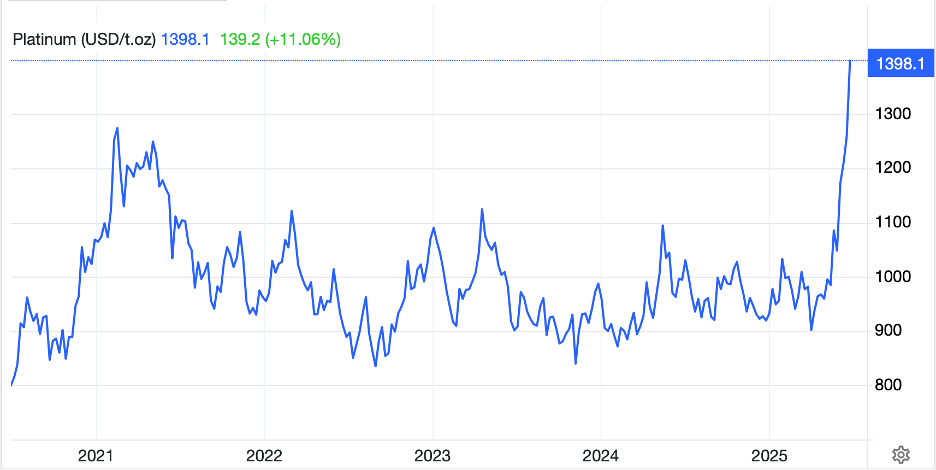
In the commodity markets, oil (+0.5%) is continuing to slowly bounce from the initial lows in the wake of the Iran/Israel ceasefire.  This market still feels quite heavy to me and absent a major change on the ground in the Middle East, if war were to resume and oil facilities be attacked, I still think lower is the way.  In the metals markets, gold (+0.25%) which tried to sell off yesterday continues to find bids below the market, likely central bank support.  But silver (+0.9%) and copper (+2.3% and above $5.00/lb) are looking good although nowhere near as impressive as platinum (+3.4%) which has now risen above $!400/oz and is going parabolic here.  There is much talk here about a supply shortage (it is used for catalytic converters) and significant Chinese demand.

Source: tradingeconomics.com

Finally, the dollar, as mentioned, is under pressure across the board, although the magnitude of this morning’s movement has not been that large.  The largest movement has been in Asia with IDR (+0.6%), JPY (+0.4%) and KRW (+0.35%) while European and LATAM movements have been generally 0.2% or less.  So, the direction is clear, but it has not been impressive.

On the data front, there is plenty today starting with the weekly Initial (exp 245K) and Continuing (1950K) Claims, the Chicago Fed National Activity Index (-0.1), the last look at Q1 GDP (-0.2%), and Durable Goods (8.5%, 0.0% ex-Transports).  We also hear from four more Fed speakers, but Powell just repeated yesterday that they are happy where they are and unlikely to move soon unless something really changes rapidly.  However, despite Powell’s claims of nothing to come, the Fed funds futures market is pricing a 25% probability of a cut at the July 30 meeting.  There is a lot of time between now and then for that to change.

I keep trying to figure out what actually matters to markets anymore as responses to different potential catalysts seem confused.  People do seem to be coalescing around the dollar is falling theme, something I have believed for a while, and if the Fed does lean to a cut next month, I do believe there is further for it to fall.  One thing to remember, though, is with Mr Trump as president, things are still a tweet away from a dramatic change.  If I were in charge of hedging risk, I would adhere to guidelines closely.  There is too great an opportunity for a sudden major reversal in the current environment.

Good luck

Adf

The World is Aghast

At one time, not long in the past
New York was a finance dynast
But yesterday’s vote
Does naught to promote
Its future. The world is aghast
 
As well, yesterday, Chairman Jay
Had nothing of note new to say
He’s watching quite keenly
And somewhat serenely
But rate cuts are not on the way


I must start this morning on the results from the NYC mayoral primary election where Zohran Kwame Mamdani won the Democratic primary and is now favored to win the general election.  His main rival was former NY state governor, Andrew Cuomo, a flawed man in his own right, but one with the usual political peccadillos (greed, grift and sexual misconduct).  Mamdani, however, is a confirmed socialist whose platform includes rent freezes, city owned grocery stores (to keep costs down) a $30/hour minimum wage (not sure how that will keep grocery prices down) and a much higher tax rate, especially on millionaires.  In addition, he wants to defund the police.  Apparently, his support was from the younger generations which is a testament to the failures of the education system in the US, or at least in NYC.

I mention this because if he does, in fact, become the mayor of NYC, and can enact much of his agenda, the financial markets are going to be interrupted in a far more dire manner than even Covid or 9/11 impacted things.  I expect that we will see a larger and swifter exodus from NYC of both successful people and companies as they seek other places that are friendlier to their needs.

Now, even though he is running as a Democrat, it is not a guarantee that he will win.  Current mayor, Eric Adams is running as an independent, and while many in the city dislike him, he may seem to be a much better choice for those somewhere in the middle of the spectrum.  As well, even if he wins, his ability to enact his agenda is not clear given his inexperience and lack of connections within the city’s power centers. Nonetheless, it is a real risk and one that needs to be monitored closely.  

As to Chairman Powell, as well as the other six FOMC members who spoke yesterday, the generic view is that while policy may currently be slightly tight, claimed to be 25bps to 50bps above neutral across all of them, they are in no hurry to adjust things until they have more clarity regarding the impact of tariffs on inflation and the economy.  They paid lip service to the employment situation, explaining that if things took a turn for the worse there, it would change the calculus, but right now, they’re pretty happy.  It can be no surprise that there were zero deep questions from the Senate committee members, and I expect the same situation this morning when he sits down in front of the House.  

Since the cease fire between Iran and Israel seems to be holding, market participants are now searching for the next catalyst for market movement.  In the meantime, let’s look at how things are behaving.  The “peace’ in the Middle East saw the bulls return with a vengeance yesterday in the US, with solid gains across all major indices, but the follow through was less robust.  While Chinese shares (Hang Seng +1.2%, CSI 300 +1.4%) both fared well, the Nikkei (+0.4%) was less excited and the rest of the region was more in line with Japan than China, mostly modest gains.  From Japan, we heard from BOJ member Naoki Tamura, considered the most hawkish, that raising interest rates was necessary…but not right away.  That message was not very well received.

However, Europe this morning is on the wrong side of the ledger with Spain’s IBEX (-1.25%) leading the way lower although other major bourses are not quite as poorly off with the DAX (-0.4%) and CAC (-0.2%) just drifting down.  NATO is meeting in The Hague, and it appears that they are finalizing a program to spend 5% of respective national GDP’s on defense, a complete turnaround from previous views.  This is, of course, one reason that European bond markets have been under pressure, but I expect it would help at least portions of the equity markets there given more government spending typically ends up in that bucket eventually.  As to US futures, at this hour (7:10) they are little changed to slightly higher.

In the bond market, US Treasury yields continue to slide, down another -1bp this morning and now under 4.30%.  Despite President Trump’s hectoring of Chairman Powell to lower Fed funds, perhaps the fact that Powell has remained firm has encouraged bond investors that he really is fighting inflation.  It’s a theory anyway, although one I’m not sure I believe.  European sovereigns have seen yields edge higher this morning, between 1bp and 2bps as the spending promises continue to weigh on sentiment.  However, even keeping that in mind, after the spike in yields seen in early March when the German’s threw away their debt brake, European yields have essentially gone nowhere.

Source: tradingeconomics.com

While this is the bund chart, all the major European bond markets have tracked one another closely.  Inflation in Europe has fallen more rapidly than in the US and the ECB’s base rate is sitting 200bps below Fed funds, so I suppose this is to be expected.  However, if Europe actually goes through with this massive military spend (Spain has already opted out) I expect yields on the continent to rise.  €1 trillion is a quite significant ask and will have an impact.

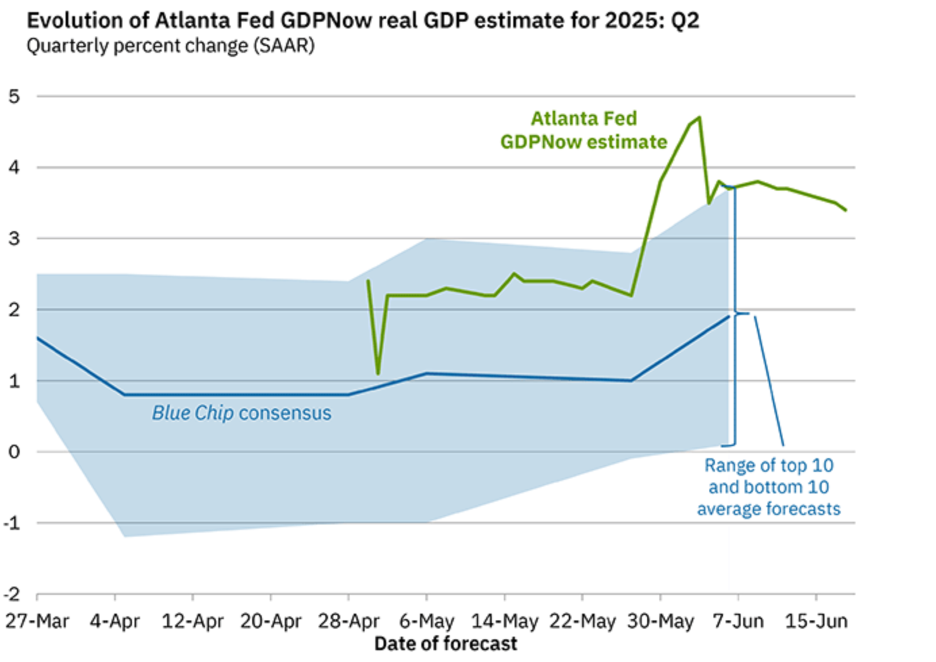
Moving to commodity markets, after its dramatic decline yesterday, oil (+0.8%) is bouncing somewhat, but that is only to be expected on a trading basis.  Again, absent the closure of the Strait of Hormuz, I suspect that the supply/demand dynamics are pointing to lower prices going forward, at least from these levels.  In the metals markets, gold (+0.15%) which sold off yesterday as fear abated, is finding its footing while silver (-0.5%) is slipping and copper is unchanged.  It feels like metals markets are looking for more macroeconomic data to help decide if demand is going to grow in the near term or not.  A quick look at the Atlanta Fed’s GDPNow estimates for Q2 show that growth remains quite solid.

Source: atlantafed.org

However, another indicator, the Citi Economic Surprise Index, looks far less promising as it has moved back into negative territory and has been trending lower for the past 9 months.

Source: cbonds.com

At this point, my take is a great deal depends on the outcome of the BBB in Congress and if it can get agreed between the House and Senate and onto President Trump’s desk in a timely manner.  If that does happen, I think we are likely to see sentiment increase, at least in the short term.  That should help all economically sensitive items like commodities.

Finally, the dollar is modestly firmer this morning, rebounding from yesterday’s declines although still trending lower.  The price action this morning is broad based with modest moves everywhere.  The biggest adjustment is in JPY (-0.6%) but otherwise, 0.2% pretty much caps the movement.  Right now, the dollar is not that interesting, although I continue to read a lot about how it is losing its luster as the global reserve currency.  There is an article this morning in Bloomberg explaining how China is trying to take advantage of the current situation to globalize the yuan, but until they open their capital markets, and not just for $50K equivalents, but in toto, it will never be the case.

On the data front, aside from Chair Powell’s House testimony, we see New Home Sales (exp 690K) and then EIA oil inventories with a modest draw expected there.  There are no other Fed speakers and certainly Powell is not going to change his tune.  To my eyes, it is setting up as a very quiet session overall.

Good luck

Adf

What He Will Mention

Last night there was, briefly, a peace
This morning, though, that seemed to cease
But worries Iran
From Hormuz, would ban
Most ships, have now greatly decrease(d)
 
So, markets have turned their attention
To Powell and what he will mention
When he sits before
The Senate once more
Though most seated lack comprehension


Talk about yesterday’s news!  While I am pretty confident we have not heard the last of the Iran/Israel conflict, it has dropped off the radar in a NY minute.  Last night President Trump announced a cease fire between the two nations and while Israel alleged that Iran already broke the peace, the market has clearly moved on from the erstwhile WWIII concept to WWJS (What Will Jay Say).  In that vein, this morning’s WSJ had an articlefrom the Fed whisperer, Nick Timiraos, describing the trials and tribulations of poor Chairman Powell as he tries to fend off those mean words from President Trump.  

Powell sits down before the Senate Banking Committee this morning, and the House Financial Services Committee tomorrow, ostensibly to describe the state of the economy and the Fed’s current thinking.  I have begun to see discussions that two Trump appointed governors, Bowman and Waller, are now interested in potentially cutting the Fed funds rate in July and the futures market has raised the probability of a cut next month to 23%, back to the levels seen a month ago, pre-war and prior to a run of stronger than expected economic data.

Source: cmegroup.com

Frequently mentioned throughout the WSJ article was the idea of Fed independence and how critical that is for monetary policy to be effective.  As well, the fact that the comments on rate cuts are from governors Trump appointed, and that is being highlighted in a negative fashion, is further evidence that the Fed remains a highly political, and quite frankly, partisan organization.  One cannot look at the rate cuts last autumn ahead of the election, which were certainly not warranted by the data, as anything other than the Fed’s attempt to support VP Harris’s presidential campaign.  And when inflation was still quite high, although starting to decline, calls for cuts by Biden appointees Cook and Jefferson, were also likely politically motivated given the still high inflation rate.  

In fact, I wonder where Governor’s Cook and Jefferson are today with respect to rate cuts.  After all, both have demonstrated dovish biases throughout their tenure at the Fed, but suddenly they are strangely silent on the subject.  I’m sure that is not a political bias showing, but rather deeply considered economic analysis. 🙃

I do find it interesting that there is an underlying presumption that the Fed funds rate is always too high, at least for the narrative, although I guess that is because most narrative writers believe strongly in the idea if rates are low, stock prices will rise.

Regardless of the politics, Powell will very likely explain that there is still concern that tariffs could raise prices and while there is the beginning of concern over the labor market, it remains solid and does not warrant rate cuts at this time.  Of course, we will also be subject to the preening of all those senators (what is the probability that Senator Van Hollen brings up deportations?) with no useful discussion.  It seems unlikely that Chairman Powell will alter his message from the post meeting press conference which remains, patience is a virtue.

Ok, now that the war has ended, let’s see how markets have behaved.  I must start with oil (-3.0% today, -12.0% since yesterday morning) where traders have removed the entire Hormuz closing premium and are now dealing with the fact that there are more than ample supplies around.  Recall, OPEC+ continues to increase production, and the macroeconomic narrative remains one of slowing economic activity.  Happily, gasoline prices are following oil lower so look for less inflation concerns for next month.

Source: tradingeconomics.com

Meanwhile, with war off the table, gold (-1.3%) is no longer in such great demand although silver (unchanged) and copper (+0.7%) continue to find support.  Net, my longer-term views remain that oil prices have further to decline while metals prices should grind higher over time.

In the equity markets, you have to search long and hard to find a market that didn’t rally overnight or is in the process of doing so this morning.  After yesterday’s strong US closing (all three main indices up about 0.9%), Asia (Nikkei +1.1%, Hang Seng +2.1%, CSI 300 +1.2%) rallied sharply with Korea (+3.0%) really popping and only one negative, New Zealand (-0.5%) where local traders cannot seem to get on board with the better news.  In Europe, the gains are also substantial (DAX +1.8%, CAC +1.2%, IBEX +1.4%) although the UK (+0.3%) is lagging given the large weighting of energy in the index.  US futures are also pointing higher this morning, about 0.8%.

In the bond market, Treasury yields are unchanged this morning after slipping -3bps yesterday, but we are seeing yields rise in Europe (Bunds +5bps, OATs +3bps) after the Germans announced they would be borrowing 20% more this quarter than initially expected to help their rearmament program.  I guess investors had a mild bout of indigestion.

Finally, the dollar, which rallied nicely into yesterday’s NY opening has basically reversed all those gains since then and is back trading near 98 on the DXY. While there are various relative sizes of movement, it is all in the same direction and entirely driven by the Iran/Israel war story.  Perhaps we are starting to see some pricing of a Fed rate cut, and if they do act in July, I would expect the dollar to fall, but right now, it feels much more like unwinding the war footing.

On the data front, aside from Chairman Powell at 10:00 this morning, we see Case Shiller Home Prices (exp +4.0%) and Consumer Confidence (100.0).  However, I suspect that neither of those will matter very much.  The equity market has the bit in its mouth and is looking for reasons to go higher.  Any dovish hints by Powell will set that off, as well as undermine the dollar.  We shall see.

Good luck

Adf
A Weapon of War

The Hammer’s a weapon of war
Just ask those who fought against Thor
At midnight on Friday
Iran learned the hard way
That Trump wields one too when called for
 
The interesting thing early on
Is this clearly ain’t a black swan
While oil did rise
Which was no surprise
Most risk gave an aggregate yawn


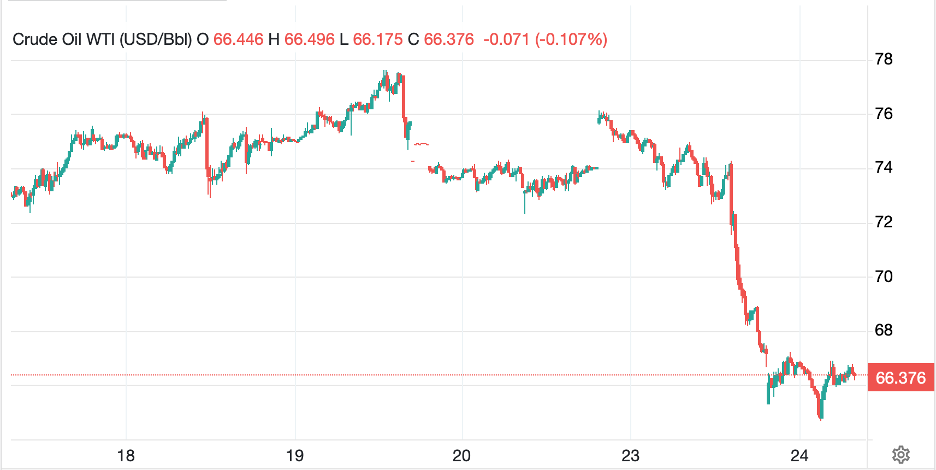
Obviously, the big news this weekend was the extraordinary attack and destruction of Iran’s three key nuclear enrichment and engineering sites.  While this poet has opinions, since I am just like the rest of you, limited to the peanut gallery and with no voice in the matter, they are not relevant for this discussion.  However, what is relevant is the early movement in markets once they reopened Sunday night in NY.  While it is no surprise that oil’s price rose as you can see below, the early 2.2% gain is pretty lackluster for the alleged (by some) beginning of WWIII.

Source: tradingeconomics.com

As to the rest of the markets early price action, it’s largely what you would have expected directionally, although unimpressive overall with equity indices modestly lower, about -0.35%, the dollar modestly higher, about 0.2%, and bonds little changed.  Gold, too, is little changed.  It appears that, at least initially, the market was anticipating something like this as you can see that even after the oil price spike, it didn’t reach the levels seen on Friday.

With two days to think it all through
Most traders appear to eschew
The idea that war
Is what is in store
Instead, buy more stocks is their view


So, as we wake up Monday morning, despite all the weekend news and the fear mongering thus far, and even though Israel and Iran continue to trade missile fire, the early consensus is that we have seen the worst already.  Iran’s parliament voted to block the Strait of Hormuz, but they have no power to drive actions, that resides with the Supreme Council and as of yet, they have not acted.  In fact, they are in a tricky position for several reasons.  First, China is their largest oil customer by far and 20% or more of their oil transits the Strait which means China’s deliveries would slow dramatically and China is one of their only supporters.  Second, the US navy has significant assets in the region and appears quite ready for that move, likely being able to reopen the Strait quickly.  And third, if they follow through and their objective fails (remember, their objective in this would be to spike the oil price and hurt Western economies accordingly) then they will prove conclusively that they are irrelevant militarily.  That is likely not what the regime there wants to demonstrate.

But the market is pretty smart about these things as the collective wisdom and thoughts of traders and investors is an excellent proxy for issues of this nature.  Therefore, we cannot be surprised that after that initial spike in oil prices, they have retreated to Friday’s pre-attack levels as investors await more information.

Source: tradingeconomics.com

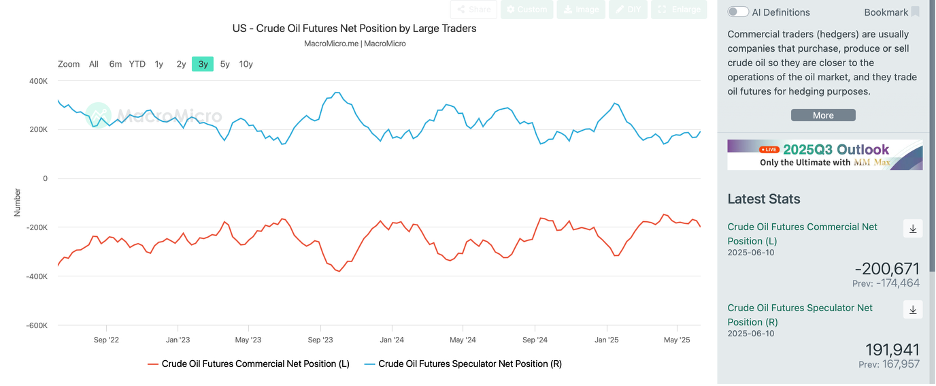
It is also worthwhile to recognize that speculative trader positions in oil are net long just under 200K contracts, so there is no short-covering spree that is likely to arrive and drive prices higher.

Source: en.macromicro.me

The point is that if oil is basically unconcerned with the potential issues in Iran, then other markets will completely ignore the situation.  And that is pretty much exactly what we are seeing this morning.  In Asia, equity markets were mixed with modest overall movement.  The Nikkei (-0.15%) and Australia (-0.35%) slid while Hong Kong (+0.7%) and China (+0.3%) rallied showing no trends whatsoever.  The rest of the region did have more laggards than gainers, but other than smaller markets like Indonesia and Taiwan, both falling -1.5% or more, movement was muted.  In Europe, modest losses are the thing with the DAX (-0.4%), CAC (-0.4%) and IBEX (-0.2%) slipping a bit while the FTSE 100 is unchanged on the morning, but there is certainly no panic.  As to US futures, while they opened lower last night, as I type at 6:30 this morning, they are back to flat on the session.

In the bond market, yields have basically edged higher by 2bps across the US, Europe and Japan, either demonstrating that government bonds are no longer a safe haven, or that no haven is necessary because fears of escalation are minimal.  Despite all the negative talk about bonds, I would still opt for the latter explanation.

In the commodity markets, we’ve already discussed oil at length.  In the metals markets, gold is essentially unchanged this morning although we are seeing a mild divergence between silver (+0.6%) and copper (-0.7%), implying to me that there is no underlying risk trend here.

Finally, the dollar is the one thing that is flexing its muscles from a risk perspective as it is pretty sharply higher across the board.  In the G10, NZD (-1.4%) is the laggard followed closely by the yen (-1.25%), which given the weekend’s events is pretty surprising to most folks.  Perhaps yen is not as haven-like as previously thought.  But AUD (-1.1%) is sliding and the euro and pound are both lower by -0.5%.  In the EMG bloc, the dollar is firmer everywhere, but the moves, other than KRW (-1.2%) are less than might have been expected.  HUF (-0.9%) is the next worst performer with PLN (-0.75%) and CZK (-0.75%) all showing their high beta to the euro.  In Asia, CNY (-0.15%) remains dull and INR (-0.2%) is also lackluster.  LATAM currencies are showing little movement as well, with MXN (-0.4%) the laggard of the bunch.

Looking at data this week shows the following:

TodayFlash Manufacturing PMI51.0
 Flash Services PMI52.9
 Existing Home Sales3.96M
TuesdayCase Shiller Home Prices4.2%
 Consumer Confidence99.8
WednesdayNew Home Sales700K
ThursdayInitial Claims247K
 Continuing Claims1947K
 Durable Goods7.2%
 -ex Transport0.1%
 Final Q1 GDP-0.2%
 Goods Trade Balance-$92.0B
FridayPersonal Income0.3%
 Personal Spending0.1%
 PCE0.1% (2.3% y/Y)
 Ex Food & Energy0.1% (2.6% Y/Y)
 Michigan Sentiment60.3

Source: tradingeconomics.com

As well as all this, with most folks looking forward to Friday’s PCE data, we hear from Chairman Powell as he testifies to the Senate on Tuesday and the House on Wednesday.  In addition, there are 13 more Fed speeches from 10 different speakers.  Too, Madame Lagarde regales us three different times.  A cynic might think that central bankers are concerned their comments are losing their importance!

One never knows what is truly happening on the ground in Iran as all news organizations and governments are trying to tell their own story.  However, I do not believe that this is going to escalate into a greater problem going forward, but rather that there is every chance that tensions reduce over time.  I do not believe Iran will even attempt to block the Strait of Hormuz and if this is the worst that the Middle East can produce in the way of war, look for oil prices to slide back toward $65-$70.  As to the dollar, it feels a bit overdone here, so a modest retracement seems viable as well.

Good luck

Adf

Not Yet Foregone

The US has not yet been drawn
To war, though it’s not yet foregone
That won’t be the case
While Persians now brace
For busters of bunkers at dawn
 
But until such time as we learn
That outcome, the current concern
Is Jay and the Fed
And what will be said
At two o’clock when they adjourn


So, every top headline this morning discusses the idea that President Trump is considering whether to initiate US military action in Iran, specifically to drop the so-called bunker buster bombs to destroy Iran’s nuclear enrichment and bomb-making facilities.  There is certainly a lively discussion on both sides of the argument with the best description of the problem that I’ve seen being a poll showing that 74% approve Trump’s position that Iran must not get nuclear weapons, but 60% oppose US involvement in the war.  I’m glad I don’t have to thread that needle!

Obviously, there are market implications if the US does get involved but given the complete lack of clarity on the situation at this point, I do not believe I can add much to the discussion.  The only thing I will say is that the longer-term trends for both oil (lower) and metals (higher) are still intact, but we are likely to see some significant volatility along the way.

Which takes us to the next most important market discussion, the FOMC meeting that ends today and the potential market impacts.  It is universally assumed that there will be no policy change at the meeting, either interest rates or QT, which means that now the punditry is focused on the arcana of Fed policy.  As this is a quarter end meeting, the Fed will release its latest SEP (summary of economic projections) and dot plot, and with nothing else to discuss until the war in Iran either ends or intensifies, those are the key discussion points in the market.  

I have long maintained that one of the greatest blunders of the Bernanke era was the institution of forward guidance.  While it may have served its purpose initially, it has now become a major distraction.  Far too much attention is paid to the dot plot, where if one member adjusts their view by 25bps, it can impact markets which have built algorithms to respond to the median outcome.

Below is the March dot plot which showed a median “expectation” of Fed funds for the end of 2025 at 3.875%, or 50 basis points lower than the current level.  However, if two more FOMC members (out of 17) thought there was only going to be one cut, that would have shifted the median “expectation” as well as the narrative.

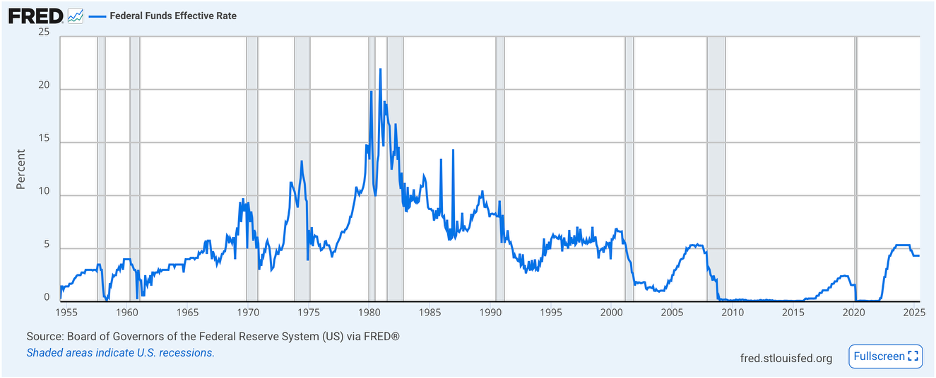
As such, the importance of the dot plot feels overstated compared to its actual value.  After all, no FOMC member has an impressive track record with respect to their analysis of the economy and its future outcomes, let alone what the appropriate rate structure should be at any given time.  In fact, nobody has that, which is the argument for restricting the Fed’s duties to be lender of last resort and allow markets to determine the proper level of interest rates based on the supply and demand of money.  But this is the world in which we live.  My one observation is that the post GFC era has greatly distorted views on the economy and appropriate monetary policy.  It is hard not to look at the below history of Fed funds and see the anomaly that occurred during the initial QE phase.  

Concluding, regardless of my, or anyone not on the FOMC’s, views on appropriate policy, it doesn’t matter one whit.  They are going to do what they deem appropriate, and while I don’t doubt their sincerity, I do doubt they have the tools for the mission.  Perhaps the most interesting thing that could come from this meeting is further information on their assessment of the current Fed process, including their communication policy.  I remain strongly in favor of them all shutting up and letting markets do their job although that seems unlikely.  But perhaps they will get rid of the dots which seem to have outlived any value they may have had initially.

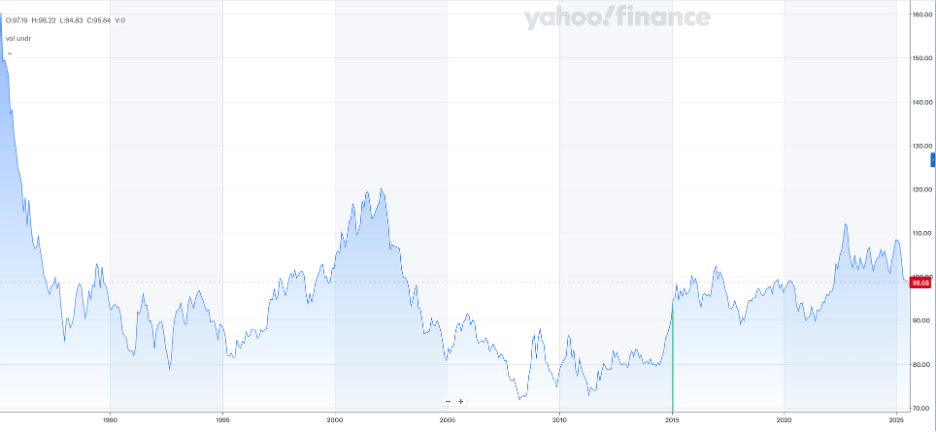
Before we go to markets, I have to highlight one other market discussion this morning with Bloomberg publishing two different articles, here and here,  on the end of the dollar’s hegemony.  The first highlights a speech by PBOC governor Pan Gongsheng and his vision of a multicurrency world which, of course, includes the renminbi as a major part of the process.  I will believe that is a possibility as soon as China opens its capital accounts completely and allows flows into and out of the country with no restrictions.  (I’m not holding my breath.)  The second takes the Michael Bloomberg Trump hatred in the direction of the president is destroying the dollar’s reign because of his policies and to highlight the dollar has fallen 10% already this year!  But let us look at a long-term chart of the dollar, using the DXY as a proxy, and you tell me if you can see the recent move as being outsized in any sense of the word.  In fact, the dollar’s recent price action is indistinguishable from anywhere in its history, and it is not anywhere near to its historic lows.  In fact, it is just a few percent below its long-term average.

Ok, now let’s look at markets.  Yesterday’s selloff in equities seemed to be based on concerns over the escalation in Iran, but as that drags out, traders don’t know what to do.  They are certainly not pushing things much further.  In fact, overnight saw the Nikkei (+0.9%) have a solid gain although HK (-1.1%) followed the US lower.  Elsewhere in the region, South Korea and Taiwan performed well, while India and Indonesia lagged and the rest were +/-20bps or less.  Europe, though, is softer this morning with declines on the order of -0.4% on the continent across the board.  I think investors here are also waiting on the potential events in Iran.  But US futures are actually pointing slightly higher at this hour (7:30).

In the bond market, yields around the world are slipping with Treasuries falling -2bps and most of Europe seeing declines between -1bp and -3bps.  This is after a few basis point decline yesterday as well.  I guess the fear of too much US debt is in abeyance this morning.

In commodity markets, oil, which rallied sharply yesterday on fears of the US entering the war, is little changed on the day after that climb as while there has been lots of talk, oil continues to flow through the Strait of Hormuz, and everybody is pumping nonstop to take advantage of the current relatively high prices.  Gold is unchanged although the other metals (Ag +0.25%, Cu +0.7%, Pt +2.4%) continue to see significant support.  In fact, platinum this morning has broken above the top of an 11-year range and many now see an opportunity for a significant rally from here.

Finally, the dollar is somewhat softer this morning, slipping about 0.2% against the pound, euro and yen, with similar declines against most other currencies.  The exceptions to this are the KRW (+0.45%) which seems to be benefitting from a growing hope that a trade deal will be completed between the US and Korea shortly, and ZAR (-0.5%) as CPI data release there this morning shows inflation under control and no reason for SARB to consider tightening policy further.

On the data front, because of tomorrow’s Juneteenth holiday, we see Initial (exp 245K) and Continuing (1940K) Claims as well as Housing Starts (1.36M) and Building Permits (1.43M).  And of course, at 2:00 it’s the Fed.  My sense is absent a US escalation in Iran, it will be quiet until the Fed, and probably thereafter as well given the lack of reason for any policy changes.  After all, there is no certainty as to either war or trade policy right now, so why would they do anything.

If I had to opine, I would say the dollar is likely to decline over the next year, but that in the longer run, it will be firmer than today.  

Good luck

Adf

Dine and Dash

The president left in a flash
Completing a quick dine and dash
But so far, no word
On what, this move, spurred
Though I’ve no doubt he’ll make a splash
 
Then last night the BOJ passed
On hiking, though none was forecast
And Germany’s ZEW
Implied there’s a view
That growth there will soon be amassed


I have to admit that when I awoke this morning, I expected there to have been significantly more news regarding the Iran/Israel conflict based on President Trump’s early departure from the G-7 meeting.  But, from what I see so far, while markets have reversed some of yesterday’s hope that a ceasefire was coming soon, my read is we are back to overall uncertainty in the situation.  Of course, the concept of the fog of war is well known, and I expect that we will not find out very much until those in control of the information, whether the IDF or the US military, or Iranian sources, choose to publicize things.  The one thing we know is that everything we learn will be biased toward the informants’ view, so needs to be parsed carefully.  I do think that Trump’s comments to the press when he was leaving the G-7 about seeking “an end. A real end. Not a ceasefire, an end,” to the ongoing activities is telling.  It appears the Israelis planned on a 2-week campaign and that is what they are going to complete.

From a market perspective, as we have already seen in the price of oil, and generally all asset classes, absent a significant escalation, something like a tactical nuclear strike by the Israelis to destroy the Iranian nuclear bomb-making capabilities, I expect choppiness on headlines, but no trend changes.  At some point, the fighting will end, and markets will return their focus to economic and fiscal concerns and perhaps central banks will become relevant again.

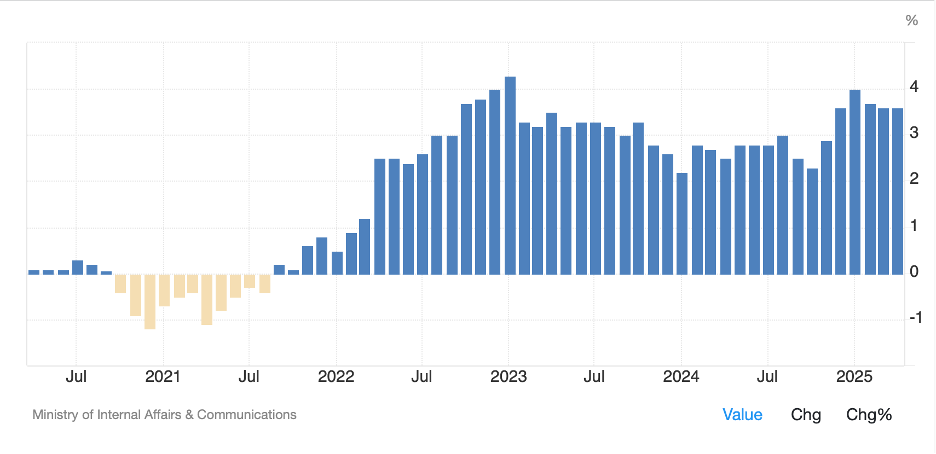
So, let’s turn to that type of news which leads with the BOJ leaving policy rates on hold, although they did reduce the amount of QE to ¥200 billion per month, STARTING IN APRIL 2026!  You read that correctly.  The BOJ, which has been buying ¥400 billion per month of JGBs while they raised interest rates in their alleged policy tightening, has decided that ten months from now it will be appropriate to slow the pace of QE.  Yes, inflation has been running above their 2.0% target for more than three years (April 2022 to be exact) as you can see in the below chart, but despite a whole lot of talk, action has been slow to materialize.

Source: tradingeconomics.com

You may recall about a month ago when Japanese long-end yields, the 30-year and 40-year bonds, jumped substantially, to new all-time highs and there was much discussion about how there had been a sea change in the situation in Japan.  Expectations grew that we would start to see Japanese institutions reduce their holdings of Treasuries and bring their funds home to invest in JGBs, leading to a collapse in the dollar.  The carry trade was going to end, and this was another chink in the primacy of the dollar’s hegemony.  Well, if that is the case, it is going to take longer than the punditry anticipated, at the very least, assuming it happens at all.  As you can see from the charts below of both USDJPY and the 40-year JGB, all that angst has at the very least, been set aside for now.

Source: tradingeconomics.com

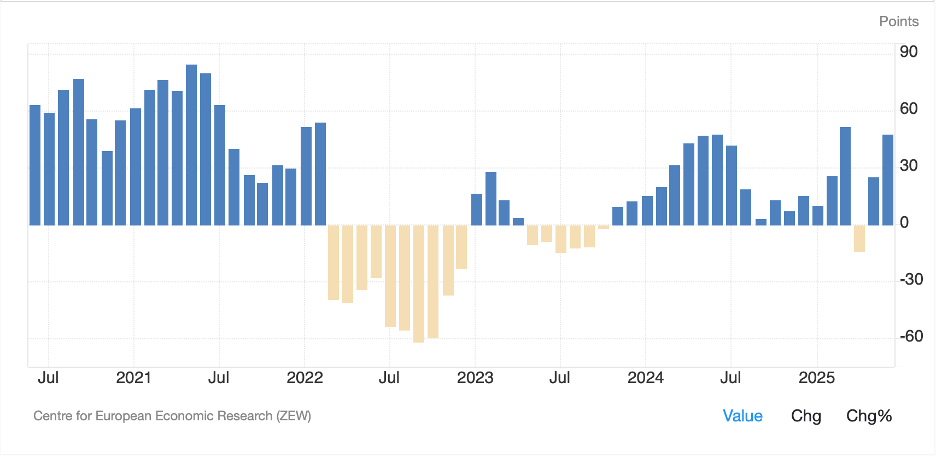
Elsewhere, the German ZEW data released this morning was substantially stronger than both last month and the forecasts for an improvement.  As you can see from the chart below, it is back at levels that are consistent with actual economic growth, something Germany has been lacking for several years.  It appears that a combination of the continued tariff truce, the promises of massive borrowing and spending by Germany to rearm itself and the ECB’s easy policy have German business quite a bit more optimistic that just a few months ago.

Source: tradingeconomics.com

Ok, while we await the next shoe to drop in Iran or Israel, let’s see how markets have behaved overnight. Yesterday’s nice rally in the US was followed by a mixed picture in Asia with the Nikkei (+0.6%) gaining after the BOJ showed that tighter policy is not coming that soon.  Elsewhere in the region, China, HK and India were all down at the margin, less than 0.4% while Korea and Taiwan managed some gains with Taiwan’s 0.7% rise the biggest mover overall.  In Europe, though, the excitement about a truce in Iran is gone with bourses across the continent lower (DAX -1.25%, CAC -1.05%, IBEX -1.5%, FTSE 100 -0.5%).  Apparently, there is fading hope of trade deals between the US and Europe and concerns are starting to grow as to how that will impact European activity.  I guess the ZEW data didn’t do that much to help.  US futures at this hour (7:00) are all pointing lower by about -0.5%, largely unwinding yesterday’s gains.

In the bond market, Treasury yields, which backed up yesterday, are lower by -3bps this morning, essentially unwinding that move.  However, European sovereign yields have all edged higher between 1bp and 2bps with Italy’s BTPs the outlier at +3bps.  Quite frankly, it is hard to have an opinion as to why bond yields move such modest amounts, so I’m not going to try to explain things.

In the commodity space, fear is back in play as oil (+1.7%) is rallying as is gold (+0.4%) which is taking the rest of the metals complex (Ag +2.3%, Cu +0.3%, Pt +3.0%) with it.  These are the markets that are most directly responding to the ongoing ebbs and flows of the Iran/Israel situation, and I expect that will continue.  In the end, I continue to believe the long-term trend for oil is toward lower prices while for gold and metals it is toward higher prices, but on any given day, who knows.

Finally, the dollar doesn’t know which way to turn with modest gains and losses vs. different currencies in both G10 and EMG blocs.  The euro, pound and yen are all within 0.1% of yesterday’s closing levels while we have seen KRW (-0.4%) and INR (-0.3%) suffer and NOK (+0.4%) and SEK (+0.4%) both gain on the day.  However, those are the largest movers across the board, so it is difficult to make a case that anything of substance is ongoing.

On the data front, yesterday’s Empire State Manufacturing index was quite weak at -16, not a good look.  This morning, we see Retail Sales (exp -0.7%, +0.1% ex-autos), IP (0.1%), and Capacity Utilization (77.7%).  As well, the FOMC begins their meeting this morning with policy announcements and Powell’s press conference scheduled for tomorrow.  Helpfully, the Fed whisperer, Nick Timiraos, published an article this morning in the WSJ to explain why the Fed was going to do nothing as they consider inflation expectations despite the lack of empirical evidence that those have anything to do with future inflation.  But it is a really good sounding theory.

For now, the heat of the Iran/Israel situation will hold most trader’s attention, but I suspect that this will get tiresome sooner rather than later.  The biggest risk to markets, I think, is that the Iranian regime collapses and a secular regime arises, dramatically reducing risks in the Middle East and reducing the fear premium in oil substantially.  If that were to be the case, I expect the dollar would suffer as abundant, and cheap, oil would help other nations more than the US on a relative basis given the US already has its own supply.  But a major change of that nature would have many unpredictable outcomes.  In the meantime…

Good luck

Adf

Terribly Keen

The evidence, so far, we’ve seen
Is nobody’s terribly keen
To stop all the shooting
In wars, or the looting
In riots, at least so I glean
 
But can stocks and bonds still maintain
The heights they consistently gain
Or will, one day soon
Risk assets all swoon
As traders turn to their left-brain?


I am old enough to remember when Israel’s attack on Iranian nuclear facilities was considered a risk to global financial assets.  Equity prices fell around the world as investors scrambled to find havens to protect their assets.  Alas, these days, the only haven around seems to be gold as Treasury yields, after an initial slide, rebounded which implies investors may have questioned their safety and the dollar, after a slight bump, slipped back.

But that is clearly old-fashioned thinking as evidenced by the fact that fear is already ebbing in markets with equities rebounding this morning, the dollar under pressure and both gold and oil slipping slightly.  Now, it is early days but a look at the chart below of oil shows that it took about 9 months for oil prices to retrace to their pre-Russia invasion levels.  Obviously, this situation is different than that from the perspective that prior to Russia’s invasion, there were no energy market sanctions while Iran has been subject to sanctions for years.  However, the larger point is that the market, at least right now, seems to have adjusted to what it believes is the appropriate level to account for changes in production.

Source: tradingeconomics.com

Now, as of January 2025, at least as per the data I could find, Russia produces 10.7 million barrels/day while Iran clocks in at just under 4 million.  As well, given the sanctions, much of Iran’s production has a limited market, with China being the largest importer.  I’m simply trying to highlight that Russia’s production was much larger and more critical to the oil market overall, so a larger impact would be expected.  However, the fact that Israel continues to destroy Iranian infrastructure, and has targeted oil infrastructure as well as nuclear infrastructure, suggests there could easily be more impacts to come.  This is especially true if Iran seeks to close the Strait of Hormuz, a key bottleneck exiting the Persian Gulf and where some 20% of global oil production transits daily.

But the market is sanguine about these risks, at least for now.  There is no indication that Israel has completed what they see as their mission, and that means things could well escalate from here.  In that case, I would expect another jump in oil prices, but overall, it is not hard to believe that we have seen the bulk of any movement.  It strikes me that we will need substantially stronger economic activity to push oil prices much higher from here, and that seems unlikely right now.

Meanwhile, near Banff there’s a meeting
Where heads of state are all competing
To help convince Trump
There will be a slump
Unless tariff pressures are fleeting

The other noteworthy story this morning is the G-7 meeting that is being held in Kananaskis, Alberta, near Calgary and Banff and how all the other members of the club, as well as invitees from Mexico, Brazil, South Africa, India and South Korea, will be trying to convince the president that his tariffs are going to be too damaging and need to be adjusted or removed, at least for their own nations.

Anyone who indicates they know how things will evolve is offering misinformation as Trump’s mercurial nature precludes that from being the case.  However, it would not be inconceivable for some headway to be made by some of these nations in certain areas although President Trump does appear to strongly believe tariffs are a benefit by themselves.  I am not counting on any major breakthroughs here, but small victories are possible.

One last thing before the market recap though, and this was a Substack piece I read this weekend from The Brawl Street Journal, that, frankly, shocked and scared me regarding the ECB and some plans they are considering.  While President Trump has consistently called the climate hysteria a hoax and his administration is doing everything it can to remove Net Zero promises and CO2 reduction from anything the government does, the opposite is the case in Europe.  The frightening part is that the ECB is considering adding effective mandates to lending criteria such that loans to support agriculture or fossil fuel production will require banks to hold more capital, making them more expensive.  The very obvious result is there will be less loans in this space, and things like agriculture and fossil fuel production will become scarcer in Europe than elsewhere.  

Yes, this is suicidal, but then we have already seen Germany (and the UK) attempt to commit economic suicide with its energy policy, and while many in Europe would suffer the consequences, I assure you the members of the ECB would not be in that group.  But my point, overall, is that if this plan is enacted, and the target date appears to be this autumn, it is a cogent reason for the euro to begin a structural decline to much lower levels.  This is not for today, but something to remember if you hear that the NVaR (Nature Value at Risk) plan is enacted.  Tariffs will be their last concern as the continent enters a long-term economic decline as a result.  The blackout in Spain in April will become the norm, not the unusual circumstance.

Ok, let’s see how little investors are concerned about war and escalation.  While equity markets were lower around the world on Friday, that is just not the case anymore.  Asia saw the Nikkei (+1.3%) lead the way higher with the Hang Seng (+0.7%) and CSI 300 (+0.25%) also gaining as well as strength in Korea (+1.8%) and India (+0.8%) as hopes rise some positive news will come from the G-7.  Europe, too, has seen gains across the board led by Spain (+0.9%) and France (+0.7%) with most other markets rising between 0.3% and 0.5%.  As to US futures, at this hour (6:50) they are higher by about 0.5% with the NASDAQ leading the way.

In the bond market, Treasury yields are backing up a further 3bps this morning but are still just above 4.40%.  European yields are +/- 1bp across the board as investors try to decipher ECB commentary about the next rate move.  The universal belief is there will be another cut, although Bundesbank president Nagel tried to pour cold water on that thesis this morning calling for caution and a meeting-by-meeting approach going forward.

Commodity markets, are of course, the real surprise this morning with oil (-1.1%) looking like it has put in at least a short-term top.  In the metals market, gold (-0.4%) is giving back some of last week’s gains although both silver (+0.2%) and copper (+1.1%) are rebounding after tougher weeks.  Metals prices seem to be pointing to less fear and more hope for economic rebound.

Finally, the dollar is under some pressure this morning, slipping vs. most of its counterparts in both the G10 and EMG blocs.  The euro (+0.25%) is having a solid session although both AUD (+0.4%) and NZD (+0.5%) are leading the G10 pack.   Even NOK (+0.1%) is rallying despite oil’s pullback.  In the EMG bloc, ZAR (+0.8%) is the leader right now, partially on continued gains in platinum and gold’s overall recent performance, and partially on hopes that their presence at the G-7 will get them some tariff relief.  Elsewhere, the gains have been less impressive with KRW (+0.5%) also benefitting from tariff hopes while the CE4 see gains of 0.3% or so.  No tariff hopes there.

It is an important data week with Retail Sales and housing data, but also because the FOMC leads a series of central bank decisions.

TodayEmpire State Manufacturing-5.5
TuesdayBOJ Rate Decision0.50% (no change)
 Retail Sales-0.7%
 -ex autos0.1%
 IP0.1%
 Capacity Utilization77.7%
WednesdayRiksbank Rate Decision2.0% (-25bps)
 Housing Starts1.36M
 Building Permits1.43M
 Initial Claims245K
 Continuing Claims1940K
 FOMC Rate Decision4.5% (no change)
ThursdaySNB Rate Decision0.00% (-25bps)
 BOE Rate Decision4.25% (no change)
FridayPhilly Fed-1.0

Source: tradingeconomics.com

So, Sweden and Switzerland are set to cut rates again, while the rest of the world waits.  Chairman Powell’s comments seem unlikely to stray from the concept of too much uncertainty given current fiscal policies so no need to do anything.  Thursday is a Federal holiday, Juneteenth, hence the early release of Claims data.  I have to say the Claims data is starting to look a bit worse with the trend clearly climbing of late as per the below chart.

Source: tradingeconomics.com

I continue to read stories about the cracks in the labor market and how it will eventually show itself as weaker US economic activity, but the process has certainly taken longer to evolve than many analysts had forecast.  One other thing to remember is that Congress is still working on the BBB which if/when passed is likely to help support the economy overall.  The target date there is July 4th, but we shall see.

Summarizing the overall situation, many things make no sense at all, and others make only little sense, at least based on more historical correlations and relationships.  I think there is a real risk of another sell-off in risk assets, but I do not see a major collapse.  As to the dollar, the trend remains lower, but it is a slow trend.

Good luck

Adf

Much Hotter

Remember when riots were seen
Across every TV’s flat screen?
Well, that’s in the past
As news of a blast
In Tehran, just one thing, can mean
 
The Middle East just got much hotter
And now every armchair war plotter
Will offer their views
Of which side will lose
So, traders, keep watch o’er your blotter


Is it a coincidence that Israel’s attack on Iran’s nuclear sites occurred on Friday the 13th, or was it meant as a message that luck, both good and bad, can be manufactured? Whatever the driver, the market reaction has been instantaneous.  Here is a look at the five-minute chart in oil with the black sticky stuff jumping more than 8% on the news.

Source: tradingeconomics.com

Too, gold jumped (+1.2%) as did the dollar (EUR -0.4%, AUD -1.0%) although both JPY (+0.3%) and CHF (+0.4%) showed their haven characteristics.  Treasury bonds rallied with yields slipping an additional -3bps in the evening session on top of the -5bp decline during the day, and stock futures are under pressure around the world (S&P500 -1.6%, Nikkei -1.5%, DAX -1.5%).  This was the early price action.

Those were last night’s initial moves and thus far, things have moderated a bit.  For instance, oil has fallen back about 1%, though remains higher by 7.3% and that big gap down on the charts from April has been filled.  

Source: tradingeconomics.com

Of course, there is now a new gap below the markets to fill, but that is a story for another day.  Equity markets are also finding their footing, bouncing off their lows as the 20-day moving average has held and dip buyers see this as an opportunity.  However, the dollar is little changed from its initial moves as is gold, and overall, not surprisingly, risk-off defines the overnight session and likely will be today’s focus.

Now, there is nothing funny about this situation with more death and destruction occurring and likely in our immediate future.  However, I could not help but chuckle at the Russian statement that Israel’s actions were “unprovoked” and “a violation of UN principles and international law.”  Of course, I guess President Putin would know all about unprovoked attacks and violating UN principles and international law given his ongoing efforts in Ukraine.

Ok, I am not a war plotter, nor a war monger, so let’s see how this and any other things are developing in the markets.  While the war discussion will dominate the headlines, there are other things ongoing that are worth considering.  For instance, though the dollar is performing as its historical safe haven this morning, SocGen analysts highlighted a very interesting relationship that has developed in the dollar with respect to inflation surprises over the past four months.  As you can see in the chart below, it appears that as we have seen a series of lower-than-expected inflation readings, the dollar has fallen in step.  Now, correlation is not causality but one could make the case that reduced inflation will lead to a more aggressive easing policy by the Fed and that could be the mechanism by which this relationship operates.

Along the same lines, there have been more stories regarding the softening in the US labor market and at what point the Fed is going to need to focus on that, rather than inflation, as they consider their policy objectives.  As well, the large contingent of analysts who expect the US to enter a recession soon have pointed to the labor market and the fact that much of the underlying data appears to show a less robust situation than the headlines have thus far revealed.  

I have two anecdotes to recount here, neither of which indicates the labor market is softening.  First, the local pizza parlor is at wits’ end trying to hire people to work there, a common high school summer or after school job but there are no takers.  Second, my daughter works for a TMT consulting firm in HR, and they are seeking to hire several new analysts and junior consultants, jobs that pay six figures out of college, and they, too, are having difficulty filling the roles.

I know that anecdata is not definitive, but two very disparate service industries are facing the same issue, and it is not a question as to whether to reduce headcount.  Consider the idea that the recent declines in inflation readings are a short-term outcome and that underlying inflation remains in the 3.5%-4.0% range.  Given median CPI is still running at 3.5%, that is entirely feasible.  If, as we go forward, we start to see high side surprises in inflation, and this relationship has meaning, that could well imply we are looking at a short-term dip in the dollar and that as the year progresses, this will reverse.  My take is that the Fed will only consider cutting rates, at least as long as Powell is Chair, if inflation remains quiescent and unemployment starts to rise.  But if inflation rebounds, I believe they will be reluctant to go there.

Now, as the morning progresses, the dollar is picking up steam with the euro (-0.8%), pound (-.6%) and JPY (-0.6%) all falling, even the havens yen and CHF (-0.5%).  In fact, looking across the board, every major currency is weaker vs. the dollar at this point in the morning (7:15).  As the US has awakened, it seems that the haven status of the dollar is reasserting itself.

Perhaps more surprisingly, Treasury yields have turned around and are now higher by 2bps, which has dragged all European sovereigns along for the ride.  In fact, the weakest nations (Italy +4bps, Spain +5bps) are faring even worse, as is the UK (Gilts +5bps).  Apparently, the recent ideas of the BOE getting more aggressive in its rate cutting is no longer the idea du jour.

In the equity markets, red remains the only color on the screen with Asian markets (Nikkei -0.9%, Hang Seng -0.6%, CSI 300 -0.7%) all rebounding from their early worst levels, but slipping on the day, nonetheless.  I guess there are dip buyers in every market 😃.  In Europe, continental bourses are all sharply lower (DAX -1.4%, CAC -1.1%, IBEX -1.6%) although the FTSE 100 (-0.4%) is holding up better.  As to US futures, they have rebounded slightly from their earliest lows and are now down about -1.0% at 7:20.  Wouldn’t it be something if they closed the day higher?  I don’t think we can rule that out!

Finally, commodities continue to show oil much higher, no retracement there, and gold also holding its gains although copper (-2.5%) is under pressure.  This is a bit odd to me as I would have thought war would bring more copper demand to a market that is physically undersupplied, but then the LME price of copper and the COMEX price of copper seem unrelated to the industrial flows of late.  At this time, everyone is waiting for the Iranian response, although apparently, the first response, a wave of drone attacks on Israel, was completely thwarted.  Not only did Israel destroy some key nuclear sites, but they were able to eliminate almost the entire leadership of the Iranian army and special forces, so any response is likely to take a little time to be created. No oil facilities were targeted, although the Strait of Hormuz is a key chokepoint in the oil market and Iran is likely able to disrupt the flow of tankers through there for now.  What we know is that everyone who was short oil as a trade has likely been stopped out.  It will likely take a little time before new shorts come back to play, so I expect a few days of prices at these levels.  However, the longer-term trend remains lower, so absent a destruction of oil producing fields, I expect that prices will retreat ahead.

On the data front, this morning brings only Michigan Consumer Sentiment (exp 53.5) and with it the inflation expectations piece, although that has been shown to be a political statement, not an economic one.  I cannot shake the feeling that by the time we head to the weekend, equities will have recovered their early losses, and the dollar will cede some of its gains.

Good luck and good weekend

Adf