Constitutional Repercussions

There once was a time when elections
Were focused on changing directions
But lately it seems
Both sides offer schemes
Designed to uphold pols protections
 
Perhaps it is time to adjust
The candidates that we entrust
To fight for our rights
And suffer the slights
But who, when it counts, blows will thrust


Reading Market Vibes this morning, I was taken by this video JJ included and it reminded me of a short story I wrote many years ago, in the wake of the governator’s election to governor of California in 2003.  

Watch the video clip then read the story and let me know what you thought.

Constitutional Repercussions

Foreigners Can Be President!  So screamed the headlines following the news that the 28th Amendment had been ratified.  The punditry was immediate in naming it the Arnold Amendment, enacted so as to allow persons born on foreign soil, who have been citizens of the US for at least 20 years, to become President of the United States.  The debate centered on the rationale of the founding fathers to include, in the constitution, the clause that only native-born citizens could be president.   

On one side were the strict traditionalists, decrying the change in the law, and declaring that if it was good enough for Washington and Jefferson, it should be good enough for us.  They conveniently forgot the fact that the clause was designed to prevent what was then perceived as the threat of an Englishman becoming president and trying to convert the great experiment known as the United States of America back to a British colony.  Their mantra was “As it is written, so it must be.”  In many ways, they resembled the creationists, who see the Bible as literally true, and believe the earth was created 6000 years ago.  In fact, many of them were the same people. 

On the other side were the more liberal modernists.  Their argument was that being born in the US didn’t necessarily make you a good person or uniquely qualify you for the job.  In fact, most naturalized citizens are far more patriotic. They are familiar with other countries and the lack of freedoms and opportunities that exist elsewhere.  

They revere rights that most native-born Americans take for granted. 

In the end, the liberals won the war.  The battle took place so that the erstwhile governor of California, Arnold Schwarzenegger, former movie star and real estate mogul, could run for the White House.  Of course, things are never that simple.  What was so intriguing was the reaction of other nations around the world.  Strange things were about to take place on the third planet from the sun. 

Many of us remember the schoolyard taunt, “my dad can beat up your dad.”  In college some even expounded on the idea that, rather than nations going to war, countries should have their leaders fight for what they believe is right.  This would save lives and solve problems far more quickly and in a far less costly manner.  Of course, nobody ever believed that anything like that would happen.  Leaders of countries are serious men and women, with a vision for the future and political skills to persuade their countrymen to follow that vision.  Why put someone in that role whose qualifications are merely strength of body, not mind?  Well, let me tell you the story of what went on after Ah-nold was elected president of the United States in 2012. 

 After a landslide victory, the Austrian bodybuilder turned American success story, started to use the bully pulpit more effectively than any president since Teddy Roosevelt.  Arnold was a man who had a finely tuned ear for the public’s feelings.  He was a man who preached common sense rather than political ideology.  In short, he was a man who could look you in the eye, describe his beliefs and persuade you of their merit because of the sincerity in his story.  He was born to lead, and now he was in the role of a lifetime. 

At a staff meeting in the early days of his presidency, Arnold realized that the budget situation was getting out of hand.  His advisors, to a man, focused only on the non-defense aspects of the budget, but he realized that defense spending represented nearly 20% of the total, and that a major reduction there could solve many great problems in a single act. This was exactly the sort of thing Arnold had become famous for during his governorship of California. 

 And so he floated the suggestion… “What if I offered to fight the leader of a foreign country when we had a fundamental disagreement?  No guns, no knives, no armies, just me and him in the ring until there was just one of us left standing!” 

 His aides were shocked at the idea, but Arnold was on a roll.  “Think of what we could accomplish.  We could end war as we know it, disband the armed forces around the world and address grievances quickly.  Think of the ratings on TV!!  It would be the biggest draw in history.”  Arnold was starting to get excited now.  “What a spectacle this could be.  I would take on Rafarrin, or the Ayatollah in Iran, or anybody.” 

 His staff was adamantly opposed to the whole thing, but once again it was Arnold who had his finger on the pulse of the nation, and really of the whole world.  He recognized that ordinary citizens everywhere were tired of the state of war that had existed around the world for the past decade or more.  He was the first to truly understand that the vast majority of the Earth’s population was far more concerned with their individual security and ability to lead a productive life rather than the geopolitical issues that were constantly in the news.  Most Americans couldn’t care less about what was going on in Russia or Saudi Arabia or the Ivory Coast.  And most Russians and Saudis couldn’t care less about what went on in the United States.  All they heard was partisan bickering on TV and in the newspapers, and an increasing stream of bad news from some far corner of the globe.  American soldiers dying, a health epidemic or revolution or civil war beginning.  These seemed to be the only thing on the news recently.  Arnold, it turned out, had hit upon the key to move the global political situation to the next level.  Two months later, June 15, 2013, to be exact, Arnold Schwarzenegger stood in front of a special joint session of Congress and on global TV made the following announcement: 

 “My fellow Americans and good citizens of the world.  I come to you this evening with an idea.  It’s a simple idea, yet one so profound as to change the way the United States will handle conflict in the future.  I believe it can change the way that mankind handles all conflicts in the future. 

 I think we can all agree that given our choice, the vast majority of us would seek a peaceful life, and that if I presented an idea that was able to solve two seemingly intractable problems simultaneously, that you would give it serious thought.  In fact, the idea that I will present can do just that, I believe.  If, after hearing this, you agree, I want you all to contact your local representation and urge them to join in and embrace this idea.  For those of you watching who are not American, it will apply equally to each one of your nations and I believe you, too, will see its beauty and effectiveness. 

 The modern world has become a place where individuals all seek what’s best for themselves, without regard to what’s best for the nation as a whole.  In fact, this attitude has mutated into ‘I want what’s best for me and if I don’t get it, it must be somebody else’s fault.’  What has been the result of this attitude?  We have reached a time in society where entitlements have become the driving force behind many people’s lives.  There seems to be a belief that merely being born an American, or Englishman or Frenchman or any nationality, means that you are automatically deserving of a certain, cushy lifestyle.  And if something happens so that you do not get everything you want, you sue, or cause trouble.  This has led to several serious consequences.  First, government spending is out of control, and not just in America, but all around the world.  Taxes are rising, spending is rising special interests are happy because they are getting more money, but the average citizen is being worn down with nothing to show for it.  Demands for energy and commodities has resulted in a transfer of power to nations that have little or no experience in working effectively within the global nation-state system.  This leads to the second consequence…war.  It’s been more than 10 years since there was a semblance of peace in the world.  It’s been more than 10 years since a full month has passed without American soldiers dying in some far-off land; Iraq, Afghanistan, Korea, Zimbabwe, or some other place.  You name it and we’ve lost our brave young men and women there.  And for what? I ask.  So that the complainers in this country get their way?  More oil, cheap imports, export markets?  It seems that if you complain long enough and loud enough, that in this country we will send in a brigade on your behalf! 

 Well, no more!!  That stops right now if you listen to my idea, and we make it the law of the land. 

 I propose that disagreements between nations be settled in a manner that requires no armies, no navies, no air forces, nothing but this.  It requires merely that the leader of the aggrieved nations meet in an arena and join in combat until one concedes the issue.  These matches would be televised globally and would have no referees.  The only rule would be no weapons of any kind, just man against man.  Each issue would be decided in a single match and the outcome would be final and binding for at least 10 years.  But the key is that the leaders of nations must fight.  There would be no nomination of a champion in his or her stead. 

 Think about this.  Armed forces currently utilize upwards of 40% of some nations’ budgets.  How much better off would we all be if we spent that money on other, more peaceful things?  How much better off would we all be if we allowed you, the citizens of the world, to keep a larger proportion of earnings to save or spend as you saw fit as an individual?  This would not only save money and lives, but it would promote that other key for successful society, responsibility.  No more would people be rewarded for complaining loudly, for complaining often or both.   

You, the citizens of all nations, would need to learn to handle adversity.  You, the citizens of all nations, would learn that there is no birthright to material items, merely to the opportunity to obtain those things by lawful means.  I will not fight the King of Saudi Arabia just so that you can drive a bigger car.  It is not worth it.  You must learn to accept that gasoline could cost more or change your driving habits accordingly.   

But here is what I will do.  I will defend the right of this nation and its people to continue to practice business in accordance with the current laws.  I will defend the right of this nation to allow its citizens to worship any god of their choosing.  In short, I will defend the Constitutional rights of all citizens as deemed necessary in the global order.” 

It was truly a once in a lifetime experience.  Arnold was proposing to change the very fabric of international diplomacy, through this simple yet compelling idea.  Sides were quickly taken with the old school dismissing this concept as mere claptrap, something to be expected from an uneducated man like Arnold.  But the citizens of the world had a different idea.  They grabbed hold of the idea tightly, and within months there were referendums held in every remotely democratic country on the planet.  Of the 146 referendums held, every one passed on the first vote, most by a landslide.  There was no ambiguity, the global population had spoken, and it had done so with a single clear voice.  Arnold became a hero to not only his fans in the United States, but to the subsistence farmers in Zambia and Eritrea as well.  And life, as we know it, changed forever. 

The first situation addressed by President Schwarzenegger under the new code of defense was the war on terror.  The firebrands of the Middle East, those Imams who preached not just Islam but death to the Infidels, found themselves on the wrong side of world opinion.  Even the French, who resisted American power at every turn could think of no excuse to prevent Arnold from facing off against the current head of Iran, Ayatollah ShahyAr Farshid, who for the past several years had done nothing but encourage violence against all things Western.  But the people of Iran, tired of isolation from the community of nations, and wanting the opportunity to partake in the fruits of their own labor, rose up and forced ShahyAr to take on Arnold.  The Iranian stakes were the end of terrorist support, to be proven by the dismantling, under UN supervision by UN personnel, of the weapons systems that Iran had either built or obtained.  The US risked the dismantling of the CIA, and the surveillance that went with clandestine operations.  The stage was the coliseum in Rome, with a worldwide audience.   

It was just before midnight when Arnold entered the arena to a wildly enthusiastic crowd.  After all, here was the man who had single-handedly changed the political equation on the planet.  Here was the man who had initiated the first truly new idea for achieving world peace since Jesus.  He was dressed, as one would expect, in the garb of an ancient Roman gladiator, a simple white toga, a brown belt and sandals.  He radiated confidence.  Despite recently celebrating his 66thbirthday, he didn’t look a day over 45.  His muscles were bulging, and his skin glistened with sweat.  Moments later, ShahyAr entered the arena from the opposite side.  Dressed in the traditional Bisht of the Arab street, he was a wiry man, just 42 years old, with a medium length beard and long hair beneath his Ghutra.  Sweat was visible on his brow and upper lip.  His eyes betrayed his fear.  As a leader of a militant mosque, he was used to having his underlings do his dirty work.  ShahyAr had never been in a position where he had to fend for himself.  There had always been someone else to support him, and now he was scared.   

At the stroke of midnight, there was a loud chime and the two men started to circle warily.  Despite Arnold’s obvious physical advantage, he recognized that his opponent was a much younger man and may be concealing something beneath his robe.  The crowd began to chant, at least two-thirds screaming for Arnold and the balance chanting ShahyAr’s name.  The intensity increased as the two warriors edged closer and closer to one another.  As the screaming reached a fevered pitch, Arnold made his move.  He was deceptively quick for one his age, and before ShahyAr knew what happened, he was on his back with Schwarzenegger’s massive hand around his throat, and his arms pinned beneath Schwarzenegger’s knees.  ShahyAr struggled to reach the knife illegally concealed beneath his robes, but Arnold’s grip was akin to a vice.  There was no escape from this position, and ShahyAr knew it.  He was about to lose, in moments, what he had worked the past 20 years to achieve, a position of power and respect amongst his followers.  But there would be no respect after losing, and his life’s aims would be dashed.  Certainly, the people of Iran would opt for another in his stead, someone who could defend the country’s honor and way of life.   

ShahyAr was having difficulty concentrating as the airflow to his brain was restricted by Schwarzenegger’s death grip.  He was sure he would meet Allah now, especially as he will have died fighting the Infidel, and he would be a martyr for his people.  They would rise against this ridiculous idea of leaders fighting leaders, and things would return to normal, leaders sending armies to fight their battles.  As he lost consciousness, ShahyAr prepared to meet Allah. 

But Arnold was smarter than that.  He had no intention of creating a martyr during the first attempt at a new world order.  As ShahyAr passed out, Arnold released his grip and let him live.  In fact, this would be a much better solution.  ShahyAr was now disgraced by his loss but had no opportunity to achieve martyrdom.  He was merely a weak leader of a country about to get weaker through the loss of key weapons systems.   ShahyAr was the laughingstock of the Arab world, losing a battle to a much older man, and letting down his people. 

In fact, the impact was much greater than just that in Iran.  Leaders around the world took stock in the situation and had to weigh the possibility of having to literally fight for what they believed in, versus the very real risk of losing the fight and being killed, or worse, like ShahyAr, disgraced.  The change in attitude around the world was remarkably rapid. Oppressed people everywhere were clamouring for someone to fight their oppressors.  Oppressors everywhere were looking for a place to hide from the global media’s spotlight.  The subjugation of ethnic groups became a very dangerous practice for erstwhile dictators.  Now they could get called on the carpet and must answer for their crimes directly.  Less power suddenly seemed a better option than total control.  

Total control was likely to be challenged.  Power sharing was not. 

And so it came to pass, that a man, born in Austria, emigrated to the United States with nothing but a dream and the determination to see it through, became the single most powerful force in the world.  He affected more lives positively than Christ, Muhammed and the Buddha combined.  He caused the creation of a new geopolitical order, and fostered peace on earth.  All because the 28th Amendment was passed into law. Stranger things may have happened, but I dare you to show me one. 

thanks

adf

Talk of the Town

Two things have been talk of the town
First, silver ne’er seems to go down
But also, of late
The Dow’s in a state
Where it wears the daily stock crown
 
But if we dig deeper, we find
Industrials, as they’re defined
Don’t build many things
Instead, they pull strings
As finance and tech are combined


Before I start, this will be the last poetry of 2025.  I want to thank all my readers for continuing to read and I certainly hope I both amused you and highlighted one view of what is driving the zeitgeist in markets these days.  FX poetry will return on January 5th with my annual long-form poetic prognostications.  Merry Christmas, Happy Chanukkah and Happy New Year to you all.

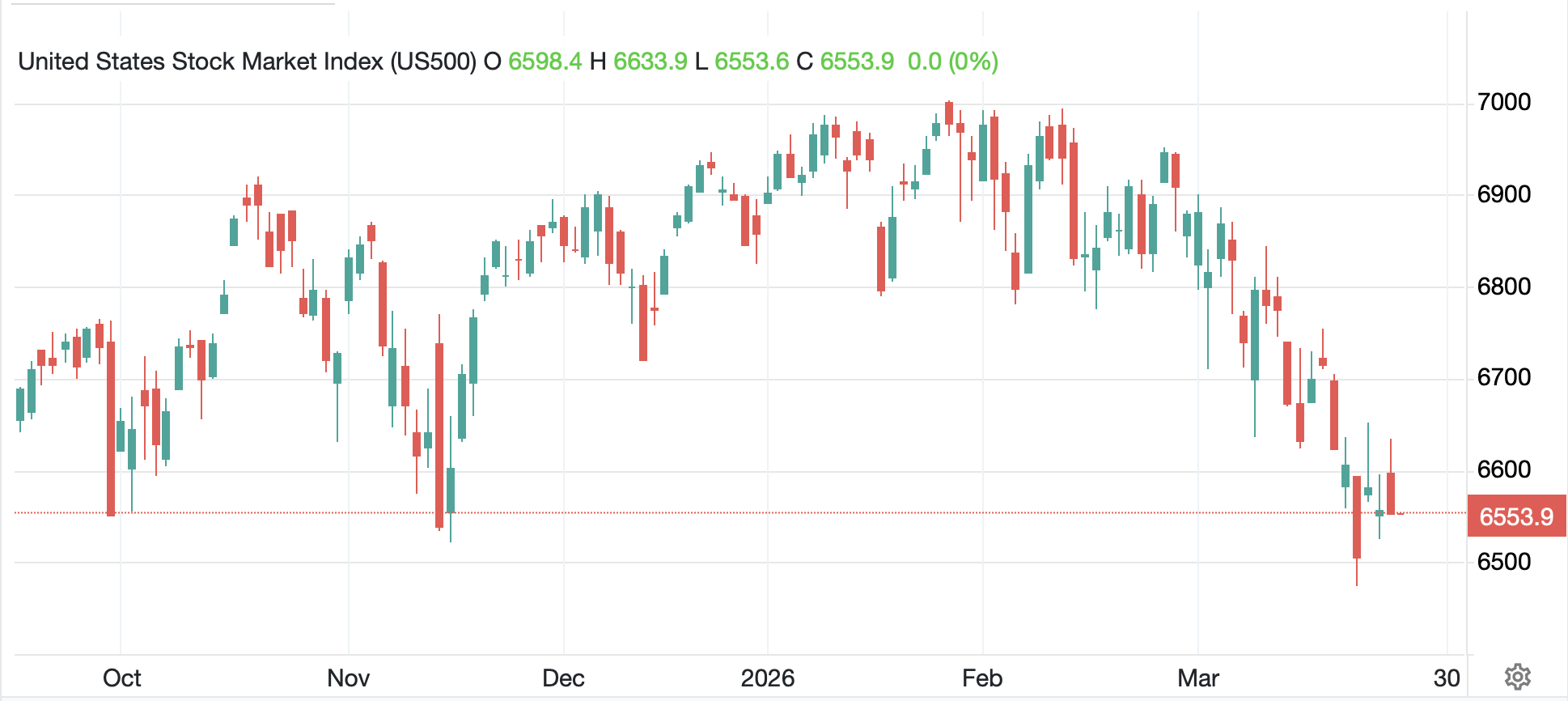
So, I was reading my friend JJ’s evening wrap up from yesterday and he highlighted the fact that the DJIA (+1.3%) made a new all-time high in trading and it was led by…Goldman Sachs.  

Source: tradingeconomics.com

Now, I have nothing against Goldman Sachs, per se, but it struck me as odd that Goldman Sachs, an investment bank, was a member of the Dow Jones Industrial Average.  It’s not that I wasn’t aware of the fact, but for some reason, this mention stuck out.  So, I thought I might look at the current membership of the Dow and see just how industrial it is.

While you will likely not be surprised that it has several non-industrial, service-based companies in the index, you might be surprised by just how many.  For instance, aside from Goldman, JPMorgan, American Express and Visa are in there as well as United Health and Travelers from the insurance space.  There are major retailers like Walmart, Home Depot, Amazon and McDonalds, along with tech and telecom/media names like Microsoft, Salesforce, Disney and Verizon.  

This is not to say that these are misplaced with respect to their relative importance in the US economy, clearly all are major corporations with long histories of profitability.  But it seems odd to list them as industrial.  I would contend that nothing explains the financialization of the US economy better than the fact that 14 out of the 30 members of the DJIA are service companies rather than producers of stuff.  Maybe they should rename it the Dow Jones Major Corporate Index.

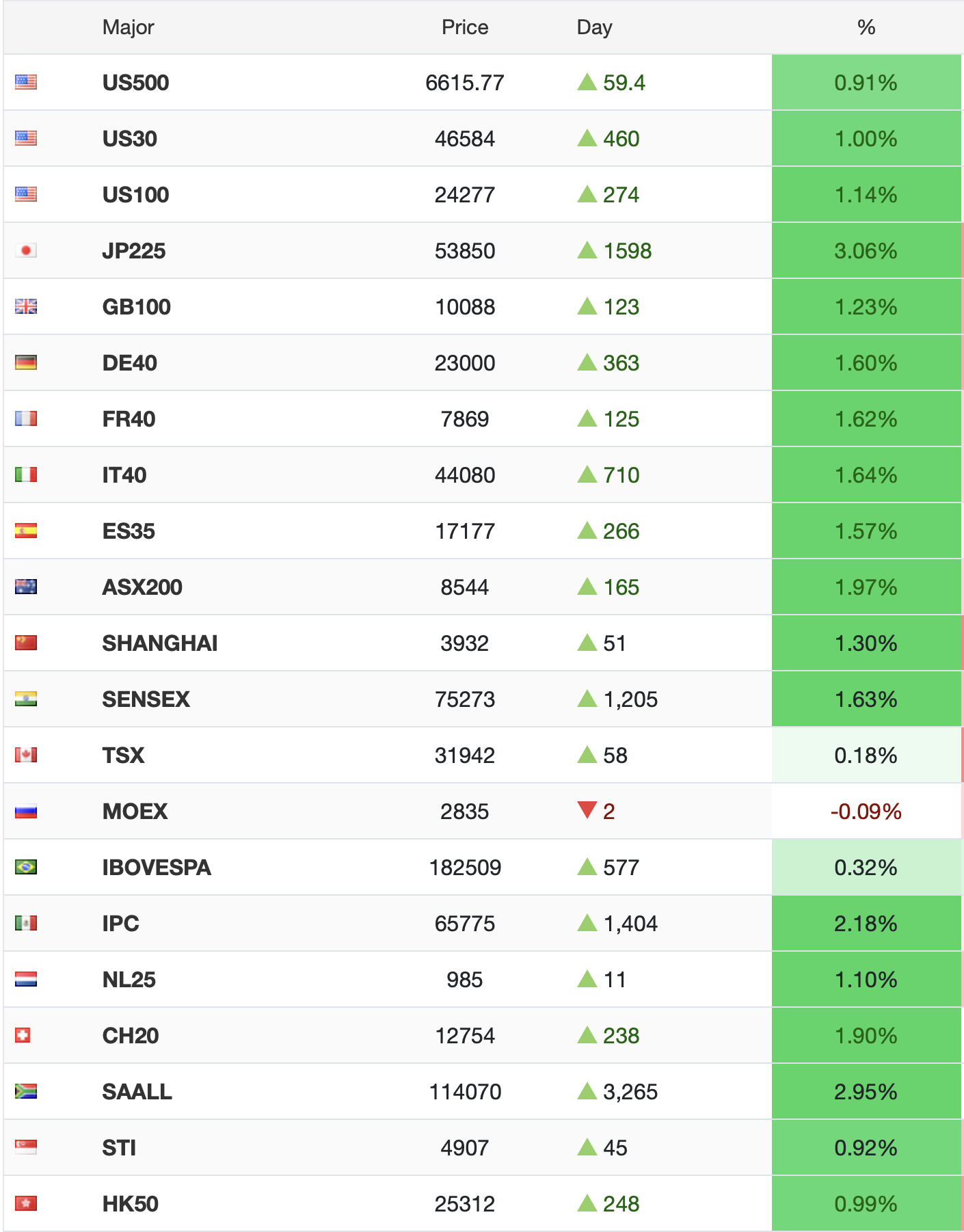
To conclude the equity portion of our discussion, yesterday saw the NASDAQ (-0.25%) decline in the face of a broad overall equity rally as there appears to be a rotation of investors from AI into other things like financials (as hopes of another Fed rate cut spring eternal) and power producers as the power needs of AI keep getting estimated ever higher.  This rally was followed pretty much everywhere around the world as regardless of one’s religion, it appears investors are all counting on Santa to deliver higher prices.  In Asia, Tokyo (+1.4%). HK (+1.75%), China (+0.6%), Australia (+1.2%), Korea (+1.4%) and virtually every other market rallied.  The only data of note here was Japanese IP which came in a tick higher than its preliminary forecast, but to counter that, Nikkei reported that the BOJ, when they meet next week, are definitely going to raise the base rate by 25bps to 0.75%, the highest level since 1994.  That doesn’t seem that bullish, but then, I’m not Japanese.

In Europe, the gains are also universal, albeit less impressive with Spain (+0.5%) and France (+0.5%) leading the way and Germany and the UK both only marginally higher.  The most interesting news here is about the EU’s efforts to confiscatethe Russian assets that have been frozen since they invaded Ukraine, but which are being blocked by Belgium where they reside under SWIFT.  And as I type (7:45) US futures are mixed with the Dow (+0.2%) still in favor while NASDAQ (-0.5%) continues to lag.

But the other story that is getting press, and arguably more press, is precious metals.  Silver (+0.9% today, +10% this week, +122% this year) is the leader and is now trading above $64/oz.  This is the very definition of a parabolic move, which is obvious when you look at the silver chart for the past 5 years.

Source: tradingeconomics.com

Referring back to JJ’s note, it is important to understand he is a commodity trader of long standing (remarkably even longer than my time in FX) and he discussed silver from an insider’s perspective.  The essence of the issue here is that there are quite a few paper short positions that have existed for a long time.  The rumor has long been that JPMorgan has been preventing silver from rising by playing in futures markets.  But now, real demand, between industrial users (solar panels and electronics) and Asian retail demand from both India and China is far higher than new supply or recovery from scrap, to the tune of 120 million oz/year, and those shorts cannot find the metal to deliver.  The last time there was a squeeze, when the Hunt’s tried to corner the market in 1980, people lined up at stores to sell their silver tea services, bringing metal to the market.  But those are all gone.  I’m not sure what will change this in the short run, but it cannot go up forever.  With that in mind, though, I think precious metals have much further to run as the ongoing debasement of fiat currencies simply adds further to demand.  

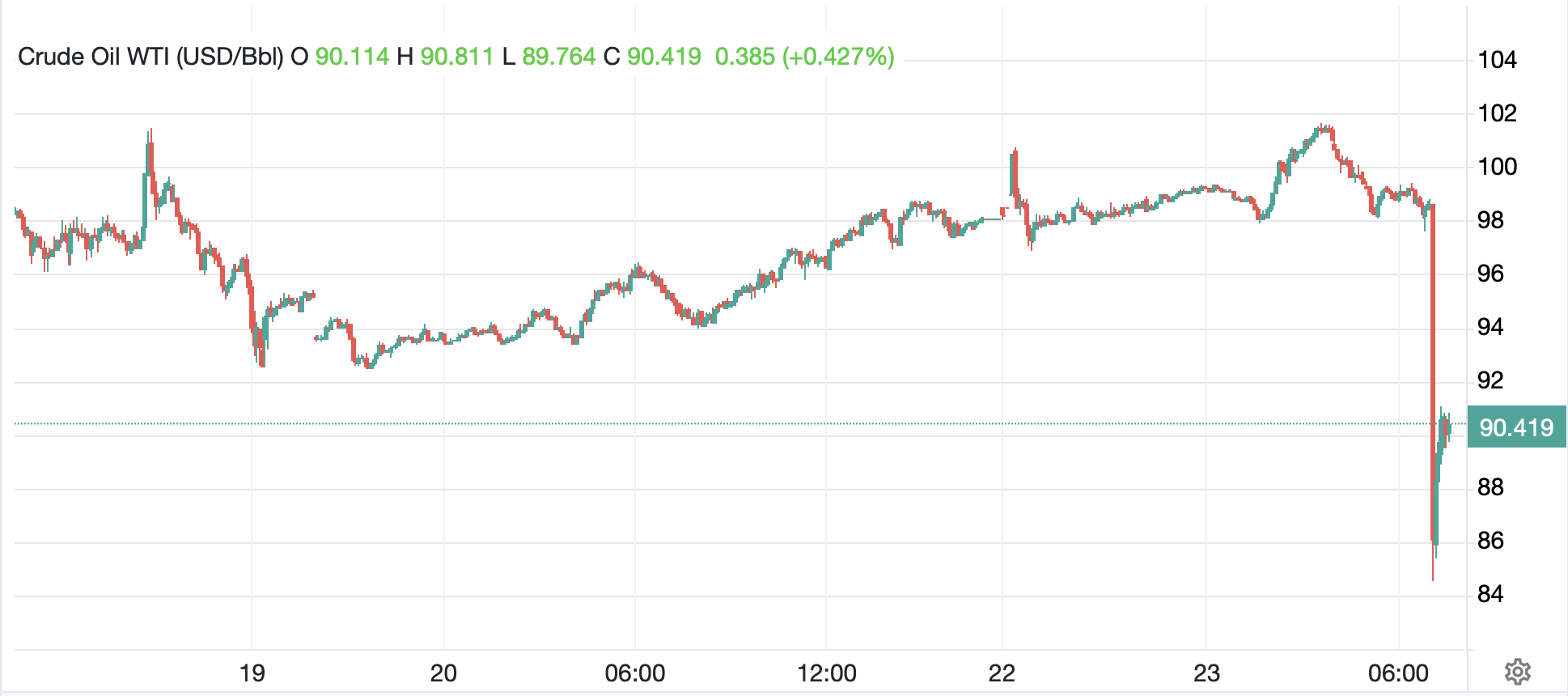
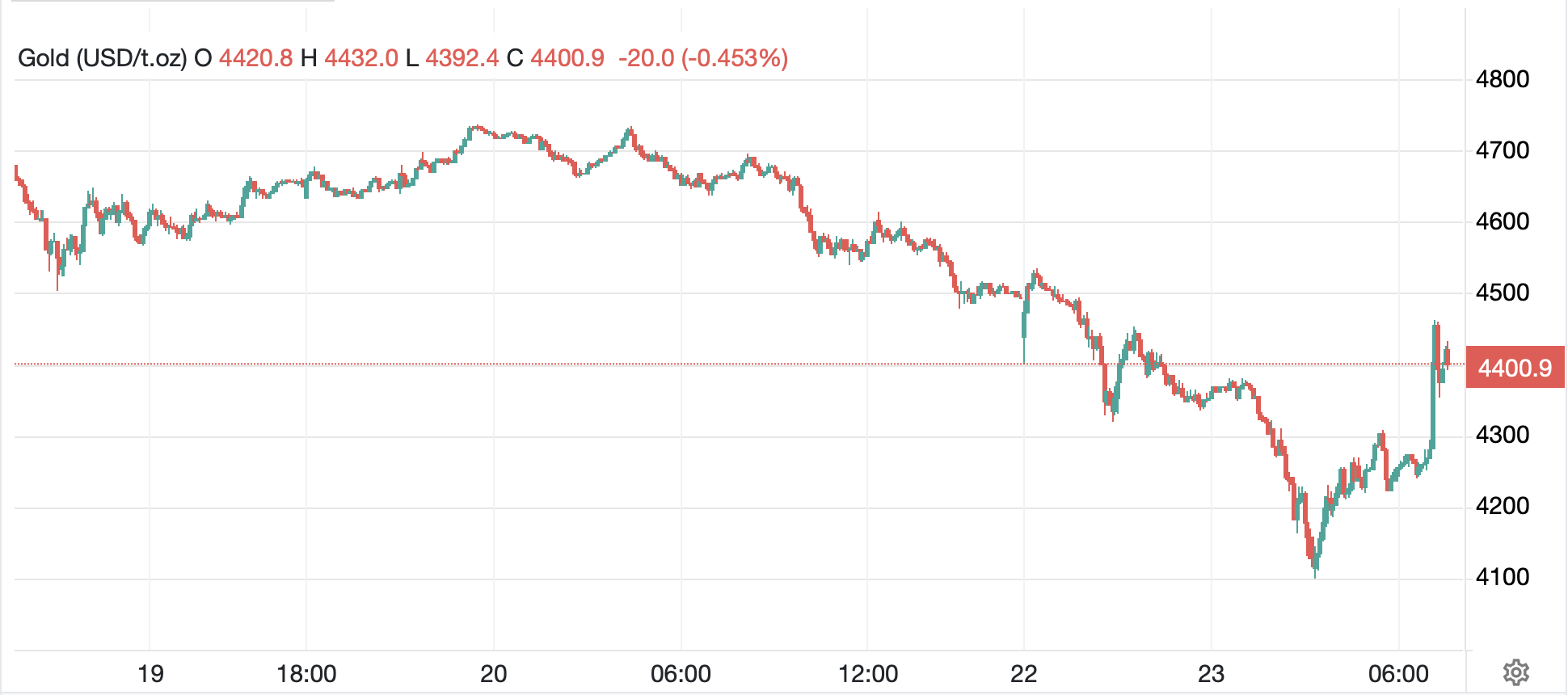
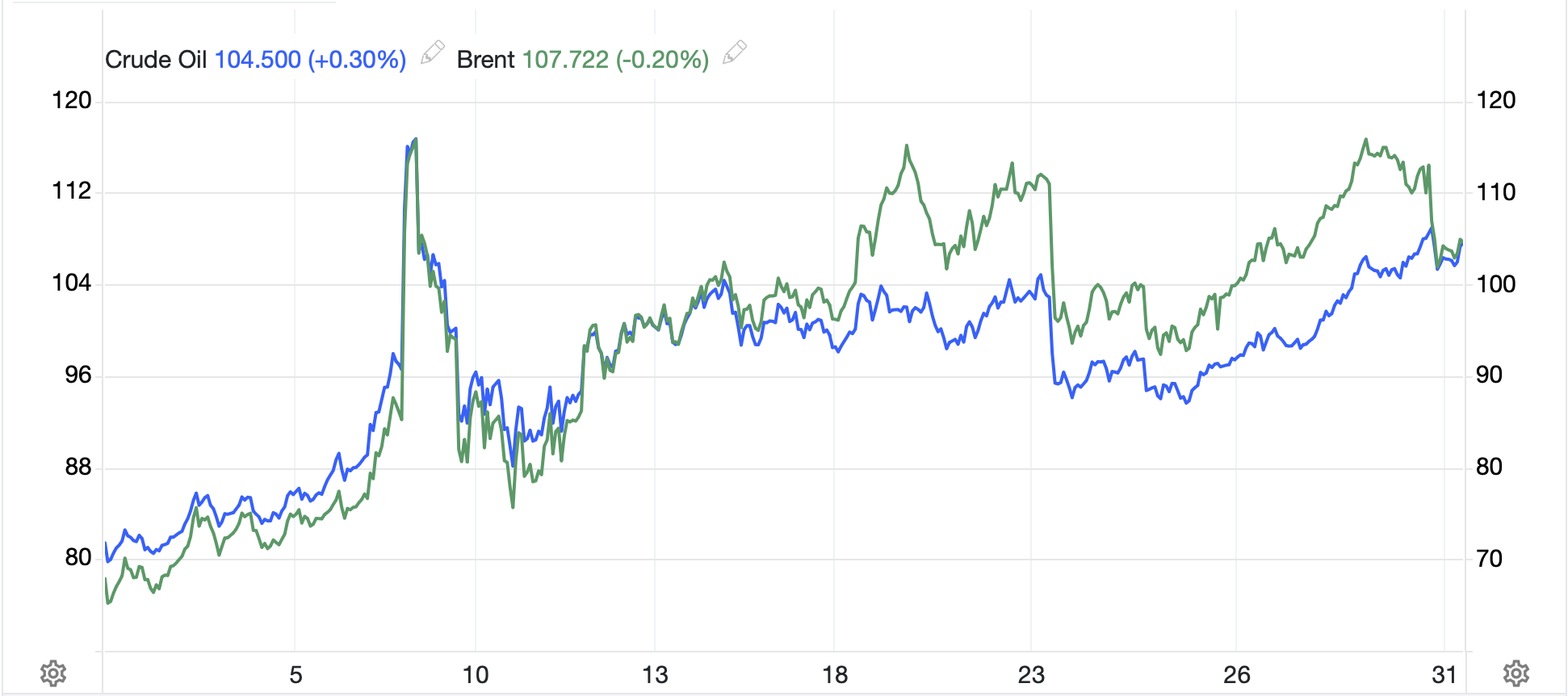
Silver managed to drag gold (+1.1% today, +3.0% this week, +65% this year) and platinum (+3.6% today, +7.2% this week, +98% this year) along for the ride and I expect this will continue across the board.  Meanwhile oil (0.0%) is unchanged this morning but has fallen -4.0% this week.  The news that the US boarded a Venezuelan oil tanker and took control in an effort to pressure Maduro didn’t seem to concern anyone in the market.  This trend remains clear.  

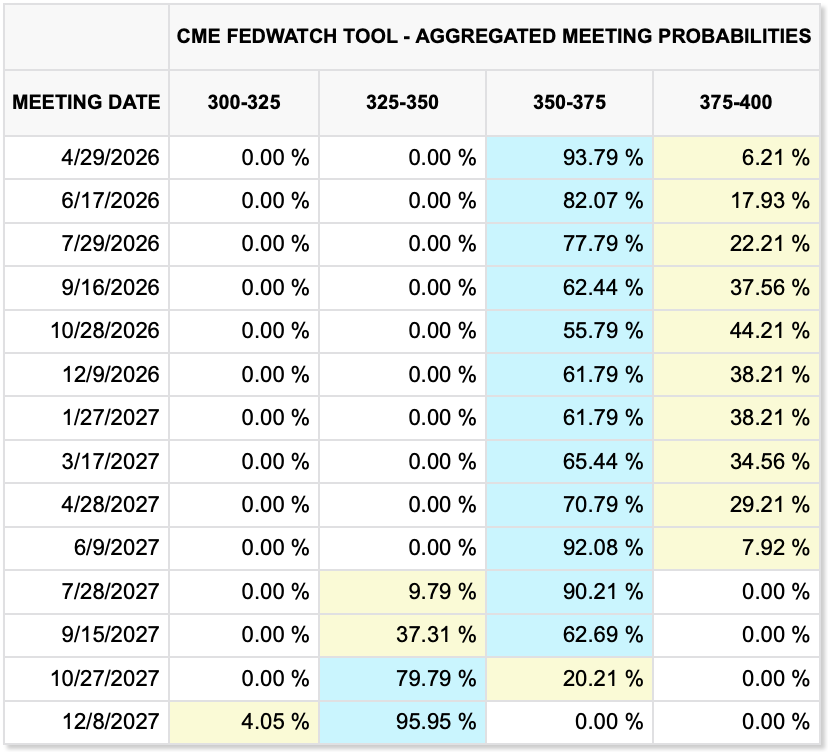
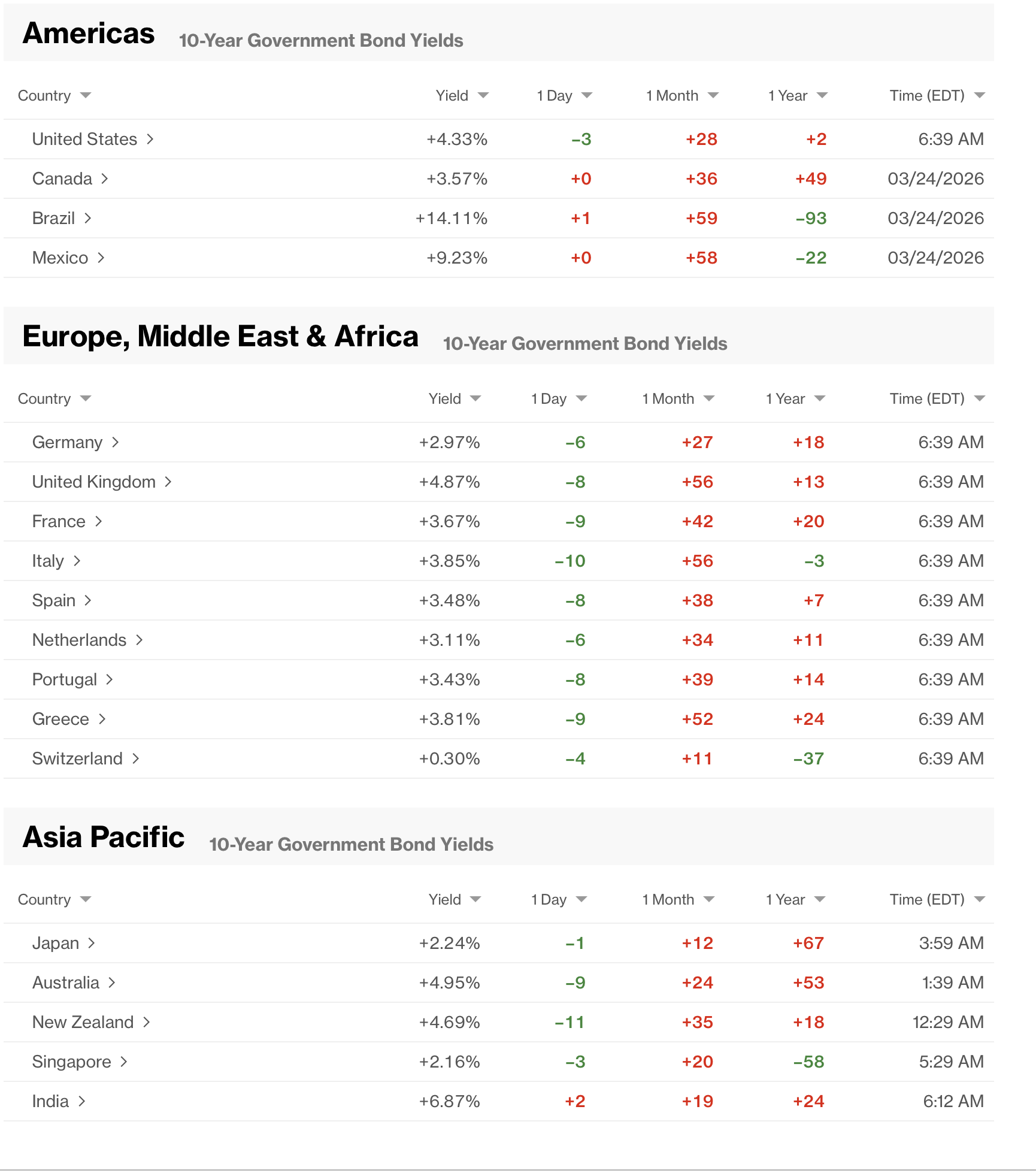
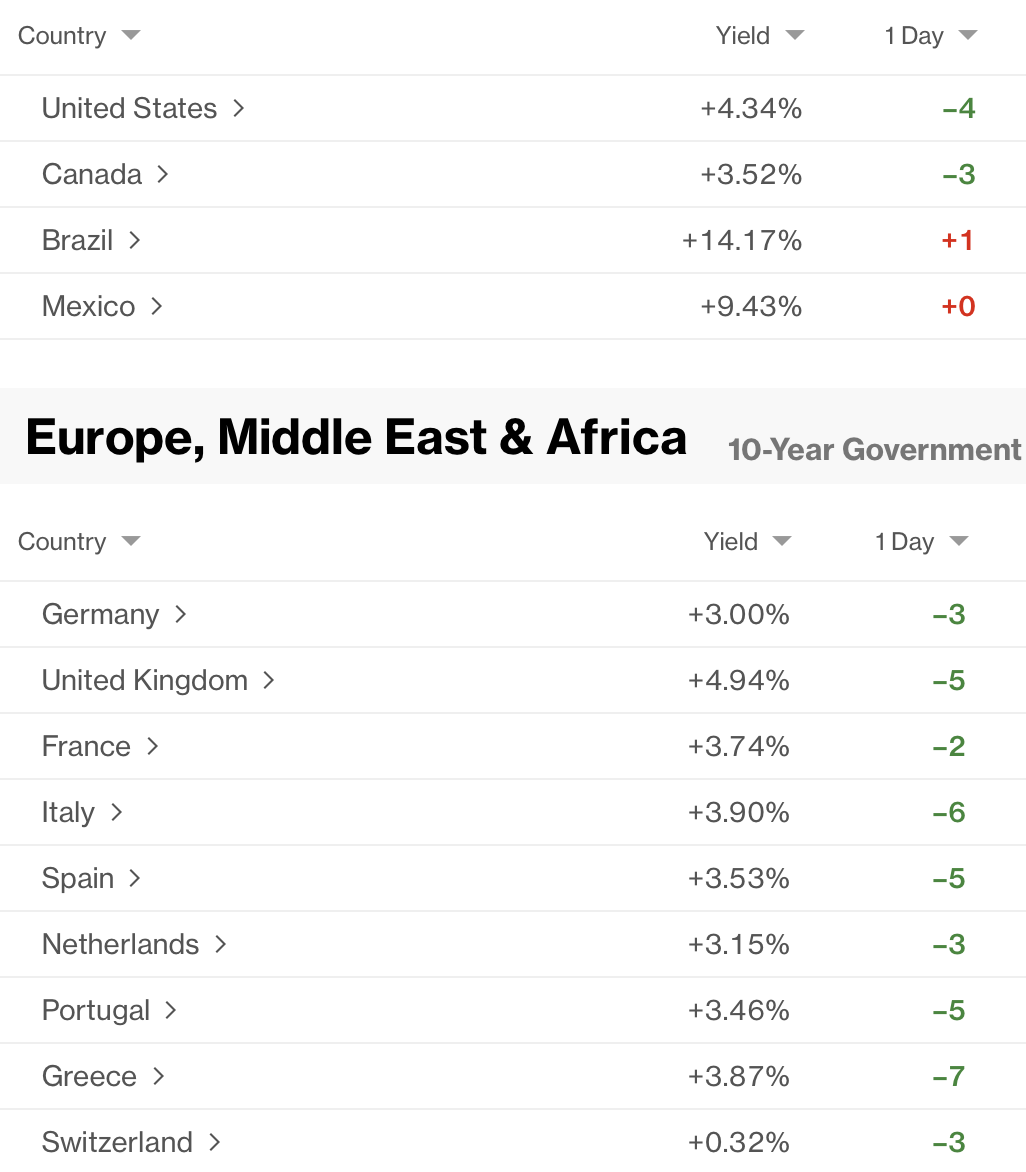
As to the bond market, this morning yields are higher by 2bps, pretty much across the board of Treasuries and all European sovereigns.  But with that in mind, the 10-year Treasury is still yielding 4.18%, below its worst level immediately following the FOMC meeting, and as I mentioned above, there appears to be a growing belief that Powell’s concern about the labor market will result in more cuts sooner rather than later.  While that is not really playing out in the futures market yet, as you can see below with the next cut priced for April with a 76% probability, that is the narrative that is being promulgated in FinX.  

Source: cmegroup.com

Next week we will get the November NFP report (exp 35K) and all the data we missed in October.  I can assure you if that comes in weak, the idea of a rate cut will explode onto the scene once again.  Too, on Wednesday evening, the WSJpublished an article indicating that Chairman Powell is concerned the employment data is overstating things because of the flaws in the birth/death model.  The point is he may be far more inclined to cut if next Tuesday’s report is weak.

Finally, the dollar is…still here.  It sold off after the Fed, and as I showed yesterday, has fallen back to the middle of its trading range of the past 6 months.  I keep reading how the dollar is the key, but quite frankly, I’m not certain what that key will unlock.  We need out of consensus activities to change the current situation.  After all, the underlying demand for dollars because of the trillions of dollars of debt outstanding outside of the US makes it difficult to get too bearish without a major reason.  If the Fed cut 50bps intermeeting, that would do it, but I’m not holding my breath.

And that’s really it my friends.  There is no data today although we do hear from three Fed speakers.  Given the dissent on the FOMC, I expect that we are going to be need to keep score as to views for a while when these folks speak. 

In the meantime, as I said above, have a wonderful holiday all

Adf

Crazier Still

There once was a time when the Fed
When meeting, and looking ahead
All seemed to agree
The future they’d see
And wrote banal statements, when read
 
But this time is different, it’s true
Though those words most folks should eschew
‘Cause nobody knows
Which way the wind blows
As true data’s hard to construe
 
So, rather than voting as one
Three members, the Chairman, did shun
But crazier still
The dot plot did kill
The idea much more can be done


I think it is appropriate to start this morning’s discussion with the dot plot, which as I, and many others, expected showed virtually no consensus as to what the future holds with respect to Federal Reserve monetary policy.  For 2026, the range of estimates by the 19 FOMC members is 175 basis points, the widest range I have ever seen.  Three members see a 25bp hike in 2026 and one member (likely Governor Miran) sees 150bps of cuts.  They can’t all be right!  But even if we look out to the longer run, the range of estimates is 125bps wide.

Personally, I am thrilled at this outcome as it indicates that instead of the Chairman browbeating everyone into agreeing with his/her view, which had been the history for the past 40 years, FOMC members have demonstrated they are willing to express a personal view.

Now, generally markets hate uncertainty of this nature, and one might have thought that equity markets, especially, would be negatively impacted by this outcome.  But, since the unwritten mandate of the Fed is to ensure that stock markets never decline, they were able to paper over the lack of consensus by explaining they will be buying $40 billion/month of T-bills to make sure that bank reserves are “ample”.  QT has ended, and while they will continue to go out of their way to explain this is not QE, and perhaps technically it is not, they are still promising to pump nearly $500 billion /year into the economy by expanding their balance sheet.  One cannot be surprised that initially, much of that money is going to head into financial markets, hence today’s rally.

However, if you want to see just how out of touch the Fed is with reality, a quick look at their economic projections helps disabuse you of the notion that there is really much independent thought in the Marriner Eccles Building.  As you can see below, they continue to believe that inflation will gradually head back to their target, that growth will slow, unemployment will slip and that Fed funds have room to decline from here.

I have frequently railed against the Fed and their models, highlighting time and again that their models are not fit for purpose.  It is abundantly clear that every member has a neo-Keynesian model that was calibrated in the wake of the Dot com bubble bursting when interest rates in the US first were pushed down to 0.0% while consumer inflation remained quiescent as all the funds went into financial assets.  One would think that the experience of 2022-23, when inflation soared forcing them to hike rates in the most aggressive manner in history, would have resulted in some second thoughts.  But I cannot look at the table above and draw that conclusion.  Perhaps this will help you understand the growth in the meme, end the fed.

To sum it all up, FOMC members have no consensus on how to behave going forward but they decided that expanding the balance sheet was the right thing to do.  Perhaps they do have an idea, but given inflation is showing no signs of heading back to their target, they decided that the esoterica of the balance sheet will hide their activities more effectively than interest rate announcements.

One of the key talking points this morning revolves around the dollar in the FX markets and how now that the Fed has cut rates again, while the ECB is set to leave them on hold, and the BOJ looks likely to raise them next week, that the greenback will fall further.  Much continues to be made of the fact that the dollar fell about 12% during the first 6 months of 2025, although a decline of that magnitude during a 6-month time span is hardly unique, it was the first such decline that happened during the first 6 months of the year, in 50 years or so.  In other words, much ado about nothing.  

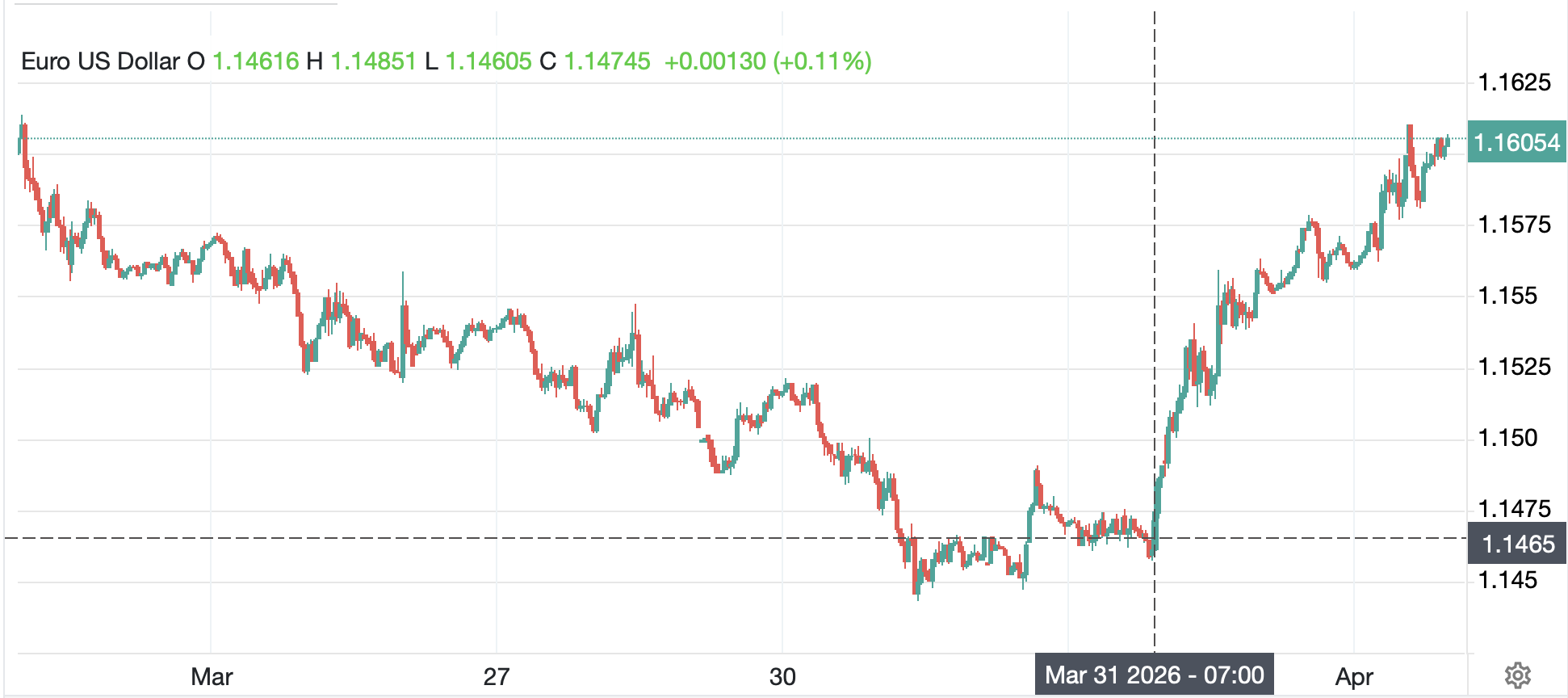
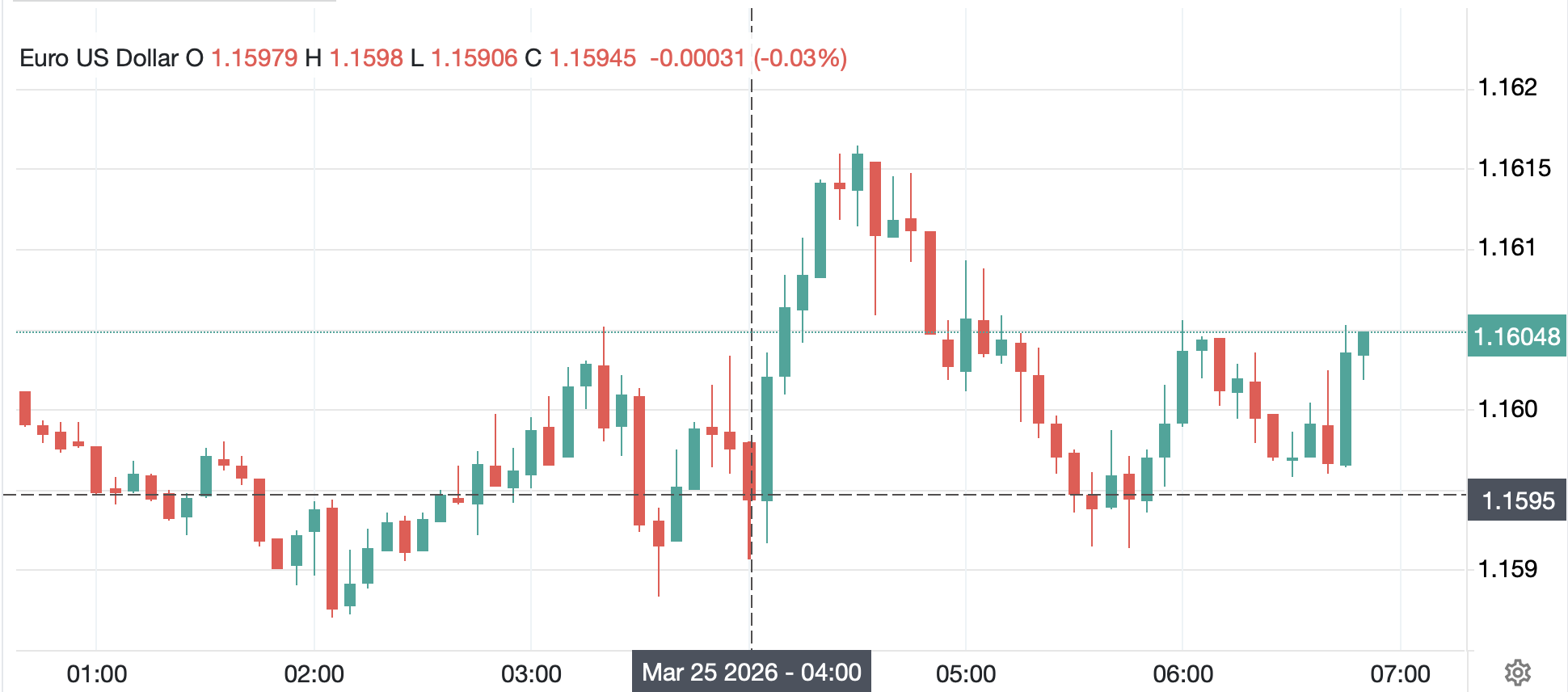
The latest spin, though, is look for the dollar to decline sharply after the rate cut.  I have a hard time with this concept for a few reasons.  First, given the obvious uncertainty of future Fed activity, as per the dot plot, it is unclear the Fed is going to aggressively cut rates from this level anytime soon.  And second, a look at the history of the dollar in relation to Fed activity doesn’t really paint that picture.  The below chart of the euro over the past five years shows that the single currency fell during the initial stages of the Fed’s panic rate hikes in 2022 then rallied back sharply as they continued.  Meanwhile, during the latter half of 2024, the dollar rallied as the Fed cut rates and then declined as they remained on hold.   My point is, the recent history is ambiguous at best regarding the dollar’s response to a given Fed move.

Source: tradingeconomics.com

I have maintained that if the Fed cuts aggressively, it will undermine the dollar.  However, nothing about yesterday’s FOMC meeting tells me they are about to embark on an aggressive rate cutting binge.

The other noteworthy story this morning is the outcome from China’s Central Economic Work Conference (CEWC).  I have described several times that the President Xi’s government claims they are keen to help support domestic consumption and the housing market despite neither of those things having occurred during the past several years.  Well, Bloomberg was nice enough to create a table highlighting the CEWC’s statements this year and compare them to the past two years.  I have attached it below.

In a testament to the fact that bureaucrats speak the same language, no matter their native tongue, a look at the changes in Fiscal Policy or Top Priority Task, or even Real Estate shows that nothing has changed but the order of the words.  The very fact that they need to keep repeating themselves can readily be explained by the fact that the previous year’s efforts failed.  Why will this time be different?

Ok, a quick tour of markets.   Apparently, Asia was not enamored of the FOMC outcome with Tokyo (-0.9%) and China (-0.9%) both sliding although HK managed to stay put.  Elsewhere in the region, both Korea (-0.6%) and Taiwan (-1.3%) were also under pressure as most markets here were in the red.  The exceptions were India, Malaysia and the Philippines, all of which managed gains of 0.5% or so.  

In Europe, things are a little brighter with modest gains the order of the day led by Spain (+0.5%) and France (+0.4%) although both Germany and the UK are barely higher at this hour.  There was no data released in Europe this morning although the SNB did meet and leave rates on hold at 0.0% as universally expected.  There has been a little bit of ECB speak, with several members highlighting that ECB policy is independent of Fed policy but that if Fed cuts force the dollar lower, they may feel the need to respond as a higher euro would reduce inflation.  Alas for the stock market bulls in the US, futures this morning are pointing lower led by the NASDAQ (-0.7%) although that is on the back of weaker than expected Oracle earnings results last night.  Perhaps promising to spend $5 trillion on AI is beginning to be seen as unrealistic, although I doubt that is the case 🤔.

Turning to the bond market, Treasury yields have slipped -2bps overnight after falling -5bps yesterday.  Similar price action has been seen elsewhere with European sovereign yields slipping slightly and even JGB yields down -2bps overnight.  Personally, I am a bit confused by this as I have been assured that the Fed cutting rates in this economy would result in a steeper yield curve with long-dated rates rising even though the front end falls.  Perhaps I am reading the data wrong.

In the commodity markets, the one truth is that there are no sellers in the silver market.  It is higher by another 0.5% this morning and above $62/oz as whatever games had been played in the past to cap its price seem to have fallen apart.  Physical demand for the stuff outstrips new supply by about 120 million oz /year, and new mines are scarce on the ground.  This feels like there is further room to run.

Source: tradingeconomics.com

As to the rest of the space, gold (-0.2%) which had a nice day yesterday is consolidating, as is copper.  Turning to oil (-1.1%) it continues to drift lower, dragging gasoline along for the ride, something that must make the president quite happy.  You know my views here.

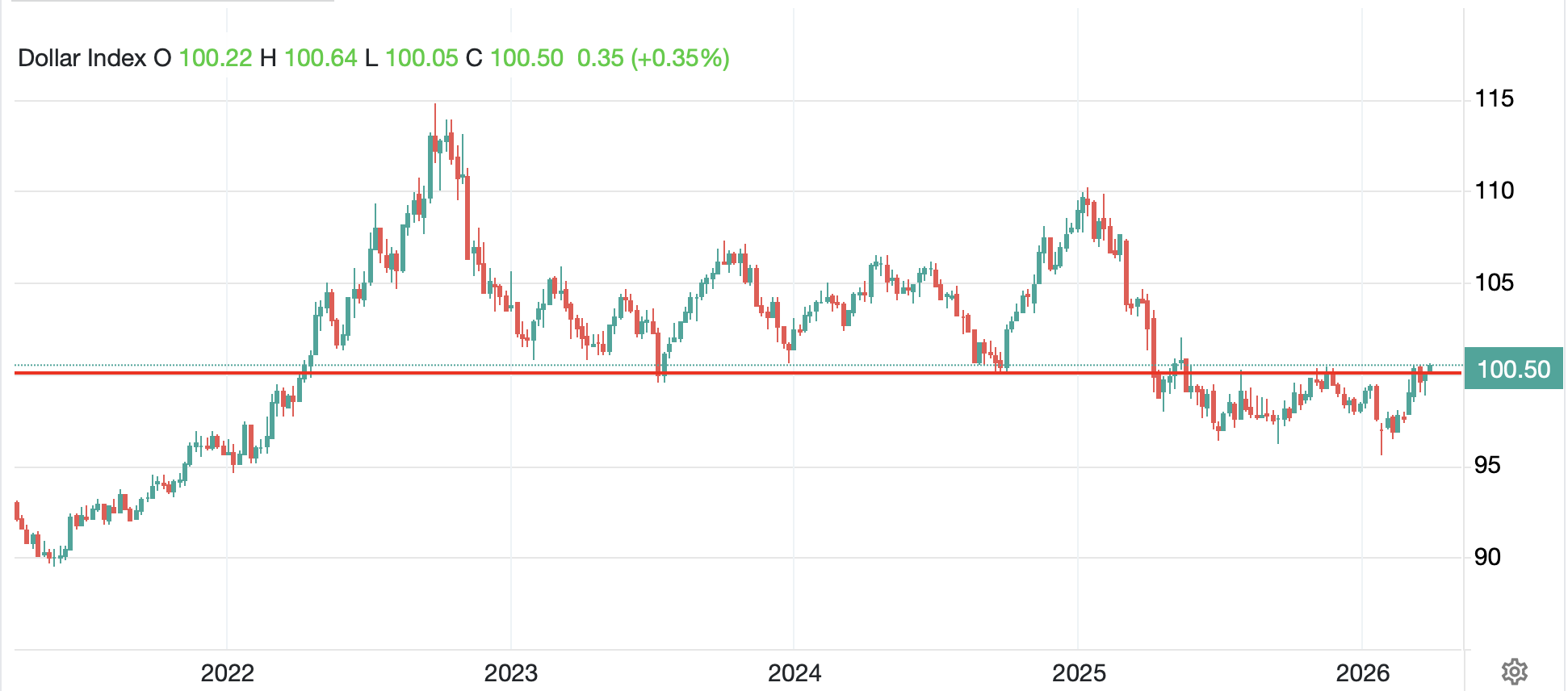
As to the dollar writ large, while it sold off a bit yesterday, as you can see from the below DXY (-0.3%) chart, it is hardly making new ground, rather it is back to the middle of its 6-month range.  

Source: tradingeconomics.com

This morning more currencies are a bit stronger but in the G10, CHF (+0.45%) is the leader with everything else far less impactful.  And on the flip side, INR (-0.7%) has traded to yet another historic low (USD high) as the new RBI governor has decided not to waste too much money on intervention.  Oh yeah, JPY (+0.2%) has gotten some tongues wagging as now that the Fed cut and the BOJ is ostensibly getting set to hike, there is more concern about the unwind of the carry trade.  My view is, don’t worry unless the BOJ hikes 50bps and promises a lot more on the way.  After all, if the Fed has finished cutting, something that cannot be ruled out, this entire thesis will be destroyed.

On the data front, Initial (exp 220K) and Continuing (1950K) Claims are coming as well as the Trade Balance (-$63.3B).  There are no Fed speakers on the docket, but I imagine we will hear from some anyway, as they cannot seem to shut up.  

It would not surprise me to see the dollar head toward the bottom of this trading range, but I think we need a much stronger catalyst than uncertainty from the Fed to break the range.

Good luck

Adf

All But Assured

A cut has been all but assured
Though since last time we have endured
Some fears Jay’s a hawk
So, when he does talk
Will this cut, at last, be secured?
 
And now there’s a narrative view
Though rates will fall, what he will do
Is try to convey
Now it’s out the way
Another one may not come through


Good morning all and welcome to Fed Day.  The question, of course, is will this be a frabjous day?  As I write this morning, the Fed funds futures market continues to price a roughly 90% probability of a 25bp cut this afternoon, but the prospects for future rate cuts have greatly diminished as you can see in the table below from the CME.

It wasn’t long ago when the market was pricing 100bps more of rate cuts by the end of 2026, meaning a Fed funds rate of 2.50% – 2.75%.  However, the narrative has shifted over the past several weeks after very mixed signals from FOMC speakers and data releases that have indicated the economy is not cratering (e.g. yesterday’s JOLTS data printing at 7.658M, >400K higher than expected).  You may recall that shortly after the last FOMC meeting at the end of October, the probability of today’s rate cut had fallen to just 30%.

It appears that the new discussion point is this will be a hawkish cut, an idiom similar to jumbo shrimp.  At this point, the bulk of the discussion has been around how many dissents will be recorded with the subtext being, what will Chairman Powell have to promise potential dissenters in order to bring them along to his side of the ledger.  My take is if you thought the last press conference was hawkish, you ain’t seen nothin’ yet.  In fact, I would not be surprised to see a virtually categoric call to this being the end of the cutting cycle for the foreseeable future.

Remember, we also will see the new dot plots and SEP which will help us understand the broad picture of where FOMC members currently stand on the matter.  Personally, I expect to see a wide disparity between the ends of the distribution, and it wouldn’t surprise me to see some expectations of no rate changes for 2026 with other calls for 150bps of cuts and no consensus view at all. 

At this point, all we can do is wait.  However, the market discussion has centered on the fact that 10-year Treasury yields (+1bp) have been climbing lately, and that this morning they have touched 4.20% again while, at the same time, 2-year Treasury yields (no change) have been slipping as per the below chart I created from FRED data.

The steepening yield curve, which now appears to be turning into a bear steepener (when long dated yields rise more quickly than short-dated yields) is ringing alarm bells in some quarters.  The narrative is that there are growing concerns over both the quantity of debt outstanding and its rate of growth as well as the fact rate cuts will engender future inflation.

A key part of the discussion is the fact that what had been a synchronous system of global central bank policy easing is now starting to split up.  While we have known the BOJ is in a hiking cycle, albeit a slow one, today, the BOC is not only expected to leave rates on hold but explain they have bottomed.  We have heard that, as well, from the RBA earlier this week, and the commentary from the ECB may be coming along those lines.  So, is the US the outlier now?  And will that weaken the dollar?  Those are the key questions we will need to address going forward.

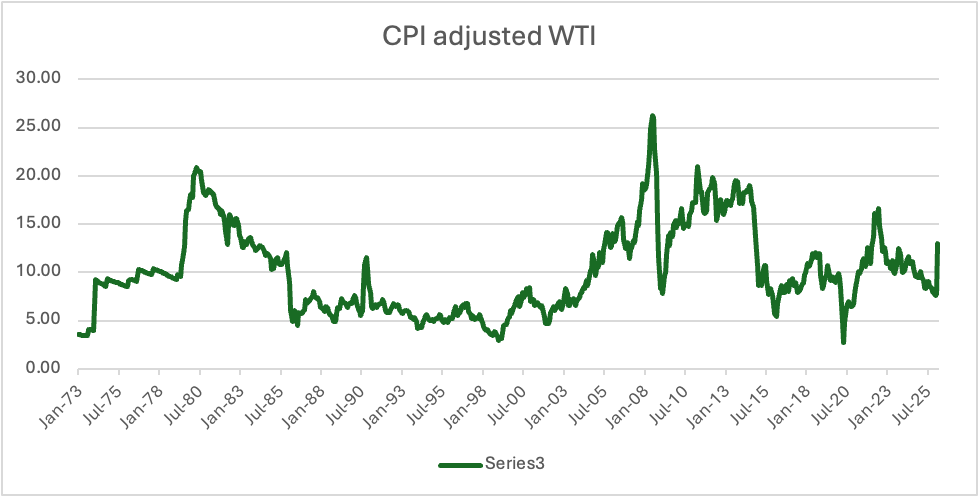
But before we move on, there is one market I must discuss, silver, which exploded to new historic highs yesterday, trading through $60/oz and is higher again this morning by 0.6% and trading at $61/oz.  someone made the point yesterday that for the second time in history, you need just 1 ounce of silver to buy one barrel of WTI.  The first time was back during the silver squeeze in January 1980, but that was quite short-lived (see chart below from macrotrends.com).  This one appears to have legs.  

I don’t know that I can find another indicator that better expresses my views of fiat currency debasement alongside an expanding availability of oil.  To my mind, both these trends remain quite strong, and this is the embodiment of them both combined.

Ok, so as we await the FOMC, let’s see if anybody is doing anything in financial markets of note.  As testament to the fact that virtually everybody is awaiting the Fed this afternoon, US equity markets barely moved yesterday, and Asian markets were similarly quiet, with only Taiwan (+0.8%) moving more than 0.4% in either direction.  The large markets were +/- 0.2% overall.  In Europe, the movement has been slightly larger, but still not impressive with Germany (-0.4%) the laggard of note while the UK (+0.3%) is the leader.  A smattering of data released from the continent doesn’t seem to be having any real impact, nor did comments by Madame Lagarde claiming the rates are in a good place and displaying some optimism on future GDP growth.  Of much greater concern is the headlong rush to a digital euro CBDC, where they are seeking to exert control over the citizenry.  If for no other reason, I would be leery of expecting great things from the Eurozone going forward.  Not surprisingly, at this hour (7:30) US futures are little changed ahead of the meeting.

In the bond market, yields are creeping higher all around the world with European sovereign yields higher between 2bps and 4bps this morning.  Perhaps investors are taking Madame Lagarde’s views to heart.  Or perhaps the fallout from the recently released US National Security Strategy, where the US basically dismisses Europe as strategic, has investors concerned that European governments are going to be spending that much more on defense without having the financial wherewithal to do so effectively, thus will be borrowing a lot and driving yields higher.  At this point, European sovereign yields have risen to levels not seen since the Eurozone bond crisis in 2011, but it feels like they have further to climb (see French 10-year OAT yields below from Marketwatch.com).

In the commodity market, oil (+0.5%) cannot get out of its own way.  While it is a touch higher this morning, it sits at $58.50/bbl, and that long-term trend remains lower.  We’ve already discussed silver and gold (-0.25%) continues to trade either side of $4200 these days, biding its time for its next move (higher I believe).  Copper (+1.4%) is looking good today, although it is hard to find economic news that is driving today’s price action.

Finally, the dollar is a touch softer this morning, about 0.1% in the DXY as well as virtually every major currency in the G10.  Interestingly, today’s outlier is SEK (+0.4%) which is rallying despite data showing GDP (-0.3%) slipping on the month while IP (-6.6%) fell sharply.  As to the EMG bloc, there is very little movement of note with the biggest news this evening’s Central Bank of Brazil meeting where they are expected to leave their overnight SELIC rate at 15.0% as inflation there, released this morning at a remarkably precise 4.46% continues to run at the top of their target range of 3.0% +/- 1.5%.

Ahead of the FOMC, we only see the Employment Cost Index (exp 0.9%), a number the Fed watches more closely than the market, and we hear from the BOC who are universally expected to leave Canadian rates on hold at 2.25%.

And that’s really it.  I wouldn’t look for much movement ahead of the 2pm statement release and then the fireworks at 2:30 when Powell speaks can drive things anywhere.  The most compelling story will be the number of dissents on the vote, as there will almost certainly be several.  According to Kalshi, 3 is the majority estimate.  With President Trump continuing to discuss the next Fed chair, I have a feeling there will be 4 and that will be a negative for bonds (higher yields) and a short-term negative for the dollar.  In fact, it is just another reason to hold precious metals.

Good luck

Adf

It Won’t End Well

From Europe, we’re hearing some squawks
They’ve not been included in talks
‘Bout war and Ukraine
So, to inflict pain
They’ve threatened a US detox
 
It seems they believe if they sell
All Treasuries held we would yell
Please stop, it’s too much
And lighten our touch
Methinks, for them, it won’t end well


Markets continue to be dull these days.  While we are clearly not in the summer (it is 15° here in NJ this morning), doldrums certainly seem to be descriptive of the current situation.  Equities bounce back and forth each day, neither trading to new highs, nor falling sharply.  The same is true with the dollar, with oil, with gold of late and even, on a slightly longer-term view, of Treasury bonds.  I guess that could be the exception, depending on your horizon, but as you can see from the chart below, it has been several months since 10-year yields have traded outside the 4.0% – 4.2% range.

Source: tradingeconomics.com

Now, much digital ink has been spilled trying to explain that the latest 15bp rise in yields is a signal that the US economy is about to collapse under the weight of its $38+ trillion in debt, but I sense that is more about reporters trying to get clicks on their articles than a reflection of reality.

However, this morning I saw a story that I think is worth discussing, even though it is only a hypothetical.  Making the rounds is the story that Europe and the UK are extremely unhappy with President Trump’s approach to obtaining a peace in Ukraine and so have threatened their so-called ‘nuclear option’ of selling all their Treasury holdings to crash the US bond market and the US economy alongside it.  From what I have seen, if you sum up all the holdings in Europe and the UK it totals $2.3 trillion or so, although it is not clear if that is controlled by the governments, or there are private holdings included.  My strong suspicion is the latter, although I have not yet been able to confirm that.

But let’s assume those holdings are completely under the control of European central banks and governments and they decide that’s what they want to do.  What do you think will happen?  Arguably, much depends on how they go about selling them.  After all, it’s not as though there is anybody, other than the Fed, who can step up and show a bid on the full amount.  So how can they do this?  I figure there are only two viable options:

  1. They can sell them slowly and steadily over time, perhaps $200 billion/day (FYI daily Treasury market volume averages about $900 billion).  That would clearly put significant downward pressure on prices and push yields higher but would likely encourage the hedge fund community to double up on the bond basis trade thus slowing the decline.  However, if they did that for 11 days, US yields would undoubtedly be higher.  Too, remember that if the market started to get unstable, the Fed would step in and absorb whatever amount they deemed necessary to prevent things from getting out of hand.
  • Perhaps, since their ostensible goal is to destabilize the US bond market, they would literally all coordinate their timing and try to sell them all at once.  At that point, since nothing happens in the bond market without the Fed being aware, it would likely have an even smaller impact as the Fed would certainly step in and take down the entire lot.  After all, through QT, their balance sheet has shrunk about $2.3 trillion over the past 18 months, so they have plenty of capacity.

My point is, I believe this is an empty threat, as it seems most European threats tend to be.  Consider that the Eurodollar market remains the major source of funding throughout Europe, and it requires collateral (i.e. Treasury bills and bonds) in order to function.  If Europe no longer had that collateral, it feels like they might have a lot more problems funding anything on the continent.  

Another issue is that if we assume they successfully sell all their Treasuries, that means they will be holding $2.3 trillion in cash.  Exactly what are they going to do with that?  If they convert it into euros and pounds, the dollar will certainly fall sharply, meaning both the euro and pound will rise sharply.  Please explain how that will help their economies and their exporters.  They are getting killed right now because their energy policies have made manufacturing ridiculously expensive.  See how many cars VW or Mercedes sells overseas if the euro rallies 15%.

Now, the article linked above is from the Daily Express, not a website I trust, but they reference a WSJ article.  However, despite searching the Journal, and asking Grok to do the same, I can find no actual article that mentions this idea.  Ostensibly, if you want to search, it came out on December 1st, although if that is the case, why is it only getting press now?

It is a sign of the absence of market news that this is a story at all.  With market participants inhaling deeply so they may hold their breath until 2:00 tomorrow afternoon when the FOMC statement is released, they need something to do.  I guess this was today’s distraction.  As I said above, this is clickbait, not reality.

Ok, let’s tour markets. US equity market slipped a bit yesterday and Asian markets were dull as well with modest gains and losses almost everywhere.  The exception was HK (-1.3%) which suffered based on concern the FOMC will provide a ‘hawkish’ cut tomorrow and that will be the end of the road.  But China (-0.5%) was also soft despite hopes that when the Politburo meets in the next weeks, they will focus on more domestic stimulus (🤣🤣) just like they have been saying for the past three years.  Australia (-0.5%) slipped as the RBA left rates on hold and sounded more hawkish, indicating there were no cuts in the offing.

European bourses are mixed, although starting to lean lower.  The CAC (-0.6%) is the laggard here although Italy and Spain are also softer while Germany (+0.2%) leads the gainers after a slightly better than expected Trade Balance was reported this morning.  The hiccup here is that the balance improved because imports fell (-1.2%) so much more than exports rose (0.1%).  Hardly the sign of economic strength.

We’ve discussed bonds on a big picture basis, and recall, yields rose yesterday in both the US and Europe.  This morning, though, yields are little changed in the US and in Europe, with sovereign yields, if anything slightly lower.  JGB yields also slipped -1bp last night and the big mover was Australia after the RBA, with yields climbing 5bps.

In the commodity markets, while the trend remains slightly lower in oil (+0.3%), as you can see from the chart below, $60/bbl is home.  As I have written before, absent an invasion of Venezuela or peace in Ukraine, it is hard to see what changes this for now.  I guess if China stops filling up its SPR, demand could shrink and that would accelerate the decline.

Source: tradingeconomics.com

In the metals markets, $4200/oz has become gold’s (+0.3%) home lately while silver (+0.9%) has found comfort between $58/oz and $59/oz.  Neither is seeing much in the way of volatility or new interest, but both trends remain strongly higher. 

Finally, the dollar, which rallied a bit yesterday, is little changed this morning.  USDJPY is interesting as it has traded back above 156 this morning, contradicting all that talk of a Japanese repatriation trade.  Again, it is difficult for me to look at the yen chart below and conclude the dollar has peaked.

Source: tradingeconomics.com

Elsewhere in the space, this is one of those days where 0.2% is a major move.  Historically, December is not a time when FX traders are active.

On the data front, the NFIB report rose to 99.0 this morning, its highest reading in three months and the underlying comments showed a modest increase in optimism with many businesses looking to hire more people but having trouble finding qualified candidates.  This is quite a juxtaposition with the narrative that small businesses are firing workers that I have read in several different places and is backed by things like the recent Challenger Gray survey which indicated that US businesses have fired more than 1.1 million workers so far this year.  This lack of clarity is not going to help the FOMC make decisions, that’s for sure.  As to the rest, the ADP Weekly Survey is due to be released as well as JOLTS Job Openings (7.2M) and Leading Indicators (-0.3%) at 10:00.

The very fact that the biggest story I could find was a hypothetical is indicative of the idea that there is nothing going on.  Look for a quiet one as market participants await Powell and friends tomorrow.

Good luck

Adf

Cold Growth

Winter approaches
Both cold weather and cold growth
Plague Japan’s future


It’s not a pretty picture, that’s for sure.  A raft of Japanese data was released early Sunday evening with GDP revised lower (-0.6% Q/Q, -2.6% Y/Y) and as you can see from the Q/Q chart below, it is hard to get excited about prospects there.

Source: tradingeconomics.com

Of course, this is what makes it so difficult to estimate how Ueda-san will act in a little less than two weeks’ time.  On the one hand, inflation remains a problem, currently running at 3.0% and showing no signs of declining.  Recall, the BOJ has a firm 2.0% target, so they are way off base here.  Add to that the fact that inflation in Japan had been virtually zero for the prior 15 years and the population is starting to get antsy.  However, if growth is retreating, how can Ueda-san justify raising rates?

In the meantime, the punditry is having a field day discussing the yen and its broad weakness, although for the past three weeks, it has rebounded some 2% in a steady manner as per the below chart,

Source: tradingeconomics.com

As well, much digital ink has been spilled regarding the 30-year JGB yield which has traded to historic highs as per the below chart from cnbc.com.

There are many pundits who have the view that the Japanese situation is getting out of control.  They cite the massive public debt (240% of GDP), the fact that the BOJ holds 50% of the JGB market, the fact that the yen has declined to its lowest level (highest dollar value) since a brief spike in 1990 and before that since 1986 when it was falling in the wake of the Plaza Accord.

Source: cnbc.com

Add in weakening economic growth and growing tensions with China and you have the makings of a crisis, right?  But ask yourself this, what if this isn’t a crisis, but part of a plan.  Remember, the carry trade remains extant and is unlikely to disappear just because the BOJ raises rates to 0.75% in two weeks.  This means that Japanese investors are still enamored of US assets, notably Treasuries, but also stocks and real estate, as a weakening yen flatters their holdings.  Too, it helps Japanese companies compete more effectively with Chinese competitors who benefit from a too weak renminbi as part of China’s mercantilist model.  Michael Nicoletos, one of the many very smart Substack writers, wrote a very interesting piece on this subject, and I think it is well worth a read.  In the end, none of us know exactly what’s happening but it is not hard to accept that some portion of this theory is correct as well.  The one thing of which I am confident is the end is not nigh.  There is still a long time before things really become problematic.

And the yen?  In the medium term I still think it weakens further, but if the Fed gets very aggressive cutting rates, that will likely result in a short-term rally.  But much lower than USDJPY at 145-150 is hard for me to foresee.

Turning to the other noteworthy news of the evening, the Chinese trade surplus has risen above $1 trillion so far in 2025, with one month left to go in the year.  This is a new record and highlights the fact that despite much talk about the Chinese focusing more on domestic consumption, their entire economic model is mercantilist and so they continue to double down on this feature.  While Chinese exports to the US fell by 29% in November, and about 19% year-to-date, they are still $426 billion.  However, China’s exports to the rest of the world have grown dramatically as follows: Africa 26%, Southeast Asia 14% and Latin America 7.1%.  Too, French president Emanuel Macron just returned from a trip to Beijing, meeting with President Xi, and called out the Chinese for their export policies, indicating that Europe needed to take actions (raise tariffs or restrict access) before European manufacturing completely disappears.  (And you thought only President Trump would suggest such things!)

So, how did markets respond to this?  Well, the CSI 300 rose 0.8% (although HK fell -1.2%) and the renminbi was unchanged.  But I think it is worth looking at the renminbi’s performance vs. other currencies, notably the euro, to understand Monsieur Macron’s concerns.

Source: tradingeconomics.com

It turns out that the CNY has weakened by nearly 7.5% vs. the euro this year, a key driver of the growing Chinese trade surplus with Europe (and now you better understand the Japanese comfort with a weaker JPY).  My observation is that the pressure on Chinese exports is going to continue to grow going forward, especially from the other G10 nations.  Expect to hear more about this through 2026.  It is also why I see the eventual split of a USD/CNY world.

Ok, let’s look around elsewhere to see what happened overnight.  Elsewhere in Asia, things were mixed with Tokyo (+0.2%) up small, Korea (+1.3%) having a solid session along with Taiwan (+1.2%) although India (-0.7%) went the other way.  As to the smaller, regional exchanges, they were mixed with small gains and losses.  In Europe, it is hard to get excited this morning with minimal movement, less than +/- 0.2% across the board.  And at this hour (7:25) US futures are little changed.

In the bond market, yields are continuing to rise around the world.  Treasury yields (+2bps) are actually lagging as Europe (+4bps to +6bps on the continent and the UK) and Japan (+3bps) are all on the way up this morning.  This is Fed week, so perhaps that is part of the story, although the cut is baked in (90% probability).  Perhaps this is a global investor revolt at the fact that there is exactly zero evidence that any government is going to do anything other than spend as much money as they can to ensure that GDP continues to grow.  QE will be making another appearance sooner rather than later, in my view, and on a worldwide basis.

When we see that, commodity prices seem likely to rise even further, at least metals prices will and this morning that is true across the precious metals space (Au +0.3%, Ag +0.3%, Pt +1.2%) although copper is unchanged on the day.  Oil (-1.2%) though is not feeling the love this morning despite growing concerns of a US invasion of Venezuela, ongoing Ukrainian strikes against Russian oil infrastructure and the prospects of central bank rate cuts to stimulate economic activity.  One thing to note in the oil market is that China has been a major buyer lately, filling its own SPR to the brim, so buying far more than they consume.  If that facility is full, then perhaps a key supporter of prices is gone.  I maintain my view that there is plenty of oil around and prices will continue to trend lower as they have been all year as per the below chart.

Source: tradingeconomics.com

Finally, nobody really cares about the FX markets this morning with the DXY exactly unchanged and all major markets, other than KRW (+0.5%) within 0.2% of Friday’s closing levels.  There is a lot of central bank activity upcoming, and I suppose traders are waiting for any sense that things may change.  It is worth noting that a second ECB member, traditional hawk Olli Rehn, was out this morning discussing the potential need for lower rates as Eurozone growth slows further and he becomes less concerned about inflation.  Expect to hear more ECB members say the same thing going forward.

On the data front, things are still messed up from the government shutdown, but here we go:

TuesdayRBA Rate Decision3.6% (unchanged)
 NFIB Small Biz Optimism98.4
 JOLTS Job Openings (Sept)7.2M
WednesdayEmployment Cost Index (Q3)0.9%
 Bank of Canada Rate Decision2.25% (unchanged)
 FOMC Rate Decision3.75% (-25bps)
ThursdayTrade Balance (Sept)-$61.5B
 Initial Claims221K
 Continuing Claims1943K

Source: tradingeconomics.com

There is still a tremendous amount of data that has not been compiled and released and has no date yet to do so.  Of course, once the FOMC meeting is done on Wednesday, we will start to hear from Fed speakers again, and Friday there are three scheduled (Paulson, Hammack and Goolsbee).

As we start a new week, I expect things will be relatively quiet until the Fed on Wednesday and then, if necessary, a new narrative will be created.  Remember, the continuing resolution only goes until late January, so we will need to see some movement by Congress if we are not going to have that crop up again.  In the meantime, there is lots of talk of a Santa rally in stocks and if I am right and ‘run it hot’ is the process going forward, that has legs.  It should help the dollar too.

Good luck

Adf

Nothing is Clear

Though next week the Fed will cut rates
The bond market’s in dire straits
‘Cause nothing is clear
‘Bout growth, and Jay’s fear
Is he’ll miss on both his mandates


In the past week, 10-year Treasury yields have risen 13bps, as per the below chart, even though market pricing of a Fed rate cut continues to hover around 88%.  Much to both the Fed’s and the President’s chagrin, it appears the bond market is less concerned with the level of short-term rates than they are of the macroeconomics of deficit spending, and total debt, as well as the potential for future inflation.

Source: tradingeconomics.com

I don’t think it is appropriate to describe the current bond market as being run by the bond vigilantes, at least not in the US (Japan may be another story) but it is unquestionable that there is a growing level of discomfort in the administration.  This morning, we will see the September PCE data (exp 0.3%, 2.8% Y/Y headline; 0.2% 2.9% Y/Y Core) which will do nothing to comfort those FOMC members who quaintly still believe that inflation matters.

It’s funny, while the President consistently touts how great things are in the economy, both he and Secretary Bessent continue to push hard for lower interest rates, which historically had been a sign of a weak economy.

But as I have highlighted before, the data is so disparate, every analyst can find something to support their pet theory.  For instance, on the employment front, the weak ADP reading on Wednesday indicated that small businesses were under pressure, yet the Initial Claims data yesterday printed at a remarkably low 191K, which on the surface indicates strong labor demand.  Arguably, that print was impacted by the Thanksgiving holiday so some states didn’t get their data in on time, and we will likely see revisions next week.  But revisions are not nearly as impactful as initial headlines.  Nonetheless, for those pushing economic strength, yesterday’s Claims number was catnip.

So, which is it?  Is the economy strong or weak?  My amateur observation is that we no longer have an ‘economy’ but rather we have multiple industrial and business sectors, each with its own dynamics and cycles, some of which are related but others which are independent.  And so, similar to the idea that the inflation rate that is reported is an average of subcomponents, each of which can have very different trajectories than the others (as illustrated in the chart below), the economy writ large is exactly the same.  So, an analogy might be that AI is akin to Hospital Services in the below chart while heavy industry is better represented by the TV’s line.

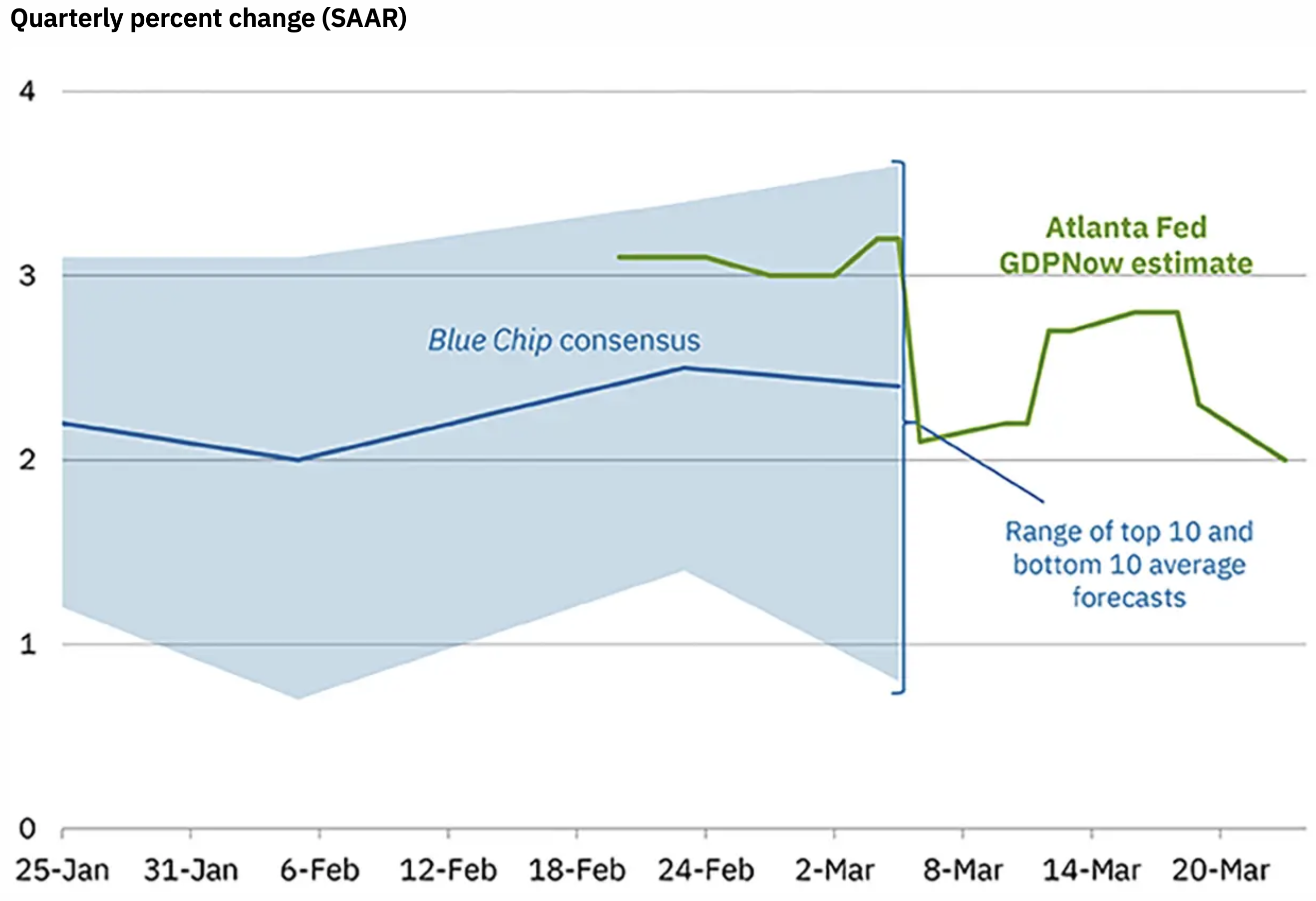
But, when we look at the Atlanta Fed’s GDPNow forecast below, it continues to show a much stronger economic impulse than the pundits expect.

And quite frankly, if 3.8% is the real growth rate, that is quite strong, certainly relative to the last two decades in the US as evidenced by the below chart I created from FRED data.  The orange line represents 4% and you can see that other than the Covid reopening, we haven’t been at that level for quite a while.

What is the reality?  Everybody has their own reality, just like everybody has their own personal inflation rate.  However, markets have been inclined to believe that the future is bright, which given my ongoing view of every nation ‘running it hot’ makes sense, so keep that in mind regardless of your personal situation.

Ok, let’s look at how markets behaved overnight.  Yesterday’s nondescript day in the US was followed by a mixed Asian session with Tokyo (-1.0%) slipping on concerns that the BOJ is going to raise rates.  I’m not sure why that is news suddenly, but there you go.  However, China (+0.8%), HK (+0.6%), Korea (+1.8%), India (+0.5%) and Taiwan (+0.7%) all continued their recent rallies.  The RBI did cut rates by 25bps, as expected, but that doesn’t seem to have been the driver.  Just good vibes for now.

In Europe, screens are also green this morning, albeit not dramatically so.  Frankfurt (+0.6%) leads the way but Paris (+0.3%), Madrid (+0.2%) and London (+0.1%) are all on the right side of the ledger.  Eurozone growth in Q3 was revised up to 0.3% on the quarter, although that translated into an annual rate of 1.4%, lower than Q2, but the positive revision was enough to get the blood flowing.  That and the idea that European defense companies are going to come back into vogue soon.  And as has been their wont, US futures are higher by 0.2% at this hour (7:35).

In the bond market, Treasury yields are higher by 2bps this morning and European sovereign yields are getting dragged along for the ride, up 1bp to 2bps across the board.  JGB yields also continue to climb and show no sign of stopping at any maturity.  A BOJ rate hike of 25bps is not going to be enough to stop the train of spending and borrowing in Japan, so I imagine there is much further to go here.

In the commodity space, silver (+1.8%) has been getting a lot more press than gold lately as there are ongoing stories about big banks, notably JPM, having large short futures positions that were designed to keep a lid on prices there, but the structural shortage of the metal has started to cause delivery questions on the exchanges all around the world.  So, while it has not yet breached $60/oz, my take is that is the direction and beyond.

Source: tradingeconomics.com

Gold’s (+0.4%) story has been told so many times, it is not nearly as interesting now, central bank buying and broader fiat debasement concerns continue to be the key here.  Copper (+1.8%) is also trading at new highs in London and the demand story here knows no bounds, at least not as long as AI and electrification are part of the mix.  As to oil (-0.25%), it is a dull and boring market and will need to see something of note (regime change in Venezuela or peace in Ukraine seem the most likely stories) to wake it up.

Finally, the dollar is still there.  The DXY is trading at 99, below its recent highs but hardly collapsing.  Looking for any outliers today ZAR (+0.4%) is benefitting from the gold rally (platinum rallying too) but otherwise there is nothing of note.  INR (-0.2%) continues to trade around its new big figure of 90.00, but has stopped falling for now, and everything else is dull.

As well as the PCE data, we get September Personal Income (exp 0.3%), Personal Spending (0.3%) and Michigan Sentiment (52.0) with only the Michigan number current.  We are approaching the end of the year and while with this administration, one can never rule out a black swan, my take is positions are being lightened up starting now, and when the December futures contracts mature, we may see very little of interest until the new year.  In the meantime, nothing has changed my big picture view.  For now, absent a very aggressive FOMC cutting rates, the dollar is still the best of a bad bunch.

Good luck and good weekend

Adf
Splitting More Hairs

The data continues to be
Uncertain, and so what we see
Is both bulls and bears
Just splitting more hairs
Til markets reach their apogee
 
Meanwhile, throughout Europe concern
Is building, that no one did learn
Their energy dreams
Are nought but grift schemes
And growth’s in a long-term downturn


Once again, macroeconomic stories are light on the ground with no overarching theme atop the headlines.  As data continues to be released in the US post the government shutdown, we are seeing a similar pattern as before the shutdown, namely lots of conflicting data.  Yesterday was a perfect example as ADP Employment data was far weaker than expected printing at -32K (exp +10K) and indicative of a slowing economy.  At the same time, ISM Services showed unexpected strength, printing 52.6 with every sub indicator printing higher than last month except prices, which slipped 5 points.  While there was September IP and Capacity Utilization data, given it was so old, it just didn’t seem relevant.  

Depending on your underlying view, it was once again easy to point to recent data and make either the bull case on the economy and stocks or the bear case.  But there’s more.  A look at the last 5 years of ADP data shows a very distinct downward trend in employment as per the below.

Source: tradingeconomics.com

But as with so many things in the economy lately, it is fair to ask if the data we have known in the past is reflective of the current economic situation.  After all, if the Trump administration has deported 500K individuals, and another 1.5 million have self-deported, as the administration claims, it ought not be surprising that employment numbers are declining.  The implication is that population is declining, which would make sense.  So, I ask, does the declining ADP data signal what it did 5 years ago or 10 years ago?  I don’t believe the answer is that straightforward.

One of the things that has concerned me lately is the measurement of GDP.  My thesis has been that counting government spending in Keynes’s equation Y = C + I + G + (X-M) is double counting because, after all, if the government spends money, it goes into the economy and is recorded by the people/companies who receive it.  But perhaps my queasiness over the GDP idea is caused by something else instead, the fact that GDP measures credit creation, not economic activity.  This article by Alasdair Macleod, a pretty well-known economic analyst with a long career observing markets and economies, does an excellent job of identifying some really interesting problems that get accepted and assumed by many in their analysis of the current situation.  

For a while we have all seen, and probably felt, there is a disconnect between the data published and the feeling we get with respect to the current situation.  I highlighted the cost-of-living problem last week with the Michael Green articles.  This is another arrow in the quiver of things are not what they appear and that’s why so many people are so unhappy (even taking away TDS).

For me, where I try to synthesize a market view based on the information available, it is a very difficult time because of all the inconsistencies relative to what I have known in the past.  As well, I am being forced to reconfigure my mental models as the world has changed.  I suggest everyone do the same, as there is no going back to pre-Covid, let alone pre-GFC.

But the US is relatively well-off compared to most of the rest of the G10 as evidenced by this morning’s Eurozone data where Construction PMIs were, in a word, dreadful as can be seen below:

Source: tradingeconomics.com

No matter how you slice it, the fact that every reading is below 50 is a telling statement on the economic situation in Europe.  Adding to this problem is the fact that it appears, the EU, under the guidance(?) of President Ursula von der Leyen, is getting set to force the appropriation of Russian assets that were frozen at the outset of the Ukraine war, an act that Russia has indicated would, itself, be an act of war and they would respond in kind.  The US has unequivocally said they will not defend Europe if that is their decision, although we will continue to sell them weapons.  

For 80 years, NATO has been the defense umbrella allowing Europe to spend their money on butter, not guns.  Despite all the plans of rearmament, if Europe goes down this road, I suspect that there is nothing they can do to defend themselves without the US.  Once again, it is difficult to look at fiat currencies around the world, especially in Europe, and think they have more staying power than the dollar.  

Ok, let’s tour markets.  A solid day in the US was followed by strength virtually across the board in Asia (Japan +2.3%, HK +0.7%, China +0.3%) with the rest of the region +/- 0.3%, so not overwhelmingly positive or negative.  The Japanese outlier was based on news about Fanuc signing a deal with Nvidia to make AI industrial robots and that took the whole tech sector in Tokyo higher.  In Europe, green is also today’s theme as despite the weak data shown above, we started to get the first hints that the ECB may consider rate cuts after all.  While Madame Lagarde has been on her high horse saying there is no need to adjust rates, Piero Cipollone, a board member has highlighted concerns over further potential economic weakness going forward.  I look for others to come to the same conclusion and talk of an ECB cut to start to increase although swaps markets do not yet reflect any changes.  And at this hour (7:40) US futures are pointing slightly higher, 0.15% or so.

In the bond market, Treasury yields are reversing some of yesterday’s modest decline, rising 2bps this morning and that has helped pull European sovereign yields higher by similar amounts across the board.  The one exception here is UK gilts, which given the ongoing weak data seem to be anticipating a greater chance of a BOE cut than before.  in Asia, JGB yields rose 4bps and now sit at 1.93%, a new high for the move, but there is no indication we are near a top.  There is growing confidence the BOJ will hike rates later this month, although I would expect that should help slow the rise as at least it will have a modest impact on inflation readings going forward.

In the commodity markets, oil (+0.5%) continues to chop back and forth making no new ground in either direction.  Stories about peace in Ukraine don’t seem to matter much, nor do stories about a US invasion of Venezuela.  In fact, nothing seems to matter too much to this market other than actual supply and demand, and that seems pretty balanced, at least as evidenced by  the fact that for the past 2+ months, we have gyrated either side of $60/bbl with no impetus in either direction.  (see below)

Source: tradingeconomics.com

Metals markets are slipping a bit this morning (Au -0.25%, Ag -1.8%, Cu -0.6%) but that is simply part of the recent consolidation.  After all, metals have rallied forcefully all year, so taking a breather is no surprise. 

Finally, the dollar is a nonevent today with the most noteworthy story the news that the PBOC fixing last night was 160 pips higher (weaker CNY) than forecast by the market.  As well, there have been several stories that Chinese state-owned banks are buying dollars in the market to help slow down the yuan’s recent appreciation.  I discussed the yuan yesterday so this should be no surprise.  The tension on China to maintain a weak enough currency to support their export industries is huge, so a quick appreciation would be extremely negative for the nation’s trade balance and economic activity.

On the data front, Initial (exp 220K) and Continuing (1960K) Claims lead us off and then Factory Orders from September (0.5%) come at 10:00.  There are still no Fed speakers, so markets remain subject to headline risk, notably from the White House.  As we are in December, my sense is that things will become increasingly uninteresting from a market perspective absent a major new event.  While price action will likely remain choppy, it is hard to see a major directional move until next year.

Good luck

Adf
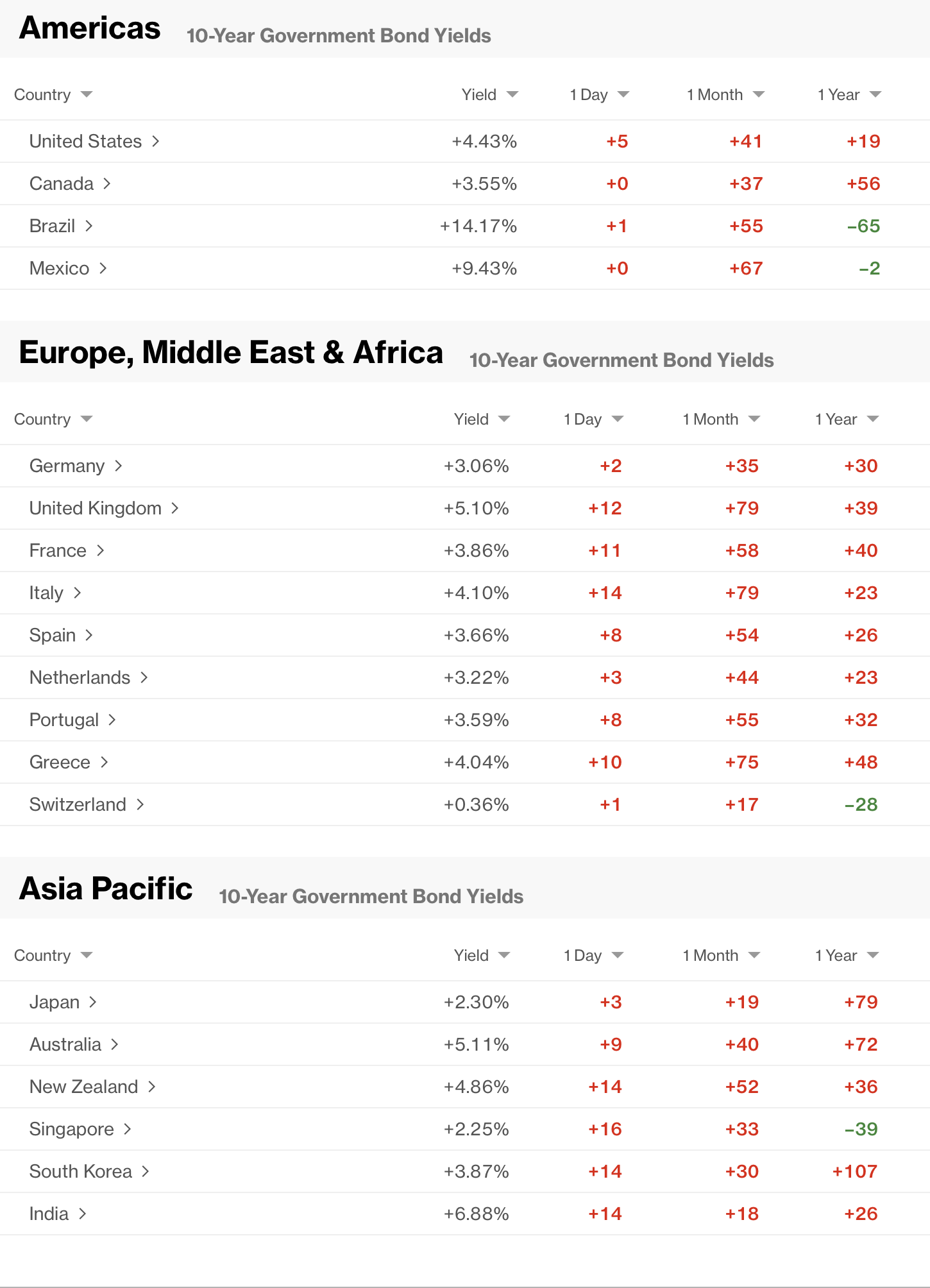
The American Dream

To aid the American Dream
The most recent Trumpian scheme
Is new Trump Accounts
In proper amounts
To help stocks become more mainstream
 
One likely effect of this act
Is stocks will be forcefully backed
Though problems extant
May come back to haunt
For now, bearish plays will get whacked


Financial market news remains mostly uninspiring these days as the Fed story has largely gone back to a cut is coming next week (89.2% probability) thus the hawkish phase has passed.  AI is still the magical future, while precious metals continue to garner support overall as concerns rise about the ongoing debasement of fiat currencies.  Elsewhere, the war in Ukraine rages on as peace talks in Moscow were described as ‘constructive’ but have yet to resolve the issues.

The other piece of the Fed story, regarding the next Chair, has taken a modest turn as a series of interviews by the finalists in the process (allegedly Hassett, Warsh and Waller) with VP Vance, were suddenly canceled for no apparent reason.  As well, the president continues to hint that Mr Hassett is going to be the one.

But one of President Trump’s strengths is his ability to keep his ideas in the news, and nothing exemplifies that better than the new Trump Accounts.  This is the idea that the government should start investing in the next generation by way of establishing investment accounts in the name of children at birth with $1000 of seed money from the government.  If these accounts are invested in the S&P 500, for instance, with a historically average return of roughly 10%, by the time the child turns 18, the initial investment will have grown more than 5-fold.  As well, these accounts are eligible for additional contributions each year, up to $5000, so can really build some value in that circumstance.  

In addition, the news that Michael and Susan Dell will be donating $6.25 billion to add $250 to those accounts, tax free to the recipient, is another boon.  Estimates are that the total could rise to $4 billion/year of outlays, all of which will be required to go into the stock market.  It’s almost as though President Trump wants the government to support the stock market, but I’m sure that is a secondary consideration!

But away from that, the news has been sparse, so let’s look at market activity overnight.  yesterday’s US session played out like the opening, modest gains, and futures at this hour (7:15) indicate more of the same is on the way today.  In Asia overnight, while Tokyo (+1.1%) had a solid session, China (-0.5%) and HK (-1.3%) were far less fortunate.  Chinese PMI data continues to be soft but perhaps of more import is the fact that the yuan (+0.15%) continues to gradually strengthen, as it has been for the past year (see chart below).

Source: tradingeconomics.com

In fact, the yuan has reached its strongest level since September 2024.  The thing about a strong CNY is that it has definitive negative impacts on Chinese exporters.  While there has been very little discussion of the yuan regarding the trade talks between the US and China, the steady appreciation of the currency will certainly hurt Chinese company earnings, and by extension stock prices there.  One thing to note is that despite its recent strength, the yuan remains undervalued vs. the dollar based on a Real Effective Exchange Rate calculation by the World Bank as per the below chart, with the current USD value at 130.6 while the CNY sits at 113.1.  That is a substantial undervaluation that, if corrected, would likely have a significant impact on the respective economies of each nation as well as, maybe, the political rhetoric.

Elsewhere in the region, India was little changed even though the rupee (-0.4%) traded through 90.00 for the first time as the RBI has decided not to waste more reserves on supporting the currency.  It appears that capital outflows are driving the rupee, but that does not bode well for stocks there.  The rest of the region was mixed with more gainers (Korea, Taiwan, Australia, New Zealand) than laggards (Philippines, Thailand, Malaysia).

In Europe, both Spain (+1.5%) and Italy (+0.7%) are having solid sessions although much of the rest of the continent is less robust.  The story is that European defense companies have benefitted today based on the absence of a peace agreement, although Eurozone inflation readings coming in a tick hotter than forecast have put paid to any idea of an ECB cut anytime soon.

Moving on to bonds, Treasury yields (-3bps) have backed off a touch from highs yesterday and that has dragged European sovereigns down with them, with the entire continent seeing yields decline -1bp or so.  Overnight, JGB yields ticked up another 3bps, to further new highs for the move, as there is no indication that government spending is going to slow down while expectations of a BOJ hike remain in full force.

Commodity markets continue to show the most volatility with both oil (+1.3%) and NatGas (+2.3%) rising this morning, the former on the lack of peace talks, the latter on the expanding polar vortex which is driving cold weather in the Northeast.  Too, I would be remiss if I didn’t mention that European demand for US LNG is running at record rates as they try to wean themselves from Russian gas supplies.  FYI, NatGas is back to its highest level since late 2022, where it skyrocketed in the wake of the initial Russian invasion.  In the metals markets, after a bit of profit taking in yesterday’s session, both gold and silver have edged higher by 0.1% this morning as both continue to be accumulated by Asian central banks and Asian investors although Western investors don’t seem to believe in the idea.  Something to note is that silver has risen 102% so far in 2025, that’s a pretty big move!  Copper (+1.45%) has jumped on the back of news that Chinese smelters have reduced activity and inventories at the LME are limited.  Add to that the underlying electrification story, and demand seems likely to be pretty robust for a while yet.

Finally, the dollar is under pressure this morning with the DXY, though still in its range, trading below 99.00 for the first time in 3 weeks.  But looking at actual currencies, the euro (+0.4%), pound (+0.7%), NOK (+0.6%), SEK (+0.5%) and CHF (+0.4%) are all nicely higher this morning.  The rest of the G10 are in a similar state, albeit with slightly smaller gains.  In the EMG bloc, CLP (+0.5%) is climbing on the back of copper’s rise, while the CE3 are all following the euro higher rising in step.  ZAR (+0.1%), BRL (+0.1%) and MXN (+0.2%) are underperforming this morning, likely because the metals markets, other than copper, are underperforming.

Turning to the data, this morning brings ADP Employment (exp 10K), IP (0.0%), Capacity Utilization (77.3%) and then ISM Services (52.1) at 10:00.  Given the IP data is old, I expect ADP to be the number with the most possible influence.  But, given the market is already assuming a cut next week, it would have to be a dramatic negative number to change any views.

The big picture remains the same, run it hot, fiat currency debasement and the dollar should be the best of a bad lot, but on any given day, much can happen that doesn’t fit that story.  Today is one of those days.

Good luck

Adf
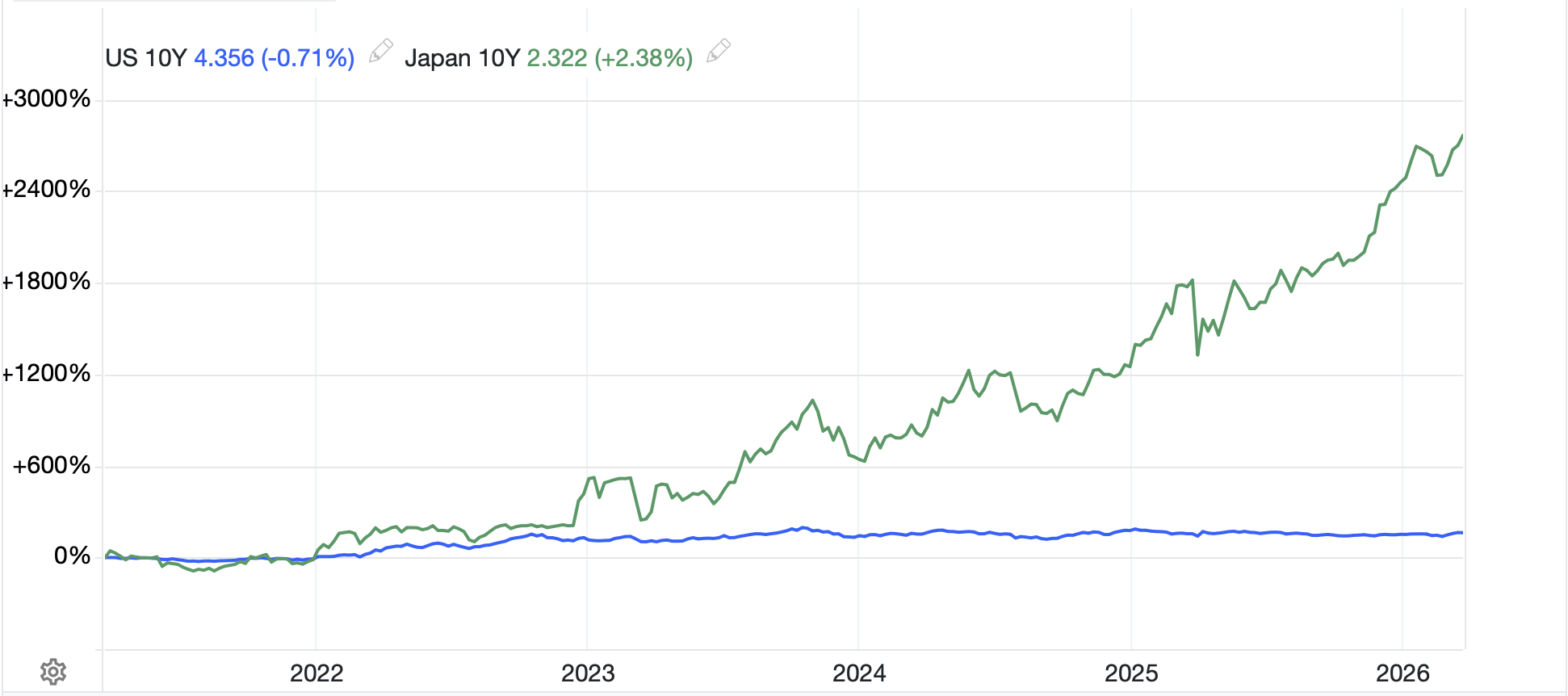
Remarkable Fragility

JGB yields have
Risen to multi-year heights
Is this why stocks fell?


Yesterday I highlighted that 10-year JGB yields had risen to their highest level since 2008.  As you can see below, the same is true for 30-year JGBs and essentially the entire curve there.

Source: tradingeconomics.com

Ostensibly, this move was triggered by comments from BOJ Governor Ueda indicating that a rate hike was coming this month.  However, the thing I find more interesting is that this move in JGB yields has become the bête noire of markets, now being blamed for every negative thing that happened yesterday.  
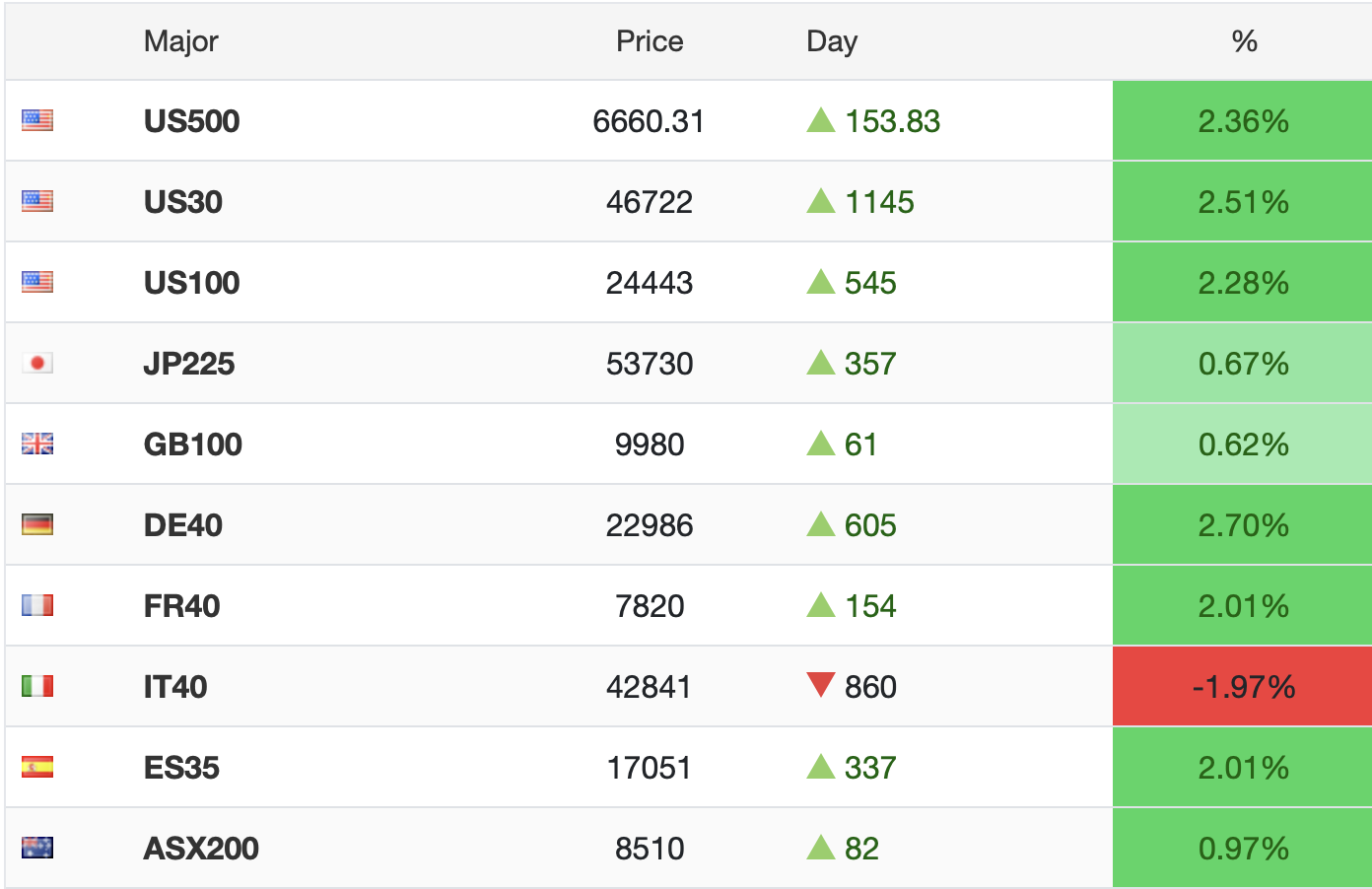
For instance, Treasury yields yesterday rose 7bps despite ISM data indicating that manufacturing activity remains sluggish at best.  In fact, the initial response to that data was that it confirmed the Fed will be cutting rates next week.  But the narrative seems to be that Japanese investors are now willing to repatriate funds, selling Treasuries to buy JGBs, in order to invest locally because they are finally getting paid to do so.  Certainly, looking at the chart above shows that Japanese yields had been tantamount to zero for a long time prior to 2024, and even then, have only started to show any real value in the most recent few months.  Of course, real 10-year yields in Japan remain significantly negative based on the latest inflation reading of 3.0%.  The upshot is, rising JGB yields are deemed the cause of Treasury market weakness.

Turning to risk assets, the story is the same for both stocks (which saw US equities decline across the board yesterday) and cryptocurrencies, notably Bitcoin.  Ostensibly, the rise in yields, and the prospect of a rate hike by the BOJ (to just 0.75% mind you) has been cited as the driver of an unwinding in leveraged trades as hedge funds seek to get ahead of having their funding costs rise thus crimping their margins.  

There is no doubt in my mind that the yen has been a critical funding currency for a wide array of carry trades, that is true.  In fact, that has been the case for several decades.  But is 25 basis points really enough to destroy all the strategies that rely on that process?  If so, it demonstrates a remarkable fragility in markets, and one that portends much worse outcomes going forward.  

If we look at the relationship between Bitcoin and 10-year JGBs, it appears that there has been a significant change in tone.  For the past two months, while JGB yields have continued to climb, BTC has broken its correlation with JGBs and has fallen dramatically instead. (see below chart from tradingeconomics.com). When it comes to crypto, I am confident that leverage levels are higher than anywhere else, in fact that seems part of the attraction, so it should not be as surprising to see something of this nature.  But again, it speaks to a very fragile market situation given there was no discernible change in the Japanese yield trend to drive a Bitcoin adjustment.

The upshot here, too, is that rising JGB yields are claimed to be the reason Bitcoin is declining.  In fact, nearly all the commentary of late seems to be focusing on JGBs as the driver of everything.  While I concede that Japanese yields are an important part of the USDJPY discussion, it is difficult for me to assign them blame for everything else.  I have seen numerous commentators explaining that the Japanese have been selling Treasuries because they don’t trust the US, and this has been ongoing for years.  I have also seen commentators explain that because Japanese surpluses had been invested internationally for years and funding so much of the world’s activity, now that they can invest at home, liquidity everywhere will dry up, and asset prices will fall.  

Responding to the first issue, especially with new PM Sanae Takaichi, I do not believe that is a concern at all.  If anything, I expect that the relationship between the US and Japan will deepen.  As to the second issue, that may have more import but the one thing of which we can be sure is that central banks around the world will not allow liquidity to dry up in any meaningful fashion.  Remember, the Fed ended QT yesterday and it won’t be long before the balance sheet starts to grow again, adding liquidity to the system.  One thing I have learned in my many years observing and trading in markets is, there doesn’t need to be a catalyst for markets to move in an unexpected direction.  Certainly not a big picture catalyst.

And with that, let’s look at how markets responded overnight to yesterday’s risk-off session in the US.  Looking at the bond market first, yesterday’s rise in yields was nearly universal with European sovereigns all following the Treasury market’s lead.  And this morning, across the board sovereigns are higher by 1bp, the same as Treasury yields.  While JGB yields didn’t budge overnight, we did see Australia and other regional yields catch up to yesterday’s rise.  I fear bond investors are stuck as they see the potential for inflation, but they also see weakening economic activity as a moderator there.  As an example, the OECD just reduced its US GDP forecast for 2026 to 2.9% this morning, from 3.2%.  Personally, I don’t think anything has changed the run it hot scenario.

In the equity markets, Asian bourses were mixed with Korea (+1.9%) and Taiwan (+0.8%) the notable gainers while elsewhere movement was much less substantial (Japan 0.0%, HK +0.2%, China -0.4%).  There was no single story driving things there.  As to Europe, things are brighter this morning led by Spain (+1.0%) and Italy (+0.5%) although there is no single driving issue here either.  US futures are edging higher at this hour as well, +0.2%, so perhaps yesterday was more like a little profit taking after last week’s strong rally, than anything else.

In the commodity sector, oil (-0.3%) is slipping after yesterday’s rally.  I suppose the potential peace in Ukraine is bearish, but that story has been dragging on for a while so I’m not sure when it will come to fruition.  In the metals markets, after a gangbusters rally yesterday, with silver trading to $59/oz, we are seeing a modest retracement this morning across the board (Au -0.6%, Ag -1.2%, Pt -2.0%) although copper (+0.4%) is holding its gains.  Nothing indicates that these metals have topped.

Finally, the dollar is little changed as I write, giving back some early modest strength.  JPY (-0.3%) continues to be amongst the worst performers, and although it has bounced from its recent lows, remains within a few percent of those levels.  My take here is we will need to see both a more aggressive Fed and a more aggressive BOJ to get USDJPY back to 150 even, let alone further than that.  If we look at the DXY, it is sitting at 99.45, and still well within its trading range for the past 6+ months as per the below.  For now, the dollar remains a secondary story.

Source: tradingeconomics.com

On the data front, here’s what comes the rest of this week:

WednesdayADP Employment 10K
 IP0.1%
 Capacity Utilization77.3%
 ISM Services52.1
ThursdayInitial Claims220K
 Continuing Claims1960K
 Trade Balance -$65.5B
FridayPersonal Income (Sep)0.4%
 Personal Spending (Sep)0.4%
 PCE (Sep)0.3% (2.8% Y/Y)
 -ex food & energy0.2% (2.9% Y/Y)
 Michigan Expectations51.2
 Consumer Credit$10.5B

Source: tradingeconomics.com

As the Fed is in its quiet period, there are no Fed speakers until Powell at the presser next week.  Given the age of the PCE data, I don’t see it having much impact.  Rather, ADP and ISM are likely the things that matter most for now.

Ultimately, I believe more liquidity is going to come to the market via central banks around the world, and that will support risk assets, as well as prices for the things we buy.  Nothing has changed in my view of the dollar either.

Good luck

Adf