Loathing and Fear

On Friday, the jobs situation
Explained there was little causation
For loathing or fear
That later this year
Recession would soon drive deflation
 
Meanwhile, in the Super Bowl’s wake
The president’s set to forsake
Economists’ warning
That tariffs are scorning
Their views, and are quite a mistake


Let’s start with a brief recap of Friday’s employment report which was surprising on several outcomes.  While the headline was a touch softer than forecast, at 143K, revisions higher to the prior two months of >100K assuaged concerns and implied that the job market was still doing well.  You may recall that there were rumors of a much higher Unemployment Rate coming because of the annual BLS revisions regarding total jobs and population, but in fact, Unemployment fell to 4.0% despite an increase in the employed population of >2 million.  Generally, that must be seen as good news all around, even for the Fed because the fact that they have paused their rate cutting cycle doesn’t seem to be having any negative impacts.

Alas for Powell and friends, although a real positive for the rest of us, the Earnings data was much stronger than expected, up 0.5% on the month taking the annual result to a 4.1% increase.  Recall, one of Powell’s key concerns is non-core services inflation, and that is where wages have a big impact.  After this data, it becomes much harder to anticipate much in the way of rate cuts soon by the Fed.  This was made clear by the Fed funds futures market which is now pricing only an 8.5% probability of a rate cut in March, down from 14% prior to the data, and only 36bps of cuts all year, which is down about 12bps from before.

Securities markets didn’t love the data with both stocks and bonds declining in price, although commodities markets continue to rally alongside the dollar, a somewhat unusual outcome, but one that makes sense if you consider the issues.  Inflation is not yet dead, hurting bonds, while the fact the Fed is likely to remain on hold for longer supports the dollar.  Stocks, meanwhile, need to see more economic growth because lower rates won’t support them while commodities are seen as that inflation fighting haven.

Of course, it wouldn’t be a day ending in Y if we didn’t have another discussion on tariffs during this administration.  The word is that the president has two things in mind, first, reciprocal tariffs, meaning the US will simply match the tariff levels of other countries rather than maintaining their current, generally lower, tariff rates.  As an example, I believe the EU imposes a 10% tariff on US automobile imports, while the US only imposes a 2.5% tariff on European imports.  The latter will now rise to 10%.  It will be very interesting to see how the Europeans complain over the US enacting tariffs that are identical to their own.  

A side story that I recall from a G-20 meeting during Trump’s first term was that he offered to cut tariffs to 0% for France if they reciprocated and President Macron refused.  The point is that while there is a great deal of huffing and puffing about free trade and that Trump is wrecking the world’s trading relationships, the reality appears far different.  If I had to summarize most of the world’s view on trade it is, the US should never put tariffs on any other country so they can sell with reckless abandon, while the rest of the world can put any tariffs they want on US stuff to protect their home industries.  This is not to say tariffs are necessarily good or bad, just that perspective matters.

The other Trump tariffs to be announced are on steel and aluminum imports amounting to 25% of the value. This will be impactful for all manufacturing industries in the US, at least initially, so we will see how things progress.  Interestingly, the dollar has not responded much here because these are not country specific, so a broad rise in the dollar may not be an effective mitigant.

Ultimately, as I have been writing for a while, volatility is the one true change in things now compared to the previous administration.  Now, with that as backdrop, and as we look ahead to not only CPI data on Wednesday, but Chair Powell’s semi-annual congressional testimony on Tuesday at the Senate and Wednesday at the House, let’s look at how markets have responded to things.

As mentioned above, US equity markets fell about -1.0% on Friday after digesting the Unemployment data. However, the picture elsewhere, especially after these tariff discussions, was more mixed.  In Asia, Japanese shares were essentially unchanged although Hong Kong (+1.8%) was the big winner in the region.  But Chinese shares (+0.2%) did little, especially after news that the number of marriages in China fell to their lowest since at least 1986, another sign of the demographic decline in the nation.  Elsewhere in the region, there was more red (India, Taiwan, Australia) than green (Singapore).  European shares, though, are holding up well, with modest gains of about 0.2% – 0.4% across the board despite no real news.  US futures are also ticking higher at this hour (7:10), about 0.5% across the board.

In the bond market, Friday saw Treasury yields jump 6bps with smaller gains seen in Europe.  This morning, though, the market is far quieter with Treasury yields unchanged and European sovereigns similarly situated, with prices between -1bp and +1bp compared to Friday’s closing levels.  Of note, JGB yields have edged higher by 1bp and now sit at 1.31%, their highest level since April 2010.  With that in mind, though, perhaps a little bit of longer-term perspective is in order.  A look at the chart below shows 10-year JGB yields and USDJPY since 1970.  Two things to note are that they have largely moved in sync and that both spent many years above their current levels.  While it has been 15 years since JGB yields were this high, they are still remarkably low, even compared to their own history.  I know that many things have changed over that time driving fundamentals, but nonetheless, this cannot be ignored.

Source: tradingeconomics.com

Sticking with the dollar, it has begun to edge higher since I started writing this morning and sits about 0.2% stronger than Friday’s close.  USDJPY (+0.5%) is once again the leader in the G10, although weakness is widespread in that bloc.  In the EMG bloc, there were a few gainers overnight (INR +0.3%, KRW +0.3%) although the rest of the world is mostly struggling.  One interesting note is ZAR (0.0%) which appears to be caught between the massive rally in gold (to be discussed below) and the increased rhetoric about sanctions by the US in the wake of the ruling party’s ostensible call for a genocide of white South Africans to take over their property.  This has not been getting much mainstream media press, but it is clear that Mr Trump is aware, especially given that Elon Musk is South African by birth.  However, there is no confusion in the South African government bond market, which, as you can see below, has seen yields explode higher in the past week since this story started getting any press at all.

Source: tradingeconomics.com

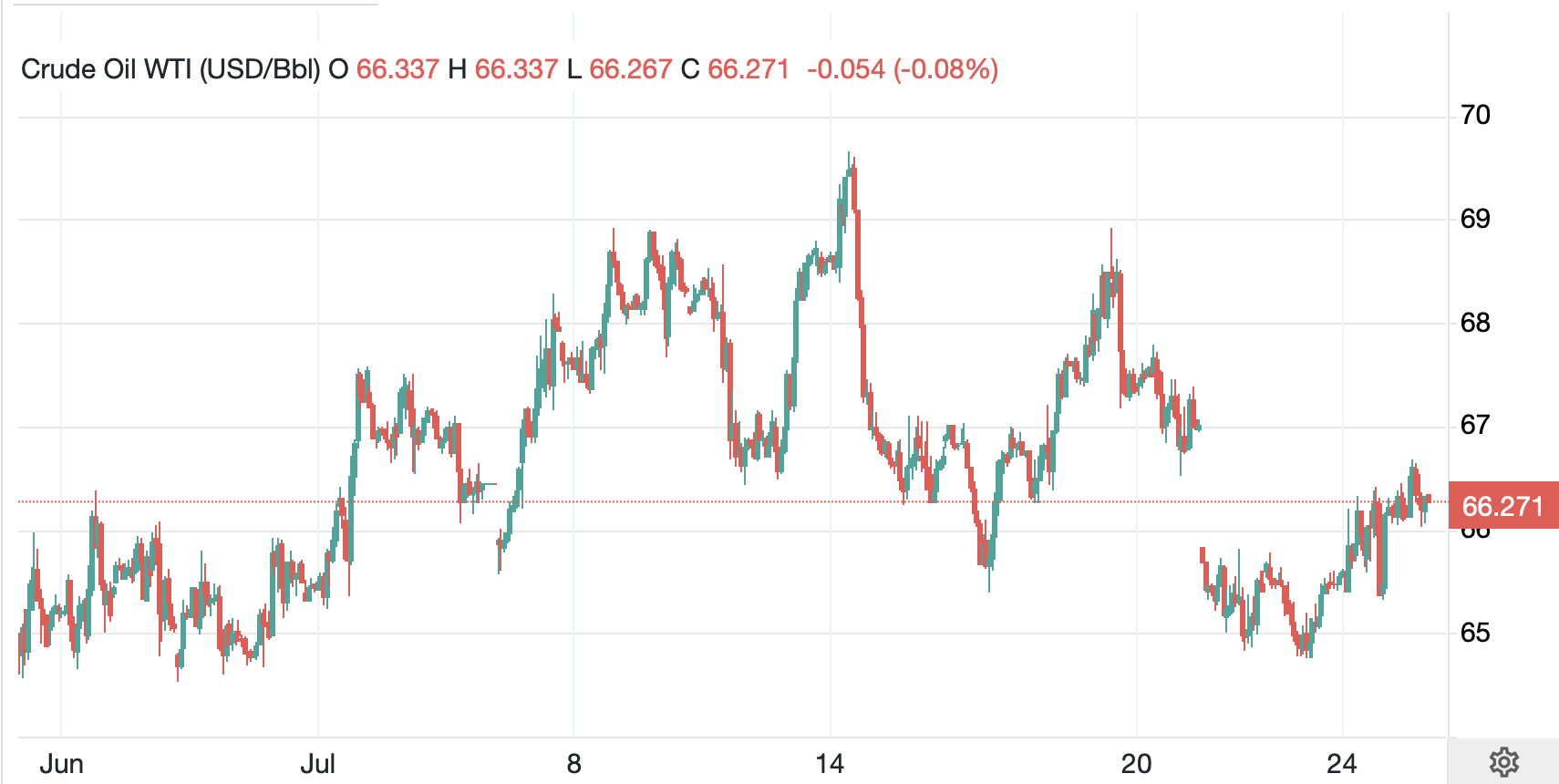
Finally, the commodity markets continue to show significant movement, especially the metals markets.  Gold (+1.6%) is now over $2900/oz, another new all-time high and calling into question if this is just an arbitrage between London and New York deliveries.  Silver (+1.4%) continues to be along for the ride as is copper (+0.6%) which is the biggest gainer of the past week, up more than 7%.  Ironically, aluminum, the only metal where tariffs are involved, is actually a touch softer this morning.  As to oil (+1.2%) while the recent trend remains lower, it does appear to be bottoming, at least if we look at the chart below.

Source: tradingeconomics.com

Turning to the data this week, it will be quite important as CPI headlines, but we also see Retail Sales and other stuff and have lots of Fedspeak.

TuesdayNFIB Small Biz Optimism104.6
 Powell Testimony to Senate 
WednesdayCPI0.3% (2.9% Y/Y)
 -ex food & energy0.3% (3.1% Y/Y)
 Powell Testimony to House 
ThursdayPPI0.3% (3.4% Y/Y)
 -ex food & energy0.3% (3.3% Y/Y)
 Initial Claims216K
 Continuing Claims1875K
FridayRetail Sales-0.1%
 -ex autos0.3%
 IP0.2%
 Capacity Utilization77.7%

Source: tradingeconmics.com

In addition to Powell, we will hear from five more Fed speakers, although with Powell speaking, I imagine their words will largely be ignored.  Overall, the world continues to try to figure out how to deal with Trump and his dramatic policy changes from the last administration.  One thing to keep in mind is that so far, polls show a large majority of the nation remains in support of his actions so it would be a mistake to think that his policy set is going to be altered.  Net, the market continues to believe this will support the dollar, as will the fact that the Fed seems less and less likely to start cutting rates soon.  Keep that in mind as you consider your hedges going forward.

Good luck

Adf

Positioning’s Fraught

The wonderful thing about Trump
Is traders no longer can pump
A market so high
That it can defy
Reality ere it goes bump
 
Since policies can change so fast
A long-term view just cannot last
So, Fed put or not
Positioning’s fraught
And larger ones won’t be amassed


As we await the NFP report this morning, I couldn’t help but ponder the uptick in complaints and concerns by traders that increased volatility in markets on the back of President Trump’s mercurial announcements has changed the trading game dramatically.  Let me say up front that I think this is a much healthier place to be and explain why.

Pretty much since the GFC and, more importantly, then Chairman Bernanke’s first utilization of QE and forward guidance, the nature of financial markets had evolved into hugely leveraged one-sided views based on whatever the Fed was guiding.  So, the initial idea behind QE and forward guidance was to assure all the traders and investors that make up the market that even though interest rates reached 0.0%, the Fed would continue to ease policy and would do so for as far out in time as you can imagine.  Lower for longer became the mantra and every time there was a hiccup in the market, the Fed rushed in, added yet more liquidity to calm things down, and put the market back on track for further gains.  This was true for both stocks and bonds, despite the fact that the Fed has no business or mandate involving the equity market.

This activity led to the ever-increasing size of trading firms as leverage was cheap and steadily rising securities prices led to lower volatility, both implied and real, in the markets.  Risk managers were comfortable allowing these positions to grow as the calculated risks were minimized by the low vol.  In fact, entire trading strategies were developed to take advantage of the situation with Risk Parity being a favorite.  

However, a negative result of these actions by the Fed was that investors no longer considered the fundamentals or macroeconomics behind an investment, only the Fed’s stance.  The only way to outperform was to take on more leverage than your competitors, and that was great while rates stayed at 0.0%.  Alas, this persisted for so long that many, if not most, traders who learned the business prior to the GFC wound up retiring or leaving the market, and the next generation of traders and investors lived by two credos, number go up and BTFD.

The Fed remained complicit in this process as FOMC members evolved from background players to a constant presence in our daily lives, virtually preening on screens and in front of audiences and reiterating the Fed’s views of what they were going to do, implicitly telling traders that taking large, leveraged bets would be fine because the Fed had their back.

Of course, the pandemic upset that apple cart as the combination of Fed and government response imbued the economy with significantly more inflation than expected and forced the Fed to change their tune.  The market was not prepared for that, hence the outcome in 2022 when both stocks and bonds fell sharply.  But the Fed would not be denied and calmed things down and created a coherent enough message so that markets recovered the past two years.  This has, naturally, led to increased position sizing and more leverage because that’s what this generation of traders understands and has worked.

Enter Donald J Trump as president, elected on a populist manifesto and despite his personal wealth, seemingly focused on Main Street, not Wall Street.  The thing about President Trump is if an idea he proffers doesn’t work, he will drop it in a heartbeat and move on.  As well, by wielding the full power of the United States when dealing in international situations, other nations can quickly find themselves in a difficult spot and, so far, have been willing to bend their knee.  As well, his focus on tariffs as a primary weapon, with little regard for the impact on markets, and the way with which he uses them, threatening to impose them, and holding off at the last minute when other nations alter their policy, has kept markets off-balance.

The result is large leveraged positions are very difficult to hold and manage when markets can move up and down 2% in a day, every day (like the NASDAQ 100 chart below), depending on the headlines.  

Source: tradingeconomics.com

The natural response is to reduce position size and leverage, and that, my friends, is a healthy turn in markets.  This is not to say that there are not still many significant imbalances, just that as they continue to blow up, whether Nvidia, or FX or metals, my take is the next set of positions will be smaller as nimble is more important than large.  It doesn’t matter how smart an algorithm is if there is no liquidity to adjust a position when the world changes.  This poet’s opinion is this is a much healthier place for markets to live.

Ok, let’s see what happened overnight ahead of today’s data.  Mixed is the best description as yesterday’s US closes saw a mixed outcome and overnight the Nikkei (-0.7%) fell while both Hong Kong (+1.2%) and China (+1.3%) gained ground.  Korea and India slid, Taiwan rose, the picture was one of uncertainty about the future.  That also describes Europe, where only Germany and Norway have managed any modest gains at all while the rest of the continent and the UK are all slightly lower.  Apparently, yesterday’s BOE rate cut has not comforted investors in the UK, nor has the talk of more rate cuts by the ECB bolstered attitudes in Europe.  As to US futures, at this hour (7:00) they are basically unchanged.

In the bond market, the biggest mover overnight was in Japan where JGB yields rose 3bps, once again touching that recent 30-year high.  While some BOJ comments indicated inflation remained well-behaved, the market is clearly of the view that Ueda-san is getting set to hike rates further.  In Europe, yields are basically lower by 1bp across the board and Treasury yields are unchanged on the session as investors and traders continue to focus on Treasury Secretary Bessent’s conversation that he cares about 10-year yields, not Fed funds.  Perhaps the Fed will cut rates to recapture the spotlight they have grown to love.

Oil (+0.5%) prices continue to drift lower overall, although this morning they are bouncing from yesterday’s closing levels.  Questions about sanctions policy on Iran, on Russia’s shadow fleet and about the state of the global economy and therefore oil demand remain unanswered.  However, the fact that oil has been sliding tells me that there is some belief that President Trump may get his way regarding a desire for lower oil prices.  In the metals markets, copper (+1.1%) is flying higher again, and seems to be telling us that the economy is in decent shape.  Either that or there is a major supply shortage, although if that is the case, I have not seen any reporting on the subject.  Both gold and silver are very modestly higher this morning after small declines yesterday as the London – NY arbitrage continues to be the hot topic and financing rates for both metals have gone parabolic.

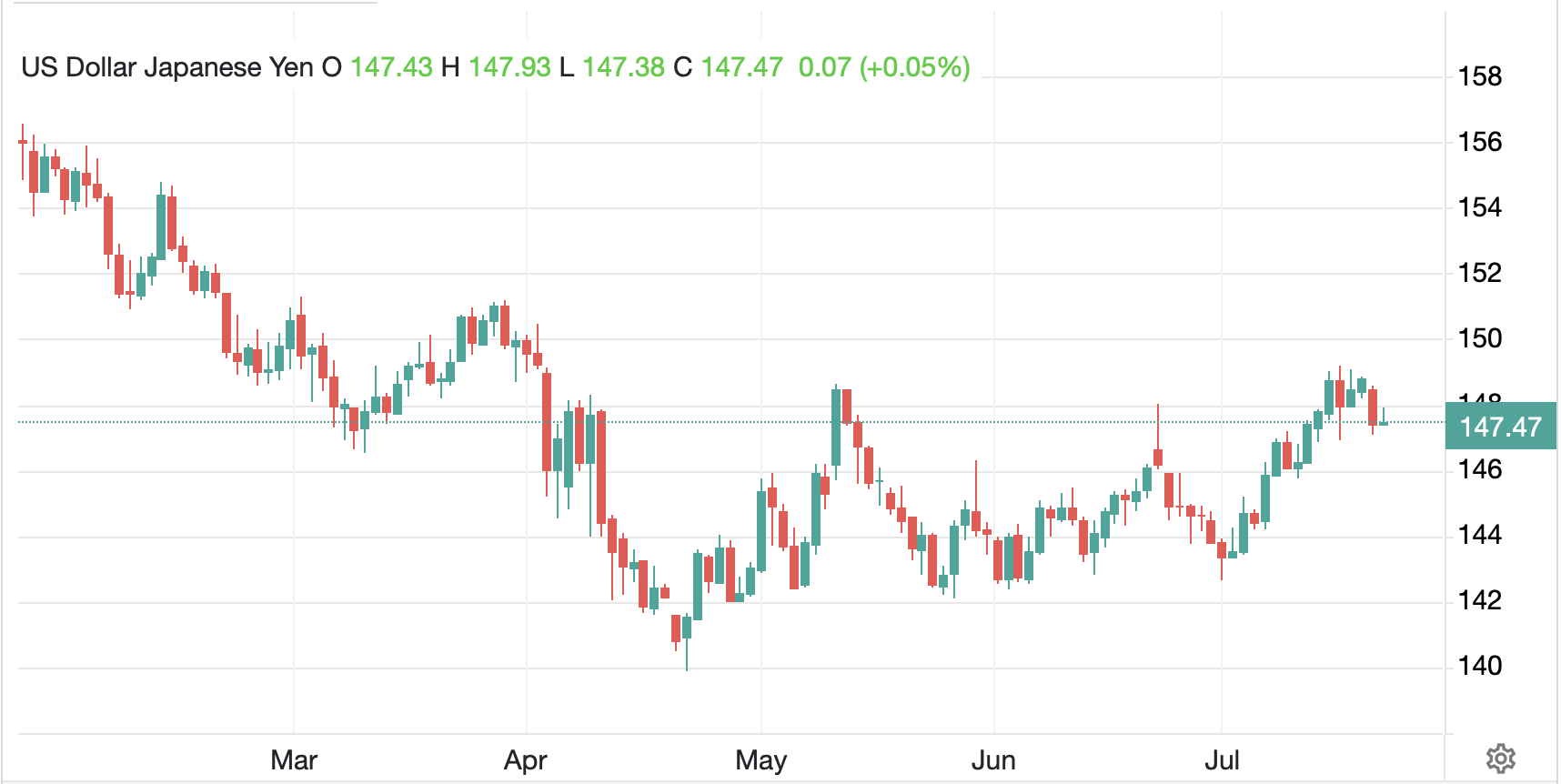
Finally, the dollar is mixed this morning, perhaps slightly firmer as JPY (-0.5%) is actually the worst performer around, despite the rise in JGB yields.  There is a lot of chatter on how the yen is due to trade much higher, and it has rallied over the past month, but it is certainly not a straight line move.  As to the rest of the space, virtually every other currency is +/-0.2% from yesterday’s close with CLP (+0.5%) the lone exception as the Chilean peso benefits from copper’s huge rally.

On the data front, here are the latest expectations for this morning’s employment report:

Nonfarm Payrolls170K
Private Payrolls141K
Manufacturing Payrolls-2K
Unemployment Rate4.1%
Average Hourly Earnings0.3% (3.8% Y/Y)
Average Weekly Hours34.3
Participation Rate62.5%
Michigan Sentiment71.1

Source: tradingeconomics.com

Remember, though, the ADP number on Wednesday was much better than expected at 183K (exp 150K) with a major revision higher by 54K to the previous month).  As well, this month brings the BLS adjustments for 2024 which will not be broken down, just lumped into the data.  Recall, there are rumors of a significant reduction in the number of jobs created in 2024 as well as a significant increase in the population estimates with more complete immigration data, and that has led some pundits to call for a much higher Unemployment Rate.  I have no insight into how those adjustments will play out although the idea they will be large seems highly plausible.

Ahead of the number, nothing will happen.  If the number is strong, so NFP >200K, I expect that bonds will suffer, and the dollar will find some support.  A weak number should bring the opposite, but the revisions are a wild card.  As I stated this morning, the best idea is to maintain the smallest exposures possible for the time being, as volatility is the one thing on which we can count.

Good luck and good weekend

Adf

Three-Three-Three

Said Bessent, when speaking of rates
The 10-year yield’s what dominates
Our focus and goals
As that’s what controls
Most mortgages here in the States
 
Remember, our goal’s three-three-three
With job one on deficits key
So, that’s why we’ll slash
The wasting of cash
With tax cuts set permanently


There is a new voice in Washington that matters to Wall Street, that of the new Treasury Secretary Scott Bessent.  Yesterday in his first significant comments since his swearing-in, he made very clear that he and the president were far more focused on the 10-year Treasury yield, and driving that lower, than they were concerned over the Fed funds rate.  Talk about a different focus than the last administration!  At any rate, he expounded on his views as to how that can be achieved, namely lower energy prices and a reduced budget deficit alongside deregulation.  Recall, his three-three-three plan is 3% budget deficit, 3mm barrels of oil/day additional supply and 3% GDP growth.  Clearly, this is a tall order given the starting point, but he has not shied away from these goals and insists they are achievable.

Yesterday also brought the Quarterly Refunding Announcement, the Treasury’s announced borrowing schedule for the current quarter.  Under then-Secretary Yellen, the US shifted its borrowing to a much greater percentage of short-term T-bills (<1-year maturity) while avoiding the sale of longer date notes and bonds.  This is something which Bessent has consistently explained his predecessor screwed up given her unwillingness to term out more debt when the entire interest rate structure was much lower.  After all, homeowners were smart enough to refinance down to 3% fixed rate mortgages, but the Treasury secretary thought it was a better idea to stay short.  

Of course, changing the current treasury mix is one of the impediments to lower 10-year yields because changing it would require an increase in the sale of longer dated paper which would depress the price and raise those yields.  Bessent has his work cut out for him.  However, my take is this is a goal, but one that will be achieved gradually.  He even commented that until the debt ceiling is raised, there will be no changes in the debt mix.  Arguably, if the administration can make real progress on reducing the budget deficit, that is what will allow for the gradual adjustment of the debt mix without a dramatic rise in long-term yields.

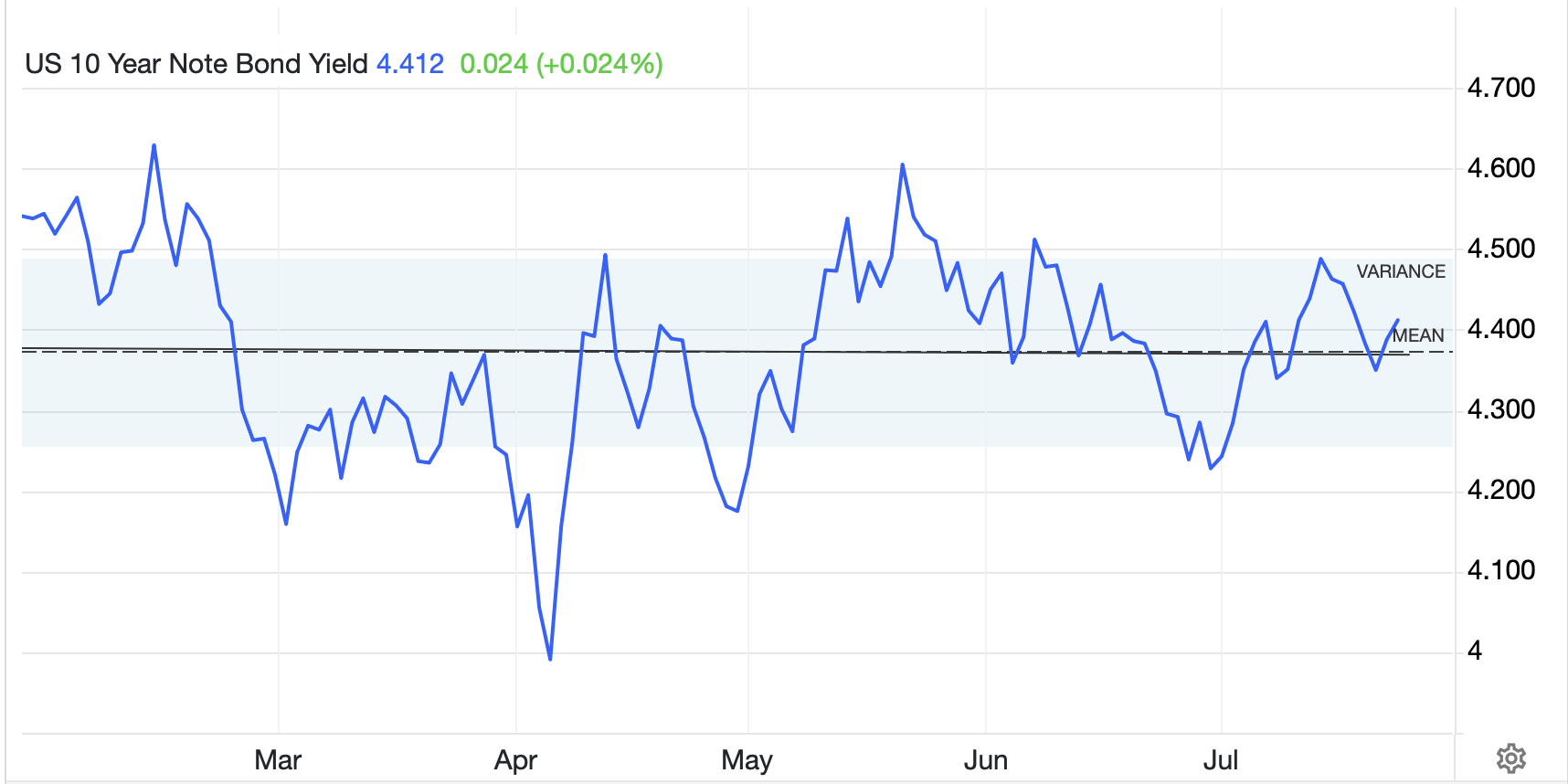
Perhaps it is still the honeymoon period, but the market is showing some deference to Mr Bessent as 10-year yields have fallen steadily in the past two weeks, dropping from a high of 4.81% the week before the inauguration to their current level at 4.44%.  

Source: tradingeconomics.com

While we cannot attribute the entire move to Bessent, certainly investors are showing at least a little love at this stage.  I believe the 10-year yield will grow in importance for all markets as movement there will be seen as the report card for Bessent and this administration’s goals.

Meanwhile, in the UK, stagflation
Is now the Old Lady’s vexation
But cut rates, they will
Lest growth they do kill
As prices continue dilation

The BOE is currently meeting, and expectations are nearly universal that they will cut their base rate by 25bps to 4.50% with 8 of the 9 MPC members set to vote that way.  The only hawk on the committee, Catherine Mann, is expected to vote for no change.  The problem they have (well the problem regarding monetary policy, there are many problems extant in the UK right now) is that core inflation continues to run above 3.0% while GDP is growing at approximately 0.0% in recent quarters and at 1.0% in the past year.  A quick look at the monthly GDP readings below shows that things have not been moving along very well, certainly not since PM Starmer’s election in July.

Source: tradingeconomics.com

In stagflationary environments, the most successful central bank responses have been to kill the inflation and suffer the consequences of the inevitable recession first, allowing growth to resume under better circumstances.  Of course, Paul Volcker is most famous for this model, which he derived after numerous other countries, notably the UK, failed to effectively solve the problem in the mid 1970’s in the wake of the first oil price shocks.  Now, the UK has created its own energy price supply shock via its insane efforts to wean itself from fossil fuels without adequate alternate supplies of energy, and stagflation is the natural result.  However, addressing inflation does not appear to be the primary focus of the Bank of England right now.  I am skeptical that they will be successful in achieving their goals which is one of the key reasons I dislike the pound over time.

Ok, let’s turn to market activity overnight.  The party continues on Wall Street with yesterday’s equity gains attributed to many things, perhaps Bessent’s comments being amongst the drivers.  Certainly, a reduced budget deficit and reduced 10-year yields are likely to help the market overall.  That attitude has been uniform overnight and through the morning session with every major Asian market (Japan, +0.6%, Hong Kong +1.4%, China +1.3%) and European market (Germany +0.8%, France +0.8%, UK +1.45%) higher on the session.  As it happens, the BOE did cut rates by 25bps as expected and now we await Governor Bailey’s comments.  As to US futures, at this hour (7:25) they are little changed on the session.

In the bond market, the ongoing rally has stalled for now with Treasury yields higher by 2bps this morning while most European sovereign yields are little changed on the day.  A key piece of information that is set to be released tomorrow comes from the ECB as their economists are going to report the ECB’s estimate of where the neutral rate lies in Europe.  With the deposit rate there down to 2.75%, many pundits, and ECB speakers, are targeting 2.0% as the proper level implying more rate cuts to come.

In the commodity markets, oil (+0.65%) is bouncing off its recent trading lows but in truth, a look at the chart and one is hard-pressed to discern an overall direction.  More choppiness seems likely as the market tries to absorb the latest information from the Trump administration and its plans.

Source: tradingeconomics.com

As to the metals markets, gold, which had a strong rally yesterday and made further new all-time highs, is unchanged this morning while silver (-0.75%) consolidates its recent gains and copper (+0.6%) adds to its gains.  The thing about copper is it is, allegedly, a good prognosticator of economic activity as it is so widely used in industry and construction, and it has been rallying sharply for the past month.  That does seem to bode well for future activity.

Finally, the dollar is firmer this morning, recouping some of its recent losses although I would contend we have merely been consolidating after a sharp move higher during the past three months.  The pound (-1.0%) is today’s laggard after the rate cut but we are seeing weakness almost everywhere in both G10 and EMG currencies.  One exception is the yen (+0.2%) which seems to be benefitting from comments by former BOJ Governor Kuroda that the BOJ is likely to raise rates above 1.0% during the coming year.  Interestingly, he explained that given the recent economic trajectory, it was only natural that the BOJ would seek to normalize rates.  However, given that interest rates in Japan have been 0.5% or below for the past 30 years, wouldn’t that be considered normal these days?  Just sayin’!

On the data front, with the BOE out of the way, we now get the weekly Initial (exp 213K) and Continuing (1870K) Claims data as well as Nonfarm Productivity (1.4%) and Unit Labor Costs (3.4%).  Yesterday’s ADP Employment data was much stronger than expected with a revision higher to last month as well, certainly a positive for the job outlook.  As well, this afternoon we hear from three more Fed speakers, but so far this week, the word caution has been the most frequently used noun in their vocabulary.  Of course, with Mr Bessent now starting to make his views known, perhaps more focus will turn there and away from the Fed for a while.

Market participants are clearly feeling pretty good right now, especially about the recent activity in the US.  I think you have to like US assets, both stocks and bonds, while expecting the dollar to continue to hold its ground.  This sounds like a recipe for weaker commodity prices, notably gold, but so far, that has not been the case.

Good luck

Adf

Is Past Prologue?

The Japanese tale
Now sees brighter times ahead
Yen buyers rejoice


While its movement has been somewhat choppy, for the past month, the yen has been the best performing currency in the G10, gaining more than 3.0% during that time.  This strength seems to have been built on several different themes including a more hawkish BOJ, better growth prospects based on PMI data, rising wages, and some underlying risk aversion.  A quick look at the chart shows that the trend is clearly lower and there have been far more down days for the dollar than up days during this period.

Source: tradingeconomics.com 

Of course, as I regularly remind myself, and you my good readers, perspective is an important thing to keep in mind, especially when making statements about longer term prospects of a currency.  When looking at USDJPY over a longer term, say the past 5 years where long-term trends have been entrenched based on broad macroeconomic issues as well as the day-to-day vagaries of trading, the picture looks quite different.  In fact, as you can see from the below chart, the past month’s movement barely registers.

Source: tradingeconomics.com

My point is that we must be careful regarding the relative importance of information and news and keep in mind that short-term movements may very well be just that, short-term, rather than major changes in long-term trends.  The latter require very significant macro changes regarding interest rate policy and economic activity, at least when it comes to currencies, not simply a single central bank policy move.

So, the question at hand is, are we at the beginning of a major set of policy shifts that will change the long-term trajectory of the yen?  Or is the yen’s recent strength merely normal noise?

While almost everybody has their own opinion on how the Fed is going to proceed going forward, I think it is instructive to look at the Fed funds futures market and the pricing for future rate activity.  For instance, a look at the current market, especially when compared where these probabilities were one month ago tells us that expectations for Fed rate cuts have diminished pretty substantially, arguably implying that there is more reason to hold dollars.

Source: CME.org

You can see in the lower right-hand corner of the chart that the probability of a rate cut has fallen from nearly 44% to just 16.5% over the past month.  However, during that same period, the BOJ has not only raised interest rates by 25bps, but they have made clear that further rate hikes are coming based on wage settlements and sticky inflationary readings.  One potential way to incorporate this relative movement is to look at the change in forecast interest rates, which in the US have risen by ~7bps (27% *25bps) while Japanese interest rates have risen by 25bps with expectations for another 25bps coming soon.  That is a powerful incentive to be long yen or at least less short yen, than previous positioning.  And we have seen that play out as the yen has strengthened as per the above.

The real question is, can we expect this to continue?  Or have we seen the bulk of the movement?   Here, much will depend on the future of the Fed’s actions as the market is seeing a bifurcation between those who believe rates are destined to fall further once inflation starts to ease again, vs. those, like this poet, who believe that inflation is showing no signs of easing, and therefore the Fed will be hard-pressed to justify further rate cuts.  While I am not the last word on the BOJ, from every source I see, expecting their base rate to be raised above 1.00% anytime in the next several years is aggressive.  Just look at the below chart showing the history of the BOJ base rate.  The last time the rate was above 0.50%, its current level, was September 1995.  That is not to say they cannot raise it, just that as you can see, several times in the intervening years they tried to do so and were forced to reverse course as the economy fell back into the doldrums with inflation quickly falling as well.  

Source: tradingeconomics.com

Is past prologue?  Personally, my take is above 1.0% is highly unlikely any time in the next several years.  Meanwhile, if inflation remains the problem it is in the US, Fed cuts will be much harder to justify.  This is not to say that the yen cannot strengthen somewhat further, but I am not of the opinion we have had a sea change in the long-term trend.

Ok, after spending way too much time on the yen, given that there hasn’t even been any tariff discussion on Japanese products, let’s look elsewhere to see how things moved overnight.

Yesterday saw further relief by equity investors that tariffs are a key Trump negotiating tactic rather than an effort to raise revenue and US markets all gained, especially the NASDAQ.  However, the movement in Asia was more muted with the Nikkei (+0.1%) barely higher while both Hong Kong (-0.9%) and China (-0.6%) fell amid the Chinese tariffs remaining in place.  As to the regional markets, there were some notably gainers (Korea and Taiwan), but away from those two a more mixed picture with less absolute movement was the order of the day.  In Europe, Spain’s IBEX (+1.0%) is the standout performer after the PMI data showed only a modest slowing, and a much better result than the rest of the continent.  Perhaps this explains why the rest of the continent is +/- 0.2% on the session.  As to US futures, they are lower at this hour (7:30) on the back of weaker earnings data from Google after the close last night.

In the bond market, yields have fallen across the board (except in Japan where JGB yields made a run at 1.30%) with Treasury yields lower by 4bps this morning and 12bps from the highs seen yesterday morning.  European sovereign yields are all lower as well, between -4bps and -7bps, as the weaker PMI data has traders convinced that the ECB is going to respond to weakening growth rather than sticky inflation and are now pricing in 100bps of cuts this year with the first 25bps coming tomorrow.

In the commodity space, gold (+1.0%) is the god of commodities right now, rallying more than $100/oz over the past five sessions.  There continue to be questions as to whether this is a major short squeeze as COMEX contracts come up for delivery, but it is not hard to write a narrative that there is increased uncertainty in the world and gold is still seen as the ultimate safe haven.  This gold rally continues to pull other metals higher (Ag +0.8%, Cu +0.2%) although I have to believe this is going to come to a halt soon.  Meanwhile, energy prices have fallen again (oil -1.0%, NatGas -1.5%) as fears over supply issues have dissipated completely.

Finally, the dollar is under pressure overall, certainly one of the reasons the yen (+1.0%) has performed so well overnight, but elsewhere in the G10, we are seeing the euro, pound and Aussie all gain 0.4% or so.  In the EMG bloc, CLP (+1.0%) is gaining on that renewed copper strength while ZAR (+0.5%) is shaking off the Trump threats regarding recent legislative changes and benefitting from gold’s massive rally.  The one outlier is MXN (-0.4%) which seems to be caught between the benefits of stronger silver prices (Mexico is a major exporter of silver) and weaker oil prices.

On the data front today, we start with ADP Employment (exp 150K) then the Trade Balance (-$96.6B) and get ISM Services (54.3) at 10:00.  We also see the EIA oil inventory data with a modest build anticipated across all products.  Four more Fed speakers are on the docket but as we continue to hear from more and more of the FOMC, the word of the moment is caution, as in, the Fed needs to move with caution regarding any further rate cuts.

I don’t blame the Fed for being cautious as President Trump has the ability to completely change perspectives with a single announcement.  While yesterday was focused on Gaza, not really a financial market concern, who knows what today will bring?  It is for this reason that I repeatedly remind one and all, hedging is the best way to moderate changes in cash flows and earnings, and consistent programs, regardless of the situation on a particular day, are very valuable.

Good luck

Adf

Rate Cuts Have Slowed

The story that’s driving the news
Is one on which most have strong views
Both neighbors have claimed
Their borders are tamed
So, tariffs, the Prez, will not use
 
Meanwhile, data yesterday showed
That managers are in growth mode
The ISM rose
And Fed speakers chose
To validate rate cuts have slowed


The major economic story is, of course, the news that both Canada and Mexico have altered their behavior in order to prevent the imposition of 25% tariffs on their exports to the US.  Both nations have now promised to police the border between themselves and the US more tightly, and it also seems that the US now has operational control, via military overflights, of the Mexican border.  While there are many pundits who believe all this activity was merely theater and could have been accomplished without tariff threats, none of them are in a position of power.  In the end, I think it is very difficult to conclude anything other than Trump got what he wanted and achieved it via his preferred means.

The market response was very much what you might expect.  The early sharp declines in the CAD and MXN were reversed and the day ended with both currencies at basically the same levels they closed on Friday.  However, as you can see from the chart below, there was clearly some excitement and panic during the session, with back and forth 2% movements.

Source: tradingeconomics.com

Here’s the thing, I think you all need to be prepared for this type of activity on a regular basis for the next four years.  Certainly, there is nothing to suggest that President Trump is going to change his style and as long as he is successful in achieving his aims in this manner, he will continue with these activities.  Consider this as well, no national leader wants to appear weak, especially to their electorate, and so when President Trump turns his focus to a smaller nation, those leaders are very likely to try to stand up to the pressure, at least in public.  But in the end, most nations are far more reliant on the US market to buy their stuff than the other way around.  After all, the US is basically the consumer of last resort globally.  As such, very few nations can truthfully withstand an onslaught of this magnitude.

Now, turning to the state of the US economy, President Trump got some very positive news from the ISM data which printed at 50.9, its highest level since September 2022 and far higher than forecasts.  In fact, it is not hard to look at the recent trend in this data series and believe we are going to see positive economic growth going forward

Source: tradingeconomics.com

However, the downside here was that the Prices Paid portion of the index also rose, back to 54.9, implying that inflation pressures remain extant within the economy.  Now, you and I both know that is the case as we all deal with these prices on a daily basis, but until the data starts to become more obvious, it appears the Fed is always the last to know.

Speaking of the Fed, while only one speaker was on the schedule, Atlanta Fed President Bostic, we heard from three of them anyway as it remains clear to me there is a strong belief in the Marriner Eccles building that a key part of their job is to never shut up constantly pitch their narrative to try to keep markets in line.  So, as well as Bostic, we heard from Chicago’s Goolsbee and Boston’s Collins and they all basically said the same thing, perhaps best stated by Ms Collins, “There’s no urgency for making additional adjustments.  The data is going to have to tell us.  At some point I certainly would see additional normalization in terms of what the policy stance is.”  The last part of her comment refers to the idea that she, and truthfully all three, believe that further rate cuts remain appropriate despite the ongoing growth and continued stickiness of prices.  And to think, some people believe that Trump and the Fed are not on the same page.   They all want lower rates!

Ok, let’s turn to markets and see how they have behaved overnight.  Yesterday, after a pretty horrible opening on the basis of tariffs, tariffs everywhere, the news that they would be postponed saw US markets rebound, although still close lower on the session.  In Asia, Japan (+0.7%) rallied as so far, Japan remains out of the tariff sightlines, and Hong Kong (+2.8%) traded much higher in its first post-holiday session although mainland Chinese share trading doesn’t reopen until tonight.  Elsewhere in Asia, the screens were largely green, perhaps on the thesis that tariffs are just a negotiating tactic.  In Europe, the picture is more mixed with the UK (-0.2%) lagging while Spain’s IBEX (+0.8%) is the leading gainer.  The rest of the continent, though, is seeing gains on the order of just 0.2%, so not much love.  And at this hour (7:10) US futures are little changed.

In the bond market, Treasury yields, after edging higher by a few bps yesterday, are up another 2bps this morning and pushing back to 4.60%.  In Europe, sovereign yields are also firmer this morning, up between 2bps and 4bps across the board, although this is after sharply lower yields yesterday on still weak PMI data from the continent.  As well, Mr Trump is hinting that he is going to turn his tariff sights on Europe soon, so there has to be some trepidation there.  After all, Europe, which is already a basket case due to self-inflicted energy-based wounds, really cannot afford a trade fight with the US, especially since they have a net trade surplus on the order of $200 billion with the US.  Finally, JGB yields rose 3bps and are now at their highest level since May 2010 and look for all the world like the trend remains strongly intact as per the below chart.

Source: tradingeconomics.com

In the commodity markets, confusion in energy reigns as yesterday’s initial rally on Canadian tariff news has been completely reversed with oil (-2.1%) and NatGas (-4.2%) both falling sharply today.  But what is not falling is gold (+0.1%) which made yet another new all-time high yesterday and continues to defy gravity.  This has helped the entire metals complex with both silver and copper higher by 0.5% this morning.

Finally, the dollar continues its general winning ways this morning.  Yesterday saw early gains, also on the tariff story, which as evidenced by the chart at the beginning of the note, reversed.  But in the other currencies, the euro and pound remain under modest pressure along with Aussie, as all three are softer by about -0.3% today, with the yen (-0.4%) along for the ride.  In the EMG bloc, MXN (-0.6%), BRL (-1.2%) and ZAR (-0.3%) are also under pressure as though the immediate tariff threat seems to have abated, fear remains the driving force in the space.  Add to the tariff fears the fact that the US economy continues to outperform its peers, and the Fed has basically put the kibosh on any rate cuts anytime soon and it is easy to understand why money is flowing this way.

On the data front, JOLTS Job Openings (exp 8.0M) and Factory Orders (-0.7%, +0.6% ex Transport) are today’s information, and we hear from more Fed speakers.  It seems clear, so far, that the Fed mantra is wait and see as things evolve under President Trump.  Unless one of these speakers (Bostic, Daly, Jefferson) offers a different view, which seems unlikely, then I suspect the dollar will continue to find more support than resistance for now.

Good luck

Adf

Run Amok

The price level, sadly, will jump
According to President Trump
Will Canada shrink?
Will Mexico blink?
As tariffs cause things to go thump
 
The first thing that moved was the buck
While stock markets were thunderstruck
So, who will blink first?
And who will hurt worst?
No matter, things have run amok


Whatever you think of the man, you must admit that President Trump knows how to maintain the spotlight on himself and his policies to the exclusion of virtually everything else in the news.  And so, in the wake of two terrible aviation disasters in short order, pretty much all eyes are now focused on the tariffs that Trump imposed this weekend on Canada, Mexico and China.  While there had been a large school of thought that the tariff talk was a cudgel to be used during negotiations but would never actually be imposed as they would be too damaging, that thesis has been destroyed.  It appears that President Trump believes his long-term goals of reshoring significant parts of US industry and leveling the playing field with trade partners is achievable via tariff policy and will more than offset any short-term pain that may come.  We shall see if he is correct, but certainly, the short-term pain is beginning to arrive.

The early movement in equity markets was uniform around the world, and it was not pretty.  The below snapshot of equity futures markets, taken at 6:00am this morning shows that the only two markets that have not fallen are China and Hong Kong, and that is only because they remain closed for the Chinese New Year holidays.  But there is plenty of fear all around the world, especially considering that markets throughout Europe and Japan, as well as other nations that have not been named targets of tariffs, have also fallen sharply.

Source: tradingeconomics.com

Too, the FX markets have also responded dramatically, with the dollar exploding higher vs. virtually all its counterpart currencies this morning as 1% gains are the norm.

Source: tradingeconomics.com

A special shoutout to ZAR (-1.55%) which while not directly impacted by tariffs, caught Trump’s ire by their recently enacted legislation to confiscate property as they deem fit, oftentimes without compensation.  While South African officials have claimed it is akin to eminent domain rules in the US, those require compensation at all times, a not insubstantial difference.  

So, what’s a hedger to do?  Well, this is why you maintain a hedge program in the first place.  Lots of things happen in the world, most of which are beyond any individual or companies’ control, yet the impacts are real.  Some of what I have read this morning highlights the idea that Canada and Europe and Mexico are going to stick together to fight these tariffs.  However, at the end of the day, the US economy, and by extension its market, is the largest by far, and losing the US as an export destination will be a very difficult pill for those nations and their economies to swallow.  

My sense is that Trump, especially if he continues to address the immigration and government waste issues, will have far more runway than most other nations, especially given the precarious situation of many ruling parties right now.   But the other thing to consider is that there is no going back to the way things were in the past.  Alliances and treaties are going to come under much greater scrutiny by all sides as governments everywhere re-evaluate what they are trying to achieve with various policies and how they can partner with other nations to work together.  In fact, I suspect that the EU is going to continue to come under even greater pressure as it becomes more evident that while many countries believe in the trade benefits of the EU, the recent focus by Brussels on other issues like climate activism and immigration run counter to some members’ views.  No matter what, the world is changing dramatically, and my take is the change is going to come faster than many will have anticipated.

OK, there are a thousand stories on how the tariffs are going to impact the US, with initial calculations regarding the negative impact on GDP and how much they are going to raise inflation, so I’m not going to go there.  Needless to say, the universal belief is things will get worse on those metrics.  But here’s something else to consider.  On Friday, the BLS will be revising the 2024 jobs data, including their population estimates and the birth/death model that describes the number of new businesses that are formed, net, each month. Early estimates show that the number of jobs created is going to fall by nearly 1 million while population, now taking into account more immigration, is going to rise.  I have seen estimates that the Unemployment Rate may rise, or be revised, to 4.5% or 4.6%.  If that is the case, it will certainly call into question exactly what the Fed has been doing.  It will also, almost certainly, result in a Trumpian tirade about how the BLS is political and was cooking the books to burnish Biden’s economic record.  I suspect it will not help equity markets if that is the case, but also probably hurt the dollar as the Fed will be right back onto their rate cutting discussions.

As I’ve already shown the equity and FX markets above, a look at bonds shows that Treasury yields are unchanged this morning, as they seem to be caught between concerns of slower growth and higher inflation due to the tariffs.  Remember, too, that Wednesday, the Treasury will issue its Quarterly Borrowing Estimate with all eyes on the mix that new Treasury Secretary Bessent will be seeking as things go forward.  Remember, he was quite vocal, before he took the job, as to the mistakes that Yellen made in not terming out more Treasury debt when rates were at extremely low levels.  Meanwhile, European sovereign yields are all lower this morning, between -2bps (Italy) and -6bps (Germany) as PMI data released showed that though things were better than last month, they remain well below the key 50.0 level.  However, on the inflation front, both Eurozone and Italian data printed higher than expected, clearly not what Madame Lagarde wants to see.

Finally, commodity markets have seen oil prices (+2.6%) rise sharply as the US will be imposing 10% tariffs on imports of Canadian oil products, while NatGas prices have jumped by 9.0% on concerns over supply disruptions from those tariffs.  Like I said, the world is a different place today!  In the metals markets, both gold and silver are little changed this morning although copper (-0.9%) prices are slipping, perhaps on the idea that these tariffs are going to slow economic activity.  And that is one of the key belief sets amongst economists.

As to the data this week, it is reasonably busy, but all eyes will be on Friday’s NFP report, especially with the rumors of a major revision.

TodayISM Manufacturing49.8
 ISM Prices Paid52.6
TuesdayJOLTS Job Openings8.0M
 Factory Orders-0.8%
 -ex Transport+0.6%
WednesdayADP Employment150K
 Trade Balance-$96.5B
 ISM Services54.2
ThursdayInitial Claims215K
 Continuing Claims1855K
 Nonfarm Productivity1.7%
 Unit Labor Costs3.5%
FridayNonfarm Payrolls170K
 Private Payrolls140K
 Manufacturing Payrolls-2K
 Unemployment Rate4.1%
 Average Hourly Earnings 0.3%(3.8% Y/Y)
 Average Weekly Hours34.3
 Participation Rate62.5%
 Michigan Sentiment70.9
 Consumer Credit$10.5B

Source: tradingeconomics.com

In addition to all of this, we will hear from nine different Fed speakers, at least, over 13 different venues this week.  Now, things could get quite interesting here given Chairman Powell did not speak to tariffs as they were not yet implemented when he delivered the FOMC news last week, but all of these speakers will have an opinion.  I wonder if there will be a unified set of talking points or if each one will truly give their own views.  Of course, given that each is a neo-Keynesian economist, I suspect their views will all be aligned anyway.

One other thing from last week that didn’t get much press is that the BOC, after cutting the base rate by 25bps as widely expected, has indicated they will be ending their QT program and, in fact, restarting their QE program over the next several months in order to grow their balance sheet in line with the economy.  Do not be surprised if we see other major central banks go down this road as well, regardless of sticky inflation.  

Summing it all up, the world is very different this morning compared to Friday morning.  Trade and economic disruptions are going to become evident and there is still a great deal of vitriol to be vented at Trump by others, while Trump will continue to decry other nations efforts to weaken the US.  As I have written in the past, volatility will be the main underlying thesis this year.  Meanwhile, the beauty of a good hedge program is it helps through all market conditions.  Do NOT slow things down waiting for a better entry point, be consistent, as that better entry point may not materialize for a long time.  My strongest cue will be the bond market as if yields start to decline in anticipation of a significant economic slump, I expect the dollar will suffer, but if they hold up, then there is nothing to stop the dollar from testing and breaking its recent highs.

Good luck

Adf

Forked Tongue

The major discussion today
Is tariffs and if they’re in play
While Trump thinks they’re great
Economists hate
Their impact and watch with dismay
 
Meanwhile it has not been a week
And questions are rife ‘bout DeepSeek
The most recent questions
Are making suggestions
That China, with forked tongue, did speak


President Trump has promised to impose 25% tariffs tomorrow on all Canadian and Mexican exports to the US if those nations do not agree to further efforts to tighten border security regarding the movement of both immigrants and drugs across the borders.  Even within his administration, there are many who do not want to see them imposed given the potential disruption they would cause in supply chains throughout the nation.  And of course, economists abhor tariffs as a pure deadweight loss to the economy.  But Trump sees the world through very different eyes, that much is clear, and as evidenced by the very short-term row with Colombia last weekend, believes they can be useful tools to achieve strategic, non-economic outcomes.

This poet is not fool enough to try to anticipate what will actually happen as the mercurial nature of President Trump’s actions is far beyond my ability to forecast.  However, if history is any guide, we will see both Mexico and Canada make some additional concessions and an announcement that because of that, the tariffs will be delayed until negotiations can be completed by some new deadline.  (Well, maybe I am fool enough 🤣)

From our perspective observing market reactions, the only consistent view is that US tariffs will drive the dollar higher, or more accurately, other currencies lower, as the FX market adjusts to compensate for the tariffs.  If we look back at Trump’s first term, the first tariffs were imposed on China in early 2018 on solar panels and washing machines and a few other things.  A look at the chart below shows that the yuan (the green line) did, in fact, weaken substantially following those tariffs, with the dollar rising from 6.25 to 6.95 over the course of the ensuing six months.  However, if we broaden our horizons beyond the renminbi to the dollar writ large, as seen by the Dollar Index (the blue line), which rose from 88 to 96 over the same period, the renminbi’s price action was directly in line with the dollar overall.  There was only limited additional impact to CNY.  Remember, too, that in 2018, the US equity market was performing quite well, and funds were flowing into the US, thus driving the dollar higher, not dissimilar to what we have seen over the past year.  The point is that while the tariffs may have some impact, it is also likely that the dollar will move based on its traditional drivers of interest rate differentials and capital flows regardless.

Source: tradingeconomics.com

Away from the tariff talk, though, there is precious little other market related news, at least on a macro basis.  Yesterday’s data showed that GDP grew a tick less than anticipated at 2.3% in Q4, but Real Consumer Spending, which is a critical part of the economic picture, rose at 4.2%, a very solid performance and an indication that things in the economy are still ticking along just fine.  (The difference between that number and the GDP number is due to inventory adjustments, which are seen to wash out over time.). In fact, arguably, that solid growth was a key reason that the equity markets in the US had another strong session yesterday, with gains across the board.

Well, there is one other thing on many people’s minds, and that is the veracity of the claims about DeepSeek.  You may recall I highlighted the question of all those Nvidia sales to Singapore earlier in the week as somewhat strange.  Well, I was not the only one asking that question and this morning in Bloomberg, there is an exclusive story about a US government investigation into whether China actually got the most advanced H100 chips via Singapore after all.  If that is the case, then perhaps the DeepSeek claims are not as impressive as they were initially made out.  I suspect if this turns out to be the case, that worries over the need for AI to no longer utilize the most advanced chips will dissipate and the tech rally will regain momentum.

So, let’s look at markets now.  China and Hong Kong remain closed for their New Year celebrations.  Japan (+0.15%) had a modest gain and the truth is that only two Asian bourses had strong sessions, Singapore (+1.45%) and India (+1.0%) with the rest of the region mostly a touch firmer.  In Europe, all markets are slightly stronger this morning, on the order of 0.3% or so, as the combination of yesterday’s ECB rate cut and hints at future cuts by Madame Lagarde, seem to be underpinning the markets.  Certainly, today’s Eurozone data, showing German Unemployment climbing a tick to 6.2% while Retail Sales there fell -1.6% in December don’t seem like a rationale to buy equities.  In the US futures market, though, we are seeing solid performance, 0.5% or more, as I believe many are jumping back on the AI bandwagon.

In the bond market, Treasury yields have edged higher by 1bp, and remain just north of 4.50% as the tension between solid growth and slowing inflation dreams keeps the market quiet.  In Europe, though, yields are continuing their decline from yesterday, with sovereign yields down by between -3bps and -4bps as investors look for further easing from the ECB as the Eurozone sinks slowly toward recession.  However, in Japan, JGB yields rose 3bps as data overnight showed inflation remains above target and expectations for another rate hike in the first half of the year rise.

In the commodity markets, oil (-0.35%) continues to chop around in the middle of its trading range with no strong directional impulse (see chart below).

Source: tradingeconomics.com

It is very difficult to know how to view this market in the short run given the potential for disruptions by tariffs and even more sanctions, but nothing has changed my long-term view that there is plenty of oil around and prices will remain here or decline.  In the metals markets, both gold and silver are little changed on the morning although both have been in the midst of a strong rally with gold making new all-time highs in the cash market yesterday.  Copper (-0.7%) is offered this morning but is still much higher than at the beginning of the month/year.

As to the dollar, it is modestly firmer this morning rallying against most of its G10 counterparts, but not by very much, 0.3% (JPY) at most.  Versus its EMG counterparts, though, there is more strength with PLN (-0.6%) and ZAR (-0.4%) both under a bit of pressure.  The latter is responding to ESKOM, the national electrical utility, announcing that they may need to impose rolling blackouts to help repair parts of the grid.

On the data front, this morning brings Personal Income (exp 0.4%) and Spending (0.5%) but of more importance it brings PCE (0.3%, 2.6% Y/Y) and core PCE (0.2%, 2.8% Y/Y) along with the Chicago PMI (40.0) release at 9:45.  We also hear our first post-meeting Fed speaker, Governor Bowman, this morning but it would be shocking if she said anything other than they are going to be patient to watch inflation slowly move toward their target, almost as if by magic.

Once again, tape bombs are the biggest risk, as they will be for the next four years, but I imagine all eyes will be on Trump and the tariffs as the key driver.  For now, nothing has dissuaded me from my view the dollar is more likely to rise than fall, but we need to see how things evolve.

Good luck and good weekend

Adf

Not in a Hurry

Said Powell, we’re not in a hurry
To cut after last year’s late flurry
Instead, wait and see
Is likely to be
The future lest ‘flation hawks worry


The opening paragraph of the FOMC Statement was concise as they acknowledge that things aren’t too bad right now.  “Recent indicators suggest that economic activity has continued to expand at a solid pace. The unemployment rate has stabilized at a low level in recent months, and labor market conditions remain solid. Inflation remains somewhat elevated.”  

Of course, that didn’t stop Chairman Powell from still describing rates as restrictive or “meaningfully above” the neutral rate, although in fairness, he did explain “We do not need to be in a hurry to adjust our policy stance.”  When asked about the impact of President Trump’s mooted policies regarding tariffs and trade, he explained, “The committee is very much in the mode of waiting to see what policies are enacted. We need to let those policies be articulated before we can even begin to make a plausible assessment of what their implications for the economy will be.”

In the end, I don’t believe very much changed with respect to expectations for the Fed with the futures market still pricing in a total of 46 basis points of cuts for the rest of the year with just an 18% probability of a cut in March.  Certainly, nothing we heard or saw today changed my view of rates remaining here and potentially going higher before the end of 2025.  But for now, I don’t think there is much else to say on the subject.

In Europe, the data was bleak
As growth there remains awful weak
Today they’ll cut rates
And on future dates
A base rate much lower they’ll seek

As we await the ECB’s meeting announcement later this morning, where Madame Lagarde is virtually certain to cut their interest rate structure by 25bps, we were entertained by GDP data from the Eurozone as well as several of its members.  The numbers were disappointing even compared to weak forecasts.  For instance, in Q4, France (-0.1%) and Germany (-0.2%) both saw declining activity while Italy (0.0%) managed to not fall.  Not surprisingly, the Eurozone, as a whole, also saw a result of 0.0% GDP growth in Q4.  In every case, the annual number is below 1.0%.  Of course, if just looking at this data, it would be easy to say the ECB needs to cut rates further.  However, inflation remains uncomfortably higher than target and as evidenced by Spanish data this morning, showing it rose to 3.0% Y/Y in January, Madame Lagarde cannot ignore the sole ECB mandate of stable prices at 2.0%.

Under the rubric a picture is worth a thousand words, I think the chart below of quarterly GDP activity in Germany and the Eurozone speak volumes of how things are progressing on the continent. 

Source: tradingeconomics.com

The current policy mix in Europe is clearly not getting the job done, assuming the job is to grow the economy in a non-inflationary manner.  While the ECB can continue to cut rates in their effort to support growth, the problems on the continent have far more to do with energy policy than anything else.  The focus on ending the use of fossil fuels has resulted in the highest energy costs of any region which has led to the steady deindustrialization of the continent.  It doesn’t really matter where interest rates are if companies cannot power their operations and that is the crux of the ECB’s problems.  No matter what Lagarde and her friends do, it cannot reverse this decline.  If you were wondering why so many, including this poet, are negative on the euro’s prospects going forward, this is it in a nutshell.

Ok, let’s turn to the overnight market activity.  First, a moment’s thought for the tragedy that took place in Washington DC last night where a commuter jet collided with a military helicopter near Reagan National Airport.  As I write, it is not known how many fatalities occurred, but the word is there were 60 passengers plus crew on board the plane and 4 on the helicopter.

Yesterday’s US session was less positive than many had hoped with the specter of DeepSeek still haunting many investors but the situation in Asia was a bit more upbeat with the Nikkei (+0.25%) and Australia (+0.55%) both showing gains.  I read an entire X post as to why the next Chinese stimulus package was really going to change things and support the economy there although I continue to remain skeptical. (As an aside, it is Chinese New Year, the year of the snake, so markets in China and Hong Kong are closed for a few days.). Meanwhile, in Europe, all markets are higher as traders anticipate not only today’s ECB rate cut, but clearly more in the future as economic activity continues to wane.  So, gains across the board of between 0.35% (DAX) and 0.7% (IBEX).  US futures, too, are higher this morning, up by 0.4% at this hour (6:50).

In the bond market, yields are sliding as Treasuries (-3bps) are sitting right on 4.50% after Chairman Powell seemed to indicate they actually do care about inflation.  Meanwhile, European sovereign yields are all lower by between -6bps and -7bps ahead of the ECB announcement and responding to the weak GDP data.  Clearly, investors on the continent are convinced there are more rate cuts coming.  On the other side of that rate coin, JGB’s saw yields climb 2bps as Deputy BOJ Governor Himino indicated that further rate hikes would be appropriate given Japanese real interest rates remain negative.  Not only did that support JGB yields, but the yen (+0.5%) was also a beneficiary.  Finally, I would be remiss to ignore the Brazilian central bank, which hiked rates 100bps last night, taking their SELIC rate to 13.25%!  (And equity investors in the US complain rates are too high!)

In the commodity space, oil (-0.1%) is little changed this morning although remains near the bottom of its recent trading range.  There is so much discussion regarding what will happen here, whether Trump will be able to encourage more drilling in the US, how OPEC is going to respond to both Trump and the market, and what is going to happen in the Russia/Ukraine war, that it is very difficult to get a good handle on things.  Nothing has changed my long-term view that there is plenty of oil around and it is a political decision, not a technical nor geological one, that will determine the price.  As to metals markets, gold (+0.65%) continues to perform well and edges closer to the all-time high levels reached back in late October.  There is much discussion about the arbitrage between COMEX and LME gold with many deliveries apparently due in NY and not enough 100toz bars available.  This may be driving prices higher as those with short positions scramble to either roll their positions are get ready for delivery.  As to silver (+0.4%) and copper (+0.2%), they are both along for the ride.

Finally, the dollar is mixed this morning as while it is modestly stronger vs. some G10 counterparts (EUR -0.2%, SEK -0.2%), the yen’s strength is moderating the overall movement.  Versus its EMG counterparts, BRL (-0.8%) is the most notable mover as traders take profit after the BCB’s rate hike last night.  It was widely assumed to occur and real rates in Brazil are now nearly 9%, a very attractive level that has helped the currency appreciate more than 6% in the past month.  However, elsewhere, the movement is basically random.

On the data front, aside from the ECB rate decision, we see the weekly Initial (exp 220K) and Continuing (1890K) Claims data and the first look at Q4 GDP (exp 2.6%). Yesterday’s Goods Trade Balance was a record deficit of -$122.1 Billion as it appears many companies were ordering stuff to get ahead of the threatened tariffs.  Also, yesterday the BOC cut rates by 25bps, as widely expected, but nobody really noticed.  With the Fed sidelined for now, I suspect that we will continue to follow the equity stories more closely than the macro ones, although we do see PCE tomorrow, so a big surprise there could certainly impact the narrative.  But for now, it remains difficult to be too bearish the dollar.

Good luck

Adf

Stardom is Fleeting

Remarkably few people care
That Jay and the Fed will soon share
Their latest impressions
On growth and recessions
An outcome, of late, that’s quite rare
 
Does this mean that ere the next meeting
There will be an increase in bleating
By every Fed speaker
Each one a fame seeker
As they realize stardom is fleeting?


I wonder how the atmosphere in the meeting room at the Marriner Eccles building has changed today vs. what it has been for the past decade at least.  Usually, the FOMC meets, and financial markets are riveted by the potential and then everything comes to a virtual standstill as traders and investors await the wisdom of the Fed Chair to help determine where markets are likely to go.  I am reminded of the crop report scene in Trading Places, where the entire pit stops to watch the news and then springs back into action. 

One of the consequences of this evolution is that every member of the FOMC feels it is their duty to reiterate their views as frequently as possible, whether they are changing or not, because they are trying to increase their profile to ensure a lucrative future gig want to make sure that the American people understand just how much the Fed is doing to help them and the nation.  This is why for the first four weeks after a Fed meeting, virtually every day we have at least one if not two or three FOMC members repeating themselves ad nauseum.

But suddenly, they have real competition for airtime.  President Trump, no shrinking violet he, is incredibly adept at forcing all the world’s attention on himself, to the exclusion of formerly important voices like Alberto Musalem or Lisa Cook.  Now, the fact that you can probably not remember who those two people are is exactly my point.  FOMC members speak constantly, but it is the office, not the voice, to which people are listening.  And right now, fewer and fewer people are listening to the Fed because President Trump is commanding all the attention.  In fact, to the extent the Fed is discussed, it is generally in relation to how they are going to respond to Trump’s next moves.

But, in an effort to maintain our focus on markets and not politics, to the extent that is possible right now, the Fed still has a role to play in both expectations of how things are going to evolve as well as actual pricing.  A quick summation of where we have been with Powell and friends is that last year, starting in September they cut rates for the first time in nearly two years and have since reduced the Fed funds rate by 100bps.  A key issue here is the fact that the economy is showing no signs of slowing down, unemployment remains modest at best, and inflation has been, at best, bottoming well above their 2.0% target, if not rising again.  Hence, there have been many questions as to why they cut rates at all.

At this point, though, the Fed’s narrative prior to the quiet period, was one of increased caution that further rate cuts may not be necessary, or certainly not imminent, given the ongoing positivity in the economic situation.  As such, there is no expectation for a rate cut today, and according to the Fed funds futures market, only a 30% probability of a March cut, with basically two full cuts priced in for all of 2025.  I would argue that based on the data we have seen, it is not clear why there would be any further cuts, and, in fact, believe that by mid-year, we are likely to start to hear talk of a rate hike before the end of the year.  This will be dependent on the data, but if inflation continues to remain sticky (see chart of Core PCE below), the bar for cuts will move higher still.  Certainly, to my non-PhD trained eye, it doesn’t really look like their key metric is declining anymore.

Source: tradingeconomics.com

Perhaps the most remarkable thing about this Fed meeting is that I have seen virtually nothing regarding expectations of how the statement may change or forecasts may change.  FWIW, which is probably not much, my take is the statement will be virtually identical given no real changes in the data trends, and that Chairman Powell will go out of his way to say absolutely nothing at the presser, especially when asked about President Trump and his policies.  Of course, this will not prevent the cacophony of Fedspeak that will come between now and the next meeting, but there may be fewer folks paying attention.

Ok, let’s turn to markets.  While Monday was a tech stock rout, yesterday was the reverse with the NASDAQ shaking off the DeepSeek fears or actually embracing them based on Jevon’s Paradox (the idea that the more efficient something becomes, the greater the need/desire for it and therefore the increase in its price) leading to the new narrative that Nvidia’s chips will be in more demand.  But regardless, everybody was happier!  Asian markets responded with the Nikkei (+1.0%) regaining some luster on the tech story as well as the weaker JPY, which saw the dollar rally a full yen on the session, although it is little changed overnight.  While not universal, there was a lot more green than red in Asia, although Chinese shares (-0.4%) did not participate.

In Europe, most bourses are showing gains this morning although the CAC (-0.3%) is lagging after luxury goods makers saw weaker growth than expected.  But the DAX (+0.75%) and IBEX (+1.0%) are both stronger as is the FTSE 100 (+0.3%) as Chancellor Reeves continues to try to explain that growth is Labour’s goal despite all their policies that seem to point in the other direction.  As to US futures, at this hour (7:30) they are higher led by the NASDAQ (+0.5%).

In the bond market, the fear from Monday is gone although the bounce in yields was modest yesterday and this morning Treasury yields are unchanged on the session.  I suspect that there is some waiting for the Fed involved here.  European sovereign yields, though, are all a bit lower, down between -2bps and -3bps, as investors anticipate tomorrow’s ECB rate cut and are looking for a dovish message going forward.

In the commodity space, yesterday modest rebound in oil (-0.6%) is being reversed this morning while NatGas (0.0%) is consolidating after a dramatic decline in the past week of more than 20% given the latest weather models are now calling for much warmer temperatures in the northern hemisphere.  In the metals markets, gold (-0.2%) is consolidating yesterday’s gains as is silver (+0.2%) and copper (-0.1%).  For now, these are not all that interesting.

Finally, in the FX markets, the dollar continues to regain momentum higher with the euro (-0.3%) sliding back below 1.04 this morning and the DXY (+0.2%) back above 108.00.  However, looking across both the G10 and EMG blocs, while the dollar’s strength is widespread, it is not dramatic, with AUD (-0.5%) and PLN (-0.5%) the biggest movers of the session.  It should be no surprise that there is confusion here given the uncertainty sown by President Trump and his tariff discussions.

On the data front, the only numbers today, aside from the FOMC meeting and the BOC meeting (expected 25bp cut) is the Goods Trade Balance (exp -$105.4B).  We also get the EIA oil data with inventory builds anticipated.  But really, despite the seeming lack of interest leading up to today’s FOMC meeting, it is the only game in town.  To me, the risk is something more dovish as that part of the narrative seems to be ebbing lately, so will be a real surprise.  If that is the case, then I suspect the dollar will suffer somewhat.

Good luck

Adf

Eclipse

This morning, the question on lips
Is where did DeepSeek get their chips
As well, there’s concern
That China will learn
Our secrets, and so, us, eclipse


Narratives are funny things.  They seemingly evolve from nowhere, with no centralization, but somehow, they quickly become the only thing people discuss.  I’ve always been partial to the below comic as a perfect representation of how narratives evolve for no apparent reason.

Of course, yesterday’s narrative was that the Chinese LLM, DeepSeek, was built by a hedge fund manager with older NVDA chips and for far less money than the other announced models from OpenAI or Google and performed just as well if not better.  While equity traders were not going to wait around to determine if this was true or not, hence the remarkable selling on the open of all things AI, a little time has resulted in some very interesting questions being raised about the veracity of how DeepSeek was built, what type of chips they use and who actually built it.

For instance, a quick look at NVDA’s 10Q shows that, remarkably, Singapore is a major source of revenue, and it has been growing dramatically.

Source: SEC.gov

Now, it is entirely possible that Singapore is a hotbed of AI development, but from what I have read, that is not the case.  In fact, there is basically one lab there that has resources on the order of just $70mm.  But despite that lack of local investment, at least reported local investment, Nvidia shows that chip sales in Singapore nearly quadrupled in the last year.  Far be it from me to suggest that the narrative may change again, but who is buying those chips, more than $17 billion worth?  The idea that they have been trans shipped to China is quite plausible and they may well be what underpins DeepSeek.

Again, I have no first-hand knowledge of the situation but it is not beyond the pale to make the connection that China has been effectively circumventing US export controls through Singapore, have built their own LLM model using the exact same chips as OpenAI and others, but propagated a narrative that they have built something better for much less in order to undermine the US tech sector equity performance and call into question some underlying beliefs in the US market and economy.  Now, maybe this Chinese hedge fund manager did what he said.  But the one thing we know about China is, it is opaque in everything it does, so perhaps we need to take this story and dig deeper.  I am sure others will do so, and more information will be forthcoming, but it highlights that narratives continue to drive markets, but can also, at times, be constructed rather than simply evolve.

The thing is, this is still the only story of note in the market.  Scott Bessent was confirmed as Treasury Secretary yesterday, and indicated he was a fan of gradual tariff increases, perhaps 2.5% per month, rather than large initial tariffs, but that does not seem all that exciting.  And while Trump has not slowed down one iota, his focus has been on things like browbeating California into allowing reconstruction of LA rather than international issues, at least for the past twenty-four hours.  The upshot is that markets, which even yesterday closed far above their worst levels from the opening, are rebounding further today with many of yesterday’s moves reversing, at least to some extent.

Starting in the equity markets, despite the weakness in the tech sector, US market closes were far higher than the opens with the DJIA actually gaining 0.65% on the session.  However, while Japanese shares (-1.4%) definitely felt the pain of the tech sector, the rest of Asia saw some decent performance (Korea +0.85%, India +0.7%, Taiwan +1.0%) although Chinese shares (-0.4%) struggled.  Of course, one reason for that may be that the largest Chinese property company, Vanke, reported humongous losses and both the Chairman and CEO stepped down.

In Europe, though, all is well with every major exchange in the green led by Spain’s IBEX (+1.0%) although gains of 0.5% – 0.7% are the norm.  Now, remember, there is effectively no tech sector in Europe to be negatively impacted by the AI story, and it should be no surprise that these shares have followed the DJIA higher.  And this morning in the US futures market, at this hour (6:50), we are seeing gains on the order of 0.4% across the board.

In the bond market, yesterday’s early rally in prices (decline in yields) backed off as stocks bounced from their lows although Treasury yields still fell 10bps on the day.  This morning, the bounce in yields continues with Treasury yields higher by another 3bps and European sovereign yields rising between 1bp and 2bps on the session.  It will be very interesting to watch the bond market now that Bessent has been confirmed as Treasury Secretary given his goal to extend the maturity of the US debt outstanding.  Arguably, that should push up back-end yields, so we will see how effective he can be in reaching that goal.  

Turning to commodities, yesterday saw a rout there as well with both oil and the metals markets suffering greatly.  However, this morning, like many other markets, things are reversing course.  Oil (+0.75%) has bounced off its lows from yesterday, and despite a pretty rough past two weeks, is still higher than it was at the beginning of the year.  Gold and silver are unchanged from yesterday’s closing levels, and while off their recent highs, remain much higher in the past month.  Copper, too, is bouncing slightly and still much higher this month.  Perhaps yesterday’s price action was a catalyst for lightening up positions rather than changing views.

Finally, the dollar has rebounded vs. the G10 this morning, rising alongside US yields with the euro (-0.7%) and AUD (-0.8%) lagging the field, although dollar gains of 0.5% are the norm across the entire G10 this morning.  In the EMG bloc, the CE4 are all tracking the euro lower, with all down around -0.6% to -0.8%, but yesterday’s biggest laggards, MXN, COP and BRL are little changed this morning, not rebounding, but not falling further.  With the Fed expected to remain on hold while both the BOC tomorrow and ECB on Thursday are set to cut rates, perhaps the FX market is reverting to its more fundamental interest rate drivers than the hysteria of AI models.  If that is the case, then we are likely to turn our attention to Chairman Powell’s press conference as the next critical piece of news.

On the data front this morning, we see Durable Goods (exp 0.8%, 0.4% -ex Transport), Case Shiller Home Prices (+4.3%) and Consumer Confidence (105.6).  Yesterday saw New Home Sales rise more than expected but still resulted in the smallest number of sales for the year since 1995 when the population was far smaller.  

Once again, depending on where you look, you can find data that supports either economic strength or weakness.  It strikes me that today’s data will be of little consequence as traders will be focused on the equity market to see if the rebound has legs, as well as further news regarding DeepSeek.  Tomorrow, however, the Fed will take center stage.

Good luckAdf