Quite a Fuss

Inflation is still somewhat higher
Though currently nor quite on fire
Thus, further reductions
In rates may cause ructions
In markets, which we don’t desire


With regard to the outlook for inflation, participants expected that inflation would continue to move toward 2 percent, although they noted that recent higher-than-expected readings on inflation, and the effects of potential changes in trade and immigration policy, suggested that the process could take longer than previously anticipated. Several observed that the disinflationary process may have stalled temporarily or noted the risk that it could. A couple of participants judged that positive sentiment in financial markets and momentum in economic activity could continue to put upward pressure on inflation.” [emphasis added]

I think this paragraph from the FOMC Minutes was the most descriptive of the evolving thought process from the committee.  Since then, we have heard every Fed speaker discuss the need for caution going forward with regard to further rate reductions although to a (wo)man, they all remain convinced that they will achieve their 2% target while still cutting rates further, just more slowly.  While today is a quasi-holiday, with the Federal government closed along with the stock exchanges, although banks and the Fed are open and making payments, I anticipate activity will be somewhat reduced.  This is especially so given tomorrow brings the NFP data which will be closely monitored given the recent strength seen in other economic indicators.  If that number is strong, I anticipate the market will reduce pricing for future rate cuts towards zero from this morning’s 40bps total for 2025.  This, my friends, will serve to underpin the dollar going forward.

In England, there is quite a fuss
As traders begin to discuss
Can Starmer and Reeves
Address what aggrieves
The nation, or are they now Truss?

The situation in the UK seems to be going from bad to worse.  Even ignoring the horrifying stories regarding the cover-up of immigrant grooming gangs and their actions with young girls, the economic and policy story is a disaster.  While the exact genesis of their fiscal issues may not be certain, the UK’s energy policy, where they have doubled down on achieving Net Zero carbon emissions and continue to remove dispatchable power from their grid, is a great place to start looking.  UK electricity prices are the highest in Europe, even higher than Germany’s, and that is destroying any ability for industry to exist, let alone thrive.  The result has been slowing growth, reduced tax receipts and a growing government budget deficit.

Some of you may remember the Gilt crisis of September/October 2022, when then PM Liz Truss proposed a mini-budget focused on growth but with unfunded aspects.  Confidence in Gilts collapsed and pension funds, who had been seeking sufficient returns during ZIRP to match their liabilities and had levered up their gilt holdings suddenly were facing massive margin calls and insolvency.  The upshot is that the BOE stepped in, bought loads of Gilts to support the price and PM Truss was booted out of office.

While the underlying issues here are somewhat different, the market response has been quite consistent with both Gilts (+5bps this morning, +34bps in past week) and the pound (-0.6% this morning, -2.0% in past week) under significant pressure again this morning.  Unlike the US, with the global reserve currency, the UK doesn’t have the ability to print as much money or borrow as much money as they would like to achieve their political goals.  In fact, the UK is far more akin to an emerging market than a G7 nation at this stage, running a massive fiscal deficit with rising inflation and a sinking currency amid slowing economic growth.  There are no good answers for the BOE to address these problems simultaneously.  Rather, they will need to address one thing (either inflation and the currency by raising rates, or economic activity by cutting them) while allowing the other problem to become worse.  

It is very difficult to view this situation as anything other than a major problem for the UK.  While it occurred before even my time in the markets, back in the 1970’s, the UK was forced to go to the IMF to borrow money to get them through a crisis.  There are some pundits saying they may need to do this again.  For some perspective, the chart below shows GBPUSD over the long-term.

Source: tradingeconomics.com

The history is the pound was fixed at $2.80 at Bretton Woods and then saw several devaluations until 1971 when Nixon closed the gold window, and Bretton Woods fell apart.  The spike lower in the 1970’s was the result of the UK policies driving them to the IMF.  The all-time lows in the pound were reached in 1985, when the dollar topped out against its G10 brethren, and that resulted in the Plaza Accord.  But since then, and in truth since the beginning, the long-term trend has been for the pound to depreciate vs. the dollar.  

It continues to be difficult for me to see a strong bull case for the pound as long as the current government seems intent on destroying the economy.  FX option markets have seen implied volatility spike sharply, with short dates rising from 8% to 13% in the past week while bids for GBP puts have also exploded higher.  Meanwhile, the gilt market cannot find a bid.  Something substantive needs to change and don’t be surprised if it is political, with Starmer or Reeves, the Chancellor of the Exchequer, finding themselves out of office and a new direction in policy.  However, until then, look for both these markets to continue lower.

I apologize for the history lesson, but I thought it best to help understand today’s price action in all things UK.  And that’s really it for discussion.  Yesterday’s mixed US session was followed by weakness in Asia (Nikkei -0.95%, Hang Seng -0.2%, CSI 300 -0.25%) with the rest of the region also lower.  However, this morning in Europe other than the DAX, which is basically unchanged, modest gains are the order of the day.  Surprisingly, the FTSE 100 (+0.55%) is leading the way higher, but given the large majority of companies in this index benefit from a weaker pound, perhaps it is not so surprising after all.

In the bond market, Treasury yields are 3bps lower this morning, although still near recent highs above 4.65%, while European sovereigns continue to rise as the global interest rate structure climbs amid growing concerns nobody is going to adequately address the ongoing inflation.  Even Chinese yields rose 2bps despite CPI data showing deflation at the factory gate continues and consumer demand remains moribund.

Commodity prices are modestly firmer this morning with oil (+0.2%) stabilizing after a sharp decline yesterday on supply concerns after a large build of product inventories in the US.  Metals prices continue to be supported (Au +0.4%, Ag +0.8%, Cu +1.2%) despite the dollar’s ongoing strength as it appears investors want to hold real stuff rather than financial assets these days.

Finally, the dollar continues to climb with most currencies sliding on the order of -0.2% aside from the pound mentioned above and the yen (+0.3%) which seems to be acting as a haven this morning.  Nonetheless, this remains a dollar focused process for now.

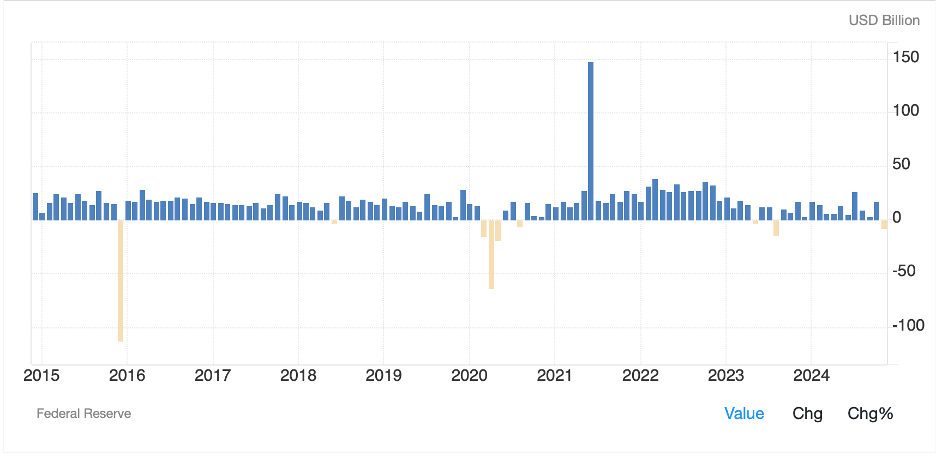
There is no economic data to be released today although I must note that Consumer Credit was released yesterday afternoon and fell -$7.5B, a much worse outcome than expected.  As you can see from the below chart, declining consumer credit, while not completely unheard of, is a pretty rare occurrence.  You can clearly see the Covid period and the best I can determine is the December 2015 decline is a data adjustment, not an actual decline.  The point to note, though, is that despite lots of ostensibly strong economic data, this is a warning.
Source: tradingeconomics.com

I keep looking for something to turn the tables on the dollar, but for now, it is hard to make the case that the greenback is going to suffer in any broad-based manner.  Tomorrow, though, with NFP should be quite interesting.

Good luckAdf
Falling Further

Like a stone toward earth
The yen keeps falling further
Beware Kato-san


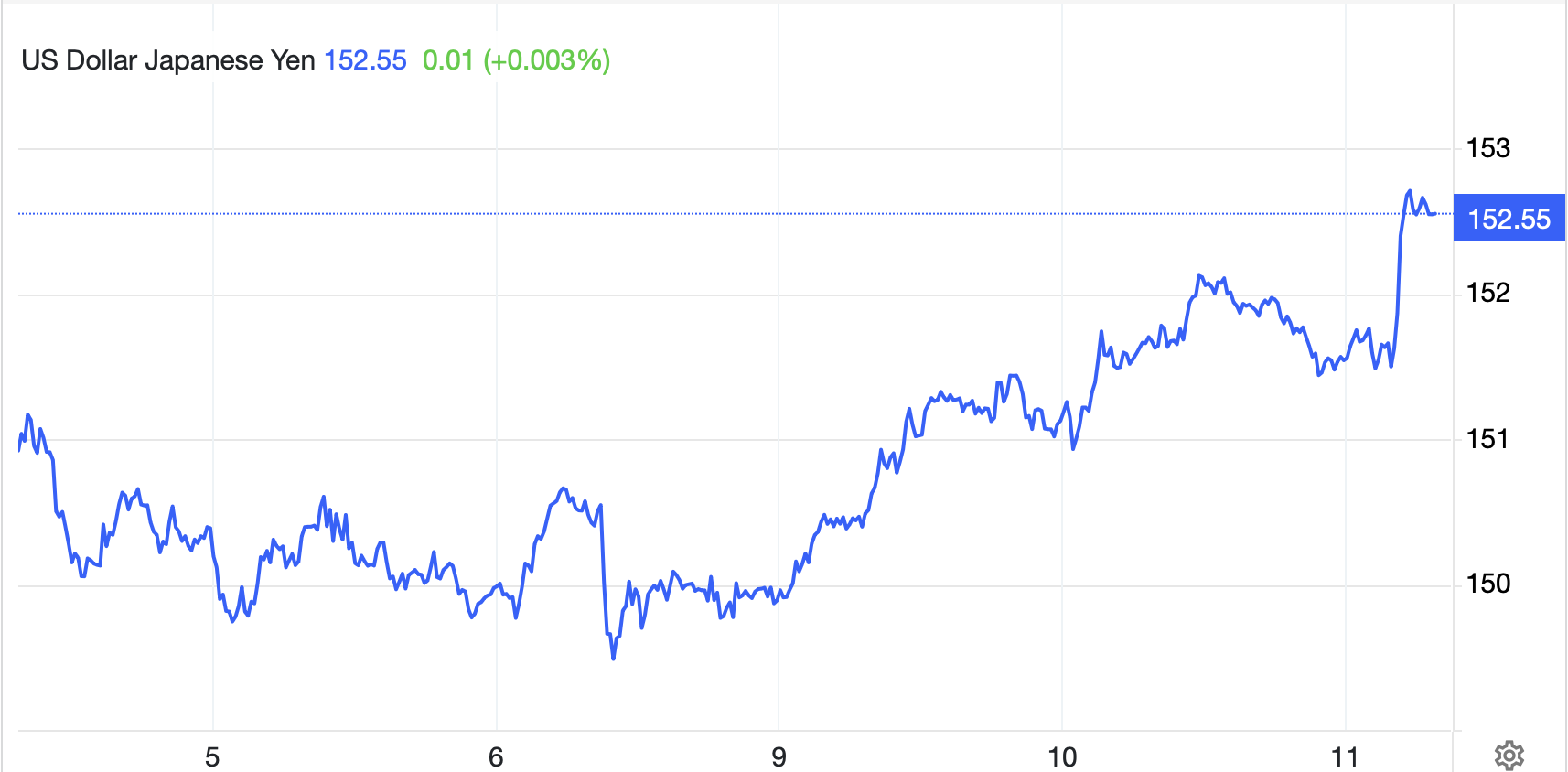
While we have not discussed the yen much lately, its recent weakness, in concert with the dollar’s broad strength, has begun to cause some discomfort in Japan.  Last night, Japanese FinMin Katsunobu Kato explained, “We will take appropriate action if there are excessive movements in the currency market.”  He went on that he is “deeply concerned” by the recent weakness, especially moves driven by those evil pesky speculators.

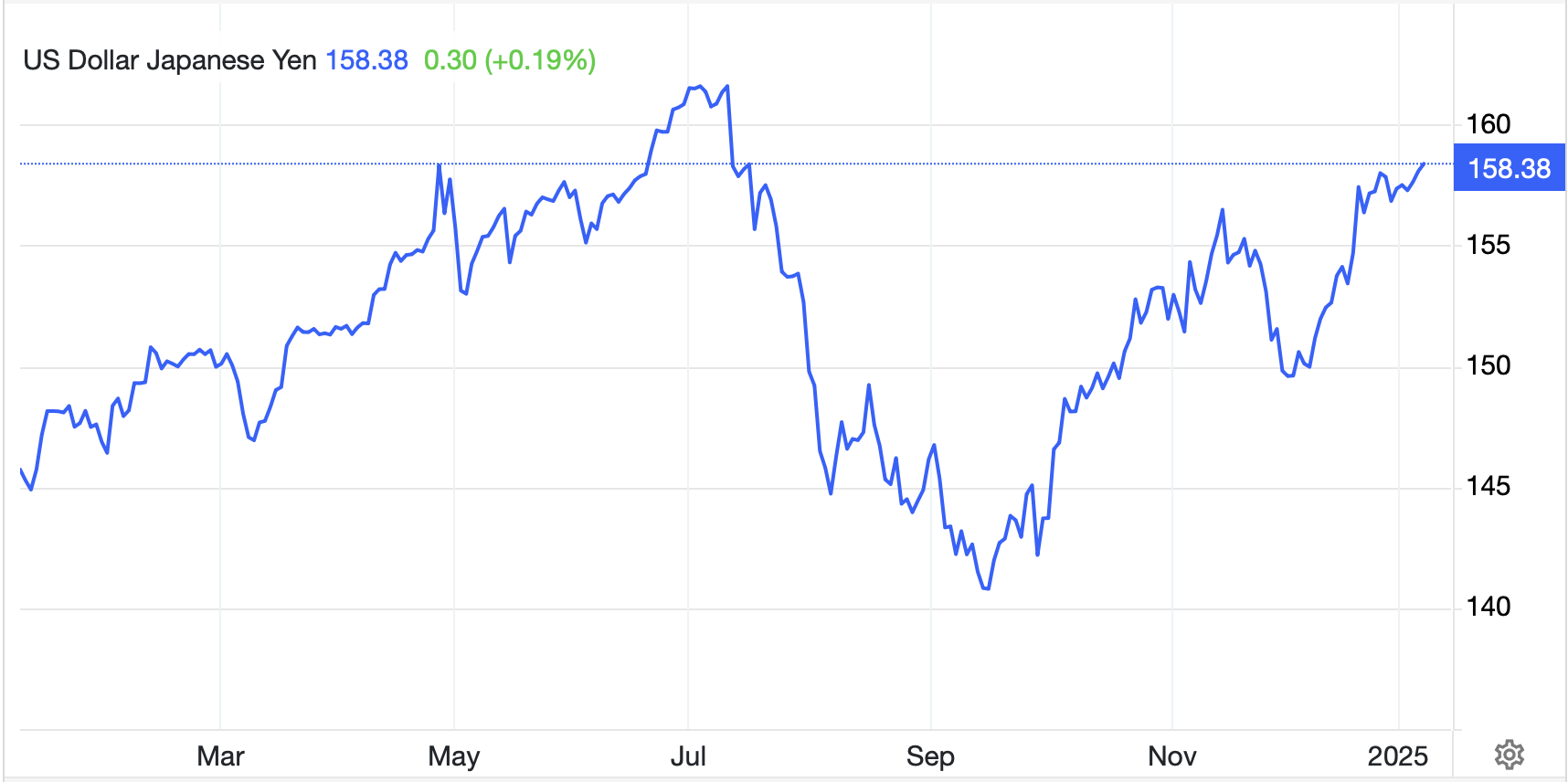
The problem, of course, is that all those expectations that the BOJ would be tightening policy to fight domestic inflation while the Fed would continue to ease policy since they “beat” inflation, with the result being the yen would regain its footing, have proven to be false hope.  Instead, as you can see from the below chart, since the Fed first cut rates back in September, the yen has tumbled nearly 13% and very much looks like it is going to test the previous four-decade highs seen last summer.

Source: tradingeconomics.com

Last year, the MOF/BOJ spent about $100 billion in their efforts to stem the yen’s weakness.  They still have ample FX reserves to continue with that process, but ultimately, history has shown that maintaining a cap on a currency that is weakening for fundamental reasons is nigh on impossible.  If a weak yen is truly seen as existential in Tokyo, then Ueda-san needs to be far more aggressive in tightening monetary policy.  This is especially so given the Fed continues to back away from earlier expectations that it would be aggressively loosening policy.  Now, while JGB yields have moved higher over the past several sessions, trading now at 1.18%, which is their highest level since April 2011, that is not going to be enough to stem this tide.  From what I read, inflation is an issue, but not the same as it was in the US in 2022, so Ueda-san is not getting the same pressure to address it as Powell did back then.  My read is the BOJ remains on hold this month and hikes rates in March while the yen continues its decline.  Look for another bout of intervention when we test the 162 level, but that will not stop the rot.  Nothing has changed my view of 170 or higher in USDJPY by year end.

Though Treasury yields have been rising
Most credit spreads have been downsizing
So, corporate supply
Is ever so high
An outcome that’s somewhat surprising

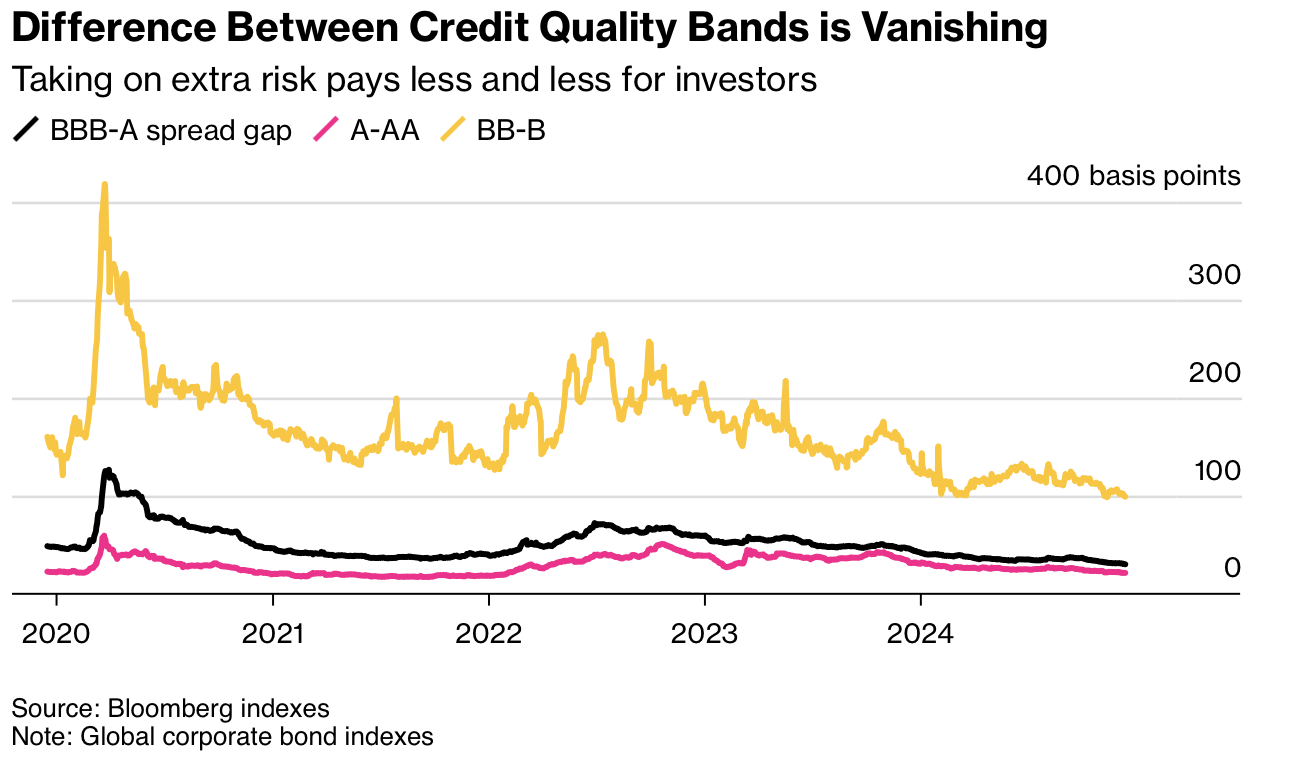
In the bond market, government bond yields continue to rise around the world (China excepted) as investors increase their demands in order to hold the never-ending supply of new bonds.  Ironically, despite this ongoing rout in government bonds across the board, corporate debt issuance looks as though it will set new records this month.  One thing to remember here is that corporates have a lot of debt coming due over the next two years as all that issuance during the ZIRP period needs to be rolled over.  But the other thing to recognize is that corporate credit spreads, the amount of yield investors require to own risky corporate bonds vis-à-vis “safe” government bonds, has fallen to its lowest levels in years, and as can be seen in the chart below, the extra yield available for high-yield investors is shrinking faster than for investment grades.

Potentially, one reason for this is the dramatic increase in the amount of Private Credit, the latest investment fad where weaker credits go directly to funds designed to lend money rather than to their banks, and investors ostensibly remove one of the middlemen from the process.  As such, there is less of this debt around than there otherwise might be, hence increasing demand and reducing that credit spread.  But the other reason is that there continues to be a significant amount of investable assets looking for a home, and with global yields near the highest they have been in a decade or more, and with the equity market dividend yield down to just 1.27% or so, a record low, there are lots of investors who are comfortable with clipping 5% or 5.5% coupons on BBB corporate bonds.

The question I would ask is, if government bond yields continue to climb, and I see no reason for that to stop given the trend in inflation and necessary issuance, at what point are investors going to get scared?  We are likely still a long way from that point, but beware if the new Treasury Secretary, Scott Bessent, follows through with his hinted views of reducing T-bill issuance and increasing coupon issuance, yields could go much higher absent the Fed implementing QE.  That would cause some serious market ructions!

Ok, let’s see how things look around markets this morning after yesterday’s sell-off in the US equity markets.  It seems Japanese stocks were caught between the weaker yen (generally a stock positive) and the tech sell-off (generally a stock negative) with the Nikkei closing lower by -0.25% on the session.  Meanwhile, the Hang Seng (-0.9%) suffered a bit more on the tech move, although Mainland shares (-0.2%) were not as badly affected.  An interesting story here is that the chief economist at state-owned SDIC Securities made comments at an international forum run by the Peterson Institute that really pissed off President Xi.  Gao Shanwen said the quiet part out loud when he claimed that actual GDP growth in China for the past several years has likely been much closer to 2% than the 5% published.  That story has been widespread in the West, although has never been given official credence.  And for Xi, 2% growth is not going to get it done, what with the property bubble still imploding and consumption declining despite promises of more stimulus.  Stay tuned to this story to see if we start to see more Western analysts reduce their expectations.  Elsewhere in Asia, the picture was mixed with gainers (Korea, Australia, Singapore) and laggards (Taiwan, Malaysia, Philippines).

In Europe, red is today’s color, led by the CAC (-1.0%) although we are seeing losses across the board. Eurozone data showed declining Consumer Confidence, Economic Sentiment and Industrial Sentiment all while inflation expectations remain stubbornly high.  That stagflationary hint is typically not an equity market benefit so these declines should be expected.  The story on the continent is not a positive one and I maintain that the ECB is going to have to cut rates more aggressively than their inflation mandate would suggest.  That might support equities a bit, but it will be hell on the euro!  Finally, US futures are a touch softer (-0.2%) at this hour (7:05) although they were higher most of the overnight session before this.

As mentioned above, bond yields are higher with Gilts (+9bps) leading the way as not only is the economy suffering from some very poor policy decisions by the Starmer government, but it seems that the ongoing political crisis regarding grooming gangs has investors shying away.  But yields continue to rise across the board with continental yields up between 3bps and 6bps, Treasury yields higher by another 1bp this morning after a 10bp rise in the previous two sessions, and JGB yields, as mentioned, higher by 5bps.  This trend is very clear!

In the commodity markets, oil (+0.5%) keeps on keeping on, as API data showed a greater than 4mm barrel draw on inventories, far more than expected and indicating a reduced supply around.  Cold temperatures are keeping NatGas (+5.0%) firm as well.  In the metals markets, both precious and base are under a touch of pressure this morning, down less than -0.2%, largely in response to the dollar’s rebound.

Speaking of the dollar, it is higher against all its counterparts this morning with the pound (-1.2%) the G10 laggard although weakness on the order of 0.5% is pretty common this morning.  In the EMG bloc, ZAR (-1.5%) is the worst performer, after weaker than expected PMI data called into question the economic path forward.  But here, too, we are seeing weakness like MXN (-0.9%), CLP (-0.8%), PLN (-0.8%) and KRW (-0.5%).  I would be remiss to ignore CNY (-0.25%), which is trading below (dollar above) 7.3600 in the offshore market, and is now 2.4% weaker than last night’s fixing rate.  This is also the weakest the renminbi has been since it touched this level back in September and then November 2007 prior to that.  Those Chinese problems are coming home to roost for President Xi.

On the data front, ADP Employment (exp 140K) leads the day followed by Initial (218K) and Continuing (1870K) Claims.  These are being released this morning because of tomorrow’s quasi holiday regarding the late President Carter, when US markets will be closed.  This afternoon, the FOMC Minutes arrive and will be scrutinized closely to see just how hawkish they have become.  We also hear from Governor Waller this morning with caution being the watchword from virtually every Fed speaker of late.

It is all playing out like I anticipated, with the ISM data showing strength yesterday, not just in the headline number, but also in the Prices Paid number.  The Fed will have no chance to cut rates again, and I look for the dollar to continue to rise.

Good luck

Adf

No Reprieve

The scuttlebutt had it correct
Trudeau hit the button, eject
But he’s yet to leave
And there’s no reprieve
His legacy will be neglect


Those reports from yesterday morning were spot on as around 11:00am, PM Trudeau announced that he would, in fact, be stepping down.  There is a somewhat convoluted process involved which sees the Canadian Parliament prorogued until late March, while the ruling Liberal party seeks a new leader.  At that point, Parliament will be called back into session, and it seems likely a vote of no confidence will be held.  Assuming that vote goes against the new leader, an election will be called.  No matter how long the Liberals delay this process, and you can bet they will hang on for as long as possible, by October, an election is required.  As well, currently all things point to the Conservative party led by Pierre Poilievre winning that election and taking power with a significant majority.  Obviously, Poilievre would like the election to happen sooner, rather than later, but it seems hard to believe now, regardless of the new Liberal leader, that the Conservatives will fail to win.

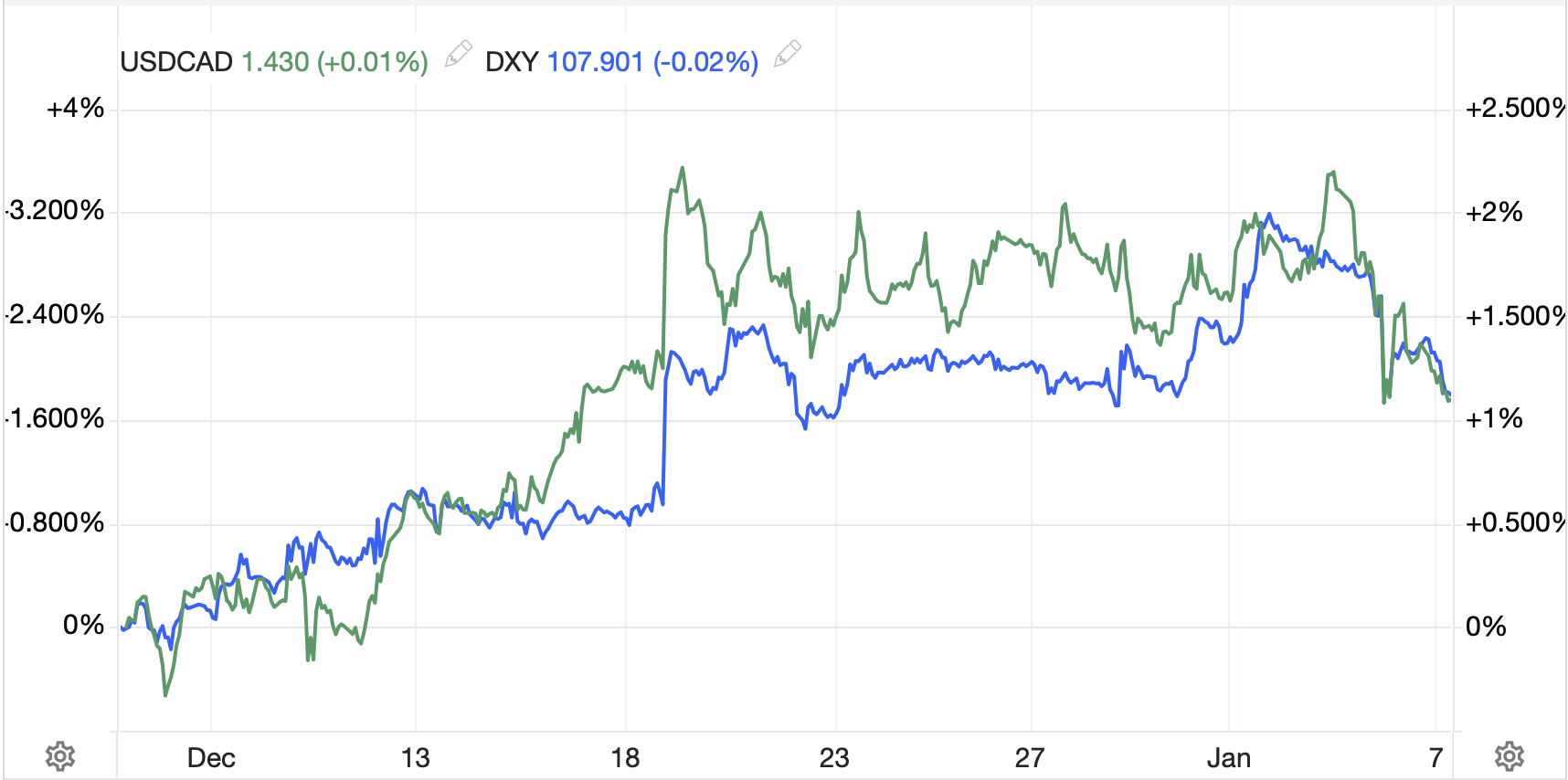
The market impact of this news needs to be separated from the broader drivers, but as I showed yesterday, CAD had been weakening more quickly than the dollar writ large, and now it seems to be moving back into line with the general movement as per the below chart showing the movements between the DXY and USDCAD right on top of each other. 

Source: tradingeconomics.com

My sense is that Canada has now had its day in the sun and will soon retreat to the background of most market consciousness going forward.  After all, despite it being our largest trading counterparty, it has a small population and small economy with limited impact on the global situation.

Certification’s complete
And Trump, in two weeks, takes his seat
Between now and then
Again and again
Prepare for a surfeit of Tweet(s)

In truth, aside from the Canadian story, the bulk of the discussion in both financial and political circles is focused on exactly what President Trump will do when he is inaugurated on the 20th.  The biggest financial discussion revolves around tariffs and exactly how he plans to utilize them going forward.  For the surface thinkers, tariffs are an unadulterated bad policy with significant negative consequences.  As well, the idea that tariffs = higher dollar is axiomatic to these people.  In fact, yesterday’s reversal in the dollar’s recent substantial gains was based entirely on a story that despite some campaign rhetoric of large tariffs imposed on Day 1 of the new Trump administration, in fact things would be far more nuanced.

While I understand the economic case behind tariffs driving the dollar higher (nations hit with tariffs will devalue their currency sufficiently to offset the tariff and allow their exports to remain competitive in the US), I have always been suspect of that theory and logic.  First, we can look at Trump’s first term and see how things played out.  The chart below of USDMXN, a tariff target, shows that, in fact, initially the peso strengthened upon Trump’s inauguration and range traded for the bulk of his term, only weakening substantially during the Covid market dislocations.

Source: tradingeconomics.com

We can look at USDCNY as well and see that over Trump’s first term, there were several large ebbs and flows in the yuan but that, in fact, CNY was stronger vs. the dollar at the end of his term than at the beginning.  Again, this assumption the dollar will appreciate strongly because of tariffs is a talking point, not an empirical reality.

Source: tradingeconomics.com

The other thing to remember about Trump (although it is not clear how you can forget it) is that he is a businessman, not a politician.  He is very transactional and wants to make deals.  I am a strong proponent of the idea that Trump sees tariffs as a negotiating tool and while he is a man of great bluster in his public pronouncements, his ultimate goal remains clearly to achieve his sense of fairness in trade relations.  If his belief is that a nation is maintaining a weak currency to enhance its mercantilist model, Trump will respond aggressively.  Ultimately, I believe a large part of the angst that is evident in governments around the world is that Trump will not behave in a diplomatic manner and will call out all the problems he sees or believes.  And other governments are uncomfortable with their own dirty laundry left to air dry.  While I continue to believe that inflation remains far stickier than the Fed is willing to admit now, nothing has changed my view that the Fed will not cut again and may be forced to raise rates before the year ends.  And that will support the dollar!

Ok, let’s turn to the overnight session.  After a mixed Wall Street performance, where the Mag7 continue to shine, but not so much else, we saw the Nikkei (+2.0%) rally sharply as well, following the NASDAQ.  Chinese shares (CSI 300 +0.7%, Hang Seng -1.2%) were split with the former benefitting from the reduced tariff story while the Hang Seng suffered largely on the back of Tencent Holdings being named a military contractor by the US DOD with its shares tumbling 8% in the US and HK.  Elsewhere in the region, there were both gainers and laggards but nothing of any note in either direction.  In Europe, UK shares (-0.3%) are under pressure as 30yr Gilt yields have risen to their highest level since 1998, an indication that investors are becoming concerned over the UK’s future path.  For context, current levels are 50bps above those which triggered the October 2022 gilt crisis and spelled the end of PM Liz Truss’s time in office.  Meanwhile, continental bourses are modestly higher led by the CAC (+0.6%) which seems to be benefitting from both the lower tariff story as well as hopes that Chinese stimulus will support the luxury goods sector.  As to US futures, at this hour (7:05) they are essentially unchanged.

In the bond market, yields are continuing to edge higher everywhere with Treasuries up 1bp and European sovereign yields higher by between 2bps and 4bps across the board.  Asian government bond markets continue to sell off as well, with yields there climbing in Japan and Australia and even Chinese 10yr yields edging higher by 1bp.  As long as central banks around the world insist that rate cuts are the future (and most of them do) look for bond yields to continue to climb.

In the commodity space, oil (+0.8%) continues to hold its own as trading activity remains modest and hopes are pinned on Chinese stimulus.  NatGas (-3.2%) is backing off its highs as the winter storm has passed (although it is still really cold here!) while the metals markets are performing well.  Gold (+0.5%) continues to trade either side of $2650/oz as speculators await the next major leg.  However, silver (+1.1%) and copper (+0.5%) have both bounced nicely from recent lows as specs look for another breakout higher.

Finally, the dollar is under modest pressure this morning compared to yesterday’s closing levels but is actually slightly firmer than when I wrote yesterday morning.  My point is that while it has been selling off from its peak late last week, there is no collapse coming and all eyes will be turning toward the data later this week to see if the Fed will have room to ease further, or if the NFP report will once again show strength and push any further rate cuts off in time.  The leading gainer in the G10 is NZD (+0.65%) which is benefitting from a combination of higher commodity prices, hopes for more Chinese stim and the tariff reduction story.  But for the rest of the market, 0.2% gains are the norm with only JPY (-0.15%) bucking the trend.

On the data front, this morning brings the Trade Balance (exp -$78.0B) as well as ISM Services (53.3) and JOLTS Job Openings (7.70M).  Yesterday’s PMI data while solid was softer than forecast and Factory Orders, too, were a tick lower than expected at -0.4%.  First thing this morning we will hear from Richmond Fed president Barkin who has been on the more hawkish side lately.  After the weekend chorus that cuts needed to be deliberate, I expect more of the same here.

For now, the broad themes remain unchanged, higher US yields on the back of inflation concerns forcing the Fed to reverse course this year.  But on a day-to-day basis, it would not be surprising to see the dollar continue to give back some of its recent gains given the significant size and speed with which they were attained.  I still like hedgers picking levels and leaving orders to buy dollars a bit cheaper from here.

Good luck

Adf

Active De-Bonding

Up north is a nation quite vast
Whose money, of late’s been, out, cast
But word that Trudeau
Is soon set to go
Has seen Loonies quickly amassed
 

One of the biggest stories over the weekend has been the sudden upsurge in articles and discussion regarding the remaining tenure for Canadian PM Justin Trudeau.  For the past several weeks, since his FinMin Krystia Freeland resigned and published a scathing resignation letter, pressure on Trudeau has increased dramatically.  It appears that it is coming to a head with articles from both Canadian and international sources indicating he may step down as soon as this week.  As well, his main political rival, conservative party leader Pierre Poilievre, is touted, according to the betting websites, as an 89% probability to be the next PM.
 
Now, we all know the dollar has been strong in its own right lately, and I suspect that while there will be bumps along the road, it will get stronger still over the year absent some major Fed rate cutting.  As such, USDCAD is higher along with everything else.  However, you can see in the chart below (the green line rising faster than the blue line since December) that it has been an underperformer for the past month, since that Freeland resignation, as investors have been shying away from Canada, given the combination of concerns over the incoming Trump administration imposing tariffs and no political leadership to address these issues.


Source: tradingeconomics.com

While no sitting politician is ever willing to cede power easily, and there are indications that Trudeau is going to go down kicking and screaming, ultimately, I expect that Poilievre will be the PM and will develop a strong relationship with the US.  As that becomes clearer, I expect to see the CAD appreciate modestly vs. the dollar, but much more so against other G10 currencies.

Once more, what the Chinese have said
Is stimulus is straight ahead
But so far, its talk
They ain’t walked the walk
So, bulls need take care where they tread

Another tidbit this morning comes from Beijing, where the economic planning agency there has indicated that they will expand subsidies for consumer purchases of electronic goods like cellphones, tablets and smart watches, as President Xi continues to watch his nation’s economy grind along far more slowly than he really needs to happen.  There was an excellent thread on X this morning by Michael Pettis, one of the best China analysts around, describing the fundamental problem that Xi has and why the slow motion collapse of the property market portends weakness for a long time going forward.  As is almost always the case, while tearing the proverbial band aid off quickly can hurt more at the instant, the pain dissipates more quickly.  President Xi believes he cannot afford to inflict that much pain, so their problems, which stem from decades of malinvestment in property that inflated a massive bubble, are going to last for a long time.  While CNY (+0.4%) is modestly firmer this morning, that is only because the dollar is weaker across the board, and in fact, it is significantly underperforming.

This week, the US Treasury’s Yellen
Much debt, will look forward to sellin’
The market’s responding
By active “de-bonding”
With dollars and bonds both rebellin’

The last big story of the day is clearly the upcoming Treasury auctions this week, where the US is set to sell $119 billion of debt, starting with $58 billions of 3-year notes today.  Arguably, market participants have been aware that this was going to be a necessary outcome given the massive deficits that continue to be run by the US.  Adding to the broad concept of deficits, the Biden administration appears to be trying to spend every appropriated dollar in the last two weeks in office and that requires actual cash, hence the auctions to raise that cash.  In addition, the debt ceiling comes back into force shortly, so they want to get this done before that serves to prevent further issuance.

Now, the yield curve has reverted back to a normal slope with the 2yr-10-yr spread at 34bps and 30yr bonds trading another 22bps higher than 10yr at 4.81% and bringing 5% into view.  Here’s the thing about the relationship between the dollar and yields; the dollar is typically far more correlated to short-term yield differentials, not long-term yields.  So rising 30yr bond yields is not likely to be a dollar benefit.  In fact, just the opposite as international investors will not want to suffer the pain of those bonds declining in price rapidly.  

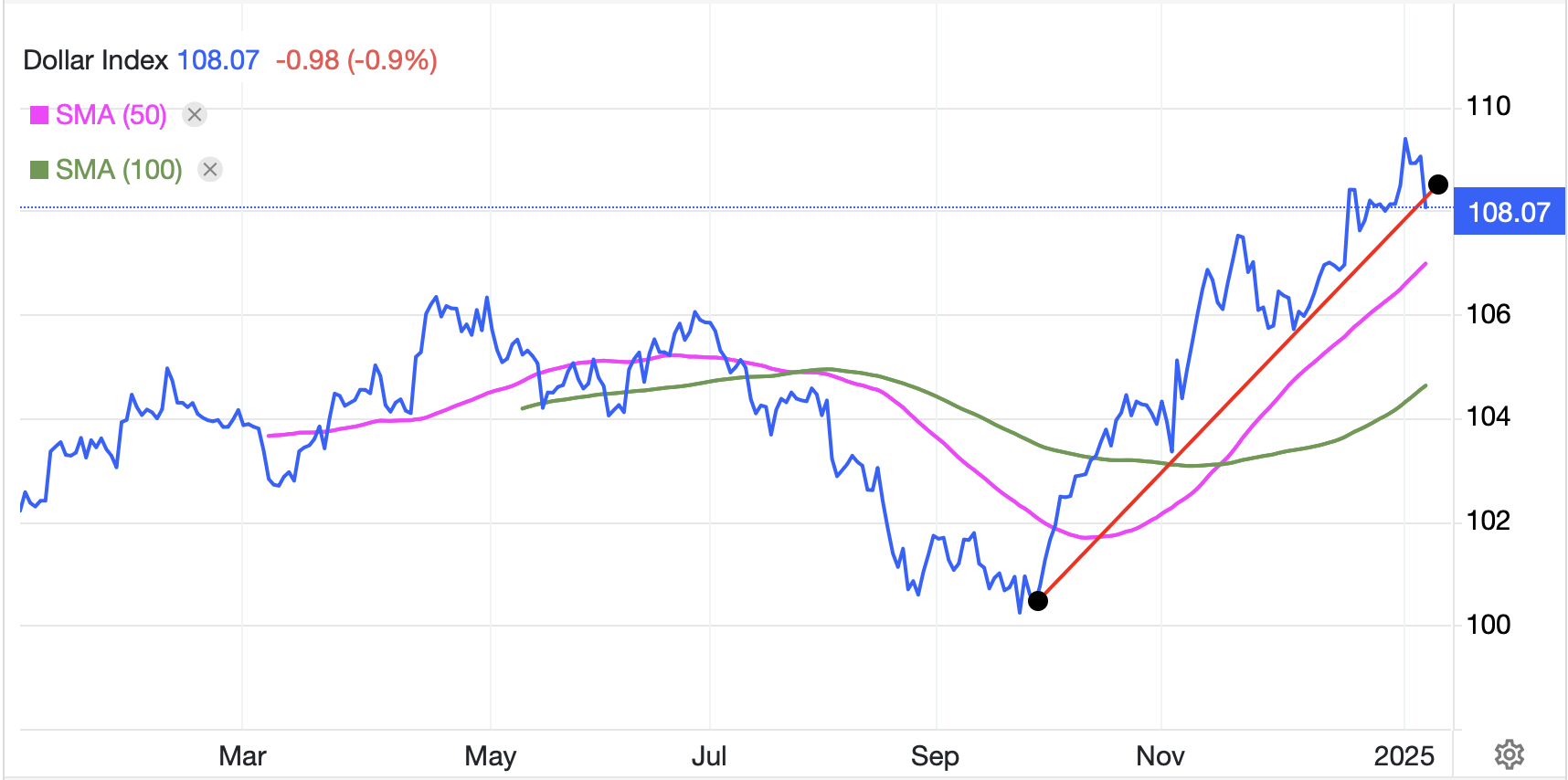
And this is what we are witnessing this morning as the dollar, which rallied sharply at the end of last week, is correcting in a hurry today.  As mentioned above, CNY is the laggard with the euro, pound, Aussie, Kiwi and Loonie all firmer by 1% or more this morning and similar gains seen across the emerging markets, with some extending those gains as far as 1.35% or so.  Is this the end of the dollar?  I would argue absolutely not.  However, that doesn’t mean that we won’t see a further decline in the buck before it heads higher again.  A quick look at the chart below, which shows the Dollar Index, while it has just touched the steep trend line higher, it remains far above its 50-day and 100-day moving averages.  Howe er, it seems that the big story here comes from a report from the Washington Post that Trump is considering much less widespread tariff impositions with only some critical imports to be addressed.  As such, given the tariffs = higher dollar consensus, if this is true, you can understand the dollar’s retreat.

Source: tradingeconomics.com

However, today’s story is that of a weak dollar and strong equity markets, well at least in some places. Friday’s US equity rally was not followed by similar enthusiasm in Asia with the Nikkei (-1.5%) leading the way lower while both the Hang Seng (-0.4%) and China (-0.2%) also lagged.  Perhaps the mooted China stimulus helped those markets on a relative basis.  Europe, however, is in fine fettle (CAC +2.3%, DAX +1.4%, IBEX +0.9%) as PMI data released this morning was solid, if not spectacular, and the weaker dollar seems to be having a net positive impact.  US futures are also firmer, with NASDAQ (+1.1%) leading the way.

In the bond market, the big movement was in Asia overnight as JGBs (+4bps) sold off alongside virtually every other Asian bond market except China, which saw yields edge lower by 1bp to a new record low of 1.59%.  In Europe, there has been very little movement with yields +/- 1bp at most and Treasury yields, which had been firmer earlier in the overnight session, have actually slipped back at this hour and are lower by 2bps to 4.58%.

In the commodity markets, the weak dollar has helped support prices here with oil (+1.0%) continuing its rally (+9% in the past month) as the combination of Chinese stimulus hopes and cold weather seem to be providing support.  Speaking of cold weather, NatGas (+7.4%) is also in demand this morning as winter storm Barrie makes its way across the country.  In the metals markets, gold (+0.3%) is the laggard this morning with both silver (+2.3%) and copper (+2.4%) really taking advantage of the dollar’s weakness.

On the data front, there is a ton of stuff this week, culminating in NFP on Friday.

TodayPMI Services58.5
 PMI composite56.6
 Factory Orders-0.3%
TuesdayTrade Balance-$78.0B
 ISM Services53.0
 JOLTS Job Openings7.70M
WednesdayADP Employment139K
 Initial Claims217K
 Continuing Claims1848K
 Consumer Credit$12.0B
 FOMC Minutes 
FridayNonfarm Payrolls160K
 Private Payrolls134K
 Manufacturing Payrolls10K
 Unemployment Rate4.2%
 Average Hourly Earnings0.3% (4.0% Y/Y0
 Average Weekly Hours34.3
 Participation Rate62.8%
 Michigan Sentiment73.9

Source: tradingeconomics.com

In addition to all this, we hear from six more Fed speakers over seven venues with Governor Waller likely the most impactful.  Over the weekend, we heard from Governor Kugler and SF President Daly, both explaining that they needed to see more progress on inflation before becoming comfortable that things were ok.

Clearly, the tariff story is the current market driver in the dollar.  As I never saw tariffs as the medium-term driver of dollar strength, I don’t think it has as much importance.  Plus, this is a report from the Washington Post.  There are still two weeks before inauguration and many things can happen between now and then.  Nothing has changed my longer-term view that the dollar will be supported as the Fed, which is not tipped to cut rates this month and is seen only to be cutting about 40bps all year will ultimately raise rates as inflation proves far more stubborn than desired.  But that is the future.  Today, pick spots to establish dollar buys and leave orders.

Good luck

Adf

Havoc the Dollar Will Wreak

Apparently, President Xi
Is starting to listen to me 🤣
His currency’s falling
As he stops forestalling
The weakness in his renminbi
 
But it’s not just yuan that is weak
The havoc the dollar will wreak
Is set to keep growing
As funds keep on flowing
To US investments, still chic


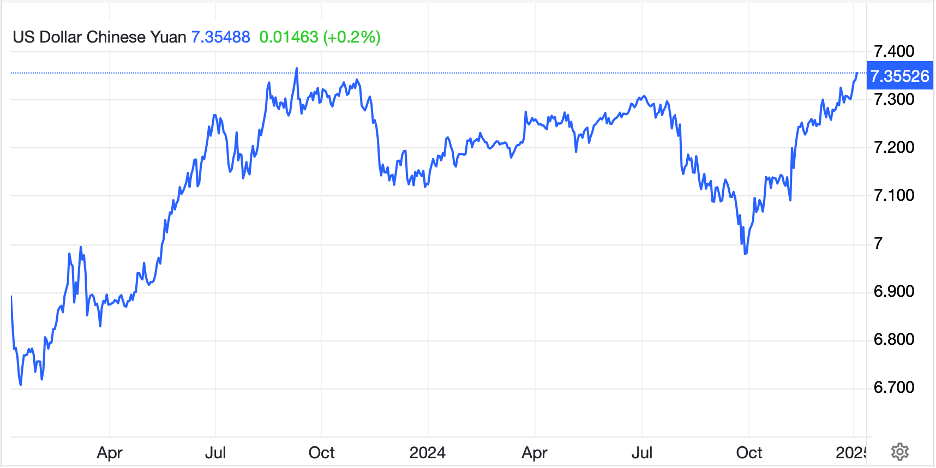
It seems that one of President Xi Jinping’s New Year’s resolutions was to finally allow the renminbi to resume its longer-term decline.  While 7.30 has been the line in the sand for a while, as can be seen from the first chart below, suddenly, as the calendar page turned to 2025, it appears that the PBOC is going to allow for the renminbi to weaken further.  Thus far, the PBOC has been adamant about fixing the Chinese currency at levels much stronger than anyone wants to pay for it, and even last night that was the case, with a fixing rate of 7.1878.  However, while the onshore market must trade within +/- 2% of that fixing rate, no such restriction limits the offshore market, and this morning, the offshore renminbi is trading 2.3% weaker than the fixing, above 7.35 to the dollar.

Much has been made of the “chess” moves that are ongoing between the US and China regarding currency policy with many pundits blankly claiming that if Trump is to impose the threatened tariffs, the renminbi will simply weaken to offset them.  However, while I do believe the CNY has much further to fall, that is not the driving case I see.  Rather, Xi’s problem is that his economy is not in nearly as good condition as he needs it to be and confidence in the consumer sector continues to wane.  This is largely a result of the ongoing destruction of the property bubble that was blown for decades.

Remember, Chinese investors have tied up significant personal wealth in second and third homes as stores of value.  This was encouraged as cities could sell property to developers, get paid a bunch to help finance their operations, and since demand was so high, prices kept rising so everyone was happy.  Alas, as with all bubbles (I’m looking at you, too, NASDAQ) eventually the air comes out.  For the past three years the Chinese have been trying to deal with this collapsing property market, but house prices continue to decline thus reducing investor wealth and confidence.  I read that there are an estimated 80 million empty homes that have been built over the past decades and are now in disrepair in the countryside.  These are the ghost cities that were all part of the Chinese growth miracle, but in fact were simply massive malinvestment.

While the prescription for China has long been to increase its consumer sector of the economy, Xi and his minions at the central committee have no idea how to do that (given they are communist, this is not that surprising) and so continue to support the means of production.  The problem is they have now seemingly gone too far in that space as well with not merely the Western world, but also much of the developing world starting to push back on all the excess stuff that is coming from China.  

Xi’s other problem is that as he rails against the dollar and seeks others to use the renminbi in their trade, if the currency starts to fall sharply, that will be a difficult ask.  Given the US FX policy remains benign neglect, it is entirely upon China to solve their own problems.  While it is unlikely to happen in a big devaluation a la August 2015, weakness is the trend to bet here this year.

Source: tradingeconomics.com

Source: tradingeconomics.com

Away from that news, though, the year is starting off in a fairly modestly.  Most of the world’s focus is on the upcoming Trump inauguration as well as the political machinations that will begin today as Trump’s Cabinet nominees start to go through their paces in front of the Senate.  New Year’s Eve’s horrifying terrorist attack in New Orleans has just upped the ante with respect to Trump getting his picks through the process.  

So, let’s review the overnight market activity to get a sense of what today could bring.  The first day of the US trading year resulted in modest declines across the board in equities, although as I type (7:30), they appear to be retracing those losses and are slightly higher.  The bigger news was from Asia where both the Nikkei (-1.0%) and CSI 300 (-1.2%) showed weakness with the former feeling the pain of some profit taking after gains last week, although Chinese shares seem to be succumbing to the troubles I have described above.  Elsewhere in the region there was no consistency with gainers (Hong Kong, Taiwan, Korea and Australia) and losers (India, New Zealand, Malaysia) with other exchanges little changed.  In Europe this morning, there is more red than green with the CAC (-0.8%) the biggest laggard amid concerns over the fiscal situation in France.  But the DAX (-0.35%) and FTSE MIB (-0.45%) are also lagging with only Spain’s IBEX (0.0%) bucking the trend.

In the bond market, Treasury yields have slipped 2bps this morning, but remain above 4.50%, something that continues to vex Chairman Powell as he and the Fed seemed certain that by cutting the Fed funds rate, he would drive the entire yield curve lower.  I wonder if he will learn this lesson about the relation between a made-up rate (Fed funds) and market rates (bond yields) anytime soon.  In Europe, French yields are 2bps higher, widening their spread vs. German bunds and perhaps more remarkably, at least from a nominal perspective, well above Greek government bond yields now! (Remember, there are far fewer GGB’s around than OAT’s so there is a scarcity bid there). Certainly, Madame Lagarde must be getting a bit concerned over her native nation’s profligacy and I suspect that the fiscal ‘need’ for lower Eurozone interest rates is one of the features of the discussion regarding the ECB’s future path (lower).  As to JGB’s, they are unchanged, sitting at 1.07% and showing no sign of rising anytime soon.  One last thing, Chinese 10yr bonds now yield a new record low of 1.61%, 2bps lower on the day and pretty convincing evidence that not all is well in the Middle Kingdom’s economy.

On the commodity front, oil (-0.2%) is consolidating yesterday’s strong gains which were ostensibly based on the idea that President Xi will successfully implement more stimulus and aid growth in China.  History shows otherwise, but we shall see.  Gold (-0.1%) is also consolidating yesterday’s strong gains as it appears there has been renewed central bank buying activity to start the year.  The other metals also benefitted yesterday with silver (+0.8%) continuing this morning.

Finally, the dollar is retracing some of yesterday’s gains but remains much stronger than we saw just last week, and certainly since the last time I wrote.  Looking at the Dollar Index, it is hovering near 109 this morning, having traded well above that yesterday afternoon.  The next obvious technical target is 112, about 3% higher and there are now many calls for a test of the 2002 highs of 120.  I assure you, if the DXY gets to those levels, EMG currencies are going to come under a great deal of pressure.  As an example, we already see several EMG currencies (CLP, BRL) trading at or near all-time lows (dollar highs) and there is nothing to think this will change soon.  As well, check out the euro at 1.03 this morning, which while 0.3% higher on the session, appears as though it could well test those October 2022 lows (dollar highs) sooner rather than later, especially if the ECB continues to lean more dovish than the Fed.  If you are a receivables hedger, currency puts seem like a pretty good idea these days.

On the data front, ISM Manufacturing (exp 48.4) and Prices Paid (51.7) are all we have today and late this morning Richmond Fed president Barkin speaks.  Interestingly, tomorrow evening and Sunday we hear from SF Fed President Daly and tomorrow evening Governor Kugler will be joining Daly.  I guess they can’t go but so long without hearing their voices in the echo chamber!

There is nothing to suggest that the dollar, while modestly softer today, is set to turn around soon.  Keep that in mind.

Good luck and good weekend

Adf

The Twists of the Coming Year

(With apologies to Henry Wadsworth Longfellow)

Listen my children and you shall hear
Of the twists and turns to come this year
Let’s look through to Christmas time, Ought Twenty-Five
At which point, I trust, we’re all still alive
To learn what’s robust, and what is austere
 
To start out this tale, the ‘conomy’s first
Will Trump bring us growth or disaster?
The former, my friends, percent three at worst
Though inflation will start rising faster
In fact, by year end, alas you will find
That prices have risen, instead of declined
Perhaps four percent, or just less
For Powell, t’will be quite a mess
At least, as of now, that’s my very best guess
 
With this for context, let’s turn now to rates
A subject, on which, we’ve many debates
The Chairman wants to keep cutting
But that window appears to be shutting
As he’s hemmed in by those dual mandates
In fact, ere this year comes to a close
As neither growth nor inflation slows
The Fed will turn tail and be forced to raise
Fed funds, a result that’s sure to amaze
 
Through summer, before those hikes arrive
Prices for bonds will keep falling
Investors will start caterwauling
As yields climb to levels not lately seen
Think 10-year’s a half-point o’er five
And 30’s at six percent, stalling
With calls that Chair Jay intervene
 
Come solstice, yields will have reached their peak
Then Powell and friends will respond
At which point you’ll want to buy the bond
As we are overwhelmed by Fedspeak
Inflation will once again be Job One
And Powell, this mandate, will not shun
So, Fed funds will start to be raised
And Powell, by hawks, will be praised
But President Trump will be miffed
And his response will be sure and swift
With Tweets, many see as half-crazed
 
As rates and yields rise, what, now, of stocks?
How will they fare in this brave new world?
Seems likely sectors will be swirled
Industrials healthy, tech with a pox
Thus, indices, pressure will feel
As FOMOers soon start to squeal
This is one move they’ll want to miss out
Although I don’t foresee a great rout
Investors will then face a true paradox
Do rates matter more or growth, for stocks?
And will foreigners all lose their zeal?
Come year end, the Dow is likely to drift
Toward 40K in a modest downshift
Though Tech is another story
With the Q’s at four hunge, pretty gory.
 
Attention, now must, to Europe we turn
A region, which lately’s been a concern
Governments falling and growth, oh so weak
This is a place investors will spurn
As profits, returns and value they seek
The ECB mandate, inflation alone
Will suffer as weaker growth they bemoan
Thus Madame Lagarde, much further will cut
Which leads to a case, quite open and shut
As interest rates slide, back to, Percent, One
The euro, itself will, too, come undone
‘ Neath Parity when, December, we look
The euro will trade, as it’s been forsook
And don’t be surprised if Sterling, as well
Falls down to One-Ten, by hook or by crook
As Starmer and Labor face a death knell
 
In China, though Xi is certain to try
His best to attain real 5% growth
When push comes to shove hist’ry shows he’s been loath
To help demand rather than add to supply
And adding to troubles, a falling birthrate
Is just one more thing that will, Xi, frustrate
As such, come December, a Yuan below Eight
Is likely with further rate cuts coming nigh
 
Japan is our next discussion to nourish
Ishiba is anxious for growth there to flourish
As such, raising rates is highly unlikely
His bet will be paychecks are greater than ‘flation
If not, he will be condemned to damnation
And soon lose his job, on that we agree
 
The upshot for FX seems clear
The yen will struggle to find support
And so, come the end of the year
We’ll see levels not seen in decades
One Seventy’s likely where it trades
As yen’s weakness, Ueda can’t thwart
 
Let us turn now to EMG
Whose moneys all tumbled throughout Twenty-Four
When looking ahead I foresee
Troubles ahead, though perhaps not as bad
As last year’s distress, though still quite sad
Ten percent falls or more, you’d agree
Are signals investors, these moneys, deplore
 
Let us start south of the border
Where last year, pesos fell 20%
For Ms. Scheinbaum t’will be a tall order
To soothe Donald Trump and maintain her smile
When fighting inflation all the while
As Banxico, last year’s hikes do augment
This won’t be enough to arrest its fall
Though it won’t fall to Covid lows
Next winter we’ll all be in thrall
When Twenty-Three on your screen shows
 
And finally, Brazil, the land of the Samba
Is likely to see its currency bomb-a
Inflation has bottomed, and is rising
While Lula has nought enterprising
The central bank, rates, will certainly raise
But t’wont be enough, the real to praise
Come Christmas, the real, to Seven will jump
Though that is no way to make friends with Trump
 
These forecasts rely on the Fed
Adjusting their story as prices won’t sink
But if Powell cuts, we must rethink
‘Cause things will be very different ahead
The dollar will suffer, commodities soar
Investors, T-bonds, will say issue no more
While stocks will rise sharply, say Dow 50K
But truly, that strikes me as widely astray
In sum, please remember that I’m just one man
And though I attempt to weave a strong thread
Oft times things don’t go according to plan
Dear readers, I hope, that I’ve not misled
 
For all of you who have stuck with me through the gyrations past, and perhaps will do so for the gyrations future, thank you for giving me your time and consideration.
I truly appreciate your thoughts and feedback on each and every note.
Have a very happy and prosperous 2025
Adf

Caution and Fear

For Jay and the FOMC
There’s nothing that’s likely to be
Enough to adjust
The often discussed
Reduction in rates, all agree
 
But as we look off to next year
The sitch has become much less clear
The dot plot and SEP
Could very well prep
Investors for caution and fear


*Let me begin by explaining this will be the last poetry for 2024 as I take some time to reflect on the past year as well as my views for 2025.  Come January 2nd, I will offer those views, as I always do, in a long-form poem.  For all of you who have come along for the ride, thank you very much, I sense next year may be even more interesting than the one ending in a few weeks*.

Now, back to our regularly scheduled programming.  To my eye, the ongoing coordinated policy easing by central banks around the world (US, Europe, UK, Canada, China, Switzerland, etc.) feels at odds to the ongoing inflation data that seems to show a reluctance for price rises to slow back to the preferred pace of those same central banks.  Certainly, in the US, as evidenced by both the CPI data Wednesday, and even more so by yesterday’s PPI data, the null hypothesis that the rate of inflation is slowing toward 2% feels as though it is no longer valid.  One needn’t dig too far under the surface to see core and median inflation readings with 3% and 4% handles and given this is almost entirely in the services sector, the sector that encompasses more than two-thirds of the economy, it seems increasingly hard to make the case that inflation is going to decline much further.  This is not to imply we are heading for hyperinflation, just that the slow pace of price increases that existed since the GFC seems to have ended.

At least in the US, the economic growth story appears to be a bit more positive than elsewhere around most of the world, and so the opportunity exists for wages to keep up with prices.  Alas, elsewhere in the world, that is not necessarily the case.  Yesterday, Madame Lagarde and the ECB cut rates by a further 25bps, as universally expected, and the market is looking for another 25bp cut in January.  However, despite what is a clearly slowing growth impulse on the continent, even Lagarde felt it necessary to caution about the sticky services prices in Europe and how they must be careful in their policy decisions to prevent a reemergence of inflation.  Remember, too, the ECB’s sole mandate is price stability, so theoretically, even if Europe falls into recession, it is not the ECB’s task to rescue the economy there.

Perhaps the one place where policy ease is appropriate is China, where the pace of activity in the economy is very clearly slowing.  President Xi and his minions have not yet been able to arrest the decline in the property market there, which given such a large proportion of Chinese GDP growth over the past decade was contingent upon an ever-growing property sector and consistently rising prices, is a problem.  An interesting feature of their recent announcements is that they seem ready to have the central bank lend directly to the government (monetizing debt) to finance activity rather than have the central bank buy bonds from the Chinese banking community (otherwise known as QE).  In fact, arguably the biggest problem in China is that the banking system there is dangerously overleveraged and undercapitalized when taking a true account of bad loans outstanding.  It seems that Xi and friends have figured out it would simply be cheaper to print money and directly give it to the government rather than pass it through a creaking banking system that no longer works.  While this almost certainly is smart policy given the circumstances, it doesn’t speak well of the overall situation there.

(As an aside, can we really be surprised that the Chinese banking system, which is basically an arm of the government’s finance ministry which directed lending to favored companies/industries without any real analysis, is having problems?)

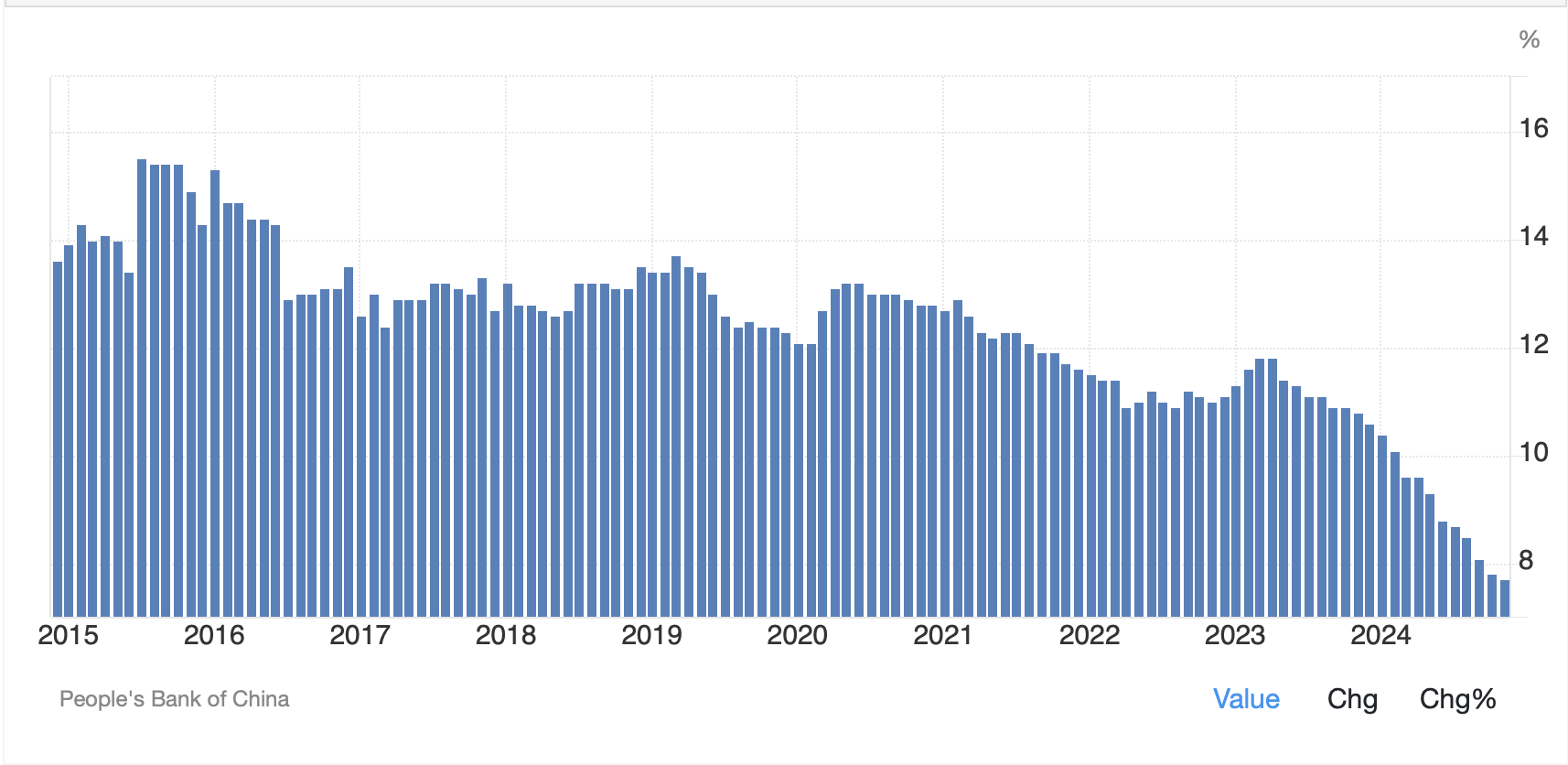
Under the guise, a picture is worth 1000 words, a quick look at the below chart from tradingeconomics.com which shows the trajectory of outstanding Yuan Loan Growth over the past 10 years is pretty descriptive.  Banks in China have lost their ability to help the government implement monetary policy so the government is going to simply do it themselves.  The “moderately loose” policy the Politburo announced seems likely to go beyond moderate as 2025 progresses, at least in this poet’s eyes.

In the end, there are many problems extant in the global economy.  As well, there has been an uptick in overall uncertainty with the election of Donald Trump as US president given his history of sudden, unpredictable pronouncements.  I would contend that the one constant in 2025 and beyond is that volatility is far more likely to increase than decrease across markets everywhere.

Ok, let’s take a quick tour of the overnight activity before my short-term hiatus.  Once again, US equity markets were under modest pressure yesterday as I continue to see more and more pundits calling for a short-term pullback before the next leg higher.  That weakness was followed by Asian markets selling off with China (-2.4%) and Hong Kong (-2.1%) both suffering from ongoing disappointment that the modest loosening wasn’t dramatic loosening!  Interestingly, despite the JPY (-0.55%) weakening further (its 5th consecutive down day) the Nikkei (-1.0%) couldn’t gain any traction, perhaps undercut by concerns over the tech story and rising US rates.  However, both Korea and India put in solid positive sessions.  Clearly Asia is not a monolithic market.  

In Europe this morning, the screens are green, but it is a pale green, with gains on the order of 0.1% to 0.3% only as investors seem to have taken some heart by the ECB’s cut and modest dovish follow up.  Meanwhile, US futures are slightly firmer at this hour (8:00).

In the bond market, yields continue to climb in the US (Treasuries +2bps) and Europe (Bunds +4bps, OATs +3bps Gilts +2bps) as bond investors are far more circumspect of the ECB cutting rates while inflation lurks in the background.  Chinese yields continue to fall, with the 10-year there hitting a new low of 1.78% and talk now that by the end of 2025, Chinese yields may fall below those in Japan!  Now that would be something, and I suspect the FX markets would see a lot of volatility if that happens.

Oil prices (+0.5%) continue to hold the $70/bbl level with very little impetus after the rally early in the week.  Metals prices, though, are under modest pressure this morning, perhaps on the idea that Chinese demand is going to falter.  After all, if Chinese shares can’t hold up, why would traders believe they will be buying up copper, silver and gold?  All three are lower by about -0.2% this morning.

Finally, the dollar is mixed this morning, having rallied vs. some counterparts like JPY, BRL (-0.75%) and ZAR (-0.55%) while declining vs. the euro (+0.45%), NOK (+0.75%) and the CE4 currencies.  My take is the euro’s rebound, and that of the CE4, is more position related after a sell-off yesterday and given today is Friday, rather than anything fundamental.

There really is no data today and while we do see Retail Sales next Tuesday (exp 0.5%, 0.4% ex autos), I think it’s really all about the Fed next Wednesday.  The market is still pricing 97% probability of a cut, and I don’t see anything changing that.  Rather, the Fed’s dot plot will be the story for markets as the narrative starts to account for higher inflation and therefore, a higher long-term outcome for the neutral rate.

Again, none of this portends a weaker dollar as we head to the end of 2024.  For 2025, you will need to wait for January 2nd to see my views then.

Good luck, good weekend and have a wonderful holiday season

Adf

Tempt the Fates

Inflation just won’t seem to die
No matter what Jay and friends try
Will he tempt the fates
To once more cut rates?
And if so, will bond yields comply?


It took until 1:10pm yesterday for Nick Timiraos at the WSJ to publish his article regarding the fact that Strengthening Inflation Poses Challenge for Trump, Fed.  I find the title of the article interesting as, to the best of my knowledge, Mr Trump has yet to take office and enact any policies.  But I suppose if Chairman Powell doesn’t like Trump (which seems to be the widely held view) he wanted to ensure his mouthpiece took a dig and distracted the audience from Powell’s problems.

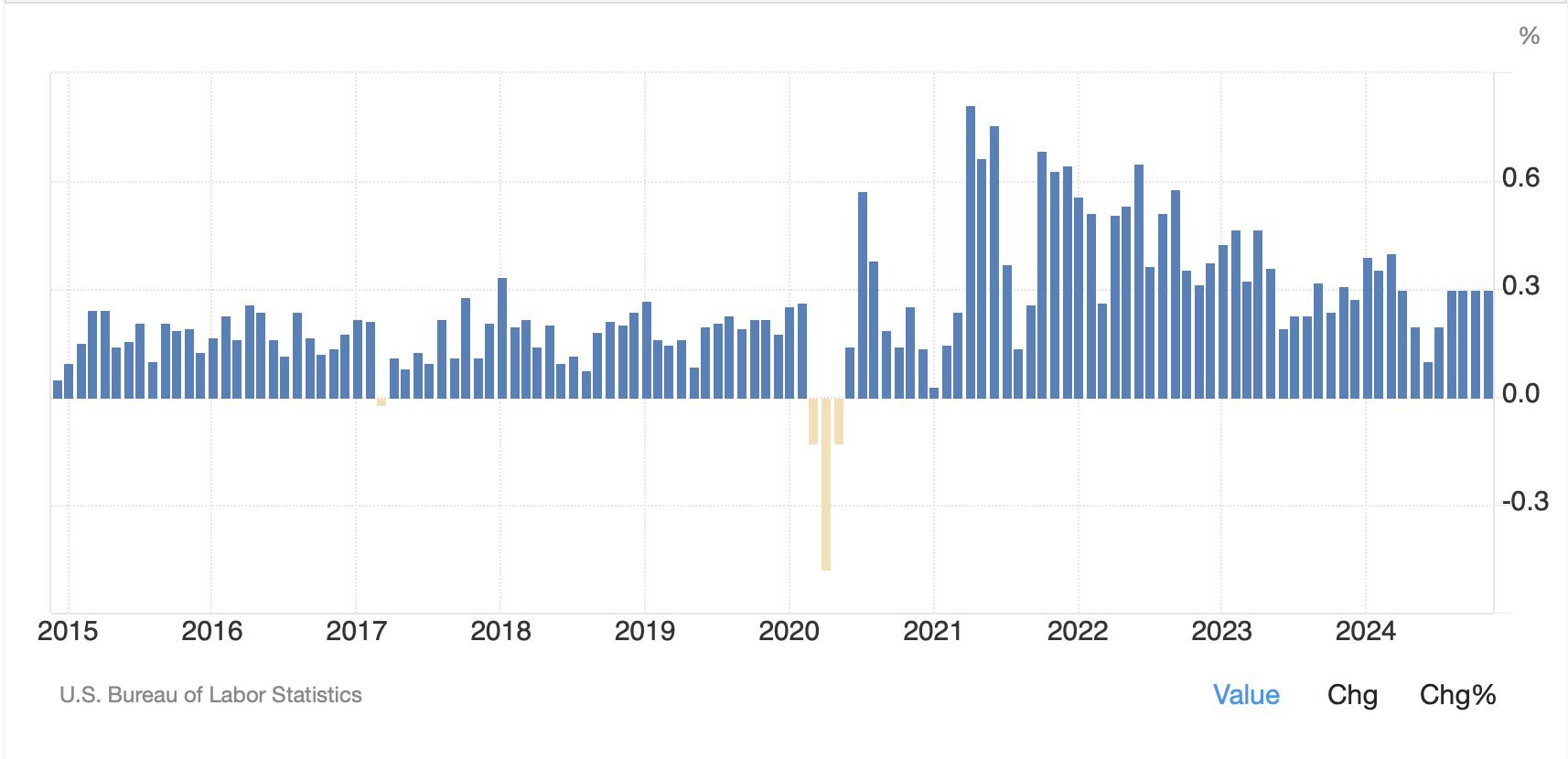
Regardless, yesterday’s CPI report was a bit firmer than forecast, at least at the second decimal place, which is enough for the punditry to discuss.  Of course, it is remarkable that a statistic of this nature is considered down to the second decimal place given the broad uncertainty over its measurement overall.  However,  looking at the chart below, which shows the monthly CPI readings for the past ten years, it is not hard to see that monthly inflation bottomed back in June and appears to be finding a new home at the 0.3% or higher level.  

Source: tradingeconomics.com

I showed the 10-year chart to also highlight that pre-Covid, the monthly readings were somewhere between 0.1% and 0.2% consistently.  My point is that 0.3% per month annualizes to about 3.7% which is as good a guess as any for how inflation is going to play out going forward absent some major fiscal and monetary changes.

Aside from the fact that this is important because we all suffer the consequences in our daily lives, from a markets perspective, I believe this is the money line in the article [emphasis added], “Officials have indicated sticky inflation could lead them to slow the pace of rate reductions or stop altogether.”  Yet, despite this strong hint that the Fed is getting uncomfortable with the market’s current assessment of how much further Fed funds are going to decline, the futures market is pricing a 98.6% probability of a cut next week.  

In fairness, the market is now pricing only two more rate cuts after next week for all of 2025, a number that has been declining slowly over the past month.  But ask yourself how the Fed will behave if their firmly held belief that inflation is still heading toward their 2% goal starts to falter under the weight of continued high readings.  There are a few analysts who are discussing rate hikes for next year for just this reason.  That, my friends, would upset the apple cart!

The central bank theme of the week
Is current rates need quite a tweak
Despite CPI
That’s still on the fly
More havoc, these bankers, will wreak
 
Down Under, though they didn’t cut
The doves’ case was open and shut
The Swiss and Canucks
Made changes, deluxe
While Christine, a quarter, will strut

While we are beginning to see some changes in the market’s perception of the Fed’s future path, those changes are not obvious elsewhere.  So far this week, the RBA left rates on hold, as they had promised, but explained the need to cut was upon them, demonstrating far less concern over inflation than in the past.  You may recall that the AUD fell sharply after the RBA statement put cuts in play going forward.  Then, yesterday, the BOC cut 50bps, as expected, as they, too, have turned their focus to economic activity and away from inflation, which continues above their target.  This morning, the Swiss National Bank surprised the markets with a 50bp cut, taking their base rate back down to 0.50%, expressing concern that inflation was slowing too rapidly and could become a problem.  Finally, shortly the ECB will announce their policy rate with the market highly confident a 25bp cut is on the way, although there are a few looking for 50bps.

The funny thing about all these cuts is that other than Switzerland, where recent CPI readings were at 0.7%, inflation remains above target levels and is demonstrating the same type of behavior as in the US, where it bottomed during the summer and is rebounding.  As well, especially in Europe, unemployment does not appear to be a major problem in these nations.  This begs the question, why are central banks so keen to cut rates if inflation remains sticky above their target levels and economic activity is hanging on?  

I have no good answer for this although I suspect there may be significant pressure from finance ministries regarding the cost of all that government debt that is outstanding and needs to be refinanced.  Alas, even though almost every central bank’s primary mandate is to maintain low inflation, it has become clearer by the day that following that mandate is not seen as important as other concerns.  Whether those concerns are economic activity or financing outstanding debt, or perhaps something else, I fear that we are heading back into a world where higher inflation is going to be the norm everywhere in the world.  Plan accordingly.

Ok, after another couple of record high closes in the US yesterday, let’s see how things have played out ahead of the ECB this morning.  In Asia, both Japan (+1.2%) and China (+1.0%) rallied on the brightening tech outlook, the prospect of further rate cuts and the ongoing hopes for that Chinese bazooka to finally be fired.  As well, Hong Kong (+1.2%) and Korea (+1.6%) also fared well, although the rest of the region was more mixed on much smaller movement.  In Europe, the best description ahead of the ECB is unchanged, with every bourse within 0.1% of Wednesday’s closing levels.  US futures at this hour (7:15) are pointing modestly lower, however, down about -0.2%.

In the bond market, despite all the surety of rate cuts, investors are not comfortable holding duration, and we are seeing yields continue to rise across the board.  Treasury yields are higher by another 3bps and back to 4.30% while European sovereign yields are all higher by between 3bps and 5bps.  It seems the bond markets are not convinced that central banks are behaving properly.  Perhaps the “bond vigilantes” will truly make a return after all.

In the commodity markets, oil (+0.1%) which managed to capture the $70/bl level is holding on this morning after the IEA raised its demand forecast for 2025 based on increased expectations for Chinese demand (because of the stimulus that is expected.). In the metals market, that Chinese stimulus is helping copper (+0.5%) although the precious sector is consolidating yesterday’s gains with gold (-0.3%) backing off slightly and silver unchanged.  However, gold is back above $2700/oz and appears to have finished its consolidation.

Finally, the dollar is mixed this morning, broadly holding onto its recent gains, but seeing some weakness against specific currencies.  For instance, BRL (+1.0%) responded to the fact that the central bank there, bucking the global trend, hiked the Selic rate by 100bps, a quarter point more than expected, as their concern over rising inflation increases.  (It seems they are one of the few central banks that is focused on their job, not the politics!). But away from that outlier move, we see AUD (+0.45%) rising on stronger than expected jobs growth data while NOK (+0.4%) is continuing to benefit from oil’s recent gains.  On the flip side, CHF (-0.35%) is suffering for the larger than expected SNB rate cut and GBP (-0.2%) is under modest pressure as traders debate whether the BOE will cut rates next week or not.

On the data front, Initial (exp 220K) and Continuing (1880K) Claims lead the way alongside PPI (0.2%, 2.6% Y/Y headline, 0.2%, 3.2% Y/Y core) at 8:30 this morning.  Beyond that, there is a 30-year auction this afternoon and that is really it.  I don’t see PPI having a great deal of impact and with CPI behind us, and Timiraos having told us that the Fed is going to slow the pace of cuts, I’m not sure what else there is to watch.  Obviously, this morning’s ECB meeting matters, but really, it is hard to get overly excited about the outcome there.  I suspect that attention will now be focused on the FOMC next week, with much more concern over the dot plot and SEP than the 25bp cut that seems a foregone conclusion.  

If the Fed is truly slowing the pace of cuts, once again, it becomes difficult to see how the dollar will soften vs. its major counterparts. Keep that in mind for now.

Good luck

Adf

A New Denouement

The story is that the Chinese
Will speed up their policy ease
Creating for Yuan
A new denouement
Of currency weakness disease
 
Their problem is that in the past
That weakness could happen too fast
So, how far will Xi
Be willing to see
Renminbi decline at long last?


As we await the US CPI data this morning, the story du jour in markets revolves around the Chinese renminbi and whether President Xi will allow, or encourage, the PBOC to weaken the currency.  Strategically, Xi has made a big deal to the rest of the world that the Chinese currency will remain strong and stable as he seeks other nations to increase their use of the renminbi in commercial transactions as well as a store of value.  I believe part of this is a legitimate goal but that there is also a significant fear underlying these actions as history has shown the Chinese people will flee the currency if it starts to weaken too quickly.  It is the latter issue that has been the primary driver of the PBOC’s efforts to continuously fix the renminbi at stronger than market levels.
 
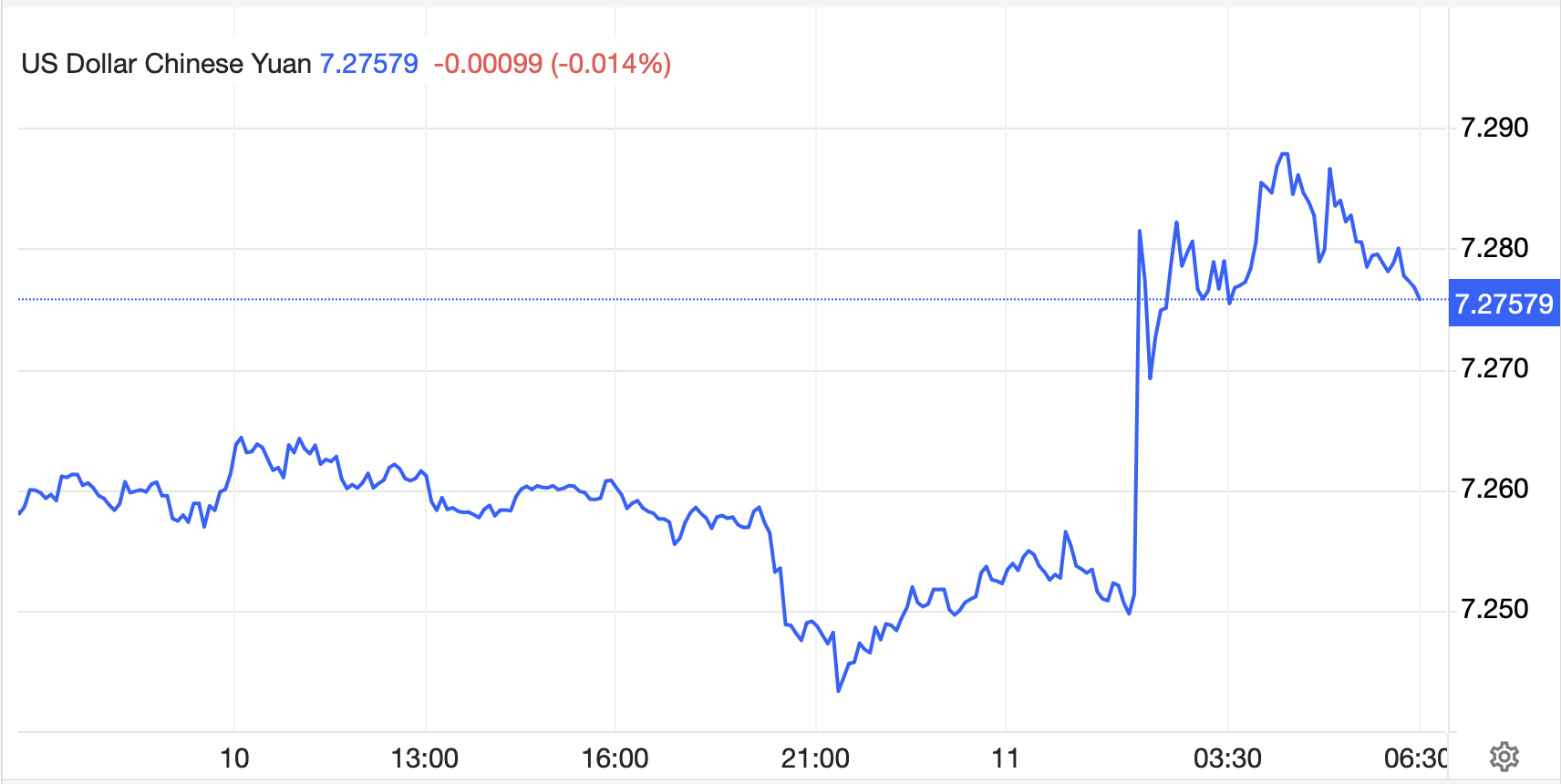
This process worked well enough for the past four years as the Biden administration, while certainly not friendly to China, was not aggressively attacking the nation’s efforts to expand its influence.  However, that situation is about to change with the Trump administration and as Mr Trump has already threatened numerous new tariffs on various parts of China’s production economy, Xi’s calculus must change.  This puts Xi in a difficult situation; allow the currency to weaken more aggressively to offset the impact of any tariffs and suffer through capital flight or maintain the renminbi’s value and see exports decline along with overall economic activity.  It is easy to see in the chart below when the story about allowing a weaker currency hit the tape.  However, there is not nearly enough information to take a longer-term view on the subject.


Source: tradingeconomics.com

One other thing to remember is that Chinese interest rates are continuing to decline with 10-year yields trading to yet another new low last night at 1.88%.  As the spread between US and Chinese yields continues to widen, by itself that will put pressure on the renminbi to decline.  The problem for Xi is that no matter the control the PBOC has over the FX markets in China, now that there is an offshore market, if the Chinese people become concerned over the value of the renminbi, it has the ability to decline far more quickly than the government would want to allow.

For those of you with Chinese assets on your balance sheet or Chinese denominated revenues, I would be looking to maximize my hedges for now.  As an aside, there were a number of forecast changes by major banks overnight with many calls for USDCNY to reach 7.50 or higher by the end of next year now.

The market’s convinced
A rate hike is on the way
Why won’t the yen rise?

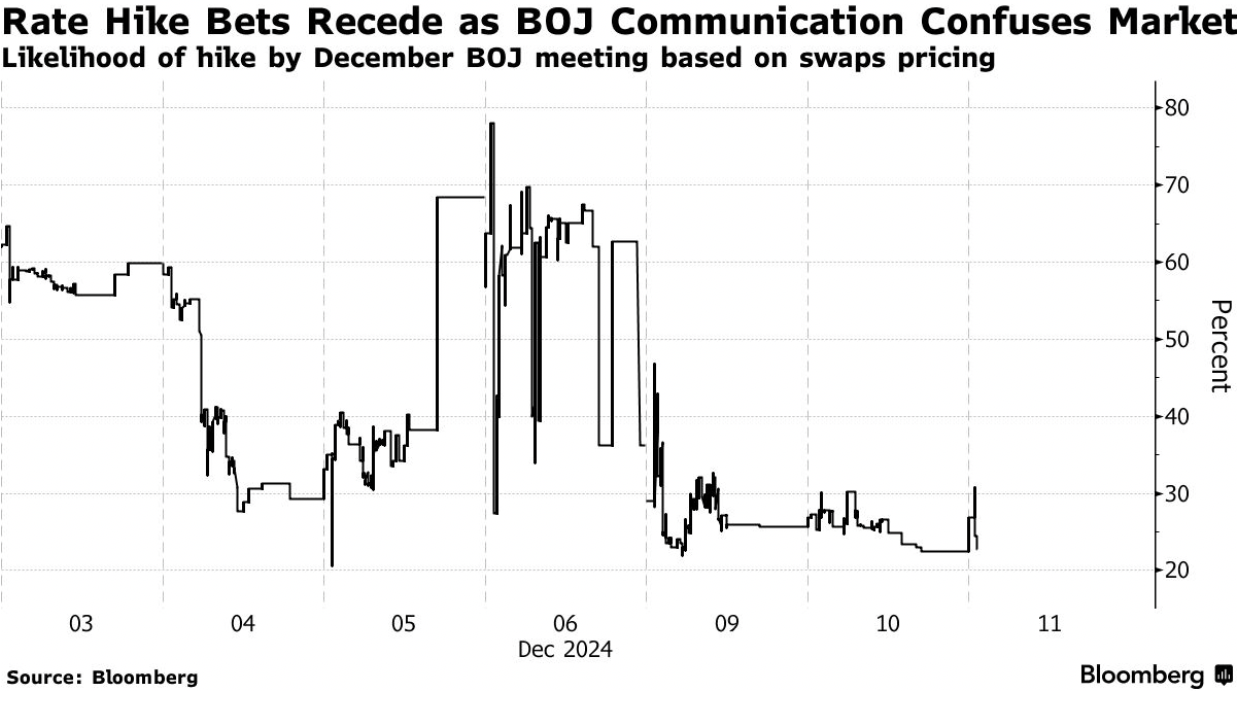
The other story overnight focused on Japan, or more precisely the BOJ meeting to be held in one week’s time.  It seems that there is a lot of dissent amongst the analyst community regarding whether or not the BOJ will hike rates.  As an example of how thin all the analyst gruel really is, one of the key rationales for the belief in a rate hike was that last week, Toyoaki Nakamura, perceived as the most dovish BOJ board member, indicated he didn’t object to a rate hike, although wanted to see more data before declaring one was appropriate for December.  However, just last night the BOJ added a speech and press briefing to their calendar for Deputy Governor Ryozo Himino right before the January meeting.  This has the punditry now expecting the BOJ to wait until then rather than move next week.  The below chart shows the change in the market’s expectations for a rate hike over the past week.

As I said, the tea leaves that the punditry are reading really don’t say very much at all.  Perhaps we can look at the economic data to get a sense.  Over the past month, we have seen CPI for both the nation and Tokyo print higher than forecast and continue to slowly climb.  As well, PPI printed higher and GDP continues to grow, albeit at a modest pace.  Of greater concern is that earnings data is lagging the CPI data.  

A look at the FX market would indicate that traders are losing their taste for a rate hike next week, at least as evidenced by the yen’s recent weakness.  As you can see in the past week, it has slipped nearly 2%, hardly a sign that higher Japanese rates are expected.  But something that is not getting much press is the potential Trump impact, where the incoming president would like to see the yen, specifically, strengthen as it is truly historically undervalued.  FWIW, which is probably not that much, I am in the rate hike camp for next week and expect the yen will find some support soon.

Source: tradingeconomics.com

Ok, enough Asian currency talk.  Let’s see how everything else behaved ahead of this morning’s data.  Yesterday’s modest US equity declines were followed by virtually no movement in Japanese shares although most of the rest of Asia followed the US lower.  Hong Kong (-0.8%) and Taiwan (-1.0%) were the worst performers and the one outlier the other way was Korea (+1.0%) as the KOSPI continues to recoup the losses made after the martial law fiasco.  European bourses are mostly little changed on the day with Spain’s IBEX (-1.1%) the lone exception which has been negatively impacted by Q3 results from Inditex (the parent company of Zara).  As to US futures, at this hour (7:25) they are little changed.

In the bond market, yields continue to edge higher in Treasuries (+2bps) and European sovereigns with gains on the order of 1bp to 2bps across the board.  While there is some discussion regarding fiscal questions in Europe, ultimately, nothing has broken the connection between US and European yields, and I would contend they are all awaiting this morning’s CPI.

In the commodity markets, oil (+1.4%) is rebounding although remains below $70/bbl, which seems to be a trading pivot for now.  The China stimulus story remains the key in the market with a growing belief that if China does successfully stimulate, oil demand will increase.  Meanwhile in the metals markets, gold is unchanged this morning after another nice rally yesterday while both silver and copper are under modest pressure.  I would contend, however, that the trend for all metals remains slightly upward.

Finally, the dollar is firmer against virtually all its counterparts this morning with most G10 currencies softer on the order of -0.3% or so although CAD and CHF are little changed on the session.  In the EMG bloc, KRW (+0.3%) is rebounding alongside the KOSPI as the excesses from the martial law story last week continue to be unwound, but elsewhere in the bloc, modest weakness, between -0.2% and -0.4%, is the rule.  However, this is all dollar focused today.

On the data front, it is worth noting that yesterday’s NFIB Small Business Optimism Index shot higher in November in the wake of the election results, heading back toward its long-term average just above 100.  As to this morning, forecasts for Headline (exp 0.3%, 2.7% Y/Y) and Core (0.3%, 3.3% Y/Y) CPI continue to indicate that the Fed may be overstating the case in their belief that inflation pressures are ebbing.  Rather, I continue to believe that we have seen the bottom in the rate of inflation and a gradual increase is in our future.  Two other things of note are the BOC rate decision (exp 50bps cut) this morning and then the Brazilian Central Bank rate decision (exp 75bp HIKE) this afternoon.  The latter is clearly an attempt to rein in the BRL’s recent dramatic decline.

With no Fed speakers, if the data this morning is significantly different than expectations, I would look for the Fed Whisperer, Nick Timiraos, to publish something before the end of the day in order to get the Fed’s latest views into the market.  Absent that, nothing has gotten in the way of the higher dollar at this stage so stay sharp.

Good luck

Adf

Just Won’t Evanesce

The RBA left rates on hold
And sounded quite dovish, all told
Meanwhile in Brazil
Old Lula is ill
With something much worse than a cold
 
In Syria, things are a mess
In Taipei they’re feeling some stress
With all this unfolding
It’s no shock beholding
Risk assets just won’t evanesce


Risk is the topic du jour as pretty much everywhere one looks around the world, things are afoot that can inculcate fear (and loathing) rather than embrace those animal spirits.  Perhaps the least frightful, but most directly impactful regarding markets, was the RBA meeting last night at which the committee left rates on hold, as universally expected, but appeared to turn (finally) to the dovish side of the ledger.  The policy statement explained, “Some of the upside risks to inflation appear to have eased and while the level of aggregate demand still appears to be above the economy’s supply capacity, that gap continues to close.  The board is gaining some confidence that inflation is moving sustainably toward target.”   However, the proof is in the pudding and a quick look at the AUD (-0.7%) shows that the market has come to believe the RBA is finally joining the central bank rate cutting party.

Source: tradingeconomics.com

The trend seems pretty clear and it is hard to make a case for a reversal absent a massive spike in inflation Down Under forcing the RBA to change direction or something coming from the US focusing on weakening the USD, but given nothing like that seems likely until Mr Trump is officially in office, I am concerned that the Aussie dog will live up to its nickname and make new lows going forward, perhaps testing 0.6000 before this is over.

Speaking of currencies under pressure, elsewhere in the Southern Hemisphere we find the Brazilian real which has fallen to new historic lows, with the dollar now trading above 6.08.  For those of you who hate to pay away the points in USDBRL to hedge your balance sheet assets, the reason that you need to do it is very evident from the chart below.

Source: tradingeconomics.com

While there were several short-term dips in the dollar during the past year, the spot rate (at which you remeasure your balance sheet each month) moved from 4.92 to 6.08 in 12 months, nearly a 24% decline in the real.  A one-year forward would have cost far less, something like 40-45 big figures, or less than half the actual move, and would have given you certainty as to the cost.  Hedging matters!

Now, why, you may ask is this happening?  Well, news that Brazilian president Lula da Silva had emergency brain surgery has clearly not helped the currency.  Suddenly there are many questions over who is running the country and how they will address the ongoing fiscal issues that are extant.  As an aside, this is likely another deterrent to the idea of a BRICS currency appearing any time soon, if ever.

Turning our gaze elsewhere, the situation in Syria continues to unfold with no clear outcome although increased concerns over what will happen with the beleaguered people of that nation and whether it will foment yet another immigration wave into Europe and elsewhere in the Middle East.  However, right now, the oil market remains nonplussed over this issue as evidenced by yet another day of quiet trading and a slow drift lower in the price (-0.55%).

However, we cannot ignore Taiwan, where China is currently in the process of military maneuvers that appear to be simulating a naval blockade of the nation.  Price action here has shown the TWD (-0.4%) sliding further and pushing back toward its weakest level in more than 15 years (since the GFC), while the TAIEX stock index (-0.65%) is also feeling a little heat, although the story there has been one of consistent gains over the past several years, following the NASDAQ higher given the breadth of technology companies there, notably TSMC.

Putting it all together leaves one wanting with respect to their risk appetite this morning as today seems like another step closer to that Fourth Turning.  So, it should be no surprise that after a down day yesterday in the US, with all three major equity indices declining, we have seen far more red than green on the screens overnight.  The exception to this rule was in Korea, where the KOSPI (+2.4%) rose sharply as it appears that things are starting to revert to more normalcy there politically.  President Yoon is under pressure to resign and seems likely to be impeached and the government is back to functioning in more of its ordinary manner.  But elsewhere in Asia, Hong Kong (-0.5%), Australia (-0.5%) and most of the smaller regional bourses were lower although the Nikkei (+0.5%) rallied on the back of the yen’s renewed weakness, and mainland Chinese shares (+0.7%) seemed to begin to believe that more stimulus is, in fact, on its way.  We shall see about that.

In Europe, the bourses range from flat (DAX, IBEX) to down CAC (-0.5%), FTSE 100 (-0.5%) with both these nations suffering from their own political distress.  French President Macron is trying to form a government but categorically refuses to include Marine Le Pen’s RN party so has no chance of a majority with concerns growing over the fiscal situation there.  Apparently, if they cannot get a financing bill passed, the French will get to experience the heretofore unique American experience of a government shutdown.  Meanwhile, PM Starmer is watching his ratings circle the drain as his government continues to try to raise revenues by raising taxes on the rich and finding out that one thing rich people are really good at is creating new methods of operations to avoid paying higher taxes.  While there is no vote necessary in the UK for years (remember, Starmer won election just this past July 4th) it certainly feels like his government is going to fall sooner rather than later.  Meanwhile, US futures are little changed at this hour (7:30).

In the bond market, yields are rebounding with Treasuries higher by 3bps this morning after a 3bp rally yesterday.  In Europe, there is very little change except for UK Gilts (+4bps) with concerns over inflation rising there while in Asia, Australian yields slipped 6bps on the dovish RBA.  Generally speaking, the bond market has not been very exciting lately which is one reason, I believe, that things have not fallen apart.  If we start to see more volatility here, watch out.

In the commodity markets, aside from oil’s modest decline, gold (+0.65%) continues to find support in this risk-off scenario although both copper and silver are little changed this morning after solid rallies yesterday.

Finally, the dollar is higher again this morning, with the DXY well back above 106.00 and every G10 currency declining led by NZD (-1.0%).  This is suffering from the RBA’s dovishness which is expected to allow the RBNZ to maintain, or even increase, its own dovishness.  But the whole bloc is softer.  In the EMG bloc, there are a few currencies that are holding their own vs. the dollar this morning, but only just, with MXN (+0.2%) arguably the strongest currency around while CNY (+0.1%) is also relatively strong.  But elsewhere in this bloc, ZAR (-0.7%), PLN (-0.55%), and CLP (-0.4%) are indicative of the type of price action we are seeing across the board.  This is a dollar day, though, not really focusing on individual currency foibles.

On the data front, we see only Nonfarm Productivity (exp 2.2%) and Unit Labor Costs (1.5%) and that is really it.  There was nothing yesterday and all eyes are truthfully turned toward tomorrow’s CPI data.  Things don’t feel very positive right now, so I expect risk to remain on its back foot to start the day.  However, given the number of uncertain situations that abound, anything can happen to either change that view or reinforce it.  Once again, this is why you hedge, to mitigate the markets’ inherent volatility.

Good luck

Adf