Far From It

Ahead of the FOMC
The pundits were sure they would see
A cut come December
As every Fed member
Saw joblessness to some degree
 
But turns out, dissent did abound
And Jay, to the press, did expound
December’s not destined
“Far from it”, when pressed, and
The bond market fell to the ground


The Fed cut the 25bps that were priced and they said they would end QT, the balance sheet runoff beginning December 1st.  As well, they indicated that as MBS matured, they would be replaced with T-bills.  So far, all pretty much as expected.  But…the vote was 7-2 for the cut.  One dissent was Stephen Miran, once again looking for 50bps but the real shocker was KC Fed president Jeffrey Schmid, who wanted to stand pat!  During the press conference, Powell explained [emphasis added], “there were strongly different views about how to proceed in December.  A further reduction in the policy rate at the December meeting is not a foregone conclusion.  Far from it!”

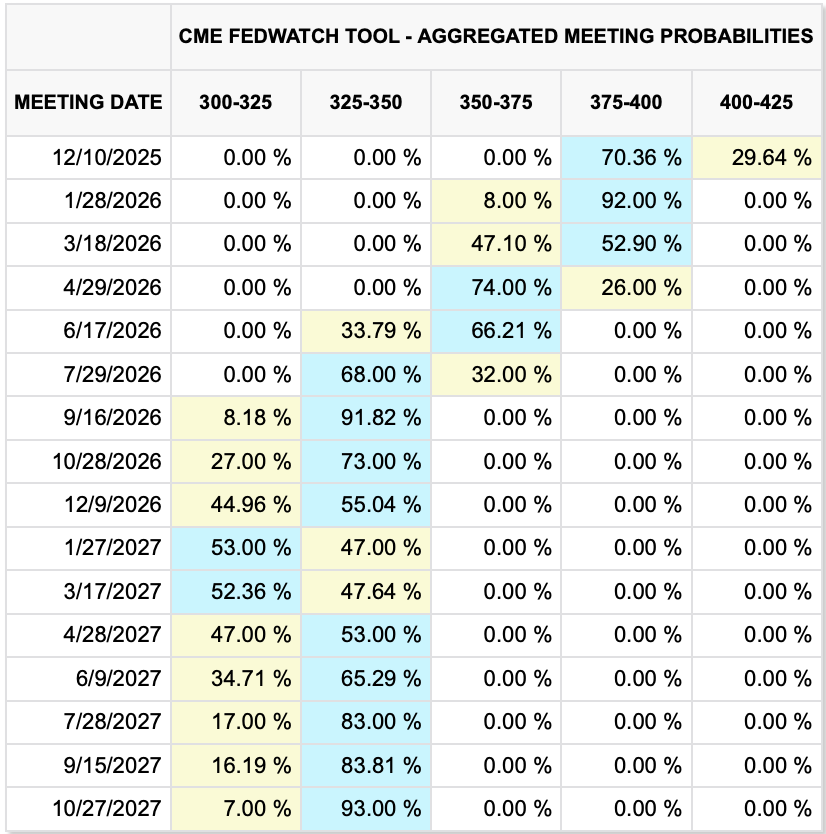
The Fed funds futures market jumped on that comment and as of this morning, the December probability fell from 92% to 70% with only a 3/4 probability of another cut after that by April, down from a near certainty by March previously.  

You won’t be surprised by the fact that the bond market sold off hard, with yields rising 10bps on the day, with seven of those coming in the wake of the press conference.  

Source: tradingeconomics.com

Stocks struggled, with the DJIA under modest pressure and the S&P 500 unchanged although the NASDAQ managed to rise yet again to a new high, as NVDA doesn’t pay attention to gravity.

So much has been written about this that I don’t think it is worth going into more detail.  FWIW, my view is the Fed is still going to cut in December, and that will become clearer as the government reopens (which I think happens by the end of the week) and data starts to trickle out again.  The employment situation remains their main focus, and it just doesn’t seem that positive right now.  I suspect next year, when the OBBB policies begin to be implemented and we see the fruits of the dramatic increase in foreign investment in the US, that situation can change, but things feel slow for now.  

In effect, that is why they are going to run the economy as hot as they can to try to prevent any recession and hopefully make it to the point where the government can back off and the private sector picks up the slack.  At least, that’s my read for now.  For the dollar, that means more support.  For stocks, the same.  And the inflation prospects will keep the precious metals supported.  Bonds feel like the worst place to be.

In other central bank news, the Bank of Canada cut 25bps, as expected, and in their commentary explained rates were now “at about the right level” for the economy based on their projections.  The market demonstrated they cared about this story for about 3 hours, as the initial move was modest CAD strength that evaporated as soon as Powell started speaking.

Source: tradingeconomics.com

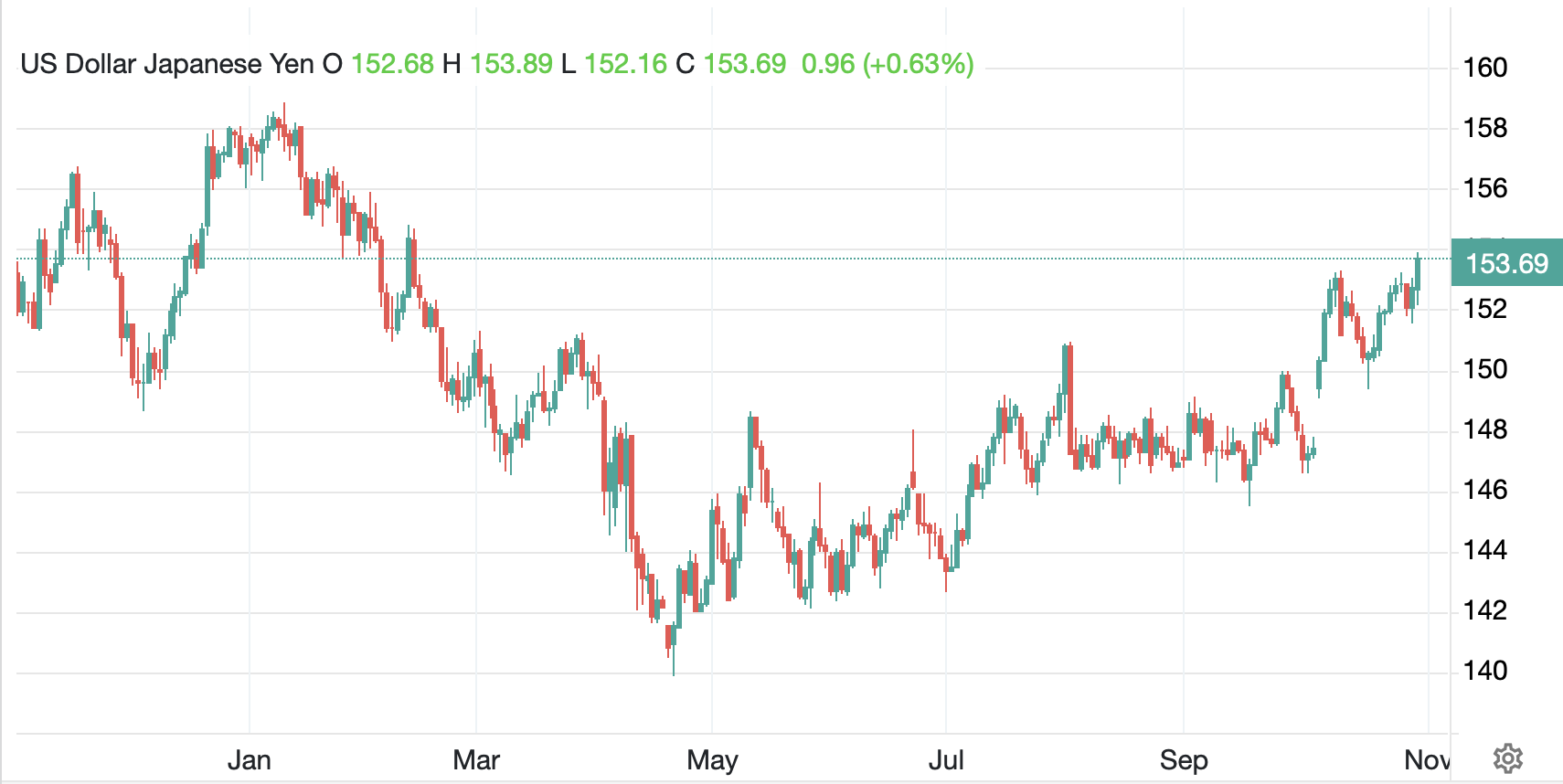
The BOJ also met last night and left rates on hold, as widely expected, with the same two votes for a rate hike as the last meeting.  During the press conference, Ueda-san explained, “We held today as we want to see more data on domestic wage-setting behaviors, while uncertainty remains high in overseas economies. If we’re convinced, we’ll adjust rates regardless of the political situation.”  The yen (-0.6%) fared somewhat poorly, responding to Ueda-san’s comments regarding the relative lack of strength in the Japanese economy.  Ultimately, as you can see in the below chart, the yen fell to its weakest point since last February, although I suspect if I am correct regarding the Fed continuing its policy ease, that weakness will abate somewhat.

Source: tradingeconomics.com

While Spinal Tap got to eleven
Said Trump, t’was a twelve, not a seven
The deal that he struck
To get things unstuck
With China, it’s manna from heaven

The last big story was the long-awaited meeting between Presidents Trump and Xi last night, where the two sat down and agreed to cool the temperature regarding trade.  Key aspects include the US reducing tariffs on China, especially those regarding fentanyl, as well as rolling back the broad restrictions on Chinese companies, while China will purchase “tremendous amounts” of soybeans and pause their restrictions on the sale of rare earth minerals.  Tiktok came up, and that will be settled and overall, it appears that a great deal of progress was made.  This was confirmed by the Chinese as they announced the same things.
 
Clearly, this is an unalloyed positive for the global economy and while the situation is not back to its pre-Trump days, it offers the hope of some stability for the time being.  But the surprising thing about these announcements was how little they seemed to help financial markets.  For instance, both the Hang Seng (-0.25%) and CSI 300 (-0.8%) slipped during the session, as did India (-0.7%) and Australia (-0.5%) with the rest of the region basically unchanged.  That is a disappointing performance for what appears to be a very positive outcome.  I suppose it could be a ‘sell the news’ response, but in today’s markets, especially with the ongoing influx of central bank liquidity, I would have expected more positivity.
 
Turning to European markets, they are lower across the board led by Spain (-1.1%) and France (-0.6%) as the US-China trade deal had little impact, and investors responded to a plethora of data on GDP and inflation.  The odd thing about this is that the Q/Q GDP data was better than expected across the board (France 0.5%, Netherlands 0.4%, Germany 0.0%, Eurozone 0.2%) which was confirmed by positive confidence data and modest inflation.  While those growth numbers are hardly dramatic, at least they are not recessionary.  You just can’t please some people!  Meanwhile, at this hour (6:30) US futures are little changed to slightly softer.
 
If we turn to the bond markets, yesterday’s dramatic rise in Treasury yields is consolidating with the 10-year slipping -1bp this morning.  In Europe, sovereign yields are higher by 3bps across the board as they catch up to yesterday’s Treasury move.  At this hour, though, bond markets are doing little as investors and traders await Madame Lagarde’s announcements at 9:15 EDT although there is no expectation for any rate move.  In fact, looking at the ECB’s own website, there is currently a 5% probability of a rate hike!  (That ain’t gonna happen, trust me.)
 
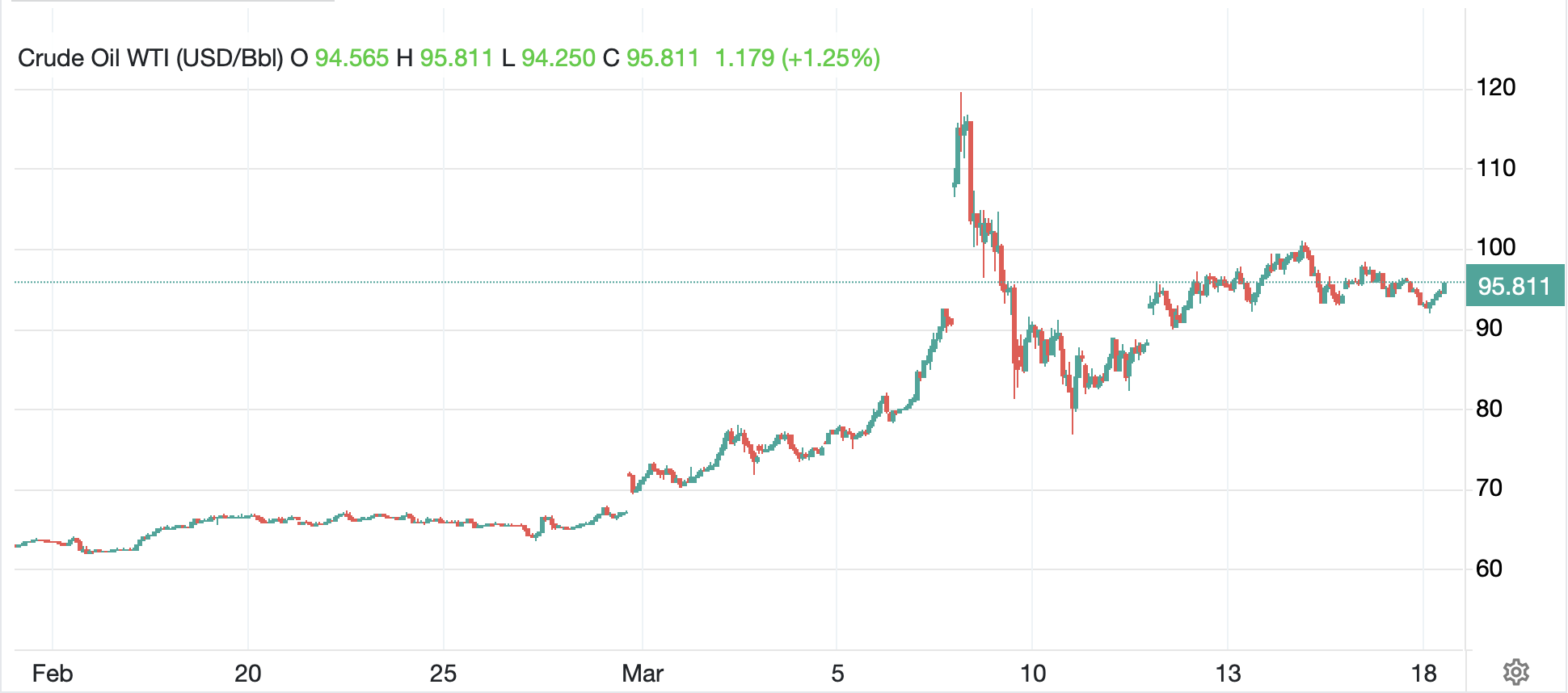
In the commodity markets, oil (-0.5%) is softer this morning but is still right around $60/bbl with yesterday’s EIA inventory data showing a larger draw on inventories than expected.  That is what helped yesterday’s modest gains, but those have since been reversed.  In the metals markets, price action remains quite choppy, but this morning sees gold (+1.3%), silver (+1.0%) and platinum (+0.35%) all bouncing although copper (-0.2%) is a touch softer.  Nothing has changed my longer-term views here, but it does appear that there is a lot more choppiness that we will need to work through before the trend reasserts itself.
 
Finally, the dollar, which rose yesterday on the relatively hawkish Fed commentary is mixed this morning as it shows strength vs. the yen (now -0.8%), ZAR (-0.4%), KRW (-0.35%), and INR (-0.4%) with even CNY (-0.2%) following suit, although the rest of the currency universe has moved only +/-0.1% from yesterday’s closes.  Again, my view is the dollar is confined to a range, has been so for many months, and we will need to see some policy changes to break out in either direction.  Right now, those policy changes don’t seem to be imminent.
 
With data still MIA, the only things to which we can look forward are the ECB and the first post-meeting Fed speak with Governor Bowman and Dallas Fed president Logan up today.  I would have thought risk assets would be in greater demand this morning, but that is clearly not the case.  Perhaps, as we approach month-end, we are seeing some window dressing, but despite the ostensible hawkish outcome from yesterday’s FOMC, I don’t think anything has changed with their future path of more rate cuts no matter what.  As equity markets had a broadly positive October, rebalancing flows would indicate sales, but come Monday, I think the rally continues.  As to the dollar, there is still no reason to sell that I can discern.
 
Good luck
Adf


Throw in the Towel

All eyes are on Chairman Jay Powell
And if he will throw in the towel
Or will he still fight
Inflation? Oh, right
He caved as the hawks all cried foul!
 
So, twenty-five’s baked in the cake
While fifty would be a mistake
If fighting inflation
Is his obligation
Though half may, Trump’s thirst, somewhat slake


Well, it’s Frabjous Fed Day and there will be a great deal of commentary on what may happen and what it all means.  Of course, none of us really knows at this point, but I assure you by this afternoon, almost all pundits will explain they had it right.  

At any rate, my take is as follows, FWIW.  I believe the huge revision to NFP data has got the FOMC quite concerned.  Prior to that, they were smug in their contention that patience was a virtue and their caution because of the uncertain price impact of tariffs was warranted given the underlying strength in the jobs market.  Now, not only has that underlying strength been shown to be a mirage, but the import price data released yesterday, showing that Y/Y, import prices are flat, is further evidence that tariffs have not been a significant driver of inflation.  If you look at the chart below of Y/Y import prices for the past 5 years, you can see that since April’s ‘Liberation Day’ tariff announcements, they have not risen at all.

Source: tradingeconomics.com

With that in mind, if you are the Fed, and you are data dependent, as they claim to be, and the data shows weakening employment and stable prices in the area you had been highlighting, you have no choice but to cut.  The question then becomes, 25bps or 50bps?  While the market is pricing just a 6% probability of a 50bp cut, given there are almost certainly three Governor votes for 50bps (Waller, Bowman and Miran) and the underlying central bank tendency is toward dovishness, I am going to go out on a limb and call for 50bps.  Powell and the Fed have already been proven wrong, and the only thing worse for them than seeming to cave to pressure from the White House would be standing pat and being blamed for causing a recession.  

With that in mind, my prognostications for market responses are as follows:

  • The dollar will weaken pretty much across the board with a move as much as -1% possible
  • Precious metals will rally sharply, making new highs for the move as this will be proof positive that the Fed has tacitly raised its inflation target from the previous 2%.  In fact, my take is 3% is the new 2%, at least until we spend a long time at 4%.
  • Equity markets will take the news well, at least initially, as the algos will be programmed to buy, but the concern will have to grow that slowing economic activity will impair earnings going forward, and multiples will suffer with higher inflation.  I continue to fear a correction here.
  • Bonds are tricky here as they have been rallying aggressively for the past six weeks and that could well have been ‘buying the rumor’ ahead of the meeting.  So, it is not hard to make the case that bonds sell off, and long end yields rise in response to 50bps.

On the other hand, if they cut 25bps, and sound hawkish in the statement or Powell’s presser, I don’t imagine there will be much movement of note.   I guess we’ll see in a while.

Until then, let’s look at the overnight price action.  Yesterday’s modest declines in US equities looked far more like consolidation after strong runs higher than like the beginning of the end.  The follow on in Asia was mixed with Tokyo (-0.25%) after export data was weak, especially in the auto sector, while HK (+1.8%) and China (+0.6%) both rallied on the prospect of reduced trade tensions between the US and China based on the upcoming meeting between Presidents Trump and Xi.  Elsewhere in the region, Korea, Taiwan and Australia fell while India, Malaysia and Indonesia all rallied, the latter on the back of a surprise 25bp rate cut by Bank Indonesia.

In Europe, the picture is also mixed with Germany (-0.2%), France (-0.4%) and Italy (-1.2%) all under pressure, with Italy noticeably feeling the pain of potential domestic moves that will hurt bank profitability with increased taxes there to offset tax cuts for individuals.  Spain is flat and the UK (+0.25%) slightly firmer after inflation data there showed 3.8% Y/Y headline, and 3.6% Y/Y core, as expected and still far higher than the BOE’s 2.0% target.  While the BOE meets tomorrow, and no policy change is expected, if the Fed cuts 50bps, do not be surprised to see 25bps from the Old Lady.  US futures at this hour (7:30) are essentially unchanged.

In the bond market, Treasury yields continue to creep lower ahead of the meeting, slipping another 2bps this morning and now trading at 4.01%, the lowest level since Liberation Day and the initial fears of economic disaster in the US.

Source: tradingeconomics.com

You can see the trend for the past six months remains lower and appears to be accelerating right now. Meanwhile, as is often the case, European sovereign yields are following Treasury yields and they are lower by between -1bp and -2bps across the board.  Nothing to see here.

Commodity markets have seen the most movement overnight with oil (-0.7%) topping a bit while gold (-0.65%), silver (-2.5%) and copper (-1.8%) have all seen some profit taking ahead of the FOMC meeting.  Now, there are plenty of profits to take given the 10% rallies we have seen in gold and silver in the past month.  In fact, I lightened up some of my gold position yesterday as well!

Finally, the dollar, which fell pretty sharply yesterday is bouncing a bit this morning.  Using the DXY as proxy, it came close to the lows seen back on July 1st, as you can see in the chart below. 

Source: tradingeconomics.com

But remember, as you step away from the day-to-day, the dollar is hardly weak.  Rather, it is much closer to the middle of its long-term price action as evidenced by the longer view below.

Source: finance.yahoo.com

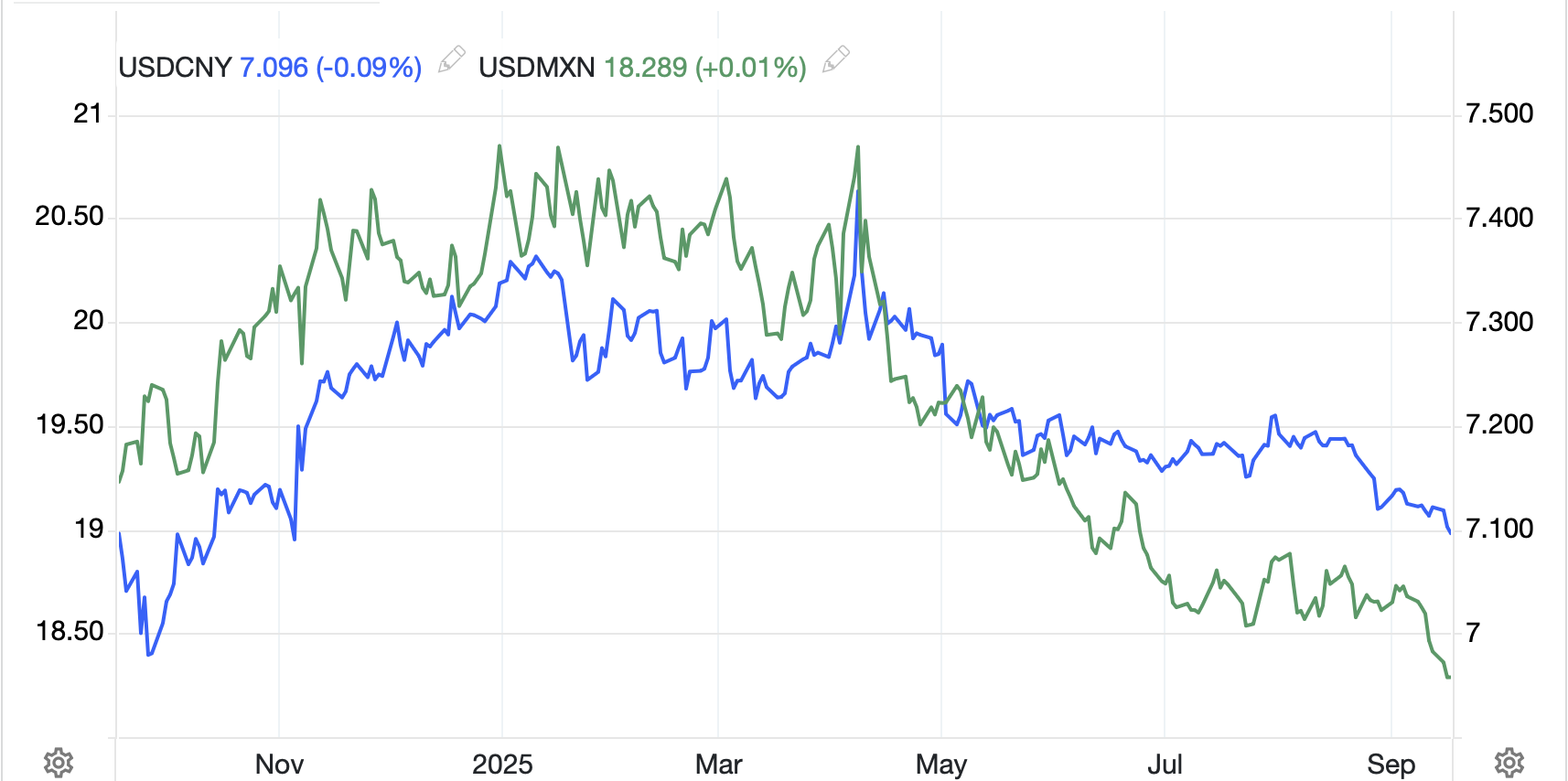
There is a lot of discussion on FinX (nee FinTwit) about whether we are about to bounce or if the dollar is going to collapse.  But it is hard to look at the chart directly above and get the feeling that things are out of hand in either direction.  Now, relative to some other currencies, there are trends in place that don’t impact the DXY, but matter.  Notably, CNY and MXN have both been strengthening slowly for the bulk of the year and are now at levels not seen for several years.  given the importance of both these nations with respect to trade with the US, this is where Mr Trump must be happiest as it clearly is weighing on their export statistics.

Source: tradingeconomics.com

Ahead of the FOMC meeting, we do get a few data points, with Housing Starts (exp 1.37M) and Building Permits (1.37M) leading off at 8:30.  Then at 9:45 the BOC interest rate decision comes, with a 25bp cut expected and finally the Fed at 2:00.  Housing will not have any impact on the market in my view but the BOC, if they surprise, could matter, especially if they pre-emptively cut 50bps as that will get the juices flowing for the Fed to follow suit.  But otherwise, we will have to wait for Powell and friends for the next steps.

Good luck

Adf

Lost In Translation

The data today on inflation
Will help tweak the latest narration
But arguably
There’s little to see
As CPI’s lost in translation
 
And too, central bankers have learned
Their comments leave folks unconcerned
Today’s BOC
Where rate cuts will be
The outcome will ne’er be discerned


It is Donald Trump’s world, and we are all just living in it.  Virtually everything that happens in any financial market these days is a result of something that President Trump has either said or done.  Obviously, tariffs are a major player, but so are the peace talks in Ukraine (good news that Ukraine has agreed a cease fire to get things started) and his domestic initiatives regarding DOGE and the shake up that has come to government from that project.  You cannot look at a business journal without reading a story about how corporate America’s CEO’s are very concerned because of all the activity as they are having difficulty planning their strategies.

While this poet endeavors to track the macroeconomic issues and how they impact markets, and one can argue that tariffs are a macro issue, the ongoing back and forth as to which products will get tariffed and when is occurring far more rapidly than is worth reporting on a daily outlook.  After all, nobody has any idea what today will bring on that front.

With that in mind, one of the other things I have discussed has been the demotion of central bankers from their previous preeminence in the world of financial markets.  Now, every one of them is simply left to respond to whatever President Trump says that day.  Consider, the Fed entered their quiet period last Friday and the fact that we have not heard a word from them is entirely inconsequential.  The Fed funds futures market is currently pricing just a 3% probability of a rate cut next week and a total of 75bps of cuts by the end of the year, but that has been true for the past several weeks.  Despite an increase in the talk of a US recession, the markets are not indicating that is a concern.

Now, that doesn’t mean that other central banks aren’t doing things, but when the BOC cuts rates by 25bps this morning, taking their base rate to 2.75%, 150 basis points below the US, nothing is going to happen in the market.  It is already widely assumed.  I guess it is possible that Governor Macklem could make some comments of note, but given that Canada remains a bit player on the world stage, does whatever he says really matter?  In fact, the only reason people are discussing Canada now is because of President Trump and his trolling former PM Trudeau and calls to make it the 51st state.  Let’s face it, the economy there is ticking along fine for now, although if their exports to the US are impaired by tariffs it will definitely hurt them.  Meanwhile, other than a huge housing bubble, nobody really notices them.  After all, their economy is roughly $2.3 trillion, smaller than that of Texas.

We have also heard from Madame Lagarde recently as she tries to calm European leaders’ nerves while the ECB tries to manage their policy around US fiscal gyrations.  However, the most concerning information from there has been her confirmation that the ECB is pushing forward with their central bank digital currency (CBDC) project, looking to get things started in October of this year.  This contrasts with President Trump’s EO that the US will not pursue a CBDC and there is currently legislation in Congress to enshrine that into law.  My personal view is a CBDC would be very concerning given its inherent reduction in individual liberties.  While the current setup is for the euro to rise relative to the dollar, it is not clear to me that will remain the case in the event the digital euro comes into being.  In fact, it would not surprise me if many Europeans decided that holding dollars was a much better idea than holding euros in that environment.  But that is a story for the future.

As to today, CPI is set to be released with the following median expectations; headline (0.3%, 2.9% Y/Y) and core (0.3%, 3.2% Y/Y).  Both of those annualized numbers are one tick lower than last month’s outcomes, so would help the Fed narrative that inflation is falling back to their target.  But again, absent a major discrepancy, something like a 0.1% or 0.5% reading on the core number, I don’t think it will have any market impact across any market.  Data is just not that important these days.

Let’s turn to the overnight session to see how things are behaving in the wake of yesterday’s late US equity rebound, where while the indices all finished lower, they were well off the daily lows.  In Asia, the picture was very mixed with some major gainers (Korea +1.5%, Indonesia +1.8%, Taiwan +0.9%) and some major laggards (Thailand -2.5%, Malaysia -2.3%, Australia -1.3%, Hong Kong -0.8%) with both Japan and mainland China showing little movement.  In Europe, after a down day yesterday, this morning is seeing a solid rebound across most major markets with the DAX (+1.8%) leading the way followed by the CAC (+1.4%) and FTSE 100 (+0.6%).  Some solid earnings reports and ongoing hope belief that European defense spending will ramp up seems to be the drivers.  As to US futures, at this hour (7:30) they are firmer by 0.8% ish across the board.

In the bond market, after Treasury yields climbed 7bps yesterday, this morning they have edged a further 1bp higher.  The big domestic story is the continuing resolution which was just passed by the House and now sits at the Senate.  If it is not passed by Friday, the government will shut down, although it is not clear to me how that can be more disruptive than the way things have been operating for the past 6 weeks!  Meanwhile, European sovereign yields are also edging higher with German bunds (+4bps) leading the way as the ongoing discussion over breeching the debt brake continues and concerns over massive new issuance remain front and center.   Elsewhere in Europe, yields have risen as well, but generally by only 1bp or 2bps.  Last night, JGB yields didn’t move at all.

In the commodity bloc, oil (+1.1%) is continuing to bounce along the bottom of its trading range as per the below chart.

Source: tradingeconomics.com

A look at the trend line there shows that, at least based on the past 6 months, there has not been any net movement of note.  The question of whether the Ukraine war ends and that allows Russian oil back into the market, out in the open, is also current, with no clear answer in sight.  Meanwhile, the metals markets continue to ignore the recession calls with silver (+0.7%) and copper (+2.3%) both strong although gold is unchanged on the day.

Finally, the dollar is bouncing slightly this morning after declining sharply in 5 of the past 7 sessions with the other two basically unchanged.  This has all the hallmarks of a trading pause as there is nothing that has altered the idea that President Trump wants the dollar lower, and his policies are going to push it in that direction.  The one big outlier this morning is CLP (+0.9%) which is tracking copper’s rally, but otherwise, the yen (-0.6%) is the only mover of note, and that also seems a trading response, certainly not a fundamental change.

And that’s really it.  CPI is the only data for the day and there are no Fed speakers.  Of course, tape bombs are the new normal and we never have any idea what President Trump or Secretary Bessent may say at any given time.  However, with that in mind, the bigger picture remains intact.  I remain negative the equity space overall as changes continue, while the dollar is likely to remain under pressure as well.  This should help the bond market, and commodities.

Good luck

Adf

In Vogue

The cutting of rates is in vogue
And Madame Lagarde won’t go rogue
She’ll cut twenty-five
And keep hopes alive
That with Chair Jay, she did collogue
 
The stock market clearly believes
That soon they’ll be getting reprieves
In higher for longer
So, markets are stronger
As everyone, rate cuts, conceives


First it was Switzerland in March with a surprise 25bp rate cut.  Then Sweden cut 25bps in early May, although that was more widely touted ahead of the move.  Yesterday, the Bank of Canada joined the fray with a 25bp cut with Governor Tiff Macklem explaining that they are “not close to the limits” of the difference between US and Canadian interest rates and that with both inflation and growth receding, “markets have a very good idea of what’s on our minds” with respect to the value of CAD.  I think the last comment was an indication that they are comfortable if CAD were to weaken further, although after a very short-term dip of about -0.5% yesterday in the wake of the announcement, it is right back to where it was before and unchanged this morning.

With this as background, we turn now to the ECB which has virtually promised us a 25bp rate cut this morning and will almost certainly deliver it.  While many will remember that just last week, Eurozone CPI was released at a higher than expected 2.6% with core CPI also rising, up to 2.8%, at least those numbers have the same big figure as the ECB’s target.  But, as per the CPI chart below from tradingeconomics.com, it is not hard to make the case that the decline in inflation has bottomed above their target.

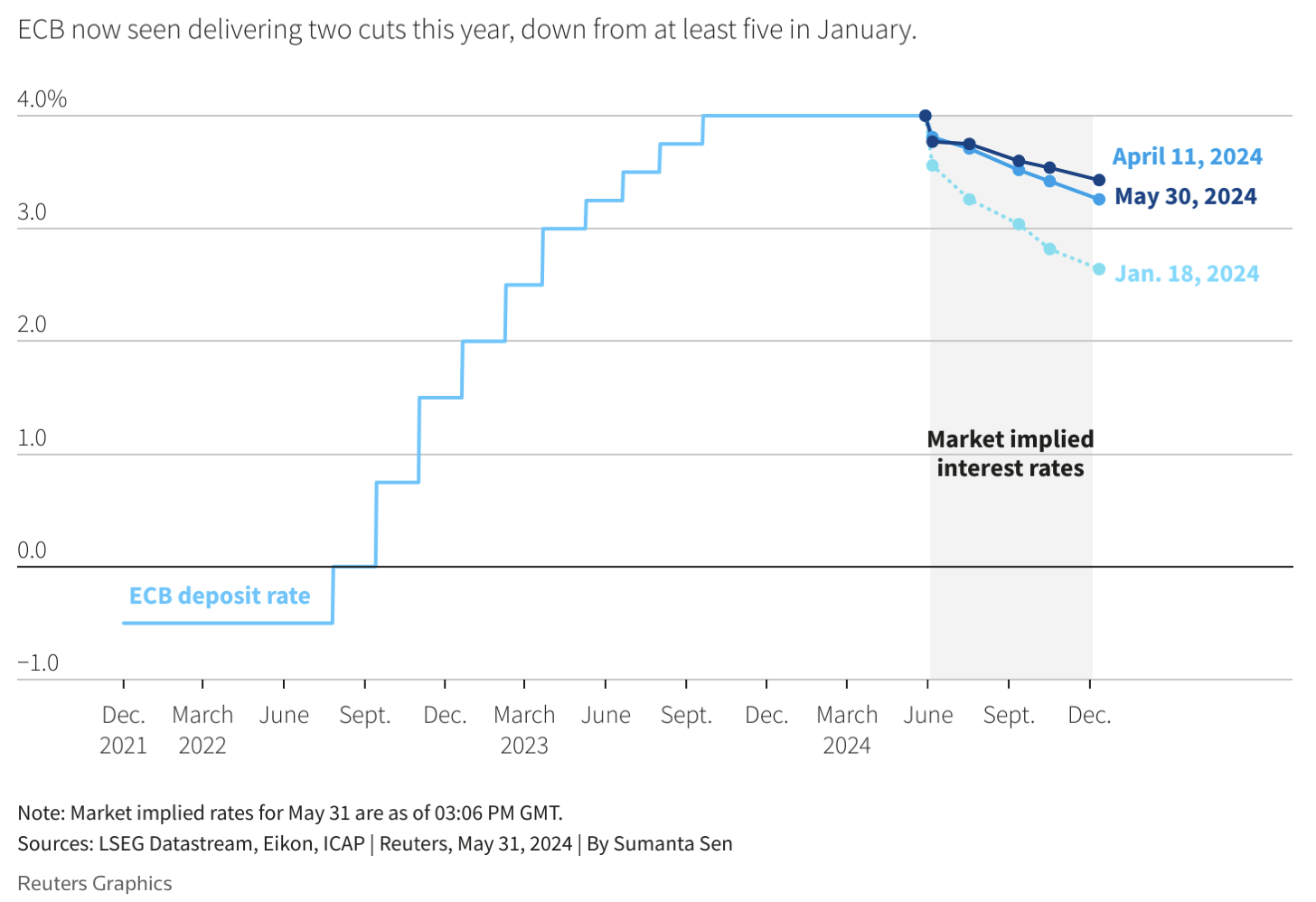
That could be awkward for their future actions but is also very likely why virtually every ECB speaker has been adamant that a July cut is not a given and they will continue to be data dependent.  Many analysts believe that there will be a total of three cuts this year, June, September and December, as the ECB will roll out their latest forecasts at those meetings, but beyond June, it is a bit less certain.  Market pricing shows that there are about 60bps total priced in at this stage, including today’s cut, as per the chart below.

Source: Reuters.com

Perhaps the most important question is, why do we care?  Well, certainly in the FX markets, given the importance of interest rate differentials, the relative speed of policy rate changes by the ECB and the FOMC can have an impact on the EURUSD exchange rate.  However, absent a surprise, something most central bankers try strenuously to avoid, the movement has already occurred ahead of the announcement.  Arguably, the more important part of this whole charade is the signal it gives for official views of future economic activity.  

When central banks are cutting interest rates, there is obviously concern that prospects for future economic activity to support the government in power are dimmer than they had been previously, hence the need to act.  As such, the very fact that a rate cutting cycle has begun in so many nations is indicative of the fact that expectations for future economic growth are diminishing.  It remains very difficult for me to understand that concept and expect that equity prices should rally substantially on the news.  But clearly, I am very old-fashioned in my thinking as evidenced by the fact that yet again, the S&P 500 and NASDAQ 100 have made new all-time highs on the strength of Nvidia’s non-stop rally.  While the Dow and NASDAQ Composite are still lagging, as are small cap stocks, euphoria remains the theme. (PS, my dour view from last Friday has been damaged, but I remain quite concerned with long-term prospects.)

However, this is where we are today.  The ECB will soon be the fourth major central bank to cut their policy rate and the pressure on the Fed to begin their cutting cycle will increase further.  Alas for the Fed, they continue to receive mixed signals from the data and rate cuts are not necessarily the proper prescription for what ails the US economy.  Just yesterday we received two contradictory signals with the ADP Employment report showing a weaker than expected 152K jobs created after a downwardly revised April number.  A few hours later, the ISM Services indicator was released at a much stronger than expected 53.8 reading, its highest since last August, and certainly not indicating that growth is ebbing.  As well, the Prices Paid subindex was a still hot 58.1, again not screaming out for a rate cut.

As of now, the market is pricing in virtually a zero probability of any rate move next week, but there has been a pickup in chatter about a cut at the July meeting with the probability of a cut then rising to 18.5% as of this morning, according to the Fed funds futures market.  If the Fed were to cut later this summer, nothing has changed my view that it will result in a significant decline in the dollar, and a significant rally in commodities. And, while the first move in both stocks and bonds might be higher, the specter of rising inflation will ultimately squash those moves.  But that is not today’s story, rather it is a story for the future.

Today, after those record highs in the US, we saw strength throughout most of Asia although Mainland Chinese shares did not participate in the fun.  That said, the gains were modest, between 0.25% and 0.5% overall.  In Europe this morning, the screens are all green with gains ranging from 0.3% in the UK to 0.7% in Germany as investors seem to believe in the goldilocks scenario there.  As to the US, futures at this hour (7:00) are unchanged as investors await tomorrow’s NFP data.

In the bond markets, after further declines yesterday, with 10-year Treasury yields touching their lowest level (4.27%) since the end of March, yields have bounced slightly this morning, higher by 2bps.  We are seeing similar price action throughout Europe, yield rallies of 2bps, except for the UK, which has seen a further 2bp decline despite the only data point, Construction PMI, rising the most in 2 years.  One last thing is that JGB yields, the ones that were supposed to be breaking out and running much higher now that the BOJ is leaving them alone, fell 5bps and are at 0.96%, below the 1.00% dotted line in the sand.

Commodity prices are rising this morning, continuing to rebound from the sharp declines earlier in the week, as oil (+0.6%) and NatGas (+0.4%) show there is still demand for energy regardless of the economic situation.  In the metals space, all the big four precious and industrial metals are higher this morning as it appears more and more like the weakness at the beginning of the week was a trading event, not a fundamental one.

Finally, the dollar is little changed overall this morning with the biggest mover being PLN (-0.3%), an indication that there is nothing ongoing.  While some currencies have managed small gains vs. the dollar and others have lagged, my sense is everyone is awaiting tomorrow’s NFP before deciding the next move, given the certitude of the ECB move later today.

We do, however, get some data this morning as follows: Initial Claims (exp 220K), Continuing Claims (1790K), Trade Balance (-$76.1B), Nonfarm Productivity (0.1%), and Unit Labor Costs (4.9%).  While we already know that the growth in the Trade Balance has been the key driver in the decline in the GDPNow figures (net exports are a subtraction from the calculation), I think the Fed may be more focused on the productivity numbers which are hardly inspiring and when combined with rising Labor Costs imply that inflation will have a tough time declining further.

So, the ECB will act first thing and then Madame Lagarde will very likely tell us that they remain data dependent, so nothing is promised for July or anytime the rest of the year.  As to today’s US data, I don’t believe it will be market moving.  This means that the equity bulls will continue to make their case and will need to be strongly disabused of the notion that the world is a great place right now.  When that time comes, beware, but it doesn’t seem likely today.

Good luck

Adf

Not Fear, But Greed

It seems that on Friday, we learned
The prospect for rate cuts upturned
The ISM sunk
And Michigan stunk
So, doves got the data they yearned
 
And so, things are priced for perfection
Though history cautions reflection
Is what we all need
As not fear, but greed
Is likely to cause the correction


Markets are funny things with a history of reacting to catalysts that were completely unexpected while ignoring the ‘big’ things all the time.  Friday was a perfect example as the release of some second-tier data, ISM and Michigan Sentiment, drove a major change in the narrative and market prices in every asset class.  Prior to the Friday data releases, which saw ISM Manufacturing fall to 47.8, far below last month and forecasts, as well as the Michigan Sentiment index fall to 76.9, also well below last month’s number and forecasts, there had been a steady stream of strong data and hawkish Fed rhetoric.  

By now, you are all familiar with the Fed’s general lack of confidence that inflation is going to return to their 2.0% target soon as that sentiment has been expressed by, literally, all 17 FOMC members in the past three weeks.  The result of the hawkish talk and the solid data was a repricing in the Fed funds futures market of just how many rate cuts were coming in 2024, as well as their timing.  As well, we saw Treasury yields back up nearly 50bps during the month of February as the concept of higher for longer was finally getting internalized by market participants.  

But observing the market’s behavior, it was never clear that investors and traders really believed that tale of higher for longer.  Undoubtedly, there has been a camp, FX poets included, who have been singing that tune all year long.  But a much larger camp has been convinced that inflation was clearly on its way to 2% or lower and the Fed would want to cut sooner rather than later.  The rationales for these cuts had very little to do with the economy and focused instead on one of two things; the election this year and their effort to prevent President Trump from being elected support the current administration, or the fact that the extraordinary amount of funding that the Federal government needs to pay for its increasing deficits requires lower interest rates to prevent a fiscal disaster.

Then along comes Friday’s data and much of the Fed’s hard-won respect regarding higher for longer got tossed right out the window.  Treasury yields fell sharply, down 8bps, while the futures curves upped the ante for a May rate cut and made June that much more certain.  Not surprisingly, equity markets got quite the boost, although they have mostly been ignoring the rates story anyway. But perhaps the most interesting thing was what happened in the gold market, where the price of the barbarous relic jumped nearly 2% on the idea that rates were set to decline in the face of still high inflation.

It is important to remember that these two data points were, as I said at the top, secondary.  The fact that both pointed to economic weakness after a long string of strong data points was interesting, but was it really a signal that the trend has changed?  Personally, I am skeptical that is the case.  However, for a market that was looking for a reason to push back on the growing narrative of fewer rate cuts, they were a welcome sight.

In the broad scheme of things, though, this week is likely to be far more important in helping us all understand the nature of the current economy as well as the ongoing Fed reaction function thereto.  After all, not only do we hear from Chairman Powell as he testifies to the Senate and House on Wednesday and Thursday respectively, but Friday brings the payroll report.  Too, on Wednesday the Bank of Canada and on Thursday the ECB meet to lay out their latest views.  Remember, too, that the Chinese National People’s Congress is being held this week, and while leaks are rare, they will ultimately be announcing their growth targets for the year, so another crucial piece of information.  Net, I do not believe that last Friday’s data will have changed the minds of any FOMC members, and continue to believe that even a June cut is a low probability absent a significant overall economic decline, including lower inflation data.  But then, that’s what makes all this so exciting  A yellow face with a black line

Description automatically generated.

As we await all the activity to come, let’s recap the overnight session.  In Asia, only the Nikkei (+0.5%) managed to generate any excitement as it made yet another new all-time high and breached the 40,000 level for the first time.  Chinese shares were dull as was most of the rest of the region.  In Europe, the picture is mixed although the only mover of note is the FTSE 100 (-0.6%) which seems to be declining on the prospects of a lackluster budget announcement by the government this week.  Otherwise, bourses here are within +/- 0.2% of Friday’s closing levels.  And at this hour (8:00), US futures are edging slightly lower.

In the bond market, Treasury yields are backing up from Friday’s decline, rising 3bps this morning, but in Europe, sovereigns are mostly seeing some demand with yields slipping 2bps-4bps across the board.  The one exception is, again, the UK, where Gilt yields are unchanged on the day.  Overnight, JGB yields were unchanged, while we saw lower yields across the rest of Asia which seemed to simply be following the Treasury market.

In the commodity space, Friday also saw oil prices rise 2%, and this morning they are essentially unchanged, consolidating those gains.  OPEC+ announced that they would continue their lower production levels which clearly has had a bigger impact than rumors that a ceasefire would soon be taking place in Gaza.  Gold is also little changed this morning, holding its gains while copper is edging higher, and aluminum is slipping.  There are many analysts who discuss the coming super cycle for commodities, but thus far, there is little consistency in the price action there.

Finally, the dollar is mixed this morning.  In the G10 we are seeing weakness from SEK (-0.65%), NOK (-0.35%) and JPY (-0.3%) although some strength from the euro (+0.1%) and pound (+0.2%).  Similarly, EMG currencies are seeing gainers (ZAR +0.4%) and laggards (CLP -0.8%) and everything in between.  If the new narrative of easier Fed policy turns into reality, then I would look for the dollar to suffer.  However, I don’t yet accept that as the case.

As mentioned above, there is much on the data front this week as follows:

TuesdayISM Services53.0
WednesdayADP Employment150K
 Bank of Canada Rate Decision5.0% (unchanged)
 JOLTS Job Openings8.9M
 Fed’s Beige Book 
ThursdayECB Rate Decision4.0% (unchanged)
 Initial Claims215K
 Continuing Claims1885K
 Trade Balance -$63.4B
 Nonfarm Productivity3.1%
 Unit Labor Costs0.6%
 Consumer Credit$10B
FridayNonfarm Payrolls200K
 Private Payrolls158K
 Manufacturing Payrolls10K
 Unemployment Rate3.7%
 Average Hourly Earnings0.3% (4.4% Y/Y)
 Average Weekly Hours34.3
 Participation Rate62.6%

Source: tradingeconomics.com

In addition, as well as Chairman Powell’s testimonies in Congress, there are another four Fed speakers, although with Powell headlining, I don’t think folks will pay too close attention to them.  Last week, the Fedspeak onslaught was very consistent about that lack of confidence that inflation would reach target soon, and there is clearly no hurry to cut rates, although virtually all speakers expect rate cuts to be the case.  Perhaps the data this week will change some minds, but remember, the big number doesn’t come out until after Powell speaks, and after Friday, the Fed enters its quiet period ahead of the next FOMC meeting.  

Right now, I have to believe last Friday’s data was the exception, not the rule, but we will learn more as the week progresses.  In the end, I think the dollar remains tied to the yield story, so as long as growth remains stronger here than elsewhere, and doesn’t show signs of falling sharply, the dollar should maintain its broad level of strength.

Good luck

Adf

Jay Will Scrape By

Today it’s about CPI
As Jay and his cadre still try
To push prices lower
Which might mean growth’s slower
But don’t worry, Jay will scrape by

This morning we see the last big data point before the Fed meets in two weeks’ time as CPI is to be released at 8:30am.  According to Bloomberg’s survey, the median expectation is for both headline and core monthly prints of 0.3% with the Y/Y numbers at 3.1% headline and 5.0% core as a result.  There are many who are excited about the prospect of a 2 handle on the headline number as a potential catalyst for the equity market to break out even higher. The idea seems to be that a reading that low will get the Fed to change their tune and not merely stop raising rates but start bringing rate cuts back on the table.  Wishful thinking in my view, but that’s what makes markets.

Even a cursory analysis of the commentary from the plethora of Fed speakers we have heard since the last meeting shows that there is very little willingness to end the current tightening program anytime soon.  Certainly, there is no indication that a cut is even remotely a consideration.  But equity bulls need a story to push their thesis, so there you have it.  The thing is that while this month is clearly going to show a substantial decline on a year over year basis due to the base effects (remember, June 2022 M/M CPI was +1.2%, the peak), next month has the opposite base effect with the July 2022 M/M reading at 0.0%.

As I’m sure all of you are very clearly aware, there is essentially no evidence in our day-to-day llives that indicates prices are declining across the board.  While gasoline prices have certainly fallen from their highs, they appear to have bottomed along with oil, and if you head out to a restaurant, especially one that you frequent, I’m sure you’ve seen the same steady rise in prices that I have.  Remember, too, that CPI measures the change in prices on a monthly or annual basis, not the level of prices.  Absent deflation, something that is incredibly unlikely in the current monetary and fiscal framework, prices are never going back to where they were prior to the pandemic.  I sincerely hope wages continue to rise for all our sakes.

In the end, I continue to look at the employment situation as the critical variable for the Fed as weakness there will be the only thing that deters them from continuing their current mission.  Powell clearly believes that the Silicon Valley Bank situation has been completely contained and that there will be no further concerns to distract them going forward.  Maybe that is correct, but I am wary of accepting the idea that the fastest rate hikes in the Fed’s history are consistent with minimal damage to the economy.  My suspicion is that there will be far more coming, it’s just that refinancings have not been necessary yet.  When companies on the margin need to pay 9% to refinance their 4% coupon, it will result in an even greater uptick in bankruptcies than we have already seen this year and according to Epiq Bankruptcy, a compiler of bankruptcy information, filings have jumped by 68% this year compared to last, with a total of 2,973 in the first six months of the year.  If the Fed continues to tighten, look for this number to rise further, and possibly faster.  

Ahead of the data, the bulls remain in charge of the market with yesterday’s rally having been followed throughout Europe this morning although last night’s Asia session was more mixed.  In fact, one of the best performing markets of the year, Japan, has seen something of a reversal in the past two weeks as the Nikkei has fallen almost 11% while the yen has rallied about 3.5%.  This is no coincidence as much of Japan’s corporate profitability continues to rely on exports and the yen’s recent strength (+0.5% today with the dollar back below 140 again) has clearly been a weight around that market’s neck.  Interestingly, despite the same mercantilist mindset in China, the relation between the Chinese stock market and the renminbi is far less tight.  As it happens, CNY (+0.2%) is a bit firmer this morning but is less than 1% from its bottom while the Chinese stock market continues to flounder, having fallen yet again last night and continuing its downtrend for the year.

Turning to the bond market, 10-year yields have slipped another 2.5bps this morning as for now it appears the market is rejecting that 4.0% level.  Of more interest is the fact that the 2yr yield has fallen faster with the curve inversion down to -90bps.  This is an indication that bond investors are entertaining the idea that inflation is slowing, and the Fed will back off.  Be careful if there is a high CPI print today as that will almost certainly see quite the reversal of this price action.  Regarding the rest of the world, European sovereigns are following Treasuries with yields generally slipping between 2bps and 3bps, but the real surprise is Japan, where yields rose 1.9bps last night and are now at 0.467%, quite close to the YCC cap for the first time in Ueda-san’s tenure.  The combination of rising JGB yields and a stronger yen has a lot of tongues wagging that a policy change is in the offing in Tokyo.  It strikes me that Ueda-san is far more likely to move when the market is not expecting something rather than being seen to respond to pressure from the market.  However, anything is possible there.

WTI is back above $75/bbl this morning for the first time in two months and there are many, this pundit included, who believe that we may have seen the bottom.  Fundamentals like the Saudi production cuts and the Biden administration discussion of refilling the SPR are adding support, as is the fact that while recession continues to be forecast, it has not yet seemed to arrive.  Do not be surprised if we see $80/bbl or higher before the summer is over.  As to metals prices, gold is marginally higher this morning, benefitting from the dollar’s continuing weakness, as are both copper and aluminum.

Finally, talking about the dollar’s weakness, it is widespread with NOK (+0.65%) rallying alongside oil and SEK (+0.5%) also benefitting from commodity prices.  The only G10 laggard is NZD (-0.2%) which seems to have been disappointed that the RBNZ left rates on hold last night.  Speaking of central banks, this morning we hear from the BOC which is expected to raise rates again by 25bps to 5.0% at 10:00am so be attuned for any alternative outcome.

As to the emerging markets, it is a story of modest strength across almost the entire set with no real outstanding stories to highlight.

In addition to CPI, we also get the Fed’s Beige Book this afternoon and we hear from four more Fed speakers starting with Richmond’s Thomas Barkin right when CPI is released.  The only thing that might be interesting is if somebody starts to change the tune, something that I find highly unlikely at this time.

We will have to see the print to have any chance of understanding the next steps, but for now, the dollar is on its heels and absent a strong print, seems likely to test its recent lows before anything else.

Good luck

Adf

Canada’s Burning

In Europe, the data today
Showed growth’s in a negative way
Recession is here
Though not too severe
While pundits are filled with dismay

Meanwhile in the States there’s a haze
Of smoke for the last several days
That Canada’s burning
Is somewhat concerning
As forests there still are ablaze

Arguably, the story that is getting the most press is the ongoing wildfires in Canada which has led to significant smoke issues throughout the Midwest and East Coast of the US.  In fact, at one point yesterday, the FAA closed LaGuardia Airport in New York because the smoke was so thick.  The latest that I have seen indicates these fires are likely to continue to burn for a number of days yet as they are nowhere near under control in Canada.  I guess we will need to get used to an orange sun rather than a yellow one for the time being.  While there is no evidence yet of any true behavioral changes, be alert for government edicts to prevent people from traveling or going outside and a short-term reduction in economic activity, at least in June while this is ongoing.  I fear that the willingness of government officials to declare states of emergency and take on dictatorial powers has grown since Covid, so it will be interesting to see how this plays out.  A headline across the tape just now (7:00) shows that LaGuardia is shut down for inbound flights again due to reduced visibility.  In the end, be careful as inhaling too much smoke will not be good for you.


But after that, which is truly wagging every tongue in NY, the other story of note is that the Eurozone has fallen into a technical recession, with the final revision of Q1 GDP falling to -0.1%, and Q4’s numbers being revised lower as well, to -0.1%, after much weaker than previously assumed data from both Germany and Ireland was incorporated into the statistics.  You may recall the argument in the beginning of 2022 when the US suffered through two consecutive quarters of negative real GDP growth, but there was a great effort to claim that was not a recession.  And officially it was not as in the US a recession is not official until the NBER declares it so in hindsight.  But Europe does not have an NBER and there is no argument at this point that the Eurozone went through quite a weak patch recently. 


Arguably, though, of more importance is whether this weakness will continue or whether we have just witnessed the much-anticipated recession.  This matters a great deal because next week, the ECB meets and is widely expected to raise its interest rate scheme by a further 25bps with the market pricing in an additional hike there by summer.  If the Eurozone is in recession, especially if it starts to deepen a bit more aggressively than the recent -0.1% quarterly data, will the ECB have the resolve to continue to fight inflation and keep raising rates?  Granted, their mandate is purely inflation focused, unlike the Fed’s dual mandate of inflation and employment, so they would be well within their rights to do so.  But…continuing to raise interest rates into a clear recession is a very difficult decision as it can easily be seen as a policy error.  At this point, my take is they will indeed hike next week, but I am far more skeptical about future hikes especially as the Fed is pausing skipping this meeting and may well be done.  The idea that the ECB will continue to tighten policy aggressively while the Fed is not seems pretty far-fetched based on its history.


Speaking of rate hikes, Canada is in the news there as well after the BOC surprised the market and unpaused (?) by hiking 25bps yesterday.  Essentially, they have concluded that economic activity is too strong to allow inflation to return to their 2% goal, the same reasoning we heard from the RBA last week when they surprised markets and raised their base rate.  While the FX market response was not quite as aggressive as in Australia (CAD rose 0.5% on the news and has basically tread water since then), the move has certainly forced rethinking the assumption that the Fed is actually going to skip this meeting.  Arguably, much will depend on next Tuesday’s CPI data with current estimates there for 4.2% headline and 5.2% core.  Any number that prints hot will get tongues wagging about the Fed continuing to raise rates with corresponding market impacts.  For now though, we can merely guess.


And that is the background for today’s session.  Yesterday saw a bit of a pullback in risk assets in the US with most of Asia following lower, although Chinese stocks held up.  Eurozone bourses are all marginally higher this morning, as it seems the growth data was less concerning and hopes that the ECB would be forced to stop hikes sooner have been a driving force.  As to US futures, they are all essentially unchanged this morning as everybody continues to wait for the Fed next week.


Bond markets, though, were a bit shaken by the BOC move with yields climbing in the US yesterday and a further 1bp rise this morning back to 3.80%.  In addition, 2yr yields are back up to 4.55%, and with the Treasury now having no debt ceiling at all, I expect we will see significant issuance driving yields higher still.  In Europe, the picture is more mixed with yields either side of unchanged as there is confusion on how to play this market.  And one final thing is in Japan, where JGB yields have edged higher by 2bps overnight and are now at 0.434%, slowing approaching the YCC cap.  That is a potential issue for the not-too-distant future so we will keep on top of it.


Oil prices continue their slow rebound, up 0.9% this morning and actually up 4.3% in the past week.  Perhaps the Saudi production cuts are finally being priced, or perhaps the idea that Canada has indicated stronger growth is seen as a harbinger of a better economic situation and less demand destruction.  As to metals prices, gold, which fell sharply yesterday, is rebounding slightly and the base metals are mixed.  As long as we get conflicting economic signals (weakness in Europe, strength in North America) I think these metals will have a difficult time choosing a direction.


Finally, the dollar is generally softer this morning, which given the higher yields in the US is a bit surprising.  But NOK (+0.7%) leads the way on oil strength, and we continue to see strength throughout the commodity bloc.  Even the euro has rallied this morning, although that feels far more like position adjustments than fundamentally driven movement.  As to the EMG bloc, ZAR (+0.7%) is once again at the head of the list, entirely on commodity movement but most of EMEA is stronger while Asian currencies were generally under a bit of pressure overnight.  At this point, I continue to believe most markets are awaiting the FOMC meeting as the next potential catalyst and so expect limited directional trading until then.


On the data front, Initial (exp 235K) and Continuing (1802K) Claims are on tap this morning, neither of which seem likely to move the needle.  Yesterday’s Trade data was modestly better than expected while Consumer Credit grew a bit more than expected.  In the end, though, it is still all about the Fed.  As such, I expect more back and forth but no secular movement until we hear from the FOMC.


Good luck

Adf

Could Be Dead

The tapering talk at the Fed
Continues as they look ahead
Though growth’s clearly slowing
Inflation is growing
So, QE, next year, could be dead

In Europe, though, it’s not the same
As price rises largely are tame
But plenty of squawks
From ECB hawks
Have feathered the doves with great shame

Central bank meetings continue to be key highlights on the calendar and this week is no different.  Thus far we have already heard from the RBA, who left policy unchanged, as despite inflation running at 3.8% Q/Q, are unwilling to tighten policy amid a massive nationwide lockdown.  After all, how can they justify tighter policy as growth continues to sag?

This morning the BOC meets, and the universal view is that the Overnight Lending rate will be left unchanged at 0.25%.  However, you may recall that the BOC has actually begun to taper its QE purchases, reducing the weekly amount of purchases to C$2 billion from its peak setting of C$4 billion.  Most of the punditry believe that there will be no change in the rate of QE at this meeting as the bank will want to evaluate the impact of the delta variant on the Canadian economy more fully, but most also believe that the next step lower will occur in October.  In either event, though, it seems the currency markets remain far more focused on the US half of the equation than on what the other central bank is doing.  After all, since the BOC began to taper policy in April, the Loonie has weakened by more than 1%, although it did show initial strength in the wake of the surprise announcement.

Turning to tomorrow’s ECB meeting, there has also been a clear delineation between the hawks and doves as to the proper steps going forward.  Given the macroeconomic situation in Europe, where growth is slowing from relatively modest levels and inflation remains far below levels seen in either the US or Canada (or Australia or the UK), it would seem that the doves should retain the upper hand in the discussion.

But one of the key, inherent, flaws in the Eurozone is that different countries tend to have very different economies as well as very different fiscal policies, and so the individual economic outcomes vary greatly.  Thus, while Spain remains mired with excessively high unemployment and lackluster growth prospects, as does Italy, Germany has seen rising prices in a much more sustained fashion, with CPI there running a full percentage point above the Eurozone as a whole.  Given that German DNA is vehemently anti-inflation (a result of the suffering of the Weimar Hyperinflation of the 1920’s), this situation has resulted in Bundesbank President Jens Weidmann and some of his closest colleagues (Austria’s Holtzmann and the Netherlands’ Knot) vociferously calling for a reduction in the rate of purchases in the PEPP.  However, most of the rest of the committee sees no need to slow things down.  The question tomorrow is whether or not Madame Lagarde will be able to tether the hawks.  While there is market talk that tapering will occur, my money is on no change in the pace of purchases.  The direct impact of this should be further modest weakness in the euro and a rebound in European sovereign bond market prices.

As to the Fed, they meet in two weeks’ time and after Powell’s Jackson Hole performance, I think there are vanishingly few players who believe they are going to even announce the tapering schedule then.  However, that does not mean that the segment of the FOMC who are adamantly pro-taper will be quiet, and so expect to hear a steady stream of tapering talk until the quiet period begins on Saturday.  In fact, just last night St Louis President Bullard was interviewed by the FT and reiterated his vocal stance that tapering needs to begin right away.  As well, we will hear from Dallas’ Kaplan later today with his message guaranteed to be the same.  Of more interest will be NY’s Williams, who speaks this afternoon at 1:10pm, and who has yet to voice his tapering opinion.  If he does say tapering is necessary, that would be an important signal, so we must pay close attention.

With all that in mind, markets overnight have started to take a somewhat dimmer view of risk, especially in Europe.  In fact, looking around, only the Nikkei (+0.9%) has been able to see any positivity as the rest of Asia (Hang Seng -0.1%, Shanghai -0.1%) edged lower while Europe (DAX -0.7%, CAC -0.4%, FTSE 100 -0.5%) are seeing much greater selling.  That said, the situation on the Continent was worse earlier in the session with losses everywhere greater than 1.0%.  US futures, meanwhile, are essentially unchanged on the morning, although leaning slightly lower.

In the bond market, buyers have returned with Treasury yields falling 2.4bps, reversing half of yesterday’s climb.  But Europe, too, is seeing demand for havens with Bunds (-1.2bps), OATs (-1.5bps) and Gilts (-1.0bps) all decently bid this morning.  Certainly, if the ECB does reduce its PEPP purchases you can expect yields across the board in Europe to rise.  And, in fact, that is why I don’t expect that to occur!

In a bit of a conundrum, commodity prices are generally higher, alongside the dollar.  Looking at WTI (+1.4%), it seems that energy is on the rise everywhere.  (Pay attention to Uranium, which has rallied 32% in the past month and is structurally bullish as current demand is significantly greater than the run rate of production.)  But weirdly, other than copper (-0.8%) every other key commodity is higher this morning with Au (+0.3%), Al (+0.5%) and Soybeans (+0.7%) leading the way.

This is strange because the dollar is broadly, albeit generally modestly, higher this morning.  In the G10, EUR, CAD and DKK are all softer by 0.2% while only NZD (+0.1%) has managed any gains on the back of the strength in commodity prices.  In the emerging markets, the situation is far more pronounced with TRY (-1.0%) leading the way lower after the central bank indicated rate cuts were coming, although we also saw weakness overnight in KRW (-0.75%), THB (-0.5%) and TWD (-0.4%).  All of these Asian currencies suffered on a pure risk-off viewpoint as equity markets in these nations fell as well.  But it’s not just APAC currencies as we are seeing weakness in EMEA with HUF (-0.5%) and PLN (-0.3%) also under pressure.

On the data front, today brings the JOLTS Job Openings report (exp 10.049M) which continues to indicate the labor market is quite tight despite the payroll data last week.  And after that we get the Fed’s Beige Book at 2:00.  To my mind, Williams’ speech at 1:10pm is the most important story of the day, so we will need to pay close attention when he starts speaking.

Overall, it appears that the dollar bulls have regained the upper hand and are slowly pushing the greenback higher versus most counterparts.  If Williams does agree tapering is needed, I expect the dollar to take another leg higher.  But if he is clear that there is no rush, especially with the delta variant impact, look for the dollar to cede some of its recent gains and equity markets to regain a little spring in their step.

Good luck and stay safe
Adf

Powell Won’t Waver

The story last quarter was prices
Would rise, leading up to a crisis
So, bond markets dropped
The dollar, she popped
And gold bugs all made sacrifices

But now a new narrative line
Explains that inflation’s benign
So, bonds are in favor
As Powell won’t waver
While dollars resume their decline

All year long the market story has been driven by the yield on the 10-year Treasury bond.  Ever since the run-off elections in Georgia in the beginning of January, market anticipation has been for significant growth in the US on the heels of increased vaccination rates and increased fiscal stimulus.  In Q1, Treasury yields rose dramatically, touching as high as 1.77% at their top toward the end of March.  Meanwhile, the dollar, which had been slated to decline all year, rallied versus every emerging market currency and all but CAD, GBP and NOK in the G10.

But, as of the first of this month, the world appears to be a different place, as Treasury bonds have rallied driving yields lower and supporting equity and commodity markets.  At the same time, the dollar has come under broad-based pressure and reversed a large portion of its Q1 gains.

Currently, the narrative appears to be along the following lines: US GDP growth in 2021 is going to be spectacular, well above 6.0% and its strongest since 1984.  Inflation, meanwhile, will print at higher levels for Q2 purely as a result of base effects, but will then resume its long-term downtrend and the Fed will be required to continue to support the economy aggressively in order to meet their goals.  By the way, the Fed’s newly articulated goal is for maximum employment, not full employment, and they have promised to become completely reactive, waiting for hard data to confirm positive results in employment and wages, before considering any efforts to rein in rising prices.

Equity markets still love the story as the implication is that interest rates will not be rising at all this year, nor next year for that matter, at least in the front end of the curve.  Treasury markets, which appeared to get a little panicked in Q1 have reverted to form and seem to be pricing one of two things; either less impressive economic growth, or anticipation that the Fed will expand QE or YCC as Powell and friends seek to prevent any significant rise in yields.  Meanwhile, the dollar is falling again, gold is rising and commodity prices (the one true constant) remain firm.

Have we reached economic nirvana?  Some skepticism might be in order given the myriad issues that can undermine this narrative.  The primary issue is, of course, another wave of Covid spreading throughout the US and the world.  As the virus mutates, it is not clear that the current vaccines are going to be effective preventatives to new strains.  While the vaccination progress in the US and UK has been excellent, with 40% and 50% of their respective populations receiving at least the first dose, the same cannot be said elsewhere in the world.  In fact, the newsworthy item of the day is that India reported 315,800 new cases just yesterday!  Alongside Brazil and Turkey, these three nations, with a combined population of nearly 1.7 billion find themselves in the midst of another serious wave of infection.  Remember that a huge part of the reopening and growth narrative is the ending of the pandemic.  It is still too early to make that claim, and so, perhaps a bit early to count the 2021 GDP growth figures as a given.

However, there is a second issue of note that cannot be ignored, and that is the inflation story.  While it is clear that the Fed has convinced themselves inflation is not a concern, that the elevated readings that are almost certain to come over the next three months will be ‘transitory’, there is a case to be made that rising inflation may have a more lasting impact.

Consider that oil prices have risen dramatically from their levels this time last year and continue to trend higher.  Now, while the Fed looks at core prices, ex food & energy, the reality is that rising energy prices feed into everyday items beyond the cost of filling your gas tank.  Given that virtually everything produced and consumed requires energy to create, eventually higher energy prices feed into the cost of all those products.  It can be even more direct for services such as shipping, where energy price surcharges are common.  But just because something is labeled a surcharge doesn’t mean it hasn’t raised the price of the item consumed.  The point is, rising energy prices and rising commodity prices in general, are leading to higher input costs which will eventually lead to higher prices.  We continue to see the evidence in data like PPI and the price indices in the PMI and ISM data.

And these are just the two largest known issues.  Less probable, but potentially highly significant, we could see increased tension in US-China relations, with a stepped-up trade war, or even a confrontation over the situation in Taiwan.  Neither can one rule out more mischief from Russia, or Middle Eastern strife that could easily impact the supply of oil and hence its price.  The point is, it seems early to declare that the worst is behind us and price securities and risk as though that is the case.

Market activity today is relatively muted as investors and traders await the latest word(s) from Madame Lagarde and the ECB.  Expectations are there will be no changes to policy, but the real hope is that she will give clearer guidance on their plans going forward.  You may recall at the last meeting they expressed some dismay that bond yields had risen as much as they had and promised to increase PEPP purchases.  Since then, while they have increased those purchases, the amount of increase has been less than impressive and yields in Europe, while not rising further, have not returned to previous lower levels.  At the same time, as US yields have fallen back more than 20bps from their recent highs, the euro (+0.2%) has resumed its climb and is back above 1.20 for the first time since early March.  One thing we know is that the ECB can ill afford a stronger euro, so some type of response may be forthcoming.

Speaking of central banks, yesterday’s big surprise came from north of the border as the Bank of Canada, while leaving policy on hold, changed their tune on the timing for the end of QE.  They brought forward their tapering timeline and the market brought forward the rate hike timeline in response.  It seems that the employment situation in Canada has returned far closer to pre-Covid levels than in the US, with more than 90% of the jobs lost having been regained.  While CAD has given up 0.1% this morning, this is after a nearly 1.0% rise yesterday in the wake of the BOC announcement.

A quick look at equity markets around the world shows that Asia had a pretty good session (Nikkei +2.4%, Hang Seng +0.5%, Shanghai -0.25%) while Europe is all green and has been steadily climbing all day (DAX +0.45%, CAC +0.6%, FTSE 100 +0.1%).  US futures, however, are ever so slightly softer, down about 0.15% across the board, although this was after solid rallies yesterday afternoon.  Meanwhile, bond markets are under the barest of pressures with yields edging higher in the US (+0.5bps) and Europe (Bunds +0.4bps, OATs +0.8bps, Gilts -0.4bps), really showing a market waiting for the next piece of data.

Energy prices are under modest pressure this morning (WTI -0.5%), as are precious metals (Au -0.3%, Ag -0.6%) and industrials (Cu 0.0%, Zn -0.2%, Al -0.2%).

It can be little surprise that the dollar is mixed this morning, given the lack of a coherent market theme, although there are some modest surprises.  NOK (+0.25%) for example is stronger in the face of weaker oil prices.  Meanwhile NZD (-0.3%) is the weak link in the G10, on the back of market internals and stop-loss selling.  EMG currencies have a few more substantial movers with RUB (+1.25%) the leading gainer by far after President Putin’s state of the nation address focused entirely on domestic issues rather than feared saber rattling.  This encouraged bond buying and strength in the ruble.  On the other end of the spectrum is TRY (-0.8%) which has seen further investor outflow after reports that the US administration is prepared to raise the issue of the Armenian genocide and put further pressure to isolate President Erdogan.  However, away from those two movers, the rest of the bloc is +/- 0.2% or less.

Aside from the ECB meeting, the US data slate brings Initial Claims (exp 610K), Continuing Claims (3.6M), Leading Indicators (1.0%) and Existing Home Sales (6.11M).  Clearly the Claims data is the most important of the bunch with a strong number possibly helping to halt the Treasury rally and potentially support the dollar.  We are in the Fed quiet period, so no speakers there.

The rest of the day will take its tone from Madame Lagarde, but if she is less than forceful, I would expect the current trend (modestly lower yields, modestly higher equities and modestly weaker dollar) to continue.

Good luck and stay safe
Adf

Frustrations

The global economy’s state
Continues to see growth abate
As trade between nations
Has met with frustrations
While central banks try to reflate

Markets have been extremely quiet overnight as investors and traders await the release of the US payroll report at 8:30 this morning. Expectations, according to Bloomberg, are as follows:

Nonfarm Payrolls 85K
Private Payrolls 80K
Manufacturing Payrolls -55K
Unemployment Rate 3.6%
Average Hourly Earnings 0.3% (3.0% Y/Y)
Average Weekly Hours 34.4
Participation Rate 63.1%
ISM Manufacturing 48.9
ISM Prices Paid 50.0
Construction Spending 0.2%

While the GM strike has ended, it was in full swing during the survey period and explains the expected significant decline in manufacturing jobs. One other thing having a negative impact is the reduction of census workers. Given these idiosyncratic features, we must look beyond the headline number to ascertain if the employment situation remains robust, or is starting to roll over. Consider that most analysts expect that the GM strike was worth about 50K jobs and the census situation another 20K. If we add those back to the median expectation of 85K, we wind up at essentially the 3-month average of 157K. However, it is important to remember that the 1-year average is higher, 179K, which indicates that there has been an ongoing decline in new hiring for a little while now. Some of this is certainly due to the fact that, as we have heard repeatedly, finding good employees is so difficult, especially in the service industries. But certainly, the trade situation and the fact that the US economy is growing more slowly is weighing on the data as well.

The reason this is important, of course, is that the NFP report is one of the key metrics for the Fed as they try to manage monetary policy in an uncertain world. Unfortunately for them, the Unemployment Rate is backward looking data, a picture of what has been, not what is likely to be. In truth, they should be far more focused on the ISM report at 10:00. At least that has some forecasting ability.

A quick recap of this week’s central bank activity shows us that there were 3 key meetings; the Bank of Canada, who left policy unchanged but turned dovish in their statement; the FOMC, which cut rates and declared they were done cutting rates unless absolutely necessary; and the BOJ, which left policy unchanged but hinted that they, too, could be induced to easing further if things don’t pick up soon. (I can pretty much promise the BOJ that things are not going to pick up soon, certainly not inflation.) Perhaps the most interesting market response to this central bank activity was the quietest bond market rally in history, where 10-year Treasury yields are, this morning, 15bps lower than Monday’s opening. Only Canada’s 10-year outperformed that move with a 20bp decline (bond rally). Given the rate activity, it ought not be surprising that equity markets retain their bid overall. This morning, ahead of the NFP report, US futures are pointing higher and we have seen gains in Europe (FTSE, CAC, and DAX +0.33%) as well as most of Asia (Hang Seng +0.7%, Shanghai +1.0%) although the Nikkei did fall 0.3%.

And what about the dollar? Well, in truth it is doing very little this morning, with most currencies trading within a 0.20% band around yesterday’s closing levels. The one big exception has been the Norwegian krone which has rallied sharply, 0.65%, after a much better than expected Manufacturing PMI release. Interestingly, this movement has dragged the Swedish krona higher despite the fact that Sweden’s PMI disappointed, falling to 46.0. However, beyond that, there is nothing of excitement to discuss.

We hear from five Fed speakers today, starting with Vice-chairman Richard Clarida, who will be interviewed on Bloomberg TV at 9:30 this morning before speaking at 1:00 to the Japan Society. But we also hear from Dallas Fed President Richard Kaplan, Governor Randall Quarles, SF Fed President Mary Daly and NY’s John Williams before the day is out. It seems to me that the market was pretty happy with Chairman Powell’s comments and press conference on Wednesday so I expect we will see a lot of reaffirmation of the Chairman’s thoughts.

So, all in all, it is shaping up to be a pretty dull day…unless Payrolls are a big surprise. I have a funny feeling that we are going to see a much weaker number than expected based on the extremely weak Chicago PMI data and its employment sub index, as well as the fact that the Initial Claims data seems to be edging higher these days. Of course, the equity market will applaud as they will start to price in more rate cuts, but I think the dollar will suffer accordingly.

Good luck and good weekend
Adf