Crazier Still

There once was a time when the Fed
When meeting, and looking ahead
All seemed to agree
The future they’d see
And wrote banal statements, when read
 
But this time is different, it’s true
Though those words most folks should eschew
‘Cause nobody knows
Which way the wind blows
As true data’s hard to construe
 
So, rather than voting as one
Three members, the Chairman, did shun
But crazier still
The dot plot did kill
The idea much more can be done


I think it is appropriate to start this morning’s discussion with the dot plot, which as I, and many others, expected showed virtually no consensus as to what the future holds with respect to Federal Reserve monetary policy.  For 2026, the range of estimates by the 19 FOMC members is 175 basis points, the widest range I have ever seen.  Three members see a 25bp hike in 2026 and one member (likely Governor Miran) sees 150bps of cuts.  They can’t all be right!  But even if we look out to the longer run, the range of estimates is 125bps wide.

Personally, I am thrilled at this outcome as it indicates that instead of the Chairman browbeating everyone into agreeing with his/her view, which had been the history for the past 40 years, FOMC members have demonstrated they are willing to express a personal view.

Now, generally markets hate uncertainty of this nature, and one might have thought that equity markets, especially, would be negatively impacted by this outcome.  But, since the unwritten mandate of the Fed is to ensure that stock markets never decline, they were able to paper over the lack of consensus by explaining they will be buying $40 billion/month of T-bills to make sure that bank reserves are “ample”.  QT has ended, and while they will continue to go out of their way to explain this is not QE, and perhaps technically it is not, they are still promising to pump nearly $500 billion /year into the economy by expanding their balance sheet.  One cannot be surprised that initially, much of that money is going to head into financial markets, hence today’s rally.

However, if you want to see just how out of touch the Fed is with reality, a quick look at their economic projections helps disabuse you of the notion that there is really much independent thought in the Marriner Eccles Building.  As you can see below, they continue to believe that inflation will gradually head back to their target, that growth will slow, unemployment will slip and that Fed funds have room to decline from here.

I have frequently railed against the Fed and their models, highlighting time and again that their models are not fit for purpose.  It is abundantly clear that every member has a neo-Keynesian model that was calibrated in the wake of the Dot com bubble bursting when interest rates in the US first were pushed down to 0.0% while consumer inflation remained quiescent as all the funds went into financial assets.  One would think that the experience of 2022-23, when inflation soared forcing them to hike rates in the most aggressive manner in history, would have resulted in some second thoughts.  But I cannot look at the table above and draw that conclusion.  Perhaps this will help you understand the growth in the meme, end the fed.

To sum it all up, FOMC members have no consensus on how to behave going forward but they decided that expanding the balance sheet was the right thing to do.  Perhaps they do have an idea, but given inflation is showing no signs of heading back to their target, they decided that the esoterica of the balance sheet will hide their activities more effectively than interest rate announcements.

One of the key talking points this morning revolves around the dollar in the FX markets and how now that the Fed has cut rates again, while the ECB is set to leave them on hold, and the BOJ looks likely to raise them next week, that the greenback will fall further.  Much continues to be made of the fact that the dollar fell about 12% during the first 6 months of 2025, although a decline of that magnitude during a 6-month time span is hardly unique, it was the first such decline that happened during the first 6 months of the year, in 50 years or so.  In other words, much ado about nothing.  

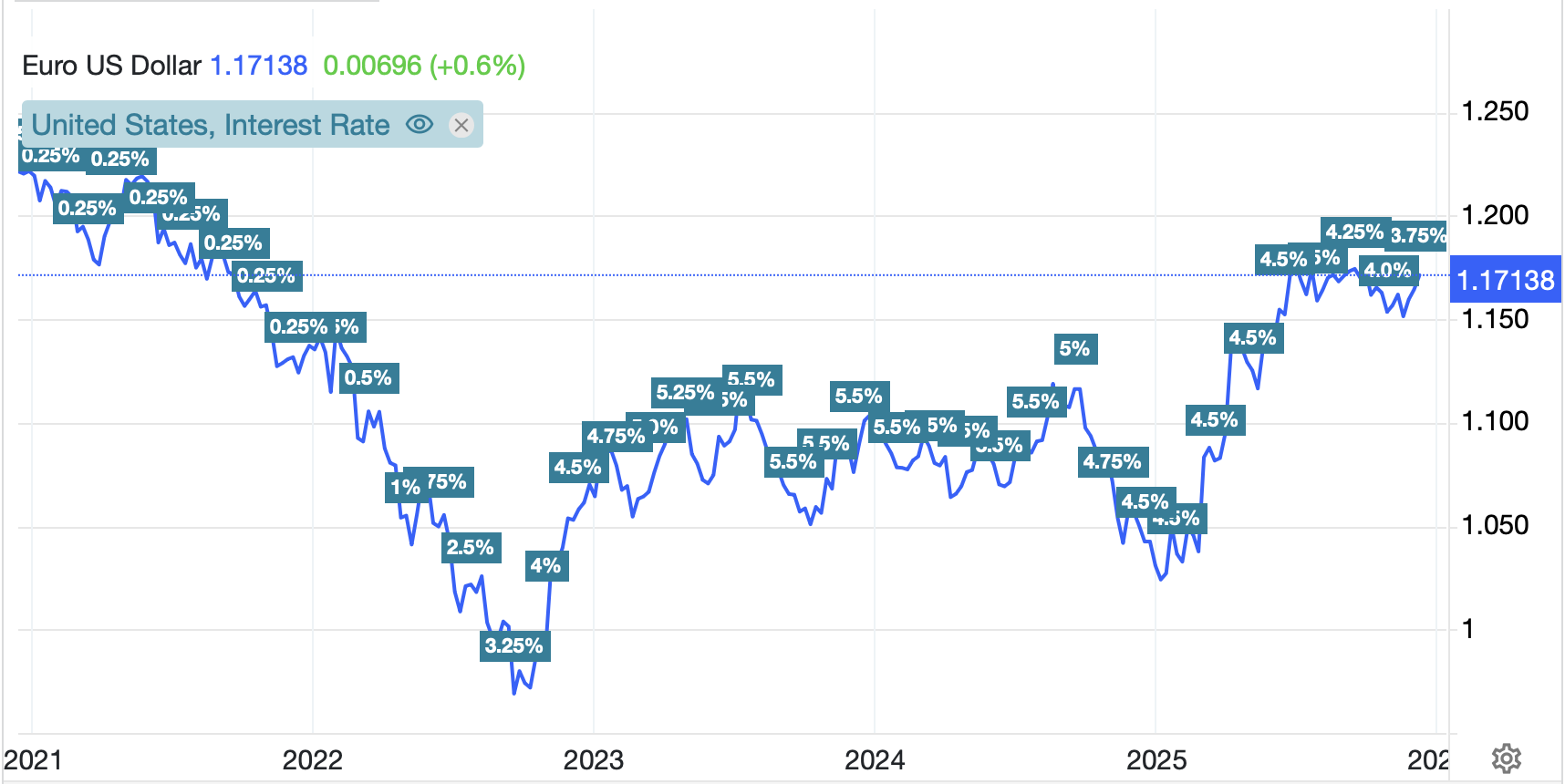
The latest spin, though, is look for the dollar to decline sharply after the rate cut.  I have a hard time with this concept for a few reasons.  First, given the obvious uncertainty of future Fed activity, as per the dot plot, it is unclear the Fed is going to aggressively cut rates from this level anytime soon.  And second, a look at the history of the dollar in relation to Fed activity doesn’t really paint that picture.  The below chart of the euro over the past five years shows that the single currency fell during the initial stages of the Fed’s panic rate hikes in 2022 then rallied back sharply as they continued.  Meanwhile, during the latter half of 2024, the dollar rallied as the Fed cut rates and then declined as they remained on hold.   My point is, the recent history is ambiguous at best regarding the dollar’s response to a given Fed move.

Source: tradingeconomics.com

I have maintained that if the Fed cuts aggressively, it will undermine the dollar.  However, nothing about yesterday’s FOMC meeting tells me they are about to embark on an aggressive rate cutting binge.

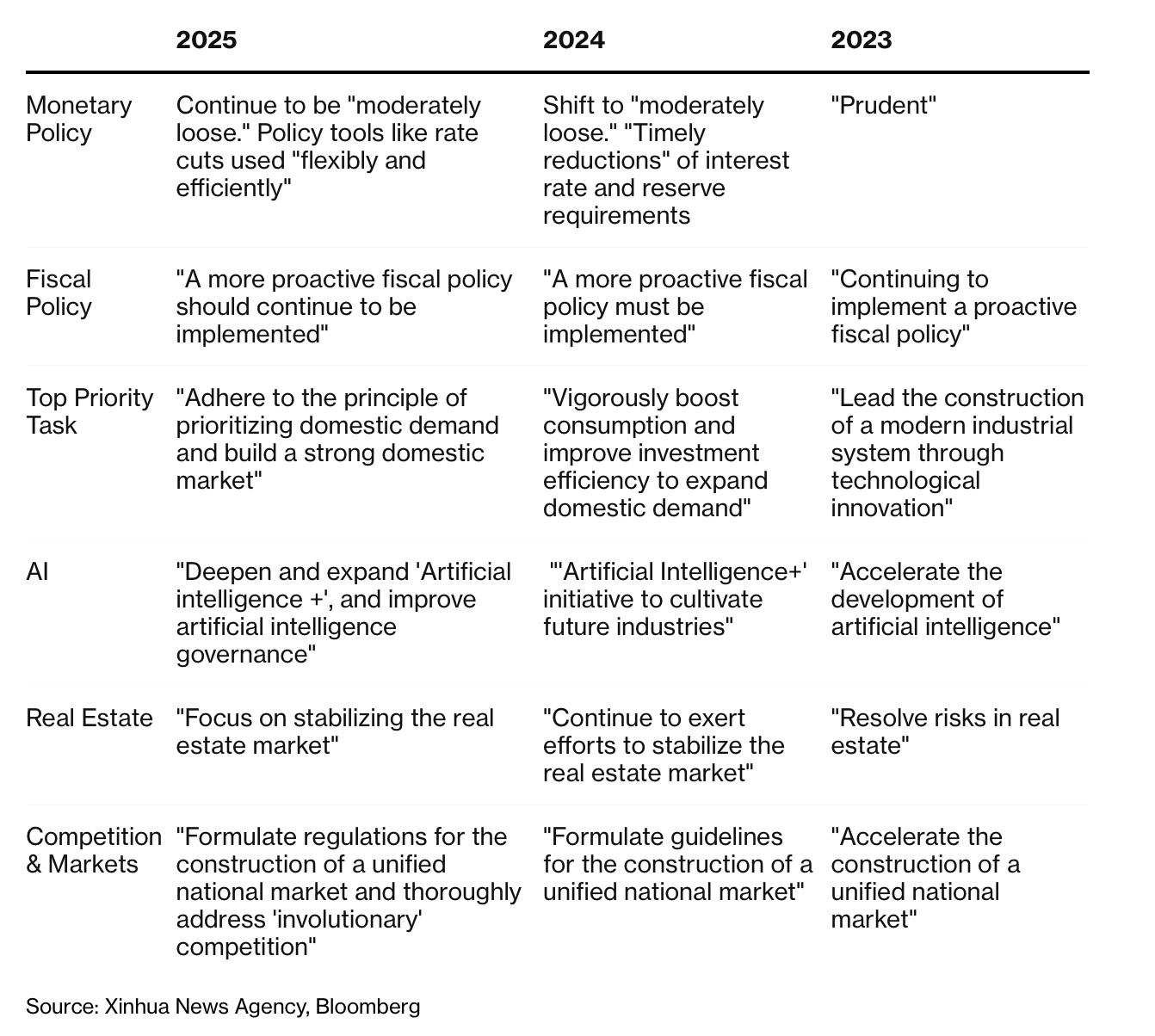
The other noteworthy story this morning is the outcome from China’s Central Economic Work Conference (CEWC).  I have described several times that the President Xi’s government claims they are keen to help support domestic consumption and the housing market despite neither of those things having occurred during the past several years.  Well, Bloomberg was nice enough to create a table highlighting the CEWC’s statements this year and compare them to the past two years.  I have attached it below.

In a testament to the fact that bureaucrats speak the same language, no matter their native tongue, a look at the changes in Fiscal Policy or Top Priority Task, or even Real Estate shows that nothing has changed but the order of the words.  The very fact that they need to keep repeating themselves can readily be explained by the fact that the previous year’s efforts failed.  Why will this time be different?

Ok, a quick tour of markets.   Apparently, Asia was not enamored of the FOMC outcome with Tokyo (-0.9%) and China (-0.9%) both sliding although HK managed to stay put.  Elsewhere in the region, both Korea (-0.6%) and Taiwan (-1.3%) were also under pressure as most markets here were in the red.  The exceptions were India, Malaysia and the Philippines, all of which managed gains of 0.5% or so.  

In Europe, things are a little brighter with modest gains the order of the day led by Spain (+0.5%) and France (+0.4%) although both Germany and the UK are barely higher at this hour.  There was no data released in Europe this morning although the SNB did meet and leave rates on hold at 0.0% as universally expected.  There has been a little bit of ECB speak, with several members highlighting that ECB policy is independent of Fed policy but that if Fed cuts force the dollar lower, they may feel the need to respond as a higher euro would reduce inflation.  Alas for the stock market bulls in the US, futures this morning are pointing lower led by the NASDAQ (-0.7%) although that is on the back of weaker than expected Oracle earnings results last night.  Perhaps promising to spend $5 trillion on AI is beginning to be seen as unrealistic, although I doubt that is the case 🤔.

Turning to the bond market, Treasury yields have slipped -2bps overnight after falling -5bps yesterday.  Similar price action has been seen elsewhere with European sovereign yields slipping slightly and even JGB yields down -2bps overnight.  Personally, I am a bit confused by this as I have been assured that the Fed cutting rates in this economy would result in a steeper yield curve with long-dated rates rising even though the front end falls.  Perhaps I am reading the data wrong.

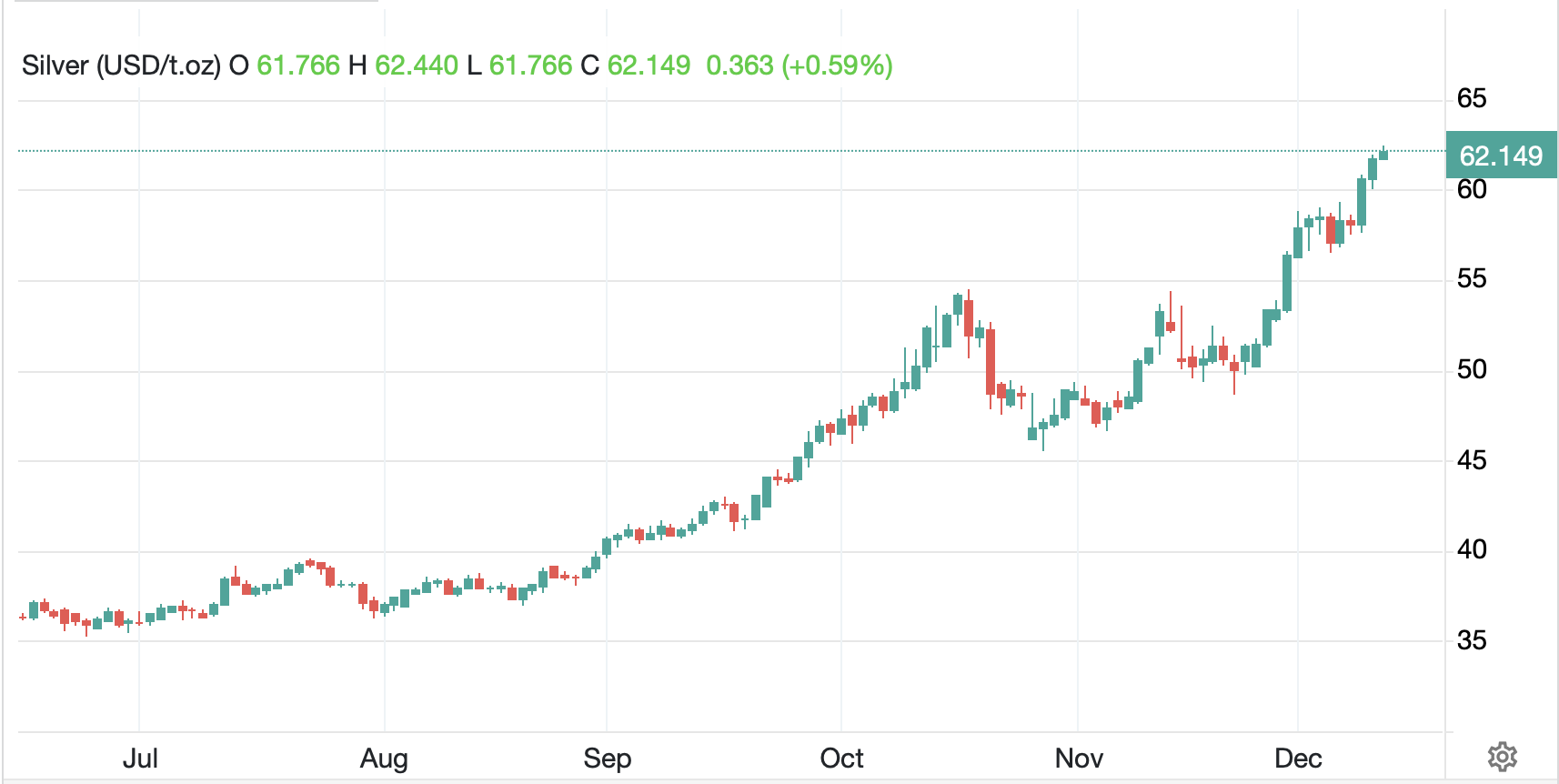
In the commodity markets, the one truth is that there are no sellers in the silver market.  It is higher by another 0.5% this morning and above $62/oz as whatever games had been played in the past to cap its price seem to have fallen apart.  Physical demand for the stuff outstrips new supply by about 120 million oz /year, and new mines are scarce on the ground.  This feels like there is further room to run.

Source: tradingeconomics.com

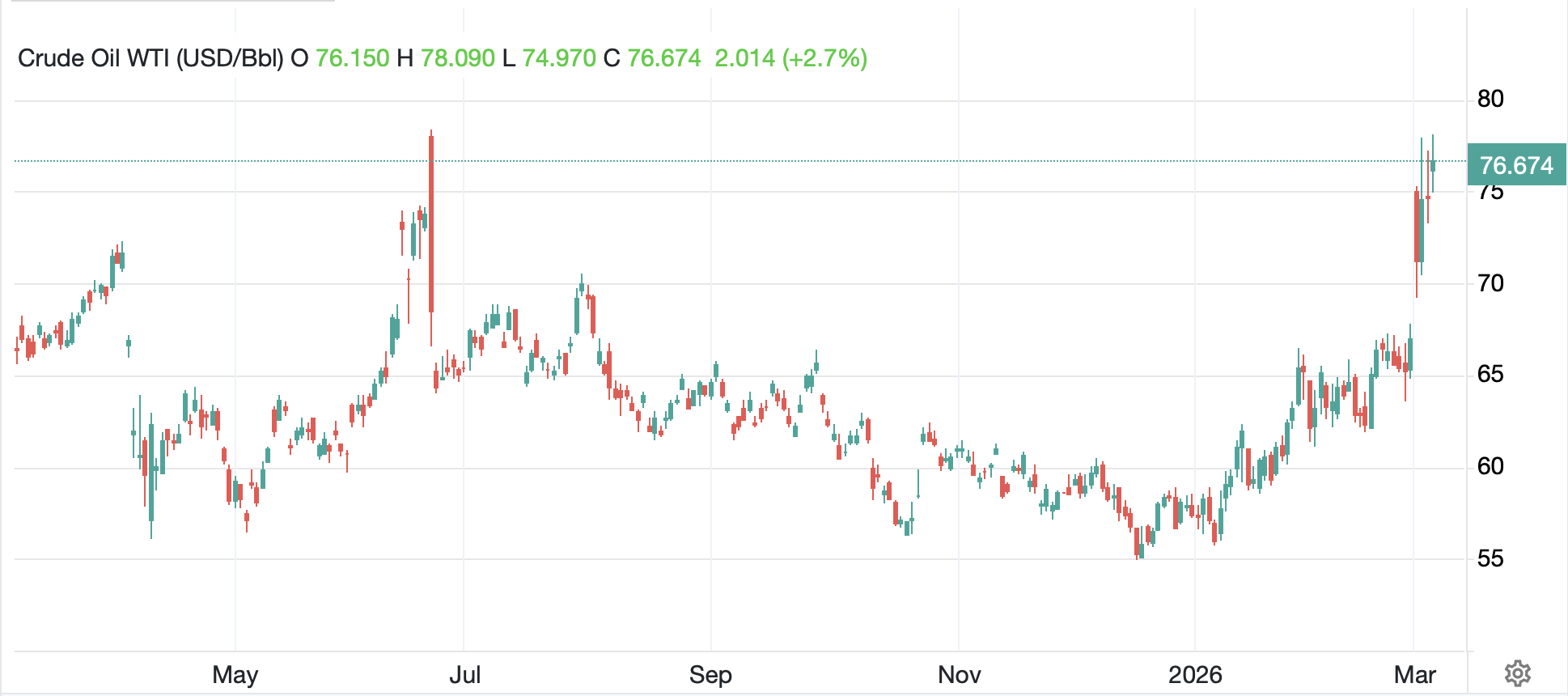
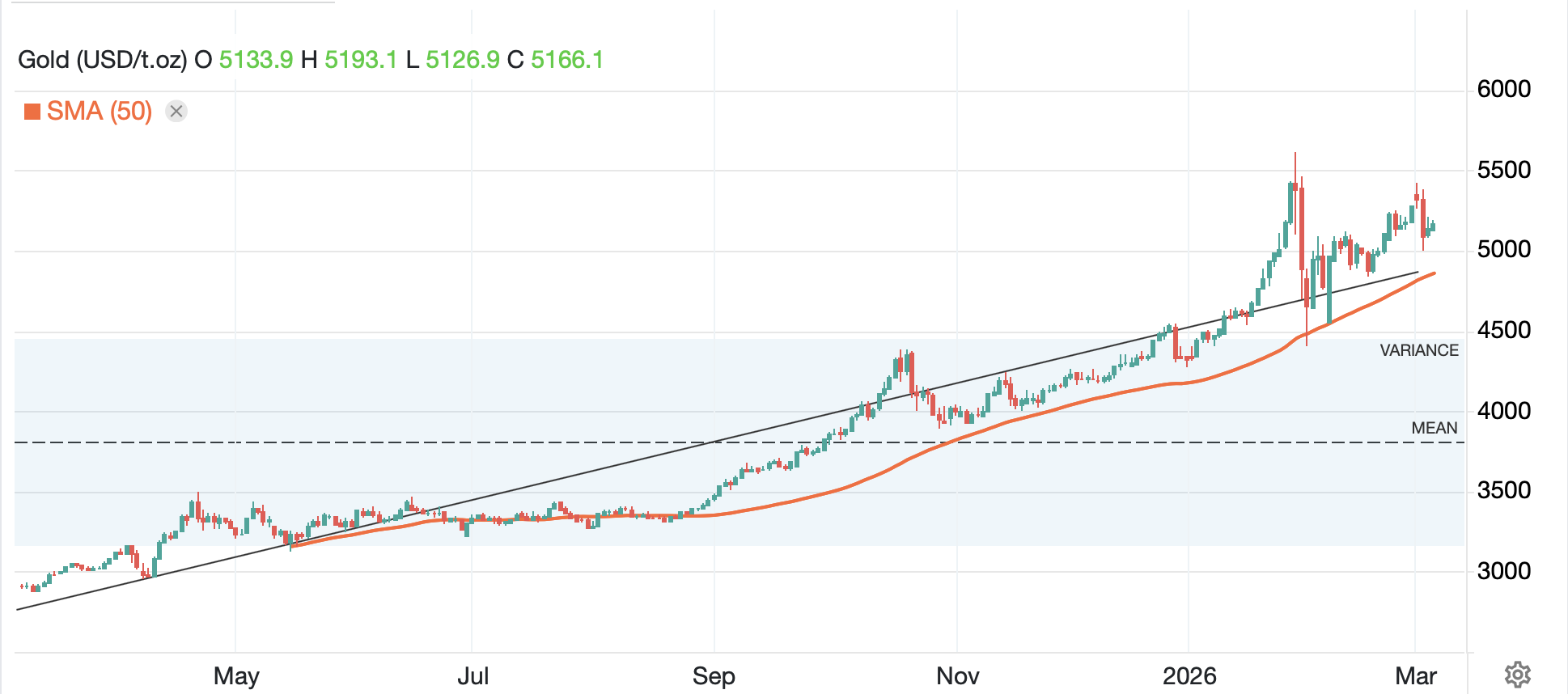
As to the rest of the space, gold (-0.2%) which had a nice day yesterday is consolidating, as is copper.  Turning to oil (-1.1%) it continues to drift lower, dragging gasoline along for the ride, something that must make the president quite happy.  You know my views here.

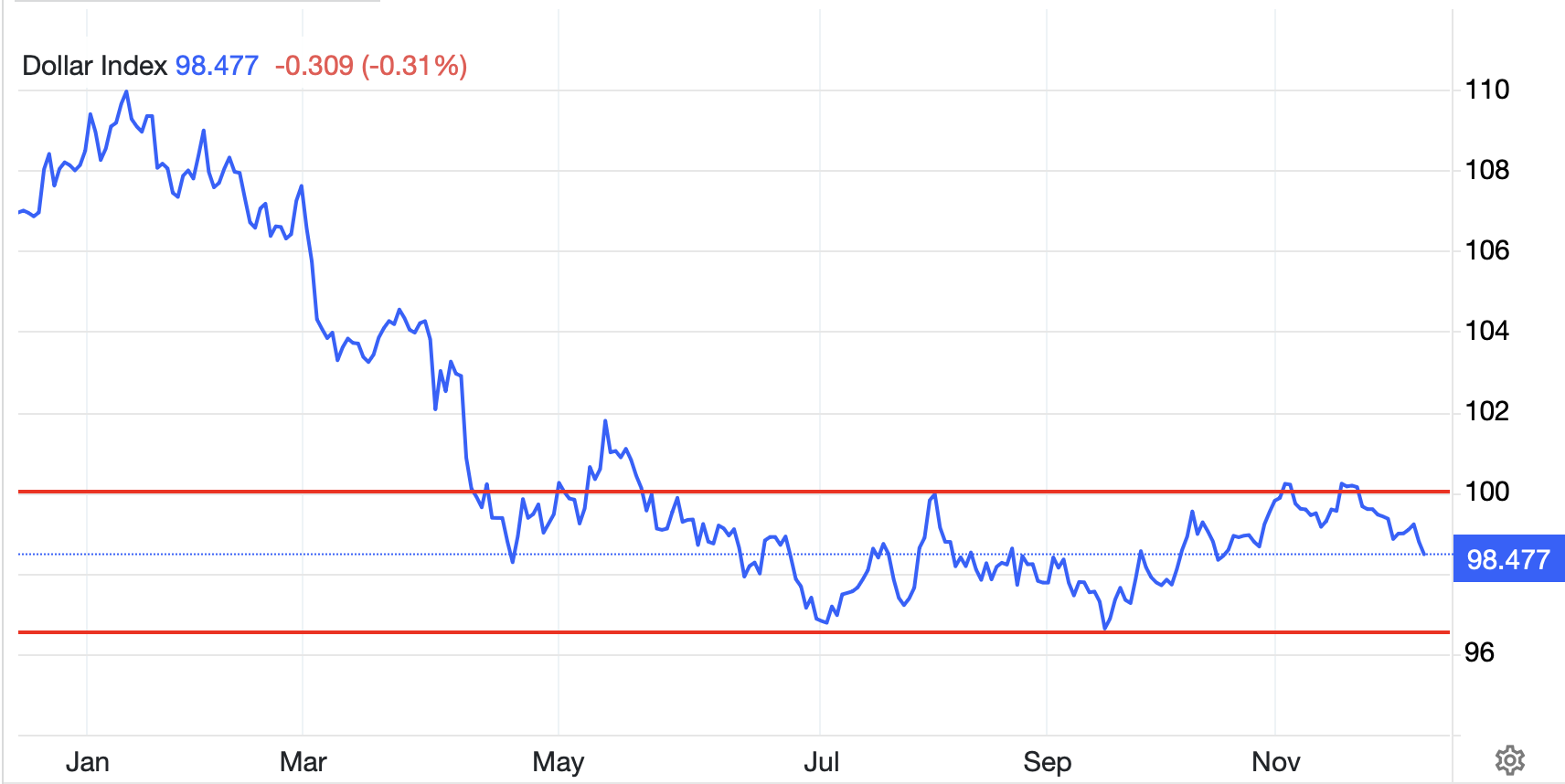
As to the dollar writ large, while it sold off a bit yesterday, as you can see from the below DXY (-0.3%) chart, it is hardly making new ground, rather it is back to the middle of its 6-month range.  

Source: tradingeconomics.com

This morning more currencies are a bit stronger but in the G10, CHF (+0.45%) is the leader with everything else far less impactful.  And on the flip side, INR (-0.7%) has traded to yet another historic low (USD high) as the new RBI governor has decided not to waste too much money on intervention.  Oh yeah, JPY (+0.2%) has gotten some tongues wagging as now that the Fed cut and the BOJ is ostensibly getting set to hike, there is more concern about the unwind of the carry trade.  My view is, don’t worry unless the BOJ hikes 50bps and promises a lot more on the way.  After all, if the Fed has finished cutting, something that cannot be ruled out, this entire thesis will be destroyed.

On the data front, Initial (exp 220K) and Continuing (1950K) Claims are coming as well as the Trade Balance (-$63.3B).  There are no Fed speakers on the docket, but I imagine we will hear from some anyway, as they cannot seem to shut up.  

It would not surprise me to see the dollar head toward the bottom of this trading range, but I think we need a much stronger catalyst than uncertainty from the Fed to break the range.

Good luck

Adf

Cold Growth

Winter approaches
Both cold weather and cold growth
Plague Japan’s future


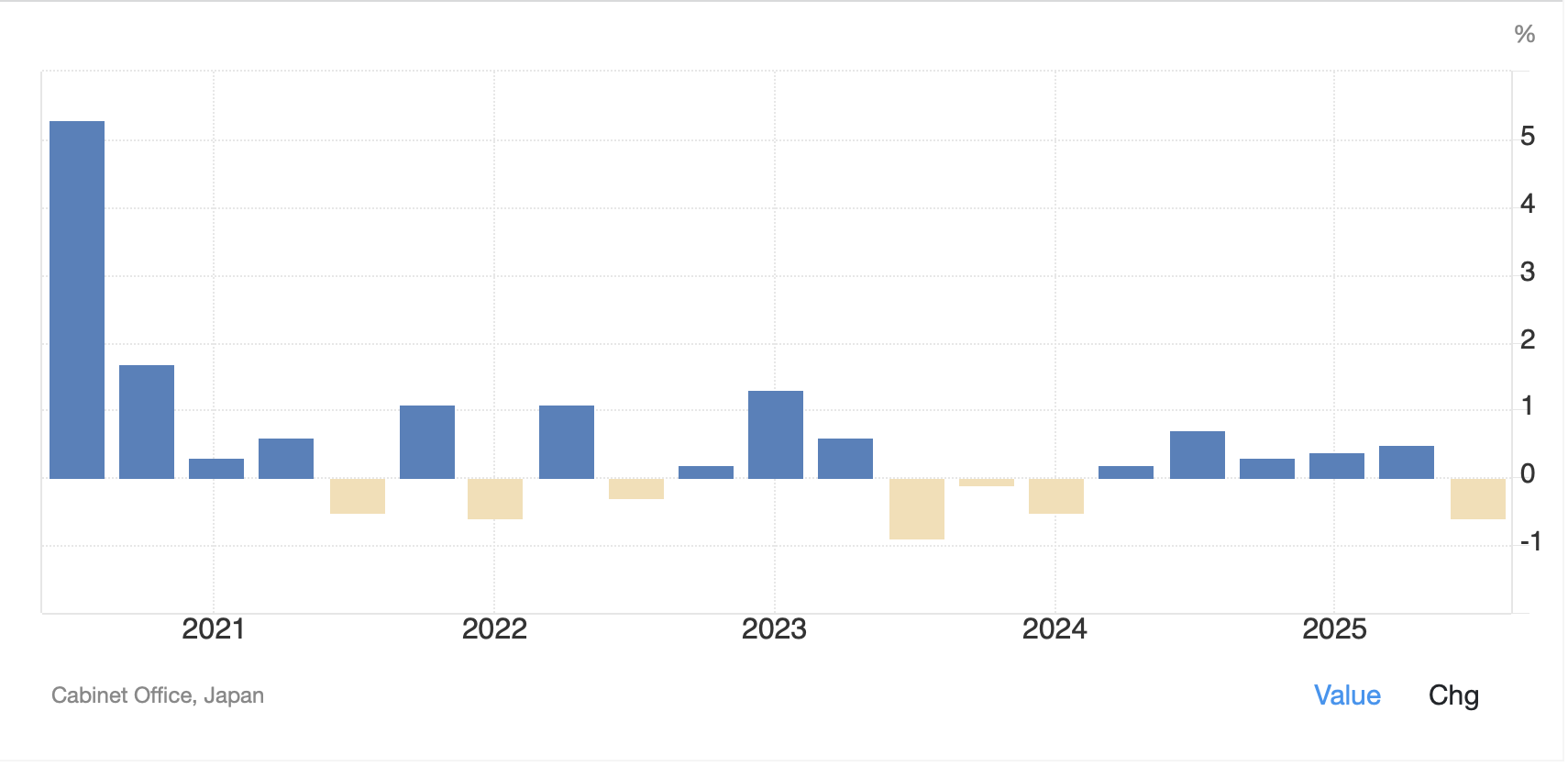
It’s not a pretty picture, that’s for sure.  A raft of Japanese data was released early Sunday evening with GDP revised lower (-0.6% Q/Q, -2.6% Y/Y) and as you can see from the Q/Q chart below, it is hard to get excited about prospects there.

Source: tradingeconomics.com

Of course, this is what makes it so difficult to estimate how Ueda-san will act in a little less than two weeks’ time.  On the one hand, inflation remains a problem, currently running at 3.0% and showing no signs of declining.  Recall, the BOJ has a firm 2.0% target, so they are way off base here.  Add to that the fact that inflation in Japan had been virtually zero for the prior 15 years and the population is starting to get antsy.  However, if growth is retreating, how can Ueda-san justify raising rates?

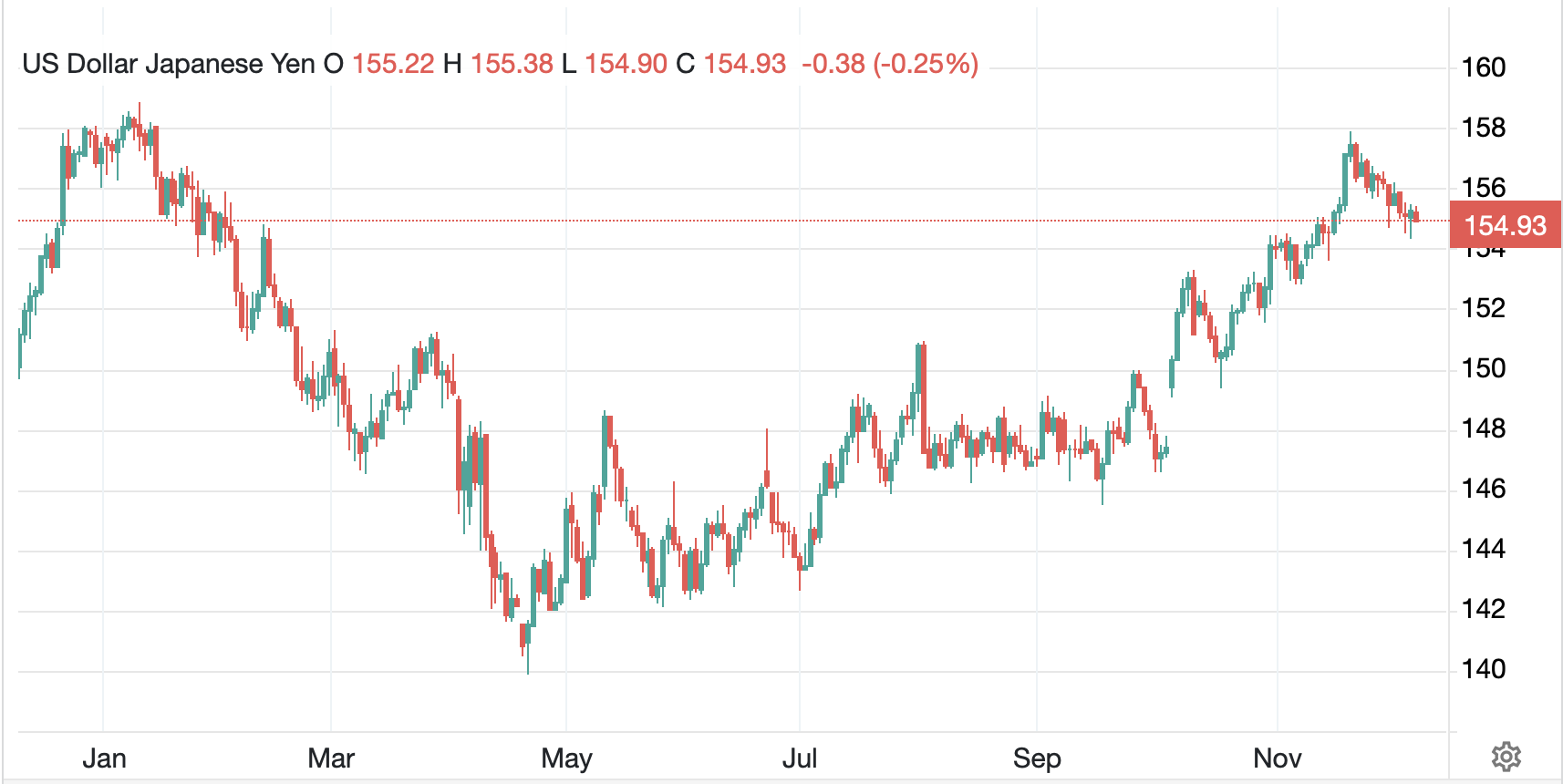
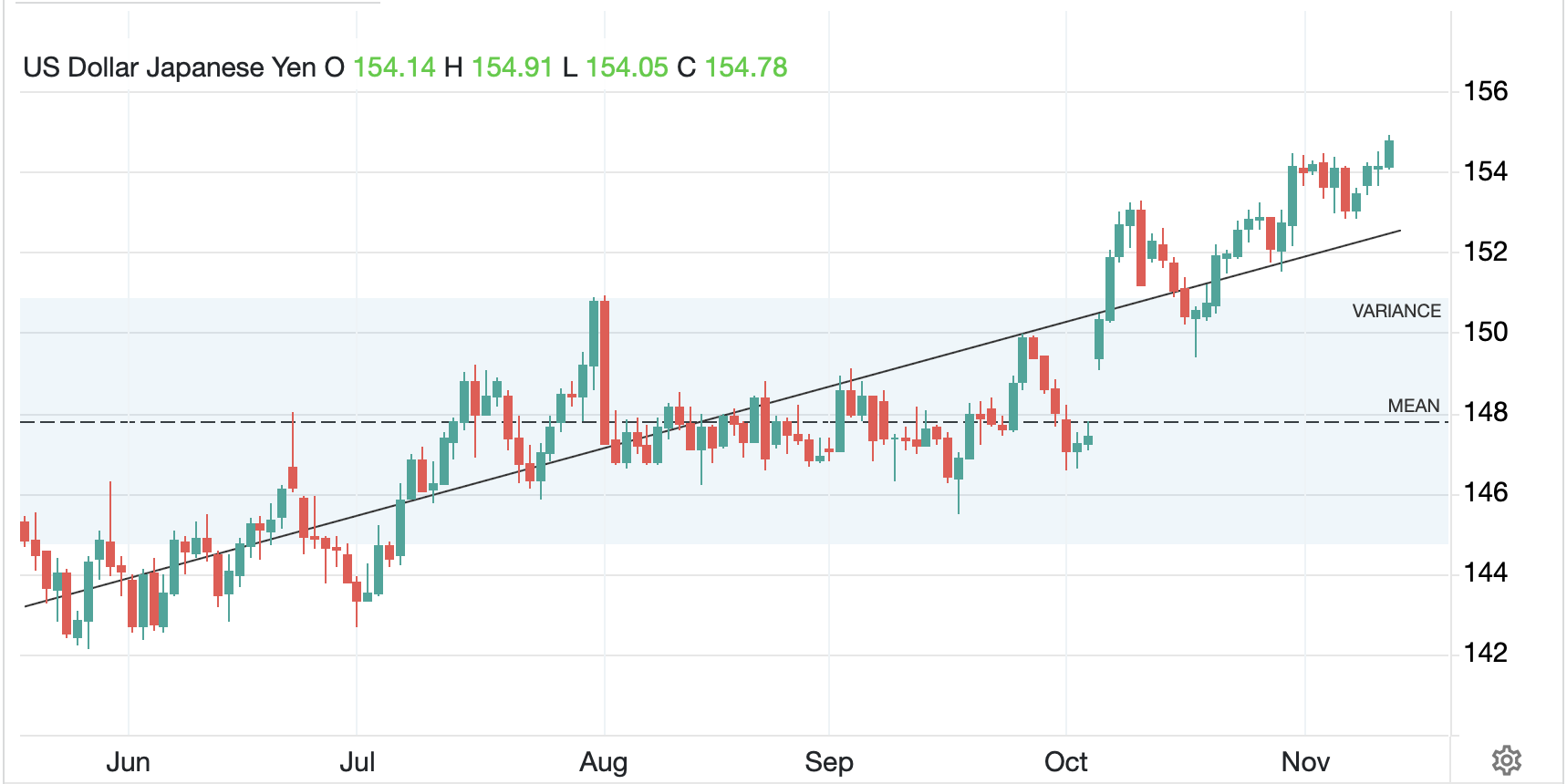
In the meantime, the punditry is having a field day discussing the yen and its broad weakness, although for the past three weeks, it has rebounded some 2% in a steady manner as per the below chart,

Source: tradingeconomics.com

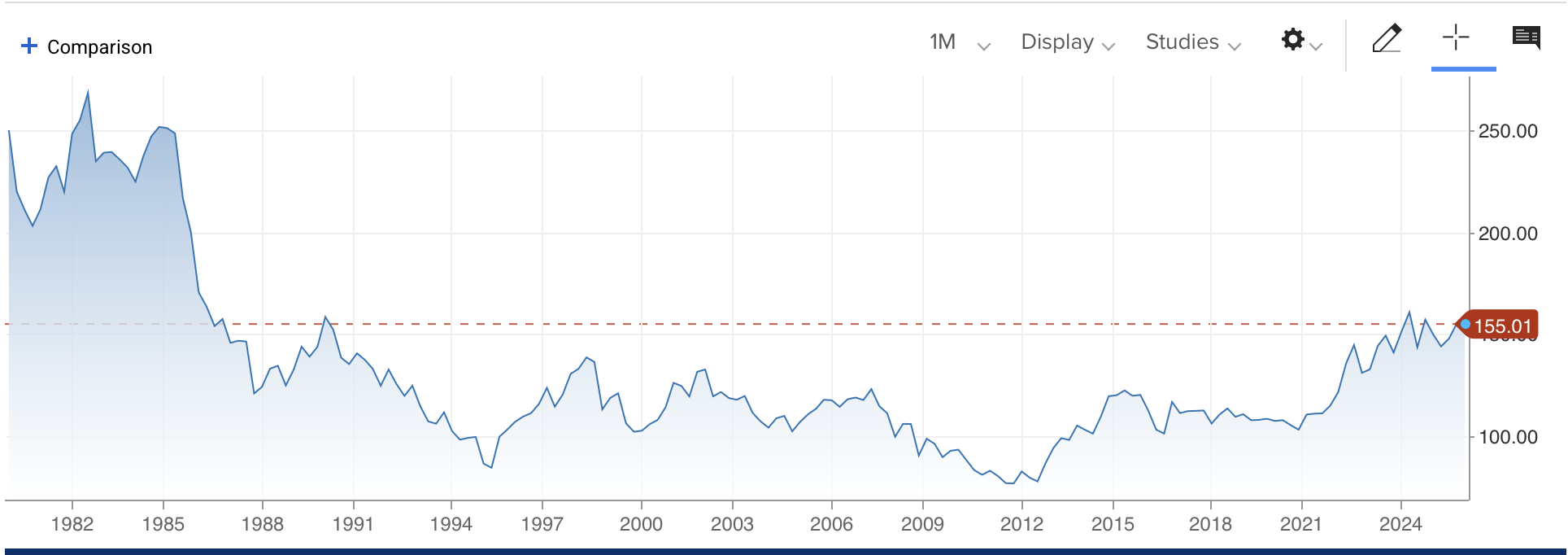
As well, much digital ink has been spilled regarding the 30-year JGB yield which has traded to historic highs as per the below chart from cnbc.com.

There are many pundits who have the view that the Japanese situation is getting out of control.  They cite the massive public debt (240% of GDP), the fact that the BOJ holds 50% of the JGB market, the fact that the yen has declined to its lowest level (highest dollar value) since a brief spike in 1990 and before that since 1986 when it was falling in the wake of the Plaza Accord.

Source: cnbc.com

Add in weakening economic growth and growing tensions with China and you have the makings of a crisis, right?  But ask yourself this, what if this isn’t a crisis, but part of a plan.  Remember, the carry trade remains extant and is unlikely to disappear just because the BOJ raises rates to 0.75% in two weeks.  This means that Japanese investors are still enamored of US assets, notably Treasuries, but also stocks and real estate, as a weakening yen flatters their holdings.  Too, it helps Japanese companies compete more effectively with Chinese competitors who benefit from a too weak renminbi as part of China’s mercantilist model.  Michael Nicoletos, one of the many very smart Substack writers, wrote a very interesting piece on this subject, and I think it is well worth a read.  In the end, none of us know exactly what’s happening but it is not hard to accept that some portion of this theory is correct as well.  The one thing of which I am confident is the end is not nigh.  There is still a long time before things really become problematic.

And the yen?  In the medium term I still think it weakens further, but if the Fed gets very aggressive cutting rates, that will likely result in a short-term rally.  But much lower than USDJPY at 145-150 is hard for me to foresee.

Turning to the other noteworthy news of the evening, the Chinese trade surplus has risen above $1 trillion so far in 2025, with one month left to go in the year.  This is a new record and highlights the fact that despite much talk about the Chinese focusing more on domestic consumption, their entire economic model is mercantilist and so they continue to double down on this feature.  While Chinese exports to the US fell by 29% in November, and about 19% year-to-date, they are still $426 billion.  However, China’s exports to the rest of the world have grown dramatically as follows: Africa 26%, Southeast Asia 14% and Latin America 7.1%.  Too, French president Emanuel Macron just returned from a trip to Beijing, meeting with President Xi, and called out the Chinese for their export policies, indicating that Europe needed to take actions (raise tariffs or restrict access) before European manufacturing completely disappears.  (And you thought only President Trump would suggest such things!)

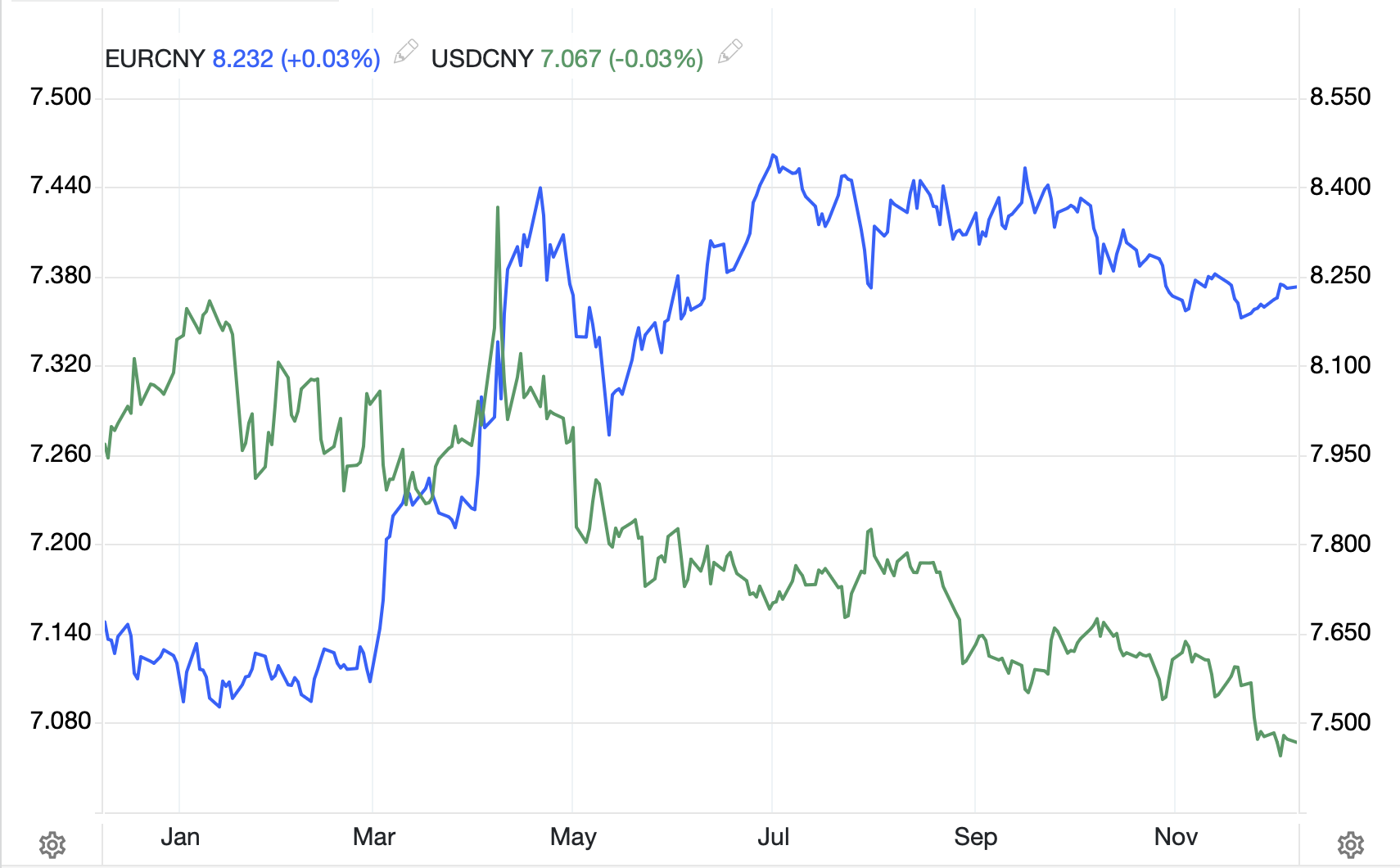
So, how did markets respond to this?  Well, the CSI 300 rose 0.8% (although HK fell -1.2%) and the renminbi was unchanged.  But I think it is worth looking at the renminbi’s performance vs. other currencies, notably the euro, to understand Monsieur Macron’s concerns.

Source: tradingeconomics.com

It turns out that the CNY has weakened by nearly 7.5% vs. the euro this year, a key driver of the growing Chinese trade surplus with Europe (and now you better understand the Japanese comfort with a weaker JPY).  My observation is that the pressure on Chinese exports is going to continue to grow going forward, especially from the other G10 nations.  Expect to hear more about this through 2026.  It is also why I see the eventual split of a USD/CNY world.

Ok, let’s look around elsewhere to see what happened overnight.  Elsewhere in Asia, things were mixed with Tokyo (+0.2%) up small, Korea (+1.3%) having a solid session along with Taiwan (+1.2%) although India (-0.7%) went the other way.  As to the smaller, regional exchanges, they were mixed with small gains and losses.  In Europe, it is hard to get excited this morning with minimal movement, less than +/- 0.2% across the board.  And at this hour (7:25) US futures are little changed.

In the bond market, yields are continuing to rise around the world.  Treasury yields (+2bps) are actually lagging as Europe (+4bps to +6bps on the continent and the UK) and Japan (+3bps) are all on the way up this morning.  This is Fed week, so perhaps that is part of the story, although the cut is baked in (90% probability).  Perhaps this is a global investor revolt at the fact that there is exactly zero evidence that any government is going to do anything other than spend as much money as they can to ensure that GDP continues to grow.  QE will be making another appearance sooner rather than later, in my view, and on a worldwide basis.

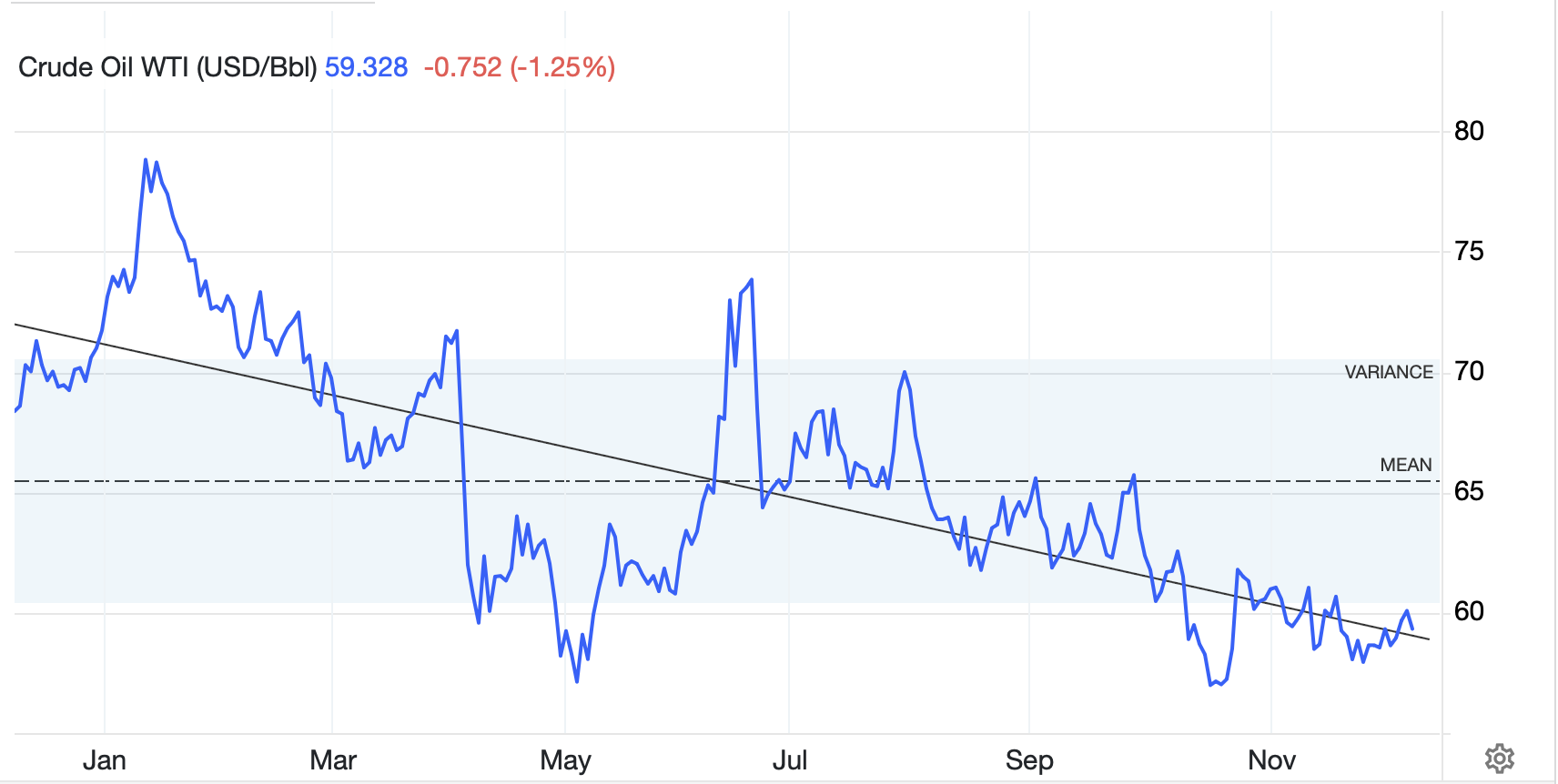
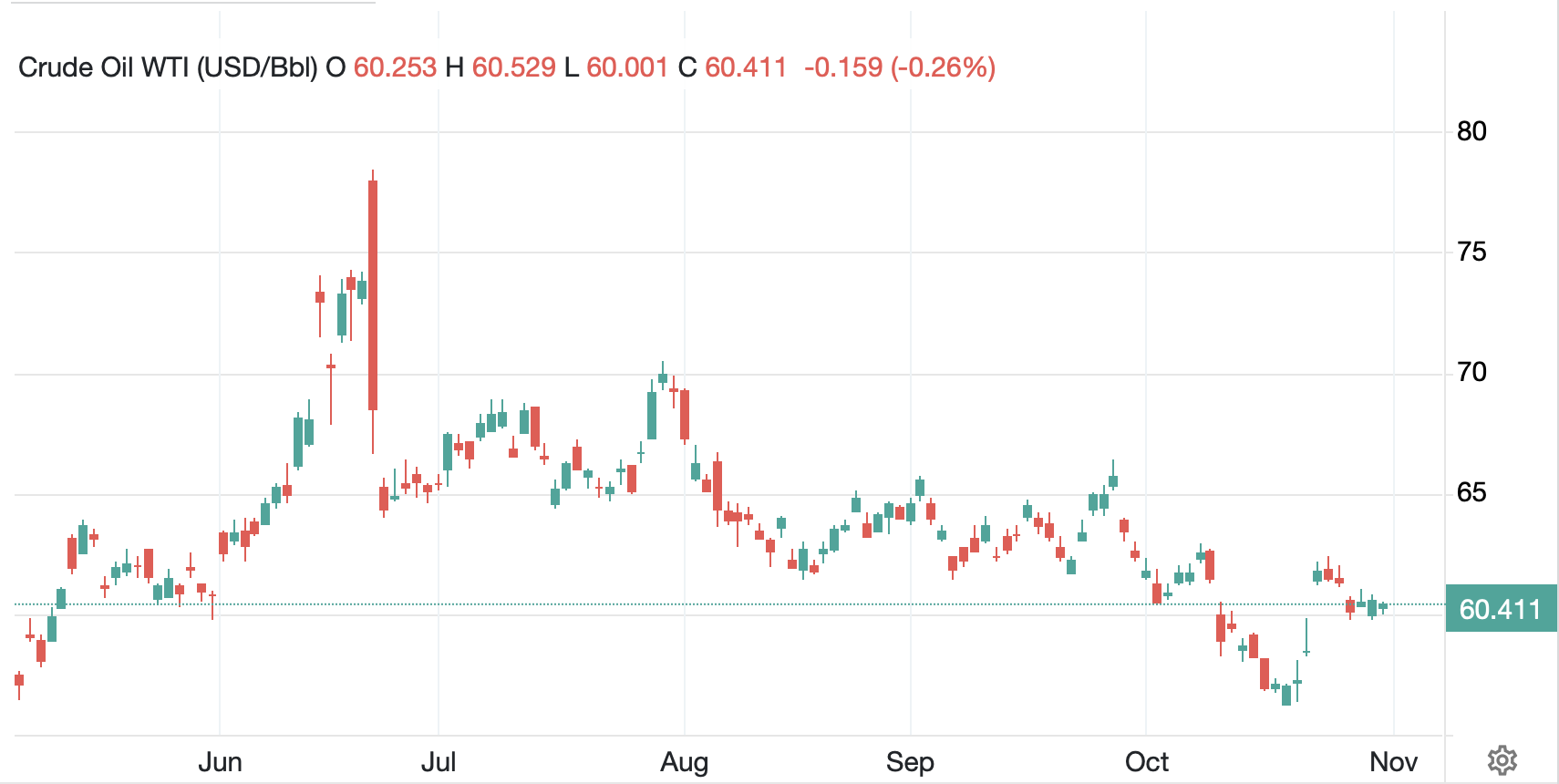
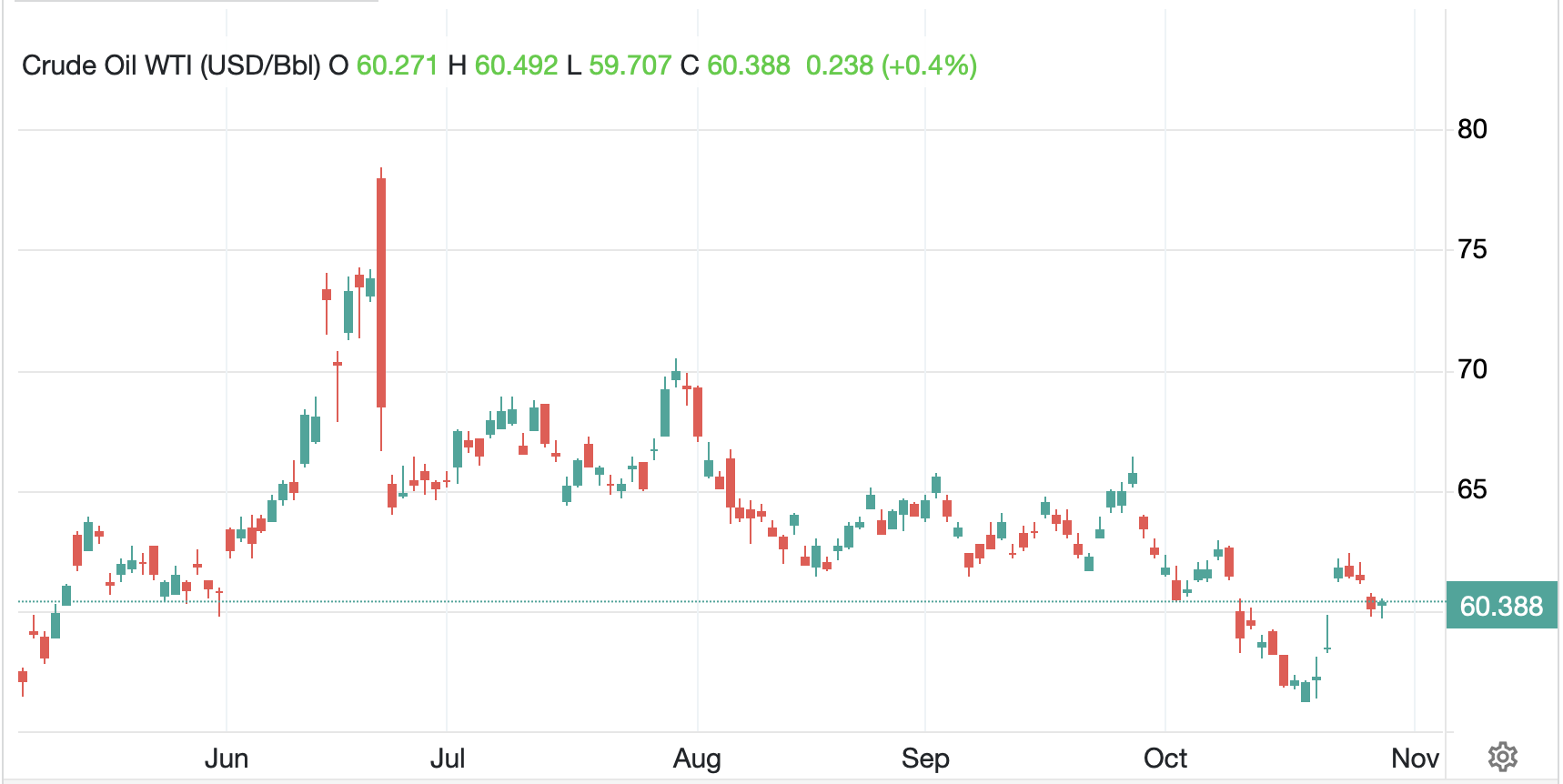
When we see that, commodity prices seem likely to rise even further, at least metals prices will and this morning that is true across the precious metals space (Au +0.3%, Ag +0.3%, Pt +1.2%) although copper is unchanged on the day.  Oil (-1.2%) though is not feeling the love this morning despite growing concerns of a US invasion of Venezuela, ongoing Ukrainian strikes against Russian oil infrastructure and the prospects of central bank rate cuts to stimulate economic activity.  One thing to note in the oil market is that China has been a major buyer lately, filling its own SPR to the brim, so buying far more than they consume.  If that facility is full, then perhaps a key supporter of prices is gone.  I maintain my view that there is plenty of oil around and prices will continue to trend lower as they have been all year as per the below chart.

Source: tradingeconomics.com

Finally, nobody really cares about the FX markets this morning with the DXY exactly unchanged and all major markets, other than KRW (+0.5%) within 0.2% of Friday’s closing levels.  There is a lot of central bank activity upcoming, and I suppose traders are waiting for any sense that things may change.  It is worth noting that a second ECB member, traditional hawk Olli Rehn, was out this morning discussing the potential need for lower rates as Eurozone growth slows further and he becomes less concerned about inflation.  Expect to hear more ECB members say the same thing going forward.

On the data front, things are still messed up from the government shutdown, but here we go:

TuesdayRBA Rate Decision3.6% (unchanged)
 NFIB Small Biz Optimism98.4
 JOLTS Job Openings (Sept)7.2M
WednesdayEmployment Cost Index (Q3)0.9%
 Bank of Canada Rate Decision2.25% (unchanged)
 FOMC Rate Decision3.75% (-25bps)
ThursdayTrade Balance (Sept)-$61.5B
 Initial Claims221K
 Continuing Claims1943K

Source: tradingeconomics.com

There is still a tremendous amount of data that has not been compiled and released and has no date yet to do so.  Of course, once the FOMC meeting is done on Wednesday, we will start to hear from Fed speakers again, and Friday there are three scheduled (Paulson, Hammack and Goolsbee).

As we start a new week, I expect things will be relatively quiet until the Fed on Wednesday and then, if necessary, a new narrative will be created.  Remember, the continuing resolution only goes until late January, so we will need to see some movement by Congress if we are not going to have that crop up again.  In the meantime, there is lots of talk of a Santa rally in stocks and if I am right and ‘run it hot’ is the process going forward, that has legs.  It should help the dollar too.

Good luck

Adf

The Narrative’s Turned

Last Friday it certainly seemed
The bears had achieved what they’d dreamed
Most bulls were in hell
As stock markets fell
While bears felt that they’d been redeemed
 
But since then, the narrative’s turned
And short-sellers all have been burned
In fact, round our sphere
Investors all cheer
For Jay to cut rates, Fed hawks spurned


The holiday spirit is alive and well this morning, and in truth has been all week.  And not just in the US, but around the world.  Literally, I am hard-pressed to find a stock market that has declined in the past twenty-four hours, with most on multi-day rallies.  And so, I must wonder, has everything really gotten that much better in the world?

A quick tour around the world of problems extant includes:

  • Russia/Ukraine war
  • Chinese property deflation
  • Net zero insanity
  • TDS
  • K-shaped economies
  • Rise of Socialism
  • Excessive global debt/leverage
  • Cost of living

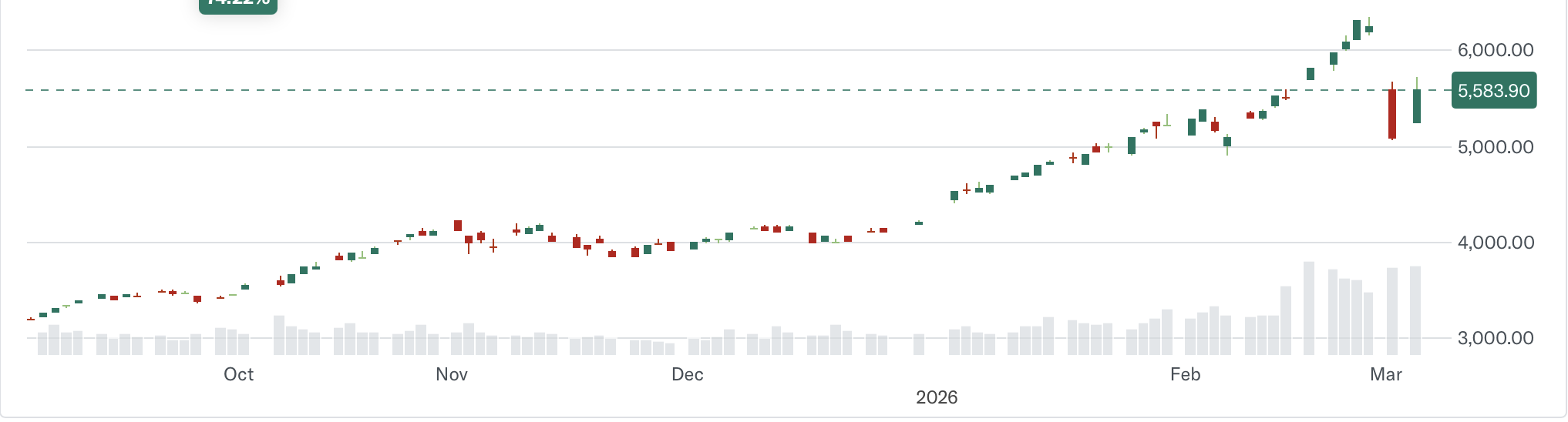
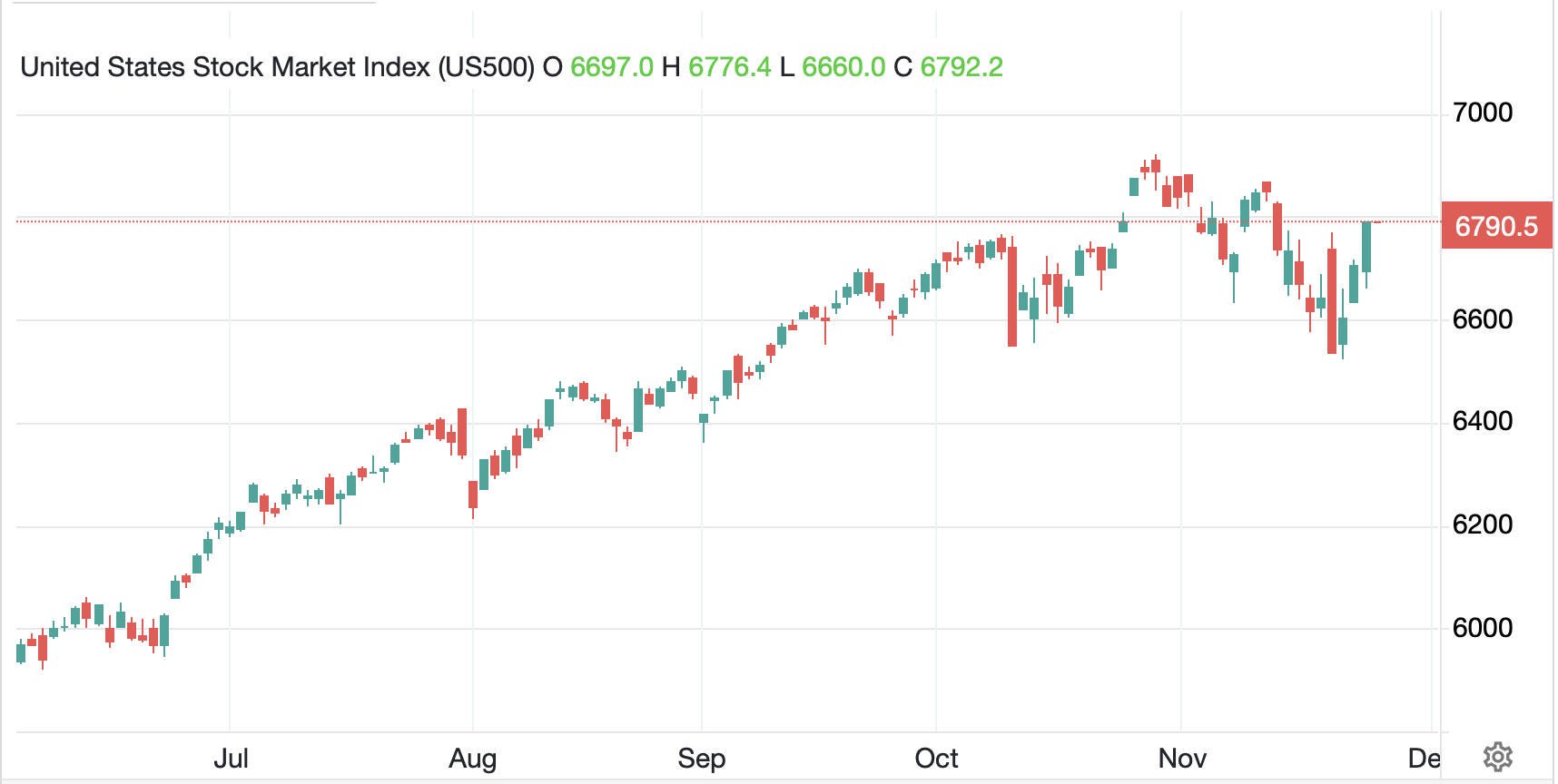
I’m sure there are others, but I just wanted to touch on a few and try to figure out why investors have turned so positive.  After all, a look at the S&P 500 chart below shows that we are less than 2% from the historic highs set back on October 29th.

Source: tradingeconomics.com

So, let’s run through the list.

  • The war in Ukraine continues apace, although we cannot ignore the uptick in ostensible peace talks that have been occurring in the past week.  I’m game to accept those talks as a positive.
  • The Chinese economy continues to overproduce amid weakening domestic demand as property prices show no signs of bottoming.  This is one of the major reasons for the massive global imbalances we have experienced over the past two decades and President Xi has basically proven that they only model he understands is mercantilism.  With President Trump addressing that directly, this will continue to generate uncertainty and volatility, so there will be up days, but also plenty of down ones.
  • The ongoing waste of resources in this Quixotic effort, especially by the Europeans will serve only to further depress their economies while adding debt to pay for their ill-advised policies.  As long as this continues, Europe will be poorer in the future and that doesn’t bode well for their equity markets.
  • Nothing will change TDS but its bifurcation of the population, and not just the US but globally, is likely to be a net negative for everything.
  • The K-shaped economy is a major problem, and not one restricted to the US.  As long as this remains the case, it will breed social unrest, as we continue to see, and have encouraged policies that have proven time and again to be disastrous, but sound good to those in the bottom leg of the K, i.e. Socialism.  I assure you, Socialism will not enhance market capitalization.
  • See above
  • The global debt problem continues to hang over the global economy like the Sword of Damocles, ready to decimate economies with just the right (wrong?) catalyst.  Of course, this is why rate cuts are so favored, and QE more so, but while those may be solutions for government accounts, they will simply exacerbate the last on this list
  • I specifically point to the cost of living since the economists’ concept of inflation, the rate of change of prices, is irrelevant to most people.  The price level is the key, and there is no world where the price level will decline absent a major depression, which is why run it hot is the favored plan.  If growth can be raised sufficiently so that people believe life is affordable again, it will alleviate the K-shaped problem as well as the socialism problem.  But that is a big IF.

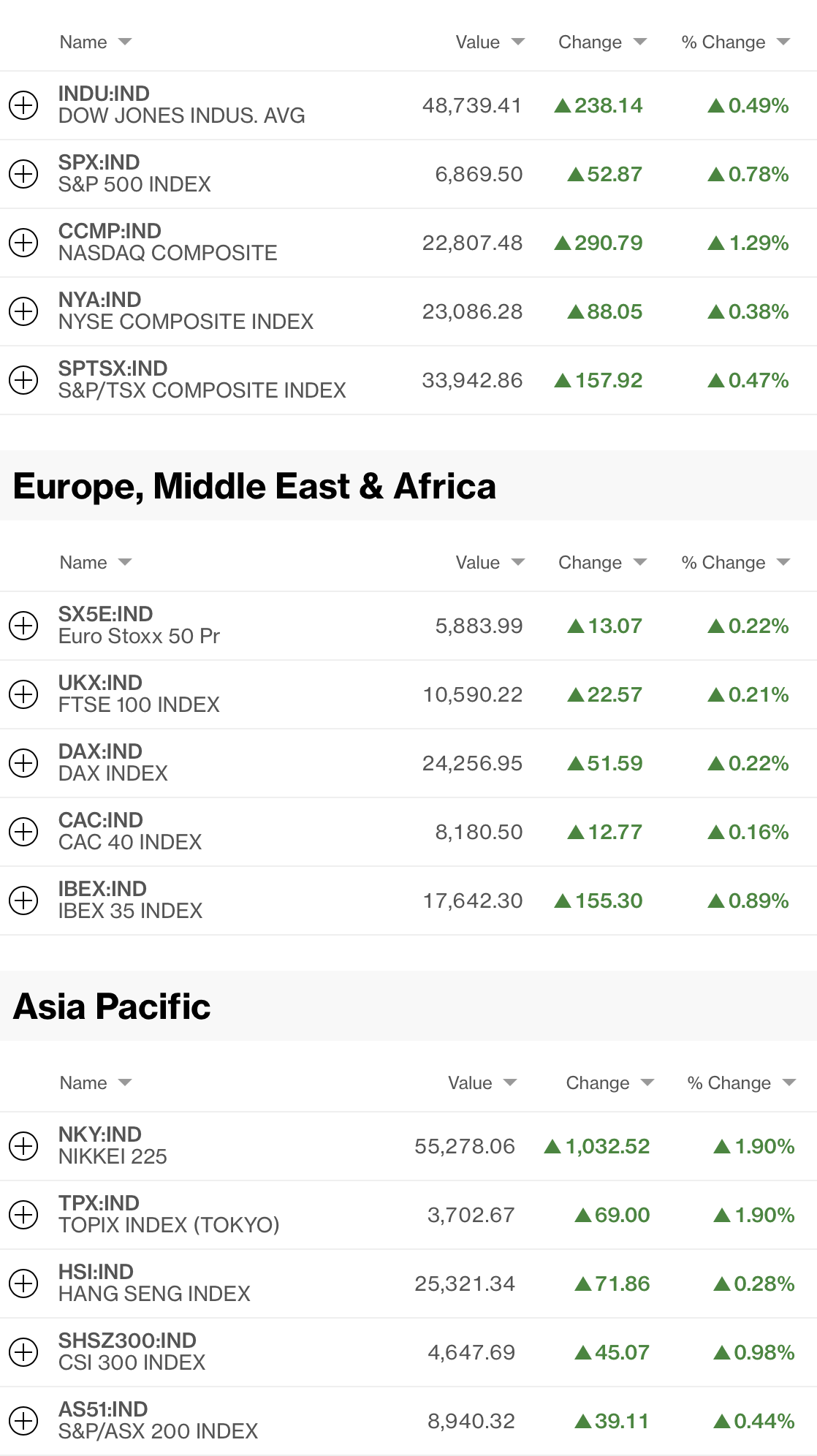
And yet, as you can see from this screenshot from Bloomberg.com, as I type, every market is in the green.

My conclusion is that either investors have grown to believe that the key short-term problems, like Russia/Ukraine will be effectively addressed, or under the guise of YOLO, they are all in on AI and the stock market and see it as the only way forward.  I wish I could be so sanguine, but then I am just an old misanthrope.  I hope they are right!

Ok, well, absent any real new news, and leading up to the Thanksgiving holiday here in the US, market signals are telling me everything is right with the world.  You see the equity markets above, and US futures are higher as well at this hour (7:30), albeit only about 0.2%.  

In the meantime, with risk in such demand, it is no surprise that bond yields are edging higher with Treasuries +2bps, after trading below 4.0% during yesterday’s session on a weak ADP weekly employment report (-13.5K) as well as PPI data that seemed less concerning.  European sovereign yields have all edged higher by 1bp this morning, again synchronous with risk on, and JGB yields also edged higher by 1bp after the government there explained they would be borrowing ¥11.5 trillion (~$73.5 billion) in extra debt to fund Takaichi-san’s supplementary budget.  The big outlier is Australia, where AGBs rose 10bps after CPI rose a hotter than expected 3.8% in October, not only putting paid any thoughts of a further rate cut but bringing rate hikes back into view.

In the commodity markets, oil (-0.2%) continues to slide lower, now below $58/bbl, and following its recent trend as per the below tradingeconomics.com chart.

Javier Blas, the widely respected Bloomberg oil analyst, put out an op-ed this morning explaining that he saw higher oil prices in the future.  That is at odds with my view, but I have linked it here so you can help determine if his reasons make sense.  I believe he underestimates both the impact of technology making it ever cheaper to get oil, and the political incentives to drill for more of the stuff by those nations that have it.  Net zero will not survive much longer in my view.

In the metals markets, prospects for lower interest rates have helped encourage further buying and this morning we see the entire complex higher (Au +0.7%, Ag +1.5%, Cu +1.3%, Pt +1.0%).  To the extent that the leverage story remains, and governments are going to continue to print money to pay their debts, metals prices across both precious and base, should continue to appreciate in price.

Finally, the dollar, which slipped a bit yesterday, is mixed this morning.  the yen (-0.3%) is sliding along with KRW (-0.6%), but really, there seem to be more gainers than that.  The biggest mover was NZD (+0.8%) after the RBNZ cut its base rate, as expected, but indicated the cutting cycle is over.  AUD (+0.3%) has also rallied on that inflation report.  I haven’t focused much on the renminbi (+0.1%) lately, largely because the daily movement is typically small, but if you look at the chart below, you can see that the trend has been steady all year, with CNY appreciating nearly 4% since the beginning of the year.  There are many analyses that indicate the renminbi is massively undervalued, so perhaps this is part of the trade deal with the US.  But it will be difficult for Xi to countenance too much strength as it will negatively impact his mercantilist policies.

Source: tradingeconomics.com

Lastly, the pound is gyrating this morning as Chancellor Rachel Reeves offers her budget.  The highlights are a larger than expected fiscal buffer of £22 billion achieved by raising taxes by more than £29.8 billion on gambling and real estate.  However, the recent history of tax hikes in the UK, as they try to tax the wealthy, is that the wealthy simply leave and the result is tax deficits.  Maybe it really is different this time!

And that’s what we have going into the weekend.  Data today brings September Durable Goods (exp 0.3%, 0.2% ex transport), Initial Claims (225K), Continuing Claims (1975K) and Chicago PMI (44.3).  I see no reason for this recent rebound to end as clearly everybody is feeling good into the holiday.  As I highlighted above, there remain myriad problems around, none of which will be solved soon, but apparently, that doesn’t matter.  So go with it!

There will be no poetry tomorrow or Friday so Monday, we will see how things have evolved.

Good luck and have a great holiday weekend

Adf

Doesn’t Make Sense

In England they call it the pence
But now it just doesn’t make sense
While pennies will still
Live in the cash till
We’ll speak of them in the past tense
 
And as to the shutdown, Trump signed
The CR to leave it behind
While this is good news
It won’t change the views
Of those who are not Trump aligned


For 230 years, the penny was a staple of the US currency system with more than 300 billion currently in circulation.  Of course, I don’t know that I would call them in circulation as they are generally sitting next to the cashier in a dish to be used since most folks don’t want to deal with them, or in a jar in the bedroom where they remain as people cannot throw out something valuable, but don’t want to bother with them either.  Let’s say they are in existence.  But given the rise in the price of copper, as well as the rise in general inflation, the Treasury estimates that it costs about 3.7 cents to mint each one, obviously a losing trade.  While they will remain legal tender, be prepared for everything to be rounded to the nearest nickel soon.  I guess there is no better description of inflation than the fact that the penny has outlived its useful life.  An interesting tidbit, the last coin discontinued by the Mint was the half-penny, which ended in 1857.

On to more important things, last night, President Trump signed the CR and ended the government shutdown.  It strikes me this was a whole lot of politics with no substantive changes to anything.  But it, too, is now history and we move on.  It was interesting to me that there was not a broad “sell the news” outcome as the equity rally early in the week appeared to be based on the prospects that this would occur.  Perhaps that will be today’s trade, although the futures at this hour (7:00) are little changed.  But no matter, there appear to be an increasing number of cracks in the façade of ever higher asset prices.  While the DJIA did set another record yesterday, the NASDAQ slipped.  I don’t foresee a smooth path ahead for risk assets, especially with havens continuing to perform well.

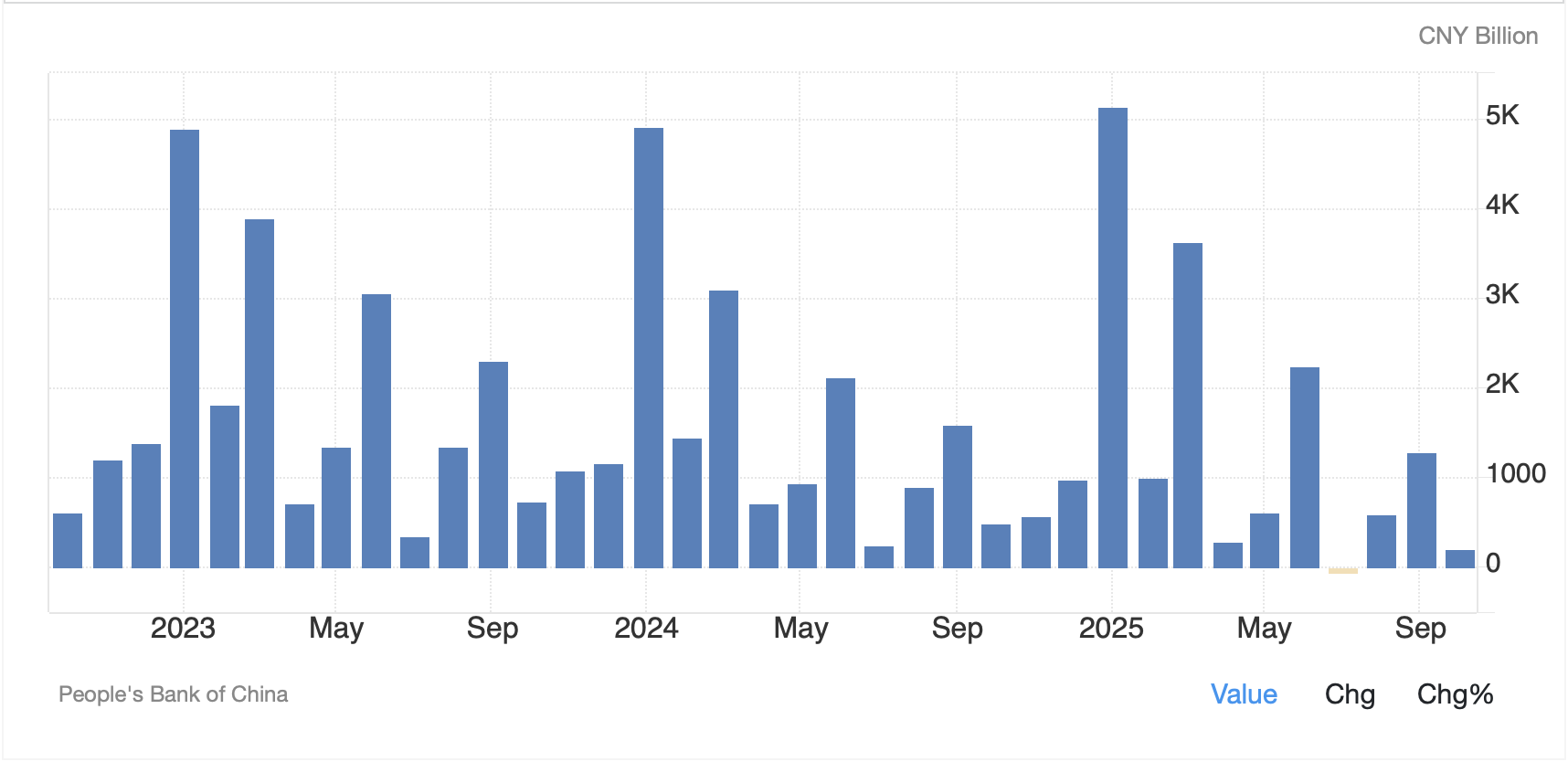
The last thing of note this morning was Chinese monetary data which was released last night.  Remember yesterday’s story about the ‘phantom’ loans?  Well, apparently, that has not been enough to keep the flywheel turning on the mainland as New Bank Loans fell to CNY220 billion, down more than CNY 1 trillion from September and well below last year’s October data of CNY 500 billion as per the chart below from tradingecomomics.com.  There is huge seasonality in this data, with every January showing massive growth, but looking at the past three years of data, my eye tells me things are slowing regularly despite their alleged 5% GDP growth.

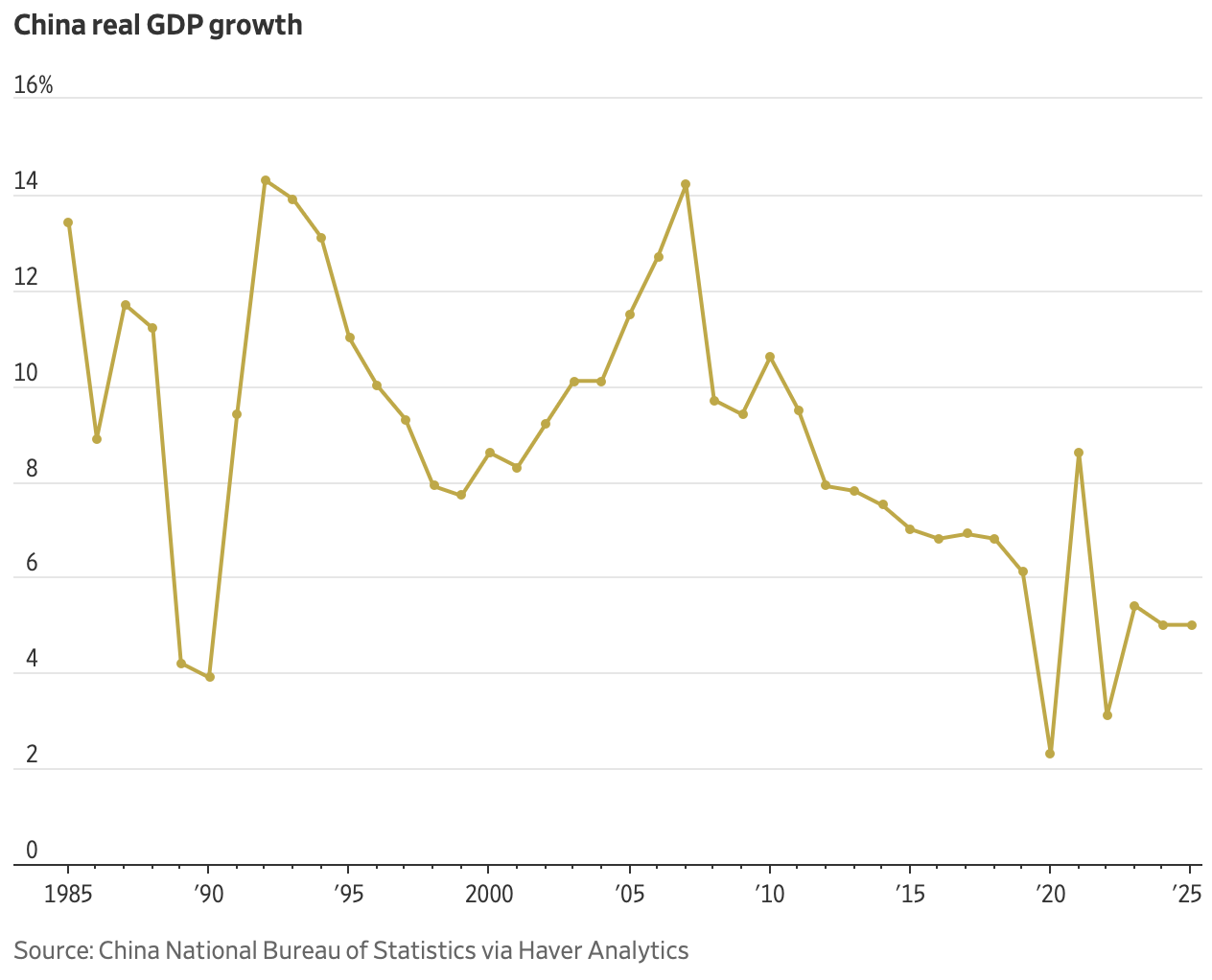
Despite the 4th Plenum declaring they would be focusing on increasing domestic economic activity, President Xi continues to have a difficult time growing the economy organically.  The ongoing GDP targets warp investment decisions which result in overproduction of goods and massive infrastructure spending which drives up debt issuance.  The problem with this cycle is the lack of domestic consumption means that the returns on that infrastructure are terrible, likely negative, and so while building the stuff increases GDP, having it sit there idle doesn’t do anything once its built.  For now, investors continue to believe in the growth story, and I’m confident that Xi Jinping will never allow economic data to be released that would counter that narrative, but trouble is brewing there in my mind.  Just not today!

And that’s really the news this morning, at least from what I’ve seen, so let’s look at markets overnight.  The official end of the government shutdown was widely lauded in Asia with Tokyo (+0.4%), HK (+0.6%) and China (+1.2%) all closing higher in the session.  Korea (+0.5%) also rallied but elsewhere in Asia, things were less satisfactory with Australia, New Zealand and Taiwan all under modest pressure while India was unchanged.  

In Europe, the FTSE 100 (-0.6%) is slipping after weaker than expected GDP data with the Y/Y number slipping to 1.1% while IP fell -2.5%.  It is difficult to look at the chart of GDP below and get the sense that the UK economy is in very good shape.

Source: tradingeconomics.com

All this is with the backdrop of the Starmer government getting set to release its latest budget in just under two weeks and expectations they are going to be raising income taxes yet again as revenues cannot keep up with their welfare state promises.  The problem they have is the pound is not the global reserve currency nor are Gilts the global reserve asset, so it appears the Gilt vigilantes are alive and well although the bond vigilantes remain in hibernation.  As to the continent, the DAX (-0.6%) is also suffering despite no data releases while the CAC (+0.4%) is managing to rally.  The rest of the bourses are generally little changed with all eyes focused on the UK to see how they handle their problems.  Of course, virtually every country on the continent has the same problems!

In the bond market, after sliding -4bps yesterday, 10-year Treasury yields have backed up 2bps this morning.  we are seeing similar price action on the continent with virtually all sovereign debt showing rises of between 1bp (France) and 3bps (Germany, Netherlands), once again mostly tracking the Treasury market.

In the commodity space, oil (+0.7%) is bouncing after a disastrous session yesterday where it fell nearly $2/bbl on news that the IEA increased its supply forecasts (2.5 MM bbl/day) significantly more than its demand forecasts (780K bbl/day).  Certainly, this is aligned with my longer-term bearish view on oil and a look at the chart below shows the trend over the past year remains firmly downward.  Do not be surprised if we get to $50/bbl next year.

Source: tradingeconomics.com

Turning to the metals markets, the rally continues across base and precious this morning and this steady climb after a sharp pullback a few weeks ago seems to have real legs.  This morning, we see gold (+1.0%), silver (+1.3% and pushing its recent ATH), copper (+0.9% despite the loss of penny demand) and platinum (+1.2%).  When governments run it hot, precious metals benefit.

Finally, the dollar is softer this morning with the DXY (-0.25%) slipping back to the middle of its narrowing trading range as per the below chart.

Source: tradingeconomics.com

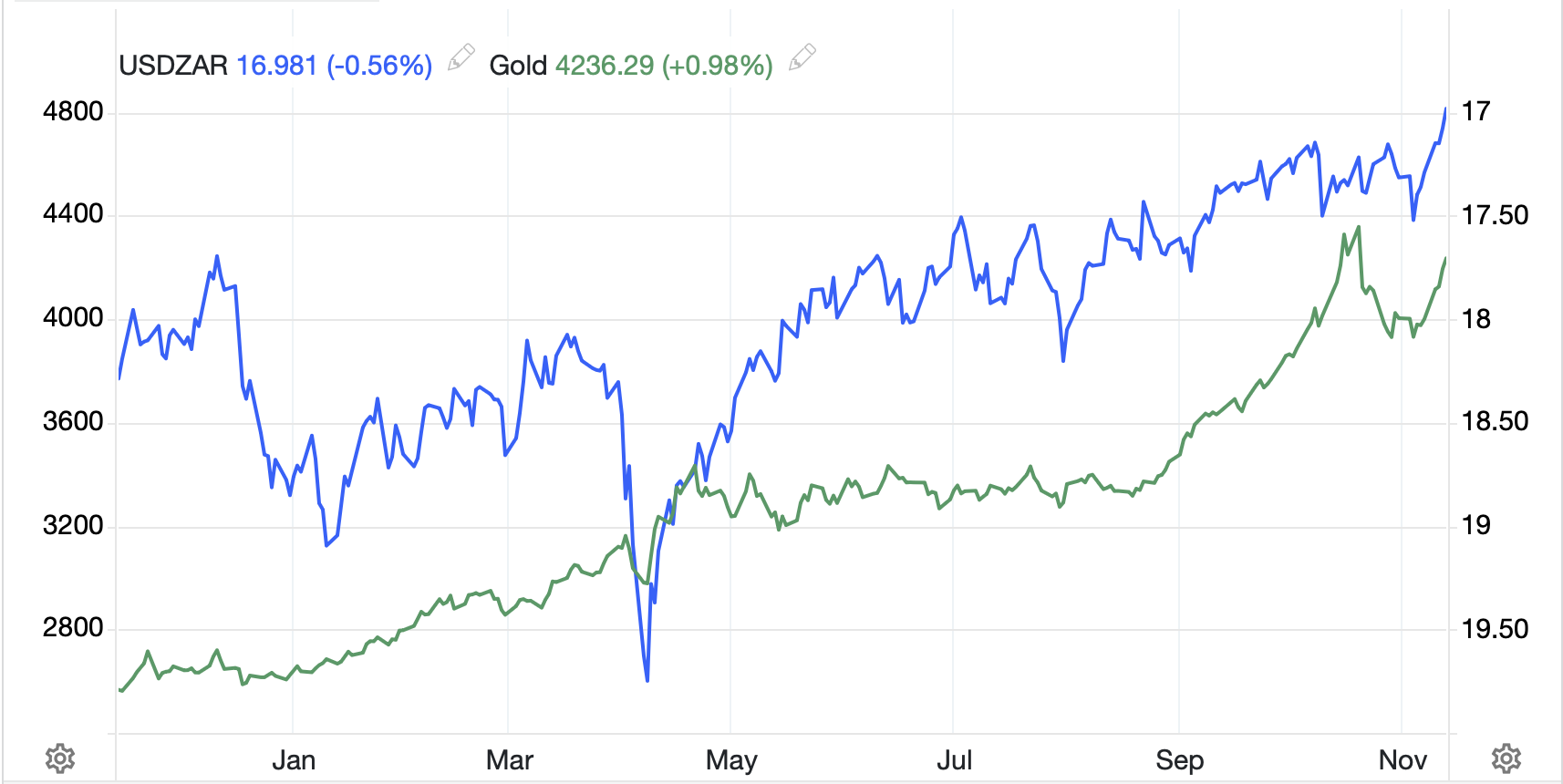
The weakness is universal, though with G10 and EMG currencies stronger across the board.  ZAR (+0.6%) is the leader today as the dollar has fallen back below 17.00 for the first time since January 2023 as it continues to benefit from the rally in gold and platinum.

Source: tradingeconomics.com

It strikes me that if one were so inclined to play a long-term trend in currencies, long ZAR vs. short NOK might be a very interesting way to play the dichotomy between oil’s ongoing decline and gold’s ongoing rally.  But everything is firmer vs. the dollar with the pound (+0.3%), euro (+0.2%) and AUD (+0.3%) highlighting the G10.  In the EMG bloc, CLP (+0.5%) is benefitting from copper’s rally while the CE4 are all higher by 0.3% to 0.4%, mirroring the euro’s rise.  Even CNY (+0.25%) is higher despite the weak monetary data.  Not to be outdone, both MXN (+0.2%) and BRL (+0.3%) are in thrall to a weaker dollar.

While the government is open now, given the closure, no data has been collected so it is not yet clear when we will be seeing the next set of numbers.  Yesterday’s Fedspeak showed caution the watchword regarding more cuts which has led the futures market to reduce the probability of a December cut to just 54% this morning and a definite change in flavor for the curve overall.  It is somewhat surprising that the dollar is not performing better given this adjustment in views. 

Equity prices feel extended and the fear and greed index continues to sit in extreme fear despite the seemingly daily record highs.  I am uncomfortable with stocks overall here and believe they are due for a reckoning, or at least a correction.  But metals have nowhere to go but up.

Good luck

Adf

Quelling the Strains

The government shutdown remains
In place, as the House is at pains
To summon the will
For them to fulfill
Their mandate, while quelling the strains
 
Meanwhile, banks in China are lending
Out cash, though in fact, they’re pretending
But quotas from Xi
Mean he wants to see
More loans to encourage more spending


While the Senate has passed a CR that will fund government completely through January 30th and includes full year funding for Veterans Affairs, the Department of Agriculture and legislative activities (they paid themselves), with the rest yet to be completed, the House is meeting today to vote on the measure, at which point, assuming it passes, it will then be sent to President Trump for his signature.  It should be completed today, but this being Congress, with numerous members seeking to preen to their TikTok viewers, until it is done, we cannot be certain.

Now, get ready to hear a lot about how much the shutdown cost as we will get many estimates from various economists and analysts, and you can be sure that they will reflect the political bias of the estimator.  I have seen estimates ranging from 0.2% of GDP to 0.6% of GDP for the quarter, with appropriate annualizations.  My personal view is the damage will be lesser, not greater, as all federal employees will be receiving back wages and most spending will have been delayed rather than destroyed.  We shall see.

Regarding the US economy, as we missed the first reading of Q3 GDP due to the shutdown, it seems we will be getting our first look at the end of this month.  Now, the Atlanta Fed did not stop working and their GDPNow estimate for Q3 remains quite robust at 4.0% as per the below chart from their website, atlantafed.org, but the damage, of course, will fall in Q4, so we won’t really know until sometime in January with the first look at that data.

However, it is important to understand that an increasing number of analysts are explaining that the economy is slowing rapidly.  Their latest ‘proof’ is from yesterday’s ADP weekly data, an entirely new statistic with a track record of exactly…2 weeks, but which showed that 11,250 jobs were lost last week.  I am no econometrician (thankfully), but it seems to me that building your case on a statistic with 2 data points is weak sauce.  Ultimately, I think the main reason that there is so much uncertainty amongst analysts is the concept of the K-shaped economy, where the wealthy are doing fine, basking in the glow of their equity returns, while those less well-off are struggling with ongoing inflation and a less robust job market.

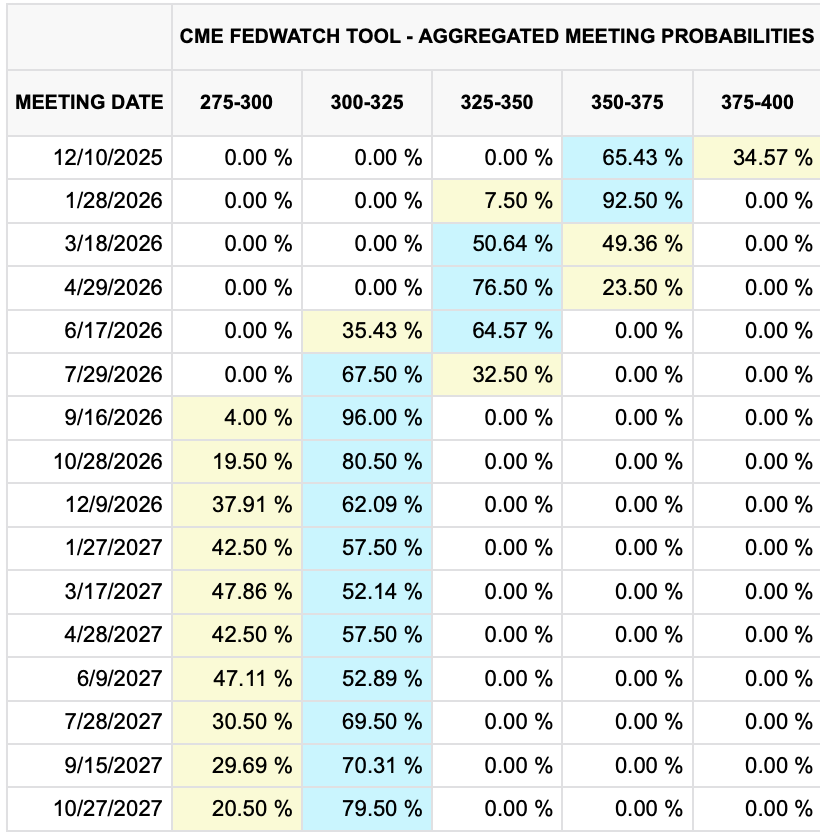
In fact, the Fed is having the same problem, looking at the economy with no consistency as there appears to be a pretty significant rift between the hawks and doves right now.  We got further proof of this (as if the two dissents at the last meeting, one for a bigger cut and one for no move wasn’t enough proof) in this morning’s WSJ where the Fed whisperer, Nick Timiraos, published an article explaining exactly that.  There are two camps, one focused on weakening employment and wanting to cut and one still focused on inflation (allegedly) and wanting to pause.  The Fed funds futures market has reduced the probability of a December cut to 65% as of this morning, but is a lock for that cut by January with a small probability of two more cuts by then.

Nothing has changed my view that they cut next month because I believe that they are essentially unconcerned about inflation at this point, believing 3% is close enough to 2% for government work, and remain entirely focused on the job market.

Turning to the most fascinating international story, it appears that Chinese banks have started to make “phantom” loans, or at least that’s what they are being called, as President Xi is very keen to goose economic activity and the large, state-owned banks have quotas to reach.  So, apparently, what they are doing is going to their best customers, begging them to take out a loan they don’t need, and then having the loans repaid within one month.  The banks are even going so far as to pay the interest so there is no actual impact on anything other than bank loan volume.  Of course, that is the quota being met, so I imagine this will continue.

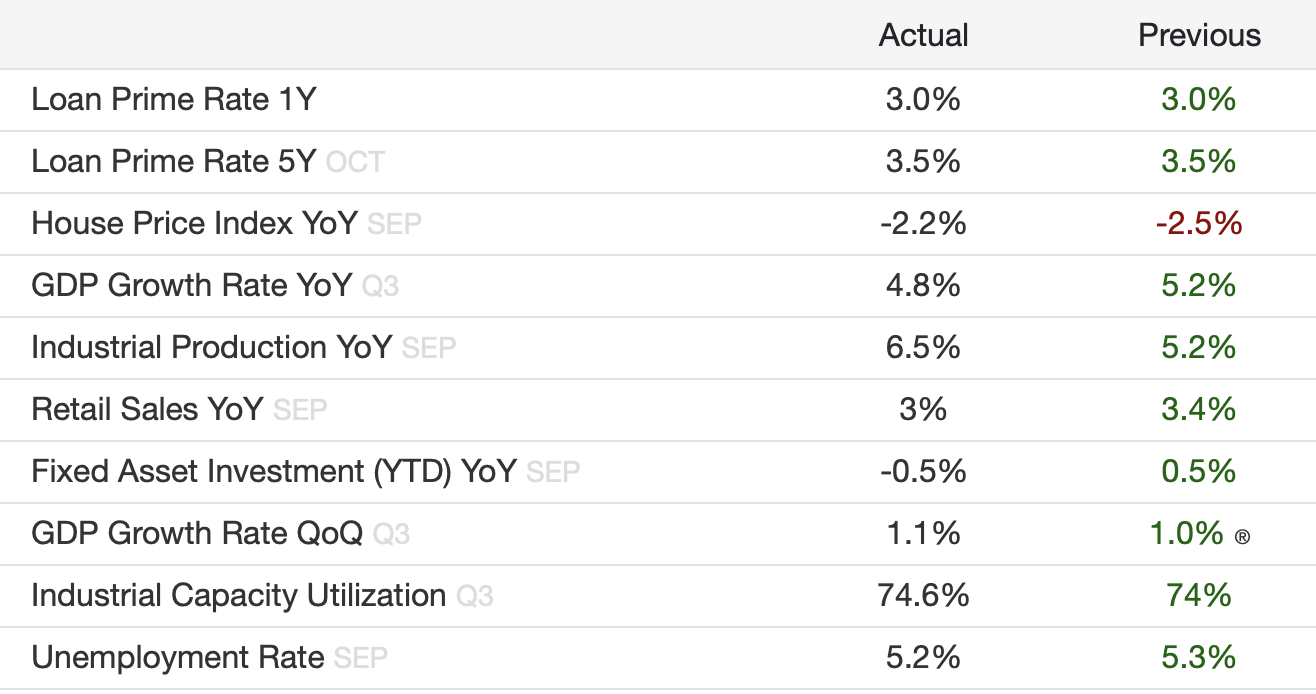
But it makes you wonder, exactly how bad are things in China that banks are resorting to these games?  Perusing the Chinese data from the past month, things are clearly slowing as per the below from tradingeconomics.com:

Too, the PMI data was soft and Foreign Direct Investment is collapsing, falling -10.4% in September. Again, if you want to understand why President Xi was willing to agree a deal with President Trump, the answer is that the Chinese economy remains under intense pressure, and while the currency doesn’t reflect anything about the economy, the fact that Chinese yields are amongst the lowest in the world is a strong signal that things are not great.

Ok, let’s turn to the overnight activity and see how things behaved.  While the US had a mixed performance (NASDAQ fell although the other indices rallied), we continue to see more positive than negative outcomes in Asia on the back of the ongoing tech rally and the end of the shutdown.  Thus, Japan (+0.4%), HK (+0.8%), Korea (+1.1%), India (+0.7% despite a terrorist attack) and Taiwan (+0.6%) all continued their recent rallies.  China (-0.1%) had a much less impressive day. But these markets continue to benefit from the tech story, and I expect that to continue if the tech story continues to be positive.  As to Europe, bourses there are also benefitting from the imminent end of the US shutdown with gains across the board on the continent (DAX +1.2%, CAC +1.1%, IBEX +1.1%) although the UK (-0.15%) is struggling as concerns grow over the nation’s ability to come up with a viable budget that pays for services without raising taxes to a crippling rate.  As to US futures this morning, at this hour (7:30), they are nicely higher, 0.5% or more.

In the bond market, Treasury yields have slipped -4bps, ostensibly on that weak ADP number which has more investors expecting a much weaker economy here.  Europe though, has seen yields tick higher by 1bp across the board, with the UK the exception (+3bps) as concerns over UK finances continue apace.

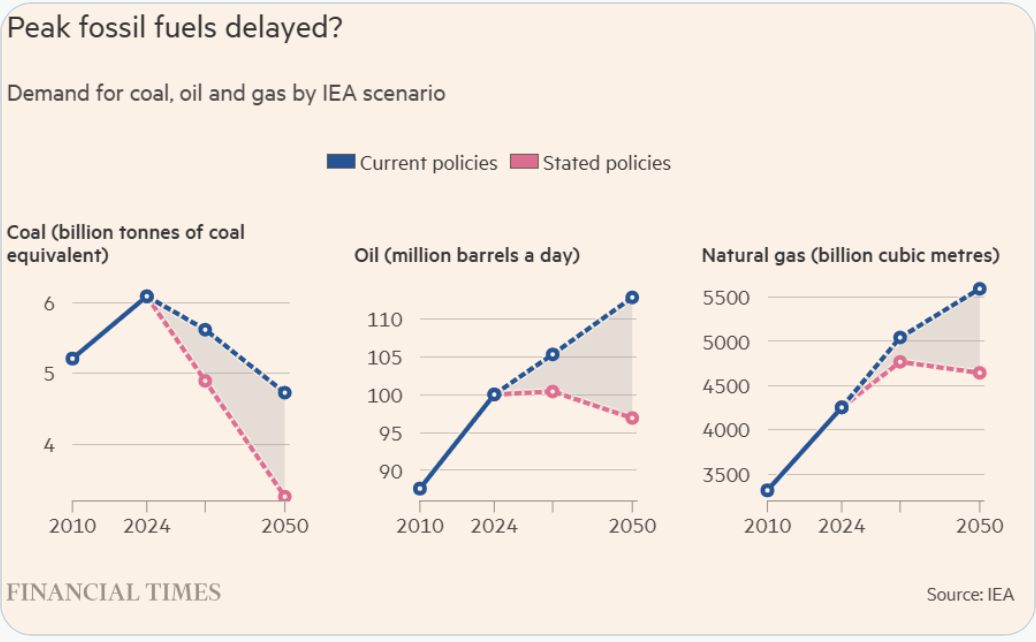
In the commodity markets, oil (-1.1%) which rallied yesterday on growing concerns over the latest US sanctions on Lukoil and Rosneft, have given back those gains and are once again hovering around $60/bbl.  The IEA released their report on the future of energy use, specifically fossil fuels, and in another sign the climate crisis is ending (or at least that it is no longer a concern), they explained that fossil fuel use would now peak in 2050 under current policies, rather than prior to the end of this decade under stated policies.  The FT was kind enough to put together a little graphic showing the two different views, but we all know that stated policies are wishful thinking.

In a nutshell, more oil demand will drive more oil supply, count on it!  Turning to metals, the rally continues this morning with gold (+0.2%) and silver (+1.1%) pushing back toward the highs seen on October 20th.  I strongly believe these markets will continue to rally as the ‘run it hot’ philosophy will be enacted in as many places around the world as can get away with it.  

Finally, the dollar is a touch firmer this morning, with DXY (+0.1%) on the back of continued weakness in the pound (-0.3%) and the yen (-0.4%).  Elsewhere, the picture is mixed with the euro little changed while the rand (+0.5%) continues to benefit from the gold rally.  Otherwise, the dollar remains a back burner issue for most investors right now, although I have read that people are talking about the carry trade again, funding investments with short yen positions.  Certainly, the yen has been quite weak overall as evidenced by its trend over the past six months below.

Source: tradingeconomics.com

There is no data this morning although we will get bombarded with five Fed speakers, three of whom are confirmed doves (Miran, Williams and Waller) while the other two seem more middle of the road (Bostic, Paulson).  At this point, there is no consensus on the economy’s strength or direction and that is evident at the Fed as well as in the analyst community.  The only consensus seems to be that stocks and gold should both continue to rally.  As to the buck, what’s not to like?

Good luck

Adf

A Strong Sense of Urgency

Katayama said
“A strong sense of urgency”
Informs our views now


Source: tradingeconomics.com

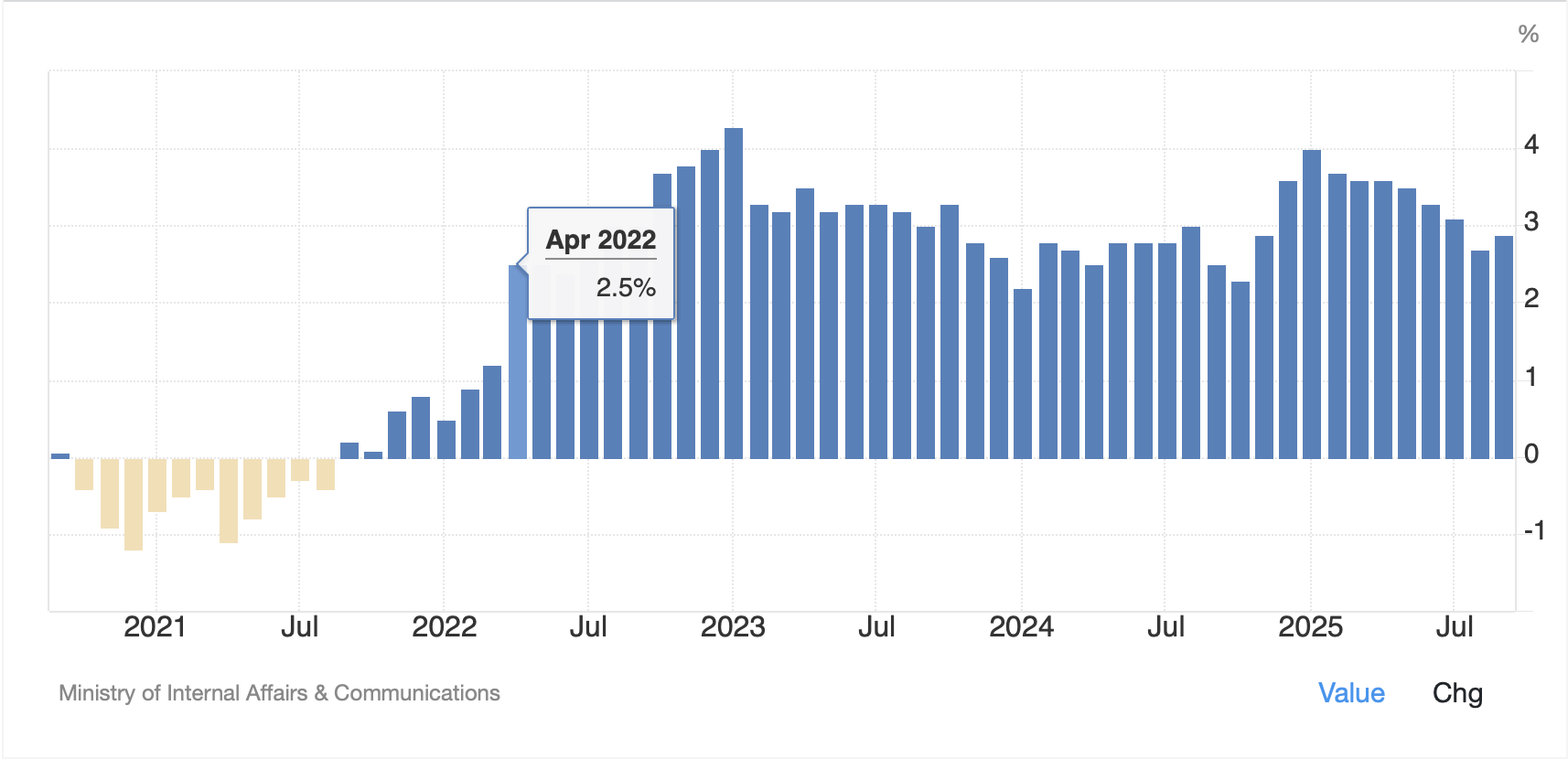
But this is the first step in their typical seven step plan before intervention.  And I get it, the combination of Chairman Powell suddenly sounding hawkish on Wednesday afternoon, telling us a December rate cut was not a foregone conclusion and the BOJ continuing to sit on its hands despite inflation running at 2.9%, the 42nd consecutive month (see below) that it has been above their 2.0% target (sound familiar?), indicates that the current policy stances will likely lead to further dollar strength vs. the yen.  

Source: tradingeconomics.com

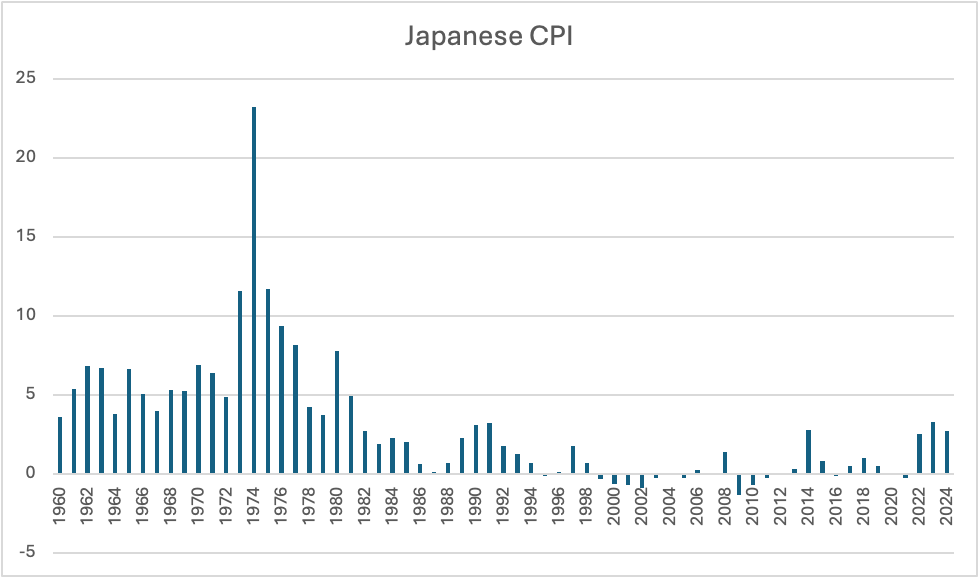
There is something of an irony in the current situation in Japan.  Recall that for years, the Japanese economy was in a major funk, with deflation the norm, not inflation, as government after government issued massive amounts of debt to try to spend their way to growth.  In fact, Shinzo Abe was elected in 2012, his second stint as PM, based on his three arrows plan to reinflate the economy because things were perceived so poorly.  If you look at the chart below, which takes a longer-term view of Japanese inflation, prior to 2022, the two positive spikes between 1992 and 2022 were the result of a hike in the Japanese VAT (they call it the Goods and Services Tax) which raised prices.  In fact, during that 30-year period, the average annual CPI was 0.25%.  And the Japanese government was desperate to raise that inflation rate.  Of course, we know what HL Mencken warned us; be careful what you wish for, you just may get it…good and hard.  I have a sense the Japanese government understands that warning now.

Data source: worldbank.org

Net, it is hard to make a case that the yen is going to reverse course soon.  For receivables/asset hedgers, keep that in mind.  At least the points are in your favor!

So, now that a trade deal’s agreed
Can China reverse from stall speed?
The data last night
Sure gave Xi a fright
More stimulus is what they need!

The other noteworthy macro story was Chinese PMI data coming in weaker than expected with the Manufacturing number falling to 49.0, vs 49.8 last month, with all the subcategories (foreign sales, new orders, employment and selling prices) contracting as well.  The Chinese mercantilist model continues to struggle amid widespread efforts by most developed nations to prevent the Chinese from dumping goods into their own economies via tariffs and restrictions.  The result is that Chinese companies are fighting on price, hence the deflationary situation there as too many goods are chasing not enough demand (money).  

There have been many stories lately about how the Chinese have the upper hand in their negotiations with the US, and several news outlets had stories this morning about how the US got the worst of the deal just agreed between Trump and Xi.  As well, this poet has not been to China for a very long time, so my observations are from afar.  However, things in China do not appear to be going swimmingly.  While there continues to be talk, and hope, that the government there is going to stimulate domestic consumer spending, that has been the story for the past 3 or 4 years and it has yet to occur in any effective manner.  The structural imbalances in China remain problematic as so many people relied upon their real estate investments as their nest egg and the real estate bubble continues to deflate 3 years after the initial shock.  Chinese debt remains extremely high and is growing, and while they certainly produce a lot of stuff, if other nations are reluctant to buy that stuff, that production is not very efficient for economic growth.

Many analysts continue to describe the US-China situation as China is playing chess while the US is playing checkers, implying the Chinese are thinking years ahead.  If that is so, please explain the one-child policy and the decimation of their demographics.  Just sayin.

Ok, let’s look at markets overnight.  While yesterday’s US markets were blah, at best, strong earnings from Amazon and Apple has futures rocking this morning with NASDAQ higher by 1.3% at this hour (7:40).  Those earnings, plus the euphoria over the Trade deal with the US sent Japanese shares (+2.1%) to another new all-time high which dragged along Korea (+0.5%) and New Zealand (+0.6%) but that was all.  The rest of Asia was under pressure as the weak Chinese PMI data weighed on both HK (-1.4%) and mainland (-1.5%) indices and that bled to virtually every other market. Meanwhile, European bourses are all somewhat lower as well, albeit not dramatically so, as the tech euphoria doesn’t really apply here.  So, declines between -0.1% (Spain) and -0.4% (UK) are the order of the day.

In the bond markets, yields have essentially been unchanged since the FOMC response with treasury yields edging 1bp higher this morning, now at 4.10%, while European sovereign yields are either unchanged or 1bp higher.  The ECB was a nothingburger, as expected, and going forward, all eyes will be on the data to see if any stances need change.

The commodity markets continue to be the place of most excitement with choppiness the rule.  Oil (-0.25%) is a touch softer this morning but continues to hover around the $60/bbl level.  I’m not sure what will get it moving, but right now, neither war nor peace seems to matter.  Regime change in Venezuela maybe?

Source: tradingeconomics.com

In the metals markets, volatility is still the norm with gold (-0.45%) lower this morning after a nice rebound yesterday and currently trading just above $4000/oz.  Silver and copper are unchanged this morning with platinum (-0.9%) following gold.  However, regardless of the recent market chop, the charts for all these metals remain distinctly bullish and the theme of debased fiat currencies is still alive.  Run it hot is still the US playbook, and that is going to support all commodity prices.

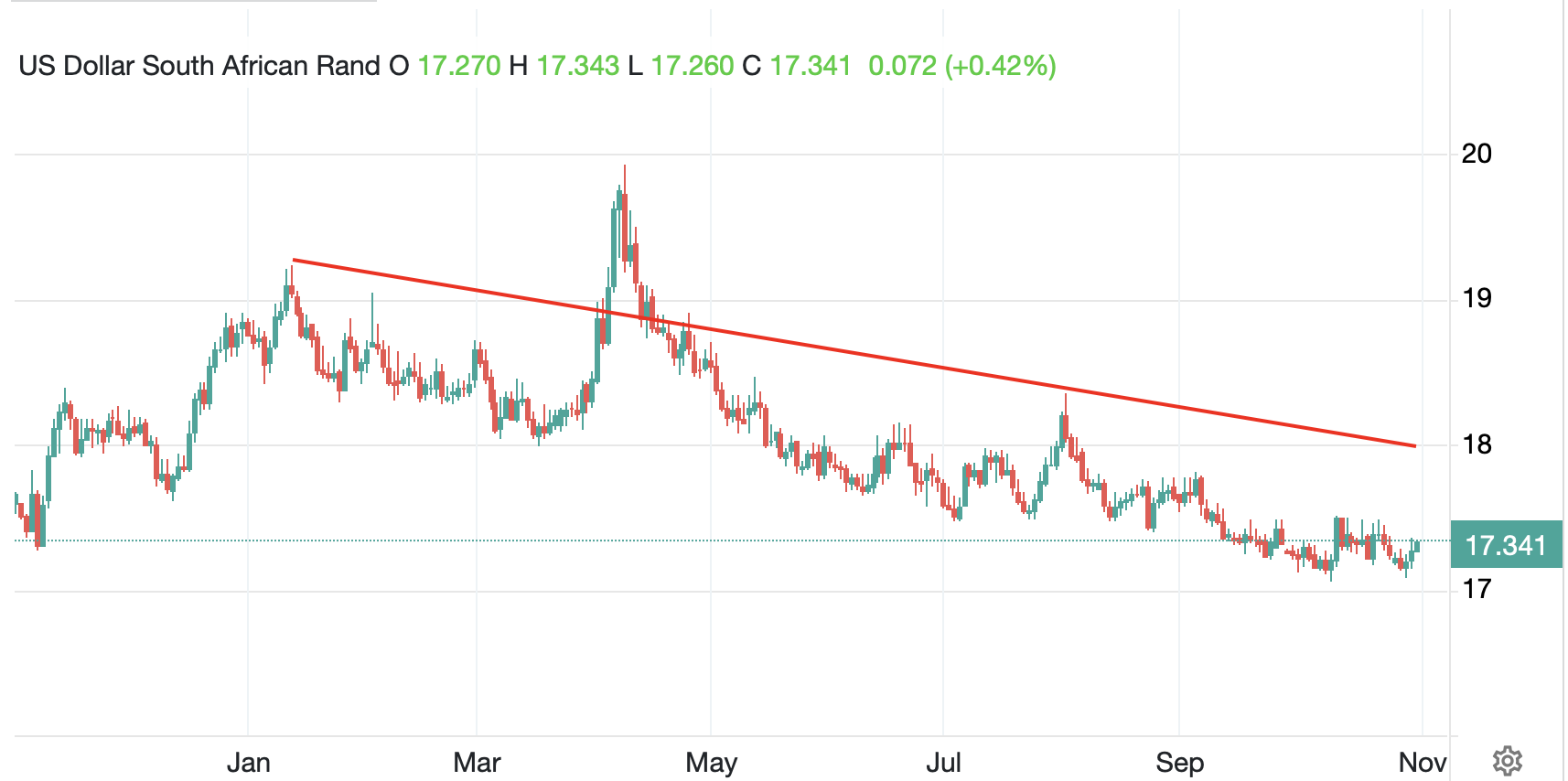
Finally, the dollar, after another step higher yesterday, is little changed this morning.  Both the euro and yen are unchanged and the rest of the G10 has slipped by between -0.1% and -0.2%.  In truth, today’s outlier is ZAR (-0.4%).  Now, let’s look at two ZAR charts, the past year and the long term, which tell very different stories.  In fact, it is important to remember that this is often the case, not merely a rand situation.  First, the past year shows the rand with a strengthening trend as per the below from tradingeconomics.com.  That spike was the response to Liberation Day.

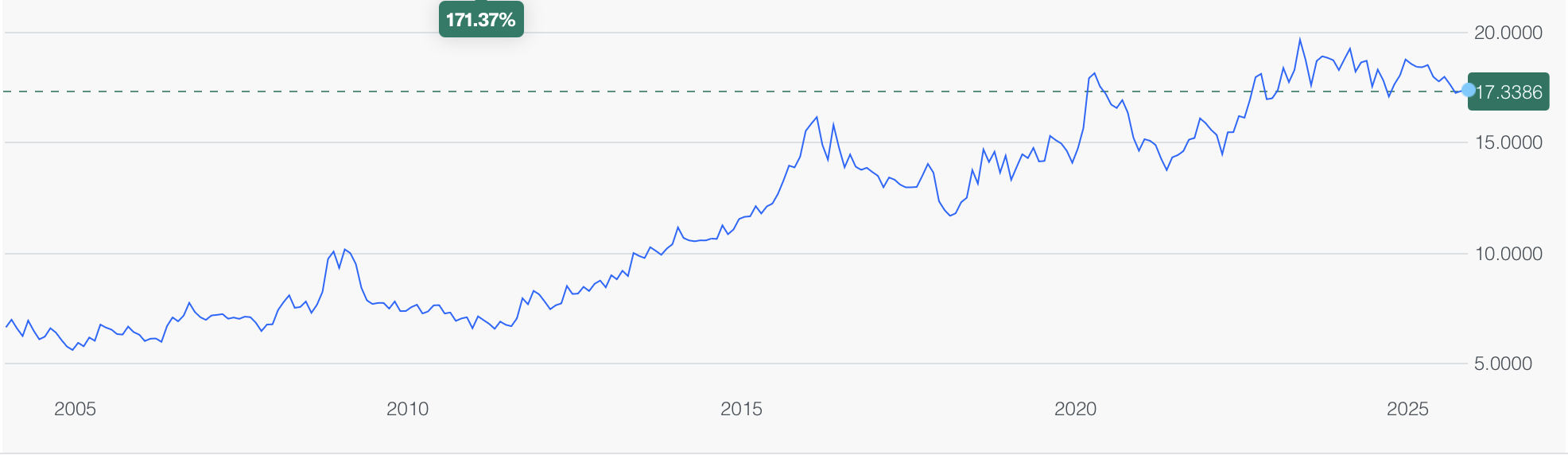
But now, let’s look at a longer-term chart of the rand, showing the past 21 years.

Source: finance.yahoo.com

Like most emerging market currencies, the rand has been steadily depreciating vs. the dollar for decades.  It’s not that we haven’t seen a few periods of modest strength, but always remember that in the big picture, most EMG currency’s slide over time.  This is merely one example, and it is a BRICS currency.  The demise of the dollar remains a long way into the future.

On the data front, Chicago PMI (exp 42.3) is the only release, and we hear from three more Fed speakers.  It appears every FOMC member wants to get their view into the press as quickly as possible since there seem to be so many differing views.  In the end, I continue to think the Fed cuts in December, and nothing has changed.  But for now, there is less certainty as this morning, the probability of a cut is down to 66%.  I guess we’ll see.  But regardless, I still like the dollar for now.

Good luck and good weekend

Adf

Curses and Squeals

Though data is scarce on the ground
This week has the chance to astound
Four central banks meet
And when it’s complete
Two cuts and two stays ought abound
 
Meanwhile, Mr Trump’s signing deals
In Asia, an act that reveals
His fervent desire
To drive markets higher
As foes let out curses and squeals


Some days, there’s very little to note, with the news cycle a rehash of stories that have been festering for weeks.  This is especially true in the political sphere, but also on the economic front.  As well, given the ongoing government shutdown and the lack of government data being released, a key market focus is missing.  But not today!

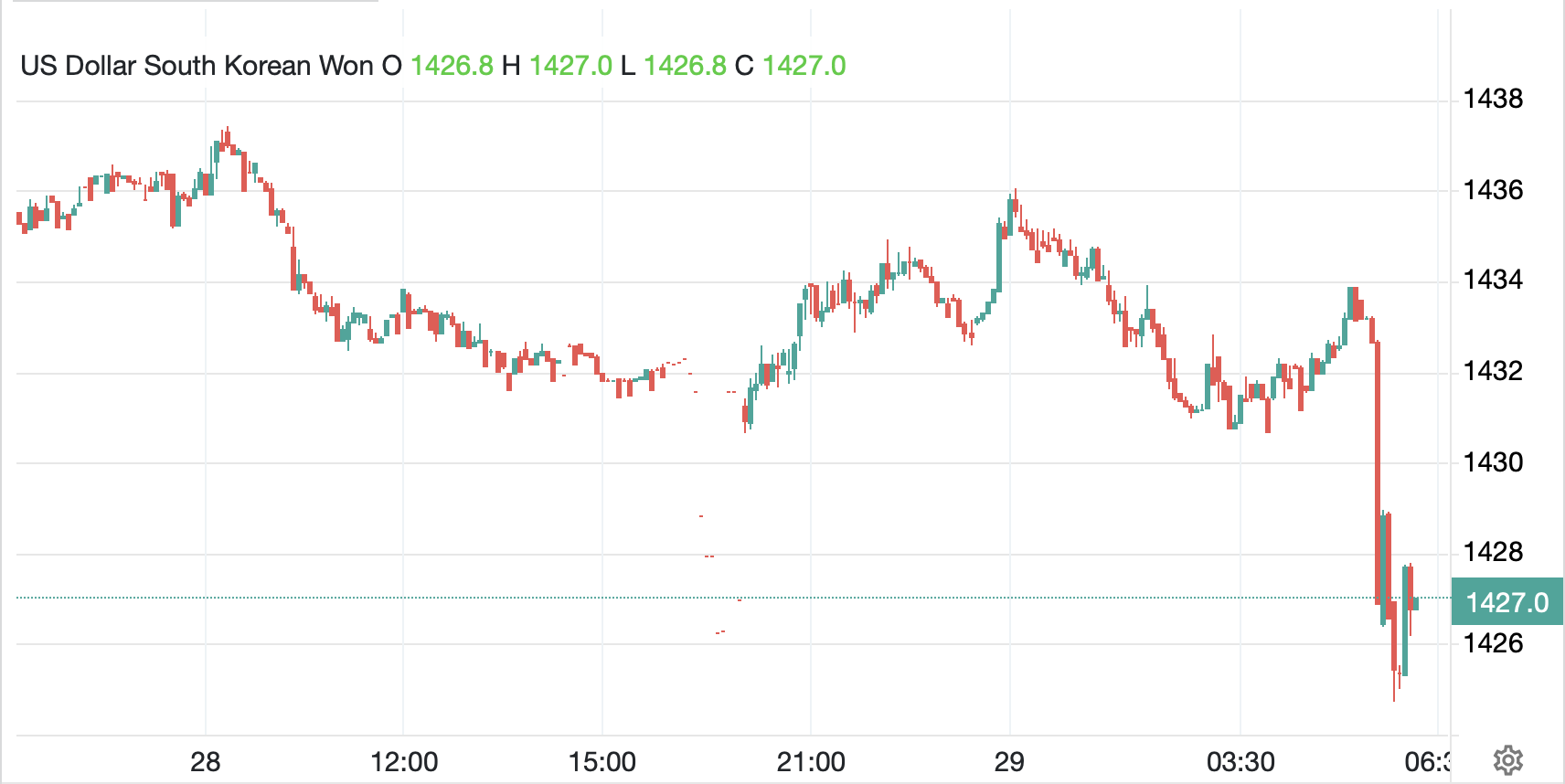
News across the tape moments ago is that President Trump has agreed a trade deal with South Korea, although the details of the deal are yet to be revealed.  When it comes to Trump and trade deals, it is always difficult to get through the hype to determine if things will actually improve, but if we use the KRW as a proxy for market sentiment, as you can see in the chart below, the announcement was seen as a benefit to the won.

Source: tradingeconomics.com

This is hardly definitive, and the nature of a trade deal is that it takes time to be able to determine its benefits for both sides, but for now, it appears markets are giving it the benefit of the doubt.  As well, it continues to be reported that Presidents Trump and Xi will be sitting down tomorrow (tonight actually) and that a trade framework has been agreed by Secretary Bessent and Chinese Vice Commerce Minister Li Chenggang which includes reduced tariffs, fentanyl, soybeans, semiconductors and rare earth minerals as key pieces of the puzzle.  

The ongoing competition between the US and China is not about to end with this deal, but perhaps it will be able to revert to a background issue rather than a headline one, and that is likely a positive for all.  Certainly, equity markets continue to believe that this dialog is a benefit as evidenced by their daily trips to new highs.

Which takes us to the other key discussion point in markets, central banks.  Over the next twenty-seven hours (it is 6:30am as I type) we are going to hear four major central banks explain their latest policy steps starting with the Bank of Canada (expected 25bps cut) at 9:45 this morning, then the FOMC at 2:00 this afternoon with their 25bps cut.  This evening at 11:00, NY time, the BOJ is expected to leave rates on hold, although there are those who believe a 25bps hike is possible, and then tomorrow morning at 9:15 EDT, the ECB will also leave rates on hold.  

While this is certainly a lot of new information, the question is, will it have any market impact?  Given the market pricing of these events, if any of the central banks do something different, you can be sure its markets will respond.  If I had to assess what might be different, both the BOC and FOMC could cut more than 25bps, and the ECB could cut 25bps rather than standing pat.  In all those cases, the currency would likely weaken sharply at first, although if all those things happened, I suppose it would simply create a new equilibrium.  But understand, I don’t think any of that WILL happen.

Regarding the Fed, though, there is another question and that is, what is going to happen to QT and the balance sheet.  Lately, there has been a great deal of discussion regarding how much longer the Fed will allow the balance sheet to shrink.  Last week I discussed the difference between ample and abundant reserves, but in numeric terms, the signals are coming from the SOFR (Secure Overnight Financing Rate) market, the one that replaced LIBOR.  It seems that there is increasing concern over the recent rise in the rate.  This is seen by numerous pundits, as well as by some in the Fed, as a signal that the reserve situation is getting tighter, thus offsetting the Fed’s attempts at ease. 

The below chart from the NY Fed shows the daily wiggles, but also, it is pretty clear that the recent trend has been higher.  You can see the September Fed funds cut in the sharp drop, and the first peak after that was September 30th, the quarter-end when banks typically look to spruce up their balance sheets, so borrow more aggressively.  But since then, this rate has been edging higher, an indication that there may not be sufficient reserves available for the banking system.

This begs the question; will the Fed end QT today?  Or wait until December?  My money is on today as they are growing concerned about the employment situation with the uptick in recent layoff announcements, and the pressure on SOFR is the best indicator they have that things have reached the point where their balance sheet no longer needs to shrink.  One other thing to keep in mind, at some point, it seems likely that the Fed is going to need to find more buyers of Treasuries as the market may develop indigestion given the amount being issued.  That pivot back to QE, whatever it is called, is easier if they are not simultaneously reducing their own balance sheet.

And one final point on the Fed.  Apparently, when they cut today, it will be the twenty-second time the Fed will have cut with stock indices at all-time highs, and of those previous twenty-one, twenty-one times equity markets were higher one year later.  Let’s keep that party rolling!

Ok, let’s look at how things have gone overnight.  Tokyo (+2.2%) was basking in the glow of all the love between President Trump and PM Takaichi, as it, too, traded to new all-time highs.  China (+1.2%) gained on the news of the trade framework, but interestingly, HK (-0.3%) did not follow suit.  And it should be no surprise that Korea (+2.1%) rallied on that trade news with India and Taiwan rising as well.  Australia (-1.0%) though, had a rougher go after a higher than forecast inflation print (3.5%) put paid to the idea that the RBA would be cutting rates again soon.

In Europe, Spain (+0.65%) is rallying on solid GDP data (1.1% Q/Q) although the rest of the continent is doing very little with virtually no change there.  In the UK, the FTSE 100 (+0.6%) is rallying on stronger corporate earnings from miners (metals are higher) and pharma companies.  As to US futures, at this hour (7:30) they are all nicely in the green, about 0.35% or so.

In the bond market, Treasury yields have backed up 2bps, but are still just below the 4.00% level, hardly signaling major concern right now.  European sovereign yields are all essentially unchanged this morning and overnight, only Australia (+5bps) moved after that CPI data Down Under.

Turning to commodities, oil (+0.5%) is bouncing after a couple of weak sessions, but net, we are right back to the $60 level which appears to be a comfortable level for both buyers and sellers.  It is also a high enough price to encourage continued exploration, so my take is we are likely to trade either side of this level for quite a while going forward.  My previous bearish views are being somewhat tempered, although I don’t foresee a major rally of any note.  

Source: tradingeconomics.com

In the metals markets, gold (+1.7%) is bouncing off its recent trading low and currently back above $4000/oz.  A look at the chart for the past month shows just how large the movements have been as the parabolic blow-off to near $4400 was seen through the middle of the month, and after a second try, the rejection was severe.  I don’t believe the long-term story in the precious metals has changed at all, the idea that fiat currencies are going to maintain their current status as reserve assets is going to be more and more difficult to defend with gold the natural replacement.  But in a market with a history of manipulation, don’t be surprised to see many more sharp moves ahead.

Source: tradingeconomics.com

As to the rest of the metals, they are all higher this morning with silver (+2.1%) leading the way and copper (+0.6%) and platinum (+1.6%) following in its wake.

Turning to those fiat currencies, the dollar is broadly firmer this morning, with only AUD (+0.15%) managing any gains against the greenback after that inflation print got traders thinking about higher rates Down Under.  But otherwise, in the G10, the dollar is ascendant.  In the EMG bloc, we already discussed KRW, but ZAR (+0.2%) is also gaining today on the back of the metals bounce.  Elsewhere, though, modest dollar strength is the rule.  What makes this interesting is the dollar is back to rallying alongside precious metals.

Ahead of the Fed, we only see EIA oil inventories with a small draw expected.  In theory, with President Trump in South Korea, one would expect him to be sleeping throughout most of today’s session, but apparently the man rarely sleeps.

The big picture is that run it hot remains the play, and that means equities should benefit, bonds should have a bit more trouble, but the dollar and commodities should do well.  I see no reason for that to change soon.

Good luck

Adf
No Mean Feat

On Friday, the story was gold
And PMs, which everyone sold
The question now asked
Is, has the peak passed?
Or will it still rise twentyfold?
 
The funny thing, though, is that stocks
While weak coming out of the blocks
Reversed course and rose
Right into the close
T’was like Bessent sold from Ft Knox!
 
(PMs = precious metals)


The world felt like it was ending on Friday as the early price action showed all the asset classes that have been rallying dramatically, notably gold and stocks, falling sharply.  But a funny thing happened on the way to the close.  While gold stopped declining, it had no rebound whatsoever, yet the equity market rallied sharply late in the session to close in positive territory.  The below chart (taken Sunday evening) shows that the two assets tracked each other pretty closely right up until lunchtime Thursday and then diverged sharply.

Source: tradingeconomics.com

While there continues to be an overwhelming amount of news stories that may have an impact, I believe Occam’s Razor would indicate the most likely reason that gold sold off so dramatically, slipping more than 2%, is that the rally had gone parabolic and a series of option expirations on Friday forced some real position changes.  My take is this was some profit taking and despite the decline, the bull market trend remains strong and there is no reason to believe this move is over.  After all, there has been nothing to indicate that inflation is going to be contained, nor that fiscal spending will be significantly cut, and Chairman Powell has pretty much promised another rate cut in 10 days.  Look for the correlation, which regained some vibrancy late Friday, to reassert itself going forward.

However, the activity in the other precious metals cannot be ignored, as gold was the least dramatic.  My friend JJ (Alyosha’s Market Vibes) explained that the story was silver driven as an extremely large number of SLV (the Silver ETF) call options were expiring on Friday and there were many machinations by the market makers to prevent too many from being in the money.  Read his piece above for the details, but I would argue none of these machinations change the underlying precious metals thesis.

Takaichi-san
Seems to have found a partner
History’s waiting

From Japan, the word is that Sanae Takaichi and the LDP have convinced the Japan Innovation Party to join in a governing coalition and that, in fact, Ms Takaichi will become the first female Prime Minister in Japan.  This was seen very favorably by Japanese equity markets with the Nikkei gapping higher on its open overnight and rallying 3.4% on the session.  I guess investors are excited by her run it hot plans, and given a governing majority, she should be able to implement those plans.  I suppose that given run it hot is the global consensus of policymakers right now, we shouldn’t be surprised.  FYI, the rally since the April Liberation Day decline has been just over 60%, but I’m sure there is no bubble here.🙄

Source: tradingeconomics.com

In China, this week Xi will meet
With leaders, and though he won’t Tweet
They’ll conjure a plan
For growth, if they can
Success though, will be no mean feat

Finally, Chinese data was released overnight showing that GDP growth fell to 4.8% Y/Y in Q3 as Retail Sales remain relatively sluggish and Fixed Asset Investment (a euphemism for housing) continues to decline, falling -0.5%.  In fairness, housing prices, though they fell -2.2% across 70 major cities, have seen the rate of decline slow, but as you can see from the chart below, those prices have been falling for 3 ½ years.  it is not surprising that the people there feel less wealthy and correspondingly spend less as housing was sold as their retirement nest egg and represents some 25% of the economy.

Source: tradingeconomics.com

The Fourth Plenum is this week, which is the meeting where Xi and the CCP determine the next five-year plan.  There is much hope that they will focus on supporting domestic consumption, but history has shown that is not their strong suit.  Rather, the economic model they know is mercantilism, and I suspect that will still dominate the process going forward.  However, Chinese shares (CSI 300 +0.5%, HK +2.4%) responded positively to hopes that the US-Chinese trade situation will be ameliorated when President’s Xi and Trump meet next week.  Apparently, Secretary Bessent and Premier Li are due to meet this week as a preliminary to that meeting.

So, with all that in mind, let’s see how things so far unmentioned played out overnight. it should be no surprise that given the rallies in both Japan and China, the rest of the region performed well with Korea (+1.75%), India +(0.5%) and Taiwan (+1.4%) indicative of the price action.  Only Singapore (-0.6%) showed any contrariness although there were no obvious reasons for the move.  In Europe, we have also seen some real positive movement with the DAX (+1.3%) and IBEX (+1.5%) performing quite well on  relief that the US-China, and by extension global, trade situation seemed set to improve.  However, in Paris, the CAC (0.0%) has lagged on news that BNP Paribas has been fined >$20 million on its alleged complicity in Sudan atrocities two decades ago dragging the entire French banking sector down with them.  As to US futures, at this hour (7:10) they are pointing higher by about 0.2%.

In the bond market, yields are unchanged in the Treasury market, with the 10-year sitting at 4.01% while European sovereign yields have edged higher by 1bp, except France (+3bps).  Ostensibly, the story is the reduced trade tensions have investors leaving the ‘haven’ of bonds and getting back into equity markets.  Overnight, JGB yields rose 4bps as the news that Takaichi-san seemed set to become PM has bond investors there a bit nervous given her unfunded spending plans.

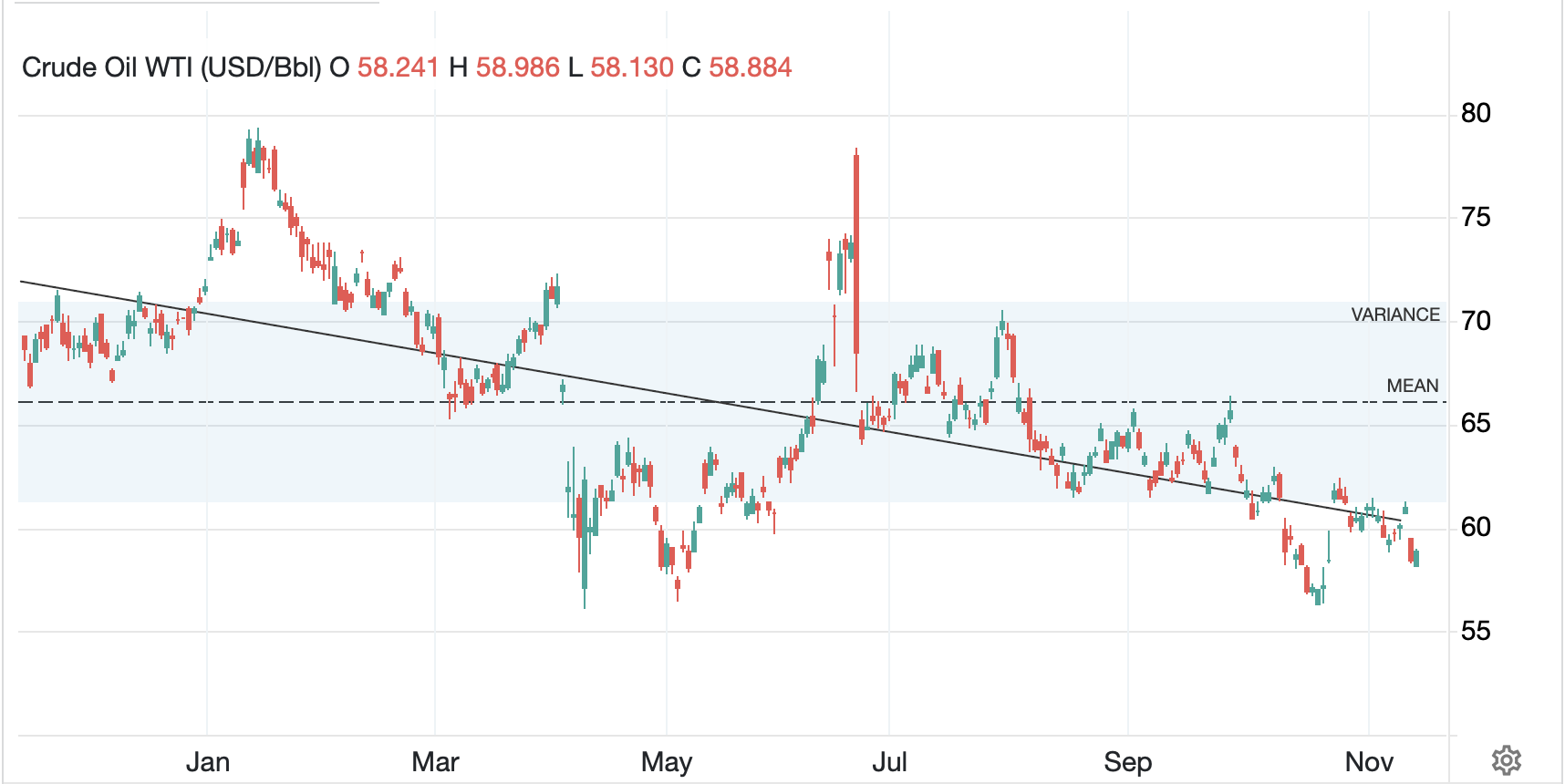
In the commodity markets, oil (-1.0%) continues to slide and is now testing the post Liberation Day lows seen in April.  Looking at the chart below, it is hard to get too bullish, and I suspect we will see lower prices going forward for the near term.

Source: tradingeconomics.com

As to the metals markets, gold (+0.2%) is choppy, but clearly has found short-term support after Friday’s decline while silver (-0.25%) and Platinum (-1.0%) are both still under modest pressure, although nothing like Friday’s moves.  If Friday’s story was all about the option expiries in SLV, which is quite viable, I don’t expect much more downside and the underlying bullish thesis is likely to reassert itself.

Finally, nobody seems to care about the FX markets these days.  The dollar has edged slightly higher this morning but as we have consistently seen for the past several weeks, daily movement is on the order 0.1% or 0.2%, and the big picture is the dollar is not a focus right now.   If we use the euro as our proxy, you can see that since June, it has basically been unchanged.  The rally from the first part of the year has ended for now, and I continue to suspect that absent a significant dovish turn by the Fed, it is likely over.

Source: tradingeconomics.com

On the data front, with the government still shut down, the only data point we will see is CPI on Friday (exp +0.4%, 3.1% Headline; +0.3%, 3.1% Core).  As well, the Fed is in their quiet period so we won’t have any distractions there.  That means that FX markets will be beholden to risk moves and trade comments, but for now, I don’t see much movement on the horizon.

Good luck

Adf

Old Theses Are Reeling

The temperature’s rising on trade
As China, rare earths, did blockade
It seems they believe
That they can achieve
A triumph with cards that they’ve played
 
Investors worldwide are now feeling
Concern as old theses are reeling
This new world now shows
It’s capital flows
And trust, which is why gold’s appealing


Escalation in the trade war between the US and China is clearly the top story.  There are a growing number of analysts who believe that currently, China may have the upper hand in this battle given the recent history of deindustrialization in the US and the West.  Obviously, rare earth minerals, which are critical to manufacturing everything from magnets to weapons, and semiconductors, are China’s big play.  They believe this is the bottleneck that will force the US and the West to back down and accept their terms.  The Chinese have spent decades developing the supply chain infrastructure for just this situation while the West blithely ignored potential risks of this nature and either sought lower costs or virtue signals.

Before discussing the market take, there is one area where China lacks capacity and will find themselves greatly impaired, ultra-pure silicon that is used to manufacture semiconductors.  The global supply is almost entirely made in Japan, Germany and the US, and without it, Chinese semiconductor manufacturing will encounter significant problems.  So don’t count the West out yet.

Anyway, the interesting question is why have equity markets continued to behave so well in the face of this growing bifurcation in the global economy?  After all, it is clear why gold (+0.75%) continues to rise as central banks around the world continue to buy the barbarous relic for their reserves while individual investors are starting to jump on board if for no other reason than the price has been rising dramatically.  (As an aside, the gold price chart can fairly be called parabolic at this point, and history has shown that parabolic rallies don’t last forever and reverse course dramatically.)

Source: tradingeconomics.com

But equity prices are alleged to represent the discounted value of estimated future cash flows, and those are certainly not parabolic.  Of course, there is something that has been rising rapidly that feeds directly into financial markets, and that is liquidity.  Consider the process by which money is created; it is lent into existence by banks and used to purchase either financial or real assets.  The greater the amount of money that is created, the more upward pressure that exists for asset prices (as well as retail prices).  This is the essence of the idea that inflation is the result of too much money chasing too few goods.

Turning to the IIF for its latest statistics, it shows, as you can see in the chart below, that global liquidity continues to rise, and there is nothing to indicate this rise is going to slow down.  The chart below shows global debt across all sectors (government and private) has reached $337.8 trillion at the end of Q2 2025, which is 324% of global GDP.  If you are wondering why asset prices continue to rise in the face of increased global macroeconomic risks, look no further than this chart.

And if you think about the fact that literally every major nation around the world, whether developed or EMG, is running a public budget deficit, this number is only going to grow further.  It is very difficult to make the case for a reversal unless this liquidity starts to dry up.  And the one thing central bankers around the world have figured out is that they cannot turn off the liquidity flow without causing severe problems.  As to CPI inflation, some portion of this liquidity will continue to seep into prices paid for things other than securities and financial assets.  Ironically, if President Trump succeeds in dramatically reducing the budget and trade deficits, the impact on global financial markets would be quite severely negative.  This is the best reason to assume it will never happen…by choice.

In the meantime, this is the world in which we live, and financial markets are subject to these flows so let’s see how they behaved overnight.  After yesterday’s modest gains in the US markets, Tokyo (+1.3%) continued its recent rally despite a growing concern that Takaichi-san will not become the first female PM in Japan as all the opposition parties seem to be coming together simply to prevent that outcome, rather than because they share a grand vision.  HK (-0.1%) and China (+0.25%) had lackluster sessions as the trade war will not help either of their economies either, while the rest of the region had a strong session across Korea (+2.5%), India (+1.0%), Taiwan (+1.4%), Australia (+0.9%) and Indonesia (+0.9%).  One would almost think things are great there!

As to Europe, France (+0.75%) is the leader today as PM LeCornu survived a no-confidence vote by agreeing not to raise the retirement age from 62 to 64 despite this being seen as President Macron’s crowning achievement.  (I cannot help but look at public finances around the world and see that something is going to break down, and probably pretty soon.  Promises to continue spending while economic activity stagnates are destined to collapse.  Of course, the $64 trillion question is, when?).  As to the rest of Europe, equity markets are little changed, +/- 0.15% or less.  At this hour (7:40) US futures are pointing nicely higher though, about 0.5% across the board.

In the bond market, the place where the growth in liquidity should be felt most acutely, there is no obvious concern by investors at this stage.  Yields across the board in the US and Europe are essentially unchanged in the session and there was no movement overnight in JGBs.  It feels as though the entire situation is becoming more precarious for investors, but thus far, no real cracks are visible.  However, you can be sure that if they start to develop, we will see the next wave of QE to support these markets.

Away from gold, this morning silver (+0.1%) and copper (-0.1%) are little changed although platinum (+0.7%) is working to keep up with both of the better-known precious metals and doing a pretty good job of it.  Oil (+0.9%) is bouncing off recent lows but remains below $60/bbl and seems to have lost the interest of most pundits and traders, at least for now.  

Finally, the dollar continues to edge lower, with most G10 currencies a touch higher (GBP +0.2%, SEK +0.2%, NOK +0.3%, EUR +0.05%) although the yen (-0.15%) and CHF (-0.2%) are both slipping slightly.  But the reality is there has been no noteworthy movement here.  Even in the EMG bloc, movement is 0.2% or less virtually across the board this morning.  The dollar is an afterthought today.

On the data front, Philly Fed (exp 10.0) is the only data release with some positive thoughts after yesterday’s Empire State Manufacturing Index rose a much better than expected 10.7.  We also hear from a whole bunch more Fed speakers (Barkin, Barr, Miran, Waller, Bowman) as the IMF / World Bank meetings continue.  Yesterday, to nobody’s surprise, Mr Miran said that rates needed to be lower to address growing uncertainties in the economy.  I suspect he will repeat himself this morning.  But the market is already pricing two cuts for this year, and absent concrete data that the economy is falling off a cliff, it is hard to make the case for any more (if that much) given inflation’s stickiness.

The world is a messy place.  Debt and leverage are the key drivers in markets and will continue to be until they are deemed too large.  However, it is in nobody’s interest to make that determination, not investors nor governments.  This could go on for a while.

Good luck

adf

Rare Earths No More

Said Xi, we’ll sell rare earths no more
Said Trump, well that means we’re at war
The stock market puked
As traders got spooked
And Trump imposed tariffs galore
 
The question is just why would Xi
Get feisty when things seemed to be
Improved for both sides
With fewer divides
Did Mideast peace kill his esprit?


Let’s talk about markets for a moment.  Sometimes they go down and go down fast when you’re not expecting it.  That is their very nature, so it is important to understand that Friday’s price action, while dramatic relative to what we have seen over the past 6 months, is not that uncommon at all over time.  It appears the proximate cause of the market decline was the word from China that they would stop selling and exporting rare earth minerals. 
It can be no surprise that President Trump immediately responded by threatening an additional 100% tariffs on all Chinese exports and new controls on software, all to be implemented on November 1st.  There is a lot of tit-for-tat in the dueling messages from China and the Trump administration and it is hard to tell what is real and what isn’t.  However, equity markets clearly weren’t prepared for a break in the previous expectations that the US and China were closing in on a more lasting trade stance.

But weekends are a long time for markets as so much can happen while they are closed.  This weekend was a perfect example.  After the carnage on Friday, we cannot be that surprised that both sides of this new tiff modified their responses.

First we saw this on Truth Social:

Then China backed off clarified that what they are really doing is require licensing for all rare earth minerals and products that contain them in exports.  China claims that applications that meet regulations will be approved although the regulations have not yet been defined. Ostensibly this is for national security reasons, and it is unclear exactly who will receive licenses, but this is clearly not the same as ending exports.  

And just like that, many of the fears that were fomented on Friday have been alleviated as evidenced by this morning’s equity market moves in the futures markets.

Source: tradingeconomics.com

But why did Xi make this move in the first place?  I have no idea, nor does anyone but Xi, although here are two completely different thought processes, one very conspiratorial and one rooted in the broader escalation of geopolitical affairs.

As to the first, (Beware, you will need your tinfoil hat here!) consider if the Israel-Gaza peace settlement, (with the hostages returned as of the time I am writing this morning at 5:30) does not serve China’s interest.  First, the one Middle East nation that will be on the outside is their ally, Iran.  Second, the ongoing problems there were always a distraction for the US, something that clearly suits Xi and China.  After all, if the US is focused there, they will have more difficulty paying attention to things Xi cares about like Taiwan and the South China Sea.  If the peace in Israel-Gaza holds, and the Abraham Accords extend to the bulk of the rest of the region, Xi loses a major distraction that cost him virtually nothing.  Plus, this opens the door for tightening sanctions on Iran even further, which could negatively impact China’s oil flows.  

The second is much more esoteric and I read about it this weekend from Dr Pippa Malmgren, someone who has a deep insight into global politics from her time as a presidential advisor as well as from her father, Harold Malmgren, who advised four presidents.  In her most recent Substack post she explained the importance of Helium-3 (3He), a rare isotope of helium that has major energy and military implications and where the largest deposit of the stuff known to man is on the moon.  Her claim is this is the foundation of the recent acceleration in the space race between the US and China and without rare earth minerals, the US ability to achieve its goals and obtain this element would be greatly hampered opening the door for China to get ahead.

Are either of these correct?  It is not clear, but I would contend each contains some logic.  In the end, though, as evidenced by the quick retreat on both sides, I suspect that the trade situation between the US and China will move forward in a positive manner, although there could well be a few more hiccups along the way.  And those hiccups could easily see equity markets decline such that there is a real correction of 15% to 20%.  Just not today.

So, what is happening today?  Let’s look.  First, I would be remiss if I didn’t highlight the following Bloomberg headline: ‘Buy the Dip’ Call Grows Louder as China Selloff Seen Containedas it perfectly encapsulates the ongoing mindset in equity markets.  At least in US equities.  Asia had a much rougher session despite the backtracking with HK (-1.5%) and China (-0.5%) under pressure and weakness virtually universal in the time zone (Korea -0.7%, India -0.2%, Taiwan -1.4%, Australia -0.8%). Tokyo was closed.  It appears there are either still concerns over the trade situation, or perhaps the fact that globally, markets have had long rallies has led to some profit taking amid rising uncertainties.  

European bourses, though are all in the green, with the continent seeing gains of 0.5% or so across the board although the UK is lagging with a miniscule 0.05% gain at this hour (6:30).  As to US futures, as seen above, gains range from 1.0% (DJIA) to 2.0% (NASDAQ).

Meanwhile, bond yields also saw a dramatic move on Friday, tumbling -8bps and back to their lowest level seen in a month as per the below chart from tradingeconomics.com

This morning, those yields are unchanged.  European sovereign yields, which followed Treasury yields lower on Friday are also little changed at this hour, down another -1bp as concerns begin to arise that economic growth is going to be impaired by the escalation in trade tension between the US and China.  

I would argue that commodities are the one area where the back and forth is raising the most concern.  At least that is true in metals markets, with gold, which rallied 1% Friday amid the equity carnage, higher by another 1.6% this morning, to more new highs and we are seeing silver (+1.6%), copper (+4.2%) and Platinum (+3.6%) all in sync.  To me, this is the clearest indicator that there is an underlying fear pervading markets.  Oil (+1.8%) has rebounded from Friday’s rout as the easing of trade tensions appears to have calmed the market somewhat, although WTI remains just below $60/bbl at this point.  

Finally, the dollar is firmer again this morning as, although it softened slightly Friday, it has since regained most of those losses and is back on its recent uptrend as you can see below.

Source: tradingeconomics.com

While Tokyo was closed overnight, we did see further JPY weakness as the yen retraced most of its Friday gains like the rest of the market.  The biggest G10 mover was CHF (-0.9%) followed by AUD (-0.7%) and JPY (-0.7%) with other currencies less impacted and NOK (+0.2%) benefitting from the oil rally.  However, the EMG bloc has seen a much wider dispersion with MXN (+0.5%), ZAR (+1.1%) and CLP (+0.8%) all rallying sharply on the metals rally while PLN (-0.5%) and CZK (-0.4%) lag as they follow the euro lower.

And that’s enough for today.  With the government still on hiatus, no official statistics will be released although we do get a little bit of stuff as follows:

TuesdayNFIB Small Business Index100.5
WednesdayEmpire State Manufacturing-1.8
 Fed’s Beige Book 
ThursdayPhilly Fed Manufacturing9.1

Source: tradingeconomics.com

But, with the lack of data, it appears Chairman Powell has instructed his minions to flood the airwaves with a virtual cacophony of speeches this week, I count 18 on the calendar including the big man himself on Tuesday afternoon.  It seems difficult to believe that their opinions on the economy will have changed very much given the lack of new data.  The market is still pricing a 98% chance of a cut at the end of this month and another 91% chance of a cut in December.  With the increased trade tension, there is much more discussion regarding a slower economic course ahead, which would play into further rate cuts.  However, while that would clearly help precious metals as it ends any ideas of an inflation fight, it is not clear it will weaken the dollar very much as everybody else will almost certainly follow along.

Good luck

Adf