What Havoc it Wreaks

Today, for the first time in weeks
Comes news that will thrill data geeks
It’s CPI Day
So, what will it say?
We’ll soon see what havoc it wreaks
 
The forecast is zero point three
Too high, almost all would agree
But Jay and the Fed
When looking ahead
Will cut rates despite what they see


Spare a thought for the ‘essential’ BLS employees who were called back to the office during the shutdown so that they could prepare this month’s CPI report.  The importance of this particular report is it helps define the COLA adjustments to Social Security for 2026, so they wanted a real number, not merely the interpolation that would have otherwise been used.  Expectations for the outcome are Headline (0.4% M/M, 3.1% Y/Y) and Core (0.3% M/M, 3.1% Y/Y) with both still well above the Fed’s 2% target.  As an aside, we are also due Michigan Sentiment (55.0), but I suspect that will have far less impact on markets.

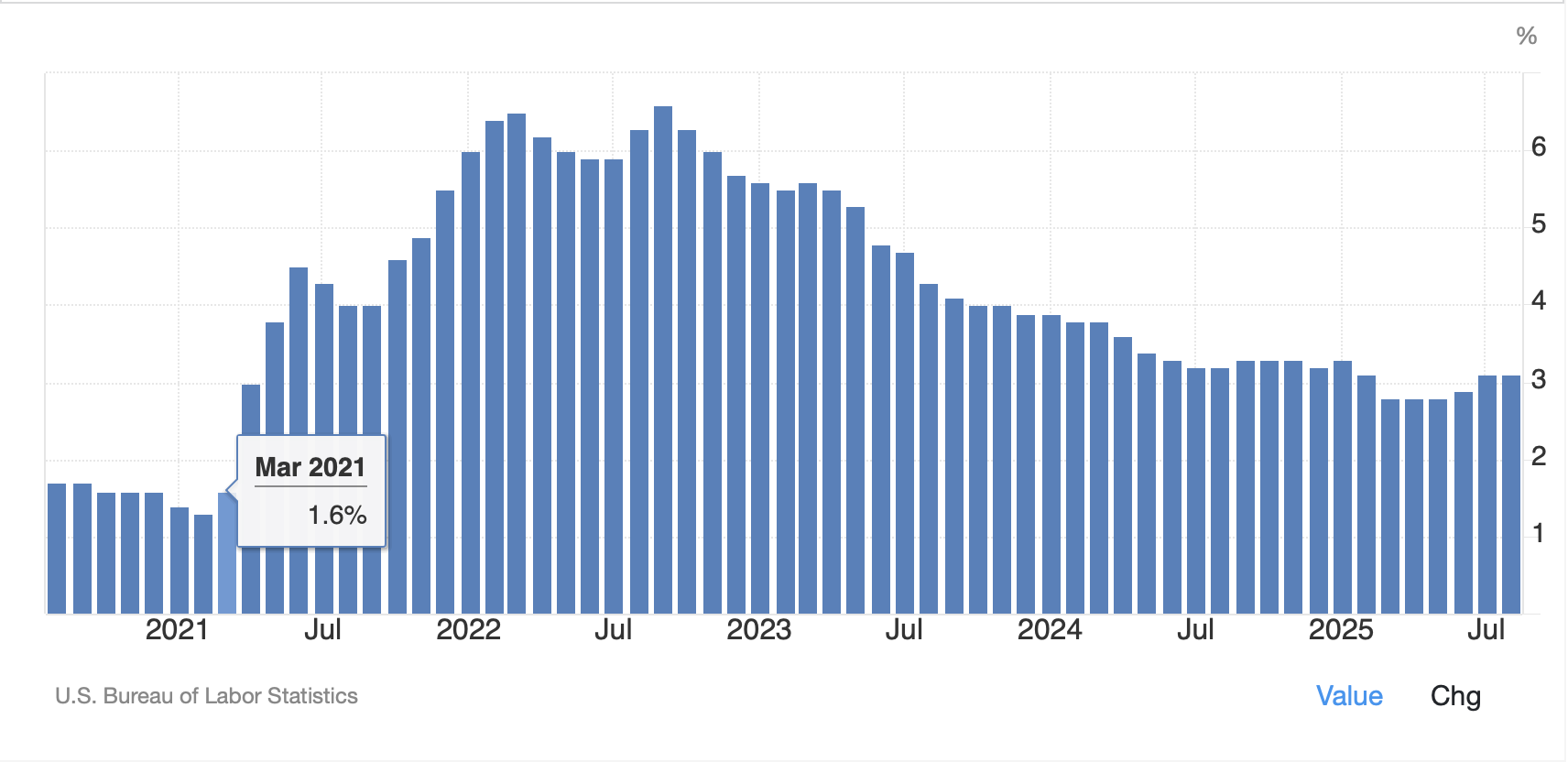
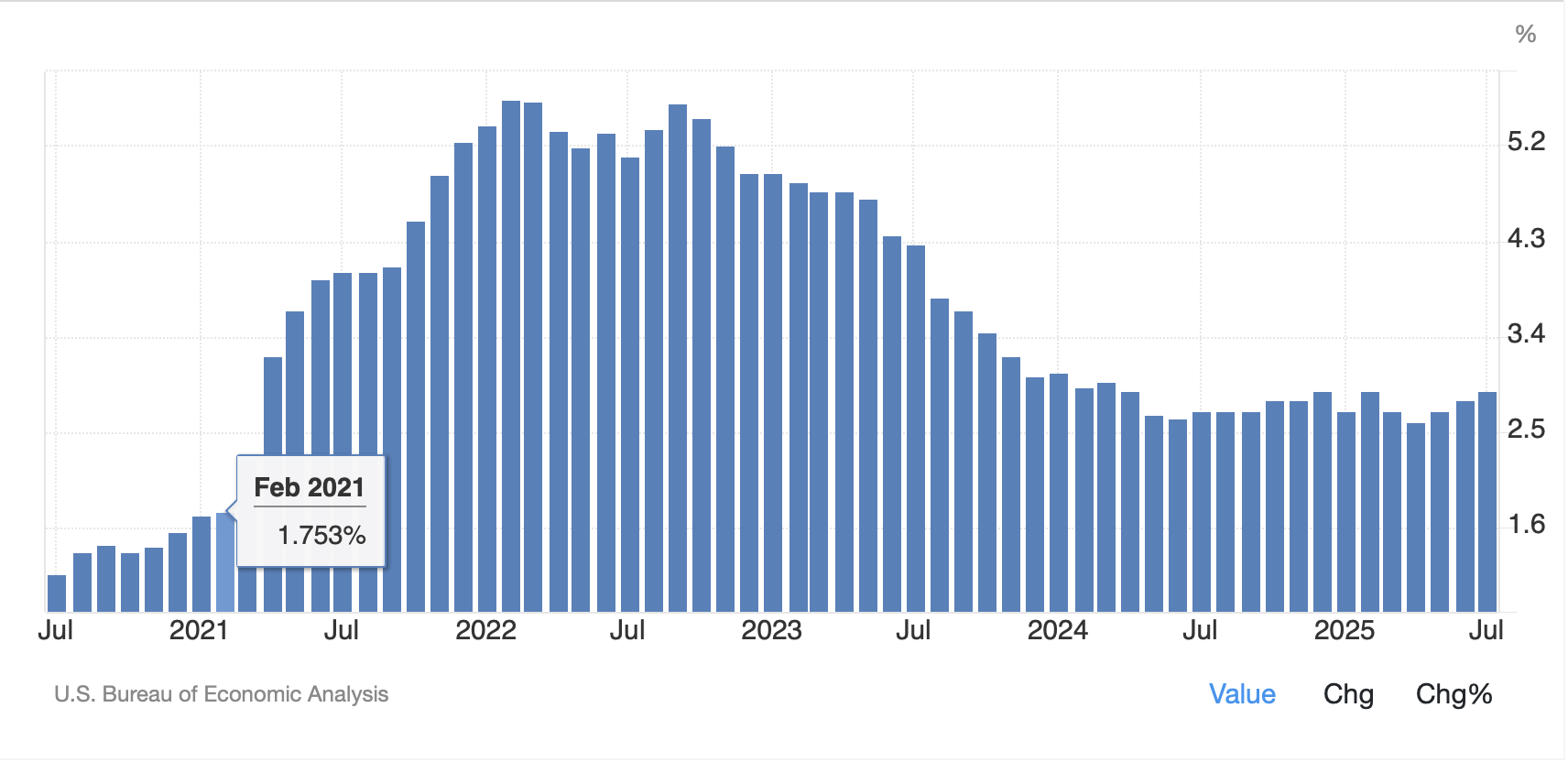
If we consider the Fed and its stable prices mandate, one could fairly make the case that they have not done a very good job, on their own terms, when looking at the chart below which shows that the last time Core CPI was at or below their self-defined target of 2.0% was four and one-half years ago in March 2021.  And it’s not happening this month either.

Source: tradingeconomics.com

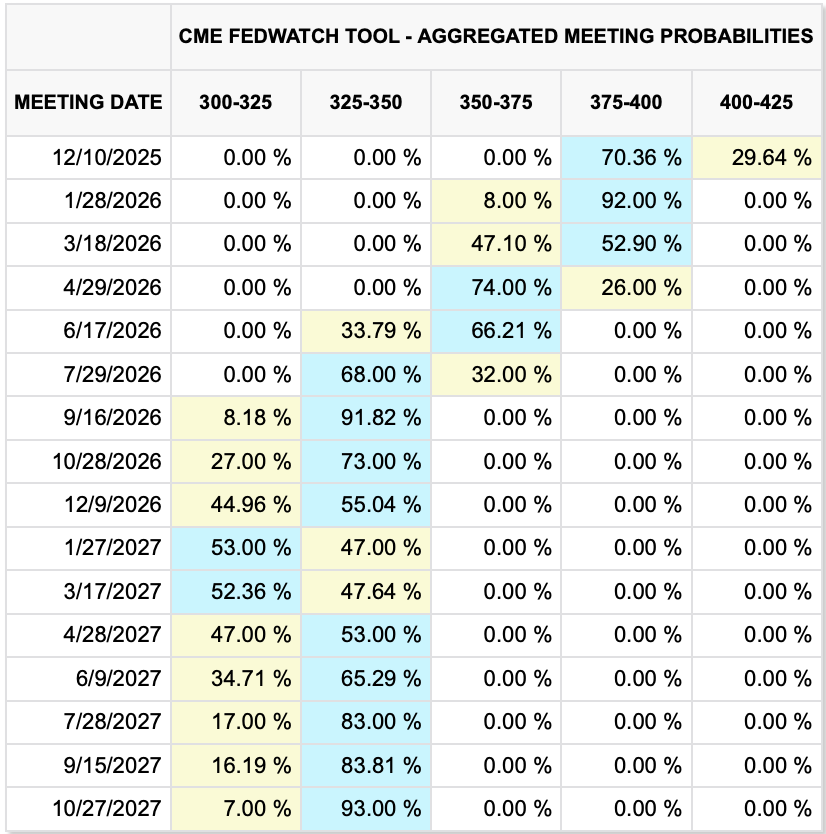
Now, when we consider the Fed and its toolkit, the primary monetary policy tool it uses is the adjustment of short-term interest rates.  The FOMC meets next Tuesday and Wednesday and will release its latest statement Wednesday afternoon followed by Chairman Powell’s press conference.  A quick look at the Fed funds futures market pricing shows us that despite the Fed’s singular inability to push inflation back toward its own target using its favorite tool, it is going to continue to cut interest rates and by the end of this year, Fed funds seem highly likely to be 50bps lower than their current level.

Source: cmegroup.com

The other tool that the Fed utilizes to address its monetary policy goals is the size of its balance sheet, as ever since the GFC and the first wave of ‘emergency’ QE, buying (policy ease) and selling (policy tightening) bonds has been a key part of their activities.  As you can see from the chart below, despite the 125bps of interest rate cuts since September of 2024 designed to ease policy, they continue to shrink the balance sheet (tighten policy) which may be why they have had net only a modest impact on things in the economy.  Driving with one foot on the gas and one on the brake tends to impede progress.

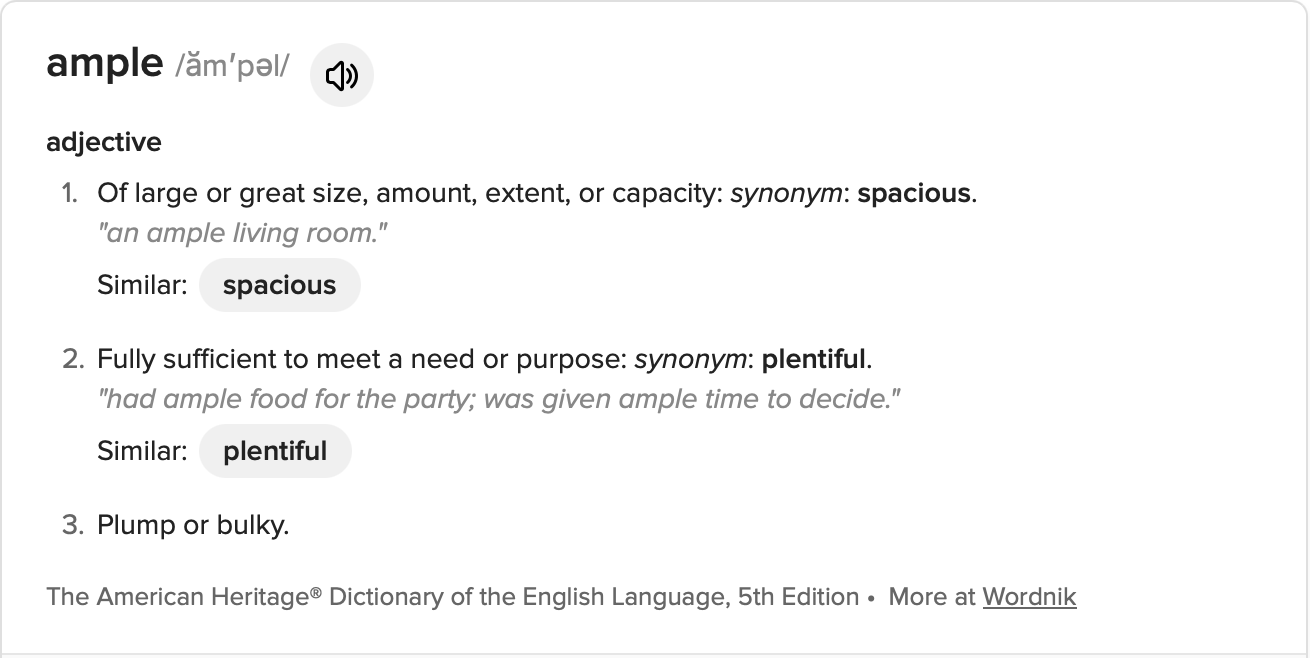
But now, the word is the Fed will completely stop balance sheet shrinkage by the end of the year, something we are likely to hear next Wednesday, as there has been much discussion amongst the pointy-head set about whether the Fed’s balance sheet now contains merely “ample” reserves rather than the previous description of “abundant” reserves.  And this is where it is important to understand Fedspeak, because on the surface, those two words seem awfully similar.  As I sought an official definition of each, I couldn’t help but notice that they both are synonyms of plentiful.

These are the sorts of things that, I believe, reduces the Fed’s credibility.  They sound far more like Humpty Dumpty (“When I use a word, it means just what I choose it to mean – neither more nor less.”) than like a group that analyses data to help in decision making.  

At any rate, no matter today’s result, it is pretty clear that Fed funds rates are going lower.  The thing is, the market has already priced for that outcome, so we will need to see some significant data surprises, either much weaker or stronger, to change views in interest rate sensitive markets like bonds and FX.

As to the shutdown, there is no indication that it is going to end anytime soon.  The irony is that the continuing resolution passed by the House was due to expire on November 21st.  it strikes me that even if they come back on Monday, they won’t have time to do the things that the CR was supposed to allow.  

Ok, let’s look at what happened overnight.  Yesterday’s rally in the US was followed by strength in Japan (+1.35%) after PM Takaichi indicated that they would spend more money but didn’t need to borrow any more (not sure how that works) while both China (+1.2%) and HK (+0.7%) also rallied on the confirmation that Presidents Trump and Xi will be meeting next week.  Elsewhere, Korea and Thailand had strong sessions while India, Taiwan and Australia all closed in the red.  And red is the color in Europe this morning with the CAC (-0.6%) the main laggard after weaker than forecast PMI data, while the rest of Europe and the UK all suffer very modest losses, around -0.1%.  US futures, though, are higher by 0.35% at this hour (7:20).

In the bond market, Treasury yields edged higher again overnight, up 1bp while European sovereigns have had a rougher go of things with yields climbing between 3bps and 4bps across the board.  While the French PMI data was weak, Germany and the rest of the continent showed resilience which, while it hasn’t seemed to help equities, has hurt bonds a bit.  Interestingly, despite the Takaichi comments about more spending, JGB yields slipped -1bp.

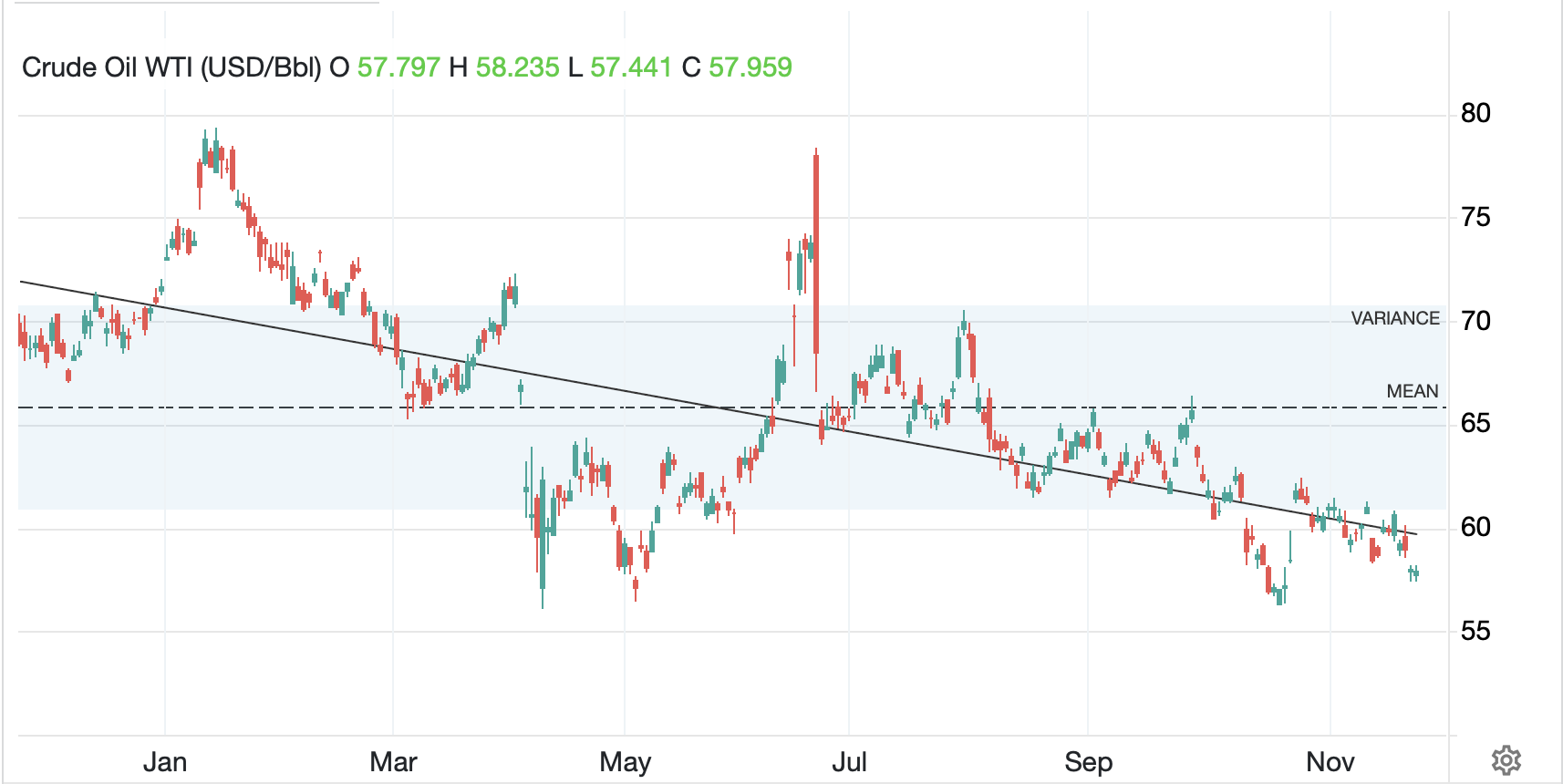
In the commodity space, oil (+0.7%) continues its rebound from the lows at the beginning of the week as the sanctions against the Russian oil majors clearly have the market nervous.  Of course, despite the sharp rally this week, oil remains in the middle of its trading range, and at about $62/bbl, cannot be considered rich.  Meanwhile, metals markets continue their recent extraordinary volatility, with pretty sharp declines (Au -1.7%, Ag -0.9%, Pt -2.1%) after sharp rallies yesterday.  There seems to be quite the battle ongoing here with positions being flushed out and delivery questions being raised for both futures and ETFs.  Nothing has changed my long-term view that fiat currencies will suffer vs. precious metals, but the trip can be quite volatile in the short run.

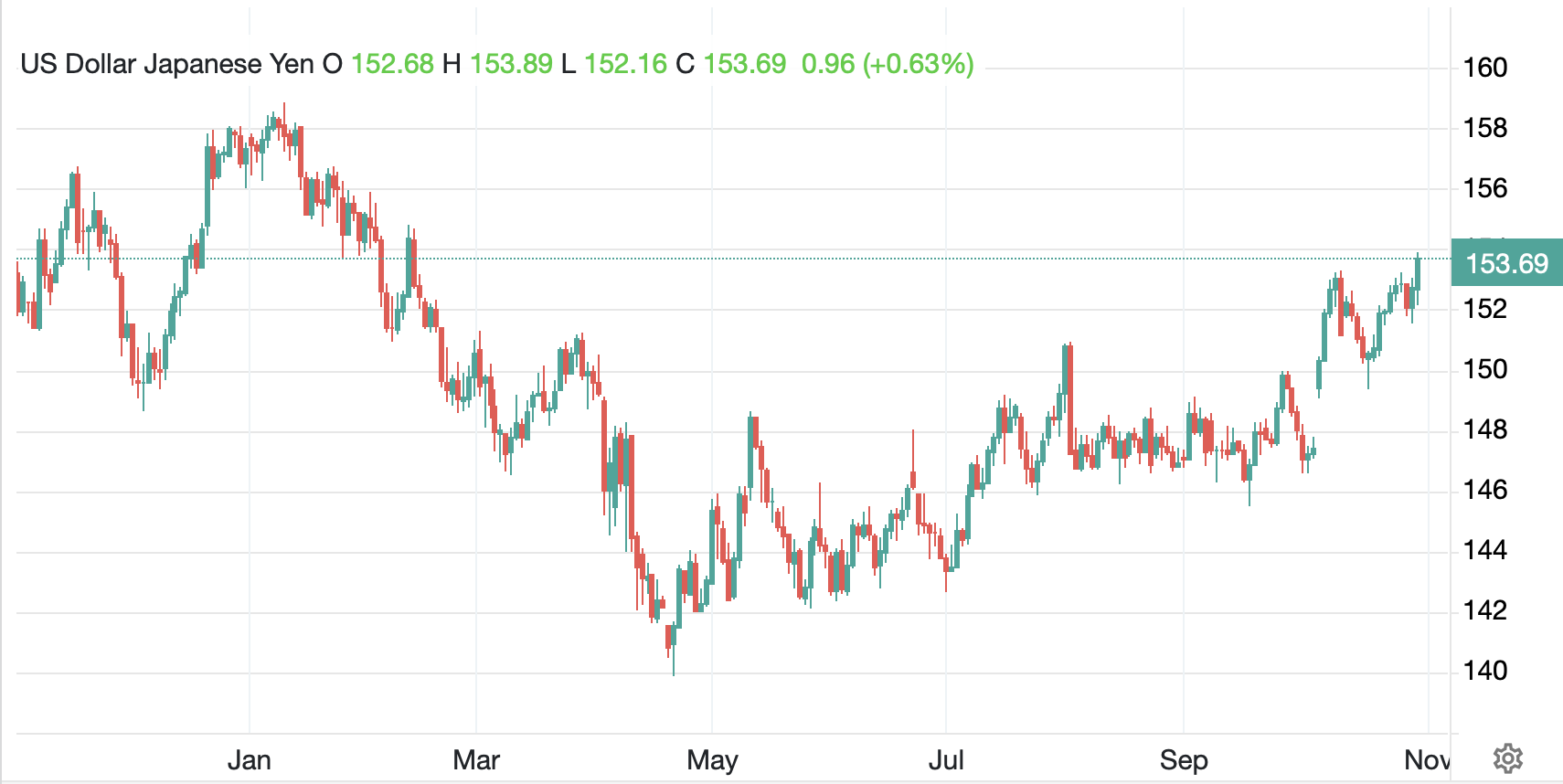
Finally, the dollar continues to creep higher vs. its fiat compatriots, with JPY (-.25%) pushing back toward recent lows (dollar highs) after the Takaichi spending plan announcements.  But, again, while the broad trend is clear, the largest movement is in PLN (-0.4%) hardly the sign of a major move.

And that’s all there is today.  We await the data and then go from there.  Even if the numbers are right at expectations, 0.3% annualizes to about 3.6%, far above the Fed’s target and much higher than we had all become accustomed to in the period between the GFC and Covid.  But remember, central bankers, almost to a wo(man) tend toward the dovish side, so I think we all need to be prepared for higher prices and weaker fiat currencies, although still, the dollar feels like the best of a bad lot.

There will be no poetry Monday as I will be heading to the AFP conference in Boston to present about a systematic way to more effectively utilize FX collars as a hedging tool.  But things will resume on Tuesday.

Good luck and good weekend

Adf

Tariff Redux

While many have called for stagflation
The ‘stag’ story’s lost its foundation
Q2 turned out great
With growth, three point eight
While ‘flation showed some dissipation
 
Meanwhile, Mr Trump’s on a roll
As he strives to still reach his goal
It’s tariff redux
On drugs and on trucks
While ‘conomists tally the toll


Analysts worldwide have decried President Trump’s policies as setting up to lead the US to stagflation with the result being the dollar would ultimately lose its status as the world’s reserve currency while the economy’s growth fades and prices rise.  “Everyone” knew that tariffs were the enemy of sane fiscal and trade policy and would slow growth leading to higher unemployment and inflation while the Fed would be forced to choose which issue to address.  In fact, when Q1 GDP was released at -05%, there was virtual glee from the analyst community as they were preening over how prescient they were.

But yesterday, we learned that things may not be as bad as widely hoped proclaimed by the analyst community after all.  Q2 GDP was revised up to +3.8% annualized growth, substantially higher than even the first estimate of 3.0% back in July.  Not only that, Durable Goods Orders rose 2.9% with the ex-Transport piece rising 0.4% while the BEA’s inflation calculations, also confusingly called PCE rose 2.1%.  Initial Claims rose only 218K, well below estimates and indicative that the labor market, while not hot, is not collapsing.  Finally, the Goods Trade Balance deficit was a less than expected -$85.5B, certainly not great, but moving in President Trump’s preferred direction.

In truth, that was a pretty strong set of economic data, better than expectations across the entire set of releases, and clearly not helping those trying to write the stagflation narrative.  Now, Trump is never one to sit around and so promptly imposed new tariffs on medicines, heavy trucks and kitchen cabinets to try to bring the manufacture of those items back into the US.  Whatever your opinion of Trump, you must admit he is consistent in seeking to achieve his goal of returning manufacturing prowess to the US.

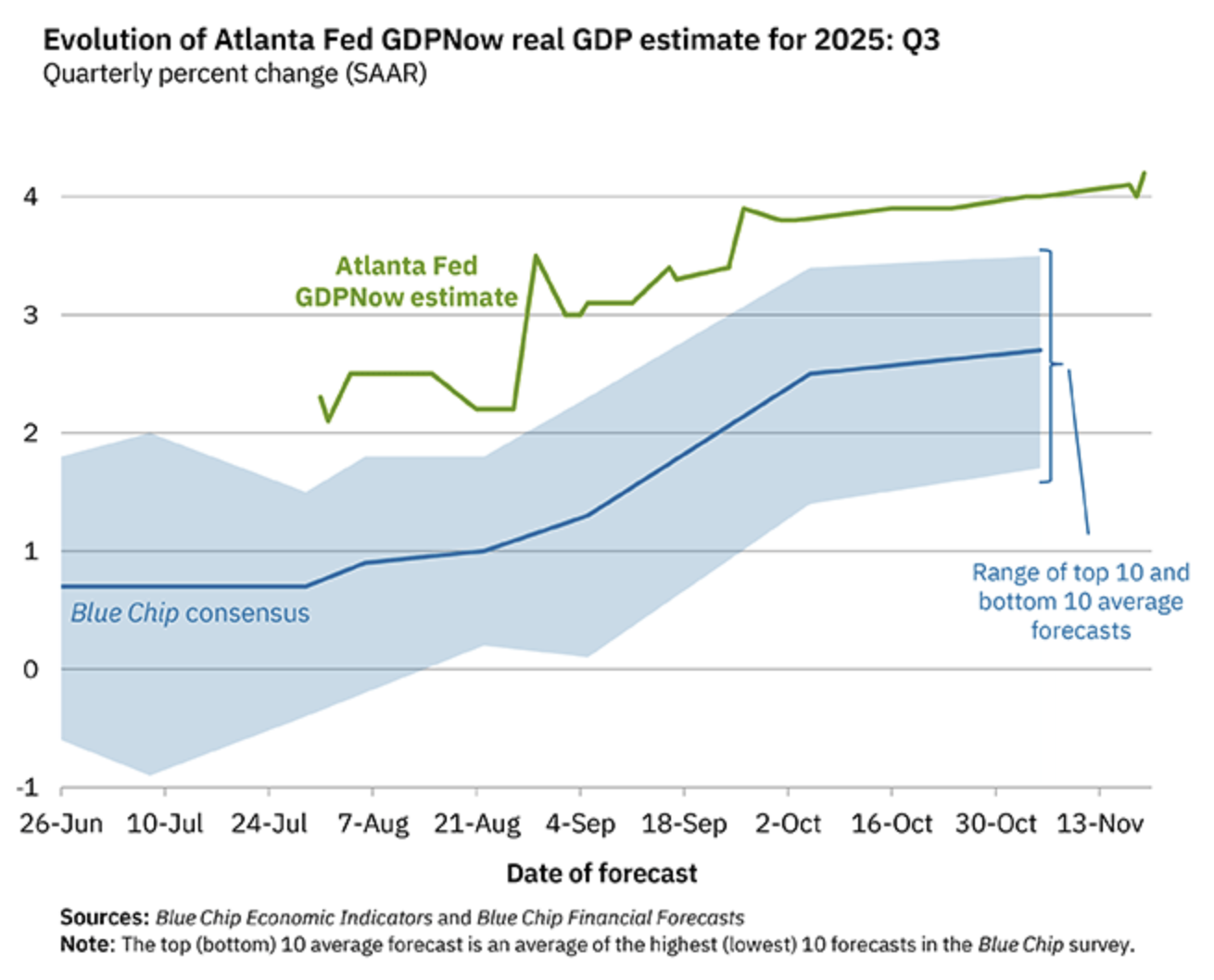
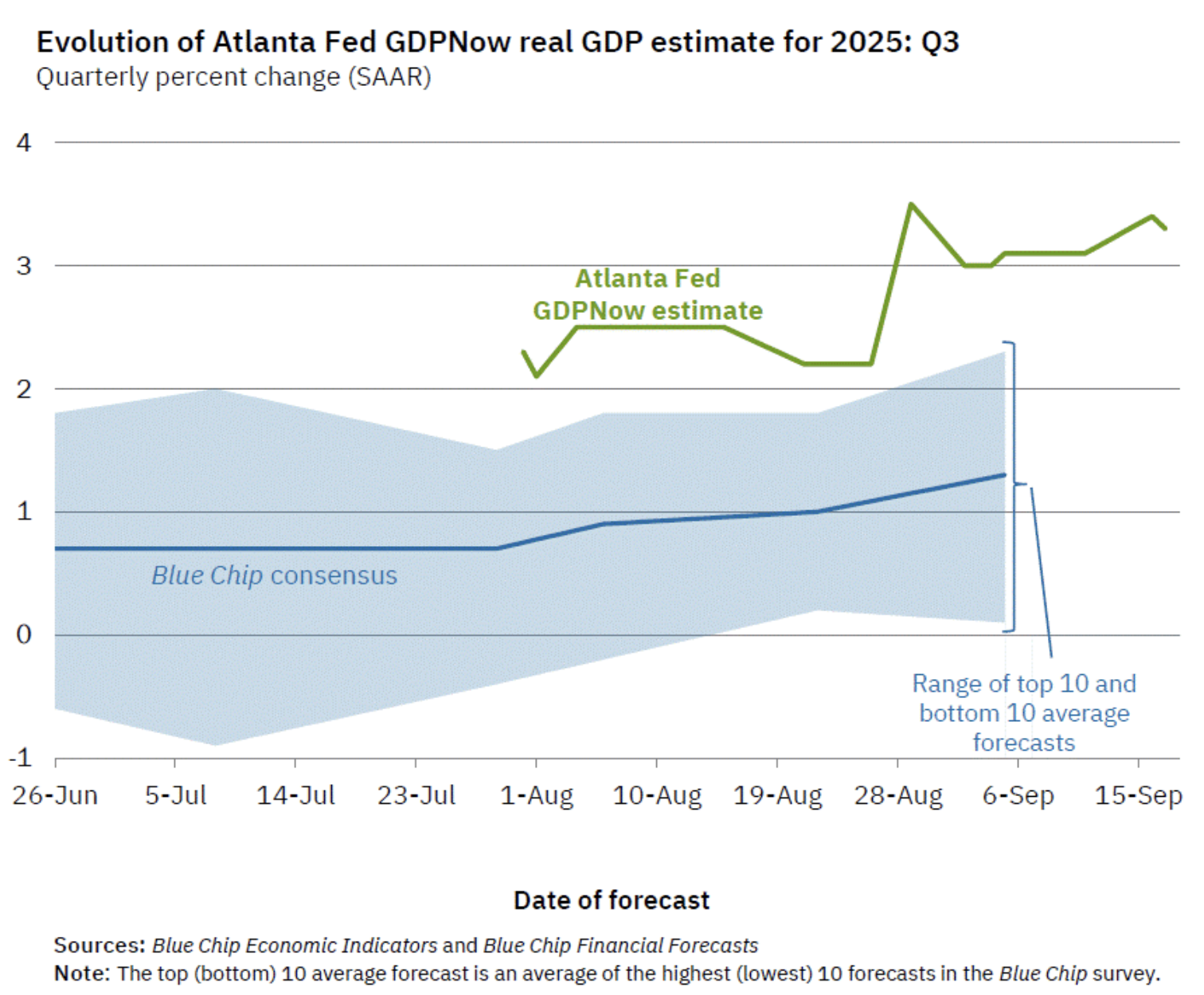
Meanwhile, down in Atlanta, their GDPNow Q3 estimate is currently at 3.3%, certainly not indicating a slowing economy.  

In fact, if that pans out, it would be only the 14th time this century that there were two consecutive quarters of GDP growth of at least 3.3%, of which 4 of those were in the recovery from the Covid shutdown.

It would be very easy to make the case that the US economy seems to be doing pretty well, at least based on the data releases.  I recognize that there is a great deal of angst about, and I have highlighted the asynchronous nature of the economy lately, but what this is telling me is that things may be syncing up in a positive manner.

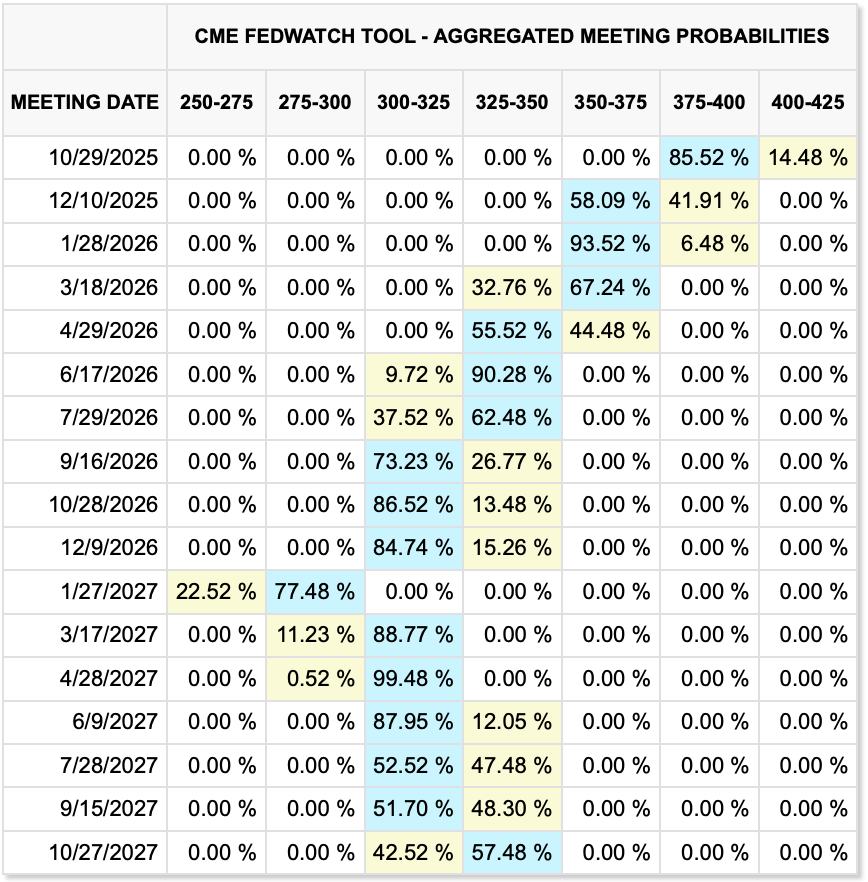
So, what does this mean for markets?  Perhaps the first place to look is the Fed funds futures market as so much stock continues to be put into the Fed’s next move.  Not surprisingly, earlier exuberance over further rate cuts has faded a bit, with the probability of an October cut slipping to 85%, down about 10 points in the wake of the data, and a total of less than 40bps now priced in for the rest of the year.  Recall, it was not that long ago that people were considering 100bps in the last three meetings of the year.

Source: cmegroup.com

The next place to look is at the foreign exchange markets, where the dollar’s demise has been widely forecast amid changing global politics with many pundits highlighting the idea that the BRICS nations would be moving their business away from dollars.  For a long time, I have highlighted that the dollar is currently within a few percent of its long-term average price, neither particularly strong nor weak, and that fears of a collapse were unwarranted.  However, I have also recognized that a dovish Fed could easily weaken the dollar for a period of time.  Short dollar positions remain large as the leveraged community continues to bet on that outcome, although I have to believe it is getting expensive given they are paying the points to maintain that view.

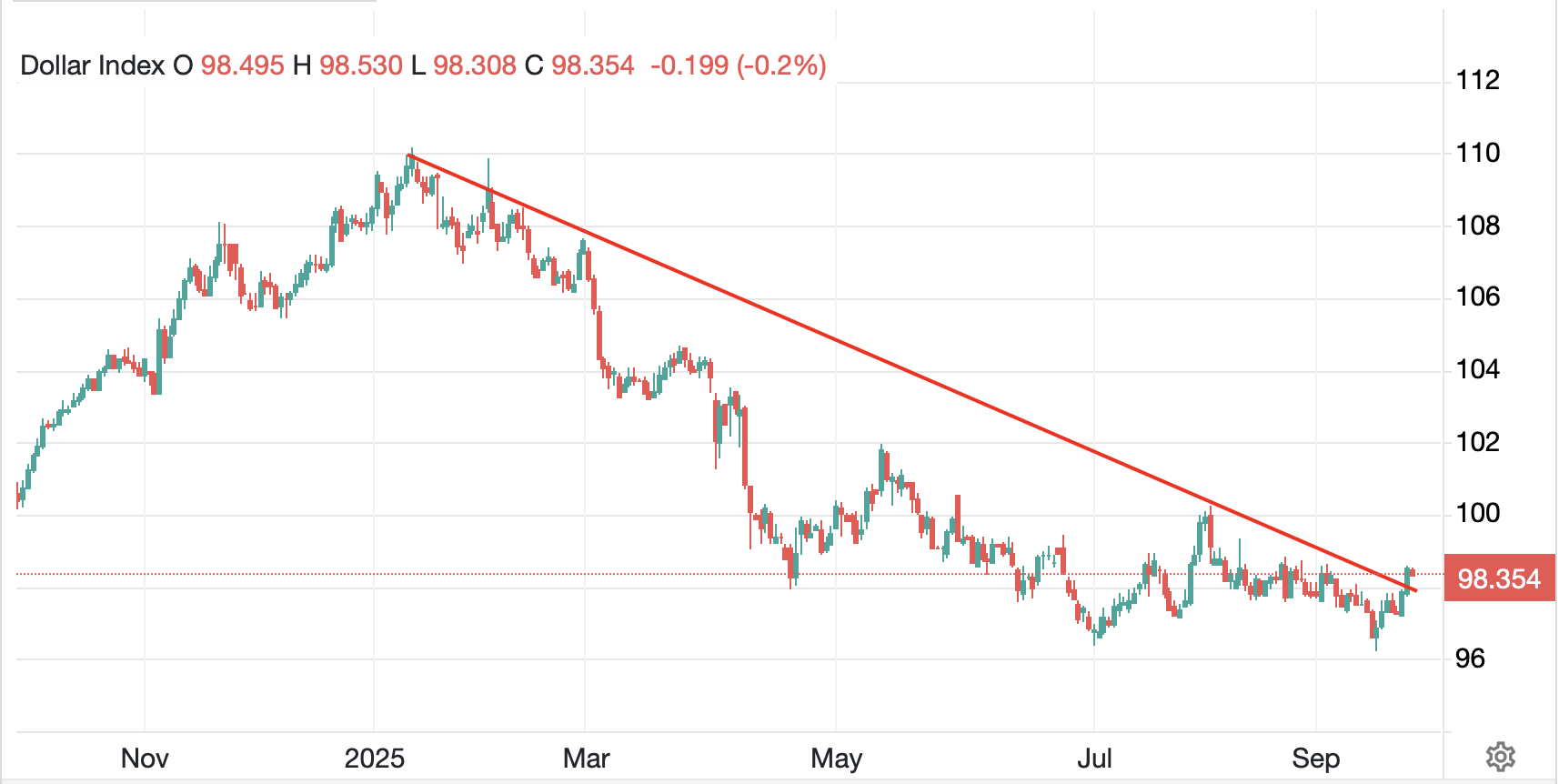
But if we look at how the dollar has performed over the past several sessions, using the DXY as our proxy, we can see that despite a very modest -0.1% decline overnight, it appears that the dollar may be breaking its medium-term trend line lower as per the chart below from tradingeconomics.com

Again, my point is that the idea that the US is facing a catastrophic outcome with a recession due and a collapsing dollar is just not supported by the data or the markets.  And here’s an interesting thought from a very smart guy, Mike Nicoletos (@mnicoletos on X) regarding some of the key drivers of the current orthodoxy regarding the dollar, notably the debt and deficit.  What if, given the dollar’s overwhelming importance to the world economy, we should be comparing those things to its global scale, not just the domestic scale.  If using that framework, as he describes here, the debt ratio falls to 58% and the budget deficit is down to 2.9%, much less worrying and perhaps why markets and analysts are out of sync.

Markets are going to go where they will, but having a solid framework as to how the economy impacts them is a very helpful tool when managing money and risk.  Perhaps this needs to be considered overall.

Ok, a really quick tour.  Yesterday was the third consecutive down day in the US, although all told, the decline has been less than -2%, so hardly devastating.  Asia mostly fell overnight as concerns over both tariffs and a Fed less likely to cut rates weighed on equities there with Japan (-0.9%), China (-1.0%) and HK (-1.35%) all under pressure.  The story was worse for other regional bourses with Korea (-2.5%), India (-0.9%) and Taiwan (-1.7%) indicative of the price action.

However, Europe has taken a different route with modest gains across the board (DAX +0.3%, CAC +0.45%, IBEX +0.6%) as investors seem to be looking through the tariff concerns.  US futures are also edging higher at this hour (7:45).

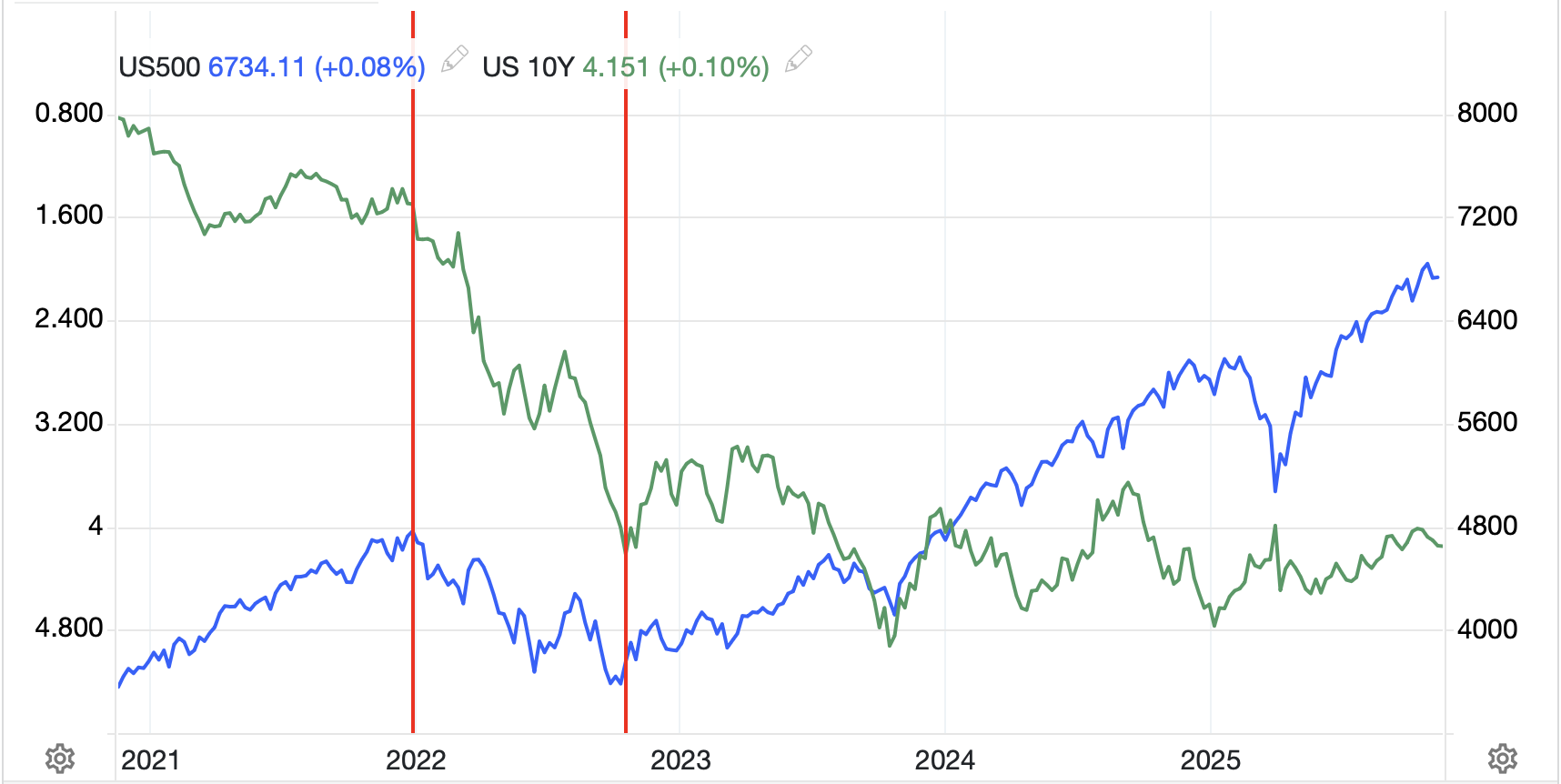
In the bond market, Treasury yields have slipped -1bp this morning, and while they remain above the levels seen immediately in the wake of the FOMC last week, they appear to be finding a home at current levels of 4.15% +/-.  European sovereigns are all seeing yields slip -3bps this morning as today’s story is focusing on how most developed nations are reducing the amount of long-dated paper they are selling to restrict supply and keep yields down.  This has been decried by many since then Treasury Secretary Yellen started this process, but as with most government actions, the expedience of the short-term benefit far outweighs the potential long-term consequences and so everybody jumps on board.

Turning to commodities, oil (-0.1%) is still trading below the top of its range and while it has traded bottom to top this week, there is no sign of a breakout yet.  I read yet another explanation yesterday as to why peak oil demand is going to be seen this year, or next year, or soon, which will drive prices lower.  While I do think prices eventually slide lower, I take the other side of that supply-demand idea and believe it will come from increased supply (Argentina, Guyana, Brazil, Alaska) rather than reduced demand.  In the metals markets, yesterday saw silver (-0.2%) jump nearly 3% to yet another new high for the move as traders set their sights on $50/oz.  Meanwhile gold (0.0%) continues to grind higher in a far less flashy manner than either silver or platinum (+10% this week) as regardless of my explanation of relative dollar strength vs. other fiat currencies, against stuff, all fiat remains under pressure.

And finally, the dollar after a nice rally yesterday, is consolidating this morning.  The currency I really want to watch is the yen, where CPI last night was released at 2.5%, lower than expected and which must be giving Ueda-san pause with respect to the next rate hike.  Most analysts are still convinced they will hike in October, but if inflation has stopped rising, will they?  I would not be surprised to see USDJPY head well above 150, a level it is fast approaching, over the next month.

On the data front, this morning’s BLS version of PCE (exp 0.3%, 2.7% Y/Y) and Core PCE (0.2%, 2.9% Y/Y) is released at 8:30 along with Personal Income (0.3%) and Personal Spending (0.5%).  Then at 10:00, Michigan Sentiment (55.4) is released and somehow, I have a feeling that could be better than forecast.  We hear from a bunch more Fed speakers as well although a pattern is emerging that indicates they are ready to cut again next month, at least until they see data that screams stop.

The world is not ending and in fact, may be doing just fine, at least economically. Meanwhile, the dollar is finding its legs so absent a spate of very weak data, I think we may see another 2% or so rebound in the greenback over the next several weeks.

Good luck and good weekend

Adf

No Reprieve

The barbarous relic is soaring
As Stephen Miran is imploring
That Fed funds should be
At 2, don’t you see
An idea that Trump is adoring
 
But what else would happen if Steve
Is Fed Chair, when Powell does leave?
At first stocks would rally
Though bonds well could valley
And ‘flation? There’d be no reprieve


Arguably, the most interesting news in the past twenty-four hours has been the speech given by the newest FOMC member, Stephen Miran, where he explained his rationale for interest rates going forward.  There is no point going into the details of the argument here, but the upshot is he believes that 2.0% is the proper current setting for Fed funds based on his interpretation of the Taylor Rule.  That number is significantly lower than any other estimate I have seen from other economists, but then, the track record of most economists hasn’t been that stellar either.  Who am I to say he is right or wrong?

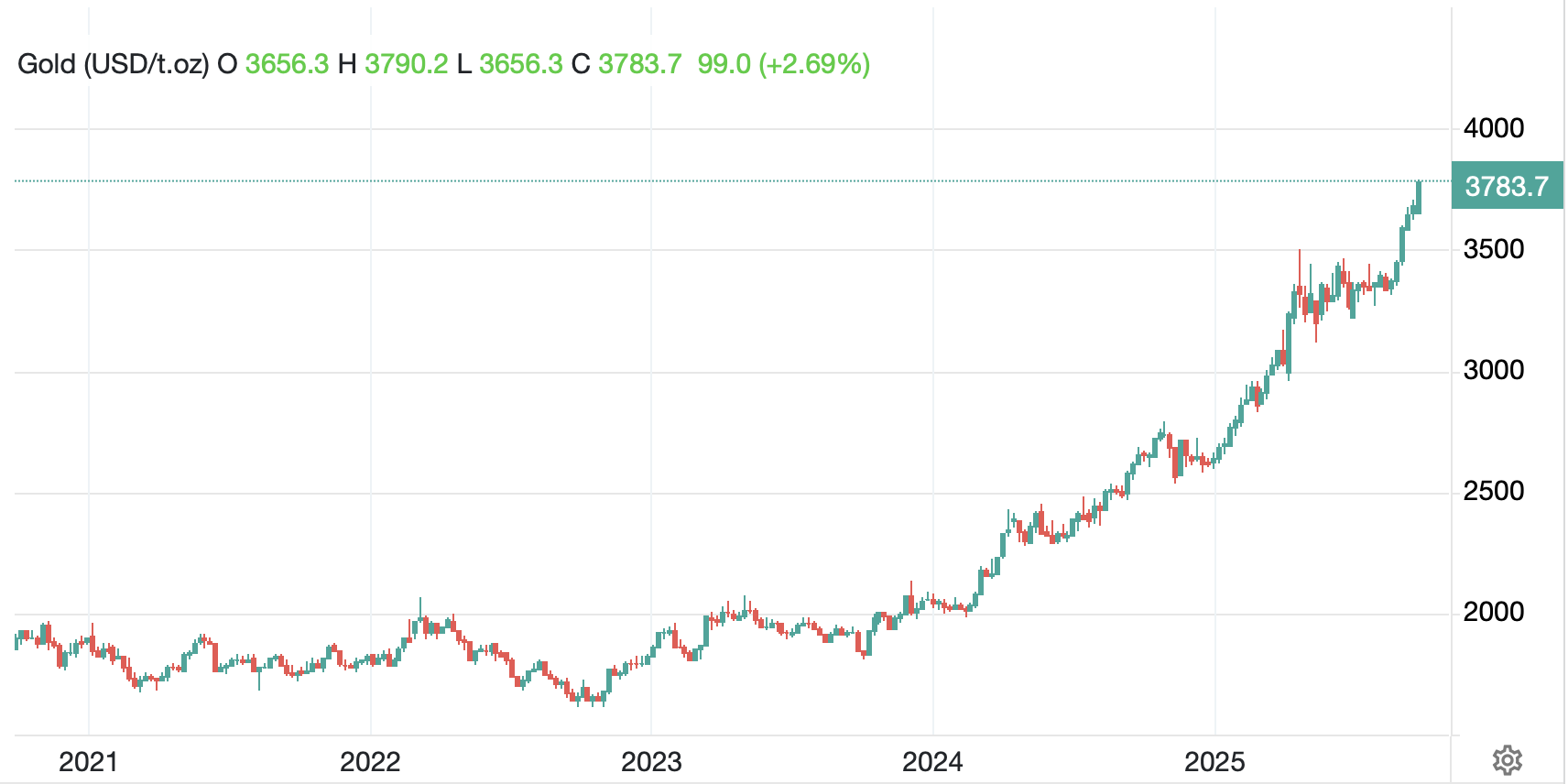
Well, actually, I guess that’s what I do, comment from the cheap seats, and FWIW, I suspect that number is far too low.  But forgetting economists’ views, perhaps the best arbiter of those views is the market, and in this case, the gold market.  With that in mind, I offer the following chart from tradingeconomics.com:

Those are weekly bars in the chart which shows us that the price of gold has risen for the past five weeks consecutively, during which time it has gained more than 14% on an already elevated price given the rally that began back in the beginning of 2024. Today’s 1% rise is just another step toward what appears to be much higher levels going forward.  

Why, you may ask, is gold rallying like this?  The thought process, which Miran defined for us all yesterday, is that he is in line to be the next Fed chair when Powell leaves, and so his effort will be to cut rates as quickly as possible to that 2% level.  Of course, the risk is inflation readings will continue to rise while the Fed is cutting.  If that occurs, and I suspect it is quite likely, then fears about a weaker dollar are well founded (that has been my view all along, aggressive rate cuts by the Fed will undermine the dollar in the short-run, longer term is different) and gold and other commodities will benefit greatly.  As to bonds…well here the picture is likely to be pretty ugly, with yields rising.  In fact, I wouldn’t be surprised to see 10-year Treasury yields head back toward 5.0% at which point the Treasury and the Fed, working hand in hand, will cap them via some combination of QE and YCC.

Of course, this is just one hypothesis based on what we know today and won’t happen until Q2 or Q3 next year.  Gold is merely sniffing out the probability of this outcome.  Remember, too, that the Trump administration has been quite unpredictable in its policy moves, and so none of this is a sure thing.

As an aside, given the inherent dovishness of the current make up of Fed governors, it would seem that a Miran chairmanship with a distinctly dovish bent will not have much problem getting the rest of the FOMC to go along, except perhaps for a few regional presidents.  And that doesn’t even assume that Governor Cook is forced out.  After all, she is a raging dove, just a political one that doesn’t want to give President Trump what he wants.

And before I start in on the overnight activity, here is another question I have.  Generally, economists are much more in favor of consumption taxes (that’s why they love a VAT) rather than income taxes and it makes sense, in that consumption taxes offer folks the choice to pay the tax by consuming or not.  If that is the case, why are these same economists’ hair all on fire about the tariffs, which they plainly argue is a consumption tax?  I read that the US is set to generate $400 billion in tariff revenue this year which would seem to go a long way to offsetting no tax on tips and other tax cuts from the OBBB.  I would expect that if starting from scratch, an honest economist, with no political bias (if such a person were to exist) would much rather see lower income tax rates and higher consumption tax rates.  Alas, that feels like a conversation we will never be able to have.

Anyway, on to markets where yesterday saw yet another set of new all-time highs in the US across all the major indices with futures this morning slightly higher yet again.  Japan was closed for Autumnal Equinox Day, while the rest of the region had a mixed performance.  China (-0.1%) and HK (-0.7%) suffered on continuing concerns over the Chinese economy with news that banks which are still dealing with property loan problems are now beginning to see consumer loan defaults as well.  Elsewhere Korea and Taiwan both rallied nicely, following the tech-led US while India suffered a bit on the H1-B visa story with the rupee falling to yet another historic low (dollar high) now pushing 89.00.  There were some other laggards as well (Thailand, Philippines) but most of the rest were modestly higher.  

In Europe, green is the theme with the CAC (+0.7%) leading the way while the DAX (+0.2%) and IBEX (+0.3%) are not as positive.  Ironically, Flash PMI data showed that French activity was lagging the most, with both manufacturing (48.1) and services (48.9) below the 50.0 breakeven level and much worse than expected.  It seems the fiscal issues in France are starting to feed into the private sector.  As to the UK, weaker Flash PMI data there has resulted in no change in the FTSE 100 as it appears caught between inflation worries and growth worries.

In the bond market, Treasury yields which rose 2bps yesterday have slipped by -1bp this morning while continental sovereigns are all essentially unchanged.  The one outlier here is the UK where gilts (-3bps) are rallying on hopes that the PMI data will lead to easier monetary policy.

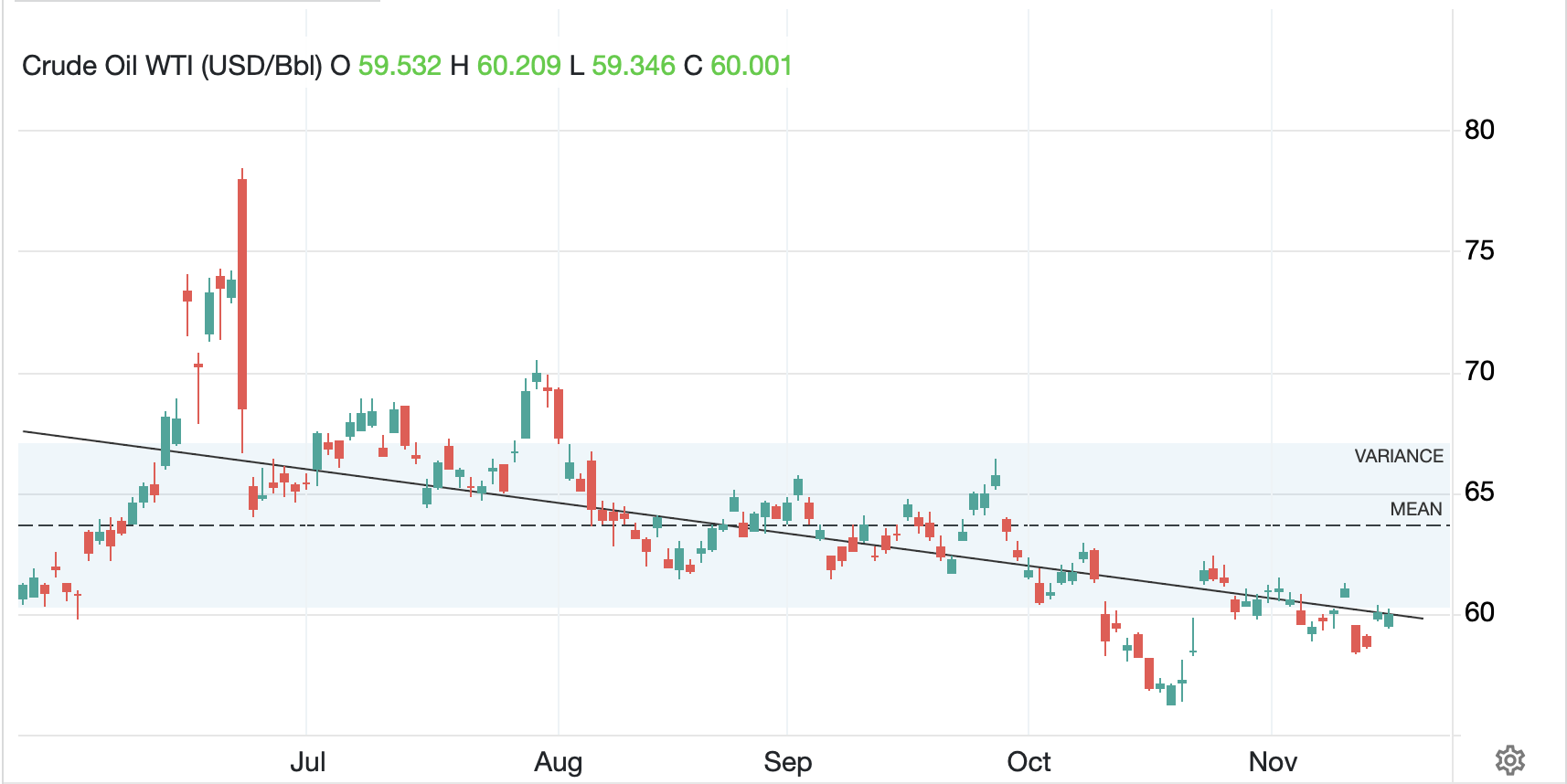
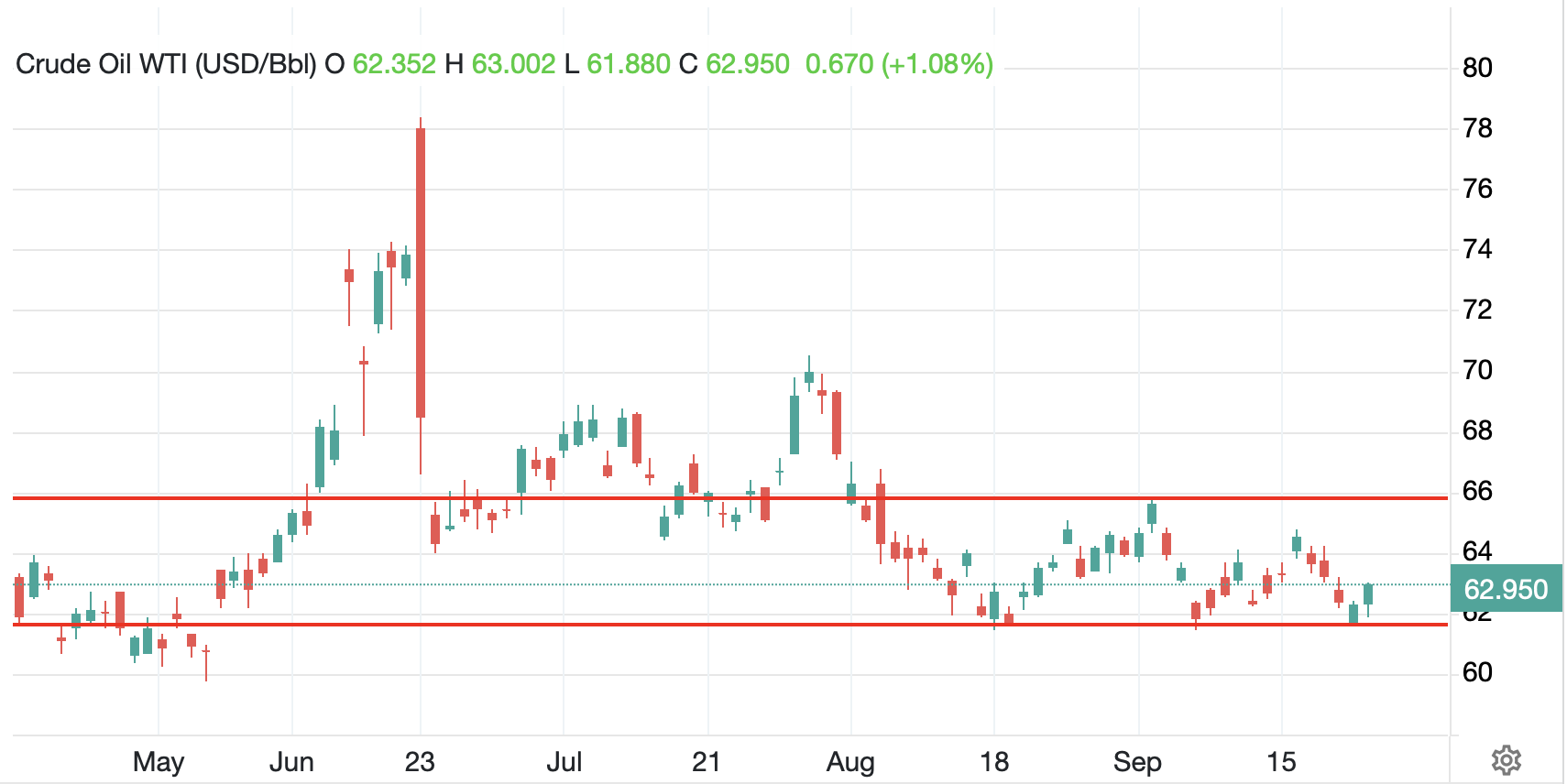
Elsewhere in the commodity markets, oil (+1.1%) is bouncing from its recent lows but has not made much of a case to breech its recent $61.50/$65.50 trading range as per the below.

Source: tradingeconomics.com

The other precious metals are rocking alongside gold (Ag +0.7%, Pt +2.6%) with silver having outperformed gold since the beginning of the year by nearly 10 percentage points.  Oh, and platinum has risen even more, more than 63% YTD!

Finally, the dollar is basically unchanged this morning, with marginal movement against most of its counterparties.  There are only two outliers, SEK (+0.5%) which rallied despite (because of?) the Riksbank cutting their base rate by 25bps in a surprise move.  However, the commentary indicated they are done cutting for this cycle, so perhaps that is the support.  On the other side of the coin, INR (-0.5%) has been weakening steadily with the H1-B visa story just the latest chink in the armor there.  PM Modi is walking a very narrow tight rope to appease President Trump while not upsetting Presidents Putin and Xi.  His problem is that he needs both cheap oil and the US market for the economy to continue its growth, and there is a great deal of tension in his access to both simultaneously.  But away from those currencies, +/- 0.1% describes the session.

On the data front, today brings the Flash PMI data (exp 52.0 Manufacturing, 54.0 Services) and the Richmond Fed Manufacturing Index (-5.0).  remember, the Philly Fed Index registered a much higher than expected 23.2 last week, so the manufacturing story is clearly not dead yet.

Arguably, though, of far more importance than those numbers will be Chairman Powell’s speech at 12:35 this afternoon on the Economic Outlook in Providence, RI.  All eyes and ears will be on his current views regarding the employment situation and inflation, especially in light of Miran’s speech yesterday.

While the gold market is implying our future is inflationary and fiat currencies will weaken, the FX market has not yet taken that idea to extremes.  Any dovishness by Powell, which given the lack of data since we heard from him last week would be a surprise, will have an immediate impact.  However, I suspect he will maintain the relatively hawkish tone of the press conference and not impact markets much at all.

Good luck

Adf
Many Ructions

Just two days before Halloween
When Jay and his minions convene
With great joie de vivre
Investors believe
A quarter-point cut will be seen
 
But what if the model that Jay
Consults might have led him astray
Then Fed fund reductions
May cause many ructions
In markets, and too, the beltway


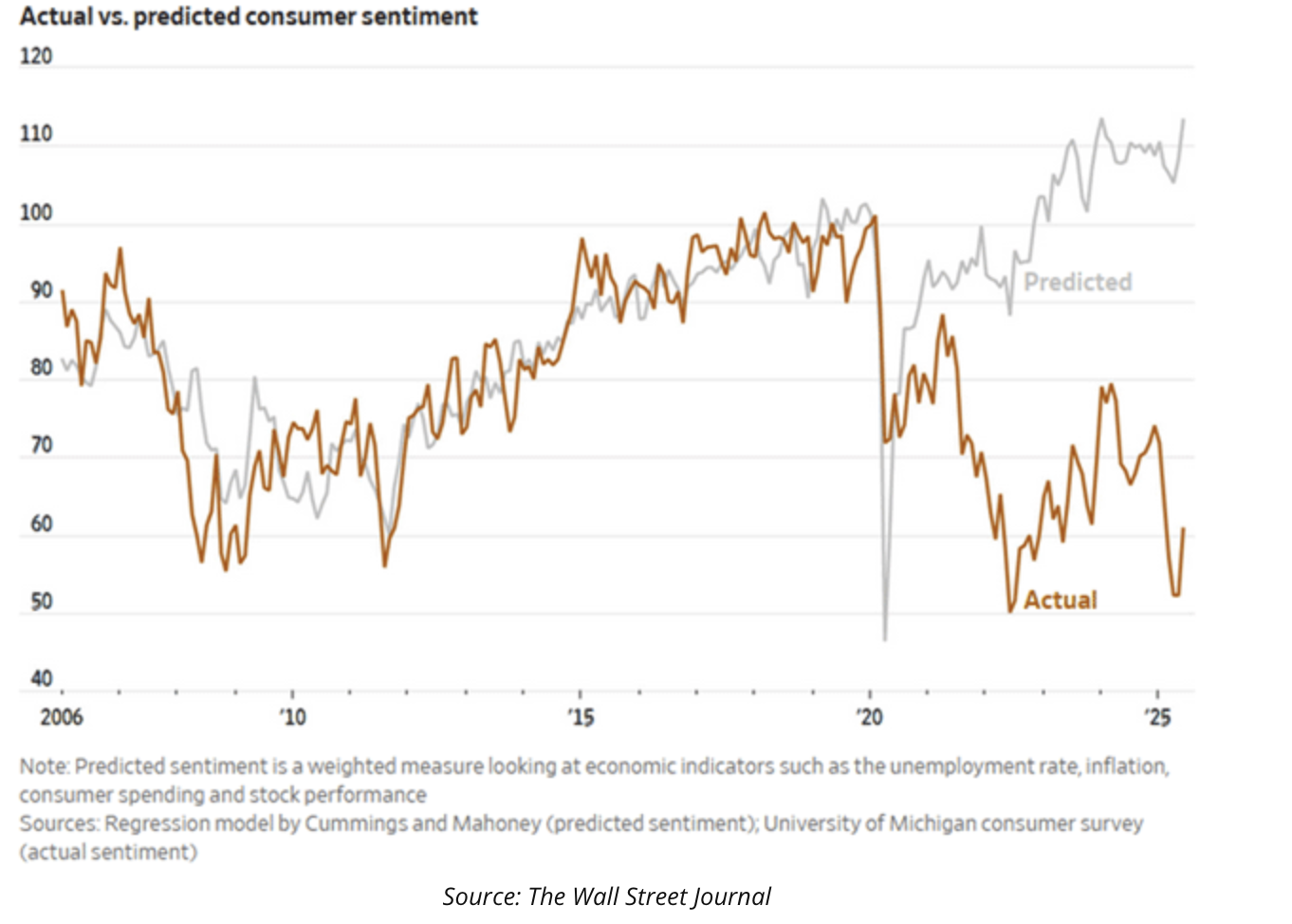
But I am just a poet and my voice is not so loud in financial markets.  However, John Mauldin is someone with much greater reach and his letter this week highlighted that exact issue. (For those of you who are not familiar with John, his weekly letter, “Thoughts from the Frontline” is usually an excellent read and completely free, you should sign up.)  At any rate, he reprinted a chart originally in the WSJ that I think does an excellent job of demonstrating the flaws in models developed pre-Covid.

It is quite apparent how this particular model, which appears to use the type of inputs that most econometric models utilize, had done a pretty good job, even throughout the GFC, of anticipating changes in consumer sentiment right up until Covid.  However, it is also clear that since then, it has a terrible track record.  

And this is the problem.  I would wager that every one of the models built by the hundreds of PhD’s at the Fed has a similar problem, things that used to drive economic decision making no longer do.  I guess when people get used to the government supporting them completely, many are willing to sit back and do nothing.  And when that support stops, it appears that people aren’t very happy about that situation.  Go figure!

The bigger picture here is that I believe it is time for the Fed to question its own modeling prowess.  Consider the situation that with interest rates at their current levels of 4% +/- a bit depending on the tenor, many people, especially retirees, were quite content to clip coupons and were spending those funds supporting the economy.  At the same time, interest expense for small companies never really fell that far, so current rates are not deathly. 

But you know who benefits from low interest rates?  The government and large corporations who have access to capital markets and pay the lowest rates.  And even there, companies like Apple, Google and Microsoft have so much cash on hand that they are net earning interest with higher rates.

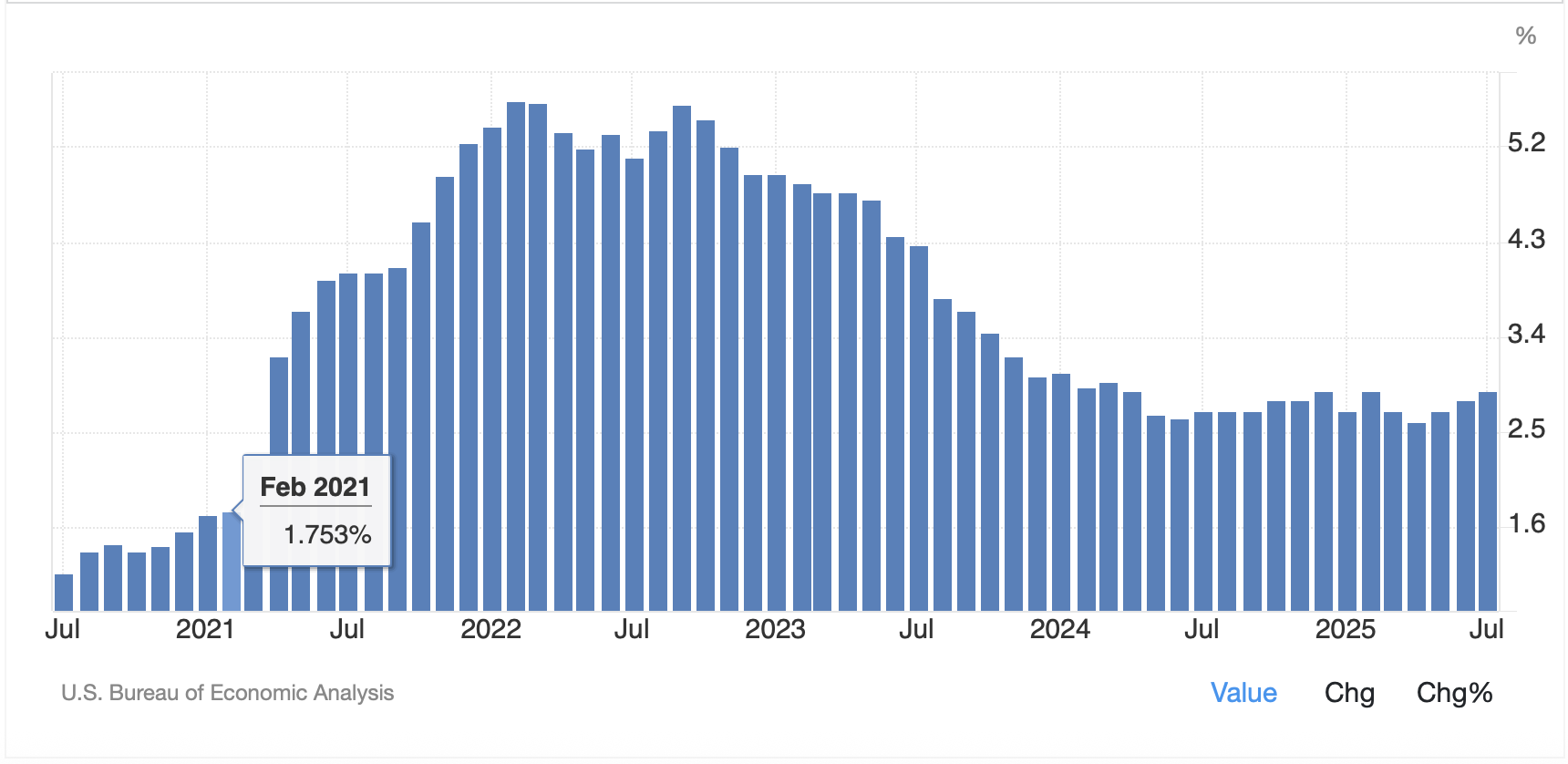
All this begs the question, what is the purpose of the Fed cutting rates?  A key risk is that inflation will return with a vengeance.  It has been 55 months since core PCE was at or below the Fed’s target level of 2.0% as you can see in the below chart, and I feel confident in saying that when the data is released this Friday, it will not be changing that trend.

Source: tradingeconomics.com

So, savers will suffer as their income will be reduced, the risk of rising inflation will increase as easier monetary policy typically precedes that type of movement, and long-term yields, which have rebounded recently, run the risk of starting higher again.  Remember what happened last year when the Fed cut, 10-year Treasury yields rose 100bps. (see chart below)

Source: tradingeconomics.com

It is far too early to claim the outcome will be the same this time, but it is a real risk.  After all, bond yields have a strong relationship with inflation, running at a long-term correlation of 0.36 and as can be seen in the chart below I prepared from FRED data.

Concluding, the current batch of economic models utilized by analysts and the Fed appear to have limited ability to describe the economy, whether it is because of the asynchronous nature of the current state of the world, or because the unprecedented government responses around the world to the Covid pandemic have changed the way everything works.  The market is pricing a 93% probability of another rate cut in October, and it appears Chairman Powell believes that to be the case.  But is it the right move at this time?  I feel like that is not the question being asked, but it needs to be by people more powerful than this poet.

Ok, I’ll step down from my soapbox to survey the market activity overnight.  Friday’s US closes at yet more all-time highs were followed by a more mixed session in Asia.  While Japanese investors got the joke, with the Nikkei rising 1.0%, Hong Kong (-0.8%) and India (-0.6%) were both under pressure with the former suffering from a strengthening currency and concern about a major typhoon about to hit the island nation, while India is suffering from the backlash of the Trump policy change on H1-b visas, now charging $100,000 for them.  It turns out Indian firms were the largest user of those visas and there is concern over a serious economic impact there.  Otherwise, the region saw a mixture of green (China, Taiwan, Australia, Malaysia) and red (New Zealand, Indonesia, Singapore, Thailand).

European bourses, though, are having a tougher time this morning with the continental exchanges all under pressure (DAX -0.7%, CAC -0.3%, IBEX -1.0%, FTSE MIB -1.0%) as concerns rise over the Flash PMI data to be released tomorrow and the idea it may show a much weaker economy than previously considered.  As well, USD futures are softer at this hour (6:40), with all three major indices showing declines on the order of -0.25%.  However, we must keep in mind that the trend in equity markets has been strongly higher so a modest pullback would not be a surprise and perhaps should be welcomed.

In the bond market, yields having moved higher on Friday, are quite stable this morning with Treasury yields unchanged and most of Europe seeing a -1bp decline.  The only outlier here is Japan, where JGB yields topped 1.65%, a new high for the move and the highest level since 2008 as per the below chart from marketwatch.com.  Ueda-san has to start getting worried soon, I think.

In the commodity space, oil (-0.7%) is continuing its recent decline but remains within the trading range and doesn’t appear to have much impetus in the short term in either direction.  However, I continue to look for an eventual decline here.  As to gold (+1.15%) and silver (+1.6%), nothing is going to stop this train.  Well, certainly there is no indication that policy changes are coming anywhere in the world that would force investors to rethink the idea of continuous depreciation of fiat currencies, and let’s face it, that’s all this represents.  I continue to see analysts raise their target price for the barbarous relic and I agree there is plenty of room to run as interest has been modest, at best, by Western investors.

Finally, the dollar is a touch softer this morning with both the euro (+0.25%) and pound (+0.25%) leading the way in the G10, although the yen is basically unchanged.  There was an interesting story in Bloombergdiscussing how volatility in the FX markets has been declining rapidly with many attributing this to the rise of algorithmic trading.  As well, all over X this morning are stories about how the dollar’s decline this year (about -14% vs. the euro) is unprecedented.  It’s not at all which is one of the reasons you need be careful about what people put up there.  It seems that some analysts are putting undue emphasis on the starting point being January 1st, rather than when the market tops.  But saying the dollar is declining in an unprecedented manner is absurd and picayune.  Meanwhile, EMG currencies are all over the place with gainers (KRW +0.4%, ZAR +0.4%) and laggards (MXN -0.5%, INR -0.25%) and everything in between.  

On the data front, PCE is Friday’s offering, but before then there is some stuff and more interestingly, there is lots of Fed speak.

TodayChicago Fed National Activity-0.17
TuesdayFlash Manufacturing PMI52.0
 Flash Services PMI53.9
WednesdayNew Home Sales650K
ThursdayDurable Goods-0.5%
 -ex transport-0.2%
 GDP (Q2)3.3%
 Initial Claims235K
 Continuing Claims1930K
 Existing Home Sales3.96M
FridayPCE0.3% (2.7% Y/Y)
 Core PCE0.2% (2.9% Y/Y)
 Personal Income0.3%
 Personal Spending0.5%
 Michigan Sentiment55.4

Source: tradingeconomics.com

On top of the data, we hear from…wait for it…ten different Fed speakers, including Chair Powell tomorrow, across 16 different events.  I expected to hear from a lot as there is clearly no real consensus at this point in time there.

People love to hate the dollar, and if the Fed is going to ease more aggressively, I understand that, but longer term, I think the story is different.  Just be careful.

Good luck

Adf
A Third Fed Mandate

As Jay and his minions convene
A new man is making the scene
Now, Stephen Miran
A man with a plan
Will help restart Jay’s cash machine
 
But something that’s happened of late
Is talk of a third Fed mandate
Yes, jobs and inflation
Have been the fixation
But long-term yields need be sedate


As the FOMC begins their six-weekly meeting this morning, most market participants focus on the so-called ‘dual mandate’ of promoting the goals maximum employment and stable prices.  This, of course, is why everybody focuses on the tension between the inflation and unemployment rates and why the recent revisions to the NFP numbers have convinced one and all that a rate cut is coming tomorrow with the only question being its size.  But there is a third mandate as is clear from the below text of the Federal Reserve Act, which I have copied directly from federalreserve.gov [emphasis added]:

“Section 2A. Monetary policy objectives

The Board of Governors of the Federal Reserve System and the Federal Open Market Committee shall maintain long run growth of the monetary and credit aggregates commensurate with the economy’s long run potential to increase production, so as to promote effectively the goals of maximum employment, stable prices, and moderate long-term interest rates.

[12 USC 225a. As added by act of November 16, 1977 (91 Stat. 1387) and amended by acts of October 27, 1978 (92 Stat. 1897); Aug. 23, 1988 (102 Stat. 1375); and Dec. 27, 2000 (114 Stat. 3028).]”

One of the things we have heard consistently from Treasury Secretary Bessent is that he is highly focused on ensuring that longer-term yields do not get too high.  Lately, the market has been working to his advantage with both 10-year, and 30-year yields having declined by more than 25bps in the past month.  And more than 40bps since mid-July.  (Look at the yields listed on the top of the chart below to see their recent peaks, not just the line.)

Source: tradingeconomics.com

Now, with President Trump’s head of the CEA, Stephen Miran getting voted onto the board to fill the seat that had been held by Governor Adriana Kugler, but heretofore vacant, one would think that the tone of the conversation is going to turn more dovish.  What makes this so odd is that, by their nature, central bankers are doves and seemingly love to print money, so there should be no hesitation to cut rates further.  But…that third mandate opens an entirely different can of worms and brings into play the idea of yield curve control as a way to ensure the Fed “promote(s)…moderate long-term interest rates.”

It was Ben Bernanke, as Chair, who instigated QE during the GFC although he indicated it was an emergency measure.  It was Janet Yellen, as Chair, who normalized QE as one of the tools in the toolbox for the Fed to address its dual mandate.  I believe the case can be made that newly appointed Governor Miran will begin to bang the drum for the Fed to act to ensure moderate long-term interest rates, and there is no better policy to do that than QE/YCC.  Actually, there is a better policy, reduced government spending and less regulation that allows productivity to increase and balances the production-consumption equation, but that is out of the Fed’s hands.

At any rate, we cannot ignore that there could be a subtle change in focus to the statement and perhaps Chairman Powell will discuss this at the press conference.  If this has any validity, a big IF, the market impacts would be significant.  The dollar would start another leg lower, equities would rise sharply, and commodity prices would rise as well.  Bonds, of course, would be held in check regardless of the inflationary consequences.  Just something to keep on your bingo card!

Ok, let’s check out the overnight activity.  While it was quiet in the US yesterday, we did manage to make more new highs in the S&P 500 as all three major indices were higher.  As to Asia, Tokyo (+0.3%) had the same type of session, with modest gains as it takes aim at a new big, round number of 45,000.  China (-0.2%) and HK (0.0%) did little although there was a lot of positivity elsewhere in the region with Korea (+1.2%), India, (+0.7%) and Taiwan (+1.1%) leading the way amidst almost all markets, large and small, showing gains.  Europe, though, is a different story with red today’s color of the day, as Spain (-0.8%) and Germany (-0.6%) leading the down move despite better-than-expected German ZEW data (37.3 vs. 26.3 expected).  One of the things I read this morning was that German auto manufacturers have laid off 125,000 workers in the past 6 weeks.  That is a devastating number and bodes ill for German economic activity in the future.  As to other European bourses, -0.1% to -0.4% covers the lot.  US futures, though, continue to point higher, up 0.3% at this hour (7:30).

In the bond market, Treasury yields are unchanged this morning while European sovereign yields have edged higher by between 1bp and 2bps.  It doesn’t feel like investors there are thinking of better growth, but we did hear from several ECB members that while cuts are not impossible during the rest of the year, they are not certain.

In the commodity space, oil (+0.7%) is back in a modest upswing but still has shown no inclination to move outside that trading range of $60/$65.  It has been more than a month since that range has been broken and absent a major change in the Russia sanctions situation, where Europe actually stops buying Russian oil (as if!) I see no short-term catalyst on the horizon to change this situation.  Clearly, producers are happy enough to produce and sell at this level and demand remains robust.

Turning to the metals markets, I discuss gold (+0.4%) a lot, and given it is making historic highs, that makes sense, but silver (+0.4%) has been outperforming gold for the past month and looks ever more like it is going to make a run for its all-time highs of $49.95 set back in January 1980.  The more recent peak, set in 2011, of $48.50 looks like it is just days away based on the recent rate of climb.

Source: finance.yahoo.com

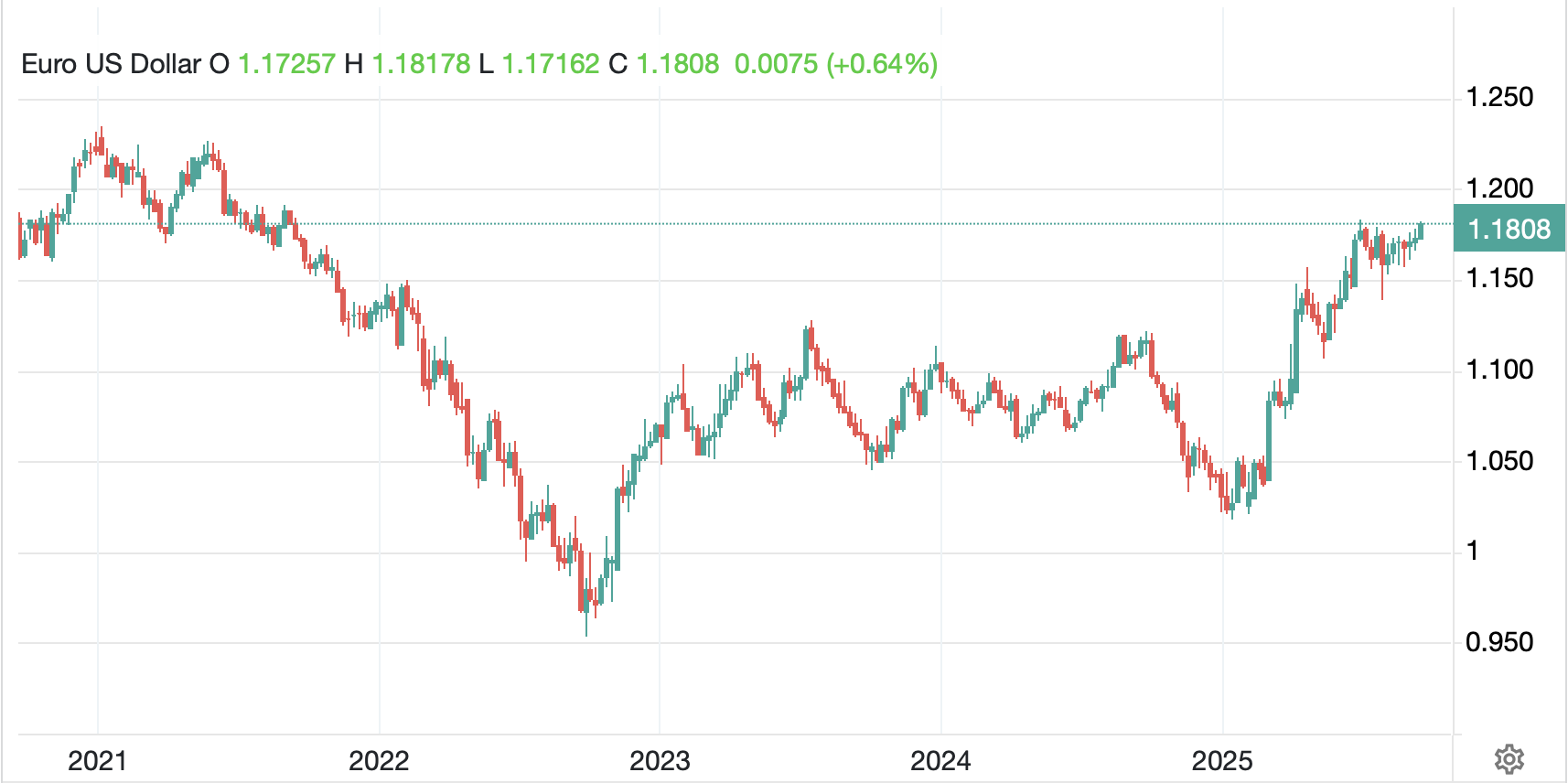
Finally, the dollar is under pressure this morning, with the euro (+0.4%) trading above 1.18 again for the first time since July 1st and there is a great deal of discussion as to how it is going to trade back to, and through, 1.20 soon, a level not seen since 2021.  

Source: tradingeconomics.com

The narrative is now that the Fed is set to begin cutting rates and the ECB is going to stand pat, the euro will rise.  This is true for GBP (+0.3%) as wel, with the Sterling chart largely the same as the euro one above.  Here’s the thing.  I understand the weak dollar thesis if the Fed gets aggressive, I discussed it above. However, if German manufacturing is contracting that aggressively, and the layoffs numbers are eye opening, can the ECB really stand pat?  Similarly, PM Starmer is under enormous, and growing, pressure to resign with the Labour party in the throes of looking to oust him for numerous reasons, not least of which is the economy is struggling.  So, please tell me why investors will flock to those currencies.  I see the dollar declining, just not as far as most.

Data this morning brings Retail Sales (exp 0.2%, 0.4% -ex autos) along with IP (-0.1%) and Capacity Utilization (77.4%).  However, it is not clear to me that markets will give this data much consideration given the imminence of the FOMC outcome tomorrow.  The current futures pricing has just a 4% probability of a 50bp cut.  I am waiting for the Timiraos article to see if that changes.  Look for it this afternoon.

Good luck

Adf
Not Blazing

Inflation was hot, but not blazing
And so, though I am paraphrasing
A 50 bip cut
Is most likely what
We’ll see next week, ain’t that amazing!
 
Though futures are not there quite yet
The Claims data’s seen as a threat
It’s been four long years
Since Claims caused such fears
Seems Trump, what he wants he will get


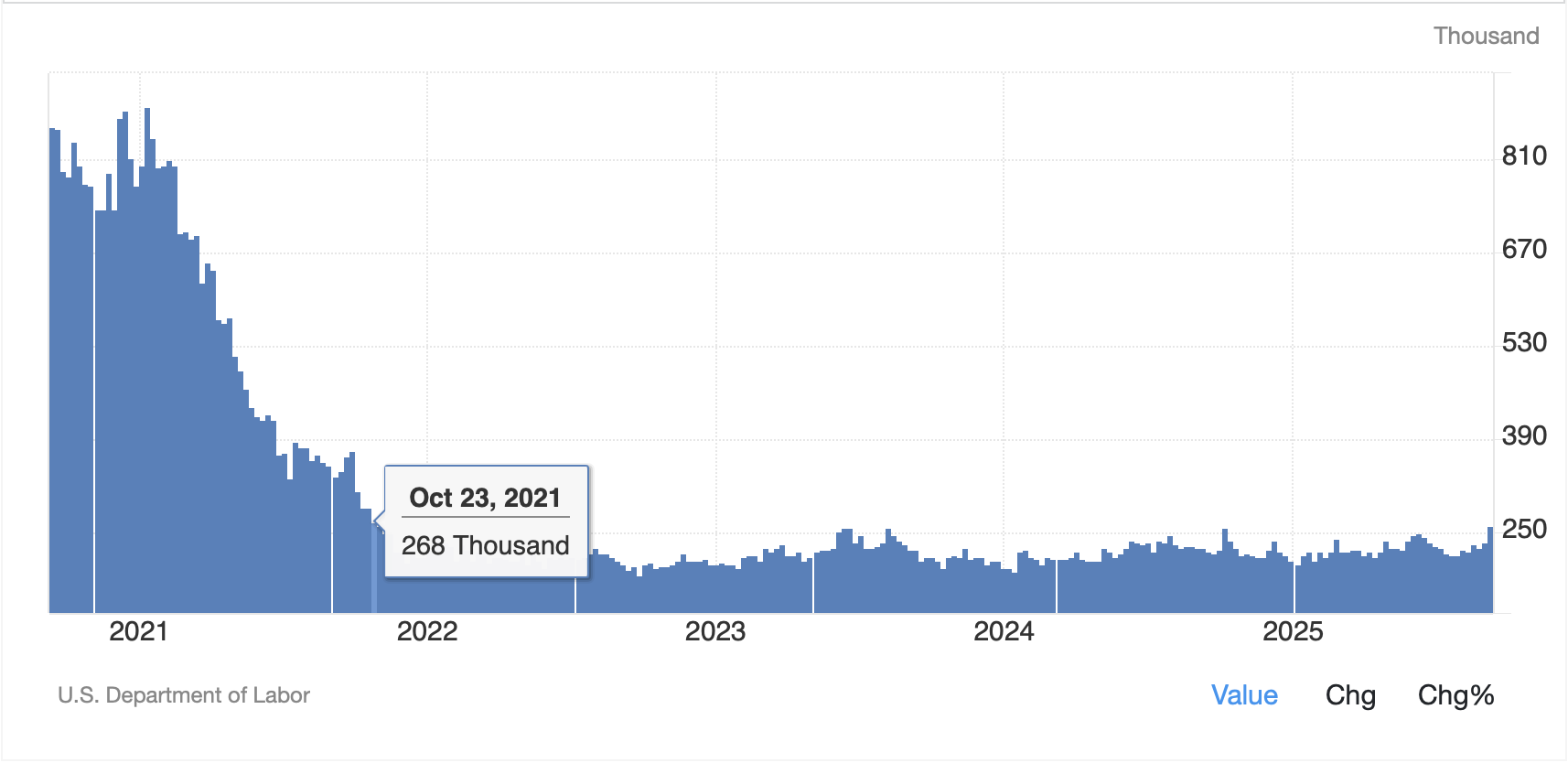
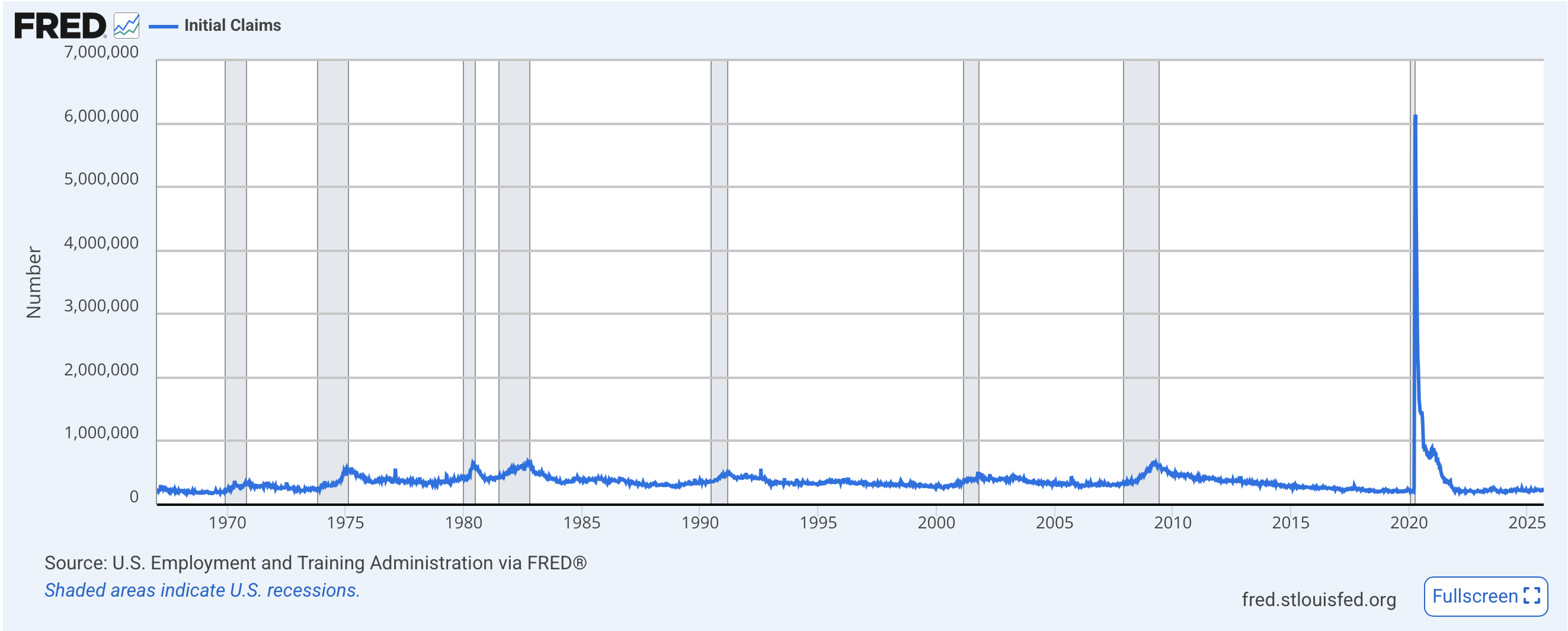
While I spent most of yesterday discussing the CPI data, which came out on the warm side of things with headline rising 0.4% M/M, a tick higher than forecast, although the Y/Y number at 2.9% was as expected, it seems far more attention than normal was paid to the Initial Claims data.  As it happens, the last time Initial Claims printed this high, 263K, was October 2021.

Source: tradingeconomics.com.

Now, we all remember last September, just prior to the Fed cutting 50bps in a surprise move, and as it happens, the Claims data the week before that jumped as well, a one-off blip to 259K.  Of course, the Fed felt it had a political imperative back then to cut as a means of supporting their preferred candidate for President, VP Harris, but that is another story.  Nonetheless, a precedent has been set that a strong claims number with inflation still warm was sufficient to get them to move.  So, will they cut 50bps next week?

Right now, the Fed funds futures market is still pricing just an 8% probability of that move, so apparently that is not the market perception.  However, this is exactly the time where we should be seeing an article from the Fed Whisperer, Nick Timiraos, at the WSJ (aka Nickileaks), which ought to explain that changes in the labor market are sufficient to overcome any concerns about inflation, especially since there is a growing expectation that a recession is coming.  Look for it on Monday.

But let us consider this for another moment.  Based on BLS data, the median reading for Initial Claims since January 1967 is 339K, far more than we saw yesterday.  In addition, if you look at a long-term chart of the Claims data, or even the shorter-term one above, while it is possible this is the beginning of a trend higher in Claims, there is no evidence yet for that, and blips higher are pretty common throughout the data set.

The one caveat here is that if we look at the recessions highlighted in gray in the above chart, the Claims data didn’t really rise until the end of the recession, so there is a chance that we are seeing the beginnings of bigger problems.  Certainly, if Claims data starts to climb further and we see 300K, there will be a stronger case to anticipate a recession.  But we haven’t yet seen that.  Alas, what we do know from Powell’s last press conference is that the Fed has basically abandoned their inflation target, so despite the fact it has been 54 months (February 2021) since core PCE has been at or below 2.0%, and even though the very idea that rate cuts are appropriate is remarkable, it seems the case for 50bps is strengthening.  

Source: tradingeconomics.com

But, as Walter Cronkite used to say, “That’s the way it is.”

So, how have markets been digesting this news?  Well, yesterday saw US equity indices make yet another set of new all-time highs on the prospects of a 50bp cut and that has largely fed to other equity markets around the world.  Bond yields remain quiescent, at least out to 10 years, although the really long stuff is having a tougher time, and the dollar remains range bound.  Aside from equities, the only market really moving is precious metals, which continue to rally nonstop.

Starting in Asia, Tokyo (+0.9%) rallied nicely as a combination of anticipated Fed cuts and the calming of trade tensions with the US has investors there feeling giddy.  It, too, has reached new all-time highs.  Hong Kong (+1.1%) also had a good session although China (-0.6%) didn’t follow through as profit taking was evident after what has been a very strong run in mainland stocks lately.  Elsewhere in the region, only two markets (Singapore and Philippines) lagged, and those were very modest declines of -0.3%.  Otherwise, gains of up to 1.5% were the norm.

However, Europe didn’t get that memo this morning with continental bourses all under pressure (DAX -0.3%, CAC -0.5%, IBEX -0.7%) amid a growing realization that the ECB may have finished its cutting cycle, at least according to Madame Lagarde’s comments yesterday expressing confidence the bank is in a “good place”.  However, under the rubric bad news is good, UK stocks (+0.3%) are edging higher after data showed GDP flatlined in July with the Trade deficit rising, and IP falling sharply (-0.9%) as traders are becoming more convinced the BOE will cut rates despite much stickier inflation than their target level.  Remember, too, the BOE’s mandate is entirely inflation focused, but these days, none of that matters!  Finally, US futures are either side of unchanged as I type (7:00).

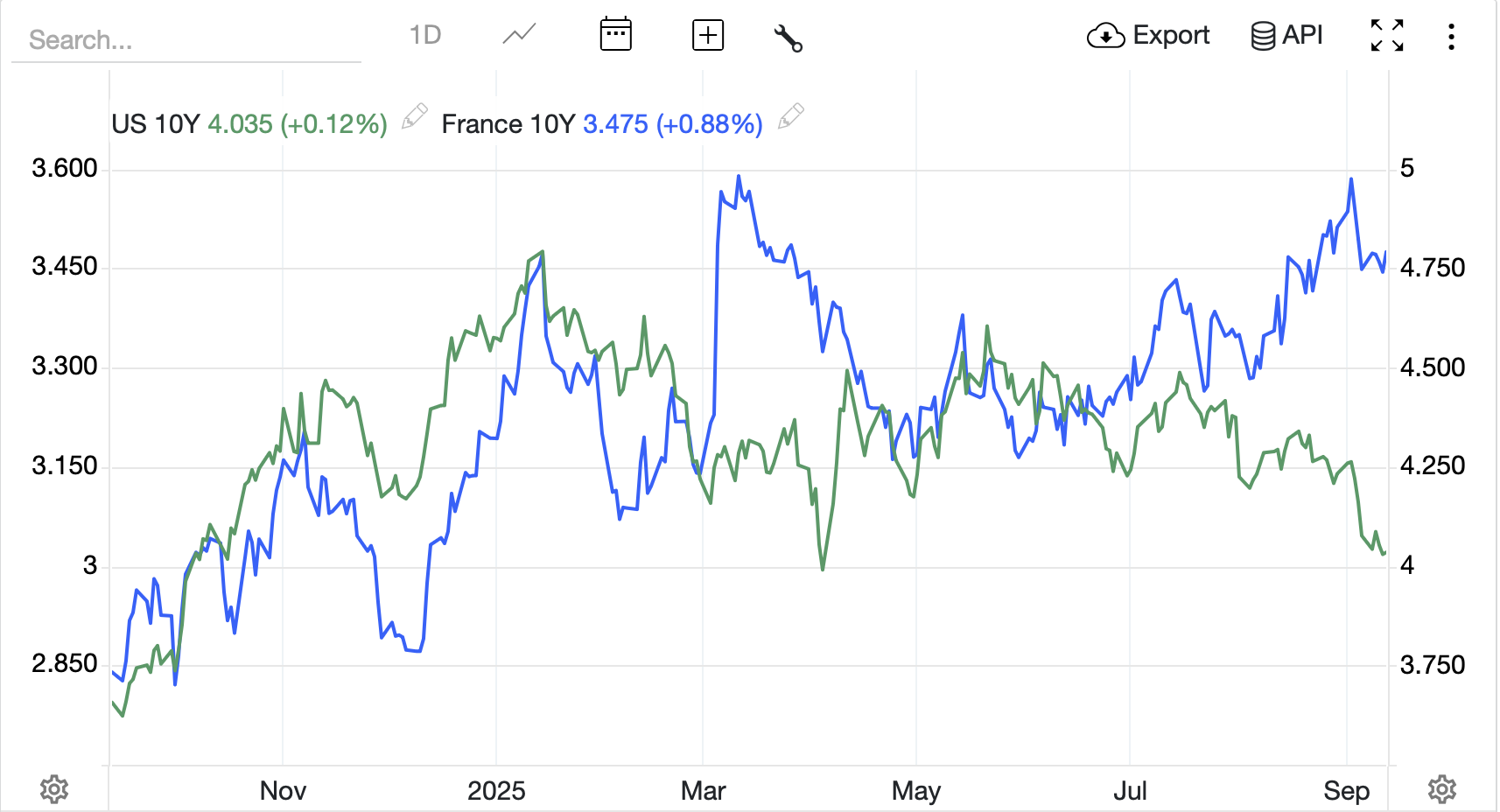
In the bond market, yields remain in their longer-term downtrend in the US although have edged higher by 1bp overnight.  European sovereign yields are higher by 3bps across the board as there are still growing concerns over French fiscal deficits and the fact that the ECB has finished cutting implies less support there.  It is interesting to look at the difference in performance between US and French 10-year bonds as per the below, as despite much angst over the US fiscal profligacy, which is well-deserved, investors still feel far more comfortable with Treasuries than with OATs.

Source: tradingeconomics.com

In the commodity markets, oil (+1.3%) is rebounding from yesterday’s decline and, net, continues to go nowhere.  Whatever the catalyst is that will change this view, it has not made an appearance yet.  Meanwhile, like the broken record I am, I see gold (+0.5%) and silver (+1.9%) continuing to rally as more and more investors around the world flock to the precious metals as they fear the destruction of the value of their fiat currencies.  And they are right because there is not a single central bank around (perhaps Switzerland and maybe Norway) that is concerned about inflation as evidenced by the fact that despite the fact inflation rates are running far higher than they had pre-Covid, every central bank is in a cutting cycle except Japan, and they have stopped hiking despite CPI there running at 3.4%!

Finally, the dollar is modestly firmer as I type, although it had been a bit softer overnight, and basically going nowhere fast.  If I look at the movement in the major currencies over the past month, only NOK (+3.0%) stands out on the back of higher than anticipated inflation readings and growing expectations that the Norges Bank, which did cut rates a few months ago, will soon have the highest interest rates in the G10 after the Fed cuts next week and they remain on hold.  As to today’s movement, JPY (-0.35%), NZD (-0.4%) and NOK (-0.3%) are the largest movers, with the EMG seeing even smaller movement than that.  Again, it is difficult to find a compelling short-term story here.

On the data front, this morning brings Michigan Sentiment (exp 58.0) and that’s it.  No Fed speakers ahead of the meeting next week, so we will be reliant on either the White House making some new, unexpected, announcement, or the dollar will take its cues from the equity markets.  It is interesting that the precious metals complex continues to perform well despite the dollar edging higher.  To me, that is the biggest story around.

Good luck and good weekend

Adf

Markets Ain’t Scared

So, NFP data was wrong
Which many have said all along
Perhaps it was proper
For Trump to just drop her
Creating McTarfer’s swan song
 
Remarkably, though, no one cared
And equity markets ain’t scared
While Treasury yields
Edged higher, it feels
That 50bps is now prepared


Like a dog with a bone, I cannot give up the NFP story even though the market clearly didn’t care about the adjustment or had fully priced it in before the release.  In fact, it seems investors, or algos at least, welcomed the fact that the number was so large as it seems to make the case for a 50 basis point cut next week that much stronger.  Certainly, Chairman Powell will have difficult saying that starting a cut cycle with 50bps would be inappropriate given his more politically driven efforts a year ago.

But one final word on this subject is worthwhile I believe, and that is; why does the market pay so much attention to this particular data point?  Consider the following:  according to the BLS, current total employment in the US is approximately 159,540,000.  In fact, that number has been above 150 million since January 2019, although Covid managed to impact that for a few months before it was quickly regained.  

Now, NFP has averaged ~125K since they started keeping records in 1939 with a median reading of 160K.  To modernize the data, since 2000 it has averaged ~93K with a median of 154K.  Consider what that means with respect to the total labor force.  Ostensibly, the most important economic data point of each month represents, on average, 0.06% of the working population.  Additionally, that number is subject to massive revisions both on a monthly basis, and then, as we saw yesterday, there is another annual revision.  I don’t know if Ms. McEntarfer was good at her job or not, but it is not unreasonable to consider that the payrolls data, as currently calculated, does not really represent anything other than statistical noise.   I prepared the below chart to help you visualize how close to zero the NFP number is relative to the working population.  Absent the Covid spike, I would argue that the information that this datapoint delivers, especially in the past 25 years, also approaches zero.

Data FRED database, calculations @fx_poet

You may recall the angst with which the firing of Ms McEntarfer was met, and given President Trump’s penchant for overstating certain things, it certainly had a bad look about it.  But the evidence seems to point to the fact that the data is not only suspect, given its revision history, but essentially inconsequential relative to the economy.  The fact that the Fed is making policy decisions based on changes in the economy that represent less than 0.1% of the working population, and half that amount of the general population, may be the much larger scandal here.  

Remember, a 4th Turning is all about tearing down old institutions because they no longer are fit for purpose and building new ones to gain trust.  Perhaps NFP as THE monthly number is an institution whose time has passed, and investors (and the Fed) need to find other data to help them evaluate the current economic situation.  Of course, the algos love a single number to which they can be programmed and respond instantaneously, so if NFP loses its cachet, and algos lose some of their power, it would be better for us all, except maybe Ken Griffin and Larry Fink!

Otherwise, the overnight market offered very little new information.  Chinese inflation data continues to show an economy in deflation with the Y/Y result of -0.4% being worse than expected and the 5th negative outcome in the past seven months.  Looking at the chart below, it is becoming clearer that President Xi, despite flowery words about consumption, has no idea how to stimulate domestic activity other than the mercantilist model to which China subscribes.  Now, they overproduce stuff and since the imposition of higher tariffs by the US on Chinese goods, it seems more of that stuff is hanging around at home and driving prices down.  Alas, it seems not enough Chinese want the things they manufacture, hence steadily declining prices.  While it is a different problem than in the US, it is a problem nonetheless for President Xi.

Source: tradingeconomics.com

And with that, let’s head to the market activity.  Yesterday’s US rally was followed by strength all around the world as it appears everybody is excited about the prospects of the FOMC cutting rates by 50bps next week. While the Fed funds futures market has barely moved, currently pricing just an 8.2% probability of that move, I am hard pressed to conclude that the rest of the economic and earnings data is so good that equities should be rallying for any other reason.

Anyway, Japan (+0.9%), China (+0.2%), HK (+1.0%), Korea (+1.7%), India (+0.4%) and Taiwan (+1.4%) are pretty definitive proof that everybody is all-in on a 50bp cut by the Fed.  In fact, the worst performer in Asia, Thailand (0.0%) was merely flat on the day.  Turning to Europe, here, too, green is today’s color with Spain (+1.3%), France (+0.6%), Germany (+0.2%) and the UK (+0.5%) all rising nicely.  Domestic issues, which abound throughout Europe, are inconsequential this morning.  and don’t worry, US futures are higher by 0.35% this morning as well.

In the bond market, while yields edged up yesterday a few basis points, this morning they are essentially unchanged across the board in the US, Europe and Japan.  Worries about excessive deficits have been set aside.  A major protest in France today is not impacting markets at all.  Word that the BOJ will consider tightening policy (as if!) despite the political uncertainty has had no impact.  Perhaps we have achieved that long sought equilibrium in rates! 🤣

In the commodity space, oil (+1.1%) rallied after the Israeli attempt to eliminate Hamas leadership in Qatar yesterday ruffled many feathers and was seen as a potential escalation in Middle East conflicts.  But, at $63.30/bbl, WTI remains firmly in the middle of its recent trading range as per the below chart.

Source: tradingeconomics.com

But you know what is not in the middle of its trading range, in fact the only thing with a real trend right now?  That’s right, gold.  A quick look at the below chart from tradingeconomics.com helps you understand why so many market pundits, if not investors, are excited about continued gains here.  Calls for $4000/oz and more by early next year are increasing.  As to the other metals, silver and platinum are following gold higher this morning although copper is unchanged.

Finally, the dollar is little changed vs. most major currencies with the euro and pound having moved 0.1% or less than the close and the same with JPY, CAD, CHF and MXN.  In fact, the biggest mover this morning is NOK (+0.5%) which on top of oil’s rally has benefitted from still firm inflation encouraging the idea that the Norges Bank is going to raise rates when they meet next Thursday.  If they hike after the Fed cuts 50bps, the krone will likely see further strength, at least in the short run.

On the data front this morning, PPI (exp 0.3%, 3.3% Y/Y; 0.3%, 3.5% Y/Y core) is the key release and then the EIA oil inventory data is released at 10:30 with a modest draw expected.  As we remain in the quiet period, no Fed speakers are slated, so the algos will have to live with the PPI data or any other stories they can find.

If the inflation data this week stays quiescent, I think 50bps is likely next week as the employment situation, despite my comments above, will still be seen in a negative light and I think Powell will feel forced to move.  Plus, if Stephen Miran is added to the board this week, there will be increased pressure for just such an outcome.  However, while a Fed aggressively cutting rates should be a dollar negative, I feel like that is becoming the default view, so maybe not so much movement from here.  We need another catalyst.

Good luck

Adf
Is That the Fear?

Regarding the payroll report
The fear is jobs coming up short
But is that the fear?
Or will traders cheer
As 50bps they will exhort
 
With clarity at the Fed lacking
Because of Ms Cook’s recent sacking
And markets at highs
It seems to be wise
To hedge some exposure you’re tracking


Another month, another payroll day.  It certainly seems that the market has not lost any of its appetite for this particular data point, although one must be impressed with the ongoing rally to continuous record highs in share prices.  So, as we get started, let’s look at what expectations are for this morning’s numbers:

Nonfarm Payrolls75K
Private Payrolls75K
Manufacturing Payrolls-5K
Unemployment Rate4.3%
Average Hourly Earnings0.3% (3.7% Y/Y)
Average Weekly Hours34.3
Participation Rate62.1%

Source: tradingeconomics.com

Yesterday’s ADP Employment number was a bit softer than forecast at 54K with a very slight revision higher to the previous month’s reading.  And of course, poor Ms McEntarfer was fired last month after the massive downward revisions to the previous data so as much scrutiny as this number ordinarily receives, it feels like even that has been turned up to 11 this month.  If we look at the Initial Claims data for a signal, (or the 4-week average which removes situations where individual states are late to report) it is hard to get excited about a major problem in the labor market as per the below chart from tradingeconomics.com.

It has pretty much flatlined since the end of the Covid aberration.  Even more impressively, the number is low by much longer-term historical standards when the absolute population was smaller, yet Claims data were typically somewhat higher.  (I capped the Covid situation so you could get a flavor for the rest of the series).  It is hard to look at the last 58 years and describe Initial Claims as pointing to a problem.  While I didn’t shade the chart, you can see the recessions in 1970, 1973, 1980, 1982, 1990, 2001, 2008-9 as the periods when Claims peaked.  Again, it is difficult to look at this data and conclude a recession is around the corner, at least the traditional definition of one.

Source: FRED database

Of course, there is a very different vibe these days regarding employment as evidenced by the discussions you see on LinkedIn or even the stories in the WSJ regarding the unwillingness of people to leave a job as they fear finding a new one.

All this is just my way of saying that the asynchronous nature of the economy means we really don’t know what to expect.  But we can anticipate market reactions depending on the outcome.  FWIW, and remember, I am just a poet:

NFPBondsFed funds futuresStocksDollarGold
>75K4.30%20bps-1%0.50%-1%
35K – 75K4.15%25bps0%0%0%
0K – 35K4.10%35bps1%-0.5%0.20%
<0K3.95%50bps-1%-1.50%1.50%

So, there you have it, one man’s guesses as to how the markets will respond depending on the data.  In essence, it seems to me that the market has been anticipating enough support to cut rates to protect the economy without assuming the economy is going to crash.  That’s why a negative number will be such a problem because that will force a reevaluation of the economic situation and stocks cannot abide a repricing of that risk given the rich valuations. It will demonstrate that the Fed is behind the curve, at least in traders’ minds, and the result will not be pretty.  We shall see.

In the meantime, after yesterday’s rally in the US, equity markets around the world are all in the green this morning despite some mediocre data from Europe.  But starting with Asia, Japan (+1.0%) had a nice session although China (+2.2%) and Hong Kong (+1.4%) put it to shame.  While Japan benefitted from a reduction to 15% on automobile tariffs vs. Japanese cars, Chinese shares jumped on word from the PBOC that they would inject CNY1 trillion into the system and reduced fears of efforts to hold back the rally.  Elsewhere in the region, other than India, which was unchanged on the day, everything else was nicely higher following the main exchanges’ leads.  As to Europe, while all the bourses are higher, the gains are de minimis, on the order of 0.1% or so, with traders caught between hopes of a US rally and ongoing meh data at home.

In the bond markets, Treasury yields are down to 4.15%, lower by -1bp today, but as you can see from the chart below, down 15bps this week as anticipation of either soft data or 50bps, I’m not sure which, builds.

Source: tradingeconomics.com

In Europe, sovereign yields are all lower by -2bps this morning and we saw the same price behavior overnight in Asia with JGB’s and Australian bond yields slipping as well.  Maybe inflation is dead! (just kidding)

In the commodity markets, oil (-0.7%) continues to slide and has given back all the gains that accrued based on the idea that OPEC+ was going to cut production further.  Gold (+0.1%) continues to find support and drag silver and copper along for the ride as the yellow stuff sits at new historic highs.

Finally, the dollar is softer this morning, down about 0.2% to 0.3% vs. the G10 with similar declines across most of the EMG bloc.  I have a feeling this is the market that is anticipating a weak NFP print and a more aggressive Fed come the meeting in two weeks.  Futures, right now, are pointing to a 99% probability of a 25bp cut and a 55% probability of another cut in October.  Any weak print this morning is going to really show up here, as I explained above.

Source: cmegroup.com

And that’s what we have.  There are no Fed speakers lined up, and after today, the Fed enters its quiet period, so we won’t hear anything until the meeting on the 17th.  NFP will set the tone, so until then, all we can do is wait.

Good luck and good weekend

Adf
AI is Grokking

The ‘conomy grew a bit faster
Than ‘spected by every forecaster
Consumers are rocking
While AI is Grokking
Though prices could be a disaster
 
The question this data incites
Is why cut rates from current heights?
With stocks on a tear
And ‘flation still there
The risk is the long bond ignites


Yesterday’s GDP data indicated that both consumer spending and AI investment were larger than expected with the result being GDP activity increased more than economists had forecast.  Most would consider this good news, and the equity markets clearly saw the benefits as they continue their slow march higher.  Surprisingly, despite the positive economic data, the Fed funds futures market did not reduce the probability of a rate cut next month.  Arguably that was because Governor Waller, one of the two who voted for a cut in July, spoke yesterday and reiterated his views that a cut was appropriate to prevent a worse outcome in the employment situation.  Frighteningly, he said, “I am back on Team Transitory.”  I fear that the transitory phenomenon is going to be the reduction in inflation we have experienced over the past two years, not the initial peak seen in 2022. (As an aside, if inflation is your concern, USDi is one way to maintain the purchasing power of your funds as it mechanically tracks CPI, rising in step with the index.)

Perhaps the futures market is starting to expect that Governor Lisa Cook’s days are truly numbered with a third instance of potential mortgage fraud surfacing yesterday, a situation that has a bad look for a Fed governor.  If she is forced out soon, that would be yet another Fed governor that President Trump will get to appoint, and the tension in the Marriner Eccles building will certainly grow at that September meeting.  After all, if Trump seats two more governors, and has 4 votes for a rate cut on the board, the question will not be should they cut, but how much they should cut with 50 basis points on the table regardless of the economics.

But all that is still three weeks away and based on the fact that if I look at almost every market, price action has been consolidating for the entire summer, it is hard to get excited in the short-term.  In fact, I think it is worthwhile to look at some charts so you can get a sense of just how little is going on.

All these charts are from tradingeconomics.com and I have drawn in some recent ranges to show that over the past 6 months, only one asset class has shown any trend of note.  See if you can guess which that is.  I’ll start with the EURUSD since, after all, I am an FX guy, but go to bonds, oil, gold and equities.

Since late April, the euro has chopped back and forth despite many stories of the dollar’s incipient demise and the euro’s upcoming rally as investors flock to European equity markets.  Maybe not.

Treasury yields have also been largely range bound, and if anything, look like they are heading lower despite fears being flamed regarding massive amounts of issuance having trouble finding buyers as foreigners pull out of the market.  Maybe not.

Crude has been the choppiest, and of course we did have the bombing of Iran’s nuclear facilities which inspired some fears of the beginning of a new Middle East war.  But Russia keeps pumping, OPEC put 2.2 million barrels per day of production back into the market and it appears, that for now, the market has found a balance.  I still see oil sliding over time, but for now, the range is king.

The barbarous relic has just started to pick up and broke above the $3400 range cap just two days ago but has not yet shown signs of a major breakout.  However, if the Fed cuts, especially if they go 50bps for some reason, I would look for this to change and gold (and all precious metals) to rally sharply as inflation re-enters the conversation.

However, if we look at the US equity market, the picture is very different.  The only other market moving like this is USDTRY as the Turkish Lira steadily depreciates amid massive monetary expansion there with inflation rising sharply.  In fact, this is what many foresee for the dollar going forward, but even if the Fed cuts, it seems a bit of an exaggeration.

At this point I should note that there is one currency that is outperforming the dollar right now, the Chinese renminbi.  It appears that as trade negotiations are ongoing, the Chinese (and the Koreans amongst others) have gotten the message that they need to adjust their currency’s value if an agreement is going to be reached.  

To conclude, ranges remain the situation in most markets other than equities which continue to rally based on hopes and prayers that central bank spigots are never turned off.  With Labor Day on Monday, perhaps we will begin to see more real activity reenter the market as traders and investors come back from summer vacation.  But we will need a real catalyst to break those ranges, whether that is a shocking NFP number, a reescalation of Middle East conflict or something else (China laying siege to Taiwan?).  While I don’t know what that catalyst will be, history tells us something will come along, that’s for sure.

As we look to the NY opening, we do get more important data as follows: Personal Income (exp 0.4%); Personal Spending (0.5%); PCE (0.2%, 2.6% Y/Y); Core PCE (0.3%, 2.9% Y/Y); Goods Trade Balance (-$89.5B); Chicago PMI (46.0); and Michigan Sentiment (58.6).  There are no Fed speakers on the docket, but you can be sure that the Lisa Cook story will remain front and center, especially as I read that the judge initially selected to oversee the case was Ms Cook’s sorority sister, potentially a disqualifying factor that would cause her recusal and a new appointment. In fact, I suspect that story will have more traction than whatever the data says today.

As to the dollar, it is hard to get excited at this point.  If PCE data is softer than forecast, though, I would look for the dollar to sell off and the probability of that Fed funds rate cut to rise from its current 85%.

Good luck and have a good holiday weekend

Adf
Political War

In Washington, Cook feels the heat
As Trump wants a change in her seat
In Paris, the sitch
For Macron’s a bitch
As confidence there’s in retreat
 
These two stories plus so much more
Explain that we’re in, Turning, Four
So, all that we knew
Seems no longer true
Instead, there’s political war


The dichotomy between the general lack of price volatility in markets and the increase in political volatility over policy choices and requirements around the world is truly remarkable.  However, just like so much else that many have assumed as a baseline process for so long, this relationship appears to be changing as well.  These changes have historical precedence, as documented by Neil Howe and William Strauss back in 1997 in their seminal book, The Fourth Turning.  

Perhaps this is the best definition of what the Fourth Turning is all about [emphaisis added]:

“In the recurring loop of modern history, a final, perilous era arrives once each lifetime.  It is marked by civic upheaval and national mobilization, both traumatic and transformative.  That era, reshaping the social and political landscape, is unfolding now.

Now, read that and tell me it is not a perfect description of what we are seeing daily, not just in the US, but around the world.  If you wondered why all the models that had been built about many things, whether financial, economic or governmental are no longer offering accurate forecasts, I would point to this as the underlying premises are going through the throes of change.

For instance, consider President Trump and his relationship with the Fed.  We already know that he and Chairman Powell are at odds and have been so for months over Powell’s reluctance to cut rates.  But his attacks on the Fed are unceasing, and last night he ‘fired’ Governor Lisa Cook for cause.  That cause being the allegations that she committed mortgage fraud, which if true is certainly a concern for a Federal Reserve Board Governor.  But this has never been attempted before so will involve legal wrangling which we will watch over the next many months.

Now, some of you may remember the last time there was a scandal at the FOMC, where two different regional Fed presidents, Dallas’s Robert Kaplan and Boston’s Eric Rosengren, were trading S&P 500 futures in their personal accounts prior to FOMC announcements of which they had inside knowledge.  Both did step down and allegedly the Fed has tightened its controls on that issue as they tried to sweep it under the rug, but let’s face it, Fed members are no angels.

I have no idea how this will play out, although I suspect that Governor Cook will eventually resign as the one thing at which President Trump excels is applying public pressure.  While Powell is an experienced public figure, Ms Cook was a professor at Michigan State, not exactly a spot where you feel the withering heat of a Trumpian attack on a regular basis.  Of course, if she did lie on her mortgage applications, that is a tough look for someone charged with overseeing the financial system.

But that is just the latest issue in the US, at least involving financial markets.  This Fourth Turning is coming alive all around the Western World, perhaps no place more than Paris this morning.  There, PM Bayrou has called for a confidence vote in order to gain the power to pass an austerity budget that cuts €44 billion from spending.  While at this point, it seems long ago, his predecessor PM, Michel Barnier, lasted just 99 days with his minority government and was ousted last December.  While Bayrou has made it for 9 months, it appears his odds of making it for a full year are greatly diminished now as all the opposition parties have promised to vote against him.  Recall, he leads a minority government and if he loses the vote, there will be yet another set of elections in France.

Again, this is emblematic of a Fourth Turning, where systems and institutions that have been operating for decades are suddenly coming apart.  From our perspective, the impact is more direct here with French equity markets (CAC -1.5%) falling sharply (see below) while French government bond yields soar.

Source: tradingeconomics.com

In fact, French 10-year yields now trade above almost all other EU nations including Greece and Spain, although Italian yields are still a touch higher.  Consider that during the European bond crisis of 2011-12, France was considered one of the stronger nations.  Oh, how the mighty have fallen!

Source: tradingeconomics.com

Again, my point is that much of what we thought we understood about how markets behave on both an absolute and relative basis is changing because the institutions underlying the Western economy are undergoing massive changes.  This is not merely a US phenomenon with President Trump, but we are seeing a growing nationalist fervor throughout the West as populations throughout Europe, and even Japan, increasingly reject the culmination of what has been described as the globalist agenda.  As John Steinbeck has been widely quoted, things can change gradually…and then suddenly.

So, let’s look at how other markets behaved overnight following the weakness in US equity markets yesterday.  Asian markets followed suit lower (Tokyo -1.0%, Hong Kong -1.2%, China -0.4%, Korea -1.0%, India -1.0%) with essentially the entire region in the red.  Europe, too, is under pressure this morning and while France leads the way, Germany (-0.4%), Spain (-0.8%) and the UK (-0.6%) are all declining in sync.  However, at this hour (7:10) US futures are essentially unchanged, so perhaps things will stabilize.

Those yields I picture above represent modest declines from yesterday’s levels, although that is only because European yields yesterday mostly climbed between 5bps and 7bps across the board.  As to Treasury yields, they are higher by 2bps this morning, but remain below 4.30%, so are showing no signs of a problem.

In the commodity markets, oil (-1.8%) is giving back all its gains from yesterday and a little bit more, but in the broad scheme of things, continues to trade in its recent range.  The one thing to watch here is Ukraine’s increasing ability to interrupt Russian production and shipment of oil via long-range drone strikes, as if they continue to be successful, it may well start to push prices above their recent cap at $70/bbl.  That is, however, a big if.  It is getting pretty boring describing metals markets as gold (+0.3%) has been trading in an increasingly narrow range as per the below chart.  This has been ongoing since April and feels like it could last another 5 months without a problem.  Silver’s chart is similar, albeit not quite as narrow a range.

Source: tradingeconomics.com

Finally, the dollar is a touch softer this morning, slipping against the euro (+0.3%), pound (+0.2%), and yen (+0.2%) with most of the rest of the G10 having moved less than that.  NOK (-0.3%) is the outlier following oil lower.  In the EMG bloc, +/- 0.3% is the range for the entire bloc today, so it appears that traders like other G10 currencies today for some reason I cannot fathom.

On the data front, we see Durable Goods (exp -4.0%, +0.2% ex Transport) as well as Case Shiller Home Prices (2.1%) and then Consumer Confidence (96.2).  Speaking of Consumer Confidence, in France this morning the latest reading was released at 87.0, three points lower than forecast and clearly trending down.  Perhaps the government’s problems are feeding into the national psyche.

Source: tradingeconomics.com

It is difficult to get excited by markets during the last week of August, and if we add the time of year, when vacations are rife, to the ongoing White House bingo outcomes, the best position seems to be no position at all.  As to the dollar, if the Fed does start to ease policy at this time, with inflation still sticky, I do foresee a decline.  However, it is very difficult to look around the world and think, damn, I want to own THAT currency, whatever currency that might be.  Perhaps the one exception would be the Swiss franc, where they really do work to have sane monetary policies.

Good luck

Adf