Gone Astray

The ADP Labor report
On Wednesday, came up a bit short
Investors decided
That they would be guided
By this and bought bonds like a sport
 
As well, there’s a story today
The BLS has gone astray
It seems that their data
Might have the wrong weight-a
So, CPI’s not what they say


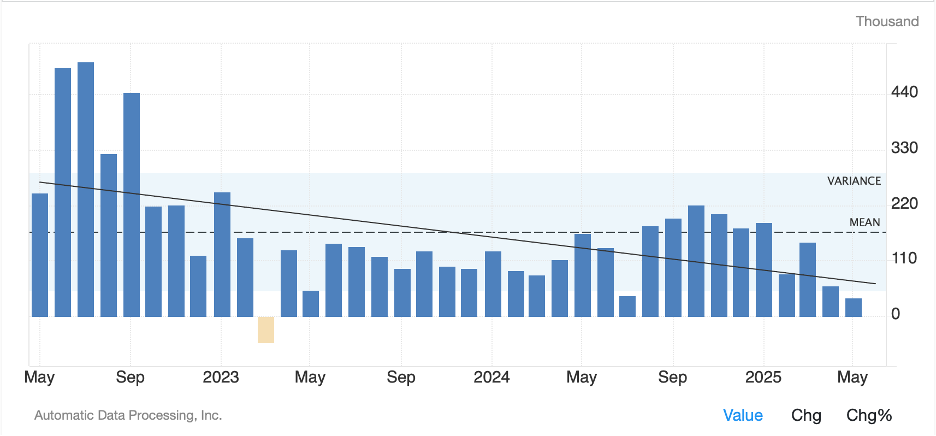
It has been another very dull session in most markets although yesterday did see a strong bond market rally after the ADP Employment Report was released much lower than expected at just 37K jobs created.  Certainly, the trend has been lower for the past three years as you can see in the below chart from tradingeconomics.com, so I guess we cannot be that surprised.
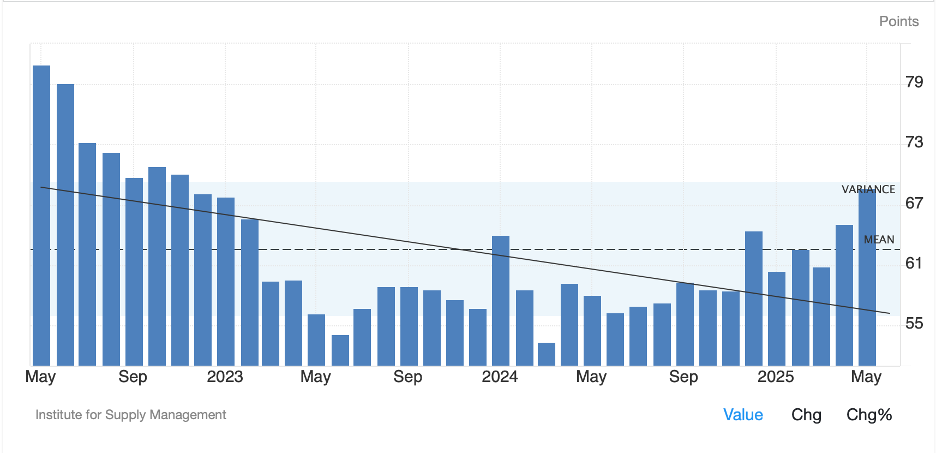
You will also not be surprised that this data brought out the recessionistas as they jumped all over the release to make their case that recession was just around the corner, and quite possibly stagflation.  Adding to their case was the ISM Services data which also disappointed at 49.9 and has also been trending lower for the past three years.  As well, they were almost gleeful in their description of the Prices Paid sub index rising to 68.7, its highest print since November 2022.  Alas, while Pries Paid have been rising for the past year or so, a look at the trendline shows they are continuing to retreat from the highs seen during the Bidenflation of 2022.
Source: tradingeconomics.com

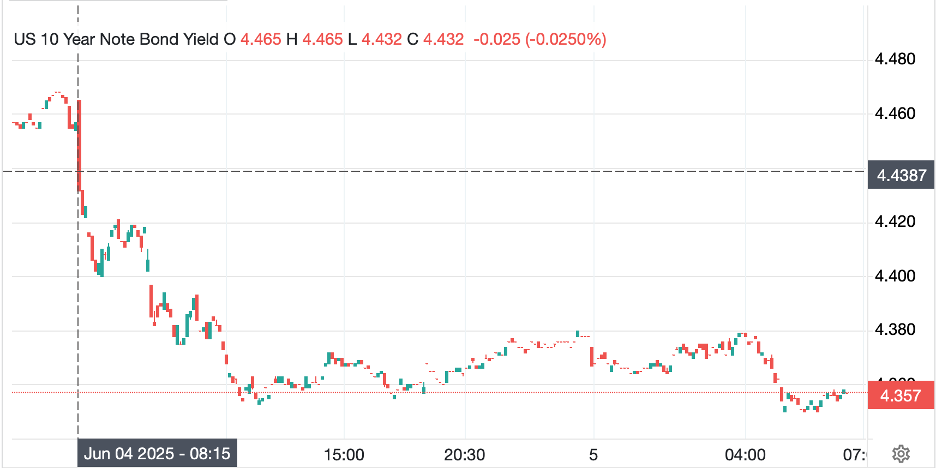
In the end, although this data was unquestionably disappointing, it feels a bit too early, at least to me, to declare the recession has arrived.  But not too early for the bond market where 10-year yields tumbled 11bps on the day and almost all the damage was done in the first hour after the ADP release although the ISM helped things along as well.
Source: tradingeconomics.com

Perhaps we are going into a recession, or even already in one, but overall, the data so far are just showing the beginnings of that.  I imagine opinions will be strengthened one way or another tomorrow when the NFP report is released, but for now, the recessionistas appear to have the upper hand, at least in the bond market.

The other story that is getting a response, at least amongst the Twitterati (X-eratti?) is the WSJ article about how the BLS, due to President Trump’s hiring freeze, is suddenly calling into question the accuracy of their statistical releases, notably the CPI report due next week.  I will let my friend, The Inflation Guy™, Mike Ashton, explain why this is a nothing burger. [emphasis added]

WSJ story about how staff shortages at BLS are affecting how many estimates the staff has to make instead of collecting actual data. It is very hard to make these errors accumulate to as much as 1-2bps on the monthly number.

UNLESS: there is bias in the estimating, or there are very large categories affected, or there are HUGE errors in some categories. Lots of random errors increases the overall error but is unlikely to affect the mean. And be honest. Do you have any idea what the MSE (mean standard error) of the CPI is?

People really should care about the error bars but even most economists almost never do. Unless it’s an opportunity to complain about budget cuts to economists, which is what this is. Nothing to see here.”

Otherwise, folks, another day in paradise with nothing else new, at least on the market front.  At some point, domestic politics, or geopolitics or war or something else is going to catch the fancy of the algos and change trading, but right now, that does not appear to be the case.  Perhaps Friday’s NFP data will be the catalyst to start a serious change in attitudes but I’m not holding my breath.

In the meantime, let’s survey market activity.  Yesterday’s US session was quite dull with limited movement and low volumes. Asia saw a mixed picture with the Nikkei (-0.5%) slipping, ostensibly, on concerns that a weaker US would negatively impact their export sector, tariffs be damned.  Hong Kong (+1.1%) though, rallied on Chinese PMI data holding on to recent levels rather than slipping further.  The rest of the region was far more positive, led by Korea (+1.5%) although the gains were more on the order of +0.5%.  Europe is all green this morning, with the CAC (+0.5%) leading the way, although the DAX (+0.4%) and FTSE 100 (+0.3%) are also holding up well on the back of positive German Factory orders data and solid UK Retail Sales.  Meanwhile, at this hour (7:00), US futures are ever so slightly firmer, +0.15% or so.

In the bond market this morning, after the big rally yesterday discussed above, Treasury yields this morning have edged lower by 1bp and European sovereigns have seen yields slide by between -3bps and -5bps as inflation data on the continent continues to soften encouraging the belief that the ECB, later this morning, may even consider more than the 25bp cut that is priced in.

The one true consistency lately has been gold (+0.8%) which has no shortage of demand, especially in Asia, and certainly feels like it is going to test, and break, the previous high of $3500/oz, which is now just $100 away.  But this has encouraged silver (+4.0%), copper (+2.65%) and now even platinum (+3.8%) has been invited to the party.  Regardless of the macroeconomic statistics, the ongoing global monetary policy of fiat debasement seems set to continue which can only help these metals.  As to oil (+0.3%), it continues to sit near its recent highs with not much activity in either direction.  It feels like we will need a major event/pronouncement of some sort, whether wider war in the Middle East or a change in OPEC policy to move this thing.

Finally, the dollar can best be described, again, as mixed.  While the euro and pound are marginally higher, the yen is marginally weaker.  In the EMG bloc, both KRW (+0.4%) and ZAR (+0.5%) are showing gains this morning, but nothing else of note is moving.  And when looking at the broad DXY, unchanged is where it’s at.  As with most markets right now, metals excepted, doing nothing seems the best choice.

On the data front, this morning brings the weekly Initial (exp 235K) and Continuing (1910K) Claims as well as the Trade Balance (-$94.0B) which if correct will almost certainly bring on a lot of White House crowing but is likely inconsequential with respect to the overall scheme of things.  We also see Nonfarm Productivity (-0.7%) and Unit Labor Costs (+5.7%) a combination of expectations that does speak to stagflation.  The ECB meeting will get some eyeballs, but unless they cut 50bps, a very low probability event based on current market pricing, it is hard to see much impact there either.

We are in a rut for now.  Whatever the catalyst that is required to change views substantially, it is not obvious at this point.  Bigger picture, nothing indicates any government is going to slow their spending or their money printing.  There is too much debt to ever be repaid, so a slow inflationary debasement is very likely our future.  I still think the dollar slides further, but it could be a few months before the current range breaks.

Good luck

Adf
A True F’ing Cluster

Seems everyone just wants to sell
Their equities and bonds as well
But what will they do
With funds they accrue
If everything’s all gone to hell?
 
I guess it’s why gold still has luster
And Bitcoin’s become a blockbuster
The future’s unclear
And there’s growing fear
That this is a true f’ing cluster


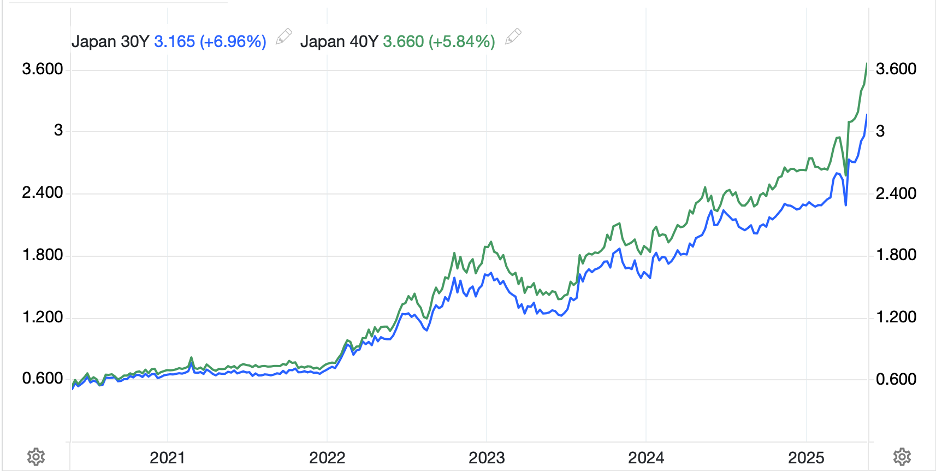
It is difficult to highlight any particular driver of any market movement this morning.  I imagine yesterday’s US equity selloff left a sour taste in the mouths of investors around the world which may help explain why virtually every equity market in Asia (Nikkei -0.85%, Hang Seng -1.2%, Korea -1.2%, India -0.8%) was lower last night or is so (CAC -1.0%, DAX -0.9%, IBEX -0.9%, FTSE 100 -0.65%) this morning.  But bonds are hardly the destination of those funds with yields essentially unchanged this morning after yesterday’s bond sell-off (yield rally).  In fact, in Japan, the long end of the curve, 30-year and 40-year, yields have each traded to new record highs.

Source: tradingeconomics.com

So, if investors are selling stocks and not buying bonds, exactly what are they doing with the funds?  Gold, (-0.5%) which has had a nice run in the past week, is lower this morning, so it doesn’t appear money is heading there.  Too, platinum (-0.3%) is softer this morning after a massive rally this week.  Oil (-1.6%) is lower, NatGas (-1.1%) is lower, and in truth, it is difficult to find anything doing well.  Except perhaps Bitcoin (+1.0%), which has rallied nearly 7% this week and more than 18% in the past month and is trading at new all-time highs.

Source: tradingeconomics.com

It appears that we have reached a point where the market narrative on virtually every asset class (crypto excepted) is that the future is bleak.  There is a bull market in the number of analysts forecasting stagflation because of the US tariff policy and a nascent bull market in the number of analysts calling for much higher US (and by extension other national) yields given the fiscal follies that continue to be evidenced every day.  As much press as the US gets for its massive, peacetime fiscal deficit, in a quieter voice, the IMF just warned France that its fiscal deficits were unsustainable as they, too, are above 7% of GDP.

Our concern should be that central bankers around the world are all going to respond in unison and that response is going to be debt monetization.  Inflation targets are fine as far as they go, but they are not the raison d’etre of central banks.  On a deeper level, central banks, whether independent or not, exist to assure that their respective governments can continue to borrow and fund their expenditures.  Absent a massive fiscal tightening wave around the world, something that seems highly unlikely in our lifetimes, central banks will always be the lender of last resort to their governments.

Now, we already know that fiscal tightening can be accomplished as President Javier Milei in Argentina has accomplished an extraordinary feat down there.  My concern is that it took decades of irresponsible fiscal policy and an almost complete absence of available financing to get the people to vote for change.  Folks, no matter your views about how bad things are in the US or Europe or Japan, we are not even close to the situation there.  So, we know what the future roadmap looks like, Argentina has paved the way, but we are just getting started, I fear.  And in the US, given the advantage of having the global reserve currency, we are much further from a denouement than other Western nations.  

In sum, if you want to know why gold and bitcoin are doing well, I believe they are pointing to the inevitable outcome of global debt monetization, or perhaps debt jubilees.  Owning assets that are a liability of a government that can change the rules if they so desire is not a safe place to be, especially in a fourth turning.  I think this is the message we need to start to understand.  This is not to say things are going to fall apart tomorrow, just that I believe this is the direction of travel.

Well, that was darker than I expected when I started writing this morning, but alas, that is where things lead.  The one thing I haven’t discussed is the dollar and FX markets.  But unlike other markets, FX is a truly relative game, where the dollar’s strength (or weakness) is also manifest as another currency’s weakness (or strength).  A broad-based dollar move, may be a harbinger of other market movements being seen as either better or worse than the US in a macro context, but let’s face it, despite all the angst recently of the dollar’s weakness, the euro is higher by just 4.5% in the past year!  Similarly, the pound (+5.5%) has not moved that far although the yen (+8.5%) has shown more life, albeit from a starting point that was at multi decade lows.  The fact that the dollar is modestly higher this morning, on the order of 0.3%ish across most currencies does not really tell us much.

Let’s take a look at the data we’ve seen so far in the session, with today being Flash PMI day.  In Japan, while Manufacturing edged slightly higher to 49.0, it is still sub-50, and the Services number was weaker taking the Composite below 50.0.  In Europe, France was little changed from last month with all three readings below 50, Germany was much softer than last month with all three readings below 49 and the Eurozone softened, as you would expect, with readings around 49.5.  In fact, as we await US data, India is the only economy showing vibrancy with readings above 60!  (I neglected the UK but alas, they are quickly making themselves irrelevant anyway.  But for good order’s sake, they did manage to tick up from last month, although the Composite is still below 50.)

In the US this morning we get the weekly Initial (exp 230K) and Continuing (1890K) Claims data as well as the Chicago Fed National Activity Index (-0.2) at 8:30.  Then the Flash PMI data (Mfg 50.1, Services 50.8) comes at 9:45 and Existing Home Sales (4.1M) at 10:00.  We also hear from NY Fed President Williams, but is he really going to tell us something new?  I don’t think so.

Sorry to have been so bleak this morning, perhaps the weather has contributed to the mood, but it is hard to find financial positives in the short run.  I was truly excited by the concept of the US cutting spending, but I fear that ship has sailed for now.  If DOGE did nothing else, it opened our eyes to the very specific ways in which government money is being spent on things that had no net benefit for the nation, although obviously the recipients were happy.  Perhaps someday these things will be addressed, but if Argentina is any example, it could still take decades.

Good luck

adf

Three-Three-Three

Said Bessent, when speaking of rates
The 10-year yield’s what dominates
Our focus and goals
As that’s what controls
Most mortgages here in the States
 
Remember, our goal’s three-three-three
With job one on deficits key
So, that’s why we’ll slash
The wasting of cash
With tax cuts set permanently


There is a new voice in Washington that matters to Wall Street, that of the new Treasury Secretary Scott Bessent.  Yesterday in his first significant comments since his swearing-in, he made very clear that he and the president were far more focused on the 10-year Treasury yield, and driving that lower, than they were concerned over the Fed funds rate.  Talk about a different focus than the last administration!  At any rate, he expounded on his views as to how that can be achieved, namely lower energy prices and a reduced budget deficit alongside deregulation.  Recall, his three-three-three plan is 3% budget deficit, 3mm barrels of oil/day additional supply and 3% GDP growth.  Clearly, this is a tall order given the starting point, but he has not shied away from these goals and insists they are achievable.

Yesterday also brought the Quarterly Refunding Announcement, the Treasury’s announced borrowing schedule for the current quarter.  Under then-Secretary Yellen, the US shifted its borrowing to a much greater percentage of short-term T-bills (<1-year maturity) while avoiding the sale of longer date notes and bonds.  This is something which Bessent has consistently explained his predecessor screwed up given her unwillingness to term out more debt when the entire interest rate structure was much lower.  After all, homeowners were smart enough to refinance down to 3% fixed rate mortgages, but the Treasury secretary thought it was a better idea to stay short.  

Of course, changing the current treasury mix is one of the impediments to lower 10-year yields because changing it would require an increase in the sale of longer dated paper which would depress the price and raise those yields.  Bessent has his work cut out for him.  However, my take is this is a goal, but one that will be achieved gradually.  He even commented that until the debt ceiling is raised, there will be no changes in the debt mix.  Arguably, if the administration can make real progress on reducing the budget deficit, that is what will allow for the gradual adjustment of the debt mix without a dramatic rise in long-term yields.

Perhaps it is still the honeymoon period, but the market is showing some deference to Mr Bessent as 10-year yields have fallen steadily in the past two weeks, dropping from a high of 4.81% the week before the inauguration to their current level at 4.44%.  

Source: tradingeconomics.com

While we cannot attribute the entire move to Bessent, certainly investors are showing at least a little love at this stage.  I believe the 10-year yield will grow in importance for all markets as movement there will be seen as the report card for Bessent and this administration’s goals.

Meanwhile, in the UK, stagflation
Is now the Old Lady’s vexation
But cut rates, they will
Lest growth they do kill
As prices continue dilation

The BOE is currently meeting, and expectations are nearly universal that they will cut their base rate by 25bps to 4.50% with 8 of the 9 MPC members set to vote that way.  The only hawk on the committee, Catherine Mann, is expected to vote for no change.  The problem they have (well the problem regarding monetary policy, there are many problems extant in the UK right now) is that core inflation continues to run above 3.0% while GDP is growing at approximately 0.0% in recent quarters and at 1.0% in the past year.  A quick look at the monthly GDP readings below shows that things have not been moving along very well, certainly not since PM Starmer’s election in July.

Source: tradingeconomics.com

In stagflationary environments, the most successful central bank responses have been to kill the inflation and suffer the consequences of the inevitable recession first, allowing growth to resume under better circumstances.  Of course, Paul Volcker is most famous for this model, which he derived after numerous other countries, notably the UK, failed to effectively solve the problem in the mid 1970’s in the wake of the first oil price shocks.  Now, the UK has created its own energy price supply shock via its insane efforts to wean itself from fossil fuels without adequate alternate supplies of energy, and stagflation is the natural result.  However, addressing inflation does not appear to be the primary focus of the Bank of England right now.  I am skeptical that they will be successful in achieving their goals which is one of the key reasons I dislike the pound over time.

Ok, let’s turn to market activity overnight.  The party continues on Wall Street with yesterday’s equity gains attributed to many things, perhaps Bessent’s comments being amongst the drivers.  Certainly, a reduced budget deficit and reduced 10-year yields are likely to help the market overall.  That attitude has been uniform overnight and through the morning session with every major Asian market (Japan, +0.6%, Hong Kong +1.4%, China +1.3%) and European market (Germany +0.8%, France +0.8%, UK +1.45%) higher on the session.  As it happens, the BOE did cut rates by 25bps as expected and now we await Governor Bailey’s comments.  As to US futures, at this hour (7:25) they are little changed on the session.

In the bond market, the ongoing rally has stalled for now with Treasury yields higher by 2bps this morning while most European sovereign yields are little changed on the day.  A key piece of information that is set to be released tomorrow comes from the ECB as their economists are going to report the ECB’s estimate of where the neutral rate lies in Europe.  With the deposit rate there down to 2.75%, many pundits, and ECB speakers, are targeting 2.0% as the proper level implying more rate cuts to come.

In the commodity markets, oil (+0.65%) is bouncing off its recent trading lows but in truth, a look at the chart and one is hard-pressed to discern an overall direction.  More choppiness seems likely as the market tries to absorb the latest information from the Trump administration and its plans.

Source: tradingeconomics.com

As to the metals markets, gold, which had a strong rally yesterday and made further new all-time highs, is unchanged this morning while silver (-0.75%) consolidates its recent gains and copper (+0.6%) adds to its gains.  The thing about copper is it is, allegedly, a good prognosticator of economic activity as it is so widely used in industry and construction, and it has been rallying sharply for the past month.  That does seem to bode well for future activity.

Finally, the dollar is firmer this morning, recouping some of its recent losses although I would contend we have merely been consolidating after a sharp move higher during the past three months.  The pound (-1.0%) is today’s laggard after the rate cut but we are seeing weakness almost everywhere in both G10 and EMG currencies.  One exception is the yen (+0.2%) which seems to be benefitting from comments by former BOJ Governor Kuroda that the BOJ is likely to raise rates above 1.0% during the coming year.  Interestingly, he explained that given the recent economic trajectory, it was only natural that the BOJ would seek to normalize rates.  However, given that interest rates in Japan have been 0.5% or below for the past 30 years, wouldn’t that be considered normal these days?  Just sayin’!

On the data front, with the BOE out of the way, we now get the weekly Initial (exp 213K) and Continuing (1870K) Claims data as well as Nonfarm Productivity (1.4%) and Unit Labor Costs (3.4%).  Yesterday’s ADP Employment data was much stronger than expected with a revision higher to last month as well, certainly a positive for the job outlook.  As well, this afternoon we hear from three more Fed speakers, but so far this week, the word caution has been the most frequently used noun in their vocabulary.  Of course, with Mr Bessent now starting to make his views known, perhaps more focus will turn there and away from the Fed for a while.

Market participants are clearly feeling pretty good right now, especially about the recent activity in the US.  I think you have to like US assets, both stocks and bonds, while expecting the dollar to continue to hold its ground.  This sounds like a recipe for weaker commodity prices, notably gold, but so far, that has not been the case.

Good luck

Adf

Fervor and Joy

The talk of the Street is the Fed,
While quiet this week, will soon shed
The higher for longer
Idea, with words stronger
That cuts are directly ahead
 
So, bonds are the new favorite toy
Of every hedge fund girl and boy
Since growth is now slowing
Investors are going
To buy bonds with fervor and joy


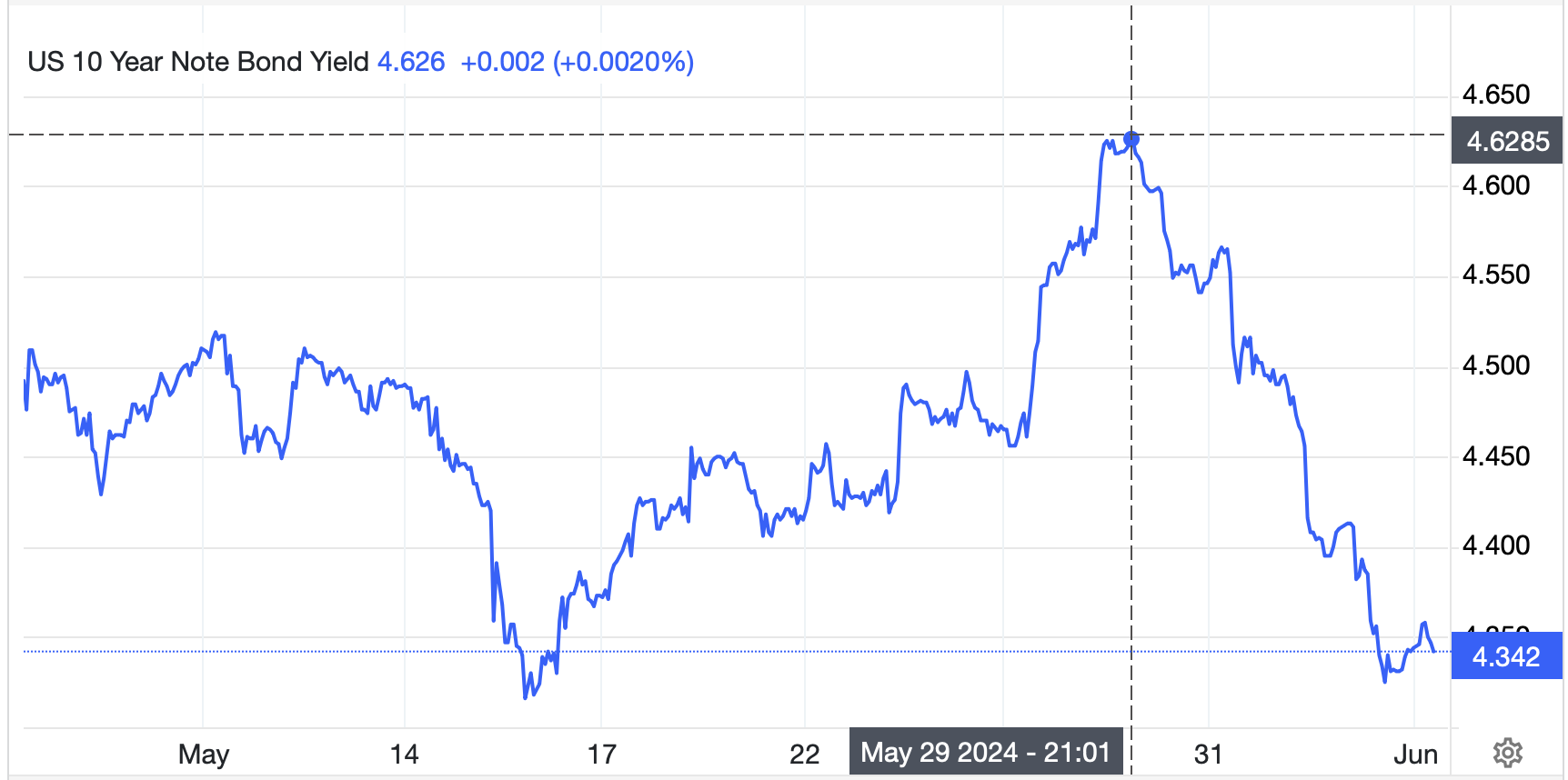
The amazing thing about markets is just how quickly they can shift their focus and reverse course if they find the right catalyst. Consider that just one week ago, 10-year Treasury yields were trading at 4.63%, having risen nearly 30 basis points in the prior two weeks on the strength of hawkish commentary from FOMC speakers, a much more hawkish than expected FOMC Minutes release, and economic data that indicated economic growth was still solid.

Source: tradingeconomics.com

And yet, in the past seven days, that entire move has been reversed and now the commentary is pointing to weakening economic activity, declining inflation, a looser jobs market and the inevitability of the Fed cutting rates before the election!  So, what happened?

Well, first, a little perspective is in order.  While a 30 basis point move in 10-year yields is a nice sized move, it is hardly unprecedented.  Consider that if we look at a chart of yields over just the past year, rather than the past month as above, the most recent dip does not stand out as particularly impressive.

Source: tradingeconomics.com

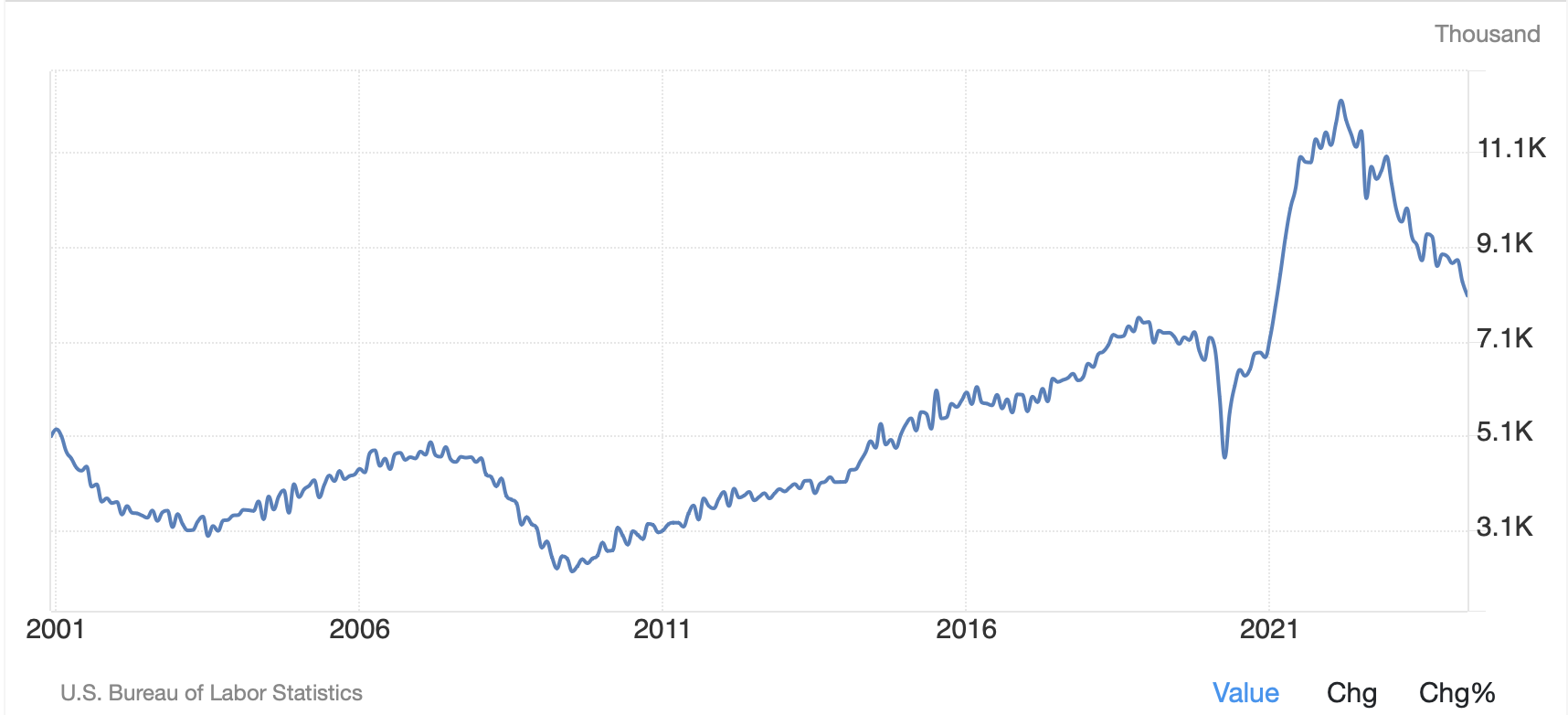
But second, the economic data in the US is starting to align more clearly in a negative fashion.  Yesterday I showed the Citi Surprise economic indicator index, which demonstrated that data is failing to keep up with forecasts.  Then yesterday, the JOLTS Job Openings data was released at a much diminished 8.059M, more than 300K jobs less than both anticipated and than last month.  In fact, despite this data point really looking backward (yesterday’s print was for April data), the recent trend, as seen below is very clearly lower.  

Source: tradingeconomics.com

This is an indication that the jobs market is much looser than the Fed had been worried about with regards to inflation, but of course is a problem for their maximum employment mandate.  In any event, the weaker data continues to pile up and the natural response of investors is to start to price in a more traditional weak growth scenario.  This includes declining bond yields on the assumption the Fed is going to ease policy, declining commodity prices on lessening demand, and a declining dollar on the back of those lower interest rates.  And that is exactly what we have seen.  

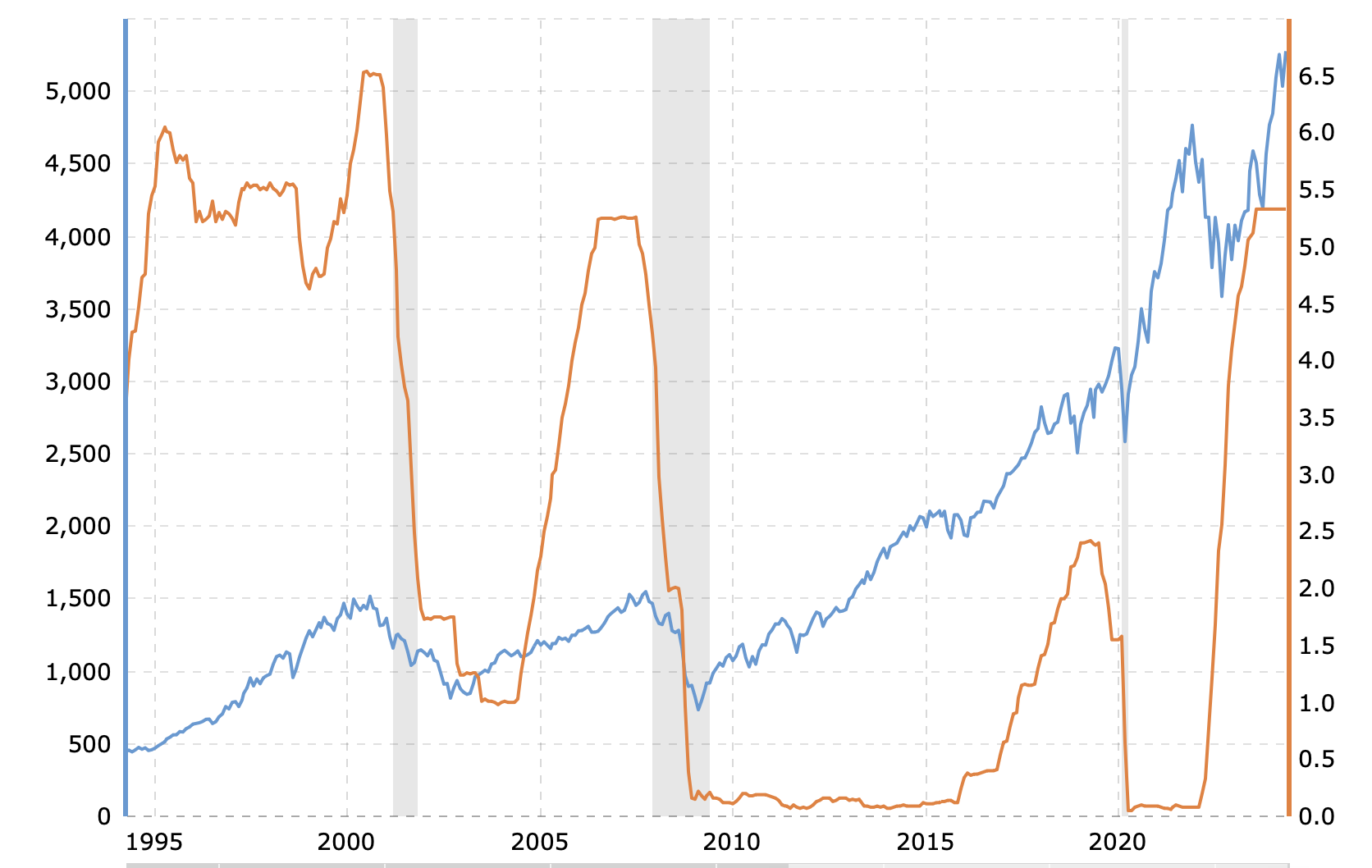
You will notice I left out the equity response to these events as I would contend it is far less clear.  Initially, I expect that equity investors will be excited by the prospects of rate cuts, and we could see stocks rally, but if growth is really slowing, then that is going to negatively impact earnings which should undermine equity prices.  Historically, when the Fed is cutting rates, it is in response to a slowing economy and equity prices have not fared well in this scenario.  You can see in the chart below, that the Fed tends to cut rates (orange line) during recessions (grey areas), and those declines are coincident with equity market (S&P 500 – blue line) declines.

Source: macrotrends.net

So, has the economy turned down for real now?  I would contend there are more indicators that are widely followed which indicate that is the case.  Several months ago, one really needed to dig into the secondary parts of major releases to conclude things were rolling over.  Today, it seems a bit clearer.  But remember, too, Treasury Secretary Yellen has > $700 billion in the TGA to spend leading up to the election in an effort to prevent that outcome, and you can be certain she will do all in her power to do so.  Will it be enough?  I guess we will find out.  

One last thought, though, is that my take is the current sticky inflation may well remain sticky despite an economic slowdown.  Remember, there is a humongous amount of money around, and the response of every government will be to print even more if things slow, so the idea of stagflation remains very real and cannot be dismissed at this time.

Ok, let’s look at the overnight session to see how things have fared.  After yesterday’s late equity rally resulted in very minor gains in the US, Asia had a mixed session with both Japan (-0.9%) and China (-0.6%) lower, although there were gains throughout the region led by India (+3.6%) rebounding from the initial election news there.  PM Modi will continue ruling, but in a coalition, so with much reduced power.  But Korea, Australia and Taiwan all performed well.  In Europe this morning, equity markets are having a good day with gains on the continent around 0.9% across the board although UK stocks are only higher by a bit (0.3%).  PMI Services data was released, and it was generally a touch better than forecasts (France excepted) but certainly not significant enough to change the view that the ECB is going to cut rates tomorrow.  Meanwhile, US futures are picking up at this hour (8:00), rising 0.3% across the board.

We discussed bonds earlier but not the fact that Treasury yields fell 7bps yesterday after the softer data, dragging European yields down as well.  This morning, Treasuries are another 1bp softer with Europe sliding by between 1bp and 4bps.  Overnight, yields also fell, with JGB’s down 2bps and now right back at 1.00%, while other bonds in Asia saw yields fall more sharply.  It seems pretty clear that the market is starting to price in a global slowdown in the economy.

In the commodity sector, after a week of routs, things have settled this morning with oil (+0.5%) bouncing slightly, although still lower by -7% in the past week.  Gold (+0.25%) too, is a bit firmer, although that was not the metal that fell most sharply.  Both silver and copper are unchanged this morning as the bullish long-term story mongers (present company included) are all licking their wounds, but absent more weak data, there is no incentive to sell things aggressively here right now.  However, if the data keeps softening, so will these prices.

Finally, the dollar, which had fallen earlier in the week, has edged up a touch this morning.  JPY (-0.6%) is giving back some of its recent haven inspired gains, and we have also seen both MXN (+0.9%) and INR (+0.25%) recoup a small amount of their election related losses.  ZAR (-1.0%), however, is still under pressure as the weakened state of the government combined with the weakness in metals prices is clearly a major weight on the rand.  All eyes today will be on CAD (unchanged) as the BOC meets and will be announcing their rate decision at 10:30. There is a 60% probability of a rate cut priced into the market, as recent data softness is getting traders excited that Governor Macklem will ignore his recent comments about needing “months of data” to confirm the situation.  After all, inflation up there is within the BOC’s range, and I suspect a cut is coming.

On the data front, ADP Employment was just released at a slightly softer than forecast 152K (exp 170K) and then we see ISM Services (50.8) at 10:00am.  As of yet, there has been no real response to the ADP data.  At this point, the narrative is swinging quickly to the idea that softer economic activity will lead the Fed to cut sooner than previously expected.  The Fed funds futures market has moved the probability of the September cut up to nearly two-thirds.  For now, that is going to drive things, and as such, I believe the dollar will remain under pressure overall.  Absent a very strong NFP report Friday, perhaps we have seen some near-term tops in yields and the dollar.

Good luck

Adf

Wages on Fire

The ECI data’s designed
To help understand what’s enshrined
In hiring workers,
Including the shirkers,
With numbers quite nicely streamlined
 
The problem for Jay and the Fed
Is yesterday’s data brought dread
It rocketed higher
With wages on fire
And showing that rate cuts are dead

It’s funny the way things work.  Historically, the number of people who paid attention to the Employment Cost Index (ECI), even in financial markets, could be counted on your fingers and toes.  It was just not a meaningful datapoint in the scheme of the macro conversation.  And yet, here we are in extraordinary times and suddenly it is a market mover!  I have updated yesterday’s 10-year graph with the most recent print of 1.2% and it is now very evident that wage pressures are not dissipating at all.  Rather, they seem to be accelerating and that is not going to help Jay achieve the 2.0% inflation goal.

Source: tradingeconomics.com

But in fairness, it wasn’t just the ECI.  Yesterday’s data releases were lousy across the board.  Case-Shiller Home prices rose more than expected, by 7.3% Y/Y.  Chicago PMI fell sharply to 37.9, far below expectations and I guess we cannot be surprised that, given all that, Consumer Confidence fell to 97.0, its lowest reading since immediately after the pandemic.  The upshot is rising prices and weakening growth, back to fears of stagflation.  With that as backdrop, the fact that risk assets got slaughtered across the board yesterday seems par for the course. 

And that is the setup for Jay and his merry band at the FOMC today.  At this point, much ink has already been spilled trying to anticipate what the statement will say and how hawkish/dovish Powell will be at the press conference so there is very little I can add that will be new.  I would contend the consensus is that the statement will be more hawkish, likely removing the line about “Inflation has eased over the past year but remains elevated,” or adjusting it.  However, one of the things that has been pointed out lately is that Powell’s press conferences seem to have consistently been more dovish than the statement.  Perhaps that happens again today, but I have to have some faith that Powell is actually trying to achieve the mandates and it is abundantly clear that right now the price side of the mandate is in jeopardy.  As there are no dots or ‘official’ forecasts coming, my take is a slightly more hawkish statement and Powell backing that up later.

I guess the biggest question, especially after yesterday’s data, is how he will respond to questions regarding hiking rates further.  If I were him, I would have that answer prepared to be as nondescript as possible. Because if he opens up that avenue of discussion, we are going to see a much more serious decline in risk assets.

One other thing of note yesterday was a comment by Secretary Yellen which was almost laughable when considering who is making the statement.  Apparently, she is,” concerned about where we’re going with [the] US deficit.”  Seriously?  She is the Treasury Secretary in charge of spending plans and after pitching for ever more money to spend she is now concerned about the budget deficit?  Then, apparently according to Axios, in a speech later today she is set to make a plea for the Fed’s independence!  Again, seriously?  The Fed is ostensibly already independent, yet I’m pretty certain she is bending Powell’s ear daily about what to do, i.e., commingling Treasury and the Fed.  But suddenly she is concerned about its independence?  It is things like this that make it so difficult to take certain players on the stage seriously.  It doesn’t speak well of the current administration’s efforts to fix the problems that exist, many of which they have initiated.

Ok, enough ranting on my part.  As it is May Day, much of Europe and some of Asia was closed last night but let’s recap the session as well as look ahead to the data before the FOMC.  I’m pretty sure you know how poorly the equity markets behaved yesterday with -1.5%- to -2.0% losses in the US.  In Asia, the markets that were open, Japan, Australia and New Zealand followed the same course, falling, albeit not quite as far, more on the order of -0.5% to -1.0%.  in Europe, only the FTSE 100 is trading today, and it is flat on the session while US futures are pointing lower again, down -0.3% or so at this hour (7:00).

In the bond market, after yesterday’s Treasury selloff with yields jumping 8bps across the curve, markets are quiet with Europe on holiday so no change ahead of the NY opening.  The rise in Treasury yields did drag European sovereign yields up as well, just not as far with most higher by 3bps-4bps yesterday and they are closed today.  As to JGB yields, despite all the huffing and puffing in the FX market, they are essentially unchanged so far this week.

But the real fun yesterday was in the commodity markets with significant declines across the board.  Oil prices fell on a combination of higher inventories according to the API as well as hopes of a ceasefire in Gaza helping to settle things down in the middle east.  And they are lower by another -1.5% this morning.  Meanwhile, metals markets, which had been exploding higher across the board until two days ago, had another wipeout yesterday with all the metals falling by 1% or more.  This morning, though, they seem to have found some support with gold (+0.1%) and silver (+0.5%) bouncing slightly while copper (-0.8%) and aluminum (-0.3%) are still under pressure given the weaker economic data.  Of course, underlying all this movement is concerns that interest rates are going to continue higher.

Which brings us to the dollar, which, not surprisingly given the rise in interest rates, rose sharply yesterday and is holding those gains this morning.  On average, I would say the dollar gained 0.5% yesterday and it was broad based, rising against both G10 and EMG currencies as well as against financial and commodity currencies.  For instance, CLP, which is closely linked to copper prices, fell -2.0% yesterday while ZAR was lower by -1.0%.  But the euro (-0.6%) and pound (-0.4%) were also under pressure as traders started to anticipate an even more hawkish Fed today.  I suspect things will be quiet until the FOMC this afternoon despite the data that is due.

Speaking of that data, first thing we get the ADP Employment report (exp 175K) then JOLTS Job Openings (8.69M) and ISM Manufacturing (50.0).  A little later comes the EIA oil inventory data and then, of course, the FOMC statement at 2:00 with the press conference at 2:30.  Since all eyes are focused on that, I would not expect much activity until it is released, and Powell speaks.

Good luck

Adf

Stagflation

Call rates will remain
Zero to Point-one percent
We’ll still purchase bonds


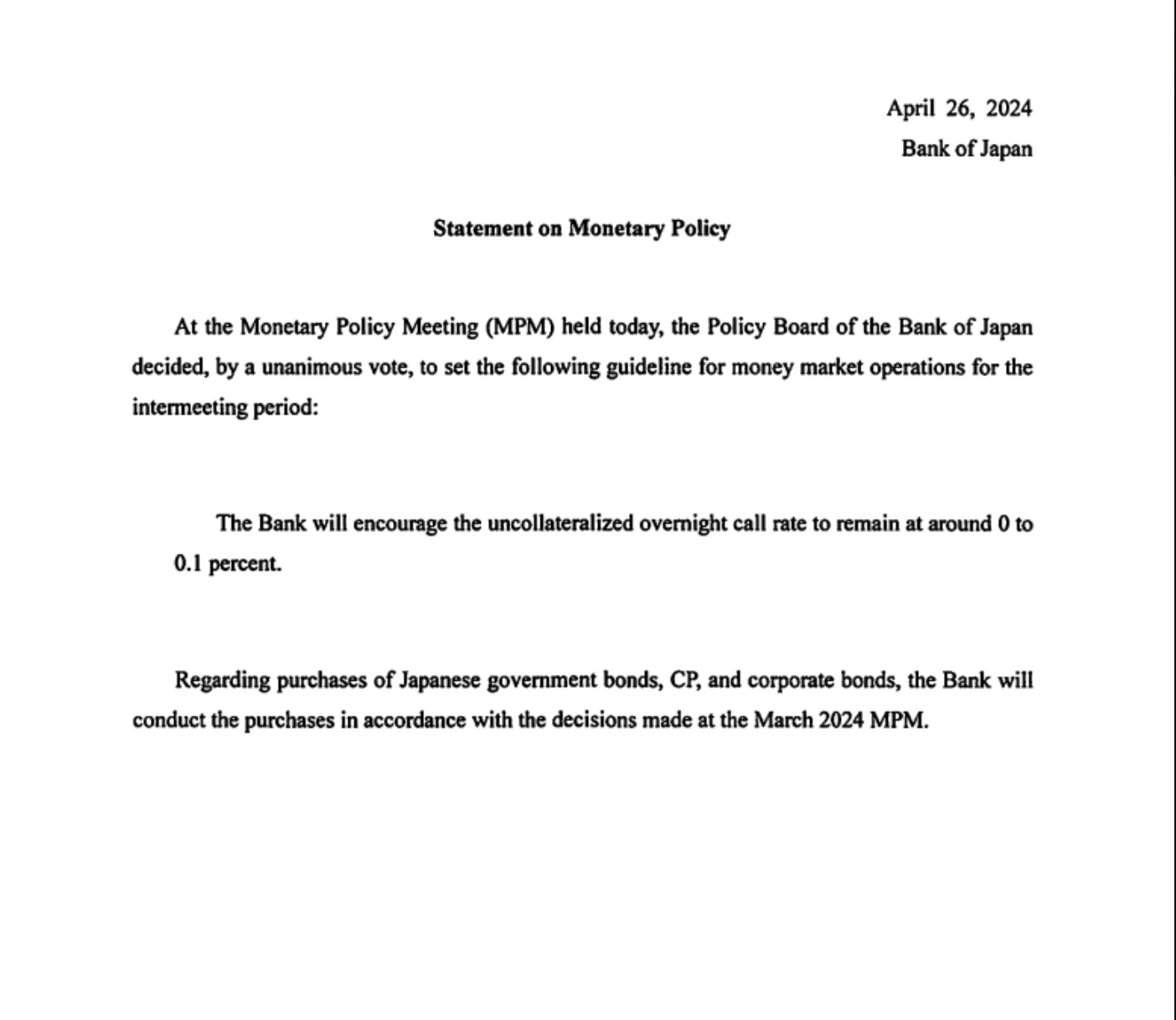
In a move that clearly captured my heart, the BOJ left policy on hold last night, as widely expected.  But the key is that the policy statement, in its entirety, is as follows:

I would contend they could have used my haiku above and completely gotten the message across!  This is the best central bank move I have seen in forever, an economy of words with limited discussion about their views of the future.  But that the Fed would be so terse in their statements.  By forcing investors and traders to consider all the issues and the best, or at least possible, ways in which the central bank can achieve their stated goals, positioning would be substantially reduced because nobody would think the central bank ‘had their back’.  This would prevent another SVB-type collapse, and probably go a long way to reducing the massive wealth inequalities that central banks have fostered since the GFC.  Just sayin’!

The market response to this, and the subsequent Ueda press conference was to sell the yen even more aggressively, with USDJPY touching yet further new 34-year highs at 156.80, higher by more than one full yen (0.7%) and JGB yields climbed to 0.92%, slowly approaching the big round number of 1.00%.  FinMin Suzuki was out trying to talk the yen higher (dollar lower) with the following comments, “the weak yen has both positive and negative impacts, but we are more concerned about the negative effects right now.”  Those comments were sufficient to drive USDJPY down about 90 pips in a few minutes, but as of right now (6:20), the dollar is back to its highs.  As long as the Fed and the BOJ remain on different wavelengths, the yen will not be able to rally, trust me.

The GDP data surprised
By showing less strength than surmised
But really, for Jay
The prob yesterday
Was PCE so energized

This brings us to the GDP data yesterday, which missed badly at 1.6%.  However, that was not the worst part of the report.  Alongside the GDP data, there is a PCE calculation, that while not the one on which the Fed focuses, is still a harbinger of how things are going.  That number was higher than expected with the Core rising 3.7% Q/Q, up from 2.0% in Q4.  The upshot of this data was that growth is slowing and inflation is rising, exactly the opposite of the Fed’s (and the administration’s) goals and moving toward the concept of stagflation.

While quoting oneself is not the best etiquette, I think it makes some sense here as I described this exact situation back in January as follows:

Stagflation is an awful word as it describes a state
Where prices rise too fast while growth just cannot germinate.
And this, dear friends, is what I fear will come to pass this year
By Christmas, bonds and stocks will fall while metals hit high gear.

It should be no surprise that both bonds and stocks fell yesterday as market participants are growing concerned that the Fed has lost control of the narrative.  After all, the last time we had stagflation, Chairman Volcker chose to fight inflation first by raising the Fed funds rate to 21% and driving the economy into a double-dip recession from 1980-1982.  But the debt/GDP ratio at the time was just 30% or so and the government could afford it.  That is not the case today, and quite frankly, there are exactly zero politicians on either side of the aisle who can tolerate a recession of any type, let alone a double dip.  My guess is that all hands will be pushing to increase the rate of growth and let inflation rip because given the current drivers of inflation (commodity prices, near-shoring and demographics), it is not clear the Fed can do anything about it anyway.  Don’t you feel better now?

All this leads us to this morning’s PCE data (exp 0.3% M/M for both headline and core, 2.6% Y/Y for both readings) as well as Personal Income (0.5%) and Personal Spending (0.6%).  Given yesterday’s outcomes and the fact that the Bureau of Economic Analysis produces both sets of numbers, the whisper number is clearly higher.  If that should manifest, I suspect that the price action from yesterday, lower stocks and bonds, is very likely to continue despite the after-market rally of both Google and Microsoft on better-than-expected earnings data.  I also suspect that before noon, the Fed whisperer, Nick Timiraos, will have an article out in the WSJ to give some Fed perspective as they are currently muzzled in their quiet period.            

I don’t think there’s anything else to say about this, so let me recap the overnight session, at least the parts I have not yet discussed.  While the US equity session did not finish on its lows, all three major indices were lower by at least -0.5% on the day.  However, the same was not true in Asia with the Nikkei (+0.8%) responding positively to the fact that tighter monetary policy was not on its way, while Chinese (+1.5%) and Hong Kong (+2.1%) shares positively ripped on the back of the strong tech earnings in the US.  As to European bourses, they are all in the green this morning, with Spain (+1.1%) leading the way but all higher by at least +0.5%.  Lastly, US futures are pointing higher as well after the strong earnings numbers overnight, up by +1.0% or so at this hour (7:20).

After jumping 8bps in the wake of the GDP data yesterday, 10-year Treasury yields slid a bit and finished the day up 5bps.  This morning, they have given back two more basis points, but still trade right at 4.70%.  If this morning’s data is 0.4%, watch for another sharp move higher in yields today.  European yields pretty much followed the US yesterday, all closing higher by between 4bps and 6bps, and this morning they are lower by similar amounts, right back to where they started.

Oil prices (+0.5%) are climbing higher again, seeming to have found a recent bottom and looking like they are set to push back toward $90/bbl by summer.  While the real GDP data was softer, nominal remains solid and that is what drives demand.  In the metals markets, they all jumped on the data release and this morning are continuing higher (Au +0.7%, Ag +0.8%, Cu +0.8%, Al +0.9%).  In the industrial metals, inventories are dropping while the precious space is clearly responding to the inflation fears.

Finally, the dollar is little changed overall this morning.  while it has rallied sharply vs. the yen, ZAR (+0.85%) is gaining on metal market strength as an offset and pretty much everything else is +/- 0.25% or less.  My take is everyone is waiting for this morning’s data to determine if the Fed is going to become even more hawkish, or if there will be a reprieve. 

In addition to the PCE data, we get Michigan Sentiment at 10:00 (exp 77.8, down from 79.4).  Right now, players are holding their collective breath for the numbers.  After the release, it’s all about the results.  Given that every recent inflation print has been on the high side, I expect this to be no different.  Bonds should suffer, commodities should outperform, and I expect the dollar to do well.

Good luck and good weekend

Adf

Raring to Spend

Japan’s new PM
Fumio Kishida is
Raring to spend yen

The LDP elected Fumio Kishida as its new president, thereby assuring him of the job of Japan’s 65th Prime Minister.  Relacing Yoshihide Suga, Kishida-san has a tall task ahead of him in leading the nation back to a growth trajectory.  In addition, he must face the voters by November as well as rally his supporters in an upper house election next year.  Apparently, his plan is…spend more money!  He has promised to spend tens of trillions of yen (hundreds of billions of dollars equivalent) in order to help resuscitate the Japanese economy and bolster the middle class.

As refreshing as it is to have a new administration, it seems as though the policy playbook continues to consist of a single page…spend more yen.  Perhaps something will change in Japan, but it seems unlikely.  Rather, the nation will continue to struggle with the same macroeconomic issues that have plagued it for the past decades; excess debt driving slower growth amid an aging population.  The yen (+0.1%) has stabilized this morning but appears to be trending pretty sharply lower.  While support (USD resistance) is strong at 111.65-85, should we breech that level, a move toward 115.00 appears quite reasonable as well as likely.

As energy prices rise higher
Most governments seek a supplier
Of power that will
Completely fulfil
The orders that they all desire

In other news, it is becoming abundantly clear that the combination of energy policies that have been enacted recently are not having the desired outcome, assuming that outcome is to develop clean energy in abundance.  This is made evident by the dramatically rising prices of things like natural gas in Europe (+400% since 1Mar21) and the US (+130% YTD) and coal (+160% YTD).  Of course, the latter is rarely considered ‘clean’ but it is reliable.  And that is the crux of the matter.  Reliability of both wind and solar power has been called into question lately and reliance on baseload power sources like coal, which Europe, China, and India have in abundance, and NatGas, which they don’t, is driving policy decisions.

For instance, China is mulling energy price hikes for industry in an effort to reduce demand.  And if that doesn’t work, they will raise prices for residential users.  Go figure, a communist nation using price signals to adjust behavior!  At any rate, the immediate impact is likely to be downgraded growth prospects for China’s economy as rising energy prices will lead to rising export prices, lower exports, and lower growth.  We have already seen Chinese equity markets under pressure recently as the energy situation worsens.  Shanghai (-1.8%, -5.5% in past two weeks) is leading the way lower amid growing concern that Evergrande is not the biggest problem impacting China.  At some point, I expect the renminbi is going to suffer a bit more than its recent price action has shown.  Slowing growth and continued monetary expansion are going to add a great deal of pressure to the currency as it may be the only outlet available for the economy.  I fear it could be a “long cold lonely winter” in China this year.

Of course, it’s not just China where energy prices are rising, they are higher everywhere.  I’m sure you see it when you refill your gas tank, or when you pay your electric bill.  And this is a problem for economic growth as higher energy costs feed into product and service pricing directly, as well as reduce the amount of disposable income available for spending by the population.  Higher prices and slower growth (i.e. stagflation) are a very real risk, and by some measures have already arrived.

Beyond the direct discomfort we all will feel from its impacts, the policy questions are critical.  Consider, last time stagflation was upon us, then Fed Chairman Paul Volcker raised interest rates sharply in order to attack the inflation issue driving the US economy into a severe double-dip recession.  Oh yeah, the S&P 500 fell nearly 30% over the two-year period.  But ask yourself if, given the current zeitgeist as well as the current makeup of the Fed, there is any possibility that Chairman Powell (or his successor) will attack inflation in the same way.  It seems highly unlikely that would be the case.  Rather, it is a virtual certainty that the focus will be on the ‘stag’ part of the term and more money printing and spending will be recommended.  After all, given the increasing acceptance of the MMT mindset, that’s all that needs to be done.  Remember, policies matter, and if policies are designed to achieve short-term goals at the expense of longer-term needs, the ultimate outcome tends to be poor.  As in China, the currency is likely to be the relief valve for the economy which is what informs my view of longer-term USD weakness.  However, for now, the dollar is following 10-year Treasury yields, which seem to be trending higher, albeit not today when they have fallen 4.2 basis points.

Summing it all up, rising energy prices are starting to have deleterious effects on all parts of the global economy and the financial market implications are only going to grow.  In addition, the policy actions going forward are critical, and the chance of a policy error seem to grow daily.  The idea of short-term pain for long-term gain is obsolete in the year 2021.  Be prepared for more problems in the future.

Ok, a quick run around markets shows that after yesterday’s sharp US equity sell-off, Japan (Nikkei -2.1%) followed suit as did Shanghai although the Hang Seng managed to rally 0.7%.  Europe, on the other hand has decided that central banks will come to the rescue, as we are seeing a nice rebound from yesterday’s price action (DAX +1.1%, CAC +1.2%, FTSE 100 +1.0%).  US futures, too, are higher led by the NASDAQ (+1.0%) as declining yields are helping out.

But are yields really declining?  The fact that the bond market has bounced slightly after a dramatic 1-week decline is hardly a sign of a rebound.  Rather, it is normal trading activity.  While the trend remains for higher yields, today, all of Europe has seen yields slide on the order of 2 basis points alongside the Treasury yield declines.  This feels very much like a lull in the action, not a top/bottom in the market.

Commodity prices are behaving in a similar manner as oil (-0.8%) and NatGas (-1.2%) are leading the way lower, consolidating what has been an impressive rally.  Metals prices are mixed with gold (+0.6%) rebounding but base metals (Cu -0.4%, Al -0.2%, Sn -0.6%) all sliding.  Agricultural prices are mixed as the overall session seems to be one of position adjustments after a big move.

As to the dollar, it is mixed, albeit slightly firmer if anything.  In the G10, NOK (-0.35%) is falling alongside oil prices with NZD (-0.3%) the next worst performer on weakening commodity prices.  JPY (+0.1%) and CHF (+0.1%) are both modestly firmer, but here, too, things seem more position oriented than trend worthy.  EMG currencies are mixed with an equal number of gainers and losers, but the notable thing is that the biggest movers have only seen price adjustments of 0.3% or less.  In other words, there are precious few stories here to think about.

There is no data of note this morning, but we do hear from a lot of central bankers, notably Chairman Powell alongside Lagarde, Kuroda and Bailey (BOE) at an ECB forum.  We also hear from Harker, Daly and Bostic, but the narrative remains tapering is coming in November, and none of these three will be able to change that narrative.

In truth, I would have expected the dollar to soften today given the bond market, so the fact it remains reasonably well bid is a sign that there is further strength in this move.  The euro is pushing to critical technical support at 1.1650, a break of which is likely to see a much sharper decline.  Hedgers, keep that in mind.

Good luck and stay safe
Adf

Reason to Fear

In Europe, the price of Nat Gas
Has risen to new highs, alas
As winter comes near
There’s reason to fear
A rebound will not come to pass

As well the impact on inflation
Is likely to add to frustration
Of Madame Lagarde
As she tries so hard
To hide the debt monetization

Some days are simply less interesting than others, and thus far, today falls into the fairly dull category.  There has been limited new news in financial markets overall.  While the ongoing concerns over the imminent failure of China Evergrande continue to weigh on Asian stocks (Nikkei -0.6%, Hang Seng -1.5%, Shanghai -1.3%), the story that is beginning to see some light in Europe is focused on the extraordinary rise in Natural Gas prices.  As a point of reference, in the US, Nat Gas closed yesterday at $5.34/MMBtu, itself a significant rise in price over the past six months, nearly doubling in that time.  Europeans, however, would give their eye teeth for such a low price as the price in the Netherlands for TTF (a contract standard) is $22.61/MMBtu!  This price has risen nearly fourfold during the past six months and now stands more thar four times as costly as in the US.  Whatever concerns you may have had about your personal energy costs rising in the US, they are dwarfed by the situation in Europe.

This matters for a number of reasons beyond the economic (for instance, how will people in Europe afford to heat their homes in the fast approaching winter and continue to feed their families as well?)  but our focus here is on markets and economics.  Thus, consider the following:  Europe remains a manufacturing and exporting powerhouse and is reliant on stable supply and pricing of natural gas to power their factories.  Obviously, recent price action has been anything but stable, and given the European dependence on Russian gas supplies, there is a geopolitical element overhanging the market as well.  LNG can be a substitute, but Asian buyers have been paying up to purchase most of those cargoes, so Europe is finding itself with reduced supply and correspondingly rising prices.

The first big industrial impact came yesterday when a major manufacturer of fertilizer shut down two UK plants because the cost of Nat Gas had risen too far to allow them to be competitive.  Consider the chain of events here: first, closure of the plant means reduced overall output, as well as furloughed, if not fired, workers. Second, reduction in the supply of fertilizer means that the price for farmers will almost certainly rise higher, thus forcing farmers to either raise their prices or reduce production (or go out of business).  Higher food prices, which have already risen dramatically, will result in reduced non-food consumption and strain family budgets as it feeds into inflation.  Net, slower growth and higher prices are the exact wrong combination for any economy and one to be avoided at all costs.  Alas, this is very likely the type of future that awaits many, if not most, European countries, the dreaded stagflation.  The ECB has its work cut out to combat this issue effectively while the Eurozone economy sits on more than €11.3 trillion in debt.  I don’t envy Madame Lagarde’s current position.

Beyond the macroeconomic issues, what are the potential market impacts?  Here things, as always, are less clear, but thus far, we have seen one impact, and that is a declining euro (-0.4%).  In fact, all European currencies are falling today as it becomes clearer that economic activity across the pond is going to be further impaired by this situation.  It has been sufficient to offset perceived benefits of European economies reopening in the wake of the spread of the delta variant of Covid.  However, the upshot of this currency weakness has been equity market strength.  It seems that any concerns of the ECB considering tighter policy have been pushed even further into the future thus encouraging investors to continue to add risk to their portfolios.  Hence, this morning, in the wake of the ongoing rise in Nat Gas prices, we see European equities all in the green (DAX +0.5%, CAC +1.0%, FTSE 100 +0.45%).  Under the guise of TINA, weaker growth leads to continued low rates and higher stock prices.  What could possibly go wrong?

US markets are biding their time at this hour, with futures essentially unchanged and really, so are bond markets.  Of the major sovereigns, only Gilts (+1.8bps) have moved more than a fraction of a basis point this morning.  While risk may be on, it is not aggressively so.  Either that, or European banks are back to buying more and more of their national bonds tightening the doom loop that ultimately led to the Eurozone crisis in 2012.

Commodities?  Well, as it happens, after a multi-day rally, oil prices are consolidating with WTI (-0.25%) basically holding the bulk of the $10 in gains it has made in the past month.  Nat Gas, too, is consolidating this morning, down $0.16/MMBtu, although that represents 3% (Natty is very, very volatile!)  With the dollar rocking, we are also seeing weakness across the metals’ markets, both precious (gold -0.75%) and industrial (Cu -2.0%, Al -0.6%, Pb -1.6%).  In fact, the only commodity that is performing well today is Uranium, which is higher by a further 8.1%.

Finally, the dollar is king today, rising against 9 of its G10 counterparts with CHF (-0.5%) the laggard and only NZD (+0.1%) able to show any strength today.  The Kiwi story has been a much better than expected GDP print (2.8% vs 1.1% expected) leading to growing expectations of a 0.50% rate hike next month.  Meanwhile, the rest of the bloc is suffering from the aforementioned cracks in the rebound theory as well as broad-based dollar strength.  This strength has been universal in EMG markets, with every currency sliding against the greenback.  Thus far, the worst performer has been PLN (-0.6%) followed by THB (-0.5%) and HUF (-0.5%).  Beyond that, most currencies are down in the 0.2% range.  Interestingly, for both PLN and HUF, the market discussion is about raising interest rates with Hungary looking at 50bps while Poland has called for a “gentle” rise, assumed to be 0.25%.  As to THB, it seems the market has been reacting to a rise in the number of Covid cases which is perpetuating the Asian risk-off theme.

We have a full slate of data today at 8:30 with Initial (exp 323K) and Continuing (2740K) Claims; Philly Fed (19.0) and the biggest of the day, Retail Sales (-0.7%, 0.0% ex autos).  Tuesday’s Empire Manufacturing data was MUCH stronger than expected, so there will be some hope for Philly to beat.  But the Retail Sales data is the key.  Remember, this number started to slide once the stimulus checks stopped, and last month we saw a much worse than expected -1.1% outcome.  Given the uncertainty over the near-term trajectory of the economy, this will be seen as an important number.

Well, the dollar managed to strengthen despite lacking support from yields, certainly a blow to the dollar bears out there.  The thing is, against the G10, I continue to see the dollar in a range (1.17/1.19) and will need to see a break of either side to change views.  If forced to opine, I would say the medium-term trend for the dollar is gradually higher, but would need to see the euro below 1.17, or the DXY above 93.50 before getting too excited.

I will be out of the office tomorrow so no poetry until Monday.

Good luck, good weekend and stay safe
Adf

The Dollar’s Fate (In the Coming Year)

With apologies to Henry Wadsworth Longfellow

Listen, my children, and you shall hear
Of the dollar’s fate in the coming year
In the wake of a time that’s ne’er been seen
Since the Spanish Flu of Nineteen Eighteen
Perhaps Twenty-One will bring joy, not fear

Recapping Twenty shows that despite
A plague of biblical magnitude
The printing press revealed its might
As governments everywhere, debt, accrued
And flooded the markets with cash untold
(The better their citizens be controlled)
But all of that money was used, not for,
Increased production of goods onshore
Instead, for the purchase of stocks galore

Thus, equity markets at home rose higher
With Asia, too, on proverbial fire
Though Europe lagged, as the ECB
Was late to the party with more QE
Risk was embraced with a multiplier
Government bonds, though falling of late
Had seen yields tumble, year-to date
And lastly, the dollar, is now descending
As traders await this trend extending

Looking ahead, what can we expect?
Has Covid passed? Will ‘normal’ return?
Or are there surprises we’ve yet to learn?
Will stocks continue their flights of fancy?
Will bonds, inflation, at last detect?
Will dollars, everyone, start to spurn?
Will gold and bitcoin still seem chancy?

Regarding the virus, it’s not dead yet
Though hope springs eternal, and at last
The vaccines imply the worst has passed
But life, as we knew it, has been reset
Working from home (or living at work)
Is mainstream now, and not just a quirk
Office demand will certainly slide
And travel for business will lessen worldwide
Normal has changed, for boss and for clerk

Let us now speak of growth and inflation
Will growth improve on last year’s “success”?
Or will it instead fall flat and regress
Lockdown renewals bode ill for salvation
Policymakers constantly flail
As policy efforts constantly fail
Stimulus, fiscal, continues to flow
Interest rates are now forevermore low
Central banks tell us that this combination
Is perfect to counter a fearful stagnation
But in their efforts, good times to hail
The rising of prices will bypass their gaze
Leading to many more difficult days
GDP this year will struggle to One
Inflation, however, at Four, will not stun

How, then, will markets respond to this fate?
Equity prices at first will inflate
By spring, though, ‘twill be clear something’s amiss
Traders, their holdings, will start to truncate
While we shall not tumble into the abyss
Do not be shocked if the market does fall
Some twenty percent, at the least, is my call
What about bonds? How will they react?
Powell will ne’er let their prices contract
Yield Curve Control is the future we’ll see
Alongside the horror of pure MMT
Hence, ten-year bonds when December arrives
Will keep up their value, a cat with nine lives
One percent will be the height they attain
Implying the real yield most certainly dives
And so, the dollar will suffer great pain

Starting in Europe where Madame Lagarde
Is trying to keep up with Fed Chairman Jay
Sadly, what’s clear, at the end of the day
The ECB’s structure will make it too hard
While Fed and the Treasury work hand in hand
Pushing more money throughout all the land
Treaties in Europe have outcomes, unplanned
PEPP’s not enough for a rebound unscarred

Even though growth throughout Europe will sag
Even though prices will still be a drag
Nothing Lagarde can create will impact
The outcome, a euro that’s sure to move higher
Thus, if it’s something you need to acquire
At year-end, One-Thirty, you’ll need, that’s a fact

Tumultuous best describes last year’s UK
Twixt Covid and Brexit, the nation felt pain
Unhappily, this year, to Johnson’s dismay
Could worsen for every old bloke on the street
With growth in the toilet while prices show heat
It doesn’t seem much like Pound Sterling could gain

But real rates keep diving throughout the US
Offsetting those troubles, so if you need quid
Come Christmas, One-Fifty, if I had to guess
Is what they will cost as the dollar’s declined
Looking elsewhere, perhaps north of the border
Canada still seems a bit out of order
Oil’s rebounded but still seems confined
Meanwhile, housing there is quite well bid

However, again, it is Fed Chairman Jay
Who’s promised support for considerable time
Thus, when we get to our next Boxing Day
One-Fifteen for Loonies you’ll see on your screen
Eastward now, let’s turn our gaze as we glean
Whether the yen can continue its climb
Long-term, the dollar, its trend has been clear
Even before the debasement of late
Several percent, like a clock every year
Why would this year, something new, demonstrate?

Frankly, it won’t, as the Fed’s in control
Rather, the yen, will continue to roll
So, Winter Solstice this year will reveal
Dollar-Yen, Ninety-Six, where you can deal
Let us turn now to both future and past
Bitcoin and gold, which have both been amassed
Can both their prices continue to rise?
Certainly, as they’ve restricted supplies

For centuries, gold has defined what’s secure
Its glitter unblemished while paper’s debased
So, don’t be surprised if the relic’s embraced
As buyers pay Three Grand their wealth to insure
But youth has ideas which to many seem odd
And bitcoin is one such that’s been called a fraud
So, is it? Or is Bitcoin digital gold?
An updated version important to hold
As fiat debasement continues apace
This digital token gains further allure
And this year it seems Bitcoin’s making its case
As something that everyone needs to procure

It’s starting this year right around thirty grand
And hodlers believe that ‘tween here and the sky
Unless countries call for Bitcoin to be banned
A doubling or tripling’s the gain they’ll apply
One last thing I’ll highlight in digital space

The DCEP is now leading the race
This digital yuan, the first CBDC
Is coming soon courtesy of Mr Xi
It’s impact initially is quite unclear
But I guarantee that inside of a year
Nations worldwide will each roll out their own
And each will define a DC trading zone

While last year was filled with surprises galore
This year we’re likely to see many more
And finally, thank you, my readers and friends
For listening to all the twists and the bends
Now looking ahead to Twenty Twenty-One
Let’s all keep perspective and try to have fun.

Good luck, stay safe and have a wonderful new year
Adf

DCEP = Digital Currency / Electronic Payment
CBDC = Central Bank Digital Coin