All But Assured

A cut has been all but assured
Though since last time we have endured
Some fears Jay’s a hawk
So, when he does talk
Will this cut, at last, be secured?
 
And now there’s a narrative view
Though rates will fall, what he will do
Is try to convey
Now it’s out the way
Another one may not come through


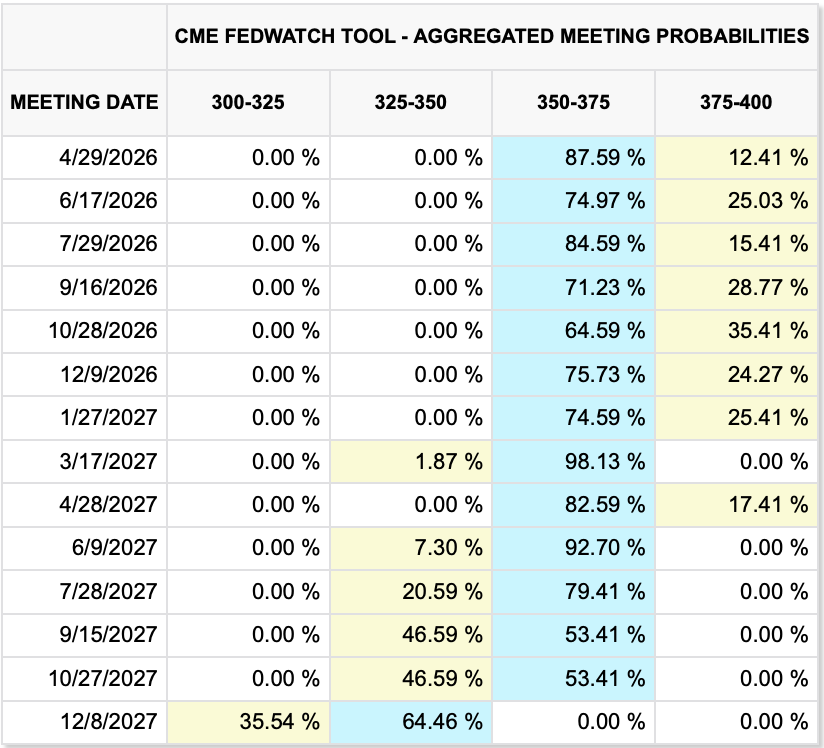
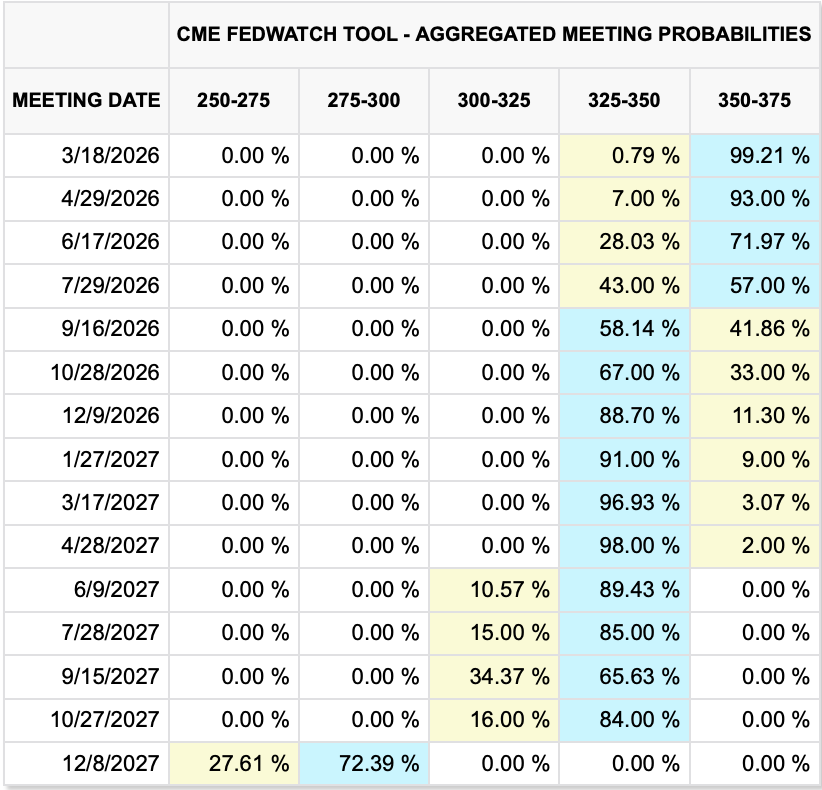
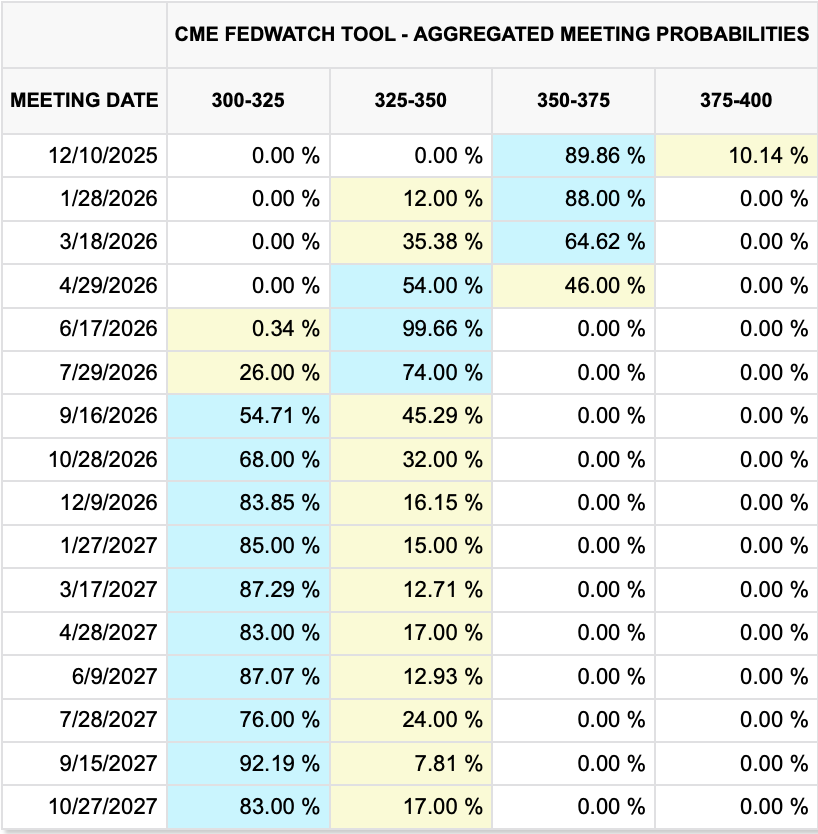
Good morning all and welcome to Fed Day.  The question, of course, is will this be a frabjous day?  As I write this morning, the Fed funds futures market continues to price a roughly 90% probability of a 25bp cut this afternoon, but the prospects for future rate cuts have greatly diminished as you can see in the table below from the CME.

It wasn’t long ago when the market was pricing 100bps more of rate cuts by the end of 2026, meaning a Fed funds rate of 2.50% – 2.75%.  However, the narrative has shifted over the past several weeks after very mixed signals from FOMC speakers and data releases that have indicated the economy is not cratering (e.g. yesterday’s JOLTS data printing at 7.658M, >400K higher than expected).  You may recall that shortly after the last FOMC meeting at the end of October, the probability of today’s rate cut had fallen to just 30%.

It appears that the new discussion point is this will be a hawkish cut, an idiom similar to jumbo shrimp.  At this point, the bulk of the discussion has been around how many dissents will be recorded with the subtext being, what will Chairman Powell have to promise potential dissenters in order to bring them along to his side of the ledger.  My take is if you thought the last press conference was hawkish, you ain’t seen nothin’ yet.  In fact, I would not be surprised to see a virtually categoric call to this being the end of the cutting cycle for the foreseeable future.

Remember, we also will see the new dot plots and SEP which will help us understand the broad picture of where FOMC members currently stand on the matter.  Personally, I expect to see a wide disparity between the ends of the distribution, and it wouldn’t surprise me to see some expectations of no rate changes for 2026 with other calls for 150bps of cuts and no consensus view at all. 

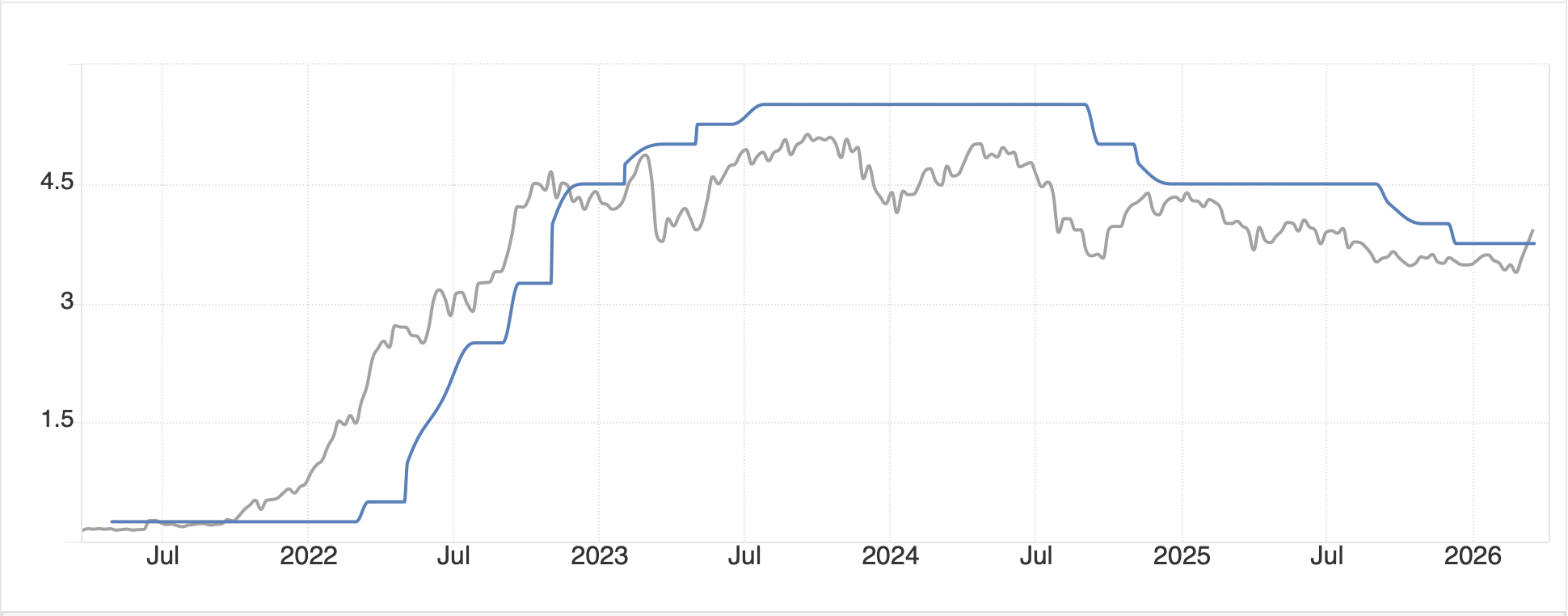
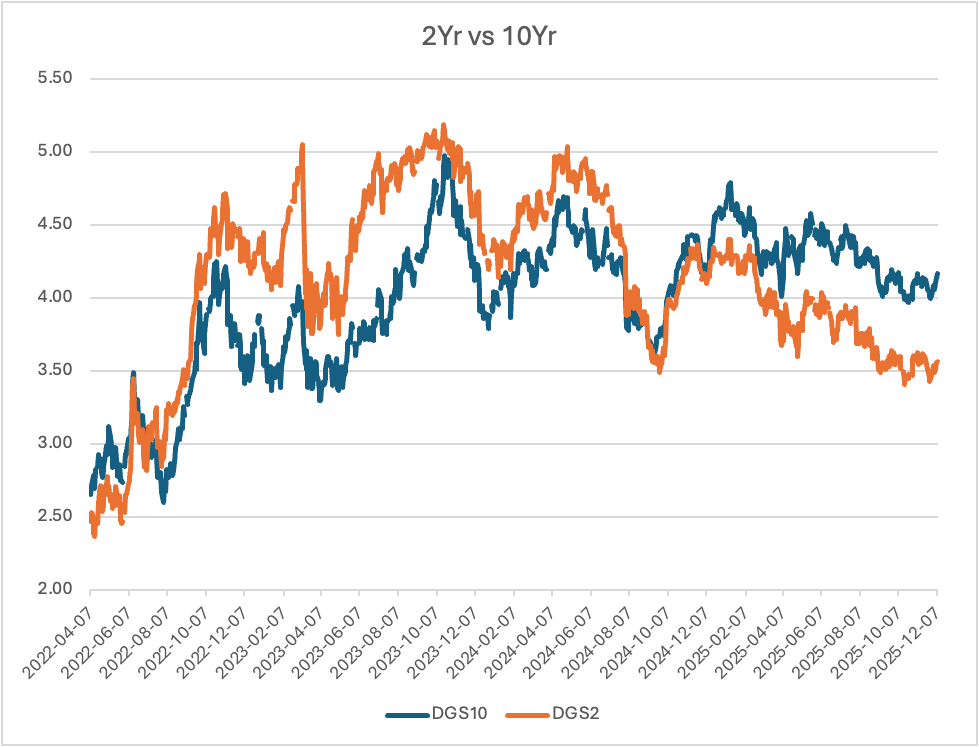
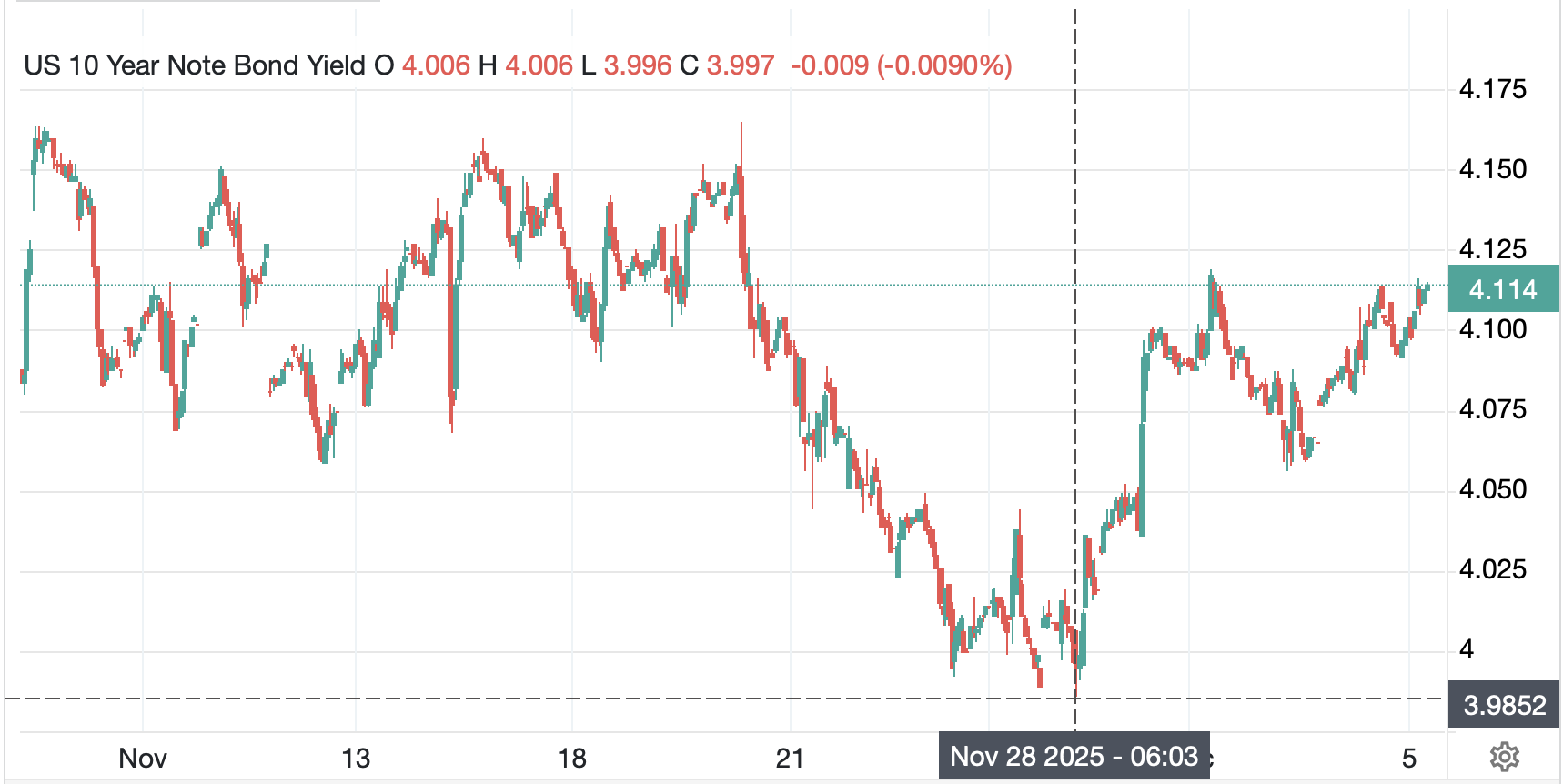
At this point, all we can do is wait.  However, the market discussion has centered on the fact that 10-year Treasury yields (+1bp) have been climbing lately, and that this morning they have touched 4.20% again while, at the same time, 2-year Treasury yields (no change) have been slipping as per the below chart I created from FRED data.

The steepening yield curve, which now appears to be turning into a bear steepener (when long dated yields rise more quickly than short-dated yields) is ringing alarm bells in some quarters.  The narrative is that there are growing concerns over both the quantity of debt outstanding and its rate of growth as well as the fact rate cuts will engender future inflation.

A key part of the discussion is the fact that what had been a synchronous system of global central bank policy easing is now starting to split up.  While we have known the BOJ is in a hiking cycle, albeit a slow one, today, the BOC is not only expected to leave rates on hold but explain they have bottomed.  We have heard that, as well, from the RBA earlier this week, and the commentary from the ECB may be coming along those lines.  So, is the US the outlier now?  And will that weaken the dollar?  Those are the key questions we will need to address going forward.

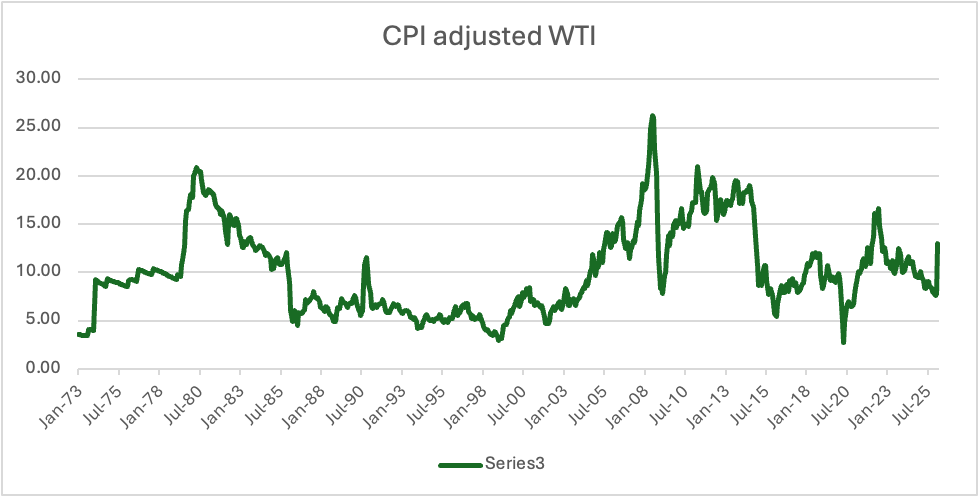
But before we move on, there is one market I must discuss, silver, which exploded to new historic highs yesterday, trading through $60/oz and is higher again this morning by 0.6% and trading at $61/oz.  someone made the point yesterday that for the second time in history, you need just 1 ounce of silver to buy one barrel of WTI.  The first time was back during the silver squeeze in January 1980, but that was quite short-lived (see chart below from macrotrends.com).  This one appears to have legs.  

I don’t know that I can find another indicator that better expresses my views of fiat currency debasement alongside an expanding availability of oil.  To my mind, both these trends remain quite strong, and this is the embodiment of them both combined.

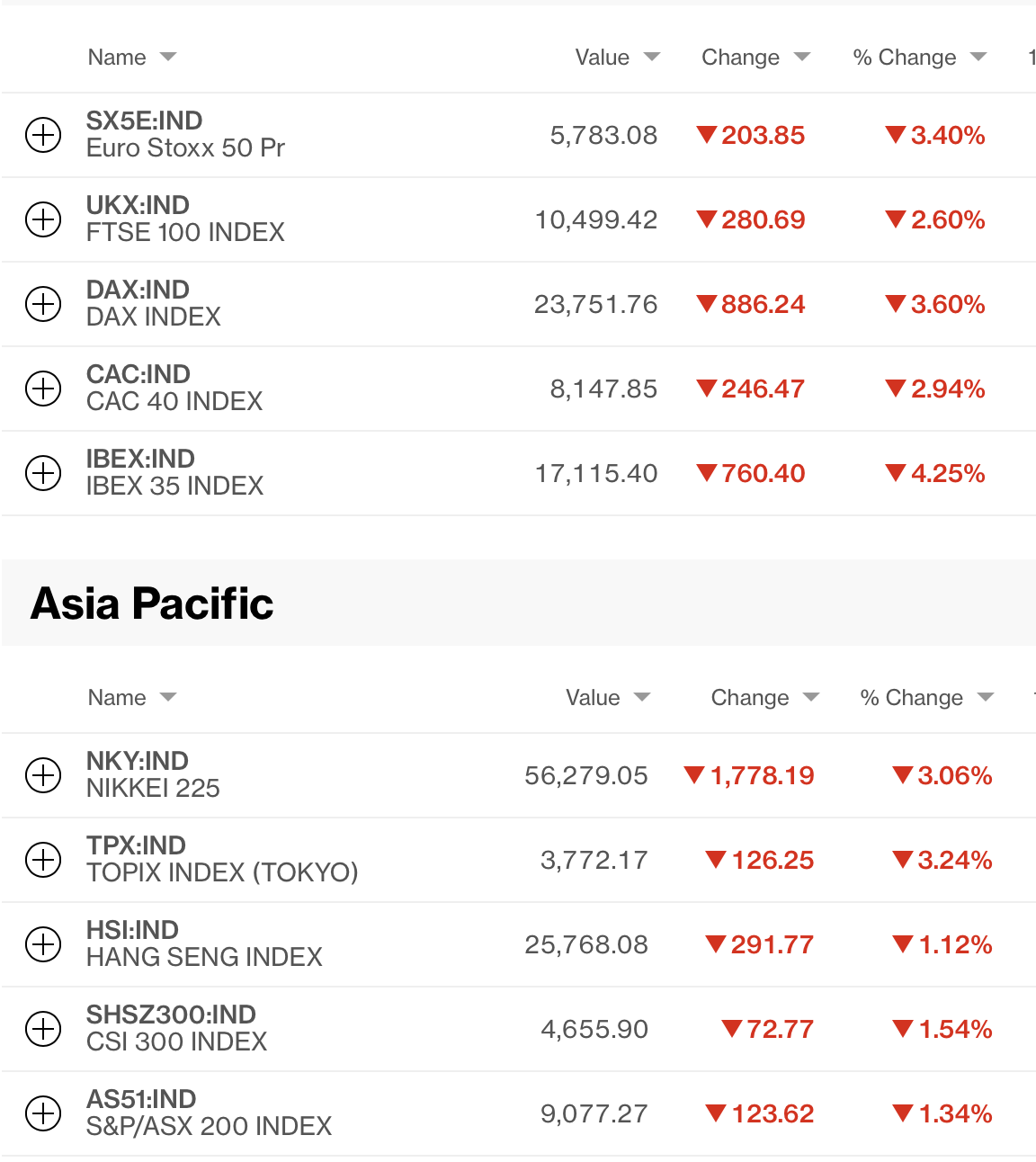
Ok, so as we await the FOMC, let’s see if anybody is doing anything in financial markets of note.  As testament to the fact that virtually everybody is awaiting the Fed this afternoon, US equity markets barely moved yesterday, and Asian markets were similarly quiet, with only Taiwan (+0.8%) moving more than 0.4% in either direction.  The large markets were +/- 0.2% overall.  In Europe, the movement has been slightly larger, but still not impressive with Germany (-0.4%) the laggard of note while the UK (+0.3%) is the leader.  A smattering of data released from the continent doesn’t seem to be having any real impact, nor did comments by Madame Lagarde claiming the rates are in a good place and displaying some optimism on future GDP growth.  Of much greater concern is the headlong rush to a digital euro CBDC, where they are seeking to exert control over the citizenry.  If for no other reason, I would be leery of expecting great things from the Eurozone going forward.  Not surprisingly, at this hour (7:30) US futures are little changed ahead of the meeting.

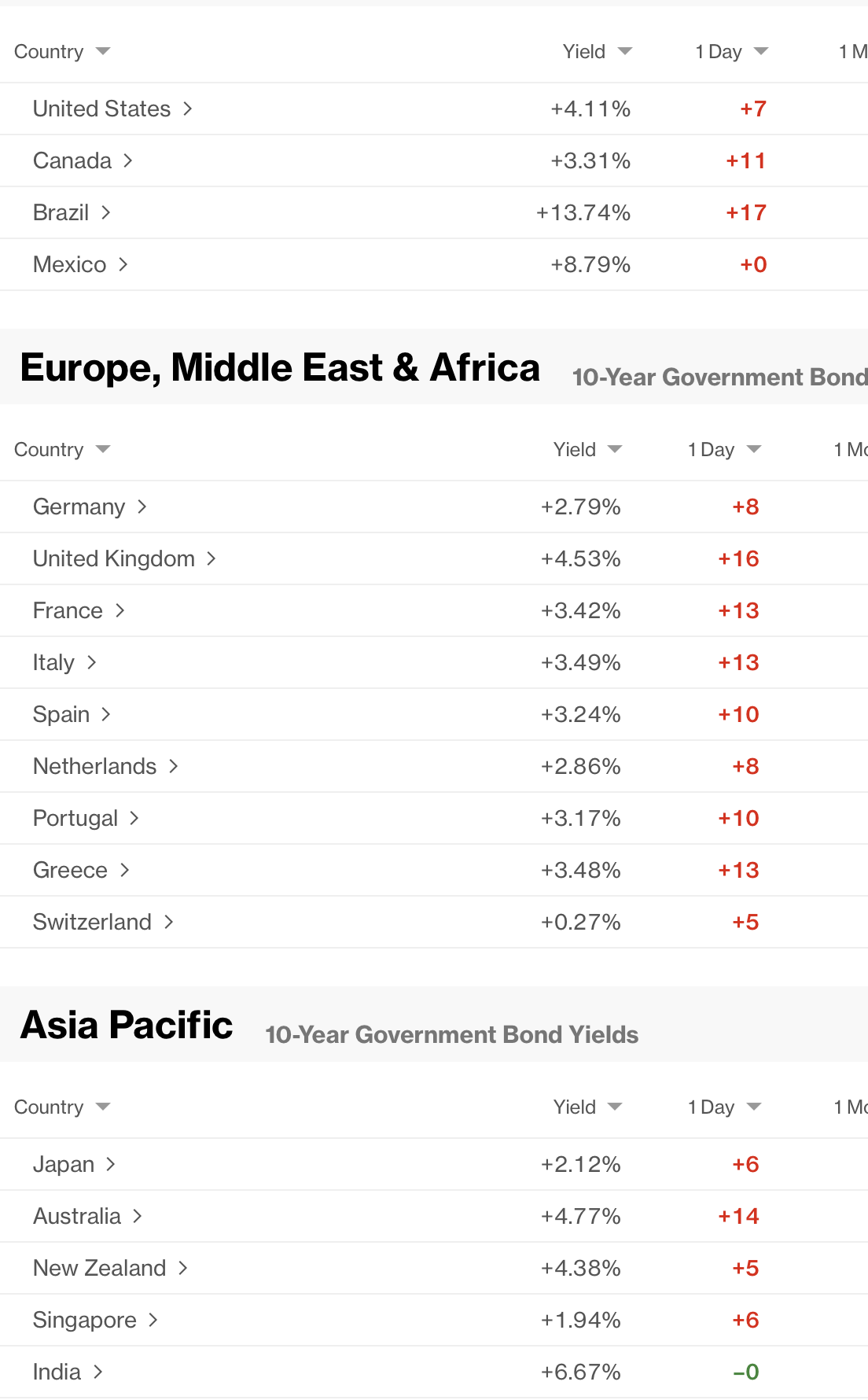
In the bond market, yields are creeping higher all around the world with European sovereign yields higher between 2bps and 4bps this morning.  Perhaps investors are taking Madame Lagarde’s views to heart.  Or perhaps the fallout from the recently released US National Security Strategy, where the US basically dismisses Europe as strategic, has investors concerned that European governments are going to be spending that much more on defense without having the financial wherewithal to do so effectively, thus will be borrowing a lot and driving yields higher.  At this point, European sovereign yields have risen to levels not seen since the Eurozone bond crisis in 2011, but it feels like they have further to climb (see French 10-year OAT yields below from Marketwatch.com).

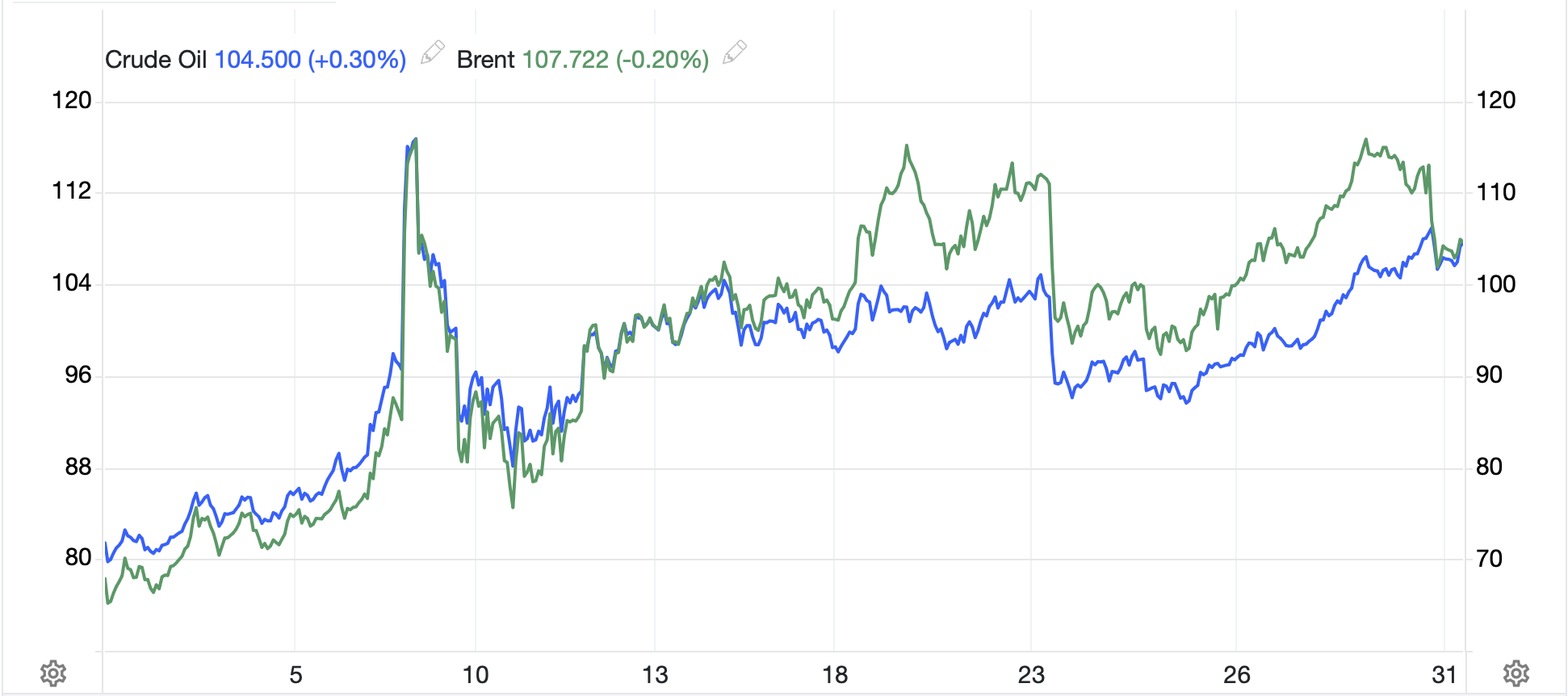
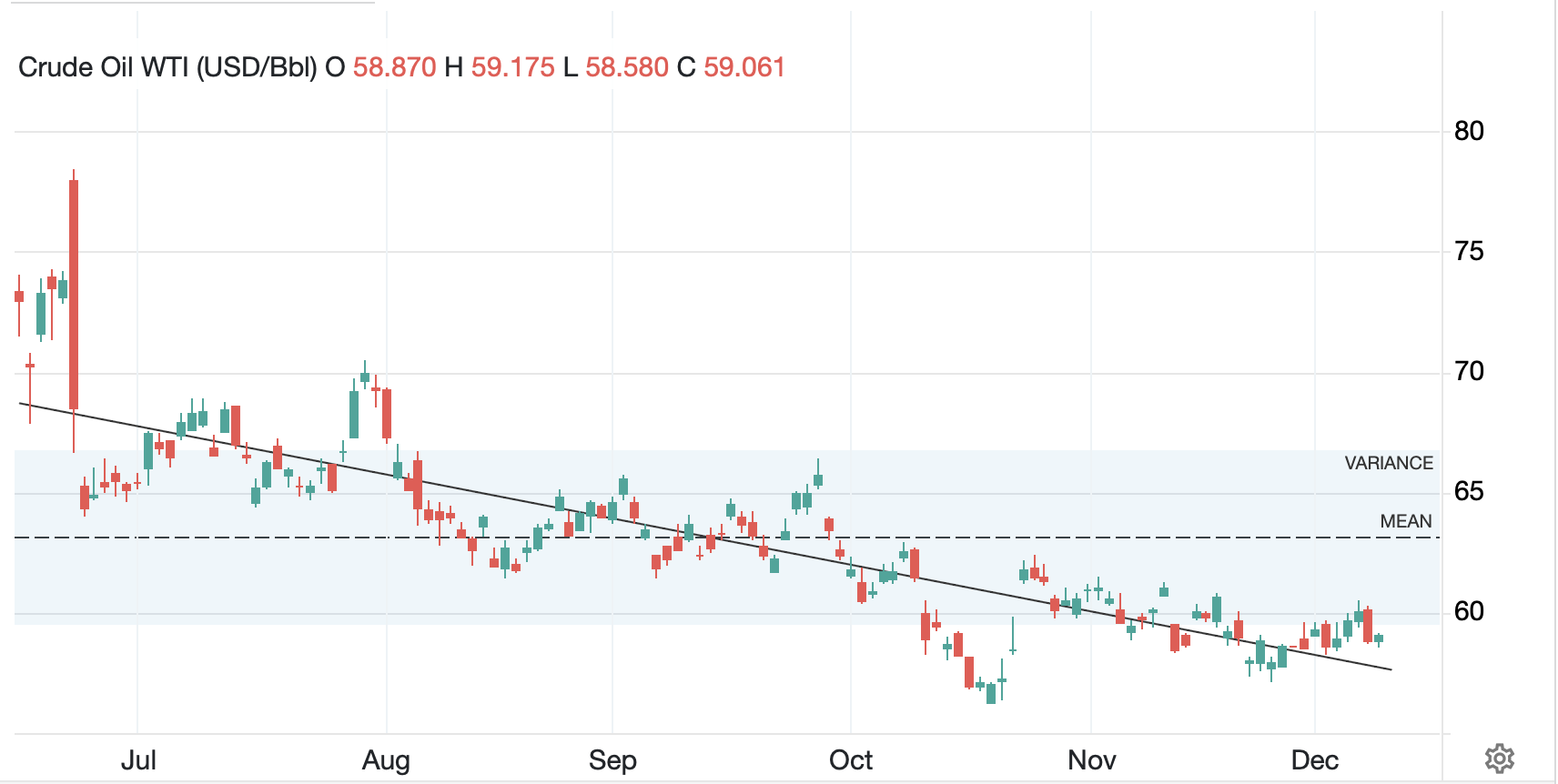
In the commodity market, oil (+0.5%) cannot get out of its own way.  While it is a touch higher this morning, it sits at $58.50/bbl, and that long-term trend remains lower.  We’ve already discussed silver and gold (-0.25%) continues to trade either side of $4200 these days, biding its time for its next move (higher I believe).  Copper (+1.4%) is looking good today, although it is hard to find economic news that is driving today’s price action.

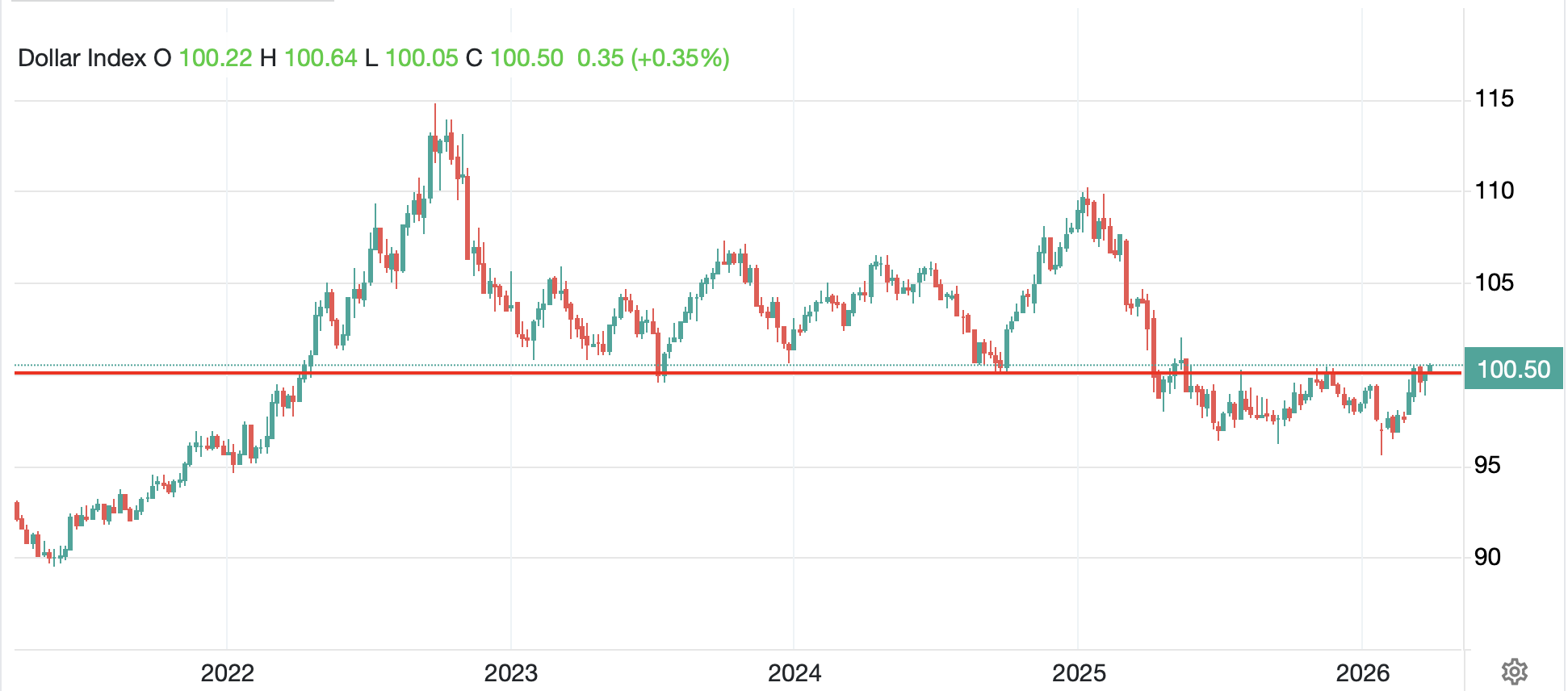
Finally, the dollar is a touch softer this morning, about 0.1% in the DXY as well as virtually every major currency in the G10.  Interestingly, today’s outlier is SEK (+0.4%) which is rallying despite data showing GDP (-0.3%) slipping on the month while IP (-6.6%) fell sharply.  As to the EMG bloc, there is very little movement of note with the biggest news this evening’s Central Bank of Brazil meeting where they are expected to leave their overnight SELIC rate at 15.0% as inflation there, released this morning at a remarkably precise 4.46% continues to run at the top of their target range of 3.0% +/- 1.5%.

Ahead of the FOMC, we only see the Employment Cost Index (exp 0.9%), a number the Fed watches more closely than the market, and we hear from the BOC who are universally expected to leave Canadian rates on hold at 2.25%.

And that’s really it.  I wouldn’t look for much movement ahead of the 2pm statement release and then the fireworks at 2:30 when Powell speaks can drive things anywhere.  The most compelling story will be the number of dissents on the vote, as there will almost certainly be several.  According to Kalshi, 3 is the majority estimate.  With President Trump continuing to discuss the next Fed chair, I have a feeling there will be 4 and that will be a negative for bonds (higher yields) and a short-term negative for the dollar.  In fact, it is just another reason to hold precious metals.

Good luck

Adf

It Won’t End Well

From Europe, we’re hearing some squawks
They’ve not been included in talks
‘Bout war and Ukraine
So, to inflict pain
They’ve threatened a US detox
 
It seems they believe if they sell
All Treasuries held we would yell
Please stop, it’s too much
And lighten our touch
Methinks, for them, it won’t end well


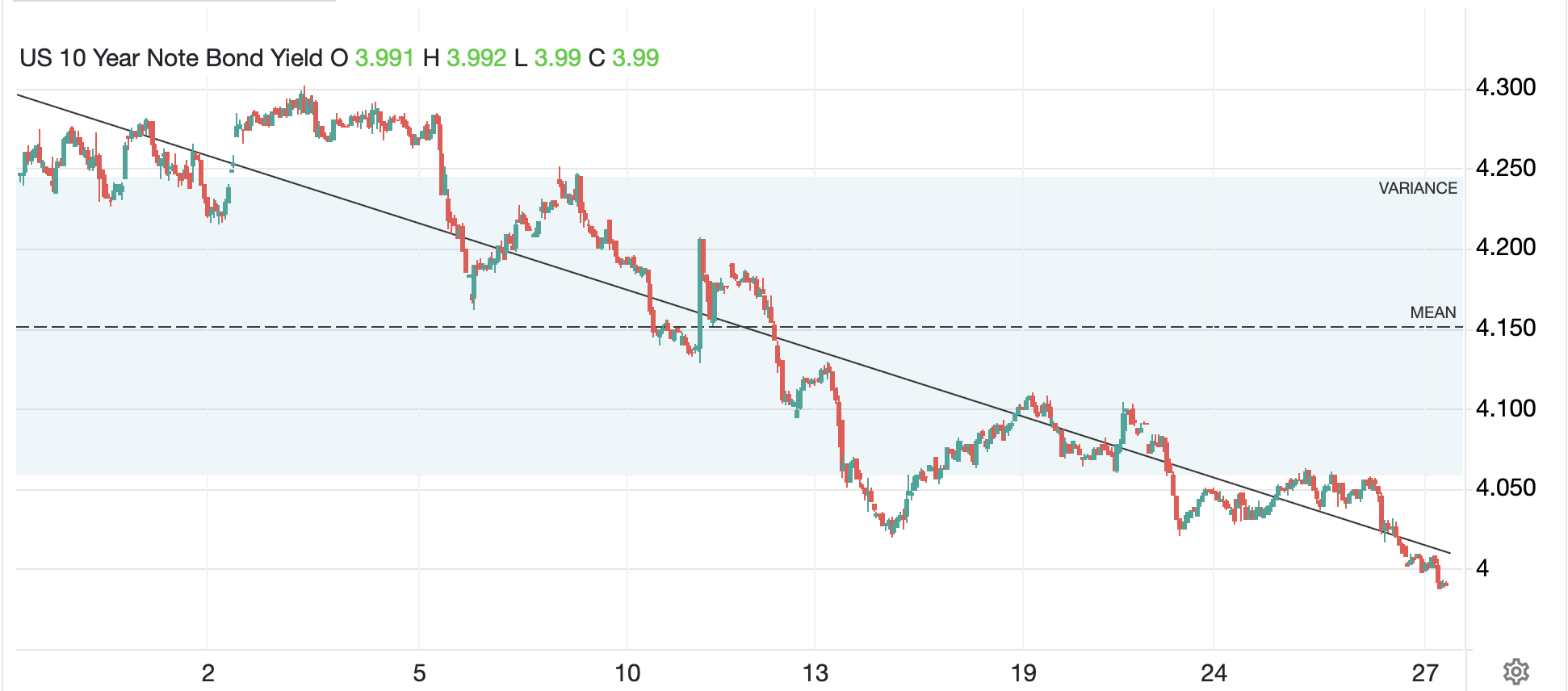
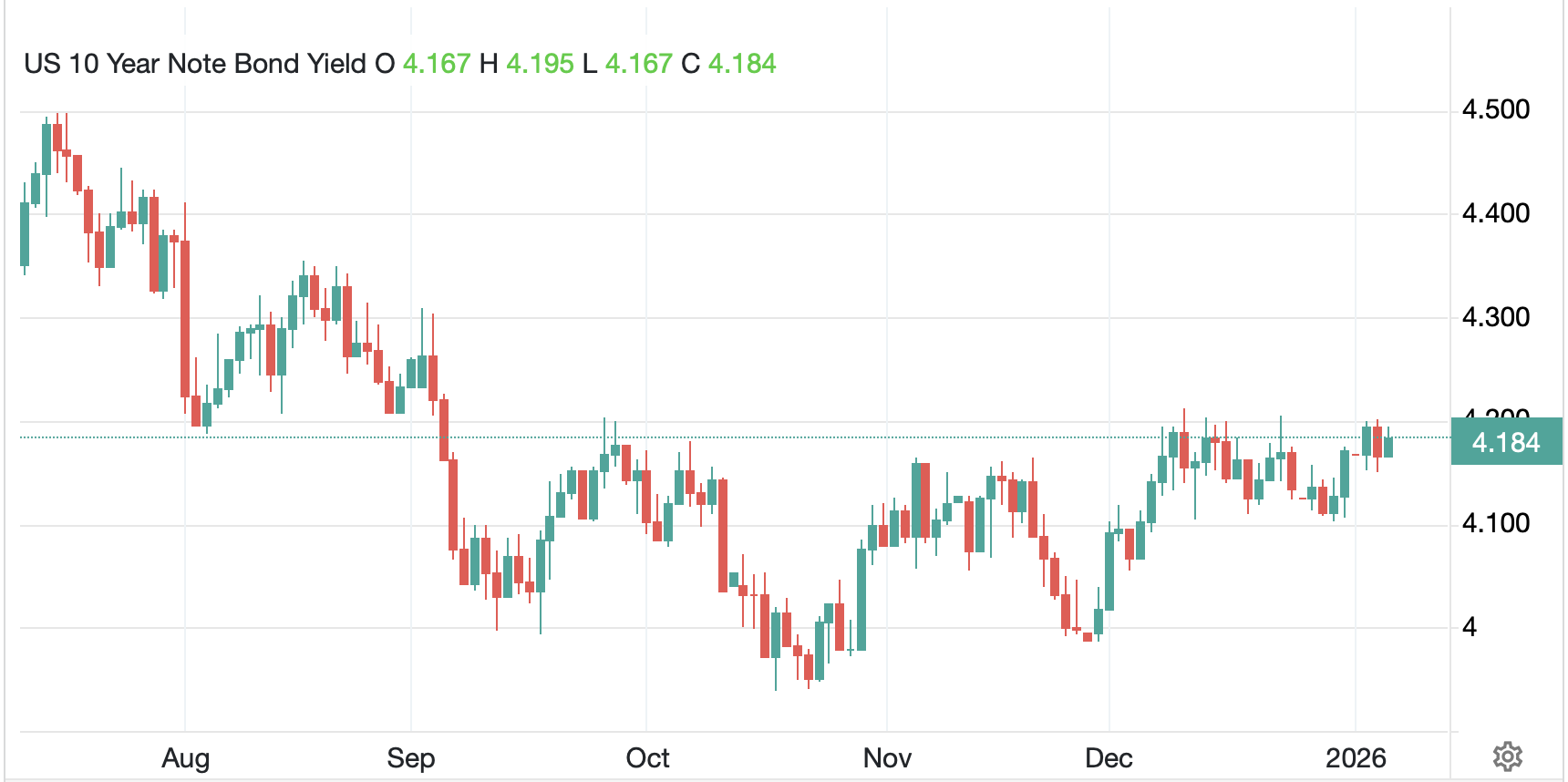
Markets continue to be dull these days.  While we are clearly not in the summer (it is 15° here in NJ this morning), doldrums certainly seem to be descriptive of the current situation.  Equities bounce back and forth each day, neither trading to new highs, nor falling sharply.  The same is true with the dollar, with oil, with gold of late and even, on a slightly longer-term view, of Treasury bonds.  I guess that could be the exception, depending on your horizon, but as you can see from the chart below, it has been several months since 10-year yields have traded outside the 4.0% – 4.2% range.

Source: tradingeconomics.com

Now, much digital ink has been spilled trying to explain that the latest 15bp rise in yields is a signal that the US economy is about to collapse under the weight of its $38+ trillion in debt, but I sense that is more about reporters trying to get clicks on their articles than a reflection of reality.

However, this morning I saw a story that I think is worth discussing, even though it is only a hypothetical.  Making the rounds is the story that Europe and the UK are extremely unhappy with President Trump’s approach to obtaining a peace in Ukraine and so have threatened their so-called ‘nuclear option’ of selling all their Treasury holdings to crash the US bond market and the US economy alongside it.  From what I have seen, if you sum up all the holdings in Europe and the UK it totals $2.3 trillion or so, although it is not clear if that is controlled by the governments, or there are private holdings included.  My strong suspicion is the latter, although I have not yet been able to confirm that.

But let’s assume those holdings are completely under the control of European central banks and governments and they decide that’s what they want to do.  What do you think will happen?  Arguably, much depends on how they go about selling them.  After all, it’s not as though there is anybody, other than the Fed, who can step up and show a bid on the full amount.  So how can they do this?  I figure there are only two viable options:

  1. They can sell them slowly and steadily over time, perhaps $200 billion/day (FYI daily Treasury market volume averages about $900 billion).  That would clearly put significant downward pressure on prices and push yields higher but would likely encourage the hedge fund community to double up on the bond basis trade thus slowing the decline.  However, if they did that for 11 days, US yields would undoubtedly be higher.  Too, remember that if the market started to get unstable, the Fed would step in and absorb whatever amount they deemed necessary to prevent things from getting out of hand.
  • Perhaps, since their ostensible goal is to destabilize the US bond market, they would literally all coordinate their timing and try to sell them all at once.  At that point, since nothing happens in the bond market without the Fed being aware, it would likely have an even smaller impact as the Fed would certainly step in and take down the entire lot.  After all, through QT, their balance sheet has shrunk about $2.3 trillion over the past 18 months, so they have plenty of capacity.

My point is, I believe this is an empty threat, as it seems most European threats tend to be.  Consider that the Eurodollar market remains the major source of funding throughout Europe, and it requires collateral (i.e. Treasury bills and bonds) in order to function.  If Europe no longer had that collateral, it feels like they might have a lot more problems funding anything on the continent.  

Another issue is that if we assume they successfully sell all their Treasuries, that means they will be holding $2.3 trillion in cash.  Exactly what are they going to do with that?  If they convert it into euros and pounds, the dollar will certainly fall sharply, meaning both the euro and pound will rise sharply.  Please explain how that will help their economies and their exporters.  They are getting killed right now because their energy policies have made manufacturing ridiculously expensive.  See how many cars VW or Mercedes sells overseas if the euro rallies 15%.

Now, the article linked above is from the Daily Express, not a website I trust, but they reference a WSJ article.  However, despite searching the Journal, and asking Grok to do the same, I can find no actual article that mentions this idea.  Ostensibly, if you want to search, it came out on December 1st, although if that is the case, why is it only getting press now?

It is a sign of the absence of market news that this is a story at all.  With market participants inhaling deeply so they may hold their breath until 2:00 tomorrow afternoon when the FOMC statement is released, they need something to do.  I guess this was today’s distraction.  As I said above, this is clickbait, not reality.

Ok, let’s tour markets. US equity market slipped a bit yesterday and Asian markets were dull as well with modest gains and losses almost everywhere.  The exception was HK (-1.3%) which suffered based on concern the FOMC will provide a ‘hawkish’ cut tomorrow and that will be the end of the road.  But China (-0.5%) was also soft despite hopes that when the Politburo meets in the next weeks, they will focus on more domestic stimulus (🤣🤣) just like they have been saying for the past three years.  Australia (-0.5%) slipped as the RBA left rates on hold and sounded more hawkish, indicating there were no cuts in the offing.

European bourses are mixed, although starting to lean lower.  The CAC (-0.6%) is the laggard here although Italy and Spain are also softer while Germany (+0.2%) leads the gainers after a slightly better than expected Trade Balance was reported this morning.  The hiccup here is that the balance improved because imports fell (-1.2%) so much more than exports rose (0.1%).  Hardly the sign of economic strength.

We’ve discussed bonds on a big picture basis, and recall, yields rose yesterday in both the US and Europe.  This morning, though, yields are little changed in the US and in Europe, with sovereign yields, if anything slightly lower.  JGB yields also slipped -1bp last night and the big mover was Australia after the RBA, with yields climbing 5bps.

In the commodity markets, while the trend remains slightly lower in oil (+0.3%), as you can see from the chart below, $60/bbl is home.  As I have written before, absent an invasion of Venezuela or peace in Ukraine, it is hard to see what changes this for now.  I guess if China stops filling up its SPR, demand could shrink and that would accelerate the decline.

Source: tradingeconomics.com

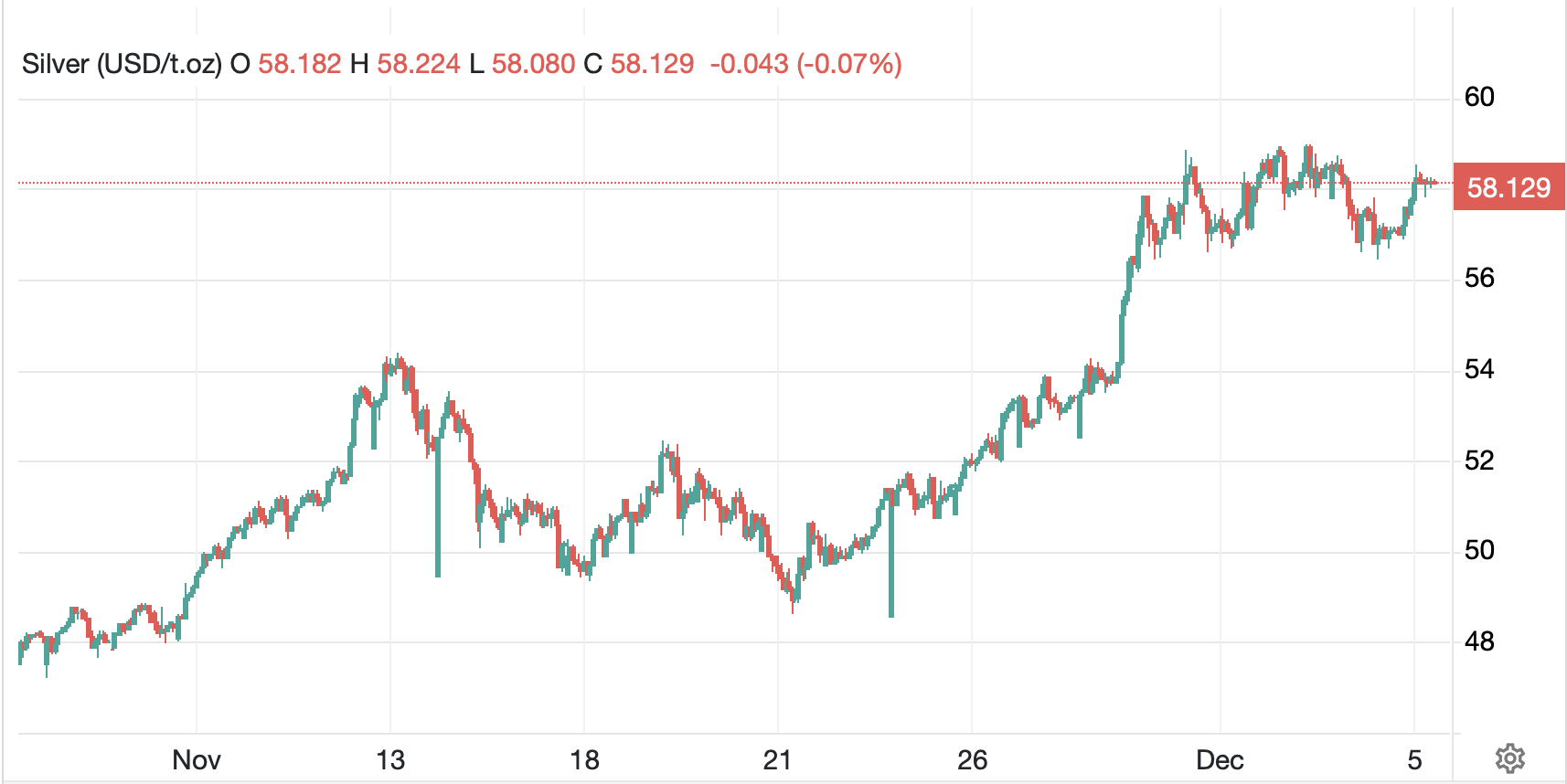
In the metals markets, $4200/oz has become gold’s (+0.3%) home lately while silver (+0.9%) has found comfort between $58/oz and $59/oz.  Neither is seeing much in the way of volatility or new interest, but both trends remain strongly higher. 

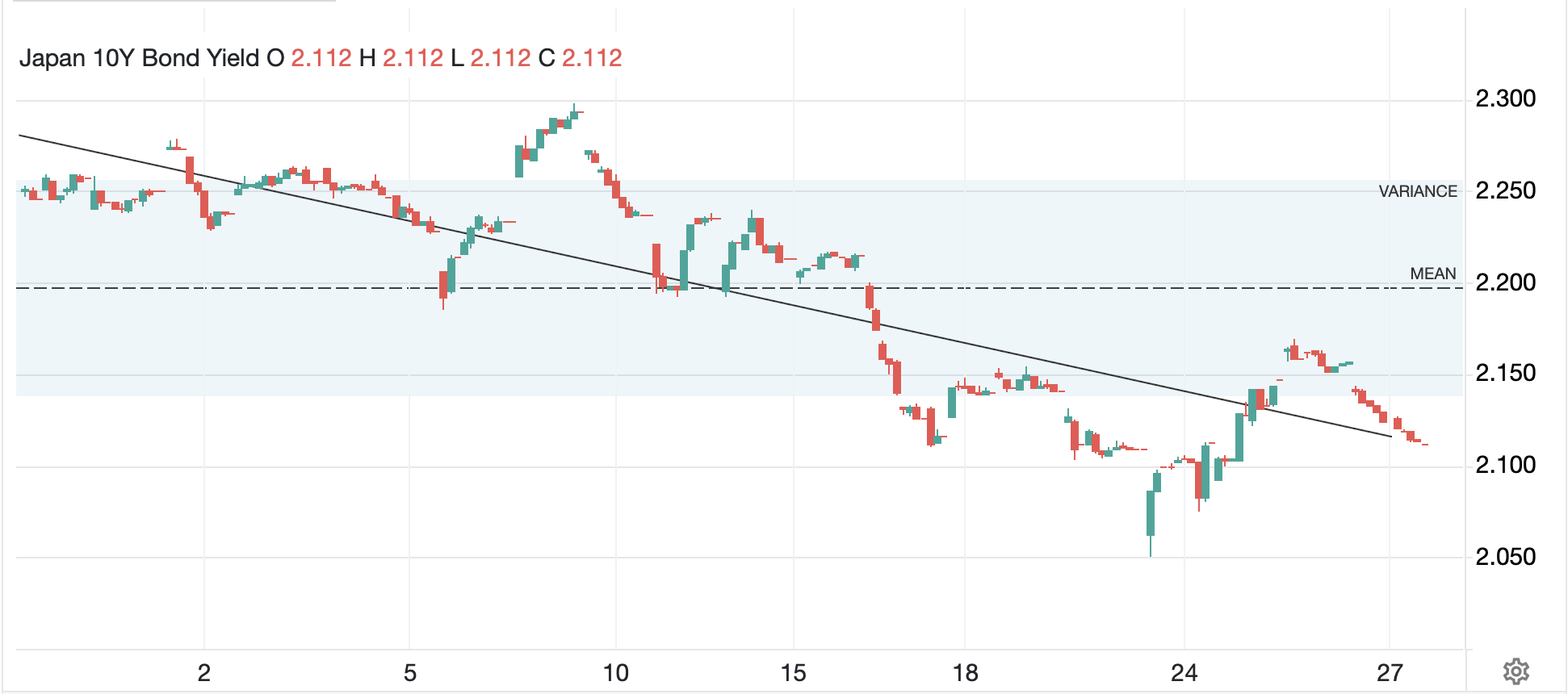
Finally, the dollar, which rallied a bit yesterday, is little changed this morning.  USDJPY is interesting as it has traded back above 156 this morning, contradicting all that talk of a Japanese repatriation trade.  Again, it is difficult for me to look at the yen chart below and conclude the dollar has peaked.

Source: tradingeconomics.com

Elsewhere in the space, this is one of those days where 0.2% is a major move.  Historically, December is not a time when FX traders are active.

On the data front, the NFIB report rose to 99.0 this morning, its highest reading in three months and the underlying comments showed a modest increase in optimism with many businesses looking to hire more people but having trouble finding qualified candidates.  This is quite a juxtaposition with the narrative that small businesses are firing workers that I have read in several different places and is backed by things like the recent Challenger Gray survey which indicated that US businesses have fired more than 1.1 million workers so far this year.  This lack of clarity is not going to help the FOMC make decisions, that’s for sure.  As to the rest, the ADP Weekly Survey is due to be released as well as JOLTS Job Openings (7.2M) and Leading Indicators (-0.3%) at 10:00.

The very fact that the biggest story I could find was a hypothetical is indicative of the idea that there is nothing going on.  Look for a quiet one as market participants await Powell and friends tomorrow.

Good luck

Adf

Nothing is Clear

Though next week the Fed will cut rates
The bond market’s in dire straits
‘Cause nothing is clear
‘Bout growth, and Jay’s fear
Is he’ll miss on both his mandates


In the past week, 10-year Treasury yields have risen 13bps, as per the below chart, even though market pricing of a Fed rate cut continues to hover around 88%.  Much to both the Fed’s and the President’s chagrin, it appears the bond market is less concerned with the level of short-term rates than they are of the macroeconomics of deficit spending, and total debt, as well as the potential for future inflation.

Source: tradingeconomics.com

I don’t think it is appropriate to describe the current bond market as being run by the bond vigilantes, at least not in the US (Japan may be another story) but it is unquestionable that there is a growing level of discomfort in the administration.  This morning, we will see the September PCE data (exp 0.3%, 2.8% Y/Y headline; 0.2% 2.9% Y/Y Core) which will do nothing to comfort those FOMC members who quaintly still believe that inflation matters.

It’s funny, while the President consistently touts how great things are in the economy, both he and Secretary Bessent continue to push hard for lower interest rates, which historically had been a sign of a weak economy.

But as I have highlighted before, the data is so disparate, every analyst can find something to support their pet theory.  For instance, on the employment front, the weak ADP reading on Wednesday indicated that small businesses were under pressure, yet the Initial Claims data yesterday printed at a remarkably low 191K, which on the surface indicates strong labor demand.  Arguably, that print was impacted by the Thanksgiving holiday so some states didn’t get their data in on time, and we will likely see revisions next week.  But revisions are not nearly as impactful as initial headlines.  Nonetheless, for those pushing economic strength, yesterday’s Claims number was catnip.

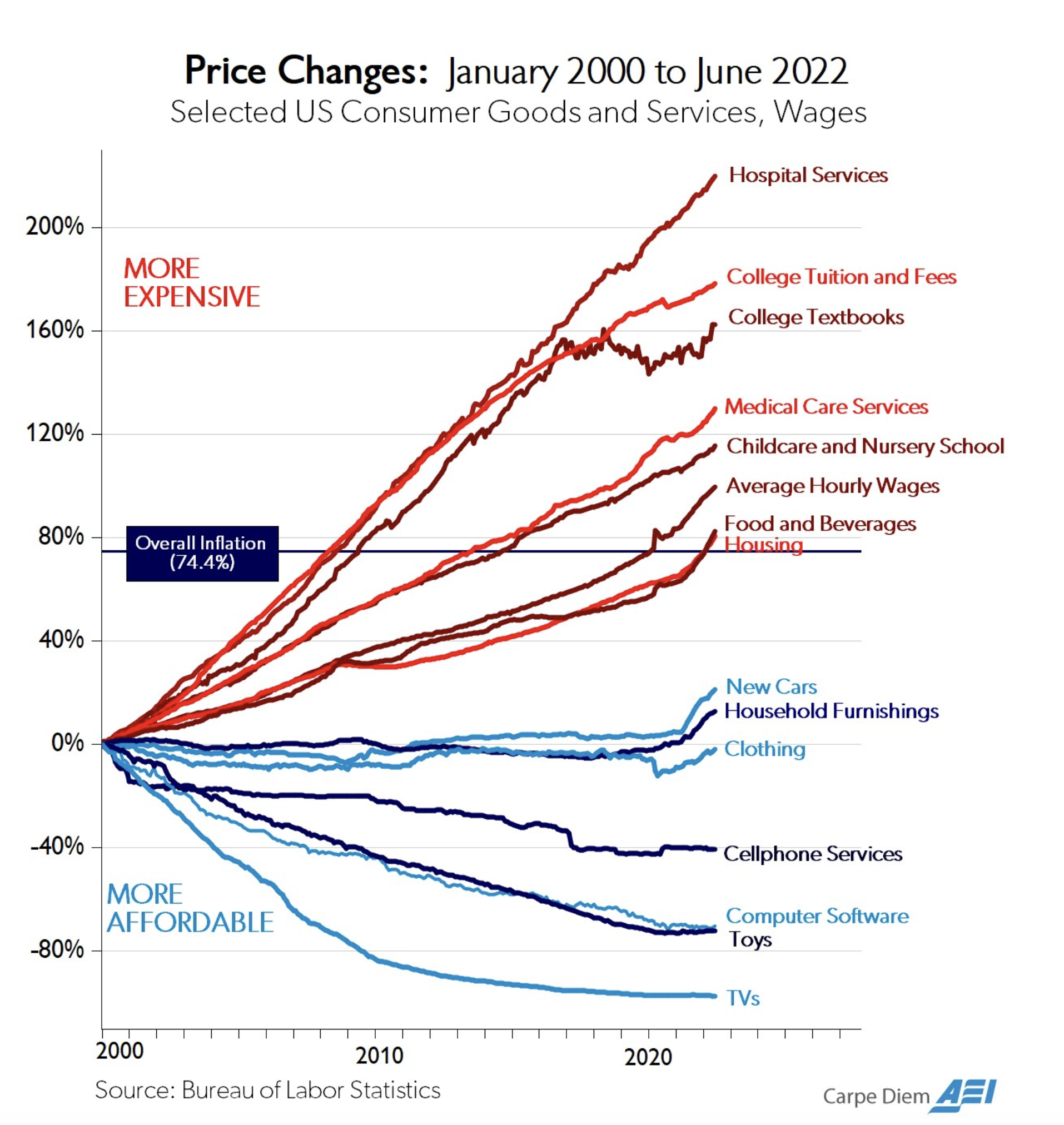
So, which is it?  Is the economy strong or weak?  My amateur observation is that we no longer have an ‘economy’ but rather we have multiple industrial and business sectors, each with its own dynamics and cycles, some of which are related but others which are independent.  And so, similar to the idea that the inflation rate that is reported is an average of subcomponents, each of which can have very different trajectories than the others (as illustrated in the chart below), the economy writ large is exactly the same.  So, an analogy might be that AI is akin to Hospital Services in the below chart while heavy industry is better represented by the TV’s line.

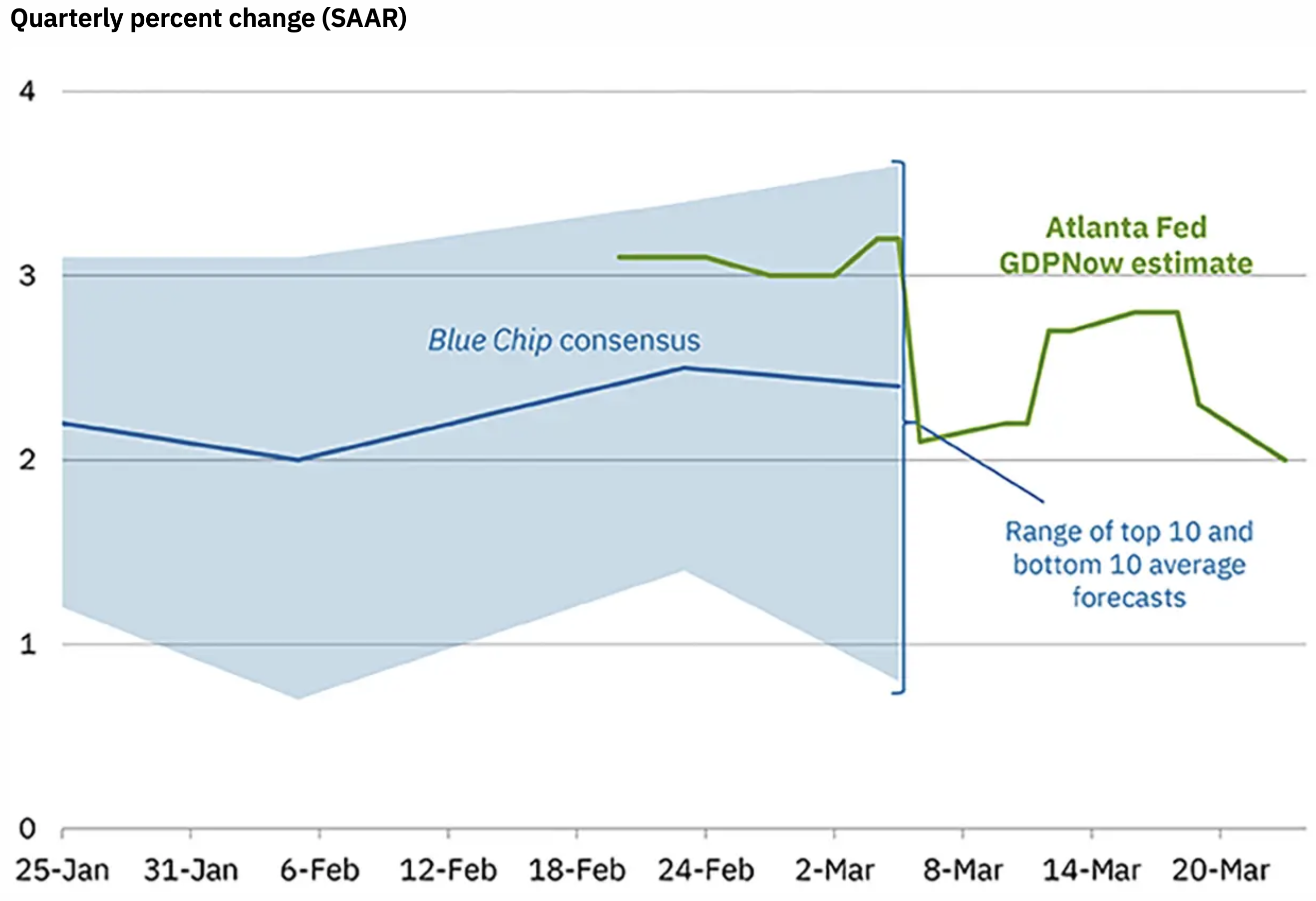
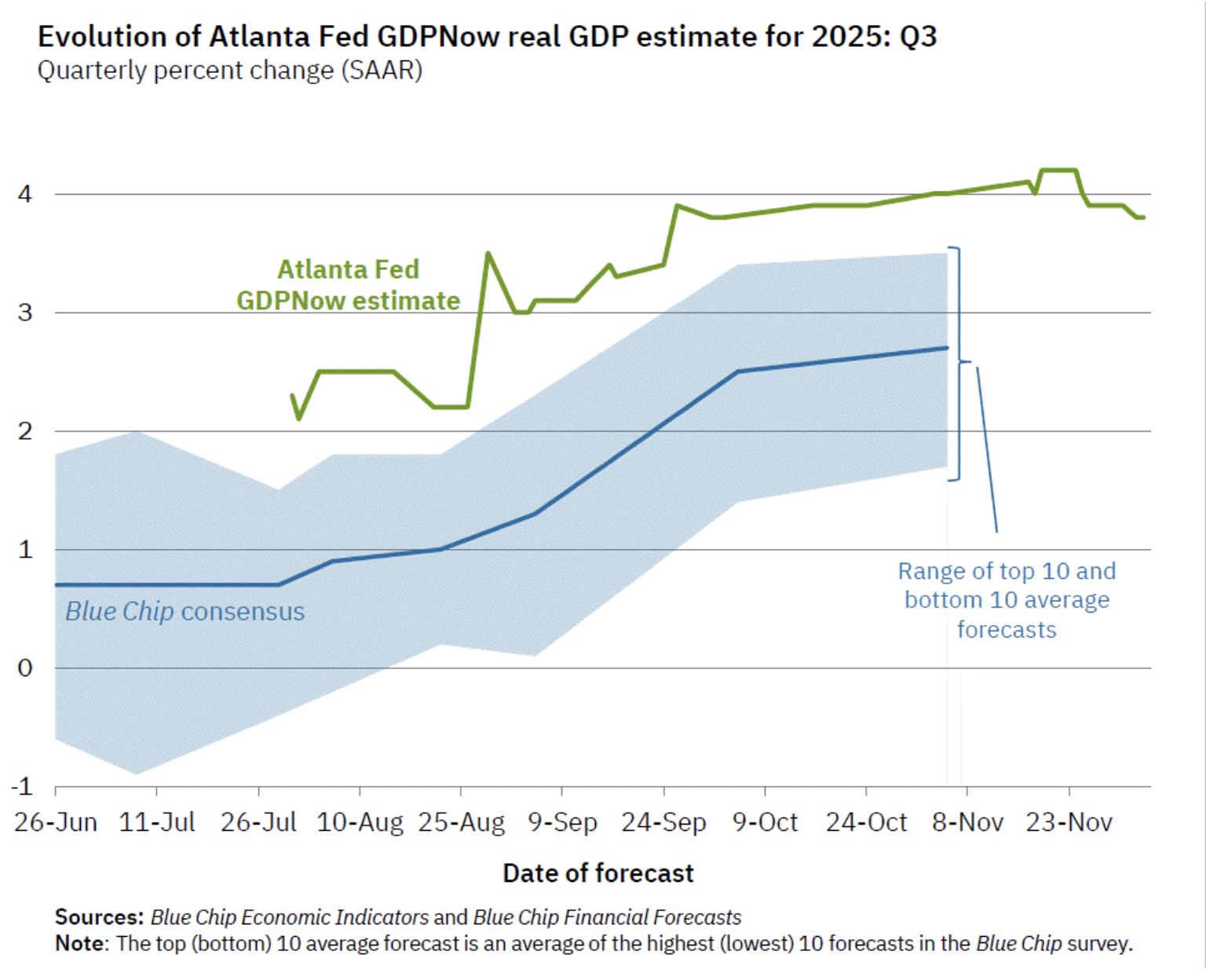
But, when we look at the Atlanta Fed’s GDPNow forecast below, it continues to show a much stronger economic impulse than the pundits expect.

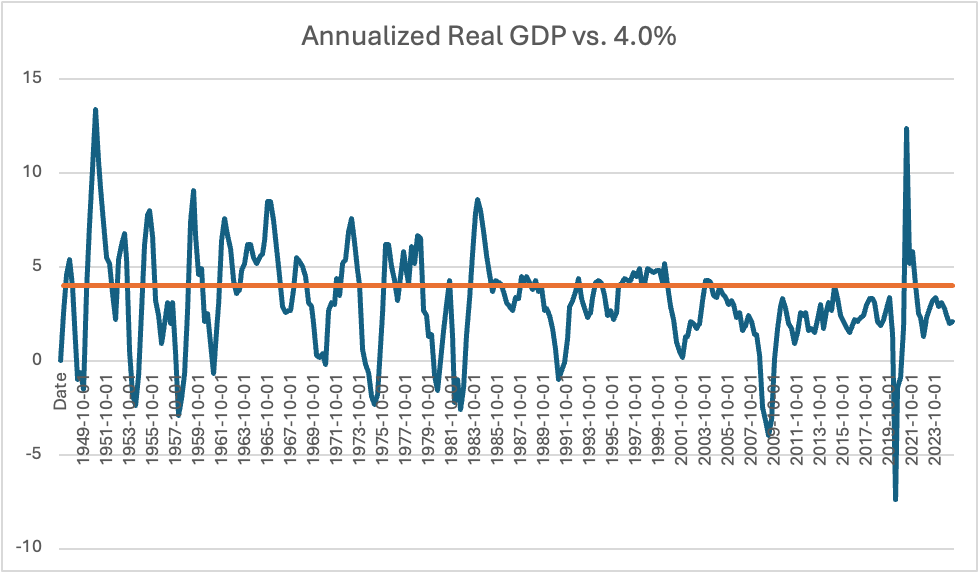
And quite frankly, if 3.8% is the real growth rate, that is quite strong, certainly relative to the last two decades in the US as evidenced by the below chart I created from FRED data.  The orange line represents 4% and you can see that other than the Covid reopening, we haven’t been at that level for quite a while.

What is the reality?  Everybody has their own reality, just like everybody has their own personal inflation rate.  However, markets have been inclined to believe that the future is bright, which given my ongoing view of every nation ‘running it hot’ makes sense, so keep that in mind regardless of your personal situation.

Ok, let’s look at how markets behaved overnight.  Yesterday’s nondescript day in the US was followed by a mixed Asian session with Tokyo (-1.0%) slipping on concerns that the BOJ is going to raise rates.  I’m not sure why that is news suddenly, but there you go.  However, China (+0.8%), HK (+0.6%), Korea (+1.8%), India (+0.5%) and Taiwan (+0.7%) all continued their recent rallies.  The RBI did cut rates by 25bps, as expected, but that doesn’t seem to have been the driver.  Just good vibes for now.

In Europe, screens are also green this morning, albeit not dramatically so.  Frankfurt (+0.6%) leads the way but Paris (+0.3%), Madrid (+0.2%) and London (+0.1%) are all on the right side of the ledger.  Eurozone growth in Q3 was revised up to 0.3% on the quarter, although that translated into an annual rate of 1.4%, lower than Q2, but the positive revision was enough to get the blood flowing.  That and the idea that European defense companies are going to come back into vogue soon.  And as has been their wont, US futures are higher by 0.2% at this hour (7:35).

In the bond market, Treasury yields are higher by 2bps this morning and European sovereign yields are getting dragged along for the ride, up 1bp to 2bps across the board.  JGB yields also continue to climb and show no sign of stopping at any maturity.  A BOJ rate hike of 25bps is not going to be enough to stop the train of spending and borrowing in Japan, so I imagine there is much further to go here.

In the commodity space, silver (+1.8%) has been getting a lot more press than gold lately as there are ongoing stories about big banks, notably JPM, having large short futures positions that were designed to keep a lid on prices there, but the structural shortage of the metal has started to cause delivery questions on the exchanges all around the world.  So, while it has not yet breached $60/oz, my take is that is the direction and beyond.

Source: tradingeconomics.com

Gold’s (+0.4%) story has been told so many times, it is not nearly as interesting now, central bank buying and broader fiat debasement concerns continue to be the key here.  Copper (+1.8%) is also trading at new highs in London and the demand story here knows no bounds, at least not as long as AI and electrification are part of the mix.  As to oil (-0.25%), it is a dull and boring market and will need to see something of note (regime change in Venezuela or peace in Ukraine seem the most likely stories) to wake it up.

Finally, the dollar is still there.  The DXY is trading at 99, below its recent highs but hardly collapsing.  Looking for any outliers today ZAR (+0.4%) is benefitting from the gold rally (platinum rallying too) but otherwise there is nothing of note.  INR (-0.2%) continues to trade around its new big figure of 90.00, but has stopped falling for now, and everything else is dull.

As well as the PCE data, we get September Personal Income (exp 0.3%), Personal Spending (0.3%) and Michigan Sentiment (52.0) with only the Michigan number current.  We are approaching the end of the year and while with this administration, one can never rule out a black swan, my take is positions are being lightened up starting now, and when the December futures contracts mature, we may see very little of interest until the new year.  In the meantime, nothing has changed my big picture view.  For now, absent a very aggressive FOMC cutting rates, the dollar is still the best of a bad bunch.

Good luck and good weekend

Adf

Tariff Redux

While many have called for stagflation
The ‘stag’ story’s lost its foundation
Q2 turned out great
With growth, three point eight
While ‘flation showed some dissipation
 
Meanwhile, Mr Trump’s on a roll
As he strives to still reach his goal
It’s tariff redux
On drugs and on trucks
While ‘conomists tally the toll


Analysts worldwide have decried President Trump’s policies as setting up to lead the US to stagflation with the result being the dollar would ultimately lose its status as the world’s reserve currency while the economy’s growth fades and prices rise.  “Everyone” knew that tariffs were the enemy of sane fiscal and trade policy and would slow growth leading to higher unemployment and inflation while the Fed would be forced to choose which issue to address.  In fact, when Q1 GDP was released at -05%, there was virtual glee from the analyst community as they were preening over how prescient they were.

But yesterday, we learned that things may not be as bad as widely hoped proclaimed by the analyst community after all.  Q2 GDP was revised up to +3.8% annualized growth, substantially higher than even the first estimate of 3.0% back in July.  Not only that, Durable Goods Orders rose 2.9% with the ex-Transport piece rising 0.4% while the BEA’s inflation calculations, also confusingly called PCE rose 2.1%.  Initial Claims rose only 218K, well below estimates and indicative that the labor market, while not hot, is not collapsing.  Finally, the Goods Trade Balance deficit was a less than expected -$85.5B, certainly not great, but moving in President Trump’s preferred direction.

In truth, that was a pretty strong set of economic data, better than expectations across the entire set of releases, and clearly not helping those trying to write the stagflation narrative.  Now, Trump is never one to sit around and so promptly imposed new tariffs on medicines, heavy trucks and kitchen cabinets to try to bring the manufacture of those items back into the US.  Whatever your opinion of Trump, you must admit he is consistent in seeking to achieve his goal of returning manufacturing prowess to the US.

Meanwhile, down in Atlanta, their GDPNow Q3 estimate is currently at 3.3%, certainly not indicating a slowing economy.  

In fact, if that pans out, it would be only the 14th time this century that there were two consecutive quarters of GDP growth of at least 3.3%, of which 4 of those were in the recovery from the Covid shutdown.

It would be very easy to make the case that the US economy seems to be doing pretty well, at least based on the data releases.  I recognize that there is a great deal of angst about, and I have highlighted the asynchronous nature of the economy lately, but what this is telling me is that things may be syncing up in a positive manner.

So, what does this mean for markets?  Perhaps the first place to look is the Fed funds futures market as so much stock continues to be put into the Fed’s next move.  Not surprisingly, earlier exuberance over further rate cuts has faded a bit, with the probability of an October cut slipping to 85%, down about 10 points in the wake of the data, and a total of less than 40bps now priced in for the rest of the year.  Recall, it was not that long ago that people were considering 100bps in the last three meetings of the year.

Source: cmegroup.com

The next place to look is at the foreign exchange markets, where the dollar’s demise has been widely forecast amid changing global politics with many pundits highlighting the idea that the BRICS nations would be moving their business away from dollars.  For a long time, I have highlighted that the dollar is currently within a few percent of its long-term average price, neither particularly strong nor weak, and that fears of a collapse were unwarranted.  However, I have also recognized that a dovish Fed could easily weaken the dollar for a period of time.  Short dollar positions remain large as the leveraged community continues to bet on that outcome, although I have to believe it is getting expensive given they are paying the points to maintain that view.

But if we look at how the dollar has performed over the past several sessions, using the DXY as our proxy, we can see that despite a very modest -0.1% decline overnight, it appears that the dollar may be breaking its medium-term trend line lower as per the chart below from tradingeconomics.com

Again, my point is that the idea that the US is facing a catastrophic outcome with a recession due and a collapsing dollar is just not supported by the data or the markets.  And here’s an interesting thought from a very smart guy, Mike Nicoletos (@mnicoletos on X) regarding some of the key drivers of the current orthodoxy regarding the dollar, notably the debt and deficit.  What if, given the dollar’s overwhelming importance to the world economy, we should be comparing those things to its global scale, not just the domestic scale.  If using that framework, as he describes here, the debt ratio falls to 58% and the budget deficit is down to 2.9%, much less worrying and perhaps why markets and analysts are out of sync.

Markets are going to go where they will, but having a solid framework as to how the economy impacts them is a very helpful tool when managing money and risk.  Perhaps this needs to be considered overall.

Ok, a really quick tour.  Yesterday was the third consecutive down day in the US, although all told, the decline has been less than -2%, so hardly devastating.  Asia mostly fell overnight as concerns over both tariffs and a Fed less likely to cut rates weighed on equities there with Japan (-0.9%), China (-1.0%) and HK (-1.35%) all under pressure.  The story was worse for other regional bourses with Korea (-2.5%), India (-0.9%) and Taiwan (-1.7%) indicative of the price action.

However, Europe has taken a different route with modest gains across the board (DAX +0.3%, CAC +0.45%, IBEX +0.6%) as investors seem to be looking through the tariff concerns.  US futures are also edging higher at this hour (7:45).

In the bond market, Treasury yields have slipped -1bp this morning, and while they remain above the levels seen immediately in the wake of the FOMC last week, they appear to be finding a home at current levels of 4.15% +/-.  European sovereigns are all seeing yields slip -3bps this morning as today’s story is focusing on how most developed nations are reducing the amount of long-dated paper they are selling to restrict supply and keep yields down.  This has been decried by many since then Treasury Secretary Yellen started this process, but as with most government actions, the expedience of the short-term benefit far outweighs the potential long-term consequences and so everybody jumps on board.

Turning to commodities, oil (-0.1%) is still trading below the top of its range and while it has traded bottom to top this week, there is no sign of a breakout yet.  I read yet another explanation yesterday as to why peak oil demand is going to be seen this year, or next year, or soon, which will drive prices lower.  While I do think prices eventually slide lower, I take the other side of that supply-demand idea and believe it will come from increased supply (Argentina, Guyana, Brazil, Alaska) rather than reduced demand.  In the metals markets, yesterday saw silver (-0.2%) jump nearly 3% to yet another new high for the move as traders set their sights on $50/oz.  Meanwhile gold (0.0%) continues to grind higher in a far less flashy manner than either silver or platinum (+10% this week) as regardless of my explanation of relative dollar strength vs. other fiat currencies, against stuff, all fiat remains under pressure.

And finally, the dollar after a nice rally yesterday, is consolidating this morning.  The currency I really want to watch is the yen, where CPI last night was released at 2.5%, lower than expected and which must be giving Ueda-san pause with respect to the next rate hike.  Most analysts are still convinced they will hike in October, but if inflation has stopped rising, will they?  I would not be surprised to see USDJPY head well above 150, a level it is fast approaching, over the next month.

On the data front, this morning’s BLS version of PCE (exp 0.3%, 2.7% Y/Y) and Core PCE (0.2%, 2.9% Y/Y) is released at 8:30 along with Personal Income (0.3%) and Personal Spending (0.5%).  Then at 10:00, Michigan Sentiment (55.4) is released and somehow, I have a feeling that could be better than forecast.  We hear from a bunch more Fed speakers as well although a pattern is emerging that indicates they are ready to cut again next month, at least until they see data that screams stop.

The world is not ending and in fact, may be doing just fine, at least economically. Meanwhile, the dollar is finding its legs so absent a spate of very weak data, I think we may see another 2% or so rebound in the greenback over the next several weeks.

Good luck and good weekend

Adf

Got Smote

There once was a poet that wrote
‘Bout bonds and the fact they got smote
So, yields, they did rise
And to his surprise
Most pundits, this news did promote
 
Now turning to stories today
The biggest one, I’d have to say
Is how, in Japan
Ishiba’s grand plan
Has failed, thus he’ll be swept away


The number of stories this morning regarding the synchronous rise of long-dated bond yields around the world has risen dramatically.  While yesterday, I highlighted this fact, I certainly didn’t expect it to be the key narrative this morning.  But such is life, and virtually every news outlet is focusing on the subject as both a reason for the poor equity performances yesterday as well as a way to highlight government profligacy.  I do find it interesting, though, that the same publications that push for more spending for their preferred causes have suddenly become worried about too much government spending.  But double standards are nothing new.   A smattering of examples show ReutersBloomberg and the WSJ all feigning concern over too much government spending.

I say they are feigning concern because all these publications are perfectly willing to support excess government spending if it is spent on the things they care about.  Regardless, the fact that this has become one of today’s key talking points is evidence that some folks are starting to recognize that trees cannot grow to the sky.  Even though almost every major central bank is in easing mode, long-term yields keep rising.  Alas, the almost certain outcome here, albeit likely still well into the future, is some form of yield curve control as central banks will be forced to prevent yields from rising too high lest their respective governments go bust.  I expect that the initial stages will be regulations requiring banks and insurance companies, and maybe private, tax-advantaged accounts like IRA’s and 401K’s, to hold a certain percentage of Treasuries.  But I suspect that eventually, only central banks will have the wherewithal to prevent runaway yields.  Welcome to the future; got gold?

However, you can read about this everywhere, and after all, I touched on it yesterday so let’s move on.  Government stability/fragility is the topic du jour in this poet’s eyes.  We already know that the French government is set to fall on Monday when PM Bayrou loses a confidence vote.  It is unclear what comes next, but French finances are in bad shape and getting worse and they don’t print their own currency.  This tells me that we could see a lot more social unrest in France going forward given the French penchant for nationwide strikes.  

But a story that has gotten less press is in Japan, where PM Ishiba saw the LDP majority decimated in the Upper House two weeks ago and is now heading a minority government as the LDP does not have a majority in either house in the Diet.  One of the key members of the LDP, and apparently the glue that was holding together the fragile coalition was Hiroshi Moriyama, the LDP Secretary General, and he is now resigning along with several of his lieutenants, so it appears that Japan’s government is about to fall as well.  The upshot here is that the BOJ seems unlikely to raise interest rates given the political uncertainty, which is not only pressuring long-dated JGB’s but also the yen. (see chart below from tradingeconomics.com)

While I have not written extensively about the UK’s government, the situation there is quite similar, with massive fiscal problems driving yields higher while the government focuses on removing the right of free speech amongst its people if that speech is contra to the government’s policies.  While the next UK election need not be held for another 4 years, my take is it will be much sooner as PM Starmer has destroyed his legitimacy with recent policy decisions and will soon be unable to govern.  It will only be a matter of time before his own party turns on him.

The governments in Japan, France and the UK are all under increasing pressure as their policy prescriptions have not tackled the key problems in their respective economies.  Inflation in Japan and the UK and benefits in France need to be addressed, but it is abundantly clear that the current leadership will not be able to do so effectively.  Once again, please explain why people are so bearish the dollar, at least in the long run.  While inflation will be higher worldwide and fiat currencies will all suffer vs. real assets, on a relative basis, the dollar doesn’t appear so bad after all.

Ok, let’s move on to the overnight activity as it gets too depressing highlighting all the government failures around the world.  While US stocks closed above their worst levels of the session, they were all lower yesterday.  That bled into Asia with Japan (-0.9%), Hong Kong (-0.6%) and China (-0.7%) all falling with worse outcomes in some other parts of the region (Australia -1.8%, Philippines -0.75%) although there were winners as well (Korea, India, Taiwan) albeit in less impressive fashion.  Perhaps the surprise was Chinese underperformance after PMI Services data there printed at its highest level since May 2024.

But whatever the negativity that existed in Asia was, it did not translate to European shares as they are all higher (CAC +1.0%, DAX +0.8%, FTSE 100 +0.55%, IBEX +0.2%).  Now, clearly it is not confidence in government activity that has investors excited.  The only data of note was Services PMI, which was mostly as expected except in Germany where it fell to 49.3, far lower than the initial estimate of 50.1 and based on the chart below, seemingly trending lower.

Source: tradingeconomics.com

US futures, too, are higher this morning, with gains of 0.5% to 0.75% for the S&P and NASDAQ.

You won’t be surprised that bond yields continue to drift higher, even in the 10-year space with Treasuries higher by 2bps, although most European sovereign yields have edged down by -1bp in the 10-year space.  It is the longer dated yields that continue to see the most pressure with 30-year yields across the US, Europe and Japan all pushing to new highs for the move, and in the case of Japan, new all-time highs.

Source: tradingeconomics.com

This, of course, is the underlying story for virtually all markets right now.

In the commodity markets, oil (-2.1%) has given back yesterday’s gains after reports that OPEC+, which is meeting this weekend, will be raising their output yet again.  Whatever the situation is in Russia, whether Ukrainian attacks are reducing supply or not, it seems clear that OPEC is unperturbed and wants to pump as much as possible. In the metals markets, gold (+0.3%) has set another new all-time high and appears to be breaking out from its recent consolidation pattern.  I am no market technician (I’m a poet after all), but a consensus seems to be forming that $3700 is coming soon and $4000 will be achieved by early next year.

Source: tradingeconomics.com

The rest of the metals space is little changed this morning with silver holding at its 11-year highs and copper treading water at the levels that existed pre-tariff threats.

Finally, the currency markets, which saw the dollar rally sharply yesterday, are taking a breather with the dollar giving back some of those gains amid a consolidation.  In the G10, movement is 0.2% or less, so really nothing and in the EMG bloc, HUF (+0.6%), KRW (+0.5%) and ZAR (+0.3%) are the biggest gainers, with the latter following gold, while traders see the central bank in Hungary maintaining higher rates to fight still, too high inflation of 4.3%.  As to Korea, better than expected GDP data helped drive inflows to the currency.

On the data front today, we see JOLTs Job Openings (exp 7.4M) and Factory Orders (-1.4%) this morning and the Fed’s Beige Book is released at 2:00pm.  We also hear from two Fed speakers, which given the row over Governor Cook’s tenure at the Fed, may be interesting to see.  The market continues to price a 92% probability of a 25bp cut in two weeks’ time, but I suspect that Friday’s NFP data may be the ultimate arbiter there.

I cannot look at the world and conclude that the US is the biggest problem around.  However, if we do see weak data on Friday and the market starts to price 50bps of cuts by the Fed, the dollar will decline in the near term.  But longer term, the more I read, the more bullish I get on the greenback, at least relative to other currencies.

Good luck

Adf

AI is Grokking

The ‘conomy grew a bit faster
Than ‘spected by every forecaster
Consumers are rocking
While AI is Grokking
Though prices could be a disaster
 
The question this data incites
Is why cut rates from current heights?
With stocks on a tear
And ‘flation still there
The risk is the long bond ignites


Yesterday’s GDP data indicated that both consumer spending and AI investment were larger than expected with the result being GDP activity increased more than economists had forecast.  Most would consider this good news, and the equity markets clearly saw the benefits as they continue their slow march higher.  Surprisingly, despite the positive economic data, the Fed funds futures market did not reduce the probability of a rate cut next month.  Arguably that was because Governor Waller, one of the two who voted for a cut in July, spoke yesterday and reiterated his views that a cut was appropriate to prevent a worse outcome in the employment situation.  Frighteningly, he said, “I am back on Team Transitory.”  I fear that the transitory phenomenon is going to be the reduction in inflation we have experienced over the past two years, not the initial peak seen in 2022. (As an aside, if inflation is your concern, USDi is one way to maintain the purchasing power of your funds as it mechanically tracks CPI, rising in step with the index.)

Perhaps the futures market is starting to expect that Governor Lisa Cook’s days are truly numbered with a third instance of potential mortgage fraud surfacing yesterday, a situation that has a bad look for a Fed governor.  If she is forced out soon, that would be yet another Fed governor that President Trump will get to appoint, and the tension in the Marriner Eccles building will certainly grow at that September meeting.  After all, if Trump seats two more governors, and has 4 votes for a rate cut on the board, the question will not be should they cut, but how much they should cut with 50 basis points on the table regardless of the economics.

But all that is still three weeks away and based on the fact that if I look at almost every market, price action has been consolidating for the entire summer, it is hard to get excited in the short-term.  In fact, I think it is worthwhile to look at some charts so you can get a sense of just how little is going on.

All these charts are from tradingeconomics.com and I have drawn in some recent ranges to show that over the past 6 months, only one asset class has shown any trend of note.  See if you can guess which that is.  I’ll start with the EURUSD since, after all, I am an FX guy, but go to bonds, oil, gold and equities.

Since late April, the euro has chopped back and forth despite many stories of the dollar’s incipient demise and the euro’s upcoming rally as investors flock to European equity markets.  Maybe not.

Treasury yields have also been largely range bound, and if anything, look like they are heading lower despite fears being flamed regarding massive amounts of issuance having trouble finding buyers as foreigners pull out of the market.  Maybe not.

Crude has been the choppiest, and of course we did have the bombing of Iran’s nuclear facilities which inspired some fears of the beginning of a new Middle East war.  But Russia keeps pumping, OPEC put 2.2 million barrels per day of production back into the market and it appears, that for now, the market has found a balance.  I still see oil sliding over time, but for now, the range is king.

The barbarous relic has just started to pick up and broke above the $3400 range cap just two days ago but has not yet shown signs of a major breakout.  However, if the Fed cuts, especially if they go 50bps for some reason, I would look for this to change and gold (and all precious metals) to rally sharply as inflation re-enters the conversation.

However, if we look at the US equity market, the picture is very different.  The only other market moving like this is USDTRY as the Turkish Lira steadily depreciates amid massive monetary expansion there with inflation rising sharply.  In fact, this is what many foresee for the dollar going forward, but even if the Fed cuts, it seems a bit of an exaggeration.

At this point I should note that there is one currency that is outperforming the dollar right now, the Chinese renminbi.  It appears that as trade negotiations are ongoing, the Chinese (and the Koreans amongst others) have gotten the message that they need to adjust their currency’s value if an agreement is going to be reached.  

To conclude, ranges remain the situation in most markets other than equities which continue to rally based on hopes and prayers that central bank spigots are never turned off.  With Labor Day on Monday, perhaps we will begin to see more real activity reenter the market as traders and investors come back from summer vacation.  But we will need a real catalyst to break those ranges, whether that is a shocking NFP number, a reescalation of Middle East conflict or something else (China laying siege to Taiwan?).  While I don’t know what that catalyst will be, history tells us something will come along, that’s for sure.

As we look to the NY opening, we do get more important data as follows: Personal Income (exp 0.4%); Personal Spending (0.5%); PCE (0.2%, 2.6% Y/Y); Core PCE (0.3%, 2.9% Y/Y); Goods Trade Balance (-$89.5B); Chicago PMI (46.0); and Michigan Sentiment (58.6).  There are no Fed speakers on the docket, but you can be sure that the Lisa Cook story will remain front and center, especially as I read that the judge initially selected to oversee the case was Ms Cook’s sorority sister, potentially a disqualifying factor that would cause her recusal and a new appointment. In fact, I suspect that story will have more traction than whatever the data says today.

As to the dollar, it is hard to get excited at this point.  If PCE data is softer than forecast, though, I would look for the dollar to sell off and the probability of that Fed funds rate cut to rise from its current 85%.

Good luck and have a good holiday weekend

Adf

So Mind-Blowing

On one hand, the chorus is growing
That US debt is so mind-blowing
The ‘conomy will
Slow down, then stand still
As ‘flation continues its slowing
 
But others remind us the data
Does not show a slowing growth rate-a
And their main concerns
Are Powell still yearns
For rate cuts to help market beta


As many of us enjoyed the long weekend, it appears it is time to put our noses back to the proverbial grindstone.  I know that as I age, I find the meaning of the Memorial Day holiday to grow in importance, although I have personally been very fortunate having never lost a loved one in service of the nation.  However, as the ructions in the nation are so evident each day, I remain quite thankful for all those that “…gave the(ir) last full measure of devotion” as President Lincoln so eloquently remarked all those years ago.

But on to less important, but more topical things.  A week ago, an X account I follow, The Kobeissi Letter, posted the following which I think is such an excellent description of why we are all so confused by the current market gyrations.  

Prior to President Trump’s second term, I would contend that the broad narrative had some internal consistency to it, so risk-on days saw equity markets rally along with commodities while bond prices would fall (yields rise) and the dollar would sink as well.  Similarly, risk-off days would see pretty much the opposite.  And it was not hard to understand the logic attached to the process.  

But here we are, some four plus months into President Trump’s term and pretty much every old narrative has broken into pieces.  I think part of that stems from the fact that the mainstream media, who were purveyors of that narrative, have been shown to be less than trustworthy in much of what they reported during the Biden Administration, and so there is a great deal of skepticism now regarding all that they say, whether political or financial.

However, I think a bigger part of the problem is that different markets have seen participants focusing on different idiosyncratic issues rather than on the bigger picture, and so there are many mini narratives that are frequently at odds.  Add to this the fact that there continues to be a significant dichotomy between the soft, survey data and the hard, calculated data, with the former pointing toward recession or stagflation while the latter seems to be pointing to stronger economic activity, and the fact that if you ask twenty market participants about the impact of President Trump’s tariff policies, you will receive twenty-five different explanations for why markets are behaving in a given manner and what those policies will mean for the economy going forward.

It is at times like these, when there are persuasive short-term arguments on both sides that I step back and try to look at bigger picture events.  In this category I place two things, energy and debt.  Energy is life.  Economic activity is simply energy transformed and the more energy a nation has and the cheaper it is, the better off that economy will be.  President Trump has made no bones about his desire to cement the US as the number one energy producer on the planet and to allow affordable energy to power the economy forward.  As that occurs, that is a medium- and long-term bullish backdrop.

On the other hand, we cannot forget the debt situation, which is an undeniable drag on economic activity.  Forgetting the numbers per se, the fact that the US debt/GDP ratio is at wartime levels during peacetime (well, US peacetime) with no obvious end to the spending is a key concern.  But it is not just the US with a growing debt/GDP ratio.  Here is a listing from tradingeconomics.com of the G20’s ratios.  (Russia is the bottom of the list but not relevant for this discussion.)

And remember what has been promised by Germany and the Eurozone with respect to defense spending? More than €1 trillion for Germany and it sounds, if my addition is correct, like upwards of €1.7 trillion across the continent.  And all of that will be borrowed, so that is another 22% in Germany alone.  The point is the global debt/GDP ratio remains above 300% for public and private debt.  As government debt grows above 100%, at some point, we are going to see central banks, in sync, clamp down on longer-term yields.  

However they couch it, and however they do it, whether actual yield curve control, through regulations requiring banks and insurance companies to hold more government bonds on their balance sheets with no capital charges, or through adjustments to tax driven accounts like IRA’s and 401K’s, requiring a certain amount of government debt in the portfolio to maintain the tax deferred status, I expect that is what we are going to see.  And even with oil prices declining, which I think remains the trend, inflation is going to be with us for a long time to come as debt will be monetized.  It is the only solution absent a depression.  And every central bank will be in on the joke.  Which takes us to this morning…

As yields were soaring
The BOJ kept quiet
Until yesterday

Apparently, the bond vigilantes have spent the past decades learning Japanese.  At least that is what I conclude from the price action, and more importantly, the BOJ’s recent response in the JGB market. As you can see in the chart below, there has been a significant reversal in 30-year JGB yields with similar price action in both the 20-year and 40-year varieties.

Source: tradingeconomics.com

You may recall that last week, the Japanese government issued 20-year bonds, and the auction went quite poorly, with yields rising sharply (that was the large green candle six sessions ago). Well, it seems that the BOJ (along with the Ministry of Finance) have figured out that the bond situation in Japan is reaching its limits. After all, in less than two months, 30-year JGB yields rose 100 basis points from a starting point of about 2.2%.  That is an enormous move.  Now, if we look at the table above, we are reminded that Japan’s debt/GDP ratio is the highest in the developed world at well over 200%.  In addition, the BOJ owns more than 53% of all JGBs outstanding.  Quite frankly, it is easy to make the case that the BOJ has been monetizing Japanese debt for years.  

As it happens, last week the BOJ held one of their periodic (actually, the 22nd) “Bond Market Group” meetings in which they discuss with various groups of market participants the situation in the JGB market regarding liquidity and trading capabilities and the general functioning of the market.  The two charts below, taken from the BOJ’s website (H/T Weston Nakamura) demonstrate that there is growing concern in the market as to its ability to continue along its current path.

The concern demonstrated by market participants is a clear signal, at least to me, that we are entering the end game.  For all the angst about the situation in the US, with excessive fiscal expenditures and too much debt, Japan has that on steroids.  And while Japan has the benefit of being a net creditor country, the US has the advantage of having both the strongest military in the world and issuing the world’s reserve currency.  As well, the US neighborhood is far less troublesome than Japan’s in East Asia with two potential protagonists, China and North Korea.  All I’m saying is that after decades of kicking the can down the road, it appears that the road may be ending for Japan and difficult policy decisions regarding spending, deficits and by extension JGB issuance are coming soon.

It’s funny, many economists have, in the past, described the US situation as Japanification, with rising debt and slowing growth.  But perhaps Japanification will really be the road map for how to respond to the first true limits on the issuance of government debt for a major economy.  Last night, JGB yields fell across the board, dragging global yields down with them.  The yen (-0.8%) weakened sharply, reversing its trend of the past two weeks, while the Nikkei (+0.5%) rallied.  Perhaps market participants are feeling comforted by the fact the Japanese government seems finally ready to recognize that things must change.  But this is the beginning of that process, not the end, and there will be many twists and turns along the way.  Stay tuned.

Ok, I really ran on, but I feel it is critical for us all to recognize the debt situation and that there are going to be changes coming.  As to other markets overnight, this is what we’ve seen.  Asia was mixed with gainers (Hong Kong, Australia, Singapore) and laggards (China, Korea, India, Taiwan) but nothing moving more than 0.5% in either direction.  Europe, on the other hand, has been the beneficiary of President Trump delaying the tariffs on the EU until July 9th, with all the major indices higher led by the DAX (+0.8%) which also rallied more than 1% yesterday.  Say what you will about President Trump, he has gotten trade discussions moving FAR faster than ever before in history.  US futures, at this hour (6:15) are also pointing nicely higher, more than 1.3% across the board.

We’ve already discussed bond yields where 10yr Treasury yields have backed off by 5bps this morning although European sovereign yields have not benefitted quite the same way with declines of only 2bps on average.  But the trend in all cases is for lower yields right now.  Hope springs eternal, I guess.

In the commodity space, with the new view on tariffs, risk is abating and gold (-1.5%) is being sold off aggressively.  Not surprisingly, this has taken the whole metals complex with it.  As to oil (+0.1%) it continues to trade in its recent $60 – $65 range and while the trend remains lower, it is a very slow trend.

Source: tradingeconomics.com

Finally, the dollar is perking up this morning, not only against the yen, but across the board.  On the haven front, CHF (-0.6%) is sinking and the commodity currencies (AUD -0.6%, NZD -0.8%, SEK -0.6%) are also under pressure.  But the euro (-0.4%) is lower and taking the CE4 with it.  In fact, every major counterpart currency is lower vs. the dollar this morning.

On the data front, this morning brings Durable Goods (exp -7.8%, -0.1% ex-transport), Case Shiller Home Prices (4.5%), and Consumer Confidence (87.0). We also hear from NY Fed President Williams this evening.  Chairman Powell spoke at the Princeton graduation ceremony but said nothing about policy.  I will review the rest of the week’s data tomorrow.

Bonds are the thing to watch for now, especially if we are going to see more active policy adjustments to address what has long been considered an unsustainable path.  The question is, will there be fiscal adjustments that help?  Or will central banks simply soak up the bonds?  While I hope it is the former, I fear it is the latter.  Be prepared.

Good luck

Adf

Has Bug Met Windshield?

So, once again, we were misled
By all those who told us, with dread,
The ratings reduction
Would cause much destruction
With both stocks and bonds, money, dead
 
Instead, what we saw yesterday
Was traders jumped into the fray
Despite all the gloom
It seems there’s still room
Where bullish investors hold sway


I know it is hard to believe, but it seems that all the angst that was fomented over the weekend following Moody’s ratings downgrade of US Treasury debt was for naught.  In fact, the decline in both stocks and bonds didn’t even last one session, let alone weeks or months as both markets closed the session essentially unchanged on the day, recouping the early losses seen.  A quick look at the chart below shows the price action in S&P 500 futures from the time of the announcement through yesterday’s close and then this morning.  It seems the market is concerned about things other than the US credit rating.

Source: tradingeconomics.com

In fact, I am willing to say that we are unlikely to hear anything more about the downgrade until such time that equity prices fall on some other catalyst, and the punditry will add in the ratings story to help bolster whatever claim they are making at that time.  Please remember, as well, that I am quite concerned that equity valuations remain rich and that a decline is quite possible, if not likely.  It’s just that the ratings downgrade story is not going to be the driver of that move.

In Japan, it seems
No one’s buying JGBs
Has bug met windshield?

Last night, Japan auctioned 20-year JGBs with the yield coming at 2.52%, the highest since these bonds were first issued back in 1999.  As well, yields in 30-year and 40-year JGBs also soared, rising 12bps in each case to the highest yield in more than 25 years as per the below chart of the 30-year bond.

While the selloff in JGBs has been accelerating, real yields there are still negative with CPI running at 3.6%.  This presents quite a conundrum for Japanese investors as despite the negative real yield, the ability to borrow cheaply (remember short term rates in Japan are 0.50%) and invest in long-dated bonds and earn 3.0% is quite tempting.  250 basis points of carry with no currency risk is now going to compete with 450 basis points of carry (US 30-year yields of ~5.0% – 0.50% funding costs in Japan) with FX risk.

What makes this especially tricky for Japanese investors is that the dollar’s future path, which had been clearly higher for longer, appears to have adjusted.  It seems evident the Trump administration is keen to see the dollar decline, or perhaps more accurately, see other currencies appreciate, especially if those nations run significant trade surpluses with the US.  Japan certainly fits that bill.  And the thing about currency risk is that FX can move swiftly enough to wipe out any carry benefits before institutional investors can even organize meetings to determine if they want to change their strategy.

One of the things that we have heard regularly for the past several years (decades?) is that the US fiscal situation has put the nation in a precarious position, relying on investment by foreigners to fund the massive budget deficits that the government has been running.  The problem with these warnings is they have been ongoing for so long, nobody really pays them any attention.  It is not to say the theory is incorrect, just that there have been other things that have offset that factor and attracted capital to the US anyway.  It is also not apparent that Moody’s ratings cut has changed that dynamic.

But, if at the margin, Japanese investors start to focus more on the JGB market to reduce currency risk, rather than on the highest yield available in major nations, that would likely have a negative impact on the Treasury market.  That is, of course, a big IF and there is no evidence yet that is the situation.  It is something, though, we must watch closely.  

Remember, too, global debt/GDP is more than 300% across all types of debt, public and private.  That tells me it will never be repaid, only rolled over.  The question is at what point will investors decide that holding debt is too great a risk at current yields?  While I assure you governments around the world will work hard to prevent that outcome, including changing regulations to force purchases, it is not clear how much higher that ratio can go without more seriously negative consequences.  We will need to watch this closely.

With that in mind, let’s turn to markets and see how things have behaved in the wake of the reversal in US markets yesterday.  Asian equities were mixed with Japan essentially unchanged, China (+0.5%) and Hong Kong (+1.5%) showing the best performance in the region while India (-1.0%) was the laggard.  Otherwise, there were both gainers and losers of limited note.  In Europe, though, equity markets are rallying across the board led by Spain’s IBEX (+1.6%) despite another infrastructure disaster where half the nation lost telecoms for several hours as Telefonica (Spain’s major telecom company) messed up a systems upgrade.  The rest of the continent has seen shares rise on the order of 0.4% to 0.5% as ECB comments seem to be encouraging the idea of another rate cut coming soon and European Current Account data showed a greater surplus than expected.  US futures, though, are ever so slightly lower at this hour (7:15), down about -0.1% across the board.

In the bond market, in the 10-year space, yields are within 1bp of yesterday’s closing for Treasuries (+1bp), European sovereigns (-1bp) and JGBs (+1bp).  It seems that despite all the talk of the end of times, investors haven’t given up yet, at least not in the 10yr space.  However, the evidence is growing that fixed income investors are growing leery of tenors longer than that.

In the commodity markets, oil (-0.6%) is slightly softer but remains well within its recent trading range amid the slightest of downtrends.  In truth, I find this chart to be an excellent description of my feelings of this market, a really slow decline over time.

Source: tradingeconomics.com

As to the metals markets, gold (+0.6%) is continuing its rebound from the worst levels seen last Thursday and is currently more than $100/oz higher than those recent lows.  This has helped silver (+0.5%) as well although copper (-0.5%) is not playing along today.

Finally, the dollar, remarkably, did not collapse in the wake of the Moody’s downgrade.  In fact, similar to the price action in both stocks and bonds yesterday, the dollar retraced much of its early losses.  This morning, it remains on the soft side, but movement is much less pronounced across both the G10 and EMG blocs.  However, the worst performer today is AUD (-0.7%) which some may attribute to the fact that the RBA cut their base rate by 25bps last night (although that was widely expected).  But I would point to the law that was recently enacted by the Albanese government in Australia to begin taxing UNREALIZED capital gains.  This idea has been floated by other governments but never actually enacted.  I fear that the consequences for Australia will be dire as it becomes clear the policy is extraordinarily destructive.  Capital will flee and that bodes ill for the currency.  If they truly follow through with this, be very careful.

There is no data today, but we hear from six different Fed speakers as they are all participating in an Atlanta Fed symposium.  However, I do not expect anything other than patience is the watchword as they observe the Trump administration policies unfold.

In the end, the predicted doom did not come to pass.  However, for my money, I would pay closest attention to Australia.  I fear the negative consequences of this policy will be extreme.

Good luck

Adf
Set Cash On Fire

On Friday, the Moody’s brain trust
At last said it’s time to adjust
America’s debt
As we start to fret
That it’s too large and might combust
 
So, Treasury yields are now higher
As pundits explain things are dire
But elsewhere, as well
Seems bonds are a sell
As governments set cash on fire


Arguably, the biggest story of the weekend happened late Friday evening as Moody’s became the third, and final, ratings agency to downgrade US government debt to Aa1 from Aaa.  S&P did the deed back in 2011 and Fitch in 2023.  The weekend was filled with analyses of the two prior incidents and how markets responded to both of those while trying to analogize those moves to today.  In a nutshell, the first move in both 2011 and 2023 was for stocks to fall and bonds to rally with the dollar falling. However, in both of those instances, those initial moves reversed over the course of the ensuing months such that within a year, markets had pretty much reversed those moves, and in some cases significantly outperformed, the situation prior to the downgrade.  

Looking at Moody’s press release, they were careful to blame this on successive US administrations, so not putting the entire blame on President Trump, but in the end, it is hard to ignore that the nation’s fiscal statistics regarding debt/GDP and debt coverage are substantially worse than that of other nations that maintain a Aaa rating.  As well, their underlying assumption is that there will be no changes in the current trajectory of deficits and so no reason to believe things can change.

The most popular weekend game was to try to estimate how things would play out this time although given the starting conditions are so different in the economy, I would contend past performance is no guarantee of future outcomes.  In this poet’s eyes, it is not clear to me that it will have a long-term material impact on any market.  We have already been hearing a great deal about how Treasuries are no longer the safe haven they were in the past.  I guarantee you that institutions looking for a haven were not relying solely on Moody’s Aaa rating for comfort.  In addition, given a key demand for Treasuries is as collateral in the financial markets, and the Aa1 rating is just as effective as a Aaa rating from a regulatory risk perspective, I see no changes coming

As to equities, I see no substantive impact on the horizon.  The equity market remains over richly valued and if it were to decline, I don’t think fingers could point to this action.  Finally, the dollar has been declining since the beginning of the year and remains in a downtrend.  Using the DXY as our proxy, if the dollar falls further, should we really be surprised?

source tradingeconomics.com

To summarize, expect lots more hyperbole on the subject, especially as many analysts and pundits will try to paint this as a failure of the Trump administration.  And while bond yields may rise further, as they are this morning, given the fact that yields are rising everywhere around the world, despite no other nations being downgraded, this is clearly not the only driver.

In fact, one could make the case that bond yields are rising around the world because, like the US, nations all over are talking about adding fiscal stimulus to their policy mix.  After all, have we not been assured that Europe is going to borrow €1 trillion or more to rearm themselves?  That is not coming out of tax revenue, that is a pure addition to the debt load.  As well, is not a key part of the ‘US will suffer more than China in the tariff wars’ story based on the idea that China will stimulate the domestic economy and increase consumption (more on that below)?  That, too, will be increased borrowing.  I might go so far as to say that the increased borrowing globally to increase fiscal stimulus will lead to higher nominal GDP growth everywhere along with higher inflation.  I guess we will all learn how things play out together. 

Ok, so now that we have a sense of THE big story, let’s see how markets behaved elsewhere.  I thought that today, particularly, it would be useful to see how bond markets around the world have behaved in the wake of the Moody’s news.  Below is a screenshot from Bloomberg this morning.  note that every major market that is open has seen bonds sell off and I’m pretty confident that Canada’s at the very least, will do so when they wake up.  Ironically, the European commission came out this morning and reduced their forecasts for GDP growth and inflation this year and next and still European sovereign yields are higher.  I have a feeling that this news is not as impactful as some would have you believe.

Turning to equity markets, Friday’s US rally is ancient history given the change in the narrative.  And as you can see below from the tradingeconomics.com page, every major market is softer this morning (those are US futures) with only Russia’s MOEX rising, hardly a major market.  Again, it appears the fallout from the ratings cut is either far more widespread, or not a part of the picture at all.  It seems you could make the case that if European growth is going to underperform previous expectations, equity markets there should underperform as well.  The other two green arrows are Canada and Mexico, neither of which is open as of 6:30 this morning.

Commodity markets are the ones that make the most sense this morning as oil (-1.3%) is under pressure, arguably on a weaker demand picture after softer Chinese data was released overnight.  While the timing of the impacts of the trade war is unsettled, there is certainly no evidence that China is aggressively stimulating its economy.  This was very clear from the decline in Retail Sales, Fixed Asset Investment and IP, although the latter at least beat expectations.  But the idea that China is changing the nature of their economy to a more consumption focused one is not yet evident.  Meanwhile, metals markets are all firmer this morning with gold (+1.2%) leading the way, arguably as a response to the ratings downgrade.  This has dragged both silver (+0.9%) and copper (+1.0%) along for the ride.  It is not hard to imagine that sovereign investors see the merit in owning storable commodities like metals in lieu of Treasuries, at least at the margin.  But also, given the dollar’s weakness, a rally in metals is not surprise.

Speaking of the dollar’s weakness, that is the strong theme of the day along with higher yields across the board.  Right now, the euro (+1.0%) and SEK (+1.0%) are leading the way higher although the pound (+0.9%) is also doing well.  Perhaps this has to do with the trade agreement signed between the UK and EU reversing some of the Brexit outcomes at least regarding food and fishing, although not regarding regulations or immigration.  JPY (+0.6%) is also rallying as is KRW (+0.75%) and THB (+0.9%) as there is a continuing narrative that stronger Asian currencies will be part of the trade negotiations.  Finally, Eastern European currencies are having a good day (RON +2.3%, HUF +1.8%, CZK +1.2%, PLN +1.0%) after the Romanians finally elected a president that was approved by the EU.  Yes, they had to nullify the first election and then ban that candidate from running again, but this is how democracy works!

On the data front, there is very little hard data to be released this week, although it appears every member of the FOMC will be on the tape ahead of the Memorial Day weekend.  Perhaps they are starting to feel ignored and want to get their message out more aggressively.

TodayLeading Indicators-0.9%
ThursdayInitial Claims230K
 Continuing Claims1890K
 Flash Manufacturing PMI50.5
 Flash Services PMI51.5
 Existing Home Sales4.1M
FridayNew Home Sales690K

Source: tradingeconomics.com

Actually, as I count, there are three members, Barr, Bowman and Waller who will not be speaking this week, although Chairman Powell doesn’t speak until next Sunday afternoon.  In the end, the narrative is going to focus on the ratings cut for a little while, at least for as long as equity markets are under pressure along with the dollar.  However, when that turns, and I am sure it will, there will be a search for the next big thing.  I have not forgotten about the potential large-scale changes I discussed on Friday, and I am still trying to work potential scenarios out there, but for now, that is not the markets’ focus.  Certainly, for now, I see no reason for the dollar to gain much strength.

Good luck

Adf
As Though It Had Fleas

Well, CPI wasn’t as hot
As most of the punditry thought
But bonds don’t believe
The Fed will achieve
Low ‘flation, so they weren’t bought
 
But maybe, the biggest response
Has been that the buck, at the nonce
Has lost devotees
As though it had fleas
The end of the Trump renaissance?


Yesterday’s CPI data was released a touch softer than market expectations with both headline and core monthly numbers printing at 0.2%.  If you dig a bit deeper, and look out another decimal place, apparently the miss was just 0.03%, but I don’t think that really matters.  As always, when it comes to inflation issues, I rely on @inflation_guy for the scoop, and he provided it here.  The essence of the result is that while inflation is not as high as it had been post Covid, it also doesn’t appear likely that it is going to decline much further.  I think we all need to be ready for 3.5% inflation as the reality going forward.

Interestingly, different markets seemed to have taken different messages from the report.  For instance, Treasury yields did not see the outcome as particularly positive at all.  While yields have edged lower by -2bps this morning, as you can see from the below chart, they remain near their highest level in the past month.  

Source: tradingeconomics.com

There are two potential drivers of this price action, I believe, either bond investors don’t believe the headline data is representative of the future, akin to my views of inflation finding a home higher than current readings, or bond investors are losing faith in the full faith and credit of the US.  Certainly, the latter would be a much worse scenario for the US, and arguably the world, as the repudiation of the global risk-free asset of long-standing choice will result in a wild scramble to find a replacement.  I continue to see comments on X about how that is the case, and that US yields are destined to climb to 6% or 10% over the next couple of years as the dollar declines in importance in the global trading system.  However, when I look at the world, especially given my views on inflation, I find that to be a lot of doomporn clickbait and not so much analysis.  Alas, higher inflation is not a great outcome either.

Interestingly, while bond investors did not believe in the idea of lower yields, FX traders took the softer inflation figure as a reason to sell dollars.  This is a little baffling to me as there was virtually no change in Fed funds futures expectations with only an 8% probability of a cut next month and only 2 cuts priced for the year.  So, if long-dated yields didn’t decline, and short-dated yields didn’t decline, (and equity prices didn’t decline), I wonder what drove the dollar lower.  

Yet here we are this morning with the greenback softer against all its G10 counterparts (JPY +1.0%, NOK +0.6%, EUR +0.5%, CHF +0.5%) and almost all its EMG counterparts (KRW +1.5%, MXN +0.3%, ZAR +0.3%, CLP +0.6%, CZK +0.5%).  In fact, the only currency bucking the trend is INR (-0.25%) but given the gyrations driven by the Pakistan issues, that may simply be the market adjusting positions.

From a technical perspective, we are going to hear a lot about how the dollar failed on its break above the 50-day moving average that was widely touted just two days ago. (see DXY chart below).

Source: tradingeconomics.com

But let’s think about the fundamentals for a bit.  First, we know that the Trump administration would prefer a weaker dollar as it helps the competitiveness of US exporters and that is a clear focus.  Second, the fact that US yields remain higher than elsewhere in the world is old news, that hasn’t changed since the Fed stopped its brief cutting spree ahead of the election last year while other nations (except Japan) have been cutting rates consistently.  What about trade and tariffs?  While it is possible that the idea of a reduction in trade will reduce the demand for dollars, arguably, all I have read is that during this 90-day ‘truce’, companies are ordering as much as they can to lock in low tariffs.  That sounds like more dollars will be flowing, not less.

As I ponder this question, the first thing to remember is that markets don’t necessarily trade in what appears to be a logical or consistent fashion.  I often remark that markets are simply perverse.  But going back to the first point regarding President Trump’s desire for a weaker dollar, there was a story overnight that a stronger KRW was part of the trade discussion between the US and South Korea and I have a feeling that is going to be part of the discussion throughout Asia, especially with Japan.  As of now, I continue to see more downward pressure on the dollar than upward given the Administration’s desires.  I don’t think the Fed is going to do anything, nor should they, but I also don’t foresee a change in the recession narrative in the near future.  While that has not been the lead story today, it remains clear that concern about an impending recession is everywhere except, perhaps, the Marriner Eccles Building.  My view has been a lower dollar, and perhaps today’s price action is a good example of why that is the case.

Ok, let’s touch on other markets quickly.  After yesterday’s mixed session in the US, Asia saw much more positivity with China (+1.2%) and Hong Kong (+2.3%) leading the way higher with most regional markets having good sessions and only Japan (-0.15%) missing the boat.  In Europe, though, the picture is not as bright with both the CAC (-0.6%) and DAX (-0.5%) under some pressure this morning despite benign German inflation data and no French data.  Perhaps the euro’s strength is weighing on these markets.  As to US futures, at this hour (6:45), they are basically unchanged.

Away from Treasury markets, European sovereign yields have all slipped either -1bp or -2bps on the day with very little to discuss overall here.

Finally, in the true surprise, commodity prices are under pressure this morning across the board despite the weak dollar.  Oil (-1.1%) is slipping, with the proximate cause allegedly being API oil inventory data showed a surprising gain of >4 million barrels.  However, given the courteousness of the meeting between President Trump and Saudi Prince MBS, I would not be surprised to hear of an agreement to see prices lower overall.  I believe that is Trump’s goal for many reasons, notably to put more pressure on Russia’s finances, as well as Iran’s and to help the inflation story in the US.  As to the metals complex, they are all lower this morning with gold (-0.7%) leading the way but both silver (-0.3%) and copper (-0.5%) lagging as well.

On the data front, there is no front-line data to be released, although we do see EIA oil inventories with modest declines expected.  However, it is worth noting that Chinese monetary data was released this morning and it showed a significant decline in New Yuan Loans and Total Social Financing, exactly the opposite of what you would expect if the Chinese were seeking to stimulate their economy.  It is difficult for me to look at the chart below of New Bank Loans and see any trend of note.  I would not hold my breath for the Chinese bazooka of stimulus that so many seem to be counting on.

Source: tradingeconomics.com

Overall, it appears to me the market is becoming inured to the volatility which is Donald Trump.  As I have written before, after a while, traders simply get tired and stop chasing things.  My take is we will need something truly new, a resolution of the Chinese trade situation, or an Iran deal of some kind, to get things moving again.  But until then, choppy trading going nowhere is my call.

Good luck

Adf