The Throes of Anguish

The answer this morning is clear
The president starting next year
Is Donald J Trump
Who always could pump
Excitement when he did appear

The market response has been swift
With equities getting a lift
The dollar, too, rose
But bonds felt the throes
Of anguish while getting short shrift

The punditry was quite convinced that it would be a long time before the results of the election were clear as they anticipated significant delays in the vote count in the battleground states.  Fears were fanned that if Trump were to lose, he wouldn’t accept the election.  As well, virtually every pundit in the mainstream media portrayed the race as “tight as a tick’ (a somewhat odd expression in my mind).

But none of that is what happened at all.  Instead, somewhere around 3:00am NY time, Donald J Trump was called the winner of the presidential election, effectively in a landslide as he appears set to win > 300 electoral votes and, perhaps more importantly as a signal, the popular vote, and will be inaugurated as the 47thpresident of the United States on January 20th, 2025.  Congratulations are in order.

It ought not be surprising that the ‘Trump trade’ is back in full force early on with US equity futures rallying about 2%, Treasury bonds selling off sharply with 10-year yields jumping 20bps and the dollar exploding higher, jumping by about 1.5% as per the DXY, with substantial gains against virtually all its G10 and EMG counterparts.  Oil prices are under pressure as the prospect of ‘drill, baby, drill’ is the future and Bitcoin has exploded higher to new all-time highs amid the prospects of a pro-crypto Trump administration.

Much digital ink will be spilled over the next weeks and months as the punditry first tries to understand how they could have been so wrong, and then tries to create the new narrative.  However, if we learned nothing else from this election it is that the previous narrative writers, especially the MSM, have lost a great deal of sway and that it will be the new narrative writers, those independents on X and Substack and podcasters, who don’t answer to a corporate master, who will be leading the way imparting information and stories.  I’ve no idea how this will play out with respect to financial markets, but I am confident it will have an impact over time.

With all of the votes being tallied
While stocks and the dollar have rallied
We’ll turn to the Fed
Who soon will have said
On rate cuts, we’ve not dilly-dallied

With the election now past, at least as a point of volatility, all eyes will likely turn to the FOMC meeting, which starts this morning and will run until the statement is released tomorrow at 2pm with Chairman Powell’s press conference coming 30 minutes later.  The election result has not changed any views on tomorrow’s rate cut, with futures markets still pricing in a 98% probability, but the pricing as we look further out the curve has changed a bit more.  For instance, the December meeting is now priced at less than a 70% probability for the next 25bps, and if we look out to December 2025, the market has removed at least one 25bp cut from the future.

This makes sense based on the idea that a Trump administration is going to be heavily pro-growth and one consequence will potentially be more inflationary pressures.  Of course, if energy prices decline, that is going to help cap inflation, at least at the headline level, so the impact going forward is very hard to discern at this time.  As well, if that pro-growth agenda helps improve the employment situation, the Fed will be far less compelled to cut rates further.  In fact, the only reason to do so at that time would be to address the massive debt load and that cannot be ruled out, but my take is Powell is not inclined to try to help President Trump in any way, so will likely feign allegiance to the mandate when the situation arises.

But with all the election excitement today, my sense is the Fed is tomorrow’s market discussion, not today’s.  Rather, let’s see how markets around the world have responded to the news.

It seems that yesterday’s US markets foretold the story with a solid rally across the board.  Overnight, Japanese shares (+2.65%) were beneficiaries as the yen (-1.7%) weakened sharply along with all the other currencies.  Elsewhere in the region, China (-0.5%) and Hong Kong (-2.2%) both suffered on prospects of more tariffs coming and Korea (-0.5%) was also under pressure, but almost every other regional exchange rallied nicely.  As to Europe, green is the predominant color with the DAX (+0.9%), CAC (+1.5%) and FTSE 100 (+1.2%) all performing well although Spain’s IBEX (-1.5%) is underperforming allegedly on fears of some tax issues that will impact the Spanish banking sector.  But I would look at Spain’s Services PMI falling short of expectations as a better driver.

In the bond market, while US yields have rocketed higher as discussed above, in Europe, that is not the case at all.  Instead, we are seeing declines of between 4bps and 5bps across the continent as concerns grow that Eurozone economic activity may suffer with Trump in office as threats of tariffs rise.  The market has now priced in further rate cuts by the ECB and that seems to be the driver here.

Aside from oil prices falling, metals, too, are under severe pressure with the dollar’s sharp rally.  So precious (Au -1.3%, Ag-2.3%) and industrial (Cu-2.8%, Al -1.0%) are all selling off.  Now, this space has seen a strong rally overall lately so a correction can be no real surprise.  However, it strikes me that if the growth story is maintained, demand for industrial metals will expand and gold is going to find buyers no matter what.

Finally, the dollar just continues to rock, climbing further since I started writing this morning.  the biggest loser is MXN (-2.9%) which has fallen to multi-year lows amid concerns they will be an early target of tariffs.  While the dollar, writ large, is stronger across the board today, it is only back to levels last seen in July, hardly a massive breakout.  However, do not be surprised if this rally continues over time as investors learn more specifics of how President Trump wants to proceed on all these issues about the economy, taxes and tariffs.

The only meaningful data releases this morning are the EIA Oil inventories, which last week saw a large draw and are expected to see a further one today.  Otherwise, European Services PMI data, aside from Spain’s disappointing showing, was actually better than expected, probably helping equity markets there as well.  Of course, as the Fed doesn’t come out until tomorrow, there is no Fedspeak so traders will likely continue to push the Trump trade for now.  As such, look for the dollar to remain strong until further notice.

Good luck
Adf

This is the Vibe

In DC, the IMF tribe
Is meeting, and this is the vibe
Leave China alone
While they all bemoan
Das Trump to whom, problems, ascribe
 
Meanwhile in Beijing, Xi’s delayed
His policies as he’s afraid
If Trump wins the vote
More tariffs, he’ll float
Reducing Xi’s winnings in trade


With the US election fast approaching, it appears that virtually every aspect of life now hinges on the outcome.  This is even true in ostensibly neutral NGOs like the IMF.  As an example, the title of this Bloomberg article, Trump 2.0 Haunts World Economy Chiefs Gathering in Washington Before Vote is enough to make you question the neutrality of both Bloomberg and the ongoing activity at the IMF.  Briefly, in this article, the authors quote several meeting participants explaining that a Trump victory could disrupt the current global “stability” in trade.  (I’m not sure why they think the current situation is stable given the ongoing increases in tariffs already being implemented by the Eurozone as well as the US vs. Chinese manufactured goods, but they all are certain it will be a problem only if Trump is elected.)

In fact, earlier this week, the IMF explicitly said that a Trump victory would be negative for the global economy and that his policies would be worse for the US as well when compared to Harris’s policies.  My first thought is, how do they know Harris’s policies as she hasn’t been able to articulate any, but second, the idea that a supranational organization would express its electoral preferences leading up to a major national vote is remarkable.  Clearly the concept of neutrality no longer exists.

At any rate, as I explained yesterday, the US election remains THE topic on both investors’ and traders’ minds.  As well, it is THE topic on every other government’s mind around the world.  As such, arguably until the vote is complete and a victor declared, I suspect that all markets will see plenty of volatility with each change in the polls but limited additional secular movement.

One of the ongoing activities that passes for analysis these days is the forecasting of future bond yields or equity returns based on the winner.  This is generally explained as this market will rise if one wins and fall if the other does, or vice versa.  My take is this is simply another way for analysts to proffer their political views under the guise of economic analysis and as such, while I get a chuckle from these earnest descriptions of the future, I certainly don’t see them as rigorous analysis.  

But really, this week, that is all that is happening.  Next week, we do see a lot of data, including the NFP report as well as PCE readings and the BOJ’s interest rate decision, so perhaps there will be more market focused discussion.  But right now, virtually everything you read revolves around the election and the possible results.

So, with that in mind, let’s take a look at what happened overnight.  Yesterday’s mixed US session, with the DJIA slipping while the other major indices rallied a bit, led to a mixed picture in Asia as well.  Japanese shares (-0.6%) suffered a bit as Japan, too, is heading toward a general election and questions about whether new PM Ishiba will be able to win a majority in the Diet are very real this time.  Apparently, even in a homogenous society like Japan, there are questions about the ruling party and how much it is focused on helping the population.  As to the rest of Asia, both China (+0.7%) and Hong Kong (+0.5%) managed modest gains, but there are still many questions as to exactly how much stimulus China is going to inject into the economy there.  In fact, you can see the market asking those questions by the chart below, where the spike was the initial euphoria that something was going to be done, and the retracement is the realization that it was hope and not policy that drove things.

Source: tradingeconomics.com

The numbers show that after a >30% rally in a few sessions, investors have unwound about one-third of the climb as they await the outcome of the National People’s Congress meeting to see if a new fiscal package will be approved.  (Cagily, they have set the dates for the meeting to be November 4-8 to make sure that they can encompass the outcome of the US election in their decisions.  The rest of Asia saw a mix of gainers (Taiwan, Philippines, Australia) and laggards (India, Singapore, Malaysia) with other markets barely moving.

Meanwhile, in Europe, this morning is a down day, although the losses are quite modest (CAC -0.3%, IBEX -0.4%, FTSE 100 -0.2%) as traders head into the weekend with limited confidence on how things will play out going forward.  As to the US, at this hour (7:30), futures are pointing slightly higher, 0.2% or so.

In the bond market, Treasury yields (-2bps) have backed off their highs from earlier in the week but remain far above the levels seen prior to the Fed’s rate cut in September.  A view growing in popularity is that the 10yr yield will rise above 5.0% if Trump is elected while it will decline to 3.5% in a Harris victory.  Personally, I cannot see any outcome that doesn’t boost yields as there seems to be scant evidence that either side will slow spending and the Fed has made it clear that higher inflation is ok, at least by their actions, if not yet by their words.  As an aside, I couldn’t help but notice comments from Secretary Yellen explaining that the budget deficit was getting out of hand and “something” needed to be done about it, as though she had no part in the situation!  Meanwhile, European sovereign yields are mostly edging higher this morning, but only by 1bp or 2bps, as they continue to hold onto the gains that came alongside the Treasury market.  In the end, Treasury yields remain the key global driver.

In the commodity markets, oil (+0.7%) is bouncing slightly this morning after yesteray’s decline.  The talk in the market is that the Saudis are considering opening a price war to regain market share after they have withheld so much production.  That would certainly be a different tack than their recent activities and I imagine that President Putin would not be pleased, but that is one rumor.  As to the metals markets, they are under pressure this morning with all the major metals somewhat softer (Au -0.2%, Ag -0.9%, Cu -0.2%) as we continue to see profit taking in the space after a very large run higher over the course of the entire year.

Finally, the dollar is little changed overall this morning with no G10 currency having moved even 0.2% since the close yesterday although we have seen a couple of EMG currencies (KRW -0.7%, ZAR +0.3%) with a little dynamism.  The won fell further after weaker than forecast GDP encouraged traders to look for further rate cuts by the BOK while the rand’s movement appears more trading than fundamentally focused as there was neither data nor commentary to drive things.

On the data front, this morning brings Durable Goods (exp -1.0%, ex Transport -0.1%) and Michigan Sentiment (69.0).  As explained above, the data doesn’t seem to matter right now with all eyes on the election.  There are no Fed speakers scheduled but it is not clear that all their chatter this week had any impact.  The market is still pricing a 25bp cut in November and a 75% probability of another one in December, which is what it has been doing for a while.

It is very difficult to observe recent market activity and come away with a strong directional view.  My take continues to be that the December rate cut will lose its support based on the data and the dollar will appreciate accordingly.  But right now, that is a minority view.

Good luck and good weekend

Adf

Pulling All-Nighters

As Harris and Trump try persuading
The voters, the markets keep trading
So, narrative writers
Are pulling all-nighters
To pump up the side that is fading
 
The latest attack is on Trump
Who’s blamed for the bond market slump
But what of the Fed
Whose rate cuts have spread
The fear that inflation will jump?


It appears we have reached the point in time when macroeconomic data is taking a backseat to the political situation.  Almost every story you can read in any of the mainstream media right now is about how the election is going to affect whatever subject an article is about.  The latest discussion, which I have seen across numerous sources like Bloomberg, the WSJ and Reuters, just to name a few, is that the bond markets recent decline is entirely Trump’s fault.  The logic is that as Trump’s election prospects improve, and those of fellow Republicans in both the House and Senate alongside him, the market is suddenly concerned that the government is going to spend a lot of money and run a large deficit.  You can’t make this up!

The federal government deficit under the current administration is pegged to be just shy of $2 trillion this fiscal year, and you have all heard about the fact that interest payments on the government’s nearly $36 trillion of debt have grown to be more than $1 trillion.  But that is not the driver according to the narrative.  The driver is the idea that the Republicans could sweep and that would mean large deficits because…Trump.

Now, I realize I am only an FX guy (FX poet I guess), but my rudimentary understanding of economics is that when economic activity is strong (like the current data implies) and the central bank then adds more liquidity to the system to goose demand, say by cutting interest rates in the front end of the curve, then demand can outstrip supply and prices will rise.  As such, bond investors, when they see a dovish Fed entering an easing cycle while economic activity continues to move along and the government is already running a large fiscal deficit, are concerned over higher inflation ahead and so demand higher yields to own Treasury securities.  Of course, that view doesn’t necessarily suit the narrative so desperately pushed by the mainstream media that Trump is the root of all evil, but it does seem to make more sense.

At any rate, for the next two weeks at least, and likely four years if Trump wins, I can assure you that every negative day in any financial market will be blamed on Trump and his policies, despite the fact that the Fed seems to be the one with far more direct impact on short-term economic outcomes.  A look at the below chart, showing 10yr Treasury yields and the Fed funds rate cannot help but show that it was the Fed’s rate cut that is coincident with the recent sharp rise in yields, and this took place long before the odds of a Trump victory improved.  Look through the narrative and instead at the data and Fed activities for the most important clues as to what is actually happening.  I would argue that this is a bond market that is concerned about returning inflation as the Fed’s policy prescription no longer matches the reality on the ground.

Source: tradingeconomics.com

One other thing.  If the Fed does continue to cut rates while US economic data continues to demonstrate solid growth, look for commodity prices to continue their ongoing rally, likely equity markets to continue to perform well, but the dollar is more nuanced as rising inflation ought to undermine the greenback, but given we are seeing more aggressive rate cuts elsewhere in the world (Bank of Canada just cut 50bps this week and the ECB and BOE are going to be cutting again next month), it is entirely possible the dollar holds its own despite macroeconomic fundamentals that should point to weakness.

Ok, let’s see what happened overnight.  Yesterday’s US sell-off, the third consecutive day of broad market weakness, seems to have been sufficient to wash out some of the froth in the market as US futures are pointing higher this morning, especially after Tesla’s better than expected earnings report.  But overnight, the trend from yesterday’s US session was intact with most Asian markets under pressure (Hang Seng -1.3%, CSI 300 -1.1%, KOSPI -0.7%) with only Japan (Nikkei +0.1%) bucking the trend.  In Europe, however, this morning’s color is green with all the major bourses showing life (CAC +0.75%, DAX +0.7%, FTSE 100 +0.5%). Now, there was data released in Europe with the Flash PMI readings out this morning.  The funny thing is that they did not paint a great picture, with continued softness almost everywhere.  My take is Europe is going through a ‘bad news is good’ phase where the weak PMI data implies there will be more aggressive rate cuts by the ECB going forward.  Certainly, Eurozone economic activity, led by Germany’s virtual stagnation, is lackluster at best.

In the bond markets, after several sessions of rising yields, Treasuries have seen yields slip back 5bps this morning with similar declines across the board in European sovereign markets.  Part of this is the weak PMI data I believe, but part of it is a simple trading response to a market that is likely somewhat oversold.  After all, for the past month, bonds have been under significant pressure so a bounce can be no surprise.

In the commodity markets, after yesterday’s rout, where there seemed to be a lot of profit taking of the recent rally, this morning the march higher continues.  Oil (+1.0%) is leading the energy complex higher and the entire metals complex (Au +0.5%, Ag +0.7%, Cu +0.5%, Al +0.9%) is back in gear as all the underlying drivers (rising inflation, solid demand, and for gold, ongoing geopolitical concerns) remain in place.

Finally, the dollar is a bit softer this morning, but this too seems like a response to what has been a strong rally.  Once again, using DXY as a proxy (see chart below) for the broad dollar, the rally over the past month has been quite strong, so a day of backing off is to be expected.  As I mentioned above, the future of the dollar is nuanced because while the macro indicators point to potential weakness, if the rest of the world eases monetary policy more aggressively, the dollar will still rally.

Source: tradingeconomics.com

As to today’s movement, currency gains have been between 0.2% and 0.5% with the commodity bloc the biggest beneficiary (ZAR +0.5%, NOK +0.4%, AUD +0.3%) and we have also seen the yen (+0.5%) regain a little of its footing amid declining US yields, although it remains far above the 150 level.  There are those who are looking for another bout of intervention, but I am not in that camp, at least not in the near-term.

On the data front, this morning brings the Chicago Fed National Activity Index (exp 0.2), Initial Claims (242K), Continuing Claims (1880K), Flash PMI (Mfg 47.5, Services 55.0) and New Home Sales (720K).  Yesterday’s Existing Home Sales data was weaker than expected at 3.84M, arguably a testament to the fact that mortgage rates have followed Treasury yields higher and are back above 7.0% again.  On the Fed front, we hear from new Cleveland Fed president Beth Hammack, but it feels like Fed speak is losing some momentum.  Nobody believes that they are going to stop cutting rates, and fewer and fewer analysts think they should continue amid strong growth.  The futures market is now pricing a 95% probability of a November cut but only a 71% probability of a December cut to follow.  I remain in the camp that they pause in December, especially in the event of a Trump victory.

While the dollar is under pressure today, I continue to believe it retains the ‘cleanest shirt in the dirty laundry’ appeal and will ultimately continue to rally.  

Good luck

Adf

Feelings of Doubt

Two candidates took to the stage
But neither of them could assuage
The feelings of doubt
‘bout how things turn out
And how we can all turn the page
 
Meanwhile there’s news south of the border
Where AMLO, the courts, did reorder
This has raised some fears
That in coming years
The nation will lack law & order


Before I start, please take a moment to remember those 2,977 nnocent lives lost on this horrible day 23 years ago, this generation’s day of infamy.

Now, on to the market discussion.  I don’t know about you, if you watched the debate, but frankly I was pretty bored and disappointed by the whole thing.  I heard many platitudes from both sides, many accusations from both sides, and couldn’t help but notice how the moderators interjected themselves consistently in favor of Vice-president Harris via their “fact-checking”.  All in all, I don’t think we learned that much, although Harris is certainly more coherent than Biden was.  My guess is that very few undecided voters changed their minds.  As to the market’s reaction, perhaps the only notable result was that gold rallied slightly as no matter who wins the election, the idea that fiscal prudence is on the agenda remains anathema to both sides.  Equity futures were slightly lower when the debate started, and still slightly lower when it ended, as well as this morning.  It ought not be surprising as the impact of politics on equity markets has always been unclear in the short run.

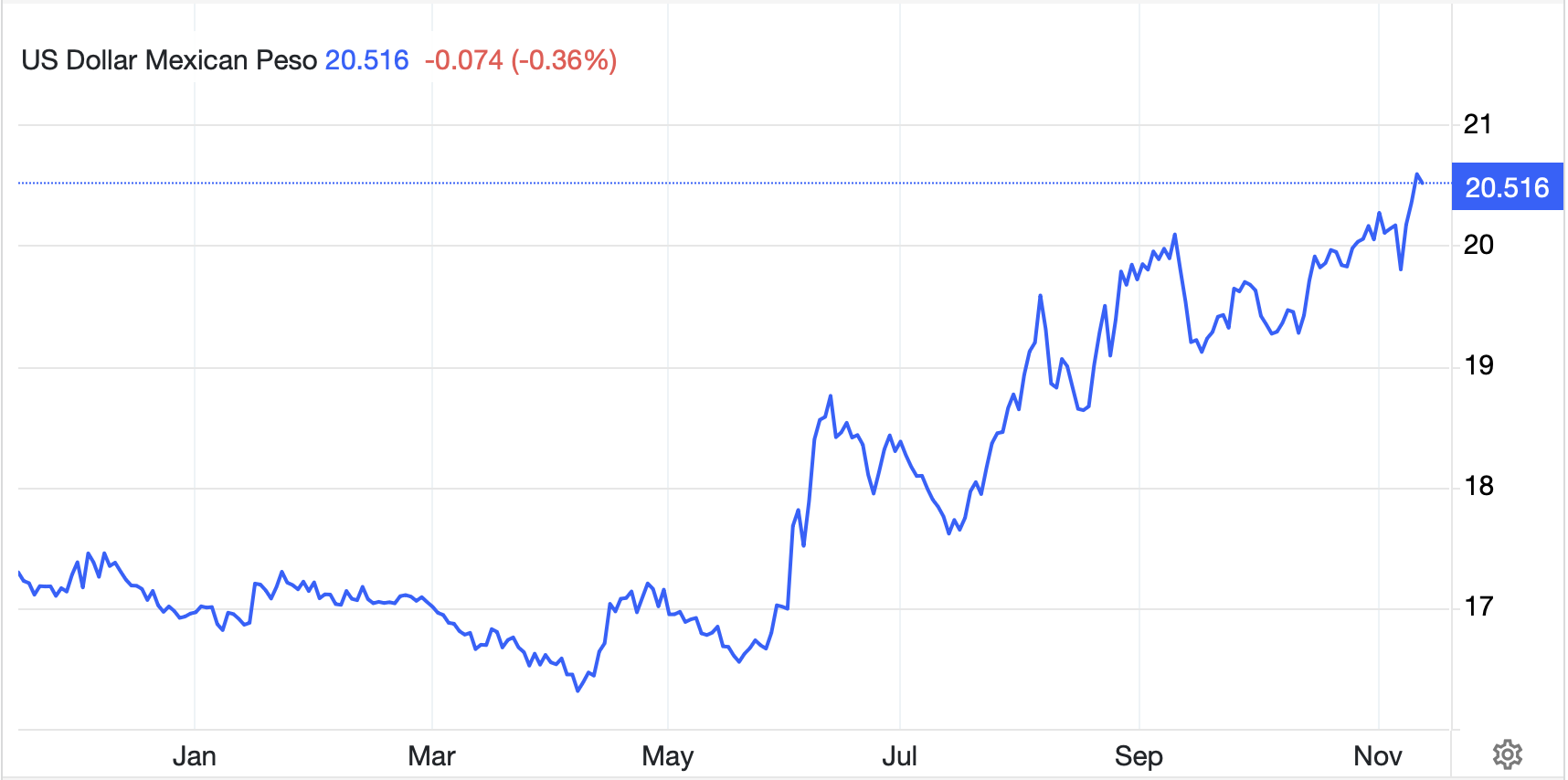
The other political story of note was that in Mexico, AMLO, who remains president for a few more weeks, was able to finally get the change to the constitution he has been seeking his entire term, which now allows for judges, including supreme court justices there, to be elected rather than appointed.  The concern is that this will politicize the judicial system.  An independent judiciary is a key ingredient for international investors as they seek some comfort that business decisions can be fairly considered.  However, judicial elections may call that into question and that is likely to have a longer-term negative impact on the Mexican economy.  As you can see from the chart below, the peso has been massively underperforming since April, falling more than 22% and breaching the 20.00 peso level for the first time in more than 2 years, as concerns over this issue have grown.  Add to this the fact that inflation in Mexico has drifted slowly lower and expectations are rising for more aggressive rate cuts by Banxico, and you have the recipe for a weaker currency.  While the peso has bounced 0.9% this morning, this trend lower remains clear for now.

Source: tradingeconomics.com

With all that out of the way, it is time to turn to this morning’s big news, the August CPI report.  Current median expectations are for a 0.2% M/M, 2.6% Y/Y rise in the headline number and a 0.2% M/M, 3.2% Y/Y rise in the ex-food & energy reading.  However, I have seen estimates ranging from 0.0% M/M to 0.3% M/M based on various subcomponents like used cars, apparel and shelter.  Ahead of the release, I have no further information than that, but let’s consider what can happen in either situation.

First, we know that the Fed is going to cut rates next week, regardless of the number today.  Currently, the Fed funds futures market is pricing a 29% probability of a 50bp cut.  A quick look at the below table from the CME shows this is close to the lower end of the range of expectations over the past month, which back in August were at 51%.

source: cmegroup.com

The current working assumption seems to be that a soft number will virtually assure a 50bp cut regardless of any other economic data, while a 0.3% print will lock in a 25bp cut.  Once again, given the apparent resilience of the economy, the rationale for cutting rates aggressively remains elusive.  The cynic in me might point to the fact that Chairman Powell is a private equity guy, someone who made his fortune in that space, and he has been receiving pressure from all his old friends and colleagues to cut rates to help resurrect the sales activity in that market.   While that may seem glib, given the way things work in the corridors of power in Washington, it cannot be ruled out.  However, history has shown that when the Fed begins a cutting cycle with 50 bps, it is generally because they are behind the curve and recession is already here.  If that is the situation, while next week a 50bp cut may be well received by equity investors, the medium-term outlook is not nearly as bright.  At this point, the question is, how will markets respond to the data.

Let’s start with looking at how things behaved overnight.  Yesterday’s mixed US session, with the DJIA slipping while both the S&P and NASDAQ rallied was followed by uniform weakness in Asia.  Perhaps nobody there was enamored of the debate, which was taking place while those markets were open, but we saw the Nikkei (-1.5%) fall sharply with weakness also in the Hang Seng (-0.75%) and CSI 300 (-0.3%). In fact, only Singapore (+0.5%) managed any gains during the session with every other regional market declining.  But that is not the story in Europe, where all markets are higher, albeit not that much higher.  Spain’s IBEX (+0.65%) is the leader with other markets showing gains of between 0.1% (FTSE 100) to 0.3% (DAX).  For those who are concerned that a Trump victory may isolate Europe more than a Harris victory, perhaps there was more encouragement she could win after the debate.

In the bond market, after some significant declines in yields yesterday, where Treasury yields fell nearly 10bps, this morning they have fallen a further 2bps and are now back to their lowest level since June 2023.  At 3.6%, nearly 200bps below Fed funds, the bond market seems to be pricing in a recession.  Interestingly, neither stocks nor credit spreads are pricing that same outcome.  European sovereign yields also fell sharply yesterday, although not as much as Treasury yields, more like 5bps, and this morning they are a bit lower again, somewhere between -1bp and -3bps.  Perhaps the most interesting outcome is that JGB yields have slipped 4bps, once again delaying the idea that the BOJ is going to tighten policy soon.

In the commodity markets, oil (+2.6%) has rebounded sharply this morning as concerns over Hurricane Francine shutting in Gulf of Mexico production rise ahead of expected landfall later today.  However, the trend here remains lower as demand concerns remain front and center and supply continues to grow.  My sense is that the declining demand is a signal that economic activity is slowing, but it will return with a return to more robust global growth.  In the metals markets, everything is back in the green with gold (+0.2%) once again pushing toward its recent all-time highs, while both silver and copper show strength this morning.  I believe those moves are related to the anticipation of larger cuts by the Fed and other central banks coming soon.

Finally, the dollar is under pressure across the board this morning, also playing along with the theme of the Fed cutting rates more aggressively going forward.  In fact, literally every currency in both the G10 and EMG blocs are stronger today with most modestly so, on the order of 0.2%, although we have seen MXN (+0.85%) rebounding from its recent declines discussed above, and ZAR (+0.45%) benefitting from the strength in metals markets.

Aside from the CPI data, the only other news is the EIA oil inventories, where last week saw a large draw overall, and the only forecast I see is for a modest build of <1mm barrels.  However, CPI will determine today’s price action.  I think we are in a ‘good news is good’ scenario so a soft number should see a rally in stocks, bonds and commodities while the dollar suffers further.  On the flip side, a high print should see the opposite reaction.

As I reread my note, it appears to be an accurate description of the fact that there are features in the data pointing to further economic strength and other pointing to weakness.  Truly, nobody knows what lies ahead.

Good luck

Adf

Fight!

When fired upon, his response
Was jumping back up at the nonce
His cry was to “Fight!”
And some on the right
Now claim he’s a man, renaissance!


As John Lennon told us in 1977:

Nobody told me there’d be days like these
Strange days indeed

While this poet tries to keep politics largely out of the discussion, during these strange days, it is THE story of note.  Of course, by now you all not only have heard of the assassination attempt on former President Trump’s life on Saturday at a political rally in Butler, PA, but you all almost certainly have your own opinions about all the different theories, conspiracy and otherwise, so I will not go down that road.  I will simply note that it speaks poorly of the current political zeitgeist.  And while cooler heads are calling for a step away from the abyss, I have not yet seen the public take that step backwards.  Maybe soon.

In the meantime, my efforts are designed to help make sense of how both the political and economic storylines may impact the markets, and correspondingly, try to help those of you who need to hedge financial exposures, with a little understanding.  But history shows, when politics leads the news, the degree of difficulty goes up significantly.

The first thing to note is that sometimes, when momentous things occur in the real world, any financial implications take some time to manifest themselves.  With that in mind, I thought I would take a 30,000 foot view of the macroeconomic situation as we head into the new week.

The data of late calls into question
If we are now in a recession
With joblessness rising
And prices downsizing
Perhaps growth is seeing regression
 
And it’s not just here in the States
Where growth appears in dire straits
In China, as well,
Things have gone to h*ll
As data of late demonstrates

The question that is being asked more frequently is, are we currently in a recession?  While the data that has been released of late has been slowing, in the US it has not generally reached levels consistent with inflation, although there are some outliers that do point in that direction.  For instance, Friday’s Michigan Sentiment reading was pretty lousy at 66.0, well below expectations, and as can be seen in the below chart from the FRED data base, seemingly heading toward, if not already at, levels consistent with recessions (gray shaded areas).

Source: FRED Data base

As well, a look at the Citibank Economic Surprise Index, an index that tracks the difference between the actual data releases and the consensus forecasts ahead of time, shows that data is consistently failing to meet expectations.

Source: Yardeni.com

Here, too, the data does not appear to have quite reached levels seen in the previous two recessions, but recall that those two recessions were not garden-variety, with the GFC the deepest recession since the global depression in 1929, and the Covid recession remarkably short and sharp in the wake of the unprecedented government shutdowns that occurred in early 2020.  But going back in time, it is generally true that if data released consistently underperform expectations, it is a signal of overall economic weakness.

There are many other data points that are showing similar tendencies like the Unemployment Rate, which I have discussed lately, and is gaining momentum in its move higher.  As well, a look at almost all production factors or Retail Sales, which are reported in nominal terms, shows that when they are deflated by the inflation data of the past several years, real activity has been minimal or even declining.  A look at the below chart shows Retail Sales in both nominal and real terms with the latter actually declining since 2021 despite the rising nominal figures.  In other words, people are simply paying more for the same amount or less of stuff.

Source: brownstone.org

And this is not just a US situation.  As is typically the case, if the US is slowing, the rest of the world is going to suffer given its place as both the largest economy overall, and the largest mass consumer of everybody else’s stuff.  So, last night when China released its latest data, it showed the Q2 GDP disappointed, printing 4.7% while Retail Sales rose only 2.0%, far below Industrial Production, which grew 5.3%.  

Source: Bloomberg.com

In fact, this chart is the graphic representation of why nations around the world are calling for more tariffs on Chinese goods.  The combination of a still-collapsing property market there with the absence of significant government stimulus and a massive debt overhang has led President Xi to seek to increase industrial output and exports (remember the trade data from last week where exports soared, and imports actually declined) thus flooding other markets with goods and harming local manufacturing in other nations.  This is merely one more issue that policymakers must navigate amid a growing global concern over both political and economic unrest.

Summing it all up, I believe the case for there being a recession is growing strongly, and while nominal GDP is likely to remain positive, especially in the US given the government’s nonstop spending spree, real economic activity is suffering.  This has major implications for markets, especially as they appeared to still be priced for that perfect 10-point landing.  As I have written consistently, if (when) things turn more sharply, the Fed will respond quickly and cut rates and the impact on markets will be significant, especially for the dollar which will almost certainly decline sharply.  Just be nimble here.

I am sorry for the extended opening, but obviously, there is much ongoing.  So, let’s take a look at how things are behaving this morning.  At the opening of trading on Sunday evening, arguably the market that was showing the most impact was FX, where the dollar, which had fallen sharply at the end of last week in the wake of that CPI data, had rebounded a bit.  The narrative seems to be that the assassination attempt will secure President Trump’s reelection and the dollar will benefit from the economic policies that are believed to come with that.  As well, at this hour, (6:30) we are seeing US equity futures rallying, up 0.4% across the board.  That’s quite the contrast with the overnight session where the Nikkei (-2.5%) came under severe pressure as investors grow concerned over potential JPY strength.  Too, the Hang Seng (-1.5%) fell sharply although mainland shares have behaved better, little changed overnight, as investors look toward the Third Plenum with hopes that President Xi will unveil something to help the Chinese economy.

In Europe, though, this morning sees red across the screens, albeit not dramatically so.  The CAC (-0.4%) in Paris and the IBEX (-0.5%) in Madrid are the laggards, unwinding some of last week’s rebound, but every major market is under pressure this morning.  The lone piece of data released was Eurozone IP (-0.6%) which fell back into negative territory for the 6th time in the past twelve months.  Certainly, this is not pointing to a robust economy in Europe.

In the bond market, Treasury yields have backed up 4bps, also on the “Trump” trade, as investors believe that a Trump victory will result in more aggressive growth policies and higher US yields.  However, in the Eurozone, and in Asia, government bond yields are essentially unchanged from Friday’s levels as I don’t think foreign investors know what to think now about the US and how it may impact other nations going forward.  After all, if the US does grow more quickly in response to a Trump victory, will that mean more or fewer opportunities for tariffs and other mechanisms to affect foreign nations?

In the commodity markets, things are quiet with oil essentially unchanged this morning, as it consolidates at its recent highs.  Market technicians are looking for a break above $85.00/bbl, but I think that will require some substantially better economic data, which as explained above, does not seem to be in our immediate future.  In the metals markets, precious metals are little changed with gold consolidating above the $2400/oz level near its recent all-time highs, although copper (-0.9%) and aluminum (-0.8%) are both under pressure on the weaker economic picture.

Finally, the dollar is little changed overall this morning from Friday’s levels.  The early dollar strength seen last night has ebbed a bit although we still are seeing some strength against peripheral currencies like ZAR (-1.2%), NOK (-0.5%) and SEK (-0.5%).  The rand story seems to be more about local politics and the inability to get the new government up and running, while deeper investigation into the Skandies shows that this is a phantom move based on an unusual close on Friday.  My sense is there has really been no net movement here, as we have seen in the euro and the pound, both of which are mere pips from Friday’s closing levels.

On the data front this week, there is some important news as well as a series of Fed speeches starting with Chairman Powell this afternoon at 12:30.

TodayEmpire State Manufacturing-6.0
TuesdayRetail Sales0.0%
 -ex autos0.1%
 Business Inventories0.3%
WednesdayHousing Starts1.31M
 Building Permits1.39M
 IP0.3%
 Capacity Utilization78.6%
ThursdayECB Rate Decision4.25% (unchanged)
 Initial Claims235K
 Continuing Claims1855K
 Philly Fed2.9
 Leading Indicators-0.3%
Source: tradingeconomics.com

While there is not as much information due as we saw last week, I think the Retail Sales data will be instructive as another indicator of whether the economy is starting to roll over.  As well, watch for revisions from previous data releases as history shows that revisions to weaker numbers are another signal of a recession.  It will be quite interesting to see if Powell hints at a cut at the end of the month.  Certainly, the Fed funds futures market is not looking for that with <5% probability currently priced in although the September meeting is now a near-lock at 94%.  Remember, too, that after Friday’s speeches conclude this week’s group of 10 Fed comments, they will enter their quiet period and we won’t hear anything else until the FOMC meeting on July 31st.

While there is much to digest, my take is that we have rolled over in the economy.  The real question is about inflation and its ability to continue to decline.  Friday’s PPI data was the opposite of the CPI data on Thursday, showing hot prints for both headline and core, and indicative of resurging price issues.  Alas, I don’t rule out more stagflationary outcomes.  Funnily, I think that will ultimately help the dollar after an initial dip.

Good luck

Adf

Change at the Top

Democracy lives and it dies
By voting for folks who devise
The laws to define
What’s right, or a crime
And this year, there’s much to surmise
 
Some sixty-four nations will vote
And watch as incumbents scapegoat
Political foes
For national woes
And claim they’re the best antidote
 
However, results that we’ve seen
Show that many nations are keen
For change at the top
Or leastwise, to swap
The current regimes’ philistines


So, I know I am not a political analyst, but I try to be a keen observer of trends around the world.  After all, to understand the macroeconomic situation globally, one needs to at least be aware of the politics in the major nations.  As such, I am going to attempt to analyze the elections we have seen around the world to date and see if we can use this trend to look ahead and forecast how things may turn out here in the US come November.

As of today, 35 nations have held elections for either Parliament (Congress), president, or both ranging from St. Maarten to India and many in between with respect to populations.  Arguably the most important have been India, Mexico, South Africa, Taiwan, Russia, Indonesia and Iran.  That list is based on both population and geopolitical importance.  

A look at the results shows the following:

  • India – PM Modi lost significant support and will now be ruling in a coalition, rather than his previous majority.  This was a far cry from the anticipated super-majority he sought.
  • Mexico – AMLO’s hand-picked successor, Claudia Sheinbaum won handily and the Morena party won a supermajority in the lower house, but not in the Senate, so there are great expectations for significant changes unchecked by congress there.
  • South Africa – President Ramaphosa and the African National Congress (ANC) the party that has ruled this nation by itself since the end of apartheid in 1994, lost their absolute majority and is casting about for a coalition partner to allow them to remain in power.
  • Taiwan – New President Lai Ching-te, an avowed separatist relative to China won, but the people did not give him the parliamentary majority to enable significant policy changes
  • Russia – was this really an election?
  • Indonesia – New President Prabowo, a former soldier and defense minister is tipped to be far more aggressive in his handling of dissent and criticism, a concern for some, but clearly given the size of his majority (>58%) something the people are ready for.
  • Iran – This is difficult to assess as the parliamentary elections have been overshadowed by the recent accidental death of the president in a helicopter crash, with a presidential election slated for June 28th.

As well, starting tomorrow, there will be voting for the European Parliament by all twenty-seven member nations.  This is a three-day process so we should know the results by next week.

In the meantime, let me offer my take on the results in a broad-brush manner.  People around the world are unhappy with their leadership and are seeking change.  More importantly, current incumbents are really annoyed by the fact that their populations are not happy.  It has been quite a long time since there have been so many efforts by governments to control all dialog and censor anything that offers an opposing view to government rules, laws and commands.

For instance, in India, despite being very popular, Modi must now account for the fact that he has lost majority support.  He has done much good for the nation, but clearly, there is a large segment of the population that does not feel they are benefitting and were looking for change.

In South Africa, it was a little different as the economic situation there is a wreck.  Inflation is rising (5.3% and climbing), Unemployment is rampant (32.9%) and confidence readings are negative while GDP stagnates. Even though the ANC has ruled for 30 years, people want change, especially since there have been numerous allegations of corruption at the top, and the country continuously has blackouts because of failures with energy policy.

In Taiwan, while former president Tsai Ing-wen was widely admired and had high favorability ratings, there is a clear concern over too much saber rattling with the mainland.  Arguably, China spent a lot of money to interfere in that election but was unsuccessful in getting their candidate elected.  However, the population there does not want war, and that seems to be the driving force.

My point is that even popular leaders have found that their popularity is not necessarily translating into power.  It is not hard to understand why this is the case given that inflation has been a global phenomenon, and the list of military conflicts has grown and forced many nations to choose sides rather than simply do what’s seen as best for themselves.

I know I ignored Mexico here, the exception that proves the rule, although perhaps the people felt that AMLO didn’t go far enough and given the huge rise in crime from the cartels there, people were looking for a stronger government to act, hence the supermajority.

What does this mean for Europe this weekend and the US later in the year?  I have been quite clear in my views that this is a change election year.  The current left leaning coalition in the European parliament is in danger of losing its ability to enact any legislation.  We have seen these changes in the Netherlands and Sweden, and Germany’s AfD party continues to gain adherents alongside the National Front in France and Italy’s European Conservative party.  Germany has three landes (state) elections in September, all in the former East Germany, where AfD is strongest.  While every other party has indicated they will not enter a coalition with AfD, I predict that in at least one of these states, AfD will win outright, and that will really shake things up.  As to the European parliament, the voting bloc on the right may be large enough to prevent almost all new legislation.  

Meanwhile, turning back home, the US election season is heating up and here, too, I would argue the population is very unhappy.  This is evident by the dreadful polling numbers of President Joe Biden, and perhaps even more significantly, by the growth in the number of Trump converts from previously solid democratic voters (watch this 2 minute video and ask yourself if Joe Biden is in trouble or not).  The efforts to utilize the DOJ to prevent Trump from contesting the election is not going over well across the nation, and I believe it will be seen as the biggest own goal in this process.

While I believe that Mr Trump WILL BE PUT IN JAIL because the Democratic party is desperate to do anything to tarnish him, it will not matter.  In fact, it will martyr him even further.  Remember, Nelson Mandela was jailed before being elected president, Vaclav Havel of the Czech Republic was imprisoned before being elected president, Lech Walesa of Poland was imprisoned before being elected president, Lula da Silva of Brazil was imprisoned before being elected president, Mohandas Gandhi was imprisoned for sedition, and yet still became leader of India.  History shows that the people of a nation can see through the political efforts of an incumbent party in their effort to remain in power, and when they demand change, they will get it.

With this in mind, my views on the economic situation remain that inflation continues to be a major impediment for every government worldwide, but if recent data is truly an indication of slowing economic activity, the outcome could well be easier monetary policy, but still weak growth, rising inflation, a falling dollar and rising commodities.  

Politics clearly matters, but it is a longer-term issue.  For now, all the efforts by governments and central banks to apply band-aids for the current ailments seem unlikely to be effective in the timeline required to alter the current broad-based unhappiness amongst the electorate.  Change is coming, and there will be hell to pay on the other side as all these short-term fixes will simply leave the long-term problems in worse shape.

One poet’s views, and I welcome any commentary and pushback.

Thanks

Adf

Depths We May Plumb

The PMI data was soft
Which helped keep stock prices aloft
As many now think
That yields will soon sink
And, therefore, stock prices have troughed
 
But really, the data to come
Is much more important to some
‘Cause if PCE
Is still on a spree
Then many more depths we may plumb


First two mea culpas on yesterday’s note.  Clearly, the ECB is considering a cut, not a hike as I mentioned inadvertently at one point and my info on the timing of Alphabet’s earnings release was incorrect, it was not yesterday but is due tomorrow.

Markets remain generally comfortable with the current situation as all eyes continue to be on Friday’s activity.  Remember, not only do we get the PCE data in the US, but before NY walks in, the BOJ will have met and announced any potential policy changes (unlikely) but hinted at future moves (more possible).  However, until then, quarterly earnings and secondary data are all we have.

This brings us to yesterday’s activity where the US Flash PMI data was weaker than expected in both Manufacturing (49.9) and Services (50.9) while both were anticipated to print at 52.0.  Of course, in a world of rising rates and concerns that the Fed is going to become yet more hawkish when they meet next week, weak data is seen as a potential cure.  The result was a rally in stocks and bond prices (yields fell), albeit not a very dramatic one.  After the equity market close, Tesla reported their earnings and while they were softer than the median analyst expectations, it appears they beat the whisper numbers and Elon said enough things to encourage a rebound in the company’s share price.

Now, you know that if I am discussing Tesla earnings, there is absolutely nothing going on in the markets.  So, let’s turn our attention to something a bit longer term, and quite speculative, but important if it comes about.  I am referring to the story that is getting more traction regarding Robert Lighthizer, who was President Trump’s trade advisor for the entire term, and who recently has discussed the goal of weakening the dollar if Trump is re-elected.  

One of the things that annoys me is that so many political hacks players believe that they can drive market prices without making major underlying policy changes.  And, generally speaking, they recognize that changing the underlying policies is either out of their hands or would cause other, more serious problems even if they were achieved.  This is a perfect example of that type of thinking.

The underlying issue, I believe, is the Trump focus on the trade deficit as being a crucial indicator and something about which the US should be overly concerned.  Let’s start by looking at a history of the dollar’s value (as measured by the EURUSD) compared to the monthly trade balance.

Source: tradingeconomics.com

The green line, based on the left-hand axis, is the trade balance while the blue line, on the right-hand axis, tracks the EURUSD exchange rate.  The first thing to see is that there is not a very strong relationship.  In fact, the R2 is just 0.07, so virtually no relationship.  However, in your old finance textbooks, there is a theory that a weaker exchange rate improves the trade balance at the expense of increasing inflation.  And that certainly makes sense, but I believe that relationship is more representative of countries whose currency is not the global reserve currency.  In the current situation, the dollar’s movement is dependent on many other things, and the trade balance is more frequently an indicator of the strength of the US economy.  After all, when things are going well, we are importing much more stuff than we can produce and so the trade balance turns more negative.  Looking at the chart, the periods when the trade deficit shrank (rising green line) are the same periods when the US was in a recession.

The other problem for a Trump administration that is seeking to weaken the dollar is that the other consequences of the policy actions that would likely lead to a weaker dollar will not be welcomed.  First, and foremost, we will see inflation rise pretty rapidly as not only import prices, but also commodity prices would all move much higher.  The other likely outcome would be an increased reticence for foreigners to hold US assets overall, as a declining dollar will reduce their value in local currency terms.  Right now, the US equity markets represent nearly 70% of global equity market assets in value.  That has been a virtuous circle of foreign buyers of US assets driving prices higher and the dollar higher as US deficit spending drives growth.  But that can certainly turn into a vicious cycle of a weakened dollar driving sales of US assets by foreigners, leading to falling equity prices and a reduction in that percentage of global market cap.  And one thing we know is that Mr Trump is very concerned with the value of the stock market, so a falling one would be seen as a big problem.

I raise this issue because it is getting more press and will impact the narrative, especially as we get closer to the election.  While I don’t believe that the US has the ability to unilaterally weaken the dollar ceteris paribus, I would not be surprised to see this topic gain in mindshare and have an impact for a while.

The reason I focused on this is there has still been very little else to consider.   Right now, everybody is happy as equity markets have rebounded around the world following yesterday’s US rally while bond yields, which dipped yesterday, are rebounding this morning by between 4bps and 6bps.  Both of these are indicators of economic strength.

In the commodity markets, yesterday’s oil rally on the back of a much bigger inventory draw than expected, according to the API, is moderating this morning while metals prices, seem to be finding a bottom after their recent correction.  Given how far and how fast metals prices rose over the past several weeks, a correction was overdue, and welcome to markets as things are now set for the next leg higher, I believe.  Nothing has changed my view on this story.

Finally, the dollar is firmer this morning after a modest decline yesterday on the back of the rates selloff.  In fact, some currencies are under more substantial pressure like SEK (-0.75%) and NOK (-0.75%) although those are the largest movers on the day.  Perhaps the biggest news is that USDJPY finally breached the 155.00 level and now has its sights set on 160.  I expect that we will hear much more talk tonight from MOF speakers regarding the yen, but I see no reason to believe the BOJ will act because of this move.  However, as I mentioned last week, for all you JPY asset and revenue hedgers, I would be using JPY puts here, either purchased or in collars, because I suspect we will see a sharp decline on any intervention, and that day is drawing closer, I fear.

On the data front, Durable Goods (exp 2.5%, 0.3% ex transport) is this morning’s release and then the EIA oil inventory data comes later this morning.  And that’s really it.  Tomorrow, we have more data, Initial Claims, and Q1 GDP, and then, of course the PCE on Friday.  But for now, it’s still an earnings driven market I think.  So macro is on the back burner till Friday.

Good luck

Adf

Democracy’s Died

There once was a fellow named Trump
Whose plan was, Joe Biden, to dump
He started last night
By winning the fight
And heads to New Hampshire to stump

Political pundits worldwide
Now claim that democracy’s died
But markets don’t seem
In touch with that theme
Instead, interest rates are their guide

The Iowa caucus results can be no surprise to anyone as the polls were quite clearly in Donald Trump’s favor.  In the end, he won with slightly more than 50% of the vote while Governor DeSantis came second, Ambassador Haley was in third and Vivek Ramaswamy was a weak fourth.  Ramaswamy has now dropped out of the race and thrown his support behind Trump.  Next week, is the New Hampshire primary and then two weeks later is the South Carolina primary.  After that, comes Super Tuesday in early March, and quite frankly, it would be shocking, at this point, if Trump did not wrap up the nomination by then.

I only mention this because of all the elections this year, arguably the US presidential one is the most impactful on the world at large as well as financial markets.  I will remind you of the equity market behavior in 2016 when Trump was elected the first time and as the evening progressed, the initial response was to see equity futures fall sharply as it became clearer that Trump was going to win, but by the time the markets opened in NY, they had completely reversed and rallied quite sharply, several percent.  Ultimately, I would not be surprised to see more market impacts this year as well.  It is one of the reasons that I believe the major theme this year is going to be more volatility across all markets than we have seen in the past several years combined.

However, right now, we are too early in the cycle and there has been no change of views or broad polling results, so investors are going to focus elsewhere, namely central bank actions.  This brings us to the question of will the Fed actually be cutting interest rates six times in 2024, or more accurately, will they be reducing the Fed funds rate by 150bps?  Funnily enough, I think that may be the least likely outcome of the array of possibilities that exist.  Instead, I expect that the futures market is pricing in an almost binary outcome.  On the one hand, the Fed remains true to their comments that inflation remains too high and while some cuts will come, it is very premature, so perhaps only one or two cuts this year.*  On the other hand, the recessionistas are correct, a hard landing is coming and the Fed is going to have to cut by 300bps or 350bps to support the market.  Play with these probabilities and it is pretty easy to come up with a scenario that shows 150bps of cuts this year.

But for now, whatever my views on how the Fed and other central banks are going to behave, the only important thing is what the market is anticipating.  This takes us back to the market’s assumption about the Fed’s reaction function regarding all the data that is coming our way.  Hence, the fact that the market largely ignored what appeared to be a hotter than expected CPI print last week, but jumped all over a softer than expected PPI print is telling in and of itself.  The market is desperate for the Fed to cut rates which will open the doors for all the other central banks to cut rates.

And in truth, I think this is exactly what we should expect for the time being.  The market is all-in on the idea that not only has the peak in inflation been seen, but that it is quickly falling back to the 2% target that is almost universal.  And they are all-in on the idea that central banks will be able to lower rates back to much more comfortable levels for those in debt while supporting risk asset prices.  My take is we will need to see a long series of data that indicates anything other than this scenario before market views change.  So, any data that indicates inflation remains sticky will be ignored, while data that indicates it is falling sharply will be regurgitated constantly.  The same will be true in the employment and production data.  All I’m saying is we need to be prepared to see certain data that doesn’t fit the narrative get completely ignored for now.  Manage your risk accordingly.

As to the overnight session, things have been less optimistic overall with most stock markets in Asia under pressure, even Japan (Nikkei -0.8%) and Hong Kong (-2.2%) really feeling pressure although mainland Chinese shares held in there after word that the Chinese government would be issuing an emergency CNY 1 trillion (~$139 billion) of debt to fund spending domestically.  As to Europe, all red there, albeit only on the order of -0.4% across the board and US futures are also lower this morning, something around -0.25% at this hour (7:45).

In the bond market, after the US holiday prevented any changes of note yesterday, we see Treasury yields backing up 7bps this morning, a similar move to what we saw in Europe yesterday.  Arguably, this seems like a catch-up move.  In fact European sovereign yields are essentially unchanged on the day as German GDP data confirming the recession of 2023 did nothing to change views, nor surprisingly, did slightly better than expected UK employment data where wage growth was seen rising less rapidly than anticipated.  JGB yields remain moribund and the idea that the BOJ is going to change anything seems a more and more distant prospect for now.

Oil prices (+0.6%) are a touch higher amid further threats from the Houthis as well as some missile attacks by Iran on areas in Iraq and Syria.  I cannot keep up with all the different allegations here, but we cannot ignore the fact that things seem to be escalating.  This cannot be a good outcome for oil prices, or perhaps more accurately, seems likely to push them higher.  The higher interest rates are weighing on precious metals with gold and silver both lower, but surprisingly, copper and aluminum are both rallying this morning.

Finally, the dollar is flexing its muscles this morning, higher against all its counterparts in both the G10 and EMG spaces.  AUD, NOK and SEK have all declined by -0.8% or so, leading the way in the G10 space, although -0.6% covers the bulk of the rest of the bloc.  In the EMG space, KRW (-1.25%), PLN (-1.0%) and MXN (-1.0%) are the laggards across an entire bloc that is under pressure.  This is all about the dollar this morning with no idiosyncratic stories to drive things.

On the data front, we only have the Empire State Manufacturing Index (exp -5.0) and we hear from Fed Governor Waller as well at 11:00.  It seems to me that the market has really gone a bit too far in its bullish beliefs and today is a bit of a correction.  Unless we start to see a lot more push back regarding policy ease though, I expect this movement will be short-lived.  Although ultimately, I believe that we will see a weaker economy, higher inflation and weaker asset prices, I do not think that is the near-term view.  Rather, I expect we will see more dip buying for risk assets by tomorrow at the latest.

Good luck
Adf

*I am well aware that the recent dot plot indicated a median expectation of 75bps of rate cuts this year, but do not forget that the dispersion of that grouping was quite wide, with one assuming no cuts and several assuming just one or two.  I feel it is very weak thinking to say the Fed has indicated three rate cuts this year, they have done no such thing!

Not So Amused

While Covid continues to spread
Chair Jay, for more stimulus pled
But President Trump
Said talks hit a bump
And ‘til the election they’re dead

The market was not so amused
With stock prices terribly bruised
So, as of today
Investors must weigh
The odds more Fed help is infused

Although nobody would characterize today as risk-on, the shock the market received yesterday afternoon does not seem to have had much follow through either.  Of course, I’m referring to President Trump’s tweet that all stimulus negotiations are off until after the election.  One need only look at the chart of the Dow Jones to know the exact timing of the comment, 2:48 yesterday afternoon.  The ensuing twenty minutes saw that index fall more than 2%, with similar moves in both the S&P 500 and the NASDAQ.  And this was hot on the heels of Chairman Powell pleading, once again, for more fiscal stimulus to help the economy and predicting dire consequences if none is forthcoming.

At this point, it is impossible to say how this scenario will play out largely because of the political calculations being made by both sides ahead of the presidential election next month.  On the one hand, it seems hard to believe that a sitting politician would refuse the opportunity to spend more money ahead of an election.  On the other hand, the particular politician in question is unlike any other seen in our lifetimes, and clearly walks to the beat of a different drummer.  The one thing I will say is that despite the forecasts of impending doom without further stimulus, the US data continues to show a recovering economy.  For instance, yesterday’s record trade deficit of -$67.2 billion was driven by an increase in imports, not something that typically occurs when the economy is slowing down.  One thing we have learned throughout the Covid crisis is that the econometric models used by virtually every central bank have proven themselves to be out of sync with the real economy.  As such, it is entirely possible that the central bank pleas for more stimulus are based on the idea that monetary policy has done all it can, and central bankers are terrified of being blamed for the economic problems extant.

Speaking of central bank activities and comments, the Old Lady of Threadneedle Street has been getting some press lately as the UK economy continues to deal with not merely Covid-19, but the impending exit from the EU.  Last month, the BOE mentioned they were investigating negative interest rates, but comments since then seem to highlight that there are but two of the nine members of the MPC who believe there is a place for NIRP.  That said, the Gilt market is pricing in negative interest rates from two to five years in maturity, so there is clearly a bigger community of believers.  While UK economic activity has also rebounded from the depths of the Q2 collapse, there is a huge concern that a no-deal Brexit will add another layer of difficulty to the situation there and require significantly more government action.  The BOE will almost certainly increase its QE, with a bump from the current £745 billion up to £1 trillion or more.  But, unlike the US, the UK does not have the advantage of issuing debt in the world’s reserve currency, and at some point, the cost of further fiscal stimulus may prove too steep.  As to the probability of a Brexit deal, it seems that much rides on French President Macron’s willingness to allow the French fishing fleet to sink shrink and allow the UK to manage their own territorial waters.

With this as the backdrop, a look at markets this morning shows a mixed bag on the risk front.  Asian equity markets saw the Nikkei (-0.05%) essentially unchanged although the Hang Seng (+1.1%) got along just fine.  Shanghai remains closed for holidays.  European bourses seem to be taking their cues from the Nikkei, as modest declines are the rule of the day.  The DAX (-0.35%) and the CAC (-0.2%) are both edging lower, and although the FTSE 100 is unchanged, the rest of the continent is following the German lead.  Interestingly, US futures are higher by between 0.3%-0.5%, not necessarily what one would expect.

Bond markets, once again, seem to be trading based on different market cues than either equities or FX, as this morning the 10-year Treasury yield has risen 4 basis points, and is trading back to the recent highs seen Monday.  One would be hard-pressed to characterize today as a risk-on session, where one might typically see investors sell bonds as they rotate into equities, so clearly there is something else afoot.  Yesterday’s 3-year Treasury auction seemed to be pretty well-received, so there is, as yet, no sign of fatigue in buying US debt.  There is much discussion here about the possibility of a contested election, yet I would have thought that is a risk scenario that would drive Treasury buying.  To my inexpert eyes, this appears to be driven by more inflation concerns.  Next week we see CPI again, and based on the recent trend, as well as personal experience, there has been no abatement in price pressures.  And unless the Fed starts buying the long end of the Treasury curve (something Cleveland’s Loretta Mester suggested yesterday), or announces yield curve control, there is ample room for the back end to sell off further with yields moving correspondingly higher, regardless of Fed activity.  And that would bring a whole set of new problems for the US.

Finally, one would have to characterize the dollar as on its back foot this morning.  While not universally lower, there are certainly more gainers than losers vs. the greenback.  In the G10 space, NOK (+0.5%) and SEK (+0.4%) are leading the way, which given oil’s 2.5% decline certainly seems odd for the Nocky.  As for the Stocky, there is no news nor data that would have encouraged buying, and so I attribute the movement to an extension of the currency’s recent modest strength which has seen the krona gain about 2% in the past two weeks.  Meanwhile, JPY (-0.4%) continues to sell off, much to the delight of Kuroda-san and new PM Suga.  Here, too, there is no news or data driving the story, but rather this feels like position adjustments.  It was only a few weeks ago where there was a great deal of excitement about the possibility of the yen breaking out and heading toward par.  That discussion has ended for now.

Emerging markets are generally better this morning as well, led by MXN (+0.85%) which is gaining despite oil’s decline and the landfall of Hurricane Delta, a category 3 storm.  If anything, comments from Banxico’s Governor De Leon, calling for more stimulus and explaining that the recovery will be uneven because of the lack of fiscal action, as well as the IMF castigating AMLO for underspending on stimulus, would have seemed to undermine the currency.  But apparently not.  Elsewhere, the gains are less impressive with HUF (+0.5%) and ZAR (+0.35%) the next best performers with the former getting a little love based on increased expectations for tighter monetary policy before year end, while ZAR continues to benefit, on days when fear is in the background, from its still very high real interest rates.

The only data of note today is the FOMC Minutes this afternoon, but are they really going to tell us more than we have heard recently from virtually the entire FOMC?  I don’t think so.  Instead, today will be a tale of the vagaries of the politics of stimulus as the market will await the next move to see if/when something will be agreed.  Just remember one thing; the Fed has already explained pretty much all the easing it is going to be implementing, but we have more to come from both the ECB and BOE.  That divergence ought to weigh on both the euro and the pound going forward.

Good luck and stay safe
Adf

Some Despair

In Germany, data revealed
That growth there’s apparently healed
But data elsewhere
Implied some despair
As problems, porcine, are concealed

Risk is back in vogue this morning as the market appears to be responding positively to a much better than expected PMI reading from Germany (Services PMI 50.6, up from 49.1 Flash reading, Composite 54.7, up from 53.7 Flash) and a modestly better outcome for the Eurozone (48.0 vs. 47.6 for Services, 50.4 vs. 50.1 for Composite) as a whole.  At least that’s the surface story I keep reading.  The problem with this version is that markets in Asia were also highly risk-centric and that was well before the PMI data hit the tape.  Which begs the question, what is really driving the risk narrative today?

When President Trump was infected
The thing that most people expected
Was two weeks before
He’d walk out the door
Explaining he wasn’t affected

A different, and timelier, explanation for today’s positive risk sentiment stems from the ongoing story of President Trump’s covid infection and his ability to recuperate quickly.  While the standing assumption had been that there is a two-week timeline from infection to recovery, the President has consistently indicated that he feels fine, as have his doctors, and the story is that he will be released today from his weekend stay at Walter Reed Memorial Hospital.  In other words, any concerns that attended the announcement of his illness from Friday, when we did see equity markets suffer, is in the process of being unwound this morning.  The rationale here seems to be twofold.  First, the President is set to be back at the White House and in control, something which matters greatly from a national security perspective.  But second, the fact that he, as a 74-year-old man, was able to recover so quickly from the infection speaks to the reduced impact covid is likely to have on the population as a whole.  And arguably, that may even have a bigger impact.  While we continue to hear of new lockdown’s being announced in certain places, NYC, Spain and France to name just three, if the potency of the infection is waning such that it is a short-term event with limited side effects, that could well lead to an increase in confidence amongst the population.  And, of course, confidence is the one thing that the economy is searching for desperately.

The problem is that since virtually everything has become political theater lately, it is difficult to discern the facts in this situation.  As such, it seems hard to believe that overall confidence has been lifted that significantly, at least as of this morning.  However, if President Trump remains active and vigorous this week, it will certainly put a dent into the thesis that covid is incredibly debilitating.  We will need to watch how things evolve.

Interestingly, there is one issue that seems to be getting short shrift this morning, the growing concern that there will be no Brexit deal reached in the next ten days.  Recall that Boris and Ursula had a virtual lunch date on Saturday, and both claimed that a deal was close, but there were a couple of issues left to address.  The two key differences remain the issue of acceptable state aid by the UK government and, the big one, the type of access that European (read French) fishing vessels will have to UK waters.  It seems that French President Macron is adamant that the UK give the French a (large) annual quota and be done with it, while Boris is of the mind that they should agree to meet annually and discuss the issue based on the available fish stocks and conditions.  It also seems that the rest of Europe is getting a bit annoyed at Macron as for them, the issue is not that significant.  This fact is what speaks to an eventual climb-down by Macron, but, as yet, he has not been willing to budge on the matter.  Based on the price of the pound and its recent performance (+0.2% today, +1.0% in the past week), the market clearly believes a deal will be reached.  However, that also foretells a more significant decline in the event both sides fail to reach said agreement.

So, now let’s take a look at the bullishness in markets today.  Asia saw strength across the board with the Nikkei(+1.25%) and Hang Seng (+1.3%) nicely higher and Australia (+2.6%) really showing strength.  (China remains closed virtually all week for a series of national holidays).  European indices are all green as well, albeit not quite as enthusiastic as Asia.  Thus, we have seen solid gains from the three major indices, DAX, CAC and FTSE 100, all higher by 0.7%.  And finally, US futures are pointing to a stronger opening, with current pricing showing gains of between 0.7% and 1.0%.

It should be no surprise that bond marks are under some pressure with 10-year Treasury yields up to 0.71% this morning, higher by 1 basis point on the session and 6 bps in the past week.  In fact, yields are back at their highest level in a month.  European bonds are also broadly softer (higher yields) but the movement remains muted as well, about 1bp where they have risen.  And it should also not be surprising that Italy, Portugal and Greece have seen yields decline, as those three certainly qualify as risk assets these days.

Oil prices are firmer, again taking their cue from the confidence that is infusing markets overall, while precious metals prices are flat.  And finally, the dollar is definitely softer, except against the yen, which continues to be one of the best risk indicators around.  So, in the G10 space, NOK (+0.7%) is the leader, following oil as well as benefitting from the general dollar weakness.  Next on the list is CHF (+0.5%) where data showed ongoing growth in sight deposits, an indication that capital flows continue to enter the country, despite today’s risk attitude.  But broadly speaking, the whole space is firmer.

As to EMG currencies, ZAR (+0.7%) is the leader today, with firmer commodity prices and still the highest real interest rates around keeping the rand attractive in a risk-on environment.  But it is almost the entire bloc with the CE4 (CZK +0.55%, PLN +0.45%, HUF +0.45%) showing their high EUR beta characteristics and MXN (+0.45%) also performing well, again benefitting from both firmer oil prices as well as a weaker dollar.  The one exception here is RUB (-0.5%), which appears to be suffering from the effects of the ongoing conflict in Nagorno-Karabakh and how much it is going to cost Russia to maintain its support for Armenia.

On the data front, it is a relatively quiet week with only a handful of numbers to be released:

Today ISM Services 56.2
Tuesday Trade Balance -$66.2B
JOLTs Job Openings 6.5M
Wednesday FOMC Minutes
Thursday Initial Claims 820K
Continuing Claims 11.4M

Source: Bloomberg

However, what we lack in data we make up for with Fedspeak, as eight different speakers, including Chairman Powell tomorrow, speak at 13 different events.  What we have heard lately is there is a growing difference of opinion by some FOMC members regarding the robustness of the US economic rebound.  However, despite those differences, the universal request is for further fiscal stimulus.  Given the dearth of data this week, I expect that Chairman Powell’s speech tomorrow morning is likely to be the most important thing we hear, barring a Brexit breakthrough or something else from the White House.

Good luck and stay safe
Adf