Ere Recession Arose

There once was a Fed Chair named Jay
Who fought ‘gainst the prez every day
He tried to explain
That tariffs brought pain
So higher rates needed to stay
 
But data turned out to expose
The job market, which had no clothes
So, he and his friends
Were forced, in the end
To cut ere recession arose


The Fed cut 25bps yesterday, as widely expected (although I went out on a limb and called for 50bps) and markets, after all was said and done by Chair Powell, saw equities mixed with the DJIA rising 0.6% while the S&P 500 and NASDAQ both slipped slightly.  Treasury yields rose 5bps which felt much more like some profit taking after a month-long rally, than the beginning of a new trend as per the chart below.

Source: tradingeconomics.com

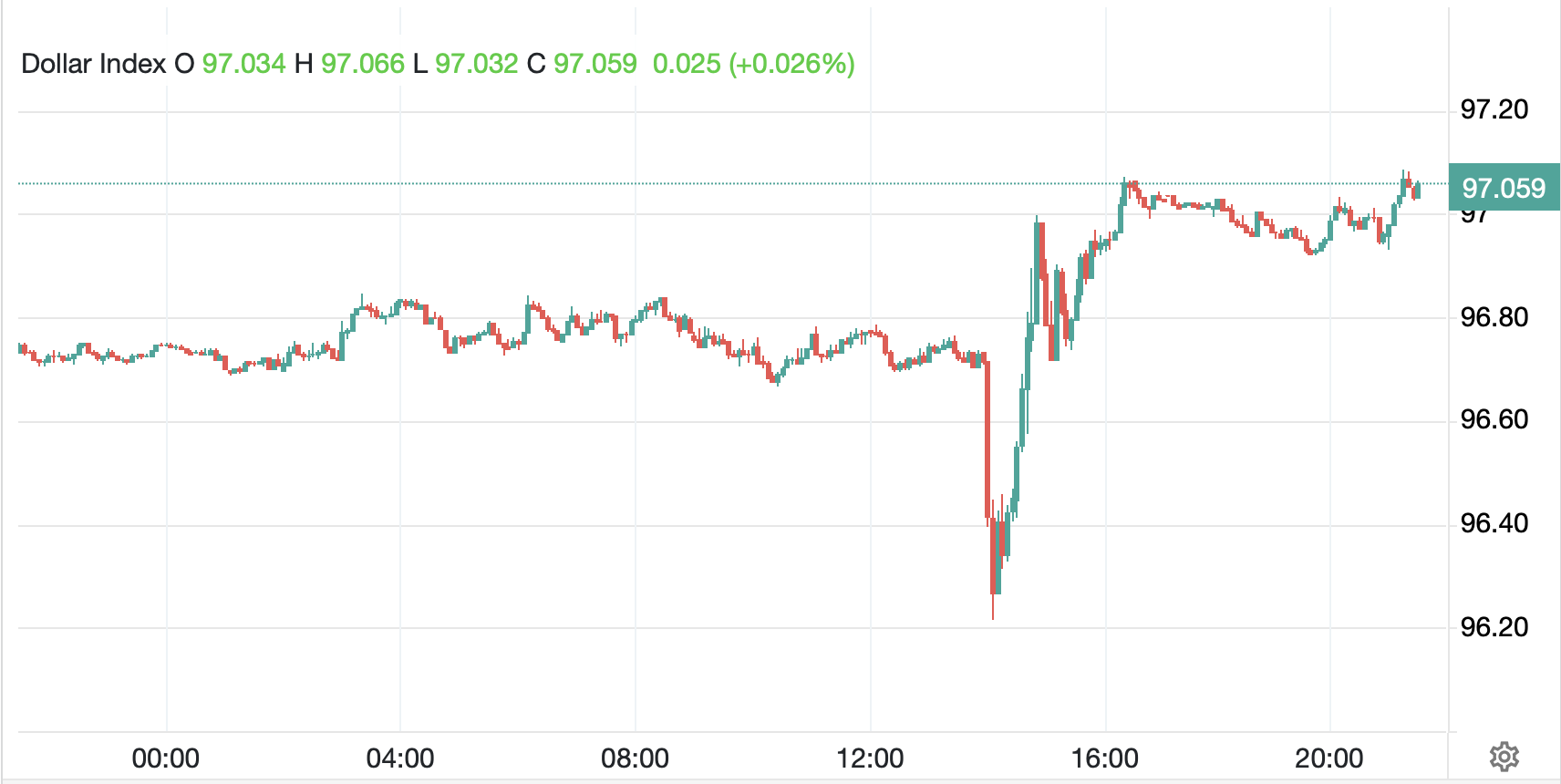
Gold rallied instantaneously on the cut news, trading above $3700/oz, but slipped back nearly 2% as Powell started speaking and the dollar fell sharply on the news but rebounded to close higher on the day as per the below chart from tradingeconomics.com.  See if you can determine when the statement was released and when Powell started to speak.

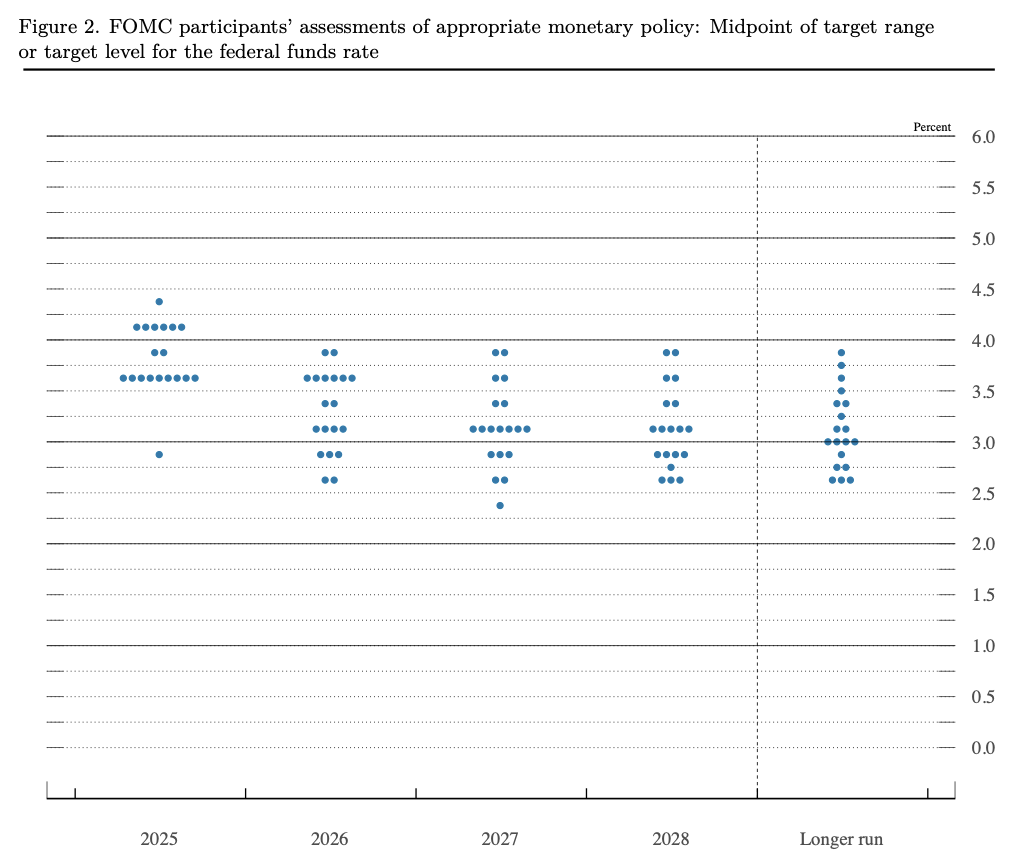
Did we learn very much from this meeting?  I think we learned two things, one which is a positive and one which is not.  On the positive side, there is clearly a very robust discussion ongoing at the Fed with respect to how FOMC members see the future evolving.  This was made clear in the dot plot as even the rest of 2025 sees a major split in expected outcomes.  But more importantly, looking into the future, there is certainly no groupthink ongoing, which is a wonderful thing.  Simply look at the dispersion of the dots for each year.

Source: federalreserve.gov

The negative, though, is that Chairman Powell is very keen to spin a narrative that seems at odds with the data that they released in the SEP.  In other words, the flip side of the idea that there is a robust discussion is that nobody there has a clue about what is happening in the economy, or at least Powell is not willing to admit to their forecasts, and that is a problem given their role in policy making.

It was a little surprising that only newly seated Governor Miran voted for 50bps with last meeting’s dissenters happy to go with 25bps.  But I have a feeling that the commentary going forward, which starts on Monday of next week, is going to offer a variety of stories.  If guidance from Fed speakers contradicts one another, exactly where is it guiding us?  (Please know I have always thought that forward guidance was one of the worst policy implementations in the Fed’s history.)

Moving on, the other central banks that have announced have done exactly as expected with both Canada and Norway cutting 25bps.  Shortly, the BOE will announce their decision with market expectations for a 7-2 vote to leave rates on hold, especially after yesterday’s 3.8% CPI reading.  Then, all eyes will turn to Tokyo tonight where the BOJ seems highly likely to leave rates on hold there as well.

If you think about it, it is remarkable that equity markets around the world continue to rally broadly at a time when central banks around the world are cutting rates because they are concerned that economic activity is slowing and they seek to prevent a recession.  Something about that sequence seems out of sorts, but then, I freely admit that markets move for many reasons that seem beyond logic.

Ok, having reviewed the immediate market response to the Fed, let’s see how things are shaping up this morning.  Asian equity markets had both winners (Tokyo +1.15%, Korea +1.4%, Taiwan +1.3%, India +0.4%) and laggards, (China -1.2%, HK 1.4%, Australia -0.8%, Malaysia -0.8%) with the rest of the region seeing more laggards than gainers.  The China/HK story seems to be profit taking related while the gainers all alleged that the prospect of another 50bps of cuts from the Fed this year is bullish.  Meanwhile, in Europe, while the UK (+0.2%) is biding its time ahead of the BOE announcement, there has been real strength in Germany (+1.2%), France (+1.15%) and Italy (+0.85%) while Spain (+0.25%) is only modestly firmer.  While there was no data of note released, we did hear from ECB VP de Guindos who said the ECB may not be done cutting rates.  Clearly that got some investors excited.  As to US futures, at this hour (6:55), they are solidly higher, on the order of 0.8% or more.

In the bond market, Treasury yields are backing off the highs seen yesterday and have slipped -4bps, hovering just above 4.0% on the 10-year.  European sovereign yields are essentially unchanged this morning as were JGB yields overnight.  It seems investors were completely prepared for the central bank actions and had it all priced in.  I guess the real question is are those investors prepared for the fact that the Fed is no longer that concerned about inflation and will allow it to rise further?  My guess there is they are not, but then, that’s where QE/YCC comes into play.

In the commodity markets, oil (-0.25%) is slightly lower this morning despite Ukraine attacking two more Russian refineries last night.  What makes that particularly interesting is that the EIA inventory data showed a massive net draw of oil and products last week of more than 11 million barrels, seemingly a bullish signal.  But hey, I’m an FX guy so maybe supply and demand in oil markets works differently!  In metals, gold (+0.2%) and silver (+0.4%) continue to rebound from their short-term lows from yesterday.  It is abundantly clear that there is growing demand for alternatives to fiat currencies.

Speaking of which, in the fiat world, rumors of the dollar’s demise remain greatly exaggerated.  After yesterday afternoon’s gyrations discussed above, it is largely unchanged this morning with some outlier moves in smaller currencies, NZD (-0.5%), ZAR (+0.3%), KRW (-0.3%) while amongst the true majors, only JPY (-0.25%) has moved any distance at all.  

***BOE Leaves rates on hold, as expected, with 7-2 vote, as expected.***

Turning to this morning’s data, we see the weekly Initial (exp 240K) and Continuing (1950K) Claims as well as Philly Fed (2.3), then at 10:00 we get Leading Indicators (-0.2%).  Something I read was that last week’s Initial Claims number of 263K was caused by a data glitch in Texas, implying it was overstated.  I imagine we will find out more on that this morning.  

Recapping all we learned yesterday and overnight, the Fed seems reasonably likely to cut at both of their last two meetings this year, but expect only one cut in 2026, which is at least 50bps less of cuts than had been expected prior to the meeting.  Meanwhile, equity markets don’t seem to care and continue to rally while bond investors remain under a spell, believing the Fed will fight inflation effectively.  Gold is under no such spell, and the dollar is the outlet for all of it, toing and froing on the back of various theories of the day.  If forced to guess, I do believe there is a bit more weakness in the dollar in the near-term, but do not look for a collapse.  In fact, I suspect that as investment flows into the US pick up, we will see a reversal of note by the middle of next year.

Good luck

Adf

Throw in the Towel

All eyes are on Chairman Jay Powell
And if he will throw in the towel
Or will he still fight
Inflation? Oh, right
He caved as the hawks all cried foul!
 
So, twenty-five’s baked in the cake
While fifty would be a mistake
If fighting inflation
Is his obligation
Though half may, Trump’s thirst, somewhat slake


Well, it’s Frabjous Fed Day and there will be a great deal of commentary on what may happen and what it all means.  Of course, none of us really knows at this point, but I assure you by this afternoon, almost all pundits will explain they had it right.  

At any rate, my take is as follows, FWIW.  I believe the huge revision to NFP data has got the FOMC quite concerned.  Prior to that, they were smug in their contention that patience was a virtue and their caution because of the uncertain price impact of tariffs was warranted given the underlying strength in the jobs market.  Now, not only has that underlying strength been shown to be a mirage, but the import price data released yesterday, showing that Y/Y, import prices are flat, is further evidence that tariffs have not been a significant driver of inflation.  If you look at the chart below of Y/Y import prices for the past 5 years, you can see that since April’s ‘Liberation Day’ tariff announcements, they have not risen at all.

Source: tradingeconomics.com

With that in mind, if you are the Fed, and you are data dependent, as they claim to be, and the data shows weakening employment and stable prices in the area you had been highlighting, you have no choice but to cut.  The question then becomes, 25bps or 50bps?  While the market is pricing just a 6% probability of a 50bp cut, given there are almost certainly three Governor votes for 50bps (Waller, Bowman and Miran) and the underlying central bank tendency is toward dovishness, I am going to go out on a limb and call for 50bps.  Powell and the Fed have already been proven wrong, and the only thing worse for them than seeming to cave to pressure from the White House would be standing pat and being blamed for causing a recession.  

With that in mind, my prognostications for market responses are as follows:

  • The dollar will weaken pretty much across the board with a move as much as -1% possible
  • Precious metals will rally sharply, making new highs for the move as this will be proof positive that the Fed has tacitly raised its inflation target from the previous 2%.  In fact, my take is 3% is the new 2%, at least until we spend a long time at 4%.
  • Equity markets will take the news well, at least initially, as the algos will be programmed to buy, but the concern will have to grow that slowing economic activity will impair earnings going forward, and multiples will suffer with higher inflation.  I continue to fear a correction here.
  • Bonds are tricky here as they have been rallying aggressively for the past six weeks and that could well have been ‘buying the rumor’ ahead of the meeting.  So, it is not hard to make the case that bonds sell off, and long end yields rise in response to 50bps.

On the other hand, if they cut 25bps, and sound hawkish in the statement or Powell’s presser, I don’t imagine there will be much movement of note.   I guess we’ll see in a while.

Until then, let’s look at the overnight price action.  Yesterday’s modest declines in US equities looked far more like consolidation after strong runs higher than like the beginning of the end.  The follow on in Asia was mixed with Tokyo (-0.25%) after export data was weak, especially in the auto sector, while HK (+1.8%) and China (+0.6%) both rallied on the prospect of reduced trade tensions between the US and China based on the upcoming meeting between Presidents Trump and Xi.  Elsewhere in the region, Korea, Taiwan and Australia fell while India, Malaysia and Indonesia all rallied, the latter on the back of a surprise 25bp rate cut by Bank Indonesia.

In Europe, the picture is also mixed with Germany (-0.2%), France (-0.4%) and Italy (-1.2%) all under pressure, with Italy noticeably feeling the pain of potential domestic moves that will hurt bank profitability with increased taxes there to offset tax cuts for individuals.  Spain is flat and the UK (+0.25%) slightly firmer after inflation data there showed 3.8% Y/Y headline, and 3.6% Y/Y core, as expected and still far higher than the BOE’s 2.0% target.  While the BOE meets tomorrow, and no policy change is expected, if the Fed cuts 50bps, do not be surprised to see 25bps from the Old Lady.  US futures at this hour (7:30) are essentially unchanged.

In the bond market, Treasury yields continue to creep lower ahead of the meeting, slipping another 2bps this morning and now trading at 4.01%, the lowest level since Liberation Day and the initial fears of economic disaster in the US.

Source: tradingeconomics.com

You can see the trend for the past six months remains lower and appears to be accelerating right now. Meanwhile, as is often the case, European sovereign yields are following Treasury yields and they are lower by between -1bp and -2bps across the board.  Nothing to see here.

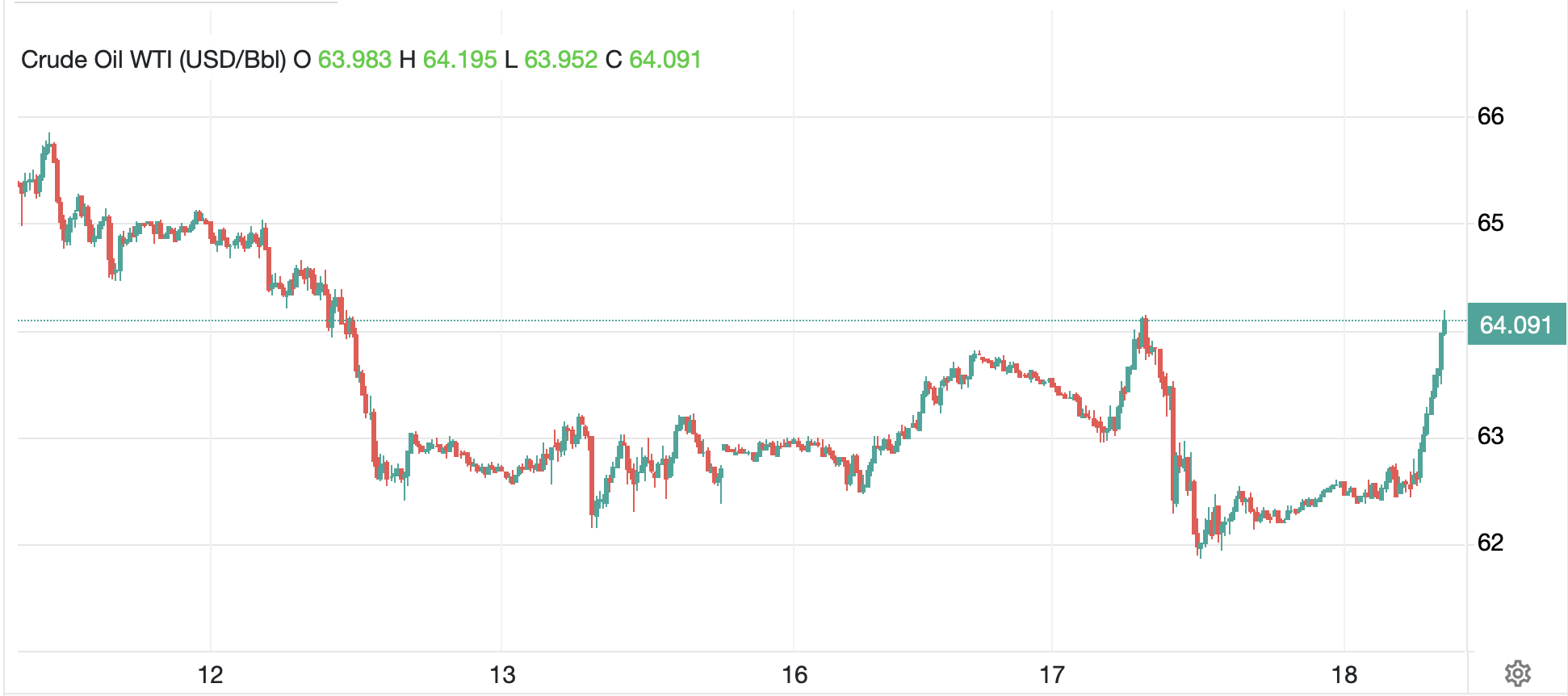
Commodity markets have seen the most movement overnight with oil (-0.7%) topping a bit while gold (-0.65%), silver (-2.5%) and copper (-1.8%) have all seen some profit taking ahead of the FOMC meeting.  Now, there are plenty of profits to take given the 10% rallies we have seen in gold and silver in the past month.  In fact, I lightened up some of my gold position yesterday as well!

Finally, the dollar, which fell pretty sharply yesterday is bouncing a bit this morning.  Using the DXY as proxy, it came close to the lows seen back on July 1st, as you can see in the chart below. 

Source: tradingeconomics.com

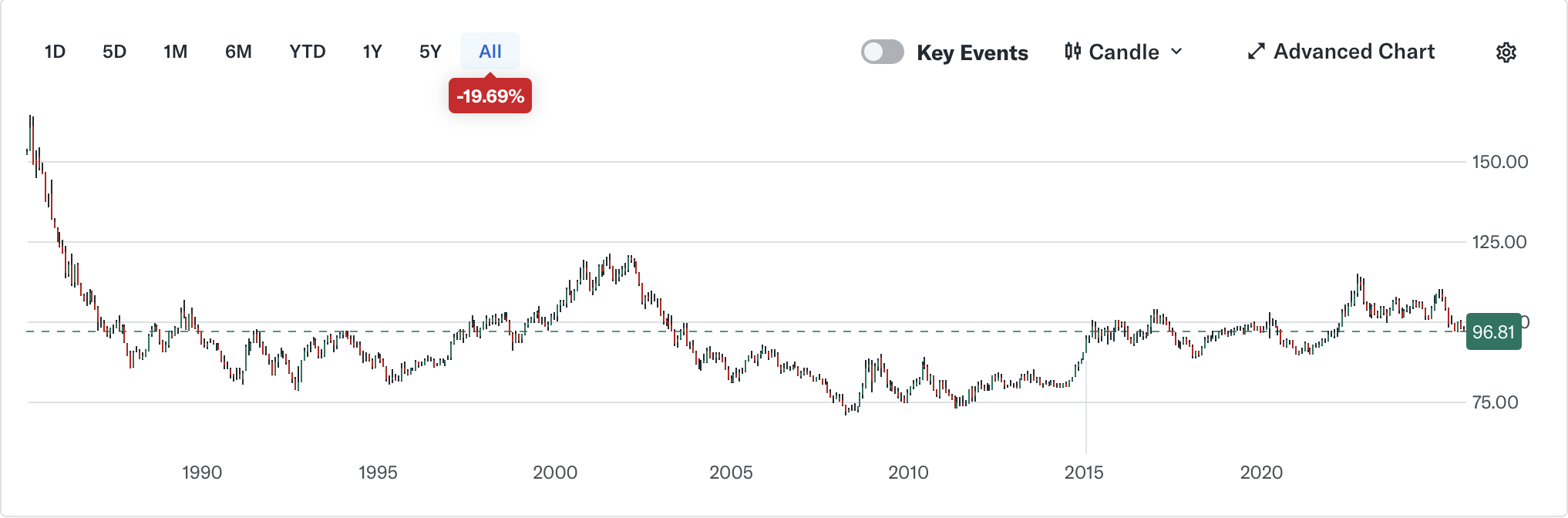
But remember, as you step away from the day-to-day, the dollar is hardly weak.  Rather, it is much closer to the middle of its long-term price action as evidenced by the longer view below.

Source: finance.yahoo.com

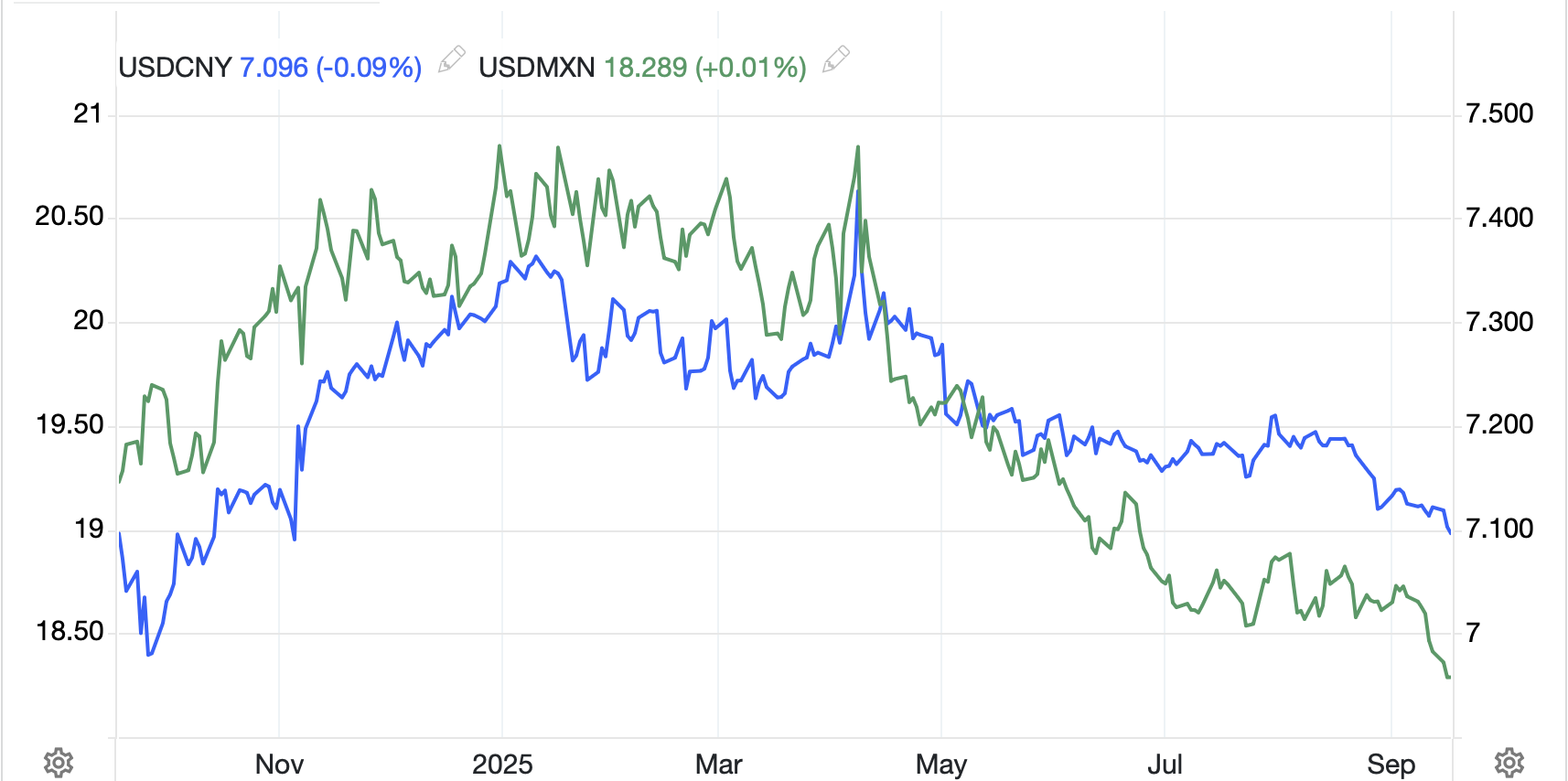
There is a lot of discussion on FinX (nee FinTwit) about whether we are about to bounce or if the dollar is going to collapse.  But it is hard to look at the chart directly above and get the feeling that things are out of hand in either direction.  Now, relative to some other currencies, there are trends in place that don’t impact the DXY, but matter.  Notably, CNY and MXN have both been strengthening slowly for the bulk of the year and are now at levels not seen for several years.  given the importance of both these nations with respect to trade with the US, this is where Mr Trump must be happiest as it clearly is weighing on their export statistics.

Source: tradingeconomics.com

Ahead of the FOMC meeting, we do get a few data points, with Housing Starts (exp 1.37M) and Building Permits (1.37M) leading off at 8:30.  Then at 9:45 the BOC interest rate decision comes, with a 25bp cut expected and finally the Fed at 2:00.  Housing will not have any impact on the market in my view but the BOC, if they surprise, could matter, especially if they pre-emptively cut 50bps as that will get the juices flowing for the Fed to follow suit.  But otherwise, we will have to wait for Powell and friends for the next steps.

Good luck

Adf

Hard to Kill

Inflation just won’t go away
As evidenced by the UK
This year started out
Removing all doubt
The Old Lady’s work’s gone astray
 
And elsewhere, the problem is still
Inflation is quite hard to kill
Though central banks want
More rate cuts to flaunt
Those goals are quite hard to fulfill


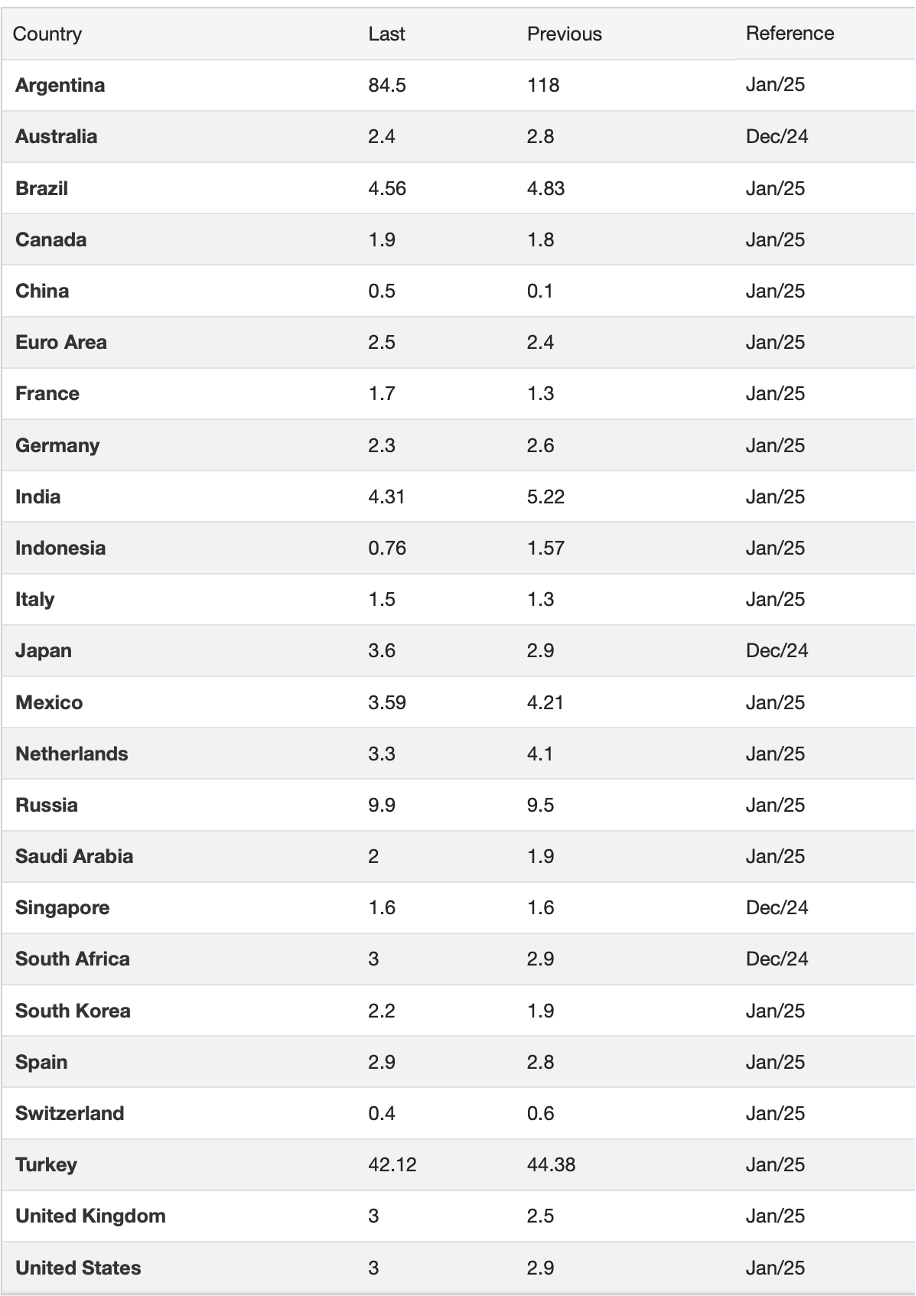
While most eyes remain on President Trump with his ongoing efforts to reduce the size of the US government, as well as his tariff discussions and efforts to negotiate a lasting peace in Ukraine, we cannot ignore the other things that go on around the world.  One of the big issues, which has almost universally been acclaimed a problem, is that inflation is higher than most of the world had become accustomed to pre-Covid.  As well, the virtual universal central bank goal remains the local inflation rate, however calculated, to be at 2.0%.  Alas for the central bankers in their seats today, that remains quite a difficult reach.  A quick look at the most recent headline CPI readings across the G20 shows that only 5 nations (counting the Eurozone as a bloc since they have only one monetary policy) are at or below that magic level as per the below table.

Source: tradingeconomics.com

Of those nations who are below, two, China and Switzerland, are actually quite concerned about the lack of price pressure and seeking to raise the inflation rate, and the other three (Canada, Singapore and Saudi Arabia) are right on the number, with core inflation readings tending higher than the headline reported here.

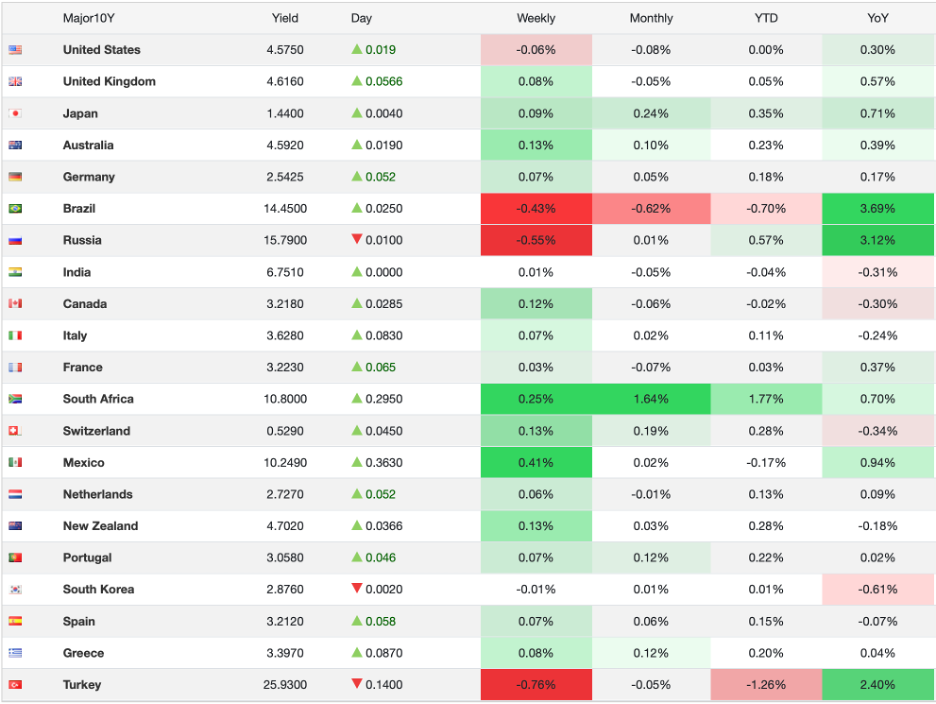
Perhaps a better way to highlight the problem is to look at the 10-year bonds of most countries and see how they have been behaving of late as an indication of whether investors are comfortable with the inflation fighting efforts by each nation.  While it is not universal, you can look at the column on the far right of the below table and see that 10-year yields have been rising for the past year.

Source: tradingeconomics.com

I only bring this up because, despite the fact that I have been downplaying central bank, especially the Fed’s, impact on markets, ultimately, every nation tasks their central bank to manage inflation.  That seems reasonable since inflation, as Milton Friedman explained to us in 1963, is “always and everywhere a monetary phenomenon.”  But perhaps you don’t believe that and are schooled in the idea that faster growth leads to higher wages and therefore higher inflation.  Certainly, Paul Samuelson’s iconic textbook (as an aside, Dr Samuelson was my Economics 101 professor in college) made clear that was the pathway.  Alas, as my good friend, @inflation_guy Mike Ashton, wrote yesterday, there is no evidence that is the case.  Read the article, it is well worth it and can help you start looking elsewhere for causes of inflation, like perhaps the growth in the money supply!

Of course, the reason that we continue to come back to inflation in our discussions is because it is critical to the outcomes in financial markets.  And that is our true focus.  It is the reason there is so much discussion regarding President Trump’s mooted tariffs and how inflationary they will be.  It is the reason that parties out of power continue to highlight any prices that have risen substantially in an effort to disparage the parties in power.  And it is the reason that central banks remain central to the plot of all financial markets, at least based on the current configuration of the global economy.  If there was only one financial lesson from the pandemic response, it is that Magical Money Tree Modern Monetary Theory is a failed concept of how to run policy.  This poet’s fervent hope is that Treasury Secretary Bessent is smart enough to understand that and will address fiscal issues in other manners.  I believe that to be the case.

Back to the UK, where CPI printed at 3.0%, 2 ticks higher than the median forecast, while core CPI printed at 3.7%.  This cannot be comforting for the BOE as most of the MPC remain committed to helping PM Starmer’s government find growth somehow and are keen to cut rates in support.  The problem they have is that inflation will not fade despite extremely lackluster GDP growth.  Recall, last week, even though the Q/Q GDP print of 0.1% beat forecasts, it was still just 0.1%.  Not falling into recession hardly seems a resounding victory for policy in the UK, especially since stagnation, or is it now stagflation, is the end result.  It should be no surprise that market participants have sold off the pound (-0.3%), Gilts (+5bps) and UK equities (-0.4%) and it is hard to find a positive way to spin any of this.  Again, while I have adjusted my views on Japan, the UK falls squarely in the camp of in trouble and likely to see a weaker currency.

Ok, let’s look elsewhere to see how things behaved overnight.  After a very modest rise in US equity indices yesterday, the Asian markets were mixed with the Nikkei (-0.3%) and Hang Seng (-0.15%) slacking off a bit although the CSI 300 (+0.7%) managed to find buyers after President Xi met with business leaders and the expectation is for further government stimulus, as well as a reduction in regulations, to help support the economy.  Australia (-0.7%) is still under pressure despite yesterday’s RBA rate cut as the post-meeting statement was quite hawkish, indicating caution is their approach for now given still sticky inflation.  (Where have we heard that before?)

In Europe, the only color on the screen is red with declines of between -0.4% and -0.9% as investors seem to be taking some profits after a solid run in most of these markets.  I guess the fact that European governments have been shown to be powerless in the world has not helped investor sentiment either as it appears these nations may be subject to more outside forces than they will be able to address adequately.  Lastly, US futures are unchanged at this hour (7:40).

In the bond market, as per the table above, yields are higher across the board with Treasuries (+2bps) the best performer as virtually all European sovereign issues have seen yields rise between 5bps and 7bps.  It simply appears that confidence in the Eurozone is slipping and demand for Eurozone assets is falling alongside that.

In the commodity markets, it should be no surprise that gold (+0.1%) continues to edge higher.  The barbarous relic continues to find price support despite the fact that interest in gold, at least in Western economies, remains lackluster at best.  There is much discussion now about an audit of the US’s gold reserves at Fort Knox and in the NY Fed, something that has not been performed since 1953.  Not surprisingly, there are rumors that there is much less gold in storage than officially claimed (a little over 8 tons) and rumors that there is much more which has not been reported but was obtained via seizures throughout history.  This story has legs as despite the lack of institutional interest in the US, it is picking up a retail following and we are seeing the punditry increasingly raise their price forecasts for the coming years.  As to oil (+0.8%) it is higher again this morning but remains in a tight trading range with market technicians looking at the $70/bbl level as a key support to hold.  A break there could well see a quick $5/bbl decline.

Finally, the dollar is modestly firmer this morning against most of its counterparts with most G10 currencies showing declines similar to the pound’s -0.2%, although the yen (+0.15%) is bucking that trend.  However, versus its EMG counterparts, the dollar is having a much better day, rising vs. PLN (-0.9%), ZAR (-0.7%) and BRL (-0.5%) on various idiosyncratic stories.  The zloty seems to be suffering from its proximity to Ukraine and the uncertainty with the future regarding a potential peace effort.  The rand is falling after the FinMin delayed the budget speech as internal squabbling in the governing coalition seems to be preventing a coherent message while the real is under pressure as inflation remains above target and the central bank’s tighter policy has been negatively impacting growth in the economy.

On the data front, this morning brings Housing Starts (exp 1.4M) and Building Permits (1.46M) and then this afternoon we see the FOMC Minutes from the January meeting.  That will be intensely parsed for a better understanding of what the committee is thinking.  We do hear from Governor Jefferson after the market closes, but generally, the cautious stance remains the most popular commentary.

Has anything really changed?  The market remains uncertain over Trump’s moves, the Fed remains on hold and cautious, and data shows that the economy continues to tick along nicely with price pressures unwilling to dissipate.  I see no reason to abandon the dollar at this point.

Good luck

Adf

Three-Three-Three

Said Bessent, when speaking of rates
The 10-year yield’s what dominates
Our focus and goals
As that’s what controls
Most mortgages here in the States
 
Remember, our goal’s three-three-three
With job one on deficits key
So, that’s why we’ll slash
The wasting of cash
With tax cuts set permanently


There is a new voice in Washington that matters to Wall Street, that of the new Treasury Secretary Scott Bessent.  Yesterday in his first significant comments since his swearing-in, he made very clear that he and the president were far more focused on the 10-year Treasury yield, and driving that lower, than they were concerned over the Fed funds rate.  Talk about a different focus than the last administration!  At any rate, he expounded on his views as to how that can be achieved, namely lower energy prices and a reduced budget deficit alongside deregulation.  Recall, his three-three-three plan is 3% budget deficit, 3mm barrels of oil/day additional supply and 3% GDP growth.  Clearly, this is a tall order given the starting point, but he has not shied away from these goals and insists they are achievable.

Yesterday also brought the Quarterly Refunding Announcement, the Treasury’s announced borrowing schedule for the current quarter.  Under then-Secretary Yellen, the US shifted its borrowing to a much greater percentage of short-term T-bills (<1-year maturity) while avoiding the sale of longer date notes and bonds.  This is something which Bessent has consistently explained his predecessor screwed up given her unwillingness to term out more debt when the entire interest rate structure was much lower.  After all, homeowners were smart enough to refinance down to 3% fixed rate mortgages, but the Treasury secretary thought it was a better idea to stay short.  

Of course, changing the current treasury mix is one of the impediments to lower 10-year yields because changing it would require an increase in the sale of longer dated paper which would depress the price and raise those yields.  Bessent has his work cut out for him.  However, my take is this is a goal, but one that will be achieved gradually.  He even commented that until the debt ceiling is raised, there will be no changes in the debt mix.  Arguably, if the administration can make real progress on reducing the budget deficit, that is what will allow for the gradual adjustment of the debt mix without a dramatic rise in long-term yields.

Perhaps it is still the honeymoon period, but the market is showing some deference to Mr Bessent as 10-year yields have fallen steadily in the past two weeks, dropping from a high of 4.81% the week before the inauguration to their current level at 4.44%.  

Source: tradingeconomics.com

While we cannot attribute the entire move to Bessent, certainly investors are showing at least a little love at this stage.  I believe the 10-year yield will grow in importance for all markets as movement there will be seen as the report card for Bessent and this administration’s goals.

Meanwhile, in the UK, stagflation
Is now the Old Lady’s vexation
But cut rates, they will
Lest growth they do kill
As prices continue dilation

The BOE is currently meeting, and expectations are nearly universal that they will cut their base rate by 25bps to 4.50% with 8 of the 9 MPC members set to vote that way.  The only hawk on the committee, Catherine Mann, is expected to vote for no change.  The problem they have (well the problem regarding monetary policy, there are many problems extant in the UK right now) is that core inflation continues to run above 3.0% while GDP is growing at approximately 0.0% in recent quarters and at 1.0% in the past year.  A quick look at the monthly GDP readings below shows that things have not been moving along very well, certainly not since PM Starmer’s election in July.

Source: tradingeconomics.com

In stagflationary environments, the most successful central bank responses have been to kill the inflation and suffer the consequences of the inevitable recession first, allowing growth to resume under better circumstances.  Of course, Paul Volcker is most famous for this model, which he derived after numerous other countries, notably the UK, failed to effectively solve the problem in the mid 1970’s in the wake of the first oil price shocks.  Now, the UK has created its own energy price supply shock via its insane efforts to wean itself from fossil fuels without adequate alternate supplies of energy, and stagflation is the natural result.  However, addressing inflation does not appear to be the primary focus of the Bank of England right now.  I am skeptical that they will be successful in achieving their goals which is one of the key reasons I dislike the pound over time.

Ok, let’s turn to market activity overnight.  The party continues on Wall Street with yesterday’s equity gains attributed to many things, perhaps Bessent’s comments being amongst the drivers.  Certainly, a reduced budget deficit and reduced 10-year yields are likely to help the market overall.  That attitude has been uniform overnight and through the morning session with every major Asian market (Japan, +0.6%, Hong Kong +1.4%, China +1.3%) and European market (Germany +0.8%, France +0.8%, UK +1.45%) higher on the session.  As it happens, the BOE did cut rates by 25bps as expected and now we await Governor Bailey’s comments.  As to US futures, at this hour (7:25) they are little changed on the session.

In the bond market, the ongoing rally has stalled for now with Treasury yields higher by 2bps this morning while most European sovereign yields are little changed on the day.  A key piece of information that is set to be released tomorrow comes from the ECB as their economists are going to report the ECB’s estimate of where the neutral rate lies in Europe.  With the deposit rate there down to 2.75%, many pundits, and ECB speakers, are targeting 2.0% as the proper level implying more rate cuts to come.

In the commodity markets, oil (+0.65%) is bouncing off its recent trading lows but in truth, a look at the chart and one is hard-pressed to discern an overall direction.  More choppiness seems likely as the market tries to absorb the latest information from the Trump administration and its plans.

Source: tradingeconomics.com

As to the metals markets, gold, which had a strong rally yesterday and made further new all-time highs, is unchanged this morning while silver (-0.75%) consolidates its recent gains and copper (+0.6%) adds to its gains.  The thing about copper is it is, allegedly, a good prognosticator of economic activity as it is so widely used in industry and construction, and it has been rallying sharply for the past month.  That does seem to bode well for future activity.

Finally, the dollar is firmer this morning, recouping some of its recent losses although I would contend we have merely been consolidating after a sharp move higher during the past three months.  The pound (-1.0%) is today’s laggard after the rate cut but we are seeing weakness almost everywhere in both G10 and EMG currencies.  One exception is the yen (+0.2%) which seems to be benefitting from comments by former BOJ Governor Kuroda that the BOJ is likely to raise rates above 1.0% during the coming year.  Interestingly, he explained that given the recent economic trajectory, it was only natural that the BOJ would seek to normalize rates.  However, given that interest rates in Japan have been 0.5% or below for the past 30 years, wouldn’t that be considered normal these days?  Just sayin’!

On the data front, with the BOE out of the way, we now get the weekly Initial (exp 213K) and Continuing (1870K) Claims data as well as Nonfarm Productivity (1.4%) and Unit Labor Costs (3.4%).  Yesterday’s ADP Employment data was much stronger than expected with a revision higher to last month as well, certainly a positive for the job outlook.  As well, this afternoon we hear from three more Fed speakers, but so far this week, the word caution has been the most frequently used noun in their vocabulary.  Of course, with Mr Bessent now starting to make his views known, perhaps more focus will turn there and away from the Fed for a while.

Market participants are clearly feeling pretty good right now, especially about the recent activity in the US.  I think you have to like US assets, both stocks and bonds, while expecting the dollar to continue to hold its ground.  This sounds like a recipe for weaker commodity prices, notably gold, but so far, that has not been the case.

Good luck

Adf

Deceit

Though many will claim it’s deceit
The Chinese declared they did meet
The target that Xi
Expected to see
Though skeptics remain on the Street
 
In fact, it appears there’s a trend
That data surprises all tend
To flatter regimes
And their stated dreams
As policy faults they defend


Last night, the Chinese released their monthly data barrage with final 2024 numbers as part of the mix. Despite numerous indications that Chinese growth is slowing, somehow, they managed to show a 5.4% annualized GDP growth rate for Q4 and a 5.0% GDP growth rate for all of 2024, right on President Xi’s target.  

Now, the government did add some stimulus in Q4 as they recognized things are not going well, and I continue to read articles that President Xi is starting to feel increased pressure from CCP insiders as to his stewardship of the nation and the economy.  Statistics like electricity usage and travel don’t really jive with the data, although it is certainly possible that ahead of the mooted tariffs that President Trump has threatened to impose starting next week, many companies preordered extra inventory to beat the rush, and that goosed growth.  

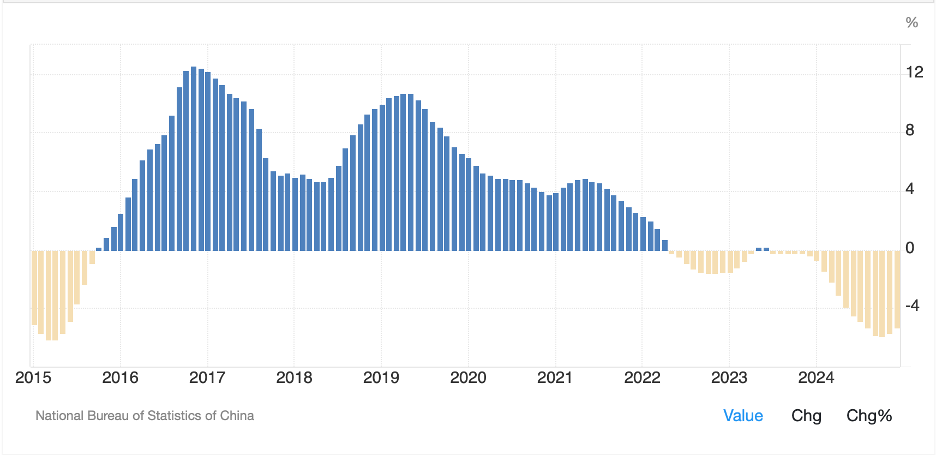
But there are a couple of things that continue to drag on the Chinese economy, with the primary issue the continuing implosion of the property market there.  For instance, while house price declines have been slightly slower, (only -5.3% last month) it has basically been three years since there was any gain at all as shown in the chart below.

Source: tradingeconomics.com

As well, one of the key concerns about China has been Foreign Direct Investment, which has not merely slowed down but has actually been reversing (companies leaving China) over the past two years as per the next chart.

Source: tradingeconomics.com

Meanwhile, a WSJ headline, China’s Population Fell Again Despite a Surprise Rise in Births, highlights yet another issue President Xi faces, the ongoing aging and shrinking of his nation.  Remember, GDP is basically the product of the number of people working * how much they each produce.  If that first number is shrinking, and the working age population in China is doing just that, it is awfully difficult to generate GDP growth.  Finally, I couldn’t help but notice in yesterday’s confirmation hearings for Treasury secretary, where Scott Bessent offered his view that China is actually in a recession, with massive deflation and are struggling to export their way out of the problems, rather than address their internal imbalances.  This is a theme that has been discussed widely in the past, and ostensibly, China has admitted they want to be more consumption focused in their economy, but it doesn’t appear that is the direction they are heading.

I raise these points in the context of the Chinese renminbi and how we might expect it to behave going forward.  The question of tariffs remains open at this stage, although I daresay we will learn more next week.  If they are imposed, there is a strong belief that the renminbi will weaken to offset the terms.  As it is, the currency remains within pips of its weakest level in 18 years and the trend, both short-term and for the past decade, has been for it to weaken further. 

Source tradingeconomics.com

Xi remains caught between the need for the currency to weaken to maintain competitiveness in the face of threatened tariffs from the US, and his desire to demonstrate that the renminbi is a stable store of value that other nations can trust to hold and use outside the global dollar network.  In the end, I expect the immediate competitiveness needs are going to overwhelm the long-term aspirations, especially if it is true that Xi is feeling internal pressure because of an underperforming economy.  Nothing has changed my view that we approach 8.00 by the end of the year.

Ok, and that’s really the big news overnight.  As an aside, it was interesting to watch Mr Bessent dismantle the attempts by the Democrat senators for a ‘gotcha’ moment.  As I wrote yesterday, it wasn’t really a fair fight given his intelligence, experience and understanding of markets and the economy compared to the Senators.

Let’s start in the equity world where US markets opened higher but ultimately slid all day long to close on their lows.  An uninspiring performance to say the least.  That performance weighed on much of Asia with the Nikkei (-0.3%) sliding alongside Australia, Korea and India.  On the plus side, modest gains were shown in China (Hang Seng and CSI 300 both +0.3%) and some positive numbers were seen in Taiwan, Malaysia and Singapore.  But overall, the movements were not substantial in either direction.  In Europe, though, markets are starting to anticipate more aggressive ECB rate cuts as data continues to show weakness in economic activity.  Weak UK Retail Sales data has the FTSE 100 (+1.3%) leading the way higher as hopes for a BOE cut grow.  Meanwhile, the CAC (+1.0%) and DAX (+1.0%) are both rallying on the thesis that Chinese growth is going to attract imports from both nations.  Meanwhile, US futures are higher by 0.4% at this hour (7:40).

In the bond market, all the inflation fears seem to have abated.  Either that or we continue to see a massive short squeeze and position unwinding.  But the result is yields are lower across the board with Treasury yields down 3bps further, and below 4.60% while European sovereign yields have fallen between -3bps and -5bps as investors take heart that the ECB and BOE are going to be cutting rates soon.  Perhaps the market is showing faith that Mr Bessent will be able to address the US fiscal financing crisis.  After all, he did explain in no uncertain terms that the US would not default on its debt.  But my sense is the market narrative about rising inflation and higher yields had really pushed too far, and this is simply the natural bounce back.  While this week’s inflation data was not as hot as feared, nothing has changed my view that inflation remains a problem going forward.

In the commodity markets, oil is unchanged on the day, having given back some of its substantial gains over the past two sessions, although it remains right near $79/bbl this morning.  Apparently, there are rumors Trump will end Russian oil sanctions as part of the Ukraine negotiations, but that doesn’t sound like something he would offer up initially, at least to me.  Meanwhile, NatGas (-4.0%) though slipping this morning, remains above $4/MMBtu as the US prepares for a major arctic cold snap next week.  In the metals markets, my understanding is there has been a lot of position adjustment and arbitrage between NY and London as we approach futures contract maturities, and that has been a key driver of the recent rally in metals (H/T Alyosha at Market Vibes, a very worthwhile trading Substack), but may be coming to an end in the next several sessions.  However, here, too, nothing has changed my longer-term view of higher prices over time.

Finally, the dollar is a tad stronger this morning, rallying vs. the pound (-0.4%), Aussie (-0.4%), NOK (-0.5%) and NZD (-0.5%) as all those ECB and BOE rate cut stories weigh on those currencies.  Interestingly, JPY (-0.3%) is also weaker this morning despite an article overnight signaling the BOJ will be raising rates next Friday.  On the flip side, looking at the EMG bloc, I see very modest gains by many of the key players (MXN +0.15%, ZAR +0.1%), although those moves feel far more like position adjustments than fundamentally driven changes in view.

On the data front, this morning brings Housing Starts (exp 1.32M) and Building Permits (1.46M) and then IP (0.3%) and Capacity Utilization (77.0%) later on.  There are no Fed speakers on the docket, and tomorrow is the beginning of the quiet period.  The last thing we heard from Cleveland Fed president Hammack was that inflation remains a concern and they have not yet finished the job.

For the day, I don’t think the data will have much impact.  Rather, as we are now in earnings season, I suspect that stocks will take their cues there and FX will remain in the background for now.

Good luck and good weekend

Adf

Will It Matter?

Will Japan hike rates?
How much will it matter if
They do?  Or they don’t?


Market activity and discussion has been somewhat lacking this week as the real fireworks appear to be in Washington DC where President-elect Trump’s cabinet nominees are going through their hearings at the Senate.  Certainly, between that and the ongoing fires in LA, the news cycle is not very focused on financial markets in the US.  This, then, gives us a chance to gaze Eastward to the Land of the Rising Sun and discuss what is happening there.

You may recall yesterday I mentioned a speech by BOJ Deputy Governor Himino where he explained that given the inflation situation as well as the indication that wages would continue to rise at a more robust clip in Japan, a rate hike may be appropriate.  Well, last night, Governor Ueda basically told us the same thing.  Alas, it seems that the BOJ takes a full day to translate speeches into English because there are no quotes from Ueda, but we now have the entire Himino speech from the day before.

Regardless, the essence of the story is that the BOJ is carefully watching the data and awaiting the Trump inauguration to see if there are any surprise tariff outcomes against Japan (something that has not been discussed) while they await their own meeting at the end of next week.  Market pricing now has a 72% probability of a 25bp rate hike next week, up from about 60% yesterday, and last night the yen did rally, climbing 0.7%.  However, a quick look at the chart below might indicate that the market is not overly concerned about a major yen revaluation.

Source: tradingeconomics.com

In fact, since the last BOJ meeting in December, when they sounded a bit more dovish than anticipated, the yen has done very little overall, treading water between 156.50 and 158.50.  While a BOJ rate hike would likely support the yen somewhat, there is another dynamic playing out that would likely have the opposite effect.  At the beginning of the year I prognosticated that the Fed may well hike rates by the end of 2025 as inflation seems unlikely to cooperate with their prayers belief that 2.0% was baked in the cake.  At the time, that was not a widely held view.  However, in a remarkably short period of time, market participants are starting to discuss the idea that may, in fact, be the case.  Even the WSJ today had a piece on the subject from James Mackintosh, one of their economics writers laying out the case.  The point here is that if tighter monetary policy by the Fed is in the cards, I suspect the yen will have a great deal of difficulty climbing much further.  Let’s keep an eye on the 156.00 level for clues that things are changing.

In England, inflation is rising
Less quickly than some theorizing
Meanwhile in the States
Jay and his teammates
Are hoping for data downsizing

Turning now to the inflation story, European releases were generally right on forecast except for the UK, where the headline rate fell to 2.5% while the core fell to 3.2%, 1 tick and 2 ticks lower than expected respectively.  Certainly, that is good news for the beleaguered people in the UK and it has now increased the odds that the BOE cuts rates at their next meeting on February 6th.  However, we cannot forget that the BOE’s inflation target, like that of the Fed, is 2.0%, and there is still limited belief that they will achieve that level even in 2025. But the markets did respond to the data with the FTSE 100 (+0.75%) leading the European bourses higher while 10-year Gilt yields (-8bps) have seen their largest decline in several weeks and are also leading European sovereign yields lower.  Interestingly, the pound has been left out of this movement as it is essentially unchanged on the day.  Perhaps there is a message there.

Which brings us to the US CPI data this morning.  after yesterday’s PPI data printed softer than expected at both the headline and core levels, excitement is building for a soft print and the resumption of the Fed cutting cycle.  However, it is important to remember that despite the concept that these prices should move together, the reality is they really don’t.  Looking at the monthly core movements below, while the sign is generally the same, the relationship is far weaker than one might imagine.

Source: tradingeconomics.com

In fact, since January 2000, the correlation between the two headline series is 0.04%, or arguably no relationship at all.  I would not count on a soft CPI print this morning based on yesterday’s PPI.  Rather, I am far more concerned that the ISM Services Prices Paid index last week was so hot at 64.1, a better indicator that inflation remains sticky.  But I guess we will all learn in an hour or two how it plays out.

Ahead of that, let’s look at the rest of the overnight session.  Yesterday’s mixed US equity performance (the NASDAQ lagged) was followed by mixed price action overnight with the Nikkei (-0.1%) edging lower on the modestly stronger yen and talk of a rate hike, while the Hang Seng (+0.3%) managed a gain on the back of Chinese central bank activity as the PBOC added more than $130 billion in liquidity ahead of the Lunar New Year holiday upcoming.  However, mainland shares (CSI 300 -0.6%) did not share the Hong Kong view.  Elsewhere in the region Taiwan (-1.25%) was the laggard while Indonesia (+1.8%) jumped on a surprise rate cut by the central bank there.

In Europe, though, all is green as gains of 0.4% (CAC) to 0.8% (DAX) have been driven by ECB comments that rate cuts are coming as concerns grow over the weakness of the economies there.  Germany released its GDP data and in 2024, Germany’s GDP shrank by -0.2%, the second consecutive annual decline and the truth is, given the combination of their insane energy policy and the fact that China is eating their proverbial lunch with respect to manufacturing, especially in the auto sector, it is hard to look ahead and see any positivity at all.  Meanwhile, US futures are higher by 0.5% or so at this hour (7:00) clearly with traders looking for a soft CPI print.

In the bond market, Treasury yields are lower by 3bps this morning but remain just below 4.80% and the 5.0% watch parties are still hot tickets.  European yields have also softened away from Gilts, with the entire continent lower by between -2bps and -4bps.  Right now, with dreams of a soft CPI, bond bulls are active.  We shall see how that plays out.

In the commodity space, oil (+0.3%) is modestly firmer after a reactionary sell-off yesterday.  The IEA modestly raised its demand forecast and supplies in the US, according to the API, were a bit tighter yesterday, so that seems to be the support.  NatGas is little changed right now while metals markets (Au +0.4%, Ag +0.5%, Cu +0.4%) are edging higher although mostly remain in a trading range lately.  Activity here has been lackluster with no new story to drive either direction.

Finally, the dollar is a touch softer overall, but away from USDJPY, most movement is of the 0.1% variety. Right now, the FX markets are not garnering much interest overall.

On the data front, expectations for CPI are as follows: Headline (0.3%, 2.9% Y/Y) and Core (0.2%, 3.3% Y/Y).  As well, we see Empire State Manufacturing (3.0) and then the Beige Book at 2:00pm.  We also have three Fed speakers, Williams, Kashkari and Barkin, but are they really going to alter the cautionary message?  I doubt it and the market continues to price a single 25bp cut for all of 2025.  The real fireworks will only come if/when price hikes start to get priced in as discussed above.

It is hard to get excited for market activity today as all eyes remain on the confirmation hearings and LA.  As such, I suspect there will be very little to see today.

Good luck

Adf

Nearly Obscene

The FX Poet will be in Nashville at the AFP Conference October 21-22, speaking about effective ways to use FX options in a hedging program.  Please come to the presentation on Monday at 1:45 in Grand Ballroom C1 if you are there.  I would love to meet and speak.
 
While here in the States we have seen
Inflation that’s nearly obscene
In Europe, inflation
In ‘bout every nation
Has fallen much more than foreseen
 
The narrative there has adjusted
As all of their models seem busted
So, cuts with more speed
We’ll soon see proceed
Though central banks still aren’t trusted

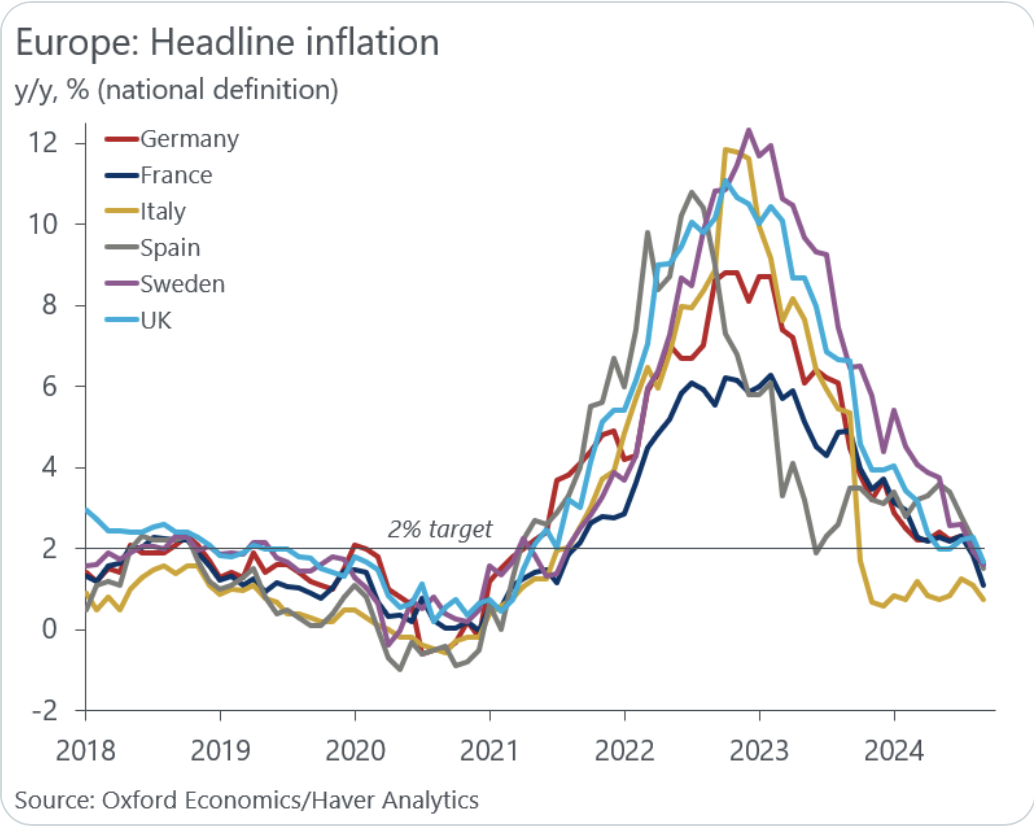
While Fed speakers are trying to claim victory over inflation, whether or not that is reality, the situation in Europe is a bit different.  In fact, headline inflation has fallen quite dramatically virtually across the board as evidenced by the below chart.

Now, a critical piece of this decline is the fact that energy prices have fallen dramatically in the past year with Brent Crude (-16.5%) and TTF NatGas (-18.9%) leading the way lower.  In fact, core inflation data, for the few nations that show it, remains above that 2% target with the UK (Core 3.2% Y/Y) the latest to report this morning.  One other thing to remember is that in the wake of the Covid pandemic, no nation printed and spent nearly as much money as the US on a relative basis, let alone an absolute basis, so there was less fiscal largesse elsewhere.

Yet, the fact remains that headline inflation throughout Europe and the UK has fallen below the 2% targets and so the narrative has now shifted to see more aggressive rate cuts by the central banks everywhere.  This will be part of the discussion tomorrow at the ECB, where most analysts are looking for a 25bp cut although some are calling for 50bps, and the market is pricing more than 40bps at this point.

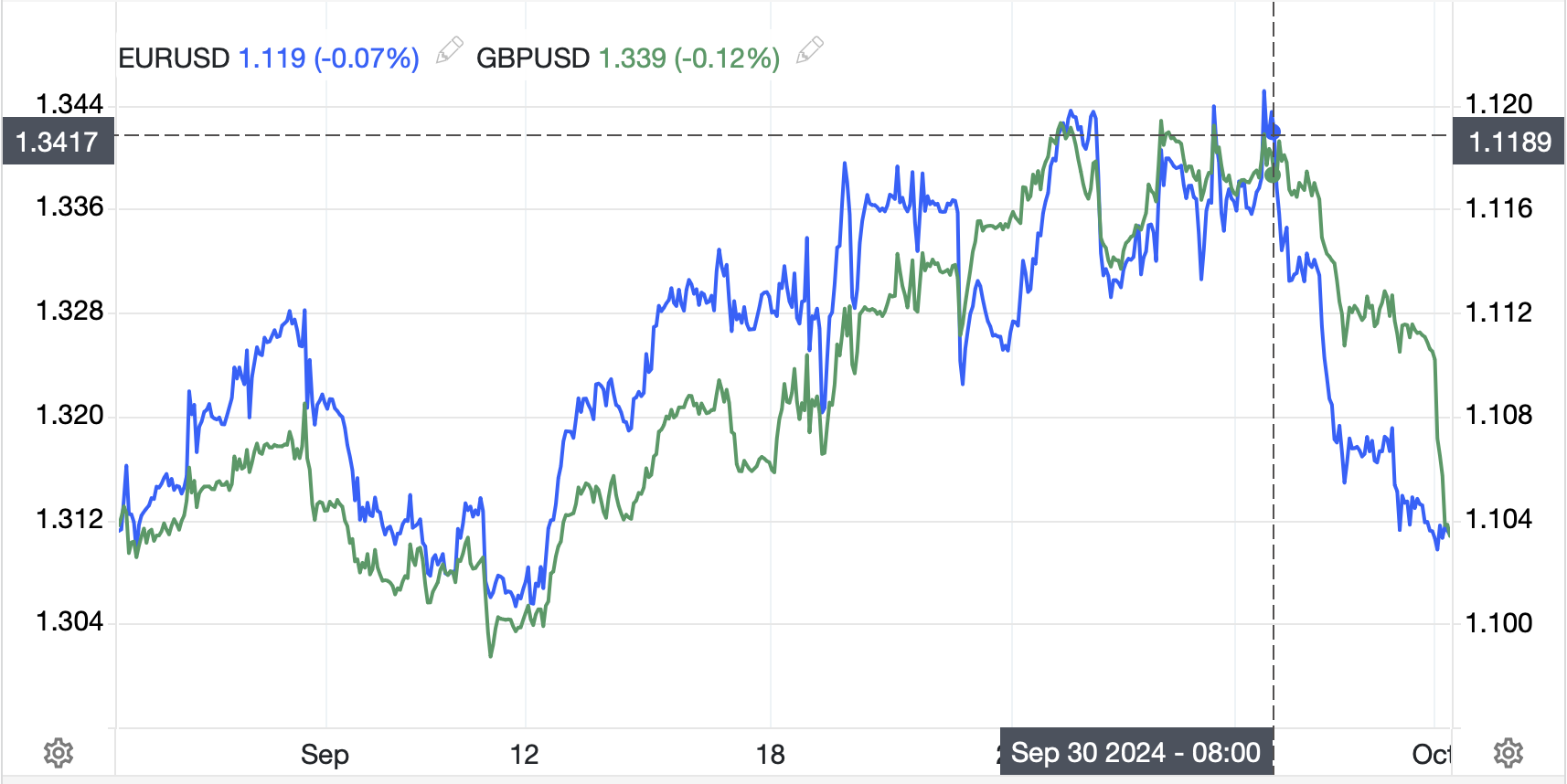
You know what else is pricing a larger rate cut by the ECB?  The FX market.  Yesterday, the euro fell below the 1.09 level for the first time in more than two months (remember that chart of the double top formation from Monday?) and the single currency has fallen more than 2% in the past month.  Similarly, the pound, after today’s softer than expected CPI readings, has fallen -0.35% this morning, the worst performer in the G10, and is now lower by nearly -1.5% in the past month and looking like it has reversed the uptrend that existed through the summer and early autumn.

Ultimately, my point is that the narrative about rate cuts is shifting to a more accelerated mode in Europe and the UK (where talk of a 50bp cut is making the rounds as well) while here in the States, a 25bp cut is not fully priced in even after yesterdays’ much weaker than expected Empire State Manufacturing Index (-11.9 vs. exp 3.8 and last month’s +11.5).  If you want a reason to explain the dollar’s resilience, you could do worse than the fact that economies elsewhere in the world are lagging the performance here.

Speaking of the Fed, yesterday’s surprise Fedspeak came from Raphael Bostic, Atlanta Fed president, when he explained that he only foresees one more rate cut in 2024.  That is quite a different story than we have been hearing from the rest of the FOMC speakers, who seem completely on board with at least 50bps of cuts and seemingly could be persuaded to head toward 75bps.  There is still much to learn between now and the next FOMC meeting the day after the election here, but despite Bostic’s comments, I believe the minimum we will see before the end of the year will be 50bps.

Ok, that was really all the action overnight.  Yesterday’s disappointing US equity performance, with all three major indices lower by at least -0.75% (I thought that was outlawed 🤣) was followed by similarly weak performance in Asia with the Nikkei (-1.8%) leading the way lower as tech shares underperformed, but further weakness in China (-0.6%) as Godot seems more likely to arrive than the Chinese stimulus.  Throughout the region, only Thailand (+1.2%) managed any gains after the central bank there cut rates 25bps in a surprise move seeking to foster a better growth situation.  In Europe, only the UK (+0.6%) is rallying on the strength of the idea that lower inflation will encourage a 50bp cut from the BOE when they meet the day after the Fed. But otherwise, red is the color of the day in Europe with losses ranging from -0.1% (Spain) to -0.6% (France).  Meanwhile, US futures are a touch firmer at this hour (7:15), by just 0.2%.

In the bond market, yields are lower across the board after that weak Empire State number encouraged the slowing economy narrative and the lower inflation prints in Europe and the UK have weighed on yields there this morning.  So, Treasury yields (-2bps) are lagging most of Europe (Bunds -3bps, OATs -3bps) and UK Gilts (-8bps) are all about the data this morning.  Even JGB yields (-1bp) got into the act.

In the commodity space, oil (-0.5%) is continuing its recent decline, although yesterday it managed to bounce a bit and close above the $70/bbl level where it still sits, barely.  But the metals complex is having another good day with gold (+0.6%) pushing to new all-time highs as western investors are finally following Chinese and Indian investors as well as global central banks.  The lower interest rates certainly help here.  Similarly, we are seeing gains in the other metals (Ag +1.2%, Cu +1.1%) as stories regarding shortages for both metals in the long-term resurface given the lack of new mining activity and increased demand driven by the idea of increased solar and electricity needs respectively.

Finally, the dollar, overall, is little changed, holding onto its recent gains although with a mixed performance this morning.  ZAR (+0.5%) is this morning’s leader on the back of the metals market gains, and we have seen strength in KRW (+0.3%) as well.  However, elsewhere, movement is small and favoring the dollar (HUF -0.2%, CZK -0.2%) and we’ve already discussed the euro and pound.  Interestingly, the THB (+0.45%) rallied after the rate cut on the back of equity inflows.

There is no major data set to be released this morning and no Fed speakers on the current calendar, although as always, I suspect we will still hear from some of them.  Madame Lagarde speaks this afternoon, and given the ECB meeting tomorrow, there will be many interested listeners.

Overall, the themes seem to be that Eurozone inflation is sinking and rate cuts are coming.  That should keep some downward pressure on European currencies vs. the dollar, at least until we see or hear something that describes a more aggressively dovish Fed.  The one truly consistent feature of these markets has been the rally in gold which seems to benefit from fear, inflation and lower rates, all of which appear to be in our future.

Good luck

Adf

Surprise!

Ishiba explained
He was just kidding about
Tight money…surprise!


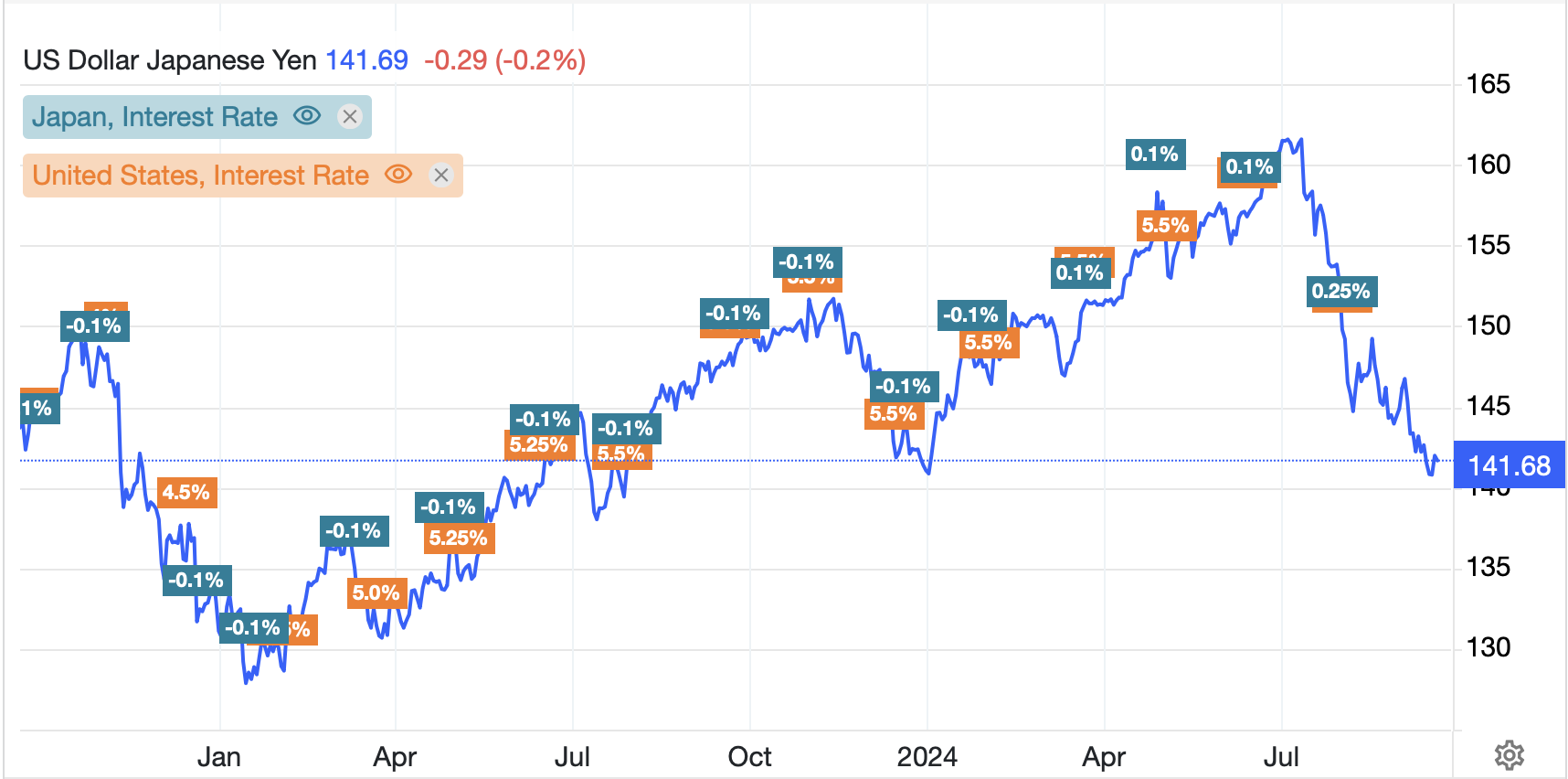
So, yesterday’s biggest mover was JPY (-2.1%), where the market responded to comments by new PM Ishiba that all his previous comments regarding policy normalization were not really serious (and you thought Kamala flip-flopped!)

Here are his comments in the wake of that massive 12% decline in the Nikkei back in early August:

“The Bank of Japan (BOJ) is on the right policy track to gradually align with a world with positive interest rates,” ruling party heavyweight Shigeru Ishiba told Reuters in an interview.

“The negative aspects of rate hikes, such as a stock market rout, have been the focus right now, but we must recognize their merits, as higher interest rates can lower costs of imports and make industry more competitive,” he said.

And here are his comments after meeting with BOJ Governor Ueda Wednesday morning in Tokyo:

“From the government’s standpoint, monetary policy must remain accommodative as a trend given current economic conditions.”

See if you can tell the difference.  The below chart includes the market response to his election last week as well as its response since uttering those last words early yesterday morning.

Source: tradingeconomics.com

Remember the idea that the carry trade was dead and completely unwound?  Well, now the talk is its coming back with a vengeance between Powell sounding less dovish, Ishiba sounding more dovish and then yesterday’s ADP Employment Report printing at a higher-than-expected 143K.  Maybe all those rate cuts that had been priced are not going to show up in traders’ Christmas stockings after all.  Certainly, the Nikkei (+2.0%) was pleased with the weaker yen which has fallen further this morning (-0.2%) after further comments from BOJ member Noguchi calling for more time to evaluate the situation before considering tighter policy.  In fairness, though, Noguchi-san is a known dove and voted against the rate hikes back in July.  Summing it all up here, it is hard to make a case currently for the yen to strengthen too much from here.  Rather, a test of 150 seems the next likely outcome.

In England, the Old Lady’s Guv
Explained that he’s really a dove
He’ll be more aggressive
Though not quite obsessive
While showing investors some love

The other big mover this morning is the British pound (-1.1%) which is responding to an interview BOE Governor Bailey had in The Guardian where he explained he could become “a bit more aggressive” in their policy easing stance provided inflation data continues to trend lower.  Now, prior to the interview, the OIS market was already pricing in a 25bp cut at the next meeting in November, and 45bps of cuts by year end, and it is not much changed now.  But for whatever reason, the FX market decided this was the news on which to sell pounds.  

Remember, as I’ve repeatedly explained, the dollar’s demise is likely to be far slower than dollar bears believe because now that the Fed has begun cutting rates, and nothing is going to stop them going forward for a while, other central banks will feel empowered to cut as well.  The only way the dollar falls sharply is if the Fed is the most dovish central bank of the bunch, but Monday, Chairman Powell made clear that was not the case.  In fact, yesterday, Richmond Fed president Barkin was the latest to explain that things look good, but they are in no hurry to cut aggressively.  Other central banks are now in a position to ease policy more aggressively, something many had been seeking to do as economic activity was slowing in their respective countries, without the fear of a currency collapse. 

It was just a few days ago that I highlighted key technical levels the market was focused on, which if broken might herald a much weaker dollar.  Across the board, we are more than 2% from those levels (EUR 1.12, GBP 1.35, DXY 100.00) and traveling swiftly in the other direction.  A quick peek at the chart below shows that while the exact timing of these moves was not synchronized, the outcome is the same.

Source: tradingeconomics.com

Moving beyond the FX market, where the dollar is stronger literally across the board, the economic story continues to muddle along.  Services PMI data was released this morning with most of Europe looking a bit better, although the Italians were lagging, but not enough to get people excited about European assets in general.  Equity markets on the continent are mixed with both the DAX (-0.6%) and CAC (-0.8%) under pressure while Spain’s IBEX (+0.1%) and the FTSE 100 (+0.25%) buck the trend on the back of Spain’s best in class PMI data and, of course, the UK rate cut frenzy.  As to last night’s Asian markets, while China remains closed, the Hang Seng (-1.5%) gave back some of yesterday’s gains and the rest of the region was unconvinced in either direction.  While US markets eked out the smallest of gains yesterday, futures this morning are pointing lower by -0.4% or so at this hour (6:45).

In the bond market, Treasury yields are higher by 3bps this morning, as the market absorbs the idea that the Fed may not be cutting in 50bp increments each meeting and traders responded to a much better than expected ADP Employment Report yesterday (143K, exp 120K) so are prepping for a good NFP number tomorrow. Meanwhile, European sovereign yields are all higher by between 5bps and 7bps as they catch up to yesterday’s Treasury move, much of which occurred after European markets were closed.  One thing to keep in mind here is that bond markets, at least 10-year and longer maturities, are far more concerned with the inflation outlook than the central bank discussion.  Right now, as the world awaits Israel’s response to the Iranian missile attack, concerns are rife that oil prices could move much higher and take inflation readings along for the ride.  If you add that to the idea that 3% is the new 2% for central bank inflation targets, something which is also gaining credence in the market, the case for higher bond yields is strong.

Speaking of oil markets, once again this morning the black sticky stuff is higher (+2.0%) amid those Middle East conflagration fears.  As I highlighted yesterday, if Israel were to attack Iran’s oil fields and knock a large portion offline, I would expect oil to get back to $100 in a hurry.  And if the damage was sufficient to keep it offline for many months, we could stay there.  However, the combination of the stronger dollar and higher oil prices has taken a toll on the metals markets with all the major metals weaker this morning (Au -0.5%, Ag -1.1%, Cu -1.5%).  This strikes me as a short-term phenomenon as the fundamental supply/demand issues remain in favor of higher prices and anything that drives inflation higher will help price as well.  But not today.

As to the dollar, I have already discussed its broad-based strength with gains against literally all its G10 and EMG counterparts.  It will take some pretty bad US data to change this story today.

Speaking of the data, as it’s Thursday, we get the weekly Initial (exp 220K) and Continuing (1837K) Claims data as well as ISM Services (51.7) and Factory Orders (0.0%).  Yesterday, in a surprise, EIA oil inventories rose, a welcome outcome, but not enough to offset the Middle East fears.  The only Fed speaker on the calendar today is Atlanta Fed president Bostic, one of the more hawkish members, so my guess is he is likely to continue to preach moderation in rate cuts.  Speaking of the Atlanta Fed, their GDPNow reading fell to 2.5% for Q3 after the weaker than expected construction spending the other day, but it remains above the Fed’s estimated long-term trend growth rate.

Putting it all together, I can see no good reason for the dollar to reverse this morning’s gains absent a Claims number above 250K.  The hyper dovishness that had been a critical part of the dollar decline story has been beaten back.  Of course, tomorrow brings the NFP report, so anything can still happen.  

Good luck

Adf

Fednesday

Well, Fednesday is finally here
And traders, for fifty, still cheer
But arguably
The prices we see
Account for a half-point rate shear
 
So, if they just cut twenty-five
Prepare for a market nosedive
The doves will all scream
Jay’s killing the dream
While hawks everywhere all will thrive


First, I did not create the term Fednesday, I saw it on Twitter but thought it quite appropriate.  In fact, looking, I cannot determine who did create it but kudos to them.

As I have already written twice on the subject of today’s meeting, I will be brief this morning, especially because not much has changed.  Yesterday’s stronger than expected Retail Sales data resulted in Fed funds futures reducing the probability of a 50bp hike during the session, but overnight, we have returned to the 65%/35% probability spectrum for a 50bp cut.  I continue to believe that will be the case based on the number of articles we have seen in the mainstream media about the merits of a 50bp cut, mostly centering on the idea that rates are “too” high despite the fact that growth continues apace, the employment situation remains solid, if cooling somewhat, and inflation remains well above target.  Perhaps the big surprise will be that there will be a dissent on the vote, something we have not seen in two years.  (In fact, the last time a governor dissented was 2006 I believe).  

But something I have not touched on is the dot plot which will give us an idea as to the members’ collective belief for the rest of the year.  For instance, if the dot plot indicates Fed funds will be at 4.5% by year end, then 25bps today will be followed by at least one 50bp cut.  That should be net equity bullish and bearish for the dollar.  If the dot plot indicates only 75bps of cuts, so 4.75% at year end, my take is that will be seen as somewhat hawkish overall, and we should see risk assets decline while the dollar rallies.  Finally, if it is more than 100bps expected, I think that could be a situation of the market asking, what does the Fed know that we don’t?  That would not be a positive for risk assets but would also hammer the dollar.  Bonds would rally as would gold.  At least those are my views.

Moving on, tomorrow brings a BOE meeting where the current expectation is for no cut, although one is priced for the next meeting in the beginning of November.  Early this morning, the UK released its inflation report which showed headline CPI at 2.2%, as expected while the core rate rose to 3.6%, a tick more than expectations and up 0.3% from the July reading.  Arguably, that is what has the BOE concerned, the fact that despite the decline in energy prices which has taken headline CPI lower, the underlying stickiness of inflation remains extant within the UK.  As well, the UK also released its PPI data, all of which showed declines greater than expected, if nothing else implying that UK corporate margins should be healthy.  The pound (+0.35%) has rallied on the news, although the dollar is weaker overall, so just how much of this move is UK related is open to debate.  I guess we can say that the short-term differences in central bank stance is likely to continue to help the pound for a while.  In fact, the pound is back to levels last seen in summer 2022 and there is a growing bullish sentiment for the currency based on current perceptions of the divergence between the Fed and BOE.  My view is the BOE will fall in line pretty quickly so this will change, but for now, especially with the dollar under broad pressure, the pound has further to go.

On Friday we’ll learn
If Ueda can once more
Surprise one and all

The other central bank meeting this week is the BOJ early Friday morning.  Currently, there is no expectation of a BOJ policy change although many analysts are looking for a rate hike by December.  However, I think it is worth looking at USDJPY in relation to the policy adjustments we have seen by both central banks over the past several years.  Hopefully you can see in the chart below that the exchange rate here has returned to the level when the Fed last raised rates in July 2023.  

Source: tradineconomics.com

Since then, after a dramatic further decline in the yen, with both policy rates on hold, the BOJ first adjusted the cap on YCC higher (from 0.50% to 1.0%) then eventually raised the policy rate from -0.1% to +0.25% where it is today.  During that time, Ueda-san has surprised markets several times, and has had help from the MOF regarding intervention, taking a completely different approach to the process than the Fed, who never wants to surprise markets. With this in mind, we must be prepared for another surprise on Friday.  One thing to remember is that the BOJ meeting announcement occurs after the market in Tokyo closes, so even though other markets, and of course the FX market will be able to respond, the Tokyo equity and JGB markets won’t be able to move until Monday.  The point is the reaction may take time to play out.  In this situation, I don’t have enough information to take a view, but I will say that if he tightens policy in any manner, USDJPY is likely to fall much further.

One other thing I realize is that I have not discussed QT/QE.  If the Fed changes that process, the current $25 billion/month of balance sheet runoff, that will be extremely dovish and be quite a boost for stocks, bonds and commodities while the dollar will get run over.

Ok, heading into this morning, and after a mixed and lackluster session yesterday in the US, Asian equity market all rallied with Japan (+0.5%) continuing its recent rally, while even mainland Chinese shares (CSI 300 +0.4%) managed a gain today.  However, European bourses are all softer this morning with the FTSE 100 (-0.6%) lagging after the higher-than-expected inflation data driving concerns the BOE won’t cut rates much.  But screens everywhere are red, albeit only modestly so.  US futures are currently (7:45) edging slightly higher as I continue to believe traders and investors are looking for a 50bp cut.

In the bond market, yields are higher across the board as the euphoria we have seen lately seems to be running into a bit of profit taking with Treasury yields higher by 3bps and European sovereign yields all higher by between 4bps and 6bps.  Perhaps the one surprise is that JGB yields are unchanged this morning as there seems to be no anticipation of a BOJ move, at least not yet.

In the commodity markets, oil (-1.0%) is giving back some of its recent gains but remains above $70/bbl.  It seems that the stories of a massive military strike by Ukraine deep in Russia have raised concerns amongst the punditry of an escalation of the war there, but it has not concerned energy markets, at least not yet.  In the metals markets, gold (+0.2%), which sold off yesterday, continues to find support while copper has been on a roll and has risen once again.  

Finally, as mentioned above, the dollar is softer overall against all its G10 counterparts and most EMG currencies as well. The one outlier here was KRW (-0.35%) where traders are starting to price in rate cuts by the BOK after yet another mild inflation report earlier this week.

Ahead of the Fed we see Housing Starts (exp 1.31M) and Building Permits (1.41M) as well as the EIA oil inventory data where expectations are for no real changes.  Until the FOMC release, look for quiet markets. Afterwards, I’ve given my views above.

Good luck

Adf

A Stock Jamboree

Said Jay, there are two goals we seek
Strong job growth while prices are weak
And as I sit here
The way things appear
Come autumn, Fed funds we may tweak

The market responded with glee
Twas truly a stock jamboree
Plus, bonds joined the fun
And went on a run
The dollar, though, sank in the sea

At this point, the only question in market participants’ minds is whether the Fed will cut 25bps or 50bps in the September meeting.  Yesterday afternoon, as widely expected, the FOMC left rates unchanged and tried to offer a balanced view of the future, explaining that both of their dual mandate goals were normalizing.  Obviously, inflation, which has been their primary focus for the past two years, has been moving in the right direction and Chairman Powell reiterated that they are gaining ‘confidence’ that they will achieve their 2% target.  But this time, Powell spent more time describing the job market and how it was now coming into balance.  In other words, what had previously been a significant inflationary pressure in the Fed’s collective view, was now having less of an impact on prices.

At the press conference, Powell would not be pinned down on a September cut, although based on pricing in the Fed funds futures market, you would be hard pressed to believe that.  This morning, the market is pricing more than 28bps of rate cuts (a 13.5% probability of a 50bp cut) into the September meeting, so the key will be to watch how that probability of a 50bp cut evolves.  If we start to see hard data, like tomorrow’s NFP or CPI, in two weeks’ time, decline, I’m confident that the market will be calling for a 50bp cut before long.

In the end, the recent correction seen in risk asset markets seems to have been just that, a correction, and now the narrative is that there are blue skies ahead with lower rates to support things and the Fed is going to stick the soft landing.  This poet is less certain that the best case will obtain, but that’s what makes markets.

So, even though we have not yet heard from the third major central bank as I write (the BOE is due to announce in a few hours’ time), I don’t think that is going to impact the global narrative.  Let me start by saying that I believe they will cut rates in the UK as yesterday’s activities in the US make it all but certain a cut is coming here, and given the ECB, BOC and Riksbank have all cut already, they have plenty of company.  However, let’s recap where things are now and what the market narrative is now explaining to us all.

Policy normalization is the new watchword as we hear that the BOJ is normalizing policy by raising interest rates and tightening while the rest of the G10 are normalizing policy by cutting rates and ending activities like QT.  I guess the definition that the punditry ascribes to normal policy is, every country has the same interest rate!  In fact, I say that only half tongue in cheek, as there is some merit to the discussion.  While it is certainly true that global economies have evolved in greater synchronicity over the past decades, interest rate policy has always been based on the idiosyncrasies of each economic area.  For instance, money supplies and productive capacities differ widely amongst countries, so why should we believe that the “proper” monetary policy is the same level of interest rates across the board.  Of course, we shouldn’t, but for market participants, it is much easier if they have one target for everything rather than being forced to understand each economy in its own right.

But with that in mind, let’s recap where things currently stand around the major economies.

1.     US – economic activity is slowing, but the pace of that slowdown is very modest, at least based on the recent GDP reading.  Inflation is slowly receding but has not yet achieved the Fed’s target and the jobs market has, to date, held up reasonably well.  Of course, we will know more about that tomorrow.  On the flip side, the manufacturing portion of the economy has been the laggard, with PMI and regional Fed surveys pointing to subpar activity.  There seems to be a disconnect between the slowing economy and the roaring equity market, but markets have a life of their own.
2.     Europe – economic activity overall is modest with a reversal in the weak vs. strong players as Germany is the sick man of Europe and the PIGS economies are all faring far better.  Inflation here is a bit stickier than it seems in the US as evidenced by yesterday’s higher than expected readings and remains well above the 2% target here.  Most nations are seeing more substantial weakness in their manufacturing sectors, although for some (I’m looking at you Germany) it is self-inflicted based on insane energy policies driving energy costs much higher.
3.     Japan – recent growth signs have been quite poor with a negative GDP release just last week indicating things are not going well.  This has been accompanied by above target inflation, which while seeming to slow, is slowing very gradually.  In fact, this is the one place where the FX rate seems to really have had an impact, with the yen’s previous weakness adding to inflationary pressures and offsetting their very modest monetary policy tightening.  However, the combination of the BOJ hiking and the Fed seeming to promise a cut has led the yen to recoup nearly 8% over the past several weeks and now that USDJPY is below 150, I expect to see this move continue.  That should help ameliorate some of the inflation pressures, although it is not clear to me it will help economic growth.
4.     China – last night’s Caixin Manufacturing PMI was a disappointing 49.8, down two points and below expectations.  The indication is that economic activity in China remains hampered by the lack of consumer activity.  China’s long-term policy of mercantilism is running into its limits as nations around the world are unwilling to take their excess production freely, and the domestic economy remains in the doldrums, still suffering from the ongoing deflation of the property bubble.  While the PBOC did reduce interest rates recently, the fact that neither the Third Plenum nor the Politburo were willing to inject real stimulus into the economy indicates that things are going to remain lackluster going forward.

Arguably, the lesson from this recap is that economic activity is in a downtrend and that inflation is also in a downtrend, just a shallower one.  Policy makers around the world are struggling to find the right mix because oftentimes, the right mix means something politically difficult.  Net, I expect this process will continue and that we will see more and more efforts to turn around the economic trend while ignoring the inflation trend.

Ok, this has turned into more than I expected, so let’s be quick on markets today.  Yesterday’s Fed led to a huge tech sector rally in the US but that was not enough to help the rest of the world.  Despite that optimism, Japanese shares (-2.5%) were down sharply on the continued strength of the yen, while Chinese shares, in both Hong Kong (-0.25%) and the mainland (-0.7%) saw no love either.  In fact, the whole region was under water.  The same is true in Europe this morning with all the continental bourses lower on average by -0.65% or so after continued weak PMI data was released this morning.  The only exception here is the UK, where the FTSE 100 is now higher by 0.3% after the BOE, as I expected, cut rates by 25bps at 7:00am.  As to US futures, euphoria is still alive and they are all higher at this hour, just past 7:00.

In the bond market, yields are declining around the world led by Treasury yields which fell 10bps yesterday, although they have rebounded by 2bps this morning.  2yr yields also fell a similar amount so the yield curve’s inversion remains at -23bps this morning.  In Europe, yields also slid yesterday, albeit not as much as in the US and are a further 2bps lower this morning as they try to catch up.  The exception here is the UK, again, as 10yr Gilt yields are lower by 5bps this morning in the wake of the BOE cut.  JGB yields overnight fell 1bp, although given the move in Treasury yields, that gap has still narrowed substantially.

In the commodity markets, oil (+0.9%) continues to rally as fears over an Iranian retaliation against Israel grow with no clear idea where this will stop.  Consider, though, WTI remains below $80/bbl still, so right in the middle of its longer term range.  I imagine we could see a bump higher, but remember, OPEC has a lot of spare capacity, so if some countries are forced to stop producing, the Saudis can turn on the taps.  Gold (-0.4%) is backing off the new all-time highs it reached yesterday, but remains far above $2400/oz.  In fact, all the metals markets saw gains yesterday and this morning they are ceding some of those gains, but I don’t think this story has changed; if the Fed gets more aggressive, I expect these commodity prices to rise further.

Finally, the dollar is on fire this morning, rallying against everything but the Swiss franc right now.  The pound (-0.7%) is under the most pressure in the G10 after the rate cut, but we are seeing weakness everywhere else but Norway and Switzerland.  Even the yen, which had broken through the 150 level earlier this morning is now back below (dollar above) that level, although I expect there are further declines to come here in the dollar.  One other surprisingly large mover is CNY (-0.4%) which has given back more than half its gains from the activities last week involving the PBOC rate cuts and intervention.  Remember, if the yen continues to strengthen, the renminbi will be able to do so at a very gradual rate and maintain increased competitiveness vs. Japanese exports.

On the data front, this morning brings Initial (exp 236K) and Continuing (1860K) Claims, Nonfarm Productivity (1.7%), Unit Labor Costs (1.8%) and ISM Manufacturing (48.8).  Remarkably, there are no Fed speakers on the schedule, but I imagine they will not be able to keep quiet for long.  However, while there is a definite glow amongst investors, all eyes will turn to tomorrow’s NFP data, where a hot number will not be taken well, at least not at first, but if we print below NFP expectations, look for stocks to rock on a growing expectation of 50bps in September.  That will also hurt the dollar, which should retrace some of today’s gains.

Good luck
Adf