Ere Recession Arose

There once was a Fed Chair named Jay
Who fought ‘gainst the prez every day
He tried to explain
That tariffs brought pain
So higher rates needed to stay
 
But data turned out to expose
The job market, which had no clothes
So, he and his friends
Were forced, in the end
To cut ere recession arose


The Fed cut 25bps yesterday, as widely expected (although I went out on a limb and called for 50bps) and markets, after all was said and done by Chair Powell, saw equities mixed with the DJIA rising 0.6% while the S&P 500 and NASDAQ both slipped slightly.  Treasury yields rose 5bps which felt much more like some profit taking after a month-long rally, than the beginning of a new trend as per the chart below.

Source: tradingeconomics.com

Gold rallied instantaneously on the cut news, trading above $3700/oz, but slipped back nearly 2% as Powell started speaking and the dollar fell sharply on the news but rebounded to close higher on the day as per the below chart from tradingeconomics.com.  See if you can determine when the statement was released and when Powell started to speak.

Did we learn very much from this meeting?  I think we learned two things, one which is a positive and one which is not.  On the positive side, there is clearly a very robust discussion ongoing at the Fed with respect to how FOMC members see the future evolving.  This was made clear in the dot plot as even the rest of 2025 sees a major split in expected outcomes.  But more importantly, looking into the future, there is certainly no groupthink ongoing, which is a wonderful thing.  Simply look at the dispersion of the dots for each year.

Source: federalreserve.gov

The negative, though, is that Chairman Powell is very keen to spin a narrative that seems at odds with the data that they released in the SEP.  In other words, the flip side of the idea that there is a robust discussion is that nobody there has a clue about what is happening in the economy, or at least Powell is not willing to admit to their forecasts, and that is a problem given their role in policy making.

It was a little surprising that only newly seated Governor Miran voted for 50bps with last meeting’s dissenters happy to go with 25bps.  But I have a feeling that the commentary going forward, which starts on Monday of next week, is going to offer a variety of stories.  If guidance from Fed speakers contradicts one another, exactly where is it guiding us?  (Please know I have always thought that forward guidance was one of the worst policy implementations in the Fed’s history.)

Moving on, the other central banks that have announced have done exactly as expected with both Canada and Norway cutting 25bps.  Shortly, the BOE will announce their decision with market expectations for a 7-2 vote to leave rates on hold, especially after yesterday’s 3.8% CPI reading.  Then, all eyes will turn to Tokyo tonight where the BOJ seems highly likely to leave rates on hold there as well.

If you think about it, it is remarkable that equity markets around the world continue to rally broadly at a time when central banks around the world are cutting rates because they are concerned that economic activity is slowing and they seek to prevent a recession.  Something about that sequence seems out of sorts, but then, I freely admit that markets move for many reasons that seem beyond logic.

Ok, having reviewed the immediate market response to the Fed, let’s see how things are shaping up this morning.  Asian equity markets had both winners (Tokyo +1.15%, Korea +1.4%, Taiwan +1.3%, India +0.4%) and laggards, (China -1.2%, HK 1.4%, Australia -0.8%, Malaysia -0.8%) with the rest of the region seeing more laggards than gainers.  The China/HK story seems to be profit taking related while the gainers all alleged that the prospect of another 50bps of cuts from the Fed this year is bullish.  Meanwhile, in Europe, while the UK (+0.2%) is biding its time ahead of the BOE announcement, there has been real strength in Germany (+1.2%), France (+1.15%) and Italy (+0.85%) while Spain (+0.25%) is only modestly firmer.  While there was no data of note released, we did hear from ECB VP de Guindos who said the ECB may not be done cutting rates.  Clearly that got some investors excited.  As to US futures, at this hour (6:55), they are solidly higher, on the order of 0.8% or more.

In the bond market, Treasury yields are backing off the highs seen yesterday and have slipped -4bps, hovering just above 4.0% on the 10-year.  European sovereign yields are essentially unchanged this morning as were JGB yields overnight.  It seems investors were completely prepared for the central bank actions and had it all priced in.  I guess the real question is are those investors prepared for the fact that the Fed is no longer that concerned about inflation and will allow it to rise further?  My guess there is they are not, but then, that’s where QE/YCC comes into play.

In the commodity markets, oil (-0.25%) is slightly lower this morning despite Ukraine attacking two more Russian refineries last night.  What makes that particularly interesting is that the EIA inventory data showed a massive net draw of oil and products last week of more than 11 million barrels, seemingly a bullish signal.  But hey, I’m an FX guy so maybe supply and demand in oil markets works differently!  In metals, gold (+0.2%) and silver (+0.4%) continue to rebound from their short-term lows from yesterday.  It is abundantly clear that there is growing demand for alternatives to fiat currencies.

Speaking of which, in the fiat world, rumors of the dollar’s demise remain greatly exaggerated.  After yesterday afternoon’s gyrations discussed above, it is largely unchanged this morning with some outlier moves in smaller currencies, NZD (-0.5%), ZAR (+0.3%), KRW (-0.3%) while amongst the true majors, only JPY (-0.25%) has moved any distance at all.  

***BOE Leaves rates on hold, as expected, with 7-2 vote, as expected.***

Turning to this morning’s data, we see the weekly Initial (exp 240K) and Continuing (1950K) Claims as well as Philly Fed (2.3), then at 10:00 we get Leading Indicators (-0.2%).  Something I read was that last week’s Initial Claims number of 263K was caused by a data glitch in Texas, implying it was overstated.  I imagine we will find out more on that this morning.  

Recapping all we learned yesterday and overnight, the Fed seems reasonably likely to cut at both of their last two meetings this year, but expect only one cut in 2026, which is at least 50bps less of cuts than had been expected prior to the meeting.  Meanwhile, equity markets don’t seem to care and continue to rally while bond investors remain under a spell, believing the Fed will fight inflation effectively.  Gold is under no such spell, and the dollar is the outlet for all of it, toing and froing on the back of various theories of the day.  If forced to guess, I do believe there is a bit more weakness in the dollar in the near-term, but do not look for a collapse.  In fact, I suspect that as investment flows into the US pick up, we will see a reversal of note by the middle of next year.

Good luck

Adf

Throw in the Towel

All eyes are on Chairman Jay Powell
And if he will throw in the towel
Or will he still fight
Inflation? Oh, right
He caved as the hawks all cried foul!
 
So, twenty-five’s baked in the cake
While fifty would be a mistake
If fighting inflation
Is his obligation
Though half may, Trump’s thirst, somewhat slake


Well, it’s Frabjous Fed Day and there will be a great deal of commentary on what may happen and what it all means.  Of course, none of us really knows at this point, but I assure you by this afternoon, almost all pundits will explain they had it right.  

At any rate, my take is as follows, FWIW.  I believe the huge revision to NFP data has got the FOMC quite concerned.  Prior to that, they were smug in their contention that patience was a virtue and their caution because of the uncertain price impact of tariffs was warranted given the underlying strength in the jobs market.  Now, not only has that underlying strength been shown to be a mirage, but the import price data released yesterday, showing that Y/Y, import prices are flat, is further evidence that tariffs have not been a significant driver of inflation.  If you look at the chart below of Y/Y import prices for the past 5 years, you can see that since April’s ‘Liberation Day’ tariff announcements, they have not risen at all.

Source: tradingeconomics.com

With that in mind, if you are the Fed, and you are data dependent, as they claim to be, and the data shows weakening employment and stable prices in the area you had been highlighting, you have no choice but to cut.  The question then becomes, 25bps or 50bps?  While the market is pricing just a 6% probability of a 50bp cut, given there are almost certainly three Governor votes for 50bps (Waller, Bowman and Miran) and the underlying central bank tendency is toward dovishness, I am going to go out on a limb and call for 50bps.  Powell and the Fed have already been proven wrong, and the only thing worse for them than seeming to cave to pressure from the White House would be standing pat and being blamed for causing a recession.  

With that in mind, my prognostications for market responses are as follows:

  • The dollar will weaken pretty much across the board with a move as much as -1% possible
  • Precious metals will rally sharply, making new highs for the move as this will be proof positive that the Fed has tacitly raised its inflation target from the previous 2%.  In fact, my take is 3% is the new 2%, at least until we spend a long time at 4%.
  • Equity markets will take the news well, at least initially, as the algos will be programmed to buy, but the concern will have to grow that slowing economic activity will impair earnings going forward, and multiples will suffer with higher inflation.  I continue to fear a correction here.
  • Bonds are tricky here as they have been rallying aggressively for the past six weeks and that could well have been ‘buying the rumor’ ahead of the meeting.  So, it is not hard to make the case that bonds sell off, and long end yields rise in response to 50bps.

On the other hand, if they cut 25bps, and sound hawkish in the statement or Powell’s presser, I don’t imagine there will be much movement of note.   I guess we’ll see in a while.

Until then, let’s look at the overnight price action.  Yesterday’s modest declines in US equities looked far more like consolidation after strong runs higher than like the beginning of the end.  The follow on in Asia was mixed with Tokyo (-0.25%) after export data was weak, especially in the auto sector, while HK (+1.8%) and China (+0.6%) both rallied on the prospect of reduced trade tensions between the US and China based on the upcoming meeting between Presidents Trump and Xi.  Elsewhere in the region, Korea, Taiwan and Australia fell while India, Malaysia and Indonesia all rallied, the latter on the back of a surprise 25bp rate cut by Bank Indonesia.

In Europe, the picture is also mixed with Germany (-0.2%), France (-0.4%) and Italy (-1.2%) all under pressure, with Italy noticeably feeling the pain of potential domestic moves that will hurt bank profitability with increased taxes there to offset tax cuts for individuals.  Spain is flat and the UK (+0.25%) slightly firmer after inflation data there showed 3.8% Y/Y headline, and 3.6% Y/Y core, as expected and still far higher than the BOE’s 2.0% target.  While the BOE meets tomorrow, and no policy change is expected, if the Fed cuts 50bps, do not be surprised to see 25bps from the Old Lady.  US futures at this hour (7:30) are essentially unchanged.

In the bond market, Treasury yields continue to creep lower ahead of the meeting, slipping another 2bps this morning and now trading at 4.01%, the lowest level since Liberation Day and the initial fears of economic disaster in the US.

Source: tradingeconomics.com

You can see the trend for the past six months remains lower and appears to be accelerating right now. Meanwhile, as is often the case, European sovereign yields are following Treasury yields and they are lower by between -1bp and -2bps across the board.  Nothing to see here.

Commodity markets have seen the most movement overnight with oil (-0.7%) topping a bit while gold (-0.65%), silver (-2.5%) and copper (-1.8%) have all seen some profit taking ahead of the FOMC meeting.  Now, there are plenty of profits to take given the 10% rallies we have seen in gold and silver in the past month.  In fact, I lightened up some of my gold position yesterday as well!

Finally, the dollar, which fell pretty sharply yesterday is bouncing a bit this morning.  Using the DXY as proxy, it came close to the lows seen back on July 1st, as you can see in the chart below. 

Source: tradingeconomics.com

But remember, as you step away from the day-to-day, the dollar is hardly weak.  Rather, it is much closer to the middle of its long-term price action as evidenced by the longer view below.

Source: finance.yahoo.com

There is a lot of discussion on FinX (nee FinTwit) about whether we are about to bounce or if the dollar is going to collapse.  But it is hard to look at the chart directly above and get the feeling that things are out of hand in either direction.  Now, relative to some other currencies, there are trends in place that don’t impact the DXY, but matter.  Notably, CNY and MXN have both been strengthening slowly for the bulk of the year and are now at levels not seen for several years.  given the importance of both these nations with respect to trade with the US, this is where Mr Trump must be happiest as it clearly is weighing on their export statistics.

Source: tradingeconomics.com

Ahead of the FOMC meeting, we do get a few data points, with Housing Starts (exp 1.37M) and Building Permits (1.37M) leading off at 8:30.  Then at 9:45 the BOC interest rate decision comes, with a 25bp cut expected and finally the Fed at 2:00.  Housing will not have any impact on the market in my view but the BOC, if they surprise, could matter, especially if they pre-emptively cut 50bps as that will get the juices flowing for the Fed to follow suit.  But otherwise, we will have to wait for Powell and friends for the next steps.

Good luck

Adf

A Third Fed Mandate

As Jay and his minions convene
A new man is making the scene
Now, Stephen Miran
A man with a plan
Will help restart Jay’s cash machine
 
But something that’s happened of late
Is talk of a third Fed mandate
Yes, jobs and inflation
Have been the fixation
But long-term yields need be sedate


As the FOMC begins their six-weekly meeting this morning, most market participants focus on the so-called ‘dual mandate’ of promoting the goals maximum employment and stable prices.  This, of course, is why everybody focuses on the tension between the inflation and unemployment rates and why the recent revisions to the NFP numbers have convinced one and all that a rate cut is coming tomorrow with the only question being its size.  But there is a third mandate as is clear from the below text of the Federal Reserve Act, which I have copied directly from federalreserve.gov [emphasis added]:

“Section 2A. Monetary policy objectives

The Board of Governors of the Federal Reserve System and the Federal Open Market Committee shall maintain long run growth of the monetary and credit aggregates commensurate with the economy’s long run potential to increase production, so as to promote effectively the goals of maximum employment, stable prices, and moderate long-term interest rates.

[12 USC 225a. As added by act of November 16, 1977 (91 Stat. 1387) and amended by acts of October 27, 1978 (92 Stat. 1897); Aug. 23, 1988 (102 Stat. 1375); and Dec. 27, 2000 (114 Stat. 3028).]”

One of the things we have heard consistently from Treasury Secretary Bessent is that he is highly focused on ensuring that longer-term yields do not get too high.  Lately, the market has been working to his advantage with both 10-year, and 30-year yields having declined by more than 25bps in the past month.  And more than 40bps since mid-July.  (Look at the yields listed on the top of the chart below to see their recent peaks, not just the line.)

Source: tradingeconomics.com

Now, with President Trump’s head of the CEA, Stephen Miran getting voted onto the board to fill the seat that had been held by Governor Adriana Kugler, but heretofore vacant, one would think that the tone of the conversation is going to turn more dovish.  What makes this so odd is that, by their nature, central bankers are doves and seemingly love to print money, so there should be no hesitation to cut rates further.  But…that third mandate opens an entirely different can of worms and brings into play the idea of yield curve control as a way to ensure the Fed “promote(s)…moderate long-term interest rates.”

It was Ben Bernanke, as Chair, who instigated QE during the GFC although he indicated it was an emergency measure.  It was Janet Yellen, as Chair, who normalized QE as one of the tools in the toolbox for the Fed to address its dual mandate.  I believe the case can be made that newly appointed Governor Miran will begin to bang the drum for the Fed to act to ensure moderate long-term interest rates, and there is no better policy to do that than QE/YCC.  Actually, there is a better policy, reduced government spending and less regulation that allows productivity to increase and balances the production-consumption equation, but that is out of the Fed’s hands.

At any rate, we cannot ignore that there could be a subtle change in focus to the statement and perhaps Chairman Powell will discuss this at the press conference.  If this has any validity, a big IF, the market impacts would be significant.  The dollar would start another leg lower, equities would rise sharply, and commodity prices would rise as well.  Bonds, of course, would be held in check regardless of the inflationary consequences.  Just something to keep on your bingo card!

Ok, let’s check out the overnight activity.  While it was quiet in the US yesterday, we did manage to make more new highs in the S&P 500 as all three major indices were higher.  As to Asia, Tokyo (+0.3%) had the same type of session, with modest gains as it takes aim at a new big, round number of 45,000.  China (-0.2%) and HK (0.0%) did little although there was a lot of positivity elsewhere in the region with Korea (+1.2%), India, (+0.7%) and Taiwan (+1.1%) leading the way amidst almost all markets, large and small, showing gains.  Europe, though, is a different story with red today’s color of the day, as Spain (-0.8%) and Germany (-0.6%) leading the down move despite better-than-expected German ZEW data (37.3 vs. 26.3 expected).  One of the things I read this morning was that German auto manufacturers have laid off 125,000 workers in the past 6 weeks.  That is a devastating number and bodes ill for German economic activity in the future.  As to other European bourses, -0.1% to -0.4% covers the lot.  US futures, though, continue to point higher, up 0.3% at this hour (7:30).

In the bond market, Treasury yields are unchanged this morning while European sovereign yields have edged higher by between 1bp and 2bps.  It doesn’t feel like investors there are thinking of better growth, but we did hear from several ECB members that while cuts are not impossible during the rest of the year, they are not certain.

In the commodity space, oil (+0.7%) is back in a modest upswing but still has shown no inclination to move outside that trading range of $60/$65.  It has been more than a month since that range has been broken and absent a major change in the Russia sanctions situation, where Europe actually stops buying Russian oil (as if!) I see no short-term catalyst on the horizon to change this situation.  Clearly, producers are happy enough to produce and sell at this level and demand remains robust.

Turning to the metals markets, I discuss gold (+0.4%) a lot, and given it is making historic highs, that makes sense, but silver (+0.4%) has been outperforming gold for the past month and looks ever more like it is going to make a run for its all-time highs of $49.95 set back in January 1980.  The more recent peak, set in 2011, of $48.50 looks like it is just days away based on the recent rate of climb.

Source: finance.yahoo.com

Finally, the dollar is under pressure this morning, with the euro (+0.4%) trading above 1.18 again for the first time since July 1st and there is a great deal of discussion as to how it is going to trade back to, and through, 1.20 soon, a level not seen since 2021.  

Source: tradingeconomics.com

The narrative is now that the Fed is set to begin cutting rates and the ECB is going to stand pat, the euro will rise.  This is true for GBP (+0.3%) as wel, with the Sterling chart largely the same as the euro one above.  Here’s the thing.  I understand the weak dollar thesis if the Fed gets aggressive, I discussed it above. However, if German manufacturing is contracting that aggressively, and the layoffs numbers are eye opening, can the ECB really stand pat?  Similarly, PM Starmer is under enormous, and growing, pressure to resign with the Labour party in the throes of looking to oust him for numerous reasons, not least of which is the economy is struggling.  So, please tell me why investors will flock to those currencies.  I see the dollar declining, just not as far as most.

Data this morning brings Retail Sales (exp 0.2%, 0.4% -ex autos) along with IP (-0.1%) and Capacity Utilization (77.4%).  However, it is not clear to me that markets will give this data much consideration given the imminence of the FOMC outcome tomorrow.  The current futures pricing has just a 4% probability of a 50bp cut.  I am waiting for the Timiraos article to see if that changes.  Look for it this afternoon.

Good luck

Adf

More Insane

Though debt round the world keeps on growing
The equity run isn’t slowing
But what’s more insane
Is yields slowly wane
Despite signs inflation ain’t slowing
 
The French are the latest to hear
Their credit’s somewhat less sincere
But CBs this week
Seem likely to tweak
Rates lower, and markets will cheer


Something is rotten in the state of financial markets, or at least that is the conclusion this poet has drawn (and please do not think I am trying to compare myself to Shakespeare).  No matter what my personal view of the economy may be, I cannot help but look at the recent performance of the equity market and the bond market and be extremely confused.  The chart below shows the past year’s price action in the S&P 500 (blue line) and US 10-year yields (green line). 

Source: tradingeconomics.com

Since early June, the two price series, which have historically had a pretty decent correlation, have gone in completely opposite directions.  Equity markets continue to trade to new highs on a regular basis as earnings multiples continue their expansion.  Typically, multiples only expand when growth expectations are rising, and the economy is in an uptrend.  Ergo, if multiples are high and rising, it seems equity investors believe that is the case.  I understand that view as there are strong indications the administration is going to continue to ‘run the economy hot’ meaning do all it can to increase economic activity and allow inflation to rise as well, counting on the fast growth to offset the pain.

However, 10-year Treasury yields have been sliding steadily for the past three months despite the equity market belief in running it hot.  Bond yields have historically been far more sensitive to inflationary pressures and the fact that yields have been declining, down >40bps since early June, would lead to a very different conclusion about the economy, that it is going to see much slower growth and by consequence, reduced inflationary pressures.

I have discussed the asynchronous economy in the past and I believe this is more proof of that thesis.  The equity markets are still being largely driven by the AI/Tech sector and while that is a huge portion of the equity market, its size within the overall economy is pretty small.  Given the capital weightings of both the S&P 500 and NASDAQ, strength in that sector has clearly been sufficient to drive stock indices higher.  However, much of the rest of the economy is not seeing the same benefits, and in fact, there is a portion suffering as AI takes over roles that had been filled by people thus increasing unemployment.  That segment of the economy is much larger, and it seems there is a growing probability that a recession may be coming there.  

Or not, if the administration is able to run it hot.  Ultimately, the thing the makes the least sense to me is that there is no indication that inflation is slowing anywhere back toward the Fed’s alleged 2% target.  Rather CPI looks far more likely to coalesce around the 3.5%-4.0% level which means that PCE, even on a core basis, is going to be hanging around 3.0%.  If the Fed is getting set to cut rates, and by all indication they are going to cut at least 25bps on Wednesday, I think it is clear that 3.0% is the new 2.0%.

And here’s the problem with that. When inflation is low, 2% or less, equities have historically been negatively correlated with bond prices, so if stocks fell, bonds rallied and the 60:40 portfolio had an internal hedge.  But when inflation is higher, and it doesn’t need to be 10%, 4% is enough to change the relationship, equity prices and bond prices tend to move in sync.  This means, if stock prices fall because of a recession, so do bond prices with yields rising.  In that situation, the 60:40 portfolio suffers greatly.  Just think back to 2022 when both equities and bonds fell -30% or so.  Where was inflation?  Right, we were in the throes of the Fed’s last mistake regarding the word transitory.  The below chart is the best I could find to show how things behaved in the 60’s and 70’s with inflation running hot and then how things changed after Mr Volcker began to squash inflation.

Original source: Isabelnet.com

And what of the dollar you may ask?  Well, theoretically, rising inflation should undermine the currency, but rising rates, when central banks fight inflation, should help support it.  However, this time, with rising inflation and the Fed set to cut, it seems the dollar may have some trouble, although as other central banks follow suit, and they will, the dollar will find support.

Ok, let’s see how things behaved overnight.  While Friday’s US session was mixed with only the NASDAQ managing to gain, there was more green in Asia and Europe.  The Japanese celebrated Respect for the Aged Day, so markets there were closed.  However, both HK (+0.2%) and China (+0.25%) managed modest gains despite (because of?) weaker than expected Chinese economic data.  Every aspect of the data, IP, Retail Sales, Investment and Unemployment, printed worse than forecasts and has now encouraged investors to look for further Chinese government stimulus to support the economy.  That theory helped Korea, Malaysia and Indonesia, all showing solid gains, but did nothing for the rest of the region, perhaps most surprisingly Taiwan.

In Europe, Fitch cut France’s credit rating to A+ from AA- based on fiscal deficits and political turmoil (aka no government), yet equity investors saw that as a buy signal with the CAC (+1.15%) leading European shares higher.  The DAX (+0.4%) and IBEX (+0.6%) are also doing well although the FTSE 100 (0.0%) is just treading water.  There has been no data of note, so it appears investors there are anticipating good things from the US where futures are higher by 0.2% at this hour (7:30).

Bond yields in the US are unchanged this morning, but European sovereign yields have slipped -2bps across the board, despite France’s downgrade.  I am really at a loss these days to understand the mind of bond investors.  I guess there is a growing belief that central bank rate cuts are going to help!

In the commodity sector, oil (+0.4%) has edged higher this morning but remains firmly in the middle of its 3-month trading range and is showing no desire to move in either direction.  Metals markets, meanwhile, are basically unchanged this morning, simply sitting at their recent highs with the latest contest on Wall Street being who can forecast the highest price for gold in 2026.  Goldman just explained that $5000/oz is reasonable if just 1% of risk assets move into the relic.

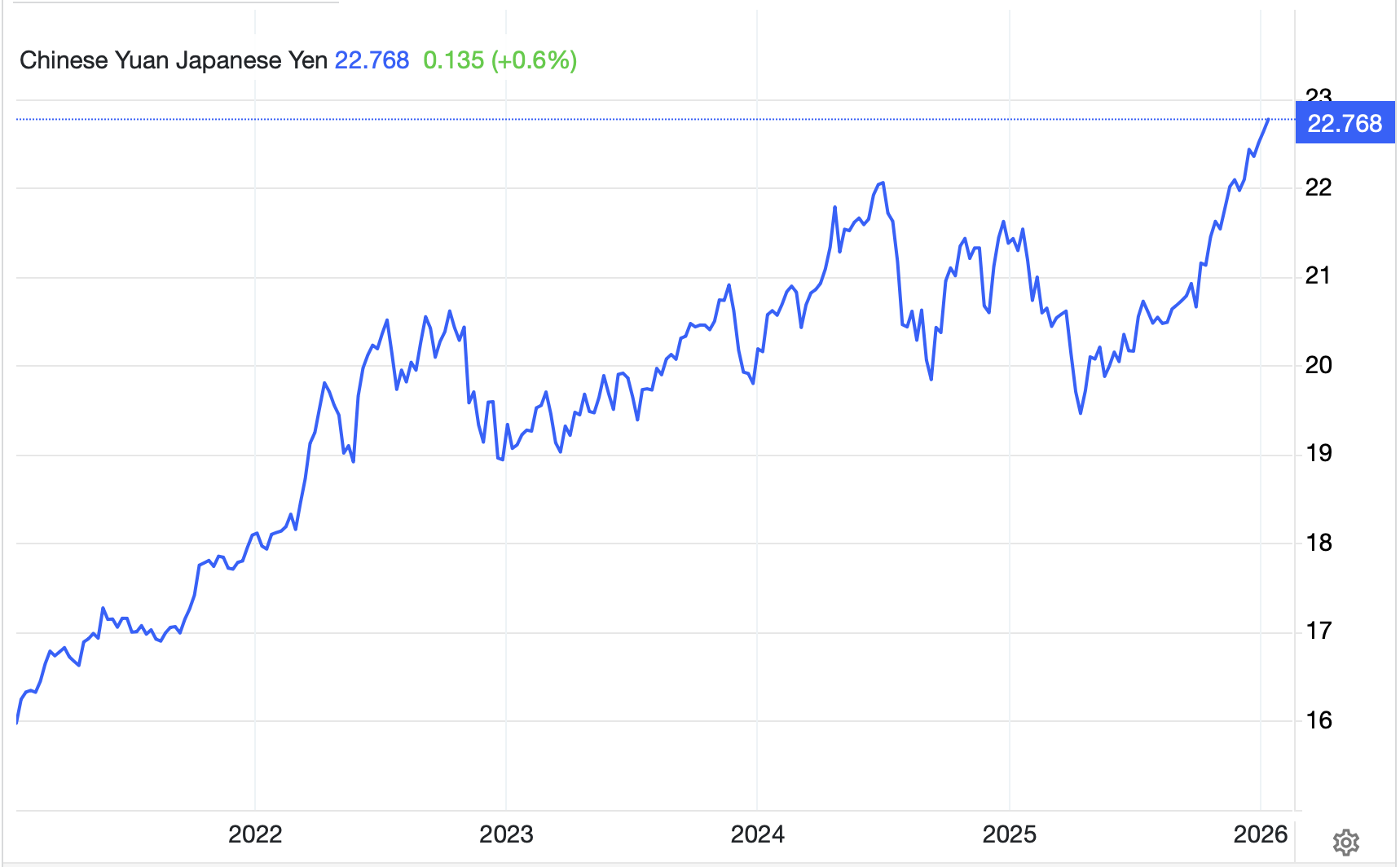
As to the dollar, while it did little most of the evening, as NY is walking in, it is slipping a bit, with the euro (+0.25%) and pound (+0.5%) leading the way higher in the G10, and truthfully across the board as the largest EMG moves are KRW (+0.4%) and HUF (+0.4%) while the rest have moved on the order of 0.1% to 0.2%.  There has been growing chatter that China is now going to allow the renminbi to start to strengthen more steadily (in fairness, it has been strengthening modestly since the beginning of 2025, up about 3% since then), and that this is part of the trade negotiations ongoing with the US currently taking place in Madrid.  But remember, while CNY has been creeping higher this year, a quick look at the chart below shows it has fallen substantially since 2022, having declined more than 17% between 2022 and the beginning of this year.

Source: tradingeconomics.com

On the data front, in addition to the FOMC, there are several other central bank meetings and some important data as follows:

TodayEmpire State Manufacturing5.0
TuesdayRetail Sales0.3%
 -ex autos0.4%
 Control Group0.4%
 IP-0.1%
 Capacity Utilization77.4%
WednesdayIndonesia Rate Decision5.0% (Unchanged)
 Housing Starts1.37M
 Building Permits1.37M
 Bank of Canada Rate Decision2.5% (-0.25%)
 FOMC Decision4.25% (-0.25%)
 Brazil Rate Decision15.0% (unchanged)
ThursdayBOE Rate Decision4.0% (unchanged)
 Initial Claims240K
 Continuing Claims1950K
 Philly Fed2.3
 South Africa Rate Decision7.0% (unchanged)
 Leading Indicators-0.1%
 BOJ Rate Decision0.5% (unchanged)

Source: tradingeconomics.com

So, while Retail Sales may give us some more color on the strength of the economy, it is really a week filled with central bank policy decisions and the ensuing discussions they have to spin things as they desire.  I imagine we will be getting an article from Nickileaks this afternoon or tomorrow to get Powell’s message out, but it remains to be seen if we are watching bond traders buy the rumor and they are set to sell bonds on the news, especially if the Fed goes 50bps, something that remains a real possibility in my mind, though the futures market is pricing just a 4% chance of that as of this morning.

A 50bp cut will undermine the dollar in the short run and may put pressure on the BOE to cut more rather than hold.  Until then, though, I suspect there will be little net movement in either direction.

Good luck

Adf

Not Blazing

Inflation was hot, but not blazing
And so, though I am paraphrasing
A 50 bip cut
Is most likely what
We’ll see next week, ain’t that amazing!
 
Though futures are not there quite yet
The Claims data’s seen as a threat
It’s been four long years
Since Claims caused such fears
Seems Trump, what he wants he will get


While I spent most of yesterday discussing the CPI data, which came out on the warm side of things with headline rising 0.4% M/M, a tick higher than forecast, although the Y/Y number at 2.9% was as expected, it seems far more attention than normal was paid to the Initial Claims data.  As it happens, the last time Initial Claims printed this high, 263K, was October 2021.

Source: tradingeconomics.com.

Now, we all remember last September, just prior to the Fed cutting 50bps in a surprise move, and as it happens, the Claims data the week before that jumped as well, a one-off blip to 259K.  Of course, the Fed felt it had a political imperative back then to cut as a means of supporting their preferred candidate for President, VP Harris, but that is another story.  Nonetheless, a precedent has been set that a strong claims number with inflation still warm was sufficient to get them to move.  So, will they cut 50bps next week?

Right now, the Fed funds futures market is still pricing just an 8% probability of that move, so apparently that is not the market perception.  However, this is exactly the time where we should be seeing an article from the Fed Whisperer, Nick Timiraos, at the WSJ (aka Nickileaks), which ought to explain that changes in the labor market are sufficient to overcome any concerns about inflation, especially since there is a growing expectation that a recession is coming.  Look for it on Monday.

But let us consider this for another moment.  Based on BLS data, the median reading for Initial Claims since January 1967 is 339K, far more than we saw yesterday.  In addition, if you look at a long-term chart of the Claims data, or even the shorter-term one above, while it is possible this is the beginning of a trend higher in Claims, there is no evidence yet for that, and blips higher are pretty common throughout the data set.

The one caveat here is that if we look at the recessions highlighted in gray in the above chart, the Claims data didn’t really rise until the end of the recession, so there is a chance that we are seeing the beginnings of bigger problems.  Certainly, if Claims data starts to climb further and we see 300K, there will be a stronger case to anticipate a recession.  But we haven’t yet seen that.  Alas, what we do know from Powell’s last press conference is that the Fed has basically abandoned their inflation target, so despite the fact it has been 54 months (February 2021) since core PCE has been at or below 2.0%, and even though the very idea that rate cuts are appropriate is remarkable, it seems the case for 50bps is strengthening.  

Source: tradingeconomics.com

But, as Walter Cronkite used to say, “That’s the way it is.”

So, how have markets been digesting this news?  Well, yesterday saw US equity indices make yet another set of new all-time highs on the prospects of a 50bp cut and that has largely fed to other equity markets around the world.  Bond yields remain quiescent, at least out to 10 years, although the really long stuff is having a tougher time, and the dollar remains range bound.  Aside from equities, the only market really moving is precious metals, which continue to rally nonstop.

Starting in Asia, Tokyo (+0.9%) rallied nicely as a combination of anticipated Fed cuts and the calming of trade tensions with the US has investors there feeling giddy.  It, too, has reached new all-time highs.  Hong Kong (+1.1%) also had a good session although China (-0.6%) didn’t follow through as profit taking was evident after what has been a very strong run in mainland stocks lately.  Elsewhere in the region, only two markets (Singapore and Philippines) lagged, and those were very modest declines of -0.3%.  Otherwise, gains of up to 1.5% were the norm.

However, Europe didn’t get that memo this morning with continental bourses all under pressure (DAX -0.3%, CAC -0.5%, IBEX -0.7%) amid a growing realization that the ECB may have finished its cutting cycle, at least according to Madame Lagarde’s comments yesterday expressing confidence the bank is in a “good place”.  However, under the rubric bad news is good, UK stocks (+0.3%) are edging higher after data showed GDP flatlined in July with the Trade deficit rising, and IP falling sharply (-0.9%) as traders are becoming more convinced the BOE will cut rates despite much stickier inflation than their target level.  Remember, too, the BOE’s mandate is entirely inflation focused, but these days, none of that matters!  Finally, US futures are either side of unchanged as I type (7:00).

In the bond market, yields remain in their longer-term downtrend in the US although have edged higher by 1bp overnight.  European sovereign yields are higher by 3bps across the board as there are still growing concerns over French fiscal deficits and the fact that the ECB has finished cutting implies less support there.  It is interesting to look at the difference in performance between US and French 10-year bonds as per the below, as despite much angst over the US fiscal profligacy, which is well-deserved, investors still feel far more comfortable with Treasuries than with OATs.

Source: tradingeconomics.com

In the commodity markets, oil (+1.3%) is rebounding from yesterday’s decline and, net, continues to go nowhere.  Whatever the catalyst is that will change this view, it has not made an appearance yet.  Meanwhile, like the broken record I am, I see gold (+0.5%) and silver (+1.9%) continuing to rally as more and more investors around the world flock to the precious metals as they fear the destruction of the value of their fiat currencies.  And they are right because there is not a single central bank around (perhaps Switzerland and maybe Norway) that is concerned about inflation as evidenced by the fact that despite the fact inflation rates are running far higher than they had pre-Covid, every central bank is in a cutting cycle except Japan, and they have stopped hiking despite CPI there running at 3.4%!

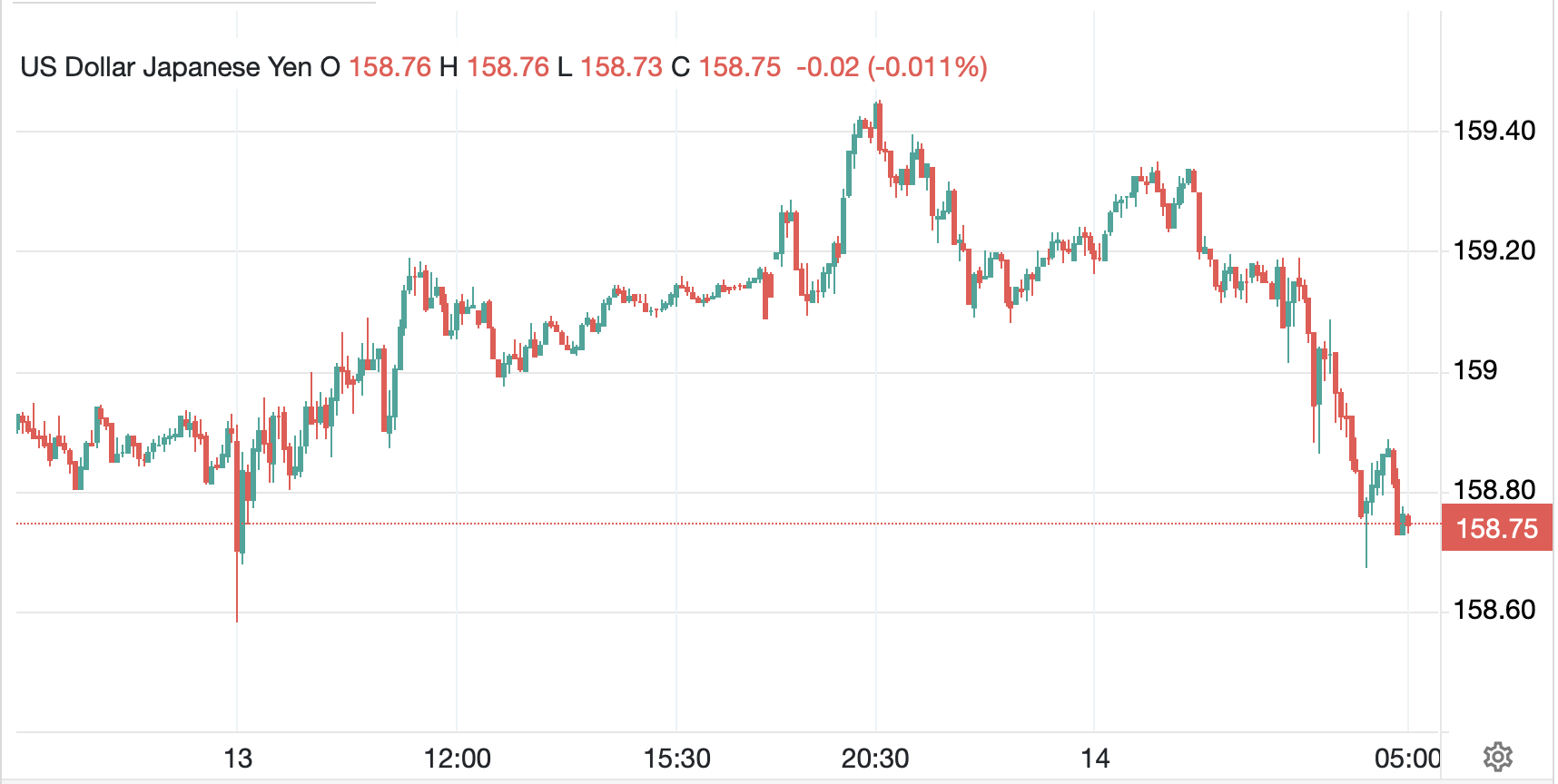
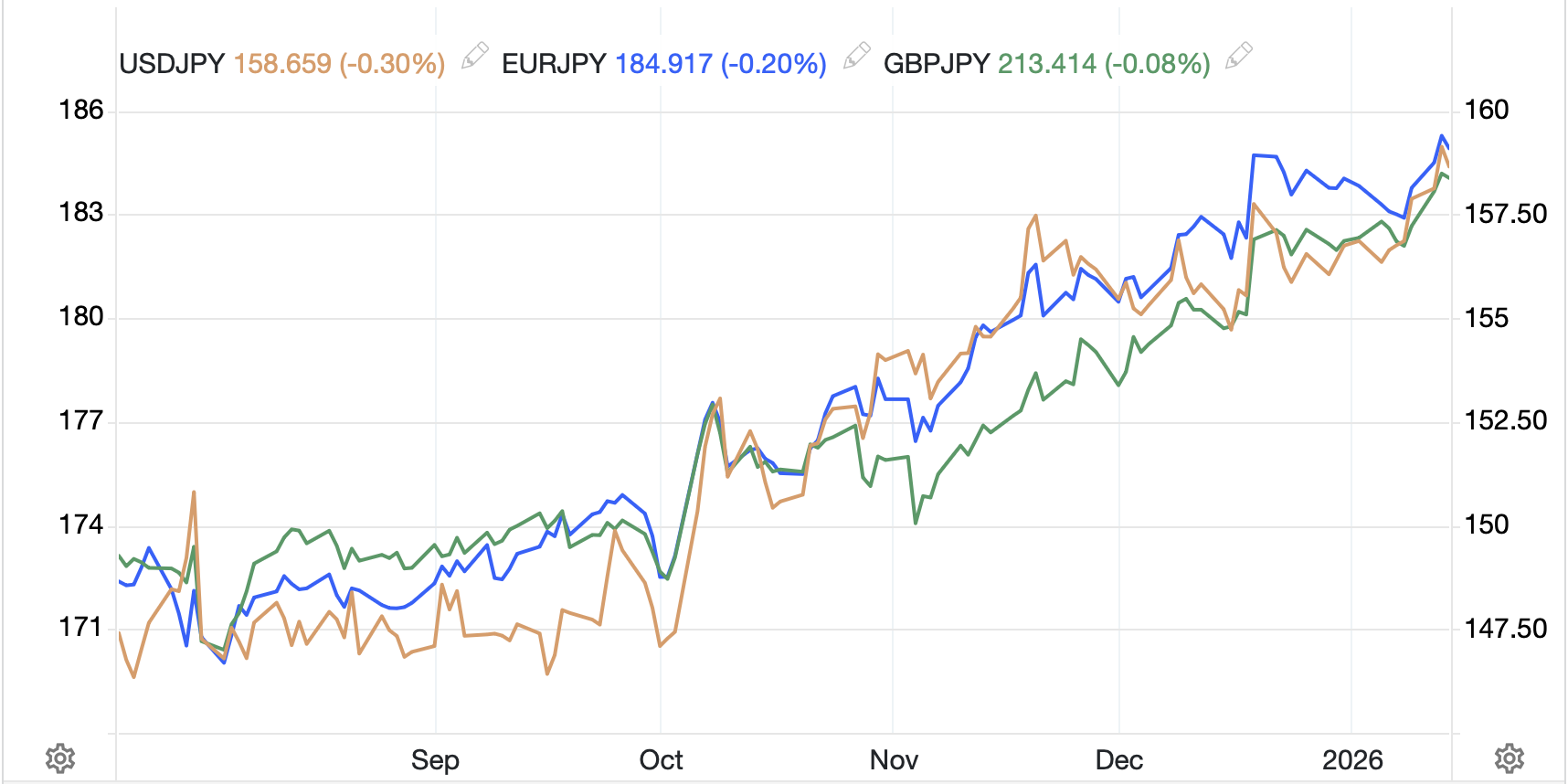
Finally, the dollar is modestly firmer as I type, although it had been a bit softer overnight, and basically going nowhere fast.  If I look at the movement in the major currencies over the past month, only NOK (+3.0%) stands out on the back of higher than anticipated inflation readings and growing expectations that the Norges Bank, which did cut rates a few months ago, will soon have the highest interest rates in the G10 after the Fed cuts next week and they remain on hold.  As to today’s movement, JPY (-0.35%), NZD (-0.4%) and NOK (-0.3%) are the largest movers, with the EMG seeing even smaller movement than that.  Again, it is difficult to find a compelling short-term story here.

On the data front, this morning brings Michigan Sentiment (exp 58.0) and that’s it.  No Fed speakers ahead of the meeting next week, so we will be reliant on either the White House making some new, unexpected, announcement, or the dollar will take its cues from the equity markets.  It is interesting that the precious metals complex continues to perform well despite the dollar edging higher.  To me, that is the biggest story around.

Good luck and good weekend

Adf

Falling Fast

His swords were words he wielded well
He spoke his truths, but would not yell
His followers enrapt
His enemies then snapped
And undeservedly he fell
 
RIP Charlie Kirk
 
A score plus four of years have passed
Since thousands died, we were aghast
No logic could be found
For those at, zero, ground
Society is falling fast


A generation after the horrific events of September 11, 2001, it appears that memories have faded.  Personally, having observed those events from one block away, it is indelibly imprinted on my brain.  But now, in the course of a week we have seen several senseless murders make the news as whatever decorum may have existed at the turn of the century is long gone.  Messrs. Howe and Strauss were always quite clear that the 4thTurning involved chaos and the destruction of institutions.  I fear the process is accelerating.  I also fear that it must play out to get through to the other side.  Civil war feels excessive as a description, but as I have forecast for the past year or two, one of the major political parties was likely to explode.  Right now, it feels like the Democrats are on that path.  I don’t know what will replace it, but something must, and it would behoove us all if there is some coherence in their policies when it appears.  I remain confident that Socialists are not the answer, nor will they be embraced across the nation. 
 
The reason I discuss this, which seems outside the bounds of my market perspective, is that it is going to impact markets even more than it already has.  The ongoing politicization of the media, businesses and entertainment does not lead to kumbaya, but rather volatility and distress.  If you wonder why gold continues to perform well, look no further.  Whatever the data, whatever the Fed does, whatever Trump and his administration do, or what Congress tries to do, gold has a history of maintaining value for the past 5 millennia.  Everything else is new and prices are all relative to gold.  Remember that as you approach your day job and your investments, whether you hedge for a living, or simply are trying to make a living.
 
There are now two things on the docket
That could lead risk assets to rocket
First, CPI comes
The Jay and his bums
Decide what gets put in our pocket

Considering these very serious issues, it seems almost ridiculous to discuss markets, but they will continue to trade and the ability to keep your eye on that particular ball is still critical to financial outcomes.  So, let us turn to the two stories (well, maybe two and a half stories) that have the potential to change some viewpoints.  The first is today’s CPI, then next week’s FOMC meeting with a half nod given to today’s ECB meeting.

Regarding the least important, the ECB is almost certainly going to leave policy unchanged.  The only opportunity for anything new will come from Madame Lagarde’s press conference and if she displays a new tone, whether hawkish (I doubt) or perhaps more dovish as European data continues to ebb.

But let’s move on to CPI.  After yesterday’s much lower than expected PPI data, where the M/M numbers for both headline and core were -0.1% compared to +0.3% expected, there has been some talk on the margins that we could see much softer CPI data.  However, it is worth knowing that for the inflation cognoscenti (e.g., @inflation_guy) PPI data is seen as a random number generator with very little direct impact on the consumer data.  (In fact, after my look at NFP data, aren’t all the data points random?)  With that in mind, current median expectations remain as they were earlier in the week (0.3% M/M for both headline and Core with the Y/Y numbers expected at 2.9% and 3.1% respectively).  

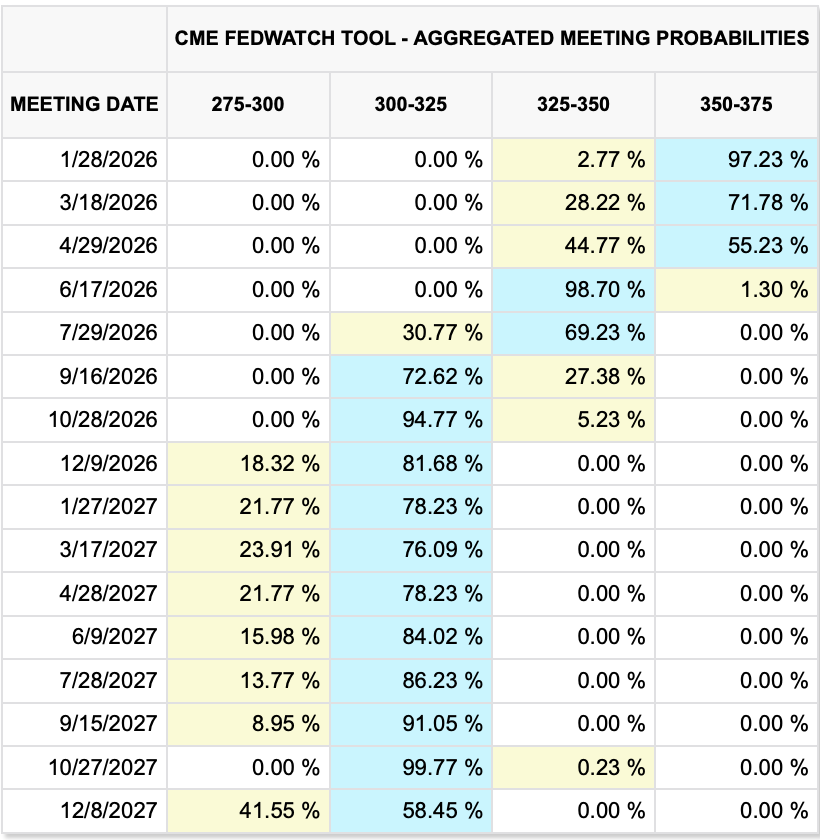
Given the market is currently pricing a full 25bp cut with an 8% probability of 50bps, my take is the only way to change things would be for CPI to also print like the PPI data as negative numbers.  If that were to be the case, and I do not anticipate that outcome by any stretch, it would give Chairman Powell ample opportunity to cut 50bps with the market welcoming the outcome along with President Trump.  On the flip side, I don’t think CPI can print a high enough number to remove the 25bp cut.  As a reminder, below are the cumulative probabilities for future Fed funds rates based on the CME’s futures contract.  A total of 75bps remains the default view for the rest of 2025.

We will learn about the outcome at 8:30 this morning and I have no particular insight into whether those median forecasts are high, low or on the money.  This is a wait and see situation.

As to the FOMC meeting, it has the opportunity to be far more impactful.  While 25bps is currently baked in the cake, I remain of the opinion that 50bps is a very viable outcome.  Recall, the most recent Fed discussions were about the importance of the employment portion of their mandate as opposed to the inflation portion.  With the newly revised reduction in NFP over the past twelve months, characterizing the employment situation as solid or strong seems unreasonable.  Weakening would seem a more apt description and should have the discussion be between 25bps or 50bps.  We already know there are at least two governors, Bowman and Waller, who wanted to start cutting last time, and it appears that Stephen Miran, Trump’s current head of the CEA, is going to get approved by the Senate in time to sit in the meeting next week.  One would assume that is a vote for easier policy.   

ITC Markets has a very nice table on the perceived hawkishness/dovishness of FOMC members, and it shows that the governors, as a whole, live in the dovish camp with only a few regional presidents as known hawks.  In fact, one of the remarkable things about the entire Lisa Cook affair is that she was always one of the more dovish members of the board and the fact that she was not pushing for cuts never made any sense.  At least based on her background and history.  However, if you take politics into account, and the idea that she didn’t want to cut because President Trump wanted a cut, it begins to become clearer.  At any rate, it strikes me that based on this table, which feels reasonable, 50bps is in play.

With all that in mind, let’s take a quick turn around the markets to see what is happening ahead of this morning’s data.  As seemingly always, equity markets rallied in the US yesterday, well mostly.  The DJIA slipped, but the other indices managed to continue their hot streaks.  It is very hard to link economic activity to equity market outcome these days, at least to my eyes.

But on to Asia, where Japan (+1.2%) had a solid session on the back of the remarkable rise in Oracle shares and the idea that Japanese tech companies will benefit.  China (+2.3%) was the beneficiary of the story that President Xi is now looking to have banks prop up local governments that have stopped paying contractors now that their property sale gravy train has derailed.  It seems that they have figured out if you don’t pay people, they don’t consume anything.  So, upwards of CNY 1 trillion will be injected into local government coffers specifically to pay these late bills and try to kickstart consumption.  But, as I look through the rest of the region, it was a much more mixed picture with some gainers (Korea, Indonesia, Thailand), some laggards (HK, Malaysia, Australia) and many markets that barely moved.

In Europe, all the major markets are green this morning led by the CAC (+0.85%) and UK (+0.5%) with the others showing much smaller gains (DAX +0.2%, IBEX +0.25%).  There is no obvious reason for the gains as expectations for the ECB remain static and there has been no data of note released.  Meanwhile, US futures are higher by 0.25% at this hour (7:30).

Bond markets remain frozen as Treasury yields have edged higher by just 1bp and European sovereign yields are +/-1bp from yesterday’s close.  As you can see from the chart below, the range on 10-year Treasuries has been fairly narrow for the past week.  Perhaps today’s CPI will shake things up.

Source: tradingeconomics.com

In the commodity space, oil (-1.25%) is giving back the gains it saw earlier in the week but basically remains unchanged overall.  If fears grow that a recession is upon us, I could see a rationale for oil to decline, but it is hard to get excited about the market right now.  Gold (-0.6%) is backing off its most recent all-time high, but is still firmly above $3600/oz.  Given the recent run, it is no surprise it takes a breather here and there is no reason to believe that precious metals are topping out.  In fact, a look at the charts tells me that there is plenty of upside left across the space.

Source: tradingeconomics.com

Finally, the dollar is a bit firmer this morning, probably one reason the precious metals are under some pressure, but here too, if we use the DXY as our proxy, the range is pretty clear.

Source: tradingeconomics.com

JPY, INR and ZAR are the largest movers this morning, each declining -0.4%, while the rest of the world is mostly softer by -0.1% to -0.2%.  Broad based dollar strength but no depth whatsoever.  We shall see how things behave after the CPI release.

And that’s really it.  For now, the big picture remains the same, where the prospects of an easier Fed will weigh on the dollar and support commodities.  Equities will like that for now, at least until inflation picks back up, and bonds feel subject to manipulation so I’m just not sure.

Good luck

Adf

Markets Ain’t Scared

So, NFP data was wrong
Which many have said all along
Perhaps it was proper
For Trump to just drop her
Creating McTarfer’s swan song
 
Remarkably, though, no one cared
And equity markets ain’t scared
While Treasury yields
Edged higher, it feels
That 50bps is now prepared


Like a dog with a bone, I cannot give up the NFP story even though the market clearly didn’t care about the adjustment or had fully priced it in before the release.  In fact, it seems investors, or algos at least, welcomed the fact that the number was so large as it seems to make the case for a 50 basis point cut next week that much stronger.  Certainly, Chairman Powell will have difficult saying that starting a cut cycle with 50bps would be inappropriate given his more politically driven efforts a year ago.

But one final word on this subject is worthwhile I believe, and that is; why does the market pay so much attention to this particular data point?  Consider the following:  according to the BLS, current total employment in the US is approximately 159,540,000.  In fact, that number has been above 150 million since January 2019, although Covid managed to impact that for a few months before it was quickly regained.  

Now, NFP has averaged ~125K since they started keeping records in 1939 with a median reading of 160K.  To modernize the data, since 2000 it has averaged ~93K with a median of 154K.  Consider what that means with respect to the total labor force.  Ostensibly, the most important economic data point of each month represents, on average, 0.06% of the working population.  Additionally, that number is subject to massive revisions both on a monthly basis, and then, as we saw yesterday, there is another annual revision.  I don’t know if Ms. McEntarfer was good at her job or not, but it is not unreasonable to consider that the payrolls data, as currently calculated, does not really represent anything other than statistical noise.   I prepared the below chart to help you visualize how close to zero the NFP number is relative to the working population.  Absent the Covid spike, I would argue that the information that this datapoint delivers, especially in the past 25 years, also approaches zero.

Data FRED database, calculations @fx_poet

You may recall the angst with which the firing of Ms McEntarfer was met, and given President Trump’s penchant for overstating certain things, it certainly had a bad look about it.  But the evidence seems to point to the fact that the data is not only suspect, given its revision history, but essentially inconsequential relative to the economy.  The fact that the Fed is making policy decisions based on changes in the economy that represent less than 0.1% of the working population, and half that amount of the general population, may be the much larger scandal here.  

Remember, a 4th Turning is all about tearing down old institutions because they no longer are fit for purpose and building new ones to gain trust.  Perhaps NFP as THE monthly number is an institution whose time has passed, and investors (and the Fed) need to find other data to help them evaluate the current economic situation.  Of course, the algos love a single number to which they can be programmed and respond instantaneously, so if NFP loses its cachet, and algos lose some of their power, it would be better for us all, except maybe Ken Griffin and Larry Fink!

Otherwise, the overnight market offered very little new information.  Chinese inflation data continues to show an economy in deflation with the Y/Y result of -0.4% being worse than expected and the 5th negative outcome in the past seven months.  Looking at the chart below, it is becoming clearer that President Xi, despite flowery words about consumption, has no idea how to stimulate domestic activity other than the mercantilist model to which China subscribes.  Now, they overproduce stuff and since the imposition of higher tariffs by the US on Chinese goods, it seems more of that stuff is hanging around at home and driving prices down.  Alas, it seems not enough Chinese want the things they manufacture, hence steadily declining prices.  While it is a different problem than in the US, it is a problem nonetheless for President Xi.

Source: tradingeconomics.com

And with that, let’s head to the market activity.  Yesterday’s US rally was followed by strength all around the world as it appears everybody is excited about the prospects of the FOMC cutting rates by 50bps next week. While the Fed funds futures market has barely moved, currently pricing just an 8.2% probability of that move, I am hard pressed to conclude that the rest of the economic and earnings data is so good that equities should be rallying for any other reason.

Anyway, Japan (+0.9%), China (+0.2%), HK (+1.0%), Korea (+1.7%), India (+0.4%) and Taiwan (+1.4%) are pretty definitive proof that everybody is all-in on a 50bp cut by the Fed.  In fact, the worst performer in Asia, Thailand (0.0%) was merely flat on the day.  Turning to Europe, here, too, green is today’s color with Spain (+1.3%), France (+0.6%), Germany (+0.2%) and the UK (+0.5%) all rising nicely.  Domestic issues, which abound throughout Europe, are inconsequential this morning.  and don’t worry, US futures are higher by 0.35% this morning as well.

In the bond market, while yields edged up yesterday a few basis points, this morning they are essentially unchanged across the board in the US, Europe and Japan.  Worries about excessive deficits have been set aside.  A major protest in France today is not impacting markets at all.  Word that the BOJ will consider tightening policy (as if!) despite the political uncertainty has had no impact.  Perhaps we have achieved that long sought equilibrium in rates! 🤣

In the commodity space, oil (+1.1%) rallied after the Israeli attempt to eliminate Hamas leadership in Qatar yesterday ruffled many feathers and was seen as a potential escalation in Middle East conflicts.  But, at $63.30/bbl, WTI remains firmly in the middle of its recent trading range as per the below chart.

Source: tradingeconomics.com

But you know what is not in the middle of its trading range, in fact the only thing with a real trend right now?  That’s right, gold.  A quick look at the below chart from tradingeconomics.com helps you understand why so many market pundits, if not investors, are excited about continued gains here.  Calls for $4000/oz and more by early next year are increasing.  As to the other metals, silver and platinum are following gold higher this morning although copper is unchanged.

Finally, the dollar is little changed vs. most major currencies with the euro and pound having moved 0.1% or less than the close and the same with JPY, CAD, CHF and MXN.  In fact, the biggest mover this morning is NOK (+0.5%) which on top of oil’s rally has benefitted from still firm inflation encouraging the idea that the Norges Bank is going to raise rates when they meet next Thursday.  If they hike after the Fed cuts 50bps, the krone will likely see further strength, at least in the short run.

On the data front this morning, PPI (exp 0.3%, 3.3% Y/Y; 0.3%, 3.5% Y/Y core) is the key release and then the EIA oil inventory data is released at 10:30 with a modest draw expected.  As we remain in the quiet period, no Fed speakers are slated, so the algos will have to live with the PPI data or any other stories they can find.

If the inflation data this week stays quiescent, I think 50bps is likely next week as the employment situation, despite my comments above, will still be seen in a negative light and I think Powell will feel forced to move.  Plus, if Stephen Miran is added to the board this week, there will be increased pressure for just such an outcome.  However, while a Fed aggressively cutting rates should be a dollar negative, I feel like that is becoming the default view, so maybe not so much movement from here.  We need another catalyst.

Good luck

Adf

Voters Have Doubt

In France, Monsiuer Bayrou is out
In Norway, though, Labor held stout
Japan’s been discussed
And Starmer’s soon Trussed
In governments, voters have doubt
 
Investors, though, see all this news
And none of them have changed their views
Just one thing they heed
And that’s market greed
At some point they’ll all sing the blues


Here we are on Wednesday and already we have seen two major (Japan and France) and one minor (Nepal) nations make governmental changes.  Actually, they haven’t really changed yet, they just defenestrated the PM and now need to figure out what to do next.  In Japan, it appears there are two key candidates vying to lead a minority LDP government, Sanae Takaichi and Shinjiro Koizumi, although at this point it appears too close to call.  Regardless, it will be rough sledding for whoever wins the seat as the underlying problems that undermined Ishiba-san remain.  

In France, President Macron has, so far, said he will not call for new elections, nor will he resign despite increasing pressure from both the left and the right for both measures.  He will appoint a new PM this week and they will go through this process yet again as the underlying issue, how to rein in spending and reduce the budget deficit, remains with nobody willing to make the hard decisions.  A side note here is that French 10-year OATs now trade at the same level as Italian 10-year BTPs, a catastrophic decline over the past 15 years as per the below chart. 

Recall, during the Eurozone crisis in 2011, Italy was perceived as the second worst situation after Greece in the PIGS, while France was grouped with Germany as hale and hearty.  Oh, how the mighty have fallen.

Nepal is clearly too insignificant from a global macroeconomic perspective to matter, but it strikes me that the fall of the PM there is merely in line with the growing unhappiness of populations around the world with their respective governments.

A friend of mine, Josh Myers, who writes a very thoughtful Substack published last night and it is well worth the read.  He makes the point that the Washington Consensus, which has since the 1980’s, underpinned essentially all G10 activity and focused on privatization of assets, free trade and liberalized financial systems, appears to have come to the end of the road.  I think this is an excellent observation and fits well with my thesis that the consensus views of appropriate policies are falling apart.  Too many people have been left behind as both income and wealth inequality in the G10 is rampant, and those who have fallen behind are now angry enough to make themselves heard.  

This is why we see governments fall.  It is why nationalist parties are gaining strength around the world as they focus on their own citizens rather than a global concept.  And it is why those governments still in power are desperately struggling to prevent their opponents from being able to speak.  This is the genesis of the restrictions on speech that are now rampant in Germany and the UK, two nations whose governments are under extreme pressure because of policy failures, but don’t want to give up the reins of power and are trying to prevent anybody from saying anything bad about them, thus literally jailing those who do!

And yet…investors are sanguine about it all!  At least that seems to be the case on the surface as equity indices around the world continue to trade higher with most major equity markets at or within a few percent of all-time highs.  This seems like misplaced confidence to me as the one thing I consistently read is that markets are performing well in anticipation of the FOMC cutting Fed funds next week, with hopes growing that it will be a 50bp cut.  

But if we look at the Treasury market, which has seen yields slide steadily since the beginning of the year, with 10-year yields now lower by 75bps since President Trump’s inauguration, it is difficult to square that circle.  

Source: tradingeconomics.com

Bond yields typically rise and fall based on two things, expected inflation and expected growth as those two have been conflated in investor (and economist) minds for a while.  The upshot is if yields are declining steadily, as they have been, it implies investors see slowing economic activity which will lead to lower inflation.  Now, if economic activity is set to slow, it strikes me that will not help corporate profitability, and in fact, has the potential to exacerbate the situation by forcing layoffs, reducing economic activity further.  Alas, it is not clear if that will drive inflation lower in any meaningful way.  The point is the bond market and the stock market are looking at the same data and seeing very different future outcomes.

Is there a tiebreaker we can use here?  The FX market might be one place, but the weakness in this idea is that FX rates are relative rates, not descriptive of the global economy.  Sure, historically the dollar has been the ultimate safe haven with funds flowing there when things got rough economically, but its recent weakness does not foretell that particular story.  Which brings us to the only other asset class around, commodities.  And the one thing we have seen lately is commodity prices continuously rising, or at least metals prices doing so, specifically gold.  Several millennia of history showing gold to be the one true store of value is not easily forgotten, and that is why the barbarous relic has rallied 39% so far in 2025.  

A number of analysts have likened the current situation to that of Wile E Coyote and I understand the idea.  It certainly is a potential outcome so beware.

Well, once again I have taken much time so this will be the lightning round.  Starting with bonds, this morning, yields in the US and Europe are higher by 2bps across the board, with one exception, France which has seen yields rise 6bps as discussed above.  JGB yields are unchanged as it appears investors there don’t know what to think yet and are awaiting the new PM decision.

In equities, yesterday’s very modest late rallies in the US were followed by a mixed session in Asia (Japan -0.4%, China -0.7%, HK +1.2%) although there were more winners (Korea, India, Taiwan, Thailand) than laggards (Australia, New Zealand, Indonesia) elsewhere in the region.  In Europe, mixed is also the proper adjective with the CAC (+0.4%) remarkably leading the way higher despite lousy IP data (-1.1%) while Germany (-0.4%) and Spain (-0.4%) both lag.  As to US futures, at this hour (7:20) they are marginally higher, 0.15% or so.

Oil (+0.8%) continues to trade back and forth each day with no direction for now.  I’m sure something will change the situation here, but I have no idea what it will be.  Gold (+0.5%) meanwhile goes from strength to strength and is sitting at yet another new all-time high, above $3600/oz.  While silver and copper are little changed this morning, the one thing that seems clear is there is no shortage of demand for gold.

Finally, the dollar is arguably slightly lower this morning, although mixed may be a better description.  The euro (-0.15%) is lagging but JPY (+0.6%) is the strongest currency across both G10 and EMG blocs.  Otherwise, it is largely +/-0.2% or less as traders ponder the data.

While CPI is released on Thursday, I think this morning’s NFP revision is likely to be the most impactful number we see this week, and truly, ahead of the FOMC next week.

TodayNFP Revision-500K to -950K
WednesdayPPI0.3% (3.3% Y/Y)
 -ex food & energy0.3% (3.5% Y/Y)
ThursdayECB Rate Decision2.0% (unchanged)
 CPI0.3% (2.9% Y/Y)
 -ex food & energy0.3% (3.1% Y/Y)
 Initial Claims235K
 Continuing Claims1950K
FridayMichigan Sentiment58.0

Source: tradingeconomics.com

As I type, the Fed funds futures market is pricing a 12% probability of a 50bp cut next week and an 80% chance of 75bps this year.

Source: cmegroup.com

If the NFP revisions are more than -500K, I suspect that rate cut probabilities will rise sharply with the dollar falling, gold rising, and bond yields heading lower as well.  Equity markets will probably rally initially, although it strikes me that this type of bad news will not help corporate earnings.  So, buckle up for the fun this morning on a release that has historically been ignored but is now clearly center stage.

Good luck

Adf

Naught But Dismay

Ishiba’s fallen
Who’ll grab the poisoned chalice
For the next go round?


Well, it was inevitable after the LDP lost the Upper House election a few weeks ago, but now it is official, Japanese PM Shigeru Ishiba has resigned effective today and will only stay on until a new LDP leader is chosen.  You must admit, for a politician he was exceptionally ineffective.  He managed to lead the LDP to two major election losses in the span of 10 months, quite impressive if you think about it.  However, now that he has agreed a trade deal with the US, where ostensibly US tariffs on Japanese autos will be reduced from 25% to 15%, he felt he had done enough damage and is getting out of the way.  Frankly, I wouldn’t want to be the next man up here as the situation there remains fraught given still high inflation and a central bank that is so far behind the curve, it makes the Fed seem like it is Nostradamus!

The intricacies of Japanese politics are outside the bounds of this note, but the initial market response is a weaker yen (-0.7% as of 7:30pm Sunday night) and 1% gain in the Nikkei.  JGB yields have barely moved at all as it seems Japanese investors are not yet abandoning ship in hopes of a stronger PM.  However, my take is they have further to climb going forward as the BOJ’s ongoing unwillingness to tackle inflation will undermine their value.  Japan has a world of hurt and lacking an effective government is not going to help them address their problems.  It is hard to like Japanese assets or the yen in my view, at least until something or someone demonstrates competence in government.

The jobs report basically sucked
As companies smoothly conduct
More layoffs each week
While they try to tweak
Their staffing ere management’s f*cked

By now, I’m sure you’re all aware that the payroll report was pretty weak across the board.  NFP rose only 22K, well below expectations and although there was a marginal increase in last month’s results, just 6K, the overall picture was not bright.  The Unemployment Rate ticked up 0.1%, as expected with the labor force growing >400K, but only 288K of them getting jobs.  However, layoffs are down, and the real positive is that government jobs continue to fall, having declined 56K in the past three months with private hiring making up the slack.  In fact, if you look at the past three months, private job creation has been 144K or 48K/month.  That is the best news of the entire process.  Eliminating government employees will eventually result in lower government expenditures and let’s face it, if the government employees who leave become baristas at Starbucks, they are likely adding more value to the economy than their government roles!  The chart below from Wolfstreet.com does a great job of highlighting private sector jobs growth, which is slowing but still positive.  Maybe it is not yet the end of the world.

As to my efforts to prognosticate on the market behavior based on a range of outcomes, I mostly got the direction right, although some of the movement was a bit more aggressive than I anticipated.  The one place I missed was equities, which started higher, but ultimately fell on the day.  Nostradamus I’m not.

The last thing to mention today
Is France, where a vote’s underway
When finally completed
And Bayrou’s unseated
Macron will have naught but dismay

The last key story to discuss is the vote today in France’s parliament where another snap election has been called by a minority government (see Japan for previous results) and in all likelihood will result in the government falling.  The problem here, as it is pretty much everywhere in the Western world is that the government’s budget deficit is exploding higher and legislators cannot agree to cut spending.  The result is rising bond yields (see below chart as I discussed this last week here), and growing concern as to how things will ultimately play out.  The prognosis is not positive.  

Source: tradingeconomics.com

While the US is in a similar situation, we have substantially more tools available and more runway given our status as the global hegemon and owning the global reserve currency.  But France, and the UK or Japan for that matter, have no such backstop and investors are growing leery of the increasing risk of a more substantial meltdown.  Apparently, the results of this vote ought to be known by 3:00pm Eastern time this afternoon.

The question is, if/when he loses, what happens next?  The choice is President Macron appoints a different PM to head another minority government, which will almost certainly be unable to achieve anything else, or there is another parliamentary election, which at least could result in a majority government with the ability to enact whatever fiscal policies they believe.  Remember, France is the second largest economy in the Eurozone, so if it remains under pressure, it is difficult to make the case that the euro will rally very much, especially given Germany’s many issues.

And that feels like enough for one day.  Let me recap the overnight session but since there is no data of note today and the Fed is in its quiet period, I will list data tomorrow.  While US equity markets sold off a bit at the end of the day, that was not the vibe this morning anywhere else in the world as green is the predominant color on screens.  In Japan, no PM is no problem as the Nikkei (+1.45%) rallied after much stronger than expected GDP data (2.2% in Q2) helped convince investors things would be fine.  Hong Kong (+0.85%) and China (+0.2%) also managed gains as hopes for a Fed rate cut spring eternal.  In fact, the bulk of Asia saw gains on that basis.

Europe, too, has embraced the weaker US payroll data and prospective Fed rate cut to rally this morning, although in fairness, German IP rose 1.4% for its first gain in four months, so that helped the cause.  But even French stocks are higher despite the imminent collapse of the government.  I am beginning to notice a pattern of equity investors embracing the removal of ineffective governments, but perhaps I am looking too hard.  US futures are also modestly higher at this hour (7:15) this morning, rising about 0.25%.

In the bond markets, after Friday’s rally, Treasury yields have edged higher by 1bp while European sovereign yields are largely unchanged, perhaps +/- 1bp on the day.  Surprisingly, even JGB yields have not risen despite the lack of fiscal rectitude there.  It certainly appears that bond investors are ignoring a lot of potential bad news.  Either that or someone is buying a lot of bonds on the sly.

In the commodity markets, oil (+2.0%) after a down day Friday ahead of expectations that OPEC+ would be increasing production again, has rallied back as those increases were less than feared by the market.  But net, oil is just not going anywhere these days, trading between $62/bbl and $66/bbl for the past month.  It feels like we will need a major demand story to change this narrative, either up or down.  As to metals, they continue to rally sharply (Au +0.7%, Ag +0.7%, Cu +0.5%, Pt +1.9%) as no matter the bond markets’ collective ennui over global fiscal profligacy, this segment of the market is paying attention.  If this week’s CPI data is cooler than expected, I suspect that 50bps is going to be the default expectation and metals will climb further.

Finally, the dollar is under modest pressure this morning, with the euro and pound both rising 0.2% although AUD (+0.6%) and NZD (+0.8%) are having far better sessions on the back of commodity price strength.  JPY (-0.3%) has recouped some of its early losses from the overnight session, though my money is still on weakness there.  In the EMG bloc, it is hard to get excited about much with ZAR (+0.25%) appreciating the rally in gold and platinum, but only just, while the rest of the bloc hasn’t even moved that much.  

And that’s really all for today.  The discussion will continue around the Fed and whether 50bps is coming with Thursday’s CPI the last big piece of data that may sway that conversation.  Personally, I am surprised that the government upheavals in Japan and France (with the UK also having major fiscal problems) have not had a bigger impact on markets.  My sense is that there is an opportunity for more fireworks in those places in the near future.  But apparently not today.  As investors whistle past those particular graveyards, I imagine we will see a risk-on session continue with the dollar remaining under modest pressure.

Good luck

Adf

Is That the Fear?

Regarding the payroll report
The fear is jobs coming up short
But is that the fear?
Or will traders cheer
As 50bps they will exhort
 
With clarity at the Fed lacking
Because of Ms Cook’s recent sacking
And markets at highs
It seems to be wise
To hedge some exposure you’re tracking


Another month, another payroll day.  It certainly seems that the market has not lost any of its appetite for this particular data point, although one must be impressed with the ongoing rally to continuous record highs in share prices.  So, as we get started, let’s look at what expectations are for this morning’s numbers:

Nonfarm Payrolls75K
Private Payrolls75K
Manufacturing Payrolls-5K
Unemployment Rate4.3%
Average Hourly Earnings0.3% (3.7% Y/Y)
Average Weekly Hours34.3
Participation Rate62.1%

Source: tradingeconomics.com

Yesterday’s ADP Employment number was a bit softer than forecast at 54K with a very slight revision higher to the previous month’s reading.  And of course, poor Ms McEntarfer was fired last month after the massive downward revisions to the previous data so as much scrutiny as this number ordinarily receives, it feels like even that has been turned up to 11 this month.  If we look at the Initial Claims data for a signal, (or the 4-week average which removes situations where individual states are late to report) it is hard to get excited about a major problem in the labor market as per the below chart from tradingeconomics.com.

It has pretty much flatlined since the end of the Covid aberration.  Even more impressively, the number is low by much longer-term historical standards when the absolute population was smaller, yet Claims data were typically somewhat higher.  (I capped the Covid situation so you could get a flavor for the rest of the series).  It is hard to look at the last 58 years and describe Initial Claims as pointing to a problem.  While I didn’t shade the chart, you can see the recessions in 1970, 1973, 1980, 1982, 1990, 2001, 2008-9 as the periods when Claims peaked.  Again, it is difficult to look at this data and conclude a recession is around the corner, at least the traditional definition of one.

Source: FRED database

Of course, there is a very different vibe these days regarding employment as evidenced by the discussions you see on LinkedIn or even the stories in the WSJ regarding the unwillingness of people to leave a job as they fear finding a new one.

All this is just my way of saying that the asynchronous nature of the economy means we really don’t know what to expect.  But we can anticipate market reactions depending on the outcome.  FWIW, and remember, I am just a poet:

NFPBondsFed funds futuresStocksDollarGold
>75K4.30%20bps-1%0.50%-1%
35K – 75K4.15%25bps0%0%0%
0K – 35K4.10%35bps1%-0.5%0.20%
<0K3.95%50bps-1%-1.50%1.50%

So, there you have it, one man’s guesses as to how the markets will respond depending on the data.  In essence, it seems to me that the market has been anticipating enough support to cut rates to protect the economy without assuming the economy is going to crash.  That’s why a negative number will be such a problem because that will force a reevaluation of the economic situation and stocks cannot abide a repricing of that risk given the rich valuations. It will demonstrate that the Fed is behind the curve, at least in traders’ minds, and the result will not be pretty.  We shall see.

In the meantime, after yesterday’s rally in the US, equity markets around the world are all in the green this morning despite some mediocre data from Europe.  But starting with Asia, Japan (+1.0%) had a nice session although China (+2.2%) and Hong Kong (+1.4%) put it to shame.  While Japan benefitted from a reduction to 15% on automobile tariffs vs. Japanese cars, Chinese shares jumped on word from the PBOC that they would inject CNY1 trillion into the system and reduced fears of efforts to hold back the rally.  Elsewhere in the region, other than India, which was unchanged on the day, everything else was nicely higher following the main exchanges’ leads.  As to Europe, while all the bourses are higher, the gains are de minimis, on the order of 0.1% or so, with traders caught between hopes of a US rally and ongoing meh data at home.

In the bond markets, Treasury yields are down to 4.15%, lower by -1bp today, but as you can see from the chart below, down 15bps this week as anticipation of either soft data or 50bps, I’m not sure which, builds.

Source: tradingeconomics.com

In Europe, sovereign yields are all lower by -2bps this morning and we saw the same price behavior overnight in Asia with JGB’s and Australian bond yields slipping as well.  Maybe inflation is dead! (just kidding)

In the commodity markets, oil (-0.7%) continues to slide and has given back all the gains that accrued based on the idea that OPEC+ was going to cut production further.  Gold (+0.1%) continues to find support and drag silver and copper along for the ride as the yellow stuff sits at new historic highs.

Finally, the dollar is softer this morning, down about 0.2% to 0.3% vs. the G10 with similar declines across most of the EMG bloc.  I have a feeling this is the market that is anticipating a weak NFP print and a more aggressive Fed come the meeting in two weeks.  Futures, right now, are pointing to a 99% probability of a 25bp cut and a 55% probability of another cut in October.  Any weak print this morning is going to really show up here, as I explained above.

Source: cmegroup.com

And that’s what we have.  There are no Fed speakers lined up, and after today, the Fed enters its quiet period, so we won’t hear anything until the meeting on the 17th.  NFP will set the tone, so until then, all we can do is wait.

Good luck and good weekend

Adf