Europe Has Folded

Last week Japan finally agreed
To tariffs as they did concede
Now Europe has folded
Their cards as Trump molded
A deal despite pundits’ long screed
 
So, now this week there’s lots of news
That ought to give markets more cues
Four central banks speak
And late in the week
Inflation and jobs we’ll peruse


All the talk this morning revolves around the announcement yesterday of a US-EU trade deal where the basics are a 15% tariff on all EU exports to the US and an EU promise to buy US energy and defense products totaling some $550 billion.  Many have said that the agreement means nothing because for it to become law, it requires both the European parliament and each nation to vote to agree on the deal.  As well, we are hearing from various nations how it is a terrible deal (French farmers are furious, German pharmaceutical manufacturers are furious and unions all over the continent are unhappy) and certain politicians (notably Marine Le Pen) are also extremely unhappy.  

It is far too early to understand if the deal will be implemented in full, but the precedent has been set that European exports to the US are going to be subject to higher tariffs than any time since prior to WWI and that is true whether the deal is ratified or not.  As analyst/trader Andreas Steno Larsen explained well this morning, “The EU vs. US trade deal highlights that the EU primarily exports ‘nice-to-have’ products rather than essential ‘need-to-have’ ones.  And if you think about it, arguably the best-known EU companies are luxury goods makers, whether in fashion or autos.  So, while there are women who swear they ‘need’ that Birkin bag, the reality is far different.  

Expect to hear a lot more about this deal going forward, but the market response has been quite positive with European equity markets (IBEX +1.0%, FTSE MIB +0.9%, CAC +0.6%, DAX +0.4%) all higher along with US futures (+0.3%).  Interestingly, Asian markets were mixed overnight as Japanese (-1.1%) and Indian (-0.7%) equities suffered, perhaps on the idea that their deals were no longer that special.  China (+0.2%) and Hong Kong (+0.7%), though, did well amid news that another meeting was scheduled between the US and China, this time in Stockholm, to continue the trade dialog.

Away from the trade discussion, market focus this week is going to be on a significant amount of news and data to be released as follows:

TuesdayTrade Balance-$98.4B
 Case Shiller Home Prices3.0%
 JOLTS Job Openings7.55M
 Consumer Confidence95.8
WednesdayADP Employment78K
 Q2 GDP2.4%
 Treasury QRA 
 BOC Interest Rate Decision2.75% (unchanged)
 FOMC Interest Rate Decision4.50% (unchanged)
 Brazil Interest Rate Decision15.0% (unchanged)
ThursdayBOJ Interest Rate Decision0.50% (unchanged)
 Initial Claims224K
 Continuing Claims19660K
 Personal Income0.2%
 Personal Spending0.4%
 PCE0.3% (2.5% Y/Y)
 Core PCE0.3% (2.7% Y/Y)
 Chicago PMI42.0
FridayNonfarm Payrolls102K
 Private Payrolls86K
 Manufacturing Payrolls0K
 Unemployment Rate4.2%
 Average Hourly Earnings0.3% (3.6% Y/Y)
 Average Weekly Hours34.2
 Participation Rate62.3%
 ISM Manufacturing49.6
 ISM Prices Paid66.5
 Michigan Sentiment61.8

Source: tradingeconomics.com

In addition to all of this, there are Eurozone GDP and inflation data, Japanese inflation data and PMI data from all around the world.  Happily, there is virtually no central bank speaking beyond the post meeting press conferences as I presume all of them will be seeking an escape.

There is far too much data to discuss in any depth this morning, but my take is that President Trump has managed to move the Overton Window significantly over the course of his first 6 months in office.  If you recall, it was on “Liberation Day” back in April, when he announced his reciprocal tariffs on the rest of the world, that the global economic community had a collective meltdown and proclaimed the end of the economy as we know it.  Equity markets around the world plummeted and the future seemed bleak, at least according to every economist and pundit who could get their views heard.  Now, here we are a bit more than three months later and tariffs of 15% on the entire EU as well as Japan, 10% on the UK and higher on other nations is seen as a solid outcome, sidestepping the worst cases promulgated, and the world is moving on.

It appears, at least for the moment, that Mr Trump understood that most nations need to export to the US more than the US needs to export to them. I would contend that is why these deals, which in many eyes seem unfavorable to the US counterparts, are being agreed.  It is far too early to ascertain if things will work out as Trump expects, as the naysayers expect or somewhere in between (or entirely different) but thus far, you have to admit that the president has largely gotten his way.

So, as we open the week, we have already seen equity markets are generally in a positive mood.  Bond markets are also behaving well, with Treasury yields edging higher by 1bp, still glued to that 4.40% level, while European sovereign yields have mostly slipped -2bps or so on the session.  And last night, JGB yields fell -4bps.  It appears that bond investors are not as concerned about the trade deals as some would have you believe.

In fact, the market with the biggest reaction overnight has been FX, where the dollar is showing strength against virtually all its counterparts in both G10 and EMG spaces.  EUR (-0.8%) is the G10 laggard, although CHF (-0.8%) is right there with the single currency as clearly, Switzerland will be impacted by the EU tariff deal.  But AUD (-0.6%), JPY (-0.5%) and SEK (-0.65%) are all under pressure as well as the DXY (+0.6%) continues its bounce.

Source: tradingeconomics.com

I continue to read about all the reasons why the dollar is losing its luster in the global community, because of tariffs, because of the Treasury’s actions freezing Russian assets after the invasion of Ukraine, because China and the BRICS are seeking other payment means to eliminate the dollar from their economies, because American exceptionalism is dead, and yet, while I am no market technician, I cannot help but look at the chart of the DXY above and see a broken downward trendline, indicating a move higher, and a bottoming in the moving average, also indicating further potential gains.  I am confident that if the FOMC cuts rates (which full disclosure I don’t believe makes sense given the current amount of available liquidity and global equity market performance) that the dollar will decline further.  But all those traders who are short dollars (and it is a very crowded position) are paying away between 25bps (long GBP) and 450bps (long CHF) on an annual basis so need to see the dollar’s previous downtrend resume pretty quickly. (see current overnight rates across major economies below from tradingeconomics.com)
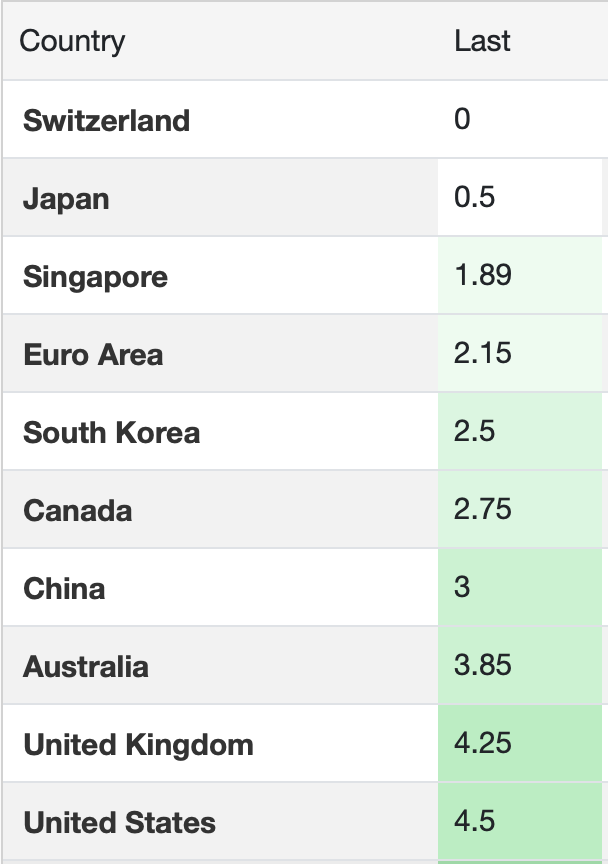
The market is pricing just a 2% probability of a rate cut on Wednesday, and about 60% of a September cut. Unless this week’s data screams recession, I am having a hard time seeing the case for the dollar to fall much further, at least in the short and medium term.  And this includes the fact that it is pretty clear President Trump would like to see a lower dollar to help US export competitiveness.

Finally, a look at commodities shows that while oil (+1.3%) is having a solid session, it remains in the middle of its trading range for the past several weeks.  Meanwhile, metals prices (Au -0.1%, Ag -0.2%, Cu -0.4%) are feeling a little strain from the dollar’s strength but generally holding up well overall.  Too, while there has historically been a strong negative correlation between the dollar and metals, given the large short dollar positions that are outstanding, it would not be hard to see both cohorts rally in sync for a while going forward.

And that’s really all for today.  The data doesn’t really start until tomorrow, and as its summer, trading desks are already lightly staffed.  Look for a quiet session today and the potential for choppiness this week if the data is away from expectations.

Good luck

Adf

Why Their Economy’s Poo

With Tokyo having conceded
On trade, focus turns to what’s needed
For Europe to sign
A deal to align
Its interests and trade unimpeded
 
But headlines about the EU
Explain they have made a breakthrough
With China on carbon
Which might be a harbin-
Ger of why their economy’s poo


Yesterday’s market activity was focused on the benefits of the fact that the US and Japan had reached a trade deal, whatever the terms, and that it seemed to set the stage for other deals to come.  Naturally, all eyes turned to the EU, where negotiations are ongoing, and the working assumption is that they, too, will wind up with a 15% tariff on all goods exported to the US, like the Japanese deal, and that non-tariff barriers would be removed reduced as well.  My sense is that is a reasonable assumption as it will clarify the process going forward and allow businesses to plan and invest accordingly.

As an aside, I am curious why there is so much angst over tariffs from the economist’s community.  Generically, most economists will explain that consumption taxes are better than income taxes as they are more efficient, and fairer in many ways.  After all, if something has a high tariff, you can avoid paying it by not buying the item (I know that’s simplistic but work with me here).  However, an income tax is unavoidable if you earn income.  In fact, that is why so many economists love the VAT.  Yet when it comes to President Trump’s tariff plans, combined with the fact that the OBBB prevented a major tax hike and cut rates for certain parts of income like tips and overtime, these same economists are up in arms over the process.  I would have thought that is exactly what most economists would want to see.  But then, I am just a poet.

Ok, back to the EU, where while the trade deadline with the US is fast approaching, EU Commission president Von der Leyen was in China where she agreed with President Xi to lead the way on CO2 reduction.  Apparently, it was the only thing on which they could agree, and it is, quite frankly, hilarious.  Whatever your views on CO2’s impact on global warming, and if there even is global warming, China is by far the largest emitter of the stuff on the planet.  As of 2023 (which apparently is the most recent data available) here is a list of the top ten countries regarding emissions.

Obviously, only one EU nation is on the list, but if you sum up the entire EU, it comes in at about 2.9 million tons.  (GtCO2e = gigatons of CO2 emitted).  Meanwhile, China continues to build out its electricity infrastructure by expanding its fleet of coal-fired generation, adding 94.5 gigawatts last year.  My point is that if you wonder why Europe’s economy has lagged the US so badly for so many years, this is a perfect encapsulation of the problem.  They are highly focused on virtue signaling for something over which they have essentially no control, and the one nation that could impact things, literally doesn’t care.  For their sake, I hope they agree trade terms.

But away from that, and all the news that DNI Tulsi Gabbard is making with document declassifications and releases, markets continue to trade as though all is well.  It is noteworthy that recent concerns over US Treasury issuance and how foreign investors would be shunning the US because of its uncontrollable debt situation have not been heard in several weeks now that Treasury auctions seem to be going along fine with plenty of foreign buyers attending and buying.  Maybe the worst case is not the default case here.

Ok, so let’s see how markets are digesting the most recent news.  More record highs in the US stock market were followed by gains throughout much of Asia last night with Japan (+1.6%) continuing to benefit from the trade deal and both China (+0.7%) and Hong Kong (+0.5%) feeling some love as talk is a deal there is also getting closer.  Elsewhere in the region, there were a mix of gainers (Singapore, Korea, Malaysia) and laggards (India, Australia, Thailand) but a little bit more positivity than negativity.  In Europe, only France (-0.25%) is lagging today with the rest of the continent (DAX +0.4%, IBEX +1.7%) generally in good shape as investors await the ECB decision, although no policy change is expected.  The UK (+0.9%) is also having a solid day despite lackluster data which seems to be all about the potential US EU trade deal.  As to US futures, at this hour (7:25) they are mixed with the DJIA (-0.4%) lagging while the other two key indices are higher by about 0.25%.

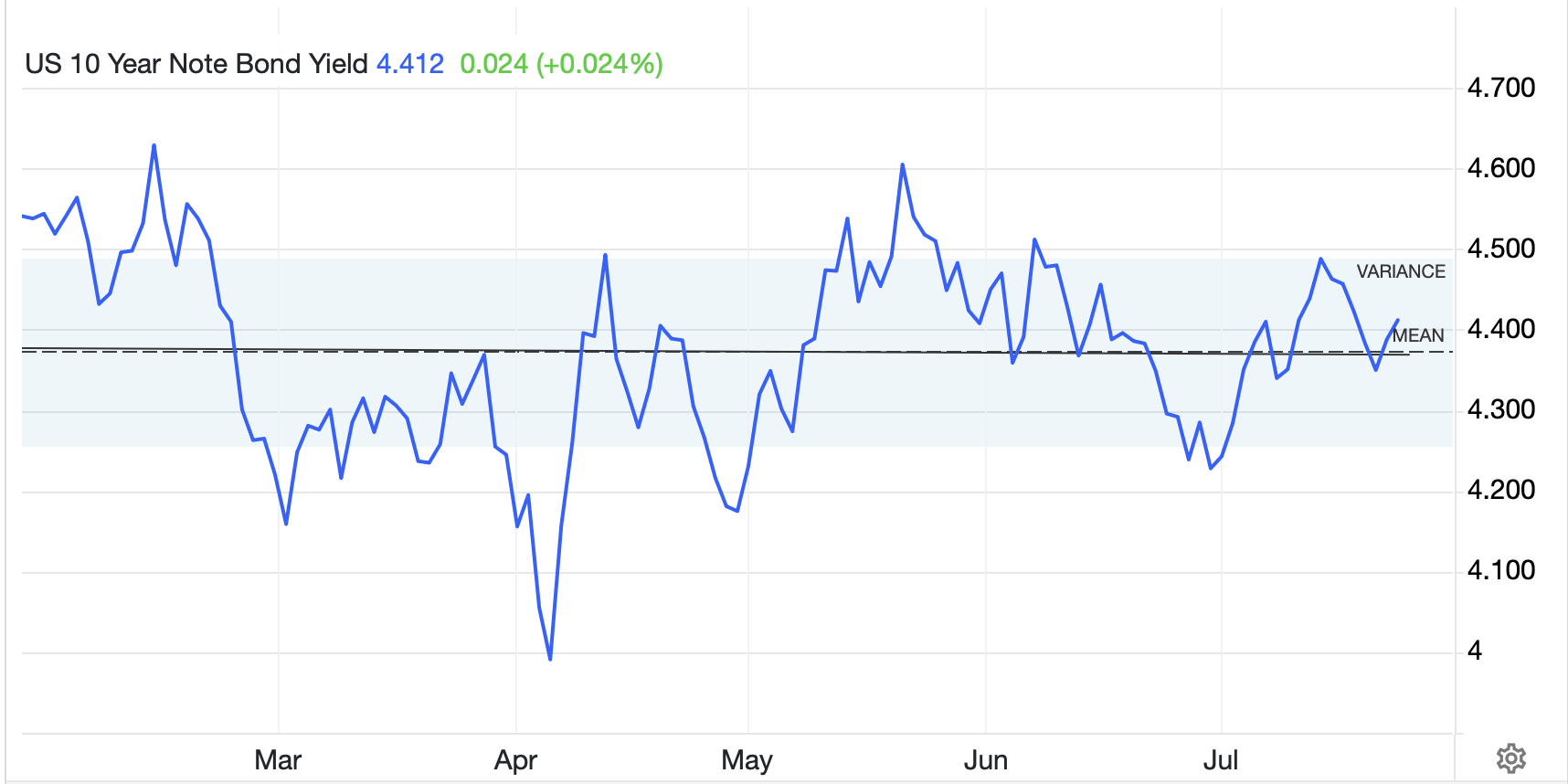
In the bond market, yields are ticking higher across the board with Treasuries (+2bps) back at 4.40%, although still below the top if its recent trading range.  In fact, I think the below chart does an excellent job of describing the fact that the bond market, despite much angst, has done nothing and is trending nowhere for the past six months.

Source: tradingeconomics.com

As to European sovereigns, yields there are higher by 4bps across the board.  The story I read tells me this is optimism that a US-EU deal will help juice the EU economy, thus driving yields higher.  I’m skeptical.

In the commodity markets, oil (+0.8%) is bouncing off its lows, allegedly also responding to the positive trade news.  I guess.  Precious metals, though, are lower (Au -0.7%, Ag -0.5%, Pt -1.25%) as either there is less fear about the future or somebody sold a lot of metals after their recent rally.  Copper (+1.0%) though, continues to benefit from the trade story as well as the underlying story regarding insufficient supply for the future electrification of the world.

Finally, the dollar is a bit firmer this morning, rising 0.2% against both the euro and pound with the yen (-0.15%) also moving in that direction.  Surprisingly, CHF (-0.3%) is the biggest mover in the G10 while ZAR (-0.4%) is the EMG laggard as it follows (leads?) precious metals lower.  This trend remains downward, although as discussed yesterday, it is possible we have seen a true break of that trend.  If Trump successfully concludes the main trade deals, I imagine that we will see significant inflows to the US and that should support the greenback.

On the data front, after the ECB announcement at 8:15, we see Initial (exp 227K) and Continuing (1960K) Claims as well as the Chicago Fed National Activity Index (-0.1) which had a terrible showing last month.  Later we get flash PMI data (Manufacturing 52.6, Services 53.0) and then New Home Sales (650K) at 10:00.

Right now, the market feels like it is embracing the potential for more trade deals to remove uncertainty.  Earnings numbers have been generally strong in the US, which continues to support the stock market, but it remains to be seen how much of the tariffs will be absorbed by corporate margins and how much will find its way into prices.  If the former, that implies earnings will start to lag.  Meanwhile, given the market is generally short dollars, and it appears the next piece of news is more likely to be dollar positive than negative, I have a feeling we could see the dollar bounce nicely in the next weeks.

Good luck

Adf

All Its Sophists

The art of the deal
Tokyo and Washington
Birds of a feather


Seemingly, the biggest news story of the evening was the trade agreement between the US and Japan, where reciprocal tariffs have been set at 15%, including on Japanese autos, and Japan has pledged to invest $550 billion in the US, which I assume is from private corporations although that was not specified.  However, they did explain that one of the investments would be Alaskan North Slope natural gas liquification, a project that has been on the boards for more than 20 years.  Thus far, this seems like a big win and major milestone in President Trump’s trade strategy as it also opened Japanese markets to American products, including rice which had been a key sticking point.

The market response was as might be expected with the Nikkei (+3.5%) rallying sharply and taking virtually every regional Asian market higher for the ride as the conclusion of a deal in the preferred timeline was seen as a precursor to others falling in line.  It is quite interesting that this happened so shortly after PM Ishiba’s election disaster on Sunday, but perhaps that was his motivation.  He needed a big win and conceding on some points to get a deal was much preferred to holding out and getting nothing.  However, JGB markets saw things differently as a very weak 40-year JGB auction (lowest bid-to-cover ratio of 2.127 since 2011) led to long-dated yields rising between 8bps and 10bps last night, with the 10-year yield trading back to the highs seen in late March.

Source: tradingeconomics.com

While the stock market was giddy, apparently the only discussion in the bond market was whether Ishiba-san would be forced to resign, leaving Japan with a leadership vacuum.  Meanwhile, the yen (+0.3%) did very little overnight although it has been creeping higher since the election results.  My sense is Japanese investors are cautiously heading home, but I would not look for a major move lower in USDJPY, rather the current gradual pace makes sense.

A juxtaposition exists
Twixt Europe with all its sophists
And stolid Japan
Who finished their plan
On trade despite recent vote twists

As trade continues to be the topic du jour, it is no surprise that the chatter out of European capitals is that they will fight to get the best trade deal possible.  (I cannot help but laugh at Friedrich Merz saying, if they [the US] want war, we will give them a war).  However, it is also no surprise that markets have looked at the Japanese deal and increased the pressure on EU negotiators to achieve a solution by the end of the month.  First off, every European official wants to go on holiday in August, so they will want to have completed things.  But secondly, equity investors have taken the fact that deals with major counterparties can be accomplished as a sign that the EU is next.  And if they do not agree terms, it will be a double whammy of political and financial problems as you can be certain that the equity gains we are seeing today and have been steady so far this year (see below), will likely reverse on a failure to agree.

                                                                                     Today        1 Week        1 Month          YTD

Source: tradingeconomics.com

But, away from the trade story, and various political stories in the US that are unlikely to have any immediate impact on markets, that’s kind of all there is to discuss.  The Fed meets next week and there is no expectation of a rate move.  The ECB meets tomorrow and there is no expectation of a rate move.  Important data is scarce on the ground and the focus on crypto and meme stocks continues.  In fact, this is likely the best descriptor of a market that has abundant liquidity and shoots down the case for cutting rates at all.  In the meantime, let’s look at how other markets behaved overnight.

You will not be surprised that US equity futures are all pointing higher this morning, and we have already discussed the rest of the equity markets around the globe.  In the bond markets, after declining yesterday, yields have stabilized this morning (Treasuries +1bp, Bunds +1bp, OATs +1bp) although UK Gilt yields (+5bps) have underperformed as there continue to be concerns over the fiscal picture in the UK as well as questions about PM Starmer’s ability to stay in his seat.  In fact, UK 10-year yields are the highest in the developed world right now, and while they have been knocking back and forth for a few months, show no sign of falling regardless of the BOE’s future actions.

In the commodity space, oil (-0.7%) has been slipping back to the bottom of its post 12-day war range amid lackluster overall activity.  Just as there didn’t seem to be an obvious driver when oil rallied to $68/bbl, too there is no clear driver of the recent decline.  I continue to believe this is market internals rather than macro fundamentals.  In the metals markets, after a major rally yesterday across the board, gold (-0.25%) is consolidating but silver (+0.1%) is pushing within spitting distance of a major milestone, $40/oz, while copper (+1.2%) sees the benefits of the trade deal and is rallying nicely.

Finally, the dollar is mixed this morning.  While the yen is firming and the effects of the trade deal seem to be helping Aussie (+0.6) and Kiwi (+0.75%), the euro and pound are both little changed.  in fact, the rest of the G10 is +/- 0.1% on the day, so nothing at all happening.  In the EMG bloc, KRW (+0.3%) is the biggest mover with every other currency across regions +/- 0.15% or less and showing no signs of a trend right now.  Broadly, the dollar appears to be in a downtrend, but short dollars is one of the most crowded trades in the hedge fund and CTA communities, and that gets expensive given US funding costs are higher than pretty much everybody else’s right now.  Depending on how you draw your trend line (and I am no market technician), it appears that the dollar broke above that line and is now getting set to retest it.  I would not be surprised to see a more substantial bounce on the next move.

Source: tradingeconomics.com

And that is really all there is today.  This morning’s data consists of Existing Home Sales (exp 4.01M) and EIA oil inventories with a small draw expected.  The Fed is in their quiet period so no speakers which means that all eyes will, once again, turn toward the White House to see who has the right squares on their bingo card.

Good luck

Adf

Flat On His Face

Poor Ishiba-san
Started with so much promise
Fell flat on his face


In what cannot be a major surprise in the current political zeitgeist, a fringe party that focused all its attention on inflation and immigration (where have we heard that before?) called Sanseito, captured 12 seats, enough to prevent Ishiba-san’s coalition of the LDP and Komeito from maintaining control of the Upper House of Parliament there.  The electoral loss has increased pressure on PM Ishiba with many questioning his ability to maintain his status for any extended length of time.  While he is adamant that he is going to continue in the role, and that he is fighting the good fight for Japan with respect to trade talks with the US, it appears that the population has been far more focused on the cost of living, which continues to rise, and the increase in foreign visitors in the nation.  Sanseito describe themselves as a “Japan First” party.

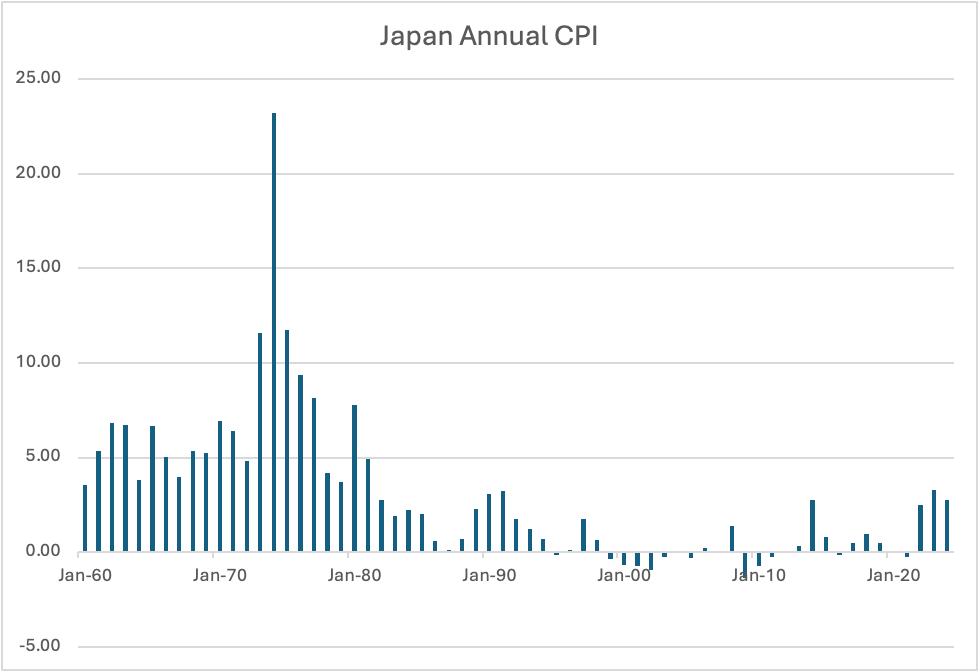
Consider, for a moment, the cost of living in Japan.  For the 30 years up until 2022, as you can see from the chart below taken from FRED data, the average annual CPI was 0.44%.  

In fact, the imperative for Japanese monetary policy was to end the decades of deflation as it was deemed a tremendous drag on the economy.  This was the genesis of their Negative Interest rate policy as well as their massive QE program, which went far beyond JGBs into equities and ETFs.  Now, while the economists and politicians hated deflation, it wasn’t such a bad thing for the folks who lived there.  Think of your life if prices for stuff that you consume rose less than 1% a year for 20-30 years.  

But now, under the guise of, be careful what you wish for, you just may get it, the Japanese government has been successful in raising the nation’s inflation rate to their 2.0% target and beyond and have shown no ability to halt the process.  After all, the Japanese overnight rate remains at 0.50% leaving real rates significantly negative, which is no way to fight inflation.   So, while Ishiba-san explained to the electorate that he was defending Japan’s pride and industry, the voters said, we want prices to stop rising.  

The biggest problem for Japan is that they now have less than 2 weeks to conclude a trade deal with the US based on the latest timeline, and their government is weak with no mandate on trade.  It is not impossible that Japan caves on most issues because if they fight, given the government’s current status, it could be a lot worse.

Now, Friday, when I discussed this possibility, I made that case that if the LDP lost the Upper House majority, it would be a distinct negative for both the yen and the JGB market.  Well, as you can see in the chart below, the first call has thus far been wrong with the USDJPY falling a full yen right away, and after an initial bounce, it has resumed that downtrend.  Like the dollar’s strength when the GFC exploded in 2008, despite the fact that the US was the epicenter of the problem, it appears that Japanese investors are bringing more money home as concern over the future increases.  Over time, I expect that the yen is likely to weaken, but I guess not yet.

Source: tradingeconomics.com

As to JGBs, Japan was on holiday last night, celebrating Sea Day, so there was no market in Tokyo.  While there is a JGB futures market, there was very little activity, and we will need to wait until this evening to learn their fate. 

The deadline for trade talks is looming
And Europe, responses, are grooming
If talks fall apart
And cut to the heart
Of what people there are consuming

The other story that is getting discussed this morning is the fast-approaching trade talk deadline of August 1st.  The EU has been actively negotiating to achieve a deal and there appears to be a decent chance that something will be concluded.  However, this morning’s stories are all about how Europe is preparing a dramatic response (“if they want war, they’ll get war” according to German Chancellor Merz) if they cannot reach a deal and the US imposes much higher tariffs on EU exports.  It is actually quite amusing to see the framing of Europe as the righteous entity being unfairly treated and forced to create a response to the American bullies.  But, that is the message from the WSJ and Bloomberg, and I’m sure from the other news sources that I don’t follow.

Every time I consider the trade situation, and the speed with which President Trump is working to conclude deals, I am amazed at how quickly this is all coming about.  Consider that the Doha Development Round of trade talks was launched in 2001 and IS STILL ONGOING with no resolution yet.  The previous framework, the Uruguay Round took 8 years to complete.  Thus, perhaps the question should be, why have trade talks taken so long in the past.  Much has been made of how President Trump blinked when the original 90-day window closed and so extended the timeline for a few weeks.  Apparently, the use of more sticks and fewer carrots is what has been needed to get these things moving along.  Otherwise, trade negotiators had cushy jobs with no accountability and no responsibility, so no incentive to come to an agreement.

Many analysts have explained that the US will suffer from these deals as inflation will rise because of tariffs and growth will slow.  Of course, these were the same analysts who explained that tariffs by the US would result in other nations’ currencies weakening to offset the tariff.  Once again, I would highlight that old analyst models are not fit for purpose in the current world situation.  I have no idea if there will be a successful conclusion of these deals, but I won’t bet against that outcome.  In the end, as I have repeatedly explained, the US has been the consumer of last resort for nations around the world, and loss of access to the US market is a major problem for everybody else.  That is a very large incentive to agree to deals.

Ok, enough, let’s see how things look this morning.  Tokyo was closed last night but we saw gains in Hong Kong (+0.7%) and China (+0.7%) as the PBOC maintained its policy ease supporting the economy.  In fact, Chinese money supply has been growing recently which should help the economy there, although it is still struggling a bit.  The rest of the region was a mixed bag with some gainers (Korea, India, Indonesia) and some laggards (Taiwan, Australia, Malaysia).  In Europe this morning, equities are under some pressure with the CAC (-0.5%) the laggard, although all bourses are lower.  This appears to be trade related with some concerns things won’t work out.  As to US futures, at this hour (7:05), they are pointing higher by about 0.25%.

In the bond market, yields are falling everywhere with Treasuries (-4bps) lagging the continent where European sovereigns have all seen 10-year yields decline by -6bps to -7bps.  It seems that there is growing hope the ECB will cut rates this Thursday, although according to the ECB’s own Watch Tool, the probability is just 2.7% of that happening.  

In the commodity space, oil is unchanged this morning as the variety of stories around leave no clear directional driver.  However, remember, it has bounced off recent lows despite production increases, and if confidence in economic growth is returning, which it seems to be, then I suspect the demand story will improve.  Meanwhile, metals markets (Au +0.65%, Ag +0.89%, Cu +1.1%, Pt +1.2%) are all having a good morning as a combination of dollar weakness and better economic sentiment are supporting the space.

As to the dollar, it is broadly lower against all its major counterparties apart from NOK (-0.2%) and INR (-0.2%) as NY walks in the door.  While the yen has been the biggest mover, the rest of the world has seen gains on the order of 0.35% or so uniformly.  The INR story apparently revolves around the trade talks with the US and concerns they may not be completed on time, but looking at the krone, after a strong rally last week following oil’s recovery, this morning looks like a bit of profit-taking there.

On the data front, there is very little coming out this week amid the summer holidays.

TodayLeading Indicators-0.2%
WednesdayExisting Home Sales4.01M
ThursdayECB Rate Decision2.00% (no change)
 Initial Claims228K
 Continuing Claims1952K
 Flash PMI Manufacturing52.5
 Flash PMI Services53.0
 New Home Sales650K
FridayDurable Goods-10.5%
 -ex Transport0.1%

Source: tradingeconomics.com

In addition to this limited calendar, it appears the FOMC is on vacation with only two speakers, Chairman Powell tomorrow morning and Governor Bowman tomorrow afternoon.  It is hard to get too excited about much in the way of market movement today.  As has been the case for the past six months, we are all awaiting the next White House Bingo call, as that is what is driving things for now.

Good luck

Adf

No Retreating

The virtue of patience remains
The key to our policy gains
Though tariffs and trade
May one day, soon, fade
It’s still ‘nuff to scramble our brains


In a bit of a surprise, Chairman Powell resurrected the term ‘transitory’ in his press conference yesterday with respect to the potential impact on prices from President Trump’s tariff policies.  He explained, “We now have inflation coming in from an exogenous source, but the underlying inflationary picture before that was basically 2½% inflation, 2% growth and 4% unemployment.”  In addition, he said, “It’s still the truth if there’s an inflationary impulse that’s going to go away on its own, it’s not the right policy to tighten policy because by the time you have your effect, you’re in effect, by design, you are lowering economic activity and employment.”  It is this mindset that returned ‘transitory’ to the discussion.  Now, while mainstream economics would agree to that characterization, with the idea being it is a one-off price rise, not the beginning of a trend, given the Fed’s history of using the word to describe the impact of monetary and fiscal policies in the wake of the pandemic, it caught most observers off guard.

But in the end, the Fed’s only policy change was a reduction in the pace of runoff of Treasuries from the Balance Sheet on a temporary basis.  Previously, they had been allowing $25B per month to run off without being replaced and starting April 1, that will be reduced to $5B per month.  The runoff of Mortgage-backed assets will continue as before.  This has been a widely discussed idea as the Fed approaches their target of “ample” reserves on the balance sheet, an amount they still characterize as “abundant”.

As to changes in the dot plot and SEP forecasts, they were, at the margin, modest, with the median dot plot ‘forecast’ continuing to call for 2 rate cuts this year.  Fed fund futures are now pricing in 65bps of cuts, so marginally tighter than the 75bps seen last week.  The SEP also showed slightly different forecasts for growth, inflation and unemployment, but just a tick or two different, hardly enough about which to get excited.  

Certainly, Mr Powell said nothing to upset equity markets as the response was a continuation of the modest rally that began in the morning.  As well, bond yields slid almost 9bps from their level just before the Statement was released.  Net, I expect the only people who are unhappy with the Fed’s performance are the hundreds of millions of Americans who have seen the inflation rate remain above the 2.0% target for the past 48 months (see chart below), but then Powell doesn’t really respond to them directly, now does he?

Source: tradingeconomics.com

Oh yeah, President Trump also published a little note on Truth Social that Powell should cut rates, but I don’t think that had any impact at all.  For now, Trump’s attention is elsewhere, and if 10-year yields continue to slide, I suspect he will be fine, certainly Secretary Bessent will be.

In Europe, the leaders are meeting
Again, as they keep on repeating
They need to spend more
To maintain the war
In Ukraine, ‘cause there’s no retreating

Back in the real world, the diverging points of view between President Trump, and his attempts to end the Ukraine War, and the EU, which seems hell-bent on continuing it ad infinitum were highlighted again today as yet another summit meeting is being held in Brussels to discuss the process and progress on rearming the continent as well as how they envision the future of Ukraine.  This matters to markets as the continuous calls for more fiscal military spending is going to be a driver of equity prices in Europe, and given it is going to be funded by issuing more debt, on both a national and supranational basis, yields are likely to rise as well over time.  

There has been much talk lately of the end of US exceptionalism, and certainly there has been a shift of investment into European shares, especially defense firms, and out of US tech shares.  This has helped support the single currency, which while it has slipped the past two days, remains higher by 4.5% since the beginning of the month.  Ex ante, there is no way to know how this situation will evolve, but if history is a guide at all, the US continues to hold all the defense cards in the deck, and so even with European protests, I suspect the war will come to an end.

But here’s a thought, perhaps even if the war ends, the pre-war energy flows may not resume.  This would not be because Europe doesn’t want cheap Russian gas, but perhaps because Russia doesn’t want to sell it to those who will use it to build armaments that can be used against Russia.  The world has moved to a different place both politically and economically, than where it was pre-Covid.  My sense is many old models may no longer work as proxies for reality, which takes me back to my favorite theme, the one thing on which we can count is more volatility!

Ok, let’s take a turn through markets overnight.  After the US rally, Asia was far more mixed with the Nikkei (-0.25%) slipping a bit and both China (-0.9%) and Hong Kong (-2.2%) falling more substantially on fears that US tariffs could slow growth there more than previously feared.  But elsewhere in the region there were far more gains (Korea, Australia, India, Taiwan) than losses (Malaysia, Thailand). 

Europe, though, is having a tougher session with losses across the board.  The continent is particularly hard hit (Germany -1.7%, France -1.2%, Spain -1.2%) although the UK (-0.3%) is holding up better after decent employment data was released.  We did see the Swiss National Bank cut its base rate by 25bps, as expected, while Sweden’s Riksbank left rates on hold, also as expected.  In fairness, European stocks have had quite a good run, so a pullback should not be a surprise, but it is disappointing, nonetheless.  As to US futures, at this hour (7:10), they are pointing lower by -0.5% or so.

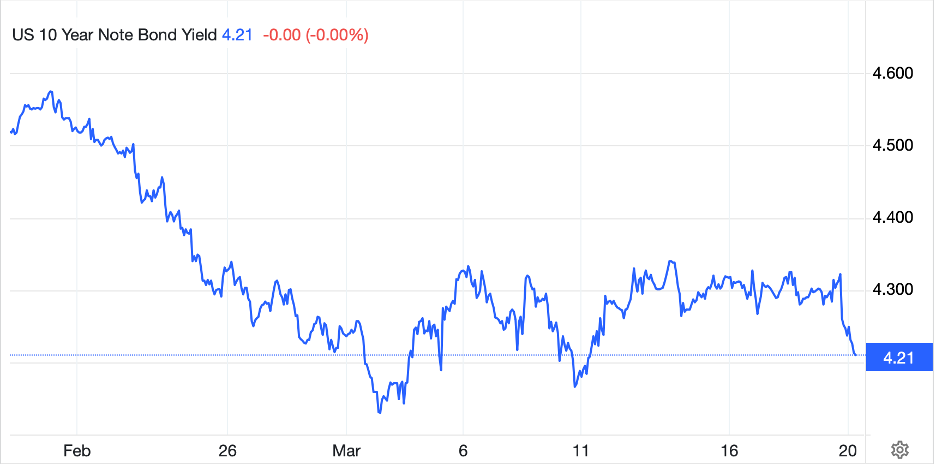
In the bond market, Treasury yields are lower by a further -4bps this morning and down to 4.20%, still well within the recent trading range (see chart below).  As to European sovereigns, they too are lower by between -3bps and -5bps, as despite concerns over potential new issuance, fear seems to be today’s theme.  Oh yeah, JGB yields are still pegged at 1.50%.

Source: tradingeconomics.com

In the commodity bloc, oil is little changed this morning, and net, on the week little changed as well.  It is difficult to see short-term drivers although I continue to believe we will see it drift lower over time as supply continues apace while demand, especially in a slowing growth scenario, is likely to ebb.  Gold (-0.6%) is having its worst day in more than a week, but the trend remains strongly higher.  Arguably a bit of profit taking is visible today.  This is dragging silver (-1.8%) along for the ride although copper (+0.1%) is sitting this move out.

Finally, the dollar is firmer again this morning, higher by 0.5% according to the DXY, with the biggest currency laggards the AUD (-1.1%), SEK (-0.8%) and ZAR (-0.75%).  But the dollar’s strength is universal this morning.  One possibility is that traders have decided Powell is not going to cut rates, hence more pressure on US equities, and more support for the dollar.  I don’t agree with that thesis, as I believe Powell really wants to cut rates, but for now, the other argument has the votes.

On the data front, we get the weekly Initial (exp 224K) and Continuing (1890K) Claims as well as the Philly Fed (8.5) all at 8:30.  Then at 10:00 we see Existing Home Sales (3.95M) and Leading Indicators (-0.2%).  Also, at 8:00 we will get the BOE rate decision, with no change expected.  However, as I have been explaining, central bank stories are just not that important, I believe.  Investors in the UK are far more worried about the Starmer fiscal disaster than the BOE.

There are no Fed speakers on the schedule today, so, I suspect it will be headline bingo.  While the dollar has outperformed for the past two sessions, I continue to believe the trend is lower for the buck and higher for commodities.  Perhaps today is a good day to take advantage of some dollar strength for payables hedgers.

Good luck

Adf

Hard to Kill

Inflation just won’t go away
As evidenced by the UK
This year started out
Removing all doubt
The Old Lady’s work’s gone astray
 
And elsewhere, the problem is still
Inflation is quite hard to kill
Though central banks want
More rate cuts to flaunt
Those goals are quite hard to fulfill


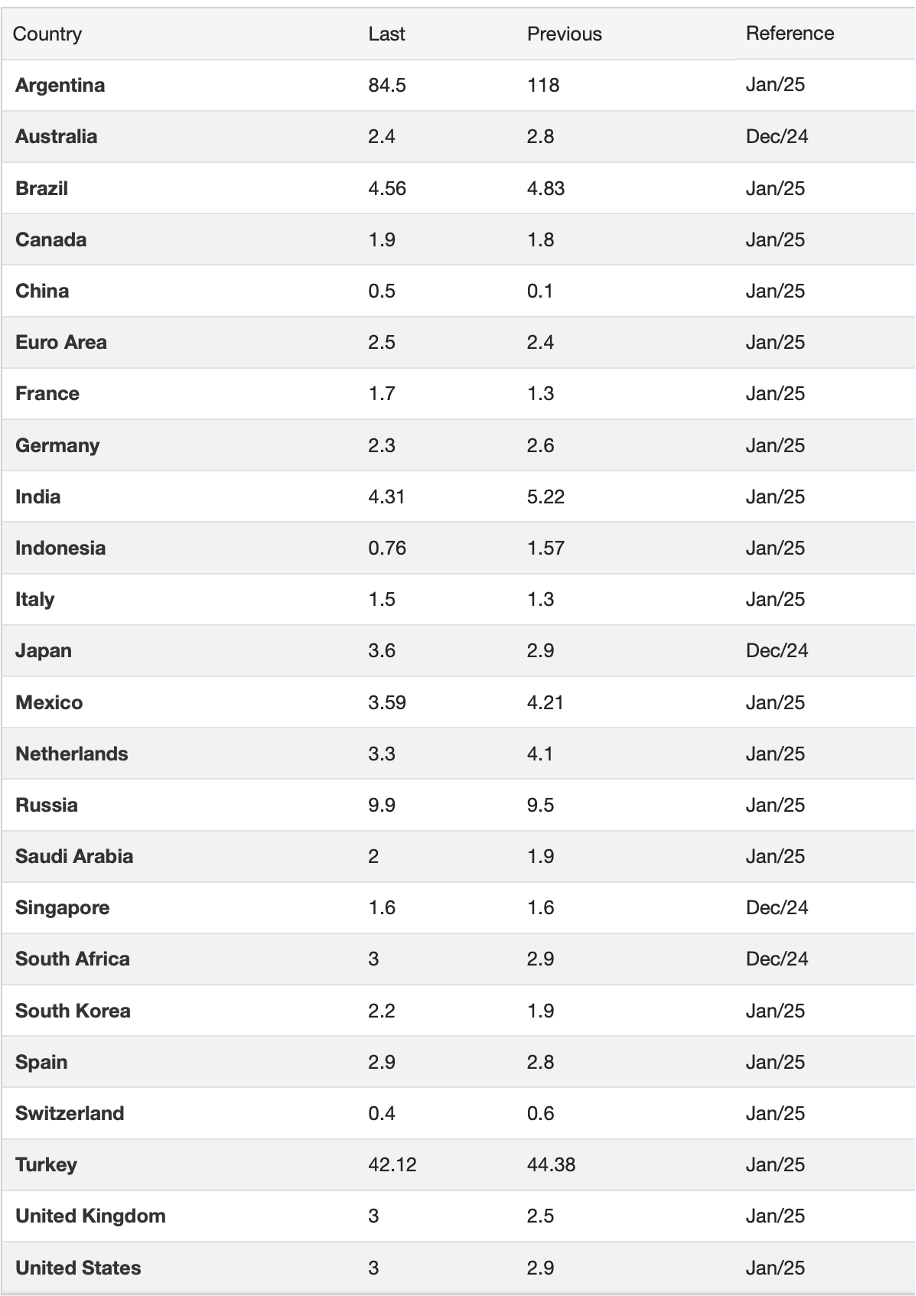
While most eyes remain on President Trump with his ongoing efforts to reduce the size of the US government, as well as his tariff discussions and efforts to negotiate a lasting peace in Ukraine, we cannot ignore the other things that go on around the world.  One of the big issues, which has almost universally been acclaimed a problem, is that inflation is higher than most of the world had become accustomed to pre-Covid.  As well, the virtual universal central bank goal remains the local inflation rate, however calculated, to be at 2.0%.  Alas for the central bankers in their seats today, that remains quite a difficult reach.  A quick look at the most recent headline CPI readings across the G20 shows that only 5 nations (counting the Eurozone as a bloc since they have only one monetary policy) are at or below that magic level as per the below table.

Source: tradingeconomics.com

Of those nations who are below, two, China and Switzerland, are actually quite concerned about the lack of price pressure and seeking to raise the inflation rate, and the other three (Canada, Singapore and Saudi Arabia) are right on the number, with core inflation readings tending higher than the headline reported here.

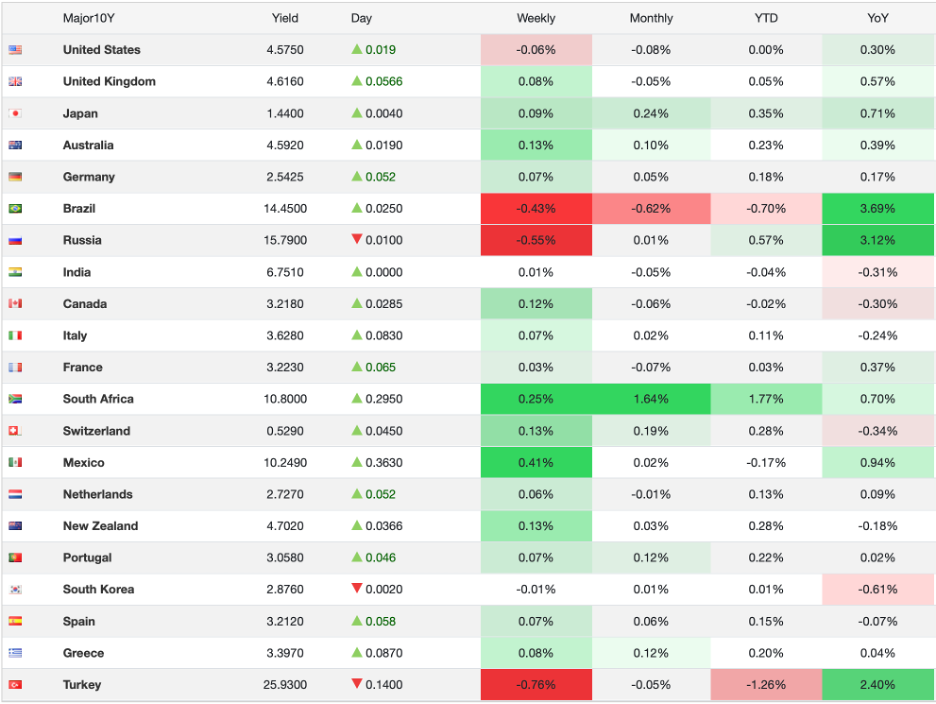
Perhaps a better way to highlight the problem is to look at the 10-year bonds of most countries and see how they have been behaving of late as an indication of whether investors are comfortable with the inflation fighting efforts by each nation.  While it is not universal, you can look at the column on the far right of the below table and see that 10-year yields have been rising for the past year.

Source: tradingeconomics.com

I only bring this up because, despite the fact that I have been downplaying central bank, especially the Fed’s, impact on markets, ultimately, every nation tasks their central bank to manage inflation.  That seems reasonable since inflation, as Milton Friedman explained to us in 1963, is “always and everywhere a monetary phenomenon.”  But perhaps you don’t believe that and are schooled in the idea that faster growth leads to higher wages and therefore higher inflation.  Certainly, Paul Samuelson’s iconic textbook (as an aside, Dr Samuelson was my Economics 101 professor in college) made clear that was the pathway.  Alas, as my good friend, @inflation_guy Mike Ashton, wrote yesterday, there is no evidence that is the case.  Read the article, it is well worth it and can help you start looking elsewhere for causes of inflation, like perhaps the growth in the money supply!

Of course, the reason that we continue to come back to inflation in our discussions is because it is critical to the outcomes in financial markets.  And that is our true focus.  It is the reason there is so much discussion regarding President Trump’s mooted tariffs and how inflationary they will be.  It is the reason that parties out of power continue to highlight any prices that have risen substantially in an effort to disparage the parties in power.  And it is the reason that central banks remain central to the plot of all financial markets, at least based on the current configuration of the global economy.  If there was only one financial lesson from the pandemic response, it is that Magical Money Tree Modern Monetary Theory is a failed concept of how to run policy.  This poet’s fervent hope is that Treasury Secretary Bessent is smart enough to understand that and will address fiscal issues in other manners.  I believe that to be the case.

Back to the UK, where CPI printed at 3.0%, 2 ticks higher than the median forecast, while core CPI printed at 3.7%.  This cannot be comforting for the BOE as most of the MPC remain committed to helping PM Starmer’s government find growth somehow and are keen to cut rates in support.  The problem they have is that inflation will not fade despite extremely lackluster GDP growth.  Recall, last week, even though the Q/Q GDP print of 0.1% beat forecasts, it was still just 0.1%.  Not falling into recession hardly seems a resounding victory for policy in the UK, especially since stagnation, or is it now stagflation, is the end result.  It should be no surprise that market participants have sold off the pound (-0.3%), Gilts (+5bps) and UK equities (-0.4%) and it is hard to find a positive way to spin any of this.  Again, while I have adjusted my views on Japan, the UK falls squarely in the camp of in trouble and likely to see a weaker currency.

Ok, let’s look elsewhere to see how things behaved overnight.  After a very modest rise in US equity indices yesterday, the Asian markets were mixed with the Nikkei (-0.3%) and Hang Seng (-0.15%) slacking off a bit although the CSI 300 (+0.7%) managed to find buyers after President Xi met with business leaders and the expectation is for further government stimulus, as well as a reduction in regulations, to help support the economy.  Australia (-0.7%) is still under pressure despite yesterday’s RBA rate cut as the post-meeting statement was quite hawkish, indicating caution is their approach for now given still sticky inflation.  (Where have we heard that before?)

In Europe, the only color on the screen is red with declines of between -0.4% and -0.9% as investors seem to be taking some profits after a solid run in most of these markets.  I guess the fact that European governments have been shown to be powerless in the world has not helped investor sentiment either as it appears these nations may be subject to more outside forces than they will be able to address adequately.  Lastly, US futures are unchanged at this hour (7:40).

In the bond market, as per the table above, yields are higher across the board with Treasuries (+2bps) the best performer as virtually all European sovereign issues have seen yields rise between 5bps and 7bps.  It simply appears that confidence in the Eurozone is slipping and demand for Eurozone assets is falling alongside that.

In the commodity markets, it should be no surprise that gold (+0.1%) continues to edge higher.  The barbarous relic continues to find price support despite the fact that interest in gold, at least in Western economies, remains lackluster at best.  There is much discussion now about an audit of the US’s gold reserves at Fort Knox and in the NY Fed, something that has not been performed since 1953.  Not surprisingly, there are rumors that there is much less gold in storage than officially claimed (a little over 8 tons) and rumors that there is much more which has not been reported but was obtained via seizures throughout history.  This story has legs as despite the lack of institutional interest in the US, it is picking up a retail following and we are seeing the punditry increasingly raise their price forecasts for the coming years.  As to oil (+0.8%) it is higher again this morning but remains in a tight trading range with market technicians looking at the $70/bbl level as a key support to hold.  A break there could well see a quick $5/bbl decline.

Finally, the dollar is modestly firmer this morning against most of its counterparts with most G10 currencies showing declines similar to the pound’s -0.2%, although the yen (+0.15%) is bucking that trend.  However, versus its EMG counterparts, the dollar is having a much better day, rising vs. PLN (-0.9%), ZAR (-0.7%) and BRL (-0.5%) on various idiosyncratic stories.  The zloty seems to be suffering from its proximity to Ukraine and the uncertainty with the future regarding a potential peace effort.  The rand is falling after the FinMin delayed the budget speech as internal squabbling in the governing coalition seems to be preventing a coherent message while the real is under pressure as inflation remains above target and the central bank’s tighter policy has been negatively impacting growth in the economy.

On the data front, this morning brings Housing Starts (exp 1.4M) and Building Permits (1.46M) and then this afternoon we see the FOMC Minutes from the January meeting.  That will be intensely parsed for a better understanding of what the committee is thinking.  We do hear from Governor Jefferson after the market closes, but generally, the cautious stance remains the most popular commentary.

Has anything really changed?  The market remains uncertain over Trump’s moves, the Fed remains on hold and cautious, and data shows that the economy continues to tick along nicely with price pressures unwilling to dissipate.  I see no reason to abandon the dollar at this point.

Good luck

Adf

Change at the Top

Democracy lives and it dies
By voting for folks who devise
The laws to define
What’s right, or a crime
And this year, there’s much to surmise
 
Some sixty-four nations will vote
And watch as incumbents scapegoat
Political foes
For national woes
And claim they’re the best antidote
 
However, results that we’ve seen
Show that many nations are keen
For change at the top
Or leastwise, to swap
The current regimes’ philistines


So, I know I am not a political analyst, but I try to be a keen observer of trends around the world.  After all, to understand the macroeconomic situation globally, one needs to at least be aware of the politics in the major nations.  As such, I am going to attempt to analyze the elections we have seen around the world to date and see if we can use this trend to look ahead and forecast how things may turn out here in the US come November.

As of today, 35 nations have held elections for either Parliament (Congress), president, or both ranging from St. Maarten to India and many in between with respect to populations.  Arguably the most important have been India, Mexico, South Africa, Taiwan, Russia, Indonesia and Iran.  That list is based on both population and geopolitical importance.  

A look at the results shows the following:

  • India – PM Modi lost significant support and will now be ruling in a coalition, rather than his previous majority.  This was a far cry from the anticipated super-majority he sought.
  • Mexico – AMLO’s hand-picked successor, Claudia Sheinbaum won handily and the Morena party won a supermajority in the lower house, but not in the Senate, so there are great expectations for significant changes unchecked by congress there.
  • South Africa – President Ramaphosa and the African National Congress (ANC) the party that has ruled this nation by itself since the end of apartheid in 1994, lost their absolute majority and is casting about for a coalition partner to allow them to remain in power.
  • Taiwan – New President Lai Ching-te, an avowed separatist relative to China won, but the people did not give him the parliamentary majority to enable significant policy changes
  • Russia – was this really an election?
  • Indonesia – New President Prabowo, a former soldier and defense minister is tipped to be far more aggressive in his handling of dissent and criticism, a concern for some, but clearly given the size of his majority (>58%) something the people are ready for.
  • Iran – This is difficult to assess as the parliamentary elections have been overshadowed by the recent accidental death of the president in a helicopter crash, with a presidential election slated for June 28th.

As well, starting tomorrow, there will be voting for the European Parliament by all twenty-seven member nations.  This is a three-day process so we should know the results by next week.

In the meantime, let me offer my take on the results in a broad-brush manner.  People around the world are unhappy with their leadership and are seeking change.  More importantly, current incumbents are really annoyed by the fact that their populations are not happy.  It has been quite a long time since there have been so many efforts by governments to control all dialog and censor anything that offers an opposing view to government rules, laws and commands.

For instance, in India, despite being very popular, Modi must now account for the fact that he has lost majority support.  He has done much good for the nation, but clearly, there is a large segment of the population that does not feel they are benefitting and were looking for change.

In South Africa, it was a little different as the economic situation there is a wreck.  Inflation is rising (5.3% and climbing), Unemployment is rampant (32.9%) and confidence readings are negative while GDP stagnates. Even though the ANC has ruled for 30 years, people want change, especially since there have been numerous allegations of corruption at the top, and the country continuously has blackouts because of failures with energy policy.

In Taiwan, while former president Tsai Ing-wen was widely admired and had high favorability ratings, there is a clear concern over too much saber rattling with the mainland.  Arguably, China spent a lot of money to interfere in that election but was unsuccessful in getting their candidate elected.  However, the population there does not want war, and that seems to be the driving force.

My point is that even popular leaders have found that their popularity is not necessarily translating into power.  It is not hard to understand why this is the case given that inflation has been a global phenomenon, and the list of military conflicts has grown and forced many nations to choose sides rather than simply do what’s seen as best for themselves.

I know I ignored Mexico here, the exception that proves the rule, although perhaps the people felt that AMLO didn’t go far enough and given the huge rise in crime from the cartels there, people were looking for a stronger government to act, hence the supermajority.

What does this mean for Europe this weekend and the US later in the year?  I have been quite clear in my views that this is a change election year.  The current left leaning coalition in the European parliament is in danger of losing its ability to enact any legislation.  We have seen these changes in the Netherlands and Sweden, and Germany’s AfD party continues to gain adherents alongside the National Front in France and Italy’s European Conservative party.  Germany has three landes (state) elections in September, all in the former East Germany, where AfD is strongest.  While every other party has indicated they will not enter a coalition with AfD, I predict that in at least one of these states, AfD will win outright, and that will really shake things up.  As to the European parliament, the voting bloc on the right may be large enough to prevent almost all new legislation.  

Meanwhile, turning back home, the US election season is heating up and here, too, I would argue the population is very unhappy.  This is evident by the dreadful polling numbers of President Joe Biden, and perhaps even more significantly, by the growth in the number of Trump converts from previously solid democratic voters (watch this 2 minute video and ask yourself if Joe Biden is in trouble or not).  The efforts to utilize the DOJ to prevent Trump from contesting the election is not going over well across the nation, and I believe it will be seen as the biggest own goal in this process.

While I believe that Mr Trump WILL BE PUT IN JAIL because the Democratic party is desperate to do anything to tarnish him, it will not matter.  In fact, it will martyr him even further.  Remember, Nelson Mandela was jailed before being elected president, Vaclav Havel of the Czech Republic was imprisoned before being elected president, Lech Walesa of Poland was imprisoned before being elected president, Lula da Silva of Brazil was imprisoned before being elected president, Mohandas Gandhi was imprisoned for sedition, and yet still became leader of India.  History shows that the people of a nation can see through the political efforts of an incumbent party in their effort to remain in power, and when they demand change, they will get it.

With this in mind, my views on the economic situation remain that inflation continues to be a major impediment for every government worldwide, but if recent data is truly an indication of slowing economic activity, the outcome could well be easier monetary policy, but still weak growth, rising inflation, a falling dollar and rising commodities.  

Politics clearly matters, but it is a longer-term issue.  For now, all the efforts by governments and central banks to apply band-aids for the current ailments seem unlikely to be effective in the timeline required to alter the current broad-based unhappiness amongst the electorate.  Change is coming, and there will be hell to pay on the other side as all these short-term fixes will simply leave the long-term problems in worse shape.

One poet’s views, and I welcome any commentary and pushback.

Thanks

Adf

Desperate Straits

In Europe, the growth impulse faded
As governments there were persuaded
To lock people down
In city and town
While new strains of Covid invaded

Contrast that with here in the States
Where GDP growth resonates
Tis no real surprise
That stocks made new highs
And bond bulls are in desperate straits

There is no better depiction of the comparative situation in the US and Europe than the GDP data released yesterday and today.  In the US, Q1 saw GDP rise 6.4% annualized (about 1.6% Q/Q) after a gain of 4.3% in Q4 2020.  This morning, the Eurozone reported that GDP shrank -0.6% in Q1 after declining -0.7% in Q4 2020.  In other words, while the US put together a string of substantial economic growth over the past 3 quarters (Q3 was the remarkable 33.4% on this measure), Europe slipped into a double dip recession, with two consecutive quarters of negative growth following a single quarter of rebound.  If you consider how markets behaved in Q1, it begins to make a great deal more sense that the dollar rallied sharply along with Treasury yields, as the economic picture in the US was clearly much brighter than that in Europe.

But that is all backward-looking stuff.  Our concerns are what lies ahead.  In the US, there is no indication that things are slowing down yet, especially with the prospects of more fiscal stimulus on the way to help goose things along.  As well, Chairman Powell has been adamant that the Fed will not be reducing monetary accommodation until the economy actually achieves the Fed’s target of maximum employment.  Essentially, this has been defined as the reemployment of the 10 million people whose jobs were eliminated during the depths of the Covid induced government lockdowns.  (Its stable price target, defined as 2.0% average inflation over time, has been kicked to the curb for the time being, and is unimportant in FOMC discussions…for now.)

At the same time, the fiscal stimulus taps in Europe are only beginning to drip open.  While it may be a bit foggy as it was almost a full year ago, in July 2020 the EU agreed to jointly finance fiscal stimulus for its neediest members by borrowing on a collective level rather than at the individual country level.  This was a huge step forward from a policy perspective even if the actual amount agreed, €750 billion, was really not that much relative to the size of the economy.  Remember, the US has already passed 3 separate bills with price tags of $2.2 trillion, $900 billion and just recently, $1.9 trillion.  But even then, despite its relatively small size, those funds are just now starting to be deployed, more than 9 months after the original approval.  This is the very definition of a day late and a dollar euro short.

Now, forecasts for Q2 and beyond in Europe are much better as the third wave lockdowns are slated to end in early to mid-May thus freeing up more economic activity.  But the US remains miles ahead on these measures, with even NYC declaring it will be 100% open as of July 1st.  Again, on a purely economic basis, it remains difficult to look at the ongoing evolution of the Eurozone and US economies and decide that Europe is the place to be.  But we also know that the monetary story is critical to financial markets, so cannot ignore that.  On that score, the US continues to pump more money into the system than the ECB, offering more support for the economy, but potentially undermining the dollar.  Arguably, that has been one of the key drivers of the weak dollar narrative; at some point, the supply of dollars will overwhelm, and the value of those dollars will decrease.  This will be evident in rising inflation as well as in a weakening exchange rate versus its peers.

The thing is, this story has been being told for many years and has yet to be proven true, at least in any significant form.  In the current environment, unless the Fed actually does ease policy further, via expanded QE or explicit YCC, the rationale for significant dollar weakness remains sparse.  Treasury yields continue to define the market’s moves, thus, that is where we must keep our attention focused.

Turning that attention to market activity overnight, whether it is because it is a Friday and traders wanted to square up before going home, or because of the weak data, risk is definitely on the back foot today.  Equity markets in Asia were all red led by the Hang Seng (-2.0%) but with both the Nikkei and Shanghai falling 0.8% on the session.  Certainly, Chinese PMI data were weaker than expected (Mfg 51.1, Services 54.9) both representing declines from last month and raising questions about the strength of the recovery there.  At the same time, Japanese CPI remains far below target (Tokyo CPI -0.6%) indicating that whatever policies they continue to implement are having no effect on their goals.

European bourses are mixed after the weaker Eurozone data, with the DAX (+0.2%) the star, while the CAC (-0.2%) and FTSE 100 (0.0%) show little positive impetus.  Looking at smaller country indices shows lots of red as well.  Finally, US futures are slipping at this hour, down between -0.4% and -0.7% despite some strong earnings reports after the close.

Perhaps the US markets are taking their cue from the Treasury market, where yields continue to edge higher (+1.2bps) with the idea that we have seen the top in rates fading quickly.  European sovereign bonds, however, have seen demand this morning with yields slipping a bit as follows: Bunds (-1.8bps), OATs (-1.2bps) and Gilts (-1.3bps). Perhaps the weak economic data is playing out as expected here.

Commodities are under pressure this morning led by WTI (-1.9%) but seeing weakness in the Agricultural space (Wheat -0.7%, Soy -0.9%) as well.  The one thing that continues to see no end in demand, though, is the base metals with Cu (+0.3%), Al (+0.9%) and Sn (2.2%) continuing their recent rallies.  Stuff is in demand!

In the FX markets, the day is shaping up to be a classic risk-off session, with the dollar firmer against all G10 counterparts except the yen (+0.1%) with SEK (-0.55%) and NOK (-0.5%) the leading decliners.  We can attribute Nokkie’s decline to oil prices while Stockie seems to be demonstrating its relatively high beta to the euro (-0.3%). EMG currencies have far more losers than gainers led by ZAR (-0.7%), TRY (-0.65%) and RUB (-0.6%).  The ruble is readily explained by oil’s decline while TRY is a bit more interesting as the latest central bank governor just promised to keep monetary policy tight in order to combat inflation. Apparently, the market doesn’t believe him, or assumes that if he tries, he will simply be replaced by President Erdogan again.  The rand’s weakness appears to be technical in nature as there is a belief that May is a particularly bad month to own rand, it having declined in 8 of the past 10 years during the month of May, and this is especially true given the rand has had a particularly strong performance in April.

On the data front, today brings a bunch more information including Personal Income (exp 20.2%), Personal Spending (+4.1%), Core PCE Deflator (1.8%), Chicago PMI (65.3) and Michigan Sentiment (87.5).  Given the Fed’s focus on PCE as their inflation measure, it will be important as a marker, but there is no reason to expect any reaction regardless of the number.  That said, every inflation reading we have seen in the past month has been higher than forecast so I would not be surprised to see that here as well.

In the end, though, it is still the Treasury market that continues to drive all others.  If yields resume their rise, look for a stronger dollar and pressure on equities and commodities.  If they were to head back down, so would the dollar while equities would find support.

Good luck, good weekend and stay safe
Adf

No Use Delaying

In Europe, the powers that be
Are feeling quite smug, don’t you see
Not only have they
Held Covid at bay
But also, they borrow for free

Thus, Italy now wants to spend
More money, recession, to end
If Germany’s paying
There’s no use delaying
With Merkel now Conte’s best friend

The euro is continuing its climb this morning, as it mounts a second attack on 1.1600, the highest level it has traded since October 2018. While the overall news cycle has been relatively muted, one thing did jump out today. It should be no surprise, but Italy is the first nation to take advantage of the new EU spending plans as they passed a supplemental €25 billion budget to help support their economy.

Now, it must be remembered that prior to the pandemic, Italy was in pretty bad shape already, at least when looking at both fiscal and economic indicators. For instance, Italy was in recession as of Q4 2019, before Covid, and it was maintaining a debt/GDP ratio of more than 130%. Unemployment was in double digits and there was ongoing political turmoil as the government was fighting for its life vs. the growing popularity of the conservative movement, The League, led by Matteo Salvini. Amongst his supporters were a large number of Euroskeptics, many of whom wanted to follow in the UK’s footsteps and leave the EU. (Quitaly, not Italexit!) However, it seems that the economic devastation of Covid-19 may have altered the equation, and while Salvini’s League still has the most support, at 26%, it has fallen significantly since the outbreak when it was polling more than 10 points higher. Of course, when the government in power can spend money without limits, which is the current situation, that tends to help that government stay in power. And that is the current situation. The EU has suspended its budget restrictions (deficits <3.0%) during the pandemic, and Italy clearly believes, and are probably correct, that the EU is ultimately going to federalize all EU member national debt.

It seems the growing consensus is that federalization of EU fiscal policies will be a true benefit. Of course, it remains to be seen if the 8 EU nations that are not part of the Eurozone will be forced to join, or if the EU will find a way to keep things intact. My money is on the EU forcing the issue and setting a deadline for conversion to the euro as a requisite for remaining in the club. Of course, this is all looking far in the future as not only are these monumental national decisions, but Europe takes a very long time to move forward on pretty much everything.

This story, though, is important as background information to developing sentiment regarding the euro, which is clearly improving. In fairness, there are shorter term positives for the single currency’s value, notably that real interest rates in the rest of the world are falling rapidly, with many others, including the US, now plumbing the depths of negative real rates. Thus, the rates disadvantage the euro suffered is dissipating. At the same time, as we have seen over the past several months, there is clearly very little fear in the market these days, with equity prices relentlessly marching higher on an almost daily basis. Thus, the dollar’s value as a safe haven has greatly diminished as well. And finally, the appearance of what seems to be a second wave of Covid infections in the US, which, to date, has not been duplicated as widely in Europe, has added to confidence in the Eurozone and the euro by extension.

With all this in mind, it should be no surprise that the euro continues to rally, and quite frankly, has room for further gains, at least as long as the economic indicators continue to rebound. And that is the big unknown. If the economic rebound starts to falter, which may well be the case based on some high-frequency data, it is entirely likely that there will be some changes to some of the narrative, most notably the idea that risk will continue to be eagerly absorbed, and the euro may well find itself without all its recent supports.

But for now, the euro remains in the driver’s seat, or perhaps more accurately, the dollar remains in the trunk. Once again, risk is on the move with equity markets having gained modestly in Asia (Hang Seng +0.8%, Sydney +0.3%, Nikkei was closed), while European bourses have also seen modest gains, on the order of 0.5% across the board. US futures are also pointing higher, as there is no reason to be worried for now. Bond markets have behaved as you would expect, with Treasuries and bunds little changed (although Treasuries remain at levels pointing to significant future economic weakness) while bonds from the PIGS are seeing more demand and yields there are falling a few basis points each. Oil is higher on optimism over economic growth, and gold continues to rally, preparing to set new all-time highs as it trades just below $1900/oz. The gold (and silver) story really revolves around the fact that negative real interest rates are becoming more widespread, thus the opportunity cost of holding that barbarous relic have fallen dramatically. Certainly, amongst the market punditry, gold is a very hot topic these days.

As to the rest of the currency space, there are two noteworthy decliners in the G10, NOK (-0.5%) and GBP (-0.25%). The former, despite rising oil prices, fell following the release of much worse than expected employment data. After all, rising unemployment is hardly the sign of an economic rebound. The pound, on the other hand, has suffered just recently after comments by both sides regarding Brexit negotiations, where the essence was that they are no nearer a positive conclusion than they were several months ago. Brexit has been a background issue for quite a few months, as most market players clearly assume a deal will be done, and that is a fair assumption. But that only means that there is the potential for a significant repricing lower in the pound if the situation falls apart there. Otherwise, the G10 is broadly, but modestly firmer.

In the emerging markets, the picture is a bit more mixed with the CE4 tracking the euro higher, but most other currencies ceding earlier session gains. IDR is the one exception, having rallied 0.5% for a second day as equity inflows helped to support the rupiah. On the downside, KRW (-0.2%) suffered after GDP data was released at a worse than expected -3.4%, confirming Korea is in a recession. Meanwhile, the weakest performer has been ZAR (-0.6%) as traders anticipate a rate cut by the SARB later today.

Data in the US this morning includes the ever-important Initial Claims (exp 1.3M) and Continuing Claims (17.1M), as well as Leading Indicators (2.1%). But all eyes will be on the Claims data as the consensus view is weakness there implies the rebound is over and the economic situation may slide back again. Counterintuitively, that could well help the dollar as it spreads fear that the V-shaped recovery is out of the question. However, assuming the estimates are close, I would look for the current trends to continue, so modestly higher equities and a modestly weaker dollar.

Good luck and stay safe
Adf

A Blank Check

While much of the nation’s a wreck
The good news is there’s still Big Tech
Whose prices ne’er fall
Thus, keeping in thrall
Investors who wrote a blank check

One cannot but be impressed with the performance of the tech sector in US equity markets.  It seems that no matter what else happens anywhere in the world, a small group of companies has unearthed the secret to infinite value, or at least a never-ending rally in their share prices. Yesterday’s price action was instructive in that a group of just seven companies, all tech titans, added nearly $300 billion in value, which was greater than the entire NASDAQ’s 2.5% gain. While we all are happy to see equity markets continue to rally, it certainly is beginning to appear as though some of these valuations are unsustainable, especially if the V-shaped recovery doesn’t materialize. One other thing to consider about the values of these companies is that if there is a change in the White House, it is almost certain to bring with it significantly higher corporate taxes (39.6% anyone?), which will almost certainly result in a repricing of the future stream of earnings available to shareholders. But for now, clearly nothing matters but the fact that these companies are market darlings and are set to continue to rally…until they stop.

In Europe, those twenty plus nations
(Ahead of their summer vacations)
Have finally agreed
To help those in need
With billions in brand new donations

However, arguably the biggest story in the markets today is that the EU finally did agree to a spending plan to help those nations most severely impacted by the Covid recession. It was inevitable that this would be the result as the political imperative was too great for four smaller nations to prevent its completion. To hear the frugal four, though, is quite amusing. They seem to believe that their “principled” stand, where they each get a larger rebate from the general pool of funds (each is a net payer into the EU budget), and their demands that this is a one-time solution to an extraordinary event means that in the future, debt mutualization will not expand. If there is one thing that we know about government programs, it is that they always expand, and they never die. There is no such thing as a one-time program. Debt mutualization is now the standard in the EU, and one should expect nothing less. Redistribution from the North to the South of the continent is now a permanent feature.

The market reaction to this news is mostly what one would have expected. European equity markets have rallied, with those in Italy (+2.2%) and Spain (+1.9%) leading the way higher, although the strength is broad-based. As well, European government bond markets are also performing appropriately, with the havens seeing a modest rise in yields while the risk bonds, like Italian and Greek debt, falling as investors have greater assurances that they will now be repaid. After all, with debt mutualization, Greek and German debt are basically the same!

Finally, looking at the FX markets, we find the euro slightly softer on the session, having briefly traded higher, but now falling victim to what appears to be a buy the rumor, sell the news type event. But the euro has been a stellar performer for the past two months, rising 4.5% in that period as the market narrative has turned back to some previously discredited themes. Notably, we continue to hear a great deal about the dollar’s twin deficit issue and how that will undermine the greenback. In addition, given the ongoing risk rally, the idea of needing a safe haven currency, has simply faded from existence. In fact, this morning there is now talk that the euro, with its new solidarity, is really a haven asset. PPP models continue to point to the euro being undervalued at current levels with forecasts creeping ever higher. In fact, one large bank is out calling for 1.30 in the euro by the end of next year.

Of course, there is a great irony in the discussion of a stronger euro, the fact it is the absolute last thing Madame Lagarde and her ECB compatriots want (or need). After all, one of the key reasons for them to cut interest rates below zero was to undermine the euro in order to both import inflation and help European exporters become more price competitive. You can be sure that if the euro does start to break higher, we will hear a great deal more about the inappropriate price action of a rising euro. For now, all eyes are on 1.1495, which was the spike high seen in March, and which is currently serving as a resistance point for the technicians. A break there is likely to see a test of the 1.17-1.18 level before the end of the summer.

As to the dollar overall, it continues its recent weakening trend, with only a handful of currencies modestly softer and some decent moves the other way. For instance, Aussie is the top pick in the G10 this morning, rising 0.85%, as a combination of risk appetite and a short squeeze is doing the job nicely. But we are also seeing strength in NOK (+0.6%) and CAD (+0.5%), both of which are benefitting from oil’s rally today (WTI +2.8%). In the EMG space, it should be no surprise that RUB and ZAR (both +0.8%) are the leaders as the oil and commodity price rallies are clear supports. In fact, the bulk of this bloc is firmer this morning with only a handful of currencies (RON, CNY, SGD) in the red, and there just by a few basis points. Overall, it is fair to say the dollar is on its back foot again today.

With no data due today, and none of note released overnight, the FX market seems set to take its cues from the equity space and the broad risk themes. And it is pretty clear that the broad risk theme today is…buy more risk!

Herbert Stein, a very well-respected economist in the 1960’s was quoted as saying, “that which cannot continue, will not continue.” His point was that while exuberance may manifest itself periodically, it always ends when reality intrudes. Right now, it feels like risk assets, especially that formidable group of tech names, is completely disconnected with the economic reality and best-case prospects. The implication is this cannot go on. But that doesn’t mean it won’t go further before it ends. The narrative is risk assets are the thing to own, and as long as that is the case, the dollar is likely to remain under pressure.

Good luck and stay safe
Adf