The Specter

On the horizon
The specter of BOJ
Intervention climbs


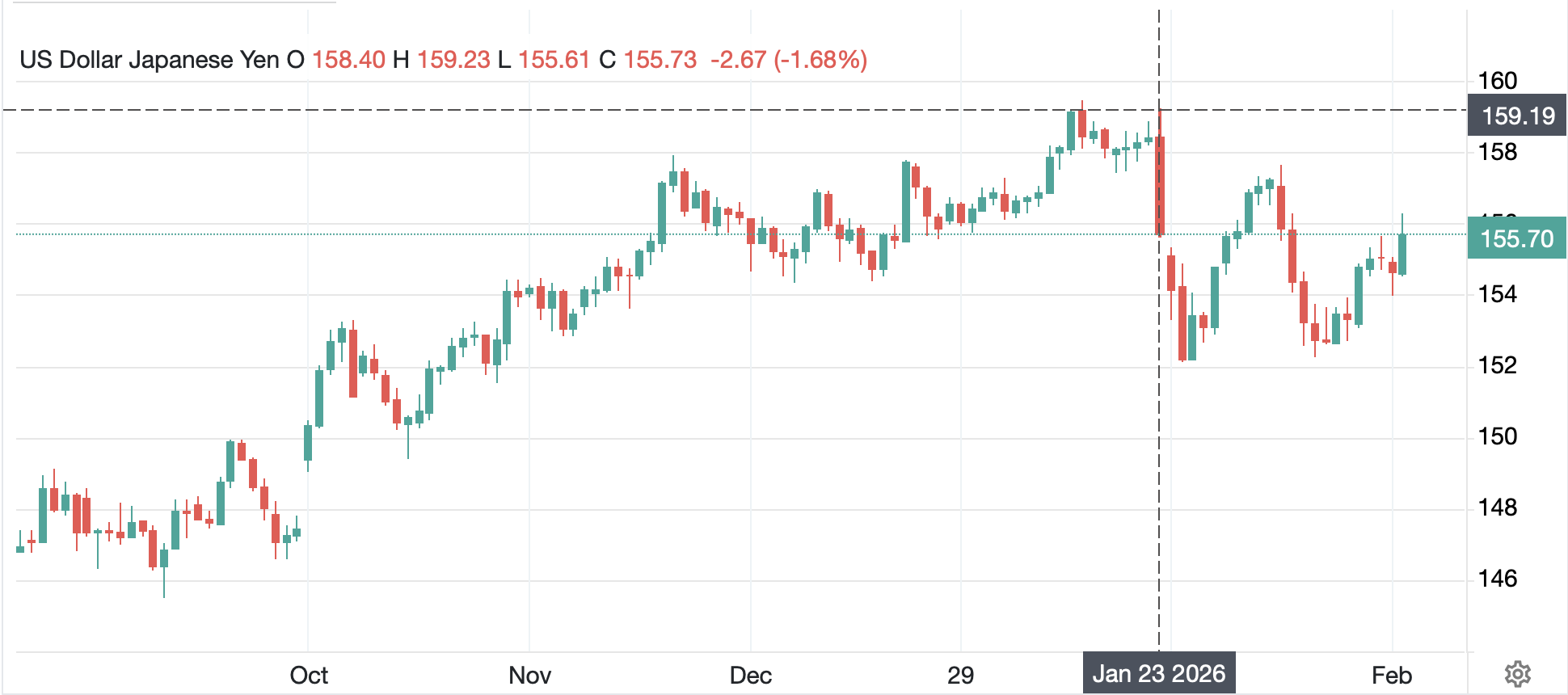
For those of you who don’t know, the genesis of this note was a daily update during my time covering US corporates for their FX hedging needs.  The poetry was episodic… until it wasn’t.  At any rate, this is the reason I sometimes harp on particular currencies rather than markets more generally.  And right now, while the dollar, writ large, is not that interesting, as I have been explaining for months, the yen (+0.3%) is becoming interesting in its own right as its recent spate of weakness has opened the door to intervention.  Last night, I would say we took a half-step forward on this journey as, while the BOJ did not check rates, FinMin Katayama was more explicit in her discussion about the yen’s weakness, even discussing the fact that the ‘agreement’ that her predecessor made with Treasury Secretary Bessent has no restrictions on intervention if deemed appropriate.

Following are her remarks from last evening, “We can take decisive measures against sudden movements that do not reflect fundamentals. This refers to intervention, and there are no constraints or restrictions on this.  I have repeatedly stated that we will take bold action including all the different measures available.  We shared the view that recent moves have been excessive and do not reflect fundamentals.” Then, she followed that up by referring back to her discussions with Bessent in Washington on Monday. “For many years before I took office, the Treasury secretary has held the personal view that monetary policy has been behind the curve.”

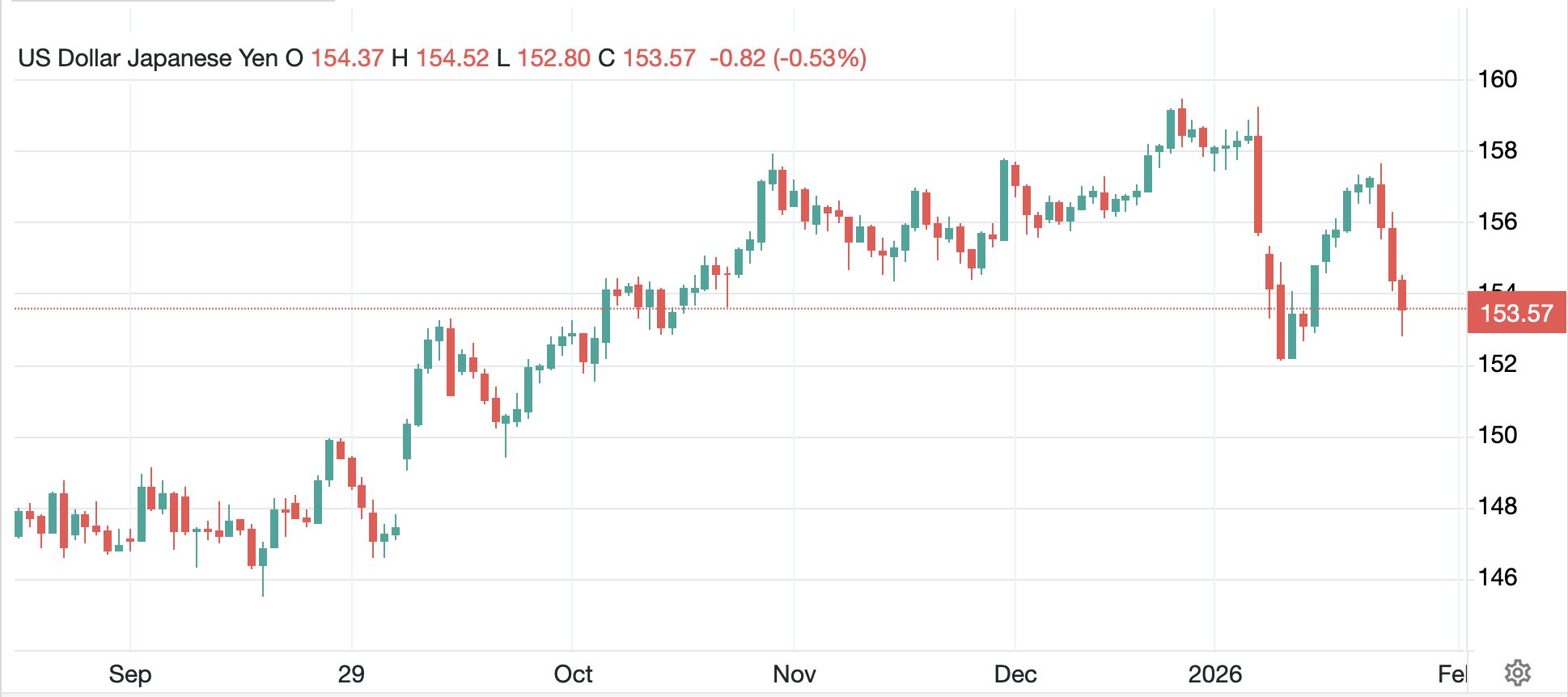
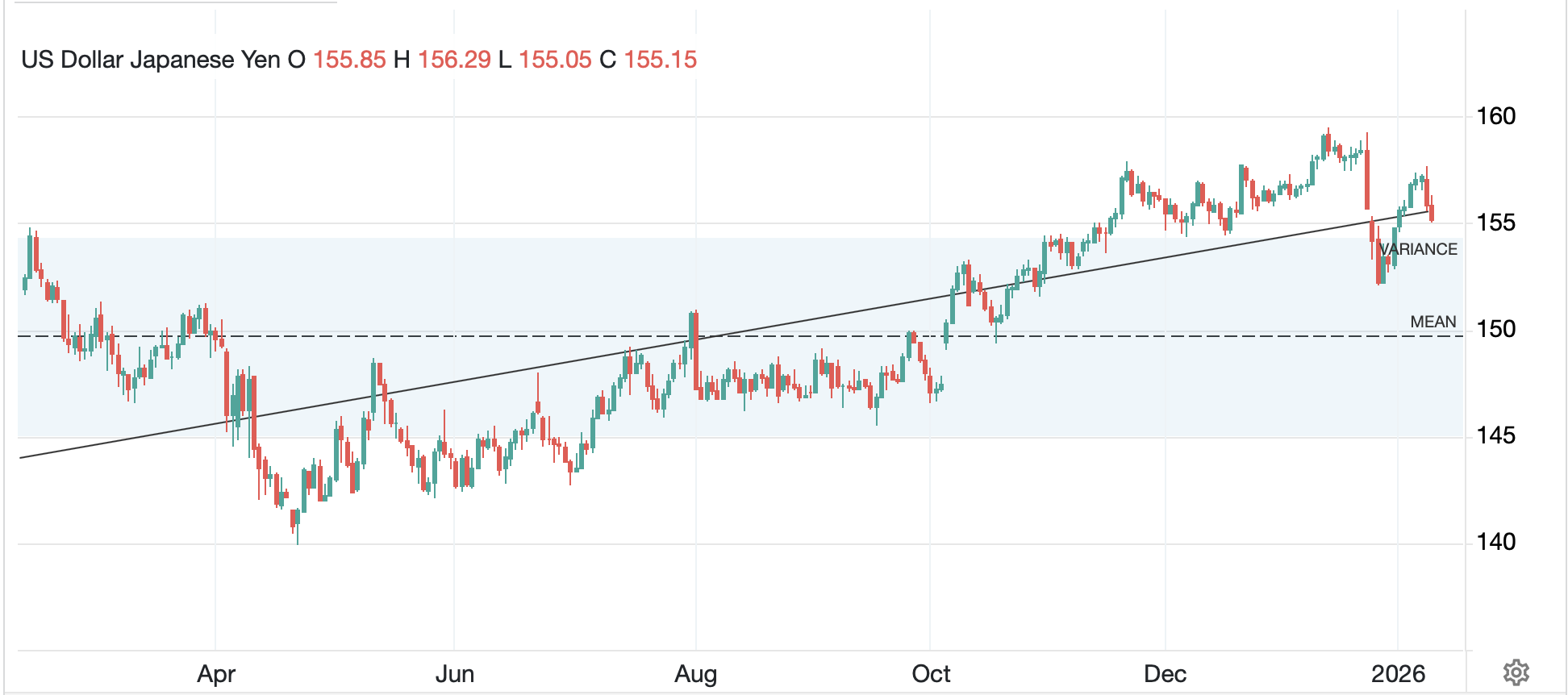
The chart below shows that for now, jawboning is the preferred measure to prevent further yen weakness, but as jawboning is only ever a temporary solution, it seems clear to me that there will be intervention at some point.  In fact, given Monday is a bank holiday in the US, implying less liquidity as banks run skeleton staffs, that may be an ideal time to get the most bang for their buck.

Source: tradingeconomics.com

But remember, even if/when they intervene, the impact will only be temporary.  Perhaps keeping a floor underneath the currency for a month or two.  Ultimately, though, it will follow the fundamentals, and if those are such that the US continues to grow rapidly and receive investment flows, unless the BOJ raises rates dramatically to moderate those flows, the yen will ultimately weaken further.   Now, ask yourself if you think the BOJ can raise rates aggressively given the combination of Japan’s 250% debt/GDP ratio and the fact that Takaichi-san’s policy mix is to borrow more and run things as hot as possible.

Away from the mess in Japan
A story of note is Iran
But tensions have waned
And thus, it’s explained
The oil complex can, down, stand

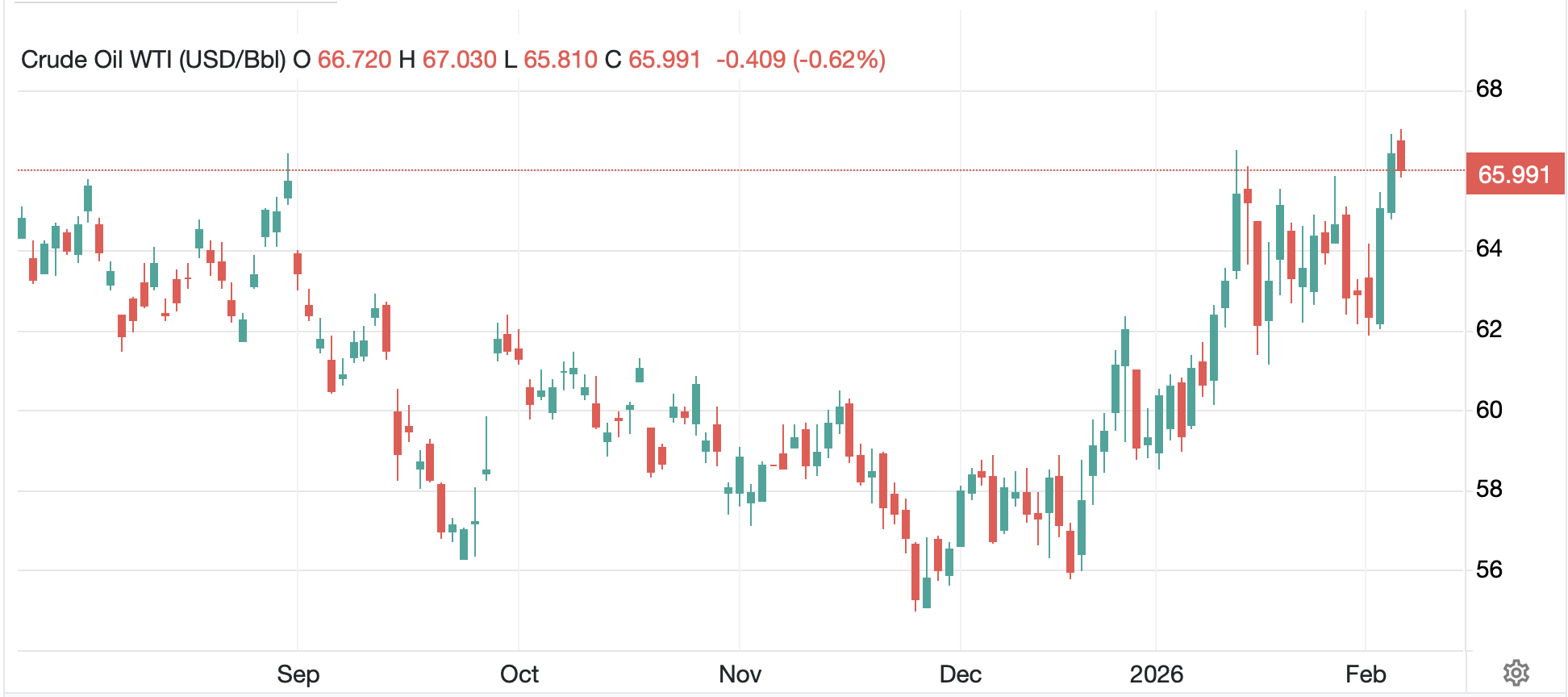
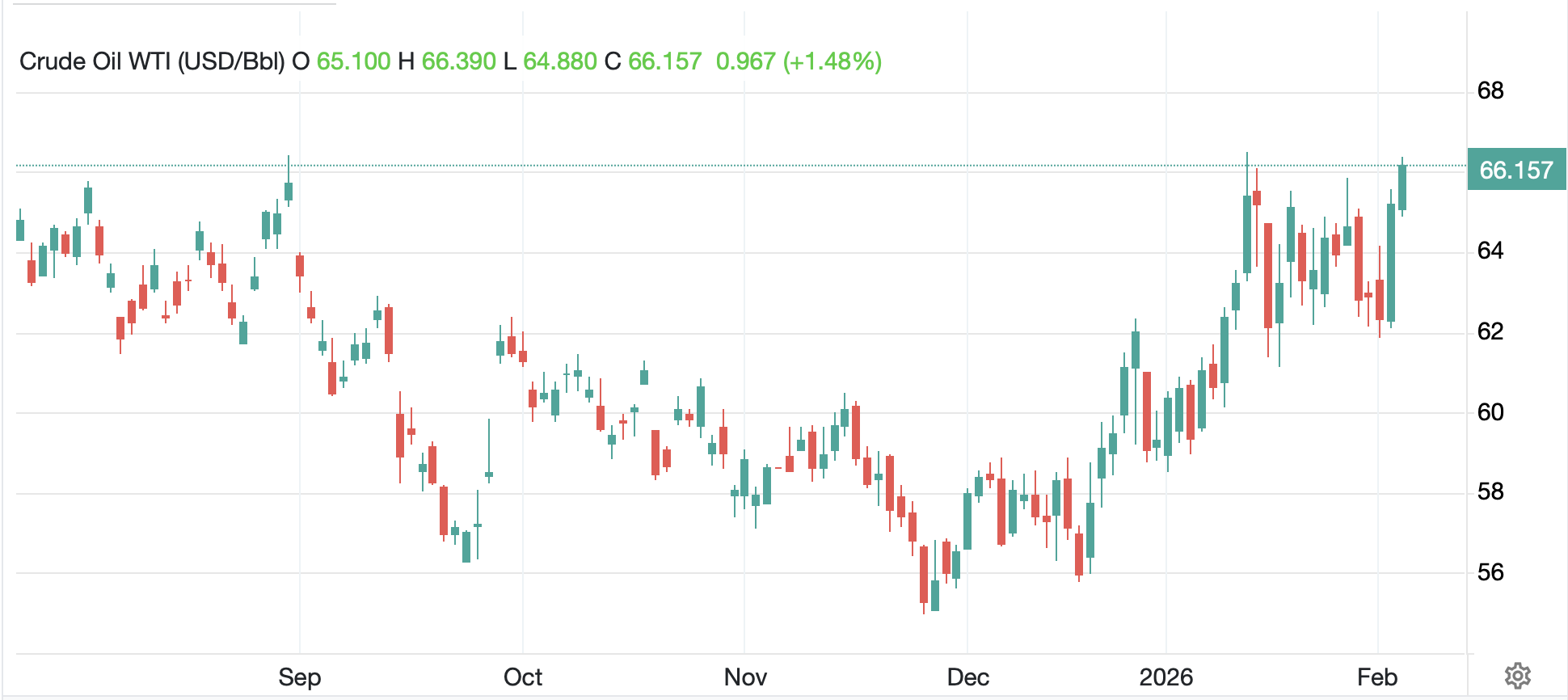
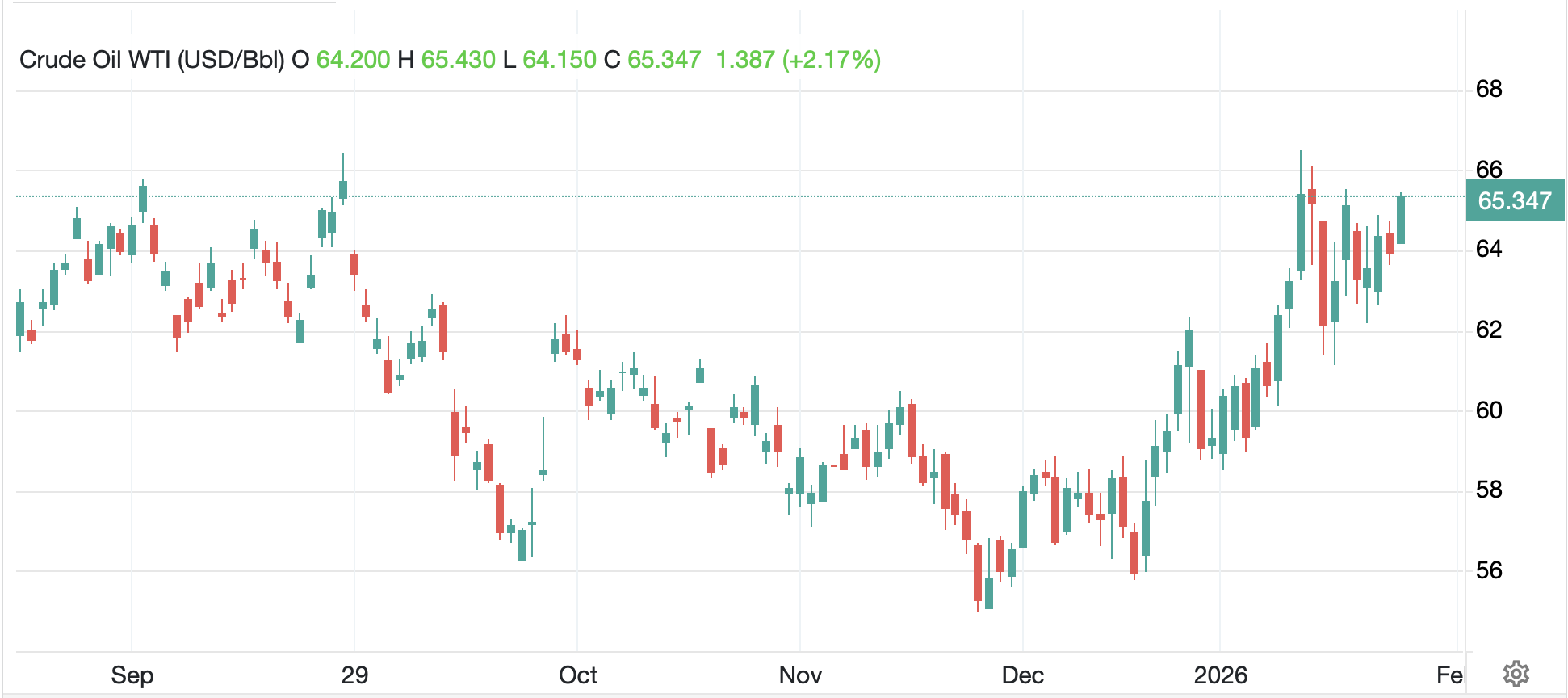
Looking elsewhere for news of note, there continues to be an enormous amount of energy focused on Minneapolis, which has no market impact.  Remarkably, Venezuela has become an afterthought to the markets as the new narrative is their natural resources are not economically retrievable at current prices.  Iran remains a hot topic in the oil market, but the concerns registered by traders early in the week have ebbed overall, although this morning, Texas tea is higher by 1.5% and back over $60/bbl. 

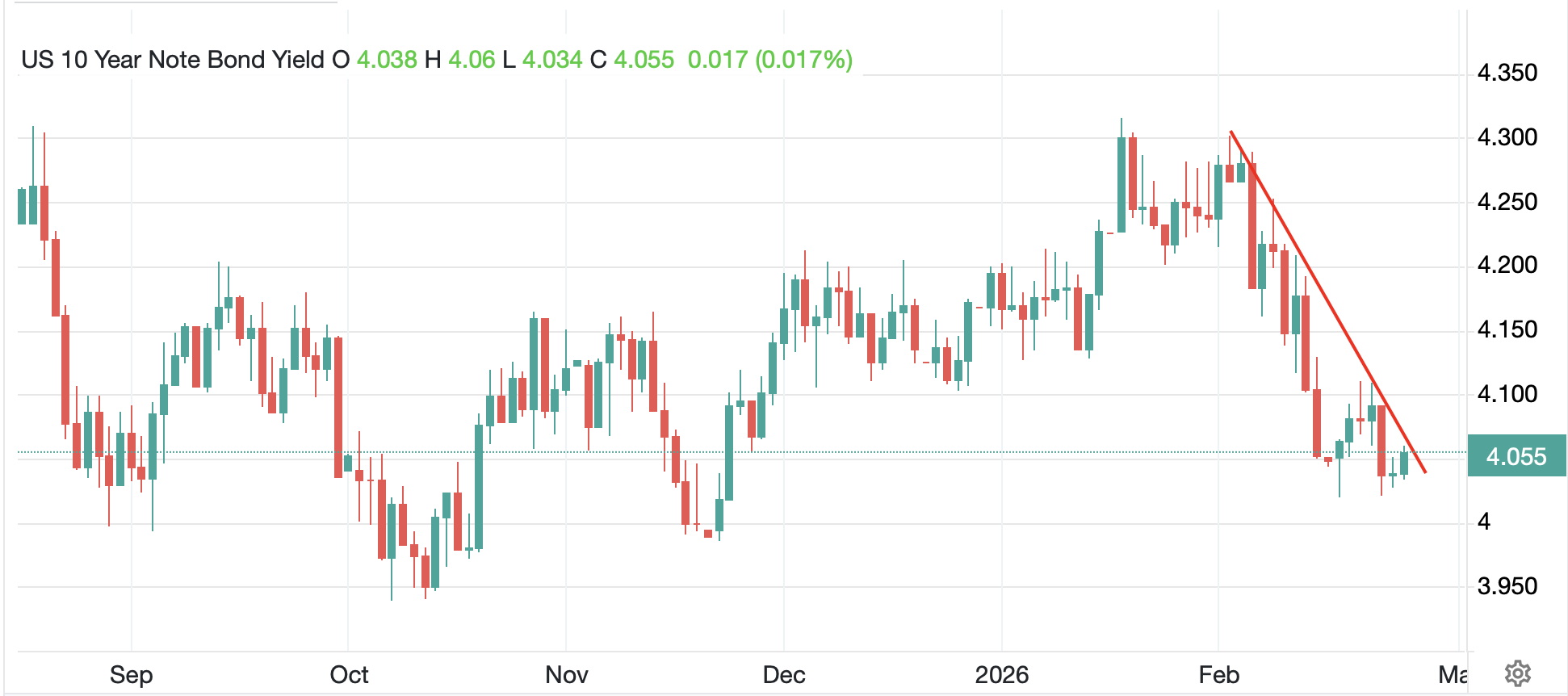
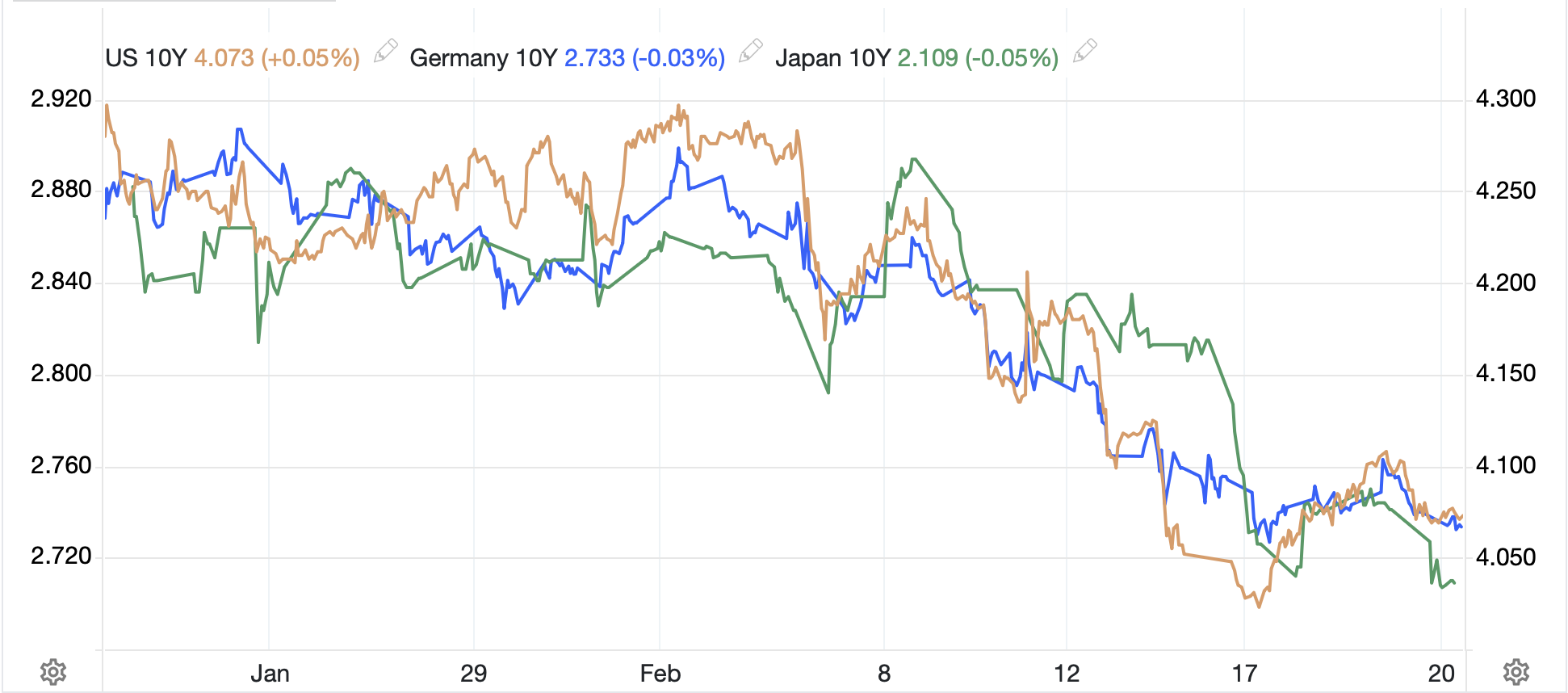
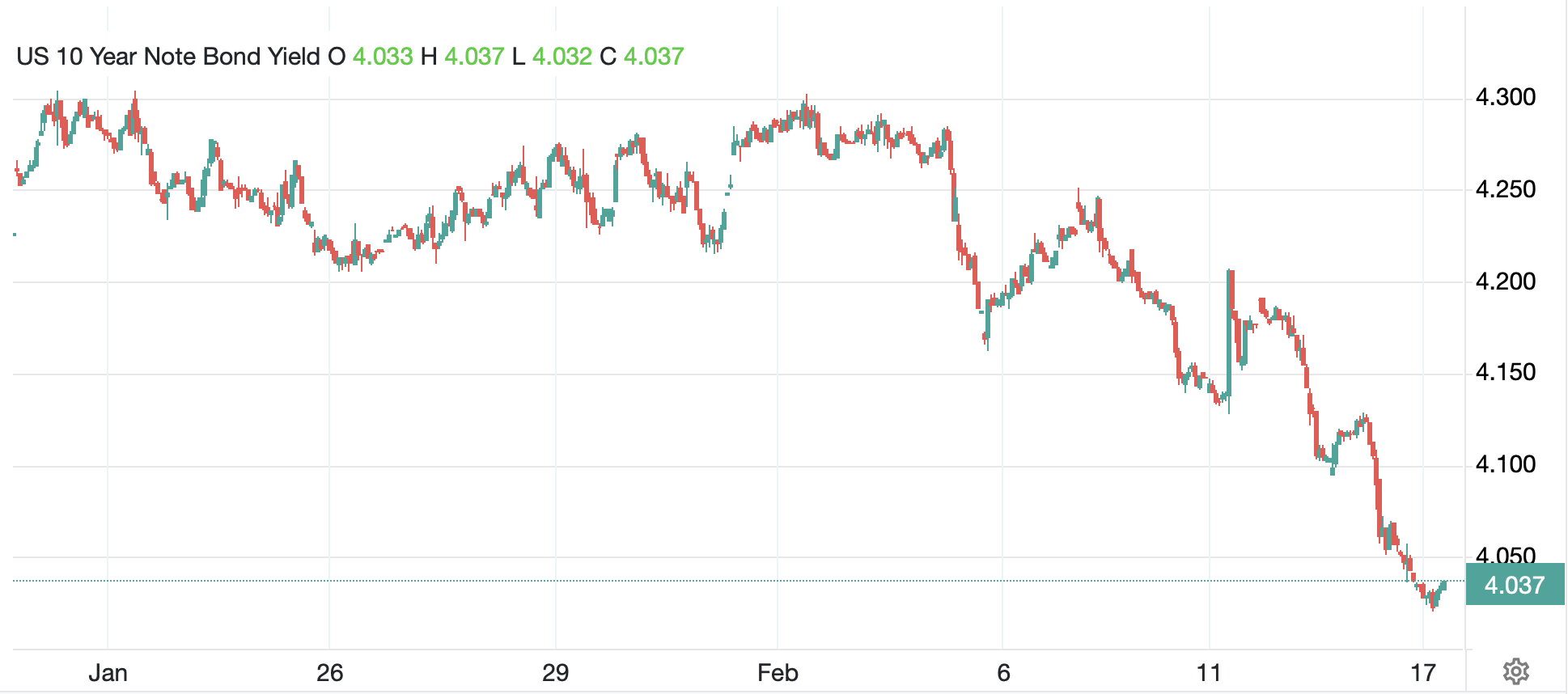
Looking at other markets, bonds remain somnolent, with yields up 1bp this morning, reversing yesterday’s decline of -1bp but still firmly within the 4.00% – 4.20% range.  European sovereign yields have edged higher by 2bps this morning and overnight JGB yields rose 3bps.  However, it remains difficult to see any significant pattern over the past month as evidenced by the chart below of French and German 10-year yields.  Net movement has been a handful of basis points overall.

Source: tradingeconomics.com

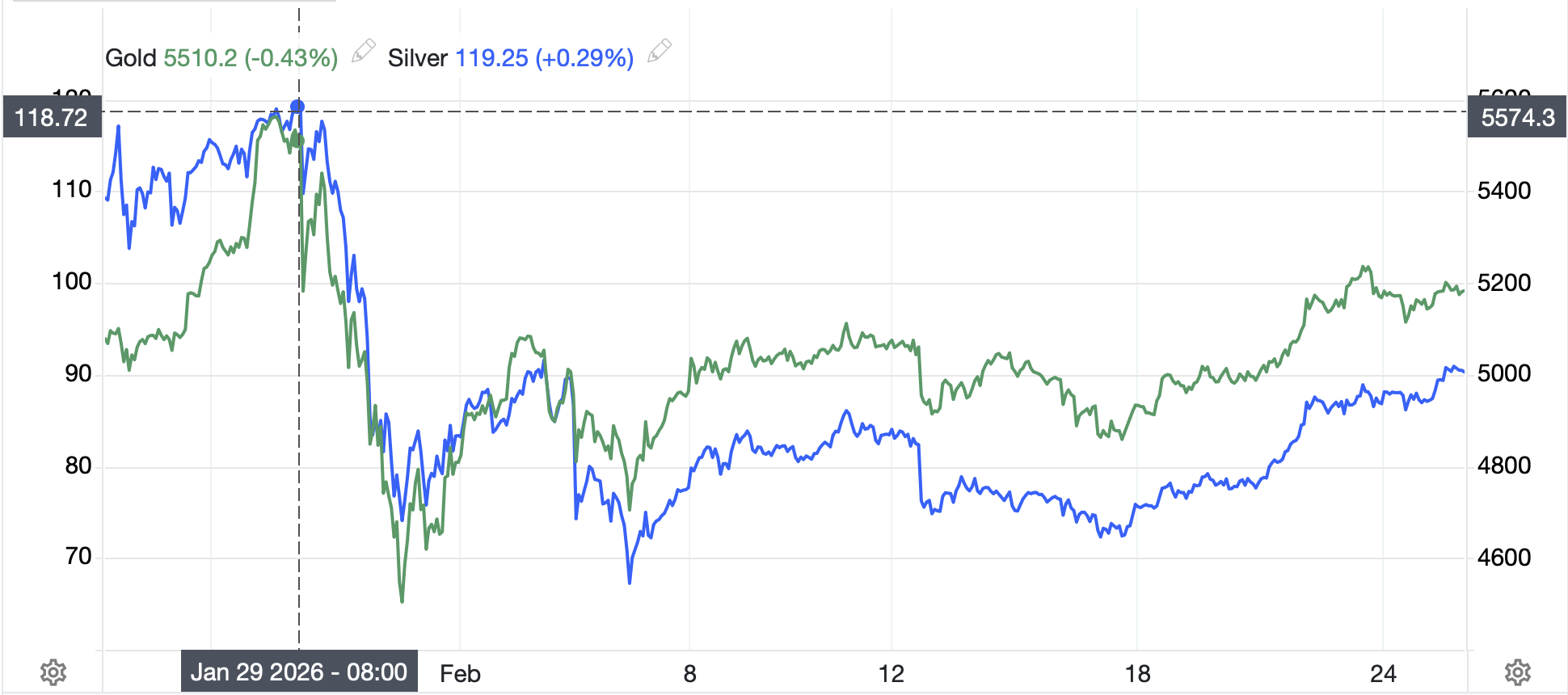
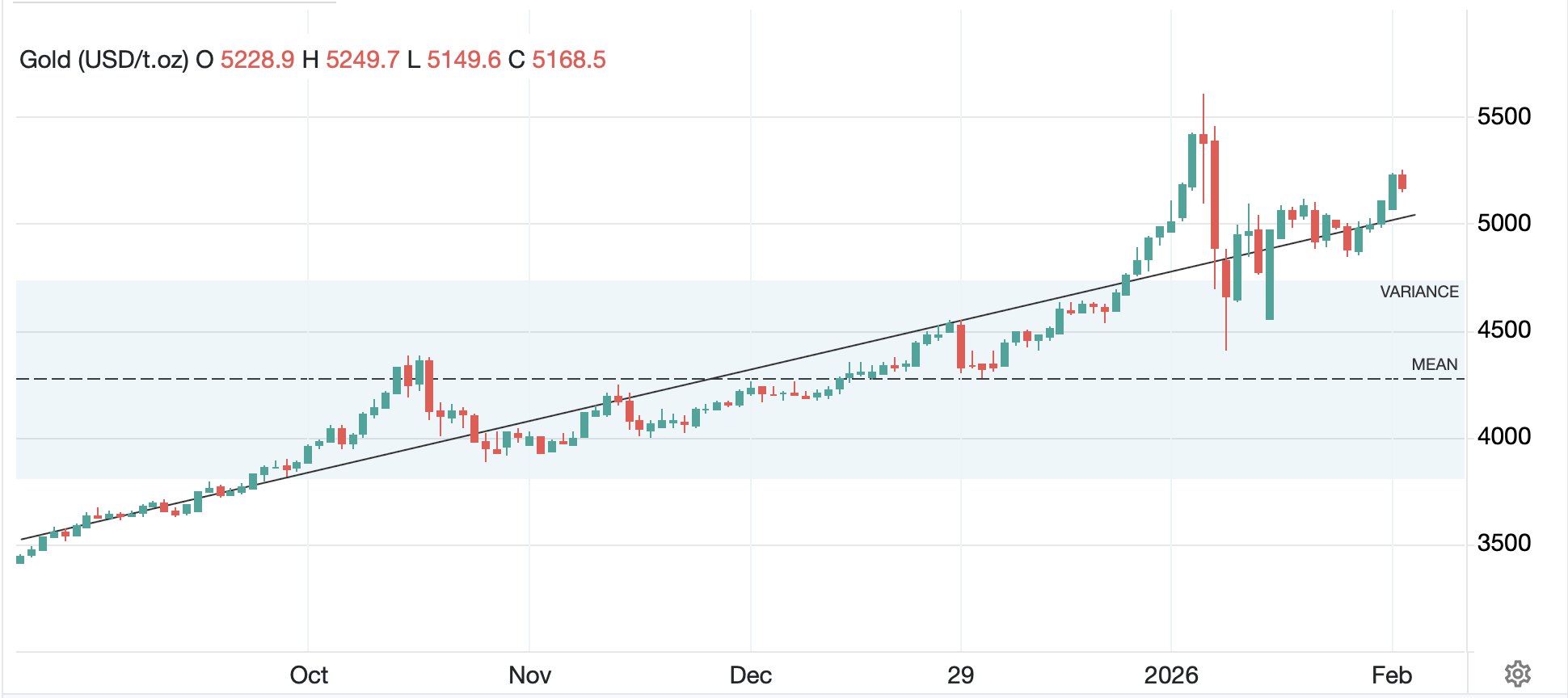
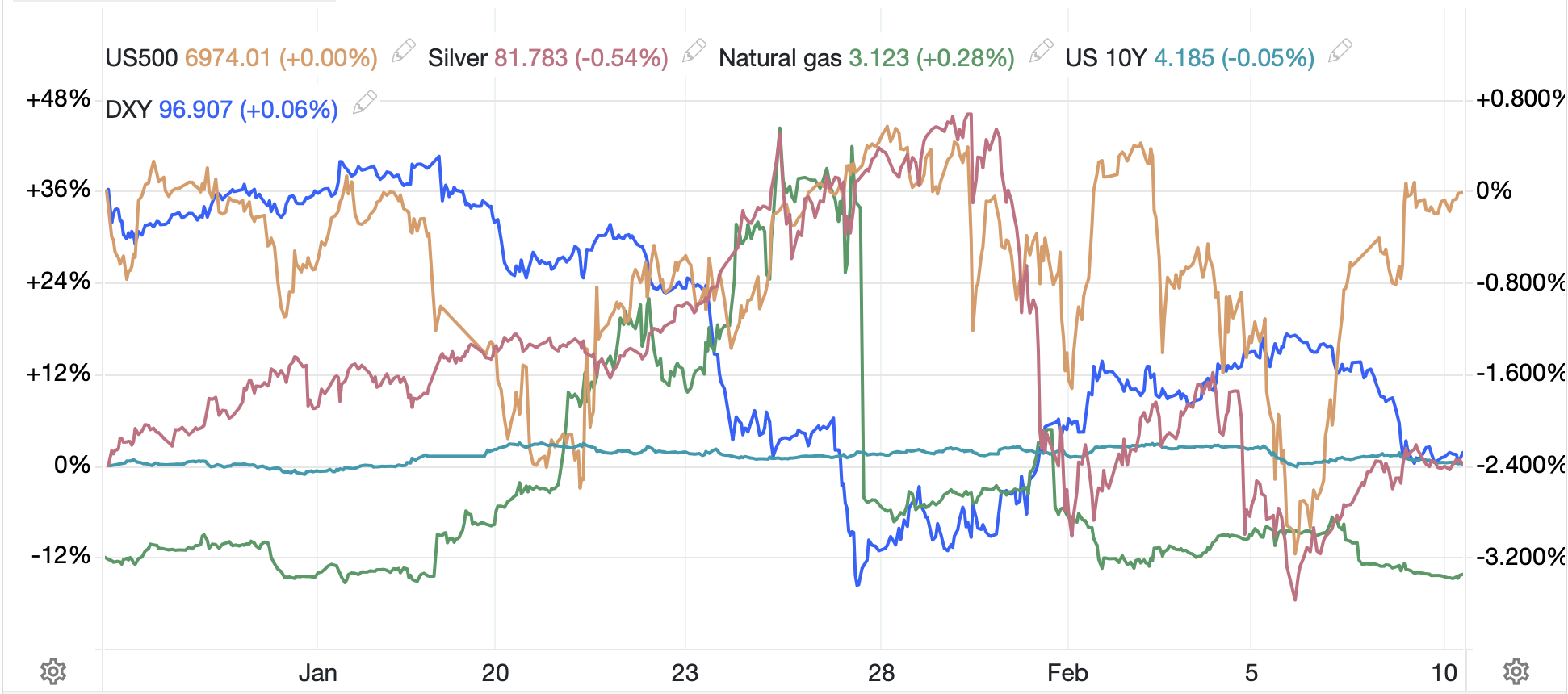
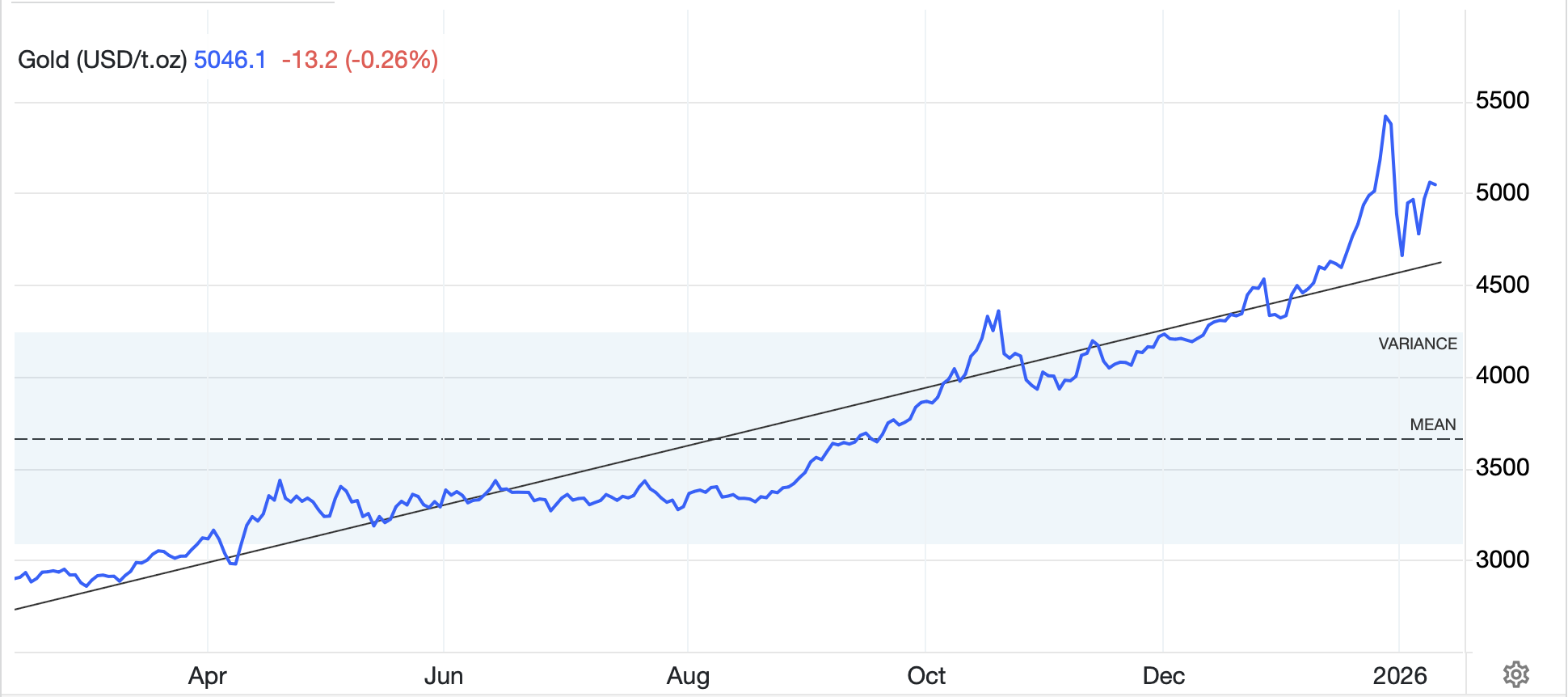
Even the metals markets, which have been THE story for the past months, have calmed down a bit as they consolidate their recent remarkable gains.  This morning, gold (-0.25%), silver (-2.1%), copper (-1.5%) and platinum (-3.2%) are all softer, but all remain higher on the week and over the past month, with silver having gained 37% since this time in December, and sitting above $90/oz.

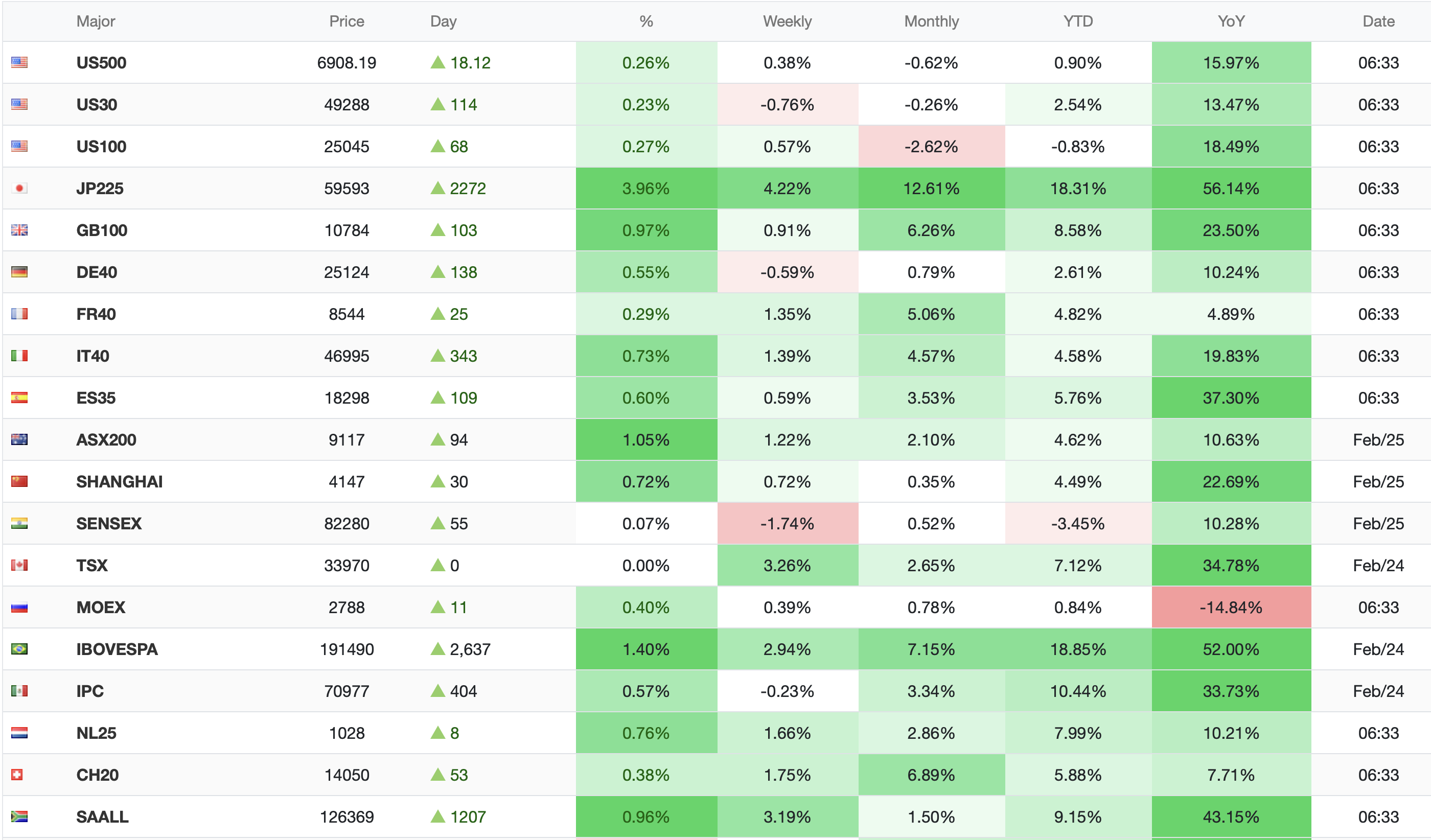
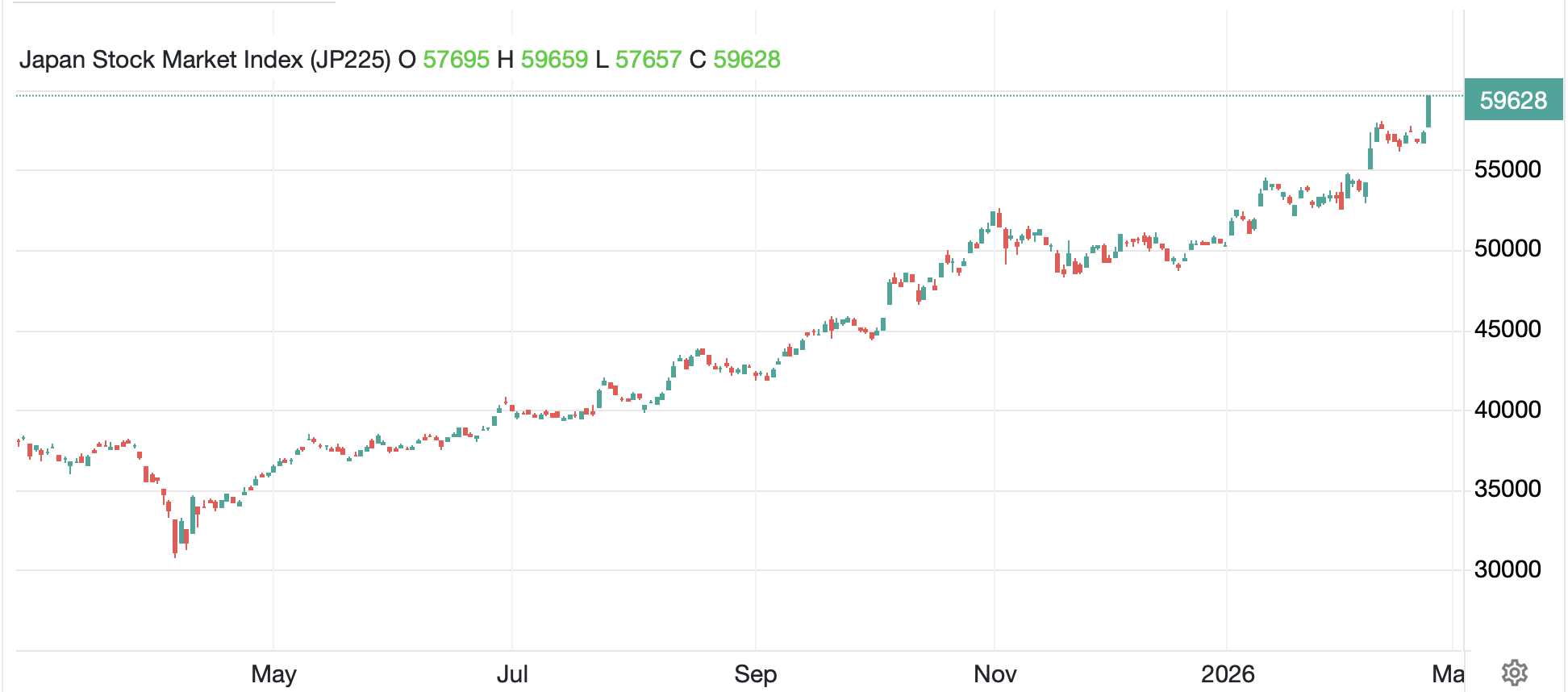
Equity markets in the US rebounded yesterday, seemingly on some decent earnings data, but overnight, there was little love with Japan (-0.3%), China (-0.4%) and HK (-0.3%) all slipping from recent highs.  Elsewhere in the region, though, there was much more positivity as Korea (+0.9%), India (+0.25%), and Taiwan (+1.9%) all rallied with the latter benefitting from the agreement of a trade deal with the US that cut tariffs on Taiwanese exports in exchange for a $250 billion commitment of investment into the US.

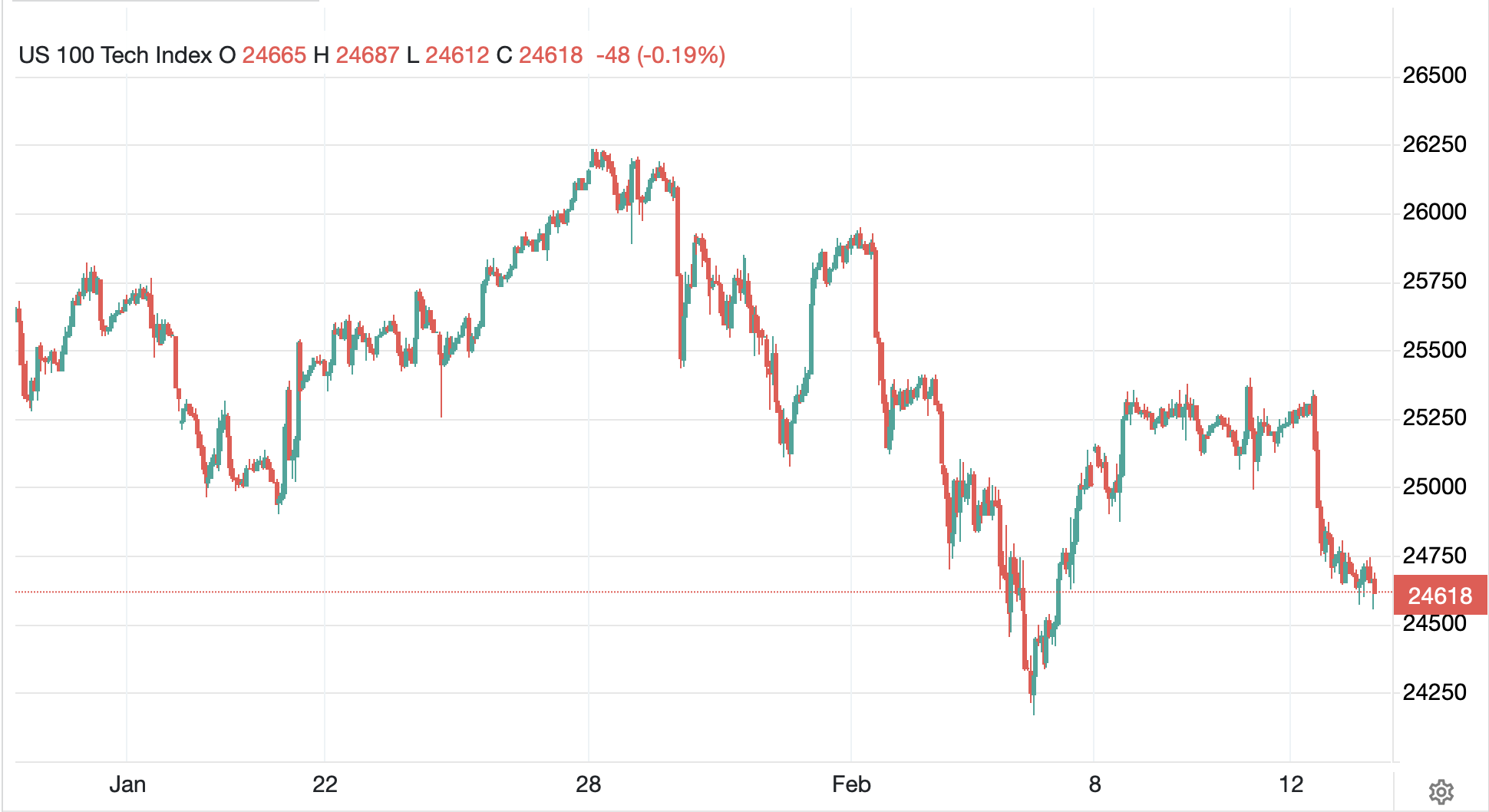
In Europe, France (-0.8%) is the laggard du jour as ongoing budget negotiations in the government are no closer to completion and showing signs of breaking down.  As to the rest of the continent, modest declines are the order of the day while the UK is unchanged.  US futures at this hour (7:40) are pointing higher, however, led by the NASDAQ at +0.7%.

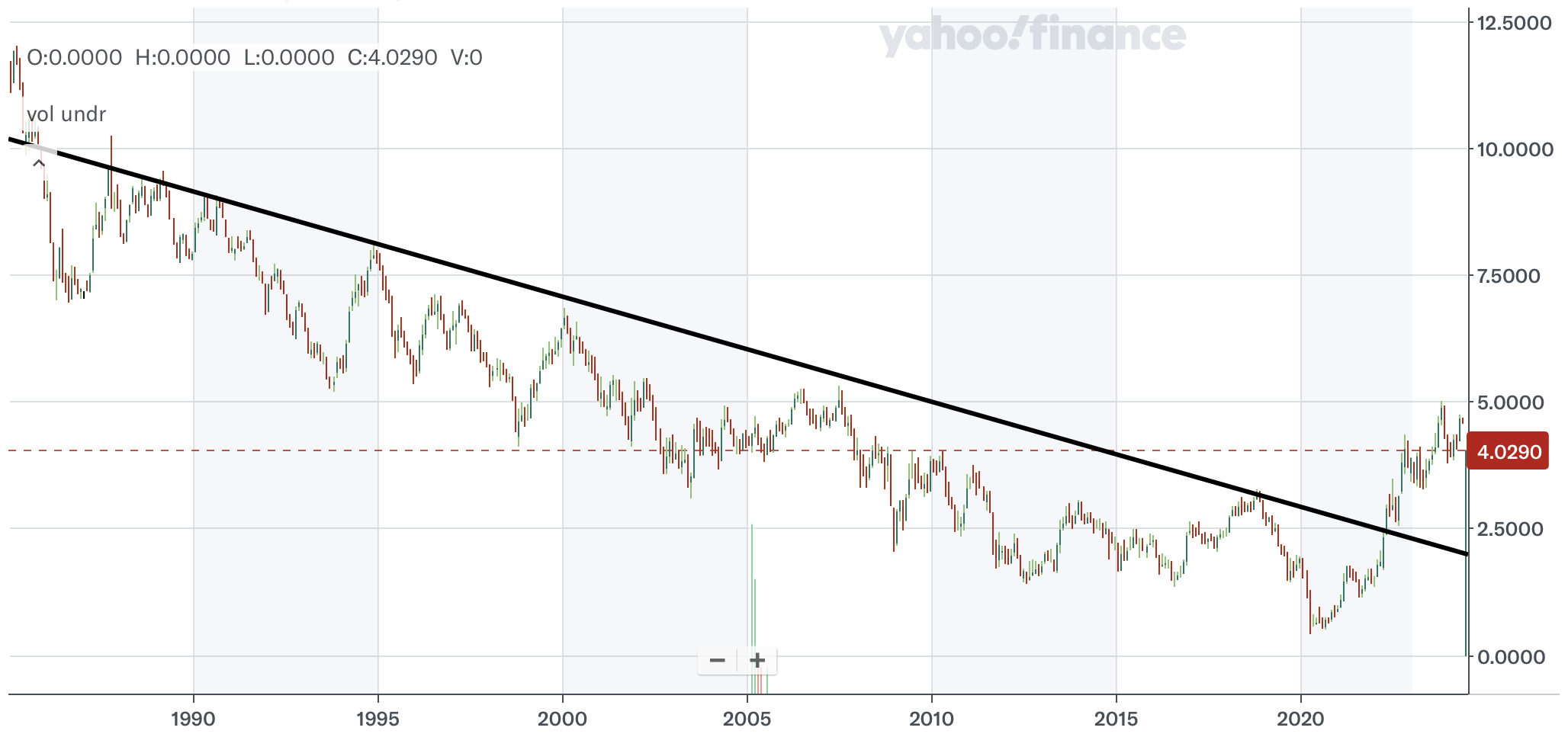
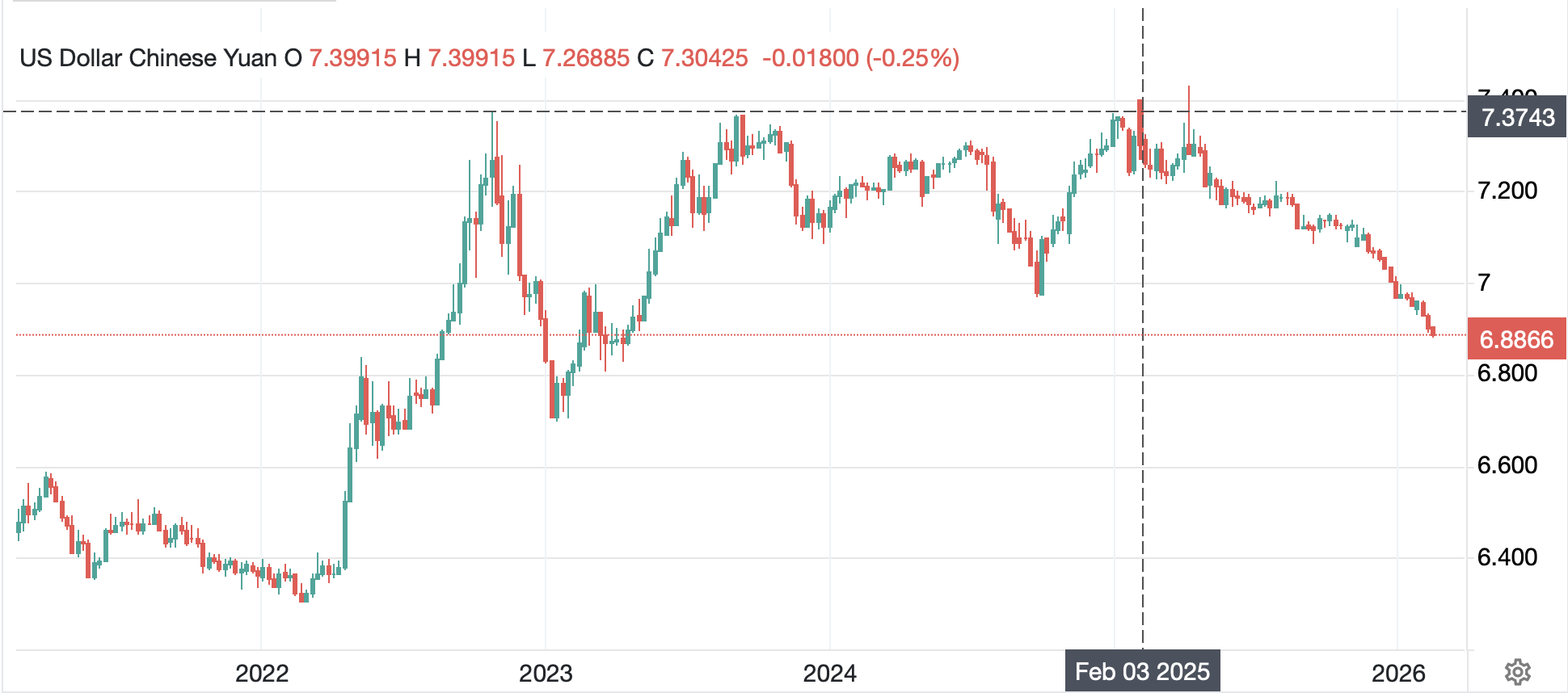
While overall, the dollar remains dull, an underreported story is the CNY (0.0% today) which has been appreciating steadily for the past year and is now at its strongest level since May 2023.  In the beginning of the year my view was if Xi actually got Chinese consumers to raise their spending and back away from the mercantilism that has been the driver of the Chinese economy since the beginning, we would see CNY strength, calling for 6.50 by the end of the year.  Well, a look at the chart below helps keep things in perspective as while CNY has appreciated about 5% in the past year, it remains far below (dollar higher) levels seen post pandemic.  However, I need to see the data indicate Chinese domestic demand is growing before I become a true believer!  Note, too, that the pace of this move is hardly remarkable.

Source: finance.yahoo.com

And that’s all I got today.  Today’s data brings IP (exp 0.2%) and Capacity Utilization (76.0%) with a few more Fed speakers as well.  Remarkably, despite the Fed trotting out virtually every member this week, nothing of note has been said given the current focus on defending Chairman Powell regarding the renovations at the Eccles Building.  

One other thing I have been wondering, and this has been for a long time, is the meaning of the Capacity Utilization reading.  On its surface, it tells us that only three-quarters of the US currently available manufacturing, mining and drilling capacity is being utilized.  But that seems like a low count based on the economy and the narrative.  I wonder, how much of what is considered available capacity is actually obsolete?  Undoubtedly, as you can see from the chart below from the FRED database, the trend is falling.  

But do companies really build so much capacity they don’t use and it sits idle?  Seems a tough way to make a living in a highly competitive world.  I understand that globalization undermined US manufacturing ever since China entered the WTO in 2001.  And maybe that is all this reflects.  But given the dramatic buildout in AI infrastructure, as well as growth in LNG and power production of late, if nothing else, I have to believe this trend is set to reverse in the near future.  After all, isn’t that Trump’s goal?

Meanwhile, I feel like we are all awaiting the next headline to determine the next move.  The underlying trend in commodities remains in place, and mostly, bonds and the dollar have no reason to go anywhere.

Good luck and good long weekend

Adf

Tired

Though recently there’s been a ton
Of news, which has led to much fun
The markets today
Have little to say
Though recent trends ain’t been undone
 
Sometimes traders simply get tired
And find, in a rut, they’ve been mired
But you needn’t worry
‘Cause soon they will scurry
To come back with ideas inspired


As much activity and new news that has been part of the process over the past several weeks, today is one of those days when it appears we may be able to step back and catch our collective breath.  One thing I have observed throughout my career on trading desks is that no matter the underlying news, narrative or data, traders, even algorithms, can only remain in a frenzy for so long.  Consider it has been nearly two weeks of nonstop news since the US exfiltration of former Venezuelan president Maduro, yet some markets have exploded.  Silver is probably the poster child for this price action and as you can see below, since markets reopened after that news, gold’s little brother has risen nearly 25%, including today’s modest -2.3% retracement.

Source: tradingeconomics.com

But all the precious metals, and base metals as well, have had massive runs and the narrative regarding supply constraints and increased strategic purchases by China along with the US labeling many as critical national defense requirements, has been enough to bring retail into the mix.  But a 25% move in less than two weeks is really exhausting for the folks who are in those markets every day.  

At the same time, the amount of energy that has been consumed regarding Greenland, Iran and Minneapolis (which even though it is not a market related issue, is so widespread in its reporting takes up space in one’s brain) seems to have reached a peak yesterday, at least a local maximum.  I don’t, for a minute, believe that these trends have ended.  But a few sessions of modest net movement as positions are adjusted is a normal response to dramatic movement.  We should welcome the rest!

Reading through as much as I could find this morning, there really is no new story on which to hang your hat, so without further ado, I will review overnight market activity and perhaps ponder how things may evolve going forward.

A key sign of the slower activity was yesterday’s US equity markets where modest declines were the order of the day.  That was followed by a mixed session in Asia with some gainers (China +0.2%, Australia +0.5%, Korea +1.6%) and some laggards (Tokyo -0.4%, HK -0.3%, Taiwan -0.4%, India -0.3%).  Other than Korea’s strong session, which was inspired by central bank and government efforts to get investment to come back home to support the won, it appears traders are now biding their time ahead of the next major event.

European bourses are also mixed (Germany -0.1%, France -0.3%, Spain -0.1%, UK +0.4%) with the UK benefitting from a stronger than expected GDP report where growth jumped to 0.3% on the month, well above expectations of a 0.1% increase.  But a look at the chart below indicates one ought not get too excited about the economic growth in the UK with 14 negative months in the past 3 years.

Source: tradingeconomics.com

As to US futures, at this hour (7:10) they are pointing higher, currently almost exactly offsetting yesterday’s declines.

In the bond market…ZZZZZZ is the story of the day week month past four months as evidenced by the chart below.

Source: tradingeconomics.com

There are a number of conflicting narratives here with one story that the economy is going into a tailspin as a look beneath the headline data shows weakness everywhere (housing, employment, manufacturing) and the result is rates will fall along with inflation because of the coming recession.  Another narrative is that the ongoing debt expansion to fund unending budget deficits in the US is going to lead to the collapse of the dollar and much higher long-term rates as investors require far more payment to hold this much riskier than previously assumed asset.

Right now, neither of these seem to be living up to their promises.  Yesterday’s Retail Sales print was much stronger than expected at +0.6%, which hardly portends a recession.  Now, the CPI data has been polluted by the missing October numbers and is biased downward based on the BLS methodology, but you can be confident that it will recoup those losses in a few months’ time.  Meanwhile, there is no indication the Fed is going to do anything in two weeks, and my take is there is significant uncertainty over the future direction of the economy, with both positive and negative pieces.  Until we get indications that growth is either truly cratering along with rises in unemployment, or that things are exploding higher, remaining in the range seems the most likely outcome.  Remember, too, the OBBB is going to goose economic activity right away and running it hot remains the mantra.  

As to European sovereign yields, they have edged higher by 1bp this morning with one outlier, Portugal (+13bps) which seems to be reacting to the prospect of a runoff in the presidential election this Sunday, in the race between a populist outsider and a Socialist party insider, with the populist seen a slight favorite.  As to JGB yields, they have slipped back -2bps as the market becomes accustomed to the idea of the snap election.

In the commodity space, oil (-3.6%) has ceded most of its recent gains after President Trump indicated that there would be no bombing by the US, and the Mullahs ostensibly promised no executions of protestors.  Added to that was a massive build in inventories reported yesterday and supply concerns have abated.  In the metals markets, we are seeing that breather across the board (Au -0.25%, Ag -2.3%, Cu -0.8%, Pt -0.6%) which is very clearly profit taking after we saw record highs in all metals yesterday.  Nothing has changed the fundamentals here, so higher is still the way, IMO, but a few days of chop ought not be surprising.

Finally, the dollar appears to have found a comfortable home at 99.00 in the DXY.  There has been limited movement across the board with even JPY unchanged on the day as traders wait before trying to push the currency lower again.  KRW (-0.3%) is the worst performer today as it has been weakening steadily for a year.  Adding to the discussion above, the Korean government is trying to internationalize the won to some extent in their effort to get Korea taken out of the emerging market bucket for markets.  This relaxing of restrictions has seen capital outflow, but my take is this will be temporary as the country remains in very good fiscal and economic condition and will attract investment in my view.  Otherwise, there is nothing of note.

On the data front today, we get the weekly Initial (exp 215K) and Continuing (1890K) Claims as well as Empire State Manufacturing (1.0) and Philly Fed (-2.0) all at 8:30.  We hear from 3 more Fed speakers and it seems the hymnal now contains a single talking point, Fed independence is crucial and the subpoenas to Powell are lawfare and inappropriate.  Only Steven Miran is not singing that tune, but given he is Trump’s appointee, that is no surprise.

As commodities, and really metals, have driven the entire narrative lately, if they are going to have a quiet day, look for quiet all over.  Longer term, nothing has changed, but nothing goes up in a straight line, and that is what we are witnessing today.

Good luck

Adf
Step Five?

It takes seven steps
Ere intervention arrives
Was last night step five?


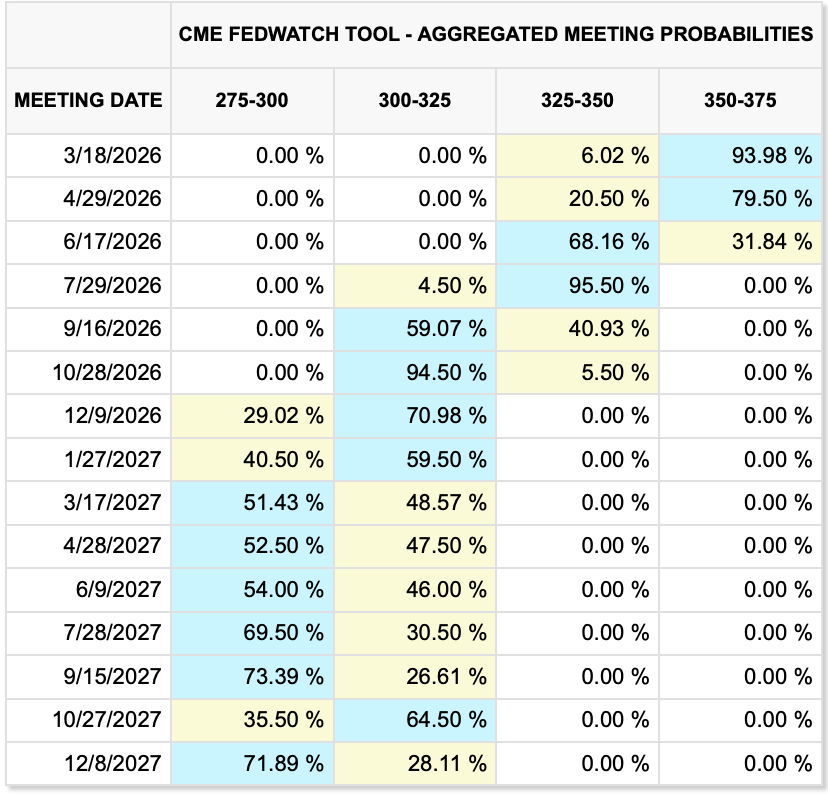
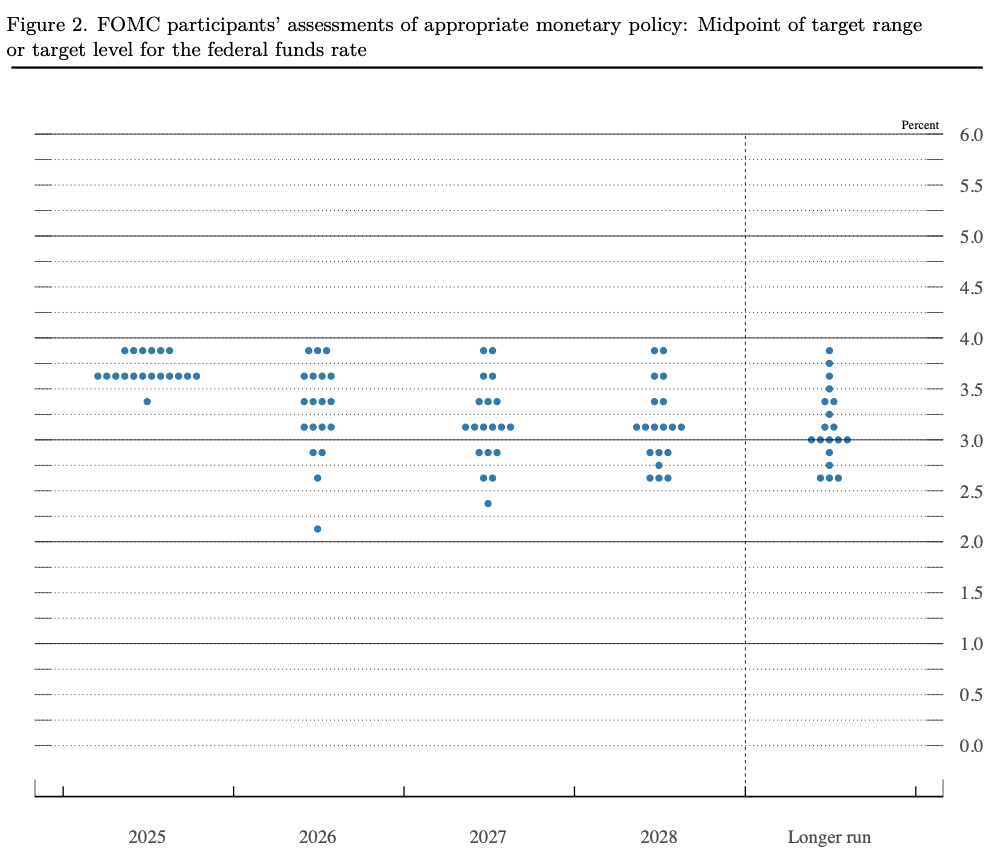
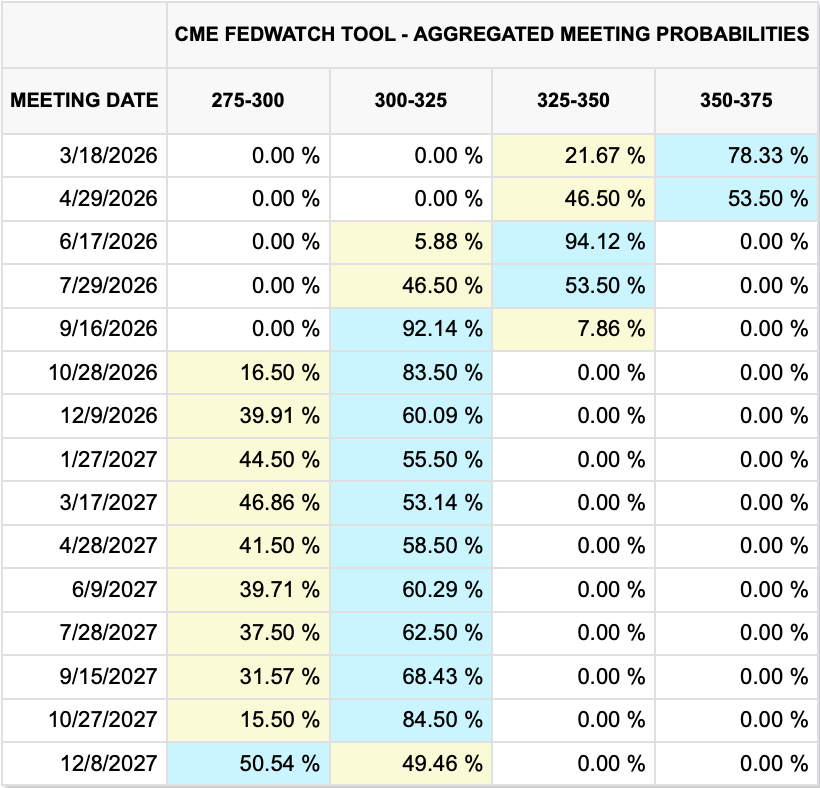
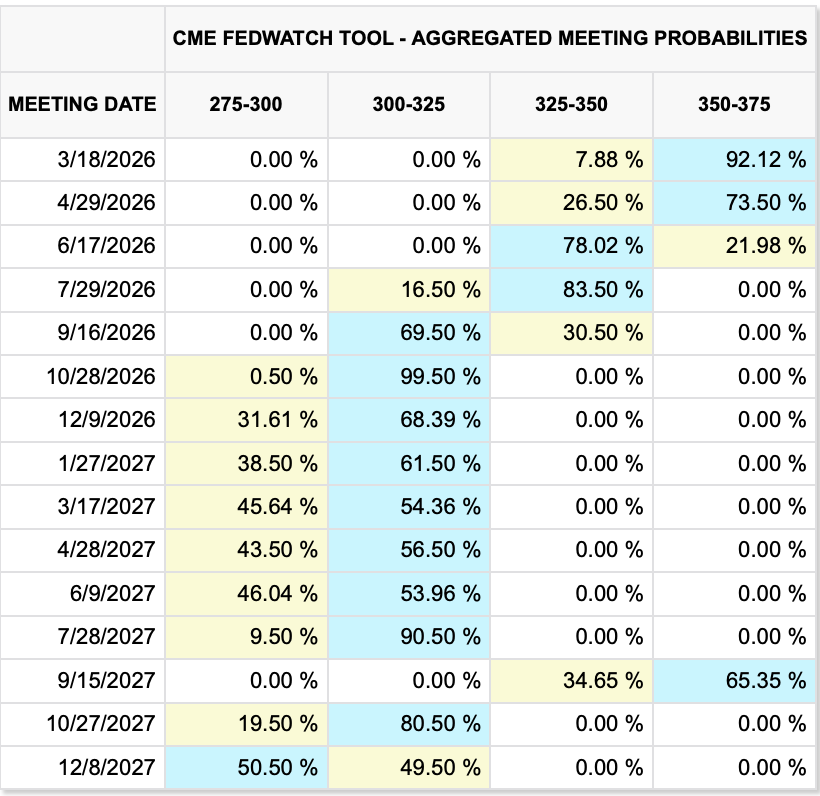
The yen continues to be in the crosshairs of traders as further weakness is anticipated based on several things I believe.  First, there had long been an assumption that the Fed was going to cut rates further, especially with President Trump haranguing Chairman Powell constantly on the subject.  In addition to that, there continues to be an underlying thesis amongst many pundits that the US economy is weakening dramatically to drive that rate decision.  Yet recent data belies those facts, notably the Atlanta Fed’s remarkable GDPNow jump, but also relative stability in other data, including employment.  The upshot is the futures market is now pricing a mere 3% probability of a cut at the end of this month and not pricing the next rate cut until June, after Chairman Powell is gone.  One key leg of the yen strength argument is weakened.

Source: cmegroup.com

Second, there continues to be a belief that the BOJ will continue to hike interest rates, and perhaps they will, but it appears that the pace of those hikes will be far slower than previously anticipated.  Currently, the market is pricing just 50bps of hikes for all of 2026.  At the same time, Takaichi-san is set to “run it hot” in Japan just like in the US, pumping up fiscal stimulus and forcing the BOJ to come along for the ride.  The implication here, which is what we are seeing in the markets right now, is that a larger fiscal deficit will lead to strength in equities but a weaker currency.  The second leg of the yen strength argument is failing here as well.

Which brings us to last night’s commentary from Satsuki Katayama, Japan’s FinMin, who explained, [emphasis added] “We won’t rule out any means and will respond appropriately to moves that are excessive, including those that are speculative. We’ve mentioned this to the prime minister today as well.”  The kind of sudden moves we saw on Jan. 9 have nothing to do with fundamentals, and are deeply concerning,” she added. Her message was soon backed up by Atsushi Mimura, the ministry’s top official in charge of the yen, who reiterated that no options were being ruled out.

The bolded words are all part of the Japanese seven-step plan toward intervention.  At this point, I feel like we have reached number five.  The market responded predictably, with the yen strengthening vs. the dollar (and all its counterparts), albeit not all that much.  Last night saw the yen trade at 159.45, its highest since July 2024 (the last time the BOJ intervened), before the comments helped bring it back a bit.

Source: tradingeconomics.com

But one other area which the MOF/BOJ follow closely is not just the USDJPY exchange rate, but also the yen’s rate vs. other major currencies.  If, for instance, the yen is only weakening vs. the dollar, that is one thing.  However, a look at the chart below showing USDJPY, EURJPY and GBPJPY shows us that the yen is weakening against all those currencies pretty much in sync.  In fact, this argues that the yen’s current weakness is a yen specific fundamental, not a speculative move, which should argue against intervention, as that will only be a temporary sop.  However, my take is when we get to 160 or 162, which I believe is coming, we will see the BOJ selling aggressively.

Source: tradingeconomics.com

Ironically, the one currency against which the yen has been weakening steadily that I’m sure delights the BOJ/MOF is the Chinese yuan.  Since Liberation Day in the US, the yen has fallen more than 17% and continues to slide vs. the yuan as it has been doing for the past five years.  It is not hard to believe there are voices in the Japanese government that see that move and recognize how much it helps the Japanese export sector and caution against trying to arrest the yen’s weakness too aggressively.

Source: tradingeconomics.com

I look forward to much more dialog on this subject and expect that soon, we will be hearing about the end of the carry trade, yet again.  To my eyes, until Japanese fundamentals change, or at least appear to be moving in the right direction, the yen will struggle.  So, let me know when the fiscal deficit shrinks, or GDP jumps to 4% or inflation slides back to 1%.  Until then, they yen is damaged goods.

As to the rest of the market, precious metals continue to be the shining stars with the whole sector higher this morning (Au +1.0%, Ag +4.2%, Pt +2.0%) and that move taking copper (+0.4%) along for the ride.  Last night the CME raised its margining requirement and changed its nature by requiring a percentage of the value, rather than a numeric amount per contract.  My friend JJ, who writes the Market Vibes substack wrote a brilliant piece last night explaining how the flows are evolving in the silver market.  To sum it up, at this point, there appears no end in sight for the demand as short positions are covered by new shorts.  Metal for delivery remains scarce and despite the extraordinary shape of the move, it appears to have more steam to drive it forward.  Markets like this are extremely difficult to trade, and history shows that movements in the shape seen below reverse very sharply.  But as Keynes explained 100 years ago, markets can remain wrong longer than you can remain solvent.  I am happy I have been long silver for quite a while but am having a hard time figuring out what to do now!

Source: tradingeconomics.com

Meanwhile, oil (+1.4%) continues to rally on concerns that the Iran situation will lead to one of two outcomes, either a substantial decline in production as the regime collapses, or an effort by the regime to close the Strait of Hormuz which will impede shipping and reduce supply as they try to inflict pain on the US and the rest of the world who are rooting for the uprising.

Heading back to paper markets, yesterday’s weakness in the US was followed by a more mixed picture in Asia with Japan (+1.5%) rallying on continuing hope for more fiscal stimulus.  HK (+0.6%) benefitted from news that China’s trade surplus hit a new record high of $1.2 trillion (remember when they were going to grow domestic demand?) but Chinese shares suffered (-0.4%) after the regulators there raised margin requirements to 100%.  As to the rest of the region, it was far more green than red, although India continues to be a laggard overall.  In Europe, mixed is also the best description with the DAX (-0.35%) lagging while we have seen modest gains in the UK (+0.3%) and France (+0.2%).  Otherwise, it is hard to get excited about activity here today.  There continue to be existential questions about the EU and which nations will enact EU directives given that Poland, Hungary, Italy and the Czech Republic seem to be ignoring the latest issues like the Digital Asset Tax.  As to US futures, at this hour (7:00) they are softer by about -0.25% across the board.

Bond markets (except Japanese ones) remain completely uninteresting.  Treasury yields have slipped -3bps this morning and European sovereign yields are lower by -1bp.  Despite all the sound and fury about specific issues in markets, fixed income investors remain nonplussed by everything for now.  If/when that changes, we will need to watch things carefully.

Finally, aside from the yen (+0.3%) there is little to discuss overall. The DXY is still trading right around 99 and there has been very little movement of note.  Relationships that we would expect (ZAR and Au, NOK and oil) remain intact, but despite the metals dramatic movement, the rand is just gradually appreciating.

On the data front, yesterday’s CPI printed slightly softer than market expectations, but it is hard to get excited that inflation is heading back to target anytime soon.  @inflation_guy, Mike Ashton, had an excellent write-up here explaining what is going on and why much lower inflation is unlikely.  Ultimately, despite a lot of discussion regarding rental rates, those figures are not representative of the rental market as a whole and shelter costs continue to climb.  Absent a serious decline in goods inflation, it will be virtually impossible to get back to 2.0% on any sustainable basis.

As to today, it is a hodge podge of current and old data with Existing Home Sales (exp 4.21M) the only December number.  We see November Retail Sales (0.4%, 0.4% ex-autos) and PPI for both October and November which seem unlikely to impact markets greatly.  We also see EIA oil inventory data where a small draw is expected for crude but a build for gasoline.  Last week saw a massive build in products which likely helped weigh on the price last week.  But this week, things are different.  

We also hear from five more Fed speakers including Steven Miran, who will undoubtedly make his case for aggressive rate cuts again.  Then at 2:00 we get the Fed’s Beige Book.

Drinking from a firehose seems an apt metaphor for market analysts trying to make sense of the current situation.  Stepping back, I have never understood the market pricing for more rate cuts given the economy’s resilience.  The twin stories, in my estimation, are a growing level of fear regarding the debasement of fiat currencies, hence the move in metals, and the fact that the US remains the cleanest dirty shirt in the laundry, hence my preference for the dollar vs. other fiat currencies.  But on any given day, be careful!

Good luck

Adf
Under Damocles’ Sword

It turns out the market ignored
Chair Powell, though many abhorred
The idea the Fed
May soon need to shred
Its views under Damocles’ Sword
 
So, stocks rose and set more new highs
And bonds ignored all the shrill cries
But metals retained
The heights that they gained
How long ere the bears euthanize?


Yesterday, of course, the big news was the Powell video describing the subpoenas that he and the Fed received on Friday.  This continues to be seen as an attack on the Fed’s “independence” and the talking heads remain aghast.  I couldn’t help but chuckle at 12 current central bankers from around the world putting out a statement that this was a terrible precedent.  Consider that most people have no idea who any of the signees are, so they hold no reverence for their views, and the people who do know them, are already in the camp.  Of course, I cannot help but remember the statement by 51 former FBI/CIA security apparatus people explaining that Hunter Biden’s laptop had all the earmarks of Russian disinformation.  My point is this type of response is not necessarily the unvarnished truth.  I wasn’t at the Senate committee meeting and do not recall what he said, if I ever heard it, so am in no position to judge what went on.  I guess, that’s what a grand jury is all about, to determine if there are sufficient grounds to go forward with a charge.  Again, this is a Washington DC grand jury, who will be biased against anything President Trump’s administration is doing.  I put it at 50/50 that any charges are even brought.
 
Meanwhile, despite all the angst, equity markets rebounded all day to close higher, bond markets absorbed a 10-year auction with little concern and yields were within 1bp of the morning levels while the dollar, which had initially fallen about -0.4% to -0.5% on the news, clawed back a part of that loss, and is slightly firmer this morning.  The only real outlier here were the precious metals markets where both gold and silver had monster days trading to new highs.  Such was yesterday.
 
Takaichi-san
Like a hungry boa, wants
To tighten her grip

First, my error in yesterday’s note regarding the Japanese stock market on Monday, which was actually closed for Coming of Age Day, but overnight did jump 3.1% on the news that PM Takaichi, she of the 70+% approval rating, is going to call for snap elections to try to consolidate her power more effectively in the Lower House of the Diet.  While the announcement has not officially been made, it has been widely reported that on January 23rd, she will dissolve parliament and seek an election on either February 8th or 15th.

The market response here was quite clear.  Aside from the jump in equity prices based on more government support for her fiscal spending, the yen (-0.5%) fell to its lowest point in more than a year and now, trading near 159, is seen as entering the ‘intervention range’.  A look at the chart below shows that in July of last year, the last time the yen weakened to this level, we did see the BOJ enter the market and it was quite effective in the short run.  If I recall correctly, there was a great deal of discussion then about the end of the carry trade.  Of course, that didn’t happen, and even though the BOJ has increased rates to 0.75% in the interim, I assure you, the carry trade is still out there in very large size.

Source: tradingeconomics.com

I expect that this evening we will hear more from the FinMin and her deputies regarding concerns over ‘one-sided’ moves and the need for the yen to represent fundamentals, but I sincerely doubt that there will be any activity before 160 trades, and maybe even 165.

Perhaps of greater concern for Takaichi-san is that JGB yields rose sharply on the news with the 10yr (+7bps) rising to a new high for this move, while the super long 40-year traded to 3.80%, higher by 9bps and a new all-time high for the bond.  Japan has serious financing issues and has had them for quite some time.  However, two decades of ZIRP and NIRP hid the problems as financing costs were virtually nil.  As a net creditor nation, they also have inherent strengths with respect to international finance, although it remains to be seen if the population there will accept the idea that their savings need to be used to pay down government debt.

As we have seen across many markets, the old rules and relationships don’t seem to apply these days.  The fact that Japanese yields are climbing far more quickly than US yields, with the spread narrowing dramatically, in the past would have seen a much stronger yen.  As well, rising yields tend to undermine equity markets, and yet, they sit at record highs.  This is not the world in which many of us grew up.

Ok, as we await this morning’s CPI data, let’s see how other markets behaved overnight.  While yesterday’s US gains were modest across the board, they were gains after a terrible start.  Meanwhile, in addition to Tokyo’s rally, we saw HK (+0.9%), Korea (+1.5%), Taiwan (+0.5%) and Australia (+0.6%) all rally although both China (-0.6%) and India (-0.3%) lagged.  It appears the latter two suffered from some profit-taking (although Indian shares have not really performed that well) while the gainers all benefitted from the US rally and ongoing excitement over tech shares.  In Europe, though, every major market is softer this morning although only Paris (-0.6%) is showing any substance in the decline. Elsewhere, declines of -0.1% to -0.3% are the order of the day, hardly groundbreaking, and given most of these markets have had a good run, it seems there has been some profit-taking ahead of this morning’s CPI data.  As to US futures, at this hour (7:00) they are basically unchanged.

In the bond market, this morning yields are edging higher everywhere with Treasury yields (+2bps) now touching the top of its forever range at 4.20%.  European sovereign yields are uniformly higher by 2bps as well although there has been no data of note nor commentary to really offer a rationale.  Of course, 2bps is hardly earth shattering.  

In the commodity markets, while precious metals (Au -0.2%, Ag +0.75%, Pt -1.1%, Cu +0.5%) have been the headline story, the oil market has taken a back seat.  Quickly, on the metals side, it seems that the supply scarcity remains the main driver overall, and the fact that there is limited new exploration, let alone new mines coming online, ongoing, my take is these have further to climb.  

But oil is quite interesting.  You all know my view that the trend remains lower, but today, it is bucking that trend with WTI (+1.9%) up nicely and back above $60/bbl for the first time since mid-November.  A look at the chart below shows that using my, quite imperfect, crayon if I ignore the massive Operation Midnight Hammer spike, even after a few solid up days, oil remains well within its down trend.  I am no technician, so others will draw lines as they see fit, but I am looking at longer term views, not day-to-day or intraday.  

Source: tradingeconomics.com

My take is that the Venezuela story has evolved into increased production from there will take quite a long time, so ought not pressure prices lower.  Rather, I would lean toward the ongoing uprising in Iran as the proximate cause for today’s recent gains.  After all, if the regime falls, and the Mullahs exit for Moscow, it is unclear who will fill the power vacuum and what will come next.  As such, it is easy to anticipate a reduction in Iranian supply, which is currently about 3.2mm to 3.5mm barrels/day (according to Grok), and if that goes missing, or even is cut in half, would have a significant short-term impact on the price.  

Regarding this situation, obviously I have no special insight.  However, the most interesting thing I read, and why I believe this will indeed be the end of the theocracy, is that the protestors have burned down 350 mosques, a direct attack on the belief system of the Ayatollah.  This appears quite widespread, and it would not surprise me if the regime falls before the end of the month.  Good luck to the people of Iran.

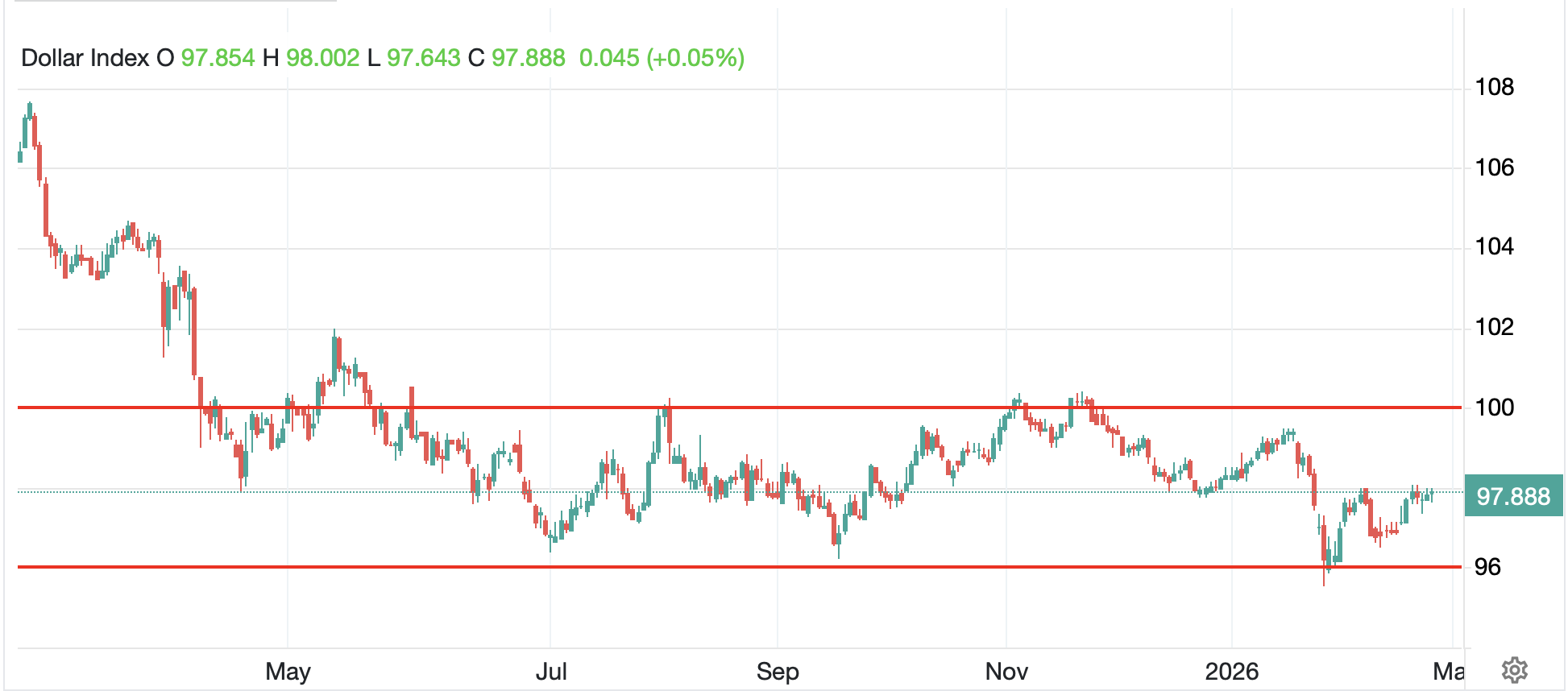
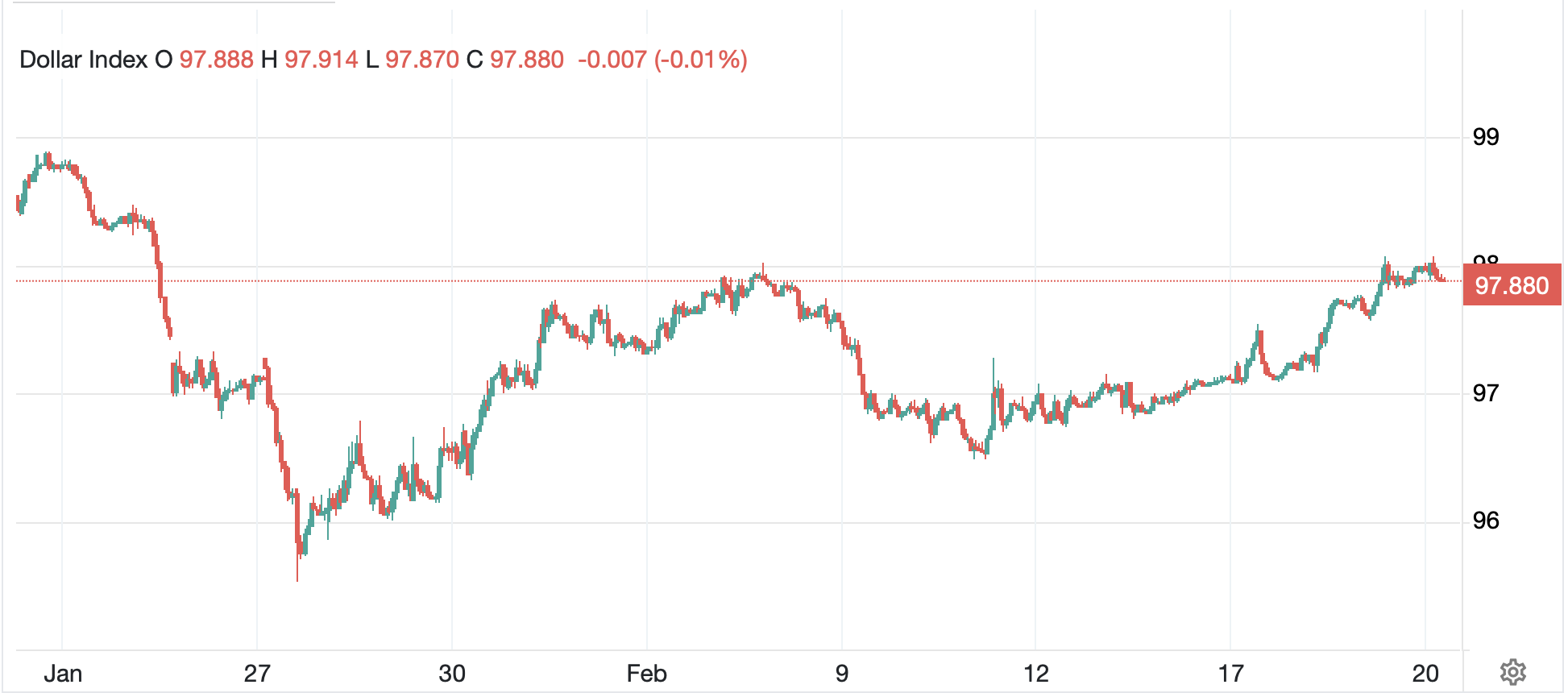
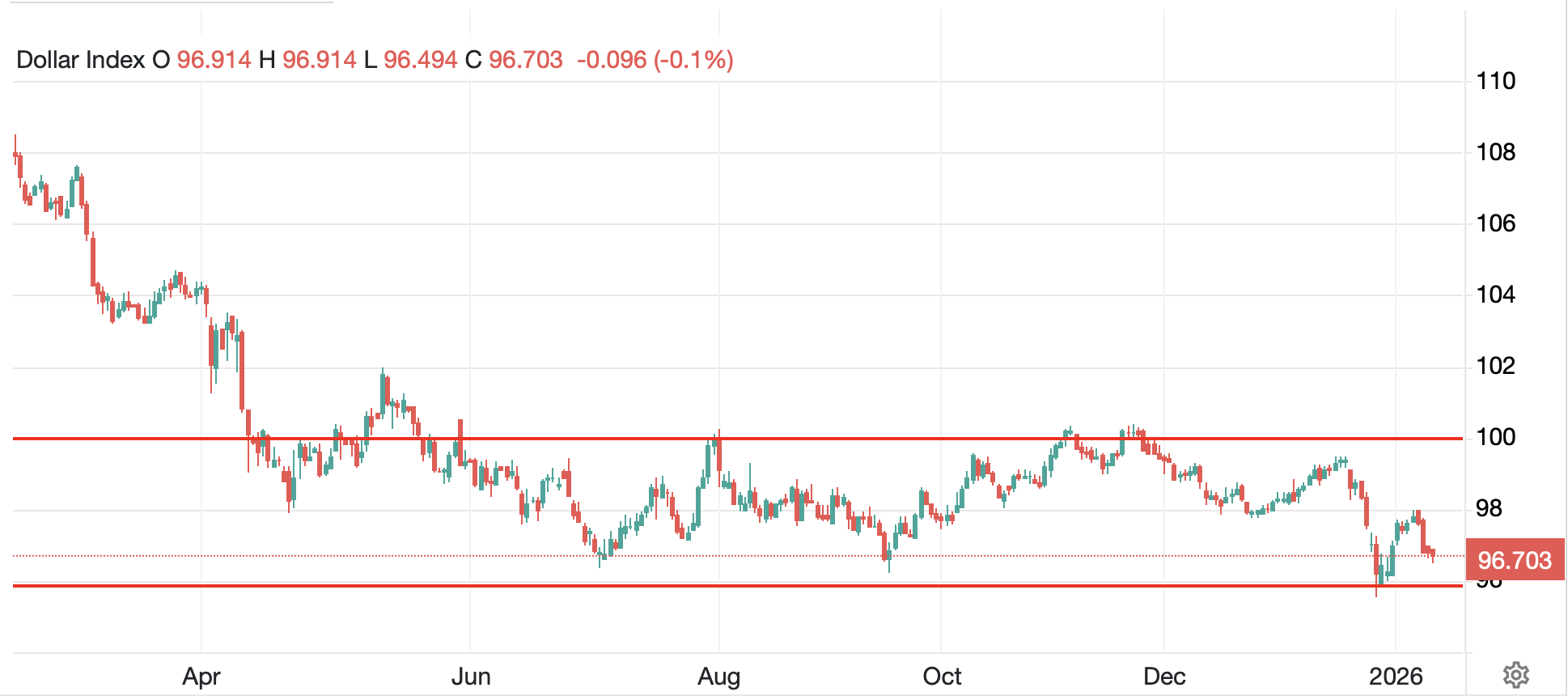
Finally, the dollar is little changed this morning other than against the yen.  For the dollar bearish crowd, which is quite large as doom porn about the end of the dollar’s hegemony remains quite popular, yesterday’s decline was tiny.  In fact, if we use the DXY as our proxy, it is higher by 0.1% this morning and trading just below 99.00 as I type.  Once again, if we look at the chart below, it has been 9 months since the DXY has traded outside the 97/100 range in any substantive manner and we are basically right in the middle.  Nobody really cares right now.

Source: tradingeconomics.com

Turning to the data this morning, CPI (Exp 0.3%, 2.7% Y/Y) for both headline and core leads the list.  This is December data, so as up to date as we will get.  We also see stale New Home Sales data, but it is hard to get excited about that.  The NFIB Small Business Optimism Index already printed right at expectations of 99.5.

It’s funny, despite all the discussion of the Fed regarding the Powell subpoena, Fed speakers don’t seem to be getting much traction.  Yesterday, three speakers indicated that rates seemed to be in a good place, and, not surprisingly, all defended Chairman Powell.  My view at the beginning of the year was that the Fed was going to become less important to the market dialog and in truth, that remains my view.  Rate cut probabilities have fallen to 5% for this month with the next cut priced for June.  Obviously, that is a long time from now and much can happen, but if the data showing GDP is accurate, it seems hard to understand why there would be a cut at all.  Too, remember one of the key theses behind dollar weakness was Fed dovishness.  If the Fed is not so dovish, tell me again why the dollar should decline.

It’s a crazy world in which we live.  Hedgers, stay hedged.  The rest of you, play it close to the vest.

Good luck

Adf
The Temperature’s Rising

This morning the temperature’s rising
With Trump and his allies devising
An alternate way
For him to axe Jay
But this move is quite polarizing
 
The market response has been clear
It’s given the move a Bronx Cheer
Both stocks and the dollar
Are feeling a choler
But gold, everybody holds dear


The financial world is aghast this morning as last night, Chairman Powell revealed that the Fed has been served with grand jury subpoenas threatening criminal indictment regarding Chairman Powell’s testimony to the Senate Banking Committee last June.  The issue at hand is ostensibly the ongoing renovations at the Marriner Eccles Building, including their cost, and how that differs from Chairman Powell’s testimony.

Chairman Powell offered a video response last night explaining he will not be cowed into cutting rates because the President wants lower rates, but will continue their work of setting policy based on their assessments of the economy.  One cannot be surprised that this has raised an entirely new round of screaming about President Trump’s tactics, although what I did see this morning was that Florida House Representative Anna Paulina Luna took credit for referring the case to the DOJ.

While I have strong opinions on Chairman Powell’s effectiveness, or lack thereof, this is certainly a new level of pressure.  In fact, if you listen to the video above (it’s just 2 minutes) Powell explicitly claims that this is entirely about the Fed not cutting rates further.  But I am not going to discuss the legality, or tactics here, our focus is on the market’s response.

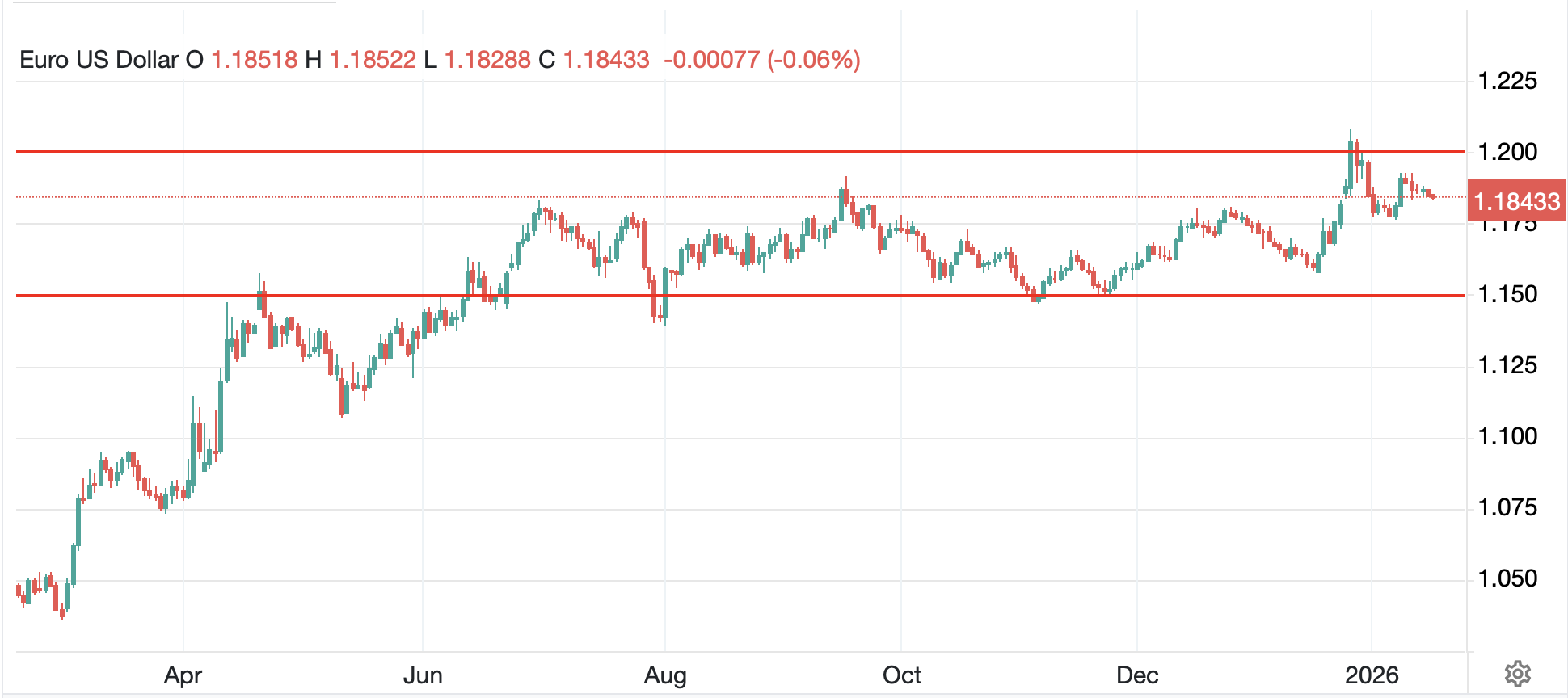
Starting with the dollar in the FX markets, it has fallen almost universally, and while it hasn’t collapsed, we are looking at a 0.3% to 0.5% decline pretty much everywhere.  Using the euro (+0.4%) as our proxy, you can see from the chart below that in the context of the past year’s price activity, this move is indistinguishable from any other move.

Source: tradingeconomics.com

This is not to imply that the Administration’s actions are insignificant, just that despite the rending of garments by the punditry, the market hasn’t determined it matters that much, at least not yet.  I have maintained my view that the dollar remains the best of a bad bunch of fiat currencies given the prospects for US economic activity compared to the rest of the world.  However, it is quite possible that foreign investors will view this action as far too detrimental to the structure of US financial markets and seek to exit, thus driving the dollar much lower.  I did not have this on my bingo card at the beginning of the year, so my views of dollar strength are somewhat tempered at this point.  It will certainly be interesting to see as we go forward.

One other thing to note is that CPI is released this week (exp 2.7% for both headline and core) and Truflation came out last week at 1.8%.  Now, I don’t put great stock in Truflation but there are many who do.  For that contingent, I assume they are aligned with President Trump in his views that Fed funds are too high.  After all, with Fed funds at 3.75%, that is nearly 200bps above the Truflation number.  I have always understood the “appropriate” relation to be closer to 75bps to 100bps above inflation, which if you believe Truflation, means you are looking for cuts.  (PS, this is not my personal view, I am simply highlighting part of the market thought process.)

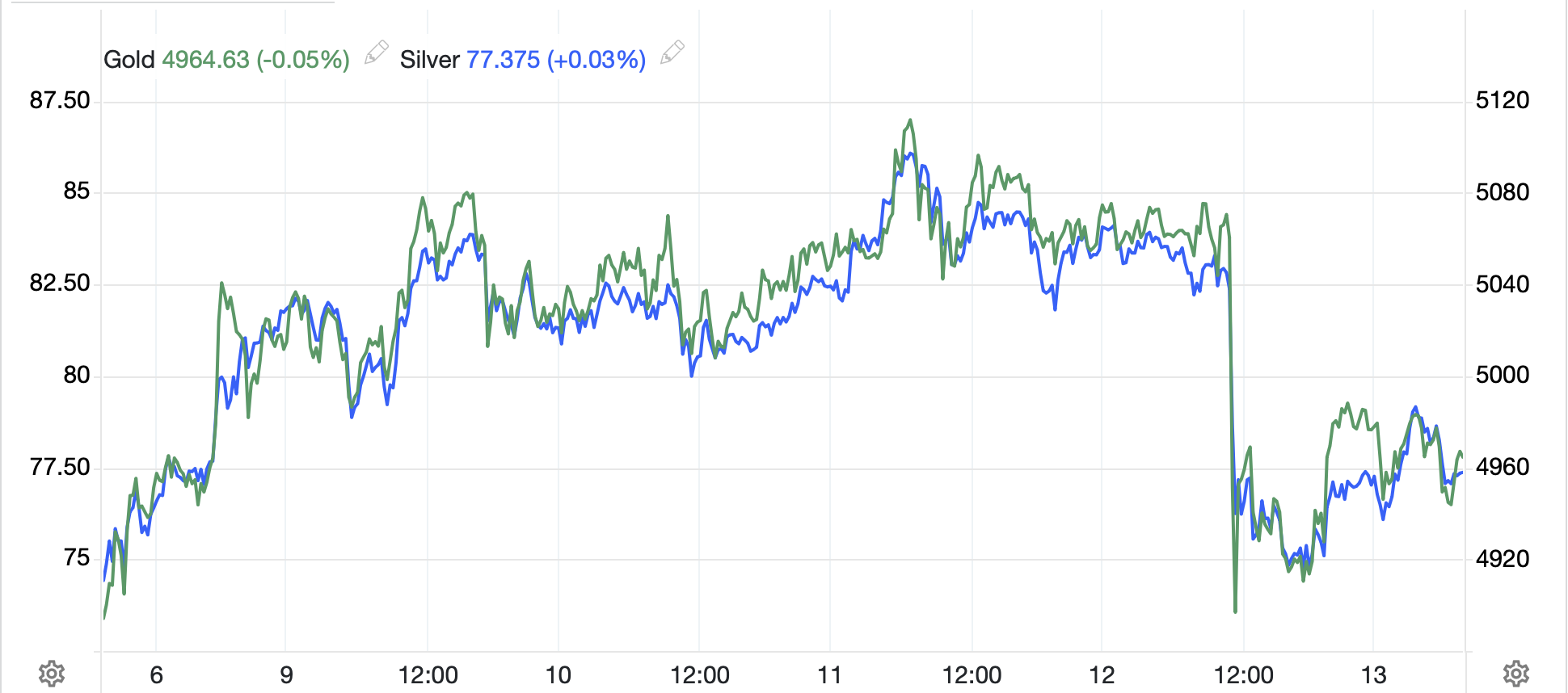
At any rate, the dollar is under pressure this morning but remains well within its recent trading range.  Turning to commodities, though, that is where the real price action is, with precious metals exploding higher on this news.  We are looking at record highs for gold (+1.6%), silver (+4.6%) with platinum (+3.2%) also much richer, although not back to all-time highs.  If we look at a chart of both gold and silver below, we can see the parabolic nature of silver’s recent move, a situation which should make everyone uncomfortable as parabolic moves frequently signal the end of the line. 

Source: tradingeconomics.com

But perhaps what makes this more interesting is that there is a substantial amount of supply in both gold and silver due to enter the market as the BCOM index rebalancing began last Friday and continues through Thursday.  Given the dramatic rallies in both metals last year, there is a significant amount to be sold by those funds that track the index.  Estimates are for a total of nearly $7 billion of gold and silver to be sold for the rebalancing, and many expected the metals markets to decline under that pressure.  And perhaps they still will, but today’s moves are the clearest signal that there are many investors who are uncomfortable with the Fed situation.

Remarkably, Venezuela and oil markets have basically disappeared from the conversation at this point.  However, this morning WTI (-0.9%) is giving back some of last week’s gains, and remains well within its recent downtrend, but shows no signs of a sharp break in either direction.

Turning to the other risk spot, equity markets, while US futures are all lower by -0.5% to -0.6% at this hour (7:10), the Fed news has had a mixed impact elsewhere around the world.  For instance, Japan (+1.6%), HK (+1.4%) and China (+0.65%) all had solid sessions with that being the case throughout the region.  Even India (+0.4%) finally managed to go green last night.  And all of this occurred after the Fed news.  One possible explanation is that foreign investors are running home, hence bidding up local shares.  Of course, it is also possible that they don’t believe there is much there, there, and are simply ignoring the news.

In Europe, the situation is different with weakness the general trend as Spain (-0.4%), France (-0.3%) and Italy (-0.15%) all slipping although Germany (+0.3%) has managed to buck the trend absent any specific macro catalyst.  German defense stocks are modestly higher this morning and perhaps threats by President Trump to aid the fomenting Iranian revolution have investors looking for more gains there.  As I often say, markets can be quite perverse for no apparent reason at all.

Finally, bond markets are not really responding to the news in any substantial manner.  Treasury yields have backed up 3bps this morning, but at 4.19%, remain within that long-term trading range and are not signaling flight.  European sovereigns have seen yields edge lower by -1bp across the board, so while modestly better, hardly the sign of massive buying.  And JGB yields were unchanged overnight.  Bonds remain the least interesting space there is of all the markets.

Which takes us to the data this week.

TuesdayNFIB Small Biz Optimism99.5
 CPI0.3% (2.7% Y/Y)
 -ex food & energy0.3% (2.7% Y/Y)
 New Home Sales710K
WednesdayRetail Sales0.4%
 -ex Autos0.3%
 Existing Home Sales4.2M
 Fed’s Beige Book 
ThursdayInitial Claims219K
 Continuing Claims1918K
 Empire State Mfg1.0
 Philly Fed-2.0
FridayIP0.1%
 Capacity Utilization76.0%

Source: tradingeconomics.com

In addition, we get PPI data on Wednesday, but it is all old data, for October and November and, as such, I don’t think it will matter very much at all.  We also hear from 10 different Fed speakers, some several times, over the course of the week.  It will be very interesting to hear how they address the major news overnight regarding the subpoenas, or if they even touch on them.  I expect there will be oblique references to Fed independence at most.

And remember, none of this even considers the ongoing revolution in Iran, which appears to be gaining strength in its third week.  If the theocracy in Iran falls, that will have a very different impact on oil markets than the Venezuela situation.  First, they are currently producing far more oil.  Second, the removal of sanctions there would seemingly reduce the amount of ultra cheap oil that China can import, adding pressure to the Chinese economy, as well as help pressure oil prices lower in general, which would negatively impact Putin’s war chest.  (If Iranian oil is no longer black market, it raises China’s cost, but lower overall prices will reduce further Russia’s sanctioned sale prices).

As to the dollar on the FX markets, this move certainly gives me pause regarding my bullish view, but there seems to be a long way to go before anything really comes of it.  As well, grand jury testimony is secret, so we won’t know about anything that is said anytime soon.  Ultimately, nothing may come of this, no charges of any sort.  Remember, this is a Washington DC grand jury, and so many there disagree with everything that President Trump does, they may not indict for that reason alone.

I’m not willing to make a sweeping statement at this time, but caution in positioning seems like a sensible view.

Good luck

Adf
Too Potent a Force

The headline today’s NFP
As pundits will try to agree
On whether the Fed
When looking ahead
Will like what it is that they see
 
But, too, the Supreme Court is due
To rule whether tariffs imbue
Too potent a force
For Trump, to endorse
Or whether they’ll let them go through


As the session begins in NY, markets have been relatively quiet as traders and algorithms await the NFP data this morning.  Recall, Wednesday’s ADP number was a touch softer than forecast, but still, at 41K, back to a positive reading.  Forecasts this morning are as follows:

Nonfarm Payrolls60K
Private Payrolls64K
Manufacturing Payrolls-5K
Unemployment Rate4.5%
Average Hourly Earnings0.3% (3.6% y/Y)
Average Weekly Hours34.3
Participation Rate62.6%
Housing Starts1.33M
Building Permits 1.35M
Michigan Sentiment53.5

Source: trading economics.com

Regarding this data point, there are two things to remember.  First, last month Chairman Powell explained that he and the Fed were coming to the belief that the official data was overstating reality by upwards of 60K jobs due to concerns over the birth/death portion of the model.  That is the factor the BLS includes to estimate the number of new businesses started vs. old ones closed in any given month.  Historically, at economic inflection points, it tends to overstate things when the economy is starting to slow and understate when it is turning up.  

The second thing is that given the changes in the population from the administration’s immigration policy, with net immigration having fallen to zero recently, the number of new jobs required to maintain solid economic growth is much lower than what we have all become used to, which in the past was seen as 150K – 200K.  So, 60K, or even 40K, may be plenty of new jobs to absorb the growth in the labor market, which will come from people re-entering the market who had previously quit looking for a job.

The ancillary data, like ADP and the employment pieces of ISM were both stronger in December than November, so my take is, the estimates are probably reasonable.  I have no strong insight into why it would be dramatically different at this point.  The question is, how will markets respond?  My take is this could well be a ‘good news is bad’ situation where a strong print will see pressure on bonds and stocks as the market reduces its probability of a Fed rate cut (currently 14% for January, 45% for March) even further.  The dollar would benefit, as would oil on the demand story, but I think metals will do little as that story is not growth oriented.  A weak number would see the opposite.

Of course, the other big potential news today is the Supreme Court ruling on the legality of Trump’s tariffs.  The odds markets are at ~70% they will overturn them, but there is the question of whether it will require the government to repay the tariffs or simply stop them.  As well, most of them will be able to be reimposed via different current laws, so net, while a blow to the administration I don’t believe it will have a major long-term impact with repayment the biggest concern.  This particular issue is far too esoteric for a simple poet to prognosticate.

And those are the market stories of note, although we cannot ignore the growing protests in Iran as videos show buildings burning in Tehran and there is word that the Mullahs are at the airport, which if true tells me that the regime is on the edge.  While this would be a great victory for the people of Iran, it would also have a dramatic impact on oil markets and specifically on China.  While sanctions could well be lifted, thus depressing the price as more comes to market, China currently benefits from buying sanctioned oil at a massive discount, and that discount would disappear.

As we await all the news, let’s review the overnight activity.  A mixed US session was followed by strength in Tokyo (+1.6%) as the Japanese government surprised one and all by reporting a stronger 30-year JGB auction than anticipated as well as an uptick in spending by households.  Too, nominal GDP growth has been outpacing deficit growth driving the net debt ratio lower, exactly what the US is seeking to do.  As to the rest of the region, both China (+0.45%) and HK (+0.3%) managed gains, as did Korea and Malaysia but India (-0.7%) continues to lag as it has all year.  Data from China showed inflation fell less than expected, although the Y/Y number remains at just 0.8%.

In Europe, gains are also the norm with France (+0.9%) leading the way with both the UK (+0.55%) and Germany (+0.4%) having solid sessions.  Retail Sales data from the Eurozone was firmer than expected at 2.3%, a rare positive outcome, but showing some support.  As to the US futures market, at this hour (7:30) all three major indices are higher by about 0.15%.

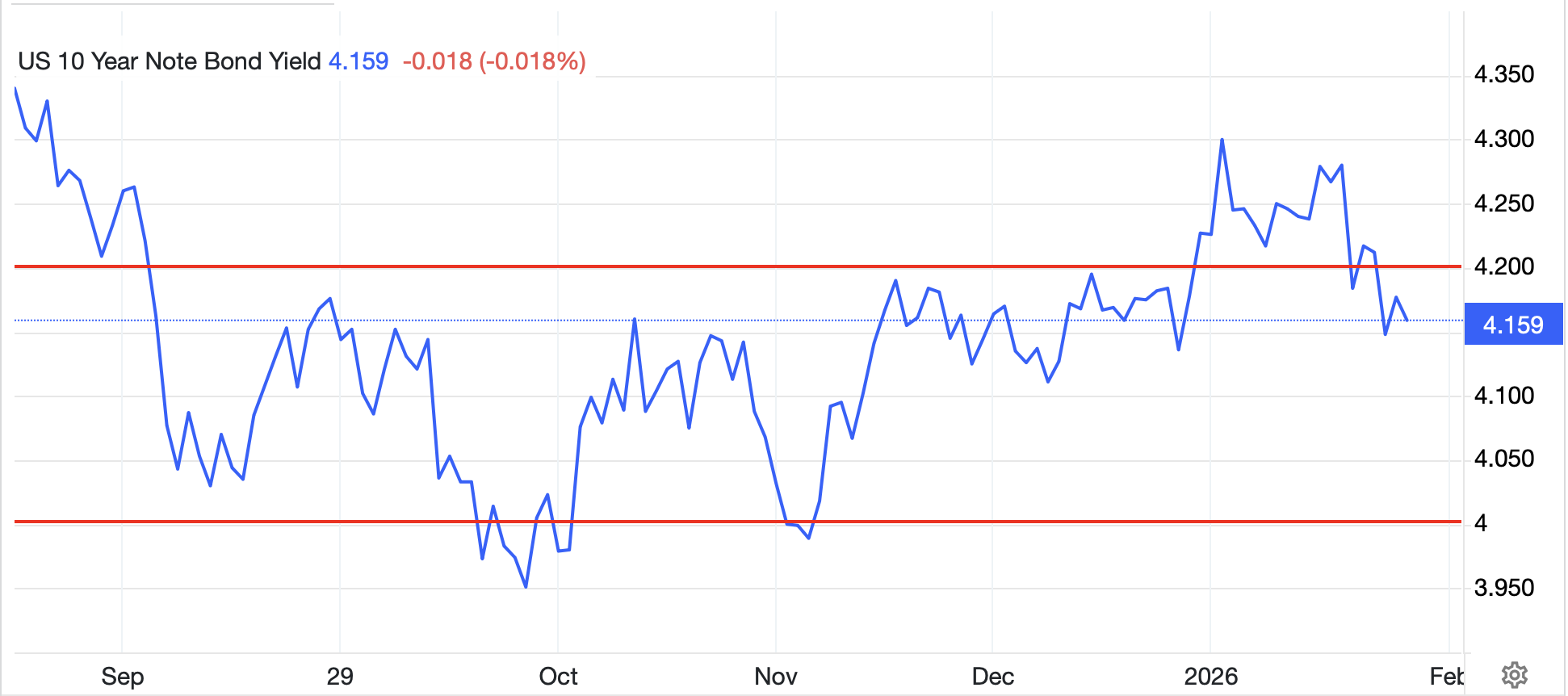
In the bond market, while yields have edged higher by 2bps this morning, as you can see from the chart below, they remain within, albeit at the top, of the recent 4.0% – 4.2% trading range.  

Source: tradingeconomics.com

The most interesting data point from yesterday was the dramatic decline in the Trade deficit, which fell to -$29B, its lowest level since 2009.  Recall that a long-time issue has been the twin deficits, with the budget and trade deficits linked closely.  I wonder, are we going to see Trump’s efforts at reducing government’s size and reach result in a smaller budget deficit?  Most pundits dismiss this idea, but I’m not so sure.  As to the rest of the world, European sovereigns are essentially unchanged this morning as investors everywhere await the US data and tariff ruling.

In the commodity markets, oil (+0.9%) is creeping higher but remains in its downward trend.

Source: tradingeconomics.com

Wednesday, we saw a large draw in crude inventories abut a massive build in both gasoline and distillates which feels mildly bearish.  The narrative is the Iran story is getting people nervous for potential short-term disruption, but I remain overall bearish for now.  As to the metals markets, gold (-0.3%) is slipping after having recovered early morning losses yesterday and finishing higher, while silver (+0.6%) is still bouncing along with copper (+1.8%) and platinum (+0.4%). Metals are in demand and supply is short.  Price here have further to rise I believe.

Finally, the dollar continues to rebound off its recent lows with the DXY back to 99 again this morning.  it has rallied in 11 of the past 13 sessions, not typical price action for a trading vehicle that is in decline.

Source: tradingeconomics.com

In fact, the greenback is firmer against virtually all its G10 and EMG counterparts this morning with the largest declines seen in JPY (-0.5%), KRW (-0.5%) and NZD (-0.5%) with others typically sliding between -0.1% and -0.3%.  again, it is hard to watch recent price action and see impending weakness.  We will need to see much weaker US data to change my view.  And along those lines, the Atlanta Fed’s GDPNow number just jumped to 5.4% for Q4 after the Trade data yesterday, again, atypical of further weakness in this sector.

And that’s really all as we covered data up top.  To me, the wild cards are Iran and the USSC.  While I do believe the regime will fall in Iran (they just shut down the internet to try to prevent a further uprising) my take on the Supremes is they may stop further tariffs but will not force repayment.  Net, that won’t change much at all and given the prediction markets are pricing a 70% probability of an end to tariffs, if it happens, it’s already in the price!

Good luck and good weekend

adf

Spinning More Heads

The speed of the change underway
In global relations today
Is spinning more heads
And tearing more threads
Than ever before, one might say
 
For markets, the question of note
Is how will investors all vote
Are bulls still in charge
Or bears now at large
Who seek, excess profits, to smote


It is becoming increasingly difficult to focus only on market activity given the extraordinary breadth of important, non-market activities that are ongoing.  When I think back to previous periods of significant market volatility and uncertainty, it was almost always driven by something endogenous to finance and the economy.  Going back to Black Monday in 1987, or the Thai baht crisis in 1997 or the Russia Default in 1998, the dot-com crash in 2000, and the GFC in the wake of the housing bubble (blown by the Fed) in 2008-09, all these periods of significant market volatility were inward looking.

But not today.  Trump 47 has become the most significant presidency since Ronald Reagan with respect to changing both domestic and international realities.  The key difference is that Mr Reagan worked within the then consensus view of international relations, merely pushing them to the limit while Mr Trump sees those views as constrictions needing to be removed.

In fairness, the world was a very different place in the 1980’s, notably for the fact that China was not a major player in any sphere of economic activity and was essentially ignored.  That is no longer the situation, and the entry of another power player has complicated things.  Arguably, this is why the president sees the old rules as obsolete, they were built for a different time with a different cast of characters.  Regardless, for those of us paying attention to markets, it is imperative to widen our view to include international relations as well as international finance.

With that as preamble, a look at today’s headlines reminds us that keeping up with the news is not for the faint of heart.  Starting with Venezuela and the impact on oil (+1.6%), news sources are littered with articles explaining why the US acted as we did and the potential implications for energy markets and energy producing countries.  From what I can tell, Venezuela recognizes that they are completely beholden to US demands at this point with respect to their oil industry (mining as well I presume although that gets less press).  And you can be sure that means they will be expected to pump more, with US corporate help, and direct their sales to the US, as opposed to Cuba, China and Iran.

Despite today’s rally, it remains my strong opinion that the price of oil has further to decline.  The trend continues to be sharply lower, as per the below chart, and the domestic political demand of reducing gasoline prices is going to keep this particular trend intact, I believe.

Source: tradingeconomics.com

News overnight indicated that two more shadow fleet tankers have been apprehended which is simply all part of the same plan, bring Venezuela back online legitimately with a focus to sell to the US.  The other global issue that is going to weigh on the price of oil are the ongoing protests in Iran which if ultimately successful at overthrowing the Ayatollah’s theocracy, will almost certainly bring Iran back into the brotherhood of nations, and see the end of sanctions on Iranian oil.  While that is bad news for China (and India) who buy a lot of cheap sanctioned oil, it will increase production and weigh on market prices.

The other sector of the commodity markets, metals, have been their own roller coaster of late, with far more volatility than any other product, cryptocurrencies included.  It cannot be a surprise that we are seeing prices retrace after the extraordinary price action over the past several months.  The silver (-4.4%) chart below is the very definition of a parabolic move and history has shown that moves of this nature tend to see, at the very least, short-term sharp reversals, even if the ultimate trend is going to continue.  

Source: tradingeconomics.com

The underlying features in these markets remain supply shortages, meaning that there is more industrial demand for utilization than there is new supply that comes to market each year.  In silver, the number apparently is ~100 million ounces, and deliveries of physical metal remain the norm these days.  That is a telling feature of the market as historically, cash settlement was sufficient.  Given the recent run, it is no surprise that gold (-0.8%) and platinum (-6.5%) are also declining sharply, but nothing has changed my view that these will trend higher this year.  One last thing about silver (h/t Alyosha), the Bloomberg commodity index (BCOM) is rebalancing next week and given the huge moves in precious metals, along with the lack of change in percentage allocation, there will be significant selling over the course of the next week, upwards of 70 million ounces of silver, which will go a long way to satisfying the shortage this year.  It will be interesting to see if demand remains intact. 

If we turn to the dollar, rumors of its death remain exaggerated.  Certainly, the price action thus far this year, and even over the past six months, points to gradual strength (see chart below from tradingeconomics.com).

Again, I have a hard time understanding the argument that the dollar will decline this year based on the fact that the US economy continues to outperform the rest of the G10, there are substantial inward investment promises that are beginning to be seen (shipbuilding, semiconductors, steel) and the US interest rate structure remains higher than the rest of the G10.  While I understand markets look forward, it is becoming increasingly difficult for me to see the benefits of European monetary policy as a driver for owning the euro, and given their industrial/energy policies are disastrous, I don’t see the rationale.  The same can be said for the pound, I believe.

In today’s session, while the movement is mostly marginal (EUR 0.0%, GBP -0.1%, SEK -0.3%, AUD -0.4%), the trend remains intact and the movement is broad with almost all G10 and EMG currencies slipping a bit further.  Money goes where it is best treated, and I am hard pressed to find other nations that treat money better.  Although…

The equity markets are a bit shakier this morning after two presidential tweets yesterday regarding institutional ownership of housing (he wants to end that for single family homes) and defense company spending priorities (he wants defense companies to end stock buybacks and dividends and invest in R&D and production).  It is not clear to me whether he can successfully force these actions, but his bully pulpit is significant.  These resulted in sharp declines in directly impacted companies, but regarding defense, he also came out of a meeting with Congressional leaders and said he wants to budget there to grow to $1.5 trillion.  

The upshot is confusion here which was evidenced by more weakness than strength in the US session and similarly, declines in Asia (Japan -1.6%, China -0.8%, HK -1.2%).  Elsewhere in the region, India (-0.9%) continues to be the laggard, but there was more red than green overall.  In Europe, red is also today’s color, albeit not as bright as in Asia.  The DAX (-0.2%), CAC (-0.25%) and FTSE 100 (-0.3%) are emblematic of the situation as investors dismissed better than expected German Factory Order data (+5.6%) although the rest of the data released was mostly at expectations.  I guess the question is does Europe treat money better than the US?  I would argue not, but that’s just my view.  Meanwhile, at this hour (7:55), US futures are down slightly, about -0.1% across the board.

Finally, the bond market remains an afterthought almost everywhere.  Perhaps the most amazing thing President Trump has accomplished is to remove the focus on the latest tick in the 10-year bond as a key metric for the economy.  So, this morning, its 1bp rise just leaves it right in that 4.0% – 4.2% range that has existed for months.  Most European sovereign yields edged higher by about 3bps with Germany (+7bps) the outlier here after that strong Factory Orders data.  Also worth noting is that JGB yields slipped -5bps overnight as the market prepares for the first 30-year JGB auction of the year.  Recent 10-year auctions have been received quite well, hence the anticipation of something good here.

On the data front, Initial (exp 210K) and Continuing (1900K) Claims lead the way along with the Trade Balance (-$58.9B) and then Consumer Credit ($10.0B) this afternoon.  Yesterday’s ADP data was a touch softer than expected but the JOLTS data was much worse, showing a decline in job openings of 300K and falling well short of expectations of 7.6M.  At this point, though, to the extent that people are paying attention to the data, tomorrow’s NFP is of far more import I believe.  

The hardest thing about these markets is the White House bingo card and its surprises that can change working assumptions.  Absent something new there, I see the dollar drifting higher helped by both its recent trend and the short-term pullback in metals.  

Good luck

Adf
Overrun

We’ve not even gone through a week
Yet Trump, so much havoc did wreak
This poet will claim
That in this ballgame
It’s top first, one down, so to speak
 
The impact of what has been done
Is widespread and hits everyone
So, please understand
Whatever you’ve planned
May, by events, be overrun


Venezuela continues to be the primary discussion point in both the media and the markets.  Mostly along political lines there are calls that the weekend’s action was illegal or not, and as Brent Donnelly, a very good follow on X (@donnelly_brent), explained after reading voluminous material, the raid was either all about the oil or had nothing to do with the oil. I feel like that sums things up pretty well.

While this poet has views on the ongoing issues, they are set from afar with no inside knowledge so keep that in mind.  But ultimately, my take is the opportunity for real change has come to Venezuela, something that did not exist while Maduro was still there.  If nothing else, the ability for the US to exfiltrate him must have made a strong impression on acting president Rodriguez and the generals overseeing the army and police forces there and ought push decision making in a positive direction, at least for a while.  What seems abundantly clear, however, is that most of the population is ecstatic at his removal and have hope for a future, something missing for decades.

As to the oil, it is heavy, sour crude, something Gulf coast refineries are tuned to use, but the infrastructure there is a disaster.  My take is the one thing that is underestimated is just how remarkable the technology of oil exploration and production has become, and its ability to solve problems in efficiency to reduce the cost of extraction.  I will take the under on the time it takes to increase production there, although a key bottleneck is the electric grid which must be addressed as well.  Nonetheless, despite the rise in oil prices during yesterday’s session, I maintain my view that the trend is lower.

Other than domestic political news there seems little else to discuss but market activity, so let’s go there.  A strong session in the US yesterday was followed by plenty of strength in Asia with Japan (+1.3%), China (+1.6%) and HK (+1.4%) all having excellent outcomes.  Too, Korea (+1.7%) and Taiwan (+1.6%) had strong showings with many more gainers than losers in the region.  The one market that has not partaken in the early year rally is India (-0.4%), which I can only ascribe to the fact they may be losing a source of cheap oil.  Or perhaps, more accurately, all the buyers of sanctioned oil may find themselves in more difficult straits, paying full price, as the dark fleet of tankers is suddenly having more trouble making the rounds.

On this note, one other place to watch is Iran, where it appears that the regime may be set to collapse as protests grow and some cities may have been completely taken over by the protesters.  If the theocracy falls, I would expect that, too, will pressure oil prices lower, as sanctions could be swiftly lifted.

Turning to Europe, does anybody really care anymore?  No, seriously, markets there are mixed this morning with France (-0.4%) lagging while the UK (+0.7%) is gaining on the back of BP and Shell and the general euphoria about the oil majors now.  Meanwhile, other major markets have seen modest gains (Italy +0.4%, Spain +0.3%, Germany +0.2%) but there is one outlier, Denmark (+2.1%) which, given all the talk of the US seeking to take control of Greenland, seems odd to me.  I can find no specific news either for the economy or any companies (Novo Nordisk being the only one of note), but something is going on.  As to US futures, at this hour (6:50) they are little changed.

Turning to the bond market, the below chart of the 10-year offers a great picture of what it means when traders say nothing is going on.  Since early September, the bond has been trading within a 20 basis point range despite all the huffing and puffing of the punditry and the FOMC’s rate cuts.

Source: tradingeconomics.com

If bond investors are the “smart” money, I would argue that right now they have no opinion, or perhaps their opinion is that the economy is going to continue to tick along at a decent rate, with limited extra inflationary pressure.  To that last point, an article in the WSJ this morning explained that several recent studies, one by the SF Fed, demonstrated that tariffs have virtually no inflationary impact.  That probably doesn’t help Powell’s talking points.  While I continue to be concerned that inflation will maintain a 3+% level, I also believe the Fed is going to suppress interest rates going forward, net, bonds don’t seem that exciting.  As to the overnight price action, Treasury yields backed up 2bps, while European sovereigns slipped between -1bp and -2bps.  I couldn’t help but also notice that yesterday saw a massive issuance of USD bonds by non-US corporates, over $60 billion, an indication to me, at least, that calls for the death of the dollar are somewhat premature.

Commodities continue to be where all the action is, or perhaps more accurately, metals markets.  After massive rallies yesterday, we are seeing follow through with gold (+0.4%), silver (+2.4%), copper (+1.0%) and platinum (+3.2%) all strong again.  Unlike the bond market, and truly FX, which is also dull and boring, the below chart shows just how much things in the metals space have changed over time. 

Source: tradingeconomics.com

My take is that investors are still trying to figure out the implications of the fact that old relationships like the dollar falling when metals rise, or metals falling when real interest rates rise, are broken and what that implies for the future.  The reality is that other than gold, which is the calmest of them all, these metals are indicating actual shortages for users.  Consider that, according to Grok, the typical catalytic converter uses between 0.1 and 0.25 troy ounces of platinum, so at today’s price, between $230 and $575.  Given the average price of a new car is ~$50K, paying up for platinum is not going to change the equation that much, certainly relative to not having the platinum and therefore not being able to complete and sell the vehicle.  I suspect that metals, while likely to be volatile in their price action, have much further to run higher.

Lastly, the dollar…is still there.  Using the DXY as my proxy this morning, you can look at the chart below for the past year and see, it has basically not moved since it stopped declining in late April 2025.  It is hard to get excited about things right now.  However, I maintain that the US will remain the cleanest dirty shirt and benefit accordingly over time.

Source: tradingeconomics.com

On the data front, Services (exp 52.9) and Composite (53.0) PMI are released this morning with both expected lower than last month, but still in expansion territory.  We also hear from Richmond Fed governor Barkin, but it seems the Fed has taken a back seat to Venezuela lately, at least with respect to what is driving markets.  As of this morning, there is just a 16% probability of a rate cut priced in for the end of the month with a 53% probability priced for the March meeting.  But two more cuts are seen as a certainty by September, although if GDP continues to perform like it has, I imagine that will change.  According to the Atlanta Fed’s GDPNow model, Q4 is forecast at 2.7%.  We shall see how that evolves over time.

Summing it all up, the dollar is an afterthought in markets right now and seems unlikely to move very much in the near term.  Metals remain the place to be, and nothing indicates those trends have ended.

Good luck

Adf
A Vision For ‘Twenty-Six

(With apologies to Clement Clarke Moore)

Tis the first day of trading in Ought Twenty-Six
With too much attention on raw politics
At home, eyes have turned to the mid-term elections
To see if results will force mid-course corrections
In Europe, they’re going all-in on Ukraine
With more billions promised, though that seems insane
Meanwhile, Mr Xi is convinced he can fix
The problems at home with his policy mix
And this, my friends, just skims the surface of things
As pols everywhere suffer arrows and slings
Remember, though, markets are what I’m about
And while I could err, I am never in doubt.

Let’s start at the top with Growth here in the States
Which likely will show more than marginal rates
In fact, Four percent seems a viable goal
As inward investment and tax cuts take hold
Remember, for Trump, if there’s one thing he’s not
It’s timid, and so he’ll demand, “Run it hot!”
Thus, growth will expand, though inflation might gain
And for the elections, that could be a pain
The problem is Jay, and whoever comes next
Have come to believe two percent’s just subtext
The greatest unknown is on government spending
And whether it grows or, at last, starts descending

The punditry’s certain the government fisc
Is going to increase inflation’ry risk
If true, CPI of near Four percent’s apt
If not, then Inflation ‘neath Three, could be capped

And what about elsewhere, in Europe? Japan?
In markets, emerging, do they have a plan?
Will they grow their ‘conomies, drawing investment?
Or will we soon witness a large reassessment?

In Europe, they claim they’ll be building more guns
To help them defend all their daughters and sons
As well, they’re committed to helping Ukraine
Continue to fight, despite so many slain
They’re planning to borrow a cool 90 Bill
But energy costs, these grand plans could well kill
Meanwhile, M Lagarde claims that rates are just right
And given growth there’s One Percent, I won’t fight
So, weak growth and low rates and energy blues
Lead me to believe that come year-end, the news
Will be that the Euro is failing to thrive
Do not be surprised when it hits One oh-Five

In England and Scotland and all the UK
Just like in the EU, they can’t make much hay
The budget’s a wreck yet they want to raise taxes
Though history shows growth will wane ere it waxes
As well, they continue their crack down on speech
While crimping their energy industry’s reach
So, power is costly, and billionaires flee
From here, ‘cross the pond, this is what I foresee
A ‘conomy heading right into stagflation
As long as Kier Starmer is leading the nation
For markets, the Pound will lose all its allure
With One-Ten the Boxing Day screen price du jour

A turn to the East where the Sun Also Rises
Will teach us that, really, there are no surprises
To date you’ve heard much ‘bout the rise in yen rates
With pundits opining the Carry Trades’ fates
This year, so they say, look for much stronger yen
As local investors buy yen bonds again
Thus, all the hedge funds who’ve been funding their trades
By borrowing yen, and they’ve done so in spades,
Will need to buy back all that Japanese Money
The outcome, for yen shorts, will not be so sunny
But what if this idea of yen heading home
Is wrong?  This implies quite a different syndrome

At this point there’s no sign the government there
Is ready, more spending and debt, to forswear
Instead, what seems likely is more of the same
More government spending in all but its name
So, debt will continue to rise without end
And up to One-Eighty the buck will ascend

As well as Japan, in the continent vast
Of Asia, it’s China we come to at last
“Poor” President Xi has a problem at home
Consumption is not in the Chinese genome
For decades, the model’s been, build and export
Which helps explain why local usage falls short
But lately the rest of the world’s of a mind
That Chinese imports are a troublesome kind
So, Xi needs his people to learn how to spend
Else all that production may come to an end
But if they consume, what will that do to growth?
Its rate will decline, something for which Xi’s loath

Thus, GDP 5 means a weaker yuan
Well above Seven you can depend on
But if, against odds, Xi gets Chinese to spend
Six-Fifty is where yuan will be at year end.

Let’s shift our perspective to Treasury debt
A market of critical import, and yet
A market that’s been in a range for a while
So, what must occur for a change in profile?
The popular view is that deficit spending
Will drive an outcome of, high yields, never-ending
But Trump and his team are, quite hard, pushing back
Explaining that policy’s on the right track
Twixt tariffs and growth, tax receipts have been flying
While RIFs in the government are underlying
The idea that deficits soon will be shrinking
In truth, this is not what the punditry’s thinking
But one thing is clear that will keep yields from climbing
QE, which is back, is designed for pump-priming
So, Jay and his heir will keep buying and buying
And 10-Years at Four Percent seems satisfying

It’s not just the government, though, that’s in debt
Those corporates who borrowed at ZIRP, have not yet
Refinanced the trillions they owe, to this day
And now they’re competing with Bessent and Jay
While Scott will find buyers, if not least the Fed
For corporates that path may be flashing bright red
If credit spreads widen will companies fail?
And will that unravel the stock markets’ tale?
Right now, spreads for IG sit near one percent
And Junk’s above eight with investors content
However, the biggest risk this year could be
The absence of corporate debt liquidity
If IG spreads widen 200 bps more
The outcome could be a GFC encore

This takes us to stocks, both at home and abroad
Which last year saw rallies we all did applaud
But will this year bring us some more of the same?
Or have things been altered?  Is there a new game?
If my crystal ball is in any way clear
The outcome could well be a frightening year
Remember, the driver of last year’s returns
Was government spending which lacked all concerns
Thus, Cantillon nailed it with where cash would go
And stocks were the winner, of that much we know
But this year the mountain of debt coming due
Could well force decisions of what will ensue
And too, don’t forget if the deficit shrinks
It’s likely to be a great stock market jinx
So, don’t be surprised if December this year
A 10% fall ‘cross all stocks does appear

And what of that black, sticky stuff that they drill
Which powers the global economy still
When its price increases, it causes much pain
For most everyone, it can be quite the bane
Consumers, instead, like those prices to sink
But drillers, in that case, cause output to shrink
So, which will it be, will Trump’s mantra come true
Or will, new production, most drillers eschew
I think what is missed is technology’s traction
And how costs per barrel will tend toward contraction
As well, nations worldwide, at last understand
That Carbon Dioxide just cannot be banned
Come Christmas, next, we will see growth in supply
With Fifty per barrel the price we’ll espy

The last place to look is at bright things that shine
Which saw prices move in a vertical line
While gold was the starter, by year end t’was clear
That silver and platinum said, wait, hold my beer
The latter two rising thrice fifty percent
With neither responding to any event
Which brings us to this year, can these trends maintain?
Or are we now set up for infinite pain?
It seems to me that til the summer at least
All three will continue to rise, as with yeast
But when we reach solstice do not be surprised
If views on their future become bastardized
In other words, look for corrections in price
With early year gains given back in a trice
But still, by the end of the year I believe
Five Thousand in Gold is what we will perceive
For Silver, One Hundred could well be the spot
And Platinum, Three Grand, would not be too hot.

To all of my readers and friends, please forgive
My musings if they got too ruminative
This year will see change across many degrees
And some will be painful, while others will please

In sum, I think President Trump can succeed
In changing behavior, though not corporate greed
Reducing the number of government staff
As well as with regs, he can cut those in half
Inward investment will focus on stuff
Instead of on stocks, for the markets that’s rough
Dollars will still be in greater demand
While Treasury yields will be stuck in the sand
IG and Junk are unlikely to win
As rising expenses cut margins quite thin
And still, through it all, precious metals will gain
Though G7 central banks all will abstain
Come Christmas next, nothing will look quite the same
And maybe my views can help you build a frame.

Thank you all for tolerating my punditry and I hope that you all have a wonderful, healthy and successful year ahead.

Adf
Talk of the Town
Two things have been talk of the town
First, silver ne’er seems to go down
But also, of late
The Dow’s in a state
Where it wears the daily stock crown
 
But if we dig deeper, we find
Industrials, as they’re defined
Don’t build many things
Instead, they pull strings
As finance and tech are combined


Before I start, this will be the last poetry of 2025.  I want to thank all my readers for continuing to read and I certainly hope I both amused you and highlighted one view of what is driving the zeitgeist in markets these days.  FX poetry will return on January 5th with my annual long-form poetic prognostications.  Merry Christmas, Happy Chanukkah and Happy New Year to you all.

So, I was reading my friend JJ’s evening wrap up from yesterday and he highlighted the fact that the DJIA (+1.3%) made a new all-time high in trading and it was led by…Goldman Sachs.  

Source: tradingeconomics.com

Now, I have nothing against Goldman Sachs, per se, but it struck me as odd that Goldman Sachs, an investment bank, was a member of the Dow Jones Industrial Average.  It’s not that I wasn’t aware of the fact, but for some reason, this mention stuck out.  So, I thought I might look at the current membership of the Dow and see just how industrial it is.

While you will likely not be surprised that it has several non-industrial, service-based companies in the index, you might be surprised by just how many.  For instance, aside from Goldman, JPMorgan, American Express and Visa are in there as well as United Health and Travelers from the insurance space.  There are major retailers like Walmart, Home Depot, Amazon and McDonalds, along with tech and telecom/media names like Microsoft, Salesforce, Disney and Verizon.  

This is not to say that these are misplaced with respect to their relative importance in the US economy, clearly all are major corporations with long histories of profitability.  But it seems odd to list them as industrial.  I would contend that nothing explains the financialization of the US economy better than the fact that 14 out of the 30 members of the DJIA are service companies rather than producers of stuff.  Maybe they should rename it the Dow Jones Major Corporate Index.

To conclude the equity portion of our discussion, yesterday saw the NASDAQ (-0.25%) decline in the face of a broad overall equity rally as there appears to be a rotation of investors from AI into other things like financials (as hopes of another Fed rate cut spring eternal) and power producers as the power needs of AI keep getting estimated ever higher.  This rally was followed pretty much everywhere around the world as regardless of one’s religion, it appears investors are all counting on Santa to deliver higher prices.  In Asia, Tokyo (+1.4%). HK (+1.75%), China (+0.6%), Australia (+1.2%), Korea (+1.4%) and virtually every other market rallied.  The only data of note here was Japanese IP which came in a tick higher than its preliminary forecast, but to counter that, Nikkei reported that the BOJ, when they meet next week, are definitely going to raise the base rate by 25bps to 0.75%, the highest level since 1994.  That doesn’t seem that bullish, but then, I’m not Japanese.

In Europe, the gains are also universal, albeit less impressive with Spain (+0.5%) and France (+0.5%) leading the way and Germany and the UK both only marginally higher.  The most interesting news here is about the EU’s efforts to confiscatethe Russian assets that have been frozen since they invaded Ukraine, but which are being blocked by Belgium where they reside under SWIFT.  And as I type (7:45) US futures are mixed with the Dow (+0.2%) still in favor while NASDAQ (-0.5%) continues to lag.

But the other story that is getting press, and arguably more press, is precious metals.  Silver (+0.9% today, +10% this week, +122% this year) is the leader and is now trading above $64/oz.  This is the very definition of a parabolic move, which is obvious when you look at the silver chart for the past 5 years.

Source: tradingeconomics.com

Referring back to JJ’s note, it is important to understand he is a commodity trader of long standing (remarkably even longer than my time in FX) and he discussed silver from an insider’s perspective.  The essence of the issue here is that there are quite a few paper short positions that have existed for a long time.  The rumor has long been that JPMorgan has been preventing silver from rising by playing in futures markets.  But now, real demand, between industrial users (solar panels and electronics) and Asian retail demand from both India and China is far higher than new supply or recovery from scrap, to the tune of 120 million oz/year, and those shorts cannot find the metal to deliver.  The last time there was a squeeze, when the Hunt’s tried to corner the market in 1980, people lined up at stores to sell their silver tea services, bringing metal to the market.  But those are all gone.  I’m not sure what will change this in the short run, but it cannot go up forever.  With that in mind, though, I think precious metals have much further to run as the ongoing debasement of fiat currencies simply adds further to demand.  

Silver managed to drag gold (+1.1% today, +3.0% this week, +65% this year) and platinum (+3.6% today, +7.2% this week, +98% this year) along for the ride and I expect this will continue across the board.  Meanwhile oil (0.0%) is unchanged this morning but has fallen -4.0% this week.  The news that the US boarded a Venezuelan oil tanker and took control in an effort to pressure Maduro didn’t seem to concern anyone in the market.  This trend remains clear.  

As to the bond market, this morning yields are higher by 2bps, pretty much across the board of Treasuries and all European sovereigns.  But with that in mind, the 10-year Treasury is still yielding 4.18%, below its worst level immediately following the FOMC meeting, and as I mentioned above, there appears to be a growing belief that Powell’s concern about the labor market will result in more cuts sooner rather than later.  While that is not really playing out in the futures market yet, as you can see below with the next cut priced for April with a 76% probability, that is the narrative that is being promulgated in FinX.  

Source: cmegroup.com

Next week we will get the November NFP report (exp 35K) and all the data we missed in October.  I can assure you if that comes in weak, the idea of a rate cut will explode onto the scene once again.  Too, on Wednesday evening, the WSJpublished an article indicating that Chairman Powell is concerned the employment data is overstating things because of the flaws in the birth/death model.  The point is he may be far more inclined to cut if next Tuesday’s report is weak.

Finally, the dollar is…still here.  It sold off after the Fed, and as I showed yesterday, has fallen back to the middle of its trading range of the past 6 months.  I keep reading how the dollar is the key, but quite frankly, I’m not certain what that key will unlock.  We need out of consensus activities to change the current situation.  After all, the underlying demand for dollars because of the trillions of dollars of debt outstanding outside of the US makes it difficult to get too bearish without a major reason.  If the Fed cut 50bps intermeeting, that would do it, but I’m not holding my breath.

And that’s really it my friends.  There is no data today although we do hear from three Fed speakers.  Given the dissent on the FOMC, I expect that we are going to be need to keep score as to views for a while when these folks speak. 

In the meantime, as I said above, have a wonderful holiday all

Adf