
The Conundrum We Find

Tis nearly a month since the vote
When President Trump, Harris, smote
So maybe it’s time
To sample the clime
Of what all his plans now connote
 
To many, his claims are just talk
With pundits believing he’ll balk
But history shows
That Trump will bulldoze
Detractors as he walks the walk
 
So, tariffs are likely to be
The first part of his strategy
But if that’s the case
The dollar may chase
Much higher than he’d like to see
 
It seems the conundrum we find
Is not all his thoughts are aligned
And this, my good friends
Is why dividends
Are paid to a hedge, well designed


I have tried to stay away from forecasting how things will evolve once Mr Trump is inaugurated, but this weekend, listening to a podcast (Palisades Gold Radio) I got inspired as there was some interesting discussion regarding the dollar.  As I consider the issues, as well as what appears to be the current expectations, I thought it might be worthwhile to note my views, especially in the context of companies considering their hedging needs for 2025 and 2026.

Clearly, the watchword for Trump is tariffs as he has been boasting about implementing significant tariffs on trade counterparties on day 1.  The latest discussion is 25% on Canada and Mexico and 60% on China with Europe in the crosshairs as well.  (Remember, though, many believe these tariff threats are being used to encourage those countries to change their emigration policies and help stop the current influx of illegal immigration.  So, if countries do their part, those tariffs may never materialize.)

The classical economic view is that tariffs are a terrible policy as impeding free trade negatively impacts all players.  As well, you will hear a lot about how the countries in question will not pay them, but rather consumers in the US will pay those tariffs.  As such, there is a great deal of talk about how tariffs will feed immediately into inflation.  (Of course, this is in addition to the inflation that will allegedly come immediately on the heels of Trump’s promise to deport all illegal aliens in the country because it will decimate the workforce.  On this subject, simply remember that the deportation will result in a significant decline in demand for things like housing which remain quite sticky in the pricing process.)

But let’s consider what Trump’ stated goals really are.  I would boil them down to rebuilding America’s industrial capacity and creating good jobs throughout the nation for citizens and legal residents.  If he is successful, the result will be a dramatic reduction in the trade deficit which will reduce the need to import so much foreign capital to fund things.  And what are the knock-on effects there?  Well, classical economics tells us that tariffs will be met with foreign currency depreciation (higher dollar) in an effort to offset the higher prices of those imports.  However, one of Trump’s goals is to reduce the value of the dollar in order to make US exporters more competitive internationally while reducing demand for imports.  Now, it seems that those two goals are at odds.

I think the thing we need to consider, though, is that the timing of these changes is very uncertain.  My guess is Trump is thinking of a 4-year process, or at least a 3-year one, not a 6-month outcome.  After all, these are tectonic shifts which will take time to play out.  Based on his commentary, and I think we must pay it close attention as he is pretty clearly telling us what he wants to do, the market response to any tariffs imposed will likely be weakness in the currencies of the countries affected.  

But, over time, it would not be surprising to see Trump lean effectively on the Fed to reduce policy rates (remember, he was quite upset the Fed never went negative).  As well, if there is any success in the DOGE project, with significant reductions in spending and deficits, that seems likely to alleviate some of the concerns over the US fiscal stance.  After all, if debt grows more slowly than the nominal pace of the economy, it remains quite manageable and should help remove some of the current hysteria.  In fact, a look at the 10-year yield over the past month (see chart below) shows that it has fallen 25bps (although they are 4bps higher this morning) and may well be signaling a market that is willing to give DOGE a chance.  If that is the case, it seems quite possible that the dollar will eventually start to recede from its current loftier levels.
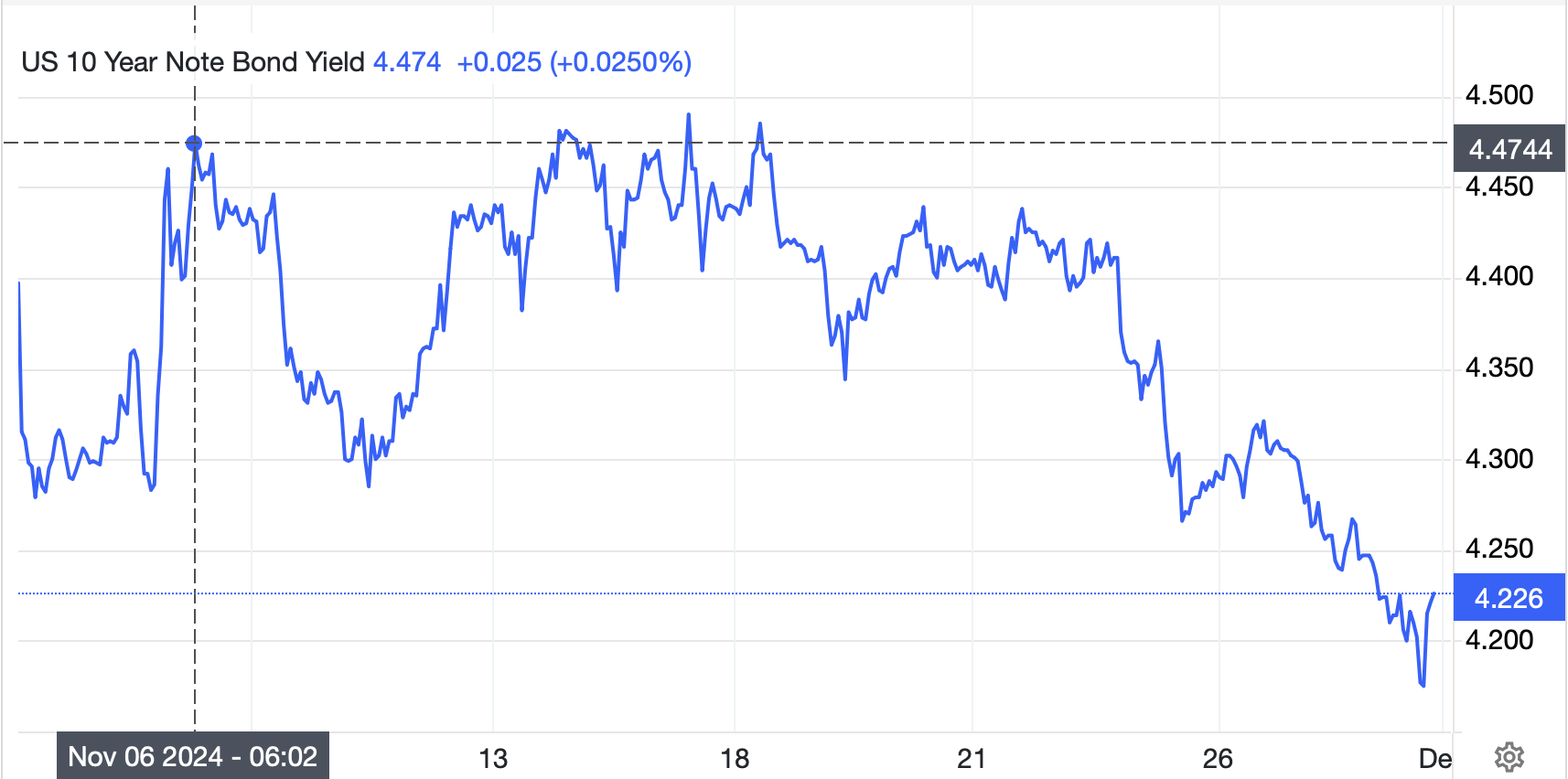
Source: tradingeconomics.com

Bringing this back to the hedging issue, I might suggest that given the uncertainty of the timing of any movements, receivables hedgers will be well-served by using optionality here, whether outright purchases or zero-premium structures as they look to address 2025 and 2026 exposures.  While the dollar may well continue its recent strengthening trend with the euro heading to parity or below for a time, and other currencies following, at some point in H2 25 or beyond, it is quite feasible that the dollar reverses course.  Consider what could happen if Trump convenes a Mar-a -Lago accord, similar to the Plaza Accord of 1985, which saw the dollar decline dramatically in the ensuing three years, falling nearly 50% against a broad mix of trading partners’ currencies by the end of 1987.
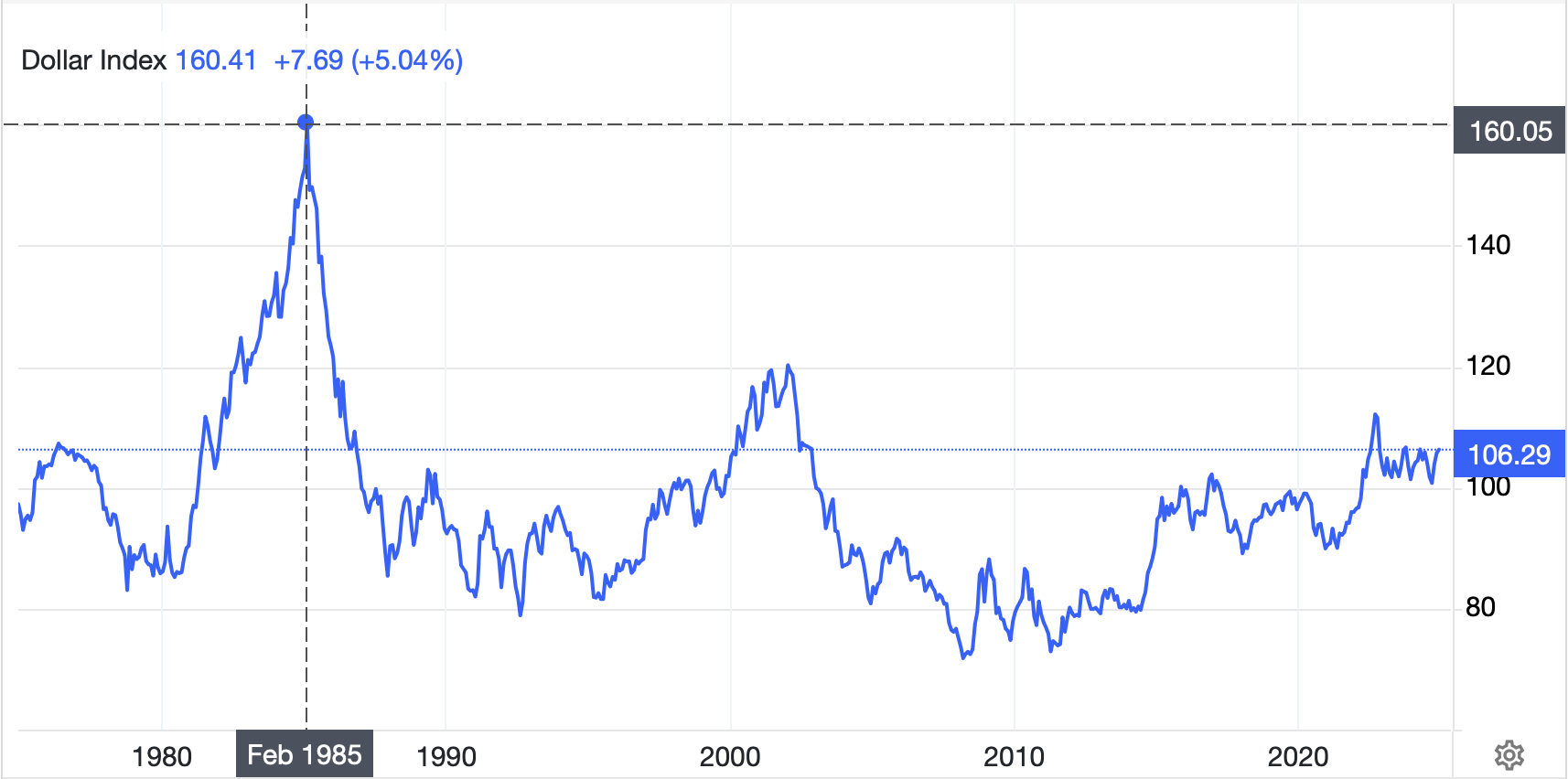
Source: tradingeconomics.com

In that situation, those out-month hedges will want to have optionality to allow the weaker dollar to benefit the revenue line.  Similarly, for those with payables hedges, care must be taken to hedge effectively there as well given the opportunity for much higher costs due to the potential dollar decline.  Current market pricing (implied volatilities) is quite reasonable from a long-term perspective.  While they are not near the lows seen in the past year, they very likely offer real value for hedgers of either persuasion.

I apologize for the extended opening, but it just seemed to be a good time to review the evolving Trump impact.  Now onto markets. The first thing to recall is that last Wednesday’s PCE data continued to show that inflation, even in this measurement, appears to have stopped declining and is beginning to head higher again.  This will continue to put pressure on the Fed as housing data was pretty dreadful last Wednesday.  Add to the data conundrum the unknown unknowns of a Trump presidency and Chairman Powell will have his hands full until his term ends.

Friday’s abbreviated session in the US saw two of the three major indices trade to new all-time highs (NASDAQ is < 1.0% below its recent high) and that seemed to help support the Asian time zone markets with green outcomes nearly universal.  Japan (+0.8%), China (+0.8%) and Hong Kong (+0.65%) all had solid sessions as did every regional exchange other than Indonesia (-0.95%) which has been suffering for the past several months in contrast to most other nations.  In Europe, the picture is more mixed with most bourses in the green (DAX +0.8%, IBEX +0.9%) although the CAC (-0.35%) is feeling pain from increased worries that the government there will fall, and the fiscal situation will be a disaster going forward.  French yields continue to climb vs. every other European nation as the country is leaderless for now.  For the rest of the continent, slightly softer PMI Manufacturing data seems to have investors increasing their bets that the ECB is going to become even more aggressive in their rate cutting going forward.  As to the US futures market, at this hour (7:00) it is mixed with the SPX (+0.5%) rising but the other indices little changed.

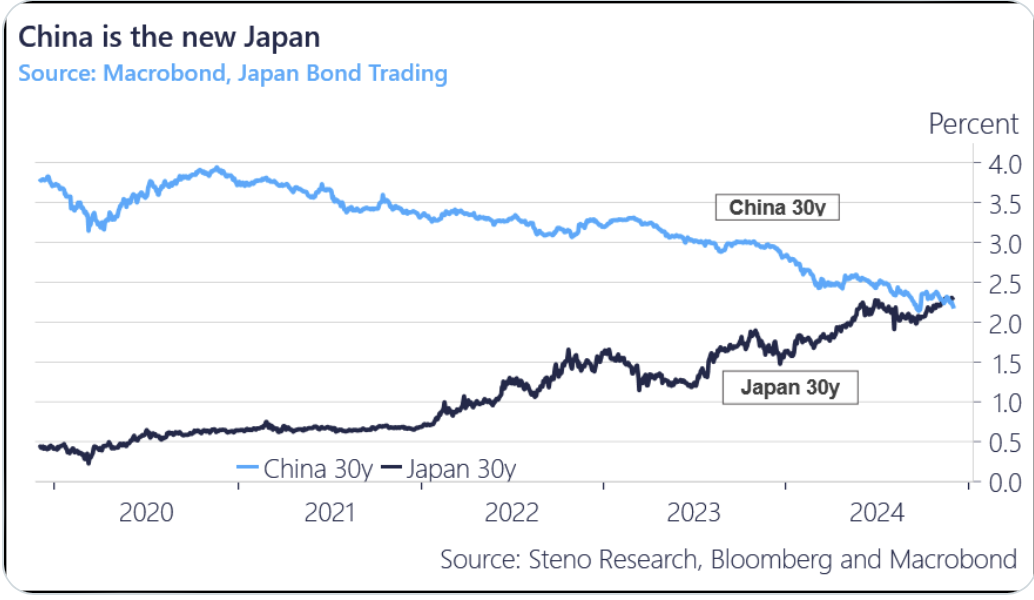
In the bond market, as mentioned above, US yields have rallied a bit although European yields are all lower by between -2bps and -4bps (France excepted at unchanged) as those hopes for an ECB rate cut are manifest here as well.  As to JGB’s, 10yr yields are higher by 2bps this morning as there is increasing chatter that Ueda-san will be hiking rates later this month.  One other interesting note here is that in the 30-year space, Chinese yields have fallen below Japanese yields for the first time ever.  This seems to be an indication that market expectations of a Chinese rebound (despite solid Caixin PMI data overnight at 51.5) are limited at best.
In the commodity markets, oil is little changed on the day, remaining below the $70/bbl level but potentially seeing some support after a story surfaced that China would be reducing its purchases of Iranian oil in an effort to avoid US sanctions and tariffs under the Trump administration.  If Trump is successful in isolating Iran again, that could well support prices.  In the metals markets, this morning is seeing a little profit-taking in the precious space after last week’s late rally, but industrial metals are little changed.

Finally, the dollar is stronger again this morning, rallying against all of its counterparts in various degrees.  The euro (-0.5%) is lagging along with SEK (-0.65%) in the G10 space as concerns over slowing growth weigh on the single currency.  But the dollar is stronger across the board.  In the EMG bloc, BRL (-0.75% and back above 6.00) is leading the way lower but we have seen declines across the board with MXN (-0.4%), KRW (-0.7%), ZAR (-0.6%) and HUF (-1.1%) just some of the examples.  Despite that hotter than expected PCE data last Wednesday, the market is still pricing a nearly 62% probability of a cut by the Fed later this month.

On the data front, there is much to learn this week, culminating in NFP data on Friday.

TodayISM Manufacturing47.5
 ISM Prices Paid55.2
TuesdayJOLTS Job Openings7.48M
WednesdayADP Employment150K
 ISM Services55.6
 Factory Orders0.3%
 Fed’s Beige Book 
ThursdayInitial Claims215K
 Continuing Claims1905K
 Trade Balance-$75.1B
FridayNonfarm Payrolls195K
 Private Payrolls200K
 Manufacturing Payrolls15K
 Unemployment Rate4.2%
 Average Hourly Earnings0.3% (3.9% Y/Y)
 Average Weekly Hours34.3
 Participation Rate62.6%
 Michigan Sentiment73.3

Source: tradingeconomics.com

In addition to all the data, we hear from 10 different Fed speakers, most notably Chairman Powell on Wednesday afternoon.  Given that the recent data does not seem to be going according to their plans, at least not the inflation data, it will be very interesting to hear what Powell has to say about things.

As the end of the year approaches with many changes certain to come alongside the Trump inauguration, I will once again express my view that hedging is crucial for risk managers here.  While I see the dollar benefitting in the near term, as discussed above, the longer-term situation is far less certain.

Good luck

Adf

In a Plight

The Minutes explained that the Fed
Is confident, looking ahead
They’ve conquered inflation
Although its duration
May last longer than they had said
 
They still think their policy’s tight
And truthfully, they may be right
But if they are not
And ‘flation’s still hot
They might find themselves in a plight


Below are a couple of key passages from the FOMC Minutes which show that the Fed continues to put on a game face when it comes to their performance.  Although some participants have begun to hedge their bets, it is clear the majority of the committee remains convinced that despite the broad inaccuracies of their models over the past forty four years, they are still on track to achieve their objectives.  

Participants anticipated that if the data came in about as expected, with inflation continuing to move down sustainably to 2% and the economy remaining near maximum employment, it would likely be appropriate to move gradually toward a more neutral stance of policy over time.”

Participants indicated that they remained confident that inflation was moving sustainably toward 2%, although a couple noted the possibility that the process could take longer than previously expected.”  [emphasis added]

And this morning, they will get to see if their confidence has been rewarded with the release of the October PCE data (exp 0.2%, 2.3% Y/Y headline; 0.3%, 2.8% Y/Y core).  One of the tell-tale signs that they are losing confidence is there has been more discussion about the vagaries of where exactly the neutral rate lies as evidenced by the following comment.  

Many participants observed that uncertainties concerning the level of the neutral rate of interest complicated the assessment of the degree of restrictiveness of monetary policy and, in their view, made it appropriate to reduce policy restraint gradually.

Once upon a time, the Fed was the undisputed master of markets, and their actions and words were the key drivers of prices across all asset classes.  However, not dissimilar to what we have seen occur regarding other mainstream institutions and their loss in respect, the same is happening at the Marriner Eccles Building I believe.  Chairman Powell, he of transitory inflation fame, is a far cry from the Maestro, Alan Greenspan, let alone Saint Volcker, and my observation is that more and more market participants listen to, but do not heed, the Fed’s words.

My read is the Fed has it in their mind that they need to continue to cut rates because the committee members have not lived through periods when interest rates were at current levels for any extended length of time.  They still fervently believe that their policy is restrictive, despite all the evidence to the contrary (record high stock prices and GDP expanding above potential) and so seem afraid that if they don’t cut rates they will be blamed for a recession.  I would argue the market interpretation of the Minutes was dovish as shown by the Fed funds futures market increasing the probability of a December cut to 66%.  Remember, Monday it was 52%.  My cynical view is the reason Powell wants to cut is his friends in the Private Equity space are suffering and he wants to help, because really, given both the inflation and economic activity data, it does not appear a cut is warranted.

Turning our attention elsewhere, there is a story going round that China is preparing to fire that bazooka this time…for real.  At least that’s what I keep reading on X, and certainly, Chinese equity markets rallied on something (CSI 300 +1.75%, Hang Seng +2.3%), but I cannot find a news story explaining any of it.  Were there comments from Xi or Li Qiang?  If so, I have not seen them.  While Chinese assets have underperformed lately, that seems to have been a response to the Trump announcements of even more tariff-minded economic cabinet members.  And the currency is essentially unchanged this morning, hanging just above that 7.25 level vs. the dollar which has served as a cap for the past decade.  (see below).

Source: tradingeconomics.com

Keep in mind that the consensus view is if Trump imposes tariffs, the renminbi will weaken enough to offset them very quickly.  Arguably, the dollar’s strength since September, when it briefly traded below 7.00, is a response to first, Trump’s improving prospects to win, and then once he won, his cabinet selections.  Will CNY really decline 5% if tariffs are imposed?  That seems an awful lot, but I guess it’s possible.  It strikes me that hedgers should be looking at CNY puts to manage their risk here.

Finally, a look at Europe shows that the dysfunction on the continent seems to be accelerating.  France is the latest target as the current government is hanging on by a thread with growing expectations that Marine Le Pen’s RN party is going to call for a confidence vote and topple it.  As well, there are growing calls for President Macron to resign as he has clearly lost control.  They are currently running a 6% fiscal deficit (just like the US although without the benefit of the world’s reserve currency) and they already have the highest tax burden in Europe.    With Germany sinking further into its own morass (GfK Consumer Confidence fell to -23.3 and continues to show a nation lacking belief in its future.  Just look at the longer-term chart of this indicator below:

Source: tradingeconomics.com

While Covid was obviously a problem, things seemed to be getting back toward normal until Russia’s invasion of Ukraine in early 2022 sent energy prices higher and laid bare the insanity of their Energiewende policy.  As industry flees the country and politics focuses on the immigration issues ignited by Angela Merkel’s open borders policy, people there truly have little hope that things will get better.  

I cannot look at the situation in both Germany and France, with both nations struggling mightily and conclude anything other than the ECB is going to be cutting rates more aggressively going forward.  Combining that with the ongoing belief that Trump’s policies are going to be dollar positive overall, it seems that the euro has much further to decline.  Do not be surprised to see it break parity sometime early in 2025.

Ok, ahead of the Thanksgiving holiday, let’s look at other markets.  In addition to the gains in Chinese shares, Australia (+0.6%) and New Zealand (+0.7%) had a good session with the latter buoyed by the RBNZ cutting rates the expected 50bps.  However, Japan (-0.8%) was under pressure as the yen (+1.1%) rallied strongly on rumors that the BOJ is getting set to hike rates next month, a bit of a change from the previous viewpoint.  In Europe, the CAC (-1.25%) is the laggard as investors are watching French OATs slide in price (rise in yields) relative to their German Bund counterparts and worrying that if the government does fall, there is no way for things to work without the RN involved.  But the DAX (-0.6%) is also softer as is the rest of the continent.  Only the UK (0.0%) is holding up this morning.   meanwhile, at this hour (7:10), US futures are pointing slightly lower, just -0.15% or so.

In the bond market, Treasury yields (-4bps) continue to slide as investors are going all-in on the idea that proposed Treasury Secretary Bessent will be able to solve the intractable problems current Secretary Yellen is leaving him.  This decline is helping European sovereign yields slide as well, as they decline between -1bp and -3bps.  However, a quick look at the chart below shows the above-mentioned Bund-OAT story and how that spread is the widest it has been in many years.

Source: tradingeconomics.com

In the commodity space, oil (+0.2%) is settling in just below $70/bbl as it becomes clear that OPEC+ is not going to be raising production anytime soon.  NatGas (-4.8%) has suffered this morning on warmer weather in Europe, but the situation there remains dicey at best, and I think this has further to run.  In metals markets, gold (+0.8%) is continuing to rebound from Monday’s wipeout, having recouped about half of the move, and we are also seeing strength in silver and copper on the China stimulus story.

Finally, the dollar is under pressure again this morning with the yen and NZD (+1.1%) leading the way although the euro (+0.3%) and pound (+0.3%) are having solid sessions as well.  In the EMG bloc, MXN (-0.3%) continues to be pressured by the tariff talk although much of the rest of the bloc is following the euro’s lead and edging higher.  My sense here is that there are quite a few crosscurrents pushing the dollar around so on any given day, it is hard to tell what will happen.  However, I still am looking for eventual further dollar strength, especially given the Fed seems to be far less likely to cut aggressively.

On the data front, yesterday’s new Home Sales were horrific, falling -17.3% and indicating the housing market is beginning to struggle.  I think that is one of the reasons the rate cut probability rose.  As to the rest of today’s data beyond PCE we see the following: 

Personal Income0.3%
Personal Spending0.3%
Q2 GDP2.8%
Durable Goods0.5%
-ex Transport0.2%
Initial Claims216K
Continuing Claims1910K
Goods Trade Balance-$99.9B
Chicago PMI44.0

Source: tradingeconomics.com

With the holiday, there are no Fed speakers scheduled and Friday, exchanges are only open for a half-day.  There continues to be a very positive vibe overall, with retail investors the most bullish they have ever been according to several banking surveys.  As well, there continues to be a positive vibe from the Trump cabinet picks which has many people expecting great things.  As I said yesterday, I hope they are correct.

My concerns go back to the fact that I just don’t see inflation declining like the Fed projects and that is going to have some negative market impacts along the way.  The one inflation positive is that I see oil prices with the opportunity to fall further, although demand for NatGas should keep that market underpinned.  As to the dollar, I’m still looking for a reason to sell it and none has been presented.

There will be no poetry on Friday so please have a wonderful Thanksgiving holiday and we get to see how things play out come Monday.

Good luck and good weekend

Adf

A Shocking Surprise

On Wednesday the data was dreck
On Friday, twas more of a wreck
The read’s now that growth
Is set for more slowth
Will this break the Fed’s bottleneck?
 
Meanwhile, in a shocking surprise
In France, tis the Left on the rise
But no party there
Is willing to share
Their power and reach compromise
 
And while day-to-day matters greatly
The populists, worldwide, are lately
Ascending to power
And ready to shower
Their voters with cash profligately


This morning, the world is a very different place than it was when I last wrote.  Broadly speaking there are three key stories of note; US data was much weaker than expected, the French election surprised one and all with the coalition of hard-left parties winning the most seats, although no group is even close to a majority of the French parliament, and the questions over President Biden’s capacity to remain on the job, let alone his ability to be president for the next four years, have been coming fast and furious from the mainstream media, many Democrats in Congress and the Democratic donor base.

So, let’s address them in order.  On the US data front, arguably the best release was the Trade Balance printing at a slightly smaller deficit than forecast by the Street.  Otherwise, ISM Services was miserable at 48.8, Factory Orders fell -0.5%, -0.7% ex Transport, and Initial and Continuing Claims both rose to new high levels for the cycle.  And that was just Wednesday.  On Friday, while the headline NFP number did beat forecasts, once again, there were major revisions lower to the past 3 months, -111K, the Unemployment Rate rose to a new high for the cycle at 4.1%, its highest level since November 2021 and a continuation of the recent uptrend in the data.  A look at the chart below seems to show a defined trend higher in the Unemployment Rate, and as I explained last week, this is a statistic that tends to have momentum once it gets going.  I would argue this number is going to continue to climb higher as the year progresses.

Source: tradingeconomics.com

As well, the biggest piece of the report was an increase of 70K Government jobs, compared to just 136K Private sector jobs and a loss of -8K in Manufacturing.  The one thing we know is that government jobs do not add to economic growth as they are the least productive of all.  

The upshot is that based on the data from Wednesday and Friday, the story of still strong growth in the US has clearly been called into question.  Will Powell, who testifies before Congress this week, pay homage to the weaker data and hint that perhaps higher for longer has reached its sell-by date?  While this is only one set of data, and he has been adamant that he needs to see several months of data, the market is becoming more convinced that a September rate cut is coming as the Fed funds futures probability of that cut has risen to 75%.  It should be an interesting week given both the CPI release and the Powell testimony.

On to the French and what was truly a shocking outcome, at least on one level.  After the first-round last week, the abject fear by the press in France, and all of Europe, of the idea that a right-wing government could come to power in a key European nation resulted in the numerous parties on the Left working with President Macron’s centrists to try to prevent any such thing from happening.  As such, they strategically pulled candidates from different seats in order to prevent splitting the vote and allowing Marine Le Pen’s RN party from achieving a majority.  And they were effective in that.  Alas, they now have a completely unworkable setup where no party has anywhere close to a majority and so passing any legislation will be nigh on impossible.  

Jean-Luc Melenchon, the Left’s most well-known proponent, and leader of a sect called France Unbowed, has declared that he wants his party’s agenda implemented full-on.  That means reducing the retirement age, raising wages and establishing price controls on power and energy as well as expanding wind and solar power.  Of course, the math on that won’t work, even if they raise taxes, but that certainly never stopped a populist once in office.  

Interestingly, while on the surface it would have been easy to conclude that French OATs would see yields rise vis-à-vis German Bunds as fears of larger government deficits build, that has not yet been the case.  In fact, this morning, yields across Europe are little changed as bond traders and investors seem to be ignoring the situation.  The rationale here is that given no group has a majority, the probability of having any party’s wish list implemented by parliament is vanishingly small.  The most likely outcome is a year of muddling through, with no decisions of any substance made and another election held next summer.  (By law, President Macron must wait one year after an election to call a second one.)  In fact, it will be very interesting to see how a prime minister will even be elected in parliament as it seems unlikely that any individual will have support of a majority of the chamber. 

As to the other potential impacts of this election, neither French equities nor the euro have shown any substantive movement as traders in both these spaces see the same situation, a very low probability of any substantive policy changes given the lack of parliamentary leadership.  Ultimately, while the political ramifications in France are large, the economic ones are not as obvious yet.

This is different than in the UK, where Keir Starmer and his Labour party swept to victory as widely expected.  In the UK, Labour runs the show now and so will be able to implement whatever policies they deem appropriate.  So far, there has been little in the way of concern demonstrated by market participants for UK assets either, but I fear the risk here is greater as the policy prescriptions that Starmer favors are likely to have a much larger negative economic toll.

Finally, in what must be THE most surprising aspect of the presidential election cycle in the US, former President Trump is NOT the major topic of conversation.  Rather, in the wake of the debate 10 days ago, the only topic is President Biden’s fitness for office now, and in the future.  This is certainly not a good look for the US, especially with a key NATO meeting this week in Washington D.C., but it is the current situation.  Thus far, US risk assets have ignored all this, arguably because the fiscal spending spigot has not been turned off.  But it is not hard to imagine that there are myriad problems ahead as Secretary Yellen tests just how many bonds the US can issue and still find buyers.

So, with all that remarkable news in our memory banks, let’s look at how markets are behaving this morning and what happened overnight.  Ironically, it seems Asian investors are the ones most upset by the European elections of last week as equity markets throughout the time zone fell.  The Hang Seng (-1.55%) was the laggard, although China (-0.85%) and Australia (-0.8%) also performed quite poorly and the Nikkei (-0.3%) was a star by comparison.  There was very little in the way of economic data to drive things here, so this seems merely to be part of the usual ebb and flow of markets.  The real surprise, though, is in Europe where equity markets are higher across the board.  Despite the pressures for more spending and higher taxes that will come from both France and the UK, the CAC (+0.45%) and the FTSE 100 (+0.3%) are nonplussed by the situation.  In the UK, as laws are implemented, I expect there will be a bigger reaction, but in France, perhaps the view that there is gridlock which will prevent any new legislation of note, means equities can run higher.  As to the US, futures markets at this hour (7:00) are basically unchanged.

As mentioned above, bond yields throughout Europe have been limited in their movement while Treasury yields have rebounded 2bps from last week’s declines.  While I was out, the weak data certainly encouraged bond investors to increase allocations as visions of a Fed rate cut grow.  For now, the bond markets are not signaling any concerns over the electoral outcomes.  My take is that may be appropriate for France and the continent, but I would be wary of UK Gilts given the likelihood of a downturn in the fiscal situation as more spending is implemented by parliament.

In the commodity markets, the end of last week saw sharp rallies in the metals markets, perhaps on those fears of a RN electoral victory in France, or perhaps on expectations of quicker Fed rate cuts, but this morning, commodities across the board are softer, with oil (-1.3%) leading the way, although WTI remains well above $82/bbl.  As to the metals, both precious (Au -0.7%, Ag -0.7%) and industrial (Cu -0.2%, al -0.1%) are giving back some of those gains.

Finally, the dollar is somewhat higher than it closed on Friday, although not very much.  In the G10, NOK (-0.5%) is suffering on oil’s decline which has dragged SEK (-0.4%) along with it.  The yen (-0.1%) which fell to near 162 vs. the dollar last Wednesday recouped some of those losses into the weekend but seems to have bounced with 160.00 now showing technical support in USDJPY.  In the EMG bloc, HUF (-0.8%) is the laggard as despite a lack of data, it seems markets are looking at the right-leaning politics of PM Orban and see continued friction between Hungary and the rest of the EU, specifically when it comes to subsidy payments.  KRW (-0.5%) is softer as the government’s efforts to expand trading hours in the currency have not yet borne fruit although it is still early days.  They are trying to improve onshore currency trading in order to allow more convertibility for equity investors and thus get Korean stock markets included in more global indices.

On the data front, while the calendar is not packed, it is impactful.

TodayConsumer Credit$10B
TuesdayNFIB Small Biz Optimism89.5
 Powell Testimony 
WednesdayPowell Testimony 
ThursdayInitial Claims240K
 Continuing Claims1860K
 CPI0.1% (3.1% Y/Y)
 -ex food & energy0.2% (3.4% Y/Y)
FridayPPI0.1% (2.3% Y/Y)
 -ex food & energy0.2% (2.5% Y/Y)
 Michigan Sentiment68.5
Source: tradingeconomics.com

In addition to Powell, 5 other Fed speakers are slated, but clearly all eyes will be on Powell.  And the CPI reading.  After last week’s soft data, there is a growing expectation that price pressures are going to fall back further and allow the Fed to cut rates.  Certainly, if CPI prints soft, I expect to see a rally in risk assets, but we must wait to hear Powell’s spin ahead of those numbers.

Net, the market is seemingly turning toward a more dovish approach with visions of rate cuts coming fast and furious once they get started.  That seems excessive to me, but for now, it is hard to like the dollar’s status as rate cut expectations build, especially given the market has ignored potential problems elsewhere.

Good luck

Adf

Thwarted?

For those of the dovish persuasion
Last Friday was quite the occasion
At zero percent
Those doves are now bent
On writing a new Fed equation
 
If PCE really is nil
It’s likely that Chair Powell will
Be forced to cut rates
And shut down debates
Inflation is bothersome still
 
Meanwhile, out of France its reported
Macron’s government’s been aborted
Will Madame Le Pen
Now lead all Frenchmen
Or will her success soon be thwarted?


A funny thing happened on the way to lower interest rates on Friday; the long end of the curve, from 10-year to 30-year Treasury yields, exploded higher by 15bps from their post PCE nadir.  While the initial reaction to the PCE data, which, by the way, was exactly in line with forecasts, was to see a modest decline in yields as all those pushing for Fed rate cuts were out in force making their case again, by the end of the day, the damage was done with yields 10bps higher despite the data.  

Now, part of that move might be blamed on the fact that Chicago PMI printed at a much better than expected 47.4, indicating that last month’s horrendous figure of 35.4 was the true aberration.  And part might be blamed on the Michigan Consumer sentiment, having barely fallen, to 68.2, rather than the expected 3+ point fall the analysts had forecast.  Of course, there were those who raised the question of the outcome of the US elections in November after Thursday night’s debate and the disastrous Biden performance seemed to open the door for a Trump victory.  For some reason, bond investors seem to think that Trumpian spending is worse than Bidenomics spending although both are likely to be far too much overall.

Or perhaps, this is the first step toward a growing concern that the trajectory of US government spending is becoming problematic writ large.  After all, there is no indication that whoever is the next president is going to rein in spending and run an austerity budget.  While they may spend on different things, it will still require the Treasury to borrow trillions more dollars.  Perhaps the biggest buyers of Treasury debt, be they foreign governments, hedge funds or individual investors do not believe that the Fed is going to do, as Mario Draghi once promised, “whatever it takes” to achieve their 2.0% inflation target.  If this is the case, then beware as yields will be able to rise much further.  I’m not saying this is what is happening, just that it is one possible explanation.

While there is much yet to discern in the US, we must, at this stage, turn to France, where the first round of President Macron’s snap election was held yesterday and the results were largely as expected, although Marine Le Pen’s RN party did not quite achieve quite the heights that some had feared forecasted.  However, she did win more than one-third of the vote relegating Macron to just over 20% and the awkward coalition of the Left, the so-called New Popular Front, to 29% or so. (Maybe they aren’t as popular as they thought!)

The upshot is that there are now all types of maneuvering between the New Popular Front and Macron to figure out a way to prevent Le Pen’s RN from winning an outright majority of 289 seats.  That vote comes this Sunday so we will have to wait and see what happens, but between now and then, there is an enormous amount of new information due to arrive including the results of the UK elections on July 4th and then the US employment report on July 5th.  This week has the opportunity to be quite volatile given the news forthcoming and the fact that in the US, there will be many trading desks that are lightly staffed due to the holiday.

So, let’s take a look at how markets are behaving given all the new information.  The first thing to note is that despite a strong start in US equity markets Friday, all three major indices closed in the red, not dramatically so, but certainly a concerning reversal of fortune.  This, of course, coincided with the melt down in Treasury prices.  However, in Asia, there is far more green than red on the screen led by China (+0.5%) and India (+0.5%) with most other markets showing less enthusiasm and Australia following the US markets as the only nation with equity declines.  Japanese Tankan data was largely in line with expectations with one outlier, the Non-Manufacturing Outlook was much weaker than expected.  Chinese Manufacturing PMI data was unchanged at 49.5, still hovering below the growth/slowdown line while the Non-Manufacturing Index fell to 50.5, down 0.6 and indicative of the fact that economic growth in China is slowing more quickly than expected.  It appears that market participants are now looking for more stimulus from the government, hence the support in the equity markets.

In Europe, markets are powering ahead this morning led by the CAC (+1.25%) in Paris as the new story is there is hope that Le Pen’s RN party will not win an outright majority of Parliament and therefore be unable to implement their policies.  It is not clear why a caretaker government, which would be the result in that case, is seen as so positive, although arguably, this is simply a modest retracement of the CAC’s 8% decline over the past six weeks as fears over a Le Pen victory rose.  However, the rest of the continent is also moving higher this morning despite (because of?) PMI data showing that the continent remains in the economic doldrums.  I guess the view is ongoing weakness will reduce inflationary pressures and thus allow the ECB to cut rates more aggressively.  Finally, US futures at this hour (6:00) have edged higher by 0.1% or so.

The bond market, though, is where there has been far more activity as following Friday’s massive sell-off in the US, we are seeing European yields climb, although there are idiosyncratic stories here as well.  For instance, German Bunds have seen yields jump 8bps, while French OATs are only higher by 2bps and Italian BTPs are unchanged.  It appears that bond investors have taken equal solace in the fact that the RN party may not win an outright majority on Sunday coming, and so are modestly less worried about more pressure in the Eurozone.  However, it cannot be overlooked that yields are generally higher this morning across the board than they were las Monday, and the market appears far more concerned over the future.

In the commodity markets, oil (+0.55%) is modestly higher this morning as are the metals markets with both precious and base metals all in the green.  While oil has had a life of its own lately, responding to idiosyncratic features of the market, the metals have lately been closely linked to the dollar, rallying when the dollar is under pressure and vice versa.  Today is a perfect example of that movement with the dollar largely weaker across the board.

The biggest mover in the dollar, at least vs. the G10 currencies, is the euro (+0.35%) as traders and investors follow French stocks and have shown some relief in the fact that an RN victory may not be forthcoming.  (Just be prepared for a major reversal if RN does win an outright majority.). This has helped virtually all the other G10 currencies except the yen (-0.15%) and CHF (-0.3%), both of whom have lost some of that haven status this morning.  In the EMG bloc, things are largely as you would expect with the CE4 all gaining and ZAR (+0.8%) gaining slightly more with the help of metals markets.  As to APAC currencies, they are essentially sitting out the French elections and are little changed across the board this morning.

On the data front, as it is the first week of the month, there is much to await.

TodayISM Manufacturing49.1
 ISM Prices Paid55.9
TuesdayJOLTS Job Openings7.85M
WednesdayADP Employment 170K
 Initial Claims235K
 Continuing Claims1841K
 Trade Balance-$76.0B
 ISM Services52.5
 Factory Orders0.3%
 -ex Transport0.3%
 FOMC Minutes 
FridayNonfarm Payrolls195K
 Private Payrolls169K
 Manufacturing Payrolls5K
 Unemployment Rate4.0%
 Average Hourly Earnings0.3% (3.9% Y/Y)
 Average Weekly Hours34.3
 Participation Rate62.7%
Source: tradingeconomics.com

In addition to all this, we hear from Chairman Powell tomorrow morning and NY Fed president Williams on Wednesday and Friday.  Given Friday’s PCE data moved closer to their target, there are many looking for a clear signal that rate cuts are coming soon.  The Fed funds futures market has not really changed its pricing with a bit more than a 10% probability of a July cut and a roughly two-thirds probability for September.  And remember, virtually every Fed speaker in the past two weeks has looked through the data and indicated they need to see more of it moving in their direction to consider it to be time to ease policy.  I suspect that Friday’s NFP and Unemployment Rate are going to be critical at this juncture although certainly Chairman Powell can change the tone of the narrative all by himself.

One last thing, Thursday, the UK will hold an election with the Labour Party is so far ahead in the polls, it appears a foregone conclusion that they will win, ousting the Tories after 14 years in power.  As such, the market has already made their peace with that.  In the end, the hopes and prayers of many are that inflation is truly ebbing and that the Fed will be able to take their foot off the brakes.  Certainly, if the NFP is weak, we need to look for them to hit the gas and rate cuts will be back in play for this month.  In that case, look for the dollar to tumble and stocks to rock.  But if NFP and Unemployment remain solid, there is little cause for the Fed to change the current higher for longer.

Good luck

Adf

Fearmongers Now Say

A question that’s going around
Is where will the buyers be found
For all the new debt
That nations are set
To issue as budgets compound
 
As well, the fearmongers now say
A crisis is coming our way
If voters elect
The folks who reject
The status quo finance cliché


As markets return from yesterday’s US holiday, activity remains somewhere between muted and ordinary in most markets.  At times like these, it is interesting to take note of the tone of the articles in financial journals, whether the WSJ, Bloomberg or the New York Times, as they are the place where I find politics is inserted into the discussion.  

For instance, there have been several articles regarding the pending French election and the market’s concern about a victory by Marine Le Pen on the right.  The thesis seems to be if her RN party wins and takes over parliament, that her plans will result in a collapse in French finances based on the promises she has made throughout the campaign.  There are many analogies to what occurred in October 2022 in the UK, when the newly elected PM, Liz Truss, put forth a program of unfunded spending and the Gilt market fell sharply.  You may recall the result was that the BOE had to step in to buy Gilts even though at that time, they had just begun to sell them to reduce the size of their balance sheet. 

Of course, what gets far less press is the fact that UK insurance companies had levered up their balance sheets because of ZIRP as they tried to earn a sufficient return to match their pension liabilities and when the BOE started tightening policy, those companies were already in trouble.  Certainly, the market response accelerated the problem, but even without Truss, as the BOE kept raising rates, the outcome would likely have been the same.  However, it was politically expedient for the press to blame Truss and the Tories.

Now consider the US, where government profligacy is truly breathtaking as the current government is borrowing $1 trillion every 100 days or so.  Certainly, this topic has been reported, although it is difficult to find a discussion from the mainstream media that makes the leap that spending as much as is currently happening is the underlying cause.  (Yes, there are many stories of this from conservative media as well as on Twitter, but not on the CBS Nightly News.)  However, those same mainstream sources threaten everyone that in the event Donald Trump is elected, it will spell the end of the bond market and the US economy because of his policy proposals of tax cuts and supporting energy growth.

It is commentary of this nature that, in my opinion, has reduced the value of mainstream media via the constant politicization of every subject.  This is also why alternate media sources, like the numerous excellent articles on Substack, have become so popular and widely read.  Analysts who are not beholden to a corporate policy and politics are able to give much more accurate and politically unbiased views.

At any rate, there was much concern ahead of this morning’s French bond auctions (they issued €10.5 billion across various maturities from 3-8 years) as this was the first attempt to sell debt since President Macron called his snap election after his European Parliament electoral disaster.  However, happily for all involved (except the doom mongers) things went just fine with a solid bid-to-cover ratio and a modest decline in market spreads.  All told, while nobody knows the future, it is difficult to expect that a Le Pen government will be any worse financially than the current Macron led government.  After all, France has just been warned by the European Commission that it must reduce its budget deficit from the current 5.5% to 3.0% as per the Maastricht Treaty, and there is no “far-right” influence on the current government.

Enough politics, let’s recap the overnight markets.  Asian markets were mixed as the Nikkei edged higher (+0.15%) but the Hang Seng (-0.5%) gave back some of yesterday’s spectacular rally.  The laggard, though, was mainland China (-0.7%).  In Europe this morning, despite the fears of a Le Pen victory, the CAC (+1.0%) is the leading gainer as either we are seeing a trading bounce after a terrible week last week, or maybe the initial hysteria is being seen for what it was, unfounded hysteria.  Meanwhile, as the BOE just left rates on hold, as widely expected, the FTSE 100 has bounced about 0.3% in the first 15 minutes since the announcement and is up 0.5% on the day.  Overall, Europe is having a good day with the DAX and virtually all markets ahead.  US futures, too, are firmer this morning, with both the NASDAQ and S&P higher by 0.5% or more although the Dow continues to lag.

In the bond market, Treasury yields have backed up 2bps this morning but the picture in Europe is much more mixed.  German yields are higher by 3bps, but UK yields have slipped a similar amount.  In fact, looking at all the nations there, it appears that there is slightly less concern over Europe as a whole as French yields are only higher by 1bp and Italian yields have slipped 1bp, thus narrowing the spread with Germany overall.  Turning to Asia, JGB yields rose 2bps, following USDJPY higher, or perhaps anticipating a higher inflation reading tonight.

In the commodity markets, crude oil (+0.15%) is edging higher this morning, although it slipped in futures trading yesterday (the only market open).  This morning brings the inventory data which is anticipating a draw of 2M barrels.  Metals markets are solid again with gold (+0.4%), silver (+1.7
%) and copper (+0.2%) all continuing their rebound from the dramatic decline two weeks ago.

Finally, the dollar is stronger this morning against most of its counterparts, notably the JPY (-0.3%) and CNY (-0.1%).  I highlight these because the yen story remains critical to the global financial markets, and it appears that Japanese investors are beginning to turn back toward Treasuries and away from JGBs supporting the moves in those markets and USDJPY.  

Regarding China, last night the PBOC fixing was at 7.1192, its highest level since November 2023 and the largest move (33 pips) in weeks.  It appears that there are numerous changes being considered and ongoing in China regarding its domestic bond market (the PBOC is looking to become more involved to support liquidity) as well as the overall monetary structure (there is talk that they will be adjusting the framework of three different rates to something more akin to what Western central banks use with a single policy rate).  In the end, given the ongoing lackluster performance of the Chinese economy, a weaker CNY remains my base case and while it may be gradual, it seems it is the PBOC’s view as well.  The onshore market continues to trade at the edge of the 2% allowable band and the offshore market is a further 35bps higher (weaker CNY) than that.  

Elsewhere, ZAR (-0.85%) which has had a good run on the back of the ultimate electoral outcome, seems to be afflicted with some profit-taking and then most of the rest of the currencies are softer vs. the dollar by about 0.2%.  One last exception is CHF (-0.65%) which has slipped after the SNB cut their policy rate by 25bps, as expected, to 1.25%.

On the data calendar today, we see Initial (exp 235K) and Continuing (1810K) Claims, Philly Fed (5.0), Housing Starts (1.37M) and Building Permits (1.45M), all at 8:30.  Then, later this afternoon, Thomas Barkin of the Richmond Fed will undoubtedly remind us that things are moving in the right direction, but patience is required.

Summing it all up, while I didn’t specifically mention it, the key thing in financial markets continues to be Nvidia, which is much higher in pre-market trading again, and apparently is the driver of everything.  However, traditional relationships have been under strain as although it appears to be a risk-on day, both the dollar and precious metals are firmer.  Overall, nothing has changed my view that the Fed is going to remain firm for now, and that (too) much credence will be assigned to next Friday’s PCE data.  But such is the state of the world.

Good luck

Adf

Indigestion

The answer to yesterday’s question
Is CPI’s seem some regression
Both stocks and bonds soared
The dollar was floored
But Powell now has indigestion
 
To no one’s surprise he left rates
Unchanged, while the dot plot translates
To higher for longer
Though pressure’s grown stronger
To cut to achieve his mandates


Unequivocally, the CPI data was cooler than market forecasts.  Month over month prices were unchanged at the headline level and grew only 0.16% on a core basis, with the year-on-year numbers each coming in one tick below expectations.  It took absolutely no time for markets to run with this data as the following charts from tradingeconomics.com for the NASDAQ 100, 10-year Treasury yields and EURUSD demonstrate.  See if you can determine when the CPI data was released.

Now, as I explained, and has become abundantly clear to anyone watching, the equity market is in a world of its own.  While yields backed up and the dollar rebounded (euro fell) after the somewhat more hawkish than expected FOMC statement, dot plot and Powell press conference, the NASDAQ ignored everything and kept on rallying.  While that is remarkably impressive, I remain of the opinion that trees still don’t grow to the sky, although apparently, they can get really tall!

At any rate, a quick look under the hood at the CPI shows that core goods prices continue to fall, which was largely why today’s data looked so good, but primary rents and OER continue to climb at about 0.4% monthly despite many assurances by many pundits, analysts and economists that rental inflation was sure to begin declining soon.  It has been rising at this pace or faster for more than two years, and while the actual pace has backed off from the rate a year ago, if you annualize 0.4% you come up with just under 5.0% inflation.  It remains hard to believe that shelter costs can rise at that pace and the general price level is going to get back to 2.0%.  Yesterday’s data was good, but we are not out of the woods yet.

Turning to the FOMC, the statement was virtually unchanged from the May statement, which makes sense since the mix of data that we have seen in the interim shows some hot and some cold numbers and no clear line of sight to the end game.  As such, it is not surprising that Chairman Powell tried to veer hawkish at the press conference in what appears to have been an attempt to offset the (over)reaction to the CPI data.  In fact, a look at the dot plot shows that, as I suggested, the median expectation for rate moves in 2024 is down to a single cut, although they are more confident that inflation will continue to fall next year with the median expectation for an additional 4 cuts.  However, as I also suggested, the longer-term outlook continues to rise with the median there now up to 2.80% from 2.60% in March, and 2.5% or below for the 3 years prior to that.

Interestingly, in their Summary of Economic Projections they expect PCE inflation to be 2.6% this year, up from 2.4% in March, with core PCE to be at 2.8% this year, up from 2.6% in March.  They did, however, maintain their views of GDP growth (2.1%) and Unemployment (4.0%).  At least, unlike Madame Lagarde who cut rates despite raising inflation forecasts, the Fed’s inaction made far more sense.

But pressure is building on Powell and the Fed to cut rates.  Today, several senators wrote (and released) a letter to Powell exhorting him to cut rates because everybody else is doing it.  They claim that his intransigence is hurting the economy, although the whole point of higher for longer is that there is scant evidence that the economy, as a whole, is in trouble despite rates where they are, although certainly some sectors are feeling a pinch.  As an aside, given the extreme degree of financial and economic ignorance that is routinely demonstrated by virtually every member of the House and Senate, this letter is simply political grandstanding.  But pressure is pressure, and Powell will certainly feel it, although I don’t think he is too concerned by this group overall.

While this morning brings PPI (exp 0.1%/2.5% headline and 0.3%/2.4% Core) as well as the weekly Initial (225K) and Continuing (1800K) Claims data, it is hard to believe that either of those data points are going to have any substantive impact given everything we learned yesterday.  So, let’s look elsewhere to see what is happening.

One of the interesting stories right now is the ongoing situation in France with the snap elections called by President Macron.  Apparently, the quick timing has resulted in significant confusion on both the left and right of the spectrum as to who will be allying with whom, and what they stand for.  While this is amusing in its own right (see this Twitter thread), the ramifications are greater for the impact on the French OAT market and the euro.

Briefly, the issue is that France has been slowly sliding from the figurative north of Europe to the South, meaning that it used to be considered a country with almost Germanic fiscal sensibilities and now it is much more akin to the PIGS than Germany.  The WSJ had an interesting article this morning describing the situation.  Ultimately, the market response has been for French yields to rise compared to German yields, adding pressure to the country as it needs to continue to finance its 5%+ budget deficit.  Now add to that the absolute trainwreck that is the current government leadership (as evidenced by that Twitter thread) and investors have decided that there are better places to invest with less credit risk.  After all, S&P Global downgraded French debt last month due to their profligate spending and I assure you, whatever the election outcome, there will be more spending not less.  

If we view this through a FX lens, the combination of clear dysfunction in Europe, lower interest rates in Europe and a Fed still committed to seeing the whites of 2%’s eyes before cutting rates here, it is very easy to anticipate the euro will be biased downwards over time.  While I know there are many who continue to write the dollar’s obituary, the fact remains that it is still standing with no competitors of note.  In fact, part of the raison d’etre of the euro was to be able to replace the dollar as a reserve currency.  It seems that hasn’t worked out all that well.

Ok, let’s see how global markets responded to the US data yesterday.  Perhaps the most interesting thing was that even in the US, the DJIA fell slightly, despite the conviction that rates are heading lower.  In Asia, the picture was mixed with Japan (-0.4%) and China (-0.5%) sliding while Hong Kong (+1.0%) rallied on the tech rally.  Many consider the Hang Seng to be China’s NASDAQ with respect to the weight of tech companies in the index.  As to European bourses, they are all in the red this morning by more than -1.0% with France (-1.4%) leading the way lower.  Of course, based on the above discussion, that can be no surprise.  Lastly, in the US, futures at this hour (6:45) are mixed with NASDAQ higher by 0.6% while DJIA futures are -0.4%.  Apparently, the prospect of lower rates doesn’t help more mature companies.

In the bond market, after yesterday’s wild ride (see above chart), Treasury yields have edged lower by -1bp, but in Europe, yields are continuing higher from their closing levels, catching up to the Treasury yield rebound in the wake of the FOMC meeting.  Not surprisingly, French OATs are leading the way with yields higher by 4bps while Germany has seen only a 2bp rise.

This morning, commodities are uniformly under pressure with oil (-0.8%) sliding after a solid weekly performance while metals markets are also slipping (Au -0.1%, Ag -0.8%, Cu -0.6%) as traders try to come to grips with the next interest rate moves and adjust their positions.  An interesting story this morning is that a shipment of copper from Russia to China for 2000 tons apparently never arrived in China.  This is simply the latest quirk in the metals markets where confirmation of what is being traded is limited.  You may recall the story last year about nickel inventories at the LME actually being bags of painted rocks.  In this space, the broad trend remains that there is excess demand for metals, especially copper, silver and aluminum, as all three are critical to electrification of systems and grids, but it is going to be a bumpy ride higher!

Finally, the dollar, which was decimated in the immediate wake of the CPI data yesterday, managed to claw back some of those losses in the afternoon thanks to the more hawkish Fed and this morning, that slow rebound continues with the greenback higher vs. almost all its counterparts in both the G10 and EMG blocs.  However, nothing really stands out as having moved significantly, with a general trend of about 0.2% or so across the board.

And that is really all we have today.  The first post-FOMC speaker is NY Fed president Williams at noon, although I suspect his message will be identical to Powell’s yesterday.  As to the rest of things, the BOJ meets tonight and while there is no expectation of a policy change, Ueda-san’s comments will be carefully parsed for any clues to when a change may be coming.  

Since nothing seems to matter to the NASDAQ and everyone wants to own it, I suspect that the dollar will maintain its gradual strength until further notice.

Good luck

Adf

Riven By Obstinacy

Said Jay, in this challenging time
Our toolkit is truly sublime
It is our desire
More bonds to acquire
And alter the Fed’s paradigm

In contrast, the poor ECB
Is riven by obstinacy
Of Germans and Dutch
Who both won’t do much
To help save Spain or Italy

Is anybody else confused by the current market activity? Every day reveals yet another data point in the economic devastation wrought by government efforts to control the spread of Covid-19, and every day sees equity prices rally further as though the future is bright. In fairness, the future is bright, just not the immediate future. Equity markets have traditionally been described as looking forward between six months and one year. Based on anything I can see; it is going to take far more than one year to get global economies back to any semblance of what they were like prior to the spread of the virus. And yet, the S&P is only down 9% this year and less than 13% from its all-time highs set in mid-February. As has been said elsewhere, the economy is more than 13% screwed up!

Chairman Powell seems to have a pretty good understanding that this is going to be a long, slow road to recovery, especially given that we have not yet taken our first steps in that direction. This was evidenced by the following comment in the FOMC Statement, “The ongoing public health crisis will weigh heavily on economic activity, employment and inflation in the near term, and poses considerable risks to the economic outlook over the medium term.” (My emphasis.) And yet, we continue to see equity investors scrambling to buy stocks amid a great wave of FOMO. History has shown that bear markets do not end in one month’s time and I see no reason to believe that this time will be different. I don’t envy Powell or the Fed the tasks they have ahead of them.

So, let’s look at some of the early data as to just how devastating the response to Covid-19 has been around the world. By now, you are all aware that US GDP fell at a 4.8% annualized rate in Q1, its sharpest decline since Q4 2008, the beginning of the GFC. But in truth, compared to the European data released this morning, that was a fantastic performance. French Q1 GDP fell 5.8%, which if annualized like the US reports the data, was -21.0%. Spanish Q1 GDP was -5.2% (-19.0% annualized), while Italy seemed to have the best performance of the lot, falling only 4.8% (-17% annualized) in Q1. German data is not released until the middle of May, but the Eurozone, as a whole, printed at -3.8% Q1 GDP. Meanwhile, German Unemployment spiked by 373K, far more than forecast and the highest print in the history of the series back to 1990. While these were the highlights (lowlights?), the story is uniformly awful throughout the continent.

With this in mind, the ECB meets today and is trying to determine what to do. Last month they created the PEPP, a €750 billion QE program, to support the Eurozone economy by keeping member interest rates in check. But that is not nearly large enough. After all, the Fed and BOJ are at unlimited QE while the BOE has explicitly agreed to monetize £200 billion of debt. In contrast, the ECB’s actions have been wholly unsatisfactory. Perhaps the best news for Madame Lagarde is the German employment report, as Herr Weidmann and Frau Merkel may finally recognize that the situation is really much worse than they expected and that more needs to be done to support the economy. Remember, too, that Germany has been the euro’s biggest beneficiary by virtue of the currency clearly being weaker than the Deutschemark would have been on its own and giving their export industries an important boost. (I am not the first to notice that the euro’s demise could well come from Germany, Austria and the Netherlands deciding to exit in order to shed all responsibility for the fiscal problems of the PIGS. But that is a discussion for another day.)

The consensus is that the ECB will not make any changes today, despite a desperate need to do more. One of the things holding them back is an expected ruling by the German Constitutional Court regarding the legality of the ECB’s QE programs. This has been a bone of contention since Signor Draghi rammed them through in 2012, and it is not something the Germans have ever forgiven. With debt mutualization off the table as the Teutonic trio won’t even consider it, QE is all they have left. Arguably, the ECB should increase the PEPP by €1 trillion or more in order to have a truly positive impact. But thus far, Madame Lagarde has not proven up to the task of forcing convincing her colleagues of the necessity of bold action. We shall see what today brings.

Leading up to the ECB announcement and the ensuing press briefing, Asian equity markets followed yesterday’s US rally higher, although early gains from Europe have faded since the release of the sobering GDP data. US futures have also given back early gains and remain marginally higher at best. Bond markets are generally edging higher, with yields across the board (save Italy) sliding a few bps, and oil prices continue their recent rebound, although despite some impressive percentage moves lately, WTI is trading only at $17.60/bbl, still miles from where it was at the beginning of March.

The dollar, in the meantime, remains under pressure overall with most G10 counterparts somewhat firmer this morning. The leaders are NOK (+0.45%) on the strength of oil’s rally, and SEK (+0.4%) which seems to simply be continuing its recent rebound from the dog days of March. Both Aussie and Kiwi are modestly softer this morning, but both of those have put in stellar performances the past few days, so this, too, looks like position adjustments.

In the EMG bloc, IDR was the overnight star, rallying 2.8% alongside a powerful equity rally there, as investors who had been quick to dump their holdings are back to hunting for yield and appreciation opportunities. As markets worldwide continue to demonstrate a willingness to look past the virus’s impact, there are many emerging markets that could well see strength in both their currencies and stock markets. The next best performers were MYR (+1.0%) and INR (+0.75%), both of which also responded to a more robust risk appetite. As LATAM has not yet opened, a quick look at yesterday’s price action shows BRL having continued its impressive rebound, higher by 3.0%, but strength too in CLP (+2.9%), COP (+1.2%) and MXN (2.5%).

We get more US data this morning, led by Initial Claims (exp 3.5M), Continuing Claims (19.476M), Personal Income (-1.5%), Personal Spending (-5.0%) and Core PCE (1.6%) all at 8:30. Then, at 9:45 Chicago PMI (37.7) is due to print. As can be seen, there is no sign that things are doing anything but descending yet. I think Chairman Powell is correct, and there is still a long way to go before things get better. While holding risk seems comfortable today, look for this to turn around in the next few weeks.

Good luck and stay safe
Adf


Dire Straits

In Europe, that grouping of states
Now find themselves in dire straits
The PMI data
Described a schemata
Of weakness and endless low rates

In the past, economists and analysts would build big econometric models with multiple variables and then, as new data was released, those models would spit out new estimates of economic activity. All of these models were based on calculating the historic relationships between specific variables and broader growth outcomes. Generally speaking, they were pretty lousy. Some would seem to work for a time, but the evolution of the economy was far faster than the changes made in the models, so they would fall out of synch. And that was before Covid-19 pushed the pace of economic change to an entirely new level. So now, higher frequency data does a far better job of giving indications as to the economic situation around the world. This is why the Initial Claims data (due this morning and currently expected at 4.5M) has gained in the eyes of both investors and economists compared to the previous champ, Nonfarm Payrolls. The latter is simply old news by the time it is released.

There is, however, another type of data that is seen as quite timely, the survey data. Specifically, PMI data is seen as an excellent harbinger of future activity, with a much stronger track record of successfully describing inflection points in the economy. And that’s what makes this morning’s report so disheartening. Remember, the PMI question simply asks each respondent whether activity is better, the same or worse than the previous month. They then subtract the percentage of worse from the percentage of better and, voila, PMI. With that in mind, this morning’s PMI results were spectacularly awful.

Country Manufacturing Services Composite
France 31.5 10.4 11.2
Germany 34.4 15.9 17.1
UK 32.9 12.3 12.9
Eurozone 33.6 11.7 13.5

Source: Bloomberg

In each case, the data set new historic lows, and given the service-oriented nature of developed economies, it cannot be that surprising that the Services number fell to levels far lower than manufacturing. After all, social distancing is essentially about stopping the provision of individual services. But still, if you do the math, in France 94.8% of Service businesses said that things were worse in April than in March. That’s a staggering number, and across the entire continent, even worse than the dire predictions that had been made ahead of the release.

With this in mind, two things make more sense. First, the euro is under pressure this morning, falling 0.6% as I type and heading back toward the lows seen last month. Despite all the discussion of how the Fed’s much more significant policy ease will ultimately undermine the dollar, the short-term reality continues to be, the euro has much bigger fundamental problems and so is far less attractive. The other thing is the ECB’s announcement last evening that they were following the Fed’s example and would now be accepting junk bonds as collateral, as long as those bonds were investment grade as of April 7. This is an attempt to prevent Italian debt, currently rated BBB with a negative outlook, from being removed from the acceptable collateral list when if Standard & Poor’s downgrades them to junk tomorrow. Italian yields currently trade at a 242bp premium to German yields in the 10-year bucket, and if they rise much further, it will simply call into question the best efforts of PM Conte to try to support the Italian economy. After all, unlike the US, Italy cannot print unlimited euros to fund themselves.

Keeping all that happy news in mind, market performance this morning is actually a lot better than you might expect. Equities in Asian markets were mixed with the Nikkei up nicely, +1.5%, but Shanghai slipping a bit, -0.2%. Another problem in Asia is Singapore, where early accolades about preventing the spread of Covid-19 have fallen by the wayside as the infection rate there spikes and previous efforts to reopen the economy are halted or reversed. Interestingly, the Asian PMI data was relatively much better than Europe, with Japanese Services data at 22.8. Turning to Europe, the picture remains mixed with the DAX (-0.3%) and FTSE 100 (-0.3%) slipping while the CAC (+0.1%) has managed to keep its head above water. The best performer on the Continent is Italy (+1.0%) as the ECB decision is seen as a win for all Italian markets. US futures markets are modestly negative at this time, but just 0.2% or so, thus it is hard to get a sense of the opening.

Bond markets are also having a mixed day, with the weakest links in Europe, the PIGS, all rallying smartly with yields lower by between 5bps (Italy) and 19bps (Greece). Treasury yields, however, have actually edged higher by a basis point, though still yield just 0.63%. And finally, the dollar, too, is having a mixed session. In the G10 bloc, the euro and Swiss franc are at the bottom of the list today, with Switzerland inextricably tied to the Eurozone and its foibles. On the plus side, NOK has jumped 1.0% as oil prices, after their early week collapse, are actually rebounding nicely this morning with WTI higher by 12.4% ($1.70/bbl), although still at just $15.50/bbl. Aussie (+0.6%) and Kiwi (+0.75%) are also in the green, as both have seen sharp recent declines moderate.

EMG currencies also present a mixed picture, with the ruble on top of the charts, +1.4%, on the strength of the oil market rebound. India’s rupee has also performed well overnight, rising 0.8%, as the market anticipates further monetary support from the Reserve bank there. While there are other gainers, none of the movement is significant. On the other side of the ledger, the CE4 are all under pressure, tracking the euro’s decline with the lot of them down between 0.3% and 0.5%. I must mention BRL as well, which while it hasn’t opened yet today, fell 2.6% yesterday as the market responded to BCB President Campos Neto indicating that further rate cuts were coming and that QE in the future is entirely realistic. The BRL carry trade has been devastated with the short-term Selic rate now sitting at 3.75%, and clearly with room to fall.

Aside from this morning’s Initial Claims data, we see Continuing Claims (exp 16.74M), which run at a one week lag, and then we get US PMI data (Mfg 35.0, Services 30.0) at 9:45. Finally at 10:00 comes New Home Sales, which are forecast to have declined by 16% in March to 644K.

The big picture remains that economic activity is still slowing down around the world with the reopening of economies still highly uncertain in terms of timing. Equity markets have been remarkable in their ability to ignore what have been historically awful economic outcomes, but at some point, I fear that the next leg lower will be coming. As to the dollar, it remains the haven of choice, and so is likely to remain well bid overall for the foreseeable future.

Good luck and stay safe
Adf


Not a Chance

From Germany and, too, from France
We saw the economy’s stance
Their prospects are dire
And though they aspire
To growth, it seems they’ve not a chance

Surveying the markets this morning, the theme seems to be that the growth scare continues to be real. PMI data from Europe was MUCH worse than expected across the board, with Services suffering as well as the manufacturing data which has been weak for quite a while already. This is how things stacked up:

Event Expectations Release
German Manufacturing PMI 44.0 41.4
Services PMI 54.3 52.5
Composite PMI 51.5 49.1
French Manufacturing PMI 51.2 50.3
Services PMI 53.2 51.6
Composite PMI 52.6 51.3

Source: Bloomberg

Anybody that claims Germany is not in recession is just not paying attention. Friday evening, the Bundestag agreed to a new €54 billion bill to address climate change, which some are looking at as an economic stimulus as well. However, a stimulus bill would need to create short term government spending, and the nature of this bill is decidedly longer term in nature. And a bigger problem is the German unwillingness to run a budget deficit means that if they put this in place, it will restrict their ability to add any stimulus on a more timely basis. It also appears that the ECB and IMF will continue to call them out for their austere views, but thus far, the German people are completely backing the government on this issue. Perhaps when the recession is in fuller flower, der mann on der strasse will be more willing for the government to borrow money to spend.

It ought not be that surprising that European equity markets suffered after the release with the DAX down a solid 1.2% and CAC -1.0% with the bulk of the move coming in the wake of the releases. This paring of risk also resulted in a rally in Bunds (-6bps), OATS (-3bps) and Treasuries (-3bps) while the dollar rallied (EUR -0.4%, GBP -0.3%).

But I think this begs the question of whether or not a recession is going to be solely a European phenomenon or if the US is going to crash that party. What we have learned in the past two weeks is that the ECB is basically spent, and that the market’s review of their newest policy mix was two thumbs down. Ironically, Draghi’s clear attempts to weaken the euro are now being helped by the significantly weaker than expected Eurozone data that he’s trying to fix. Apparently, you can’t have it both ways. Much to his chagrin, however, I believe that there is plenty more downside for the euro as the Eurozone economy continues its slow descent into stagnation. When Madame Lagarde takes over on November 1st, she will have an empty cupboard of tools to address the economy and will be forced to rely on verbal suasion. I expect that we will hear from the Mandame quite frequently as she tries to change the narrative. I also expect that her efforts will do very little, especially if China continues to falter.

Away from the weak European data, there was not that much else of interest. Friday, if you recall, the US equity markets suffered after the low-level Chinese trade delegation canceled a trip to Montana and Nebraska as the perception was the talks broke down. It turns out, however, that the request came from the US for other reasons, and that the talks, by all accounts, went quite well. At this point, the market is now looking forward to Chinese Vice-Premier, Liu He, coming to Washington on October 10, so barring any further tweets on the subject that topic may well slip to the back burner.

Brexit was also in the news as Boris makes his way to NY for the UN session this week He has scheduled meetings with all the key players from Europe including Chancellor Merkel, President Macron and Taoiseach Varadkar. At the same time, the Labour party’s conference is in disarray as leader Jeremy Corbyn wants to campaign on a second referendum but will not definitively back Remain. In other words, it’s not just the Tories who are split over Brexit, it is both parties. And don’t forget, we are awaiting the UK Supreme Court’s decision on the legality of Boris’ move to prorogue parliament for five weeks, which could come any day this week. In the end, the pound is still completely beholden to Brexit, so look for a Supreme Court ruling against the government to result in a rally in the pound as it will be perceived as lowering the probability of a no-deal Brexit. Again, my view remains that at the EU summit in the middle of next month, there will be an announcement of a breakthrough of some sort to fudge the Irish backstop and that the pound will rally sharply on the news.

Looking ahead to this week, we have a fair amount of new information as well as a host of Fed speakers:

Tuesday Case-Shiller House Prices 2.90%
  Consumer Confidence 133.3
Wednesday New Home Sales 656K
Thursday Q2 GDP (2ndrevision) 2.0%
  Initial Claims 211K
Friday Personal Income 0.4%
  Personal Spending 0.3%
  Durable Goods -1.1%
  -ex transportation 0.2%
  Core PCE Deflator 0.2% (1.8% Y/Y)
  Michigan Sentiment 92.0

Source: Bloomberg

We also hear from 11 different Fed speakers this week, two of them twice! At this point I expect they will be working hard to get their individual viewpoints across which should actually help us better understand the mix of views on the board. So far we have a pretty good understanding of where Bullard, George and Rosengren stand, but none of them are speaking this week. This means we will get eleven entirely new viewpoints. And my take is that the general viewpoint is going to be unless the data really turns lower; there is no more cause to ease at this point. I don’t think the equity market will like that, nor the bond market, but the dollar is going to be a big beneficiary. The euro is back below 1.10 this morning. Look for it to continue lower as the week progresses.

Good luck
Adf