Havoc He’s Wreaking

The focus has turned to the data
And whether it’s good or it’s bad-a
We all want to see
Today’s NFP
Then listen to punditry chat-a
 
It’s funny, cause generally speaking
Most pundits are strongly critiquing
The numbers released
Declaring they’re greased
To help Trump and havoc he’s wreaking

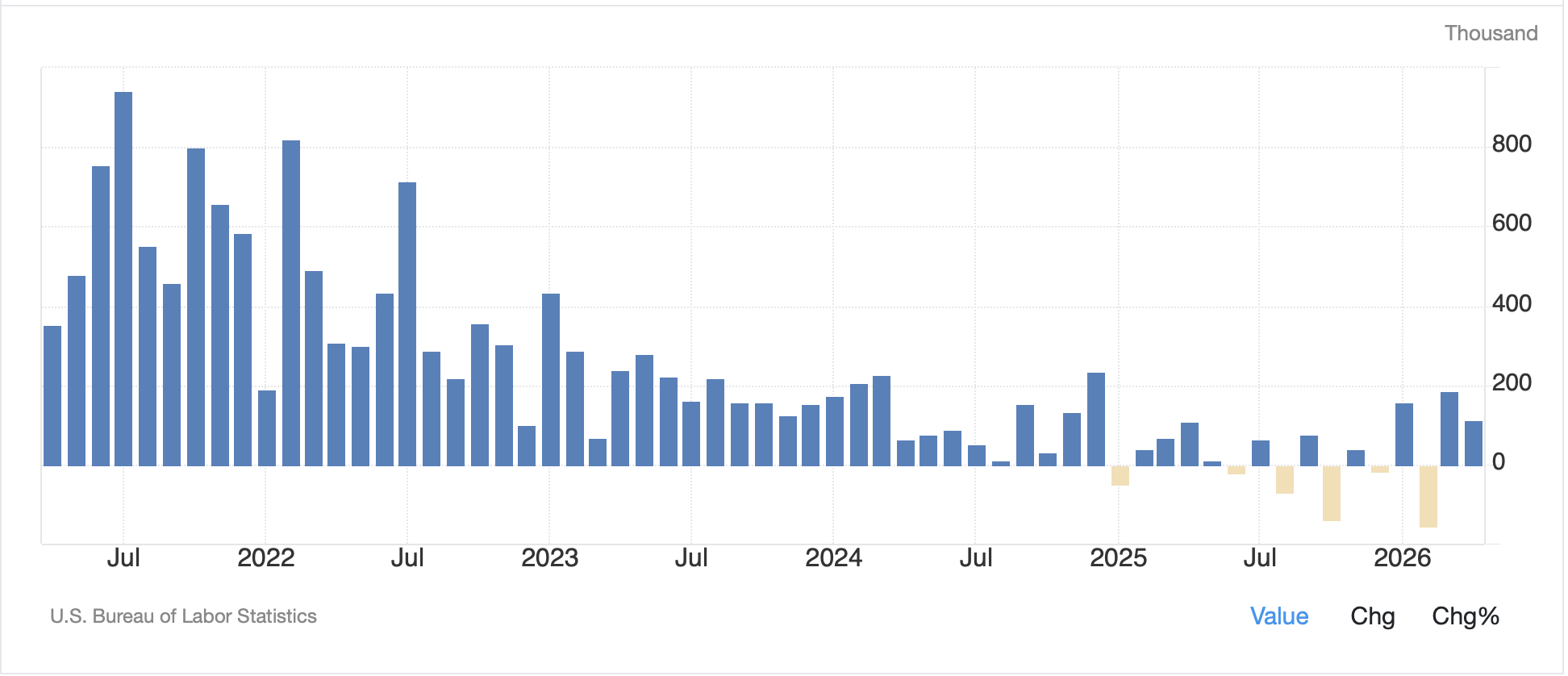
It’s NFP day today, which given it is Wednesday is a bit odd, but that’s what happens when the government shuts down for a few days.  At any rate, this is the biggest data week we’ve had in a while as not only did we see Retail Sales yesterday, which disappointed at 0.0% despite showing the largest actual jump, $80 billion, ever between November and December, although that was completely removed by the largest seasonal adjustment ever, (Read about it here at WolfStreet.com) we also get CPI on Friday.  For good order’s sake, here are the current consensus forecasts for NFP:

Nonfarm Payrolls70K
Private Payrolls70K
Manufacturing Payrolls-5K
Unemployment Rate4.4%
Average Hourly Earnings0.3% (3.6% Y/Y)
Average Weekly Hours34.2
Participation Rate62.3%

Source: tradingeconmomics.com

As the market continues to adjust to the recent gyrations, there is hope that the data will lead to unequivocal conclusions about the economy, which could drive Fed decisions and then coalesce around a clear direction of travel.  I’m not holding my breath.  

The first thing to remember is that the data is revised virtually every month, and when the economy is at an inflection point, or even when it is showing more pronounced activity in one sector than another, those revisions can tell a very different story than the original print.  But even beyond that, while the algorithms are clearly programmed to respond to the data, longer term investors have a much tougher time discerning what is happening.  All that is a long way of saying, nobody still has any idea where things are headed!

While I dismiss the FOMC speaking circuit, yesterday’s two speakers, Logan and Hammack, who are both voting members this year, said that they felt the current rate is at neutral.  Remember, right now Fed funds are 3.75%, which is a far cry from the Longer run neutral rate they have been feeding us in the Dot Plot!

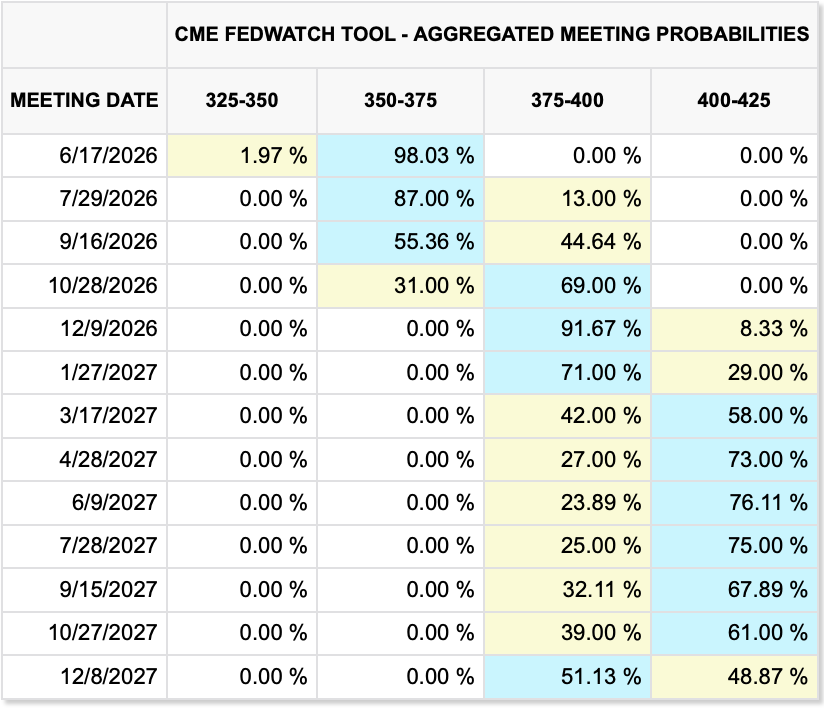
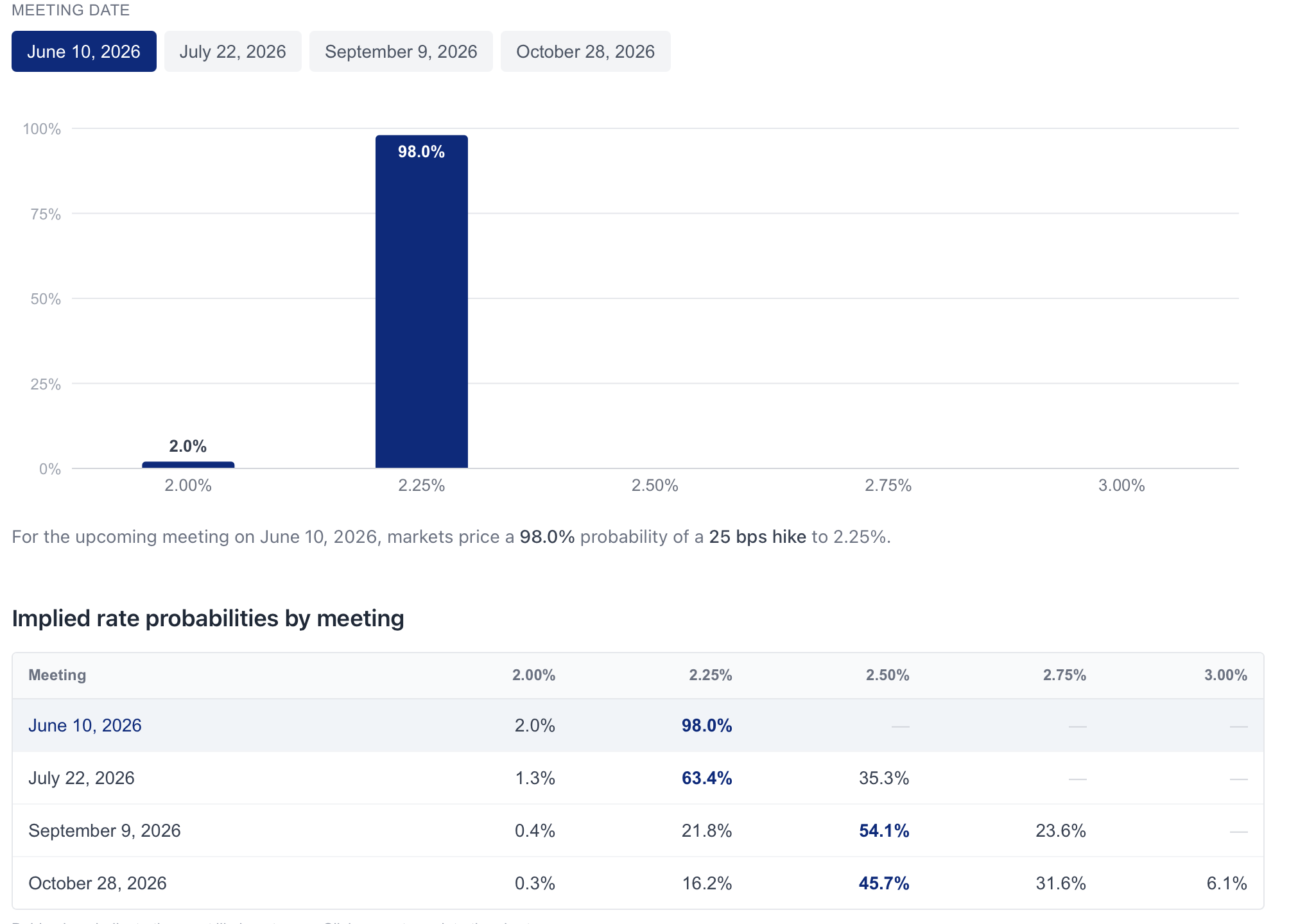
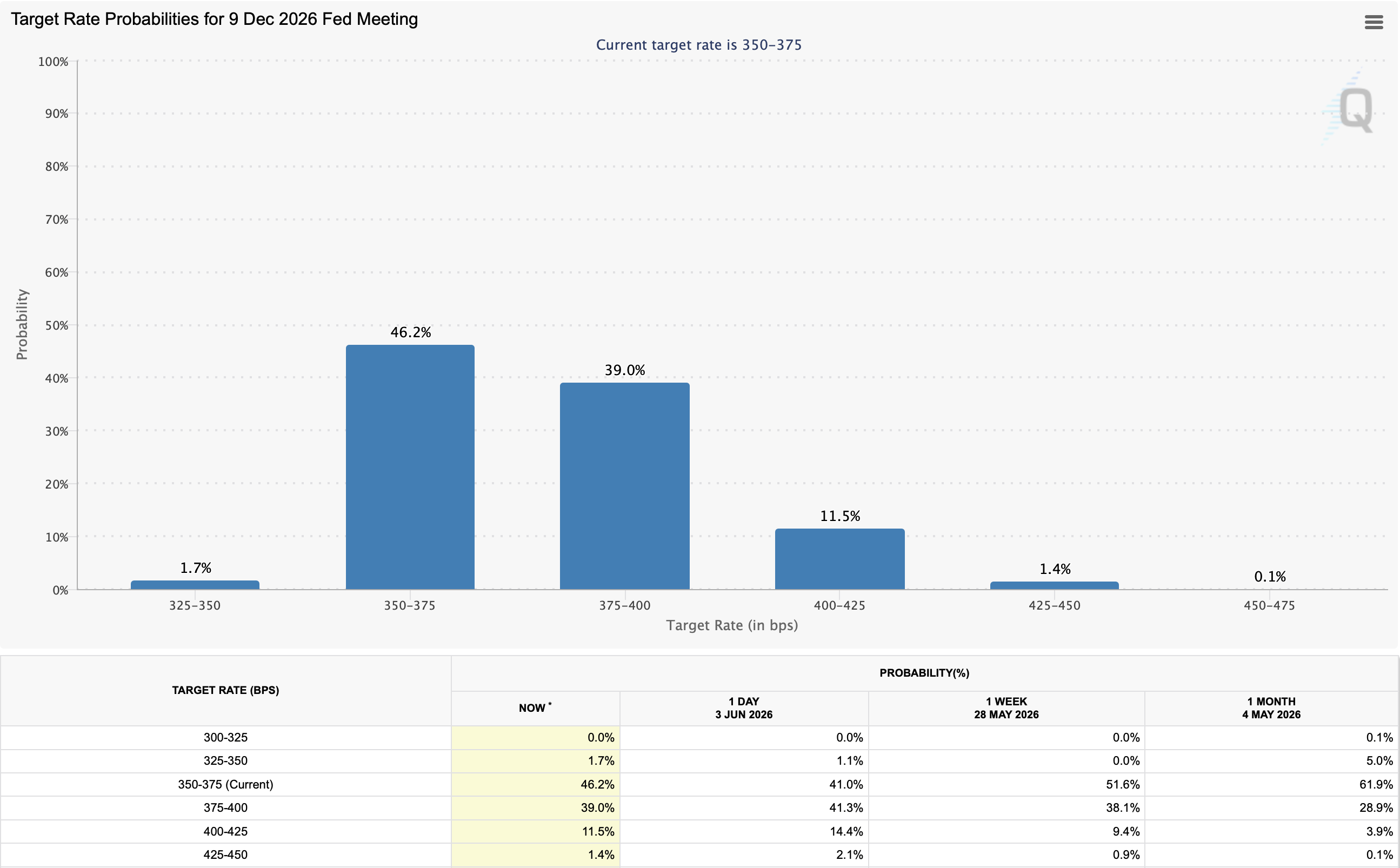
In fact, their median expectation is 3.0%, so the fact that two voting members think 3.75% is neutral is somewhat confusing especially as both indicated they expected inflation to continue to decline and exhibited concern over the employment situation.  My views of where things are headed don’t matter nearly as much as theirs do, but there seems to be a little inconsistency involved here.  As it happens, the current Fed funds futures market pricing shows that there is a 22% probability of a rate cut in March and then it’s 50:50 in April as per the below chart fromcmegroup.com.

At this point, I suspect we will need to see negative NFP numbers along with continuing declines in CPI/PCE for the Fed to cut as I think Chairman Powell is so miffed at President Trump, he doesn’t want to do anything that Trump wants.  It would also not surprise me if that attitude has suffused the bulk of the FOMC.  The irony remains that Governors Cook and Jefferson are raging doves but would rather keep policy tight to stymy Trump rather than act as they otherwise would.  At least that’s my take.

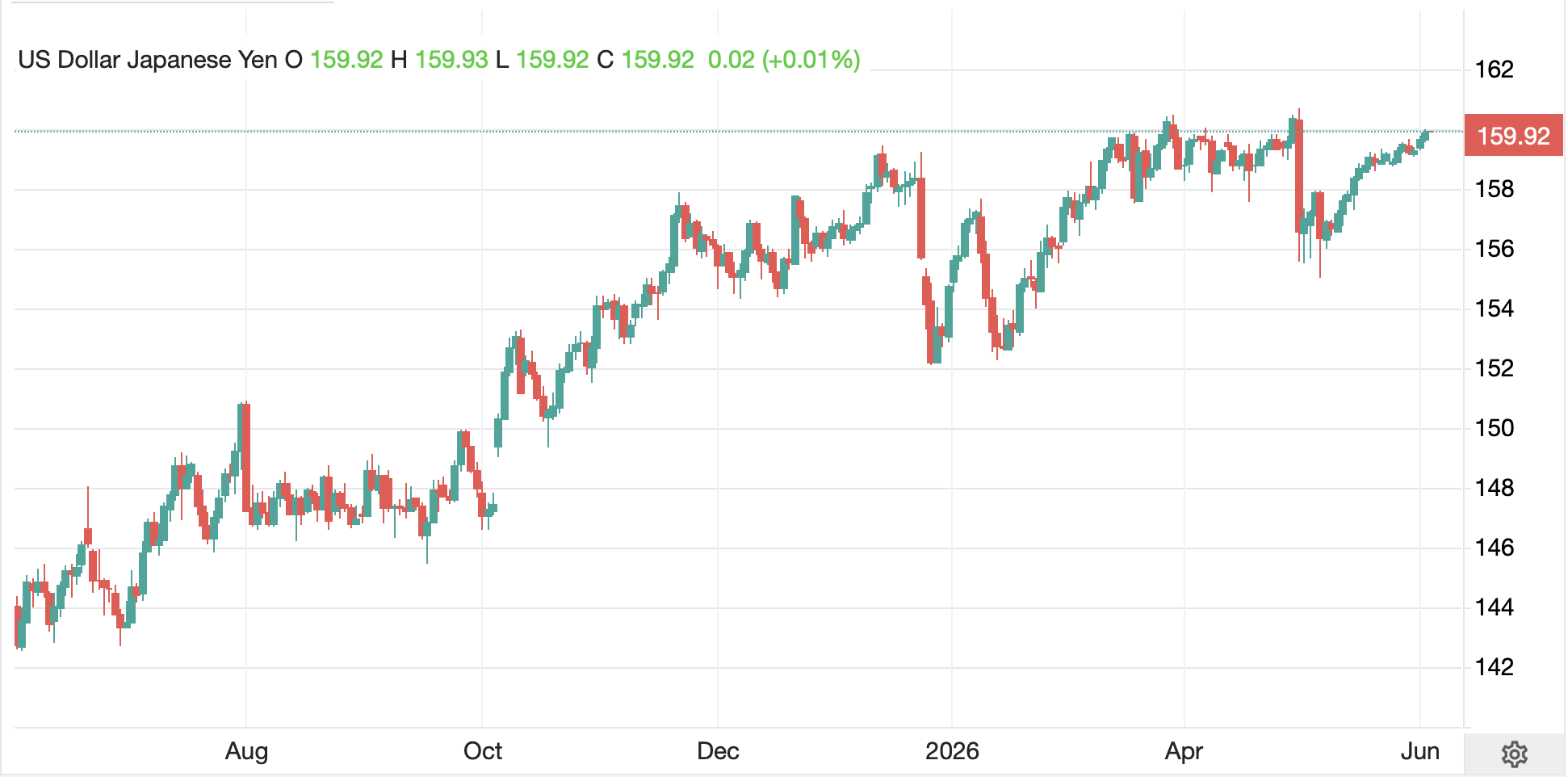
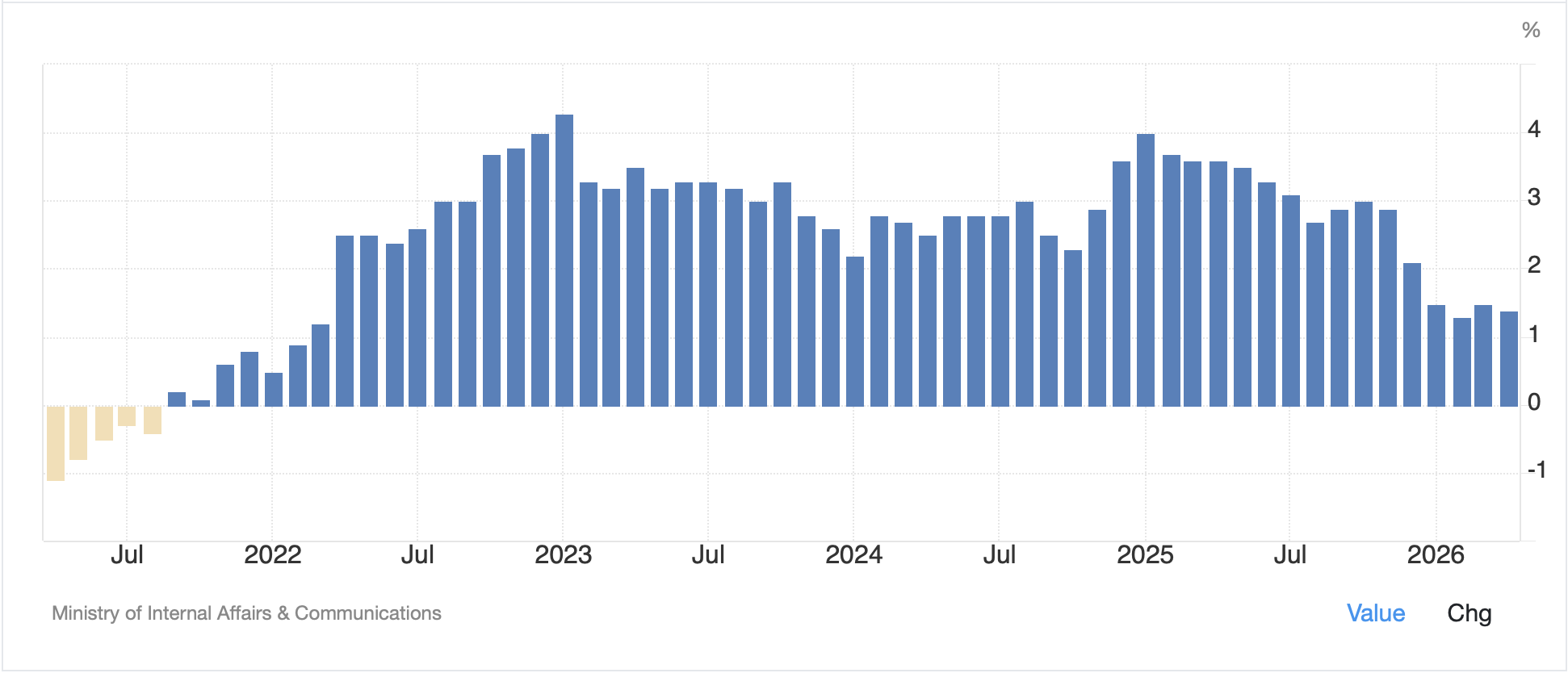
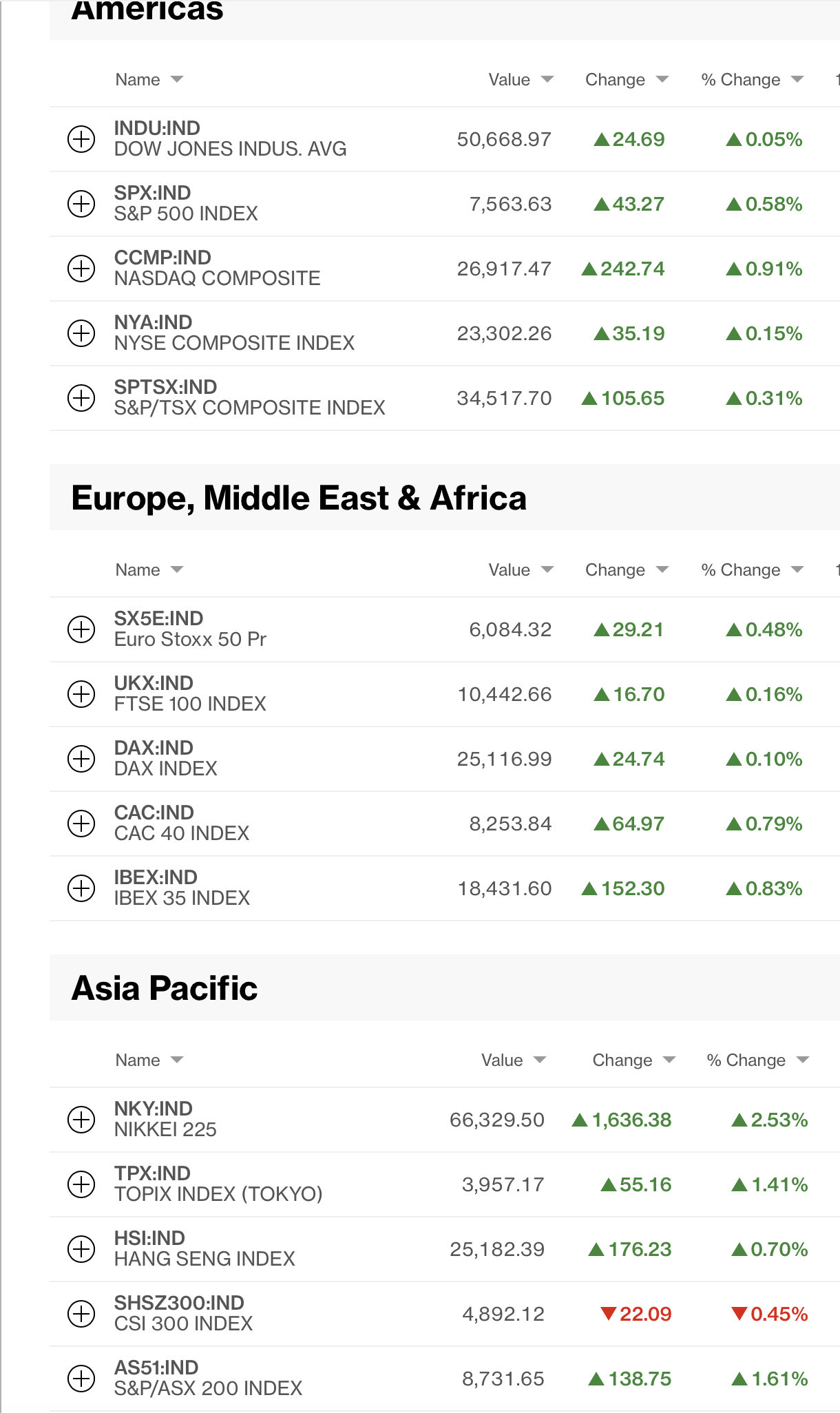
Anyway, that’s what we have to look forward to this morning.  So, how have things behaved overnight?  Let’s look.  Tokyo (+2.3%) continues to be the star of the show, continuing to rally on excitement and optimism that PM Takaichi is going to solve Japan’s problems.  Maybe she will, but they have a lot of them, so it will take time.  But the tech story is strong there and it appears that foreign buying is picking up, which has been one of the drivers of the JPY (+0.5%) lately.  In fact, this week, the yen is leading all currencies having gained more than 2.3% so far.

Source: tradingeconomics.com

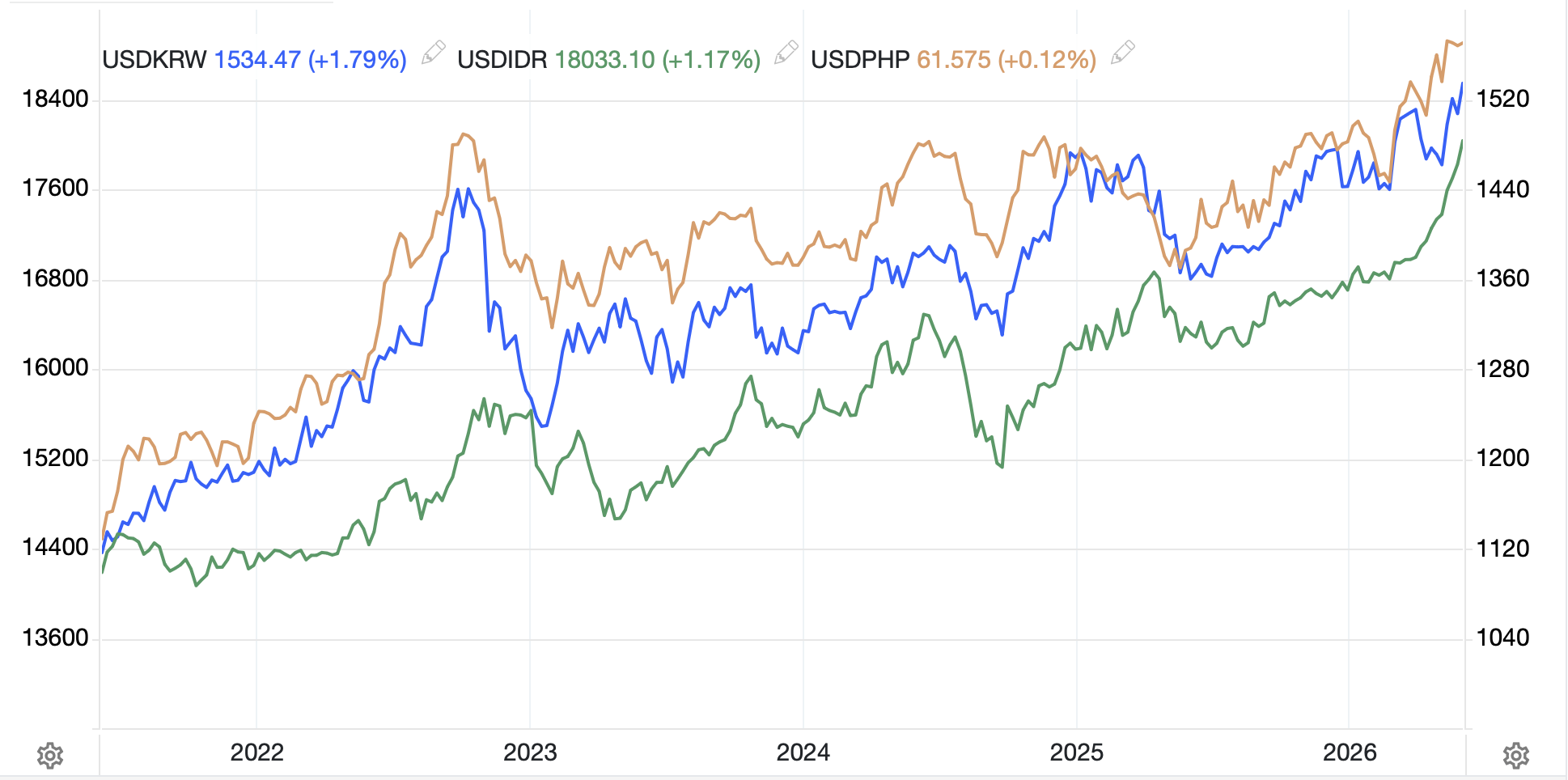
As to the rest of Asia, China (-0.2%) and HK (+0.3%) did little although the tech-based Korean (+1.0%) and Taiwanese (+1.6%) exchanges did well, as did Australia (+1.6%) on the back of stronger metals prices.  One other interesting note is Indonesia (+2.0%) where the government just restricted mining of Nickel (+1.7%) in order to raise the price of their largest export!

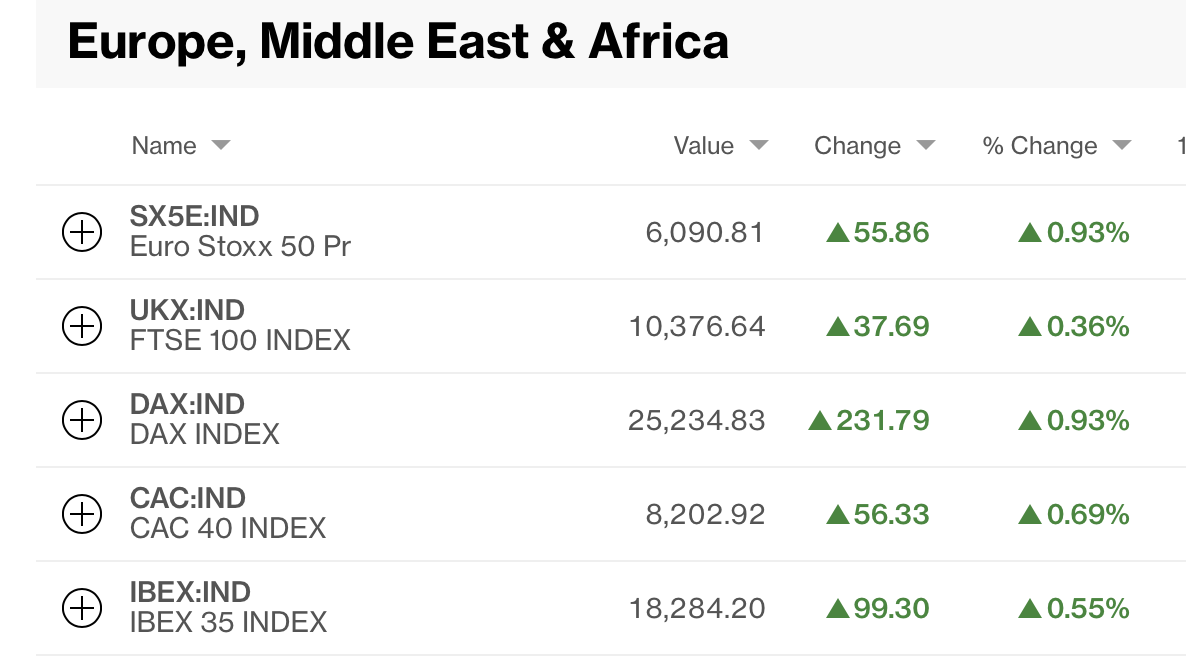
Europe is a lot less interesting with the continent under some pressure (France -0.2%, Spain -0.3%, Germany -0.2%) although the UK (+0.7%) is performing well on the back of strength in mining and natural resource shares.  US futures at this hour (7:35) are pointing slightly higher, about 0.15%.

In the bond market, things have gone back to sleep with 10-year yields lower by -1bp pretty much throughout the US and Europe.  JGB yields also did nothing last night, and it appears that despite the massive debt that continues to grow around the world, bond investors are comfortable right now.  Perhaps they see deflation in our future, but that doesn’t feel right to me.

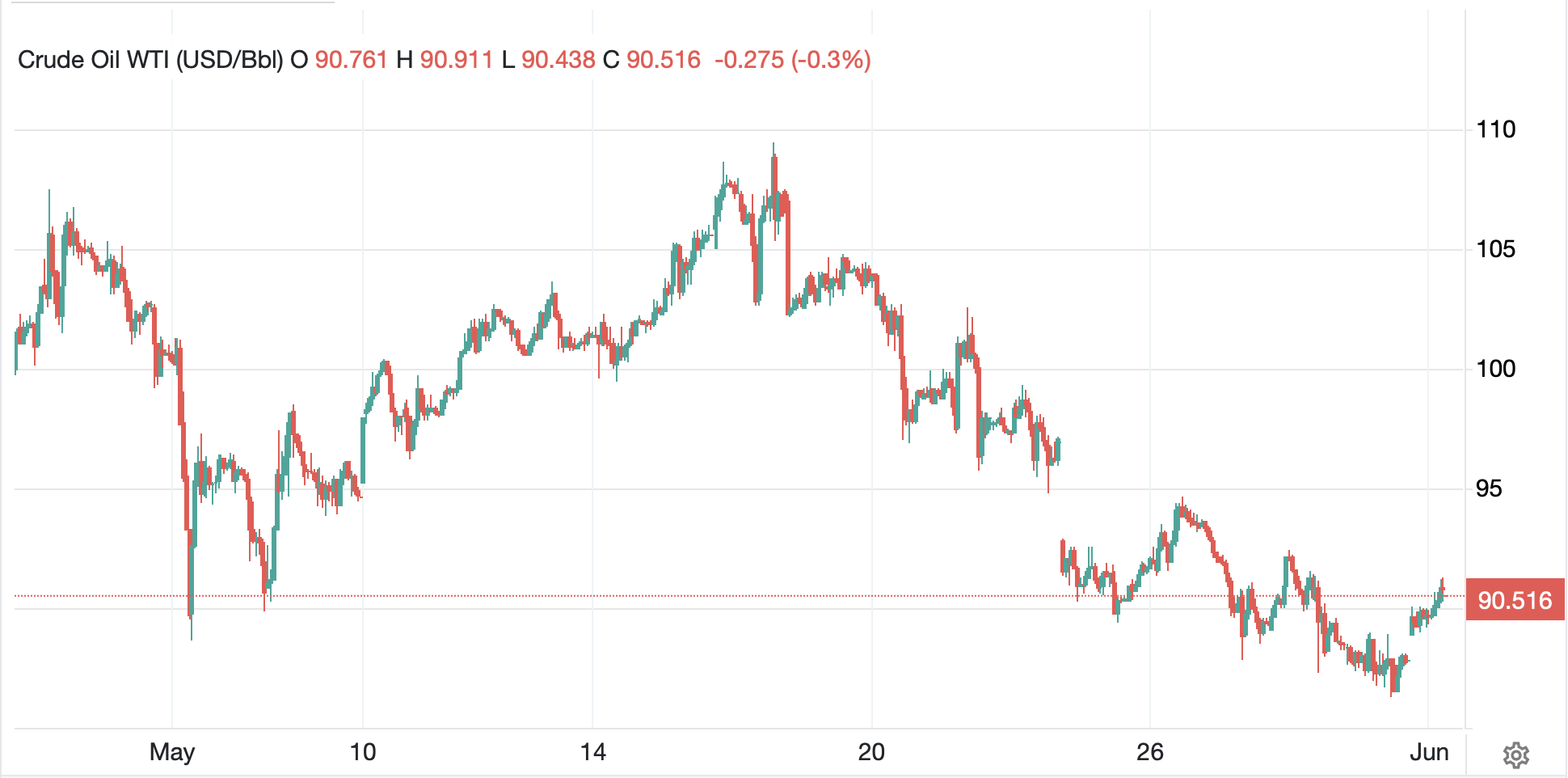
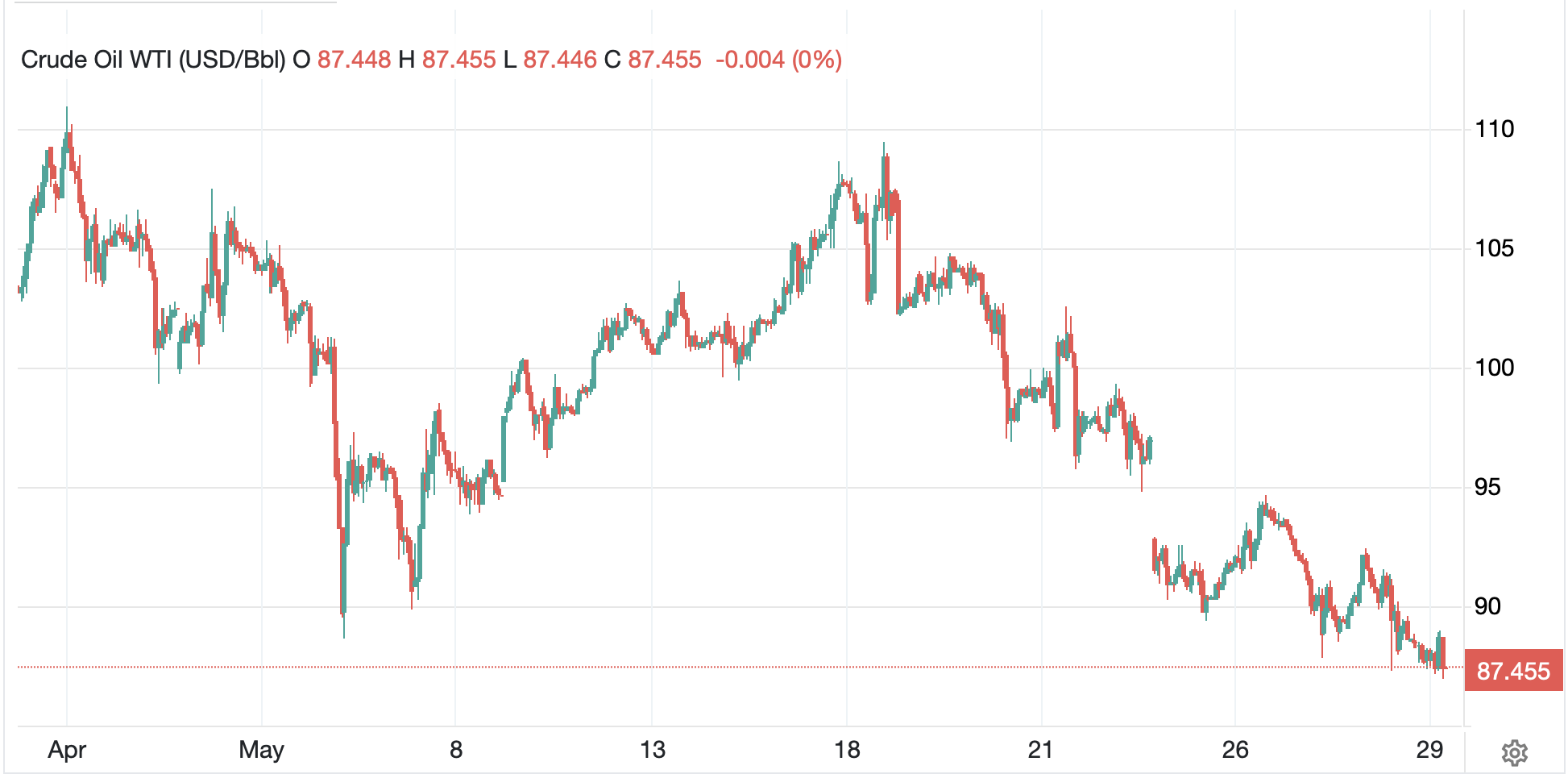
Turning to the markets that continue to show the most volatility, commodities, let’s start with oil (+2.1%) which is demonstrating concern over re-escalating tensions regarding Iran, the negotiations and the potential for military activity there.  There are reports that the US may intercept Iranian tankers and if you look at the chart below, a pretty good uptrend has developed over the past two months.  You won’t be surprised that NOK (+0.6%) has benefitted from today’s move either.

Source: tradingeconomics.com

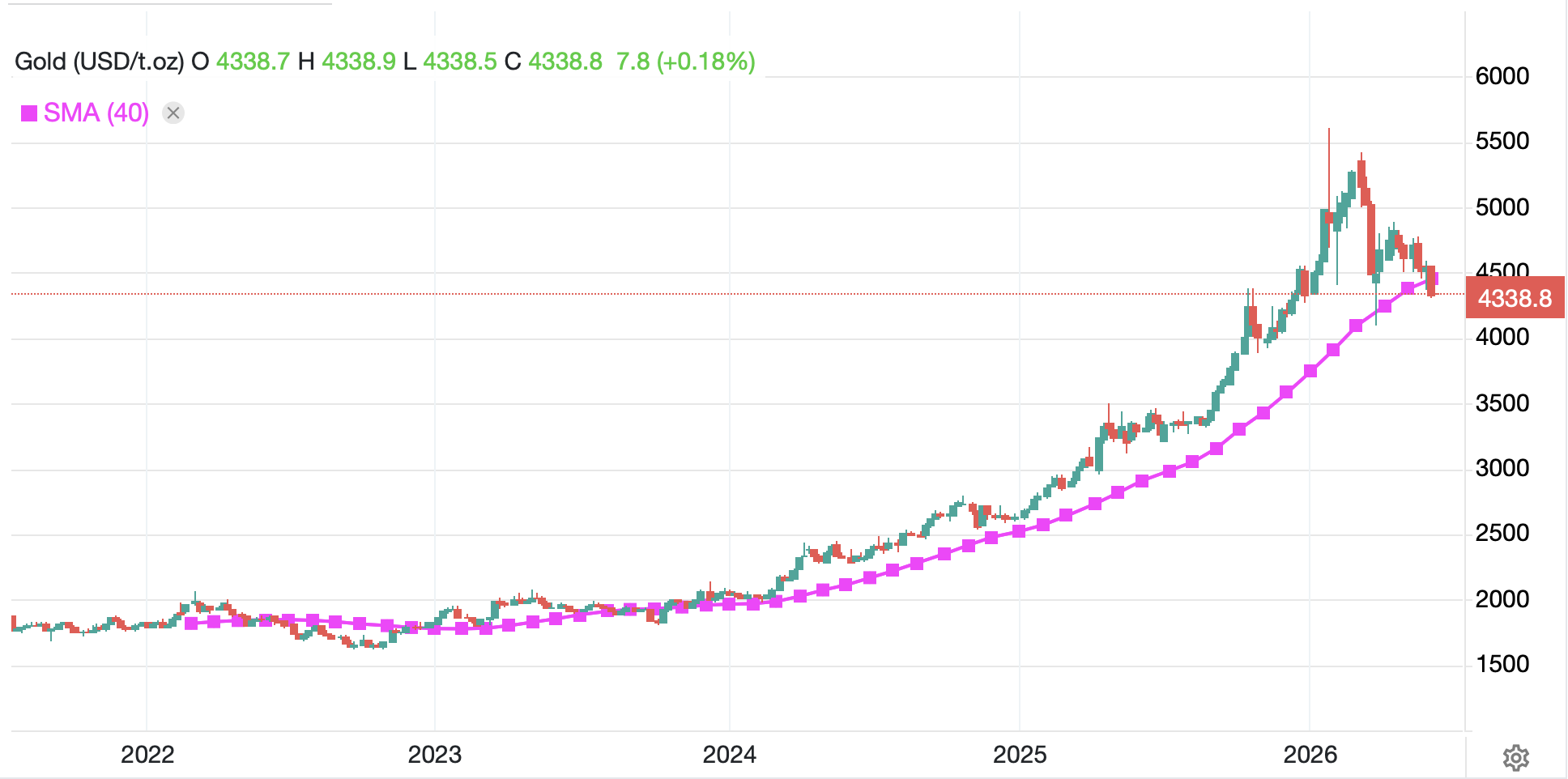
As to the precious metals, after yesterday’s modest decline, we are back on the rise with gold (+0.85%), silver (+5.5%), copper (+2.1%) and platinum (+3.3%) all nicely higher.  The silver story is about declining inventories in Shanghai, which was the last place that can afford it since both the COMEX and London are already light on available ounces.  While we saw a dramatic decline nearly two weeks ago, I have to say things appear to be shaping up to recoup all those losses and then some!

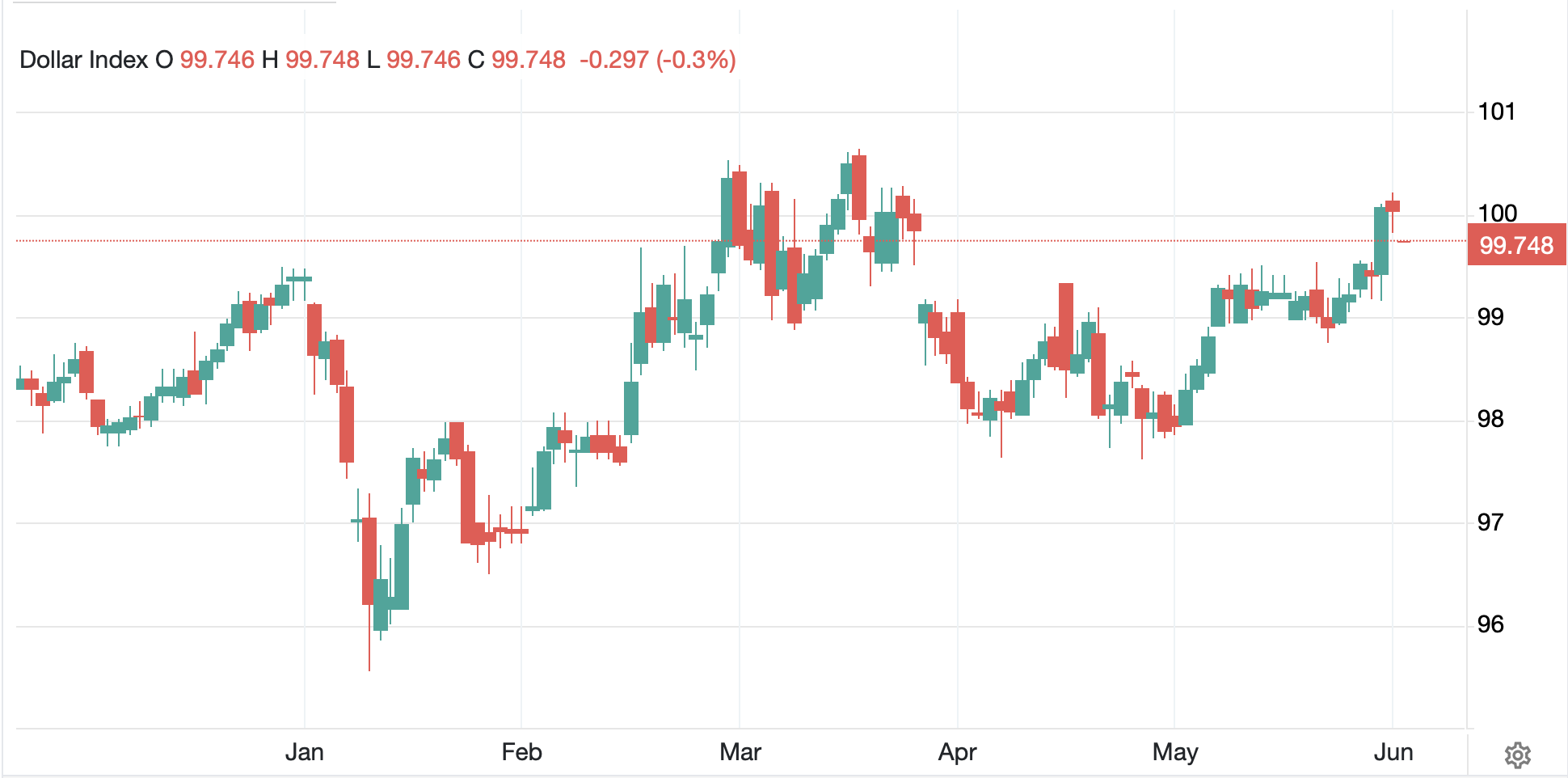
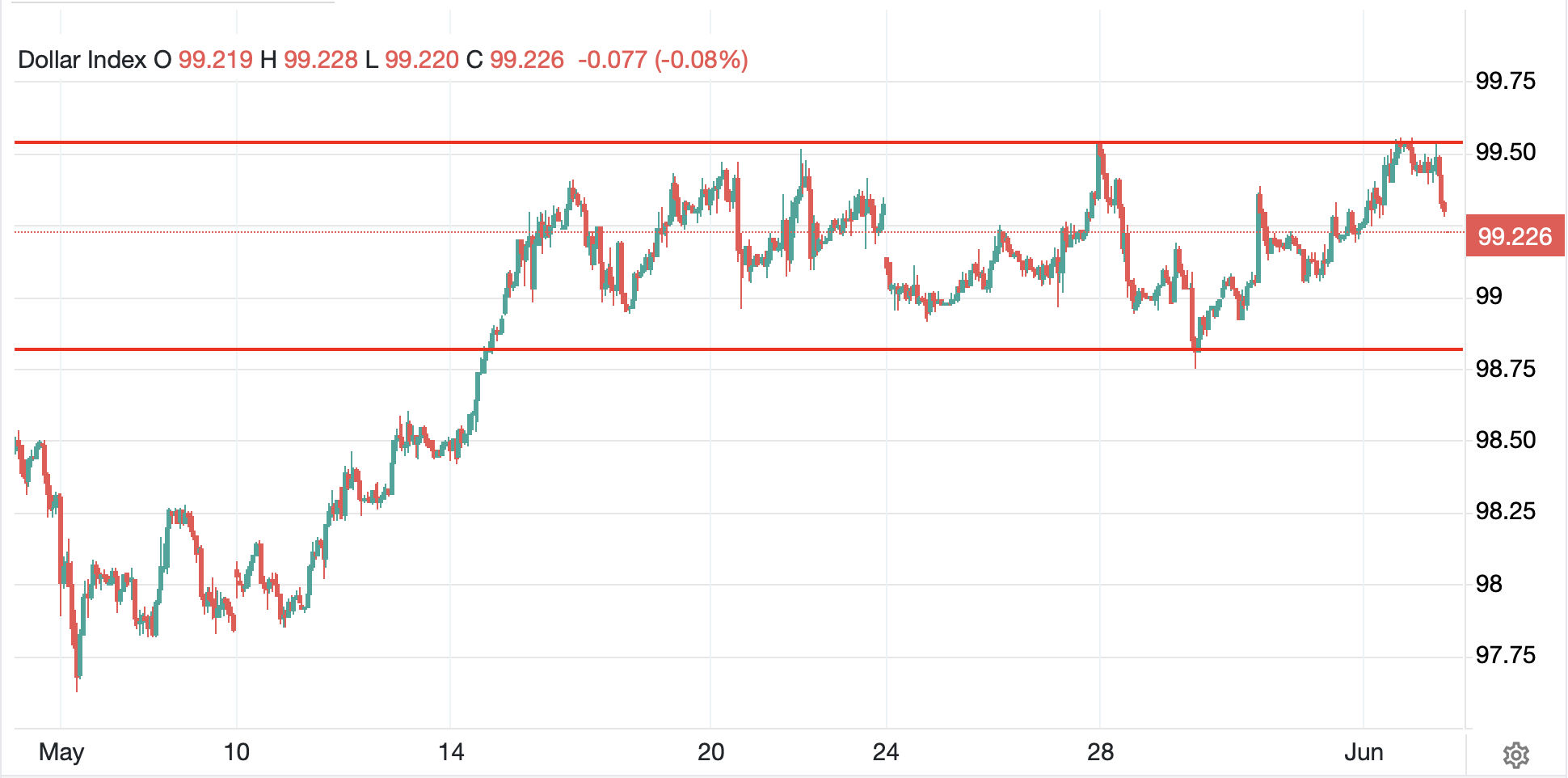
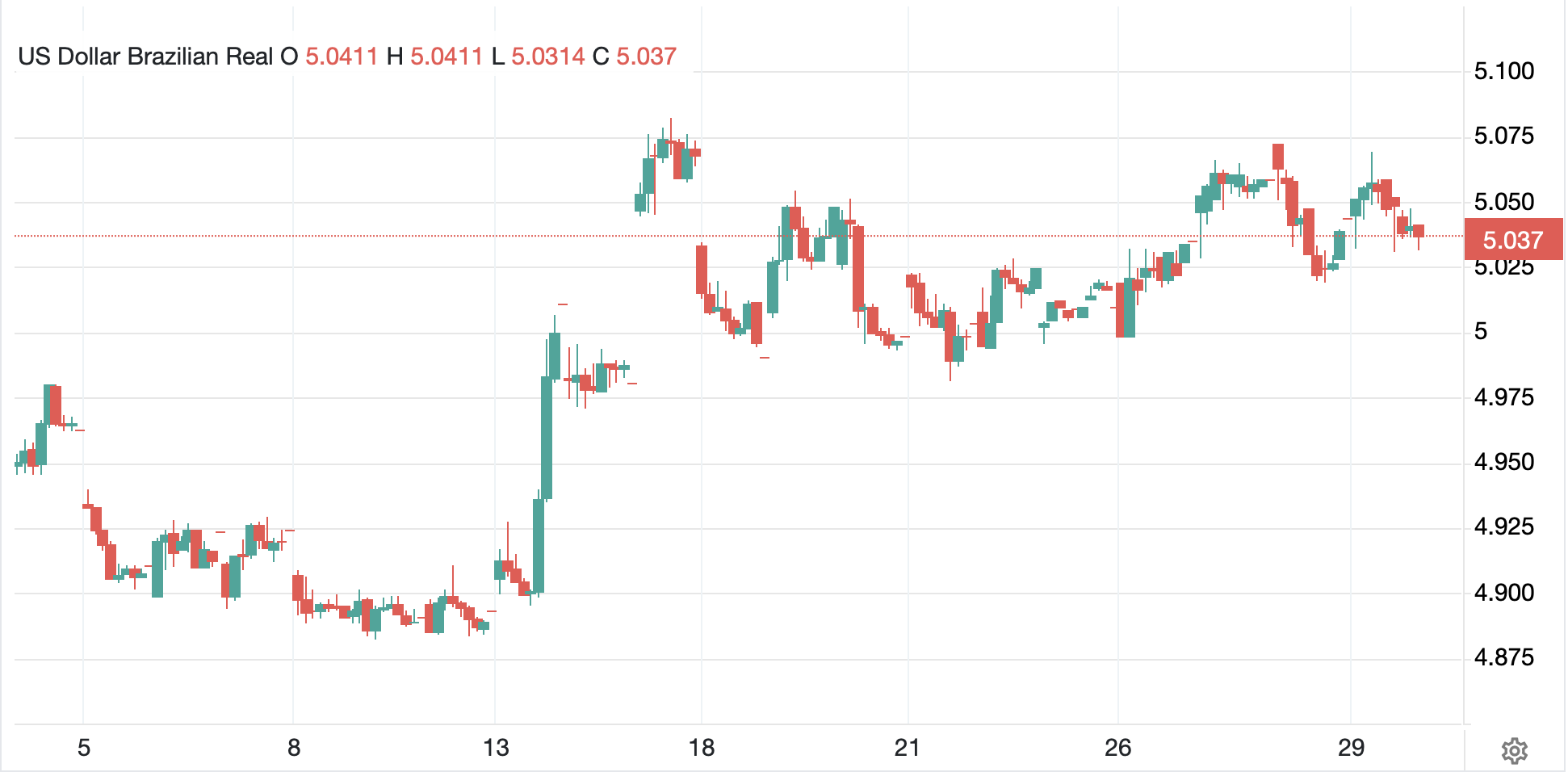
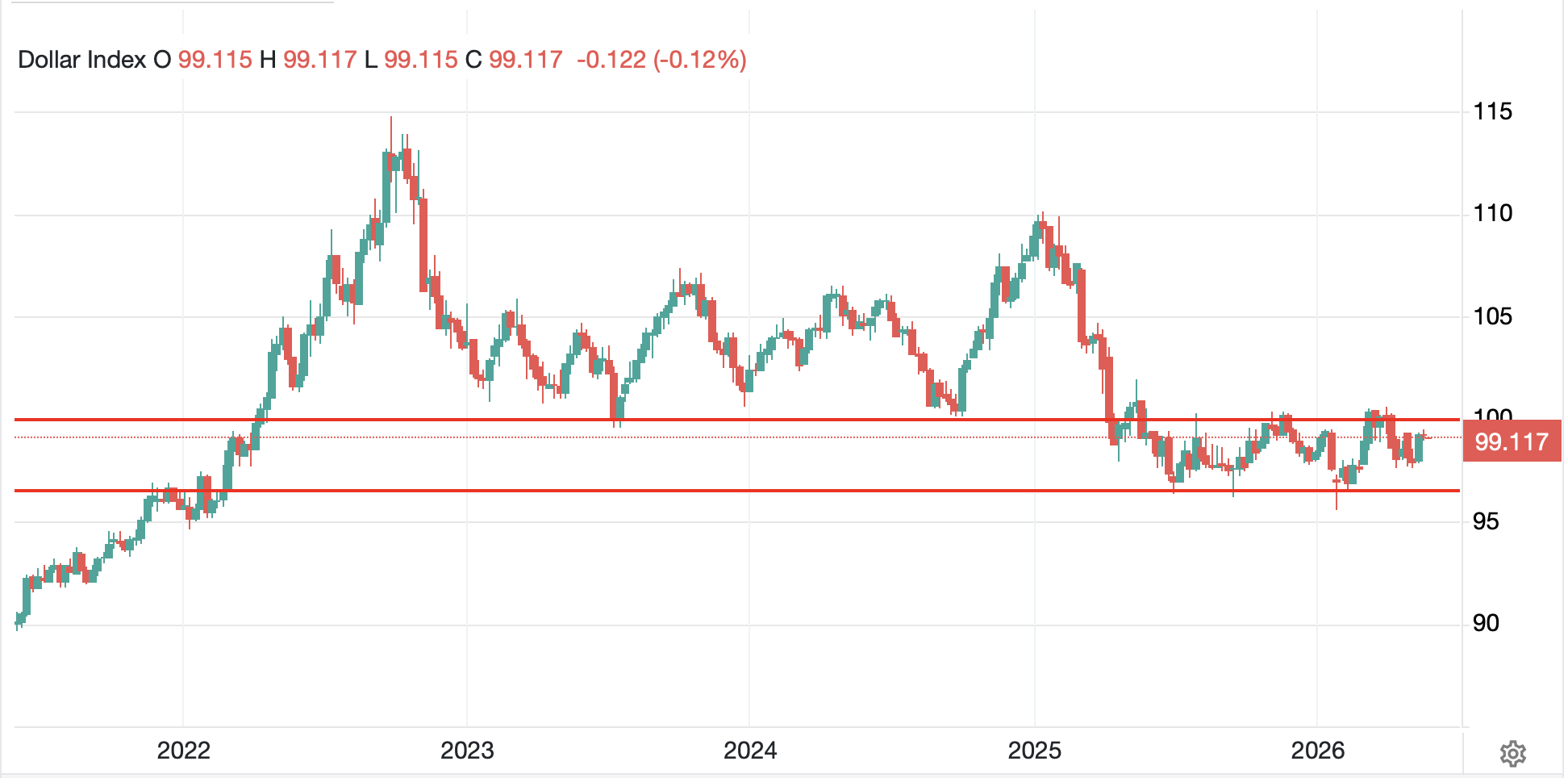
Finally, the dollar is back under pressure this morning across the board.  I’ve already mentioned the two biggest movers and AUD (+0.5%) joins the list on the back of commodity strength.  Otherwise, the movements are not terribly large here, with the euro (+0.1%), pound (+0.3%), KRW (+0.3%), and ZAR (+0.2%) indicative of the situation.  I expect that the dollar will be responsive to today’s NFP data with a strong print helping the dollar and a weak one pushing it down a bit further.  However, remember that it remains within its trading range, albeit nearer the bottom than the top of that range as per the below.

Source: tradingeconomics.com

And that’s really it for today.  The NFP should drive the first movement and after that, there is still White House bingo for fun and surprises.  While the dollar is soft, I don’t see a collapse coming, and in the end, the more I read about EU energy policy, I can only expect that any collapse will be that of the euro, not the dollar.  But that is a ways into the future I think.

Good luck

Adf

Sanae Lightning

It has been two weeks
Since she rolled the dice. Sunday
It came up hard eight!
 
Leaders round the world
Would sell their soul to obtain
The Sanae lightning

Source: asia.nikkei.com

Japanese PM Takaichi scored a resounding victory yesterday, capturing more than 76% of the seats with her coalition partners, and she now commands a super-majority, enabling her to control the dialog completely, pass any legislation and even change the constitution.  As I said, every other elected leader in the world pines for that type of power and approval, even Xi!  

The immediate market response was a 5.0% rally in the Nikkei as expectations for an aggressive fiscal policy expansion to the economy gets priced in.  Add to this more defense spending and the mooted tax cuts on food, and it is easy to understand the response.  

Interestingly, the yen, which had been under pressure from fears of unfunded spending, after declining at first, reversed course and strengthened nearly 1% from its worst levels early in the Tokyo session as per the below chart.  It certainly seems logical that yen weakness would be coming on this basis, but perhaps, what we are going to see is the Japanese use some of their FX reserves, which total about $1.3 trillion, to help fund the ¥5 trillion (~$32 billion) that the tax cuts will cost.  That would mean selling Treasuries to sell USD and buy JPY, helping to support the yen while allowing the BOJ to leave rates on hold.  In truth, it makes a lot of sense.  We shall have to see how things progress from here.

Source: tradingeconomics.com

Some pundits, when looking ahead
Are worried that Warsh at the Fed
With Bessent, will try,
To Treasury, tie
Their efforts, some assets to shed

The other big story this morning is a growing concern about a potential accord between the Fed and the Treasury once Kevin Warsh is confirmed and takes his seat as Fed chair.  Bloomberg has a big article on the subject, but it is around all over.  When combined with another article on China recommending its banks to reduce their Treasury holdings, it has helped create a narrative that the US is going to have major fiscal problems going forward which will result in massive money printing and much higher inflation.

Of course, the thing about this that I don’t understand is that Warsh is on record, repeatedly, for saying he wants the Fed’s balance sheet to shrink, and that its expansion has been one of the major economic issues in the US since QE2 back in 2012.  I also find it interesting that Warsh’s apparent desire to see the Fed’s balance sheet hold almost exclusively short-dated Treasuries, 3-years and under, is seen as a concern given that has been the Fed’s stated goal since they started shrinking the balance sheet back in April 2022.

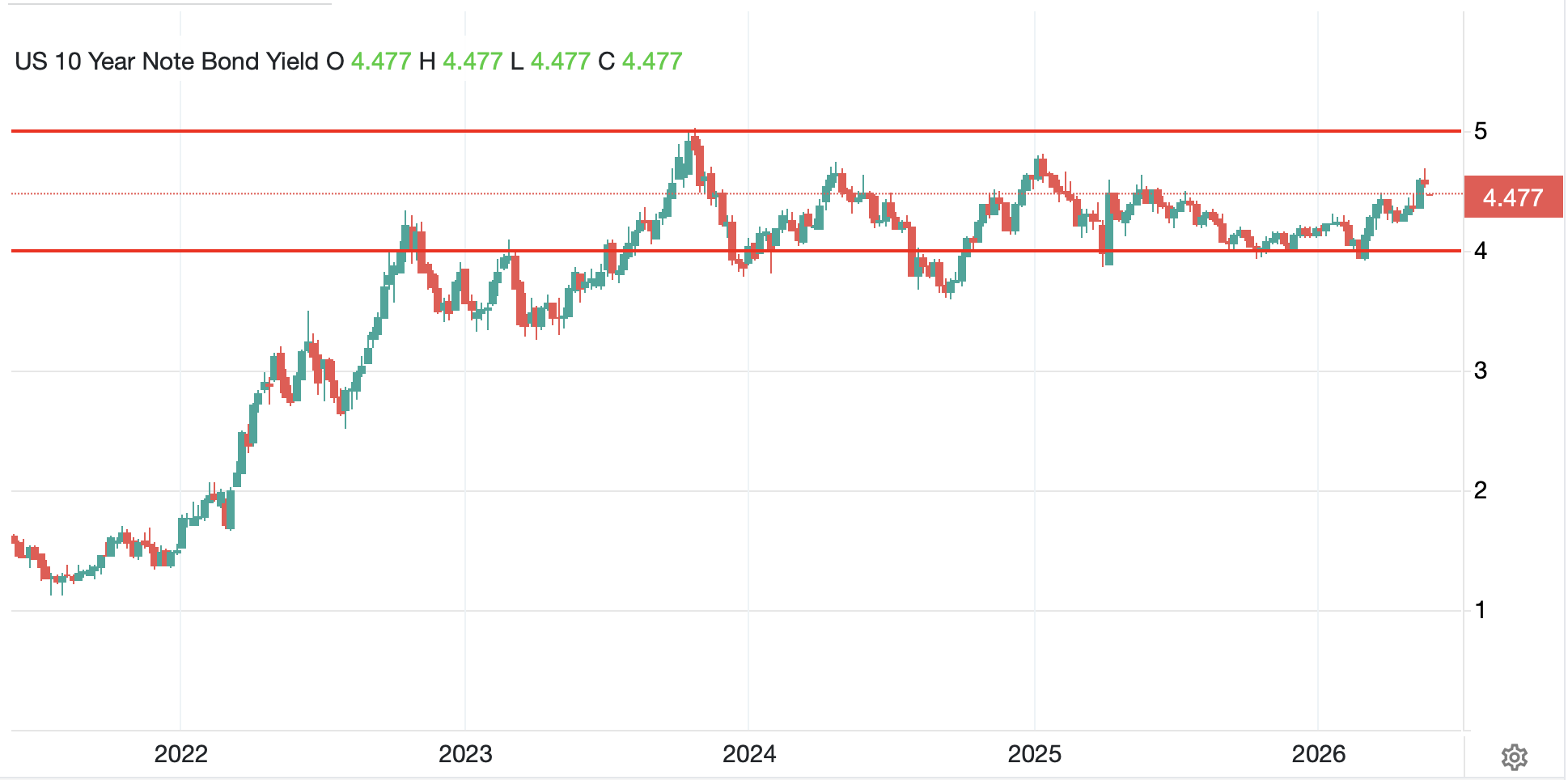
Recall, Chairman Powell explained that in order to maintain the ample reserves framework they are currently using, the balance sheet needs to grow alongside the economy.  However, this is completely at odds with Warsh’s stated beliefs that the ample reserves framework is no longer effective and needs to be replaced eventually.  Of course, if I look at 10-year Treasury yields (+2bps today) over the past 5 years, as per the below chart, it is hard to get overly excited that things have changed much since the end of the Covid adjustments.  

Source: tradingeconomics.com

Perhaps Chinese selling will drive yields higher, or perhaps others will sell because they are concerned that the Fed and Treasury working together is inherently bad for the economy and will lead to higher inflation but so far, that is not the case.  As to inflation, while CPI and PCE remain higher than the Fed’s target, it does not appear to be galloping away at this stage.  In fact, there is much discussion on X that Truflation is now running at 0.68% and that the Fed will soon need to cut rates aggressively!  Of course, if inflation is running at 0.68%, can someone please explain the ‘affordability’ crisis that has gotten so much press?  PS, I don’t see Truflation as being an accurate representation of the world, but it sure is good for narrative writers sometimes!

And that is how we have started the week.  The Super Bowl was pretty dull overall, with defensive excellence, but nothing spectacular.  Someone made the point that this was the AI Super Bowl for advertising and the last two times we saw something dominate the advertising (dot.com in 2000 and crypto in 2022), within a year, both sectors had been decimated in the equity markets.  In the meantime, a quick tour of the overnight session shows the following:

Stocks – Asia was strong across the board with Japan (+3.9%) giving back some of the early gains but still rocketing to new highs.  The rest of the region was similarly strong, especially Korea (+4.1%) but gains of between 1.5% and 2.0% were the norm.  I guess everybody is positive on Takaichi-san!  Europe, however, has not been as robust although there are mostly gains there led by Spain (+0.6%) and Germany (+0.3%).  The laggard here is the UK (-0.1%) which is struggling as PM Starmer appears to be coming to the end of his disastrous term.  His appointment of Ambassador to the US looks to be the final straw as Peter Mandelson is widely mentioned in the Epstein files and now Starmer has lost his chief of staff because of that.  The UK will be better off, I believe, if Starmer is pushed out, although if they put in Ed Miliband, it could actually get worse given his personal insanity regarding energy.  But I would buy a Starmer removal.  As to US futures, at this hour (7:20), they are modestly lower, -0.15% or so.

Bonds – European sovereign yields are edging higher this morning, around 1bp across the board as there has been no data to change opinions and the bond markets, worldwide (Japan excepted) remain the dullest of places to play.  Japan (+6bps) did see a response to the Takaichi victory, which is what one would have expected.  We will have to watch this yield closely as if it truly does start to break out, there will be ramifications worldwide.  However, if we look at the chart below of 10-year and 30-year JGBs, they remain below the peak seen several weeks ago and, surprisingly, the overnight move was more pronounced in the 10-year than the 30-year.  Watch this space.

Source: tradingeconomics.com

Commodities – oil (+0.3%) has been chopping around either side of unchanged all evening as questions about Iran remain unanswered.  There was a story in the WSJ about the US holding back on any military action because Iran has so many medium range ballistic missiles and any reprisal could be devastating to the Middle East overall.  But if I have learned anything from observing President Trump and his negotiating style, it is impossible to know what the next move will be.  I would not rule out either a successful deal or a military strike at this point, with the former resulting in lower oil prices while the latter would see a sharp rally.  In the metals, gold (+0.9%) and silver (+2.7%) are both continuing their volatile rebound from last week’s sharp selloff, while copper is unchanged this morning.  As I have said, nothing has changed this supply demand balance in physical metals, although the paper, futures market, can still do many remarkable things that don’t necessarily make sense.

FX – the dollar is softer across the board this morning, slipping against both G10 (EUR +0.5%, GBP +0.3%, JPY +0.4%, CHF +0.7%) and EMG (MXN and BRL +0.25%, PLN +0.65%, ZAR +0.25%, CNY +0.15%) with little in the way of data as a driver anywhere.  While I have not specifically seen a reboot of the dollar is collapsing narrative, I presume the concerns over a potential Fed-Treasury accord are an underlying thesis today.

On the data front, we see both NFP and CPI this week as they come a few days late due to the short government shutdown.

TuesdayNFIB Small Biz Optimism99.9
 Retail Sales0.4%
 -ex autos0.3%
 Employment Cost Index0.8%
WednesdayNonfarm Payrolls70K
 Private Payrolls70K
 Manufacturing Payrolls-5K
 Unemployment Rate4.4%
 Average Hourly Earnings0.3% (3.6% Y/Y)
 Average Weekly Hours34.2
 Participation Rate62.3%
ThursdayInitial Claims218K
 Continuing Claims1850K
 Existing Home Sales4.15M
FridayCPI0.3% (2.5% Y/Y)
 Ex food & energy0.3% (2.5% Y/Y)

Source: tradingeconomics.com

In addition, we hear from seven more Fed speakers, with Governor Miran making three appearances as he seeks to make his case for cutting rates.

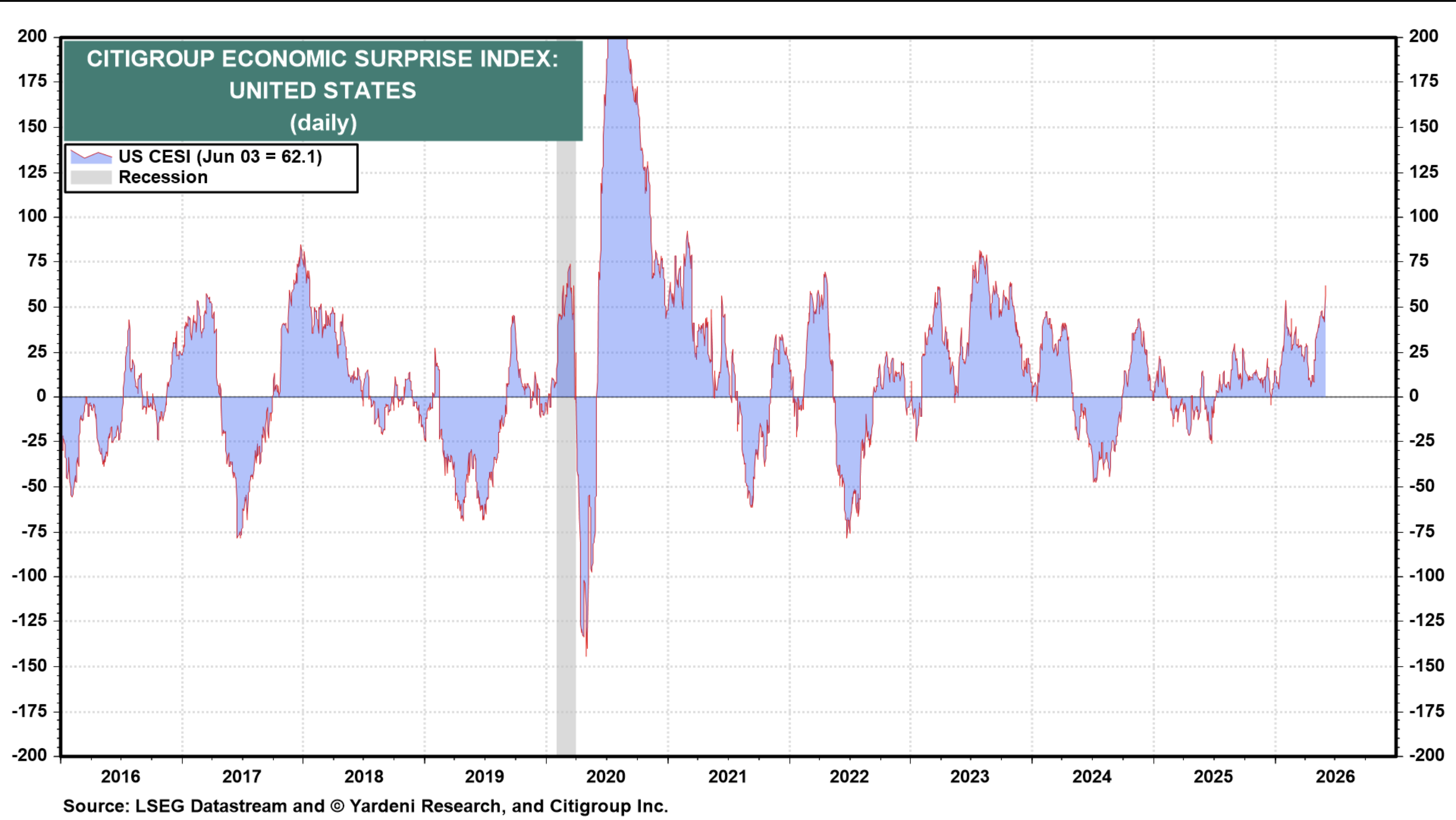
Nothing has changed my view that Warsh and Bessent are the two most important voices now, with the rest of the Fed relegated to biding their time until Warsh shows up.  As to the data, the Citi surprise index continues to show that data is better than most forecasts which speaks well of the economic situation.

Source: cbonds.com

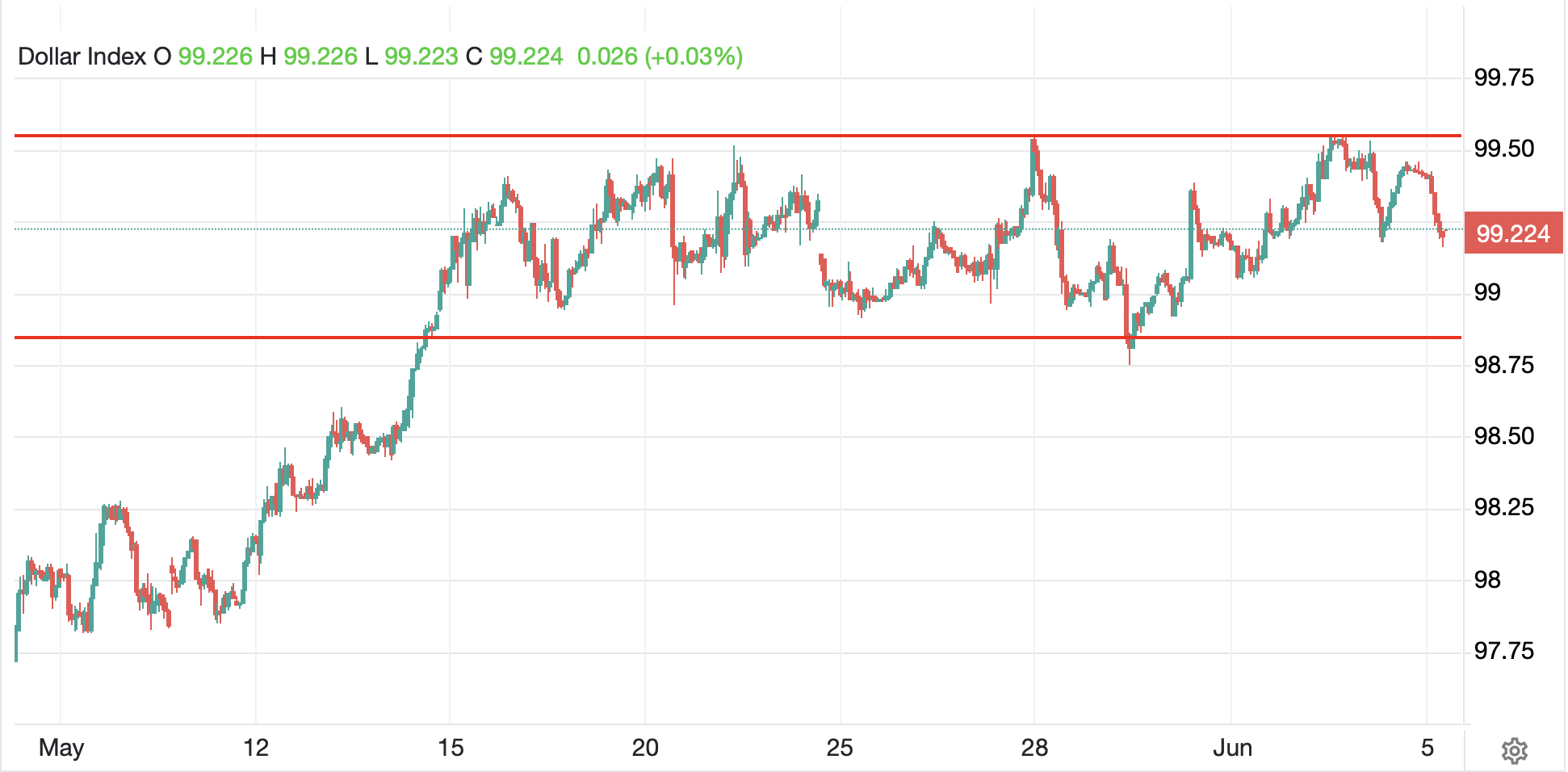
I am not a proponent of the world ending, the Treasury market collapsing or the dollar dying despite a lot of doom porn that this is the near future.  I would contend the dollar remains rangebound for now, and we need a definitive policy adjustment to see that situation change.  Until then…choppy is the way.

Good luck

Adf

Changing Fast

At this point most traders are thrilled
It’s Friday, ‘cause throughout that guild
Exhaustion is rife
From bulls’ and bears’ strife
O’er whether their dreams be fulfilled
 
As well, all the narrative writers
Are stuck pulling college all-nighters
With facts changing fast
Their latest forecasts
Do naught but encourage backbiters

It has certainly been an interesting week in financial markets, at least most of them, with significant moves throughout the commodity, equity and cryptocurrency spaces.  We even saw a jump in bond prices yesterday after a really lousy JOLTS Jobs number (6.54M compared to 7.2M expected) and a higher-than-expected Initial Claims number of 231K.  Suddenly, questions about the labor market are front of mind, and prospects for a March Fed Funds cut rose to 23% for a time, although have slipped back to 17% as of this morning.  But one need only look at a few charts (all from tradingeconomics.com) showing the daily movement in some popular trading vehicles to understand why traders are thankful the week is ending.  For instance, 

Silver (+4.75%), which had a 34% range last Friday and has fallen 39% since its high 8 days ago:

Gold (+2.1%), which showed the same pattern, albeit not quite as dramatically:

Natural Gas (+3.4%), which rose $2.65 and reversed $2.00 on a $3.00 base over the past two weeks:

And Bitcoin (+5.8%), which has fallen nearly 50% since its highs in early October and 22% in the past week:

Now, it must be remembered that Bitcoin has a long history of massive drawdowns, with a 50% drawdown in spring of 2021 and a 75% drawdown from November 2021 through October 2022. We shouldn’t be surprised as Bitcoin is essentially a pure risk asset, so is completely narrative driven.  And as the narrative writers try to keep up with the facts on the ground, they are trying to figure out how to sell the story that Bitcoin, which was ostensibly designed to be an alternative to the fiat currency system, has become so tightly linked to the fiat financial system.

In the end, though, the commodity markets are beholden to the marginal demand/supply of the last molecule available.  I have not seen anything change with respect to demand for power to drive the economy, the demand for silver to build out electronics or the demand for gold by central banks.  To me, while prices for these commodities can whipsaw aggressively as the global regime changes, ultimately, I remain confident demand will continue to be the story.  (Bitcoin is an entirely different beast and one I will not discuss in depth other than to highlight its volatility along with the rest of these markets.)

Anyway, you can understand why traders are exhausted.  In fact, my forecast for next week is that we are highly unlikely to see the same size movements, although choppiness will still be the rule.

You may have noticed I missed oil (-0.4%) which has also seen some volatility as per the below chart, but not quite at the same level as the others.  Part of that is the oil market is much larger and more liquid and part of that is that the whole Iran/US discussions question has provided fodder for both bulls and bears in short intervals resulting in no net movement over the past week.

From what I can piece together, the situation in Iran is coming to a head regarding the regime there.  The talks today are ongoing, but there is other information that appears to indicate preparations are being made for a transitional government, and the State Department just warned all US citizens to leave Iran.  Something is up which will certainly drive more oil volatility.

If we look at bonds, Treasury yields fell -8bps yesterday and have rebounded by 2bps this morning.  That was the largest single day move we’ve seen since October, and basically took the market right back to that 4.20% level that had been home for weeks.

There continues to be a lot of confusing data and information regarding the economy as yesterday’s weak jobs data conflict with the broader idea that the hyperscalers are spending 2% of GDP on capex this year and forecasts for the budget deficit continue to run around 2%.  It seems like it will be difficult for a recession to come about with that much new spending in the economy, but as we have seen over the past decades, the beneficiaries of that spending are not necessarily the population cohort that is currently upset.  I guess the question is, is economic growth real if the population doesn’t feel it?  That will certainly be the political question come November.

As to European yields, they all followed Treasuries lower, especially after the BOE 5-4 vote to leave rates on hold offered a much more dovish signal than anticipated, and the ECB harped on the strength of the euro and how that could bring down their inflation forecasts, hinting at lower rates going forward.

In the equity markets, yesterday saw a tough day in the US as the tech/AI story continues to get beaten up right now, and that was more than enough to offset strength in things like defensives and staples.  But this morning, US futures are higher by about 0.5% as I type (8:00).  In Asia, Japan (+0.8%) bucked the US trend on the back of excitement about the upcoming election where Takaichi-san is expected to gain a mandate.  However, China (-0.6%), HK (-1.2%), Korea (-1.4%) and Australia (-2.0%) all had the same fate as the US.  Given the weight of technology companies in Asian indices, I suspect we are going to see more volatility here as different narratives come about on AI and investment and the social/political impacts.  As to Europe, modest gains are the story with the DAX (+0.5%) and IBEX (+0.9%) leading the way higher with the former benefitting from yesterday’s surge in Factory orders as well as a better-than-expected trade balance today.  As to Spain, it has been trending higher and nothing has come out to change that view for now.

Finally, the dollar is giving back some of yesterday’s gains but remains within that longer term trading range.  Using the dollar index (DXY) as our proxy, you can see just how little things have changed.  All the talk last week of the breakdown in the dollar has been forgotten for now, although I continue to read about China building a digital currency backed by gold.  I discussed that earlier this week and why I continue to believe that is unrealistic at this time.

But the weird thing about the DXY is it doesn’t seem to reflect what is happening in individual currencies.  For instance, AUD (+0.85%), GBP (+0.45%) and NOK (+0.9%) are all much stronger although the euro (+0.15%) and JPY (0.0%) not so much.  In the EMG bloc, MXN (+0.8%), ZAR (+1.1%), HUF (+0.8%) and KRW (+0.3%) are all having a very good session despite no specific news that would seem to drive that.  Historically, I never paid attention to the DXY because nobody who actually trades FX pays it any mind.  However, as a trading vehicle, it has gained many adherents which is why I mention it.  So, as we look across the currency universe, the dollar is having a tough day.

On the data front, we only see Michigan Sentiment (exp 55.0) and Consumer Credit ($8.0B).  We also hear from Governor Jefferson, but nobody seems to be listening to any Fed speakers right now, Secretary Bessent is a far more important voice for the markets.

We have seen massive moves across many markets lately, with excessive moves correcting, but I remain stubbornly of the view that while things got ahead of themselves, the underlying trends are still in place, at least in commodities.  As to the dollar, it’s not dead yet, but its future will depend on the administration’s ability to achieve their goals regarding the economic adjustments and inward investment.  

Good luck and good weekend

Adf

Gone Astray

Though Friday will lack NFP
We still will have something to see
The States and Iran
Will meet in Oman
To talk about nuke strategy
 
But til they, in fact, do sit down
Be careful as crude moves around
And what if talks fail
To find holy grail
Beware oil shorts and their frowns
 
With that as the background today
The narrative has gone astray
’Cause all kinds of tech
Resemble a wreck
While metals are fading away

Sometimes it’s hard to determine which stories are really driving markets as there are so many that have potential conflicts between them.  With that in mind, I will start with oil this morning, which has seen a bit of choppiness during the past week on the back of on-again, off-again, on-again talks due to be held between the US and Iran.  See if you can guess where the worries about a US military strike gained ground, were quashed by news of potential talks, saw a military skirmish in the Strait of Hormuz and then when talks were reconfirmed.

Source: tradingeconomics.com

Net, there is still an underlying concern about the situation, which is why, I believe, the price of crude (-1.1%) is still above $64/bbl.  Remember, it was not that long ago when it had seemed to find a comfort zone below $60/bbl.  It strikes me that if some type of accommodation is reached at these talks, where Iran gives up its nuclear weapon dreams and stops funding terrorism (I believe these are the administration’s goals) then there is plenty of room for oil prices to slide back below $60/bbl and continue what had been a longer term down trend as per the below chart.  

Source: tradingeconomics.com

After all, given the fact that Venezuelan oil is going to be returning to the market, the continued expansion of production in Guyana, Brazil and Argentina, and now the idea of welcoming Iran back into the good graces of nations, that is a lot of potential supply that is currently not available.  My concern is if Iran agrees to those terms, it may be an existential threat to the theocracy, so I guess they need to weigh that risk vs. the risk that the US does escalate militarily, which could also be an existential risk to the theocracy.  Net, choppiness seems to be the likely road ahead.

Finishing commodities, precious metals have reversed the reversal and are down sharply this morning (Au -1.7%, Ag -11.0%, Pt -4.4%).  Volatility remains extremely high and given the competing narratives of a) it was a bubble, and b) the fundamentals remain in place, I expect we will continue to see price action like this for a while yet.  Although remember my strong belief that markets can only maintain volatility of this nature for a few weeks as at some point, all the participants simply become too tired to trade.  There was a very interesting chart I saw on X this morning that showed the price action in gold during the German hyperinflation of the Weimar Republic a bit over 100 years ago.  

I’m not implying we are heading to a hyperinflation, just that gold (and silver and platinum) prices can move very far in short order, as we’ve seen.  In the end, nothing has changed the fundamentals with demand for gold still price insensitive, demand for silver still greater than mining supply with the same true for platinum.  But it will be a rough ride for a little while yet.

So, let’s turn to the equity markets, where there are far more plugged-in analysts than me, but I want to take a higher-level look.  While yesterday’s price action was mixed (NASDAQ and S&P lower, DJIA higher) it seems to indicate that there is an ongoing rotation out of tech stocks into other areas, amongst them consumer staples, energy and defensives.  What I find so interesting about this, though, is that if I look at a chart of the three major US indices, they are all the same chart.

Source: tradingeconomics.com

Granted, the NASDAQ had the highest high back in November, but, in reality, they all move very much in sync.  This begs the question, what can we expect going forward?  At the end of the day, I still believe that stocks represent the value created in the economy.  As such, if the Trump administration’s plans to reduce regulations and encourage banks to lend more to the real economy, rather than purchase financial assets, can be implemented effectively, that is a very real positive for equity markets over time.  However, that probably means a much less steady climb, especially if the Fed is not explicitly supporting assets as the new Chair, Warsh, tries to shrink the balance sheet.  It is going to be messy and there are going to be a lot of cross narratives and claims, so at any given time, the only reality will be increased volatility.  But at least there’s a plan.

As to the rest of the world’s equity markets, it does appear as the bifurcation between those nations that are willing to work closely with the US and those working closely with China is likely to continue.  It remains to be seen which bloc will outperform, although I like the US odds given the legal structure and the demographics.  

With all that in mind, let’s look at the overnight price action.  Asia had a tough go of it given the high proportion of tech names there.  While Tokyo (-0.9%) slipped along with China (-0.6%) the real laggards were Korea (-3.9%) and Taiwan (-1.5%) and there were far more laggards (India, Australia, Malaysia, Indonesia) than gainers (Singapore, HK).  This is the tech story writ large.  In Europe, even though they largely lack tech, weakness is the norm (Spain -1.1%, Germany -0.2%, UK -0.3%) although the French (+0.3%) have managed to buck the trend.  It is not clear why Spain is lagging so badly, although perhaps PM Sanchez’s efforts to import 500K new people while unemployment remains at 10%, the highest in the EU, has some concerned.  As to US futures, at this hour (7:15), they are pointing higher by about 0.2%.

In the bond market, once again there is nothing going on.  Treasury yields are almost exactly unchanged since early Friday morning, although we did see a dip and rebound after the Warsh announcement.

Source: tradingeconomics.com

The US yield curve is steepening as 30-year yields edge higher although those remain below 5.0%, a level that many are watching closely as a signal of a bondmageddon.  On the continent, European sovereign yields have edged higher by 1bp to 2bps, but activity is muted ahead of the ECB meeting announcement (exp no change) scheduled later this morning.  UK yields have edged lower by -1bp after the BOE left rates on hold, as expected, with a 5/4 vote, the 4 looking for a cut.  I continue to believe that the odds are for the ECB to cut rates again far sooner than the market is pricing.  And JGB yields slipped -2bps overnight as market participants await Sunday’s election results.  Given PM Takaichi is forecast to win with an increased majority, it is hard for me to believe that if she does, JGB’s will sell off sharply on the idea she has promised more unfunded spending, they already know that.

Lastly, the dollar is firmer this morning, continuing to defy all the calls for its demise.  The pound (-0.8%) is the laggard after the BOE sounded a bit more dovish than expected, but we are seeing losses across the entire G10 bloc.  As to the EMG bloc, ZAR (-0.7%) is the laggard, but given the dramatic reversal in precious metals, that is no surprise.  Otherwise, losses on the order of -0.3% or so are the norm.

On the data front, Initial (exp 212K) and Continuing (1850K) Claims lead the way and later we see the JOLTs Job Openings Report (7.2M).  The word is that the NFP report will be released next Wednesday with CPI next Friday.  Atlanta Fed president Bostic speaks later this morning, but I continue to believe that until we hear from Mr Warsh, the Fed’s words have very little impact.  Arguably, the neutering of the Fed is why the bond market remains so quiet.  Traders have lost their cues.

Risk attitudes are getting revisited around the world as the seeming permanence of increased risk appetite is starting to be called into question.  There is no better signal of this than Bitcoin, which has broken back below $70K this morning to its lowest level since October 2024.  

Source: tradingeconomics.com

It was January 2024 when the ETF, IBIT, started trading and BTC was about $43K at that time.  As BTC is a pure risk asset/vehicle, it’s recent decline may well be the biggest signal that risk-off is coming.  That could well impede the Trump efforts to rebuild the US manufacturing base, but perhaps, it could also encourage it, as business risks are easier to understand than market risks.  The volatility is not over.

Good luck

Adf

Dissension

It seems that there’s still quite some tension
As metals and stocks show dissension
Though Friday both puked
Of late, metals juked
Much higher, to stocks contravention
 
So, what can we learn from this split?
That tech stocks all now trade like sh*t
While silver and gold
Are what folks will hold
And bonds? No one just gives a whit

It seems the government shutdown has ended, just as quickly as it began and the only people impacted are traders who were looking forward to the NFP data on Friday.  Given the shutdown was only for a few days, and that apparently, all the data was already collected, it was the compilation that was being delayed, I presume we will get the numbers next week.  Of course, this is a government bureaucracy, so it may take a bit longer.  Nonetheless, this morning we see the ADP Employment number (exp 48K) and analysts will have to work from that, plus the reports like the ISM hiring data, to give their views of the economy.  It really all does seem like theater, I must admit.

Anyway, away from that, the only other news of note that is impacting markets has been an increase in tensions in Iran after the US shot down an Iranian drone heading toward the US aircraft carrier, Abraham Lincoln.  However, it appears that talks are still scheduled for Friday, so oil (+0.2% today, +1.4% since yesterday morning) is creeping back higher, although remains well below the levels seen last week when concerns over a US attack there were mounting.

Source: tradingeconomics.com

Which takes us to markets and what appear to be the key internal drivers.  Starting today with stocks, the narrative revolves around concern that AI is going to destroy software companies and SaaS models since their user base will no longer need those companies.  As well, there are the lingering concerns about the AI investment bubble and the circular dealing between Nvidia and its customers being an indication of the end of the era.  This is akin to what happened during the tech bubble in 2000-01 and has been highlighted by numerous analysts for several months, although is gaining more traction of late.  Finally, the Business Development Companies (BDC’s) and PE firms are under increasing pressure as their portfolio of loans and positions, many of which are being hurt by AI, are starting to hemorrhage cash.  This trifecta has been weighing on the NASDAQ, preventing any significant strength, although other sectors, notably energy and materials, have been doing pretty well.

The funny thing is, while the NASDAQ (-1.4%) fell yesterday amid widespread US equity weakness, if I look at the chart (below from tradingeconomics.com) it doesn’t seem that negative, rather it seems to be consolidating ahead of another leg higher.  But then, I am no technician, so don’t pay attention to me.

However, the narrative is strong here that the world is about to end because Nvidia hasn’t made a new high in the past three months.  I am no tech stock expert, but my take from the cheap seats is that future equity market outcomes are going to continue to be reliant on the success of the Trump administration’s plans regarding reshoring and changing the nature of trade.  It is likely to be bumpy, especially if the Fed does not cut rates to support equity markets, especially since that has been the MO for the past 40 years.  But I remain positive overall.

Looking around the rest of the world, last night saw a mixed picture, although definitely more green than red.  While Tokyo (-0.8%) slid along with Malaysia and the Philippines, the rest of the region had a nice session led by Korea (+1.6%), China (+0.8%) and Australia (+0.8%).  It appears the tech fears were less concerning there, either that or PE and BDC companies aren’t yet so prevalent.  In Europe, meanwhile, despite mixed PMI Services data, there are more gainers than laggards led by the UK (+1.0%), which does have miners, benefitting from the rebound in metals prices.  But France (+0.9%) and Spain (+0.15%) are also higher although Germany (-0.2%) is lagging after a modest miss in the PMI data. As to US futures, at this hour (7:15), they are pointing higher by about 0.25%.

Back to metals, which continue to be THE story these days, gold (+2.0%) has reclaimed the $5000/oz level and while it is lower in the past week, remains nearly 17% higher YTD.  Silver (+6.0%) is also rebounding nicely along with platinum (+3.8%) as more and more discussions have ascribed last Friday’s rout to month end delivery and position issues amongst a few very large players who were able to prevent some major damage to their own balance sheets.  However, as I have maintained all along, the fundamentals are unchanged; there is a shortage of silver for industrial use and has been for several years.  As to gold, there is no indication that central banks have stopped buying.  These continue to be long-term plays and will likely drag the entire metals sector along for the ride.

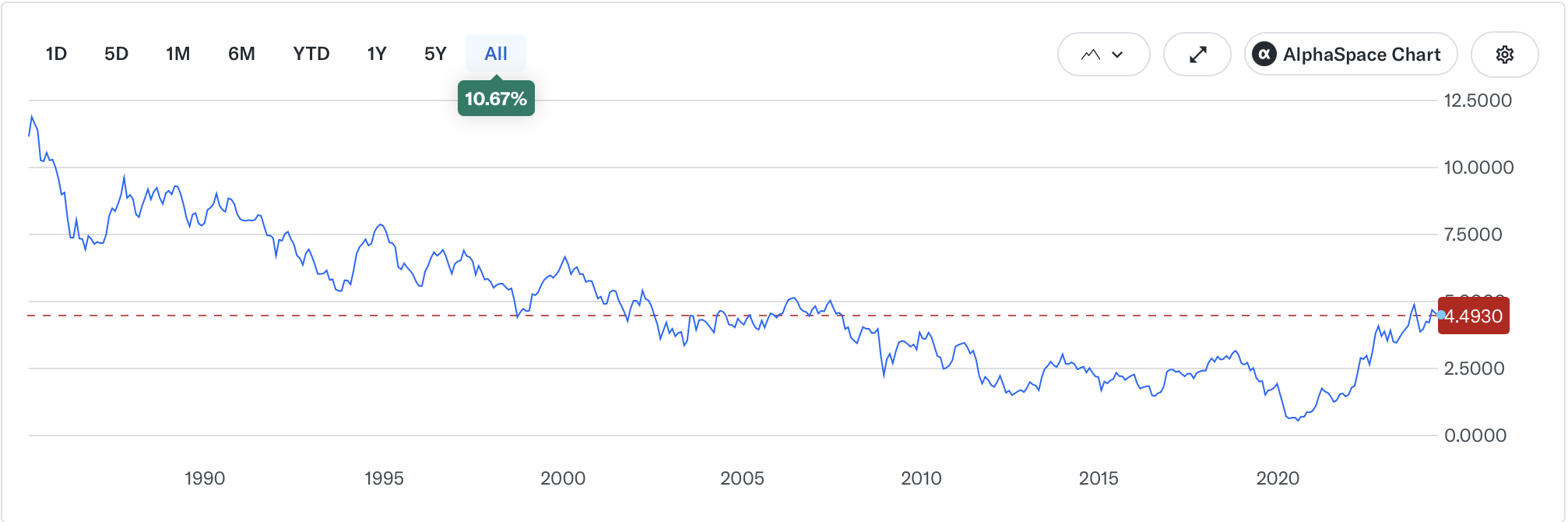
What about bonds, you may ask?  Well actually, nobody is asking about bonds!  They remain mired in a tight range with dueling narratives about the long-term view.  On the one hand, there are those who continue to look at the US debt load, and the expectation of fiscal deficits as far as the eye (or the CBO) can see, and expect supply issues to dominate, forcing the government to seek inflation to create the soft default necessary to pay back the debt.  They will point to the long-term trend, which saw yields decline for 40 years and then reverse back in 2020 (see chart below from finance.yahoo.com) as evidence that yields are going to trend higher for the next decades.

On the other side, you have those who believe the future is deflationary, with AI driving massive increases in productivity and driving down prices, while focusing on Truflation’s recent readings of 1.0% and claiming that is the way.  Personally, I have more sympathy for the former view than the latter, as it is increasingly difficult for me to understand the view that AI will be able to achieve all its currently stated desires without sufficient energy and materials, whose increasing prices are going to limit any downside in inflation.  As well, while a Warsh Fed chairmanship may strive to change the current central bank model of QE whenever needed, there is zero evidence any other central banks are going to follow suit.  

In the meantime, the tension between those two views has kept yields in a very tight range for a while, and we need an exogenous catalyst to break that range.  Peace in Ukraine?  War in Iran?  I’m not sure.

Finally, the dollar is a touch firmer this morning, notably against the yen (-0.6%), which continues to give back its gains from two Friday’s ago when the Fed ‘checked rates’ in the NY session as seen in the chart below.

Source: tradingeconomics.com

However, the point was made this morning, and it is a good one, that while Japanese 10-year yields are at 2.24%, 10-year yields, 10-years forward are about 4.10%, which would be a devastating yield for the Japanese government given its debt/GDP ratio remains above 230%.  It is difficult to get excited about owning the yen with that backdrop, especially given the demographic implosion of population that is ongoing there.  As to the rest of the currency market, Zzzzz.  Aside from the narrative of the dollar is dead, which gets recycled by somebody every day, it is very hard to look at recent price action and think something remarkable is going to happen.  We will need major monetary and fiscal policy changes, which while they may arrive, are going to take quite some time to get here.

And that’s really it this morning.  Aside from ADP, we get the ISM Services (exp 53.5) and we get the Quarterly Treasury refunding announcement, which will garner a great deal of attention only if Secretary Bessent explains he is going to issue more bonds and less bills, which seems unlikely.  Monday’s ISM data was quite strong.  Strength today could well portend that the US economy has a bright future ahead, in the near term, and that should support stocks and the dollar, while commodities will benefit from the increased demand.  Bonds?  Well, we’ll see which side of that argument is correct.  And what happens if the deficits are smaller than expected?  That is the question nobody is asking because the ‘smart’ folks don’t believe it is possible.  Remember, the dollar is still king.

Good luck

Adf

Tired

Though recently there’s been a ton
Of news, which has led to much fun
The markets today
Have little to say
Though recent trends ain’t been undone
 
Sometimes traders simply get tired
And find, in a rut, they’ve been mired
But you needn’t worry
‘Cause soon they will scurry
To come back with ideas inspired


As much activity and new news that has been part of the process over the past several weeks, today is one of those days when it appears we may be able to step back and catch our collective breath.  One thing I have observed throughout my career on trading desks is that no matter the underlying news, narrative or data, traders, even algorithms, can only remain in a frenzy for so long.  Consider it has been nearly two weeks of nonstop news since the US exfiltration of former Venezuelan president Maduro, yet some markets have exploded.  Silver is probably the poster child for this price action and as you can see below, since markets reopened after that news, gold’s little brother has risen nearly 25%, including today’s modest -2.3% retracement.

Source: tradingeconomics.com

But all the precious metals, and base metals as well, have had massive runs and the narrative regarding supply constraints and increased strategic purchases by China along with the US labeling many as critical national defense requirements, has been enough to bring retail into the mix.  But a 25% move in less than two weeks is really exhausting for the folks who are in those markets every day.  

At the same time, the amount of energy that has been consumed regarding Greenland, Iran and Minneapolis (which even though it is not a market related issue, is so widespread in its reporting takes up space in one’s brain) seems to have reached a peak yesterday, at least a local maximum.  I don’t, for a minute, believe that these trends have ended.  But a few sessions of modest net movement as positions are adjusted is a normal response to dramatic movement.  We should welcome the rest!

Reading through as much as I could find this morning, there really is no new story on which to hang your hat, so without further ado, I will review overnight market activity and perhaps ponder how things may evolve going forward.

A key sign of the slower activity was yesterday’s US equity markets where modest declines were the order of the day.  That was followed by a mixed session in Asia with some gainers (China +0.2%, Australia +0.5%, Korea +1.6%) and some laggards (Tokyo -0.4%, HK -0.3%, Taiwan -0.4%, India -0.3%).  Other than Korea’s strong session, which was inspired by central bank and government efforts to get investment to come back home to support the won, it appears traders are now biding their time ahead of the next major event.

European bourses are also mixed (Germany -0.1%, France -0.3%, Spain -0.1%, UK +0.4%) with the UK benefitting from a stronger than expected GDP report where growth jumped to 0.3% on the month, well above expectations of a 0.1% increase.  But a look at the chart below indicates one ought not get too excited about the economic growth in the UK with 14 negative months in the past 3 years.

Source: tradingeconomics.com

As to US futures, at this hour (7:10) they are pointing higher, currently almost exactly offsetting yesterday’s declines.

In the bond market…ZZZZZZ is the story of the day week month past four months as evidenced by the chart below.

Source: tradingeconomics.com

There are a number of conflicting narratives here with one story that the economy is going into a tailspin as a look beneath the headline data shows weakness everywhere (housing, employment, manufacturing) and the result is rates will fall along with inflation because of the coming recession.  Another narrative is that the ongoing debt expansion to fund unending budget deficits in the US is going to lead to the collapse of the dollar and much higher long-term rates as investors require far more payment to hold this much riskier than previously assumed asset.

Right now, neither of these seem to be living up to their promises.  Yesterday’s Retail Sales print was much stronger than expected at +0.6%, which hardly portends a recession.  Now, the CPI data has been polluted by the missing October numbers and is biased downward based on the BLS methodology, but you can be confident that it will recoup those losses in a few months’ time.  Meanwhile, there is no indication the Fed is going to do anything in two weeks, and my take is there is significant uncertainty over the future direction of the economy, with both positive and negative pieces.  Until we get indications that growth is either truly cratering along with rises in unemployment, or that things are exploding higher, remaining in the range seems the most likely outcome.  Remember, too, the OBBB is going to goose economic activity right away and running it hot remains the mantra.  

As to European sovereign yields, they have edged higher by 1bp this morning with one outlier, Portugal (+13bps) which seems to be reacting to the prospect of a runoff in the presidential election this Sunday, in the race between a populist outsider and a Socialist party insider, with the populist seen a slight favorite.  As to JGB yields, they have slipped back -2bps as the market becomes accustomed to the idea of the snap election.

In the commodity space, oil (-3.6%) has ceded most of its recent gains after President Trump indicated that there would be no bombing by the US, and the Mullahs ostensibly promised no executions of protestors.  Added to that was a massive build in inventories reported yesterday and supply concerns have abated.  In the metals markets, we are seeing that breather across the board (Au -0.25%, Ag -2.3%, Cu -0.8%, Pt -0.6%) which is very clearly profit taking after we saw record highs in all metals yesterday.  Nothing has changed the fundamentals here, so higher is still the way, IMO, but a few days of chop ought not be surprising.

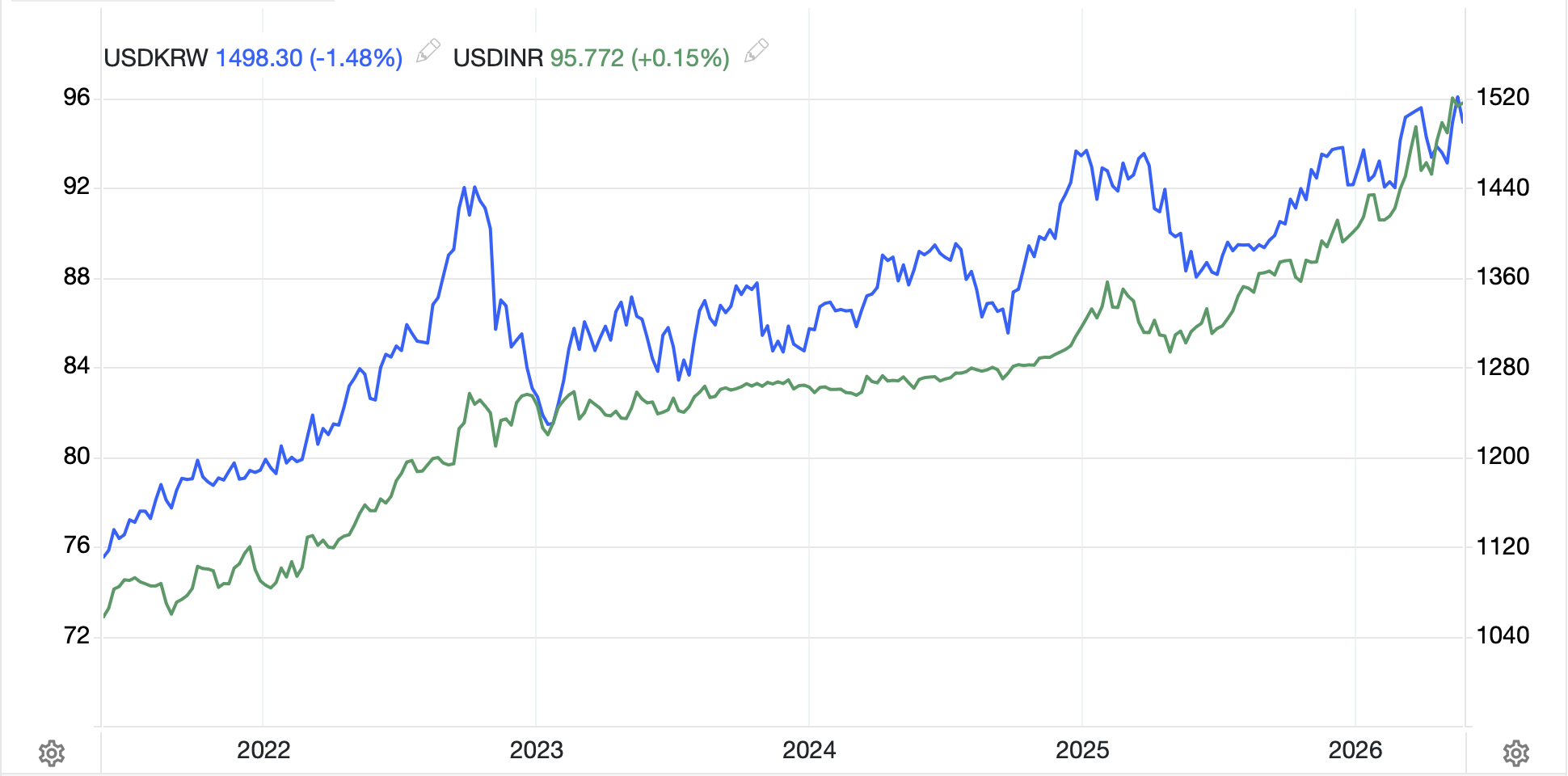
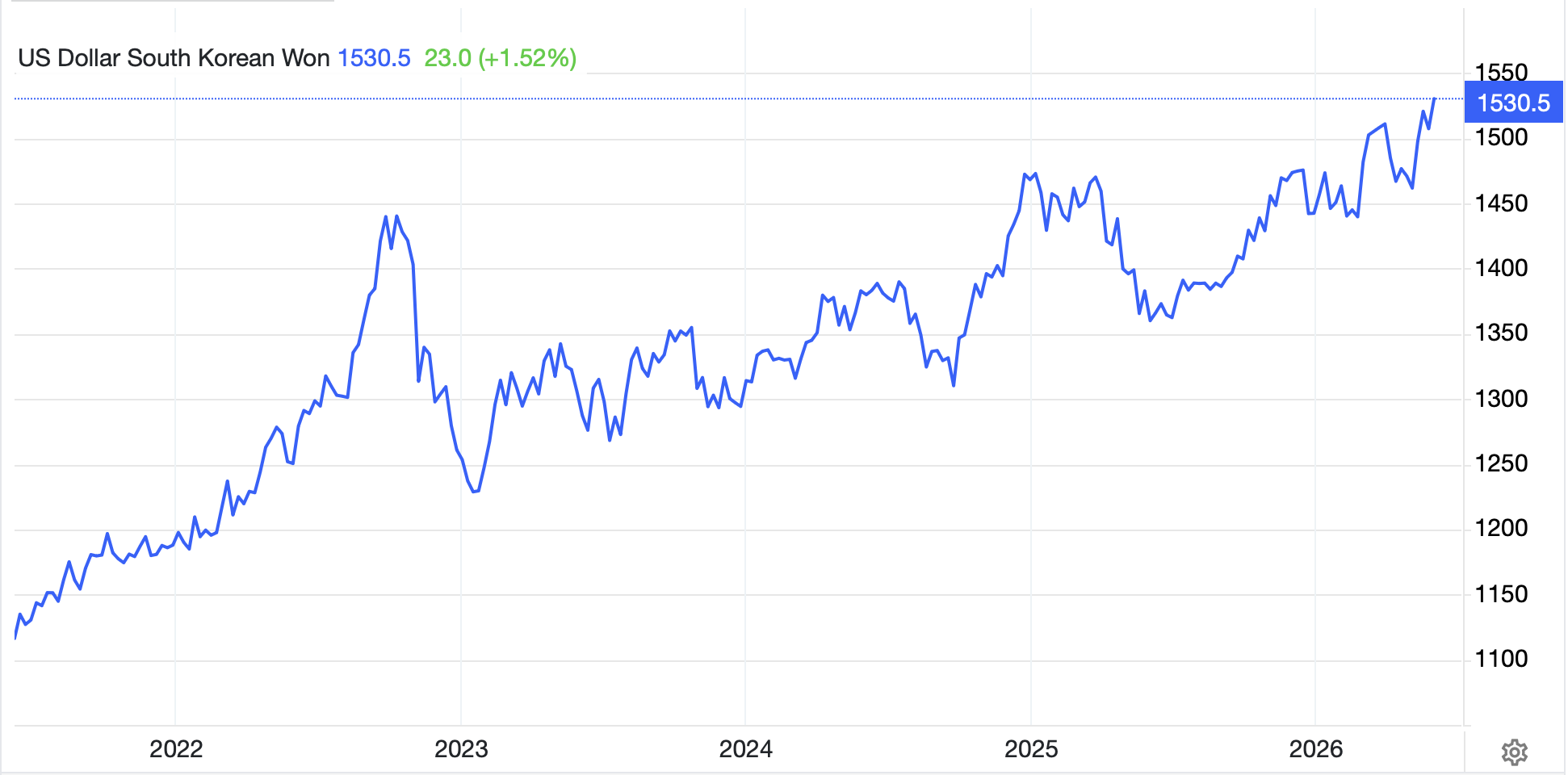
Finally, the dollar appears to have found a comfortable home at 99.00 in the DXY.  There has been limited movement across the board with even JPY unchanged on the day as traders wait before trying to push the currency lower again.  KRW (-0.3%) is the worst performer today as it has been weakening steadily for a year.  Adding to the discussion above, the Korean government is trying to internationalize the won to some extent in their effort to get Korea taken out of the emerging market bucket for markets.  This relaxing of restrictions has seen capital outflow, but my take is this will be temporary as the country remains in very good fiscal and economic condition and will attract investment in my view.  Otherwise, there is nothing of note.

On the data front today, we get the weekly Initial (exp 215K) and Continuing (1890K) Claims as well as Empire State Manufacturing (1.0) and Philly Fed (-2.0) all at 8:30.  We hear from 3 more Fed speakers and it seems the hymnal now contains a single talking point, Fed independence is crucial and the subpoenas to Powell are lawfare and inappropriate.  Only Steven Miran is not singing that tune, but given he is Trump’s appointee, that is no surprise.

As commodities, and really metals, have driven the entire narrative lately, if they are going to have a quiet day, look for quiet all over.  Longer term, nothing has changed, but nothing goes up in a straight line, and that is what we are witnessing today.

Good luck

Adf

Step Five?

It takes seven steps
Ere intervention arrives
Was last night step five?


The yen continues to be in the crosshairs of traders as further weakness is anticipated based on several things I believe.  First, there had long been an assumption that the Fed was going to cut rates further, especially with President Trump haranguing Chairman Powell constantly on the subject.  In addition to that, there continues to be an underlying thesis amongst many pundits that the US economy is weakening dramatically to drive that rate decision.  Yet recent data belies those facts, notably the Atlanta Fed’s remarkable GDPNow jump, but also relative stability in other data, including employment.  The upshot is the futures market is now pricing a mere 3% probability of a cut at the end of this month and not pricing the next rate cut until June, after Chairman Powell is gone.  One key leg of the yen strength argument is weakened.

Source: cmegroup.com

Second, there continues to be a belief that the BOJ will continue to hike interest rates, and perhaps they will, but it appears that the pace of those hikes will be far slower than previously anticipated.  Currently, the market is pricing just 50bps of hikes for all of 2026.  At the same time, Takaichi-san is set to “run it hot” in Japan just like in the US, pumping up fiscal stimulus and forcing the BOJ to come along for the ride.  The implication here, which is what we are seeing in the markets right now, is that a larger fiscal deficit will lead to strength in equities but a weaker currency.  The second leg of the yen strength argument is failing here as well.

Which brings us to last night’s commentary from Satsuki Katayama, Japan’s FinMin, who explained, [emphasis added] “We won’t rule out any means and will respond appropriately to moves that are excessive, including those that are speculative. We’ve mentioned this to the prime minister today as well.”  The kind of sudden moves we saw on Jan. 9 have nothing to do with fundamentals, and are deeply concerning,” she added. Her message was soon backed up by Atsushi Mimura, the ministry’s top official in charge of the yen, who reiterated that no options were being ruled out.

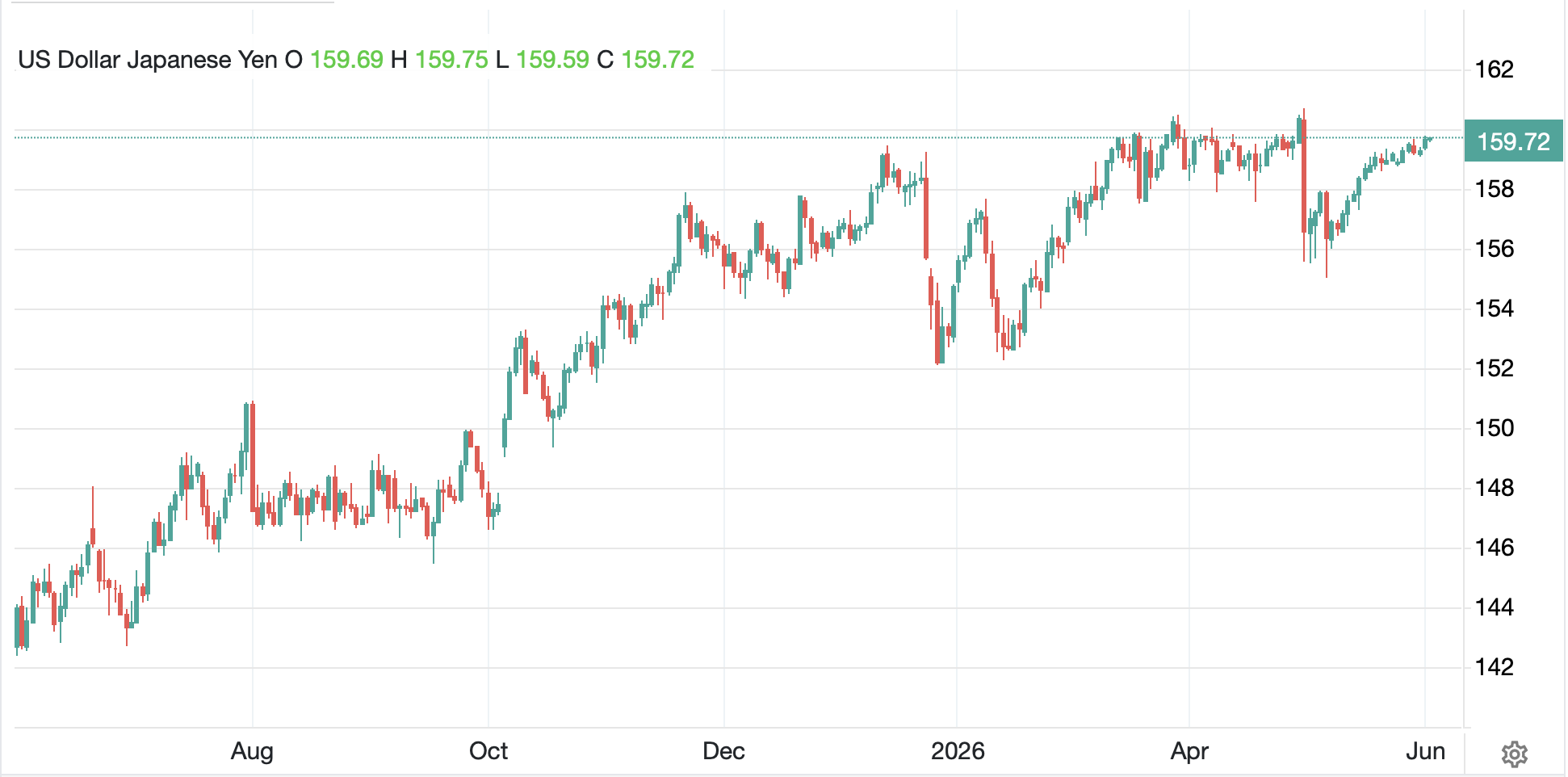
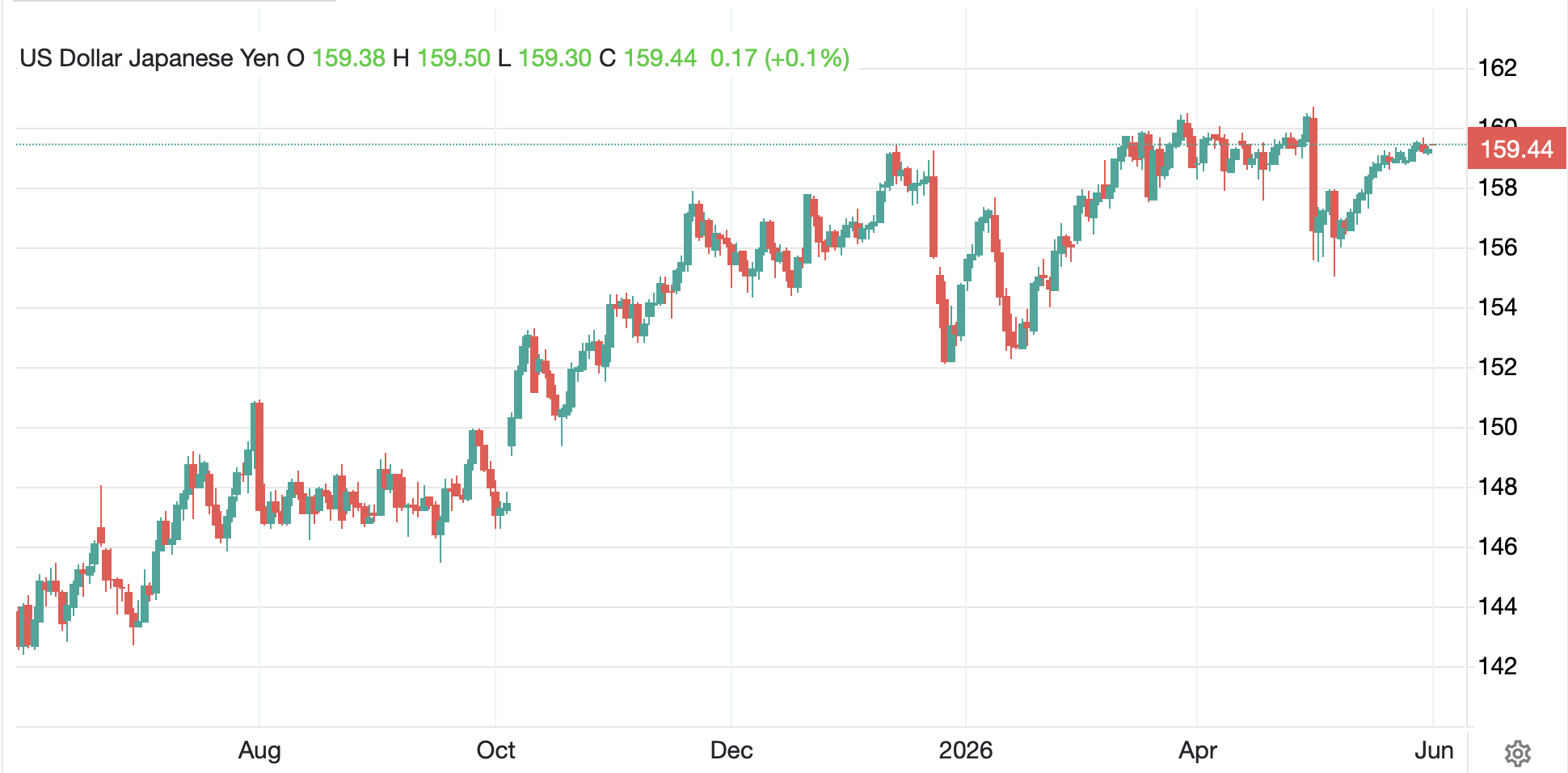
The bolded words are all part of the Japanese seven-step plan toward intervention.  At this point, I feel like we have reached number five.  The market responded predictably, with the yen strengthening vs. the dollar (and all its counterparts), albeit not all that much.  Last night saw the yen trade at 159.45, its highest since July 2024 (the last time the BOJ intervened), before the comments helped bring it back a bit.

Source: tradingeconomics.com

But one other area which the MOF/BOJ follow closely is not just the USDJPY exchange rate, but also the yen’s rate vs. other major currencies.  If, for instance, the yen is only weakening vs. the dollar, that is one thing.  However, a look at the chart below showing USDJPY, EURJPY and GBPJPY shows us that the yen is weakening against all those currencies pretty much in sync.  In fact, this argues that the yen’s current weakness is a yen specific fundamental, not a speculative move, which should argue against intervention, as that will only be a temporary sop.  However, my take is when we get to 160 or 162, which I believe is coming, we will see the BOJ selling aggressively.

Source: tradingeconomics.com

Ironically, the one currency against which the yen has been weakening steadily that I’m sure delights the BOJ/MOF is the Chinese yuan.  Since Liberation Day in the US, the yen has fallen more than 17% and continues to slide vs. the yuan as it has been doing for the past five years.  It is not hard to believe there are voices in the Japanese government that see that move and recognize how much it helps the Japanese export sector and caution against trying to arrest the yen’s weakness too aggressively.

Source: tradingeconomics.com

I look forward to much more dialog on this subject and expect that soon, we will be hearing about the end of the carry trade, yet again.  To my eyes, until Japanese fundamentals change, or at least appear to be moving in the right direction, the yen will struggle.  So, let me know when the fiscal deficit shrinks, or GDP jumps to 4% or inflation slides back to 1%.  Until then, they yen is damaged goods.

As to the rest of the market, precious metals continue to be the shining stars with the whole sector higher this morning (Au +1.0%, Ag +4.2%, Pt +2.0%) and that move taking copper (+0.4%) along for the ride.  Last night the CME raised its margining requirement and changed its nature by requiring a percentage of the value, rather than a numeric amount per contract.  My friend JJ, who writes the Market Vibes substack wrote a brilliant piece last night explaining how the flows are evolving in the silver market.  To sum it up, at this point, there appears no end in sight for the demand as short positions are covered by new shorts.  Metal for delivery remains scarce and despite the extraordinary shape of the move, it appears to have more steam to drive it forward.  Markets like this are extremely difficult to trade, and history shows that movements in the shape seen below reverse very sharply.  But as Keynes explained 100 years ago, markets can remain wrong longer than you can remain solvent.  I am happy I have been long silver for quite a while but am having a hard time figuring out what to do now!

Source: tradingeconomics.com

Meanwhile, oil (+1.4%) continues to rally on concerns that the Iran situation will lead to one of two outcomes, either a substantial decline in production as the regime collapses, or an effort by the regime to close the Strait of Hormuz which will impede shipping and reduce supply as they try to inflict pain on the US and the rest of the world who are rooting for the uprising.

Heading back to paper markets, yesterday’s weakness in the US was followed by a more mixed picture in Asia with Japan (+1.5%) rallying on continuing hope for more fiscal stimulus.  HK (+0.6%) benefitted from news that China’s trade surplus hit a new record high of $1.2 trillion (remember when they were going to grow domestic demand?) but Chinese shares suffered (-0.4%) after the regulators there raised margin requirements to 100%.  As to the rest of the region, it was far more green than red, although India continues to be a laggard overall.  In Europe, mixed is also the best description with the DAX (-0.35%) lagging while we have seen modest gains in the UK (+0.3%) and France (+0.2%).  Otherwise, it is hard to get excited about activity here today.  There continue to be existential questions about the EU and which nations will enact EU directives given that Poland, Hungary, Italy and the Czech Republic seem to be ignoring the latest issues like the Digital Asset Tax.  As to US futures, at this hour (7:00) they are softer by about -0.25% across the board.

Bond markets (except Japanese ones) remain completely uninteresting.  Treasury yields have slipped -3bps this morning and European sovereign yields are lower by -1bp.  Despite all the sound and fury about specific issues in markets, fixed income investors remain nonplussed by everything for now.  If/when that changes, we will need to watch things carefully.

Finally, aside from the yen (+0.3%) there is little to discuss overall. The DXY is still trading right around 99 and there has been very little movement of note.  Relationships that we would expect (ZAR and Au, NOK and oil) remain intact, but despite the metals dramatic movement, the rand is just gradually appreciating.

On the data front, yesterday’s CPI printed slightly softer than market expectations, but it is hard to get excited that inflation is heading back to target anytime soon.  @inflation_guy, Mike Ashton, had an excellent write-up here explaining what is going on and why much lower inflation is unlikely.  Ultimately, despite a lot of discussion regarding rental rates, those figures are not representative of the rental market as a whole and shelter costs continue to climb.  Absent a serious decline in goods inflation, it will be virtually impossible to get back to 2.0% on any sustainable basis.

As to today, it is a hodge podge of current and old data with Existing Home Sales (exp 4.21M) the only December number.  We see November Retail Sales (0.4%, 0.4% ex-autos) and PPI for both October and November which seem unlikely to impact markets greatly.  We also see EIA oil inventory data where a small draw is expected for crude but a build for gasoline.  Last week saw a massive build in products which likely helped weigh on the price last week.  But this week, things are different.  

We also hear from five more Fed speakers including Steven Miran, who will undoubtedly make his case for aggressive rate cuts again.  Then at 2:00 we get the Fed’s Beige Book.

Drinking from a firehose seems an apt metaphor for market analysts trying to make sense of the current situation.  Stepping back, I have never understood the market pricing for more rate cuts given the economy’s resilience.  The twin stories, in my estimation, are a growing level of fear regarding the debasement of fiat currencies, hence the move in metals, and the fact that the US remains the cleanest dirty shirt in the laundry, hence my preference for the dollar vs. other fiat currencies.  But on any given day, be careful!

Good luck

Adf

Under Damocles’ Sword

It turns out the market ignored
Chair Powell, though many abhorred
The idea the Fed
May soon need to shred
Its views under Damocles’ Sword
 
So, stocks rose and set more new highs
And bonds ignored all the shrill cries
But metals retained
The heights that they gained
How long ere the bears euthanize?


Yesterday, of course, the big news was the Powell video describing the subpoenas that he and the Fed received on Friday.  This continues to be seen as an attack on the Fed’s “independence” and the talking heads remain aghast.  I couldn’t help but chuckle at 12 current central bankers from around the world putting out a statement that this was a terrible precedent.  Consider that most people have no idea who any of the signees are, so they hold no reverence for their views, and the people who do know them, are already in the camp.  Of course, I cannot help but remember the statement by 51 former FBI/CIA security apparatus people explaining that Hunter Biden’s laptop had all the earmarks of Russian disinformation.  My point is this type of response is not necessarily the unvarnished truth.  I wasn’t at the Senate committee meeting and do not recall what he said, if I ever heard it, so am in no position to judge what went on.  I guess, that’s what a grand jury is all about, to determine if there are sufficient grounds to go forward with a charge.  Again, this is a Washington DC grand jury, who will be biased against anything President Trump’s administration is doing.  I put it at 50/50 that any charges are even brought.
 
Meanwhile, despite all the angst, equity markets rebounded all day to close higher, bond markets absorbed a 10-year auction with little concern and yields were within 1bp of the morning levels while the dollar, which had initially fallen about -0.4% to -0.5% on the news, clawed back a part of that loss, and is slightly firmer this morning.  The only real outlier here were the precious metals markets where both gold and silver had monster days trading to new highs.  Such was yesterday.
 
Takaichi-san
Like a hungry boa, wants
To tighten her grip

First, my error in yesterday’s note regarding the Japanese stock market on Monday, which was actually closed for Coming of Age Day, but overnight did jump 3.1% on the news that PM Takaichi, she of the 70+% approval rating, is going to call for snap elections to try to consolidate her power more effectively in the Lower House of the Diet.  While the announcement has not officially been made, it has been widely reported that on January 23rd, she will dissolve parliament and seek an election on either February 8th or 15th.

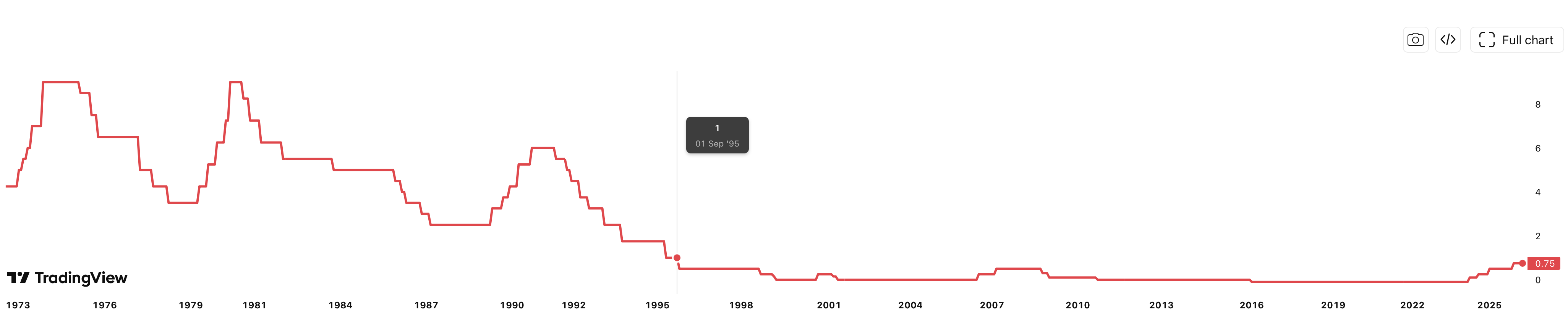
The market response here was quite clear.  Aside from the jump in equity prices based on more government support for her fiscal spending, the yen (-0.5%) fell to its lowest point in more than a year and now, trading near 159, is seen as entering the ‘intervention range’.  A look at the chart below shows that in July of last year, the last time the yen weakened to this level, we did see the BOJ enter the market and it was quite effective in the short run.  If I recall correctly, there was a great deal of discussion then about the end of the carry trade.  Of course, that didn’t happen, and even though the BOJ has increased rates to 0.75% in the interim, I assure you, the carry trade is still out there in very large size.

Source: tradingeconomics.com

I expect that this evening we will hear more from the FinMin and her deputies regarding concerns over ‘one-sided’ moves and the need for the yen to represent fundamentals, but I sincerely doubt that there will be any activity before 160 trades, and maybe even 165.

Perhaps of greater concern for Takaichi-san is that JGB yields rose sharply on the news with the 10yr (+7bps) rising to a new high for this move, while the super long 40-year traded to 3.80%, higher by 9bps and a new all-time high for the bond.  Japan has serious financing issues and has had them for quite some time.  However, two decades of ZIRP and NIRP hid the problems as financing costs were virtually nil.  As a net creditor nation, they also have inherent strengths with respect to international finance, although it remains to be seen if the population there will accept the idea that their savings need to be used to pay down government debt.

As we have seen across many markets, the old rules and relationships don’t seem to apply these days.  The fact that Japanese yields are climbing far more quickly than US yields, with the spread narrowing dramatically, in the past would have seen a much stronger yen.  As well, rising yields tend to undermine equity markets, and yet, they sit at record highs.  This is not the world in which many of us grew up.

Ok, as we await this morning’s CPI data, let’s see how other markets behaved overnight.  While yesterday’s US gains were modest across the board, they were gains after a terrible start.  Meanwhile, in addition to Tokyo’s rally, we saw HK (+0.9%), Korea (+1.5%), Taiwan (+0.5%) and Australia (+0.6%) all rally although both China (-0.6%) and India (-0.3%) lagged.  It appears the latter two suffered from some profit-taking (although Indian shares have not really performed that well) while the gainers all benefitted from the US rally and ongoing excitement over tech shares.  In Europe, though, every major market is softer this morning although only Paris (-0.6%) is showing any substance in the decline. Elsewhere, declines of -0.1% to -0.3% are the order of the day, hardly groundbreaking, and given most of these markets have had a good run, it seems there has been some profit-taking ahead of this morning’s CPI data.  As to US futures, at this hour (7:00) they are basically unchanged.

In the bond market, this morning yields are edging higher everywhere with Treasury yields (+2bps) now touching the top of its forever range at 4.20%.  European sovereign yields are uniformly higher by 2bps as well although there has been no data of note nor commentary to really offer a rationale.  Of course, 2bps is hardly earth shattering.  

In the commodity markets, while precious metals (Au -0.2%, Ag +0.75%, Pt -1.1%, Cu +0.5%) have been the headline story, the oil market has taken a back seat.  Quickly, on the metals side, it seems that the supply scarcity remains the main driver overall, and the fact that there is limited new exploration, let alone new mines coming online, ongoing, my take is these have further to climb.  

But oil is quite interesting.  You all know my view that the trend remains lower, but today, it is bucking that trend with WTI (+1.9%) up nicely and back above $60/bbl for the first time since mid-November.  A look at the chart below shows that using my, quite imperfect, crayon if I ignore the massive Operation Midnight Hammer spike, even after a few solid up days, oil remains well within its down trend.  I am no technician, so others will draw lines as they see fit, but I am looking at longer term views, not day-to-day or intraday.  

Source: tradingeconomics.com

My take is that the Venezuela story has evolved into increased production from there will take quite a long time, so ought not pressure prices lower.  Rather, I would lean toward the ongoing uprising in Iran as the proximate cause for today’s recent gains.  After all, if the regime falls, and the Mullahs exit for Moscow, it is unclear who will fill the power vacuum and what will come next.  As such, it is easy to anticipate a reduction in Iranian supply, which is currently about 3.2mm to 3.5mm barrels/day (according to Grok), and if that goes missing, or even is cut in half, would have a significant short-term impact on the price.  

Regarding this situation, obviously I have no special insight.  However, the most interesting thing I read, and why I believe this will indeed be the end of the theocracy, is that the protestors have burned down 350 mosques, a direct attack on the belief system of the Ayatollah.  This appears quite widespread, and it would not surprise me if the regime falls before the end of the month.  Good luck to the people of Iran.

Finally, the dollar is little changed this morning other than against the yen.  For the dollar bearish crowd, which is quite large as doom porn about the end of the dollar’s hegemony remains quite popular, yesterday’s decline was tiny.  In fact, if we use the DXY as our proxy, it is higher by 0.1% this morning and trading just below 99.00 as I type.  Once again, if we look at the chart below, it has been 9 months since the DXY has traded outside the 97/100 range in any substantive manner and we are basically right in the middle.  Nobody really cares right now.

Source: tradingeconomics.com

Turning to the data this morning, CPI (Exp 0.3%, 2.7% Y/Y) for both headline and core leads the list.  This is December data, so as up to date as we will get.  We also see stale New Home Sales data, but it is hard to get excited about that.  The NFIB Small Business Optimism Index already printed right at expectations of 99.5.

It’s funny, despite all the discussion of the Fed regarding the Powell subpoena, Fed speakers don’t seem to be getting much traction.  Yesterday, three speakers indicated that rates seemed to be in a good place, and, not surprisingly, all defended Chairman Powell.  My view at the beginning of the year was that the Fed was going to become less important to the market dialog and in truth, that remains my view.  Rate cut probabilities have fallen to 5% for this month with the next cut priced for June.  Obviously, that is a long time from now and much can happen, but if the data showing GDP is accurate, it seems hard to understand why there would be a cut at all.  Too, remember one of the key theses behind dollar weakness was Fed dovishness.  If the Fed is not so dovish, tell me again why the dollar should decline.

It’s a crazy world in which we live.  Hedgers, stay hedged.  The rest of you, play it close to the vest.

Good luck

Adf

The Temperature’s Rising

This morning the temperature’s rising
With Trump and his allies devising
An alternate way
For him to axe Jay
But this move is quite polarizing
 
The market response has been clear
It’s given the move a Bronx Cheer
Both stocks and the dollar
Are feeling a choler
But gold, everybody holds dear


The financial world is aghast this morning as last night, Chairman Powell revealed that the Fed has been served with grand jury subpoenas threatening criminal indictment regarding Chairman Powell’s testimony to the Senate Banking Committee last June.  The issue at hand is ostensibly the ongoing renovations at the Marriner Eccles Building, including their cost, and how that differs from Chairman Powell’s testimony.

Chairman Powell offered a video response last night explaining he will not be cowed into cutting rates because the President wants lower rates, but will continue their work of setting policy based on their assessments of the economy.  One cannot be surprised that this has raised an entirely new round of screaming about President Trump’s tactics, although what I did see this morning was that Florida House Representative Anna Paulina Luna took credit for referring the case to the DOJ.

While I have strong opinions on Chairman Powell’s effectiveness, or lack thereof, this is certainly a new level of pressure.  In fact, if you listen to the video above (it’s just 2 minutes) Powell explicitly claims that this is entirely about the Fed not cutting rates further.  But I am not going to discuss the legality, or tactics here, our focus is on the market’s response.

Starting with the dollar in the FX markets, it has fallen almost universally, and while it hasn’t collapsed, we are looking at a 0.3% to 0.5% decline pretty much everywhere.  Using the euro (+0.4%) as our proxy, you can see from the chart below that in the context of the past year’s price activity, this move is indistinguishable from any other move.

Source: tradingeconomics.com

This is not to imply that the Administration’s actions are insignificant, just that despite the rending of garments by the punditry, the market hasn’t determined it matters that much, at least not yet.  I have maintained my view that the dollar remains the best of a bad bunch of fiat currencies given the prospects for US economic activity compared to the rest of the world.  However, it is quite possible that foreign investors will view this action as far too detrimental to the structure of US financial markets and seek to exit, thus driving the dollar much lower.  I did not have this on my bingo card at the beginning of the year, so my views of dollar strength are somewhat tempered at this point.  It will certainly be interesting to see as we go forward.

One other thing to note is that CPI is released this week (exp 2.7% for both headline and core) and Truflation came out last week at 1.8%.  Now, I don’t put great stock in Truflation but there are many who do.  For that contingent, I assume they are aligned with President Trump in his views that Fed funds are too high.  After all, with Fed funds at 3.75%, that is nearly 200bps above the Truflation number.  I have always understood the “appropriate” relation to be closer to 75bps to 100bps above inflation, which if you believe Truflation, means you are looking for cuts.  (PS, this is not my personal view, I am simply highlighting part of the market thought process.)

At any rate, the dollar is under pressure this morning but remains well within its recent trading range.  Turning to commodities, though, that is where the real price action is, with precious metals exploding higher on this news.  We are looking at record highs for gold (+1.6%), silver (+4.6%) with platinum (+3.2%) also much richer, although not back to all-time highs.  If we look at a chart of both gold and silver below, we can see the parabolic nature of silver’s recent move, a situation which should make everyone uncomfortable as parabolic moves frequently signal the end of the line. 

Source: tradingeconomics.com

But perhaps what makes this more interesting is that there is a substantial amount of supply in both gold and silver due to enter the market as the BCOM index rebalancing began last Friday and continues through Thursday.  Given the dramatic rallies in both metals last year, there is a significant amount to be sold by those funds that track the index.  Estimates are for a total of nearly $7 billion of gold and silver to be sold for the rebalancing, and many expected the metals markets to decline under that pressure.  And perhaps they still will, but today’s moves are the clearest signal that there are many investors who are uncomfortable with the Fed situation.

Remarkably, Venezuela and oil markets have basically disappeared from the conversation at this point.  However, this morning WTI (-0.9%) is giving back some of last week’s gains, and remains well within its recent downtrend, but shows no signs of a sharp break in either direction.

Turning to the other risk spot, equity markets, while US futures are all lower by -0.5% to -0.6% at this hour (7:10), the Fed news has had a mixed impact elsewhere around the world.  For instance, Japan (+1.6%), HK (+1.4%) and China (+0.65%) all had solid sessions with that being the case throughout the region.  Even India (+0.4%) finally managed to go green last night.  And all of this occurred after the Fed news.  One possible explanation is that foreign investors are running home, hence bidding up local shares.  Of course, it is also possible that they don’t believe there is much there, there, and are simply ignoring the news.

In Europe, the situation is different with weakness the general trend as Spain (-0.4%), France (-0.3%) and Italy (-0.15%) all slipping although Germany (+0.3%) has managed to buck the trend absent any specific macro catalyst.  German defense stocks are modestly higher this morning and perhaps threats by President Trump to aid the fomenting Iranian revolution have investors looking for more gains there.  As I often say, markets can be quite perverse for no apparent reason at all.

Finally, bond markets are not really responding to the news in any substantial manner.  Treasury yields have backed up 3bps this morning, but at 4.19%, remain within that long-term trading range and are not signaling flight.  European sovereigns have seen yields edge lower by -1bp across the board, so while modestly better, hardly the sign of massive buying.  And JGB yields were unchanged overnight.  Bonds remain the least interesting space there is of all the markets.

Which takes us to the data this week.

TuesdayNFIB Small Biz Optimism99.5
 CPI0.3% (2.7% Y/Y)
 -ex food & energy0.3% (2.7% Y/Y)
 New Home Sales710K
WednesdayRetail Sales0.4%
 -ex Autos0.3%
 Existing Home Sales4.2M
 Fed’s Beige Book 
ThursdayInitial Claims219K
 Continuing Claims1918K
 Empire State Mfg1.0
 Philly Fed-2.0
FridayIP0.1%
 Capacity Utilization76.0%

Source: tradingeconomics.com

In addition, we get PPI data on Wednesday, but it is all old data, for October and November and, as such, I don’t think it will matter very much at all.  We also hear from 10 different Fed speakers, some several times, over the course of the week.  It will be very interesting to hear how they address the major news overnight regarding the subpoenas, or if they even touch on them.  I expect there will be oblique references to Fed independence at most.

And remember, none of this even considers the ongoing revolution in Iran, which appears to be gaining strength in its third week.  If the theocracy in Iran falls, that will have a very different impact on oil markets than the Venezuela situation.  First, they are currently producing far more oil.  Second, the removal of sanctions there would seemingly reduce the amount of ultra cheap oil that China can import, adding pressure to the Chinese economy, as well as help pressure oil prices lower in general, which would negatively impact Putin’s war chest.  (If Iranian oil is no longer black market, it raises China’s cost, but lower overall prices will reduce further Russia’s sanctioned sale prices).

As to the dollar on the FX markets, this move certainly gives me pause regarding my bullish view, but there seems to be a long way to go before anything really comes of it.  As well, grand jury testimony is secret, so we won’t know about anything that is said anytime soon.  Ultimately, nothing may come of this, no charges of any sort.  Remember, this is a Washington DC grand jury, and so many there disagree with everything that President Trump does, they may not indict for that reason alone.

I’m not willing to make a sweeping statement at this time, but caution in positioning seems like a sensible view.

Good luck

Adf
Too Potent a Force

The headline today’s NFP
As pundits will try to agree
On whether the Fed
When looking ahead
Will like what it is that they see
 
But, too, the Supreme Court is due
To rule whether tariffs imbue
Too potent a force
For Trump, to endorse
Or whether they’ll let them go through


As the session begins in NY, markets have been relatively quiet as traders and algorithms await the NFP data this morning.  Recall, Wednesday’s ADP number was a touch softer than forecast, but still, at 41K, back to a positive reading.  Forecasts this morning are as follows:

Nonfarm Payrolls60K
Private Payrolls64K
Manufacturing Payrolls-5K
Unemployment Rate4.5%
Average Hourly Earnings0.3% (3.6% y/Y)
Average Weekly Hours34.3
Participation Rate62.6%
Housing Starts1.33M
Building Permits 1.35M
Michigan Sentiment53.5

Source: trading economics.com

Regarding this data point, there are two things to remember.  First, last month Chairman Powell explained that he and the Fed were coming to the belief that the official data was overstating reality by upwards of 60K jobs due to concerns over the birth/death portion of the model.  That is the factor the BLS includes to estimate the number of new businesses started vs. old ones closed in any given month.  Historically, at economic inflection points, it tends to overstate things when the economy is starting to slow and understate when it is turning up.  
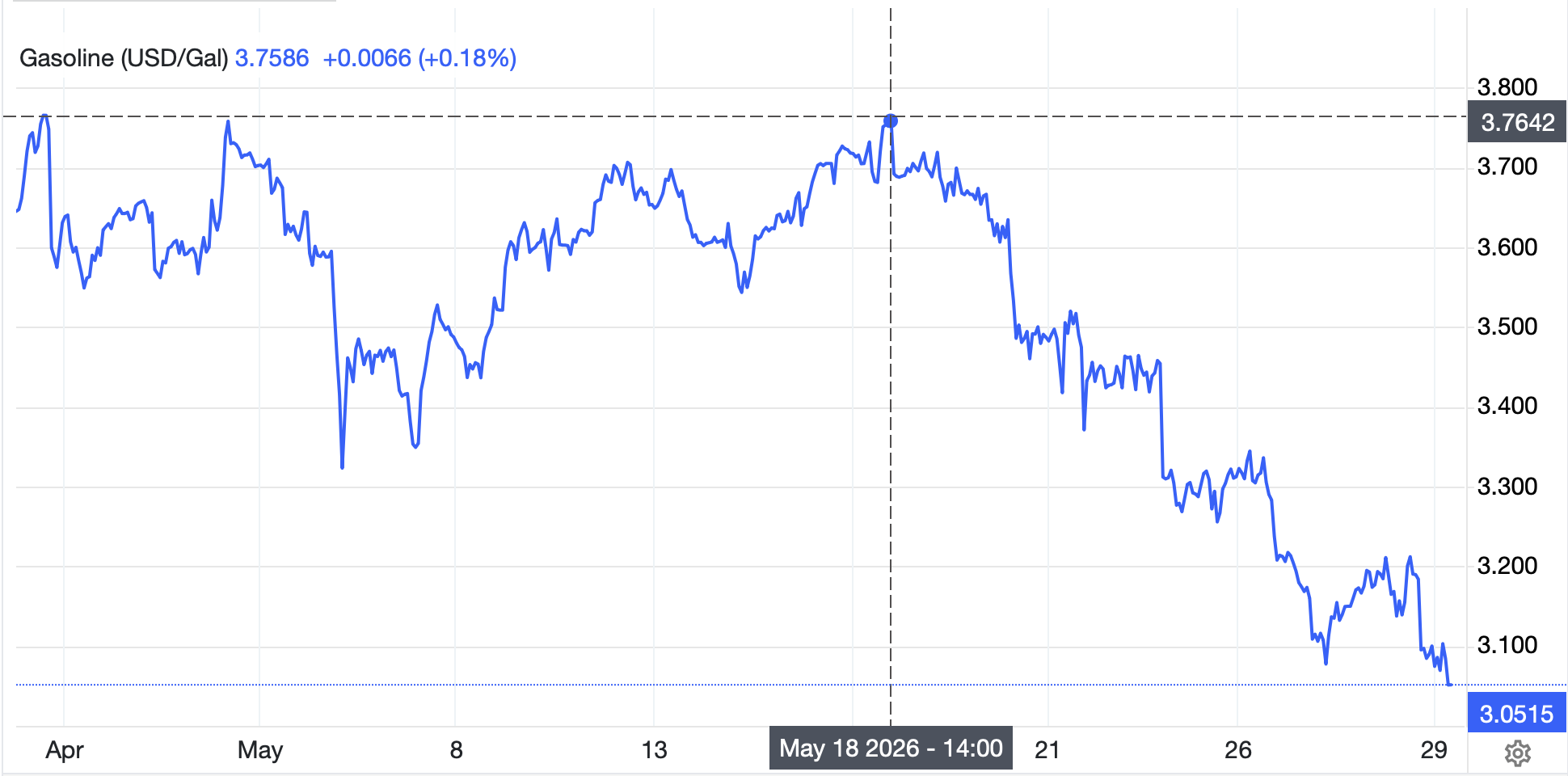
The second thing is that given the changes in the population from the administration’s immigration policy, with net immigration having fallen to zero recently, the number of new jobs required to maintain solid economic growth is much lower than what we have all become used to, which in the past was seen as 150K – 200K.  So, 60K, or even 40K, may be plenty of new jobs to absorb the growth in the labor market, which will come from people re-entering the market who had previously quit looking for a job.

The ancillary data, like ADP and the employment pieces of ISM were both stronger in December than November, so my take is, the estimates are probably reasonable.  I have no strong insight into why it would be dramatically different at this point.  The question is, how will markets respond?  My take is this could well be a ‘good news is bad’ situation where a strong print will see pressure on bonds and stocks as the market reduces its probability of a Fed rate cut (currently 14% for January, 45% for March) even further.  The dollar would benefit, as would oil on the demand story, but I think metals will do little as that story is not growth oriented.  A weak number would see the opposite.

Of course, the other big potential news today is the Supreme Court ruling on the legality of Trump’s tariffs.  The odds markets are at ~70% they will overturn them, but there is the question of whether it will require the government to repay the tariffs or simply stop them.  As well, most of them will be able to be reimposed via different current laws, so net, while a blow to the administration I don’t believe it will have a major long-term impact with repayment the biggest concern.  This particular issue is far too esoteric for a simple poet to prognosticate.

And those are the market stories of note, although we cannot ignore the growing protests in Iran as videos show buildings burning in Tehran and there is word that the Mullahs are at the airport, which if true tells me that the regime is on the edge.  While this would be a great victory for the people of Iran, it would also have a dramatic impact on oil markets and specifically on China.  While sanctions could well be lifted, thus depressing the price as more comes to market, China currently benefits from buying sanctioned oil at a massive discount, and that discount would disappear.

As we await all the news, let’s review the overnight activity.  A mixed US session was followed by strength in Tokyo (+1.6%) as the Japanese government surprised one and all by reporting a stronger 30-year JGB auction than anticipated as well as an uptick in spending by households.  Too, nominal GDP growth has been outpacing deficit growth driving the net debt ratio lower, exactly what the US is seeking to do.  As to the rest of the region, both China (+0.45%) and HK (+0.3%) managed gains, as did Korea and Malaysia but India (-0.7%) continues to lag as it has all year.  Data from China showed inflation fell less than expected, although the Y/Y number remains at just 0.8%.

In Europe, gains are also the norm with France (+0.9%) leading the way with both the UK (+0.55%) and Germany (+0.4%) having solid sessions.  Retail Sales data from the Eurozone was firmer than expected at 2.3%, a rare positive outcome, but showing some support.  As to the US futures market, at this hour (7:30) all three major indices are higher by about 0.15%.

In the bond market, while yields have edged higher by 2bps this morning, as you can see from the chart below, they remain within, albeit at the top, of the recent 4.0% – 4.2% trading range.  

Source: tradingeconomics.com

The most interesting data point from yesterday was the dramatic decline in the Trade deficit, which fell to -$29B, its lowest level since 2009.  Recall that a long-time issue has been the twin deficits, with the budget and trade deficits linked closely.  I wonder, are we going to see Trump’s efforts at reducing government’s size and reach result in a smaller budget deficit?  Most pundits dismiss this idea, but I’m not so sure.  As to the rest of the world, European sovereigns are essentially unchanged this morning as investors everywhere await the US data and tariff ruling.

In the commodity markets, oil (+0.9%) is creeping higher but remains in its downward trend.

Source: tradingeconomics.com

Wednesday, we saw a large draw in crude inventories abut a massive build in both gasoline and distillates which feels mildly bearish.  The narrative is the Iran story is getting people nervous for potential short-term disruption, but I remain overall bearish for now.  As to the metals markets, gold (-0.3%) is slipping after having recovered early morning losses yesterday and finishing higher, while silver (+0.6%) is still bouncing along with copper (+1.8%) and platinum (+0.4%). Metals are in demand and supply is short.  Price here have further to rise I believe.

Finally, the dollar continues to rebound off its recent lows with the DXY back to 99 again this morning.  it has rallied in 11 of the past 13 sessions, not typical price action for a trading vehicle that is in decline.

Source: tradingeconomics.com

In fact, the greenback is firmer against virtually all its G10 and EMG counterparts this morning with the largest declines seen in JPY (-0.5%), KRW (-0.5%) and NZD (-0.5%) with others typically sliding between -0.1% and -0.3%.  again, it is hard to watch recent price action and see impending weakness.  We will need to see much weaker US data to change my view.  And along those lines, the Atlanta Fed’s GDPNow number just jumped to 5.4% for Q4 after the Trade data yesterday, again, atypical of further weakness in this sector.

And that’s really all as we covered data up top.  To me, the wild cards are Iran and the USSC.  While I do believe the regime will fall in Iran (they just shut down the internet to try to prevent a further uprising) my take on the Supremes is they may stop further tariffs but will not force repayment.  Net, that won’t change much at all and given the prediction markets are pricing a 70% probability of an end to tariffs, if it happens, it’s already in the price!

Good luck and good weekend

adf