A Warshach Test

While narrative writers obsessed
For some this was a Warshach test
The doves and the hawks
Each messaged their flocks
That Warsh, to their views, acquiesced

Meanwhile, in Iran bombs are falling
And President Trump is name calling
However, despite
The restarting fight
Risk assets keep on, higher, crawling

So, the FOMC Minutes were released, and they were hawkish dovish irrelevant.  The best expression of this came from Bloomberg’s Joe Weisenthal when he posted this on X,

Two simultaneous takes on the release that he received.  And I confess, I read those Minutes and didn’t learn anything at all.  It seems that the decision to leave rates on hold was unanimous although several committee members would have voted for a hike as well.

What does this say about the state of things?  I am very hopeful that we are on our way to a Fed that is less intrusive in market activities, both by reducing its balance sheet size, something that Chairman Warsh has expressly indicated as a goal, and by hearing less from committee members.  As @inflation_guy, Mike Ashton explains here, if forward guidance is dead, then why do we need to hear from any FOMC members about anything?  All those speeches were simply each member’s way to get their opinion out there and try to influence markets.  As I have frequently written, we would be much better off if the Fed were opaquer in their decision making as it would reduce risk and leverage and that would enhance financial market stability.  For everyone who wants Warsh to be Volcker redux, remember, back then, there were probably fewer than 10 people on Wall Street, let alone anywhere else, who could name a single member of the FOMC other than Mr Volcker himself.  That is an aspirational goal!

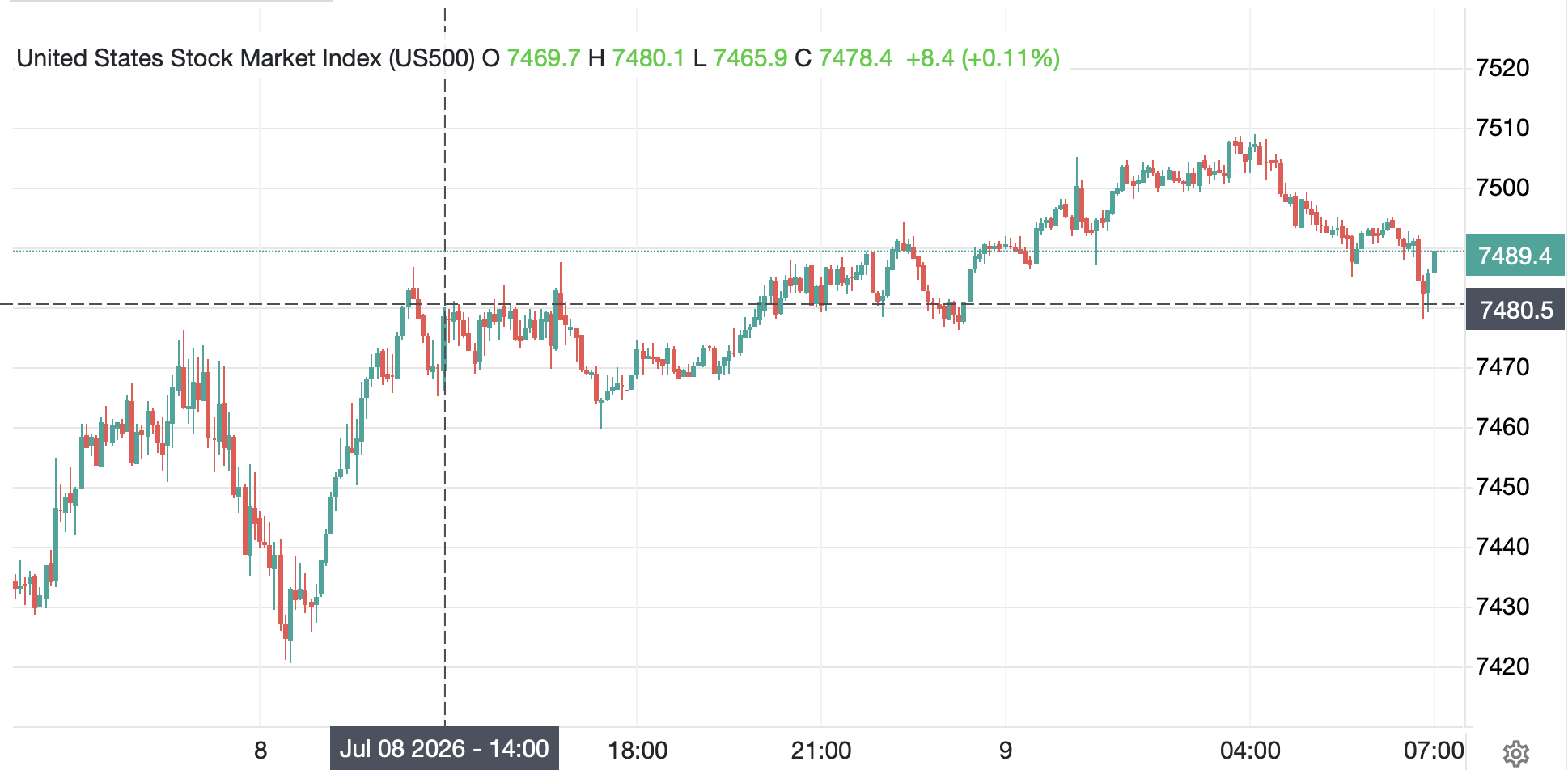
How did the market respond to the Minutes?  They basically ignored them.  Equity markets, which had opened much lower, were already in the process of reclaiming those losses when the Minutes were released and edged higher from there, with no meaningful change in trajectory as you can see in the below chart of the S&P 500.
Source: tradingeconomics.com

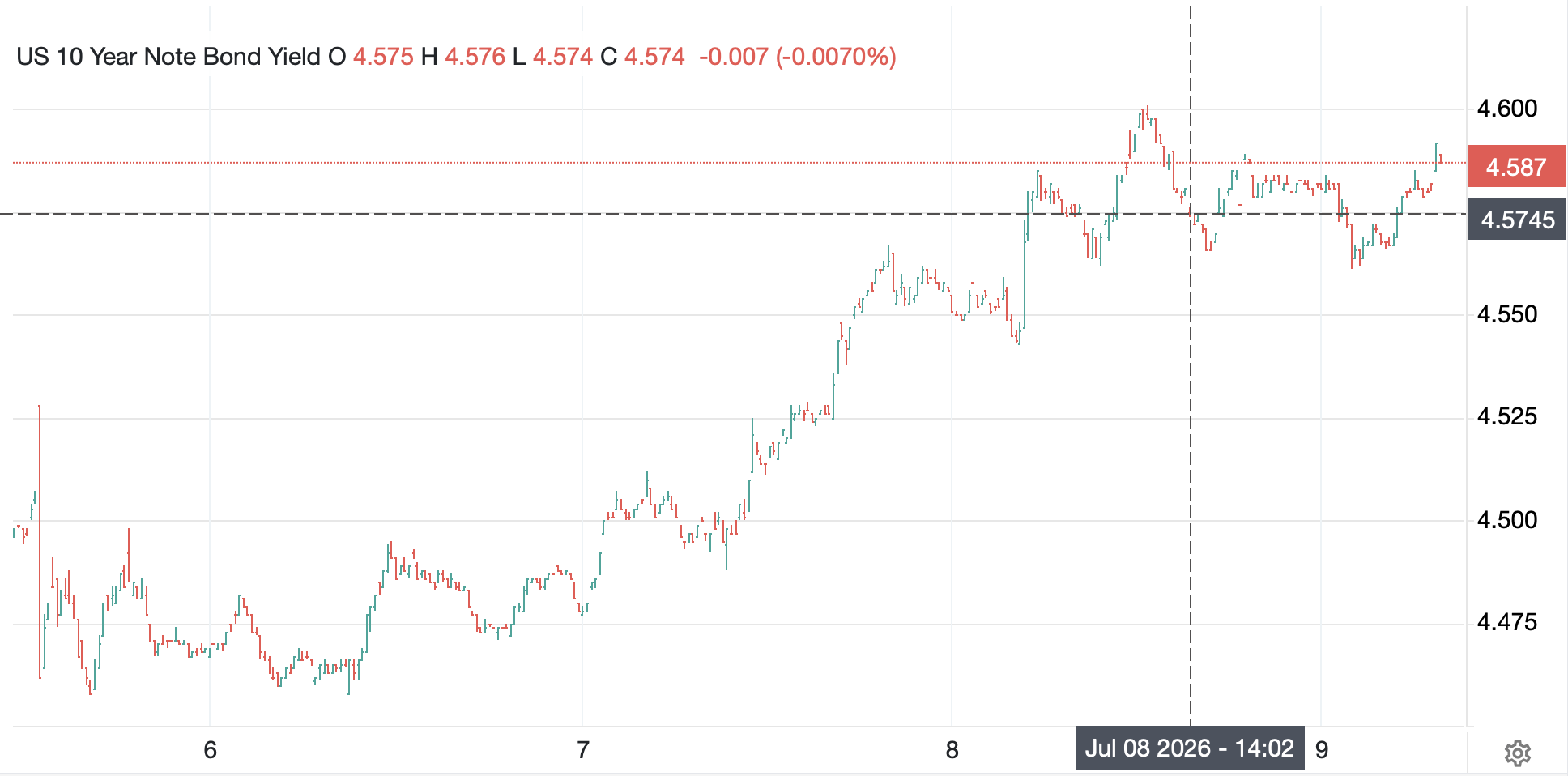
How about bonds?  Well, here is the 10-year chart and you tell me if the Minutes had an impact.
Source: tradingeconomics.com

I guess the real question is will the rest of the world’s central banks follow Mr Warsh’s lead and seek to end forward guidance and simply go about their job of managing inflation?  One can always hope.

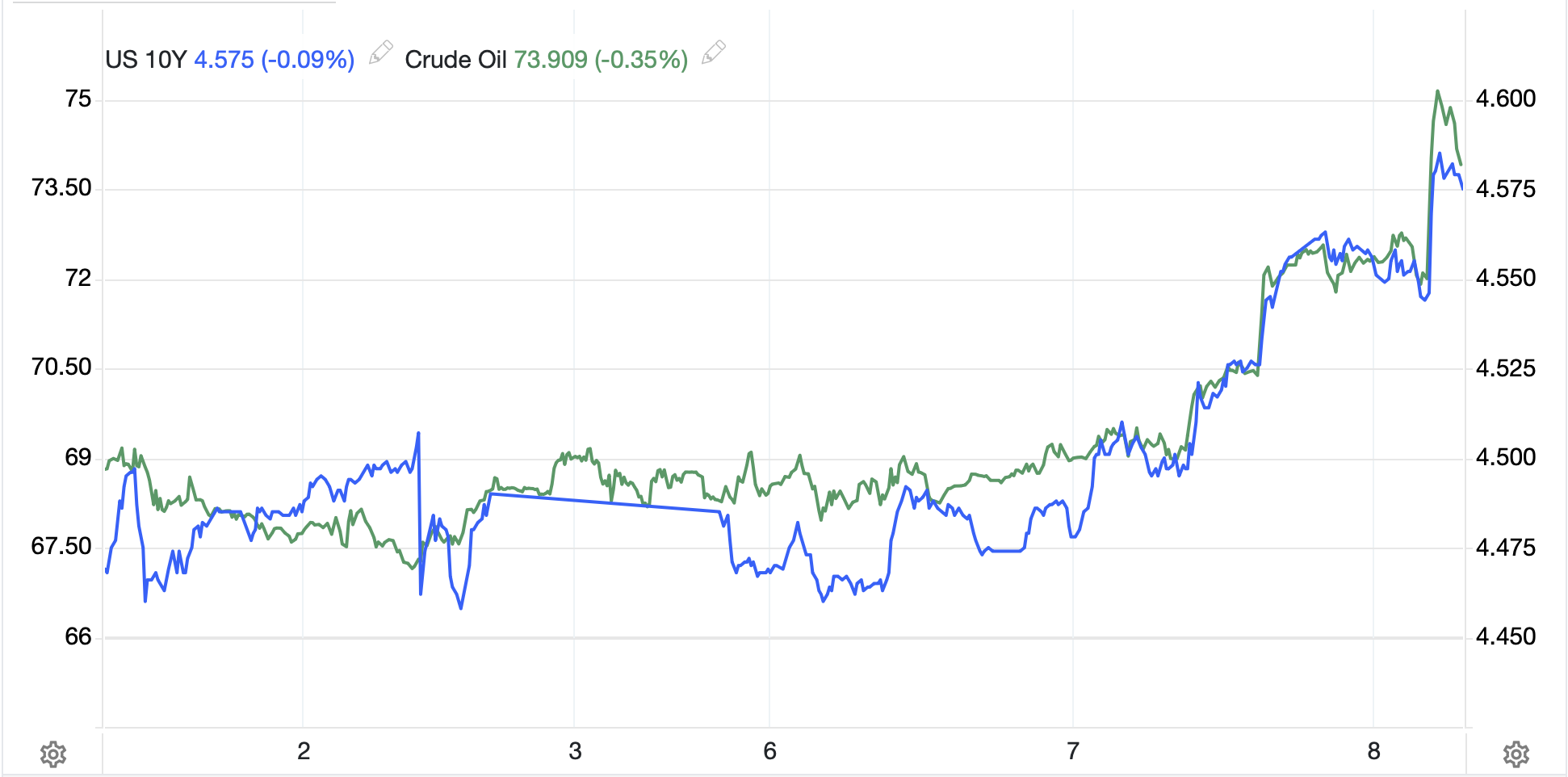
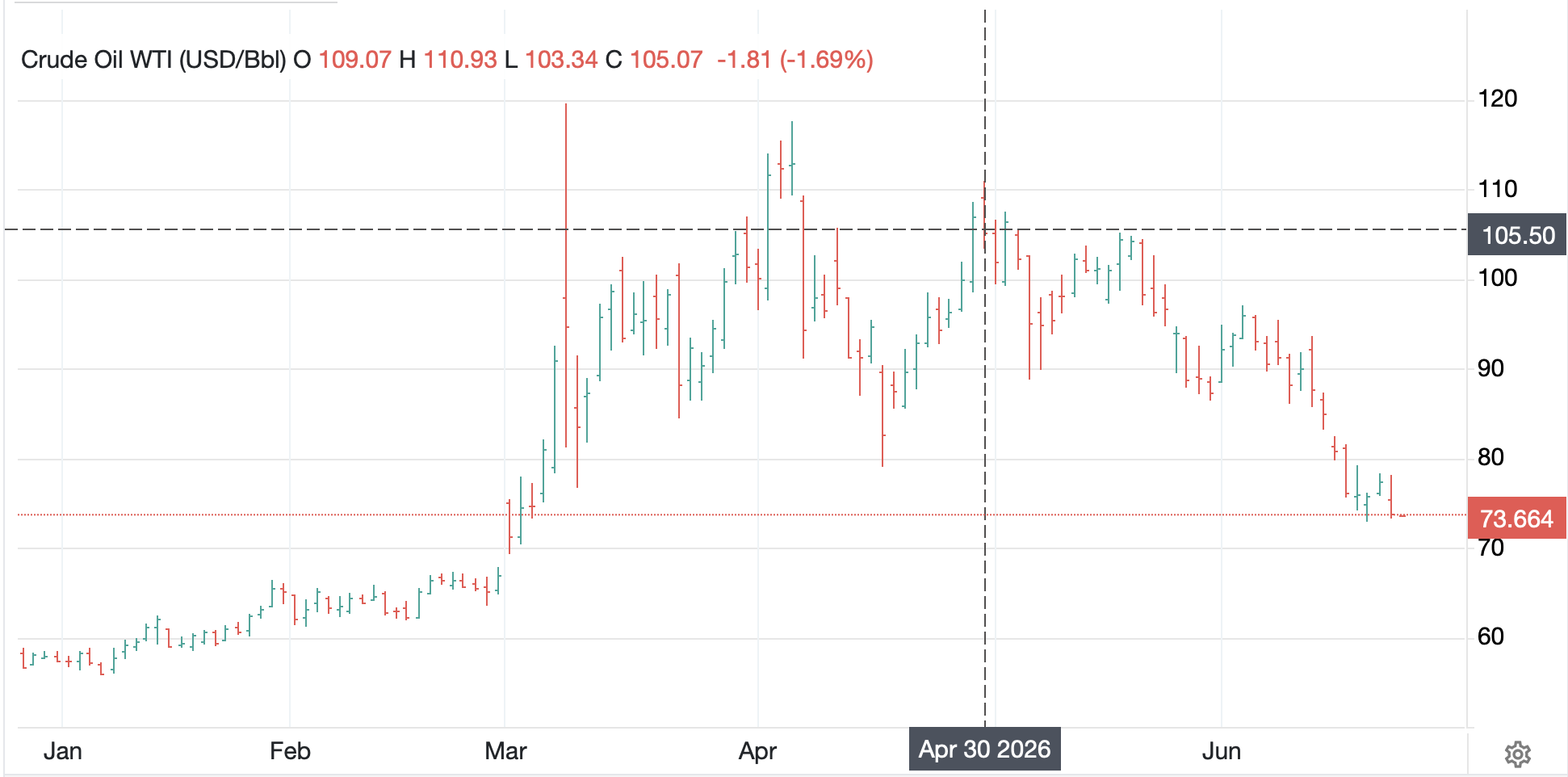
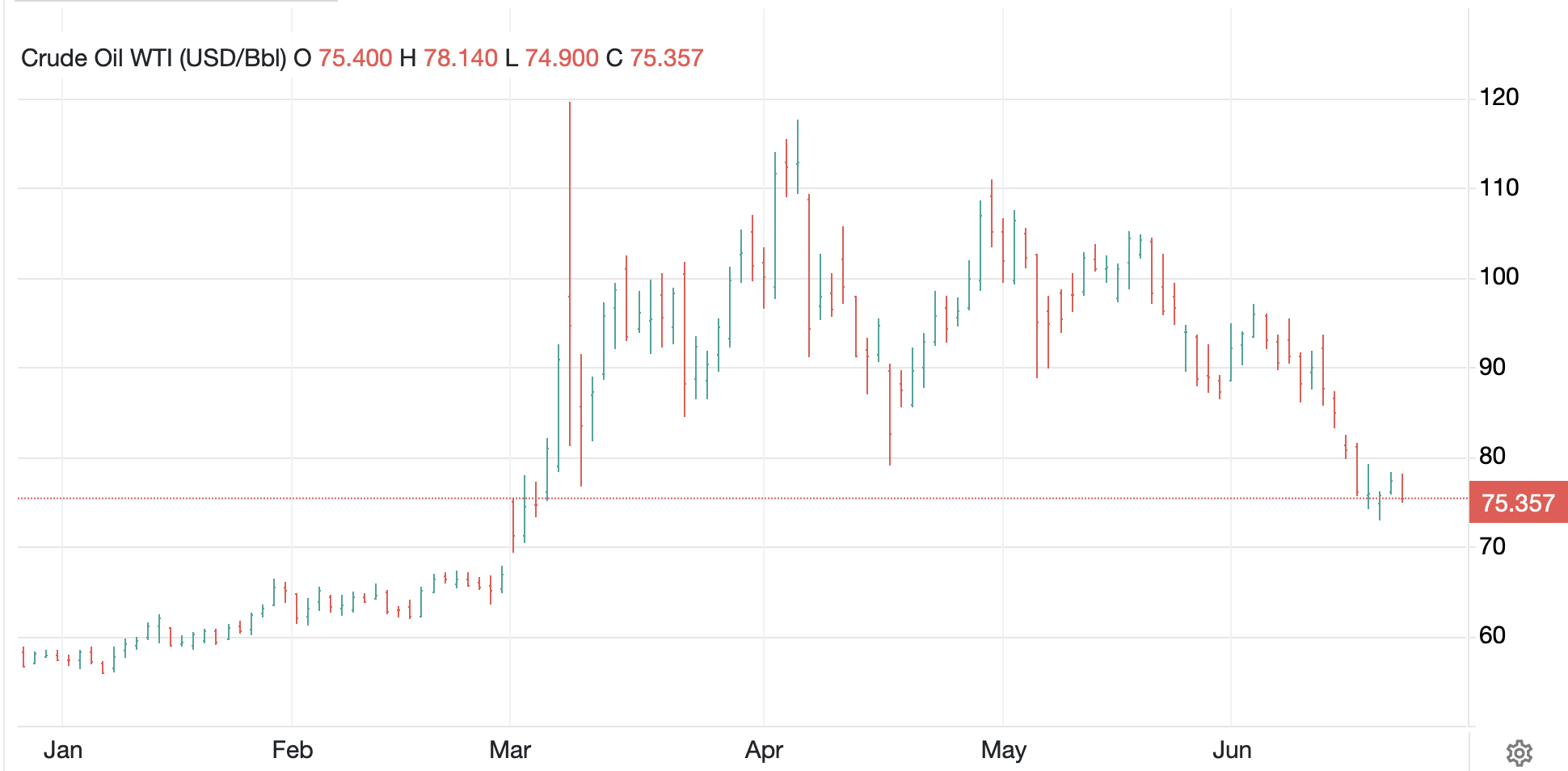
Which takes us to the other story of note, the apparent end of the ceasefire in Iran and the question of what is now happening in the Strait of Hormuz.  First, let’s be clear, nobody really knows as the fog of war remains thick.  Obviously, yesterday saw a sharp rise in the price of oil as concerns over future transits of the Strait rose dramatically.  However, as of this morning, while WTI (+0.6%) has edged slightly higher from yesterday’s closing levels, as you can see from the chart below, it seems to have found a new short-term home here around $74/bbl.
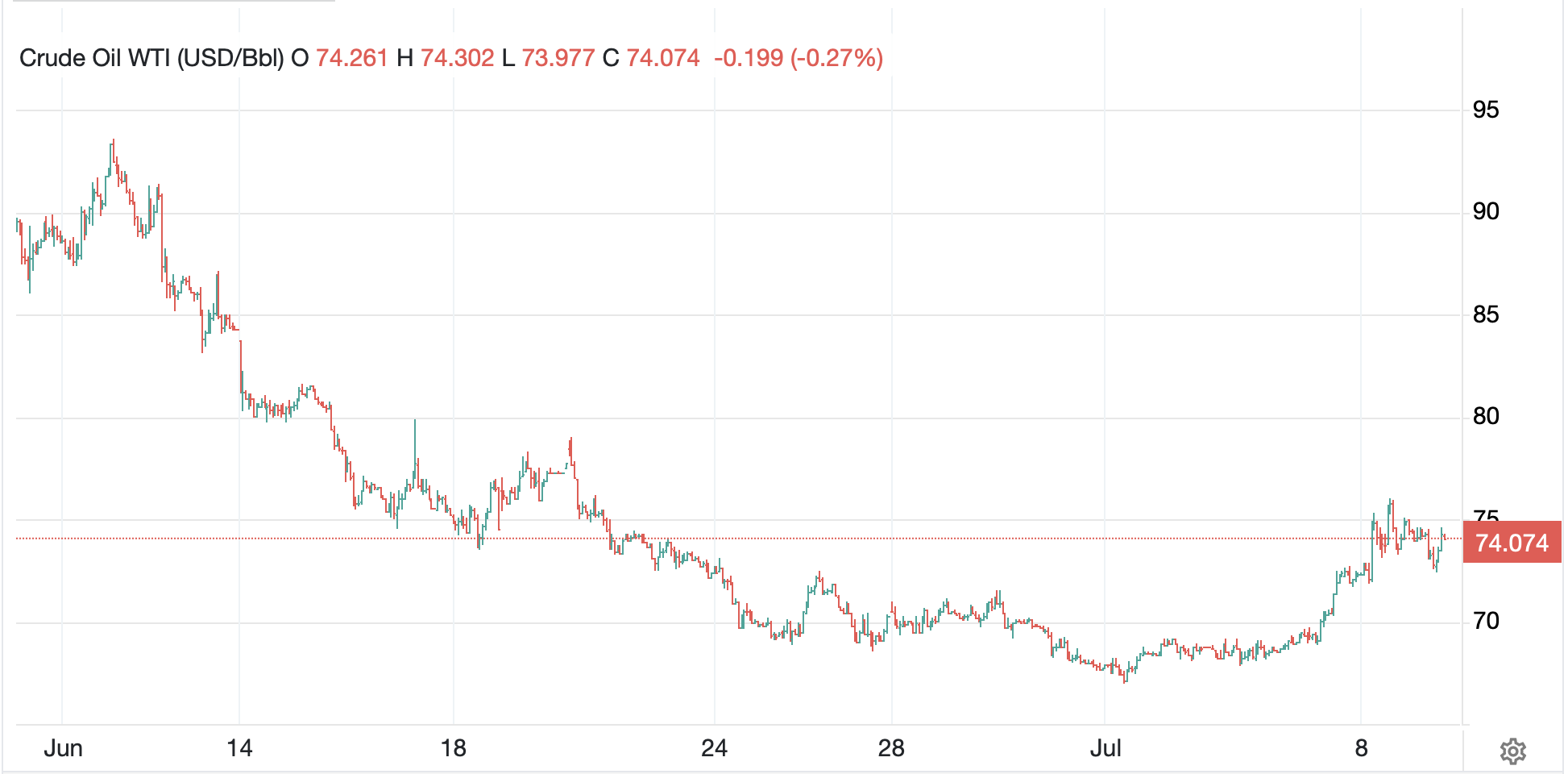
Source: tradingeconomics.com

Scrolling through X this morning, the $200/bbl analysts were back at it, explaining that this time, with all those inventories having already been used up, we are going to see much higher prices.  But weirdly, yesterday’s EIA data showed an inventory build of 3 million barrels.  I keep seeing charts of the US SPR and how it is at its lowest level since 1982 implying that we are on the cusp of running out like this one from Bob Elliott.  Now, Bob Elliott is a really smart guy, but I feel like the piece of the puzzle that is missing in these analyses is that right now, the US is producing just under 14 million bpd of oil, plus another ~7.5 million bpd of natural gas liquids and 110 billion cubic feet/day of dry natural gas.  In fact, we are a massive exporter of oil and products, so perhaps a better question is, why do we need an SPR anymore?  After all, it was created when we were at the mercy of the Middle East and producing just 8.6 million bpd.  That is no longer the case.

My take is the world can run perfectly well on $75/bbl oil and there is plenty of supply at that level.  In addition, we have seen numerous announcements of how Gulf oil producers are building new methods of transport away from the Strait, and over time, that will no longer be a choke point with any meaning.  War is exciting to market participants for about two weeks, at which point they get bored and move on to the next big thing.  After all, the Ukraine war has been ongoing for 4 years and it doesn’t get a mention in market commentary.  Next week we start to see earnings releases for Q2 and that will be much more interesting for equity, and likely all other, markets.

In the meantime, let’s see what happened overnight.  Based on the mix of information, we cannot be surprised that there were mixed outcomes in equity markets around the world.  Yesterday’s US split (DJIA -1.1%, NASDAQ +0.2%) was followed by gains in Tokyo (+1.4%), China (+2.5%), Korea (+0.6%) and India (+0.3%) while HK (-0.7%), Taiwan (-0.8%) and the Philippines (-0.8%) all slid a bit.  There was no rhyme or reason here.  The only data of note overnight was Chinese inflation data where CPI fell to +1.0%, while PPI rose to +4.1%.  It strikes me that Chinese companies will continue to see pressure on their margins.

In Europe, things are also mixed with Spain (+0.8%), Italy (+0.7%) and France (+0.3%) all higher while the UK (-0.6%) is slipping and Germany is little changed.  As to US futures, they are leaning higher at this hour (7:50).

Bond markets seem to have stopped selling off as yields this morning are little changed (Treasury +1bp, Bunds +1bp, Gilts -3bps, OATs -3bps).  JGBs were unchanged overnight.  The 10-year auction yesterday went pretty well with a bid-to-cover ratio of 2.59, although with yields at 4.58%, it is not that surprising there was real demand.  I will say this, bonds, too, are a market with some smart folks with diametrically opposed views of the future outcome.  Both 3% and 6% are seen as the next major destination depending on the analyst.

Interestingly, metals markets are showing some life this morning with gold (+0.8%), silver (+1.4%) and copper (+2.2%) all bouncing off recent lows.  This is a bit out of character compared to recent price action relative to oil, but maybe we are putting in some bottoms here.

Finally, the dollar is, net, little changed this morning.  In the G10, NZD (+0.65%) is the big mover, which continues on the back of their rate hike from yesterday.  But otherwise, +/-0.1% is the norm here.  In the EMG bloc, KRW (-0.5%) is giving back some of its recent gains but continues to hover near multi-decade lows.  The recent gains have been on the back of a record current account surplus, but it remains an interesting conundrum that despite the massive gains in the Korean stock market, the currency has not attracted more buying interest.  Otherwise, modest EMG gains on the order of +0.1% are today’s story.

On the data front, we see Initial (218K) and Continuing (1820K) Claims as well as Existing Home Sales (4.20M) today.  In addition, there are two Fed speakers as I imagine getting them to shut up will take some time.  However, I wonder, will they really add to the discussion?

Oil continues to be the driving force in markets, but right now, my sense is eyes are turning to upcoming earnings releases.  Of course, we also get CPI next week, which will be a critical number for markets, at least for now.  

Good luck

Adf

Theses All Wrecked

There once was a fire that ceased
Which many hoped would lead to peace
But recent attacks
On ships did climax
In poking the milit’ry beast

The market’s response was direct
With oil bears’ theses all wrecked
The dollar, it rose
While risk takers chose
Their stocks and bonds, now, to reject

While we had all become accustomed to the gradual decline in the price of oil as it appeared there was a solid chance that an agreement would be reached between Iran and the US, that all came a cropper yesterday after Iran attacked 3 different ships exiting the Strait and the US responded with attacks on more than 80 targets, including (according to the WSJ) “air-defense systems, command and control networks, antiship missile sites and more than 60 Iranian small boats near the waterway.”  This was a significant uptick in the nature of the response from previous skirmishes and according to President Trump, the ceasefire is over.

“To me, I think it’s over, I don’t want to deal with them anymore,” Trump told reporters at a NATO summit in Ankara on Wednesday. “They’re liars, they’re cheats, they’re sick people.” 

Given the sudden change in the status in the Gulf, we cannot be surprised by the market response.  WTI (+6.0%) rocketed higher as you can see in the chart below.

Source: tradingeconomics.com

And while that is clearly a significant move, and has changed attitudes in the market, I think it is worth stepping back slightly and looking at the price action over the past month, just to remind ourselves that though things may be changing, we have still seen a dramatic decline in price.

Source: tradingeconomics.com

Here’s the thing, right now there is no way to know if we are going back to the situation in early March, where there was substantial fighting, or at least bombing and missile attacks, each day, or if this, too, is going to pass like the previous minor skirmishes.  Certainly, President Trump appears tired of the current situation, but it is not clear what type of further response is in the offing.

In the meantime, given the new military action and the limited prognosis for a quick return to the previous status of ships moving through the Strait, it can be no surprise that investors decided to dump a lot of risk.  So, let’s take a look at how things behaved overnight.

You will not be surprised that equity markets are broadly lower this morning.  Yesterday’s US session was soft on concerns over the tech sector and that was before the resumption of hostilities in Iran.  So, Tokyo (-2.1%), China (-0.8%), Korea (-5.4%) and India (-2.2%) all fell sharply amongst major markets in Asia with most of the smaller exchanges under pressure as well.  The outliers here were HK (+3.0%) and Taiwan (+0.6%) as both saw continued demand for semiconductor and tech shares.  It feels to me that these two markets will have difficulty maintaining this positivity under the current circumstances.

In Europe, it is a bloodbath with all major bourses lower led by Germany (-2.4%) and Spain (-2.7%) while France (-2.2% and the UK (-1.6%) are not far behind.  The NATO meeting ongoing in Ankara is not helping anybody’s views as President Trump continues to add pressure to NATO to pay their own way.  Ultimately, the NATO transition continues, and it is anybody’s guess as to how involved the US will be going forward.  As to US futures, at this hour (6:35) all the major markets are lower by -1.0% or more.

In the bond market, yesterday saw Treasury yields rise 6bps during the session as yields tracked the oil move pretty closely.

Source: tradingeconomics.com

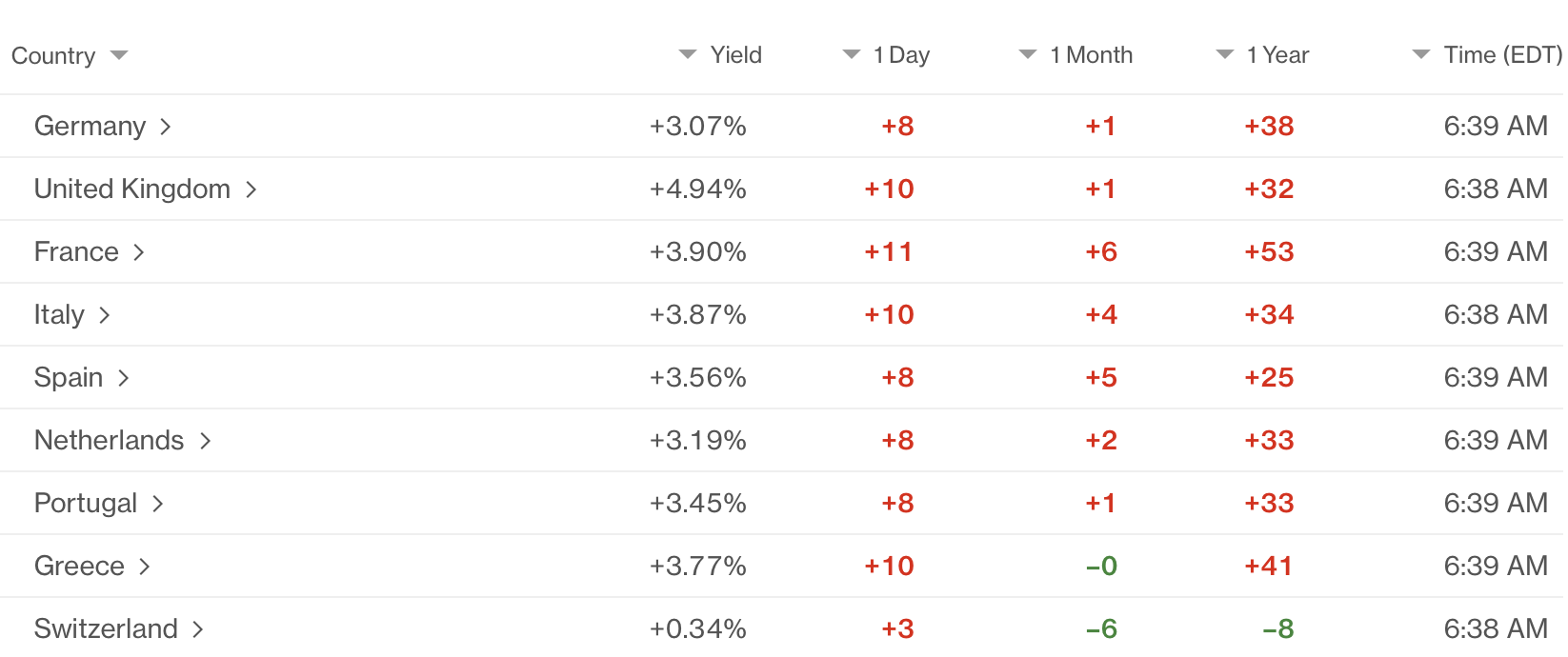
This morning, Treasury yields are higher by 2bps more but that is nothing compared to the European sovereign markets, which as you can see from the below Bloomberg.com screenshot are substantially higher this morning.

All those visions of inflation finally starting to decline were abruptly altered after the renewed activities in the Gulf.  Adding to the pressure on bonds is the concern over the increased spending promises from governments around the world which has seen traders increase short positions in the bond market to near record levels.

We cannot be surprised that gold (-1.2%), silver (-2.2%) and copper (-2.2%) are lower in response to the renewed fighting and rise in oil prices as that relationship has been very consistent.  We also cannot be surprised that the dollar is a bit firmer this morning, although not universally so.  For instance, JPY (-0.2%) is now pushing back to its recent lows (dollar highs) although the pace of movement remains quite modest.  As well ZAR (-0.6%) is also under pressure amid the decline in gold prices and rising oil prices (they are an importer of oil).  On the flip side, though, NOK (+0.4%) is benefitting from oil’s rally as is CAD (+0.25%) while KRW (+0.6%) seems to be benefitting from money flowing home after the recent equity rout there (covering margin calls?).  NZD (+0.4%) strengthened on the back of the RBNZ raising their base rate by 25bps as they continue to have some concern over inflation, but that only takes it back to 2.50%, hardly tight money.  As to the other main currencies, they have not really done that much, although lean slightly lower this morning.

On the data front, we see the EIA oil inventory data with draws still expected, as well as a 10-year Treasury auction, where it will be quite interesting to see if investors are keen on the extra yield now available.  And we get the FOMC Minutes, which despite the Iran situation, will still be keenly watched and read as the analyst community tries to get a better understanding of the way the Fed will be behaving going forward.  What is the new reaction function?  

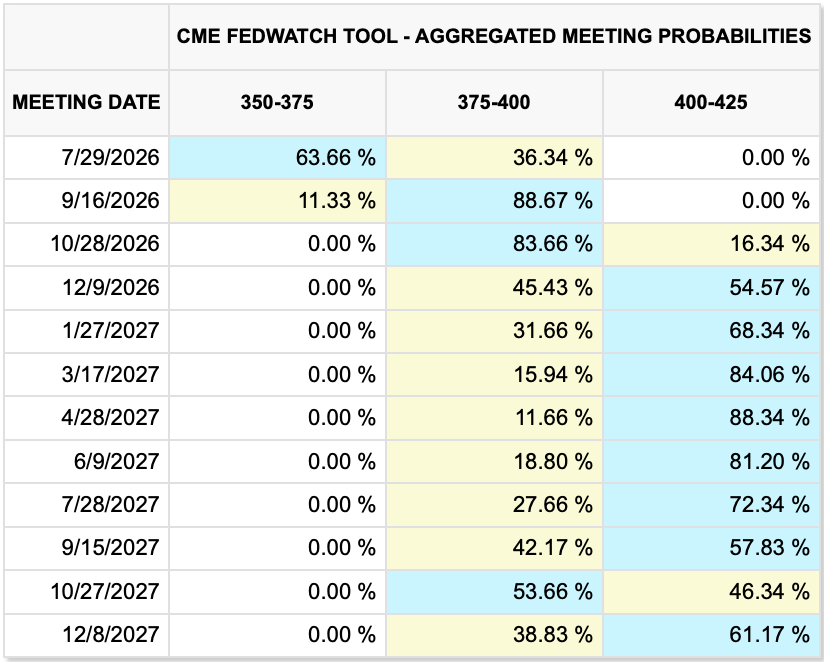
Looking at the Fed funds futures market, pricing for that first rate hike has moved to September from the previous October timeframe, and a second hike is back in the cards as well.

However, nothing has changed my view about the way things will evolve.  Certainly, the increased hostilities are a negative for markets, but I suspect that this will be a short-lived episode and things will calm down again sooner rather than later.  With that in mind, I have not changed my view about no rate hikes this year with a potential cut.  However, if this fighting does increase and the oil price creeps higher over the next weeks and months, I will be rethinking this stance.

Right now, we are back to being hostage to events on the other side of the world.  All we can do is watch and respond.  

Good luck

Adf

Subterfuge

The narrative right now is run
By hawks who think Warsh is the one
To raise short-term rates
Right out of the gates
And so, they’re long bucks by the ton

Thus, futures positions are huge
With no effort at subterfuge
But if they are wrong
About being long
The hawks will have all been the stooge

In an otherwise quiet session, this morning I am going to borrow from Ole Sloth Hansen, the futures maven at Saxo Bank.  He publishes a Substack that is well worth reading if you are actively involved in the markets as he breaks down futures positions and offers context.  This morning I am going to juxtapose those positions with my views, which are diametrically opposed to the way the market is currently positioned.

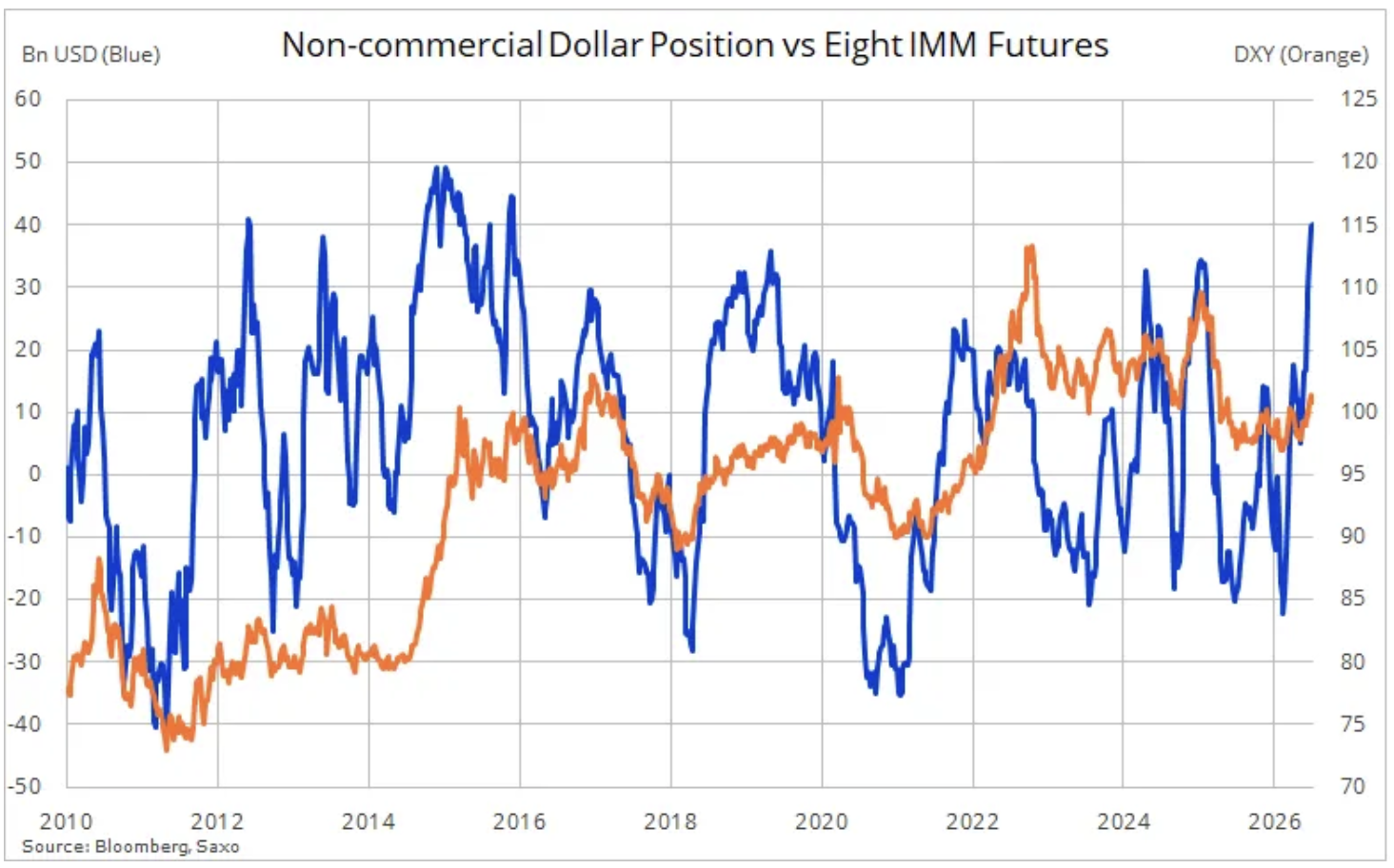
Starting with the FX market, he has created a wonderful chart showing that the net non-commercial long USD position against eight major currencies has reached 10-year highs.  Interestingly, the DXY is not anywhere near those highs, although it appears that is the growing expectation of many traders.

Arguably, this is based on the idea that Chairman Warsh is Paul Volcker redux and will be quite hawkish going forward.  Now, I cannot tell if this is the narrative because, absent forward guidance, narrative writers must now think on their own and are incapable of doing so, or if they truly believe that despite all the talk that rising oil prices were going to feed through to inflation readings, declining oil prices won’t have the same impact on the way down.

But it is not just the FX trading community that is on board with this story, so too is the short-term interest rate trading community.  While LIBOR has been forced out of existence, SOFR (Secured Overnight Funding Rate) is the new benchmark in interest rate markets and, naturally, there is an active futures market there as well.  As you can see from the below chart, also from Mr Hansen, the current positioning is strongly expecting higher short-term interest rates.

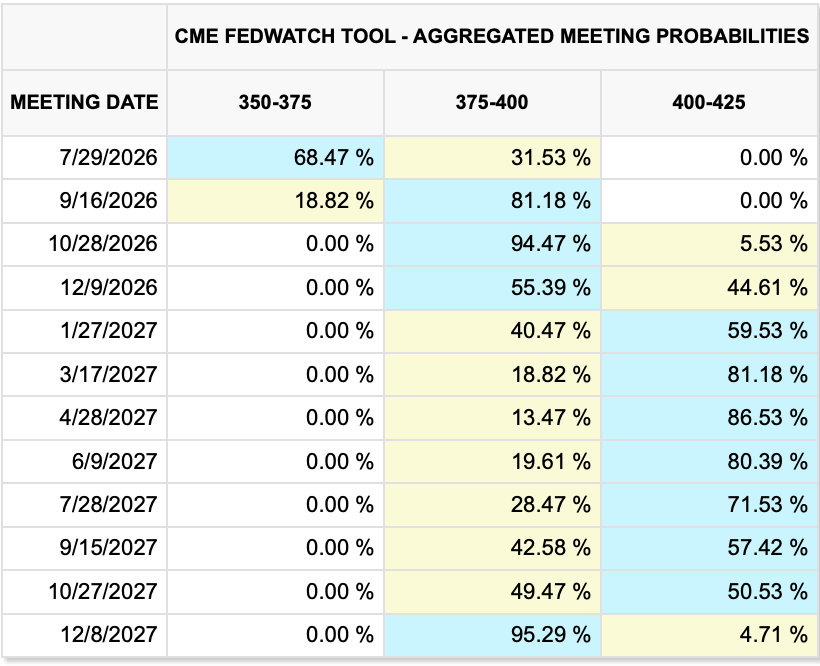
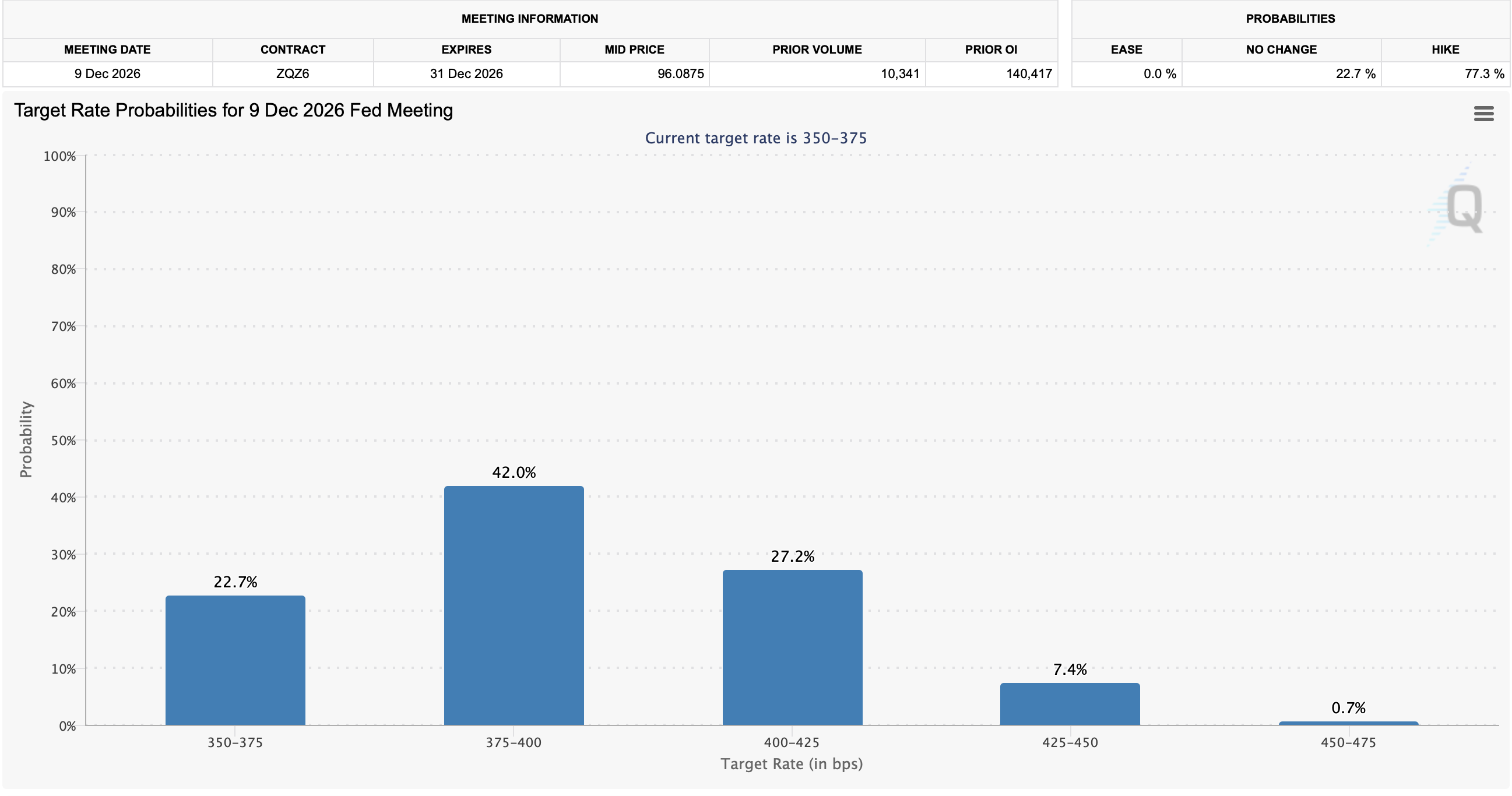
This is completely in accord with the Fed funds futures market where the market continues to price a 25% probability of a hike at the end of July and a virtual certainty of a hike by October.  By my calculations, as per the chart from cmegroup.com below, the market is pricing about 30bps of rate hikes by the December meeting.

Or course, by now you know that my view is the Fed will not be hiking rates at all, and as measured inflation slides back (just look around the world and at oil prices) the narrative will belatedly shift to the need willingness to reduce rates on Warsh’s part and all these market positions will adjust.  

My longer-term positive view of the dollar is based on the ongoing investment inflows into the US, for real investment, not merely equity market participation, and nothing has happened to change that view.  In fact, the announcement yesterday by Toyota that they will be expanding their San Antonio truck and SUV plant with a $3.6 billion investment is just the latest in a series of these announcements.  But that is not the carry trade driving things.  In fact, ironically, we could easily see US rates slide a bit as the dollar rallies on natural investment demand rather than financial demand.  As well, if I am correct, the Fed funds futures market is going to head back to pricing no rate hikes, perhaps as soon as next week after the CPI data is released.

I think the lesson is that the narrative writers need to bone up on their understanding of macroeconomics and international finance as the central bank policy driver may not be the future.  Certainly, if Mr Warsh has anything to say about it, and he does, that will likely be the case.

Which takes us to the overnight session. The most excitement overnight was for Belgium as they completely outplayed the USMNT in a 4-1 victory in Seattle.  But otherwise, the story that Iran fired two missiles at ships heading through Hormuz helped support oil prices, but as I type, they are higher by just 0.7% (~50¢/bbl) so not really very much.  The interesting discussion in the oil market this morning is the fact that Iranian oil, which is no longer sanctioned, cannot seem to find any buyers with some 58 million barrels in floating storage and no takers.  Meanwhile, despite ongoing buying by central banks around the world, gold (-0.5%) continues to struggle, although appears to be putting in a base and silver (-1.4%) is suffering as well.  

In the bond market, yields are creeping higher with both Treasuries and European sovereigns all higher by 2bps this morning with a similar move by JGBs overnight.  My take is this is less of an inflation concern than a supply concern.  Certainly, there is no indication that the US, Europe or Japan are about to slow down their fiscal stimulus, with Europe now further ramping up its defense spending as the US pressures NATO further.  To me, this is where the rubber will meet the road as if Warsh really does seek to reduce the Fed’s balance sheet, it is not clear where buyers are going to be found to replace them.  I suspect we will see more regulatory freedom for banks and insurance companies to hold Treasuries without capital penalties, but that is a big hole to fill.  

In the equity markets, yesterday’s US rally was followed by a reversal in Asia with Korea (-4.9%) leading the way lower on the back of weakness in SK Hynix stock despite stellar earnings.  But that dragged down the entire region (Japan -2.1%, China -1.0%, HK -0.5%, Taiwan -2.3%) and various declines everywhere else except Singapore (+1.4%) although I can find no specific catalyst for that outlier move.  In Europe, things are more mixed with Germany (-0.7%) under pressure although there is modest strength in the UK (+0.3%), France (+0.2%) and Spain (+0.1%).  All the talk here is about defense spending, although one would have thought that would help Germany the most.  As to US futures, at this hour (7:55), NASDAQ futures are following Asia lower, -1.3%, but the other indices are little changed.

Finally, the dollar is generally a bit stronger this morning, at least against its G10 counterparts, although JPY (+0.1%) is holding up.  But the dollar’s gains are minimal, about 0.1% to 0.2%, so it is difficult to get too excited.  In the EMG bloc KRW (+1.0%) is the clear leader after the country expanded trading hours in the currency markets, and there has been modest strength in BRL (+0.4%) and INR (+0.4%) although neither has seen any major policy changes.

On the data front, yesterday’s ISM Services data was right on the button at 54.0.  This morning we see the Trade Balance (exp -$78.5B) and that’s it.  The hawkish Fed story continues to be the most popular, and until we see some data that can undermine that story, I expect it will remain in place.  Tomorrow’s FOMC Minutes should be interesting as there was obviously a lot of back and forth at the meeting, but since we have already heard further from Mr Warsh, and it is way too early to hear back from the task forces, I suspect we are in for more quiet markets for now.

Good luck

Adf
Peace Was in Sight

The weekend saw missiles in flight
As both sides continued the fight
But just ere the open
The market put hope in
The idea that peace was in sight

So, here we are first thing today
And focus has moved far away
We’re back to AI
And pie in the sky
As stocks, once again, make more hay

Much has been made of the fact that President Trump is hyper aware of financial markets and seeks to ensure that whatever is happening in the world, it happens on weekends so that by the time markets reopen, the situation appears far less dire, hence less need to sell stocks.  This weekend is a perfect example as Friday after the close, it was announced that the US had responded to the several Iranian attacks on ships in the Strait of Hormuz last week with significant force.  The early punditry on Friday night and Saturday was that when markets reopened, the recent decline in oil prices would reverse as that has been predicated on a more lasting peace.  But then, last night shortly before futures markets opened, there were announcements that the US had finished its response and that the peace talks were back on under the guise of the 60-day ceasefire.  

I have to say, though, it almost appears as if Iran is in on the joke.  After all, if not, wouldn’t they try to force Trump’s hand during market hours?  Just asking.  Whatever the case, the situation as we wake up this morning is that oil (+0.8%) has edged back higher near $70/bbl but certainly doesn’t have the feel of breaking out higher.  Meanwhile, equity markets are generally positive and have been overnight while bond yields and the dollar are little changed.  in other words, there’s not much happening this morning.

In reality, it is not that surprising that things are quiet.  It is summer and summer markets are typically somewhat less active.  As well, away from the uncertainties of the Iran conflict, economic activity seems to be ticking along pretty well.  Arguably, the biggest story remains AI and both its potential impact on workers and the economy as well as the questions about its ability to generate sufficient revenue to repay the hundreds of billions of dollars being spent on it.  But those are longer-term stories, not day-to-day.

Which takes us to this morning.  Frankly, I don’t think there is an interesting market related them right now.  Instead, we have much time-biding until the next big thing.

Let’s start with commodities as oil continues its multi-month decline from the early April peak.  it remains very difficult to look at the below daily chart and think, damn, oil is about to run away higher.  At least for me.

Source: tradingeconomics.com

There are still numerous analysts who maintain that the drawdown of reserves is going to come back and haunt the market, driving prices much higher as inventories fall and tank bottoms are reached.  And I am sure they earnestly believe those outcomes are ordained.  But the relative wisdom of market prices disagrees.

Remember back when this all started, there was another point that was made by these same analysts, that fertilizer shortages would be manifest and food prices would rise much higher.  The story was that the closing of the Strait would reduce the ability of Qatar to produce and ship LNG and that was a critical input into the making of Urea.  Let me show you the price chart for Urea.

Source: tradingeconomics.com

While it certainly rose initially, apparently there is sufficient urea around to continue with agriculture as we know it.  Again, much of the initial fear seems to have been misplaced.  I do not know if that is because analysts didn’t really understand the way these markets operated, or because they have models that they have used for years, and those models are no longer fit for purpose.  My observation is that many analysts try to determine the price trends by looking at their understanding of both supply and demand of a given commodity.  But I might argue that the price is what defines both supply and demand, and that at given prices, those two curves adjust to make the system work.  Think of it as price is the independent variable, not supply/demand.

Moving on to the metals markets, they remain under pressure this morning with both gold (-1.3%) and silver (-1.9%) unable to find support, especially the latter.  Copper (-0.3%) is holding up better and I continue to believe that all three will fare well over time, but not right now.

In the equity markets, Friday’s nondescript US markets were followed by more strength (Tokyo +0.15%, HK +1.6%, China +1.2%, Australia +0.7%, Taiwan +1.0%) than weakness (Korea -0.2%, India -0.5%, Indonesia -1.3%) in Asia.  The big news overnight was the South Korean government supporting a massive semiconductor investment by the two big Korean firms, SK Hynix and Samsung, to build four more fabs.  In Europe, though, things are less positive with Germany’s unchanged performance leading the way although the declines elsewhere (UK -0.2%, France -0.3%, Spain -0.4%) are hardly devastating.  We ought not be surprised that US futures are higher this morning as I type (7:25) led by the NASDAQ (+0.9%) as the AI/semiconductor theme continues.

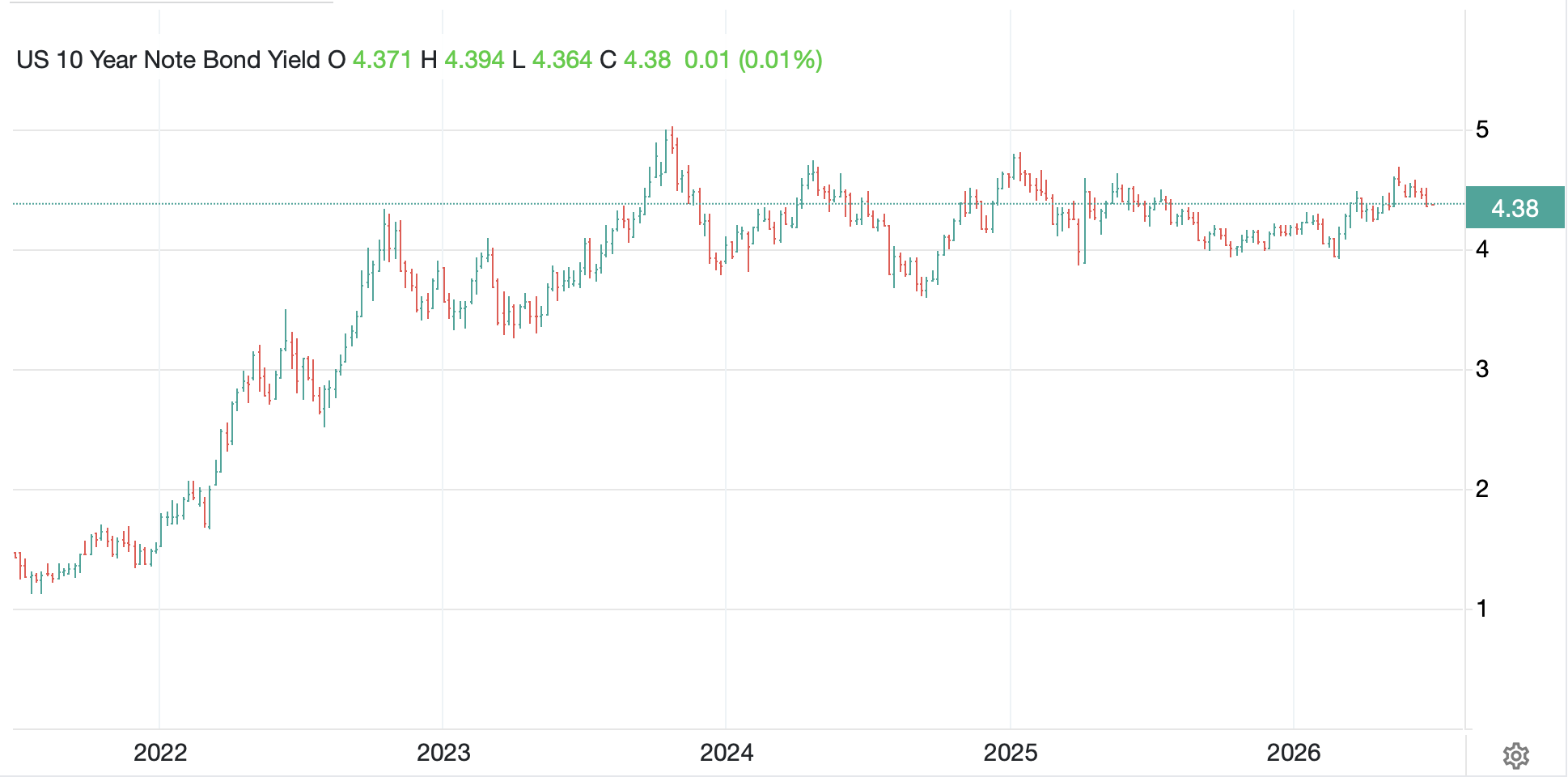
Bond markets continue to do very little with yields essentially unchanged on the day in Europe or the US.  10-year Treasury yields are currently 4.37%, well off the highs seem a month ago near 4.70% when there was much discussion about a breakout higher.  But look at the below longer-term chart of the 10-year Treasury yield and tell me that anything substantive has happened in the past 3+ years.  Since yields rise alongside the 2022 inflation surge, we have seen very little net movement.

Source: tradingeconomics.com

Finally, the dollar is a bit softer this morning but is clearly not the focus today.  I continue to read analyses about Chairman Warsh and what he is going to do and why he will not be able to achieve his goals.  The implication is that either he will need to be ultra hawkish, raise rates quickly and the dollar will soar, or he will wind up with QE 5 or 6 or whatever number we are on, and the dollar will collapse.  My personal view is neither of those scenarios will play out.  As I wrote in the wake of his first meeting, I expect inflation data will ease along with the recent decline in energy prices, and he will be able to do nothing without consequences as he works to change the way things work there.  In the meantime, the dollar will remain supported by real investment flows.

On the data front, even though it is a holiday-shortened week with markets closed Friday for July 4th, we get a lot of data.

TuesdayCase-Shiller Home Prices0.8%
 Chicago PMI60.0
 JOLTS Job Openings7.28M
 Consumer Confidence94.2
WednesdayADP Employment113K
 ISM Manufacturing54.0
 ISM Prices Paid79.0
ThursdayNonfarm Payrolls110K
 Private Payrolls115K
 Manufacturing Payrolls3K
 Unemployment Rate4.3%
 Average Hourly Earnings0.3% (3.5% Y/Y)
 Average Weekly Hours34.3
 Participation Rate61.7%
 Initial Claims220K
 Continuing Claims1825K
 Factory Orders-2.1%
 -ex Transport0.4%

Source: tradingeconomics.com

Obviously, all eyes will be on the payroll data on Thursday.  But Chairman Warsh will be at Europe’s version of Jackson Hole, in Sintra Portugal and speaking at 9am Wednesday morning.  It will certainly be interesting to hear what he has to say there.

It doesn’t seem like there is much about which to get excited today, or tomorrow frankly.  So, Warsh and then NFP will be this week’s story absent another major flareup in the gulf.

Good luck

Adf
What’s Next To Be Feared?

For Holmes, when the dog didn’t bark
He recognized that was the spark
To solving the case
And so, we must brace
For narrative changes quite stark

This morning, no headline appeared
Regarding Iran, which is weird
Have markets moved past
This problem, at last?
And if so, what’s next to be feared?

So, perusing the WSJ on-line this morning, the notable absence was any story on Iran and the current situation regarding the ongoing peace talks.  There was a throwaway article about Trump and what he has said about Iran, but nothing of substance.  Part of me is amazed that this is the case as the conflict would still seem to be the most important issue in the markets given the impact on oil prices and inflation, as well as its general geopolitical impact.  But part of me cannot be surprised at all.  It’s not just traders who have the attention span of a fruit fly, apparently so does the general public.

I made the point several weeks ago that this conflict would fade into history quickly when it was ending based on the fact that the Venezuela incursion, back in January, fell from headlines within about three days.  Given the generic MO for most publications of, if it bleeds, it leads, the fact that bombs are no longer falling, and peace talks are ongoing is no longer that interesting.  Add to that the generic TDS of most of the media, where they loved to play up rising oil prices as a major policy failure for Trump, now that those prices have been falling for the past 11 weeks and have slipped >30% in that period, and quite frankly, have further to fall, most editors have moved on.  If they cannot tar Trump with a policy failure, they would rather not discuss the subject at all.

Source: tradingeconomics.com

So, here we are this morning with the market now turning its focus to an ostensibly hawkish Fed despite the recent analysis by the BLS indicating that more than 60% of the recent uptick in inflation was driven by the rise in energy costs.  So, with energy costs reversing course dramatically, what does that say about their impact on inflation and exactly how hawkish does the Fed need to be in that case.

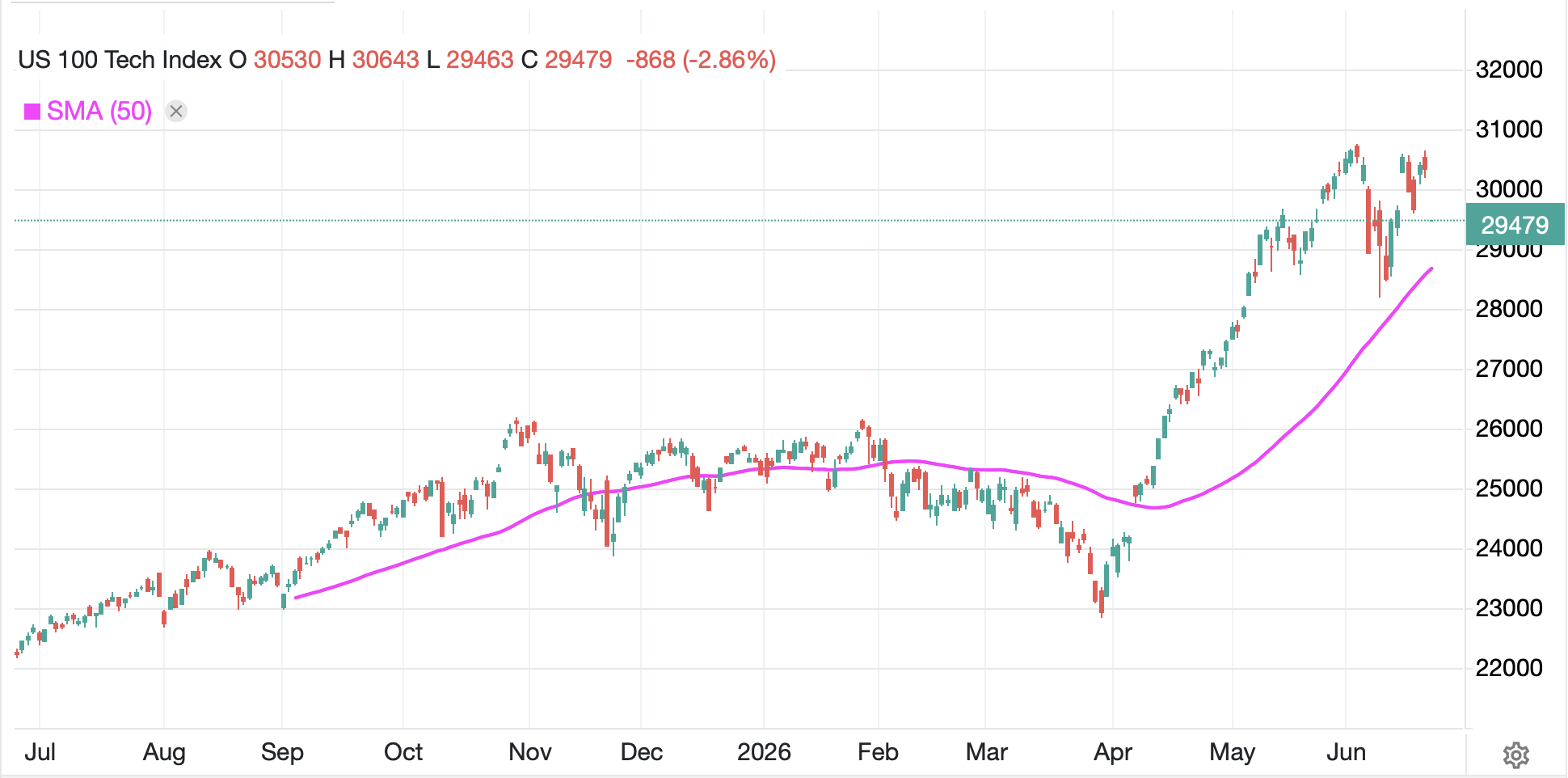
Right now, equity markets are under some pressure as some of the euphoria associated with the rising tech sector’s stock prices and the ongoing AI mania, is wearing a little thin.  And let’s face it, things certainly seemed a bit bubblicious.  But the combination of ongoing fiscal support from the OBBB and tax cuts and declining energy prices is likely to help support things going forward.  No matter the timeline you observe, we have seen a remarkable rally in tech stocks, as evidenced by the NASDAQ’s chart below.  A correction to the 50-day moving average would hardly be surprising, nor would it be damaging to the overall market structure, I think, although it would almost certainly result in ‘end of days’ headlines!

Source: tradingeconomics.com

So, while futures this morning are lower across the board (NASDAQ -2.9%, SPX -1.4%, DJIA -0.6%) as of 6:40am, and we could easily see some weakness for a few more days/weeks as positions shake out, I am not in the camp of things are about to collapse.

Speaking of equity markets, the overnight session was filled with red ink led by the KOSPI (-10.0%) in South Korea, although there was weakness pretty much everywhere (Nikkei -3.6%, CSI 300 -2.8%, Hang Seng -1.8%) with India and Taiwan also slipping more than -1.0% although Australia, NZ and Singapore had more muted declines.  Tech was clearly under pressure.  Of course, we cannot be surprised that European shares are also lower in a generally weak risk scenario, but given the lack of tech companies headquartered there, the declines have been far less significant (DAX -1.0%, CAC -0.6%, IBEX -0.2%, FTSE 100 -0.2%) although the Netherlands (-1.3%) home to ASML, the only tech name of note on the continent, is underperforming as well.

Meanwhile, the bond market has peeked at the oil market and decided, perhaps inflation is not a chronic condition, or at least not as bad as previously feared.  Yields are lower across the board with Treasuries (-3bps) leading the way while European sovereigns are all lower by between -3bps and -4bps.  Overnight, though, JGB yields could make no headway lower as the yen continues to be under enormous pressure.

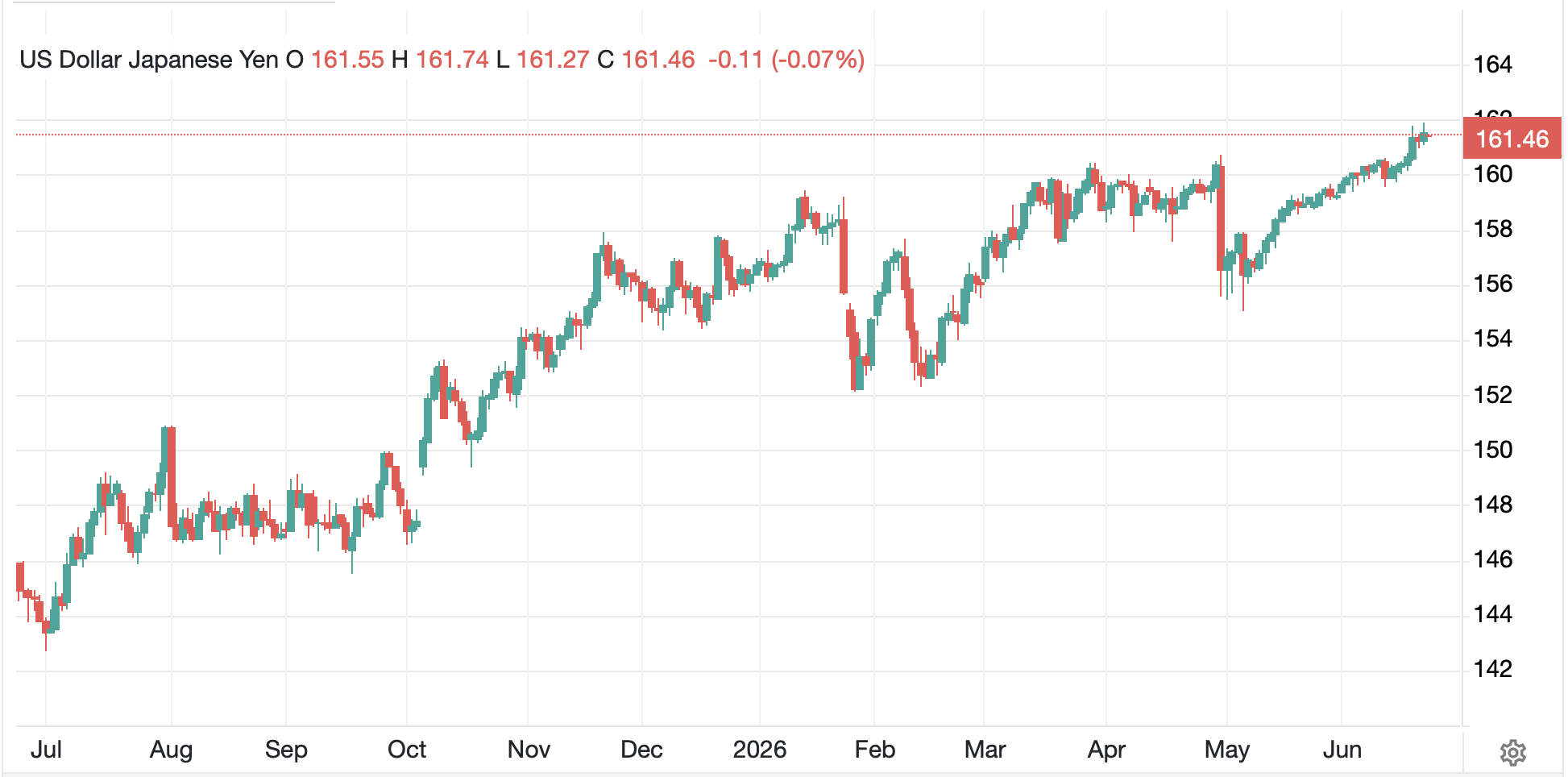
Speaking of the yen, it continues to slowly weaken despite prominent statements by Japanese FinMin Katayama about her discussions with Treasury Secretary Bessent and their agreement to have the US coordinate with Japan in the event it is decided something needs to be done in the markets.  But so far, no signs of actual intervention.  A look at the chart below shows a very slow and steady climb in the dollar, and frankly, I do not see what will change this trajectory.

Source: tradingeconomics.com

While interest rates aren’t the only driver, they still have a key impact, and they are the one thing that can be changed quickly.  In fact, the best hope for the yen, in my view, is the fact that at some point soon, the market is going to understand the Fed is not about to raise rates again, and the next move will likely be lower, albeit not until later in the year.  but that change in tone will change a lot of opinions on how the yen should behave, and a move back toward 155 amid modest overall dollar weakness could easily be seen.  But right now, everybody is of the opinion that the FOMC is going to hike this year, and Japan cannot afford to be aggressive in that context, hence the yen’s weakness.

Here is a forecast I do not make lightly, Fed funds will finish the year lower than they are now, probably 3.25%-3.50%.  And the current Fed funds futures market has bottomed (rates peaked) as per the CME table below.

As to the rest of the FX world, the dollar reigns supreme this morning as the euro (-0.3%) is below 1.1400 this morning, its weakest in more than a year as the Flash PMI data did it no favors, but the new hawkish Fed, higher US rates strong dollar narrative has been the driver.  We have seen the same type of movement elsewhere, except where the dollar has moved further, with AUD (-0.8%) the worst performer in the G10 although HUF (-1.0%) is actually the biggest laggard.  However, given the overall decline in commodity prices, those currencies that benefit from rising commodities are also under pressure (NOK (-0.7%, ZAR -0.5%, SEK -0.8%, MXN -0.7%) and we already discussed AUD.

Lastly, the metals markets are also under serious pressure with gold (-1.6%), silver (-4.5%) and copper (-3.3%) all tumbling on the same new view of higher rates and a stronger dollar.  The thing about the commodities story is the fundamentals still seem positive to my eyes, and this seems like the last of the fluff getting taken out.

On the data front, Thursday’s PCE data is the big day and here’s what we have overall:

TodayFlash Manufacturing PMI54.8
 Flash Services PMI51.0
WednesdayNew Home Sales640K
ThursdayInitial Claims225K
 Continuing Claims1800K
 Q1 GDP Final1.6%
 Personal Income0.4%
 Personal Spending0.6%
 PCE0.5% (4.0% Y/Y)
 Core PCE0.3% (3.4% Y/Y)
 Durable Goods-4.3%
 -ex Transport0.7%
FridayMichigan Sentiment50.3

Source: tradingeconomics.com

In addition to the data, we start to hear from some of the FOMC members, although I am confident Chairman Warsh won’t be out and about.  Some analysts claim that Warsh’s view of less communication is going to weaken him as others will get to make their point and he won’t be able to counter it.  But I think that Warsh has a plan, and if we continue to see oil prices decline, which seems the likely outcome, then all the inflation fears are going to dissipate and by the time the next meeting rolls around, it will be far harder to make the case that tighter policy is necessary.  Historically, hiking into an energy price shock has been a central banking mistake, and I think Warsh knows this and is keen not to repeat it.

Net, for now, everybody loves the dollar and hates risk on this new hawkish Fed narrative.  But going forward, I like the dollar on the back of a better economy and better investments and expect that the hawkish Fed narrative is going to fade away.  But I’m just an FX poet.

Good luck

Adf
No Plan of Action

In England and Scotland and Wales
Kier Starmer has gone off the rails
A buffoon-like clown
He’s set to step down
As from the Brits eyes, fall their scales

But will his replacement gain traction
Or will Burnham be a distraction
From solving their woes
As Lord only knows
They’ve many, and no plan of action

It has been an eventful weekend for me so let me start by telling you that Marvel was Best of Breed in back-to-back shows last Thursday.  We are very proud and happy.

Second, Friday was a more difficult day for me as I wound up having emergency surgery, although everything is fine.  But I am still in recovery mode.  Sometimes, aging is harder than other times.

With that in mind, we can talk about the three things that matter, I believe, the change of PM in the UK, the on-again-off-again peace talks in Iran and the fact that the yen is now weaker than the level that got the MOF to intervene back in April.

Starting with the UK, PM Starmer has promised to step down now that his most likely successor, Andy Burnham, the former mayor of Manchester, is in Parliament and will now become PM sometime in the next several months depending on the actual timing of certain technicalities.  He is described as left-wing, even by the press, which tells you that he must be quite far to the left.  But the UK has serious problems with respect to their economy, slowing growth and high inflation, and the social structure due to massive immigration, both legal and illegal.  As well, the report that just dropped about the Pakistani grooming gangs that were systematically raping young English girls is so damning, it is hard to believe, yet it was all covered up.  The government doesn’t have to go to the national polls until 2029, so Burnham will have time to try to implement policies, but the nation has many troubles ahead.

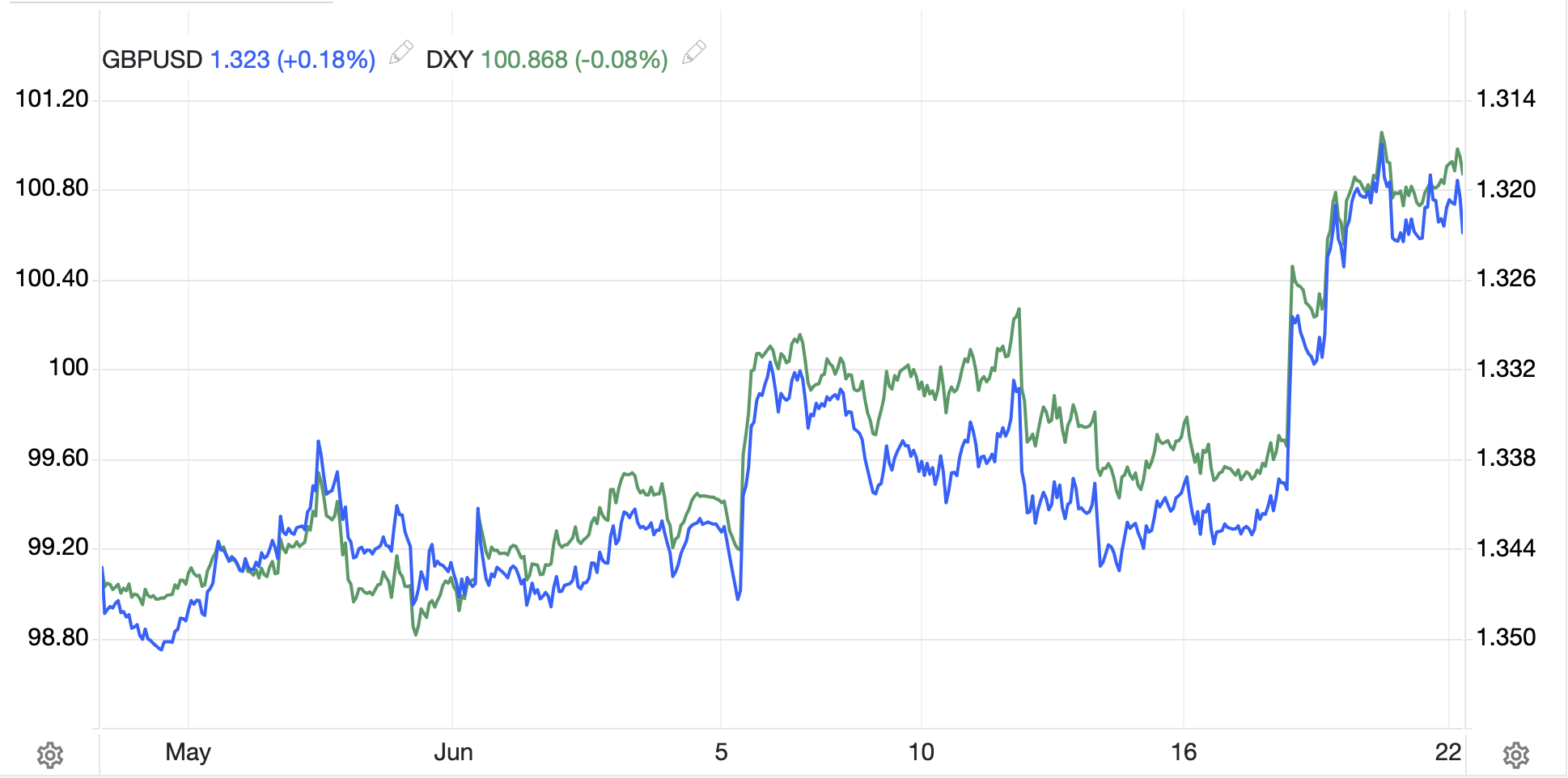
As to UK markets, both the pound and FTSE 100 have been underperformers relative to their peer European counterparts over the past month or so as this process has heated up, but in truth, not by very much.  Much of the pound’s weakness can be attributed to dollar strength (see chart below), where the dollar has broken through key technical resistance in the DXY, while the FTSE is just drifting given the lack of positive news.  Certainly, this story didn’t help either one, as both are unchanged on the day.

Source: tradingeconomics.com

In Switzerland, talks are ongoing
As Trump and the Mullahs try showing
That they are the ones
Who have the most guns
But progress seems like it is growing

It cannot be a great surprise that there is a lot of bluster from both sides of this negotiation between the US and Iran as President Trump tries to end the conflict in Iran.  After all, both sides are famous for their bluster!  And you can read whatever you like from whatever source you want to get your spin, but I’m not smart enough to understand the intricacies of international diplomacy.  However, what I do understand is market price movement, and here we are this morning, with oil prices falling further, down -2.5%, and back to levels last seen in early March, right at the beginning of this conflict.

source tradingeconomics.com

Thus far, every story about tank bottoms being reached and an insufficient amount of oil for the pipeline infrastructure to be effective has proven not to be true.  There is still a large group of analysts who are calling for end of days, but the market signals just don’t agree.  I suspect that the only ones who really want to see oil prices remain high are the oil companies who sell the stuff, but for the rest of the world, lower is clearly better.  Obviously, anything can still happen, but by all appearances, it seems that more and more traffic is flowing through the Strait and we are going to see lower prices going forward.

In the end, from my vantage point thousands of miles away from the action, it appears that Iran was greatly weakened by this conflict on a military basis, but more importantly, every one of its Gulf neighbors realized that they needed alternative routes to get their oil to market, and we are going to see a lot more pipeline infrastructure built to do just that, so as time goes by, this choke point is going to lose its effectiveness.  And that is probably a bigger weakness for Iran, as that was something they held over the world, but now it seems it is not as impressive a strength as it had been made out to be in the past.

It’s no waterfall
But the yen keeps dripping down
Whence the BOJ?

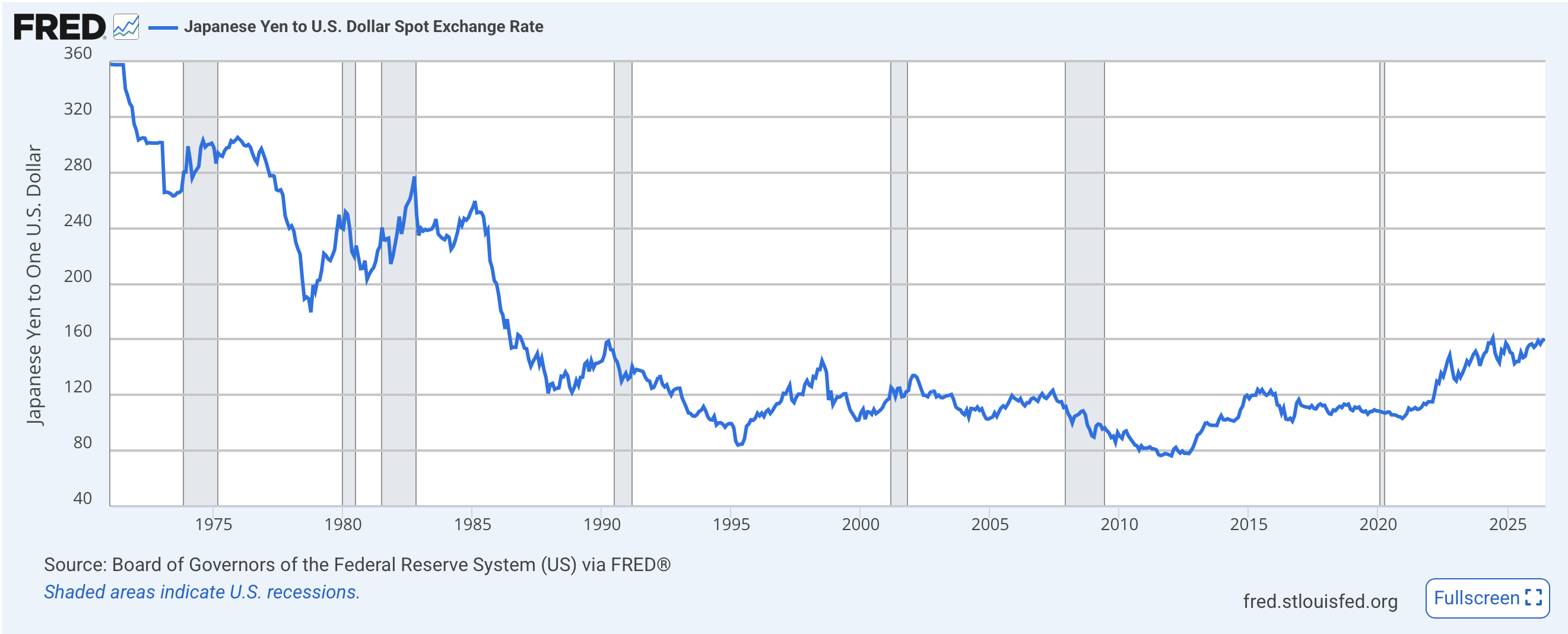
Finally, the yen (-0.3%) is having a tough time right now as it has traded back to its lowest level vs. the dollar since 1986!  That’s right folks, it has been forty years since USDJPY traded above 162.00, and we are pushing that level right now as you can see in the chart below.

The last two times the yen reached these levels, back in April and in July 2024, the BOJ intervened in the markets aggressively.  But so far, crickets.  I think the issue for them is the dollar continues to be quite strong, especially as traders are now pricing in rate hikes by the Fed, and so intervening is going to be a waste of money.  And it’s true, if the dollar is rallying across the board, there is very little Ueda-san can do.  As I have repeatedly said, the only way for the yen to break this slide is for serious fiscal and monetary policy changes, and frankly, that doesn’t look like it is in the cards right now.  While I know there are many who think the dollar is heading to its graveyard, it apparently still has a bit of life left in it.

Which takes us to the overnight activity.  Equity markets have been mixed as all this new information gets digested.  In Asia, Tokyo (+1.6%) and China (+2.4%) both had strong sessions although HK (-0.7%) couldn’t keep up.  Elsewhere in the region, there was slightly more green than red led by Taiwan (+2.75%) while the Philippines (-1.65%) was the biggest laggard.  Uncertainty continues to reign although as the Iran situation slowly resolves, I expect to see things brighten here as Asia was the region hurt most by the entire conflict.

In Europe it is also a mixed picture with the UK (+0.3%) now rallying on the news that Starmer is leaving and Spain (+0.4%) has managed a gain as well while both Germany (-0.3%) and France (-0.7%) are lagging this morning, although there is no news of note in either place.  US futures are basically unchanged at this hour (7:15).

In the bond market, Treasury yields (+3bps) have edged higher this morning, I guess on this new belief in higher Fed funds, although I would have thought the bond market would appreciate a hawkish Fed fighting inflation.  European sovereign yields, though, are lower across the board down about -2bps everywhere.  Bonds remain less interesting now that they are back in their ranges and not breaking out as so many though was occurring back in May as per the below chart.

Source: tradingeconomics.com

With oil prices lower, it should be no surprise that gold (+1.35%) and silver (+2.4%) are both higher this morning.  Many have made the case that with the dollar strengthening, the precious metals complex will remain under pressure, and it is a valid case, but for some reason, I have a feeling it will not be as dramatic as they believe.

Finally, the dollar is firmer across the board this morning, albeit not by very much.  Wednesday and Thursday of last week were the big moving days in the wake of the FOMC meeting and the new hawkish read.  Since then, not much has happened, just a slow drift higher across the board.  FWIW, I don’t think that Chairman Warsh is going to be that hawkish, but I look forward to the structural changes that he makes.  However, for now, that is the market assessment.

On the data front, there is nothing today and really nothing of import until Thursday so I will go through it tomorrow.

That’s how things are shaping up, with the dollar gaining, oil sliding and stocks uncertain what to do next.  I am a fan of uncertainty as it will reduce systemic risk, and that is something we really need to see.

Good luck

Adf
Leverage Doomsday

Though oil continues to be
The lens through which most of us see
The current events
In dollars and cents
There’s more going on causing glee

For instance, as stock markets rise
It cannot be such a surprise
The narrative writers
Are pulling all-nighters
Adjusting their views to seem wise

But naysayers need to say nay
And here’s what they’re pushing today
The Bank of Japan
And their current plan
Will lead to a leverage doomsday

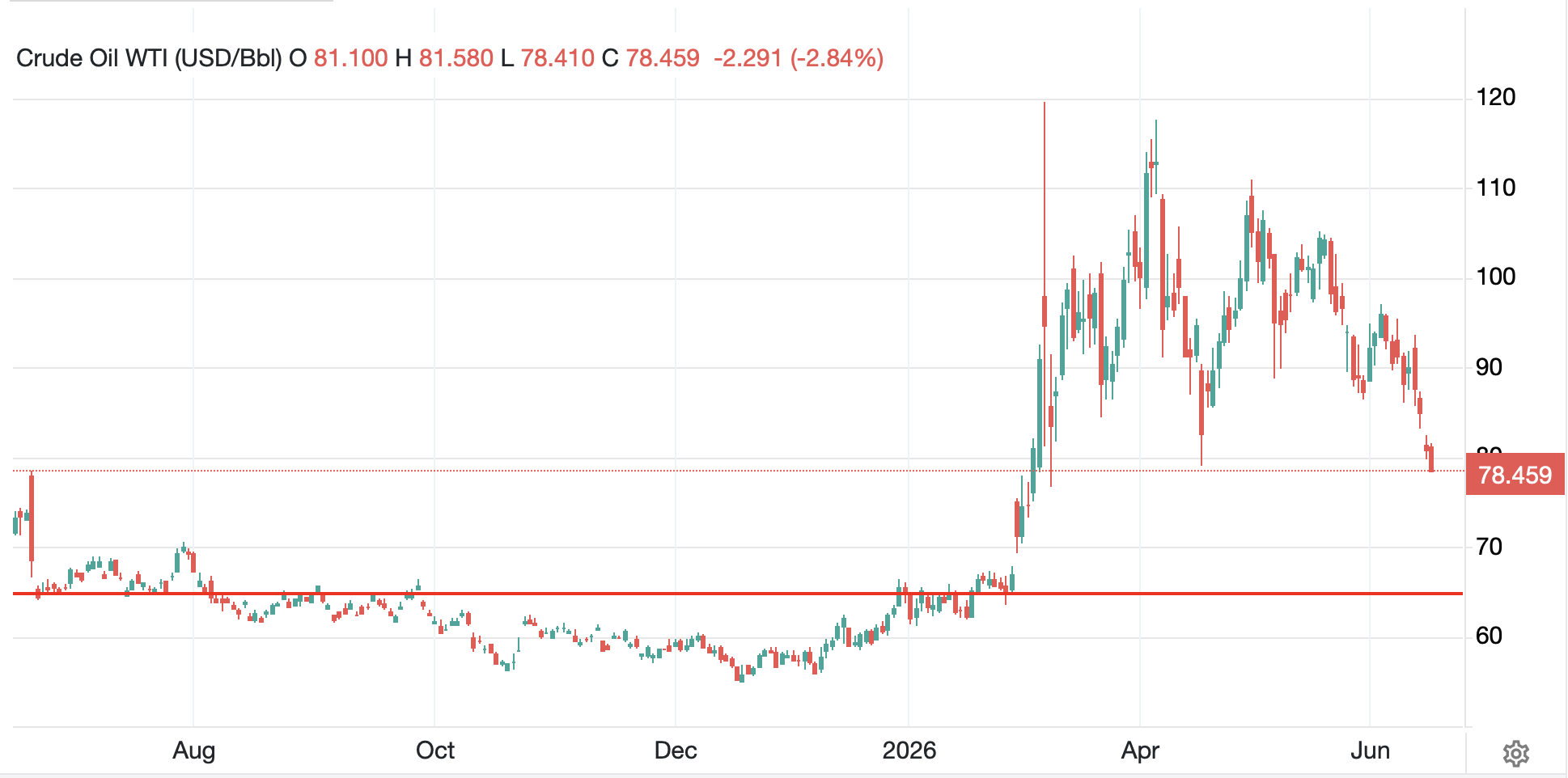
We might as well start off with oil this morning since it is still the top story in markets, and still the major catalyst.  It is lower again this morning, down a further -2.8%, and despite many questions as to whether the deal will hold, both sides appear to be moving toward a signing on Friday.  The below chart from tradingeconomics.com shows WTI prices for the last year.  As you can see, the current price is the lowest since March 10th, which was a reaction low after the spike high on March 9th when it touched its highs for the entire situation.

I eyeballed a line at about $65.00/bbl as an estimate of what prices were like prior to the Iran conflict.  Based on that, the current front month futures price remains about 20% above the pre-war price, certainly high, but it doesn’t seem crippling.  I believe it is very clear that the analysts who were calling for $150/bbl or $200/bbl are now working hard to determine what they got wrong.  Doomberg wrote an interesting piece this morning (it is paywalled, but their stuff is fantastic) describing two likely reasons for the fact that oil prices never rose that high.  First, the original estimates of how much oil was stuck behind the Strait were overstated as all the players there found ways to export some, whether through tankers going dark or via rail or truck or pipeline.  But the more interesting observation was that China was able to reduce its imports by between 3mm and 4mm bpd and things were just fine.  China has altered their energy mix such that oil, while still important, can be substituted out as necessary.  That is a very interesting outcome with respect to one of China’s greatest perceived weaknesses, its lack of natural energy capacity.  If they don’t need as much oil to run their economy (which by the way based on overnight data is struggling) then they have less geopolitical weakness.  

Enough on oil, but while I’m here, it is not surprising that as oil slides, metals prices rise so gold (+0.9%) and silver (+0.8%) are continuing to benefit as is copper (+0.1%) although the latter not so much today.

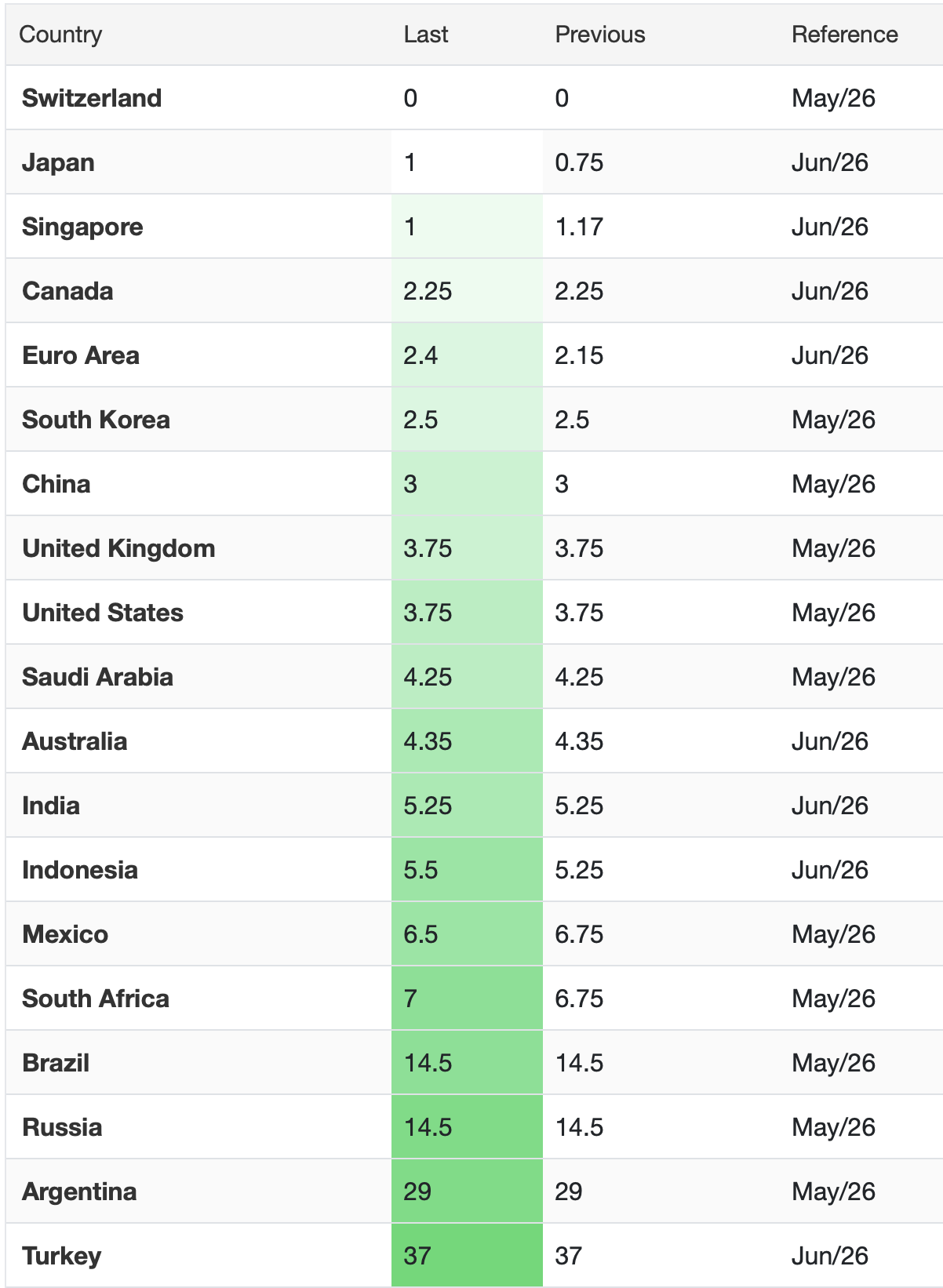
Turning to the other story that has tongues wagging, the BOJ raised their base rate to 1.00% last night as had been universally expected by markets.  Now, the interesting thing here is that there is a group of analysts who believe that this will lead to net position liquidation by leveraged fund managers (i.e. hedge funds) as their funding costs will have risen.  I disagree, and so far, markets are on my side.  This is evident by the fact that equity markets continue to perform well, and USDJPY has shown no inkling of reversing its multi-year trend of rising.  Below is a table of the base interest rates of the G20 nations.  While Switzerland does have a lower rate, and Singapore is the same, if you are thinking about borrowing in a currency to lever up positions, Japan, given the yen’s depth and liquidity, remains the currency of choice by a long shot.

Source: tradingeconomics.com

Ask yourself if your borrowing costs rose 0.25% but you were still earning a net 13.5% return on your BRL deposits, would you flee the trade?  And if you have been buying equities, you are even less likely to get out.  Japan’s problem is not specifically that their base rate is low, it is that they currently are fighting a terrible demographic position of a shrinking population and they have a massive debt/GDP ratio.  They cannot afford to raise rates enough to have a meaningful impact on the yen without bankrupting the country and decimating the yen.  It is not clear to me how they get out of their current situation, but despite concerns elsewhere in the world about the yen’s weakness being a competitive advantage, I think it has further to go.  Basically, there needs to be another Plaza Accord type agreement to change things, and that doesn’t seem likely right now.  After all, in Evian, it doesn’t sound like things are going smoothly.

So, how have markets behaved overnight?  Well, risk is still in vogue.  Following yesterday’s strong US performance, where the DJIA made another all-time high, there were far more gainers (Korea, India, Taiwan, Malaysia, New Zealand, Indonesia) than laggards (HK -1.4%, China -0.2%) while Tokyo was little changed.  As I mentioned above, the Chinese data was pretty lousy as per the below table:

So, the housing market continues to suffer, and the domestic economy along with it, although the export economy continues to grow.

In Europe, the decline in oil prices is clearly helping as all major indices are higher between 0.4% and 0.75%.  As to US futures, at this hour (7:20), they are pointing slightly higher, about 0.15% across the board.

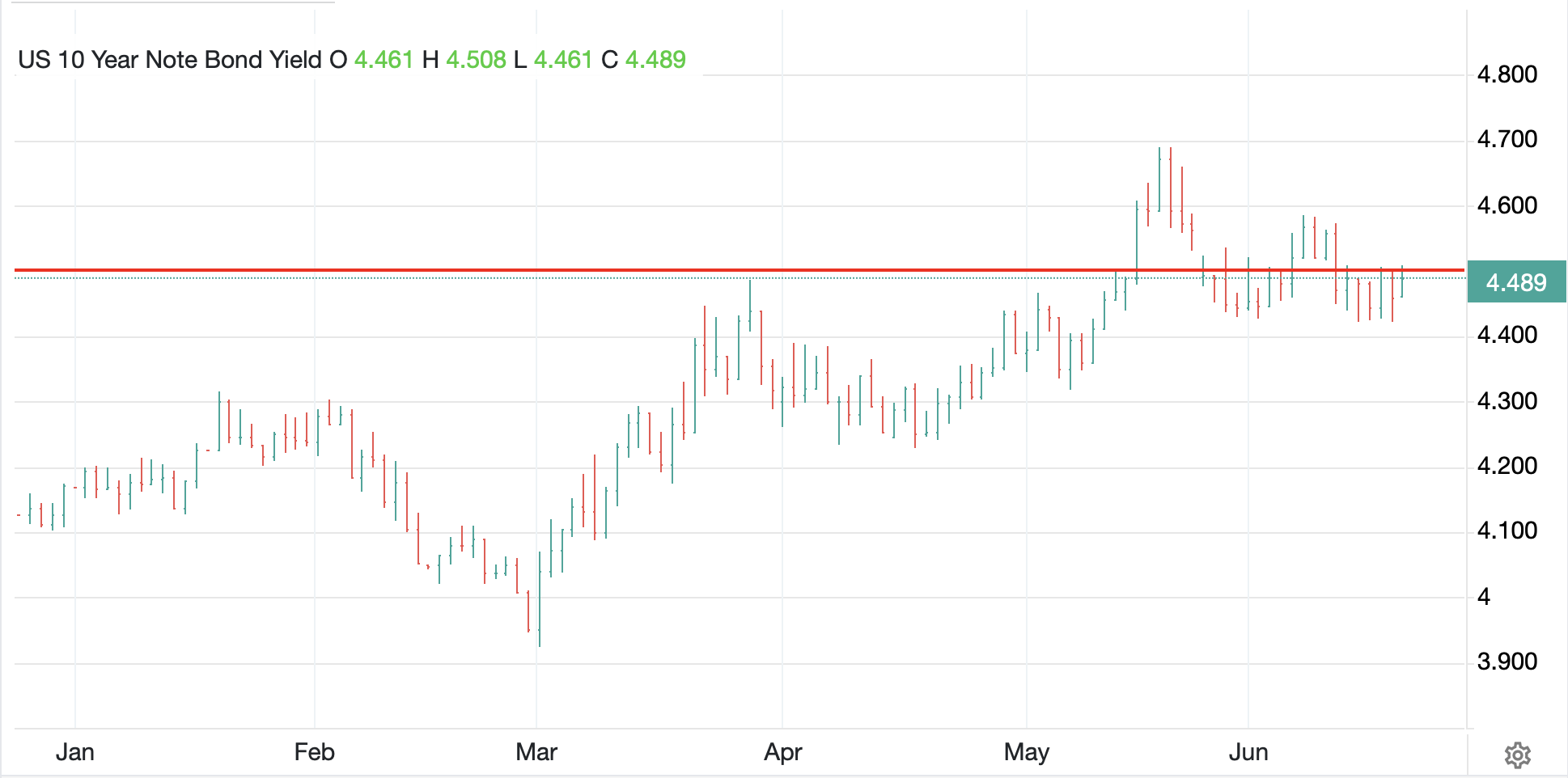
In the bond market, yields continue to decline with Treasuries (-3bps) back below 4.5% which had been seen as a real problem just a few weeks ago.  European sovereigns are also lower by between -3bps and -4bps, duly following both Treasury yields and oil prices.  The outlier here is JGB yields (+6bps) which responded to the rate hike by rising, perhaps an indication that investors don’t believe the BOJ is doing enough.  However, my wager would be the BOJ is done.

Finally, the dollar is a touch softer, as one would expect given the movements in other markets, but there is very little excitement in the FX markets.  Using the DXY (-0.05%) as proxy, you can see things are little changed.  The biggest movers are BRL (+0.4%) and KRW (+0.4%) both of which are seeing capital inflows supporting the currency.  But otherwise, +/-0.2% defines the session in both G10 and EMG currencies.  Note that despite the BOJ rate hike, USDJPY sits at 160.32 showing no sign of heading lower, even in an environment where the dollar is modestly softer.

On the data front, this morning brings Housing Starts (exp 1.43M) and Building Permits (1.42M) and that’s really it.  With the FOMC tomorrow, and Iran ostensibly solved, Mr Warsh and his press conference will get a great deal of focus.  Until then, I don’t see any reason for recent trends to change absent a complete collapse of the Iran deal, which seems unlikely at this point.

Good luck

Adf
Many Malign

Said Trump, come next Friday I’ll sign
A deal, and though many malign
The war with Iran
It’s all gone to plan
As they’ve lost their arms and their spine

Thus, oil has fallen in price
While gold and stocks rose in a trice
With bears in retreat
For Trump’s next great feat
Some midterm success would be nice

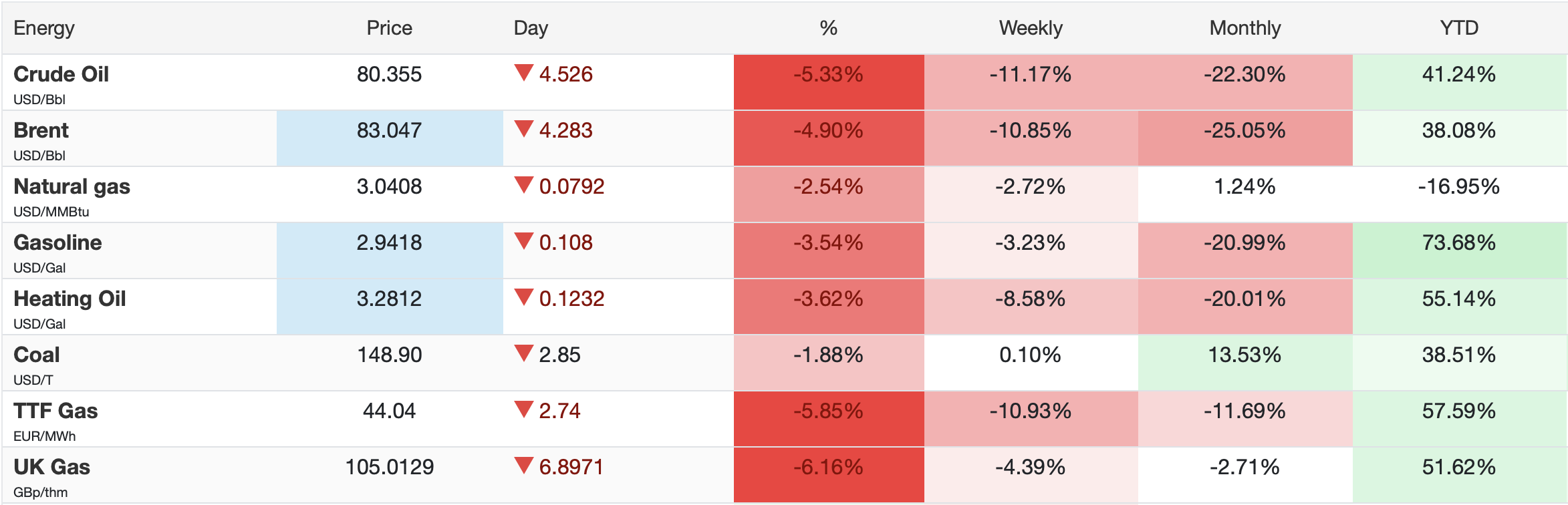
This is a look at the major energy futures markets according to tradingeconomics.com at 5:15 this morning

Sharp declines on the session in the wake of the announcement, confirmed by the Iranians, that a deal had been struck and that the Strait of Hormuz would be reopening by Friday after the mines are cleared.  And while there has been much discussion over the past week, as you can see in the far-right column, energy prices are still largely higher year-to-date with only NatGas the exception.

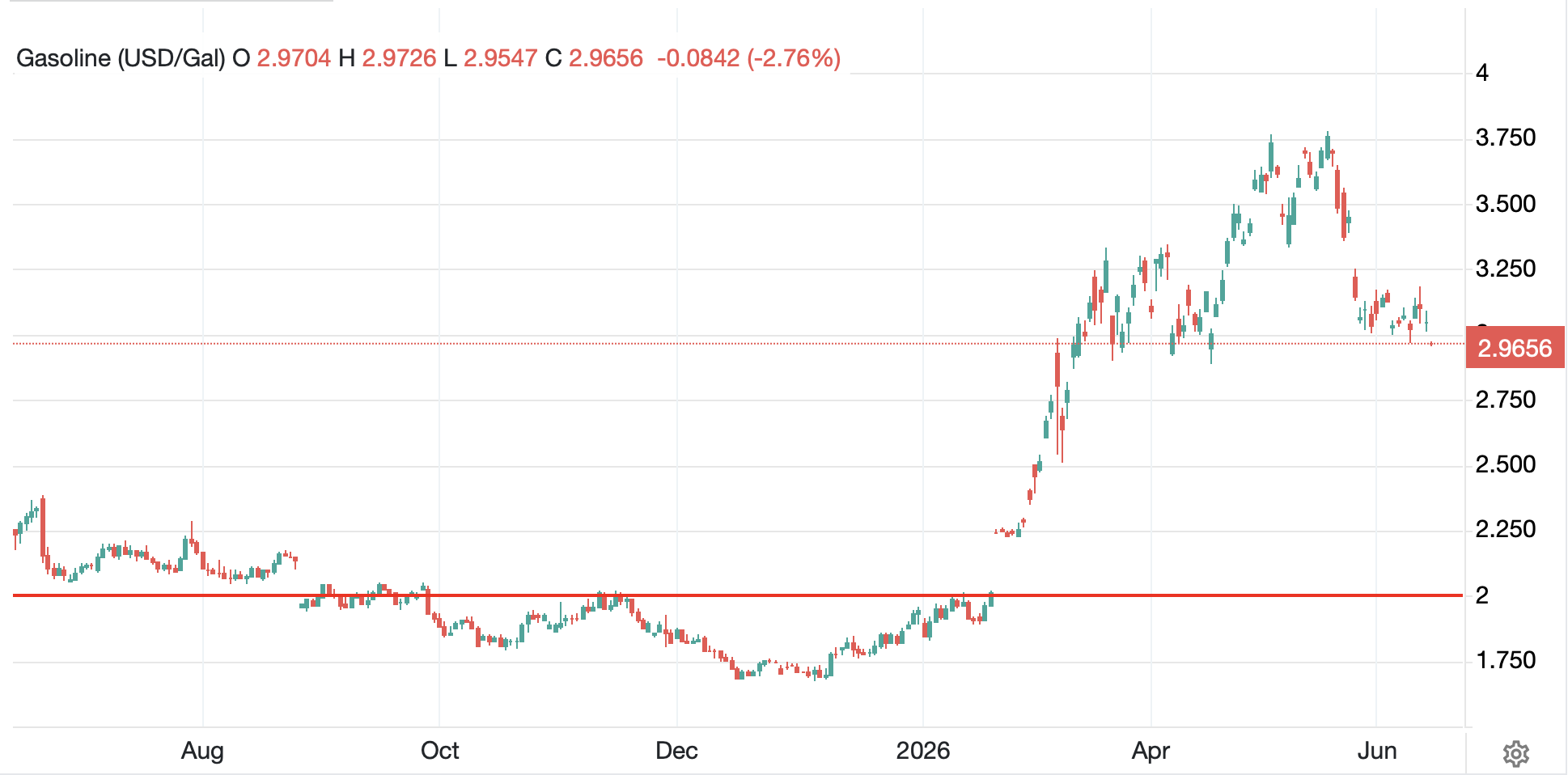
To my mind, the question becomes, just how quickly prices continue to decline, and can gasoline prices, the one that matters most to the US consumer, slide back to the $2.00/gallon level that we saw prior to the war?

As you can see from that chart below, it still has a long way to fall, but if the Strait remains open, I suspect it will round trip by the end of the summer, just in time for people to start considering their voting habits.

Source: tradingeconomics.com

Remember this, as well, how much have you heard about Venezuela lately?  Back in January, less than six months ago, the US captured and remanded Nicholas Maduro into custody and the world was up in arms.  I would wager that most people don’t even remember it happened!  Memories are very short for global events like this (consider the fact that the Russia – Ukraine war continues and it never even makes the proverbial papers anymore).  For President Trump, the outcome of this situation will be a massively degraded Iranian military with pretty much the rest of the GCC aligned against everything they stood for, an economy that continues to demonstrate remarkable resilience, high stock prices and the likelihood that inflation, as oil prices slide, will be heading back closer to the theoretical 2% target.

There once was a time central banks
Were saviors, and we would give thanks
For all of their aid
When, problems, they slayed
And bankers, they all would close ranks

But last week the ECB raised
Tonight, Ueda-san will be praised
For hiking rates too
So, what will Warsh do?
On Wednesday when his trail is blazed?


Meanwhile, we are in the midst of the monthly central bank onslaught as last week, Madame Lagarde and the ECB raised their base rate by 25 basis points, blaming the ongoing rise in oil prices for leading to inflation.  Of course, 96 hours later, with the announcement by both sides of a deal to end the Iran conflict, this is likely to be seen as an error, the full Trichet as it were.

Tonight, the BOJ meets and all signs are that they, too, are going to be hiking rates by 25bps tonight, to 1.00%, which you will have heard is the highest in more than 30 years.  It’s funny, the official inflation data from Japan is showing a reading of 1.4%, below their target, and now that the prospect of oil prices falling more sharply has increased, it feels like they may be on the cusp of an error here as well.  Consider that of all the governments around, the Japanese with a debt/GDP ratio of about 250% is the nation least able to absorb higher interest rates.  

Which takes us to Wednesday’s FOMC meeting, the first under Chairman Warsh.  There is a long Nick Timiraos article this morning in the WSJ ostensibly explaining that Warsh would like to see less Fed communication, including killing the dot plot, and have the cacophony of Fed speakers shut up.  First, Timiraos has real skin in this game because while he was Powell’s go to, I doubt he will be Warsh’s, thus Timiraos’s status is about to be hit hard.  In fact, the article read as though Powell was writing it to make it seem as though Warsh’s ideas are all wrong.

Personally, I am in favor of less communication by the Fed as policy uncertainty will result in significantly reduced positioning in the speculative community and that is a net benefit for the rest of the market.  Plus, if there is a hiccup, there is less reason for a bailout.  We shall see.  It seems highly unlikely that they move on Wednesday, but we should at least get an inkling of how things may evolve going forward.

So, let’s turn to the markets.  It is no surprise that risk is on everywhere this morning after the Trump announcement so briefly, here is a screenshot from 6:40 this morning showing equity futures markets higher across the board.

Source: tradingeconomics.com

While these are just the major markets, the reality is that markets are higher everywhere except Oslo, as the decline in oil prices hits the Norwegian stock market.  But otherwise, it is universal.

Bond yields are lower across the board as well, with Treasuries (-4bps) leading the way and all of Europe seeing sovereign yields decline by between -4bps and -6bps as the inflation story follows oil lower.  JGBs, too, slipped -4bps overnight and are down -17bps in the past week!

But oil remains the story because its movement is what is driving the narrative.  And, interestingly, there is still strong support from one side of the argument that we are close to hitting tank bottoms and prices are going to shoot higher.  We have heard from both Chevron and Exxon that it is a dangerous situation and even the reopening of the Strait may not happen in time to stop it.  But consider if you are Exxon or Chevron, high oil prices are what you need as you sell your inventory rich and drilling is much more profitable.  And one thing they have is a lot of inventory in their refinery systems.  It hardly seems likely they would be out touting the deal as great and talking prices down.  We have heard throughout the conflict that in a few weeks, prices would spike higher as shortages developed, but that has never happened.  I go back to my view that ignoring market prices in favor of the narrative is a mistake.  At this point, with WTI at $80/bbl, I will argue we will see $50 long before we ever see $100 again.

As to metals markets, based on recent price action, it should be no surprise that gold (+2.75%), silver (+4.3%) and copper. (+0.7%) are all rallying on the lower inflation => lower interest rates => increased commodity demand.

Finally, the dollar is under pressure generally as the DXY (-0.25%) is a pretty good proxy for most things.  In truth, we are seeing some larger movements (INR +0.7%, SEK +0.8%, ZAR +0.6%, CHF +0.6%) all responding to the lower oil price, and in the case of the rand, the higher gold price.  However, there are two outliers here.  NOK (0.0%) is, not surprisingly, unable to show any traction, as like the Norwegian stock market, declining oil prices are a drag here, and JPY (+0.1% and still above 160.00).  The latter must really be concerning to Ueda-san as in a broad dollar decline, if the yen can’t gain traction, that is a real problem.

On the data front, there is a bunch of stuff, but other than Retail Sales on Wednesday, all of it is second tier.

TodayEmpire State Manufacturing14.0
 IP0.3%
 Capacity Utilization76.2%
TuesdayRBA rate decision4.35% (unchanged)
 Housing Starts1.44M
 Building Permits1.41M
WednesdayRetail Sales0.5%
 -ex autos0.5%
 FOMC rate decision3.75% (unchanged)
ThursdayInitial Claims232K
 Continuing Claims1790K
 Philly Fed10.0
 Leading Indicators0.1%

Source: tradingeconomics.com

In addition to all that, the G7 meets this week, starting this evening in Evian, France with French President Macron leading the group.  

As always there is a great deal of naysaying out there as the joint announcement of a deal between the US and Iran has upset the applecart for many narrative writers, and they are committed to their positions.  Personally, I am very happy to see the deal, although it was early as I had anticipated a July 4th outcome, but in this case, a much better result.  I guess it will take some time before it is clear if things are truly operating more normally again, but market pricing is demonstrating a willingness to believe.

With this in mind, the dollar should remain under some pressure for now, as prospects for a Fed rate hike are going to fade, although they haven’t yet according to the futures market, but if anything, that will simply mean that the US will suck in more global capital as the US economy continues to outperform elsewhere.  Ultimately, that will benefit the greenback.

Good luck

Adf
Change Their World View

The markets are trading like peace
Has come, hence the stock price increase
While crude prices fall
And risk, overall
Is favored like summer in Greece

But can we trust this time it’s true?
Or will, once again, this fall through?
I guess time will tell
If this will compel
The doomers to change their world view

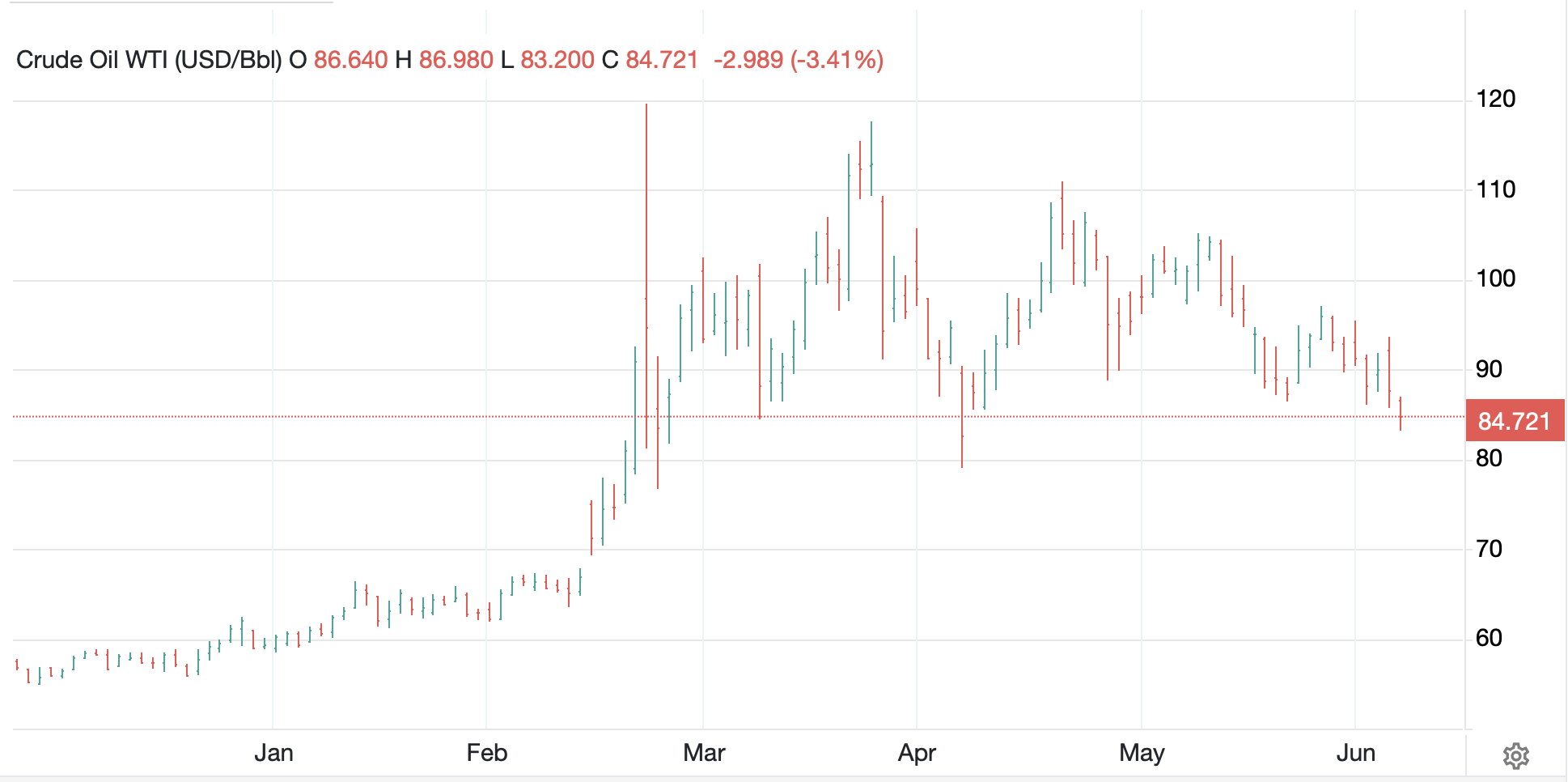
It is certainly a hopeful morning today as risk rallies around the world while oil prices tumble.  At $84.72/bbl, down -3.4% on the session, oil is trading at its lowest level since April 17.  

Source: tradingeconomics.com

While President Trump had once again threatened to destroy Iran’s oil infrastructure, shortly thereafter he reversed that call with news that Iran was back at the table with both sides closing in on a peace deal.  Frankly, despite the absolute certitude that so many pundits seem to have, the reality is nobody really knows if this time is the charm or not.  In fact, I would argue that the Iranians themselves, as well as President Trump, are not certain, as though I’m confident both sides would like to stop this, there are many political calculations that go into the process, and the punditry is simply not party to those conversations.  We shall see.

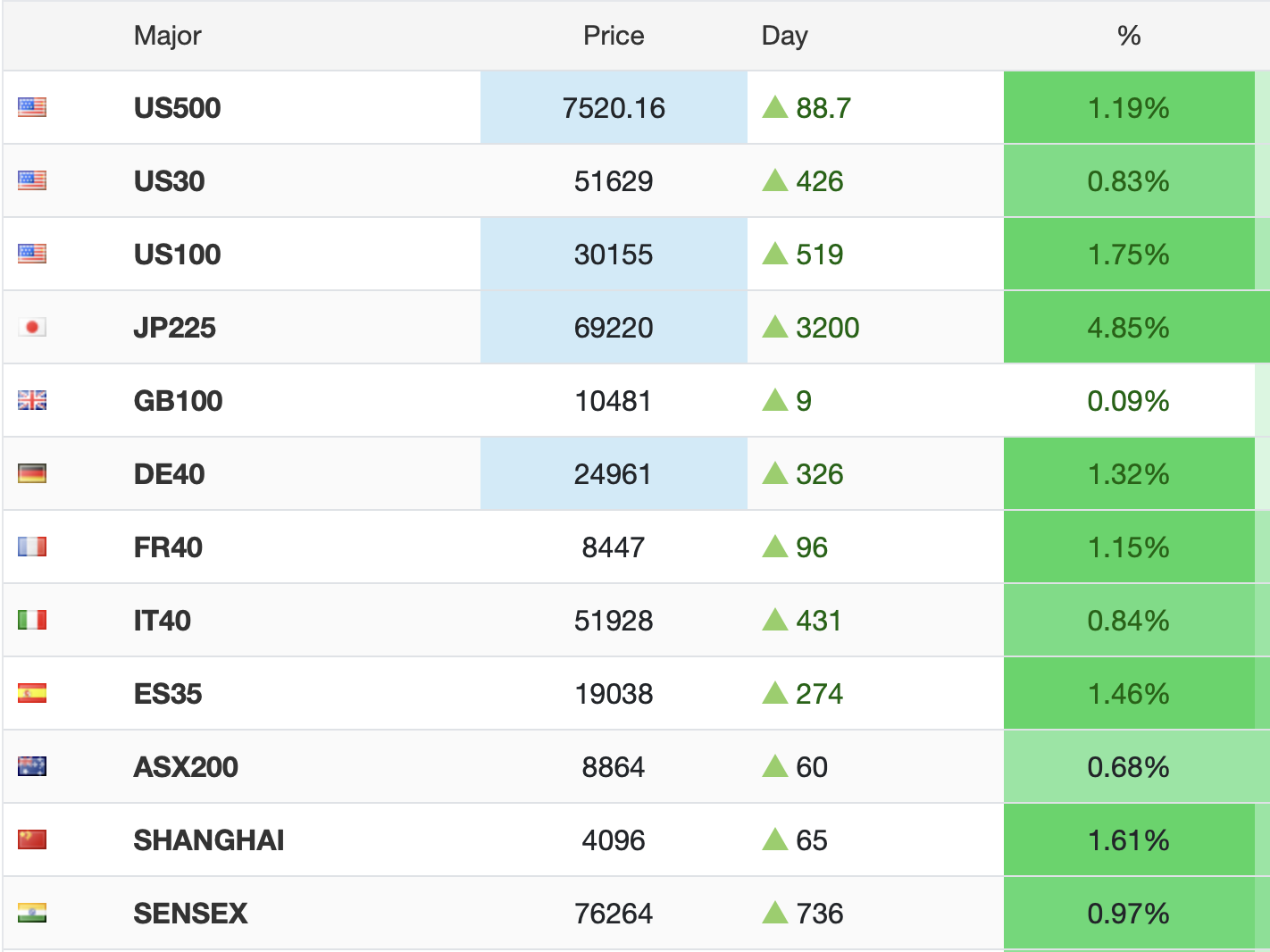
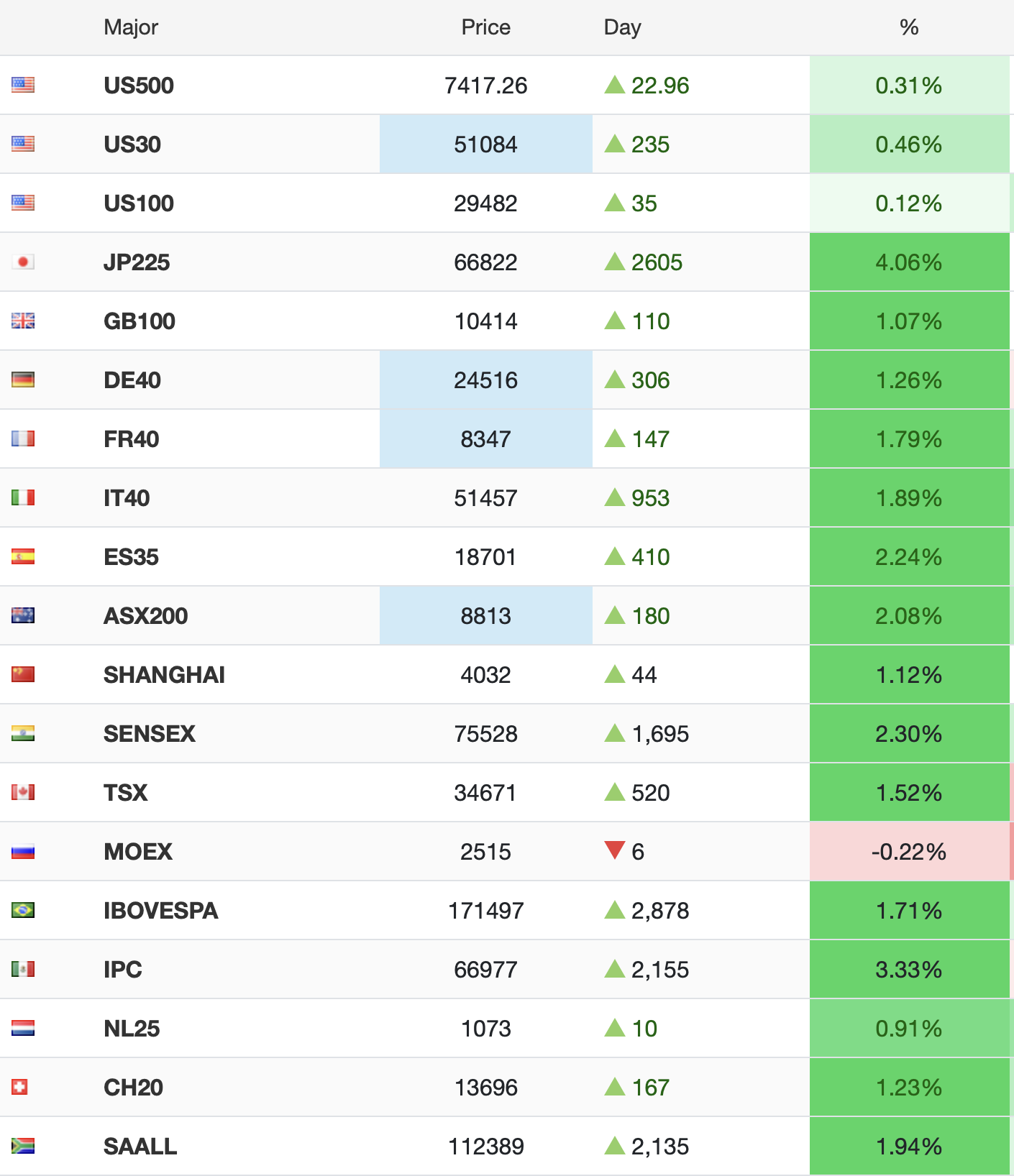
Of course, markets trade the rumor, not the news, or at least they initiate positioning on the rumor, so with that story making the rounds, it is also no surprise that equity markets have shaken off their early week blues and rallied strongly pretty much everywhere around the world.  The below chart of futures markets shows just how widespread the gains are with only Russia’s MOEX under pressure (is that really even a market still?) and although Toronto, Mexico and Brazil have not yet opened, all rallied yesterday alongside the US.

Source: tradingeconomics.com

Of course, there is another equity story and that is SpaceX, which IPO’d last night at a price of $135/share, and which, like so many things these days, has a seen a huge disparity between the pros and the cons.  Many analyses have been performed showing that the company is not “worth” anywhere near the $1.8 trillion market cap at which it is starting.  But those same folks have consistently explained that Tesla is not worth the $1.5 trillion, and yet there Tesla sits.  There was a huge amount of interest with more than $75 billion of retail orders to buy the IPO.  My observation is that Elon Musk is somebody who gets things done, and usually better than anyone else.  But markets are, as I always say, perverse, so this will be an interesting ride.

Other than the end of the war and the SpaceX IPO, the two stories that made a brief appearance were yesterday’s PPI data, which depending on the analyst were either hot or cold, and the fact that Madame Lagarde and the ECB raised their base rate by 25bps yesterday, right as energy prices started falling dramatically.  This is not the first time the ECB has made a mistake of this nature, one need only look back to the beginning of the GFC when then-president Jean Claude Trichet controversially raised interest rates in July 2008 and reversed course 3 months later after Lehman Brothers failed.

And that’s what the setting is as we head into the last trading session of the week.  So, let’s see how other markets are behaving.

It should be no surprise that bond yields are falling.  While Treasury yields are unchanged this morning, they fell about -7bps across the board yesterday.  But the Iran news was after the European close so sovereign yields are lower by between -4bps and -7bps this morning.  I presume some investors are happy that the ECB is fighting inflation, but I think most are responding to the idea that the end of the war means lower oil prices and therefore a significant reduction in inflation pressures.  Last night in Asia, we also saw yields fall sharply across the board with JGBs down -6bps and every other market (Australia, Singapore, Korea) slide by a similar or even greater amount.

In the metals markets, while gold (-0.1%) is little changed this morning, it did manage to rally more than $100/oz yesterday, or more than 2%.  Silver (-0.5%) is also slipping a bit today but that is after a 6% rally yesterday.  My take is these are short term profit taking trades.

Finally, the dollar is, overall, little changed this morning.  it was very modestly weaker during yesterday’s session with the DXY slipping back below 100 (currently 99.75), but USDJPY remains above 160, still in a danger zone although there has been precious little discussion on the topic for the past several sessions.  You will not be surprised that NOK (-0.5%) is under pressure as it is probably the currency that tracks most closely to oil prices.  But other than that, not much to say in this market either.

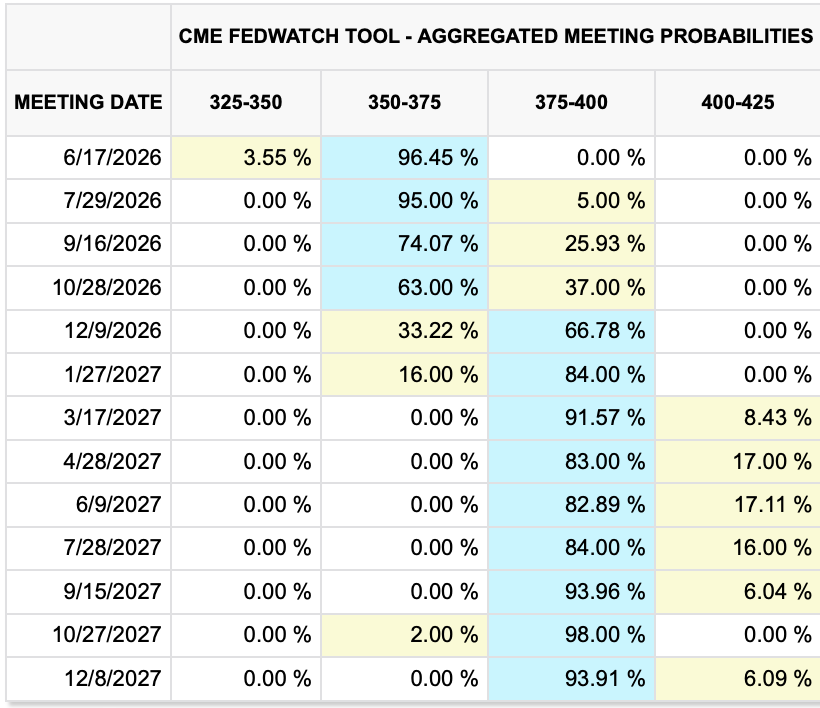
On the data front, this morning brings only Michigan Sentiment (exp 46.0), which continues to hug the lows of the series as a contradiction to the highs in equity markets.  But now, with CPI/PPI out of the way, all eyes will turn to next week’s FOMC meeting.  If we look at the Fed funds futures curve, it is still forecasting a rate hike by the end of this year.

Source: cmegroup.com

But I have to wonder, if the fighting stops and a deal is reached such that the Strait is reopened and the blockade is lifted, the one certainty is that oil prices will fall much lower, probably below the levels seen prior to the war began.  Given all the talk about secondary effects of high oil prices, I would expect that talk to disappear.  History has shown that every shortage of a commodity is followed by a glut.  Will economists be explaining why persistently low energy prices in the future are going to undermine inflationary expectations?

Markets are still beholden to the headlines so if this deal falls apart, you need to expect all these moves to reverse course with oil higher alongside yields and the dollar while stocks and precious metals fall.  But if this is the end of the Iranian engagement, I suspect that risk is going to be in vogue for quite a while, investment will be flowing into the US and the dollar will hold its own, even as yields decline.  (Going back to my flows as a key driver, not just interest rates.)

Good luck and good weekend

Adf

Stoke Some More Fear

The word of the day is inflation
As data from many a nation
Appears, still, to show
It has room to grow
With fears this is no aberration

But are things as bad as we hear
From media outlets who cheer
More pain, as they make
Their case Trump will break
The nation, and stoke some more fear

It’s CPI day here in the US and similarly, we got readings from various nations around the world overnight.  To level set, expectations for this morning’s numbers are:

  • Headline – 0.5% M/M, 4.2% Y/Y
  • Core – 0.3% M/M, 2.9% Y/Y

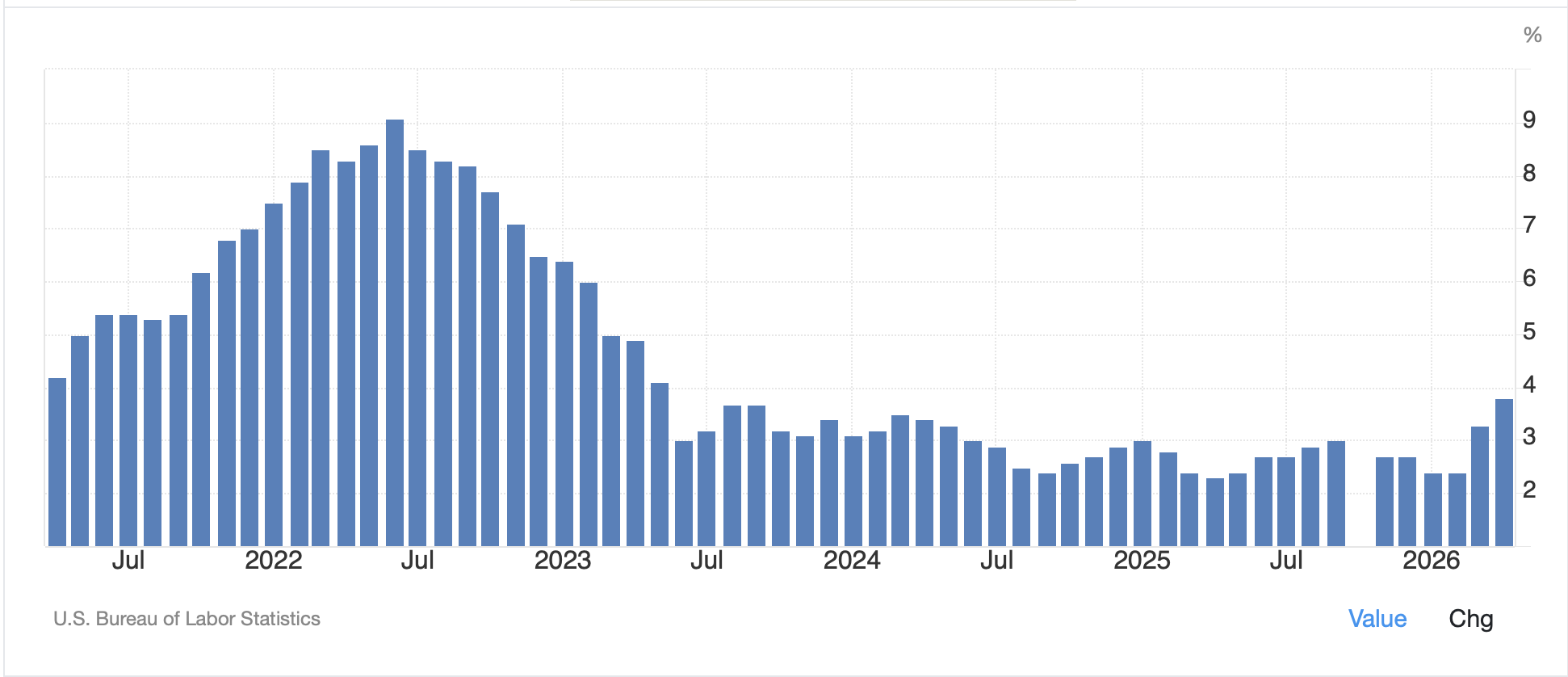
On an annual basis, as you can see in the below chart from tradingeconomics.com, 4.2%, while much higher than some recent data and much higher than we would like, was seen as recently as April 2023 during the “transitory” phase from the Covid years.

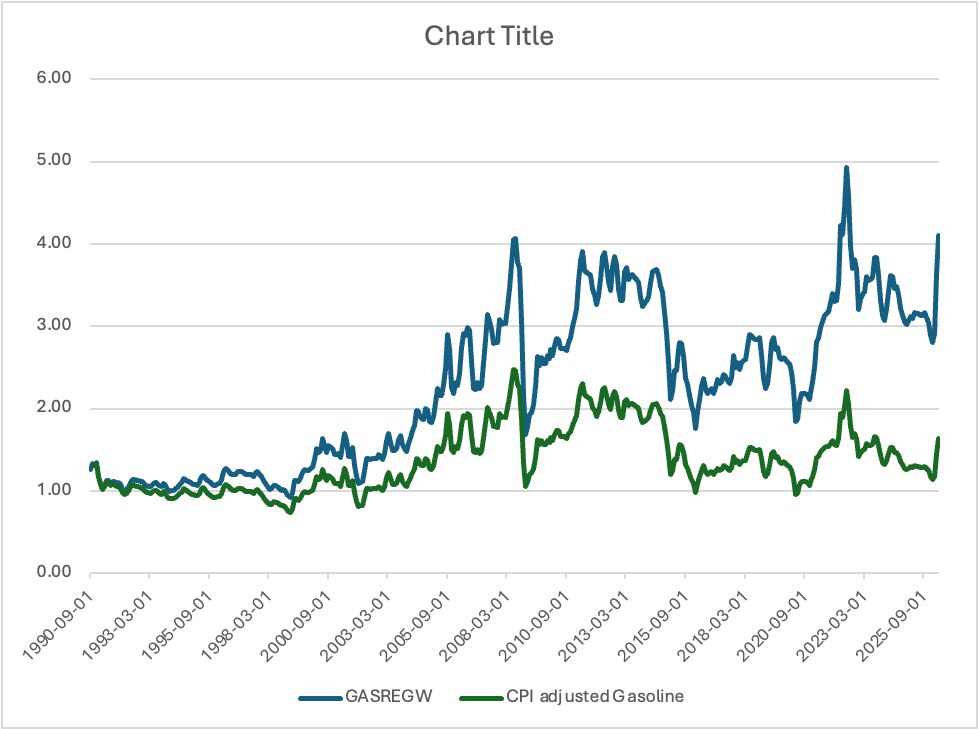
And don’t get me wrong, I am as sensitive to inflation as all of you as I go to the supermarket or Costco and see prices and fill up my car’s gas tank as well.  In fact, speaking of gasoline, there is no question it is much higher than it was prior to the beginning of the Iran conflict.  Looking at the chart I drew from FRED data below shows that, nominally, it is back at levels from the immediate aftermath of Russia’s invasion of Ukraine in 2022.  But look at the other line on the chart, that is the price of a gallon of unleaded adjusted for CPI starting back in 1990.  It is remarkable that the latest reading, while still obviously higher than a few months ago, is just $1.635/gallon in real terms.

Somebody else pointed out that gasoline is one of the few things that seems rarely to be described in real terms, arguably because it hasn’t really risen all that much over time and those who describe things in real terms are frequently trying to make the point that inflation is far too high.  Arguably, though, this is further proof of famed economist Julian Simon’s thesis that commodity prices all head lower over time as the ability to produce them in abundance, and their relative abundance in the earth, drive those prices lower.

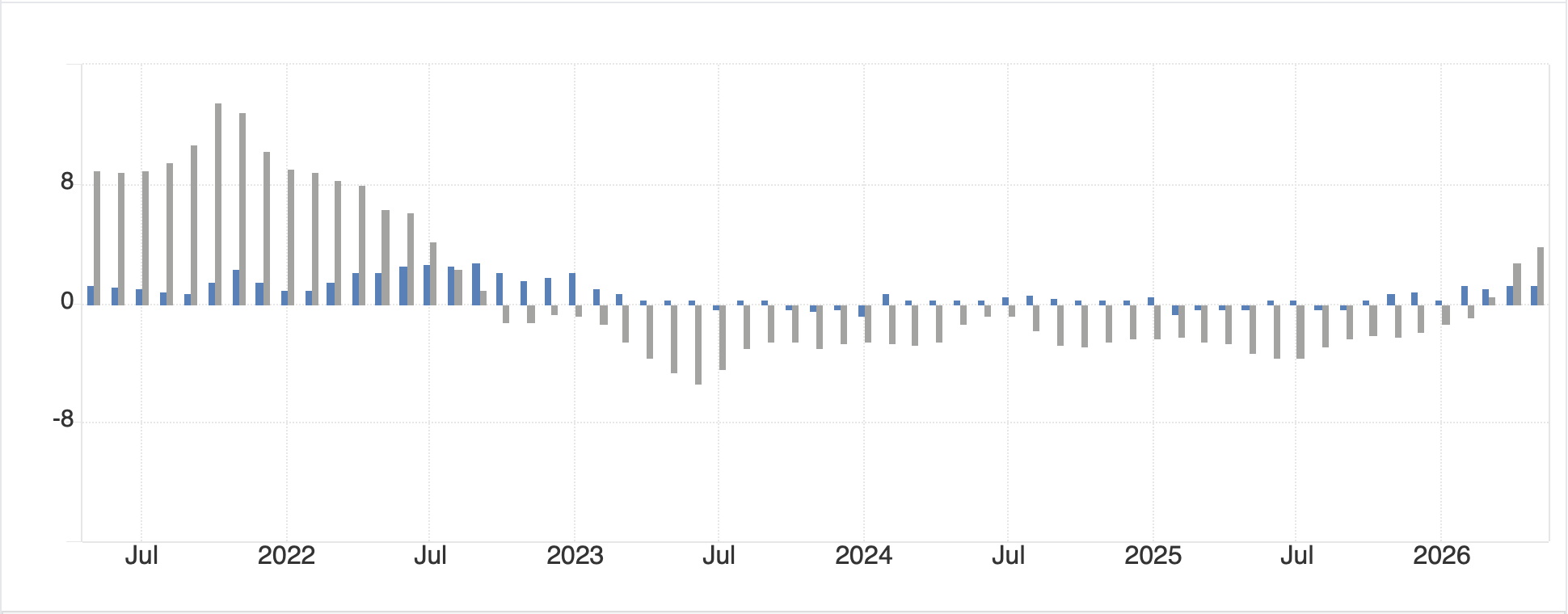
As to elsewhere in the world, last night China reported that CPI (blue bars) remained at 1.2% but PPI, which may be a better indication of price activity there, rose to 3.9%.  This implies that Chinese corporate profits are under increasing pressure.  It also represents a sea change in China as can be seen in the below chart where PPI (grey bars) was negative for the 3 years prior to April.  

Source: tradingeconomics.com

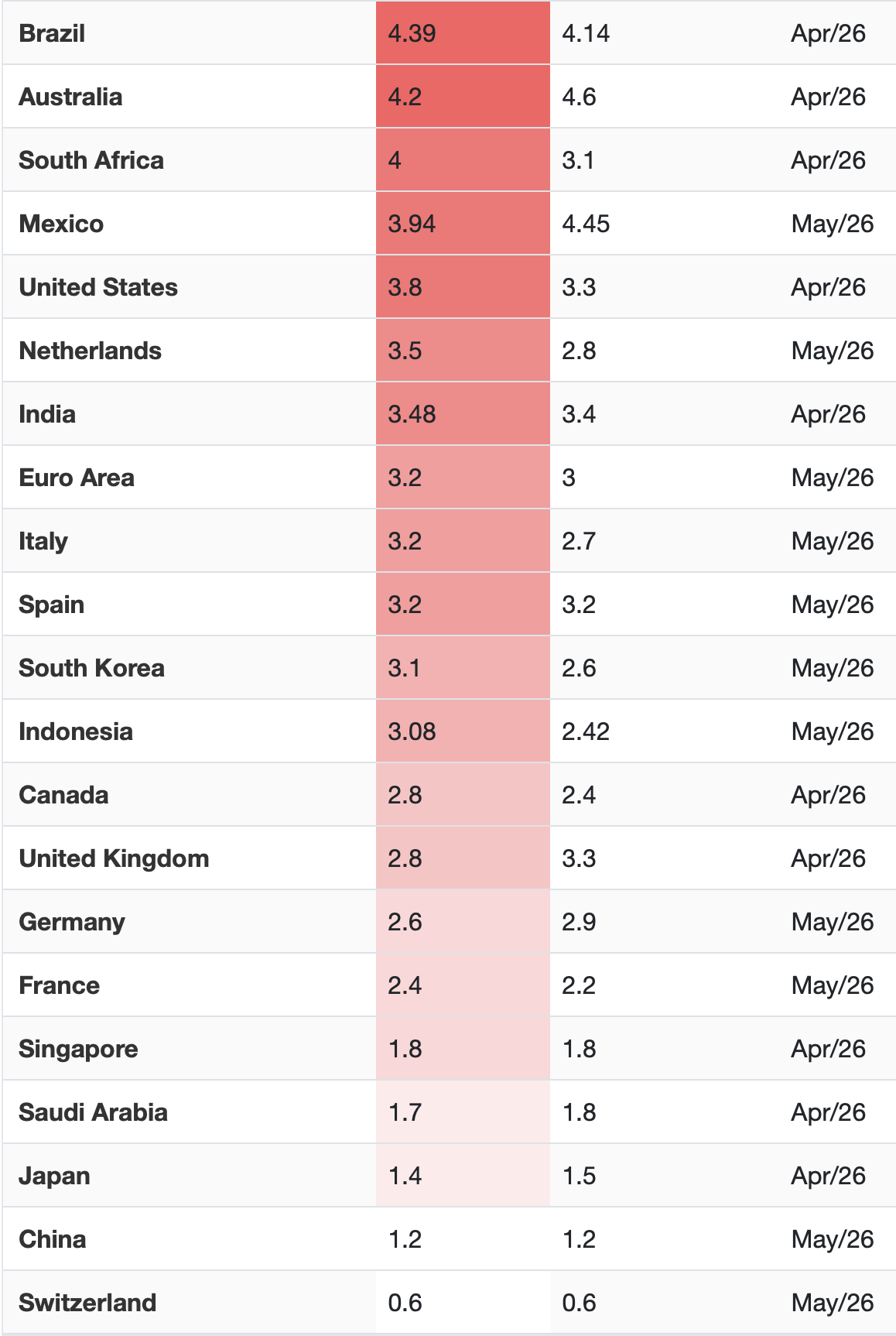
As with all inflation analysis, the real question is who absorbs the price pressures.  In the US, the recent experience from Covid, when the government helicoptered $5 trillion into the economy so people had money to spend, businesses raised prices and continue to believe they can do so.  Apparently in China, that is not the case.  To finish the discussion, below is a chart of 17 of the G20 nations and their most recent headline CPI readings (I left out Argentina, Turkey and Russia as I couldn’t fit them all on the screenshot).  Interestingly, only 11 of these 17 nations have seen CPI rise in the past month.  I wonder, is inflation the global phenomenon that some make it out to be.

Country Last. Previous Date

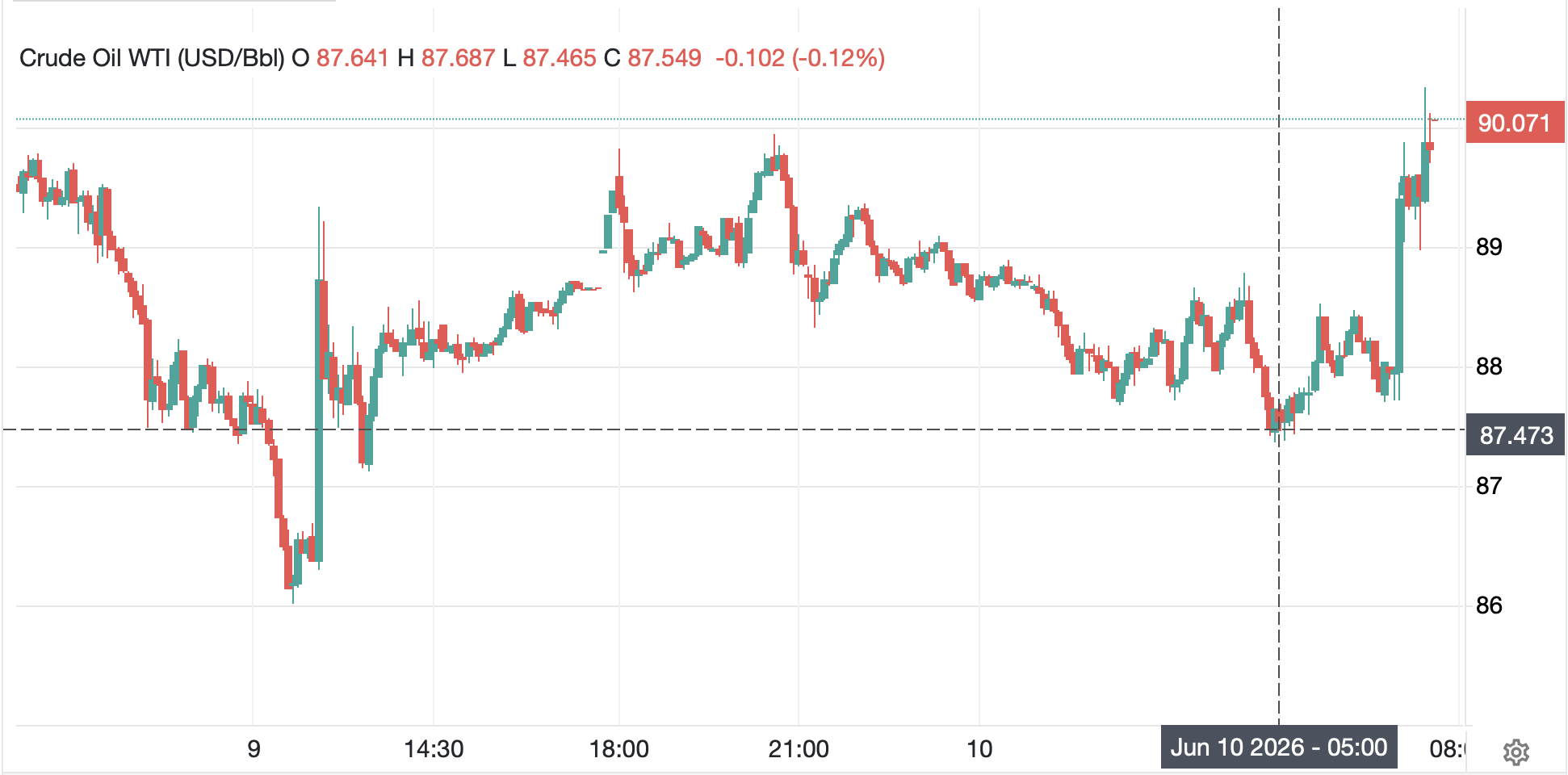
Ok enough on that.  Let’s move on to market activity.  For the past several days, the oil story did not seem quite as important as despite a few random missiles being fired, it appeared that the Iran conflict was quieting down.  This allowed the focus to turn to important things like AI and the SpaceX IPO coming tomorrow after the close.  For example, when I sat down this morning around 5:00, oil was around $87.50/bbl and had slipped slightly lower compared to yesterday’s close.  However, in the interim, President Trump tweeted out the following:

But despite these comments, while oil has jumped as per the below chart, it is just barely at $90/bbl, hardly a sign the market believes something dramatic is on its way.

Source: tradingeconomics.com

In the meantime, there continue to be multiple articles that we are heading to the cliff for oil inventories and prices will skyrocket soon.  You know my opinion on those as I take the market’s side things are not as dire as some believe.

But if things heat up in Iran and the Gulf, I expect that we will see a downdraft in equities and bonds while the dollar moves higher.  And that is what we are currently seeing.  Below is a screenshot of equity futures markets as of 7:45 this morning.

source: tradingeconomics.com

Not a lot of happy faces there.  As well, overnight saw weakness throughout most of Asia after yesterday’s modest US declines.

In the bond market, Treasury yields are backing up 3bps and European sovereign yields are also higher this morning, between 3bps and 5bps across the entire continent.  So despite my statements above that inflation may not be as big a deal as some explain, bond investors are at least a bit uncomfortable this morning.

As to the metals markets, that break below the 200-day moving average in gold is seeing real follow through as old long positions and new short momentum plays pile on with the barbarous relic (-2.5%) tumbling as well as silver (-1.9%) and copper (-1.2%).  The key here is that whatever the short-term price action is, I think the one unalloyed truth is that fiat currencies will continue to get printed like there is no tomorrow and precious metals will regain their form.  But it could take a while.  In that vein, there was a Bloomberg article this morning explaining that more government bonds have been sold at this point in the year, ~$504 billion, than the first half of 2020 with Covid.  If my short-term inflation thesis is wrong, this is the reason why.

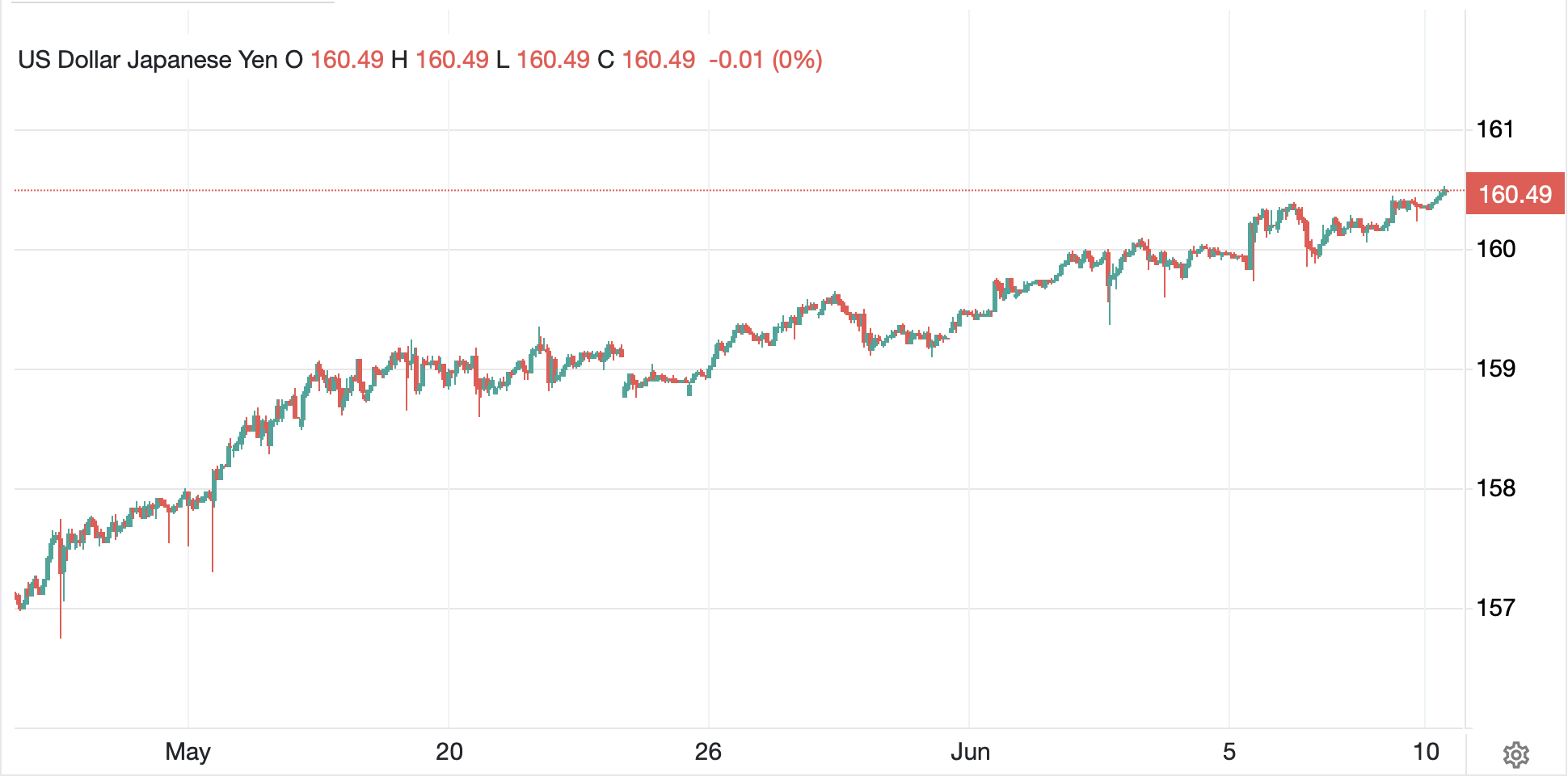
Finally, the dollar has edged higher this morning but is generally little changed.  The noteworthy thing is that USDJPY is at 160.50, above the supposed line-in-the-sand for the MOF, but as you can see from the below chart, the movement has been extremely gradual, with very little volatility.  Remember, one of the things the MOF focuses on is that volatility, so if the dollar continues to creep higher, they are likely to hold off for a while before feeling the need to intervene.

Source: tradingeconomics.com

But otherwise, most currency movement has been modest overnight.

Aside from CPI, and the oil inventory data, we do hear from the Bank of Canada, which is likely to leave policy rates on hold.

It feels like the market is getting increasingly concerned over an uptick in activities in the Gulf, which will have a negative impact on financial assets but support the dollar.  We shall see.

Good luck

Adf