Actively Chided

Ostensibly, talks are ongoing
However, some fighting is sowing
The seeds of more doubt
That they’ll work it out
Ere Tehran’s surroundings are glowing

But markets have clearly decided
An outcome will soon be provided
Thus, risk is embraced
And stocks, higher, chased
While bond bears are actively chided

I hope everyone had a nice Memorial Day weekend, although until Monday afternoon, I must admit the weather here in NJ was less than we might have hoped.  Of course, a few raindrops are nothing compared to the “defensive” attacks executed by US forces, sinking two Iranian boats while they were trying to lay mines in the Strait.  Apparently, Iran’s response, several volleys of surface-to-air missiles was met with the destruction of those launchers as well.  

There is nothing better, though, than the language Iran uses in situations like this.  According to the WSJ, the head of the national security committee of Iran’s parliament, Ebrahim Azizi, explained that any attacks on the country’s armed forces would be met with “a decisive, crushing and regrettable response.”  It certainly sounds impressive, but it is not clear they can back up those words that effectively.  I guess we shall see.

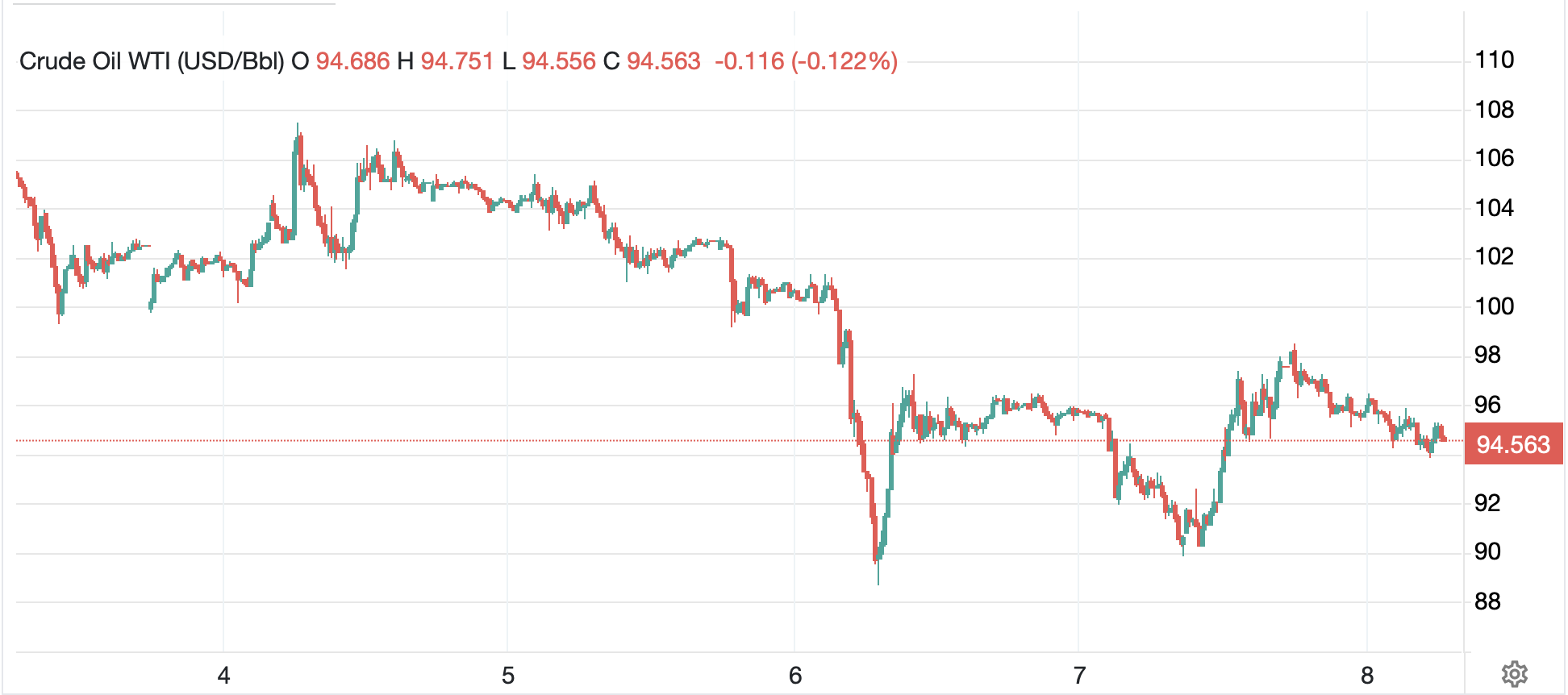
In the meantime, the other newsworthy item from the weekend was that the Supreme Leader, Mojtaba Hussein, was killed in a military strike and yet talks appear to be continuing.  President Trump explained that the framework for a deal was getting close and that was enough for traders to don their rose-colored glasses as oil gapped lower by more than $5/bbl when futures markets opened Sunday night and despite the recent “defensive” strikes mentioned above, remains far below levels seen last week.
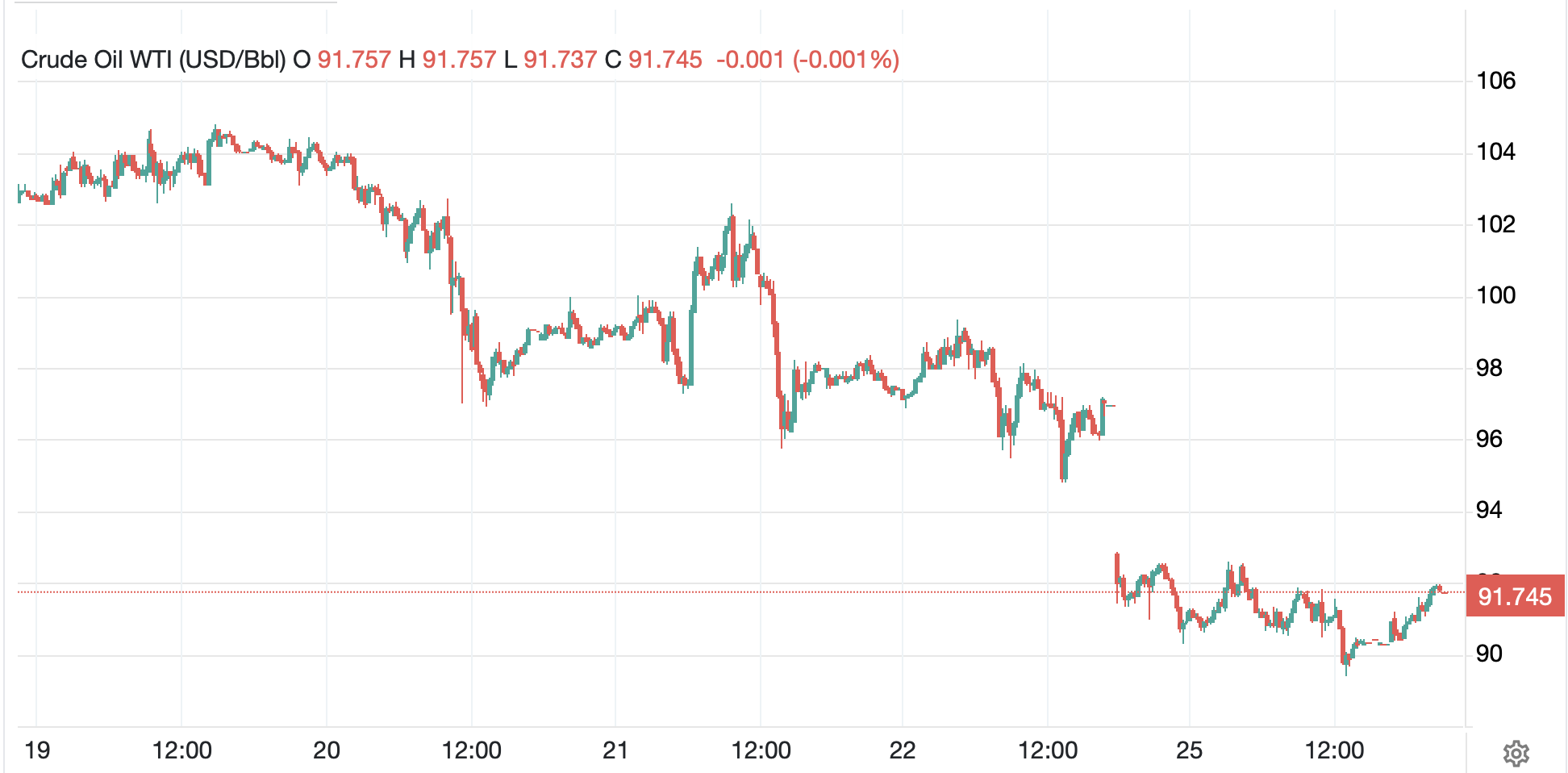
Source: tradingecomomics.com

Not surprisingly, as Monday night trading in Asia gets underway, risk is back on with equities and metals higher, and bond yields lower.  

And as we awaken Tuesday morning, very little new has occurred.  The market continues to believe in the idea that the war is over in all but the details, at least the Iran war.  Ukraine continues, alas.  

On Friday, the latest Fed Chair
A man with a full head of hair
Was sworn to uphold
The idea that gold
To dollars, must never, compare

Before the weekend began, Kevin Warsh was sworn in as the new Fed Chair and the man has a tough job, that is for sure.  As another indication that the Fed is not an apolitical institution (as if any institution based in Washington DC could be apolitical), he hadn’t even gotten the keys to the office before two Fed governors were out opposing his very existence. The WSJ editorial page had a nice summation here which explained that Michael Barr, the erstwhile Vice Chair for Supervision who oversaw the collapse of Silicon Valley Bank (perhaps not the best credentials) was adamant that shrinking the balance sheet would lead to problems, as though he could foresee them!  Then Chris Waller, who was in the hunt for the Chairman’s seat, reversed his recent views on interest rates, explaining hikes were likely in order.  I’m sure there are no sour grapes there!

From this poet’s perspective, the financialization of the economy has been one of the biggest long-term problems we have seen and part and parcel of that financialization has been the Fed bloating expanding its balance sheet from <$1 trillion prior to the GFC to nearly $9 trillion at the height of the Covid madness and still well above $6 trillion today.  It is much harder to financialize things if there is less money around.  I fully support the idea that shrinking the Fed’s balance sheet would be a good thing.  Alas, that will be a tough road to hoe for Mr Warsh.  Good luck to him.

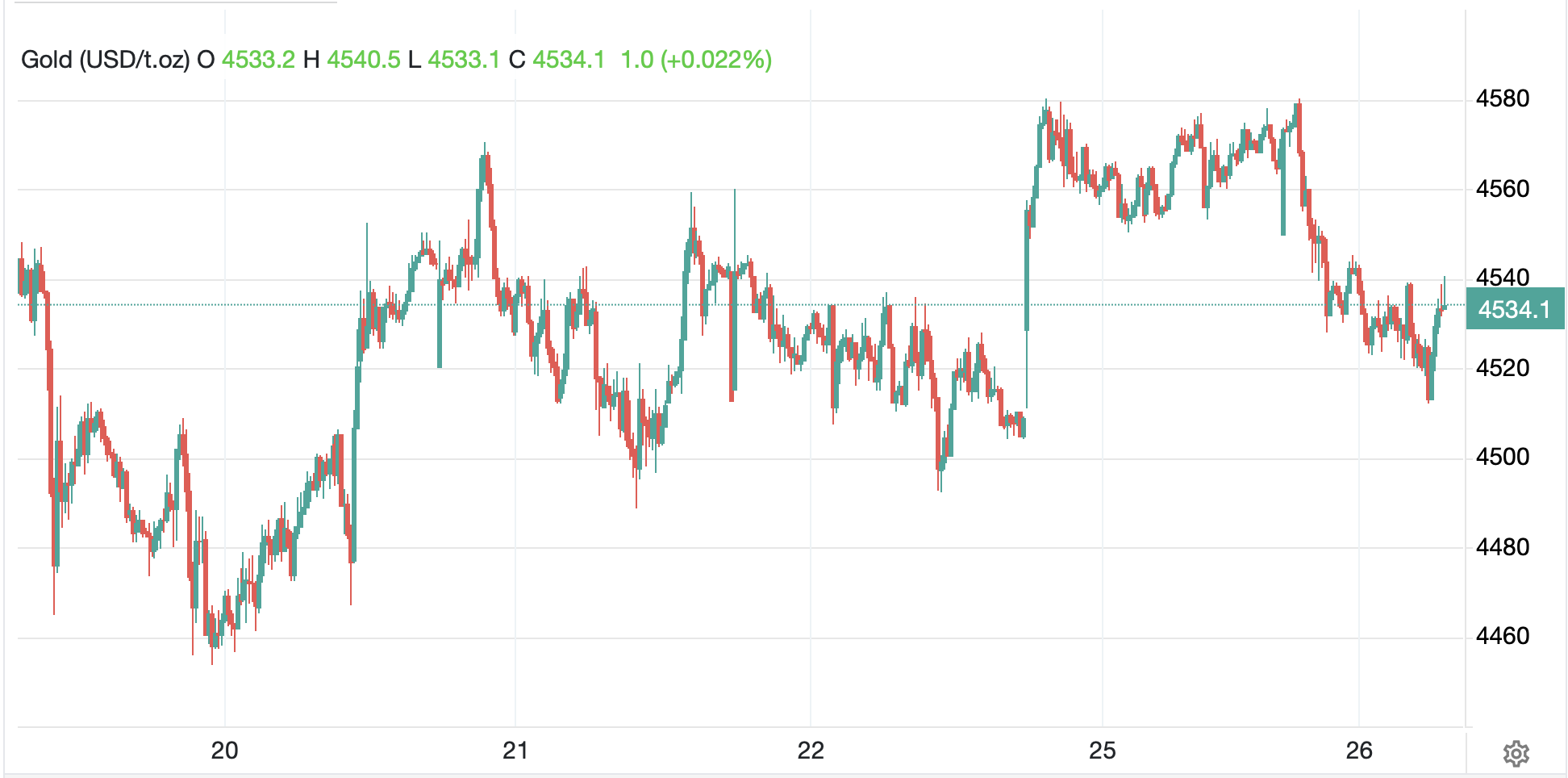
And with that, there are few other stories of note, so let’s look at the market response to the latest peace initiatives.  While we’ve already discussed oil above, gold saw the initial move you would have expected, jumping sharply, but has since given back much of those gains, as per the below chart, and is now about 0.5% higher than Friday’s close.
Source: tradingeconomics.com

Silver has seen similar price action as has copper.  Certainly, if a deal is signed, I believe we can expect oil to head back toward $75 – $80 per barrel and gold and silver to rebound sharply as well.  

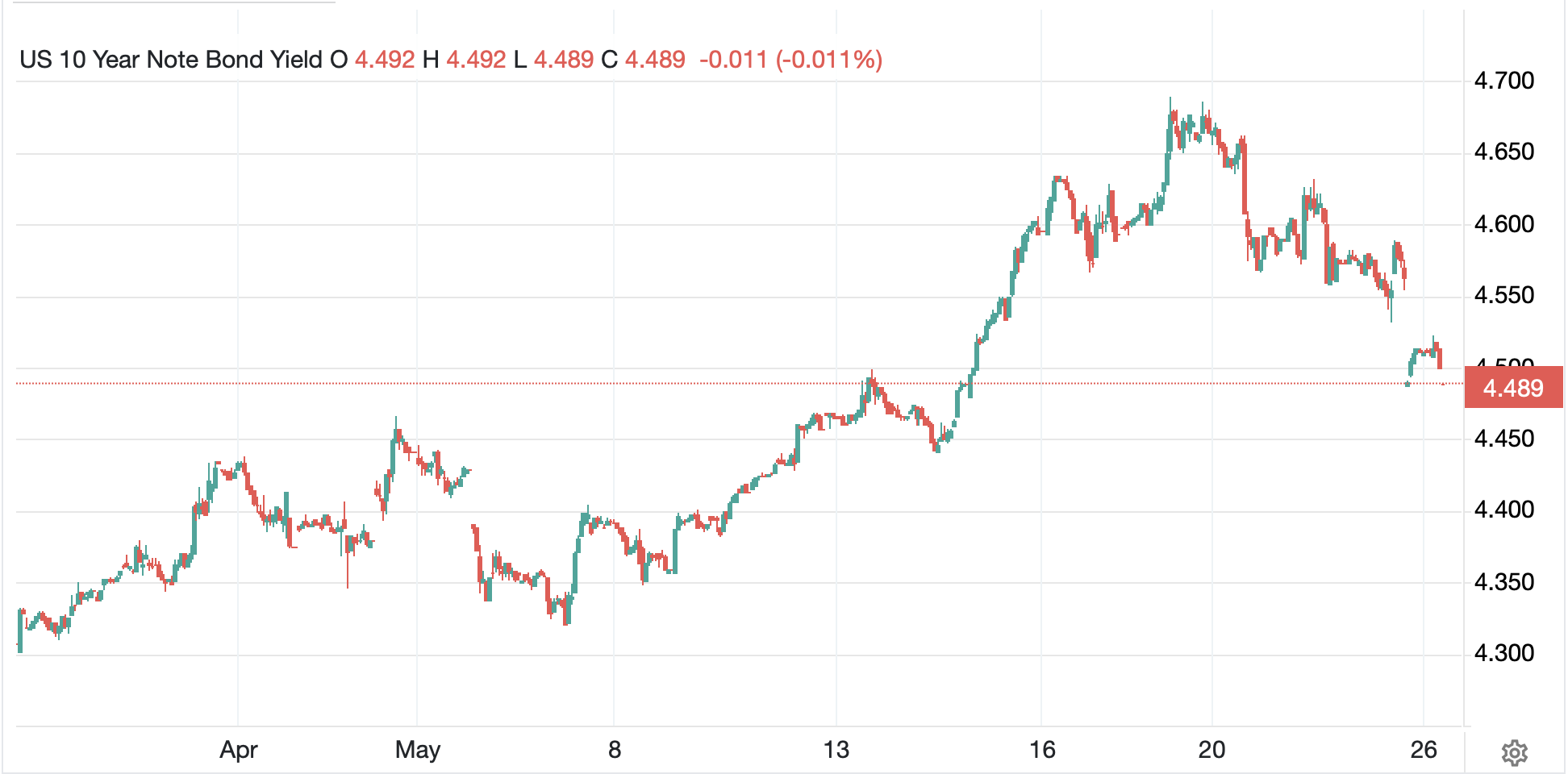
The other noteworthy mover was the bond market, which saw yields fall sharply on the news of the deal framework getting close.  You may recall the apocalyptic prognostications just last week when 10-year Treasury yields climbed near 4.70% with many discussions regarding the steepening of the yield curve and the trouble ahead for the economy.  But as I type this morning at 7:00am, the 10-year yield has dipped back below 4.50% in sync with the oil move lower as some of those inflation fears seem to be mitigating.
Source; tradingeconomics.com

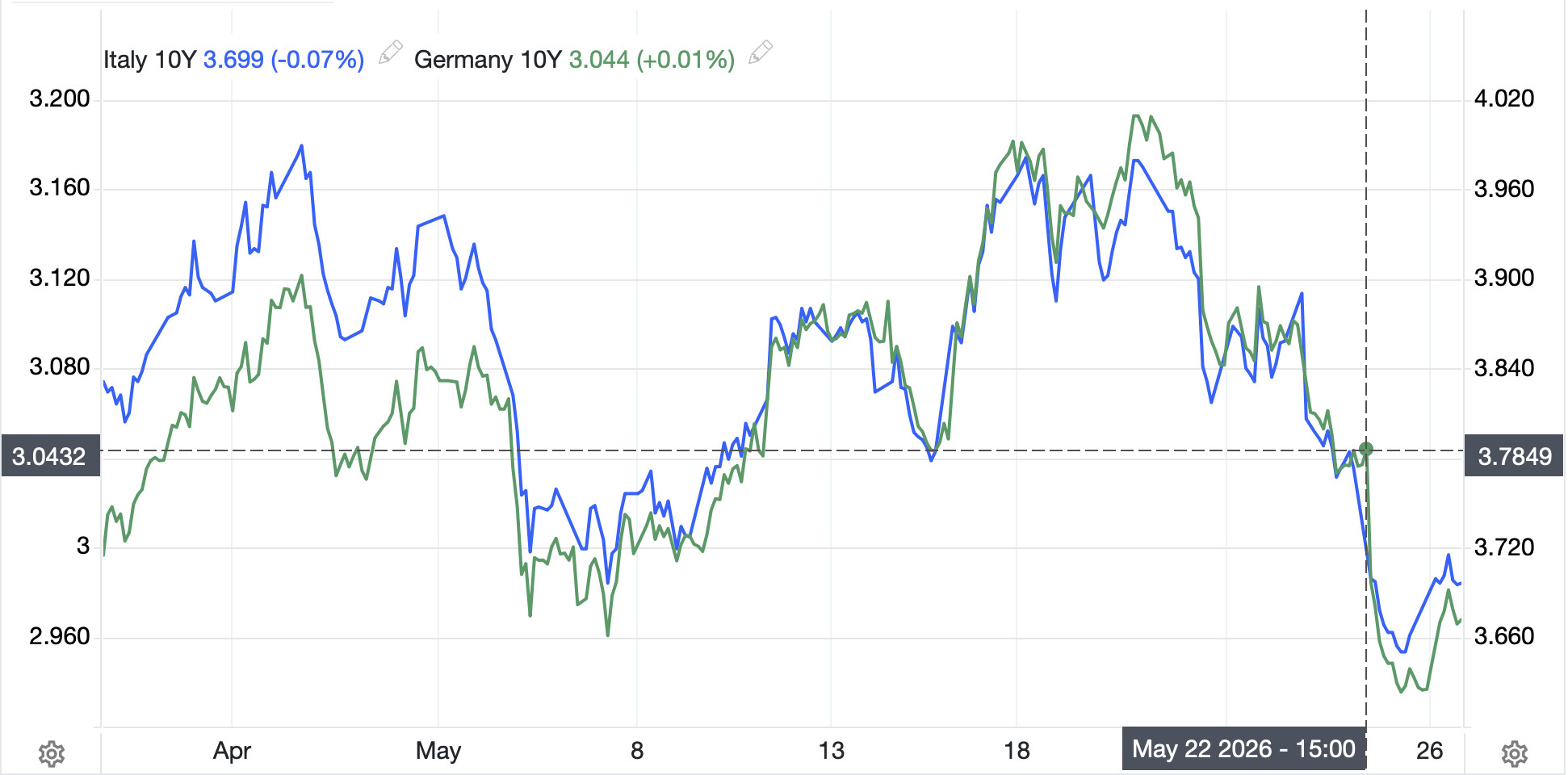
Now, as I look across European sovereign markets, they all show modest rises in yields this morning, but that is because yesterday, they fell so sharply.  Net, over the two days, yields are lower across the board.  As an example, the chart below shows both German and Italian 10-year yields and I highlighted Friday’s closing levels.  As you can see, both fell sharply yesterday and bounce a bit this morning but remain much lower.
Source: tradingeconomics.com

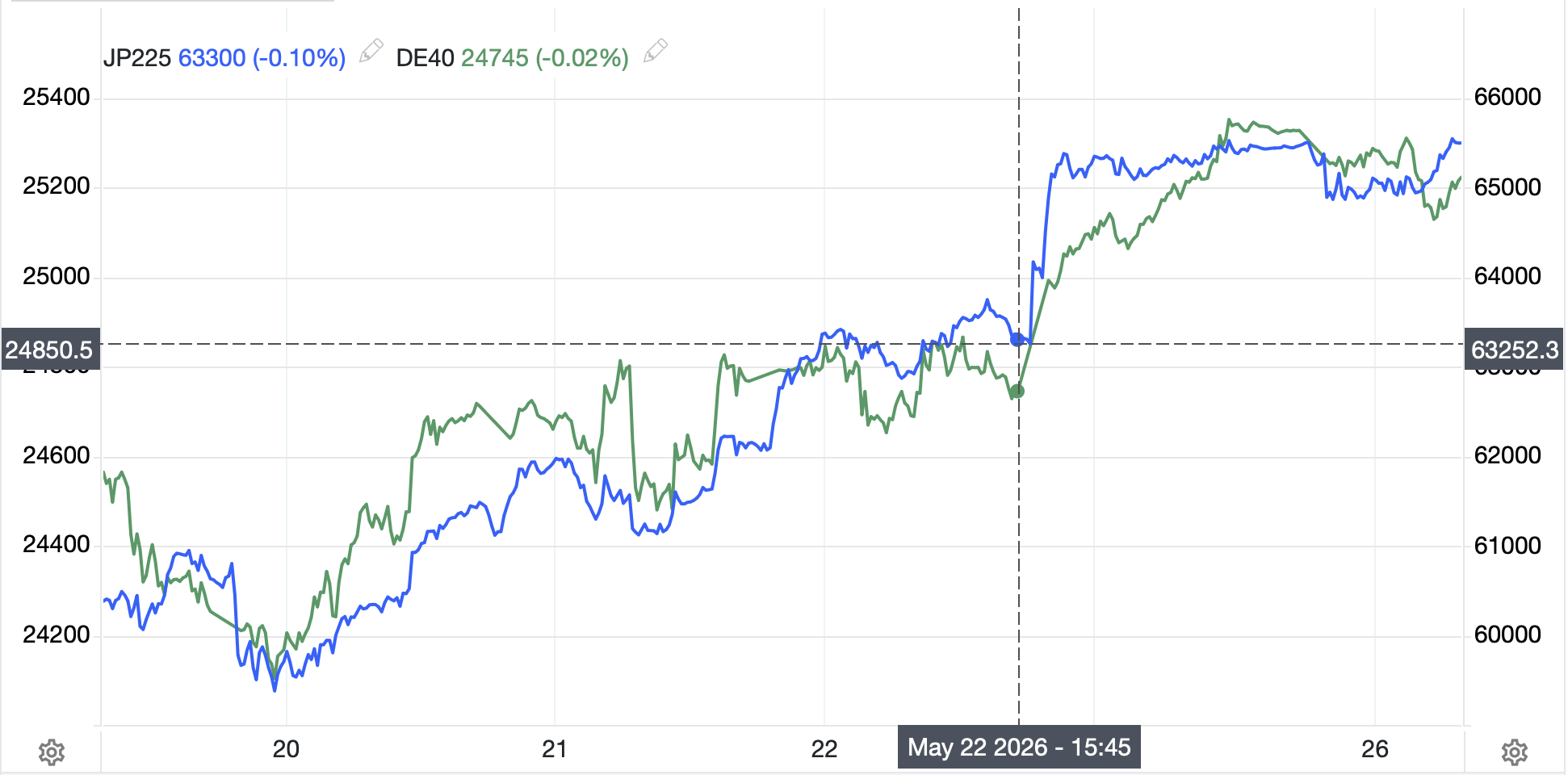
Moving on to equity markets, we have observed the same phenomena there, where there was a gap opening higher on Sunday night in futures markets which continued in cash markets while the US markets were closed for Memorial Day.  So, while last night, the Nikkei (-0.25%) slipped, that was after a more than 3% rally on Sunday night/Monday.  Ultimately, given the US holiday and the news cycle over the weekend, we need to look at the movement since Friday to get a sense of things.  So, below is a chart of both the Nikkei and the German DAX showing the rally from Friday’s late trading.  Again, risk is back baby!!
Source: tradingeconomics.com

Finally, the dollar is, well, it is all over the place this morning.  I look at tradingeconomics.com as my source for currency prices as they are all in one place.  One of the weird things this morning is that the EUR (-0.1%), GBP (-0.2%), JPY (-0.15%), CAD (0.0%), CHF (-0.2%) and SEK (-0.2%), the components of the DXY, are all flat to weaker this morning, the DXY itself is also weaker.  I have no explanation for that.  Generally, I would say the dollar is a bit firmer overall this morning with one notable exception, KRW (+0.7%) which saw demand alongside the sharp rally in the KOSPI overnight.  but otherwise, the dollar is modestly higher against most of its counterparts.  Lastly there has been a lot more noise than signal here.

On the data front, the short week does bring some important information.

TodayChicago Fed National Activity-0.3
 Case-Shiller Home Prices1.0%
 Consumer Confidence92.0
ThursdayInitial Claims211K
 Continuing Claims1780K
 Durable Goods3.5%
 -ex Transport0.5%
 Personal Income0.4%
 Personal Spending0.5%
 GDP Q12.0%
 PCE0.5% (3.8% Y/Y)
 Core PCE0.3% (3.3% Y/Y)
 New Home Sales670K
FridayGoods Trade Balance-$87.0B
 Chicago PMI49.7

Source: tradingeconmics.com

Now, with PCE coming, we are going to have to get a new line there as Chairman Warsh likes trimmed-mean PCE, which not surprisingly, has been lower of late, as the key metric for the Fed to follow.  I assume that will become the newest thing to watch.  Of course, it is far too early to have any sense of anything at the Fed now, other than the fact that there will be lots of politicking going on.

So, what have we learned?  Markets are still hopeful that the Iran conflict will end soon with a satisfactory (meaning no SOH problems) conclusion.  In that circumstance, risk will be the ongoing preferred stance, and I expect the dollar will come under pressure in that scenario, at least for a time.

Good luck

Adf
The Drumbeat

The drumbeat grows louder each day
Catastrophe’s soon on its way
Yet markets ignore
The impact of war
On how things, in future, will play

Right now, Iran says they need U
Although one might ask what they’ll do
As well, on the Strait
They want a toll gate
Methinks this deal, Trump, will eschew

So, are oil tanks running dry?
Will phosphate’s price rise to the sky?
Will food soon run out?
Again, I’m in doubt
But pundits, good times, need deny

This is either setting up to be the greatest market pricing mistake of all time, or the global situation is not as bad as many pundits would have you believe.  There are a bunch of very smart analysts out there who have great expertise in the commodity space, who have continuously explained that the closure of the Strait of Hormuz is setting the world up for catastrophe.  Amongst them are Luke Gromen (@lukegromen), Craig Tindale (@ctindale), Adam Rozencwajg (from Goehring & Rozencwajg Associates) and Javier Blas from Bloomberg.  I read all of them periodically as they have some excellent insights as to what is going on in commodity markets.  And, to a man, they are all singing the same tune that even if the Strait were reopened tomorrow, the damage done is so great that we are heading into a major global economic recession.

Undoubtedly, all of them are smarter than me, a simple FX poet, and while I read a lot, market price action is far too important to ignore, especially as the current situation is not exactly hidden from traders and investors.  Thus, at the end of the day, while I understand their thesis, market prices are telling a completely different story.  Oil and gas production is growing elsewhere in the world and deals are being signed all over the world for new opportunities (Alaska, Brazil, Guyana, Venezuela).  The oil market remains in a steep backwardation which is another sign that markets are not overly concerned about the future.  I’m sorry, I cannot get worked up about this stuff without some clearer price signals, perhaps WTI at $150/bbl or something like that.

As to the Iran news, it is impossible to tell truth from fiction regarding the negotiations as it remains unclear, who in Iran is negotiating and what power they have.  The uranium issue remains key, in my mind, as a nuclear weapon cannot be considered defensive, and given their stated goals of destroying the great Satans of Israel and the United States, I very much fear if they were to create one, they would launch it the next day.  Even Xi agreed they cannot get one.  

All this leads me to believe that there is still quite a bit more back and forth before things end, and if I had to pick a date, I am still in for July 4th as a time to announce an agreement.  We shall see.

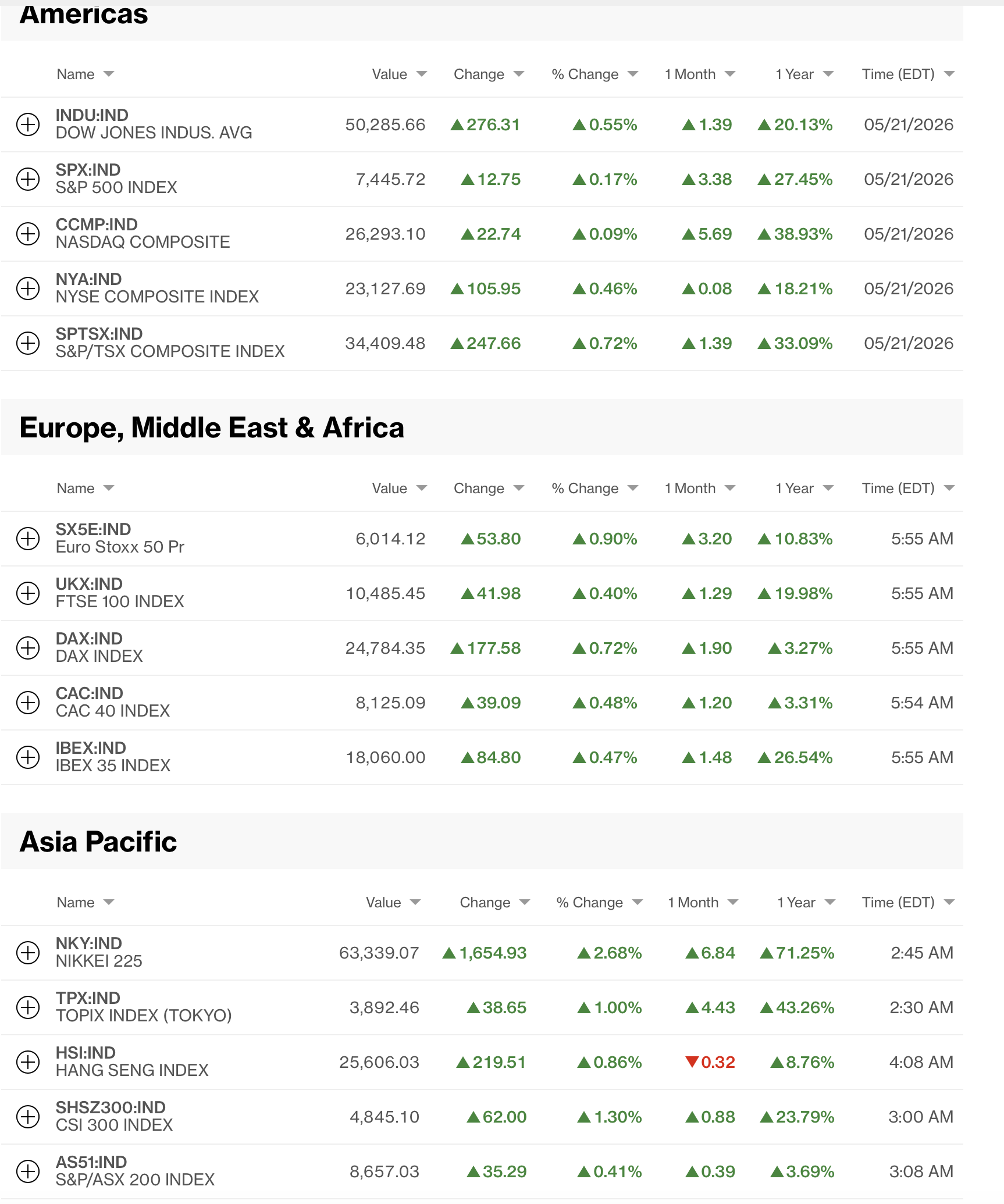
So, given we are not going to solve the Iran conflict here, it’s time to observe how markets are behaving.  And frankly, there is not very much to observe.  Starting with equity markets, as you can see from the Bloomberg screenshot below, things look pretty good right now, regardless of the Iran situation.  Yesterday’s US rally (the concerns raised regarding Iran and its uranium were set aside, it seems) were followed by strength in Asia and this morning in Europe.

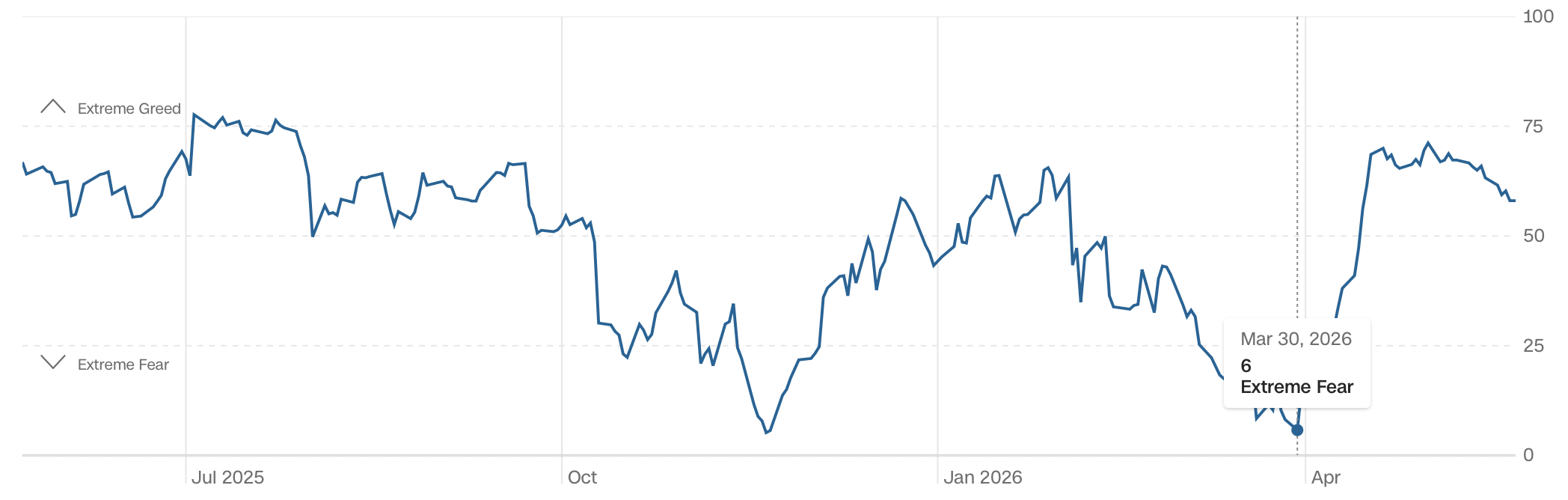
Earnings data continues to be released in a generally positive manner, and despite the ongoing angst amongst the punditry, as discussed above, there is, as yet, no sign that fear is growing amongst the investing set.  Below is a chart of the CNN Fear and Greed Index over the past year.  the current reading is 57, firmly in the Greed bucket and as you can see, the fear over the war began to dissipate at the end of March. 

If you think about it, this is really no different than the Ukraine War, which for a relatively short time was seen as catastrophic, and eventually faded into the background.  Honestly, when was the last time you saw an article on the subject?

As to the bond market, it continues its recent uncertainty as to what the future holds.  This morning yields are lower across the board with Treasuries (-2bps) after slipping -3bps yesterday, while European sovereign yields are all lower by between -4bps and -6bps.  The bond market appears to be caught between fears of rising inflation because of the impact of higher oil prices, not only on direct things like transportation, but also secondary impacts as those costs are passed on and adding in the potential for higher food prices if the fertilizer situation is as bad as some forecast.  However, the other side of that coin is the potential for a significant recession, which historically has resulted in substantially lower yields as governments around the world add both monetary and fiscal stimulus.  Place your bets!

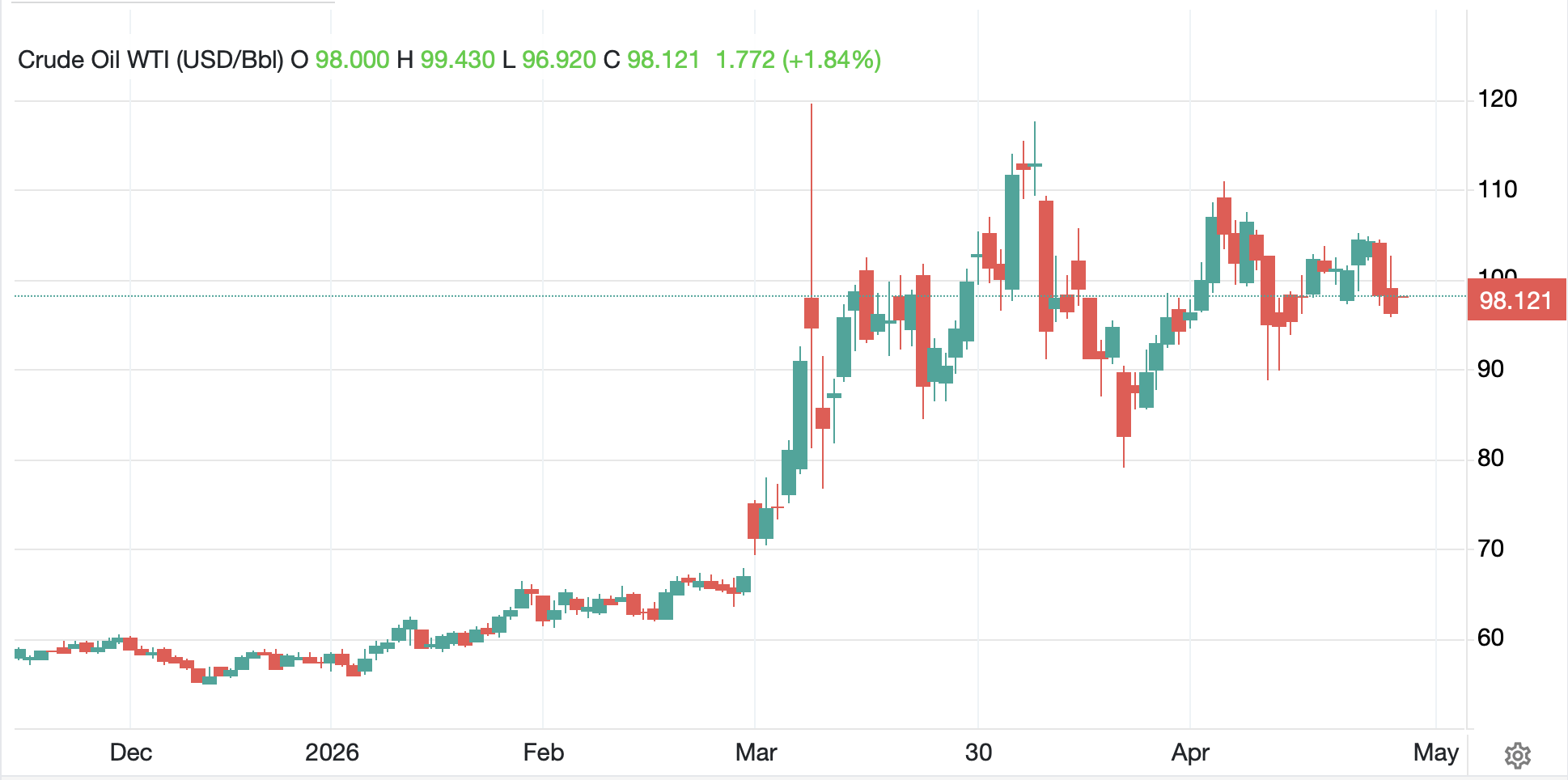
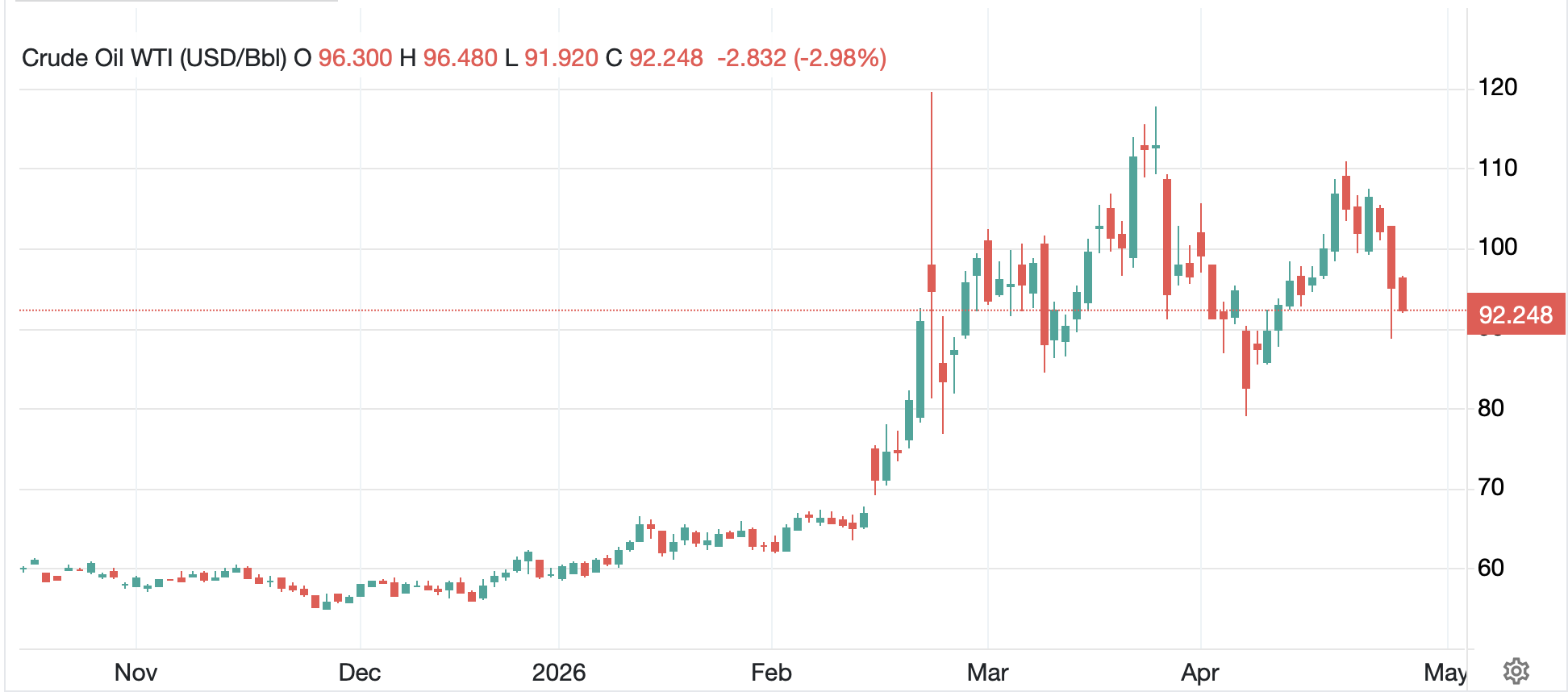
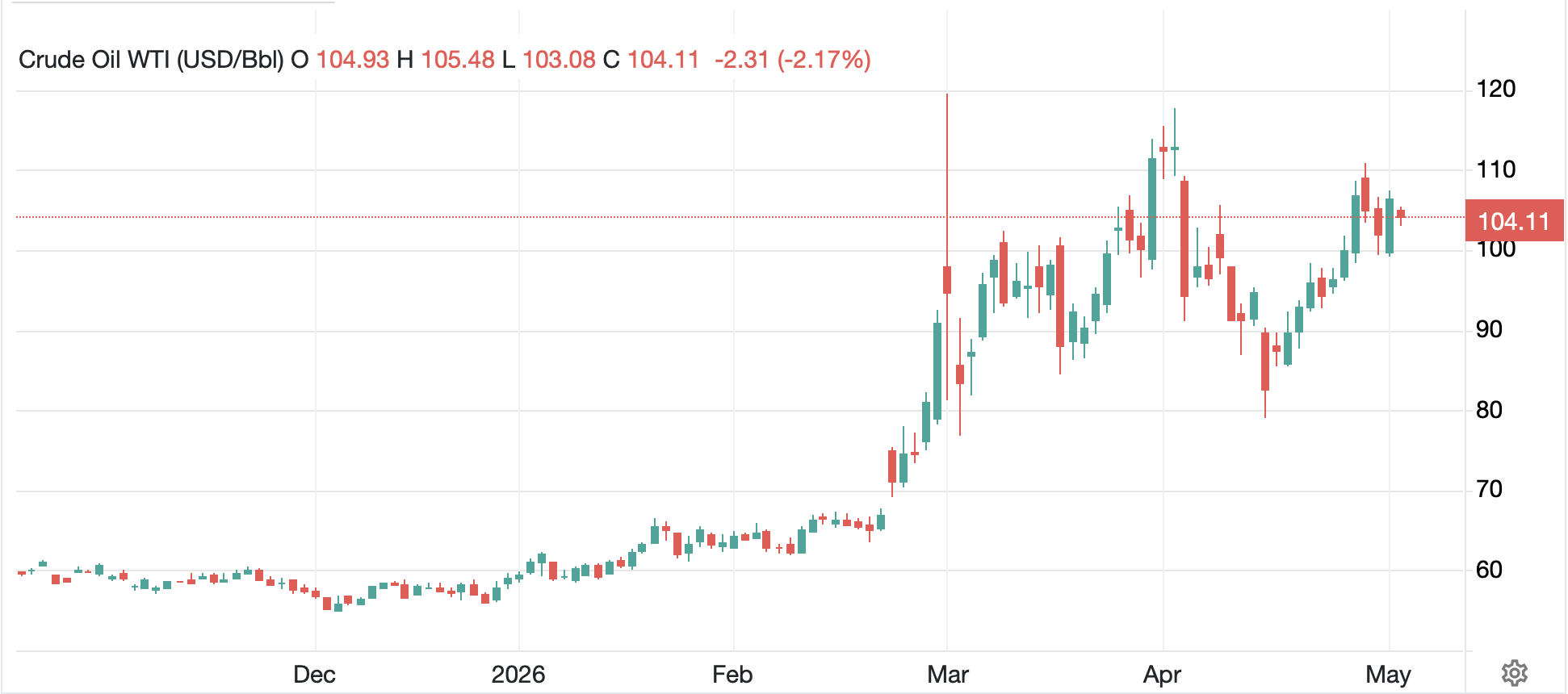
Turning to the oil market, while WTI is higher by 1.8% this morning, as you can see in the chart below, it continues to go nowhere overall.  If the apocalypse is coming, the market is certainly not ready.  Either that, or there is a lot more oil around than people give it credit for.

Source: tradingeconomics.com

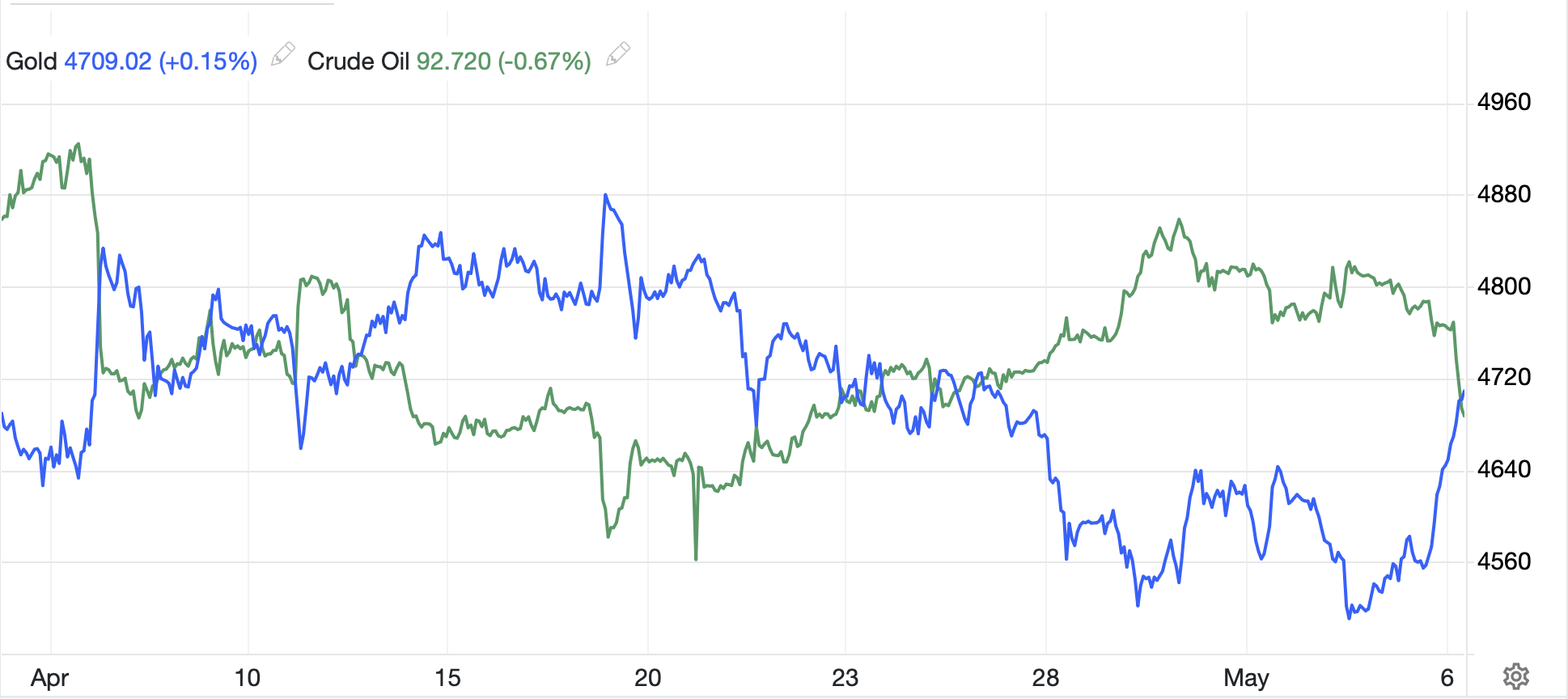
Of course, as has been the case, when oil’s price rises, gold (-0.6%) and silver (-1.1%) slide as that negative correlation has become firmly entrenched.  Copper (+0.7%) though, is bucking that trend this morning, albeit hardly running away.  I expect that these relationships are likely to hold until there is a resolution of some sort in the Gulf.

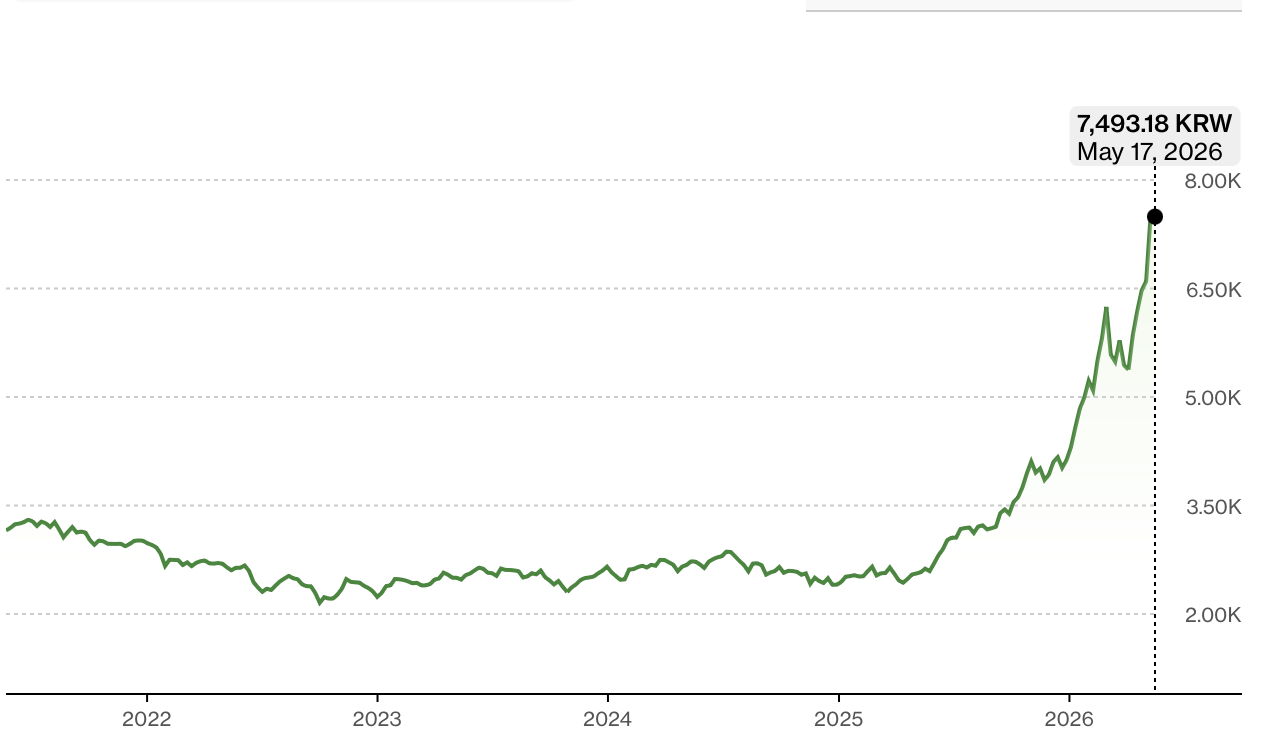
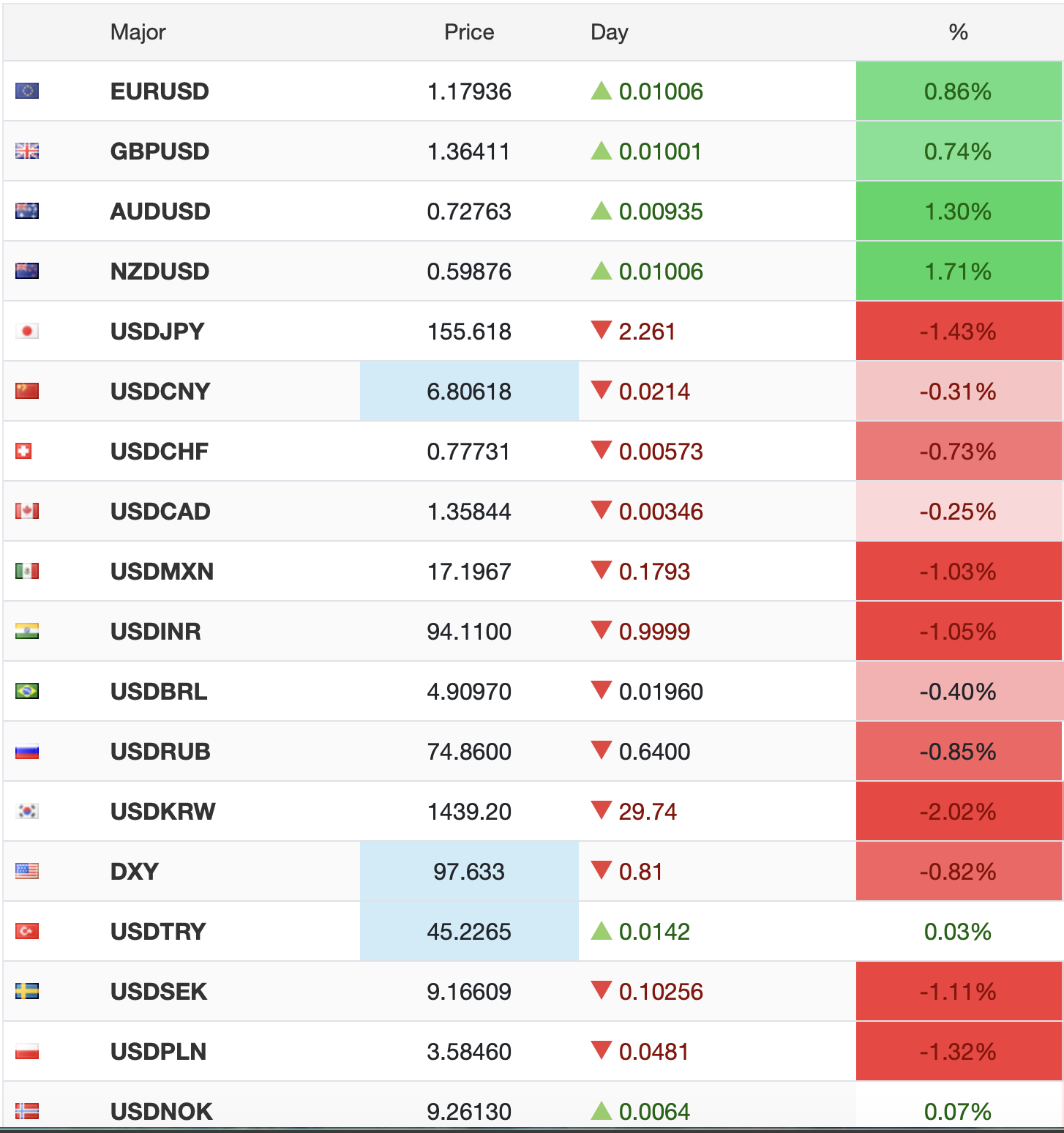
Finally, the dollar is generally firmer this morning despite the decline in yields.  In fact, if we look across markets, bonds are today’s outlier.  But back to FX, in the G10, all the currencies are weaker by between -0.1% and -0.3% although in the EMG bloc, there are two more substantial movers, INR (+0.5%) as the RBI continues its intervention process amid fears the rupee will collapse, while KRW (-0.8%) continues to see foreign outflows despite its equity market continuing to be one of the best performing in the world as you can see in the Bloomberg chart of the KOSPI below.

And that’s really it as we head into the weekend.  Perhaps the conflict will heat up during the long weekend, which would likely drive some real movement.  But for now, there is nothing new under the sun.

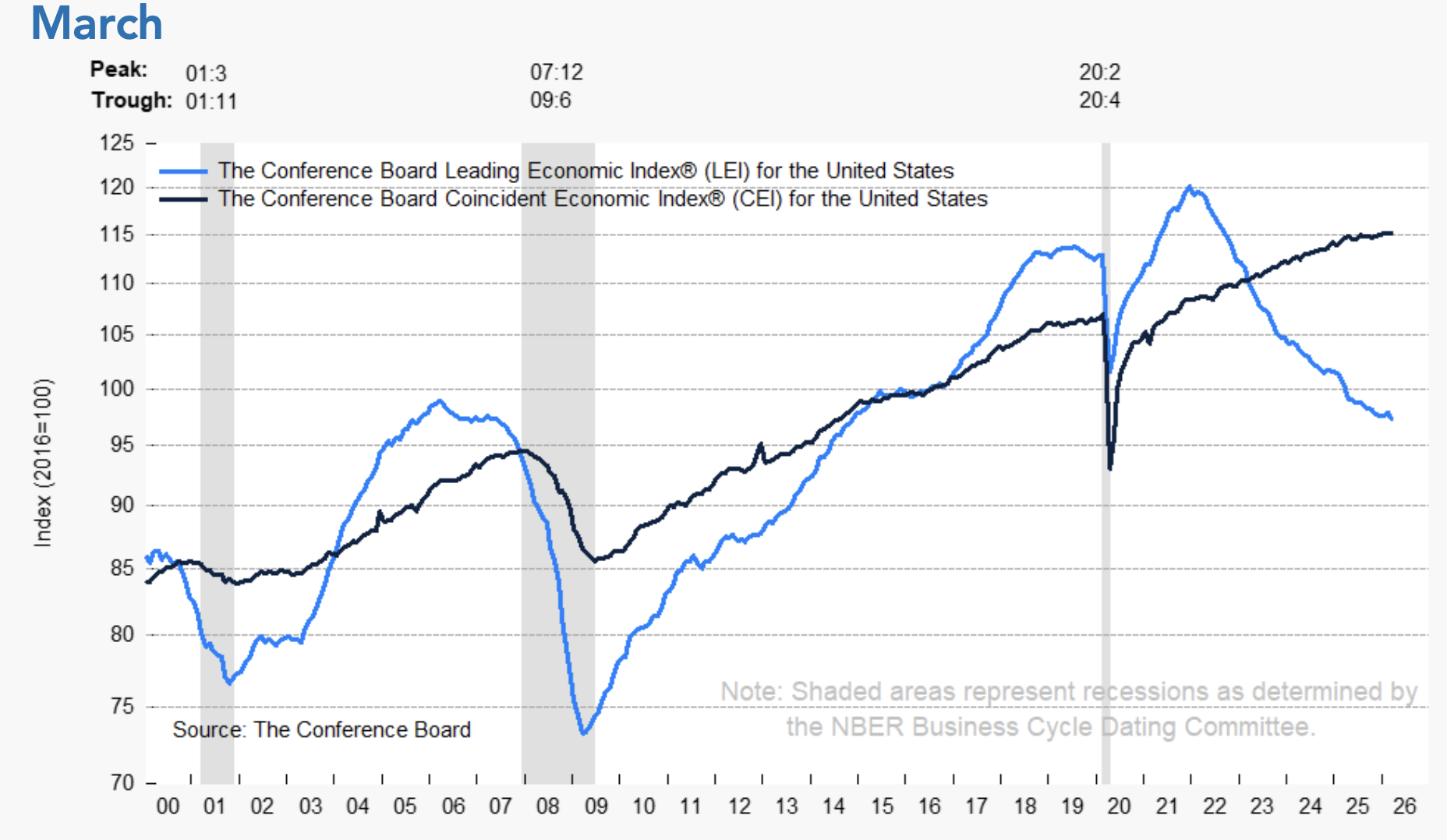
On the data front, yesterday saw generally solid data with the Philly Fed the lone, weak, exception.  Last night, Japanese CPI was released at a much lower than expected 1.4% for both headline and core.  While there is still a strong expectation that the BOJ is going to raise rates next month, if inflation is truly at 1.4%, that seems like it might be a mistake.  This morning we see Michigan Sentiment (exp 48.2) and Leading Indicators (-0.2%).  Here’s the thing about the Leading Indicators, though, as you can see from the chart below from the Conference Board’s website, it appears they may not be telling us the whole story anymore.

After all, they have been declining steadily since early 2022 despite an economy that has grown solidly during that period.  Again, maybe this truly is a harbinger for the future, but I am not convinced.

And that’s all there is.  Have a wonderful Memorial Day weekend and let’s see what the world looks like on Tuesday morning!

Good luck and good weekend

Adf

Narrative Doom

The crude price continues to fall
But one thing that has us in thrall
Is narrative doom
Where pundits all fume
God dammit, we’ll soon hit the wall

But under the headlines we learn
It’s really not quite the concern
The major details
Of SPR sales
Are by next year all will return

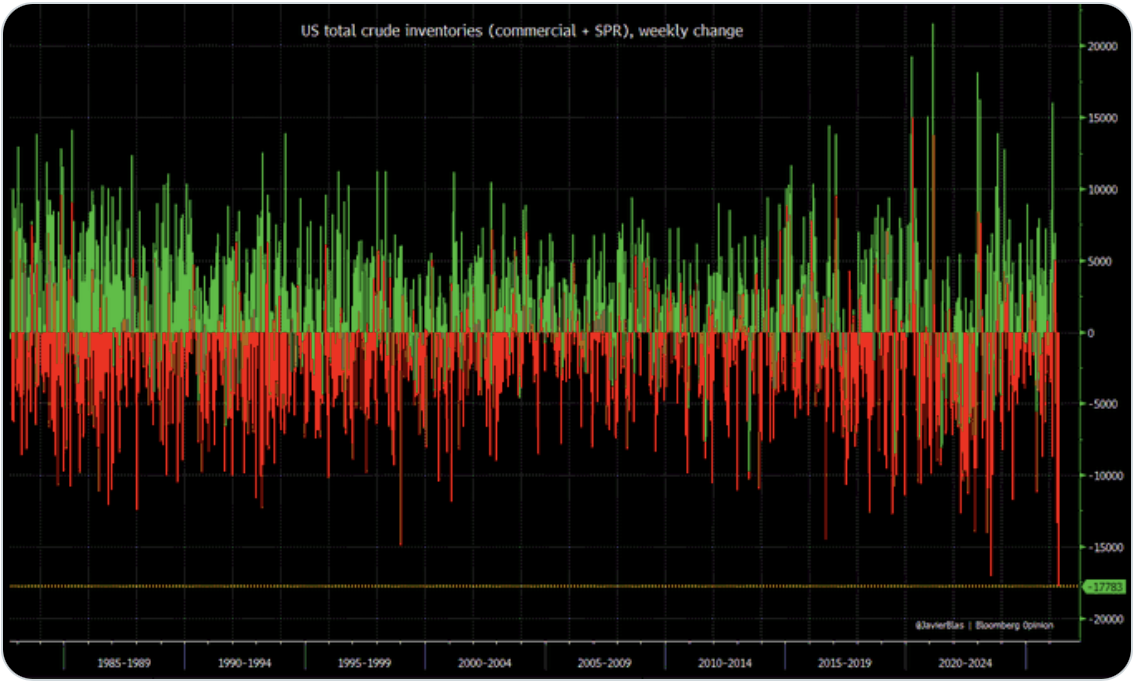
Oil puked yesterday, down nearly -6% despite the news that the EIA inventories fell dramatically as well.  The total draw was just under 18 million barrels, which on the surface is a new record draw.  Charts like the below were all over the place as the narrative writers were busy calling for the end of American Exceptionalism er.. the dollar, er.. US energy dominance.

However, I am not convinced that is the case.  The first clue is that oil prices collapsed and if the doom porn was accurate, I don’t believe that would be happening.  Instead, there is a far better explanation which I am lifting in its entirety from my friend JJ who writes market vibes and has been trading oil for as long as I have been trading FX.  If you care about oil markets, you really need to be reading what he says.

The DOE is releasing 172 million barrels of SPR oil with swaps rather than outright sales. Companies borrow SPR crude now and they pay it back plus a premium in more barrels later which based on the curve could be as much as 25% more barrels. This is explicitly designed to grow the reserve by at least 200 million barrels “at no cost to the taxpayer” and it will.

These are not “draws.” They are loans. The swaps are repaid ratably from November 2026 through September 2028. Earlier return structures have lower premiums.

In other words, the administration is taking advantage of the major backwardation in the oil futures curve and selling prompt and buying forward, taking oil instead of cash at a discounted basis.  If we understand this, it helps us understand why there is no panic in the oil markets, at least not in the US WTI market.

And, whether or not the IRGC is negotiating or getting ready to annihilate us all, my sense is this is a much bigger part of the picture than anyone is considering, except actual oil traders.  But it is not nearly as sexy a narrative, especially if you hate President Trump and can try to tar him with yet another problem.

And as we have learned lately, as goes oil, so goes the entire market.  So, it should be no surprise that equities and precious metals rallied as oil fell alongside Treasury yields and the dollar.  Pretty ordinary actually.

For Jay in his last time as Chair
Where soon, Kevin Warsh we’ll compare
The Minutes revealed
That rises in yield
Would soon change to common from rare

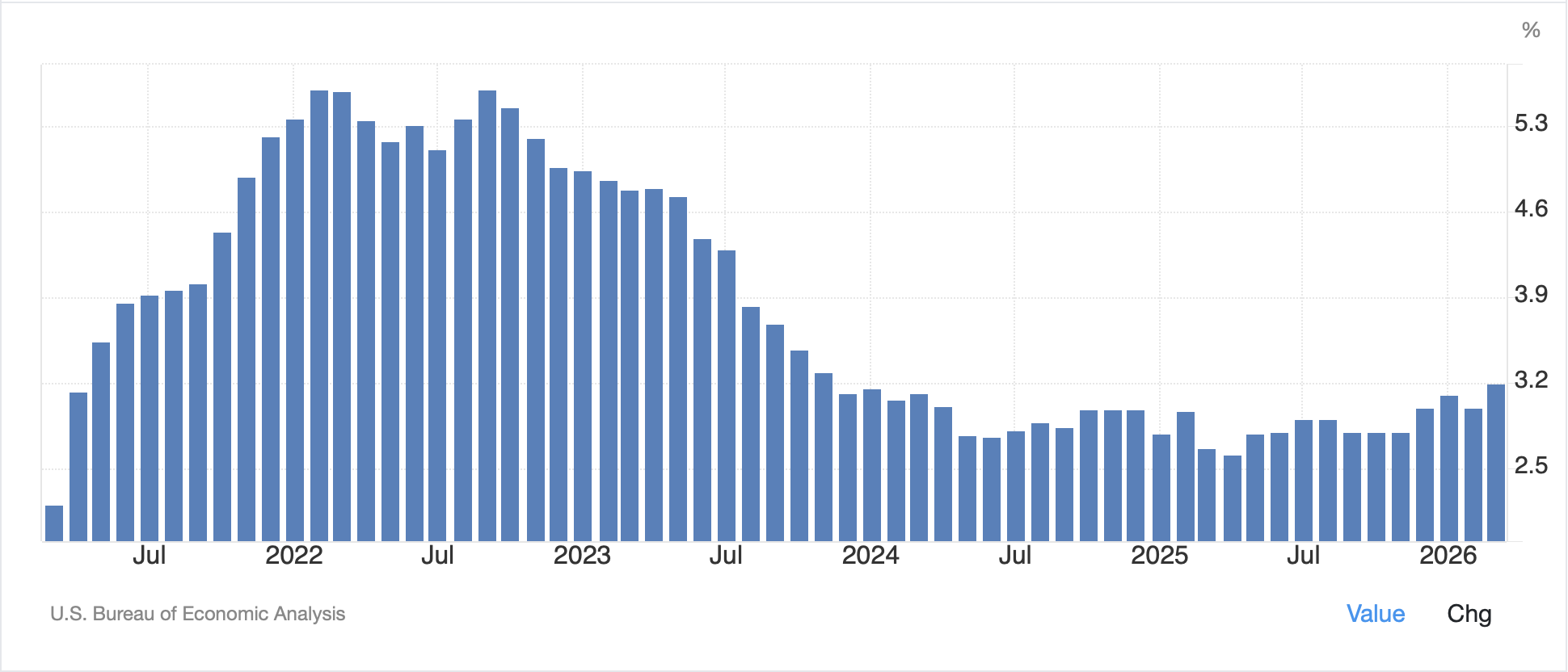
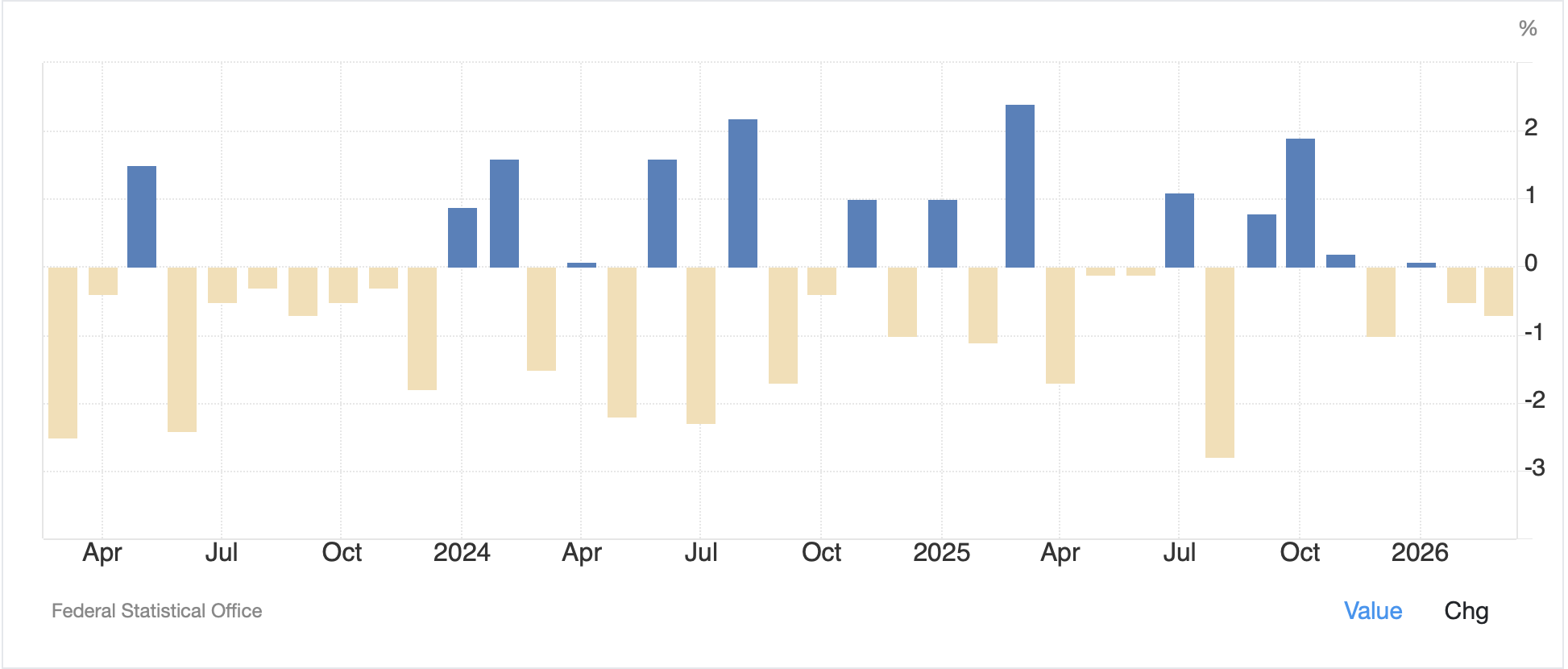
“A majority of participants highlighted…that some policy firming would likely become appropriate if inflation were to continue to run persistently above 2%.”  This statement from the FOMC Minutes of the last meeting at the end of April is actually quite galling.  Even though the FOMC has settled on the inflation reading that has historically run lower than all others, Core PCE, a metric, by the way, that doesn’t even try to represent a consumer’s experience, they have singularly failed to achieve their 2.0% target for more than five years running now.  In the chart below from tradingeconomics.com, the leftmost bar is at 2.2% from March 2021, right as the Covid monetary insanity started to accelerate.  This chart should be Jay Powell’s epitaph, a singular failure in the seat.  After all, as awful as I thought Janet Yellen was in the role, her track record was not this bad!

Of course, now that Mr Warsh is due to be sworn in tomorrow, you can be certain that the punditry will lay the entirety of blame on the fact that inflation is running hot on him directly because, well, President Trump appointed him and they generally hate President Trump.  Of course, I would contend this was not really a newsworthy release as we all already knew that the FOMC had turned more hawkish, and we have seen Fed funds futures begin to price in the probability of a rate hike by the end of the year.  

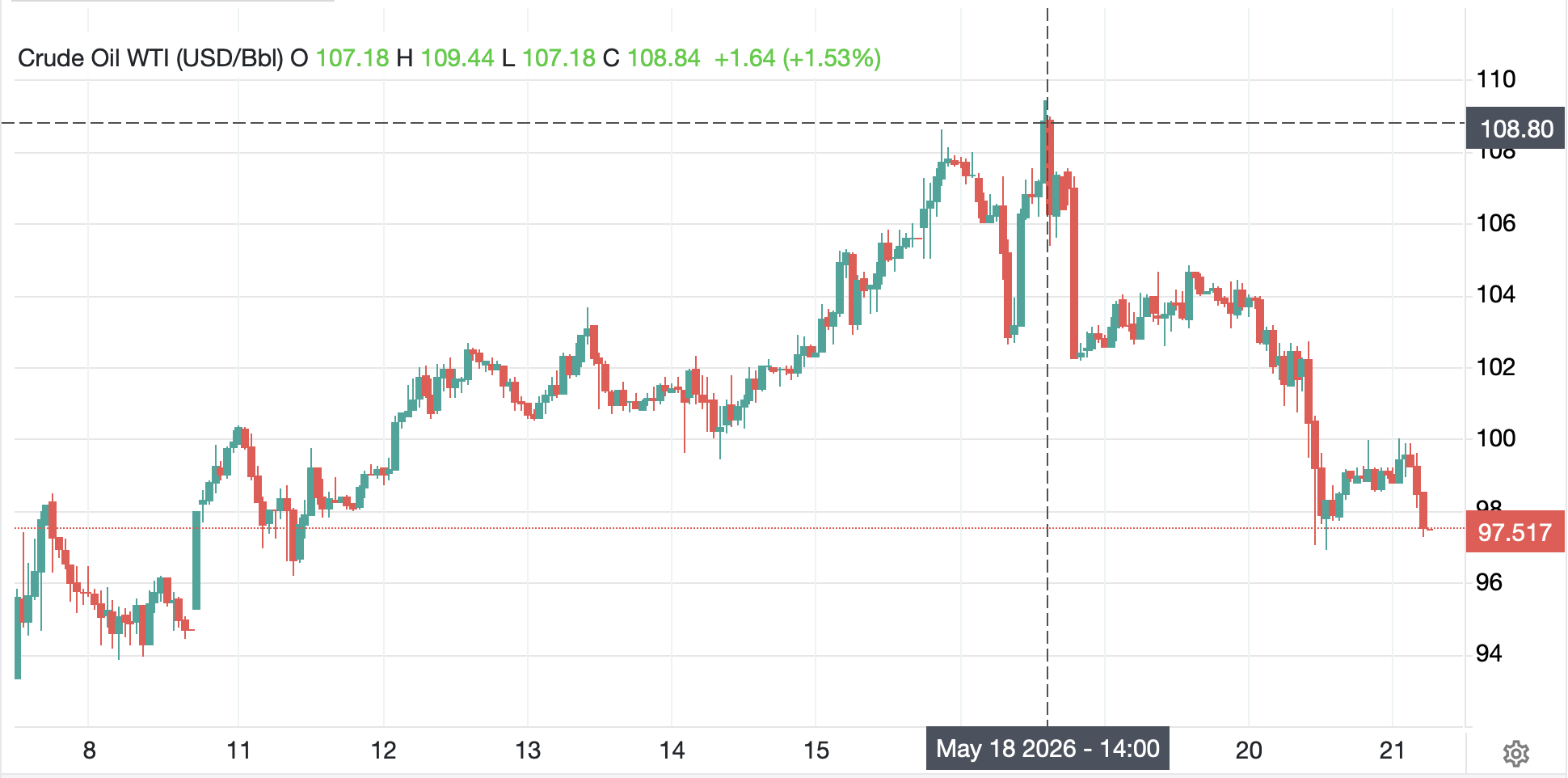
In the end, though, the oil price remains the key driver of all market activity for the foreseeable future.  So, let’s see how the rest of the markets behaved after yesterday’s sharp decline and given that the black, sticky stuff is sliding a little further this morning, currently down -0.75% at 6:00am.  Remember, too, that Monday afternoon, WTI was more than $10/bbl higher than it is right now.

Source: tradingeconomics.com

Finishing the commodity space, the metals, which all rallied yesterday, have slipped a bit despite oil’s slide this morning with gold (-0.3%), silver (-1.0%) and copper (-1.0%) all under modest pressure.  I must admit that the price action in both gold and silver is starting to make me question the long-term case, let alone the short-term case, to hold them.  Copper, however, seems like it will be in such demand as the electrification of everything increases, that any price declines should be snapped up.

In the equity markets, as mentioned above, yesterday saw gains in the US which were then followed up by what seemed to be a strong earnings report from Nvidia, although I read that there were those who were disappointed they didn’t guide things even higher.  The follow through in Asia was mixed with Tokyo (+3.1%), Taiwan (+3.4%) and Korea (+8.4%) following the tech lead from the US.  Interestingly, both China (-1.4%) and HK (-1.0%) did not follow along, but sold off, ostensibly on profit taking after their recent rallies.  The other big laggard in this time zone was Indonesia (-3.5%) which reacted negatively to government export restrictions on key commodities like palm oil and metals as still-high oil prices take their toll on the economy.

As to Europe this morning, there is not much of which to speak with the major indices all +/- 0.2% or less after Flash PMI data showed weakening activity, notably in Services, although the market is still pricing two rate hikes this year by the ECB.  US futures at this hour (6:35) are pointing slightly lower, with the NASDAQ (-0.6%) leading the way.

In the bond market, Treasury yields have backed up 3bps this morning after tumbling -8bps yesterday.  Right now, they sit right at 4.60%.  As it happens, yields fell everywhere yesterday alongside oil’s price decline, so it is no surprise that modest gains are the order of the day with German bunds (+1bp) outperforming the rest of the continent where yields are higher by 3bps to 4bps across the board.

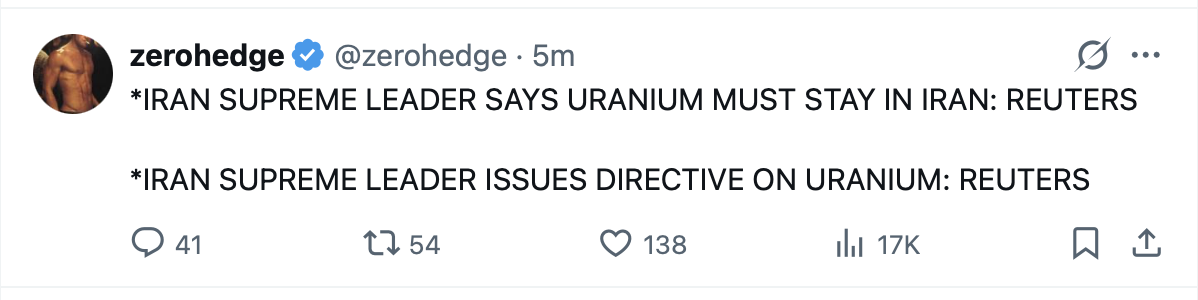
Finally, the dollar, which had been very quiet all evening, virtually unchanged when I sat down at my desk a 90 minutes ago, is starting to rally a bit here, which explains all the movements.  Apparently, there was just an announcement by Iran regarding uranium, which not surprisingly, has changed the tone of the market.

This explains the dollar’s sudden revival, higher by 0.25% across the board, oil’s sudden rebound, it is now higher by 2.5% at 6:45, and the decline in metals prices.  It also neatly matches bond yields higher.  So, if negotiations are struggling, we should expect to see further risk-off behavior.

On the data front, this morning brings Initial (exp 210K) and Continuing (1790K) Claims, Housing Starts (1.41M), Building Permits (1.39M), Philly Fed (+18.0) and then a little later the Flash PMI readings (Mfg 53.8, Services 51.1).  But as we have just seen in the past 45 minutes, everything is still attached to oil, so that is the key to watch.  All the market correlations remain intact for now, and I suspect they will continue to do so until this conflict is well and truly over.  In fact, it is situations like this, where news changes market pricing so dramatically in short order, that demands hedging programs to be maintained for everyone.  Let’s face it, nobody is going to get it right all the time.

Good luck

Adf

Still on Hold

Despite faster growth
The yen continues to sink
Are rate hikes anon?

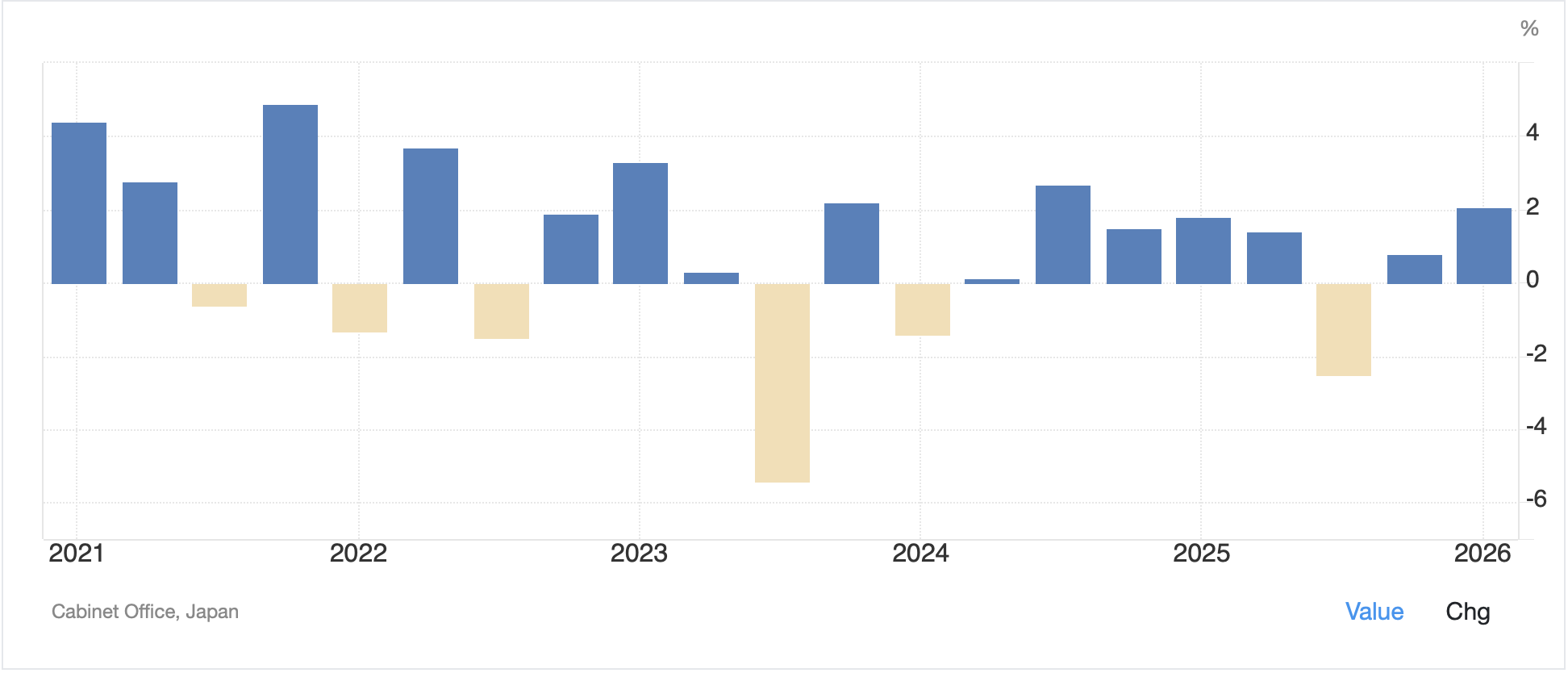
It’s funny, in Japan, there is a great deal of angst amongst government officials that the economic situation is under significant duress, and they appear uncertain how to act.  Now, in fairness, the ongoing Iran conflict is clearly problematic for a country that imports essentially 100% of its oil, and most of it travels through the Strait of Hormuz.  But if we look at the data, Japan is holding up remarkably well.  For instance, below is a chart of annual GDP which was released last night showing 2.1% annualized growth in Q1.

Source: tradingeconomics.com

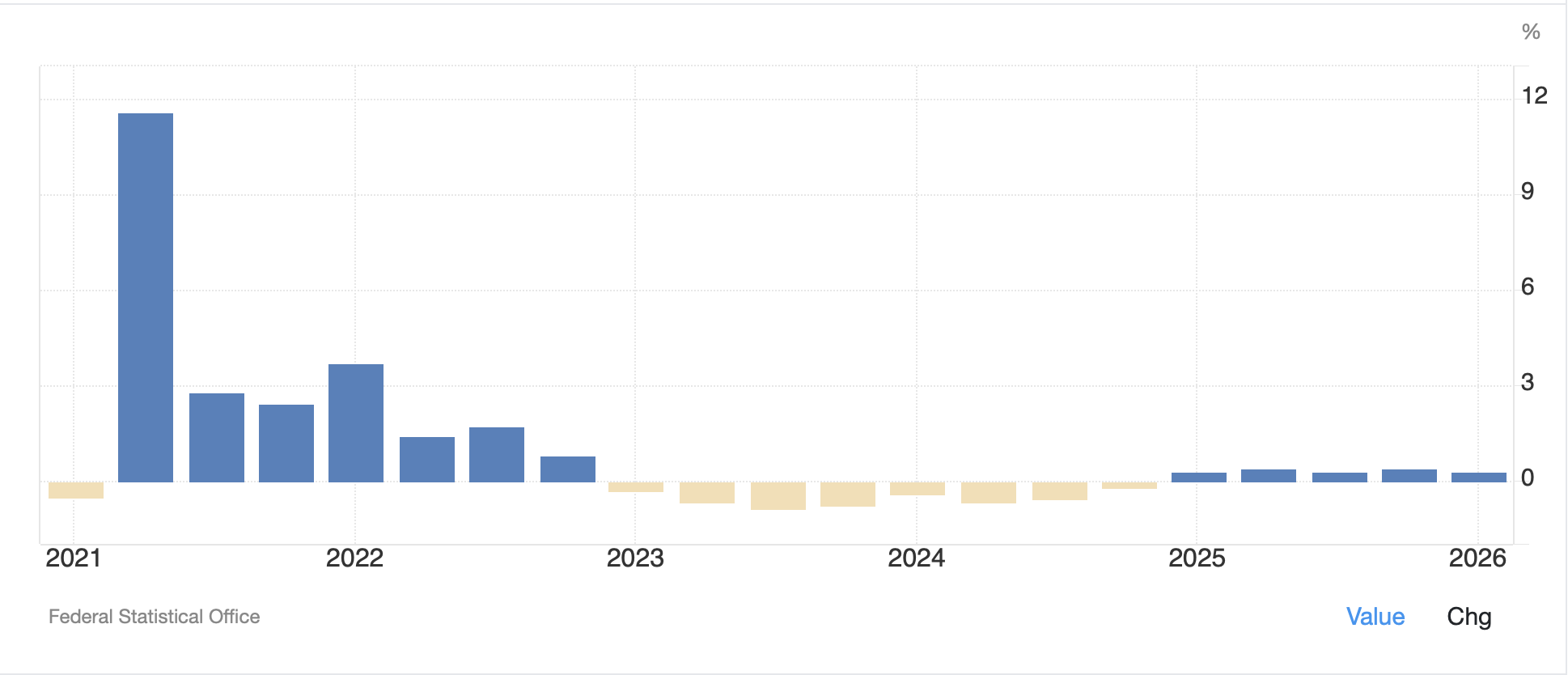
Granted, this is not a chart of an extraordinary expansion, but it is also, relative to its European counterparts, a chart to be envied.  For instance, the below chart of German GDP growth (and I use the term growth loosely) shows that after the Covid reopening, things have basically gone into stagnation.

Source: tradingeconomics.com

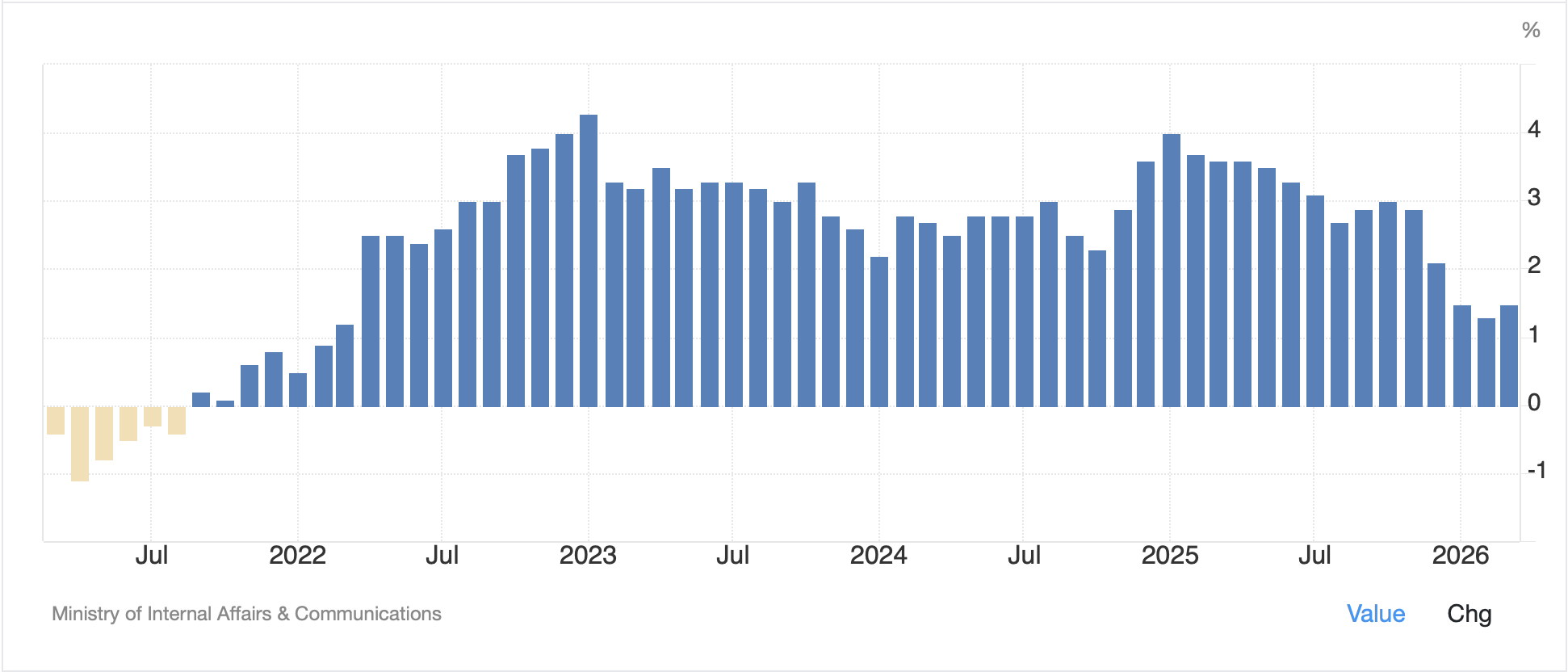
My point is that things in Japan seem to be moving along relatively well, with solid growth, especially when one considers that the population in Japan is shrinking, so given GDP = # people working x output/person, it is hard to grow the economy with a shrinking population.  Meanwhile, inflation in Japan remains sticky, although because of government subsidies to ameliorate the costs of electricity and fuel in the wake of the Iran conflict, it is below the 2% target for now.  However, apparently it remains a concern amongst the population there.

Source: tradingeconomics.com

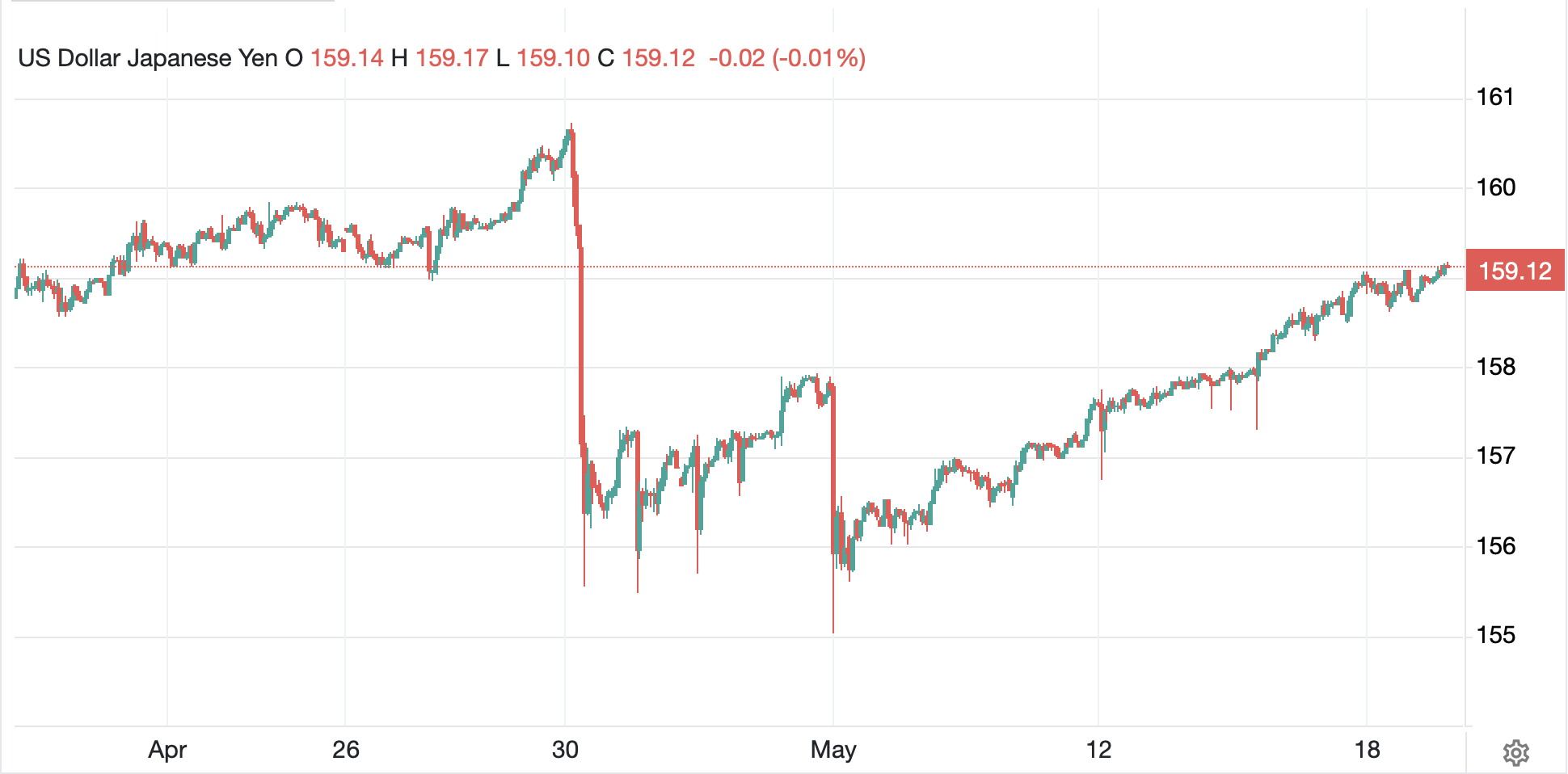
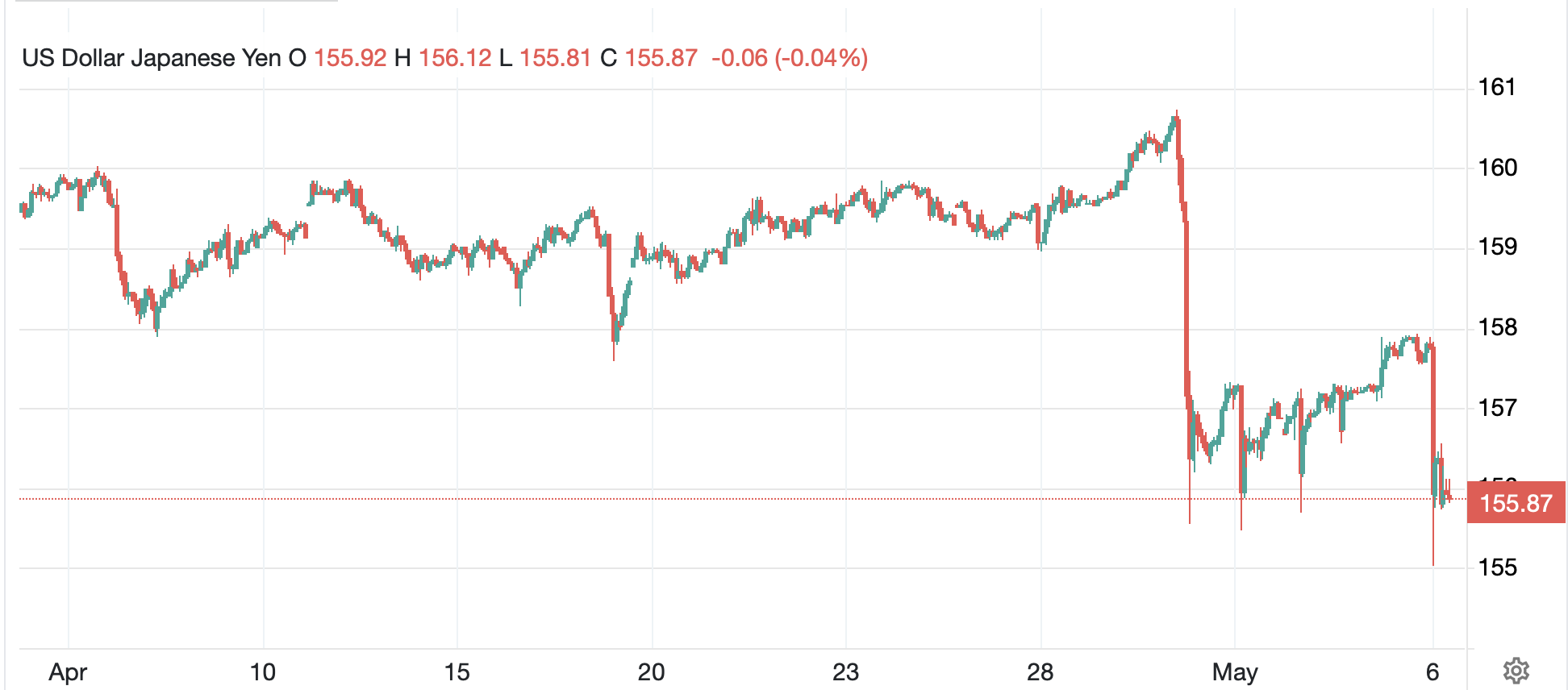
Which brings me to the true market related question, what of the yen?  You may recall a few weeks ago when the BOJ intervened because the yen had traded through the 160 level vs. the dollar and then there seemed to be a few mini interventions in the days that followed.  Yet this morning, as you can see in the below chart, the yen is once again marching toward 160, although I have not seen any commentary from the BOJ or MOF on the subject.

Source: tradingeconomics.com

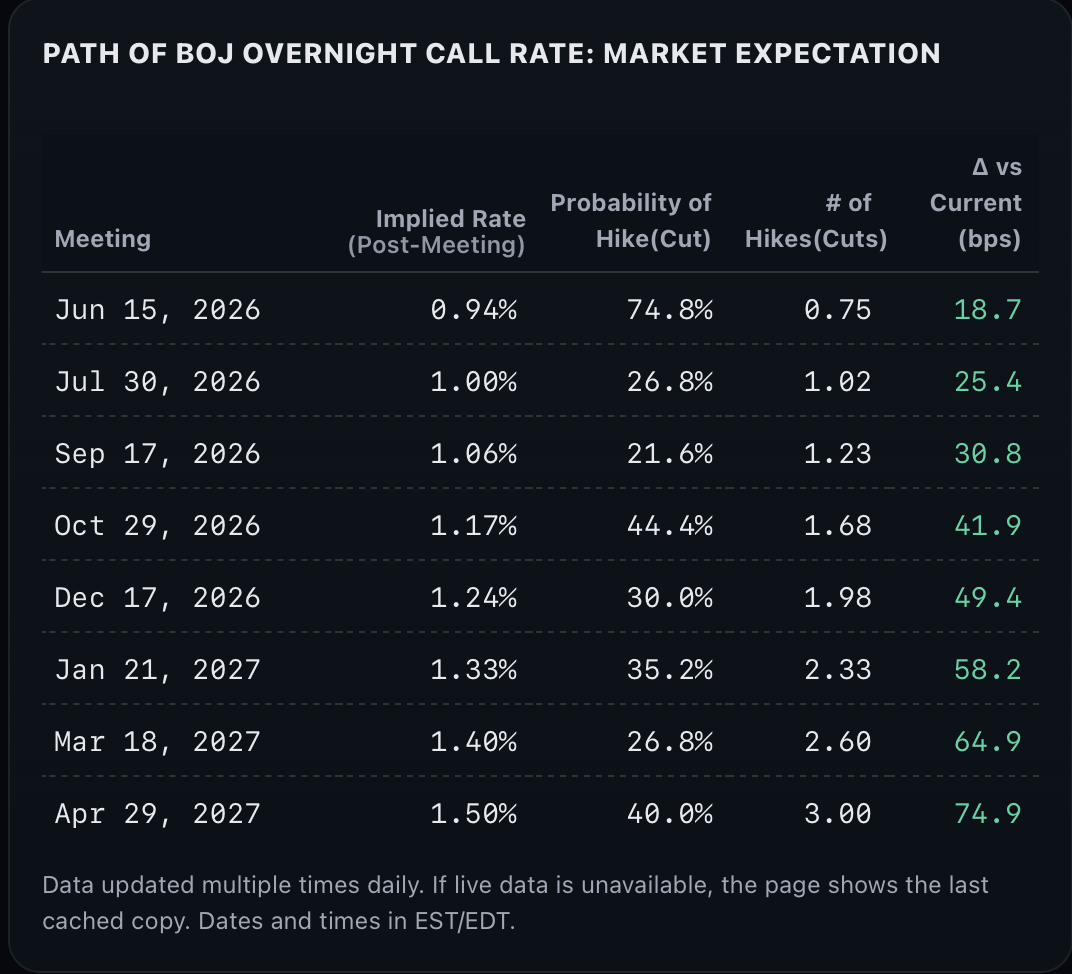
Bringing it all together, the question I would ask is, why is the BOJ even concerned about raising rates at their next meeting in a few weeks?  Ueda-san has been around a long time and understands the only way to address persistent currency weakness is via policy changes.  Especially now that markets have begun to price rate hikes as the next move in the US (I personally don’t believe that will be the case but that is a different story), the yen will continue to slide unless the BOJ moves.  Yet, with GDP growing decently, and underlying price pressures extant, a rate hike should be an easy call.  Currently, the probability appears to be about 75% that they will hike in June, but certainty they will hike by July, at least according to rateprobability.com as per the below table.  I’m not sure why it is even a question.

The war in Iran’s still on hold
As prices for crude stay controlled
But dollars are bid
And equities skid
While nobody wants any gold

As to the Iran situation, President Trump announced he was delaying, for two or three days, any renewed military action at the behest of the UAE and Qatar who claim that substantive negotiations are underway.  Once again, I make no claims of knowledge about what is actually happening there, although that admission is one that most of the punditocracy seems unwilling to make.  

But here’s a thought.  If you were Ahmad Vahidi, the ostensible leader of Iran, and you have spent the last 3 months in spider holes, caves and basements, moving every 8-12 hours lest someone leaks your location to the Israelis or Americans, how comfortable are you in your position?  After all, one of the reasons that people aspire to lead nations is for all the trappings that come with the job. Not only do you get a nice place to live, but you command respect from the people, at least a significant portion of them.  Is it impossible to believe that Vahidi is actually looking for a way out as well, perhaps willing to give up his nuclear ambitions for the removal of the price on his head?  I know that does not fit the narrative for many folks, and is pure speculation on my part, but is it really that far-fetched?

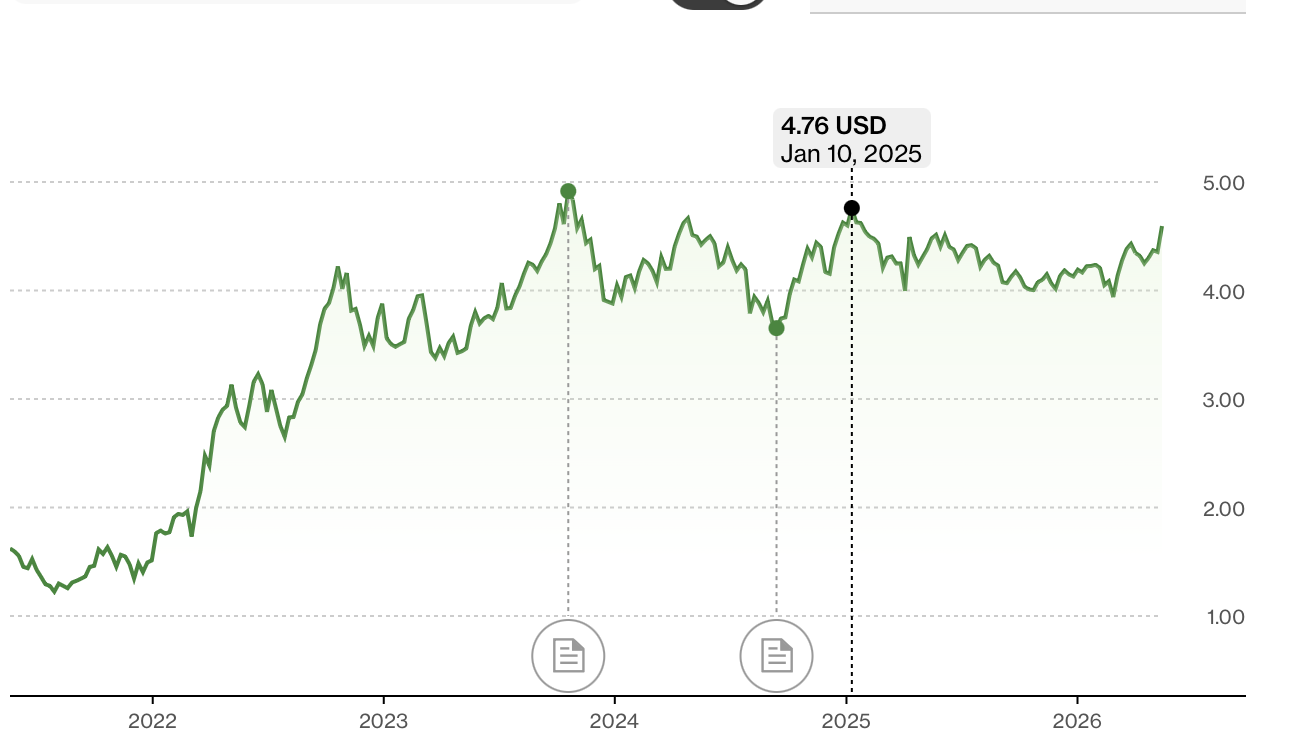
Ok, in the meantime, as we await the next news from Iran, let’s look at market activities.  Starting in the bond market, yields continue to climb higher pretty much all around the world as inflation concerns remain high and there is a growing concern that government bond issuance is going to grow even faster going forward as countries everywhere seek to rearm quickly.  So, Treasury yields (+3bps) are pushing back to the levels seen in January 2025, although remain 15bps below those levels as per the below Bloomberg chart.

And as has been the case for quite a while now, Treasury yields are leading the global yield market with European sovereign’s all higher by about 2bps and JGB yields jumping 6bps last night after the GDP data.  Certainly, JGB traders believe the BOJ is going to hike rates.

In the equity markets, though, risk appetite remains remarkably robust through all the complexities of the war and economic data.  Yesterday’s US session, which started off deeply in the red, rallied back so the DJIA actually closed higher while the other two major indices dramatically reduced their losses.  This morning, futures markets are pointing slightly lower with the NASDAQ (-0.8%) the laggard as questions continue to arise about how long AI will drive the thesis there.  As to the rest of the world, Asia was mixed with the Nikkei (-0.4%) slipping, although every other index in Tokyo rose, China (+0.4%), HK (+0.5%) and Australia (+1.2%) all gaining.  Korea (-3.25%) and Taiwan I-1.75%), though, had rough sessions as those two markets have been driven by semiconductor companies just like the NASDAQ.  The only other noteworthy move was in Indonesia (-3.5%) as investors are concerned about the central bank raising rates after their meeting concludes tonight.

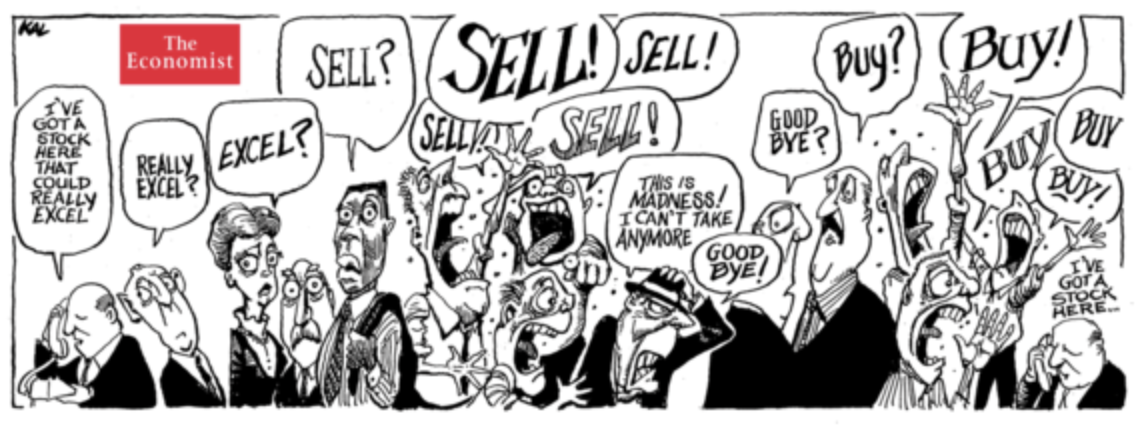
Europe is in fine fettle this morning with gains across the board led by the DAX (+1.4%) and followed by the CAC (+0.8%), FTSE 100 (+0.7%) and Spain’s IBEX (+0.4%).  I keep reading that there is optimism that an agreement will be reached as the rationale for these moves, but I guess that is the way things go.  Never forget this perfect illustration of how market information is passed.

Turning to oil markets, this morning has seen that war ending optimism here as well with WTI (-0.4%) and Brent (-0.9%) both slipping a bit.  Interestingly, metals markets are not behaving as they have recently as they, too are lower; gold (-0.65%), silver (-2.1%), copper (-1.1%).  In the end, like every market, movement here is entirely dependent on the Iran situation, at least in the short run.

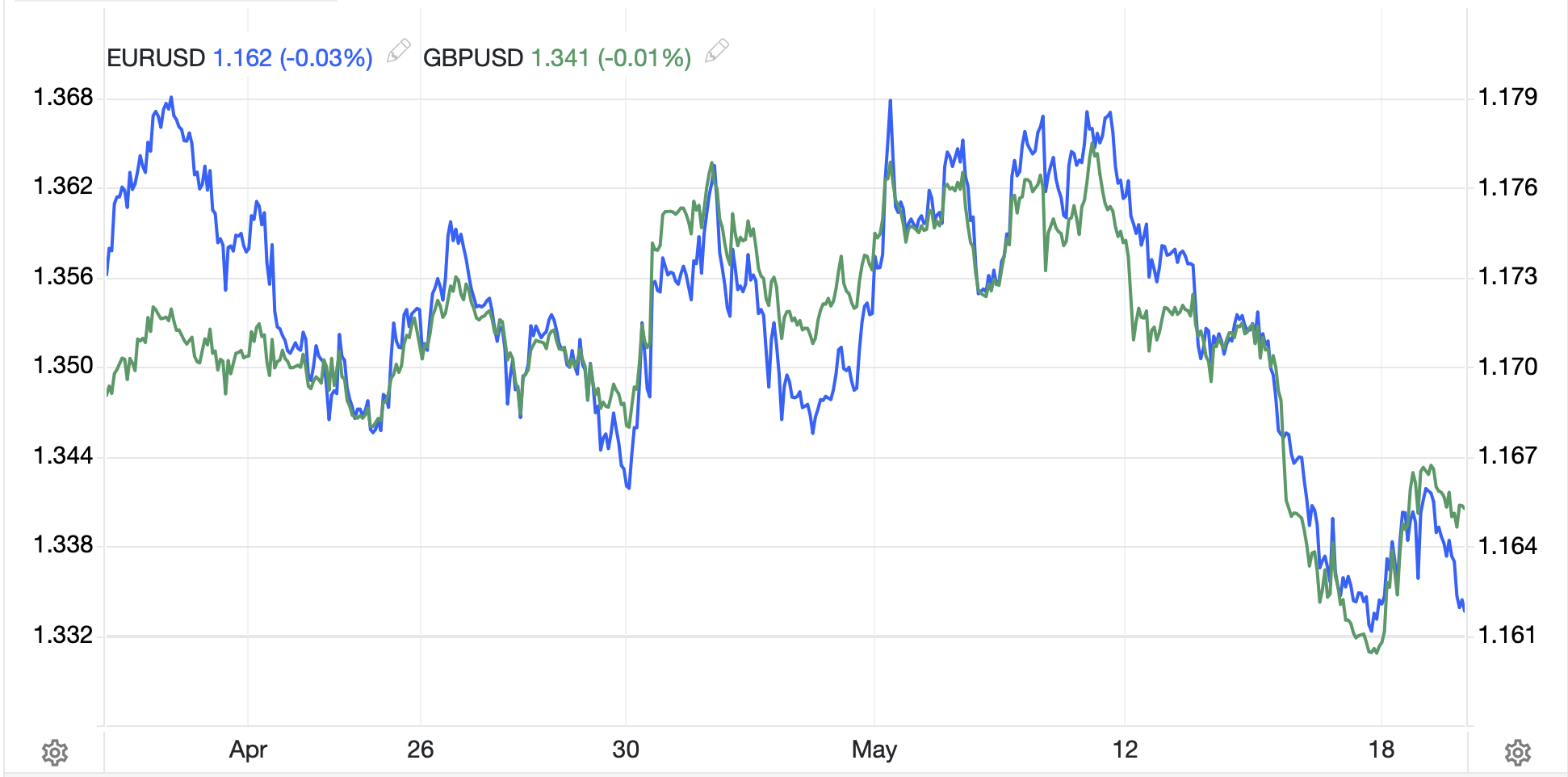
Finally, the dollar is flexing this morning rising against virtually all its major counterparts.  In the G10, AUD (-0.7%) is the laggard, but the euro (-0.3%) and pound (-0.2%) are both under continued pressure with both trading near recent lows as per the tradingeconomics.com chart below.

The rest of the block has not fallen as much but is uniformly lower.  In the EMG bloc, KRW (-1.3%) suffered after the sharp decline in the equity markets there and ZAR (-0.5%) continues to suffer on the back of weaker gold prices.  The one outlier is BRL (+0.3%) which is benefitting despite a weaker economic outlook after some soft data yesterday continues to encourage the potential for further rate cuts there.

And that’s really it for today.  There is no data today although there are 3 Fed speakers, including Governor Waller who many have come to believe is a critical voice for the FOMC.  Broader movement continues to be all about Iran and how things evolve there.  With renewed military engagement on hold, I suspect that the speculators are going to buy stocks again in hopes of a positive outcome.

Good luck

Adf
Massive Divides

On Friday, the Payrolls were strong
So, pessimists mostly were wrong
This week it’s inflation
That might change narration
Of how things are coming along

As well, this week Trump and Xi meet
And pundits, for good takes, compete
One side says Trump’s hand
Is nought but grandstand
The other cites Xi’s self-deceit

And last, but not least, all the talk
Of some kind of deal on the block
Was trashed by both sides
With massive divides
Twixt what each will offer…or walk

Last week ended on a very positive note in markets.  The payroll report, at least to my eyes, was solid with NFP higher than forecast, although Manufacturing payrolls shrank slightly, and overall, things seemed pretty solid.  Certainly, the equity markets were comforted as all three major indices closed higher with new record highs for both the S&P 500 and the NASDAQ.  Oil prices slipped on Friday, along with bond yields and the dollar while gold and silver finished the day higher.  The Iran narrative was that there were proposals going back and forth and folks were generally in a good mood.

Ahhh, the good old days.  While thus far, this morning is no disaster, there has clearly been a change in tone as hopes for a peace deal collapsed after President Trump declared that the Iranian response was “TOTALLY UNACEPTABLE!”  Not surprisingly, the first move in markets was oil (+2.5%) rising along with the dollar (DXY +0.1%) and Treasury yields (+3bps) while stocks (S&P -0.15%, NASDAQ -0.3%) and gold (-1.1%) fell.  This is all of a piece with recent correlations and relationships.

So, what are we to make of the current situation?  On the ground, at least in the US, things have not changed very much.  While energy prices remain higher than before the war, there are no shortages of any type for consumers, although that is not the case in many other nations.  India has gotten a lot of press this morning after PM Modi suggested that more people there work from home and that they stop buying gold as that exacerbates the shrinking FX reserve situation while the rupee continues to slide. 

Now, the thing about the rupee is that it has been sliding for a very long time.  Since 2003, as you can see in the below chart from Yahoo finance, the currency has more than halved in value vs. the dollar.  Perhaps the trajectory has steepened a little lately, but my take is this is more about the big round number of 100 rupee/dollar than the fact that the currency is weakening.

Of course, the issue for them becomes a weakening rupee amid rising commodity prices results in rising inflation, and that never helps an elected government.

I raise the point because it is a lead article in the WSJ and I have seen discussions on Substack blogs as well this morning, so it has a little oomph.  But look at that chart and ask has anything really changed?  The more important fact is that India is merely the avatar of what is happening around the world, especially in developing nations as they try to cope with the current situation.

Which begs the next question, when might this change?  Here the answer is far more difficult.  Clearly, there needs to be a cessation of hostilities in Iran for things to begin to return to normal and while I am encouraged that, at least, the US and Iran are swapping proposals, no matter how far apart the terms, it implies that there is a goal to end the situation.  One other thing that I continue to read is that the world hasn’t really felt the full impact of the war as the buffers of products that flow through Hormuz were significant and haven’t been run down yet, but there are many analysts explaining its just a matter of days/weeks/months before a total collapse occurs.  And maybe they are correct, but so far it has just not been the case.

Which takes us to the key event this week, the Trump-Xi meeting and what may result.  China is one of Iran’s few allies and likely has real pressure points there to help (force?) them to come to the table.  And, of course, there is a great deal of economic and trade stress between the two nations.  However, it is clearly in both nations’ best interest to come to an accord of some nature and de-escalate.  I am far more hopeful of a positive outcome on that front than on Iran, but we shall see.

In the meantime, let’s look at how markets have behaved overnight as we await, prior to the Trump-Xi summit, CPI tomorrow.

In the equity markets, overall, Tokyo was mixed although the Nikkei (-0.5%) finished the day lower.  Other laggards of note were, not surprisingly, India (-1.7%) along with Australia (-0.5%), Indonesia (-0.9%) and Thailand (-0.6%).  However, on the flip side, Korea (+4.3%) continues to be the biggest beneficiary of the semiconductor craze and setting yet another closing record.  As you can see from the chart below from Bloomberg.com, the market is going parabolic right now.  For those who are long, this is great, but history has shown that these moves will revert to the mean over time, and likely pretty quickly when it happens (remember gold and silver in late January?).  Beware here.  Meanwhile China (+1.6%) was amongst the other half of markets there with gains, although no others had substantial movement. 

In Europe, there is broad weakness on the continent, but only France (-1.0%) has shown any movement of note. Otherwise, major bourses here are +/- 0.25% or less.

In the bond markets, yields are higher across the board, with European sovereigns following Treasury yields and all higher by between 2bps and 4bps.  The UK (+6bps) is the outlier here after BOE member, Greene, in an interview explained that all the inflation risks were to the upside in the UK.  Right now, I suspect that is the case around the world.

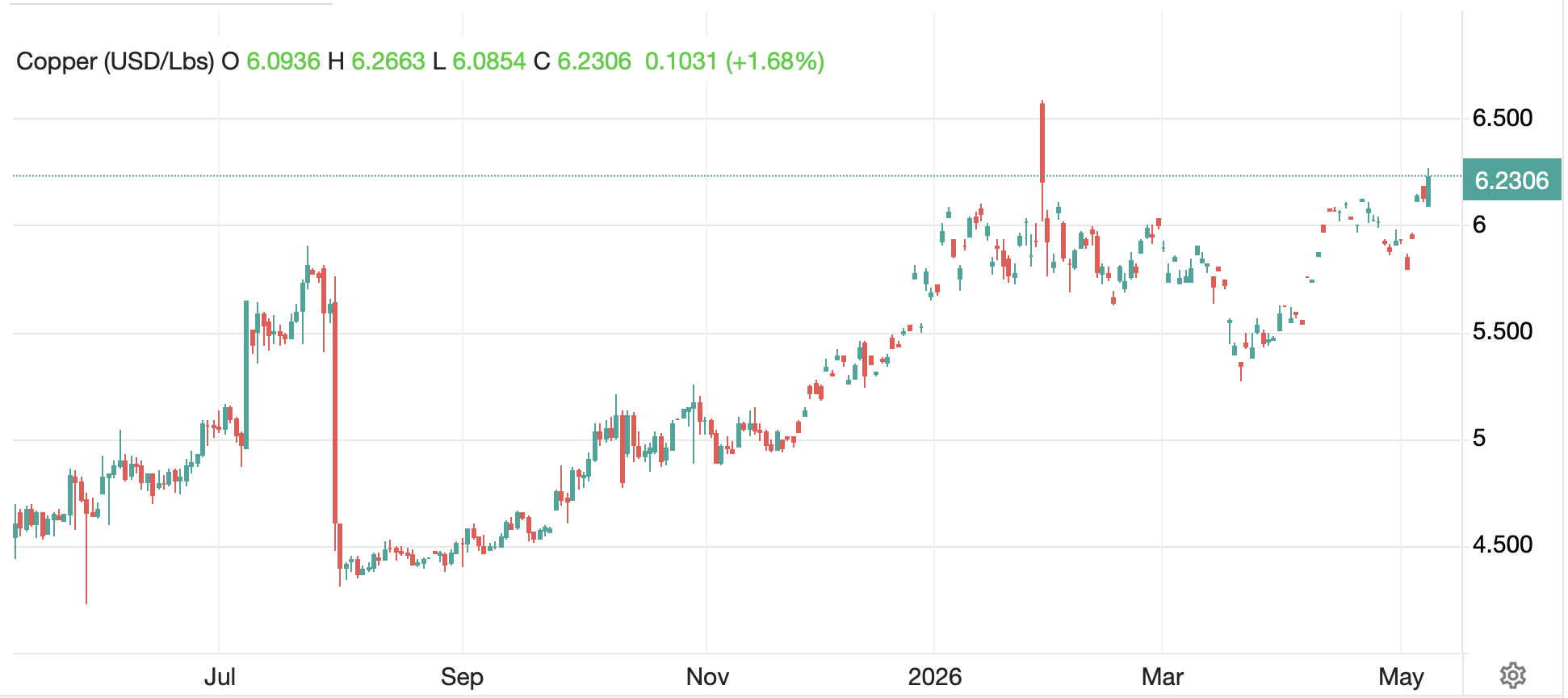
In the commodity markets, perhaps the surprising feature today is not that gold is lower amid higher oil prices, but that silver (+0.25%) and copper (+1.4%) are both firmer.  In fact, copper is pushing back to its all-time trading highs set in a spike in late January.  But as you can see from the chart below from tradingeconomics.com, this move is gaining some strength.

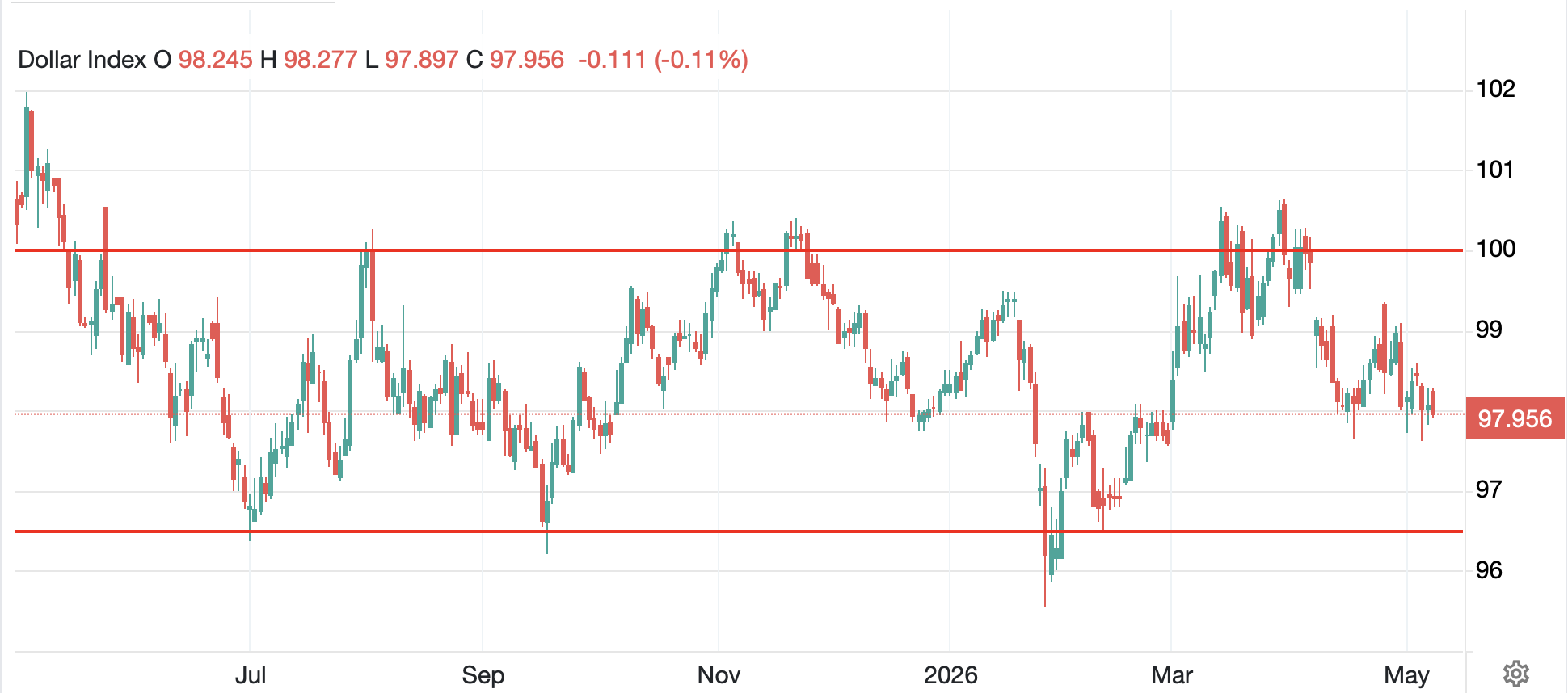
Finally, the dollar is a bit stronger this morning, although hardly running away.  Other than the rupee discussed above and KRW (-0.65%) which is odd given the equity performance there, the bulk of the movement has been dollar strength on the order of 0.1% to 0.2% against both G10 and EMG currencies.  The dollar is not driving the market bus right now.  For those who follow the DXY, it is right at 98.00, again in the middle of its year long range.

On the data front, it is inflation week around the world with China reporting last night higher than forecast numbers of 1.2% Y/Y and PPI of 2.8% Y/Y with the latter, as you can see in the chart below, the highest number since July 2022.  Perhaps China’s long deflationary slog is over.

Source: tradingeconomics.com

Here are this week’s offerings:

TodayExisting Home Sales4.05M
TuesdayNFIB Small Biz Optimism96.1
 CPI0.6% (3.7% Y/Y)
 -ex food & energy0.4% (2.7% Y/Y)
WednesdayPPI0.5% (4.9% Y/Y)
 -ex food & energy0.3% (4.3% Y/Y)
ThursdayInitial Claims205K
 Continuing Claims1775K
 Retail Sales0.5%
 -ex autos0.6%
FridayEmpire State Manufacturing7.8
 IP0.3%
 Capacity Utilization75.9%

Source: tradingeconomics.com

As well, we get inflation readings from Germany, India, Brazil, France, Spain and Italy this week.  There are several Fed speakers, five in total, but they just don’t seem to matter that much right now.

And that’s what we have, everybody is waiting on the next Iran conflict news with hope for a resolution seeming to ebb slightly.  Frankly, until there is more clarity there, it is difficult to determine what comes next.

Good luck

Adf

Futures Are Juiced

At first, it was open then not
As small boats attacked and were shot
But now, all eyes turn
To what we will learn
From Payrolls and if things are hot

While yesterday saw risk reduced
This morning stock futures are juiced
So, as we await
More news from the Strait
We’re hoping Jobs give things a boost

The top story was the minor skirmish in the Strait of Hormuz when three US destroyers transited the Strait and escorted one or two ships trapped in the Persian Gulf out.  Iranian small boats attacked and were sunk, but missiles were fired and it seems they hit a Chinese tanker.  I’m guessing President Xi is none too pleased with that outcome.  In the end though, while oil (-0.2%) traded higher through most of yesterday, as you can see in the chart below, it subsequently faded back from its highest levels of the day and remains well below $100/bbl as I type.

Source: tradingeconomics.com

In the end, the major market themes and correlations continue to play out with oil the primary driver and other markets responding either in sync (the dollar and bond yields) or in opposition (stocks and precious metals).  I imagine we are going to see this continue to play out until such time as an agreement is definitively reached to end all the hostilities there, whether that is by signing an accord or the complete destruction of the IRGC leadership.

Which means, we need to turn elsewhere for our news and happily, we have the payroll report to observe this morning.  Leading into this report, we saw the ADP number on Wednesday print at a better-than-expected 109K, while Initial and Continuing Claims yesterday both printed at lower than forecast numbers, indicating that the labor market is in pretty good shape.  With that in mind, here are this morning’s expectations:

Nonfarm Payrolls62K
Private payrolls75K
Manufacturing Payrolls5K
Unemployment Rate4.3%
Average Hourly Earnings0.3% (3.8% Y/Y)
Average Weekly Hours34.2
Participation Rate61.7%
Michigan Sentiment49.5

Source: tradingeconomics.com

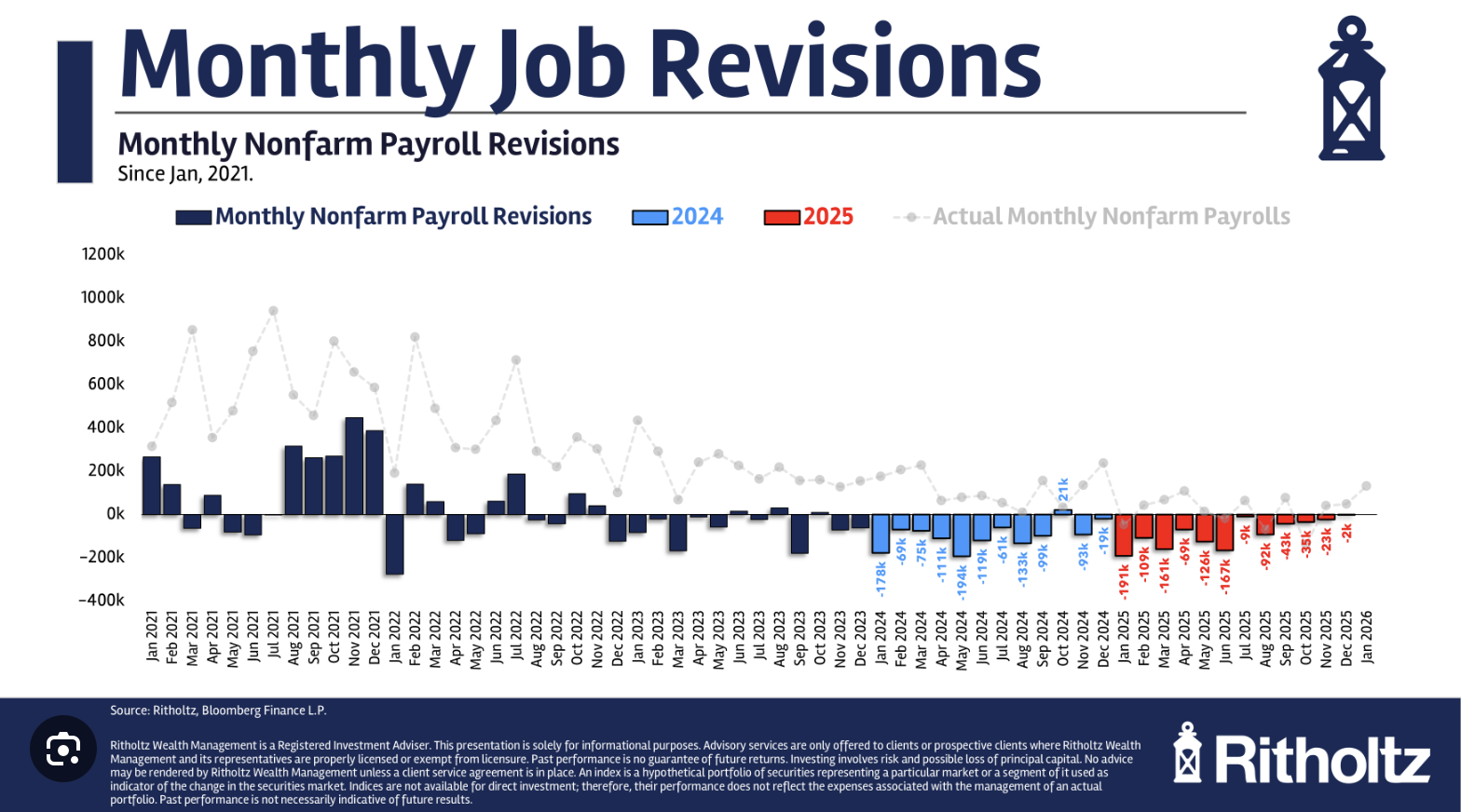
Of course, it is key to remember that revisions to this report have been consistently lower over the past several years as per the below chart.  Of course, headlines are everything in today’s world, and while there are many economists and analysts who try to explain the revisions matter and offer a much dimmer view of the labor market, as we all know, the correction to a misleading story published on page 24 never impacts the narrative.

In fact, based on this, and what is apparently a fatally flawed birth/death model at the BLS, and based on the stronger performance in the ADP data as well as the continued low readings from Initial Claims, I anticipate a better than expected number and would not be surprised to see something on the order of 100K.  There is one other thing worth noting that I believe is a major positive, and that is that government payrolls continue to shrink, something that can only help the overall fiscal position in the US.

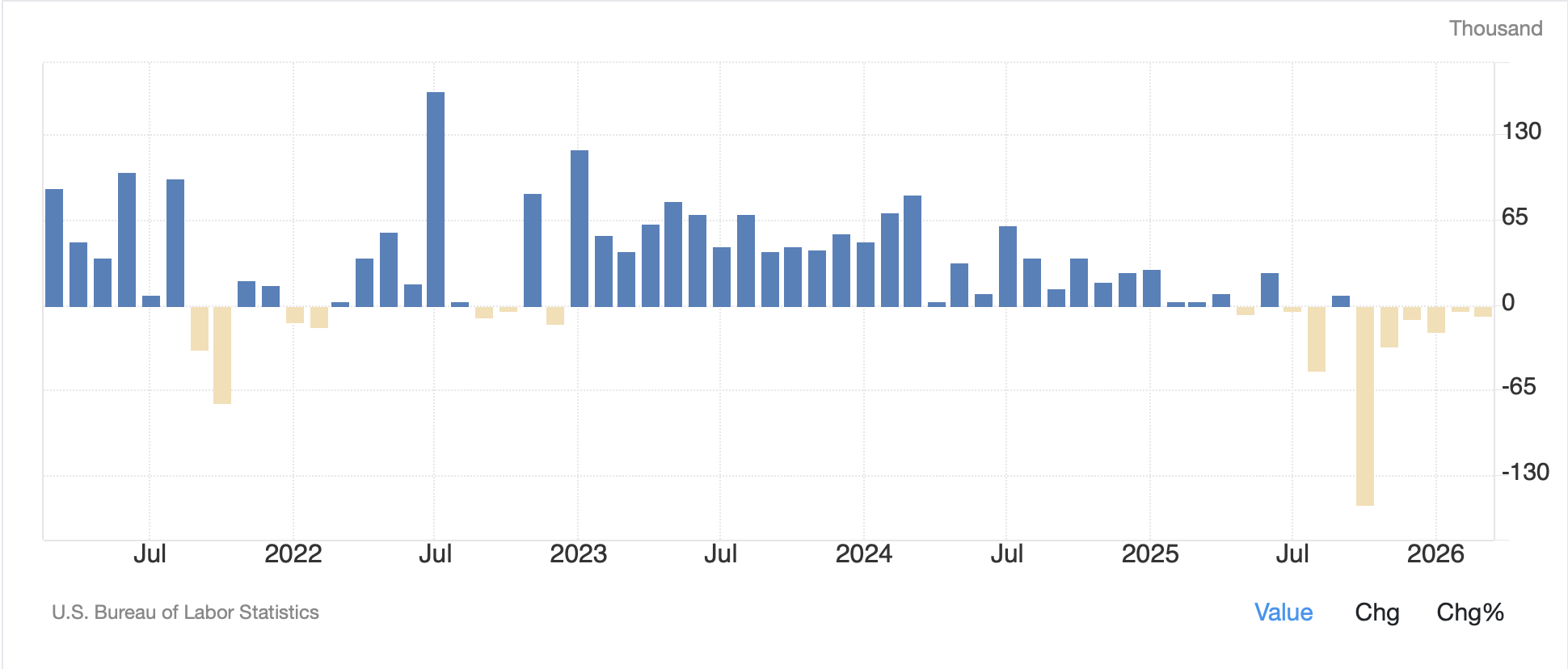
We can only hope that the recent trend, as seen below, continues.  As I have written in the past, given the remarkable lack of productivity in the government, if these people become baristas at Starbucks, it would add more to economic prosperity for the nation than their current role.

Source: tradingeconomics.com

And with that as preamble, let’s visit the overnight market results in the wake of the little skirmish and President Trump’s comments that the cease fire was still in effect.

Yesterday’s US weakness has been followed around the world, pretty much, with declines in Asia (Japan -0.2%, HK -0.9%, China -0.6%) and the regional exchanges there as well (India -0.7%, Taiwan -0.8%, Australia -1.5%, Indonesia -2.9%) with only Korea (+0.1%) managing to hold its ground during the session.  There is much discussion regarding the upcoming Summit between Presidents Trump and Xi, and the other stories of note are yet another Chinese plan to support domestic consumption.  (It strikes me that these plans are akin to European sanctions on Russia, full of fanfare and producing zero results).

Speaking of Europe, equity markets are weaker there as well with the DAX (-0.7%) leading the way lower after IP was released at a much worse than expected -0.7% in March along with a smaller than forecast trade surplus.  A quick look at the last 3 years of German IP and you can see that Energiewende, their insane energy policy, is effectively deindustrializing the nation, once the heartbeat of Europe.

Source: tradingeconomics.com

As to the rest of the continent, red is today’s color with France (0.7%), Spain (-0.3%) and the UK (-0.1%) all under water.  However, US futures are higher by about 0.5% across the board ahead of NFP.

In the bond market, Treasury yields (-1bp) are reversing part of yesterday’s climb, but are still higher than yesterday morning.  Most of Europe is little changed although UK gilts (-5bps) have performed best after (despite?) local elections where the ruling Labour Party lost half the seats they were defending with the MAGA-like (MUKGA? MEGA?) Reform Party of Nigel Farage and the Green party the big beneficiaries.  Pressure is increasing on PM Starmer to step aside as his favorability plummets, but like most politicians, he is clinging to power with a death grip.  I’m not really sure I understand the mechanics of why gilts would rally, although perhaps as Reform’s power increases, investors believe there will be more fiscal rectitude.

Precious metals, which rallied yesterday again, are continuing higher this morning (Au +0.8%, Ag +2.8%) with Silver back above $80/oz.  I have not mentioned copper (+1.7%) lately, but it is worth noting that the red metal has been powering higher and is approaching the spike high seen in late January, which is the all-time high in the market there.  While there are clearly market internals regarding positioning that are helping the move here, it does portend a positive outlook for the economy given its importance in virtually all manufacturing these days.

Source: tradingeconomics.com

Finally, the dollar is under pressure again this morning with the DXY (-0.1%) back below 98.00, but just barely.  Again, the collapsing dollar narrative makes no sense to me and if I look at the DXY over the last year, 96.50 – 100.00 does a pretty good job of containing the entire range as per below.  If the dollar gets down to that lower level and breaks it convincingly, we can discuss the merits of a short-term vs. long-term view on the dollar’s future.  

Source: tradingeconomics.com

And it is important to note that the long-term future, at least compared to other fiat currencies, remains positive in my view.  Looking at specific movers, both the euro and pound are higher by 0.35% while the yen (+0.1%) remains caught between its negative fundamentals and fears of another round of BOJ intervention.  NOK (+1.3%) is kind of surprising given the lack of impetus in the oil market, but it is no surprise to see ZAR (+0.6%) and CE4 currencies benefit alongside the euro.  LATAM currencies are also doing well although CLP (0.0%) is somewhat surprising given copper’s strong move higher.

And that’s really it today.  We see payrolls in a bit and that should drive the discussion unless there is some other breakthrough in Iran and the ongoing conflict.

Good luck and good weekend

Adf

Quite Sublime

Though skeptics do not yet believe
That Trump, a peace deal, will achieve
The markets are saying
This sunshine they’re haying
And fading this move is naïve

So, oil continues to fall
And stocks are just having a ball
It’s peace in our time
And all quite sublime
To many, though, this tale is tall

It is not clear what else to say about the current situation other than the markets are starting to believe that the Iran conflict is coming to a close.  The headlines from the administration and news from Pakistan seem to indicate a deal is near, something we all should welcome.  Certainly, the market is ready to accept this as gospel, at least based on the current risk appetite being demonstrated across all markets.  So, this morning, oil (-2.8%) continues its rapid decline, down more than $18/bbl from its highs just one week ago.

Source: tradingeconomics.com

The commentariat refuses to accept that the conflict is ending and I cannot tell if that is because they hate President Trump so much, they cannot stand the idea of him concluding things having achieved objectives, or because if the conflict is over, they will need to find the next thing to prove their ‘expertise’ and they don’t know what that is yet (hantavirus anyone?)  Regardless, markets are on board with this narrative as the moves we saw yesterday are simply extending this morning.  

Meanwhile, the data from yesterday showing that ADP Employment was a stronger than expected 109K and the JOLTs quit numbers rose, meaning more people are willing to quit their jobs for a new one, indicating a growing confidence in the labor market, point to a continuation of the US equity rally, and by extension, the global rally.  (As an aside, I chuckled at the article in the WSJ this morning about how the next target of taxes should be ‘compute’ since AI is going to replace human workers.  My comment here, which has been confirmed by my time this week at the Consensus 2026 cryptocurrency conference, is that machines are great, but people still want to deal with people they can trust!)

Anyway, with the conflict ostensibly coming to a close, there is not much else to discuss outside actual market activity, so let’s see how things responded to this news.

By this time, you have all checked your PA’s and saw the green from yesterday there.  Overnight, Asian markets were also quite positive with Japan (+5.6%) exploding higher after their Golden Week holidays ended.  Excitement on tech as well as a market that is looking forward to Treasury Secretary Bessent’s visit were the drivers.  But we also saw strength in China (+0.5%), HK (+1.6%), Korea (+1.4%) and Taiwan (+1.9%).  In fact, looking across the region, you are hard pressed to find a true laggard, as India (0.0%) was the worst performer of note.  European markets, though, are not quite in as fine a fettle with most of them essentially unchanged this morning although the UK (-0.7%) is lagging after some underwhelming earnings reports as it appears profit taking is today’s motive.  As to US futures, at this hour (6:45), they too, like Europe, are essentially unchanged

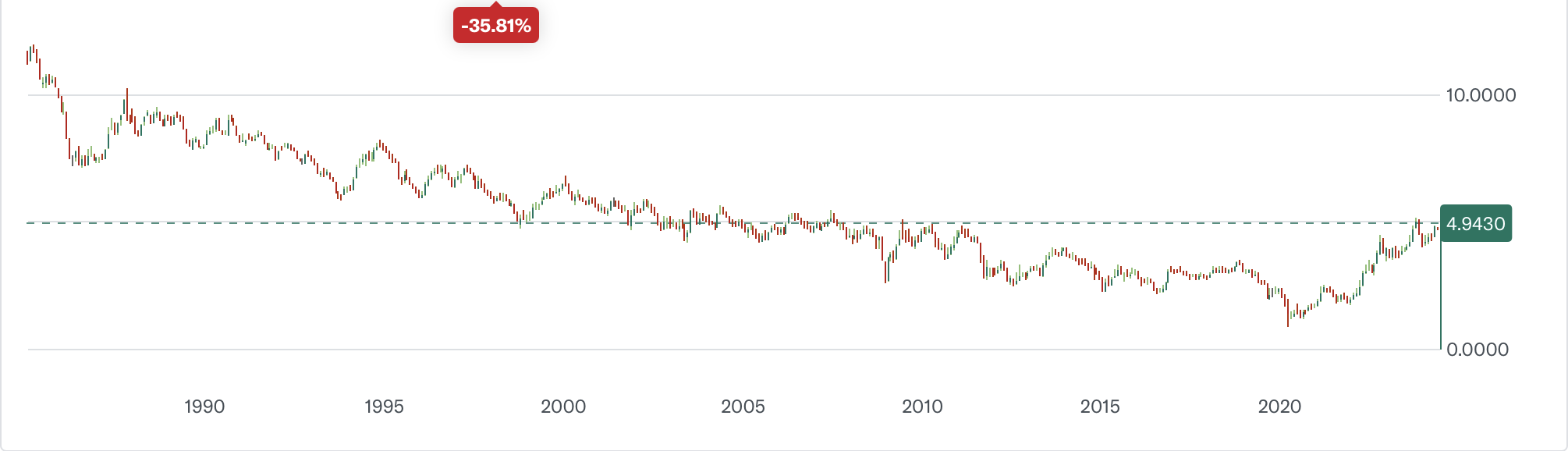
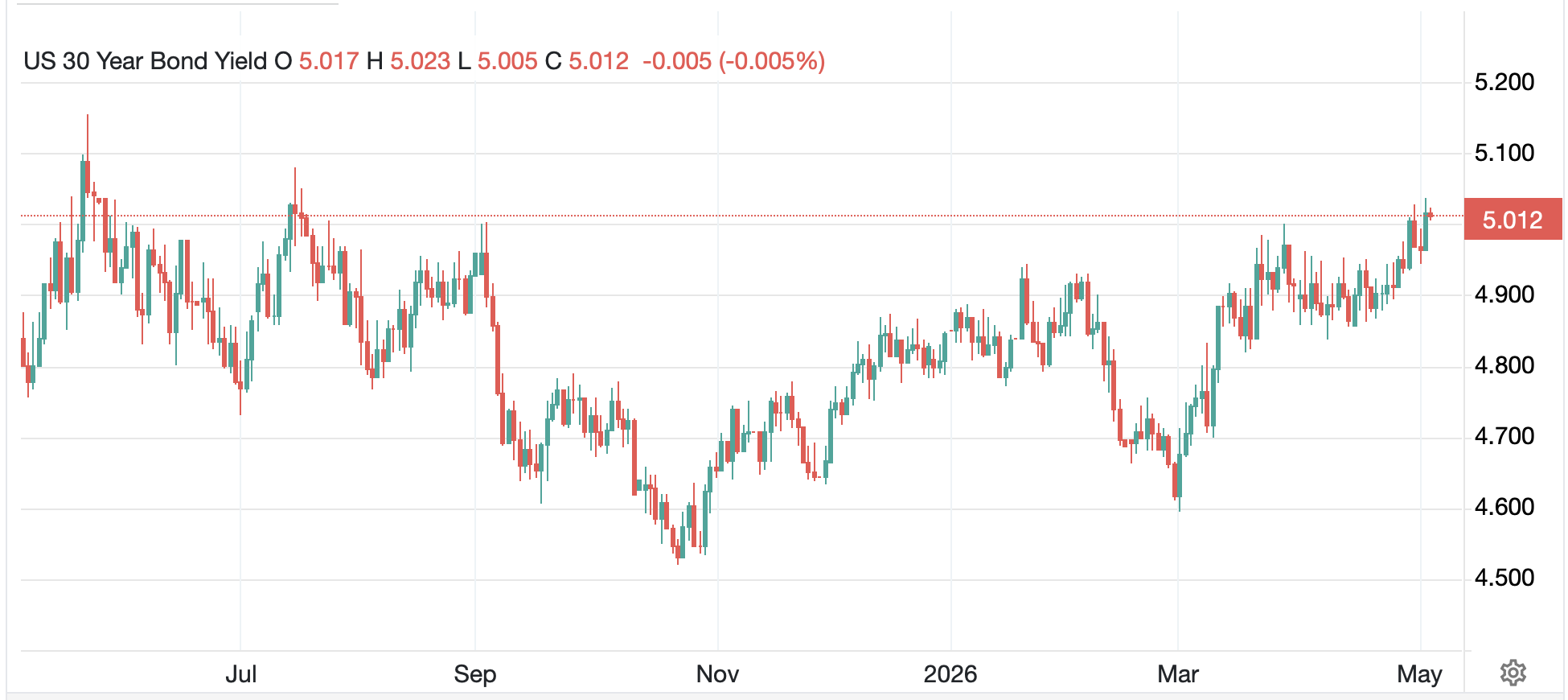
In the bond markets, yields continue to slide with Treasury yields lower by -2bps and virtually all European sovereign yields slipping -1bp.  Overnight, JGB yields fell -3bps as markets there reopened and essentially all Asian government bonds saw yields decline as well.  Apparently, fears over rampant inflation are ebbing.  You may recall on Tuesday I discussed the 30-year Treasury as it traded above 5.0% on Monday and stayed there for about a minute.  That had engendered a great deal of apocalyptic discussion.  However, here we are this morning with 30-year yields slipping another -2bps, and now 10 bps below that little spike, and back below 5.0%.  But I think it is worthwhile to offer a little perspective on the 30-year bond and the idea that 5.0% is deadly.  Here is the chart of 30-year Treasury yields since 1985.  Perhaps the anomaly was much lower yields, not 5.0%!

Source: finance.yahoo.com

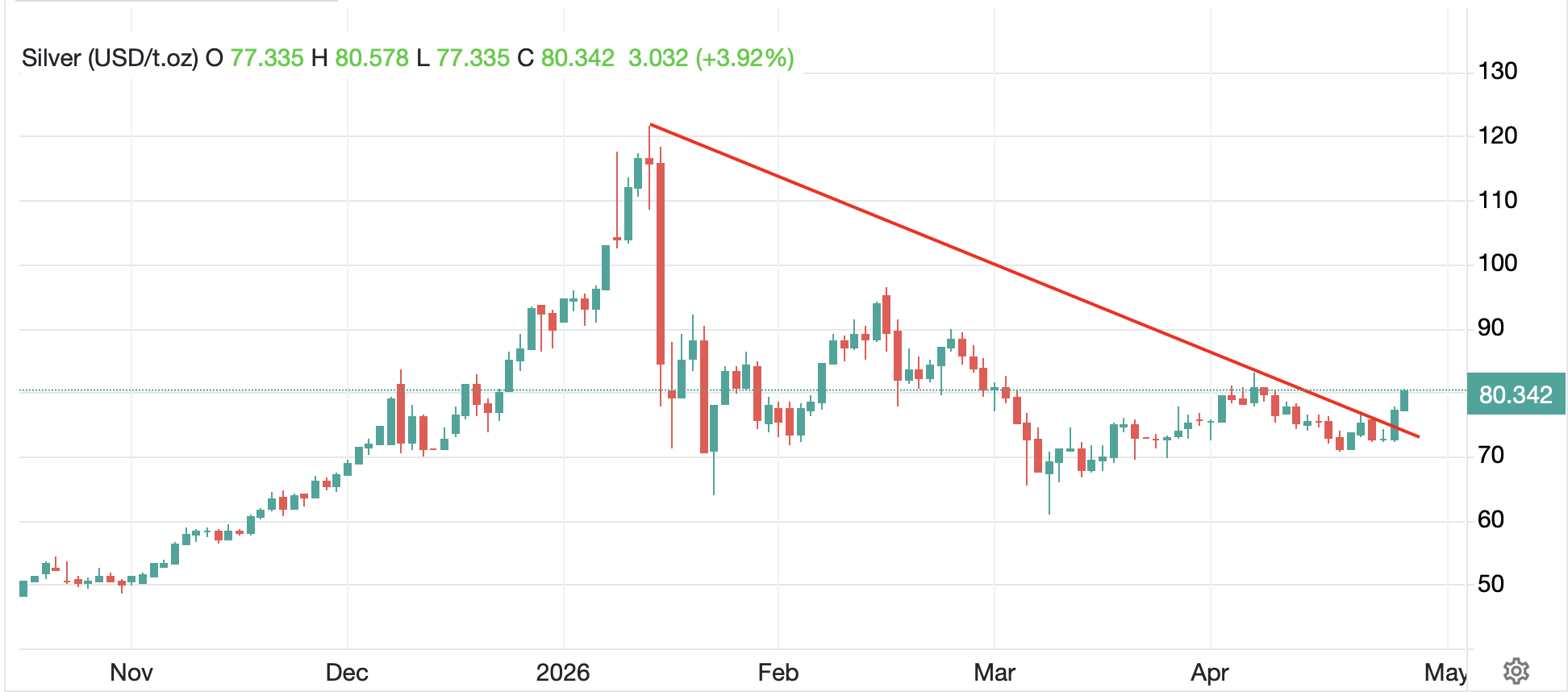
Precious metals are continuing to benefit from the peace initiative and oil’s delice with gold (+1.0%) and silver (+4.0%) both stronger again after big gains yesterday.  In fact, I am starting to read more about why silver is set to make massive gains because of shortages, a narrative that was set aside for the past two months but seems to be reawakening.  Now, I am no technician, but I am given to understand that if you look at this trend line in silver from its January peak, we have broken above the line and that portends a massive move higher.  (full disclosure, I am long silver so would be happy to see that but have not spent the extra money yet!)

Source: tradingeconomics.com

Finally, the dollar is softer again this morning, which should be no surprise based on the overall market zeitgeist this morning.  So, the DXY (-0.15%) is a pretty good approximation of what is happening, although we have seen some larger moves, notably NOK (+0.8%) which seems to be responding to the fact that the country is going to reopen some shuttered oil and gas drilling sites in the North Sea as Europe tries to figure out where to get energy from.  As to the yen (0.0%) after a series of what appeared to be modest interventions by the BOJ during Golden Week, it appears the market may be explaining that the fundamentals are still pointing to yen weakness and while the BOJ may be able to cap the dollar for a short time, establishing real JPY strength will take a lot more effort, and real policy changes (i.e. much higher interest rates).

Source: tradingeconomics.com

Turning to the data this morning, we get the weekly Initial (exp 205K) and Continuing (1800K) Claims data, which continues to hover near historic lows despite the angst over the labor market.  We also see Nonfarm Productivity (1.4%) and Unit Labor Costs (2.6%) and hear from several more Fed speakers, although most of their comments are back page news.  Of course, tomorrow we will see the NFP report, and that will certainly garner all the attention.  Personally, I will be focused on the Manufacturing Payrolls outcome as a proxy for the reshoring initiative and the potential for continued strong economic activity going forward.

And that’s really it.  Despite the ongoing narrative of the dollar’s demise, it remains well within its recent trading range, and I keep reading about other nations issuing dollar debt as that is the market with the most liquidity.  Over time, I continue to see the dollar as the best fiat around, although I still like stuff more than paper.

Good luck

Adf

Stories, Compelling

The latest pronouncements appear
To indicate Hormuz is clear
As well, Trump explained
He’ll soon have attained
A deal where both sides will adhere

Investors responded by selling
Their oil, as fears, Trump, was quelling
While metals and stocks
Embraced Goldilocks
And rallied with stories, compelling

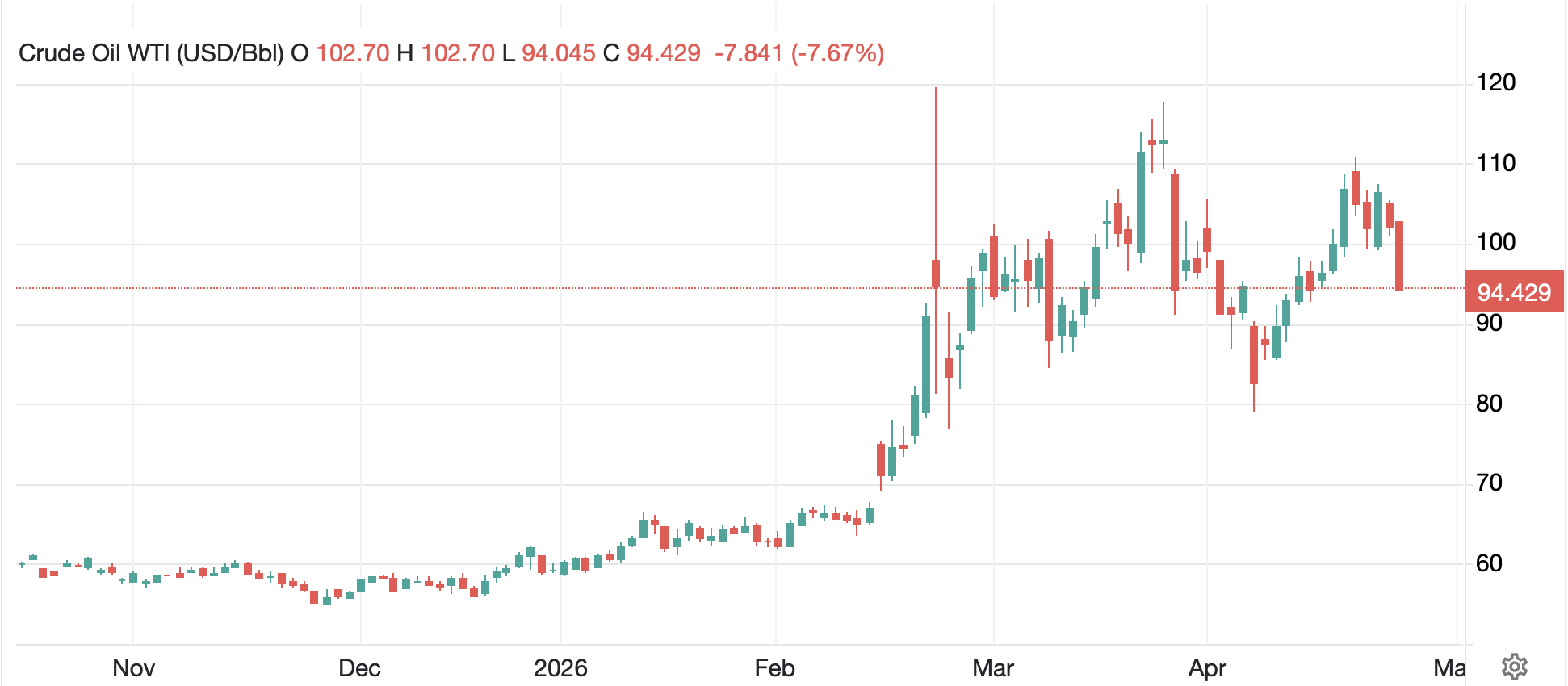
The word from President Trump is that the Iranians have moved closer to a deal and the ceasefire will remain in place.  From what I have read, it appears several ships have, indeed, crossed out of the Strait, although many remain trapped.  At this time, nothing is clear, but markets very clearly believe we have passed the peak of the problems as is evident by the below char of WTI (-7.7%) which continues yesterday’s decline and is now back well below $100/bbl.

Source: tradingeconomics.com

Now, we have seen previous situations during this conflict where it appeared that the end was nigh only to be disabused of that notion within days.  And we all must still contend with the issue that unless you are in the White House situation room, or the Iranian equivalent, none of us really know what is happening.  Propaganda is rife from both sides official pronouncements and then there is a whole cottage industry of pundits who claim expertise in the inner workings of Iranian military capabilities and explain the US is losing the war.  But as always, I go back to those with real skin in the game, traders and investors, as opposed to the pundits who when proven wrong simply pivot and say they knew the outcome all along. I certainly hope, for everyone’s sake, that we are in the final stages as we shall all benefit from that outcome. 

One other thing helping this story is word that the Chinese have been leaning on the Iranians to reopen the Strait as despite all their preparations and their SPR, the lack of outbound flow is clearly starting to cause Xi some concern.  And remember, Xi and Trump are slated to meet in 10 days and I’m guessing he really doesn’t want to have to answer as to why his Iranian allies are holding up the world.

It should be no surprise that with oil prices having retreated so far, the market response elsewhere was strength in equities, strength in precious metals, strength in bonds and weakness in the dollar.  After all, those correlations have been solid during this entire engagement.  But before we discuss the markets, which are quite positive everywhere, a word about the economy in the US.

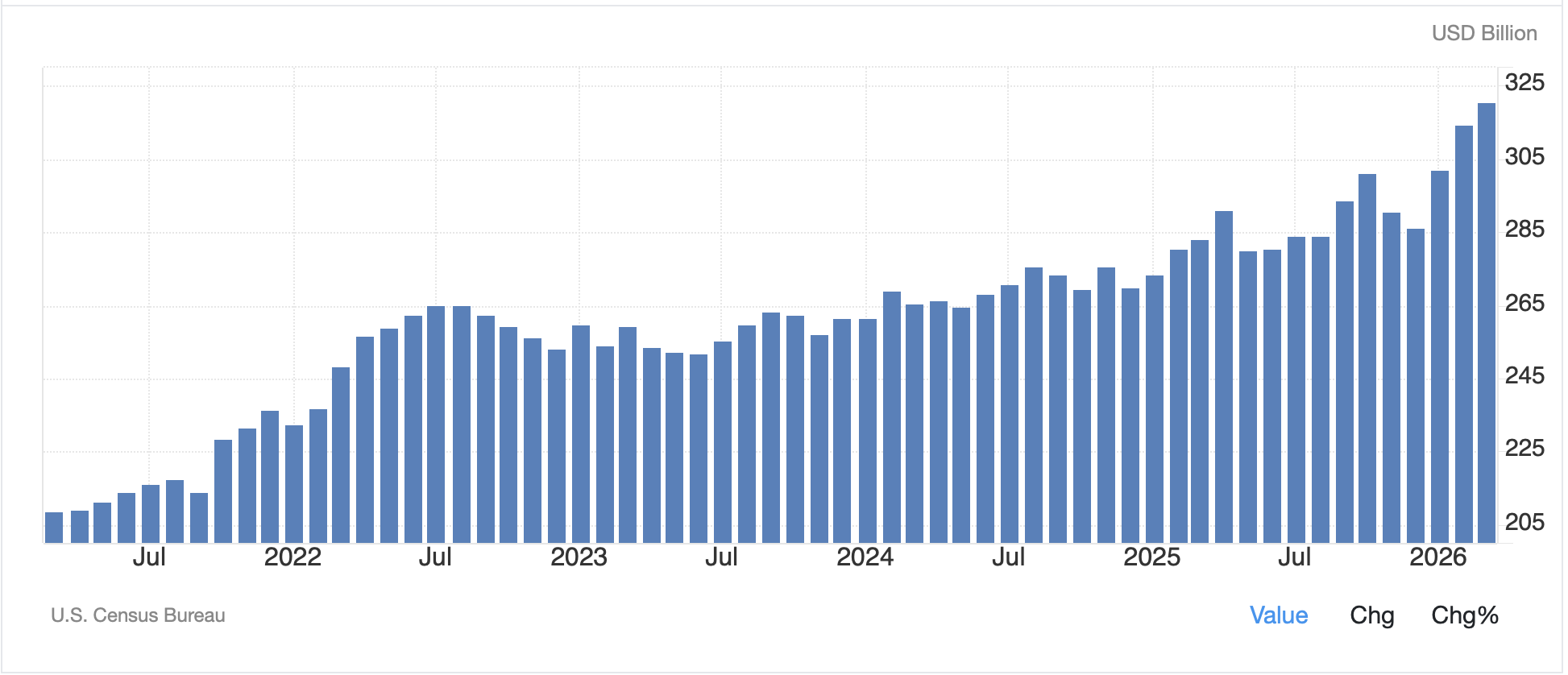
We all know that a key focus of President Trump has been to reshore industry and reduce the trade deficit.  While economists have been proselytizing that it’s a great deal for the US; we get cheap stuff and just have to give up paper we print, the Covid pandemic, and more importantly the government responses to it, highlighted just how much the US, and most nations, were at the mercy of China when it came to critical supplies.  We all have heard about rare earth metals, but it is a much deeper problem as the US has lost a great deal of institutional knowledge regarding how to simply produce certain things.  I raise this point because yesterday the Trade Balance data was released right on expectations of -$60.3B.  but I think it is instructive to look at the export data as an indication of just how much change we have seen in the economy over the past several years.  as you can see in the chart below, exports have been growing quite significantly of late.  Now, one of the reasons is because the US has been exporting significant amounts of oil and gas rather than manufactured goods.  But ask yourself, would that have happened under a potential Harris administration who likely would have continued the fight against energy.

Source: tradingeconomics.com

It will be very interesting to see the NFP data on Friday and I will especially be looking at the Manufacturing employment result, as that is something which has clearly been a focus of the administration.  I suspect those numbers will look pretty good.

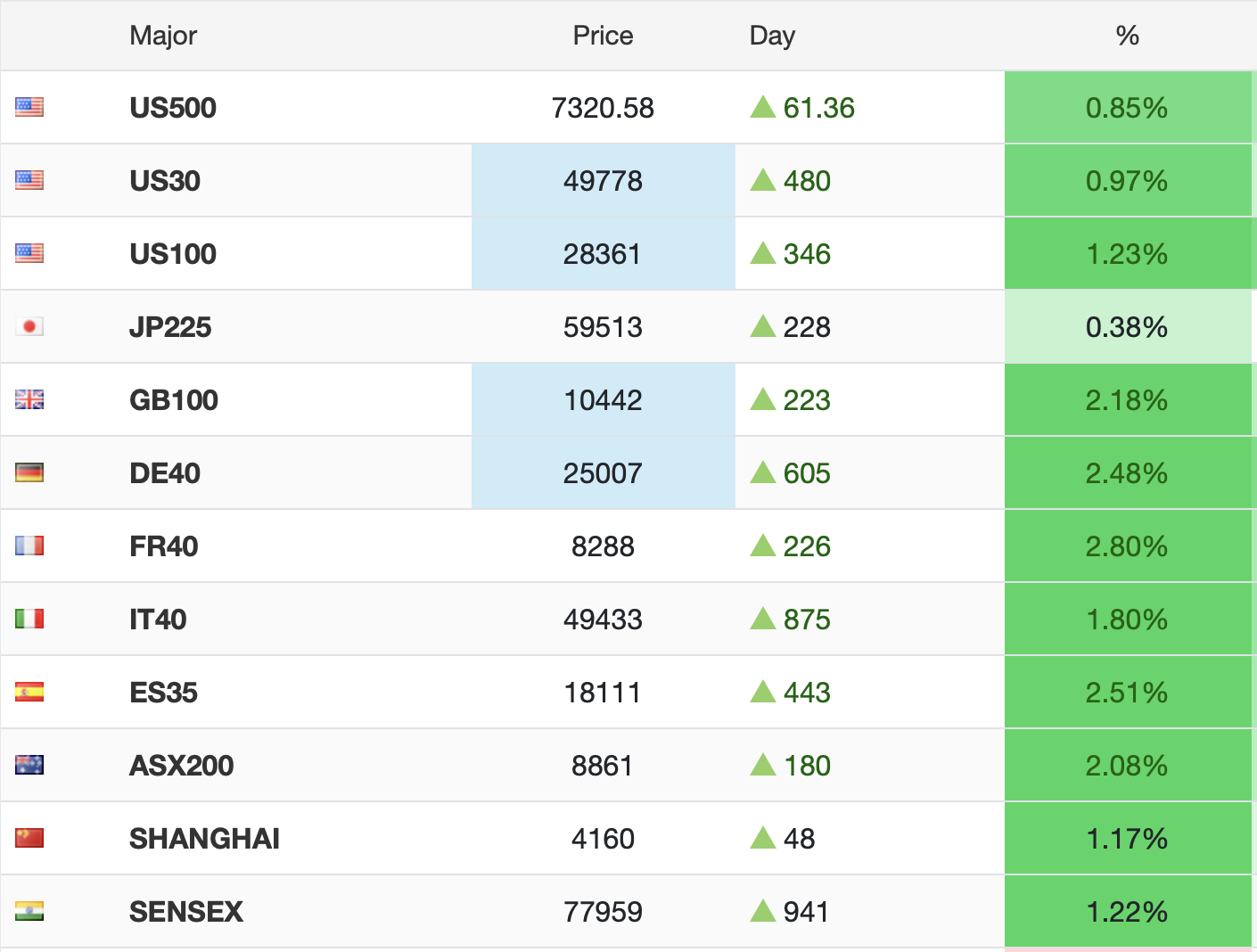
Ok, on to the markets.  It is far easier to show a screenshot from tradingeconomics.com of futures prices at 6:30 this morning, than list all the outcomes as below.

Needless to say, there is a lot of happiness in equity markets today.  I must note that Japan was still closed last night, so that is not updated, but otherwise, these are all current or from the overnight session.  One thing to remember about the US markets as they make consistent new highs is that earnings releases have been remarkably solid thus even though P/E ratios are historically high, there is some rationale behind the moves.

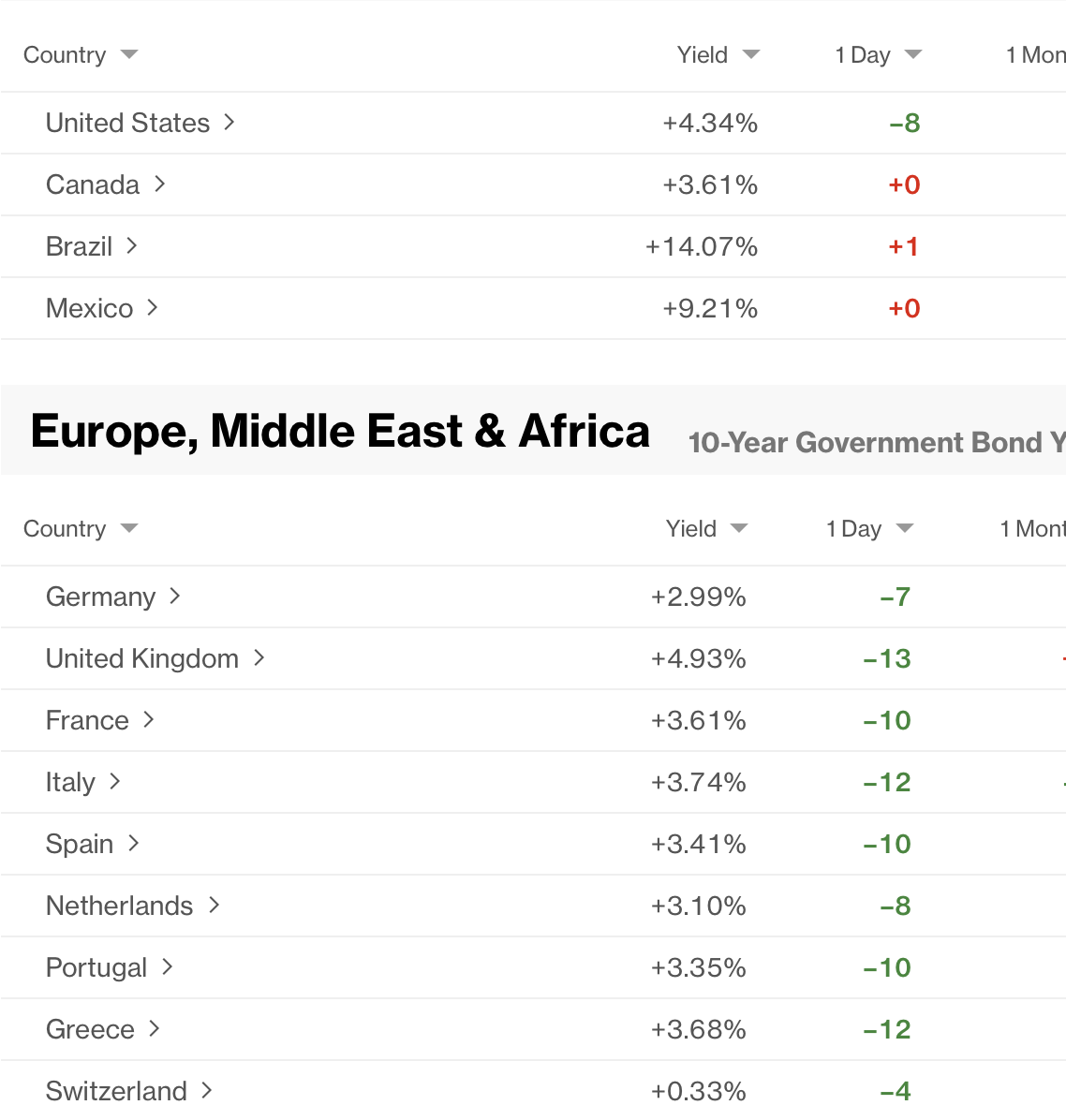
Turning to the bond markets, once again a screenshot, this time from Bloomberg, tells the story eloquently.  At this hour, Canada, Brazil and Mexico markets have not yet opened, but I assure you yields there will fall sharply when they do.

As I said, it is happy days everywhere.

Turning to precious metals, both gold (+3.4%) and silver (+6.4%) are rocketing higher this morning as the recent negative correlation with oil is almost perfect.  You can see that below in the chart of price action during the past month.

Source: tradingeconomics.com

Historically, gold and oil tended to trade together, but this event has really destroyed that narrative.  I have read an analysis describing gold’s troubles despite the war as a result of fears over higher inflation leading to higher real interest rates and thus less demand for gold.  Maybe that is correct, but my take on the bigger picture remains that fiat currencies will remain under general pressure against ‘stuff’ and gold is the most desirable of ‘stuff’ there is.  I remain long-term bullish here.

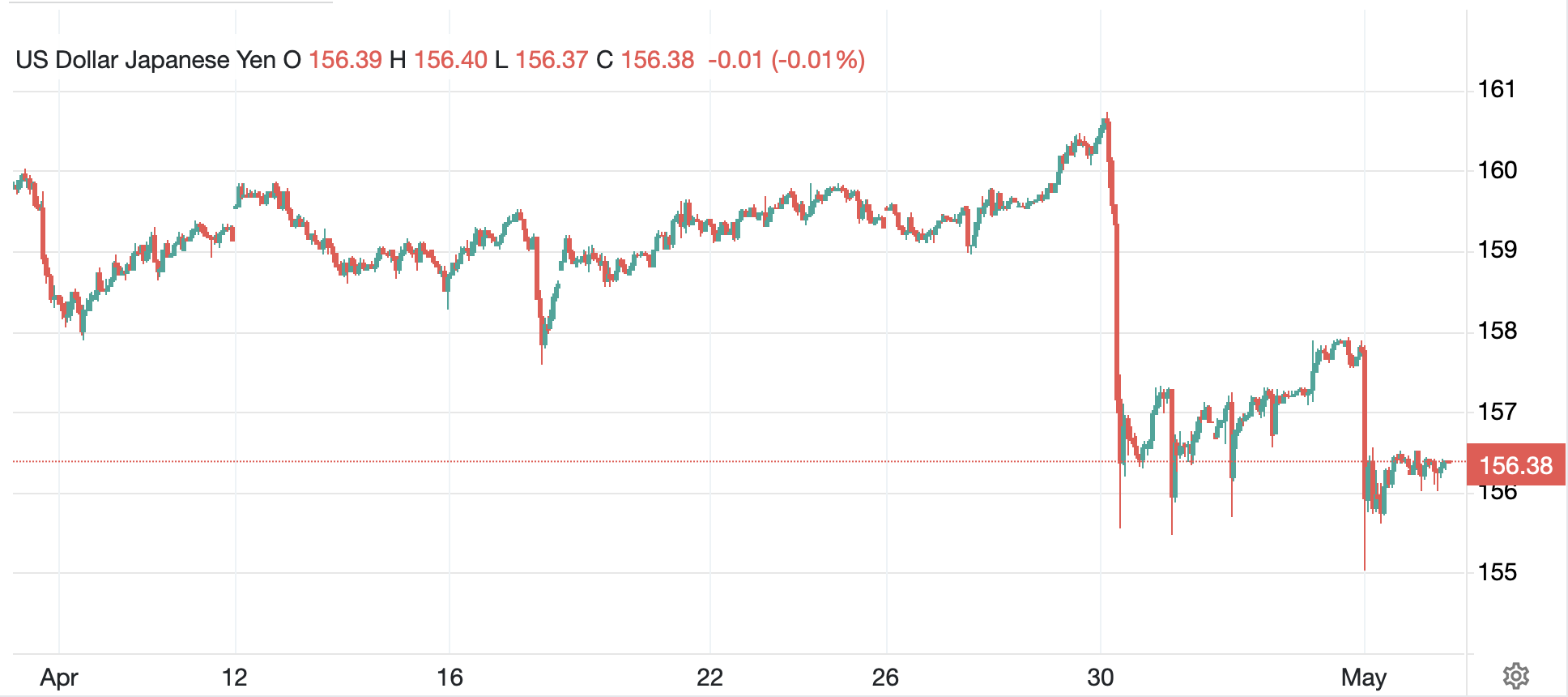
Finally, the dollar is under pressure this morning, as you would expect given the overall market movement.  The most noteworthy price action has been in JPY (+1.35%) which appears to have seen some further intervention from the BOJ last night as per the below chart.

Source: tradingeconomics.com

When asked, there was no comment from the BOJ/MOF, but certainly given the velocity of the decline in the dollar and given the type of movement we have seen during the past week, with the first major intervention essentially confirmed, it makes sense.  Tokyo markets remain closed, so the timing made sense as liquidity was light allowing a lot of bang for their buck.  But remember the history of intervention is that while it can provide a temporary solution to a weakening currency, until policies change, the pressure will remain.

But broadly the dollar has been routed overnight.  One more tradingeconomics.com screenshot will give the flavor for the market this morning.

 The outliers here are NOK (-0.1%) which is suffering from oil’s sharp decline, along with CAD (+0.25%) which also is feeling that pressure.  Not in the shot is ZAR (+2.3%) which has been feeling double pain of weak gold and high oil and seeing a real relief rally today. 

If you ask, is this the end of the dollar and now it will decline sharply going forward? I would answer no, but that doesn’t mean we won’t test the bottom of the DXY range at 96.50 before this move is over.

On the data front, today brings ADP Employment (exp 99K) and then the EIA oil inventory data with another draw expected.  But I don’t see the data as critical with the peace story driving markets and headlines for now.  In this situation, the dollar will likely remain under pressure in the near term, but nothing has changed my longer-term view of relative strength.

Good luck

Adf

Greatly Vexed

For weeks it appeared that the war
Was something we all could ignore
As equities rallied
And most people tallied
Their gains as those prices did soar

But yesterday, things took a turn
And suddenly, stocks, folks, did spurn
While oil went higher
As missiles did fire
And UAE oil did burn

The question today is what’s next?
Will Hormuz soon wind up annexed?
Or will Iran’s forces
Back up their discourses
And keep Mr Trump greatly vexed?

For nearly two weeks, it appeared that the market was completely willing to accept the narrative that the Iranians were on their last legs and that the Strait would be reopened soon, thus relieving the pressure on the oil markets, and global markets in general.  After all, US equity markets, as well as those in Korea and Taiwan, were making new all-time highs regularly despite the ongoing stress in Iran.  

But yesterday, those happy thoughts were called into question as evidenced by the equity markets’ collective sharp decline throughout Europe and the US.  Of course, most of Asia was closed on Monday, but the few markets that were open performed well then.  Alas, last night was a different story with more losers (HK, India, Australia, New Zealan, Singapore) than gainers (Malaysia, Indonesia).  Even if markets don’t decline much further, there has been a distinct change in sentiment about things, at least in my view.

The timing of the progress in potential negotiations and the question of potential escalation of fighting again are suddenly weighing more heavily on investor perceptions than they had for the last several weeks.

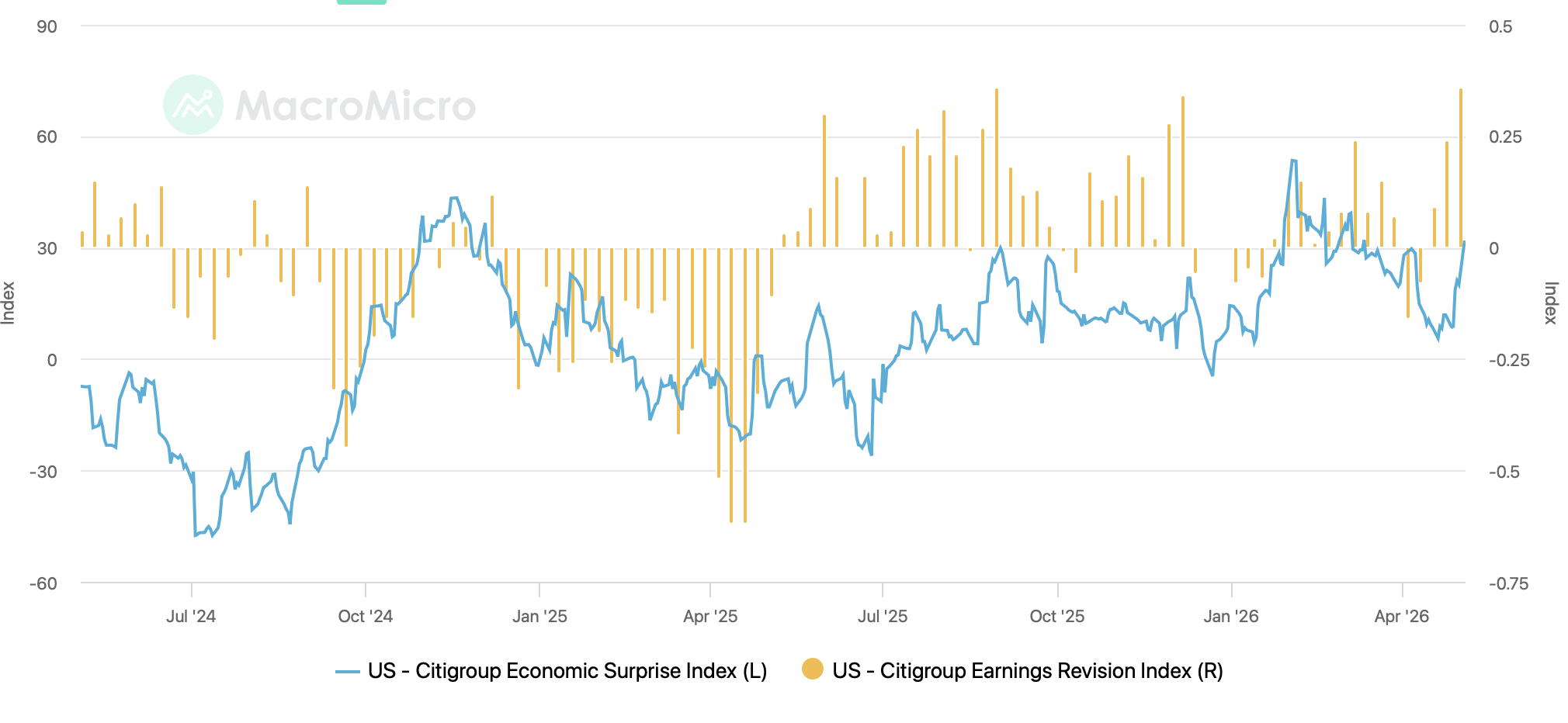
In the meantime, if we turn our attention to economic data, yesterday’s Factory Orders came in much stronger than expected, just the latest in a line of “surprisingly” strong data points from the US.  If we look at the chart below from macromicro.me, showing the Citi Surprise Index and their earnings index, we can see that both the economic indicators and US corporate earnings results are moving higher.  This seems at odds with the narrative of imminent collapse that is still making the rounds but is likely the cause of the equity market’s resilience.

In fact, this morning, markets are once again pointing in a more favorable direction as yesterday’s skirmishes in the Gulf have been quickly forgotten, it seems, and European bourses are all higher (Germany +1.0%, France + 0.6%, Spain +1.1%) recouping yesterday’s losses although UK equities (-1.0%) are suffering on a combination of yesterday’s concerns as well as a surprisingly negative HSBC earnings report.  And US futures are also higher at this hour (5:45) by about 0.4% across the board.  It is difficult to get markets downbeat for very long these days, which is remarkable given the sentiment indicators which have consistently been reading quite poorly.

This dichotomy is quite interesting to me as I am currently reading “Narrative Economics” by Robert Shiller, where he describes how social narratives have, throughout history, led to economic outcomes, whether positive or negative.  His implication is that the data tends to follow the current zeitgeist, and then almost regardless of any government efforts to change that narrative, the zeitgeist is what drives the economy.  For those of us who have been observing markets for any extended length of time, I don’t think this is a surprising revelation, although Shiller does a great job highlighting all the different times the narrative drove the bus.  

And that is what makes the current situation so remarkable, the narrative is that things are terrible with the nation dramatically split politically while gasoline prices have risen so much and inflation is a major problem.  You can see that in the Michigan Sentiment Survey and the political polls.  Yet Retail Sales remain firm and we just saw those strong Factory Orders, two things which one would expect to soften given the current narrative.

Perhaps what we have seen is the impact of social media and ‘influencers’ whose goal is to show the good life and why/how you should live it.  Given they only maintain their followers if they show an ideal situation, there will be no shaming for ostentatious consumption, that is their stock in trade.  So, while during the Great Depression, social pressures were such that buying anything new, like cars or houses, was seen as inappropriate, today, buying new cars is seen as a requirement, the more expensive the better.  Or going on an expensive holiday, or some other extravagance.  I wonder if the gloomy narrative will end up overcoming the influencers.  I suppose much will depend on just how much longer the war in Iran continues, as a clear end soon would almost certainly see a major sentiment change and another wave higher in risk assets while the longer it drags on, the more likely negativity overwhelms.

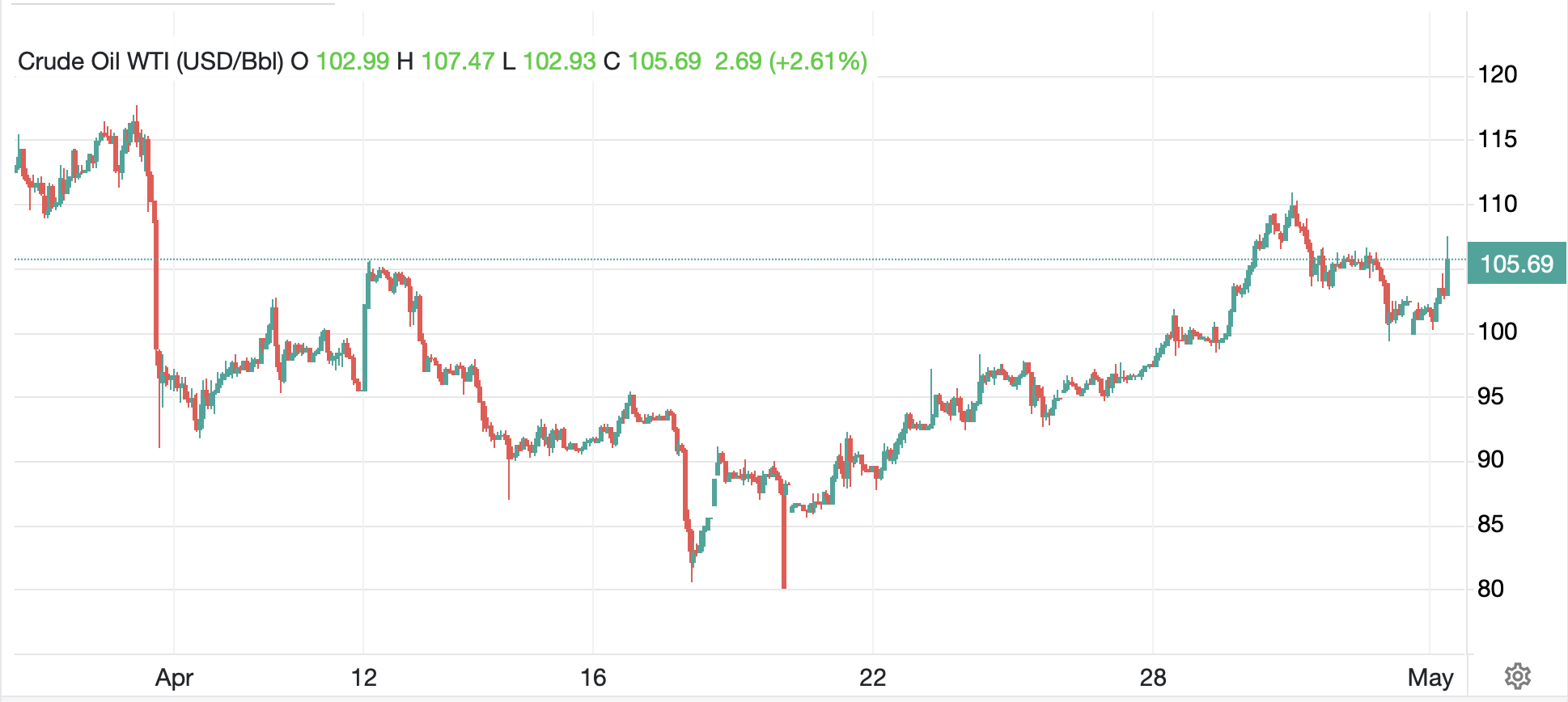
But this morning, having already looked at equity markets, we see a key piece of that story is oil (-2.0%) having slipped back.  Perhaps the fact that there have been no new skirmishes has people back to a brighter outlook.  Or perhaps, as the conspiracy theorists would explain, governments are in manipulating the price lower again.  As I look at the chart, though, it remains remarkable to me that despite the Strait having been closed for two months now, oil prices have not risen further.

Source: tradingeconomics.com

The question at this point is how quickly things can return to any semblance of normal when the hostilities end.  From what I have read, and I am not an expert, it almost seems like every day the Strait remains closed will require one and a half days more before things get back to the pre-war situation.  Of course, even if that is the case, if the war ends, the zeitgeist will change far faster and that will likely be overlooked.

Meanwhile, given the current gold/oil relationship, we cannot be surprised that gold (+0.6%) and silver (+1.3%) are higher this morning.

In the bond market, after yields rose sharply yesterday (Treasuries +8bps), this morning, things are less dramatic with 10-year Treasury yields slipping -1bp and European sovereign yields all softer with Greece and Italy (-5bps) seeing the largest declines although German bunds (-1bp) were more in line with Treasuries.  There has been much discussion lately about 30-year Treasuries and how they have traded back above 5.0% again, indicating it is a sign of the apocalypse.  However, if you look at the chart below, you can see we have been at or above that level several times in just the past year.  I understand 5.0% is a big round number, but I don’t see this as an imminent disaster because of the move. (Don’t misunderstand, the US fiscal situation is a major problem with many potential problems going forward, I just don’t think this is the final straw.)

Source: tradingeconomics.com

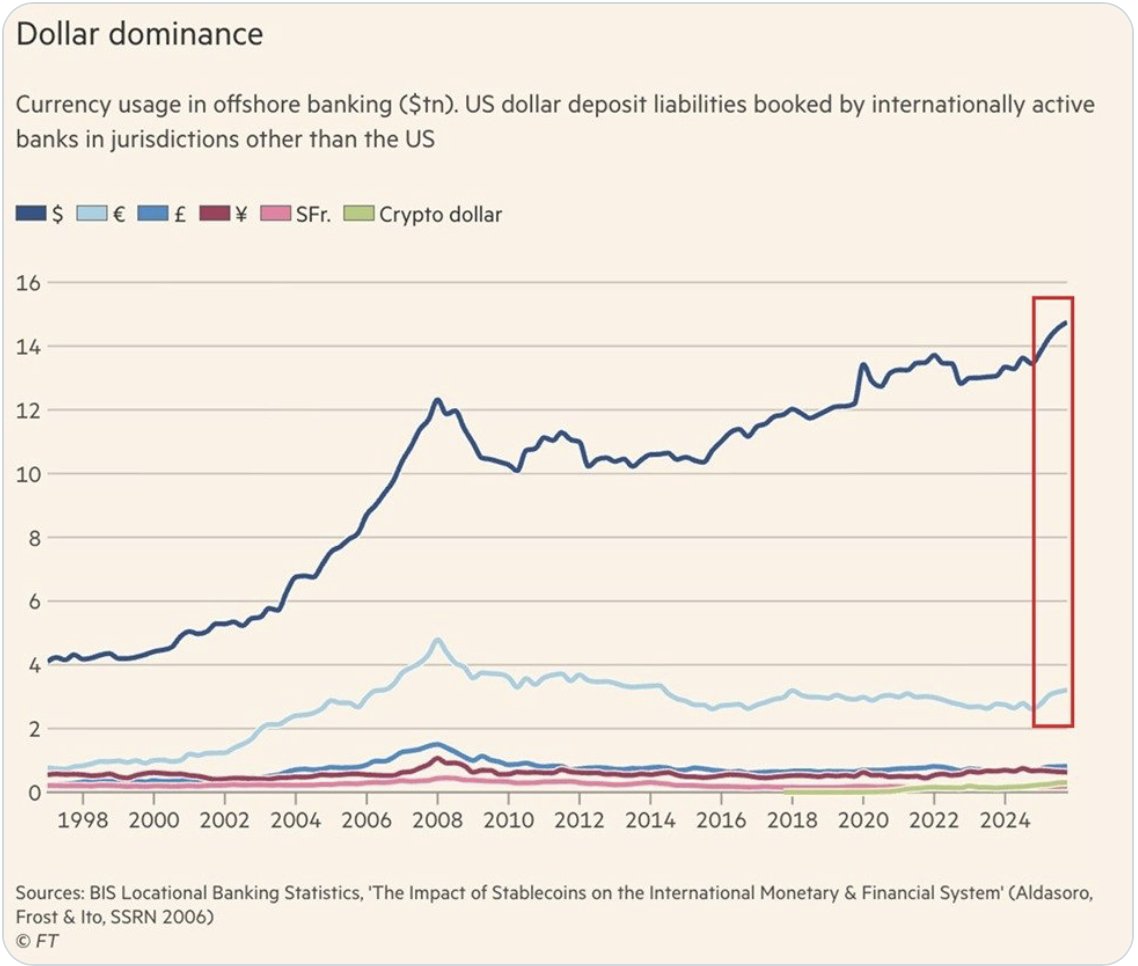
Finally, turning to the dollar, after modest gains yesterday, it is little changed this morning.  The RBA raised rates by 25bps, as expected and AUD is unchanged, as are the euro and pound.  With the BOJ on holiday, JPY (-0.2%) is slipping slightly, but not showing any major activity.  However, we have seen several EMG currencies improve with MXN (+0.3%) and BRL (+0.4%) both benefitting from the increased risk appetite we are seeing in overall markets.  The thing about the dollar is it has not been interesting for quite some time, trading within a fairly narrow range.  However, while we continue to hear many pundits describe the dollar’s ultimate demise, there is an interesting story in the FT about the dollar’s dominance in global markets as can be seen in the chart below from Kobeissi on X.

This is not a demonstration of the world shunning dollars, just sayin!

On the data front, this morning brings the Trade Balance (exp -$60.5B) along with ISM Services (53.7) and JOLTs Job Openings (6.83M).  We also see New Home Sales (668K) and hear from two Fed governors, Bowman and Barr.

But it is all still about the war and oil, and until something definitively changes there, I expect we will chop with every headline.

Good luck

Adf
Ere Fears They Shed

The status is still very quo
As ships still cannot come or go
However, Iran
Proposed a new plan
With nukes as a part of the show
But thus far, whatever they said
Has not moved discussions ahead
So, oil’s crept higher
As traders require
More certainty ere fears they shed

While President Trump has announced a new plan to help escort ships trapped in the Persian Gulf through the Strait of Hormuz, thus far, none have taken the chance.  Over the weekend, Iran ostensibly put forth another peace proposal, and this time their nuclear activities were part of the plan, a major change, although President Trump has rejected it overall.  To me, though, this is major progress as it demonstrates that there is a negotiation ongoing.  

My armchair analysis, FWIW, is that Ahmed Vahidi is watching his nation crumble and beginning to really feel the pinch of the US naval blockade as his revenues shrink rapidly.  While there are many estimates of how long Iran can withstand a lack of revenue, and I have no idea what that answer is, I feel it is reasonable to assume that if he doesn’t have enough to pay his soldiers, many of them will simply go home.  Already I have read reports that many of their payments to soldiers and proxies have been dramatically reduced as the US continues to tighten the financial screws via sanctions on banks and companies that have been acting as Iran’s middlemen.  I believe it is widely agreed on all sides of the conversation that the Iranian economy has been virtually collapsing with the rial having fallen 95% in value, access to basic staples limited and suffering widespread.  

The one thing of which I feel certain is that Vahidi wants to remain in power, and I would estimate as the pain increases, and the money stops flowing, his grip on power is slipping.  Staying in power without nuclear weapons is likely much preferred to being deposed.  

In the end, like every negotiation, the parties start far apart and get closer over time.  Now, my view is likely not worth all that much, but the oil market’s view is worth billions of dollars and if we look at how the price of oil has behaved, while uncertainty remains, (especially after a report this morning that Iran fired on and struck a US naval vessel, although that report has been denied), the market does not appear to believe that this is going to continue that much longer.  

Source: tradingeconomics.com

Several things continue to occur as at $100/bbl; there is some level of demand destruction; production elsewhere in the world continues to grow (I read that Venezuelan production rose to 1.25 mm bpd ,more than had been assumed prior to the Iran war); and the Saudi east-west pipeline is now pumping its capacity 7 million bpd, thus the amount of oil ‘missing’ has been reduced from the initial headline 20 mm bpd to somewhere along the lines of 12 mm bpd, still extremely painful to the global economy, but obviously not (yet) catastrophic.  However, since oil prices remain around $100/bbl, and have not risen to $150/bbl or $200/bbl as many pundits had forecast, there remains a great deal of confidence that this is going to end before too much more time has passed.  I certainly hope so for everyone’s sake.

Away from that, there is precious little other news to note as Asia is basically on holiday until Thursday and the UK is closed today, so market activity has been more muted.  But let’s take a look.  In the equity markets, weirdly HK (+1.2%) was open despite both China and the UK being closed and given HK’s history, I would have thought it would have responded to one of those situations.  But the big news was Korea (+5.1%) which was dramatically higher on rallies in Samsung and SK Hynix shares, both of which have been major beneficiaries of their semiconductor businesses booming alongside AI demand.  I guess we shouldn’t be surprised Taiwan (+4.6%) followed that path and in truth, there were more positive outcomes (India, Philippines, Malaysia, Singapore, New Zealand) than laggards (Australia).  Remarkably, everything I read is that Asia is the region most negatively affected by the Iran war, yet here we continue to see equity markets rising.

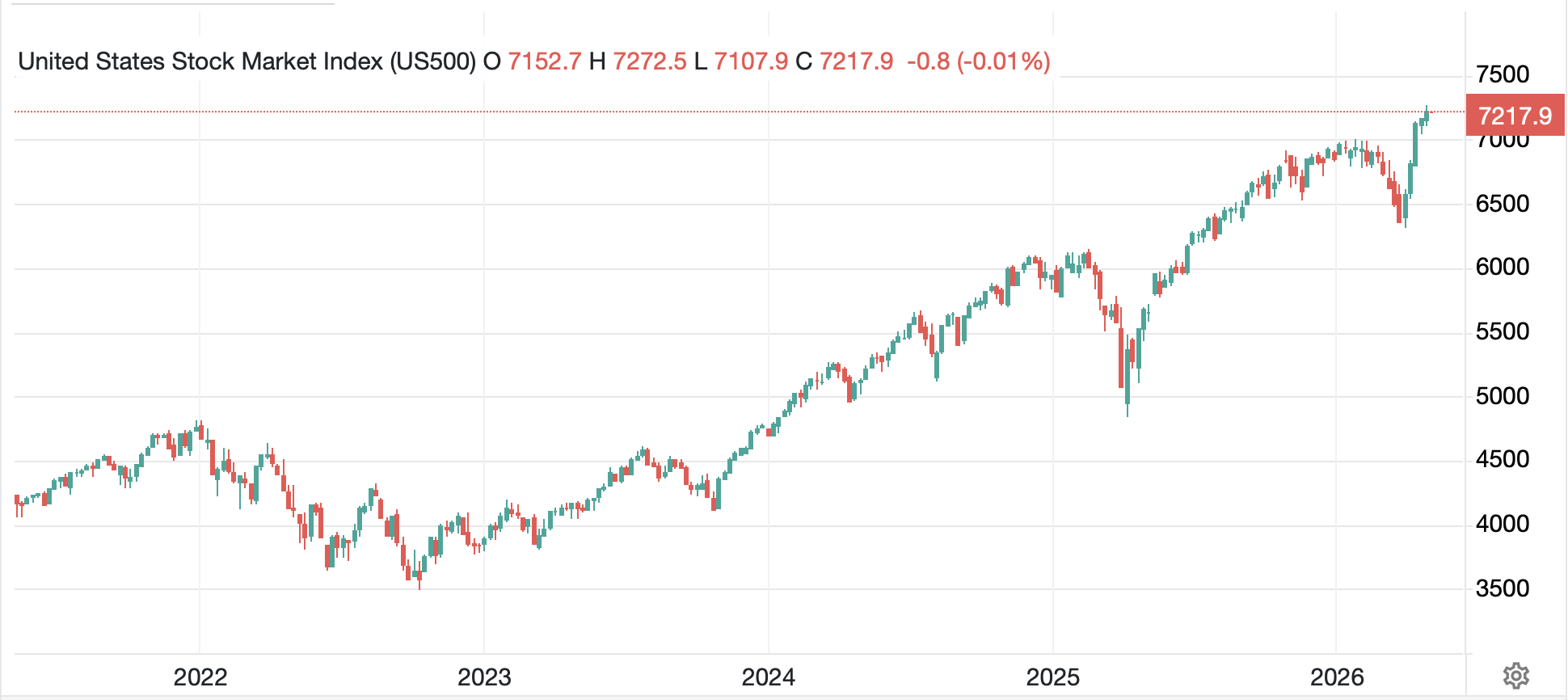
In Europe, things are less optimistic this morning with red across the screen led by Spain (-1.6%) and France (-1.0%) although both the UK and Germany are nigh on unchanged.  One of the weekend stories is that the US is now going to be raising tariffs on European auto imports to 25% from the 15% initially agreed as Trump claims the Europeans weren’t following the agreement.  As to US futures, this morning they are marginally lower as I type (7:30) but remain just ticks away from the all-time highs set last week.  Again, it is difficult to accept the idea that the world is about to end based on the market’s current behavior.  Look at the chart below and worry does not seem to be prevalent, nor has it been for any extended length of time in the past 5 years.

Source: tradingeconomics.com

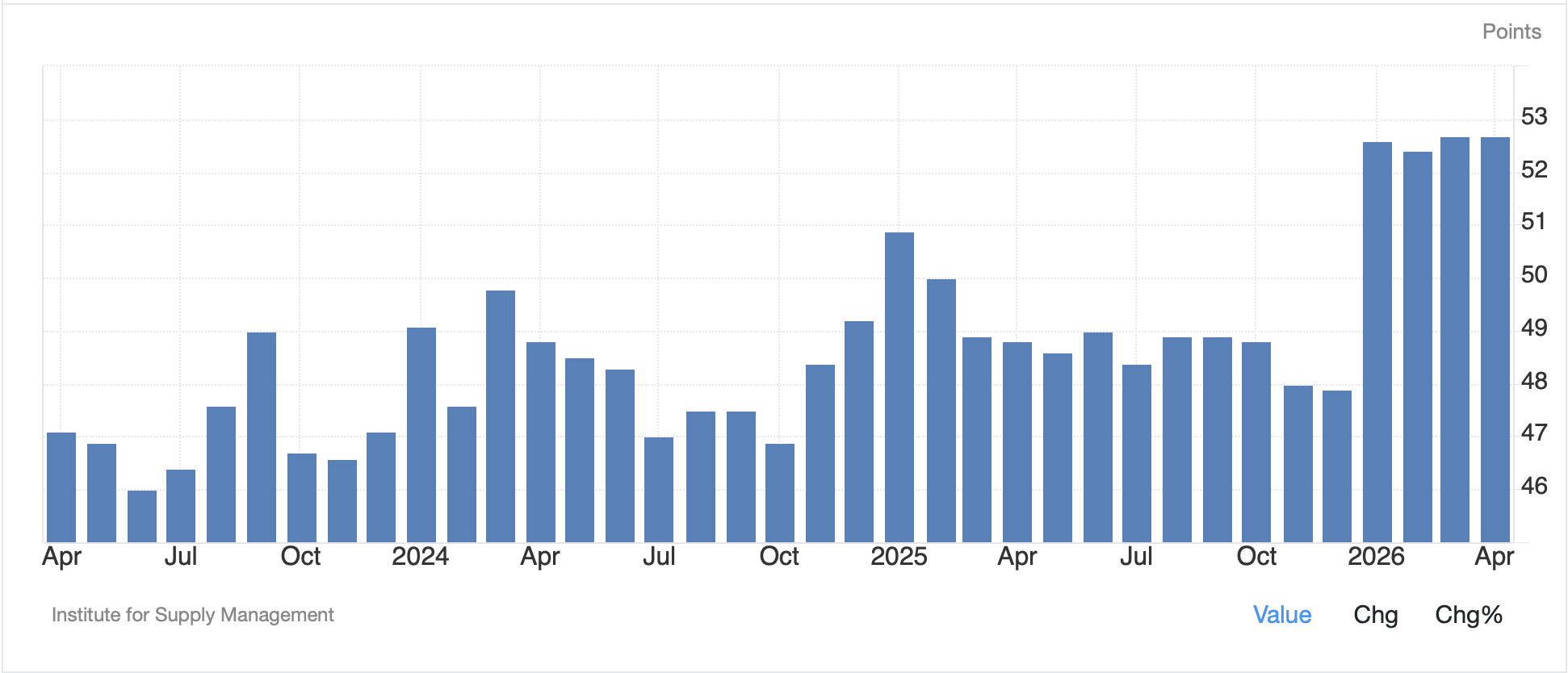
In the bond market, yields are higher this morning with Treasuries (+4bps) leading the way and European sovereigns all higher by between 3bps and 4bps as well.  It’s interesting that this is the behavior but I suppose it has to do with the Keynesian view that higher economic activity leads to higher rates.  If we look at the PMI data from around the US and Europe, manufacturing has been doing quite well.  Look at the ISM Manufacturing chart below for the past 3 years and it is clear that investment is growing there.

Source: tradingeconomics.com

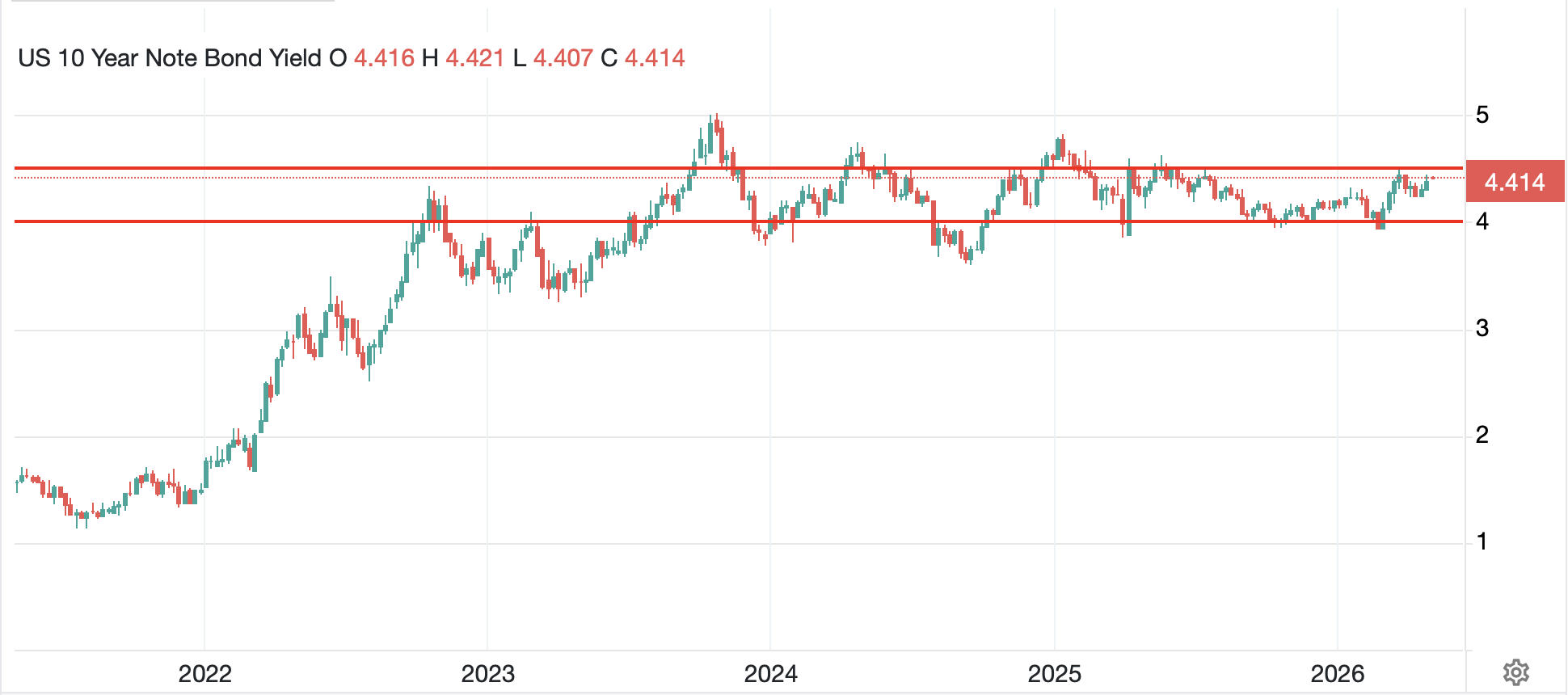
It is a similar tale in Europe with Manufacturing PMI data this morning all being released healthily above the 50 level and rising from last month.  The market response to lift yields seems anachronistic, but such is life.  However, it is worth highlighting that if we take a bit of a longer-term perspective on 10-year Treasury yields, while they are pushing toward the top of a 4.00% – 4.50% range, you can see that range has largely been intact for the past 3 years.  It is not clear to me that it is time to panic on yields yet.

Source: tradingeconomics.com

In the commodity space, with oil (+3.3%) having risen on the reports of a US ship being attacked, we cannot be surprised to see gold (-1.2%) and silver (-2.6%) both slipping along with copper (-1.6%). This is especially true with China and most of Asia on holiday as official buying of gold is probably on hold for now.  

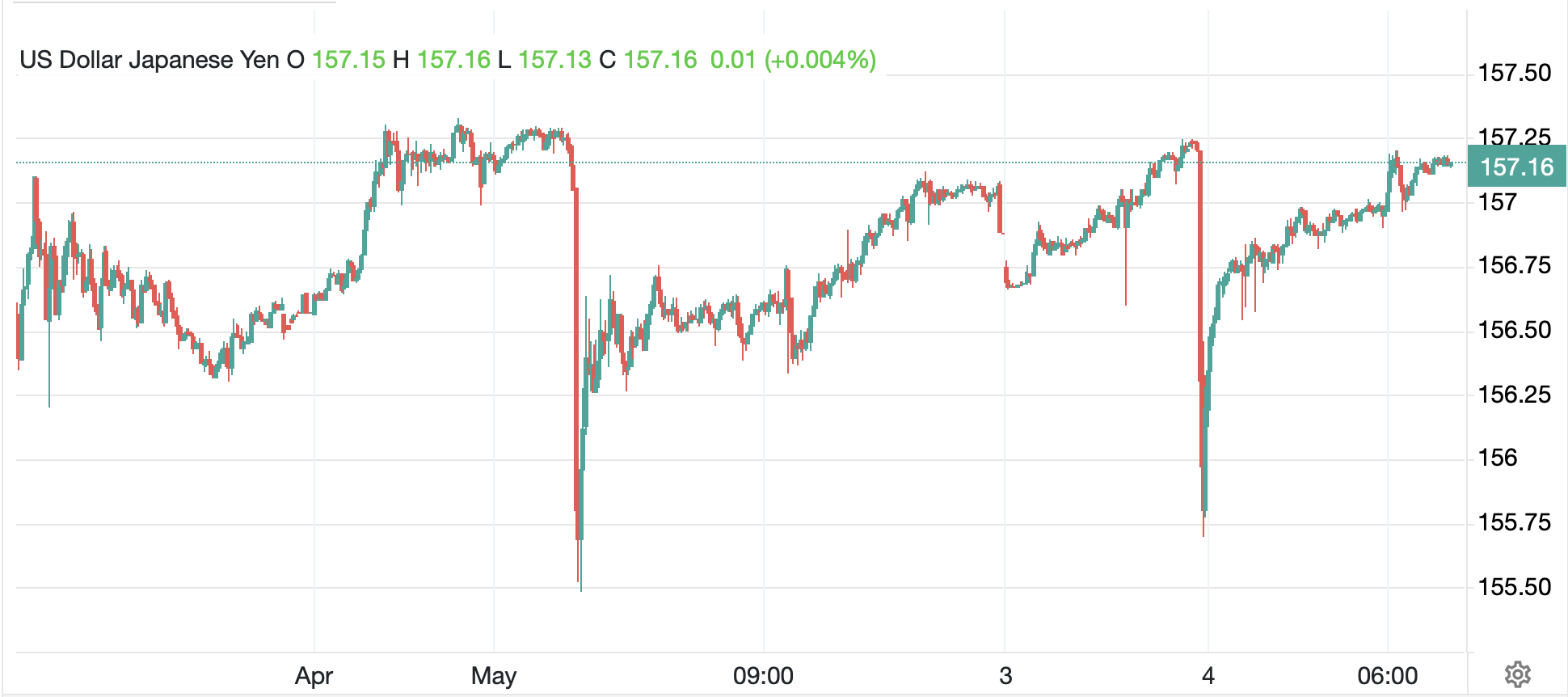
Finally, the dollar is firmer this morning as risk is under pressure across the board.  US futures are lower, European stocks are lower and oil is higher.  So, gains of 0.25% for the dollar against most currencies are the norm.  There was a very sharp appreciation in the yen early in the overnight session and another one a few hours ago, as you can see in the chart below, with many believing the BOJ was in again during quiet markets, but it has completely reversed.  My take is the BOJ would not have spent reserves like this and would have been far more emphatic if they wanted to move the market again.

Source: tradingeconomics.com

But, as market in Asia were quite thin, any large sell order would have been able to force a move like these.  In addition, with the dollar now several percent below their level of concern, I suspect they will save their ammunition.  In the EMG bloc, ZAR (-0.5%) continues to feel most of the pressure from Iran as the combination of higher oil prices and lower gold prices are a double whammy.  As well, NOK (+0.35%) continues to respond positively to the oil price.   Net, the dollar remains in demand for now.

On the data front this week, it is a mixed week until Friday’s NFP data is released.

TodayFactory Orders0.5%
 -ex Transport0.7%
TuesdayTrade Balance-$60.5B
 ISM Services53.7
 JOLTs Job Openings6.83M
 New Home Sales668K
WednesdayADP Employment99K
ThursdayInitial Claims205K
 Continuing Claims1800K
 Nonfarm Productivity1.4%
 Unit Labor Costs2.6%
 Consumer Credit$11.0B
FridayNonfarm Payrolls60K
 Private Payrolls73K
 Manufacturing Payrolls5K
 Unemployment Rate4.3%
 Average Hourly Earnings0.3% (3.8% y/Y)
 Average Weekly Hours34.2
 Participation Rate61.7%
 Michigan Sentiment49.5

Source: tradingeconomics.com

In addition, Fed speakers are back on the circuit (I sure hope Warsh shuts them all up) with 12 speeches from 9 different speakers.  The funny thing is, we already know their views, Miran wants to cut and everybody else is on hold, so what are they going to say?

The war remains the only thing that matters right now, so watch for headlines that an agreement is coming closer.  If that happens, oil will slide along with yields and the dollar while metals and stocks will rally.  (Of course, apparently, we don’t need anything else to get stocks to rally!)

Good luck

Adf