The American Dream

To aid the American Dream
The most recent Trumpian scheme
Is new Trump Accounts
In proper amounts
To help stocks become more mainstream
 
One likely effect of this act
Is stocks will be forcefully backed
Though problems extant
May come back to haunt
For now, bearish plays will get whacked


Financial market news remains mostly uninspiring these days as the Fed story has largely gone back to a cut is coming next week (89.2% probability) thus the hawkish phase has passed.  AI is still the magical future, while precious metals continue to garner support overall as concerns rise about the ongoing debasement of fiat currencies.  Elsewhere, the war in Ukraine rages on as peace talks in Moscow were described as ‘constructive’ but have yet to resolve the issues.

The other piece of the Fed story, regarding the next Chair, has taken a modest turn as a series of interviews by the finalists in the process (allegedly Hassett, Warsh and Waller) with VP Vance, were suddenly canceled for no apparent reason.  As well, the president continues to hint that Mr Hassett is going to be the one.

But one of President Trump’s strengths is his ability to keep his ideas in the news, and nothing exemplifies that better than the new Trump Accounts.  This is the idea that the government should start investing in the next generation by way of establishing investment accounts in the name of children at birth with $1000 of seed money from the government.  If these accounts are invested in the S&P 500, for instance, with a historically average return of roughly 10%, by the time the child turns 18, the initial investment will have grown more than 5-fold.  As well, these accounts are eligible for additional contributions each year, up to $5000, so can really build some value in that circumstance.  

In addition, the news that Michael and Susan Dell will be donating $6.25 billion to add $250 to those accounts, tax free to the recipient, is another boon.  Estimates are that the total could rise to $4 billion/year of outlays, all of which will be required to go into the stock market.  It’s almost as though President Trump wants the government to support the stock market, but I’m sure that is a secondary consideration!

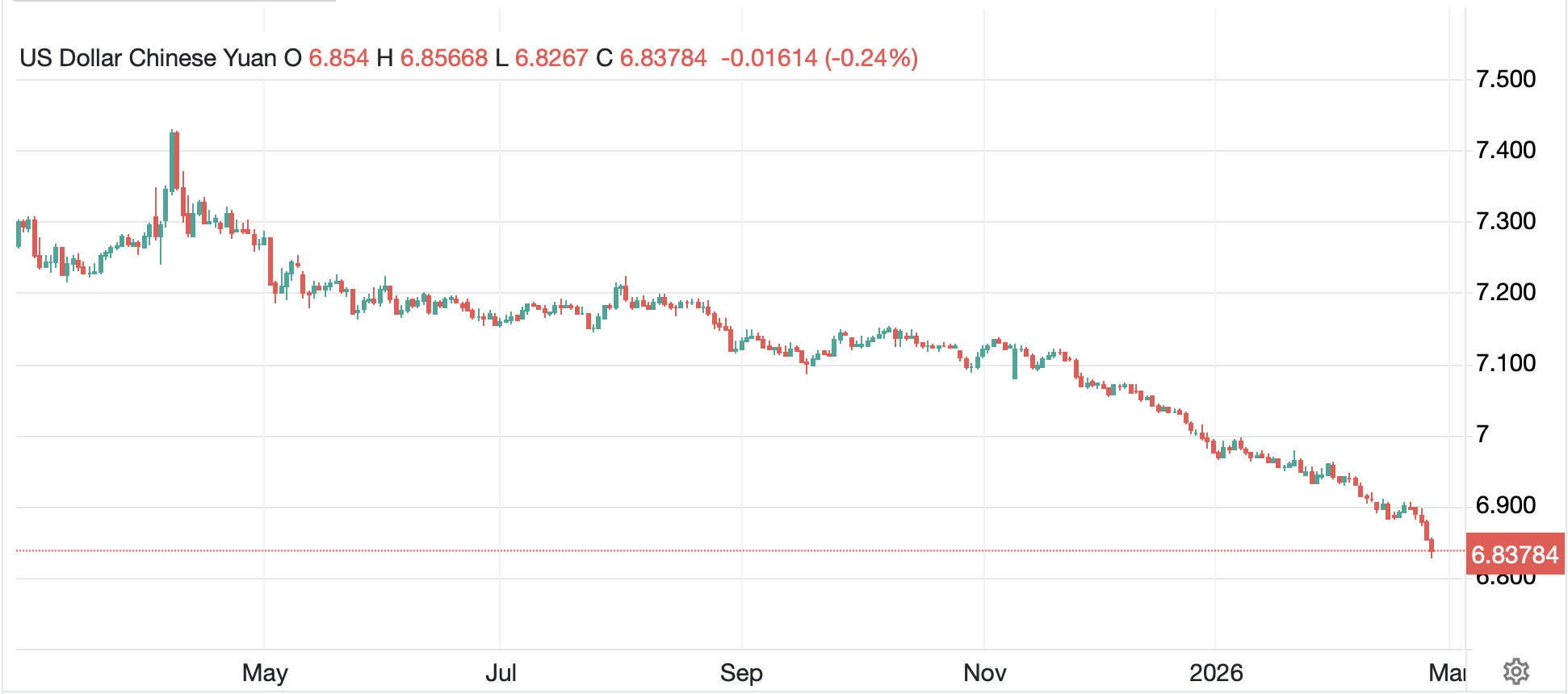
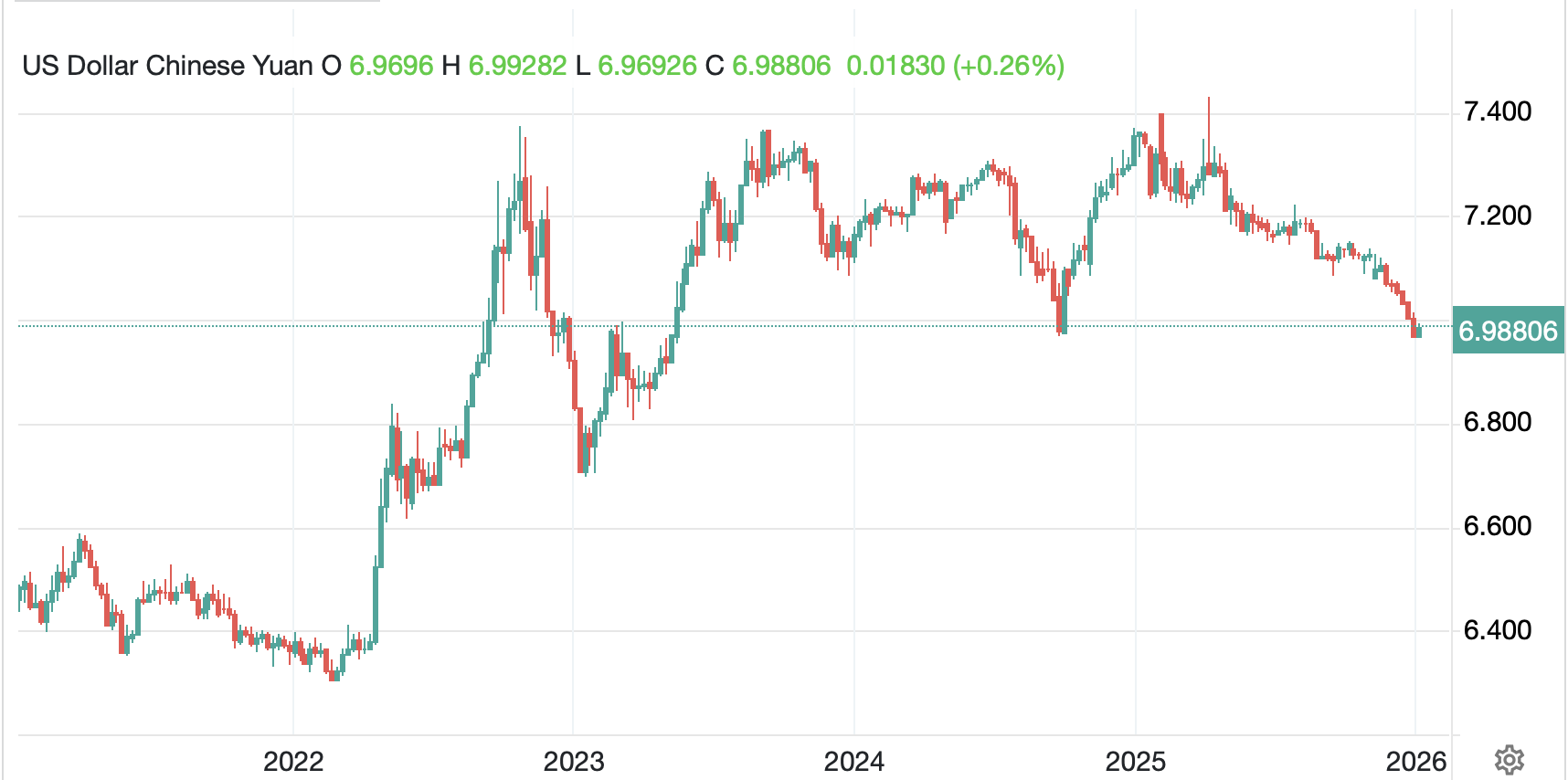
But away from that, the news has been sparse, so let’s look at market activity overnight.  yesterday’s US session played out like the opening, modest gains, and futures at this hour (7:15) indicate more of the same is on the way today.  In Asia overnight, while Tokyo (+1.1%) had a solid session, China (-0.5%) and HK (-1.3%) were far less fortunate.  Chinese PMI data continues to be soft but perhaps of more import is the fact that the yuan (+0.15%) continues to gradually strengthen, as it has been for the past year (see chart below).

Source: tradingeconomics.com

In fact, the yuan has reached its strongest level since September 2024.  The thing about a strong CNY is that it has definitive negative impacts on Chinese exporters.  While there has been very little discussion of the yuan regarding the trade talks between the US and China, the steady appreciation of the currency will certainly hurt Chinese company earnings, and by extension stock prices there.  One thing to note is that despite its recent strength, the yuan remains undervalued vs. the dollar based on a Real Effective Exchange Rate calculation by the World Bank as per the below chart, with the current USD value at 130.6 while the CNY sits at 113.1.  That is a substantial undervaluation that, if corrected, would likely have a significant impact on the respective economies of each nation as well as, maybe, the political rhetoric.

Elsewhere in the region, India was little changed even though the rupee (-0.4%) traded through 90.00 for the first time as the RBI has decided not to waste more reserves on supporting the currency.  It appears that capital outflows are driving the rupee, but that does not bode well for stocks there.  The rest of the region was mixed with more gainers (Korea, Taiwan, Australia, New Zealand) than laggards (Philippines, Thailand, Malaysia).

In Europe, both Spain (+1.5%) and Italy (+0.7%) are having solid sessions although much of the rest of the continent is less robust.  The story is that European defense companies have benefitted today based on the absence of a peace agreement, although Eurozone inflation readings coming in a tick hotter than forecast have put paid to any idea of an ECB cut anytime soon.

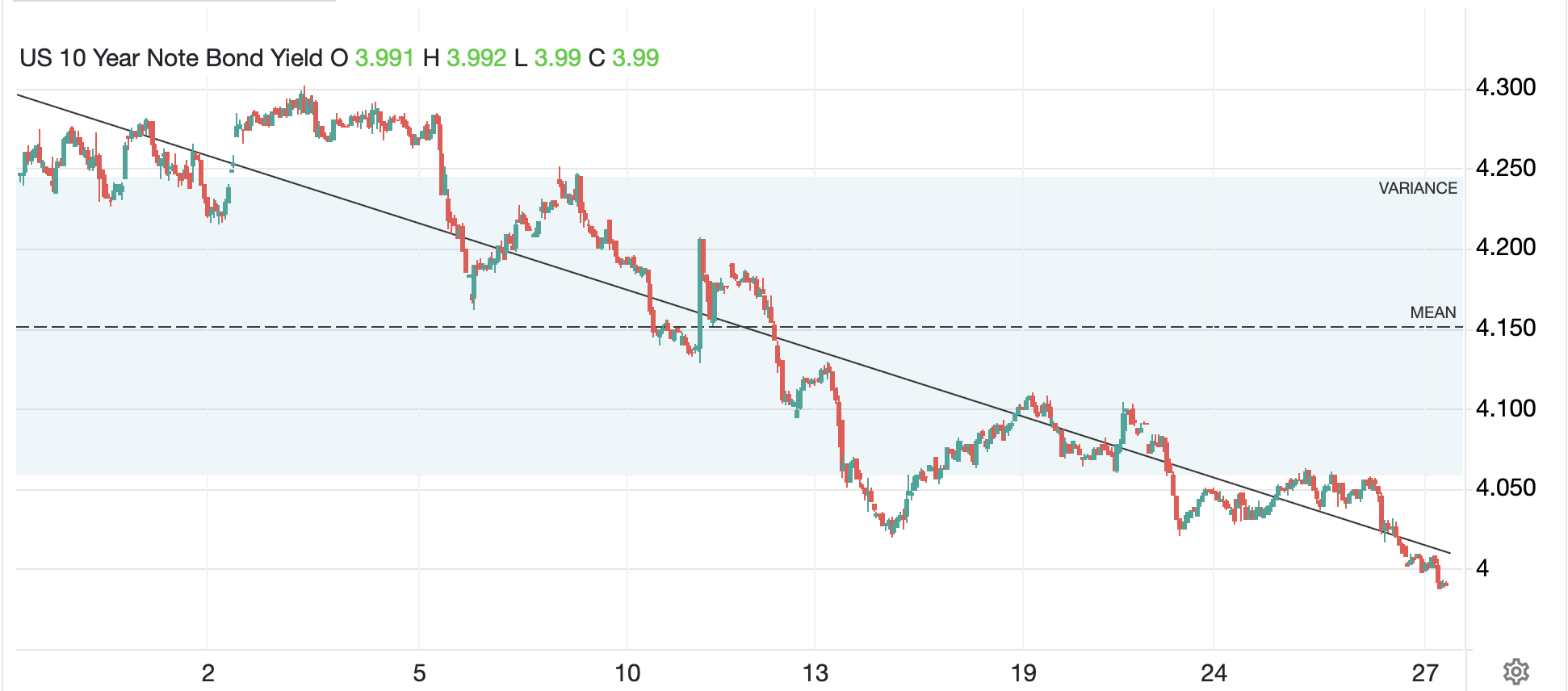
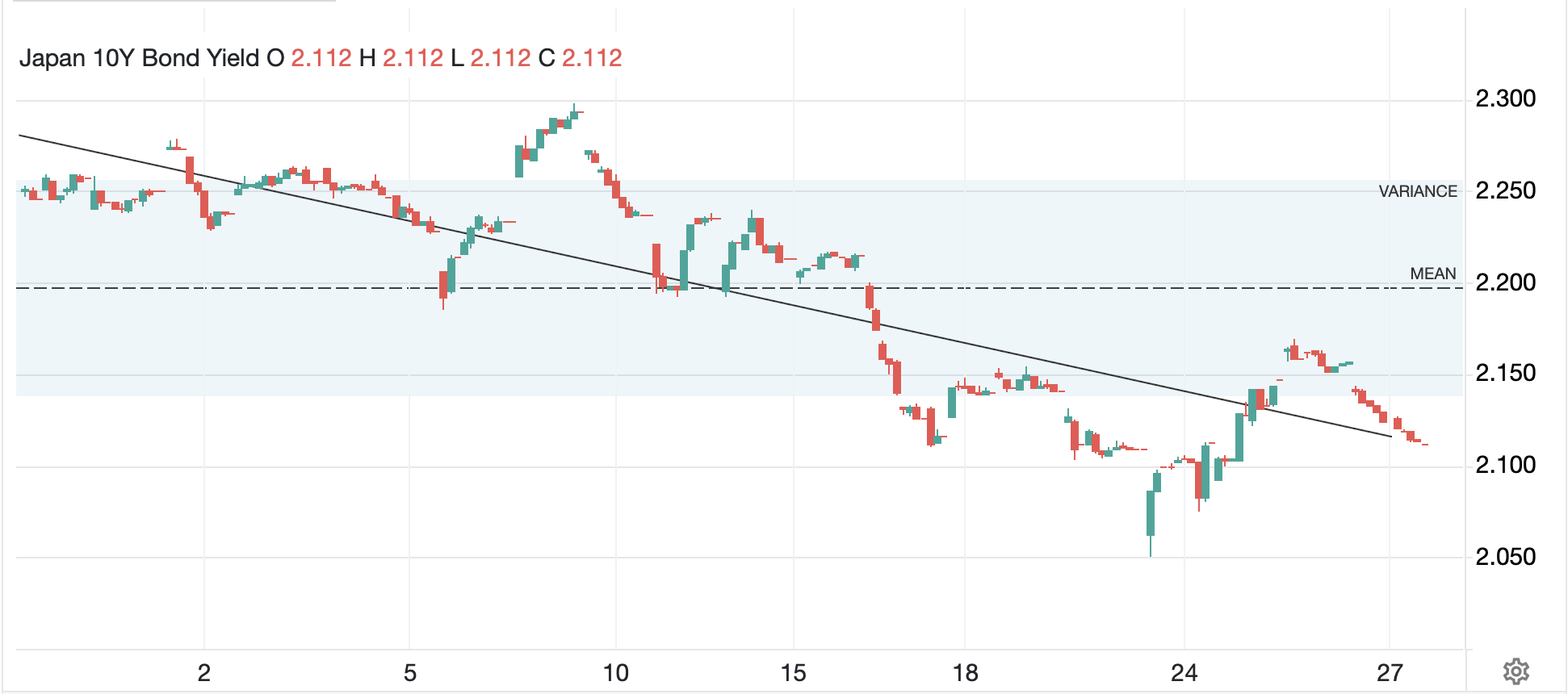
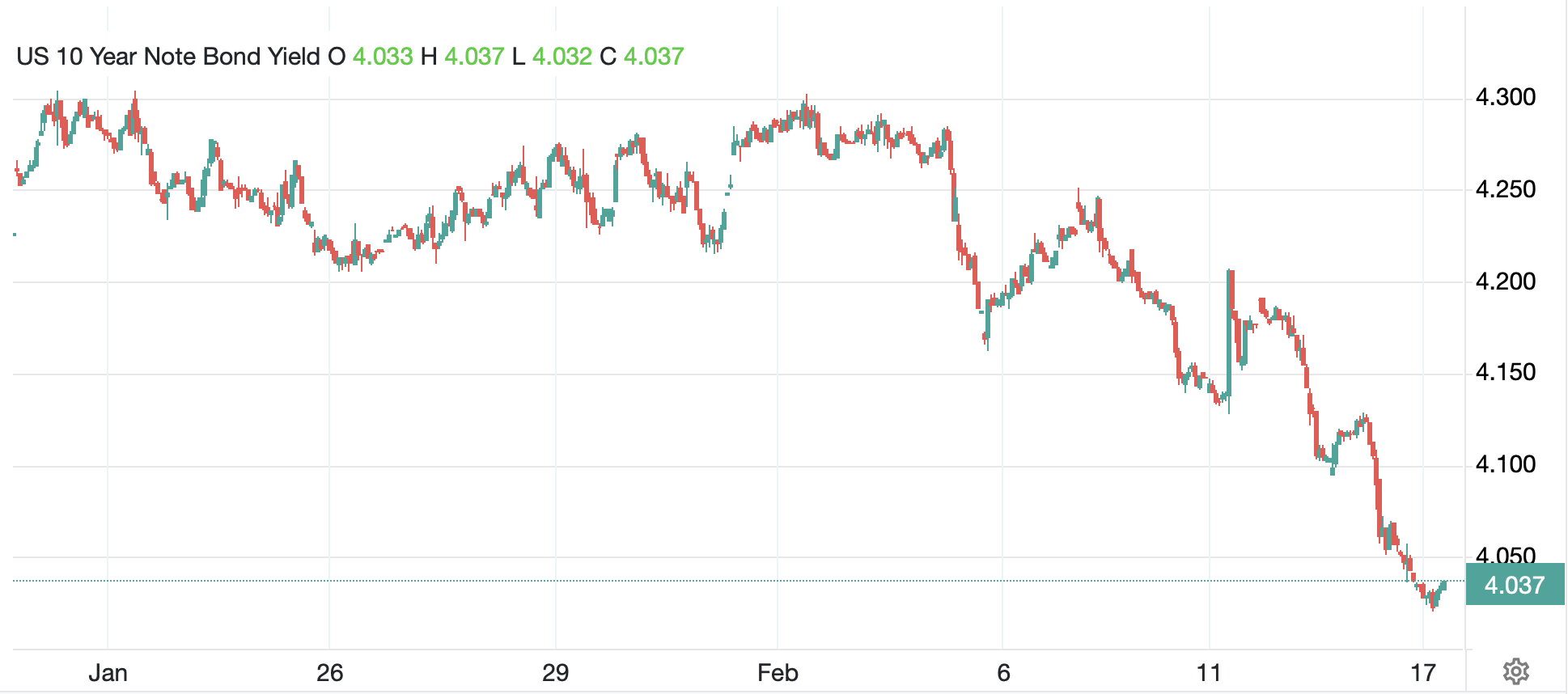
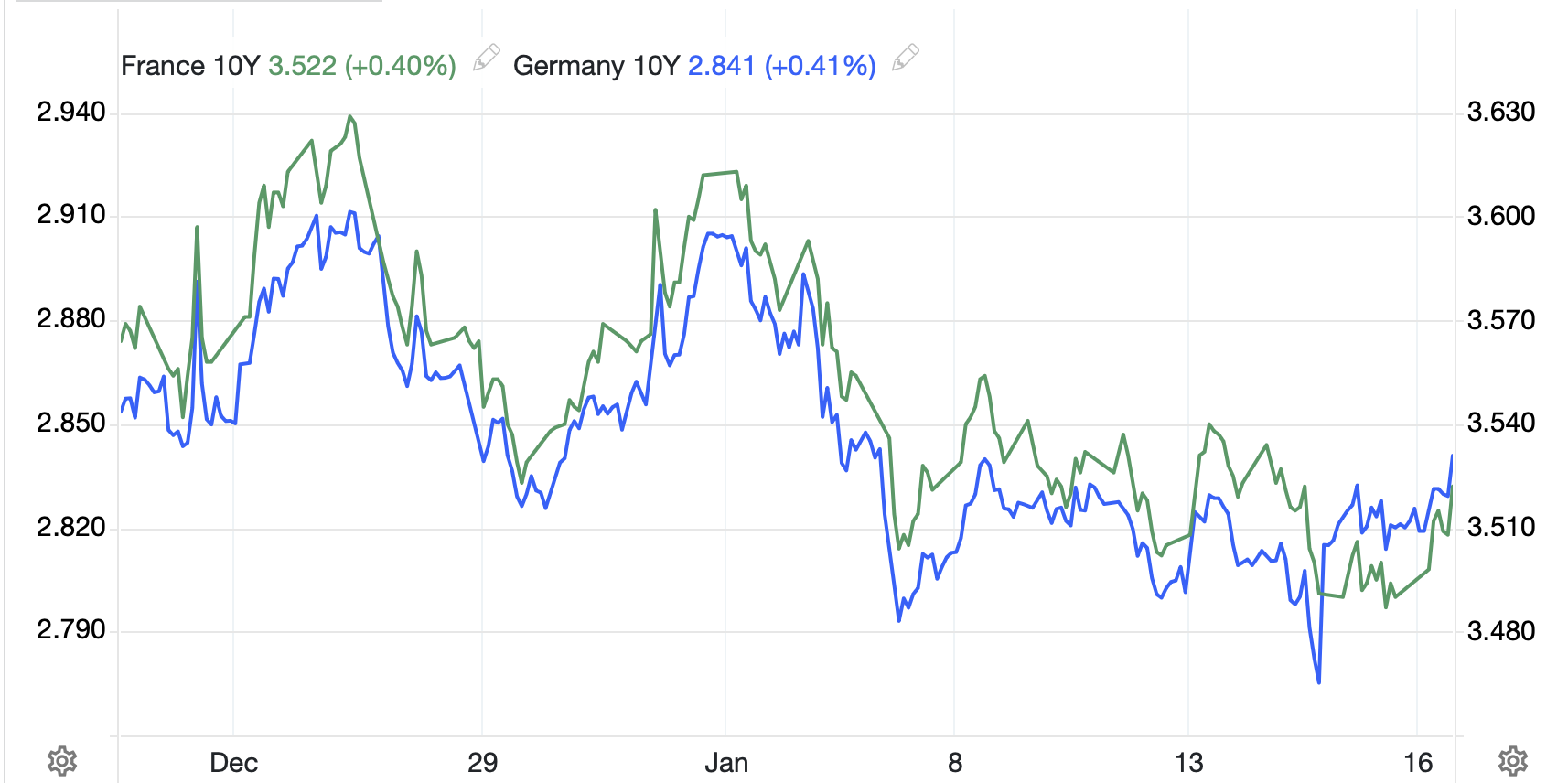
Moving on to bonds, Treasury yields (-3bps) have backed off a touch from highs yesterday and that has dragged European sovereigns down with them, with the entire continent seeing yields decline -1bp or so.  Overnight, JGB yields ticked up another 3bps, to further new highs for the move, as there is no indication that government spending is going to slow down while expectations of a BOJ hike remain in full force.

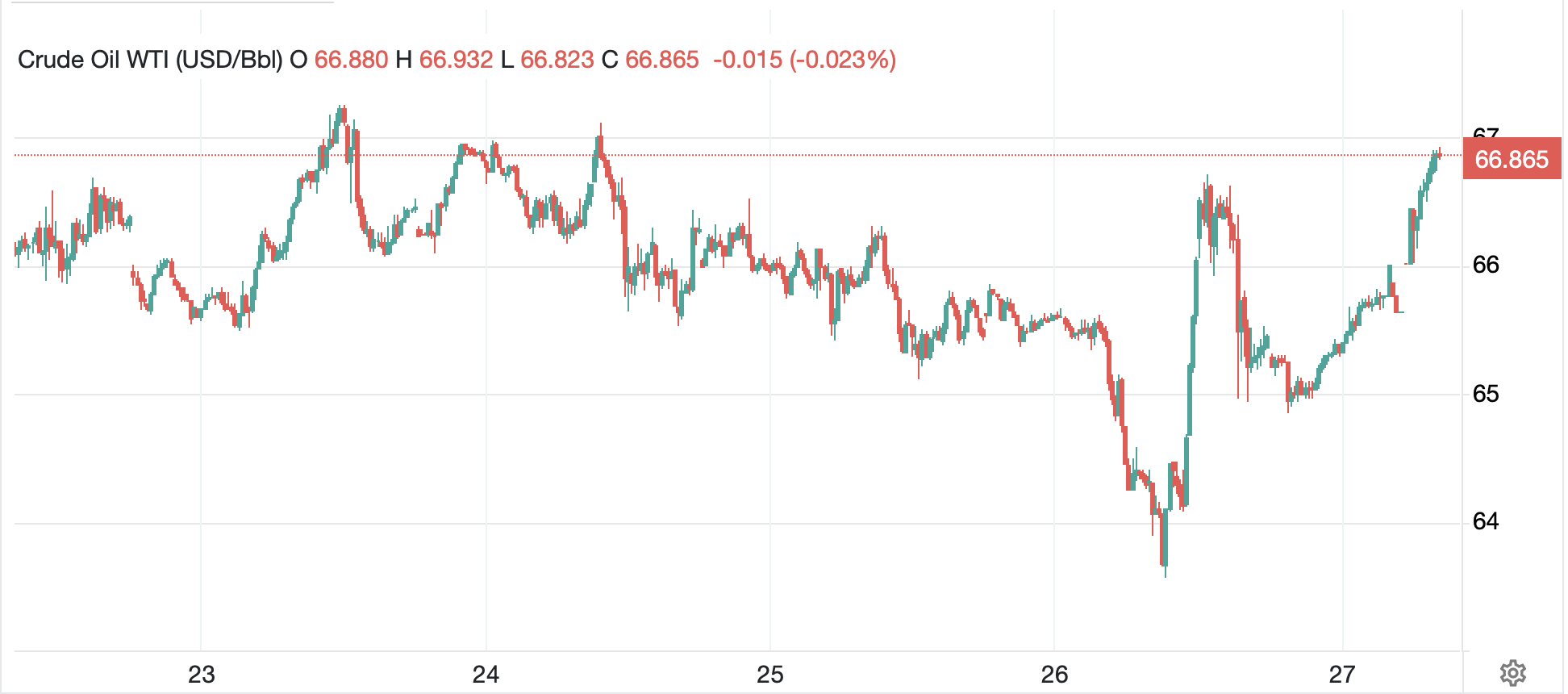
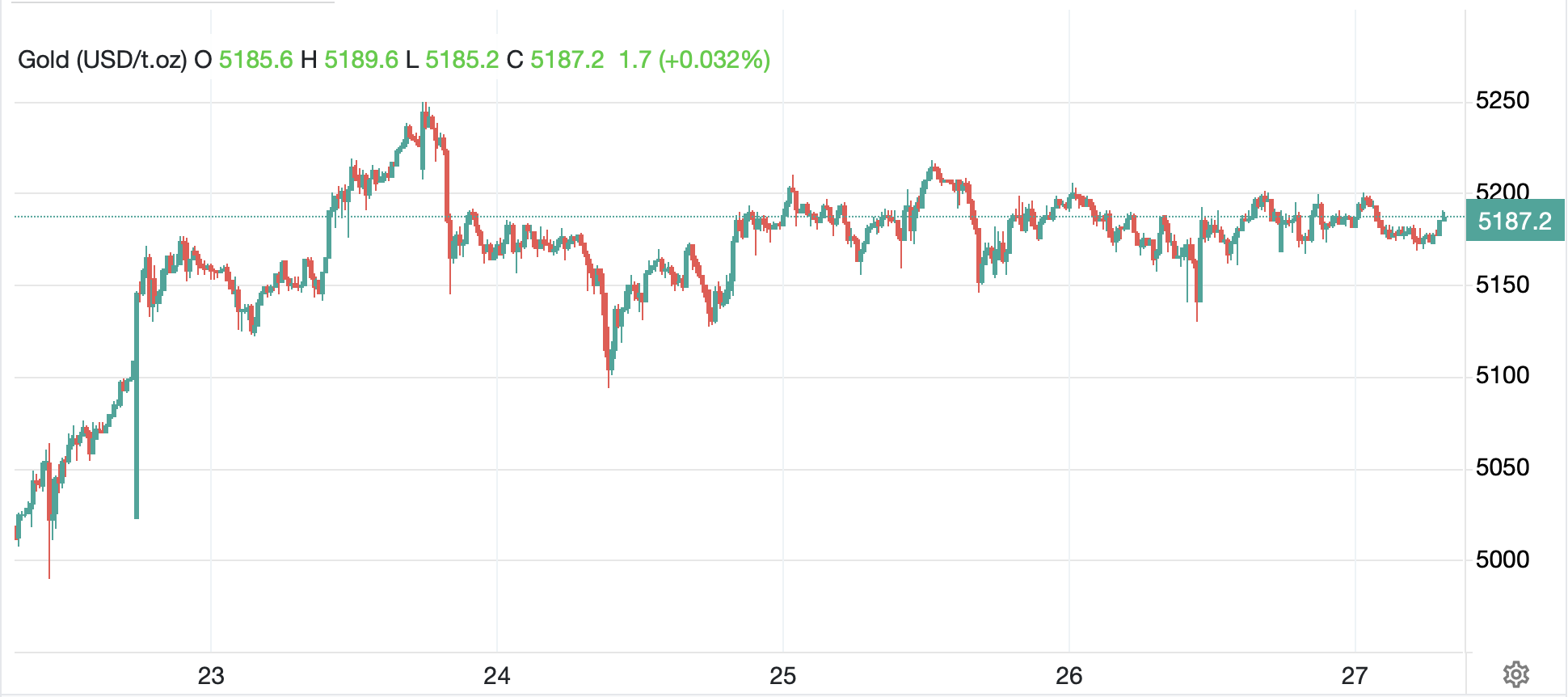
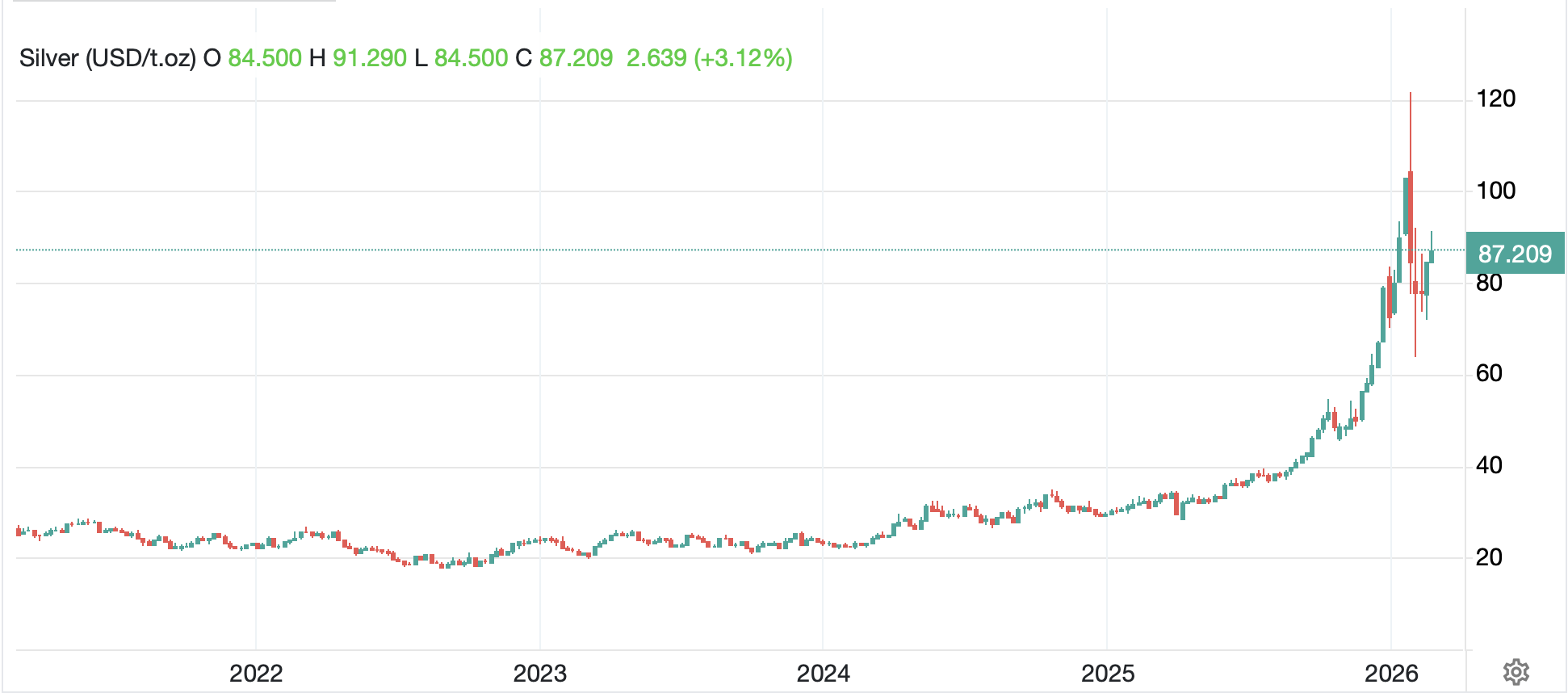
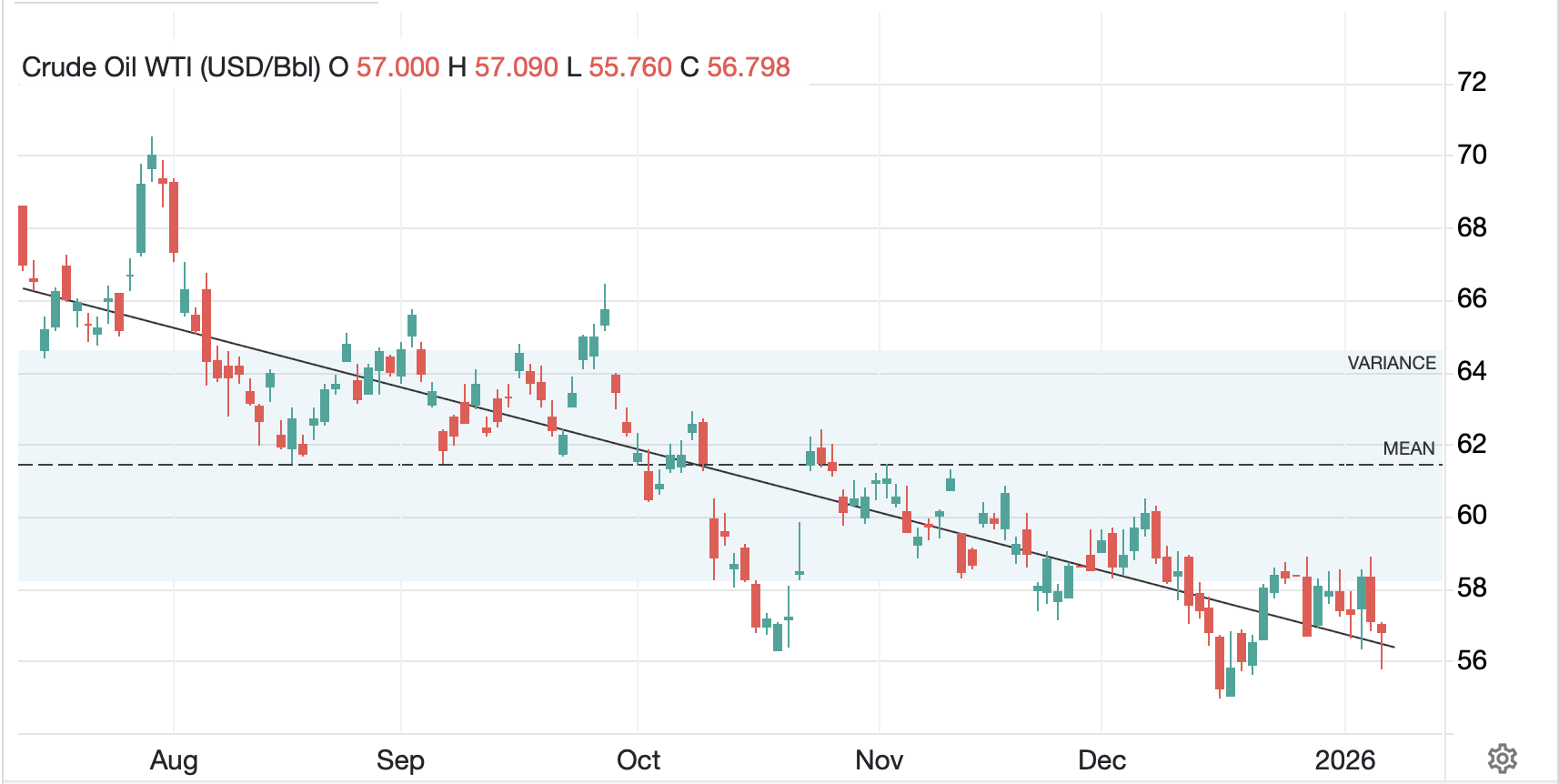
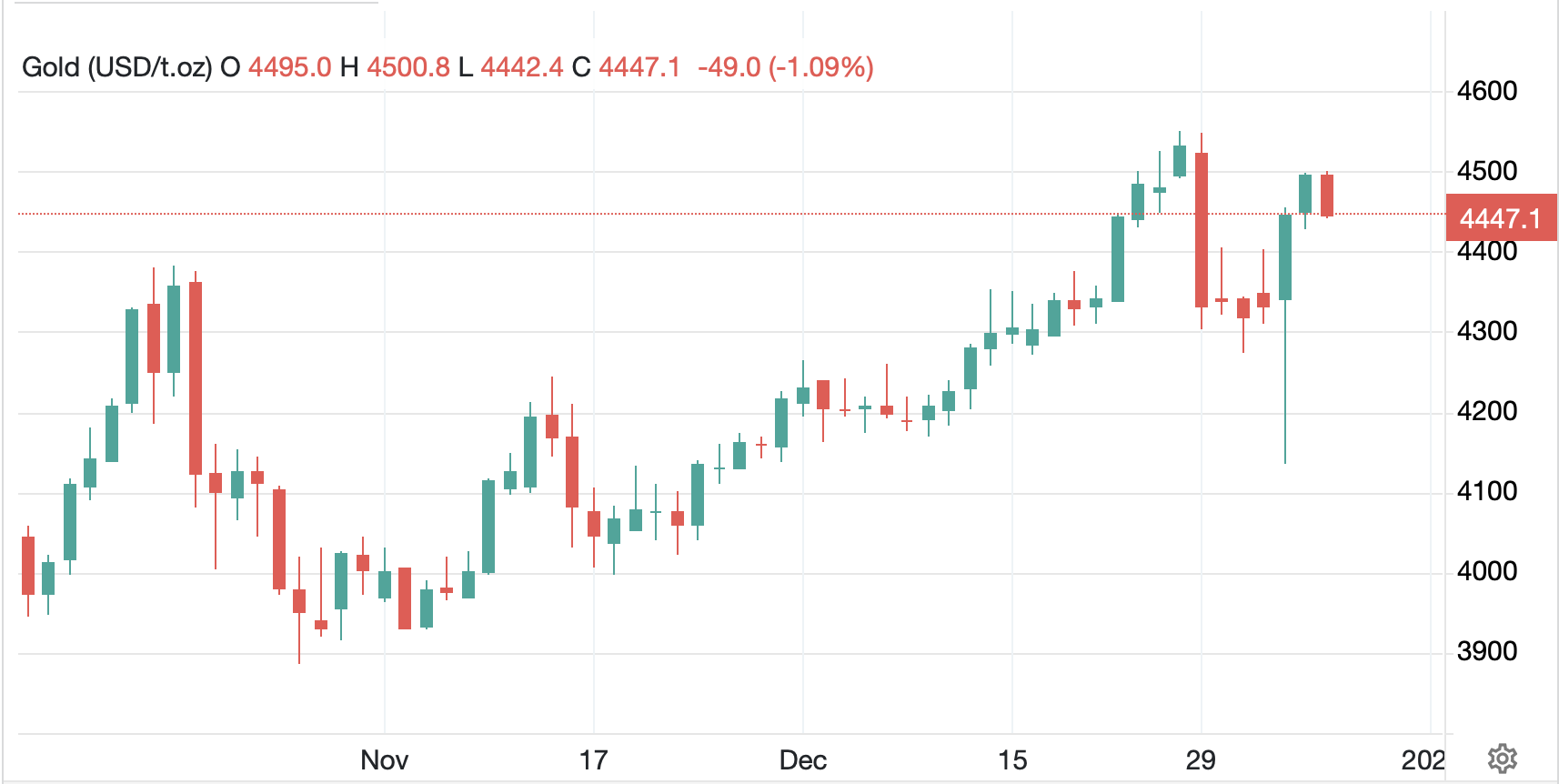
Commodity markets continue to show the most volatility with both oil (+1.3%) and NatGas (+2.3%) rising this morning, the former on the lack of peace talks, the latter on the expanding polar vortex which is driving cold weather in the Northeast.  Too, I would be remiss if I didn’t mention that European demand for US LNG is running at record rates as they try to wean themselves from Russian gas supplies.  FYI, NatGas is back to its highest level since late 2022, where it skyrocketed in the wake of the initial Russian invasion.  In the metals markets, after a bit of profit taking in yesterday’s session, both gold and silver have edged higher by 0.1% this morning as both continue to be accumulated by Asian central banks and Asian investors although Western investors don’t seem to believe in the idea.  Something to note is that silver has risen 102% so far in 2025, that’s a pretty big move!  Copper (+1.45%) has jumped on the back of news that Chinese smelters have reduced activity and inventories at the LME are limited.  Add to that the underlying electrification story, and demand seems likely to be pretty robust for a while yet.

Finally, the dollar is under pressure this morning with the DXY, though still in its range, trading below 99.00 for the first time in 3 weeks.  But looking at actual currencies, the euro (+0.4%), pound (+0.7%), NOK (+0.6%), SEK (+0.5%) and CHF (+0.4%) are all nicely higher this morning.  The rest of the G10 are in a similar state, albeit with slightly smaller gains.  In the EMG bloc, CLP (+0.5%) is climbing on the back of copper’s rise, while the CE3 are all following the euro higher rising in step.  ZAR (+0.1%), BRL (+0.1%) and MXN (+0.2%) are underperforming this morning, likely because the metals markets, other than copper, are underperforming.

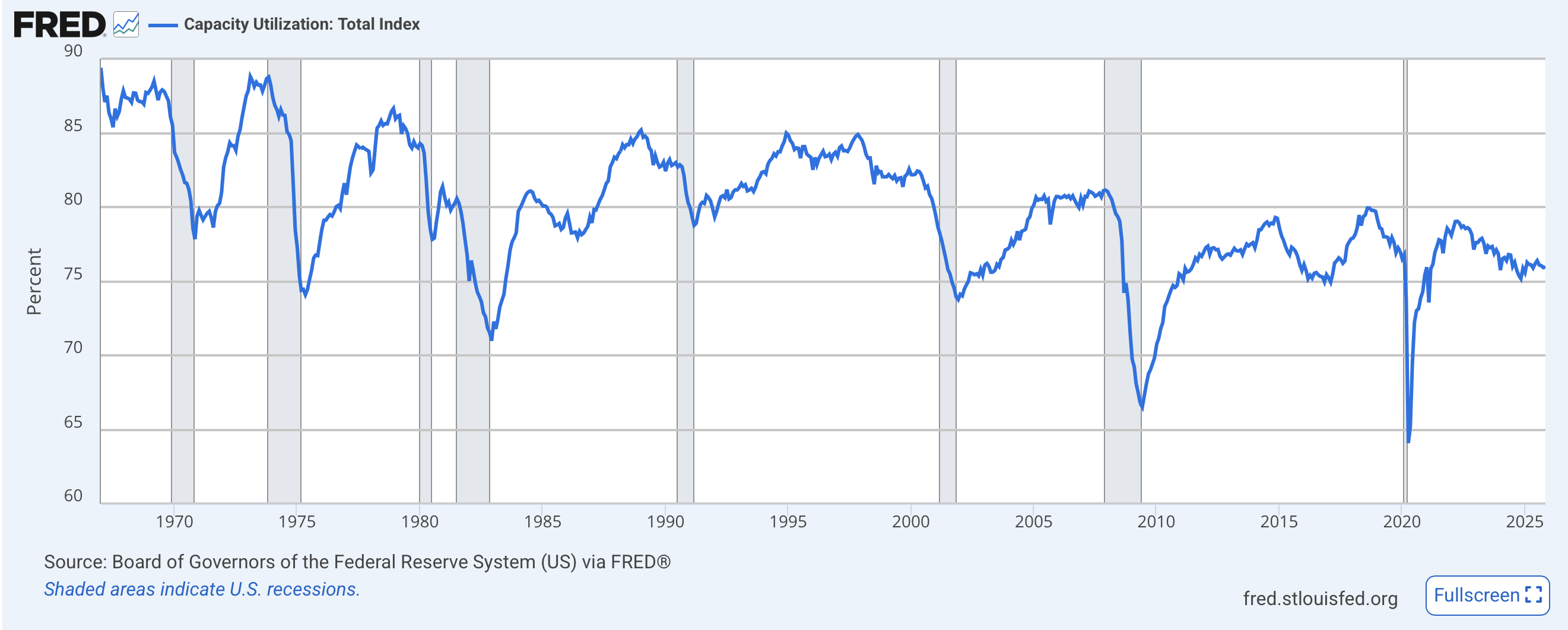
Turning to the data, this morning brings ADP Employment (exp 10K), IP (0.0%), Capacity Utilization (77.3%) and then ISM Services (52.1) at 10:00.  Given the IP data is old, I expect ADP to be the number with the most possible influence.  But, given the market is already assuming a cut next week, it would have to be a dramatic negative number to change any views.

The big picture remains the same, run it hot, fiat currency debasement and the dollar should be the best of a bad lot, but on any given day, much can happen that doesn’t fit that story.  Today is one of those days.

Good luck

Adf
AI is Grokking

The ‘conomy grew a bit faster
Than ‘spected by every forecaster
Consumers are rocking
While AI is Grokking
Though prices could be a disaster
 
The question this data incites
Is why cut rates from current heights?
With stocks on a tear
And ‘flation still there
The risk is the long bond ignites


Yesterday’s GDP data indicated that both consumer spending and AI investment were larger than expected with the result being GDP activity increased more than economists had forecast.  Most would consider this good news, and the equity markets clearly saw the benefits as they continue their slow march higher.  Surprisingly, despite the positive economic data, the Fed funds futures market did not reduce the probability of a rate cut next month.  Arguably that was because Governor Waller, one of the two who voted for a cut in July, spoke yesterday and reiterated his views that a cut was appropriate to prevent a worse outcome in the employment situation.  Frighteningly, he said, “I am back on Team Transitory.”  I fear that the transitory phenomenon is going to be the reduction in inflation we have experienced over the past two years, not the initial peak seen in 2022. (As an aside, if inflation is your concern, USDi is one way to maintain the purchasing power of your funds as it mechanically tracks CPI, rising in step with the index.)

Perhaps the futures market is starting to expect that Governor Lisa Cook’s days are truly numbered with a third instance of potential mortgage fraud surfacing yesterday, a situation that has a bad look for a Fed governor.  If she is forced out soon, that would be yet another Fed governor that President Trump will get to appoint, and the tension in the Marriner Eccles building will certainly grow at that September meeting.  After all, if Trump seats two more governors, and has 4 votes for a rate cut on the board, the question will not be should they cut, but how much they should cut with 50 basis points on the table regardless of the economics.

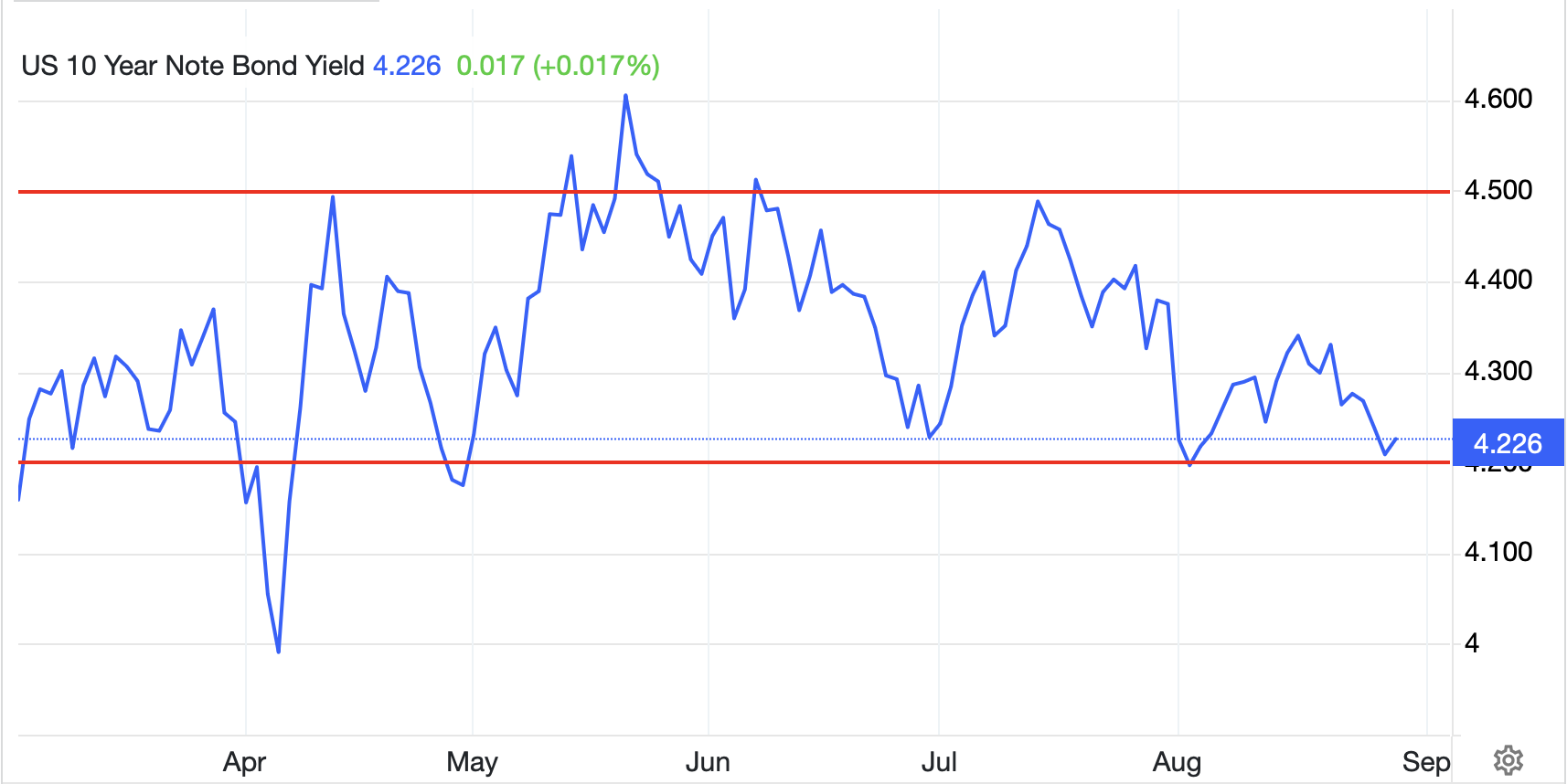
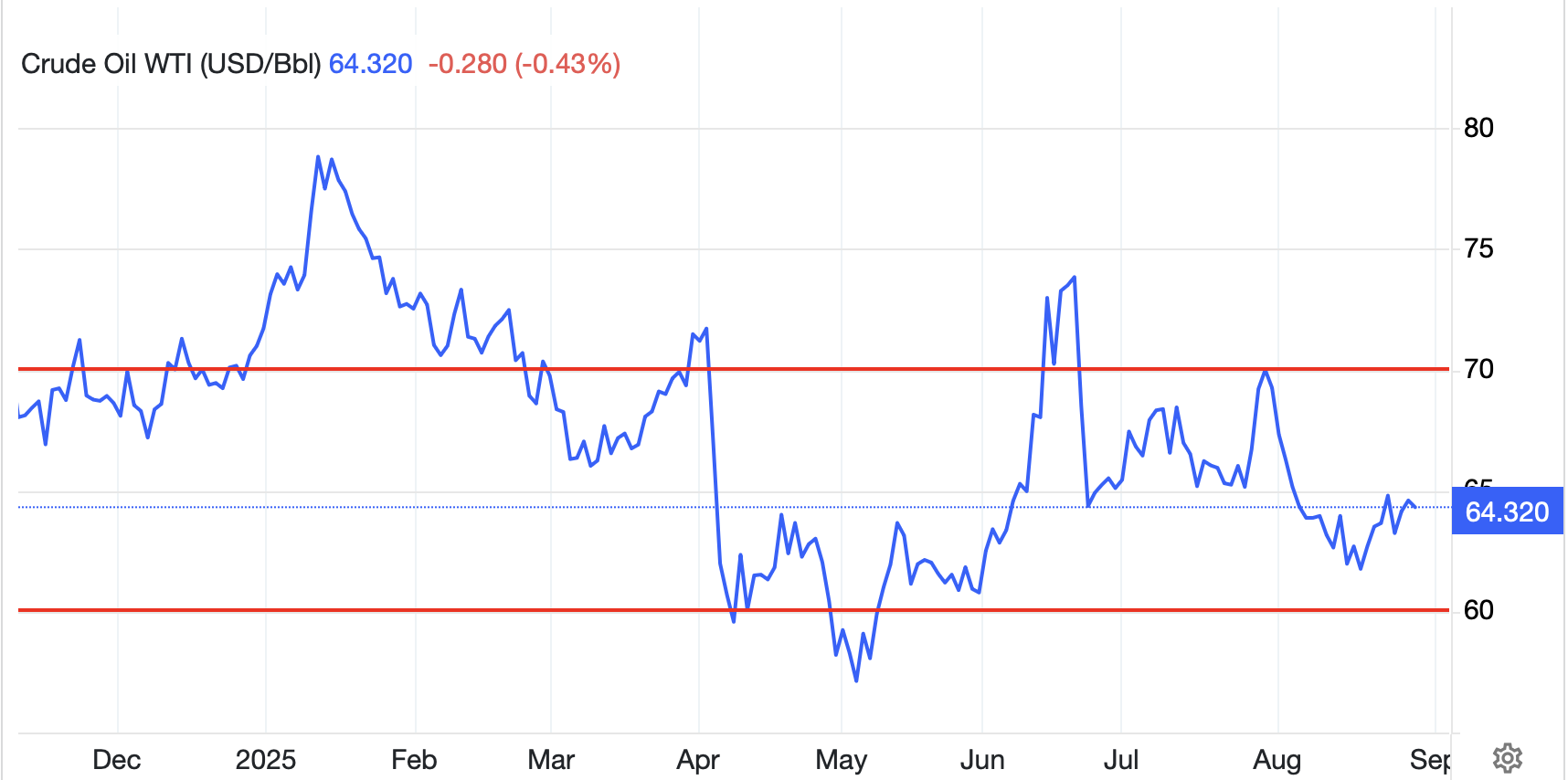
But all that is still three weeks away and based on the fact that if I look at almost every market, price action has been consolidating for the entire summer, it is hard to get excited in the short-term.  In fact, I think it is worthwhile to look at some charts so you can get a sense of just how little is going on.

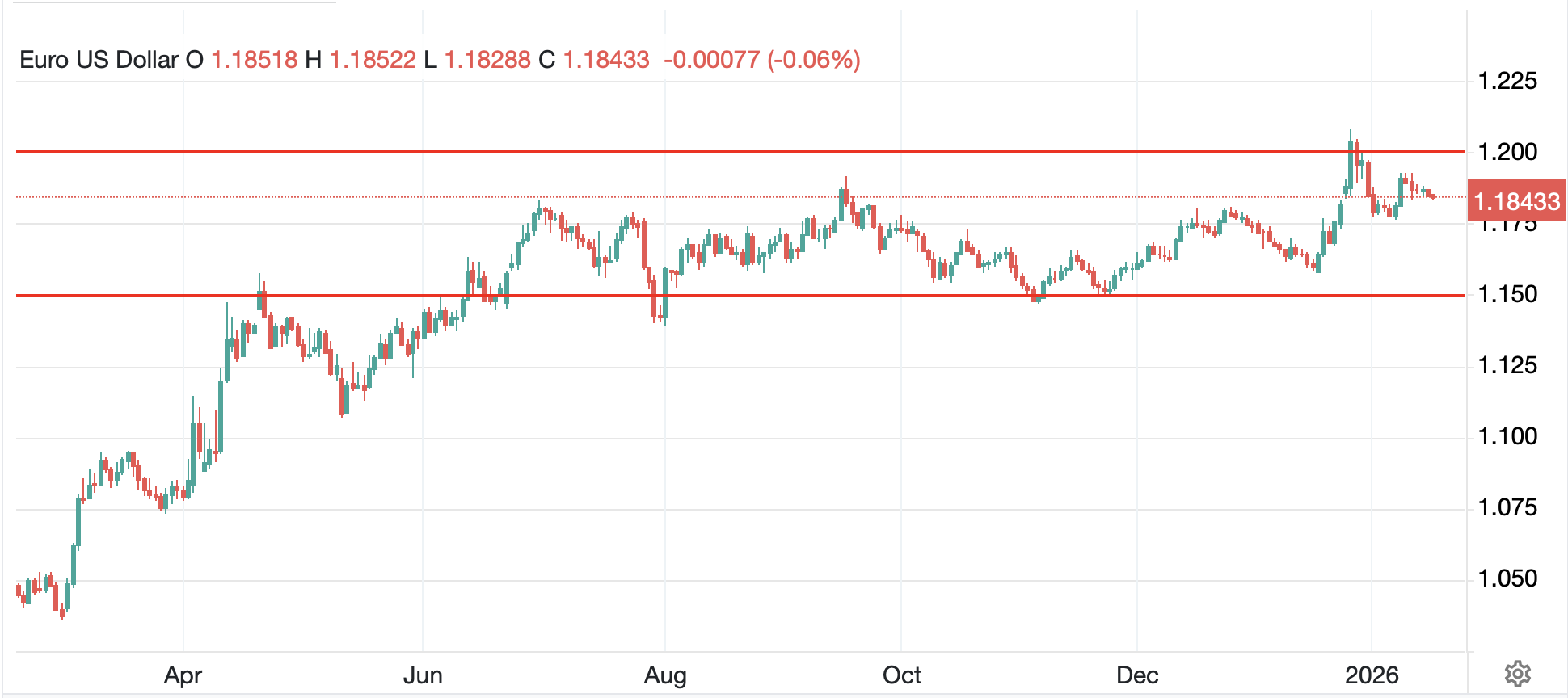
All these charts are from tradingeconomics.com and I have drawn in some recent ranges to show that over the past 6 months, only one asset class has shown any trend of note.  See if you can guess which that is.  I’ll start with the EURUSD since, after all, I am an FX guy, but go to bonds, oil, gold and equities.

Since late April, the euro has chopped back and forth despite many stories of the dollar’s incipient demise and the euro’s upcoming rally as investors flock to European equity markets.  Maybe not.

Treasury yields have also been largely range bound, and if anything, look like they are heading lower despite fears being flamed regarding massive amounts of issuance having trouble finding buyers as foreigners pull out of the market.  Maybe not.

Crude has been the choppiest, and of course we did have the bombing of Iran’s nuclear facilities which inspired some fears of the beginning of a new Middle East war.  But Russia keeps pumping, OPEC put 2.2 million barrels per day of production back into the market and it appears, that for now, the market has found a balance.  I still see oil sliding over time, but for now, the range is king.

The barbarous relic has just started to pick up and broke above the $3400 range cap just two days ago but has not yet shown signs of a major breakout.  However, if the Fed cuts, especially if they go 50bps for some reason, I would look for this to change and gold (and all precious metals) to rally sharply as inflation re-enters the conversation.

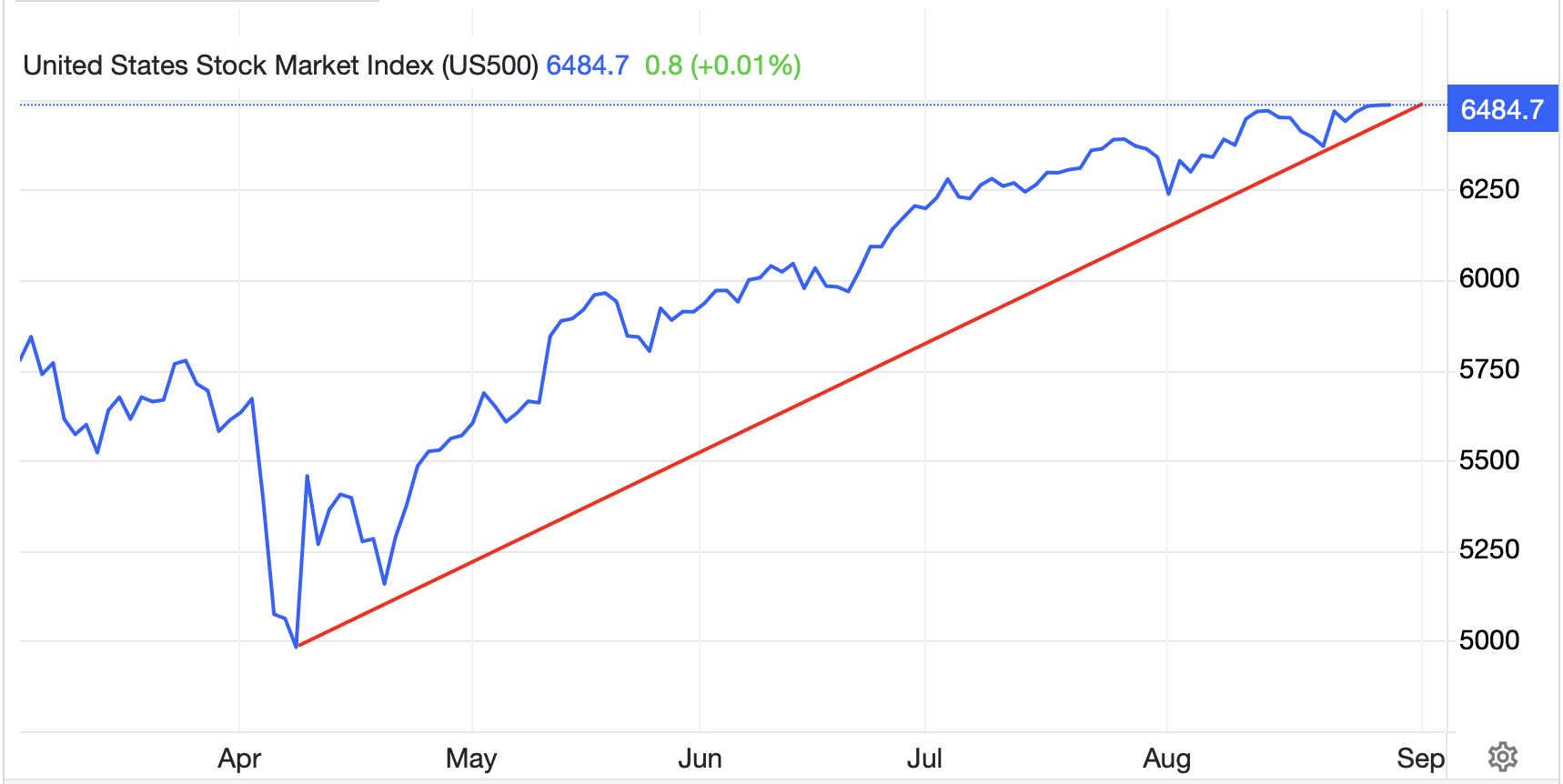
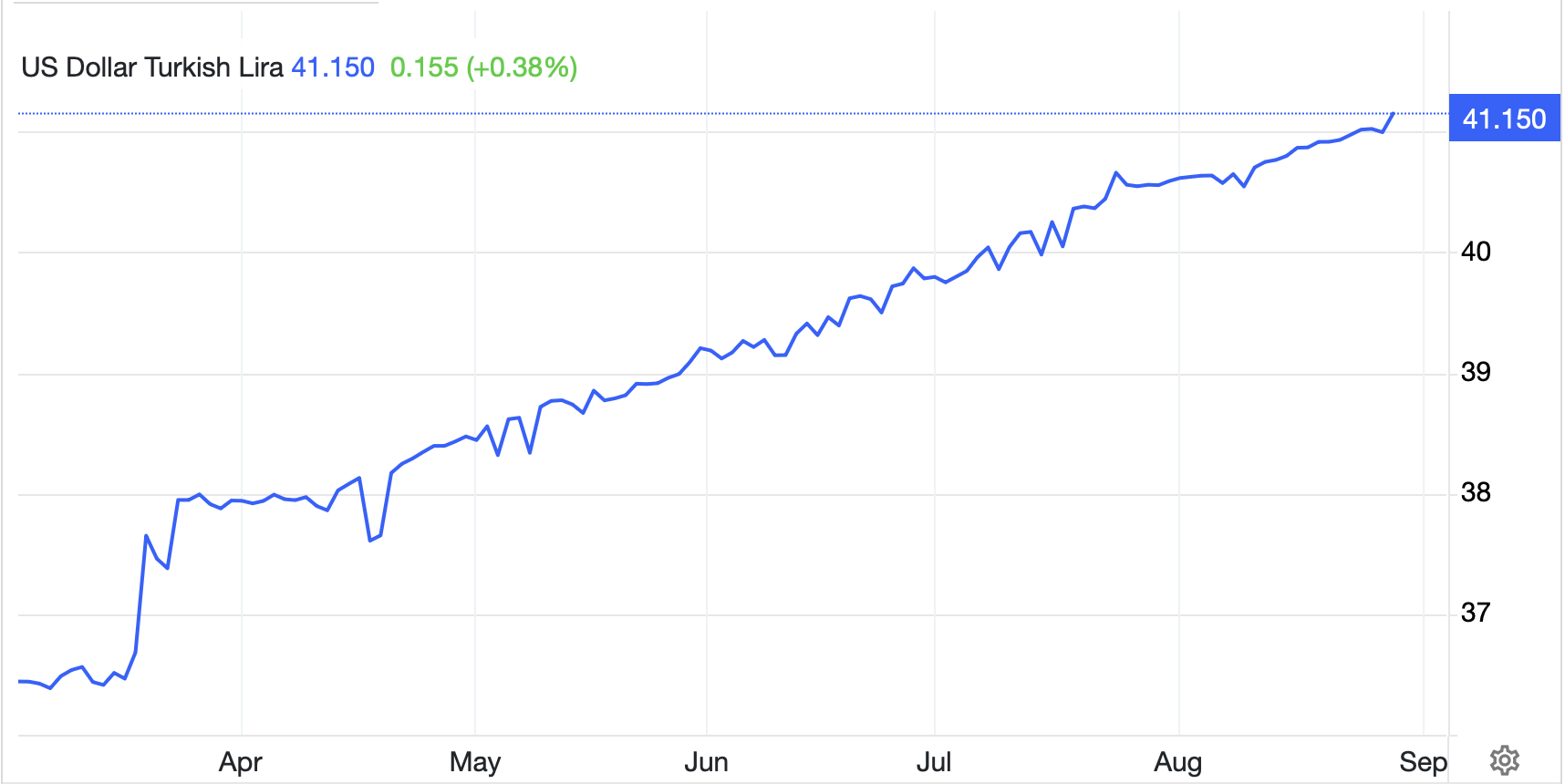
However, if we look at the US equity market, the picture is very different.  The only other market moving like this is USDTRY as the Turkish Lira steadily depreciates amid massive monetary expansion there with inflation rising sharply.  In fact, this is what many foresee for the dollar going forward, but even if the Fed cuts, it seems a bit of an exaggeration.

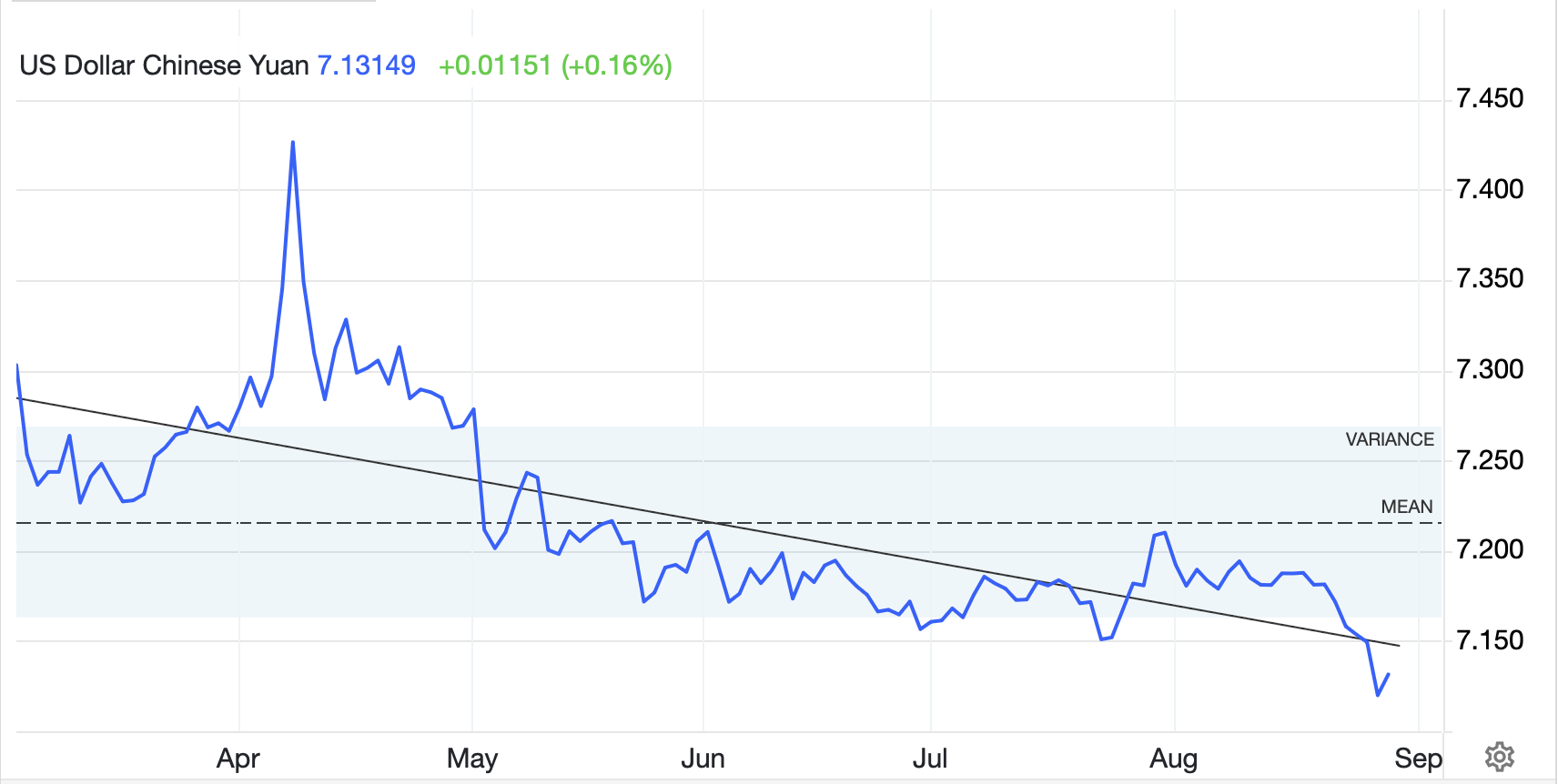
At this point I should note that there is one currency that is outperforming the dollar right now, the Chinese renminbi.  It appears that as trade negotiations are ongoing, the Chinese (and the Koreans amongst others) have gotten the message that they need to adjust their currency’s value if an agreement is going to be reached.  

To conclude, ranges remain the situation in most markets other than equities which continue to rally based on hopes and prayers that central bank spigots are never turned off.  With Labor Day on Monday, perhaps we will begin to see more real activity reenter the market as traders and investors come back from summer vacation.  But we will need a real catalyst to break those ranges, whether that is a shocking NFP number, a reescalation of Middle East conflict or something else (China laying siege to Taiwan?).  While I don’t know what that catalyst will be, history tells us something will come along, that’s for sure.

As we look to the NY opening, we do get more important data as follows: Personal Income (exp 0.4%); Personal Spending (0.5%); PCE (0.2%, 2.6% Y/Y); Core PCE (0.3%, 2.9% Y/Y); Goods Trade Balance (-$89.5B); Chicago PMI (46.0); and Michigan Sentiment (58.6).  There are no Fed speakers on the docket, but you can be sure that the Lisa Cook story will remain front and center, especially as I read that the judge initially selected to oversee the case was Ms Cook’s sorority sister, potentially a disqualifying factor that would cause her recusal and a new appointment. In fact, I suspect that story will have more traction than whatever the data says today.

As to the dollar, it is hard to get excited at this point.  If PCE data is softer than forecast, though, I would look for the dollar to sell off and the probability of that Fed funds rate cut to rise from its current 85%.

Good luck and have a good holiday weekend

Adf

Forked Tongue

The major discussion today
Is tariffs and if they’re in play
While Trump thinks they’re great
Economists hate
Their impact and watch with dismay
 
Meanwhile it has not been a week
And questions are rife ‘bout DeepSeek
The most recent questions
Are making suggestions
That China, with forked tongue, did speak


President Trump has promised to impose 25% tariffs tomorrow on all Canadian and Mexican exports to the US if those nations do not agree to further efforts to tighten border security regarding the movement of both immigrants and drugs across the borders.  Even within his administration, there are many who do not want to see them imposed given the potential disruption they would cause in supply chains throughout the nation.  And of course, economists abhor tariffs as a pure deadweight loss to the economy.  But Trump sees the world through very different eyes, that much is clear, and as evidenced by the very short-term row with Colombia last weekend, believes they can be useful tools to achieve strategic, non-economic outcomes.

This poet is not fool enough to try to anticipate what will actually happen as the mercurial nature of President Trump’s actions is far beyond my ability to forecast.  However, if history is any guide, we will see both Mexico and Canada make some additional concessions and an announcement that because of that, the tariffs will be delayed until negotiations can be completed by some new deadline.  (Well, maybe I am fool enough 🤣)

From our perspective observing market reactions, the only consistent view is that US tariffs will drive the dollar higher, or more accurately, other currencies lower, as the FX market adjusts to compensate for the tariffs.  If we look back at Trump’s first term, the first tariffs were imposed on China in early 2018 on solar panels and washing machines and a few other things.  A look at the chart below shows that the yuan (the green line) did, in fact, weaken substantially following those tariffs, with the dollar rising from 6.25 to 6.95 over the course of the ensuing six months.  However, if we broaden our horizons beyond the renminbi to the dollar writ large, as seen by the Dollar Index (the blue line), which rose from 88 to 96 over the same period, the renminbi’s price action was directly in line with the dollar overall.  There was only limited additional impact to CNY.  Remember, too, that in 2018, the US equity market was performing quite well, and funds were flowing into the US, thus driving the dollar higher, not dissimilar to what we have seen over the past year.  The point is that while the tariffs may have some impact, it is also likely that the dollar will move based on its traditional drivers of interest rate differentials and capital flows regardless.

Source: tradingeconomics.com

Away from the tariff talk, though, there is precious little other market related news, at least on a macro basis.  Yesterday’s data showed that GDP grew a tick less than anticipated at 2.3% in Q4, but Real Consumer Spending, which is a critical part of the economic picture, rose at 4.2%, a very solid performance and an indication that things in the economy are still ticking along just fine.  (The difference between that number and the GDP number is due to inventory adjustments, which are seen to wash out over time.). In fact, arguably, that solid growth was a key reason that the equity markets in the US had another strong session yesterday, with gains across the board.

Well, there is one other thing on many people’s minds, and that is the veracity of the claims about DeepSeek.  You may recall I highlighted the question of all those Nvidia sales to Singapore earlier in the week as somewhat strange.  Well, I was not the only one asking that question and this morning in Bloomberg, there is an exclusive story about a US government investigation into whether China actually got the most advanced H100 chips via Singapore after all.  If that is the case, then perhaps the DeepSeek claims are not as impressive as they were initially made out.  I suspect if this turns out to be the case, that worries over the need for AI to no longer utilize the most advanced chips will dissipate and the tech rally will regain momentum.

So, let’s look at markets now.  China and Hong Kong remain closed for their New Year celebrations.  Japan (+0.15%) had a modest gain and the truth is that only two Asian bourses had strong sessions, Singapore (+1.45%) and India (+1.0%) with the rest of the region mostly a touch firmer.  In Europe, all markets are slightly stronger this morning, on the order of 0.3% or so, as the combination of yesterday’s ECB rate cut and hints at future cuts by Madame Lagarde, seem to be underpinning the markets.  Certainly, today’s Eurozone data, showing German Unemployment climbing a tick to 6.2% while Retail Sales there fell -1.6% in December don’t seem like a rationale to buy equities.  In the US futures market, though, we are seeing solid performance, 0.5% or more, as I believe many are jumping back on the AI bandwagon.

In the bond market, Treasury yields have edged higher by 1bp, and remain just north of 4.50% as the tension between solid growth and slowing inflation dreams keeps the market quiet.  In Europe, though, yields are continuing their decline from yesterday, with sovereign yields down by between -3bps and -4bps as investors look for further easing from the ECB as the Eurozone sinks slowly toward recession.  However, in Japan, JGB yields rose 3bps as data overnight showed inflation remains above target and expectations for another rate hike in the first half of the year rise.

In the commodity markets, oil (-0.35%) continues to chop around in the middle of its trading range with no strong directional impulse (see chart below).

Source: tradingeconomics.com

It is very difficult to know how to view this market in the short run given the potential for disruptions by tariffs and even more sanctions, but nothing has changed my long-term view that there is plenty of oil around and prices will remain here or decline.  In the metals markets, both gold and silver are little changed on the morning although both have been in the midst of a strong rally with gold making new all-time highs in the cash market yesterday.  Copper (-0.7%) is offered this morning but is still much higher than at the beginning of the month/year.

As to the dollar, it is modestly firmer this morning rallying against most of its G10 counterparts, but not by very much, 0.3% (JPY) at most.  Versus its EMG counterparts, though, there is more strength with PLN (-0.6%) and ZAR (-0.4%) both under a bit of pressure.  The latter is responding to ESKOM, the national electrical utility, announcing that they may need to impose rolling blackouts to help repair parts of the grid.

On the data front, this morning brings Personal Income (exp 0.4%) and Spending (0.5%) but of more importance it brings PCE (0.3%, 2.6% Y/Y) and core PCE (0.2%, 2.8% Y/Y) along with the Chicago PMI (40.0) release at 9:45.  We also hear our first post-meeting Fed speaker, Governor Bowman, this morning but it would be shocking if she said anything other than they are going to be patient to watch inflation slowly move toward their target, almost as if by magic.

Once again, tape bombs are the biggest risk, as they will be for the next four years, but I imagine all eyes will be on Trump and the tariffs as the key driver.  For now, nothing has dissuaded me from my view the dollar is more likely to rise than fall, but we need to see how things evolve.

Good luck and good weekend

Adf

Deceit

Though many will claim it’s deceit
The Chinese declared they did meet
The target that Xi
Expected to see
Though skeptics remain on the Street
 
In fact, it appears there’s a trend
That data surprises all tend
To flatter regimes
And their stated dreams
As policy faults they defend


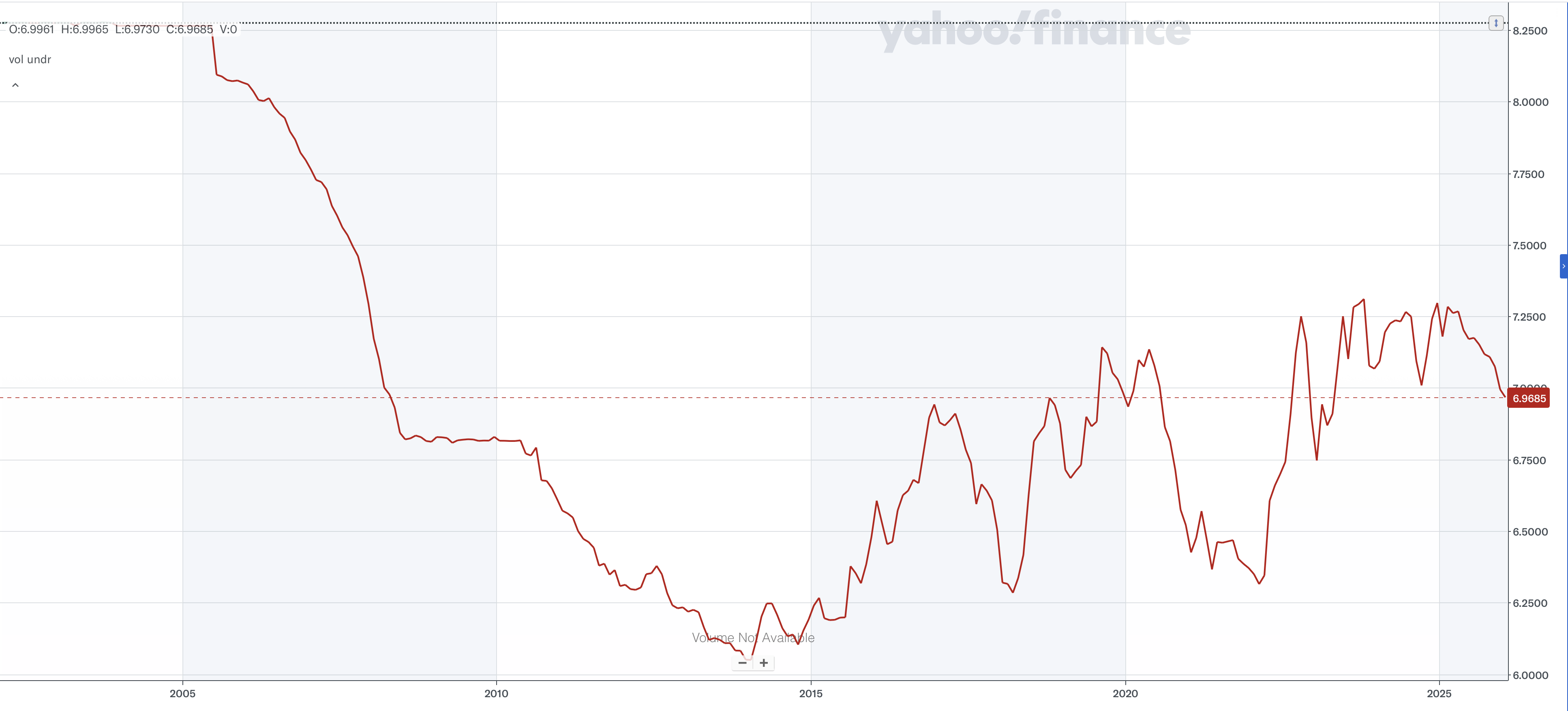
Last night, the Chinese released their monthly data barrage with final 2024 numbers as part of the mix. Despite numerous indications that Chinese growth is slowing, somehow, they managed to show a 5.4% annualized GDP growth rate for Q4 and a 5.0% GDP growth rate for all of 2024, right on President Xi’s target.  

Now, the government did add some stimulus in Q4 as they recognized things are not going well, and I continue to read articles that President Xi is starting to feel increased pressure from CCP insiders as to his stewardship of the nation and the economy.  Statistics like electricity usage and travel don’t really jive with the data, although it is certainly possible that ahead of the mooted tariffs that President Trump has threatened to impose starting next week, many companies preordered extra inventory to beat the rush, and that goosed growth.  

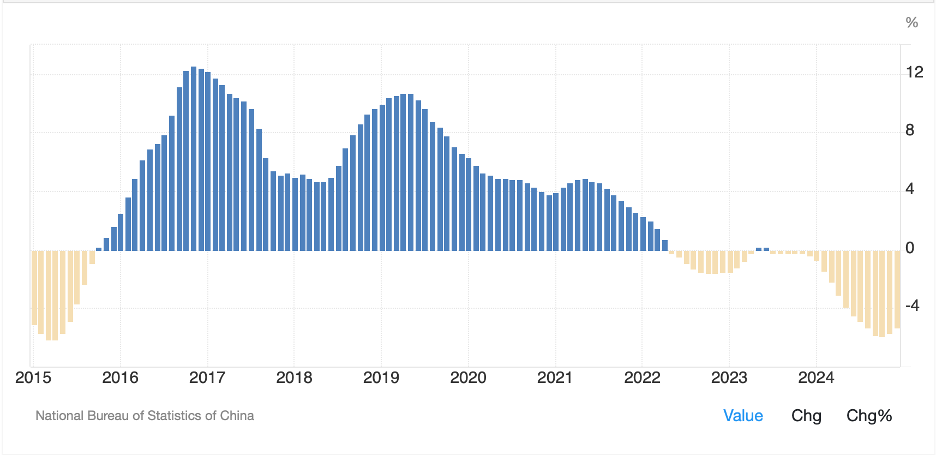
But there are a couple of things that continue to drag on the Chinese economy, with the primary issue the continuing implosion of the property market there.  For instance, while house price declines have been slightly slower, (only -5.3% last month) it has basically been three years since there was any gain at all as shown in the chart below.

Source: tradingeconomics.com

As well, one of the key concerns about China has been Foreign Direct Investment, which has not merely slowed down but has actually been reversing (companies leaving China) over the past two years as per the next chart.

Source: tradingeconomics.com

Meanwhile, a WSJ headline, China’s Population Fell Again Despite a Surprise Rise in Births, highlights yet another issue President Xi faces, the ongoing aging and shrinking of his nation.  Remember, GDP is basically the product of the number of people working * how much they each produce.  If that first number is shrinking, and the working age population in China is doing just that, it is awfully difficult to generate GDP growth.  Finally, I couldn’t help but notice in yesterday’s confirmation hearings for Treasury secretary, where Scott Bessent offered his view that China is actually in a recession, with massive deflation and are struggling to export their way out of the problems, rather than address their internal imbalances.  This is a theme that has been discussed widely in the past, and ostensibly, China has admitted they want to be more consumption focused in their economy, but it doesn’t appear that is the direction they are heading.

I raise these points in the context of the Chinese renminbi and how we might expect it to behave going forward.  The question of tariffs remains open at this stage, although I daresay we will learn more next week.  If they are imposed, there is a strong belief that the renminbi will weaken to offset the terms.  As it is, the currency remains within pips of its weakest level in 18 years and the trend, both short-term and for the past decade, has been for it to weaken further. 

Source tradingeconomics.com

Xi remains caught between the need for the currency to weaken to maintain competitiveness in the face of threatened tariffs from the US, and his desire to demonstrate that the renminbi is a stable store of value that other nations can trust to hold and use outside the global dollar network.  In the end, I expect the immediate competitiveness needs are going to overwhelm the long-term aspirations, especially if it is true that Xi is feeling internal pressure because of an underperforming economy.  Nothing has changed my view that we approach 8.00 by the end of the year.

Ok, and that’s really the big news overnight.  As an aside, it was interesting to watch Mr Bessent dismantle the attempts by the Democrat senators for a ‘gotcha’ moment.  As I wrote yesterday, it wasn’t really a fair fight given his intelligence, experience and understanding of markets and the economy compared to the Senators.

Let’s start in the equity world where US markets opened higher but ultimately slid all day long to close on their lows.  An uninspiring performance to say the least.  That performance weighed on much of Asia with the Nikkei (-0.3%) sliding alongside Australia, Korea and India.  On the plus side, modest gains were shown in China (Hang Seng and CSI 300 both +0.3%) and some positive numbers were seen in Taiwan, Malaysia and Singapore.  But overall, the movements were not substantial in either direction.  In Europe, though, markets are starting to anticipate more aggressive ECB rate cuts as data continues to show weakness in economic activity.  Weak UK Retail Sales data has the FTSE 100 (+1.3%) leading the way higher as hopes for a BOE cut grow.  Meanwhile, the CAC (+1.0%) and DAX (+1.0%) are both rallying on the thesis that Chinese growth is going to attract imports from both nations.  Meanwhile, US futures are higher by 0.4% at this hour (7:40).

In the bond market, all the inflation fears seem to have abated.  Either that or we continue to see a massive short squeeze and position unwinding.  But the result is yields are lower across the board with Treasury yields down 3bps further, and below 4.60% while European sovereign yields have fallen between -3bps and -5bps as investors take heart that the ECB and BOE are going to be cutting rates soon.  Perhaps the market is showing faith that Mr Bessent will be able to address the US fiscal financing crisis.  After all, he did explain in no uncertain terms that the US would not default on its debt.  But my sense is the market narrative about rising inflation and higher yields had really pushed too far, and this is simply the natural bounce back.  While this week’s inflation data was not as hot as feared, nothing has changed my view that inflation remains a problem going forward.

In the commodity markets, oil is unchanged on the day, having given back some of its substantial gains over the past two sessions, although it remains right near $79/bbl this morning.  Apparently, there are rumors Trump will end Russian oil sanctions as part of the Ukraine negotiations, but that doesn’t sound like something he would offer up initially, at least to me.  Meanwhile, NatGas (-4.0%) though slipping this morning, remains above $4/MMBtu as the US prepares for a major arctic cold snap next week.  In the metals markets, my understanding is there has been a lot of position adjustment and arbitrage between NY and London as we approach futures contract maturities, and that has been a key driver of the recent rally in metals (H/T Alyosha at Market Vibes, a very worthwhile trading Substack), but may be coming to an end in the next several sessions.  However, here, too, nothing has changed my longer-term view of higher prices over time.

Finally, the dollar is a tad stronger this morning, rallying vs. the pound (-0.4%), Aussie (-0.4%), NOK (-0.5%) and NZD (-0.5%) as all those ECB and BOE rate cut stories weigh on those currencies.  Interestingly, JPY (-0.3%) is also weaker this morning despite an article overnight signaling the BOJ will be raising rates next Friday.  On the flip side, looking at the EMG bloc, I see very modest gains by many of the key players (MXN +0.15%, ZAR +0.1%), although those moves feel far more like position adjustments than fundamentally driven changes in view.

On the data front, this morning brings Housing Starts (exp 1.32M) and Building Permits (1.46M) and then IP (0.3%) and Capacity Utilization (77.0%) later on.  There are no Fed speakers on the docket, and tomorrow is the beginning of the quiet period.  The last thing we heard from Cleveland Fed president Hammack was that inflation remains a concern and they have not yet finished the job.

For the day, I don’t think the data will have much impact.  Rather, as we are now in earnings season, I suspect that stocks will take their cues there and FX will remain in the background for now.

Good luck and good weekend

Adf

Havoc the Dollar Will Wreak

Apparently, President Xi
Is starting to listen to me 🤣
His currency’s falling
As he stops forestalling
The weakness in his renminbi
 
But it’s not just yuan that is weak
The havoc the dollar will wreak
Is set to keep growing
As funds keep on flowing
To US investments, still chic


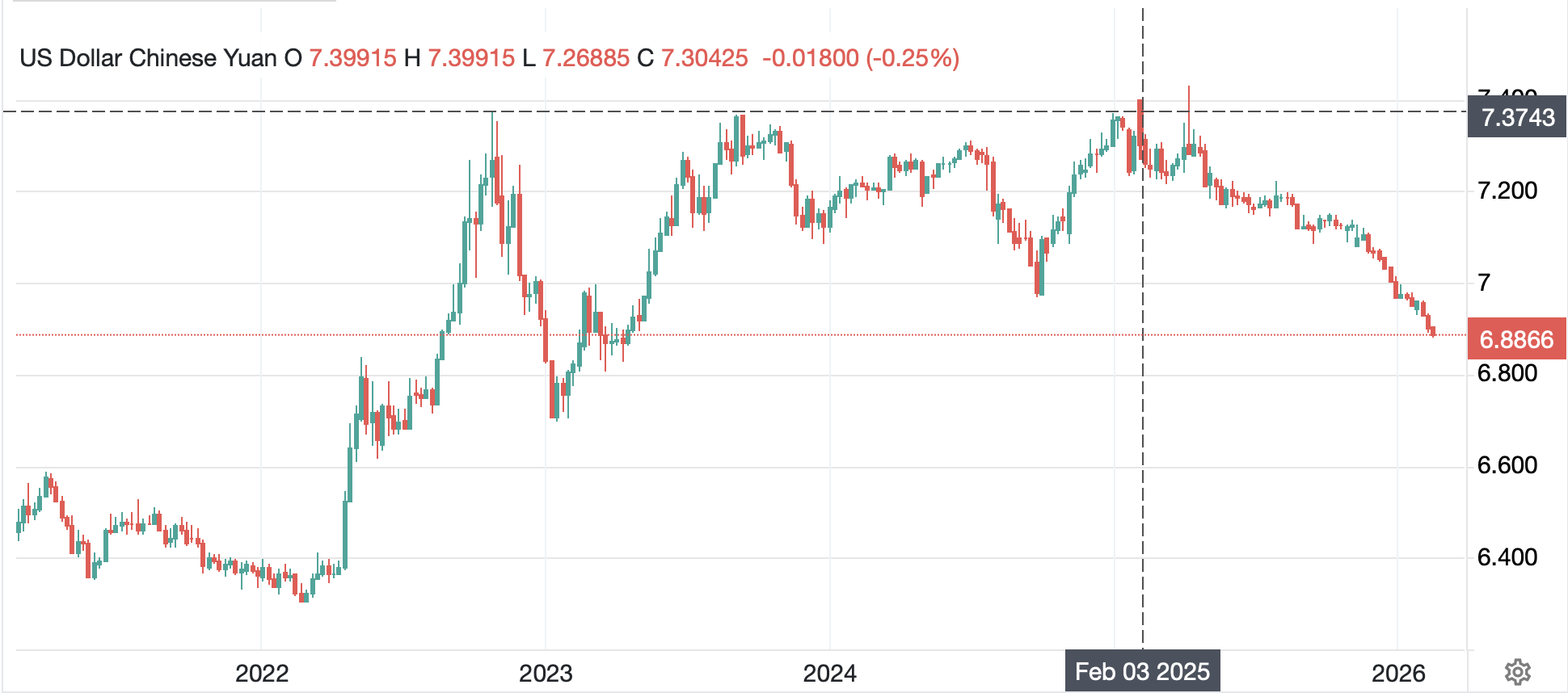
It seems that one of President Xi Jinping’s New Year’s resolutions was to finally allow the renminbi to resume its longer-term decline.  While 7.30 has been the line in the sand for a while, as can be seen from the first chart below, suddenly, as the calendar page turned to 2025, it appears that the PBOC is going to allow for the renminbi to weaken further.  Thus far, the PBOC has been adamant about fixing the Chinese currency at levels much stronger than anyone wants to pay for it, and even last night that was the case, with a fixing rate of 7.1878.  However, while the onshore market must trade within +/- 2% of that fixing rate, no such restriction limits the offshore market, and this morning, the offshore renminbi is trading 2.3% weaker than the fixing, above 7.35 to the dollar.

Much has been made of the “chess” moves that are ongoing between the US and China regarding currency policy with many pundits blankly claiming that if Trump is to impose the threatened tariffs, the renminbi will simply weaken to offset them.  However, while I do believe the CNY has much further to fall, that is not the driving case I see.  Rather, Xi’s problem is that his economy is not in nearly as good condition as he needs it to be and confidence in the consumer sector continues to wane.  This is largely a result of the ongoing destruction of the property bubble that was blown for decades.

Remember, Chinese investors have tied up significant personal wealth in second and third homes as stores of value.  This was encouraged as cities could sell property to developers, get paid a bunch to help finance their operations, and since demand was so high, prices kept rising so everyone was happy.  Alas, as with all bubbles (I’m looking at you, too, NASDAQ) eventually the air comes out.  For the past three years the Chinese have been trying to deal with this collapsing property market, but house prices continue to decline thus reducing investor wealth and confidence.  I read that there are an estimated 80 million empty homes that have been built over the past decades and are now in disrepair in the countryside.  These are the ghost cities that were all part of the Chinese growth miracle, but in fact were simply massive malinvestment.

While the prescription for China has long been to increase its consumer sector of the economy, Xi and his minions at the central committee have no idea how to do that (given they are communist, this is not that surprising) and so continue to support the means of production.  The problem is they have now seemingly gone too far in that space as well with not merely the Western world, but also much of the developing world starting to push back on all the excess stuff that is coming from China.  

Xi’s other problem is that as he rails against the dollar and seeks others to use the renminbi in their trade, if the currency starts to fall sharply, that will be a difficult ask.  Given the US FX policy remains benign neglect, it is entirely upon China to solve their own problems.  While it is unlikely to happen in a big devaluation a la August 2015, weakness is the trend to bet here this year.

Source: tradingeconomics.com

Source: tradingeconomics.com

Away from that news, though, the year is starting off in a fairly modestly.  Most of the world’s focus is on the upcoming Trump inauguration as well as the political machinations that will begin today as Trump’s Cabinet nominees start to go through their paces in front of the Senate.  New Year’s Eve’s horrifying terrorist attack in New Orleans has just upped the ante with respect to Trump getting his picks through the process.  

So, let’s review the overnight market activity to get a sense of what today could bring.  The first day of the US trading year resulted in modest declines across the board in equities, although as I type (7:30), they appear to be retracing those losses and are slightly higher.  The bigger news was from Asia where both the Nikkei (-1.0%) and CSI 300 (-1.2%) showed weakness with the former feeling the pain of some profit taking after gains last week, although Chinese shares seem to be succumbing to the troubles I have described above.  Elsewhere in the region there was no consistency with gainers (Hong Kong, Taiwan, Korea and Australia) and losers (India, New Zealand, Malaysia) with other exchanges little changed.  In Europe this morning, there is more red than green with the CAC (-0.8%) the biggest laggard amid concerns over the fiscal situation in France.  But the DAX (-0.35%) and FTSE MIB (-0.45%) are also lagging with only Spain’s IBEX (0.0%) bucking the trend.

In the bond market, Treasury yields have slipped 2bps this morning, but remain above 4.50%, something that continues to vex Chairman Powell as he and the Fed seemed certain that by cutting the Fed funds rate, he would drive the entire yield curve lower.  I wonder if he will learn this lesson about the relation between a made-up rate (Fed funds) and market rates (bond yields) anytime soon.  In Europe, French yields are 2bps higher, widening their spread vs. German bunds and perhaps more remarkably, at least from a nominal perspective, well above Greek government bond yields now! (Remember, there are far fewer GGB’s around than OAT’s so there is a scarcity bid there). Certainly, Madame Lagarde must be getting a bit concerned over her native nation’s profligacy and I suspect that the fiscal ‘need’ for lower Eurozone interest rates is one of the features of the discussion regarding the ECB’s future path (lower).  As to JGB’s, they are unchanged, sitting at 1.07% and showing no sign of rising anytime soon.  One last thing, Chinese 10yr bonds now yield a new record low of 1.61%, 2bps lower on the day and pretty convincing evidence that not all is well in the Middle Kingdom’s economy.

On the commodity front, oil (-0.2%) is consolidating yesterday’s strong gains which were ostensibly based on the idea that President Xi will successfully implement more stimulus and aid growth in China.  History shows otherwise, but we shall see.  Gold (-0.1%) is also consolidating yesterday’s strong gains as it appears there has been renewed central bank buying activity to start the year.  The other metals also benefitted yesterday with silver (+0.8%) continuing this morning.

Finally, the dollar is retracing some of yesterday’s gains but remains much stronger than we saw just last week, and certainly since the last time I wrote.  Looking at the Dollar Index, it is hovering near 109 this morning, having traded well above that yesterday afternoon.  The next obvious technical target is 112, about 3% higher and there are now many calls for a test of the 2002 highs of 120.  I assure you, if the DXY gets to those levels, EMG currencies are going to come under a great deal of pressure.  As an example, we already see several EMG currencies (CLP, BRL) trading at or near all-time lows (dollar highs) and there is nothing to think this will change soon.  As well, check out the euro at 1.03 this morning, which while 0.3% higher on the session, appears as though it could well test those October 2022 lows (dollar highs) sooner rather than later, especially if the ECB continues to lean more dovish than the Fed.  If you are a receivables hedger, currency puts seem like a pretty good idea these days.

On the data front, ISM Manufacturing (exp 48.4) and Prices Paid (51.7) are all we have today and late this morning Richmond Fed president Barkin speaks.  Interestingly, tomorrow evening and Sunday we hear from SF Fed President Daly and tomorrow evening Governor Kugler will be joining Daly.  I guess they can’t go but so long without hearing their voices in the echo chamber!

There is nothing to suggest that the dollar, while modestly softer today, is set to turn around soon.  Keep that in mind.

Good luck and good weekend

Adf

A New Denouement

The story is that the Chinese
Will speed up their policy ease
Creating for Yuan
A new denouement
Of currency weakness disease
 
Their problem is that in the past
That weakness could happen too fast
So, how far will Xi
Be willing to see
Renminbi decline at long last?


As we await the US CPI data this morning, the story du jour in markets revolves around the Chinese renminbi and whether President Xi will allow, or encourage, the PBOC to weaken the currency.  Strategically, Xi has made a big deal to the rest of the world that the Chinese currency will remain strong and stable as he seeks other nations to increase their use of the renminbi in commercial transactions as well as a store of value.  I believe part of this is a legitimate goal but that there is also a significant fear underlying these actions as history has shown the Chinese people will flee the currency if it starts to weaken too quickly.  It is the latter issue that has been the primary driver of the PBOC’s efforts to continuously fix the renminbi at stronger than market levels.
 
This process worked well enough for the past four years as the Biden administration, while certainly not friendly to China, was not aggressively attacking the nation’s efforts to expand its influence.  However, that situation is about to change with the Trump administration and as Mr Trump has already threatened numerous new tariffs on various parts of China’s production economy, Xi’s calculus must change.  This puts Xi in a difficult situation; allow the currency to weaken more aggressively to offset the impact of any tariffs and suffer through capital flight or maintain the renminbi’s value and see exports decline along with overall economic activity.  It is easy to see in the chart below when the story about allowing a weaker currency hit the tape.  However, there is not nearly enough information to take a longer-term view on the subject.


Source: tradingeconomics.com

One other thing to remember is that Chinese interest rates are continuing to decline with 10-year yields trading to yet another new low last night at 1.88%.  As the spread between US and Chinese yields continues to widen, by itself that will put pressure on the renminbi to decline.  The problem for Xi is that no matter the control the PBOC has over the FX markets in China, now that there is an offshore market, if the Chinese people become concerned over the value of the renminbi, it has the ability to decline far more quickly than the government would want to allow.

For those of you with Chinese assets on your balance sheet or Chinese denominated revenues, I would be looking to maximize my hedges for now.  As an aside, there were a number of forecast changes by major banks overnight with many calls for USDCNY to reach 7.50 or higher by the end of next year now.

The market’s convinced
A rate hike is on the way
Why won’t the yen rise?

The other story overnight focused on Japan, or more precisely the BOJ meeting to be held in one week’s time.  It seems that there is a lot of dissent amongst the analyst community regarding whether or not the BOJ will hike rates.  As an example of how thin all the analyst gruel really is, one of the key rationales for the belief in a rate hike was that last week, Toyoaki Nakamura, perceived as the most dovish BOJ board member, indicated he didn’t object to a rate hike, although wanted to see more data before declaring one was appropriate for December.  However, just last night the BOJ added a speech and press briefing to their calendar for Deputy Governor Ryozo Himino right before the January meeting.  This has the punditry now expecting the BOJ to wait until then rather than move next week.  The below chart shows the change in the market’s expectations for a rate hike over the past week.

As I said, the tea leaves that the punditry are reading really don’t say very much at all.  Perhaps we can look at the economic data to get a sense.  Over the past month, we have seen CPI for both the nation and Tokyo print higher than forecast and continue to slowly climb.  As well, PPI printed higher and GDP continues to grow, albeit at a modest pace.  Of greater concern is that earnings data is lagging the CPI data.  

A look at the FX market would indicate that traders are losing their taste for a rate hike next week, at least as evidenced by the yen’s recent weakness.  As you can see in the past week, it has slipped nearly 2%, hardly a sign that higher Japanese rates are expected.  But something that is not getting much press is the potential Trump impact, where the incoming president would like to see the yen, specifically, strengthen as it is truly historically undervalued.  FWIW, which is probably not that much, I am in the rate hike camp for next week and expect the yen will find some support soon.

Source: tradingeconomics.com

Ok, enough Asian currency talk.  Let’s see how everything else behaved ahead of this morning’s data.  Yesterday’s modest US equity declines were followed by virtually no movement in Japanese shares although most of the rest of Asia followed the US lower.  Hong Kong (-0.8%) and Taiwan (-1.0%) were the worst performers and the one outlier the other way was Korea (+1.0%) as the KOSPI continues to recoup the losses made after the martial law fiasco.  European bourses are mostly little changed on the day with Spain’s IBEX (-1.1%) the lone exception which has been negatively impacted by Q3 results from Inditex (the parent company of Zara).  As to US futures, at this hour (7:25) they are little changed.

In the bond market, yields continue to edge higher in Treasuries (+2bps) and European sovereigns with gains on the order of 1bp to 2bps across the board.  While there is some discussion regarding fiscal questions in Europe, ultimately, nothing has broken the connection between US and European yields, and I would contend they are all awaiting this morning’s CPI.

In the commodity markets, oil (+1.4%) is rebounding although remains below $70/bbl, which seems to be a trading pivot for now.  The China stimulus story remains the key in the market with a growing belief that if China does successfully stimulate, oil demand will increase.  Meanwhile in the metals markets, gold is unchanged this morning after another nice rally yesterday while both silver and copper are under modest pressure.  I would contend, however, that the trend for all metals remains slightly upward.

Finally, the dollar is firmer against virtually all its counterparts this morning with most G10 currencies softer on the order of -0.3% or so although CAD and CHF are little changed on the session.  In the EMG bloc, KRW (+0.3%) is rebounding alongside the KOSPI as the excesses from the martial law story last week continue to be unwound, but elsewhere in the bloc, modest weakness, between -0.2% and -0.4%, is the rule.  However, this is all dollar focused today.

On the data front, it is worth noting that yesterday’s NFIB Small Business Optimism Index shot higher in November in the wake of the election results, heading back toward its long-term average just above 100.  As to this morning, forecasts for Headline (exp 0.3%, 2.7% Y/Y) and Core (0.3%, 3.3% Y/Y) CPI continue to indicate that the Fed may be overstating the case in their belief that inflation pressures are ebbing.  Rather, I continue to believe that we have seen the bottom in the rate of inflation and a gradual increase is in our future.  Two other things of note are the BOC rate decision (exp 50bps cut) this morning and then the Brazilian Central Bank rate decision (exp 75bp HIKE) this afternoon.  The latter is clearly an attempt to rein in the BRL’s recent dramatic decline.

With no Fed speakers, if the data this morning is significantly different than expectations, I would look for the Fed Whisperer, Nick Timiraos, to publish something before the end of the day in order to get the Fed’s latest views into the market.  Absent that, nothing has gotten in the way of the higher dollar at this stage so stay sharp.

Good luck

Adf

Juiced

No doubt it was President Xi
Who leaned on the PBOC
To cut rates at last
And try to recast
The tone of its cash policy
 
So, mortgage rates will be reduced
While bank reserves, too, will be juiced
But will cutting rates
Be what motivates
The people and give growth a boost?


It’s almost as though Pan Gongsheng, head of the PBOC, read my note yesterday morning and decided that it was time to really do something big!  While obviously, we know that is not the case (at least I don’t see his name on my subscriber list), the PBOC definitely painted the tape last night with their actions.  Fortunately, Bloomberg listed them for us as per the below:

  1. The seven-day reverse repurchase rate will be lowered to 1.5% from 1.7%
  2. RRR lowered by 0.5 percentage points, unleashing 1 trillion yuan in liquidity
  3. PBOC didn’t specify when RRR cut takes effect
  4. MLF expected to be cut by 0.3 percentage points
  5. Minimum down-payment ratio cut to 15% for second-home buyers, from 25%
  6. China may cut the RRR further this year by another 0.25 to 0.5 percentage points
  7. RRR cut won’t apply to small banks
  8. LPR and deposit rates to fall by 0.2 to 0.25 percentage points
  9. The PBOC to cover 100% of loans for local governments buying unsold homes with cheap funding, up from 60%

A glossary of terms is as follows:

  • RRR is the reserve ratio requirement which describes how much leverage banks may take, with the lower the number equating to more leverage (need to hold fewer reserves).
  • MLF is the medium-term lending facility which is the program that the PBOC uses to lend money to banks in China, and the rate had been the key interest rate for policy. 
  • LPR is the loan prime rate, the rate at which banks lend to their best clients
  • Seven-day reverse repurchase rate is a relatively new rate that the PBOC uses for its monetary policy efforts, similar to the Fed funds rate, and is now deemed the PBOC’s key interest rate.

Now, that’s a lot of activity for a central bank in one day.  Consider how long it takes the Fed to decide to raise or cut the Fed funds rate and compare that to just how much was done.  

And that’s just the rate moves.  In addition, they indicated they would lend up to CNY 500 billion for funds, brokers and insurers to buy Chinese shares and another CNY 300 billion for companies to buy back their own shares.  Again, I find the irony of a strictly communist nation worrying about their stock market unbelievably delicious.  So, the government is willing to roll out significant monetary stimulus, but as yet, has not been willing to inject fiscal stimulus.  Arguably the biggest economic problem in China right now is that sentiment is weak as people are concerned over both their jobs and the value of their property, hence consumption remains weak overall.  It is not clear what Xi can do to fix that problem, but cheap money is only effective if people and companies want to borrow and spend it.  That remains to be seen, although the odds of China achieving its 5.0% GDP growth target for 2024 have improved now.

One other thought is that this likely would not have been possible for the Chinese had the Fed not cut 50bps last week.  As I have consistently explained, once the Fed gets going, central banks everywhere will feel more comfortable cutting their own rates and easing policy further.  At least in China, inflation is not a problem, so they have plenty of room to cut.  However, elsewhere inflation has proven stickier than most central bankers would like to see.  Nothing is yet carved in stone as to just how many rate cuts are in the offing.

As this was the only noteworthy story, let’s look at how it impacted markets everywhere.  It can be no surprise that shares in China exploded higher given the explicit PBOC support with both the CSI 300 and Hang Seng rallying more than 4.1% on the session.  As well, Chinese yields backed up a bit, off the lows I described yesterday, but only by a few basis points.  As seen below, CNY (+0.4%) rallied nicely, trading to its strongest level since May 2023 and commodities rallied across the board with oil (+2.1%) and copper (+2.4%) the leaders although precious metals (Au +0.3%, Ag +0.8%) are also rising.

Source: tradingeconomics.com

Perhaps the most interesting thing about this story is just how little it impacted non-Chinese markets. Japanese shares (Nikkei +0.6%) rallied but given the yen’s decline (-0.3%) overnight, that likely had a bigger impact on those shares.  And the rest of Asia saw a mix of modest gains and losses, with Taiwan (+0.6%) and Korea (+1.1%) the next best performers although India, Australia and Singapore saw no benefit whatsoever.  It appears they are awaiting the fiscal boost.

In Europe, though, shares are definitely feeling the love led by the CAC (+1.6%) although even the DAX (+0.75%) is rallying despite another series of lousy data, this time the Ifo surveys all printing weaker than last month and weaker than expectations.  I guess given the importance of China as an export market for Germany, the PBOC news trumps the Ifo surveys from earlier this month.  As to US futures, after very modest gains yesterday, although some more record highs, they are essentially unchanged at this hour (7:00).

In the bond market, Treasury yields continue to back up, higher by 3bps this morning and now 15bps off the lows pre-FOMC meeting.  European sovereign yields are higher by 1bp across the board except for UK gilts (+4bps) as concerns grow that the fiscal situation in the UK may deteriorate more rapidly given the apparent confusion in the Starmer government about what to do to pay its bills.  It is also worth noting that JGB yields have slipped 3bps this morning and are now back to levels last seen back in April before the BOJ’s policy tightening got somewhat serious. 

As to the dollar, overall, it is on its back foot this morning although other than the renminbi, most of the moves have been 0.2% or less.  Today’s story is CNY for sure.

On the data front, this morning brings Case-Shiller Home Prices (exp 5.8%) and Consumer Confidence (103.8).  While there are no Fed speakers today, yesterday we heard from three (Goolsbee, Bostic and Kashkari) all of whom agreed with the 50bp cut last week and were mostly pushing for another one before the end of the year.  It seems Goolsbee has taken the mantle of chief dove on the committee, explaining there are “hundreds” of basis points left to cut before they achieve the neutral rate, however neither of the other two indicated any hesitation to cut further.  As of this morning, it is basically a 50:50 proposition as to 25bps or 50bps at the November 7th meeting according to the Fed funds futures market.

And that’s where we stand this morning.  China has opened their coffers and are adding yet more liquidity to the global system.  This should continue to help risk assets everywhere, and ultimately feed into inflation readings, although in China that is not a problem.  But what about elsewhere?  For now, it feels like the dollar is more likely to suffer given the dovish enthusiasm from the Fed speakers, but Thursday will bring 4 more speakers, including Chairman Powell, so perhaps we need to hear that before getting too excited.

Good luck

Adf
Recalibration


All week we had heard many clues
That fifty is what Jay would choose
And that’s what he cut
With only one but
From Bowman, who shuns interviews
 
The key is now recalibration
In order to tackle inflation
Without driving higher
The joblessness spire
So, trust us, it’s all celebration


Recent indicators suggest that economic activity has continued to expand at a solid pace. Job gains have slowed, and the unemployment rate has moved up but remains lowInflation has made further progress toward the Committee’s 2 percent objective but remains somewhat elevated.” [emphasis added]

Reading the opening paragraph of the FOMC Statement, it might be confusing as to why they needed to cut rates 50bps.  After all, the economy is expanding at a solid pace (In fact, after the Retail Sales data on Tuesday, the Atlanta Fed’s GDPNow reading for Q3 is up to 3.0%!)  unemployment remains low and inflation is still somewhat elevated.  I know I am a simple poet, but the plain meaning of those words just doesn’t lead my thinking to, damn, we better cut 50 to get started.  But I guess that is just another reason I am not a member of the FOMC.

Perhaps the more interesting thing was the Summary of Economic Projections and the dot plot which showed that while expectations were for rates to fall far more dramatically than in June, the longer run expectations continue to rise.  In fact, Chairman Powell specifically addressed the SEP in the press conference, “If you look at the SEP you’ll see that it’s a process of recalibrating our policy stance away from where we had it a year ago when inflation was high and unemployment low to a place that’s more appropriate, given where we are now and where we expect to be, and that process will take place over time.” [emphasis added] In fact, there was a lot of recalibrating going on as that appears to be the Chairman’s new favorite word, using it 8 times in the press conference.

Source: federalreserve.cgov

Notice that their current forecasts are for GDP to slow to 2.0% with Unemployment edging only slightly higher while PCE inflation magically returns to their 2.0% target.  And take a look at the last two lines, with the Fed funds rate projections falling substantially for the next three years, far more quickly than their previous views, although they think the long-run level will be higher.  

I wonder about that last issue.  Historically, the thought was that the long run Fed funds rate would be inflation (2.0%) + real interest rate (0.5%) and they pegged it at 2.5% for years.  Now that they see it at 2.9%, is that because they think inflation is going to be higher (not according to their projections) which means that for some reason they think real interest rates are going to be higher.  However, when asked, Chairman Powell and every member of the board has been unable to explain this change.

But what really matters is how have markets responded to this earth-shattering news?  The initial movement was as expected, with stocks rallying sharply (see chart below) and yields sliding along with the dollar while commodities rallied.

Source: Bloomberg.com

But a funny thing happened on the way to the close, as can be seen in the chart.  Stocks gave back all their gains and then some, with all three major indices lower on the session while 10yr Treasury yields backed up 7bps and the dollar rebounded.  Arguably, this was a sell the news response, but we need to be careful.  Remember, there are many analysts who believe the economy is in deep trouble already and by starting off with a big cut, those with paranoia may be wondering what the Fed knows that the data, at least the headline data, is not really showing.

So much for yesterday, now let’s look at markets this morning beyond the initial knee-jerk responses.  Absent any other major news or data (Norgesbank leaving rates on hold doesn’t count as major), markets have played out far more along the lines of what would have been expected in the wake of a 50bp cut.  In other words, the dollar has fallen sharply against almost all its counterparts, equity markets have rallied around the world, commodity prices have rallied sharply, and bond yields are…unchanged? 

Which brings us to the question that has yet to be answered.  Which market is right, stocks or bonds?  They appear to be telling us different stories with stocks pushing to new highs amid rising multiples and rising profit growth expectations while bonds are pricing in another 200bps of rate cuts by the end of 2025, an outcome that would only seem to make sense in the event the economy fell into a recession.  But if we are in a recession, corporate earnings seem highly unlikely to rise as much as currently forecast and typically, P/E multiples contract.  Meanwhile, if the economy is humming along such that current equity pricing is warranted, what will be the driver for the Fed to cut rates as that will almost certainly reignite inflation.  

History has shown that the bond market tends to get these big questions right when they are pointing in different directions, but that doesn’t mean that risk assets will stop rallying right away.  In fact, this will likely take quite a while to play out.

Ok, so let’s put a little more detail on the market activity overnight.  Tokyo rocked (+2.0%) as did Hong Kong (+2.0%), Taiwan (+1.7%), Singapore (+1.1%) and even mainland China (+0.8%) managed to rally some.  It appears that investors around the world believe the Fed has opened the floodgates for a much lower interest rate environment everywhere.  European bourses, too, are sharply higher led by the CAC (+2.1%) but with strength across the board (DAX +1.5%, FTSE 100 +1.3%).  And US futures have shaken off the late selloff yesterday and are firmly higher this morning led by the NASDAQ (+2.2%).

Bond yields, though, are largely unchanged on the day, with yesterday’s backup in Treasury yields maintained and European sovereigns all within 1bp of yesterday’s close.  It appears that bond investors are less confident in a soft landing than equity investors.  Interestingly, JGB yields rose 2bps last night as Japanese markets prepare for the BOJ meeting tonight.

In the commodity markets, oil (0.75%) is continuing its recent rebound after another massive inventory draw was revealed by the EIA yesterday prior to the Fed meeting.  There is a growing concern that inventories in Cushing, Oklahoma are falling to a point where products like gasoline and diesel will not be able to be produced.  As an example, gasoline futures have risen far more than crude futures this week on that fear.  As to the metals markets, gold briefly touched $2600/oz yesterday immediately in the wake of the FOMC but sold off hard afterwards.  This morning, however, it is back pushing up to that level again and the entire metals complex is rising nicely.

Finally, the dollar, has been a whipsaw of late.  Post the FOMC, it fell sharply across the board, and then into yesterday’s close it rebounded to close higher on the day.  However, this morning it has given back all those late gains and then some, and is now sitting at its lowest level, at least per the DXY, since April 2022.  This morning, in the G10, we are seeing many currencies rally between 0.5% (EUR) and 1.3% (NOK) vs the dollar and everywhere in between.  The one exception to that is the yen (-0.2%) which is biding its time ahead of the BOJ meeting.  The working assumption is that the BOJ will do nothing tonight, but now that the Fed has cut 50bps, and given Ueda-san’s history of actively trying to surprise markets to achieve outcomes he wants, we cannot rule out another rate hike in Japan.  Monday morning, USDJPY fell below 140 for the first time in 18 months.  My take is Ueda-san is quite comfortable with it heading back to the 130 level, if not the 120 level.  If he were to surprise markets and raise the base rate by even 10bps tonight, I think we would see a sea change in sentiment and a much lower dollar.  And given inflation in Japan seems to have stalled at 2.8%, well above their 2.0% target, he has a built-in excuse.

Too, watch the CNY (+0.45%) as it is now trading at its highest level (weakest dollar) in more than a year, and is approaching the big, round number of 7.00.  the linkage between JPY and CNY is tight as they constantly compete in markets, especially now in autos and electronics.  If the Fed is really going to cut as much as markets are pricing, both these currencies should strengthen much further.

It is almost anticlimactic to discuss the data today but here goes.  First, the BOE left rates on hold, as expected and the market impact was limited.  Expectations are they will cut next in November.  As to data, we see Initial (exp 230K) and Continuing (1850K) Claims, Philly Fed (-1.0) and Existing Home Sales (3.90M).  None of that is likely to change any views.  Prior to the BOJ meeting, at 7:30 this evening we see Japanese CPI, which may change views there.

For now, the dollar is very likely to remain on its back foot as enthusiasm builds for multiple rate cuts by the Fed going forward.  However, if the data continues to impress like it has lately, that enthusiasm will need to be tempered.

Good luck

Adf
Wasn’t Whizzbang

There once was a time in the past
When earnings reports were forecast
If companies beat
It was quite a treat
If not, CEOs were harassed
 
But that was before Jensen Huang
Described the AI bell he rang
Nvidia now
Is what defines tao
Alas, last night wasn’t whizzbang


In what cannot be that great a surprise, given the remarkable hype that continues to surround Nvidia, their earnings were great, but not great enough to exceed the outsized expectations that have become commonplace.  And while revenues and earnings more than doubled, and their profit margins are above 50%, it wasn’t enough to satisfy the underlying belief that exists.  What is that belief?  The best I can tell is that the true believers are certain Nvidia will be the only company left on earth when AI takes over, and so it’s value will equate to global economic activity, currently approximately $105 trillion, so it has much further to climb.  Perhaps the oddest result was that there were actual ‘watch parties’ for the earnings release.  It is not clear to me if that is more hype than a Jensen Huang fan asking him to sign her breast or not, but it is certainly a lot of hype.
 
And yet, the world continues to turn this morning despite the disappointment and US stock futures are actually higher after a lackluster day yesterday where all three main indices declined. As is always the case, in hindsight, the hype is revealed for just what it was, but usually the rest of our lives feel no impact.  That said, it was clearly the market driver yesterday and will almost certainly continue to have an outsized impact on things for a while yet.  But let’s move on.
 
Said Bostic, I need to see more
Results on inflation before
I’m banging the drum
For that cut to come
‘Cause I don’t know what more’s in store

Back in the macro world, we heard from Atlanta Fed president Bostic last night and he was far more circumspect of a rate cutting cycle than the market currently believes was signaled by Chairman Powell last week in Jackson Hole.  As of this morning, the market continues to price a one-third probability of a 50bp cut in September, a total of 100bps of cuts in the rest of 2024 and a total of 225bps of cuts by the end of 2025.  Meanwhile, Mr Bostic explained, “I don’t want us to be in a situation where we cut and then we have to raise rates again.  So, if I’m going to err on one side, it’s going to be waiting longer just to make sure that we don’t have that up and down.”

Now, I know I’m not a Fed funds trader, or even a fixed income trader (I’m just an FX guy) but these comments didn’t sound like he was ready to start slashing rates anytime soon.  Bostic is a voter this year, and while I’m pretty sure the Fed is going to cut next month, I remain in the 25bp camp, and I might suggest that there are still several FOMC members who see no reason to cut rates quickly.  After all, absent a serious downturn in the labor market, and given the economy continues to perform reasonably well, at least according to the data they watch, what is the rationale for a cut?  And remember, if the Fed is cutting rates quickly it means they are responding to economic difficulties.  That doesn’t seem like an outcome we want to see.

Beyond those two stories, though, once again, there is a dearth of new information on which to make decisions.  China continues to struggle and there are now more bank analysts (UBS being the latest) who are lowering their forecasts for GDP growth there to the 4.5% range, well below President Xi’s 5.0% target.  The ongoing implosion of the Chinese property market continues to weigh heavily on the economy there and, as the chart below shows, the Chinese stock market.

A graph with blue lines and numbers

Description automatically generated

Source: Bloomberg.com

Aside from the irony of a strictly communist country even having the very essence of capitalism, an equity market, I believe the incredibly poor performance in Chinese shares is an ongoing signal that not all is well in China, regardless of what official statistical data they present.  President Xi has many problems to address, and I expect he will spend far more of his time trying to smooth international trade relations than anything else for the time being.  After all, the blank paper protests that led to the end of Covid restrictions in China are evidence that Xi is still subject to some popular sentiment.  If the economy were to crater, it would become a major problem for his power, and potentially his health.

Ok, let’s run through the overnight price action.  Asian markets were a mixed bag overnight with Japan essentially unchanged while China (-0.3%) continues to lag virtually all other markets.  The Hang Seng (+0.5%) managed a rally alongside India and Singapore, but there were more laggards including Australia, Korea, Indonesia and New Zealand.  But that is not the story in Europe this morning with all markets in the green led by the CAC (+0.7%) and DAX (+0.6%) on the back of somewhat softer German state inflation data (the national number is released at 8:00am) and what appears to be modestly better than expected Eurozone sentiment indices regarding services and industry, although consumers are still a bit unhappy.

In the bond market, everyone is asleep it seems as there has been no movement of more than 1 basis point in any major market.  Given the lack of new economic inputs, this should not be a great surprise.  I suspect that this morning’s US data, and especially tomorrow’s PCE data may shake things up if there are any unusual outcomes.

In the commodity markets, oil (+0.3%) has stopped falling for now as yesterday’s EIA inventory data showed a total draw of more than 4 million barrels, the 9th drawdown in the past 10 weeks and an indication that supply is falling to meet the alleged weakening demand.  Gold (+0.6%), which started off under pressure yesterday rebounded in the afternoon and continues this morning dragging silver along for the ride.  Copper (-1.9%) however, remains under pressure on both the softening demand story and a technical trading move.

Finally, the dollar, at least the DXY, is continuing to rebound from its Tuesday lows although there is a lot of mixed activity here with some gainers (AUD +0.55%, NZD +0.5%, ZAR +0.85%, CNY +0.6%) and some laggards (EUR -0.25%) along with the CE4 showing weakness.  The big outlier is CNY, which is showing one of its largest single day gains in the past year.  This seems a bit odd given the ongoing lackluster equity market performance and the data showing that foreign investment into China has reversed course and is now divestment.  None of that speaks to a currency’s strength, but as yet, I have not found a good rationale for the renminbi’s strength.  I will keep looking.

On the data front, we finally see some things this morning starting with Initial (exp 232K) and Continuing (1870K) Claims, the second look at Q2 GDP (2.8%) and all the attendant data that comes with that release (Real Consumer Spending +2.3%, PCE +2.6%, 2.9% core).  As well, Mr Bostic as back at it this afternoon at 3:30.  

My take is given the elevated importance of the employment report, today’s data that really matters will be the Claims numbers with any substantial miss (>15k different than forecast) leading to some price action and potential concerns.  But otherwise, Bostic certainly won’ change his tune in less than 24 hours, and the current market zeitgeist appears to be that the dollar, while headed lower, is going to chop to get there.  If we do see a high Claims number, above 245K, look for the dollar to fall more sharply, retracing its overnight bounce.

Good luck

Adf
Destined for Sloth

The Chinese are starting to worry
That if they don’t act in a hurry
Their ‘conomy’s growth
Is destined for slowth
Explaining their rate cutting flurry


Sunday night, the PBOC surprised markets by cutting both their 1-year and 5-year Loan Prime Rates by 10 basis points each.  As well, they cut the rate on their newly developed 7-day repo rate by 10bps as they endeavor to shorten the maturity of their money market operations. At the time, it was taken as a response to the Third Plenum and the only concrete action seen as new support for the economy.  As its name suggests, those rates represent the cost to borrow for credit worthy companies.  A quick look at the history of this rate (the blue line), which was first tracked toward the end of 2013, shows that over time, it has done nothing but decline.  I have overlayed a chart of USDCNY in the chart (the grey line) to help appreciate the long-term trend in that as well which, not surprisingly, shows a steady weakening of the renminbi (rise in the dollar).

Source: tradingeconomics.com

But the reason I bring this up is that last night, the PBOC surprised markets yet again by cutting its One-Year Medium-Term Lending Facility by 20 basis points, to 2.30%.  Not only was this the largest cut since the pandemic, but it was also done at an extraordinary meeting and combined with an injection of CNY235 billion (~$32B) into the economy.  Arguably, this is the most aggressive monetary policy stance that has been effected by the PBOC since the summer of 2015 when they surprisingly devalued the renminbi 2%.  Apparently, the PBOC is trying to adjust its policy actions to be more in line with the G7 where central banks use short term rates as their tools.  One other thing this implies is that President Xi remains steadfastly against any fiscal stimulus of substance at this point.  On the one hand, you must admire that effort, but I fear that the domestic Chinese economy remains so weighed down by the ongoing property sector problems, achieving their 5.0% GDP growth target is going to become that much more difficult as the year progresses.

For our purposes, though, the story is all about the CNY (+0.7%), which rallied sharply after the announcement, continuing its movement from the Monday rate cuts which totals 1.1%.  Now, ordinarily one might think that a country cutting its rates would lead to a weaker currency, ceteris paribus, However, given the market outcome, there is much discussion about how the PBOC “requested” Chinese banks to more aggressively buy CNY to support the currency.  Interestingly, the fixing rate on shore overnight (7.1321) continues to weaken ever so slightly overall, but now the spread between the fix and the market has fallen to just over 1%, well within the +/- 2% band and an indication there is less pressure on the currency.  My take is this is just window dressing, but I would not fight it.  I expect that we will see USDCNY slowly return to higher levels over time, with the key being it will take lots of time.

The ongoing rout
In tech stocks has another
Victim, dollar-yen

Under the guise, a picture is worth a thousand words, the below chart showing the NASDAQ 100 (blue line) and USDJPY (green line) overlaid is quite interesting.

Source: Tradingeconomics.com

While there is an ongoing argument amongst market practitioners as to whether it is the decline in the tech sector that is driving USDJPY’s decline or the other way round, what is clear is that there is a strong correlation between the two.  If you think about what the USDJPY trade represents, it is the purest form of a carry trade, shorting the cheapest currency and using the funds to buy a much higher yielding currency with maximum liquidity.  But another thing to do with those funds obtained from borrowing yen and buying dollars was to use the dollars to jump on the tech stock bandwagon.  After all, that added another 30% to the trade since the beginning of the year.  

However, over the past two weeks, nearly one-third of the NASDAQ gains have been erased and that has been made worse by the >6% rise in the yen.  At this stage, it no longer matters which is driving which, the reality is that we are seeing significant short covering in the yen with sales in other assets required to unwind the trade.  Arguably, this is why we are seeing virtually every risk asset lower this morning, although bonds are holding up as havens, as all have been funded with short yen.  Given that relationship, I am coming down on the side of the yen being the driver, but as I said, I don’t think it matters.  

The real question is can it continue?  It is important to understand that when markets achieve excessive levels like we saw in USDJPY, they rarely simply unwind to some concept of fair value.  Rather they typically overshoot dramatically in the other direction.  As such, if we assume PPP is fair value, and PPP for USDJPY is currently around 110.00, it appears there is ample room for USDJPY to decline much further.  Consider, this movement has happened, and the Fed has not even started to cut rates.  If we do, indeed, fall into recession, the Fed will respond, and I expect that we could see a very sharp decline in USDJPY.  Something to consider looking ahead.

While that was a lot about the currency markets, they seem to be the current drivers, so are quite important.  But let’s look at everything else.

Equity market pain has been universal with Japan (-3.3%), Hong Kong (-1.8%) and China (-0.6%) all following the US lower overnight and in Europe, this morning, it is no better with the CAC (-2.2%) the worst performer, but all the major indices falling sharply.  US futures are little changed at this hour (7:00), but remember, we are awaiting key GDP data and more earnings numbers, which have been the driver.

As mentioned above, bond markets are rallying with Treasury yields lower by 5bps and most European sovereigns seeing declines of -3bps or -4bps.  Credit is an issue as Italian BTPs are the laggard this morning, with yields there only lower by 1bp.  Equally of interest is the fact that the US yield curve inversion has been reduced to just 14bps and has been normalizing dramatically for the past several sessions.  One thing to remember about the yield curve is that when it inverts, it indicates a recession is coming, but when it uninverts, it indicates the recession has arrived!  This is all of a piece with softer economic data and expectations of Fed policy ease coming soon to a screen near you.

In the commodity markets, nobody wants to own anything.  Oil (-1.3%) is continuing its recent poor performance despite EIA data showing significant inventory reductions.  This is not a sign of strong demand.  But we are also seeing weakness across the entire metals space with gold (-1.0%) breaking back below $2400/oz and silver and copper under severe pressure.  Right now, nobody wants to hold these, although I suspect that the long-term supply/demand situation remains bullish.

Finally, the dollar is mixed overall.  While we have seen strength in JPY and CNY, as discussed above, and CHF (+0.8%) is also showing its haven status and use as a funding currency, there are numerous currencies under pressure, notably AUD (-0.8%), NOK (-0.8%), MXN (-0.8%), ZAR (-0.7% and SEK (-0.6%) all of which are commodity linked to some extent.  Yesterday, the BOC cut rates by 25bps, as expected, but the Loonie has been steadily weakening for the past two weeks, so yesterday’s decline and today’s is just of a piece with that.  Ultimately, we are watching a serious risk-off event, and I expect the dollar will hold its own vs. most currencies, although JPY and CHF seem to have room to run yet.

On the data front, once again yesterday’s data was on the soft side with the Flash Manufacturing PMI falling to 49.5, well below expectations and New Home Sales slipping to 617K.  In fact, it is difficult to find the last strong piece of data, perhaps the ex-autos Retail Sales number from last week.  This morning, we see Initial (exp 238K) and Continuing (1860K) Claims, Q2 GDP (2.0%), and Durable Goods (0.3%, 0.2% ex transport).  The Atlanta Fed’s GDPNow tool is indicating GDP in Q2 was 2.6%, well above the forecasts.  However, I think of much more interest will be to see how it starts out for Q3.  We have had a spate of weak data, and those recession calls are growing louder.

This is a tough market, but I expect we have not yet seen the last of the risk-off trade (just consider how long the risk-on trade has been going on) so further dollar strength against most currencies, except for JPY and CHF, and further weakness in commodities and equities seem the most likely direction.

Good luck

Adf