Much Ado

The market response to the raid
In Vene has so far been staid
The black, sticky goo
Despite much ado
Shows traders have not yet been swayed
 
And frankly, that seems to make sense
‘Cause years will pass ere they commence
To pump much more oil
But that shouldn’t spoil
The truth their reserves are immense


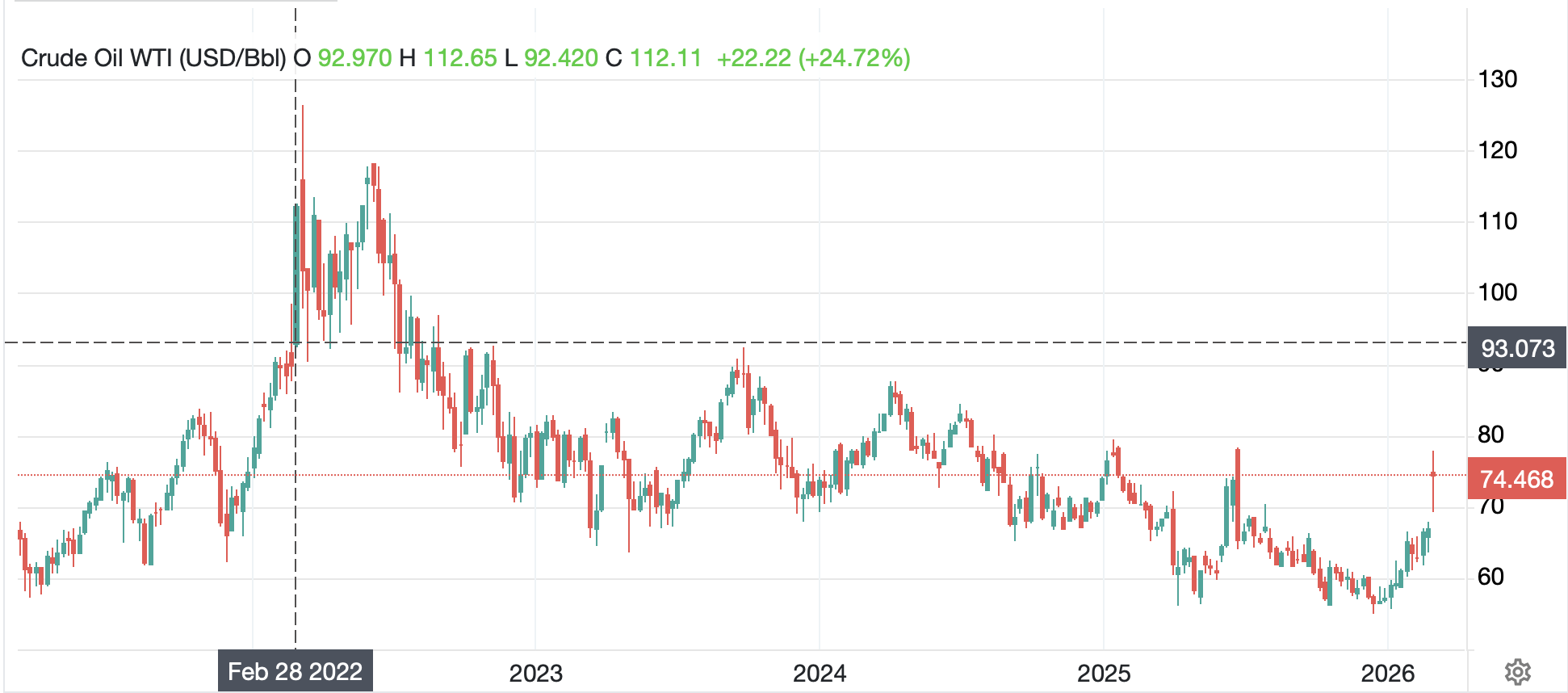
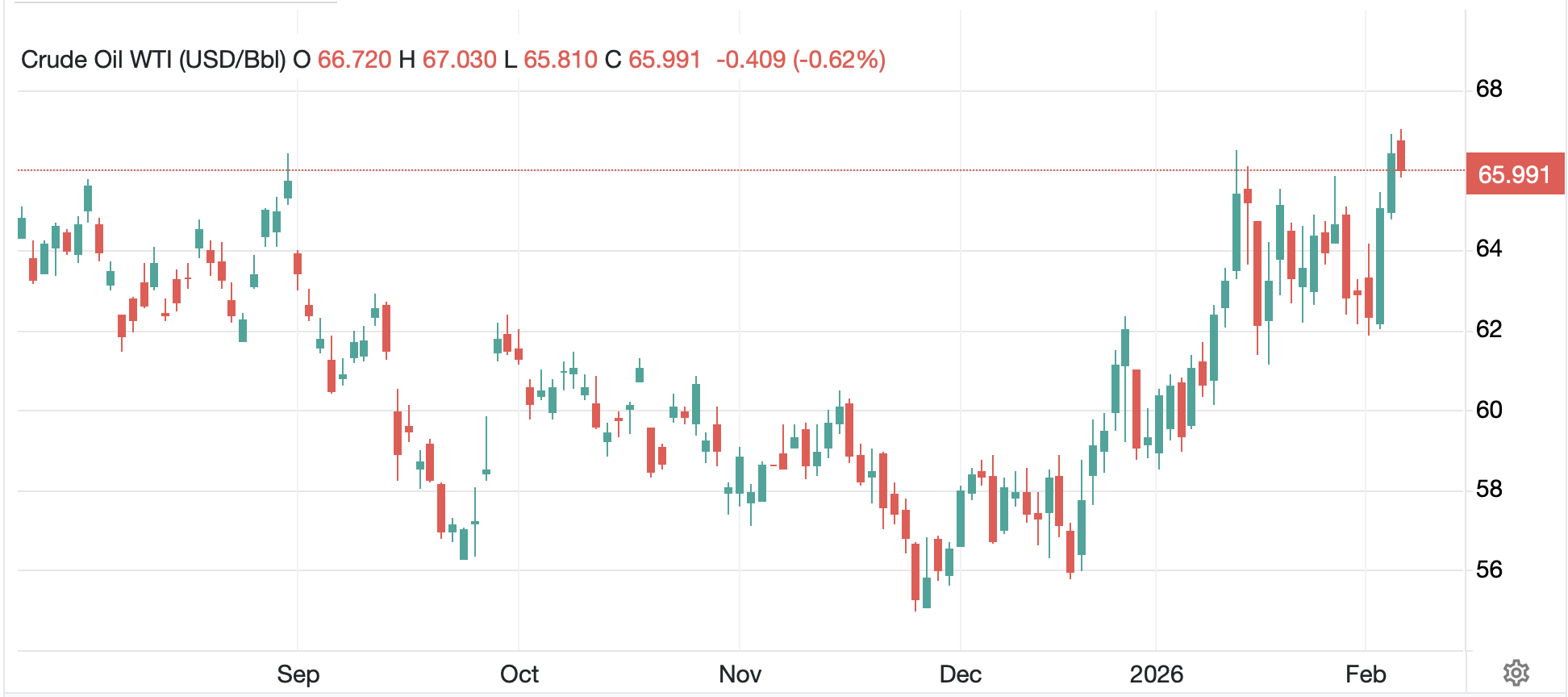
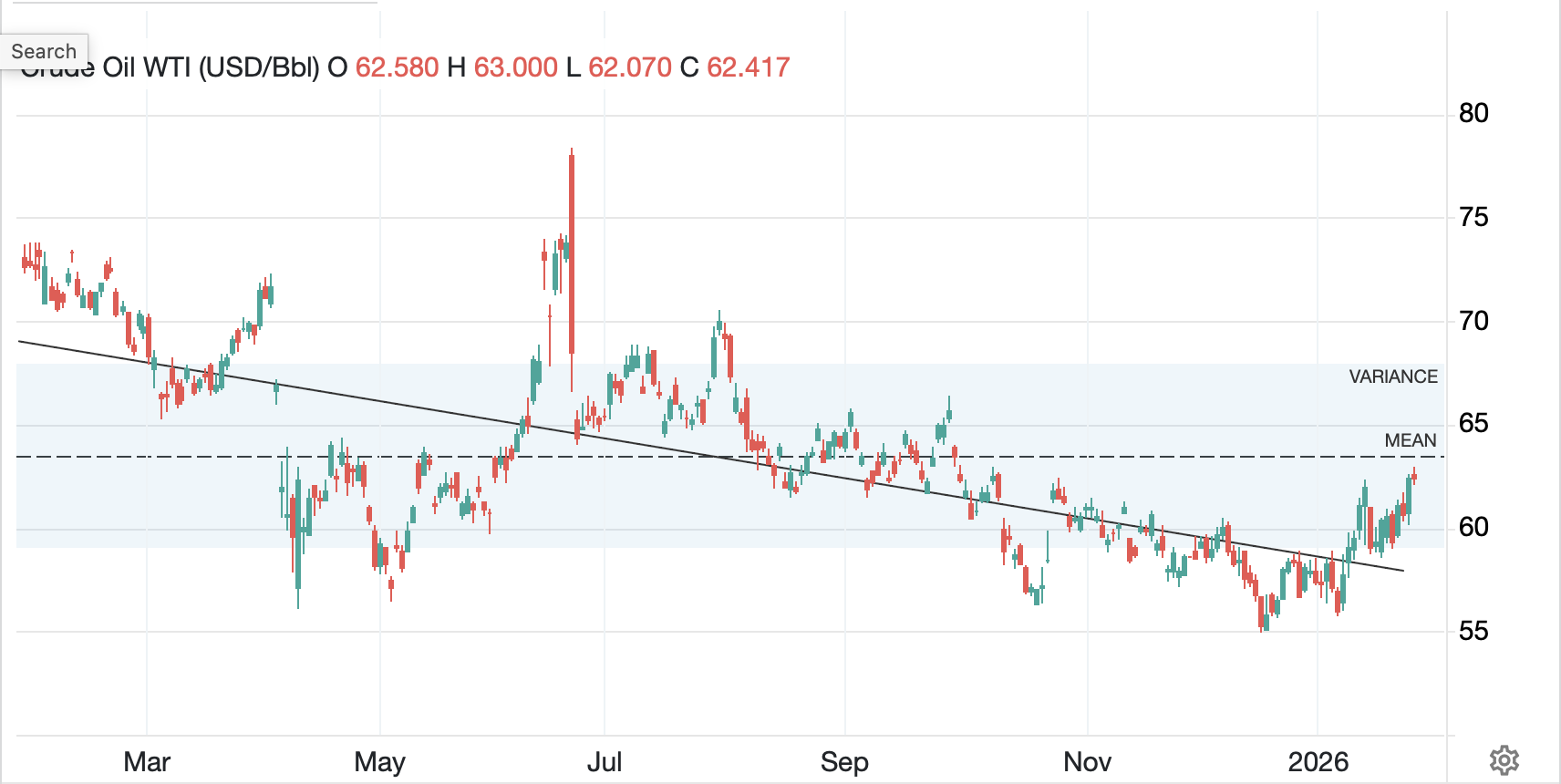
As of 9:00 last night, oil futures are essentially unchanged from Friday’s, pre-Venezuelan news, close.  As you can see from the chart below, while there was an early blip higher of about 50¢, that quickly retraced.

Source: tradingeconomics.com

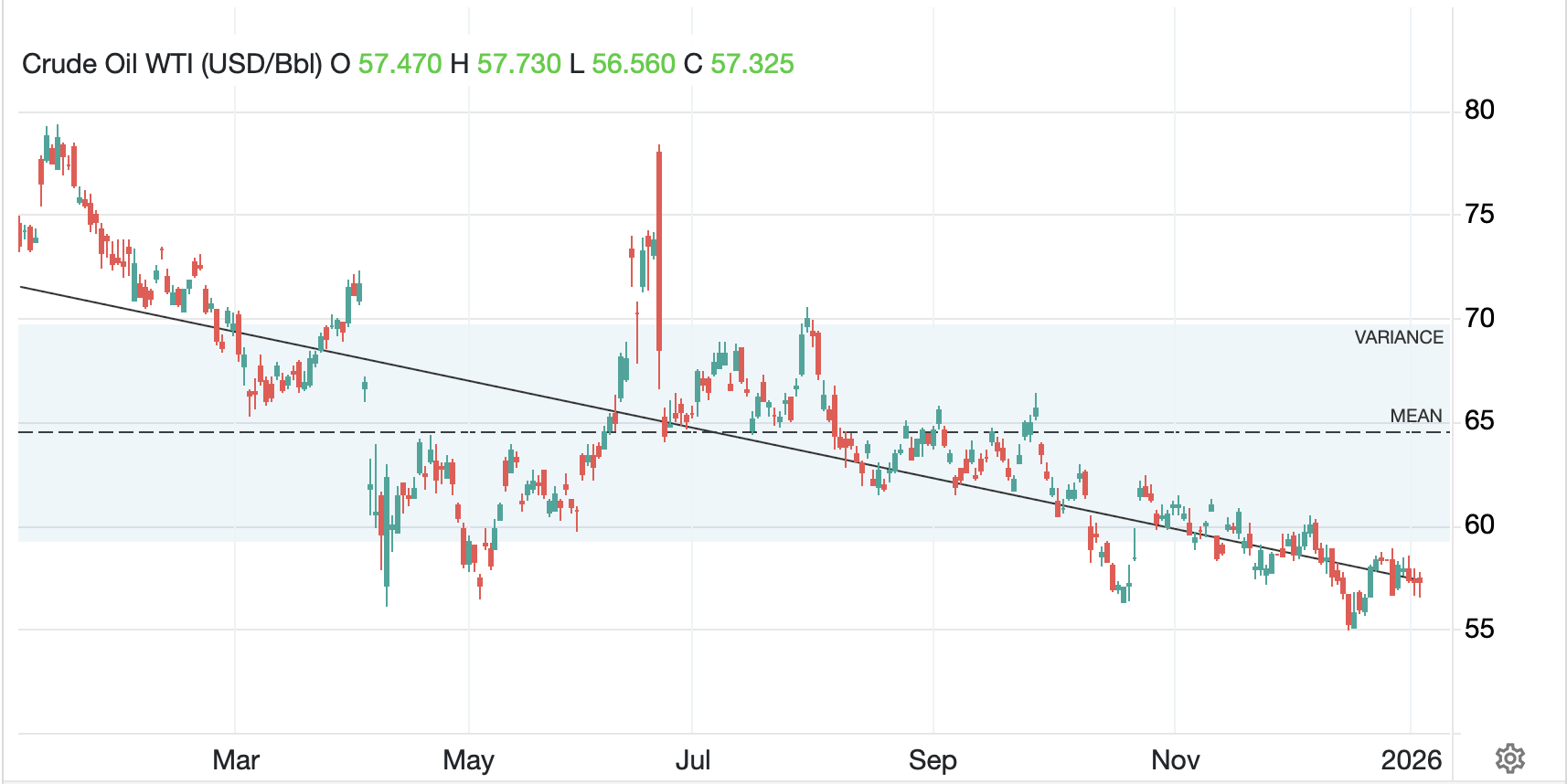
But, stepping back a bit, a look at the chart for the past year shows a very steady decline in the price and at this point, there seems to be little that will change that result.

Source: tradingeconomics.com

I have consistently made the case that oil supply exists all over the world, and that politics has been the chokepoint.  Arguably, a new government in Venezuela has just removed one of those chokepoints, although from everything I can gather, given the decrepit state of the oil infrastructure in Venezuela after nearly 20 years of Socialist neglect, it will take quite a while to hit the market.  But Guyana and Argentina are going to be growing their output considerably going forward, so, a slower rate of production here ought to not matter much.

One other thing I did read was that a key driver of the weekend’s events was growing concern by the US military that the Chinese were going to monopolize rare earth mining and processing from areas of southern Venezuela and that was too great a concern.  Even if the timeline is long, it appears, at this stage, that the future of Venezuela’s oil production should start to trend higher, and that will simply add to pressures on prices.  After all, we know that markets are forward looking.

One last thing to note is that acting president of Venezuela, Delcy Rodriguez, has called for “cooperation” with the US going forward, a very different tone than her initial comments of outrage.  Perhaps she has figured out that this is a sweet deal for her, or perhaps she is simply afraid that she is not safe if she doesn’t cooperate.  Whatever the reason, I suspect that things will progress positively from here.

In the meantime, let us try to turn our attention elsewhere, although it will be difficult as this action will clearly have many widespread, and at this point unforeseeable, impacts on markets other than oil.  But try we must.  With that in mind, let’s review markets overnight and see how the initial price action has evolved, and perhaps what it implies for the future.

Starting with equities, you’re hard pressed to find a market anywhere in the world that is suffering this morning despite the alleged increase in uncertainty.  In fact, it appears that investors are pretty certain that today is a better day than Friday was given the new world order that is developing.  Starting in Asia, the only market that fell overnight was India (-0.4%) seemingly on the idea that one source of their cheap oil may have been stopped.  But elsewhere, Japan (+3.0%), China (+1.9%), Korea (+3.4%) and Taiwan (+2.6%) all had extremely strong sessions with HK, Australia and other smaller exchanges showing little to no gains.  My only surprise here is China, which has invested significantly in Venezuela, lent them large sums of money and also had their advanced radar systems shown to be useless against US military aircraft.  But in the end, fear was not on the agenda in Asia.

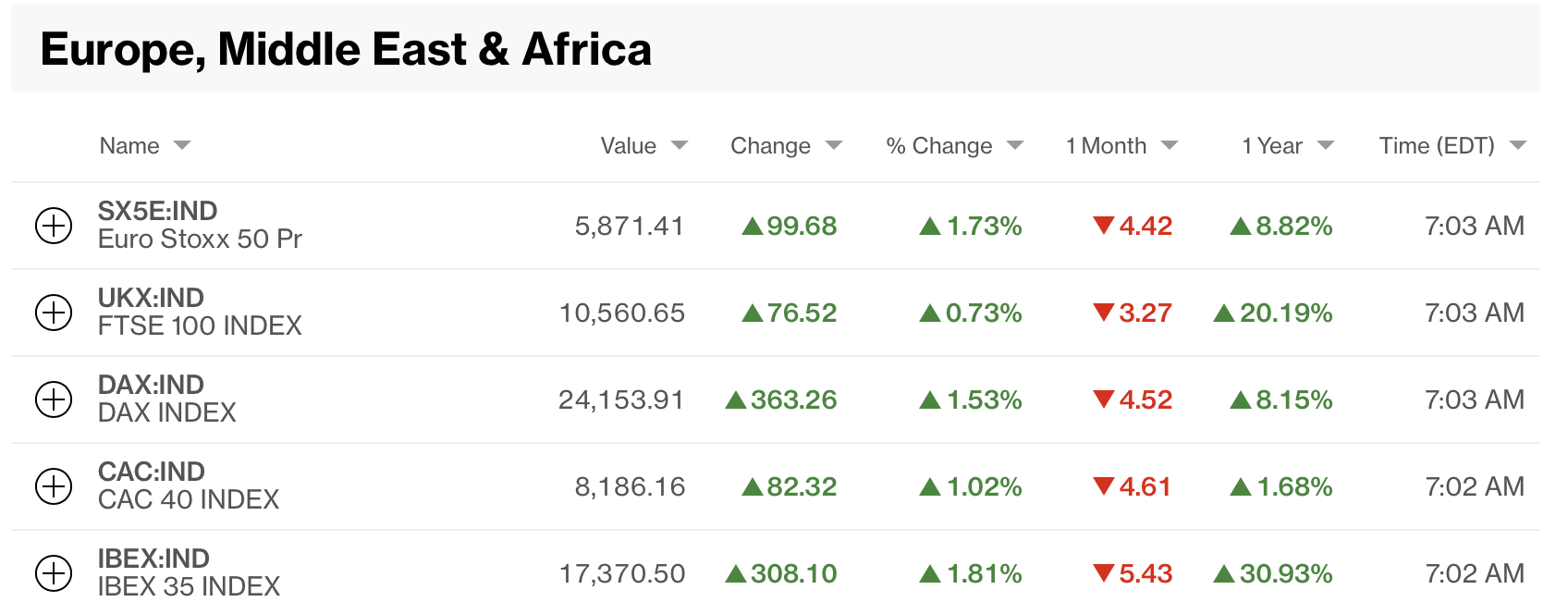
What about Europe?  Well, here things are less excitable, with Germany (+0.65%) and Italy (+0.6%) the leaders as defense firms in both nations have performed well this morning.  But otherwise, Europe is a nonevent this morning, which given their increasing global irrelevance, should be no surprise.  The UK, France, and Spain have all barely moved and surprisingly, Switzerland (-0.7%) has fallen, although perhaps neutrality is not such a benefit anymore.  US futures, though, are continuing their ride higher with the NASDAQ (+0.8%) leading the way in a sea of green.    The net result here is, risk is still in vogue.

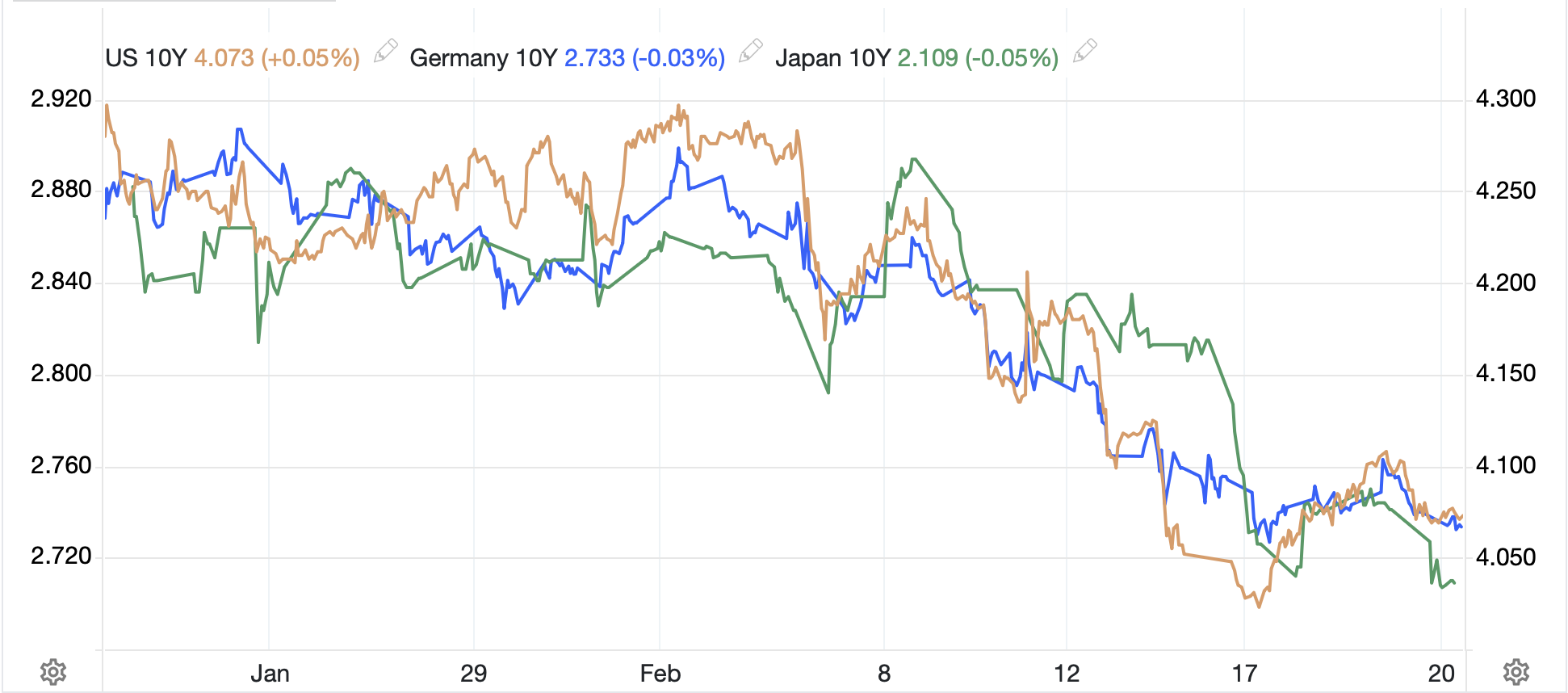
Turning to the bond market, only JGB yields (+6bps) are rising after PM Takaichi reiterated her call for more spending.  Yes, this is a new 29-year high in 10-year JGB yields, but I suspect they have further to go.  After all, as you can see from the below chart, yield suppression has been the game there for decades, so unwinding it will take some time.

Source: investing.com

But elsewhere in the fixed income world, yields are slipping across the board.  Treasury yields (-3bps) are leading the way with all of Europe seeing declines between -2bps and -3bps.  I might suggest this is a response to the prospect of declining oil and energy prices going forward, even though it will take time to see the increases in production.

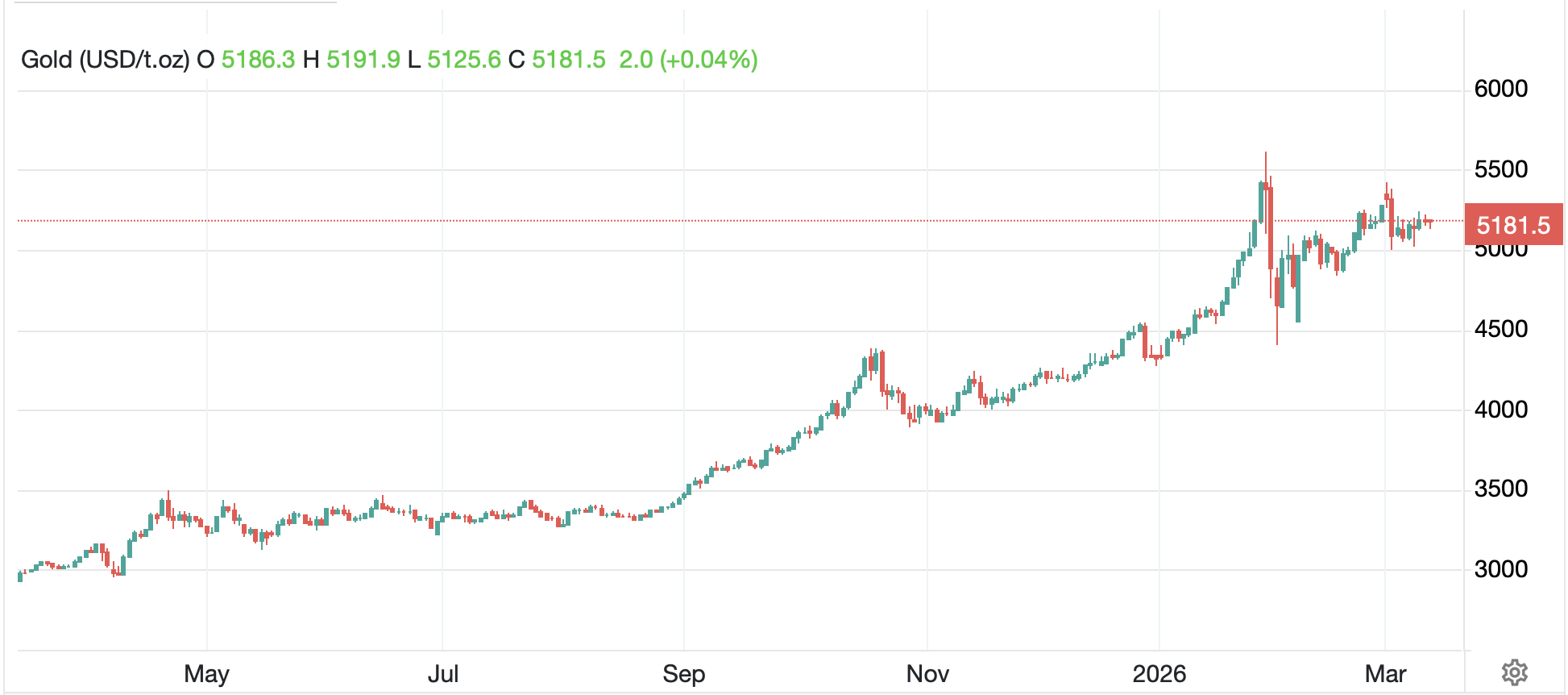
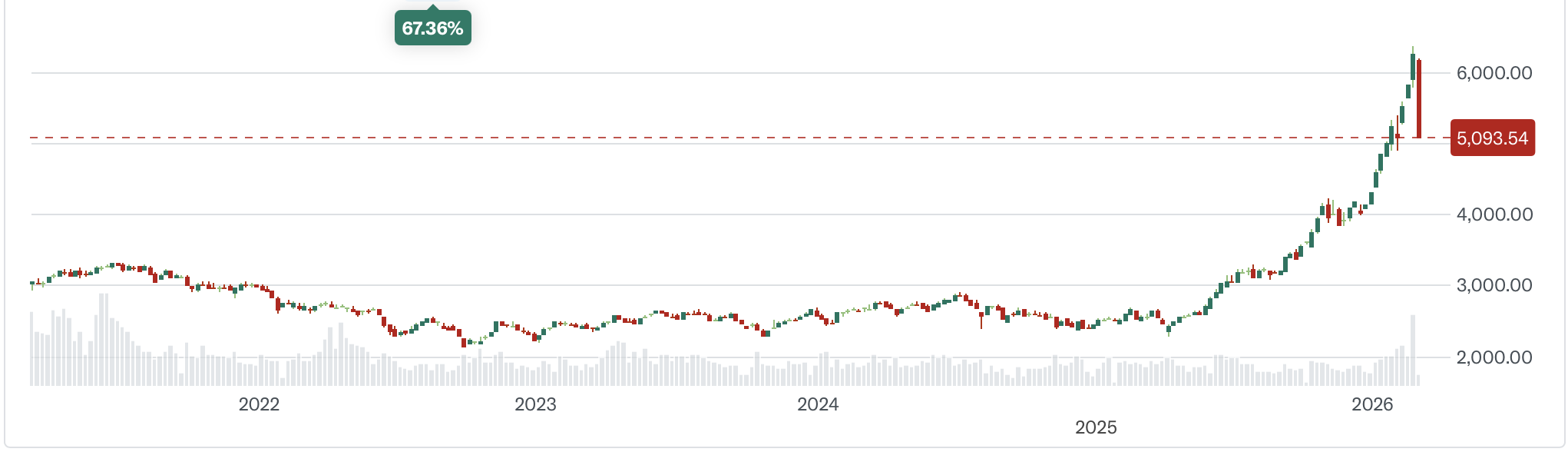
As to commodities, as of this morning at 7:30, oil has bumped up 0.5%, although as you can see in the above chart, remains in a longer-term downtrend that shows no signs of breaking soon.  Metals, meanwhile, remain the story of stories with the entire periodic table looking good (Au +1.9%, Ag +3.3%, Cu +2.9%, Pt +2.5%).  I continue to read about reasons as to why this rally in metals is going to end soon, with most focused on the speed of the ascent last year.  But the difference in this market vs. any paper financial market is, physical supplies matter here, and by all accounts, Ag, Cu and Pt are all in short supply for their industrial uses (think catalytic converters for Pt) and as industrial users recognize the shortage, they continue to bid up the price.  While I expect all these markets to remain volatile this year, I suspect that the trend higher has a lot of runway yet.

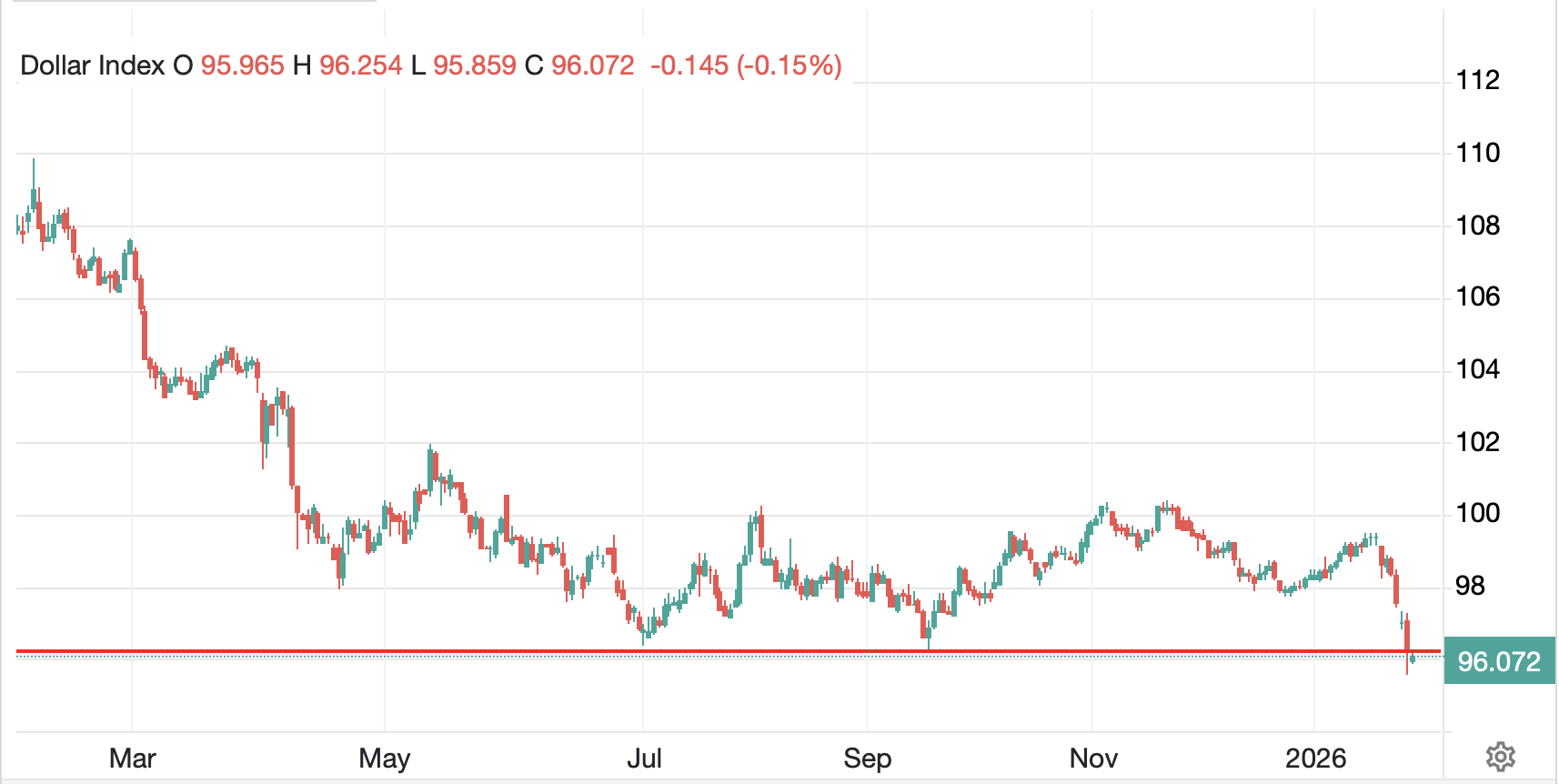
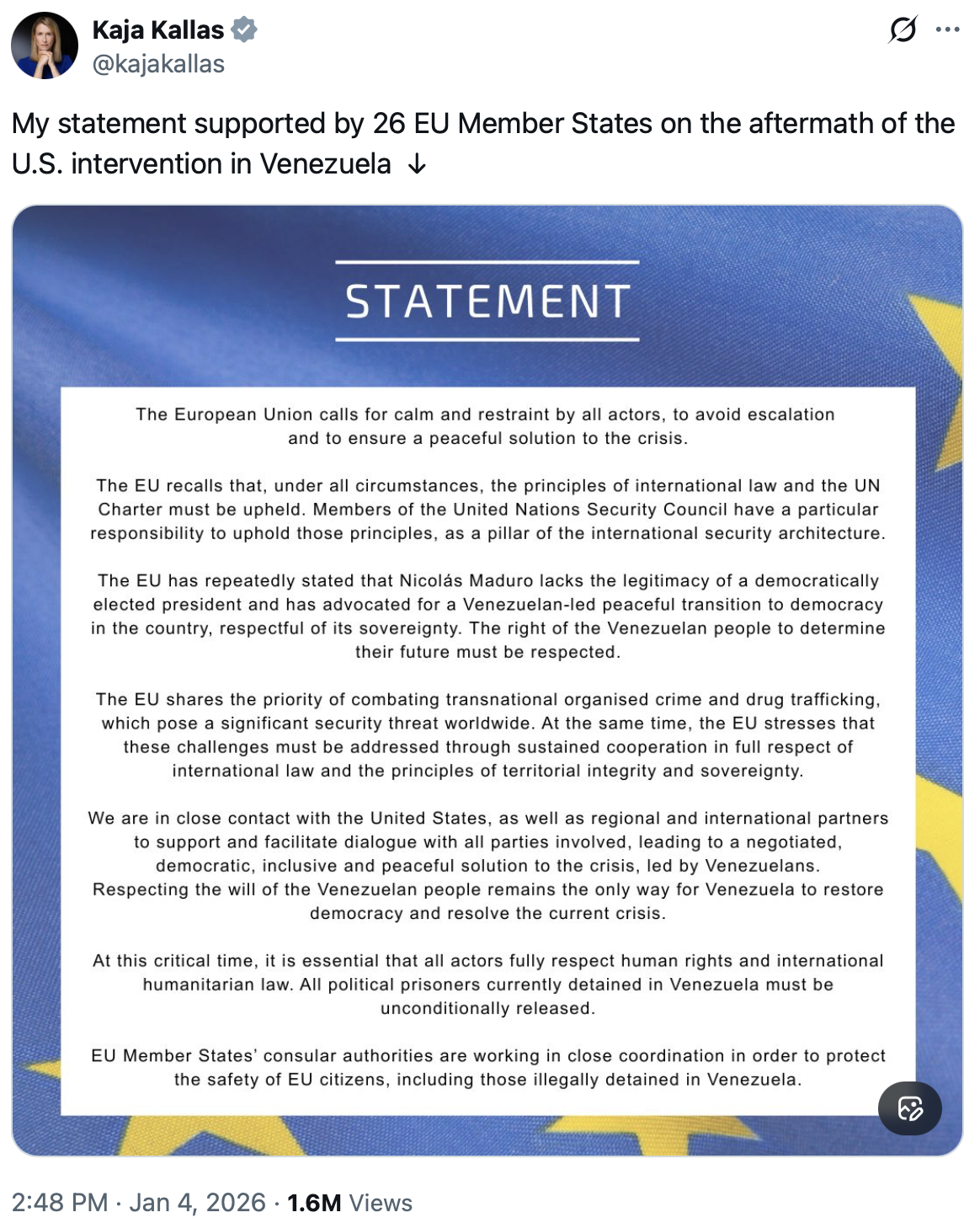
Finally, the dollar is firmer this morning, despite the rally in metals.  The euro (-0.3%) is the laggard in the G10 space as the EU was shown to be completely powerless, useless and irrelevant over the weekend.  However, they did issue a carefully considered statement to cement the idea that they are powerless, useless and irrelevant as seen below.

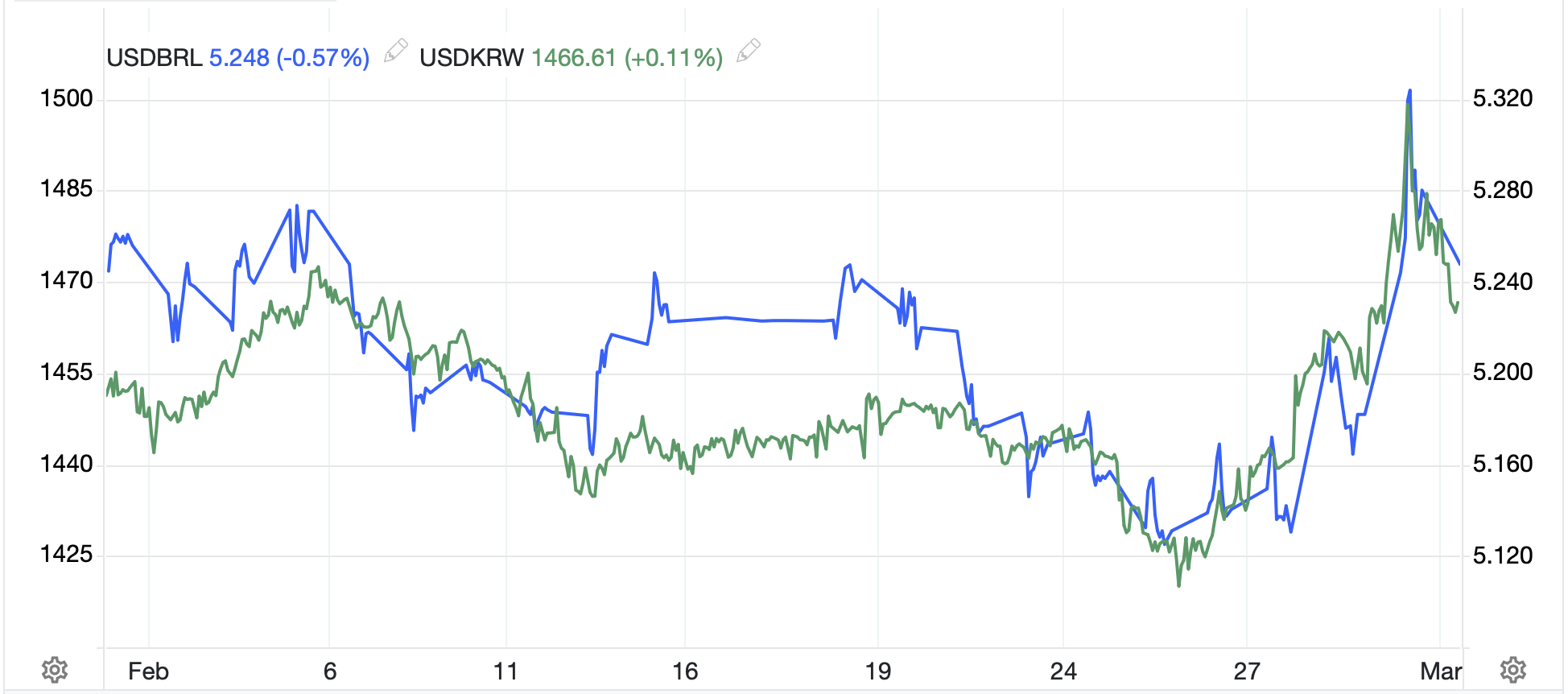
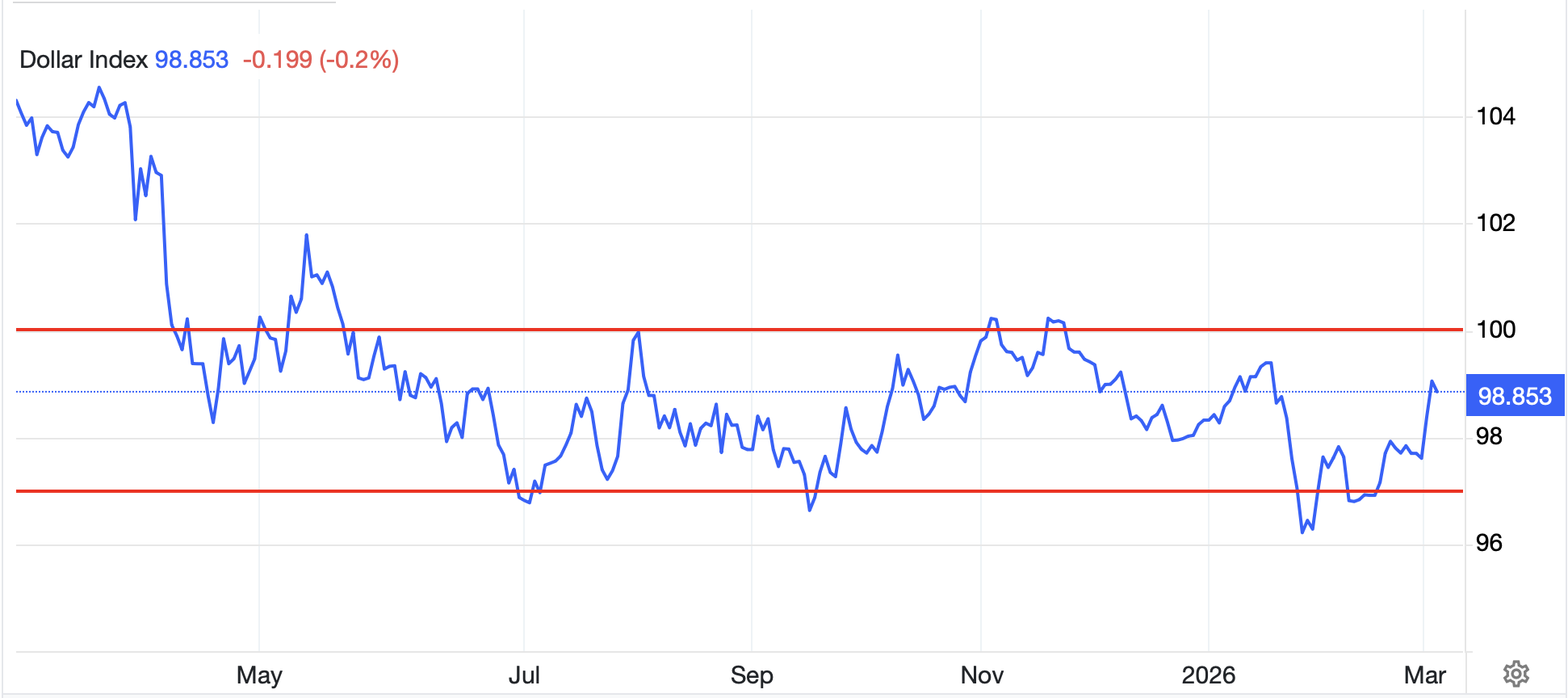
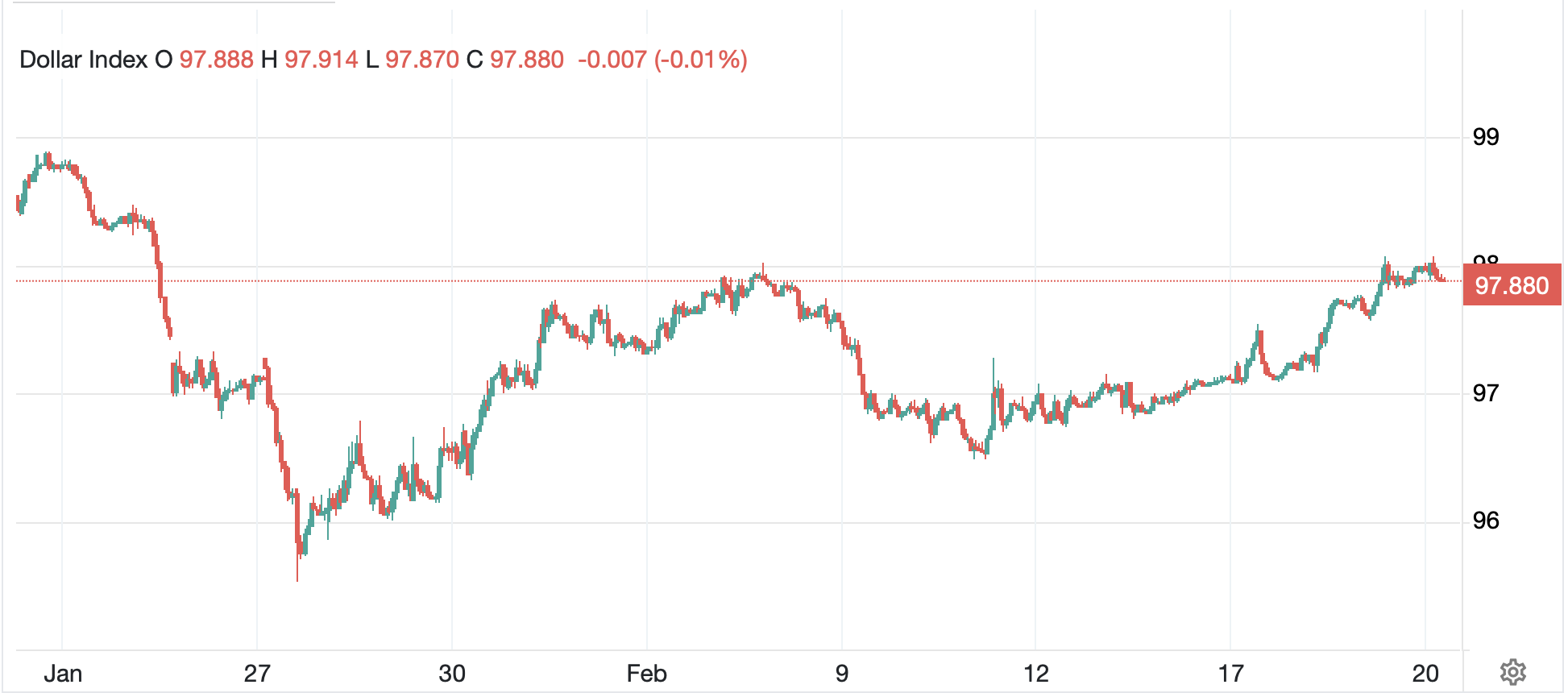
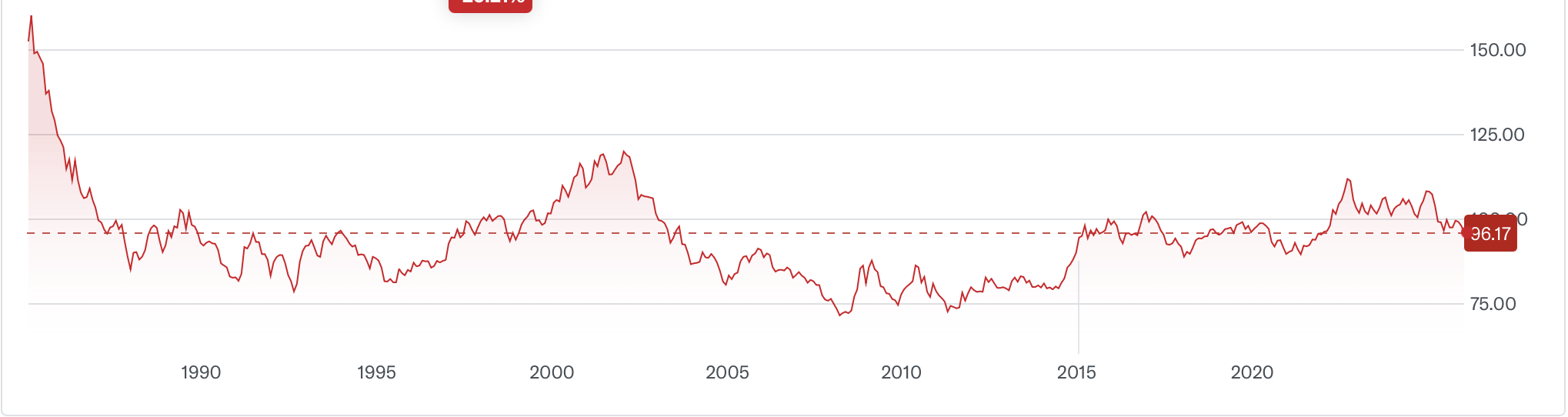
I know I feel safer now!  In addition to this demonstration, the timeline for a digital euro seems to be speeding up, a decision that will further undermine the single currency in my view.  Nothing has changed my opinion, except perhaps strengthening it, that the world is going to bifurcate into USD stablecoins and digital CNY over the next few years, with most of Europe opting for USD.  Elsewhere in the G10, movement has been less pronounced, +/-0.2% or less with nothing of note to mention.  In the EMG bloc, most of the currencies here are a bit weaker, -0.3% or so, with two key exceptions, ZAR (+0.1%) and CLP (+0.2%), both benefitting from the large gain in the metals complex.  Interestingly, MXN (-0.35%) is amongst the worst performers as the natural thought process seems to be, is President Sheinbaum next unless she effectively shuts down the cartels.  I keep searching for reasons to understand bearishness on the dollar but have yet to find any that make sense.  One other thing to note, there has been a resurgence in the discussion of how the dollar is losing its traction amongst central banks with respect to reserves held.  Many are highlighting that the percentage of reserves in USD has fallen to its lowest level since the mid 1990’s.  but a look at the chart below shows that while the recent trend has declined, it remains far above its lows, and far below its highs over time.  In fact, one might say it’s right in the middle of the range.

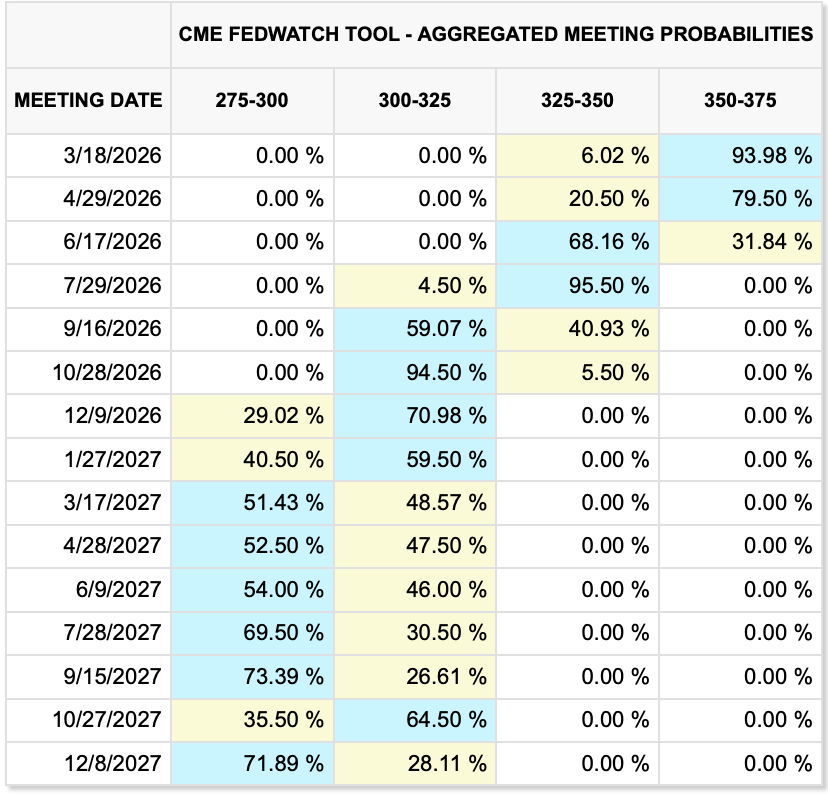
Turning to the data this week, with the government having been back in action for a while, we are back to a full slate of data for the first week of a month.

TodayISM Manufacturing48.3
 ISM Prices Paid59.0
TuesdayPMI Services52.9
 PMI Composite53.0
WednesdayADP Employment45K
 ISM Services52.3
 JOLYs Job Openings7.64M
 Factory Orders-1.2%
 -ex Transport-0.3%
ThursdayInitial Claims216K
 Continuing Claims1851K
 Trade Balance -$58.4B
 Nonfarm Productivity3.0%
 Unit Labor Costs1.0%
 Consumer Credit$10.2B
FridayNonfarm Payrolls55K
 Private Payrolls60K
 Manufacturing Payrolls-5K
 Unemployment Rate4.5%
 Average Weekly Hours34.3
 Average Hourly Earnings0.3% (3.6% Y/Y)
 Participation Rate62.6%
 Housing Starts (Sept)1.31M
 Building Permits (Sept)1.35M
 Michigan Sentiment53.2

Source: tradingeconomics.com

While some data remains stale (housing), the jobs data is December’s and will get a great deal of attention.  One thing to remember here is that if the deportation numbers discussed by the government are correct (~500K actual deportations and ~2.0MM self-deportations), then the economy doesn’t need to create that many new jobs to keep things ticking along.  I have seen estimates of somewhere between 0 and 20K jobs each month being sufficient to keep the Unemployment Rate steady to declining.  I am sure, however, this issue will be the subject of much discussion by the economics community going forward, but as I have said time and again, the models in use today do not seem to reasonably represent the reality today.  Expect a lot of huffing and puffing about this data, largely along political lines.

And that’s really it.  Obviously, Venezuela has changed a lot of calculations about many markets, but in the end, while I remain concerned over an eventual risk-off outcome, I don’t see that as an immediate threat.  Remember, too, the OBBB has taken effect and tax situations are going to be changing now, something that will undoubtedly help the economic data going forward.

Good luck

Adf
A Vision For ‘Twenty-Six

(With apologies to Clement Clarke Moore)

Tis the first day of trading in Ought Twenty-Six
With too much attention on raw politics
At home, eyes have turned to the mid-term elections
To see if results will force mid-course corrections
In Europe, they’re going all-in on Ukraine
With more billions promised, though that seems insane
Meanwhile, Mr Xi is convinced he can fix
The problems at home with his policy mix
And this, my friends, just skims the surface of things
As pols everywhere suffer arrows and slings
Remember, though, markets are what I’m about
And while I could err, I am never in doubt.

Let’s start at the top with Growth here in the States
Which likely will show more than marginal rates
In fact, Four percent seems a viable goal
As inward investment and tax cuts take hold
Remember, for Trump, if there’s one thing he’s not
It’s timid, and so he’ll demand, “Run it hot!”
Thus, growth will expand, though inflation might gain
And for the elections, that could be a pain
The problem is Jay, and whoever comes next
Have come to believe two percent’s just subtext
The greatest unknown is on government spending
And whether it grows or, at last, starts descending

The punditry’s certain the government fisc
Is going to increase inflation’ry risk
If true, CPI of near Four percent’s apt
If not, then Inflation ‘neath Three, could be capped

And what about elsewhere, in Europe? Japan?
In markets, emerging, do they have a plan?
Will they grow their ‘conomies, drawing investment?
Or will we soon witness a large reassessment?

In Europe, they claim they’ll be building more guns
To help them defend all their daughters and sons
As well, they’re committed to helping Ukraine
Continue to fight, despite so many slain
They’re planning to borrow a cool 90 Bill
But energy costs, these grand plans could well kill
Meanwhile, M Lagarde claims that rates are just right
And given growth there’s One Percent, I won’t fight
So, weak growth and low rates and energy blues
Lead me to believe that come year-end, the news
Will be that the Euro is failing to thrive
Do not be surprised when it hits One oh-Five

In England and Scotland and all the UK
Just like in the EU, they can’t make much hay
The budget’s a wreck yet they want to raise taxes
Though history shows growth will wane ere it waxes
As well, they continue their crack down on speech
While crimping their energy industry’s reach
So, power is costly, and billionaires flee
From here, ‘cross the pond, this is what I foresee
A ‘conomy heading right into stagflation
As long as Kier Starmer is leading the nation
For markets, the Pound will lose all its allure
With One-Ten the Boxing Day screen price du jour

A turn to the East where the Sun Also Rises
Will teach us that, really, there are no surprises
To date you’ve heard much ‘bout the rise in yen rates
With pundits opining the Carry Trades’ fates
This year, so they say, look for much stronger yen
As local investors buy yen bonds again
Thus, all the hedge funds who’ve been funding their trades
By borrowing yen, and they’ve done so in spades,
Will need to buy back all that Japanese Money
The outcome, for yen shorts, will not be so sunny
But what if this idea of yen heading home
Is wrong?  This implies quite a different syndrome

At this point there’s no sign the government there
Is ready, more spending and debt, to forswear
Instead, what seems likely is more of the same
More government spending in all but its name
So, debt will continue to rise without end
And up to One-Eighty the buck will ascend

As well as Japan, in the continent vast
Of Asia, it’s China we come to at last
“Poor” President Xi has a problem at home
Consumption is not in the Chinese genome
For decades, the model’s been, build and export
Which helps explain why local usage falls short
But lately the rest of the world’s of a mind
That Chinese imports are a troublesome kind
So, Xi needs his people to learn how to spend
Else all that production may come to an end
But if they consume, what will that do to growth?
Its rate will decline, something for which Xi’s loath

Thus, GDP 5 means a weaker yuan
Well above Seven you can depend on
But if, against odds, Xi gets Chinese to spend
Six-Fifty is where yuan will be at year end.

Let’s shift our perspective to Treasury debt
A market of critical import, and yet
A market that’s been in a range for a while
So, what must occur for a change in profile?
The popular view is that deficit spending
Will drive an outcome of, high yields, never-ending
But Trump and his team are, quite hard, pushing back
Explaining that policy’s on the right track
Twixt tariffs and growth, tax receipts have been flying
While RIFs in the government are underlying
The idea that deficits soon will be shrinking
In truth, this is not what the punditry’s thinking
But one thing is clear that will keep yields from climbing
QE, which is back, is designed for pump-priming
So, Jay and his heir will keep buying and buying
And 10-Years at Four Percent seems satisfying

It’s not just the government, though, that’s in debt
Those corporates who borrowed at ZIRP, have not yet
Refinanced the trillions they owe, to this day
And now they’re competing with Bessent and Jay
While Scott will find buyers, if not least the Fed
For corporates that path may be flashing bright red
If credit spreads widen will companies fail?
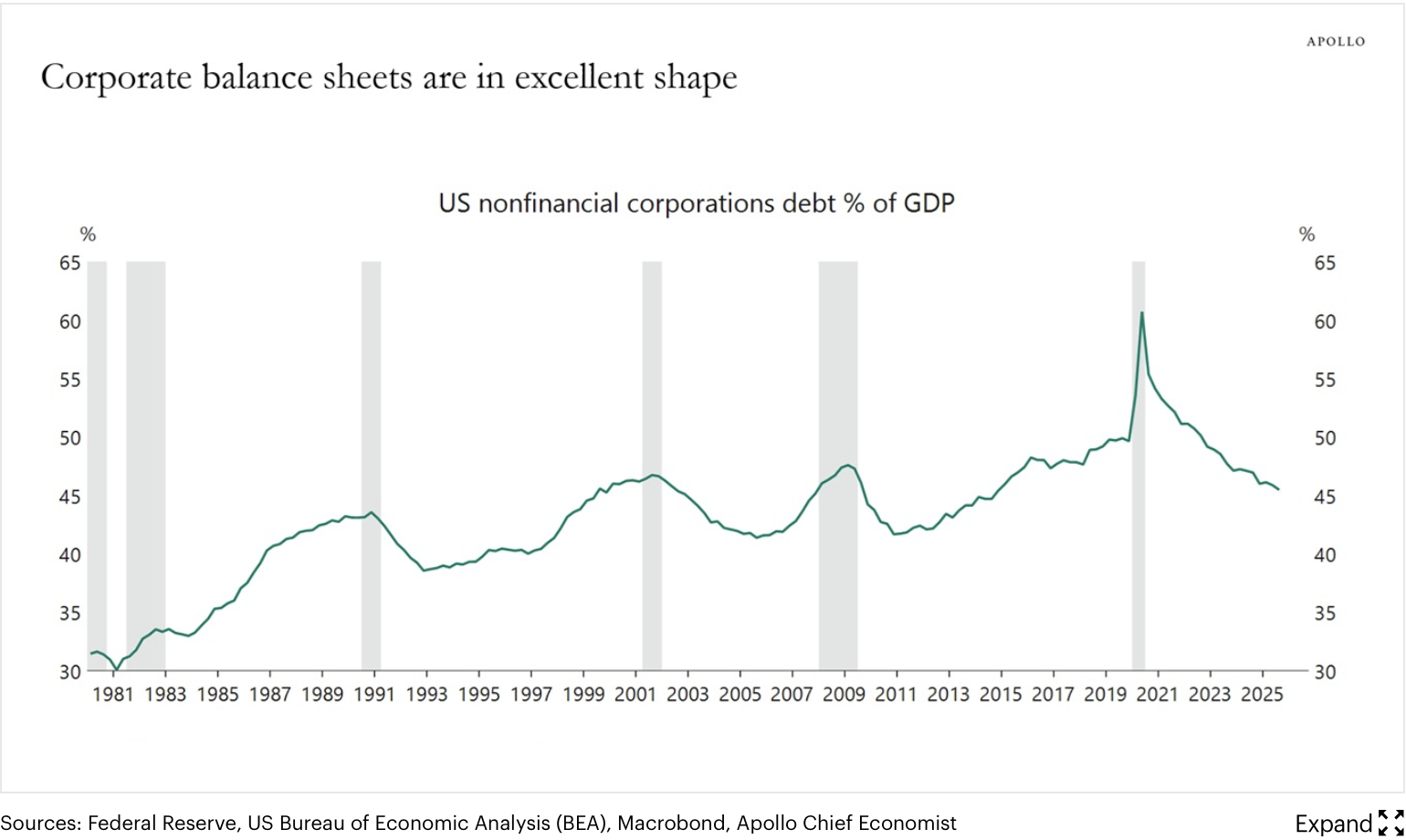
And will that unravel the stock markets’ tale?
Right now, spreads for IG sit near one percent
And Junk’s above eight with investors content
However, the biggest risk this year could be
The absence of corporate debt liquidity
If IG spreads widen 200 bps more
The outcome could be a GFC encore

This takes us to stocks, both at home and abroad
Which last year saw rallies we all did applaud
But will this year bring us some more of the same?
Or have things been altered?  Is there a new game?
If my crystal ball is in any way clear
The outcome could well be a frightening year
Remember, the driver of last year’s returns
Was government spending which lacked all concerns
Thus, Cantillon nailed it with where cash would go
And stocks were the winner, of that much we know
But this year the mountain of debt coming due
Could well force decisions of what will ensue
And too, don’t forget if the deficit shrinks
It’s likely to be a great stock market jinx
So, don’t be surprised if December this year
A 10% fall ‘cross all stocks does appear

And what of that black, sticky stuff that they drill
Which powers the global economy still
When its price increases, it causes much pain
For most everyone, it can be quite the bane
Consumers, instead, like those prices to sink
But drillers, in that case, cause output to shrink
So, which will it be, will Trump’s mantra come true
Or will, new production, most drillers eschew
I think what is missed is technology’s traction
And how costs per barrel will tend toward contraction
As well, nations worldwide, at last understand
That Carbon Dioxide just cannot be banned
Come Christmas, next, we will see growth in supply
With Fifty per barrel the price we’ll espy

The last place to look is at bright things that shine
Which saw prices move in a vertical line
While gold was the starter, by year end t’was clear
That silver and platinum said, wait, hold my beer
The latter two rising thrice fifty percent
With neither responding to any event
Which brings us to this year, can these trends maintain?
Or are we now set up for infinite pain?
It seems to me that til the summer at least
All three will continue to rise, as with yeast
But when we reach solstice do not be surprised
If views on their future become bastardized
In other words, look for corrections in price
With early year gains given back in a trice
But still, by the end of the year I believe
Five Thousand in Gold is what we will perceive
For Silver, One Hundred could well be the spot
And Platinum, Three Grand, would not be too hot.

To all of my readers and friends, please forgive
My musings if they got too ruminative
This year will see change across many degrees
And some will be painful, while others will please

In sum, I think President Trump can succeed
In changing behavior, though not corporate greed
Reducing the number of government staff
As well as with regs, he can cut those in half
Inward investment will focus on stuff
Instead of on stocks, for the markets that’s rough
Dollars will still be in greater demand
While Treasury yields will be stuck in the sand
IG and Junk are unlikely to win
As rising expenses cut margins quite thin
And still, through it all, precious metals will gain
Though G7 central banks all will abstain
Come Christmas next, nothing will look quite the same
And maybe my views can help you build a frame.

Thank you all for tolerating my punditry and I hope that you all have a wonderful, healthy and successful year ahead.

Adf

Real Savoir Faire

There once was an aging Fed Chair

With poise and some real savoir faire

He claimed the foundation

Of rising inflation

Were objects that, right now, were rare

But soon when supply chains are mended

And joblessness falls as intended

Inflation will sink

To levels we think

Are fine, and the world will be splendid

Remember when the FOMC Statement and following press conference were seen as hawkish?  That was sooo last week!  There was talk of rate hikes in only TWO YEARS!  There was talk about talk about tapering the purchase of assets as monetary policy started to ‘normalize’.  (Not for nothing but given we have had the same monetary policy for effectively the past 13 years, ZIRP and QE might be considered normal now, not positive real rates and a stable balance sheet.)  Well, apparently the market reaction was not seen as appropriate by Chairman Jay and his cadre of central bankers, so we have heard a definitive retreat on those concepts in the ensuing six days.  

Just since Monday, we have heard from six different FOMC members and every one of them has essentially said, “just kidding!”  Yesterday, Chairman Powell testified to a House Subcommittee on Covid and was forced to explain, yet again, that policy changes were still a long way down the road and that inflation remains transitory.  It was not, however, just Powell delivering that message.  It was also Cleveland’s Loretta Mester, SF’s Mary Daly and NY’s John Williams amongst others.  Current policy settings are appropriate, inflation is transitory and there is still a long way to go before that elusive substantial further progress toward the Fed’s dual mandates will have been achieved.

History has shown that the Fed’s effective reaction function, at least since Alan Greenspan was Chair, is defined by an equity market decline of a certain amount.  This is especially true if the decline happens quickly whereupon they will jump in and ease policy.  It appears that the amount of market angst necessary to get the Fed to change their tune regarding infinite liquidity and monetary support continues to shrink.  It used to take a decline on the order of 15%-20% to get the Fed nervous.  This time, the S&P 500 fell less than 2% before virtually the entire committee was on the tape walking back their tough talk.  And yet, they would have you believe that when inflation is roaring higher for the rest of the year, they have the intestinal fortitude to fight it effectively by raising interest rates or reducing QE.  As actions speak louder than words, my money is on the Fed being completely unable to address rising inflation.  Be prepared.

This topic continues to be the primary narrative in markets around the world, with many other countries now grappling with the transitory inflation story as well.  Nothing else really matters, and rightly so.  If inflation is building a head of steam and will be rising around the world, central banks are going to be forced to respond.  Some will respond more forcefully and more quickly than others, and it is those currencies which are likely to outperform going forward.  Investors today are generally unfamiliar with investing in an inflationary environment.  The 1970’s were the last time we really saw inflation of substance and even I was still in college (and I am almost certainly much older than you) when that was the situation, with many, if not most, of the current investment community not yet even born.

A quick look at the chart of the Dollar Index (DXY) from that time shows that from the autumn of 1971, right after President Nixon closed the gold window and ended Breton Woods, through the end of 1979, right after Paul Volcker was named Fed Chair and had just started his inflation fight, the dollar declined about 28% (roughly 4% per annum).  Of course, once Volcker got going and US interest rates were raised dramatically to kill off inflation, the dollar rose more than 75% in the following four years.

The point is that while we may disparage the Fed’s actions as being wrong-headed, their policies matter immensely.  Jay Powell may wind up with his reputation in tatters akin to Arthur Burns and G. William Miller, the Fed Chairs who oversaw the sharp rises in inflation in the 1970’s preceding Mr Volcker.  It seems unlikely this outcome is his goal, however, his insistence on toeing the political line rather than hewing to sound money policies bodes ill for the future.

Anyway, while US equity markets have essentially retraced all their post FOMC losses, the rest of the world has seen a more mixed outcome.  In Asia last night, the Nikkei (0.0%) was essentially flat although there were gains in the Hang Seng (+1.8%) and Shanghai (+0.25%).  Europe, on the other hand, is under some pressure this morning with both the DAX (-0.5%) and CAC (-0.4%) feeling some pain based on softer than expected, though still strong, Flash PMI data.  The UK, however, is seeing a much better performance (FTSE 100 +0.35%) as not only was the PMI data stronger than expected, but there apparently is a breakthrough on the lingering Brexit issues of treating goods in Northern Ireland.  Meanwhile, US futures are essentially unchanged this morning, perhaps waiting for some more encouragement from today’s roster of Fed speakers.

Bond markets, after a very choppy few days, have calmed down greatly with Treasuries (+1.2bps) softening a bit while European sovereigns (Bunds -1.4bps, OATs -1.4bps) are seeing some demand.  UK Gilts are little changed as the market there awaits tomorrow’s BOE meeting, where some believe there is a chance for a more hawkish tilt.

Commodity prices are definitely firmer this morning led by oil (+0.7%) but also seeing strength in precious metals (Au +0.25%, Ag +0.7%), base metals (Cu +0.7%, Fe +1.4%, Sn +0.2%) and agricultural products (Soybeans +0.5%, Wheat +1.2%, Corn +0.4%).  Clearly the commodity markets see inflation in the future.

Finally, the dollar is mixed this morning but, in truth, the relatively small movements indicate a lack of interest.  Commodity currencies like NOK (+0.1%), AUD (+0.2%) and NZD (+0.2%) are the leading G10 gainers while JPY (-0.35%) continues to come under pressure, arguably suffering from the fact that Japan imports virtually all its commodities.

In the EMG space, the picture is also mixed with HUF (+0.7%) the leading gainer after the central bank raised its benchmark rate to 0.9% yesterday a 0.3% increase that was expected.  But the idea that they are joining the several other EMG central banks in tightening mode (Brazil, Russia, Ukraine) has investors buying up the forint.  Away from that, ZAR (+0.4%) is clearly benefitting from higher commodity prices as are RUB (+0.2%) and MXN (+0.1%) although the latter two are quite modest.  On the downside, KRW (-0.5%) saw the sharpest declines as a combination of equity outflows as well as a sharp rise in Covid infections was seen quite negatively.  But in truth, most APAC currencies were under some pressure overnight, albeit not to the extent seen in Seoul.

Today’s data brings the Flash PMI (exp 61.5 Mfg, 70.0 Services) as well as New Home Sales (865K).  But more importantly, we have three more Fed speakers set to reiterate the message that policy is not going to change for a while yet, so no need for investors to panic in any market.  The dollar responded logically to the idea that the Fed was going to tighten policy, but now that they have gone out of their way to walk that idea back, I expect the dollar is more likely to drift lower for now.  Perhaps when it becomes clearer that the Fed is actually going to move, we could see some strength again.  But that is likely still a few weeks or months away.  Trade the range for now.

Good luck and stay safe

Adf

Getting Upset

The Chinese are getting upset

Commodity prices, as yet

Continue to rise

As shrinking supplies

Now pose, to their model, a threat

So, naturally, what did they do?

They ordered state firms to eschew

Stockpiling provisions

As now all decisions

Will come from Beijing ‘pon review

With the FOMC meeting on virtually everyone’s mind this morning, market activity overall has been muted.  However, the one place in the world that doesn’t revolve around the Fed is China, and news from there last night is quite interesting.  You may recall my quick story about the Department of Price two weeks’ ago and how that ‘august’ institution warned commodity hoarders and speculators to stop what they were doing.  Well, apparently, not enough people listened to those warnings as last night two more Orwellian entities in China joined the conversation regarding commodity prices.  The State-owned Assets Supervision and Administration Commission (SASAC) ordered companies under its purview, the SOE’s, to “control risks and limit their exposure to overseas commodities markets”.  This was clearly the stick to accompany the carrot dangled by the National Food and Strategic Reserves Administration, which has indicated it will soon release state stockpiles of copper, aluminum and zinc amongst other metals.

It is obvious that China has figured out that rising commodity prices may soon start to pass through from the factory to the consumer and drive CPI higher on the mainland.  President Xi is clearly concerned that rising prices could lead to some political unrest given that the bargain he has made with his citizens is to enhance their lives economically so he can control all the levers of power.  Thus, if inflation starts to rise more seriously, the population may call his leadership into question.

The problem for China, however, is that while in the past, they had been the marginal buyer of virtually all commodities as they grew their economic capacity dramatically, that situation no longer holds.  Yes, they still have an impact, but in this post-Covid environment where the rest of the world is rebounding very quickly, demand for commodities outside of China is growing rapidly.  But perhaps more importantly, because the previous decade saw commodity prices lag financial prices, investment in the sector was greatly reduced.  This has led to reduced supplies of many critical things and now that demand is resurgent, not surprisingly the prices of copper, steel and other commodities have been rising rapidly even if China isn’t buying as much as they used to.

Adding to this dynamic is the great conundrum of ESG.  On the one hand, ESG’s goals are to reduce environmental impact of economic activity which has largely played out as trying to substitute electricity for fossil fuels as a power source.  On the other hand, in order to electrify economies, the amount of metals like steel and copper required to achieve the stated goals is dramatically higher than the current model.  So, reducing investment in commodity producers results in much higher prices for the very commodities needed to achieve ESG goals in the long run.  While this is not the only argument to rebut the Fed’s transitory inflation story, it is an important part of the inflationists’ views.  China’s actions will only have a very temporary impact on the prices of the commodities in question, but the long-term demand is here to stay.  Until investment in extraction of commodities increases sufficiently to bring more capacity online, odds are that commodity prices will continue to rise, whether Xi Jinping likes it or not.  And if input prices continue to rise, at some point soon, so will prices of end products.  We have been witnessing the beginnings of that trend, but I fear it has much further to go.

Interestingly, despite all the sturm und drang in Beijing about metals prices, after a sharp decline yesterday, this morning they are edging higher (Cu +0.2%, Al +0.1%, Fe +0.5%, Steel +2.8%) although not nearly reversing yesterday’s moves.  If you ever wanted proof that China no longer calls the shots in commodities, here is exhibit A.

Today Chairman Jay will expound

On growth and its stunning rebound

But do not expect

That he will project

Some changes will shortly gain ground

The other story today, really the biggest for our session, is the FOMC meeting.  Broadly speaking, expectations are that the Fed will not make any policy changes of note, although there will clearly be some tweaking to the statement.  They cannot ignore the 5.0% CPI reading, I think, and they will certainly focus on the idea that the employment situation isn’t improving as rapidly as they would like.  And ultimately, for now, it is the latter issue that will continue to inform policy choices.  So tapering is not going to be on the menu, and when Powell is asked in the press conference, as he surely will be, I expect a response along the lines of, substantial further progress needs to be made before they will change things.

If I were to assess the risks, it feels like there is more risk of a hawkish outcome than a dovish one as the inflation story will not go away.  But that implies to me that the market is according a hawkish twist some real probability, so the big surprise to markets would be if they were excessively dovish.  However, I think Powell will do everything he can to be as nondescript as possible, stay on message and there will be very little movement.

A brief recap of markets overnight shows that Asian equities suffered, led by Shanghai (-1.1%).  Not only are they dealing with rising commodity prices, but the data released (Retail Sales, IP and Fixed Asset Investment) all disappointed vs. expectations.  China’s negativity bled into the Nikkei (-0.5%) and Hang Seng (-0.7%) as well.  Europe, on the other hand, has gone nowhere ahead of the Fed, with virtually every equity index within 0.1% of yesterday’s closes.  It should be no surprise that US futures markets are also essentially unchanged ahead of the Fed.

As to the bond market, we are beginning to see a touch of strength with yields declining ever so slightly.  Treasuries are lower by 0.5bps, while Bunds (-1.1bps), OATs (-0.9bps) and Gilts (-0.7bps) are also performing reasonably well ahead of this afternoon’s announcements.  It remains remarkable to me that with inflation rising universally, bond yields continue to ignore the situation.  One has to give credit to the central banks for selling their transitory story.

In the FX markets, the picture is mixed with gainers and losers evenly split in the G10.  AUD and NZD (+0.3% each) lead the way higher, although there does not appear to be a clear catalyst implying this is a positioning issue.  GBP (+0.25%) has gained on the back of slightly higher than expected CPI readings (2.1% vs. 1.9% expected), as traders look for more concrete tightening of policy there.  On the downside, both NOK and SEK have fallen by 0.35%, despite oil’s modest gains and a lack of other news.  Again, this feels more technical than fundamental.

EMG currencies are also little changed overall, with a touch of weakness seen in the APAC bloc overnight, but only on the order of -0.1%, while RUB (+0.3%) and MXN (+0.25%) are the leaders, clearly helped by oil’s ongoing gains, but also seeming to benefit from some political stories.

Data this morning bring Housing Starts (exp 1630K) and Building Permits (1730K), but they will not be noticed with the Fed story coming later this afternoon.  Yesterday’s data was mixed at best with Retail Sales disappointing for May but seeing large positive revisions in April to offset, while PPI once again printed at much higher than expected levels (6.6%).  But let’s face it, today is Fed day and we are unlikely to see much movement until at least 2:00 when the statement is released if not until 2:30 when Chairman Powell starts to speak.  At this time, any hawkishness is very likely to support the dollar with the opposite true as well, a dovish tilt will lead to a dollar decline.

Good luck and stay safe

Adf

Out of Gas

Though prices are forecast to rise
The Treasury market implies
That Jay has it right
And this is the height
Inflation will reach at its highs

Instead, once the base effects pass
Inflation will run out of gas
So there is no need
For Powell to heed
The calls to halt QE en masse

This morning we finally get to learn about two of the three potential market catalysts I outlined on Monday, as the ECB announces their policy decision at 7:45 EDT with Madame Lagarde speaking at a press conference 45 minutes later.  And, as it happens, at 8:30 EDT we will also see the May CPI data (exp 0.5% M/M, 4.7% Y/Y headline; 0.5% M/M, 3.5% Y/Y ex food & energy).  Obviously, these CPI prints are far higher than the Fed target of an average of 2.0% over time, but as we have been repeatedly assured, these price rises are transitory and due entirely to base effects therefore there is no need for investors, or anybody for that matter, to fret.

And yet…one cannot help but notice the rising prices that we encounter on a daily basis and wonder what the Fed, and just as importantly, the bond market, is thinking.  Perhaps the most remarkable aspect of the current inflation discussion is that despite an enormous amount of discussion on the topic, and anecdotes galore about rising prices, the one market that would seem to be most likely to respond to these pressures, the Treasury market, has traded in exactly the opposite direction expected.  Yesterday, after a very strong 10-year auction, where the coverage ratio was 2.58 and the yield fell below 1.50%, it has become clear that bond investors have completely bought into the Fed’s transitory story.  All of the angst over the massive increases in fiscal spending and huge growth in the money supply have not made a dent in the view that inflation is dead.

Recall that as Q1 ended, 10-year yields were up to 1.75% and forecasters were falling all over themselves to revise their year-end expectations higher with many deciding on the 2.25%-2.50% area as a likely level for 10-year yields come December.  The economy was reopening rapidly and expectations for faster growth were widespread.  The funny thing is that those growth expectations remain intact, yet suddenly bond investors no longer seem to believe that growth will increase price pressures.  Last week’s mildly disappointing NFP report is a key reason as it was the second consecutive report that indicated there is still a huge amount of labor slack in the economy and as long as that remains the case, wage rises ought to remain capped.  The counter to that argument is the heavy hand of government, which is both increasing the minimum wage and paying excessive unemployment benefits thus forcing private companies to raise wages to lure workers back to the job.  In effect, the government, with these two policies, has artificially tightened the labor market and historically, tight labor markets have led to higher overall inflation.

The last bastion of the inflationists’ views is that the recent rally in Treasuries has been driven by short-covering and that has basically been completed thus opening the way for sellers to reemerge.  And while I’m sure that has been part of the process, my take, also anecdotal, is that fixed income investors truly believe the Fed at this time, despite the Fed’s extraordinarily poor track record when it comes to forecasting literally anything.  

As an example, two weeks ago, I was playing golf with a new member of my golf club who happened to be a portfolio manager for a major insurance company.  We spent 18 holes discussing the inflation/deflation issue and he was 100% convinced that inflation is not a problem.  More importantly, he indicated his portfolio is positioned for that to be the case and implied that was the house view so his was not the only portfolio so positioned.  This helps explain why Treasury yields are at 1.49%, 25 basis points lower than on April 1.  However, it also means that while today’s data, whatever it is, will not be conclusive to the argument, as the summer progresses and we get into autumn, any sense that the inflation rate is not heading back toward 2.0% will likely have major market consequences.  Stay tuned.

As to the ECB, it seems highly unlikely that they will announce any policy changes this morning with the key issue being their discussion of the pace of QE purchases.  You may recall that at the April meeting, the key words were, “the Governing Council expects purchases under PEPP over the current quarter to continue to be conducted at a significantly higher pace than during the first months of the year.”  In other words, they stepped up the pace of QE to roughly €20 billion per week, from what had been less than €14 billion prior to that meeting.  While the data from Europe has improved since then, and reopening from pandemic induced restrictions is expanding, it would be shocking if they were to change their view this quickly.  Rather, expectations are for no policy change and no change in the rate of QE purchases for at least another quarter.  The inflationary impulse in the Eurozone remains far lower than in the US and even though they finally got headline CPI to touch 2.0% last month, there is no worry it will run away higher.  Remember, too, there is no way the ECB can countenance a stronger euro as it would both impair its export competitiveness as well as import deflation.  As long as the Fed continues to buy bonds at the current rate you can expect the ECB to do the same.

In the end, we can only wait and see what occurs.  Until then, a brief recap of markets shows that things have continued to trade in tight ranges as investors worldwide await this morning’s news.  Equity markets in Asia were very modestly higher (Nikkei +0.3%, Shanghai +0.5%, Hang Seng 0.0%) and in Europe the movement has been even less pronounced (DAX +0.1%, CAC -0.1%, FTSE 100 +0.3%).  US futures are mixed as well with the three major indices within 0.2% of closing levels.

Bond markets, after a strong rally yesterday, have seen a bit of profit taking with Treasury yields edging higher by 0.8bps while Europe (Bunds +1.0bps, OATs +1.6bps, Gilts +0.7bps) have moved up a touch more.  But this is trader position adjustments ahead of the news, not investors making wholesale portfolio changes.

Commodity markets are mixed with crude oil (+0.1%) barely higher while precious metals (Au -0.5%, Ag -0.4%) are under a bit of pressure.  Base metals, however, are seeing more selling pressure (Cu -1.5%, Al -0.2%, Sn -0.7%) while foodstuffs are mixed as wheat is lower though corn and soybeans have edged higher.

Finally, in the FX market, the G10 is generally mixed with very modest movement except for one currency, NOK (-0.5%) which has fallen sharply after CPI data came out much lower than expected thus relieving pressure on the Norgesbank to tighten policy anytime soon.  In the EMG bloc, ZAR (+0.6%) is the leading gainer after its C/A surplus was released at a much stronger than expected 5.0% indicating finances in the country are improving.  But away from that, things have been much less exciting as markets await today’s data and ECB statements.

In addition to the CPI data this morning, as it is Thursday, we will see Initial Claims (exp 370K) and Continuing Claims (3.65M).  Interestingly, those may be more important data points as the Fed is clearly far more focused on employment than on inflation.  But they will not be sensational, so will not get the press.  FWIW my money is on a higher than expected CPI print, 5.0% or more with nearly 4.0% ex food & energy.  However, even if I am correct, it is not clear how big a market impact it will have beyond a very short-term response.  In the end, if Treasury yields continue to fall, I believe the dollar will follow.

Good luck and stay safe
Adf


Kept at Bay

The key for investors today
Is payrolls and how they portray
The jobs situation
Thus, whether inflation
Will rocket, or be kept at bay

It’s Payrolls day, generally a session where there is a great deal of anticipation leading up to the release, often followed by a burst of activity and then a very slow afternoon.  However, given today also happens to be Good Friday, with all European markets closed in observation, as well as US equity markets, it is likely the burst activity, assuming one comes, will be compressed into an even shorter timeline than usual.  Of course, what makes this potentially unnerving is that market liquidity will be significantly impaired relative to most sessions, and any surprising outcome could result in a much larger move than would normally be the case.

It is not a bank holiday, which means the bond market will be trading, and that is, in truth, the market that continues to drive the action.  As evidenced by yesterday’s price action, the bond rally, with 10-year Treasury yields sliding 7 basis points, led to a declining dollar and new record highs in the stock market.  We also saw gold and other commodities rally as the combination of strong data (ISM at 64.7) and lower yields was a double-barreled benefit.

With that in mind, here are the latest expectations:

Nonfarm Payrolls 660K
Private Payrolls 643K
Manufacturing Payrolls 35K
Unemployment Rate 6.0%
Average Hourly Earnings 0.1% (4.5% Y/Y)
Average Weekly Hours 34.7
Participation Rate 61.5%

Source: Bloomberg

All that seems fine, but it is worth a look at the individual forecasts that make up that NFP number.  There is a wide dispersion of views ranging from a gain of just 350K to eight forecasts greater than 900K and three of those at a cool million each.

Let’s consider, for a moment, if the optimists are correct.  Harking back to Chairman Powell’s constant refrain regarding the recovery of the 10 million lost jobs, the expected timeline for that to happen remains sometime in late 2023.  But if this morning’s release is 1000K or more, that would seem to potentially shorten the timeline for those jobs to return.  And following that logic, it seems likely that the Fed may find themselves in a situation where ZIRP is no longer appropriate somewhat earlier in 2023 than currently expected as inflation rises, and unemployment falls back to their new goal of 3.5%-4.0%.  The implication here is that the bond market will anticipate this activity and we could see the 10-year yield break through to new highs quite quickly.  Based on broad market behavior as seen yesterday, a sharp decline in the bond market would likely result in the dollar rebounding sharply and equity futures, which are trading, retreating.  And all this on a day when there is much less liquidity than normal.

Of course, a weak number is likely to have just the opposite effect, with the bond bulls making the case that we have seen the high in yields, and dollar bears back in the saddle making the case the dollar’s run higher has ended.

And that’s really what we have in store for the day.  The two markets that were open overnight saw equities rally on the heels of the US equity rally, with the Nikkei (+1.6%) and Shanghai (+0.5%) both performing well.  Every European market is closed for the holiday and will be on Monday as well.  Meanwhile, US futures are all pointing modestly higher, roughly 0.25%, ahead of the payroll report.

As NY is walking in, we are seeing the first movement in Treasury yields and they have edged higher by 1.1bps at this point.  But as I highlight above, this is all about the data today.

In the commodity markets, only precious metals are trading but both gold and silver are essentially unchanged at this hour ahead of the data.  This follows yesterday’s strong performance with both rallying more than 1% in the session.

And finally, in the FX market, except for TRY (+0.7%) and KRW (+0.4%) there is no movement more than 0.2%, which is indicative of the fact that some positions are being adjusted but there is no news driving things.  In the case of TRY, the new central bank governor, in a speech today, made clear that he was not going to cut rates and that he was likely to raise them again in an effort to combat the rising inflation in the country.  This was well received by the market and has helped TRY recover much of its initial losses upon the sacking of the previous central bank chief.  As to KRW, they released CPI data last night, 1.5%, which was the highest print since January 2020, indicating that growth was persistent, and the BOK would be more vigilant going forward.  This also encouraged equity inflows resulting in the won’s modest appreciation.

So, now we wait for the payroll data.  Based on the releases that we have seen during the past couple of weeks, where the economy is clearly pushing ahead, I suspect this number will be somewhere above 800K, although 1000K is clearly not out of the question.  As such, my view is we will see the bonds sell off and the dollar retest its recent highs, if not break through them.

Good luck, good weekend and stay safe
Adf

A Tiny Tsunami

Covid’s wrought havoc
Like a tiny tsunami
Can Japan rebound?

In what is starting off as a fairly quiet summer morning, there are a few noteworthy items to discuss. It cannot be surprising that Japan’s economy suffered greatly in Q2, given the damage to economic activity seen worldwide due to Covid-19. Thus, although the -7.8% Q2 result was slightly worse than forecast, it merely served to confirm the depths of the decline. But perhaps the more telling statistic is that, given Japan was in recession before Covid hit, the economy there has regressed to its size in 2011, right after the Tohoku earthquake and tsunami brought the nation to its knees.

Back then, the dollar had been trending lower vs. the yen for the best part of the previous four years, so the fact that it dropped sharply on the news of the earthquake was hardly surprising. In fact, it was eight more months before the dollar reached its nadir vs. the yen (75.35), which simply tells us that the trend was the driver and the singular event did not disrupt that trend. And to be clear, that trend was quite steep, averaging nearly 11% per year from its beginning in 2007. In comparison, the current trend in USDJPY, while lower, is much less dramatic. Since its recent peak in June 2015, the entire decline has been just 15.5% (~3.2% per annum). Granted, there have been a few spikes lower, most recently in March during the first days of the Covid panic, but neither the economic situation nor the price action really resembles those days immediately after Tohoku.

The point is, while the dollar is certainly on its back foot, and the yen retains haven status, the idea of a dollar collapse seems far-fetched. I’m confident that Japan’s Q3 data will show significant improvement compared to the Covid inspired depths just reported, but given the massive debt overhang, as well as the aging demographics and trend growth activity in the country, it is likely to be quite a few years before Japan’s economy is once again as large as it was just last year. Ironically, that probably means the yen will continue to trend slowly higher over time. But even getting to 100 will be a long road.

The other interesting story last night was from China, where the PBOC added substantially more liquidity to the markets than had been anticipated, RMB 700 billion in total via one-year injections. This more than made up for the RMB550 billion that is maturing over the next week and served as the catalyst for the Shanghai Exchange’s (+2.35%) outperformance overnight. This merely reinforces the idea that excess central bank liquidity injections serve a singular purpose, goosing stock market returns supporting economic activity.

There is something of an irony involved in watching the central banks of communist nations like China and Russia behave as their actions are essentially identical to the actions of central banks in democratic nations. Is there really any difference between the PBOC injecting $100 billion or the Fed buying $100 billion of Treasuries? In the end, given the combination of uncertainty and global ill will, virtually all that money finds its way into equity markets, with the only question being which nation’s markets will be favored on any given day. It is completely disingenuous for the Fed, or any central bank, to explain that their activities are not expanding the current bubble in markets; they clearly are doing just that.

But the one thing of which we can be certain is that they are not going to stop of their own accord. Either they will be forced to do so after changes in political leadership (unlikely) or the investment community will become more fearful of their actions than any possible inaction on their parts. It is only at that point when this bubble will burst (and it will) at which time central banks will find themselves powerless and out of ammunition to address the ensuing financial distress. As to when that will occur, nobody knows, but you can be certain it will occur.

And with that pleasant thought now past, a recap of the overnight activity shows that aside from Shanghai, the equity picture was mixed in Asia (Nikkei -0.8%, Hang Seng +0.6%) while European bourses are similarly mixed (DAX +0.2%, CAC 0.0%, Spain’s IBEX -0.75%). US futures are modestly higher at this point, but all well less than 1%. Bond markets are starting to find a bid, with 10-year Treasuries now down 1.5 basis points, although still suffering indigestion from last week’s record Treasury auctions. And in fact, Wednesday there is another huge Treasury auction, $25 billion of 20-year bonds, so it would not be surprising to see yields move higher from here. European bond markets are all modestly firmer, with yields mostly edging lower by less than 1bp. Commodity markets show oil prices virtually unchanged on the day while gold (and silver) are rebounding from last week’s profit-taking bout, with the shiny stuff up 0.5% (AG +2.1%).

Finally, the dollar is arguably slightly softer overall, but there have really been no large movements overnight. In G10 world, the biggest loser has been NZD (-0.3%) as the market voted no to the announcement that New Zealand would be postponing its election by 4 weeks due to the recently re-imposed lockdown in Auckland. On the plus side, JPY leads the way (+0.25%, with CAD and AUD (both +0.2%) close by on metals price strength. Otherwise, this space is virtually unchanged.

Emerging markets have had a bit more spice to them with RUB (-1.25%) the outlier in what appears to be some position unwinding of what had been growing RUB long positions in the speculative community. But away from that, HUF (-0.6%) is the only other mover of note, as investors grow nervous over the expansion of the current account deficit there.

This week’s data releases seem likely to be less impactful as they focus mostly on housing:

Today Empire Manufacturing 15.0
Tuesday Housing Starts 1240K
  Building Permits 1320K
Wednesday FOMC Minutes  
Thursday Initial Claims 915K
  Continuing Claims 15.0M
  Philly Fed 21.0
Friday Manufacturing PMI 51.8
  Services PMI 51.0
  Existing Home Sales5.40M  

Source: Bloomberg

Of course, the FOMC Minutes will be greatly anticipated as analysts all seek to glean the Fed’s intentions regarding the policy overhaul that has been in progress for the past year. Away from the Minutes, though, there are only two Fed speakers, Bostic and Daly. And let’s face it, pretty much every FOMC member is now on board with the idea that raising the cost of living inflation is imperative, and that if inflation runs hot for a while, there is no problem. Clearly, they don’t do their own food-shopping!

It is hard to get too excited about markets one way or the other today, but my broad view is that though the medium-term trend for the dollar may be lower, we continue to be in a consolidation phase for now.

Good luck and stay safe
Adf

Deep-Sixed

This morning the UK released
Fresh data that showed growth decreased
By quite an extent
(Some twenty percent)
Last quarter. Boy, Covid’s a beast!

But really the market’s transfixed
By gold, where opinions are mixed
It fell yesterday
An awfully long way
With shorts praying it’s been deep-sixed

Two stories are vying for financial market headline supremacy this morning; the remarkable collapse in gold (and silver) prices, and the remarkable collapse in the UK economy in Q2. And arguably, they are sending out opposite messages.

Starting with the gold price, yesterday saw the yellow metal fall nearly 6%, which translated into $114/oz decline. On a percentage basis, silver actually fell far further, -14.7%, although for now let’s simply focus on gold. The question is, what prompted such a dramatic decline? Arguably, gold’s rally has been based on two key supports, the increasingly larger negative real yield in US interest rate markets and an underlying concern over the impact of massive monetary stimulus by the Fed and other central banks undermining all fiat currencies. These issues drove a speculative frenzy where gold ETF’s were trading above NAV and demand for physical metal was increasing faster than production.

Looking at the real yield story, last Thursday saw the nadir, at least so far, in that metric, with real10-year Treasury yields falling to -1.08%. However, as risk appetite recovered a bit, nominal yields rebounded by 10bps, and real yields did the same, now showing at ‘just’ -0.99%. At this point, it is important to remember that markets move at the margin, so even though real yields remain highly negative, the modest rebound changed the tone of the trade and encouraged a bout of profit-taking in gold. Simultaneously, we saw a much more positive risk environment, especially after Germany’s ZEW survey showed much better than forecast Expectations, pumping up European equity markets and US ones as well. This simply added to the rationale to take profits on what had been a very sharp, short-term increase in the precious metals markets. As these things are wont to do, the selling begat more selling and bingo, a major correction resulted.

Is this the end of the gold story? I sincerely doubt it, as the underlying drivers are likely to continue their original trend. If anything, what we continue to see from central banks around the world is additional stimulus driving ever lower nominal and real yields. We saw this last night in New Zealand, where the RBNZ increased their QE program and openly discussed NIRP, pushing kiwi (-0.5%) lower. But in this context, the important issue is that, yet another G10 central bank is leaning closer to negative nominal yields, which will simply drive real yields even lower. Simultaneously, additional QE is exactly the issue driving concern over the ultimate value of fiat currencies, so both key factors in gold’s rise are clearly still relevant and growing today. Not surprisingly, gold’s price has rebounded about 1.0% this morning, although it did fall an additional 2.5% early in the Asian session.

As to the other story, wow is all you can say. Q2 GDP fell 20.4% in the UK, more than double the US decline and the worst G10 result by far. Social distancing is a particularly damaging policy for the UK economy because of the huge proportion of services activity that relies on personal contact. But the UK government’s relatively slow response to the outbreak clearly did not help the economy there, and the situation on the ground indicates that there are still several pockets of rampant infection. One thing working in the UK’s favor, and thus the pound’s as well, is that despite the depths of the Q2 data, recent activity reports on things like IP and capital formation have actually been better than expected. The point is, this data, while shocking, is old news, as is evidenced by the fact that the pound is unchanged on the day while the FTSE 100 is higher by more than 1% as I type.

So, what are the mixed messages? Well, the collapse in gold prices on the back of rising yields would ordinarily be an indication of a stronger than expected economic result, as increased activity led to more credit demand and higher yields. But the UK GDP result is just the opposite, a dramatic decline that has put even more pressure on both PM Johnson’s government as well as the BOE to increase fiscal and monetary stimulus, thus driving yields lower and debasing the currency even further. So which story will ultimately dominate? That, of course, is the $64 trillion question, but for now, my money is on weaker growth, lower yields and a gold rebound.

Not dissimilar to the mixed messages of those two stories, today’s session has seen a series of mixed outcomes. For instance, equity markets are showing no consistency with both gainers (Nikkei +0.4%, Hang Seng +1.4%) and losers (Shanghai -0.6%) in Asia with similar mixed action in Europe (CAC +0.4%, DAX 0.0%, Stockholm -0.5%). Not to worry, US futures are pointing higher across the board by roughly 0.75%.

Bond markets, however, are pretty consistent, with 10-year yields higher in virtually every market (New Zealand excepted), as Treasuries rise 2.5bps, UK gilts a similar amount and German bunds a bit more than 3bps. In fact, Treasury yields, now at 0.67%, are 17bps higher in the past 6 sessions, the largest move we have seen since May. But again, I see no evidence that the big picture stories have changed nor any reason for US yields, at least in the front end, to rebound any further. One can never get overly excited by a single day’s movement, especially in as volatile an environment as we currently sit.

Finally, the dollar, too, is having a mixed session, with kiwi the leading decliner, but weakness also seen in JPY (-0.45%) and AUD (-0.25%). Meanwhile, the ongoing rally in oil prices continues to support NOK (+0.55%), with SEK (+0.45%) rising on the back of firmer than expected CPI data this morning. (As an aside, the idea that we are in a massively deflationary environment is becoming harder and harder to accept given that virtually every nation’s inflation data has been printing at much higher than expected levels.)

EMG currencies, keeping with the theme of the day, are also mixed, with TRY (-1.3%) the worst in the world as investors and locals continue to flee the currency and the country amid disastrous monetary policy activity. IDR (-0.55%) is offered as Covid cases continue to rise and despite the central bank’s efforts to contain its weakness, and surprisingly, RUB (-0.25%) is softer despite oil’s rally. On the plus side, the gains are quite modest, but CZK (+0.3%) and ZAR (+0.3%) lead the way with the former simply adding to yesterday’s gains while the rand seemed to benefit from a positive economic survey result.

This morning brings US CPI (exp 0.7%, 1.1% ex food & energy) on an annual basis, but as Chairman Powell and his minions have made clear, inflation is not even a top ten concern these days. However, if we see a higher than expected print, it is entirely realistic to see Treasury yields back up further.

Overall, the dollar remains under modest pressure, but one has to wonder if yesterday’s gold price action is a precursor to a correction here as well. Remember, positioning is extremely short the dollar, so any indication that the Fed will be forced to address inflation could well be a signal for position reductions, and hence a dollar rebound.

Good luck and stay safe
Adf


They’ll See the Light

In China, a new rule applies
Which helped stocks close on session highs
The news was released
Insurers increased
The size of their equity buys

Meanwhile, Brussels has been the sight
Of quite a large policy fight
Four nations refuse
Their cash to misuse
But in the end, they’ll see the light

Once upon a time, government announcements were focused on things like international relations, broad economic policies and the occasional self-kudos to try to burnish their reputation with the electorate, or at least with the population.  But that ideal has essentially disappeared from today’s world.  Instead, as a result of the ongoing financialization of economies worldwide, there are only two types of government announcements these days; those designed to explain why the current government is the best possible choice, and those designed to prop up the nation’s stock market.  Policy comments are too hard for most people to understand, or at least to understand their potential ramifications, so they are no longer seen as useful.  But, do you know what is seen as useful?  Explaining that institutions should buy more stocks because a higher stock market is good for everyone!

Once again, China leads the way in this vein, with Friday night’s announcement that henceforth, Insurers should can allocate as much as 45% of their assets to equities, up from the previous cap of 30%.  Some quick math shows that this new regulation has just released an additional $325 billion of new buying power into the Chinese stock market, or roughly 4% of the total market capitalization in the country.  It cannot be a surprise that the Shanghai Exchange rallied 3.1% last night, which was, of course, exactly the idea behind the announcement.  In fact, lately, the Chinese have been really working to manipulate the stock market there, apparently seeking a steady move higher, probably something like 1% a day, but have been having trouble reining in the exuberance of the large speculative community there.  So, all of their little nudges higher result in 3%-5% gains, which they feel could be getting out of hand, and so they need to squash them occasionally.  But for now, they are back on the rally bandwagon, so look for some steady support this week.

Interestingly, however, this was clearly not seen as a global risk-on signal as equity activity elsewhere has been far more muted.  The rest of Asia was basically flat (Nikkei +0.1%, Hang Seng -0.1%) and Europe has seen a mixed session as well, with small gains by the DAX (+0.3%) and losses by the CAC (-0.3%).  In other words, investors realize this is simply Chinese activity.  PS, US futures are basically unchanged on the day as well.

At the same time, there is a critical story building out of Europe, the outcome of the EU Summit. This began with high hopes on Friday as most people expected the Frugal Four to quickly cave into the pressure to give more money away to the PIGS.  However, after three full days of talks, there is still no agreement.  Remember, their concern is that the EU plan to give away €500 billion in grants to countries most in need (read Italy, Spain and Greece), is simply delaying the inevitable as they will almost certainly waste these funds, just like they have each wasted funds for decades.  And the frugal four nations were not interested in throwing their money away.  But in the end, it was always clear that with support from Germany and France, a deal would get done in some form.  The latest is that “only” €390 billion will be given as grants, so a 22% reduction, but still a lot of free cash.

While no one has yet signed on the dotted line, you can be sure that by the end of the day, they will have announced a successful conclusion to the process.  The funny thing is that regardless of the outcome of the Summit, it seems to me that the entire package, listed at €750 billion, is actually pretty small.  After all, the CARES act here had a price tag of $3.2 trillion, four times as large, and the EU economy is going to suffer just as much as the US.  But that is not the way the market is looking at things.  Rather, they have collectively decided that this package is a huge euro positive and have been pushing the single currency higher steadily for pretty much the entire month of July (+2.5%), with it now sitting just pips below the spike high seen in March, and back to levels last seen, really, in January 2019.  How much further can it rise?  Personally, I am skeptical that it has that much more room to run, but I know the technicians are really getting excited about a big breakout here.

As to the rest of the FX market, activity has been fairly muted with the dollar slightly softer against most G10 and EMG counterparts.  On the G10 side, NOK and SEK lead the way higher, both up by 0.45%, as in a broad move, these higher beta currencies tend to have the best performance.  JPY is a touch softer on the day, and a number of currencies, CAD, NZD, CHF, are all within just basis points of Friday’s close.

We are seeing similar price action in the emerging markets, with one notable loser, IDR (-0.5%) as traders there continue to price in further policy ease by the central bank after last week’s 25bp rate cut. On the plus side, the CE4 are leading the way higher, with gains between 0.3% and 0.6%, simply tracking the euro with a bit more beta.  But really, there is not too much of note to discuss here.

On the data front, it is an extremely quiet week upcoming as follows:

Wednesday Existing Home Sales 4.80M
Thursday Initial Claims 1.293M
  Continuing Claims 16.9M
  Leading Indicators 2.1%
Friday PMI Manufacturing 52.0
  PMI Services 51.0
  New Home Sales 700K

Source: Bloomberg

In addition, there are no Fed speakers on the docket as it seems everybody has gone on holiday.  So, once again, Initial Claims seems to be the key data point this week, helping us to determine if things are actually getting better, or we have seen a temporary peak in activity.  With the ongoing spread of what appears to be a second wave of Covid, there is every chance that we start to see the rebound in data seen for the past two months start to fade.  If that is the case, it strikes me that we will see a bit more risk-off activity and the dollar benefit.  But that is a future situation.  Today, the dollar remains under modest pressure as traders respond to the perceived benefits of striking a deal at the EU.

Good luck and stay safe

adf

Twiddling Their Thumbs

Investors are twiddling their thumbs
Awaiting the next news that comes
The Old Lady’s meeting’s
Impact will be fleeting
And Jay’s finished flapping his gums

Which leads to the question at hand
Is risk on or has it been banned?
The one thing we know
Is growth’s awfully slow
Beware, markets could well crash land

Markets are taking a respite this morning with modest movement across all three major asset classes. While the Bank of England is on tap with their latest policy announcement, the market feels certain they will leave rates on hold, at 0.10%, and that they will increase their QE purchases by £100 billion, taking the total to £745 billion, in an effort to keep supplying liquidity to the economy. It is somewhat interesting that the story from earlier in the week regarding positive movement on Brexit had such a modest and short-term impact on the pound, which has actually begun to decline a bit more aggressively as I type. After peaking a week ago, the pound has ceded 2.5% from that top (-0.6% today). There is nothing in the recent UK data that would lead one to believe that the economy there is going to be improving faster than either the EU or the US, and with monetary policy at a similar level of ease on a relative basis, any rationale to buy pounds is fragile, at best. I continue to be concerned that the pound leads the way lower vs. the dollar, at least until the current sentiment changes. And while the BOE could possibly change that sentiment, I would estimate that given yesterday’s inflation reading (0.5%) and their inflation target (2.0%), they see a weaker pound as a distinct benefit. Meanwhile, remember the current central bank mantra, ease more than expected. If there is any surprise today, look for £150 billion of QE, which would merely add further urgency to selling pounds.

But aside from the BOE meeting, there is very little of interest to the markets. The ECB announced that their TLTRO III.4 program had a take-up of €1.31 trillion, within the expected range, as 742 banks in the Eurozone got paid 1.0% to borrow money from the ECB in order to on lend it to their clients. But while an interesting anecdote, it is not of sufficient interest to the market to respond. In fact, the euro sits virtually unchanged on the day this morning, waiting for its next important piece of news.

In the G10 space, the only other mover of note is NOK, which has rallied 0.5% on the back of two stories. First, oil prices have moved a bit higher, up slightly less than 1% this morning, which is clearly helping the krone. But perhaps more importantly, the Norgesbank met, left rates on hold at 0.00%, but explained that there was no reason for rates to decline further, once again taking NIRP off the table.

However, away from those two poles, there is very little of interest in the G10 currency space. As to the EMG space, it too is pretty dull today, with RUB the leading gainer, +0.55%, on the oil move and ZAR the leading decliner, -0.4%, amid rising concern over the spread of Covid there as the infection curve remains on a parabolic trajectory. Similar to the G10 space, there is not much of broad interest overall.

Equity markets have also “enjoyed” a mixed session, with Asian markets showing gainers, Shanghai +0.1%, and losers, Nikkei -0.25%, but nothing of significant size. In Europe, the news is broadly negative, but other than Spain’s IBEX (-1.0%) the losses are quite modest. And finally, US futures are mixed but all within 0.1% of yesterday’s closing prices.

Lastly, bond markets are generally firmer, with yields falling slightly as 10-year Treasuries have decline 3 basis points on the session, broadly in line with what we are seeing in European government bond markets. Arguably, we should see the PIGS bonds perform well as that TLTRO money finds its way into the highest yielding assets available.

Perhaps we can take this pause in the markets as a time to reflect on all we have learned lately and try to determine potential outcomes going forward. From a fundamental perspective, the evidence points to April as the nadir of economic activity, which given the widespread shutdowns across the US and Europe, should be no surprise. Q2 GDP data is going to be horrific everywhere, with the Atlanta Fed’s GDPNow number currently targeting -45.5%. But given the fact that economies on both sides of the Atlantic are reopening, Q3 will certainly show a significant rebound, perhaps even the same percentage gain. Alas, a 45% decline followed by a 45% rebound still leaves the economy more than 20% lower than it was prior to the decline. And that, my friends, is a humongous growth gap! So, while we will almost certainly see a sharp rebound, even the Fed doesn’t anticipate a recovery of economic activity to 2019 levels until 2022. Net, the economic picture remains one of concern.

On the fiscal policy front, the US story remains one where future stimulus is uncertain and likely will not be nearly as large as the $2.2 trillion CARES act, although the Senate is currently thinking of $1 trillion. In Europe, the mooted €750 billion EU program that would be funded by joint taxation and EU bond issuance, is still not completed and is still drawing much concern from the frugal four (Austria, Sweden, the Netherlands and Denmark). And besides, that amount is a shadow of what is likely necessary. Yes, we have seen Germany enact their own stimulus, as has France, Spain and Italy, but net, it still pales in comparison to what the US has done. Other major nations continue to add to the pie, with both China and Japan adding fiscal stimulus, but in the end, what needs to occur is for businesses around the world to get back to some semblance of previous activity levels.

And yet, investors have snapped up risk assets aggressively over the past several months. The value in an equity is not in the ability to sell it higher than you bought it, but in the future stream of earnings and cashflows the company produces. The multiple that investors are willing to pay for that future stream is a key determinant of long-term equity market returns. It is this reason that there are many who are concerned about the strength of the stock market rebound despite the destruction of economic activity. This conundrum remains, in my view, the biggest risk in markets right now and while timing is always uncertain, provides the potential for a significant repricing of risk. In that event, I would expect that traditional haven assets would significantly outperform, including the dollar, so hedgers need to stay nimble.

A quick look at this morning’s data shows Initial Claims (exp 1.29M), Continuing Claims (19.85M), Philly Fed (-21.4) and Leading Indicators (+2.4%). The claims data remains the key short-term variable that markets are watching, although it appears that economists have gotten their models attuned to the current reality as the last several prints have been extremely close to expectations.

Overall, until something surprising arises, it feels like the bulls remain in control, so risk is likely to perform well. Beware the disconnect, though, between the dollar and the stock market, as that may well be a harbinger of that repricing on the horizon.

Good luck and stay safe
Adf