Panic They’re Sowing

While eyes and ears focus on Jay
And whatever he has to say
Poor Germany’s shrinking
And it’s wishful thinking
Japan’s kept inflation at bay
 
But fears about Jay have been growing
That rate cuts he will be foregoing
If that is the case
Most traders will race
To sell things while panic they’re sowing


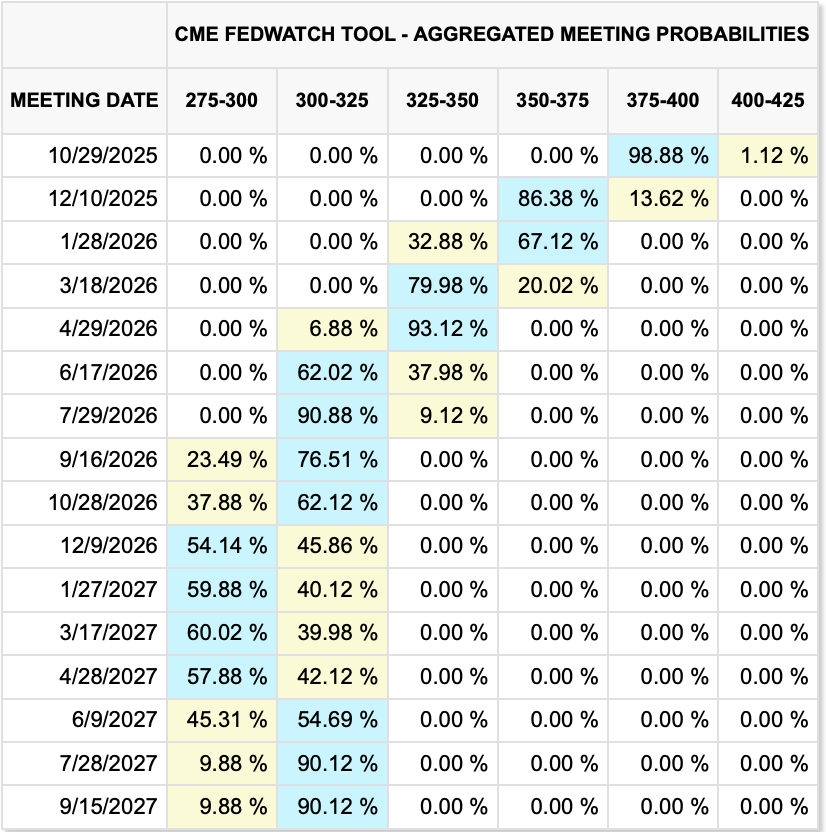
Clearly, the big story today is Chairman Powell’s speech with growing expectations that he will sound more hawkish than had previously been anticipated.  Recall, after the much weaker than expected NFP data was released at the beginning of the month, it appeared nearly certain that the Fed was going to cut at the next meeting with talk of 50bps making the rounds.  Now, a few hours before Powell steps to the podium, the futures market is pricing just a 71% probability of that rate cut with a just two cuts priced in for 2025 as per the CME’s own analysis below:

Arguably, this is one reason that equity markets have been having trouble moving higher as the Mag7 drivers of the market are amongst the longest duration assets around, so higher rates really hurt them.  While there has been a rotation into more defensive names, if opinions start to shift regarding the magnificence of AI, or perhaps just how much money they are spending on it and the potential benefits they will receive, things could get ugly.

I also find it interesting that the Fed whisperer, Nick Timiraos at the WSJ, has been running flack for Chairman Powell in this morning’s article, trying to get people to focus on the Fed’s framework as the basis of today’s speech, rather than policy per se.  Briefly, the current Fed framework, was designed right before COVID when for whatever reason they were concerned that low inflation was a problem, and they created Average Inflation Targeting (AIT) as a way to allow inflation to run above their target of 2.0% for a period if it had been below that level for too long.  We all know how well that worked out and, in fact, we are all still paying for their mistakes every day!  The word is they are going to scrap AIT although it is not clear what they will come up with next.  It is exercises like this that foment the ‘end the Fed’ calls from a growing group of monetarist economists and pundits.

At any rate, comments from other Fed speakers indicate that most are not yet ready to cut rates, so Powell will be able to have a significant impact if he turns more dovish.  But we have to wait a few more hours for that so let’s turn our attention elsewhere.

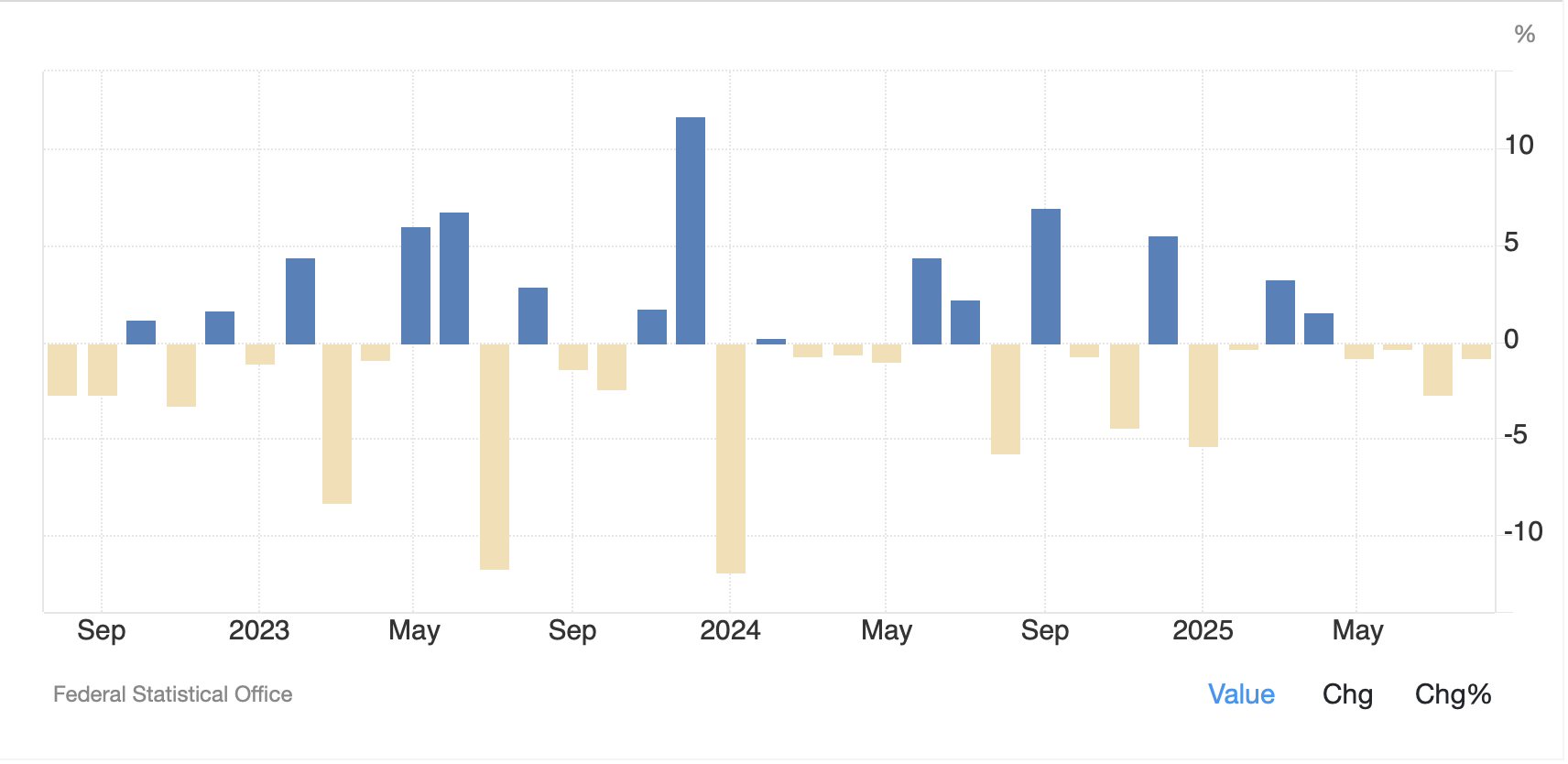
Germany GDP data (-0.3% Q/Q, +0.2% Y/Y) was a few ticks lower than expected and continues to point to an economy that has no positive momentum at all.  In fact, a look at the quarterly GDP data from Germany paints a pretty awful picture if growing your economy is the goal.

Source: tradingeconomics.com

Clearly, the US tariff changes have been quite negative, but in fairness, Germany’s insane energy policy is likely a much bigger driver of their problems as they have the most expensive power costs in the EU.  It is very difficult to have a manufacturing-based economy if you cannot power it cheaply.  Again, while the euro is more than just Germany, this does not bode well for the single currency.

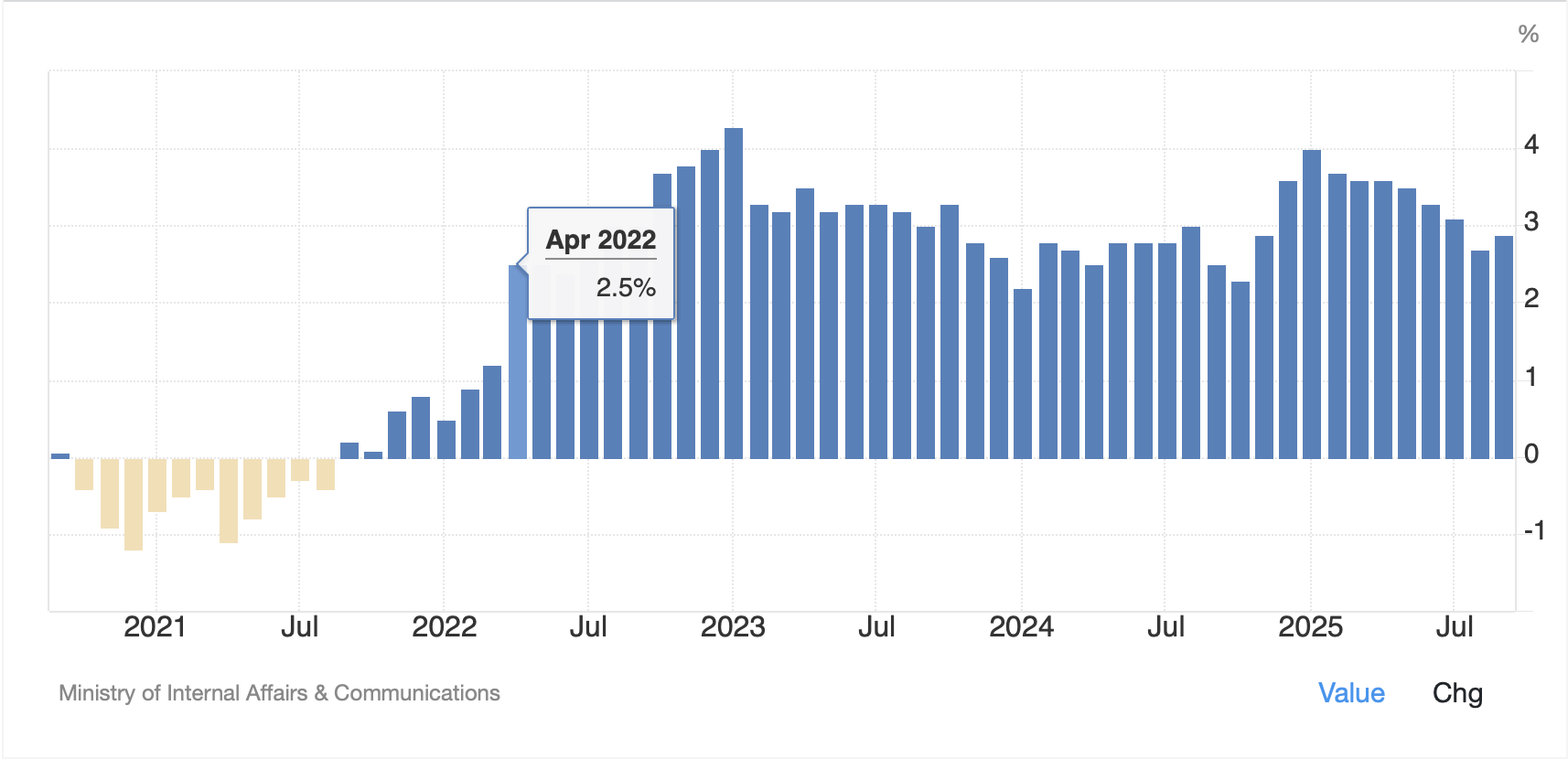
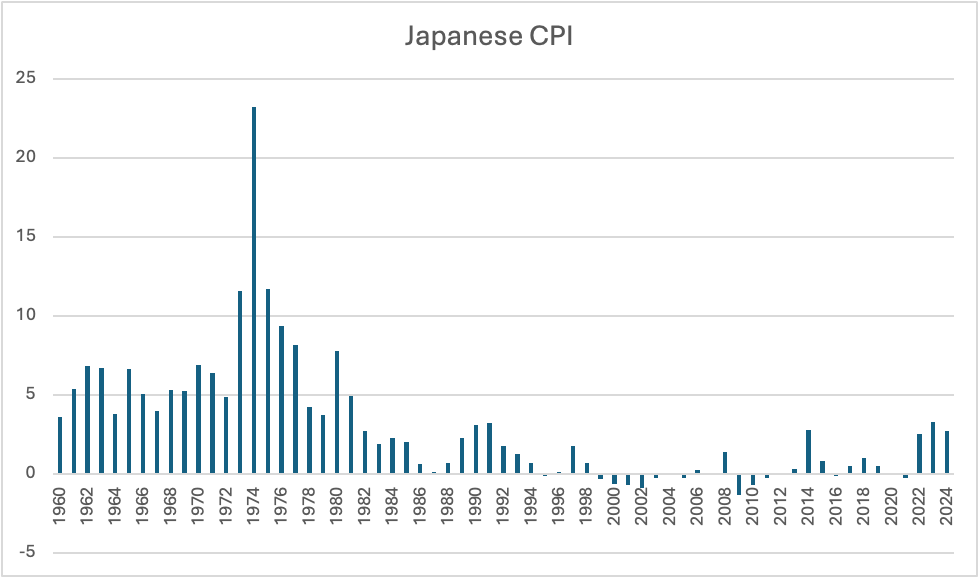
Turning to Japan, inflation continues to run far above their 2.0% target, printing last night at 3.1% on both the headline and core metrics, which while 2 ticks lower than June’s data, was still a tick higher than expected.  It has now been 40 consecutive months that core CPI in Japan has been above the BOJ’s 2.0% target and Ueda-san continues to twiddle his thumbs regarding raising rates.

Source: tradingeconomics.com

It is very hard to watch this lack of policy response to a clear problem, that from all I read is becoming a much bigger political issue for PM Ishiba, and have confidence that the yen is going to strengthen any time soon.  Back in May, the talk was of the unwinding of the carry trade.  All indications now are that it is being put back on in significant size.  FWIW I think we will see 150.00 before too long, especially if Powell sounds hawkish.

And those are really the stories today ahead of Powell and the NY open.  So, let’s see how things behaved overnight.  After a modest down day in the US yesterday, and despite the poor inflation data, Japan was unchanged overall.  However, China (+2.1%) had a huge up move apparently on the idea that US-China trade tensions are easing and despite continued weak data from the country.  Apparently, there has been a rotation from bonds to stocks by local investors driving the move.  Hong Kong (+0.9%) also had a strong session as did Korea (+1.0%) although India, Taiwan and Australia all struggled with declines between -0.6% and -1.0%.  In Europe, the. screens are green, but it is a pale green with muted gains (DAX +0.1%, CAC +0.25%, IBEX +0.4%) despite the weak German data.  Perhaps the belief is this will encourage the ECB to ease policy further.  Meanwhile, at this hour (7:15) US futures are pointing higher by 0.25% or so.

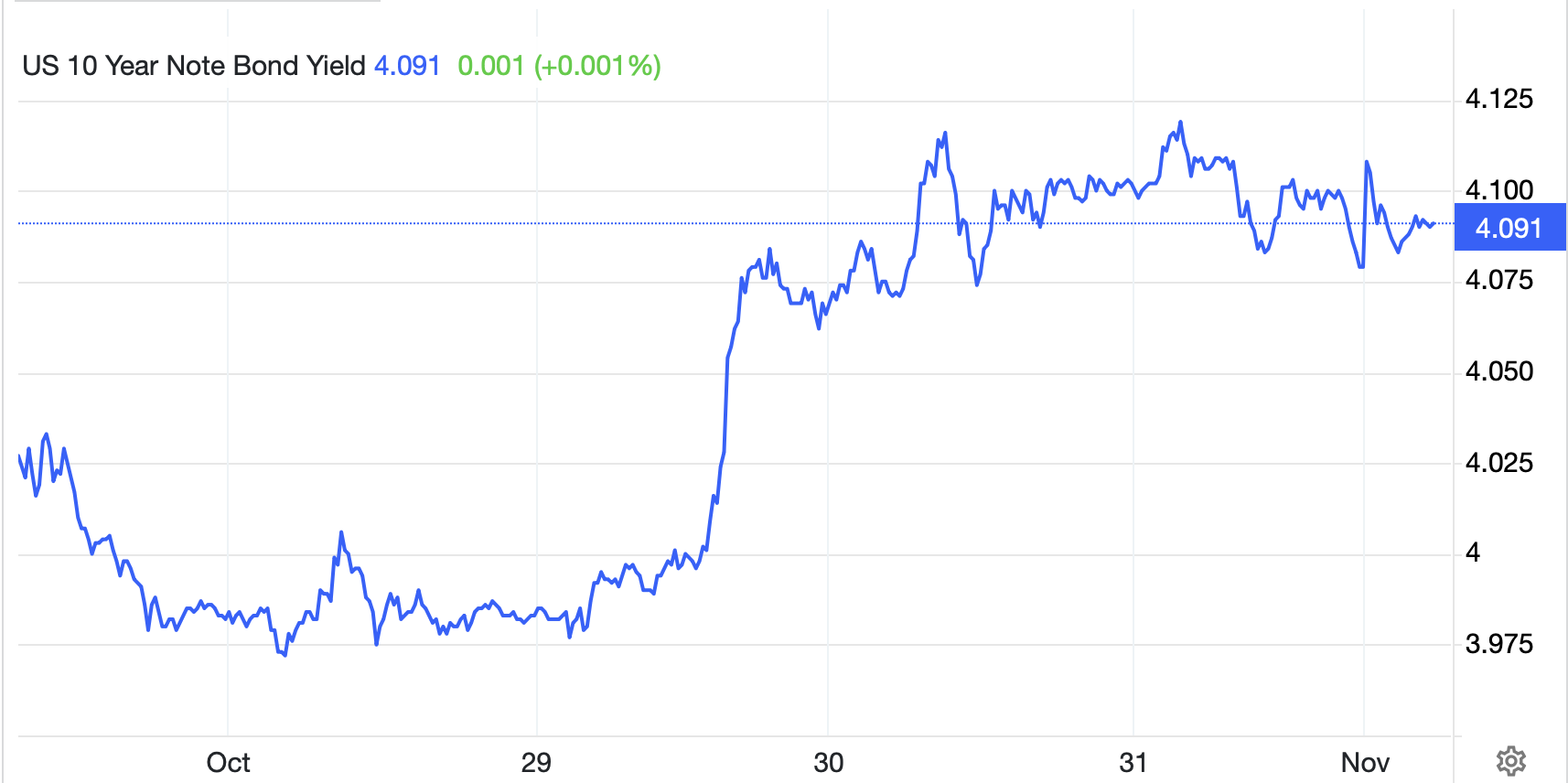
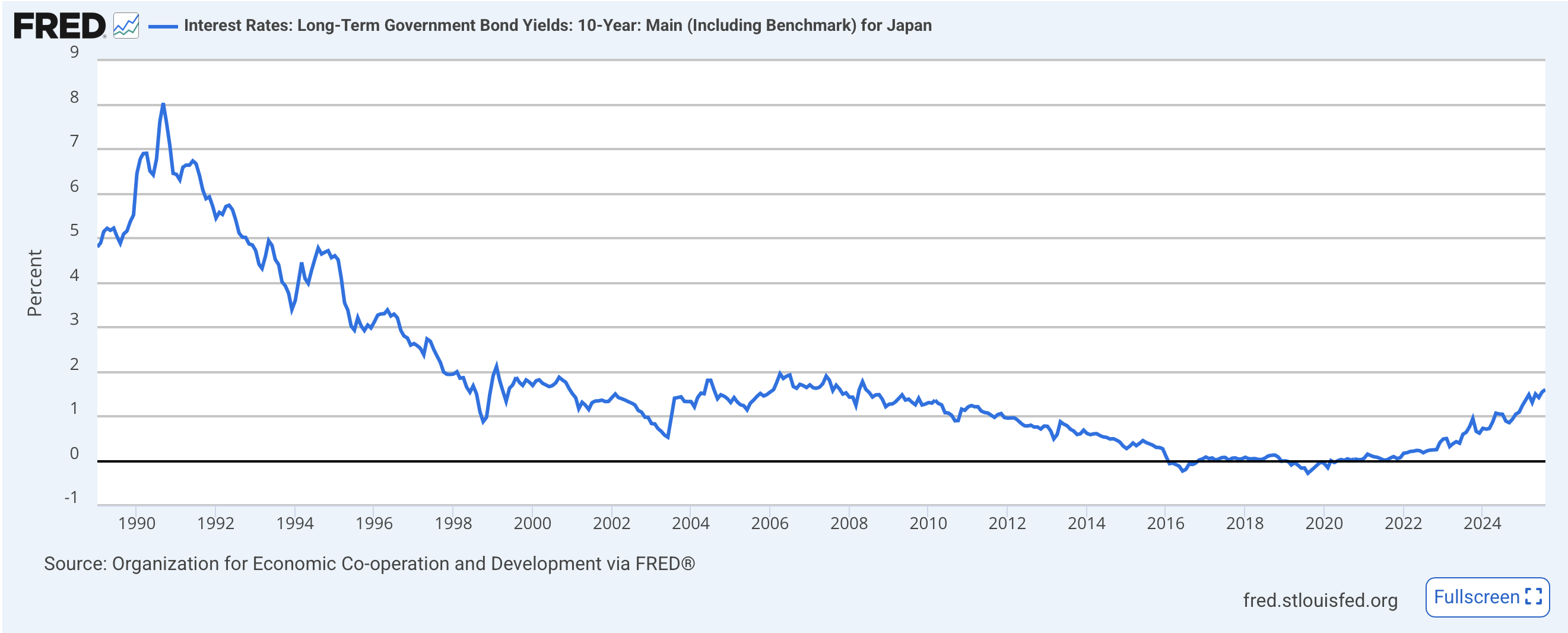
In the bond market, after climbing a few basis points yesterday, Treasury yields are unchanged, trading at 4.33%, so still range bound.  European sovereign yields are softer by -1bp to -2bps, again likely on the softer German data with hopes for a more aggressive ECB.  JGB yields edged higher by 1bp in the 10-year but the longer end of the curve there has seen yields move to new all-time highs with 30-year yields up to 3.216%. it feels like things are starting to unravel in Japanese bond markets.

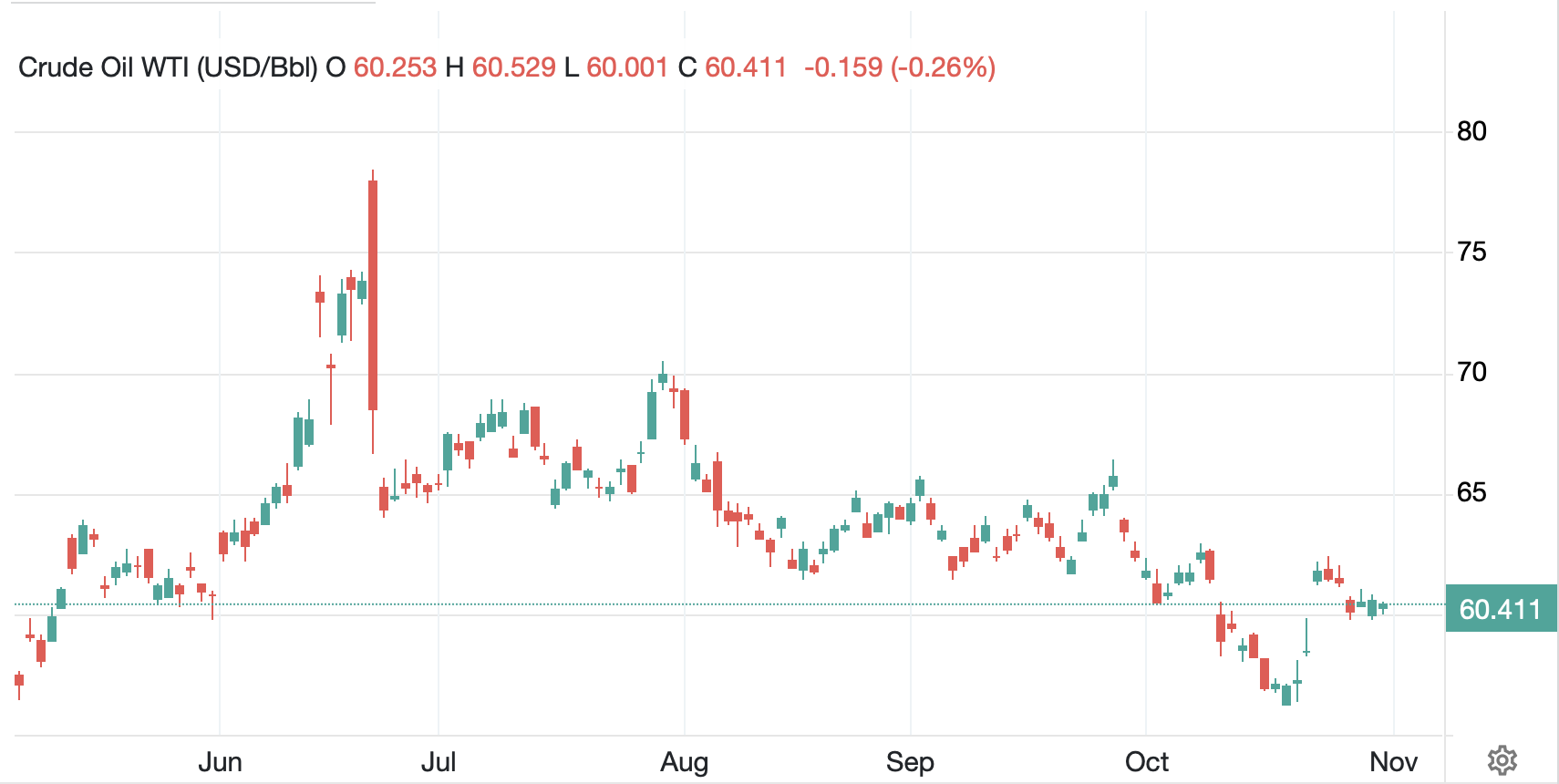
Turning to commodities, oil (+0.4%) is creeping higher again this morning but remains in its downtrend and activity is lacking.  Meanwhile, the metals markets (Au -0.35%, Ag -0.5%, Cu -0.3%) are all under pressure from a combination of a strong dollar and a lack of investor interest, at least in the West.

Speaking of the dollar, it rallied yesterday and is largely continuing this morning with one notable exception, KRW (+0.75%) which benefitted from trade data showing exports rose 7.6% in the first 20 days of the month on strong semiconductor sales.  But otherwise, +/-0.3% or less is the story of the day, with most currencies within 0.1% of yesterday’s closing levels.

And that’s really it.  There is no data so we are all awaiting Powell and then anything that may come from the White House regarding trade deals, or peace, I guess.  As the summer comes to a close, unless Powell says rate hikes are coming or promises cuts, I expect that traders will have gone for the weekend by lunch time and it will be a very quiet market.

Good luck and good weekend

Adf

A Final Bronx Cheer

Though markets are desperate for Jay
To cut, there is fear that he’ll say
It’s not yet the time
In this paradigm
As tariffs have caused disarray
 
But truly, Chair Jay’s greatest fear
Is that ere October this year
The Prez will have chosen
A new Chair and frozen
Him out with a final Bronx cheer


Yesterday saw the first substantial equity market move in nearly 3 weeks, with the NASDAQ declining 1.5% as concerns arose that the current extremely high valuations would have a more difficult time being maintained if the Fed does not ease policy as widely expected next month.  This resulted in all the Mag7 declining, which given they have been the driving force higher in the market, necessarily resulted in overall index declines.

Source: tradingeconomics.com

Of course, the question is, what made yesterday any different than previous sessions.  There were no earnings results of note, and arguably, the biggest tech news was the story about the US government taking a stake in Intel, something that seems likely to have been a positive.  However, there has been an increase in chatter about what Chair Powell is going to say on Friday at his Jackson Hole speech.  Notably, in the SOFR options market, there are a large, and still increasing, number of bets being placed that Powell will indicate 50bps is on the table in September.  But Wall St analysts continue to side with the patience crowd, explaining that while the current policy settings may be slightly restrictive, they are hardly suffocating for the economy.

While Powell has repeatedly blamed an uncertain impact of tariffs on his decision to maintain current policy settings, just like everything else, this is becoming extremely political.  Trump’s allies are lining up behind him and calling for immediate rate cuts to help support the economy.  At the same time, Trump’s political foes remain focused on preventing any Fed action that might help Trump, although they couch their arguments in terms of maintaining Fed ‘independence’.

However, last night was instructive in that two central banks, New Zealand and Indonesia, cut rates further while Sweden’s Riksbank, though standing pat, explained that more cuts are possible, if not likely, later this year.  While the PBOC did not cut rates, the pressure there is building as the economic situation is very clearly slowing down, as discussed last week after their data releases.  So, with most of the world cutting rates (Japan being the notable exception), pressure continues to mount on Powell and the Fed to pick up where they left off last December.

Hanging over both Powell’s speech and the September rate decision is the fact that Treasury Secretary Bessent explained yesterday that interviews for the next Fed chair would begin around Labor Day, just two weeks from now, and nearly eight months before Powell’s term ends.  This will almost certainly weaken Powell as other FOMC members and the market will look to whomever is selected for their views, with Powell serving out his term as a lame duck.  In fact, it is for this reason that my take is Powell’s speech at Jackson Hole will be less about policy and more an attempt to burnish his legacy.

And that’s where things stand.  With no data of note today, and yesterday’s housing data being mildly positive, but not enough to change macroeconomic opinions, the narrative writers are looking for something to say and Powell’s speech is where they have landed.  Absent a run of declining days, I put no stock in a change in the market temperature at this point.  So, let’s see how things behaved overnight.

In Asia, the Nikkei (-1.5%) had a rough night in a direct response to the US tech-led selloff.  Given that US markets have stabilized this morning, with futures unchanged at this hour (7:25), we need to see a continuation here before expecting a significant further decline there.  China (+1.1%), however, bucked that weaker trend, ostensibly on hopes that the ongoing trade talks with the US will prove fruitful.  Elsewhere in the region, Korea (-0.7%) and Taiwan (-3.0%) were both hit on the tech selloff blues but other markets, with less exposure to that sector were fine.  In Europe, it is a mixed picture with the DAX (-0.4%) the laggard after weaker than expected PPI indicated that current ECB policy needs to be more accommodative to help the country but may not be coming soon.  However, the rest of the continent is little changed.  surprisingly, UK stocks (+0.3%) are holding up well despite higher-than-expected CPI data which has adjusted analysts’ thoughts on whether the BOE will be able to cut again at their next meeting.

In the bond market, Treasury yields (-1bp) continue to trade in the middle of that band I showed yesterday, while European sovereign yields have also slipped between -1bp and -2bps this morning after the softer German price data.  The UK (-4bps) is a surprise as I would not have expected lower yields after a higher inflation reading.  Perhaps this is an indication that investors are expecting a much worse economic outcome from the UK going forward.

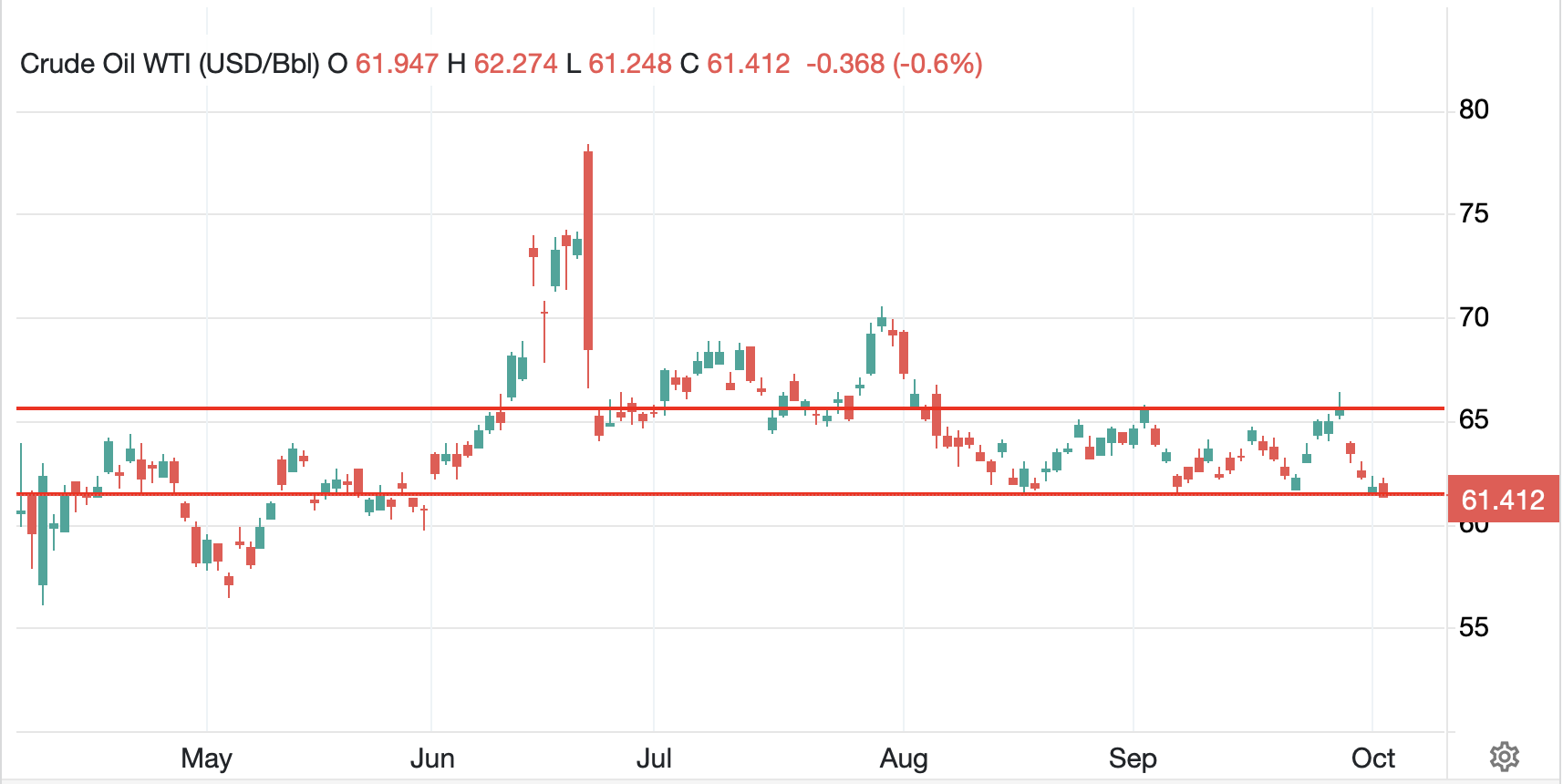
In the commodity markets, oil (+1.3%) is bouncing, but it remains in a well-defined downtrend for now as per the below chart.

Source: tradingeconomics.com

To change this trajectory, we will need to see something alter the production schedule, which with peace on the table in Ukraine seems likely to bring more oil to market not less, or we will need to see a significantly better economic outlook that drives a substantial increase in demand, something which right now seems unlikely as well.  I cannot get on board the higher oil price bandwagon at this time.  One other thing weighing on oil is the fact that NatGas has been trending lower for the past 6 months and is now at levels not seen since last November.  In fact, those two charts look remarkably similar!

Source: tradingeconomcis.com

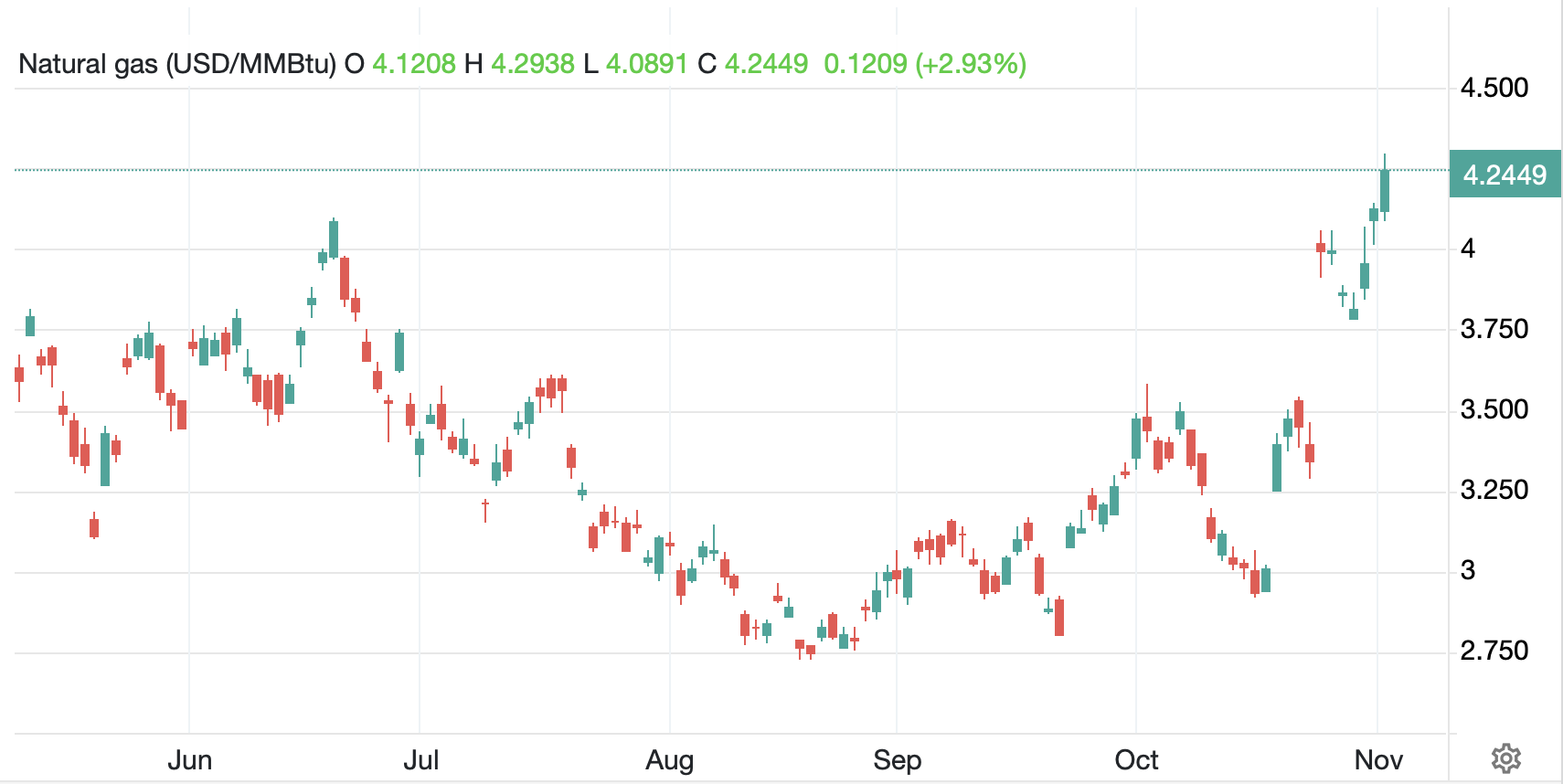
There is a real substitution effect here and currently oil is trading at a price that is about 4X the energy price of NatGas.  Until that arbitrage closes, and it will eventually, oil will have difficulty rallying in my view. 

In the metals markets, gold (+0.4%) which sold off a few dollars yesterday is rebounding although both silver and copper are soft this morning.  These markets are just not that interesting right now.

Finally, the dollar is little changed this morning with one real outlier, NZD (-1.2%) which responded to the dovish tones of the RBNZ last night and is pricing in more interest rate cuts now.  KRW (-0.4%) also fell on concerns over trade and the semiconductor results but otherwise, there is very little ongoing here.

The only data this morning is EIA oil inventories with a small draw anticipated.  The FOMC Minutes come at 2:00 and there will be a lot of digging to see if other members seemed to agree with Bowman and Waller in their dissents at the last meeting.  Bowman spoke yesterday, but was focused on her role as chief regulator, not monetary policy, although we hear from Waller this morning.

A down day in equities is not the end of the world despite much gnashing of teeth.  It remains difficult to get excited about markets right now.  Perhaps Mr Powell will shake things up on Friday, but my sense is we will need to wait for the next NFP data to get some action.

Good luck

Adf

PS. A reader explained to me that in Australia, black swans are the norm, not the remarkable case as here in the US.  I guess we will need to find a new term to discuss an unexpected surprise.

What Would You Choose?

As summer meanders along
No market is weak, nor’s it strong
But traders keep trading
With hope masquerading
As knowledge, though they know they’re wrong
 
The question is what sort of news
Can catalyze changes in views?
Seems rate cuts will not
And peace had its shot
Dear readers, just what would you choose?


My friend JJ (he writes the Market Vibes note) made a profound comment that described the current situation so well, I think it is worth repeating: 

It is not that the news and fundamentals are uninteresting or unimportant. They are. But vol control has anesthetized every future, ETF, equity, and FX market, and the managers of it are making trillions on it. Therefore, it is likely this narcolepsy won’t end for a while.”

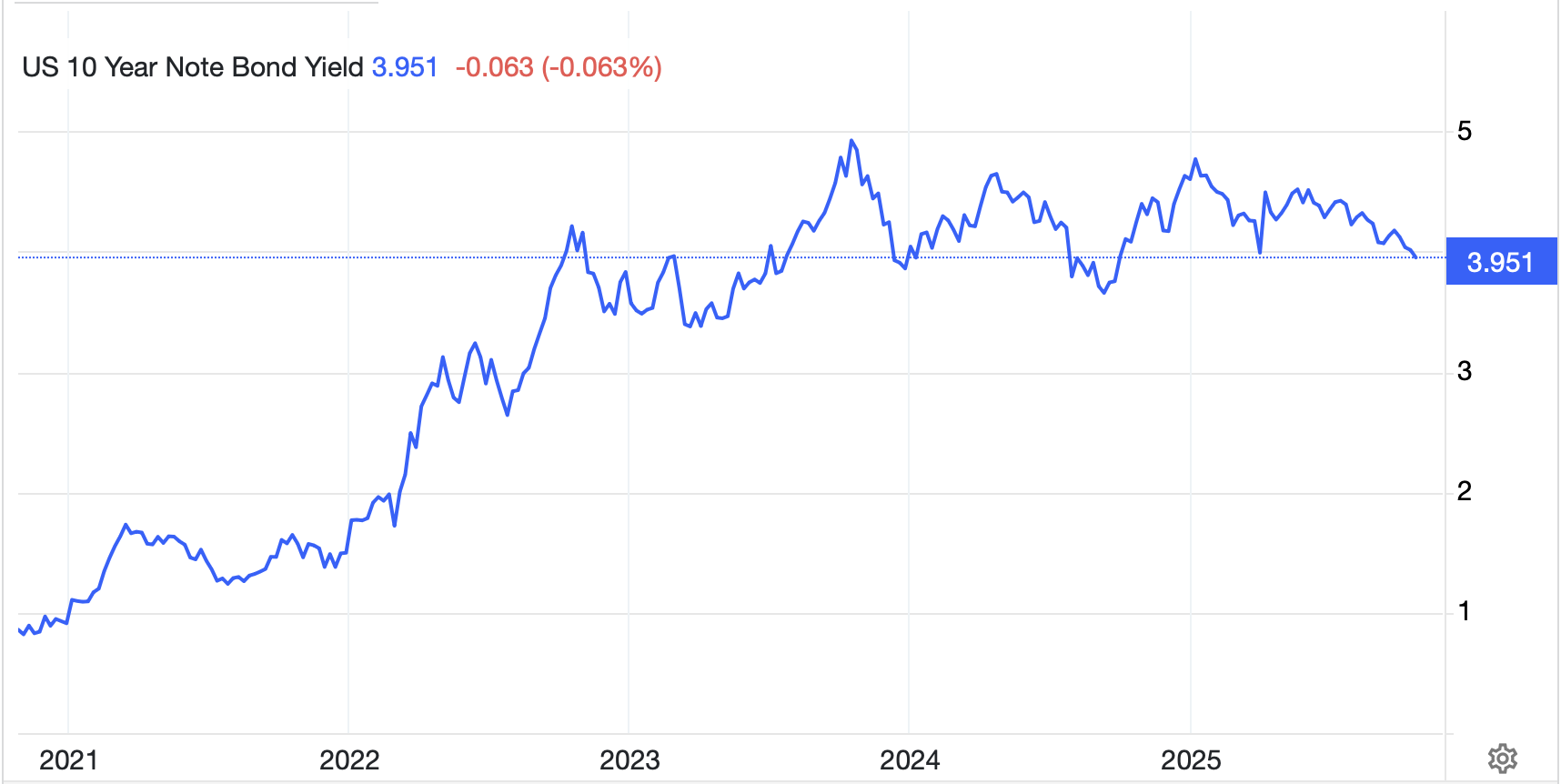
A point he has been making of late, and one with which I cannot argue, is that everything that is not algorithmic is dumb money as the algos drive it all.  And it is a fair point.  Market activity has ground to a halt, and while I have no proof, I would estimate it is even quieter than the typical year’s summer doldrums.  That seems remarkable given the panoply of news stories that exist and in other times would have had a major market impact.  Consider, war and peace in Ukraine, massive changes in federal regulations and administration priorities, and remarkable electoral shifts around the world, yet none of it matters.  Consider this chart of the US 10-year Treasury:

Source: tradingeconomics.com

The yield, which most afficionados agree is critical to not just US, but global, financial markets and activity, has largely traded between 4.0% and 4.5% since well before Mr Trump was elected.  The one thing that cannot be said is that the Trump administration has been boring.  More has happened on the fiscal front in the past six months than in entire presidential terms and yet yields are essentially unchanged since November 5th when Trump was elected.

JJ’s view is the massive increase in the use of options by retail traders has become the driving force.  Retail buys options, paying premium which decays away and that value accrues to the market making algorithms. The amounts of premium are huge, in the $trillions, and it is a straightforward business model that reaps huge rewards, so a lack of movement is the goal.  I cannot argue with that either.

However, the one thing I have learned over my too many years in the market is that no matter how smart you are, no matter how well you have considered the potential outcomes, reality will be different, and at some point, there will be a tipping point to change the market dynamic.  After all, Covid was not expected, nor even more importantly, the government responses to it which is what drove the market volatility.  I am pretty sure there is another true black swan out there, something nobody is discussing as it currently seems irrelevant or impossible, but which will alter the game.

I spent my trading career learning to manage risks while running a global FX options business, trying to profit, but more importantly preventing the huge drawdowns that end careers.  I spent my sales career trying to help my clients understand their FX risks and learn to mitigate them in the most cost-effective manner possible.  What I learned over that 40+ years is that while risks sometimes seem unimportant, or unimaginable, they exist.  Do not mistake the current state for the future state.  Things will change, although how I cannot currently imagine.

With that as preamble, let’s look at just how little things are moving.  Stocks did nothing in the US yesterday and movement overnight in Asia was lackluster as well (Nikkei -0.4%, Hang Seng -0.2%, CSI 300 -0.4%).  As I wrote above, there is just not that much that is exciting investors right now.  Europe, however, seems to be taking a positive stance on the Oval Office meeting with many of their leaders as perhaps peace in Ukraine, if it is coming, will be helpful for the continent.  Ostensibly, Presidents Trump and Putin discussed a closer economic relationship between the US and Russia, which if that came to pass, would undoubtedly rearrange some things in markets, largely to the benefit of Europe.  As to US futures, they are unchanged this morning, again.

Bond markets in Europe are exactly unchanged across the board, so much so that you would expect it was a holiday there.  Treasury yields have edged lower by -1bp, but as I explained above, are simply range trading.

I would argue the commodity markets are where there is the most potential for movement going forward as any type of US-Russian economic détente would almost certainly reduce oil prices substantially.  And, coincidentally, WTI (-1.25%) is falling this morning as hopes for a direct meeting between Putin and Zelensky, and with it the end of the war, are increasing.  Weirdly, gold (+0.35%) is not declining on that news, despite the idea that gold represents a haven against war.  Perhaps gold represents a haven against money supply growth, which if there is an economic détente, you can be sure will increase.  As to the other metals, very little movement there either.  In the vein of the lack of activity, perhaps the below gold chart is even a better descriptor of just how little activity has been going on since spring.

Source: tradingeconomics.com

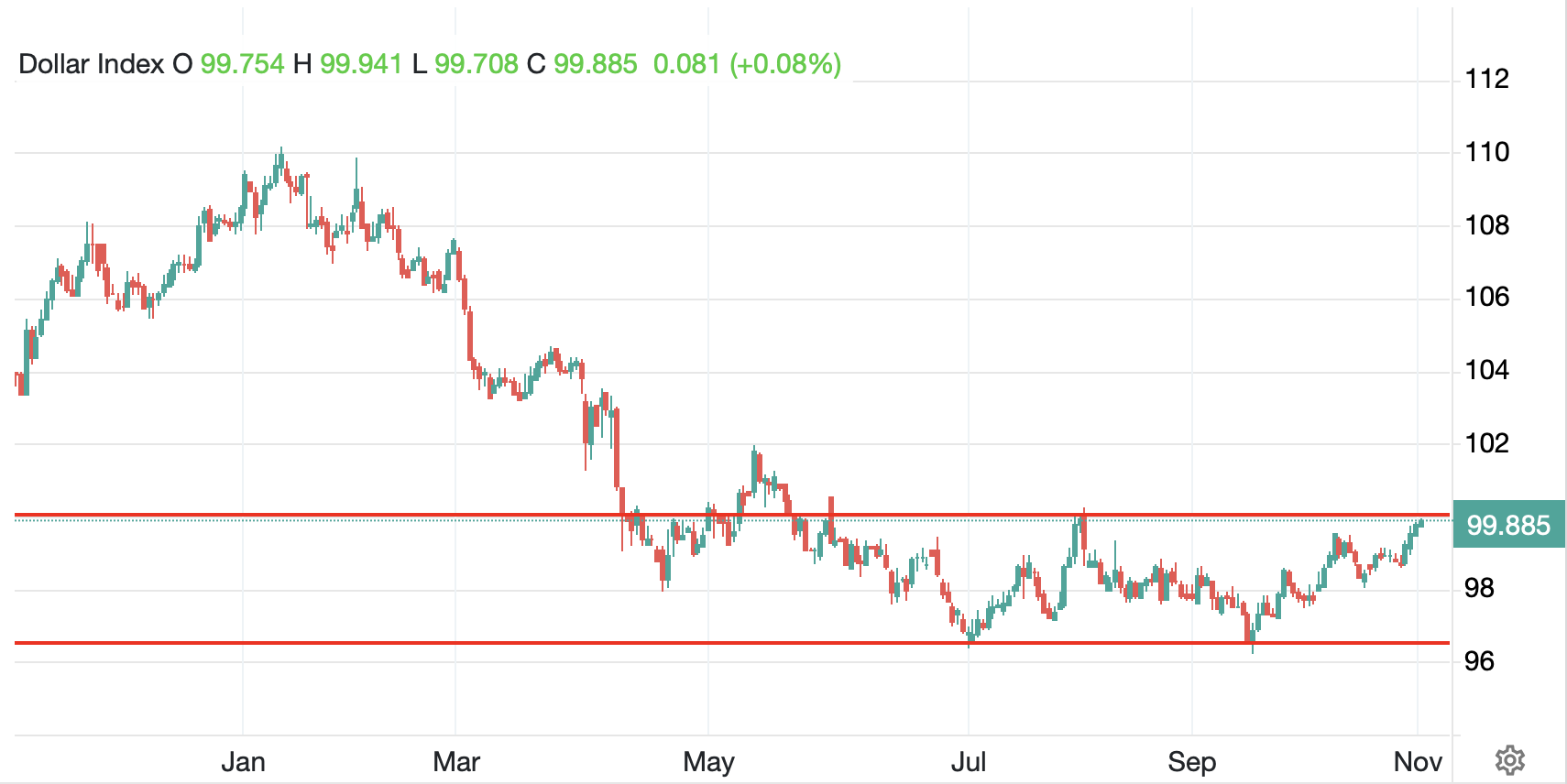
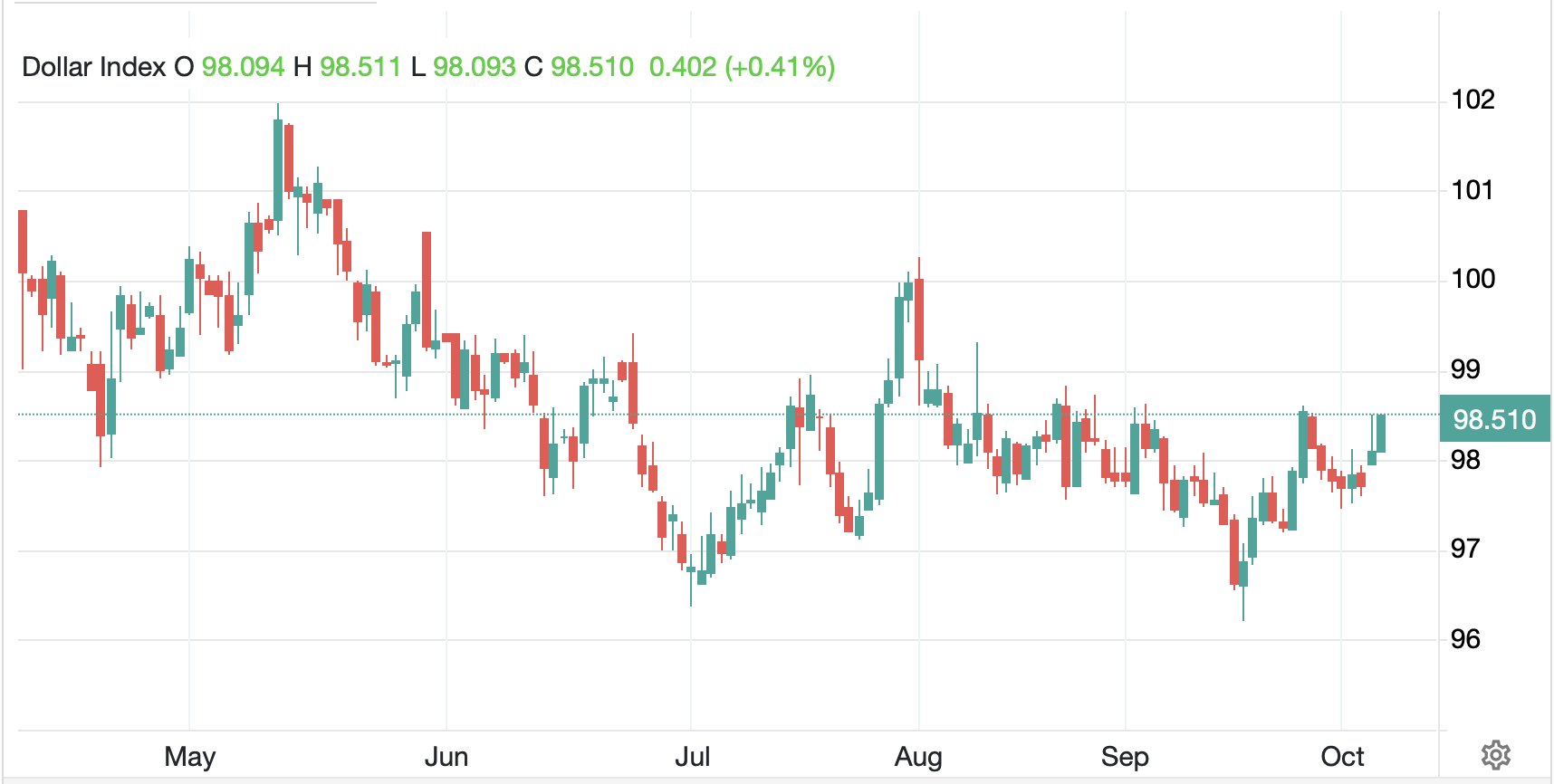
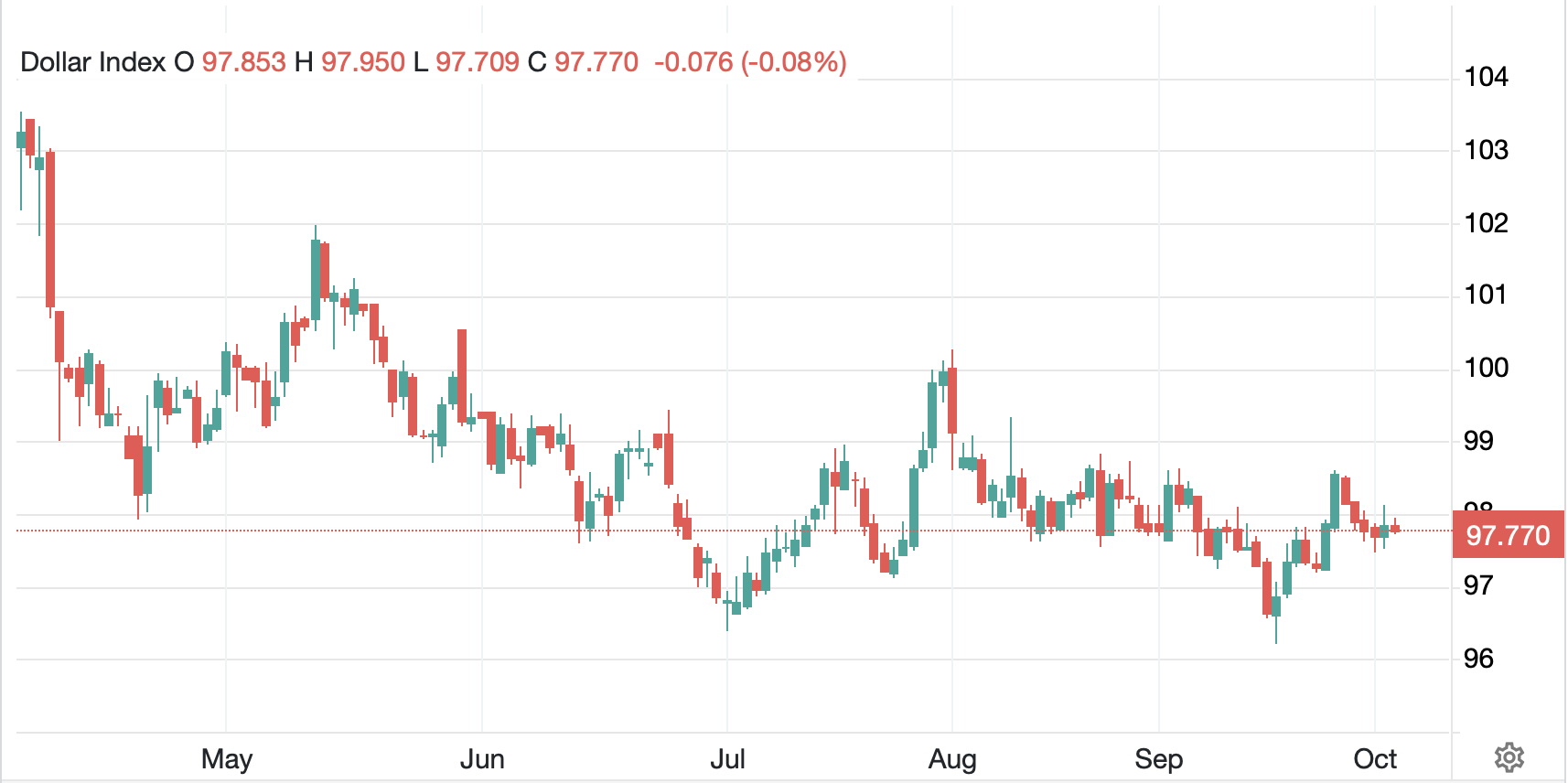
Finally, the dollar is a touch softer this morning, but it, too, remains rangebound.  While much has been made of its weakness in the first half of the year, as though that calendar period had some special significance (it doesn’t), here too, things have simply ground to a halt.  Using the dollar index (DXY) as our proxy, you can see that this market, too, has done nothing for months.

Source: tradingeconomics.com

Whether it’s G10 or EMG currencies, the movement remains desultory at best, and catatonic may be a better description.

So, let’s look at the data this week that will precede Chairman Powell’s speech Friday morning.

TodayHousing Starts1.30M
 Building Permits1.39M
WednesdayFOMC Minutes 
ThursdayInitial Claims226K
 Continuing Claims1960K
 Philly Fed6.0
 Flash Manufacturing PMI49.5
 Flash Services PMI53.7
 Existing Home Sales3.91M
 Leading Indicators-0.1%
FridayPowell Speech 

Source: tradingeconomics.com

I think it is worthwhile to consider why we look at the Leading Indicators.  The original design was that it tracked a series of indicators that historically had presaged economic activity.  Ahead of recessions, these indicators turned lower and so it seemed a pretty good fit.  However, as you can see from the below chart from conference-board.org, the creators of the index, since 2021, when the index turned lower, it has been completely out of sync with the economy’s outcome.

As I have repeatedly written, models that were created pre-Covid, and many pre-GFC, simply no longer have any relevance to today’s reality.

On the whole, the most likely outcome today, like every day lately, is limited movement in either direction.  While I am sure a black swan exists, he is currently hibernating.

Good luck

Adf

Falling Like Rain

Trump’s meeting with Putin went well
At least that’s the best we can tell
Now, later this week
Zelenskiy will speak
With Vlad, and say you go to hell
 
So, will peace be found in Ukraine?
Or will fighting grow once again
If looking for clues
One thing we might choose
Is oil that’s falling like rain


The aftermath of the Trump-Putin meeting on Friday has certainly been interesting.  While the administration, as would be expected, highlighted any and all positives as the president pushes for an uncomfortable peace process, the administration’s opponents, which include not merely the Democratic party, but most of Europe as well, are concerned he has just sold Ukraine down the river.  I am not nearly smart enough to have an informed opinion on this issue, which is likely the case for almost every commentator as well, but I know I come down on the side of anything that moves the conversation toward an end to the war and a lasting peace, even if the terms aren’t the ones either side would like, is a step in the right direction.

But this is not a political commentary, rather we are trying to understand market behavior and remain highly cognizant of global events on markets.  With that in mind, arguably the market most directly impacted by this war is oil and based on what we have seen over the past month, during which time the peace process accelerated, the participants in the oil market appear to be saying that Russian oil is coming back to the market on an unfettered basis.  One need only look at the chart below, which shows a very clear downtrend to understand.

Source: tradingeconomics.com

Certainly, some of this price decline may be attributed to the belief that the long-awaited recession in the US is upon us, although given that has been a view for nearly three years, it is not clear to me why this month is the moment.  I understand that the payroll data was weak, but I also understand that Retail Sales data on Friday was pretty strong.  The observation that the goods and services sectors of the economy are out of sync remains appropriate, I believe.  As long as that remains the case, a significant downturn seems unlikely, but so too does a significant growth spurt.  In fact, this is one of the reasons I take the decline in the price of oil to be a harbinger of an end to the Ukraine war.  

Come Friday, we’ll hear Chairman Jay
As he tries, his views, to convey
No doubt he’ll explain
Inflation’s a bane
And that’s why, rate cuts, he’ll delay
 
But also, employment is key
And so, he will want us to see
His minions are willing
To cut, if distilling
The data less growth they foresee

Arguably, the other big market story this week is the speech that we will hear Friday morning from Chairman Powell at the Jackson Hole Symposium.  Many in the market continue to look to Powell and the Fed for their guidance although my take is the Fed’s impact on market’s has been waning over time as fiscal dominance continues apace.  Nonetheless, it is still a key moment for the market as those who have been anticipating a Fed cut in September, as well as at least two more before the end of the year, will want confirmation that the weak payroll data was the trigger.  And while some of the Fed speakers since the NFP data have started to move toward a more dovish stance, I would contend the majority is still on the patience bandwagon.  

With that in mind, a look at the Fed funds futures markets shows that although the probability being priced in for a cut next month has fallen from its peak level, it remains extremely high at 85% with a 78% probability of two cuts by December and a third cut now likely by March.

Source: cmegroup.com

Remember, the reason this is so closely watched is the strong belief that when the Fed cuts rates, equity prices rise.  However, one need only look at a chart to note that frequently, equity markets are falling sharply when the Fed is cutting Fed funds.  That makes sense because given the reactive nature of Fed funds and the Fed in general, it is typically responding to weakness that is already evident in equity prices.  Which begs the question, why does everyone want the Fed to cut if it implies a weak economy and already declining stock prices?

Many measures continue to show equity valuations quite high, and there have been numerous calls that a correction in equity markets around the world is due.  I understand that view and have even bought put protection as it is pretty cheap to do so.  But I have given up on calling for a recession.  I can only be wrong for so long before I accept the evidence that one has not yet come, nor is obviously imminent.

Ok, let’s look at markets this morning.  While there was a late selloff in the US on Friday, Asian markets saw the world as a brighter place.  Perhaps they were encouraged by the Alaska meeting, or perhaps by the view that the Fed will cut, because there was no data there of which to note.  But the Nikkei (+0.8%), CSI 300 (+0.9%) and Australia (+0.25%) all managed gains although the Hang Seng (-0.4%) slipped a bit.  There was, however, a major laggard with Korea’s KOSPI (-1.5%) suffering on the back of concerns over potential new tariffs on Korean chips.  European equities, though, are on a bit shakier footing.  Perhaps it is the concern that despite their collective voice on Ukraine, they remain largely irrelevant.  Or perhaps it is the realization that the trade surpluses they have run in the past are set to decline as evidenced by the data showing Spain’s deficit growing to -€3.59B increasing more than €1B and the Eurozone’s surplus shrinking to €7B, down from €16.5B last month.  So, declines of -0.4% to -0.8% are today’s results in major markets there.  As to the US, futures are little changed at this hour (8:00).

In the bond market, yields have been edging lower this morning with Treasury yields (-2bps) slipping despite the stronger Retail Sales and PPI data from last week, while European sovereign yields are all lower by -3bps, perhaps anticipating slower growth overall.

In the commodities space, oil (+0.5%) has bounced from its overnight lows but remains in its downtrend.  Gold (+0.3%) continues to hover at its pivot point of $3350 or so while silver (+0.15%) and copper (-0.4%) are mixed this morning.  Away from the tariff story on copper, it remains an important economic indicator, so we must watch it closely.

Finally, the dollar is ever so slightly firmer this morning with the euro (-0.25%) leading the G10 slide although both Aussie and Kiwi are slightly firmer this morning.  In the EMG bloc, MXN (-0.4%) is the laggard along with HUF (-0.4%) and CZK (-0.4%) although the rest of the bloc, while mostly softer, hasn’t moved that far.  It does feel like a dollar story.

On the data front, as I am running late and there is nothing as important as Friday’s Powell speech, I will list it tomorrow.  Overall, my take is peace is nearer than further and that should adjust spending from fighting to rebuilding but spending it will be.  I expect to hear more about recession going forward, although it is not yet clear to me one is upon us.  While the dollar’s trend remains lower, I have a feeling we are at the end of that move so beware.

Good luck

Adf

Seek the Abyss

As so often has been the case
The market is in Trump’s embrace
Will he make a deal
And sell it with zeal
Or will Putin spit in his face
 
Because of the focus on this
Though PPI data did miss
Most markets held tight
With highs still in sight
As naysayers seek the abyss


Based on the fact that equity markets in the US were all essentially unchanged yesterday, I think it is reasonable to assume that investors are waiting to see the outcome of today’s Trump-Putin meeting in Alaska.  I have no opinion on how things will work out, although I am certainly rooting for a result that includes a ceasefire and the next steps toward a lasting peace.  From a direct market perspective, arguably oil (-0.75% this morning) is the one place where the outcome will have an impact.  Any type of deal that results in the promised end to sanctions on Russian oil seem likely to push prices lower.  In this vein, we continue to see the IEA and EIA reduce their demand forecasts (although some of this is because they keep expecting BEVs to replace ICE engines and that is not happening at the pace they would like to see). However, away from oil, I expect that this will be much more important to overall sentiment than anything else.

But sentiment matters a lot.  As does the attention span of traders, which as we already know, approximates the life of a fruit fly.  For instance, yesterday’s PPI data was unambiguously hotter than expected, with both headline and core monthly jumps of 0.9%.  Surprisingly for many economists, it was not goods prices that rose so much, but rather the price of services.  For the narrative, it is much harder to blame service price hikes on tariffs, than goods price hikes, but not to worry, economists are working hard to make that case.  As well, the near universal claim is that CPI is going to rise much more quickly going forward as evidenced by this rise in PPI.  A quick look at the chart below of annualized PPI shows that we are starting to rise above levels last seen in 2018, but if you recall, CPI then was very low, sub 2.0%. The relationship between the two, CPI and PPI, is not as strong as you might expect.

The contra argument here is that corporations, which were able to raise prices rapidly during the pandemic response are finding it more difficult to do so now.  We have discussed several times how corporate profit margins remain extremely high relative to history and what we may be seeing is the beginnings of those margins starting to compress as companies absorb more of the costs, be they tariffs or labor.  I also couldn’t help but notice the article in the WSJ this morning working to explain why tariffs haven’t boosted inflation as much as many economists expected.  Their answer at least according to this research, is that the many exemptions have resulted in tariffs being collected on only about half of imports, which despite all the headlines touting tariffs are now, on average, somewhere near 18%, makes the effective rate below 10%, higher than in the past, but not devastatingly so.  And remember, imports represent about 14% of GDP.  Let’s do that math.  If half of imports are excluded and the average tariff is more like 9%, we’re looking at 60 basis points of price increases, of which corporates are absorbing a great deal.  

One other thing in the article was how it highlighted the exact result that President Trump is seeking when explaining that more companies are searching for alternative sources of goods in the US.

The tariffs, are however, impacting other nations with China last night reporting a much weaker batch of data as per the below:

                                                                                                              Actual          Previous            Forecast

The property market there continues to drag on the economy, but government efforts to prop up consumption seem to be failing and clearly tariffs are impacting IP as less orders from the US result in less production.  Arguably, though, President Xi’s greatest worry is the rise in Unemployment as the one thing he REALLY doesn’t want is a lot of unemployed young males as that is what foments a revolution.  The interesting thing about the market response here is that while the Hang Seng (-1.0%) fell sharply, the CSI 300 (+0.7%) rallied, seemingly on hopes of additional stimulus being necessary and implemented.  One other thing to note about Chinese markets is that yesterday, 40-year Chinese government yields fell below 30-year Japanese yields for the first time ever, a sign that expectations of future Chinese activity are waning.  With this in mind, even though the renminbi has been gradually appreciating this year (even if we ignore the April Liberation Day spike), the Chinese playbook remains mercantilist at its heart.  I would look for a weaker CNY going forward, although the overnight move was just -0.1%.

Source: tradingeconomics.com

Ok, let’s look at the rest of markets ahead of the Alaska summit and today’s data.  Tokyo (+1.7%) had a strong session as GDP data from Japan was stronger than expected allaying worries that the tariffs would crush the economy there and bringing rate hikes back onto the table.  Australia (+0.7%), too, had a good session on solid corporate and bank earnings but the rest of the region was pretty nondescript with marginal moves in both directions.  In Europe, gains are the order of the day on the continent (DAX +0.3%, CAC 0.65%, IBEX +0.35%, FTSE MIB +1.1%) as hopes for a formalized trade deal being finalized grow.  However, UK stocks are unchanged on the session as investors here seem to be biding their time ahead of the Trump-Putin summit.  US futures are higher led by DJIA (+0.7%) although that appears to be on news that Berkshire Hathaway has taken a stake in United Health after the stock’s recent beatdown.

In the bond markets, Treasury yields are unchanged this morning although they reversed course yesterday, closing higher by 5bps rather than the -3bp opening, pre-PPI, levels.  But that rebound in yields has been seen throughout Europe where sovereigns on the continent are higher by between 3bps and 4bps and JGB yields (+2bps) rose overnight after the stronger than expected GDP data.

Away from oil, metals markets are doing very little this morning as it appears much of the activity has to do with option expirations in the ETFs SLV and GLD, so price action is likely to be choppy, but not instructive.

Finally, the dollar is softer this morning despite the higher Treasury yields.  One of the interesting things is that despite the hotter PPI data, the probability for a September cut, while falling from a chance of 50bps, to a 92.6% probability of a 25bp cut, is still pricing in an almost certain cut.  Remember, we are still a month away from that meeting and we have Jackson Hole in between as well as another NFP and CPI report so lots of potential drivers to change views.  And there is still a lot of talk of a 50bp cut, although for the life of me, I don’t understand the economic rationale there.  But softer the dollar is, falling against all its G10 brethren, on the order of 0.25% or so, and most EMG counterparts, with many having gained 0.4% or so.  But this is a dollar story today.

On the data front, ahead of the summit, which I believe starts at 2:30pm Eastern time, we see Retail Sales (exp 0.5%, 0.3% -ex autos, 0.4% Control Group) and Empire State Mfg (0.0) at 8:30, as well as IP (0.0%), Capacity Utilization (77.5%) at 9:15 and then Michigan Sentiment (62.0) at 10:00.  Retail Sales should matter most as a strong number there will encourage the equity bulls while a weak number will surely bring out the naysayers.  I still have a bad feeling about markets here, but that is my gut, not based on the data right now.  As to the dollar, there are still huge short positions out there and if rate cuts become further priced in, it can certainly decline further.

Good luck and good weekend

Adf

Crab Bisque

Though troubles worldwide haven’t ceased
Investors continue to feast
On assets with risk
As if they’re crab bisque
And appetites all have increased
 
Perhaps they believe peace is near
Or maybe they’re just cavalier
‘Cause Bitcoin has rallied
And profits they’ve tallied
Convinced them they’ll have a great year


This poet is a bit confused this morning as I watch ongoing record high equity markets in the US and elsewhere indicate a bright future, but I continue to read about the problems around the world, specifically in Ukraine and Gaza, but also throughout Africa, as well as the apparent end of democracy in the US.  Though it is showing my age, I recall during the Reagan presidency, equity markets performed well amid a sense that the world was going in the right direction.  The Cold War ended and Fed Chair Volcker had shown he had what it took to fight inflation effectively.  This combination was very effective at brightening one’s outlook on the future.

Then, leading up to the dotcom bubble, attitudes were also remarkably positive as the future held so many possibilities while peace had largely broken out around the world.  Again, the rally albeit overdone, at least had a basis that combined financial hopes with a positive geopolitical background.  Of course, the events of 9/11 put the kibosh on that for quite a while.

Leading up to the GFC, though, I would contend that the zeitgeist was a bit different, and while housing markets were on fire, the geopolitical picture was far less rosy with Russia reasserting itself and taking its first piece of Ukraine, the Middle East situation much dicier with the ongoing military action in Iraq and Afghanistan, and China beginning to flex its muscles in the South China Sea.

Of course, the similarity to these times is they all ended with significant equity market declines and resets of attitudes, at least for a while as per the below chart of the S&P 500.  Of course, given the exponential move over time, the early dips don’t seem so large today, although I assure you, on October 19, 1987, when the DJIA fell 22.6%, it seemed pretty consequential on the trading desk.

Source: finance.yahoo.com

But today, I find the disconnect between market behavior and global happenings far harder to understand. Yes, there is a prospect that Presidents Trump and Putin will agree a ceasefire tomorrow when they meet in Alaska, although I’m not holding my breath for that.  At the same time, President Trump is doing his best to reorder the global economic framework, and doing a pretty good job of it, but causing significant dislocations around the world with respect to trade and finance.  Too, through all the other bubbles, consumer price inflation was not a concern of note, with CPI remaining quiescent throughout until the Covid response as per the below and, as Tuesday’s core CPI reminded us, inflation remains a specter behind all our activities.

And yet, all-time highs are the norm in markets these days, whether US equities, Japanese equities, European equities, Bitcoin or gold, prices for financial assets remain in the uppermost percentiles of their historic ranges.  Perhaps this is the YOLO view of life, or perhaps markets are telling us the technology futurists are correct, and AI will bring so much benefit to mankind that everything will be better.  Or…maybe this is simply the latest bubble in financial markets, and that permanently high plateau for asset values, as Irving Fisher explained in October 1929, is once more a mirage.  Is the value of Nvidia, at $4.466 trillion, really greater than the economic output of every nation on earth other than the US, China and Germany?  It is a comparison of this nature that has me concerned over the short- and medium-term prospects, I must admit.

However, the valuations are what they are regardless of any logic or financial comparisons.  If the Fed cuts 50bps in September, which as of now would be a huge surprise to markets based on pricing, would that really increase the value of these companies by that much?  Perhaps, as frequently has been the case, Shakespeare was correct and “something is rotten in the state of Denmark.”  Care must be taken with regard to owning risk assets I believe, as a correction of some magnitude seems a viable outcome by the end of the year.  At least to my eyes.  Just not today.

Today, this is what we’ve seen in the wake of yesterday’s ongoing US equity rally.  Tokyo (-1.45%) slipped on what certainly looked like profit-taking after reaching new highs.  China was little changed but Hong Kong (-0.4%) fell ahead of concerns over Chinese data due this evening and the idea it may not be as strong as forecast.  As to the rest of the region, the larger exchanges, Korea and India, were little changed and the smaller ones were mixed, all +/- 0.5%.  In Europe, gains are the order of the day, at least on the continent (DAX +0.5%, CAC +0.35%, IBEX +0.8%) although the FTSE 100 (0.0%) is struggling after mixed data showing stronger than expected GDP but much weaker than expected Business Investment boding ill for the future.  As to US futures, they are little changed at this hour (7:30).

In the bond markets, Treasury yields (-3bps) continue to grind lower as comments from Treasury Secretary Bessent have encouraged investors that interest rates will be declining across the curve.  Teffifyingly, there is a story that President Trump is considering Janet Yellen as the next Fed Chair, something I sincerely hope is a hoax.  European sovereign yields are lower by -1bp across the board but JGB yields (+3bps) are rising after Bessent basically said in an interview that the Japanese needed to raise rates to support the yen!

In commodities, oil (+0.4%) is stabilizing after several days of modest declines, but the trend of late remains lower.  If peace breaks out in Ukraine, I suspect the price will have further to fall as the next step will be the reduction or ending of sanctions on Russian oil.  Meanwhile, the metals markets are little changed to slightly softer this morning after a modest rally yesterday as a stronger dollar and a general lack of interest are evident.

As to that dollar, only the yen (+0.4%) is bucking the trend of a stronger dollar today although the pound is unchanged after the data dump there.  But the rest of the G10 is weaker by between -0.2% and -0.4% which is also a pretty good description of the EMG bloc, softer by those amounts.  It’s funny, once again this morning I read some comments about how the dollar’s decline in the first half of this year, where it has fallen about -10%, is the largest since the 1970’s, as though the timing within the calendar is an important part of the dollar’s value.  While I would guess that Bessent is conflicted to some extent, I believe the administration is perfectly happy with a decline in the dollar if it helps US export competitiveness as long as inflation remains under control.  Of course, that is the $64 thousand (trillion?) dollar question.

On the data front, this morning brings the weekly Initial (exp 228K) and Continuing (1960K) Claims as well as PPI (Headline 0.2%, 2.5% Y/Y and Core 0.2%, 2.9% Y/Y).  I always find that there is less interest in PPI when it is released after CPI, but a surprise, especially a hot surprise, could well impact some views.  Once again, we hear from Richmond Fed president Barkin, although so far all he has told us is he is the quintessential two-handed economist, so I’m not expecting anything new here.

Personally, I am getting uncomfortable with equity market valuations and levels based on the rest of the things ongoing and sense a correction in the offing.  As to the dollar, I suspect if I am correct, the dollar will benefit alongside bonds.  Otherwise, the summer doldrums seem likely to describe the day.

Good luck

Adf

Lest ‘Flation Has Spice

The market absorbed CPI
And equities started to fly
Though Core prices rose
T’was Headline, I s’pose
Encouraged investors to buy
 
As well, Fed funds futures now price
The Fed will cut rates this year thrice
The upshot’s the buck
Is down on its luck
Beware though, lest ‘flation has spice


Core prices rose a bit more than forecast in yesterday’s CPI report although the headline numbers were a touch softer.  The problem for the Fed, if they are truly concerned about the rate of inflation, is that the strength of the numbers came from core services less shelter, so-called Supercore, a number unimpeded by tariffs, and one that has begun to rise again.  As The Inflation Guy™ makes clear in his analysis yesterday, it is very difficult to look at the data and determine that 2% inflation is coming anytime soon.  I know the market is now virtually certain the Fed is going to cut in September, but despite President Trump’s constant hectoring, I must admit the case for doing so seems unpersuasive to me.

Here are the latest aggregated probabilities from the CME and before you say anything, I recognize the third cut is priced in January, but you need to allow me a little poetic license!

However, since I am just a poet and neither institutions nor algorithms listen to my views, the reality on the ground was that the lower headline CPI number appeared to be the driver yesterday and into today with equities around the world rallying in anticipation of Fed cuts.  As well, the dollar is under more severe pressure this morning on the same basis.  However, it remains difficult for me to look at the situation in nations around the world and conclude that the US economy is going to underperform in any meaningful way over time.  

So, to the extent that a currency’s relative value is based on long-term economic fundamentals, it is difficult to accept that the dollar’s relative fiat value will decline substantially, and permanently, over time.  I use the euro as a proxy for the dollar, which is far better than the DXY in my opinion as the Dollar Index is a geometric average of 6 currencies (EUR, JPY, GBP, CAD, SEK and CHF) with the euro representing 57.6% of the basket.  And I assure you that in the FX markets, nobody pays any attention to the DXY.  Either the euro or the yen is seen as the proxy for the “dollar” and its relative value.  At any rate, if we look at a long-term chart of the euro below, we see that the twenty-year average is above the current value which pundits want to explain as a weak dollar.  Too, understand that back in 1999, when the euro made its debut, it started trading at about 1.17 or so, remarkably right where it is now!

Source: finance.yahoo.com

My point is that the dollar remains the anchor of the global financial system, and given the current trends regarding both economic activity and the likely ensuing central bank policies, as well as the ongoing performance of US assets on a financial basis, while short-term negativity on the dollar can be fine, I would be wary of expecting it to lose its overall place in the world.

Speaking of short-term views, especially regarding central bank activities, it appears clear that the market is adjusting the dollar’s value on this new idea of the Fed cutting more aggressively.  If that is, in fact, what occurs, I accept the dollar can decline relative to other currencies, but I really would be concerned about its value relative to things like commodities.  And that has been my view all along, if the Fed does cut rates, gold is going to be the big beneficiary.

Ok, let’s review how markets have absorbed the US data, as well as other data, overnight.  Yesterday’s record high closings on US exchanges were followed by strength in Tokyo (+1.3%), Hong Kong (+2.6%), China (+0.8%) despite the weakest domestic lending numbers in the history of the series back to 2005.  In fact, other than Australia (-0.6%) every market in Asia rallied.  The Australian story was driven by bank valuations which some feel are getting extreme despite the RBA promising further rate cuts, or perhaps because of that and the pressure it will put on their margins.  Europe, too, is rocking this morning with gains across the board led by Spain (+1.1%) although both Germany (+0.9%) and France (+0.6%) are doing fine.  And yes, US futures are still rising from their highs with gains on the order of 0.3% at this hour (7:45).

In the bond market, Treasury yields have slipped -3bps this morning, with investors and traders fully buying into the lower rate idea.  European sovereigns are also rallying with yields declining between -4bps and -5bps at this hour.  JGBs are the exception with yields there edging higher by 2bps, though sitting right at their recent “home” of 1.50%.  as you can see from the chart below, 1.50% appears to be the market’s true comfort level.

Source: tradingeconomics.com

In the commodity space, oil (-0.6%) continues to slide as hopes for an end to the Russia-Ukraine war rise ahead of the big Trump-Putin meeting on Friday in Alaska.  Nothing has changed my view that the trend here remains lower for the time being as there is plenty of supply to support any increased demand.

Source: tradingeconomics.com

Metals, meanwhile, are all firmer this morning with copper (+2.6%) leading the way although both gold (+0.4%) and silver (+1.7%) are responding to the dollar’s decline on the day.

Speaking of the dollar more broadly, its decline is pretty consistent today, sliding between -0.2% and -0.4% vs. almost all its counterparts, both G10 and EMG.  This is clearly a session where the dollar is the driver, not any particular story elsewhere.

On the data front, there is no primary data coming out although we will see the weekly EIA oil inventory numbers later this morning with analysts looking for a modest drawdown.  We hear from three Fed speakers, Bostic, Goolsbee and Barkin, with the latter explaining yesterday that basically, he has no idea what is going on and no strong views about cutting or leaving rates on hold.  If you ever wanted to read some weasel words from someone who has an important role and doesn’t know what to do, the following quote is perfect: “We may well see pressure on inflation, and we may also see pressure on unemployment, but the balance between the two is still unclear.  As the visibility continues to improve, we are well positioned to adjust our policy stance as needed.”  

And that’s all there is today.  The dollar has few friends this morning and I see no reason for any to materialize today.  But longer term, I do not believe a dollar weakening trend can last.

Good luck

Adf
Widely Decried

While tariffs are widely decried
By analysts, they are worldwide
But Trump’s latest scheme
To some, seems extreme
As license fees are codified
 
So, tech names, who’ve, taxes, deflected
Are now likely to be subjected
To payment of fees
To sell overseas
And revenues will be collected


One thing you can never say about President Trump is that he lacks innovative ideas.  Consider one of the biggest complaints over the past decades regarding US corporations; the fact that the tech companies (and drug companies) have been so effective at avoiding paying taxes based on the way they have gamed utilized the tax code and international treaties.  And this was not a partisan complaint as both sides of the aisle were constantly frustrated by large companies’ ability to not pay their “fair share” as it is often described.

It appears that President Trump has come up with a solution for this, charging a licensing fee for companies to sell overseas.  The big news over the weekend was that Nvidia and AMD are both going to pay a licensing fee of 15% of REVENUE on sales of chips to China.  In the case of Nvidia, that is anticipated to be some $2.5 billion with somewhat smaller numbers for AMD.  This is an excellent description of the process by @Kobeissiletter on X. 

I have often expressed the view that corporate taxation, if we are going to have it, ought not be on profits but on revenue.  Corporations are expert at reducing taxable income, maintaining a staff of lawyers and accountants to do just that.  But gaming top line revenues is much harder.  This gambit by President Trump is moving things in that direction.  And remarkably, given these license fees are for exports, it ought to be outside the consumer price chain in the US completely.

There is an article in the WSJ this morning titled, “The US Marches Toward State Capitalism With American Characteristics,” which outlines, and mildly complains, about the changes in the way the US government is dealing with the private sector under President Trump.  It discusses the purchase of 15% of MP Materials, the only US based miner/processor of rare earth minerals, and it discusses these license fees all under the guise of implying this is a bad direction.  And I completely understand that idea as governments tend to be terrible stewards of capital.  However, 25 years of Chinese unfettered access to Western markets while they have skirted the rules codified by the WTO have resulted in some significant national security challenges that can no longer be ignored.  Full marks to President Trump for creative methods to address these challenges, despite the wailing and teeth gnashing of economists.

But other than that story, as well as the ongoing back and forth regarding potential peace talks in the Russia-Ukraine war, not all that much has happened overnight.  For a change, markets are behaving like it is the summer doldrums, so perhaps we should be thankful for the respite.  As such, let’s take a look at how things have done and what we can anticipate this week with CPI and Retail Sales set to be released.

Friday’s US equity rally combined with the news that Nvidia and AMD will be able to export some chips to China saw modest gains there (+0.4%) and in Hong Kong (+0.2%) even though another major property company in China, China South City Holdings Ltd., is being forced into liquidation.  The property situation in China will continue to weigh on the economy there and given property investment was long seen as most Chinese families’ retirement nest egg, will undermine consumption for years.  Elsewhere in the region, there were more gainers (India, Indonesia, Malaysia, Australia, New Zealand, Taiwan) than laggards (Thailand, Philippines) with Japan closed for Mountain Day, a relatively new holiday, and other markets little changed.  

In Europe, though, screens are modestly red with losses on the order of -0.35% across the CAC, DAX and IBEX amid general uncertainties regarding the future economic direction and a lack of earnings positives.  At this hour (7:00), US futures are slightly higher, by 0.2%.

In the bond market, after last week’s auctions have been absorbed, Treasury yields have edged lower this morning, down -2bps, despite Fed funds futures’ probability of that September rate cut slipping to 88% from Friday’s 93%.  In fact, Fed Governor Bowman reiterated over the weekend that she would be voting for a cut at each of the three meetings left this year.  European sovereigns though are little changed, with some having seen yields edge higher by 1bp, as this appears to be a truly lackluster summer day.

Commodities are the only market that is seeing any movement of note, and it is not oil (+0.2%) which has been trading either side of unchanged since last night.  Rather, gold (-1.2%) is suffering this morning as you can see on the chart below as the promise of a potential peace in Ukraine seems to be removing some need for its haven status.  Of course, the thing to really note about the gold market is just how choppy trading has been as conflicting narratives continue to impinge on price movement.

Source: tradingeconomics.com

This decline has pulled down both silver (-1.4%) and copper (-0.95%) with all this happening despite virtually no movement in the FX markets.

Turning to the dollar, one is hard pressed to find any substantial movement in either G10 or EMG currencies. The true outlier this morning is NOK (+0.4%) but otherwise, +/- 0.1% or less is the best description of the price action.  This is what a summer market really looks like!

On the data front, we do get some important information as follows:

TuesdayRBA Rate Decision3.60% (current 3.85%)
 CPI0.2% (2.8% Y/Y)
 Ex food & energy0.3% (3.0% Y/Y)
 Monthly Budget Statement-$140B
ThursdayPPI0.2% (2.5% Y/Y)
 Ex food & energy0.2% (2.9% Y/Y)
 Initial Claims226K
 Continuing Claims1960K
FridayRetail Sales0.5%
 Ex Autos0.3%
 IP0.0%
 Capacity Utilization77.6%
 Michigan Sentiment62.0

Source: tradingeconomics.com

With all the hoopla about the firing of Ms McEnterfar at BLS, you can be sure that there will be lots of discussion on the CPI data regardless of the outcome.  However, as the Inflation Guy pointed out last week, imputing the bottom 30% of items in the basket, which represent something on the order of 2.5% of the total price impact, is likely to have no impact whatsoever.  We also hear from a bunch of Fed speakers, four to be exact, although Richmond Fed President Barkin will regale us twice.  Now that there are more calls for a September cut, it will be interesting to see who remains patient and who is ready to move.

And that’s all there is today.  It is hard to get excited about too much movement given the lack of obvious catalysts.  Of course, one never knows what will emanate from the White House but look for a quiet one, I think.

Good luck

Adf
You Need to Squint

While data continues to print
It doesn’t give much of a hint
To where things are going
Unless you’re all-knowing
And even then, you need to squint
 
The reason for this situation
Is passive flows constant inflation
No matter the news
Or anyone’s views
The target funds need their proration


The hardest thing about macroeconomic analysis is trying to discern whether it has any impact on market movement.  For the bulk of my career, my observation was that while there were always periods when flows dominated fundamentals, they were short-lived periods and eventually those fundamentals returned to dominance in price action.  This was true in equity markets, where earnings were the long-term driver, outlasting short-term bouts or particular manias and this was true in FX markets, where economic performance and the ensuing interest rate differentials were the key long-term driver of exchange rates.  Bond markets were virtually always a reflection of inflation expectations, at least government bond markets and commodities were simple products of supply and demand of the physical stuff.

Alas, since the GFC, and more importantly, the global central bank response to the GFC, flooding financial markets with massive amounts of liquidity, G10 economies have become increasingly finanicialized to the point where the underlying fundamentals have less and less impact and funds flows are the driving force.  The below chart I have created from FRED data shows the ratio of M2 relative to GDP.  For decades, this ratio hovered between 53% and 60%, chopping back and forth with the ebbs and flows of the economy during recessions and expansions.  But the GFC changed things dramatically and then the pandemic and its ensuing response put financialization on steroids.

By 2011, this ratio hit 60% for the first time since 1965, and it has never looked back.  The result is that there is ever more money sloshing around the economy looking for a home with the best return.  This is part and parcel as to why we have seen both massive asset price inflation as well as consumer price inflation, too much money chasing too few goods.  And this is the underlying facet in why funds flows, whether between asset classes or between nations, are the new driving force of market price action.  Michael Green (@profplum99 on X) has done the most, and most impressive, work on the rise of passive investing, which is a direct consequence of this financialization.  The upshot is, as long as money comes into the system (your semi-monthly 401K flows are the largest) they continue to buy stocks regardless of anything fundamental.  And as almost all of it is capitalization weighted, they buy the Mag7 and maybe some other bits and bobs.  It doesn’t matter about fundamentals; it only matters how much they have to buy.

So, with that caveat as to why fundamental macro analysis has been doing so poorly lately, a look at the data tells us…nothing really.  As I wrote yesterday, the two main blocs of the economy, goods production and services production, are out of sync, with marginal strength in services outweighing marginal weakness in goods production and resulting in slow growth.  Whether you look at the employment situation, the ISM data or the inflation data, none of it points in a consistent and strong direction.

For instance, yesterday’s productivity and Labor cost data were better than expected, far better than last quarter’s and pointing to an improved growth outcome.  However, if we look at the past five years of this data, we can see that labor costs have grown dramatically faster than productivity as per the below chart (ULC in grey, Productivity in blue).

Source: tradingeconomics.com

Looking at this, it is no surprise that price inflation has risen so much, given labor’s impact on prices.  But, again, this is merely another impact of the massive flow of money into the economy over the past 15 years. 

Virtually every piece of data we get has been significantly impacted by this financialization which is one reason that previous econometric models, built prior to the GFC, no longer offer effective analysis.  The system is very different.  I continue to believe that over time, fundamentals will reassert themselves, but that belief structure is under increased pressure.  Perhaps YOLO and BTFD are the future, at least until our AI overlords come into their own and enslave the human population.

In the meantime, let’s look at what happened overnight.  Yesterday’s mixed, and relatively dull, US session was followed by a mixed session in Asia with Tokyo (+1.85%) soaring on news that there were going to be adjustments, in Japan’s favor as well as rebates, to the tariff schedule.  However, both the Hang Seng (-0.9%) and CSI 300 (-0.3%) saw no such love from either the Trump administration or investors.  As to the rest of the region, red (Korea, Australia, India, Thailand, Singapore) was more common than green (Malaysia).  Apparently, tariff adjustments are not universal.  In Europe, both Spain (+0.8%) and Italy (+0.8%) are having solid sessions but they are alone in that with the other major bourses (DAX 0.0%, FTSE 100 0.0%, CAC +0.2%) not taking part in the fun.  US futures, at this hour (7:30) are higher by about 0.4%.

Bond markets, meanwhile, are sleeping through the final day of the week, with Treasury yields unchanged on the day and European sovereign yields having edged higher by just 1bp across the board.  It seems, nobody cares right now.  After all, it is August and most of Europe is on vacation anyway.

Commodity markets are showing oil (+0.6%) bouncing off its recent lows, but this seems more about trading activity than fundamental changes.  Perhaps there will be a Russia-Ukraine peace, but it is certainly not clear.  Trump’s tariffs on India for continuing to buy Russian oil are also having an impact, but as I showed yesterday, I believe the trend remains modestly lower.  Gold (-0.3%) is currently lower but has been extremely choppy as you can see from the 5-minute chart below

Source: tradingeconomics.com

This is a market where supply and demand dynamics have been impacted by both tariffs and the interplay between financialized markets (i.e. paper gold or futures) and the actual metal.  There are many theories as to different players trying to manipulate the price either higher (the Trump administration in order to revalue Ft Knox holdings) or lower (the ‘cabal’ of banks that have ostensibly been preventing the price from rising according to the gold bug conspiracy theorists).  Recently, there has apparently been less central bank demand, but that can return at any time based on political decisions.  I continue to believe that it is an important part of any portfolio, but it should be tucked away and forgotten in that vein.  As to the other metals, they are little changed this morning.

Finally, the dollar is stronger this morning, as the euro (-0.3%) and yen (-0.65%) are both under pressure and leading the way.  In fact, virtually every G10 currency is weaker (CAD is unchanged) and yet the DXY seems to be weaker as well. Something is amiss there.  Meanwhile, EMG currencies are mostly down on the session with KRW (-0.5%) the laggard, but weakness in INR (-0.2%), PLN (-0.25%) and CZK (-0.25%). 

On the data front, there is none today.  Yesterday, Atlanta Fed president Bostic explained his view that only one rate cut was likely this year, which is not what we have been hearing from other FOMC members.  Obviously, there is still uncertainty at the Fed, but they also have more than a month to decide.  Today, we hear from KC Fed president Alberto Musalem, one of the more hawkish members, so it will be interesting to see if he has changed his tune.

I would contend that confusion is the driving force in markets because data markers are not pointing in one direction nor are Fed speakers.  But it is a Friday in August so I suspect it will be a quieter day as traders look to escape to the beach for the weekend.  This morning’s trends, a higher dollar and higher stock prices, seem likely to prevail for the day.

Good luck and good weekend

Adf

A Bevy of Doves
The Fed has a bevy of doves
Whose world view was given some shoves
When Trump was elected
As they were subjected
To boxing, though without the gloves
 
But suddenly, they’ve found their voice
And rate cuts are now a real choice
So, bad news is good
And traders all should
Buy stocks every day and rejoice


Apparently, the signal has been given from on high at the Marriner Eccles building that discussing rate cuts is permitted.  Patience is no longer the virtue it was just last week.  In the past two days, three different FOMC members, Daly, Cook and Goolsbee, have returned to form and are quite open to cutting rates sooner after the recent employment data.  I would contend that rate cuts are their natural stance, but they were discouraged from expressing that view because it would put them in sync with the president, something that they very clearly have worked to avoid.  Regardless of the history, the Fed funds futures market is now pricing in a 93.2% probability of a cut next month as you can see below.  Perhaps more interesting is the fact this probability has risen from 37.7% in just the past week.  My how quickly things can change.

Source: cmegroup.com

I’m sure you recall that one of the key reasons Chairman Powell and his acolytes described the need to remain patient was the potential impact of tariffs on inflation.  This was even though the universal view was tariffs, a new tax, would be a one-off price increase, so would have no long-term impact, and that higher interest rates would do nothing to fight this particular cause of inflation, just like the price of food doesn’t respond to interest rates.  However, I want to highlight a piece from the WSJ this morning that asks a very good question, why wasn’t Powell concerned about all the tax increases from the previous administration, or for that matter, the tax increase that would have occurred had the BBB not been enacted.  Again, all the discussion that the Fed is apolitical is simply not true and never has been.

Moving on, I wanted to follow up on yesterday’s discussion as I, along with many market observers, have been trying to come to grips with the inconsistency in the data.  Some is strong, other parts are weak, and it is difficult to arrive at a broad conclusion.  My good friend, the Inflation_Guy™ put out a podcast the other day and made an excellent point, historically, there was a synchronicity between activity in the goods sector and the services sector, so when things in either sector started to decline (or rise) it took the other sector along with it.  But that is not currently the case.  

Instead, what we have seen is asynchronous behavior with the correlation between prices in the two sectors essentially independent of each other over the past five years, rather than tracking each other as they had done for the previous 30 years.  Extending the price action to overall activity, which seems a reasonable concept as prices follow the activity, depending on the data you observe, you may see strength or weakness, rather than everything heading in the same direction.  However, it is worthwhile to remember that systems in nature eventually do synchronize (see this fantastic clip) and so eventually, I suspect that both sectors will do so and a full blown recession (or expansion) will materialize.  Just not this week!

Which takes us to markets and how they have been responding to all the tariff news.  I think you can make one of the following two arguments regarding equity investors; either they have absorbed the tariff information and ensuing changes in trade behavior and have decided that earnings will continue to grow apace, or, they have no idea that there is a cliff ahead and like the lemmings they are, they are rushing toward the abyss.  Perhaps it is simply that President Trump has discussed tariffs so much that they have become the norm in any analysis thought process, and so modest adjustments don’t matter.  But whatever the reason, we continue to see strength pretty much across the board here.

The rally in the US yesterday was followed by strength across almost all of Asia with gains in Tokyo (+0.7%) and Hong Kong (+0.7%) as well as Korea, India and almost all regional bourses.  China, however, was unchanged on the session after their trade balance rose a less than expected $98.2B, as imports rose more than expected.  However, as this X post makes clear, it should be no surprise given the renminbi’s real exchange rate continues to fall, hence their exports remain quite competitive, tariffs or not.  As to Europe, strength is the word here as well (DAX +1.5%, CAC +1.2%, IBEX +0.5%) although the FTSE 100 (-0.5%) is lagging ahead of this morning’s expected BOE rate cut.  And don’t worry, US futures are higher across the board as well.

In the bond market, yields have been edging higher with Treasury yields up 2bps after yesterday’s 10-year auction was not as well received as had been hoped, but then, yields were 25 basis points lower than just a week ago, so demand was a little bit tepid.  European sovereign yields are also edging higher, mostly higher by 1bp and we saw the same thing overnight in JGBs, a 2bp rise.

In the commodity markets, oil (+0.6%) has found a short-term bottom, but is just below $65/bbl, which seems like a trading pivot of late as can be seen by the chart below from tradingeconomics.com.  As my personal bias is that the price is likely to decline going forward, the 6-month trend line heading down does appeal to me, but for now, choppy is the future.

Meanwhile, metals markets are in fine fettle this morning (Au +0.4%, Ag +1.4%, Cu +0.15%) as the dollar’s recent weakness seems to be having the expected effect on this segment of the market.

Speaking of the dollar, as more tariffs get agreed, I am confused by its weakness since I was assured that the response to higher US tariffs would be a stronger dollar.  But arguably, the fact that the Fed is suddenly appearing much more dovish is the driver right now, and while the euro is little changed this morning, we are seeing the pound (+0.4%), Aussie (+0.3%) and Kiwi (+0.4%) all move up, although the rest of the G10 space is higher by scant basis points.  In the EMG bloc, movement, while mostly higher in these currencies, is also measured in mere basis points, with INR (+0.25%) the largest mover by far.  Arguably, it is fair to say the dollar is little changed.

On the data front, the BOE did cut rates 25bps as expected, although the vote was 5/4, a bit more hawkish than forecast which is arguably why the pound is holding up so well.  US data brings Initial (exp 221K) and Continuing (1950K) Claims as well as Nonfarm Productivity (2.0%) and Unit Labor Costs (1.5%).  This is a much better mix of this data than what we saw in Q1 with productivity falling -1.5% while ULC rose 6.6%.  That was a stagflationary outcome.  In addition, we hear from two more Fed speakers, Bostic and Musalem, as the Fed gets back in gear this week.  It will be interesting to see if they are more dovish as neither would be considered a dove ex ante.

Apparently, we are back on board the bad news is good for stocks train, and it is hard to fight absent a collapse in earnings or some other catalyst.  As such, with visions of Fed cuts dancing in traders’ heads, I suspect the dollar will remain under pressure for a while.

Good luck

Adf