Markets Ain’t Fair

The pundits, when looking ahead
All fear that their theses are dead
‘Cause bitcoin’s imploding
And that is corroding
The views they have tried to embed
 
The thing is, it’s simply not clear
What caused this excessive new fear
But those with gray hair
Know markets ain’t fair
And force us to all persevere


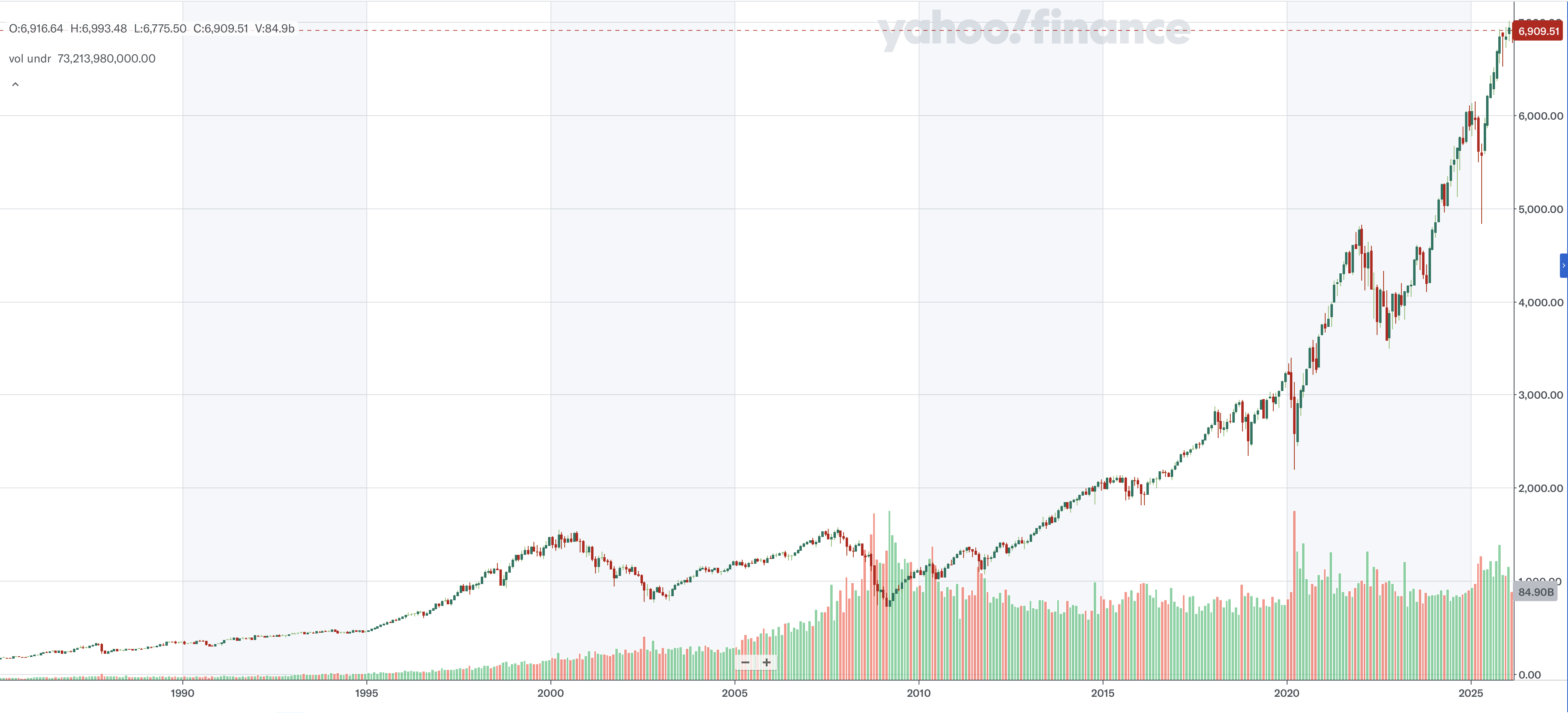
It all came undone yesterday around 10:45 in the morning for no obvious reason.  There was no data released then to drive trader reaction nor any commentary of note.  In fact, most of the punditry was still reveling in the higher Nvidia earnings and planning which Birkin bag they were going to buy for their girlfriends wives.  But as you can see from the NASDAQ chart below, in the ensuing two hours, the index fell by 4% and then slipped another 1% or so from there into the close, the level that is still trading at 6:30 this morning

Source: tradingeconomics.com

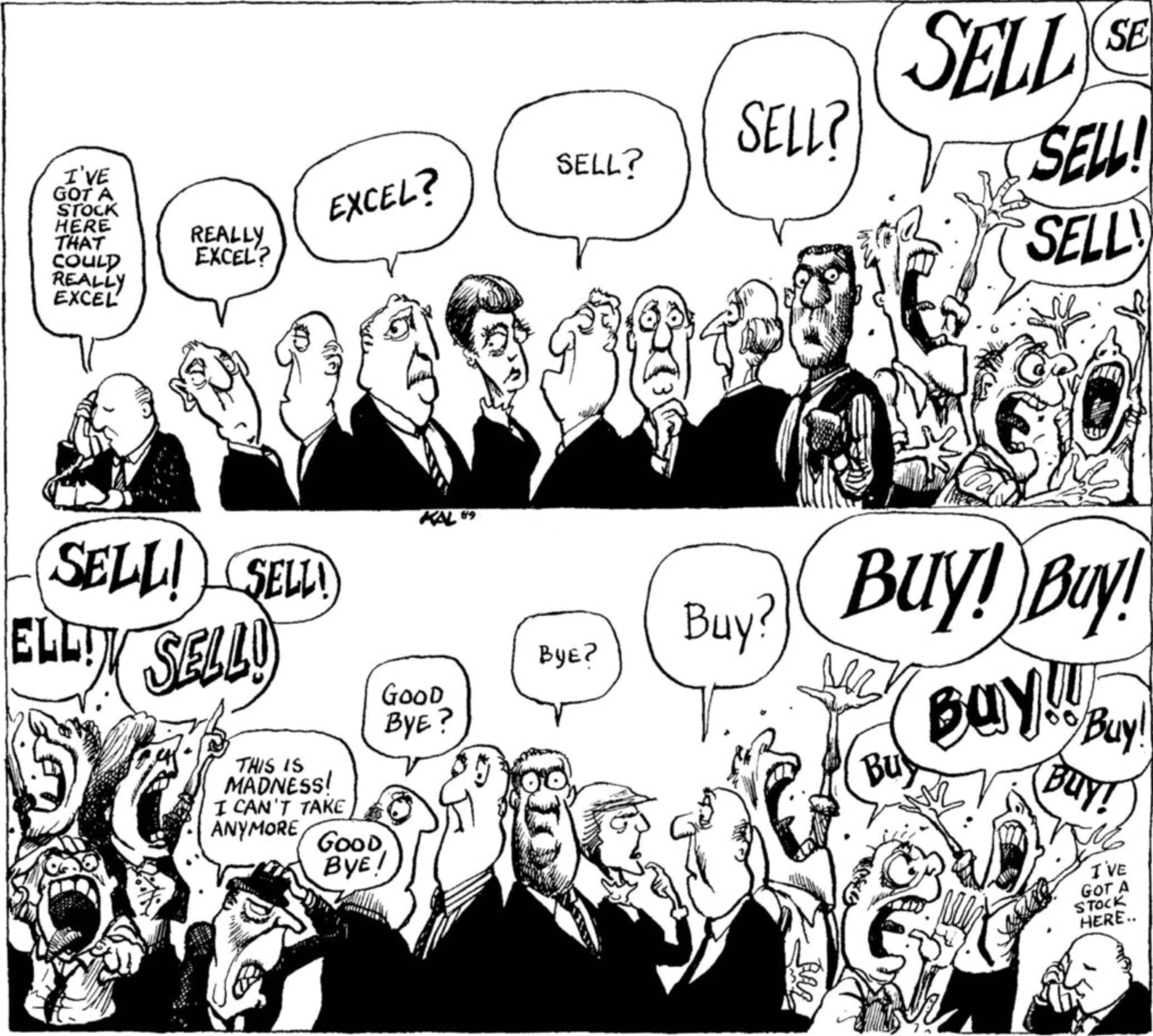
As a member in good standing of the gray hair club, I have seen this movie before, and I have always admired the following image as a perfect example of the way things work in markets.  

And arguably, this is all you need to know about how things work.  Sure, there are times when a specific data release or Fed comment is a very clear driver of market activity, but I would contend that is the exception rather than the rule.  The day following Black Monday in 1987, the WSJ asked noted Wall Street managers what caused the huge decline.  Former Bear Stearns Chairman, Ace Greenberg said it best when he replied, “markets move, next question.”  And that is the reality.  While I believe that macroeconomics offers important information for long-term investing theses, on any given day, anything can happen.  Yesterday is a perfect example of that reality.

But let us consider what we know about the overall financial situation.  The Damoclesian Sword hanging over everything is excessive leverage across the board.  I have often discussed the idea that global debt is more than 3X global GDP, a clear an indication that there will be repayment problems going forward.  And something that seems to have been driving recent equity market gains has been an increase in margin buying of stocks and leverage in general.  After all, the fact that there are ETFs that offer 3X leverage on a particular stock or strategy is remarkable.  But a look at the broad levels of leverage, as shown by the increase in margin debt in the chart below from Wolfstreet.com (a very worthwhile follow for free) tells me, at least, that when things turn, there is going to be an awful lot of selling that has nothing to do with value and everything to do with getting cash for margin calls.

It is this process that drives down the good with the bad and as you can see in the chart, happens regularly.  I’m not saying that we are looking at a major reversal ahead, but as I wrote earlier this week, a correction seems long overdue.  Perhaps yesterday was the first step.

One last thing.  I mentioned Bitcoin at the top and I think it is worthwhile to look at the chart there to get a sense of just how speculative assets behave when times are tough.  Since its peak on October 6th, 46 days ago, it has declined ~45% as of this morning.  That, my friends, is a serious price adjustment!

Source: tradingeconomics.com

Ok, let’s see how other markets are behaving in the wake of this, as well as the recent news.  Remember, yesterday we saw a slew of old US data on employment, but it is all we have, so probably has more importance than it deserves.  After all, it is pre-shutdown and things have clearly changed since then.

Starting in Asia, it wasn’t pretty with the three main markets (Nikkei, Hang Seng, CSI 300) all declining by -2.40%.  Korea (-3.8%) and Taiwan (-3.6%) fared even worse but the entire region was under pressure.  The narrative that is forming as an explanation is that there is trouble in tech land, despite the Nvidia earnings, and since Asia is all about tech, you can see why it fell.

Meanwhile, the antithesis of tech, aka Europe, is also lower across the board this morning, albeit not as dramatically.  Spain’s IBEX (-1.3%) is leading the way down but weakness is pervasive; DAX (-0.8%), CAC (-0.4%), FTSE 100 (-0.4%), as all these nations also released their Flash PMI data which came in generally softer across the board.  But there is one other thing weighing on Europe and that is the publication of a 28-point peace plan designed to end the Russia/Ukraine war.  The plan comes from the US and essentially ignored Europe’s views as it is patently clear they are not interested in peace.  In fact, it appears peace will be quite the negative for Europe as it will undermine their rearmament drive and likely force governments there to focus on domestic issues, something which, to date, they have proven singularly incompetent to address.  In fact, if the war really ends, I suspect there are going to be several governments to fall in Europe with ensuing uncertainty in their economies and markets.  As to the US futures markets, at this hour (7:30) they are basically unchanged to leaning slightly higher.  Perhaps the worst is past.

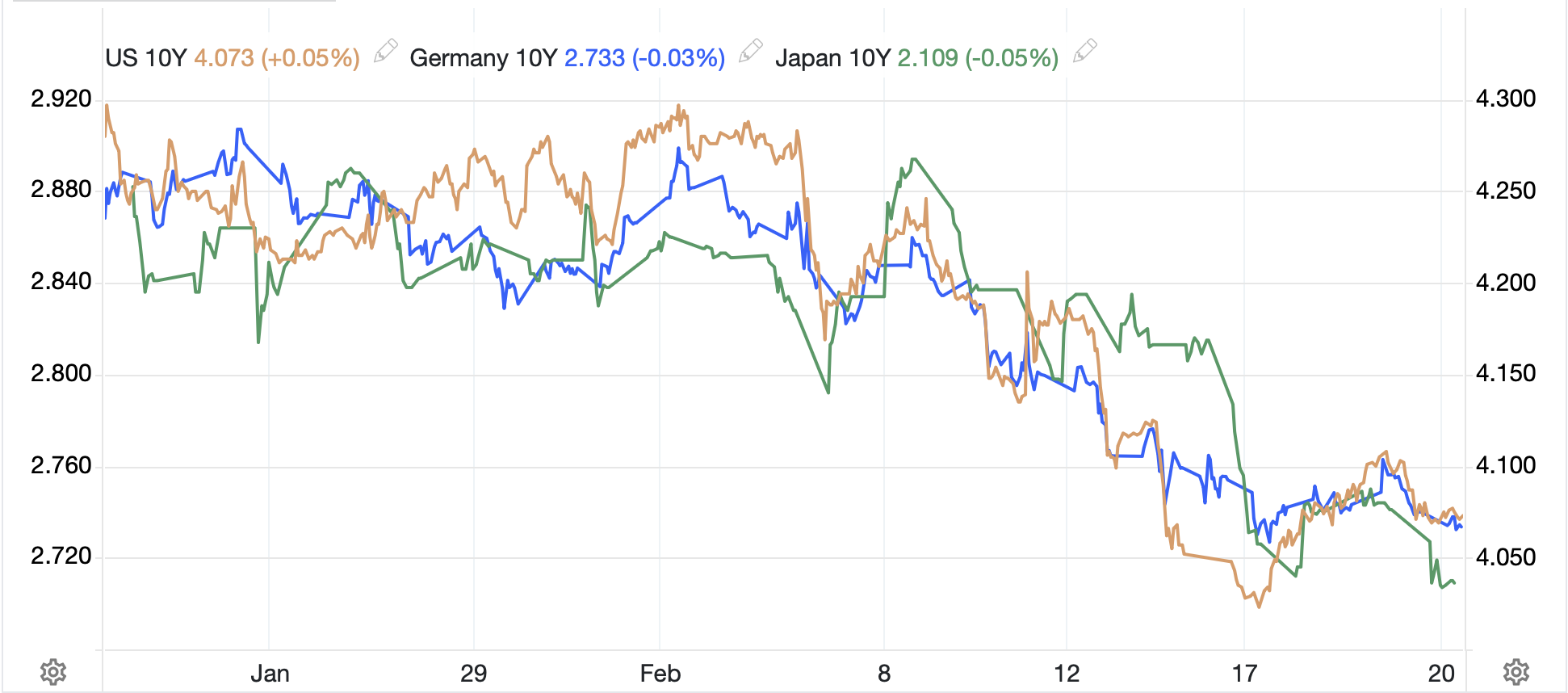
In the bond market, yields are lower across the board led by Treasuries (-4bps) while European sovereign yields have slipped -2bps to -3bps.  Certainly, the European data does not scream inflationary growth, but I have a feeling this is more about tracking Treasuries than anything else.  I say that because JGB yields also fell -4bps despite the passage of an even larger supplementary budget than expected, ¥21.7 trillion, which is still going to be paid for with more borrowing.  That is hardly the news to get investors to buy JGBs and I suspect yields will climb higher again going forward.  I think it is worth looking at the trend in US vs. Japanese 10-year yields to get a fuller picture of just how different things are in the two nations.  Of course, there is one thing that is similar, inflation continues to remain above their respective 2.0% targets and is showing no signs of returning anytime soon.

Source: tradingeconomics.com

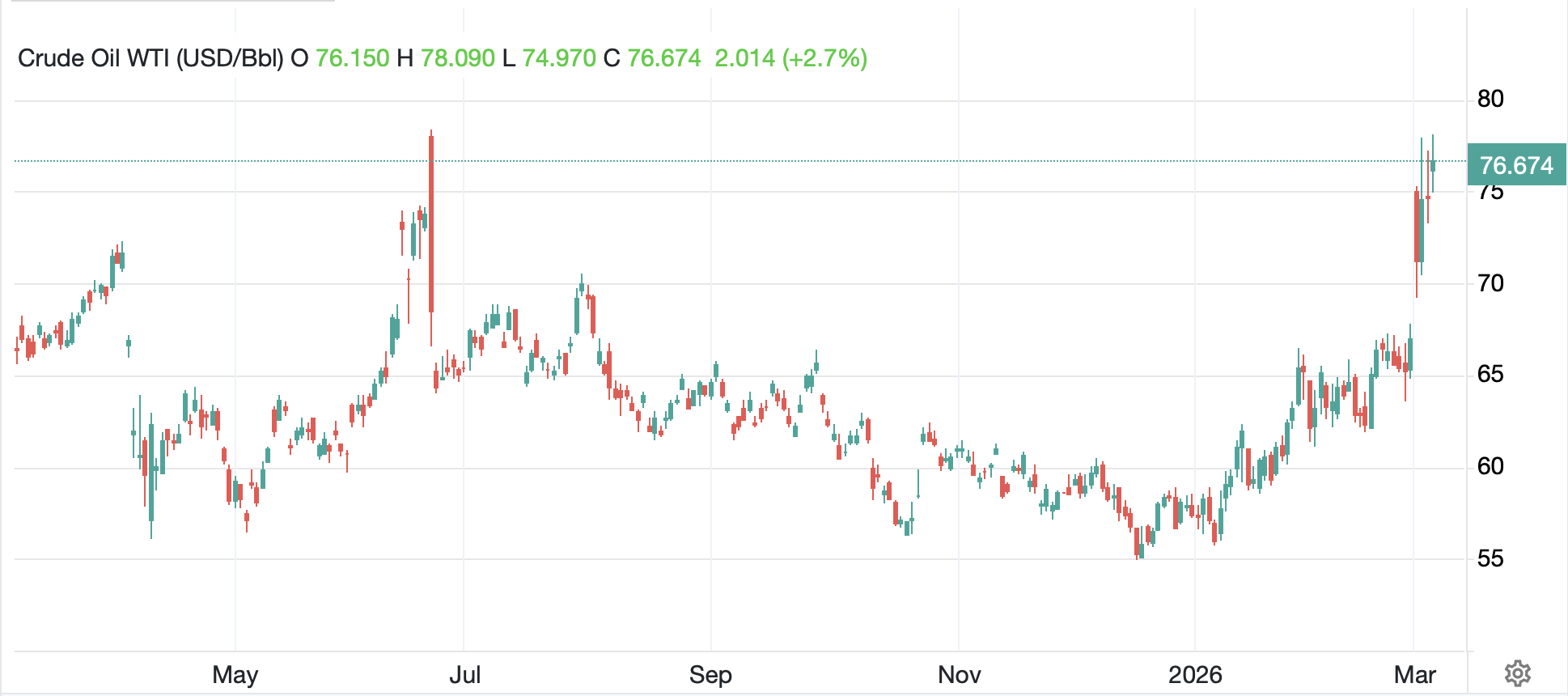
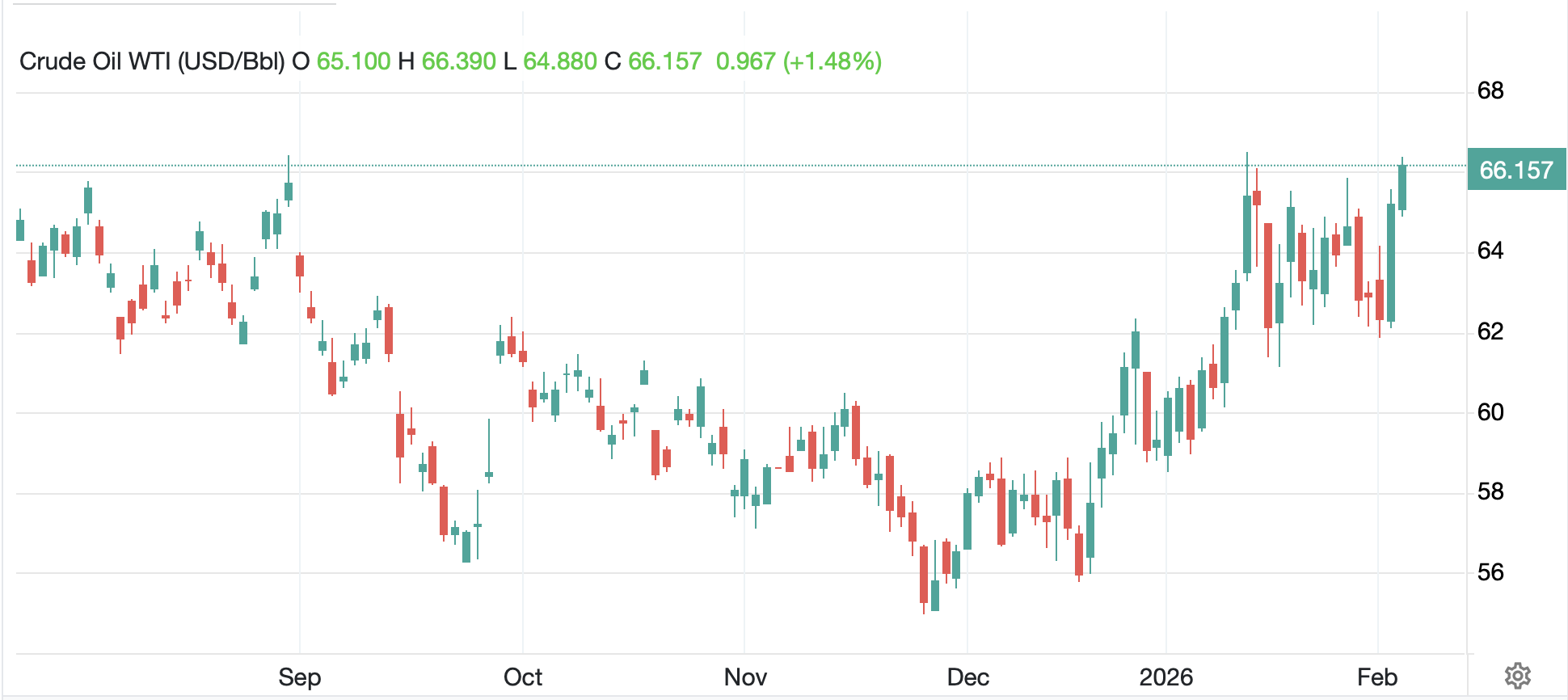
You will not be surprised to know that commodity prices remain extremely volatile.  Oil (-1.0%) had a bad day yesterday and is continuing lower this morning although as you can see from the chart below, it is off its worst levels of the session.  But the one thing that remains true despite the volatility is the trend remains lower.

Source: tradingeconomics.com

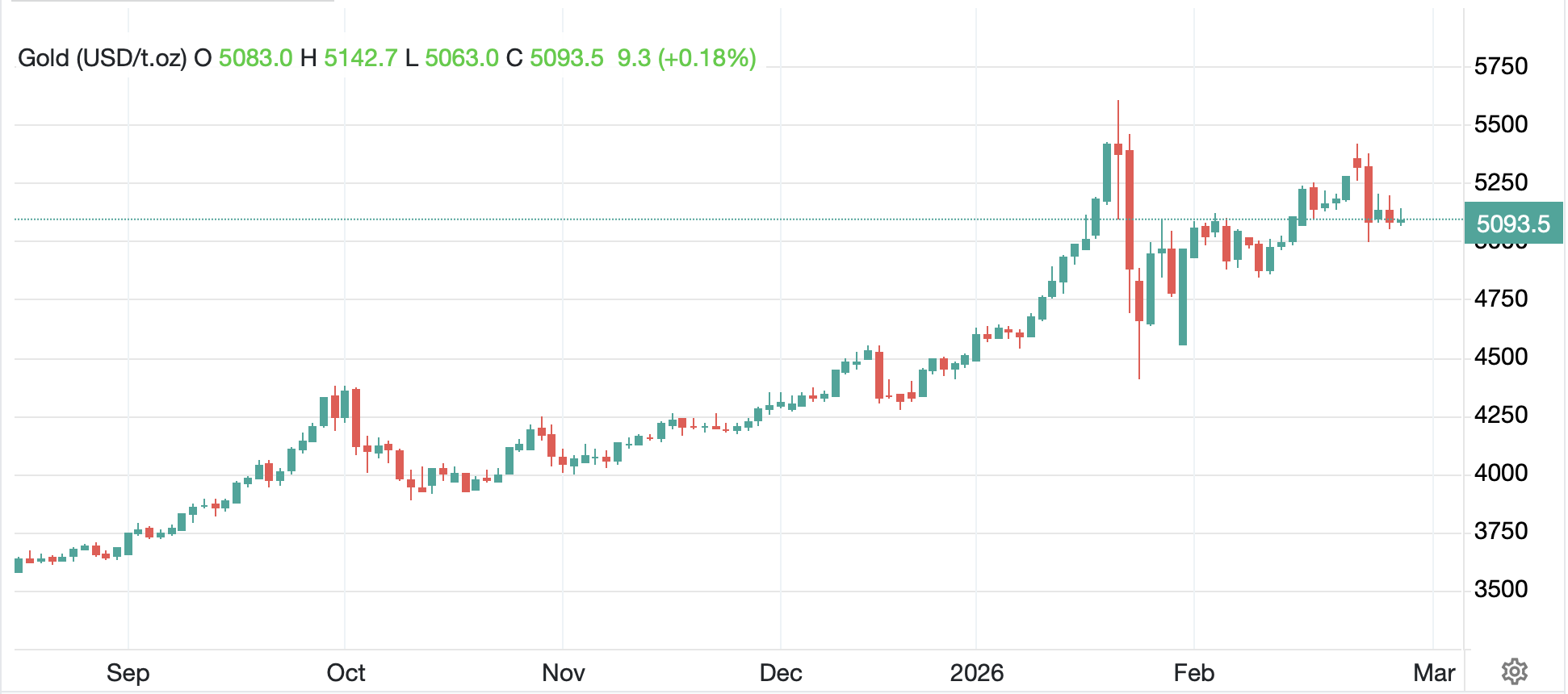
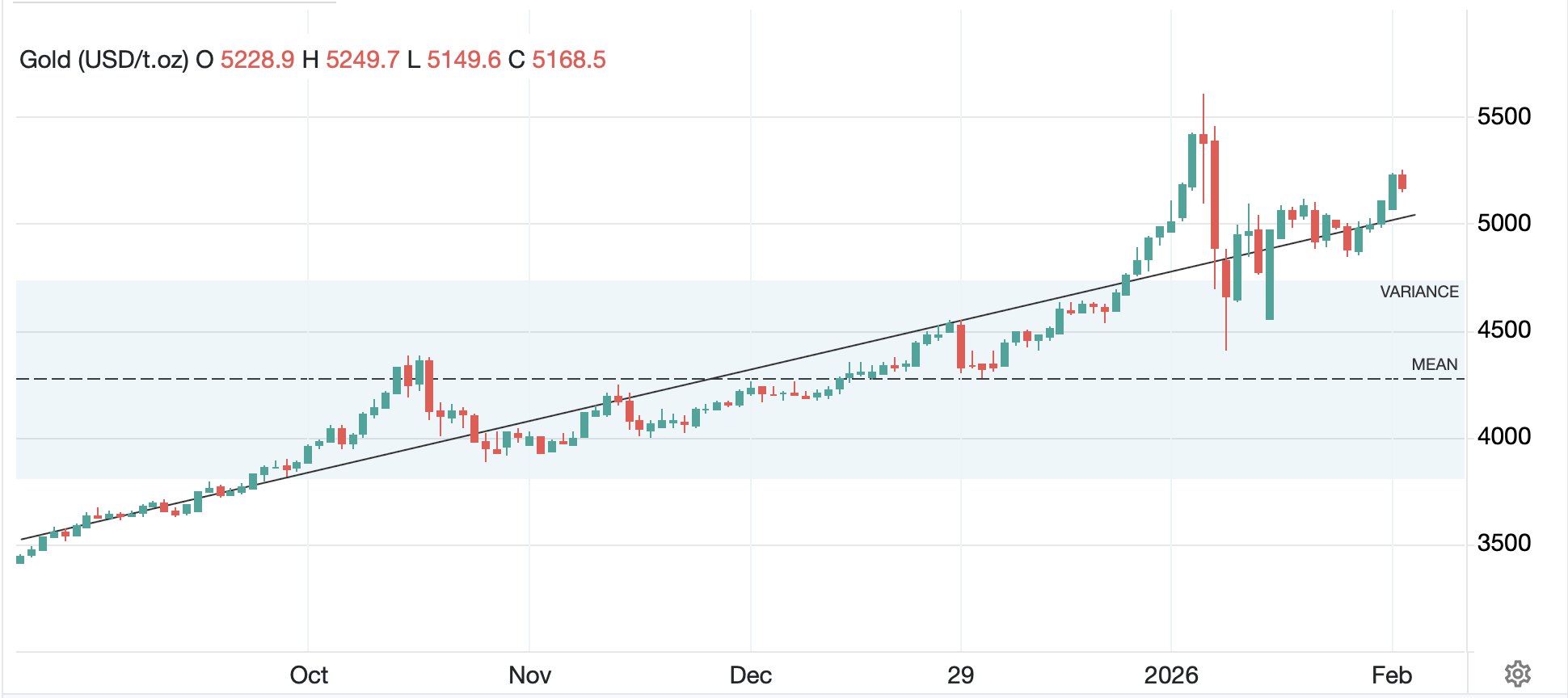
Metals markets also suffered yesterday and are under pressure this morning with gold (-0.4%) and silver (-2.5%) sliding.  One thing to remember is that when margin calls come, traders/investors sell what they can, not what they want, and given the liquidity that remains in both gold and silver, they tend to get sold to cover margin calls.  Too, today is the weekly option expiry in the SLV ETF and as my friend JJ (writes at Market Vibes) regularly explains, there is a huge amount of silver activity driven by the maturing positions.

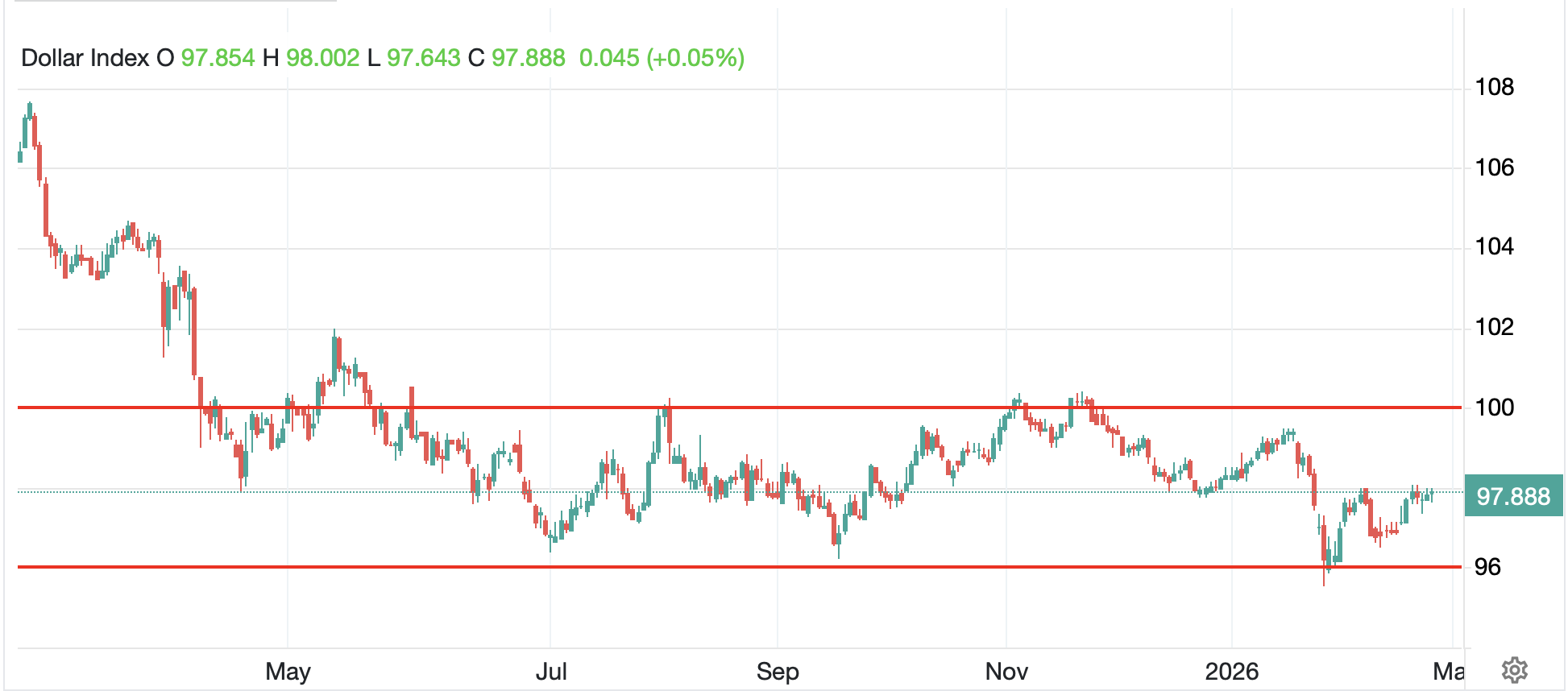
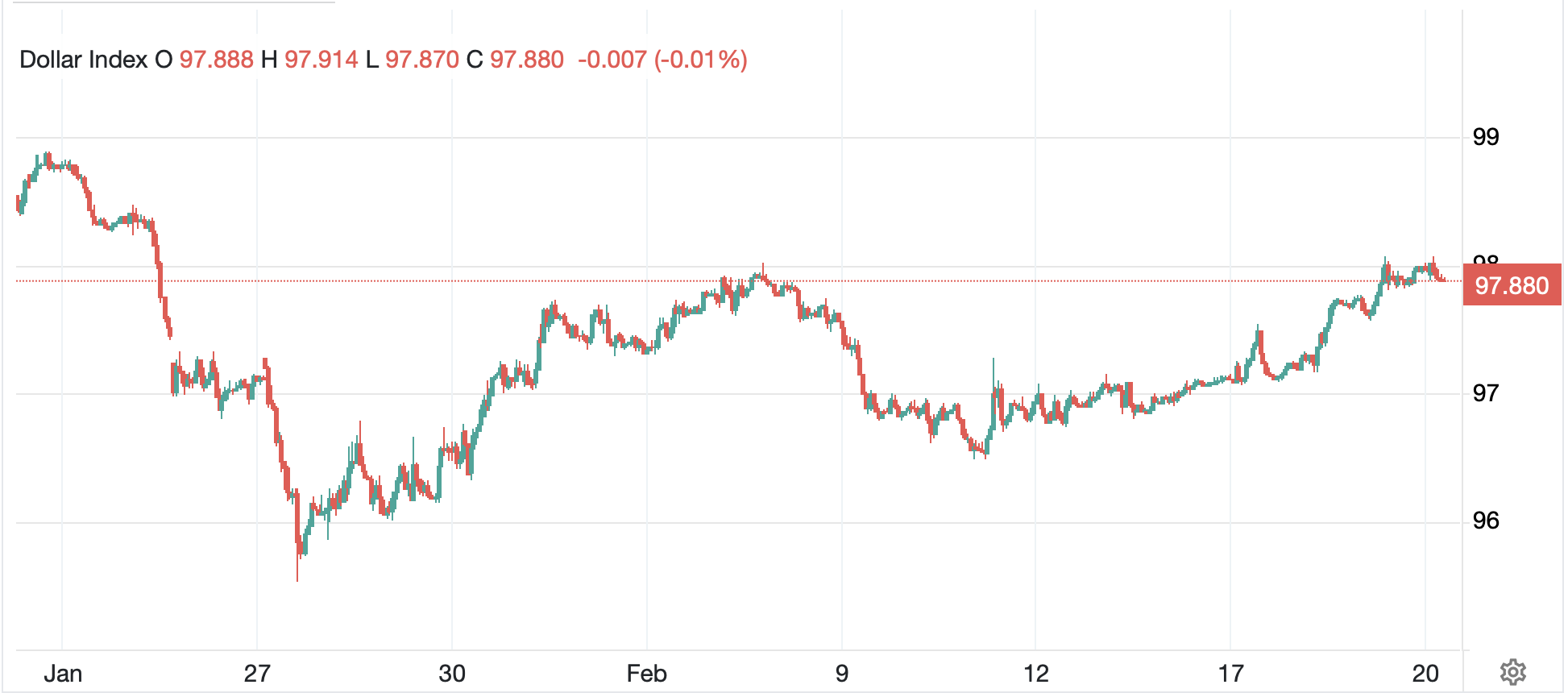
Finally, the dollar continues to remain solidly bid, although is merely consolidating recent gains as it trades just above the key 100 level in the DXY.  Two things of note today are JPY (+0.5%) which responded to comments from not only the FInMin, but also Ueda-san explaining that a weak yen is driving inflation higher and might need to be addressed.  Step 4 of the dance toward intervention?  As to the rest of the G10, movement has been minimal.  But in the EMG bloc, INR (-1.1%) fell to record lows (dollar highs) after the RBI stepped away from its market support.  It sure seems like it is going to break through 90 soon and I imagine 100 is viable.  As well, ZAR (-0.7%) is suffering on the weaker metals prices, along with CLP (-0.5%) while BRL (-0.5%) slipped as talk of a more dovish central bank stance started percolating in markets.

Today’s data brings US Flash PMI (exp 52.0 Manufacturing, 54.6 Services) and Michigan Sentiment (50.5).  We hear from five more Fed speakers, with a mix of hawks and doves.  It will be interesting to see how the doves frame yesterday’s better than expected September NFP report as their entire thesis is softening labor growth is going to be the bigger problem than rising prices.

I, for one, am glad the weekend is upon us.  For today, I am at a loss for risk assets.  The case can be made either way and I have no strong insight.  However, the one thing that I continue to believe is the dollar is going to find support.  Remember, when things get really bad (and they haven’t yet) people still run to T-bills to hide, and that requires buying dollars.

Good luck and good weekend

Adf

Divergent Views

This morning, we all must feel blessed
Nvidia is still the best
Its’s earnings were great
Which opened the gate
For buyers, much more, to invest
 
But contra to that piece of news
The Minutes showed divergent views
On whether to slash
Next month, rates for cash
Or else wait for more weakness clues


Whatever your view of AI and the entire discussion, one must be impressed with Nvidia’s performance as a company, and as an equity.  Last night’s earnings release was clearly better than expected as CEO Jensen Huang indicated that revenues for Q1 should grow to ~$65 billion as there is still significant demand for the buildout of data centers.  He also pushed back on the idea that AI was a bubble.  Of course, he would do that given he is at the center of the discussion.  Nonetheless, after modest gains in US equities yesterday, despite much more hawkish than expected FOMC Minutes (discussed below), US futures are rising sharply this morning, with NASDAQ futures currently higher by 1.6% (6:15) and taking all the indices with it.  Life is good!

Which takes us to the FOMC Minutes and our first look at dissention in the Eccles building.  I think the following paragraph, directly from the Minutes [emphasis added], does a good job in describing the wide range of views that currently exist around the table at the Fed, and make no mistake, I am hugely in favor of a wide range of views as I would contend it has been the groupthink in the past that led us to the current, unfavorable situation.

“In considering the outlook for monetary policy, participants expressed a range of views about the degree to which the current stance of monetary policy was restrictive. Some participants assessed that the Committee’s policy stance would be restrictive even after a potential 1/4 percentage point reduction in the policy rate at this meeting. By contrast, some participants pointed to the resilience of economic activity, supportive financial conditions, or estimates of short-term real interest rates as indicating that the stance of monetary policy was not clearly restrictive. In discussing the near-term course of monetary policy, participants expressed strongly differing views about what policy decision would most likely be appropriate at the Committee’s December meeting.”

Below I have copied the dot plot from the September meeting, which contra to most previous versions shows a particularly wide range of views regarding the future level of Fed funds.  I have to wonder, though, after reading the Minutes, if those dots will be stretched even wider apart from top to bottom in the December report.

Of course, our interest is how did the market respond to this release?  Well, it can be no surprise that the Fed funds futures market repriced further and is now showing just a 32% probability for a cut next month and 78% probability of the next cut coming in January.  That said, the market remains convinced that rates must go lower over time, something that does not appear in sync with equity market growth expectations and seems to be completely ignoring the announced inward investment flows to the US from around the world.

Source: cmegroup.com

As to the equity market response, the two vertical lines show the release of the Minutes and then the release of Nvidia earnings.  You can see for yourself which matters more to the market.

Source: tradingeconomics.com

Between the GDPNow data, which continues to show growth remains robust, and more announcements of inward investment on the back of trade deals, with the Saudis ostensibly promising $1 trillion after the recent White House dinner, I will take the over on future economic activity.  Remember, too, the government is actively supporting mining, drilling and manufacturing and all of that is going to feed into economic growth here.  My view is the Fed funds futures market is completely wrong, and we will not see rates back at the 3.0% level anytime in the next few years.  I’m not suggesting we won’t see an equity market correction, just that the end is not nigh.

Each day the yen slides
Intervention creeps closer
Yen traders beware

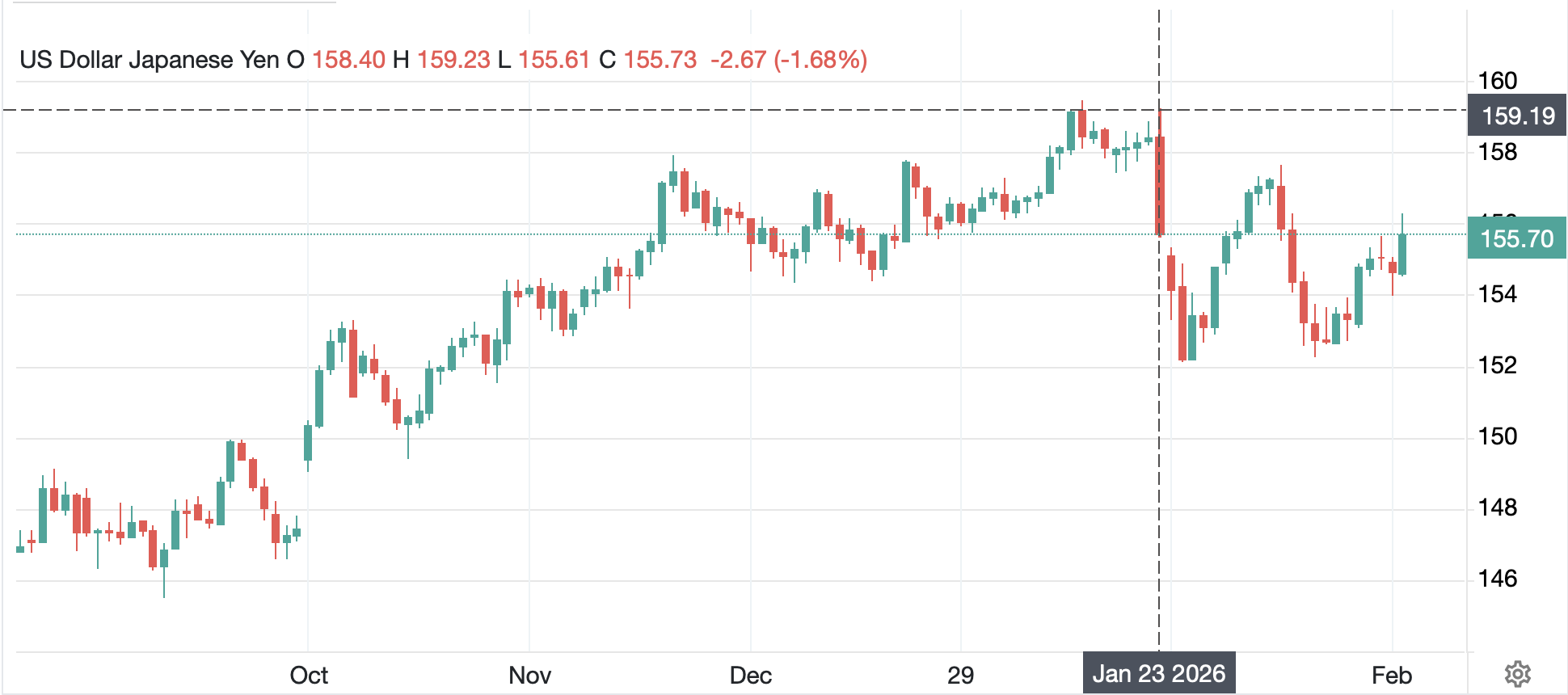
Turning to the dollar, it continues to strengthen across the board with the DXY trading back above 100 this morning, and now that the Fed seems more hawkish, looking like it may have legs.  But let us focus on the yen, quite beleaguered of late, as it appears to be accelerating its downfall.  Not only is this evident on the chart below, but we also have heard concerns for the third time, as per the following quotes from Minoru Kihara, the chief cabinet secretary:

The yen is experiencing sudden, one-way movements that are concerning and which require close monitoring.  Excessive fluctuations and disorderly movements in exchange rates must be monitored with vigilance.  We are concerned about the recent one-way and sudden movements in the foreign exchange market. It’s important for exchange rates to remain stable, reflecting fundamentals.”

In the past six months, the yen has fallen >10% vs. the dollar and is lower by nearly 4% in the past month.  At the same time, JGB yields are starting to accelerate higher, trading to yet another 20-year high at 1.82% and the price action there is remarkably similar to that of USDJPY as per the below chart.  The problem for the JGB market is the BOJ already owns more than 50% of the outstanding debt, so buying more doesn’t seem to be a solution, whereas buying JPY in the FX market will have an impact, albeit short-term if they don’t change policies.   

Source: tradingeconomics.com

The upshot of all this is the world is awash in debt, with global debt/GDP exceeding 3x.  The lesson is that not all this debt will be repaid, in fact probably not that much at all.  Be careful as to what you hold.

Ok, let’s briefly tour the markets I have not yet touched.  Tokyo equities (+2.65%) loved the Nvidia earnings as did Korea (+1.9%), Taiwan (+3.2%) and most of Asia although China (-0.5%) and HK (0.0%) didn’t play along last night.  I guess the ongoing restrictions on sales of Nvidia chips to China is still a negative there, as are recurring concerns over the property market as there is talk of yet another attempt to fix things by the government.  Europe, too, is firmer this morning, although clearly not on tech bullishness given the lack of tech on which to be bullish.  But there is talk of a Russia/Ukraine peace deal which may be a benefit.  At any rate, gains are widespread on the order of +0.6% or so across the board.

In the bond market, Treasury yields rose a couple of ticks yesterday and are higher by 1 more basis point this morning, but still at just 4.14%.  The front of the curve rose by more on the back of the Minutes.  European yields are also higher this morning, between 2bps and 3bps with UK gilts the outlier, unchanged on the day, as softer inflation has traders expecting a rate cut at the next BOE meeting on December 18th.

Oil (+1.0%) has rebounded off its recent lows and is trading back at…$60/bbl, the level at which it is clearly most comfortable these days.  Meanwhile, gold (0.0%) gave back yesterday’s overnight rally to close mostly unchanged with the same true across the other metals although this morning silver (-0.7%) is slipping a bit further.

Finally, other currency movements beyond the yen (-0.3% today) are of a similar size across both the G10 and EMG blocs.  Using the DXY as proxy, this is the third test above 100 since August 1st with many analysts are calling for a breakout at last.  

Source: tradingeconomics.com

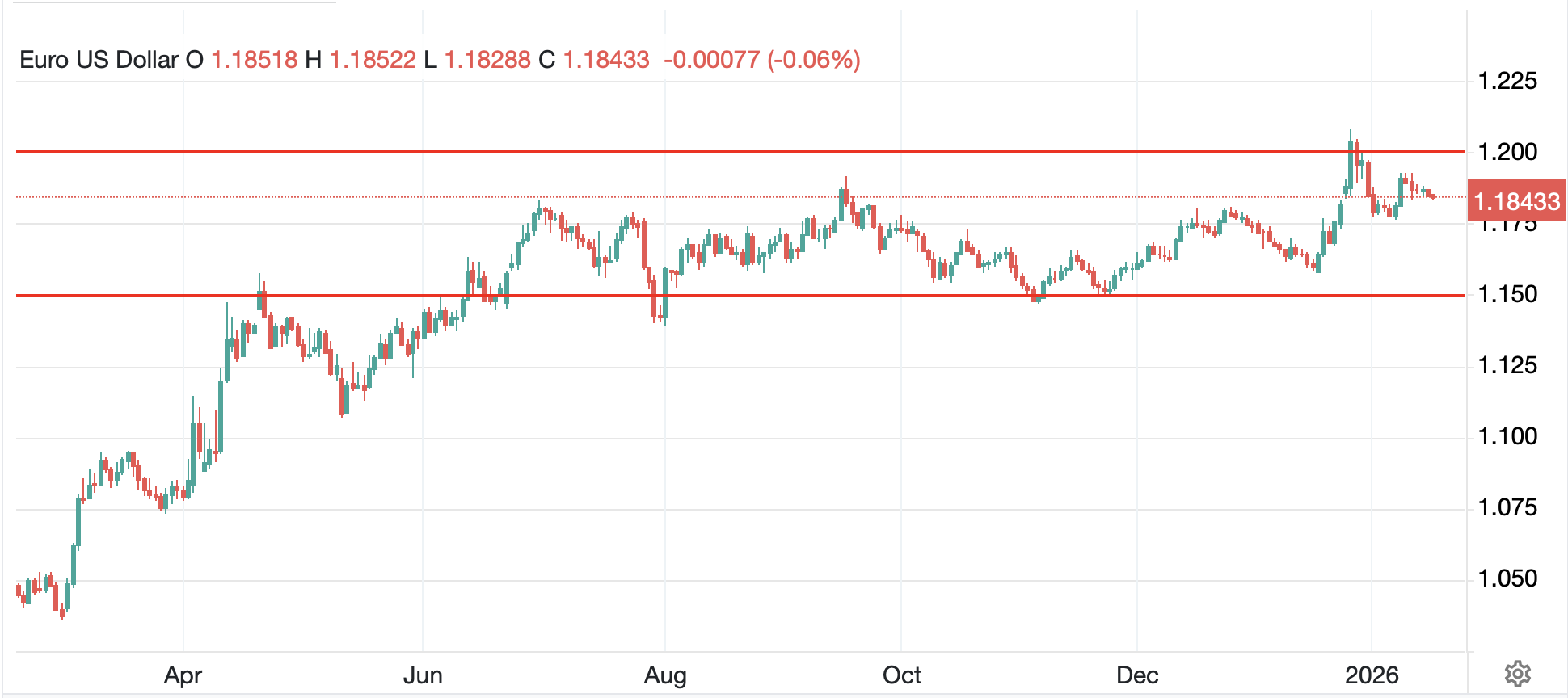
Perhaps this is true given the word is the Russia/Ukraine peace deal was negotiated entirely between the US and Russia without either Ukraine or Europe involved, demonstrating how insignificant Europe, and by extension the euro, have become.  Just a thought.

On the data front, the big news is the September employment report is going to be released this morning along with some other data:

Nonfarm Payrolls50K
Private Payrolls62K
Manufacturing Payrolls-8K
Unemployment Rate4.3%
Average Hourly Earnings0.3% (3.7% Y/Y)
Average Weekly Hours34.2
Participation Rate62.3%
Philly Fed-3.1
Existing Home Sales4.08M

Source: tradingeconomics.com

On the one hand, the data is stale.  On the other hand, it is all we have, so it will likely have greater importance than it deserves.  I have a hard time looking at the economy and seeing substantial weakness, whether because of corporate earnings, inward investment announcements or the Fed’s growing concern over higher inflation.  All that tells me the dollar is going to be in demand going forward.

Good luck

Adf
Basically Fictive

For Fedniks it must be addictive
To say rates are “somewhat restrictive”
It seems like a show
As how can they know
Since R-star is basically fictive
 
Investors, though, lap up this stuff
In fact, they just can’t get enough
Of comments that hint
There is a blueprint
For policy, though that’s a bluff


Yesterday, both Richmond Fed president Barkin and Governor Jefferson explained that current Fed policy is “somewhat restrictive”.  This takes to seven the number of FOMC members who have used this phrase with Powell, Kugler, Hammack, Schmid and Collins all having used it before, as did Jefferson two weeks ago.  And they are all referring to the concept of R-star, the mythical rate at which policy is neither restrictive nor accommodative.  In fact, R-star has become the Fed’s north star, with the key difference being, we can actually see the north star while R-star, even they will admit, is unobservable.  Of course, that hasn’t stopped them from basing policy decisions on the variable.

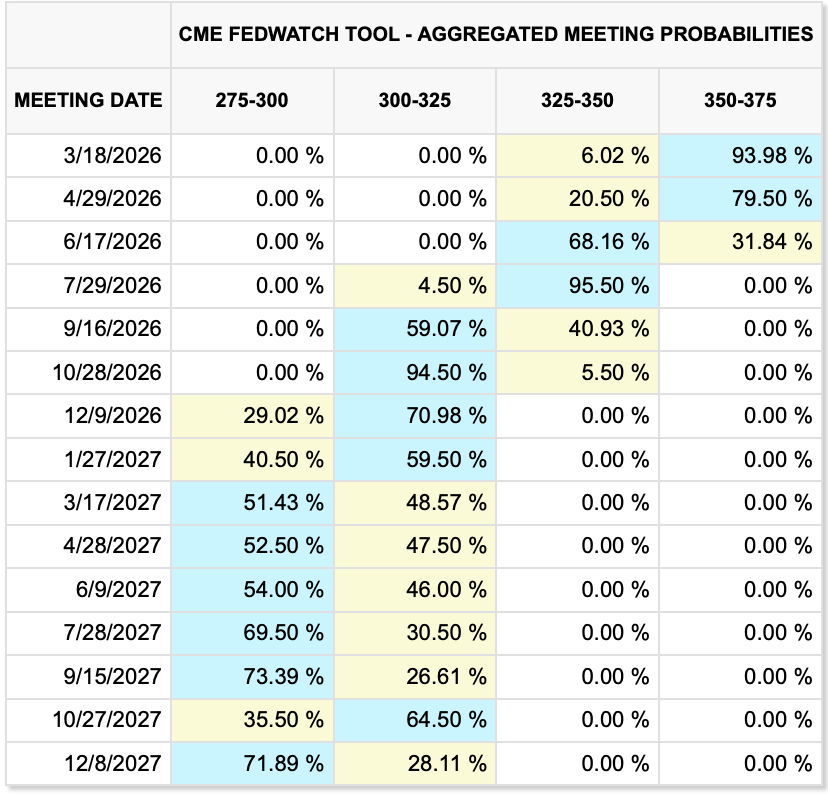
I highlight this because the tone of virtually every one of these speeches has been one of caution, with the implication being they are very close to their nirvana so the last steps will be small.  However, we cannot forget that though the last steps may be small, there is still confidence amongst the entire body that the direction of travel is toward lower rates. certainly, as you can see from the aggregated meeting probabilities from the Fed funds futures market below, there is zero expectation that rates will rise anytime during the next two years and a decent chance of another 100bps of cuts over that time.

Source: cmegroup.com

I might contend that is a pretty negative outlook on the US economy by the Fed.  Given the Fed’s models assume that a key to lower inflation is slowing economic growth, the idea that rates are going to fall implies slower growth to help them achieve the inflation portion of their mandate.  But that seems out of step with both the Atlanta Fed’s GDPNow forecast shown below and currently sitting at 4.1% annualized for Q3 and with earnings forecasts in the equity markets.

Asking Grok, the average current earnings growth forecasts for 2026 for the S&P 500 is somewhere in the 13% – 14% range with revenue growth running at ~6.9%, which is typically in line with nominal GDP growth.  (I understand that current forward PE ratios are extremely high at 23x, so be careful that companies hit their targets while their share prices fall anyway.)  But if nominal GDP is going to run at nearly 7%, and let’s assume inflation is at 3.5%, which I think is a reasonable possibility, then the math tells us that GDP is growing at 3.5% on a real basis.  With Fed funds currently at 4.0%, why would they need to decline further?

Looking back at the Fed’s September Summary of Economic Projections, it appears that the Fed sees a very different economy than the markets see.  In fact, you can see that they believe nominal GDP in the long run is going to average <4.0% (sum of longer run GDP and PCE in the table below).  

That is a really big difference, one that is the type that can lead to massive policy errors.  Now, if those 17 people cloistered in the Marriner Eccles building have a better handle on the economy than everybody else, I can understand why they believe rates need to fall further.  But is that the case?  

Here’s something else to ponder, I asked Grok about the relationship between nominal GDP and Fed funds and the below table is what it produced:

It is patently obvious how the Fed has developed its models and because of that, why they have been so wrong.  In fact, look at the SEP above and compare it to the period from 2001 – 2019, they are essentially identical.  But I would argue, and I’m not alone, that the economy from the dot.com crash up to the pandemic is no longer the reality on the ground.  The Fed’s backward-looking models seem set to make yet more errors going forward.

And with those cheery thoughts, let’s look at what happened overnight.  Yesterday’s continuation of the US stock decline seems to be finding a bottom, at least temporarily as Asian markets were mixed (Nikkei -0.3%, Hang Seng -0.4%, CSI 300 +0.4%) with the rest of the region showing a similar mixture of gainers (India, Malaysia, Indonesia, Philippines) and losers (Korea, Taiwan, Australia) as it appears the entire world is awaiting Nvidia’s earnings after the US close today.

Similarly, European bourses are edging higher this morning with the rout seemingly over for now.  This morning Spain (+0.5%) is leading the way higher followed by Germany (+0.3%) with the rest of the markets little changed overall, although leaning higher.  As to US futures, at this hour (7:30) they are pushing higher by about 0.4%.

In the bond market, Treasury yields are unchanged this morning, still sitting right around that 4.10% level while European sovereigns have seen demand with yields slipping -2bps to -3bps across the continent.  The UK is the outlier here, with yields unchanged after releasing inflation data that was bang on expectations, and below last month’s readings, though remains well above their 2.0% target.  I guess if I look at the chart below, I might be able to make the case that core UK CPI is trending lower, but similarly to the Fed, the last time they were at their target was July 2021.

Source: tradingeconomics.com

I would be remiss if I didn’t mention that JGB yields have moved higher by 3bps, pushing their decade long highs further along as concerns grow over the Japanese fiscal situation.

Oil prices (-2.4%) are falling this morning, slipping to the low side of $60/bbl after API inventories showed a surprise build of 4.4 million barrels.  However, I would contend that there is very little new here.  Perhaps the dinner last night where President Trump hosted Saudi Prince MbS has some thinking OPEC will increase production more aggressively going forward.  In the metals markets, they are all shining this morning led by silver (+3.1%) and platinum (+3.0%) with gold (+1.3%) and copper (+1.3%) lagging, although remember the latter two are much larger markets so need more interest to rise as quickly.

Finally, the dollar continues to find support, despite the precious metals gains, and this morning we see the DXY (+0.15%) pushing back toward that psychological 100.00 level.  JPY (-0.5%) has traded through 156 and certainly seems like it wants to push back to its YTYD highs of 158.80.  Interestingly, there was no Japanese commentary of note last night, but I presume if this continues, the MOF will be out warning of potential future action.  Another interesting fact is that while the dollar is firmer against virtually all G10 currencies, the EMG bloc is holding its own this morning led by HUF (+0.6%), PLN (+0.25%) and ZAR (+0.15%) with the rand obviously benefitting from gold’s rally.  The forint has benefitted from the central bank maintaining policy on hold at 6.5%, one of the highest available rates in Europe and that has helped drag the zloty along for the ride.

On the data front, this morning we see the August Trade Balance (exp -$61.0B) and then the EIA oil inventories where a small draw is expected.  We also get the FOMC Minutes at 2:00pm and hear from NY Fed president Williams this afternoon.

I cannot help but look at the difference between the Fed’s very clear view and the markets expectations and feel like the Fed is on the wrong side of the trade.  It is for this reason I fear higher inflation and ultimately, a much lower likelihood of further rate cuts.  If that is the case, the dollar will find even more support.  Interesting times.

Good luck

Adf

Left For Dead

Takaichi’s learned
Her chalice contained poison
Thus, her yen weakens


If one needed proof that interest rates are not the only determining factor in FX markets, look no further than Japan these days where JGB yields across the board, from 2yr to 40yr are trading at decade plus highs while the yen continues to decline on a regular basis.  This morning, the yen has traded through 155.00 vs. the dollar, and through 180.00 vs. the euro with the latter being a record low for the yen vs. the single currency since the euro was formed in 1999.

Source: tradingeconomics.com

Meanwhile, JGB yields continue to rise unabated on the back of growing concerns that Takaichi-san’s government is going to be issuing still more unfunded debt to pay for a massive new supplementary fiscal package rumored to be ¥17 trillion (~$109 billion).  While we may have many fiscal problems in the US, it is clear Japan should not be our fiscal role model.

Source: tradingeconomics.com

This market movement has led to the second step of the seven-step program of verbal intervention by Japanese FinMins and their subordinates.  Last night, FinMin Satsuki Katayama explained [emphasis added], “I’m seeing extremely one-sided and rapid movements in the currency market. I’m deeply concerned about the situation.”  Rapid and one-sided are the key words to note here.  History has shown the Japanese are not yet ready to intervene, but they are warming to the task.  My sense is we will need to see 160 trade again before they enter the market.  However, while that will have a short-term impact, it will not change the relative fiscal realities between the US and Japan, so any retreat is likely to be a dollar (or euro) buying opportunity.

As to the BOJ, after a highly anticipated meeting between Takaichi-san and Ueda-san, the BOJ Governor told a press conference, “The mechanism for inflation and wages to grow together is recovering. Given this, I told the prime minister that we are in the process of making gradual adjustments to the degree of monetary easing.”   Alas for the yen, I don’t think it will be enough to halt the slide.  That is a fiscal issue, and one not likely to be addressed anytime soon.

The screens everywhere have turned red
As folks have lost faith that the Fed,
Next month, will cut rates
Thus, leave to the fates
A stock market now left for dead

Yesterday, I showed the Fear & Greed Index and marveled at how it was pointing to so much fear despite equity markets trading within a few percentage points of all time highs.  Well, today it’s even worse!  This morning the index has fallen from 22 to 13 and is now pushing toward the lows seen last April when it reached 4 just ahead of Liberation Day.

In fact, it is worthwhile looking at a history of this index over the past year and remembering what happened in the wake of that all-time low reading.

Source: cnn.com

Now look at the S&P500 over the same timeline and see if you notice any similarities.

Source: tradingeconomics.com

It is certainly not a perfect match, but the dramatic rise in both indices from the bottom and through June is no coincidence.  The other interesting thing is that the fear index managed to decline so sharply despite the current pretty modest equity market decline.  After all, from the top, even after yesterday’s decline, we are less than 4% from record highs in the S&P 500.

Analysts discuss the ‘wall of worry’ when equity markets rise despite negative narratives.  Too, historically, when the fear index falls to current levels, it tends to presage a rally.  Yet, if we have only fallen 4% from the peak, it would appear that positions remain relatively robust in sizing.  In fact, BoA indicated that cash positions by investors have fallen to just 3.7%, the lowest level in the past 15 years.  So, everyone is fully invested, yet everyone is terrified.  Something’s gotta give!  In this poet’s eyes, the likely direction of travel in the short run is lower for equities, and a correction of 10% or so in total makes sense.  But at that point, especially if bonds are under pressure as well, I would look for the Fed to step in and not only cut rates but start expanding its balance sheet once again.  QT was nice while it lasted, but its time has passed.  One poet’s view.

Ok, following the sharp decline in US equity markets yesterday on weak tech shares, the bottom really fell out in Asia and Europe.  Japan (-3.2%) got crushed between worries about fiscal profligacy discussed above and the tech selloff.  China (-0.65%) and HK (-1.7%) followed suit as did every market in Asia (Korea -3.3%, Taiwan -2.5%, India -0.3%, Australia -1.9%).  You get the idea.  In Europe, the picture is no brighter, although the damage is less dramatic given the complete lack of tech companies based on the continent.  But Germany (-1.2%), France (-1.3%), Spain (-1.6%), Italy (-1.7%) and the UK (-1.3%) have led the way lower where all indices are in the red.  US futures, at this hour (7:15) are also pointing lower, although on the order of -0.5% right now.

In the bond market, Treasury yields, after edging higher yesterday are lower by -4bps this morning, and back at 4.10%, their ‘home’ for the past two months as per the below chart from tradingeconomics.com.

As to European sovereigns, they are not getting quite as much love with some yields unchanged (UK, Italy) and some slipping slightly, down -2bps (Germany, Netherlands), and that covers the entire movement today.  We’ve already discussed JGBs above.

In the commodity space, oil (-0.2%) continues to trade either side of $60/bbl and it remains unclear what type of catalyst is required to move us away from this level.  Interestingly, precious metals have lost a bit of their luster despite the fear with gold (-0.25%), silver (-0.2%) and platinum (-0.2%) all treading water rather than being the recipient of flows based on fear.  Granted, compared to the crypto realm, where BTC (-1.0%, -16% in the past month) has suffered far more dramatically, this isn’t too bad.  But you have to ask, if investors are bailing on risk assets like equities, and bonds are not rallying sharply, while gold is slipping a bit, where is the money going?

Perhaps a look at the currency market will help us answer that question.  Alas, I don’t think that is the case as while the dollar had a good day yesterday, and is holding those gains this morning, if investors around the world are buying dollars, where are they putting them?  I suppose money market funds are going to be the main recipient of the funds taken out of longer-term investments.  One thing we have learned, though, is that the yen appears to have lost its haven status given its continued weakening (-3.0% in the past month) despite growing fears around the world.  

On the data front, yesterday saw Empire State Manufacturing print a very solid 18.7 and, weirdly, this morning at 5am the BLS released the Initial Claims data from October 18th at 232K, although there is not much context for that given the absence of other weeks’ data around it.  Later this morning we are due the ADP Weekly number, Factory Orders (exp 1.4%) and another Fed speaker, Governor Barr.  Yesterday’s Fed speakers left us with several calling for a cut in December, and several calling for no move with the former (Waller, Bowman and Miran) focused on the tenuous employment situation while the latter (Williams, Jeffereson, Kashkari and Logan) worried about inflation.  Personally, I’m with the latter group as the correct policy, but futures are still a coin toss and there is too much time before the next meeting to take a strong stand in either direction.

The world appears more confusing than usual right now, perhaps why that Fear index is so low.  With that in mind, regarding the dollar, despite all the troubles extant in the US, it is hard to look around and find someplace else with better prospects right now.  I still like it in the medium and long term.

Good luck

Adf
We All Will Be Fucted

The Fed PhD’s have constructed
Their models, from which they’ve deducted
The future will be
Like post-GFC
In which case, we all will be fucted
 
Instead, perhaps what’s really needed
And for which Steve Miran has pleaded
Is changing impressions
In future Fed sessions
Accepting the past has receded


While we all know that things change over time, human nature tends to drive most of us, when facing a new situation, to call on our experience and analogize the new situation to what we have experienced in the past.  But sometimes, the differences are so great that there are no viable analogies.  For the past several years I have made the point in this commentary that the Fed’s models are broken.  Consider, as an example, how wrong they were regarding the alleged transitory nature of inflation in 2022 which led to policy adjustments that not only were far too late to address the issue, but in reality, only had a marginal impact anyway.

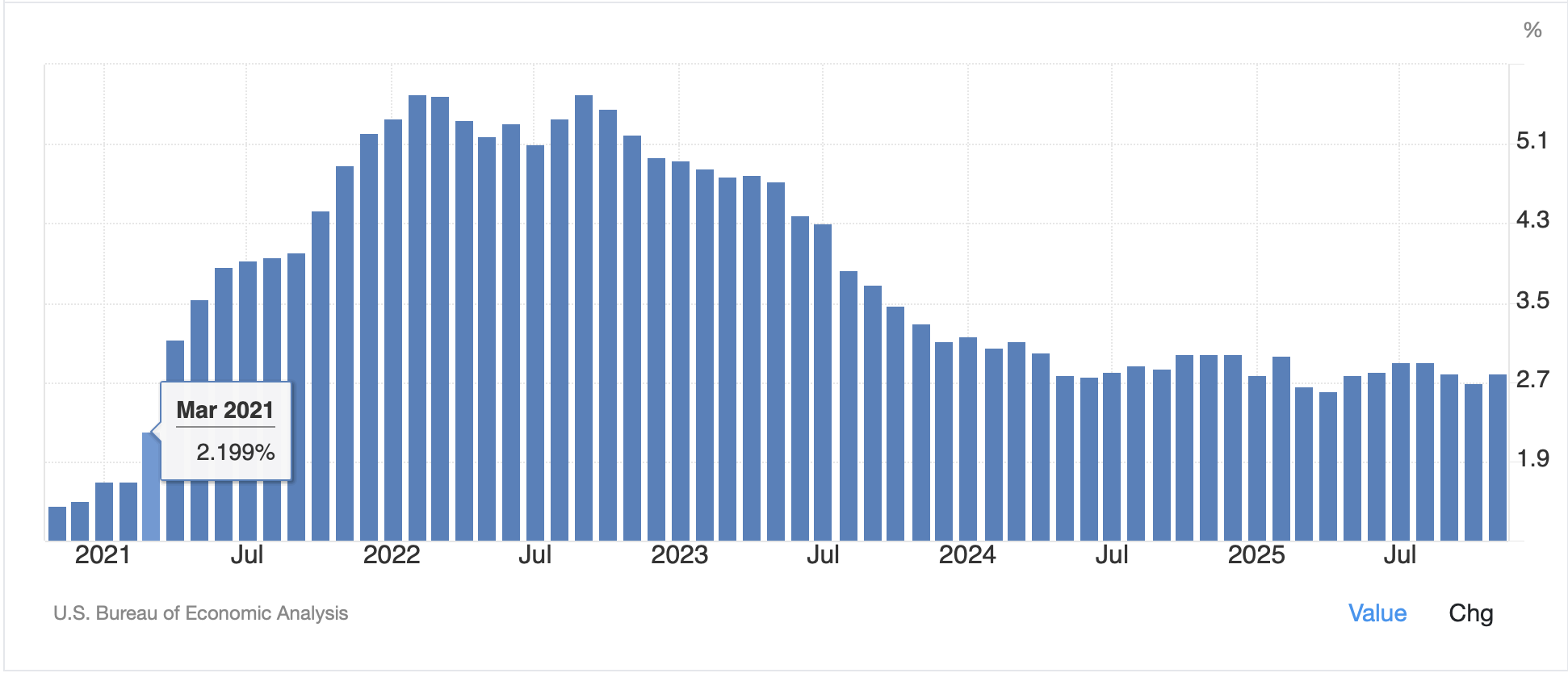
On a different, and topical subject, consider the issue with tariffs.  Economists explained that the imposition of tariffs would be devastating to the US consumer, raise prices dramatically and strengthen the dollar as FX markets adjusted to reflect the new trade policy.  But none of that happened, at least not yet.  In fact, the dollar continued to fall in the wake of the Liberation Day tariff announcements, while CPI since then has, granted, edged higher, but remains in its recent range for now and well below the 2022 levels (see below chart from tradingeconomics.com).

And a more important question regarding inflation is, have the tariffs been the driver, or has it been other parts of the price index, housing and core services for instance, that have been the key issue, neither of which would be directly impacted by tariffs.

All of this is to highlight the fact that the world has changed and that the evidence of the past several years, at least, is that the Fed’s econometric models are no longer fit for purpose.  I raise this issue because a look at so many previous market relationships show that many are breaking down.  We have seen gold rise alongside rising real interest rates and the dollar rise alongside gold, two things that are 180o from previous history.  Too, think back to 2022 when both stocks and bonds fell sharply at the same time, breaking the decades-long history of bonds behaving in a manner to offset declines in equity markets.

Source: tradingeconomics.com

This contemplation was brought on by a tweet which led me to a very interesting article (just a 5 minute read) by DL Jacobs of the Platypus Affiliated Society, regarding Fed Governor Miran and his recognition that the world has changed and that the Fed needs to change too.  Here is the second paragraph, and I think it explains the issue beautifully [emphasis added]:

He [Miran] used the moment to challenge the foundations of United States monetary policy. “I think it’s important to take these models seriously, not literally,” he said. He warned that models do not take into account the scale and speed of policy changes in light of the Trump administration’s re-election. The problem with the Fed isn’t wrong technique or bad data, he suggested, but rather that the very structure of its models is embedded in the economic and political assumptions of a bygone era. The world the forecasts are trying to measure no longer exists.

(At this point, I have to explain that the Platypus Society is a left-wing organization trying to explain why Marxism failed and recreate it, but that doesn’t make this article any less worthwhile.  I believe they see it as a step in the destruction of capitalism, which appears to be their goal.)

To me, this is just another point indicating that we’re not in Kansas anymore.  Policies need to change, and the Trump administration is working hard to do so.  One of the key points Miran makes is that the Fed and Treasury ought to be considered as a single entity, with the idea of Fed independence an anachronism from a bygone age.  The upshot is the Trump administration is going to continue to run things hot, or as macro analyst Lynn Alden has been saying, “Nothing stops this train”.  

This means that the Fed is going to run relatively easy monetary policy while the government, via the Treasury, is going to ensure there is ample liquidity available for everything, real economic activity and market activity.  The downside of these policies, alas, is that the idea inflation is going to decline in any meaningful way is simply wrong. It’s not.  Keep this in mind as we go forward.

As it happens, there was very little news of note overnight, at least market news, so let’s see how things behaved.  Friday’s mixed session in the US was followed by Chinese weakness with HK (-0.7%) and China (-0.7%) both under pressure.  Tokyo (-0.1%) was not nearly as impacted and the regional exchanges were actually broadly higher (Korea, India, Taiwan, Indonesia, Thailand).  The big news in Asia is the increasing verbal jousting by China and Japan at each other after PM Takaichi said, out loud, that if China attacked Taiwan, it would impact Japan.  Given the proximity, that is, of course, true, but apparently it was a taboo item in the diplomatic dance in the past.  I don’t see this having a long-term impact on anything.

In Europe, though, bourses are lower this morning led by Spain (-0.8%) although weakness is widespread (Germany -0.5%, France -0.4%. UK -0.1%).  There has been no data of note to drive this movement and it seems as though we are seeing the beginning of some longer-term profit taking after strong YTD gains by most bourses on the continent.  US futures at this hour (6:45) are pointing a bit higher, 0.43% or so.

In the bond market, Treasury yields have slipped -3bps this morning despite (because of?) the market pricing a December rate cut as a virtual coin toss.  This is a huge change over the past month as can be seen at the bottom of the chart below from cmegroup.com

Recent Fedspeak has highlighted the Fed’s uncertainty, especially absent data, and the belief that waiting is a better choice than acting incorrectly (what if waiting is the incorrect move?).  At any rate, we are going to be inundated with both Fedspeak (14 speeches this week!) as well as the beginnings of the delayed data so there will be lots of headlines.  Right now, I think it is fair to say that nobody is confident in the current direction of travel in the economy.  But perhaps, a more hawkish tone at the front of the curve has investors believing that inflation will, once again, become the Fed’s focus.  Alas, I don’t think so.  Looking elsewhere, European sovereign yields have followed Treasury yields lower, slipping between -2bps and -3bps this morning.  Perhaps more interesting is Japan, where JGB yields (+3bps) have risen to a new 17-year high as a prominent LDP member put forth a massive new spending bill to be passed.

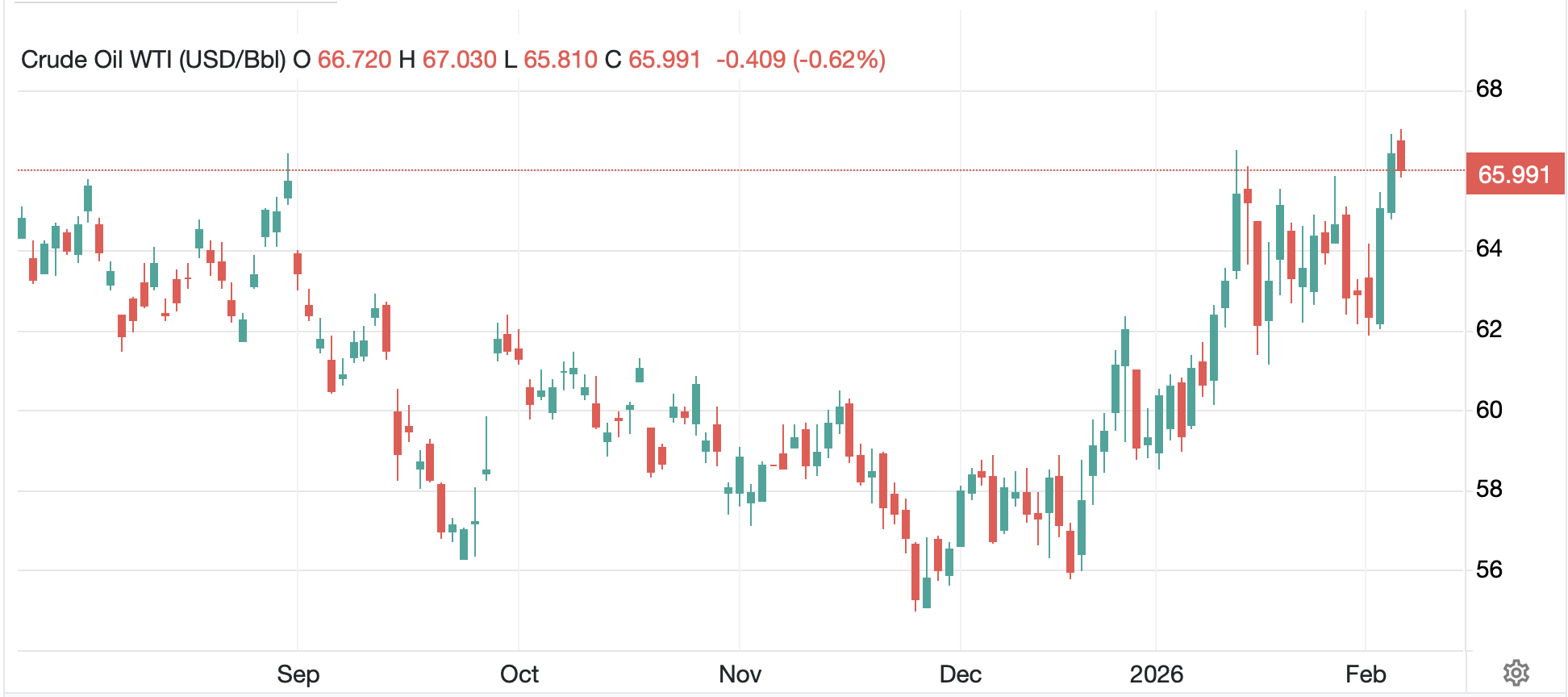
In the commodity space, oil remains pinned to the $60/bbl level with lots of huffing and puffing about Russian sanctions and oil gluts and IEA changes of opinion but in the end, WTI has been either side of $60 for the past month+ and continues to trend slowly lower.  

Source: tradingeconomics.com

Metals remain the most volatile segment of the entire market complex although this morning, movement has not been so dramatic (Au -0.1%, Ag +0.9%, Cu -0.4%, Pt -0.1%).  All the metals remain substantially higher than where they began the year and all have seemingly run into levels at which more consolidation is needed before any further substantial gains can be made.  I don’t think the supply/demand story has changed here, just the price action.

Finally, the dollar is a touch firmer this morning, with the DXY (+0.1%) a good representation of the entire space.  The only two currencies that have moved more than 0.2% today are KRW (-0.9%) which reversed Friday’s price action and is explained as continued capital outflows to the US for investment.  On the flip side, CLP (+1.1%) is benefitting from the first round of Presidential elections in Chile, where the right-wing candidate came out ahead and is expected to consolidate the vote and win an absolute majority in the second round.  Jose Antonio Kast, if he wins, is expected to proffer more market-friendly policies than the current socialist president, Gabriel Boric.  It seems the people in Chile have had enough of socialism for now.  But other than those two currencies, this market remains quiet.

On the data front, there is so much data to be released, but the calendar for much of it has not yet been finalized.  One thing that is finalized is the September employment situation which is due for release Thursday morning at 8:30. This morning we see Empire State Manufacturing (exp 6.0) and Construction Spending (-0.1%) and hopefully, the calendar will fill in as the week passes.

While equity markets remain very near their all-time highs, the Fear and Greed Index is firmly in Fear territory as per the below from cnn.com.

Historically, this has been seen as an inverse indicator for stock markets although it has been down here for more than a month.  Uncertainty breeds fear and the lack of data has many people uncertain about the current state of the US economy since the only information they get is either from the cacophony of social media, the bias of mainstream media or their own two eyes.  But even if you trust your own eyes, they just don’t see that much, likely not enough to come to a broad conclusion. 

FWIW, which is probably not much, my take is things are slower than they have been earlier in the year, but nowhere near recession.  I think it is the correct decision for the Fed to hold next month rather than cut because the drivers of inflation remain extant.  But Jay doesn’t ask me.  Whether Miran is correct in his prescriptions for the economy, I am gratified that he is questioning the underlying structure.  In the meantime, run it hot remains the name of the game and that means any risk-off period is likely to be short.

Good luck

Adf
Quelling the Strains

The government shutdown remains
In place, as the House is at pains
To summon the will
For them to fulfill
Their mandate, while quelling the strains
 
Meanwhile, banks in China are lending
Out cash, though in fact, they’re pretending
But quotas from Xi
Mean he wants to see
More loans to encourage more spending


While the Senate has passed a CR that will fund government completely through January 30th and includes full year funding for Veterans Affairs, the Department of Agriculture and legislative activities (they paid themselves), with the rest yet to be completed, the House is meeting today to vote on the measure, at which point, assuming it passes, it will then be sent to President Trump for his signature.  It should be completed today, but this being Congress, with numerous members seeking to preen to their TikTok viewers, until it is done, we cannot be certain.

Now, get ready to hear a lot about how much the shutdown cost as we will get many estimates from various economists and analysts, and you can be sure that they will reflect the political bias of the estimator.  I have seen estimates ranging from 0.2% of GDP to 0.6% of GDP for the quarter, with appropriate annualizations.  My personal view is the damage will be lesser, not greater, as all federal employees will be receiving back wages and most spending will have been delayed rather than destroyed.  We shall see.

Regarding the US economy, as we missed the first reading of Q3 GDP due to the shutdown, it seems we will be getting our first look at the end of this month.  Now, the Atlanta Fed did not stop working and their GDPNow estimate for Q3 remains quite robust at 4.0% as per the below chart from their website, atlantafed.org, but the damage, of course, will fall in Q4, so we won’t really know until sometime in January with the first look at that data.

However, it is important to understand that an increasing number of analysts are explaining that the economy is slowing rapidly.  Their latest ‘proof’ is from yesterday’s ADP weekly data, an entirely new statistic with a track record of exactly…2 weeks, but which showed that 11,250 jobs were lost last week.  I am no econometrician (thankfully), but it seems to me that building your case on a statistic with 2 data points is weak sauce.  Ultimately, I think the main reason that there is so much uncertainty amongst analysts is the concept of the K-shaped economy, where the wealthy are doing fine, basking in the glow of their equity returns, while those less well-off are struggling with ongoing inflation and a less robust job market.

In fact, the Fed is having the same problem, looking at the economy with no consistency as there appears to be a pretty significant rift between the hawks and doves right now.  We got further proof of this (as if the two dissents at the last meeting, one for a bigger cut and one for no move wasn’t enough proof) in this morning’s WSJ where the Fed whisperer, Nick Timiraos, published an article explaining exactly that.  There are two camps, one focused on weakening employment and wanting to cut and one still focused on inflation (allegedly) and wanting to pause.  The Fed funds futures market has reduced the probability of a December cut to 65% as of this morning, but is a lock for that cut by January with a small probability of two more cuts by then.

Nothing has changed my view that they cut next month because I believe that they are essentially unconcerned about inflation at this point, believing 3% is close enough to 2% for government work, and remain entirely focused on the job market.

Turning to the most fascinating international story, it appears that Chinese banks have started to make “phantom” loans, or at least that’s what they are being called, as President Xi is very keen to goose economic activity and the large, state-owned banks have quotas to reach.  So, apparently, what they are doing is going to their best customers, begging them to take out a loan they don’t need, and then having the loans repaid within one month.  The banks are even going so far as to pay the interest so there is no actual impact on anything other than bank loan volume.  Of course, that is the quota being met, so I imagine this will continue.

But it makes you wonder, exactly how bad are things in China that banks are resorting to these games?  Perusing the Chinese data from the past month, things are clearly slowing as per the below from tradingeconomics.com:

Too, the PMI data was soft and Foreign Direct Investment is collapsing, falling -10.4% in September. Again, if you want to understand why President Xi was willing to agree a deal with President Trump, the answer is that the Chinese economy remains under intense pressure, and while the currency doesn’t reflect anything about the economy, the fact that Chinese yields are amongst the lowest in the world is a strong signal that things are not great.

Ok, let’s turn to the overnight activity and see how things behaved.  While the US had a mixed performance (NASDAQ fell although the other indices rallied), we continue to see more positive than negative outcomes in Asia on the back of the ongoing tech rally and the end of the shutdown.  Thus, Japan (+0.4%), HK (+0.8%), Korea (+1.1%), India (+0.7% despite a terrorist attack) and Taiwan (+0.6%) all continued their recent rallies.  China (-0.1%) had a much less impressive day. But these markets continue to benefit from the tech story, and I expect that to continue if the tech story continues to be positive.  As to Europe, bourses there are also benefitting from the imminent end of the US shutdown with gains across the board on the continent (DAX +1.2%, CAC +1.1%, IBEX +1.1%) although the UK (-0.15%) is struggling as concerns grow over the nation’s ability to come up with a viable budget that pays for services without raising taxes to a crippling rate.  As to US futures this morning, at this hour (7:30), they are nicely higher, 0.5% or more.

In the bond market, Treasury yields have slipped -4bps, ostensibly on that weak ADP number which has more investors expecting a much weaker economy here.  Europe though, has seen yields tick higher by 1bp across the board, with the UK the exception (+3bps) as concerns over UK finances continue apace.

In the commodity markets, oil (-1.1%) which rallied yesterday on growing concerns over the latest US sanctions on Lukoil and Rosneft, have given back those gains and are once again hovering around $60/bbl.  The IEA released their report on the future of energy use, specifically fossil fuels, and in another sign the climate crisis is ending (or at least that it is no longer a concern), they explained that fossil fuel use would now peak in 2050 under current policies, rather than prior to the end of this decade under stated policies.  The FT was kind enough to put together a little graphic showing the two different views, but we all know that stated policies are wishful thinking.

In a nutshell, more oil demand will drive more oil supply, count on it!  Turning to metals, the rally continues this morning with gold (+0.2%) and silver (+1.1%) pushing back toward the highs seen on October 20th.  I strongly believe these markets will continue to rally as the ‘run it hot’ philosophy will be enacted in as many places around the world as can get away with it.  

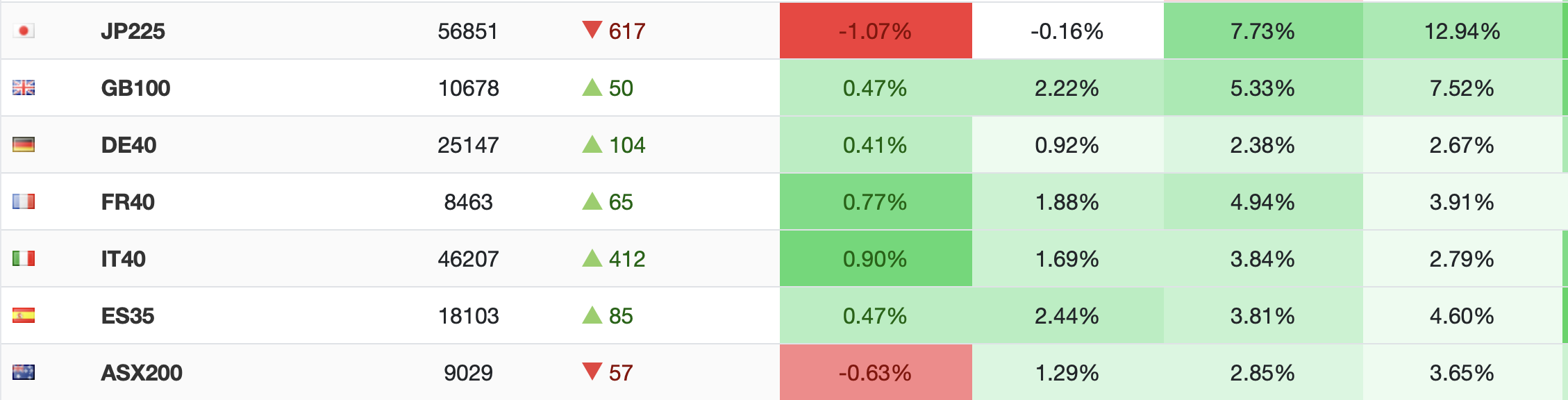
Finally, the dollar is a touch firmer this morning, with DXY (+0.1%) on the back of continued weakness in the pound (-0.3%) and the yen (-0.4%).  Elsewhere, the picture is mixed with the euro little changed while the rand (+0.5%) continues to benefit from the gold rally.  Otherwise, the dollar remains a back burner issue for most investors right now, although I have read that people are talking about the carry trade again, funding investments with short yen positions.  Certainly, the yen has been quite weak overall as evidenced by its trend over the past six months below.

Source: tradingeconomics.com

There is no data this morning although we will get bombarded with five Fed speakers, three of whom are confirmed doves (Miran, Williams and Waller) while the other two seem more middle of the road (Bostic, Paulson).  At this point, there is no consensus on the economy’s strength or direction and that is evident at the Fed as well as in the analyst community.  The only consensus seems to be that stocks and gold should both continue to rally.  As to the buck, what’s not to like?

Good luck

Adf
Like a Fable

It seems there’s a deal on the table
To end the shut down and enable
The chattering classes
To force feed the masses
A story that’s quite like a fable
 
Both sides will claim they have achieved
Their goals, though they were ill-conceived
But markets will love
The outcome above
All else, and we’ll all be relieved


While the shutdown is not technically over as the House of Representatives need to reconvene (they have been out of session since September 19th when they passed the continuing resolution) and adjust the bill so that it matches the one the Senate agreed last night and can be voted on in the House, it certainly appears that the momentum, plus President Trump’s imprimatur, is going to get it completed sometime this week. 

The nature of the deal is unimportant for our purposes here and both sides will continue to claim that they were in the right side of history, but the essence is that there appeared to be some movement on health care funding so, hurray!

As you can see in the chart below, while the story broke late yesterday afternoon and futures responded on the open in the evening session, the reality is the market sniffed out something was coming around noon on Friday.  In fact, the S&P 500 has rallied 2.4% since noon Friday.

Source: tradingeconomics.com

So, everything is now right with the world, right?  After all, this has been the major topic of conversation, not just by the talking heads on TV, but also in markets as analysts were trying to determine how much damage the shutdown was doing to the economy.  While I have no doubt that there were many people who felt the impact, my take is there were many, many more who felt nothing.  After all, the two main features were air travel and then SNAP benefits.  Let’s face it, on average (according to Grok) about 2.9 million people board airplanes in the US, well less than 1% of the population, although SNAP benefits, remarkably, go to 42 million people.  However, those have only been impacted for the past week, not the entire shutdown.

I’m not trying to make light of the inconveniences that occurred, just point out that from a macroeconomic perspective, despite the fact that the shutdown lasted 6 weeks, it probably didn’t have much of an impact on the statistics as all the money that wasn’t spent last month will be spent next month.  Different analyst estimates claim it will reduce Q4 GDP by between 0.2% and 0.5% with a concurrent impact on the annual result.  I am willing to wager it is much less.  However, it appears it will have ended by the end of the week and so markets are back to focusing on other things like AI, unemployment and QE.

Now, those three things are clearly important to markets, but I don’t think there is anything new to discuss there today.  Rather, I would like to focus on two other issues, one more immediate and one down the road, which may impact the way things evolve going forward.

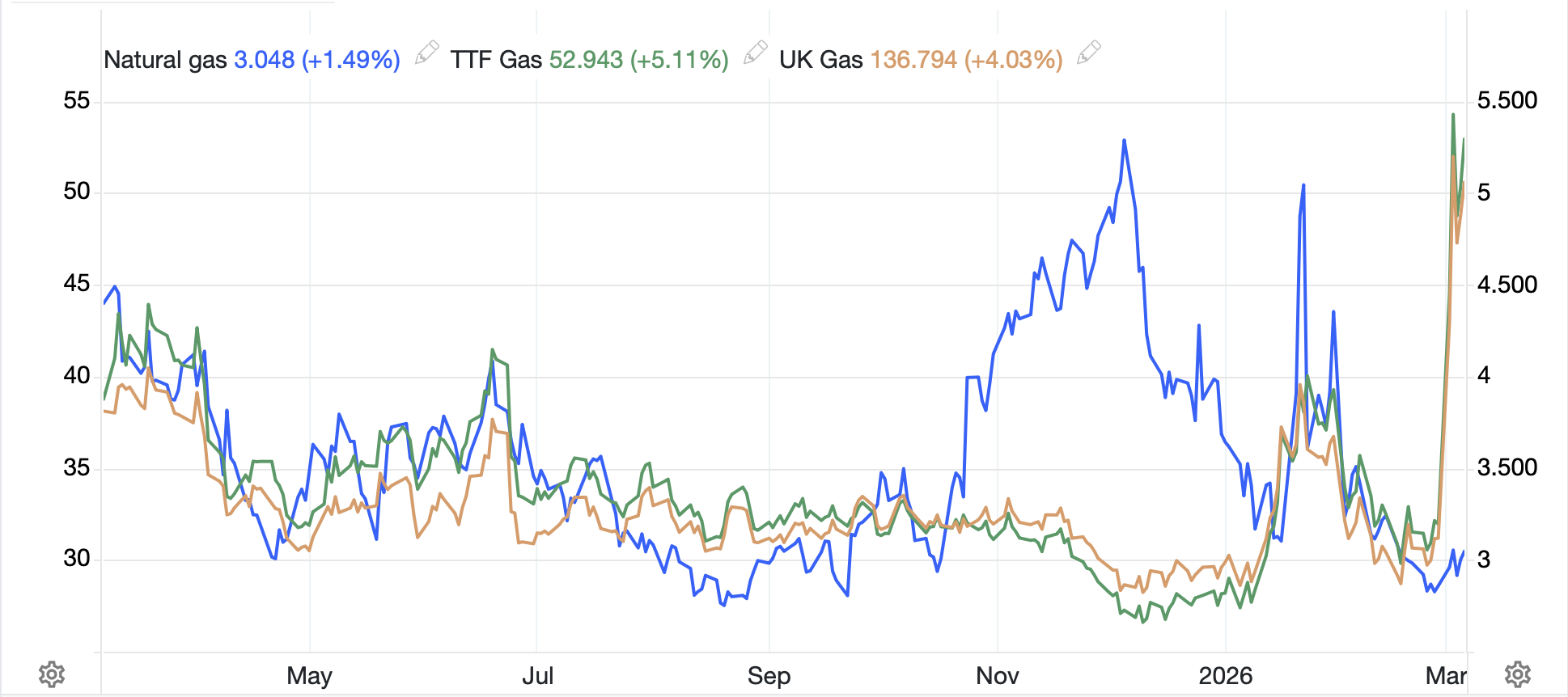
In the near term, as winter approaches, meteorologists are forecasting a much colder winter in the Northern Hemisphere across both North America and Europe, something that is going to have a direct impact on NatGas.  Bloomberg had a long article on the topic this morning with the upshot being that the Polar Vortex may break further south early this year and bring a lot of cold weather along for the ride.  This is clearly not new news to the NatGas market, as evidenced by the fact that its price has exploded (no pun intended) higher by 43% in the past month!

Source: tradingeconomics.com

While oil prices have remained stuck in a narrow range, trading either side of $60/bbl for the past 6 weeks amid a longer-term drift lower as you can see in the below chart, oil is only utilized by ~4% of homeowners for heating with 46% using NatGas.

Source: tradingeconomics.com

Ultimately, I suspect that we are going to see this feed through to inflation as not only are there the direct costs of heating homes, but NatGas is also the major source of generating electricity, with 43% of the nation’s electricity using that as its source.  We have already seen electricity prices rise pretty sharply over the past months (I’m sure you have all felt that pain) and if NatGas prices continue to climb, that will continue.  Remember, the current price ~$4.45/MMBtu is nowhere near significant highs like those seen just 3 years ago when it traded as high as $10/MMBtu.  With all this price pressure, will the Fed continue down their path of rate cuts?  Alas, I believe they will, but that doesn’t make our lives any better.

Which takes me to the second, longer term issue I wanted to mention, European legislation that is seeking to effectively outlaw the utilization of cash euros.  This substack article regarding recent Eurozone legislation is eye-opening as the ECB and Europe try to combat the coming irrelevance of the euro.  For everyone who either lives in Europe or does business there, I cannot recommend reading this highly enough.  There are many changes occurring in financial architecture, and by extension financial markets.  Keep informed!

Ok, enough of that, let’s see how markets have responded to the Senate deal.  Apparently, US politics matters to the entire global equity market.  Green is today’s color with Japan (+1.25%), HK (+1.55%) and China (+0.35%) all performing well, although not as well as Korea (+3.0%) which really had a good session.  Pretty much all the other regional markets were also higher.  In Europe, the deal has everyone excited as well with gains across the board (Germany +1.8%, France +1.4%, Spain +1.4%, UK +1.0%).  As to US futures, at this hour (7:45) they are higher by about 1% across the board.

I guess with that much excitement about more government spending, we cannot be surprised the yields have edged higher.  This morning Treasury yields are up by 3bps, which is what we saw from JGB markets last night as well, although European sovereign yields are little changed on the day.  I suspect, though, if equities continue to rally, we will see yields there edge higher.

In the commodity space, oil (+0.5%) continues to trade in its recent range.  The most interesting thing I saw here was that the IEA is set to come out with their latest annual assessment of the oil market and for the first time in more than a decade they are not going to claim that peak fossil fuel demand is here or coming soon.  The climate grift is truly breaking down.  But the commodity story of the day is precious metals which are massively higher (Au +2.5%, Ag +3.3%, Pt +2.6%) with copper (+1.6%) coming along for the ride.  The narrative here is that with the government shutdown due to end soon, President Trump talking about $2000 tariff rebate checks and the Fed likely to cut rates in December (65% probability), debasement is with us and metals is the place to be!

Interestingly, the dollar is not suffering much at all despite the precious metals story.  While AUD (+0.6%), ZAR (+0.6%) and NOK (+0.6%) are all stronger on the commodity story, the euro is unchanged, JPY (-0.4%) continues to decline and the rest of the G10 is not doing enough to matter.  In truth, if I look across the board, there are more currencies strengthening than weakening vs. the greenback, but overall, at least per the DXY, the dollar is little changed.

There is still no data at this point, although it will start up again when the government gets back to work.  Actually, there has been much talk of the weakness in Consumer sentiment based on Friday’s Michigan Index which fell to 50.3, the second lowest in the history of the series with several subindices weakening substantially.  However, that was before the news about the end of the shutdown, so my take is people will regain confidence soon.  As well, we hear from 9 Fed speakers this week, with 5 of them on Wednesday!  Both dissenters from the October meeting will speak, so perhaps things have changed in their eyes, but I doubt it.

At this point, all is right with the world as investors anticipate the US government getting back to work while the Fed will continue to support markets by easing policy further.  In truth, the dollar should not benefit here, but I have a feeling that any weakness will be short-lived at best.  Longer term, I continue to believe the dollar is the place to be.

Good luck

Adf
Turned to Sh*t

While headlines are all ‘bout elections
And some have discussed stock corrections
The dollar keeps climbing
As some think pump priming
By Jay will find no real objections
 
The punditry, though, remains split
One side claims things have turned to sh*t
The other side, though
Is really gung-ho
And weakness they will not admit


The Democrats had a good election, sweeping the big three races in NYC, NJ and Virginia and many down ticket ones as well.  One spin is this is all a vote against President Trump but given that those three venues are all heavily Democratic to begin with, that may be an exaggeration.  Of the three, my concern turns to NYC as having lived there prior to Mayor Rudy Giuliani’s cleanup of the city, I can tell you, things were not fantastic.  Mayor-elect Mamdani’s stated plans have failed every time they have been tried around the world and I suspect that will be the situation here as well. Alas, that will not prevent him from trying.  Ironically, regarding high rents, it is possible that the increased outmigration from the city by those in the center and on the right will reduce housing demand and arguably housing costs.  We will all watch as it unfolds.

But will that directly impact markets?  Of that I am far less concerned.  I read that JPMorgan already had more employees in Texas than NY prior to the election and given that the concept of a physical exchange has basically disappeared, trading can relocate quickly.  My take is, this will get the talking heads quite excited for a while but will have a minimal impact on markets.

Which takes us to yesterday’s price action and its drivers.  First off, one might have thought that we experienced another Black Monday based on some of the hysteria in commentaries, but in the end, US equity indices only fell between -0.5% (DJIA) and -2.0% (NASDAQ).  In fact, using the S&P 500, a look at the chart shows that the decline over the past several sessions amounts to just -2.3% there, hardly calamitous!

Source: tradingeconomics.com

I continue to read about the K-shaped economy with the massive split between the top 10% of income/wealth representing 87% of spending and enjoying life while the bottom 90% struggle immensely.  This has been made possible by the ongoing support of financial assets by the Fed (and other central banks) which has accrued to asset holders, i.e. the top 10%.  In fact, this is a far more likely rationale for Zoran Mamdani’s victory yesterday, he has promised to help those who are struggling by freezing rents, offering free stuff and taking over the grocery stores to remove the profit motive and lower prices.  And when it comes to elections, the bottom 90% have a lot more votes!

Here is as good an explanation of the forces driving this narrative as any:

While equity and asset prices continue to climb, the working class is finding life increasingly difficult as job opportunities seem to be shrinking.  This latter issue seems only to be exacerbated by the growth in AI spending and the announcements by numerous companies that they will be reducing staffing because of the efficiencies created by AI in their operations.

Arguably, the reason we have seen such a large dichotomy between analyst views is that some are focused on data that represents the bottom leg of the ‘K’ and see a recession around the corner, if not already upon us.  Meanwhile, others see the arm of the ‘K’ and see good times ahead.  Certainly, if we look at the broad-based GDP readings, at least based on the Atlanta Fed’s GDPNow forecast, Q3 was remarkably strong at real GDP growth of 4.0% annualized (see below chart).  Calling for a recession with that as backdrop is a very difficult case to make, in my view, but that won’t stop some analysts from trying.

Net, while nobody likes to see their portfolios’ value shrink, the declines so far have been very modest.  It is entirely reasonable to expect a correction of 10% – 15%, especially if we look at the chart at the top showing a 36% rally with limited drawdowns over the past 6 months.  It feels too early to panic.

And with that in mind, let’s see how markets behaved overnight.  Asian markets followed US ones lower with Tokyo (-2.5%) leading the way, although that was well off the early session lows which touched -4.0%.  Korea (-2.9%) and Taiwan (-1.4%) both suffered as well although the rest of the region was far less impacted.  Both China and HK were little changed and other gains and losses were on the order of +/-0.5% or less.  European bourses are all in the red as well this morning, although the one thing of which we can be sure is it is not related to the tech selloff given Europe has no tech industry of which to speak.  But Spain (-0.9%) and Germany (-0.75%) are both down despite reasonable Services PMI data from both nations and better than expected German Factory Orders (+1.1%).  UK equities are unchanged, and the rest of the continent is somewhere between unchanged and Spain.  Negative sentiment has clearly carried over, but there have been no strong reasons to sell aggressively.

In the bond market, Zzzzzz is today’s message.  Every major government bond is within 1bp of yesterday’s close, and yesterday’s price action was only worth 1bp to 2bps.  In fact, as you can see from the chart below, since the FOMC and Powell’s hawkish press conference, nothing has changed.  This is true from Fed funds futures as well, with a 71% probability still price for a December cut.

Source: tradingeconomics.com

In the commodity space, oil (-0.3%) seems to be lower every morning when I write, but continues to trade in a narrow range around $60/bbl.  Perhaps the most interesting thing I read this morning was Javier Blas’ op-ed in Bloombergregarding the rationale for a US-led regime change in Venezuela given it is the nation with the largest known oil reserves.  If you are President Trump and seeking to get oil prices lower, that could be a very effective source of the stuff.  As to the metals markets, yesterday saw a sharp decline in precious metals and this morning they are rebounding with both gold and silver higher by 0.9%.  Copper (+0.25%), too is rising a bit, although remains well off the highs seen when gold peaked.

Finally, the dollar continues to impress.  While this morning it is little changed against most of its counterparts, it is, apparently, consolidating its recent gains.  The DXY remains above 100.00, which many have seen as a key resistance level.  The pound (+0.2%) while bouncing slightly this morning is hovering just above 1.30, a level last seen on Liberation Day, and certainly appears to be working its way lower from its summer peak.  If I consider the fiscal problems and the energy policy in the UK, it is very difficult to expect a significant amount of demand for the pound.

Source: tradingeconomics.com

Elsewhere, ZAR (+0.4%) is responding to the rise in gold prices and otherwise, +/-0.2% is today’s trading story.  Over time, given the promised investments into the US based on trade deals that have been signed, I expect there will be consistent demand for the greenback.  And as I wrote yesterday, the idea of a two-currency world in the future cannot be dismissed.

We do have data today with ADP Employment (exp 25K), ISM Services (50.8) and then the EIA oil inventory data where limited net change is expected although the API data yesterday showed a large build of 6.5mm barrels.  Remarkably, there are no scheduled Fed speakers, but that story remains caution but a tendency toward cutting.

For all the election hype, I don’t perceive that things have changed very much at all.  Perhaps the Supreme Court hearings on the legality of President Trump’s tariffs are the real story today, but regardless of the hearings, no verdict will be rendered for many weeks.  Which leaves us with a world in which tech is still dominant in equity markets and the US is still dominant in tech.  With the perception of the Fed being somewhat more hawkish, I don’t see a good reason to sell dollars.

Good luck

Adf
Filled With Chagrin

The vibe in the market is fear
As equities get a Bronx cheer
Commodities, too
Most traders eschew
The dollar, though’s, getting in gear
 
So, what has the catalyst been
To drive such a change in the spin
No story stands out
But there is no doubt
Investors are filled with chagrin


Ladies and gentlemen, boys and girls, this morning things just feel bad.  As I peruse the headlines around the major publications, there is no obvious story that is driving today’s weakness in risk assets, but there is no mistaking the vibe.  Certainly, there are several issues outstanding that might be seen as a negative, but none of them are new.  

  • The government has been shut down for 35 days as of today, and it doesn’t sound like the Senate Democrats are ready to vote to reopen it.  Granted, the problems of the shutdown increase with time, but there has been no apparent change in tone for at least the past two weeks, so why is today the day when things look bad?
  • The war in Ukraine continues apace with no obvious timeline to ending, but this has been ongoing for nearly 4 years, so what is it about today that may have changed?
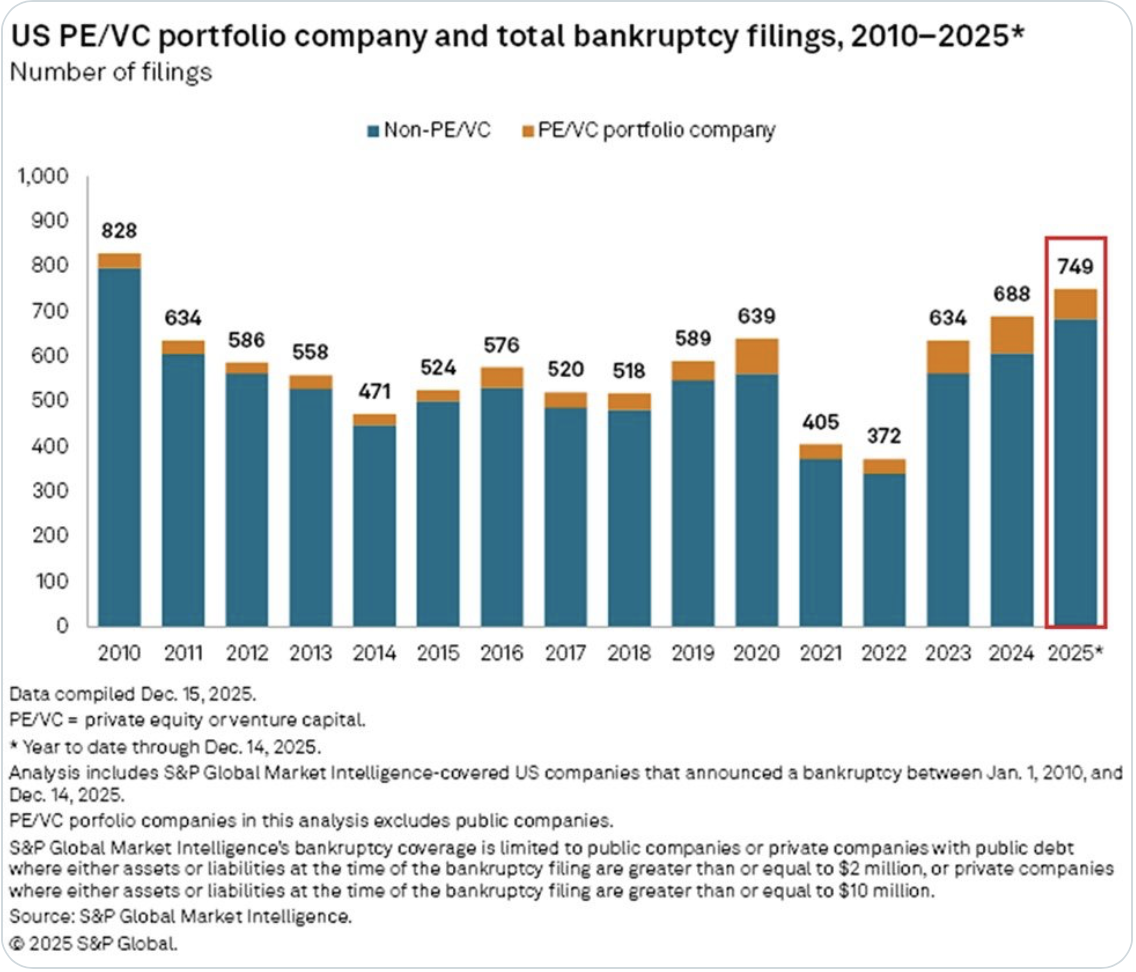
  • Concerns over fraud have increased after the recent bankruptcy filings by First Brands and Tricolor, as well as accusations by banks of other situations, but again, no new story broke overnight.
  • Perhaps it is the fact that today is Election Day in the US, and there is concern that Zoran Mamdani, a self-described Democratic Socialist, could become the next mayor of NYC, which given it is still home to so many financial markets, has those market participants unnerved.

Some days, it’s just not clear why markets move in the direction they do, and there can be far less dramatic drivers.  For instance, we have seen a major rally in equity markets, and risk assets in general, over the past 5 years, with an acceleration over the past 6 months and they are simply taking a breather.  Whatever the driver, the movement is clear.

Source: tradingeconomics.com

So, given the absence of obvious drivers to discuss, let’s simply recap the damage. After yesterday’s mixed session in the US, Asia was under significant pressure led by Tokyo (-1.75%) with HK (-0.8%) and China (-0.75%) slipping as well.  But Australia (-0.9%) fell after the RBA left rates on hold, as expected, although Governor Bullock sounded a touch more hawkish than expected, and the rest of the region saw almost universal weakness with Korea (-2.4%) the worst of the bunch, but declines everywhere (India, Taiwan, Indonesia, Singapore, Thailand) except New Zealand, which managed a small gain, to reach yet another record high, on solid earnings numbers from key companies.

Meanwhile, European bourses are all sharply lower as well (DAX -1.3%, CAC -1.2%, IBEX -1.1%) as the overall market vibe weighs on these markets, all of which recently traded at new all-time highs.  Ironically, the UK (-0.6%) is about the best performer despite a speech from Chancellor of the Exchequer, Rachel Reeves, which explained…well, it is not clear what it explained.  The UK has major budget problems and has discussed raising taxes, but given growth is lagging, there is a lot of pushback, even within the Starmer government, on that subject.  As with virtually every G10 economy, the government is spending far more than they take in and they don’t know how to address the deficit.  Unfortunately for the UK, the pound is not the global reserve currency and so they are subject to market discipline, unlike the US…so far.  But, in this space, US futures are all lower this morning, down -1.0% or so as I type at 7:10am.

Now, your first thought might be that bonds have rallied nicely on all this risk aversion, but while they have, indeed, moved higher (yields lower) I don’t know that nicely would describe the movement.  Rather, barely is a better description as 10-year yields are lower by -2bps in the Treasury market and between -1bp and -2bps in all European sovereign markets.  In fact, despite the weakness in Japanese stocks overnight, JGB yields are unchanged.  The message is, bonds are not that appealing, even if stocks aren’t either.

Turning to commodities, oil (-1.4%) is having a hard time this morning alongside the equity markets, with virtually all energy prices lower across the board.  Given there has been no announcement of a major energy breakthrough, this has the feel of growing concern over economic activity going forward.  With that in mind, though, WTI is still trading right around $60/bbl, which seems to be its “home” lately.

In the metals markets, gold (-0.15%) continues to trade around the $4000/oz level, which seems to be its new “home” as traders await the next catalyst in this space.  Silver (-0.3%) is similarly fixated on its level of $48/oz and seems likely to follow gold’s lead going forward.  However, copper (-2.3%) seems like it is more in sync with oil lately, as the two are both so intimately linked with economic activity and changes thereto.  It’s funny, despite the risk asset weakness, I have not seen anything new on a pending recession in the US, nor globally, although there continues to be a steady stream of analysts who have been explaining we are already in one.

Finally, the dollar is today’s winner, rising against every one of its counterparts except the yen (+.45%) which responded to a second round of verbal intervention from FinMin Katayama, who once again drew from the MOF seven-step playbook with a half-step overnight: “I’m seeing one-sided and rapid moves in the currency market. There’s no change in our stance of assessing developments with a high sense of urgency.”  

But away from the yen, it is merely a question of which currency looks worst.  The pound (-0.65%) has traded down to levels not seen since Liberation Day, as it appears the FX market did not take Chancellor Reeves’ comments that well.

Source: tradingeconomics.com

For those who view the DXY as the key indicator, it has traded above 100 for the first time since August, and I know many technicians are looking for a breakout here.  The fact remains that the Fed’s recent seeming mildly hawkish turn is out of sync with most of the rest of the world and will support the dollar for now.  Of course, the futures market is still pricing a 72% probability of a rate cut in December, so traders are taking the ‘hawkish’ comments by Chair Powell at the press conference last week with a grain or two of salt.  In fact, one of the things weighing on the pound is the idea that the BOE may cut this week despite still high inflation.

But wherever you look in this space, the dollar is sharply higher.  ZAR (-1.0%), NOK (-0.9%), MXN (-0.85%) and SEK (-0.9%) lead the way, but declines of -0.5% are rampant across all three regional blocs.  Today is a straight up dollar story.

And that’s all we have today.  Yesterday’s ISM data was a touch weaker than forecast, and last month, slipping to 48.7 with Prices Paid (58.0) slipping as well.  Weirdly, the S&P PMI was a better than expected 52.5, rising from last month and beating expectations.  It seems a mixed message.  Yesterday’s Fed speakers didn’t tell us anything new, with Governor Cook explaining that December is a “live” meeting.  I’m not sure what that means.  Is the implication they may not cut there?  That would not go down well in either markets or the White House.

Given how far equity prices have come in the past 6 months, it would not be a surprise to see a more substantial pullback.  In fact, it would be healthy for the market to remove some of the excesses that abound.  The fraud stories are concerning as they tend to flourish at the end of bull markets, and while they are not yet flourishing, they are starting to become more common.  In the end, while I expect the Fed will cut in December, and then again in January, I don’t see a reason for the dollar to decline sharply.

Good luck

Adf
A Strong Sense of Urgency
Katayama said
“A strong sense of urgency”
Informs our views now


Source: tradingeconomics.com

But this is the first step in their typical seven step plan before intervention.  And I get it, the combination of Chairman Powell suddenly sounding hawkish on Wednesday afternoon, telling us a December rate cut was not a foregone conclusion and the BOJ continuing to sit on its hands despite inflation running at 2.9%, the 42nd consecutive month (see below) that it has been above their 2.0% target (sound familiar?), indicates that the current policy stances will likely lead to further dollar strength vs. the yen.  

Source: tradingeconomics.com

There is something of an irony in the current situation in Japan.  Recall that for years, the Japanese economy was in a major funk, with deflation the norm, not inflation, as government after government issued massive amounts of debt to try to spend their way to growth.  In fact, Shinzo Abe was elected in 2012, his second stint as PM, based on his three arrows plan to reinflate the economy because things were perceived so poorly.  If you look at the chart below, which takes a longer-term view of Japanese inflation, prior to 2022, the two positive spikes between 1992 and 2022 were the result of a hike in the Japanese VAT (they call it the Goods and Services Tax) which raised prices.  In fact, during that 30-year period, the average annual CPI was 0.25%.  And the Japanese government was desperate to raise that inflation rate.  Of course, we know what HL Mencken warned us; be careful what you wish for, you just may get it…good and hard.  I have a sense the Japanese government understands that warning now.

Data source: worldbank.org

Net, it is hard to make a case that the yen is going to reverse course soon.  For receivables/asset hedgers, keep that in mind.  At least the points are in your favor!

So, now that a trade deal’s agreed
Can China reverse from stall speed?
The data last night
Sure gave Xi a fright
More stimulus is what they need!

The other noteworthy macro story was Chinese PMI data coming in weaker than expected with the Manufacturing number falling to 49.0, vs 49.8 last month, with all the subcategories (foreign sales, new orders, employment and selling prices) contracting as well.  The Chinese mercantilist model continues to struggle amid widespread efforts by most developed nations to prevent the Chinese from dumping goods into their own economies via tariffs and restrictions.  The result is that Chinese companies are fighting on price, hence the deflationary situation there as too many goods are chasing not enough demand (money).  

There have been many stories lately about how the Chinese have the upper hand in their negotiations with the US, and several news outlets had stories this morning about how the US got the worst of the deal just agreed between Trump and Xi.  As well, this poet has not been to China for a very long time, so my observations are from afar.  However, things in China do not appear to be going swimmingly.  While there continues to be talk, and hope, that the government there is going to stimulate domestic consumer spending, that has been the story for the past 3 or 4 years and it has yet to occur in any effective manner.  The structural imbalances in China remain problematic as so many people relied upon their real estate investments as their nest egg and the real estate bubble continues to deflate 3 years after the initial shock.  Chinese debt remains extremely high and is growing, and while they certainly produce a lot of stuff, if other nations are reluctant to buy that stuff, that production is not very efficient for economic growth.

Many analysts continue to describe the US-China situation as China is playing chess while the US is playing checkers, implying the Chinese are thinking years ahead.  If that is so, please explain the one-child policy and the decimation of their demographics.  Just sayin.

Ok, let’s look at markets overnight.  While yesterday’s US markets were blah, at best, strong earnings from Amazon and Apple has futures rocking this morning with NASDAQ higher by 1.3% at this hour (7:40).  Those earnings, plus the euphoria over the Trade deal with the US sent Japanese shares (+2.1%) to another new all-time high which dragged along Korea (+0.5%) and New Zealand (+0.6%) but that was all.  The rest of Asia was under pressure as the weak Chinese PMI data weighed on both HK (-1.4%) and mainland (-1.5%) indices and that bled to virtually every other market. Meanwhile, European bourses are all somewhat lower as well, albeit not dramatically so, as the tech euphoria doesn’t really apply here.  So, declines between -0.1% (Spain) and -0.4% (UK) are the order of the day.

In the bond markets, yields have essentially been unchanged since the FOMC response with treasury yields edging 1bp higher this morning, now at 4.10%, while European sovereign yields are either unchanged or 1bp higher.  The ECB was a nothingburger, as expected, and going forward, all eyes will be on the data to see if any stances need change.

The commodity markets continue to be the place of most excitement with choppiness the rule.  Oil (-0.25%) is a touch softer this morning but continues to hover around the $60/bbl level.  I’m not sure what will get it moving, but right now, neither war nor peace seems to matter.  Regime change in Venezuela maybe?

Source: tradingeconomics.com

In the metals markets, volatility is still the norm with gold (-0.45%) lower this morning after a nice rebound yesterday and currently trading just above $4000/oz.  Silver and copper are unchanged this morning with platinum (-0.9%) following gold.  However, regardless of the recent market chop, the charts for all these metals remain distinctly bullish and the theme of debased fiat currencies is still alive.  Run it hot is still the US playbook, and that is going to support all commodity prices.

Finally, the dollar, after another step higher yesterday, is little changed this morning.  Both the euro and yen are unchanged and the rest of the G10 has slipped by between -0.1% and -0.2%.  In truth, today’s outlier is ZAR (-0.4%).  Now, let’s look at two ZAR charts, the past year and the long term, which tell very different stories.  In fact, it is important to remember that this is often the case, not merely a rand situation.  First, the past year shows the rand with a strengthening trend as per the below from tradingeconomics.com.  That spike was the response to Liberation Day.

But now, let’s look at a longer-term chart of the rand, showing the past 21 years.

Source: finance.yahoo.com

Like most emerging market currencies, the rand has been steadily depreciating vs. the dollar for decades.  It’s not that we haven’t seen a few periods of modest strength, but always remember that in the big picture, most EMG currency’s slide over time.  This is merely one example, and it is a BRICS currency.  The demise of the dollar remains a long way into the future.

On the data front, Chicago PMI (exp 42.3) is the only release, and we hear from three more Fed speakers.  It appears every FOMC member wants to get their view into the press as quickly as possible since there seem to be so many differing views.  In the end, I continue to think the Fed cuts in December, and nothing has changed.  But for now, there is less certainty as this morning, the probability of a cut is down to 66%.  I guess we’ll see.  But regardless, I still like the dollar for now.

Good luck and good weekend

Adf