Cold Growth

Winter approaches
Both cold weather and cold growth
Plague Japan’s future


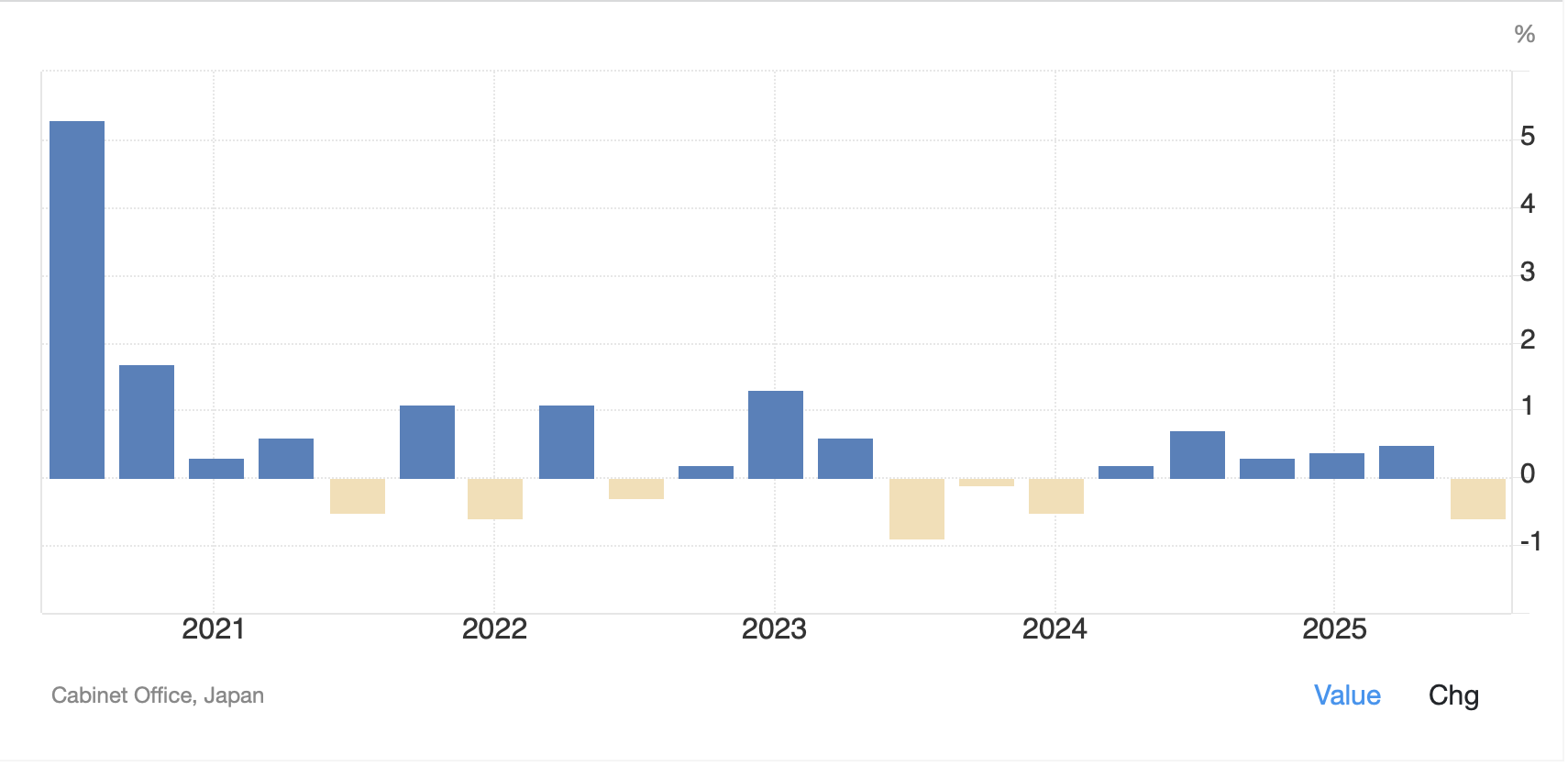
It’s not a pretty picture, that’s for sure.  A raft of Japanese data was released early Sunday evening with GDP revised lower (-0.6% Q/Q, -2.6% Y/Y) and as you can see from the Q/Q chart below, it is hard to get excited about prospects there.

Source: tradingeconomics.com

Of course, this is what makes it so difficult to estimate how Ueda-san will act in a little less than two weeks’ time.  On the one hand, inflation remains a problem, currently running at 3.0% and showing no signs of declining.  Recall, the BOJ has a firm 2.0% target, so they are way off base here.  Add to that the fact that inflation in Japan had been virtually zero for the prior 15 years and the population is starting to get antsy.  However, if growth is retreating, how can Ueda-san justify raising rates?

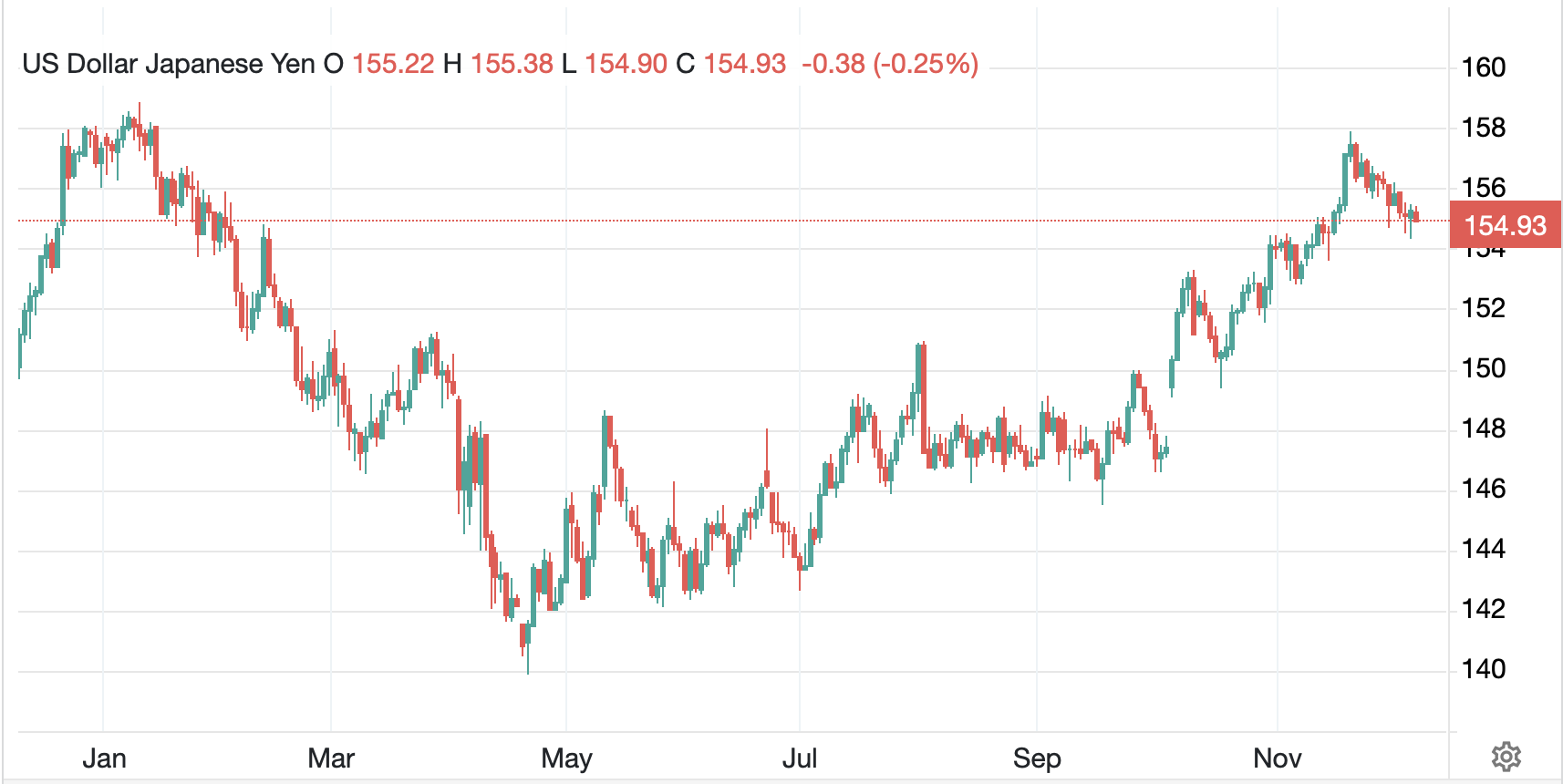
In the meantime, the punditry is having a field day discussing the yen and its broad weakness, although for the past three weeks, it has rebounded some 2% in a steady manner as per the below chart,

Source: tradingeconomics.com

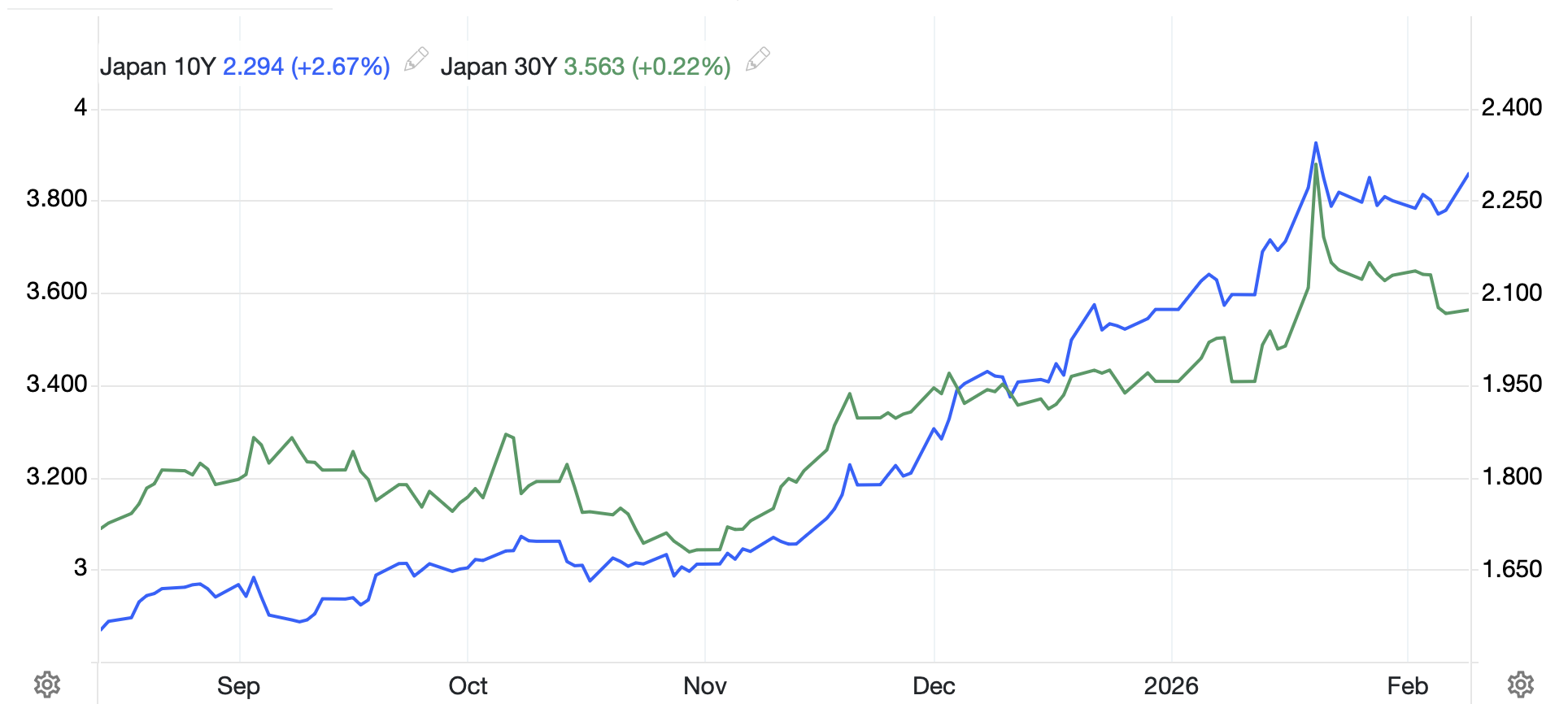
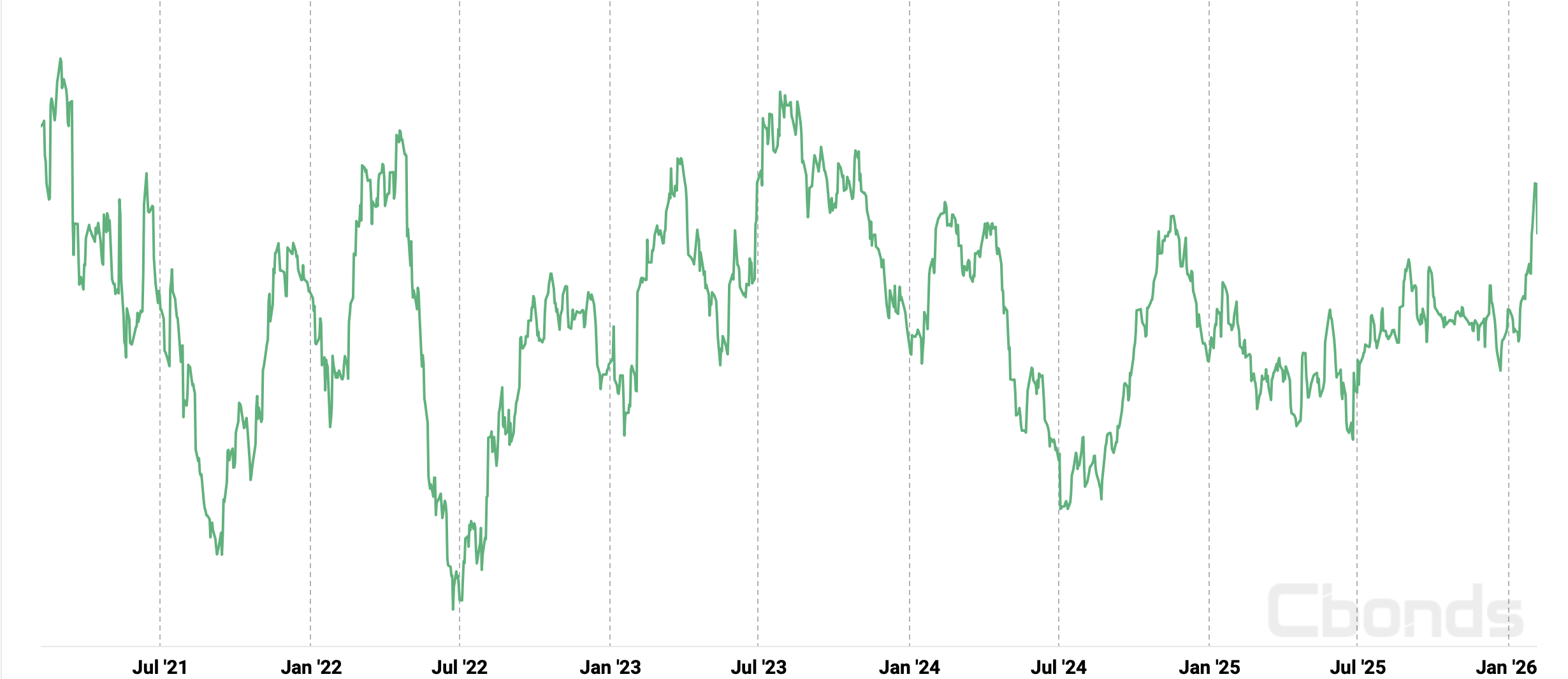
As well, much digital ink has been spilled regarding the 30-year JGB yield which has traded to historic highs as per the below chart from cnbc.com.

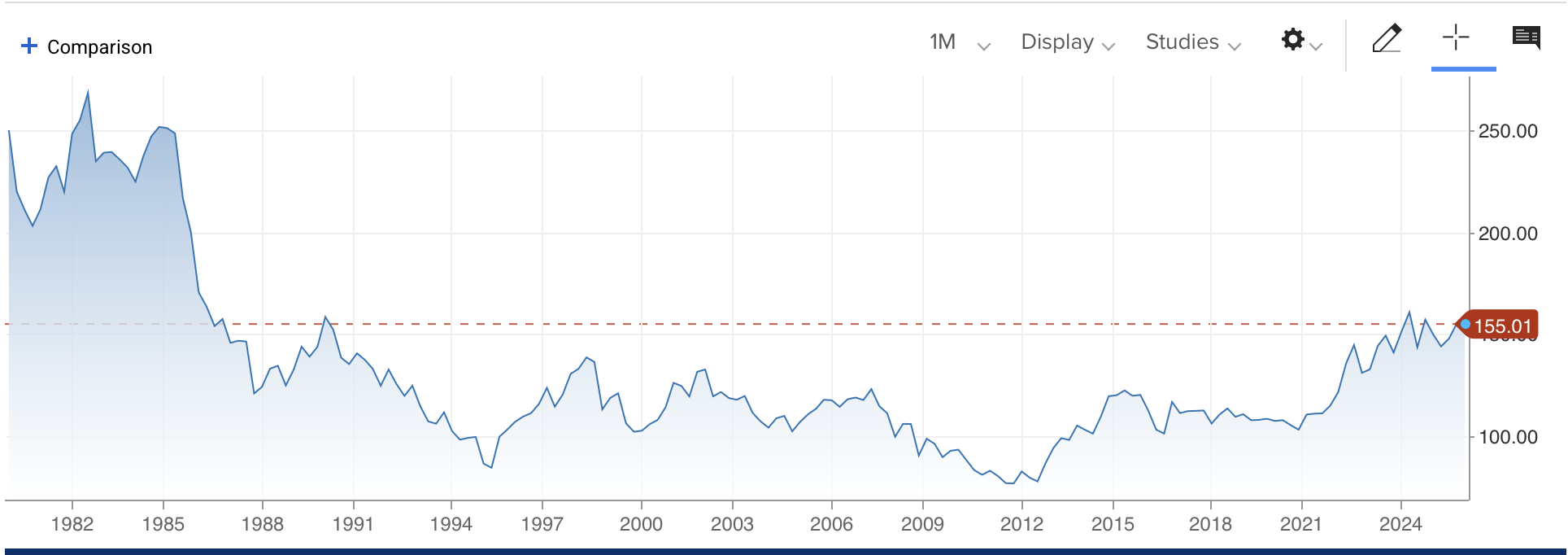
There are many pundits who have the view that the Japanese situation is getting out of control.  They cite the massive public debt (240% of GDP), the fact that the BOJ holds 50% of the JGB market, the fact that the yen has declined to its lowest level (highest dollar value) since a brief spike in 1990 and before that since 1986 when it was falling in the wake of the Plaza Accord.

Source: cnbc.com

Add in weakening economic growth and growing tensions with China and you have the makings of a crisis, right?  But ask yourself this, what if this isn’t a crisis, but part of a plan.  Remember, the carry trade remains extant and is unlikely to disappear just because the BOJ raises rates to 0.75% in two weeks.  This means that Japanese investors are still enamored of US assets, notably Treasuries, but also stocks and real estate, as a weakening yen flatters their holdings.  Too, it helps Japanese companies compete more effectively with Chinese competitors who benefit from a too weak renminbi as part of China’s mercantilist model.  Michael Nicoletos, one of the many very smart Substack writers, wrote a very interesting piece on this subject, and I think it is well worth a read.  In the end, none of us know exactly what’s happening but it is not hard to accept that some portion of this theory is correct as well.  The one thing of which I am confident is the end is not nigh.  There is still a long time before things really become problematic.

And the yen?  In the medium term I still think it weakens further, but if the Fed gets very aggressive cutting rates, that will likely result in a short-term rally.  But much lower than USDJPY at 145-150 is hard for me to foresee.

Turning to the other noteworthy news of the evening, the Chinese trade surplus has risen above $1 trillion so far in 2025, with one month left to go in the year.  This is a new record and highlights the fact that despite much talk about the Chinese focusing more on domestic consumption, their entire economic model is mercantilist and so they continue to double down on this feature.  While Chinese exports to the US fell by 29% in November, and about 19% year-to-date, they are still $426 billion.  However, China’s exports to the rest of the world have grown dramatically as follows: Africa 26%, Southeast Asia 14% and Latin America 7.1%.  Too, French president Emanuel Macron just returned from a trip to Beijing, meeting with President Xi, and called out the Chinese for their export policies, indicating that Europe needed to take actions (raise tariffs or restrict access) before European manufacturing completely disappears.  (And you thought only President Trump would suggest such things!)

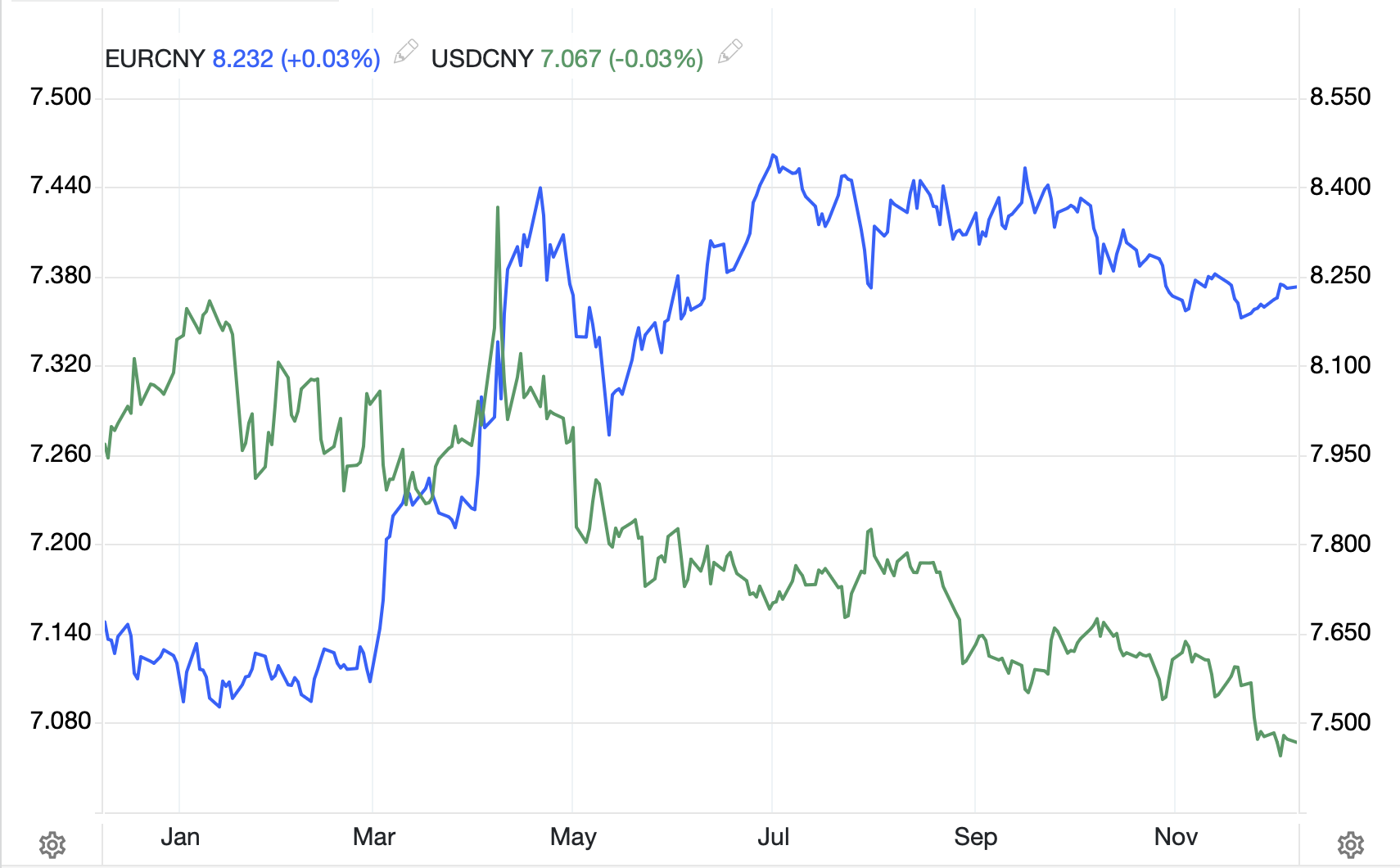
So, how did markets respond to this?  Well, the CSI 300 rose 0.8% (although HK fell -1.2%) and the renminbi was unchanged.  But I think it is worth looking at the renminbi’s performance vs. other currencies, notably the euro, to understand Monsieur Macron’s concerns.

Source: tradingeconomics.com

It turns out that the CNY has weakened by nearly 7.5% vs. the euro this year, a key driver of the growing Chinese trade surplus with Europe (and now you better understand the Japanese comfort with a weaker JPY).  My observation is that the pressure on Chinese exports is going to continue to grow going forward, especially from the other G10 nations.  Expect to hear more about this through 2026.  It is also why I see the eventual split of a USD/CNY world.

Ok, let’s look around elsewhere to see what happened overnight.  Elsewhere in Asia, things were mixed with Tokyo (+0.2%) up small, Korea (+1.3%) having a solid session along with Taiwan (+1.2%) although India (-0.7%) went the other way.  As to the smaller, regional exchanges, they were mixed with small gains and losses.  In Europe, it is hard to get excited this morning with minimal movement, less than +/- 0.2% across the board.  And at this hour (7:25) US futures are little changed.

In the bond market, yields are continuing to rise around the world.  Treasury yields (+2bps) are actually lagging as Europe (+4bps to +6bps on the continent and the UK) and Japan (+3bps) are all on the way up this morning.  This is Fed week, so perhaps that is part of the story, although the cut is baked in (90% probability).  Perhaps this is a global investor revolt at the fact that there is exactly zero evidence that any government is going to do anything other than spend as much money as they can to ensure that GDP continues to grow.  QE will be making another appearance sooner rather than later, in my view, and on a worldwide basis.

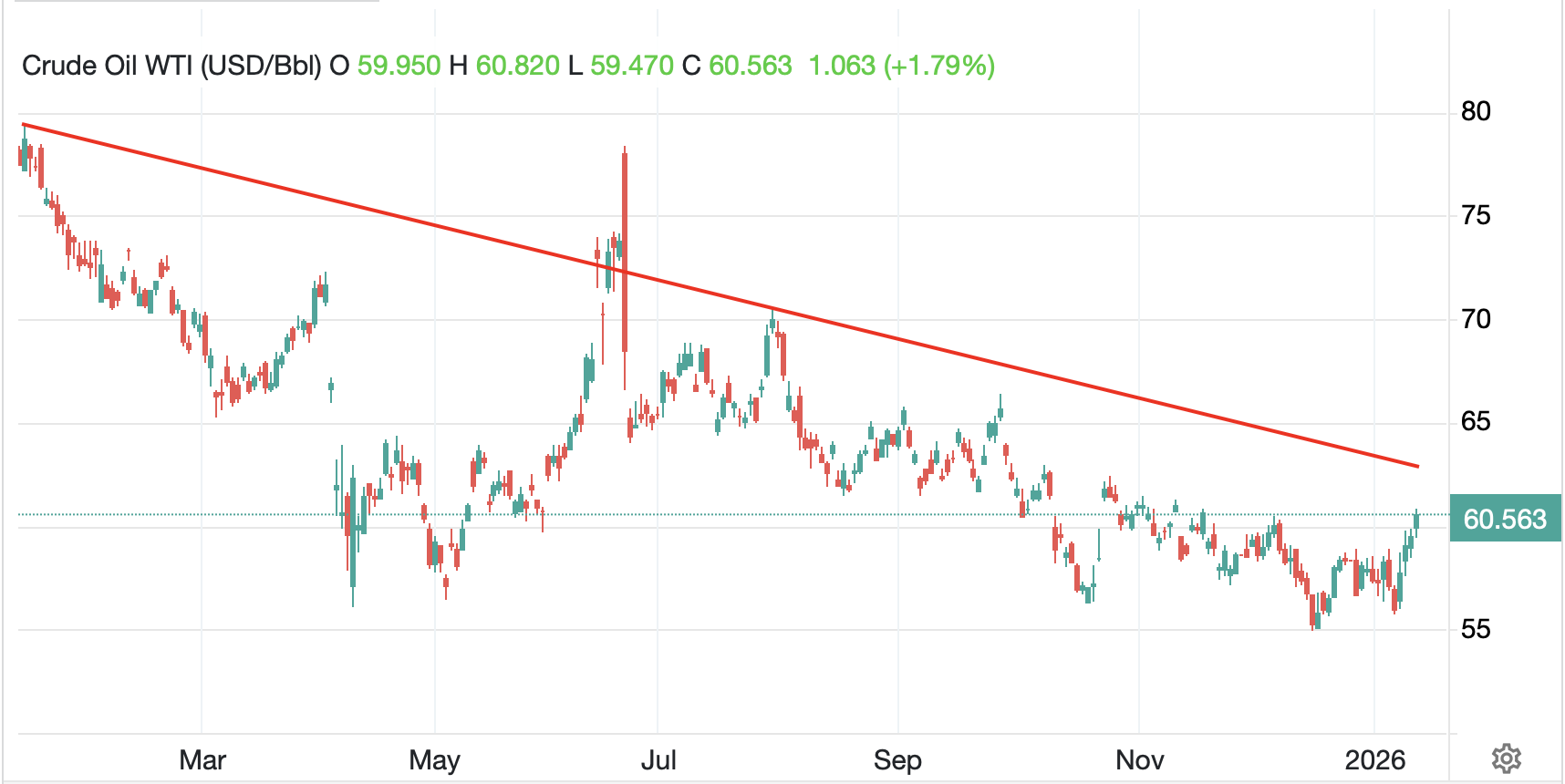
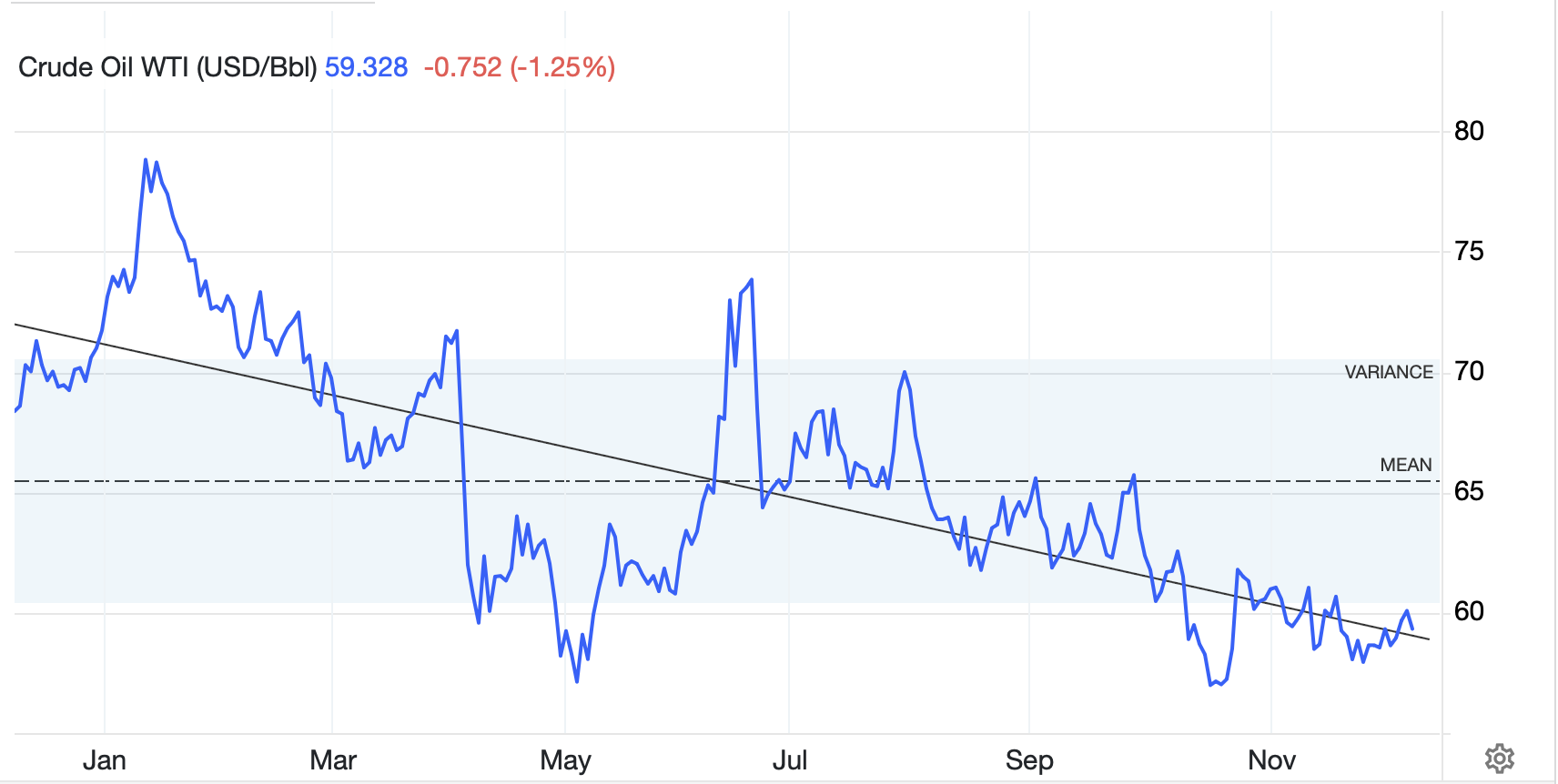
When we see that, commodity prices seem likely to rise even further, at least metals prices will and this morning that is true across the precious metals space (Au +0.3%, Ag +0.3%, Pt +1.2%) although copper is unchanged on the day.  Oil (-1.2%) though is not feeling the love this morning despite growing concerns of a US invasion of Venezuela, ongoing Ukrainian strikes against Russian oil infrastructure and the prospects of central bank rate cuts to stimulate economic activity.  One thing to note in the oil market is that China has been a major buyer lately, filling its own SPR to the brim, so buying far more than they consume.  If that facility is full, then perhaps a key supporter of prices is gone.  I maintain my view that there is plenty of oil around and prices will continue to trend lower as they have been all year as per the below chart.

Source: tradingeconomics.com

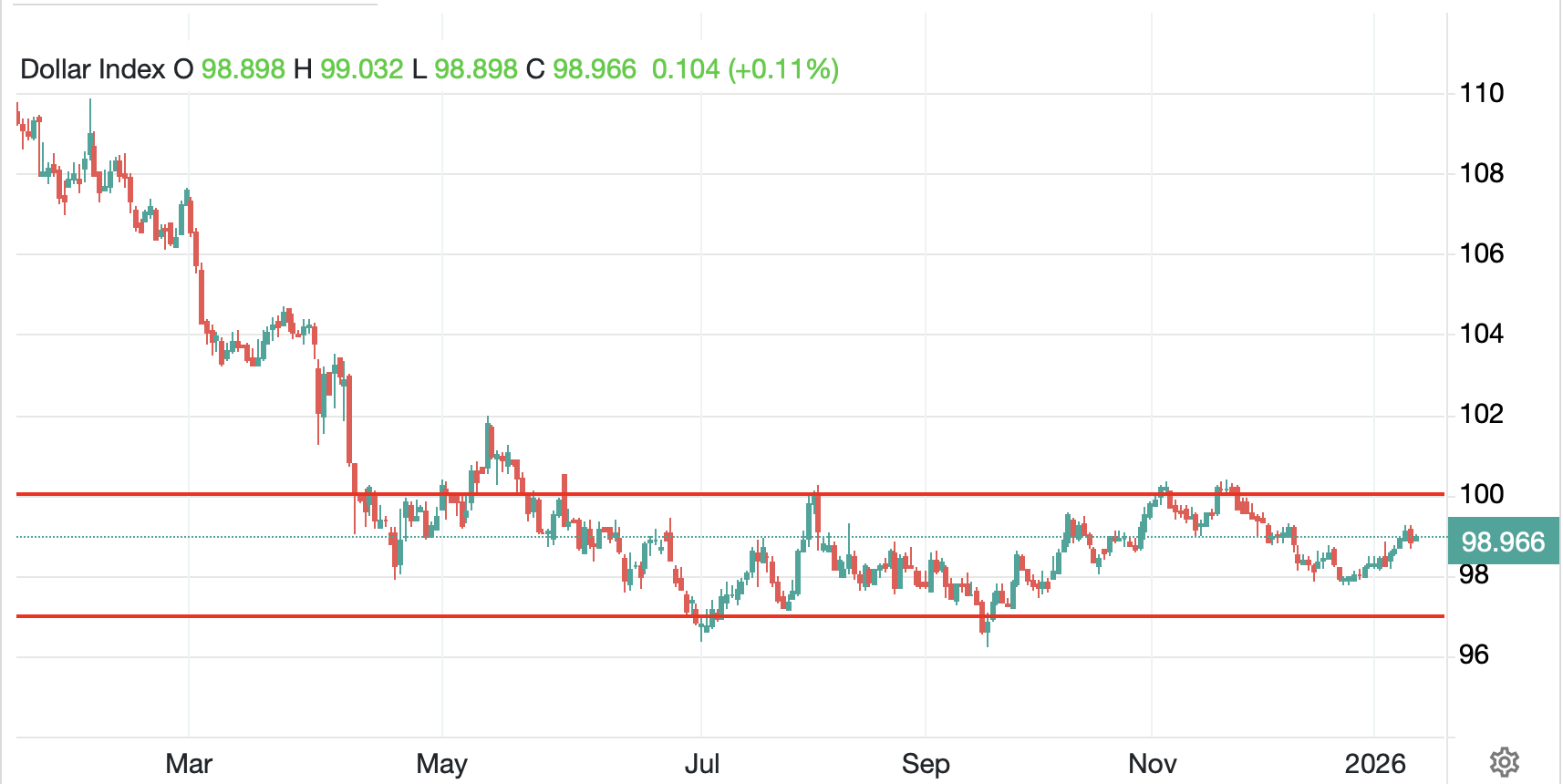
Finally, nobody really cares about the FX markets this morning with the DXY exactly unchanged and all major markets, other than KRW (+0.5%) within 0.2% of Friday’s closing levels.  There is a lot of central bank activity upcoming, and I suppose traders are waiting for any sense that things may change.  It is worth noting that a second ECB member, traditional hawk Olli Rehn, was out this morning discussing the potential need for lower rates as Eurozone growth slows further and he becomes less concerned about inflation.  Expect to hear more ECB members say the same thing going forward.

On the data front, things are still messed up from the government shutdown, but here we go:

TuesdayRBA Rate Decision3.6% (unchanged)
 NFIB Small Biz Optimism98.4
 JOLTS Job Openings (Sept)7.2M
WednesdayEmployment Cost Index (Q3)0.9%
 Bank of Canada Rate Decision2.25% (unchanged)
 FOMC Rate Decision3.75% (-25bps)
ThursdayTrade Balance (Sept)-$61.5B
 Initial Claims221K
 Continuing Claims1943K

Source: tradingeconomics.com

There is still a tremendous amount of data that has not been compiled and released and has no date yet to do so.  Of course, once the FOMC meeting is done on Wednesday, we will start to hear from Fed speakers again, and Friday there are three scheduled (Paulson, Hammack and Goolsbee).

As we start a new week, I expect things will be relatively quiet until the Fed on Wednesday and then, if necessary, a new narrative will be created.  Remember, the continuing resolution only goes until late January, so we will need to see some movement by Congress if we are not going to have that crop up again.  In the meantime, there is lots of talk of a Santa rally in stocks and if I am right and ‘run it hot’ is the process going forward, that has legs.  It should help the dollar too.

Good luck

Adf
Left For Dead

Takaichi’s learned
Her chalice contained poison
Thus, her yen weakens


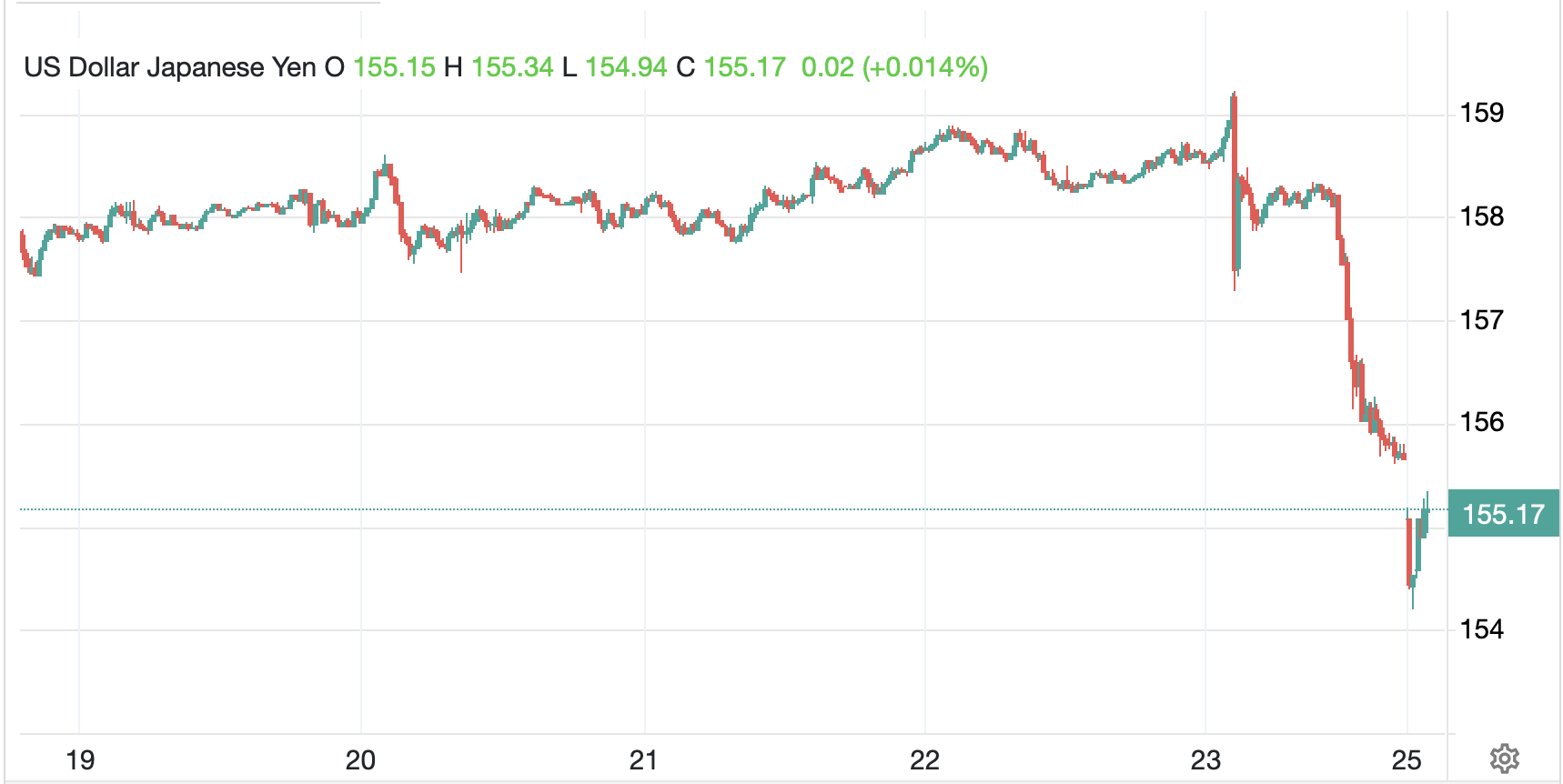
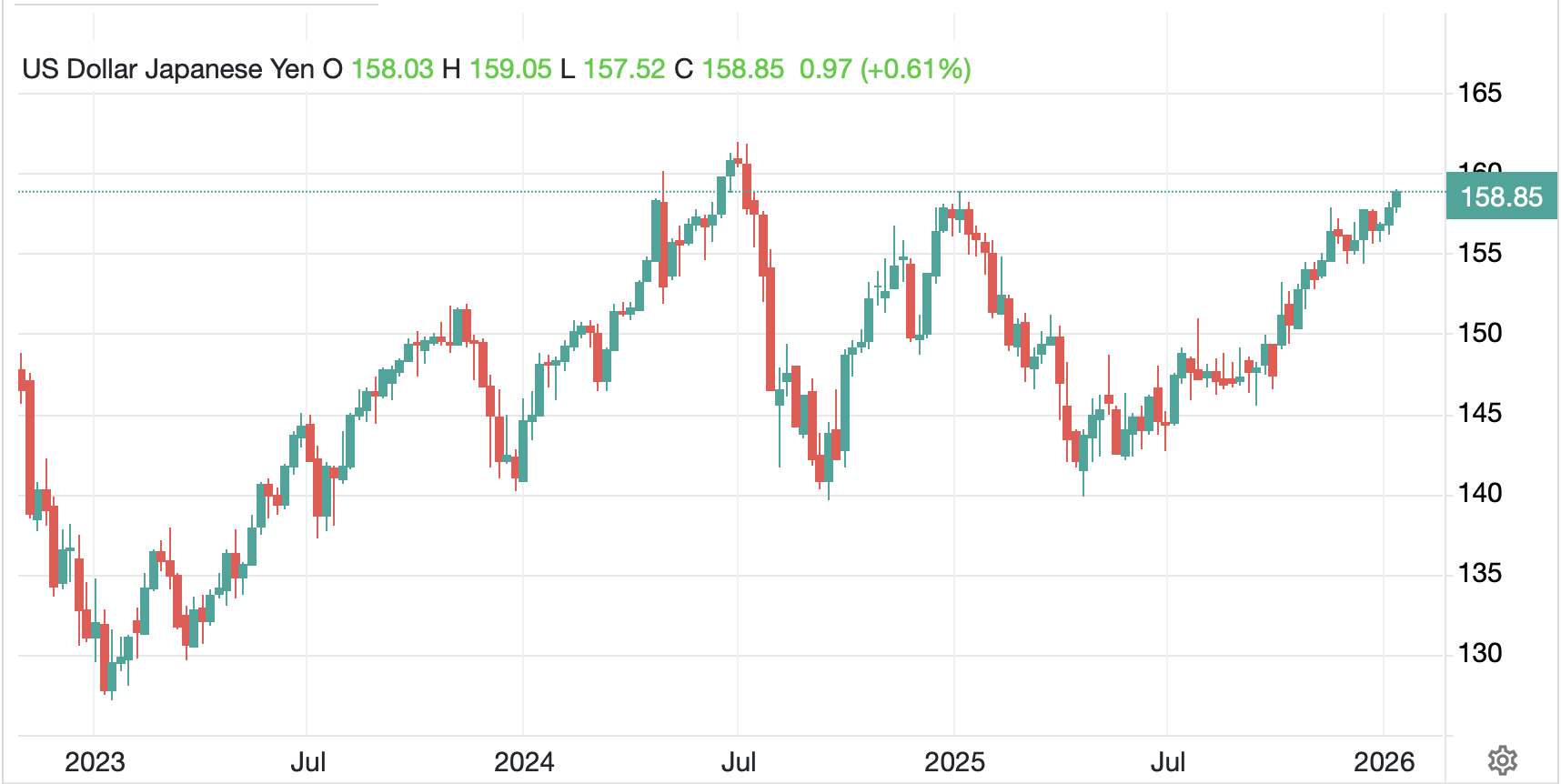
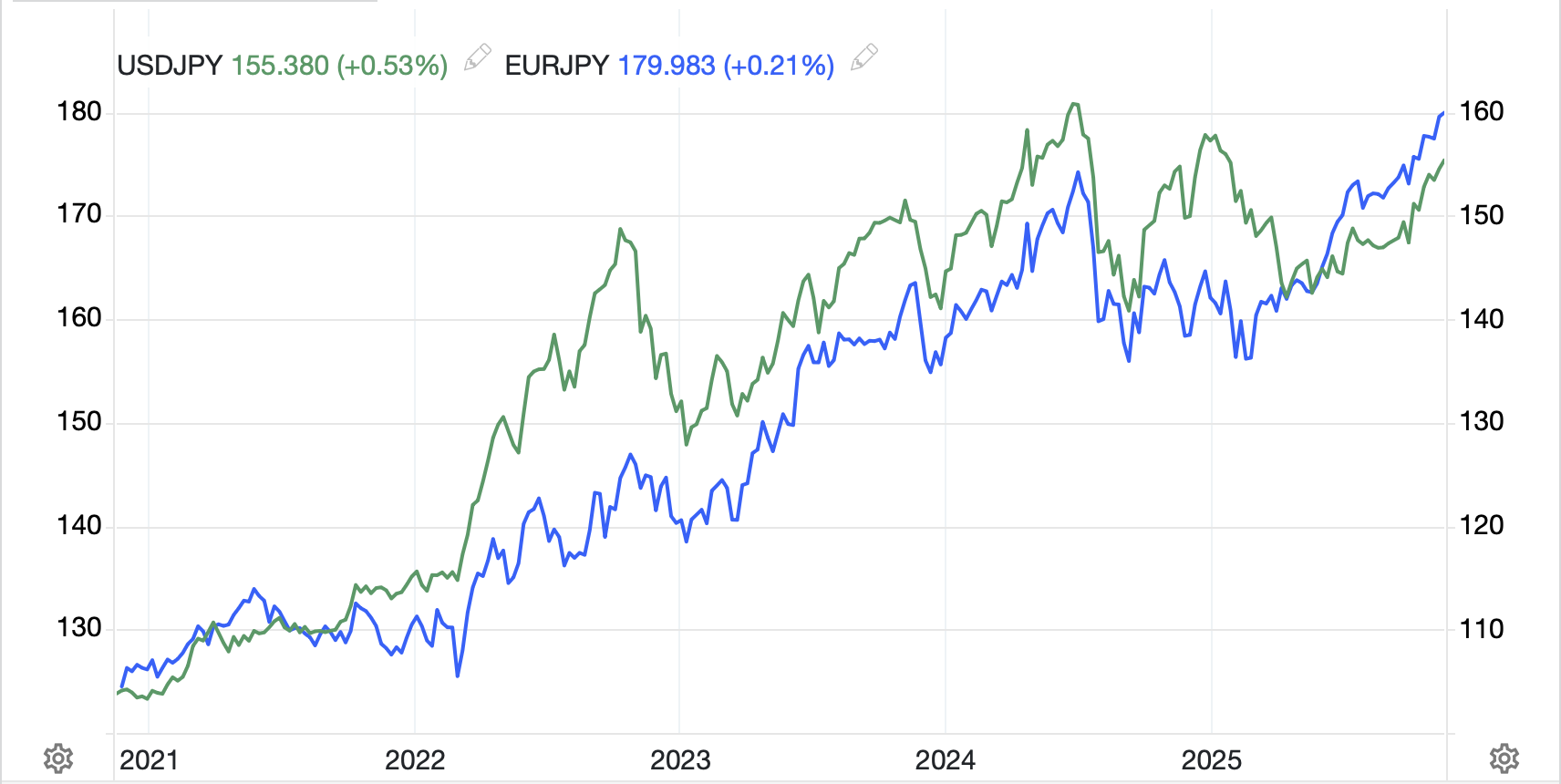
If one needed proof that interest rates are not the only determining factor in FX markets, look no further than Japan these days where JGB yields across the board, from 2yr to 40yr are trading at decade plus highs while the yen continues to decline on a regular basis.  This morning, the yen has traded through 155.00 vs. the dollar, and through 180.00 vs. the euro with the latter being a record low for the yen vs. the single currency since the euro was formed in 1999.

Source: tradingeconomics.com

Meanwhile, JGB yields continue to rise unabated on the back of growing concerns that Takaichi-san’s government is going to be issuing still more unfunded debt to pay for a massive new supplementary fiscal package rumored to be ¥17 trillion (~$109 billion).  While we may have many fiscal problems in the US, it is clear Japan should not be our fiscal role model.

Source: tradingeconomics.com

This market movement has led to the second step of the seven-step program of verbal intervention by Japanese FinMins and their subordinates.  Last night, FinMin Satsuki Katayama explained [emphasis added], “I’m seeing extremely one-sided and rapid movements in the currency market. I’m deeply concerned about the situation.”  Rapid and one-sided are the key words to note here.  History has shown the Japanese are not yet ready to intervene, but they are warming to the task.  My sense is we will need to see 160 trade again before they enter the market.  However, while that will have a short-term impact, it will not change the relative fiscal realities between the US and Japan, so any retreat is likely to be a dollar (or euro) buying opportunity.

As to the BOJ, after a highly anticipated meeting between Takaichi-san and Ueda-san, the BOJ Governor told a press conference, “The mechanism for inflation and wages to grow together is recovering. Given this, I told the prime minister that we are in the process of making gradual adjustments to the degree of monetary easing.”   Alas for the yen, I don’t think it will be enough to halt the slide.  That is a fiscal issue, and one not likely to be addressed anytime soon.

The screens everywhere have turned red
As folks have lost faith that the Fed,
Next month, will cut rates
Thus, leave to the fates
A stock market now left for dead

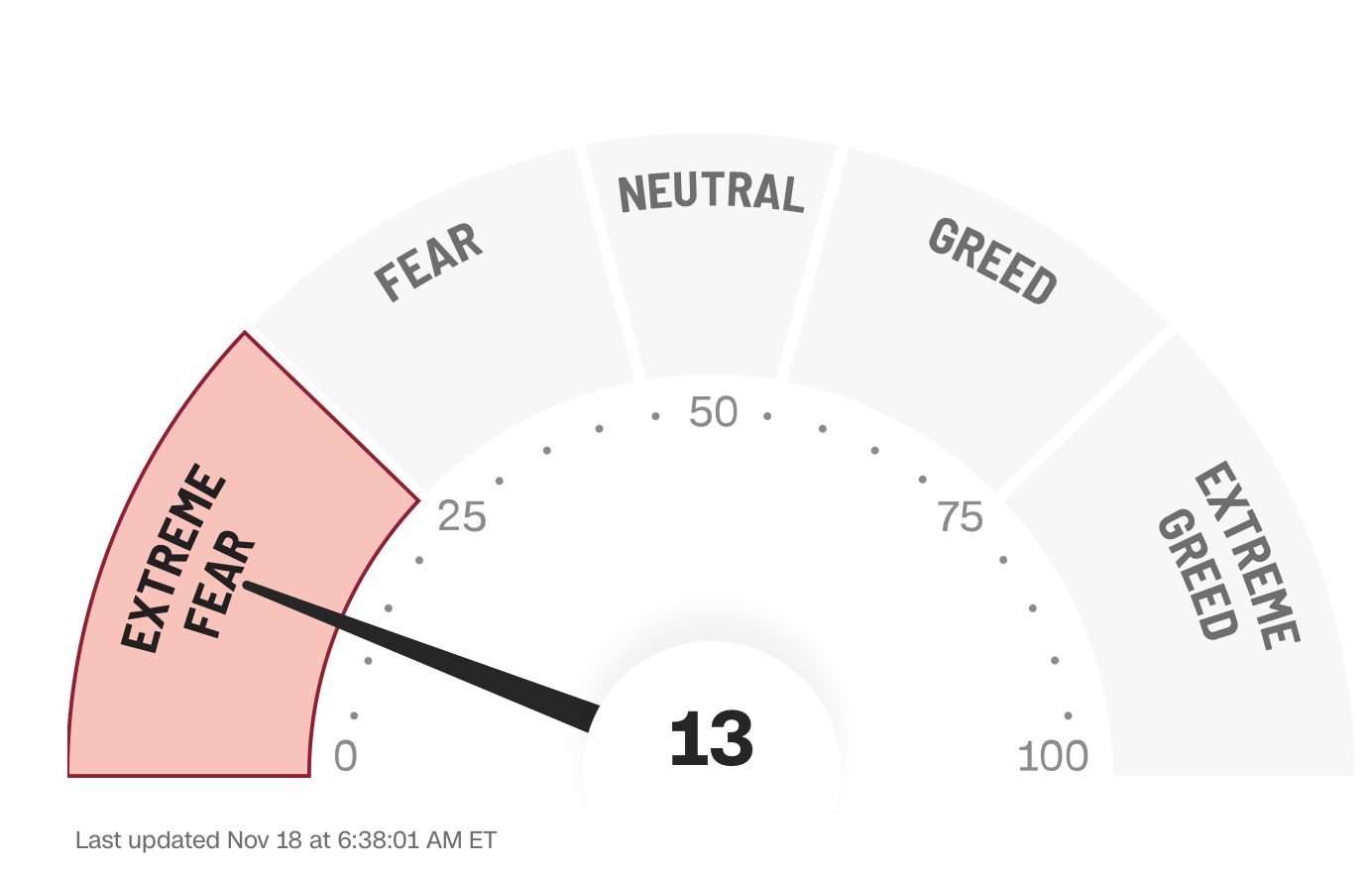
Yesterday, I showed the Fear & Greed Index and marveled at how it was pointing to so much fear despite equity markets trading within a few percentage points of all time highs.  Well, today it’s even worse!  This morning the index has fallen from 22 to 13 and is now pushing toward the lows seen last April when it reached 4 just ahead of Liberation Day.

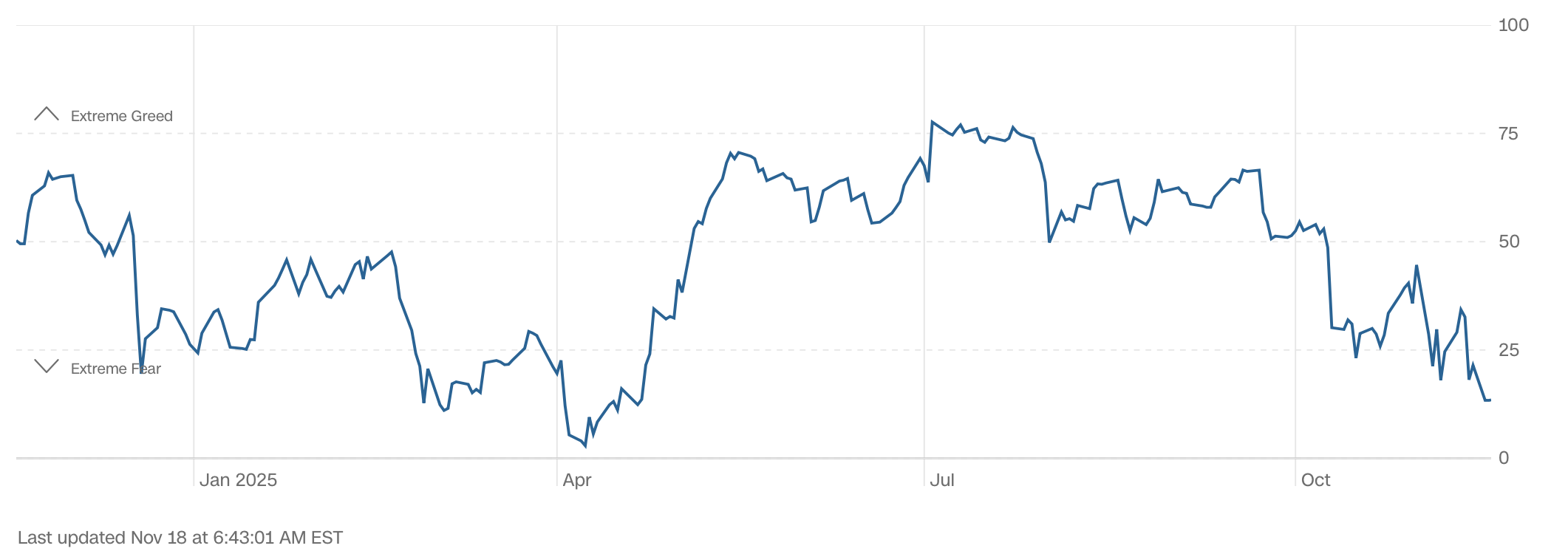
In fact, it is worthwhile looking at a history of this index over the past year and remembering what happened in the wake of that all-time low reading.

Source: cnn.com

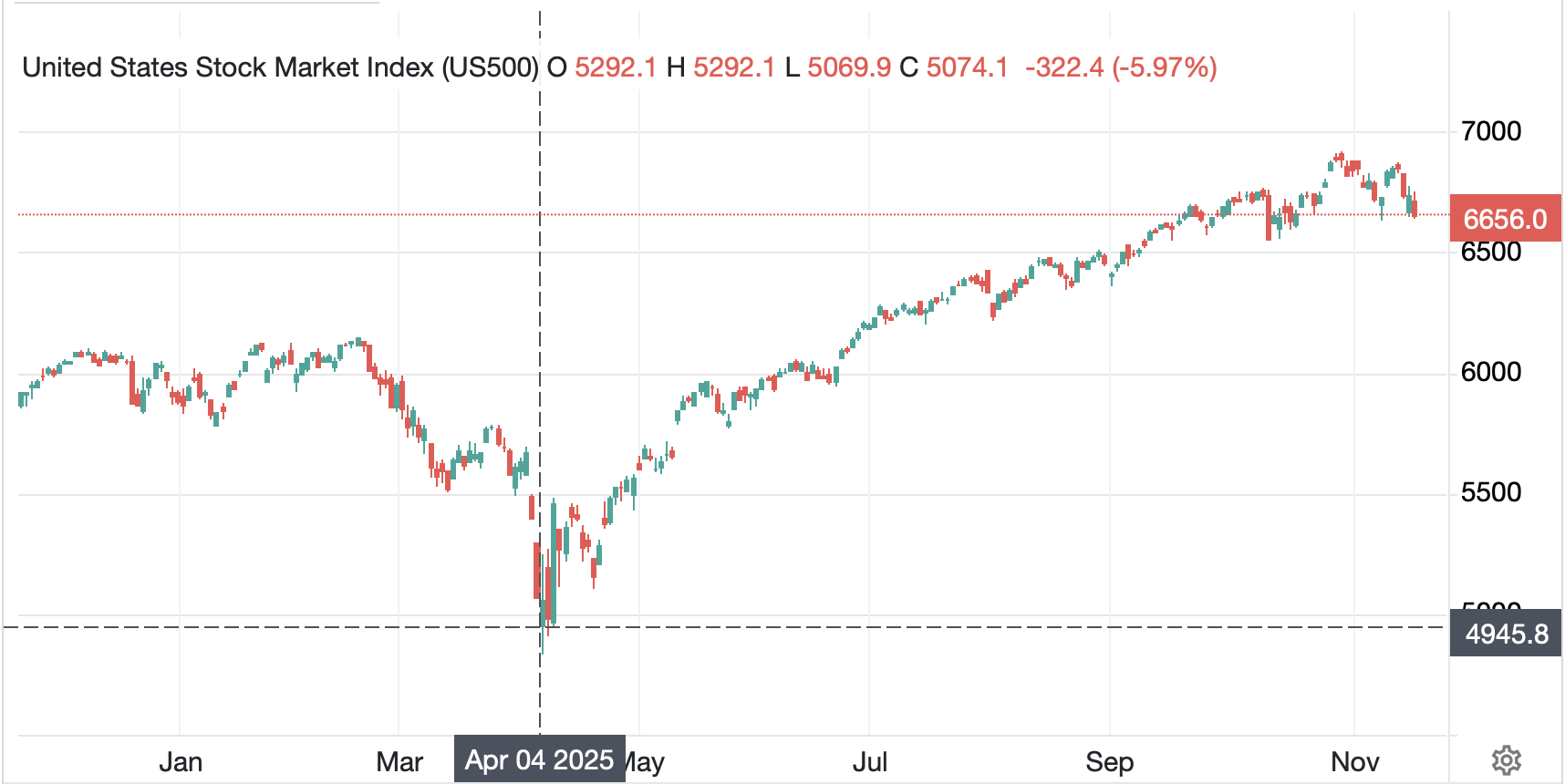
Now look at the S&P500 over the same timeline and see if you notice any similarities.

Source: tradingeconomics.com

It is certainly not a perfect match, but the dramatic rise in both indices from the bottom and through June is no coincidence.  The other interesting thing is that the fear index managed to decline so sharply despite the current pretty modest equity market decline.  After all, from the top, even after yesterday’s decline, we are less than 4% from record highs in the S&P 500.

Analysts discuss the ‘wall of worry’ when equity markets rise despite negative narratives.  Too, historically, when the fear index falls to current levels, it tends to presage a rally.  Yet, if we have only fallen 4% from the peak, it would appear that positions remain relatively robust in sizing.  In fact, BoA indicated that cash positions by investors have fallen to just 3.7%, the lowest level in the past 15 years.  So, everyone is fully invested, yet everyone is terrified.  Something’s gotta give!  In this poet’s eyes, the likely direction of travel in the short run is lower for equities, and a correction of 10% or so in total makes sense.  But at that point, especially if bonds are under pressure as well, I would look for the Fed to step in and not only cut rates but start expanding its balance sheet once again.  QT was nice while it lasted, but its time has passed.  One poet’s view.

Ok, following the sharp decline in US equity markets yesterday on weak tech shares, the bottom really fell out in Asia and Europe.  Japan (-3.2%) got crushed between worries about fiscal profligacy discussed above and the tech selloff.  China (-0.65%) and HK (-1.7%) followed suit as did every market in Asia (Korea -3.3%, Taiwan -2.5%, India -0.3%, Australia -1.9%).  You get the idea.  In Europe, the picture is no brighter, although the damage is less dramatic given the complete lack of tech companies based on the continent.  But Germany (-1.2%), France (-1.3%), Spain (-1.6%), Italy (-1.7%) and the UK (-1.3%) have led the way lower where all indices are in the red.  US futures, at this hour (7:15) are also pointing lower, although on the order of -0.5% right now.

In the bond market, Treasury yields, after edging higher yesterday are lower by -4bps this morning, and back at 4.10%, their ‘home’ for the past two months as per the below chart from tradingeconomics.com.

As to European sovereigns, they are not getting quite as much love with some yields unchanged (UK, Italy) and some slipping slightly, down -2bps (Germany, Netherlands), and that covers the entire movement today.  We’ve already discussed JGBs above.

In the commodity space, oil (-0.2%) continues to trade either side of $60/bbl and it remains unclear what type of catalyst is required to move us away from this level.  Interestingly, precious metals have lost a bit of their luster despite the fear with gold (-0.25%), silver (-0.2%) and platinum (-0.2%) all treading water rather than being the recipient of flows based on fear.  Granted, compared to the crypto realm, where BTC (-1.0%, -16% in the past month) has suffered far more dramatically, this isn’t too bad.  But you have to ask, if investors are bailing on risk assets like equities, and bonds are not rallying sharply, while gold is slipping a bit, where is the money going?

Perhaps a look at the currency market will help us answer that question.  Alas, I don’t think that is the case as while the dollar had a good day yesterday, and is holding those gains this morning, if investors around the world are buying dollars, where are they putting them?  I suppose money market funds are going to be the main recipient of the funds taken out of longer-term investments.  One thing we have learned, though, is that the yen appears to have lost its haven status given its continued weakening (-3.0% in the past month) despite growing fears around the world.  

On the data front, yesterday saw Empire State Manufacturing print a very solid 18.7 and, weirdly, this morning at 5am the BLS released the Initial Claims data from October 18th at 232K, although there is not much context for that given the absence of other weeks’ data around it.  Later this morning we are due the ADP Weekly number, Factory Orders (exp 1.4%) and another Fed speaker, Governor Barr.  Yesterday’s Fed speakers left us with several calling for a cut in December, and several calling for no move with the former (Waller, Bowman and Miran) focused on the tenuous employment situation while the latter (Williams, Jeffereson, Kashkari and Logan) worried about inflation.  Personally, I’m with the latter group as the correct policy, but futures are still a coin toss and there is too much time before the next meeting to take a strong stand in either direction.

The world appears more confusing than usual right now, perhaps why that Fear index is so low.  With that in mind, regarding the dollar, despite all the troubles extant in the US, it is hard to look around and find someplace else with better prospects right now.  I still like it in the medium and long term.

Good luck

Adf
The Winds of Change

Takaichi-san
Her pronouns so very clear
Brings the winds of change


Japan has a new Prime Minister, Sanae Takaichi, the first woman to hold the position.  She was deemed by most of the press as the most right-wing of the candidates, which fits with a growing worldwide narrative regarding nationalism, antagonism toward immigration and concerns over China and its plans in the region.  However, in the waning days of the campaign, she moderated a number of her stances as she does not have a majority in either house of the Diet, and will need to persuade other, less rigid members to vote with her in order to pass legislation.

However, the initial market response has been remarkable.  The Nikkei opened in Tokyo +5.5% and held most of those gains, closing higher by 4.75%.  USDJPY gapped 1.3% on the Tokyo opening and is currently higher by 2.0% and back above 150.  Perhaps the most interesting thing is that despite dollar strength, the precious metals have roared higher with both gold and silver gaining 1.4% as gold touches yet another new all-time high and silver pushes ever closer to $50/oz. Meanwhile, JGB yields are little changed as I imagine it will take a few days, at least, for investors to get a better sense of just how effective she will be at governing in a minority role.

Below is the chart for USDJPY, demonstrating just how big the gap was.  This appears to be another chink in the ‘end of the dollar’s dominance’ armor.  Just sayin’!

Source: tradingeconomics.com

In Europe, the powers that be
Have found citizens disagree
With most of their actions
Thus, building up factions
That want nothing but to be free
 
The most recent story is France
Where Macron’s PM blew his chance
He’s now stepped aside
But Macron’s denied
He’ll willingly exit the dance

However, the dollar’s gains today are not merely against the yen, but also, we have seen the euro (-0.7%) slide sharply with the proximate cause here being the sudden resignation of French PM LeCornu.  And the reason it seems like it was only yesterday that France got a new PM after a no-confidence vote in September, is because it basically was only yesterday.  PM LeCornu lasted just one month in the role as President Macron didn’t want to change the cabinet there, thus making LeCornu’s job impossible.  While the next presidential election is not scheduled until April 2027, and Macron is grasping to his role as tightly as possible, it appears, at least from the cheap seats over here in the US, that the vote will happen far sooner than that.  He appears to have lost whatever credibility he had when first elected, and France has now had 4 PM’s in the past twelve months, hardly the sign of a stable and successful presidency.

Like the bulk of the current European leadership, Macron has decided that nearly half the country should not have their voices heard by banning Madame LePen’s RN from government.  And while President Biden was never successful imprisoning President Trump, in France, they managed to convict LePen on some charge and ban her from running.  But that has not dissuaded her followers one iota.  We see the same behavior in Germany with AfD, and the Merz government’s attempts to ban them as a party, and similar behavior throughout Europe as the unelected Brussels contingent in the European Commission struggles to do all they can to retain power.

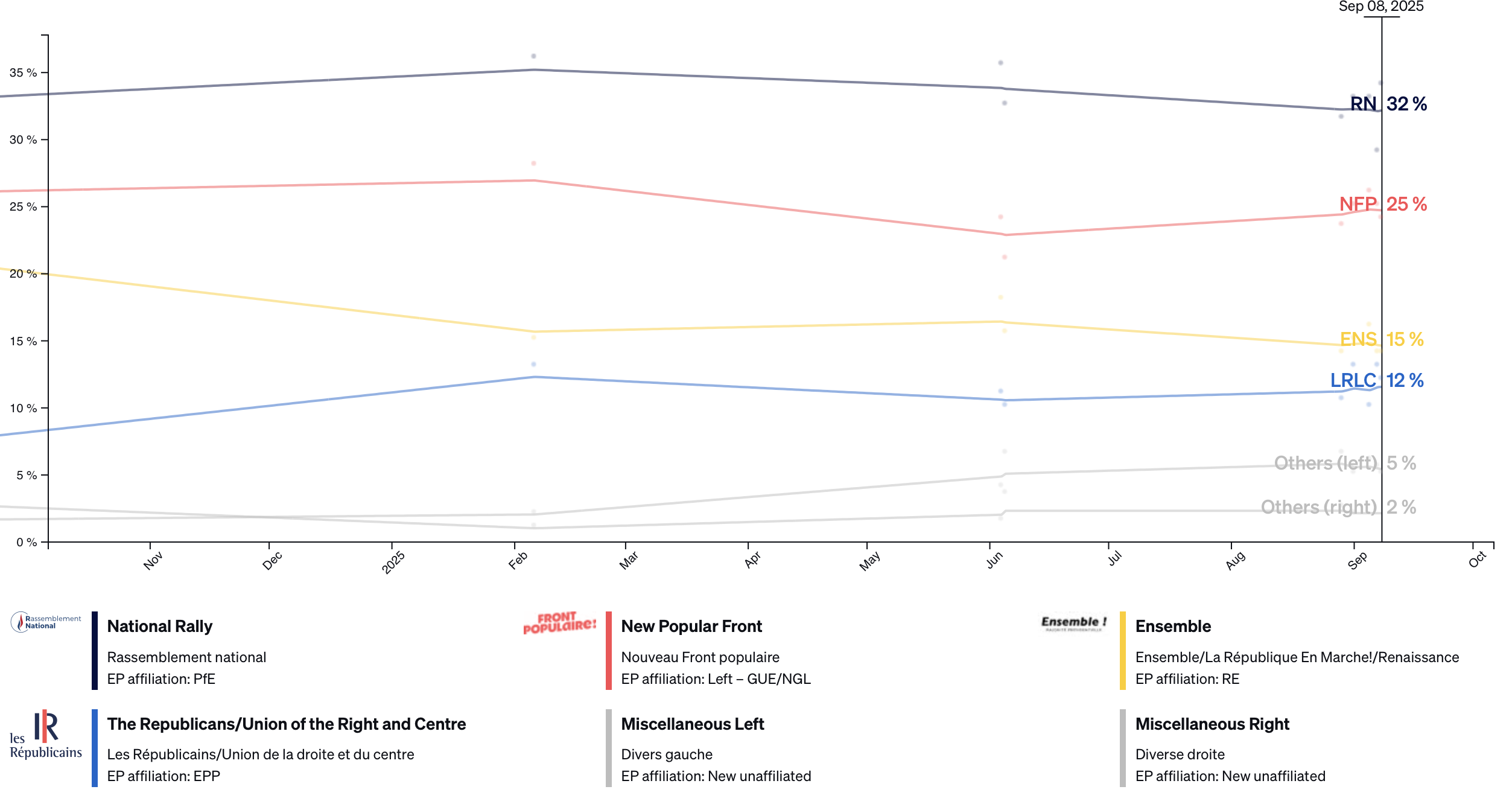
In fact, if you look at the most recent polls I can find for France, from Politico, you can see that RN, LePen’s party, is leading the polls while ENS, Macron’s centrist party has just 15% support.  The far left NFP is in second place and the center-right LRLC is at 12%.  It is difficult for me to believe that Macron can hold on until 2027, at least 18 months away, and if he does, what type of damage will he do to France?

The point of the story is that whatever you may think of Donald Trump, he has the reins of government and is doing the things he promised on the border and immigration, reducing government and reducing regulations.  In Europe, the entrenched bureaucracy is fighting tooth and nail to prevent that from happening with the result that economic activity is suffering and prospects for future growth are stunted.  And all that was before the US change in trade policy.  With that in mind, absent a massive Fed turnaround to dovishness, which doesn’t seem likely in the near term, the euro has more minuses than pluses I think and should struggle going forward.

Ok, two political stories are the driver today, and neither one has to do with Trump!  Meanwhile, let’s look at how everything else has behaved overnight.  Friday saw a mixed session in the US, and all I read and heard over the weekend was that the denouement was coming, perhaps sooner than we think.  The recurring analogy is Hemingway’s description of going into bankruptcy, gradually, then suddenly, and the punditry is trying to make the case that the ‘suddenly’ part is upon us.  I’m not convinced, and would argue that, at least in the US, things can go on longer than they should.  This is not to say the US doesn’t have serious fiscal issues, just that we have better tools to address them than anyone else.

Elsewhere in Asia, China is still on holiday while HK (-0.7%) could find no joy in the Japanese election.  But Korea (+2.7%), India (+0.7%) and Taiwan (+1.5%) all rallied nicely with only the Philippines (-1.8%) showing contrary price action as investors grew increasingly concerned over a growing corruption scandal with the government there and infrastructure embezzlment allegations.  I didn’t mention above but the rationale behind the Japanese jump is that Takaichi-san is expected to push for significant fiscal expansion on an unfunded basis, great for stocks, not as much for bonds.

In Europe, though, you won’t be surprised that France (-1.6%) is leading the charge lower, although in fairness, the rest of the continent is doing very little with the other major exchanges +/- 0.1% basically.  As to US futures, at this hour (7:15), they are all pointing higher by 0.5% or so.

In the bond market, Treasury yields have moved higher by 4bps this morning, adding to a similar gain on Friday as it appears there are lingering concerns over what happens with the government shutdown.  (Think about it, that issue hasn’t even been a topic of discussion yet this morning!). But remember, the government shutdown does not impact the payment of coupons on Treasury debt, so the issues are very different than the debt ceiling.  As to European sovereigns, not surprisingly, French OATs are the wors performers, with yields jumping 8bps (they have real fiscal problems) but the rest of the continent has tracked Treasury yields and are higher by 3bps to 4bps as well.

I’ve already highlighted precious metals, although copper (-0.7%) is bucking the trend, albeit after having risen more than 10% in the past month.  Oil (+1.4%) is also continuing to bounce off the bottom of the range trade and remains firmly ensconced in the $61.50 to $65.50 range as it has been for the past six months.  In fact, looking at the chart below from Yahoo finance, you can see that except for the twelve-day war between Israel and Iran, nothing has gone on here.  The net price change in the past six months has been just -0.19% as you can see in the upper left corner.  While this will not go on forever, I have no idea what will break this range trade.

Finally, the dollar is stronger across the board with the pound (-0.4%) and SEK (-0.5%) the next worst performers in the G10 while CAD and NOK are both unchanged on the day, reflecting the benefits of stronger oil and commodity prices.  In the EMG bloc, the CE4 are all softer by between -0.6% and -0.9%, tracking the euro, and we have seen APAC currencies slip as well (KRW -0.5%, CNY -0.15%).  MXN (-0.2%) and ZAR (-0.3%) seem to be holding in better than others given their commodity linkages.

And that’s all we have today.  With the shutdown ongoing, there are no government statistics coming but we will hear from 8 different Fed speakers, including Chairman Powell on Thursday morning, over a total of 15 different venues this week.  Again, there is a wide dispersion of views currently on the FOMC, so unless we start to see some coalescing, which given the lack of data seems unlikely in the near term, I don’t think we will learn very much new.  As far as the shutdown is concerned, the next vote is scheduled for today, but thus far, it doesn’t seem the Democratic leadership is willing to change their views.  Funnily, I don’t think the markets really care.

Overall, I see more reasons to like the dollar than not these days, and it will take a major Fed dovish turn to change that view.

Good luck

Adf

Jobs is Passe

The usual story today
Would be NFP’s on its way
But with BLS
On furlough, I guess
The story on jobs is passe
 
But ask yourself, if we don’t get
A data point always reset
That’s only a fraction
Of total job action
Is this something ‘bout we need fret?


I guess the question is, is the government shutdown impacting markets?  Frankly, it’s hard for me to see that is the case. Today offers a perfect scenario to see if it is true.  After all, if the government was working, the BLS would have released the weekly Claims data yesterday and market participants would be waiting with bated breath for today’s NFP number.  As I said yesterday, while Ken Griffin is likely quite annoyed because I’m sure Citadel makes a fortune on NFP days, the rest of the world seems to be getting along just fine.  In fact, maybe this is exactly what market participants need to learn that the data points on which they rely don’t really matter.  

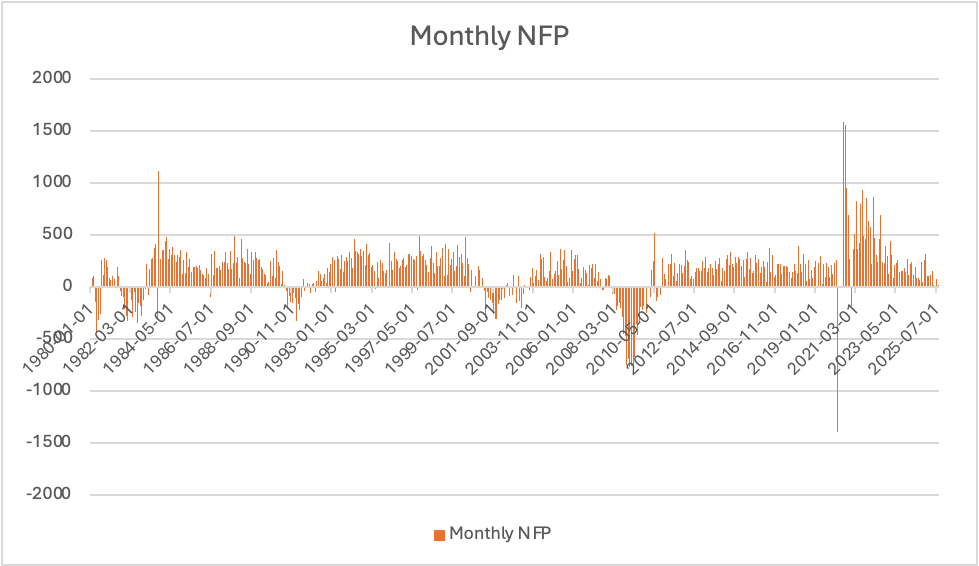
With NFP in particular, the monthly number, which since 1980 has averaged 125K with a median of 179K seems insignificant relative to the number of people actually employed, which as of August 2025 was recorded as 159.54 million.  Now I grant, that the employed population has grown greatly in the past 45 years, so when I take it down to percentages, the average monthly NFP result is 0.10% of the workforce during that period, with the median a whopping 0.14%.  The idea that business decisions are made, and more importantly, monetary policy decisions are made on such a tenuous thread is troublesome, to say the least.  Did this report really tell us that much of importance?  Especially given its penchant for major revisions.

Below is a graphic history of NFP (data from FRED) having removed the Covid months given they really distorted the chart.

And below is a chart showing total payrolls (in 000’s) on the RHS axis with the % of total payrolls represented by the monthly change in NFP on the LHS.  Notice that almost the entire NFP series, as a %age of total employment, remains either side of 0 with only a few outcomes as much as even 0.5%.  My point is, perhaps the inordinate focus on this data point by markets and policymakers alike, has been misguided, especially as the accuracy of the initial releases seems to have worsened over time.  Maybe everybody will be able to figure out that they can still do their jobs even without this data.  (Ken Griffiin excepted. 🤣)

Food for thought.

Like swallows return
To Capistrano, Japan
Votes again this year


The other notable news story is tomorrow’s election in Japan’s LDP for president of the party and the likely next Prime Minister.  While there are technically 5 candidates, apparently, it is really between two, Sanae Takaichi, a former economic security minister and a woman who would be the first female PM in the nation’s history, and Shinjiro Koizumi, son of former PM Junichiro Koizumi, and a man who would become the nation’s youngest prime minister.  There are several others, but these are the front runners.  From what I gather, Takaichi-san is the defense hawk and the more conservative of the two, an updated version of Margaret Thatcher, to whom she will constantly be compared if she wins.  Meanwhile, Koizumi is more of the same they have had in the past.

There are some analysts who are trying to make the case that this election has had a major impact on Japanese markets, and one might think that makes sense.  But if I look at USDJPY (0.0% today), as per the below chart, I am hard pressed to see that the election campaign has had any impact of note.

Source: tradingeconomics.com

If we turn to the Nikkei (+1.9%) which made a new high last night, it seems that is tracking US technology shares and is unconcerned over the election.  

Source: tradingeconomics.com

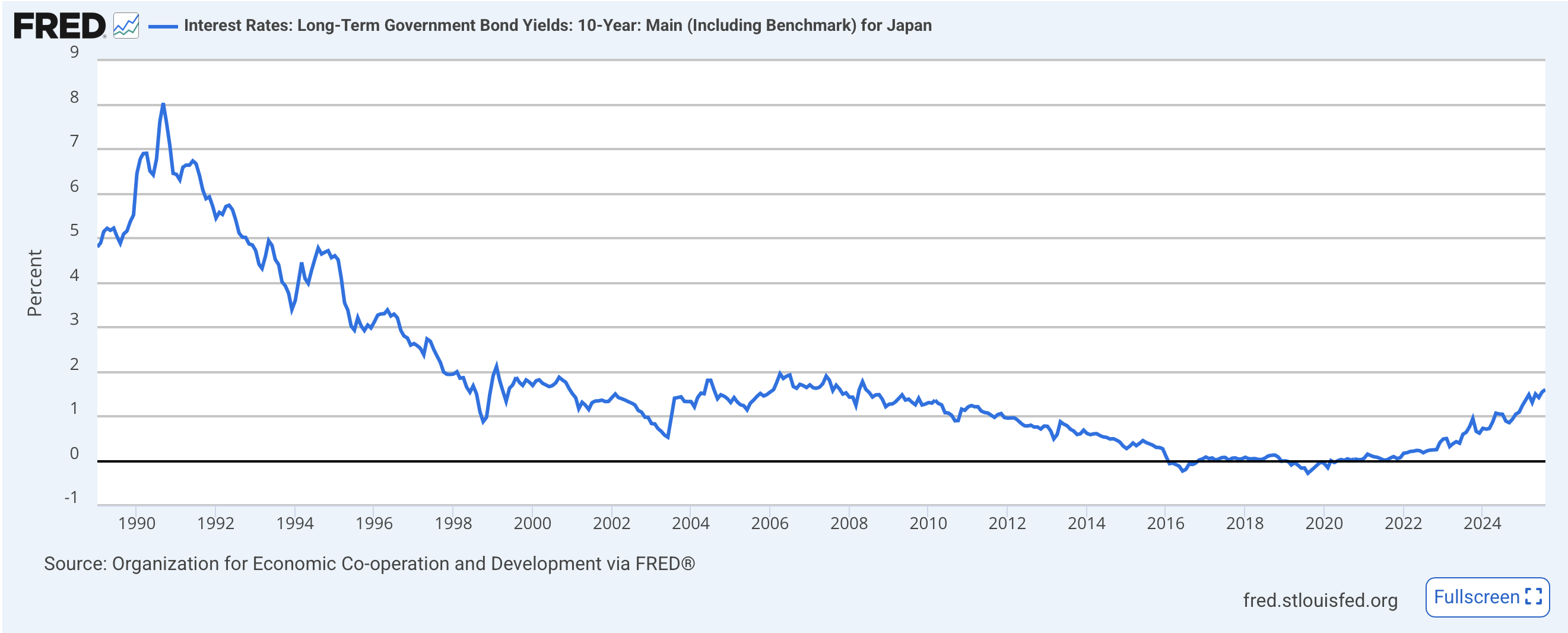
Arguably, if the equity market is forward looking (which I think is true) investors are indifferent to the next PM.  Finally, a look at JGBs shows that yields continue to climb there, albeit quite slowly, but consistently make new highs for the move and are back to levels last seen in 2008.

In fact, like almost everything since the GFC, perhaps the recent run of incredibly low yields in Japan is the aberration, not the rule!  But the argument for higher Japanese yields is more about the fact that inflation there is running at 3.5% and the base rate remains at 0.50%.  Investors remain concerned that the recent history of virtually zero inflation in Japan may be a thing of the past and so are demanding higher yields to hold Japanese debt.

I have no idea who will win this election, although I suspect that Takaichi-san may wind up on top.  But will it change the BOJ?  I don’t think so.  And the fact that the LDP does not have a working majority means not much may get done afterwards anyway.  All told, it is hard to be excited about holding yen in my eyes.

Ok, let’s look at the rest of the world quickly.  Despite a soft start, US equity markets managed to close in the green and this morning all three major indices are pointing higher by 0.25%.  Away from Japan, Chinese markets are closed for their holiday, and most of the rest of Asia followed the US higher, notably Korea (+2.7%) and Taiwan (+1.5%).  The only outlier was HK (-0.5%) which looked to be some profit taking after a sharp run higher in the past week.  In Europe, Spain (+0.8%) and the UK (+0.6%) are the best performers despite (because of?) slightly softer PMI Services data.  Either that, or they are caught up in the US euphoria.

The bond market saw yields slip a few basis points yesterday and this morning, while Treasury yields are unchanged at 4.08%, European sovereigns are sliding -1bp across the board.  I think the slightly softer data is starting to get some folks itching for another ECB rate cut, or at least a BOE cut.

In the commodity markets, oil (+0.4%) which continued to fall throughout yesterday’s session to just above $60/bbl, looks like it is trying to stabilize for now.  There continues to be discussion about more OPEC+ production increases, and it seems that whatever damage Ukraine has done to Russia’s oil infrastructure is not considered enough to change the global flows.  As to the metals, gold (+0.2%) and silver (+1.2%) absorbed a significant amount of selling yesterday in London, which may well have been one account, as they reversed course late morning and have been climbing ever since.  Copper (+1.1%) is also pushing higher and the entire argument about the defilement of fiat currencies remains front and center.  I guess JP is now calling it the debasement trade as Gen Z, if I understand correctly, is selling other assets and buying a combination of gold and bitcoin.

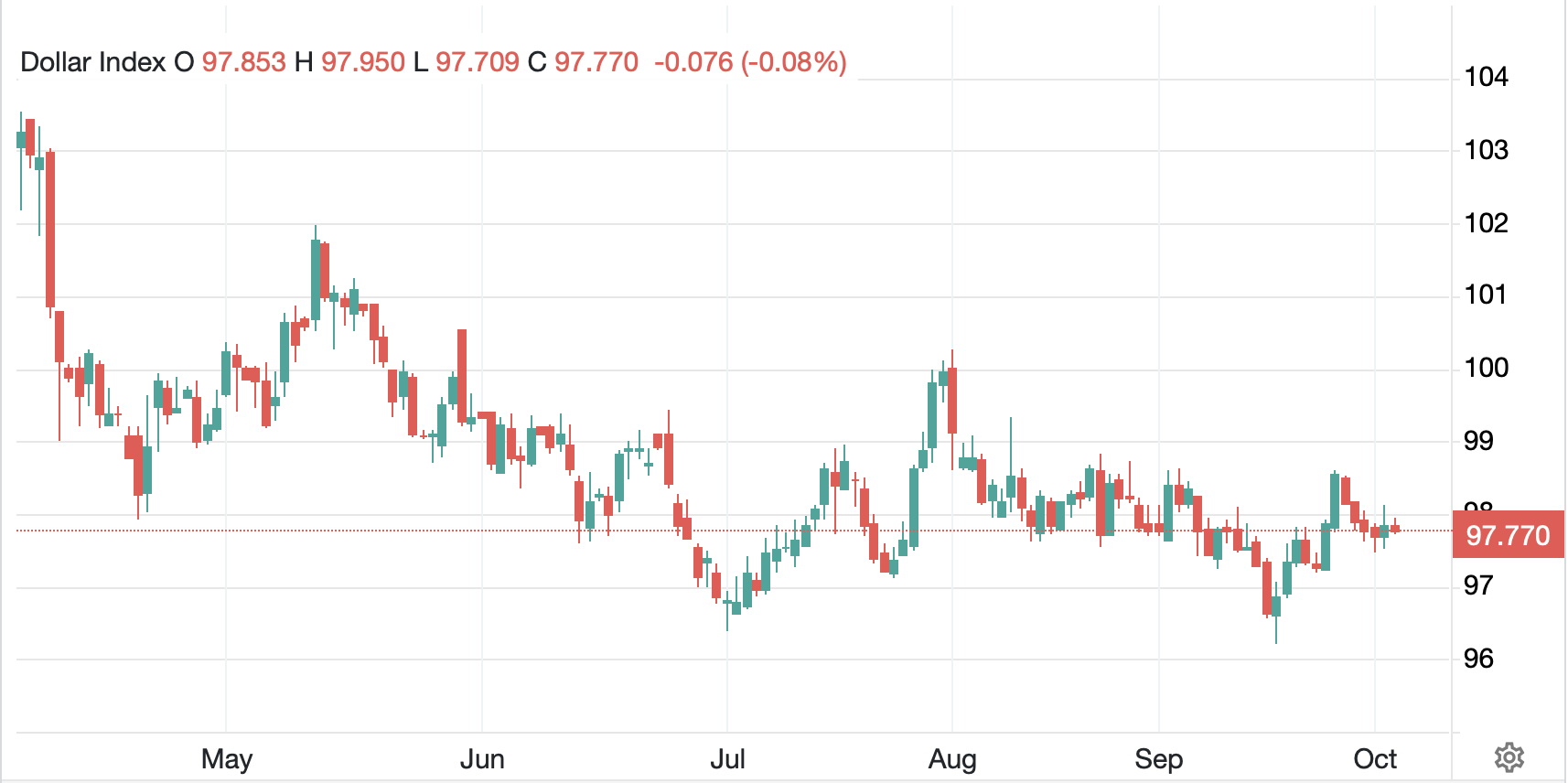
Finally, the dollar is…the dollar.  Back on April 20, DXY was at 98.08.  This morning it is 97.75.  look at the chart below from tradingeconomics.com and tell me you can get excited about any movement at all.  We will need a major outside catalyst, I believe, to change any views and right now, I see nothing on the horizon.

And that’s really all there is.  We do get ISM data this morning as it’s privately compiled and released (exp 51.7) and Fed speakers apparently will never shut up.  What is interesting there is that Lorrie Logan, Dallas Fed president, has come out much more hawkish than some of her colleagues.  That strikes me as a disqualification for being elevated to Fed chair.

I continue to read lots of bear porn and doom porn, and it all sounds great and markets clearly don’t care.  The government shutdown has been irrelevant and that should make a lot of people in Washington nervous given this administration.  President Trump has been angling to reduce government, and if it is out of action and nobody notices, it will make his job a lot easier.  But for now, nothing stops this train with higher risk assets the way forward.

Good luck and good weekend

Adf

Naught But Dismay

Ishiba’s fallen
Who’ll grab the poisoned chalice
For the next go round?


Well, it was inevitable after the LDP lost the Upper House election a few weeks ago, but now it is official, Japanese PM Shigeru Ishiba has resigned effective today and will only stay on until a new LDP leader is chosen.  You must admit, for a politician he was exceptionally ineffective.  He managed to lead the LDP to two major election losses in the span of 10 months, quite impressive if you think about it.  However, now that he has agreed a trade deal with the US, where ostensibly US tariffs on Japanese autos will be reduced from 25% to 15%, he felt he had done enough damage and is getting out of the way.  Frankly, I wouldn’t want to be the next man up here as the situation there remains fraught given still high inflation and a central bank that is so far behind the curve, it makes the Fed seem like it is Nostradamus!

The intricacies of Japanese politics are outside the bounds of this note, but the initial market response is a weaker yen (-0.7% as of 7:30pm Sunday night) and 1% gain in the Nikkei.  JGB yields have barely moved at all as it seems Japanese investors are not yet abandoning ship in hopes of a stronger PM.  However, my take is they have further to climb going forward as the BOJ’s ongoing unwillingness to tackle inflation will undermine their value.  Japan has a world of hurt and lacking an effective government is not going to help them address their problems.  It is hard to like Japanese assets or the yen in my view, at least until something or someone demonstrates competence in government.

The jobs report basically sucked
As companies smoothly conduct
More layoffs each week
While they try to tweak
Their staffing ere management’s f*cked

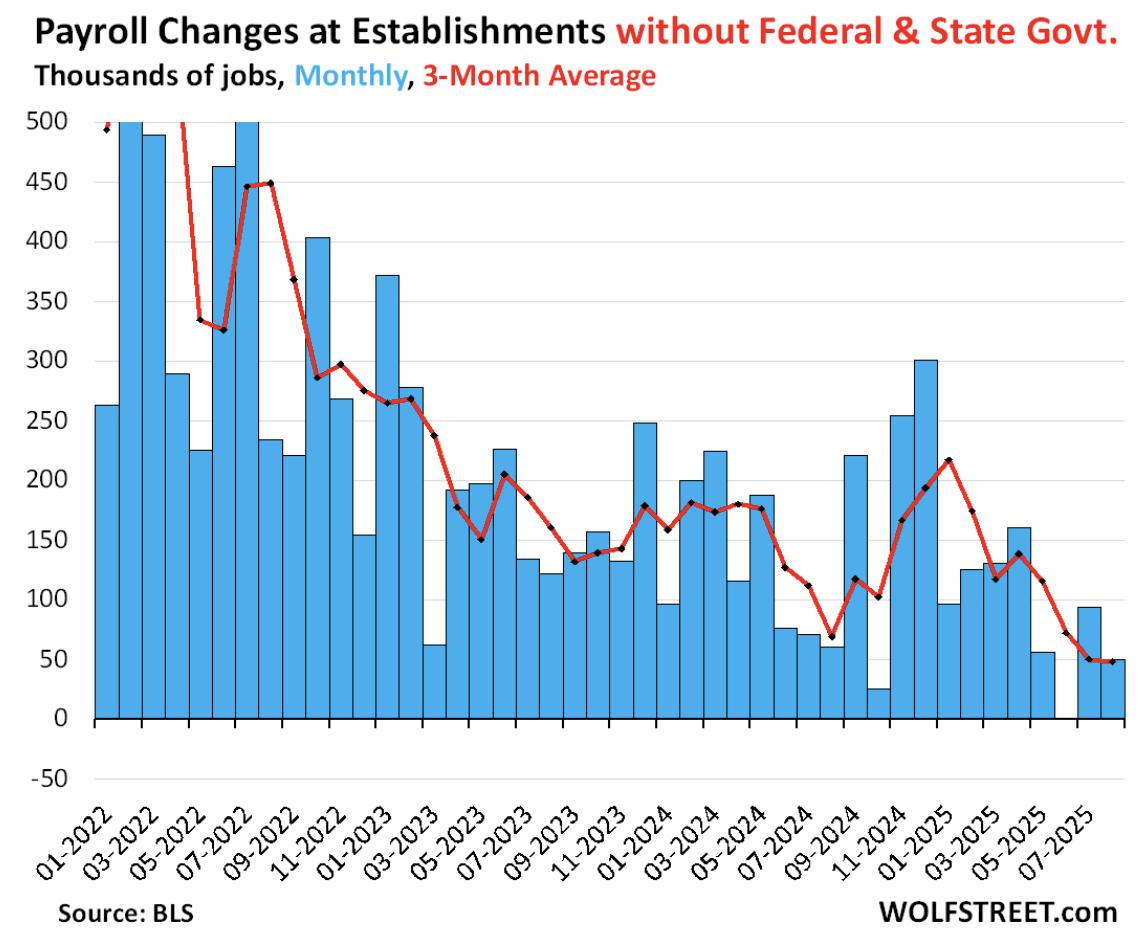
By now, I’m sure you’re all aware that the payroll report was pretty weak across the board.  NFP rose only 22K, well below expectations and although there was a marginal increase in last month’s results, just 6K, the overall picture was not bright.  The Unemployment Rate ticked up 0.1%, as expected with the labor force growing >400K, but only 288K of them getting jobs.  However, layoffs are down, and the real positive is that government jobs continue to fall, having declined 56K in the past three months with private hiring making up the slack.  In fact, if you look at the past three months, private job creation has been 144K or 48K/month.  That is the best news of the entire process.  Eliminating government employees will eventually result in lower government expenditures and let’s face it, if the government employees who leave become baristas at Starbucks, they are likely adding more value to the economy than their government roles!  The chart below from Wolfstreet.com does a great job of highlighting private sector jobs growth, which is slowing but still positive.  Maybe it is not yet the end of the world.

As to my efforts to prognosticate on the market behavior based on a range of outcomes, I mostly got the direction right, although some of the movement was a bit more aggressive than I anticipated.  The one place I missed was equities, which started higher, but ultimately fell on the day.  Nostradamus I’m not.

The last thing to mention today
Is France, where a vote’s underway
When finally completed
And Bayrou’s unseated
Macron will have naught but dismay

The last key story to discuss is the vote today in France’s parliament where another snap election has been called by a minority government (see Japan for previous results) and in all likelihood will result in the government falling.  The problem here, as it is pretty much everywhere in the Western world is that the government’s budget deficit is exploding higher and legislators cannot agree to cut spending.  The result is rising bond yields (see below chart as I discussed this last week here), and growing concern as to how things will ultimately play out.  The prognosis is not positive.  

Source: tradingeconomics.com

While the US is in a similar situation, we have substantially more tools available and more runway given our status as the global hegemon and owning the global reserve currency.  But France, and the UK or Japan for that matter, have no such backstop and investors are growing leery of the increasing risk of a more substantial meltdown.  Apparently, the results of this vote ought to be known by 3:00pm Eastern time this afternoon.

The question is, if/when he loses, what happens next?  The choice is President Macron appoints a different PM to head another minority government, which will almost certainly be unable to achieve anything else, or there is another parliamentary election, which at least could result in a majority government with the ability to enact whatever fiscal policies they believe.  Remember, France is the second largest economy in the Eurozone, so if it remains under pressure, it is difficult to make the case that the euro will rally very much, especially given Germany’s many issues.

And that feels like enough for one day.  Let me recap the overnight session but since there is no data of note today and the Fed is in its quiet period, I will list data tomorrow.  While US equity markets sold off a bit at the end of the day, that was not the vibe this morning anywhere else in the world as green is the predominant color on screens.  In Japan, no PM is no problem as the Nikkei (+1.45%) rallied after much stronger than expected GDP data (2.2% in Q2) helped convince investors things would be fine.  Hong Kong (+0.85%) and China (+0.2%) also managed gains as hopes for a Fed rate cut spring eternal.  In fact, the bulk of Asia saw gains on that basis.

Europe, too, has embraced the weaker US payroll data and prospective Fed rate cut to rally this morning, although in fairness, German IP rose 1.4% for its first gain in four months, so that helped the cause.  But even French stocks are higher despite the imminent collapse of the government.  I am beginning to notice a pattern of equity investors embracing the removal of ineffective governments, but perhaps I am looking too hard.  US futures are also modestly higher at this hour (7:15) this morning, rising about 0.25%.

In the bond markets, after Friday’s rally, Treasury yields have edged higher by 1bp while European sovereign yields are largely unchanged, perhaps +/- 1bp on the day.  Surprisingly, even JGB yields have not risen despite the lack of fiscal rectitude there.  It certainly appears that bond investors are ignoring a lot of potential bad news.  Either that or someone is buying a lot of bonds on the sly.

In the commodity markets, oil (+2.0%) after a down day Friday ahead of expectations that OPEC+ would be increasing production again, has rallied back as those increases were less than feared by the market.  But net, oil is just not going anywhere these days, trading between $62/bbl and $66/bbl for the past month.  It feels like we will need a major demand story to change this narrative, either up or down.  As to metals, they continue to rally sharply (Au +0.7%, Ag +0.7%, Cu +0.5%, Pt +1.9%) as no matter the bond markets’ collective ennui over global fiscal profligacy, this segment of the market is paying attention.  If this week’s CPI data is cooler than expected, I suspect that 50bps is going to be the default expectation and metals will climb further.

Finally, the dollar is under modest pressure this morning, with the euro and pound both rising 0.2% although AUD (+0.6%) and NZD (+0.8%) are having far better sessions on the back of commodity price strength.  JPY (-0.3%) has recouped some of its early losses from the overnight session, though my money is still on weakness there.  In the EMG bloc, it is hard to get excited about much with ZAR (+0.25%) appreciating the rally in gold and platinum, but only just, while the rest of the bloc hasn’t even moved that much.  

And that’s really all for today.  The discussion will continue around the Fed and whether 50bps is coming with Thursday’s CPI the last big piece of data that may sway that conversation.  Personally, I am surprised that the government upheavals in Japan and France (with the UK also having major fiscal problems) have not had a bigger impact on markets.  My sense is that there is an opportunity for more fireworks in those places in the near future.  But apparently not today.  As investors whistle past those particular graveyards, I imagine we will see a risk-on session continue with the dollar remaining under modest pressure.

Good luck

Adf
Got Smote

There once was a poet that wrote
‘Bout bonds and the fact they got smote
So, yields, they did rise
And to his surprise
Most pundits, this news did promote
 
Now turning to stories today
The biggest one, I’d have to say
Is how, in Japan
Ishiba’s grand plan
Has failed, thus he’ll be swept away


The number of stories this morning regarding the synchronous rise of long-dated bond yields around the world has risen dramatically.  While yesterday, I highlighted this fact, I certainly didn’t expect it to be the key narrative this morning.  But such is life, and virtually every news outlet is focusing on the subject as both a reason for the poor equity performances yesterday as well as a way to highlight government profligacy.  I do find it interesting, though, that the same publications that push for more spending for their preferred causes have suddenly become worried about too much government spending.  But double standards are nothing new.   A smattering of examples show ReutersBloomberg and the WSJ all feigning concern over too much government spending.

I say they are feigning concern because all these publications are perfectly willing to support excess government spending if it is spent on the things they care about.  Regardless, the fact that this has become one of today’s key talking points is evidence that some folks are starting to recognize that trees cannot grow to the sky.  Even though almost every major central bank is in easing mode, long-term yields keep rising.  Alas, the almost certain outcome here, albeit likely still well into the future, is some form of yield curve control as central banks will be forced to prevent yields from rising too high lest their respective governments go bust.  I expect that the initial stages will be regulations requiring banks and insurance companies, and maybe private, tax-advantaged accounts like IRA’s and 401K’s, to hold a certain percentage of Treasuries.  But I suspect that eventually, only central banks will have the wherewithal to prevent runaway yields.  Welcome to the future; got gold?

However, you can read about this everywhere, and after all, I touched on it yesterday so let’s move on.  Government stability/fragility is the topic du jour in this poet’s eyes.  We already know that the French government is set to fall on Monday when PM Bayrou loses a confidence vote.  It is unclear what comes next, but French finances are in bad shape and getting worse and they don’t print their own currency.  This tells me that we could see a lot more social unrest in France going forward given the French penchant for nationwide strikes.  

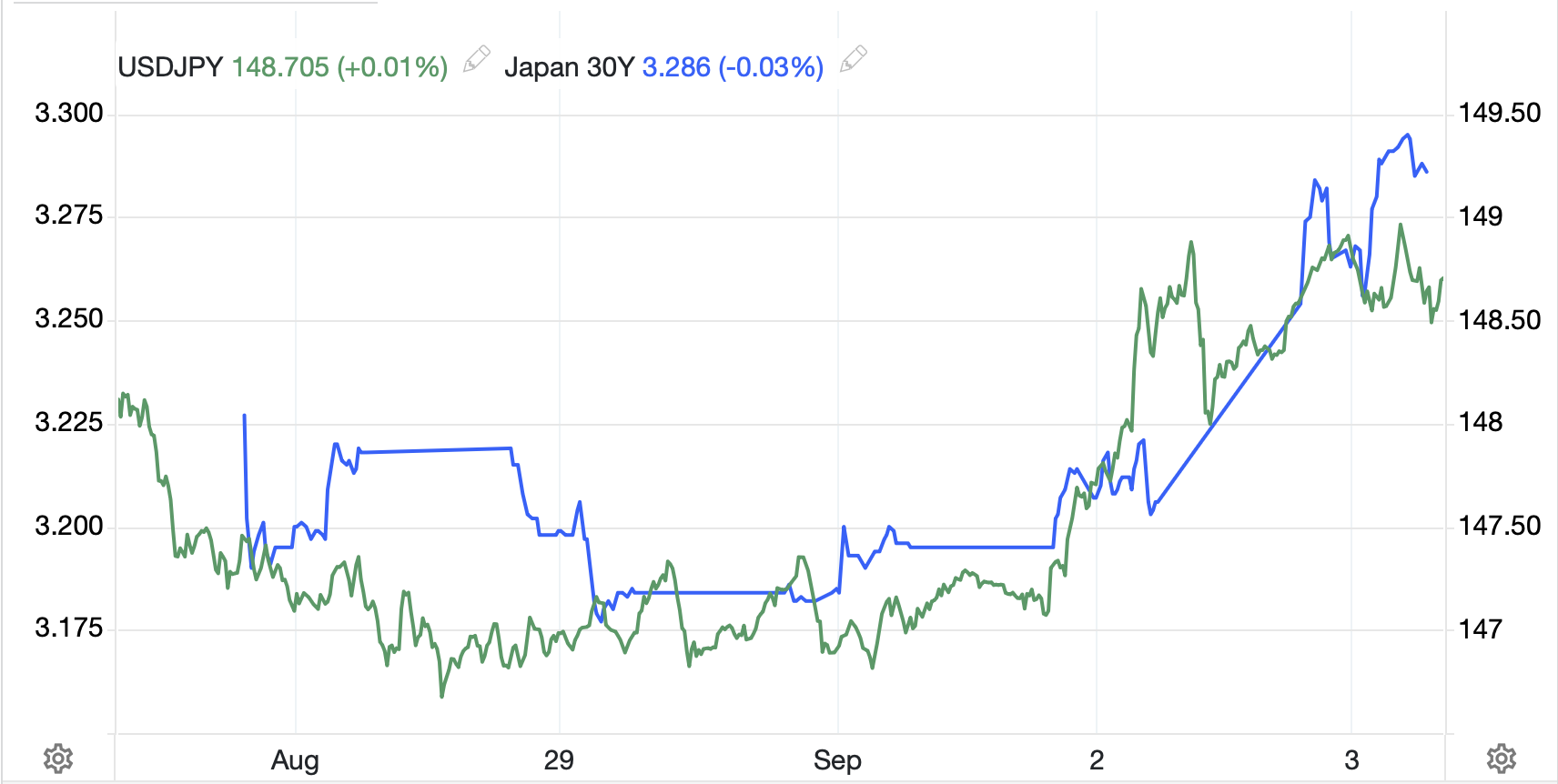
But a story that has gotten less press is in Japan, where PM Ishiba saw the LDP majority decimated in the Upper House two weeks ago and is now heading a minority government as the LDP does not have a majority in either house in the Diet.  One of the key members of the LDP, and apparently the glue that was holding together the fragile coalition was Hiroshi Moriyama, the LDP Secretary General, and he is now resigning along with several of his lieutenants, so it appears that Japan’s government is about to fall as well.  The upshot here is that the BOJ seems unlikely to raise interest rates given the political uncertainty, which is not only pressuring long-dated JGB’s but also the yen. (see chart below from tradingeconomics.com)

While I have not written extensively about the UK’s government, the situation there is quite similar, with massive fiscal problems driving yields higher while the government focuses on removing the right of free speech amongst its people if that speech is contra to the government’s policies.  While the next UK election need not be held for another 4 years, my take is it will be much sooner as PM Starmer has destroyed his legitimacy with recent policy decisions and will soon be unable to govern.  It will only be a matter of time before his own party turns on him.

The governments in Japan, France and the UK are all under increasing pressure as their policy prescriptions have not tackled the key problems in their respective economies.  Inflation in Japan and the UK and benefits in France need to be addressed, but it is abundantly clear that the current leadership will not be able to do so effectively.  Once again, please explain why people are so bearish the dollar, at least in the long run.  While inflation will be higher worldwide and fiat currencies will all suffer vs. real assets, on a relative basis, the dollar doesn’t appear so bad after all.

Ok, let’s move on to the overnight activity as it gets too depressing highlighting all the government failures around the world.  While US stocks closed above their worst levels of the session, they were all lower yesterday.  That bled into Asia with Japan (-0.9%), Hong Kong (-0.6%) and China (-0.7%) all falling with worse outcomes in some other parts of the region (Australia -1.8%, Philippines -0.75%) although there were winners as well (Korea, India, Taiwan) albeit in less impressive fashion.  Perhaps the surprise was Chinese underperformance after PMI Services data there printed at its highest level since May 2024.

But whatever the negativity that existed in Asia was, it did not translate to European shares as they are all higher (CAC +1.0%, DAX +0.8%, FTSE 100 +0.55%, IBEX +0.2%).  Now, clearly it is not confidence in government activity that has investors excited.  The only data of note was Services PMI, which was mostly as expected except in Germany where it fell to 49.3, far lower than the initial estimate of 50.1 and based on the chart below, seemingly trending lower.

Source: tradingeconomics.com

US futures, too, are higher this morning, with gains of 0.5% to 0.75% for the S&P and NASDAQ.

You won’t be surprised that bond yields continue to drift higher, even in the 10-year space with Treasuries higher by 2bps, although most European sovereign yields have edged down by -1bp in the 10-year space.  It is the longer dated yields that continue to see the most pressure with 30-year yields across the US, Europe and Japan all pushing to new highs for the move, and in the case of Japan, new all-time highs.

Source: tradingeconomics.com

This, of course, is the underlying story for virtually all markets right now.

In the commodity markets, oil (-2.1%) has given back yesterday’s gains after reports that OPEC+, which is meeting this weekend, will be raising their output yet again.  Whatever the situation is in Russia, whether Ukrainian attacks are reducing supply or not, it seems clear that OPEC is unperturbed and wants to pump as much as possible. In the metals markets, gold (+0.3%) has set another new all-time high and appears to be breaking out from its recent consolidation pattern.  I am no market technician (I’m a poet after all), but a consensus seems to be forming that $3700 is coming soon and $4000 will be achieved by early next year.

Source: tradingeconomics.com

The rest of the metals space is little changed this morning with silver holding at its 11-year highs and copper treading water at the levels that existed pre-tariff threats.

Finally, the currency markets, which saw the dollar rally sharply yesterday, are taking a breather with the dollar giving back some of those gains amid a consolidation.  In the G10, movement is 0.2% or less, so really nothing and in the EMG bloc, HUF (+0.6%), KRW (+0.5%) and ZAR (+0.3%) are the biggest gainers, with the latter following gold, while traders see the central bank in Hungary maintaining higher rates to fight still, too high inflation of 4.3%.  As to Korea, better than expected GDP data helped drive inflows to the currency.

On the data front today, we see JOLTs Job Openings (exp 7.4M) and Factory Orders (-1.4%) this morning and the Fed’s Beige Book is released at 2:00pm.  We also hear from two Fed speakers, which given the row over Governor Cook’s tenure at the Fed, may be interesting to see.  The market continues to price a 92% probability of a 25bp cut in two weeks’ time, but I suspect that Friday’s NFP data may be the ultimate arbiter there.

I cannot look at the world and conclude that the US is the biggest problem around.  However, if we do see weak data on Friday and the market starts to price 50bps of cuts by the Fed, the dollar will decline in the near term.  But longer term, the more I read, the more bullish I get on the greenback, at least relative to other currencies.

Good luck

Adf
Panic They’re Sowing

While eyes and ears focus on Jay
And whatever he has to say
Poor Germany’s shrinking
And it’s wishful thinking
Japan’s kept inflation at bay
 
But fears about Jay have been growing
That rate cuts he will be foregoing
If that is the case
Most traders will race
To sell things while panic they’re sowing


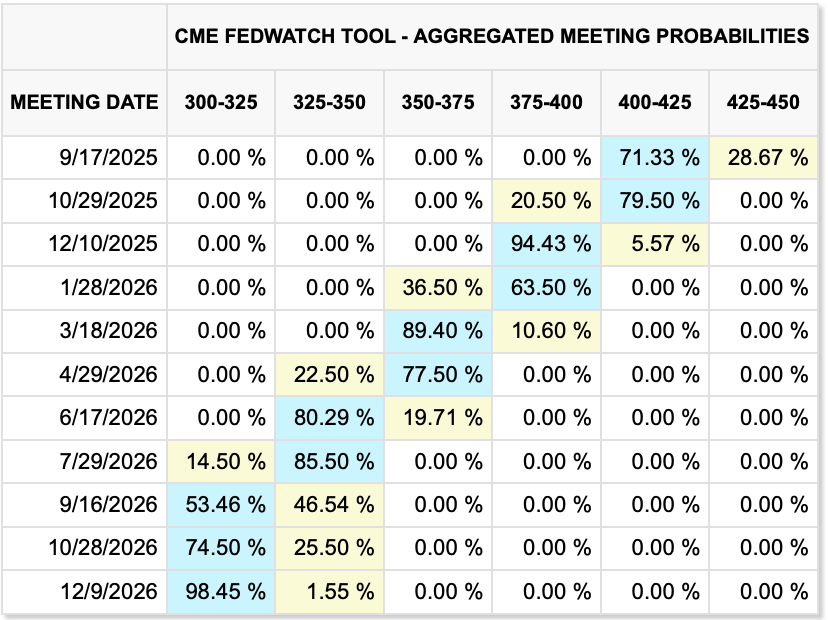
Clearly, the big story today is Chairman Powell’s speech with growing expectations that he will sound more hawkish than had previously been anticipated.  Recall, after the much weaker than expected NFP data was released at the beginning of the month, it appeared nearly certain that the Fed was going to cut at the next meeting with talk of 50bps making the rounds.  Now, a few hours before Powell steps to the podium, the futures market is pricing just a 71% probability of that rate cut with a just two cuts priced in for 2025 as per the CME’s own analysis below:

Arguably, this is one reason that equity markets have been having trouble moving higher as the Mag7 drivers of the market are amongst the longest duration assets around, so higher rates really hurt them.  While there has been a rotation into more defensive names, if opinions start to shift regarding the magnificence of AI, or perhaps just how much money they are spending on it and the potential benefits they will receive, things could get ugly.

I also find it interesting that the Fed whisperer, Nick Timiraos at the WSJ, has been running flack for Chairman Powell in this morning’s article, trying to get people to focus on the Fed’s framework as the basis of today’s speech, rather than policy per se.  Briefly, the current Fed framework, was designed right before COVID when for whatever reason they were concerned that low inflation was a problem, and they created Average Inflation Targeting (AIT) as a way to allow inflation to run above their target of 2.0% for a period if it had been below that level for too long.  We all know how well that worked out and, in fact, we are all still paying for their mistakes every day!  The word is they are going to scrap AIT although it is not clear what they will come up with next.  It is exercises like this that foment the ‘end the Fed’ calls from a growing group of monetarist economists and pundits.

At any rate, comments from other Fed speakers indicate that most are not yet ready to cut rates, so Powell will be able to have a significant impact if he turns more dovish.  But we have to wait a few more hours for that so let’s turn our attention elsewhere.

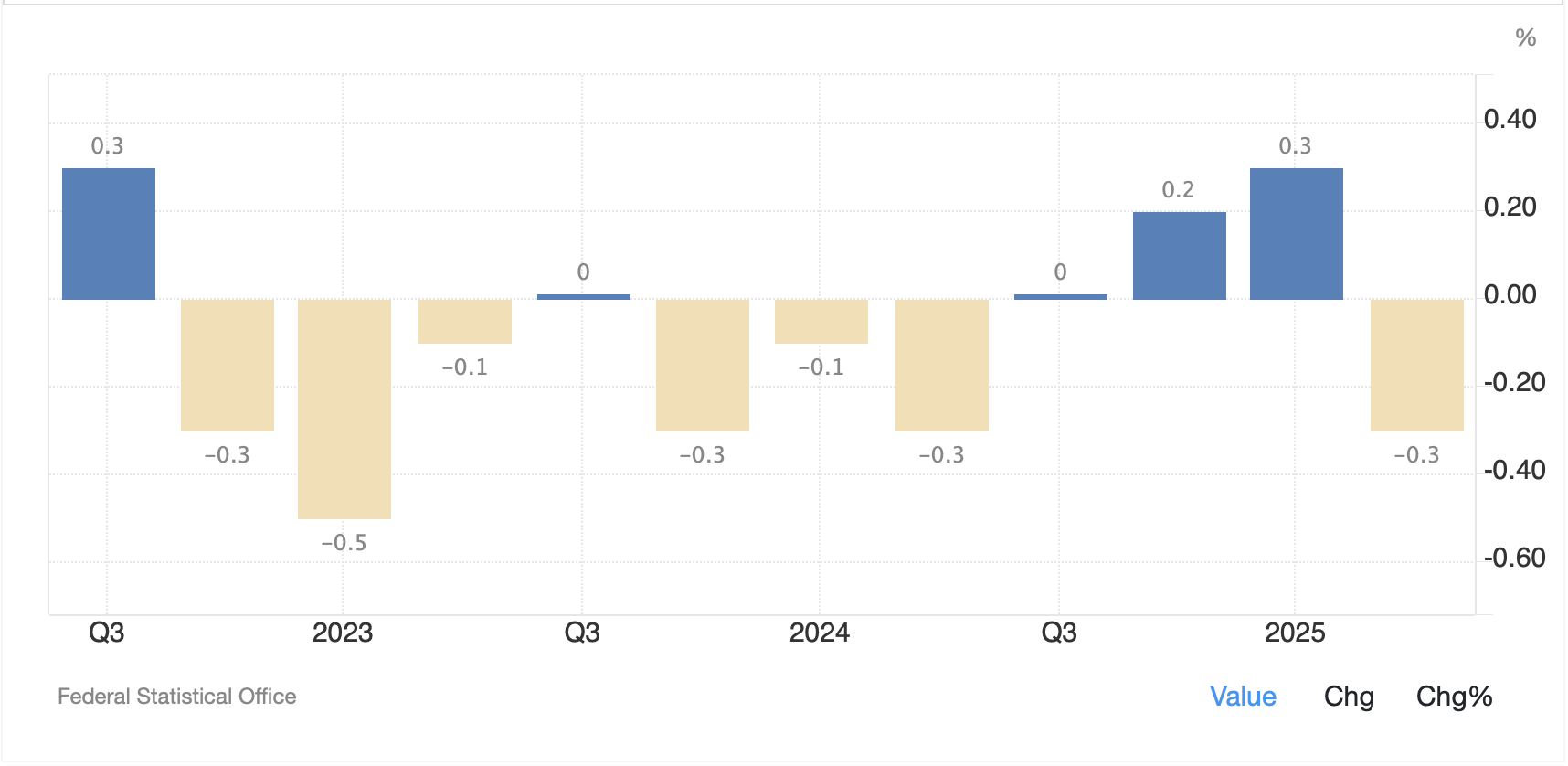
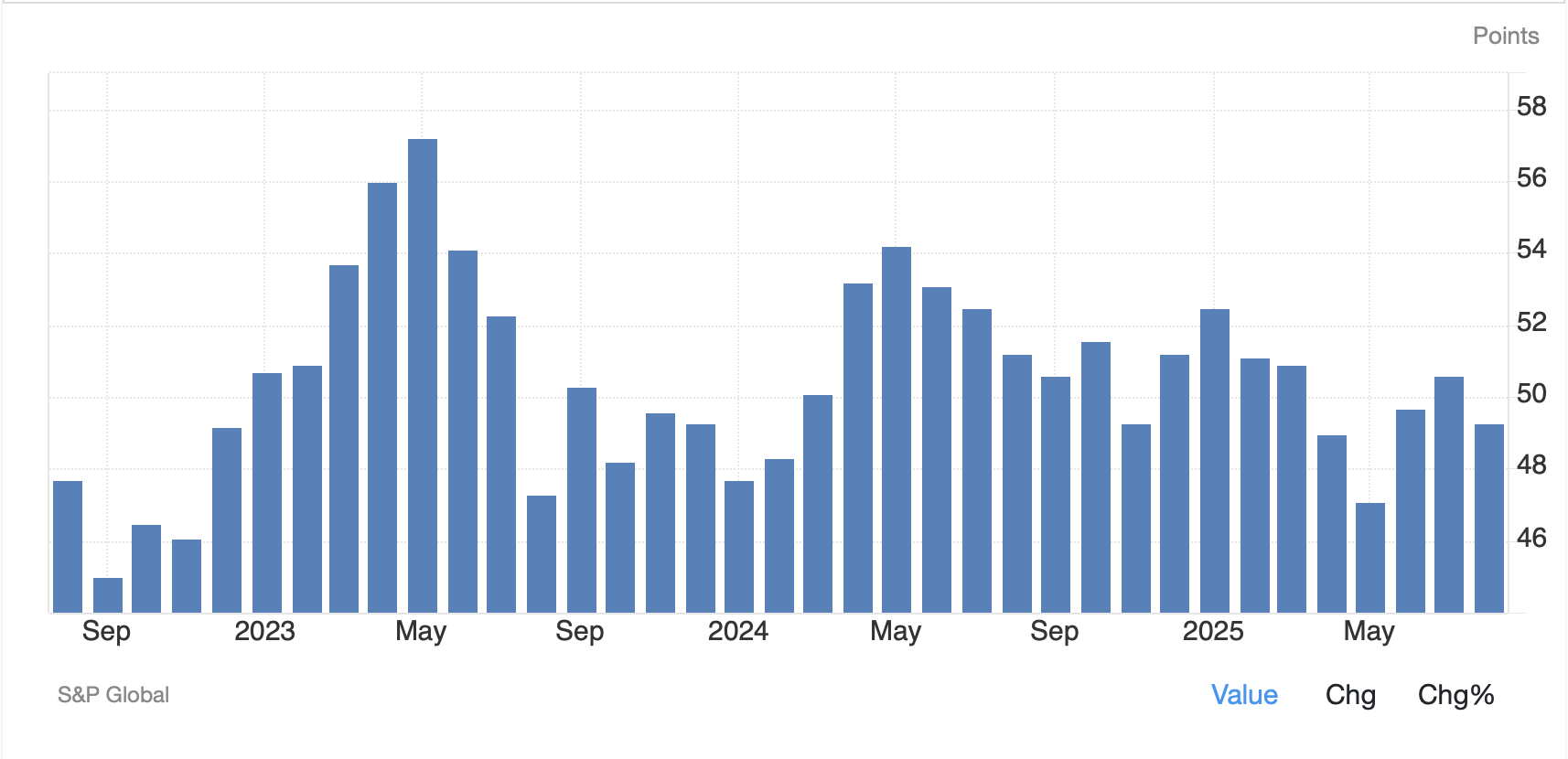
Germany GDP data (-0.3% Q/Q, +0.2% Y/Y) was a few ticks lower than expected and continues to point to an economy that has no positive momentum at all.  In fact, a look at the quarterly GDP data from Germany paints a pretty awful picture if growing your economy is the goal.

Source: tradingeconomics.com

Clearly, the US tariff changes have been quite negative, but in fairness, Germany’s insane energy policy is likely a much bigger driver of their problems as they have the most expensive power costs in the EU.  It is very difficult to have a manufacturing-based economy if you cannot power it cheaply.  Again, while the euro is more than just Germany, this does not bode well for the single currency.

Turning to Japan, inflation continues to run far above their 2.0% target, printing last night at 3.1% on both the headline and core metrics, which while 2 ticks lower than June’s data, was still a tick higher than expected.  It has now been 40 consecutive months that core CPI in Japan has been above the BOJ’s 2.0% target and Ueda-san continues to twiddle his thumbs regarding raising rates.

Source: tradingeconomics.com

It is very hard to watch this lack of policy response to a clear problem, that from all I read is becoming a much bigger political issue for PM Ishiba, and have confidence that the yen is going to strengthen any time soon.  Back in May, the talk was of the unwinding of the carry trade.  All indications now are that it is being put back on in significant size.  FWIW I think we will see 150.00 before too long, especially if Powell sounds hawkish.

And those are really the stories today ahead of Powell and the NY open.  So, let’s see how things behaved overnight.  After a modest down day in the US yesterday, and despite the poor inflation data, Japan was unchanged overall.  However, China (+2.1%) had a huge up move apparently on the idea that US-China trade tensions are easing and despite continued weak data from the country.  Apparently, there has been a rotation from bonds to stocks by local investors driving the move.  Hong Kong (+0.9%) also had a strong session as did Korea (+1.0%) although India, Taiwan and Australia all struggled with declines between -0.6% and -1.0%.  In Europe, the. screens are green, but it is a pale green with muted gains (DAX +0.1%, CAC +0.25%, IBEX +0.4%) despite the weak German data.  Perhaps the belief is this will encourage the ECB to ease policy further.  Meanwhile, at this hour (7:15) US futures are pointing higher by 0.25% or so.

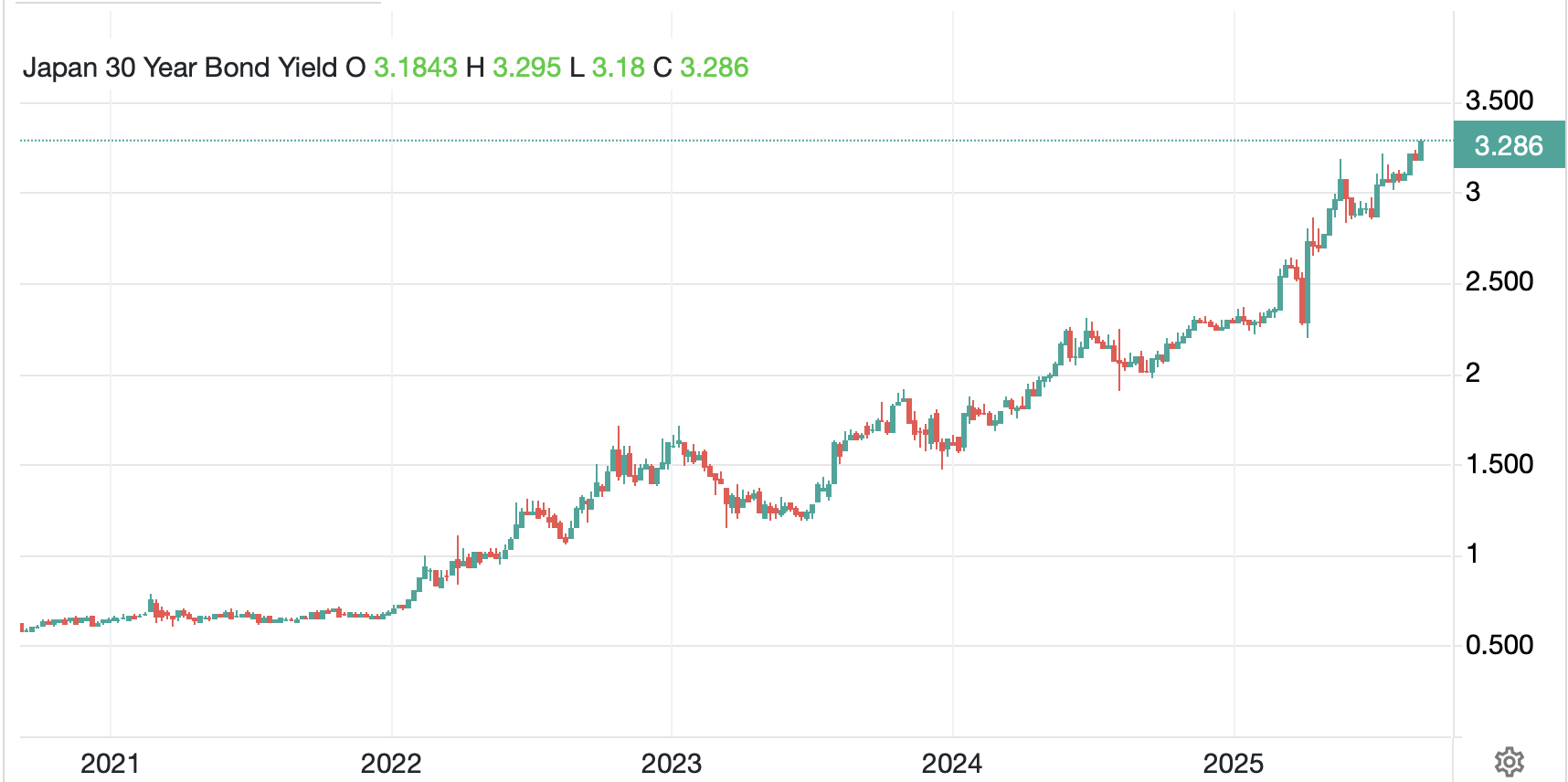
In the bond market, after climbing a few basis points yesterday, Treasury yields are unchanged, trading at 4.33%, so still range bound.  European sovereign yields are softer by -1bp to -2bps, again likely on the softer German data with hopes for a more aggressive ECB.  JGB yields edged higher by 1bp in the 10-year but the longer end of the curve there has seen yields move to new all-time highs with 30-year yields up to 3.216%. it feels like things are starting to unravel in Japanese bond markets.

Turning to commodities, oil (+0.4%) is creeping higher again this morning but remains in its downtrend and activity is lacking.  Meanwhile, the metals markets (Au -0.35%, Ag -0.5%, Cu -0.3%) are all under pressure from a combination of a strong dollar and a lack of investor interest, at least in the West.

Speaking of the dollar, it rallied yesterday and is largely continuing this morning with one notable exception, KRW (+0.75%) which benefitted from trade data showing exports rose 7.6% in the first 20 days of the month on strong semiconductor sales.  But otherwise, +/-0.3% or less is the story of the day, with most currencies within 0.1% of yesterday’s closing levels.

And that’s really it.  There is no data so we are all awaiting Powell and then anything that may come from the White House regarding trade deals, or peace, I guess.  As the summer comes to a close, unless Powell says rate hikes are coming or promises cuts, I expect that traders will have gone for the weekend by lunch time and it will be a very quiet market.

Good luck and good weekend

Adf

All Its Sophists

The art of the deal
Tokyo and Washington
Birds of a feather


Seemingly, the biggest news story of the evening was the trade agreement between the US and Japan, where reciprocal tariffs have been set at 15%, including on Japanese autos, and Japan has pledged to invest $550 billion in the US, which I assume is from private corporations although that was not specified.  However, they did explain that one of the investments would be Alaskan North Slope natural gas liquification, a project that has been on the boards for more than 20 years.  Thus far, this seems like a big win and major milestone in President Trump’s trade strategy as it also opened Japanese markets to American products, including rice which had been a key sticking point.

The market response was as might be expected with the Nikkei (+3.5%) rallying sharply and taking virtually every regional Asian market higher for the ride as the conclusion of a deal in the preferred timeline was seen as a precursor to others falling in line.  It is quite interesting that this happened so shortly after PM Ishiba’s election disaster on Sunday, but perhaps that was his motivation.  He needed a big win and conceding on some points to get a deal was much preferred to holding out and getting nothing.  However, JGB markets saw things differently as a very weak 40-year JGB auction (lowest bid-to-cover ratio of 2.127 since 2011) led to long-dated yields rising between 8bps and 10bps last night, with the 10-year yield trading back to the highs seen in late March.

Source: tradingeconomics.com

While the stock market was giddy, apparently the only discussion in the bond market was whether Ishiba-san would be forced to resign, leaving Japan with a leadership vacuum.  Meanwhile, the yen (+0.3%) did very little overnight although it has been creeping higher since the election results.  My sense is Japanese investors are cautiously heading home, but I would not look for a major move lower in USDJPY, rather the current gradual pace makes sense.

A juxtaposition exists
Twixt Europe with all its sophists
And stolid Japan
Who finished their plan
On trade despite recent vote twists

As trade continues to be the topic du jour, it is no surprise that the chatter out of European capitals is that they will fight to get the best trade deal possible.  (I cannot help but laugh at Friedrich Merz saying, if they [the US] want war, we will give them a war).  However, it is also no surprise that markets have looked at the Japanese deal and increased the pressure on EU negotiators to achieve a solution by the end of the month.  First off, every European official wants to go on holiday in August, so they will want to have completed things.  But secondly, equity investors have taken the fact that deals with major counterparties can be accomplished as a sign that the EU is next.  And if they do not agree terms, it will be a double whammy of political and financial problems as you can be certain that the equity gains we are seeing today and have been steady so far this year (see below), will likely reverse on a failure to agree.

                                                                                     Today        1 Week        1 Month          YTD

Source: tradingeconomics.com

But, away from the trade story, and various political stories in the US that are unlikely to have any immediate impact on markets, that’s kind of all there is to discuss.  The Fed meets next week and there is no expectation of a rate move.  The ECB meets tomorrow and there is no expectation of a rate move.  Important data is scarce on the ground and the focus on crypto and meme stocks continues.  In fact, this is likely the best descriptor of a market that has abundant liquidity and shoots down the case for cutting rates at all.  In the meantime, let’s look at how other markets behaved overnight.

You will not be surprised that US equity futures are all pointing higher this morning, and we have already discussed the rest of the equity markets around the globe.  In the bond markets, after declining yesterday, yields have stabilized this morning (Treasuries +1bp, Bunds +1bp, OATs +1bp) although UK Gilt yields (+5bps) have underperformed as there continue to be concerns over the fiscal picture in the UK as well as questions about PM Starmer’s ability to stay in his seat.  In fact, UK 10-year yields are the highest in the developed world right now, and while they have been knocking back and forth for a few months, show no sign of falling regardless of the BOE’s future actions.

In the commodity space, oil (-0.7%) has been slipping back to the bottom of its post 12-day war range amid lackluster overall activity.  Just as there didn’t seem to be an obvious driver when oil rallied to $68/bbl, too there is no clear driver of the recent decline.  I continue to believe this is market internals rather than macro fundamentals.  In the metals markets, after a major rally yesterday across the board, gold (-0.25%) is consolidating but silver (+0.1%) is pushing within spitting distance of a major milestone, $40/oz, while copper (+1.2%) sees the benefits of the trade deal and is rallying nicely.

Finally, the dollar is mixed this morning.  While the yen is firming and the effects of the trade deal seem to be helping Aussie (+0.6) and Kiwi (+0.75%), the euro and pound are both little changed.  in fact, the rest of the G10 is +/- 0.1% on the day, so nothing at all happening.  In the EMG bloc, KRW (+0.3%) is the biggest mover with every other currency across regions +/- 0.15% or less and showing no signs of a trend right now.  Broadly, the dollar appears to be in a downtrend, but short dollars is one of the most crowded trades in the hedge fund and CTA communities, and that gets expensive given US funding costs are higher than pretty much everybody else’s right now.  Depending on how you draw your trend line (and I am no market technician), it appears that the dollar broke above that line and is now getting set to retest it.  I would not be surprised to see a more substantial bounce on the next move.

Source: tradingeconomics.com

And that is really all there is today.  This morning’s data consists of Existing Home Sales (exp 4.01M) and EIA oil inventories with a small draw expected.  The Fed is in their quiet period so no speakers which means that all eyes will, once again, turn toward the White House to see who has the right squares on their bingo card.

Good luck

Adf
Flat On His Face

Poor Ishiba-san
Started with so much promise
Fell flat on his face


In what cannot be a major surprise in the current political zeitgeist, a fringe party that focused all its attention on inflation and immigration (where have we heard that before?) called Sanseito, captured 12 seats, enough to prevent Ishiba-san’s coalition of the LDP and Komeito from maintaining control of the Upper House of Parliament there.  The electoral loss has increased pressure on PM Ishiba with many questioning his ability to maintain his status for any extended length of time.  While he is adamant that he is going to continue in the role, and that he is fighting the good fight for Japan with respect to trade talks with the US, it appears that the population has been far more focused on the cost of living, which continues to rise, and the increase in foreign visitors in the nation.  Sanseito describe themselves as a “Japan First” party.

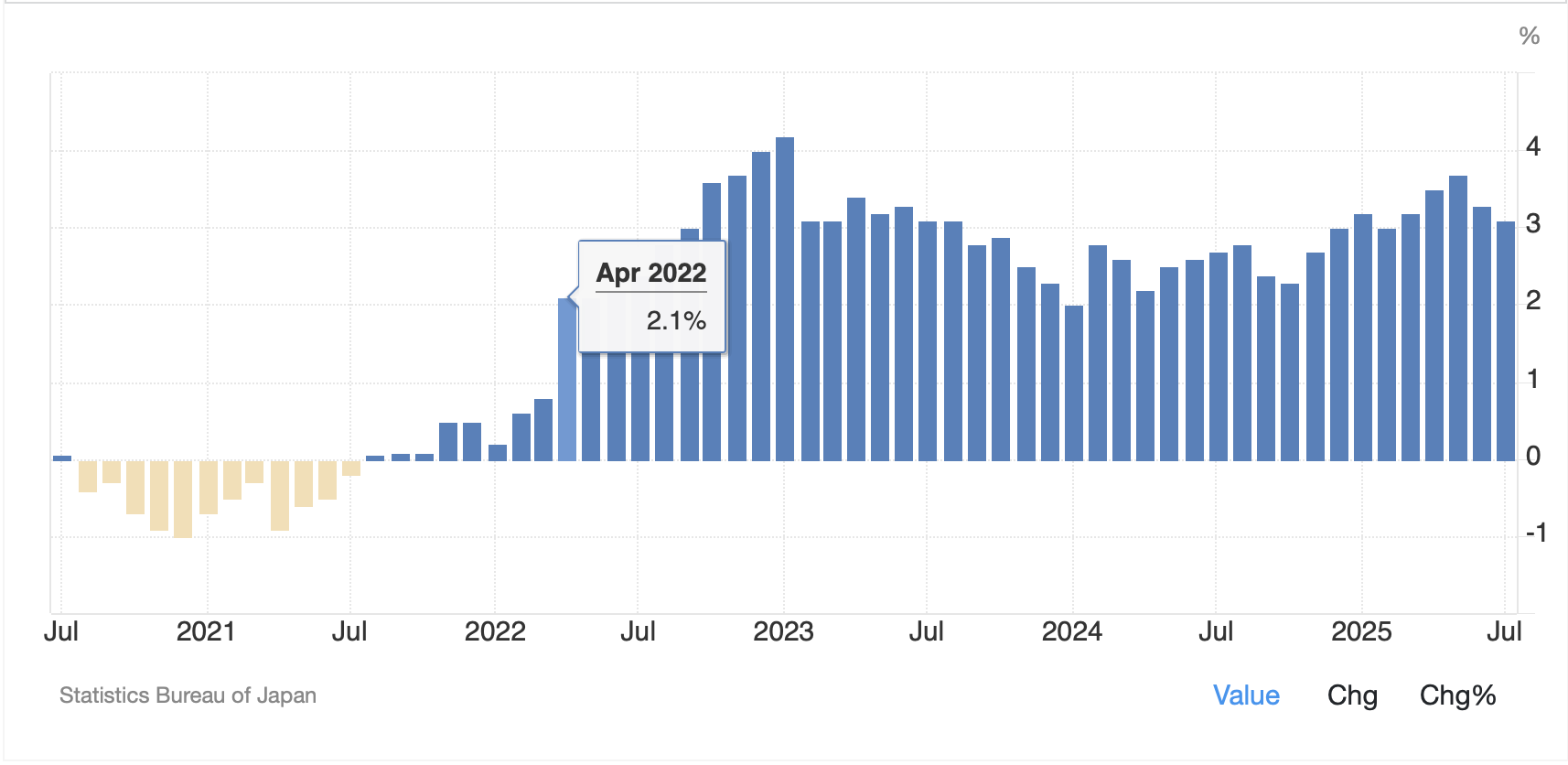
Consider, for a moment, the cost of living in Japan.  For the 30 years up until 2022, as you can see from the chart below taken from FRED data, the average annual CPI was 0.44%.  

In fact, the imperative for Japanese monetary policy was to end the decades of deflation as it was deemed a tremendous drag on the economy.  This was the genesis of their Negative Interest rate policy as well as their massive QE program, which went far beyond JGBs into equities and ETFs.  Now, while the economists and politicians hated deflation, it wasn’t such a bad thing for the folks who lived there.  Think of your life if prices for stuff that you consume rose less than 1% a year for 20-30 years.  

But now, under the guise of, be careful what you wish for, you just may get it, the Japanese government has been successful in raising the nation’s inflation rate to their 2.0% target and beyond and have shown no ability to halt the process.  After all, the Japanese overnight rate remains at 0.50% leaving real rates significantly negative, which is no way to fight inflation.   So, while Ishiba-san explained to the electorate that he was defending Japan’s pride and industry, the voters said, we want prices to stop rising.  

The biggest problem for Japan is that they now have less than 2 weeks to conclude a trade deal with the US based on the latest timeline, and their government is weak with no mandate on trade.  It is not impossible that Japan caves on most issues because if they fight, given the government’s current status, it could be a lot worse.

Now, Friday, when I discussed this possibility, I made that case that if the LDP lost the Upper House majority, it would be a distinct negative for both the yen and the JGB market.  Well, as you can see in the chart below, the first call has thus far been wrong with the USDJPY falling a full yen right away, and after an initial bounce, it has resumed that downtrend.  Like the dollar’s strength when the GFC exploded in 2008, despite the fact that the US was the epicenter of the problem, it appears that Japanese investors are bringing more money home as concern over the future increases.  Over time, I expect that the yen is likely to weaken, but I guess not yet.

Source: tradingeconomics.com

As to JGBs, Japan was on holiday last night, celebrating Sea Day, so there was no market in Tokyo.  While there is a JGB futures market, there was very little activity, and we will need to wait until this evening to learn their fate. 

The deadline for trade talks is looming
And Europe, responses, are grooming
If talks fall apart
And cut to the heart
Of what people there are consuming

The other story that is getting discussed this morning is the fast-approaching trade talk deadline of August 1st.  The EU has been actively negotiating to achieve a deal and there appears to be a decent chance that something will be concluded.  However, this morning’s stories are all about how Europe is preparing a dramatic response (“if they want war, they’ll get war” according to German Chancellor Merz) if they cannot reach a deal and the US imposes much higher tariffs on EU exports.  It is actually quite amusing to see the framing of Europe as the righteous entity being unfairly treated and forced to create a response to the American bullies.  But, that is the message from the WSJ and Bloomberg, and I’m sure from the other news sources that I don’t follow.

Every time I consider the trade situation, and the speed with which President Trump is working to conclude deals, I am amazed at how quickly this is all coming about.  Consider that the Doha Development Round of trade talks was launched in 2001 and IS STILL ONGOING with no resolution yet.  The previous framework, the Uruguay Round took 8 years to complete.  Thus, perhaps the question should be, why have trade talks taken so long in the past.  Much has been made of how President Trump blinked when the original 90-day window closed and so extended the timeline for a few weeks.  Apparently, the use of more sticks and fewer carrots is what has been needed to get these things moving along.  Otherwise, trade negotiators had cushy jobs with no accountability and no responsibility, so no incentive to come to an agreement.

Many analysts have explained that the US will suffer from these deals as inflation will rise because of tariffs and growth will slow.  Of course, these were the same analysts who explained that tariffs by the US would result in other nations’ currencies weakening to offset the tariff.  Once again, I would highlight that old analyst models are not fit for purpose in the current world situation.  I have no idea if there will be a successful conclusion of these deals, but I won’t bet against that outcome.  In the end, as I have repeatedly explained, the US has been the consumer of last resort for nations around the world, and loss of access to the US market is a major problem for everybody else.  That is a very large incentive to agree to deals.

Ok, enough, let’s see how things look this morning.  Tokyo was closed last night but we saw gains in Hong Kong (+0.7%) and China (+0.7%) as the PBOC maintained its policy ease supporting the economy.  In fact, Chinese money supply has been growing recently which should help the economy there, although it is still struggling a bit.  The rest of the region was a mixed bag with some gainers (Korea, India, Indonesia) and some laggards (Taiwan, Australia, Malaysia).  In Europe this morning, equities are under some pressure with the CAC (-0.5%) the laggard, although all bourses are lower.  This appears to be trade related with some concerns things won’t work out.  As to US futures, at this hour (7:05), they are pointing higher by about 0.25%.

In the bond market, yields are falling everywhere with Treasuries (-4bps) lagging the continent where European sovereigns have all seen 10-year yields decline by -6bps to -7bps.  It seems that there is growing hope the ECB will cut rates this Thursday, although according to the ECB’s own Watch Tool, the probability is just 2.7% of that happening.  

In the commodity space, oil is unchanged this morning as the variety of stories around leave no clear directional driver.  However, remember, it has bounced off recent lows despite production increases, and if confidence in economic growth is returning, which it seems to be, then I suspect the demand story will improve.  Meanwhile, metals markets (Au +0.65%, Ag +0.89%, Cu +1.1%, Pt +1.2%) are all having a good morning as a combination of dollar weakness and better economic sentiment are supporting the space.

As to the dollar, it is broadly lower against all its major counterparties apart from NOK (-0.2%) and INR (-0.2%) as NY walks in the door.  While the yen has been the biggest mover, the rest of the world has seen gains on the order of 0.35% or so uniformly.  The INR story apparently revolves around the trade talks with the US and concerns they may not be completed on time, but looking at the krone, after a strong rally last week following oil’s recovery, this morning looks like a bit of profit-taking there.

On the data front, there is very little coming out this week amid the summer holidays.

TodayLeading Indicators-0.2%
WednesdayExisting Home Sales4.01M
ThursdayECB Rate Decision2.00% (no change)
 Initial Claims228K
 Continuing Claims1952K
 Flash PMI Manufacturing52.5
 Flash PMI Services53.0
 New Home Sales650K
FridayDurable Goods-10.5%
 -ex Transport0.1%

Source: tradingeconomics.com

In addition to this limited calendar, it appears the FOMC is on vacation with only two speakers, Chairman Powell tomorrow morning and Governor Bowman tomorrow afternoon.  It is hard to get too excited about much in the way of market movement today.  As has been the case for the past six months, we are all awaiting the next White House Bingo call, as that is what is driving things for now.

Good luck

Adf

Not Crashing

The data was pretty darn good
And so, it must be understood
The world is not crashing
Though some things are flashing
Red signs, where recession’s a ‘could’


A review of yesterday’s economic data shows that Retail Sales were stronger than expected on every metric and subcomponent, Import Prices rose a scant 0.1%, the Philly Fed Index was much stronger than expected and Jobless Claims fell on both an Initial and Continuing basis.  In truth, it was a sweep of positive economic news.  As such, we cannot be surprised that equity markets responded positively, as did the dollar, while bonds held their ground, given the lack of inflationary signals.  But if we look at the movements in markets, they remain very modest overall.  Sure, the S&P 500 made a new high, by 2 points, but if you look at the chart below, since July 3rd, the rally has been 26 points, or 0.4%.  This is hardly the stuff of excitement.

Source: tradingecononmics.com

Of course, this did not stop the pundits who are calling for recession to highlight any negative subtext, nor did it prevent Fed Governor Waller from claiming that a rate cut in July was appropriate because the labor market is on the edge.  But the naysayers find themselves with diminishing attention these days as market price action has been quite positive.  In fact, most markets have shown similar behavior.  Whether gold or oil or other equity indices or bonds, we have been in a narrow range for a while now and it is not clear what it will take to break us out.  But here’s one thought…

On Sunday, Japan
Will vote for their Upper House
Is there change afoot?

While market insiders will discuss today’s options’ expirations as the key driver of things in the short-term, I think we need turn our eyes Eastward to Japan’s Upper House elections this Sunday.  PM Ishiba’s LDP-Komeito coalition is already in a minority status in the more powerful Lower House, a key reason why so little has been accomplished there.  But at least he had a majority in the Upper House to rubber stamp anything that was enacted.  However, signs are pointing to the LDP losing their majority in the Upper House which could well lead to Ishiba getting forced out.

Now, why does this matter to the rest of us?  There is a case to be made that flows in the JGB market are an important driver of global bond flows, including Treasuries.  For instance, Japan is the second largest net creditor nation with about $3.73 trillion invested abroad (according to Grok), much of which is Japanese insurance companies searching for higher yields than have been available there for the past decades. You may remember back in May, when there was a spike in long-dated JGB yields as all maturities from 20 years on out reached new historic highs (see below chart), well above 3.0%. 

Source: tradingeconomics.com’

Now, consider if you were a Japanese life insurer looking to match your assets to your liabilities.  Historically, buying Treasury bonds, with their much higher yield, was the place to be, especially over the past several years when the yen weakened, adding to your JPY gains.  However, that is still a risky trade, and hedging the FX risk is expensive given the yield differential between the US and Japan.  (Hedgers need to sell USD forward and the FX points reduce the effective exchange rate and by extension the benefits of the higher bond yields.)

But now, for the first time ever, JGB yields are above 3.0%, and that can be earned by a Japanese life insurer with zero FX risk, a very attractive proposition.  In fact, Bloomberg has an article this morning discussing just such a situation with one of the larger insurers, Fukoku Life.

Circling back to the election, it appears that the key issues are the rising cost of living and what the government is going to do about it.  Apparently, there are two approaches; the LDP is talking about giving out cash bribes grants of ¥20,000 to individuals while the opposition is talking about reducing consumption taxes on necessities like food.  However, in either case, the reality is that fiscal policy would loosen further with the MOF needing to issue yet more JGBs to make up for either the increased outlays or reduced income.  Add to that the uncertainty over future Japanese policy if the LDP loses its majority, and the pressure from the US regarding tariff negotiations and suddenly, it makes a lot more sense that the knock-on effects of this election can be substantial, at least with respect to the global bond markets and the USDJPY exchange rate.  (It must be said that Japanese inflation data last night actually fell to 3.3%, but that was due entirely to declining oil prices as fresh food prices, the big issue there, continue to rise.)

An election outcome that weakens PM Ishiba, potentially leading to a fall of his government and new elections in the Lower House, would be a distinct negative for the yen, and likely for the JGB market.  The impact would be felt in global bond markets as yields in the back end would almost certainly rise everywhere around the world.  This is not to imply that yields would rise by 100bps or more, but rather that the current trend of rising long-dated yields would continue for the foreseeable future.  And that will make things tough on every government.

Ok, sorry, I went on a bit long there.  A quick turn through markets shows that other than Japan (-0.2%) Asian equity indices were mostly nicely in the green following the US lead with the biggest winners Australia (+1.4%), Hong Kong (+1.3%) and Taiwan (+1.2%).  Meanwhile, in Europe this morning, while green is the color, the movement has been miniscule, averaging about 0.1% gains.  And US futures are also modestly higher at this hour (7:00) about 0.15% across the board.

In the bond market, Treasury yields have edged lower by -2bps but European sovereign yields are all higher by 2bps across the board.  The talk in Europe is over concerns regarding the conclusion of a trade deal with the US, where concerns are growing nothing will be achieved by the end of the month.

In the commodity markets, oil (+1.3%) is continuing its rebound, perhaps on the beginnings of a belief that the economy is not going to crater in the US.  Certainly, yesterday’s data was positive.  As to the metals markets, they are in fine fettle this morning with both gold (+0.4%) and silver (+0.4%) trading back to the middle of their trading ranges and copper (+1.3%) pushing back toward its recent all-time highs.

Finally, the dollar is under pressure this morning, sliding against the euro (+0.25%), pound (+0.2%) and AUD (+0.4%).  But the real movement has been in the commodity space where NOK (+0.8%) and ZAR (+0.7%) are both having solid days.  There continues to be a great deal of discussion regarding President Trump’s desire to fire Chairman Powell with a multitude of articles describing how that would be the end of the world as we know it because the Fed cherishes their “independence”.  Let’s not have that discussion.

On the data front, this morning brings Housing Starts (exp 1.3M) and Building Permits (1.39M) and then Michigan Sentiment (61.5) at 10:00.  There are no Fed speakers on the slate for today although Governor Kugler, not surprisingly, explained that waiting was the right call for the Fed when she spoke yesterday.  

It is a Friday in the summer with relatively unimportant data.  Absent another surprise from the White House Bingo card, I expect a quiet session overall as most traders and investors leave the office early for the weekend.  The dollar’s biggest risk is the Fed does cut early, but if the data keeps cooperating, it will be much harder for dollar bears, especially since so many are already short, to sell it aggressively from here.

Good luck and good weekend

Adf