It Won’t End Well

From Europe, we’re hearing some squawks
They’ve not been included in talks
‘Bout war and Ukraine
So, to inflict pain
They’ve threatened a US detox
 
It seems they believe if they sell
All Treasuries held we would yell
Please stop, it’s too much
And lighten our touch
Methinks, for them, it won’t end well


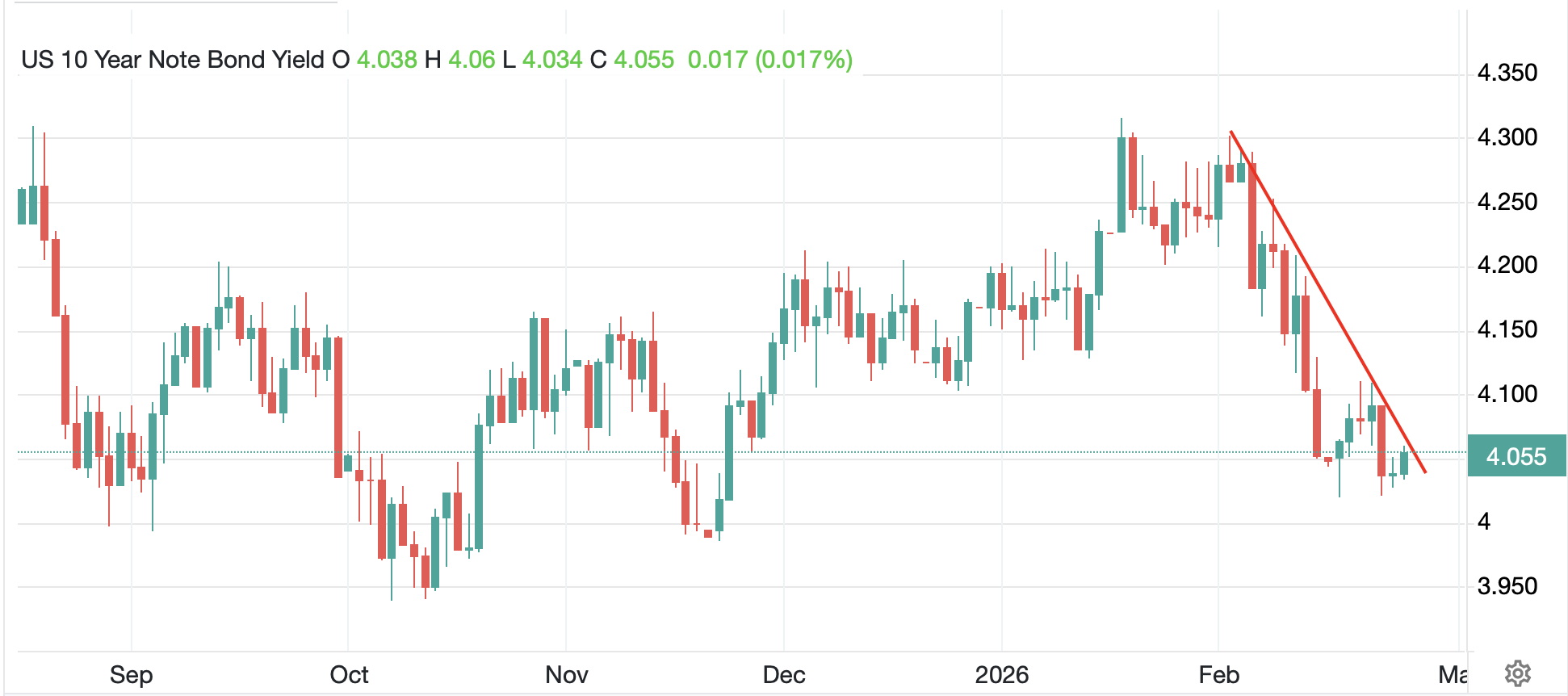
Markets continue to be dull these days.  While we are clearly not in the summer (it is 15° here in NJ this morning), doldrums certainly seem to be descriptive of the current situation.  Equities bounce back and forth each day, neither trading to new highs, nor falling sharply.  The same is true with the dollar, with oil, with gold of late and even, on a slightly longer-term view, of Treasury bonds.  I guess that could be the exception, depending on your horizon, but as you can see from the chart below, it has been several months since 10-year yields have traded outside the 4.0% – 4.2% range.

Source: tradingeconomics.com

Now, much digital ink has been spilled trying to explain that the latest 15bp rise in yields is a signal that the US economy is about to collapse under the weight of its $38+ trillion in debt, but I sense that is more about reporters trying to get clicks on their articles than a reflection of reality.

However, this morning I saw a story that I think is worth discussing, even though it is only a hypothetical.  Making the rounds is the story that Europe and the UK are extremely unhappy with President Trump’s approach to obtaining a peace in Ukraine and so have threatened their so-called ‘nuclear option’ of selling all their Treasury holdings to crash the US bond market and the US economy alongside it.  From what I have seen, if you sum up all the holdings in Europe and the UK it totals $2.3 trillion or so, although it is not clear if that is controlled by the governments, or there are private holdings included.  My strong suspicion is the latter, although I have not yet been able to confirm that.

But let’s assume those holdings are completely under the control of European central banks and governments and they decide that’s what they want to do.  What do you think will happen?  Arguably, much depends on how they go about selling them.  After all, it’s not as though there is anybody, other than the Fed, who can step up and show a bid on the full amount.  So how can they do this?  I figure there are only two viable options:

  1. They can sell them slowly and steadily over time, perhaps $200 billion/day (FYI daily Treasury market volume averages about $900 billion).  That would clearly put significant downward pressure on prices and push yields higher but would likely encourage the hedge fund community to double up on the bond basis trade thus slowing the decline.  However, if they did that for 11 days, US yields would undoubtedly be higher.  Too, remember that if the market started to get unstable, the Fed would step in and absorb whatever amount they deemed necessary to prevent things from getting out of hand.
  • Perhaps, since their ostensible goal is to destabilize the US bond market, they would literally all coordinate their timing and try to sell them all at once.  At that point, since nothing happens in the bond market without the Fed being aware, it would likely have an even smaller impact as the Fed would certainly step in and take down the entire lot.  After all, through QT, their balance sheet has shrunk about $2.3 trillion over the past 18 months, so they have plenty of capacity.

My point is, I believe this is an empty threat, as it seems most European threats tend to be.  Consider that the Eurodollar market remains the major source of funding throughout Europe, and it requires collateral (i.e. Treasury bills and bonds) in order to function.  If Europe no longer had that collateral, it feels like they might have a lot more problems funding anything on the continent.  

Another issue is that if we assume they successfully sell all their Treasuries, that means they will be holding $2.3 trillion in cash.  Exactly what are they going to do with that?  If they convert it into euros and pounds, the dollar will certainly fall sharply, meaning both the euro and pound will rise sharply.  Please explain how that will help their economies and their exporters.  They are getting killed right now because their energy policies have made manufacturing ridiculously expensive.  See how many cars VW or Mercedes sells overseas if the euro rallies 15%.

Now, the article linked above is from the Daily Express, not a website I trust, but they reference a WSJ article.  However, despite searching the Journal, and asking Grok to do the same, I can find no actual article that mentions this idea.  Ostensibly, if you want to search, it came out on December 1st, although if that is the case, why is it only getting press now?

It is a sign of the absence of market news that this is a story at all.  With market participants inhaling deeply so they may hold their breath until 2:00 tomorrow afternoon when the FOMC statement is released, they need something to do.  I guess this was today’s distraction.  As I said above, this is clickbait, not reality.

Ok, let’s tour markets. US equity market slipped a bit yesterday and Asian markets were dull as well with modest gains and losses almost everywhere.  The exception was HK (-1.3%) which suffered based on concern the FOMC will provide a ‘hawkish’ cut tomorrow and that will be the end of the road.  But China (-0.5%) was also soft despite hopes that when the Politburo meets in the next weeks, they will focus on more domestic stimulus (🤣🤣) just like they have been saying for the past three years.  Australia (-0.5%) slipped as the RBA left rates on hold and sounded more hawkish, indicating there were no cuts in the offing.

European bourses are mixed, although starting to lean lower.  The CAC (-0.6%) is the laggard here although Italy and Spain are also softer while Germany (+0.2%) leads the gainers after a slightly better than expected Trade Balance was reported this morning.  The hiccup here is that the balance improved because imports fell (-1.2%) so much more than exports rose (0.1%).  Hardly the sign of economic strength.

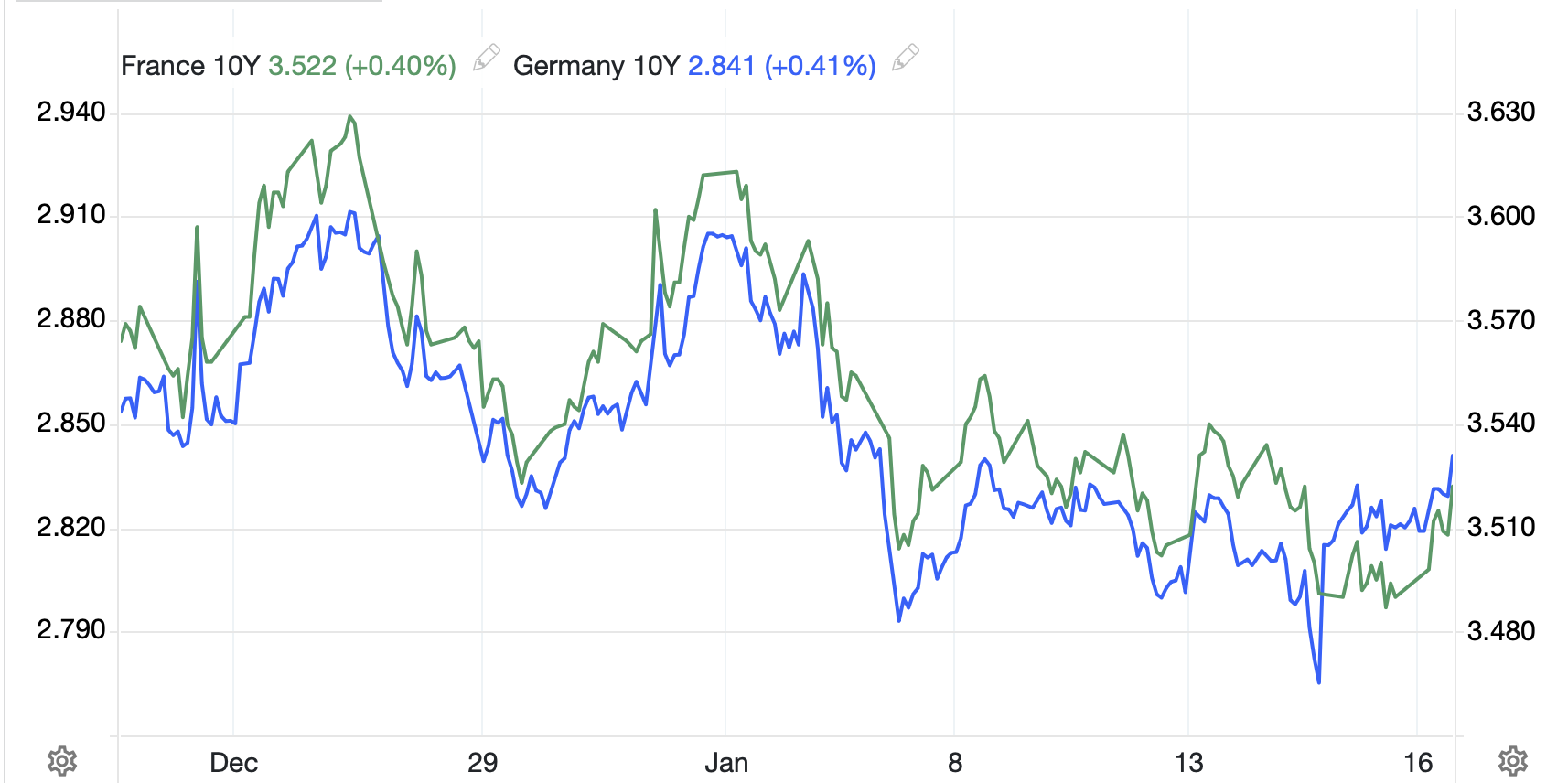
We’ve discussed bonds on a big picture basis, and recall, yields rose yesterday in both the US and Europe.  This morning, though, yields are little changed in the US and in Europe, with sovereign yields, if anything slightly lower.  JGB yields also slipped -1bp last night and the big mover was Australia after the RBA, with yields climbing 5bps.

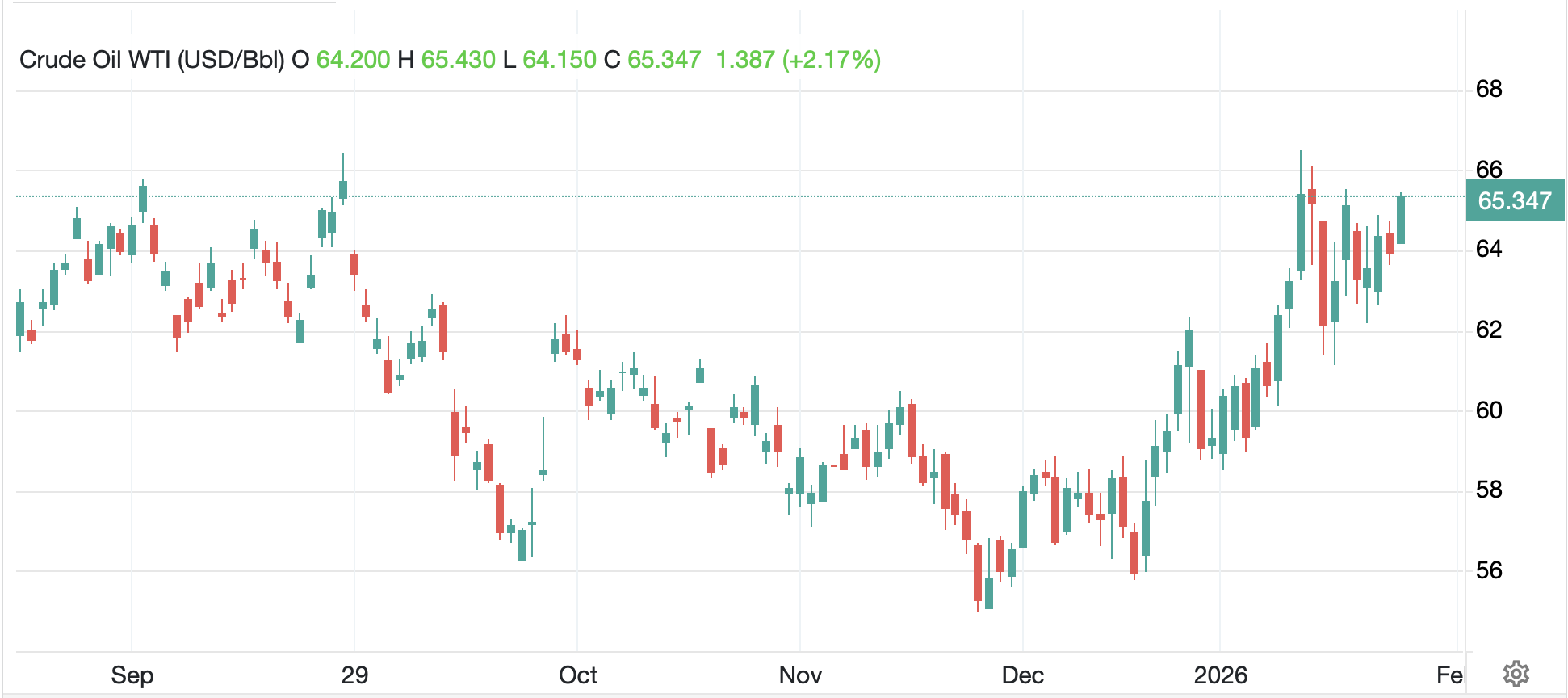
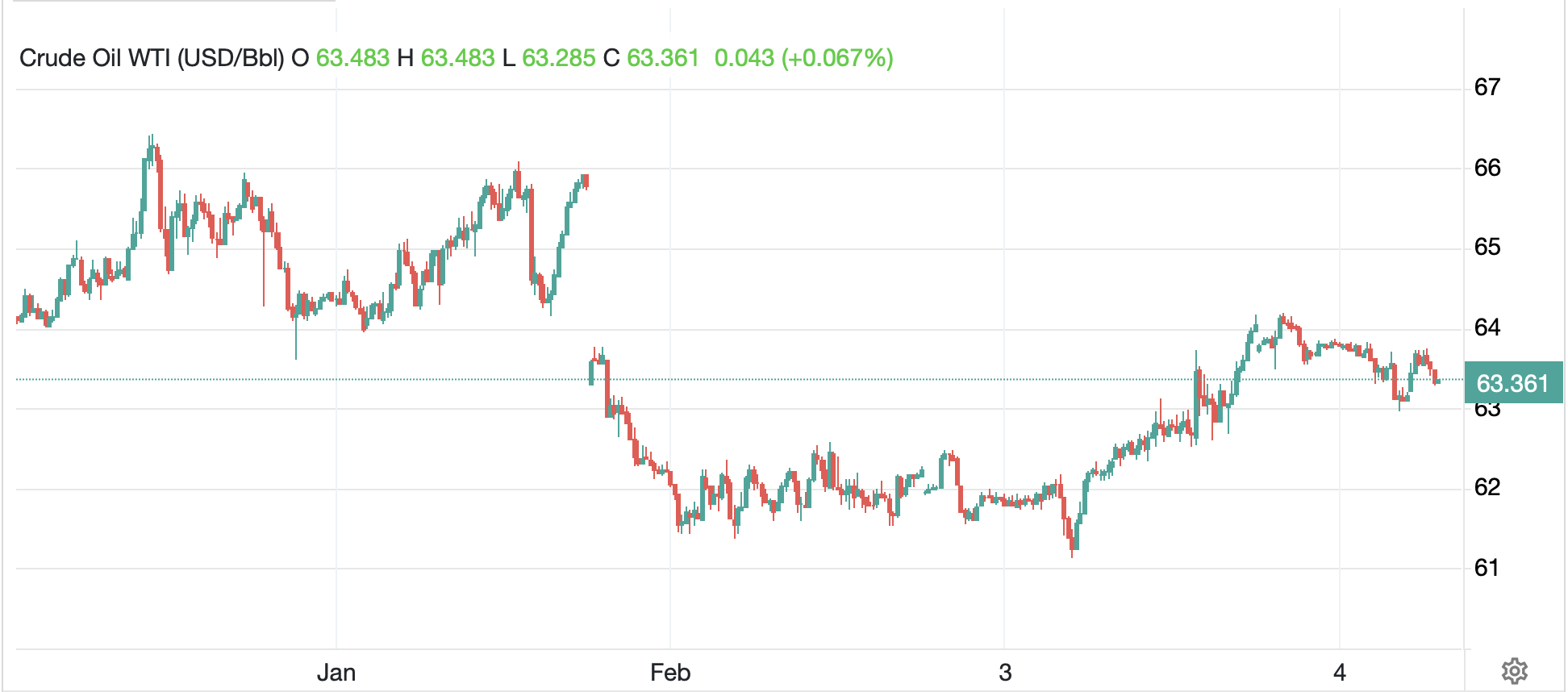
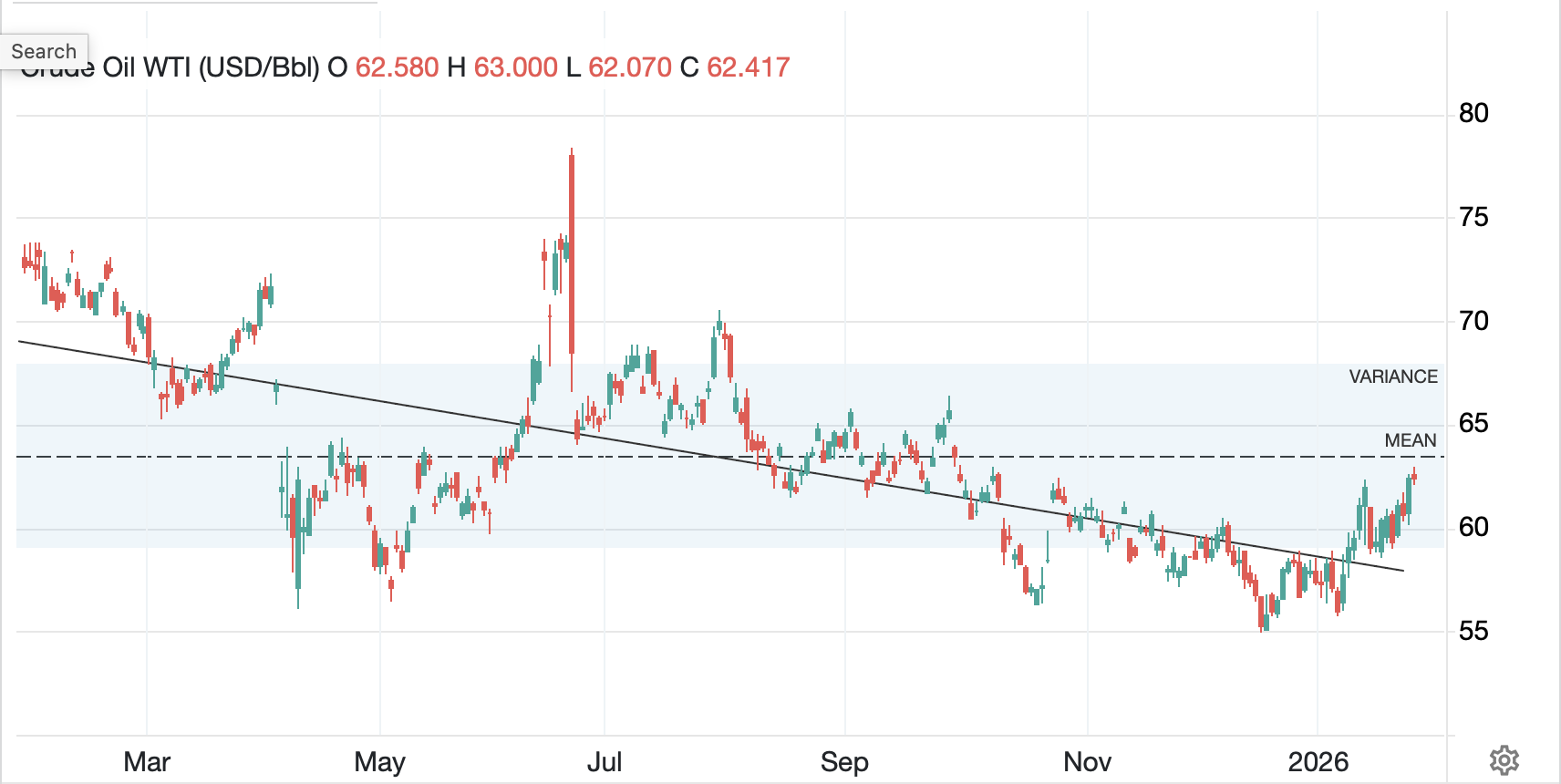
In the commodity markets, while the trend remains slightly lower in oil (+0.3%), as you can see from the chart below, $60/bbl is home.  As I have written before, absent an invasion of Venezuela or peace in Ukraine, it is hard to see what changes this for now.  I guess if China stops filling up its SPR, demand could shrink and that would accelerate the decline.

Source: tradingeconomics.com

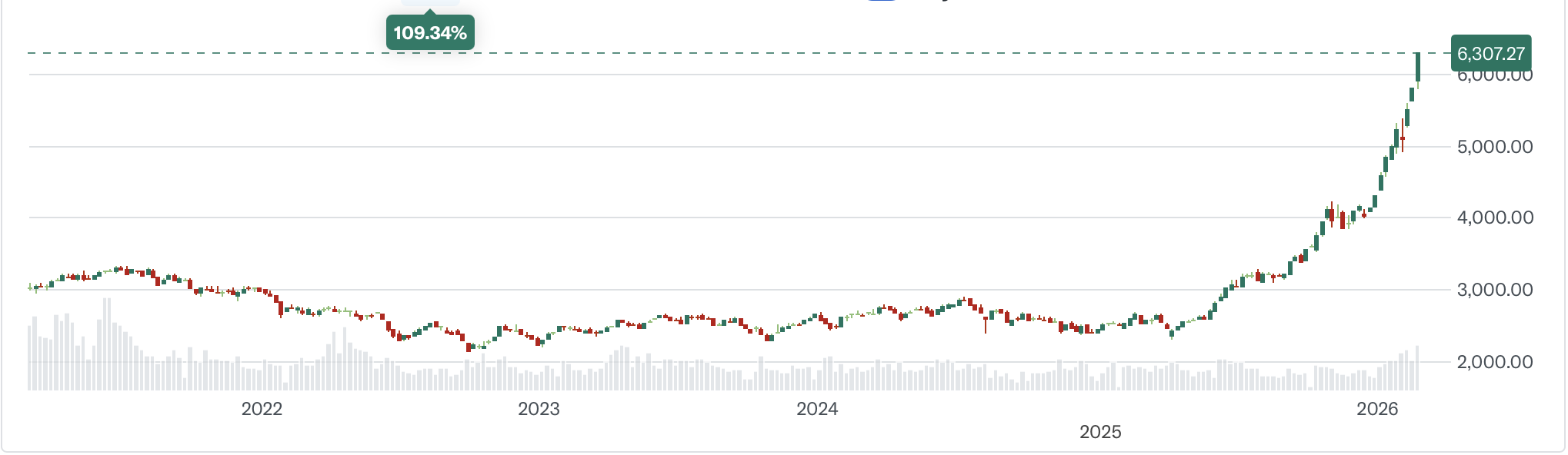
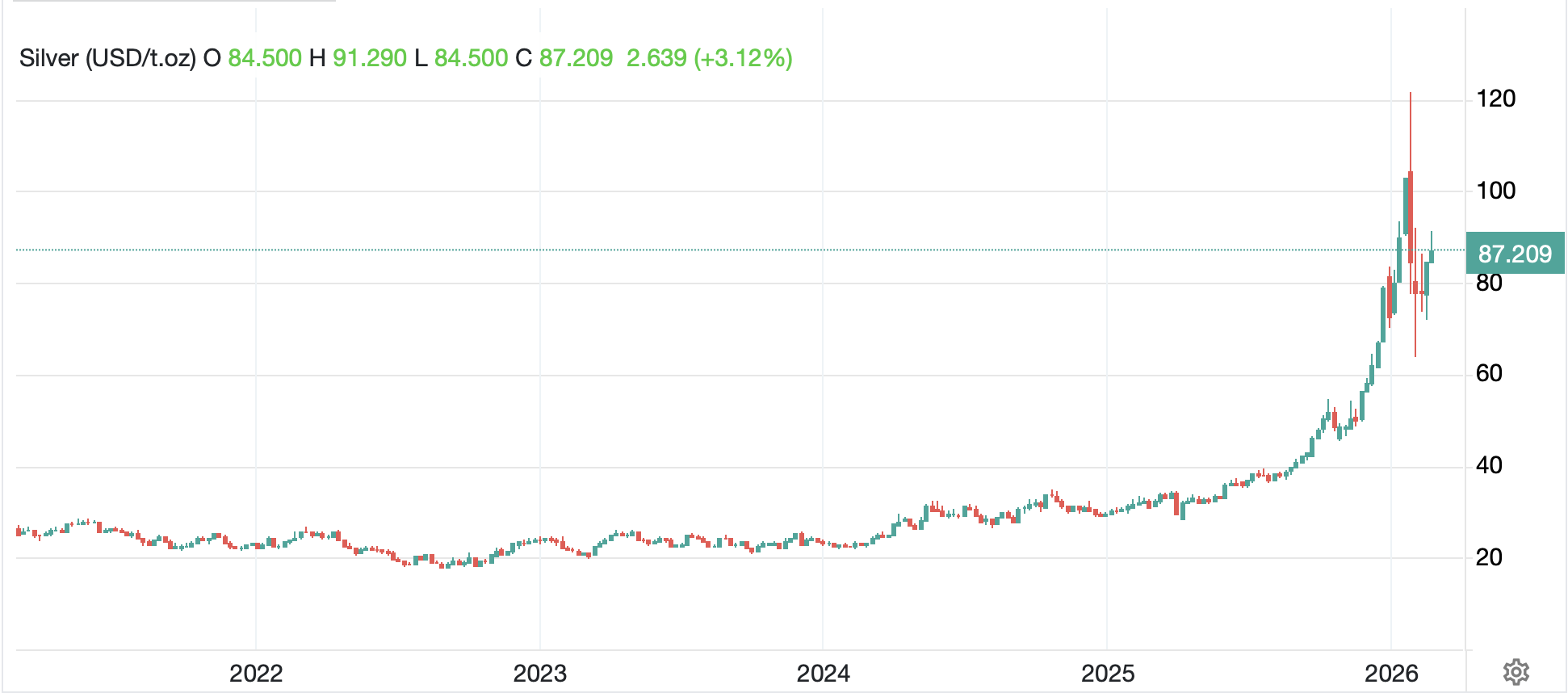
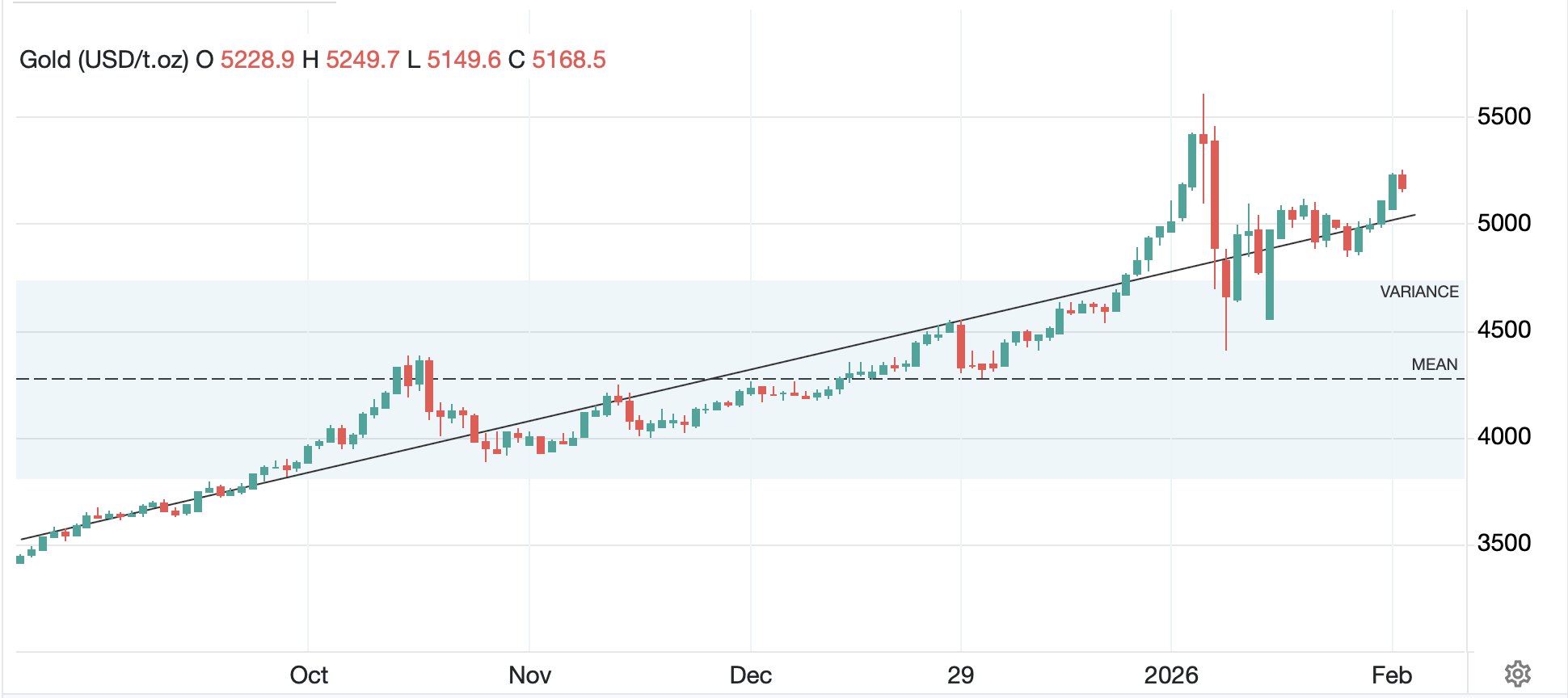
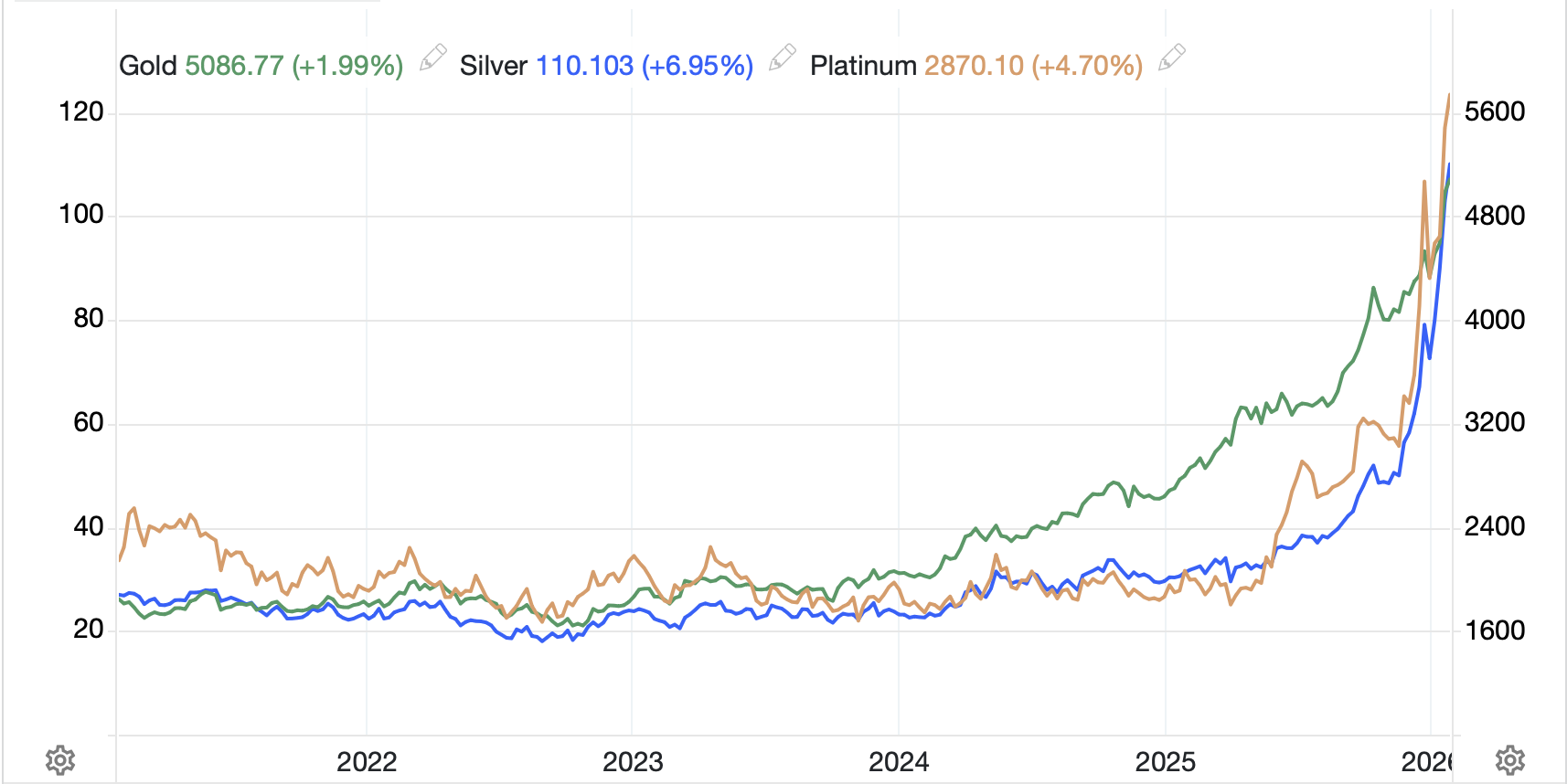
In the metals markets, $4200/oz has become gold’s (+0.3%) home lately while silver (+0.9%) has found comfort between $58/oz and $59/oz.  Neither is seeing much in the way of volatility or new interest, but both trends remain strongly higher. 

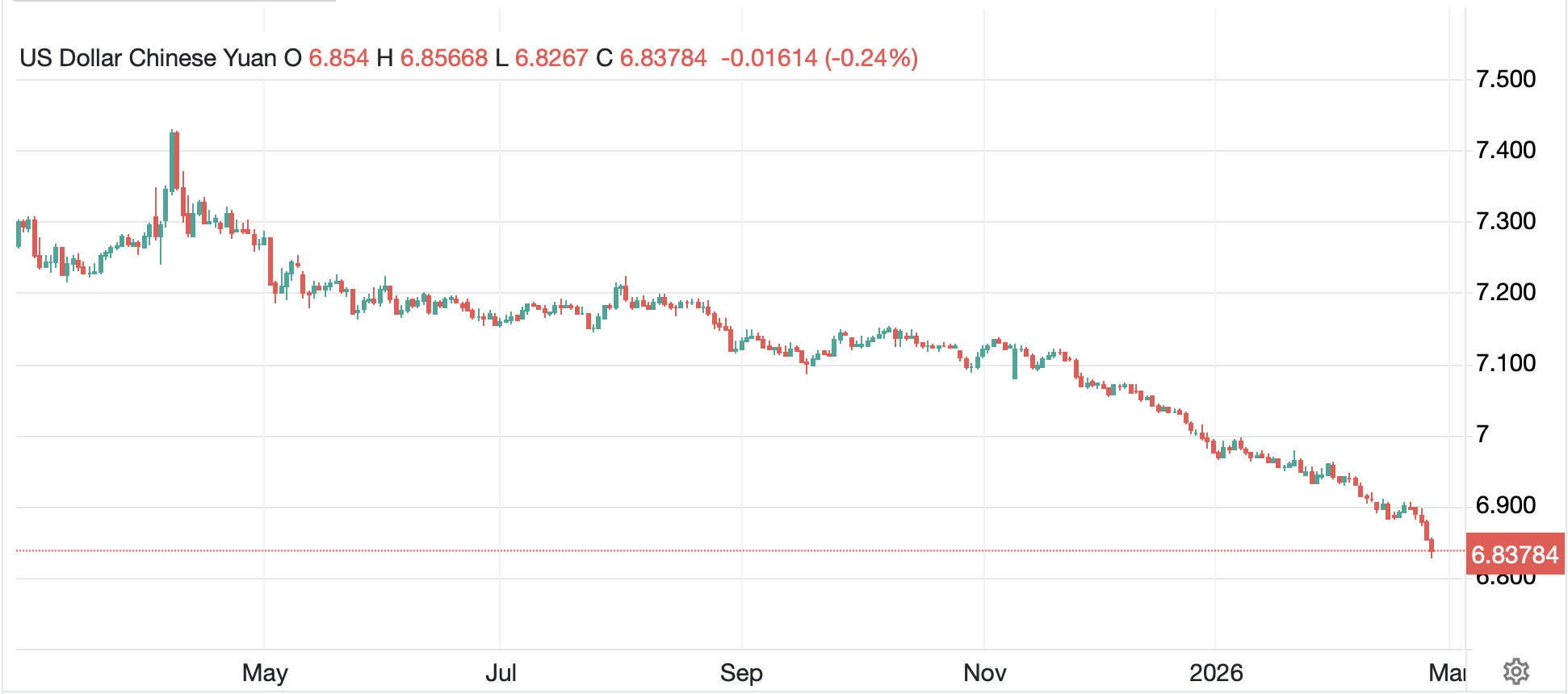
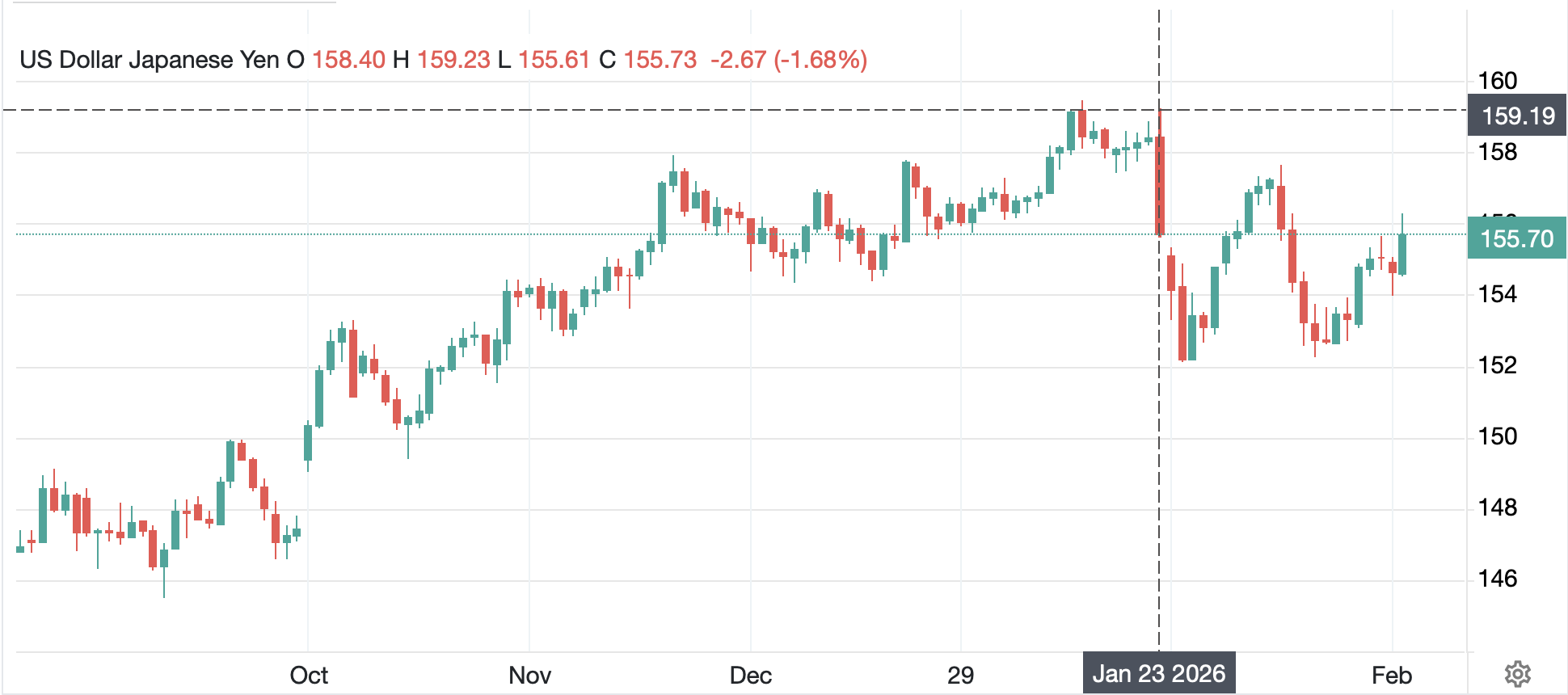
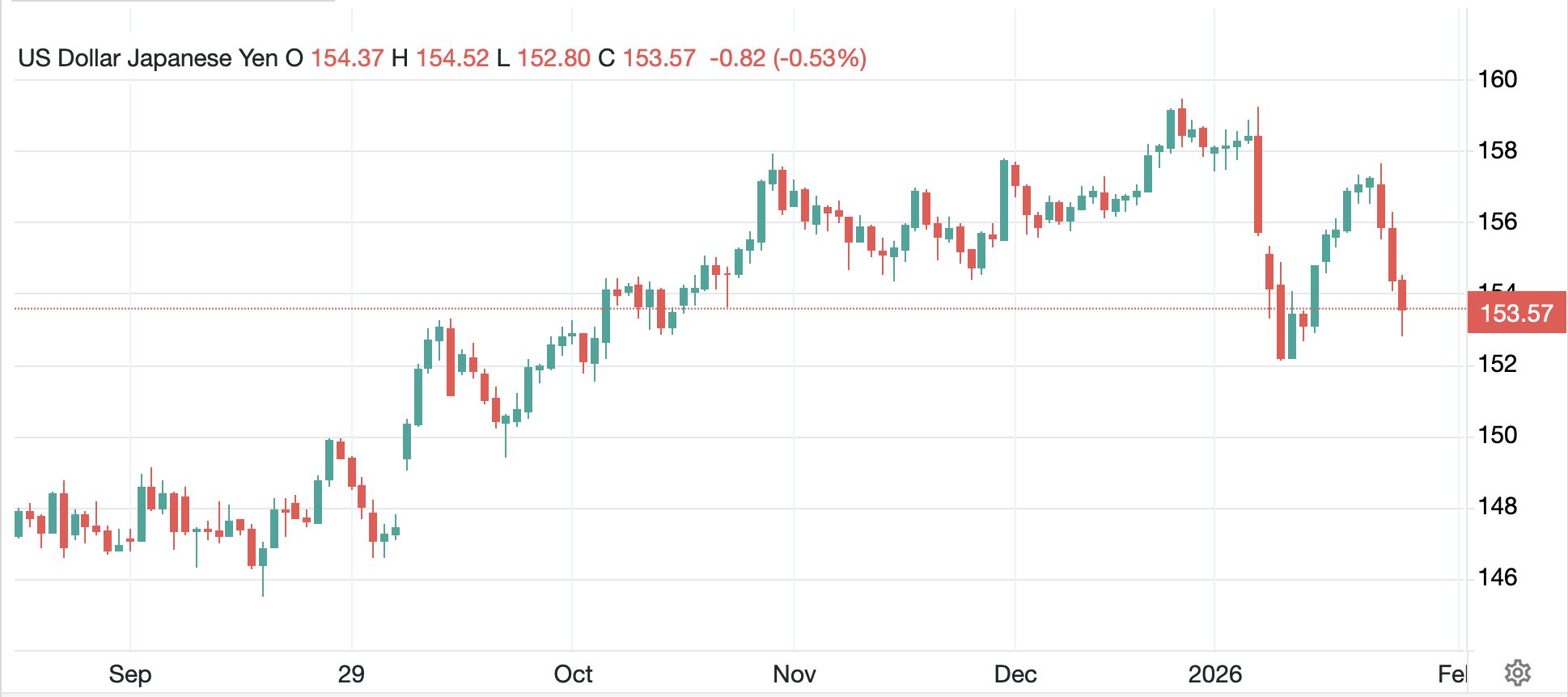
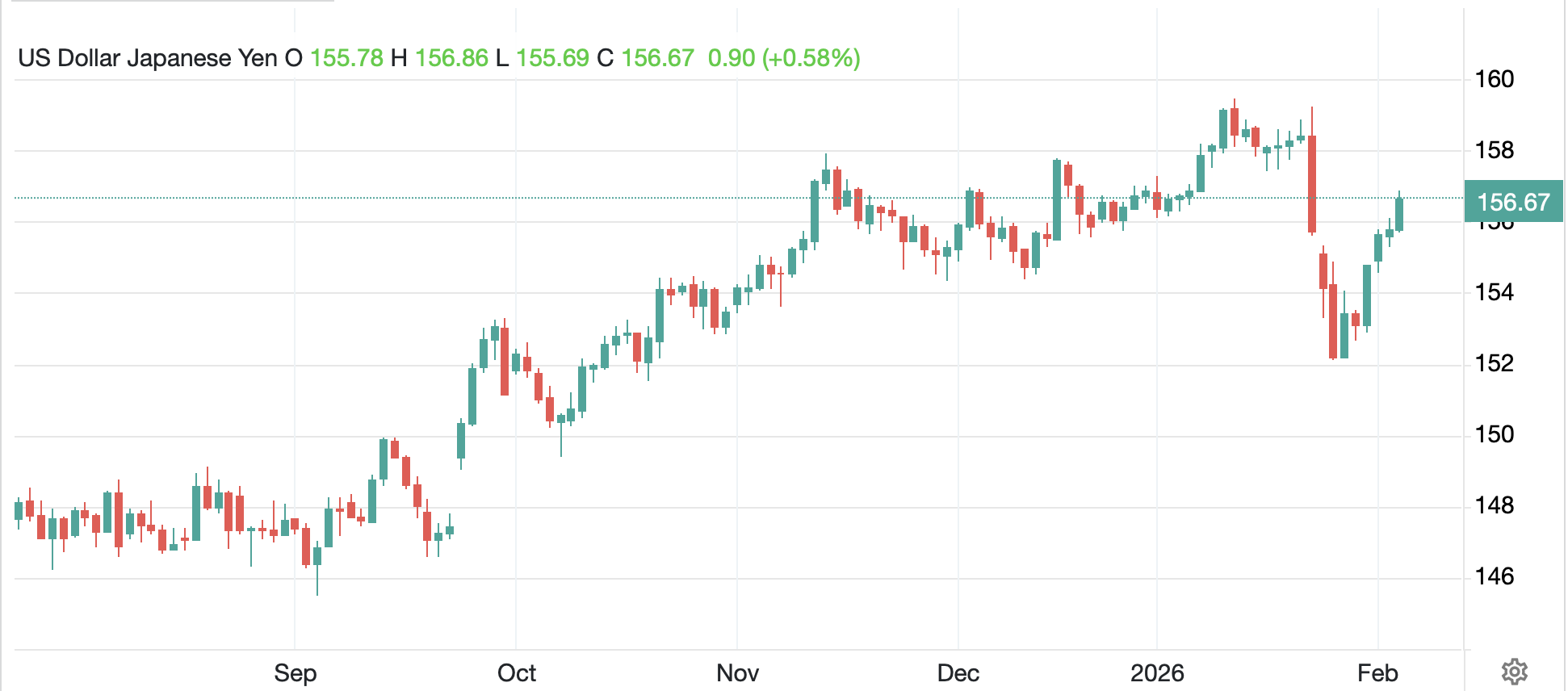
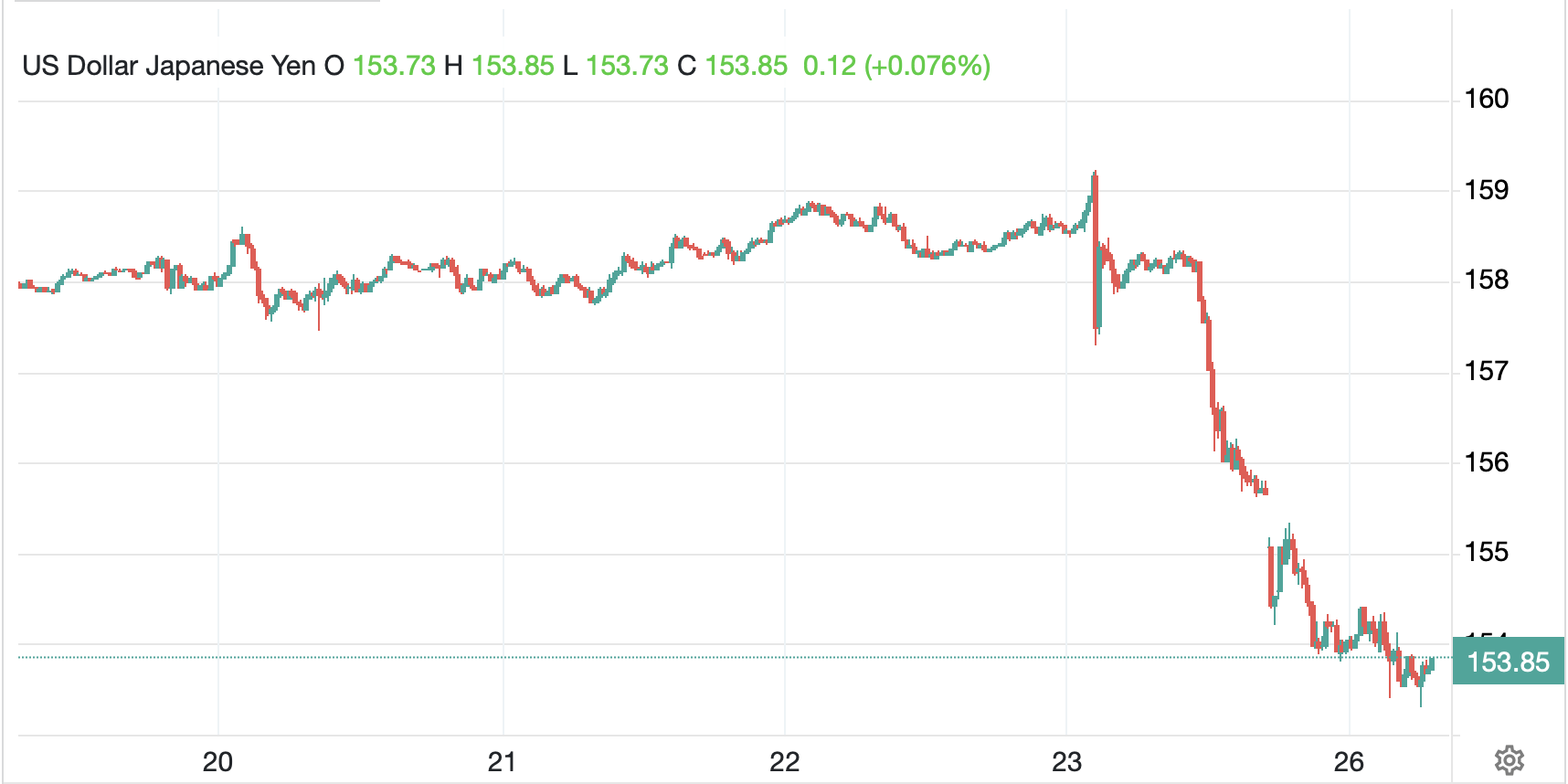
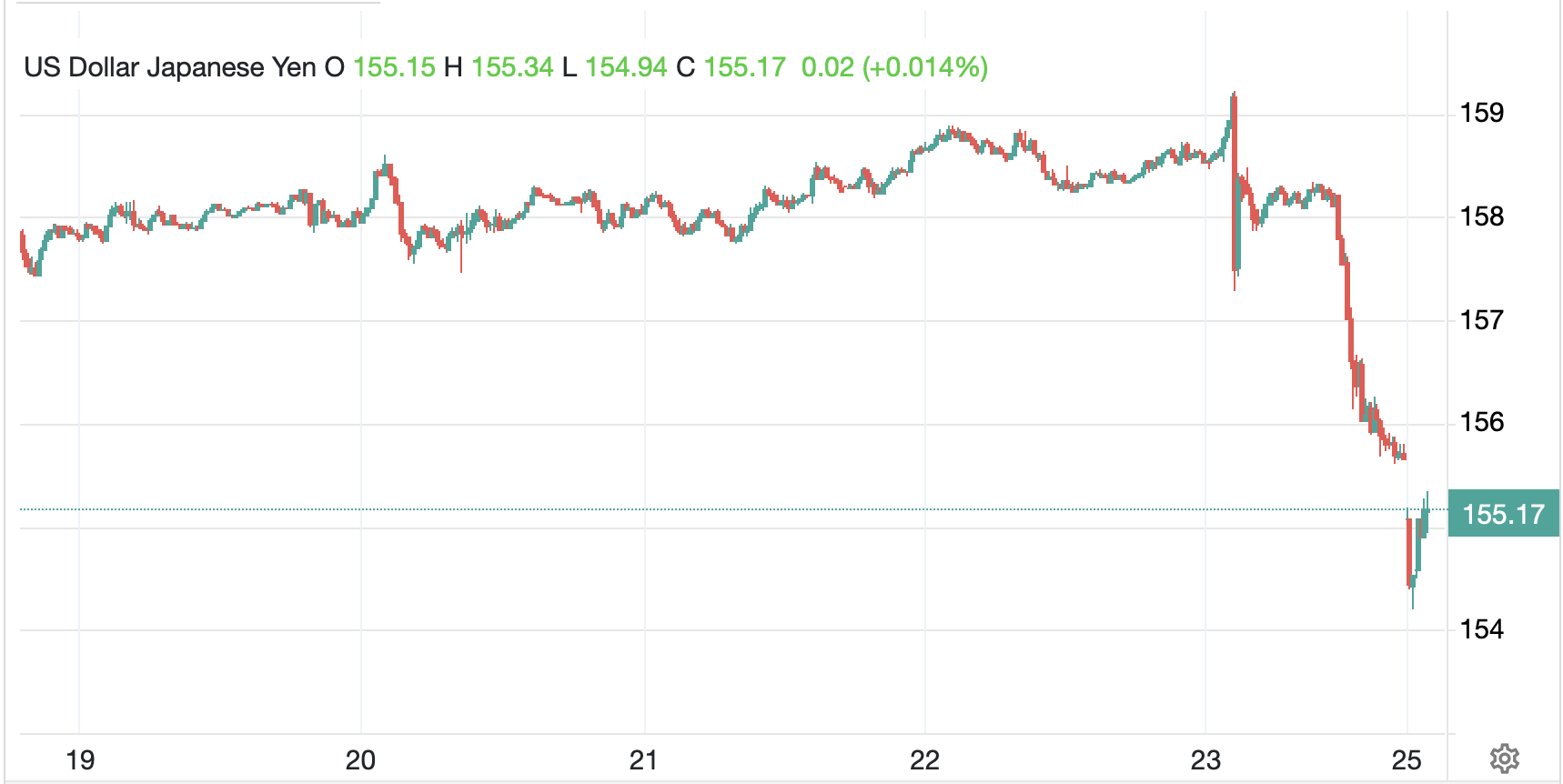
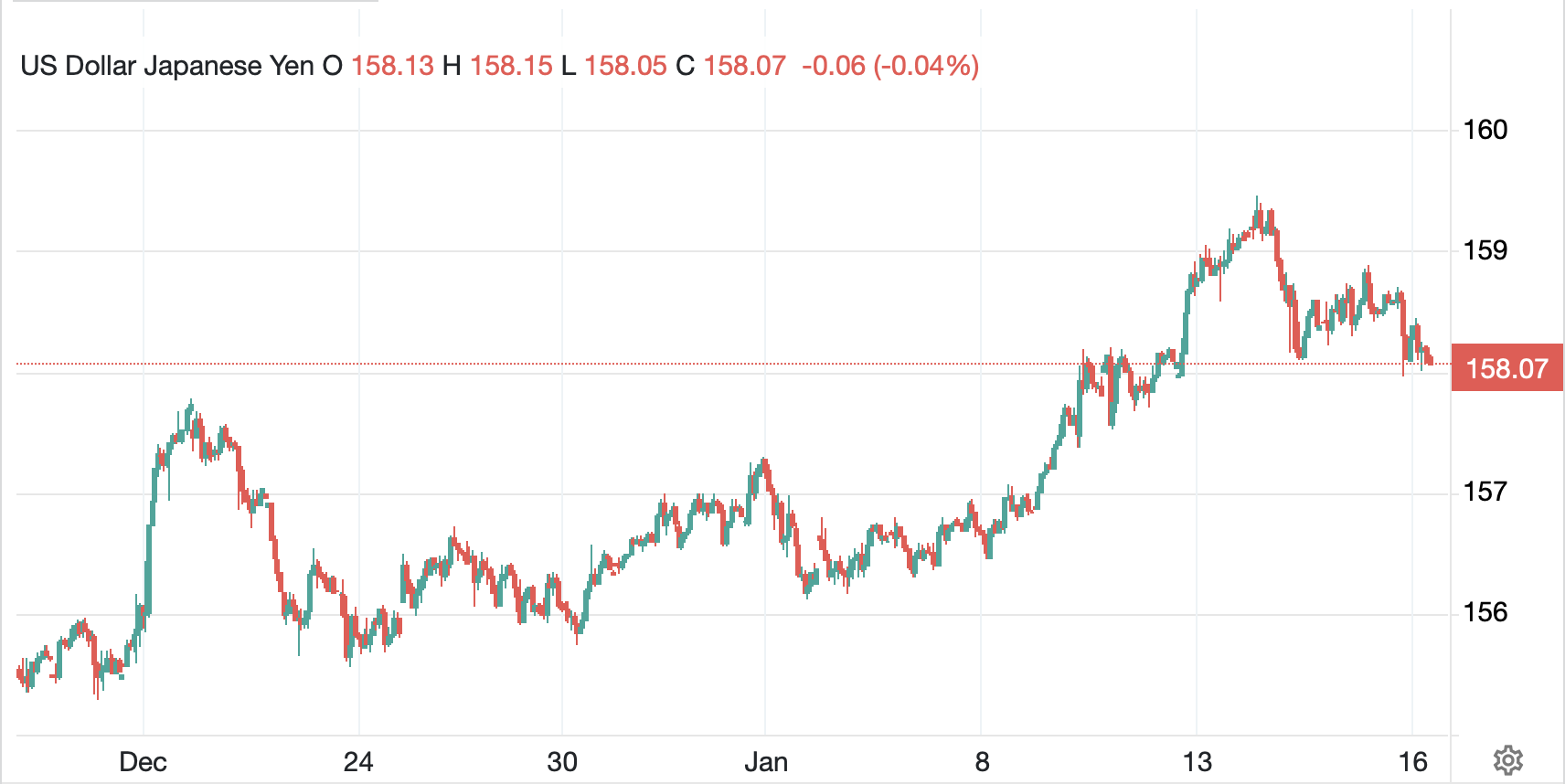
Finally, the dollar, which rallied a bit yesterday, is little changed this morning.  USDJPY is interesting as it has traded back above 156 this morning, contradicting all that talk of a Japanese repatriation trade.  Again, it is difficult for me to look at the yen chart below and conclude the dollar has peaked.

Source: tradingeconomics.com

Elsewhere in the space, this is one of those days where 0.2% is a major move.  Historically, December is not a time when FX traders are active.

On the data front, the NFIB report rose to 99.0 this morning, its highest reading in three months and the underlying comments showed a modest increase in optimism with many businesses looking to hire more people but having trouble finding qualified candidates.  This is quite a juxtaposition with the narrative that small businesses are firing workers that I have read in several different places and is backed by things like the recent Challenger Gray survey which indicated that US businesses have fired more than 1.1 million workers so far this year.  This lack of clarity is not going to help the FOMC make decisions, that’s for sure.  As to the rest, the ADP Weekly Survey is due to be released as well as JOLTS Job Openings (7.2M) and Leading Indicators (-0.3%) at 10:00.

The very fact that the biggest story I could find was a hypothetical is indicative of the idea that there is nothing going on.  Look for a quiet one as market participants await Powell and friends tomorrow.

Good luck

Adf

Divergent Views

This morning, we all must feel blessed
Nvidia is still the best
Its’s earnings were great
Which opened the gate
For buyers, much more, to invest
 
But contra to that piece of news
The Minutes showed divergent views
On whether to slash
Next month, rates for cash
Or else wait for more weakness clues


Whatever your view of AI and the entire discussion, one must be impressed with Nvidia’s performance as a company, and as an equity.  Last night’s earnings release was clearly better than expected as CEO Jensen Huang indicated that revenues for Q1 should grow to ~$65 billion as there is still significant demand for the buildout of data centers.  He also pushed back on the idea that AI was a bubble.  Of course, he would do that given he is at the center of the discussion.  Nonetheless, after modest gains in US equities yesterday, despite much more hawkish than expected FOMC Minutes (discussed below), US futures are rising sharply this morning, with NASDAQ futures currently higher by 1.6% (6:15) and taking all the indices with it.  Life is good!

Which takes us to the FOMC Minutes and our first look at dissention in the Eccles building.  I think the following paragraph, directly from the Minutes [emphasis added], does a good job in describing the wide range of views that currently exist around the table at the Fed, and make no mistake, I am hugely in favor of a wide range of views as I would contend it has been the groupthink in the past that led us to the current, unfavorable situation.

“In considering the outlook for monetary policy, participants expressed a range of views about the degree to which the current stance of monetary policy was restrictive. Some participants assessed that the Committee’s policy stance would be restrictive even after a potential 1/4 percentage point reduction in the policy rate at this meeting. By contrast, some participants pointed to the resilience of economic activity, supportive financial conditions, or estimates of short-term real interest rates as indicating that the stance of monetary policy was not clearly restrictive. In discussing the near-term course of monetary policy, participants expressed strongly differing views about what policy decision would most likely be appropriate at the Committee’s December meeting.”

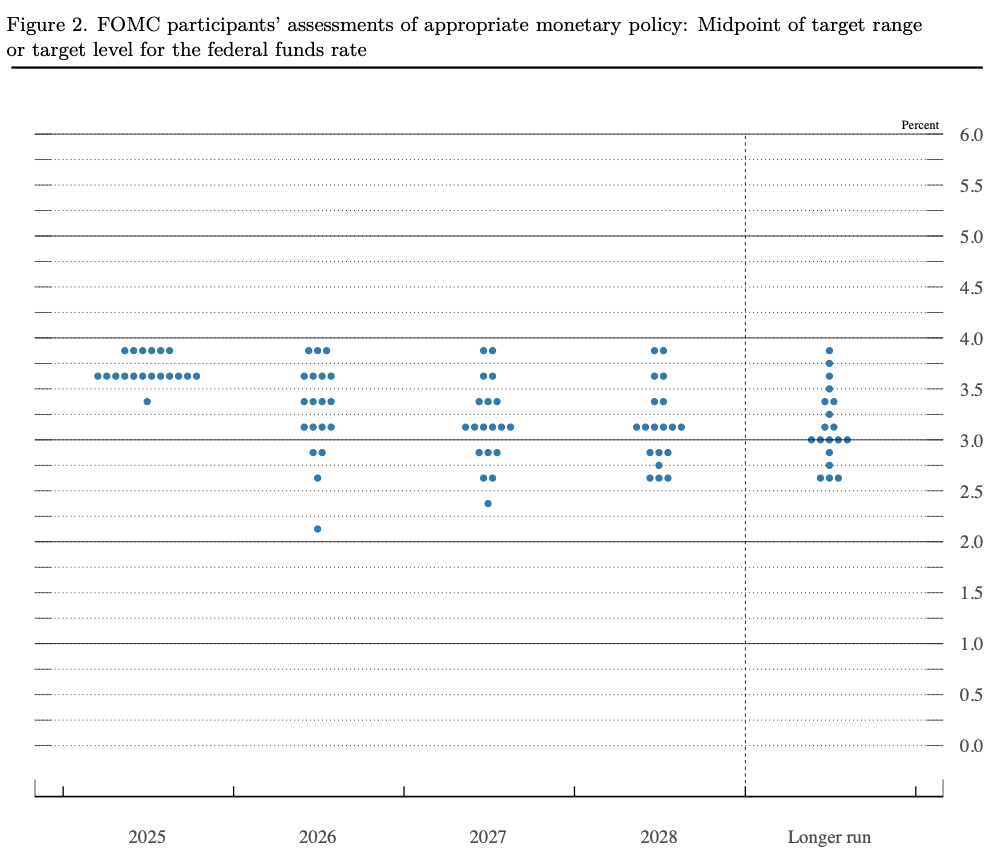
Below I have copied the dot plot from the September meeting, which contra to most previous versions shows a particularly wide range of views regarding the future level of Fed funds.  I have to wonder, though, after reading the Minutes, if those dots will be stretched even wider apart from top to bottom in the December report.

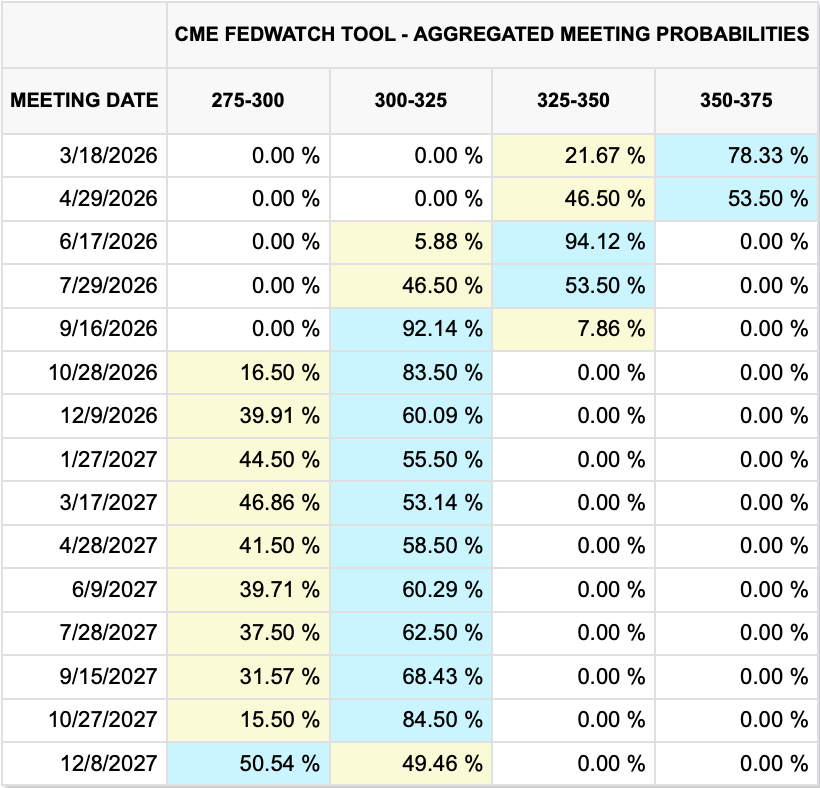
Of course, our interest is how did the market respond to this release?  Well, it can be no surprise that the Fed funds futures market repriced further and is now showing just a 32% probability for a cut next month and 78% probability of the next cut coming in January.  That said, the market remains convinced that rates must go lower over time, something that does not appear in sync with equity market growth expectations and seems to be completely ignoring the announced inward investment flows to the US from around the world.

Source: cmegroup.com

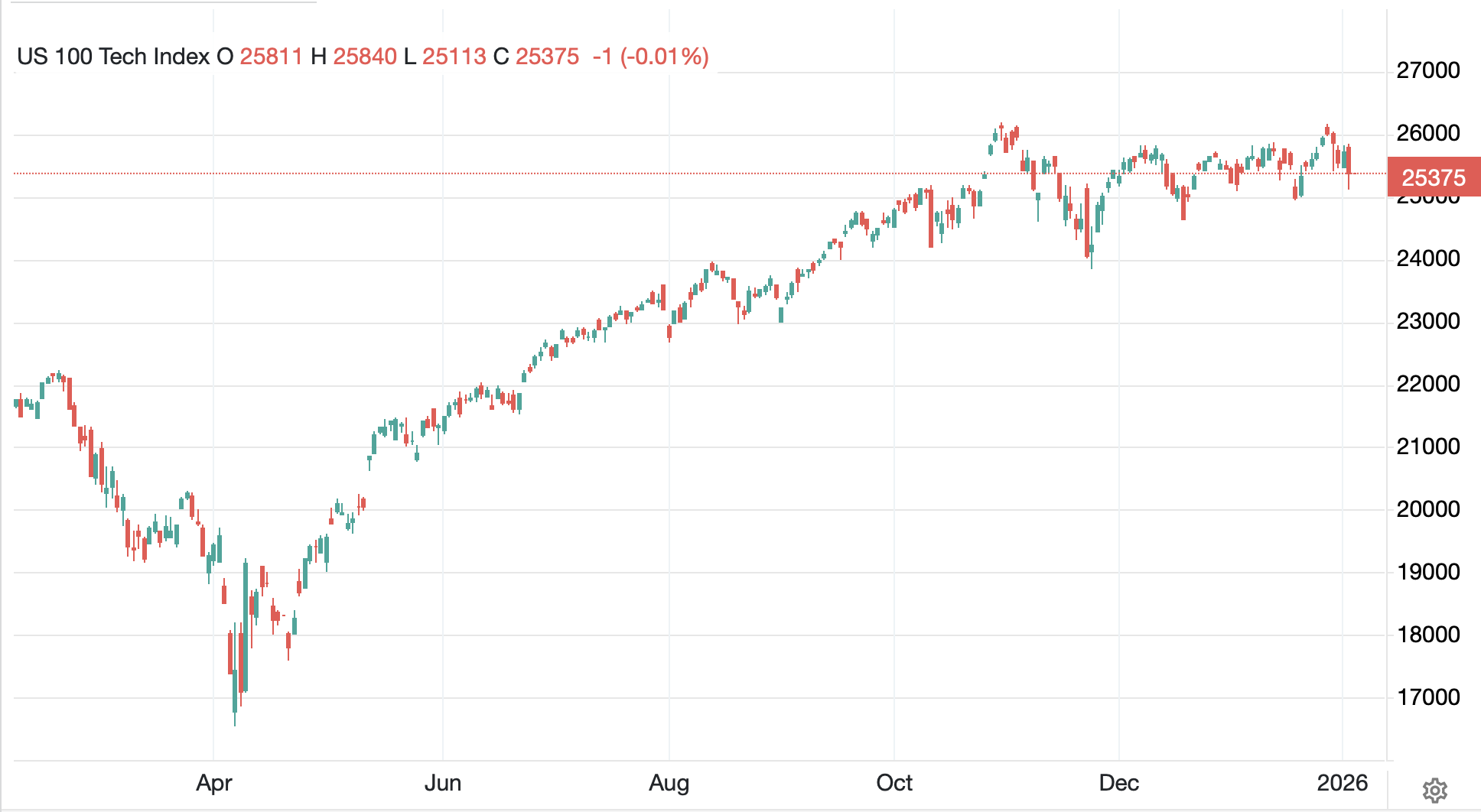
As to the equity market response, the two vertical lines show the release of the Minutes and then the release of Nvidia earnings.  You can see for yourself which matters more to the market.

Source: tradingeconomics.com

Between the GDPNow data, which continues to show growth remains robust, and more announcements of inward investment on the back of trade deals, with the Saudis ostensibly promising $1 trillion after the recent White House dinner, I will take the over on future economic activity.  Remember, too, the government is actively supporting mining, drilling and manufacturing and all of that is going to feed into economic growth here.  My view is the Fed funds futures market is completely wrong, and we will not see rates back at the 3.0% level anytime in the next few years.  I’m not suggesting we won’t see an equity market correction, just that the end is not nigh.

Each day the yen slides
Intervention creeps closer
Yen traders beware

Turning to the dollar, it continues to strengthen across the board with the DXY trading back above 100 this morning, and now that the Fed seems more hawkish, looking like it may have legs.  But let us focus on the yen, quite beleaguered of late, as it appears to be accelerating its downfall.  Not only is this evident on the chart below, but we also have heard concerns for the third time, as per the following quotes from Minoru Kihara, the chief cabinet secretary:

The yen is experiencing sudden, one-way movements that are concerning and which require close monitoring.  Excessive fluctuations and disorderly movements in exchange rates must be monitored with vigilance.  We are concerned about the recent one-way and sudden movements in the foreign exchange market. It’s important for exchange rates to remain stable, reflecting fundamentals.”

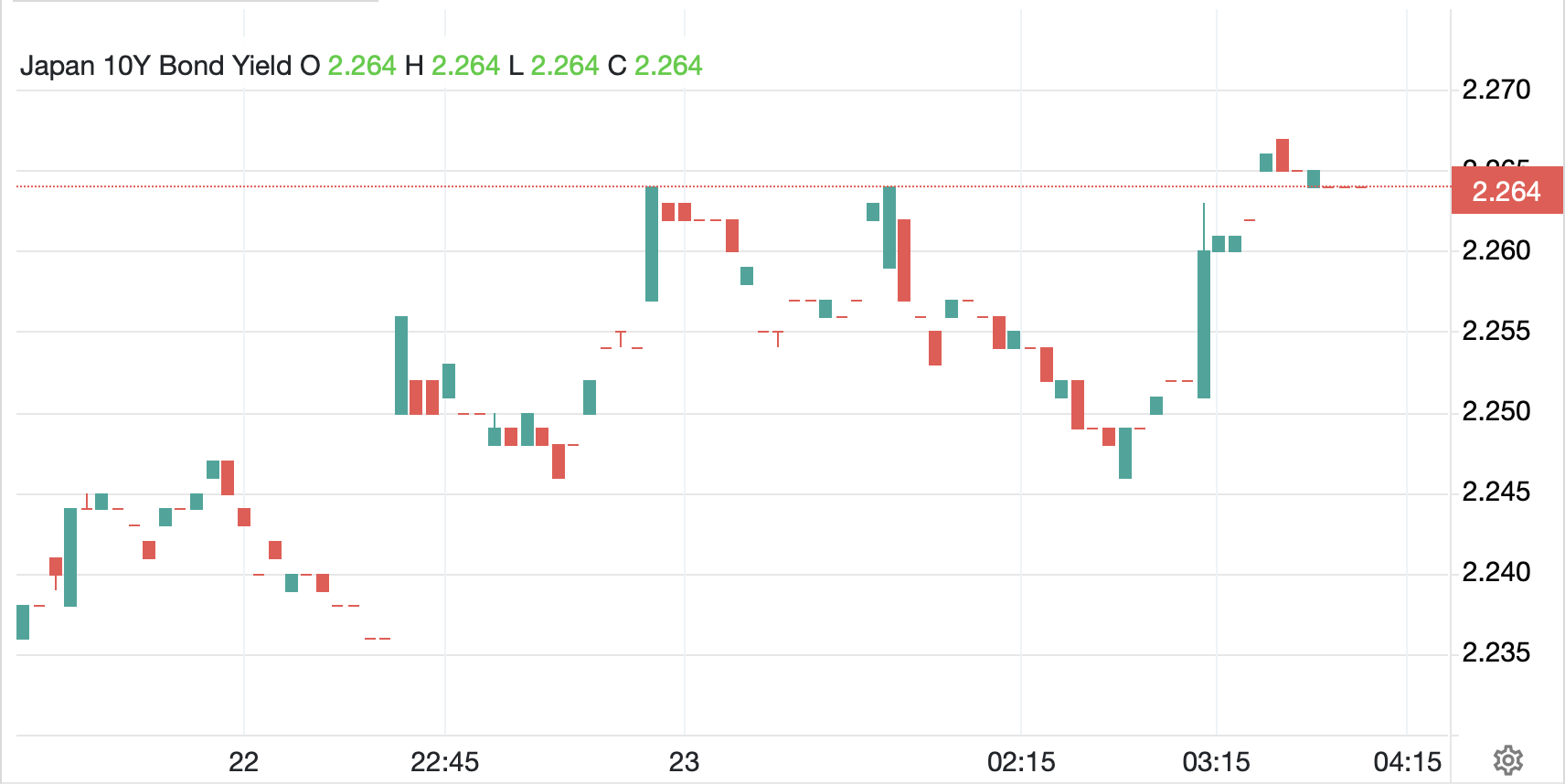
In the past six months, the yen has fallen >10% vs. the dollar and is lower by nearly 4% in the past month.  At the same time, JGB yields are starting to accelerate higher, trading to yet another 20-year high at 1.82% and the price action there is remarkably similar to that of USDJPY as per the below chart.  The problem for the JGB market is the BOJ already owns more than 50% of the outstanding debt, so buying more doesn’t seem to be a solution, whereas buying JPY in the FX market will have an impact, albeit short-term if they don’t change policies.   

Source: tradingeconomics.com

The upshot of all this is the world is awash in debt, with global debt/GDP exceeding 3x.  The lesson is that not all this debt will be repaid, in fact probably not that much at all.  Be careful as to what you hold.

Ok, let’s briefly tour the markets I have not yet touched.  Tokyo equities (+2.65%) loved the Nvidia earnings as did Korea (+1.9%), Taiwan (+3.2%) and most of Asia although China (-0.5%) and HK (0.0%) didn’t play along last night.  I guess the ongoing restrictions on sales of Nvidia chips to China is still a negative there, as are recurring concerns over the property market as there is talk of yet another attempt to fix things by the government.  Europe, too, is firmer this morning, although clearly not on tech bullishness given the lack of tech on which to be bullish.  But there is talk of a Russia/Ukraine peace deal which may be a benefit.  At any rate, gains are widespread on the order of +0.6% or so across the board.

In the bond market, Treasury yields rose a couple of ticks yesterday and are higher by 1 more basis point this morning, but still at just 4.14%.  The front of the curve rose by more on the back of the Minutes.  European yields are also higher this morning, between 2bps and 3bps with UK gilts the outlier, unchanged on the day, as softer inflation has traders expecting a rate cut at the next BOE meeting on December 18th.

Oil (+1.0%) has rebounded off its recent lows and is trading back at…$60/bbl, the level at which it is clearly most comfortable these days.  Meanwhile, gold (0.0%) gave back yesterday’s overnight rally to close mostly unchanged with the same true across the other metals although this morning silver (-0.7%) is slipping a bit further.

Finally, other currency movements beyond the yen (-0.3% today) are of a similar size across both the G10 and EMG blocs.  Using the DXY as proxy, this is the third test above 100 since August 1st with many analysts are calling for a breakout at last.  

Source: tradingeconomics.com

Perhaps this is true given the word is the Russia/Ukraine peace deal was negotiated entirely between the US and Russia without either Ukraine or Europe involved, demonstrating how insignificant Europe, and by extension the euro, have become.  Just a thought.

On the data front, the big news is the September employment report is going to be released this morning along with some other data:

Nonfarm Payrolls50K
Private Payrolls62K
Manufacturing Payrolls-8K
Unemployment Rate4.3%
Average Hourly Earnings0.3% (3.7% Y/Y)
Average Weekly Hours34.2
Participation Rate62.3%
Philly Fed-3.1
Existing Home Sales4.08M

Source: tradingeconomics.com

On the one hand, the data is stale.  On the other hand, it is all we have, so it will likely have greater importance than it deserves.  I have a hard time looking at the economy and seeing substantial weakness, whether because of corporate earnings, inward investment announcements or the Fed’s growing concern over higher inflation.  All that tells me the dollar is going to be in demand going forward.

Good luck

Adf

Jobs is Passe

The usual story today
Would be NFP’s on its way
But with BLS
On furlough, I guess
The story on jobs is passe
 
But ask yourself, if we don’t get
A data point always reset
That’s only a fraction
Of total job action
Is this something ‘bout we need fret?


I guess the question is, is the government shutdown impacting markets?  Frankly, it’s hard for me to see that is the case. Today offers a perfect scenario to see if it is true.  After all, if the government was working, the BLS would have released the weekly Claims data yesterday and market participants would be waiting with bated breath for today’s NFP number.  As I said yesterday, while Ken Griffin is likely quite annoyed because I’m sure Citadel makes a fortune on NFP days, the rest of the world seems to be getting along just fine.  In fact, maybe this is exactly what market participants need to learn that the data points on which they rely don’t really matter.  

With NFP in particular, the monthly number, which since 1980 has averaged 125K with a median of 179K seems insignificant relative to the number of people actually employed, which as of August 2025 was recorded as 159.54 million.  Now I grant, that the employed population has grown greatly in the past 45 years, so when I take it down to percentages, the average monthly NFP result is 0.10% of the workforce during that period, with the median a whopping 0.14%.  The idea that business decisions are made, and more importantly, monetary policy decisions are made on such a tenuous thread is troublesome, to say the least.  Did this report really tell us that much of importance?  Especially given its penchant for major revisions.

Below is a graphic history of NFP (data from FRED) having removed the Covid months given they really distorted the chart.

And below is a chart showing total payrolls (in 000’s) on the RHS axis with the % of total payrolls represented by the monthly change in NFP on the LHS.  Notice that almost the entire NFP series, as a %age of total employment, remains either side of 0 with only a few outcomes as much as even 0.5%.  My point is, perhaps the inordinate focus on this data point by markets and policymakers alike, has been misguided, especially as the accuracy of the initial releases seems to have worsened over time.  Maybe everybody will be able to figure out that they can still do their jobs even without this data.  (Ken Griffiin excepted. 🤣)

Food for thought.

Like swallows return
To Capistrano, Japan
Votes again this year


The other notable news story is tomorrow’s election in Japan’s LDP for president of the party and the likely next Prime Minister.  While there are technically 5 candidates, apparently, it is really between two, Sanae Takaichi, a former economic security minister and a woman who would be the first female PM in the nation’s history, and Shinjiro Koizumi, son of former PM Junichiro Koizumi, and a man who would become the nation’s youngest prime minister.  There are several others, but these are the front runners.  From what I gather, Takaichi-san is the defense hawk and the more conservative of the two, an updated version of Margaret Thatcher, to whom she will constantly be compared if she wins.  Meanwhile, Koizumi is more of the same they have had in the past.

There are some analysts who are trying to make the case that this election has had a major impact on Japanese markets, and one might think that makes sense.  But if I look at USDJPY (0.0% today), as per the below chart, I am hard pressed to see that the election campaign has had any impact of note.

Source: tradingeconomics.com

If we turn to the Nikkei (+1.9%) which made a new high last night, it seems that is tracking US technology shares and is unconcerned over the election.  

Source: tradingeconomics.com

Arguably, if the equity market is forward looking (which I think is true) investors are indifferent to the next PM.  Finally, a look at JGBs shows that yields continue to climb there, albeit quite slowly, but consistently make new highs for the move and are back to levels last seen in 2008.

In fact, like almost everything since the GFC, perhaps the recent run of incredibly low yields in Japan is the aberration, not the rule!  But the argument for higher Japanese yields is more about the fact that inflation there is running at 3.5% and the base rate remains at 0.50%.  Investors remain concerned that the recent history of virtually zero inflation in Japan may be a thing of the past and so are demanding higher yields to hold Japanese debt.

I have no idea who will win this election, although I suspect that Takaichi-san may wind up on top.  But will it change the BOJ?  I don’t think so.  And the fact that the LDP does not have a working majority means not much may get done afterwards anyway.  All told, it is hard to be excited about holding yen in my eyes.

Ok, let’s look at the rest of the world quickly.  Despite a soft start, US equity markets managed to close in the green and this morning all three major indices are pointing higher by 0.25%.  Away from Japan, Chinese markets are closed for their holiday, and most of the rest of Asia followed the US higher, notably Korea (+2.7%) and Taiwan (+1.5%).  The only outlier was HK (-0.5%) which looked to be some profit taking after a sharp run higher in the past week.  In Europe, Spain (+0.8%) and the UK (+0.6%) are the best performers despite (because of?) slightly softer PMI Services data.  Either that, or they are caught up in the US euphoria.

The bond market saw yields slip a few basis points yesterday and this morning, while Treasury yields are unchanged at 4.08%, European sovereigns are sliding -1bp across the board.  I think the slightly softer data is starting to get some folks itching for another ECB rate cut, or at least a BOE cut.

In the commodity markets, oil (+0.4%) which continued to fall throughout yesterday’s session to just above $60/bbl, looks like it is trying to stabilize for now.  There continues to be discussion about more OPEC+ production increases, and it seems that whatever damage Ukraine has done to Russia’s oil infrastructure is not considered enough to change the global flows.  As to the metals, gold (+0.2%) and silver (+1.2%) absorbed a significant amount of selling yesterday in London, which may well have been one account, as they reversed course late morning and have been climbing ever since.  Copper (+1.1%) is also pushing higher and the entire argument about the defilement of fiat currencies remains front and center.  I guess JP is now calling it the debasement trade as Gen Z, if I understand correctly, is selling other assets and buying a combination of gold and bitcoin.

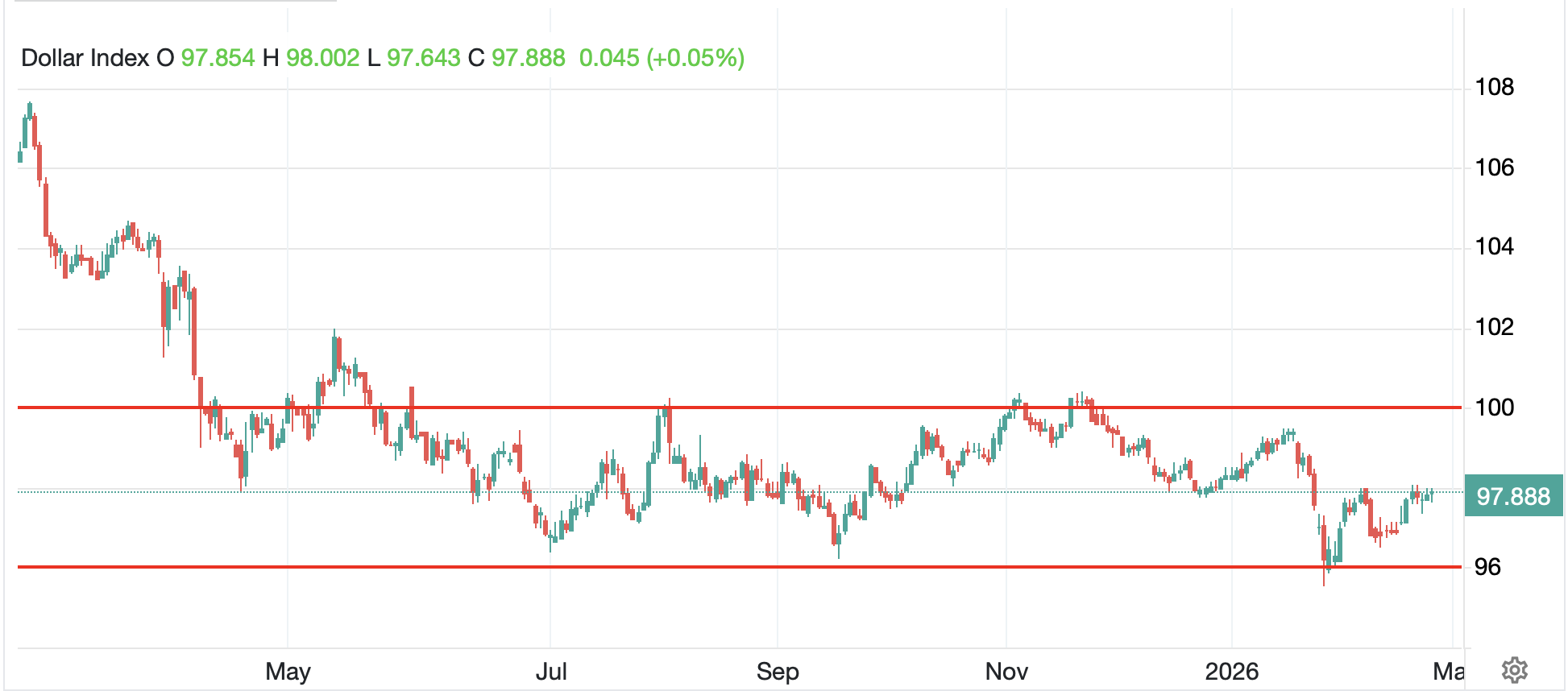
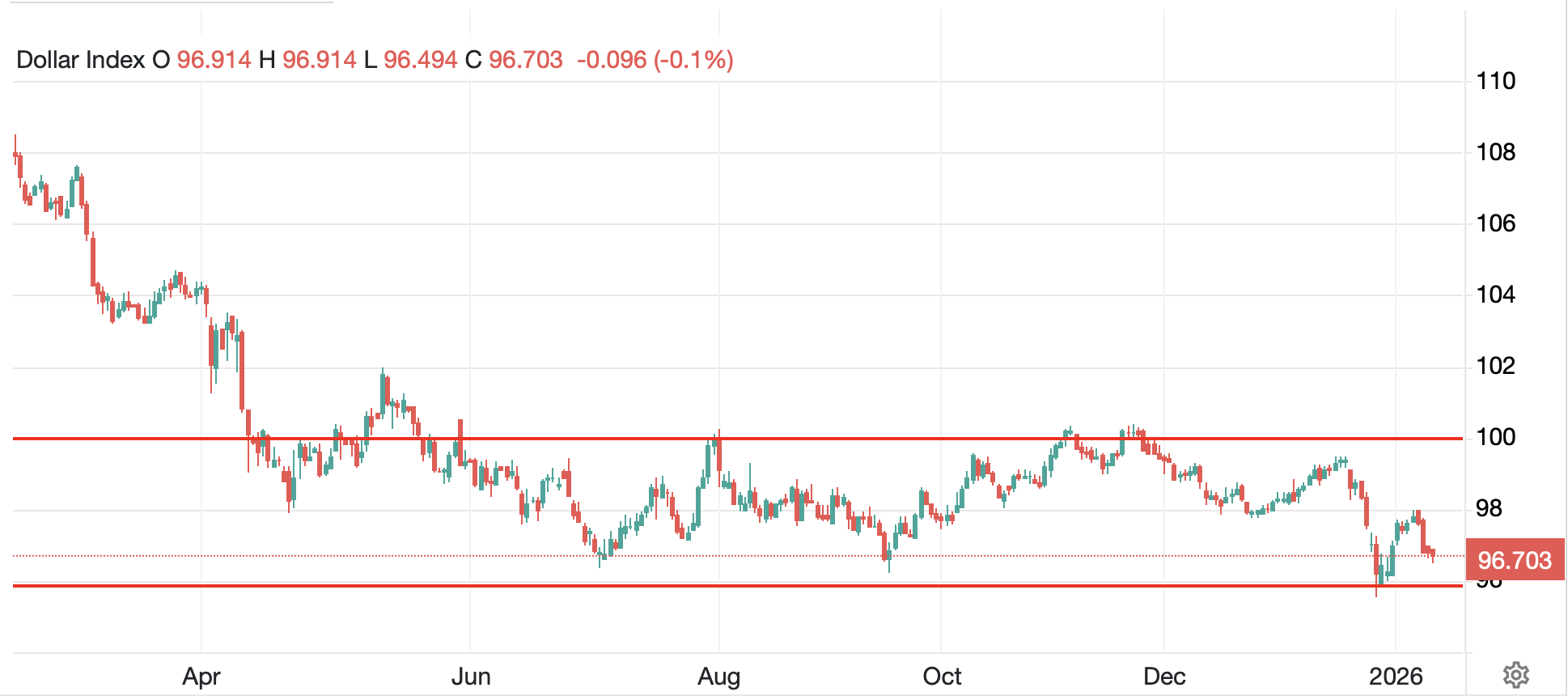
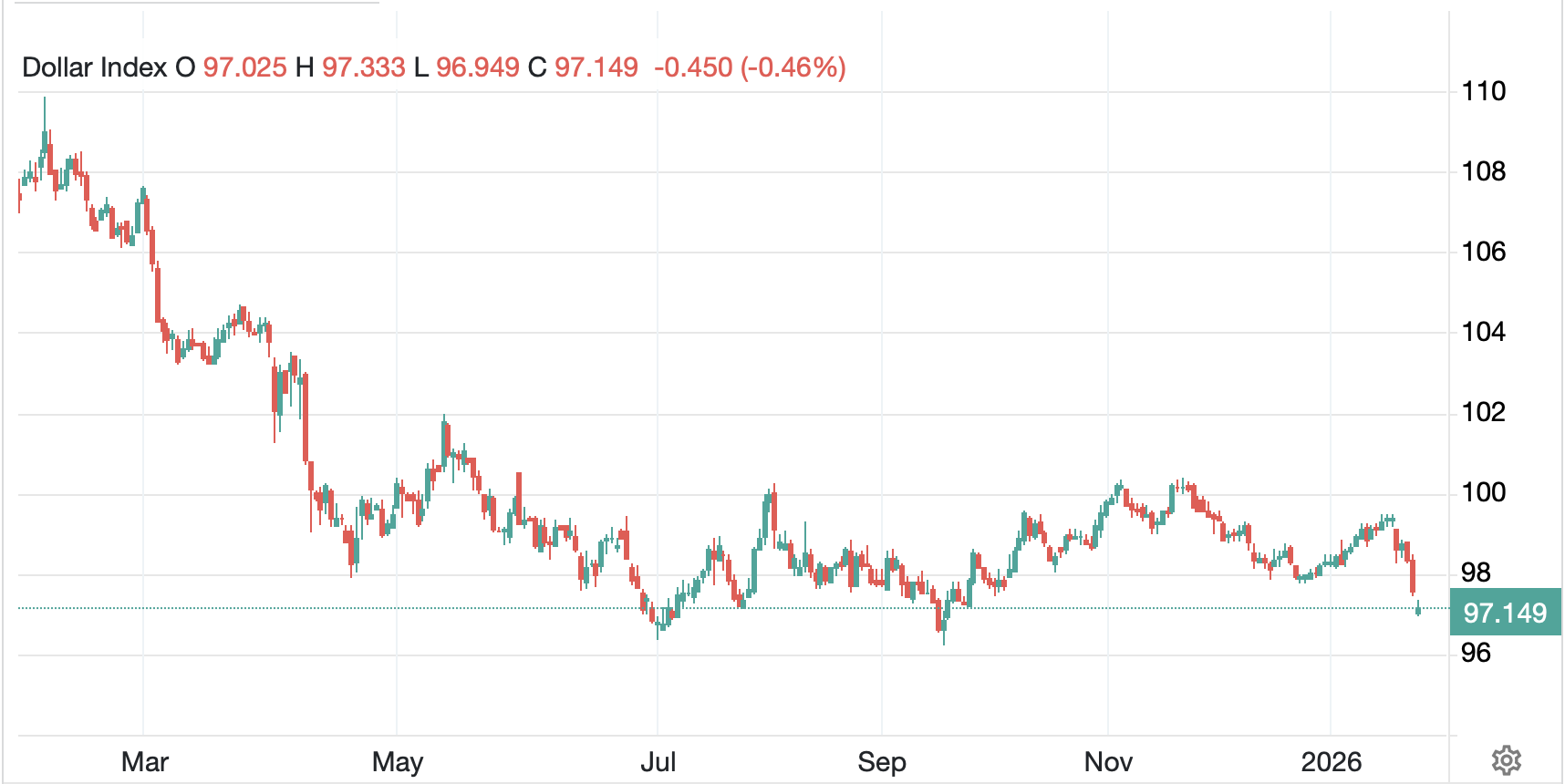
Finally, the dollar is…the dollar.  Back on April 20, DXY was at 98.08.  This morning it is 97.75.  look at the chart below from tradingeconomics.com and tell me you can get excited about any movement at all.  We will need a major outside catalyst, I believe, to change any views and right now, I see nothing on the horizon.

And that’s really all there is.  We do get ISM data this morning as it’s privately compiled and released (exp 51.7) and Fed speakers apparently will never shut up.  What is interesting there is that Lorrie Logan, Dallas Fed president, has come out much more hawkish than some of her colleagues.  That strikes me as a disqualification for being elevated to Fed chair.

I continue to read lots of bear porn and doom porn, and it all sounds great and markets clearly don’t care.  The government shutdown has been irrelevant and that should make a lot of people in Washington nervous given this administration.  President Trump has been angling to reduce government, and if it is out of action and nobody notices, it will make his job a lot easier.  But for now, nothing stops this train with higher risk assets the way forward.

Good luck and good weekend

Adf

Panic They’re Sowing

While eyes and ears focus on Jay
And whatever he has to say
Poor Germany’s shrinking
And it’s wishful thinking
Japan’s kept inflation at bay
 
But fears about Jay have been growing
That rate cuts he will be foregoing
If that is the case
Most traders will race
To sell things while panic they’re sowing


Clearly, the big story today is Chairman Powell’s speech with growing expectations that he will sound more hawkish than had previously been anticipated.  Recall, after the much weaker than expected NFP data was released at the beginning of the month, it appeared nearly certain that the Fed was going to cut at the next meeting with talk of 50bps making the rounds.  Now, a few hours before Powell steps to the podium, the futures market is pricing just a 71% probability of that rate cut with a just two cuts priced in for 2025 as per the CME’s own analysis below:

Arguably, this is one reason that equity markets have been having trouble moving higher as the Mag7 drivers of the market are amongst the longest duration assets around, so higher rates really hurt them.  While there has been a rotation into more defensive names, if opinions start to shift regarding the magnificence of AI, or perhaps just how much money they are spending on it and the potential benefits they will receive, things could get ugly.

I also find it interesting that the Fed whisperer, Nick Timiraos at the WSJ, has been running flack for Chairman Powell in this morning’s article, trying to get people to focus on the Fed’s framework as the basis of today’s speech, rather than policy per se.  Briefly, the current Fed framework, was designed right before COVID when for whatever reason they were concerned that low inflation was a problem, and they created Average Inflation Targeting (AIT) as a way to allow inflation to run above their target of 2.0% for a period if it had been below that level for too long.  We all know how well that worked out and, in fact, we are all still paying for their mistakes every day!  The word is they are going to scrap AIT although it is not clear what they will come up with next.  It is exercises like this that foment the ‘end the Fed’ calls from a growing group of monetarist economists and pundits.

At any rate, comments from other Fed speakers indicate that most are not yet ready to cut rates, so Powell will be able to have a significant impact if he turns more dovish.  But we have to wait a few more hours for that so let’s turn our attention elsewhere.

Germany GDP data (-0.3% Q/Q, +0.2% Y/Y) was a few ticks lower than expected and continues to point to an economy that has no positive momentum at all.  In fact, a look at the quarterly GDP data from Germany paints a pretty awful picture if growing your economy is the goal.

Source: tradingeconomics.com

Clearly, the US tariff changes have been quite negative, but in fairness, Germany’s insane energy policy is likely a much bigger driver of their problems as they have the most expensive power costs in the EU.  It is very difficult to have a manufacturing-based economy if you cannot power it cheaply.  Again, while the euro is more than just Germany, this does not bode well for the single currency.

Turning to Japan, inflation continues to run far above their 2.0% target, printing last night at 3.1% on both the headline and core metrics, which while 2 ticks lower than June’s data, was still a tick higher than expected.  It has now been 40 consecutive months that core CPI in Japan has been above the BOJ’s 2.0% target and Ueda-san continues to twiddle his thumbs regarding raising rates.

Source: tradingeconomics.com

It is very hard to watch this lack of policy response to a clear problem, that from all I read is becoming a much bigger political issue for PM Ishiba, and have confidence that the yen is going to strengthen any time soon.  Back in May, the talk was of the unwinding of the carry trade.  All indications now are that it is being put back on in significant size.  FWIW I think we will see 150.00 before too long, especially if Powell sounds hawkish.

And those are really the stories today ahead of Powell and the NY open.  So, let’s see how things behaved overnight.  After a modest down day in the US yesterday, and despite the poor inflation data, Japan was unchanged overall.  However, China (+2.1%) had a huge up move apparently on the idea that US-China trade tensions are easing and despite continued weak data from the country.  Apparently, there has been a rotation from bonds to stocks by local investors driving the move.  Hong Kong (+0.9%) also had a strong session as did Korea (+1.0%) although India, Taiwan and Australia all struggled with declines between -0.6% and -1.0%.  In Europe, the. screens are green, but it is a pale green with muted gains (DAX +0.1%, CAC +0.25%, IBEX +0.4%) despite the weak German data.  Perhaps the belief is this will encourage the ECB to ease policy further.  Meanwhile, at this hour (7:15) US futures are pointing higher by 0.25% or so.

In the bond market, after climbing a few basis points yesterday, Treasury yields are unchanged, trading at 4.33%, so still range bound.  European sovereign yields are softer by -1bp to -2bps, again likely on the softer German data with hopes for a more aggressive ECB.  JGB yields edged higher by 1bp in the 10-year but the longer end of the curve there has seen yields move to new all-time highs with 30-year yields up to 3.216%. it feels like things are starting to unravel in Japanese bond markets.

Turning to commodities, oil (+0.4%) is creeping higher again this morning but remains in its downtrend and activity is lacking.  Meanwhile, the metals markets (Au -0.35%, Ag -0.5%, Cu -0.3%) are all under pressure from a combination of a strong dollar and a lack of investor interest, at least in the West.

Speaking of the dollar, it rallied yesterday and is largely continuing this morning with one notable exception, KRW (+0.75%) which benefitted from trade data showing exports rose 7.6% in the first 20 days of the month on strong semiconductor sales.  But otherwise, +/-0.3% or less is the story of the day, with most currencies within 0.1% of yesterday’s closing levels.

And that’s really it.  There is no data so we are all awaiting Powell and then anything that may come from the White House regarding trade deals, or peace, I guess.  As the summer comes to a close, unless Powell says rate hikes are coming or promises cuts, I expect that traders will have gone for the weekend by lunch time and it will be a very quiet market.

Good luck and good weekend

Adf

Flat On His Face

Poor Ishiba-san
Started with so much promise
Fell flat on his face


In what cannot be a major surprise in the current political zeitgeist, a fringe party that focused all its attention on inflation and immigration (where have we heard that before?) called Sanseito, captured 12 seats, enough to prevent Ishiba-san’s coalition of the LDP and Komeito from maintaining control of the Upper House of Parliament there.  The electoral loss has increased pressure on PM Ishiba with many questioning his ability to maintain his status for any extended length of time.  While he is adamant that he is going to continue in the role, and that he is fighting the good fight for Japan with respect to trade talks with the US, it appears that the population has been far more focused on the cost of living, which continues to rise, and the increase in foreign visitors in the nation.  Sanseito describe themselves as a “Japan First” party.

Consider, for a moment, the cost of living in Japan.  For the 30 years up until 2022, as you can see from the chart below taken from FRED data, the average annual CPI was 0.44%.  

In fact, the imperative for Japanese monetary policy was to end the decades of deflation as it was deemed a tremendous drag on the economy.  This was the genesis of their Negative Interest rate policy as well as their massive QE program, which went far beyond JGBs into equities and ETFs.  Now, while the economists and politicians hated deflation, it wasn’t such a bad thing for the folks who lived there.  Think of your life if prices for stuff that you consume rose less than 1% a year for 20-30 years.  

But now, under the guise of, be careful what you wish for, you just may get it, the Japanese government has been successful in raising the nation’s inflation rate to their 2.0% target and beyond and have shown no ability to halt the process.  After all, the Japanese overnight rate remains at 0.50% leaving real rates significantly negative, which is no way to fight inflation.   So, while Ishiba-san explained to the electorate that he was defending Japan’s pride and industry, the voters said, we want prices to stop rising.  

The biggest problem for Japan is that they now have less than 2 weeks to conclude a trade deal with the US based on the latest timeline, and their government is weak with no mandate on trade.  It is not impossible that Japan caves on most issues because if they fight, given the government’s current status, it could be a lot worse.

Now, Friday, when I discussed this possibility, I made that case that if the LDP lost the Upper House majority, it would be a distinct negative for both the yen and the JGB market.  Well, as you can see in the chart below, the first call has thus far been wrong with the USDJPY falling a full yen right away, and after an initial bounce, it has resumed that downtrend.  Like the dollar’s strength when the GFC exploded in 2008, despite the fact that the US was the epicenter of the problem, it appears that Japanese investors are bringing more money home as concern over the future increases.  Over time, I expect that the yen is likely to weaken, but I guess not yet.

Source: tradingeconomics.com

As to JGBs, Japan was on holiday last night, celebrating Sea Day, so there was no market in Tokyo.  While there is a JGB futures market, there was very little activity, and we will need to wait until this evening to learn their fate. 

The deadline for trade talks is looming
And Europe, responses, are grooming
If talks fall apart
And cut to the heart
Of what people there are consuming

The other story that is getting discussed this morning is the fast-approaching trade talk deadline of August 1st.  The EU has been actively negotiating to achieve a deal and there appears to be a decent chance that something will be concluded.  However, this morning’s stories are all about how Europe is preparing a dramatic response (“if they want war, they’ll get war” according to German Chancellor Merz) if they cannot reach a deal and the US imposes much higher tariffs on EU exports.  It is actually quite amusing to see the framing of Europe as the righteous entity being unfairly treated and forced to create a response to the American bullies.  But, that is the message from the WSJ and Bloomberg, and I’m sure from the other news sources that I don’t follow.

Every time I consider the trade situation, and the speed with which President Trump is working to conclude deals, I am amazed at how quickly this is all coming about.  Consider that the Doha Development Round of trade talks was launched in 2001 and IS STILL ONGOING with no resolution yet.  The previous framework, the Uruguay Round took 8 years to complete.  Thus, perhaps the question should be, why have trade talks taken so long in the past.  Much has been made of how President Trump blinked when the original 90-day window closed and so extended the timeline for a few weeks.  Apparently, the use of more sticks and fewer carrots is what has been needed to get these things moving along.  Otherwise, trade negotiators had cushy jobs with no accountability and no responsibility, so no incentive to come to an agreement.

Many analysts have explained that the US will suffer from these deals as inflation will rise because of tariffs and growth will slow.  Of course, these were the same analysts who explained that tariffs by the US would result in other nations’ currencies weakening to offset the tariff.  Once again, I would highlight that old analyst models are not fit for purpose in the current world situation.  I have no idea if there will be a successful conclusion of these deals, but I won’t bet against that outcome.  In the end, as I have repeatedly explained, the US has been the consumer of last resort for nations around the world, and loss of access to the US market is a major problem for everybody else.  That is a very large incentive to agree to deals.

Ok, enough, let’s see how things look this morning.  Tokyo was closed last night but we saw gains in Hong Kong (+0.7%) and China (+0.7%) as the PBOC maintained its policy ease supporting the economy.  In fact, Chinese money supply has been growing recently which should help the economy there, although it is still struggling a bit.  The rest of the region was a mixed bag with some gainers (Korea, India, Indonesia) and some laggards (Taiwan, Australia, Malaysia).  In Europe this morning, equities are under some pressure with the CAC (-0.5%) the laggard, although all bourses are lower.  This appears to be trade related with some concerns things won’t work out.  As to US futures, at this hour (7:05), they are pointing higher by about 0.25%.

In the bond market, yields are falling everywhere with Treasuries (-4bps) lagging the continent where European sovereigns have all seen 10-year yields decline by -6bps to -7bps.  It seems that there is growing hope the ECB will cut rates this Thursday, although according to the ECB’s own Watch Tool, the probability is just 2.7% of that happening.  

In the commodity space, oil is unchanged this morning as the variety of stories around leave no clear directional driver.  However, remember, it has bounced off recent lows despite production increases, and if confidence in economic growth is returning, which it seems to be, then I suspect the demand story will improve.  Meanwhile, metals markets (Au +0.65%, Ag +0.89%, Cu +1.1%, Pt +1.2%) are all having a good morning as a combination of dollar weakness and better economic sentiment are supporting the space.

As to the dollar, it is broadly lower against all its major counterparties apart from NOK (-0.2%) and INR (-0.2%) as NY walks in the door.  While the yen has been the biggest mover, the rest of the world has seen gains on the order of 0.35% or so uniformly.  The INR story apparently revolves around the trade talks with the US and concerns they may not be completed on time, but looking at the krone, after a strong rally last week following oil’s recovery, this morning looks like a bit of profit-taking there.

On the data front, there is very little coming out this week amid the summer holidays.

TodayLeading Indicators-0.2%
WednesdayExisting Home Sales4.01M
ThursdayECB Rate Decision2.00% (no change)
 Initial Claims228K
 Continuing Claims1952K
 Flash PMI Manufacturing52.5
 Flash PMI Services53.0
 New Home Sales650K
FridayDurable Goods-10.5%
 -ex Transport0.1%

Source: tradingeconomics.com

In addition to this limited calendar, it appears the FOMC is on vacation with only two speakers, Chairman Powell tomorrow morning and Governor Bowman tomorrow afternoon.  It is hard to get too excited about much in the way of market movement today.  As has been the case for the past six months, we are all awaiting the next White House Bingo call, as that is what is driving things for now.

Good luck

Adf

Struggling…Juggling

For users of Bloomberg worldwide
This morning, the service has died
So, traders are struggling
As it’s like they’re juggling
With one hand, behind their back, tied


While market activity continues, it seems that the single issue receiving the most attention today is that the Bloomberg professional service is not working almost anywhere in the world.  From what I have seen so far, there is no explanation other than technical problems, and on the Bloomberg website that I reference (the professional service is way too expensive for poets) the only mention has been oblique in the news that auctions in the UK and Europe have been extended in time until the service is operational again.  However, on X, the memes are wonderful.  I’m sure they will fix things shortly, and the financial world will go back to worrying about things like interest rates and equity valuations, but right now, this is the story!

JGB markets
Are garnering far more press
Than Ueda wants


Yesterday’s story about JGB yields continues to be a key market issue this morning, and likely will be so for some time to come.  Yields there continue to climb and as we all know, the fiscal situation in Japan has been tenuous at best.  The Japanese government debt/GDP ratio is somewhere around 263%.  Consider that when the US has been deemed the height of fiscal irresponsibility with a number half that high.  Granted, Japan is a net creditor nation, which is why they have been able to maintain this situation for so long, but as with every other situation where trends seem to go on forever, at some point they simply stop. 

Sourve: tradingeconomics.com

The thing that seemed to allow Japan to continue for so long was the fact that inflation there had remained quiescent, for decades.  It has been more than twenty years since official Japanese policy was to raise inflation.  Alas, to paraphrase HL Mencken, be careful what you wish for, you just may get it good and hard.  It appears that the good people of Japan are beginning to feel what it is like when a government achieves a policy goal after twenty years.  Notably, the key issue is that inflation, after literally decades of negative or near zero outcomes, has risen back to levels not seen since the early 1990’s, arguably two generations ago.  (The blip in 2014 was the result of the rise in Japan’s GST, their version of VAT, to 10%, which was a one-off impact on prices that dissipated within 12 months.)

This lack of inflation was deemed the fatal flaw in the Japanese economy, despite the fact that things there seem to work pretty well.  The infrastructure is continuously modernized and works well and while my understanding is that a part of the population was frustrated because their nominal incomes weren’t rising, with inflation averaging 0.0% or less for 20 years, they weren’t falling behind.  However, the broad macroeconomic view from policy analysts around the world was that Japan, a nation with an actual shrinking population, needed to do everything they could to push inflation higher in order to better the lives of its citizens.  Well, they have done so with inflation there now higher than the most recent readings in the US.  I fear that the good people of Japan are going to be asking many more questions about why the government thought this was a good idea as prices continue to rise.  It is already apparent in the approval numbers of the current government with readings on the order of 27%.

So, now we must ask, how will different markets interpret the ongoing rise in inflation.  We are already seeing what is happening in long-dated JGB markets, with the 30yr and 40yr yields rising to record levels, albeit below, and barely at current inflation readings respectively.  But, as I mentioned yesterday, the broader market question will be at what point will Japanese investors, who are one of the key sources of global capital, decide that the yield at home is sufficient to bring assets back from around the world, notably the US.  That level has not yet been reached although I suspect we are beginning to see the first signs of that.  

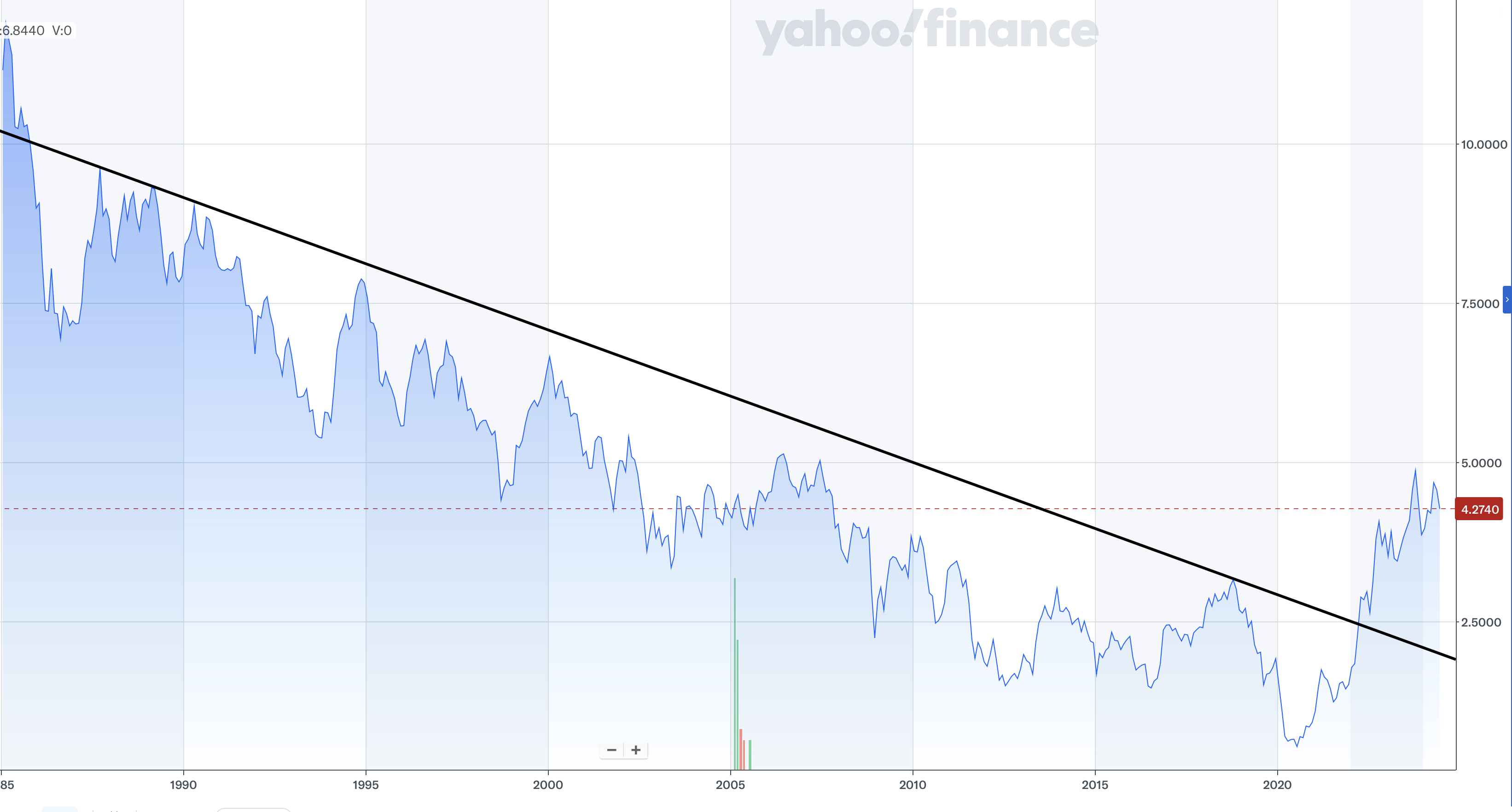
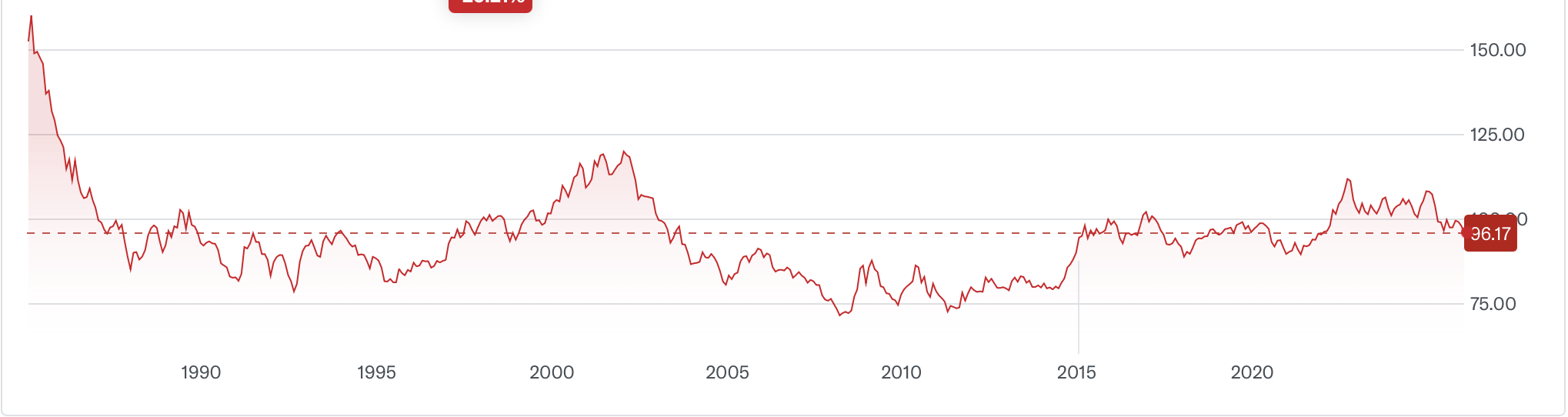
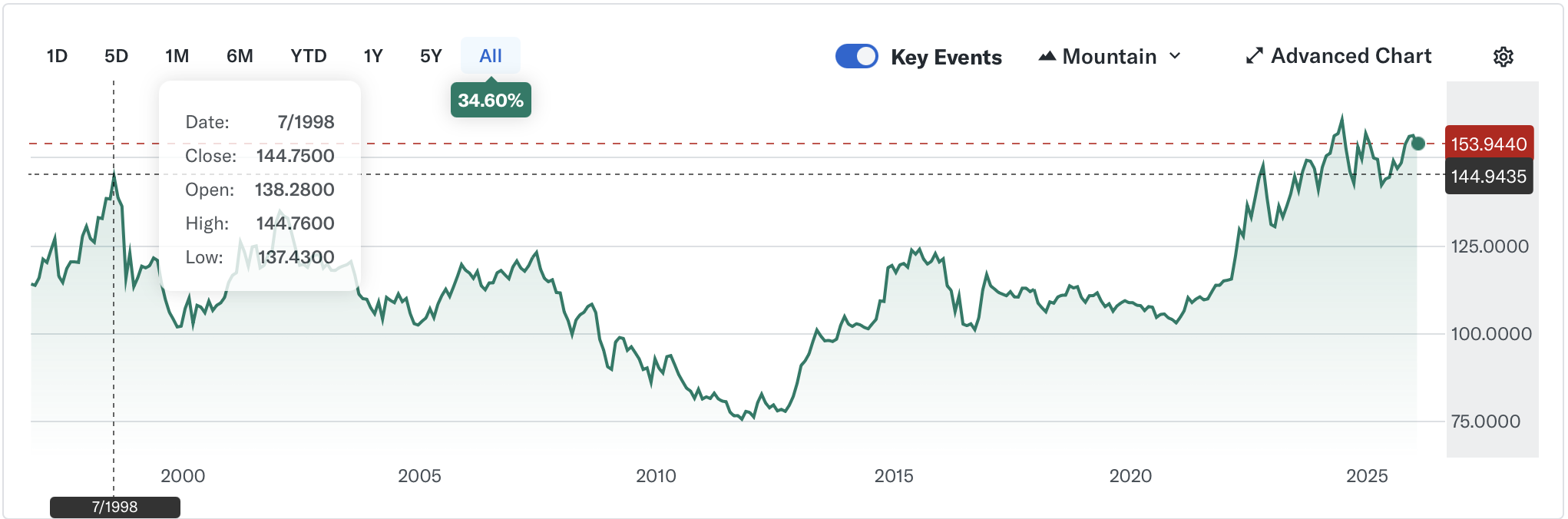
In the event this occurs, and I believe it will do so, what will be the impact on markets?  The first, and most obvious outcome will be a significant rise in the JPY (+0.6%).  As you can see below, while the yen has strengthened compared to levels seen in mid and late 2024, it remains far weaker than levels seen over the past 30+ years, where the average has been 112.62, more than 20% stronger than the current levels.

As to Treasury markets, Japan remains the largest non-US holder of Treasuries and while I doubt they will sell them aggressively, it would certainly be realistic to see them allow current positions to mature and not buy new ones but rather bring those funds home (stronger yen) while removing a key bid for the market (Kind of like their version of QT!).  Higher US yields are a real possibility here.  As to equities, these will likely be sold, although the Japanese proportion of holdings is not as large relative to others, but with rising yields and a falling dollar, it doesn’t feel like a good environment for equities.

Of course, all of this is dependent on the status quo in US policy remaining like it is today.  If President Trump can get Congress to implement his policies and they are successful at reinvigorating the US domestic economy, two big Ifs, these views will be subject to change.  The key to remember about markets, especially currency markets, is that there are two sides to every story, and expecting a particular outcome because one side of the equation moves may be quite disappointing if the other side moves and was unanticipated.

Ok, I spent far too long there, but not that much else is exciting.  The other story with some press has been driving oil markets higher (WTI +0.85%) with a gap up on news that Israel was considering a strike against Iranian nuclear facilities.  Naturally, this has been denied, and oil’s price has retreated from the early highs seen below.

Source: tradingeconomics.com

Sticking with commodities, gold (+0.5%) continues to rally, perhaps on fears of that Israeli news, or perhaps simply because more and more investors around the world want to own something they can hold onto and has maintained its value for millennia.

In the equity markets, yesterday’s modest US declines were followed by weakness in Japan (-0.6%) but strength in China (+0.5%) and Hong Kong (+0.6%).  As to the rest of the region, there were many more gainers (Korea, India, Taiwan, Australia) than laggards (Malaysia, Thailand) so a net positive tone.  In Europe, though, modest declines are the order of the day with the CAC (-0.5%) the worst performer and the FTSE 100 (-0.1%) the best.  US futures are also pointing lower at this hour (7:50) down on the order of -0.5% across the board.

Treasury yields (+4bps) have moved higher again this morning and have taken the entire government bond complex along with them as all European sovereign yields are higher by between 4bps (Germany, Netherlands) and 6bps (Switzerland, UK).  We have already discussed JGB yields where 10yr yields have moved higher by 2bps.

Finally, the dollar is softer across the board this morning with the DXY (-0.45%) a good proxy of what is happening.  The outliers are KRW (+1.2%) and NOK (+1.1%) with the latter an obvious beneficiary of oil’s rise while the former seems to be climbing in anticipation of something coming out of the G10 FinMin meeting in Canada this week.  Otherwise, that 0.45% move is a good proxy for most things.

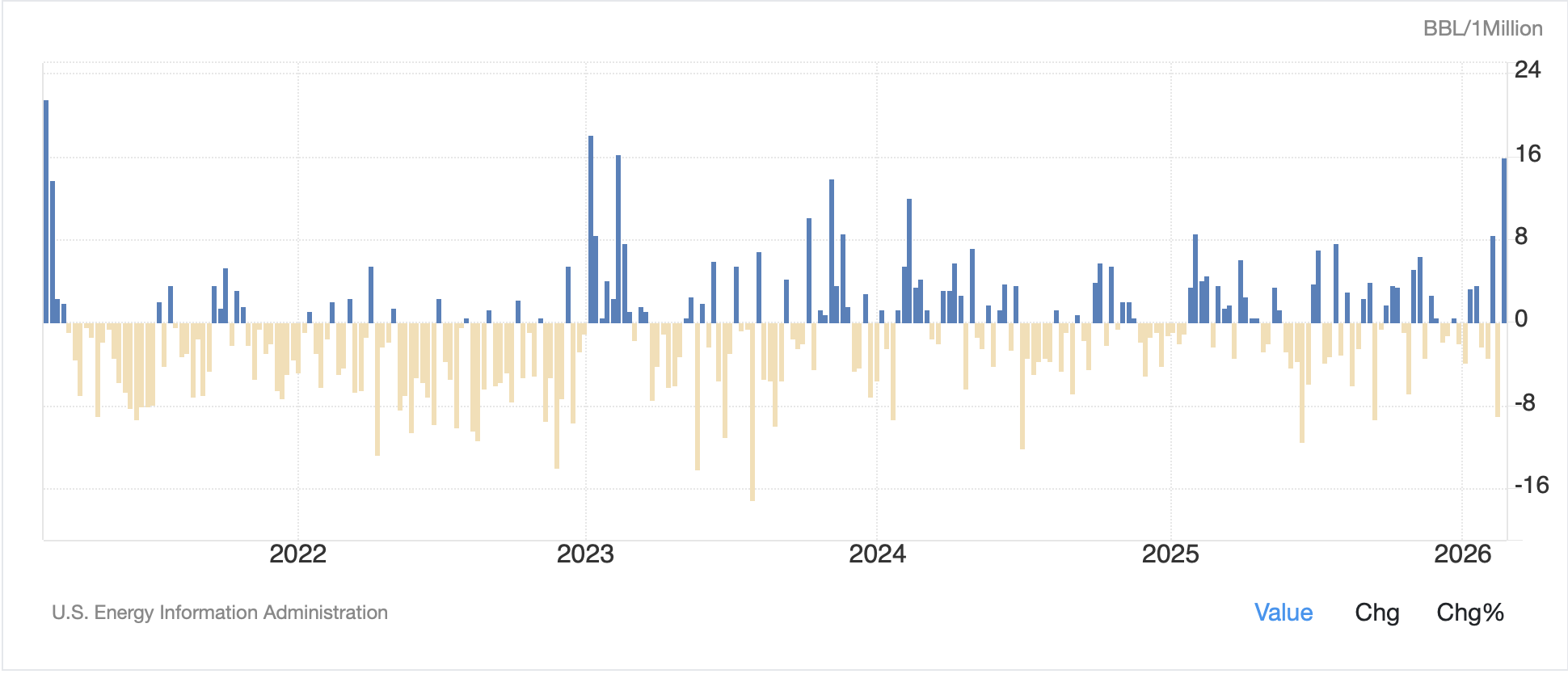
On the data front, we have another day sans anything important although EIA oil inventories will be released with a solid draw expected.  Fed speakers were pretty consistent yesterday explaining that patience remains a virtue in a world where they have no idea what is going on.  Fed funds futures markets have pushed the probability of a June cut down to 5% and only 50bps are priced in for all of 2025.  (Personally, I see no reason that a cut is coming.)

The dollar remains on its back foot, and I expect that the combination of pressure from the Trump administration to keep it that way is all that is going to be necessary to see things continue with this trend.  Of course, an Israeli strike on Iran would change things dramatically in terms of risk perception and likely support the dollar, but absent that, right now, lower is still the call.

Good luck

Adf

Positioned Quite Well

The Fed is positioned quite well
To leave rates alone for a spell
Employment is stable
Which means they are able
To try, high inflation, to quell


“In discussing the outlook for monetary policy, participants observed that the Committee was well positioned to take time to assess the evolving outlook for economic activity, the labor market, and inflation, with the vast majority pointing to a still-restrictive policy stance. Participants indicated that, provided the economy remained near maximum employment, they would want to see further progress on inflation before making additional adjustments to the target range for the federal funds rate.”

I would say that this paragraph effectively summarizes the Fed’s views during the January FOMC meeting and based on the comments we have heard since, nothing has really changed much.  If anything, there appeared to be more concern over the upside risks to inflation than worries over a much weaker employment picture.  As well, there was some discussion regarding the potential of tariffs impacting prices and economic activity, although they would never be so crass as to actually use the word.

I would argue we don’t know anything more about their views now than we did prior to the Minutes.  Interestingly, they continue to believe that the current policy rate is restrictive even though Unemployment has been sliding, inflation is sticky on the high side and equity and other financial markets continue to make record highs.  Personally, I would have thought the appropriate view would be policy is slightly easy, but then I’m no PhD economist, just a poet.  If we learned anything it is that they are not about to change the way they view the world.  This merely tells me they have the opportunity to double down on previous mistakes.

It’s almost as if
Japanese markets now see
Future yen glory

Meanwhile, away from the machinations and procrastinations of the Fed, if we turn East, we can see that last night the yen, for a brief moment, traded through the key 150 psychological level, although it has since edged back higher.  This is the strongest the yen has been in more than two months and, in a way, is somewhat surprising given the strong belief that tariffs imposed against a nation will result in that nation’s currency declining.  But that is not the case right now, where despite mooted tariffs on steel, autos and semiconductors, three things the Japanese export to the US, the yen is climbing again.  

Source: tradingeconomics.com

One of the interesting things about the interest rate market’s response to the FOMC Minutes is that there continues to be an expectation of 39bps of rate cuts this year in the US.  But then, I read the Minutes as somewhat hawkish, obviously a misconception right now.  Meanwhile, in Tokyo, we continue to hear comments from former BOJ members that further rate hikes are coming and the futures market there is pricing 36bps of rate hikes by the end of this year.  So, for now, the direction of travel is diametrically opposed between the Fed and the BOJ.  Last night also saw JGB yields edge higher by another 1bp, to 1.43% and another new high level for this move.  Add it all up and the rate movements are sufficient to be the current FX drivers.

Now, as per my opening discussion regarding the Fed, while I believe that the next move should be a hike, and that gained support from a WSJ article this morning telling us to expect higher rent prices ahead which implies that the shelter portion of US inflation is not going to decline anytime soon, perhaps this is another reason to consider that the dollar may decline.  After all, the textbooks all explain that a high inflation economy results in a weaker currency.  If the Fed is truly going to continue to try to ‘normalize’ rates lower despite rising inflation, that will change my broad view of the dollar, and I suspect it will weaken dramatically.  While the yen is the first place to watch this given the opposing actions by the Fed and BOJ, it could easily spread.

Too, it is important to remember that while we have lately become accustomed to the yen trading in the 140-160 range vs. the dollar, for many years USDJPY traded between 100 and 120 as per the below chart.  While the world has certainly changed, it doesn’t mean that we cannot head back to those levels and spend another decade at 110 give or take a bit.

Source: tradingeconomics.com

Ok, with that in mind, let’s take a look at how markets have handled the new information.  Clearly US equity markets are not concerned about a Fed volte-face as they closed at yet new record highs yesterday, albeit with very modest gains of about 0.2%.  Asian markets, however, were not so sanguine with red the dominant color as the Nikkei (-1.25%) suffered amid that strengthening yen while both the Hang Seng (-1.6%) and mainland (CSI 300 -0.3%) fell despite PBOC promises of more support for the economy and the property market.  If I’m not mistaken, this is the third time the PBOC has said they will be increasing support for property markets and prices there continue to decline.  In fact, every major index in Asia fell overnight, mostly impacted by tariff fears.

Meanwhile, European bourses are all modestly firmer save the UK (-0.4%) as we see a rebound after yesterday’s declines and earnings data from Europe continues to show decent outcomes.  While there is much talk and angst over the Ukraine situation and tariffs, right now given the uncertainty of the timing of any tariffs, as well as the possibility that they may be delayed further or deals may be struck, investors seem to be laying low.  Remember, though, that European equity markets have been outperforming US markets for the past several months, although that could well be because their valuations had become so cheap, we are seeing a rotation into them for now.  As to the US markets, futures are pointing slightly lower at this hour (7:15) down about -0.25%.

In the bond market, yesterday saw Treasury yields cede their early gains and slip 2bps on the session and this morning they have fallen a further 2bps.  Meanwhile, European sovereign yields, after jumping yesterday across the board, are falling back slightly with declines on the order of -1bp or -2bps.

In the commodity market, the one constant is that the price of gold (+0.4%) continues to climb.  Whether it is because of growing global uncertainty, concerns over rising inflation, or technical questions regarding deliveries in NY, it is not clear.  Price action is not volatile, rather it has been a steady climb for more than a year.  just look at the chart below.

Source: tradingeconomics.com

As to the other metals, both silver and copper are also continuing their climb and higher by 1.0% this morning.  Oil (+0.2%) is also edging higher which seems a bit odd given the fundamental news I keep reading.  First, OPEC+ is going to begin increasing production later this year, second, the prospects of a peace deal with Russia seems likely to result in Russian oil coming back on the market sans sanctions, and third, despite talk of Chinese economic stimulus, demand from the Middle Kingdom has not been growing.  Add to this the fact that supply is expected to grow by upwards of 1mm bpd from Guyana, Brazil and Canada, and it seems a recipe for falling prices.  Just goes to show that markets are perverse.

Finally, the dollar is under pressure across the board this morning with the yen (+0.95%) leading the way but commodity currencies (AUD +0.5%, NZD +0.5%, ZAR +0.4%) also showing strength.  In fact, virtually every currency has strengthened vs. the greenback this morning.  Looking at the charts, there is a strong similarity across almost all currencies vs. the dollar and that is the dollar put in a peak back in early January and has been gradually declining since then.  This is true across disparate currencies as seen below and may well represent the market deciding that President Trump would like to see the dollar decline and will enact policies to achieve that end.  (I used USDDKK as a proxy for EURUSD since the two are linked quite closely with a correlation of about 0.99.)

Source: tradingeconomics.com 

As I wrote above, my strong dollar thesis is based on the Fed continuing to fight inflation.  If they abandon that fight, then the dollar will certainly decline!

On the data front, this morning brings Initial (exp 215K) and Continuing (1870K) Claims as well as the Philly Fed (20.0).  In addition to the Minutes yesterday we saw Housing Starts tumble although Permits were solid.  However, there is clearly some concern over the housing market writ large, with fewer first-time buyers able to afford a new home, hence the rent story above.  We have 3 more Fed speakers today but again, I ask, are they going to change their tune?  I don’t think so.  I find it hard to believe that the Fed will allow inflation to rebound sharply, but if they remain focused on rate cuts while inflation continues to creep higher, I fear that will be the outcome.  And that, as I said above, will be a large dollar negative.  We shall see.

Good luck

Adf

A Fifth Wheel

Confusion is clearly what reigns
As even the punditry strains
To understand whether
Investors will tether
Their future to stocks or take gains


As there was no activity in the US financial markets yesterday, it seems there was time for analysts to consider the current situation and make pronouncements as to investor behavior.  Ironically, we saw completely opposite conclusions from two major players.  On the one hand, BofA posted the following chart showing that investors’ cash holdings are at 15-year lows, implying they remain fully invested and quite bullish.

Meanwhile, the WSJ this morning has a lead article on how bearish investors are, claiming they are the most bearish since November 2023 according to the American Association of Individual Investors.  Apparently, 47.3% of investors surveyed believe stock prices will fall over the next 6 months.

So, which is it?  Are investors bullish or bearish?  To me this is a perfect description of the current situation.  Everyone is overloaded with information, much of which is contradictory, and so having a coherent view has become extremely difficult.  This is part and parcel of my view that the only thing we can clearly expect going forward is an increase in volatility.  In fact, someone said that Donald Trump is the avatar of volatility, and I think that is such an apt description.  Wherever he goes, mayhem follows.  Now, I also believe that people knew what they were voting for as change was in demand.  But for those of us who pay close attention to financial markets, it will take quite the effort to keep up with all the twists and turns.

Fed speakers are starting to feel
Like they have become a fifth wheel
So, let’s get prepared
For Fed speaking squared
As they work, their views, to reveal

Away from the conundrum above, the other noteworthy thing is that FOMC members are starting to feel left out of the conversation.  Prior to President Trump’s inauguration, market practitioners hung on their every word, and they apparently loved the power that came with that setting.  However, now virtually every story is about the President and his policies with monetary policy falling to a distant issue on almost all scorecards.  Clearly, for a group that had grown accustomed to moving markets with their words, this situation has been deemed unacceptable.  The solution, naturally, is to speak even more frequently, and I fear believe this is what we are going to see (or hear) going forward.  

Yesterday was a perfect example, where not only, on a holiday, did we have multiple speakers, but they actually proffered different messages.  From the hawkish side of the spectrum, Governor Michelle Bowman, the lone dissenter to the initial 50bp rate cut back in September, explained caution was the watchword when it comes to acting alongside President Trump’s mooted tariff and other policies, “It will be very important to have a better sense of these policies, how they will be implemented, and establish greater confidence about how the economy will respond in the coming weeks and months.”  That does not sound like someone ready to cut rates anytime soon.

Interestingly, from the dovish side of the spectrum, Governor Christopher Waller, an erstwhile hawk, explained in a speech in Australia (on the day the RBA cut rates by 25bps for their first cut of the cycle and ending an 18 month period of stable rates) that, “If this wintertime lull in progress [on inflation] is temporary, as it was last year, then further policy easing will be appropriate.”  I find it quite interesting that Governor Waller suddenly sounds so dovish as many had ascribed to him the intellectual heft amongst the governors.  This is especially so given that is not the message that Chairman Powell articulated either after the last meeting or at his Humphrey-Hawkins testimony recently.  

So, which is it?  Is the Fed staying hawkish or are they set for a turn?  That will be the crux of many decision-making processes going forward, not just in markets but also in businesses.  We will keep tabs going forward.

Ok, on to the market’s overnight performances.  Lacking a US equity market to follow, everybody was on their own last night which showed with the mixed results.  Japan (+0.25%) showed modest gains while the Hang Seng (+1.6%) rocketed higher on the belief that President Xi is going to be helping the economy, notably the tech firms in China, many of which are listed in Hong Kong.  Alas, the CSI 300 (-0.9%) didn’t get that memo with investors apparently still concerned over the Trump tariff situation.  Elsewhere in the region, Korea and Taiwan rallied while Australia lagged despite the rate cut.  In Europe, unchanged is the story of the day with most bourses just +/-0.1% different than yesterday’s close.  Right now, in Europe, the politicians are trying to figure out how to respond to the recent indication that the US is far less interested in Europe than in the past, and not paying close attention to financial issues.  As to the US, futures at this hour (7:25) are pointing higher with the NASDAQ leading the way, +0.5%.

In the bond market, yields are climbing led by Treasuries (+4bps) with most of Europe seeing yields edge higher by 1bp or 2bps as well.  Remember, yesterday European sovereign yields rose smartly across the board.  Also, I must note JGB yields (+4bps) which have made further new highs for the move and continue to rise.  It appears last night’s catalyst was a former BOJ member, Hiroshi Nakaso, explained he felt more rate hikes were coming with the terminal rate likely to be well above 1.0%.  While I believe the Fed will be cautious going forward, I still think they are focused on rate cuts for now.  With that in mind and the ongoing change in Japanese policy, I am increasingly comfortable with my new stance on the yen.

In the commodity markets, last Friday’s sell-off in the metals markets is just a bad memory with gold (+0.5%) rallying again and up more than 1% since Friday’s close.  I continue to believe those moves were positional and not fundamental.  Too, we are seeing gains in silver (+0.2%) and copper (+0.6%) to complete the triad.  Meanwhile, oil (-0.25%) continues to lag, holding above its recent lows but having a great deal of difficulty finding any buying impulse.  Whether that is due to a potential peace in Ukraine and the end of sanctions on Russian oil, or concerns over demand growth going forward is not clear to me, but the trend, as seen in the chart below, is clearly downward and has been so for the past year.

Source: tradingeconomics.com

Finally, in the FX markets, the dollar is firmer this morning rising against all its G10 counterparts with NZD (-0.6%) the laggard.  But losses of -0.2% are the norm this morning.  In the EMG bloc, we are seeing similar price behavior in most markets although MXN (+0.2%) is bucking the trend, seemingly benefitting from what appears to be a hawkish stance by Banxico and the still highly elevated interest rate differential in the peso’s favor.

On the data front, Empire State Manufacturing (exp -1.0) is the only data point although we will hear from two more Fed speakers, Daly and Barr.  I cannot believe that they have really changed their tune and expect that caution will remain their guiding principle for now, although I expect to hear that repeated ad nauseum as they try to regain their place in the spotlight.

Aside from my yen view, I still find it hard to be excited about many other currencies for now.  There is still no indication the Fed is going to move anytime soon, and other central banks are clearly in easing mode.  That bodes well for the dollar going forward.

Good luck

Adf

Soaring Like Eagles

Soaring like eagles
Japanese growth beats forecasts
Are rate hikes coming?


On this President’s Day holiday, when US markets are closed, arguably the most interesting financial story around is in the Land of the Rising Sun where Q4 GDP was released last night at 0.7%, significantly higher than forecast (0.2%) and Q3’s outcome (0.4%).  Japanese markets responded about as might be expected with the yen (+0.6%) rising alongside JGB yields (+3bps) with the 10yr now at 1.38%, its highest level since March 2010.  As to equity markets, the Nikkei (+0.1%) was caught between the positive GDP news and the stronger JPY.  Of course, much has been made of the BOJ’s overnight rate, which now sits at 0.50% after several hikes during the past year.  As well, expectations are for further hikes this year, with several analysts calling for a rate over 1.00% before the end of 2025.

But let us consider, for a moment, what the Japanese rate structure looks like in the context of the current inflation story in Japan.  As can be seen below, this is the current shape of the Japanese government bond yield curve, with 2yr yields at 0.80% while 30yr yields are up to 2.30%.

Source: Bloomberg.com

However, when looking at these yields, which as you can see from the column furthest to the right have risen substantially in the past 12 months, we must also remember the pace of inflation in Japan.  Since April 2022, every monthly CPI print in Japan has been above the target of 2.0%, with all but two of them above 2.5%.  In fact, as you can see from the chart below, the most recent data, as of December 2024 with the January data to be released Thursday night, shows the headline at 3.6%.  That is nearly three years of inflation data running above their target, yet the BOJ is unwilling to say inflation is stably at 2.0%.  I guess they are correct, it is stably at about 3.0%!

Source: tradingeconomics.com

But let’s add up this conundrum and perhaps we will better understand why GDP is growing so robustly in Japan.  If 10yr JGB yields are 1.38% and inflation is 3.60%, then real yields are running at… -2.22%.  That is a pretty loose monetary policy and one in which it is no surprise that economic activity is humming along.  In fact, unless we see a substantial decline in inflation, with no indication that is on the horizon, the BOJ has ample room to raise interest rates while maintaining accommodative monetary policy.

I know that there is much discussion regarding President Trump’s tariffs and whether Japan will be affected like other nations thus increasing uncertainty.  But the economic reality is that the BOJ remains highly stimulative to the economy which has been a driver of both economic growth and inflation.  I also know that this poet has been negative on the yen for a long time, in fact calling for USDJPY to reach 170 by the end of the year.  But as I observe the current situation, take into account the fact that President Trump very clearly wants the dollar to decline, and see more hints that the Japanese government is becoming more concerned over rising inflation in Japan, I am changing my tune here.  Add to these indications the fact that the yen, on any accounting, remains significantly undervalued, with estimates of as much as 50% (Big Mac Index claims it is 44% undervalued) and the case for yen strength is growing on me.

While over the past year, the yen has, net, done very little, the more recent trend is for yen strength as per the 1-month chart below.  My take is that we need to see a break below 150 before the fireworks start, but if that is the case, do not be surprised if we trade back to 130 before the year is over.

Source tradingeconomics.com

And really, that is the story of the evening.  The Chinese NPC will be meeting next week to discuss their economic plans and policies for the upcoming year, so that will be important.  As well, Europe has been put on notice by recent speeches from VP JD Vance and Secretary of State Marco Rubio that the relationship with the US is changing.  However, at this time, it is very difficult to discern if that means the euro will weaken further or rebound on increased internal activity.

Ok, let’s look at markets overnight.  It appears that with the US on holiday, many markets were reluctant to demonstrate leadership in any direction with not only Tokyo virtually unchanged, but the same being true throughout Asia (Hong Kong, 0.0%, China +0.2%, Australia -0.2%) and most of Europe with only the German DAX (+0.8%) showing any life at all.  It seems that several German defense contractors are benefitting from the idea that Europe may be increasing its defense expenditures locally.  US futures are little changed, although of course the market will not be open today.

Treasury bonds are also unchanged this morning with no trading but in Europe, yields are higher by between 3bps and 5bps, also on the rising defense expenditure story as there is an idea now floating around that there will be pan-European debt issuance to help fund that expenditure, thus adding supply to the market.  Certainly, despite the ECB maintaining a somewhat dovish stance, if European yields climb higher, that will likely support the single currency.

In the commodity markets, after Friday’s rout in the metals, where both precious and industrial metals sold off sharply, seemingly on no news, but more likely on position adjustments, this morning we are seeing a rebound, at least in gold (+0.5%) and silver (+0.6%) although copper (-1.3%) remains under pressure.  As to energy prices, oil (-0.35%) is continuing to hover closer to the bottom than top of its recent trading range as there is no clarity at all regarding how a potential Ukrainian peace will impact Russian production.  The one consistency is that European NatGas continues to decline on hopes that Russian gas deliveries will resume going forward.

Finally, the dollar is doing mixed this morning with the yen the outlier showing strength against the greenback, but ZAR (-0.5%) and MXN (-0.4%) showing weakness.  The rest of the G10 has seen only modest movement and that is generally true for the rest of the EMG bloc.  Traders remain highly uncertain over the future that President Trump will usher in.

On the data front, it is a pretty light calendar overall.

TuesdayEmpire State Manufacturing0.0
WednesdayHousing Starts1.4M
 Building Permits1.46M
 FOMC Minutes 
ThursdayInitial Claims215K
 Continuing Claims1860K
 Philly Fed16.3
 Leading Indicators-0.1%
FridayFlash Manufcturing PMI51.2
 Flash Services PMI53.2
 Existing Home Sales4.13M
 Michigan Sentiment67.8

Source: tradingeconomics.com

As well as this data, we see the EIA oil inventories and hear from 11 more Fed speakers.  But again, after Powell made clear they are on hold for now, and there has been no data to change that perception, and President Trump continues to dominate the spotlight, I don’t anticipate any new information here.

With the holiday today, I anticipate things will be quite slow.  Traders will take advantage of the time off to rest given the rising volatility we have seen.  Going forward, I will be reevaluating my longer-term views based potential changes in fiscal policies around the world.  But for now, other than the yen, I don’t see any clear changes yet.

Good luck

Adf
Loathing and Fear

On Friday, the jobs situation
Explained there was little causation
For loathing or fear
That later this year
Recession would soon drive deflation
 
Meanwhile, in the Super Bowl’s wake
The president’s set to forsake
Economists’ warning
That tariffs are scorning
Their views, and are quite a mistake


Let’s start with a brief recap of Friday’s employment report which was surprising on several outcomes.  While the headline was a touch softer than forecast, at 143K, revisions higher to the prior two months of >100K assuaged concerns and implied that the job market was still doing well.  You may recall that there were rumors of a much higher Unemployment Rate coming because of the annual BLS revisions regarding total jobs and population, but in fact, Unemployment fell to 4.0% despite an increase in the employed population of >2 million.  Generally, that must be seen as good news all around, even for the Fed because the fact that they have paused their rate cutting cycle doesn’t seem to be having any negative impacts.

Alas for Powell and friends, although a real positive for the rest of us, the Earnings data was much stronger than expected, up 0.5% on the month taking the annual result to a 4.1% increase.  Recall, one of Powell’s key concerns is non-core services inflation, and that is where wages have a big impact.  After this data, it becomes much harder to anticipate much in the way of rate cuts soon by the Fed.  This was made clear by the Fed funds futures market which is now pricing only an 8.5% probability of a rate cut in March, down from 14% prior to the data, and only 36bps of cuts all year, which is down about 12bps from before.

Securities markets didn’t love the data with both stocks and bonds declining in price, although commodities markets continue to rally alongside the dollar, a somewhat unusual outcome, but one that makes sense if you consider the issues.  Inflation is not yet dead, hurting bonds, while the fact the Fed is likely to remain on hold for longer supports the dollar.  Stocks, meanwhile, need to see more economic growth because lower rates won’t support them while commodities are seen as that inflation fighting haven.

Of course, it wouldn’t be a day ending in Y if we didn’t have another discussion on tariffs during this administration.  The word is that the president has two things in mind, first, reciprocal tariffs, meaning the US will simply match the tariff levels of other countries rather than maintaining their current, generally lower, tariff rates.  As an example, I believe the EU imposes a 10% tariff on US automobile imports, while the US only imposes a 2.5% tariff on European imports.  The latter will now rise to 10%.  It will be very interesting to see how the Europeans complain over the US enacting tariffs that are identical to their own.  

A side story that I recall from a G-20 meeting during Trump’s first term was that he offered to cut tariffs to 0% for France if they reciprocated and President Macron refused.  The point is that while there is a great deal of huffing and puffing about free trade and that Trump is wrecking the world’s trading relationships, the reality appears far different.  If I had to summarize most of the world’s view on trade it is, the US should never put tariffs on any other country so they can sell with reckless abandon, while the rest of the world can put any tariffs they want on US stuff to protect their home industries.  This is not to say tariffs are necessarily good or bad, just that perspective matters.

The other Trump tariffs to be announced are on steel and aluminum imports amounting to 25% of the value. This will be impactful for all manufacturing industries in the US, at least initially, so we will see how things progress.  Interestingly, the dollar has not responded much here because these are not country specific, so a broad rise in the dollar may not be an effective mitigant.

Ultimately, as I have been writing for a while, volatility is the one true change in things now compared to the previous administration.  Now, with that as backdrop, and as we look ahead to not only CPI data on Wednesday, but Chair Powell’s semi-annual congressional testimony on Tuesday at the Senate and Wednesday at the House, let’s look at how markets have responded to things.

As mentioned above, US equity markets fell about -1.0% on Friday after digesting the Unemployment data. However, the picture elsewhere, especially after these tariff discussions, was more mixed.  In Asia, Japanese shares were essentially unchanged although Hong Kong (+1.8%) was the big winner in the region.  But Chinese shares (+0.2%) did little, especially after news that the number of marriages in China fell to their lowest since at least 1986, another sign of the demographic decline in the nation.  Elsewhere in the region, there was more red (India, Taiwan, Australia) than green (Singapore).  European shares, though, are holding up well, with modest gains of about 0.2% – 0.4% across the board despite no real news.  US futures are also ticking higher at this hour (7:10), about 0.5% across the board.

In the bond market, Friday saw Treasury yields jump 6bps with smaller gains seen in Europe.  This morning, though, the market is far quieter with Treasury yields unchanged and European sovereigns similarly situated, with prices between -1bp and +1bp compared to Friday’s closing levels.  Of note, JGB yields have edged higher by 1bp and now sit at 1.31%, their highest level since April 2010.  With that in mind, though, perhaps a little bit of longer-term perspective is in order.  A look at the chart below shows 10-year JGB yields and USDJPY since 1970.  Two things to note are that they have largely moved in sync and that both spent many years above their current levels.  While it has been 15 years since JGB yields were this high, they are still remarkably low, even compared to their own history.  I know that many things have changed over that time driving fundamentals, but nonetheless, this cannot be ignored.

Source: tradingeconomics.com

Sticking with the dollar, it has begun to edge higher since I started writing this morning and sits about 0.2% stronger than Friday’s close.  USDJPY (+0.5%) is once again the leader in the G10, although weakness is widespread in that bloc.  In the EMG bloc, there were a few gainers overnight (INR +0.3%, KRW +0.3%) although the rest of the world is mostly struggling.  One interesting note is ZAR (0.0%) which appears to be caught between the massive rally in gold (to be discussed below) and the increased rhetoric about sanctions by the US in the wake of the ruling party’s ostensible call for a genocide of white South Africans to take over their property.  This has not been getting much mainstream media press, but it is clear that Mr Trump is aware, especially given that Elon Musk is South African by birth.  However, there is no confusion in the South African government bond market, which, as you can see below, has seen yields explode higher in the past week since this story started getting any press at all.

Source: tradingeconomics.com

Finally, the commodity markets continue to show significant movement, especially the metals markets.  Gold (+1.6%) is now over $2900/oz, another new all-time high and calling into question if this is just an arbitrage between London and New York deliveries.  Silver (+1.4%) continues to be along for the ride as is copper (+0.6%) which is the biggest gainer of the past week, up more than 7%.  Ironically, aluminum, the only metal where tariffs are involved, is actually a touch softer this morning.  As to oil (+1.2%) while the recent trend remains lower, it does appear to be bottoming, at least if we look at the chart below.

Source: tradingeconomics.com

Turning to the data this week, it will be quite important as CPI headlines, but we also see Retail Sales and other stuff and have lots of Fedspeak.

TuesdayNFIB Small Biz Optimism104.6
 Powell Testimony to Senate 
WednesdayCPI0.3% (2.9% Y/Y)
 -ex food & energy0.3% (3.1% Y/Y)
 Powell Testimony to House 
ThursdayPPI0.3% (3.4% Y/Y)
 -ex food & energy0.3% (3.3% Y/Y)
 Initial Claims216K
 Continuing Claims1875K
FridayRetail Sales-0.1%
 -ex autos0.3%
 IP0.2%
 Capacity Utilization77.7%

Source: tradingeconmics.com

In addition to Powell, we will hear from five more Fed speakers, although with Powell speaking, I imagine their words will largely be ignored.  Overall, the world continues to try to figure out how to deal with Trump and his dramatic policy changes from the last administration.  One thing to keep in mind is that so far, polls show a large majority of the nation remains in support of his actions so it would be a mistake to think that his policy set is going to be altered.  Net, the market continues to believe this will support the dollar, as will the fact that the Fed seems less and less likely to start cutting rates soon.  Keep that in mind as you consider your hedges going forward.

Good luck

Adf