The End of the Scare?

Though words from both sides are confusing
The markets are clearly enthusing
The war will soon end
Which may well portend
The bears are all in for a bruising

With stocks round the world on a tear
And yields falling down everywhere
Plus, oil is lower
And gold’s a fast grower
Have we seen the end of the scare?

Will there be peace talks soon?  President Trump claims things are happening in that direction.  Comments from some in Iran say that is not the case.  Clearly, both sides are incented to make those claims regardless of the reality.  At the same time, US Marines and the 82nd Airborne division are on their way to the Gulf.  It is easy to conclude that this is the prelude to a US intensification and effort at physical control of the Strait of Hormuz.  Word is that the Saudis and Emiratis are also pleading with President Trump to finish the job and remove the Iranian theocracy to enable a more peaceful Middle East in the long run.  But as always, sitting here in the US, and frankly if you are sitting in Europe or China or Japan or Australia, or pretty much anywhere but the Middle East or the White House, we don’t really know the facts on the ground, and we certainly don’t know the next steps.  We are just guessing.

However, the best clues we have come from the markets, which admittedly respond to the same news flows we do, although I’m certain that large institutions have better insight than reading Bloomberg or the WSJ or listening to al-Jazeera.   But, if we look at the markets this morning, the future is a lot brighter than it was on Monday.

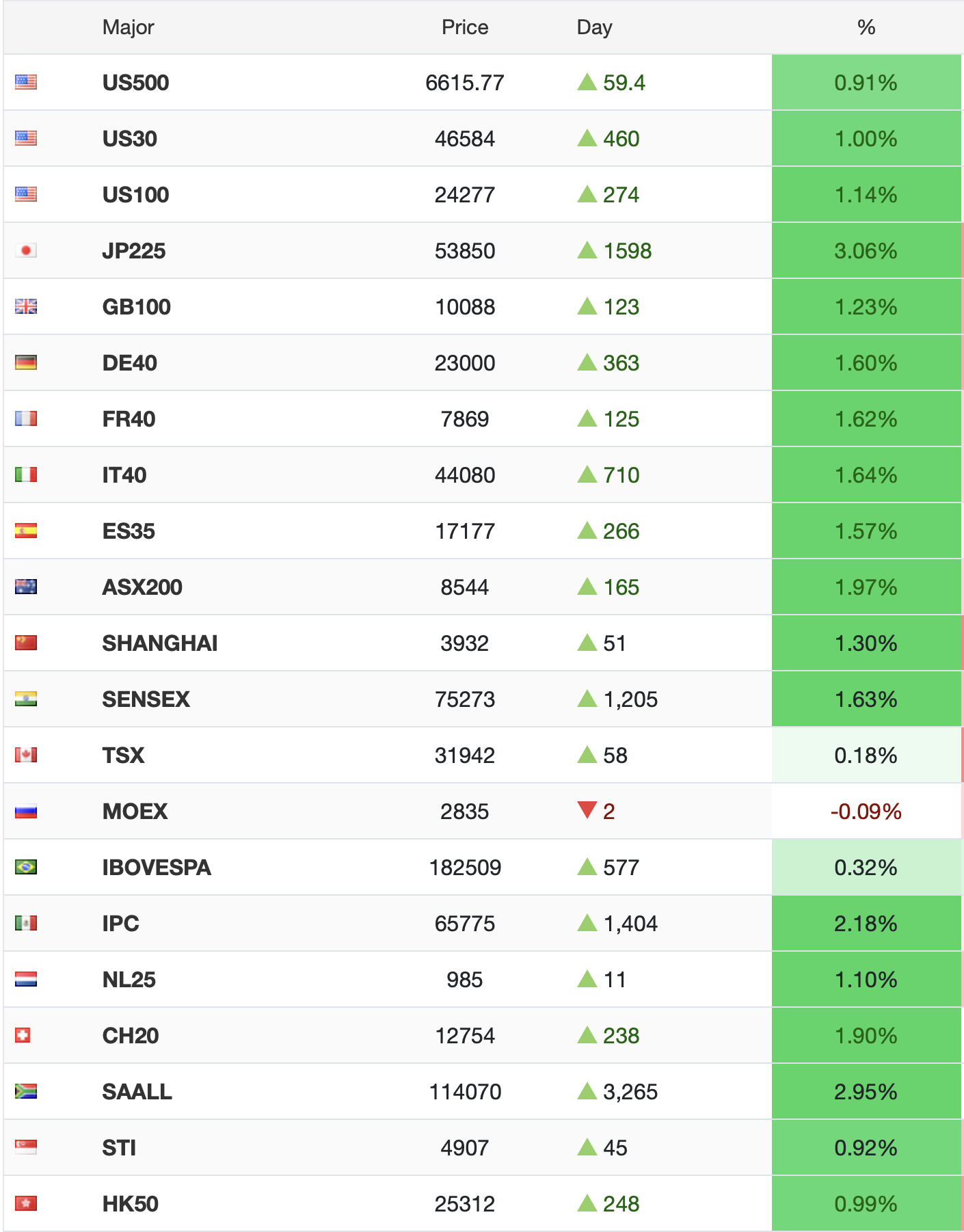
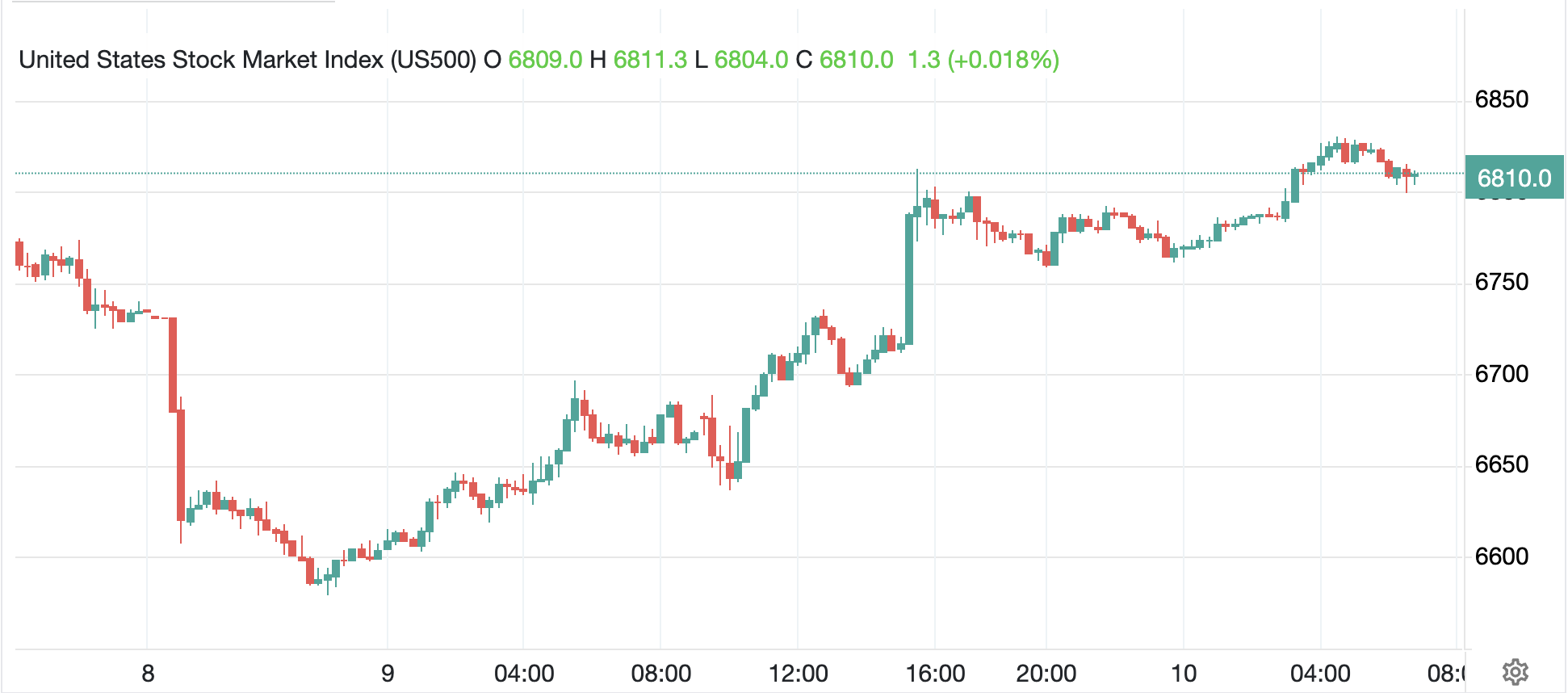
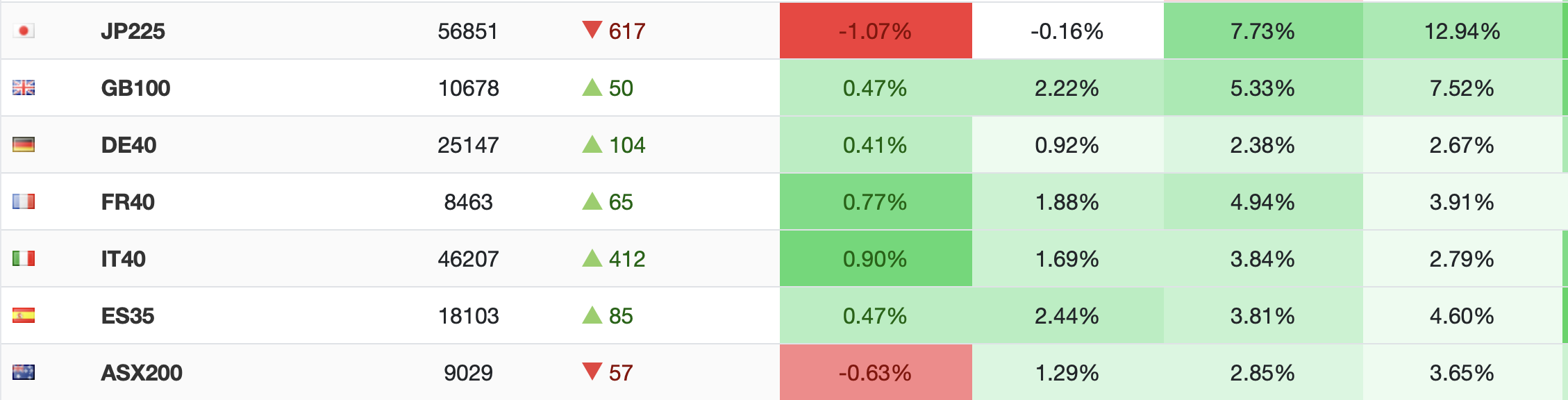
While equity markets in the US were lower yesterday, it was certainly not a rout.  Rather, after a weak opening, they rallied back to positive territory as this new dialog appeared, although closed off the highs.  This morning, though, as you can see from the screen shot from tradingeconomics.com of equity futures markets, green remains the dominant color.  In this table, only Toronto (TSX), Mexico (IPC) and Brazil (IBOVESPA) are not open right now, but otherwise, risk is back in vogue.

As we have seen over the past weeks, economic data has lost its importance, as have the words of central bankers around the world with the only words that matter coming from President Trump or whoever may be a spokesman for Iran these days.  It is entirely possible that the global equity markets have gotten this situation completely wrong, and that over the next several weeks, the situation in the Middle East is going to deteriorate, but I am going to lean to the side that has trillions of dollars at risk and go with them for now.  After all, given all the talk about rampant insider trading, somebody’s buying a lot of equities!

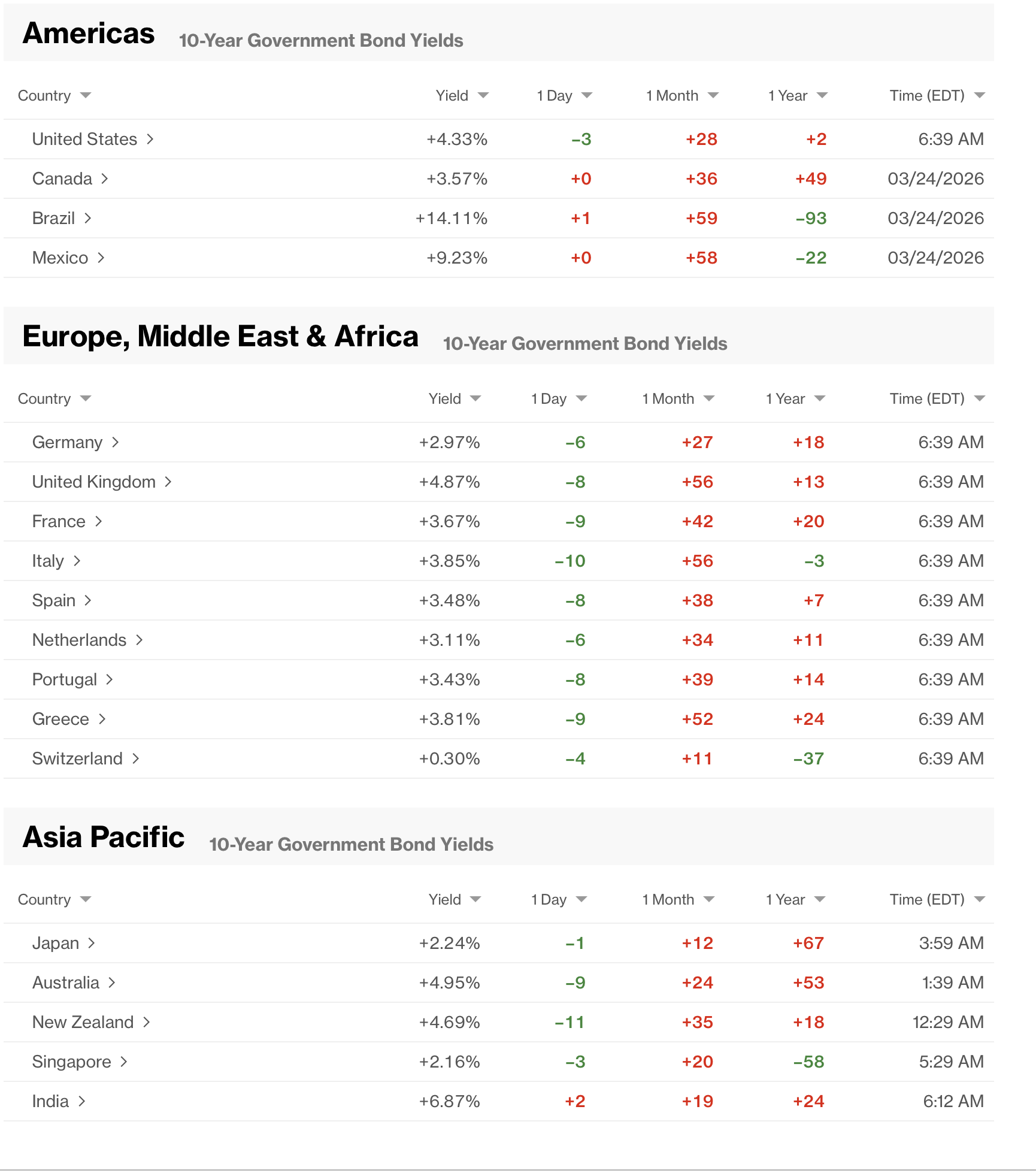
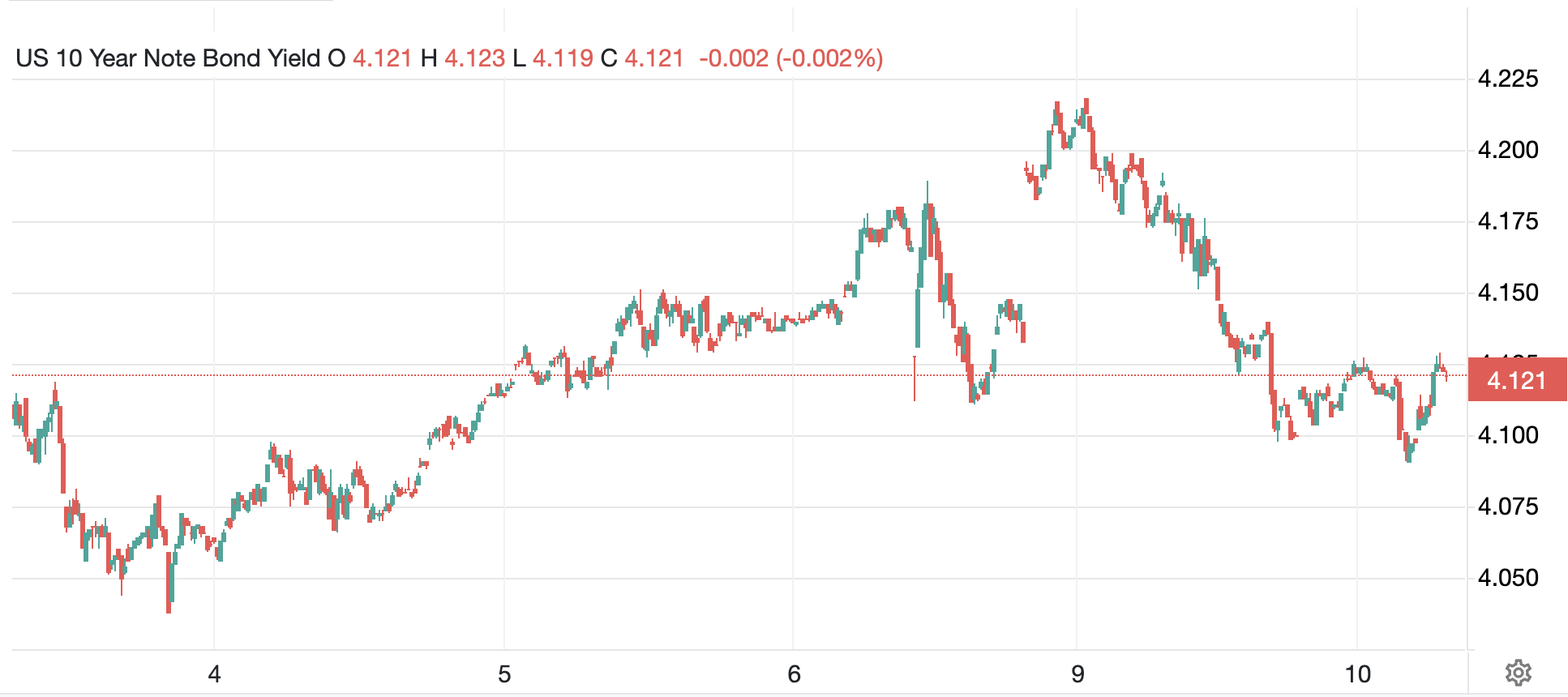
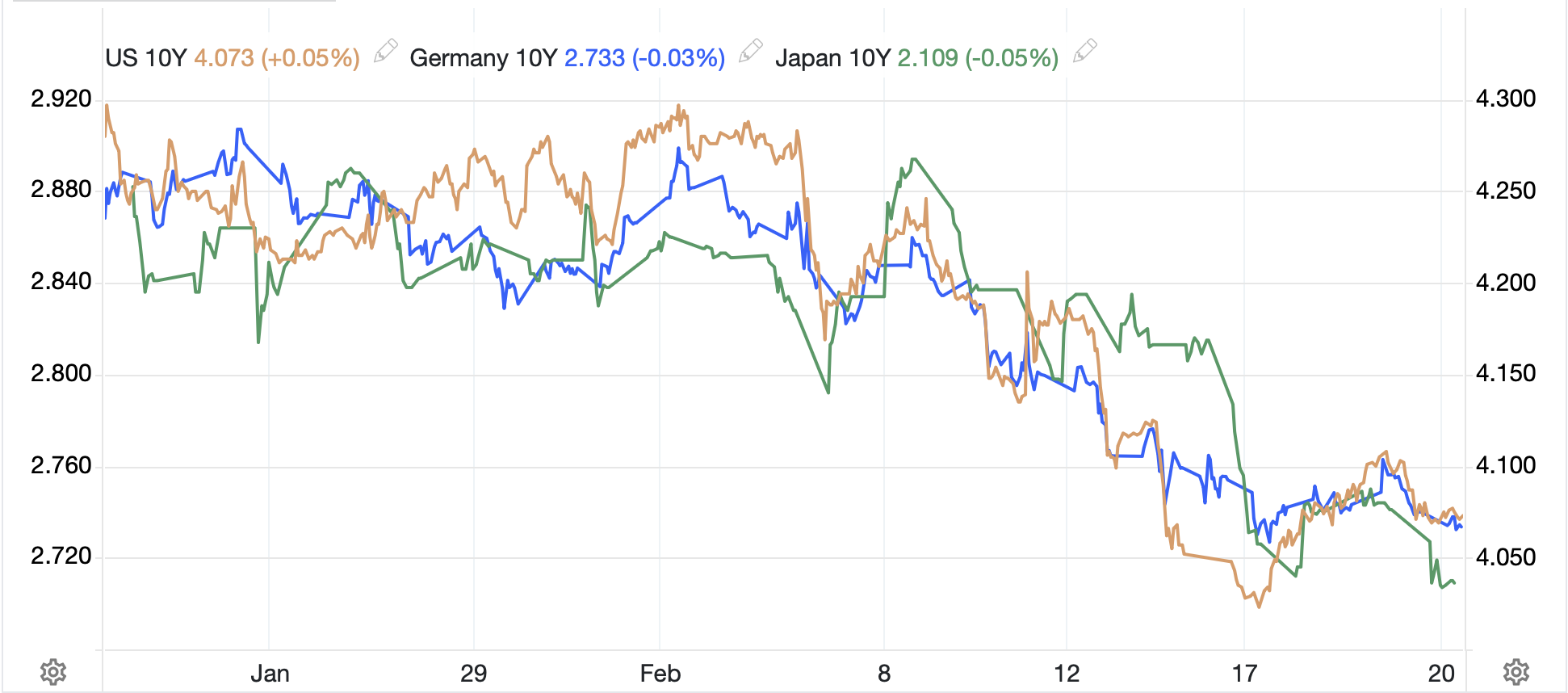
Meanwhile, bond yields around the world are sliding as well.  the Bloomberg screen shot below shows that while yields around the world have risen over the past month, today investors are starting to accept that, perhaps, oil prices may not be $100/bbl for a very long time.

We did see February UK inflation data this morning, which printed unchanged and as expected at 3.0%.  We also heard from Madame Lagarde, who explained that the ECB would act decisively and swiftly, if necessary, given their absolute commitment to a 2.0% inflation run rate.  “We will not act before we have sufficient information on the size and persistence of the shock and its propagationBut we will not be paralyzed by hesitation: our commitment to delivering 2% inflation over the medium term is unconditional.”  

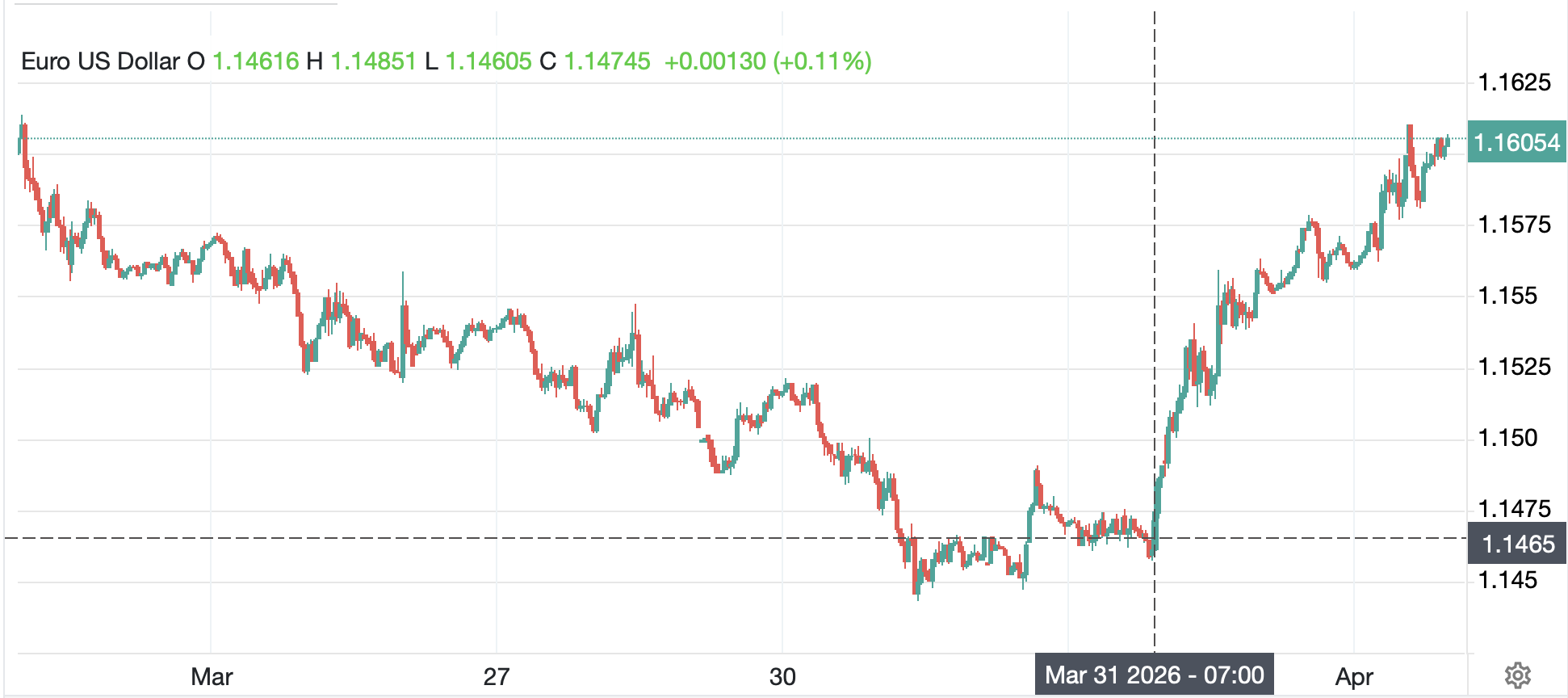
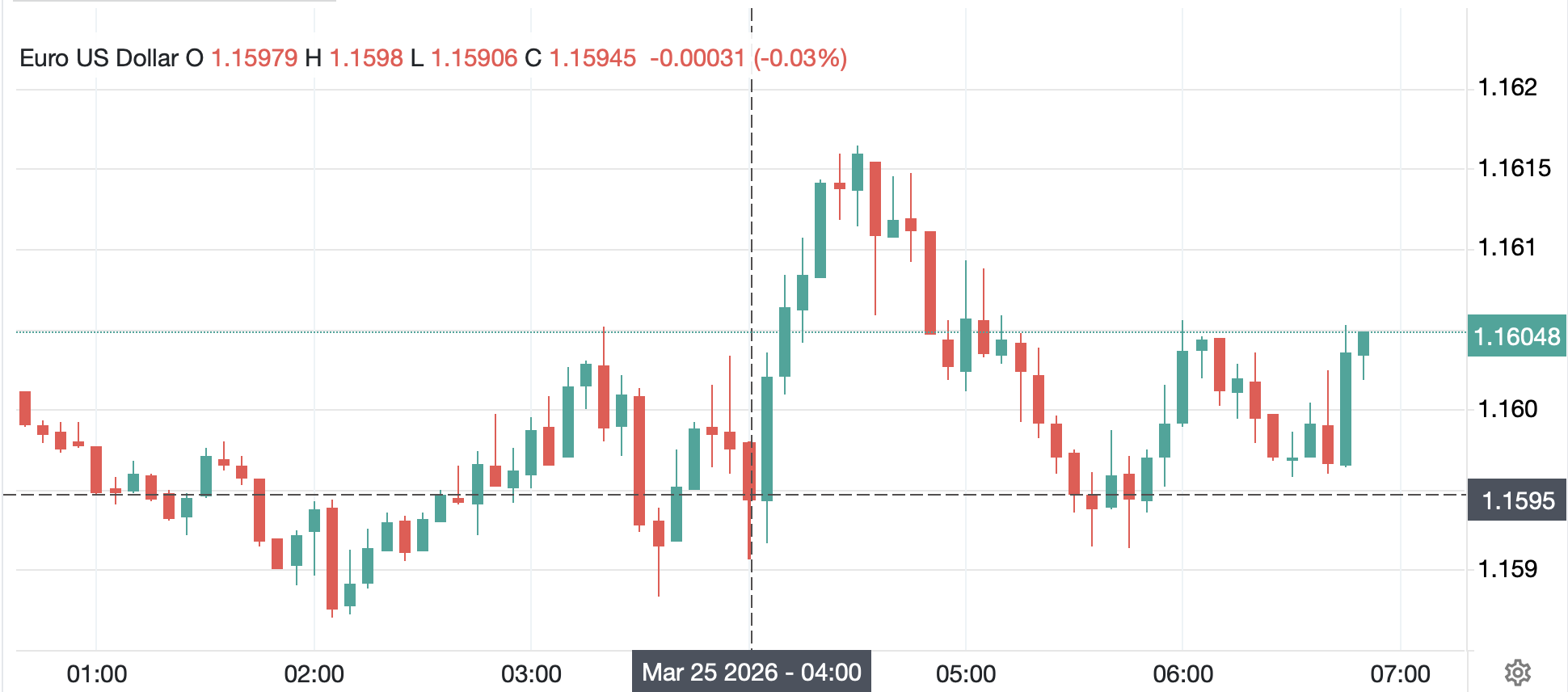
The interesting thing about this, to me, is how little the FX market seemed to care about her comments.  A look at the chart below of intraday price action with 5-minute candles, shows that her comments were enough to push the euro higher by…20 pips!  And that lasted for about 90 minutes.

Source: tradingeconomics.com

As I have been saying, central bank speakers have lost their ability to move markets, something I personally believe is quite healthy.  Alas, I am sure that when the hostilities end, or at least become more background noise (see e.g., Russia/Ukraine), they will flood the airwaves with their views in order to reclaim part of the narrative.

As to the FX market overall, movement has been pretty limited with both the euro and pound unchanged on the day, although AUD (-0.4%) is under a bit of pressure, ostensibly on slightly softer than expected inflation figures there.  Elsewhere in the G10, the two laggards are CAD (-0.2%) and NOK (-0.4%) as the oil price decline weighs there.  In the EMG bloc, ZAR (+0.5%) is benefitting from gold’s rebound with commodity discussions below, and otherwise, FX remains the least interesting market around.

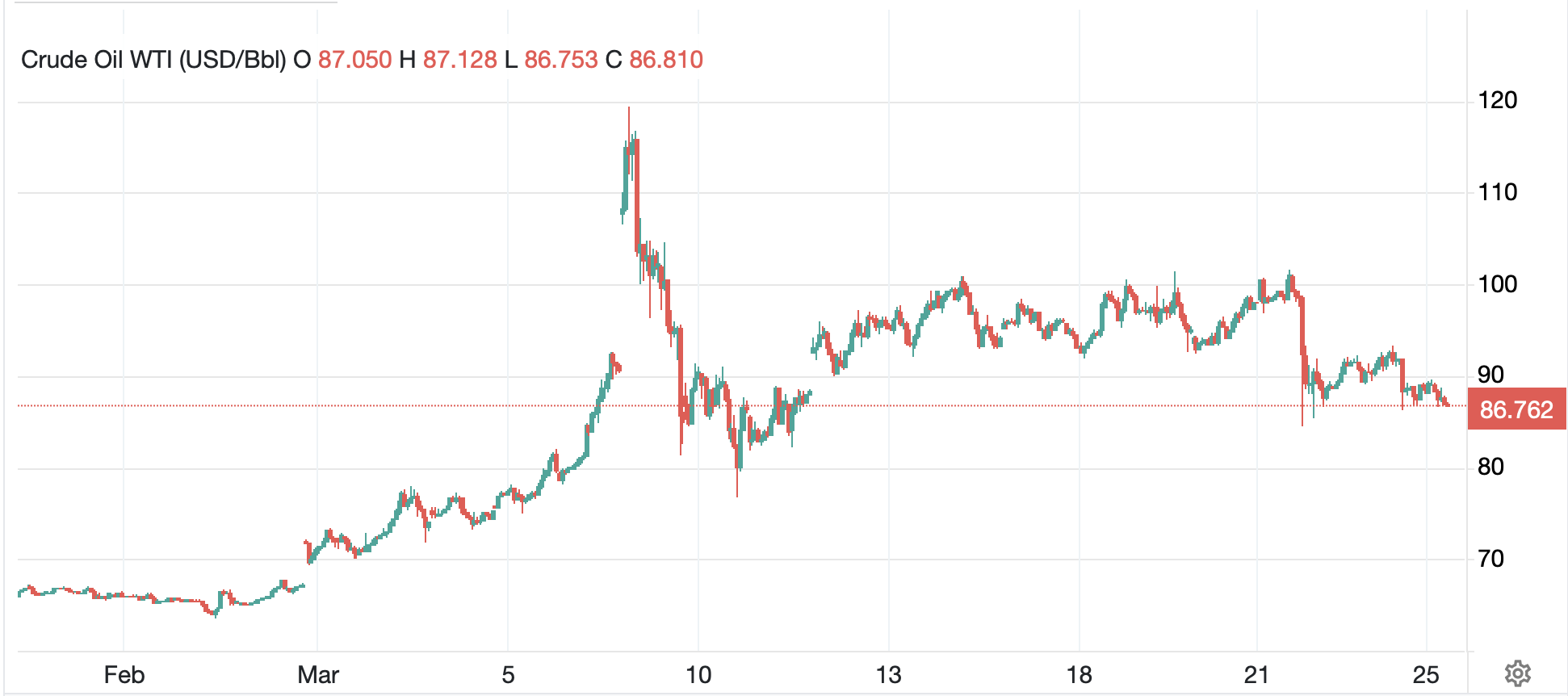
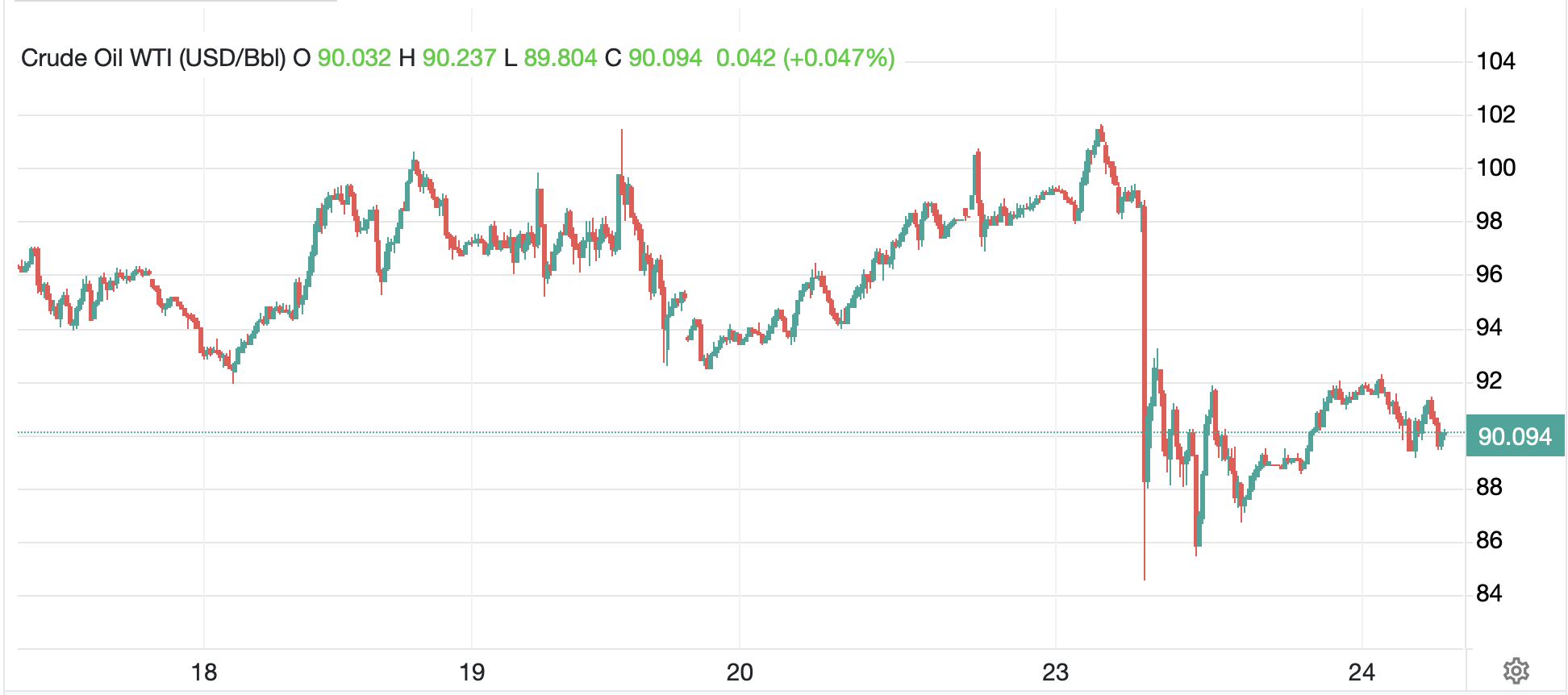
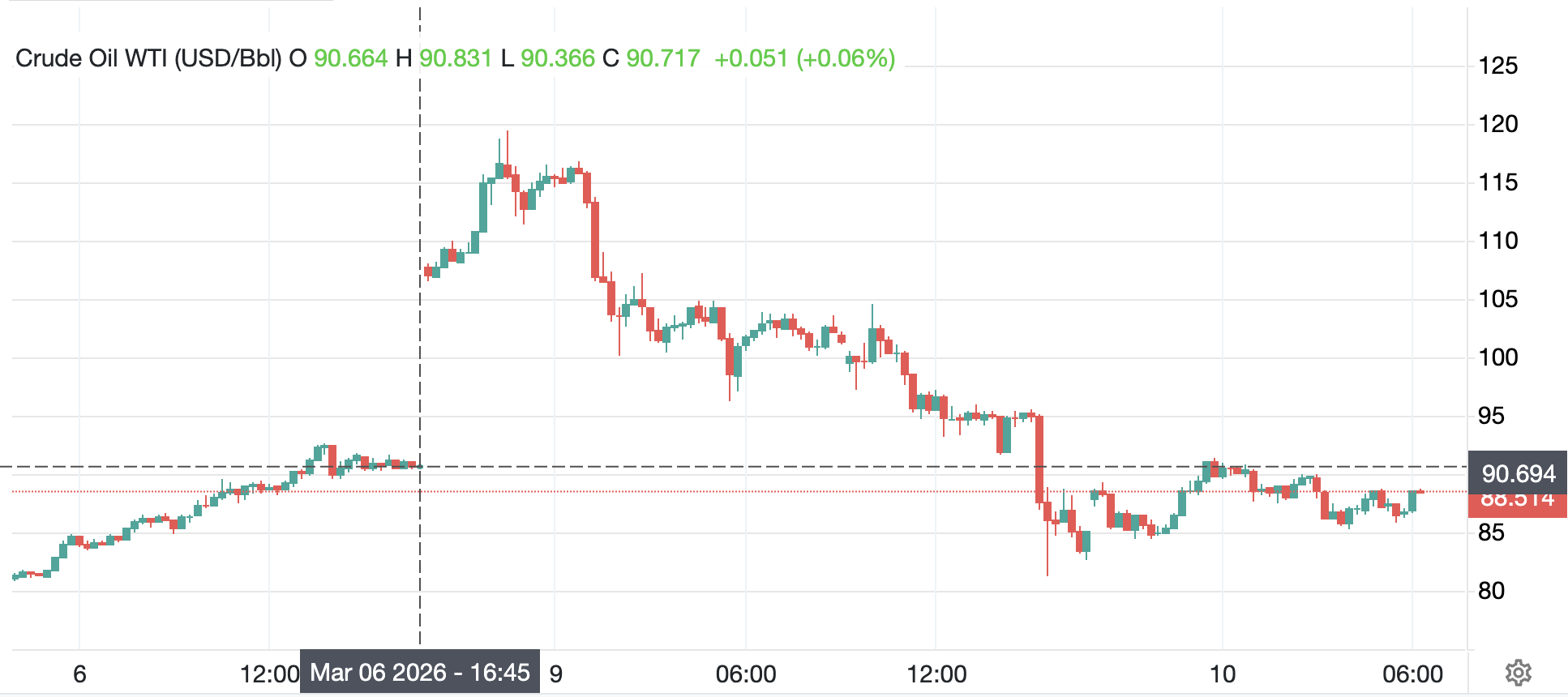
Finally, oil (-6.0%) has fallen back below $90/bbl in the US and $100/bbl in London although the price for crude in the gulf on the correct side of the Hormuz Strait is as high as $150/bbl I’ve seen.  Asia is still desperate for more barrels of oil and willing to pay up for them.  It certainly seems likely that if the Strait remains effectively closed for much longer, the economic damage will grow apace, but right now, oil traders, at least futures traders, are of the belief the end of this stoppage is nigh.

Source: tradingeconomics.com

At this point, oil has retraced a bit over 50% of its initial spike.  Market technicians will be looking at the $84.95 level as the next key Fibonacci retracement level, with a break below there likely to convince some that lower prices are the future.

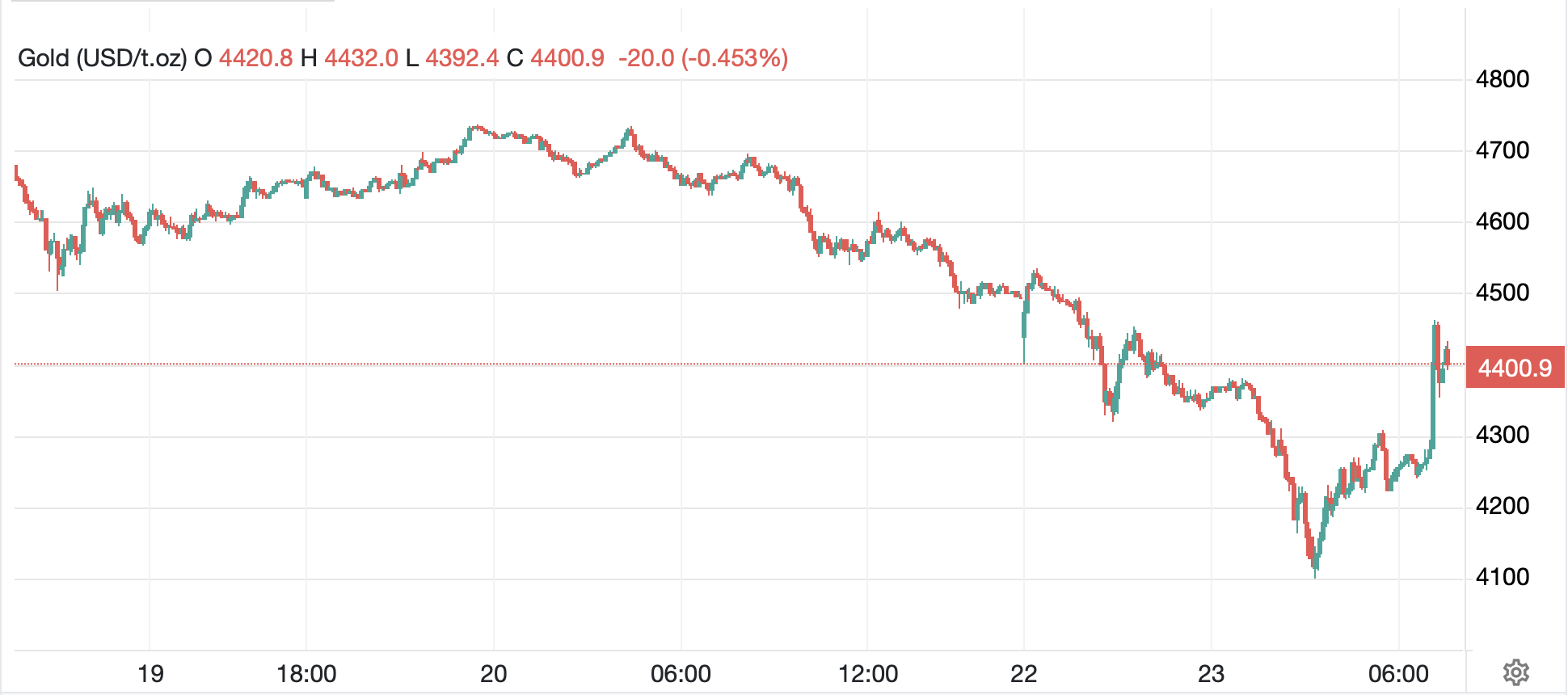
As to the precious metals, gold (+2.1%), silver (+2.7%) and platinum (+3.9%) are all rebounding sharply on the news as is copper (+1.7%).  This simply completes the positive viewpoint that has swept over markets this morning.

On the data front, German Ifo Expectations fell to 86.0, as expected, but it’s not clear that had much impact on anything.  From the US this morning we see only the Current Account (exp -$211B) a number that is never discussed, and then EIA oil inventories with a small crude build expected, although a more sizable draw of gasoline and products.

Governor Miran speaks and will certainly explain why rate cuts are appropriate, but nobody is listening to him right now.  And that’s all we have.  As has been the case for the past three plus weeks, Iran headlines will continue to drive market action with oil the first mover.  Close to the vest remains the best call in my view.

Good luck

Adf

Banish Conceit

The back story of every war
Is nobody knows what’s in store
Especially now
As Trump’s sacred cow
Is changing his message once more

So, yesterday morning, his Tweet
Led many to think a retreat
Was on the horizon
But Trump is surprisin’
With him, one must banish conceit

This morning the story is talks
Twixt both sides are unorthodox
As leaders o’er there
Are fighting since there’s
Nobody in charge, doves nor hawks

Obviously, the Iran situation remains the key driver of all market activity at this point and the stories about negotiations are the lead.  From what I can gather, and there is no definitive source I trust completely, a number of nations including Russia, Egypt, Turkey and Saudi Arabia have been trying to get conversations going.  Of course, the biggest problem is determining who speaks for Iran as the bulk of their previous leadership has been decapitated.  My take is there are different factions, some really hard line apocalyptics who would rather the entire world burn down, especially the US and Israel, than end the hostilities, and there are others who are more pragmatic and want the fighting to end, while perhaps being willing to give up some previous goals, like nuclear weapons ownership.

Everything that I have read about the Iranian leadership structure is that there are many military group leaders who have preset plans if there is no central leadership, and I assume that is why headlines from this morning about ongoing Iranian missile attacks continue.  While I am no military strategist, just a poet, from what I have read, if the USMC does, in fact, take over Kharg Island, it is defensible militarily and would essentially end Iranian funding completely.  Trump’s comments about the US and Iran running the facility together would imply the US can determine how much oil is shipped while Iran earns the proceeds.  In that scenario, it would be possible for the US to starve Iran of the money they need to continue their reign of terror and support for proxy groups.  That could well be a very satisfactory outcome for everybody but the mullahs who continue to seek the destruction of Israel and the US.  It would also reopen the Strait of Hormuz and we would see dramatic reversals in the price of oil and inflation fears.  In fact, I bet rate cuts by central banks would be back on the table immediately!

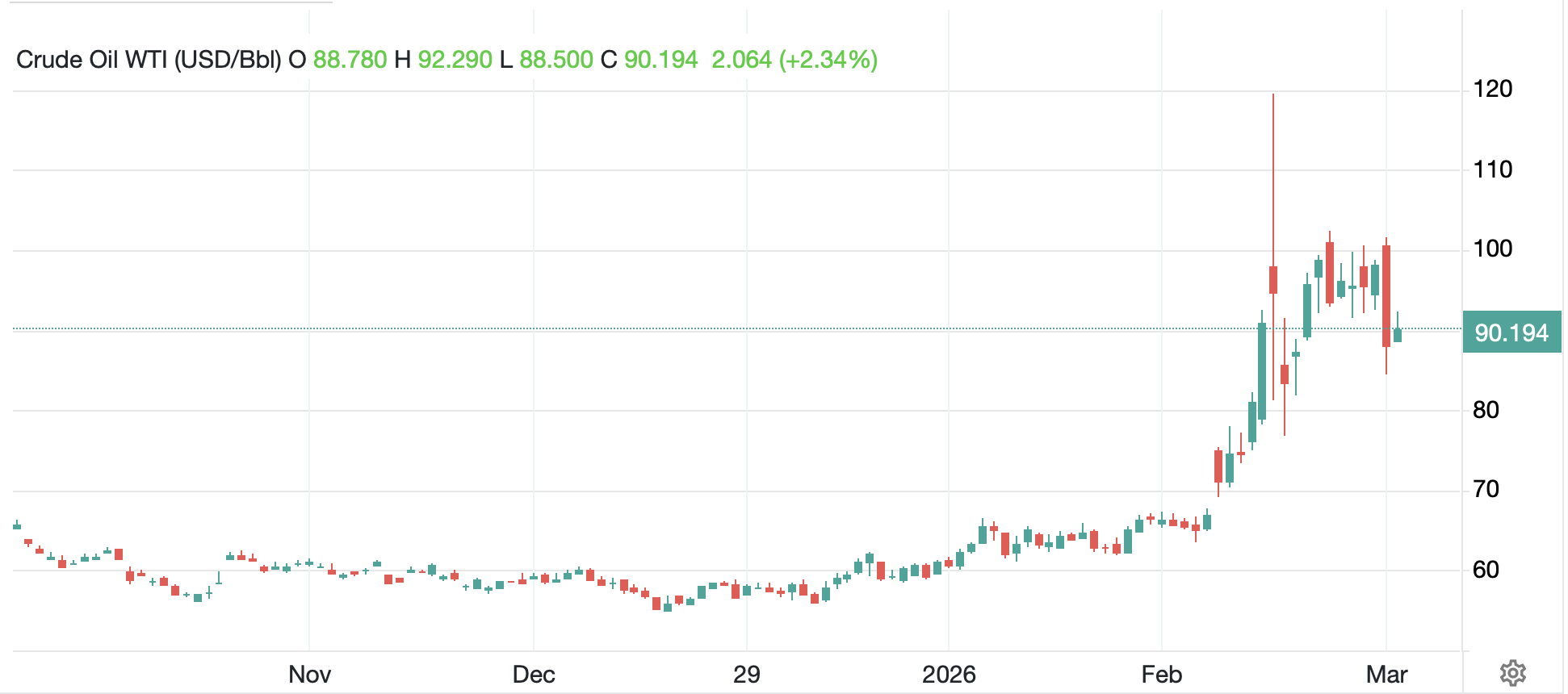
Ok, enough prognostication from someone in the peanut gallery.  Let’s see how markets have responded some 24 hours after Trump’s tweet yesterday morning.  volatility remains the primary feature of every financial market led by oil futures.  As you can see in the chart below of the last week of WTI price action, there has been a nearly $18 trading range, about 20% of movement in that timeline.

Source: tradingeconomics.com

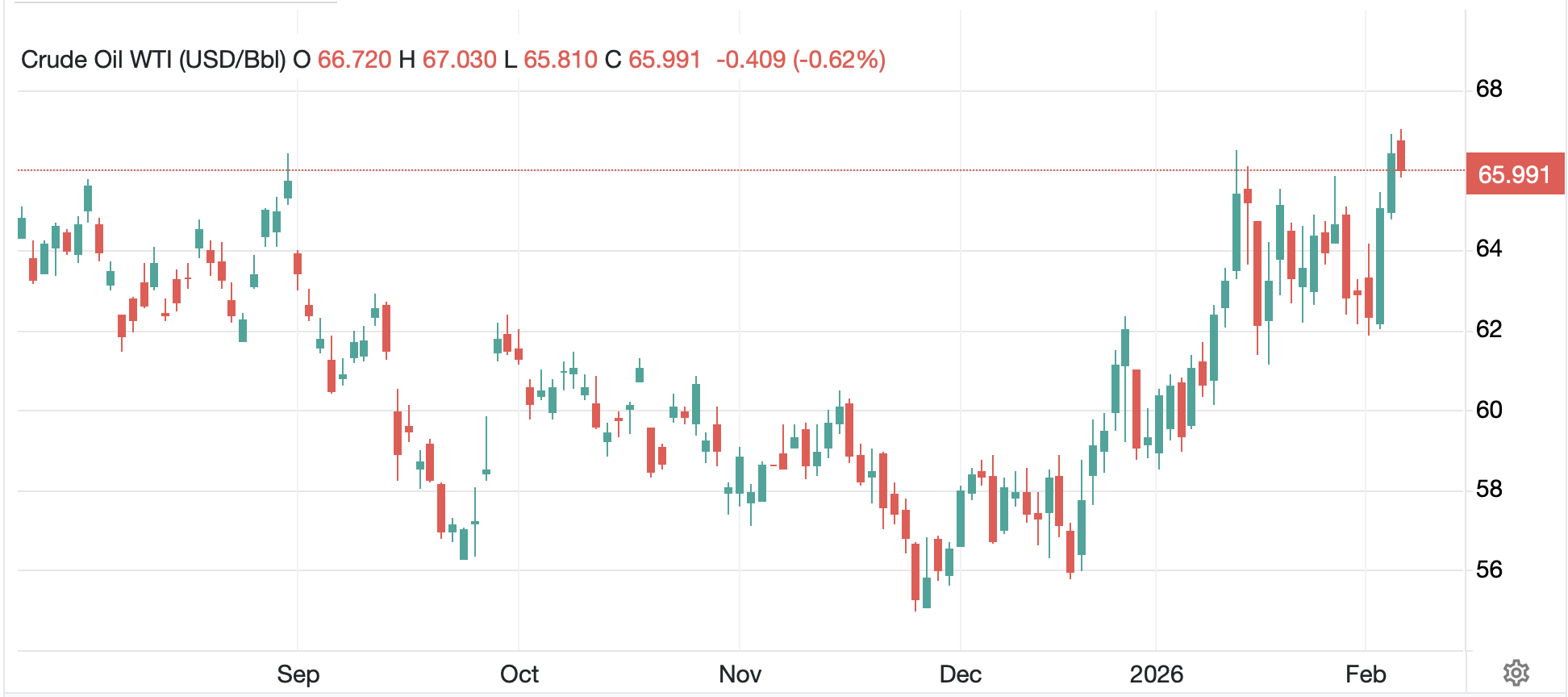
With the black sticky stuff higher by 2.2% this morning, I would argue that there will be no sense of calm in the markets until oil heads back toward its pre-war levels of $60/bbl or so.  If you recall, we discussed the support at $55/bbl in December and questioned what was driving the rise from there.  The daily chart for the past six months below offers a better sense of what I believe the market will find reassuring.  

Source: tradingeconomics.com

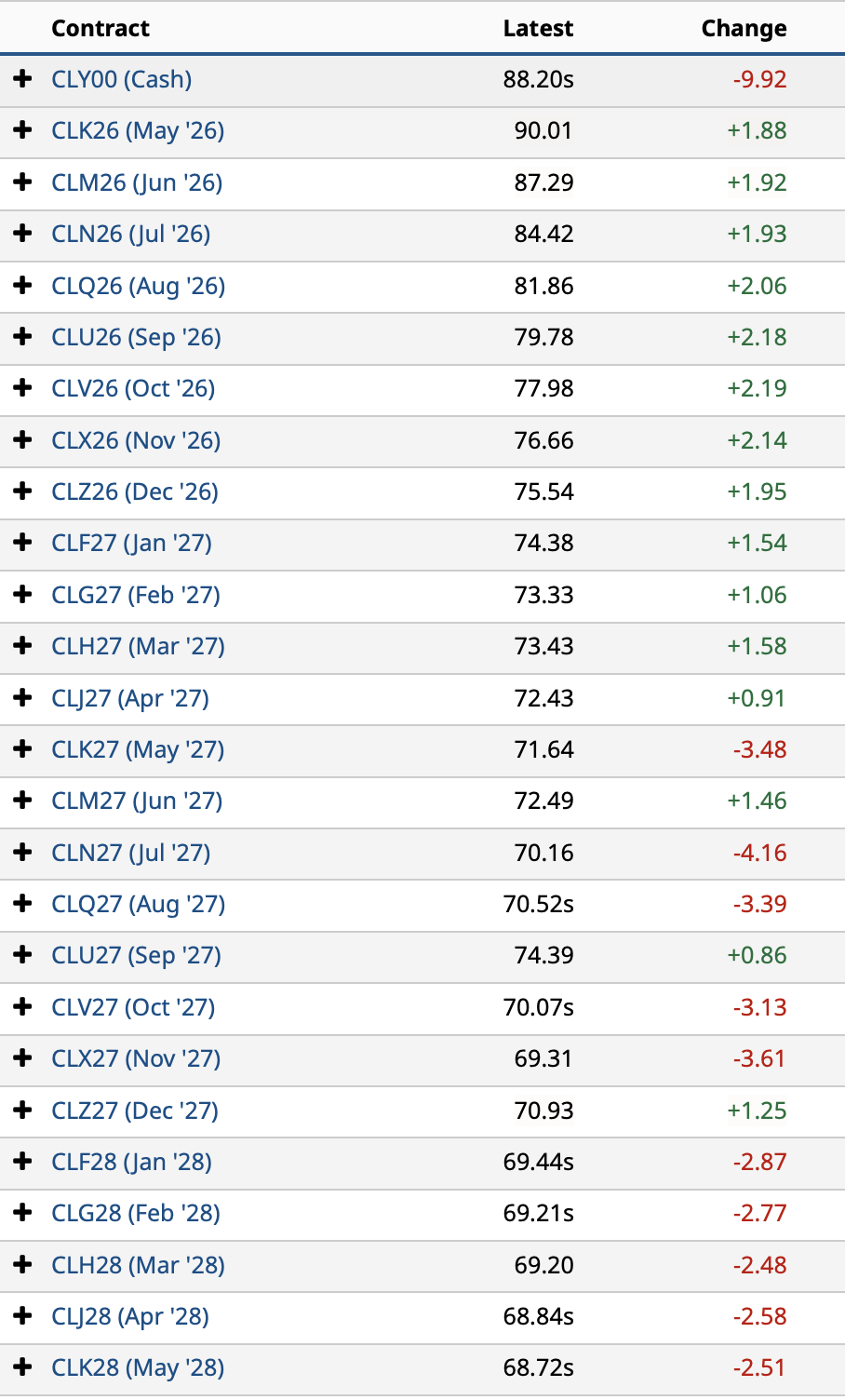
One other thing to remember is that the futures market remains in steep backwardation.  A look at the table below shows that prices for future delivery remain upwards of $20/bbl less than prompt prices.  All the evidence indicates that this war will be over soon.

Source: barchart.com

Sticking with commodities, precious metals have found some support with gold (+0.5%) and silver (+1.1%) both hanging on this morning.  

Turning to equity markets, yesterday’s solid rallies in the US, with all three major indices rising more than 1% was followed by broad strength in Asia (Tokyo +1.4%, HK +2.8%, China +1.3%) with more gainers (Korea, India Australia, Indonesia) than laggards (Taiwan, Malaysia, New Zealand) elsewhere in the region.  Two newsworthy items here were that Australia and the EU have signed a free trade agreement reducing tariffs between the two substantially, while RBNZ governor Breman talked about hiking interest rates if inflation picks up because of oil’s rise.  (As an aside, that would be a catastrophic error for the nation if she did it.)

Meanwhile, in Europe, it is a far less exciting session as they were able to respond to the Trump tweet during yesterday’s trading.  So, this morning, the DAX (-0.35%) is the laggard while the rest of the continent is +/-0.2% or less on the day.  This morning’s Flash PMI releases were broadly negative in tone as while Manufacturing readings were a touch better than expected Services in Germany, France, the UK and the EU overall, all showed substantial weakness.  I guess the prospect of another energy crisis in Europe is taking its toll.  As to US futures, at this hour (7:00) they are basically unchanged.

In the bond market, after a reversal yesterday, where Treasury yields slipped nearly -5bps, this morning they have backed up 3bps.  Bond investors remain caught between the idea that inflation is going to be a problem because of higher energy prices and the idea that the economy is going to slip into a recession because of higher energy prices.  Remember, too, there is an underlying dynamic where many analysts believe the US is going to hit a financing wall and yields are going to explode much higher.  But that story has been with us for quite a while, so I don’t put great stock in it for now.  

European sovereign yields also slipped yesterday and this morning they are little changed to slightly higher, with both France and Italy (+2bps) the worst performers and all other continental bonds, along with Gilts, essentially unchanged.  As to JGBs, last night yields slipped -5bps on both the prospects of the war ending and lower oil prices as well as a better-than-expected inflation reading where headline fell to 1.3% and core to 1.6%, down from 2% in January and a tick below expectations.

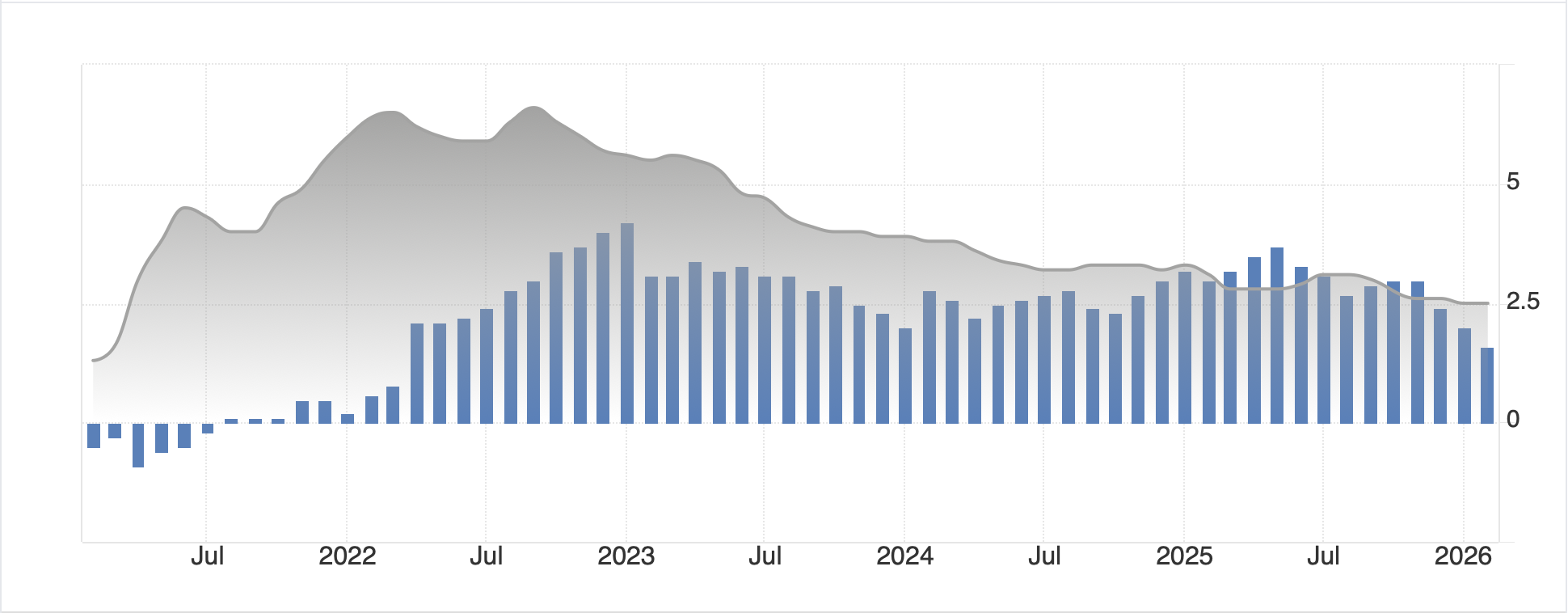
A funny thing about Japanese inflation is that if I look at a chart over the past 5 years, it is not hard to make the case that the BOJ has things moving in the right direction, and of course a reading of 1.6% is below their target.  In fact, if you look at the chart below comparing Japanese (blue bars) and US (gray space) core inflation, I expect Chairman Powell would give anything to have the Japanese chart!

Source: tradingeconomics.com

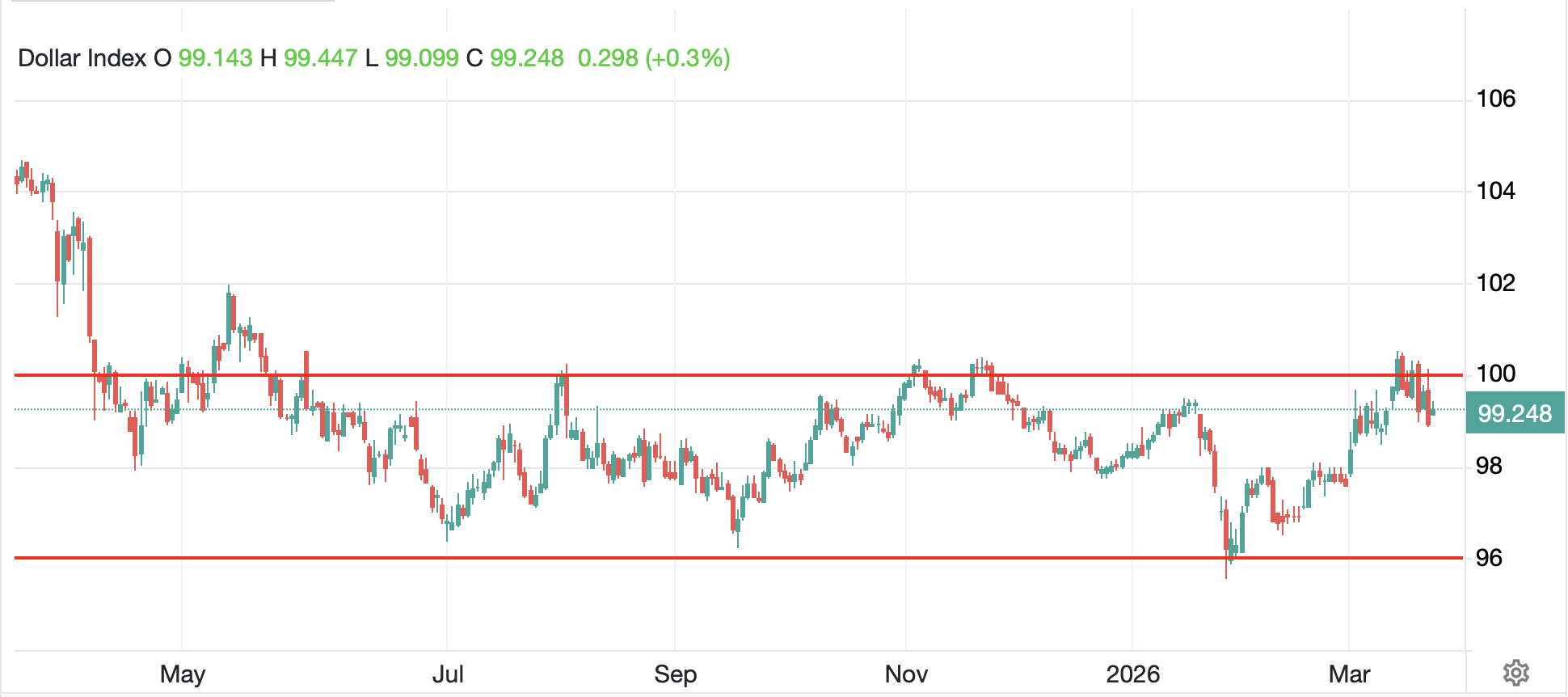
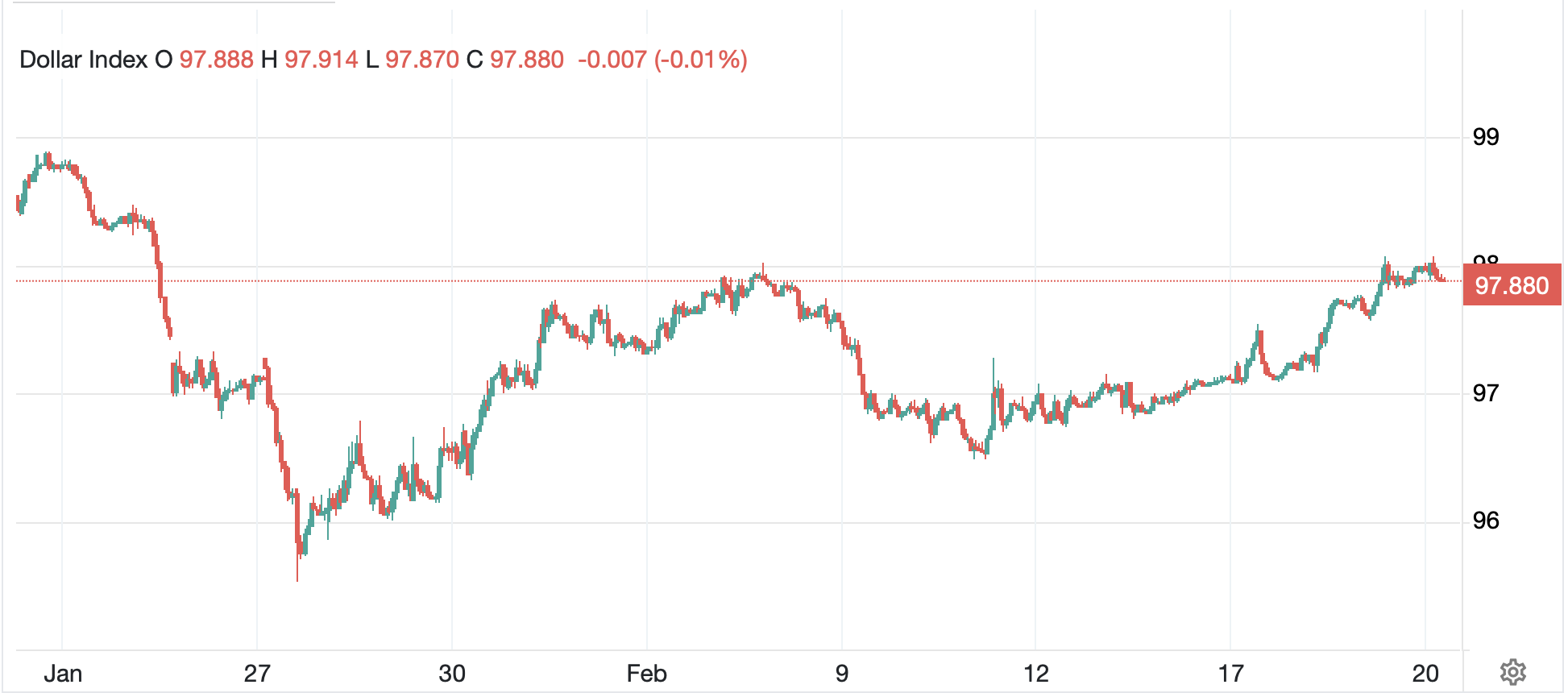
Finally, the dollar, while firmer this morning (DXY +0.3%) has traded right back into its long-term trading range of 96/100.  Again, I cannot look at the chart below and conclude that the dollar is going anywhere anytime soon.  If skyrocketing oil prices and a war in Iran cannot get a real breakout, I think we will have to go back to interest rate differentials as the driver!

Source: tradingeconomics.com

As to specific currencies, ZAR (-1.35%) is the day’s laggard as the recent sharp decline in both gold and platinum weigh on the nation’s accounts, as well as their status as a major energy importer.  We’ve also seen weakness in PLN (-0.5%), HUF (-0.6%), INR (-0.5%) and, interestingly, AUD (-0.5%) despite the latter’s deal with the EU.  I think ongoing high energy prices remain the issue here.  For the majors, -0.2% is the order of the day for the euro, pound, yen and Swiss franc.

On the data front, there’s not a ton of data this week.

TodayNonfarm Productivity Q42.0%
 Unit Labor Costs Q43.5%
 Flash Manufacturing PMI51.3
 Flash Services PMI51.5
ThursdayInitial Claims210K
 Continuing Claims1860K
FridayMichigan Sentiment53.8
 Michigan Inflation Expected3.2%

Source: tradingeconomics.com

In addition to the modest data releases, we hear from 5 Fed speakers over 7 venues this week, but it is very hard for me to believe that anything they say will matter while the war hogs the headlines.

Prognostication is silly here as headlines drive everything.  My sense is playing it close to the vest remains the best strategy.  But remember this, despite all the pearl clutching and teeth gnashing, the S&P 500 is just 6% from its high print back in January.  This has not even achieved what is typically considered a correction.  The lesson here is that history shows we can decline much further, but also that there is a lot of resilience in the market right now, hence, close to the vest.

Good luck

Adf

Wound-Licking

The clock to the deadline is ticking
And right now, most traders are kicking
All risk to the curb
But they won’t disturb
The hodlers who spend time wound-licking

The market focus right now is on the deadline that President Trump has imposed for Iran to reopen the Strait of Hormuz, which is at 7:45pm EDT this evening.  I have read several takes on the likely impact of a destruction of Iran’s power grid, all explaining the consequences would be calamitous for the nation and its people.  Within a week or two, the humanitarian crisis would be unprecedented.  And that is only on the Iranian side.  Almost certainly the Iranians would retaliate and seek to destroy as much Gulf and Israeli infrastructure as possible to inflict the same pain there.  Ultimately, I cannot believe anybody really wants to see this happen.  Alas, it is out of all of our hands.

We remain extremely fortunate that we live thousands of miles from the action and although there will be economic consequences, those are easier to adapt to then the destruction of your home and nation.  Beyond that, I have nothing to offer regarding the situation there and since I discussed the end of last week in my note last evening, let’s see how things are going this morning (spoiler alert, it ain’t pretty!)

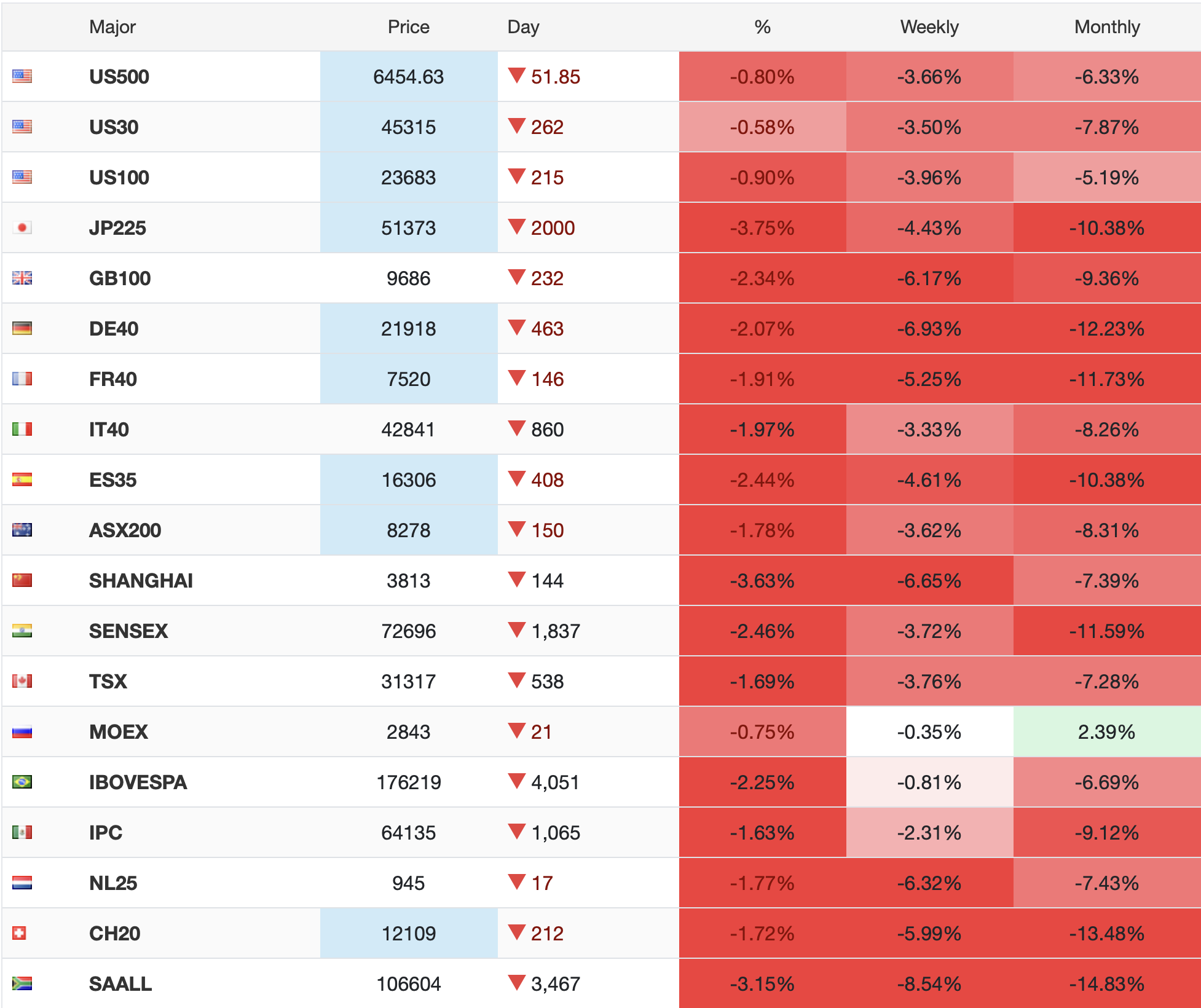
As has been the case for the past several weeks, screens everywhere are red this morning and it is easier to show a screenshot than list them all here.

Source: tradingeconomics.com

This picture was taken of futures markets at 6:55 this morning but you can see that Asian markets and European markets are all meaningfully lower.  As has been the case since the beginning of the conflict, the rise in oil prices and its knock-on effects have been the driver.  It appears that there are two broad groups of investors right now, the leveraged ones who are being forced out of positions rapidly as every decline brings further margin calls, and the cash investors who are trying to stick it out, at least in the areas they feel will rebound.  But the pain is real, at least on a mark-to-market basis, if one is marking to market every day.

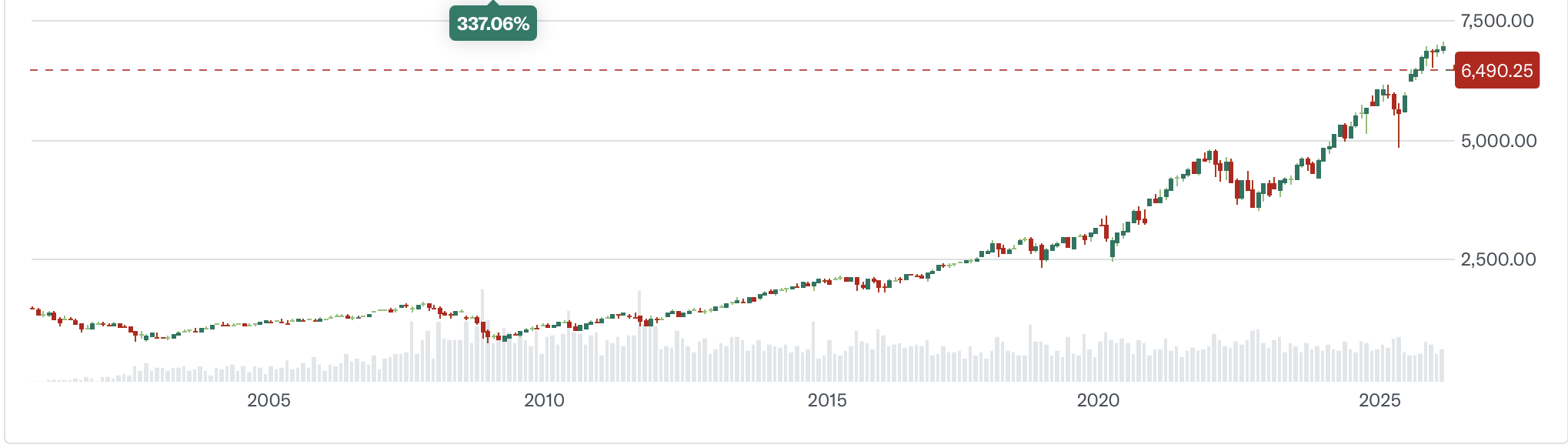
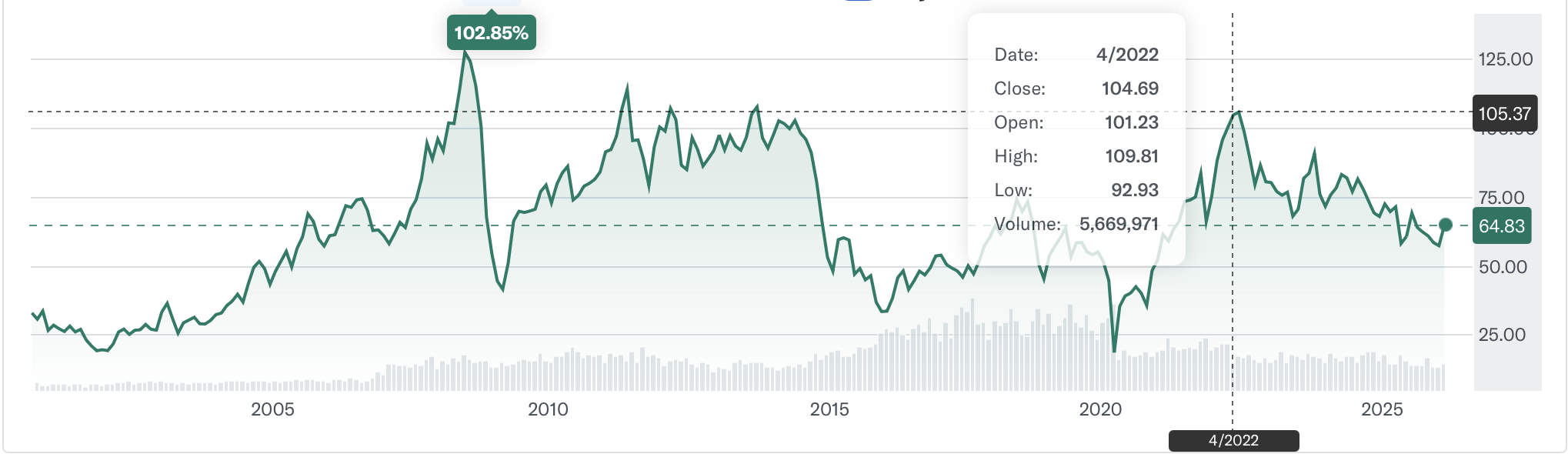
History has shown that declines of this nature tend to offer tremendous buying opportunities for those who have the means to do so.  Consider the chart below showing the S&P 500 from the year 2000 on.  

Source: finance.yahoo.com

It is easy to see the sharp decline from the GFC, as well as the Covid dip and then 2022, which was a particularly difficult year for both stocks and bonds.  But the direction of travel remains up and to the right and this dip will almost certainly be followed by significant gains going forward.  Of course, the timing of those gains remains uncertain, but absent a complete collapse of the economy, this seems the most likely outcome.  That doesn’t, however, mean it will be a painless trip.

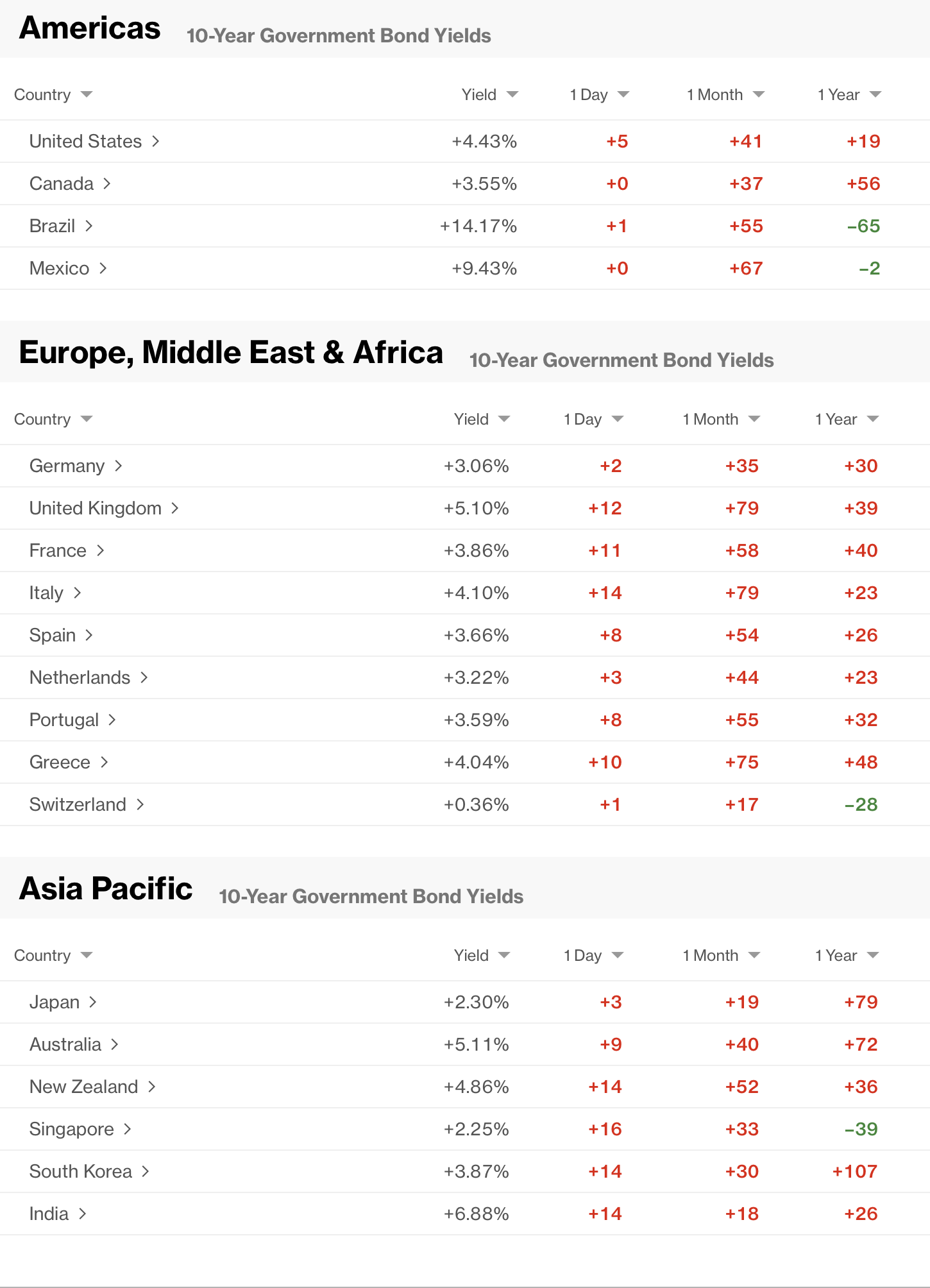
Turning to bonds, yields everywhere are higher as inflation fears remain the feature topic throughout the world.  Here, too, a Bloomberg screenshot does all the work for me.  

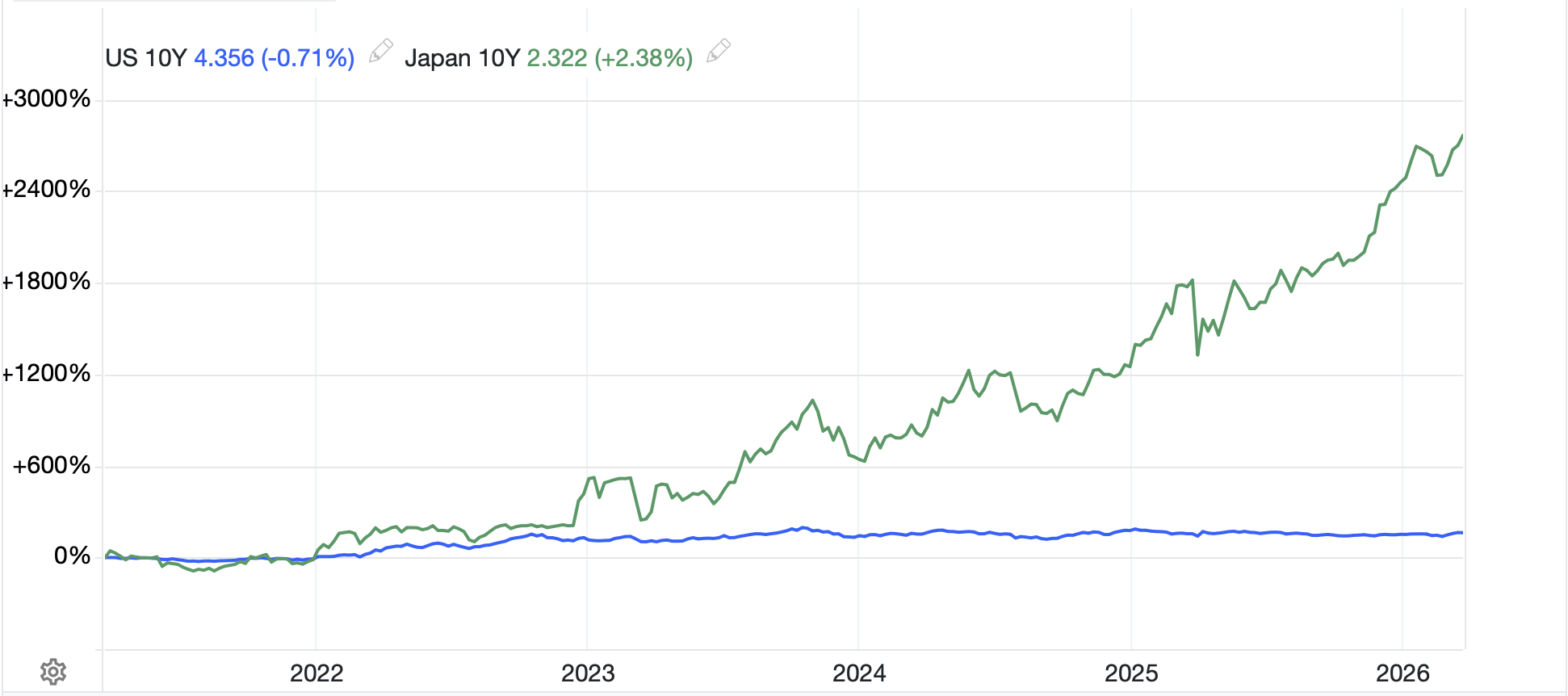
However, I think it is worth stepping back and looking at how bonds have behaved over the past five years.  the chart below shows the percentage change in 10-year bond yields in the US and Japan since early 2021.  While I am using Treasuries, despite the rise in yields everywhere in Europe, the charts there would be similar.

Source: tradingeconomics.com

My point is that while there is great angst daily regarding each basis point of movement in yields, US yields have been pretty stable for a long time.  Of course, we all know the story of JGB yields, which had been stable at extremely low levels for a decade, and have now moved much higher.  The thing is JGB yields moved much higher long before the Iran events, so while at the margin, that is having an impact, there was a strong trend already.

Once again, I believe perspective on markets is important as unless you are a professional trader, the day-to-day can drive you crazy and there is little you can do to change it.  Long-term investors need to understand that reality.

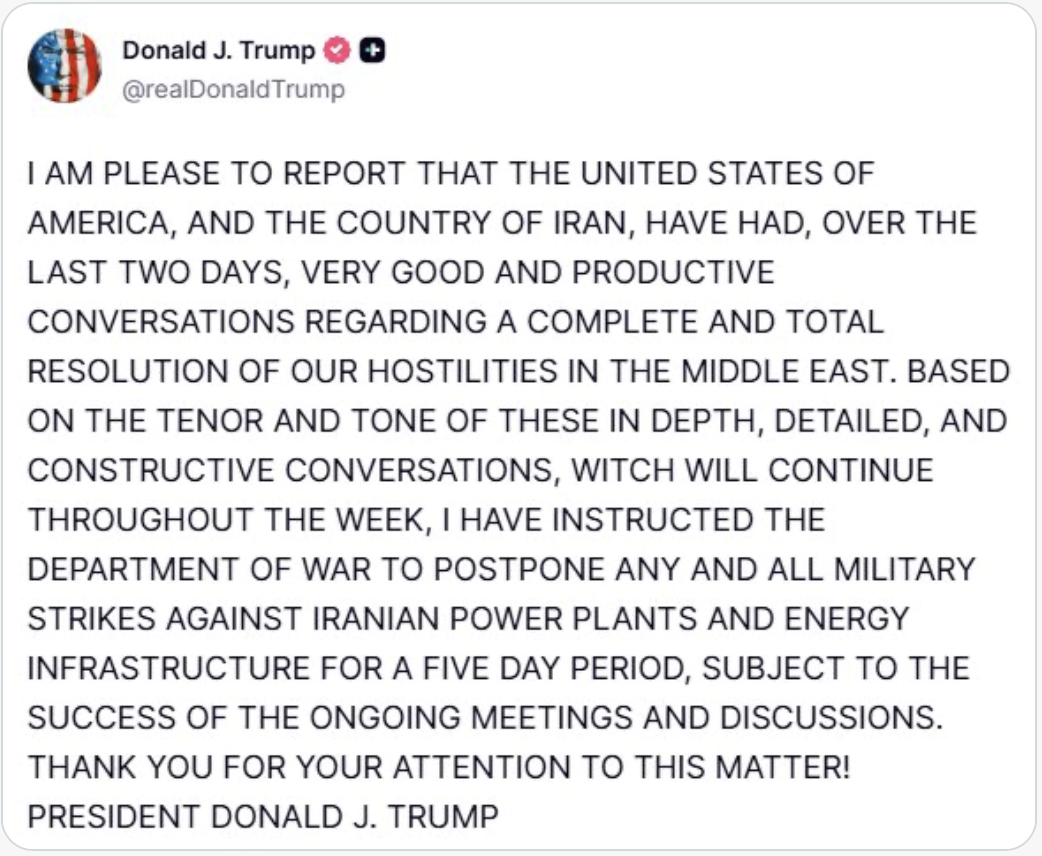
Turning to commodities, I have to wait as things have changed dramatically based on the following post by President Trump.

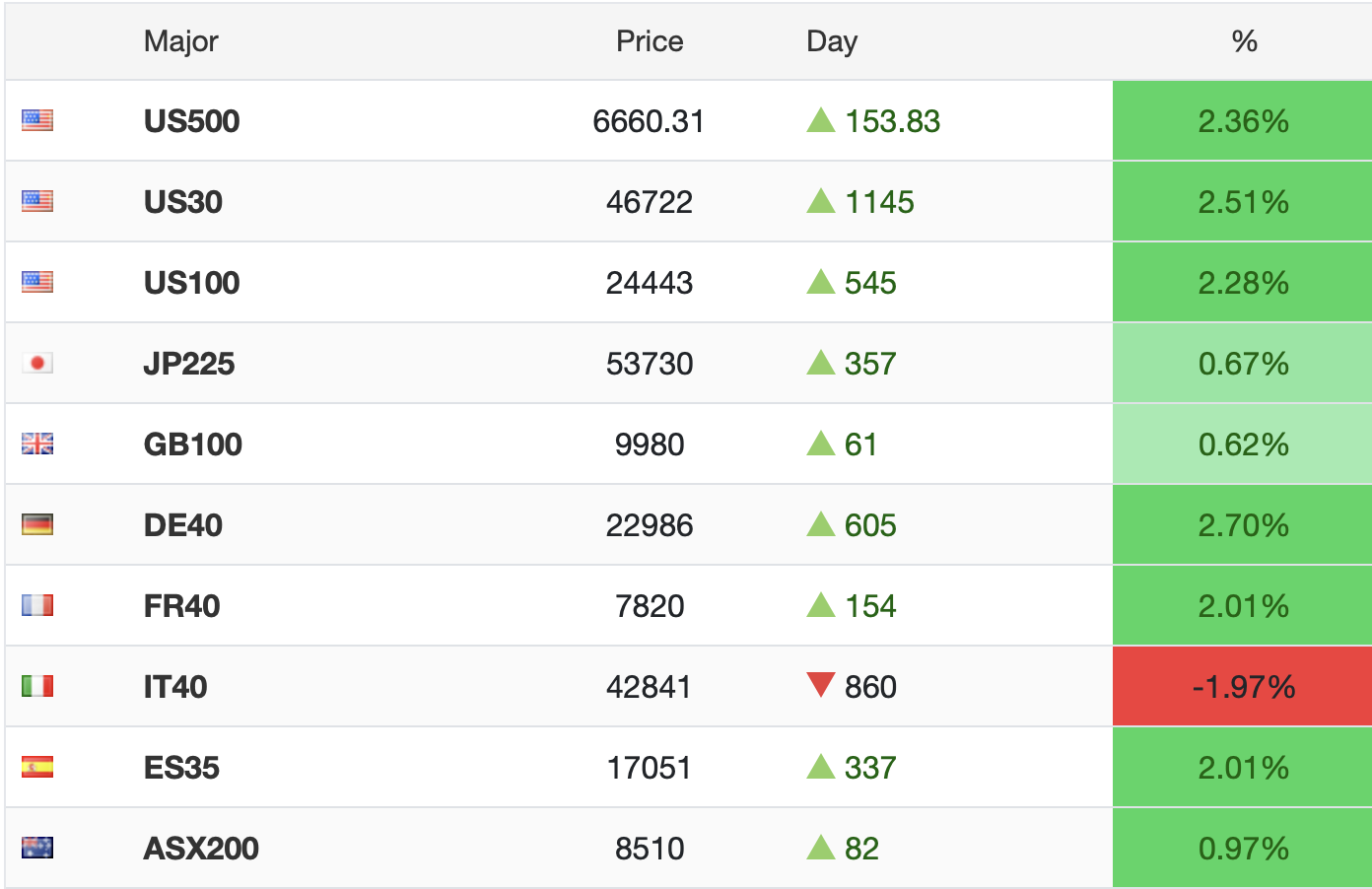
You will not be surprised that the worst-case declines in both stocks and bonds have reversed as per the below screen shot taken at 7:34

Source: tradingeconomics.com

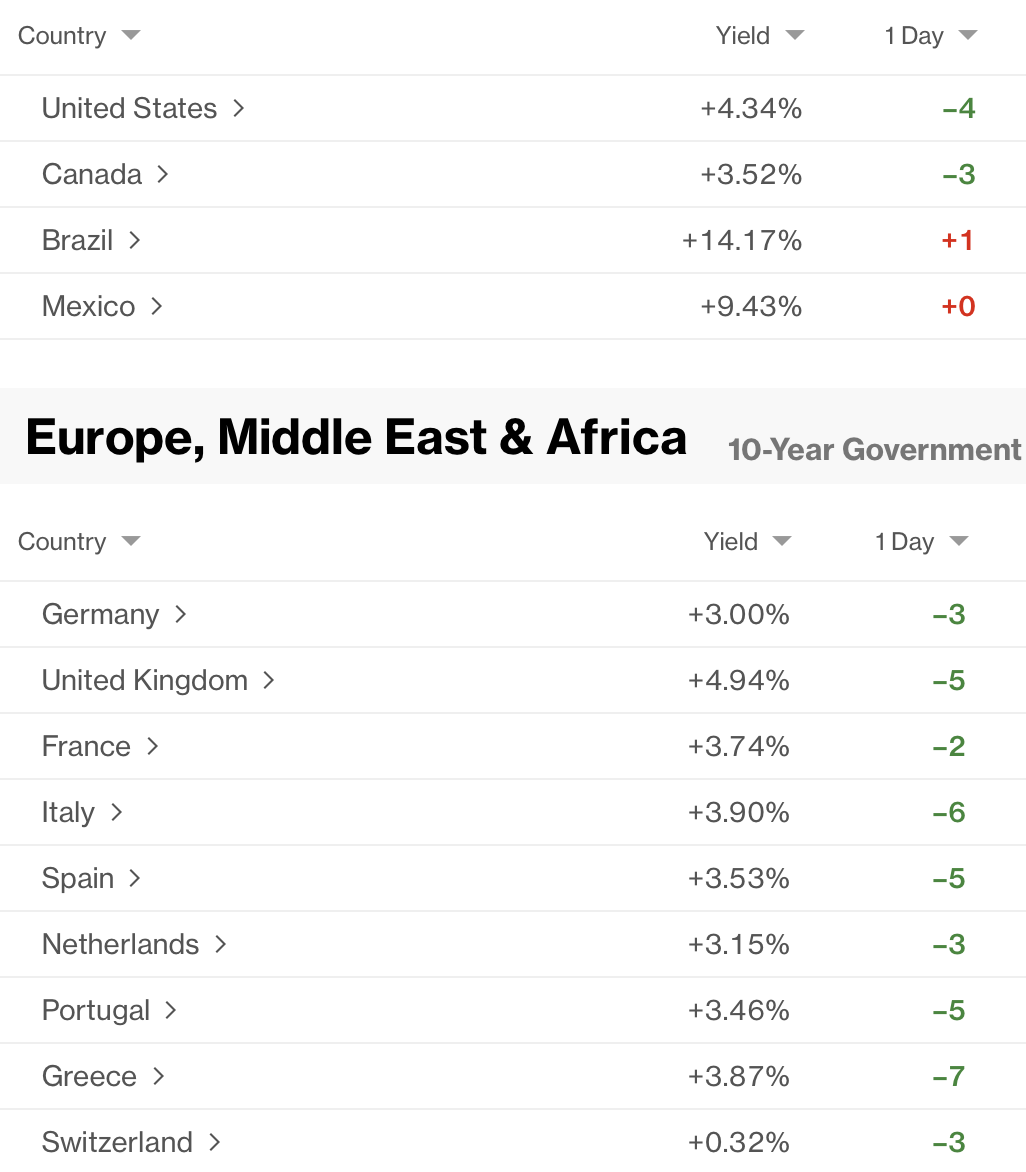
And bonds from Bloomberg:

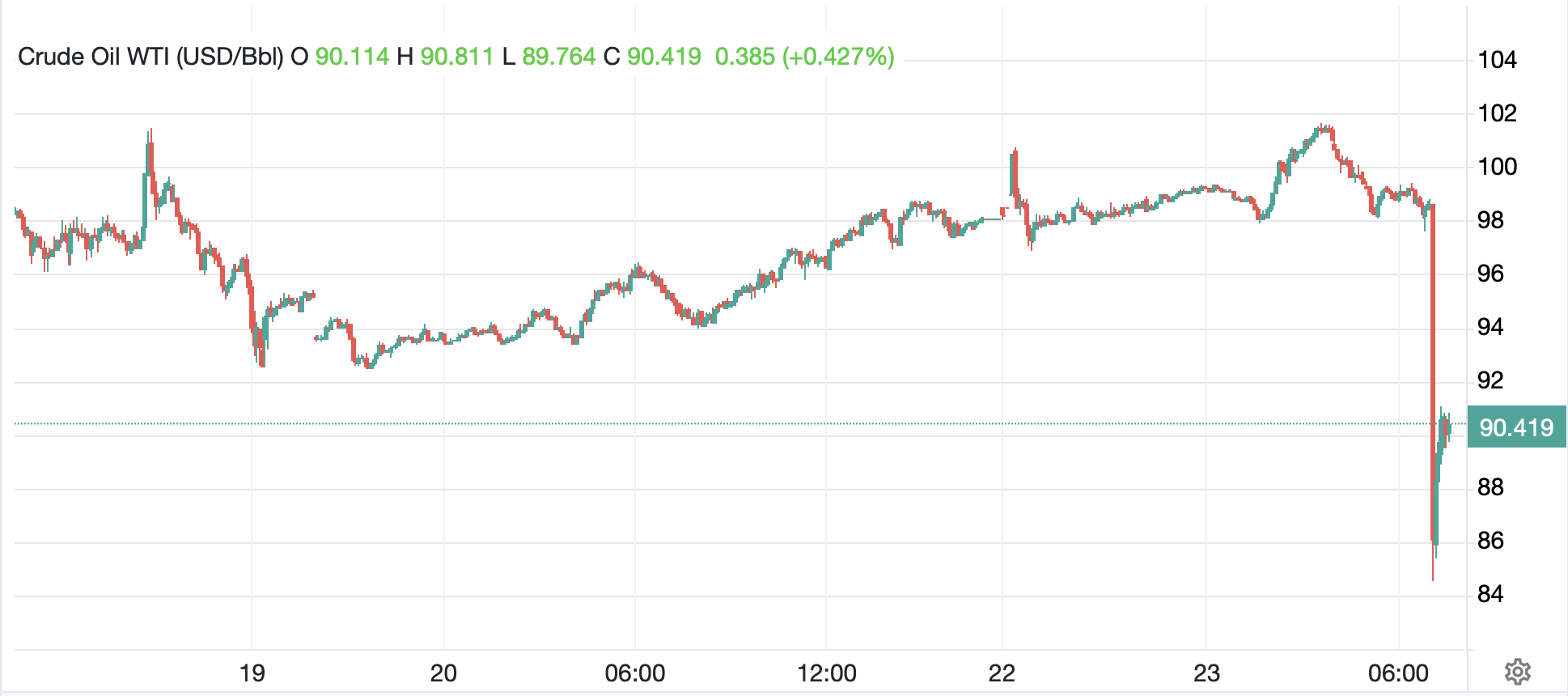
Back to commodities, below is oil’s response to the Truth Social post, falling sharply from relatively unchanged prior to the comments.

Source: tradingeconomics.com

And while gold is still lower on the day, you can see how much it, too, has adjusted based on the post.

Source: tradingeconomics.com

You won’t be surprised that the dollar, which had been much stronger earlier this morning has reversed course and is slightly lower now.

It is extremely difficult to keep up sometimes and I apologize for the numerous charts, but they truly are worth thousands of words in this situation.

I would talk about data, but I cannot believe that will really matter right now.  The growing consensus was that central banks around the world were preparing to tighten policy as oil driven inflation was going to need to be addressed, even if history showed this to be a categorical error.   And the first inkling from the Fed funds futures markets is that the probability of a rate hike is being reduced somewhat compared to the end of last week.

Frankly, nobody knows how things are going to evolve from here.  Many will say that Trump TACO’d but it is not hard to believe that whatever Iranian leadership remains has looked around and decided they couldn’t take it anymore either.  

As I have maintained for a while, play it close to the vest for now, but I expect that there are many value opportunities around, just in tiny bites.

Said Trump, we have had some good talks
And so, we will set back the clocks
On when we attack
Iran’s power stack
As doves take the lead, not the hawks.

Good luck
Adf
A Bad Dream

While yesterday’s moves were extreme
It seems like t’was all a bad dream
This morning there’s calm
And nary a qualm
Though things may not be what they seem

For now, oil’s price has retreated
And stocks, a round trip, have completed
As Trump has implied
Though not verified
Iran soon will have been defeated

One must be impressed with the price action yesterday, if nothing else.  It is a very rare occasion when the price of anything in a public market behaves like we saw oil behave yesterday.  From Friday’s closing price in the futures market of $90.71/bbl, we saw a $28.70 (31.6%) rally and a subsequent $34.35 (37.9%) decline in the first 24 hours of trading.

Source: tradingeconomics.com

With oil back to Friday morning’s, still elevated, prices, it’s almost as if nothing happened yesterday.  The two stories that appear to have driven the remarkable reversal early Monday morning were first, the discussion about the G7 potentially coordinating a release of strategic reserves, with that meeting slated for this morning.  The other catalyst apparently was a comment from President Trump that, having made significant progress on their objectives, the war could be over “very soon”.  Obviously, that would be a great outcome for all involved, although it remains to be seen if that will be the case.  

The upshot is that while oil saw the most dramatic price movement across markets, prices everywhere synchronized such that those that had declined (stocks, bonds and metals) rebounded, while the dollar, which rose, retreated.  And that’s where we are this morning.

As I read across news sources, there remains no agreement on any aspect of the ongoing war with each side of the argument maintaining their views.  There is a contingent that insists Iran is about to start a major retaliatory campaign that will devastate Israel and Gulf neighbors and a side that insists Iran’s military infrastructure has been so compromised they have nothing left but drones to fire.  As I’m not on the ground (thankfully) nor in any situation room on any side, I am completely in the dark like essentially all of us.  In fact, arguably, market price action is one of the best indicators we have, because institutions don’t invest on hope, but on the best information they have.  This tells me that the worst-case scenario has been priced out for now, meaning a prolonged conflict, but frankly, neither I nor anyone else really knows.

So, let us embrace our ignorance on the issue and simply observe market behavior to see what we can glean.  Starting with equity markets, the below chart shows the S&P 500 futures from Sunday night’s opening through this morning.  While the opening is obvious on the left, the huge green bar on the right at 3:15pm is the other major feature.

Source: tradingeconomics.com

The interesting thing to me is that Trump’s comment about the war ending soon were not made until 5:45pm.  This tells me that there was a major buy order that went through the market shortly before the close, a feature that we have seen more frequently of late.  My point is there is still much more to the markets than just the Iran conflict.  In fact, the cynical view is that the algorithms continue to control things completely and that there is a major effort to prevent a significant decline in equity markets overall, at least US equity markets.  That’s a little conspiratorial, but one cannot ignore the evidence.

At any rate, after positive closes in the US yesterday on the order of +1.0%, we saw gains across the board in both Asia (Japan +2.9%, HK +2.2%, China +1.3%, Korea +5.4%, Taiwan +2.1%,  India +0.8%, Australia +1.1%) as only New Zealand lagged, essentially unchanged on the day, amid concerns of rising inflation and a tighter RBNZ going forward.  Europe, too, is enjoying the session with strong gains across the board reversing yesterday’s declines as Spain (+2.9%) leads the way, but there is strength everywhere (Germany +2.4%, France +1.9%, UK +1.6%).  At this hour (7:10), US futures are also pointing higher, but just by 0.2% or so across the board.

Bonds also reversed yesterday, albeit not quite as dramatically.  So, in a picture remarkably similar to both oil and stocks, the yield on the 10-year gapped higher Sunday night and fell sharply enough to close lower yesterday as per the below chart.

Source: tradingeconomics.com 

Much of that retracement came after Europe closed, though, and so while this morning, 10-year Treasury yields have edged back up by 2bps, European sovereign yields are lower across the board with Italian BTPs (-6bps) leading the continent although UK Gilts (-7bps) have rallied further.  Other nations have seen a mix between -4bps and -5bps although Germany (unchanged) seems to be suffering on a relative basis after its Trade Surplus grew to €21.2B on the back of a substantial decline in imports.  Throughout all this, JGB yields (-1bp) have been the least impacted and show no signs of running away at this point despite much doomsaying for the nation.

Metals markets have reversed their decline from yesterday and are higher across the board (Au +0.9%, Ag +1.6%, Cu +1.0%, Pt +1.9%).  This is all part of the same story with price action virtually identical, although again, not quite as dramatic, as that of oil.

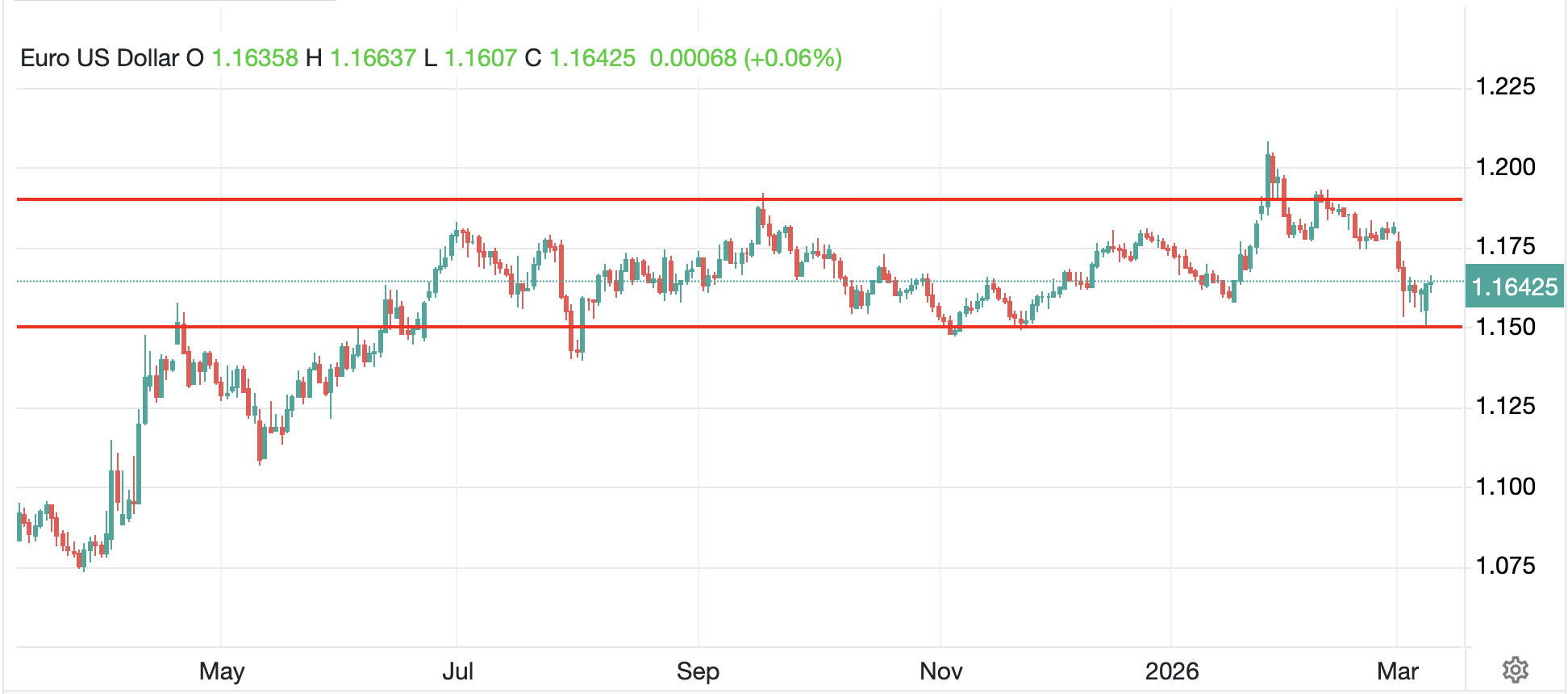
Finally, the dollar, which had significant support yesterday is giving back some of those gains as well.  But let’s face it, if we take a look at the dollar over the past year vs. the euro, it has largely traded withing a 1.1500 / 1.1900 range and doesn’t appear to be making a break in either direction.  

Source: tradingeconomics.com

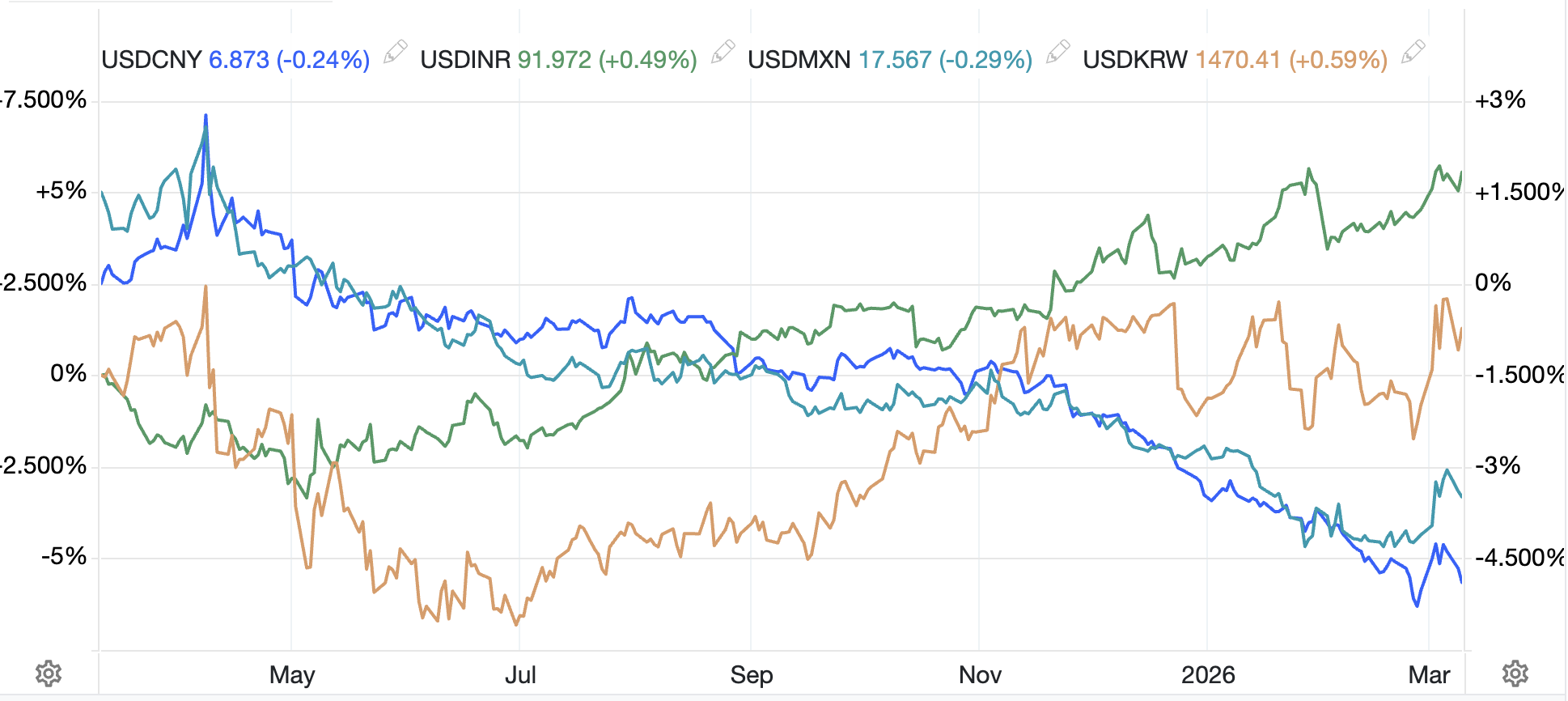
The very messy chart below shows four key EMG currencies to demonstrate that there is no trend there either.  While CNY and MXN have both strengthened during the year, INR and KRW have both fallen.  All I’m saying is that the idea that the dollar is either collapsing or exploding higher is simply not true.  Different currencies have different drivers, and while sometimes there is a key dollar issue that impacts virtually everything, many times, you need to watch the currency in question.

Source: tradingeconomics.com

Turning to the data, this morning we just saw NFIB Business Optimism print a bit soft at 98.8, exp 99.7, and we are awaiting Existing Home Sales (exp 3.89M).  Tomorrow’s CPI will garner more attention, I think.  Too, the Fed is in their quiet period as they meet next Wednesday, so even though they have been drowned out by events lately, the FOMC meeting will still get a lot of attention.

But that is where we stand.  As has been the case since President Trump’s election, White House bingo remains the biggest risk to markets since one never knows what may come out.  The backdrop of the war continues to be front of mind for all market participants, so new stories will have market impacts.  With that in mind, short term forecasts are even more of a waste of time than they usually are.  The questions I am pondering are about the long-term implications when the military activity ends.  Certainly, any result where Iran gives up its terrorist interests would not only be welcome on the global stage but would open the door for much more oil flow around the world and lower prices across the board.  Of course, a more entrenched Iranian regime would likely see even stricter sanctions there with the need for other sources to help satisfy global demand.  I guess we shall see.

Good luck

Adf
Impacts of War

The financial impacts of war
Are many, and so here are four
Inflation will rise
And what this implies
Investors, most bonds, will abhor

The dollar is like to remain
Demanded and that will cause pain
For stocks everywhere
But one thing will fare
Just fine, look for gold, more, to gain

Obviously, the war in Iran remains the top story and is likely to remain so for a few more weeks at least.  Arguably, the only way this will change is either a regime change takes place and talks for peace begin, or Iran is able to retaliate in a heretofore unknown fashion sufficient to force the US and Israel to withdraw.  President Trump has indicated he believes this campaign will last 4-5 weeks with that regime change the result.  But remember, the Russia/Ukraine war slipped from the headlines after 6-8 weeks, and it is still ongoing.  In fact, I challenge you to find a story about that war anywhere these days.

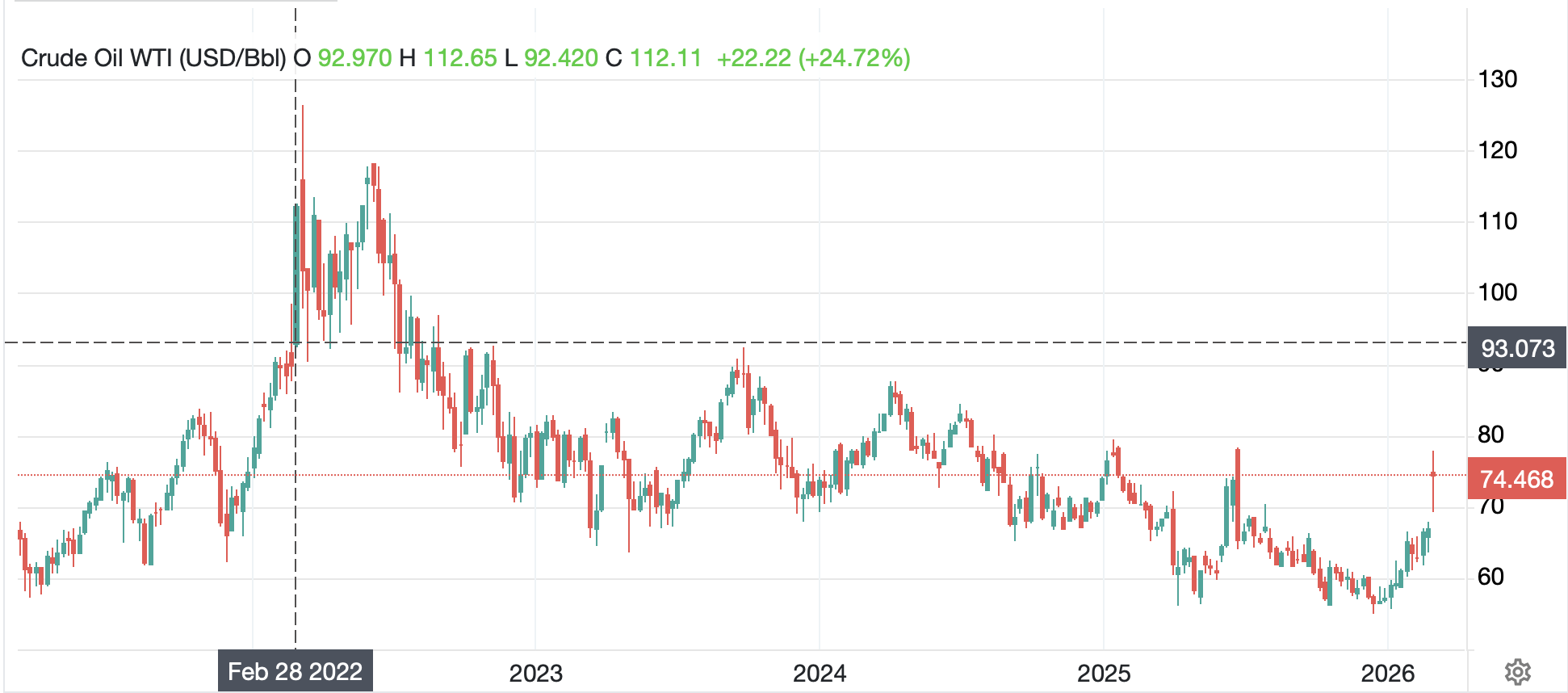
My point is, despite the ongoing hostilities, the rest of the world continues on its way, albeit with some new bumps in the road.  Clearly, the biggest bump remains the price of oil and, for much of Europe and Asia, its continued availability.  While the price of oil (+0.1% today) has risen about 18% in the past month, a look at the long-term chart below offers a bit more perspective as to just how limited this movement has been so far.

Source: tradingeconomics.com

I have highlighted the week of the Russian invasion from February 2022, which saw oil rise more than 20% at the time and remain elevated for about 5 months before it retraced to prewar levels.  The reaction this time has not been nearly as dramatic even though the effective closure of the Strait of Hormuz has removed about 20% of global oil supply from the market right now, as well as a similar proportion of LNG.  This is why we have seen the massive spike in European and Asian LNG prices as that was the destination of those cargoes.  Ironically, one of the most negatively impacted nations is China, which was Iran’s biggest oil customer, but now has seen a dramatic decline in the availability of oil. Of course, they have built a significant stockpile, their own SPR, which holds between 1.2 -1.5 billion barrels, enough to supply the nation for upwards of 4 months.  While not an immediate concern, it will start to hurt after a while if this continues.

It appears to me that unless Iran starts targeting and destroying oil production facilities throughout the Middle East, which is certainly possible, the upside for prices from here is limited under current circumstances.  My guess, and it is just that, is another 10%.  Of course, the risk for Iran there is that it draws the Saudis, Emiratis and the rest of the Gulf into the war against Iran, probably not a desired outcome either.  

As an aside, I wonder if prices rise far enough in a worst-case scenario, if the UK removes its drilling restrictions, although thus far, PM Starmer has not indicated anything of the sort.  It depends on just how painful things become I suppose.

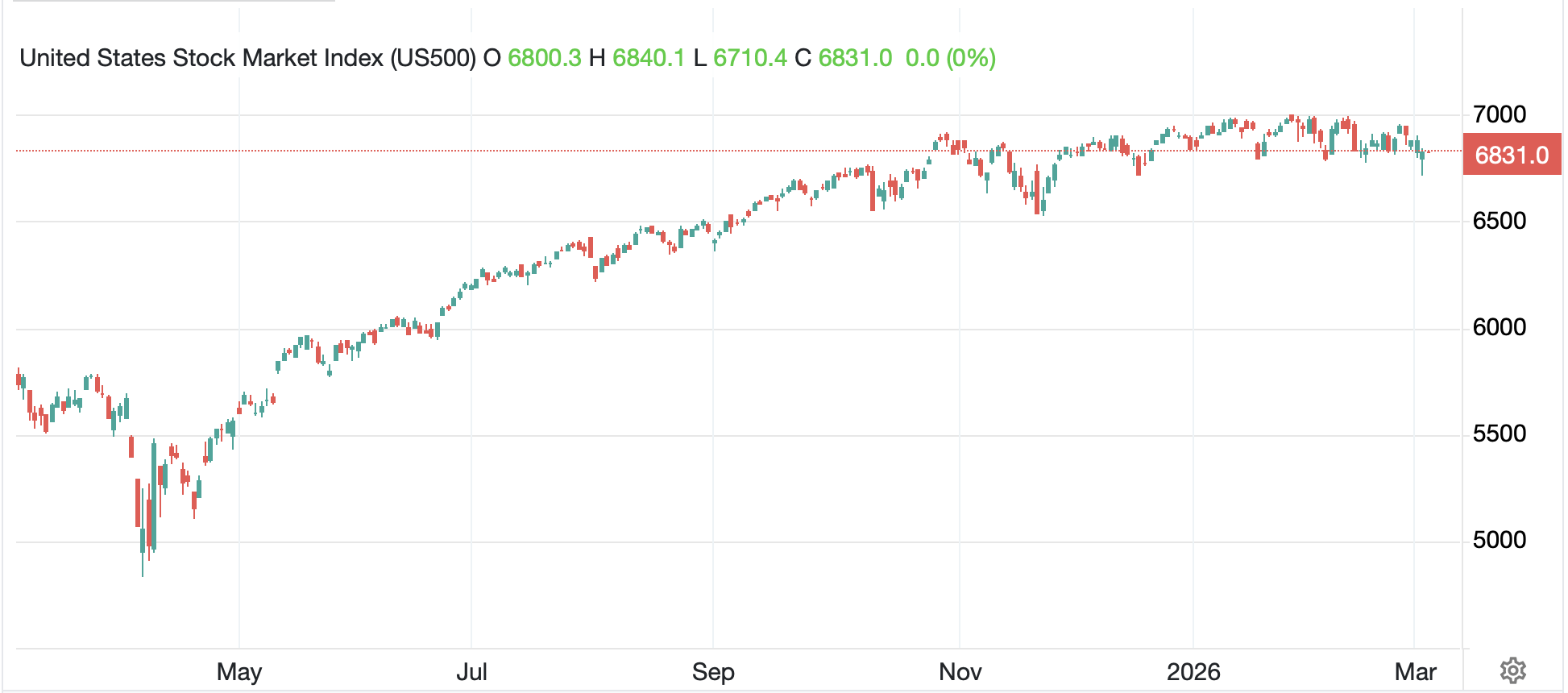
Moving on to the equity markets, while US markets have declined somewhat since the war began, the S&P 500 remains just 2.5% below its all-time high set February 28, and as you can see from the chart below, does not appear to be altering the recent trajectory in any meaningful fashion.

Source: tradingeconomics.com

However, the same cannot be said for several other markets, notably those in Asia.  The Kospi (-12.1%) is the worst offender as seen below.  But weakness in the region was widespread with the Nikkei (-3.6%), Hang Seng (-2.0%), Taiex (-4.3%) and Thailand’s SET 50 (-5.4%) leading the way lower with most other bourses falling on the order of -1.0% to -2.0%.  This makes sense as virtually all these nations rely on energy from the Middle East, and with both higher prices and reduced supply, trouble is afoot.

Source: finance.yahoo.com

Of course, as you can also see in the KOSPI chart above, with similar price action elsewhere in the region, these stock markets have been on a tear given their tech focus (Korea’s two largest companies are Samsung and SK Hynix, both semiconductor manufacturers) so there was some room for a reversal.  In fact, remarkably, despite the KOSPI having fallen almost 20% this week, it remains above its trend line.  My take is this is a major correction and something we will see until things in the Middle East settle down.

Working in favor of my correction explanation is the fact that European bourses, which all fell sharply yesterday, are all higher this morning as per the below Bloomberg table.

 As to US futures, at this hour (7:30) they are little changed. 

Turning to the bond market, after some initial fears over the inflation implications of the war, as well as the selling that accompanies margin calls, yields have settled down a bit.  This morning Treasury yields (+2bps) are a touch higher but, at 4.08%, hardly running away.  As to European sovereign yields, they are essentially unchanged this morning, and even JGB yields (-2bps) slipped a bit last night.  As I discussed above, markets have digested much of the news and seem to have found a new equilibrium

I didn’t mention metals markets above, but this morning, in sync with other markets that are rebounding, we see the entire space higher; Au +1.7%, Ag +4.3%, Cu +1.1%, Pt +3.8%.  This story of insufficient supply to meet ongoing industrial demand has not changed, nor has the demand by both central banks and individuals, especially in Asia, to hold gold as a store of value.

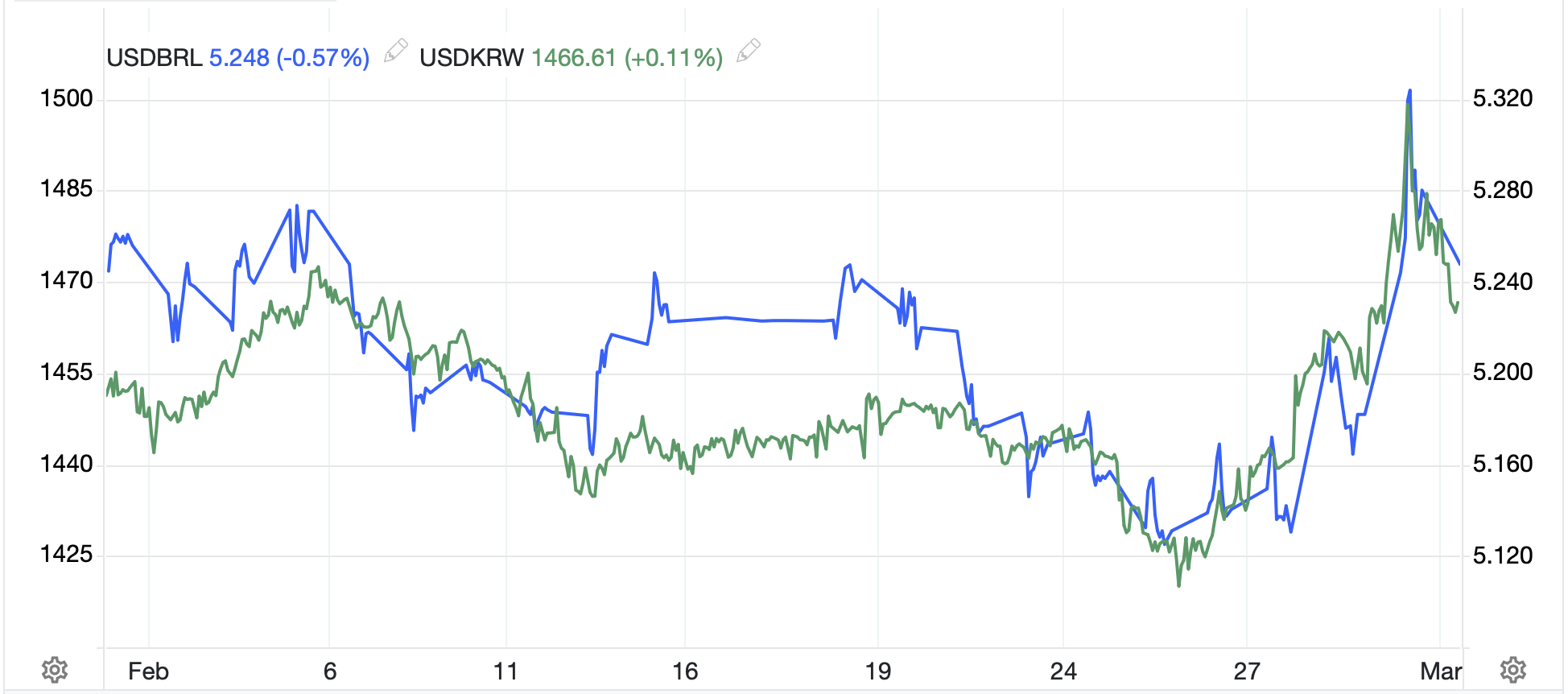
Finally, the dollar is backing off slightly this morning, which given the price action elsewhere, makes perfect sense.  In the G10 space, the movement has been on the order of 0.1% to 0.2% for the majors (EUR +0.2%, GBP +0.1%, AUD +0.1%, CHF +0.2%) with only JPY (+0.35%) and SEK (+0.8%) showing real gains.  However, it is important to remember that SEK was one of the worst performers recently, so had more ground to regain.  As to the EMG bloc, movement there has been more substantial, but again, this is after much larger declines.  For instance, BRL (+0.6%) and KRW (+0.9%) have both seen sharp declines in the past week before reversing overnight as per the below chart.

Source: tradingeconomics.com

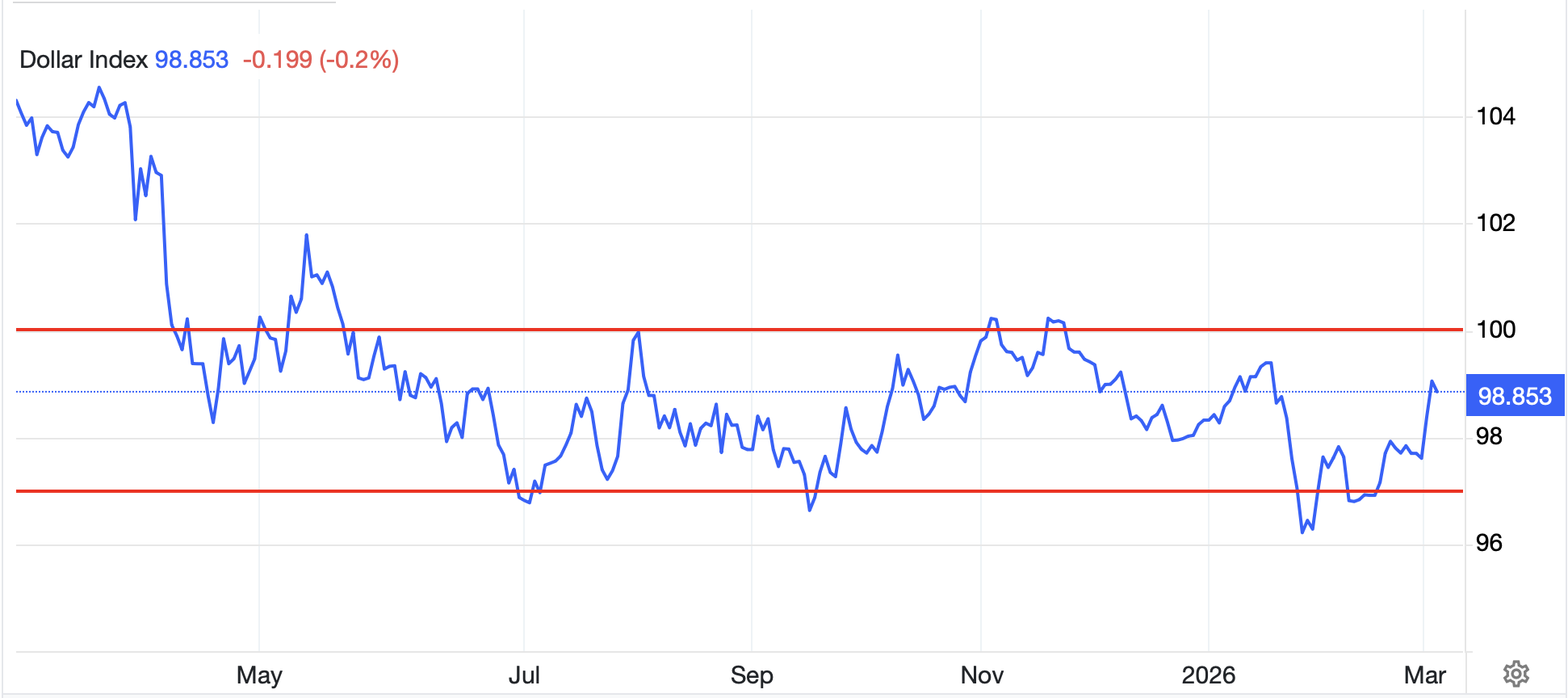
However, if we look at the DXY as our proxy, it remains in the middle of its trading range of the past 9+ months.

Source: tradingeconomics.com

In sum, we are three trading days into an entirely new geopolitical situation, and markets have digested the news and are seemingly trying to return to some sense of normalcy.  Now, there is still significant headline risk as nobody knows how things will evolve here.  What I will say is that if the Iranian regime falls or capitulates, I would look for risk to be quickly scooped up while oil prices slide.  Conversely, if things drag on much longer than another month, I think we could well see investor concern over how this will impact the global economy, especially if oil prices remain in the $75 – $80/bbl range, which likely means equity markets will suffer.

To the extent that anyone is still looking at data, this morning brings the ISM Services (exp 53.5) and then we see Crude Oil inventories later this morning.  The Services PMI data throughout Europe and Asia was in line with expectations showing slow growth remains the story.  Chinese data was marginally softer for large companies and marginally stronger for small companies.  As well, the Fed’s Beige Book is released at 2:00 this afternoon.

However, I don’t see data as a driver yet, so headline risk remains the biggest one out there, but the indications are markets are starting to absorb the war and move on.

Good luck

Adf
To Excess

The State of the Union Address
Was, as is Trump’s wont, to excess
He touted his claims
And handed out blames
While focusing on his success
 
The market responded, it seems
Like Trump answered all of its dreams
Stocks round the world rose
Which shows, I suppose
The world does approve of his schemes

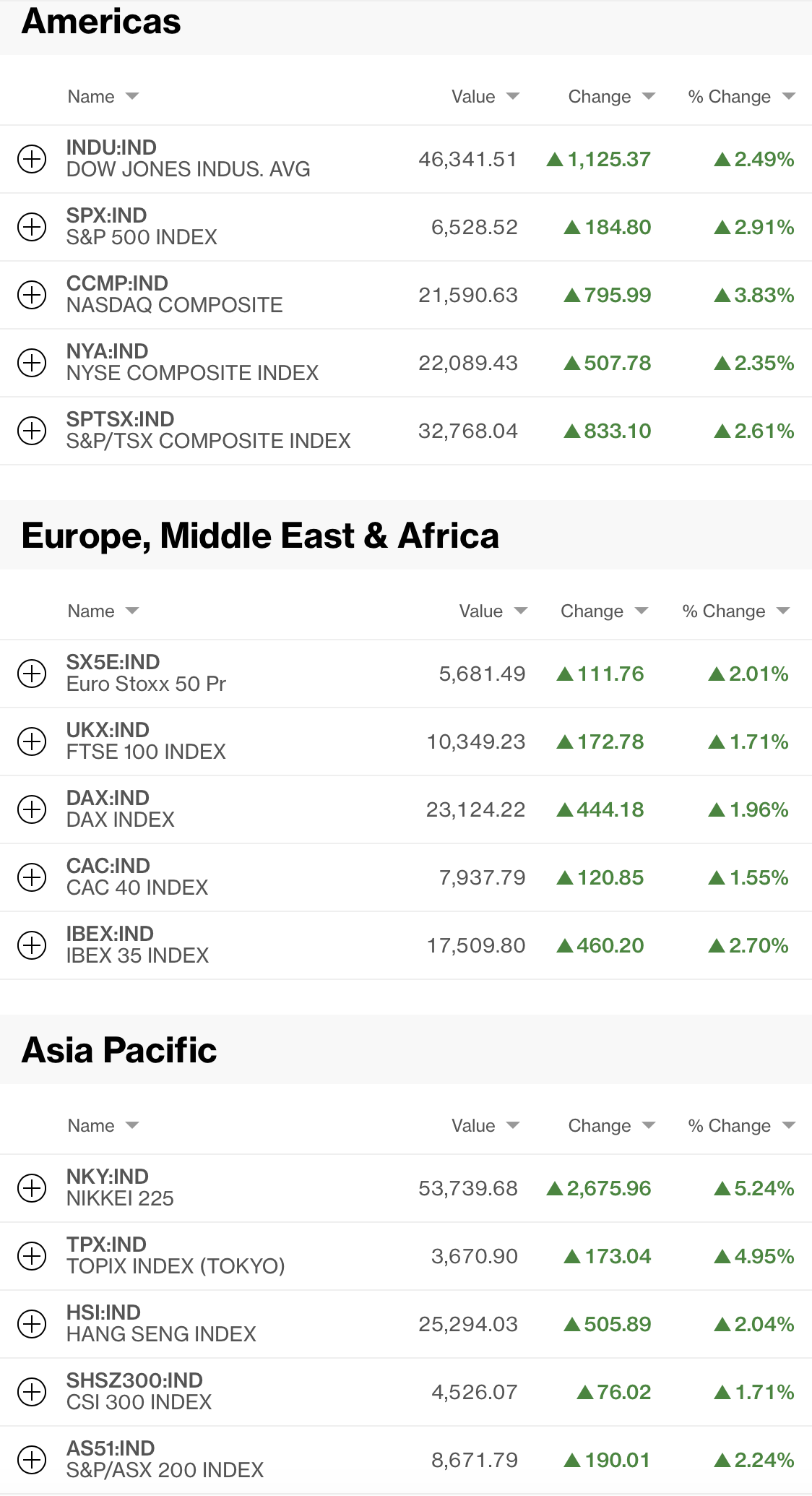
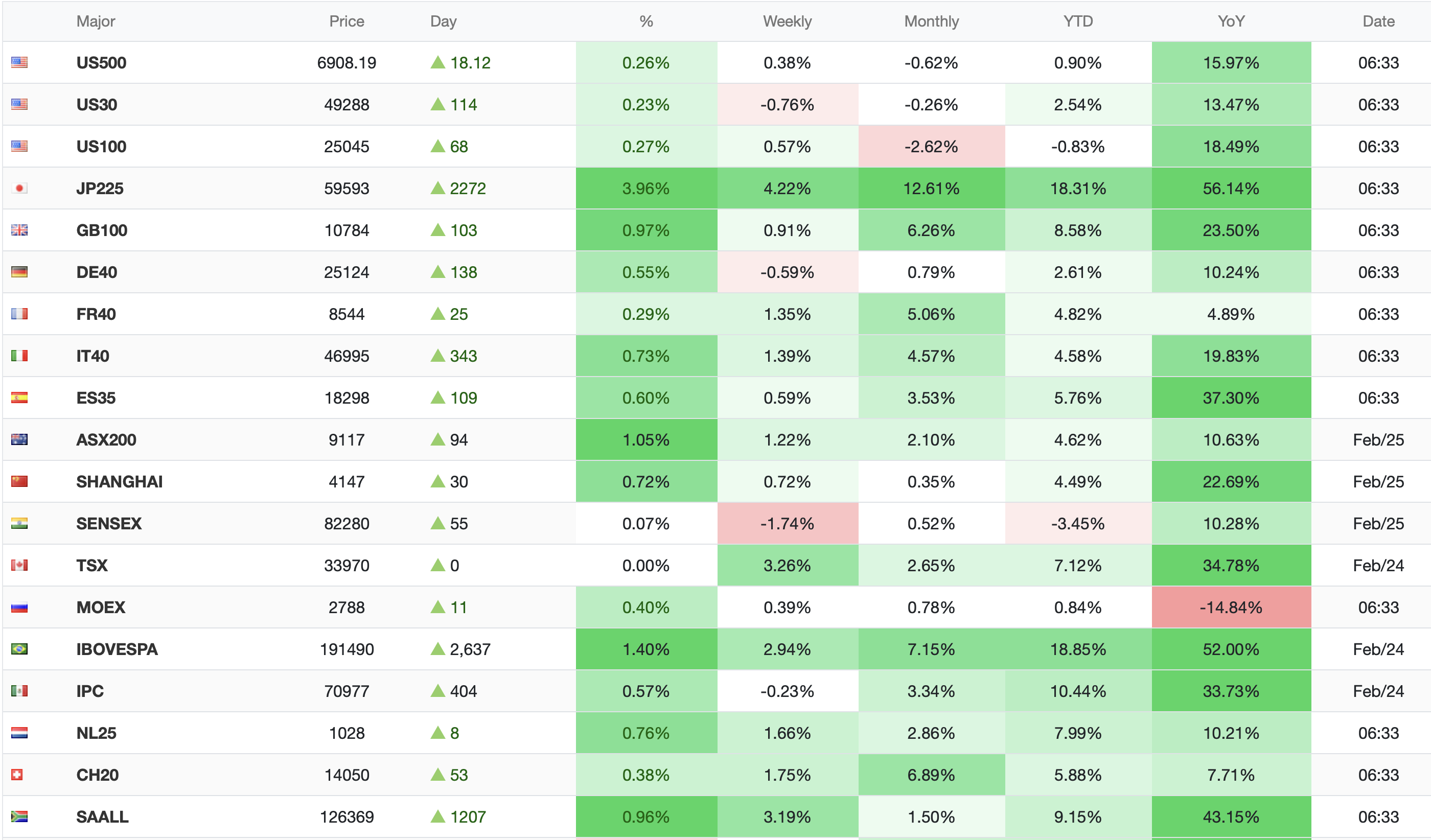
As I look at my screen this morning, literally every major equity market is higher, as per the below screenshot, as are US futures.

Source: tradingeconomics.com

In fact, if you ignore Russia, which hasn’t really been relevant since the Ukraine invasion-imposed sanctions, every market is higher over the last year, and US markets are the true laggards as seen by their monthly performance.  But you cannot look at this picture and determine that anything President Trump said last night was negative for the global economy.  I guess it’s full speed ahead now.

In true Trumpian fashion, the president remains incredibly optimistic about the future for the US and the Western world and perhaps that is what is reflected here this morning.  However, there were precious few new initiatives announced so it is unclear to me that this is going to be a topic of discussion in the financial markets going forward, although you can be sure that the political narrative is going to be very active.

So, let’s move on to things that matter for markets.

Is she hawk or dove?
Takaichi hates China,
Not easy money

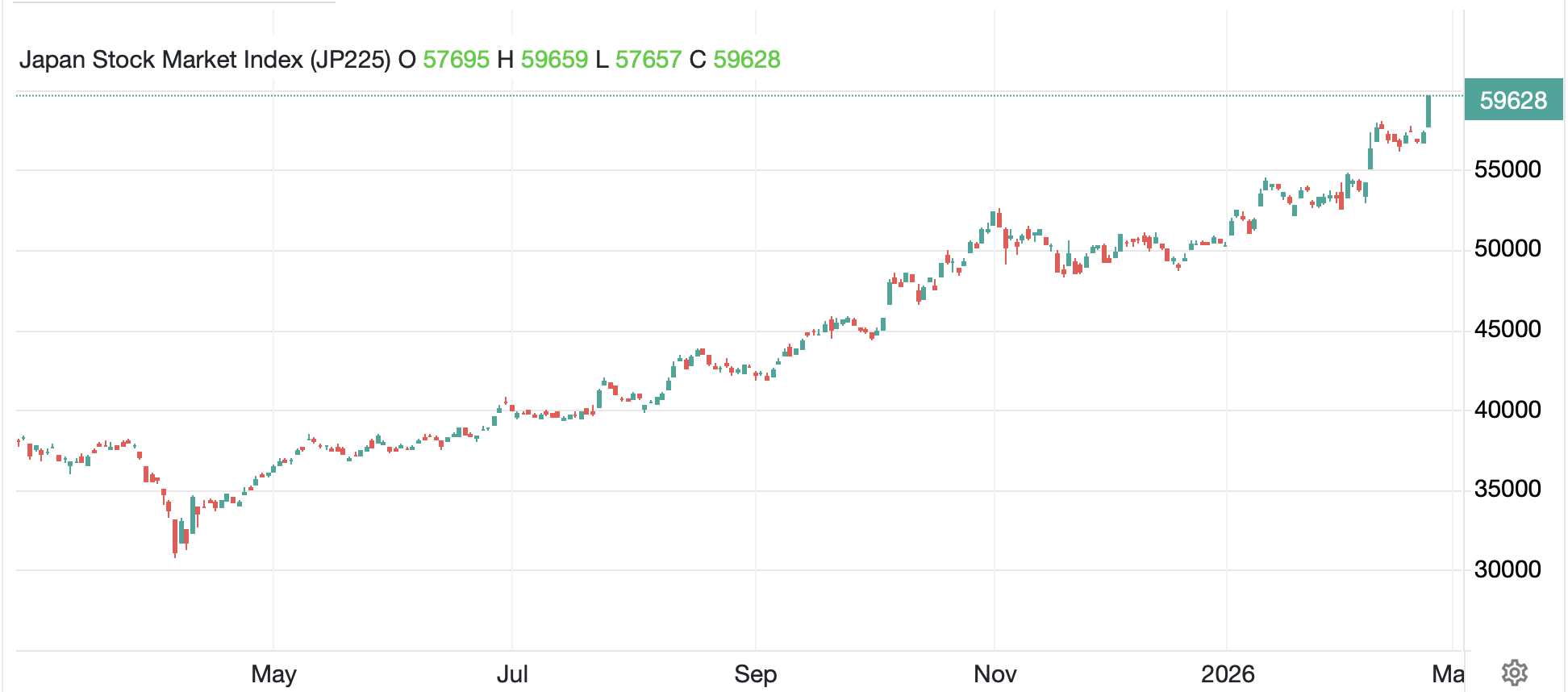
As you can see in the above table, Japan’s Nikkei 225 rose sharply, nearly 4%, but that had nothing to do with the SOTU.  Rather, her administration named two new BOJ governors (it was simply time to rotate some) and both were seen as quite dovish.  In fact, one, Toichiro Asada, is known for his belief in the benefits of MMT (you remember the magical money tree idea that governments that print their own currency don’t need to worry about overborrowing).  The upshot is that while Japanese stocks raced to yet more new highs, as per the below chart, JGB yields reversed their recent declines and rose (10yr +5bps, 30yr +10bps) and the yen (-0.6%) continued its recent slide, although remains well above (dollar below) the 160.00 level, which many see as the BOJ’s line in the sand regarding intervention.

Source: tradingeconomics.com

But other than this story, it is much harder to find things that have been market drivers.  To my eye, we continue to see market participants laying back in most places as they are still recuperating from the raucous first six weeks of the year.

So, let’s go to the tape.  We’ve already seen the equity performance around the world, with the narratives forming that the US tariff situation is now a reduced stress on global trade as they have been reduced to 10% globally.  As well, there have been an increasing number of rebuttals to the AI piece I mentioned on Monday, with this one, I think, the most succinct takedown of the idea that AI is going to eat the world and drive us into a recession with no jobs left for people.  As such, Monday’s narrative of all stocks being worthless has changed.  Elsewhere, the tariff story and tech rally have been the key discussion points across markets.

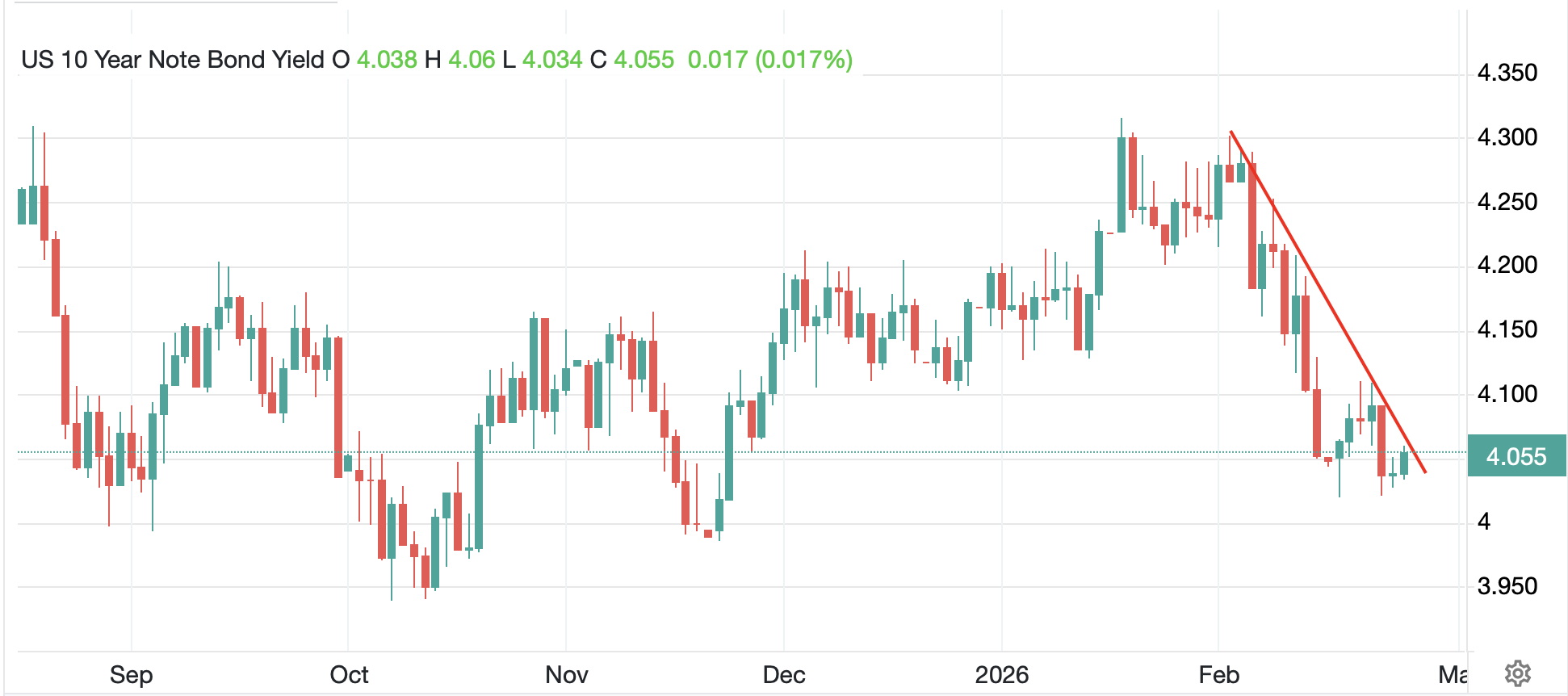
In the bond market, yields are a touch higher with Treasuries (+2bps) edging up on what seems like ordinary trading.  The short-term trend here is lower yields, as per the chart below, but we know that nothing moves in a straight line.

Source: tradingeconomics.com

As to European sovereign yields, they, too, are mostly a few ticks higher this morning although, this also appears to be simple trading activity rather than a new narrative.  It is interesting that there are more stories today about ECB President Lagarde stepping down early, which is diametrically opposed to what she said when asked the question recently.  As I said before, I think she steps down and is going to run for President of France.

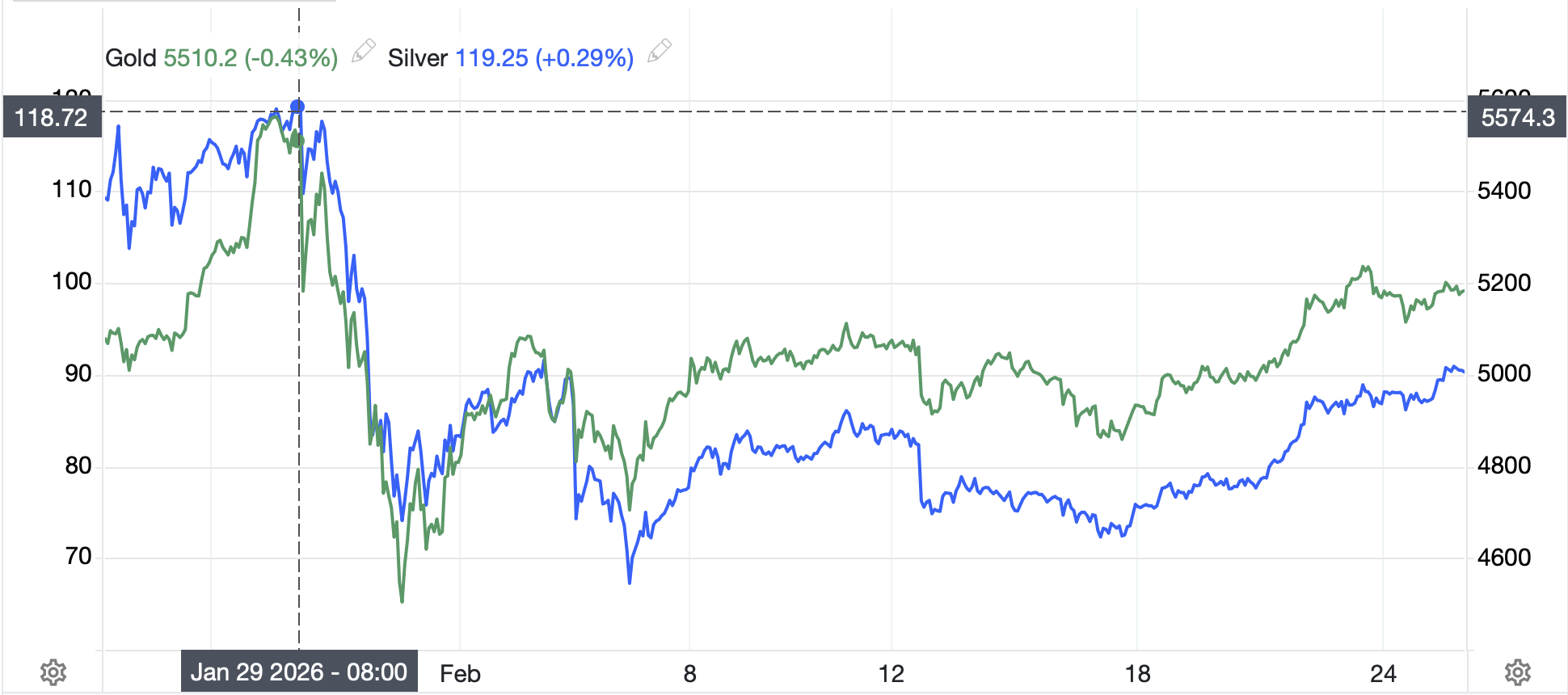
The commodity markets continue to be the place with the most price action and this morning is a continuation of that recent trend.  Gold (+0.9%), silver (+3.7%) and platinum (+5.5%) are all continuing their rebound from the extreme declines seen back on January 29th.

Source: tradingeconomics.com

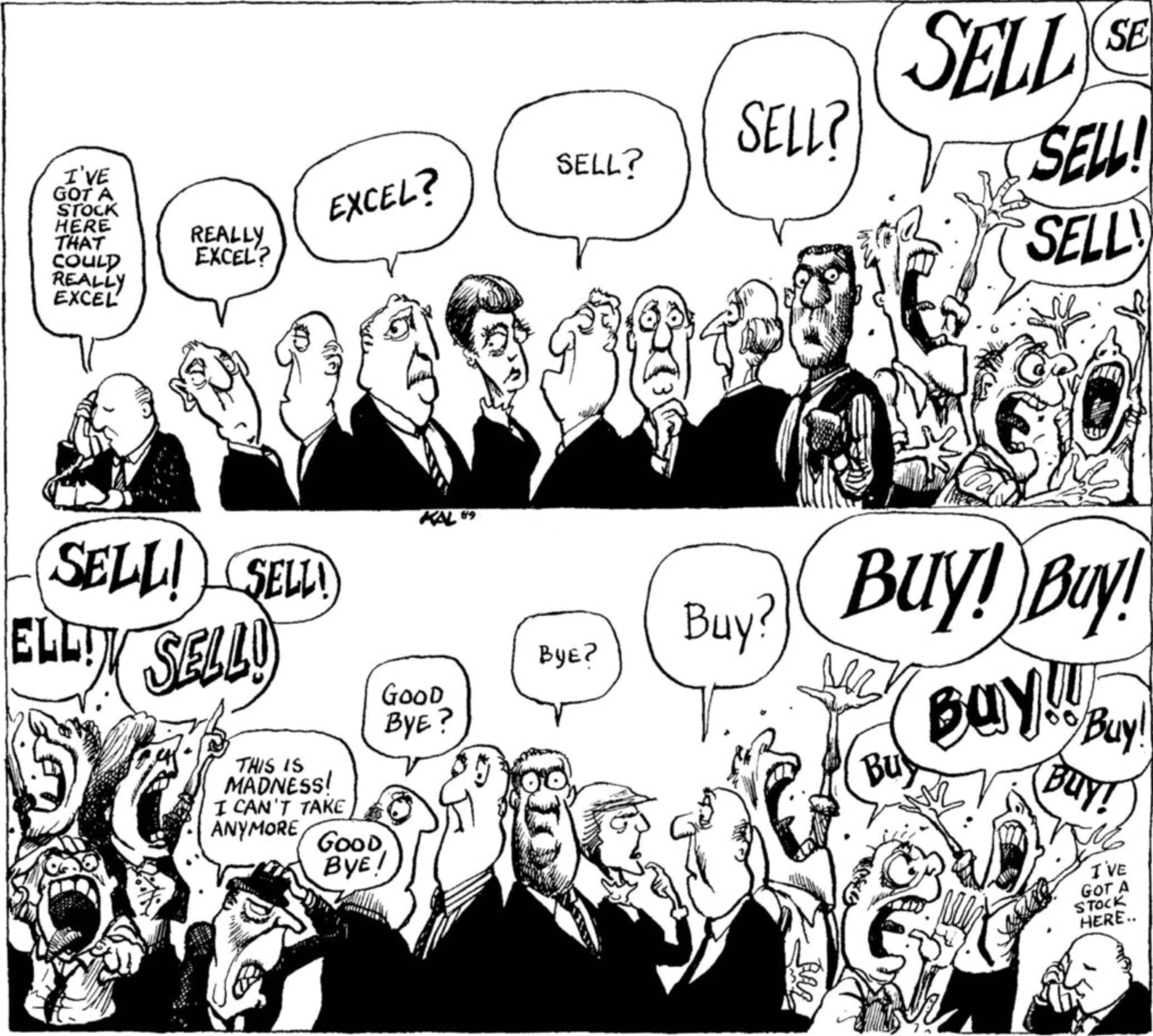
I do not have any inside track as to the driver of those moves, but I continue to read and hear about significant intervention designed to burst those bubbles (and they were clearly bubbles) and allow key institutions to cover short positions at better prices.  The problem with these stories is that we have heard for years about the manipulation of the prices of both gold and silver by large banks, and the purveyors of those stories have neither great reputations nor track records, so it is always a tough sell in my mind.  There is no question that when markets go parabolic, as the precious metals did through January, the reversals have always been dramatic.  However, I cannot speculate on the driver as often times, there doesn’t need to be one.  This cartoon from Kaltoons demonstrates it perfectly.

Turning to oil (+0.8%), Iran remains a key narrative and continues to support the front month pricing.  However, it appears that several futures spreads are falling sharply, indicating a potential glut in physical supplies has developed, at least for now.  As I look at the front contracts in the futures curve, we are still in backwardation, which implies a shortage, although I suppose that is the Iran effect.  

Source: barchart.com

I understand the short-term concerns here regarding potential military escalation there, but nothing has changed my view that the long-term energy situation is one of abundance and maintaining much higher oil prices will be very difficult for the long-term.  After all, look at Venezuela, which has already increased production back above 1mm barrels per day with contracts being signed for more activity.  Too, Argentina’s Vaca Muerta shale production is at new record levels, also ~1 mmm bpd and we continue to see growth offshore Brazil and Guyana.  Longer term, there is plenty around, I think.

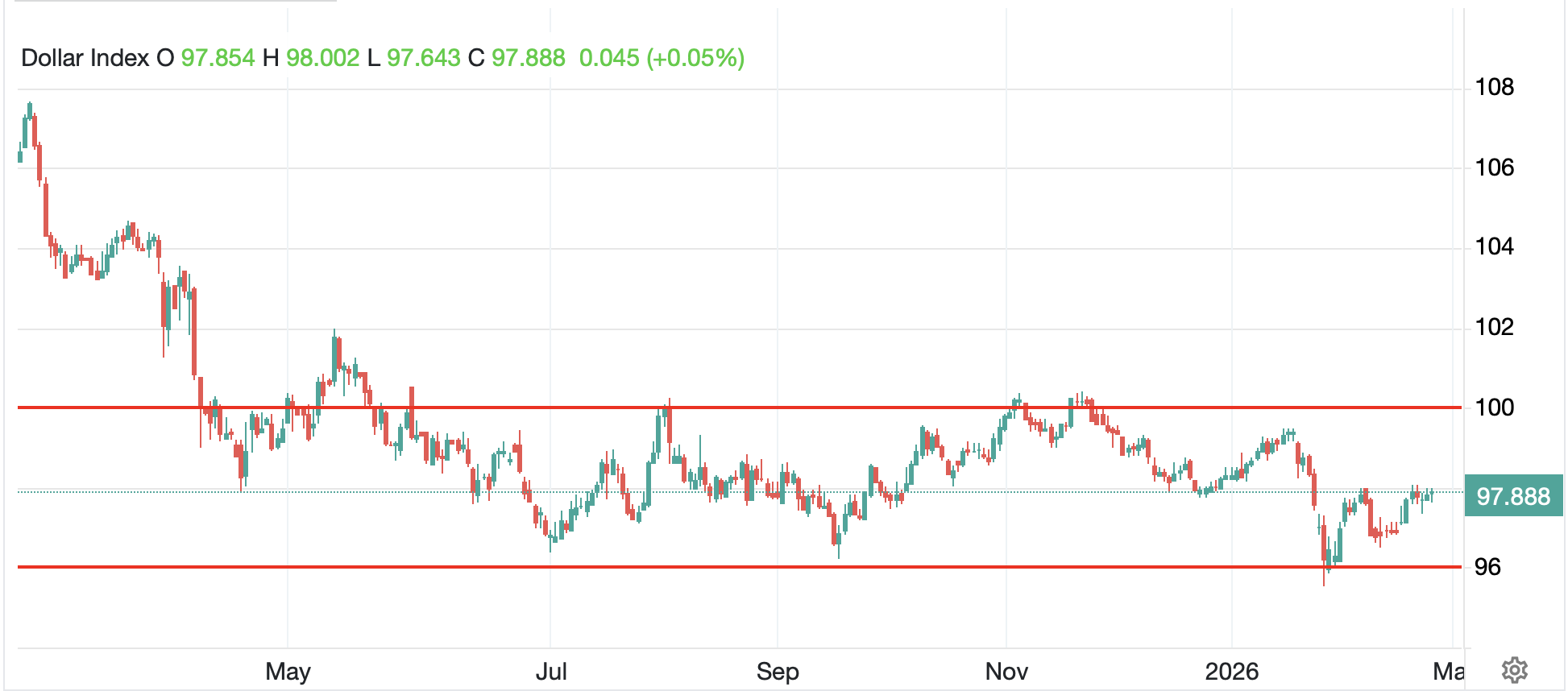
Finally, the dollar is mixed this morning as the yen’s weakness is being offset by modest strength in the euro (+0.1%) and pound (+0.2%).  However, the big movers today are KRW (+0.9%) which has benefitted from inward equity flows and hopes for tariff relief, as well as ZAR (+0.5%) on the back of the precious metals rally and CLP (+0.4%) on copper’s strength.  Remember, the US is not overly concerned about USD weakness in the FX markets as it suits the administration’s goals of reducing the trade deficit and encouraging onshoring of production.  But even with that, looking at the DXY, it is just below 98.00 and remains right in the middle of its trading range for the past 9 months.

Source: tradingeconomics.com

There is no major data out this morning with only the EIA oil inventories where a very modest build is anticipated.  

Big picture, I don’t think anything has changed.  Fiat currencies continue to lose value relative to ‘stuff’.  Equity markets continue to benefit from the global ‘run it hot’ policy and there is no clarity regarding the outbreak of a war in Iran.  With this in mind, it is hard to see a large move in the dollar in the near future.

Good luck

Adf
Far Too Extreme

Said Roberts and five more Supremes
Those tariffs, are far too extreme
They don’t pass the test
And so, we request
You find a new revenue scheme
 
Said Trump, while I think you are wrong
Your actions won’t stop me for long
We have many laws
That give me good cause
For tariffs, that help make us strong

For whatever reason, this is what first popped into my head upon hearing the tariff ruling on Friday.  I guess I confused love for law, but whatever.  At any rate, I’m sure you have seen far too much on this subject already so I will be brief.  The Supreme Court ruled against President Trump’s use of the IEEEA law to enable the imposition of tariffs on foreign nations.  They did not discuss what to do about the ~$200 billion that has already been collected under that law.  The companies that sued want the money rebated, but that was not part of the decision, and of course, the logistics of that would be extraordinarily complex.

But in the end, President Trump simply imposed a sweeping 15% tariff across the board under a different law, which to my understanding can remain in place for 150 days.  The equity market shook off the news, rallying across the board on Friday (DJIA +0.5%, S&P 500 +0.7%, NASDAQ +0.9%), so it didn’t seem to be that big a deal.  But then when Asia opened Sunday night, risk was in a much less desired state.  Early returns show equities softer across the board (-0.75% at 10:00pm), the dollar (DXY -0.4%) under pressure and gold (+1.25%) and silver (6.25%) seeing significant haven demand.

One of the things that appeared to be in question was whether countries that had signed trade deals accepting tariffs and promising investments as part of the deal, would renege, but thus far, that has not happened.

My take is the tariff discussion is no longer a concern to investors.  Playing the lead role once again is Iran, as concerns over a potential US military strike rise, with a new actor joining the cast, Mexico, which appears to be suffering significant chaos after the elimination of a cartel leader, “El Mencho” has resulted in fire fights throughout the country there.  Obviously, given the proximity to the US, this has the potential to be quite significant, although since the border with Mexico has been effectively sealed, my take is all the action will stay in country there.

Historically, when there’s a war
The first move is stocks to the floor
But generally speaking
Post first mover freaking
The buyers step up to the fore

So, if tariffs are not going to be the primary topic of discussion, and I sincerely hope that is the case, after we finish congratulating the US men’s ice hockey team for the thrilling Olympic victory this weekend, what’s next on the agenda? Iran.

The US continues to amass forces in the Middle East and from various sources, including MSM and X and Substack, the growing consensus is that some type of military action is going to occur.  The question now seems to be whether it will be an attempt to decapitate the regime, or just to impede its ongoing buildup of armaments, notably ballistic missiles.

Negotiations are set to resume this week in Geneva and given the stakes, especially for the Ayatollah, it remains unclear as to his willingness to cede to American demands of essential disarmament and the end of terrorist support.  For President Trump, the risk is that any military action does not work as quickly and smoothly as either the first attacks on the nuclear sites, or the exfiltration of erstwhile Venezuelan president Maduro.  If there is something quick and relatively clean that achieves a clear objective, I think it can be a huge boon for the President, but if anything drags on, it will have numerous ramifications for both the mid-term election and the markets.  Let’s focus on the latter.

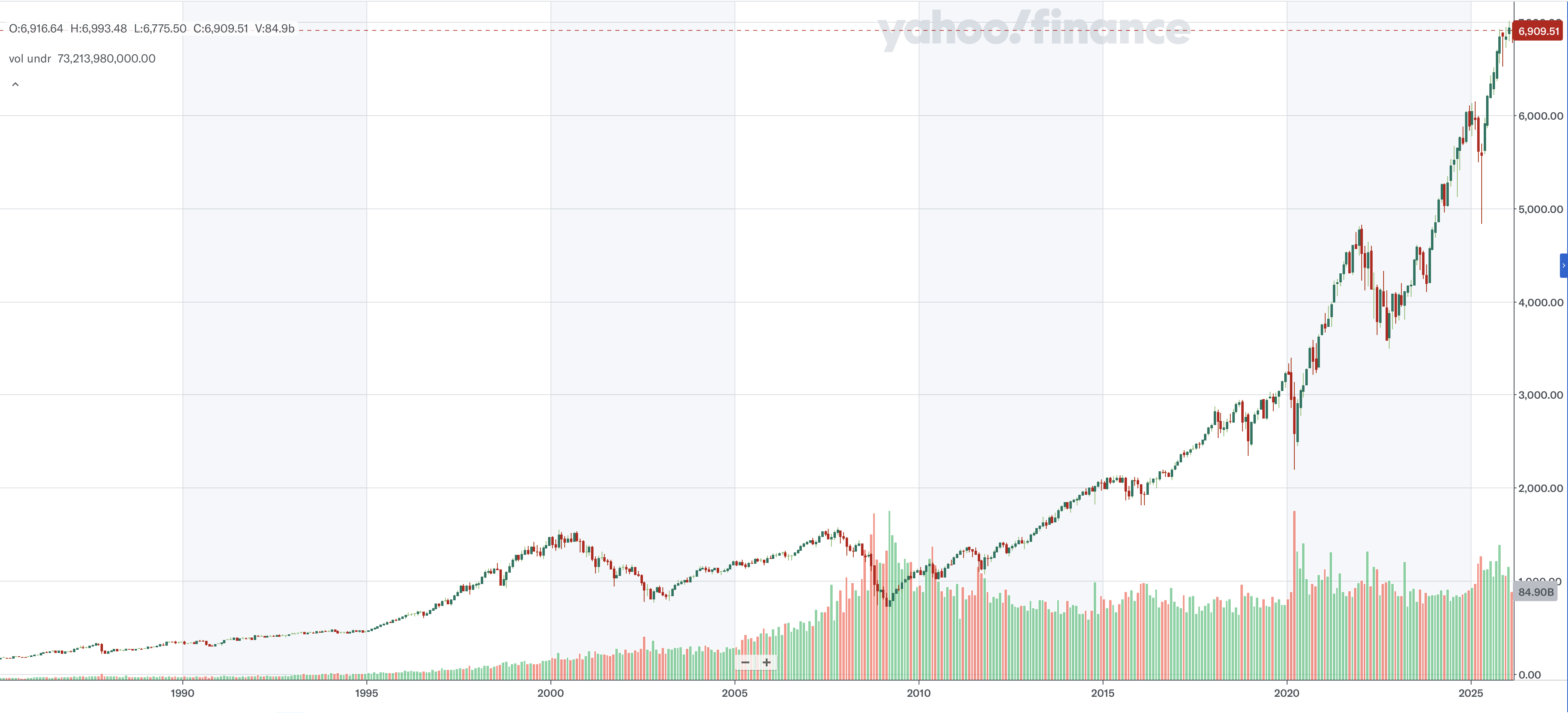
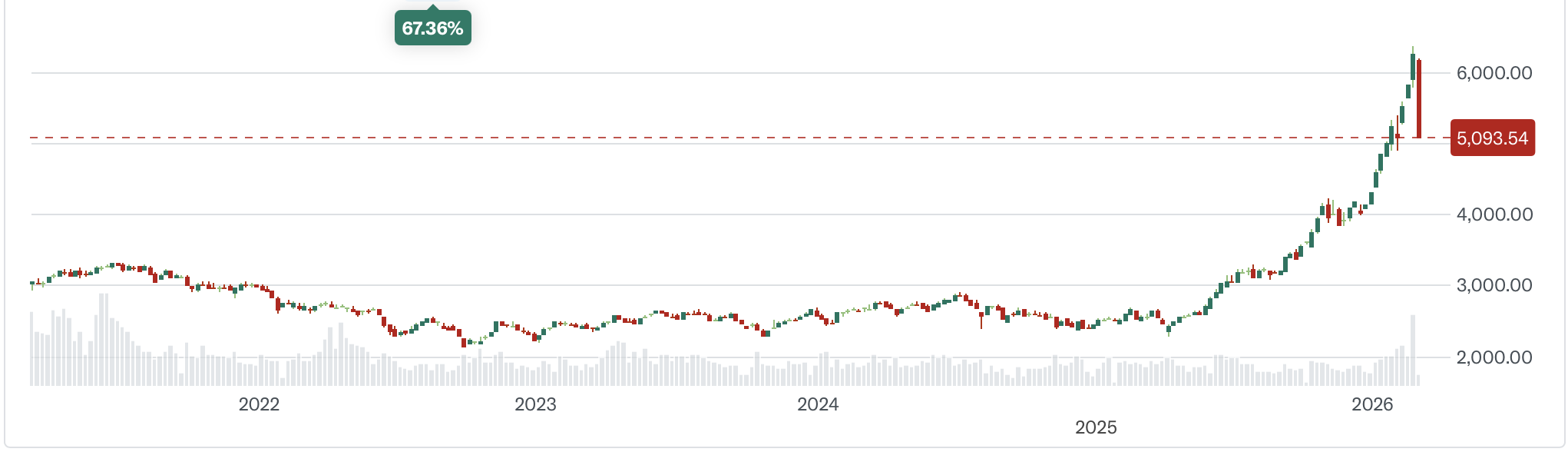
Below is a long-term chart of the S&P 500 which shows both the extraordinary recent performance relative to its previous history, as well as helps highlight some of the downturns seen during that time.  Of course, the noteworthy feature is that the downturns don’t last very long.

Source: finance.yahoo.com

If we move from right to left on the chart (these are monthly candles), the first spike down is Liberation Day in April 2025, when President Trump first announced his tariff plans.  Obviously, that is long past investors’ concerns now, especially given the events on Friday.  The next major decline took place in February 2022, when Russia invaded Ukraine.  But remember what also happened around that time, the Fed began its aggressive rate hiking when it figured out that inflation may not be transitory after all.  You probably remember that 2022 was one of the worst market performances for both stocks and bonds.  It is a worthwhile question to ask how much of that was the Russia/Ukraine situation and how much was the Fed.  My money is on the Fed.  Moving left, we see the Covid spike lower in Q1 2020 and then a baby dip during the repo shock of late 2018, when the Fed lost control of the Fed funds rate.  After that, we go back to the GFC in 2008-09 and the bursting of the dot com bubble in 2000 – 2003.  Sure, in 2003, the US invaded Iraq, but I don’t think that was the market driver.

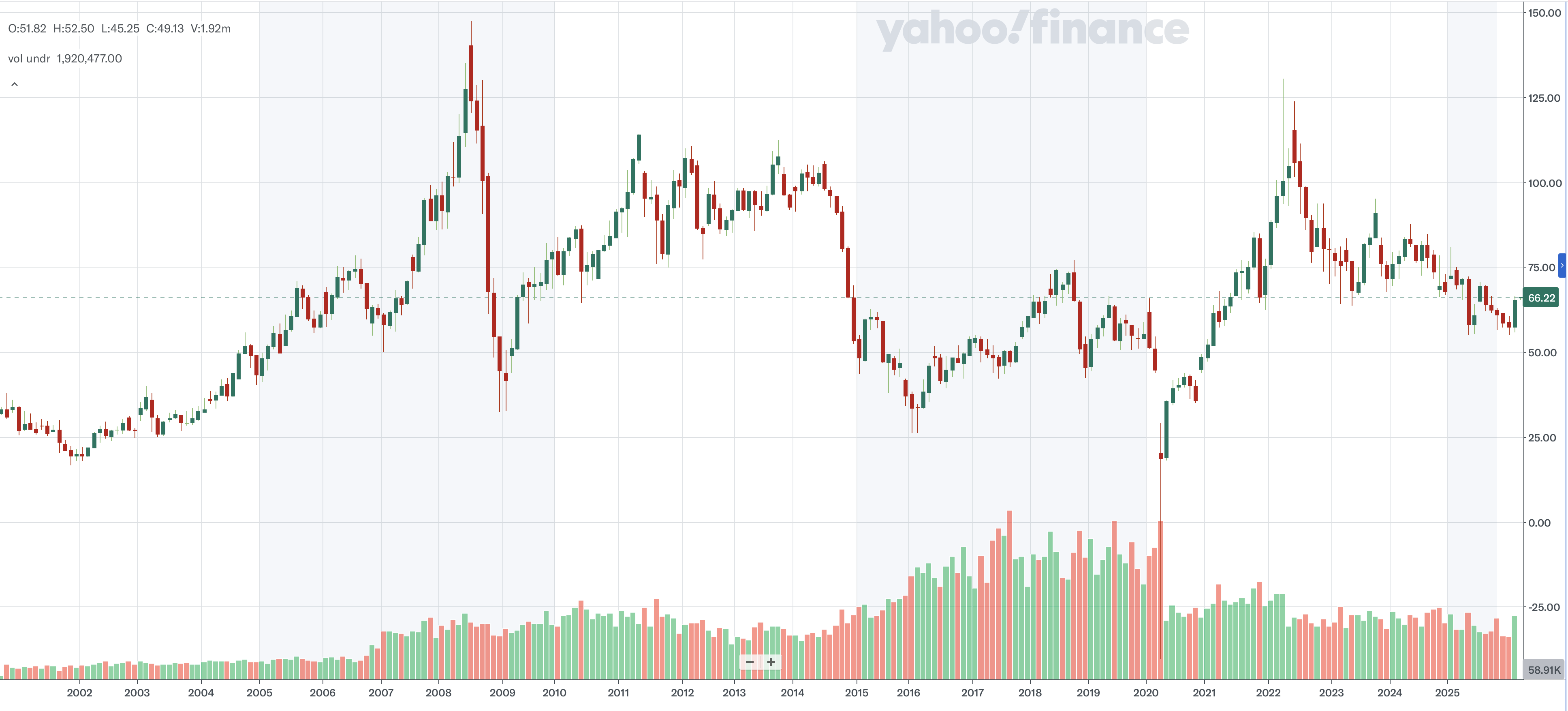
My point here is that any impact from military action is likely to be very short-lived in equity markets.  The other market that will certainly be impacted is the oil market.  A look at the long-term story there shows that, here too, there are many things that have a major impact on oil other than war.

Source: finance.yahoo.com

The huge decline on the left was the GFC and ensuing recession.  The drop in 2014 was the realization that shale oil was going to add an enormous amount of supply to the market.  You can see the Covid spike to negative prices and then the run up in prices in the wake of the Russian invasion in 2022, which was relatively short-lived, and we have been declining ever since.

Much of the commentary regarding Iran right now revolves around their ability to close the Strait of Hormuz and how that would cut 20% of the world’s oil supply from reaching the market.  (It would cut almost all of Iran’s oil off from the market as they have virtually no pipeline network).  But even here, the evidence is that a price spike will be relatively short-lived.

I raise these issues because while war is inflationary, that is generally not because of the impact on oil prices, but rather because of the increased government spending that accompanies war (remember LBJ’s guns AND butter policies leading to the inflation of the 1960’s and 70’s.). 

Summing the discussion up, while in the immediacy, there will be market responses to military actions, I do not believe they will have long-term impacts.

Ok, I went on way too long, so let’s do a hyper quick tour of markets this morning and I will leave the weekly data until tomorrow.

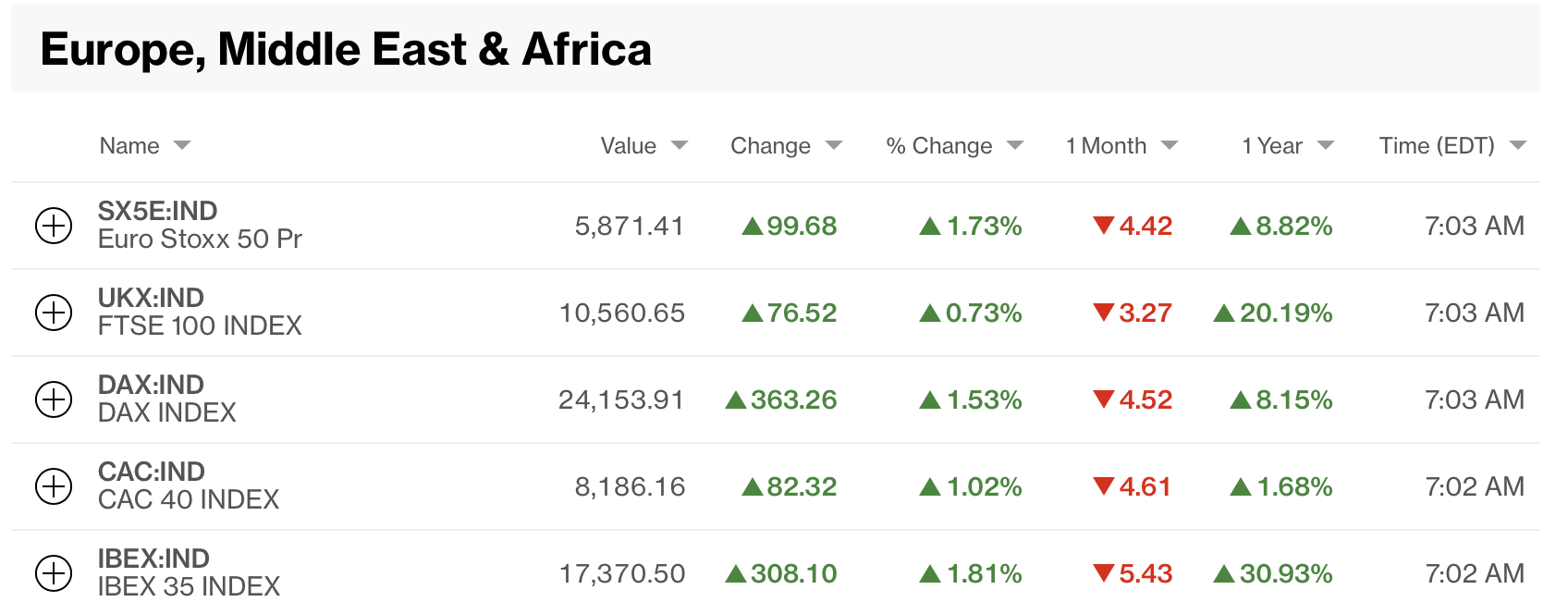
Equities – mainland China is still closed, (they open tomorrow) but the rest of Asia mostly ignored the war drums.  HK (+2.5%), Korea (+0.65%), India (+0.6%) and Taiwan (+0.5%) all showed strength although Australia (-0.6%) seems to have suffered on the tariff story.  Tokyo, too, was closed last night.  In Europe, despite slightly better than expected German Ifo data, the DAX (-0.45%) is today’s laggard while the IBEX (+1.0%) and FTSE MIB (+1.0%) both have seen strong support, ignoring any uncertainty regarding the US tariff situation and benefitting from positive earnings results. The UK and France have done little.  As to the US futures market, at this hour (7:15) they have risen from their early evening lows but are still softer by -0.35% across the board.

Bonds – the bond market remains the enigma, in my mind, as it is basically locked in place and has been for months.  Treasury yields (-1bp) have edged lower and European sovereign yields are essentially unchanged, as are JGB yields.  It continues to baffle me that bond markets, which typically sense fear first, do not seem to care about all that is ongoing in the world right now, whether war, government spending, or commodity prices.

Commodities – this morning, oil (0.0%) is ignoring Iran, which is maybe the most surprising thing of all.  Perhaps this is telling us that concerns over a closure of the Strait of Hormuz are overblown, or perhaps if that does happen, we will see a dramatic spike higher.  Again, like the bond market, something feels amiss.  In the metals markets, while both gold (+0.8%) and silver (+2.25%) are higher than Friday’s closing levels, they are well below last night’s opening levels.  I guess fear is abating, at least for now.

FX – As to the dollar, it’s early decline has largely been erased with both the euro and pound unchanged, AUD (-0.4%) sliding and the rest of the G10 under pressure.  In the EMG space, MXN (-0.5%) is feeling a little stress from the increased violence that has begun and there seems to be some sympathy in that move with CLP (-0.3%) and BRL (-0.2%). On the flip side, CZK (+0.5%) is the biggest gainer as the market continues to respond to recent central bank hawkishness.

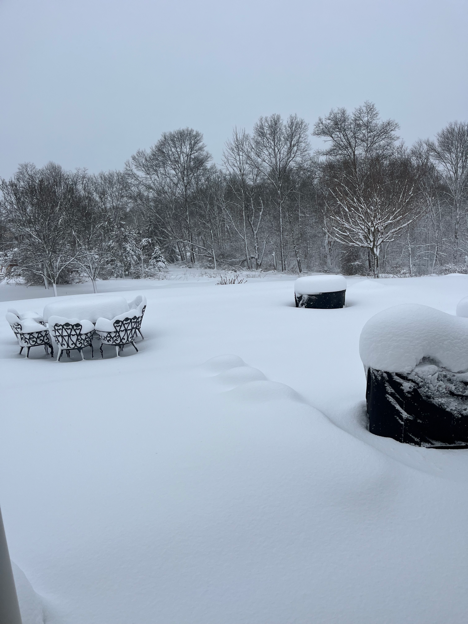
In the US today we see the Chicago Fed National Activity Index (exp 0.3 in January) and Factory Orders (-0.5% from Dec).  But remember this, as per the below, don’t look for that much activity in NY as this is the picture out my backyard this morning, I’m estimating 10” of snow, so skeleton staffs will be the rule.

Good luck

Adf
Not All in Sync

The story that’s tripping off lips
Is whether the buildup in ships
And aircraft we’ve seen
Is likely to mean
A war with Iran’s in the scripts
 
But markets are not all in sync
As equities clearly don’t think
That war would be trouble
While bond traders’ double
Their bets war will drive stocks to drink

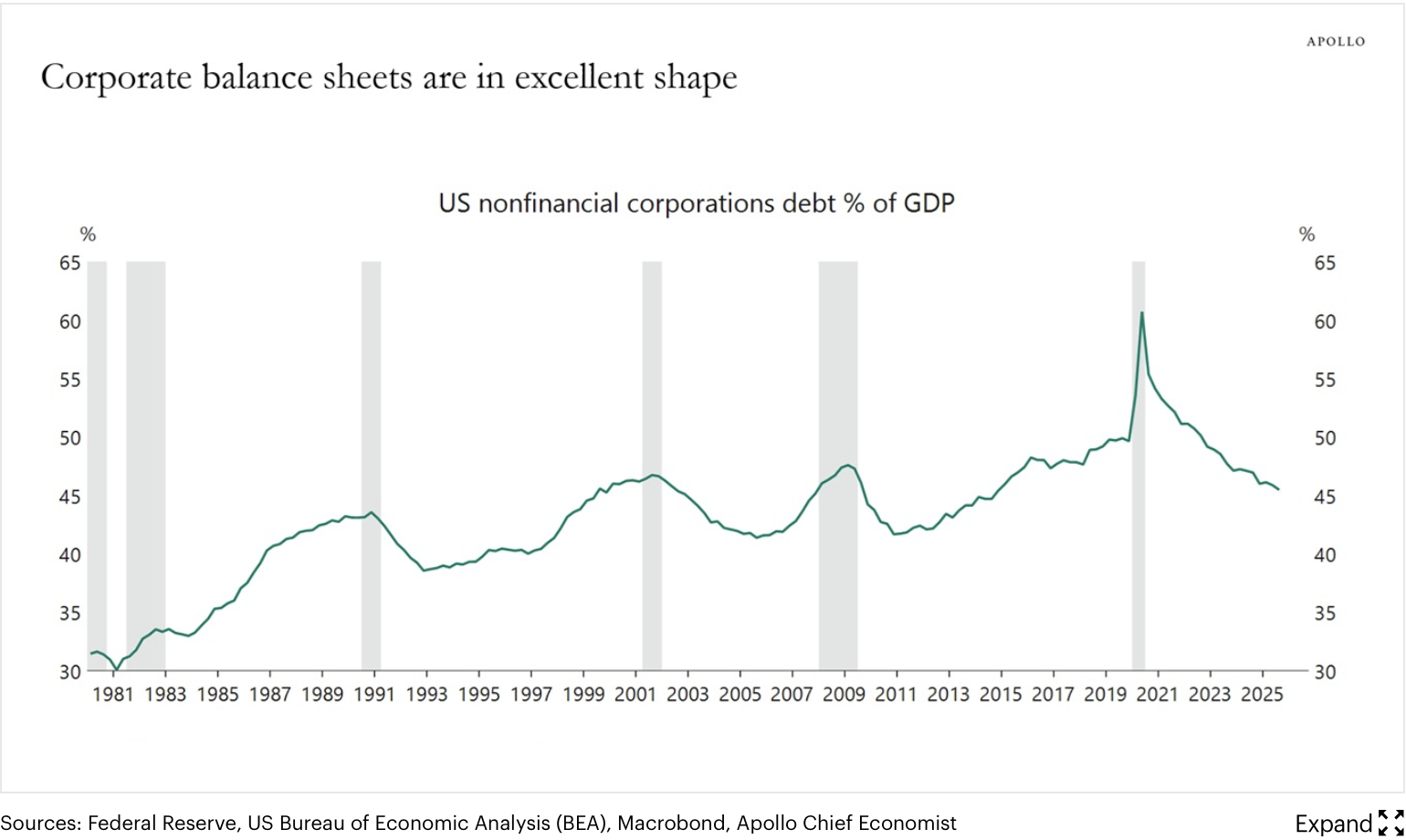
Economic data is clearly not a key driver of market movement these days, arguably because we continue to get mixed outcomes, with some things looking good (Initial Claims, Philly Fed) while others are less positive (Trade Balance, Leading Indicators), although granted, it is not clear to me what the Leading Indicators purpose is anymore.  My point, though, is that we have not seen unambiguous strength or weakness across the data set for several months.  This allows every pundit to frame the economic situation through their own personal lens, whether bullish or bearish.  A perfect example is the dichotomy between the strength of US corporate balance sheets, as per Torsten Slok and seen below, 

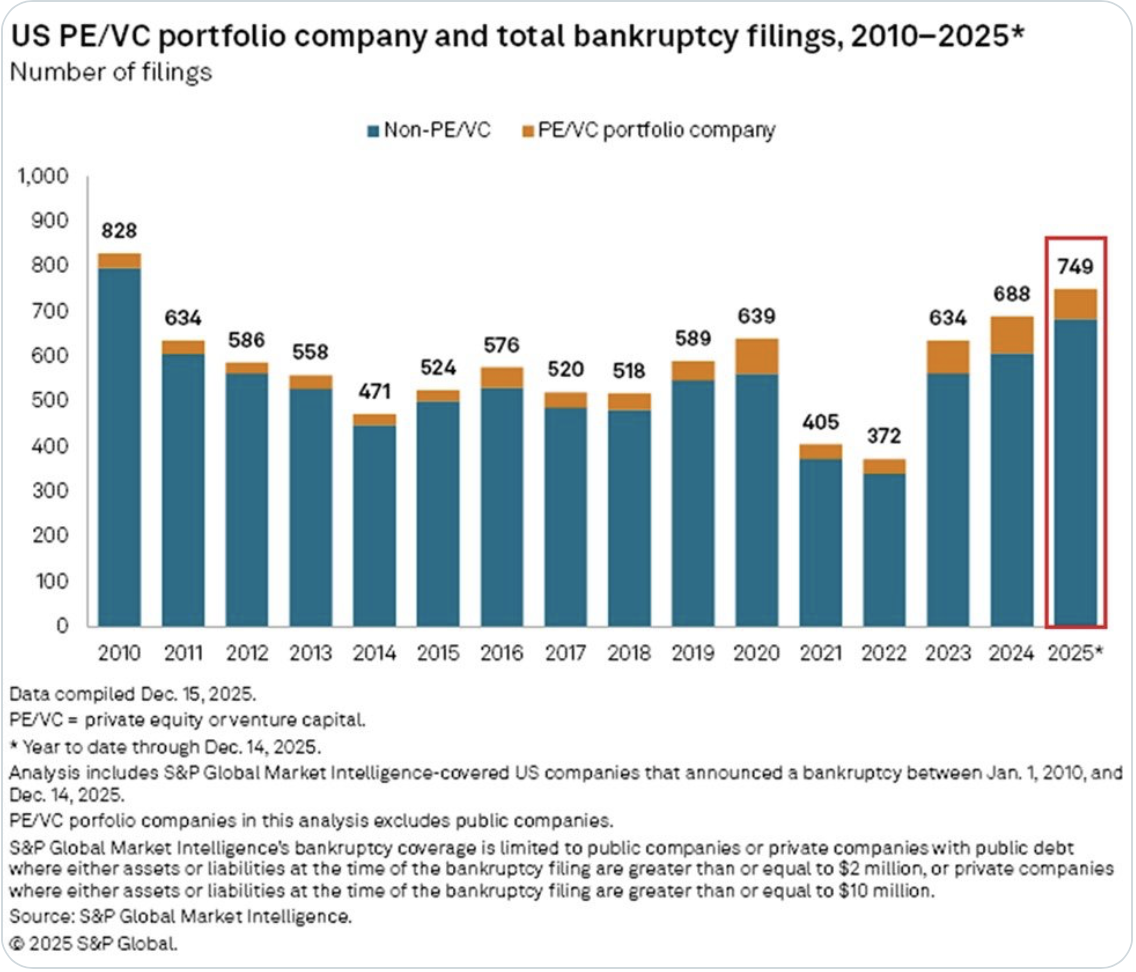
and the rise in corporate bankruptcies as per this X post from The Kobeissi Letter (a great follow on X) which shows the following chart.

So, which is it? Are things good or bad?  My understanding is that strong balance sheets and a high number of bankruptcies are not typically correlated, but I could be wrong.  

Given the lack of direction, markets have turned their focus to other things, with most headlines currently garnered by the ongoing buildup of US military power in the Middle East as President Trump tries to pressure Iran into ceding its nuclear and missile programs.  (Of course, the announcement that all information on UAP’s (fka UFO’s) has many excited, and of course, the Epstein files continue to garner attention, as does the SAVE Act, but none of those are even remotely related to financial markets.)

But even here, we are seeing very different responses by the financial markets.  For instance, equity markets continue to perform pretty well, even though Tokyo and Australia sank a bit last night.  Look at the monthly and YTD returns in Europe, Japan and Australia below:

                                           Daily   Weekly   Monthly   YTD

Source: tradingeconomics.com

It strikes me that if war was a major concern, investors wouldn’t be stocking up on risk assets.  Rather, havens would be in more demand, which we are also seeing with gold (+0.4%) and silver (+3.3%) rising overnight as despite extreme volatility in the precious metals space, there is clearly underlying demand for these havens.

Bond yields over the past month have declined, indicating that despite ongoing deficit spending, investors are seeking their perceived safety whether in Treasuries, Bunds or JGBs as per the below chart of all three.

Source: tradingeconomics.com

Finally, the dollar, despite frequent calls for its death, has been edging higher in a classic risk-off response as no matter how much some may hate the dollar philosophically, when bad things happen, its massive legal and liquidity advantages outweigh virtually everything else.  Once again, the DXY has moved back to the middle of its trading range, just below 98.00 this morning, and to my eyes, shows no signs of an imminent collapse.  Rather, if hostilities do break out in Iran, I expect the greenback to rally to at least the top of this trading range at 100, and depending on the situation, it could easily go higher.

Source: tradingeconomics.com

All this is to point out that nobody knows nothing.  Narrative writers continue to try to keep up with the action, and it is increasingly difficult to do so as things change on the ground so rapidly.  Let me be clear when I say I have zero inside information regarding any of this, I am merely an observer.  However, my observations are that there will be some type of military action in Iran as to build up this much fire power in a concentrated area and not use it would be remarkable and I can see no way in which the Ayatollah can accept the terms being offered as it would end his leadership if he does.  I guess we will find out soon enough as President Trump has put a 10-day timeline on things.

Arguably, the only market I didn’t mention here was oil (-0.5%) which is consolidating after a 20% rise in the past two months.  Remember, if military activity is directed at oil production or transport, we could see a sharp spike here and that will not help equities or economic data, although both gold and the dollar are likely to benefit.

Source: tradingeconomics.com

I don’t think there is anything else to discuss market wise so let’s turn to the data.  This morning brings a bunch of important stuff as follows:

Personal Income0.3%
Personal Spending0.4%
PCE0.3% (2.8% Y/Y)
-ex food & energy0.3% (2.9% Y/Y)
Q4 GDP3.0%
Flash Manufacturing PMI52.6
Flash Services PMI53.0
Michigan Sentiment57.3
New Home Sales730K

Source: tradingecomomics.com

We also hear from two more Fed speakers, but at this point, they are all singing from the same hymnal explaining policy is in a good place and unless there are major changes in the data, there is no reason to change.

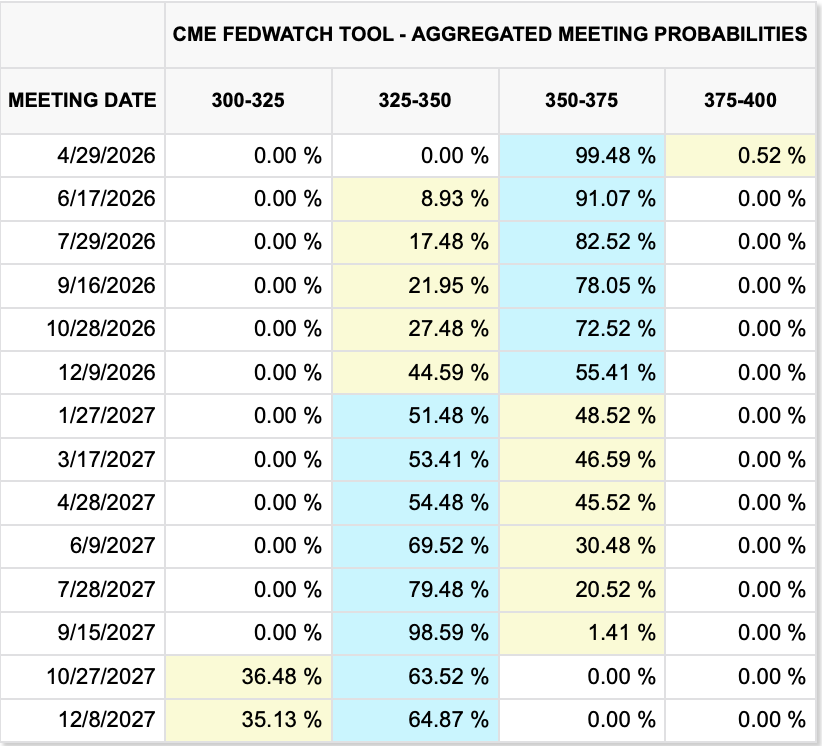
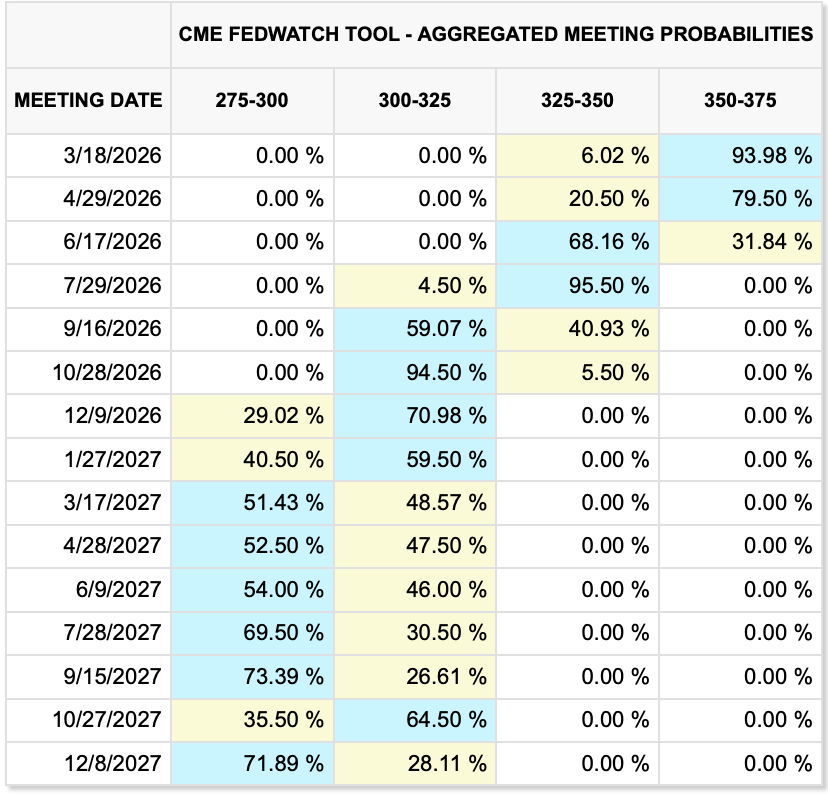
Arguably, the PCE data is the key for markets here as if it continues to run hotter than target, hopes for further rate cuts will continue to dissipate.  In fact, the next cut is now priced in for July with a second for October.  

Source: cmegroup.com

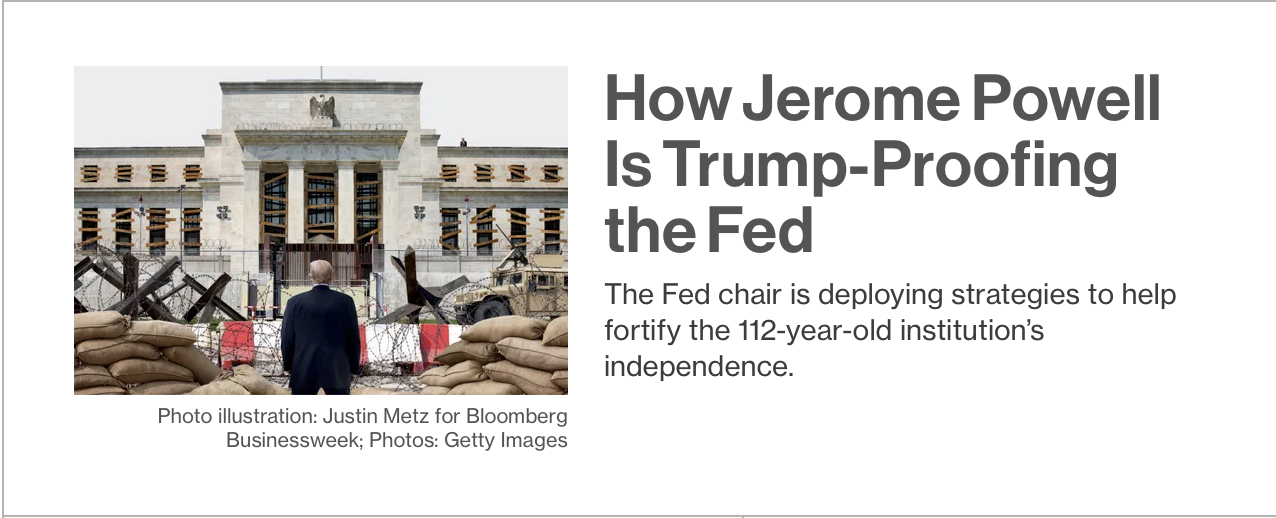
Remember, too, at that point it will be Kevin Warsh’s Fed, not Jay Powell’s, and Warsh has a very different idea about the way things need to be done.  Interestingly, as this 4th Turning proceeds and old institutions come under increasing pressure, their efforts to fight back and maintain the status quo is no longer behind the scenes as evidenced by this Bloomberg article this morning.

As I have written before, President Trump is the avatar of the 4th Turning and the institutions that are going to change are desperate to maintain the status quo.  This is, truly, the big fight that will continue through the end of the decade in my view.  Every institution that has been overseeing the global situation, whether politically, financially or militarily, is coming under pressure as income and wealth inequality have driven an ever wider disparity of outcomes.  As much power as the rich have, there are a lot more people who are not rich.  Ask Louis XVI how much being rich helped him.

On a lighter note, I watched the gold medal skating performance of Alysa Liu and it was truly magical.  A much better thought for the weekend!

Good luck and good weekend

Adf

Commodities Blazing

According to Jay and the Fed
The ‘conomy’s moving ahead
So, rates are on hold
With rallies in gold
And stocks and the dollar instead
 
But really, the thing that’s amazing
Is nobody cares about phrasing
Or Dot plots or pressers
‘Cause now all the stressors
Are Trump and commodities blazing

Once upon a time, the FOMC meeting was THE story for markets during the week leading up to the meeting and through the Chair’s press conference explaining the many virtues of what they did and why they did it.  Of course, this has not always been the case.  If we head back to the pre-Alan Greenspan days, the FOMC was peopled by 18 anonymous members and the Fed Chair, at that time Paul Volcker, and nobody ever spoke to the press and only grudgingly to Congress, they simply managed the money supply to the best of their ability to achieve their mandates.  The biggest data point of every week was the Thursday afternoon M2 release, and there was an entire subculture of ‘Fed watchers’, similar to ‘Kremlin watchers’ whose job was to read the tea leaves based on market behavior and data in trying to determine how the Fed would behave going forward.

Almost the only time Chairman Volcker spoke in public was at the semiannual Humphrey-Hawkins testimony to Congress, but he basically never answered any questions and clearly didn’t care what either Senators or Congressmen asked.

But then we got the “Maestro”, Alan Greenspan, who after Black Monday in October 1987, created the first Fed put.  At that time, the rest of the FOMC was still largely anonymous, but Greenspan craved the limelight, if only to try to show how much smarter he was than everybody else.  Famously, he explained in Congressional testimony in 1996, “If you understood what I said I must have misspoken.”  Greenspan was more available to the press than Volcker, but the rest of the committee remained in the background.

However, that simply set the table for the ensuing Fed chairs, Bernanke, Yellen and now Powell, all of whom give press conferences and clearly encouraged their minions to get out there and deliver the message.  As so many struggling leaders explain, it’s not the substance, it’s the messaging that’s the problem.  This is what we have all been dealing with since Bernanke sat down in 2006, mandated press conferences and pushed the narrative as a critical part of policy.

Then, along came President Trump’s second term, and times, they are a-changing.  While Trump rails on Powell to cut rates and lambastes him regularly, it turns out, the combination of new fiscal and economic policy is driving monetary policy into the background, at least from the perspective of market participants.  The result is that while FOMC members still get out there and give interviews regularly, they are never newsworthy.  In fact, my suspicion is that the reason Chairman Powell made his little video announcing the Fed received subpoenas was as an effort to get back on the front page, a place he and his committee members have clearly grown to enjoy, and from which they are increasingly absent.

Which brings us to the meeting yesterday where…nothing happened.  Policy rates remain unchanged, as universally expected, two voters wanted 25bp cuts (Miran and Waller), and they admitted that economic activity moved up from “moderate” to “solid”.  In the most stinging rebuke, the market virtually ignored the entire process.  In fact, the discussion about the next Fed chair is ebbing into the background.  My take is this is a better situation for all involved.  I only hope it stays this way.

So, what did happen?  Stocks were flat, bonds were flat, the dollar rebounded a bit, and commodities continue to rocket higher.  Let’s take a turn around markets overnight and start with commodities as that is where all the action is.

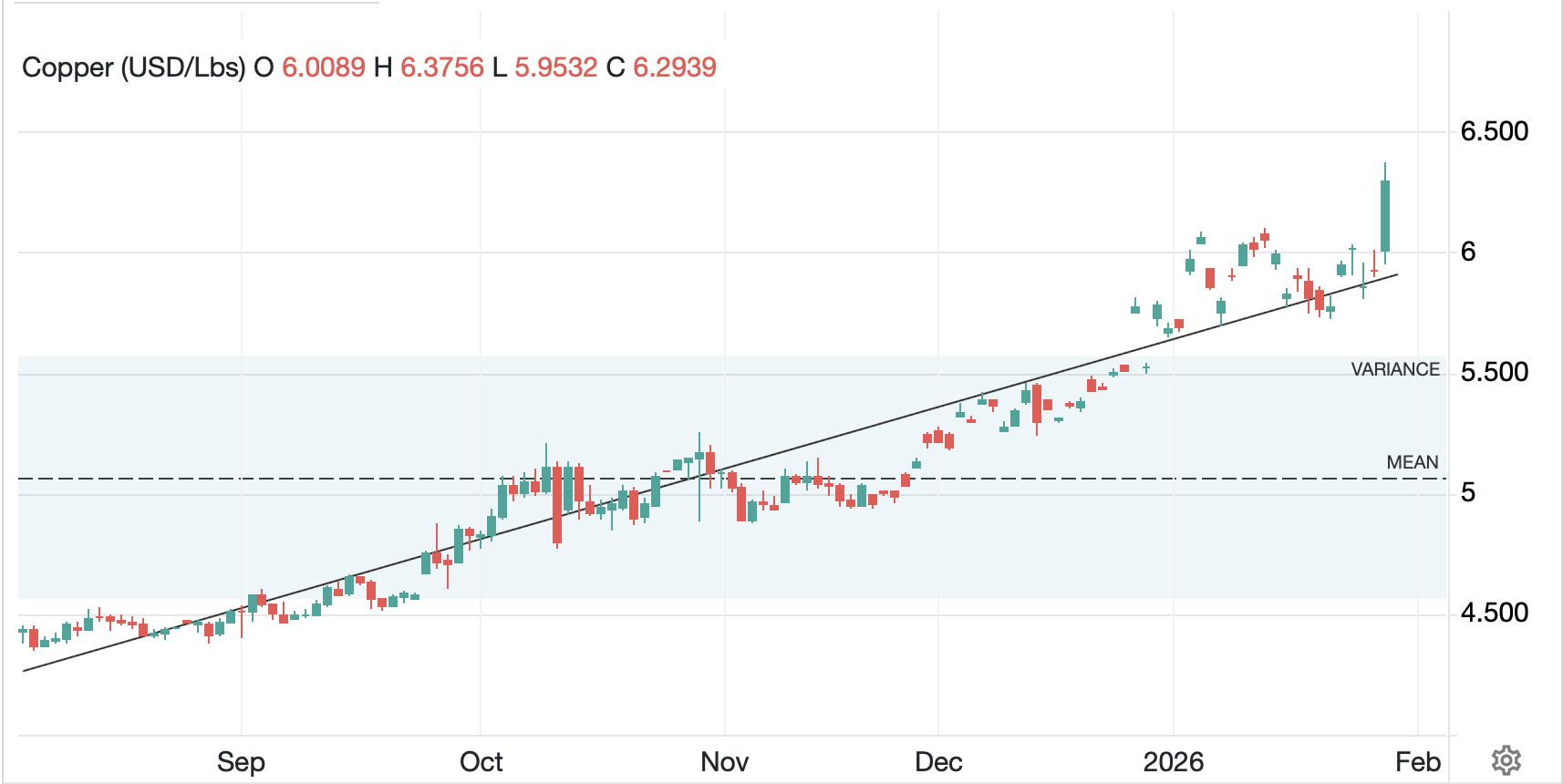
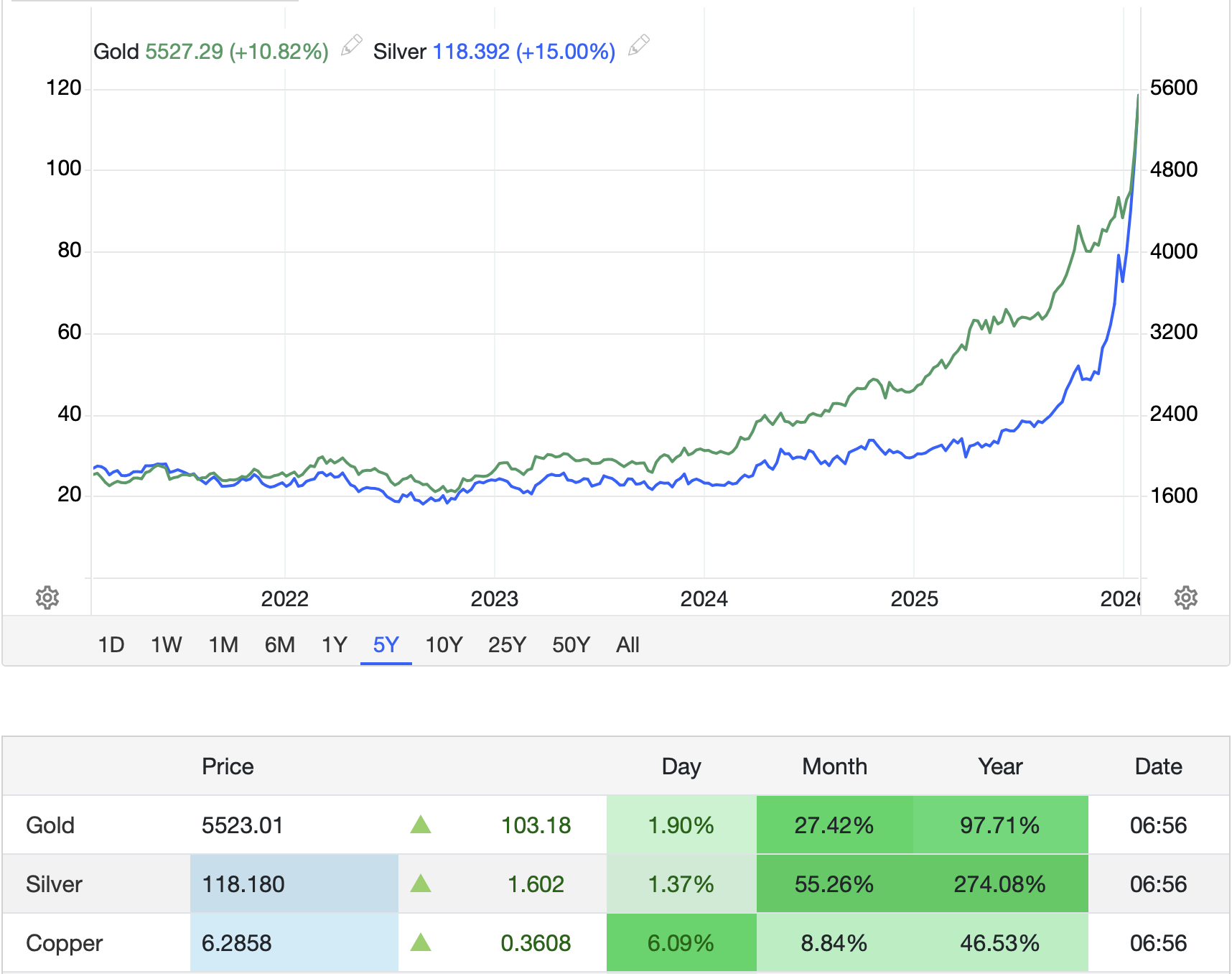
Copper (+6.1%) is the overnight star, soaring in Asia to record highs.  As with virtually all commodities right now, blame is laid at the feet of the weakening dollar (it didn’t move overnight) and with uncertainties about President Trump’s next actions and the potential risks attendant to those actions when they occur.  As we have seen with both gold (+1.9%, +27.1% in the past month) and silver (+1.3%, +54.6% in the past month), there is no doubt that fiat currencies are losing their status as a store of value, regardless of the interest rates they pay.  While copper’s movement has not been as extraordinary as that of either gold or silver, the trend, as you can see in the chart below, remains clearly higher.

Source: tradingeconomics.com

The underlying reality for all these metals is that the financialization of economies all around the world has resulted in far more market activity than was necessarily warranted by the physical markets.  And physical markets need ounces and pounds of stuff, which have very long lead times to get out of the ground.  As a trader, I look at these moves in precious metals and am very concerned they are overdone but as somebody with a basic understanding of physics, I see no reason to believe that the demand for these metals is going to slow down anytime soon.  The below chart shows just how extraordinary the silver move has been, and the table below it really tells the tale.

Source: tradingeconomics.com

As to oil (+2.6%), it is heading higher this morning on increasing fears that the President is going to initiate a military action to depose the Ayatollah in Iran.  Concerns are rising about Iran closing the Strait of Hormuz as well as its ability to respond via missile attacks.  Remember, though, a market that moves on a political issue will revert once that issue has either occurred, or clearly won’t occur, so do not mistake this move for the beginning of a new trend.  Consider what happened to oil after Russia invade Ukraine and after they invaded Crimea in 2014.

Source: finance.yahoo.com

Turning to the equity markets, yesterday’s US blahs were followed with a bit more price action in Asia as though Japan (-0.7%) slipped a bit, China (+0.8%), HK (+0.5%), Korea (+1.0%) and Taiwan (-0.8%) all so more significant movement, albeit not offering a larger theme given the relative gains and losses.  Elsewhere in the region, the smaller exchanges showed more red than green.  In Europe, Germany (-1.15%) is the dog, falling on idiosyncratic weakness in SAP and Deutsche Bank following weak earnings and forecasts, but the rest of the space is performing well (UK +0.4%, France +0.65%, Spain +0.4%) as earnings there have been relatively solid.  And, at this hour (7:10), US futures are pointing higher by about 0.25% or so as earnings numbers have been strong so far this week, highlighted by Meta last night.

In the bond market, activity is less frenetic with Treasury yields unchanged this morning, European sovereigns catching a bit of a bid as yields slip -2bps across the board and JGB yields (+2bps) rising after the latest poll showing PM Takaichi increasing her odds of getting an LDP majority in the Diet next week.  Something to watch closely going forward is the shape of the yield curve as there is growing concern that long-end rates may rise regardless of the Fed (yet another sign the Fed is losing its sway).  In fact, I suspect if that is the case, that we will see yet another bout of QE, although they will find an alternate name.

Finally, in the FX markets, despite all the pearl clutching about the end of the dollar, there is no movement of note in any currency today, with the entire screen showing gains or losses of 0.3% or less with one exception, CLP (+0.5%) following the remarkable jump in copper’s price.  The linked article is quite funny as they explain all the negatives of a weak dollar and then also explain that ECB members are concerned about a too strong euro.  I am frequently confused by whether a strong currency is good or bad for a nation, but I guess it depends on the narrative you are trying to push.

On the data front, weekly Initial (exp 205K) and Continuing (1860K) Claims come at 8:30 as does the Trade Balance (-$40.5B).  We also see final Nonfarm Productivity (4.9%) and Unit Labor Costs (-1.9%) which if those numbers are met indicate quite positive economic activity.  Then, at 10:00 we see Factory Orders from November (1.6%), but that is such old data I don’t think it matters.

Remember, it is Trump’s world (and Bessent) and we’re just living in it.  The White House is the source of all the news so let’s all be happy that the Fed is fading into the background.  With that in mind, based on President Trump’s goals, a weaker dollar is clearly his desire, at least in the short run, although I continue to see scope for longer term strength.

Good luck

Adf
What We’ve Learned

It wasn’t but three weeks ago
That pundits who felt in the know
Were sure the attack
On Vene would crack
The world, and more chaos bestow
 
But that news, so quickly, has faded
While Greenland fears have been upgraded
The pundits were sure
That war was the cure
And Europe would soon be invaded
 
Now as it turns out, what we’ve learned
Is NATO, which had been concerned
Has ‘greed to a deal
Which stopped Denmark’s squeal
As Trump, to the US, returned


It is certainly difficult to keep up with current events these days, especially for the punditry who feel it is critical they demonstrate expertise on every issue, given the speed with which the issues change.  All that effort to understand the geopolitics behind ousting Nicholas Maduro has been forgotten in less than 2 weeks as they needed to pontificate on Greenland and its importance.  If, as the president’s TruthSocial post below is the current lay of the land, by Monday, Greenland will return to its historic obscurity as President Trump will move on to the next issue of his choosing.  In fact, this morning, the WSJ is claiming Cuba is next on the list, which, while it wouldn’t be that surprising, has to date only been mentioned in passing by Mr Trump.
Here’s the thing about all the pontification regarding President Trump, nearly, if not all of it, is simply that, pontification by outsiders who have no idea about what is really happening.  These folks are not sitting in the Oval Office when the President is meeting with his advisors discussing strategy and are generally wishcasting their views and creating a narrative around that.  As I am also an outsider, all I can do is observe and try to ascertain how things might impact markets, but if you are not hearing it from the president or Secretary Rubio or someone like that, it is all speculation.  However, one must admit, it is entertaining!

As I don’t know what the next ‘global crisis’ is going to be ahead of time, let’s turn our attention to markets and how they responded to the president’s speech in Davos as well as the news of the deal framework.

Equities were quite happy.  After the sharp decline seen Sunday night, when the tariff threats were made, the S&P 500 has recouped nearly all of the losses as per the below chart.  Yesterday saw US market gains of 1.2% across the board and futures, this morning, continue to rally, up about 0.5% across the board.

Source: tradingeconomics.com

It should be no surprise that things were bright in Asia as well, with Tokyo (+1.75%) leading the way as almost every exchange in the region was higher by a decent amount (Korea +0.9%, India +0.5%, Taiwan +1.6%, Australia +0.75%) but interestingly, China (0.0%) and HK (+0.2%) were the laggards.  Perhaps good news for the West is not seen that positively there, although the story of regulators in China cracking down on possible stock manipulation by social media influencers has raised some concerns.  After all, one of the biggest issues with investing in China by outsiders is the capriciousness of President Xi and the CCP as they decide what they don’t like that particular day.  

As to Europe, it should be no surprise that there has been a collective sigh of relief from investors there given the removal of the threat of more tariffs and the promises of more defense spending by European nations.  So, gains across the board with the DAX (+1.2%) leading the way although the CAC (+1.1%) is right there as well with most of the rest of the nations seeing gains on the order of 0.5% to 0.75%.

In the bond markets, apparently the end of the world has also been postponed.  Yields declined yesterday and this morning, Treasury yields are unchanged at 4.24%.  In Europe, yields have slipped -2bps to -4bps on the continent although UK gilts (+2bps) are bucking the trend, which appears to be an ongoing impact from yesterday’s higher than expected inflation data which continues to point toward stagflation in the UK.  Interestingly, JGB yields (-4bps) have also fallen again, although they certainly remain near recent highs.  PM Takaichi is going to formally dissolve the Diet tonight and the election is slated for February 8th (wouldn’t it be wonderful if US election campaigns were just 2 weeks long!).  While nothing has changed in her fiscal planning, it seems that investors are awaiting the BOJ announcement tonight (no change expected) and have been modestly appeased by a substantial increase in exports although the trade surplus declined slightly.  

I think it is worth looking at the trade balance relative to the yen (-0.2%) as per the below chart.  Recall, historically, Japan ran major trade surpluses, which was always one of the tensions between the US and Japan dating back to President Reagan.  But as you can see below, the blue bars are the monthly trade numbers and since Covid, that situation changed dramatically.

Source: tradingeconomics.com

However, once the yen started to weaken substantially, the lagged effect showed up in trade data as can readily be seen above.  In fact, this is the real tension in Japan, I believe, that the weak yen helps exports significantly, but has become an inflation problem and the government is caught between the two issues.  This is why I believe we will see a weaker yen over time, especially if Takaichi-san comes out of the election with a solid majority.

As I’m on currencies, if we look elsewhere, the dollar, although we have been constantly assured it was collapsing, remains in its trading range.  This morning, the DXY (-0.1%) has edged lower after yesterday’s rebound.  As it happens, yen weakness has been offset by modest euro strength, but the real strength is in the commodity space with NOK (+0.8%), SEK (+0.36%), AUD (+0.6%) and NZD (+0.6%) all having solid sessions.  Now, my take is that the first two are more likely responses to the Greenland issue’s apparent resolution as NOK is rallying despite oil’s (-1.7%) sharp decline.  Remember, both those nations were in the crosshairs of Trump’s mooted tariffs.  On the other hand, last night, the employment situation in Australia perked up nicely which has helped raise market pricing for a rate hike by the RBA and given the strength in commodity prices and the apparent end of another global crisis, has helped support the currency.  Ironically, as I scan the EMG space, movements there have been much smaller overall.

Finally, turning to the rest of the commodity space, for the first time in a week, gold is not higher this morning, but rather essentially unchanged.  Silver (+0.25%) has bounced a tiny bit after selling off somewhat yesterday in NY.  I have maintained that trees don’t grow to the sky, and frankly, the price action here appears tired regarding ever larger gains.  I believe the fundamental story remains in place, but that doesn’t mean silver won’t chop around for a few weeks or months before starting higher again.   Copper (-0.6%) is also under modest pressure this morning and has retreated much further, about -6.3%, from its recent highs at $6.10/lb than the precious metals.  However, the red metal remains much in demand given the underlying electrification story. 

And lastly, a quick look at NatGas (+12%) shows what happens to commodity markets when there is the perception of insufficient supply for the current demand.  This is higher by 75% this week!  And while today in NJ, the temperature is a relatively balmy 34°, the forecast for the coming weekend is much colder and a huge snowfall.  It’s not often you see a movement of this magnitude so here is the chart for the past month.

Source: tradingeconomics.com

On the data front, today brings the final look at Q3 GDP (exp 4.3%) as well as Initial (212K) and Continuing (1880K) Claims.  Too, we get Personal Income (0.4%) and Spending (0.5%) for November and PCE (0.2%, 2.8% Y/Y) for both headline and core.  The EIA releases its weekly oil inventory data today, a day later than usual because of the holiday Monday, with a modest build expected.

Market participants in all markets appear to have found a comfort zone and are taking risk positions again, at least for now.  All the apocalyptic stories about the world rejecting the dollar and the rise of the BRICS will have to wait for another day.  While I don’t know what the next situation is going to be, I am highly confident we are going to have another geopolitical scenario that is going to result in more screaming, teeth gnashing and pearl clutching by those who continue to believe the rules-based order is the way things should be.  Alas for them, economic power and statecraft is the new world order, and my take is ultimately, the dollar benefits from this pivot.

Good luck

Adf