He’s the Worst

The talking points have been disbursed
With narrative writers well-versed
The dollar is falling
‘Cause Trump is now calling
For Powell to leave, “He’s the worst!”
 
The idea is Trump will soon name
The next Fed Chair, turning Jay lame
This shadow Fed Chair
Will have to beware
Since he’ll, for bad outcomes, get blame


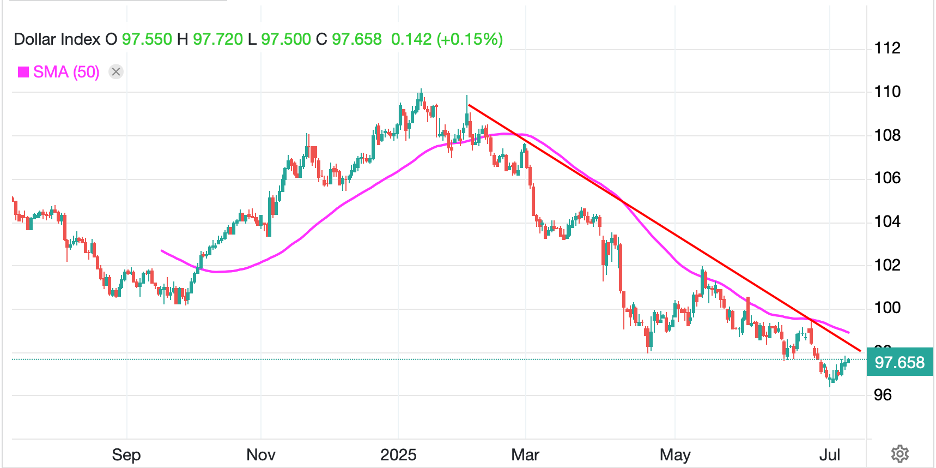
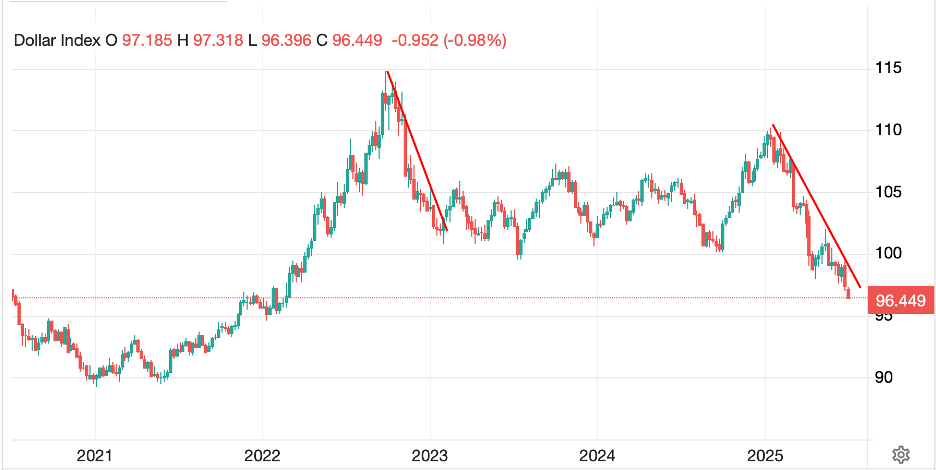
The dollar is weaker this morning and if we use the Dollar Index as a proxy, it has fallen to its lowest level since February 2022.  

Source: tradingeconomics.com

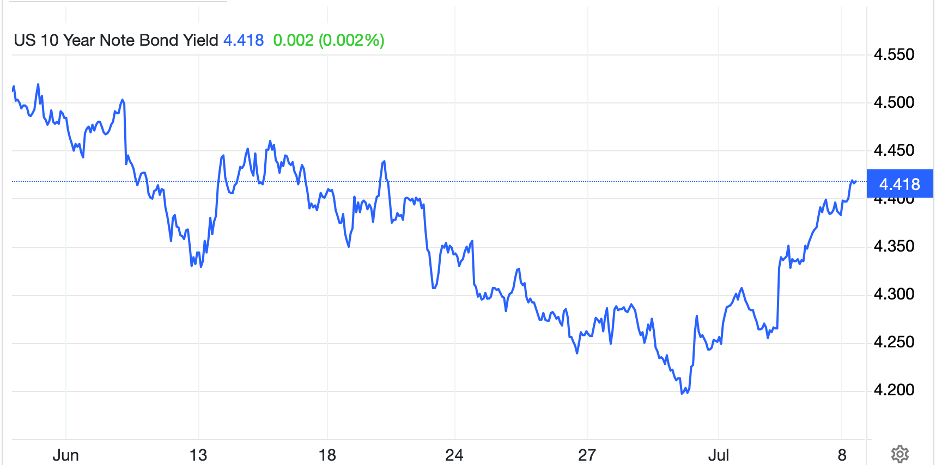
While certainly a part of this movement has been the fact that US yields continue to slide lately, it also seems there is a new narrative that has been distributed to journalists, the dollar is falling because President Trump is considering naming a new Fed Chair much earlier than usual in an effort to undermine Chairman Powell.  We have all heard about the rants the President has had regarding Powell’s unwillingness to cut rates even though inflation readings have been declining for the past two months, and are, on a Y/Y basis back to their lowest level since March 2021 whether measured as CPI (grey line) or Core PCE (blue line).

Source: tradingeconomics.com

But in an exclusive (!) article in the WSJ, which was repeated in Bloomberg, that is the story du jour.  While Bloomberg’s take cannot be a surprise given Mayor Mike’s intense hatred of Trump (after all Trump is the NY billionaire that became president, not Bloomberg), and editorial direction clearly comes from the top, it is more interesting that the Journal is pushing this theme.  Of course, given the Fed whisperer is the article’s writer, it is more than possible that he is simply airing Powell’s views and trying to explain how any move like this would result in chaos, so it’s not Powell’s fault if things go pear-shaped.

Nonetheless, that is today’s story.  In concert with this story, though is another, somewhat more interesting feature, where a really smart analyst, Marko Papic, has broken down the dollar’s movements across different time zones during 2025.  The chart below shows that the dollar selling has been emanating from Asia mostly with Europe having a lesser impact and no substantive change in the NY session.  The implication is that Asian holders of dollars, which tend to be sovereigns rather than other users like investors or corporates, are the ones bailing out.

This activity first became noticeable in early April, right around “Liberation Day” and does fit with the idea that higher US tariffs will result in a smaller US trade deficit.  But as I consider that concept, it strikes me that a smaller US trade deficit will result in fewer dollars around the rest of the world, a reduction in supply, and that would arguably increase the dollar’s value ceteris paribus.  Perhaps this reflects investors selling US assets and converting them to Europe, which has been another theme this year as European companies are set to benefit from a major increase in defense spending by NATO.  However, that doesn’t really sync with the fact that US equities continue to trade near all-time highs.  At this point, I think this is an interesting observation, but am not sure of its meaning.  I’m open to suggestions.

Ok, while that is the narrative this morning, let’s look at how markets are behaving.  Yesterday’s lackluster activity in the US, with the S&P 500 almost exactly unchanged and the other two main indices +/- 0.3% was followed by a burst higher in Tokyo (Nikkei +1.6%) but lagging activity in HK (-0.6%) and China (-0.4%).  The rest of the region couldn’t decide on much with a couple of solid performances (India, Indonesia) and one laggard of note (South Korea).  In Europe, Germany (+0.6%) is leading the way higher across the board, as NATO countries have promised to spend upward of 5% of GDP on total defense (including nonlethal investments), with as much as possible going to European based companies.  That is a lot of money, well over $1.5 trillion.  Meanwhile, US futures are all higher at this hour (7:15), up by about 0.4% or so.

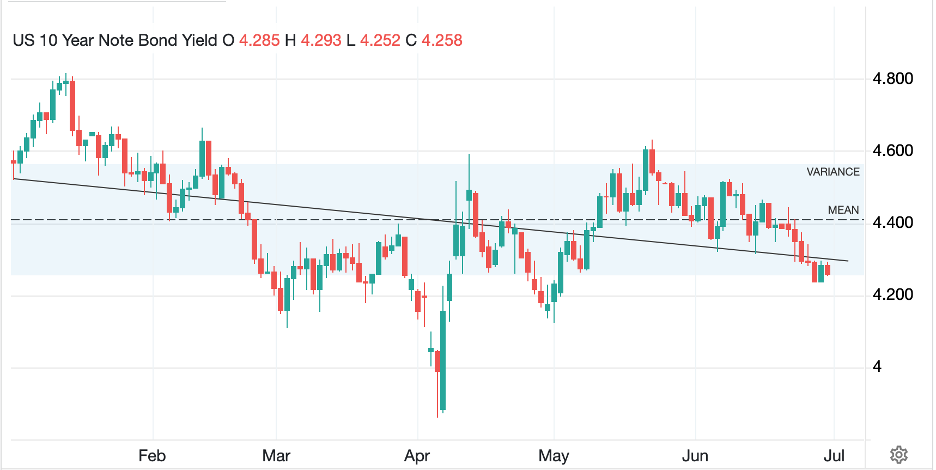
In the bond market, Treasury yields (-2bps) continue to slip and are now back to their lowest level since early May.  Perhaps more interestingly, European sovereign yields are sliding today as well, led by Italian BTPs (-4bps) but lower across the board.  This is interesting given the promises of more borrowing based on the NATO announcement.  But net, bond yields have not really done very much lately at all.

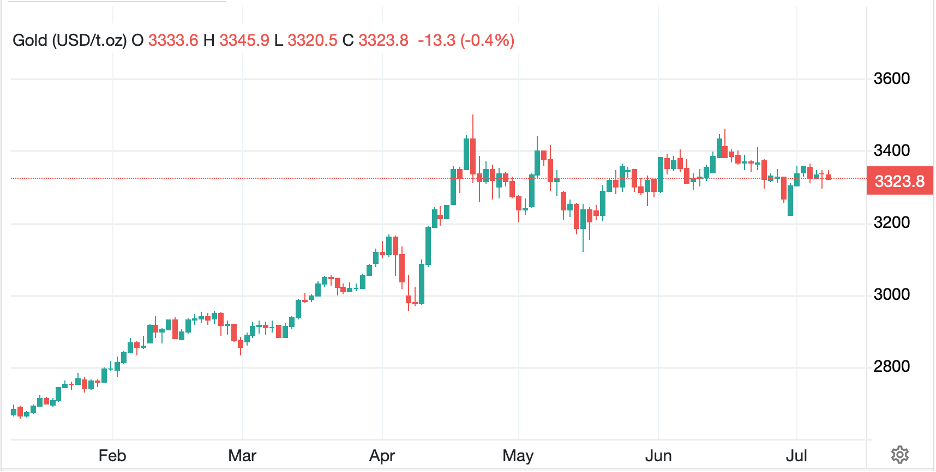
In the commodity markets, oil (+0.5%) is continuing to slowly bounce from the initial lows in the wake of the Iran/Israel ceasefire.  This market still feels quite heavy to me and absent a major change on the ground in the Middle East, if war were to resume and oil facilities be attacked, I still think lower is the way.  In the metals markets, gold (+0.25%) which tried to sell off yesterday continues to find bids below the market, likely central bank support.  But silver (+0.9%) and copper (+2.3% and above $5.00/lb) are looking good although nowhere near as impressive as platinum (+3.4%) which has now risen above $!400/oz and is going parabolic here.  There is much talk here about a supply shortage (it is used for catalytic converters) and significant Chinese demand.

Source: tradingeconomics.com

Finally, the dollar, as mentioned, is under pressure across the board, although the magnitude of this morning’s movement has not been that large.  The largest movement has been in Asia with IDR (+0.6%), JPY (+0.4%) and KRW (+0.35%) while European and LATAM movements have been generally 0.2% or less.  So, the direction is clear, but it has not been impressive.

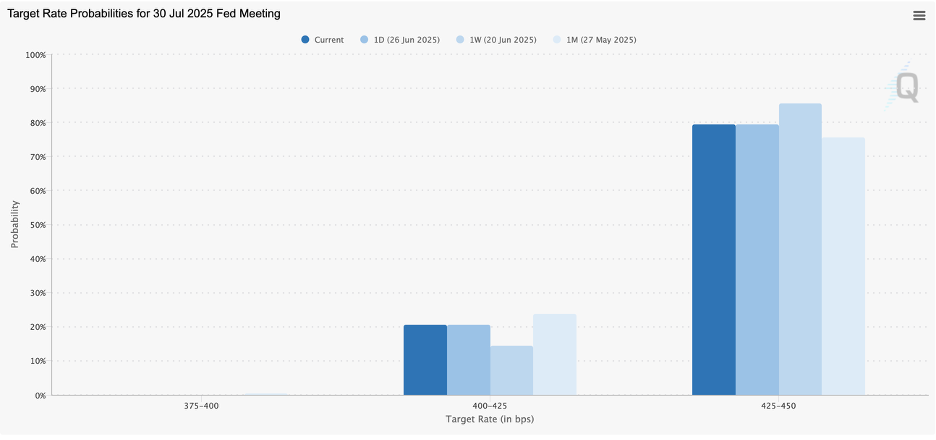
On the data front, there is plenty today starting with the weekly Initial (exp 245K) and Continuing (1950K) Claims, the Chicago Fed National Activity Index (-0.1), the last look at Q1 GDP (-0.2%), and Durable Goods (8.5%, 0.0% ex-Transports).  We also hear from four more Fed speakers, but Powell just repeated yesterday that they are happy where they are and unlikely to move soon unless something really changes rapidly.  However, despite Powell’s claims of nothing to come, the Fed funds futures market is pricing a 25% probability of a cut at the July 30 meeting.  There is a lot of time between now and then for that to change.

I keep trying to figure out what actually matters to markets anymore as responses to different potential catalysts seem confused.  People do seem to be coalescing around the dollar is falling theme, something I have believed for a while, and if the Fed does lean to a cut next month, I do believe there is further for it to fall.  One thing to remember, though, is with Mr Trump as president, things are still a tweet away from a dramatic change.  If I were in charge of hedging risk, I would adhere to guidelines closely.  There is too great an opportunity for a sudden major reversal in the current environment.

Good luck

Adf

What He Will Mention

Last night there was, briefly, a peace
This morning, though, that seemed to cease
But worries Iran
From Hormuz, would ban
Most ships, have now greatly decrease(d)
 
So, markets have turned their attention
To Powell and what he will mention
When he sits before
The Senate once more
Though most seated lack comprehension


Talk about yesterday’s news!  While I am pretty confident we have not heard the last of the Iran/Israel conflict, it has dropped off the radar in a NY minute.  Last night President Trump announced a cease fire between the two nations and while Israel alleged that Iran already broke the peace, the market has clearly moved on from the erstwhile WWIII concept to WWJS (What Will Jay Say).  In that vein, this morning’s WSJ had an articlefrom the Fed whisperer, Nick Timiraos, describing the trials and tribulations of poor Chairman Powell as he tries to fend off those mean words from President Trump.  

Powell sits down before the Senate Banking Committee this morning, and the House Financial Services Committee tomorrow, ostensibly to describe the state of the economy and the Fed’s current thinking.  I have begun to see discussions that two Trump appointed governors, Bowman and Waller, are now interested in potentially cutting the Fed funds rate in July and the futures market has raised the probability of a cut next month to 23%, back to the levels seen a month ago, pre-war and prior to a run of stronger than expected economic data.

Source: cmegroup.com

Frequently mentioned throughout the WSJ article was the idea of Fed independence and how critical that is for monetary policy to be effective.  As well, the fact that the comments on rate cuts are from governors Trump appointed, and that is being highlighted in a negative fashion, is further evidence that the Fed remains a highly political, and quite frankly, partisan organization.  One cannot look at the rate cuts last autumn ahead of the election, which were certainly not warranted by the data, as anything other than the Fed’s attempt to support VP Harris’s presidential campaign.  And when inflation was still quite high, although starting to decline, calls for cuts by Biden appointees Cook and Jefferson, were also likely politically motivated given the still high inflation rate.  

In fact, I wonder where Governor’s Cook and Jefferson are today with respect to rate cuts.  After all, both have demonstrated dovish biases throughout their tenure at the Fed, but suddenly they are strangely silent on the subject.  I’m sure that is not a political bias showing, but rather deeply considered economic analysis. 🙃

I do find it interesting that there is an underlying presumption that the Fed funds rate is always too high, at least for the narrative, although I guess that is because most narrative writers believe strongly in the idea if rates are low, stock prices will rise.

Regardless of the politics, Powell will very likely explain that there is still concern that tariffs could raise prices and while there is the beginning of concern over the labor market, it remains solid and does not warrant rate cuts at this time.  Of course, we will also be subject to the preening of all those senators (what is the probability that Senator Van Hollen brings up deportations?) with no useful discussion.  It seems unlikely that Chairman Powell will alter his message from the post meeting press conference which remains, patience is a virtue.

Ok, now that the war has ended, let’s see how markets have behaved.  I must start with oil (-3.0% today, -12.0% since yesterday morning) where traders have removed the entire Hormuz closing premium and are now dealing with the fact that there are more than ample supplies around.  Recall, OPEC+ continues to increase production, and the macroeconomic narrative remains one of slowing economic activity.  Happily, gasoline prices are following oil lower so look for less inflation concerns for next month.

Source: tradingeconomics.com

Meanwhile, with war off the table, gold (-1.3%) is no longer in such great demand although silver (unchanged) and copper (+0.7%) continue to find support.  Net, my longer-term views remain that oil prices have further to decline while metals prices should grind higher over time.

In the equity markets, you have to search long and hard to find a market that didn’t rally overnight or is in the process of doing so this morning.  After yesterday’s strong US closing (all three main indices up about 0.9%), Asia (Nikkei +1.1%, Hang Seng +2.1%, CSI 300 +1.2%) rallied sharply with Korea (+3.0%) really popping and only one negative, New Zealand (-0.5%) where local traders cannot seem to get on board with the better news.  In Europe, the gains are also substantial (DAX +1.8%, CAC +1.2%, IBEX +1.4%) although the UK (+0.3%) is lagging given the large weighting of energy in the index.  US futures are also pointing higher this morning, about 0.8%.

In the bond market, Treasury yields are unchanged this morning after slipping -3bps yesterday, but we are seeing yields rise in Europe (Bunds +5bps, OATs +3bps) after the Germans announced they would be borrowing 20% more this quarter than initially expected to help their rearmament program.  I guess investors had a mild bout of indigestion.

Finally, the dollar, which rallied nicely into yesterday’s NY opening has basically reversed all those gains since then and is back trading near 98 on the DXY. While there are various relative sizes of movement, it is all in the same direction and entirely driven by the Iran/Israel war story.  Perhaps we are starting to see some pricing of a Fed rate cut, and if they do act in July, I would expect the dollar to fall, but right now, it feels much more like unwinding the war footing.

On the data front, aside from Chairman Powell at 10:00 this morning, we see Case Shiller Home Prices (exp +4.0%) and Consumer Confidence (100.0).  However, I suspect that neither of those will matter very much.  The equity market has the bit in its mouth and is looking for reasons to go higher.  Any dovish hints by Powell will set that off, as well as undermine the dollar.  We shall see.

Good luck

Adf

Not Yet Foregone

The US has not yet been drawn
To war, though it’s not yet foregone
That won’t be the case
While Persians now brace
For busters of bunkers at dawn
 
But until such time as we learn
That outcome, the current concern
Is Jay and the Fed
And what will be said
At two o’clock when they adjourn


So, every top headline this morning discusses the idea that President Trump is considering whether to initiate US military action in Iran, specifically to drop the so-called bunker buster bombs to destroy Iran’s nuclear enrichment and bomb-making facilities.  There is certainly a lively discussion on both sides of the argument with the best description of the problem that I’ve seen being a poll showing that 74% approve Trump’s position that Iran must not get nuclear weapons, but 60% oppose US involvement in the war.  I’m glad I don’t have to thread that needle!

Obviously, there are market implications if the US does get involved but given the complete lack of clarity on the situation at this point, I do not believe I can add much to the discussion.  The only thing I will say is that the longer-term trends for both oil (lower) and metals (higher) are still intact, but we are likely to see some significant volatility along the way.

Which takes us to the next most important market discussion, the FOMC meeting that ends today and the potential market impacts.  It is universally assumed that there will be no policy change at the meeting, either interest rates or QT, which means that now the punditry is focused on the arcana of Fed policy.  As this is a quarter end meeting, the Fed will release its latest SEP (summary of economic projections) and dot plot, and with nothing else to discuss until the war in Iran either ends or intensifies, those are the key discussion points in the market.  

I have long maintained that one of the greatest blunders of the Bernanke era was the institution of forward guidance.  While it may have served its purpose initially, it has now become a major distraction.  Far too much attention is paid to the dot plot, where if one member adjusts their view by 25bps, it can impact markets which have built algorithms to respond to the median outcome.

Below is the March dot plot which showed a median “expectation” of Fed funds for the end of 2025 at 3.875%, or 50 basis points lower than the current level.  However, if two more FOMC members (out of 17) thought there was only going to be one cut, that would have shifted the median “expectation” as well as the narrative.

As such, the importance of the dot plot feels overstated compared to its actual value.  After all, no FOMC member has an impressive track record with respect to their analysis of the economy and its future outcomes, let alone what the appropriate rate structure should be at any given time.  In fact, nobody has that, which is the argument for restricting the Fed’s duties to be lender of last resort and allow markets to determine the proper level of interest rates based on the supply and demand of money.  But this is the world in which we live.  My one observation is that the post GFC era has greatly distorted views on the economy and appropriate monetary policy.  It is hard not to look at the below history of Fed funds and see the anomaly that occurred during the initial QE phase.  

Concluding, regardless of my, or anyone not on the FOMC’s, views on appropriate policy, it doesn’t matter one whit.  They are going to do what they deem appropriate, and while I don’t doubt their sincerity, I do doubt they have the tools for the mission.  Perhaps the most interesting thing that could come from this meeting is further information on their assessment of the current Fed process, including their communication policy.  I remain strongly in favor of them all shutting up and letting markets do their job although that seems unlikely.  But perhaps they will get rid of the dots which seem to have outlived any value they may have had initially.

Before we go to markets, I have to highlight one other market discussion this morning with Bloomberg publishing two different articles, here and here,  on the end of the dollar’s hegemony.  The first highlights a speech by PBOC governor Pan Gongsheng and his vision of a multicurrency world which, of course, includes the renminbi as a major part of the process.  I will believe that is a possibility as soon as China opens its capital accounts completely and allows flows into and out of the country with no restrictions.  (I’m not holding my breath.)  The second takes the Michael Bloomberg Trump hatred in the direction of the president is destroying the dollar’s reign because of his policies and to highlight the dollar has fallen 10% already this year!  But let us look at a long-term chart of the dollar, using the DXY as a proxy, and you tell me if you can see the recent move as being outsized in any sense of the word.  In fact, the dollar’s recent price action is indistinguishable from anywhere in its history, and it is not anywhere near to its historic lows.  In fact, it is just a few percent below its long-term average.

Ok, now let’s look at markets.  Yesterday’s selloff in equities seemed to be based on concerns over the escalation in Iran, but as that drags out, traders don’t know what to do.  They are certainly not pushing things much further.  In fact, overnight saw the Nikkei (+0.9%) have a solid gain although HK (-1.1%) followed the US lower.  Elsewhere in the region, South Korea and Taiwan performed well, while India and Indonesia lagged and the rest were +/-20bps or less.  Europe, though, is softer this morning with declines on the order of -0.4% on the continent across the board.  I think investors here are also waiting on the potential events in Iran.  But US futures are actually pointing slightly higher at this hour (7:30).

In the bond market, yields around the world are slipping with Treasuries falling -2bps and most of Europe seeing declines between -1bp and -3bps.  This is after a few basis point decline yesterday as well.  I guess the fear of too much US debt is in abeyance this morning.

In commodity markets, oil, which rallied sharply yesterday on fears of the US entering the war, is little changed on the day after that climb as while there has been lots of talk, oil continues to flow through the Strait of Hormuz, and everybody is pumping nonstop to take advantage of the current relatively high prices.  Gold is unchanged although the other metals (Ag +0.25%, Cu +0.7%, Pt +2.4%) continue to see significant support.  In fact, platinum this morning has broken above the top of an 11-year range and many now see an opportunity for a significant rally from here.

Finally, the dollar is somewhat softer this morning, slipping about 0.2% against the pound, euro and yen, with similar declines against most other currencies.  The exceptions to this are the KRW (+0.45%) which seems to be benefitting from a growing hope that a trade deal will be completed between the US and Korea shortly, and ZAR (-0.5%) as CPI data release there this morning shows inflation under control and no reason for SARB to consider tightening policy further.

On the data front, because of tomorrow’s Juneteenth holiday, we see Initial (exp 245K) and Continuing (1940K) Claims as well as Housing Starts (1.36M) and Building Permits (1.43M).  And of course, at 2:00 it’s the Fed.  My sense is absent a US escalation in Iran, it will be quiet until the Fed, and probably thereafter as well given the lack of reason for any policy changes.  After all, there is no certainty as to either war or trade policy right now, so why would they do anything.

If I had to opine, I would say the dollar is likely to decline over the next year, but that in the longer run, it will be firmer than today.  

Good luck

Adf

Dine and Dash

The president left in a flash
Completing a quick dine and dash
But so far, no word
On what, this move, spurred
Though I’ve no doubt he’ll make a splash
 
Then last night the BOJ passed
On hiking, though none was forecast
And Germany’s ZEW
Implied there’s a view
That growth there will soon be amassed


I have to admit that when I awoke this morning, I expected there to have been significantly more news regarding the Iran/Israel conflict based on President Trump’s early departure from the G-7 meeting.  But, from what I see so far, while markets have reversed some of yesterday’s hope that a ceasefire was coming soon, my read is we are back to overall uncertainty in the situation.  Of course, the concept of the fog of war is well known, and I expect that we will not find out very much until those in control of the information, whether the IDF or the US military, or Iranian sources, choose to publicize things.  The one thing we know is that everything we learn will be biased toward the informants’ view, so needs to be parsed carefully.  I do think that Trump’s comments to the press when he was leaving the G-7 about seeking “an end. A real end. Not a ceasefire, an end,” to the ongoing activities is telling.  It appears the Israelis planned on a 2-week campaign and that is what they are going to complete.

From a market perspective, as we have already seen in the price of oil, and generally all asset classes, absent a significant escalation, something like a tactical nuclear strike by the Israelis to destroy the Iranian nuclear bomb-making capabilities, I expect choppiness on headlines, but no trend changes.  At some point, the fighting will end, and markets will return their focus to economic and fiscal concerns and perhaps central banks will become relevant again.

So, let’s turn to that type of news which leads with the BOJ leaving policy rates on hold, although they did reduce the amount of QE to ¥200 billion per month, STARTING IN APRIL 2026!  You read that correctly.  The BOJ, which has been buying ¥400 billion per month of JGBs while they raised interest rates in their alleged policy tightening, has decided that ten months from now it will be appropriate to slow the pace of QE.  Yes, inflation has been running above their 2.0% target for more than three years (April 2022 to be exact) as you can see in the below chart, but despite a whole lot of talk, action has been slow to materialize.

Source: tradingeconomics.com

You may recall about a month ago when Japanese long-end yields, the 30-year and 40-year bonds, jumped substantially, to new all-time highs and there was much discussion about how there had been a sea change in the situation in Japan.  Expectations grew that we would start to see Japanese institutions reduce their holdings of Treasuries and bring their funds home to invest in JGBs, leading to a collapse in the dollar.  The carry trade was going to end, and this was another chink in the primacy of the dollar’s hegemony.  Well, if that is the case, it is going to take longer than the punditry anticipated, at the very least, assuming it happens at all.  As you can see from the charts below of both USDJPY and the 40-year JGB, all that angst has at the very least, been set aside for now.

Source: tradingeconomics.com

Elsewhere, the German ZEW data released this morning was substantially stronger than both last month and the forecasts for an improvement.  As you can see from the chart below, it is back at levels that are consistent with actual economic growth, something Germany has been lacking for several years.  It appears that a combination of the continued tariff truce, the promises of massive borrowing and spending by Germany to rearm itself and the ECB’s easy policy have German business quite a bit more optimistic that just a few months ago.

Source: tradingeconomics.com

Ok, while we await the next shoe to drop in Iran or Israel, let’s see how markets have behaved overnight. Yesterday’s nice rally in the US was followed by a mixed picture in Asia with the Nikkei (+0.6%) gaining after the BOJ showed that tighter policy is not coming that soon.  Elsewhere in the region, China, HK and India were all down at the margin, less than 0.4% while Korea and Taiwan managed some gains with Taiwan’s 0.7% rise the biggest mover overall.  In Europe, though, the excitement about a truce in Iran is gone with bourses across the continent lower (DAX -1.25%, CAC -1.05%, IBEX -1.5%, FTSE 100 -0.5%).  Apparently, there is fading hope of trade deals between the US and Europe and concerns are starting to grow as to how that will impact European activity.  I guess the ZEW data didn’t do that much to help.  US futures at this hour (7:00) are all pointing lower by about -0.5%, largely unwinding yesterday’s gains.

In the bond market, Treasury yields, which backed up yesterday, are lower by -3bps this morning, essentially unwinding that move.  However, European sovereign yields have all edged higher between 1bp and 2bps with Italy’s BTPs the outlier at +3bps.  Quite frankly, it is hard to have an opinion as to why bond yields move such modest amounts, so I’m not going to try to explain things.

In the commodity space, fear is back in play as oil (+1.7%) is rallying as is gold (+0.4%) which is taking the rest of the metals complex (Ag +2.3%, Cu +0.3%, Pt +3.0%) with it.  These are the markets that are most directly responding to the ongoing ebbs and flows of the Iran/Israel situation, and I expect that will continue.  In the end, I continue to believe the long-term trend for oil is toward lower prices while for gold and metals it is toward higher prices, but on any given day, who knows.

Finally, the dollar doesn’t know which way to turn with modest gains and losses vs. different currencies in both G10 and EMG blocs.  The euro, pound and yen are all within 0.1% of yesterday’s closing levels while we have seen KRW (-0.4%) and INR (-0.3%) suffer and NOK (+0.4%) and SEK (+0.4%) both gain on the day.  However, those are the largest movers across the board, so it is difficult to make a case that anything of substance is ongoing.

On the data front, yesterday’s Empire State Manufacturing index was quite weak at -16, not a good look.  This morning, we see Retail Sales (exp -0.7%, +0.1% ex-autos), IP (0.1%), and Capacity Utilization (77.7%).  As well, the FOMC begins their meeting this morning with policy announcements and Powell’s press conference scheduled for tomorrow.  Helpfully, the Fed whisperer, Nick Timiraos, published an article this morning in the WSJ to explain why the Fed was going to do nothing as they consider inflation expectations despite the lack of empirical evidence that those have anything to do with future inflation.  But it is a really good sounding theory.

For now, the heat of the Iran/Israel situation will hold most trader’s attention, but I suspect that this will get tiresome sooner rather than later.  The biggest risk to markets, I think, is that the Iranian regime collapses and a secular regime arises, dramatically reducing risks in the Middle East and reducing the fear premium in oil substantially.  If that were to be the case, I expect the dollar would suffer as abundant, and cheap, oil would help other nations more than the US on a relative basis given the US already has its own supply.  But a major change of that nature would have many unpredictable outcomes.  In the meantime…

Good luck

Adf

Quite Dreary

While pundits expected inflation
Would rise with Trump as the causation
The data has not
Shown prices are hot
Since tariffs joined the conversation
 
In fact, there’s a budding new theory
That’s made dollar bulls somewhat leery
If Powell cuts rates
While Christine, she waits
The dollar might soon look quite dreary


Well, it turns out measured inflation wasn’t quite as high as many had forecast, even if we ignore those whose views are completely political.  Yesterday’s readings of 0.1% for both headline and core were lower despite all the tariff anxiety.  The immediate response has been, just wait until next month, that’s when the tariff impact will kick in, you’ll see.  Maybe that will be the case, but right now, for a sober look, the Inflation_Guy™, Mike Ashton, offers a solid description of what happened and some thoughts about how things may be going forward.  Spoiler alert, tariffs are not likely the problem, let’s start thinking about money supply growth.

However, the market, as always, is seeking to create a narrative to drive things (or does the narrative follow the market?  Kind of a chicken and egg question) and there is a new one forming regarding the dollar.  Now, with inflation appearing to slow in the US, this is an opening for Chair Powell to cut rates again, despite the fact that inflation on every reading remains above their target.  Meanwhile, the uncertainty that US policy is having on economies elsewhere, notably in Europe as the tariff situation is not resolved, means Madame Lagarde is set to pause, (if not halt), ECB rate cuts for a while and voilà, we have the makings of a dollar bearish story.  

That seems likely to have been the driver of today’s move in the euro (+1.0%) which has taken the single currency back to its highest level since November 2021.

Source: tradingeconomics.com

Now, if you are President Trump and are seeking to reduce the trade deficit while bringing manufacturing capacity back to the US, this seems like a pretty big win.  Lower inflation and a lower dollar both work towards those goals.  Not surprisingly, the president immediately called for the Fed to cut rates by 100 basis points after the release.  As much as FOMC members seem to love the sound of their own voices, perhaps this is one time where they are happy to be in the quiet period as no response need be given!

At any rate, the softer inflation data has had a significant impact on the dollar writ large, with the greenback sliding against all its G10 counterparts, with SEK (+1.3%) leading the way, although CHF (+1.1%), NOK (+0.9%) and JPY (+0.8%) have also been quite strong.  However, the biggest winner was KRW (+1.3%) as not only has there been dollar weakness, but new president, Lee Jae-myung, has proposed tax cuts on dividends to help support Korean equity markets and that encouraged some inflows.  Other EMG currencies have gained as well, although those gains are more muted (CNY +0.3%, PLN +0.6%) and some have even slipped a bit (ZAR -0.5%, MXN -0.1%).  Net, however, the dollar is down.

Yesterday, I, and quite a few other analysts, were looking for more heat in the inflation story.  Clearly, if that is to come, it is a story for another day.  With this in mind, we shouldn’t be surprised that government bond yields have also fallen around the world with Treasuries (-5bps) showing the way for most of Europe (Bunds -6bps, OATs -5bps, Gilts -6bps) and even JGBs (-2bps) are in on the action.  

Earlier this week, the tone of commentary was that inflation was coming back, and a US stagflation was inevitable.  This morning, that narrative has disappeared.    Interestingly, I would have thought the combination of the cooler CPI and the trade truce between the US and China would have the bulls feeling a bit better.  Alas, the equity markets have not responded in that manner at all.  Despite the soft inflation readings, US equity markets yesterday edged lower, albeit not by very much.  But that weakness was followed in Asia (Nikkei -0.65%, Hang Seng -0.4%, CSI 300 -0.1%) with India, Taiwan and Australia all under pressure although Korea (+0.45%) bucked the trend on that dividend tax story.  And Europe, this morning, is also unhappy with the DAX (-1.1%) leading the way lower followed by the IBEX (-.9%) and CAC (-0.7%).  The FTSE 100 (-0.1%) is faring a bit better as, ironically, weaker than expected GDP data this morning (-0.3% in April) has reawakened hope that the BOE will get more aggressive cutting rates.  US futures are in the red as well this morning, -0.5% across the board.  Perhaps this is the beginning of the long-awaited decline from overbought levels.  Or perhaps, this is just a modest correction after a strong performance over the past two months.  After all, the bounce in the wake of the Liberation Day pause has been impressive.  A little selling cannot be a surprise.

Source: tradingeconomics.com

Lastly, we turn to commodities where the one consistency is that gold (+0.5%) has no shortage of demand, at least in Asia.  It seems that despite a 29% rise year-to-date in the barbarous relic, US investors are not that interested.  Those gains dwarf everything other than Bitcoin, and yet they have not caught the fancy of the individual investor in the US.  However, I believe that demand represents an important measure of the diminishing trust in the US dollar, at least for the time being.  The other metals are less interesting today.  As to oil (-1.9%), it has rallied despite alleged production increases from OPEC and weakening demand regarding economic activity.  Some part of this story doesn’t make any sense, although I don’t know which part yet.

This morning’s data brings Initial (exp 240K) and Continuing (1910K) Claims as well as PPI (0.2%, 2.6% Y/Y headline; 0.3%, 3.1% core).  While there are no Fed speakers, there is much prognostication as to how the CPI data is going to alter their DOT plot and SEP information next week at the Fed meeting.  

Finally, the situation in LA does not appear to have improved very much and it is spreading to other cities with substantial protests ostensibly planned for this weekend.  However, market participants have moved on as nothing there is going to change macroeconomic views, at least not yet.  If inflation is quiescent, the Fed doesn’t have to cut to have the tone of the conversation change.  That is what we are seeing this morning and this can continue quite easily.  When I altered my view on the strong dollar several months ago, I suggested a decline of 10% to 15% was quite viable.  Certainly, another 5% from here seems possible over the next several months absent a significant change in the inflation tone.

Good luck

Adf

PS – having grown up in the 60’s I was a huge Beach Boys fan and mourn, with so many others, the passing of Brian Wilson.  In fact, I wanted to write this morning’s rhyme as new lyrics to one of his songs, either “Fun, Fun, Fun” or “Surfin’ USA” two of my favorites.  But I realise that I have become too curmudgeonly as both of those are wonderfully upbeat and I just couldn’t get skeptical words to work.

Mugwump

The feud between Elon and Trump
Show’s Musk has become a mugwump
But though there’s much drama
It’s not clear there’s trauma
As markets continue to pump
 
So, turning our eyes toward today’s
Report about jobs, let’s appraise
The call for recession
That’s been an obsession
Of some for six months of Sundays


Clearly the big headlines are all about the escalating war of words between President Trump and Elon Musk.  I guess it was inevitable that two men with immense wealth and power would ultimately have to demonstrate that one of them was king.  But other than the initial impact on Tesla’s stock price, it is not clear to me what the market impacts are going to be here.  After all, President Trump has attacked others aggressively in the past when they didn’t toe his line, and it is not a general market problem, only potentially the company with which that person is associated.  As such, I don’t think this is the place to hash out the issue.

However, I think it is worth addressing one point that Musk raised regarding the Big Beautiful Bill.  The thing about reconciliation is it only addresses non-discretionary spending, meaning Social Security, Medicare, Medicaid and the interest on the debt.  All the other stuff that DOGE made headlines for, USAID etc., could never be part of this bill.  That requires recission packages where Congress specifically passes laws rescinding the previously enacted payments.  So, if this was a part of the blowup, it was senseless.  I will say, though, that the Trump administration did not communicate this fact effectively as I read all over how people are upset that Congress is not addressing these other things.  At any rate, this is not a political commentary, but I thought it was worth understanding because I only learned of this in the past weeks and I don’t believe it is widely understood.

Onward to the major market news today, the payroll report.  As of this morning, according to tradingeconomics.com, here are the forecast outcomes:

Nonfarm Payrolls130K
Private Payrolls120K
Manufacturing Payrolls-1K
Unemployment Rate4.2%
Average Hourly Earnings0.3% (3.7% Y/Y)
Average Weekly Hours34.3
Participation Rate62.6%

Of course, Wednesday’s ADP Employment number was MUCH lower than expected, so the whispers appear to be for a smaller outcome.  As well, the key wildcard in this data is the BLS Birth-Death model which is how the BLS estimates the number of jobs that have been created by small businesses which aren’t surveyed directly.  As with every model, especially post-Covid, what used to be is not necessarily what currently is.  The most accurate, after the fact, representation of employment is the Quarterly Census of Employment and Wages (QCEW) but that isn’t released until 6 months after the quarter it is addressing, so it is not much of a timing tool.  It is also the genesis of all the revisions.  

Here’s the thing, a look at the chart below shows that the BLS Birth-Death model appears to still be substantially overstating the payroll situation.  Given the datedness of its model, that cannot be a real surprise, but I assure you, if there is a major revision lower in that number, and NFP prints negative, it WILL be a surprise to markets.  I am not forecasting such an occurrence, merely highlighting the risk. 

If that were to be the case, I imagine the market reaction would be quite negative for stocks and the dollar, positive for bonds (lower yields) and likely continue to push precious metals higher, although oil would likely suffer.  I guess we will all have to wait and see at 8:30 how things go.

In the meantime, ahead of the weekend, let’s see how markets behaved overnight.  Yesterday’s modest sell-off in the US was followed by a mixed session in Asia (Nikkei +0.5%, Hang Seng -0.5%, CSI 300 -0.1%) but strength in Korea (+1.5%) and India (+0.9%).  Trade discussions still hang over the market and there are increasing bets that both India and Korea are going to be amongst the first to come to the table.  As well, the RBI cut rates by 50bps last night with the market only expecting 25bps, so that clearly supported the SENSEX.  In Europe, no major index has moved even 0.2% in either direction as positive European GDP data was unable to get people excited and there is now talk that the ECB will not cut rates again until September.  As to US futures, at this hour (6:50) they are pointing higher by about 0.3% across the board.  It appears that the Tesla fears are abating.

In the bond market, yields continue to slide with Treasuries falling -1bp and European sovereign yields down between -3bps and -5bps despite the stronger than expected Eurozone data which also included Retail Sales (+2.3%) growing more rapidly than expected.  But this is a global trend as recession discussions increase while we also saw JGB yields slip -2bps overnight.  It feels like the bond markets around the world are anticipating much slower economic activity.

In the commodity space, oil (0.0%) is unchanged this morning and continuing to hang around at its recent highs, but unable to break above that $63+ level.  It strikes me that if slower economic activity is on the horizon, that should push oil prices lower as there appears to be ample supply.  But I read that Spain has stopped importing Venezuelan crude as US secondary sanctions are about to come into effect there.  As to the metals markets, silver (+1.5%) and platinum (+2.6%) have been the leaders for the past few sessions although gold (+0.2%) continues to grind higher.  The loser here has been copper (-0.8%) which if the economic forecasts of slowing growth are correct, makes some sense.  Of course, there is a strong underlying narrative about insufficient copper supplies for the electrification of everything, but right now, payroll concerns are the story.

Finally, the dollar is a bit firmer this morning, but only just, with G10 currencies slipping between -0.2% and -0.3% while EMG currencies have shown even less movement.  INR (+0.25%) stands out for being the only currency strengthening vs. the dollar after the rate cut and positive growth story, but otherwise, this is a market waiting for its next cue.

In addition to the payroll report, we get Consumer Credit (exp $10.85B) a number which gets little attention but may grow in importance if economic activity does start to decline.  As well, I cannot ignore yesterday’s Trade data which saw the deficit fall much more than expected, to -$61.6B, its smallest outturn since September 2023.  While I didn’t see any White House comments on the subject, I expect that President Trump is happy about that number.

Are we headed into a recession or not?  Will today’s data give us a stronger sense of that?  These are the questions that we hope to answer later this morning.  FWIW, which is probably not that much, my take is while economic activity has likely slowed a bit, I do not believe a recession is upon us, and as I do believe the reconciliation bill will be passed which extends the tax cuts, as well as adds a few like no tax on tips or Social Security, I expect that will turn any weakness around quickly.  What does that mean for the dollar?  Right now, it is piling up haters so a further decline is possible, but I cannot rule out a reversal if/when the tax legislation is finalized.

Good luck and good weekend

Adf
Bond Market blues

The story today is the court
And how it was able to thwart
The president’s aim
To alter the frame
Of trade, local firms, to support
 
Investors, though, cheered at the news
As tariffs had caused them to lose
Their faith that the Fed
Would cut rates ahead
Thus, ending the Bond Market Blues


I’m no attorney and so I have no opinion as to the legality of President Trump’s tariff impositions and whether they fit within the International Emergency Economic Power Act.  However, the Court of International Trade ruled that his tariffs were illegal and must be voided.  It was immediately appealed by the administration, so this fight is far from over.  You can be sure it will head to the Supreme Court.

However, within the extraordinary mass of US legislation on the books, there is at least one other way for President Trump to achieve his aims.  Within the still operational Trade Act of 1930, more commonly known as the Smoot-Hawley tariffs, is a key section, 338, with very clear presidential authority.  As per Law360, the below describes the law and the president’s powers accordingly:

Section 338 permits the president to impose “new or additional duties” of countries that have discriminated against commerce of the United States. Section 338 authority is triggered when the president finds that a foreign country has either (1) imposed an “unreasonable charge, exaction, regulation, or limitation” on U.S. products which is “not equally enforced upon the like articles of every foreign country”; or (2) “[d]iscriminate[d] in fact” against U.S. commerce “in respect to customs, tonnage, or port duty, fee, charge, exaction, classification, regulation, condition, restriction or prohibition” so as to “disadvantage” U.S. commerce as compared to the commerce of any foreign country.

Whenever the president finds such discrimination, Section 338 authorizes him to impose additional duties of up to 50 percent of the product’s value. If a country continues to discriminate against U.S. goods, the president may then move to block imports from that country.

It would be a great irony if President Trump’s invocation of old laws that remain on the books, like the Alien Enemies Act of 1798 with respect to deporting illegal aliens, or perhaps Smoot-Hawley as per the above, was the catalyst needed by Congress to address the fact that there is a lot of stale legislation on the books that no longer serves the nation’s current needs.  Of course, that would take a lot of work, and that is not Congress’s strong suit.

At any rate, for our purposes, the ruling last night had a pretty clear impact on US equity futures as per the below chart from tradingeconomics.com and has helped propel US futures higher by 1% or more across the board.

You won’t be surprised that the response to this ruling throughout Asia was mostly quite positive, (Nikkei +1.95, Hang Seng +1.35%, CSI 300 +0.6%, KOSPI +1.9%, India’s Sensex +0.5%) although there were some laggards in the region.  And, of course, we cannot ignore the fact that Nvidia reported better than expected earnings last night at ~4:45pm (the first move higher on the chart above) and explained that the future remained very bright for the company with ever higher growth expected.  Risk is on, baby!

So, the chattering classes are going to spend the day discussing how they ‘knew’ that Trump’s actions were illegal and that this ruling opens the door for ever higher stock prices and valuations.  But I wonder how this is going to impact other markets, bonds for instance.  This morning, we are seeing yields back up with Treasuries (+5bps) leading the way while European sovereigns are all higher by between 2bps and 3bps.  Too, JGB’s edged higher overnight as there is a growing feeling that absent Trump’s tariff onslaught, global economic activity is going to pick up dramatically.  And maybe that is what will happen.  

Certainly, metals prices are rallying across the board (Au +0.3%, Ag +1.1%, Cu +0.6%), an indication that demand for economically sensitive factors is anticipated to rise.  Oil (+0.3%), too, is rallying modestly although is showing no inclination to break from its recent trading range as per the below:

Source: tradingecomomics.com

There is an OPEC+ Group of 8 meeting this weekend at which they are expected to announce another increase in monthly production of 411K barrels/day.  A number of analysts have explained that these increases are in name only, and that members have been overproducing their quotas, so the quotas are now catching up.  Meanwhile, are we closer to a Ukraine/Russia peace treaty with the possibility of Russian oil sanctions being lifted?  It doesn’t seem that way, but things in that world move in mysterious ways.  However, if you look at the chart above, it strikes me that oil has found a relatively stable equilibrium value for now.

Finally, the dollar’s response to the court ruling on tariffs has been remarkably muted.  On the one hand, this ought not be a surprise.  After all, economists and analysts assured us all before the tariff announcements, that other currencies would decline sufficiently to offset the impact of the tariffs and they were completely wrong.  As well, we continue to hear that the dollar is losing its status as the global reserve currency and that international investors are fleeing Treasuries, and with that fleeing the dollar.  That, too, has been completely off base.

It is interesting that the dollar is little changed given the commodity market price moves, but with US equities leading the global markets higher, perhaps US exceptionalism, at least when it comes to stocks, is not dead yet.  Today’s biggest mover in the currency space is ZAR (+0.4%) which may be attributed to the rally in precious metals although the SARB is meeting today with a policy announcement (a rate cut of 25bps is expected) to come later this morning.  But beyond the rand, virtually every currency is +/- 0.1% or less today.  This is despite South Korea cutting rates last night by 25bps and indicating that future cuts are on the way.  Perhaps oil is not the only thing that has found an equilibrium.

On the data front, this morning brings a raft of data starting with the weekly Initial (exp 230K) and Continuing (1890K) Claims, the second look at Q1 GDP (-0.3%), with its version of PCE (3.7%, core 3.5%) and Real Consumer Spending (1.8%).  As well, because of the Memorial Day holiday, EIA inventory data is released a day late with a small build expected.  We have 4 different Fed speakers, but yesterday’s Minutes explained they were going to remain patient which has been the message since the Powell press conference, and actually before that, as the uncertainties from tariffs have given them no reason to act right now.

The one thing of which I am certain is that we have not heard the last of tariffs at this point.  As mentioned above, there are numerous ways to skin that cat, and you can be sure that President Trump’s legal staff is going to use them all.  As to the market impact, right now, euphoria is the vibe with hopes that tariffs will go away and Nvidia will lead the NASDAQ up another 10,000 points in the coming weeks.  It is hard to see the dollar coming under pressure if foreign investors are going to keep funds flowing in this direction, at least until the next surprising outcome with President Trump’s policies.

Good luck

Adf

Much More Desirous

The world that we knew ere the virus
Was different, and much more desirous
‘Cause we got to ease
Whenever we’d please
And ‘flation was rare as papyrus


A few disparate thoughts this morning as there doesn’t seem to be a real theme in markets.  

Starting with Chairman Powell’s comments yesterday regarding the Fed’s policy framework and how they were reviewing the current framework established in 2020, to see if it was still appropriate.  It was during that policy discussion that the Fed came up with the idea of average inflation targeting, rather than maintaining a stable rate.  However, Chairman Powell was candid yesterday when he explained, “The idea of an intentional, moderate overshoot proved irrelevant to our policy discussions and has remained so through today.”  Ya think?

Of course, being the consummate central banker, he made sure to explain that their future failures would not be their fault.  As explained in the WSJ by the Fed whisperer himself, Nick Timiraos, Powell explained that higher real interest rates might “reflect the possibility that inflation could be more volatile going forward than in the intercrisis period of the 2010sWe may be entering a period of more frequent, and potentially more persistent, supply shocks—a difficult challenge for the economy and for central banks.” 

However, unlike the pre-Trump era, it’s not clear the market paid much attention to Mr Powell.  Going forward, I do expect the Fed to have more market sway again, but it may be a little while before that is the case.  But I think it is worthwhile for us to understand how they are thinking.

While pundits expressed they were certain
The US is who would be hurtin’
From tariffs and Trump
It turns out the slump
Is elsewhere, as he’d been assertin’

One of the themes following President Trump’s “Liberation Day” tariff announcements amongst much of the punditry was that the US was shooting itself in the foot and the US economy would be the loser in the end.  My thesis had been that the US, as the consumer of last resort, was far more important to other nations’ economic growth than vice versa.  Now, we know that the first look at Q1 GDP in the US was a negative number, but we also know that was entirely the result of the uptick in imports that came ahead of the tariffs.  Meanwhile, private economic activity in the US grew and government activity shrank, both distinct economic positives.

Well, it turns out that the rest of the world is finding that when the US market is not as welcoming of their exports as previously seen, those economies find themselves under pressure.  Yesterday we saw weaker Eurozone GDP and last night Japanese GDP declined much more than expected, -0.2% in Q1 leading to a -0.7% Y/Y result.  The change in trade relations and weaker exports were the driver.  Now, this is just one quarter, and not necessarily a trend, especially if trade negotiations conclude on a timely basis.  But Japanese inflation remains sticky on the high side while growth is ebbing.  The BOJ is unlikely to change policy anytime soon as they, like most central banks, try to figure out the underlying trends. 

My take is this is going to be the scenario through the summer, and likely into the early autumn as trade deals get concluded but their impacts will take time to feel.  I suspect that central banks will be reluctant to be too aggressive in either direction given the propensity of President Trump to upset the applecart of policy decisions.  Ultimately, I see this as the backdrop that will result in more market volatility in both directions in response to the currently unknown policy announcements that are sure to come.  If you are a hedger, maintain those hedge ratios, even if they are a little pricey, the alternative could be far worse.  If you are a speculator, keep your positions smaller than you might think.  Wrong is only a Trump tweet away.

And finally, let’s talk of peace
Which most folks would like to increase
Could we really see
A Trump policy
That gets global fighting to cease?

I’m going to don my tinfoil hat for a paragraph or two here, but I think we must consider the possibilities that Mr Trump has far larger plans for a geopolitical realignment than most are aware.  I discussed the remarkable Iranian proposal to re-enter the brotherhood of nations yesterday.  The recent history of war shows that it is a) hugely profitable for a select number of companies and b) generally inflationary.  Mr Trump’s overtures throughout the Middle East this week, as he seems to be cementing relationships with the leadership there could well have a motive beyond lower oil prices.  I read a remarkable piece from Dr Pippa Malmgrenyesterday that pulled together many threads as to potential motivations for Trump’s activities and they were framed as the enemy is not necessarily Russia or China or Iran, but rather the deep-state in the US (I told you it was tinfoil hat territory).  There is a group in government who profits immensely from the ongoing war footing and who are not interested in seeing peace break out all over.  

I have no idea if Mr Trump can be successful in this endeavor, but if he is, the implications for markets will be significant.  Oil prices will be far lower, as will commodity prices generally given the result could easily see more access granted for mining/drilling/growing.  Inflation will remain under control which would reduce interest rates, and by extension remove some pressure from the US budget situation.  As well, reduced defense requirements would also help the budget.  The dollar would maintain its status as the global reserve currency and focus would return to economic growth rather than geopolitical mischief.  And this feels like a pretty good state for equities, at least those that are not defense focused.  Maybe crazy…but maybe not.

Ok, really quick around the world.  In equities, mixed is the best description of the US yesterday and Asia overnight with no real outstanding movers in either direction.  Europe is all green this morning, with gains on the order of 0.6%, but I think that is based on the idea the ECB is going to continue to cut rates going forward given inflation there remains low and growth is declining.  US futures, at this hour (7:15) are pointing slightly higher, 0.25%.

Bond markets rallied yesterday with Treasury yields sliding 10bps and falling another -3bps this morning.  European sovereign yields tracked Treasuries yesterday and are actually leading the way today with yield declines on the order of -4bps to -6bps across the entire continent and the UK.  Even JGB yields fell -2bps overnight.

In the commodity space, oil (+0.25%) bounced from its worst levels of the morning during the session yesterday but has created a new gap above the price to add to the really big gap from the beginning of April.

Source: tradingeconomics.com

My take is the market sees the possibility of lower oil prices going forward as supply is set to increase further.  There has been some discussion about how low oil prices will reduce capex in the space, and that is probably true, but what are oil companies going to do if they don’t drill for oil?  My view is they will still drill.  Meanwhile, gold is under pressure again as fear seems to be abating around the world.  This morning the barbarous relic is lower by -2.0% and that is taking both copper and silver along with similar declines.

Finally, the dollar is a bit softer this morning, with NZD (+0.5%) the biggest mover in either the G10 or EMG blocs.  JPY, EUR, MXN, ZAR are all just basis points different this morning than yesterday with a few gainers and a few laggards but no real trend to note here.  I think it is very clear Mr Trump would like to see the dollar’s value decline in the FX markets for competitiveness reasons, but right now, uncertainty is the driving force.

On the data front, yesterday’s big surprise in PPI (-0.5%) seemed to be the driving force behind the bond market rally.  But there was also a huge surprise in the Philly Fed New Orders sub-index, which jumped 41.7 points, a 4.3SD move and the largest in the history of the series.  Perhaps things aren’t as negative as some would have us believe.  As to this morning, we get Housing Starts (exp 1.37M) and Building Permits (1.45M) at 8:30 followed by Michigan Consumer Sentiment (53.4) at 10:00.  

It is very difficult to determine if the recent equity rally is just a bear market rally, or if things are going to be fine.  Given the still uncertain policy outcomes both domestically and globally, there are still many possible paths forward.  I wonder if gold, which had been a harbinger of concerns about the future is now telling us that the worst has passed.  Certainly, a movement toward peace in the Middle East is going to be a net positive for risk appetite, which when I translate that back to the dollar, implies my view of weakness going forward remains intact.

Good luck and good weekend

Adf
Everyone’s Bitching

With President Trump on the road
The market has heard a boatload
Of ideas and plans
Including Iran’s
Return to a more normal mode
 
There’s talk of a nuclear deal
Audacious, if it’s truly real
Instead of enriching
While everyone’s bitching
A partnership deal they would seal


One is never disappointed with the tone of the overnight news when President Trump is traveling.  Between his flair for the dramatic and his desire to conclude deals, it seems like there is always something surprising when we awake each morning.  This morning is no different.  

While the mainstream media has been harping on the audacity of Qatar gifting a “flying palace” to the US for President Trump to use as Boeing’s delivery of the newest Air Force One is something like 10 years behind schedule, Mr Trump has indicated he is quite keen to make a deal with Iran that would bring them back into the fold of good neighbor nations.  Ostensibly, Iran has suggested that they work with the Saudis, Emiratis and the US to enrich uranium together in order to develop nuclear power in the Middle East.  As the Saudis and Emiratis have already expressed interest in building more nuclear power plants, it is not a stretch for them.  But bringing Iran into the fold, so that enrichment activities are done jointly, and therefore can be closely overseen by the US and Saudi Arabia, would be a remarkable outcome.

The JCPOA deal signed by President Obama was a nullifying deal, one that was designed to prevent an activity, the enrichment of uranium to the required concentrations sufficient to build a bomb.  But this is an encompassing deal, one that would join erstwhile enemies into a partnership to jointly produce uranium sufficiently enriched for nuclear power, without pushing toward weapons grade material.  Now, this would be a remarkable change in attitude in Tehran as the theocracy there has basically made the end of the US and Israel their motto ever since 1979 and the revolution that brought them to power.  But things are tough in Iran right now and the funny thing about power is that those who hold it are really reluctant to let go.  It would not be unprecedented for a nation’s leadership to reverse course completely in order to maintain their grip, and it is also not hard to believe that a softer tone would be welcome in Iran by the populace.

Regardless, this is a bold and audacious idea, but one that could just work.  Now, we should all care not simply because anything that could lead to less terrorism and destruction is an unalloyed good, but because the impact on the global economy would be significant, namely, the price of oil is likely to decline further.  A deal like this is likely to include the end of restrictions on Iranian oil sales, or at least a dramatic reduction in those restrictions.  While Iran has been producing and selling oil all along this would change the tone of the oil market with another major player now actively looking to expand production and sales.  (After all, the Iranian economy is desperate and the ability to generate more revenue without restrictions would be an extraordinary carrot for the mullahs.)

With this in mind, it should be no surprise that the price of oil (-3.65%) has fallen sharply today, and the real question is just how low it can go.  A look at the chart shows that the trend has been lower for the past year although it seems to have found a temporary bottom just above $56/bbl. 

Source: tradingeconomics.com

I have maintained for the past year and a half that the ‘peak cheap oil’ thesis has been faulty and that there is plenty of the stuff around with political, not geological restrictions the driving force toward higher prices.  This is Exhibit A on the political restriction case.  President Trump is quite keen to see oil prices lower as it suits both the inflation story in the US as well as offers a significant advantage to US manufacturing facilities with access to cheap energy.  I would guess this was not on anyone’s bingo card before today but must now be taken seriously as a potential outcome.  While I’m not an oil trader, I suspect we will test, and break, through those lows just above $56 in the coming weeks and find a new home closer to $50/bbl.

This is such an extraordinary story, I could not ignore it.  But as an aside, President Trump also mentioned that India has allegedly offered to cut their tariff rates on US goods to 0.0%!  I don’t know if that would be reciprocal, and that has not yet been verified by India, but again, it demonstrates that many of the things we believed to be true regarding international relations are not carved in stone.

Ok, let’s look at how markets are absorbing these latest surprises.  Yesterday’s price action could best be described as dull, with US equity markets doing little all day, although the NASDAQ managed to edge higher into the close.  In Asia overnight, the major markets (Japan -0.9%, China -0.9% and Hong Kong -0.8%) all came under pressure although there doesn’t appear to have been a particular story.  There were no new trade related comments, so I sense that the recent uptick just saw some profit-taking.  Elsewhere in Asia, the biggest winner was India (+1.5%) and then it was a mixed bag.  In Europe, equity markets have done very little overall after Eurozone data showed GDP activity was more disappointing than first reported with Q1’s second estimate down to 0.3%.  As to US futures, at this hour (7:10), they are pointing lower by about -0.4% or so across the board.

In the bond market, Treasury yields, which have been climbing relentlessly all month as per the below chart, have backed off -2bps this morning, but 10-year yields are still above 4.50%, a level Mr Bessent is clearly unhappy with.  But today’s price action has also seen European sovereign yields slide a similar amount, with the softer Eurozone growth one of the reasons here as well.

Source: tradingeconomics.com

Turning to the metals markets, the shine is off gold (-0.2%) which has fallen more than 4% in the past week, although remains well above $3100/oz.  It seems that much of the fear that drove the price higher is being removed from the markets by the constant updates of trade and peace deals that we hear regularly.  It remains to be seen if this lasts, and how the Fed will ultimately behave, but for now, fear is fading.

Finally, the dollar is a touch softer overall, but not universally so.  In the G10, the euro (+0.2%) and pound (+0.2%) are both edging higher with UK data looking a tad better compared to that modest weakness in Eurozone data.  But the yen (+0.6%) and CHF (+0.5%) are both nicely higher as there continues to be a strong belief that President Trump is seeking the dollar to decline in value.  In the EMG bloc KRW (+0.7%) and ZAR (+0.8%) are the leaders with most of the rest of the bloc making very modest gains on the order of 0.2% or less.  It appears that the dollar has decoupled from the US rate picture for the time being.  I wonder if it is presaging lower US rates, or if this relationship is going to change for a longer time going forward.  We will need to watch this closely.

On the data front, there is a bunch this morning as well as comments from Chairman Powell at 8:40.  

Initial Claims229K
Continuing Claims1890K
Retail Sales0.0%
-ex autos0.3%
PPI0.2% (2.5% Y/Y)
-ex food & energy0.3% (3.1% Y/Y)
Empire State Manufacturing-10
Philly Fed Manufacturing-11
IP0.2%
Capacity Utilization77.8%

Source: tradingeconomics.com

I don’t see PPI as having much impact, but Retail Sales will get some discussion as will the manufacturing indices as weakness there will help the negative narrative that some are trying to portray.  Net, though, the story seems likely to continue to be the announcements of deals as they come in.  It is not clear to me that they will all be net positives, and I believe that much positivity has already been absorbed so we will need to see data that backs up the narrative and that could take a few quarters.  In the meantime, my lower dollar thesis seems to fit better today.  That’s my story and I’m sticking to it!

Good luck

Adf

As Though It Had Fleas

Well, CPI wasn’t as hot
As most of the punditry thought
But bonds don’t believe
The Fed will achieve
Low ‘flation, so they weren’t bought
 
But maybe, the biggest response
Has been that the buck, at the nonce
Has lost devotees
As though it had fleas
The end of the Trump renaissance?


Yesterday’s CPI data was released a touch softer than market expectations with both headline and core monthly numbers printing at 0.2%.  If you dig a bit deeper, and look out another decimal place, apparently the miss was just 0.03%, but I don’t think that really matters.  As always, when it comes to inflation issues, I rely on @inflation_guy for the scoop, and he provided it here.  The essence of the result is that while inflation is not as high as it had been post Covid, it also doesn’t appear likely that it is going to decline much further.  I think we all need to be ready for 3.5% inflation as the reality going forward.

Interestingly, different markets seemed to have taken different messages from the report.  For instance, Treasury yields did not see the outcome as particularly positive at all.  While yields have edged lower by -2bps this morning, as you can see from the below chart, they remain near their highest level in the past month.  

Source: tradingeconomics.com

There are two potential drivers of this price action, I believe, either bond investors don’t believe the headline data is representative of the future, akin to my views of inflation finding a home higher than current readings, or bond investors are losing faith in the full faith and credit of the US.  Certainly, the latter would be a much worse scenario for the US, and arguably the world, as the repudiation of the global risk-free asset of long-standing choice will result in a wild scramble to find a replacement.  I continue to see comments on X about how that is the case, and that US yields are destined to climb to 6% or 10% over the next couple of years as the dollar declines in importance in the global trading system.  However, when I look at the world, especially given my views on inflation, I find that to be a lot of doomporn clickbait and not so much analysis.  Alas, higher inflation is not a great outcome either.

Interestingly, while bond investors did not believe in the idea of lower yields, FX traders took the softer inflation figure as a reason to sell dollars.  This is a little baffling to me as there was virtually no change in Fed funds futures expectations with only an 8% probability of a cut next month and only 2 cuts priced for the year.  So, if long-dated yields didn’t decline, and short-dated yields didn’t decline, (and equity prices didn’t decline), I wonder what drove the dollar lower.  

Yet here we are this morning with the greenback softer against all its G10 counterparts (JPY +1.0%, NOK +0.6%, EUR +0.5%, CHF +0.5%) and almost all its EMG counterparts (KRW +1.5%, MXN +0.3%, ZAR +0.3%, CLP +0.6%, CZK +0.5%).  In fact, the only currency bucking the trend is INR (-0.25%) but given the gyrations driven by the Pakistan issues, that may simply be the market adjusting positions.

From a technical perspective, we are going to hear a lot about how the dollar failed on its break above the 50-day moving average that was widely touted just two days ago. (see DXY chart below).

Source: tradingeconomics.com

But let’s think about the fundamentals for a bit.  First, we know that the Trump administration would prefer a weaker dollar as it helps the competitiveness of US exporters and that is a clear focus.  Second, the fact that US yields remain higher than elsewhere in the world is old news, that hasn’t changed since the Fed stopped its brief cutting spree ahead of the election last year while other nations (except Japan) have been cutting rates consistently.  What about trade and tariffs?  While it is possible that the idea of a reduction in trade will reduce the demand for dollars, arguably, all I have read is that during this 90-day ‘truce’, companies are ordering as much as they can to lock in low tariffs.  That sounds like more dollars will be flowing, not less.

As I ponder this question, the first thing to remember is that markets don’t necessarily trade in what appears to be a logical or consistent fashion.  I often remark that markets are simply perverse.  But going back to the first point regarding President Trump’s desire for a weaker dollar, there was a story overnight that a stronger KRW was part of the trade discussion between the US and South Korea and I have a feeling that is going to be part of the discussion throughout Asia, especially with Japan.  As of now, I continue to see more downward pressure on the dollar than upward given the Administration’s desires.  I don’t think the Fed is going to do anything, nor should they, but I also don’t foresee a change in the recession narrative in the near future.  While that has not been the lead story today, it remains clear that concern about an impending recession is everywhere except, perhaps, the Marriner Eccles Building.  My view has been a lower dollar, and perhaps today’s price action is a good example of why that is the case.

Ok, let’s touch on other markets quickly.  After yesterday’s mixed session in the US, Asia saw much more positivity with China (+1.2%) and Hong Kong (+2.3%) leading the way higher with most regional markets having good sessions and only Japan (-0.15%) missing the boat.  In Europe, though, the picture is not as bright with both the CAC (-0.6%) and DAX (-0.5%) under some pressure this morning despite benign German inflation data and no French data.  Perhaps the euro’s strength is weighing on these markets.  As to US futures, at this hour (6:45), they are basically unchanged.

Away from Treasury markets, European sovereign yields have all slipped either -1bp or -2bps on the day with very little to discuss overall here.

Finally, in the true surprise, commodity prices are under pressure this morning across the board despite the weak dollar.  Oil (-1.1%) is slipping, with the proximate cause allegedly being API oil inventory data showed a surprising gain of >4 million barrels.  However, given the courteousness of the meeting between President Trump and Saudi Prince MBS, I would not be surprised to hear of an agreement to see prices lower overall.  I believe that is Trump’s goal for many reasons, notably to put more pressure on Russia’s finances, as well as Iran’s and to help the inflation story in the US.  As to the metals complex, they are all lower this morning with gold (-0.7%) leading the way but both silver (-0.3%) and copper (-0.5%) lagging as well.

On the data front, there is no front-line data to be released, although we do see EIA oil inventories with modest declines expected.  However, it is worth noting that Chinese monetary data was released this morning and it showed a significant decline in New Yuan Loans and Total Social Financing, exactly the opposite of what you would expect if the Chinese were seeking to stimulate their economy.  It is difficult for me to look at the chart below of New Bank Loans and see any trend of note.  I would not hold my breath for the Chinese bazooka of stimulus that so many seem to be counting on.

Source: tradingeconomics.com

Overall, it appears to me the market is becoming inured to the volatility which is Donald Trump.  As I have written before, after a while, traders simply get tired and stop chasing things.  My take is we will need something truly new, a resolution of the Chinese trade situation, or an Iran deal of some kind, to get things moving again.  But until then, choppy trading going nowhere is my call.

Good luck

Adf