Woes and Scraps

The PMI data is in
And so far, it’s not really been
A sign of great strength
When viewed from arm’s length
No matter the punditry’s spin
 
That said, we are not near collapse
Despite many trade woes and scraps
And stocks keep on rising
So, t’will be surprising
For all when we see downside gaps


It was a quieter weekend than we have seen recently in the global arena with no new wars, no mega protests and no progress made on any of the major issues outstanding around the world.  Thus, the US government remains shut down, the war in Ukraine remains apace and the AI buzz continues to suck up most of the oxygen when discussing markets.

With this as background, arguably the most interesting market related news has been the manufacturing PMI data released last night and this morning.  starting in Asia, the story was some weakness as Chinese, Korean and Australian data all fell compared to last month, although India and Indonesia continued along well.  Meanwhile, in Europe, the data improved compared to last month, but the problem is it remains at or below 50 virtually across the board, so hardly indicative of strong economic activity.

                                                                                                      Current         Previous               Forecast

Source: tradingeconomics.com

I don’t know about you, but when I look at the releases this morning, I don’t see a European revival quite yet, not even if I squint.

I guess the other thing that has tongues wagging is Election Day tomorrow with three races garnering the focus, gubernatorial contests in New Jersey and Virginia and the mayoral race in New York City.  The first two are often described as harbingers of a president’s first year in office and I think this time will be no different.  But will they impact market behavior?  This I doubt.

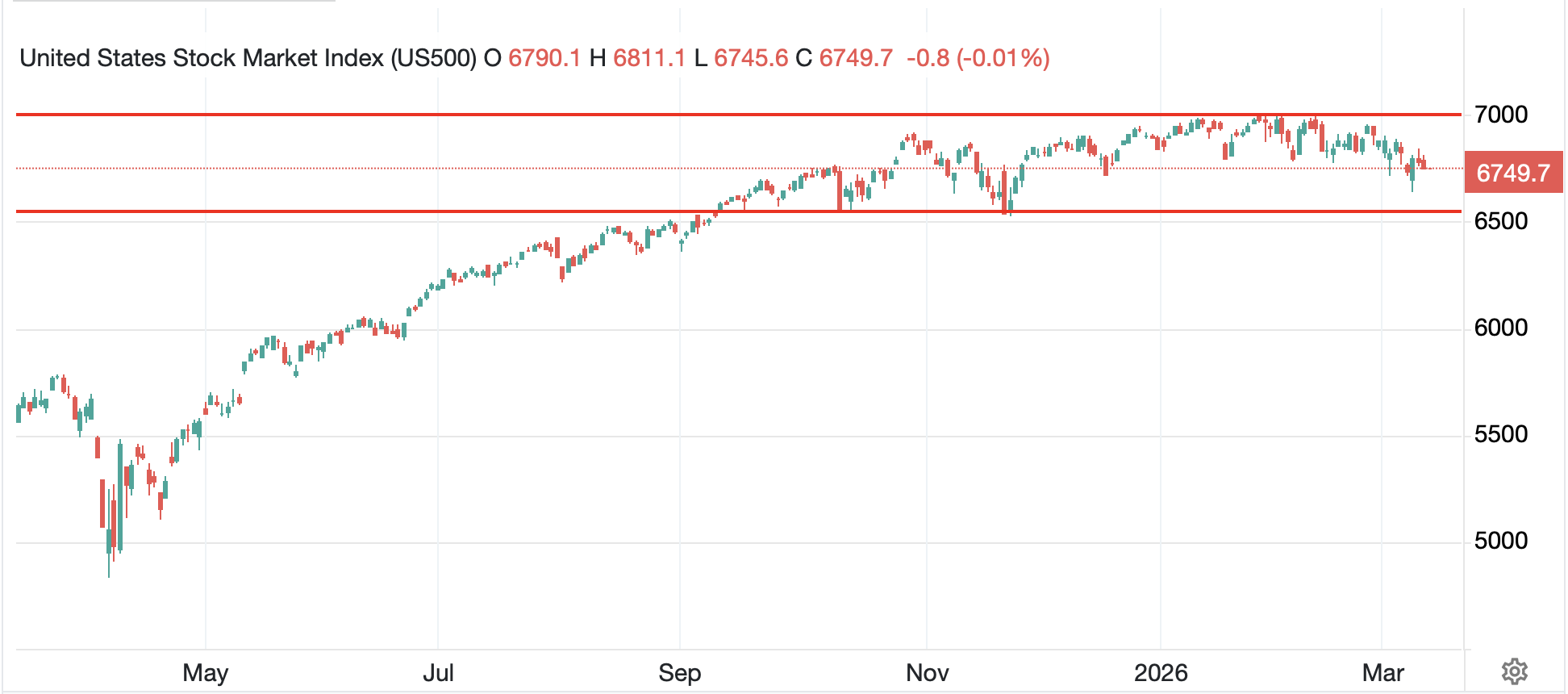
So, let’s get right into markets this morning.  Friday’s further new record highs in the US were followed by strength through much of Asia (Tokyo was closed for Culture Day) with China (+0.3%), HK (+1.0%), Korea (+2.8%) and Taiwan (+0.4%) leading the way with only the Philippines (-1.7%) bucking the regional trend as earnings growth in the country continues to disappoint relative to its peers around the region.  Europe, too, has seen broad based gains with the DAX (+1.2%) leading the way higher and gains in the IBEX (+0.45%) and CAC (+0.3%) as well.  I guess the PMI data was sufficient to excite folks and despite Europe’s status as a global afterthought, at least in terms of geopolitical issues, their equity markets have been rising alongside the rest of the world’s all year.  And you needn’t worry, US futures are all higher at this hour (6:50), with the NASDAQ (+0.7%) leading the way.

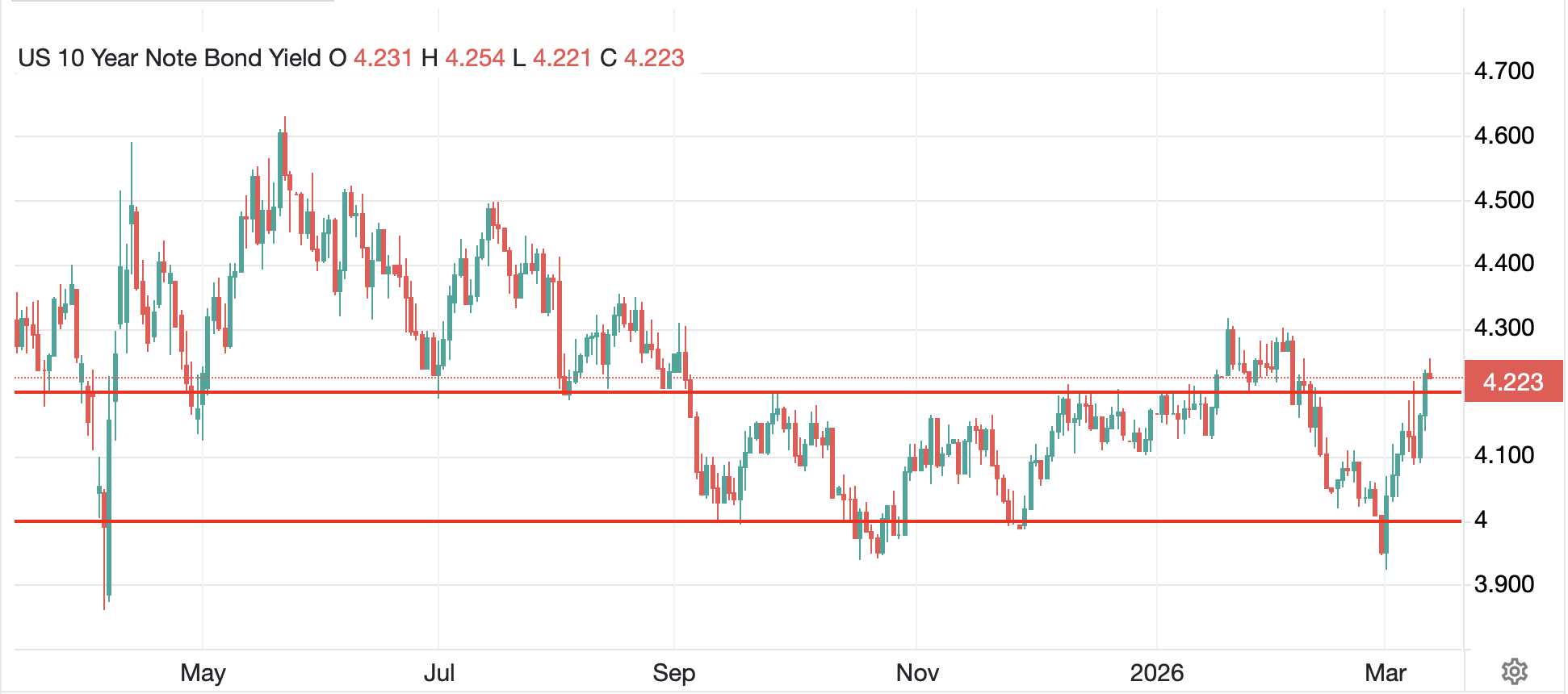
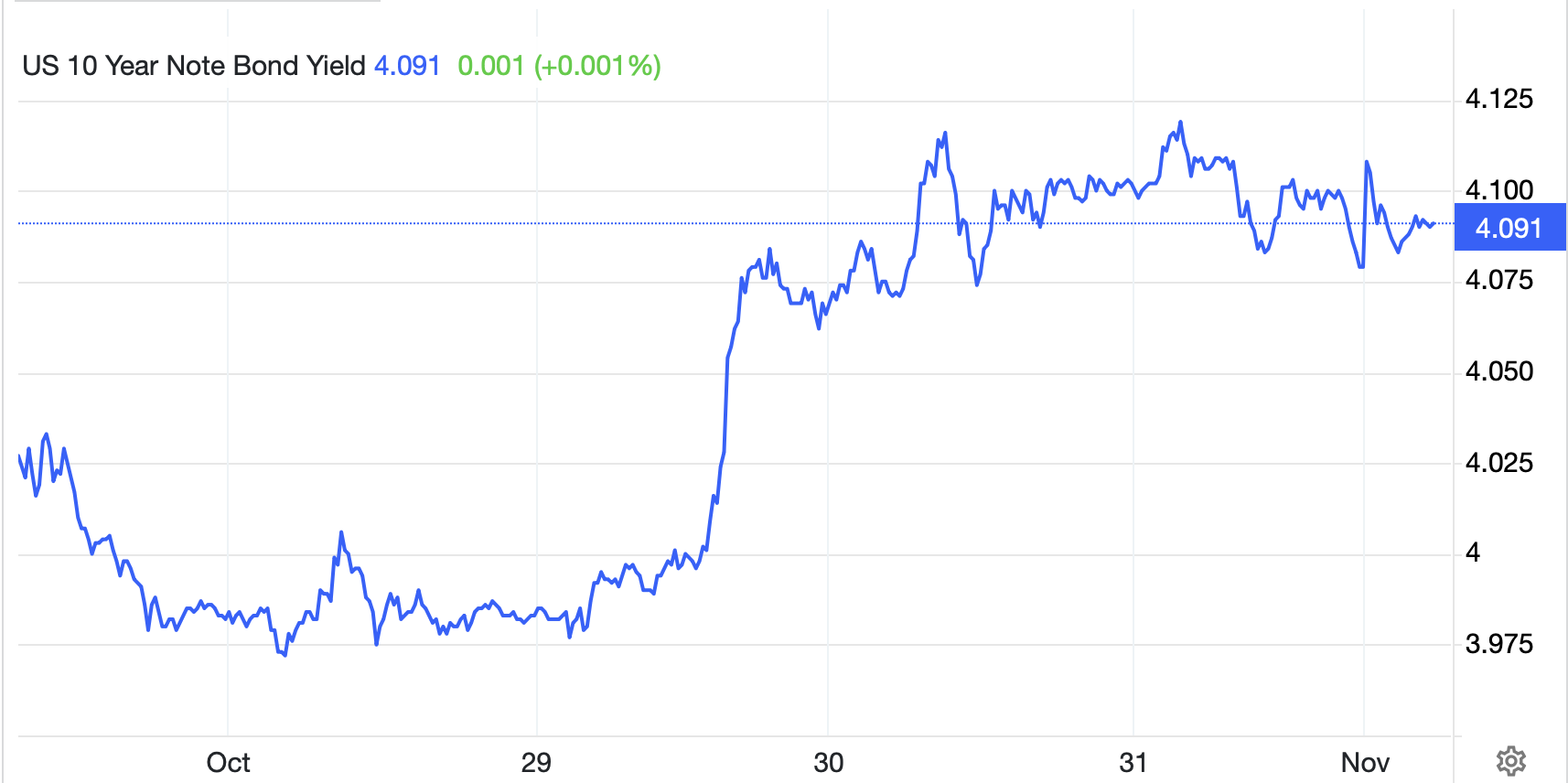
Perhaps more interesting than equities though is the fact that government bond markets are doing so little.  Treasury yields jumped ~10bps in the wake of the FOMC meeting and, more accurately, Chairman Powell’s ostensible hawkishness.  However, as you can see in the below tradingeconomics.com chart, since then, nothing has happened. 

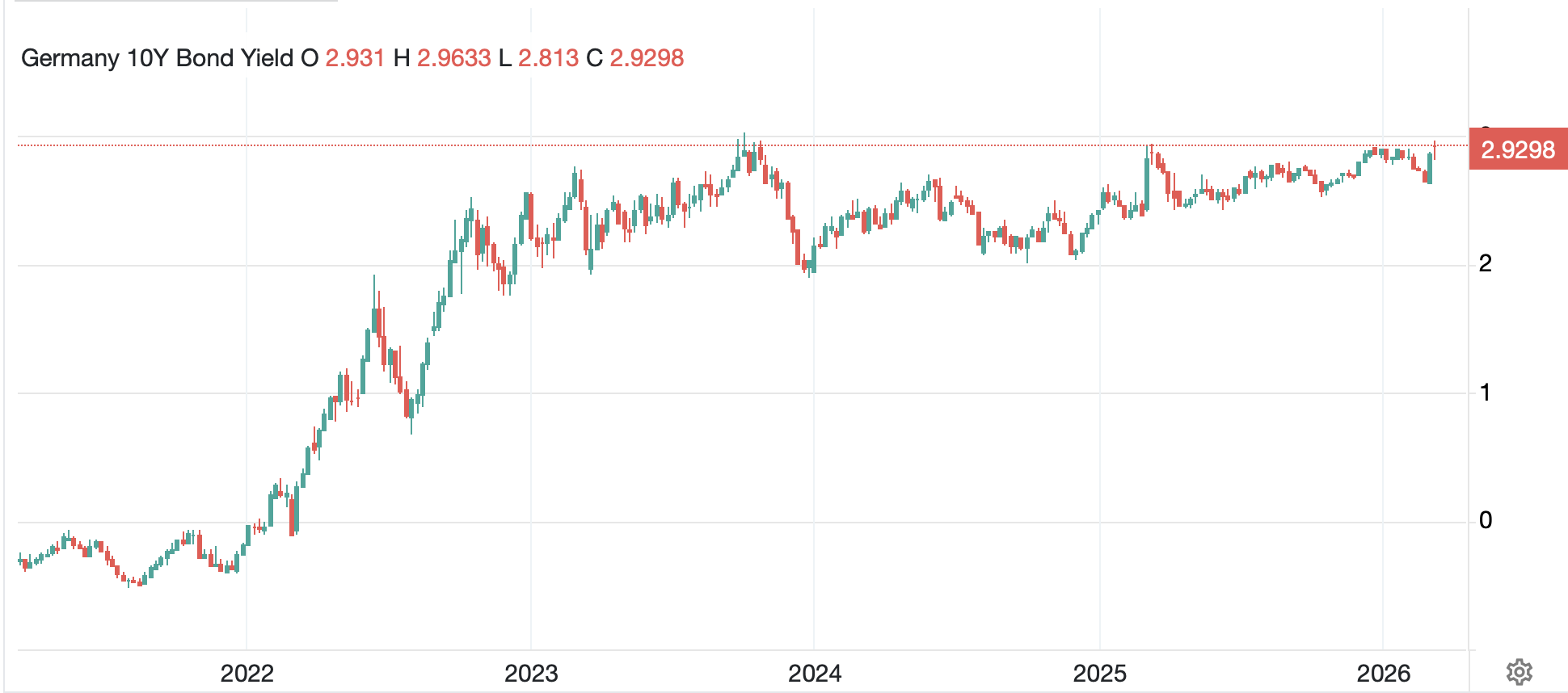
Recall, the probability of a December rate cut by the FOMC also fell from virtual certainty to 69% now.  In fact, if you think about it, that 30% probability decline translates into about 7.5bps, approximately the same amount as 10-year yield’s rose.  It appears that the market is consistent in its pricing at this point, and when (if?) data starts coming back into the picture, we will see both these interest rates rise and fall in sync.  As to European sovereigns, they continue to track the movement in the US and this morning, this morning, the entire bloc has seen yields edge higher by 1bp, exactly like the US.

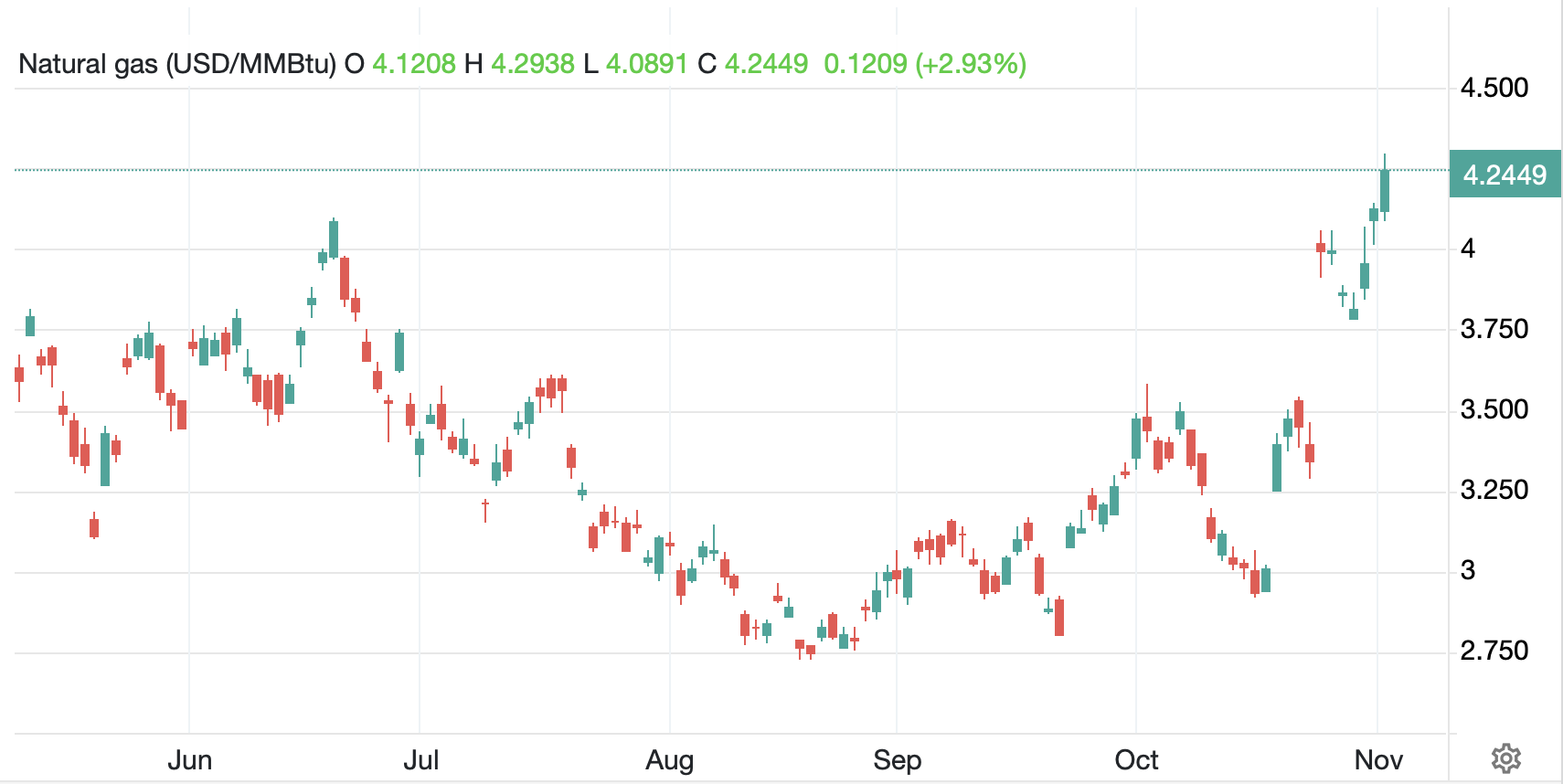
Commodities remain the most interesting place, although the dollar is starting to perk up a bit.  Oil (-0.3%) slipped overnight after OPEC+ indicated they were increasing production by another 137K bbl/day, although there would be no more increases for at least three months given the seasonality of reduced oil demand at this point on the calendar.  Something I have not touched on lately is NatGas, which traded through $4.00/MMBtu late last Thursday, and is now up to $4.25.  in fact, in the past month it has risen nearly 27%, which given it is massively underpriced compared to oil (on a per unit of energy basis) should not be that surprising.  Nonetheless, sharp movements are always noteworthy, and this is no different.

Source: tradingeconomics.com

Certainly, part of this is the fact that winter is coming and seasonal demand is rising in the US. 

Combine that with the European needs for LNG, of which the US is the largest provider, and you have the makings of a rally.  (I wonder though, did the fact that Bill Gates changed his tune on global warming no longer being an existential threat signal it is now OK to burn more fossil fuels?)

Turning to the metals markets, the ongoing fight between the gold bugs and the powers that be continues as early in the overnight session, gold was lower by nearly -1% but as I type, just past 7:00am, it is slightly higher (+0.1%) compared to Friday’s closing levels.  Silver (+0.1%) has seen similar price action although copper (-0.5%) appears more focused on the economic story than the inflation story.  

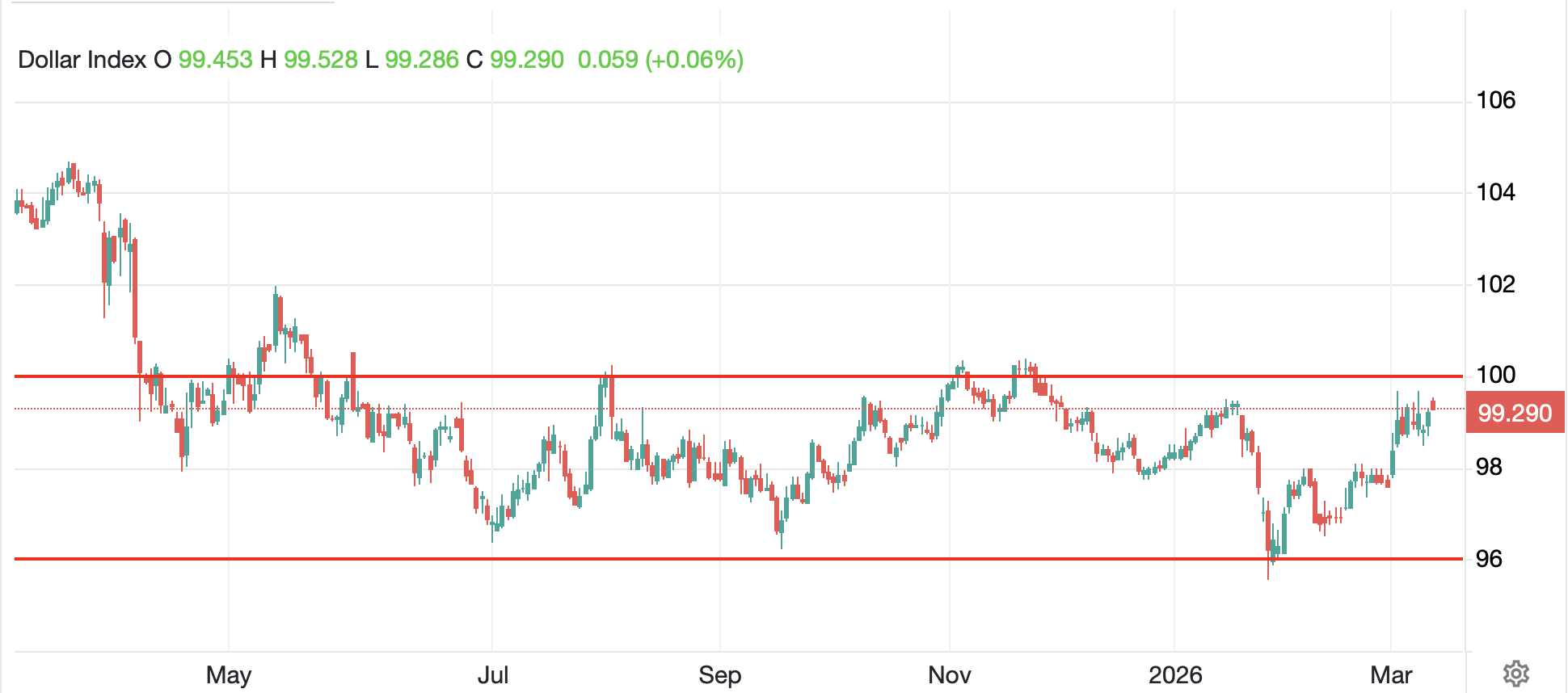
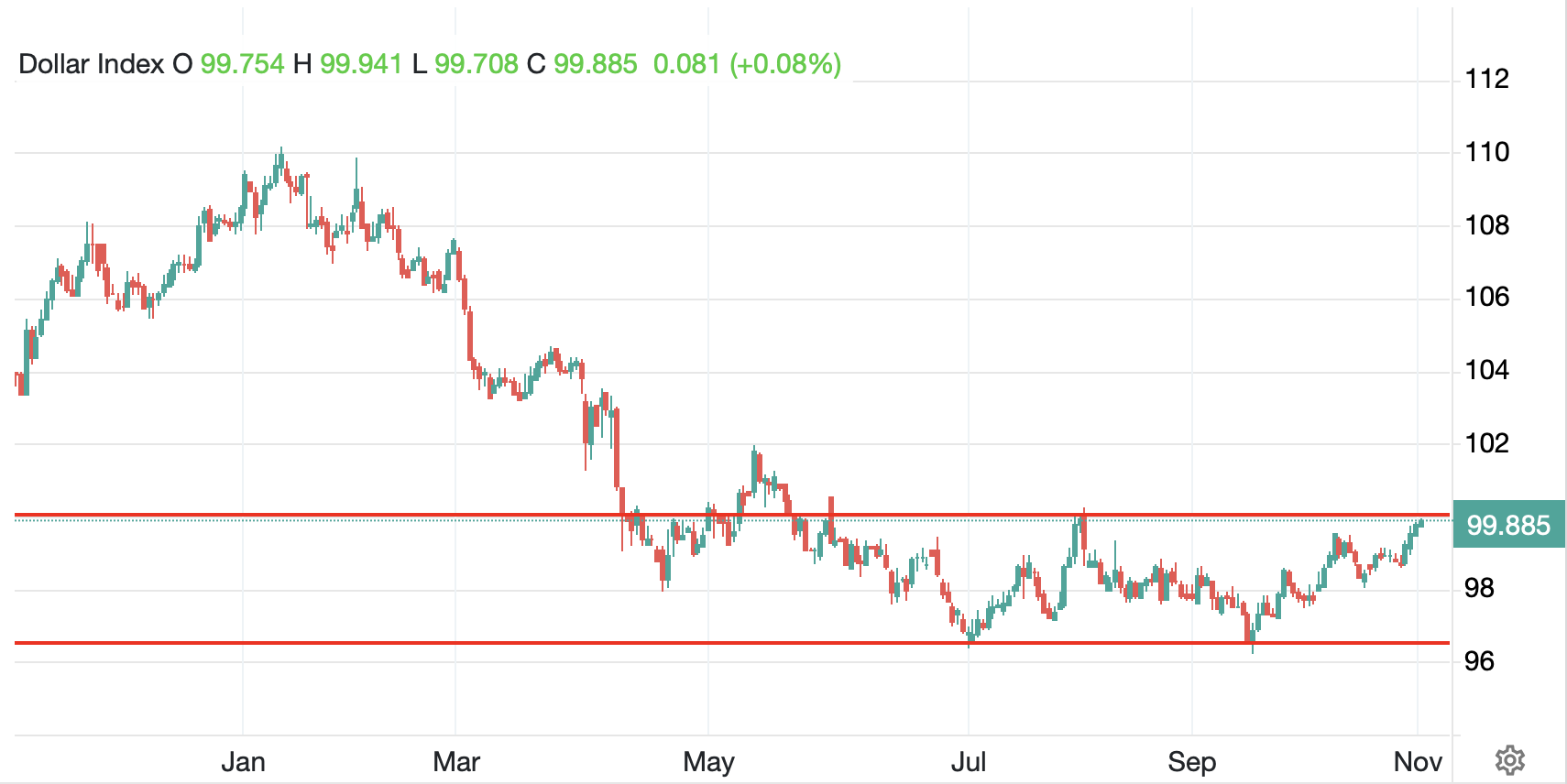
Which takes us to the dollar and its continued rally. Using the DXY (+0.1%) as our proxy, it is higher again this morning and pushing back to the psychological 100.00 level.  Now, I have made the case several times that the dollar has done essentially nothing for the past six months, and the chart below, I believe, bears that out.  We have basically traded between 96.5 and 100 since May.

Source: tradingeconomics.com

You will also recall that there is a narrative around about the end of the dollar’s hegemony and how nations around the world are trying to exit the USD financial system that has been in place since Bretton Woods, or at least since the fiat currency world took off when President Nixon closed the gold window.  And there is no doubt that China is seeking to become the global hegemon and thus wants a renminbi-based system to use to their advantage.  However, let’s run a little thought experiment. 

The Trump administration has embraced the cryptocurrency space, and especially the use of stablecoins.  Legislation has been passed (GENIUS Act) to help clarify the legal framework and the SEC has been solicitous in its willingness to ensure that these creations are not securities, thus placing them outside the SEC’s oversight.  When looking at the world of stablecoins, their current total value is approximately $311 billion (according to Grok) of which only ~$1.2 billion are non-USD.  

Now, if stablecoins represent the payment rails of the future, an idea that is readily believable, and the stablecoin market is virtually entirely USD, with massive first mover advantage, is it not possible that economies around the world are going to find it much easier to dollarize than to maintain their own native currency?  While there are calls for Argentina to dollarize, what would the world look like if the EU fell apart (an entirely possible outcome given the inconsistencies in their current energy and immigration policies and the stress within the bloc) and the euro with it?  Would smaller nations opt for their own currency, or would they see the value of having a dollarized economy given the many efficiencies it would present, especially for their export industries?

While I have no doubt that China will never accept that outcome for themselves, is the future a world where there are two currency blocs, USD and CNY, and everything else simply disappears?  Remember, we are merely spit balling here, but if that is the outcome, demand for dollars will continue to rise, and the value of other currencies will continue to decline until such time as they succumb.

Again, this is a thought experiment, but one that offers intriguing possibilities for the future.  And one where the foreign exchange market may ultimately meet its demise.  After all, if there are only two currencies, that doesn’t make much of a market.

One other thing I must note, in the stablecoin realm, there is a remarkable product, USDi (usdicoin.com), which tracks US CPI exactly, yet can fit within those same payment rails.  If you are looking into this space, USDI is worth a peek.

Ok, back to the markets, looking across the FX space, +/-0.2% is today’s theme virtually across the board, with the more important currencies slipping against the dollar (EUR, GBP, JPY, CHF, CAD) than rising vs the greenback (MXN, CLP, NOK, CZK), although the magnitudes are similar.

With the government still closed, there is no official data, but we do get ISM Manufacturing (exp 49.5) with the Prices Paid subindex (61.7) released at the same time.  There are two Fed speakers today, Daly and Cook, and then 9 more speeches throughout the week.  We also get the ADP Employment data on Wednesday (exp 24K), but I imagine that will get more press after the election results are learned Tuesday evening.

It is hard to get excited about things today, but nothing points to a weaker dollar right now.

Good luck

Adf
Printing Up Gobs

The balance sheet, so said Chair Jay
Is really the very best way
For policy ease
And so, if you please,
QT is soon going away
 
Rate cuts are now back on the table
As we work quite hard to enable
Those folks lacking jobs
By printing up gobs
Of cash, just as fast as we’re able


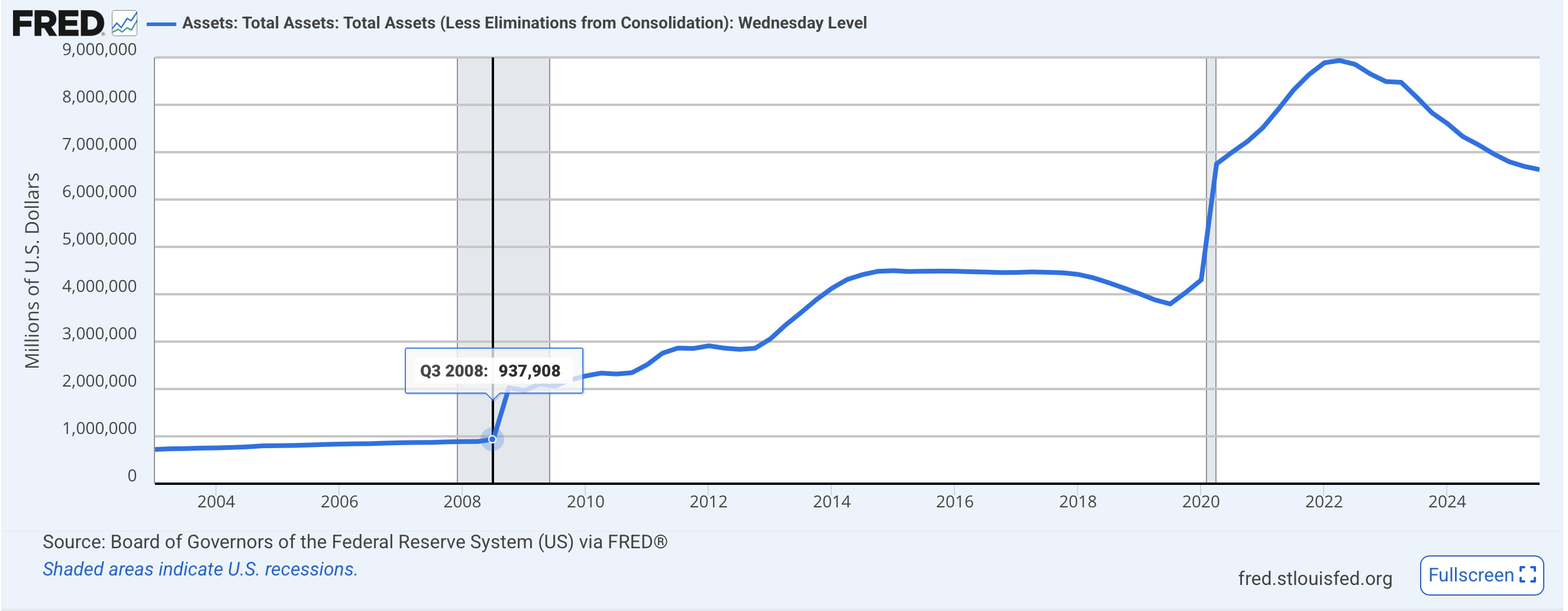
Chairman Powell spoke yesterday morning in Philadelphia at the NABE meeting and the TL; DR is that QT, the process of shrinking the Fed’s balance sheet, is coming to an end.  Below is a chart showing the Fed’s balance sheet assets over the past 20+ years.  I have highlighted the first foray into QE, during the financial crisis, and you can see how that balance sheet has grown and evolved since then.

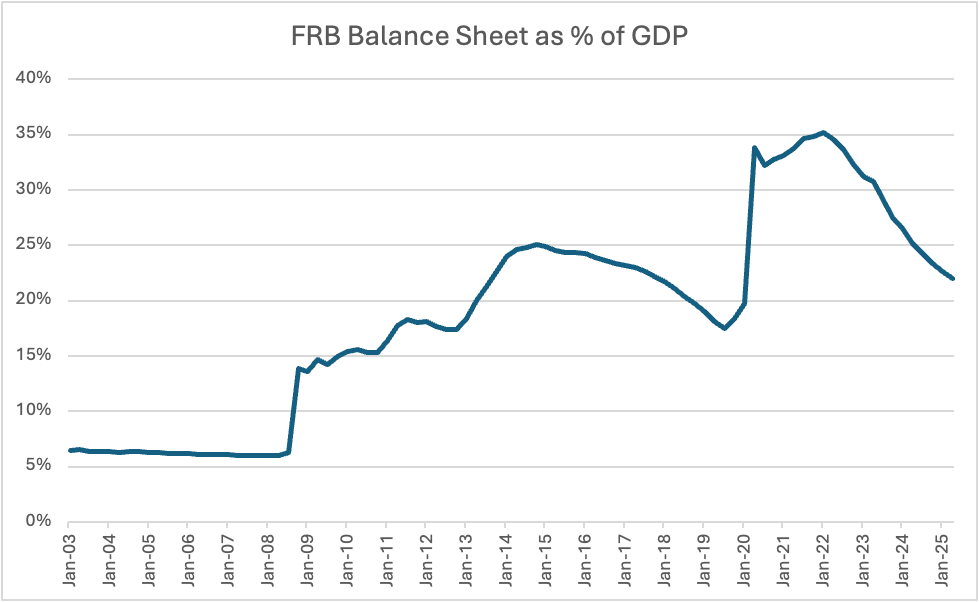
And the below chart is one I created from FRED data showing the Fed’s balance sheet as a percentage of the nation’s GDP.

Pretty similar looking, right?  The history shows that the GFC qualitatively changed the way the Fed managed monetary policy, and by extension their efforts at managing the economy.  As is frequently the case, QE was envisioned as an emergency policy to address the unfolding financial crisis in 2008, but as Milton Friedman warned us in 1984, “Nothing is so permanent as a temporary government program.”  QE is now one of the key tools in the Fed’s toolkit as they try to achieve their mandates.

There has been a great deal of discussion regarding the issue of the size of the Fed’s balance sheet, paying interest on reserves, something that started back in 2008 as well, and what the proper role for the Fed should be.  But I assure you, this is not the venue to determine those answers. 

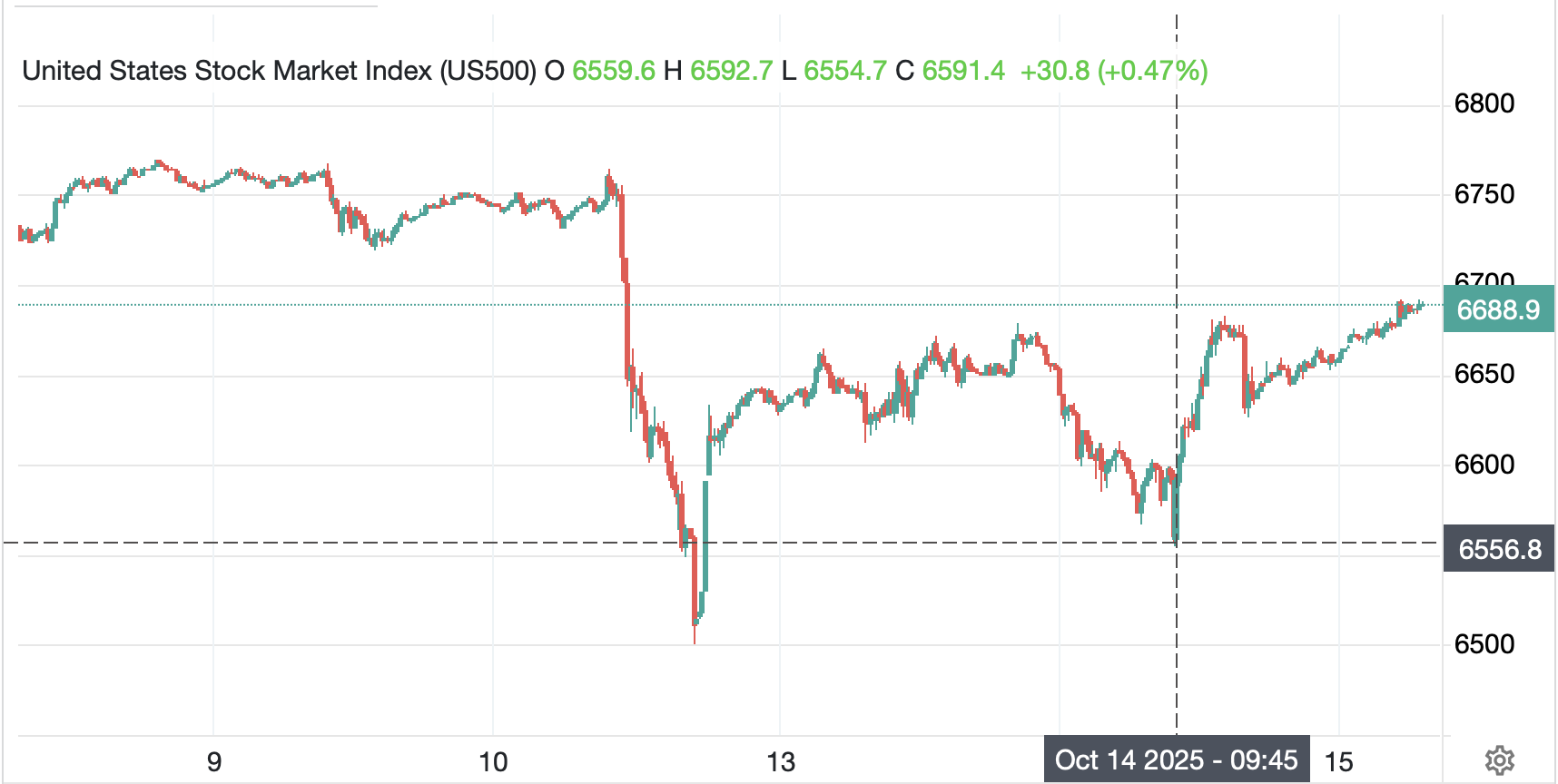
However, of more importance than the speech, per se, was that during the Q&A that followed, Mr Powell explained that the Fed was soon reaching the point where they were going to end QT, and that they were going to seek to change the tenor of the balance sheet to own more short-term assets, T-bills, than the current allocation of holding more long-term assets including T-bonds and MBS.  And this was what the market wanted to hear.  While both the NASDAQ and S&P 500 both closed slightly lower on the day, as you can see from the chart below, the response to Powell’s speech was immediate and impressive.

Source: tradingeconomics.com

Too, other markets also responded to the news in a similar manner, with gold, as per the below chart accelerating its move higher.

Source: tradingeconomics.com

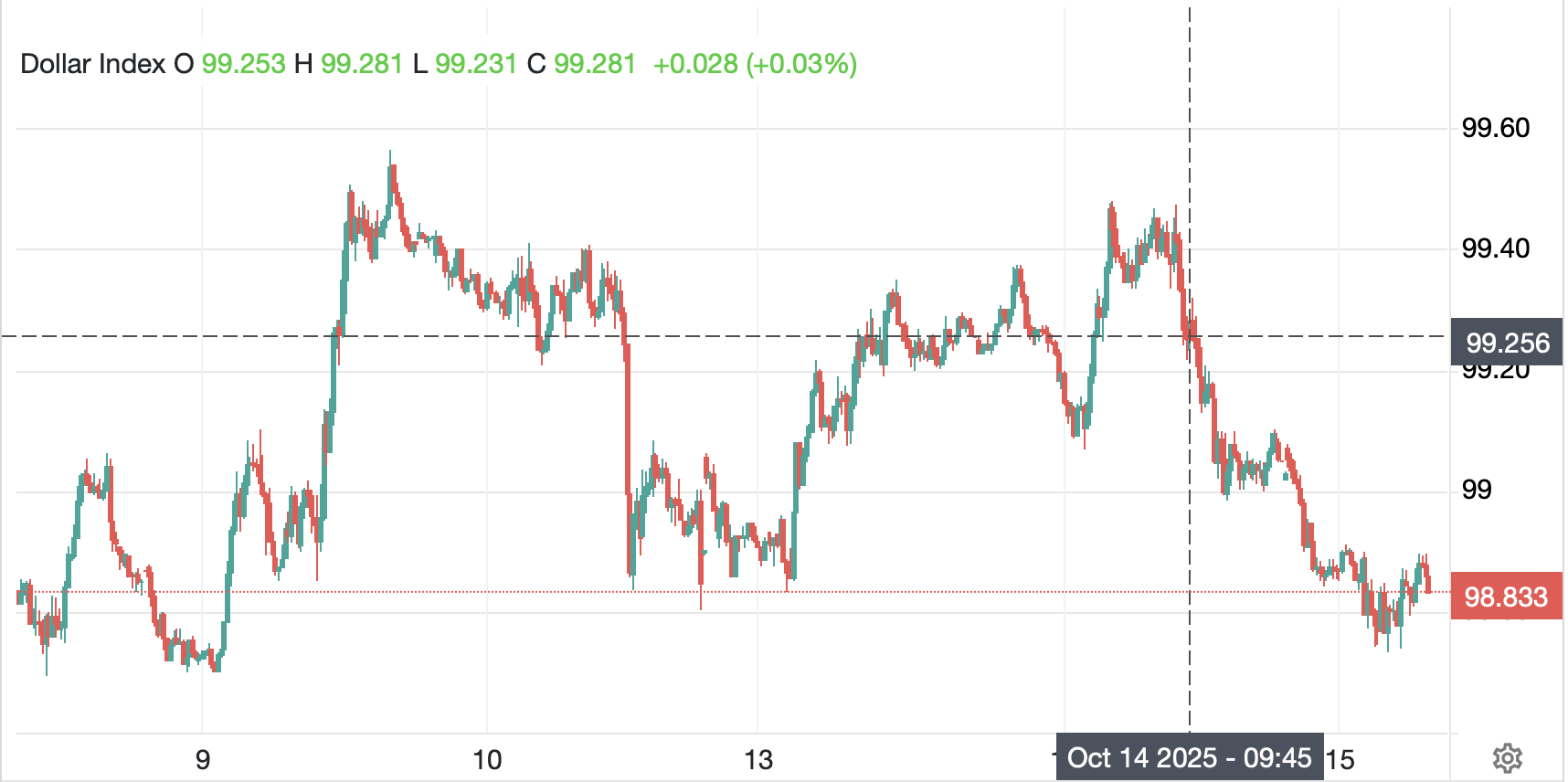
While the dollar, as per the DXY, responded in an equally forceful manner, falling sharply at the same time.

Source: tradingeconomics.com

Summing up, Chairman Powell basically just told us that inflation was no longer a fight they were willing to have and support of the economy and employment is Job #1.  Of course, this may not work out that well for long-term bond yields, which when if inflation rises are likely to rise as well, I think Powell knows that he will be gone by the time that becomes a problem, so maybe doesn’t care as much.

But here’s something to consider; there has been a great deal of talk about the animus between the Fed and the Treasury, or perhaps between Powell and Trump, but Treasury Secretary Bessent has already made clear they will be issuing more T-bills and less T-bonds going forward, which is a perfect fit for the Fed’s proposition to hold more T-bills and less T-bonds going forward.  This is not a coincidence.

Now, while that was the subject that got most tongues wagging in the market, the other story of note was the ongoing trade spat between the US and China.  It is hard to keep up with all the changes although it appears that soy oil imports from China are now on the menu of items to be tariffed, and the WSJ this morning explained that China is going to try to pressure President Trump by doing things to undermine the stock market as they see that as a vulnerability.  Funnily enough, I think Trump cares less about the stock market this time around than last time, as he is far more focused on issues like reindustrialization and jobs here and elevating labor relative to capital, which by its very nature implies stock market underperformance.

But that’s where things stand now. So, let’s take a turn around markets overnight.  Despite a mixed picture in the US, Asian equity markets had a fine time with Tokyo (+1.8%), China (+1.5%) and HK (+1.8%) all rallying sharply on the prospect of further Fed ease.  Regarding trade, given the meeting between Presidents Trump and Xi is still on the schedule, I think that many are watching the public back and forth and assuming it is posturing.  As well, Chinese inflation data was released showing deflation accelerating, -0.3% Y/Y, and that led to thoughts of further Chinese stimulus to support the economy there.  Of course, their stimulus so far has been underwhelming, at best.  Elsewhere in the region, green was also the theme with Korea (+2.7%), India (+0.7%), Taiwan (+1.8%) and Australia (+1.0%) all having strong sessions.  One other thing about India is the central bank there intervened aggressively in the FX market with the rupee (+0.9%) retracing to its strongest level in a month as the RBI starts to get more concerned over the inflationary impacts of a constantly weakening currency.

In Europe, the CAC (+2.4%) is leading the way higher after LVMH reported better than expected earnings (Isn’t it funny that the US market is dependent on NVDA while the French market is dependent on LVMH?  Talk about differences in the economy!), and while that has given a positive flavor to other markets, they have not seen the same type of movement with the DAX (+0.1%) and IBEX (+0.7%) holding up well while the FTSE 100 (-0.6%) continues to suffer from UK policies.  As to US futures, at this hour (7:40) they are all firmer by 0.5% to 0.9%.

In the bond market, yields continue to edge lower with Treasuries (-2bps) actually lagging the European sovereign market where yields have declined between -3bps and -4bps across the board.  In fact, UK gilts (-5bps) are doing best as investors are growing more comfortable with the idea the BOE is going to cut rates again after some dovish comments from Governor Bailey yesterday.

In the commodity space, oil (+0.2%) is consolidating after it fell again yesterday and is now lower by nearly -6% in the past week.  However, the story continues to be metals with gold (+1.3%), silver (+2.8%), copper (+0.5%) and platinum (+1.7%) all seeing continued demand as the theme of owning stuff that hurts if you drop it on your foot remains a driving force in the markets.  And as long as central banks are hinting that they are going to debase fiat currencies further, this trend will continue.

Finally, the dollar, as discussed above, is softer, down about -0.25% vs. most of its G10 counterparts this morning although NOK (+0.8%) is the leader in what appears to be some profit taking after an exaggerated decline on the back of oil’s decline.  In the EMG bloc, we have already discussed INR, and after that, quite frankly, it has not been all that impressive with the dollar broadly slipping about -0.2% against virtually the rest of the bloc.

On the data front, we see Empire State Manufacturing (exp -1.0) and get the Fed’s Beige Book at 2:00 this afternoon.  Four more Fed speakers are on the docket, with two, Miran and Waller, certainly on board for rate cuts, with the other two, Schmid and Bostic, likely to have a more moderated view.  Earlier this morning Eurozone IP (-1.2%) showed that Europe is hardly moving along that well.  Meanwhile, despite the excitement about Powell’s comments, the Fed funds futures market is essentially unchanged at 98% for an October cut and 95% for another in December.  I understand why the dollar slipped yesterday, but until those numbers start to move more aggressively, I suspect the dollar’s decline will be muted.

One other thing, rumor is that the BLS will be reporting the CPI data a week from Friday at 8:30am as they need it to calculate the COLA for Social Security for 2026.  If that is hot, and I understand that expectations are for 0.35% M/M, Chairman Powell and his crew may find they have a really tough choice to make the following week.

Good luck

Adf
Falling Like Rain

Trump’s meeting with Putin went well
At least that’s the best we can tell
Now, later this week
Zelenskiy will speak
With Vlad, and say you go to hell
 
So, will peace be found in Ukraine?
Or will fighting grow once again
If looking for clues
One thing we might choose
Is oil that’s falling like rain


The aftermath of the Trump-Putin meeting on Friday has certainly been interesting.  While the administration, as would be expected, highlighted any and all positives as the president pushes for an uncomfortable peace process, the administration’s opponents, which include not merely the Democratic party, but most of Europe as well, are concerned he has just sold Ukraine down the river.  I am not nearly smart enough to have an informed opinion on this issue, which is likely the case for almost every commentator as well, but I know I come down on the side of anything that moves the conversation toward an end to the war and a lasting peace, even if the terms aren’t the ones either side would like, is a step in the right direction.

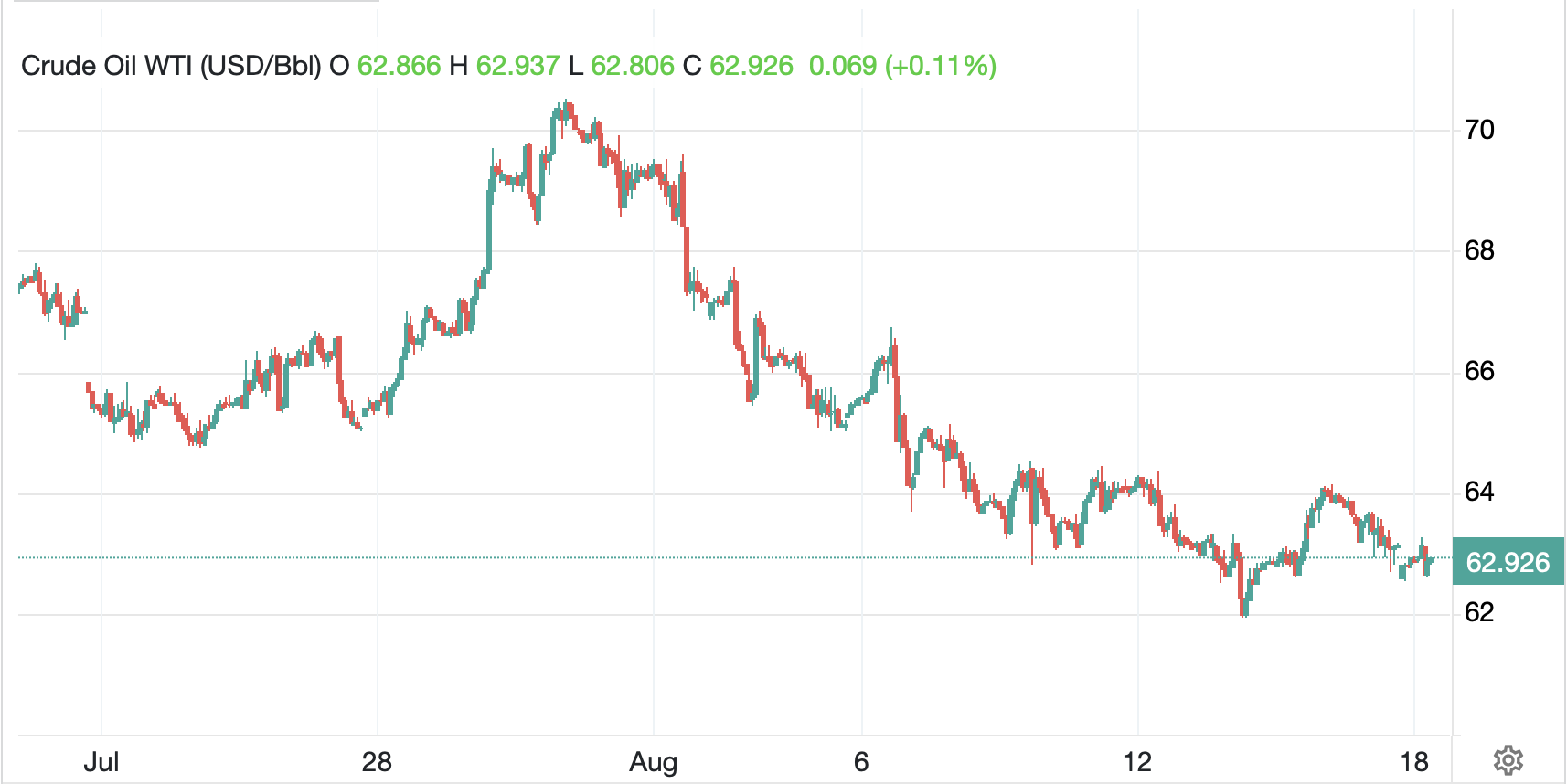
But this is not a political commentary, rather we are trying to understand market behavior and remain highly cognizant of global events on markets.  With that in mind, arguably the market most directly impacted by this war is oil and based on what we have seen over the past month, during which time the peace process accelerated, the participants in the oil market appear to be saying that Russian oil is coming back to the market on an unfettered basis.  One need only look at the chart below, which shows a very clear downtrend to understand.

Source: tradingeconomics.com

Certainly, some of this price decline may be attributed to the belief that the long-awaited recession in the US is upon us, although given that has been a view for nearly three years, it is not clear to me why this month is the moment.  I understand that the payroll data was weak, but I also understand that Retail Sales data on Friday was pretty strong.  The observation that the goods and services sectors of the economy are out of sync remains appropriate, I believe.  As long as that remains the case, a significant downturn seems unlikely, but so too does a significant growth spurt.  In fact, this is one of the reasons I take the decline in the price of oil to be a harbinger of an end to the Ukraine war.  

Come Friday, we’ll hear Chairman Jay
As he tries, his views, to convey
No doubt he’ll explain
Inflation’s a bane
And that’s why, rate cuts, he’ll delay
 
But also, employment is key
And so, he will want us to see
His minions are willing
To cut, if distilling
The data less growth they foresee

Arguably, the other big market story this week is the speech that we will hear Friday morning from Chairman Powell at the Jackson Hole Symposium.  Many in the market continue to look to Powell and the Fed for their guidance although my take is the Fed’s impact on market’s has been waning over time as fiscal dominance continues apace.  Nonetheless, it is still a key moment for the market as those who have been anticipating a Fed cut in September, as well as at least two more before the end of the year, will want confirmation that the weak payroll data was the trigger.  And while some of the Fed speakers since the NFP data have started to move toward a more dovish stance, I would contend the majority is still on the patience bandwagon.  

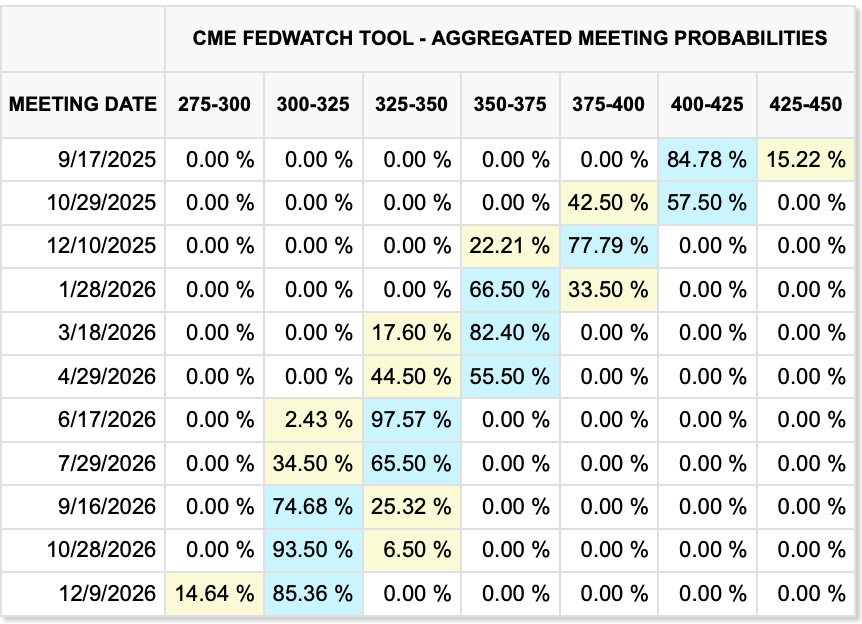
With that in mind, a look at the Fed funds futures markets shows that although the probability being priced in for a cut next month has fallen from its peak level, it remains extremely high at 85% with a 78% probability of two cuts by December and a third cut now likely by March.

Source: cmegroup.com

Remember, the reason this is so closely watched is the strong belief that when the Fed cuts rates, equity prices rise.  However, one need only look at a chart to note that frequently, equity markets are falling sharply when the Fed is cutting Fed funds.  That makes sense because given the reactive nature of Fed funds and the Fed in general, it is typically responding to weakness that is already evident in equity prices.  Which begs the question, why does everyone want the Fed to cut if it implies a weak economy and already declining stock prices?

Many measures continue to show equity valuations quite high, and there have been numerous calls that a correction in equity markets around the world is due.  I understand that view and have even bought put protection as it is pretty cheap to do so.  But I have given up on calling for a recession.  I can only be wrong for so long before I accept the evidence that one has not yet come, nor is obviously imminent.

Ok, let’s look at markets this morning.  While there was a late selloff in the US on Friday, Asian markets saw the world as a brighter place.  Perhaps they were encouraged by the Alaska meeting, or perhaps by the view that the Fed will cut, because there was no data there of which to note.  But the Nikkei (+0.8%), CSI 300 (+0.9%) and Australia (+0.25%) all managed gains although the Hang Seng (-0.4%) slipped a bit.  There was, however, a major laggard with Korea’s KOSPI (-1.5%) suffering on the back of concerns over potential new tariffs on Korean chips.  European equities, though, are on a bit shakier footing.  Perhaps it is the concern that despite their collective voice on Ukraine, they remain largely irrelevant.  Or perhaps it is the realization that the trade surpluses they have run in the past are set to decline as evidenced by the data showing Spain’s deficit growing to -€3.59B increasing more than €1B and the Eurozone’s surplus shrinking to €7B, down from €16.5B last month.  So, declines of -0.4% to -0.8% are today’s results in major markets there.  As to the US, futures are little changed at this hour (8:00).

In the bond market, yields have been edging lower this morning with Treasury yields (-2bps) slipping despite the stronger Retail Sales and PPI data from last week, while European sovereign yields are all lower by -3bps, perhaps anticipating slower growth overall.

In the commodities space, oil (+0.5%) has bounced from its overnight lows but remains in its downtrend.  Gold (+0.3%) continues to hover at its pivot point of $3350 or so while silver (+0.15%) and copper (-0.4%) are mixed this morning.  Away from the tariff story on copper, it remains an important economic indicator, so we must watch it closely.

Finally, the dollar is ever so slightly firmer this morning with the euro (-0.25%) leading the G10 slide although both Aussie and Kiwi are slightly firmer this morning.  In the EMG bloc, MXN (-0.4%) is the laggard along with HUF (-0.4%) and CZK (-0.4%) although the rest of the bloc, while mostly softer, hasn’t moved that far.  It does feel like a dollar story.

On the data front, as I am running late and there is nothing as important as Friday’s Powell speech, I will list it tomorrow.  Overall, my take is peace is nearer than further and that should adjust spending from fighting to rebuilding but spending it will be.  I expect to hear more about recession going forward, although it is not yet clear to me one is upon us.  While the dollar’s trend remains lower, I have a feeling we are at the end of that move so beware.

Good luck

Adf

Stroke of a Pen

While NFP’s top of the list
For traders this morning, the gist
Of recent releases
Show more price increases
A trend that cannot be dismissed
 
As well, Tariff Man, once again
Imposed more by stroke of a pen
While stocks are declining
The dollar’s inclining
To rise vs. the euro and yen


Let’s get the upcoming data out of the way first as the Employment report is due to be released at 8:30. Current median expectations are as follows:

Nonfarm Payrolls110K
Private Payrolls100K
Manufacturing Payrolls-3K
Unemployment Rate4.2%
Average Hourly Earnings0.3% (3.8% Y/Y)
Average Weekly Hours34.2
Participation Rate62.3%
ISM Manufacturing49.5
ISM Prices Paid70.0
Michigan Sentiment62.0

Source: tradingeconomics.com

This report is obviously of great importance as the Fed continues to rely on a solid labor market as its key justification for not cutting rates.  At least that’s its public stance.  Recall, too, that last month’s result of 147K was significantly higher than forecast and really backed them up.  In fact, I would contend that one of the reasons that Chairman Powell was willing to sound mildly hawkish on Wednesday is because of the labor market’s ongoing performance.  

It is interesting to juxtapose this strength with the increasing number of stories about how the increase in investment and usage of AI, especially at tech firms, is driving a significant amount of personnel reductions.  And yet, the broad data continue to point to a solid labor economy.

However, I think it is worth taking a closer look at recent inflation focused data as that, too, is going to be a key driving force in the central bank debate worldwide.  Yesterday’s PCE data was largely as expected but resulted in a faster pace of inflation on both the headline and core bases.  If we consider the trend over the past three years, as per the Core PCE chart below, it appears that the nadir was reached back in June of last year, and while not every print has been higher, I will contend the trend is starting to point upwards.

Source: tradingeconomics.com

Meanwhile, if we turn our attention to European inflation data, while this morning’s Eurozone flash print was unchanged from last month, it was higher than expected.  We saw the same trend in individual Eurozone nations yesterday with Germany, Italy and France all showing the recent disinflationary trend stopping, at least for the past month.  With these recent releases, the analyst community is of the mind that the ECB is likely to hold rates steady again in September, extending the pause on their previous rate cutting cycle.  The strong belief is that US tariffs are going to dampen economic activity and, with that, inflation pressures.

As to the US, with President Trump having announced another wave of tariffs yesterday, as the 90-day window closed, once again the analyst community is calling for inflation to rise here.  Ironically, these analysts may be correct that US inflation is going to be slowly heading higher, but whether that is due to tariffs, or perhaps the fact that more than ample liquidity remains in the economy and services prices continue to rise has yet to be determined.

At this point, I think it might be useful to break out an updated version of a chart that has made the rounds before showing price changes since 2000 broken down by categories.  Virtually every sector that has seen significant price rises is on the service side of the ledger while most goods saw either deflation or very modest (~1% per annum) inflation.

Housing, which is both a good and a service, and textbooks, which are directly linked to tuition, are the two outliers.  Now, many will complain that something like New Cars having risen only 24.7% since 2000 is crazy given their much higher sticker prices, and that is clearly hedonic adjustments doing its job.  But if you consider the key expenses in your life, housing, food and health care are generally top of the requirements.  It is abundantly clear from this chart that the American angst on prices is well founded.  With that in mind, tariffs are exclusively imposed on goods, not services, so given services represent 77.6% of the US economy as of 2022 (as per Grok), the inflationary impact of tariffs seems like it might not be quite as high as the hysteria indicates.

(This is a perfect time to remind you of a great way to manage your inflation risk if you participate in the cryptocurrency markets by buying USDi, the only fully backed inflation tracking coin available.  Learn more at www.usdi.com.  It is essentially inflation-linked cash.)

Coming back around to the market, I think it is a good time to review one of the other major narrative themes, that the dollar is collapsing as foreigners flee because of the massive debt load, and that the dollar will soon lose its reserve status.  You know I have dismissed this idea from the beginning as nothing more than doom porn and an effort by some analysts to get clicks.  

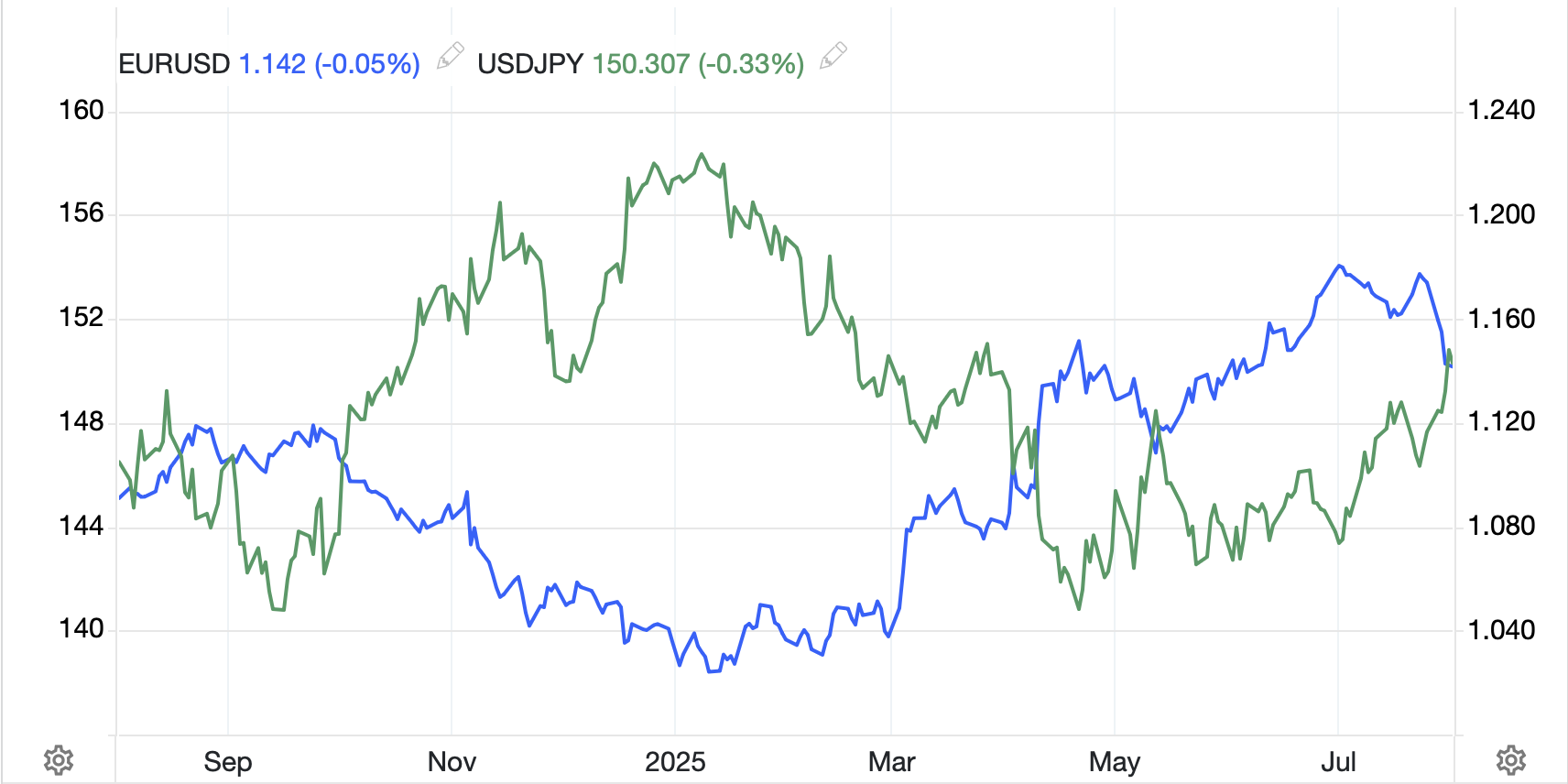
There is no doubt that there had been a downtrend in the dollar for the first six months of 2025, and as has been written repeatedly, the decline was the largest during the first half of the year since the 1980’s.  As well, my concern over the dollar has been based on the idea that the Fed would indeed be cutting rates despite no need to do so, and that would undermine its yield advantage.  But a funny thing happened on the way to the death of the dollar, it stopped falling.  While I have been using the DXY chart as my proxy, pretty much every chart looks the same as per the below of both the euro and yen, where the nadir was at the beginning of July and the dollar has risen vs. both somewhere between 3% and 5%.

Source: tradingeconomics.com

In fact, as I look down my board, the dollar has risen against every major currency over the past month, with even tightly controlled CNY declining -0.8%, and the yen falling furthest, down nearly -5.0%.  Combine this with the news that Treasury auctions have been well attended with significant foreign interest, and it is hard to conclude the end is nigh for the US economy.

Ok, a really quick turn to markets here as this has gone on longer than I expected.  Equities are red everywhere this morning after yesterday’s US declines.  Japan (-0.7%), China (-0.5%) after weak PMI data, Hong Kong (-1.1%) and Australia (-0.9%) set the tone for Asia.  In Europe, it is even worse with the CAC (-2.2%) and DAX (-1.9%) both under more pressure as a combination of increased worries over trade (although given they ostensibly have a deal, I’m not sure what the issue is) and companies there reporting weaker than forecast results have been the problem.  US futures at this hour (7:30) are all pointing lower by about -0.85%.

Despite the fear in stocks, bonds are not seen as the answer this morning with Treasury yields edging higher by 1bp and European sovereign yields all higher by between 3bps and 5bps.  I guess the inflation reading has a few traders nervous.  Interestingly, if you look at the ECB’s own website showing rate change probabilities, there is a 14% probability of a rate HIKE priced in for the September meeting!  JGB yields have also edged higher by 1bp as the BOJ, in their policy briefing yesterday, raised their inflation forecasts for 2026, ostensibly as a precursor to the next rate hike there.  I’ll believe it when I see it!

As to commodities, oil (-1.1%) after touching $70/bbl yesterday has rejected the level.  While secondary sanctions on Russian oil exports continue to be discussed, they have not yet been implemented.  I continue to believe the price ought to be lower, but clearly there is a risk premium for now.  In the metals markets, gold (+0.4%) continues to find support despite weakness in other markets (Ag -0.6%, Cu -0.9%) as its millennia-long status as the only true safe haven is reasserting itself.  After all, Bitcoin (-0.6%) has not been able to match the relic’s performance of late despite its modern twist.

And that’s really all there is (I guess that’s enough) as we head into the weekend.  The market tone will be set by the NFP data, where my take is a strong report will see the dollar rally, bonds suffer, and stocks suffer as well as hopes for a rate cut fade further.  Conversely, a weak report should see the opposite impacts.

Good luck and good weekend

adf

A Wing and a Prayer

The CPI data was hot
Or cool, all depending on what
It is that you buy
Though pundits will try
To tell you that Trump’s a tosspot
 
But stock markets don’t really care
Though bond markets are quite aware
Inflation’s not dead
Which means that the Fed
Relies on a wing and a prayer


These were the headlines yesterday in the wake of the CPI report:

WSJ – Inflation Picks Up to 2.7% as Tariffs Start to Seep Into Prices

NY Times – U.S. Inflation Accelerated in June as Trump’s Tariffs Pushed Up Prices

Washington Post – Inflation picked up in June as tariffs began to lift prices across the economy

And here are a couple from this morning:

WSJ – Trump Effect Starts to Show Up in Economy

Bloomberg – US Trade Wars Will Hit Households Worldwide, BOE’s Bailey Warns

As I forecast yesterday, the higher inflation would be blamed on President Trump’s actions regardless of the outcome.  In fairness, that was not a hard prediction to make given the current state of the mainstream media and their general views of the president.  But is that an accurate representation?  As always, on matters of CPI I turn to @inflation_guy, Mike Ashton, to get his take, which has generally been the least hysterical and most cogent of analysts around.  Here is his summary of yesterday’s CPI data.  

In essence, the higher Y/Y readings are partially due to base effects (the number twelve months ago that is leaving the calculation was very low so even a moderate number will result in a higher print) and partially due to ongoing price changes in the economy.  Goods prices did rise, but services prices were not as affected.  Notably lodging away from home (i.e. hotels) saw prices fall -2.5% on the month, likely perhaps a result of less illegal immigrants being housed in cities around the country.  In the end, as Mike explains, median inflation has been running at ~3.5% annually for the past several years and shows no signs of declining much further.  I fear, that is the new normal for inflation going forward.

(This is a good time to mention that one way to maintain the purchasing power of your money is to own USDi, the only inflation-linked stable coin around which accretes the rise in CPI to its price on an ongoing basis.  Below is a chart showing how this has performed (and by extension what has happened to inflation) since the coin was initiated on March 1st of this year.  (And yes, we know exactly where the price will be going forward through the rest of the summer based on the mechanics of the way CPI is reported.)

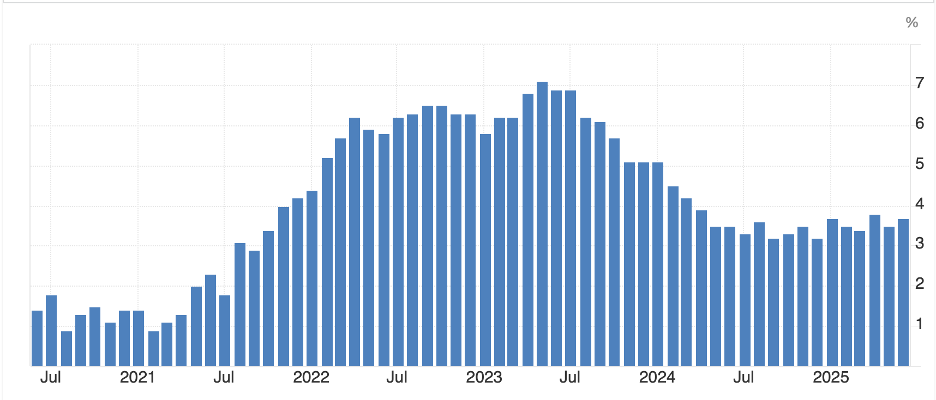
But the US is not the only place where inflation is starting higher.  Exhibit A here is the UK, which reported its CPI figures this morning where they rose to 3.6% headline and 3.7% core.  Now, looking at the chart of CPI in the UK, it is abundantly clear that prices have been consistently rising for the past twelve months, at least.  Interestingly, while the Starmer government has demonstrated remarkable incompetence across many factors, they have not been imposing tariffs on all their trade partners and yet inflation is still rising.  Perhaps tariffs are not necessarily the inflation driver that the punditry is keen to describe.  But a look at the last five years of core inflation in the UK shows pretty clearly that price rises, while having slowed from their fastest levels in the wake of the pandemic, have bottomed and appear to be accelerating again.  (Arguably, that is why BOE Governor Bailey was explaining Trump was to blame for his failures.)

Source: tradingeconomics.com

In the end, though, the market adjusted to the inflation data yesterday and overnight things have been far more muted.  This is true, even in the UK, where gilt yields have edged up only 2bps and the pound (+0.1%) is barely higher after having fallen more than 2% since the beginning of July.  In fact, my take is that markets are just not that interested in very much these days as evidenced by the much-reduced volumes that we see across all markets.

So, with that in mind, let’s see how things behaved overnight.  Starting with the bond market, treasury yields have slipped -1bp this morning, but that is after having gained 6bps yesterday after the data.  As well, Fed funds futures are now pricing less than a 3% probability of a rate cut at the end of this month with far less discussion about the Waller and Bowman comments regarding those cuts.  Meanwhile, in Europe, away from the UK, yields have also slipped -1bp across the board, although yields there did rise about 3bps after the US CPI report.  Remember, all these bond markets are tightly linked.  As to Asia, JGB yields edged higher by 1bp overnight.

In the equity markets, yesterday’s broad down session in the US (Nvidia rose on China sales news which propped up the NASDAQ) was followed by modest weakness throughout most of Asia (China -0.3%, HK -0.3%, Korea -0.9%, Australia -0.8%) although Japan was essentially unchanged.  European shares, though, are mostly a touch firmer led by the IBEX (+0.5%) although the DAX (+0.3%) and FTSE 100 (+0.2%) are also in the green despite there being no obvious catalysts here.  US futures are essentially unchanged at this hour (7:10).

In the commodity space, oil (-0.9%) has been dragging lower over the past several sessions and is now down -3.5% in the past week.  This is a reversal of the recent price action and accords far better with the fundamentals of supply coming on from OPEC with the still strong belief that economic activity is set to slow given the Trumpian tariff impact around the world.  Metals markets continue to range trade as well, with gold (+0.3%) higher this morning, although it gave back yesterday morning’s gains and based on the way it has been trading, seems likely to do that again today.  In fact, the entire metals complex has been showing similar behavior, gains overnight that retrace in the US.

Finally, the dollar is little changed this morning although it has been trending ever so slightly higher over the past several weeks.  I haven’t discussed yen in a while, but all thoughts of the end of the carry trade have been banished as the yen has declined by more than 3% since the beginning of the month and is now back to levels last seen in April.  On the day, as I look across the screen, NOK (-0.5%) is the largest mover in either G10 or EMG space, arguably responding to the fact that oil has been sliding over the past week.  But here, as in the other markets, there is no excitement.

On the data front, this morning brings PPI (exp 0.2%,2.5% headline, 0.2%, 2.7% core) as well as IP (0.1%), Capacity Utilization (77.4%) and then the Fed’s Beige Book this afternoon.  We also hear from three more Fed speakers today although yesterday’s group gave no indication that a move was in the offing.  Instead, the only speaker with a differing opinion than the group, Waller, talked about stablecoins, not monetary policy.

I sincerely doubt that anything of note will happen today from either the data or market internals as pretty much the only thing that moves markets these days are White House announcements.  And I have no idea if any of those are coming.  Look for another quiet session overall.

Good luck

Adf

Not Yet Foregone

The US has not yet been drawn
To war, though it’s not yet foregone
That won’t be the case
While Persians now brace
For busters of bunkers at dawn
 
But until such time as we learn
That outcome, the current concern
Is Jay and the Fed
And what will be said
At two o’clock when they adjourn


So, every top headline this morning discusses the idea that President Trump is considering whether to initiate US military action in Iran, specifically to drop the so-called bunker buster bombs to destroy Iran’s nuclear enrichment and bomb-making facilities.  There is certainly a lively discussion on both sides of the argument with the best description of the problem that I’ve seen being a poll showing that 74% approve Trump’s position that Iran must not get nuclear weapons, but 60% oppose US involvement in the war.  I’m glad I don’t have to thread that needle!

Obviously, there are market implications if the US does get involved but given the complete lack of clarity on the situation at this point, I do not believe I can add much to the discussion.  The only thing I will say is that the longer-term trends for both oil (lower) and metals (higher) are still intact, but we are likely to see some significant volatility along the way.

Which takes us to the next most important market discussion, the FOMC meeting that ends today and the potential market impacts.  It is universally assumed that there will be no policy change at the meeting, either interest rates or QT, which means that now the punditry is focused on the arcana of Fed policy.  As this is a quarter end meeting, the Fed will release its latest SEP (summary of economic projections) and dot plot, and with nothing else to discuss until the war in Iran either ends or intensifies, those are the key discussion points in the market.  

I have long maintained that one of the greatest blunders of the Bernanke era was the institution of forward guidance.  While it may have served its purpose initially, it has now become a major distraction.  Far too much attention is paid to the dot plot, where if one member adjusts their view by 25bps, it can impact markets which have built algorithms to respond to the median outcome.

Below is the March dot plot which showed a median “expectation” of Fed funds for the end of 2025 at 3.875%, or 50 basis points lower than the current level.  However, if two more FOMC members (out of 17) thought there was only going to be one cut, that would have shifted the median “expectation” as well as the narrative.

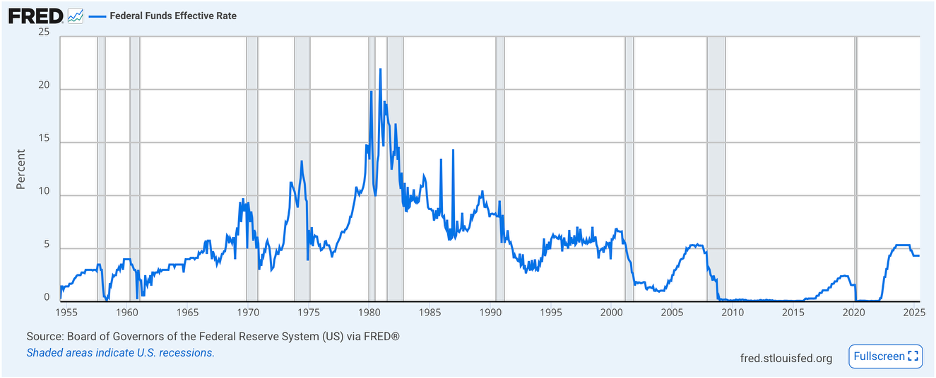
As such, the importance of the dot plot feels overstated compared to its actual value.  After all, no FOMC member has an impressive track record with respect to their analysis of the economy and its future outcomes, let alone what the appropriate rate structure should be at any given time.  In fact, nobody has that, which is the argument for restricting the Fed’s duties to be lender of last resort and allow markets to determine the proper level of interest rates based on the supply and demand of money.  But this is the world in which we live.  My one observation is that the post GFC era has greatly distorted views on the economy and appropriate monetary policy.  It is hard not to look at the below history of Fed funds and see the anomaly that occurred during the initial QE phase.  

Concluding, regardless of my, or anyone not on the FOMC’s, views on appropriate policy, it doesn’t matter one whit.  They are going to do what they deem appropriate, and while I don’t doubt their sincerity, I do doubt they have the tools for the mission.  Perhaps the most interesting thing that could come from this meeting is further information on their assessment of the current Fed process, including their communication policy.  I remain strongly in favor of them all shutting up and letting markets do their job although that seems unlikely.  But perhaps they will get rid of the dots which seem to have outlived any value they may have had initially.

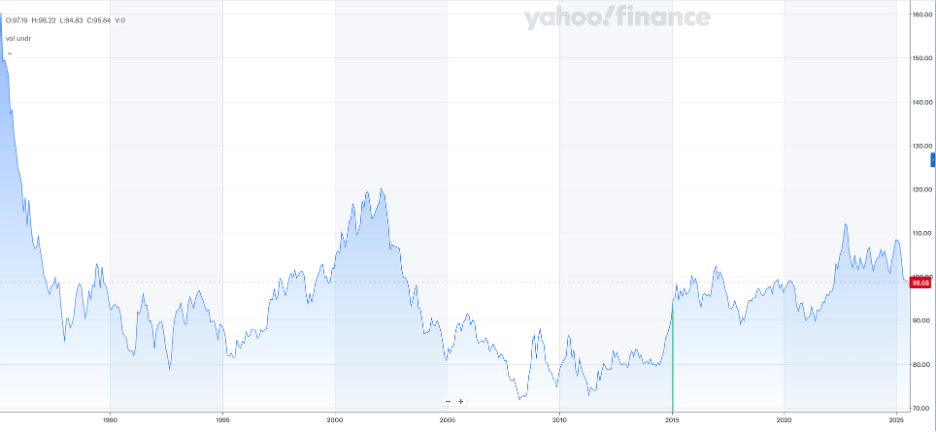
Before we go to markets, I have to highlight one other market discussion this morning with Bloomberg publishing two different articles, here and here,  on the end of the dollar’s hegemony.  The first highlights a speech by PBOC governor Pan Gongsheng and his vision of a multicurrency world which, of course, includes the renminbi as a major part of the process.  I will believe that is a possibility as soon as China opens its capital accounts completely and allows flows into and out of the country with no restrictions.  (I’m not holding my breath.)  The second takes the Michael Bloomberg Trump hatred in the direction of the president is destroying the dollar’s reign because of his policies and to highlight the dollar has fallen 10% already this year!  But let us look at a long-term chart of the dollar, using the DXY as a proxy, and you tell me if you can see the recent move as being outsized in any sense of the word.  In fact, the dollar’s recent price action is indistinguishable from anywhere in its history, and it is not anywhere near to its historic lows.  In fact, it is just a few percent below its long-term average.

Ok, now let’s look at markets.  Yesterday’s selloff in equities seemed to be based on concerns over the escalation in Iran, but as that drags out, traders don’t know what to do.  They are certainly not pushing things much further.  In fact, overnight saw the Nikkei (+0.9%) have a solid gain although HK (-1.1%) followed the US lower.  Elsewhere in the region, South Korea and Taiwan performed well, while India and Indonesia lagged and the rest were +/-20bps or less.  Europe, though, is softer this morning with declines on the order of -0.4% on the continent across the board.  I think investors here are also waiting on the potential events in Iran.  But US futures are actually pointing slightly higher at this hour (7:30).

In the bond market, yields around the world are slipping with Treasuries falling -2bps and most of Europe seeing declines between -1bp and -3bps.  This is after a few basis point decline yesterday as well.  I guess the fear of too much US debt is in abeyance this morning.

In commodity markets, oil, which rallied sharply yesterday on fears of the US entering the war, is little changed on the day after that climb as while there has been lots of talk, oil continues to flow through the Strait of Hormuz, and everybody is pumping nonstop to take advantage of the current relatively high prices.  Gold is unchanged although the other metals (Ag +0.25%, Cu +0.7%, Pt +2.4%) continue to see significant support.  In fact, platinum this morning has broken above the top of an 11-year range and many now see an opportunity for a significant rally from here.

Finally, the dollar is somewhat softer this morning, slipping about 0.2% against the pound, euro and yen, with similar declines against most other currencies.  The exceptions to this are the KRW (+0.45%) which seems to be benefitting from a growing hope that a trade deal will be completed between the US and Korea shortly, and ZAR (-0.5%) as CPI data release there this morning shows inflation under control and no reason for SARB to consider tightening policy further.

On the data front, because of tomorrow’s Juneteenth holiday, we see Initial (exp 245K) and Continuing (1940K) Claims as well as Housing Starts (1.36M) and Building Permits (1.43M).  And of course, at 2:00 it’s the Fed.  My sense is absent a US escalation in Iran, it will be quiet until the Fed, and probably thereafter as well given the lack of reason for any policy changes.  After all, there is no certainty as to either war or trade policy right now, so why would they do anything.

If I had to opine, I would say the dollar is likely to decline over the next year, but that in the longer run, it will be firmer than today.  

Good luck

Adf

Much Hotter

Remember when riots were seen
Across every TV’s flat screen?
Well, that’s in the past
As news of a blast
In Tehran, just one thing, can mean
 
The Middle East just got much hotter
And now every armchair war plotter
Will offer their views
Of which side will lose
So, traders, keep watch o’er your blotter


Is it a coincidence that Israel’s attack on Iran’s nuclear sites occurred on Friday the 13th, or was it meant as a message that luck, both good and bad, can be manufactured? Whatever the driver, the market reaction has been instantaneous.  Here is a look at the five-minute chart in oil with the black sticky stuff jumping more than 8% on the news.

Source: tradingeconomics.com

Too, gold jumped (+1.2%) as did the dollar (EUR -0.4%, AUD -1.0%) although both JPY (+0.3%) and CHF (+0.4%) showed their haven characteristics.  Treasury bonds rallied with yields slipping an additional -3bps in the evening session on top of the -5bp decline during the day, and stock futures are under pressure around the world (S&P500 -1.6%, Nikkei -1.5%, DAX -1.5%).  This was the early price action.

Those were last night’s initial moves and thus far, things have moderated a bit.  For instance, oil has fallen back about 1%, though remains higher by 7.3% and that big gap down on the charts from April has been filled.  

Source: tradingeconomics.com

Of course, there is now a new gap below the markets to fill, but that is a story for another day.  Equity markets are also finding their footing, bouncing off their lows as the 20-day moving average has held and dip buyers see this as an opportunity.  However, the dollar is little changed from its initial moves as is gold, and overall, not surprisingly, risk-off defines the overnight session and likely will be today’s focus.

Now, there is nothing funny about this situation with more death and destruction occurring and likely in our immediate future.  However, I could not help but chuckle at the Russian statement that Israel’s actions were “unprovoked” and “a violation of UN principles and international law.”  Of course, I guess President Putin would know all about unprovoked attacks and violating UN principles and international law given his ongoing efforts in Ukraine.

Ok, I am not a war plotter, nor a war monger, so let’s see how this and any other things are developing in the markets.  While the war discussion will dominate the headlines, there are other things ongoing that are worth considering.  For instance, though the dollar is performing as its historical safe haven this morning, SocGen analysts highlighted a very interesting relationship that has developed in the dollar with respect to inflation surprises over the past four months.  As you can see in the chart below, it appears that as we have seen a series of lower-than-expected inflation readings, the dollar has fallen in step.  Now, correlation is not causality but one could make the case that reduced inflation will lead to a more aggressive easing policy by the Fed and that could be the mechanism by which this relationship operates.

Along the same lines, there have been more stories regarding the softening in the US labor market and at what point the Fed is going to need to focus on that, rather than inflation, as they consider their policy objectives.  As well, the large contingent of analysts who expect the US to enter a recession soon have pointed to the labor market and the fact that much of the underlying data appears to show a less robust situation than the headlines have thus far revealed.  

I have two anecdotes to recount here, neither of which indicates the labor market is softening.  First, the local pizza parlor is at wits’ end trying to hire people to work there, a common high school summer or after school job but there are no takers.  Second, my daughter works for a TMT consulting firm in HR, and they are seeking to hire several new analysts and junior consultants, jobs that pay six figures out of college, and they, too, are having difficulty filling the roles.

I know that anecdata is not definitive, but two very disparate service industries are facing the same issue, and it is not a question as to whether to reduce headcount.  Consider the idea that the recent declines in inflation readings are a short-term outcome and that underlying inflation remains in the 3.5%-4.0% range.  Given median CPI is still running at 3.5%, that is entirely feasible.  If, as we go forward, we start to see high side surprises in inflation, and this relationship has meaning, that could well imply we are looking at a short-term dip in the dollar and that as the year progresses, this will reverse.  My take is that the Fed will only consider cutting rates, at least as long as Powell is Chair, if inflation remains quiescent and unemployment starts to rise.  But if inflation rebounds, I believe they will be reluctant to go there.

Now, as the morning progresses, the dollar is picking up steam with the euro (-0.8%), pound (-.6%) and JPY (-0.6%) all falling, even the havens yen and CHF (-0.5%).  In fact, looking across the board, every major currency is weaker vs. the dollar at this point in the morning (7:15).  As the US has awakened, it seems that the haven status of the dollar is reasserting itself.

Perhaps more surprisingly, Treasury yields have turned around and are now higher by 2bps, which has dragged all European sovereigns along for the ride.  In fact, the weakest nations (Italy +4bps, Spain +5bps) are faring even worse, as is the UK (Gilts +5bps).  Apparently, the recent ideas of the BOE getting more aggressive in its rate cutting is no longer the idea du jour.

In the equity markets, red remains the only color on the screen with Asian markets (Nikkei -0.9%, Hang Seng -0.6%, CSI 300 -0.7%) all rebounding from their early worst levels, but slipping on the day, nonetheless.  I guess there are dip buyers in every market 😃.  In Europe, continental bourses are all sharply lower (DAX -1.4%, CAC -1.1%, IBEX -1.6%) although the FTSE 100 (-0.4%) is holding up better.  As to US futures, they have rebounded slightly from their earliest lows and are now down about -1.0% at 7:20.  Wouldn’t it be something if they closed the day higher?  I don’t think we can rule that out!

Finally, commodities continue to show oil much higher, no retracement there, and gold also holding its gains although copper (-2.5%) is under pressure.  This is a bit odd to me as I would have thought war would bring more copper demand to a market that is physically undersupplied, but then the LME price of copper and the COMEX price of copper seem unrelated to the industrial flows of late.  At this time, everyone is waiting for the Iranian response, although apparently, the first response, a wave of drone attacks on Israel, was completely thwarted.  Not only did Israel destroy some key nuclear sites, but they were able to eliminate almost the entire leadership of the Iranian army and special forces, so any response is likely to take a little time to be created. No oil facilities were targeted, although the Strait of Hormuz is a key chokepoint in the oil market and Iran is likely able to disrupt the flow of tankers through there for now.  What we know is that everyone who was short oil as a trade has likely been stopped out.  It will likely take a little time before new shorts come back to play, so I expect a few days of prices at these levels.  However, the longer-term trend remains lower, so absent a destruction of oil producing fields, I expect that prices will retreat ahead.

On the data front, this morning brings only Michigan Consumer Sentiment (exp 53.5) and with it the inflation expectations piece, although that has been shown to be a political statement, not an economic one.  I cannot shake the feeling that by the time we head to the weekend, equities will have recovered their early losses, and the dollar will cede some of its gains.

Good luck and good weekend

Adf

Quite Dreary

While pundits expected inflation
Would rise with Trump as the causation
The data has not
Shown prices are hot
Since tariffs joined the conversation
 
In fact, there’s a budding new theory
That’s made dollar bulls somewhat leery
If Powell cuts rates
While Christine, she waits
The dollar might soon look quite dreary


Well, it turns out measured inflation wasn’t quite as high as many had forecast, even if we ignore those whose views are completely political.  Yesterday’s readings of 0.1% for both headline and core were lower despite all the tariff anxiety.  The immediate response has been, just wait until next month, that’s when the tariff impact will kick in, you’ll see.  Maybe that will be the case, but right now, for a sober look, the Inflation_Guy™, Mike Ashton, offers a solid description of what happened and some thoughts about how things may be going forward.  Spoiler alert, tariffs are not likely the problem, let’s start thinking about money supply growth.

However, the market, as always, is seeking to create a narrative to drive things (or does the narrative follow the market?  Kind of a chicken and egg question) and there is a new one forming regarding the dollar.  Now, with inflation appearing to slow in the US, this is an opening for Chair Powell to cut rates again, despite the fact that inflation on every reading remains above their target.  Meanwhile, the uncertainty that US policy is having on economies elsewhere, notably in Europe as the tariff situation is not resolved, means Madame Lagarde is set to pause, (if not halt), ECB rate cuts for a while and voilà, we have the makings of a dollar bearish story.  

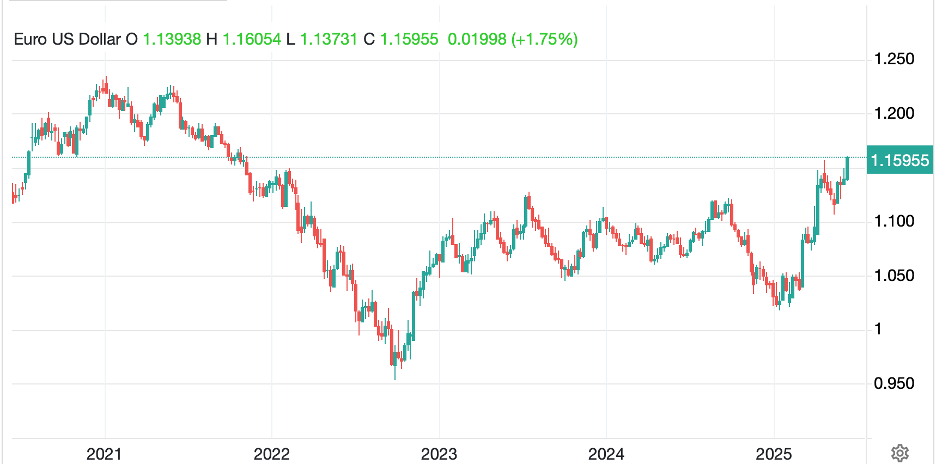
That seems likely to have been the driver of today’s move in the euro (+1.0%) which has taken the single currency back to its highest level since November 2021.

Source: tradingeconomics.com

Now, if you are President Trump and are seeking to reduce the trade deficit while bringing manufacturing capacity back to the US, this seems like a pretty big win.  Lower inflation and a lower dollar both work towards those goals.  Not surprisingly, the president immediately called for the Fed to cut rates by 100 basis points after the release.  As much as FOMC members seem to love the sound of their own voices, perhaps this is one time where they are happy to be in the quiet period as no response need be given!

At any rate, the softer inflation data has had a significant impact on the dollar writ large, with the greenback sliding against all its G10 counterparts, with SEK (+1.3%) leading the way, although CHF (+1.1%), NOK (+0.9%) and JPY (+0.8%) have also been quite strong.  However, the biggest winner was KRW (+1.3%) as not only has there been dollar weakness, but new president, Lee Jae-myung, has proposed tax cuts on dividends to help support Korean equity markets and that encouraged some inflows.  Other EMG currencies have gained as well, although those gains are more muted (CNY +0.3%, PLN +0.6%) and some have even slipped a bit (ZAR -0.5%, MXN -0.1%).  Net, however, the dollar is down.

Yesterday, I, and quite a few other analysts, were looking for more heat in the inflation story.  Clearly, if that is to come, it is a story for another day.  With this in mind, we shouldn’t be surprised that government bond yields have also fallen around the world with Treasuries (-5bps) showing the way for most of Europe (Bunds -6bps, OATs -5bps, Gilts -6bps) and even JGBs (-2bps) are in on the action.  

Earlier this week, the tone of commentary was that inflation was coming back, and a US stagflation was inevitable.  This morning, that narrative has disappeared.    Interestingly, I would have thought the combination of the cooler CPI and the trade truce between the US and China would have the bulls feeling a bit better.  Alas, the equity markets have not responded in that manner at all.  Despite the soft inflation readings, US equity markets yesterday edged lower, albeit not by very much.  But that weakness was followed in Asia (Nikkei -0.65%, Hang Seng -0.4%, CSI 300 -0.1%) with India, Taiwan and Australia all under pressure although Korea (+0.45%) bucked the trend on that dividend tax story.  And Europe, this morning, is also unhappy with the DAX (-1.1%) leading the way lower followed by the IBEX (-.9%) and CAC (-0.7%).  The FTSE 100 (-0.1%) is faring a bit better as, ironically, weaker than expected GDP data this morning (-0.3% in April) has reawakened hope that the BOE will get more aggressive cutting rates.  US futures are in the red as well this morning, -0.5% across the board.  Perhaps this is the beginning of the long-awaited decline from overbought levels.  Or perhaps, this is just a modest correction after a strong performance over the past two months.  After all, the bounce in the wake of the Liberation Day pause has been impressive.  A little selling cannot be a surprise.

Source: tradingeconomics.com

Lastly, we turn to commodities where the one consistency is that gold (+0.5%) has no shortage of demand, at least in Asia.  It seems that despite a 29% rise year-to-date in the barbarous relic, US investors are not that interested.  Those gains dwarf everything other than Bitcoin, and yet they have not caught the fancy of the individual investor in the US.  However, I believe that demand represents an important measure of the diminishing trust in the US dollar, at least for the time being.  The other metals are less interesting today.  As to oil (-1.9%), it has rallied despite alleged production increases from OPEC and weakening demand regarding economic activity.  Some part of this story doesn’t make any sense, although I don’t know which part yet.

This morning’s data brings Initial (exp 240K) and Continuing (1910K) Claims as well as PPI (0.2%, 2.6% Y/Y headline; 0.3%, 3.1% core).  While there are no Fed speakers, there is much prognostication as to how the CPI data is going to alter their DOT plot and SEP information next week at the Fed meeting.  

Finally, the situation in LA does not appear to have improved very much and it is spreading to other cities with substantial protests ostensibly planned for this weekend.  However, market participants have moved on as nothing there is going to change macroeconomic views, at least not yet.  If inflation is quiescent, the Fed doesn’t have to cut to have the tone of the conversation change.  That is what we are seeing this morning and this can continue quite easily.  When I altered my view on the strong dollar several months ago, I suggested a decline of 10% to 15% was quite viable.  Certainly, another 5% from here seems possible over the next several months absent a significant change in the inflation tone.

Good luck

Adf

PS – having grown up in the 60’s I was a huge Beach Boys fan and mourn, with so many others, the passing of Brian Wilson.  In fact, I wanted to write this morning’s rhyme as new lyrics to one of his songs, either “Fun, Fun, Fun” or “Surfin’ USA” two of my favorites.  But I realise that I have become too curmudgeonly as both of those are wonderfully upbeat and I just couldn’t get skeptical words to work.

The Mayhem-ber

Five years ago, some will remember
George Floyd was the riotous ember
But while cities burned
What some of us learned
Was markets ignored the mayhem-ber
 
Of late, as the headlines are filled
With riots, no one’s been red-pilled
While some may disdain
Risk assets, it’s plain
That most buying stocks are still thrilled


The tragic goings on in LA remain the top story as we have now passed the fourth day of rioting.  It strikes me that ultimately, the constitutional question that may be addressed is how much power the federal government has in a situation where a state government seemingly allows rampant destruction of private property.  Of course, we saw this happen just over five years ago in the wake of George Floyd’s death in May 2020 and the ensuing riots in Minneapolis which ultimately spread to Portland, Oregon and Seattle.  

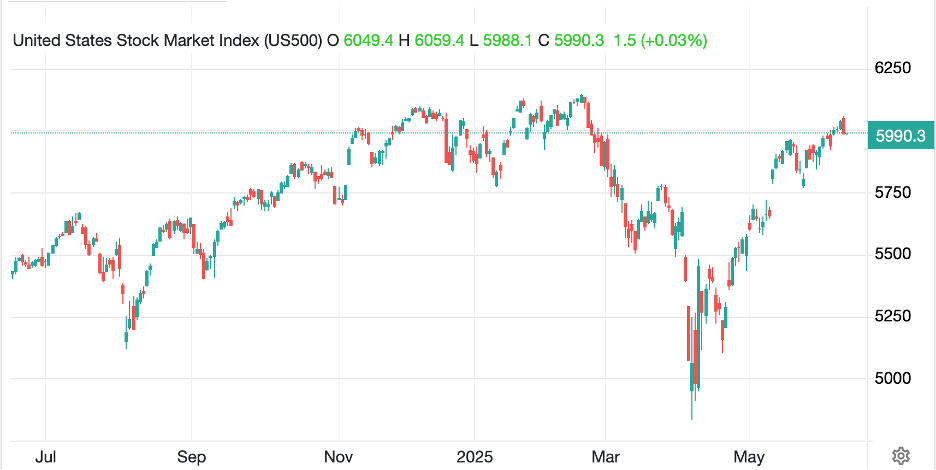
With this as a backdrop, I thought I would take a look at market behavior during that period, if for no other reason to be used as a baseline.  Of course, there are major caveats here as that was during Covid and the government had recently passed a massive stimulus bill while the Fed began to monetize that debt.  Now, we cannot ignore the BBB which looks a lot like a massive stimulus bill as well, so perhaps things are closer in kind than I originally considered.  At any rate, the chart below shows the S&P 500 leading up to and through the 2020 riots.

The huge dip before the riots began was the Covid dip, and the faint dotted line is the Fed Funds rate, so you can see things were clearly different.  However, the point I am trying to make is that despite the violence and disagreements over President Trump’s authority, I would contend the market doesn’t care at all about the situation there.  Investors remain far more concerned about the ongoing trade talks with China that are taking place in London and are “going well” according to Commerce Secretary Lutnick.  From what I read on X, it seems there is a growing expectation that a China deal of some sort will be announced soon and that will be the latest buy signal for stocks.  My larger point is that just because something dominates the headlines, it doesn’t mean that something is relevant in the financial world.

Funnily enough, because the LA riots are sucking the oxygen from every other story, there is relatively little to drive market activity, hence the relatively benign market activity we have been seeing for the past few days.  Yesterday was a perfect example with US equity markets trading either side of unchanged all day and closing pretty much in the same place as Friday.  In Asia overnight, the picture was mixed with the Nikkei (+0.3%) edging higher while both the Hang Seng (-0.1%) and CSI 300 (-0.5%) finished slightly in the red.  The one big outlier there was Taiwan (+2.1%) with other markets showing less overall interest.  I suspect this movement was on the back of the positive vibe the market is taking from the US-China trade talks.

As to Europe, the continent has a negative flavor this morning with the DAX (-0.5%) the laggard and other major indices edging lower by just -0.1% or so.  However, the FTSE 100 (+0.4%) has managed a gain after softer than expected employment data has increased discussion that the BOE will be cutting rates a bit more aggressively.  US futures are still twiddling their proverbial thumbs with no movement at this hour (7:10).

In the bond market, Treasury yields have slipped -3bps and we are seeing similar yield declines throughout the continent.  However, UK gilts (-7bps) are really embracing the slowing labor market and story of a more aggressive BOE rate cut trajectory.

In the commodity markets, oil (+0.5%) continues to climb higher despite the alleged increases in supply and is close to filling the first gap seen back in April (see chart below from tradingeconomics.com)

Given OPEC+ and their production increases, this is a pretty impressive move, especially as the recession narrative remains largely in place.  One tidbit of information, though, is that the Baker Hughes oil rig count is down 37 rigs since the 1st of May, a sign that US production, despite President Trump’s desires for more energy, may be slipping a bit.  As to the metals markets, gold (+0.45%) keeps on trucking, with a steady grind higher although both silver and copper are little changed this morning.  I must mention platinum as well, given I discussed it yesterday, and we cannot be surprised that after a remarkable run, it is softer by -1.3% this morning taking a breather.

Finally, the dollar, like equities, is directionless overall with the pound (-0.3%) slipping on the weak labor data but the rest of the G10 within 0.1% of Monday’s closing levels.  In the EMG bloc, KRW (-0.9%) is the outlier, apparently responding to the positive signals from the US-China trade talks.  However, I question that narrative as no other APAC currency moved more than 0.1% on the session in either direction.  And truthfully, that pretty well describes the rest of the bloc in LATAM and EEMEA.

On the data front, the NFIB Small Business Optimism Index was released this morning at a better than expected 98.8, which as you can see below, is a solid reading overall, certainly compared to most of 2022-2024.

Source: tradingeconomics.com

And here is the rest of what we get this week:

WednesdayCPI0.2% (2.5% Y/Y)
 -ex food & energy0.3% (2.9% Y/Y)
ThursdayPPI0.2% (2.6% Y/Y)
 -ex food & energy0.3% (3.1% Y/Y)
 Initial Claims240K
 Continuing Claims1908K
FridayMichigan Sentiment53.5
 Michigan Inflation Expected6.6%

Source: tradingeconomics.com

However, we must take that Inflation expectation number with at least a few grains of salt (even assuming it has value as an indicator at all), as yesterday, the NY Fed released their own survey of Inflation expectations which fell to 3.2%.  A quick look at the two indicators overlaid on one another shows that the Michigan indicator, if nothing else, has much greater volatility which reduces its value as an indicator.

Source: tradingeconomics.com

It is difficult to get excited about movement in either direction right now.  At some point, the mayhem in LA will end and news sources will look for the next story.  I suspect that trade deals are going to grow in importance as Mr Trump will need to sign some more before long.  As well, the BBB, which I continue to believe will be passed in some form, is going to add some measure of certainty and stimulus to the economy, which, ceteris paribus, implies that the long-awaited reckoning in the stock market may be awaited even longer.  If that is the case, then the weak dollar story, one I understand, is likely to fade for a while as well.

Good luck

Adf

In a Trice

While jobs data Friday was fine
The weekend has seen a decline
In positive news
As riots infuse
LA with a new storyline
 
The protestors don’t like that ICE
Is doing their job in a trice
So, Trump played a card,
The National Guard
As markets search for the right price


Despite all the anxiety regarding the state of the economy, with, once again, survey data like ISM showing things are looking bad, the most important piece of hard data, the Unemployment report, continues to show that the job market is in solid shape.  Friday’s NFP outcome of 139K was a few thousand more than forecast, but a lot more than the ADP result last Wednesday and much better than the ISM indices would have indicated.  Earnings rose, and government jobs shrunk for the first time in far too long with the only real negative the fact that manufacturing payrolls fell -8K.  But net, it is difficult to spin the data as anything other than better than expected.  Not surprisingly, the result was a strong US equity performance and a massive decline in the bond market with 10-year yields jumping 10bps in minutes (see below).

Source: tradingeconomics.com

But that is not the story that people are discussing.  Rather, the devolution of the situation in LA is the only story of note as ICE agents apparently carried out a series of court-warranted raids and those people affected took umbrage.  The face-off escalated as calls for violence against ICE officers rose while the LAPD was apparently told to stand down by the mayor.  President Trump called out the National Guard to protect the ICE agents and now we are at a point of both sides claiming the other side is acting illegally.  Certainly, the photos of the situation seem like it is out of hand, reminding me of Minneapolis in the wake of George Floyd, but I am not on site and can make no claims in either direction.  

It strikes me that for our purposes here, the question is how will this impact markets going forward.  A case could be made that the unrest is symptomatic of the chaos that appears to be growing around several cities in the US and could be blamed for investors seeking to move their capital elsewhere, thus selling US assets and the dollar.  Equally, a case could be made that haven assets remain in demand and while US equities do not fit that bill, Treasuries should.  In that case, precious metals and bonds are going to be in demand.  The one thing about which we can be sure is there will be lawsuits filed by Democratic governors against the federal government for overstepping their authority, but no injunctions have been issued yet.

However, let’s step back a few feet and see if we can appraise the broader situation.  The US fiscal situation remains cloudy as the Senate wrangles over the Big Beautiful Bill (BBB), although I expect it will be passed in some form by the end of the month.  The debt situation is not going to get any better in the near-term, although if the fiscal package can encourage faster nominal growth, it is possible to flatten the trajectory of that debt growth.  Meanwhile, the tariff situation is also unclear as to its results, with no nations other than the UK having announced a deal yet, although the administration continues to promise a number are coming soon.

If I look at these issues, it is easy to grow concerned over the future.  While it is not clear to me where in the world things are that much better, capital flows into the US could easily slow.  Yet, domestically, one need only look at the consumer, which continues to buy a lot of stuff, and borrow to do it (Consumer Credit rose by $17.9B in April) and recognize that the slowdown, if it comes, will take time to arrive.  Remember, too, that every government, everywhere, will always err on the side of reflating an economy to prevent economic weakness, and that means that the first cracks in the employment side could well lead to Fed cuts, and by extension more inflation.  (This note by StoneX macro guru Vincent Deluard discussing the Cancellation of Recessions is a must read).  I have spoken ad nauseum about the extraordinary amount of debt outstanding in the world, and how it will never be repaid.  Thus, it will be refinanced and devalued by EVERY nation.  The question is the relative pace of that adjustment.  In fact, I would argue, that is both the great unknown, and the most important question.

While answering this is impossible, a few observations from recent data are worth remembering.  US economic activity, at least per the Atlanta Fed’s GDPNow continues to rebound dramatically from Q1 with a current reading of 3.8%.  Meanwhile, Chinese trade data showed a dramatic decline in exports to the US (-35%) but an increased Trade Surplus of $103.2B as they shifted exports to other markets and more interestingly, imports declined-3.4%.  in fact, it is difficult to look at this chart of Chinese imports over the past 3 years and walk away thinking that their economy is doing that well.  Demand is clearly slowing to some extent, and while their Q1 GDP was robust, that appears to have been a response to the anticipated trade war.  Do not be surprised to see Chinese GDP slowing more substantially in Q2 and beyond.

Source: tradingeconomics.com

Europe has been having a moment as investors listen to the promises of €1 trillion or more to build up their defense industries and flock to European defense companies that had been relatively cheap compared to their US counterparts.  But as the continent continues to insist on energy suicide, the long-term prospects are suspect.  Canada just promised to raise its defense spending to 2% of GDP, finally, a sign of yet more fiscal stimulus entering the market and the UK, while also on energy suicide watch, has seen its service sector hold up well.

The common thread, which will be exacerbated by the BBB, is that more fiscal spending, and therefore increased debt are the future.  Which nation is best placed to handle that increase?  Despite everything that you might believe is going wrong in the US, ultimately the economic dynamism that exists in the US surpasses that of every other major nation/bloc.  I still fear that the Fed is going to cut rates, drive inflation higher and undermine the dollar before the year is over, but in the medium term, no other nation appears to have the combination of skills and political will to do anything other than what they have been doing already.  And that is why the long-term picture in the US remains the most enticing.  This is not to say that US asset prices will improve in a straight line higher, just that the broad direction remains clear, at least to me.

Ok, I went on way too long, sorry.  As there is no US data until Wednesday’s CPI, we will ignore that for now.  A market recap is as follows:  Asia had a broadly stronger session with Japan, China, HK, Korea and India all following in the US footsteps from Friday and showing solid gains.  Europe, though, is mostly in the red with only Spain’s 0.25% gain the outlier amongst major markets.  As to US futures, they are essentially unchanged at this hour (7:00).

Treasury yields have backed off -2bps from Friday’s sharp climb and European sovereign yields are softer by between -3bps and -4bps as although there has been no European data released; the discussion continues as to how much the ECB is going to cut rates going forward.  JGB yields were unchanged overnight.

In the commodity space, while oil (+0.3%), gold (+0.1%) and even silver (+0.8%) are edging higher, platinum has become the new darling of speculators with a 2.8% climb overnight that has taken it up more than 13.5% in the past week and 35% YTD.  Remarkably, it is still priced about one-third of gold, although there are those who believe that is set to change dramatically.  A quick look at the chart below does offer the possibility of a break above current levels opening the door to a virtual doubling of the price.  And in this environment, a run at the February 2008 all-time highs seems possible.

Finally, the dollar is softer across the board this morning, against virtually all its G10 and EMG counterparts.  AUD (+0.55%) and NZD (+0.7%) are leading the way, but the yen (+0.5%) is having a solid session as are the euro and pound, both higher by 0.25%.  In the emerging markets, PLN (+0.7%) is the leader with the bulk of the rest of the space higher by between +0.2% and +0.4%.  BRL (-0.3%) is the outlier this morning, but that looks much more like a modest retracement of recent gains than a new story.

Absent both data and any Fedspeak (the quiet period started on Friday), we are left to our own devices.  My take is there are still an equal number of analysts who are confident a recession is around the corner as those who believe one will be avoided.  After reading the Deluard piece above, I am coming down on the side of no recession, at least not in a classical sense, as no politician anywhere can withstand the pain, at least not in the G10 and China.  That tells me that while Europe may be the equity flavor of the moment, commodities remain the best bet as they are undervalued overall, and all that debt and new money will continue to devalue fiat currencies.

Good luck

Adf