A Final Bronx Cheer

Though markets are desperate for Jay
To cut, there is fear that he’ll say
It’s not yet the time
In this paradigm
As tariffs have caused disarray
 
But truly, Chair Jay’s greatest fear
Is that ere October this year
The Prez will have chosen
A new Chair and frozen
Him out with a final Bronx cheer


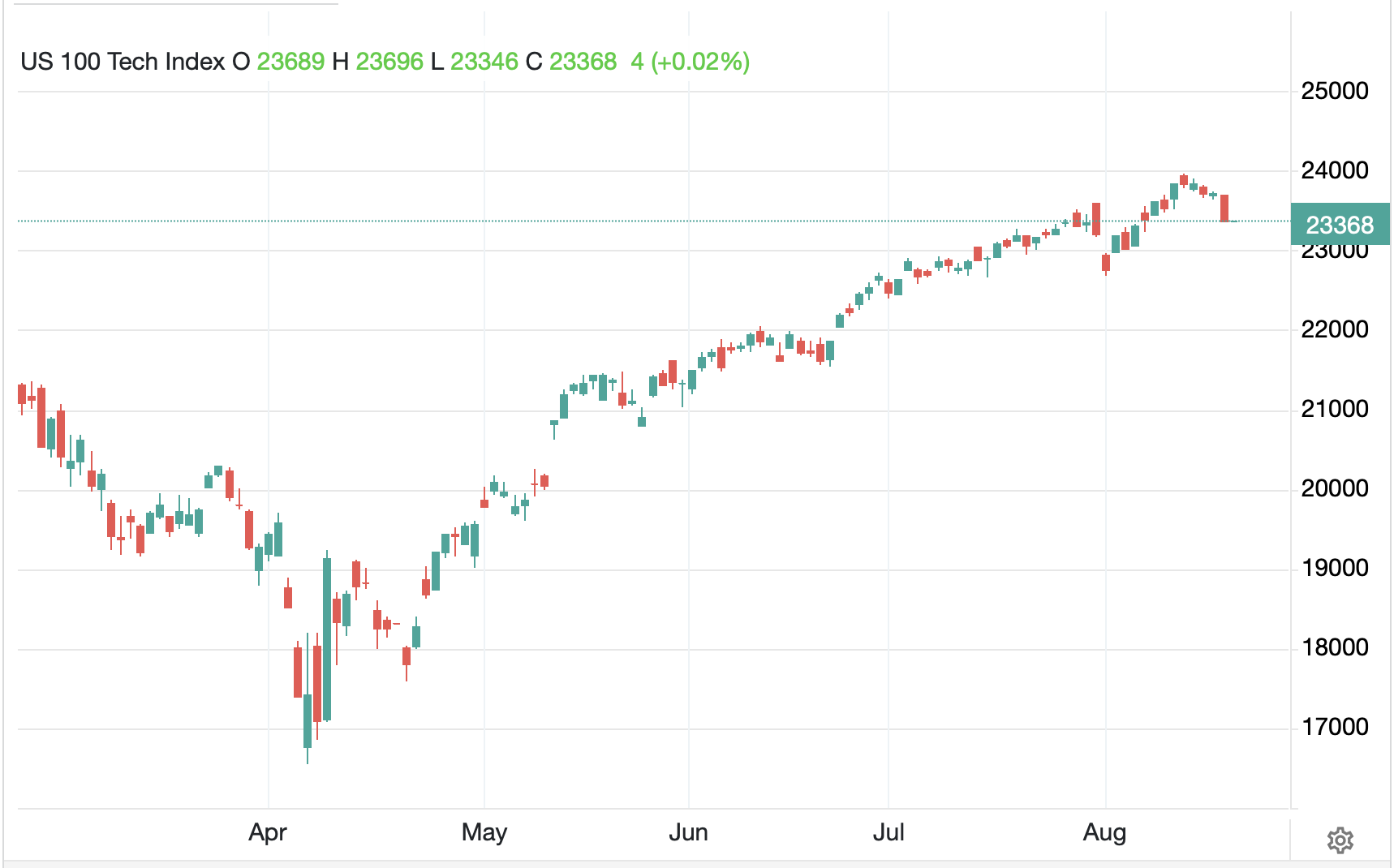
Yesterday saw the first substantial equity market move in nearly 3 weeks, with the NASDAQ declining 1.5% as concerns arose that the current extremely high valuations would have a more difficult time being maintained if the Fed does not ease policy as widely expected next month.  This resulted in all the Mag7 declining, which given they have been the driving force higher in the market, necessarily resulted in overall index declines.

Source: tradingeconomics.com

Of course, the question is, what made yesterday any different than previous sessions.  There were no earnings results of note, and arguably, the biggest tech news was the story about the US government taking a stake in Intel, something that seems likely to have been a positive.  However, there has been an increase in chatter about what Chair Powell is going to say on Friday at his Jackson Hole speech.  Notably, in the SOFR options market, there are a large, and still increasing, number of bets being placed that Powell will indicate 50bps is on the table in September.  But Wall St analysts continue to side with the patience crowd, explaining that while the current policy settings may be slightly restrictive, they are hardly suffocating for the economy.

While Powell has repeatedly blamed an uncertain impact of tariffs on his decision to maintain current policy settings, just like everything else, this is becoming extremely political.  Trump’s allies are lining up behind him and calling for immediate rate cuts to help support the economy.  At the same time, Trump’s political foes remain focused on preventing any Fed action that might help Trump, although they couch their arguments in terms of maintaining Fed ‘independence’.

However, last night was instructive in that two central banks, New Zealand and Indonesia, cut rates further while Sweden’s Riksbank, though standing pat, explained that more cuts are possible, if not likely, later this year.  While the PBOC did not cut rates, the pressure there is building as the economic situation is very clearly slowing down, as discussed last week after their data releases.  So, with most of the world cutting rates (Japan being the notable exception), pressure continues to mount on Powell and the Fed to pick up where they left off last December.

Hanging over both Powell’s speech and the September rate decision is the fact that Treasury Secretary Bessent explained yesterday that interviews for the next Fed chair would begin around Labor Day, just two weeks from now, and nearly eight months before Powell’s term ends.  This will almost certainly weaken Powell as other FOMC members and the market will look to whomever is selected for their views, with Powell serving out his term as a lame duck.  In fact, it is for this reason that my take is Powell’s speech at Jackson Hole will be less about policy and more an attempt to burnish his legacy.

And that’s where things stand.  With no data of note today, and yesterday’s housing data being mildly positive, but not enough to change macroeconomic opinions, the narrative writers are looking for something to say and Powell’s speech is where they have landed.  Absent a run of declining days, I put no stock in a change in the market temperature at this point.  So, let’s see how things behaved overnight.

In Asia, the Nikkei (-1.5%) had a rough night in a direct response to the US tech-led selloff.  Given that US markets have stabilized this morning, with futures unchanged at this hour (7:25), we need to see a continuation here before expecting a significant further decline there.  China (+1.1%), however, bucked that weaker trend, ostensibly on hopes that the ongoing trade talks with the US will prove fruitful.  Elsewhere in the region, Korea (-0.7%) and Taiwan (-3.0%) were both hit on the tech selloff blues but other markets, with less exposure to that sector were fine.  In Europe, it is a mixed picture with the DAX (-0.4%) the laggard after weaker than expected PPI indicated that current ECB policy needs to be more accommodative to help the country but may not be coming soon.  However, the rest of the continent is little changed.  surprisingly, UK stocks (+0.3%) are holding up well despite higher-than-expected CPI data which has adjusted analysts’ thoughts on whether the BOE will be able to cut again at their next meeting.

In the bond market, Treasury yields (-1bp) continue to trade in the middle of that band I showed yesterday, while European sovereign yields have also slipped between -1bp and -2bps this morning after the softer German price data.  The UK (-4bps) is a surprise as I would not have expected lower yields after a higher inflation reading.  Perhaps this is an indication that investors are expecting a much worse economic outcome from the UK going forward.

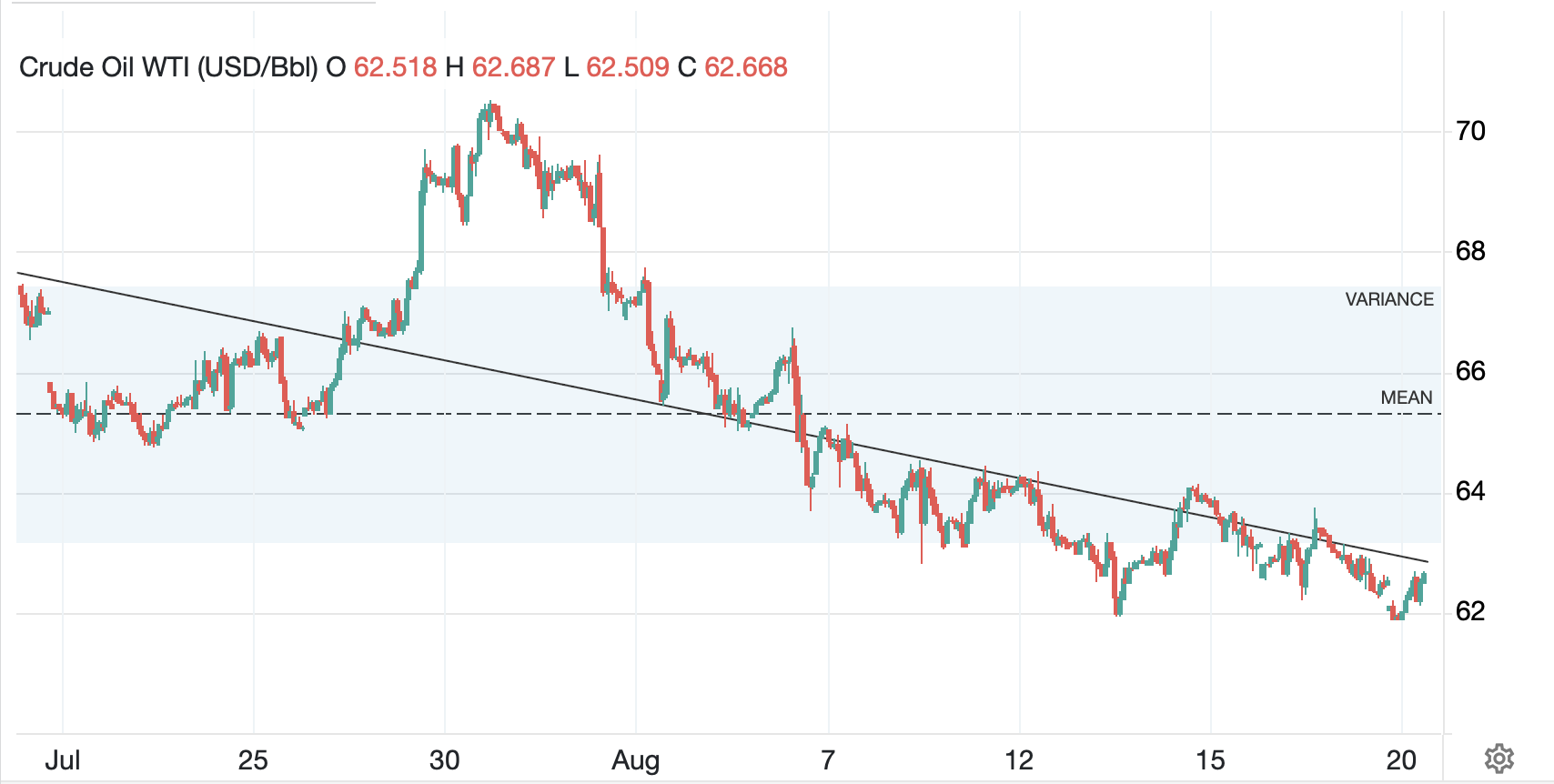
In the commodity markets, oil (+1.3%) is bouncing, but it remains in a well-defined downtrend for now as per the below chart.

Source: tradingeconomics.com

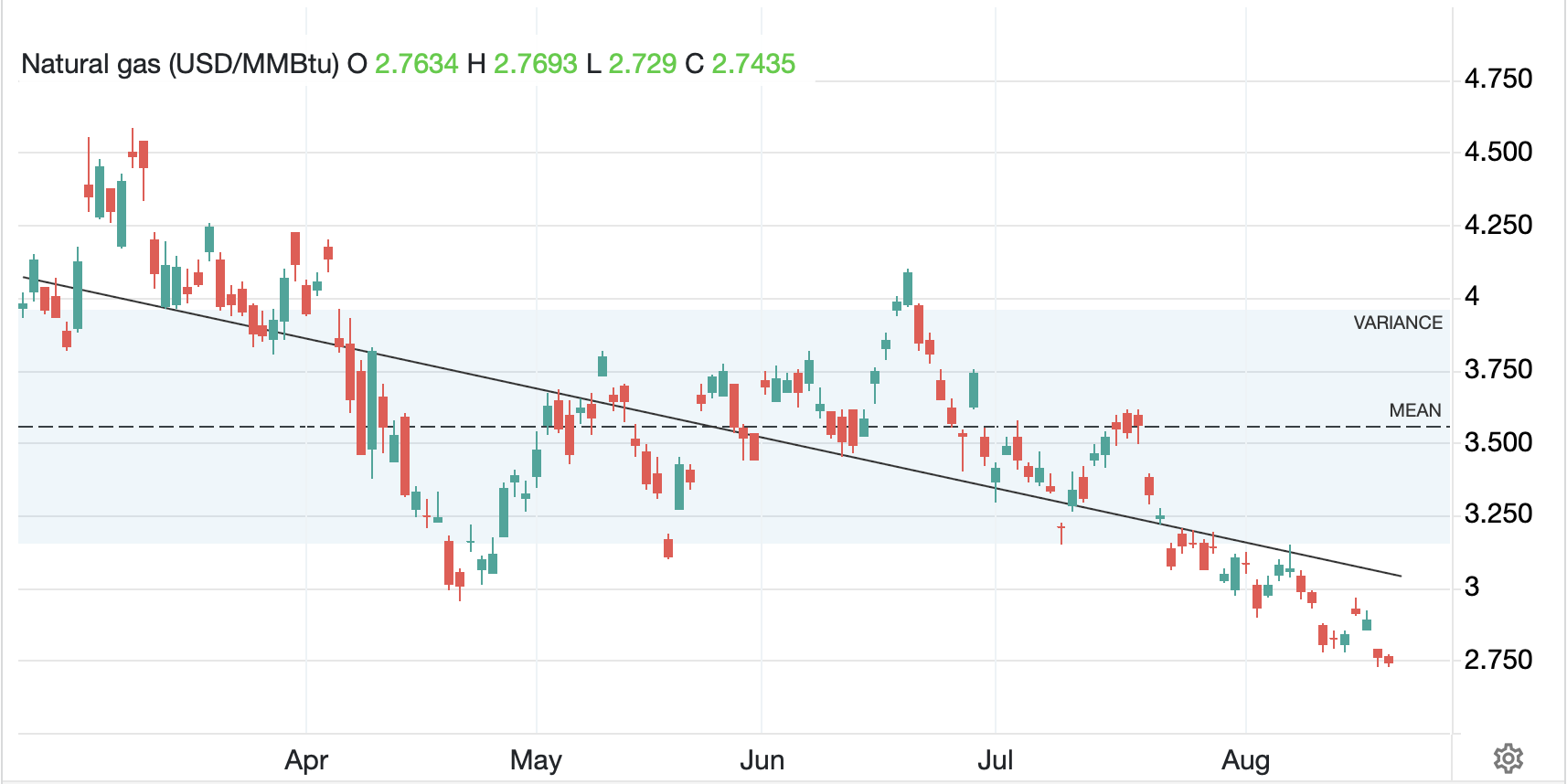
To change this trajectory, we will need to see something alter the production schedule, which with peace on the table in Ukraine seems likely to bring more oil to market not less, or we will need to see a significantly better economic outlook that drives a substantial increase in demand, something which right now seems unlikely as well.  I cannot get on board the higher oil price bandwagon at this time.  One other thing weighing on oil is the fact that NatGas has been trending lower for the past 6 months and is now at levels not seen since last November.  In fact, those two charts look remarkably similar!

Source: tradingeconomcis.com

There is a real substitution effect here and currently oil is trading at a price that is about 4X the energy price of NatGas.  Until that arbitrage closes, and it will eventually, oil will have difficulty rallying in my view. 

In the metals markets, gold (+0.4%) which sold off a few dollars yesterday is rebounding although both silver and copper are soft this morning.  These markets are just not that interesting right now.

Finally, the dollar is little changed this morning with one real outlier, NZD (-1.2%) which responded to the dovish tones of the RBNZ last night and is pricing in more interest rate cuts now.  KRW (-0.4%) also fell on concerns over trade and the semiconductor results but otherwise, there is very little ongoing here.

The only data this morning is EIA oil inventories with a small draw anticipated.  The FOMC Minutes come at 2:00 and there will be a lot of digging to see if other members seemed to agree with Bowman and Waller in their dissents at the last meeting.  Bowman spoke yesterday, but was focused on her role as chief regulator, not monetary policy, although we hear from Waller this morning.

A down day in equities is not the end of the world despite much gnashing of teeth.  It remains difficult to get excited about markets right now.  Perhaps Mr Powell will shake things up on Friday, but my sense is we will need to wait for the next NFP data to get some action.

Good luck

Adf

PS. A reader explained to me that in Australia, black swans are the norm, not the remarkable case as here in the US.  I guess we will need to find a new term to discuss an unexpected surprise.

No Longer Concern

Seems tariffs no longer concern
The markets, as mostly they yearn
For Jay and the Fed,
When looking ahead
To cut rates when next they adjourn
 
Alas, there’s no hint that’s the case
As prices keep rising apace
In fact, come this morning
There could be a warning
If CPI starts to retrace


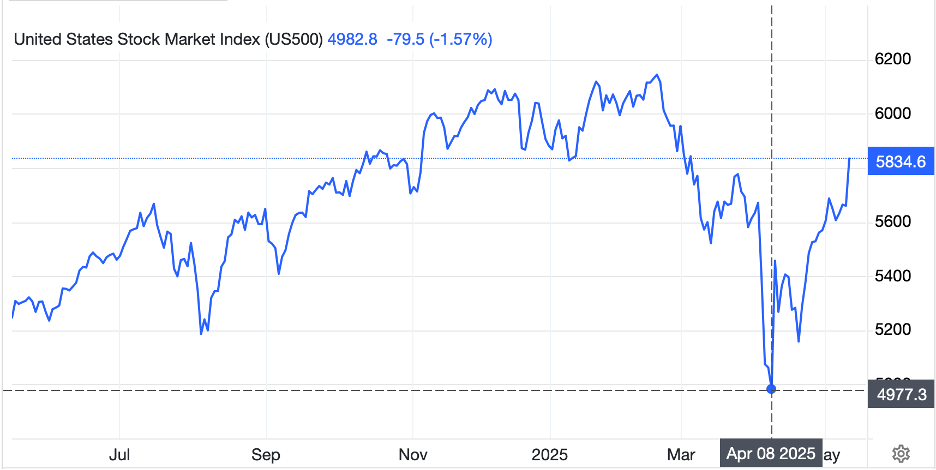
I am old enough to remember when President Trump’s actions on tariffs combined with DOGE was set to collapse the US economy.  I’m sure that was the case because it was headline news every day.  Equity markets fell sharply, the dollar fell sharply, gold rallied, and the clear consensus was the “end of American exceptionalism” in finance.  That was the description of how investors around the world flocked to the US equity markets as they held the best opportunities.  But the punditry was certain President Trump had killed that idea and were virtually licking their lips writing the obits for the US economy and President Trump’s plans.  In fact, I suspect all of you are old enough to remember that as well.  The chart below highlights the timing.

Source: tradingeconomics.com

But that is such old news it seems a mistake to even mention it.  The headlines this morning are all about how the stock market is now set to make new highs!  Bloomberg led with, Traders Model Bullish Moves for S&P 500 With Tariff Tensions Easing, although it is the theme everywhere.  So, is the world that much better today than a month ago?  Well, certainly the tariff situation continues to evolve, and we have moved away from the worst outcomes there it seems.  But recession probabilities remain elevated in all these econometric models, with current forecasts of 35%-50% quite common.  

Is a recession coming?  Well, the same people who have been telling us for the past 3 years that a recession was right around the corner, and some have even said we are currently living through one, are telling us that one is right around the corner.  Their track record isn’t inspiring.  In fact, these are the same people who are telling us that store shelves will be empty by the summer.  Personally, I take solace in the fact that the underlying numbers from the Q1 GDP data showed that despite a negative outcome, the positives of a huge increase in private investment and a reduction in government spending, were far more important to the economy than the fact that the trade deficit grew as companies rushed to stock up before the threatened tariffs.  Less government spending and more private investment are a much better mix for the economy’s performance going forward.  Let’s hope it stays that way.

But what about prices?  This morning’s CPI data (exp 0.3%, 2.4% Y/Y Headline, 0.3%, 2.8% Y/Y Core) will give us further hints about how the Fed will behave going forward.  As of now, there is no indication that the Fed is concerned about a growth slowdown of such magnitude that they need to cut rates.  In fact, Fed funds futures have reduced the probability of a June cut to just 8% and have reduced the total cuts for 2025 to just 2 now, down from 3 just a week ago.  Yesterday, Fed Governor Adriana Kugler reiterated the old view that tariffs could raise prices and reduce growth although gave no indication that cutting rates was the appropriate solution.  Arguably of more importance to the market will be Chairman Powell’s comments when he speaks Thursday morning.  My take here, though, is that the rate of inflation has bottomed and that the Fed is going to remain on hold all year long.  In fact, as I wrote back in the beginning of the year, I would not be surprised to ultimately see a rate hike before the year is over.  A rebound in growth and inflation remaining firm will change the narrative before too long, probably by the end of summer.  Of course, remember, I am just a poet and not nearly as smart as all those pundits, so take my views with at least a grain of salt.

Ok, let’s look at how markets have behaved in the new world order.  Yesterday’s massive US equity rally did not really see much follow through elsewhere although the Nikkei (+1.4%) had a solid session.  In fact, the Hang Seng (-1.9%) saw a reversal after a string of 8 straight gains as both profit-taking and some concerns about slowing growth in China seemed to be the main talking points there.  Elsewhere in the region, Malaysia and the Philippines had strong sessions while India lagged.  

In Europe, other than Spain’s IBEX (+0.8%), which has rallied purely on market internals, the rest of the continent and the UK are virtually unchanged this morning.  The most interesting comment I saw was from Treasury Secretary Bessent who dismissed the idea that a trade deal with the EU would be coming soon, “My personal belief is Europe may have a collective action problem; that the Italians want something that’s different than the French. But I’m sure at the end of the day, we will reach a satisfactory conclusion.”  That sounds to me like Europe is not high on the list of nations with whom the US is seeking to complete a deal quickly.  Finally, US futures are a touch softer this morning, although after the huge rallies yesterday, a little pullback is no surprise.

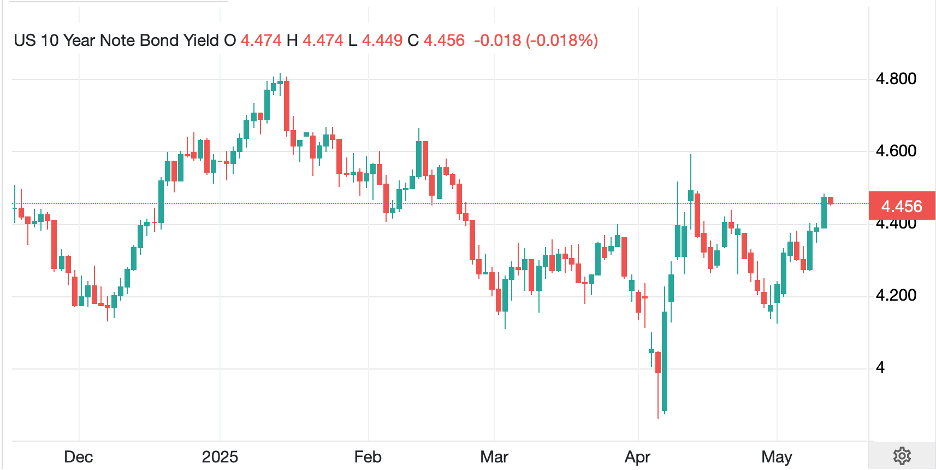
In the bond market, Treasury yields have backed off 2bps this morning, but in reality, they are higher by nearly 30bps so far this month as you can see below.

Source: tradingeconomics.com

This cannot please either Trump or Bessent but ultimately the question is, what is driving this price action?  If this is a consequence of investors anticipating faster US growth with inflation pressures building, that may be an acceptable outcome, especially if the administration can slow government spending.  But if this is the result of concern over the full faith and credit of the US government, or a liquidation by reserve holders around the world, that is a very different situation and one that I presume would be addressed directly by the Trump administration.  As to European sovereign yields, today has seen very modest rises, 1bp or 2bps across the board.  The biggest news there was the German ZEW survey which, while the Current Conditions Index fell to -82, saw the Economic Sentiment Index jump 39 points to +25.2, far better than expected.  It seems there is a lot of hope for the rearmament of Germany and the economic knock-on effects that will may bring.

In the commodity markets, oil (+0.6%) continues to grind higher as it looks set to test the recent highs near $64/bbl and from a technical perspective, may have put in a double bottom just above $56/bbl.  There is still a huge gap above the market that would need to be filled (trading above $70/bbl) in order to break this downtrend, at least in my mind.  But that doesn’t mean we can’t chop back and forth between $60 and $65 for a long time.  As to gold (+0.7%) after a sharp decline yesterday as the world was no longer scared about the future, it is bouncing back.  Whether this is merely technical, and we are heading lower, or yesterday’s price action was the aberration is yet to be determined.  Meanwhile, silver (+1.3%) and copper (+1.0%) are both having solid sessions as well.

Finally, the dollar is giving back a tiny bit of yesterday’s massive gains.  The euro (+0.2%) and pound (+0.25%) are emblematic of the overall movement although we have seen a few currencies with slightly stronger profiles this morning (SEK +0.8%, AUD +0.6%, CHF +0.5%).  In the EMG bloc, the movement has actually been far less impressive with ZAR (-0.45%) and KRW (-0.4%) bucking the trend of dollar softness but gains in MXN (+0.4%) and CZK (+0.4%) the best the bloc can do.  

One thing I will say about this administration is they have the ability to really change the tone of the discussion in a hurry.  If they are ultimately successful in reordering US economic activity away from the government and to the private sector, that is going to destroy my dollar weakness thesis.  I freely admit I didn’t expect anything like this to happen, but the early evidence points in that direction.  We will know more when Q2 GDP comes out and we find out if private sector activity is really increasing like the hints from Q1.  If that is the case, then the idea of American exceptionalism is going to make a major comeback in the punditry, although I suspect markets will have figured it out before then.

Other than the CPI, there is no other data and there are no Fed speakers on the docket.  While the dollar is soft this morning, I expect that any surprises in CPI will be the driver.  Otherwise, as I just mentioned, I am becoming concerned about my dollar weakness view.

Good luck

adf

Huge Fluctuations

There once was a war between nations
That led to some huge fluctuations
In markets worldwide
As pundits all cried
The world’s shaken to its foundations
 
In secret, though, pundits all cheered
‘Cause they all hate Trump, and thus steered
The narrative toward
This Damocles’ sword
That hung o’er the world and was feared
 
But now, twixt the US and China
There is just a bit less angina
Both sides, tariffs, slashed
And quite unabashed
These pundits said things were just fine-a


The wonderful thing about controlling the narrative is that it doesn’t matter if you are right or wrong at any particular time, because if you are wrong, you simply change the narrative.  At least that’s my impression looking here from the cheap seats.  At any rate, the news this weekend brought the end to the trade war, or at least a 90-day cease fire, as both the US and China slashed their announced tariffs dramatically, with US tariffs falling to 30% on Chinese goods and Chinese tariffs falling to 10% on US goods.  Between now and August, Treasury Secretary Bessent will be leading trade talks with Chinese Vice Premier He to try to come up with a more permanent solution.

In the interim, it will be interesting to see how the narrative evolves.  Certainly, I got tired of the different articles I saw explaining that there were no ships crossing the Pacific from China to the US and that store shelves would be empty by summer.  I wonder if we will see any of those claims retracted. (I’m not holding my breath).  I also wonder why that is the case simply from a mathematic perspective.  After all, annual US GDP is ~$28 trillion and imports from China in the twelve months from April 2024 through March 2025 were ~$444 billion, according to the FRED database.  So, does that mean that the other $27.56 trillion in economic activity was all services?  A look at the charts below created from FRED data shows that not only has the amount of imports from China not been growing lately, as a percentage of GDP, they have been shrinking.  I am not saying Chinese activity is unimportant to the US, just that the reduction in relative trade has been happening far longer than President Trump has been in office this time.

While certainly, low priced items could become a bit scarcer, it strikes me that there was more than a bit of hyperbole involved in those claims.  Of course, the next question is, will those ships start sailing again?  I guess we shall find out soon enough.

But stepping back a bit, I think it is critical to remember that prior to President Trump’s “Liberation Day” tariff announcements, it’s not as though the world trade system was all peaches and cream.  In fact, this weekend I listened to an excellent Monetarymatters podcast with guest George Magnus discussing the trade situation and why it was untenable in its current form before President Trump tried to change things.  He is far more eloquent and knowledgeable than a mere poet like me, and it is worth listening.  In the end, as others have also said, the status quo was unsustainable as both US government spending needs to be cut and the US reliance on China (or any other nation) for things of national security importance could not continue without grave results for our nation.  

I contend there is no easy way to change a system that has evolved over 80 years with goals changing during that period.  I also contend that the idea that a proverbial scalpel would have been a better method to do things, as it would not have created the market ructions we have all felt for the past few months, would never have worked.  Just like in changing the way the federal government works, the inertia in the trade system is far too great to be adjusted by tweaks here and there.  To make a lasting change, major disruptions are needed and that is what President Trump has been doing, disrupting things majorly.  Whether or not he will ultimately be successful is hard to say, but the odds of a change are greater now than before he started.  And almost everybody agreed that things were unsustainable.

One last thing you are sure to hear, especially now that the negotiations have begun is that the only reason is because President Trump “blinked” and couldn’t stand the pain of the market and the slings and arrows of the punditry.  However, it remains very difficult for me to look at the data that has been released of late, with Chinese growth slowing rapidly and Chinese stimulus unable to solve the problem and believe that President Xi hasn’t felt enormous pressure to speed up the economy.  It is clearly in both sides interest to come to a resolution, and that is what we should focus on going forward.

So, how did markets take the news?  Well, it should be no surprise that Chinese (+1.2%) and Hong Kong (+3.0%) shares both rallied sharply given they are the direct beneficiaries of the story.  Taiwan (+1.0%) and Korea (+1.2%) also fared well in the euphoria, but perhaps the biggest news in Asia was the ceasefire between India and Pakistan that was brokered by the US.  That saw Indian shares (+3.8%) and Pakistani shares (+9.0%) both explode higher.  It is certainly better that the explosions are in the relevant stock markets than on the ground!  As to the rest of Asia, markets were generally higher but not nearly as ebullient. Meanwhile, in Europe, screens are green (Germany +0.9%, France +1.35%, UK +0.4%) but the gains pale compared to some of the Asian price action.  US futures, though, are soaring at this hour (6:50) with gains between 2.4% (DJIA) and 4.0% (NASDAQ).

In the bond market, yields are soaring everywhere with Treasuries (+7bps) rising a similar amount to all European sovereigns (Bunds +7bps, OATs +6bps, Gilts +8bps) and JGBs (+8bps).  It appears that with money flowing rapidly back into the equity markets now that the trade war has ended RISK IS ON baby!!!  Either that or the only way to generate this new growth is by spending lots of government money which will require even more issuance.  I’ll take the first for now.

But that risk on trade is clear in commodities with oil (+3.6%) soaring higher to its highest level in three weeks and despite the idea that OPEC+ is going to increase production.  In fact, there are many things ongoing in the oil market that are far too detailed for this commentary, but in a nutshell, from what I understand, OPEC’s changes are simply catching up to the reality of what members have already been pumping and the market is now focusing on the renewed growth enthusiasm with the trade war on hold.  As well, if risk is no longer a concern, you don’t need to hold gold, and the barbarous relic is under huge pressure this morning, tumbling -3.5% and taking silver (-2.1%) with it.  Copper (+0.4%), however, is higher on the growth story.

Finally, the dollar is flying this morning.  on the one hand, given risk is in such demand, that doesn’t make much sense as historically, risk on markets tend to see the dollar weaken.  But my take is that all the stories about the end of American exceptionalism, with respect to US equity markets, got destroyed by the truce in the trade war, and now folks are buying dollars to buy US equities.  So, the euro (-1.4%) is under major pressure along with the pound (-1.1%) and the yen (-2.0%) is in more dire straits, as is CHF (-1.8%).  Other G10 currencies have also fallen, albeit not as far.  In the Emerging markets, only two currencies are rallying this morning, both benefitting from truces; INR (+0.7%) which is obviously benefitting from the military ceasefire and CNY (+0.6%) which is benefitting from the trade ceasefire.  As to the rest of the bloc, all currencies are lower between -0.6% and -1.6%.

On the data front, we see the following this week:

TuesdayCPI0.3% (2.4% Y/Y)
 -ex food & energy0.3% (2.8% Y/Y)
ThursdayInitial Claims230K
 Continuing Claims1890K
 Retail Sales0.0%
 -ex autos0.3%
 PPI0.2% (2.5% Y/Y)
 -ex food & energy0.3% (3.1% Y/Y)
 Empire State Manufacturing-10.0
 Philly Fed Manufacturing-12.5
 IP0.2%
 Capacity Utilization77.9%
FridayHousing Starts1.37M
 Building Permits1.45M
 Michigan Sentiment53.1

Source: tradingeconomics.com

As well as all the data, we hear from six Fed speakers, including Chairman Powell on Thursday morning.  I cannot help but think that things are a bit overdone this morning but perhaps not.  It is certainly positive that the US and China are speaking about trade, but it remains to be seen what can be agreed.  In the end, while this week is starting off well, I suggest not getting too excited yet.  As to the dollar, certainly this is positive news, but I have not changed my view that eventually it will slide.

Good luck

Adf

Very Near Future

The “very near future” is when
The US and China, again
Will restart their talks
Assuming no balks
By either of these august men
 
That’s all that the market required
For buyers to get so inspired
Can this idea last?
Or will it have passed
Ere market resolve has expired


While all and sundry have been very confident that President Trump’s attempt to alter the structure of the global economy and world trade to a more beneficial one, in his view for the US, will fail dismally and that we are doomed to stagflation as prices rise and the economy sinks, it seems these same economic analysts have forgotten that there are two sides to the supply/demand equation.  I have written before that despite all the slings and arrows that have been aimed at Trump, the US has a very strong hand in the trade game given it is THE CONSUMER OF LAST RESORT.  Virtually every nation in the world has built an economy designed to be able to manufacture stuff cheaply and sell it into the largest economy in the world.

And US consumers are remarkable in their ability to continue to consume at high levels despite what appear to be significant headwinds, whether high financing costs, limited savings or slowing economic activity.  But a funny thing is happening on the way to this mooted US stagflation, it’s not happening yet.  In fact, as described by economist Daniel Lacalle in his most recent post, it seems that the biggest problem is not that Americans cannot find what they want to buy, it is that they only bought all this stuff because it was cheap.  They will not accept significant price rises and so inventory is building up at factories while ships are stuck with containers full of stuff nobody wants, at the price.  Could it be that President Trump read the room better than the economists?

I use this as preamble to yesterday’s massive equity rebound which was, ostensibly, triggered by comments from Treasury Secretary Bessent that substantive trade talks with China would begin in the “very near future.”  Subsequent soothing comments by the President indicated that the days of 125% tariffs were numbered but there would be tariffs in place.  As well, Mr Trump explicitly said he has no intention to fire Fed Chair Powell, despite his recent diatribe that Powell is always late to the party and should cut rates.  Certainly, I agree the Fed is, and will always be, late to the party as long as they use a data driven approach.  After all, by the time economic change is reflected in the data, whatever is going to change has already done so.  However, I don’t yet see the rationale for cutting rates given the current economic data and the fact that inflation remains a problem.

As of this morning, following significant equity rallies around the world, one might come to believe that all the world’s problems have been successfully addressed.  The fact that one would be wrong in that belief is the best example of ‘the market is not the economy’.  But, hey, let’s take the rallies when they come!

From a market perspective, that was really the big story yesterday and continuing into today.  Flash PMI data is not that exciting, and all the other headlines revolve around the ongoing immigration/deportation issues plus RFK Jr’s edict to remove petroleum-based food coloring from foods.  So, let’s look at the markets and recap the action.

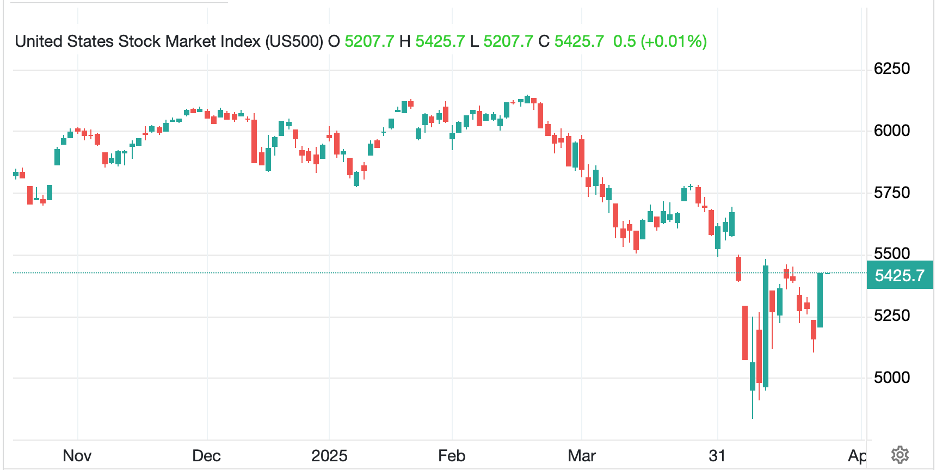
The 2.5% to 3.0% gains in the US were followed by Tokyo (+1.9%) and Hong Kong (+2.4%) performing well but nothing like Taiwan (+4.5%).  The laggard last night was China (+0.1%) with other regional exchanges showing gains between 0.5% and 1.5%.  Net, I suppose everybody was happy.  In Europe this morning, the screens are green as well, with Germany (+2.6%) leading the way followed by France (+2.2%) and the UK (+1.3%).  Again, the trade story appears to be the leading driver.  And, adding to the joy, US futures are also higher between 2.0% (DJIA) and 3.0% (NASDAQ) this morning as of 6:50.  And to think, just two days ago I was assured that the end was nigh.  A quick look at the S&P 500 chart below does give a flavor for just how much volatility we have seen on a day-to-day basis and how narrative changes continue to have huge impacts.

Source: tradingecomics.com

At the same time, Treasury yields have been retracing, lower by -8bps this morning with UK gilts (-6bps) also performing well, although continental European sovereigns are not seeing the same demand with bunds (+3bps) the laggard despite the weakest PMI readings with both Manufacturing and Services below 50.0, lower than last month and far lower than forecasts.  The narrative of money leaving the US and heading back to Europe is certainly appealing, and seems quite reasonable as a long-term metric, but it is not clear to me that it will be driving daily price action in any market.

In commodities, oil (+1.0%) continues to edge higher although it has not yet come close to filling that massive gap lower from the beginning of the month.  

Source: tradingeconomics.com

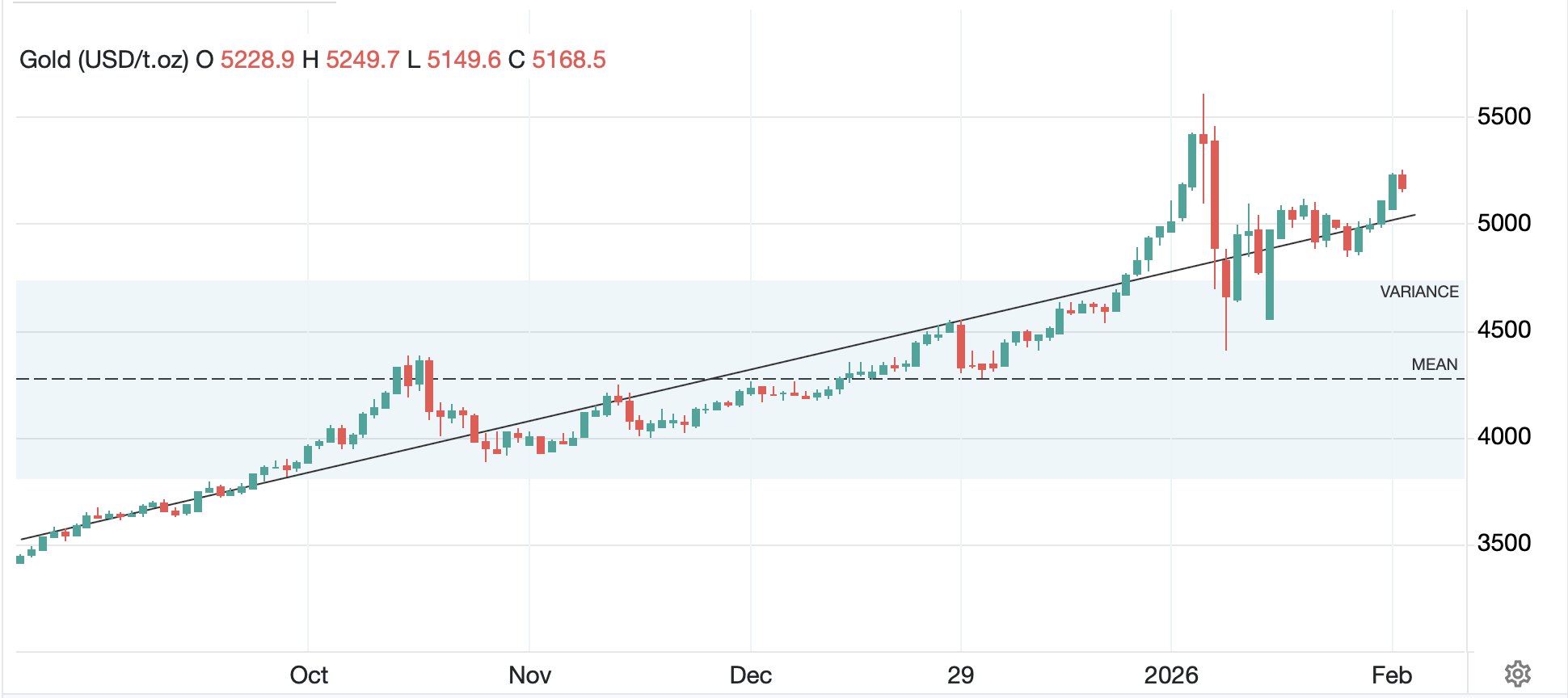
From a fundamental perspective, fears of a US recession, which remain high, as well as the IMF recently reducing their global growth forecast seem to be undermining the demand side of the equation.  Meanwhile, the opportunity for significant new supply (Iran deal, Russia peace) seems quite real.  I’m no oil trader but it strikes me the risk-reward here is for a further drop in prices.  As to the metals markets, gold (-0.4%) fell more than $100/oz yesterday, so perhaps my view that the parabolic move was too much was correct.  However, I believe this is a short-term, and much needed, correction with the long-term story fully intact.  Meanwhile, silver (+1.4%) and copper (+0.4%) are modestly higher after quiet sessions yesterday.

Finally, the dollar is firmer this morning against most of its counterparts, but this is not a universal situation.  While both the euro and pound have fallen -0.25%, AUD (+0.6%) is showing some oomph as it figures to be one of the key beneficiaries of a trade agreement between the US and China, no matter how far in the future.  Other key gainers are KRW (+0.6%) and CNY (+0.3%), with both clearly benefitting from that same trade story.  But otherwise, the dollar is mostly ascendent.  

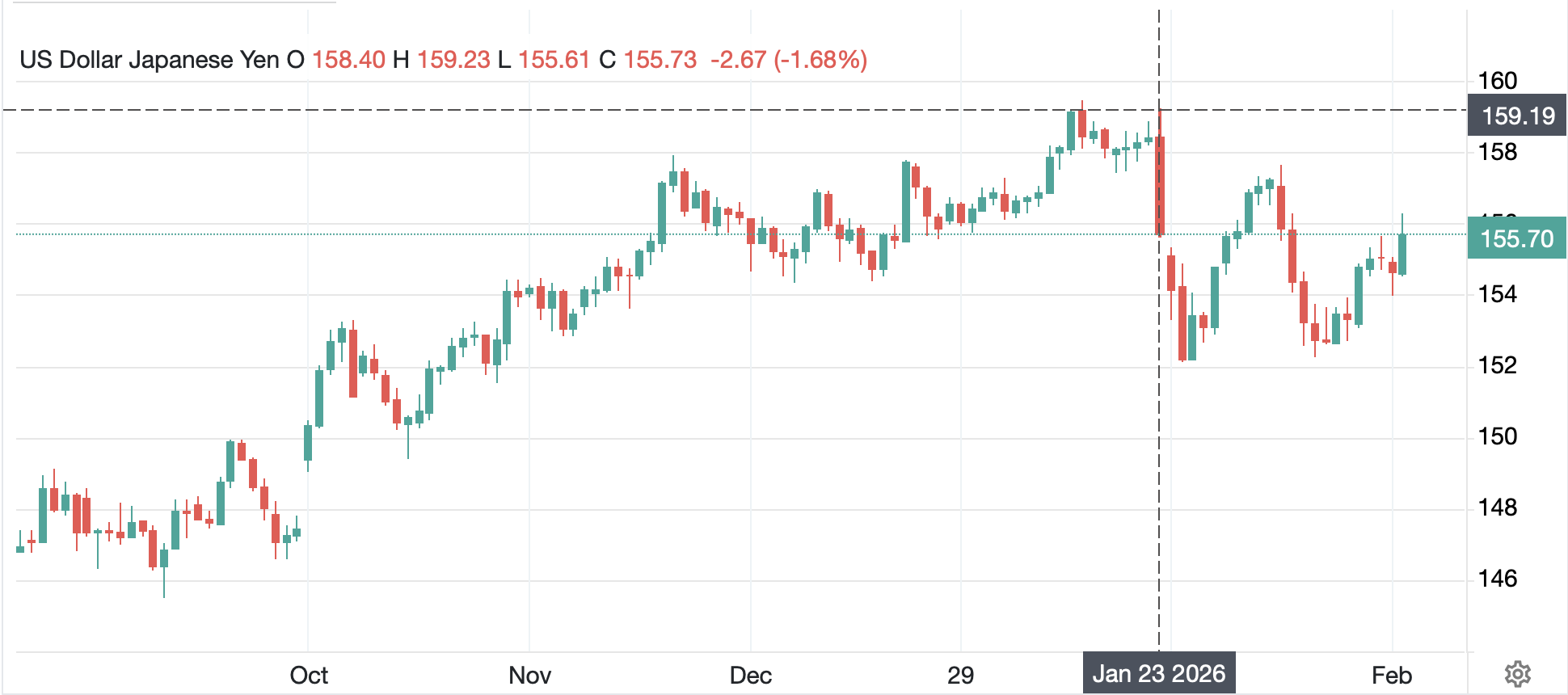
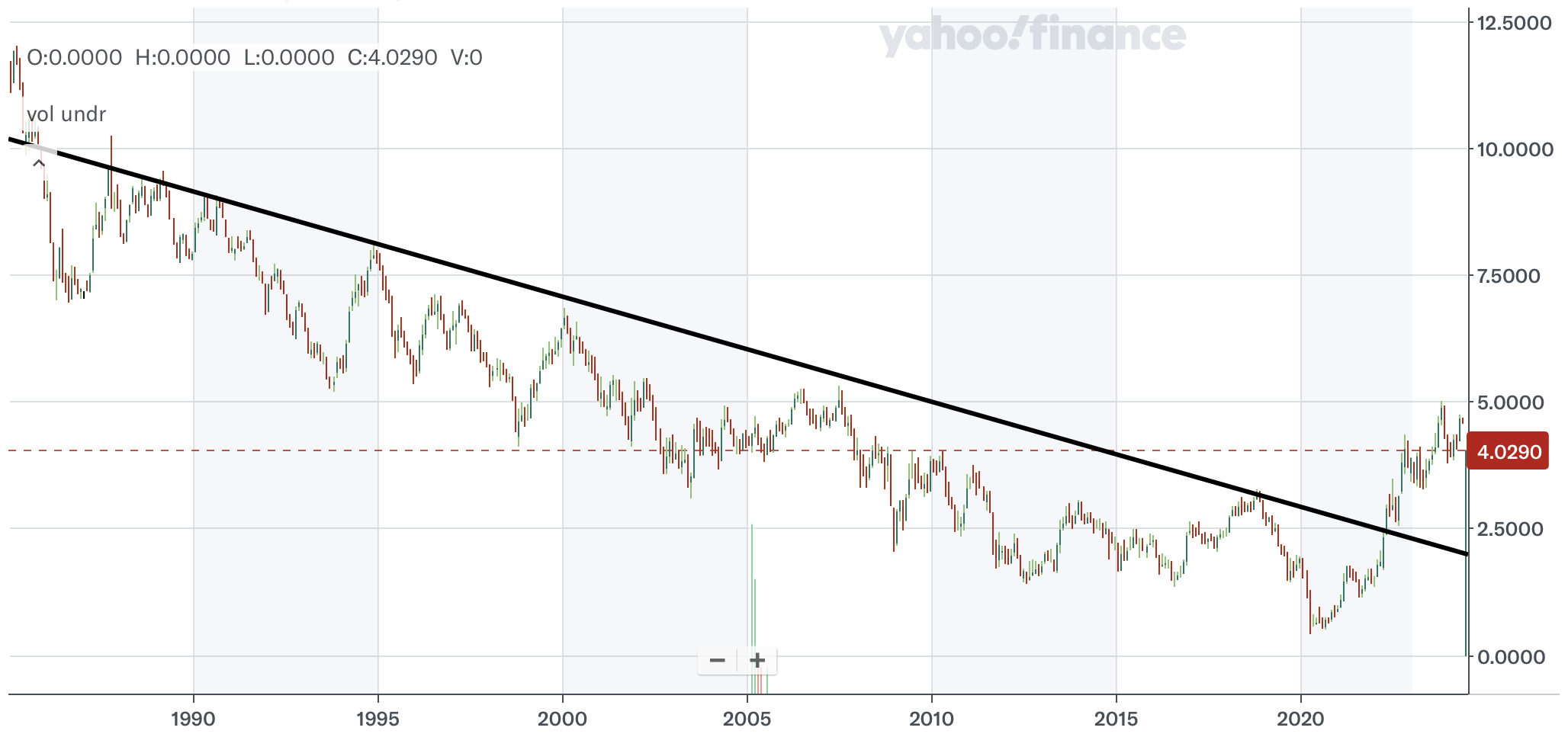
An aside here on the yen (-0.4%) which just two days ago traded below the key psychological level of 140 and this morning is back above 142.  It strikes me that this is the first currency that will be reactive to any trade deal.  As you can see from the below, long-term chart of the yen, it has spent the bulk of its time at far higher (dollar lower) levels.  I suspect that any trade deal will include an effort to revalue the yen higher vs. the dollar, perhaps to its longer-term average of around 120.

Moving on to today’s data, we have New Home Sales (exp 680K) and then the Fed’s Beige Book at 2:00pm. I’m not sure when the surveys were taken for the Beige Book, but you can be sure they will express a great deal of uncertainty and discuss how it will reduce economic activity.  You can also be sure that this will be hyped in the press.  But now that everything is better (just look at the stock market) is this old news?

If we try to look past the daily gyrations to the bigger picture, I would contend the following is the case.  Equity markets remain overvalued and are likely to weaken, the dollar is likely to slide as well as foreign investors slowly reallocate funds away from the US.  Quite frankly, the Treasury story is much harder as the interplay between inflation and potential reduced government expenditure is highly uncertain right now, although one will eventually dominate.  Finally, commodities remain far more important than their current relative weight in the global asset basket and I believe they have much further to climb in price.  One poet’s views.

Good luck

Adf

Not Worried

‘Bout markets, Scott Bessent’s not worried
As favor with specs can’t be curried
Instead, what he seeks
Is policy tweaks
To help growth, though folks want that hurried
 
Meanwhile, Chairman Jay and his team
Continue their policy theme
Inflation’s still falling
Although they are calling
For patience, as bulls start to scream


I’ve been in the investment business for 35 years, and I can tell you that corrections are healthy, they are normal,” Bessent said Sunday on NBC’s Meet The Press. “I‘m not worried about the markets. Over the long term, if we put good tax policy in place, deregulation and energy security, the markets will do great.”

The above comments from Treasury Secretary Scott Bessent yesterday morning (quote courtesy of Bloomberg.com) have garnered a remarkable amount of commentary amidst both the political and market punditry.  My first comment is I must be much older than Mr Bessent, since I have been in the investment business for 43 years.  However, as I have written numerous times over the course of the past years, the market has not cleared for a very long time.  Since the 1987 stock market crash, when then Fed Chair Greenspan started pumping liquidity into the financial markets to stabilize things, and realized he could do that to prevent serious downturns, we have seen two significant downdrafts, the tech bubble and the housing market crash, both of which were immediately met with massive liquidity injections, extremely low interest rates and for the latter, the advent of QE.

All of that liquidity has resulted in market excesses across many markets and has been a key driver in the stock market’s exceptional rise since the Covid blip.  Adding to that was the massive fiscal spending (remember those 7% budget deficits?) which has helped to insure that not only did markets rise, but so did retail prices.

Now, along comes a Treasury Secretary who hasn’t married himself to higher stock markets on a day-to-day basis and instead is focused on the long-term.  What I find most interesting is that the same pundits who are screaming about Bessent and Trump destroying the economy, were all-in on the discussion of how the US debt was going to ultimately cause a collapse.  Yet as the administration explicitly tries to address that issue (you may disagree with their methods, but that is their clear goal) suddenly, the fact that stock prices are falling is a tragedy of biblical proportions.  Here’s the thing, the worst performer, the NASDAQ, is down about -12% since its peak last month as per the below chart.  I might argue that is hardly a collapse.  In fact, a healthy correction doesn’t seem to be a bad description.

Source: tradingeconomics.com

There is no doubt that uncertainty about the near-term direction of the economy has grown, and there is no doubt that President Trump’s mercurial tendencies make long-term planning difficult.  However, I would contend we are a long way from the apocalypse or even a stockopalypse.  But once again, I highlight that volatility remains the key metric for now, and that hedging exposures remains very important.

With that as backdrop, the FOMC meets on Wednesday and while there is no expectation of any rate move, the market continues to price three rate cuts for the rest of the year, pretty much one each quarter.  A key unknown is just how hawkish or dovish Fed members currently find themselves given the recent market gyrations.  As well, while inflation had seemingly been the primary focus, with all the concern over a significant slowdown in the US economy, there are now many who believe we will see a rising Unemployment Rate despite a lack of evidence from the weekly Claims data.  These same pundits are also certain that Trump’s tariff policy will lead to rising inflation, really putting the Fed in a bind with a stagflationary outcome.  And maybe that is what will happen.

But I would contend it is far too early to assume that is our future.  First off, on the inflationary front, energy prices have fallen, a key inflation component, and as far as the tariffs are concerned, if they reduce demand, that is likely to cap prices. If on the other hand, demand is not reduced, I don’t see slowing growth as the likely outcome.  

In the end, if the economy is adjusting from one with far more government spending support, to one with more organic private sector economic activity, the transition may be bumpy, but the outcome will be far stronger.  We shall see if that is how things evolve.

In the meantime, let’s look at how the world has responded to the latest stories.  Friday’s US equity rebound was welcomed everywhere, although the key narrative remains the end of American exceptionalism, at least as regards equity markets.  Friday also saw the exiting German Bundestag agree to eliminate the debt brake for infrastructure and defense, with Chancellor-to-be Merz agreeing to waste spend €100 billion on climate related projects to convince the Green Party, which is out of the new government, to vote in the rule change before the new government is seated.  It is not clear to me how spending that money on net-zero ideas will defend Germany, but then I am just a poet, not a German policymaker.

As to Asian markets, other than mainland China (-0.25%) green was the predominant color on screens overnight with Japan (+0.9%), Australia (+0.8%) and Hong Kong (+0.8%) all following the US.  One of the remarkable things, though, is that Chinese data overnight showing IP (5.9%), Retail Sales (4.0%) and Fixed Asset Investment (4.1%) was generally solid.  Of course, Unemployment (5.4%) rose 2 ticks, an unwelcome outcome, and House prices (-4.8%) continue to decline, albeit at a slowing rate, but neither of those speak to a rebound in the Chinese economy.  The end of the Chinese NPC offered more platitudes about supporting the consumer, but it is not clear where the money is coming from.  And recall, more than 60% of Chinese household wealth remains tied up in housing investment, which continues to decline in value.  The Chinese have a long way to go in my view.

Quickly, European bourses are all modestly higher this morning, on the order of 0.3% or so, as hope springs eternal that the rearming of Europe will drive profit margins higher.  Unfortunately, at this hour (7:15), US futures are pointing lower, about -0.25% across the board, although that is up from earlier session lows.

In the bond market, Treasury yields have slipped -2bps this morning, but are really just trading around in their new trading range of 4.20% to 4.35% as investors try to get a handle on which of the big themes are going to drive markets going forward.  European sovereigns are all seeing rallies, with yields slipping -5bps to -6ps which seems out of step with the news about the end of the German debt brake.  Perhaps bond investors don’t believe the legislation will pass, or perhaps that they won’t spend the money after all.  As to JGB yields, the edged lower by -1bp in the 10yr, although longer dated paper has seen yields rise with 40-year bonds touching 3.0% for the first time in their relatively short history.

In the commodity markets, oil (+1.4%) is continuing to bounce of its lows from last week but remains well below levels seen at the beginning of the month.  The US attack on the Houthis is being called the beginning of an escalation in the Middle East by some, and perhaps that has traders concerned.  On the flip side, ostensibly, Presidents Trump and Putin are to speak tomorrow in an effort to get peace talks moving along, potentially a bearish oil signal.  In the metals markets, gold (+0.6%) remains in great demand having crested the $3000/oz level last week and rising from there.  This has helped both silver and copper, with the latter, despite concerns over slowing economic activity, pushing closer to $5.00/lb.  There is much talk of shortages in the market driving the price action.

Finally, the dollar is under pressure this morning with every G10 currency firmer led by NZD (+0.6%) and AUD (+0.4%) although gains elsewhere are on the order of +0.25%.  This story seems to go hand-in-hand with the German defense spending and the end of US exceptionalism.  As to the EMG bloc, most of these currencies are also stronger this morning, but the magnitude of these moves is generally less than the G10 bloc.  Recall, Trump wants a lower dollar, and my default is that is where we are headed at this point.

On the data front, we have an action-packed week ahead starting this morning.

TodayRetail Sales0.6%
 -ex autos0.4%
 Empire State Manufacturing-0.75
TuesdayHousing Starts1.375M
 Building Permits1.45M
 IP0.2%
 Capacity Utilization77.8%
WednesdayFOMC Rate Decision4.50% (unchanged)
ThursdayInitial Claims224K
 Continuing Claims1880K
 Philly Fed12.1
 Existing Home Sales3.92M
 Leading Indicators-0.2%

Source: tradingeconomics.com

As we have seen over the past many months, I suspect that this week’s data will be likely to give analysts on both sides of the economy is stronger/weaker argument new fodder.  While the Fed won’t be doing anything, and despite their relative decline in importance, I suspect that Chairman Powell’s press conference will still get a lot of attention.

While we don’t know what the future will bring for sure, I remain convinced that the dollar will slide, and commodities will rally.  As to stocks and bonds, well your guess is as good as mine.

Good luck

Adf

Lost In Translation

The data today on inflation
Will help tweak the latest narration
But arguably
There’s little to see
As CPI’s lost in translation
 
And too, central bankers have learned
Their comments leave folks unconcerned
Today’s BOC
Where rate cuts will be
The outcome will ne’er be discerned


It is Donald Trump’s world, and we are all just living in it.  Virtually everything that happens in any financial market these days is a result of something that President Trump has either said or done.  Obviously, tariffs are a major player, but so are the peace talks in Ukraine (good news that Ukraine has agreed a cease fire to get things started) and his domestic initiatives regarding DOGE and the shake up that has come to government from that project.  You cannot look at a business journal without reading a story about how corporate America’s CEO’s are very concerned because of all the activity as they are having difficulty planning their strategies.

While this poet endeavors to track the macroeconomic issues and how they impact markets, and one can argue that tariffs are a macro issue, the ongoing back and forth as to which products will get tariffed and when is occurring far more rapidly than is worth reporting on a daily outlook.  After all, nobody has any idea what today will bring on that front.

With that in mind, one of the other things I have discussed has been the demotion of central bankers from their previous preeminence in the world of financial markets.  Now, every one of them is simply left to respond to whatever President Trump says that day.  Consider, the Fed entered their quiet period last Friday and the fact that we have not heard a word from them is entirely inconsequential.  The Fed funds futures market is currently pricing just a 3% probability of a rate cut next week and a total of 75bps of cuts by the end of the year, but that has been true for the past several weeks.  Despite an increase in the talk of a US recession, the markets are not indicating that is a concern.

Now, that doesn’t mean that other central banks aren’t doing things, but when the BOC cuts rates by 25bps this morning, taking their base rate to 2.75%, 150 basis points below the US, nothing is going to happen in the market.  It is already widely assumed.  I guess it is possible that Governor Macklem could make some comments of note, but given that Canada remains a bit player on the world stage, does whatever he says really matter?  In fact, the only reason people are discussing Canada now is because of President Trump and his trolling former PM Trudeau and calls to make it the 51st state.  Let’s face it, the economy there is ticking along fine for now, although if their exports to the US are impaired by tariffs it will definitely hurt them.  Meanwhile, other than a huge housing bubble, nobody really notices them.  After all, their economy is roughly $2.3 trillion, smaller than that of Texas.

We have also heard from Madame Lagarde recently as she tries to calm European leaders’ nerves while the ECB tries to manage their policy around US fiscal gyrations.  However, the most concerning information from there has been her confirmation that the ECB is pushing forward with their central bank digital currency (CBDC) project, looking to get things started in October of this year.  This contrasts with President Trump’s EO that the US will not pursue a CBDC and there is currently legislation in Congress to enshrine that into law.  My personal view is a CBDC would be very concerning given its inherent reduction in individual liberties.  While the current setup is for the euro to rise relative to the dollar, it is not clear to me that will remain the case in the event the digital euro comes into being.  In fact, it would not surprise me if many Europeans decided that holding dollars was a much better idea than holding euros in that environment.  But that is a story for the future.

As to today, CPI is set to be released with the following median expectations; headline (0.3%, 2.9% Y/Y) and core (0.3%, 3.2% Y/Y).  Both of those annualized numbers are one tick lower than last month’s outcomes, so would help the Fed narrative that inflation is falling back to their target.  But again, absent a major discrepancy, something like a 0.1% or 0.5% reading on the core number, I don’t think it will have any market impact across any market.  Data is just not that important these days.

Let’s turn to the overnight session to see how things are behaving in the wake of yesterday’s late US equity rebound, where while the indices all finished lower, they were well off the daily lows.  In Asia, the picture was very mixed with some major gainers (Korea +1.5%, Indonesia +1.8%, Taiwan +0.9%) and some major laggards (Thailand -2.5%, Malaysia -2.3%, Australia -1.3%, Hong Kong -0.8%) with both Japan and mainland China showing little movement.  In Europe, after a down day yesterday, this morning is seeing a solid rebound across most major markets with the DAX (+1.8%) leading the way followed by the CAC (+1.4%) and FTSE 100 (+0.6%).  Some solid earnings reports and ongoing hope belief that European defense spending will ramp up seems to be the drivers.  As to US futures, at this hour (7:30) they are firmer by 0.8% ish across the board.

In the bond market, after Treasury yields climbed 7bps yesterday, this morning they have edged a further 1bp higher.  The big domestic story is the continuing resolution which was just passed by the House and now sits at the Senate.  If it is not passed by Friday, the government will shut down, although it is not clear to me how that can be more disruptive than the way things have been operating for the past 6 weeks!  Meanwhile, European sovereign yields are also edging higher with German bunds (+4bps) leading the way as the ongoing discussion over breeching the debt brake continues and concerns over massive new issuance remain front and center.   Elsewhere in Europe, yields have risen as well, but generally by only 1bp or 2bps.  Last night, JGB yields didn’t move at all.

In the commodity bloc, oil (+1.1%) is continuing to bounce along the bottom of its trading range as per the below chart.

Source: tradingeconomics.com

A look at the trend line there shows that, at least based on the past 6 months, there has not been any net movement of note.  The question of whether the Ukraine war ends and that allows Russian oil back into the market, out in the open, is also current, with no clear answer in sight.  Meanwhile, the metals markets continue to ignore the recession calls with silver (+0.7%) and copper (+2.3%) both strong although gold is unchanged on the day.

Finally, the dollar is bouncing slightly this morning after declining sharply in 5 of the past 7 sessions with the other two basically unchanged.  This has all the hallmarks of a trading pause as there is nothing that has altered the idea that President Trump wants the dollar lower, and his policies are going to push it in that direction.  The one big outlier this morning is CLP (+0.9%) which is tracking copper’s rally, but otherwise, the yen (-0.6%) is the only mover of note, and that also seems a trading response, certainly not a fundamental change.

And that’s really it.  CPI is the only data for the day and there are no Fed speakers.  Of course, tape bombs are the new normal and we never have any idea what President Trump or Secretary Bessent may say at any given time.  However, with that in mind, the bigger picture remains intact.  I remain negative the equity space overall as changes continue, while the dollar is likely to remain under pressure as well.  This should help the bond market, and commodities.

Good luck

Adf

Positioning’s Fraught

The wonderful thing about Trump
Is traders no longer can pump
A market so high
That it can defy
Reality ere it goes bump
 
Since policies can change so fast
A long-term view just cannot last
So, Fed put or not
Positioning’s fraught
And larger ones won’t be amassed


As we await the NFP report this morning, I couldn’t help but ponder the uptick in complaints and concerns by traders that increased volatility in markets on the back of President Trump’s mercurial announcements has changed the trading game dramatically.  Let me say up front that I think this is a much healthier place to be and explain why.

Pretty much since the GFC and, more importantly, then Chairman Bernanke’s first utilization of QE and forward guidance, the nature of financial markets had evolved into hugely leveraged one-sided views based on whatever the Fed was guiding.  So, the initial idea behind QE and forward guidance was to assure all the traders and investors that make up the market that even though interest rates reached 0.0%, the Fed would continue to ease policy and would do so for as far out in time as you can imagine.  Lower for longer became the mantra and every time there was a hiccup in the market, the Fed rushed in, added yet more liquidity to calm things down, and put the market back on track for further gains.  This was true for both stocks and bonds, despite the fact that the Fed has no business or mandate involving the equity market.

This activity led to the ever-increasing size of trading firms as leverage was cheap and steadily rising securities prices led to lower volatility, both implied and real, in the markets.  Risk managers were comfortable allowing these positions to grow as the calculated risks were minimized by the low vol.  In fact, entire trading strategies were developed to take advantage of the situation with Risk Parity being a favorite.  

However, a negative result of these actions by the Fed was that investors no longer considered the fundamentals or macroeconomics behind an investment, only the Fed’s stance.  The only way to outperform was to take on more leverage than your competitors, and that was great while rates stayed at 0.0%.  Alas, this persisted for so long that many, if not most, traders who learned the business prior to the GFC wound up retiring or leaving the market, and the next generation of traders and investors lived by two credos, number go up and BTFD.

The Fed remained complicit in this process as FOMC members evolved from background players to a constant presence in our daily lives, virtually preening on screens and in front of audiences and reiterating the Fed’s views of what they were going to do, implicitly telling traders that taking large, leveraged bets would be fine because the Fed had their back.

Of course, the pandemic upset that apple cart as the combination of Fed and government response imbued the economy with significantly more inflation than expected and forced the Fed to change their tune.  The market was not prepared for that, hence the outcome in 2022 when both stocks and bonds fell sharply.  But the Fed would not be denied and calmed things down and created a coherent enough message so that markets recovered the past two years.  This has, naturally, led to increased position sizing and more leverage because that’s what this generation of traders understands and has worked.

Enter Donald J Trump as president, elected on a populist manifesto and despite his personal wealth, seemingly focused on Main Street, not Wall Street.  The thing about President Trump is if an idea he proffers doesn’t work, he will drop it in a heartbeat and move on.  As well, by wielding the full power of the United States when dealing in international situations, other nations can quickly find themselves in a difficult spot and, so far, have been willing to bend their knee.  As well, his focus on tariffs as a primary weapon, with little regard for the impact on markets, and the way with which he uses them, threatening to impose them, and holding off at the last minute when other nations alter their policy, has kept markets off-balance.

The result is large leveraged positions are very difficult to hold and manage when markets can move up and down 2% in a day, every day (like the NASDAQ 100 chart below), depending on the headlines.  

Source: tradingeconomics.com

The natural response is to reduce position size and leverage, and that, my friends, is a healthy turn in markets.  This is not to say that there are not still many significant imbalances, just that as they continue to blow up, whether Nvidia, or FX or metals, my take is the next set of positions will be smaller as nimble is more important than large.  It doesn’t matter how smart an algorithm is if there is no liquidity to adjust a position when the world changes.  This poet’s opinion is this is a much healthier place for markets to live.

Ok, let’s see what happened overnight ahead of today’s data.  Mixed is the best description as yesterday’s US closes saw a mixed outcome and overnight the Nikkei (-0.7%) fell while both Hong Kong (+1.2%) and China (+1.3%) gained ground.  Korea and India slid, Taiwan rose, the picture was one of uncertainty about the future.  That also describes Europe, where only Germany and Norway have managed any modest gains at all while the rest of the continent and the UK are all slightly lower.  Apparently, yesterday’s BOE rate cut has not comforted investors in the UK, nor has the talk of more rate cuts by the ECB bolstered attitudes in Europe.  As to US futures, at this hour (7:00) they are basically unchanged.

In the bond market, the biggest mover overnight was in Japan where JGB yields rose 3bps, once again touching that recent 30-year high.  While some BOJ comments indicated inflation remained well-behaved, the market is clearly of the view that Ueda-san is getting set to hike rates further.  In Europe, yields are basically lower by 1bp across the board and Treasury yields are unchanged on the session as investors and traders continue to focus on Treasury Secretary Bessent’s conversation that he cares about 10-year yields, not Fed funds.  Perhaps the Fed will cut rates to recapture the spotlight they have grown to love.

Oil (+0.5%) prices continue to drift lower overall, although this morning they are bouncing from yesterday’s closing levels.  Questions about sanctions policy on Iran, on Russia’s shadow fleet and about the state of the global economy and therefore oil demand remain unanswered.  However, the fact that oil has been sliding tells me that there is some belief that President Trump may get his way regarding a desire for lower oil prices.  In the metals markets, copper (+1.1%) is flying higher again, and seems to be telling us that the economy is in decent shape.  Either that or there is a major supply shortage, although if that is the case, I have not seen any reporting on the subject.  Both gold and silver are very modestly higher this morning after small declines yesterday as the London – NY arbitrage continues to be the hot topic and financing rates for both metals have gone parabolic.

Finally, the dollar is mixed this morning, perhaps slightly firmer as JPY (-0.5%) is actually the worst performer around, despite the rise in JGB yields.  There is a lot of chatter on how the yen is due to trade much higher, and it has rallied over the past month, but it is certainly not a straight line move.  As to the rest of the space, virtually every other currency is +/-0.2% from yesterday’s close with CLP (+0.5%) the lone exception as the Chilean peso benefits from copper’s huge rally.

On the data front, here are the latest expectations for this morning’s employment report:

Nonfarm Payrolls170K
Private Payrolls141K
Manufacturing Payrolls-2K
Unemployment Rate4.1%
Average Hourly Earnings0.3% (3.8% Y/Y)
Average Weekly Hours34.3
Participation Rate62.5%
Michigan Sentiment71.1

Source: tradingeconomics.com

Remember, though, the ADP number on Wednesday was much better than expected at 183K (exp 150K) with a major revision higher by 54K to the previous month).  As well, this month brings the BLS adjustments for 2024 which will not be broken down, just lumped into the data.  Recall, there are rumors of a significant reduction in the number of jobs created in 2024 as well as a significant increase in the population estimates with more complete immigration data, and that has led some pundits to call for a much higher Unemployment Rate.  I have no insight into how those adjustments will play out although the idea they will be large seems highly plausible.

Ahead of the number, nothing will happen.  If the number is strong, so NFP >200K, I expect that bonds will suffer, and the dollar will find some support.  A weak number should bring the opposite, but the revisions are a wild card.  As I stated this morning, the best idea is to maintain the smallest exposures possible for the time being, as volatility is the one thing on which we can count.

Good luck and good weekend

Adf

Three-Three-Three

Said Bessent, when speaking of rates
The 10-year yield’s what dominates
Our focus and goals
As that’s what controls
Most mortgages here in the States
 
Remember, our goal’s three-three-three
With job one on deficits key
So, that’s why we’ll slash
The wasting of cash
With tax cuts set permanently


There is a new voice in Washington that matters to Wall Street, that of the new Treasury Secretary Scott Bessent.  Yesterday in his first significant comments since his swearing-in, he made very clear that he and the president were far more focused on the 10-year Treasury yield, and driving that lower, than they were concerned over the Fed funds rate.  Talk about a different focus than the last administration!  At any rate, he expounded on his views as to how that can be achieved, namely lower energy prices and a reduced budget deficit alongside deregulation.  Recall, his three-three-three plan is 3% budget deficit, 3mm barrels of oil/day additional supply and 3% GDP growth.  Clearly, this is a tall order given the starting point, but he has not shied away from these goals and insists they are achievable.

Yesterday also brought the Quarterly Refunding Announcement, the Treasury’s announced borrowing schedule for the current quarter.  Under then-Secretary Yellen, the US shifted its borrowing to a much greater percentage of short-term T-bills (<1-year maturity) while avoiding the sale of longer date notes and bonds.  This is something which Bessent has consistently explained his predecessor screwed up given her unwillingness to term out more debt when the entire interest rate structure was much lower.  After all, homeowners were smart enough to refinance down to 3% fixed rate mortgages, but the Treasury secretary thought it was a better idea to stay short.  

Of course, changing the current treasury mix is one of the impediments to lower 10-year yields because changing it would require an increase in the sale of longer dated paper which would depress the price and raise those yields.  Bessent has his work cut out for him.  However, my take is this is a goal, but one that will be achieved gradually.  He even commented that until the debt ceiling is raised, there will be no changes in the debt mix.  Arguably, if the administration can make real progress on reducing the budget deficit, that is what will allow for the gradual adjustment of the debt mix without a dramatic rise in long-term yields.

Perhaps it is still the honeymoon period, but the market is showing some deference to Mr Bessent as 10-year yields have fallen steadily in the past two weeks, dropping from a high of 4.81% the week before the inauguration to their current level at 4.44%.  

Source: tradingeconomics.com

While we cannot attribute the entire move to Bessent, certainly investors are showing at least a little love at this stage.  I believe the 10-year yield will grow in importance for all markets as movement there will be seen as the report card for Bessent and this administration’s goals.

Meanwhile, in the UK, stagflation
Is now the Old Lady’s vexation
But cut rates, they will
Lest growth they do kill
As prices continue dilation

The BOE is currently meeting, and expectations are nearly universal that they will cut their base rate by 25bps to 4.50% with 8 of the 9 MPC members set to vote that way.  The only hawk on the committee, Catherine Mann, is expected to vote for no change.  The problem they have (well the problem regarding monetary policy, there are many problems extant in the UK right now) is that core inflation continues to run above 3.0% while GDP is growing at approximately 0.0% in recent quarters and at 1.0% in the past year.  A quick look at the monthly GDP readings below shows that things have not been moving along very well, certainly not since PM Starmer’s election in July.

Source: tradingeconomics.com

In stagflationary environments, the most successful central bank responses have been to kill the inflation and suffer the consequences of the inevitable recession first, allowing growth to resume under better circumstances.  Of course, Paul Volcker is most famous for this model, which he derived after numerous other countries, notably the UK, failed to effectively solve the problem in the mid 1970’s in the wake of the first oil price shocks.  Now, the UK has created its own energy price supply shock via its insane efforts to wean itself from fossil fuels without adequate alternate supplies of energy, and stagflation is the natural result.  However, addressing inflation does not appear to be the primary focus of the Bank of England right now.  I am skeptical that they will be successful in achieving their goals which is one of the key reasons I dislike the pound over time.

Ok, let’s turn to market activity overnight.  The party continues on Wall Street with yesterday’s equity gains attributed to many things, perhaps Bessent’s comments being amongst the drivers.  Certainly, a reduced budget deficit and reduced 10-year yields are likely to help the market overall.  That attitude has been uniform overnight and through the morning session with every major Asian market (Japan, +0.6%, Hong Kong +1.4%, China +1.3%) and European market (Germany +0.8%, France +0.8%, UK +1.45%) higher on the session.  As it happens, the BOE did cut rates by 25bps as expected and now we await Governor Bailey’s comments.  As to US futures, at this hour (7:25) they are little changed on the session.

In the bond market, the ongoing rally has stalled for now with Treasury yields higher by 2bps this morning while most European sovereign yields are little changed on the day.  A key piece of information that is set to be released tomorrow comes from the ECB as their economists are going to report the ECB’s estimate of where the neutral rate lies in Europe.  With the deposit rate there down to 2.75%, many pundits, and ECB speakers, are targeting 2.0% as the proper level implying more rate cuts to come.

In the commodity markets, oil (+0.65%) is bouncing off its recent trading lows but in truth, a look at the chart and one is hard-pressed to discern an overall direction.  More choppiness seems likely as the market tries to absorb the latest information from the Trump administration and its plans.

Source: tradingeconomics.com

As to the metals markets, gold, which had a strong rally yesterday and made further new all-time highs, is unchanged this morning while silver (-0.75%) consolidates its recent gains and copper (+0.6%) adds to its gains.  The thing about copper is it is, allegedly, a good prognosticator of economic activity as it is so widely used in industry and construction, and it has been rallying sharply for the past month.  That does seem to bode well for future activity.

Finally, the dollar is firmer this morning, recouping some of its recent losses although I would contend we have merely been consolidating after a sharp move higher during the past three months.  The pound (-1.0%) is today’s laggard after the rate cut but we are seeing weakness almost everywhere in both G10 and EMG currencies.  One exception is the yen (+0.2%) which seems to be benefitting from comments by former BOJ Governor Kuroda that the BOJ is likely to raise rates above 1.0% during the coming year.  Interestingly, he explained that given the recent economic trajectory, it was only natural that the BOJ would seek to normalize rates.  However, given that interest rates in Japan have been 0.5% or below for the past 30 years, wouldn’t that be considered normal these days?  Just sayin’!

On the data front, with the BOE out of the way, we now get the weekly Initial (exp 213K) and Continuing (1870K) Claims data as well as Nonfarm Productivity (1.4%) and Unit Labor Costs (3.4%).  Yesterday’s ADP Employment data was much stronger than expected with a revision higher to last month as well, certainly a positive for the job outlook.  As well, this afternoon we hear from three more Fed speakers, but so far this week, the word caution has been the most frequently used noun in their vocabulary.  Of course, with Mr Bessent now starting to make his views known, perhaps more focus will turn there and away from the Fed for a while.

Market participants are clearly feeling pretty good right now, especially about the recent activity in the US.  I think you have to like US assets, both stocks and bonds, while expecting the dollar to continue to hold its ground.  This sounds like a recipe for weaker commodity prices, notably gold, but so far, that has not been the case.

Good luck

Adf

Deceit

Though many will claim it’s deceit
The Chinese declared they did meet
The target that Xi
Expected to see
Though skeptics remain on the Street
 
In fact, it appears there’s a trend
That data surprises all tend
To flatter regimes
And their stated dreams
As policy faults they defend


Last night, the Chinese released their monthly data barrage with final 2024 numbers as part of the mix. Despite numerous indications that Chinese growth is slowing, somehow, they managed to show a 5.4% annualized GDP growth rate for Q4 and a 5.0% GDP growth rate for all of 2024, right on President Xi’s target.  

Now, the government did add some stimulus in Q4 as they recognized things are not going well, and I continue to read articles that President Xi is starting to feel increased pressure from CCP insiders as to his stewardship of the nation and the economy.  Statistics like electricity usage and travel don’t really jive with the data, although it is certainly possible that ahead of the mooted tariffs that President Trump has threatened to impose starting next week, many companies preordered extra inventory to beat the rush, and that goosed growth.  

But there are a couple of things that continue to drag on the Chinese economy, with the primary issue the continuing implosion of the property market there.  For instance, while house price declines have been slightly slower, (only -5.3% last month) it has basically been three years since there was any gain at all as shown in the chart below.

Source: tradingeconomics.com

As well, one of the key concerns about China has been Foreign Direct Investment, which has not merely slowed down but has actually been reversing (companies leaving China) over the past two years as per the next chart.

Source: tradingeconomics.com

Meanwhile, a WSJ headline, China’s Population Fell Again Despite a Surprise Rise in Births, highlights yet another issue President Xi faces, the ongoing aging and shrinking of his nation.  Remember, GDP is basically the product of the number of people working * how much they each produce.  If that first number is shrinking, and the working age population in China is doing just that, it is awfully difficult to generate GDP growth.  Finally, I couldn’t help but notice in yesterday’s confirmation hearings for Treasury secretary, where Scott Bessent offered his view that China is actually in a recession, with massive deflation and are struggling to export their way out of the problems, rather than address their internal imbalances.  This is a theme that has been discussed widely in the past, and ostensibly, China has admitted they want to be more consumption focused in their economy, but it doesn’t appear that is the direction they are heading.

I raise these points in the context of the Chinese renminbi and how we might expect it to behave going forward.  The question of tariffs remains open at this stage, although I daresay we will learn more next week.  If they are imposed, there is a strong belief that the renminbi will weaken to offset the terms.  As it is, the currency remains within pips of its weakest level in 18 years and the trend, both short-term and for the past decade, has been for it to weaken further. 

Source tradingeconomics.com

Xi remains caught between the need for the currency to weaken to maintain competitiveness in the face of threatened tariffs from the US, and his desire to demonstrate that the renminbi is a stable store of value that other nations can trust to hold and use outside the global dollar network.  In the end, I expect the immediate competitiveness needs are going to overwhelm the long-term aspirations, especially if it is true that Xi is feeling internal pressure because of an underperforming economy.  Nothing has changed my view that we approach 8.00 by the end of the year.

Ok, and that’s really the big news overnight.  As an aside, it was interesting to watch Mr Bessent dismantle the attempts by the Democrat senators for a ‘gotcha’ moment.  As I wrote yesterday, it wasn’t really a fair fight given his intelligence, experience and understanding of markets and the economy compared to the Senators.

Let’s start in the equity world where US markets opened higher but ultimately slid all day long to close on their lows.  An uninspiring performance to say the least.  That performance weighed on much of Asia with the Nikkei (-0.3%) sliding alongside Australia, Korea and India.  On the plus side, modest gains were shown in China (Hang Seng and CSI 300 both +0.3%) and some positive numbers were seen in Taiwan, Malaysia and Singapore.  But overall, the movements were not substantial in either direction.  In Europe, though, markets are starting to anticipate more aggressive ECB rate cuts as data continues to show weakness in economic activity.  Weak UK Retail Sales data has the FTSE 100 (+1.3%) leading the way higher as hopes for a BOE cut grow.  Meanwhile, the CAC (+1.0%) and DAX (+1.0%) are both rallying on the thesis that Chinese growth is going to attract imports from both nations.  Meanwhile, US futures are higher by 0.4% at this hour (7:40).

In the bond market, all the inflation fears seem to have abated.  Either that or we continue to see a massive short squeeze and position unwinding.  But the result is yields are lower across the board with Treasury yields down 3bps further, and below 4.60% while European sovereign yields have fallen between -3bps and -5bps as investors take heart that the ECB and BOE are going to be cutting rates soon.  Perhaps the market is showing faith that Mr Bessent will be able to address the US fiscal financing crisis.  After all, he did explain in no uncertain terms that the US would not default on its debt.  But my sense is the market narrative about rising inflation and higher yields had really pushed too far, and this is simply the natural bounce back.  While this week’s inflation data was not as hot as feared, nothing has changed my view that inflation remains a problem going forward.

In the commodity markets, oil is unchanged on the day, having given back some of its substantial gains over the past two sessions, although it remains right near $79/bbl this morning.  Apparently, there are rumors Trump will end Russian oil sanctions as part of the Ukraine negotiations, but that doesn’t sound like something he would offer up initially, at least to me.  Meanwhile, NatGas (-4.0%) though slipping this morning, remains above $4/MMBtu as the US prepares for a major arctic cold snap next week.  In the metals markets, my understanding is there has been a lot of position adjustment and arbitrage between NY and London as we approach futures contract maturities, and that has been a key driver of the recent rally in metals (H/T Alyosha at Market Vibes, a very worthwhile trading Substack), but may be coming to an end in the next several sessions.  However, here, too, nothing has changed my longer-term view of higher prices over time.

Finally, the dollar is a tad stronger this morning, rallying vs. the pound (-0.4%), Aussie (-0.4%), NOK (-0.5%) and NZD (-0.5%) as all those ECB and BOE rate cut stories weigh on those currencies.  Interestingly, JPY (-0.3%) is also weaker this morning despite an article overnight signaling the BOJ will be raising rates next Friday.  On the flip side, looking at the EMG bloc, I see very modest gains by many of the key players (MXN +0.15%, ZAR +0.1%), although those moves feel far more like position adjustments than fundamentally driven changes in view.

On the data front, this morning brings Housing Starts (exp 1.32M) and Building Permits (1.46M) and then IP (0.3%) and Capacity Utilization (77.0%) later on.  There are no Fed speakers on the docket, and tomorrow is the beginning of the quiet period.  The last thing we heard from Cleveland Fed president Hammack was that inflation remains a concern and they have not yet finished the job.

For the day, I don’t think the data will have much impact.  Rather, as we are now in earnings season, I suspect that stocks will take their cues there and FX will remain in the background for now.

Good luck and good weekend

Adf

Shortsighted

The CPI data delighted
Investors, who in a shortsighted
Response bought the bond
Of which they’re now fond
And did so in, time, expedited
 
But does this response make much sense?
Or is it just way too intense?
I’d offer the latter
Although that may shatter
The narrative’s current pretense


Leading up to yesterday’s CPI data, it appeared to me that despite a better (lower) than expected set of PPI readings on Tuesday, the market was still wary about inflation and concerned that if the recent trend of stubbornly sticky CPI prints continued, the Fed would soon change their tune about further rate cuts.  Heading into the release, the median expectations were for a 0.3% rise in the headline rate and a 0.2% rise in the core rate for the month of December which translated into Y/Y numbers of 2.9%% and 3.3% respectively. At least those were the widely reported expectations based on surveys.  

However, in this day and age, the precision of those outcomes seems to be lacking, and many analysts look at the underlying indices prepared by the BLS and calculate the numbers out several more decimal places.  This is one way in which analysts can claim to be looking under the hood, and it can, at times, demonstrate that a headline number, which is rounded to the first decimal place, may misrepresent the magnitude of any change.  I would submit that is what we saw yesterday, where the headline rate rose to the expected 2.9% despite a 0.4% monthly print, but the core rate was only 3.24% higher, which rounded down to 3.2% on the report. Voila!  Suddenly we had confirmation that inflation was falling, and the Fed was right back on track to cut rates again.

Source: tradingeconomics.com

Now, I cannot look at the above chart of core CPI and take away that the rate of inflation is clearly heading back to 2% as the Fed claims to be the case.  But don’t just take my word for it.  On matters inflation I always refer to Mike Ashton (@inflation_guy) who has a better grasp on this stuff than anyone I know or read.  As he points out in his note yesterday, 3.5% is the new 2.0% and that did not change after yesterday’s data.

However, markets and investors did not see it that way and the response was impressive.  Treasury yields tumbled 13bps and took all European sovereign yields down by a similar amount, equity markets exploded higher with the NASDAQ soaring 2.5% and generally, the investment world is now in nirvana.  Growth remains robust but that pesky inflation is no longer a problem, thus the Fed can continue cutting rates to support equity prices even further.  At least that’s what the current narrative is.  

Remember all that concern over Treasury yields?  Just kidding!  Inflation is dying and Trump’s tariffs are not really a problem and… fill in your favorite rationale for remaining bullish on risk assets.  I guess this is where my skepticism comes to bear.  I do not believe yesterday’s data reset the clock on anything, at least not in the medium and long term.

Before I move on to the overnight, there is one other thesis which I read about regarding the recent (prior to yesterday) global bond market sell-off which has some elements of truth, although the timing is unclear to me.  It seems that if you look at the timing of the recent slide in bond markets, it occurred almost immediately after the fires in LA started and were realized to be out of control.  This thesis is that insurers, who initially were believed to be on the hook for $20 billion (although that has recently been raised to >$100 billion) recognized they would need cash and started selling their most liquid assets, namely Treasuries and US equities.  In fact, this thesis was focused on Japanese insurers, the three largest of which have significant exposure to California property, and how they were also selling JGB’s aggressively.  Now, the price action before yesterday was certainly consistent with that thesis, but correlation and causality are not the same thing.  If this is an important underlying driver, I would expect that there is more pressure to come on bond markets as almost certainly, most insurance companies don’t respond that quickly to claims that have not yet even been filed.

Ok, let’s see how the rest of the world responded to the end of inflation as we know it yesterday’s CPI data. Japanese equities (+0.3%) showed only a modest gain, perhaps those Japanese insurers were still out selling, or perhaps the fact that the yen (+0.3%) is continuing to grind higher has held back the Nikkei.  Hong Kong (+1.25%) stocks had a good day as did almost every other Asian market with the US inflation / Fed rate cuts story seemingly the driver.  The one market that did not participate was China (+0.1%) which managed only an anemic rally.  In Europe, the picture is mixed as the CAC (+2.0%) is roaring while the DAX (+0.2%) and IBEX (-0.4%) are both lagging as is the FTSE 100 (+0.65%).  The French are embracing the Fed story and assuming luxury goods will be back in demand although the rest of the continent is having trouble shaking off the weak overall economic data.  In the UK, GDP was released this morning at 1.0% Y/Y after just a 0.1% gain in November, slower than expected and adding pressure to the Starmer government who seems at a loss as to how to address the slowing economy.  As to US futures, at this hour (7:30) they are pointing slightly higher, about 0.2%.

In the bond market, after yesterday’s impressive rally, it is no surprise that there is consolidation across the board with Treasury yields higher by 2bps and similar gains seen across the continent.  Overnight, Asian government bond markets reacted to the Treasury rally with large gains (yield declines) across the board.  Even JGB yields fell 4bps.  The one market that didn’t move was China, where yields remain at 1.65% just above their recent historic lows.

In the commodity markets, oil (-1.0%) is backing off yesterday’s rally which saw WTI trade above $80/bbl for the first time since July as despite ongoing inventory builds in the US, and ostensibly peace in the Middle East, the market remains focused on the latest sanctions on Russia’s shadow tanker fleet and the likely inability of Russia (and Iran) to export as much as 2.5 million barrels/day going forward.  NatGas (+0.75%) remains as volatile as ever and given the polar vortex that seems set to settle over the US for the next two weeks, I expect will remain well bid.  On the metals side of things, yesterday’s rally across the board is being followed with modest gains this morning (Au +0.3%) as the barbarous relic now sits slightly above $2700/oz.

Finally, the dollar doesn’t seem to be following the correct trajectory lately as although there was a spike lower after the CPI print yesterday, it was recouped within a few hours, and we have held at that level ever since.  In fact, this morning we are seeing broader strength as the euro (-0.2%), pound (-0.4%) and AUD (-0.5%) are all leaking and we are seeing weakness in EMG (MXN -0.6%, ZAR -0.6%) as well.  My take is that the bond market, which had gotten quite short on a leveraged basis, washed out a bunch of positions yesterday and we are likely to see yields creep higher on the bigger picture supply issues going forward.  For now, this is going to continue to underpin the dollar.

On the data front, this morning opens with Retail Sales (exp 0.6%, 0.4% -ex autos) and Initial (210K) and Continuing (1870K) Claims.  We also see Philly Fed (-5.0) to round out the data.  There are no Fed speakers today, although in what cannot be a surprise, the three who spoke yesterday jumped all over the CPI print and reaffirmed their view that 2% was not only in sight, but imminent!  As well, today we hear from Scott Bessent, Trump’s pick to head the Treasury so that will be quite interesting.  In released remarks ahead of the hearings, he focused on the importance of the dollar remaining the world’s reserve currency, although did not explicitly say he would like to see it weaken as well.  The one thing I know is that he is so much smarter than every member of the Senate Finance committee, that it will be amusing to watch them try to take him down.

And that’s really it for now.  If Retail Sales are very strong, look for equities to see that as another boost in sentiment, but a weak number will just rev up the Fed cutting story.  Right now, the narrative is all is well, and risk assets are going higher.  I hope they are right; I fear they are not.

Good luck

Adf