The Drumbeat

The drumbeat grows louder each day
Catastrophe’s soon on its way
Yet markets ignore
The impact of war
On how things, in future, will play

Right now, Iran says they need U
Although one might ask what they’ll do
As well, on the Strait
They want a toll gate
Methinks this deal, Trump, will eschew

So, are oil tanks running dry?
Will phosphate’s price rise to the sky?
Will food soon run out?
Again, I’m in doubt
But pundits, good times, need deny

This is either setting up to be the greatest market pricing mistake of all time, or the global situation is not as bad as many pundits would have you believe.  There are a bunch of very smart analysts out there who have great expertise in the commodity space, who have continuously explained that the closure of the Strait of Hormuz is setting the world up for catastrophe.  Amongst them are Luke Gromen (@lukegromen), Craig Tindale (@ctindale), Adam Rozencwajg (from Goehring & Rozencwajg Associates) and Javier Blas from Bloomberg.  I read all of them periodically as they have some excellent insights as to what is going on in commodity markets.  And, to a man, they are all singing the same tune that even if the Strait were reopened tomorrow, the damage done is so great that we are heading into a major global economic recession.

Undoubtedly, all of them are smarter than me, a simple FX poet, and while I read a lot, market price action is far too important to ignore, especially as the current situation is not exactly hidden from traders and investors.  Thus, at the end of the day, while I understand their thesis, market prices are telling a completely different story.  Oil and gas production is growing elsewhere in the world and deals are being signed all over the world for new opportunities (Alaska, Brazil, Guyana, Venezuela).  The oil market remains in a steep backwardation which is another sign that markets are not overly concerned about the future.  I’m sorry, I cannot get worked up about this stuff without some clearer price signals, perhaps WTI at $150/bbl or something like that.

As to the Iran news, it is impossible to tell truth from fiction regarding the negotiations as it remains unclear, who in Iran is negotiating and what power they have.  The uranium issue remains key, in my mind, as a nuclear weapon cannot be considered defensive, and given their stated goals of destroying the great Satans of Israel and the United States, I very much fear if they were to create one, they would launch it the next day.  Even Xi agreed they cannot get one.  

All this leads me to believe that there is still quite a bit more back and forth before things end, and if I had to pick a date, I am still in for July 4th as a time to announce an agreement.  We shall see.

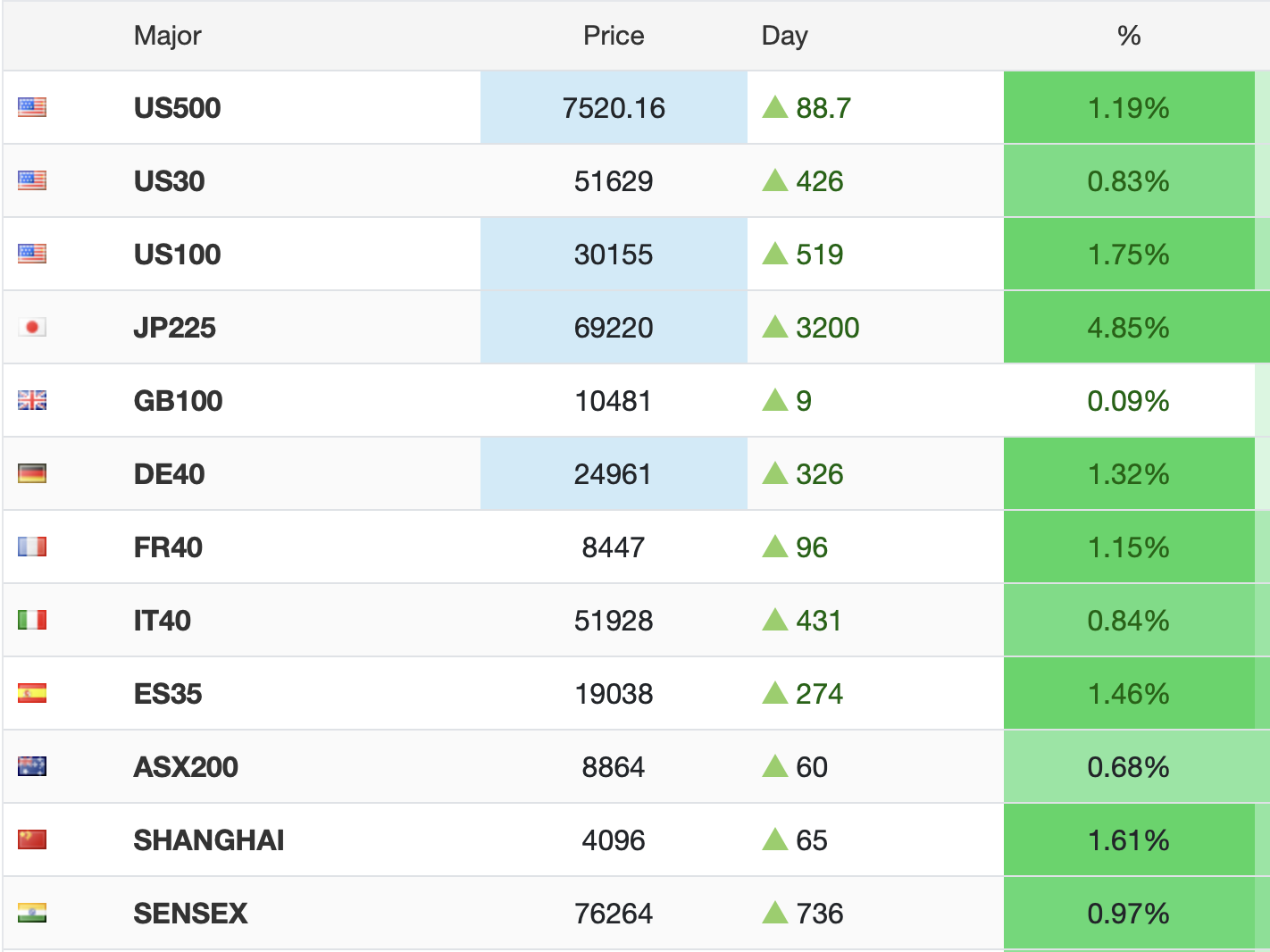
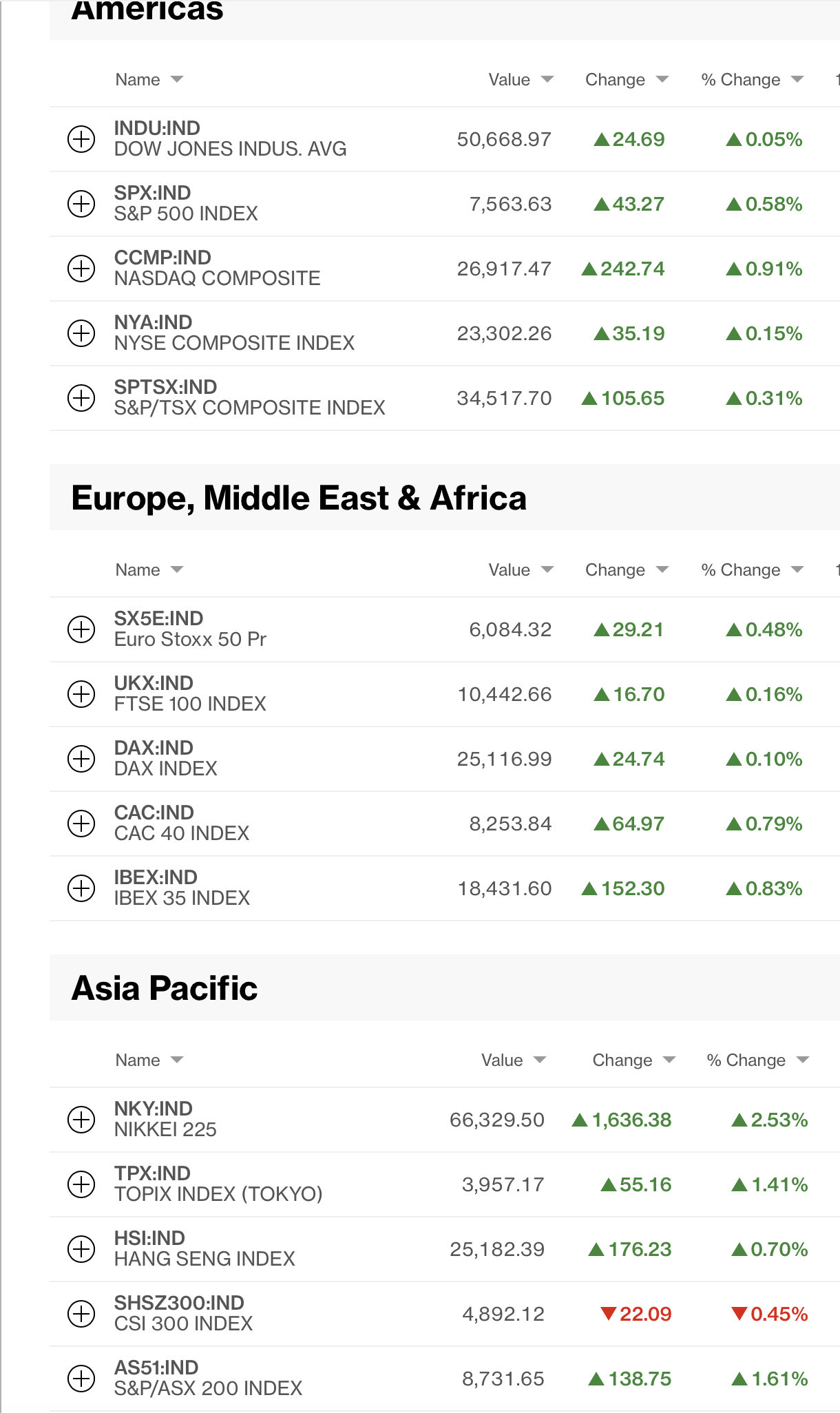
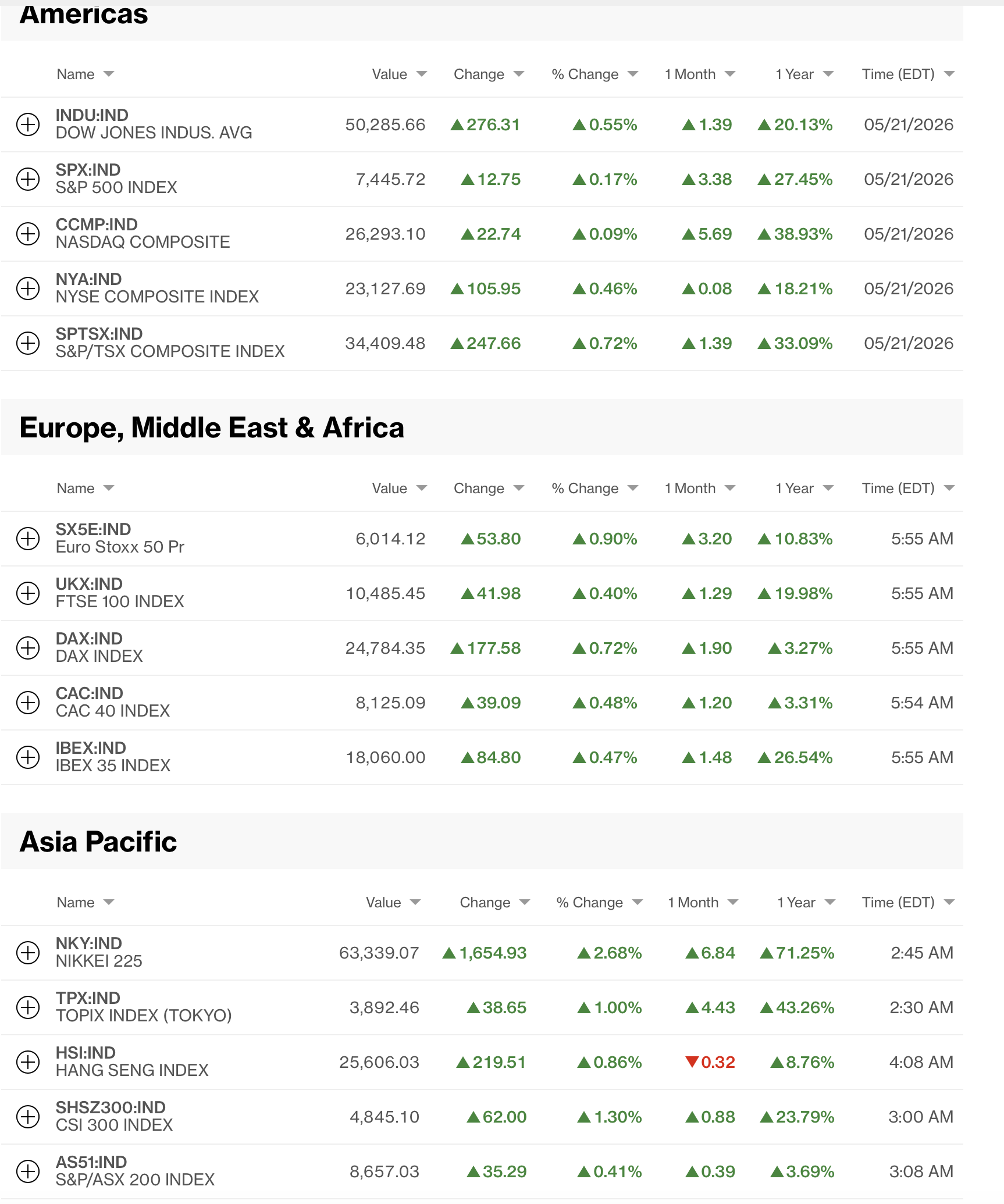
So, given we are not going to solve the Iran conflict here, it’s time to observe how markets are behaving.  And frankly, there is not very much to observe.  Starting with equity markets, as you can see from the Bloomberg screenshot below, things look pretty good right now, regardless of the Iran situation.  Yesterday’s US rally (the concerns raised regarding Iran and its uranium were set aside, it seems) were followed by strength in Asia and this morning in Europe.

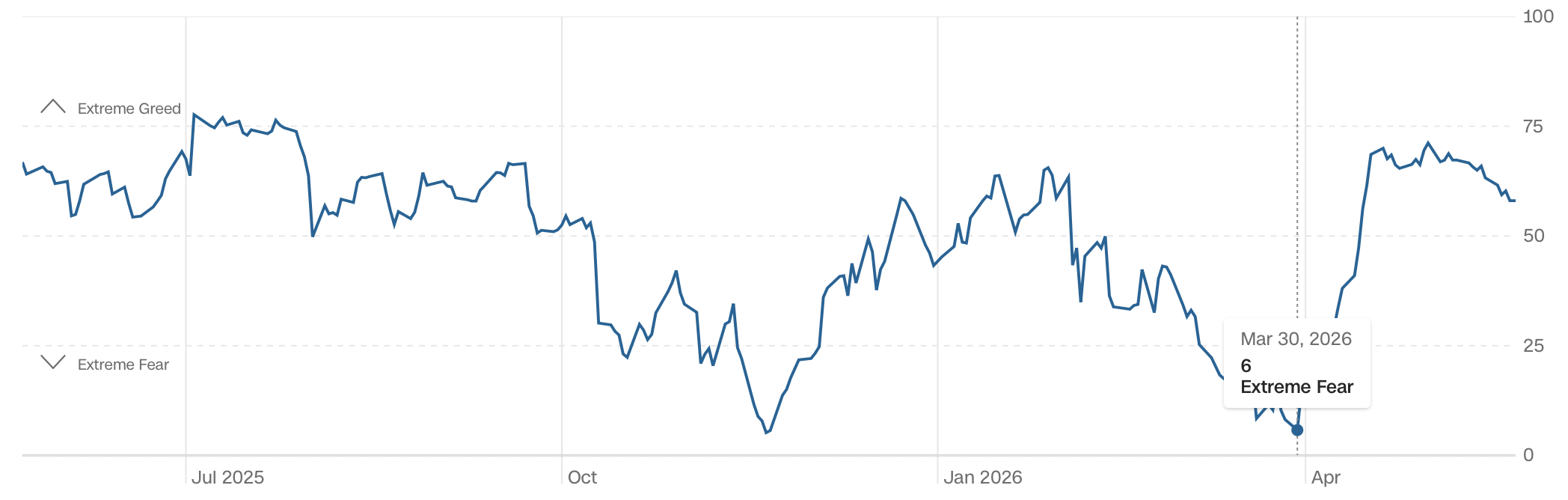
Earnings data continues to be released in a generally positive manner, and despite the ongoing angst amongst the punditry, as discussed above, there is, as yet, no sign that fear is growing amongst the investing set.  Below is a chart of the CNN Fear and Greed Index over the past year.  the current reading is 57, firmly in the Greed bucket and as you can see, the fear over the war began to dissipate at the end of March. 

If you think about it, this is really no different than the Ukraine War, which for a relatively short time was seen as catastrophic, and eventually faded into the background.  Honestly, when was the last time you saw an article on the subject?

As to the bond market, it continues its recent uncertainty as to what the future holds.  This morning yields are lower across the board with Treasuries (-2bps) after slipping -3bps yesterday, while European sovereign yields are all lower by between -4bps and -6bps.  The bond market appears to be caught between fears of rising inflation because of the impact of higher oil prices, not only on direct things like transportation, but also secondary impacts as those costs are passed on and adding in the potential for higher food prices if the fertilizer situation is as bad as some forecast.  However, the other side of that coin is the potential for a significant recession, which historically has resulted in substantially lower yields as governments around the world add both monetary and fiscal stimulus.  Place your bets!

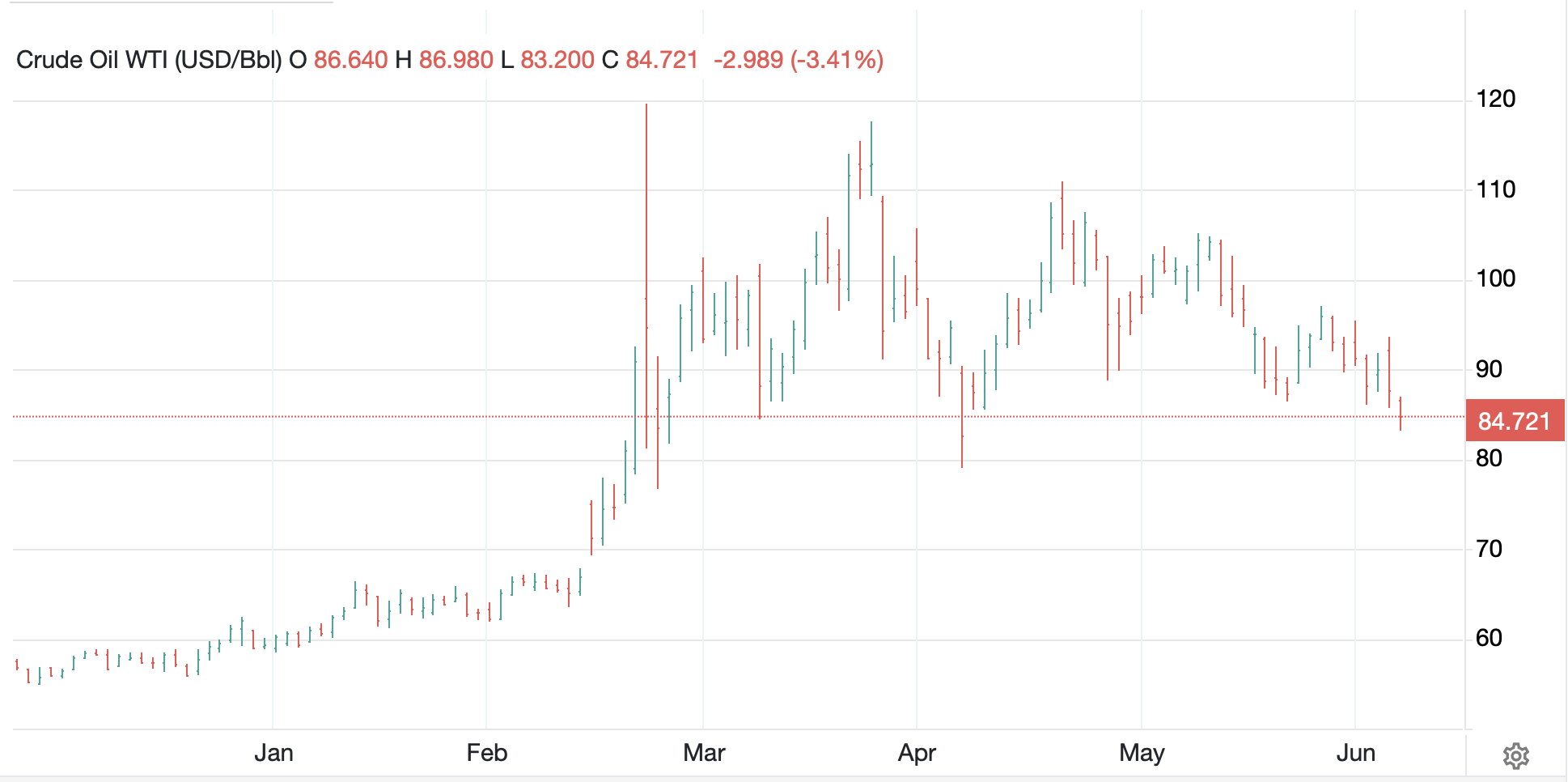
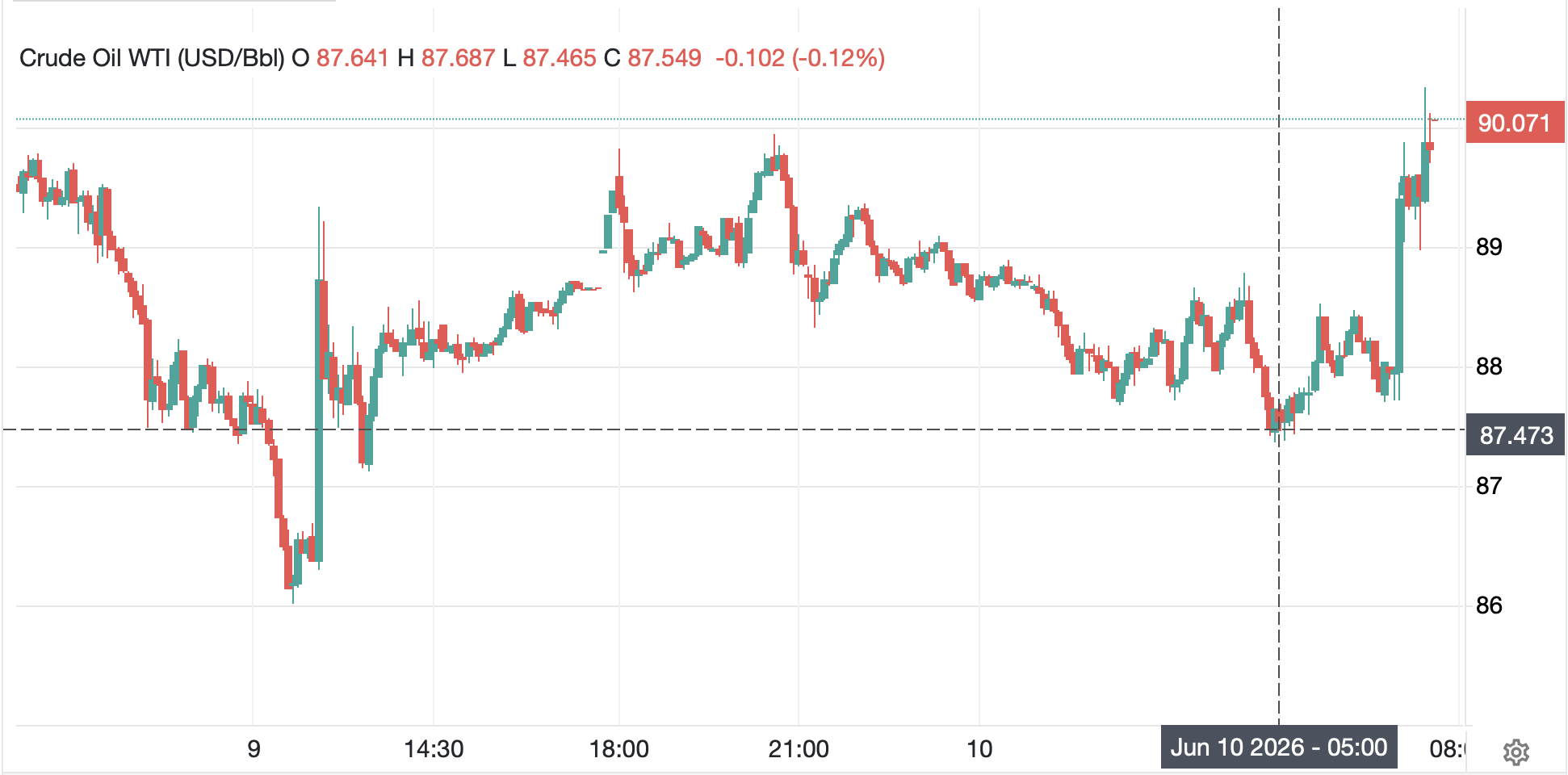
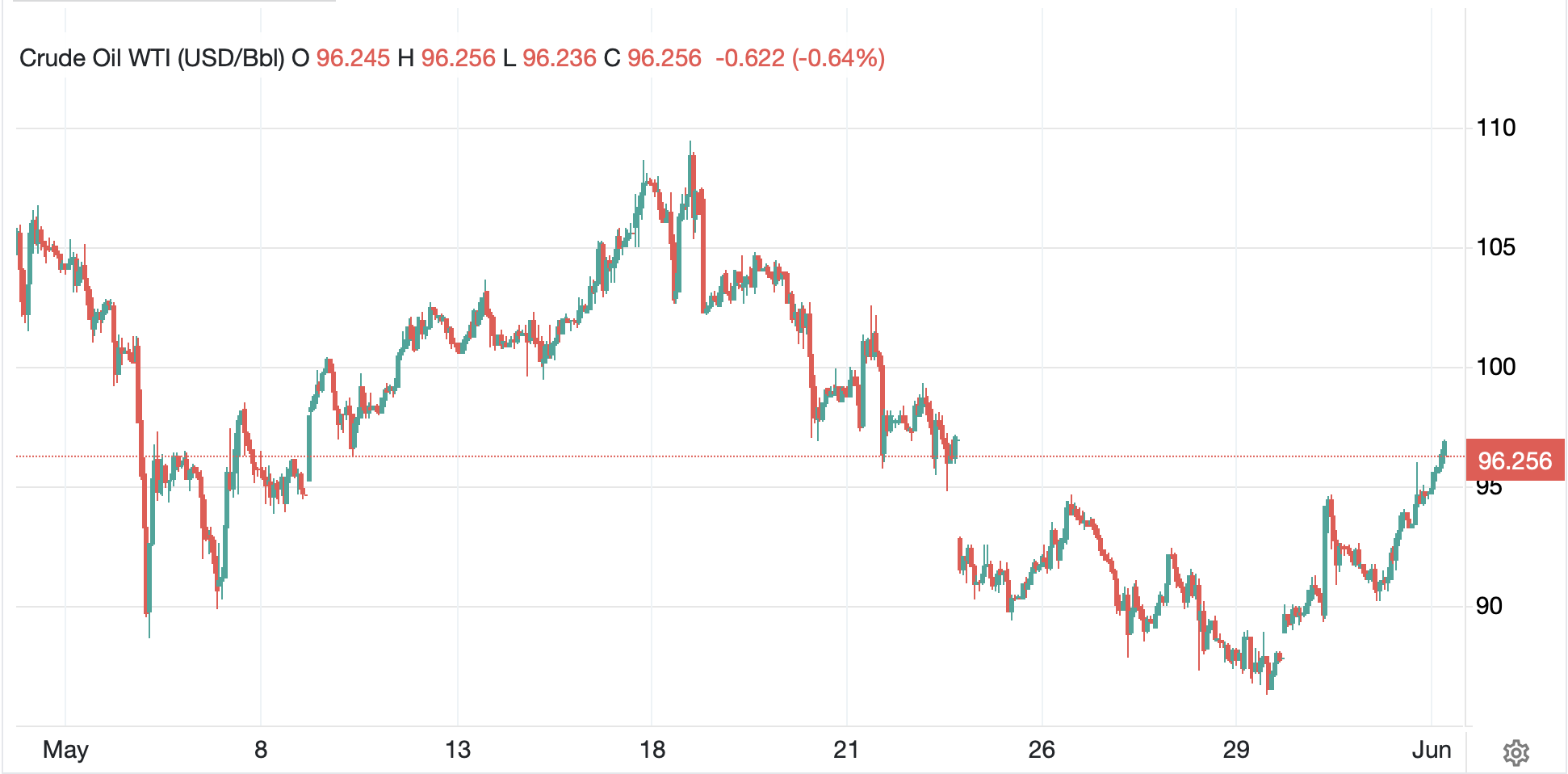
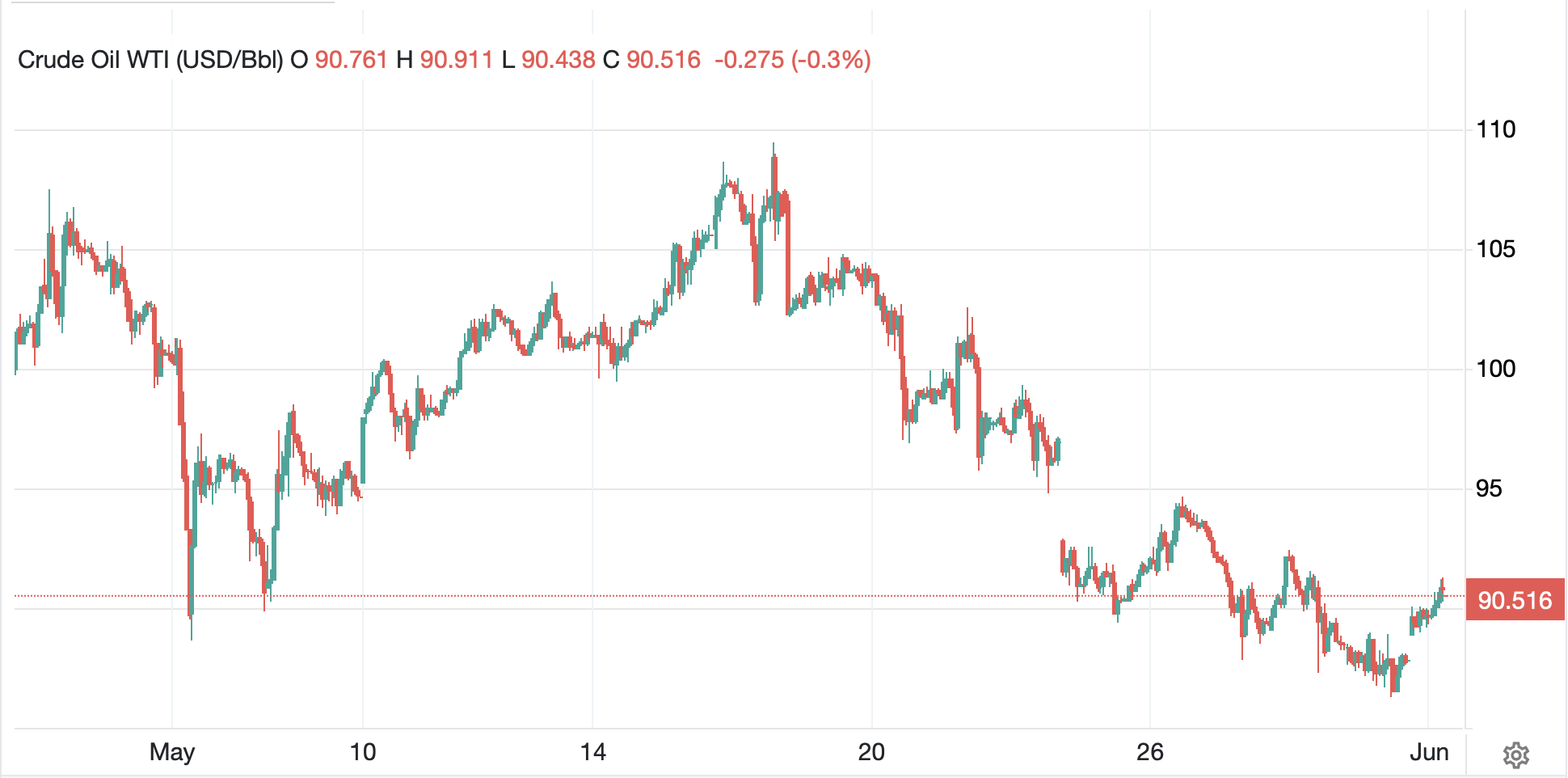
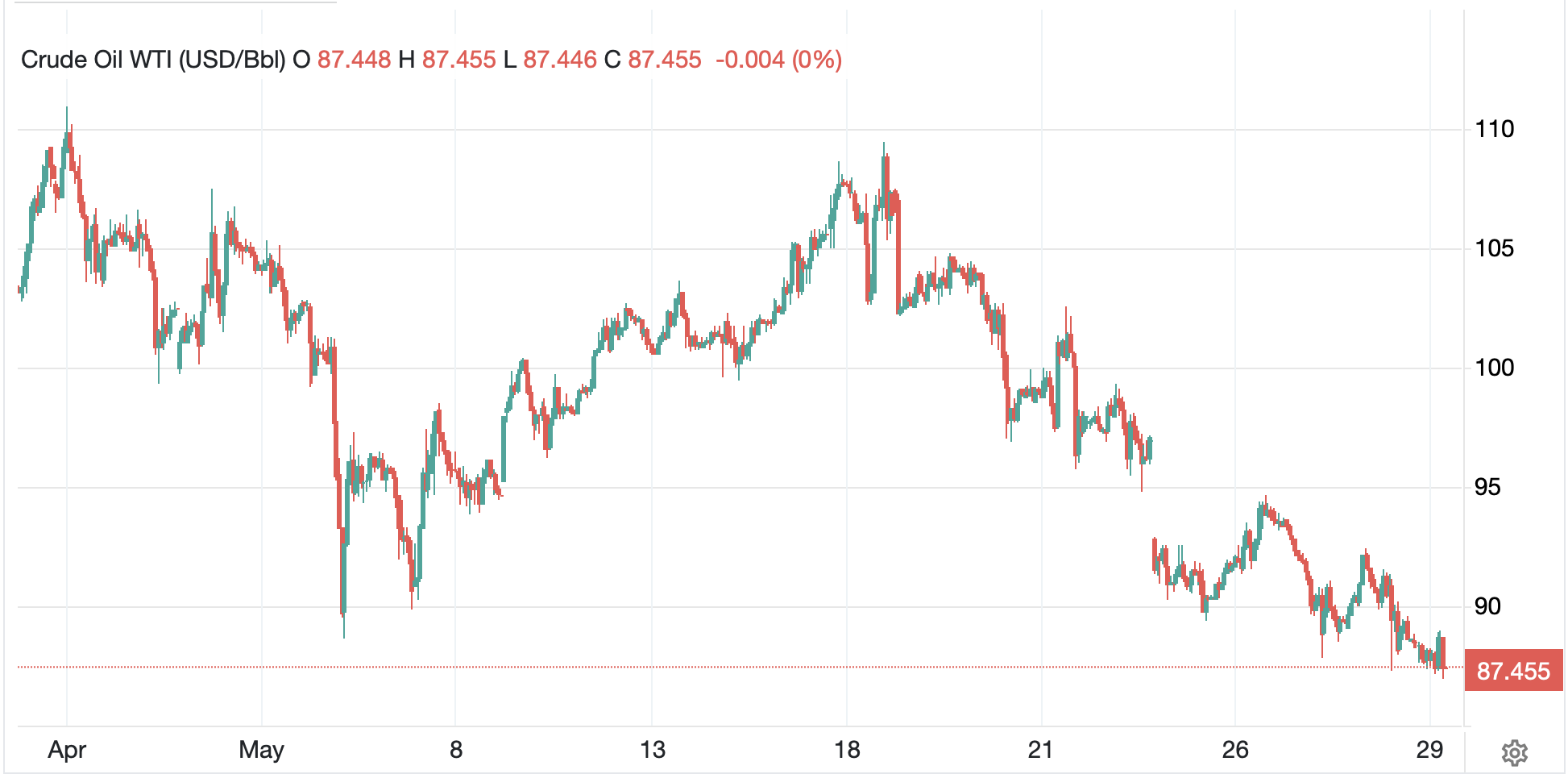
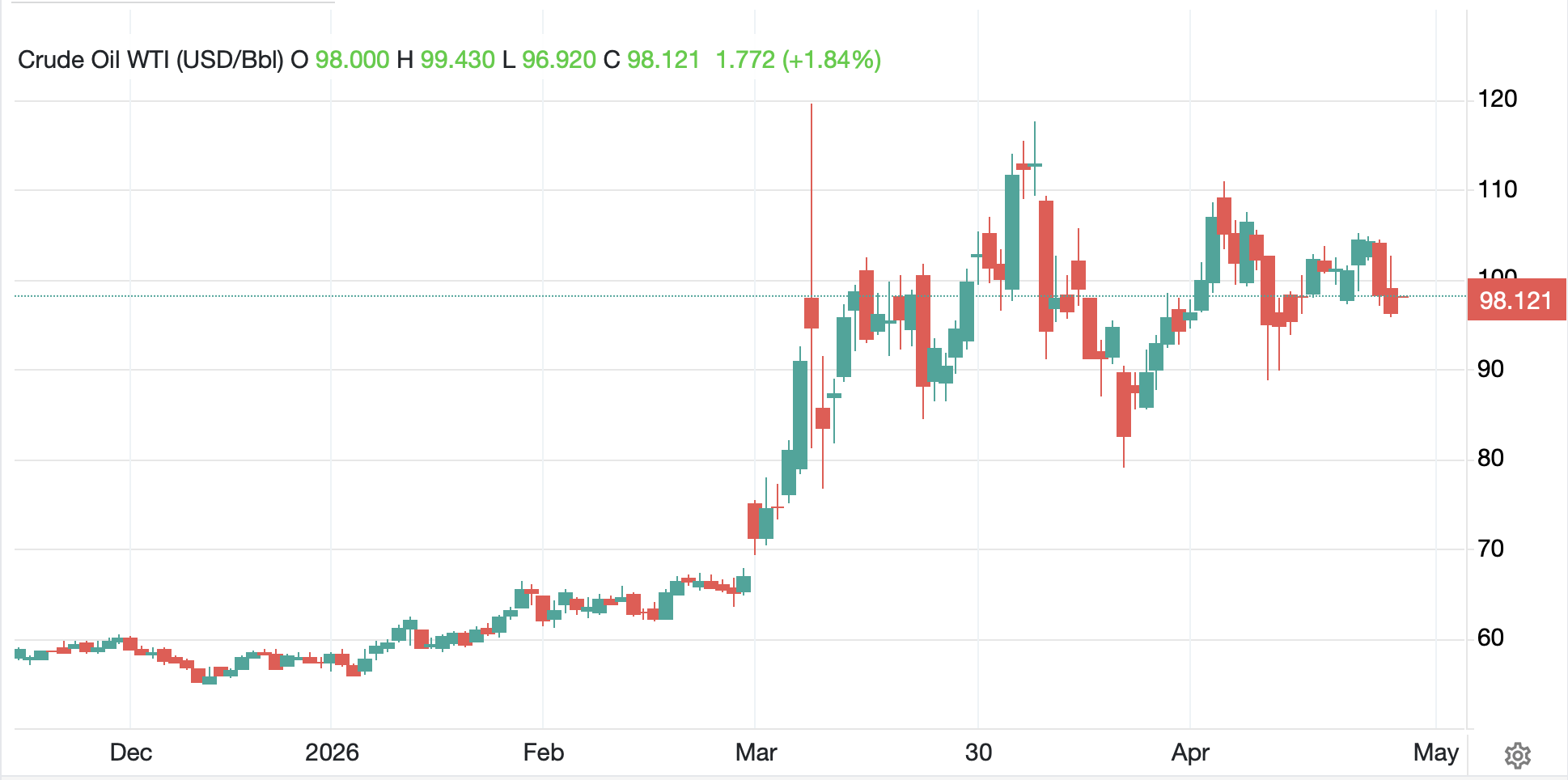
Turning to the oil market, while WTI is higher by 1.8% this morning, as you can see in the chart below, it continues to go nowhere overall.  If the apocalypse is coming, the market is certainly not ready.  Either that, or there is a lot more oil around than people give it credit for.

Source: tradingeconomics.com
Of course, as has been the case, when oil’s price rises, gold (-0.6%) and silver (-1.1%) slide as that negative correlation has become firmly entrenched.  Copper (+0.7%) though, is bucking that trend this morning, albeit hardly running away.  I expect that these relationships are likely to hold until there is a resolution of some sort in the Gulf.

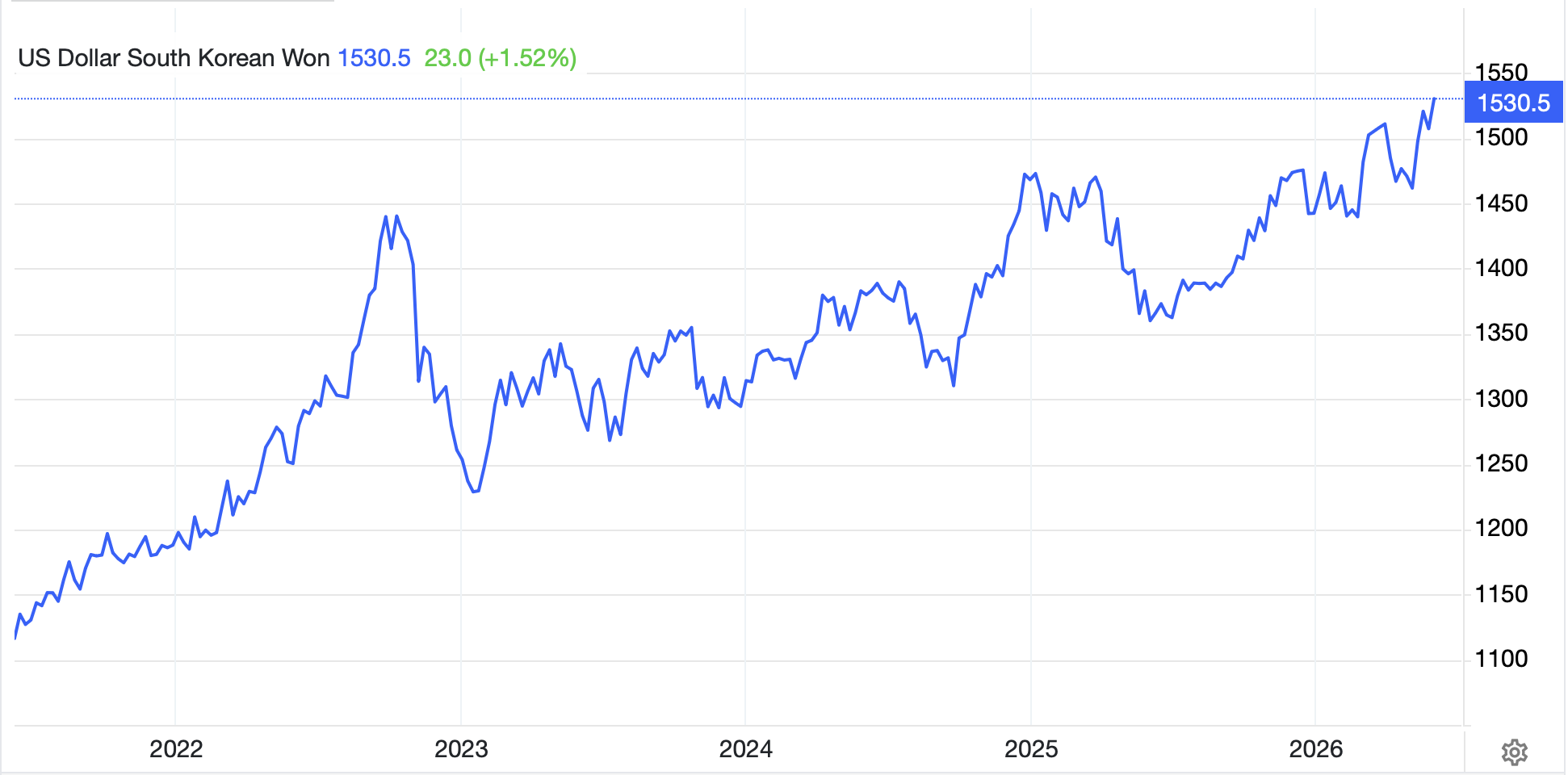
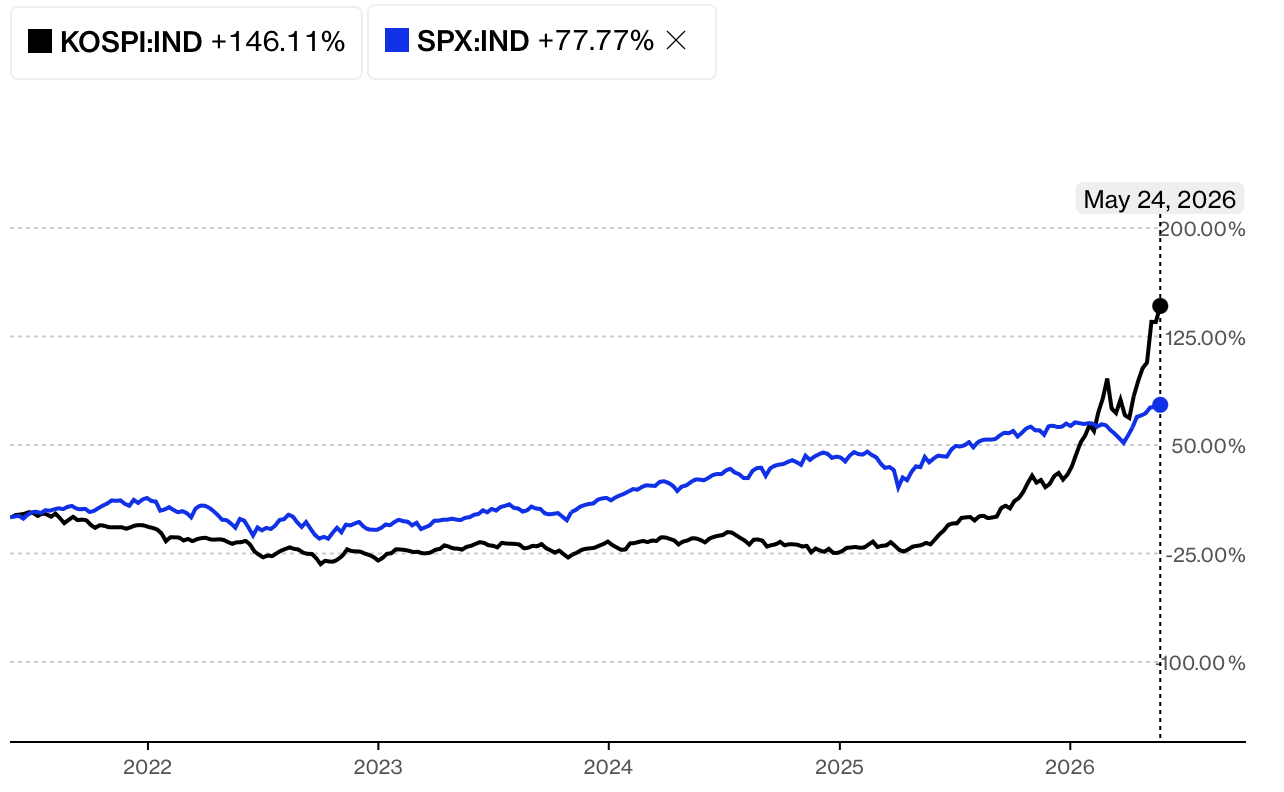
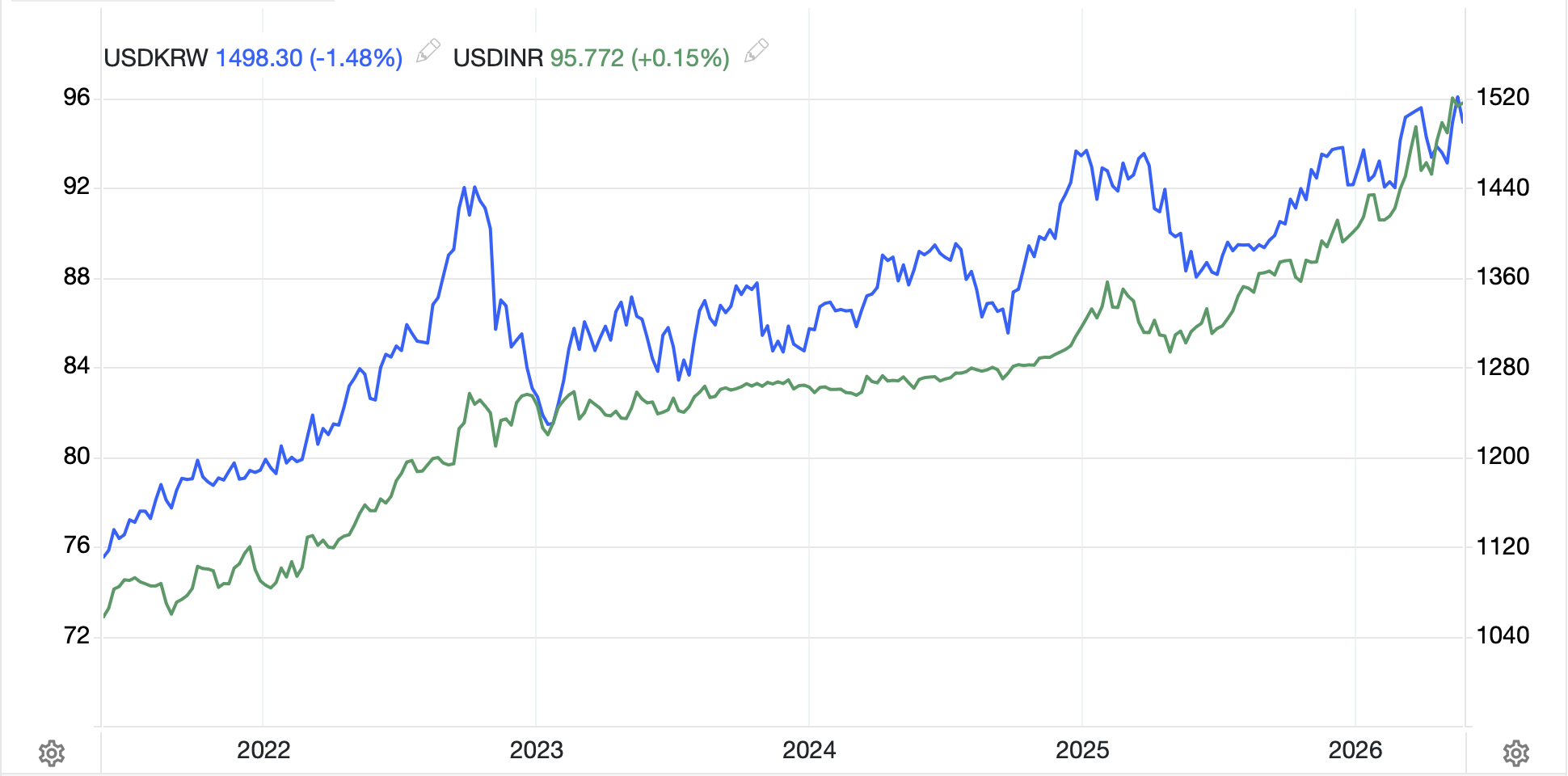
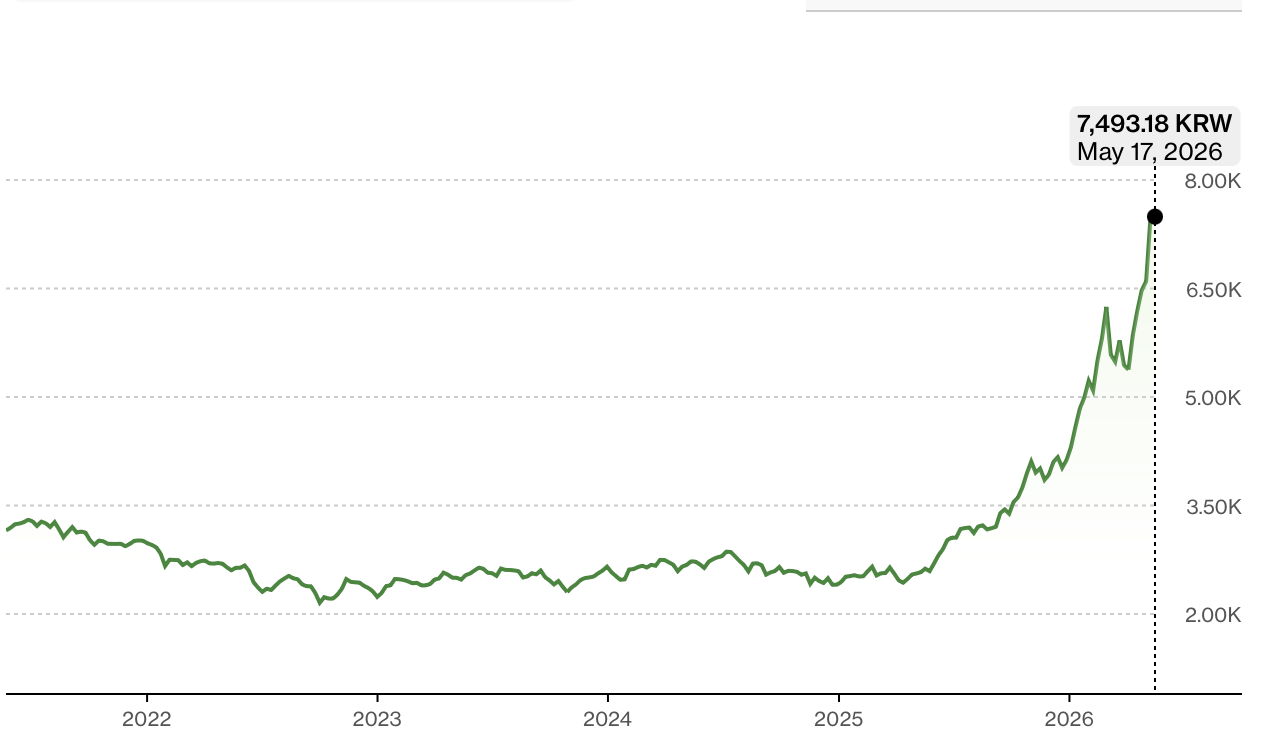
Finally, the dollar is generally firmer this morning despite the decline in yields.  In fact, if we look across markets, bonds are today’s outlier.  But back to FX, in the G10, all the currencies are weaker by between -0.1% and -0.3% although in the EMG bloc, there are two more substantial movers, INR (+0.5%) as the RBI continues its intervention process amid fears the rupee will collapse, while KRW (-0.8%) continues to see foreign outflows despite its equity market continuing to be one of the best performing in the world as you can see in the Bloomberg chart of the KOSPI below.

And that’s really it as we head into the weekend.  Perhaps the conflict will heat up during the long weekend, which would likely drive some real movement.  But for now, there is nothing new under the sun.

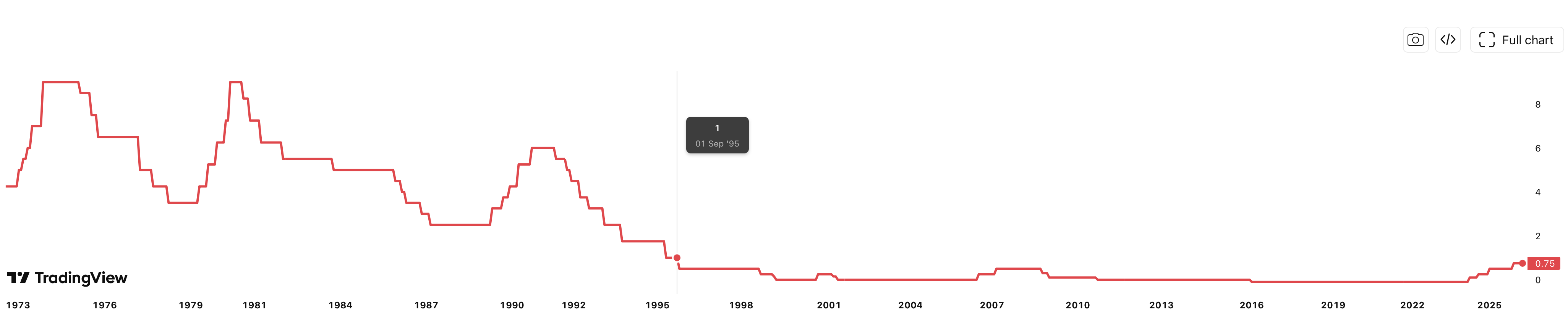
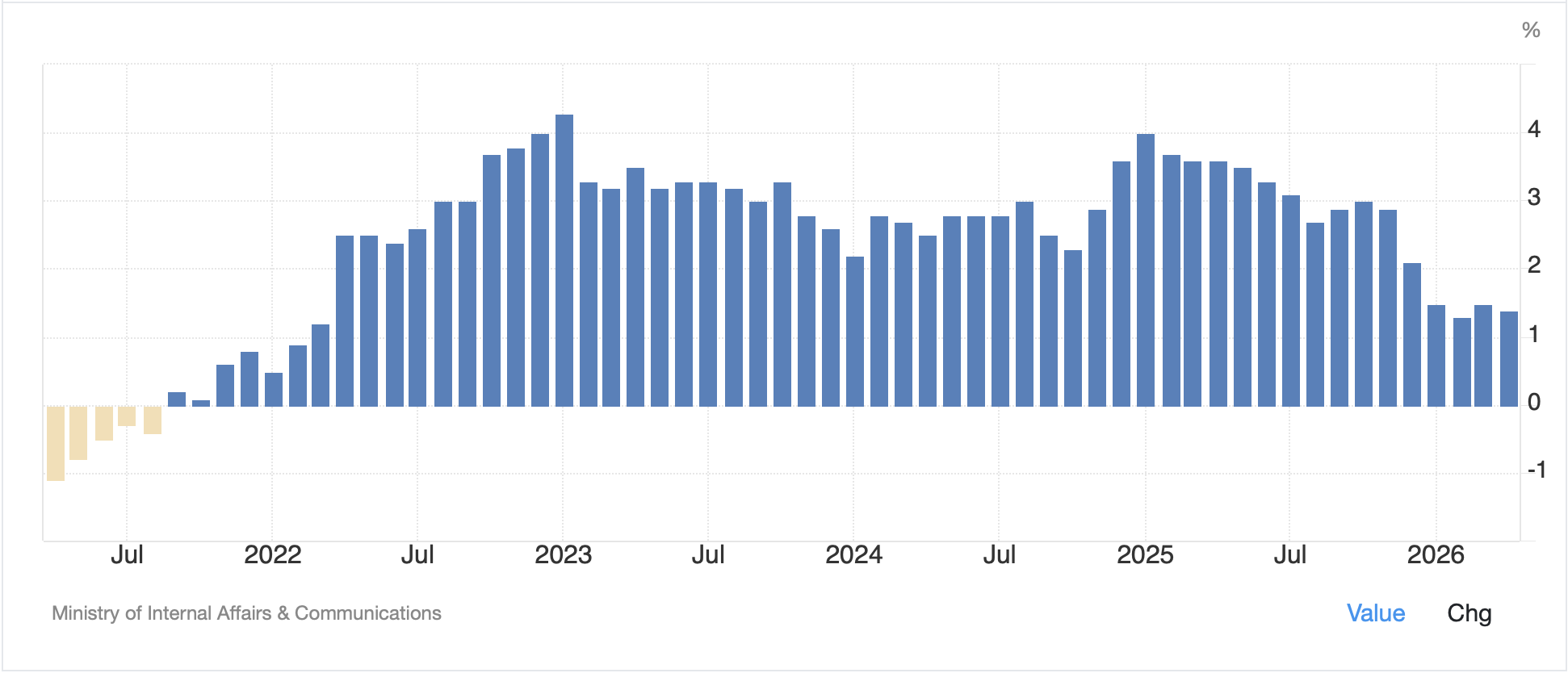
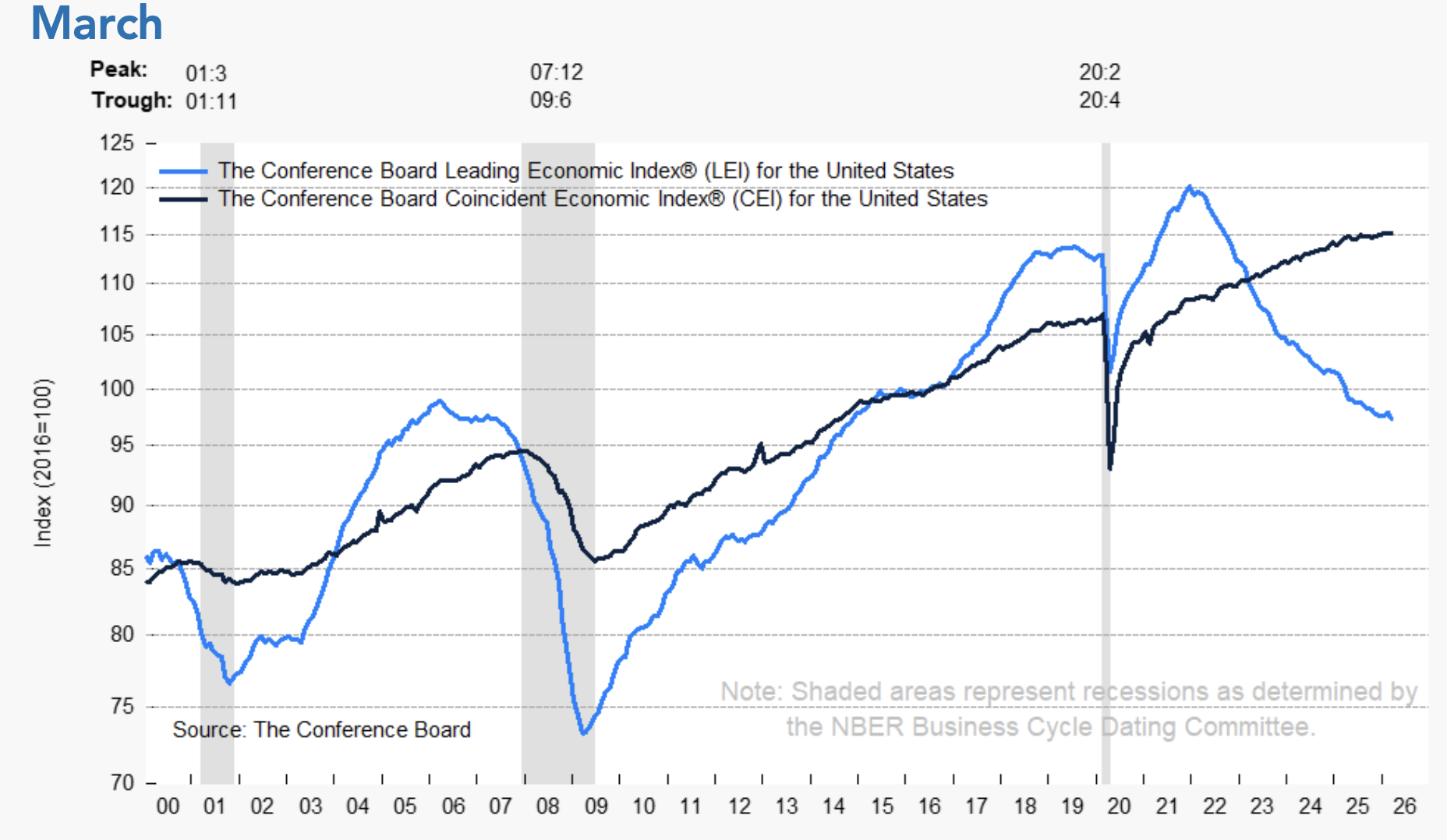
On the data front, yesterday saw generally solid data with the Philly Fed the lone, weak, exception.  Last night, Japanese CPI was released at a much lower than expected 1.4% for both headline and core.  While there is still a strong expectation that the BOJ is going to raise rates next month, if inflation is truly at 1.4%, that seems like it might be a mistake.  This morning we see Michigan Sentiment (exp 48.2) and Leading Indicators (-0.2%).  Here’s the thing about the Leading Indicators, though, as you can see from the chart below from the Conference Board’s website, it appears they may not be telling us the whole story anymore.

After all, they have been declining steadily since early 2022 despite an economy that has grown solidly during that period.  Again, maybe this truly is a harbinger for the future, but I am not convinced.

And that’s all there is.  Have a wonderful Memorial Day weekend and let’s see what the world looks like on Tuesday morning!

Good luck and good weekend

Adf

The Strait’s Dead

The president’s on his way home
And pundits with TD Syndrome
All say that the trip
Did not flip the script
And still see the world in a gloam

But markets, one thing, seemed to hear
That though China wants Hormuz clear
The President said
To him the Strait’s dead
And markets responded with fear

With President Trump on his way back home from his trip to Beijing and meeting with Chinese President Xi, we can now expect reams of stories about all the things that he either did or didn’t accomplish.  Much has been made of Xi’s opening comments about Taiwan and how it is a critical issue that cannot be mishandled or it would impact the relationship between the two nations.  But as I think about Taiwan and China, I certainly understand Xi’s interest in having the island reintegrate into China as it would bring an enormous number of technological skills and abilities in areas currently absent on the mainland.  And, of course, Xi will point to history and claim it has always been part of China, yada, yada, yada.

However, ask yourself why any Taiwanese would want to become part of China.  After all, per capita income in Taiwan is ~$42K annually compared to ~$14K on the mainland.  That is a serious reduction in living standards.  Add to that the ability to vote in free elections and the accompanying belief that one’s voice can be heard, and that is a powerful argument to remain independent.  Now, as TSMC builds out is fabs in Arizona and elsewhere in the world, it seems to me that the US will lose interest in the Taiwan independence issue overall because, especially for President Trump, who views almost everything transactionally, if the US can get its semiconductors from elsewhere with no problems, notably domestically, defending an island on the other side of the world, one that is decidedly not in the Western Hemisphere, seems far less critical. 

Here’s a forecast, by the end of Trump’s term, with TSMC fabs up and running in Arizona, Japan and even Germany, we can see a Taiwan deal similar to the Hong Kong deal, which will sound great but over time China will absorb it in the same way it has done Hong Kong, removing freedoms and its appeal as a manufacturing center.

On to the other part of the trip that has had a much larger impact on markets, when Mr Trump explained, “We don’t need the Strait of Hormuz open.”  While the comments from the trip were that China wants it open and agrees tolls are inappropriate, the last throwaway line is what has markets on edge this morning.  And on edge, they certainly are!

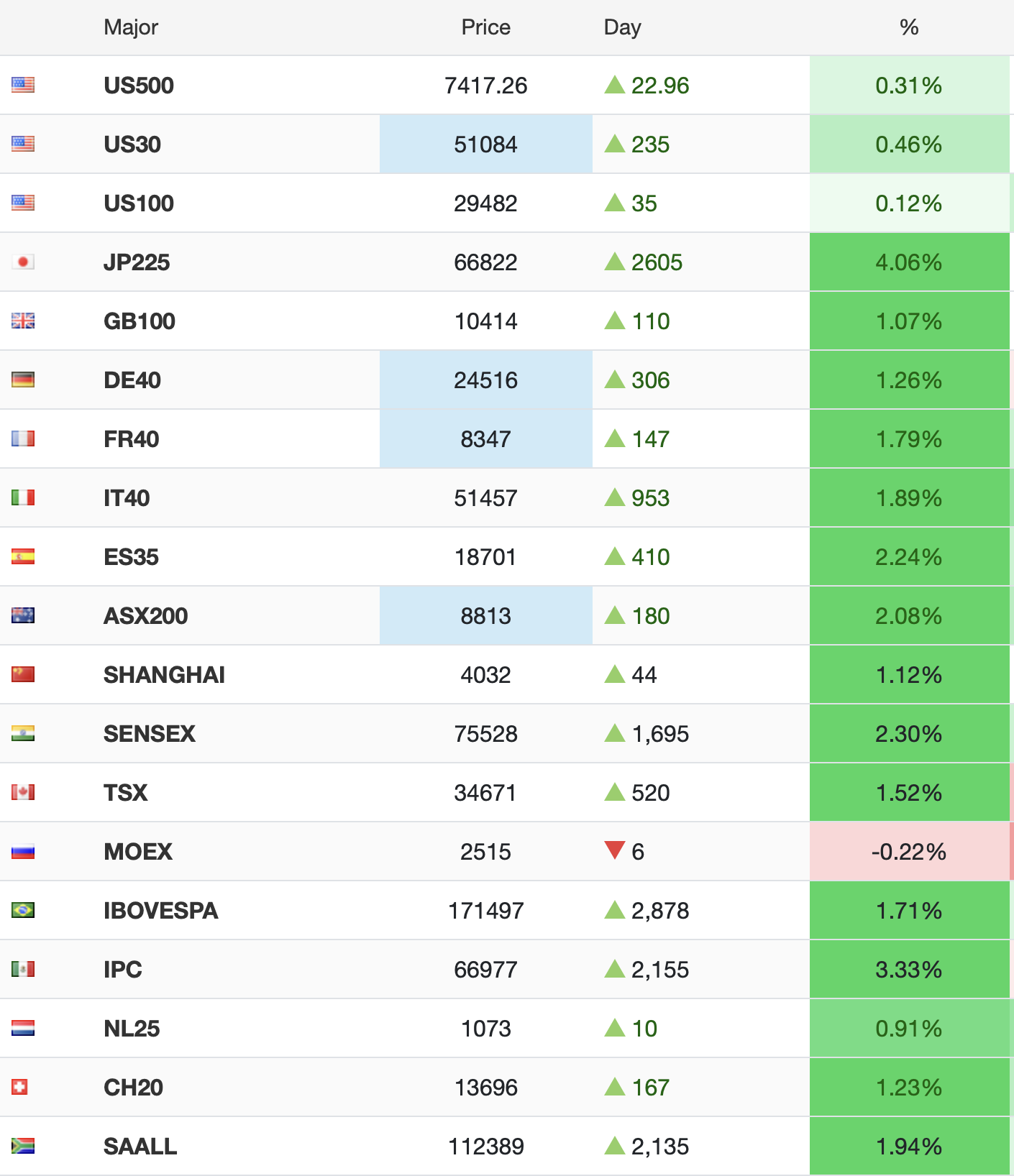
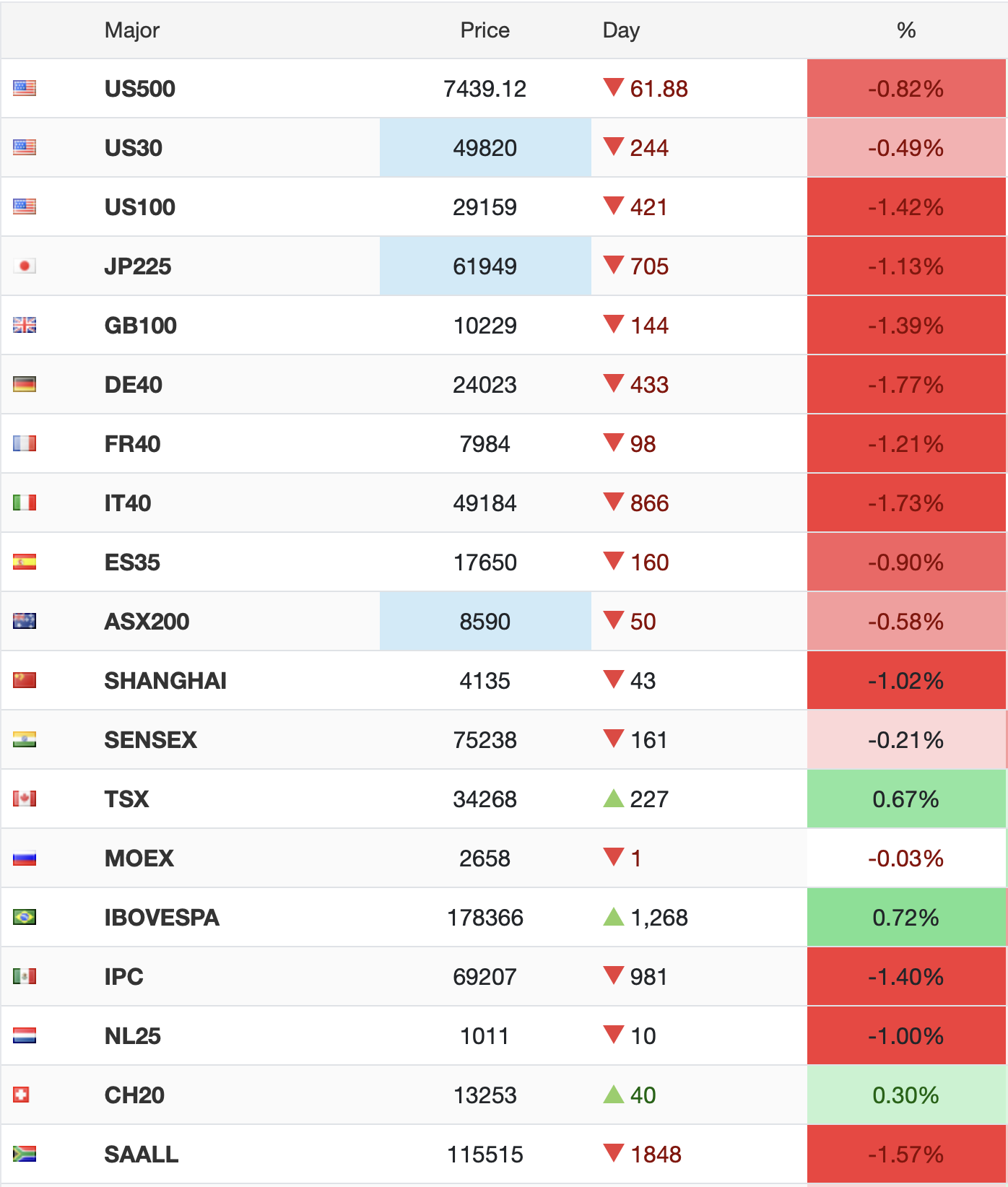
Thus, without further ado, let’s take a look with pictures serving their purpose.  As of 7:15 this morning, here are the major equity index futures from tradingeconomics.com

The caveats here are that Toronto’s TSX and Brazil’s IBOVESPA futures markets are not yet open, but I’m confident both will open lower.  Russia’s MOEX is irrelevant which makes the Swiss Market Index the only equity market anywhere that is not falling.  Perhaps more than the Swiss franc, their stock market has achieved some haven status.

The thing to remember about this sell-off, though, is that we have had a remarkably strong week overall, and so this feels more like a profit taking retracement than the beginning of a new move lower, at least to me.  

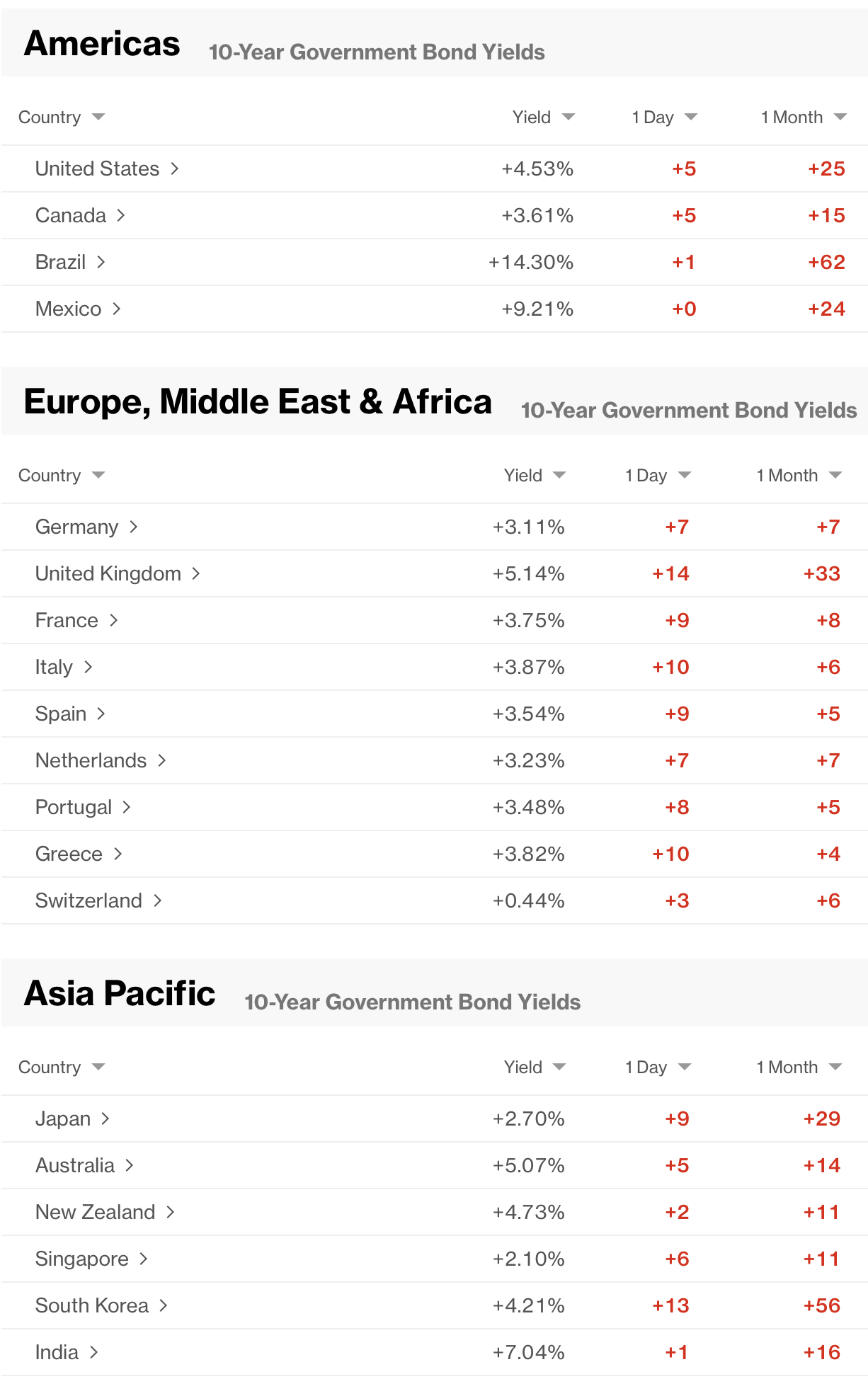
In the bond market, sellers are the dominant force with yields higher everywhere around the world as per the below Bloomberg screenshot.

Much has already been written about 10-year Treasury yields trading at their highest level in almost exactly a year, and 30-year Treasury yields now firmly above 5.0% and how that spells the end of the good times in the US.  Maybe that is the case, but I am not convinced.  My take of the biggest problem is in the UK, where PM Starmer is under even more pressure this morning after several moves where a key cabinet member, Wes Streeting, resigned to open his path to run for PM as well as where a Labour party member stepped aside so that the very popular Andy Burnham, who is Mayor of Manchester, can now run for parliament and be in a position to become PM.  The issue here is that since Starmer will do all he can to hold on to his seat, and the Chancellor, Rachel Reeves, is in his corner, we will see even more deficit spending there to try to help Starmer stay in power.  Apparently gilt investors are not impressed with that potential.  Of course, neither is anybody holding pounds as a position as is apparent in the FX markets.

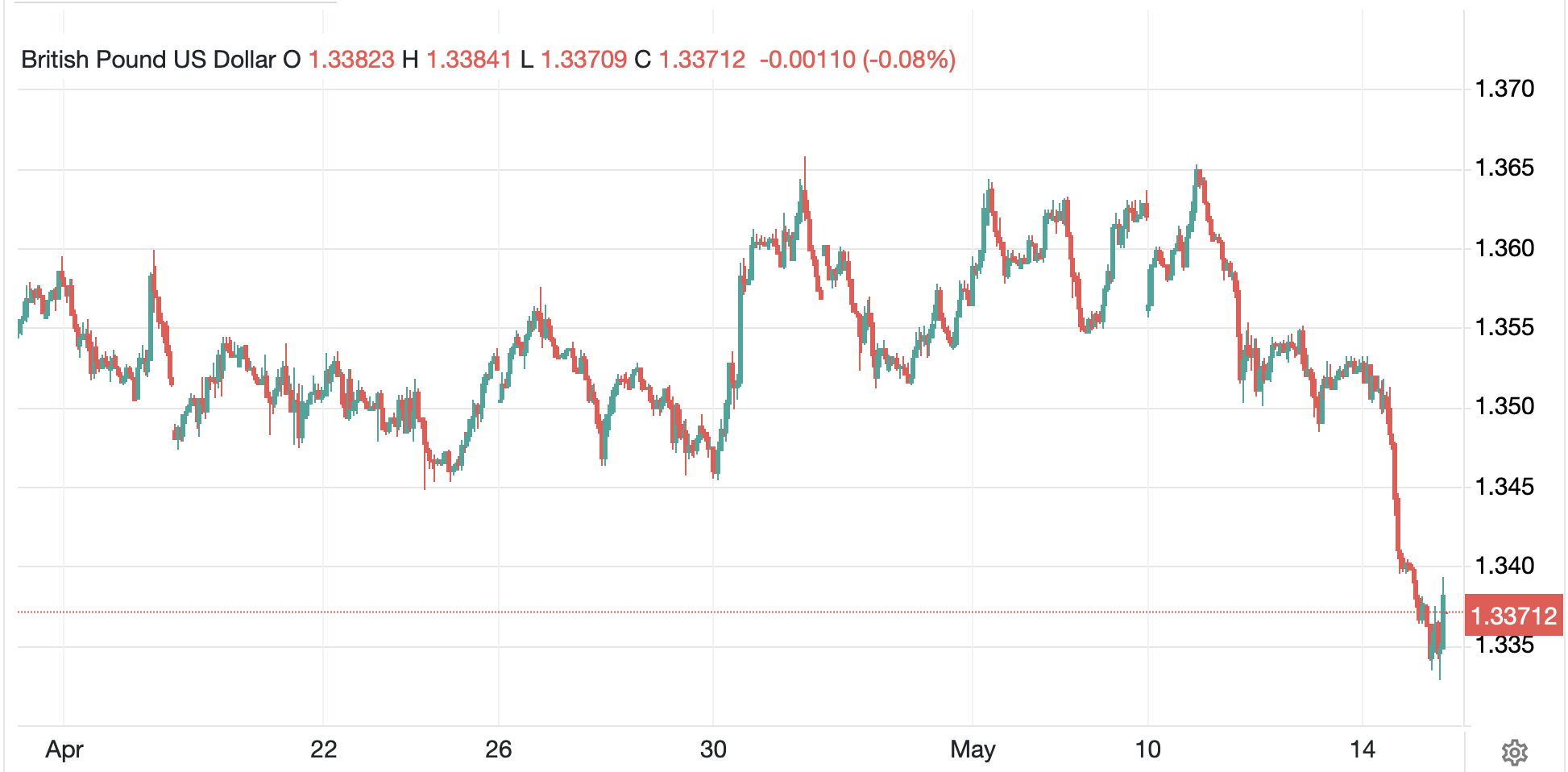
While the pound (-0.25%) is only modestly lower this morning, since Monday, as you can see below, it has fallen 3 cents and does not yet seem to have found a bottom.

Source: tradingeconomics.com
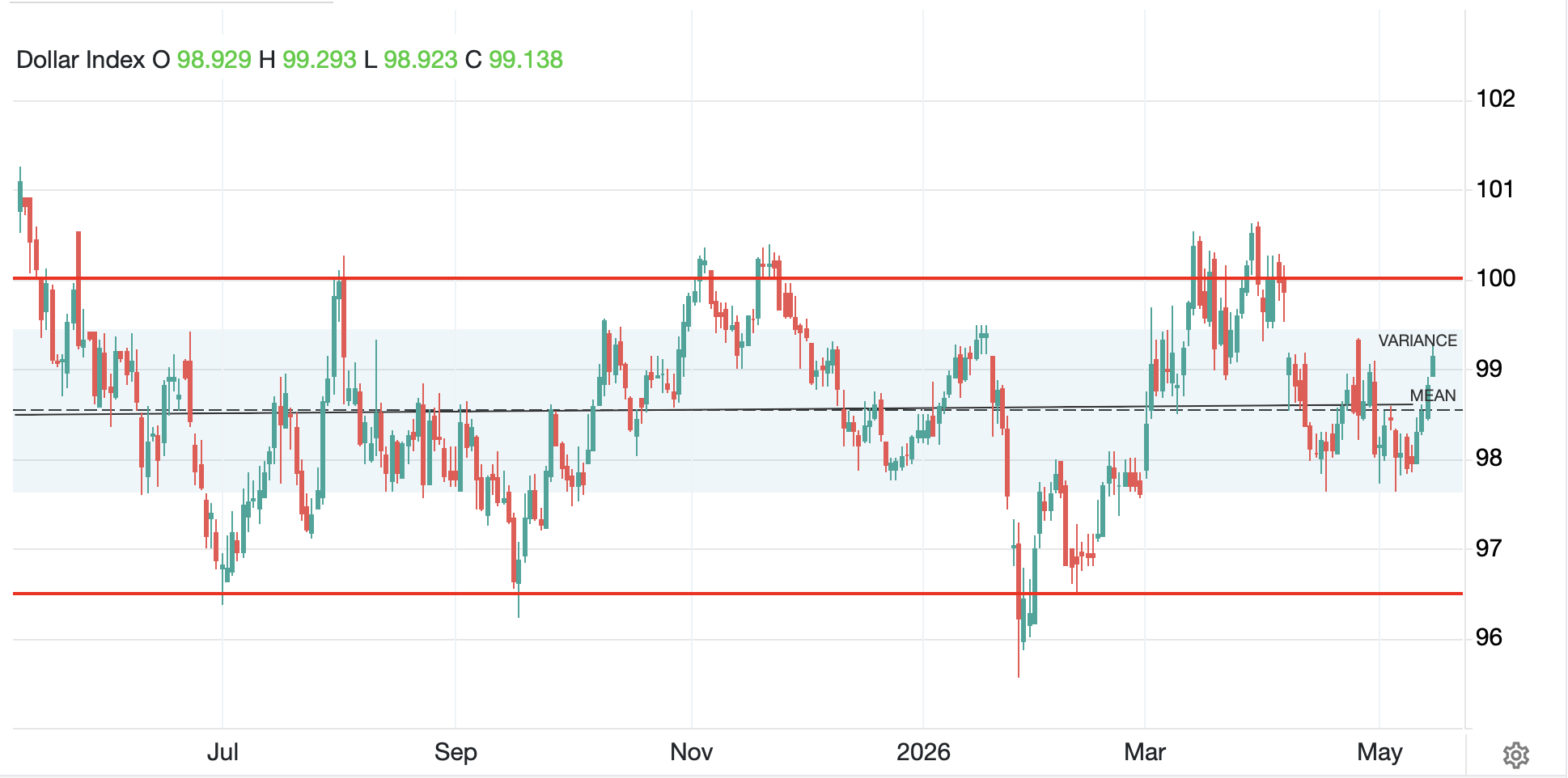
But this is of a piece with the dollar writ large this morning, which is higher virtually across the board.  In fact, as you can see, in what may be my most frequently printed chart to dispel the idea that the dollar is dying, the DXY remains firmly in its range for the past year and is now heading toward the upper band.  If you look at the calculated mean/variance of the DXY, you can see the trend line (the black line in the center) is completely flat, i.e. the dollar is trending neither higher nor lower over the past year.

Source: tradingeconomics.com
Looking at specific currencies, AUD (-1.0%) and NZD (-1.45%) are the worst performers in the G10, although NOK (-0.9%) and SEK (-0.9%) are giving them a run.  Kind of surprising for NOK given oil is much higher this morning.  in the EMG bloc, ZAR (-1.0%), CLP (-1.0%), MXN (-0.8%), and KRW (-0.5%) are the laggards in their respective regions with ZAR suffering from the commodity movements, as is CLP with copper sharply lower this morning.  MXN seems to be reacting to the news that the US has been stepping up its aggressive tactics against the drug cartels there and concerns about how that will end up.

Finally, on to commodities where oil (+3.0%) has responded exactly how you would expect to the Trump comment about his cares about Hormuz.  Meanwhile, the metals are back in full negative correlation mode with oil as all of them are sharply lower this morning (Au -2.0%, Ag -5.9%, Cu -4.3%, Pt -4.0%).  The one thing you have to admit about the commodities markets these days is that they are living up to their reputation of extreme volatility.

On the data front, this morning brings Empire State Manufacturing (exp 7.5), IP (0.3%) and Capacity Utilization (75.8%), none of which typically have a big impact and given the oil/Hormuz fears extant this morning, will almost certainly be completely ignored.  There are no Fed speakers today but I do want to mention one from yesterday, Governor Michael Barr, who directly contradicted everything Chairman Warsh has been saying about the size of the Fed’s balance sheet, explaining that if they move away from their current ‘ample reserves’ model, it could have very negative impacts on the functioning of money markets.

There is an irony here as prior to the ‘ample reserves’ framework, there was a very active Fed funds trading market on an interbank basis and banks were able to borrow from each other whatever they needed for liquidity purposes.  The Fed has usurped that role ever since the GFC and are now clearly concerned (afraid?) about going back.  The thing is, it seems to me that there continues to be a tremendous amount of liquidity around and it would be quite feasible to create an intraday loan market to help alleviate those concerns.  In fact, cash rich corporates (Berkshire Hathaway anyone?) could be part of the market as it would be entirely interbank and those corporates would know the counterparties quite well.  Suffice it to say that Mr Warsh will have quite a time getting his way at this stage.

And that’s what we have going into the weekend.  Gloom and doom about the near future, or profit taking, I’m not sure which.  As I have said all along, play it close to the vest, in think.

Good luck and good weekend

Adf

Greatly Vexed

For weeks it appeared that the war
Was something we all could ignore
As equities rallied
And most people tallied
Their gains as those prices did soar

But yesterday, things took a turn
And suddenly, stocks, folks, did spurn
While oil went higher
As missiles did fire
And UAE oil did burn

The question today is what’s next?
Will Hormuz soon wind up annexed?
Or will Iran’s forces
Back up their discourses
And keep Mr Trump greatly vexed?

For nearly two weeks, it appeared that the market was completely willing to accept the narrative that the Iranians were on their last legs and that the Strait would be reopened soon, thus relieving the pressure on the oil markets, and global markets in general.  After all, US equity markets, as well as those in Korea and Taiwan, were making new all-time highs regularly despite the ongoing stress in Iran.  

But yesterday, those happy thoughts were called into question as evidenced by the equity markets’ collective sharp decline throughout Europe and the US.  Of course, most of Asia was closed on Monday, but the few markets that were open performed well then.  Alas, last night was a different story with more losers (HK, India, Australia, New Zealan, Singapore) than gainers (Malaysia, Indonesia).  Even if markets don’t decline much further, there has been a distinct change in sentiment about things, at least in my view.

The timing of the progress in potential negotiations and the question of potential escalation of fighting again are suddenly weighing more heavily on investor perceptions than they had for the last several weeks.

In the meantime, if we turn our attention to economic data, yesterday’s Factory Orders came in much stronger than expected, just the latest in a line of “surprisingly” strong data points from the US.  If we look at the chart below from macromicro.me, showing the Citi Surprise Index and their earnings index, we can see that both the economic indicators and US corporate earnings results are moving higher.  This seems at odds with the narrative of imminent collapse that is still making the rounds but is likely the cause of the equity market’s resilience.

In fact, this morning, markets are once again pointing in a more favorable direction as yesterday’s skirmishes in the Gulf have been quickly forgotten, it seems, and European bourses are all higher (Germany +1.0%, France + 0.6%, Spain +1.1%) recouping yesterday’s losses although UK equities (-1.0%) are suffering on a combination of yesterday’s concerns as well as a surprisingly negative HSBC earnings report.  And US futures are also higher at this hour (5:45) by about 0.4% across the board.  It is difficult to get markets downbeat for very long these days, which is remarkable given the sentiment indicators which have consistently been reading quite poorly.

This dichotomy is quite interesting to me as I am currently reading “Narrative Economics” by Robert Shiller, where he describes how social narratives have, throughout history, led to economic outcomes, whether positive or negative.  His implication is that the data tends to follow the current zeitgeist, and then almost regardless of any government efforts to change that narrative, the zeitgeist is what drives the economy.  For those of us who have been observing markets for any extended length of time, I don’t think this is a surprising revelation, although Shiller does a great job highlighting all the different times the narrative drove the bus.  

And that is what makes the current situation so remarkable, the narrative is that things are terrible with the nation dramatically split politically while gasoline prices have risen so much and inflation is a major problem.  You can see that in the Michigan Sentiment Survey and the political polls.  Yet Retail Sales remain firm and we just saw those strong Factory Orders, two things which one would expect to soften given the current narrative.

Perhaps what we have seen is the impact of social media and ‘influencers’ whose goal is to show the good life and why/how you should live it.  Given they only maintain their followers if they show an ideal situation, there will be no shaming for ostentatious consumption, that is their stock in trade.  So, while during the Great Depression, social pressures were such that buying anything new, like cars or houses, was seen as inappropriate, today, buying new cars is seen as a requirement, the more expensive the better.  Or going on an expensive holiday, or some other extravagance.  I wonder if the gloomy narrative will end up overcoming the influencers.  I suppose much will depend on just how much longer the war in Iran continues, as a clear end soon would almost certainly see a major sentiment change and another wave higher in risk assets while the longer it drags on, the more likely negativity overwhelms.

But this morning, having already looked at equity markets, we see a key piece of that story is oil (-2.0%) having slipped back.  Perhaps the fact that there have been no new skirmishes has people back to a brighter outlook.  Or perhaps, as the conspiracy theorists would explain, governments are in manipulating the price lower again.  As I look at the chart, though, it remains remarkable to me that despite the Strait having been closed for two months now, oil prices have not risen further.

Source: tradingeconomics.com
The question at this point is how quickly things can return to any semblance of normal when the hostilities end.  From what I have read, and I am not an expert, it almost seems like every day the Strait remains closed will require one and a half days more before things get back to the pre-war situation.  Of course, even if that is the case, if the war ends, the zeitgeist will change far faster and that will likely be overlooked.

Meanwhile, given the current gold/oil relationship, we cannot be surprised that gold (+0.6%) and silver (+1.3%) are higher this morning.

In the bond market, after yields rose sharply yesterday (Treasuries +8bps), this morning, things are less dramatic with 10-year Treasury yields slipping -1bp and European sovereign yields all softer with Greece and Italy (-5bps) seeing the largest declines although German bunds (-1bp) were more in line with Treasuries.  There has been much discussion lately about 30-year Treasuries and how they have traded back above 5.0% again, indicating it is a sign of the apocalypse.  However, if you look at the chart below, you can see we have been at or above that level several times in just the past year.  I understand 5.0% is a big round number, but I don’t see this as an imminent disaster because of the move. (Don’t misunderstand, the US fiscal situation is a major problem with many potential problems going forward, I just don’t think this is the final straw.)

Source: tradingeconomics.com
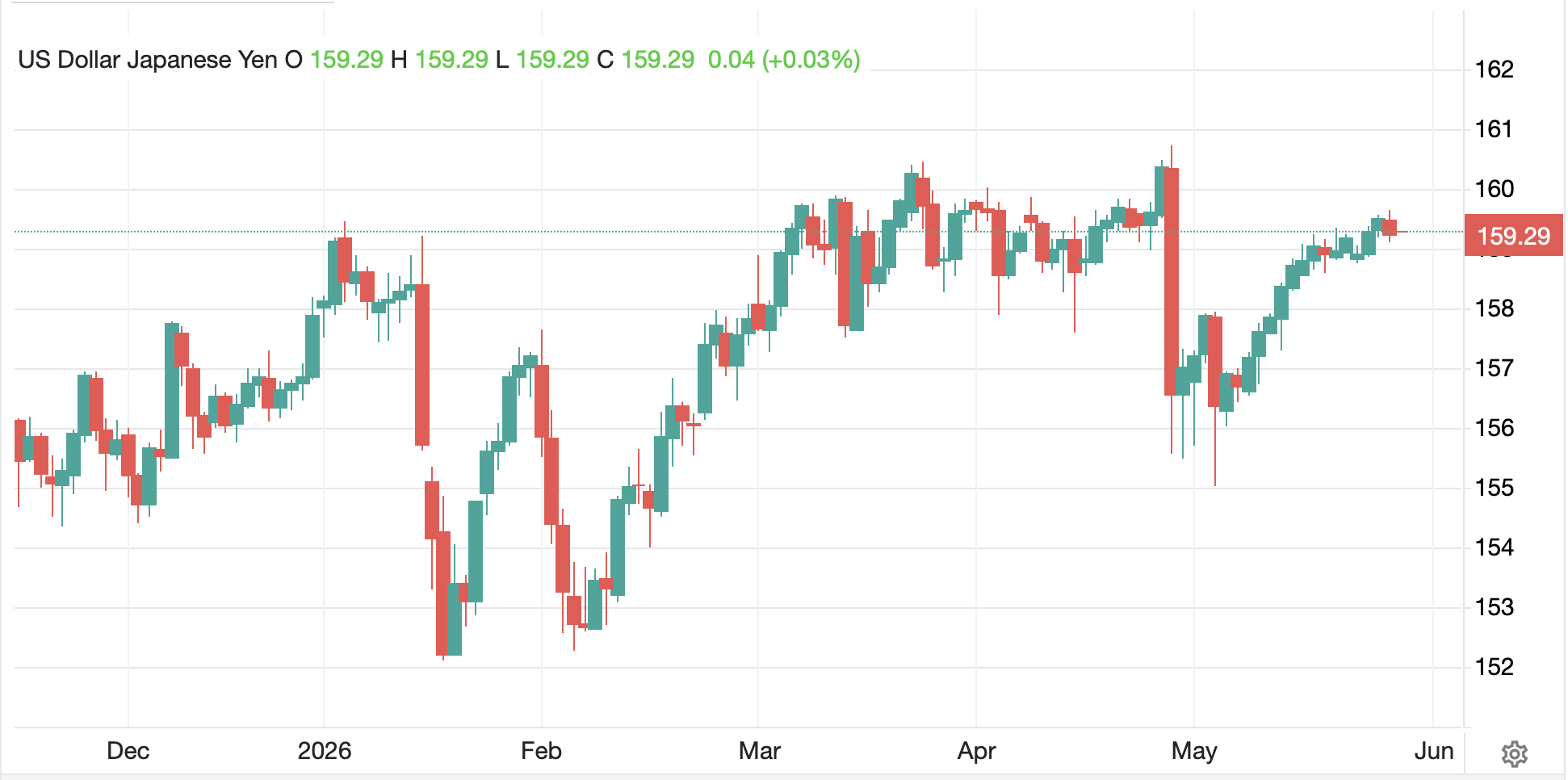
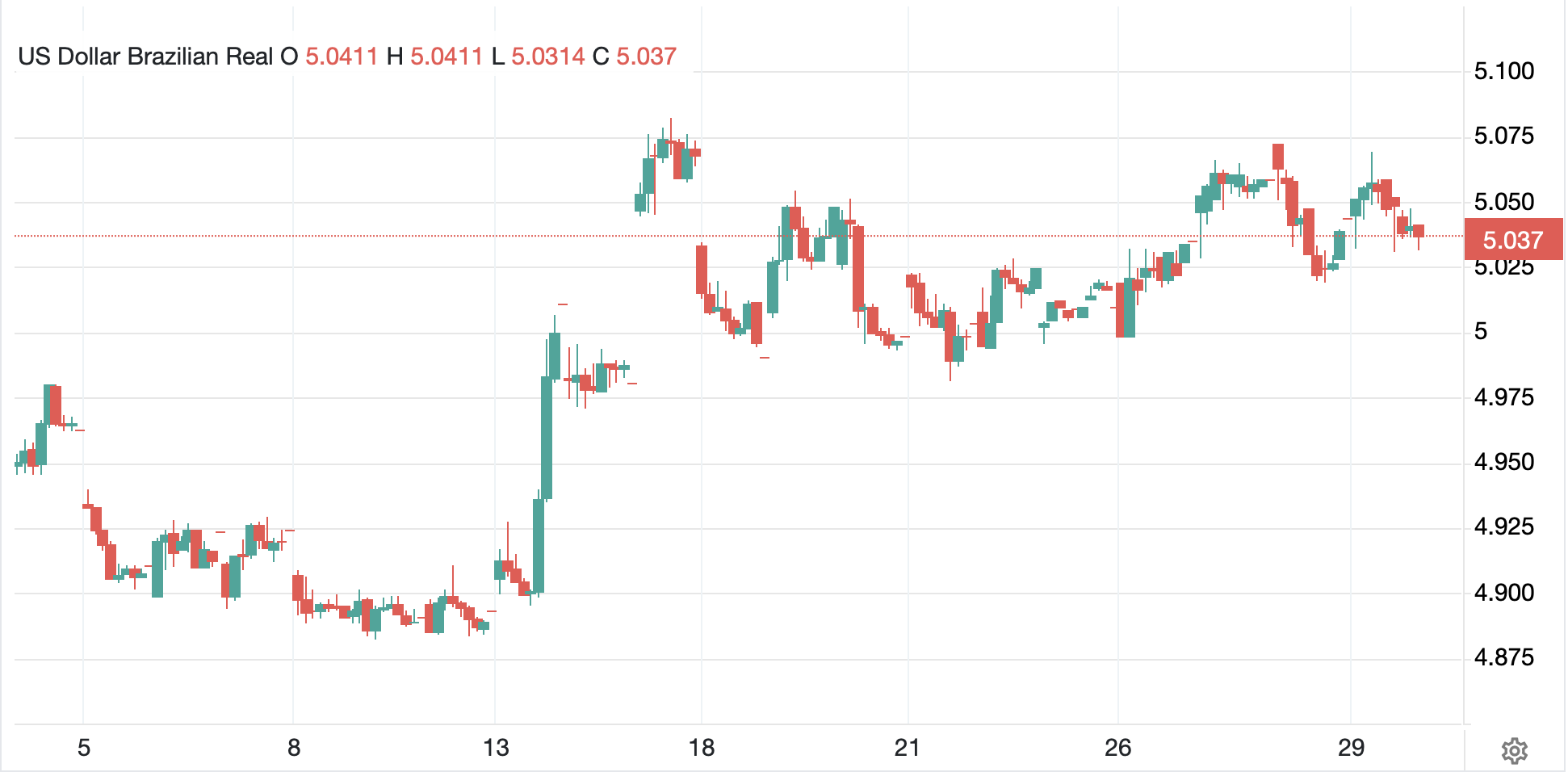
Finally, turning to the dollar, after modest gains yesterday, it is little changed this morning.  The RBA raised rates by 25bps, as expected and AUD is unchanged, as are the euro and pound.  With the BOJ on holiday, JPY (-0.2%) is slipping slightly, but not showing any major activity.  However, we have seen several EMG currencies improve with MXN (+0.3%) and BRL (+0.4%) both benefitting from the increased risk appetite we are seeing in overall markets.  The thing about the dollar is it has not been interesting for quite some time, trading within a fairly narrow range.  However, while we continue to hear many pundits describe the dollar’s ultimate demise, there is an interesting story in the FT about the dollar’s dominance in global markets as can be seen in the chart below from Kobeissi on X.

This is not a demonstration of the world shunning dollars, just sayin!

On the data front, this morning brings the Trade Balance (exp -$60.5B) along with ISM Services (53.7) and JOLTs Job Openings (6.83M).  We also see New Home Sales (668K) and hear from two Fed governors, Bowman and Barr.

But it is all still about the war and oil, and until something definitively changes there, I expect we will chop with every headline.

Good luck

Adf

Ere Fears They Shed

The status is still very quo
As ships still cannot come or go
However, Iran
Proposed a new plan
With nukes as a part of the show

But thus far, whatever they said
Has not moved discussions ahead
So, oil’s crept higher
As traders require
More certainty ere fears they shed

While President Trump has announced a new plan to help escort ships trapped in the Persian Gulf through the Strait of Hormuz, thus far, none have taken the chance.  Over the weekend, Iran ostensibly put forth another peace proposal, and this time their nuclear activities were part of the plan, a major change, although President Trump has rejected it overall.  To me, though, this is major progress as it demonstrates that there is a negotiation ongoing.  

My armchair analysis, FWIW, is that Ahmed Vahidi is watching his nation crumble and beginning to really feel the pinch of the US naval blockade as his revenues shrink rapidly.  While there are many estimates of how long Iran can withstand a lack of revenue, and I have no idea what that answer is, I feel it is reasonable to assume that if he doesn’t have enough to pay his soldiers, many of them will simply go home.  Already I have read reports that many of their payments to soldiers and proxies have been dramatically reduced as the US continues to tighten the financial screws via sanctions on banks and companies that have been acting as Iran’s middlemen.  I believe it is widely agreed on all sides of the conversation that the Iranian economy has been virtually collapsing with the rial having fallen 95% in value, access to basic staples limited and suffering widespread.  

The one thing of which I feel certain is that Vahidi wants to remain in power, and I would estimate as the pain increases, and the money stops flowing, his grip on power is slipping.  Staying in power without nuclear weapons is likely much preferred to being deposed.  

In the end, like every negotiation, the parties start far apart and get closer over time.  Now, my view is likely not worth all that much, but the oil market’s view is worth billions of dollars and if we look at how the price of oil has behaved, while uncertainty remains, (especially after a report this morning that Iran fired on and struck a US naval vessel, although that report has been denied), the market does not appear to believe that this is going to continue that much longer.  

Source: tradingeconomics.com
Several things continue to occur as at $100/bbl; there is some level of demand destruction; production elsewhere in the world continues to grow (I read that Venezuelan production rose to 1.25 mm bpd ,more than had been assumed prior to the Iran war); and the Saudi east-west pipeline is now pumping its capacity 7 million bpd, thus the amount of oil ‘missing’ has been reduced from the initial headline 20 mm bpd to somewhere along the lines of 12 mm bpd, still extremely painful to the global economy, but obviously not (yet) catastrophic.  However, since oil prices remain around $100/bbl, and have not risen to $150/bbl or $200/bbl as many pundits had forecast, there remains a great deal of confidence that this is going to end before too much more time has passed.  I certainly hope so for everyone’s sake.

Away from that, there is precious little other news to note as Asia is basically on holiday until Thursday and the UK is closed today, so market activity has been more muted.  But let’s take a look.  In the equity markets, weirdly HK (+1.2%) was open despite both China and the UK being closed and given HK’s history, I would have thought it would have responded to one of those situations.  But the big news was Korea (+5.1%) which was dramatically higher on rallies in Samsung and SK Hynix shares, both of which have been major beneficiaries of their semiconductor businesses booming alongside AI demand.  I guess we shouldn’t be surprised Taiwan (+4.6%) followed that path and in truth, there were more positive outcomes (India, Philippines, Malaysia, Singapore, New Zealand) than laggards (Australia).  Remarkably, everything I read is that Asia is the region most negatively affected by the Iran war, yet here we continue to see equity markets rising.

In Europe, things are less optimistic this morning with red across the screen led by Spain (-1.6%) and France (-1.0%) although both the UK and Germany are nigh on unchanged.  One of the weekend stories is that the US is now going to be raising tariffs on European auto imports to 25% from the 15% initially agreed as Trump claims the Europeans weren’t following the agreement.  As to US futures, this morning they are marginally lower as I type (7:30) but remain just ticks away from the all-time highs set last week.  Again, it is difficult to accept the idea that the world is about to end based on the market’s current behavior.  Look at the chart below and worry does not seem to be prevalent, nor has it been for any extended length of time in the past 5 years.

Source: tradingeconomics.com
In the bond market, yields are higher this morning with Treasuries (+4bps) leading the way and European sovereigns all higher by between 3bps and 4bps as well.  It’s interesting that this is the behavior but I suppose it has to do with the Keynesian view that higher economic activity leads to higher rates.  If we look at the PMI data from around the US and Europe, manufacturing has been doing quite well.  Look at the ISM Manufacturing chart below for the past 3 years and it is clear that investment is growing there.

Source: tradingeconomics.com
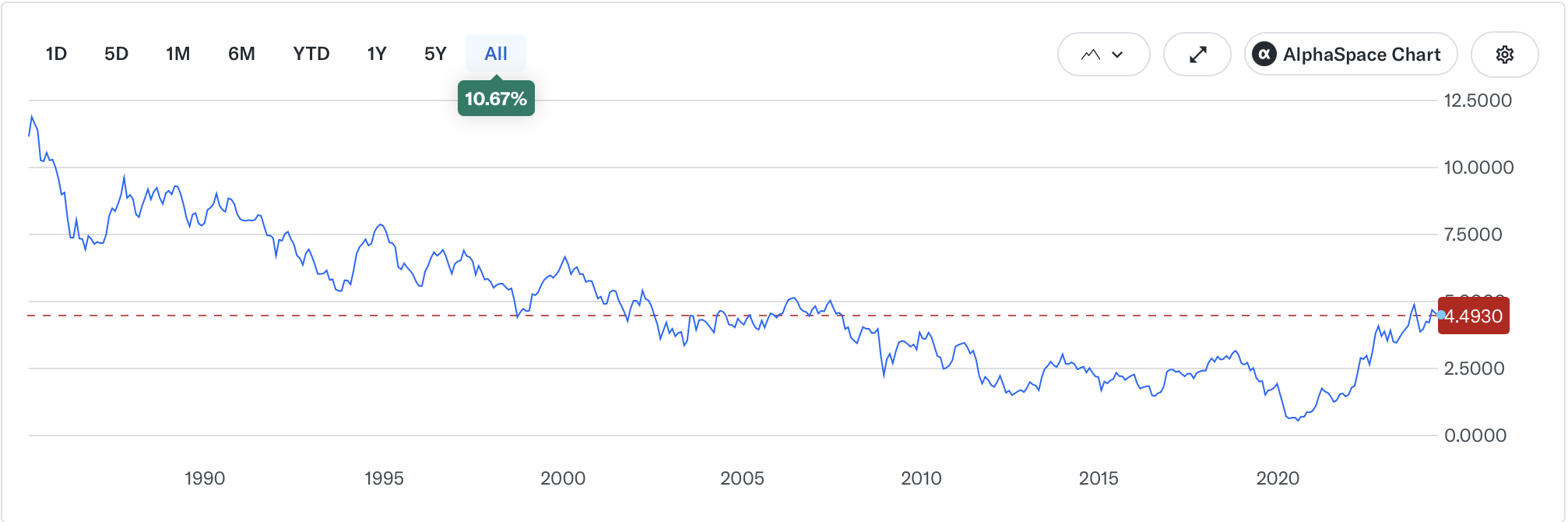
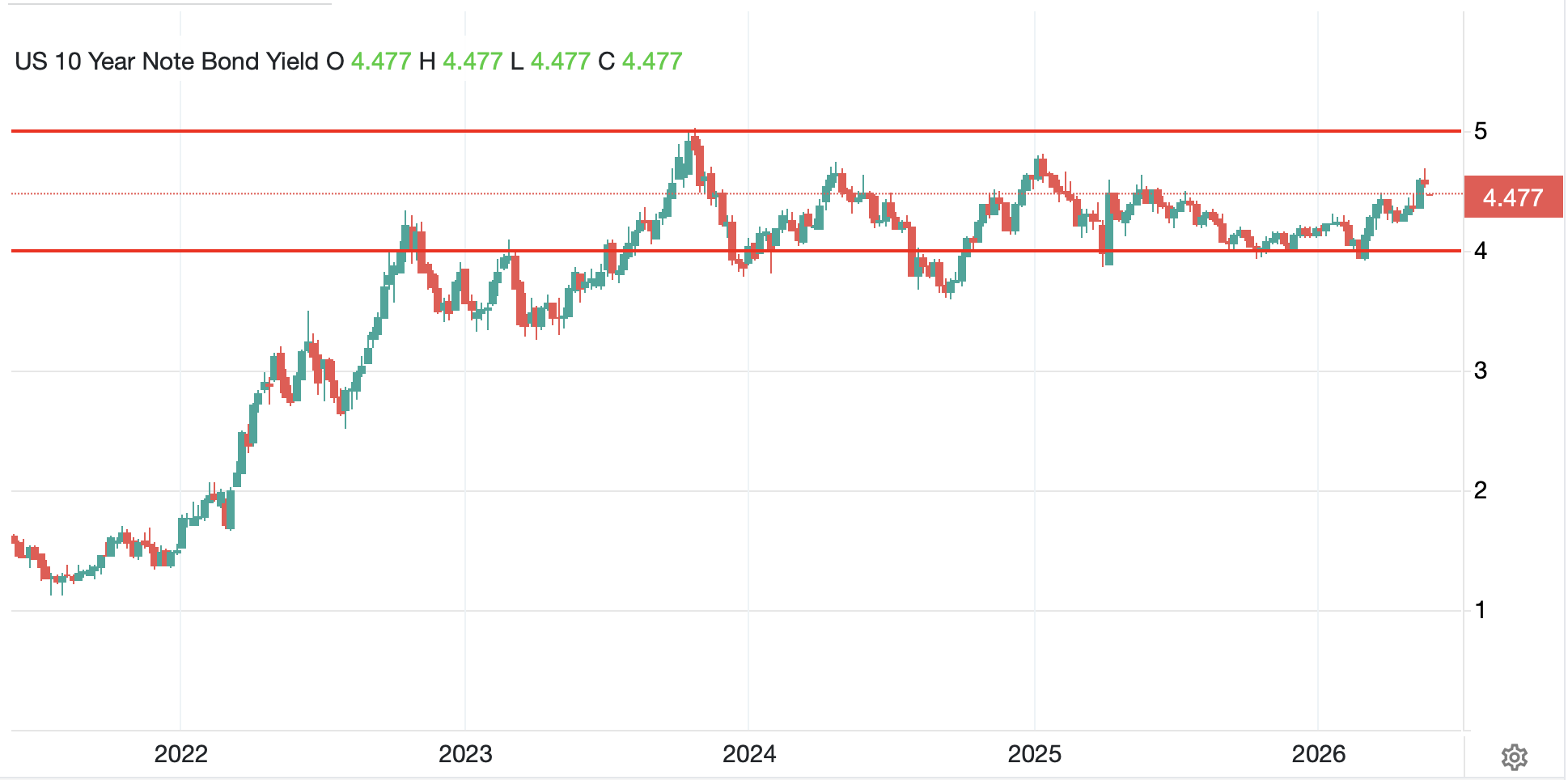
It is a similar tale in Europe with Manufacturing PMI data this morning all being released healthily above the 50 level and rising from last month.  The market response to lift yields seems anachronistic, but such is life.  However, it is worth highlighting that if we take a bit of a longer-term perspective on 10-year Treasury yields, while they are pushing toward the top of a 4.00% – 4.50% range, you can see that range has largely been intact for the past 3 years.  It is not clear to me that it is time to panic on yields yet.

Source: tradingeconomics.com
In the commodity space, with oil (+3.3%) having risen on the reports of a US ship being attacked, we cannot be surprised to see gold (-1.2%) and silver (-2.6%) both slipping along with copper (-1.6%). This is especially true with China and most of Asia on holiday as official buying of gold is probably on hold for now.  

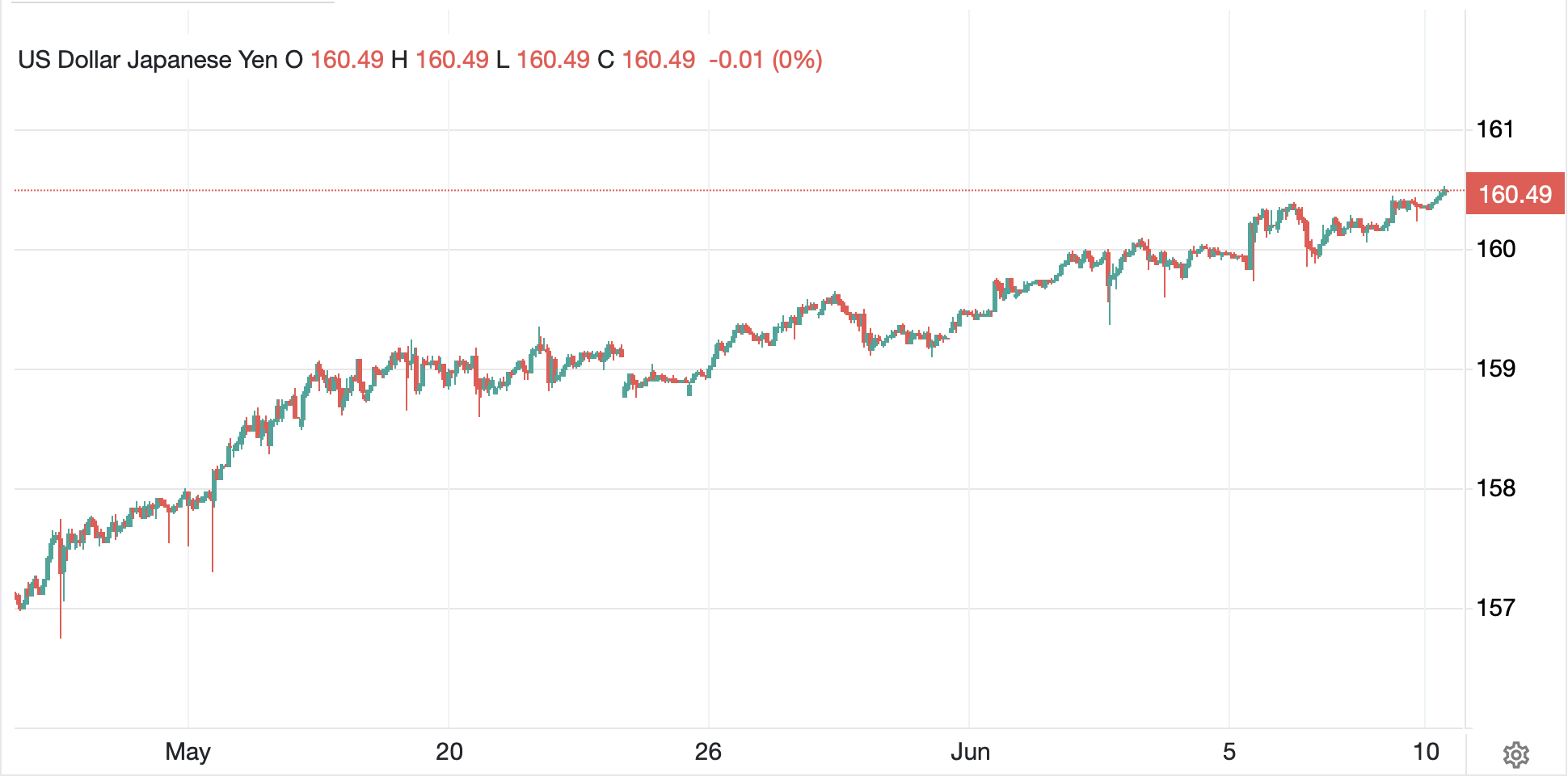
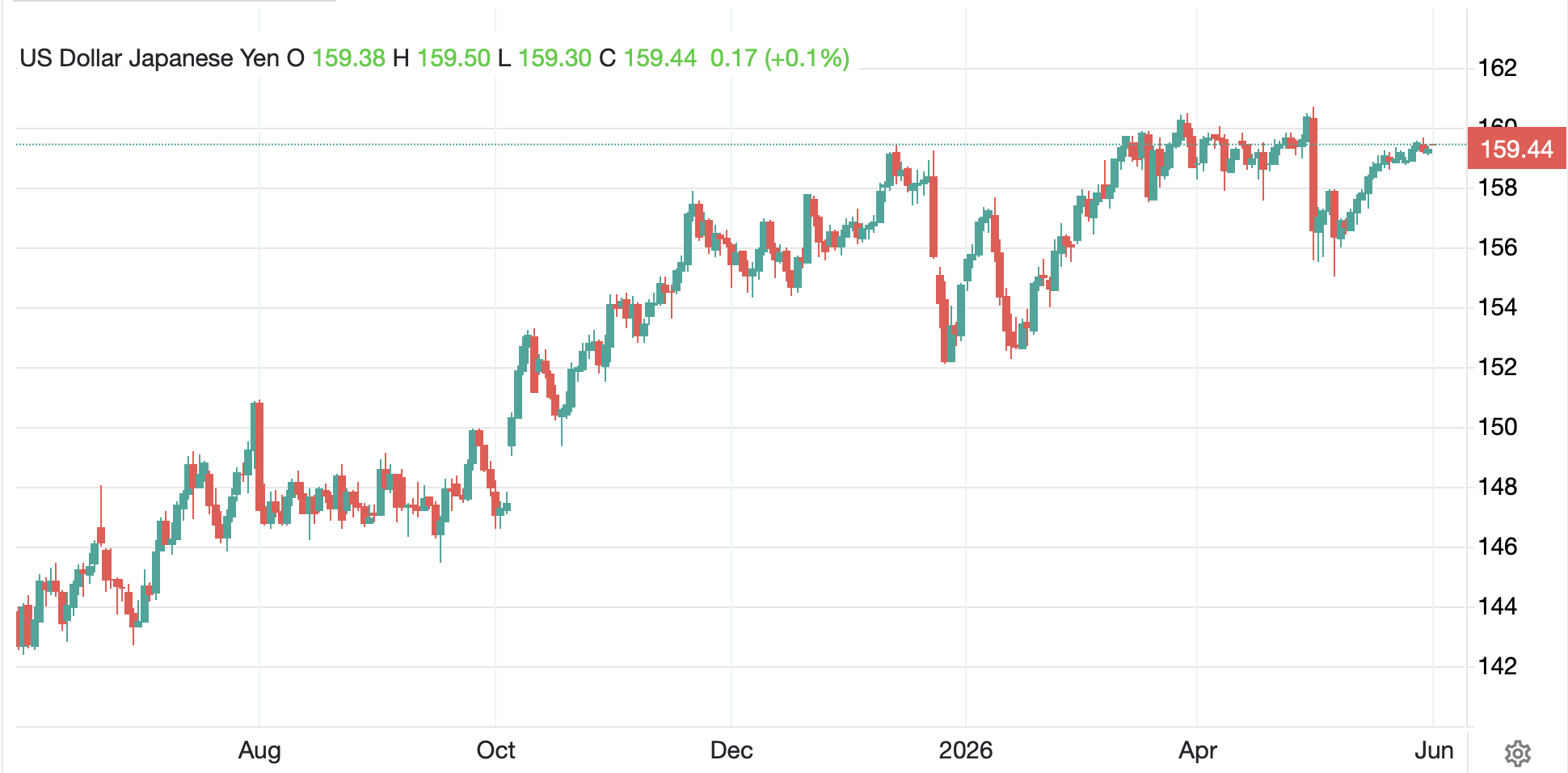
Finally, the dollar is firmer this morning as risk is under pressure across the board.  US futures are lower, European stocks are lower and oil is higher.  So, gains of 0.25% for the dollar against most currencies are the norm.  There was a very sharp appreciation in the yen early in the overnight session and another one a few hours ago, as you can see in the chart below, with many believing the BOJ was in again during quiet markets, but it has completely reversed.  My take is the BOJ would not have spent reserves like this and would have been far more emphatic if they wanted to move the market again.

Source: tradingeconomics.com
But, as market in Asia were quite thin, any large sell order would have been able to force a move like these.  In addition, with the dollar now several percent below their level of concern, I suspect they will save their ammunition.  In the EMG bloc, ZAR (-0.5%) continues to feel most of the pressure from Iran as the combination of higher oil prices and lower gold prices are a double whammy.  As well, NOK (+0.35%) continues to respond positively to the oil price.   Net, the dollar remains in demand for now.

On the data front this week, it is a mixed week until Friday’s NFP data is released.

TodayFactory Orders0.5%
 -ex Transport0.7%
TuesdayTrade Balance-$60.5B
 ISM Services53.7
 JOLTs Job Openings6.83M
 New Home Sales668K
WednesdayADP Employment99K
ThursdayInitial Claims205K
 Continuing Claims1800K
 Nonfarm Productivity1.4%
 Unit Labor Costs2.6%
 Consumer Credit$11.0B
FridayNonfarm Payrolls60K
 Private Payrolls73K
 Manufacturing Payrolls5K
 Unemployment Rate4.3%
 Average Hourly Earnings0.3% (3.8% y/Y)
 Average Weekly Hours34.2
 Participation Rate61.7%
 Michigan Sentiment49.5

Source: tradingeconomics.com
In addition, Fed speakers are back on the circuit (I sure hope Warsh shuts them all up) with 12 speeches from 9 different speakers.  The funny thing is, we already know their views, Miran wants to cut and everybody else is on hold, so what are they going to say?

The war remains the only thing that matters right now, so watch for headlines that an agreement is coming closer.  If that happens, oil will slide along with yields and the dollar while metals and stocks will rally.  (Of course, apparently, we don’t need anything else to get stocks to rally!)

Good luck

Adf

Disconcerting

The third time, it wasn’t a charm
As thankfully, Trump saw no harm
But it’s disconcerting
The left keeps on flirting
With killing Trump by firearm

But absent more news on the war
Investors, most stocks, still adore
And there’s still a call
The dollar should fall
Though so far, they’re down on that score

It is certainly disconcerting that there have been three bona fide assassination attempts on President Trump in the past two years, something I fear speaks loudly about his opponents.  Fortunately, this one also failed.  Interestingly, as this occurred at the White House Correspondents Dinner, the entire Washington press corps, who largely detest the man, were there.  I wonder if this experience will alter their rhetoric, which I would argue has been the key driving force behind these attempts.  Alas, I fear that will not be the case, at least not for more than a few days at best.  

But that was a far more exciting weekend than anybody imagined as there is no new news regarding the Iran war with potential talks never occurring over the weekend.  Neither have the marines moved in on Kharg Island, so the status quo, a US naval blockade, remains the primary situation.  This leads to two questions; first, how long can Iran withstand the lack of revenue with the government, or more accurately the military, still operating effectively? And second, how long before Iran’s oil wells need to be shut in, which is likely a death sentence on those wells, and by extension, on Iran’s long-term revenue stream?

Frankly, that’s what the weekend brought, so let’s turn to markets.  While the DJIA lagged on Friday, both the NASDAQ and S&P 500 rallied to yet further new all-time highs as US corporate earnings remain robust and the market looks ahead to this week where 5 (MSFT, GOOG, AMZN, META, AAPL) of the Mag7 report earnings this week on Wednesday and Thursday.  As well, Wednesday brings the FOMC decision, with no change expected.  As to US futures this morning, as I type (6:50), they are essentially unchanged.

Overnight, Asia’s session was mixed with Japan (+1.4%) putting in a nice performance along with Korea (+2.15%), India (+0.8%) and Taiwan (+1.8%) although there were laggards (HK, Australia, Indonesia, Singapore) as well, with much smaller declines.  China was basically unchanged.  Perhaps the biggest news was that an oil tanker from the US arrived in Japan for the first time, although certainly not the last time.  European bourses are all a bit firmer this morning, seemingly responding to decent earnings throughout many nations there.  Thus, Germany (+0.6%) is leading while Spain, France and Italy (+0.5% each) lag slightly and the UK (+0.1%) brings up the rear as King Charles prepares to visit President Trump and the US starting today, ostensibly trying to resurrect the once special relationship that has deteriorated over time.

In the bond market, nothing continues to happen with Treasury yields higher by 1bp this morning and similar price action across all of Europe.  JGB yields (+4bps) were the big mover as market participants await three key central bank meetings this week, the Fed, ECB and BOJ.  But here’s the thing, of all the major economies around, Japan’s is the only one where the bond market is offering any real signal.  The below chart from tradingeconomics.com shows US (blue line), German (tan line) and Japan (green line) 10-year yields over the past 5 years.
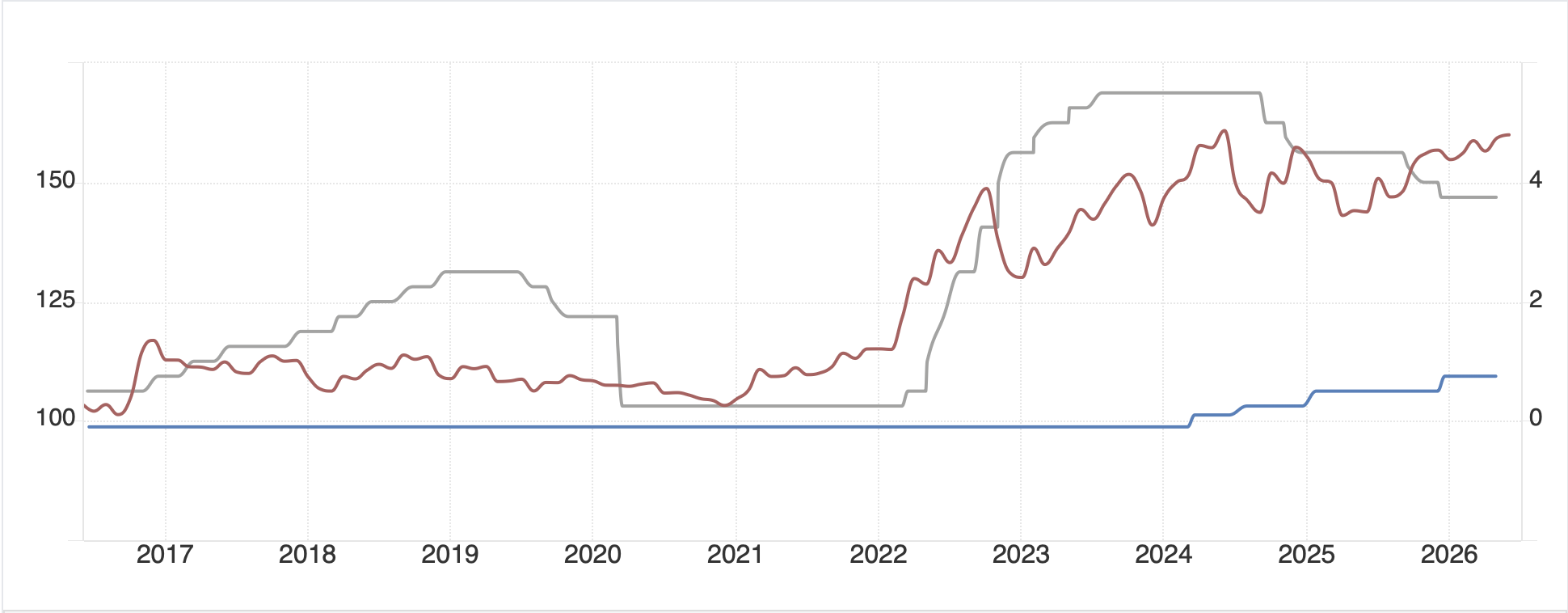
While we all remember the pain in markets when the Fed, and then all other central banks, figured out that the Covid policy inflation wasn’t going to be as transitory as they hoped and pushed rates up at a historically fast pace in 2022, since then, it is pretty easy to make the case that neither US nor Germany (and by extension the rest of Europe) have seen any substantive change in their bond markets.  I am speaking in a big picture reference here, not the day-to-day noise that we see.  Meanwhile, Japan has finally begun to feel the pressure of a massive debt/GDP ratio and rising inflation.

Contrary to popular belief, Treasury bonds remain the reserve asset of choice around the world as every nation needs to hold a certain amount of USD simply to function in the world today (which is why there is so much recent discussion regarding USD swap lines for numerous countries).  While it sounds great for the panican set to discuss how Chinese “official” holdings of Treasuries have collapsed and that is a signal they are selling bonds, the reality is they have switched their custodians from the Fed to Clearstream and Euroclear in Brussels and Luxembourg while many of those assets are now held in large Chinese ‘private’ banks rather than on the PBOC’s balance sheet.

Source: @Brad_Setser

Notice the large grey bar at the right, foreign assets of the state banks.  Which brings us to the central bank meetings this week where no major central bank is expected to change policy.  Japan seems the diciest call, but the word was put out last week that June is the likely date. As well, the ECB’s own market watching website is now looking at June as a probable rate hike as per the below from ecb-watch.eu.

For the FOMC, no change today and now that the DOJ has referred the cost overrun investigation to the IG at the Fed, the hold on Kevin Warsh by Senator Tillis has been lifted.  I expect he will be confirmed in time for Powell to leave on his scheduled date.  It remains to be seen if Powell will stay on the FOMC (his term technically runs until January 2028), but historically, once a Fed chair leaves that role, they step away completely.  Ultimately, until the markets begin to understand that inflation is going to be structurally higher than in the past, I suspect bond yields are going to remain range bound.

In the commodity space, oil (+0.7%) is a touch higher as the market seems to be becoming increasingly concerned that the impacts of the closure of the Strait of Hormuz are going to be longer lasting than previously assumed.  However, the futures curve remains steeply backwardated as per the below chart form tradingview.com.

Personally, I see this as confirmation of my own view that oil prices are likely to decline over time as more and more supply becomes available with new projects.  If anything, this war has accelerated that process.  Meanwhile, metals prices are essentially unchanged this morning, biding their time for the next big piece of news.

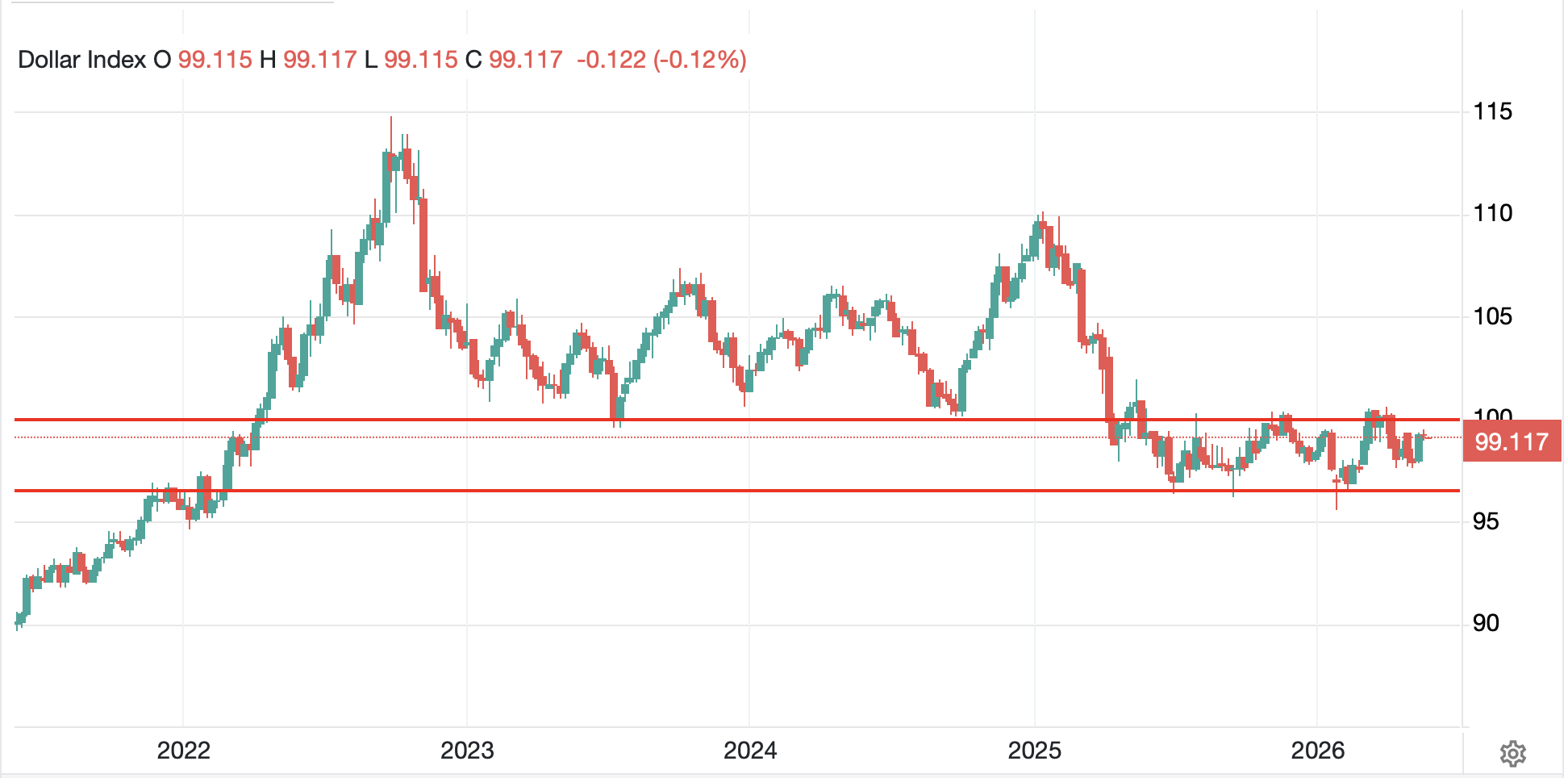
Finally, the dollar is under modest pressure this morning, down about -0.2% across the board as risk appetites continue to build with the war receding in traders’ collective mindset.  But here, too, just like in the bond market, it is difficult to make the case that anything of note has happened to the dollar, writ large, over the past year.  I know I show this chart frequently, but it is simply to hammer home the idea that the dollar is not collapsing.  It has basically had a 3.5% range 96.50 – 100.00 for the past twelve months.  I’m sorry, that is not a death omen!

Source: tradingeconomics.com
On the data front, there are a total of 5 central bank meetings with no changes expected anywhere, and then PCE data later on.

TonightBOJ Rate Decision0.75% (unchanged)
TuesdayCase-Shiller Home Prices1.1%
 Consumer Confidence89.2
WednesdayHousing Starts1.4M
 Building Permits1.39M
 Durable Goods0.5%
 -ex Transport0.4%
 Goods Trade balance -$86.0B
 BOC Rate Decision2.25% (unchanged)
 FOMC Rate Decision3.75% (unchanged)
ThursdayBOE Rate Decision3.75% (unchanged)
 ECB Rate Decision2.0% (unchanged)
 Q1 GDP2.2%
 Personal Income0.3%
 Personal Spending0.9%
 Initial Claims215K
 Continuing Claims1820K
 PCE0.7% (3.5% Y/Y)
 Core PCE0.3% (3.2% Y/Y)
 Chicago PMI53.0
 Leading Indicators-0.1%
FridayISM Manufacturing53.0
 ISM Prices Paid80.0

Source: tradingeconomics.com
It remains difficult to get too excited about the data, though, as war stories remain top of mind.  Until something changes there, I suspect we will see equities continue to rally on earnings data with the rest of the markets doing very little overall, data be damned.

Good luck

Adf

A Bad Bet

While nothing is terribly clear
It seems there’s more worry and fear
The war’s gonna start
To blow things apart
Once more, thus risk gets a Bronx cheer

At this point the navy is set
With carriers, three, as the threat
Meanwhile, Iran’s leaders
Are fighting seceders
It could be they made a bad bet

As the week draws to a close, there is no clarity regarding the potential for a peace deal to end the war as both sides continue to claim the other is the problem with respect to getting to talks.  There continues to be a massive amount of propaganda from both sides and maritime traffic remains at a standstill in the Strait of Hormuz.  Arguably the most noteworthy occurrence was that the USS George H.W. Bush has arrived in theater, bringing the navy armada up to 19 ships, I believe.  That is an enormous amount of firepower.  In fact, there is a theory that the entire purpose of the ceasefire was to allow the US to move all its assets into theater to ensure that the next action completes the process.  

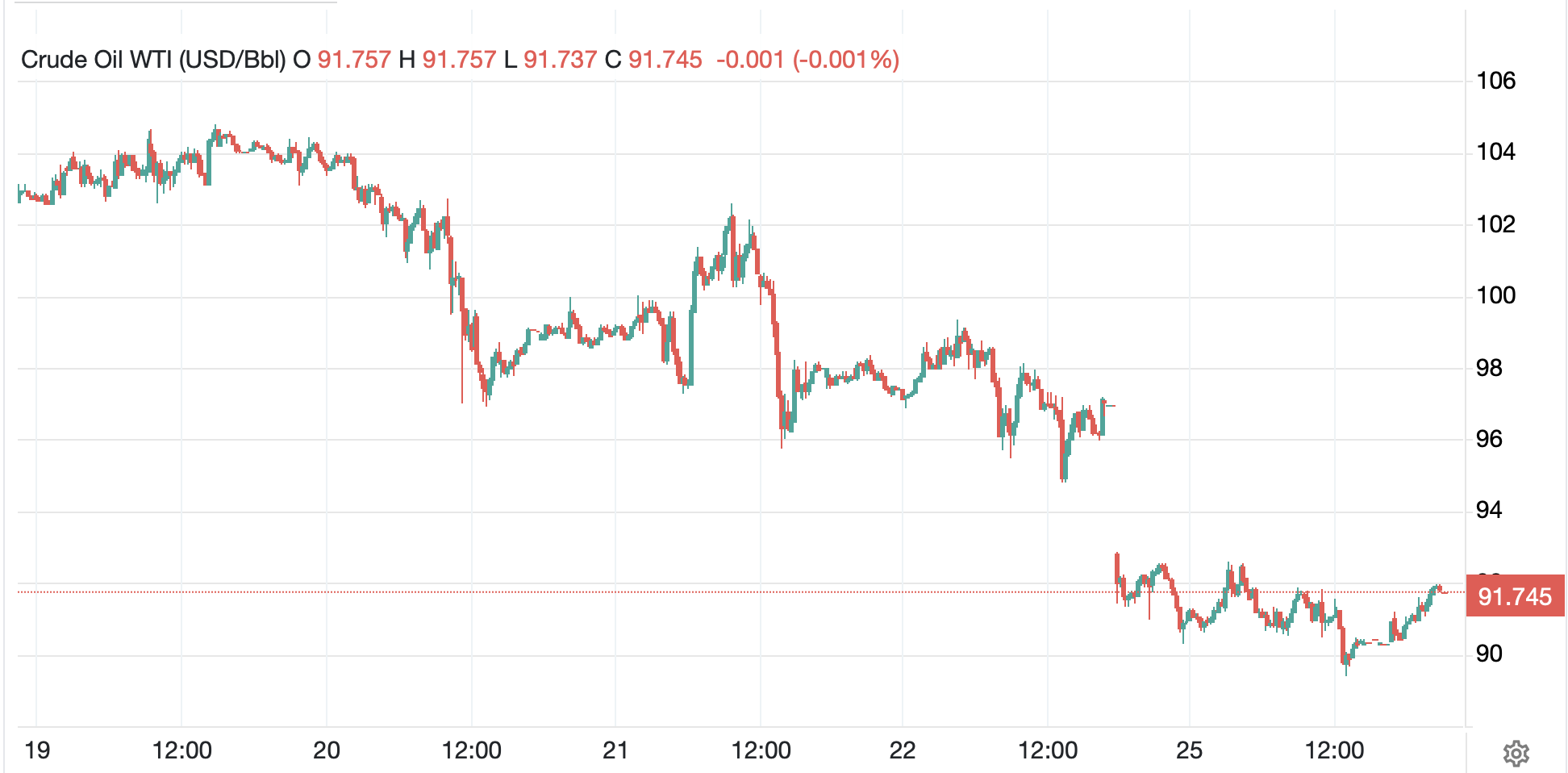
But there has been a change amongst the views of market participants about how things are going to proceed as evidenced by the price of oil.  Arguably, there is no better barometer of the situation than that price and as you can see from the below chart, crude oil’s price (+1.6%) has traded higher consistently all week.

Source: tradingeconomics.com
Too, the fact that we are approaching the weekend has me thinking that the next step in this war is about to kick off.  President Trump has shown that he favors military action when markets are closed and I am pretty certain that view hasn’t changed.  So, keep alert for the news when you wake up tomorrow morning.

However, until such time that the situation on the ground there changes, we are left with a great deal of pontification (present company included, although I try to simply focus on the markets and how their price action offers indications of current events).  Beyond the war, there is precious little new news of market import, though, right now.  Data continues to be a secondary consideration for traders and investors as everything is being distorted by the sudden impacts of the sharp rise in energy prices.  Politics is always a long-term phenomenon, with the daily machinations rarely having a market impact.  Which leaves us with speculative activity, which never rests!

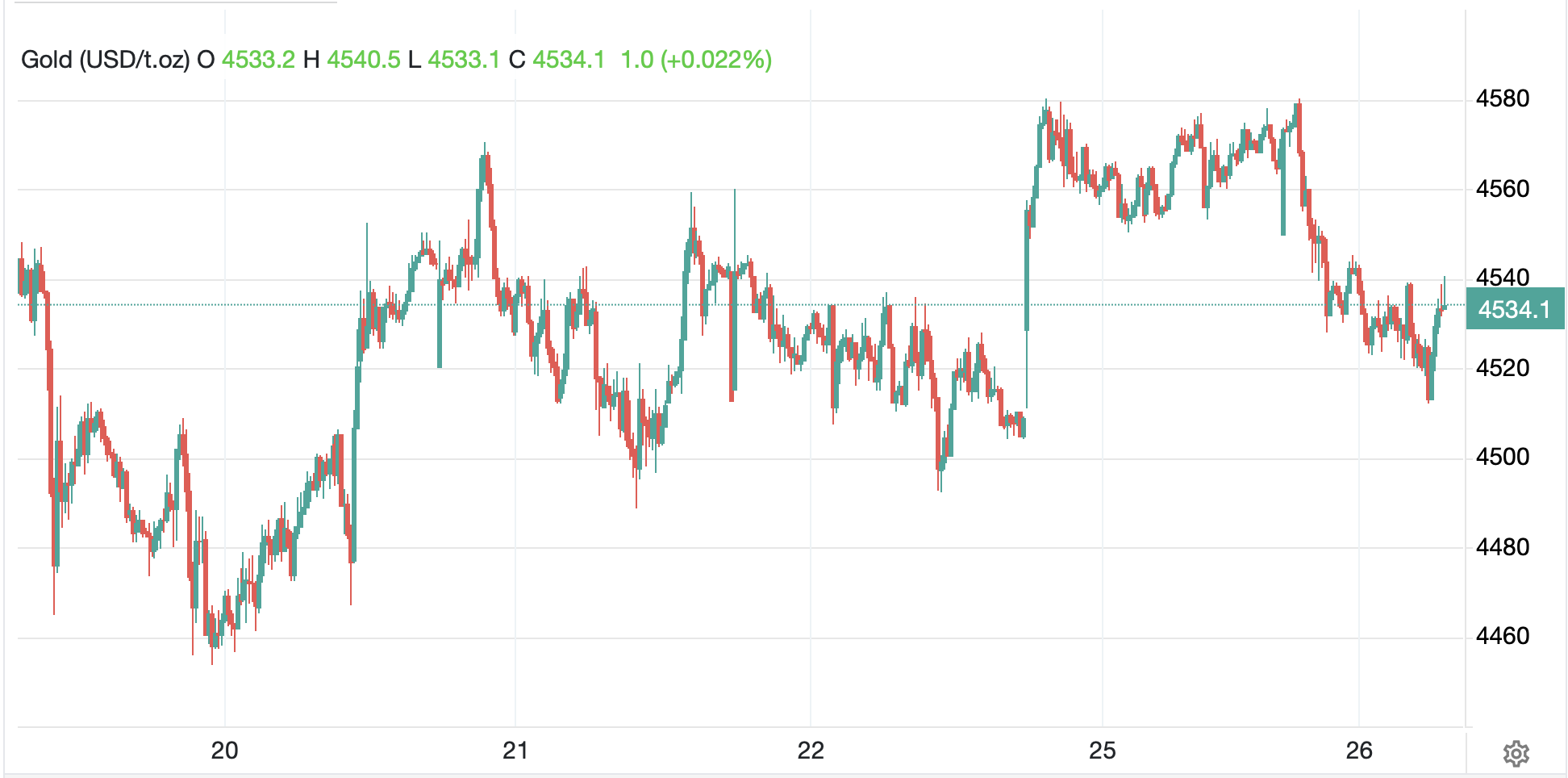
With that in mind, let’s look at the markets and see what they are telling us (or me at least).  Having already highlighted the fact that oil has been creeping higher all week, which I reiterate, implies to me that market participants have begun to believe further military action is imminent, we cannot be surprised that gold (-0.4%) and silver (-0.7%) are slipping as the correlation between the metals and oil has turned negative since the war began about 2 months ago.  Historically, this had almost always been a positive correlation, but right now, that relationship has clearly inverted as you can see in the below chart.

Source: tradingeconomics.com
It certainly remains an enigma that what many perceive to be the ultimate safe haven, gold, is performing so relatively poorly during the greatest strife we have seen in a number of years.  But there you go.

Of course, for risk appetite, the most consistent place to look is the equity market.  Yesterday saw US markets slip a bit, about -0.5% or so across the board, but they remain within spitting distance of their all-time highs.  Certainly, no panic yet.  And this morning, as I type (7:05), the futures markets show the NASDAQ firmer by nearly 1.0% while the DJIA is lagging, -0.2% and the SP500 is in between (+0.3%).  Last night, Tokyo (+1.0%) had a strong session after inflation data was released right at expectations and has not yet shown signs of running away higher.  At the same time, market participants are increasingly certain the BOJ will remain on hold next week, although there is now a 60% probability priced for a 25bp rate hike at the June meeting.  The rest of the region was mixed with China (-0.35%), India (-1.3%) and Indonesia (-3.4%!) all under pressure, the latter suffering after 4 major banks there were downgraded by Fitch, while Taiwan (+3.2%) soared after positive earnings data and economic data showing IP exploding higher by 28.7% in March.

In Europe, though, there are no happy faces with Spain’s IBEX (-1.4%) leading the way lower for the entire continent (CAC -1.1%, DAX -0.4%, FTSE 100 -0.6%).  It is a bit surprising as the only data of note was German Ifo Business Climate (84.4 and the grey line) and Expectations (83.3 and the blue line), both of which printed at their lowest levels since August 2023 and are both clearly trending lower.

Source: tradingeconomics.com
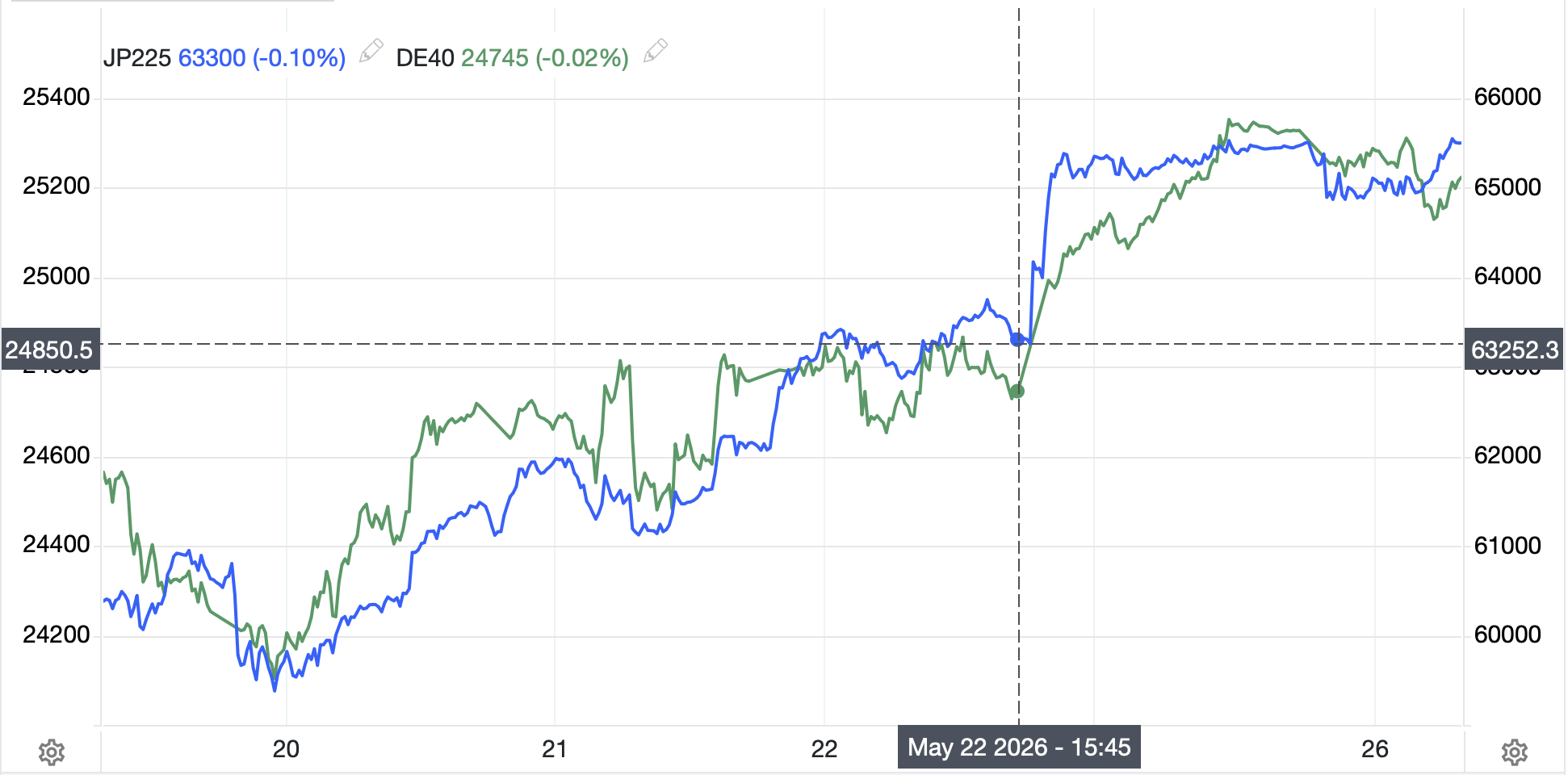
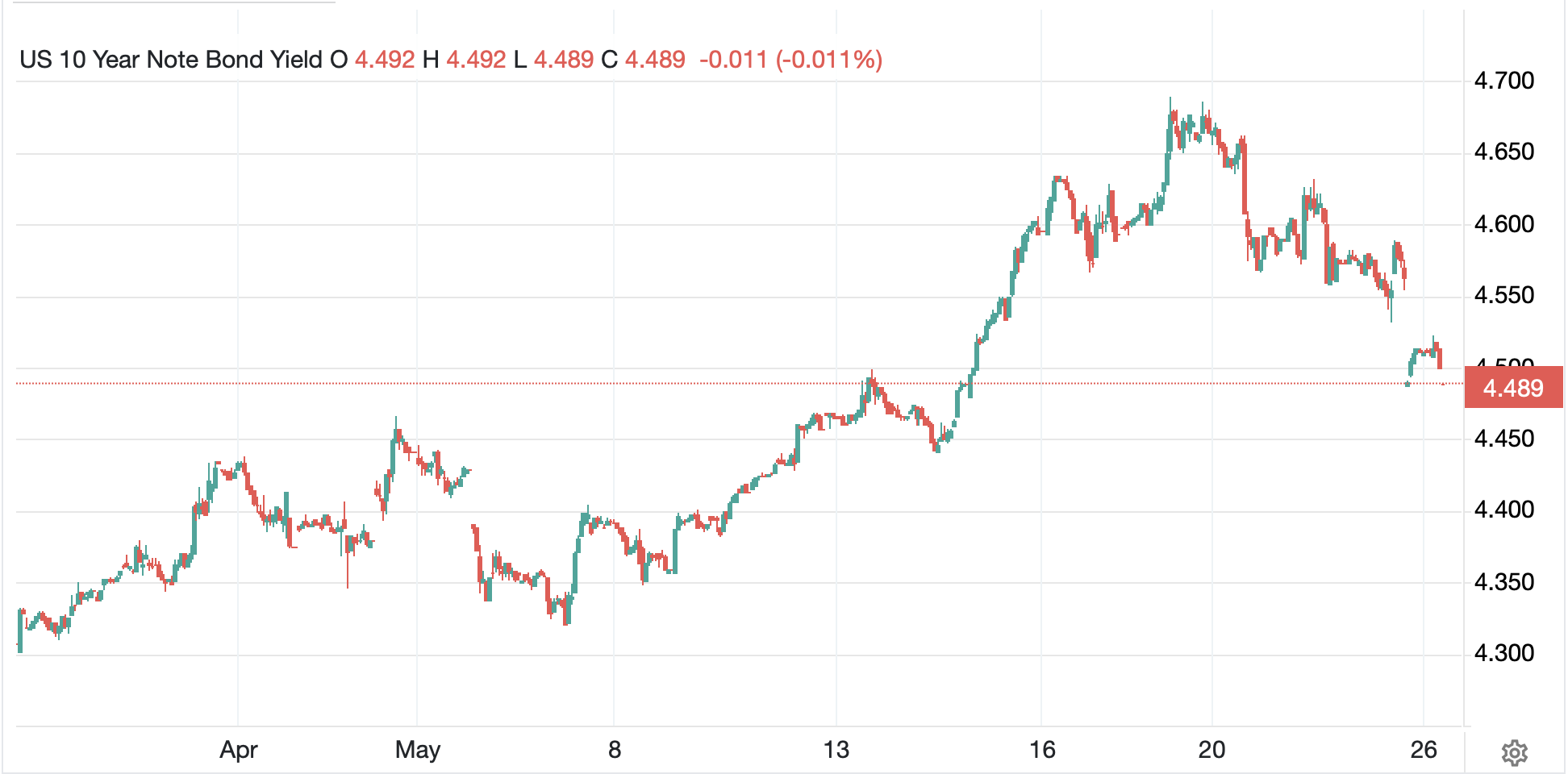
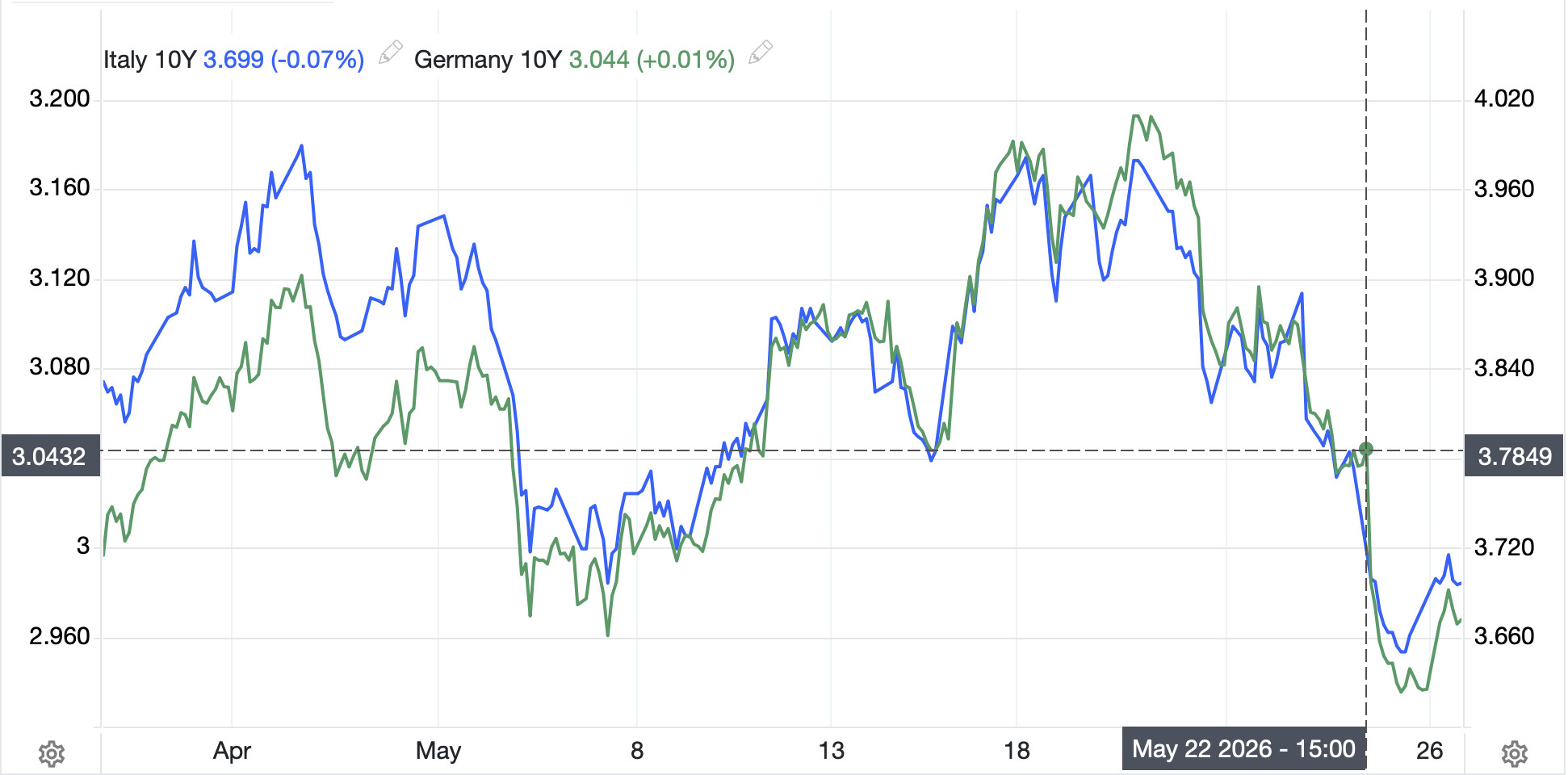
Bond yields are doing very little this morning, with Treasury yields lower by -1bp while European sovereign yields are all higher by between 1bp and 2bps.  Bond investors remain quite concerned about energy driven inflation but are also looking at the negative impacts on economic activity and so remain uncertain which way to go.  One thing to remember is that yields have really done very little over the past 6 months, at least, and that Treasury yields continue to be the global driver.  You can see the similarity in the shape of the price curves for both Treasuries and Bunds below, and both lines are pretty flat to my eye with one blip higher at the beginning of the war.

Source: tradingeconomics.com
Finally, the dollar is softer this morning, which is not in accord with its usual relationships to other assets.  Although it turns out that in the course of the hour I have been writing, things have changed and I cannot see a reason.  So, oil is now lower by -1.6%, gold is higher by 0.2%, and the dollar is softer across the board by 0.2% or so.  For me, I’m happy the relationships still hold, but I would love to be able to offer a catalyst for the change in sentiment.  And yes, US futures are higher across the board now.

Regarding the dollar, though, I couldn’t help but notice the Bloomberg article regarding the carry trade and how it has come back into favor as implied volatilies have fallen over the past month.  What this tells me is that there are no long-term views in the FX market despite all the dollar is going to collapse pap that comes from the FinTwit (FinX?) community.  Shorting yen remains the favored funding vehicle and the discussion is how BRL, MXN and TRY are the asserts favored to be held.  The thing about the carry trade is, it is great until it isn’t, but they don’t ring a bell before things change.  It is also a very different thing to short JPY and be long USD against it, with the USDJPY market amongst the most liquid markets in the world.  But if you are long BRL and short JPY, be prepared for a pretty wide spread on a forced exit because things have changed.  And if that is TRY or ZAR, the spread will be even wider!  Just sayin’.

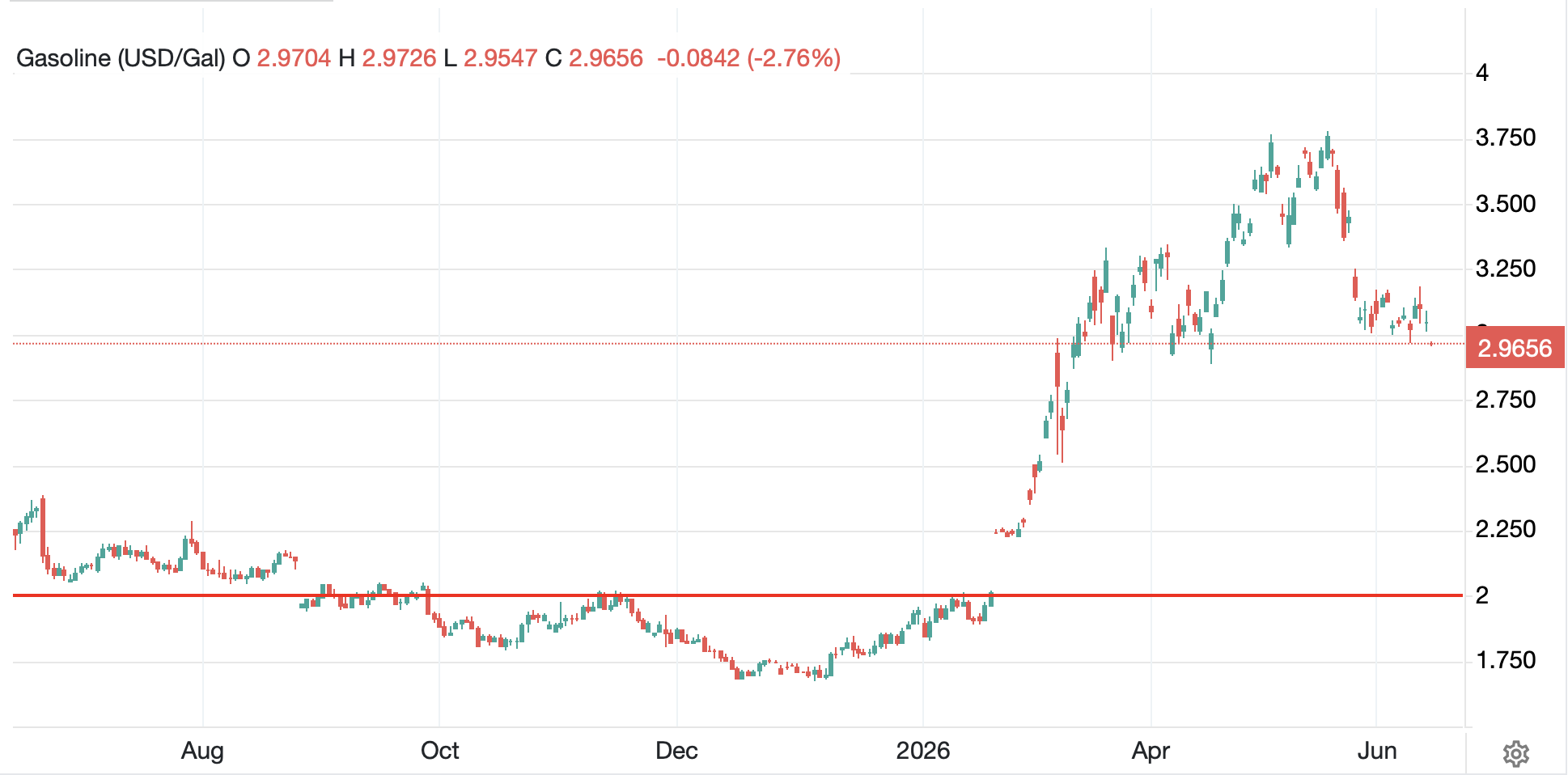
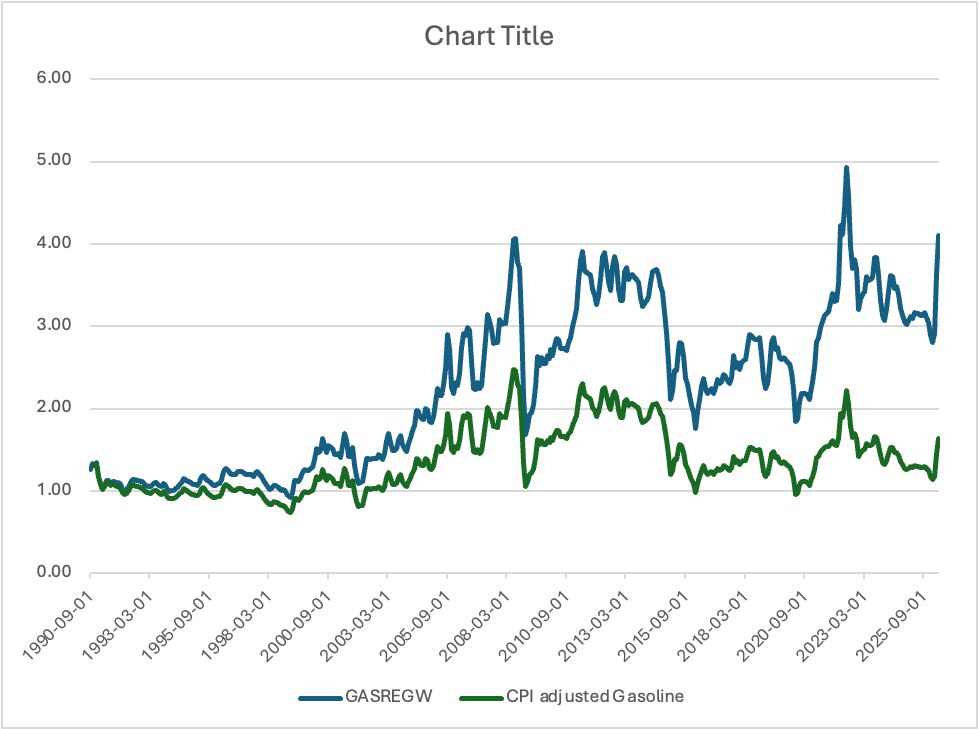
On the data front, this morning brings Michigan Sentiment (exp 47.6) unchanged from the preliminary reading which was the lowest in the 84-year history of the series.  Are things really that bad?  Maybe, but that certainly doesn’t jibe with the Retail Sales and PMI data.  The problem with survey data is there is an element of politics that distorts the reading and President Trump is such a polarizing figure, it exacerbates the situation.  Nobody likes high gasoline prices, but it is hard to reconcile gasoline prices, which by the way, remain lower than what we saw in the immediate wake of Russia’s invasion of Ukraine as per the chart below, with such a dramatic decline in confidence, hence my view of the political angle.

Source: tradingeconomics.com
Personally, I am on the lookout for the next military incursion or a deal this weekend, with diametrically opposed market impacts on Monday morning.  Once again, my advice is risk mitigation is the way you stick around to play again next week.

Good luck and good weekend

Adf

An Eye Blink

Last night it appeared a reprieve
Was offered, though I don’t believe
That Trump will delay
Much more than a day
Ere US Marines, wins, achieve

But as of last night, markets think
That peace will come in an eye blink
Thus, futures have rallied
While bond prices dallied
And oil has started to sink

This is the Tuesday night look, which is subject to significant change by the time I wake up tomorrow morning.  But here are the futures prices at 9:30pm:

Source: tradingeconomics.com
As you can see, US futures are higher and the Nikkei 225 is also modestly higher with no indication that there is concern over the US landing on Kharg Island and other Iranian key strongholds.  All this comes after news has filtered out that Ahmad Vahidi, who appears to be the senior most IRGC leader left, has arrested the civilian government members who were scheduled to meet with the US and hammer out a deal.  To my eyes, and from what I have read from what I believe is an excellent source, marines will be on Kharg Island before the week is out.  It strikes me if that is the case, the current equity rally, which has been impressive, will get challenged.

As to bonds, last night they were essentially unchanged with 10-year yields at 4.29%.  Again, this is not the stuff of major concern.  And oil?  Modestly lower and back below $90/bbl.

The early results are confusing
With recent attacks Iran’s choosing
But elsewhere there’s hope
That peace is in scope
Despite lots of, others, accusing

As of 6:20 this morning, although there have been several ships fired upon by Iranian gunboats, the US has not escalated, and the President has indicated he is waiting for news today on the situation.  One of the takes is that the Iranians are going to come to the table and seek a deal, although it is difficult for me to believe that Vahidi is ready to cede power.  But like virtually everybody else, nobody really knows what is happening.

However, markets appear to have made up their mind that the worst is over and there is no reason to panic any further.  In fact, it appears they are getting excited about the opportunities that will come about because of all the post-war reconstruction that will be necessary and will certainly be profitable for those companies engaged.

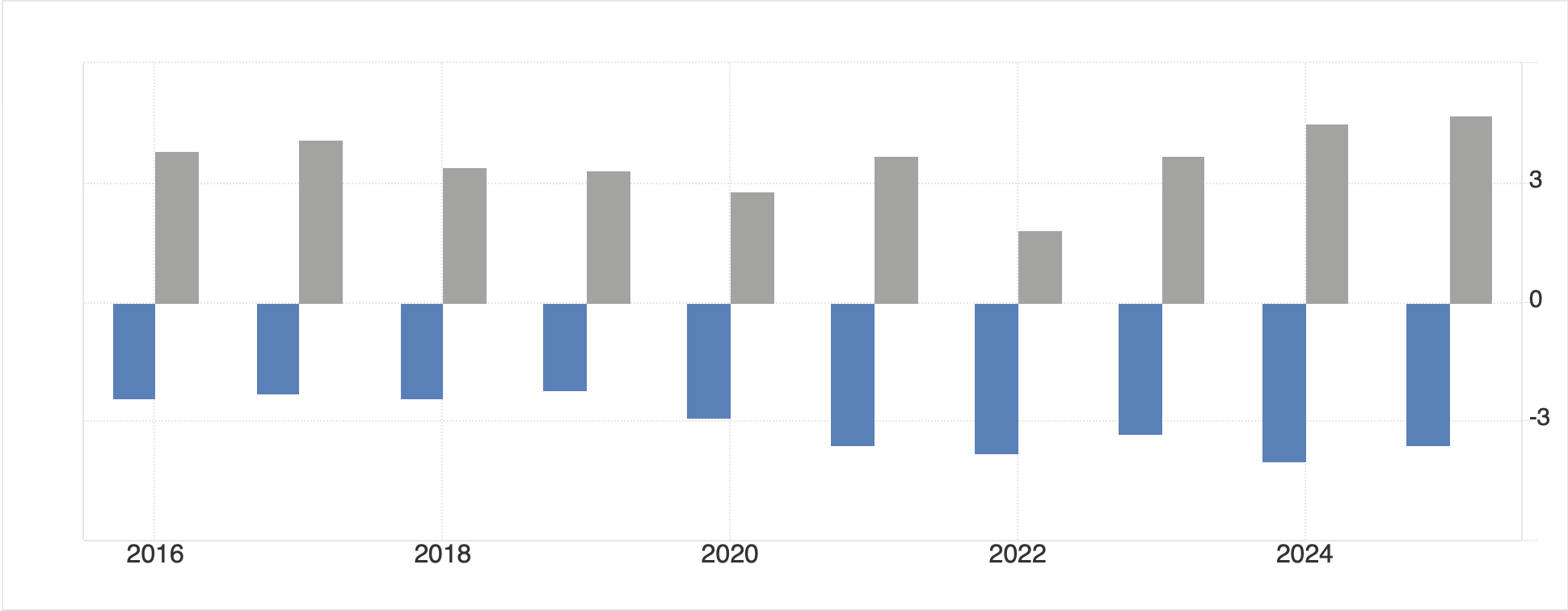
The other story from yesterday was the confirmation hearings for Fed Chair nominee Kevin Warsh.  I imagine it went about as largely expected with every Democrat despising him and every Republican liking him, but until the DOJ case against Powell regarding the reconstruction of the Eccles Building is finished, Senator Thom Tillis has said he will not allow a floor vote.  Warsh did consistently explain that the Fed has lost its way and has not achieved its goals so it is time to start thinking of new approaches.  And it is certainly true, as the below chart shows, that the Fed has been a failure with respect to its inflation target of Core PCE at or below 2.0%, a number last seen in February 2022 (the left=most bar on the chart).

Source: tradingeconomics.com
And with that in mind, let’s turn to markets this morning and see how things played out overnight and are evolving right now at 7:00.  US futures are virtually in the same place they were last night as per the below screenshot from tradingeconomics.com
Asian markets were mixed overall with Tokyo (+0.4%), China (+0.7%) and Taiwan (+0.7%) all having a decent day while HK (-1.2%) and Australia (-1.2%) led the way lower for those regional exchanges that were under pressure.  But in truth, it was about 50:50 with respect to gainers and losers.  Certainly, there was no strong theme.  Meanwhile, in Europe, markets have drifted a bit lower, but the CAC (-0.3%) and Spain’s IBEX (-0.3%) seem to be the worst of it.  Net, it is hard to get too excited about anything in the equity space right now.

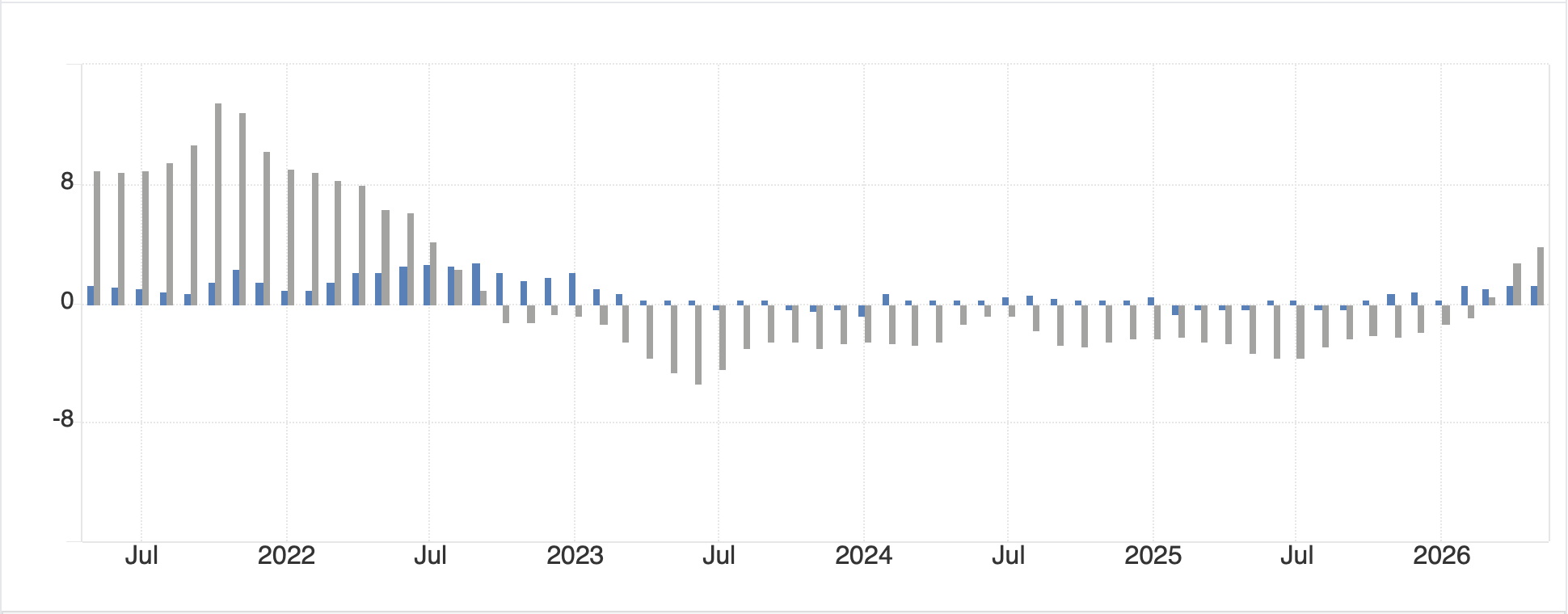
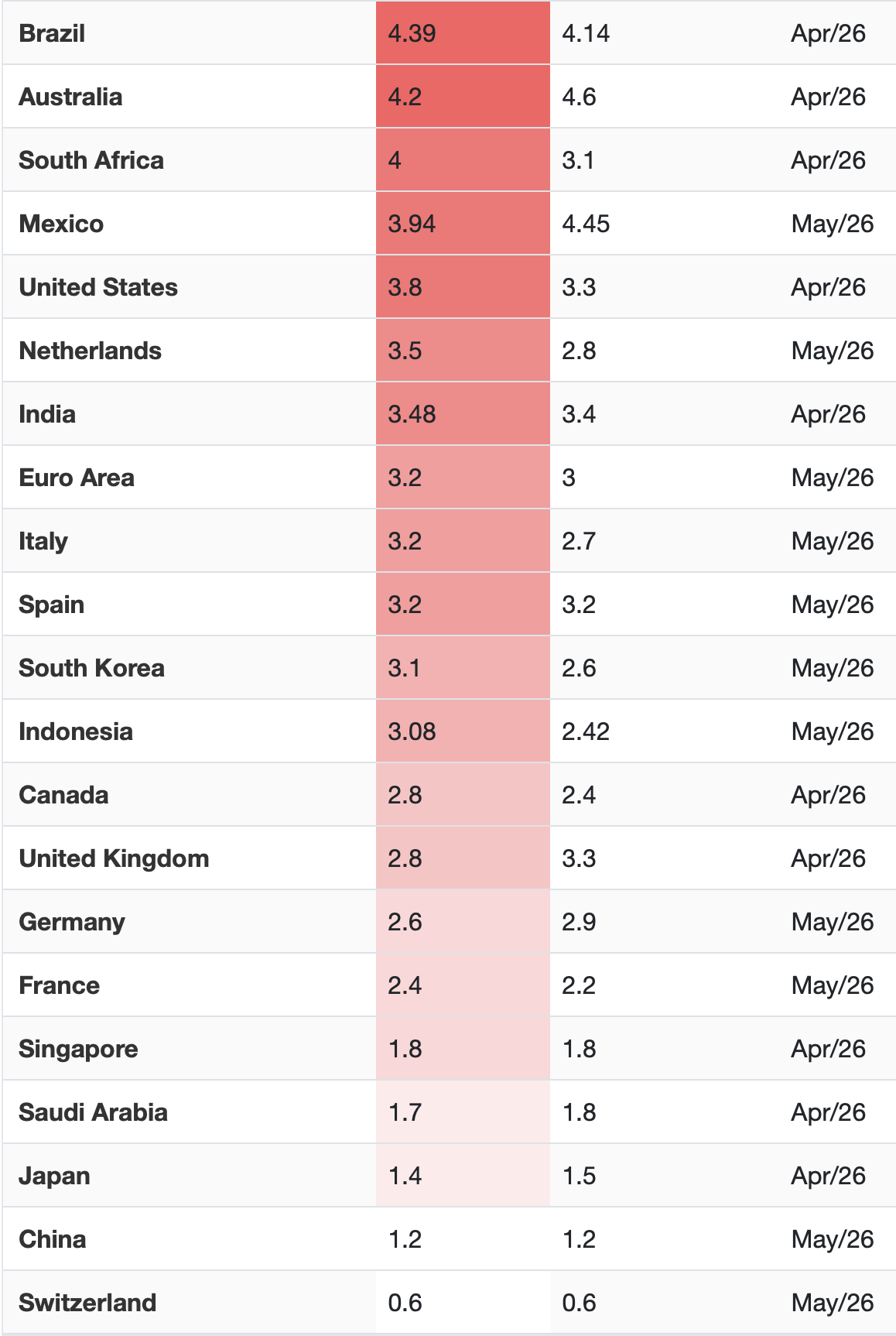
Similarly, bond markets are somnolent with Treasury yields edging lower by -1bp and similar price action in European sovereigns with the entire continent, and the UK, showing small yield declines of between 0bps and -2bps.  Overnight, JGB yields were unchanged as well.  While we continue to get inflation reads that include the war and the sharp rise in energy prices, there is no indication prices are running away yet.  For example, the UK (3.3% headline, 3.1% core) released CPI this morning as did South Africa (3.1% headline, 3.2% core).  Frankly, if you look at the chart below showing headline CPI for both nations (South Africa in blue, UK in grey), you would be hard-pressed to attribute any price pressure to the war given what has been going on in both places for the past three years.

Source: tradingeconomics.com
Turning to the commodity markets, oil (+0.8%) has rebounded from last night’s levels, but not that much, although WTI is back above $90/bbl, barely.  NatGas (+1.15%) remains the absolute bargain in the energy world with US prices at $2.72/MMBtu, vastly cheaper than oil on a per unit basis of energy.  Interestingly, in the metals markets, the recent negative correlation between gold and oil has broken down this morning with the shiny stuff rallying and taking all its friends along for the ride (Au +0.8%, Ag 2.0%, Pt +2.5%, Cu +0.7%).

Finally, the dollar doesn’t really care about anything right now, virtually unchanged against most of its counterparts this morning.  There are a few outliers, notably NOK (+0.9%) which continues to benefit from the oil story, CLP (+0.3%) which is higher on copper’s rally and NZD (+0.3%) which continues to gain on rising expectations of higher rates there.  One other amusing thing was a story in Bloomberg this morning about CNY and how its recent strength, it has gained more than 6% over the past year as the below chart highlights, is causing problems for Chinese exporters.

Source: tradingeconomics.com
Of course, this has been a US (and global) complaint for a long time, that the renminbi has been manipulated to remain excessively weak to provide a competitive advantage for Chinese exporters.  In fact, according to the OECD, the CNY’s PPP value is approximately 3.303 vs. its current level of 6.82, meaning it is trading in markets at half its appropriate value.  

Source: ceicdata.com
My sense is that TEMU would not be able to sell all that sh*t so cheaply if that was the exchange rate, just saying.  In fact, this is something President Trump has been bashing the Chinese on for years.  But Bloomberg managed to offer a sympathetic tone for those “poor” Chinese companies who have seen the CNY gain 6% in a year.

Off the soap box and on to data where the only releases are the EIA oil inventories with a modest expected crude oil draw.  This comes after the API indicated a 4.1-million-barrel draw last week.  There are no Fed speakers on the docket with the FOMC meeting coming up next week, so my take is today will be all about the ongoing earnings releases, which thus far have been quite positive, and waiting for President Trump, who ostensibly will be speaking at 3:00pm this afternoon.  It is hard to have a strong opinion in this market, that’s for sure.  Unchanged seems to be the best bet absent a major headline announcement.

Good luck

Adf

Blow-By-Blow

It wasn’t all that long ago
That if people wanted to know
The news, they would turn
To TV to learn
The latest events blow-by-blow

But now TV news when it airs
Has reached the point nobody cares
‘Cause it’s been on X
Without any checks
For networks, the stuff of nightmares

Which brings us to info this morning
That claims, Tehran, talks have been scorning
But also, we hear
A framework is near
For risk takers, this is a warning

I wonder if all of you face the same situation I do, which is answering the question, what is real?  The fog of war is truly a descriptive term for the inconsistencies in the information that comes out of the Trump administration, the mainstream media that covers it with their own spin, the Iranians (who seem to be fighting aggressively among themselves) and then looking at prices in financial markets as well as economic data, much of which seems to be inconsistent.  How exactly are we to gain an understanding of the big picture, let alone the intricacies of particular markets, given the overwhelming volume of noise we absorb every day.

The below table shows the prices of key markets when I last wrote compared to this morning:

MarketApril 14April 20
Oil$97.35$88.50
Gold$4778$4796
10-year yields4.295%4.267%
S&P 500 futures69067090
DXY98.0498.24

Source: tradingeconomics.com
I know this is an incomplete listing of things, but I just wanted to touch on the basics.  A quick look shows that oil has had, by far, the largest move, nearly a 10% decline, but after that, very little net activity.  Sure, there has been some volatility in the interim as you can see in the following charts from tradingeconomics.com, but markets always have a certain amount of inherent volatility, it is the nature of the beast.

In the same order as above:

Oil 

Gold

10-year Treasury

S&P 500 Futures

DXY

Of course, much of the movement came after Friday’s announcement by President Trump that the Strait of Hormuz was now open, and the overnight reversals have been a response to the Iranians contradicting that statement and firing on several ships.

It appears that as of now, the Strait is not yet open for free navigation, although apparently there are going to be a second round of talks tomorrow in Islamabad.  An interesting story I read indicated that the internal divisions between the IRGC and the secular government in Iran are huge, which is one reason we seem to be hearing multiple things regarding negotiations and goals.  We also must remember that all sides in a conflict like this issue propaganda for their own populations that may have nothing to do with their stance in the negotiating room.

The net of all this is, reading about things, no matter how well-read you are, doesn’t really capture the reality on the ground in my view.  However, someone else made the point that focusing on the actions, not the words, may be a better tell of the situation, and the action of note is that US troops continue to move into the region, not out of it.  I fear there is much more to come here, and the general lack of market volatility is not a sign of calm, but a sign of ignorance on the part of market participants, i.e. nobody really knows what to do!

With that in mind, let’s see how markets have behaved in the wake of the Iranian rejection of the statement the Strait was open.  Starting in equities, apparently, Asian investors didn’t care as we have seen gains in Tokyo (+0.6%), China (+0.6%), HK (+0.7%) and Korea (+0.4%).  In fact, if I look across the entire region, the only notable decline was in Indonesia, and that was only -0.5%.  Otherwise, generally speaking, equity investors in the region are sanguine about the current situation.  This seems a bit odd to me as Asia is the region that is most negatively impacted by everything going on, but then, I’m just an FX guy.

In Europe, though, things are not as happy with all major indices lower this morning.  Germany (-1.4%), Italy (-1.4%), Spain (-1.4%) and France (-1.2%) have set the tone while the UK (-0.8%) is not quite as negatively impacted.  I continue to read a great deal about the European rearmament efforts, but net, it doesn’t appear investors are flocking to the continent right now.  Uncertainty as to energy availability remains a key impediment, at least in my mind, with respect to a strong investment thesis here.  As to US futures, despite the Iranian denial regarding the Strait, the major indices are only lower by -0.6% across the board.

In the bond market, Treasury yields have edged higher by 2bps since Friday, but as you saw above, remain essentially unchanged from last week.  European sovereign yields are higher by between 3bps (Germany) and 6bps (Italy) as concerns continue apace regarding the future for European inflation as well as economic activity.  JGB yields slipped -2bps overnight amid news that the BOJ is reportedly not considering a rate hike at their meeting next week.  In addition, I must note a strong earthquake, measuring 7.4 on the Richter Scale, occurred a few hours ago, so we shall watch closely for how things evolve.  Recall it was Fukushima that set off the European madness to end their nuclear power efforts.  Hopefully, regardless of the outcome, nothing so incredibly stupid will come of this.

In the commodity space, oil (+5.9%) is obviously higher, but not even back to $90/bbl.  There are many conflicting narratives regarding the availability of oil, how much is in storage, how much inventory is around and whether we are going to see production increases outside the Middle East.  No market is more directly impacted by the Strait than oil, and since we have no idea how that will evolve, it is hard to see into the near future.  Ultimately, I remain of the view that there is loads of oil around and over time, it will come to market keeping prices in check.  But it is going to be a bumpy ride.  Turning to metals, as has been the case lately, oil and gold (-0.9%) have maintained their negative correlation with the barbarous relic taking silver (-1.7%) and copper (-1.5%) along for the ride.

Finally, the dollar remains an afterthought to traders right now, barely moving against most of its counterparts as the opportunities elsewhere for outsized gains remain far larger.  Looking across the major currencies, they are all within 0.2% of Friday’s close, although the direction is uniform with a modest dollar rally.  

On the data front this week, perhaps the most interesting thing will be Fed Chair nominee, Kevin Warsh, and his senate confirmation hearings.  But here is what the data looks like.

TuesdayRetail Sales1.4%
 -ex autos1.4%
 Control group (ex-gasoline)0.2%
 Business Inventories0.3%
ThursdayInitial Claims212K
 Continuing Claims1820K
 Flash Manufacturing PMI52.5
 Flash Services PMI50.0
FridayMichigan Sentiment47.6

Source: tradingeconomics.com

Much has been made lately about the dichotomy between the Michigan sentiment survey printing its lowest level in the 84-year history of the index while the S&P 500 is making new, all-time highs.  As I mentioned at the top, what should we believe?

If pressed, my own view is that the US is going to increase the military activity, but that oil prices are already anticipating that action.  Much will depend on the success of that situation which remains unknown although I remain positive regarding our military’s capabilities to complete their mission.  That will define risk appetite, which I anticipate would be reduced initially, although any signs of success would see that reverse.  But again, I’m just an FX guy, so take it for what it’s worth.

Good luck

Adf

PS, this is where I have been the past several days which prevented (?) me from writing, if you care.

Checkmate

The talks twixt the States and Iran
Collapsed like a climate straw man
Now there’s a blockade
In Hormuz, arrayed
As Trump pivots to a new plan

The first move in oil was higher
But I would beware as a buyer
If Trump rules the Strait
That could be checkmate
And force a much longer cease fire

As of 8:00pm last night, after the peace talks fell apart in Islamabad and President Trump announced the US would be blockading the Strait of Hormuz so no ships carrying oil, especially Iranian oil, would be able to pass the blockade, the price of oil spiked immediately as the futures markets opened.  You can see the last week’s roller coaster in the below chart from tradingeconomics.com

The question that needs to be answered at this point is, is there a substantive difference between the US blocking traffic in the Strait and Iran doing so?  I would contend there is a huge difference, especially if you are China.  But also, if you are Iran.  After all, you just lost your trump card (pun intended) and not only that, if Iranian oil is not able to be sold, then Iran runs out of money pretty quickly.  Remember, oil revenues represent approximately 90% of Iranian total revenues.  How long can the IRGC last with no money to pay their soldiers?

In the meantime, the Saudis are pumping 7 mm bpd across the East-West pipeline now, and the UAE is pumping 1.5 mm bpd to Fujairah, taking a decent sized bite out of the missing barrels.  I read this morning that upwards of 7mm bpd are now exiting the gulf via pipeline reducing the overall reduction in oil flow.  Granted, it is still a huge disruption but shrinking.  On top of that, if this continues, the Strait loses its strategic importance, which cements Iran’s loss of power.  In the short-run, oil prices can go in either direction in my view, but this has the opportunity to completely emasculate Iran’s ability to have an impact on the global oil markets in the future.  

And I would not be surprised if President Xi is burning up the lines to Washington because he just lost a key source of cheap oil, and oil he paid for in CNY.  (see WSJ chart below.)

There are many twists and turns here, and I’m sure there will be more.  But as of Sunday night, from what I have read, Iran is in a much worse position than they were on Friday.  Of course, things could all go pear-shaped from here, and this could turn out to be a complete failure.  Our goal here is to try to track how markets will evolve.

The remarkable thing, still, to me is that equity markets remain so blithe about the entire situation.  I make this claim based on the VIX Index, which remains relatively docile despite everything that is happening in Iran and the likely eventual knock-on effects.  But look at the chart of the VIX below which shows that markets are nowhere near as stressed as they have been in the past and are actually much nearer their long-term average. (The two spikes are the JPY intervention in August 2024, which lasted for just a few hours, and then the Liberation Day tariffs in April 2025 which quickly reversed as well.  

Source: tradingeconomics.com

It is worth noting that even the oil VIX, is off its highs and, while somewhat elevated, not running away.

Source: finace.yahoo.com

The thing about the VIX indices to remember, though, is that options decay and holding them is a losing proposition if the underlying market is not moving.  So, to maintain a high VIX, we need to see significant intraday as well as day-to-day price movement.

As Iran remains the major storyline for markets, let’s take a look at how things are behaving this morning.  Oil (+8.2%) has maintained its initial gains but not moved since last night.  NatGas (+1.7% in US, +9.0% in Europe) has also been impacted as there is no movement of LNG tankers through the Strait either.  Interestingly, both gold (-0.6%) and silver (-1.7%) while lower are well off the lows seen in the early overnight session as per the below chart of silver.

Source: tradingeconomics.com

I reiterate that the market perception of the current situation has not nearly matched the hysteria evident in much of the commentary.  I’m not sure whether to attribute that to market insight or market ignorance at this point, although I lean toward the former.  The problem with commentary these days is that hysterical takes generate clicks, and that is the goal of many commentators.

Turning to equity markets, Asian markets were generally, though not universally, lower.  Tokyo (-0.7%), HK (-0.9%), Korea (-0.9%) and India (-0.9%) all suffered on the breakdown in talks and the new blockade news.  New Zealand (-1.2%) was the worst performer, largely because their energy situation is deteriorating more quickly than anyone else’s.  But China (+0.2%), Taiwan (+0.1%) and Indonesia (+0.6%) all managed some gains despite the news.  Again, markets appear to be pricing a fairly benign outcome here.  Either the news is going to get better soon, or there is going to be a massive rerating of equity markets.  Something’s gotta give.

In Europe, things are a bit worse overall with Spain (-1.4%) leading the way lower although Germany (-1.0%), France (-0.9%) and Italy (-0.8%) are all under real pressure as well.  There has been a lot more press lately about how Spain’s PM Sanchez is cozying up to China as he seems to be pulling Spain away from the EU in several areas.  Of course, he is an avowed socialist, so perhaps this should not be that surprising.  However, this is further proof that NATO is surely going to die soon.

One market that has outperformed, though is Hungary (+2.8%) which is rallying sharply on the weekend’s election results that sent President Victor Orban into retirement.  Certainly, most others in Europe are thrilled as Orban had been a thorn in the side of the EU with respect to their Russia stance, but the economy there has been underperforming so new leadership is widely lauded, for now.  The forint (+1.9%) also benefitted from the election outcome.  

As to US futures, as I type at 7:00, the major indices are lower by -0.3% or so, well off the initial levels seen last night that were as much as -1.4% below Friday’s closing levels.  Again, markets remain sanguine over the weekend changes to the story.

In the bond market, Treasury yields have edged higher by 1bp and in Europe, we are seeing rises of between 1bp and 3bps across the board.  Here, too, it is hard to find panic in the streets.  JGB yields (+2bps) have made a new high for the move and continue to edge higher as concerns over the path of inflation rise given the oil price rise.  Last night, BOJ Governor Ueda gave a speech (actually his deputy did because he is in Washington for the IMF/World Bank meetings) and tried to quash the view that the BOJ was definitely going to hike rates at the end of this month, an outcome that had been priced at a 65% probability prior to his speech as you can see from the Bloomberg chart below.

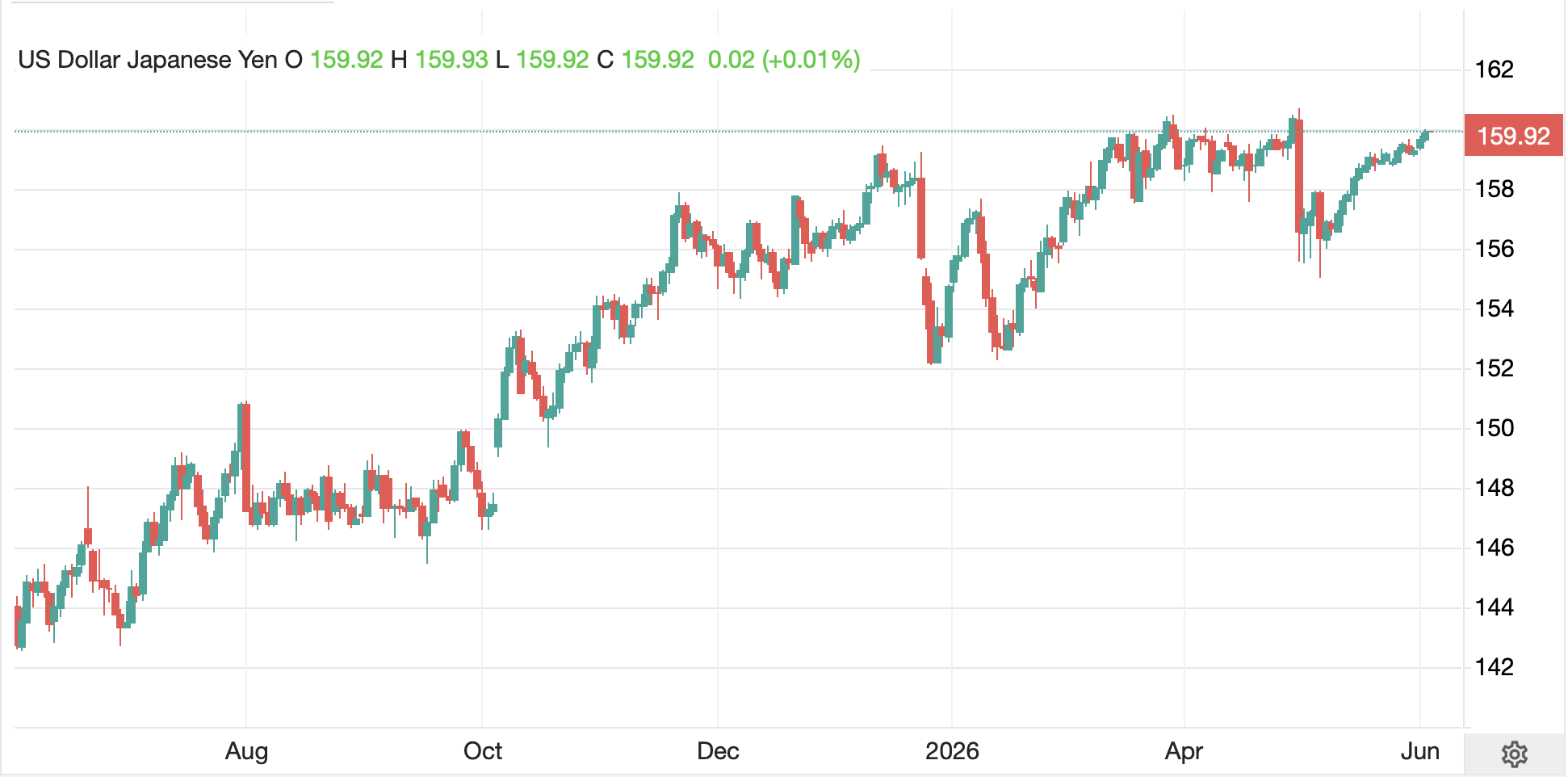
Finally, in the FX market, other than HUF as described above, and NOK (+0.6%) responding to the oil move the dollar is firmer across the board.  However, the movement is not too large, generally on the order of 0.2% or so across the G10 and perhaps a bit more in the EMG bloc.  The worst performer today is ZAR (-0.8%) which is suffering the dual problems of a lower gold and higher oil price.  The other noteworthy thing is JPY (-0.3%) is creeping back toward the 160 level, which remains the default setting for the market belief as an intervention level.

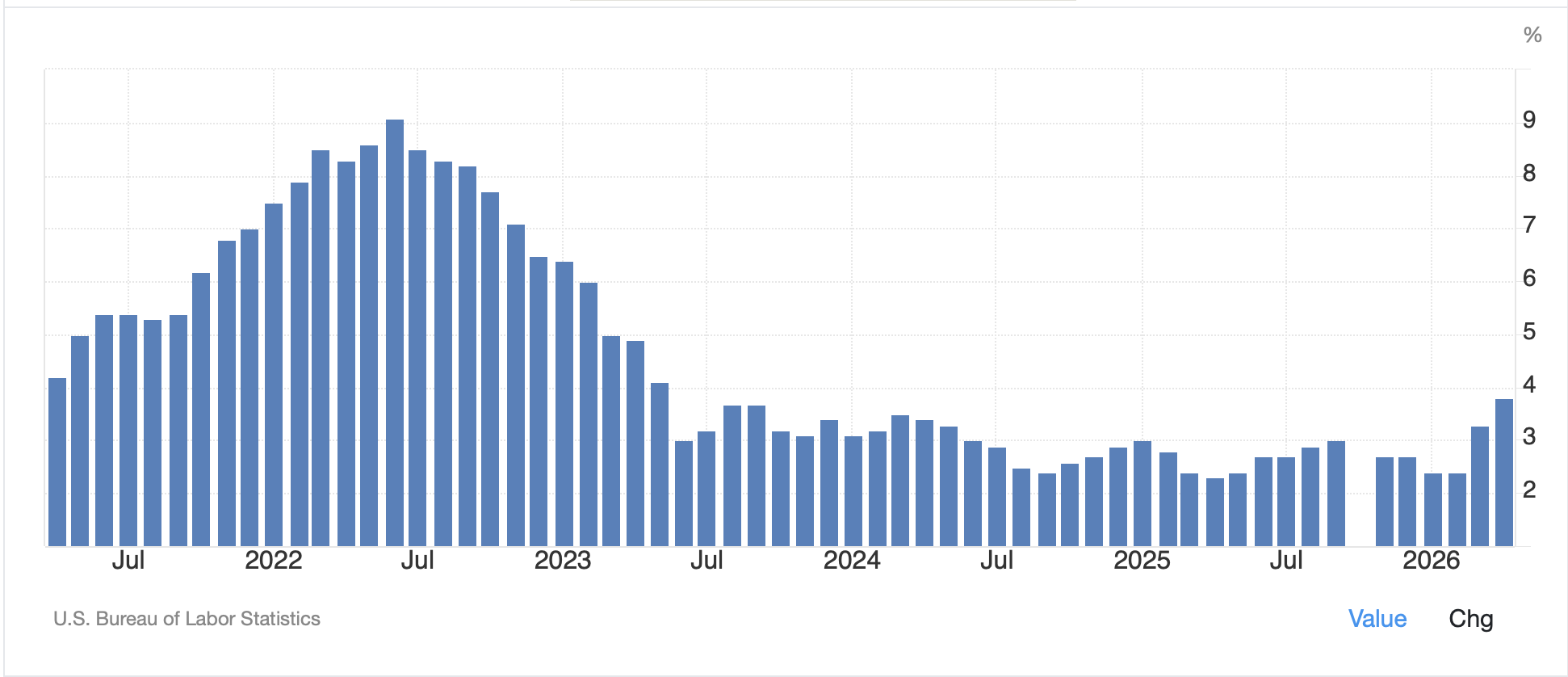
On the data front, Friday’s CPI was hot, but not quite as hot as forecast, although you can be sure that next month will remain hot.  This week brings the following mostly secondary stuff.

TodayExisting Home Sales4.06M
TuesdayNFIB Business Optimism98.6
 PPI1.2% (4.6% Y/Y)
 -ex food & energy0.6% (4.2% Y/Y)
WednesdayEmpire State Manufacturing-2.0
 Fed’s Beige Book 
ThursdayInitial Claims215K
 Continuing Claims1840K
 Philly Fed9.0
 IP0.1%
 Capacity Utilization76.3%

Source: tradingeconomics.com

As well, we hear from eight different Fed speakers over 10 venues.  An interesting aspect of the commentariat lately is that individual FOMC members are going to be far more important as there is a growing diversity of opinion.  So, the monolithic Fed Chair running things and encouraging a vote in a particular way may evolve into an actual election, where the voters vote their hearts, not the Chairman’s views just to get along.  If this is the case, and I think it would be far better than what we currently have, we will need to listen more closely to the individual speakers and start a scorecard to see who seems hawkish or dovish at any given time.  The problem is, I fear it will encourage all of them to speak more frequently, which is a worse outcome, although any given voice will likely be given far less weight.  We shall see if that is the case.

As to the broad scheme of things. My head tells me that the market is underpricing the risks out there, but my eyes explain that this is the current consensus.  I hope they are right and I am wrong about things.

Good luck

Adf

What They Most Fear

For many, it seems very clear
That war is not what they most fear
But rather, for them
They need to condemn
Each Trumpian outcome and sneer

So last night, ere clocks all struck eight
The president said he would wait
Another two weeks
As peace that he seeks
Seemed closer than it had to date

As I’m just a poet in a room in New Jersey, I don’t have any intel on the situation in Iran, but boy oh boy, the number of takes out there is remarkable.  On one side are the naysayers claiming Trump chickened out again, that Iran won this war and the US is forever seen as a loser.  On the other side is Trump played it brilliantly, raising the stakes to a level where even the IRGC leadership decided that the destruction of their nation wasn’t worth the battle.

My observation is that whatever the actual rationale, the world is better off with the fighting stopped.  With that in mind, it is hard to look at the results of the war, where Iran saw both its Navy and Air Force obliterated, its senior leadership decimated and a large proportion of its missile launchers destroyed and feel like they won.  I think this would be called a Pyrrhic Victory.

But from our perspective here, the questions of note are how did markets respond?  You will not be surprised that much of the trauma that markets have felt over the past month has already been reversed.  Let’s start with oil, as that has been the keystone for all markets.  As per the below chart, it has plunged -16% overnight, back well below $100/bbl.

Source: tradingeconomics.com

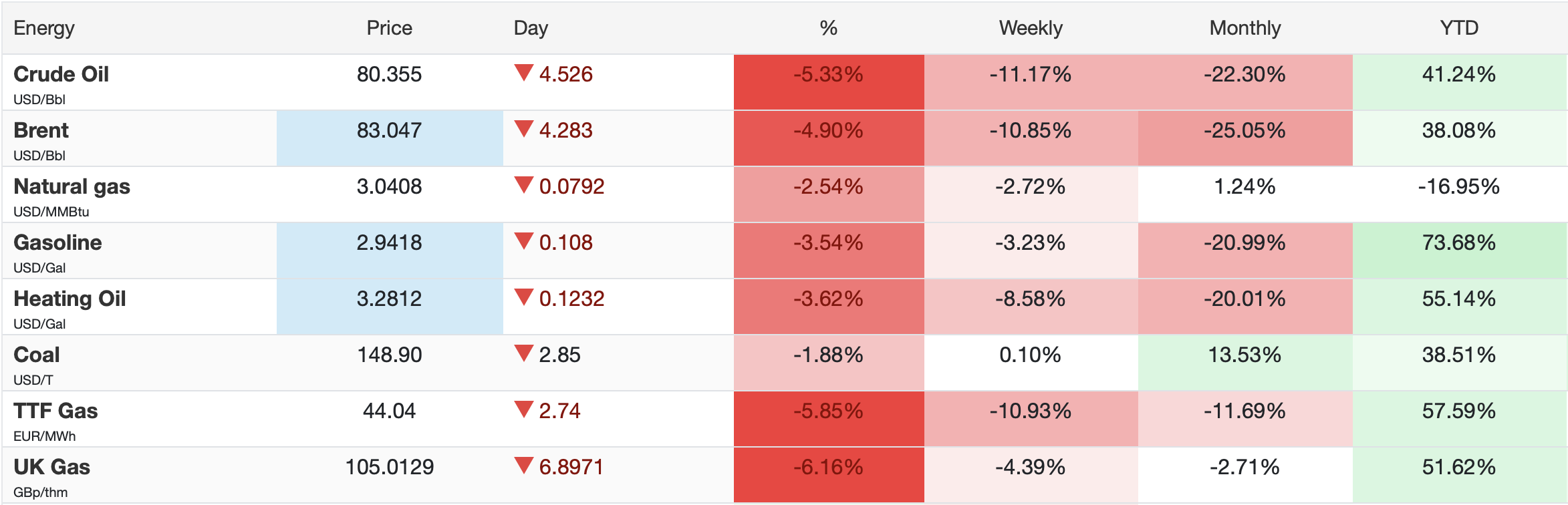
While this is a picture of WTI, Brent (-14%) also tumbled as did the markets in gasoline (-10.0%) and all other products.  NatGas (-5.3%) fell to its lowest level since October 2024, as per the below chart.

Source: tradingeconomics.com

In Europe, TTF Gas (-14.7%) also tumbled but it remains far above its prewar levels as per the below.

Source: tradingeconomics.com

All told, as would be expected, energy prices have fallen sharply.  Of course, questions have rightly been raised as to whether this will remain the case because, remember, the cease fire is slated for only 2 weeks.  What happens if there is no agreement and the US resumes their attacks?  As well, the status of the Strait of Hormuz remains somewhat cloudy with mixed information about safe passage.  It appears that many ships in there may be able to exit, but will any go back in with the risk of getting stuck again?  My point is this may not be over, but for now, everybody is giddy.

In the metals markets, the rally has been similarly impressive with both gold (+1.6%) and silver (+5.4%) continuing their rebound from the March 23rd spike lows as per the chart below of gold.

Source: tradingeconomics.com

In fact, gold has retraced 16% from that low print and silver 26%.  But here, too, it will all depend on how the Iran situation evolves going forward.  Arguably, if the fighting starts again and oil rises, precious metals will head lower while if a long-lasting peace is secured, I would look for metals to head higher again.

In the equity markets, the all-clear has been sounded, as you would have expected.  The screenshot below from tradingeconomcs.com of futures markets shows that the only perceived loser from this deal is Russia.  Otherwise, every market is substantially higher (Toronto’s TSX is closed in the overnight session) or was so last night in Asia.

The thing we are likely to hear about a lot today is that the S&P 500 has traded back above its 50-day moving average, as per the below chart.  For the technicians, this will be seen as a key outcome and expect to hear much more about a test, and potential break, of the all-time highs of 7000 made back in January.

Source: tradingeconmomics.com

Moving on to bonds, Treasury yields are the big disappointment here, having only declined -5bps heading into the NY open, but as the Bloomberg screenshot shows, European sovereign yields have virtually collapsed, as have yields throughout Asia, although remain higher than a month ago.

It appears that all the fears about rising inflation have been virtually extinguished overnight!

Finally, the dollar has also reversed its recent gains, falling sharply across the board.  Using the DXY (-1.1%) as a proxy, it does seem to measure the average movement, but there have been some real outliers.  For example, ZAR (+2.3%) has benefitted from the combination of much higher precious metals prices and much lower energy prices as South Africa is a net energy importer.  SEK (+2.2%) has also exploded higher, although that looks more like a reversal of yesterday’s sharp decline, than any other news.  But, broadly speaking, currency gains on the order of 1% or more are the norm this morning.  However, as we have seen across almost all markets, this movement merely returns us to the middle of the previous trading range, it is not a signal for the dollar’s collapse.  Just look at the chart below of the DXY.

Source: tradingeconomics.com

So, across all markets, we have witnessed a major reversal of the war induced trauma.  It is not completely unwound nor are we confident it will exist in two weeks if no deal is reached.  But that’s the scoop for now.

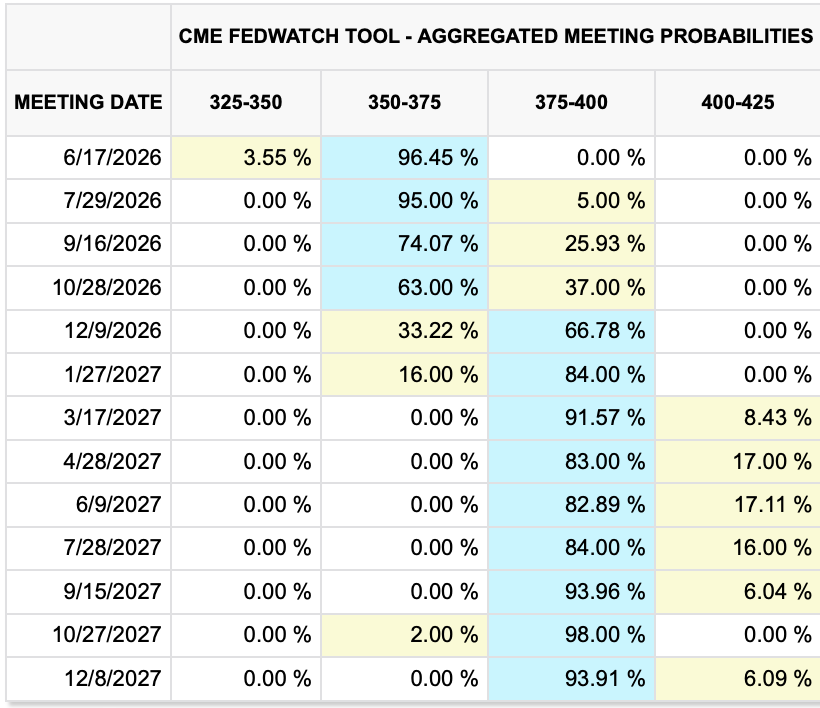
While it certainly won’t have an impact today, it is worth looking at the Fed funds futures market to see how it has behaved.  While expectations for the meeting on April 29th remain for no change, as you can see from the aggregate probability table created by the CME, cuts are back in the thought process, although not until the end of this year.

On the data front, we receive EIA oil inventory data this morning and then the FOMC Minutes are released at 2:00 this afternoon, but I cannot imagine anyone paying close attention to those given the changing situation in the Middle East and its impact on markets, especially oil and the prospects for future inflation.

To recap, we all ought to be happy that the Iran war has stopped for now with prospects for a longer peace.  You can love Trump or you can hate Trump, but if he succeeds in eliminating the terror networks that Iran has long sponsored, that is a gigantic net benefit for the entire world.  Nobody has any idea how things will ultimately resolve, but certainly, as we wake up this morning, prospects for the future look better than they did twenty-four hours ago.  Of course, my advice had been to play it close to the vest because of unexpected outcomes like this.  Nobody has any edge trading markets like this, not even the algos.  Perhaps the one thing that will change is trading volumes will start to pick up and increase overall liquidity, and that would be a net positive.

Good luck

Adf