The Narrative Shatter(ed)

For months data just did not matter
Twas oil that drove all the chatter
But Friday that changed
As NFP ranged
So high that the narrative shatter(ed)

Now suddenly, eyes have all turned
To data, with many concerned
Their previous views
Will naught but confuse
All efforts, more cash, to be earned

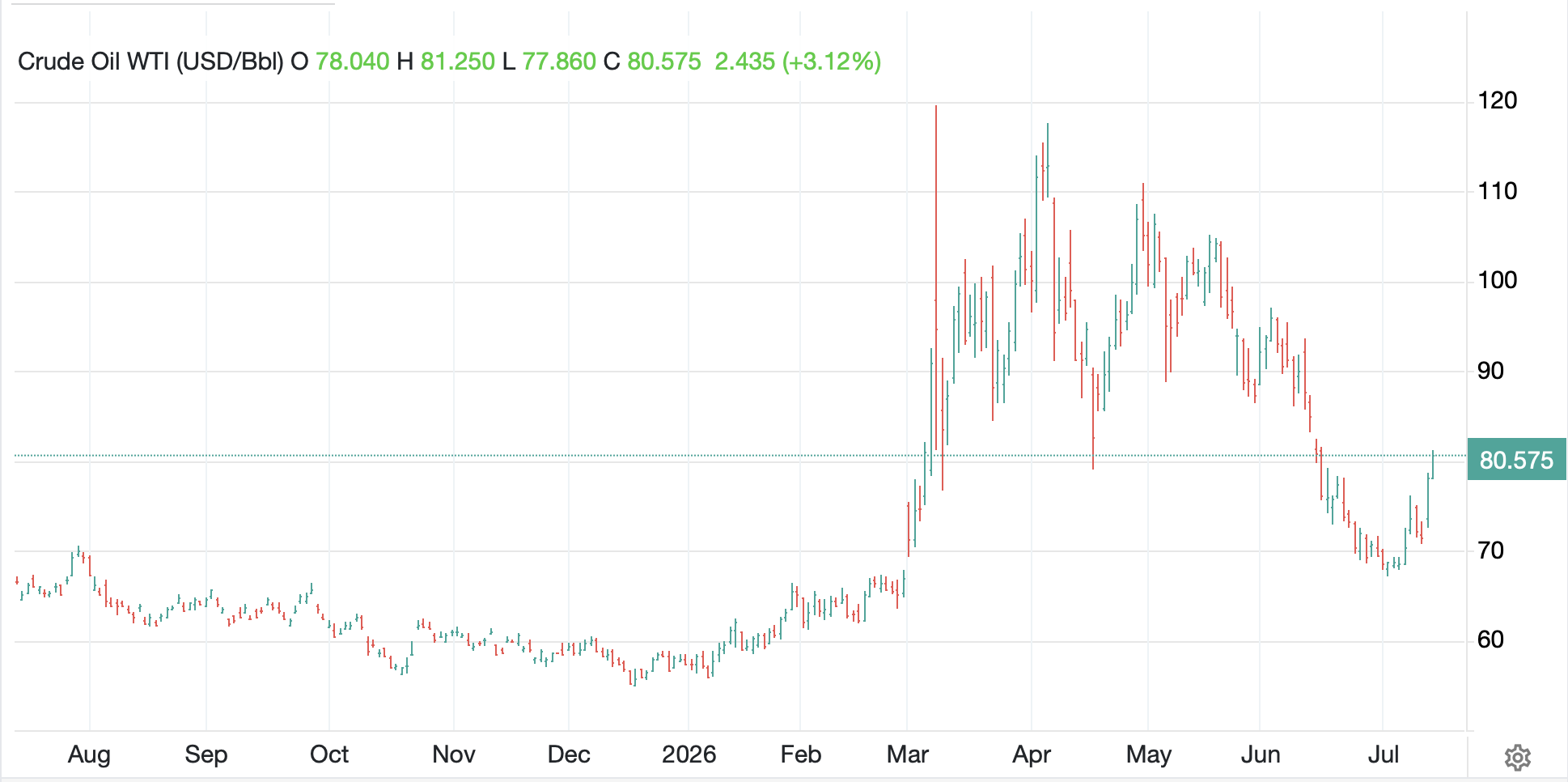
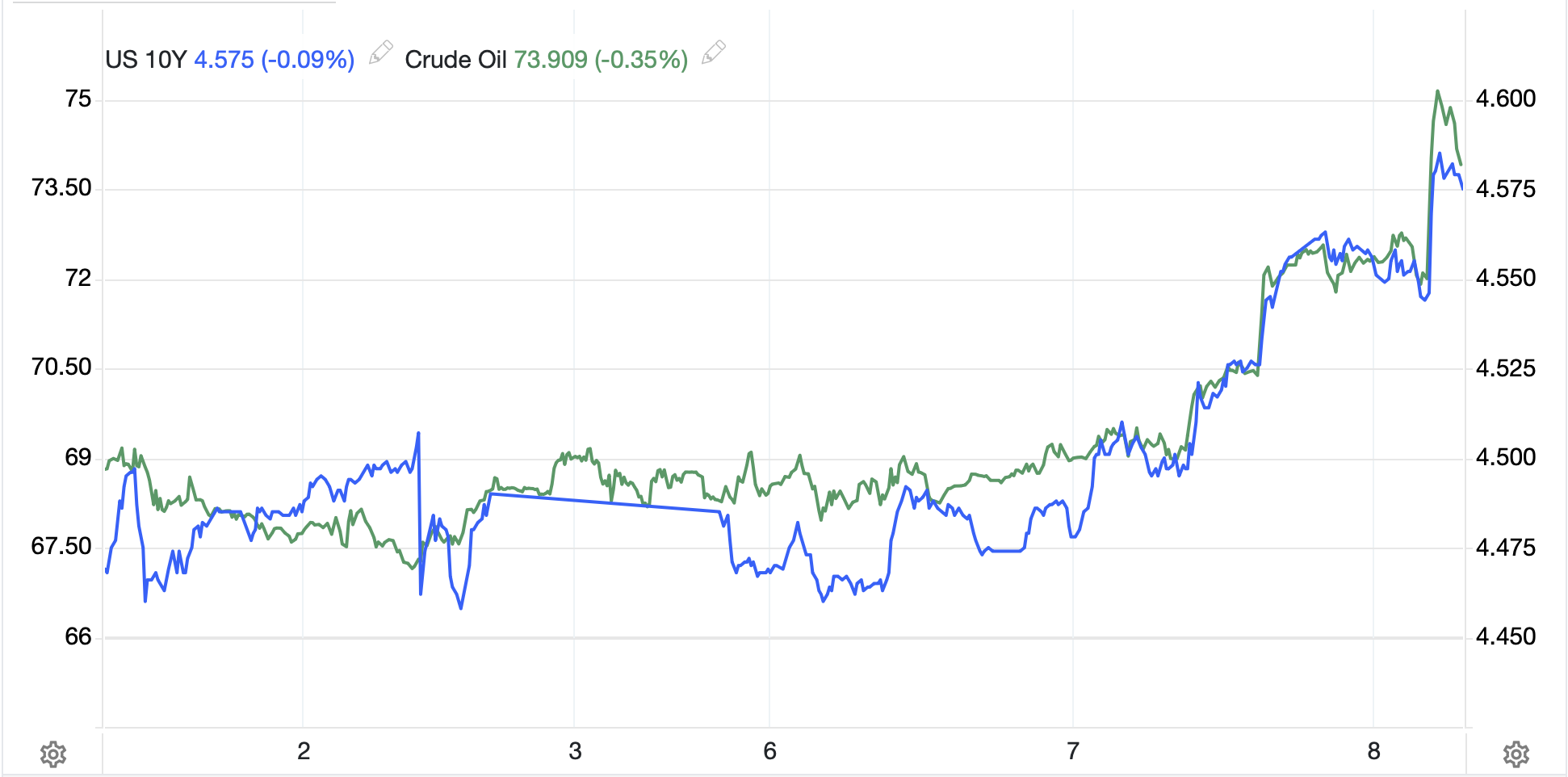
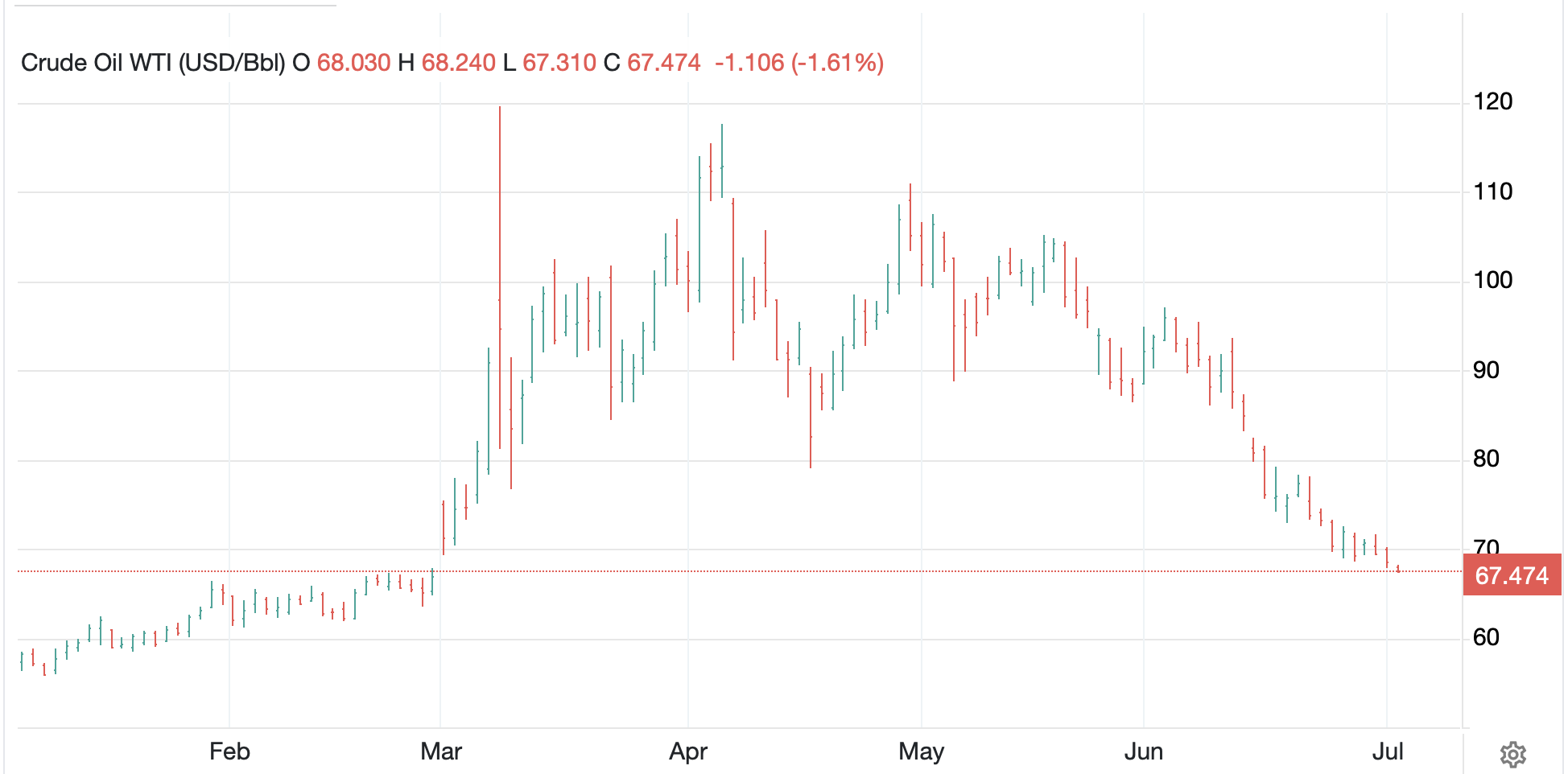
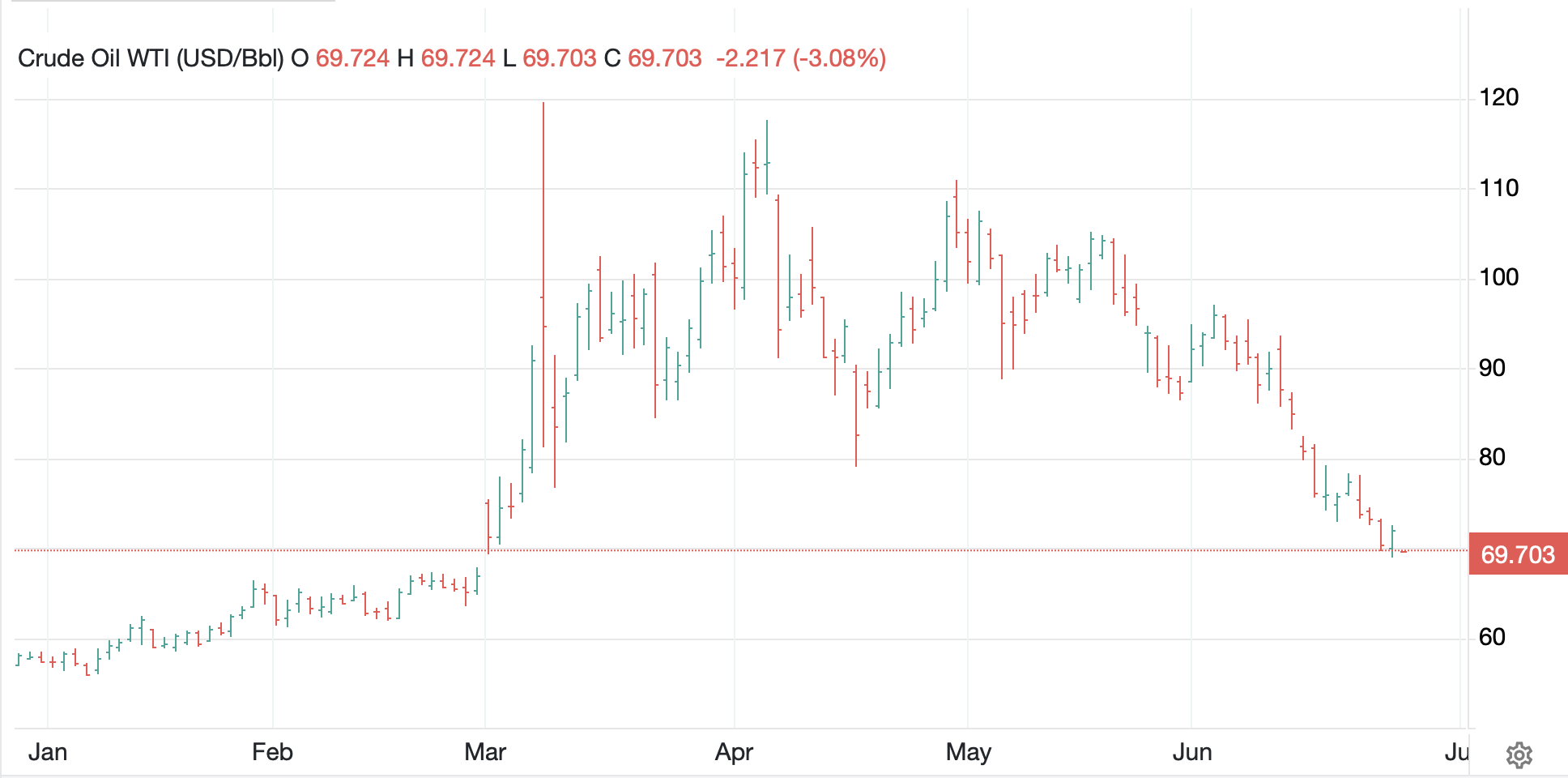
Since the Iran conflict began on the 1st of March, pretty much the only key variable in financial markets has been the price of oil.  As you can see in the chart below, the price gapped higher that Monday morning and has been the major topic of conversation ever since.

Source: tradingeconomics.com

There continues to be a large contingent of analysts who, once the Strait of Hormuz was closed, have been calling for a substantial rise in the price of the stuff, but here we are this morning, back below $90/bbl and lower by -2.3% on the day.  Stories about declining reserves, floating reserves, demand destruction and new production are all available on any given day, and all certainly have facts to support them.  But the big picture, at least so far, has been that the market has found a clearing price between the release of strategic reserves and some amount of demand destruction, which has kept prices in check.

The greatest irony to me is that all the discussion regarding the long-term damage high oil prices are going to inflict on the economy seems to ignore the cardinal rule of commodities; the cure for high prices is high prices.  Last week I highlighted comments from an Exxon SVP about the coming crisis.  If that is Exxon’s corporate belief, they will be drilling like there is no tomorrow as their costs are far below current price levels, let alone the mooted rise to $150/bbl.  However, if we look at the one source of data that discusses drilling, the Baker Hughes oil rig count, you can see in the below chart that while it is a few rigs off its recent lows, there is still limited oil industry belief that the price is going to remain this high for any extended length of time.

Source: tradingeconomics.com

I think what last Friday’s very surprising employment report has done is to change some of the thinking of investors, turning their attention from exclusively oil to the rest of the economy and, now that we are 3+ months into this adventure, to how the rest of the economy is behaving.

This brings us to the two key pieces of information that are upcoming in the US, tomorrow’s CPI report and then next Wednesday’s FOMC meeting.  But it also has market participants going back to their more regular processes with discussion of market technicals, earnings, and global policy decisions.  So, let’s look in those areas this morning.

On the policy front, a few things happened overnight.  First, Bank Indonesia raised their base rate 25bps, to 5.50%, in an emergency meeting as the rupiah continues to decline to record lows, although in the wake of the rate hike, it rebounded some 0.8% as per the below chart.  Another data point is the fact that their FX reserves have fallen by >$1 billion in the past month indicating that they are actively intervening to prevent a further decline.  Too, this comes after a 50bp hike just two weeks ago.

Source: tradingeconomics.com

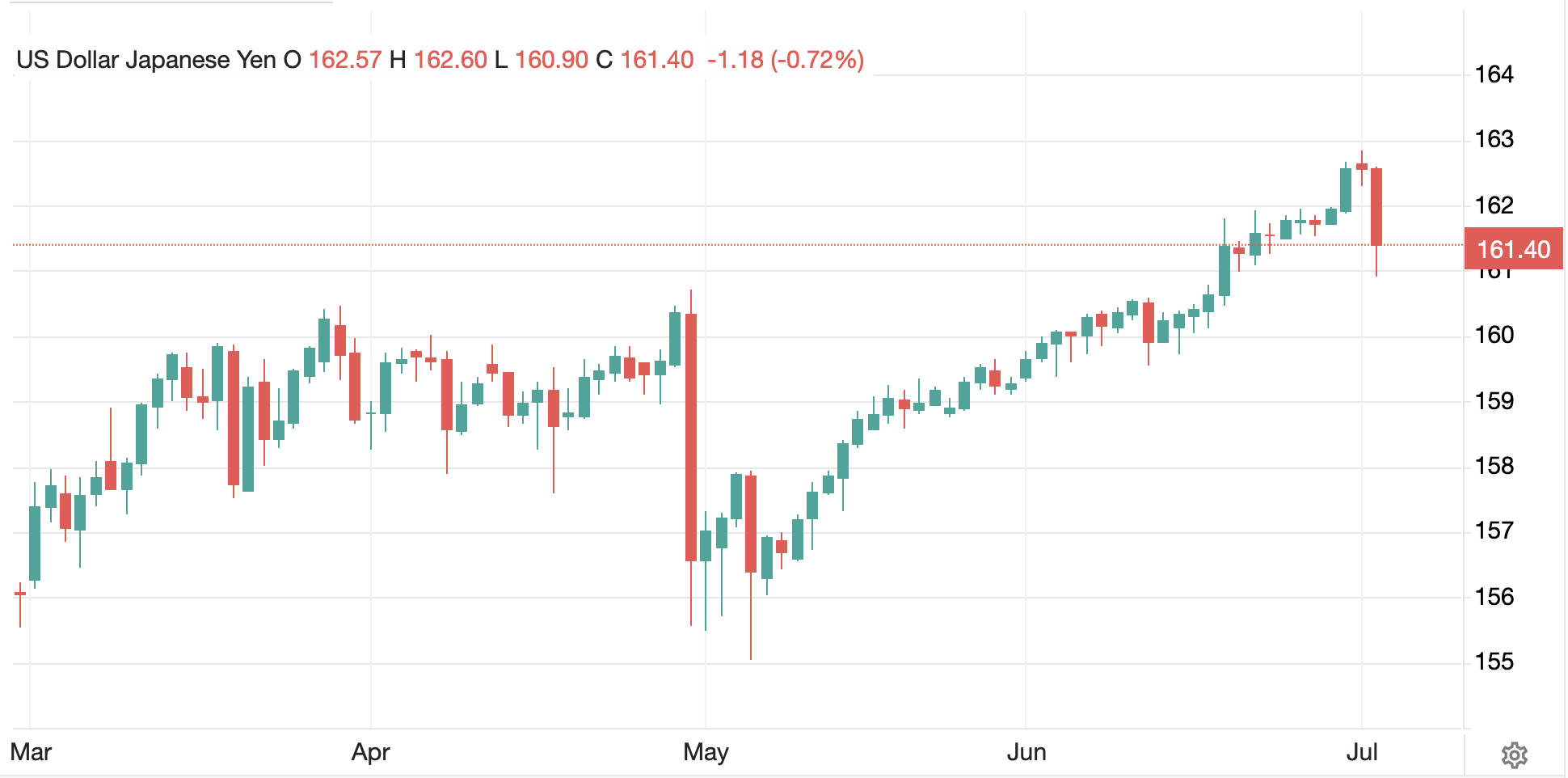
Elsewhere on the central bank front, Nikkei news reported that the BOJ will be raising its base rate by 25bps, to 1.00%, the highest level since 1995, when it meets next Monday night (recall, Nikkei has a perfect track record when calling these moves).  This has been widely expected in the market, and so there was no reaction in the FX market, although with USDJPY hovering just above 160.15 this morning, I imagine there is a bit of nervousness at the Ministry of Finance there.  Interestingly, the word from Nikkei is also that they may end the tapering of the balance sheet next year, which certainly detracts from the hawkishness of the rate move.

Moving on to data, the noteworthy datapoint overnight was the Chinese Trade Balance ($105.4B), which while somewhat larger than expected is right in line with recent activity as per the below chart.  It seems that demand for semiconductors has been significant and while trade with the US continues to remain moderate, the rest of the world is getting inundated with Chinese stuff.

Source: tradingeconomics.com

The one other major topic of conversation is the SpaceX IPO set for Thursday and the fact that OpenAI filed to go public as well.  I expect that those discussions are going to be a large part of the equity market narrative for a while yet, but that is well outside the purview of this note.

So, let’s look at market behavior and then see what is on tap for the week data wise.  Friday’s equity declines in the US were like a bad dream, they felt terrible but now it seems everybody has awakened and the world did not end.  Yesterday saw a steady climb from opening lows all day with the NASDAQ closing higher by +0.9%.  The upshot is that Asian markets broadly followed that movement with Japan (+2.2%), China (+1.9%), Korea (+8.2%!), Taiwan (+2.8%) and Indonesia (+7.6%!) all shaking off fears and rebounding sharply.  While HK (-0.4%) and Australia (-0.2%) both lagged, the other regional markets were broadly positive.  I continue to be amazed at the idea that Asia is in the worst energy shape and yet its equity markets are screaming higher.

In Europe, there is also a positive vibe with Spain (+1.2%), France (+0.9%) and Germany (+0.7%) all having solid sessions.  In fact, only the UK (-0.2%) is lagging this morning and not based on any data, but it seems more like some idiosyncratic stories regarding pharma companies there.  As to US futures, at this hour (7:20), they are firmer by 0.5% or so across the board.

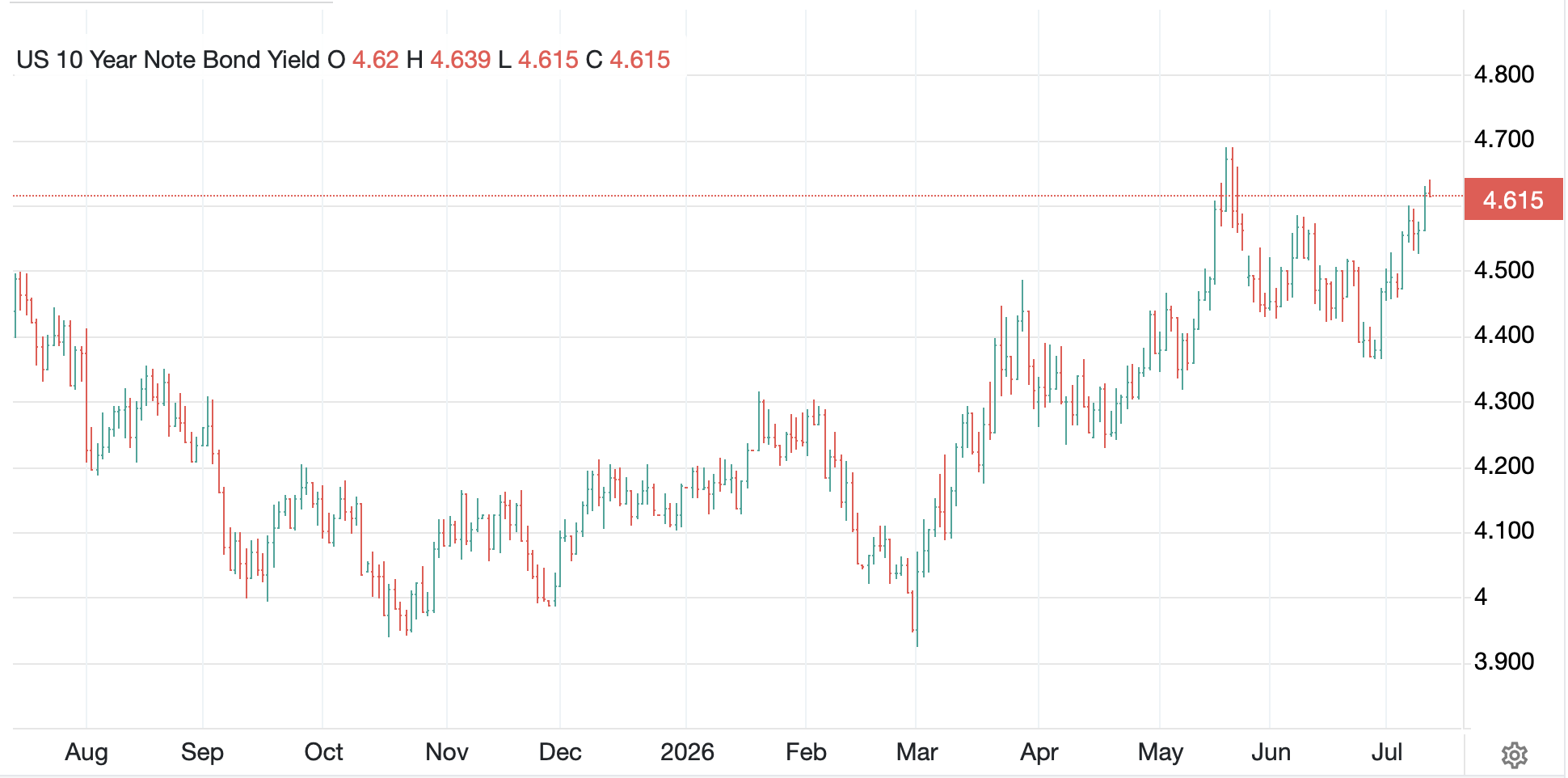
In the bond market, yields, which have been moving higher for the past week, have backed off a bit with Treasury yields down -2bps while European sovereign yields have also slipped, mostly by -1bp or -2bps.  Last night, JGB yields (-4bps) fell after the story about the rate hike.  Perhaps investors believe Ueda-san is going to be more hawkish.  But it seems they missed the story about ending QT.

In the commodity space, with oil lower, as discussed above, it is no surprise that gold (+0.5%), silver (+0.6%) and copper (+1.7%) are all higher.  In the gold market, much has been made of the fact that technically, gold closed below its 200-day moving average Friday and has stayed there so far.  If this continues, it will be seen as a negative medium-term signal.  (my chart is showing the 40-week as I cannot get a long-term chart of the 200-day, but it is essentially the same thing.)

Source: tradingeconomics.com

Finally, in the currency markets, the dollar has backed off its recent highs this morning with the DXY (-0.3%) back below 100 and its decline a pretty good proxy for most of the G10 currency’s movements.  This is in no way a rout, but a correction after a strong move higher over the past month as you can see in the below chart.

Source: tradingeconomics.com

On the data front, we see the following this week.

TodayTrade Balance-$56.1B
 Existing Home Sales4.07M
WednesdayCPI0.5% (4.2.% Y/Y)
 Ex-food & energy0.3% (2.9% Y/Y)
ThursdayInitial Claims219K
 Continuing Claims1780K
 PPI0.7% (6.4% Y/Y)
 Ex-food & energy0.4$ (5.3% Y/Y)
FridayMichigan Sentiment46.0

Source: tradingeconomics.com

So, all eyes will be on CPI tomorrow as Fed speakers are now in their quiet period ahead of next week’s meeting.  Certainly, there is very little I have seen that is going to moderate inflation in the near term, but perhaps, if we do see an end to the Iran conflict, that will remove a key price support, although I imagine it will take time to feed through.  But inflation is highly dependent on how much money is around, and that is what makes the FOMC next week so critical.  Until then, it feels like a limited price action day today as we all await CPI tomorrow.

Good luck

Adf

Changing the Fate

With things in the Gulf getting hotter
And risk assets heading to slaughter
The question on lips
Can stocks e’er eclipse
Their highs, or ‘stead sink ‘neath the water

But really, the question I’d ask
Is Chairman Warsh up to the task
Of changing the fate
Of the Fed funds rate
And if so, what will he unmask?

It is very difficult to focus on the Gulf situation as not only is it fluid, but there is also no direction of travel whatsoever.  So, this morning I want to have a different conversation.  Let me start by explaining this isn’t my idea, per se, although the analysis is solely mine.  Listening to the Macro Voices podcast Sunday morning while walking the dog, (he’s the one on the left)

Michael Every was on and expressed a very interesting thought, one that I had not considered, nor heard anywhere else.  What if the Fed, as Chairman Warsh seeks to adjust how it works, decides that they are going to put their fingers on the scale with respect to the interest rates paid by different industries, not merely by differently rated credits.  The idea is that in conjunction with the Treasury, Warsh and Bessent would decide which industries needed to have the most cost-effective funding for the nation to be able to maintain and develop the industries necessary for national defense reasons.

Now, I know this is anathema to almost all of us having been raised on the idea(l) of free markets and that markets are better at allocating, well everything, but in this case credit, than any cabal of central bankers.  And in a world where markets were truly free and where everyone competed on a level playing field, I am 100% in agreement with that view.  Alas, I’m not sure if you noticed, but that is not the world in which we live.

If Covid taught us nothing else, it was that 40 years of globalization and creating the most efficient processes for manufacturing resulted in significant fragility in those very processes.  It turns out that while economists in the US, Europe, Japan, the World Bank and IMF all explained that this was a great outcome (the US prints paper notes and gets lots of stuff for it), that only works when there is peace on earth.  During this period, China chose to play by a different set of rules, explaining they were just a poor country so didn’t need to play by the G10’s rules, and massively subsidized numerous industries while essentially ignoring all environmental issues.  That tilted the playing field pretty aggressively, and while President Trump has been adamant about that very issue for a decade, he was largely ridiculed, right up until Europe recently figured out that China was eating their lunch too, and now they are looking to impose tariffs on China’s excessive exports.  There is an excellent Substack that comes out Sunday mornings called The Brawl Street Journal,written by an analyst in Germany.  This week’s, linked here, explains that very issue extremely well.

So, I’ve set the table here, and the key to understand is the table is tilted horribly, with China getting the benefit of the doubt for almost everything.

Now, let’s consider what Mr Every’s idea would mean.  Below is a chart showing current 10-year yields for Treasuries and a series of corporate bonds delineated by their credit ratings.

Data: streetstats.finance

Makes sense, less creditworthy names pay more.  That is how things have always been within a market system as the worse the credit rating, the higher the perceived risk of the investor and therefore the higher yield they demand.

But what if that were to change?  What if the Fed and Treasury decided that companies that manufactured products, be they semiconductors, automobiles, tractors, airplanes or flat panel screens, and mining companies that mined in the US (and Canada) and energy extraction companies that drilled in the US (and Canada) needed a lower cost of capital to be more competitive globally as those companies were the ones necessary for the US to maintain its global hegemon status.  But media companies, and retailers, non-bank financial institutions and home health services companies, for example, were not deemed as critical.  Perhaps the new “credit” curve might look like this instead (all hypothetical)

The point is, China has been subsidizing numerous manufacturing industries for decades with the goal of excess production designed to drive other nations’ competitors out of business and gain a strategic advantage in all those industries.  It is why President Trump’s tariffs were a problem for them, and the rest of the world, as the US had been the dumping ground for much excess Chinese production in the past, and now that stuff is going elsewhere.  

The world we once knew is no longer the world in which we live.  Mr Every’s term, economic statecraft, is much more applicable today than any time in the past 40 years, probably longer, since the end of WWII.  Statecraft implies nations will use all the power they have, economic, military and diplomatic, to achieve their desired goals.  For more than 70 years, the US did not play by those rules under the assumption that if they created a level playing field, and even tilted it in favor of weaker allies, peace would reign.  China doesn’t play by those rules, and that is how we have arrived where we are.  

This is all hypothetical, but remember, Chairman Warsh has talked about restructuring the Fed.  All the economists think he is talking about shrinking the balance sheet.  But what if he is talking about completely changing credit markets with Fed support?  I would argue that is not on many bingo cards.

So, briefly, let’s consider how markets would respond to this action by the ‘new’ Fed.  Here are my conclusions, I would love to hear yours.

  • Stocks – broadly lower, although clearly favored sectors would continue to perform well.  But overall leverage would shrink and that has been a huge part of this rally.
  • Bonds – a steeper Treasury yield curve seems certain as subsidies for those favored industries will weigh on the US budget.  Meanwhile, non-favored industries would find themselves with real difficulties in terms of financing.
  • Commodities – offsetting forces here as industrial metals would see increased demand, and getting supply on line takes years if not a decade, but energy may result in a glut sooner as drilling takes much less time to get going.  Precious metals would soar, I believe, on the basis of investors and central banks, seeking an asset with no counterpart.
  • FX – this is the toughest call as different nations will be impacted in very different manners.  Commodity producing nations (e.g., Chile, Norway, US) should see relative strength.  Consuming nations would likely suffer somewhat, although Japan and Korea, for instance, could essentially fall within the US umbrella as their key industries are the US focus.

Again, this is all hypothetical but is probably worth some thought.  In the meantime, a brief tour of markets overnight after Friday’s sharp declines in the US shows nobody is very happy this morning.  The tradingeconomics.com screenshot below shows futures as of 6:10am.

What sticks out to me is Italian equities are bucking the trend, although there has been no data and I cannot find a specific catalyst there.  Also, it is interesting that US futures are broadly higher this morning despite growing concerns that the situation in the Gulf is going to heat up again.  But Asia had a rough session and most of Europe is feeling a little pain as well.

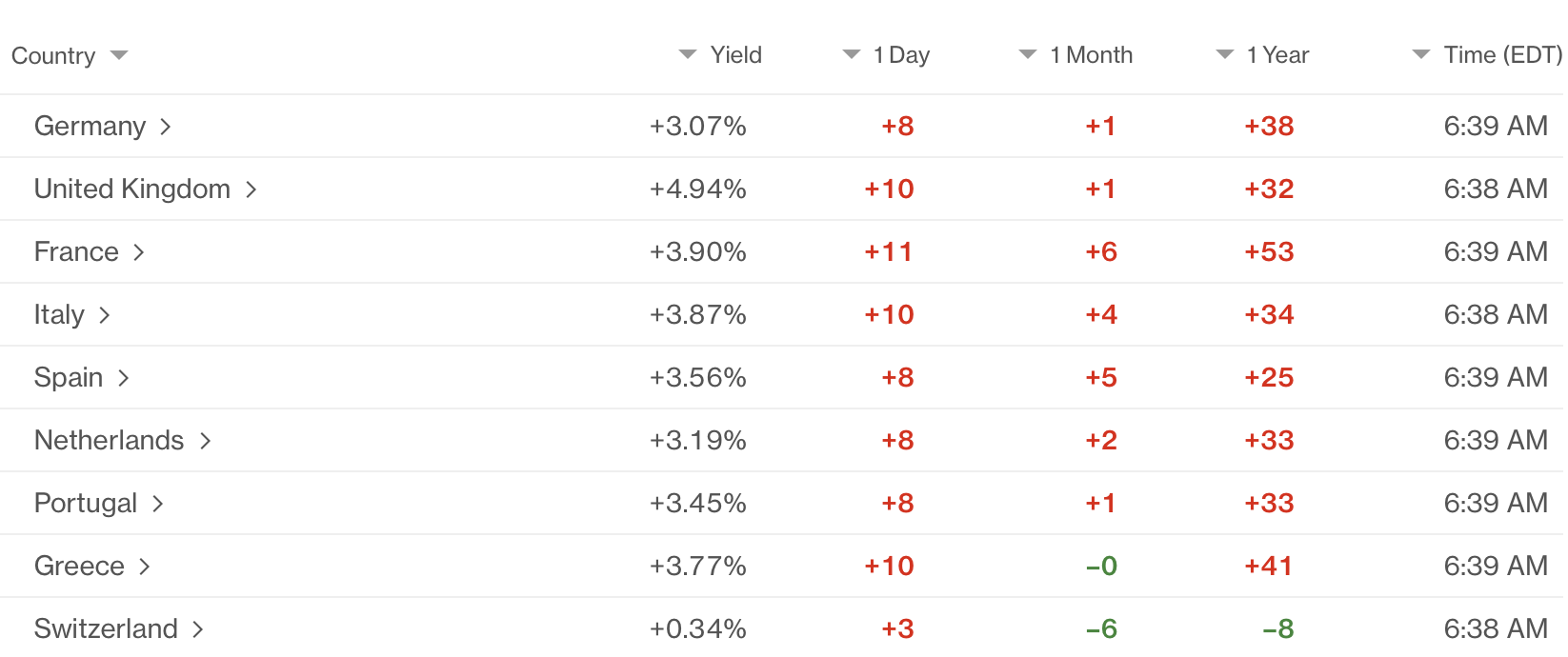
In the bond market, after climbing on Friday, yields continue higher this morning across the board.  The below Bloomberg screenshot explains things well.  Recognize that Canadian and Mexican markets haven’t opened yet and Australian markets were closed last night for the King’s Birthday.  But net, there is growing concern over inflation on a worldwide basis it appears.  

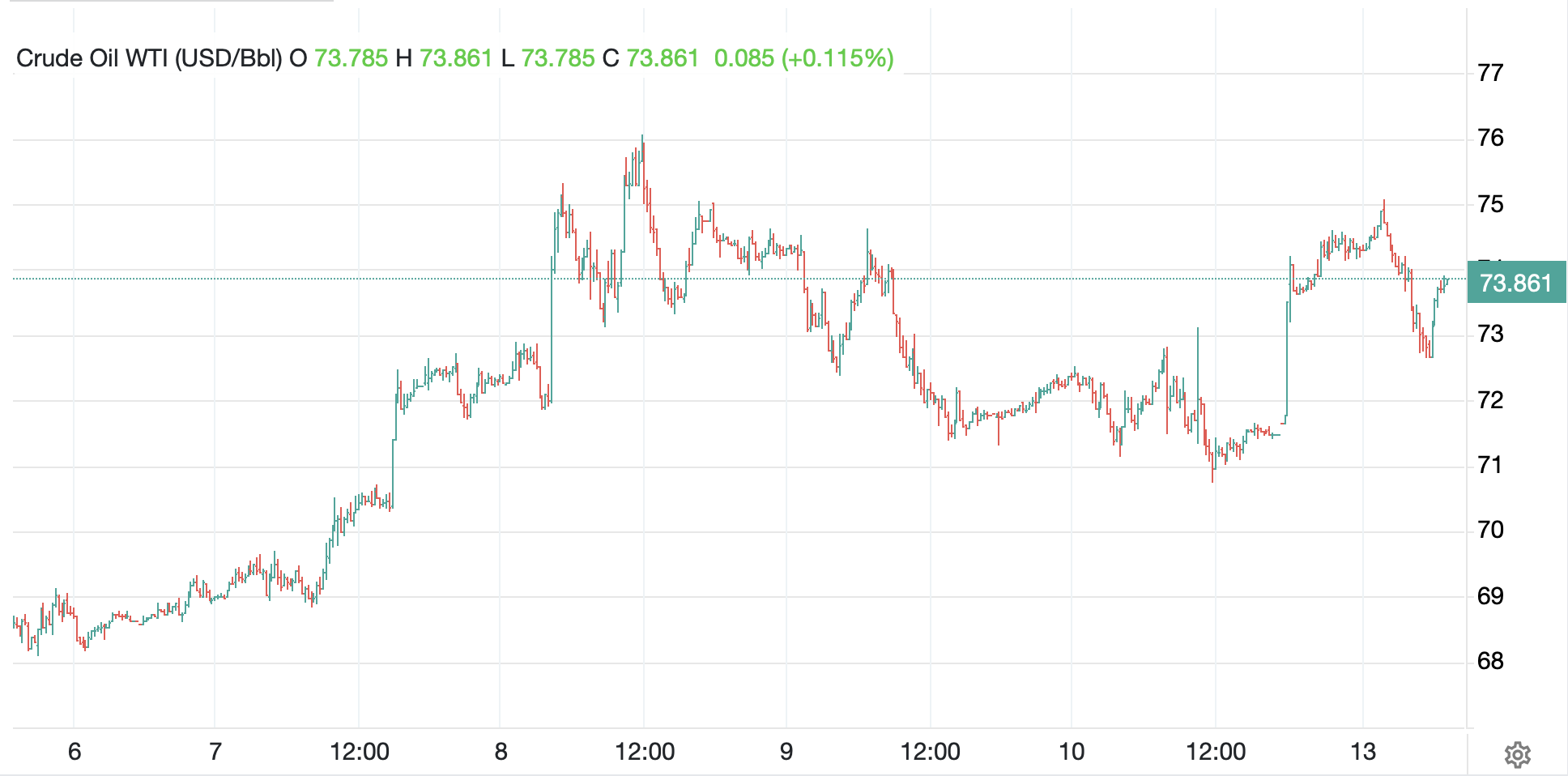
Turning to the commodity markets, oil (+3.8%) is higher again, after falling on Friday as there were missile attacks by Iran on Israel in response for Israel’s ongoing attacks on Hezbollah in Lebanon. This situation remains fraught and frankly nobody has any idea when it will settle down into something a bit less volatile.  If we look at a chart of the past six months of oil price movement, I have drawn a line at $95/bbl, which to my eye offers a pretty good estimate of the average since things began.  There are still many doomsayers who believe $200/bbl oil is coming soon, but that has been their forecast since March.  Something to remember about commodity markets is that they do not forecast the future, they are the prices at which physical stuff clears, so it appears that so far, there is ample inventory available.

Source: tradingeconomics.com

Not surprisingly, given the recent relationship between gold and oil, the barbarous relic is lower this morning by -0.7% while silver, though unchanged on the day, suffered dramatically on Friday, falling $6/oz or about 8%.

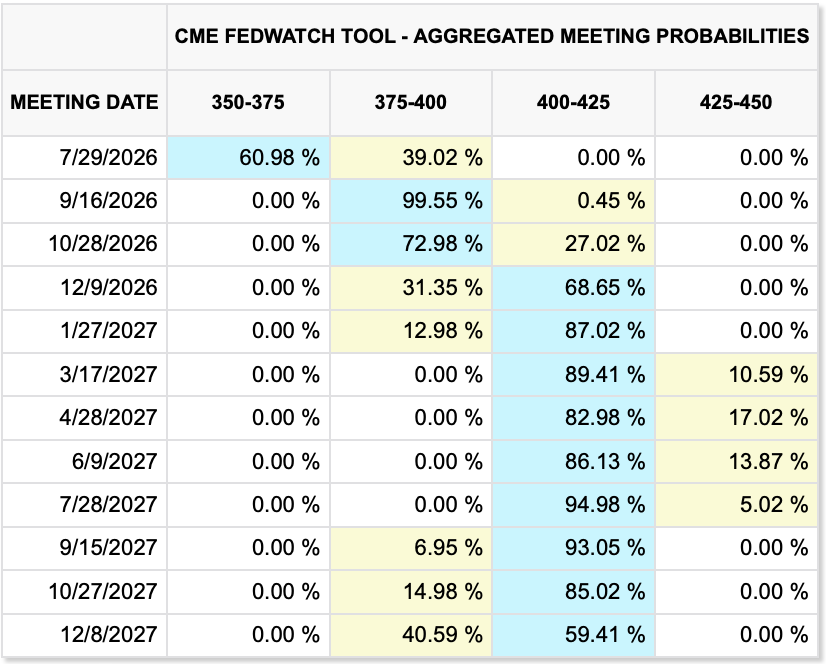
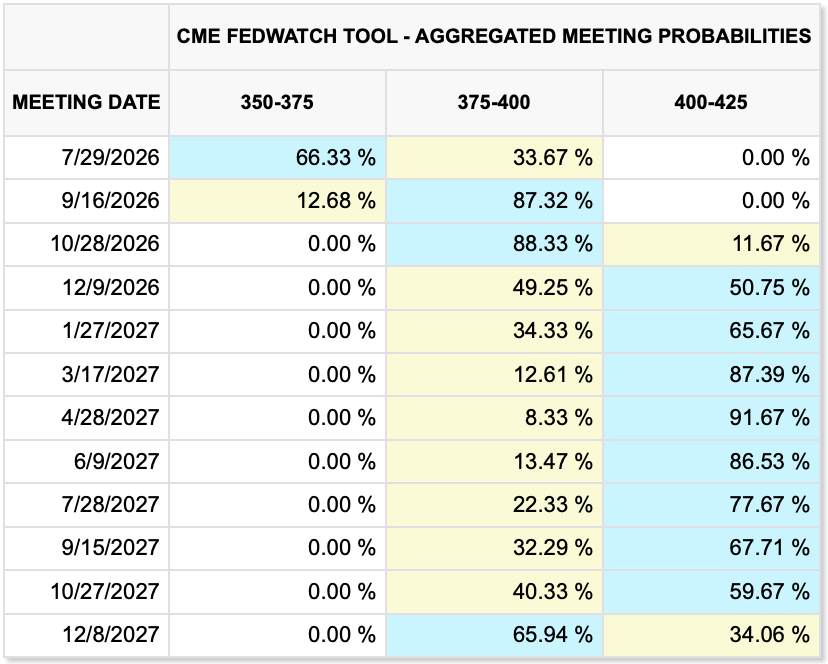
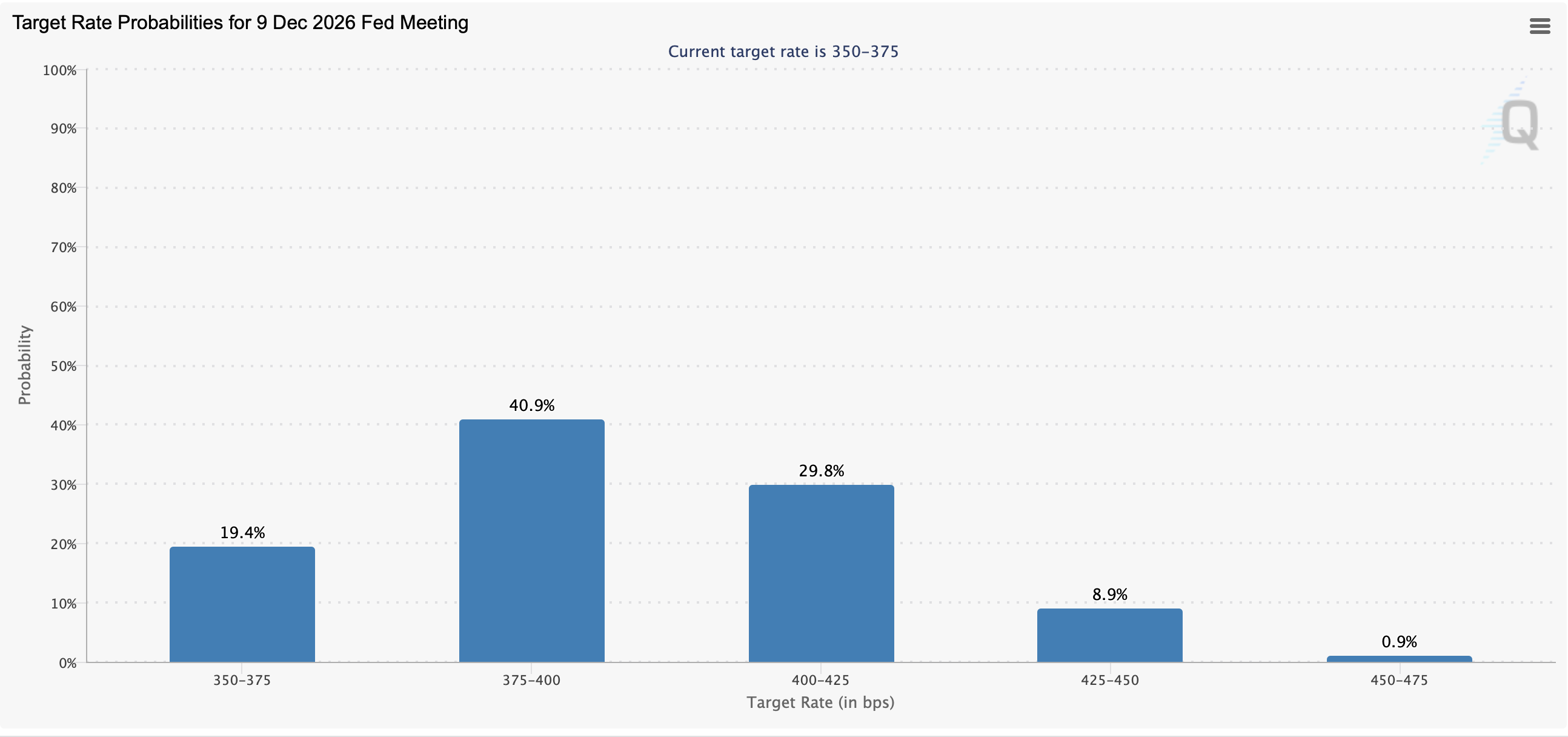
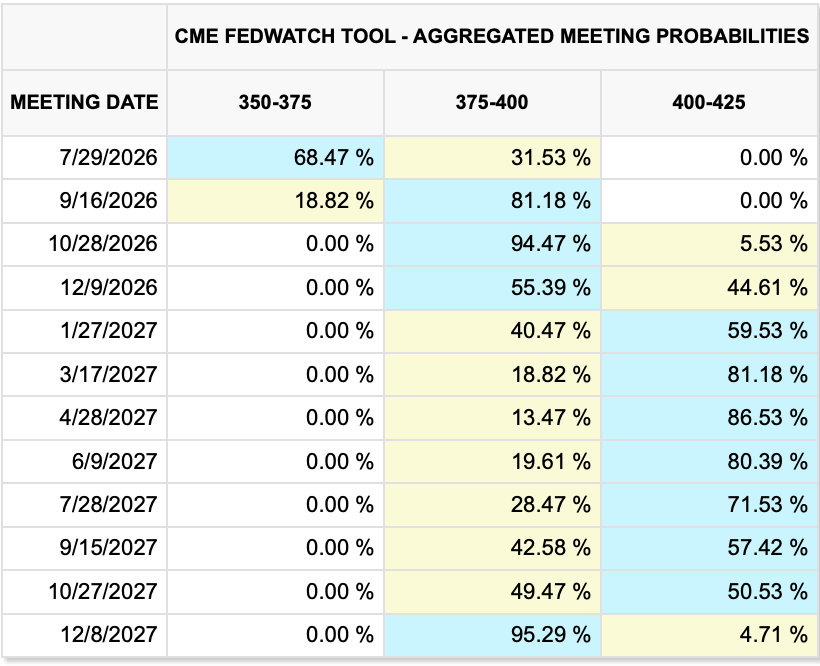
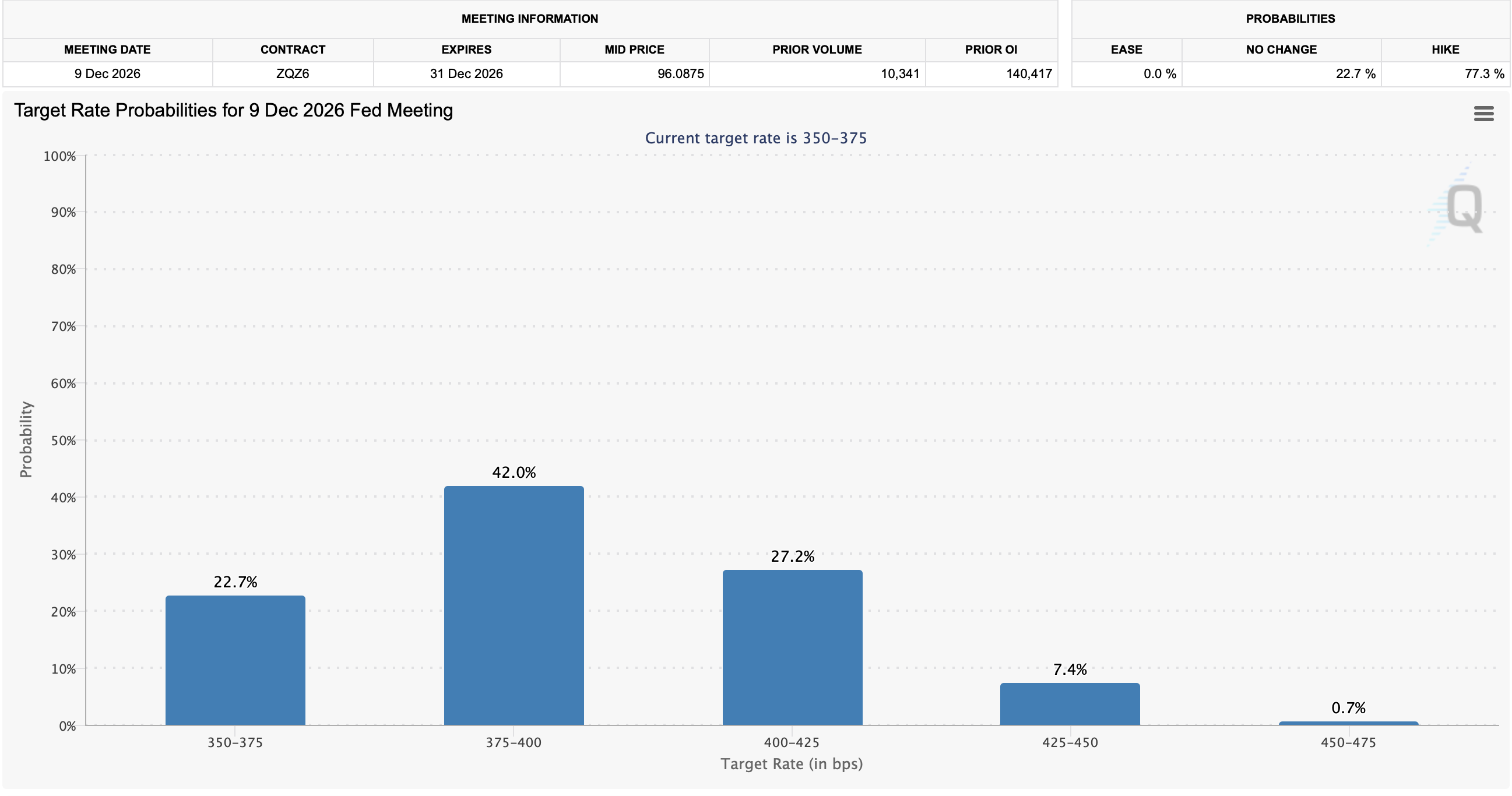
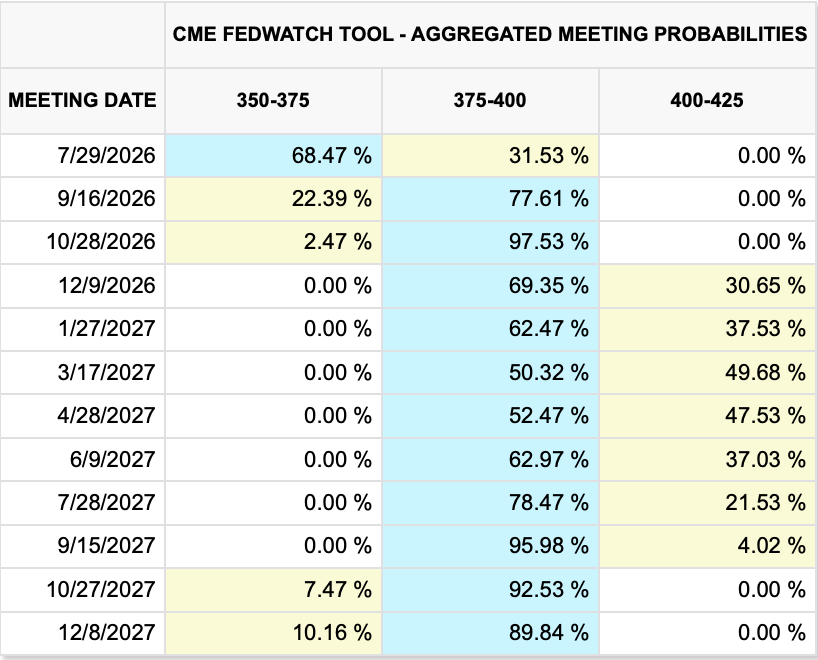
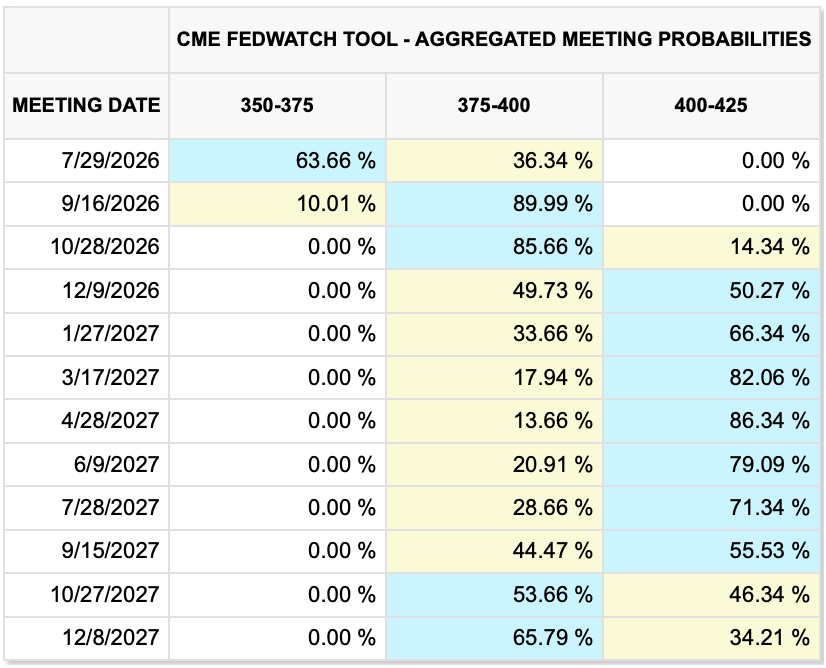
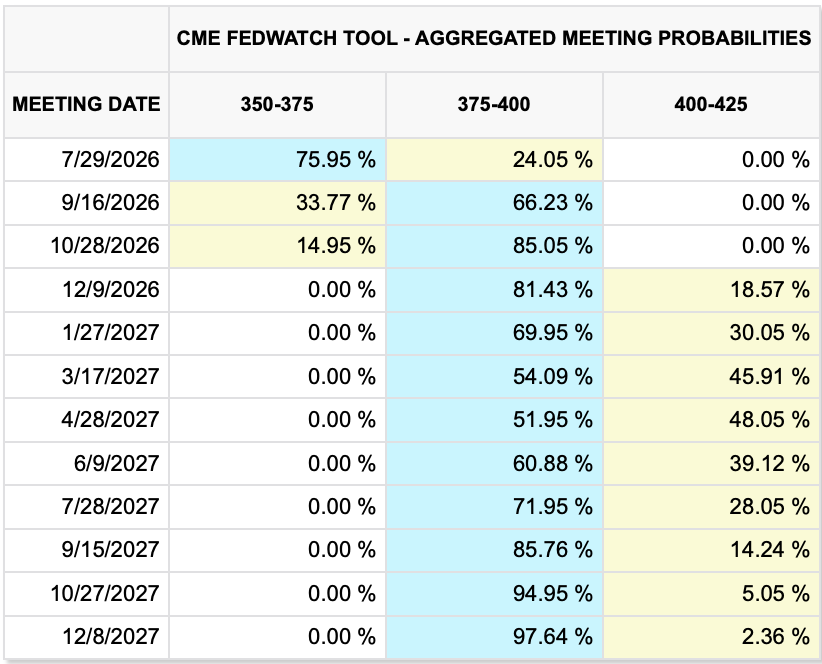
Finally, the dollar is little changed this morning, but that is after a sharp rally on Friday in the wake of the much better than expected NFP data (+172K with revisions higher in the previous two months of +93K) which helped push yields higher as a rate hike this year has now been priced by the futures market as per the below CME table.

But more than just the futures market is thinking that way.  The below chart showing the 2-year Treasury vs. Fed Funds shows that not only have 2-year yields moved above Fed funds, but they are accelerating higher.  This is seen as another harbinger of a higher Fed funds rate.

Source: tradingeconomics.com

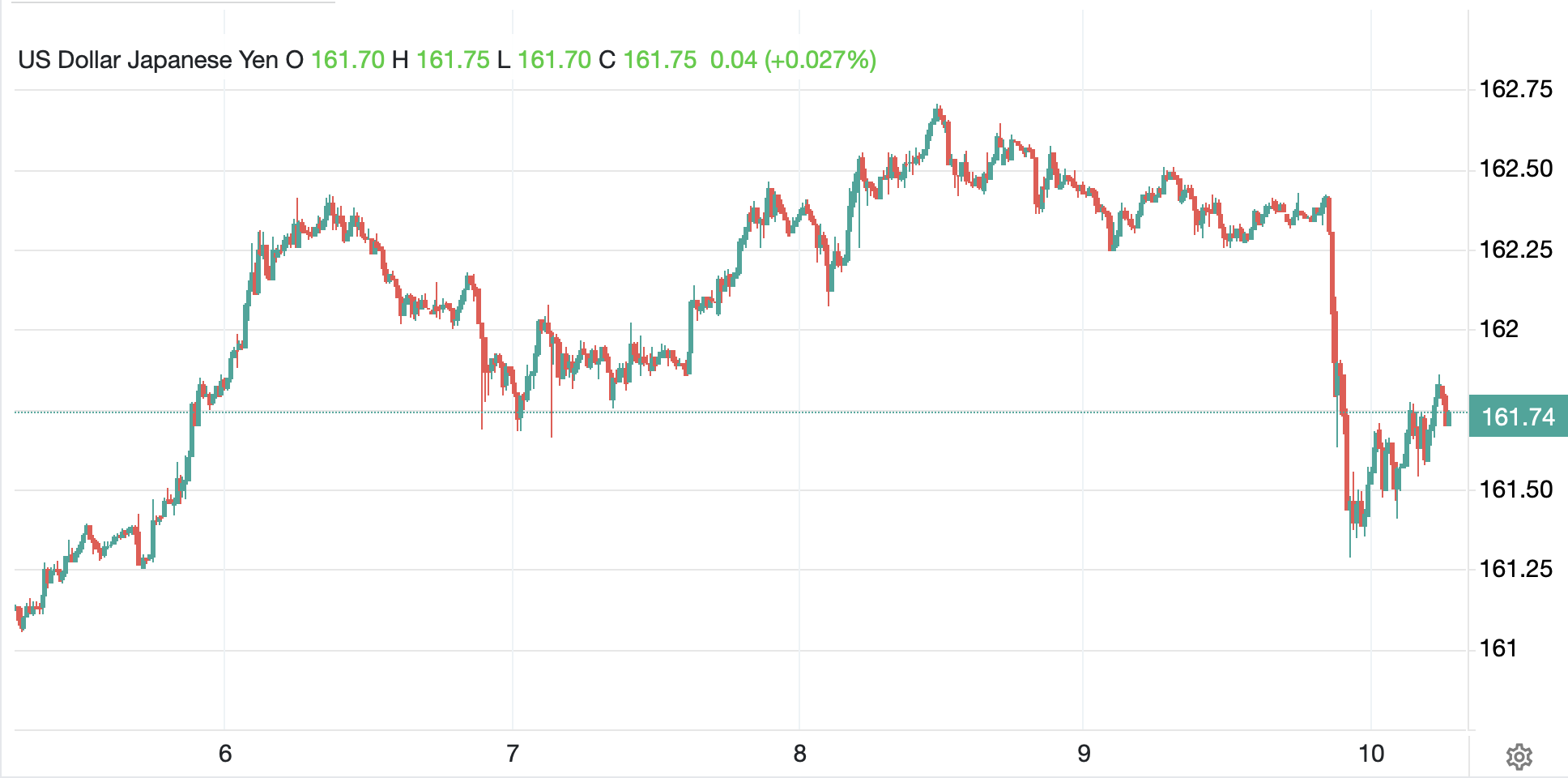
So, the DXY is back over 100.00, USDJPY breeched 160.00, and is right on that number as I type at 6:50am, and generally, the dollar is pushing the top of its recent ranges.  The one exception here is KRW (+1.6%) where the central bank and Finance Ministry both were actively jawboning the currency higher after it traded to yet another new low (dollar high).

As there is no data of note this morning, I will go through that tomorrow given how long things got today.  The world is changing rapidly and the most important thing, I think, is to recognize that old relationships may no longer be valid.  Nimbleness is critical, whether investing or hedging.

Good luck

Adf

In Secret, Would Toil

Since March, traders focused on oil
Where every explosion could roil
The bulls and the bears
In bonds and in shares
While data, in secret, would toil

Today, though, the payroll report
Is taking bows on center court
For those who are long
The buck, they need strong
Results, while a weak one helps short(s)

For a change of pace today, the market truly seems to be looking at the data release rather than the latest zig or zag in Iran.  It has been at least four months, since before the first bombs dropped in March, that this data point has had any real import for the narrative, so it is a welcome return to what we used to consider normal.  With that in mind, let’s look at what the current expectations are:

Nonfarm Payrolls85K
Private Payrolls85K
Manufacturing Payrolls2K
Unemployment Rate4.3%
Average Hourly Earnings0.3% (3.4% Y/Y)
Average Weekly Hours34.3
Participation Rate61.7%

Source: tradingeconomics.com

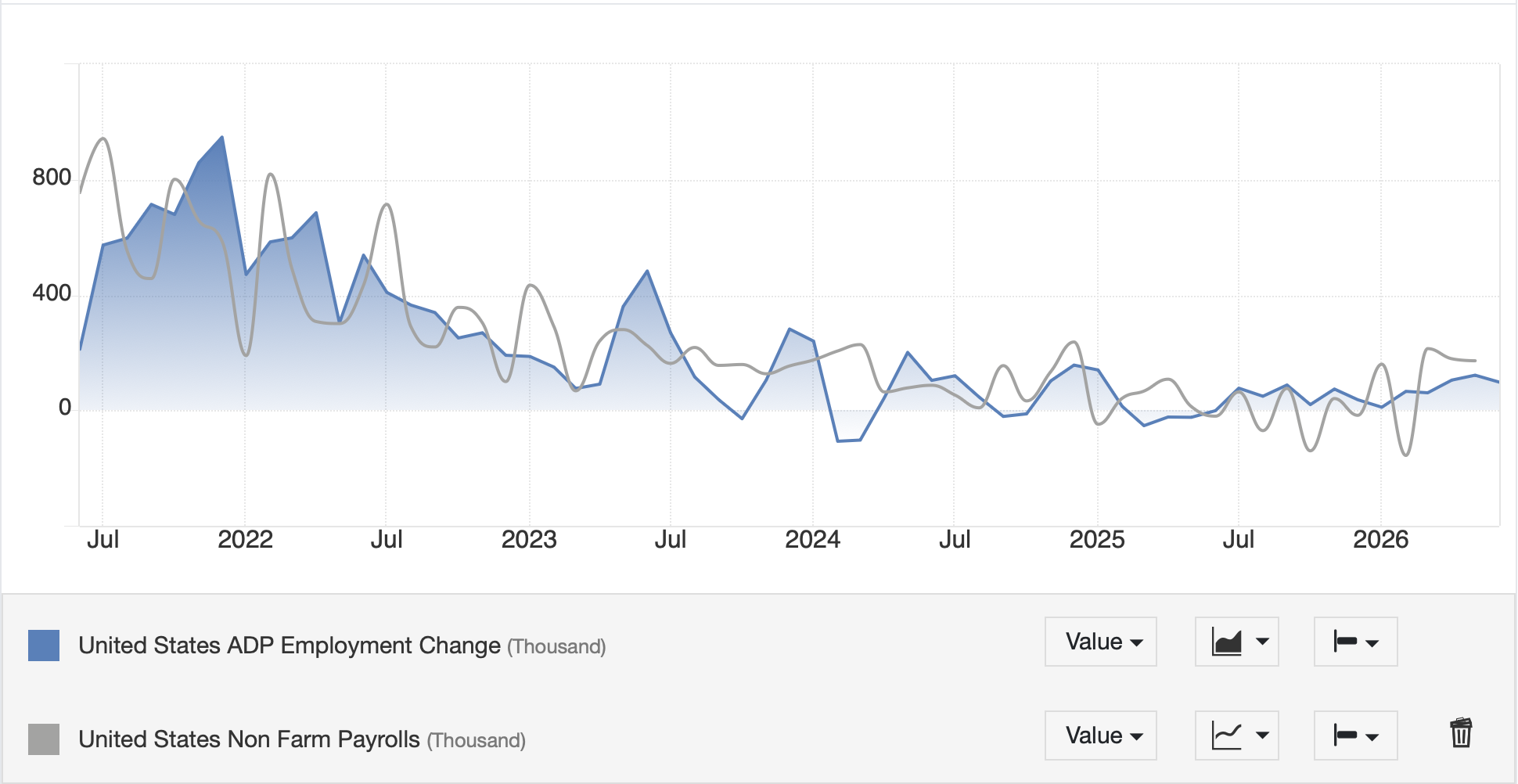
While 85K is much lower than the pre-Trump 2.0 level deemed necessary to maintain a strong labor market, it is abundantly clear that between the closure of the borders and the deportations, that is no longer the situation.  Estimates I have seen to achieve labor stability have been between 0 and 50K, and that includes comments from former Fed Chair Powell.  While an outturn at the forecast level would be lower than last month, it would still indicate the labor market is in decent condition.  Of course, one of the hardest things is to see through the revision noise as the BLS birth/death model describing new companies is clearly not representative of the current economy.  Below is a look at the past five years of monthly reports which is showing a clear trend lower, but as per the above, that may not be a problem.

Source: tradingeconomics.com

However, the other data we have seen lately, notably the strong ADP number, the solid employment subindices from the ISM data and the fact that claims data, although a touch higher yesterday, remains very contained, tells me that we are going to see a better number than forecast, something around 115K like last month.

Perhaps the real question is why this matters now.  Well, as the war fades into the background, and remarkably that is what is happening, investors are back to looking for clues as to how the economy is performing and how the Fed is likely to behave going forward.  Several times this week I have highlighted the importance of capital flows, and a key part of that story is central bank liquidity being available to flow.  Thus, if the Fed sees this data and leans more toward tightening, that is likely to have a negative impact on those markets that require easy money like stocks, high-yield debt and private markets.  Interestingly, if bond traders sense that the Fed is going to pay closer attention to inflation, that should help the long end of the bond market, and we could see a bull flattener result.  Nothing has changed in the Fed funds futures market, but that is something that could really move on an outlier number here.  We will learn soon enough.

Away from that, though, the most interesting thing I have seen is the below tweet although the commentary was strongly of the opinion that this is fake news.  If it is real, that is a major breakthrough in leading to the end of the war, however, based on the fact that oil prices are essentially unchanged (-0.15%), the market does not appear to believe the story.

Ok, let’s see what else is happening in other markets.  Not surprisingly, gold (-0.25%) is also not doing much but both silver (-1.7%) and copper (-1.6%) are softer despite the fact oil’s little changed.  Metals appear to have lost some of their luster for now, but I do believe that their long-term prospects remain strong.

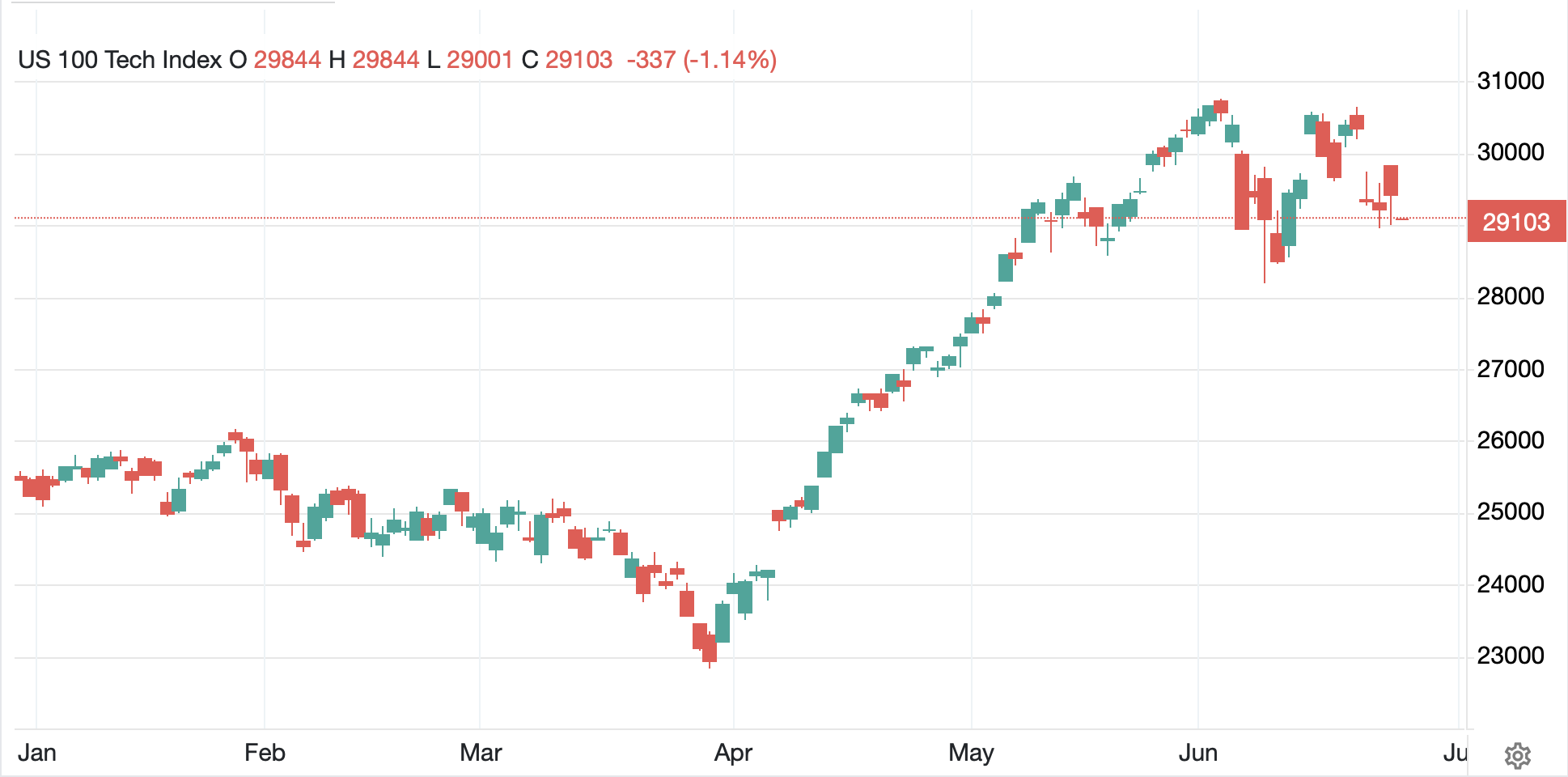
In the stock markets, yesterday saw the DJIA take the lead for a change, rallying to a new all-time high although the NASDAQ went nowhere as questions about the AI story are beginning to be raised.  Too, semiconductor stocks, which have been extraordinarily strong, are beginning to be questioned given the highly cyclical nature of that business.  Yesterday Harris Kupperman wrote a very interesting piece on semiconductors which I think is worth reading.

In the meantime, Asian markets followed the tech lead from NASDAQ and were virtually all lower, some extremely so.  The worst case was Korea (-5.5%) followed by Indonesia (-4.2%) but the major indices all fell as well (Tokyo -1.3%, HK -1.15%, China -1.8%).  Tech took a beating.  Of course, for Europe, since they basically have no tech, markets are having a much better day with Spain (+1.1%) leading the way followed by France (+0.5%), the UK (+0.4%) and Germany (+0.2%).  Perhaps the fact that Eurozone GDP for Q1 was revised down to -0.2% Q/Q and +0.3% Y/Y has some thinking the ECB may not (stupidly) raise rates due to the oil shock.  But if that’s the case, you cannot tell by the interest rate markets which show the current probabilities as per the ECB itself.

At this hour (7:40) US futures are mixed with the NASDAQ (-0.9%) still suffering while the DJIA (+0.2%) continues to smile.

Apparently, global bond markets are collectively holding their breath ahead of the data point as yields are essentially unchanged in the US, Europe and were unchanged last night in Asia.

Finally, the dollar is slightly softer this morning, although remains above 99 on the DXY and is merely chopping back and forth within the extremely tight range of the past 3 weeks I show, once again, below.

Source: tradingeconomics.com

Most movement today across both the G10 and EMG blocs is +/-0.25% or less, hardly the sign of a trend.  The one exception is INR (+0.8%) after the RBI left rates on hold, as expected, but instituted several measures to try to attract foreign capital such as easing investment rules for foreigners.  We shall see if that has a long-term benefit, but at least the rupee has put a little space between the current level and the bottom (dollar top) seen two weeks ago.

Source: tradingeconomics.com

And that’s really all for today.  So, absent news about real movement toward the end of the Iran conflict, it’s payrolls then a summer Friday where many will be seeking to leave early.  If I am correct and we see a stronger number, I see the dollar benefitting which should hurt the metals, although oil is independent of this news.  Since this would imply more chance of a Fed rate hike, I expect stocks would not be pleased, nor will bonds.  We shall see.

Good luck and good weekend

Adf

One Sixty

The asymptote nears
Will they act at One Sixty?
Can they afford to?

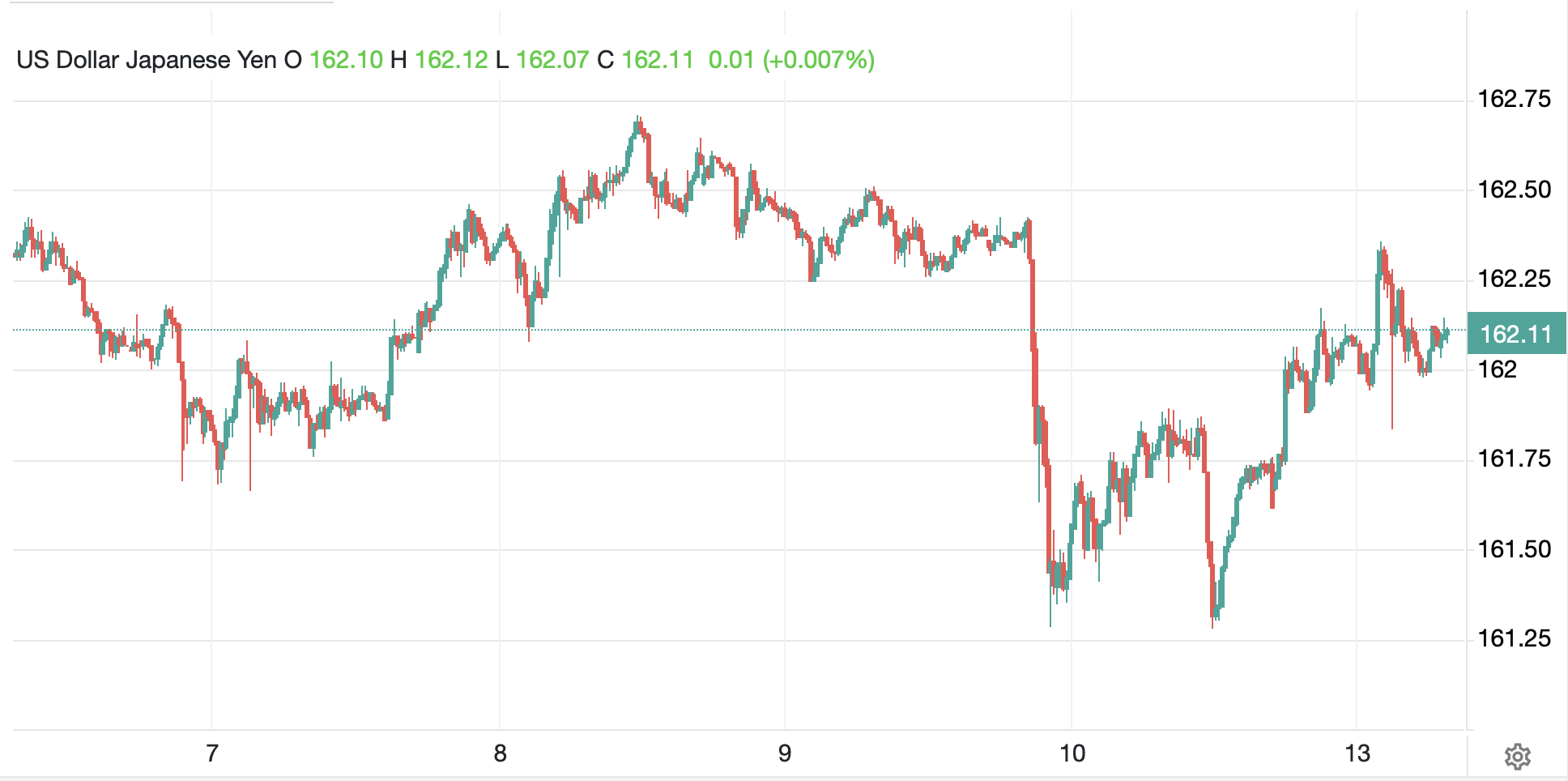
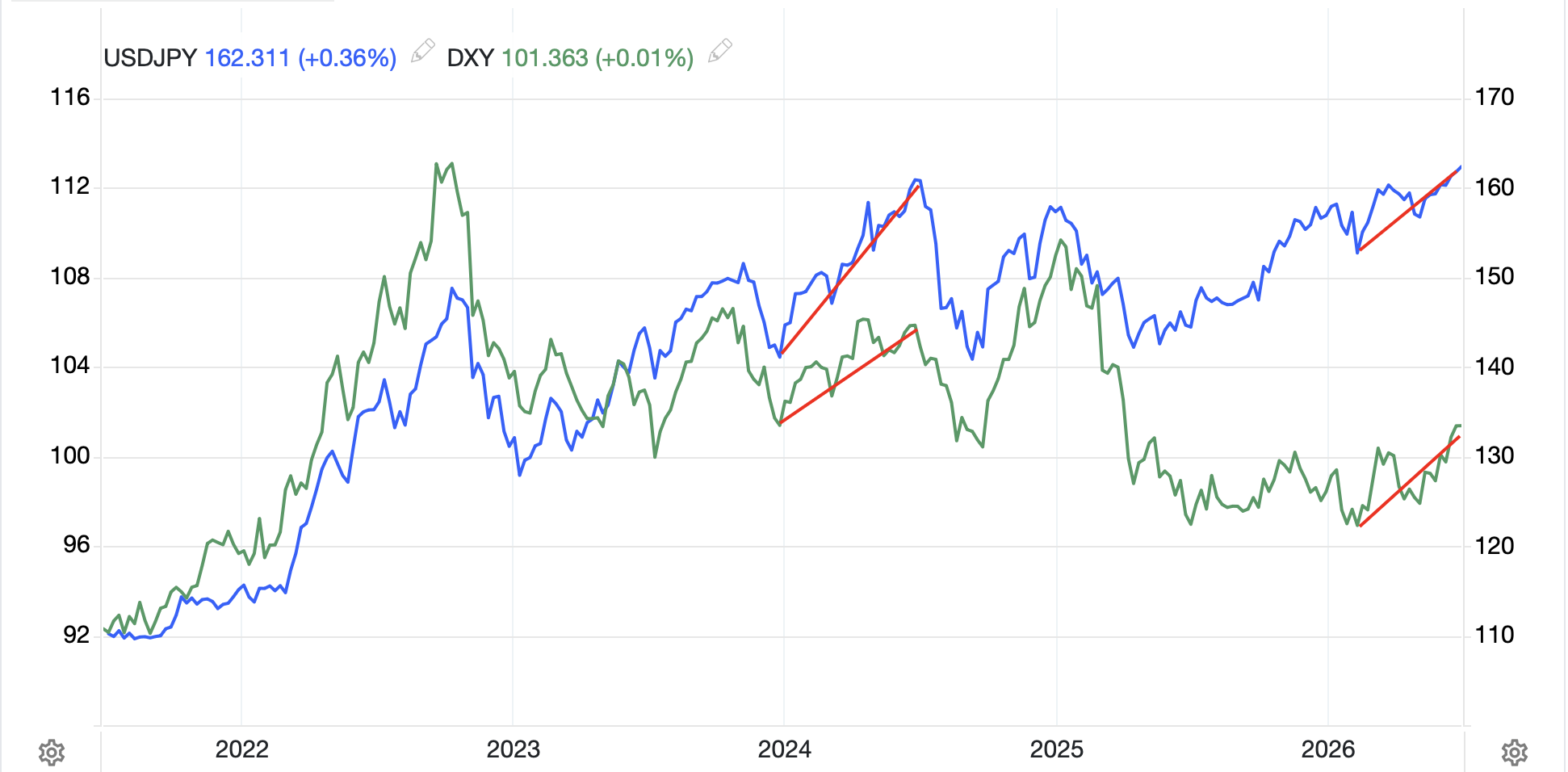
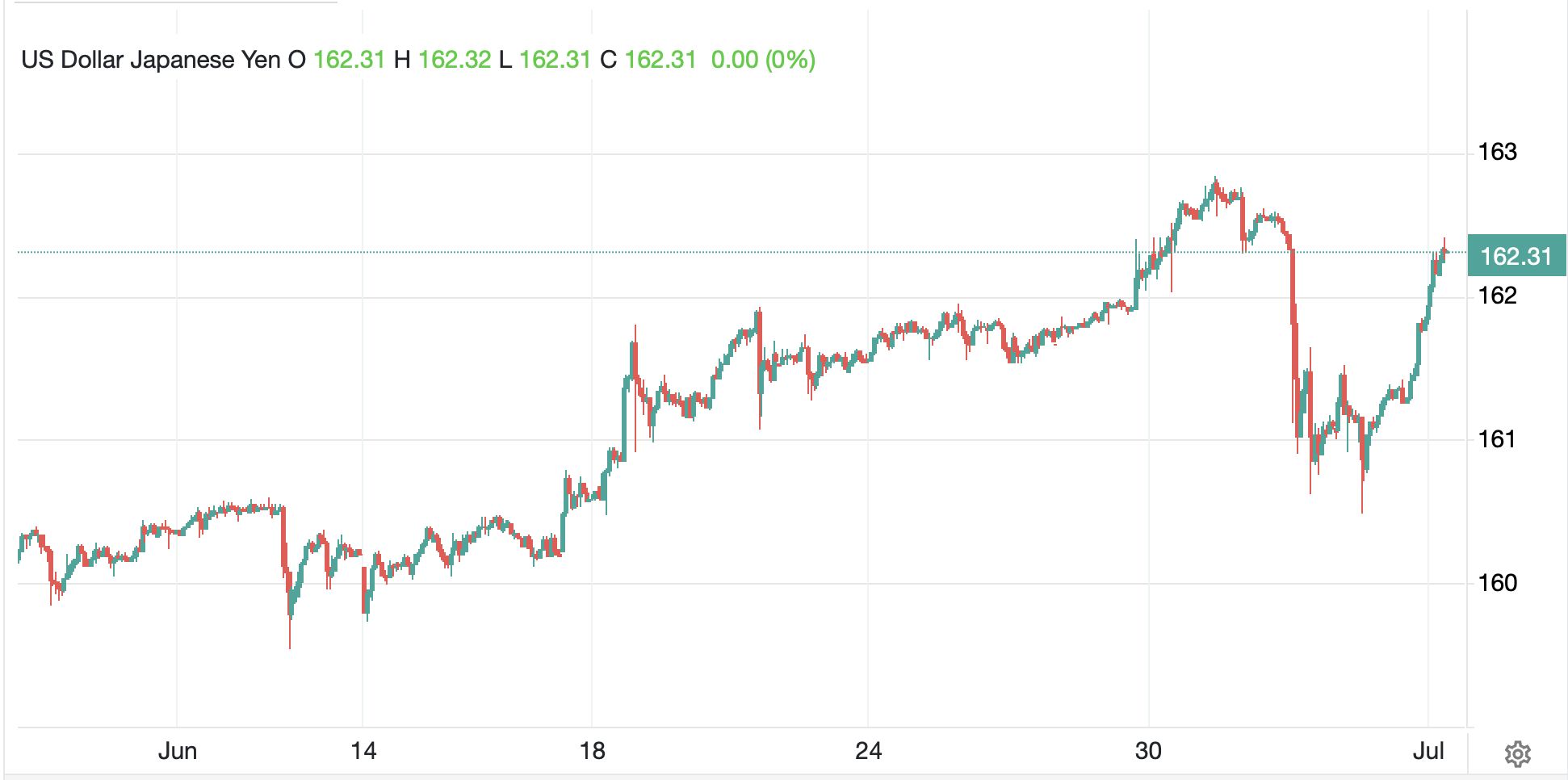
Yesterday saw the yen edge ever closer to the 160 level, the point at which the MOF/BOJ acted in April.  Frankly, looking at the chart, it reminds me of an asymptotic limit from calculus, but the one thing we know is there is no natural limit, only whatever artificial one is imposed (or tried to be imposed) by the Japanese government.

Source: tradingeconomics.com

The market continues to price a high probability, ~86% according to the OIS market, of a 25bp hike by the BOJ next week, and I’m confident they will do that.  But to me, the question is, will it matter to the FX markets?  Here’s the thing about FX, typically there are two separate, but related, drivers of the relative value of one currency vs. another.  The most common discussion is about short-term interest rate differentials, typically proxied by central bank base rates.  Below is a chart of the past ten years of data for Fed funds (grey line), BOJ base rate (blue line) and USDJPY (brown line).

Source: tradingeconomics.com

It is abundantly clear that there is a strong relationship here, as US rates shot higher in the post-Covid inflation bout and USDJPY shot higher as well.  Now, since the Fed started cutting rates back in September 2024, while Japanese rates have edged higher over the same time frame, it would be reasonable to assume that USDJPY should retreat somewhat.  However, as you can see in the first chart, that is just not happening.  In fact, the pressures are the other way, with far more weakness than strength.

Why, one might ask, is this the case?  This takes us to the other major factor in FX rates, relative capital flows.  Nations that see substantial inflows in capital will typically see their currencies appreciate.  Now, ask yourself, which nation sees the biggest inflows of capital in the world?  Yes, the US, as the capital account surplus is the mirror image of the massive current account deficit that we run.  In fact, if you look at the below chart, it shows the relative current accounts of Japan (grey bars) and the US (blue bars) in percentage of GDP which most recently showed -3.6% for the US and +4.7% for Japan.

Source: tradingeconomics.com

Now, let’s do the math.  US GDP is ~$28.8 trillion while Japanese GDP is ~$4.4 trillion.  3.6% of $28.8 trillion = ~$1.037 trillion of capital inflows.  4.7% of $4.4 trillion = $202 billion of capital outflows.  Of course, we know that everybody in the world is piling into US technology stocks, and that is where the capital is mostly flowing, but in order to do so, they are buying USD.  This is true of Japanese investors as well as others around the world.  

There is a narrative that is developing that claims as the Japanese raise interest rates, the massive, short yen positions that exist to fund many speculative trades will unwind, and with that, the yen will strengthen dramatically as well as we will see many other markets sell off sharply as those positions unwind.  But the NASDAQ is up 21% YTD and 40% in the past year.  If you are an investor and you are funding a speculative position at 0.75% annually that rises to 1.00% while you are returning 40% on the other side, do you really care?

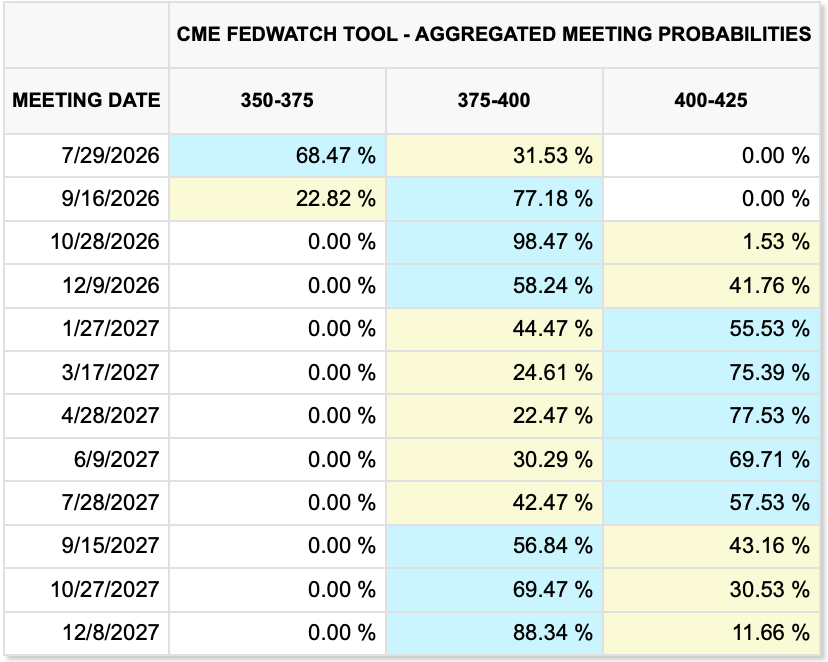
To my eye, for the yen to change course, intervention is irrelevant, and so is a 25bp rate hike.  We need to see a wholesale change in the combination of Japanese fiscal and monetary policies as well as changes in those policies in the US.  Historically, a tight monetary and loose fiscal policy combination will strengthen a currency (something that the US currently has), but can Japan afford to tighten monetary policy that much?  My money is on no, and while 25bps seems pretty certain next week, I would not be looking for USDJPY fall very far, if at all.  And remember, the market is pricing a 50% chance of a Fed hike by the end of the year.  Don’t be taken in by this story in my view.

Away from this issue, it is difficult to find other critical news.  Yes, there was another skirmish in Iran straining the concept of a ceasefire, but all-out war has not resumed.  The elections in California and LA will take several weeks to determine who will be on the ballot in November, which, when you think about it, sums up the incompetence of California governance writ large.  

So, oil is higher along with the dollar and yields, but so are stocks, while metals slip.  Let’s look at the overnight activity.  Another set of equity records in the US was followed in Asia by broad based strength as Tokyo (+2.5%), China (+0.5%), Korea (+0.2%) and Taiwan (+2.0%) all continued to climb. Both HK (-1.6%) and India (-0.4%) were not as robust with the former seeing profit taking after a few strong sessions while the latter felt pressure from those rising oil prices.  One outlier here was Indonesia (-4.5%) which suffered after weaker than expected trade data, higher than expected inflation data, and a weakening rupiah which set another record low (dollar high), touching 18,000.

European bourses, meanwhile, are mostly under pressure after President Trump has devised a new way to impose tariffs on nations that allow “forced labor” which is defined as “all work or service which is exacted from any person under the menace of any penalty for its nonperformance and for which the worker does not offer himself voluntarily.”  One must give the president props for his continuous efforts to impose tariffs, if nothing else.  At any rate, Germany (-0.9%) is leading the way lower, followed by Italy (-0.3%), France (-0.2%) and the UK (-0.2%) although Spain (+0.5%) is bucking that trend on the strength of the earnings for Inditex (Zara clothing parent) which is one of the largest companies in the nation.  US futures, at this hour (6:40) are mixed.

In the bond market, yields are rising again on the back of the oil price rise with Treasury yields (+4bps) gaining alongside the entire European sovereign market, all of which have risen a similar amount.  Last night, JGB yields also rose 6bps, as they respond to the oil market as well as pending rate hikes by the BOJ.

In the commodity market, if you think back to late May, you may recall an announcement that a deal with Iran was close which prompted a gap lower in oil prices as you can see in the chart below.  Well, that gap has now been filled.

Source: tradingeconomics.com

Just as nature abhors a vacuum, markets abhor a gap and seek to fill it whenever possible.  My take here, though, is now that the gap is filled, there is less reason to see oil rally much further and a consolidation before a slow decline is in the cards.  As to metals markets, gold (-0.8%), silver (-1.2%) and copper (-1.1%) are all softer on the day, with their negative correlation to oil intact.

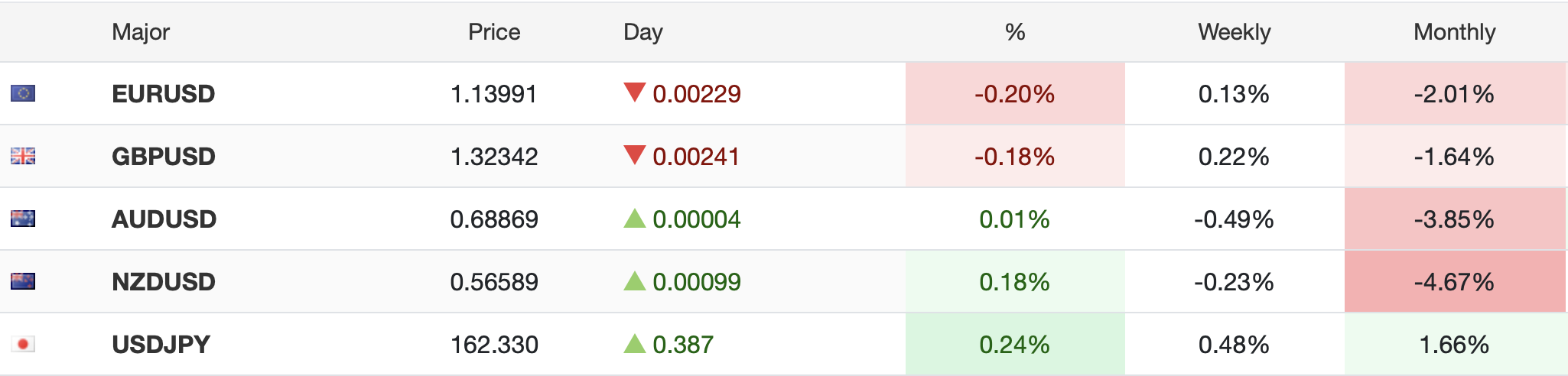
Finally, the dollar is firmer this morning, keeping in line with its recent relationship with other markets.  However, the movement remains relatively muted with most G10 currencies softer by -0.2% or so as only SEK (-0.6%) and NOK (+0.1%) really buck that trend.  NOK is clearly benefitting from the oil price rise while SEK seems to be suffering from a slightly higher beta to the broad dollar move.  In the EMG bloc, KRW (-0.9%) is the laggard as it continues under pressure and trading to its lowest levels (highest dollar) since 2009.

Source: tradingeconomics.com

But otherwise, most of these currencies are slipping a similar amount to the G10 bloc, on the order of -0.2% or so.

On the data front, this morning brings ISM Services (exp 53.8) as well as Factory Orders (4.6%, 0.8% ex-Transport) and then the EIA crude oil inventories with another sizable draw anticipated.  At 2:00, the Fed’s Beige Book is released which should make for some interesting reading.  Yesterday’s JOLTs data was surprising in that it showed a significant jump in job openings, 700K more than expected which does not portray a weakening labor market.

Overall, equity markets seem to be disconnected from the impact of oil prices, something that very few analysts would have forecast in February.  But the dollar remains closely linked to those prices for now.  As we all sit here, waiting for the next headline, I cannot help but look at the US data and consider that the economy continues to tick over pretty well.  Ultimately, I believe that bodes well for the dollar over time, or at least until some other major economy shows it can perform well.

Good luck

Adf

No Black Swan

For all of the angst that Iran
Has ended the talks and moved on
The market for oil
Has come off the boil
As risk takers see no black swan

So, stocks keep on making new highs
And it cannot be a surprise
That bond yields have slipped
While in today’s script
Elections will garner all eyes

Once again, I am having a hard time reconciling the narrative and the price action.  Yesterday saw a sharp rally in oil as the talks between the US and whoever is representing Iran apparently collapsed.  Yet, as you can see from the below chart, while that was worth nearly $5/bbl early in yesterday’s session, those gains dissipated over time and this morning, oil (-1.2%) continues that slide.

Source: tradingeconomics.com

One thing I saw on X this morning claimed Iran was done talking, had received a nuclear bomb from a third party (Pakistan? North Korea?) and was going to detonate it somewhere.  Another was that the talks are still ongoing.  I do find it interesting that so many are willing to take statements from the Iranian news agency, TASNIM, a body that has lied repeatedly for 47 years, and assume their claims are gospel.  Propaganda is always an ongoing project on both sides (in truth from every government everywhere) and thus every claim must be seen for what it is, speaking to a specific audience to achieve a response, not an unbiased description of reality.  Thus, it seems many folks see what they want to see to confirm their prior beliefs.  I come back to the market as the most unbiased arbiter, and it continues to point to an end to the conflict on a relatively short timeline.

Which takes us to the other story today, US primary elections, notably in California where there is a gubernatorial primary and a mayoral one in LA that has garnered the most attention based on the seeming outstanding performance of former reality-TV star (?) Spencer Pratt running against the incumbent Karen Bass.  This race seems like it may be quite important nationally as it would offer the possibility that the deepest blue of cities may finally have had enough incompetence in the mayor’s office and wants to change directions, at least a little bit.  Of course, NY just elected an incompetent mayor, as did Seattle and Chicago before them, so maybe the people in these cities like the situation.  I’m hopeful that is not the case.

But otherwise, it is hard to get too excited about much this morning.  equity markets in the US made yet another set of new highs yesterday across the major indices as no matter the news, it appears there is a bullish spin.  So, let’s turn to markets this morning.  Asian equity markets were mixed overnight with Tokyo (-0.3%) slipping slightly although HK (+2.5%) and China (+1.5%) both rallied nicely on the back of the US tech rally.  Net, there were far more winners in the region (Korea, India, Taiwan, Philippines, Thailand, Singapore, Indonesia), than laggards (Australia, New Zealand, Malaysia) with the laggards barely slipping at all.  So, despite all the angst over Asian nations running out of oil and oil products, equity investors are all in there!

In Europe, it’s happy days as well as per the below Bloomberg screenshot.

This is despite Eurozone inflation rising to 3.2%, its highest level since September 2023, and, as per the below chart, certainly looking like it is beginning to trend higher on the back of 3+ months of higher oil prices feeding through the entire economy.

Source: tradingeconomics.com

Of course, given Eurozone GDP is indistinguishable from zero (see below chart), and has been for 3 years, it is fair to wonder if this is setting up to be a particularly egregious central banking error by Madame Lagarde.  

Source: tradingeconomics.com

Too, while short-term inflation expectations have unsurprisingly risen, a look at the 5-year result shows limited concern by consumers.  As an aside, there is good reason to believe that inflation expectations are irrelevant in future inflation readings, at least according to the academic literature, but it is a driving force in current central banking models, so needs to be considered.

In the end, though, the ECB is going to hike rates next week, on that you can depend, and if when economic activity declines, they will blame Putin or Trump or Elon or anything but their own failed policies.

As to US futures at this hour (7:10), they are modestly lower, maybe -0.2% or so across the board.

In the bond market, Treasury yields have fallen back -3bps this morning after round-tripping 5bps higher yesterday and finishing the day unchanged.  European sovereign yields are having a better day, with declines of -6bps to -7bps across the continent and JGB yields (-11bps) are really falling.  My conclusion is that investor concerns over runaway inflation simply do not exist despite the narrative pushing that story.  The ostensible crises in May apparently never arrived, at least not yet.

In the commodity market, it can be no surprise that metals prices (Au +1.0%, Ag +1.8%, Cu +1.0%) are higher this morning given the overall risk environment.  The negative correlation between metals and oil remains largely intact for now.  The interesting thing to note, though, is that despite the daily gyrations, in reality, neither oil nor the precious metals have gone anywhere in a while.  The same is not true for copper which is at new all-time highs.

Finally, the dollar is modestly softer this morning, on the order of 0.1% against its G10 counterparts with AUD (+0.3%) the best performer.  In the EMG bloc, ZAR (+0.6%) is responding to the combination of lower oil and higher gold prices and MXN (+0.4%) is also having a pretty good session, but that seems more like beta vs. the dollar than anything else.  I would be remiss if I didn’t spotlight JPY (0.0%) which continues to edge closer to the 160.00 level as per the below chart, but was also the subject of much discussion as FinMin Katayama was out explaining that, “As for foreign exchange, we continue to maintain our stance that we stand ready to take appropriate action at any time, as needed.”  However, while the market expects a 25bp rate hike in two weeks, that is already in the price.  In order to stop the yen’s slide, they will need to really change policy, something which I maintain is not in the cards for now.

Source: tradingeconomics.com

On the data front, this morning brings only the JOLTs Job Openings (exp 6.88M), essentially unchanged from last month.  Yesterday’s ISM Manufacturing data was quite solid across the board except for the employment subindex, which remains lackluster as companies expand with more automation.

I think it is fair to say nobody knows what will happen in the Iran conflict nor the timing.  While markets can be completely wrong, and forced to reprice suddenly, that is an extremely rare occurrence.  Too, the one thing on which we can count is if something hugely negative occurs, central banks around the world will step in, add liquidity and cut rates, to ameliorate the slide.  My point is, I will not bet against the market view that this will end sooner rather than later.

Good luck

Adf
Actively Chided

Ostensibly, talks are ongoing
However, some fighting is sowing
The seeds of more doubt
That they’ll work it out
Ere Tehran’s surroundings are glowing

But markets have clearly decided
An outcome will soon be provided
Thus, risk is embraced
And stocks, higher, chased
While bond bears are actively chided

I hope everyone had a nice Memorial Day weekend, although until Monday afternoon, I must admit the weather here in NJ was less than we might have hoped.  Of course, a few raindrops are nothing compared to the “defensive” attacks executed by US forces, sinking two Iranian boats while they were trying to lay mines in the Strait.  Apparently, Iran’s response, several volleys of surface-to-air missiles was met with the destruction of those launchers as well.  

There is nothing better, though, than the language Iran uses in situations like this.  According to the WSJ, the head of the national security committee of Iran’s parliament, Ebrahim Azizi, explained that any attacks on the country’s armed forces would be met with “a decisive, crushing and regrettable response.”  It certainly sounds impressive, but it is not clear they can back up those words that effectively.  I guess we shall see.

In the meantime, the other newsworthy item from the weekend was that the Supreme Leader, Mojtaba Hussein, was killed in a military strike and yet talks appear to be continuing.  President Trump explained that the framework for a deal was getting close and that was enough for traders to don their rose-colored glasses as oil gapped lower by more than $5/bbl when futures markets opened Sunday night and despite the recent “defensive” strikes mentioned above, remains far below levels seen last week.

Source: tradingecomomics.com

Not surprisingly, as Monday night trading in Asia gets underway, risk is back on with equities and metals higher, and bond yields lower.  

And as we awaken Tuesday morning, very little new has occurred.  The market continues to believe in the idea that the war is over in all but the details, at least the Iran war.  Ukraine continues, alas.  

On Friday, the latest Fed Chair
A man with a full head of hair
Was sworn to uphold
The idea that gold
To dollars, must never, compare

Before the weekend began, Kevin Warsh was sworn in as the new Fed Chair and the man has a tough job, that is for sure.  As another indication that the Fed is not an apolitical institution (as if any institution based in Washington DC could be apolitical), he hadn’t even gotten the keys to the office before two Fed governors were out opposing his very existence. The WSJ editorial page had a nice summation here which explained that Michael Barr, the erstwhile Vice Chair for Supervision who oversaw the collapse of Silicon Valley Bank (perhaps not the best credentials) was adamant that shrinking the balance sheet would lead to problems, as though he could foresee them!  Then Chris Waller, who was in the hunt for the Chairman’s seat, reversed his recent views on interest rates, explaining hikes were likely in order.  I’m sure there are no sour grapes there!

From this poet’s perspective, the financialization of the economy has been one of the biggest long-term problems we have seen and part and parcel of that financialization has been the Fed bloating expanding its balance sheet from <$1 trillion prior to the GFC to nearly $9 trillion at the height of the Covid madness and still well above $6 trillion today.  It is much harder to financialize things if there is less money around.  I fully support the idea that shrinking the Fed’s balance sheet would be a good thing.  Alas, that will be a tough road to hoe for Mr Warsh.  Good luck to him.

And with that, there are few other stories of note, so let’s look at the market response to the latest peace initiatives.  While we’ve already discussed oil above, gold saw the initial move you would have expected, jumping sharply, but has since given back much of those gains, as per the below chart, and is now about 0.5% higher than Friday’s close.

Source: tradingeconomics.com

Silver has seen similar price action as has copper.  Certainly, if a deal is signed, I believe we can expect oil to head back toward $75 – $80 per barrel and gold and silver to rebound sharply as well.  

The other noteworthy mover was the bond market, which saw yields fall sharply on the news of the deal framework getting close.  You may recall the apocalyptic prognostications just last week when 10-year Treasury yields climbed near 4.70% with many discussions regarding the steepening of the yield curve and the trouble ahead for the economy.  But as I type this morning at 7:00am, the 10-year yield has dipped back below 4.50% in sync with the oil move lower as some of those inflation fears seem to be mitigating.

Source; tradingeconomics.com

Now, as I look across European sovereign markets, they all show modest rises in yields this morning, but that is because yesterday, they fell so sharply.  Net, over the two days, yields are lower across the board.  As an example, the chart below shows both German and Italian 10-year yields and I highlighted Friday’s closing levels.  As you can see, both fell sharply yesterday and bounce a bit this morning but remain much lower.

Source: tradingeconomics.com

Moving on to equity markets, we have observed the same phenomena there, where there was a gap opening higher on Sunday night in futures markets which continued in cash markets while the US markets were closed for Memorial Day.  So, while last night, the Nikkei (-0.25%) slipped, that was after a more than 3% rally on Sunday night/Monday.  Ultimately, given the US holiday and the news cycle over the weekend, we need to look at the movement since Friday to get a sense of things.  So, below is a chart of both the Nikkei and the German DAX showing the rally from Friday’s late trading.  Again, risk is back baby!!

Source: tradingeconomics.com

Finally, the dollar is, well, it is all over the place this morning.  I look at tradingeconomics.com as my source for currency prices as they are all in one place.  One of the weird things this morning is that the EUR (-0.1%), GBP (-0.2%), JPY (-0.15%), CAD (0.0%), CHF (-0.2%) and SEK (-0.2%), the components of the DXY, are all flat to weaker this morning, the DXY itself is also weaker.  I have no explanation for that.  Generally, I would say the dollar is a bit firmer overall this morning with one notable exception, KRW (+0.7%) which saw demand alongside the sharp rally in the KOSPI overnight.  but otherwise, the dollar is modestly higher against most of its counterparts.  Lastly there has been a lot more noise than signal here.

On the data front, the short week does bring some important information.

TodayChicago Fed National Activity-0.3
 Case-Shiller Home Prices1.0%
 Consumer Confidence92.0
ThursdayInitial Claims211K
 Continuing Claims1780K
 Durable Goods3.5%
 -ex Transport0.5%
 Personal Income0.4%
 Personal Spending0.5%
 GDP Q12.0%
 PCE0.5% (3.8% Y/Y)
 Core PCE0.3% (3.3% Y/Y)
 New Home Sales670K
FridayGoods Trade Balance-$87.0B
 Chicago PMI49.7

Source: tradingeconmics.com

Now, with PCE coming, we are going to have to get a new line there as Chairman Warsh likes trimmed-mean PCE, which not surprisingly, has been lower of late, as the key metric for the Fed to follow.  I assume that will become the newest thing to watch.  Of course, it is far too early to have any sense of anything at the Fed now, other than the fact that there will be lots of politicking going on.

So, what have we learned?  Markets are still hopeful that the Iran conflict will end soon with a satisfactory (meaning no SOH problems) conclusion.  In that circumstance, risk will be the ongoing preferred stance, and I expect the dollar will come under pressure in that scenario, at least for a time.

Good luck

Adf
Starting To Bite

The meeting between Trump and Xi
Had little but hyperbole
So, markets now turn
To their key concern
Inflation that’s grown one, two, three

While oil has garnered attention
Tis yields and their latest ascension
That’s starting to bite
And causing a flight
Of buyers, and lots of press mention

And one more thing that you should know
Is China continues to slow
Through all of Xi’s bluster
He simply can’t muster
His people to get-up-and-go

As we begin a new week, a quick review of the last one shows that the much-touted Trump-Xi summit didn’t seem to address any of the current problems, at least as defined by what financial markets deem problems.  These are the lack of transit ability through the Strait of Hormuz, with the resultant limit on oil supplies and the resulting rise in prices and inflation as energy prices feed into the price of everything else.  I guess it was always a great leap to believe that this summit was going to end the war, and depending on which side’s comments you read, China has either agreed, or not, to try to push Iran to reopening the Strait.  Certainly, they would like that to be the case, but thus far, as I type Monday morning, there has been no further movement.  In fact, last night, the President sent this message out.

I guess we cannot rule out a further escalation of military action in Iran at this point, and I imagine the oil market will not be pleased.

Speaking of China, though, while many want to continue telling the story that they are weathering the Iran conflict with limited impact because they had stockpiled so much stuff ahead of time, below are their latest economic data statistics, a grouping that does not shout, at least to me, of a nation hitting on all cylinders.

Source: tradingecomomics.com

I am confident that we will once again hear about all the stimulus that President Xi will soon add to the Chinese domestic economy as they seek to increase the proportion of domestic activity compared to their export focus.  But I would take the under there.  First, if you thought that politicians in the US didn’t care about their constituents, compared to Xi, they wait on their constituents hand and foot.  But history has shown that China’s model is to support chosen industries, as I showed on Friday, and subsidize them so they can learn to dominate all competitors.  

Arguably, the one time they were willing to subsidize the domestic economy was with the property market, although that simply led to the construction of the so-called “ghost” cities, where people invested in the property bubble, as they had few other outlets to save money, and enormous amounts of resources were consumed to build cities that never had any occupants.  Alas, for all those investors, those cities still don’t have occupants, and with a shrinking population, never will.  The property market has been shrinking in value for 4 years now and shows no signs of slowing as per the below chart of the House Price Index from above.  

Source: tradingeconomics.com

While things are certainly not perfect here, China’s got problems as well, just remember that.

But arguably the real story right now is bond yields as Treasury yields, and those almost everywhere else in the world, continue to rise.  As you can see from the Bloomberg screenshot below, while the overnight movement has not been excessive by any stretch, yields have now risen pretty aggressively over the past month, and year, and are trading at their highest levels since the 2022 inflation peaks.

Now, if we look at the below chart from tradingeconomics.com, it shows 10-year yields over the past 5 years.  You can see that US yields have not yet reached their October 2023 highs (driven then by the combination of strong economic growth and ongoing QT as inflation remained high from its Covid induced rise), but both Germany (green line) and Japan (brown line) are at their highest levels in quite a long time.  We have discussed Japan numerous times over the past months, but not spent much time on Germany.  However, the German story is one of stagflation.  I have shown how poorly German economic output has grown over the past 5 years, as it has essentially stagnated over the entire timeframe.  Now, add the self-inflicted energy policy insanity, that had already severely impacted Germany before the Iran conflict, and then the Iran conflict and $100/bbl oil prices, and the Germans have even more problems.  

Here in the States, the recent inflation data has been consistently higher, and higher than expected and the great white hope of AI-induced deflation seems to always be a little further away than hoped/expected.  It remains difficult for me to see a scenario where prices fall dramatically in the US anytime soon as there is too much economic stimulus to allow for a recession, let alone a depression, which is what I think would be needed to get prices to fall.  In this world, yields will continue to creep higher, at least until such time as Iran is no longer an issue.  One other thing to remember is that there is a massive short position in bond futures, upwards of $1 trillion across all maturities, although that is entirely driven by hedge funds in the basis trade, where they are long cash bonds and short futures as an interest rate hedge.  But that only works as long as the math works (funding costs are less than the carry they earn).  The point is, if short end rates start to rise such that funding is too expensive, we can see a massive unwind of that position, which would mean huge sales of cash bonds, and that will really drive yields higher.  However, if that were to start to play out, even Mr Warsh, he of the shrinking balance sheet idea, will be out there buying bonds to prevent a collapse.

Ok, I’ve gone on too long, so a really quick tour of the markets overnight follows.  Friday’s US equity selloff was followed by weakness across the board in Asia (Japan -1.0%, HK -1.1%, China -0.5%, Taiwan -0.7%, Australia -1.5%) although somehow Korea (+0.3%) managed to hold in there ok.  In Europe, while the UK and Germany are essentially unchanged this morning, both France (-1.0%) and Spain (-0.7%) are under pressure, following the trend.  US futures, at this hour (7:30) are also lower across the board, on the order of -0.6% or so.

Of course, underpinning all of this is oil (+1.2%) which continues to climb slowly higher as fears over an escalation in Iran have removed hope for a resolution.  Oil is higher by nearly 9% in the past week and 22% since this time last month.  In the metals markets, gold and silver, which both fell sharply on Friday into what appears to have been some major option expiration liquidation, are little changed this morning although copper (-0.8%) is still sliding from its highs amid overall market concerns about risk.

Finally, the dollar, which had a very strong week last week, is ever so slightly softer this morning, -0.1% on the DXY although there are two currencies with more substantive moves, NOK (+0.5%) on the back of the oil rally, and COP (+1.1%) which seems odd given copper’s performance today, but remember, copper is still within spitting distance of its all-time highs set last week and higher by 35% in the past year.

On the data front, it is extremely quiet this week with only a handful of meaningful numbers, although all eyes will be on NVDA’s earnings Wednesday after the close.

WednesdayFOMC Minutes 
ThursdayInitial Claims210K
 Continuing Claims1790K
 Housing Starts1.41M
 Building Permits1.40M
 Philly Fed186
 Flash Manufacturing PMI54.0
 Flash Services PMI51.0
FridayMichigan Sentiment48.2
 Leading Indicators-0.3%

Source: tradingeconomics.com

We also get 7 Fed speeches, although only four speakers in total.  And remember, too, next weekend is the holiday weekend, so as summer approaches, trading desks will start to thin out.

My take is all eyes will be on the bond market for now, which will obviously be driven by oil prices, but also by the huge basis trade.  As to the dollar, I see no reason to sell it with any force, that’s for sure.

Good luck

Adf
Hot, Hot, Hot

So, prices were all Hot, Hot, Hot
Resulting from Trump’s Iran shot
But do not forget
The government’s debt
And spending, with what that has wrought

Meanwhile, Trump, to Beijing, has flown
As both sides seek a temperate zone
Where it is agreed
To what both sides need
And neither, the outcome, bemoan

For a change, Iran is not the lead story today in markets.  Instead, there is much angst over yesterday’s CPI reading, which was hotter than forecast, and much pontificating as to what will come from the summit between Presidents Trump and Xi that starts tonight in Beijing.  Let’s take inflation first.

The results showed the month-on-month readings for headline (0.6%) and core (0.4%) which translated into annual readings of 3.8% and 2.8% respectively.  I always turn to The Inflation Guy™, Mike Ashton, when trying to understand CPI readings and have linked here his description of the report and things driving it, which you should all read.  However, I will offer his conclusion here:

Wrapping this up, the read is actually pretty easy. Inflation is not just in energy, but right now is fairly wide as the diffusion index shows. Some of that is related to energy…the price of diesel fuel affects trucking costs, which affects other goods prices…and some of it is related to the fact that wage growth is no longer slowing. Any way you look at it, as I said the read is pretty easy: the Fed obviously isn’t going to be tightening into an oil shock. But there is nothing here that gives them cover to ease into an oil shock either. Warsh inherits a pickle.”

I know the Fed targets Core PCE, not Core CPI, but I include the below chart of the latter to remind us all of just how far from their target the Fed has been for the past 5+ years.  Powell may have bitched about political pressure, but he received none during the Biden administration and he failed dismally then too.  Just sayin’.

Source: tradingeconomics.com

(One last thing I will note is that USDi, which I mentioned yesterday, will return 10.2% annualized during the month of June, on top of this month’s 12.6% return.  Folks, you really should own some.  You can mint it at www.usdicoin.com ).

We cannot be surprised that yields rose yesterday on the back of the CPI result with the 10-year rising a further 3bps right after the number and 4bps on the day.  This takes us to a 10bp rise in the past three sessions including this morning as per the below.

Source: tradingeconomics.com

It also is the highest yield since last summer and clearly is not moving in the direction the administration would like to see.  The thing is, now that we are several months into the Iran war and oil prices have been elevated since the beginning of March, we are going to see more pass through of price increases due to energy costs, at least until demand starts being destroyed.  That is always the market tension, rising prices force behavioral adjustment unless the central bank accommodates those prices by increasing money supply.  It is, of course, that action which helps drive generalized inflation as opposed to specific price increases.  Mr Warsh, who was confirmed as a Fed governor by the Senate yesterday and faces another vote today to become Fed Chair, although I expect that will be without fireworks either, will have has work cut out for him.

Moving on to the Beijing summit, the key to remember is that summits are where things are signed amid a ceremony, they are not events to negotiate details.  Secretary Bessent has been in Asia all week and he has met with Chinese Premier Le Hifeng, clearly discussing terms of what can be agreed.  One would expect that the focus will be on Iran and having China press Iran to come to an agreement, trade between the nations, especially in AI related technology and rare earth elements, and Taiwan.  I have no way of knowing what will be announced, but I’m confident Mr Trump wouldn’t be going if there wasn’t a deal of some sort already agreed.

So, let’s see how markets have behaved overnight.  Yesterday’s US session, which started out looking pretty awful, moderated throughout the day to wind up with fairly benign outcomes.  Weirdly, this led to some dramatic differences in Asia with some strong gainers (Korea +2.6%, Japan +0.85%, China +1.0%, Singapore +1.2%) and some serious laggards (Indonesia -2.0%, Taiwan -1.25%) with some lesser weakness (Australia, New Zealand, Malaysia and HK).  I might argue that most investors were excited about the potential results of the summit, but if so, perhaps it implies a change in the US position regarding Taiwan, and that could well be a negative there.

In Europe, the picture is also mixed as Germany (+0.7%) is having a solid session on some solid earnings reports from the pharma sector, although France (-0.4%) is under pressure after the Unemployment Rate there jumped to 8.1%, its highest print in five years.

Source: tradingeconomics.com

Otherwise, the rest of Europe is mixed with little of note.  US futures at this hour (7:30) are also mixed with DJIA (-0.25%) lagging but the other two major indices showing gains of 0.25%.

While we discussed Treasuries above, looking elsewhere around the world, yields this morning in Europe are essentially unchanged, having risen on the back of the US CPI report yesterday.  However, overnight, JGBs saw yields rise 4bps on that inflation fear, and they have made yet another new 19-year high as per the below chart (dates are in European terms).

In the commodity markets this morning, oil is essentially unchanged as it is clear nobody knows how things will play out in Iran.  There have been numerous commentators competing to describe just how much oil has been missing from the market and how soon (June? July? September?) the infrastructure will crash and it will be a global depression.  But they keep having to push their timeline further out as the combination of more production outside the gulf plus the ingenuity of getting production there to other markets via trucks and trains, has mitigated the overall price risk.  Again, here in the US, there is no risk of a shortage of any type as we continue to export our net surplus of products.  I have not read about the blockade lately, but I think that speaks to the fact it must be effective because most articles wanted to describe it as a failure and not doing its job.  If Iranian oil is not getting to market, their financial troubles are growing apace which is the key pressure point.

As to the metals markets, given the lack of movement in oil, it should be no surprise that gold (-0.25%) is little changed as well.  However, something is changing here and that is silver (+1.0%) and copper (+2.0%) are both starting to distance themselves from the gold trade as both remain critical inputs into the electrification story.  A quick look at the chart below of the two elements shows how just in the past two days, silver has broken away from gold.

Source: tradingeconomics.com

Finally, the dollar is firmer again today, continuing to ignore the many calls for its demise.  But as we have seen in most other markets today, the magnitude of the movement is unimpressive.  So, DXY (+0.2%) is an excellent proxy for virtually the entire FX market this morning.

On the data front, today brings PPI (exp 0.5% M/M, 4.9% Y/Y) and core (0.3% M/m, 4.3% Y/Y) although with CPI already released, I doubt it will get much interest.  We also get the EIA oil inventory data which is looking for continued draws of roughly 6 million barrels across crude and products.  there are Fed speakers too, but when was the last time anyone listened to anything they had to say with interest?  Exactly.

It is shaping up to be a quiet session (famous last words) and I suspect all the news of note will come from Beijing tonight.

Good luck

adf

His Denouement

In England and Scotland and Wales
Without getting into details
The PM has lost
Support, and will be tossed
But Labour, so far’s, moved like snails

Until the time comes when he’s gone
And Keir reaches his denouement
Both gilts and the pound
Will fall toward the ground
But they’ve no one to settle on

While the stalemate in the Gulf continues, although there is clearly less optimism that things are going to end quickly according to the oil market (+3.0% and back to $101/bbl), there are a few other things that are ongoing in the world that are impacting markets.  This morning, the most obvious is in the UK, where PM Keir Starmer, he of the <20% approval rating, is seeing his grip on power slip away, but like most politicians, he will hold on as tightly as possible for as long as possible regardless of the negative impact that has on his constituency, which in this case is the entire nation.

For instance, a quick look at the gilt market shows that yields there, this morning, have jumped 12bps in the 10-year, up to their highest level, at 5.11%, since April 2008, as per the below chart from marketwatch.com.

Perhaps, of more concern for the UK Treasury and the BOE is the fact that the spread between US Treasuries and UK Gilts has jumped 9bps this morning and, at 67bps, is now pushing back toward its upper quartile, also not seen since 2008 as per the below chart from worldgovernmentbonds.com.

The pound (-0.5%) is faring no better this morning, lagging the rest of the G10 while UK stocks suffer alongside with the FTSE 100 (-0.6%) adding to the overall pressure on Starmer. 

Now, in fairness to poor Keir, he has failed in essentially every aspect of government, notably as to his promises when elected, so this cannot be a surprise.  The question becomes; how much longer will he try to fight this very clear outcome to the detriment of his nation?  From a fiscal perspective, I imagine he will be seeking to offer money to specific constituencies in an effort to buy more time, but my take is the die is cast here.  For now, I expect UK assets and the pound are going to underperform and likely will until he is gone, regardless of his replacement.

However, aside from the war in Iran, where there is nothing new of note today, the next biggest stories are that President Trump is on his way to Beijing to meet with President Xi and this morning’s CPI report.  Since I can offer nothing of note on the summit meeting, let’s turn to inflation.

Expectations this morning are for the headline number to print 0.6% M/M and 3.7% Y/Y while the core (ex-food & energy) number is expected at 0.3% M/M and 2.7% Y/Y.  Below is a chart showing headline CPI for the past 10 years, which I believe is informative of the national mood.  In it, you can see both the annual rate of inflation (the red line, RH axis) and the steady growth of the underlying CPI index published by the BLS (blue bars, LH axis).  To get the full sense of things, though, make sure you look at the index level on the left, which has grown, in aggregate, 38.7% over the past 10 years.  It is this feature which drives the nation’s unhappiness with prices, I would contend, not the monthly data, but the cumulative nature of the problem.

Data: Fred, graphics: @fx_poet

All of us remember the peak inflation in the immediate post-Covid years.  In addition, I’m sure we all remember the government shutdown and the missing data point because of the inability to collect data and the known assumption that if data were not collected, it would be assumed to be 0.0%.  Well, not only is the Iran war having a direct impact on inflation, but that missing data is starting to leave the calculations, so the red line is going to continue to head higher.  I must admit, that if I were to guess how things arise this morning, I would suspect the estimates to be on the low side, but we shall see in a few hours.  The question here is; will the markets respond to this or are they focused on other issues?  I also suspect that this depends on the outcome.  If CPI is higher than forecast, it does not bode well for Treasury prices, nor likely stocks.  But, if it is softer than forecast, I would look for the equity rally to continue.

Ok, let’s see how markets are behaving as we await the data.  Yesterday’s nondescript and modest US rally was followed by a lot of nondescript trading in Asia (Tokyo +0.5%, HK -0.2%, China -0.1%), although both Korea (-2.3%) and India (-1.9%) had a bit more action with the former seeming a reaction to its recent moonshot rise while the latter continues to try to deal with a steadily weakening currency and the government’s efforts to address that without raising interest rates.  Otherwise, in the region there were both winners and laggards but nothing else noteworthy.

In Europe, though, red is the only color I see with the DAX (-1.1%) leading the way down despite a better than expected, although still negative, ZEW report of -10.7.  But Spain (-0.9%), Italy (-0.8%) and France (-0.6%) are all under pressure with only Norway (+0.6%) showing any life as its energy-centric market performs well with oil prices back up again this morning.  As to US futures, they, too, are red with the NASDAQ (-1.1%) the worst of them at this hour (7:10).

We’ve already discussed Gilt yields but yields around the world are higher this morning with US Treasuries (+2bps) adding to yesterday’s 5bp rise.  In Europe, and in Japan, yields are higher by 4bps to 5bps across the board.  This appears to be a combination of concerns over both increased supply as nations spend more than they tax and rising inflation.  It’s a pretty toxic combination for bonds.

Yesterday was a bit of an anomaly in the precious metals markets as despite the rise in oil prices we saw, gold, silver and copper all rally as well.  Recently, we would have expected the metals to trade lower in that circumstance.  And this morning, with oil (+3.0%) higher again, they are with gold (-0.9%) and silver (-3.3%) both under pressure although copper (+0.4%) continues to rise to new records.  It turns out, the electrification of everything, and the massive power requirements for data centers along with rebuilding aging electricity grid infrastructure will require a lot of copper, likely more than will be mined at the current prices.  It feels like this chart will continue to go higher.

Source: tradingeconomics.com

Finally, the dollar is back in form this morning against virtually all its counterparts in both the G10 and EMG blocs.  In fact, it is easier to discuss the outliers which are NOK (+0.3%) and BRL (+0.4%) both benefitting from rising oil prices (as is the dollar!) while the rest of the world collectively suffers.  The DXY (+0.35%) continues to ignore all the calls for its collapse and today’s weakest performers are KRW (-1.0%) and ZAR (-0.6%).  The latter continues to be buffeted by the combination of higher oil and lower gold prices, although remains well above the lows (below dollar highs) seen at the beginning of the war that started this price action as per the below chart.

Source: tradingeconomics.com

KRW, though, is a bit more confusing to me as while weakness overnight alongside the KOSPI, makes sense, it has, in truth, performed terribly compared to the KOSPI’s remarkable rally.  It would have made a great deal of sense to see significant foreign inflows to the won as investors jumped on that bandwagon, but I guess not.

There is nothing other than the CPI data released in the US this morning so that will be the driver for now.  I would be remiss if I didn’t highlight, again, that the best way to manage inflation risk for us all is to own USDi, the fully backed, inflation-tracking cryptocurrency that is returning 12.588% annualized this month and depending on the exact CPI print this morning, set to return something on the order of 8% or so in June.  Remember, Treasury bills return 3.6% annualized, so this is a way to keep up with prices.  Check out www.usdicoin.com for more information and the ability to mint your own!

Good luck

Adf
Quite Sublime

Though skeptics do not yet believe
That Trump, a peace deal, will achieve
The markets are saying
This sunshine they’re haying
And fading this move is naïve

So, oil continues to fall
And stocks are just having a ball
It’s peace in our time
And all quite sublime
To many, though, this tale is tall

It is not clear what else to say about the current situation other than the markets are starting to believe that the Iran conflict is coming to a close.  The headlines from the administration and news from Pakistan seem to indicate a deal is near, something we all should welcome.  Certainly, the market is ready to accept this as gospel, at least based on the current risk appetite being demonstrated across all markets.  So, this morning, oil (-2.8%) continues its rapid decline, down more than $18/bbl from its highs just one week ago.

Source: tradingeconomics.com

The commentariat refuses to accept that the conflict is ending and I cannot tell if that is because they hate President Trump so much, they cannot stand the idea of him concluding things having achieved objectives, or because if the conflict is over, they will need to find the next thing to prove their ‘expertise’ and they don’t know what that is yet (hantavirus anyone?)  Regardless, markets are on board with this narrative as the moves we saw yesterday are simply extending this morning.  
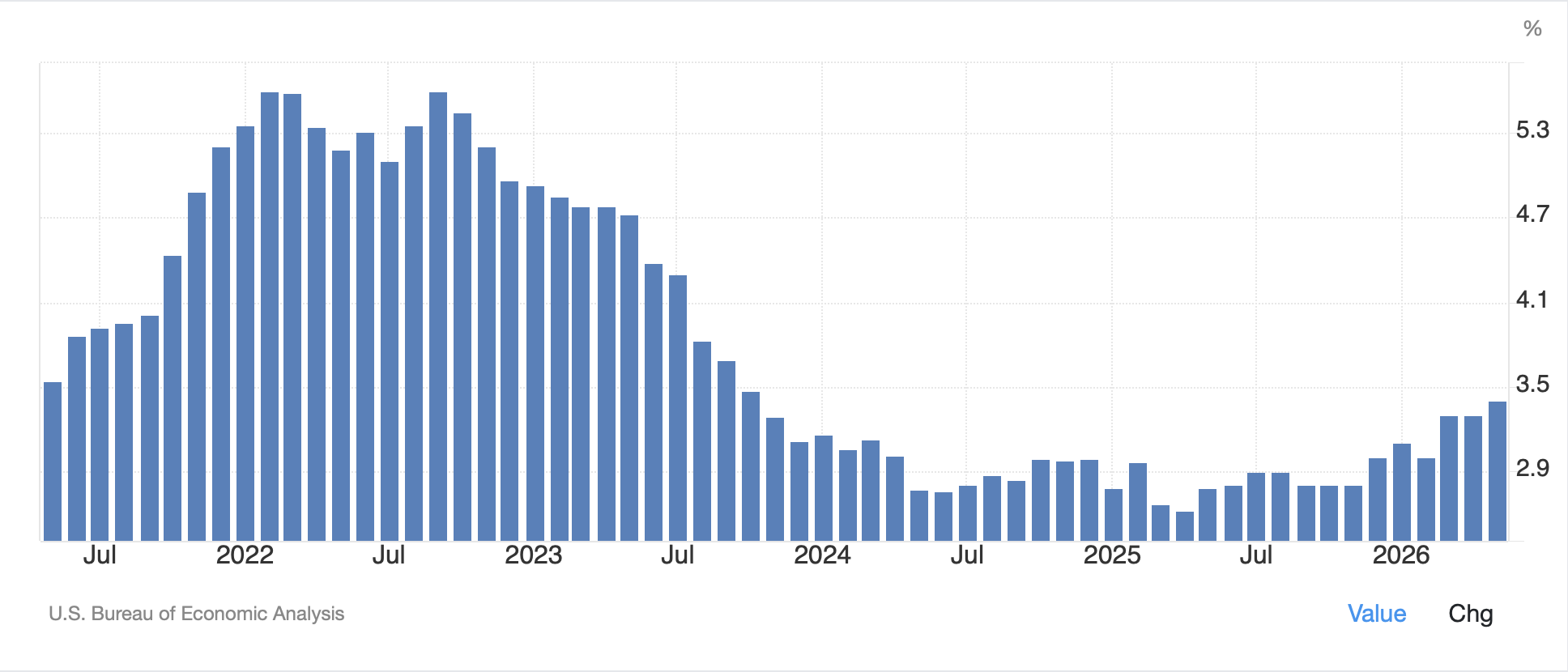
Meanwhile, the data from yesterday showing that ADP Employment was a stronger than expected 109K and the JOLTs quit numbers rose, meaning more people are willing to quit their jobs for a new one, indicating a growing confidence in the labor market, point to a continuation of the US equity rally, and by extension, the global rally.  (As an aside, I chuckled at the article in the WSJ this morning about how the next target of taxes should be ‘compute’ since AI is going to replace human workers.  My comment here, which has been confirmed by my time this week at the Consensus 2026 cryptocurrency conference, is that machines are great, but people still want to deal with people they can trust!)

Anyway, with the conflict ostensibly coming to a close, there is not much else to discuss outside actual market activity, so let’s see how things responded to this news.

By this time, you have all checked your PA’s and saw the green from yesterday there.  Overnight, Asian markets were also quite positive with Japan (+5.6%) exploding higher after their Golden Week holidays ended.  Excitement on tech as well as a market that is looking forward to Treasury Secretary Bessent’s visit were the drivers.  But we also saw strength in China (+0.5%), HK (+1.6%), Korea (+1.4%) and Taiwan (+1.9%).  In fact, looking across the region, you are hard pressed to find a true laggard, as India (0.0%) was the worst performer of note.  European markets, though, are not quite in as fine a fettle with most of them essentially unchanged this morning although the UK (-0.7%) is lagging after some underwhelming earnings reports as it appears profit taking is today’s motive.  As to US futures, at this hour (6:45), they too, like Europe, are essentially unchanged

In the bond markets, yields continue to slide with Treasury yields lower by -2bps and virtually all European sovereign yields slipping -1bp.  Overnight, JGB yields fell -3bps as markets there reopened and essentially all Asian government bonds saw yields decline as well.  Apparently, fears over rampant inflation are ebbing.  You may recall on Tuesday I discussed the 30-year Treasury as it traded above 5.0% on Monday and stayed there for about a minute.  That had engendered a great deal of apocalyptic discussion.  However, here we are this morning with 30-year yields slipping another -2bps, and now 10 bps below that little spike, and back below 5.0%.  But I think it is worthwhile to offer a little perspective on the 30-year bond and the idea that 5.0% is deadly.  Here is the chart of 30-year Treasury yields since 1985.  Perhaps the anomaly was much lower yields, not 5.0%!

Source: finance.yahoo.com

Precious metals are continuing to benefit from the peace initiative and oil’s delice with gold (+1.0%) and silver (+4.0%) both stronger again after big gains yesterday.  In fact, I am starting to read more about why silver is set to make massive gains because of shortages, a narrative that was set aside for the past two months but seems to be reawakening.  Now, I am no technician, but I am given to understand that if you look at this trend line in silver from its January peak, we have broken above the line and that portends a massive move higher.  (full disclosure, I am long silver so would be happy to see that but have not spent the extra money yet!)

Source: tradingeconomics.com

Finally, the dollar is softer again this morning, which should be no surprise based on the overall market zeitgeist this morning.  So, the DXY (-0.15%) is a pretty good approximation of what is happening, although we have seen some larger moves, notably NOK (+0.8%) which seems to be responding to the fact that the country is going to reopen some shuttered oil and gas drilling sites in the North Sea as Europe tries to figure out where to get energy from.  As to the yen (0.0%) after a series of what appeared to be modest interventions by the BOJ during Golden Week, it appears the market may be explaining that the fundamentals are still pointing to yen weakness and while the BOJ may be able to cap the dollar for a short time, establishing real JPY strength will take a lot more effort, and real policy changes (i.e. much higher interest rates).

Source: tradingeconomics.com

Turning to the data this morning, we get the weekly Initial (exp 205K) and Continuing (1800K) Claims data, which continues to hover near historic lows despite the angst over the labor market.  We also see Nonfarm Productivity (1.4%) and Unit Labor Costs (2.6%) and hear from several more Fed speakers, although most of their comments are back page news.  Of course, tomorrow we will see the NFP report, and that will certainly garner all the attention.  Personally, I will be focused on the Manufacturing Payrolls outcome as a proxy for the reshoring initiative and the potential for continued strong economic activity going forward.

And that’s really it.  Despite the ongoing narrative of the dollar’s demise, it remains well within its recent trading range, and I keep reading about other nations issuing dollar debt as that is the market with the most liquidity.  Over time, I continue to see the dollar as the best fiat around, although I still like stuff more than paper.

Good luck

Adf