Far From Dead

Tomorrow we’ll hear from the Fed
With pundits not sure where they’ll tread
Some call for a hike
So, Warsh can out psych
Inflation that seems far from dead

But others claim hikes he will thwart
Awaiting the task force report
With oil retreating,
Though some call it fleeting,
The hawks he will likely abort

The one thing we cannot forget
Is all of the outstanding debt
A hike may create
A weaker growth rate
An outcome he’ll surely regret

Let us turn out attention to the FOMC meeting which begins today and culminates in tomorrow’s policy statement and then the press conference that ensues.  On the whole, I would say that Chairman Warsh has already achieved a key objective, market uncertainty about the outcome.  A point I have been making for a very long time is that uncertainty is what creates an anti-fragile market as positioning is inevitably reduced, and more importantly, so is leverage.  And this is true in every market.  While there may have been value in forward guidance at the onset of the GFC such that the Fed wanted to calm markets down, that time is long past.  

Interestingly, perhaps the one individual who is unhappiest is Nick Timiraos at the WSJ, the former Fed whisperer.  He exhibited great power in the market because he was seen as former Chairman Powell’s mouthpiece when Powell wanted to convey information without being directly attributed.  However, it appears that there will be no Fed whisperer in a Warsh Fed, although I suspect even if there is someone, it will not be Powell’s man to whom Warsh turns.  So Timiraos is on the outs anyway.  But you can tell how unhappy he is by the tone of his recent articles like the one last night trying to insinuate that Warsh will not get his way.

At the same time, Bloomberg has an article this morning explaining how Citadel Securities’ chief economist is expecting a hike.  In my opinion, this is how it should be.  Wall Street economists and analysts make enough money that they should be able to do the work themselves and have their own opinions, not merely regurgitate what they hear from the Fed speakers.  (After all, I make no money and have opinions!)

Reiterating my view quickly, I do not see a hike for the following reasons:

  1. Recent data releases point to cooling inflation offering a respite on concerns of runaway prices
  2. Delaying any action until the task forces complete their work and help reset the way the Fed approaches things feels like the goal
  3. The Federal government cannot afford a rate hike as they migrate more and more issuance to the short end of the curve that will directly be impacted.

The counter view basically revolves around the idea that Warsh can ‘earn’ market credibility by hiking now, whether or not it is a policy error.  I don’t think he is concerned about losing credibility at this stage and has set the table, via the task forces, to show he means business when it comes to changing the Fed.  We all find out tomorrow.

As traders await all the news
On earnings, it seems there are views
That AI is losing
Its luster and cruising
Toward outcomes where stocks sing the blues

In my discussion about parabolic markets yesterday, I mentioned the Korean KOSPI index but after last night’s price action, I think a picture is in order.  This from wolfstreet.com.
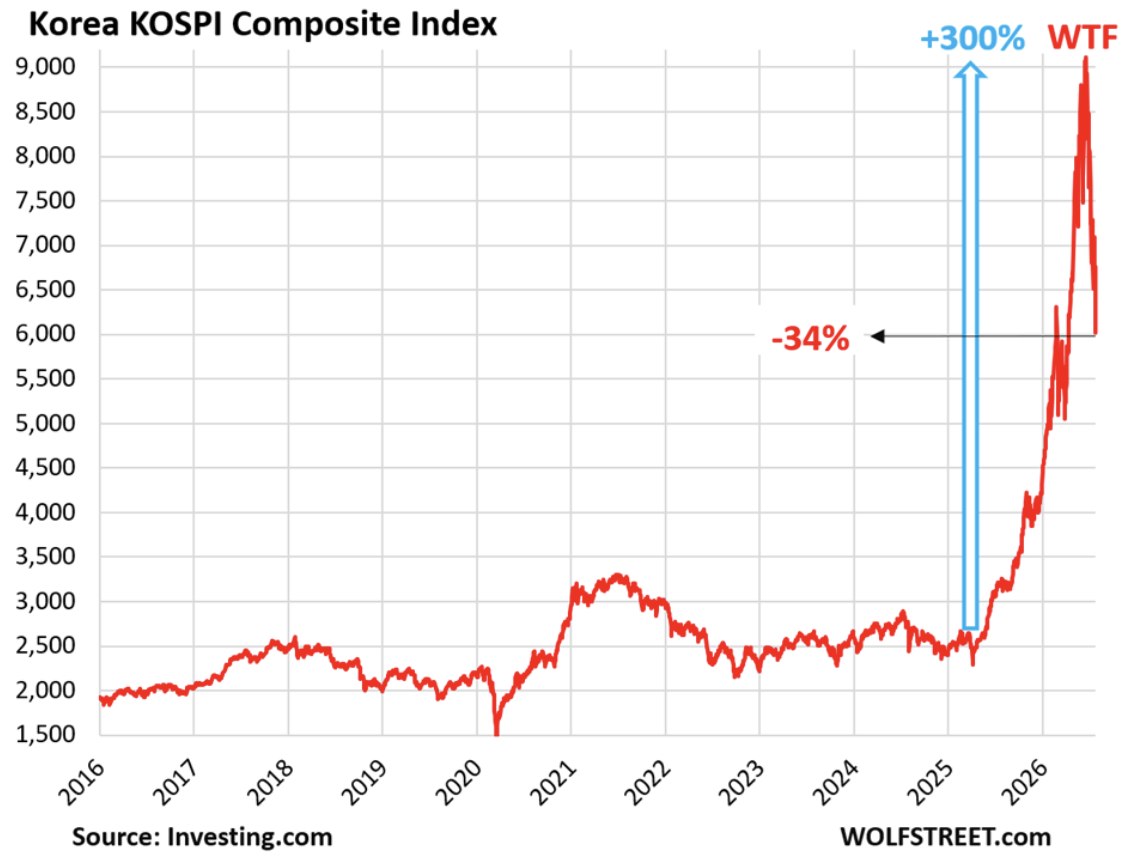
As I explained, parabolic moves do not end in a range, they fall like the chart above with pullbacks greater than 50% the norm.  This implies that the KOSPI is not done yet, and given the KOSPI is basically two stocks, Samsung and SK Hynix, both of which are major semiconductor manufacturers, it doesn’t speak well to the semiconductor space in the US either.  Tomorrow, we hear from MSFT and META and then Thursday we get AAPL and AMZN earnings reports.  My take is much is riding on these earnings reports as any indication that growth is starting to slip will feed into my discussion yesterday regarding the second derivative and how that is the driver.  In fact, we saw the announcement yesterday by Nvidia that they were guaranteeing $250 billion of debt for OpenAI to build a new datacenter in Ohio.  At cycle ends, the pace of activity tends to increase as the players want to get things done before the collapse.  I fear that is what we are watching.

Ok, let’s look at markets.  As I’ve already touched on the KOSPI, which fell -10.8% last night, it is not surprising that most of the rest of Asia had a rough go as well.  Tokyo (-4.0%), Taiwan (-4.65%) and China (-2.8%) were the biggest losers overnight although HK (+0.4%) managed to eke out some gains.  In fact, looking across the region, away from the big three mentioned above, it was a more mixed picture.  Indonesia (-0.9%) is having its own problems as the central bank governor resigned and there have been numerous scandals and other cabinet resignations lately undermining both the rupiah (-0.1% and back to multidecade lows) and the stock market there.

As to Europe, given they have no tech sector and the tech sector is the area under the most pressure, I guess we should not be surprised that bourses there are modestly higher this morning, mostly up around +0.3% across the board.  A very pleasant experience compared to the gyrations seen elsewhere.  And US futures at this hour (7:10) are mixed with NASDAQ (-1.1%) suffering while the DJIA (+0.5%) is fine and the SPX is caught in the middle, basically unchanged.

In the bond market, yields continue to edge lower, with Treasuries (-3bps) leading the way and European sovereign yields all lower between -1bp and -2bps. UK gilts (-3bps) are also performing well as the market awaits the BOE’s policy decision on Thursday.  Then JGB yields (-2bps) have slipped in concert as the market awaits the BOJ decision Friday.  At this point, consensus across the board is for no movement, although there has been a discussion regarding the BOJ with some analysts believing a hike is possible.

Turning to commodities, oil (-1.6%) is not the center of attention today for once, and is pushing back toward $80/bbl.  The ongoing decline appears to be based on comments that diplomacy is once again being tried to resolve the Iran situation and the Strait of Hormuz.  Perhaps more surprisingly the metals markets are also falling this morning (Au -1.3%, Ag -2.2%, Cu -1.1%) as their inverse relationship with oil is being tested.  

Finally, the dollar is ever so slightly firmer this morning, but mostly on the order of 0.1% or 0.2%.  AUD (-0.4%) is the worst performer in either G10 or EMG blocs as central bank comments led to a reduction in the probability of a rate hike there next month.  One other thing to note is USDJPY, where, as I type, the market is trading at 163.92, a scant 8 pips from the next big, round number at 164.00, a level almost touched last Thursday (163.99 was the high) but when it trades, it will almost certainly be hailed as an important milestone regarding potential intervention.  I don’t agree with that assessment.
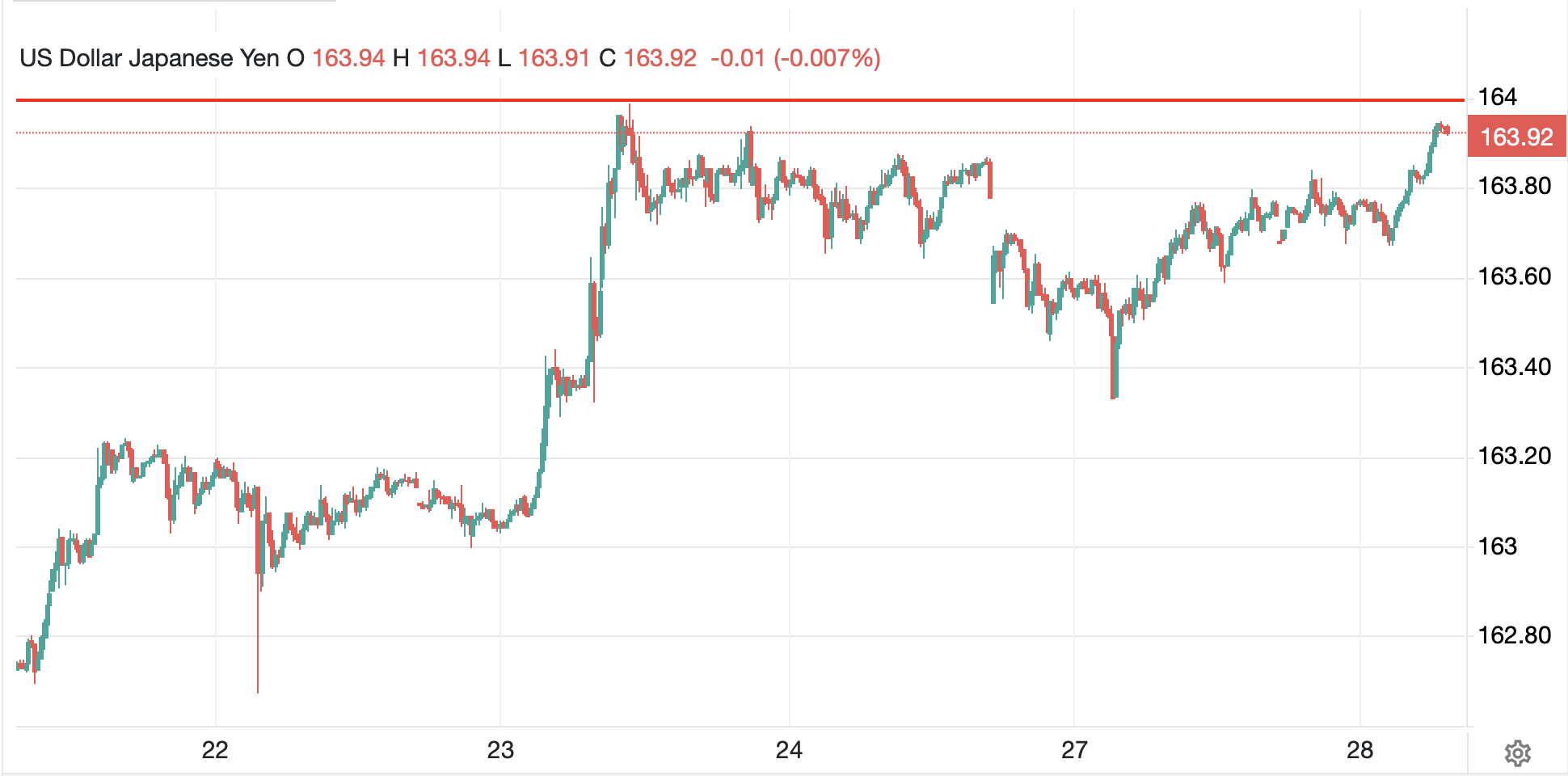
Source: tradingeconomics.com

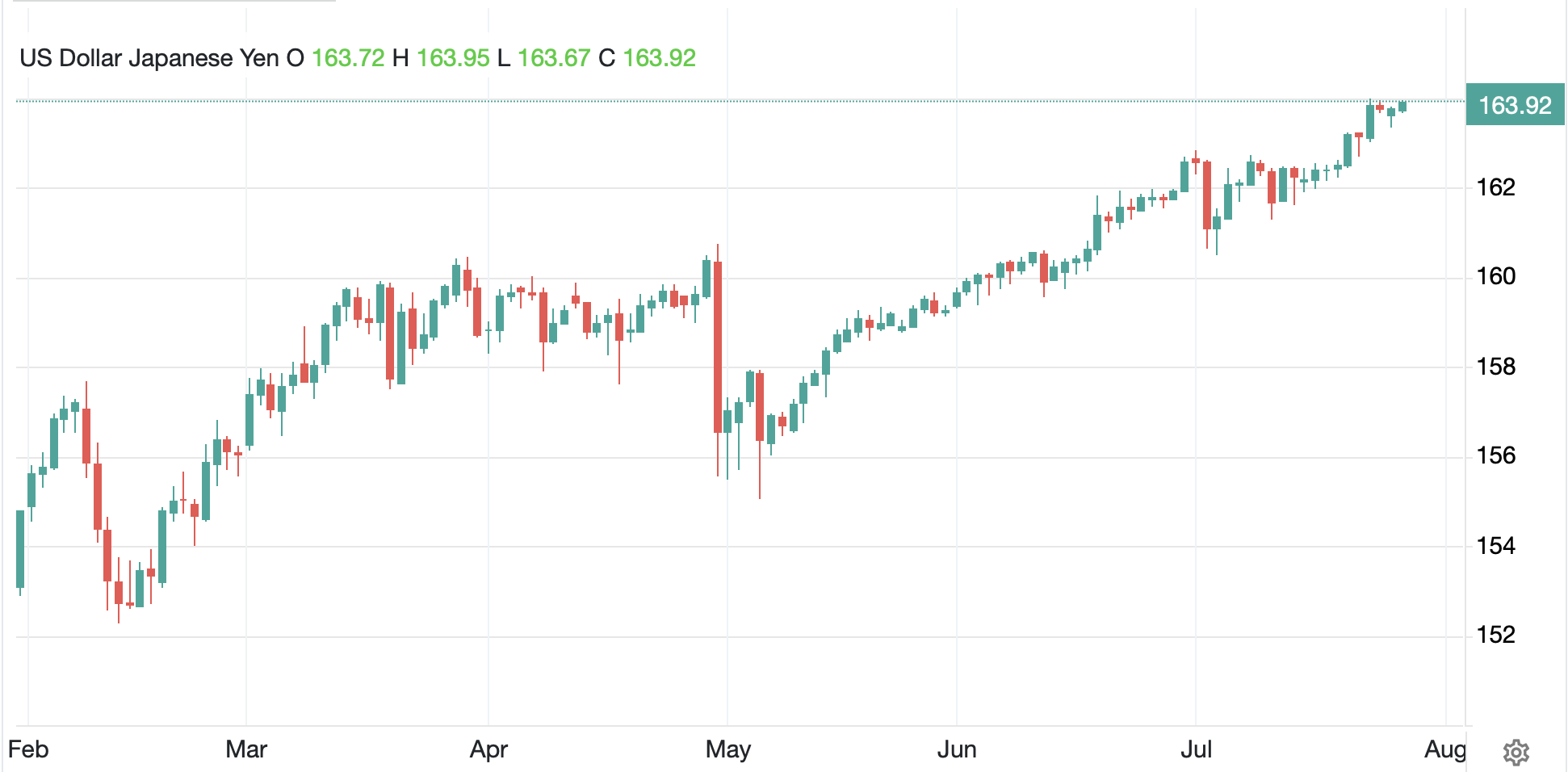
Again, a key feature of BOJ intervention has been an effort to address a volatile market, but as you can see below, while the direction of travel has been consistent, the only volatility has come from BOJ interventions.  Everything else is a slow, steady deterioration of the yen.
Source: tradingeconomics.com

On the data front, there is plenty upcoming this week in addition to the Fed, including PCE on Thursday.

TodayGoods Trade Balance-$100.0B
 Case-Shiller Home Prices1.3%
 Consumer Confidence92.3
WednesdayFOMC Decision3.75% (unchanged)
ThursdayBOE Rate Decision3.75% (unchanged)
 Initial Claims200K
 Continuing Claims1800K
 Q2 GDP2.1%
 Personal Income0.3%
 Personal Spending0.3%
 PCE-0.1% (3.7% Y/Y)
 Core PCE0.2% (3.3% Y/Y)
FridayBOJ Rate Decision1.0% (unchanged)
 Employment Cost Index0.8%
 Chicago PMI56.0
 Michigan Sentiment 54.0

Source: tradingeconomics.com

Obviously, the FOMC meeting will be the big story along with the earnings data, although I imagine that the PCE data may garner some interest for now, at least until we learn what measures of inflation the Fed is going to use going forward.  My fear is the equity market can crack, for now, and that will drive overall trading activity.  As to the dollar, I see no reason for a large move in either direction until we see new policies.

Good luck

Adf
Some Heartburn

Chairman Warsh, to the House, testified
And explained that his tolerance died
For higher inflation
Throughout this great nation
And ‘bout this, he will not backslide

But prior to his starlike turn
Investors and markets did learn
That CPI fell,
Though not a death knell,
And caused, for rate hawks, some heartburn

It is better to remain silent and be thought a fool than to speak and remove all doubt. – Abraham Lincoln

The attributed saying above, while not certain that it was uttered by President Lincoln, still makes its point eloquently, as well as somewhat humorously.  And I strongly believe that every member of the FOMC should take it to heart before they speak.  In fact, they should be thanking Chairman Warsh for his efforts to shut them up, because then they won’t sound quite so foolish.

For instance, just Monday, Governor Waller, in a speech in New York, finished with the following line, “But I don’t take the inflationary signals I have discussed today lightly. If we get another hot reading on core inflation this week, then the FOMC will need to consider tightening monetary policy in the near term.”  Oops!

And this is one of the issues because many believe that the FOMC gets the data earlier than the release date and so have inside information.  Thus, when Waller talks about the risk of a hot print, many think he knows something.  And this is yet another reason that ending forward guidance and reducing the commentary of the FOMC will be valuable.  

By now, I am sure you are aware that yesterday’s CPI reading was the largest downside miss since Covid in 2020, with the headline number falling -0.4% on the month and the annual slipping back to 3.8% while the core number was flat with the annual falling to 2.6%.  Now, as the Inflation Guy explains, this was the product of numerous subcomponents declining, not just the price of oil/gasoline and this is not the venue to discuss them (read the link).  

But it certainly helped Chairman Warsh in the timing of his testimony as nobody there could ‘blame’ him for still rising prices, at least for now.  As expected, several House members tried to get interest rate information from him, but he remains firm that the Fed’s mission is to drive inflation lower and this will be done through both interest rate and balance sheet policy changes, not through forward guidance.

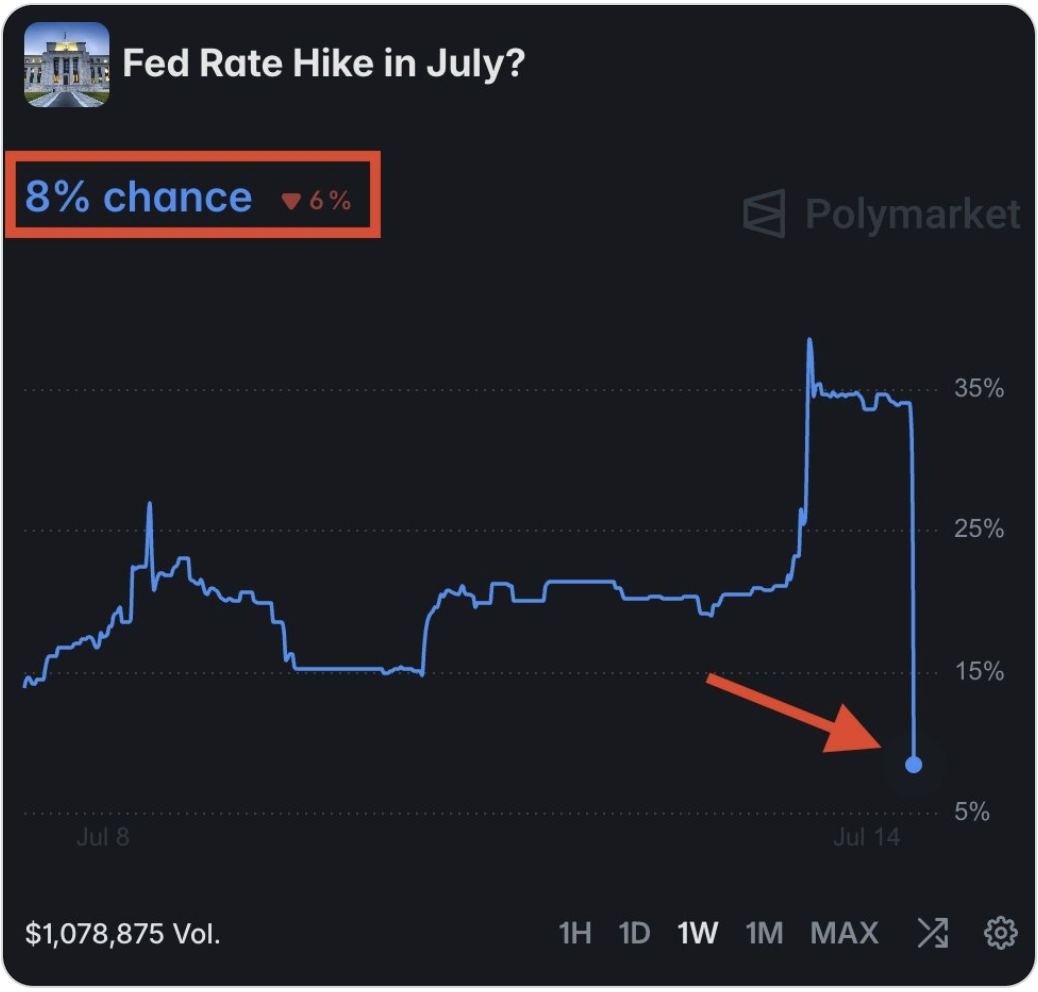
It is not surprising that the market responded dramatically with the following chart from Polymarket (taken from Kobeissi on X) showing an impressive change of heart.

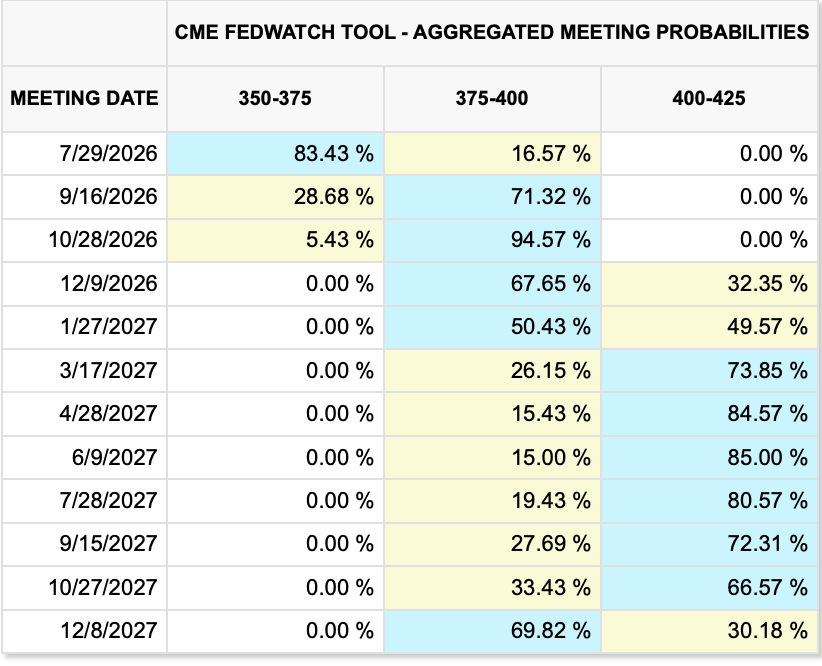
While I use the Fed funds futures chart from the CME as my guidepost, there is something to be said for the wisdom of crowds here.  Remember, this is a binary call, not a gradient one.  But even the futures markets adjusted significantly, and rightly so, with the probability of a July hike there falling to 16% from 40% when I wrote yesterday morning.  As well, while there is still more than one rate hike priced for 2026, the calculated change has declined to 33bps from 43bps yesterday morning.

Source: cmegroup.com

Skepticism remains rife regarding Chairman Warsh and his attempt to change the way things are done at the Fed, but personally, I am quite optimistic that he is attacking the real problems.  Remember, the Fed is a 114-year-old institution with an extremely long memory and a staff that, like most of government, believes they know what is best for others.  I strongly subscribe to the monetarist view that printing more money leads to more inflation, but making a change that dramatic all at once is just not possible.  Let us be thankful that Chairman Warsh appears to have a better understanding and is working to change things.  And remember, he has only been in the Chair for two months, give him some time.

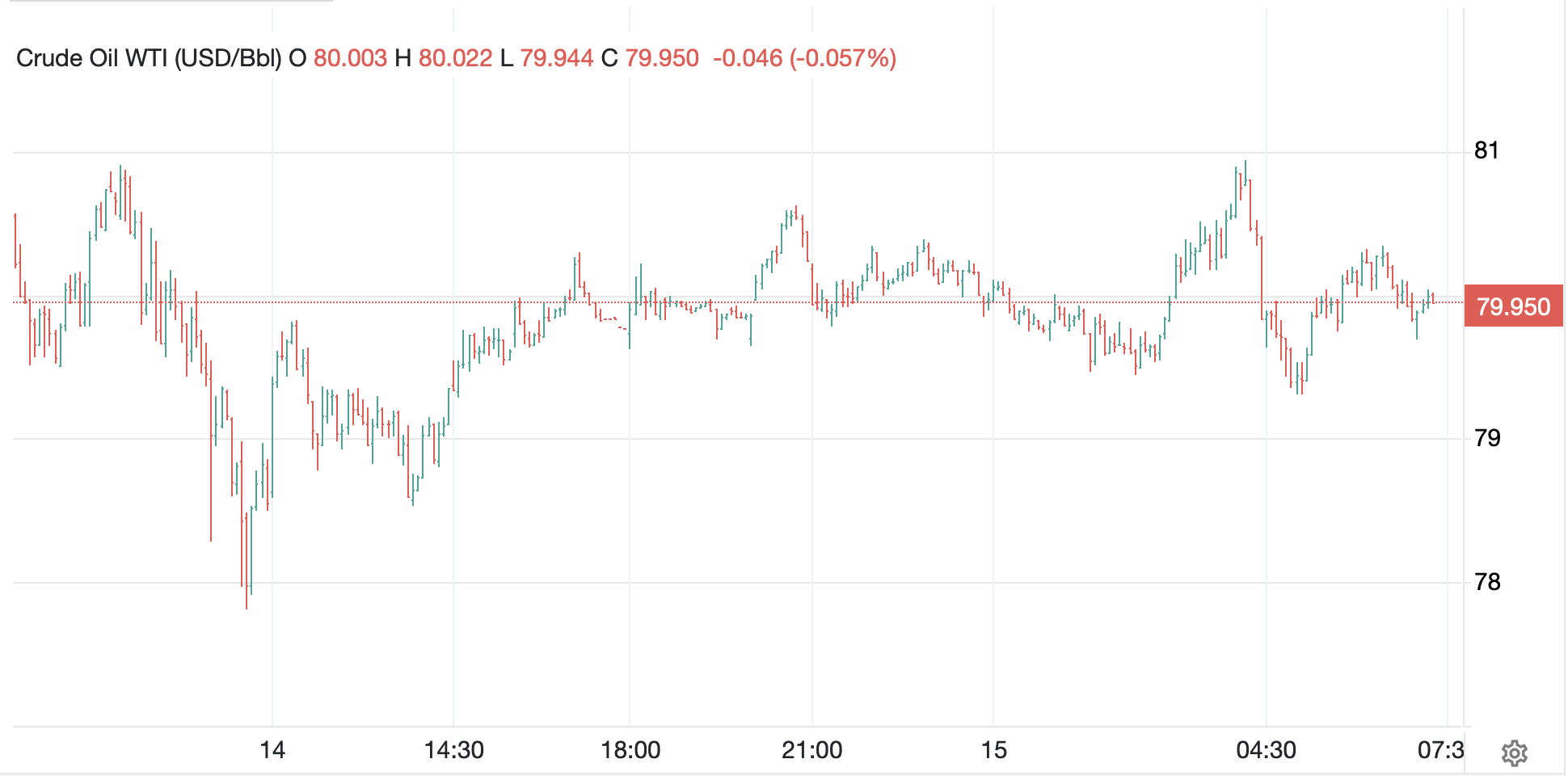
As I start to recap markets, it is quite interesting that the price of oil seems to have decoupled from the war in Iran.  I say this because as I type at 7:15, a bit more than an hour after CentCom explained they had instituted another wave of military attacks on Iran, WTI is largely indifferent to the news.  While it has edged higher by 0.7%, a look at the chart below of the past 24-hours shows essentially no response.

Source: tradingeconomics.com

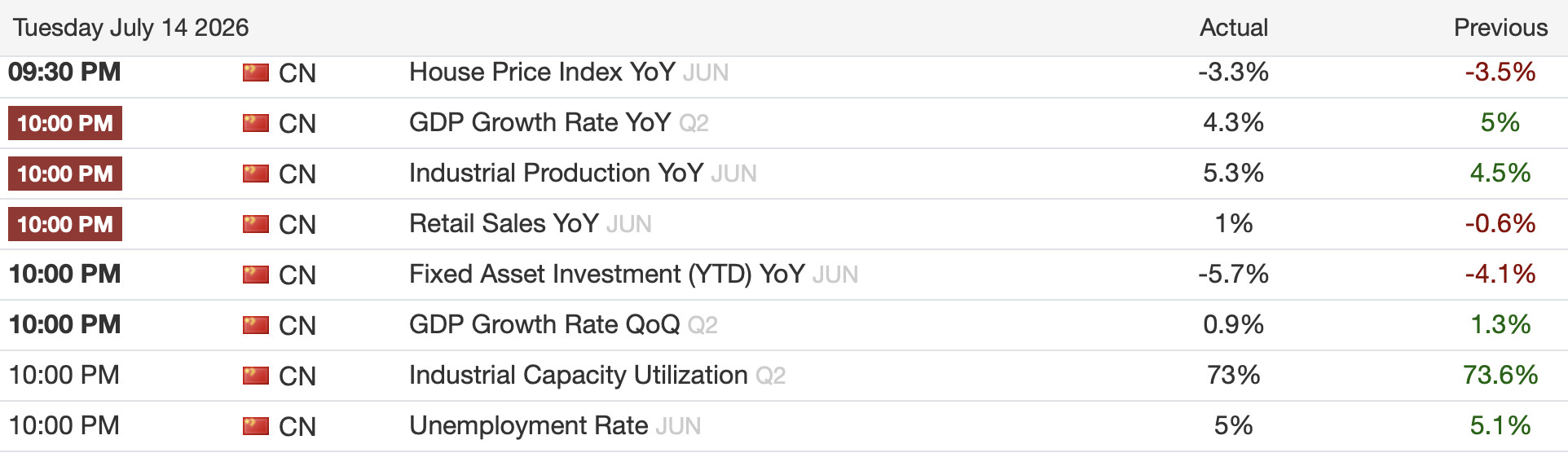
So, let’s turn to equities, which rallied on the CPI data in the US yesterday and saw follow through in Asia with Tokyo (+1.5%), HK (+1.4%) and Korea (+6.25%) all having strong sessions as did almost every market in the region.  However, there was an exception, China (-0.2%) which while not disastrous, substantially lagged other markets.  Arguably, the proximate cause of that disappointment was the disappointing data released last night as per the below:

Source: tradingeconomics.com

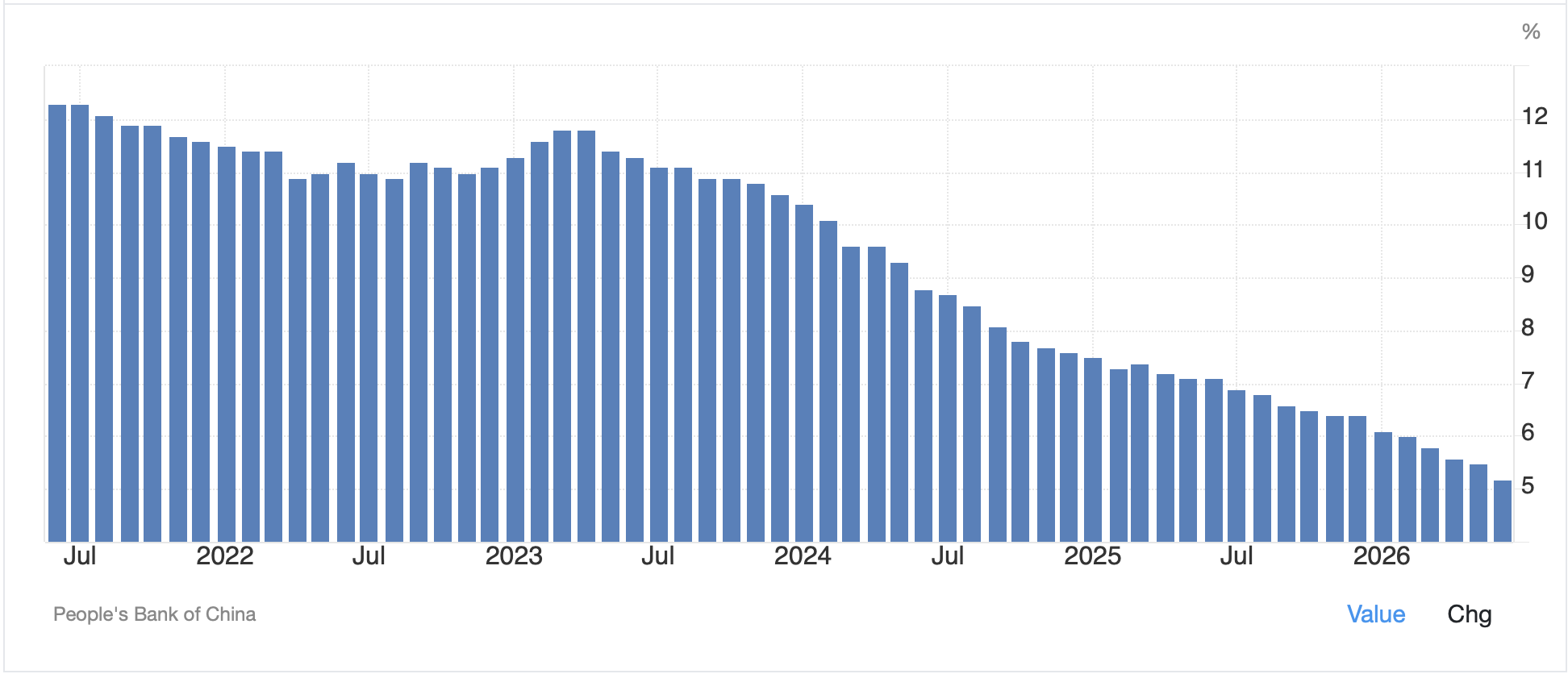
Certainly, GDP at 4.3%, below even Xi’s reduced target must be concerning and Fixed Asset Investment (housing) continues to crumble.  It is very difficult to look at this data, as well as their monetary data which, for instance, shows loan growth not merely trending lower, but doing so at an accelerating rate as per the below chart and conclude things are going will there for the economy or the equity markets.

Source: tradingeconomics.com

Europe, though, continues to lag with all the major bourses lower as the DAX (-0.8%) leads the way followed by Spain (-0.6%) and then France and the UK both slipping -0.2%. (I guess World Cup results are not indicative of their equity markets!). As to US futures, at this hour (7:25) they are all up very slightly.

Bond yields fell yesterday, notably the 2yr slipping -6bps, while the 10yr only fell -3bps.  This morning, though, yields are edging back higher with Treasury yields up 2bps and European sovereign yields higher by between 3bps and 4bps.  While equity markets remain sanguine about Iran, it seems bond markets are having a tougher time.  JGB yields (-2bps) are bucking the trend as there are still those who are looking for Japanese pension funds to start bringing more money home.

While the metals markets rallied yesterday, this morning they are under pressure again with gold (-0.6%) and silver (-1.2%) giving back yesterday’s gains while copper (-0.3%) is consolidating after jumping a dime yesterday.

Finally, the dollar is sidelined this morning with no notably large movements in either the G10 or EMG blocs.  A brief word on the yen, which has certainly been the subject of much digital ink spillage lately, as it seems all those thoughts of the pension fund support for the yen are not part of the FX conversation.  We remain less than 50 pips from the peak seen back on June 30 and I see very little reason for the broader trajectory to change.  The BOJ is not going to waste its reserves in this process, and given the gradual movement, I don’t think they are that upset.  As long as PM Takaichi is planning to spend more money, whether on infrastructure or investment, given they are borrowing all of it, a strong yen seems highly improbable.

On the data front, this morning brings PPI (exp 6.2% headline, 5.2% core) and the Empire State Manufacturing Index (8.8) at 8:30.  Then, at 9:45 the BOC will most likely leave their base rate on hold at 2.25% and at 10:00, Chairman Warsh will testify to the Senate Banking Committee.  We also get the Fed’s Beige Book this afternoon, EIA oil inventories and three more Fed speakers, although with Warsh speaking, will anybody care?  Especially since they continue to make fools of themselves with their own forward guidance.

The most remarkable thing to me is how insouciant market participants have become despite increased hostilities in the Gulf.  But both oil and equity traders have seemingly decided that other things matter more.  With that in mind, it is hard to get excited about too much these days.  Unless we see markets breaking their recent ranges, in either direction, I suspect that the weight of summer, and reduced liquidity is going to prevent anything substantial from happening anytime soon.

Good luck

Adf

The Score

Hormuz is blockaded once more
The latest response in the war
So, crude prices rose
While both sides expose
Their relative views of the score

Now after a month of some peace
Seems tensions are set to increase
So, what about stocks?
The sales are in blocks
While buyers, few bids will release

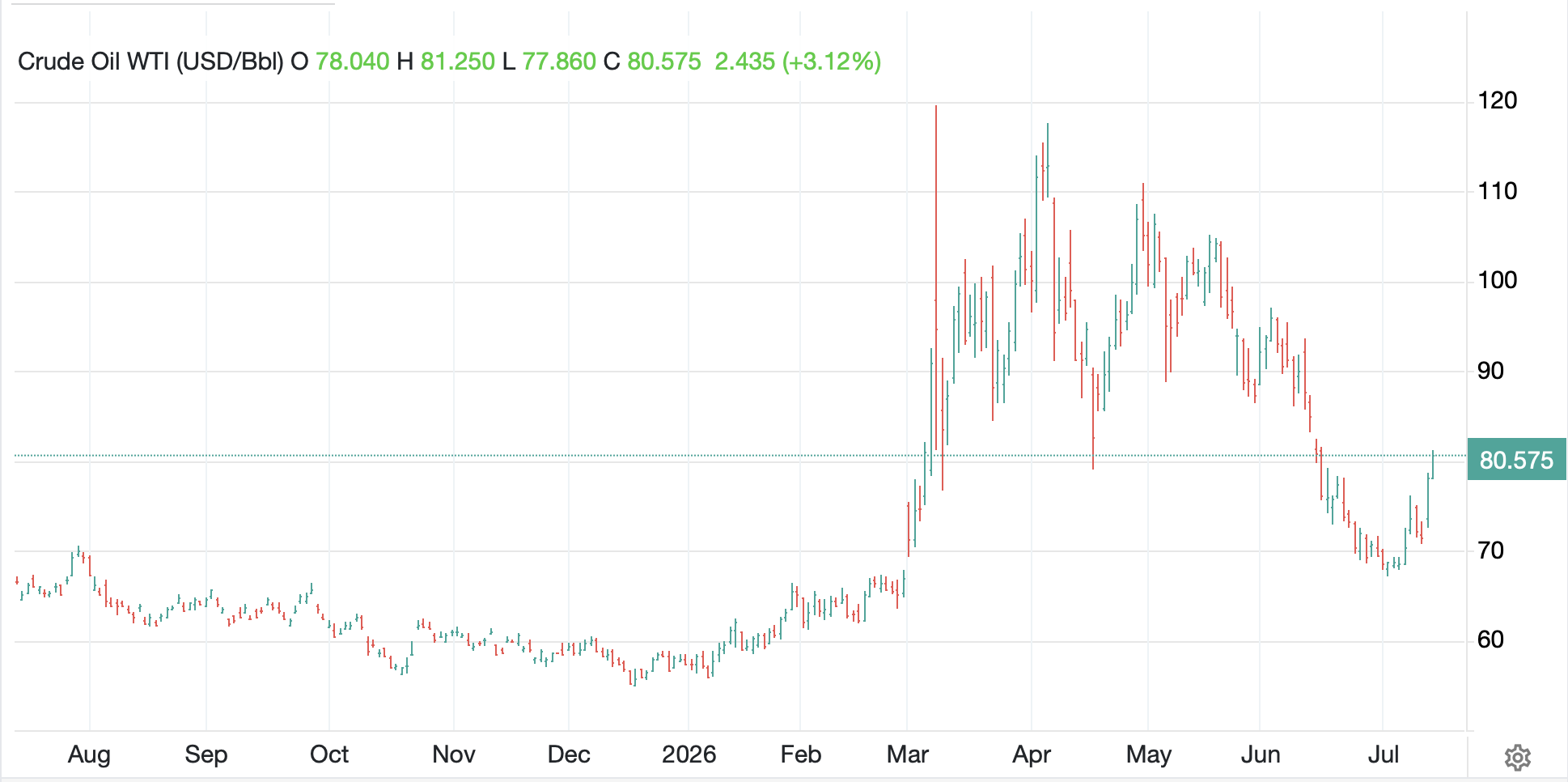
After a brief respite for markets, where oil had seemed to be drifting out of the headlines, the events of the past weekend plus the US reimposition of the blockade of the Strait of Hormuz has changed the narrative dramatically, and rightly so.  The benign attitude of an eventual conclusion to this situation has been tossed aside and the oil bulls and war hawks are both back in the ascendancy.  Yesterday ultimately saw oil prices rise 9.4% and this morning they are a further 3.2% higher, and perhaps more importantly, back above the psychological level of $80/bbl.

Source: tradingeconomics.com

There doesn’t seem to be any short-term solution to this situation.  There are clearly enough hard-liners still with power in Iran to prevent any move toward a negotiated solution.  As long as this maintains, the outlook for oil will tilt higher.  However, as I have written before, and is very clear now, the effort to reroute oil shipments from the Gulf nations away from the Strait is intensifying and will continue to do so.  As well, alternative sources of supply including additional US production, Brazil, Argentina, Guyana, Venezuela and Canada are satisfying demand.  While uncertainty remains high, especially in the short run, by the end of next year, my take is less than 8% – 10% of the world’s oil will need to transit the Strait.  However, in the meantime, given that everybody who was long oil as the war initially ramped up has sold out, there are few sellers left to cap the price.  I imagine a move toward $90/bbl is quite possible in the next weeks.

As well as the story on crude
Two other themes will be pursued
First CPI’s print
Will offer a hint
Then Warsh will discuss why he’s screwed

If we turn our attention away from the oil market now, the two main events today are the CPI release at 8:30 this morning followed by Chairman Warsh testifying to the House Financial Services committee in his semi-annual trip to Congress.  Starting with CPI, expectations are for a decline from last month as headline (exp -0.1% M/M, 3.8% Y/Y) and core (0.2% M/M, 2.8% Y/Y) are due.  From what I can tell, there are a number of analysts who are calling for a relatively hotter number, although I’m not sure on what basis they believe that.  Certainly, oil prices, and energy prices across the board, declined significantly in June and that will be reflected in the reading.  Looking at the home price data, that doesn’t appear to have risen dramatically, and other commodity prices have also slipped.  I don’t’ rule out any outcome, but on the surface, expectations seem reasonable.  

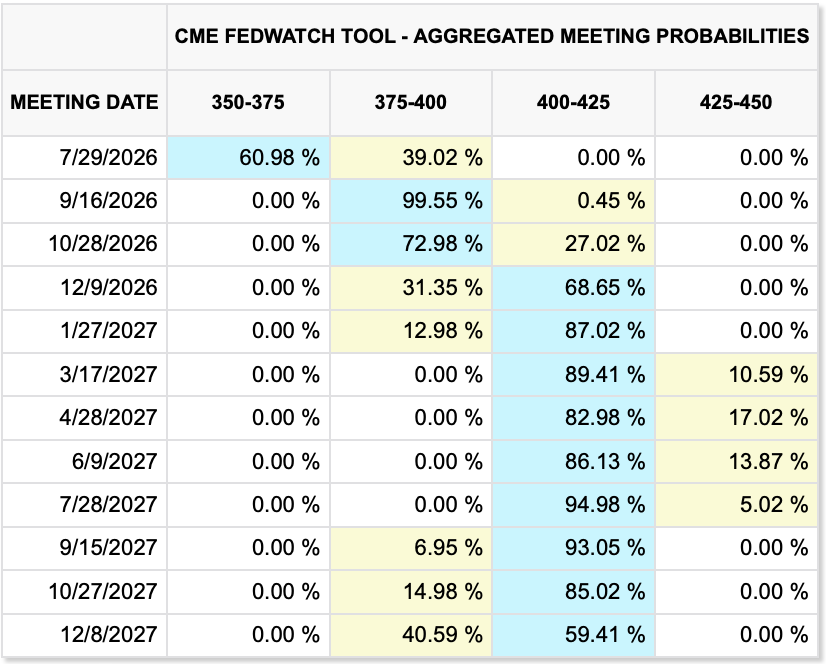
Of course, with oil prices rising, talk of more rate hikes is all the rage and according to the Fed funds futures market, as per the below CME table, you can see that expectations have risen to a 40% probability of a hike this month and a two-thirds probability of two hikes before the end of the year.  My personal view, FWIW, remains that there will be no hikes this year, although with the resumption of hostilities in the Gulf, I think a cut is off the table as well.  Remember, too, that if oil prices remain elevated that will negatively impact economic activity, so hiking rates into that scenario doesn’t seem to make much sense.  But then, I’m not on the FOMC.

Now, I have long maintained that FOMC members should shut up, but it seems Mr Warsh will have a hard time getting them to do so.  I’m not sure if they think they are helping, or they are just enamored with their own voices.  But yesterday, Governor Waller spoke and explained that if the CPI data was hot, a rate hike would be an appropriate response.  And remember, we hear from another 7 or 8 of these folks just this week, four today!  

While I expect that Warsh’s testimony will be dry, and that most of the questioning will be either long-winded preening by some idiot member, or an attempt at a gotcha question, I am confident that Chairman Warsh will continue to avoid discussing his views of where policy should go and reiterate forcefully that the Fed’s goal is to reduce inflation, full stop.  I am also confident that he will not be dragged into any discussions of other issues like global warming or DEI and simply repeat that ending inflation is the only job he has.  We shall all find out shortly.

On to the markets.  It should be no surprise that equity markets were under pressure yesterday in the US with the jump in oil prices.  This added to the chorus of those who believe the AI bubble is popping as the NASDAQ led the way lower, falling -1.5%.  But a funny thing happened in Asia.  Despite the jump in oil prices and declines in US equity markets, Tokyo (+0.75%), HK (+0.5%) and China (+2.15%) all rallied nicely last night.  In fact, so did Korea (+0.7%) and Malaysia (+1.3%) although we did see declines in India (-0.7%) and Taiwan (-1.4%) with the rest of the region moving far less.  This is a surprising outcome to me, especially as Asia is the region most negatively impacted by rising oil prices.

Europe though is trading true to form with declines across the board ranging from Spain (-1.1%) to the UK (-0.4%) and everywhere in between.  There has been precious little data overnight to drive things, and this appears to be entirely oil related.  Of course, Europe’s suicidal energy policy, notably the UK’s ban on drilling for oil in the North Sea, remains one of the key reasons that the area will continue to struggle.  As to US futures, this morning DJIA futures are lower (-0.8%) but the other two major markets are little changed at this hour (7:25).

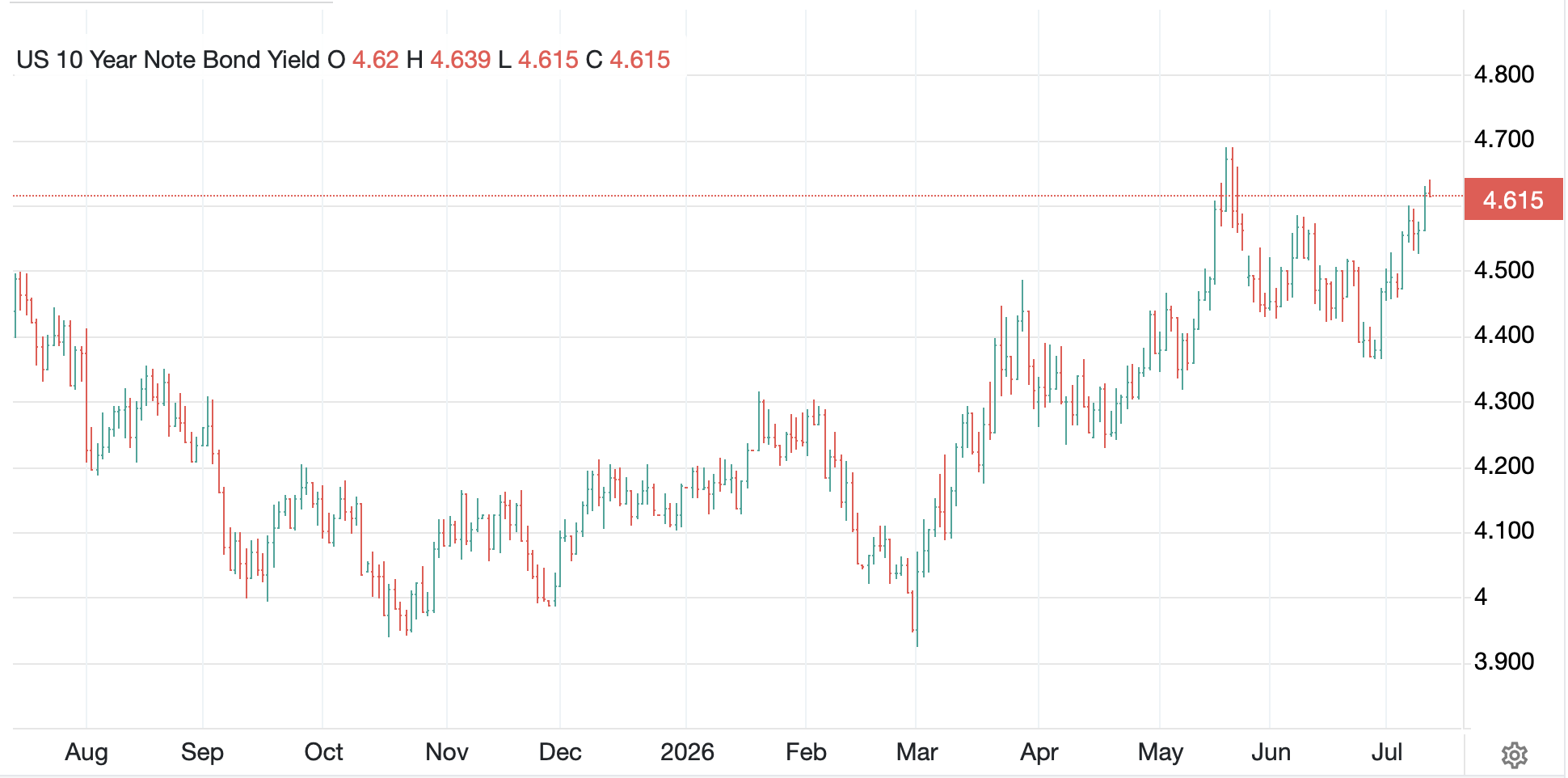
In the bond market, 10-year Treasury yields jumped 6bps yesterday although are little changed this morning.  However, as you can see from the chart below, they are pushing back up toward the highs seen in late May.

Source: tradingeconomics.com

There is a lot of talk about how Warsh should hike rates aggressively this month to gain bond market credibility in his fight against inflation, but I sense that is a lot of people talking their books.  I continue to believe that there will be no Fed action ahead of task force reports.  As to other nations, yields are generally firmer in Europe today, ranging between +1bp (Germany) and +3bps (Italy) with the UK worst of all (+4bps) as 10-year Gilts now yield more than 5.0% again, also pushing back to late-May highs.  The one exception is Japan (JGBs -5bps) where the latest ploy by Katayama-san is to propose JGBs be allowed to be invested in tax-free accounts for individuals in Japan.  Given the long history of zero rates there, a tax-free return of 2.7% with no currency risk could well be quite attractive, I think.

In the metals markets, it is no surprise that both gold and silver fell yesterday with the jump in oil prices, but despite oil’s continued rally this morning, both gold (+0.7%) and silver (+0.7%) are finding support, with gold seeming to hold the $4000/oz level for now.  Copper (+1.6%) is also holding up well, but its relation to the precious sector seems to be waning.  Perhaps the precious metals story is less about oil and more about the dollar.

Turning to the dollar, yesterday it put in a strong performance with the DXY rallying about 0.3% from Friday’s closing levels as you can see in the chart below.

Source: tradingeconomics.com

However, as you can also see in the chart, this morning the greenback is under pressure despite the rise in oil prices and yesterday’s increase in yields.  The biggest outlier is NZD (+0.9%) as the RBNZ continues to make hawkish statements about the need for further rate hikes.  And of course, NOK (+0.7%) is benefitting from the oil price rise.  But the rest of the G10 are all firmer, and so is most of the EMG bloc with only INR (-0.5%) standing out as underperforming.  That story appears to be based on higher oil prices and concerns, or thoughts at least, that the RBI will not be aggressively hiking rates to protect the rupee.  Otherwise, most currencies have moved higher vs. the dollar on the order of +0.15% to +0.25%.

And that’s really it today with CPI the only data release other than the already released NFIB Small Business Optimism index (97.4, exp 95.8), but that predates the change in the Gulf.  Chairman Warsh has his work cut out for him to get his colleagues to shut up.  I wonder if he can fine them if they speak.

We are in a narrative transition right now, but longer term, I remain bullish the US and the dollar.  

Good luck

Adf

Much Hotter

This weekend both wars got much hotter
Iran attacked ships on the water
Ukraine sent its drones
Across three time zones
And struck inside Vlad’s magna mater

Thus, oil has risen a bit
While gold and stocks both trade like sh*t
And soon, CPI
Will prove or deny
That views at the Fed are now split

By now, of course, you know that there has been more military activity in the Strait of Hormuz with the IRGC attacking commercial ships and the US retaliating with significant strikes of military sites along the Strait.  From what I can see, there are factions within the IRGC that do not want to end the conflict and whatever government exists within Iran has no control over them.  As such, it is no surprise that the price of oil (+3.5%) has risen, but even in this scenario, it is well off its overnight highs.

Source: tradingeconomics.com

At this point, I believe the trading community will need far greater proof that there is a shortage of oil before responding with significantly higher prices.  Of course, one way that could come about is if Ukraine continues its success with attacks on Russian oil infrastructure as there has been an uptick in that activity with several refineries having been hit in the past several days and Russia imposing an export ban on diesel.  Net, things in the oil space remain precarious, but for all the analysts who continue to promulgate the idea that the end is nigh, markets continue to disagree.  As always, I vote with markets here.

And, not surprisingly, other markets have responded in a similar fashion to their recent trends with higher oil prices leading to pressure on both stocks and bonds, as well as precious metals while the dollar finds some support.  The thing is, my take is the strength of these correlations has been waning somewhat.  Frankly, and remarkably, it appears as though an increase in military activity in the Strait of Hormuz has become somewhat normalized to traders and they are looking for other, fresher signals as to their next move.

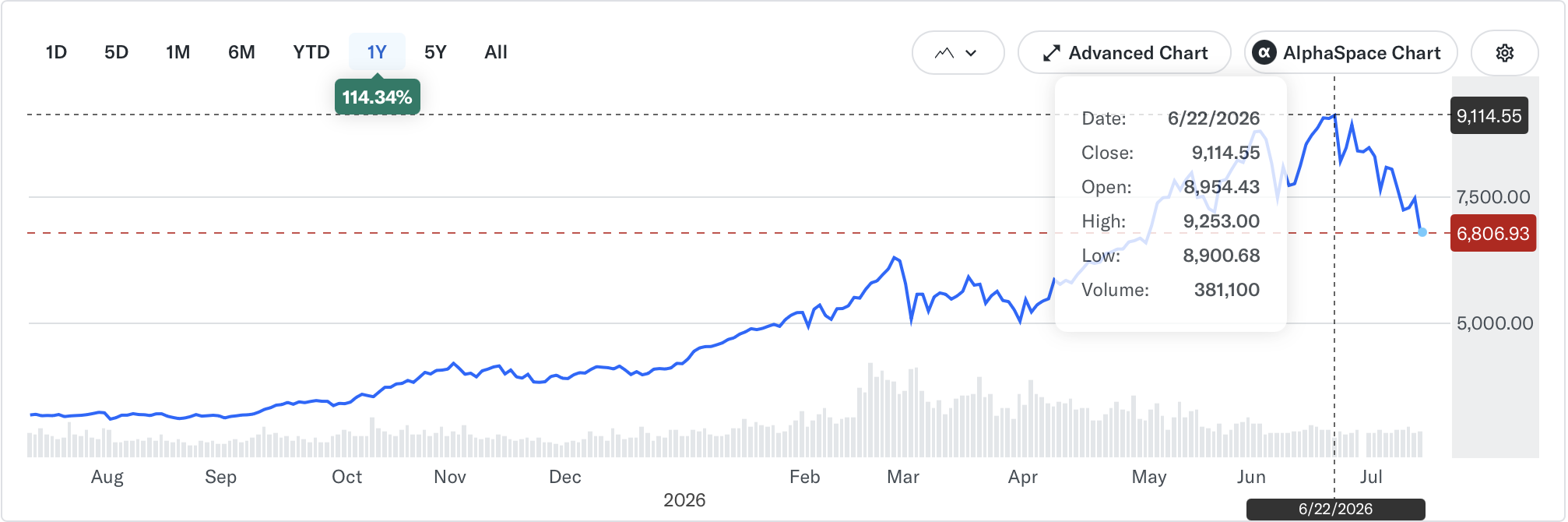
What might those other signals be?  Well, much was made of SK Hynix’s IPO in the US on Friday, which many pundits are now calling the top as the stock fell sharply in Korea overnight, down -15.4% dragging the KOSPI down -9.0% and tech stocks, in general much lower.  Of course, the KOSPI had risen dramatically over the past year, as you can see below, and is still higher by more than 100%  in the past year despite the recent decline of more than 25% since its peak on June 22.

Source: finance.yahoo.com

The problem with calling the top in stocks is that the earnings data, which starts in earnest this week, has been pretty good so far.  If companies continue to earn real profits, investors will continue to purchase stocks.

So, where else can we turn for new information?  Tomorrow brings the latest CPI report (exp 3.8% headline, 2.9% core), and you know that will be heavily scrutinized as the punditry tries to determine the FOMC’s reaction function and if it has changed with the new Chairman.  At this point, I do believe the Fed’s reaction function has changed, and more importantly, I don’t think anybody knows what it will be like, the Fed included.  The previous Fed whisperer, Nick Timiraos at the WSJ put out an article overnight discussing the idea that Chairman Warsh needs to decide whether to undo the most recent rate cuts.  However, there is no evidence that Warsh speaks to Timiraos and based on everything Warsh has said, he is not likely to tip his hand.  Chairman Warsh does testify to Congress this week, but I expect he will deflect all questions about the future path of monetary policy, and let’s face it, with the likes of Maxine Waters on the House committee, they won’t understand anything he says anyway.

And really, those are the only things that I think matter for now, so let’s review the overnight activity in markets.  As mentioned above, stocks are generally under pressure, but not universally so.  For instance, in Asia, Tokyo (-1.9%), China (-1.8%) and the aforementioned South Korea all had rough sessions, but HK, Taiwan, India and Australia were all basically flat on the day.  The big surprise is Taiwan as given the semiconductor weakness; I would have thought that market would have been significantly impacted.  But I guess not.  Meanwhile, European investors appear to be completely focused on tomorrow’s France-Spain World Cup semifinal as equity indices there are virtually unchanged this morning.  As to US futures, at this hour (7:30) NASDAQ futures are weaker by -1.2%, but the other markets are little changed.

Bond yields are higher this morning, but not hugely so.  Treasury yields have edged up by 1bp, and European sovereign yields are higher by 2bps across the board with UK Gilts (+4bps) the real laggard there.  Overnight, JGB yields backed up 4bps as well, but that story has more to do with the GPIF than anything else.

Remember Friday?
Japan was bringing home yen
They were just kidding

Think back to Friday.  Japanese FinMin Katayama mentioned that the GPIF and other Japanese pension funds ought to consider investing more money in Japan and less abroad.  That got tongues wagging about a major policy change coming that would serve to support the yen, and the JGB market while undermining Treasuries as the idea was the GPIF would sell their US Treasuries and buy JGBs instead.  Well, it turns out that is not actually the case.  The GPIF reevaluates its policy annually but has expressed no urgency to change things now despite the FinMin’s comments, at least according to Reuters.  The upshot is that JGBs sold off as did the yen (-0.3%) as per the below chart.

Source: tradingeconomics.com

Perhaps more surprisingly, though, the dollar is mixed on the day, not higher across the board as might have been expected given the uptick in oil and military activity.  So, we have seen weakness in GBP (-0.1%), AUD (-0.2%) and INR (-0.5%) while EUR (+0.1%), NZD (+0.2%), NOK (+0.3%) and KRW (+0.4%) have all had decent sessions.  Net, the DXY is essentially unchanged this morning.

Finally, and quickly, both gold (-1.5%) and silver (-2.0%) are under pressure with the higher oil price although copper (+0.6%) continues to find support and remains well above $6.00/lb.

In addition to the CPI data, it is a pretty busy week as follows:

TuesdayNFIB Small Biz Optimism95.6
 CPI-0.1% (3.8% y/Y)
 -ex food & energy0.2% (2.9% Y/Y)
 Warsh Testimony 
WednesdayPPI-0.1% (6.2% Y/Y)
 -ex food & energy0.3% (5.2% Y/Y)
 Empire State Mfg8.9
 Warsh Testimony 
 Fed’s Beige Book 
ThursdayInitial Claims218K
 Continuing Claims1811K
 Retail Sales0.2%
 -ex Autos-0.1%
 Philly Fed13.5
FridayHousing Starts1.30M
 Building Permits1.40M
 IP0.2%
 Capacity Utilization76.2%
 Michigan Sentiment51.5

Source: tradingeconomics.com

We also hear from 9 other Fed speakers (it almost seems like they didn’t get the memo about reducing communication) but with Warsh on the stand both Tuesday and Wednesday, I don’t think the others will matter that much.  Of course, it will be interesting to hear the other speeches if CPI comes in softer than expected as it may put a crimp in the hawks’ views.

In the end, not that much has really changed I would argue.  The war is an exogenous variable, and the market has learned to largely ignore it.  The Fed is still too uncertain in its new construction for many views to have changed, but I think the one thing we can conclude is that the old models of their reaction function are no longer viable.  My take is the beauty of the task forces for Chairman Warsh is they won’t report for at least 3 months, and probably more like 6 months, so until they report, absent a massive spike in measured inflation, the Fed is not going to do anything.  The Fed funds futures market is now pricing a one-third probability of a hike at the end of this month and certainty of one and 50% probability of two by the end of the year.  I would fade those trades.

Good luck

Adf
A Warshach Test

While narrative writers obsessed
For some this was a Warshach test
The doves and the hawks
Each messaged their flocks
That Warsh, to their views, acquiesced

Meanwhile, in Iran bombs are falling
And President Trump is name calling
However, despite
The restarting fight
Risk assets keep on, higher, crawling

So, the FOMC Minutes were released, and they were hawkish dovish irrelevant.  The best expression of this came from Bloomberg’s Joe Weisenthal when he posted this on X,

Two simultaneous takes on the release that he received.  And I confess, I read those Minutes and didn’t learn anything at all.  It seems that the decision to leave rates on hold was unanimous although several committee members would have voted for a hike as well.

What does this say about the state of things?  I am very hopeful that we are on our way to a Fed that is less intrusive in market activities, both by reducing its balance sheet size, something that Chairman Warsh has expressly indicated as a goal, and by hearing less from committee members.  As @inflation_guy, Mike Ashton explains here, if forward guidance is dead, then why do we need to hear from any FOMC members about anything?  All those speeches were simply each member’s way to get their opinion out there and try to influence markets.  As I have frequently written, we would be much better off if the Fed were opaquer in their decision making as it would reduce risk and leverage and that would enhance financial market stability.  For everyone who wants Warsh to be Volcker redux, remember, back then, there were probably fewer than 10 people on Wall Street, let alone anywhere else, who could name a single member of the FOMC other than Mr Volcker himself.  That is an aspirational goal!

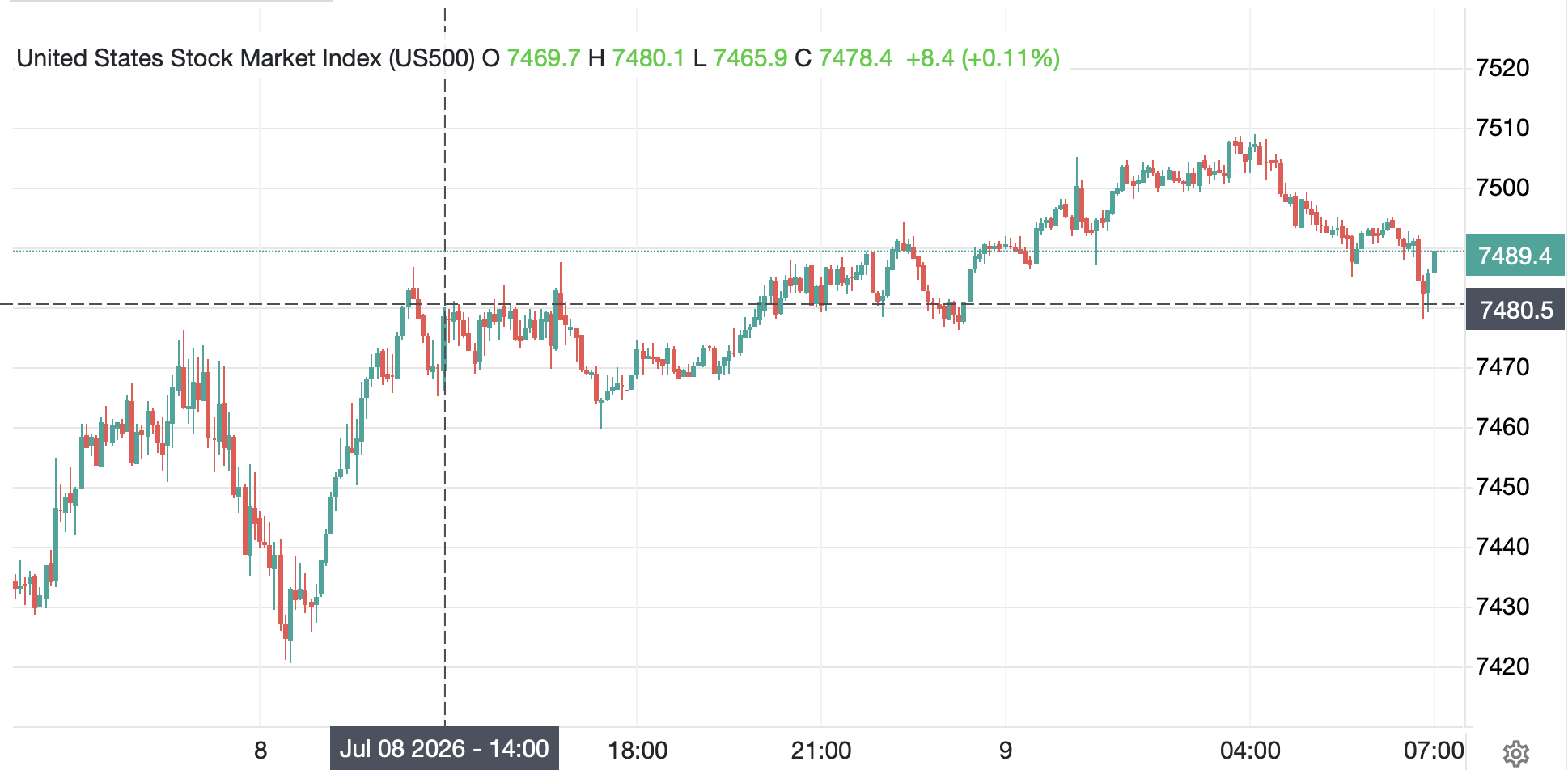
How did the market respond to the Minutes?  They basically ignored them.  Equity markets, which had opened much lower, were already in the process of reclaiming those losses when the Minutes were released and edged higher from there, with no meaningful change in trajectory as you can see in the below chart of the S&P 500.

Source: tradingeconomics.com

How about bonds?  Well, here is the 10-year chart and you tell me if the Minutes had an impact.

Source: tradingeconomics.com

I guess the real question is will the rest of the world’s central banks follow Mr Warsh’s lead and seek to end forward guidance and simply go about their job of managing inflation?  One can always hope.

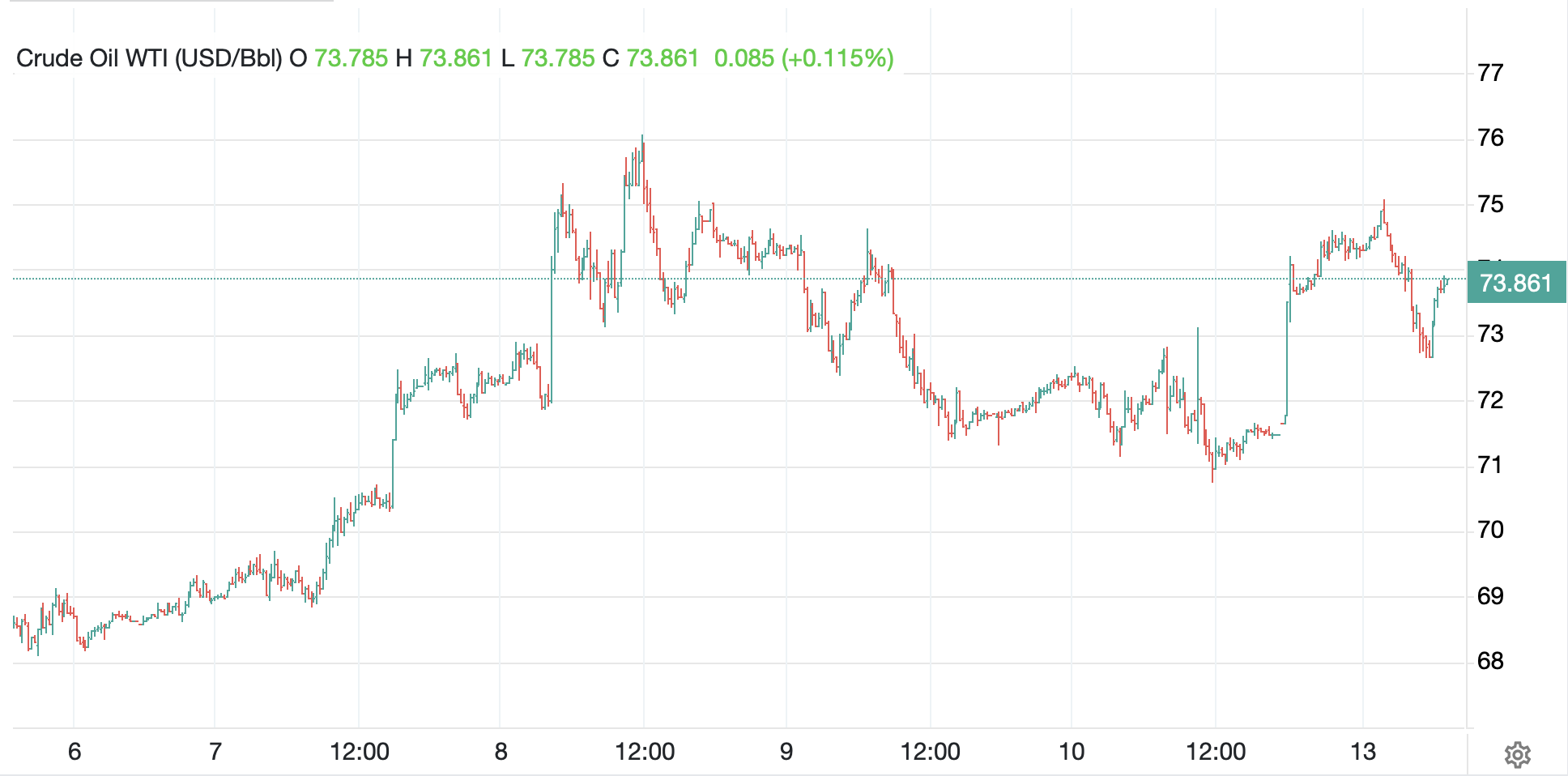
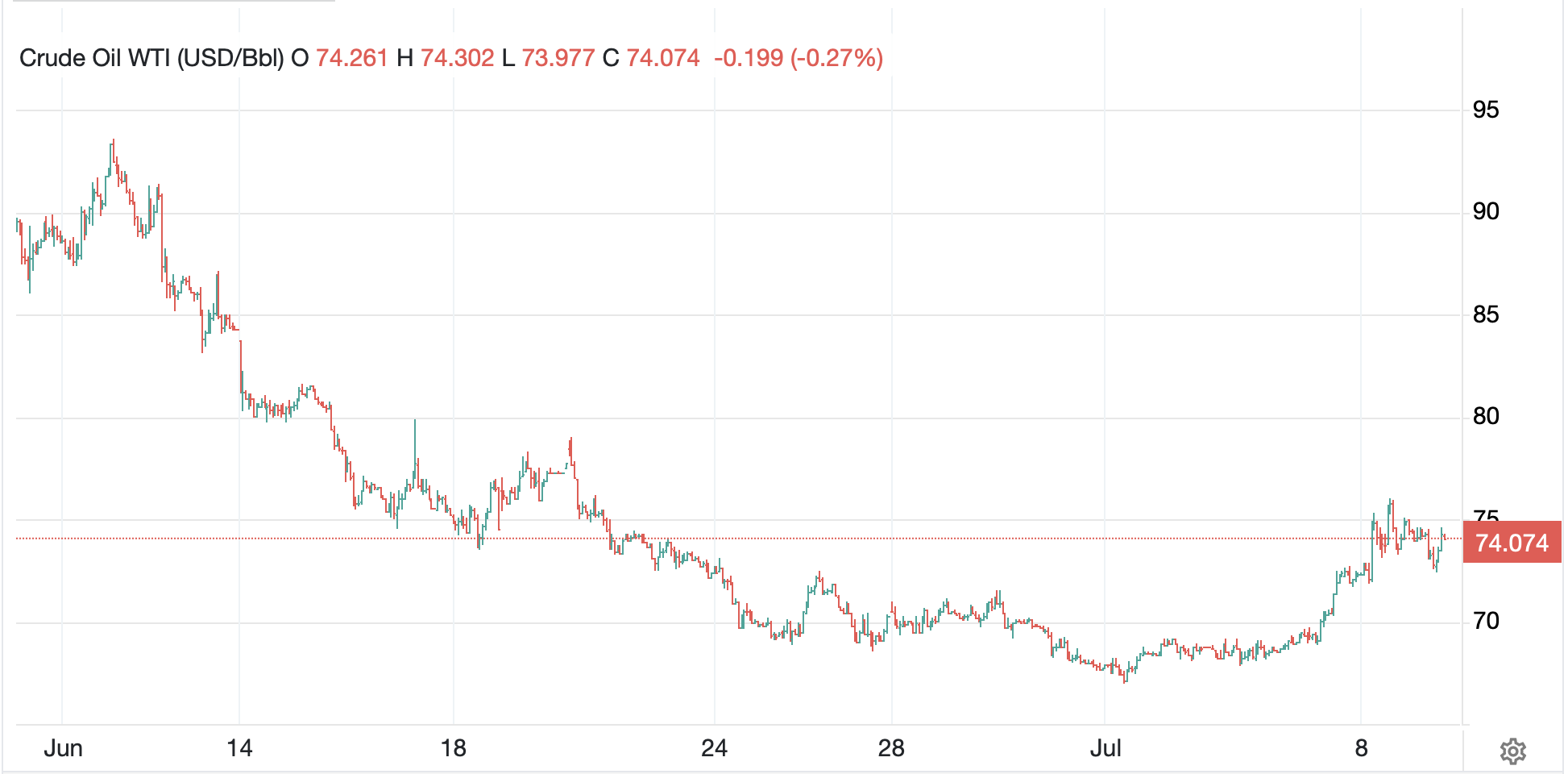
Which takes us to the other story of note, the apparent end of the ceasefire in Iran and the question of what is now happening in the Strait of Hormuz.  First, let’s be clear, nobody really knows as the fog of war remains thick.  Obviously, yesterday saw a sharp rise in the price of oil as concerns over future transits of the Strait rose dramatically.  However, as of this morning, while WTI (+0.6%) has edged slightly higher from yesterday’s closing levels, as you can see from the chart below, it seems to have found a new short-term home here around $74/bbl.

Source: tradingeconomics.com

Scrolling through X this morning, the $200/bbl analysts were back at it, explaining that this time, with all those inventories having already been used up, we are going to see much higher prices.  But weirdly, yesterday’s EIA data showed an inventory build of 3 million barrels.  I keep seeing charts of the US SPR and how it is at its lowest level since 1982 implying that we are on the cusp of running out like this one from Bob Elliott.  Now, Bob Elliott is a really smart guy, but I feel like the piece of the puzzle that is missing in these analyses is that right now, the US is producing just under 14 million bpd of oil, plus another ~7.5 million bpd of natural gas liquids and 110 billion cubic feet/day of dry natural gas.  In fact, we are a massive exporter of oil and products, so perhaps a better question is, why do we need an SPR anymore?  After all, it was created when we were at the mercy of the Middle East and producing just 8.6 million bpd.  That is no longer the case.

My take is the world can run perfectly well on $75/bbl oil and there is plenty of supply at that level.  In addition, we have seen numerous announcements of how Gulf oil producers are building new methods of transport away from the Strait, and over time, that will no longer be a choke point with any meaning.  War is exciting to market participants for about two weeks, at which point they get bored and move on to the next big thing.  After all, the Ukraine war has been ongoing for 4 years and it doesn’t get a mention in market commentary.  Next week we start to see earnings releases for Q2 and that will be much more interesting for equity, and likely all other, markets.

In the meantime, let’s see what happened overnight.  Based on the mix of information, we cannot be surprised that there were mixed outcomes in equity markets around the world.  Yesterday’s US split (DJIA -1.1%, NASDAQ +0.2%) was followed by gains in Tokyo (+1.4%), China (+2.5%), Korea (+0.6%) and India (+0.3%) while HK (-0.7%), Taiwan (-0.8%) and the Philippines (-0.8%) all slid a bit.  There was no rhyme or reason here.  The only data of note overnight was Chinese inflation data where CPI fell to +1.0%, while PPI rose to +4.1%.  It strikes me that Chinese companies will continue to see pressure on their margins.

In Europe, things are also mixed with Spain (+0.8%), Italy (+0.7%) and France (+0.3%) all higher while the UK (-0.6%) is slipping and Germany is little changed.  As to US futures, they are leaning higher at this hour (7:50).

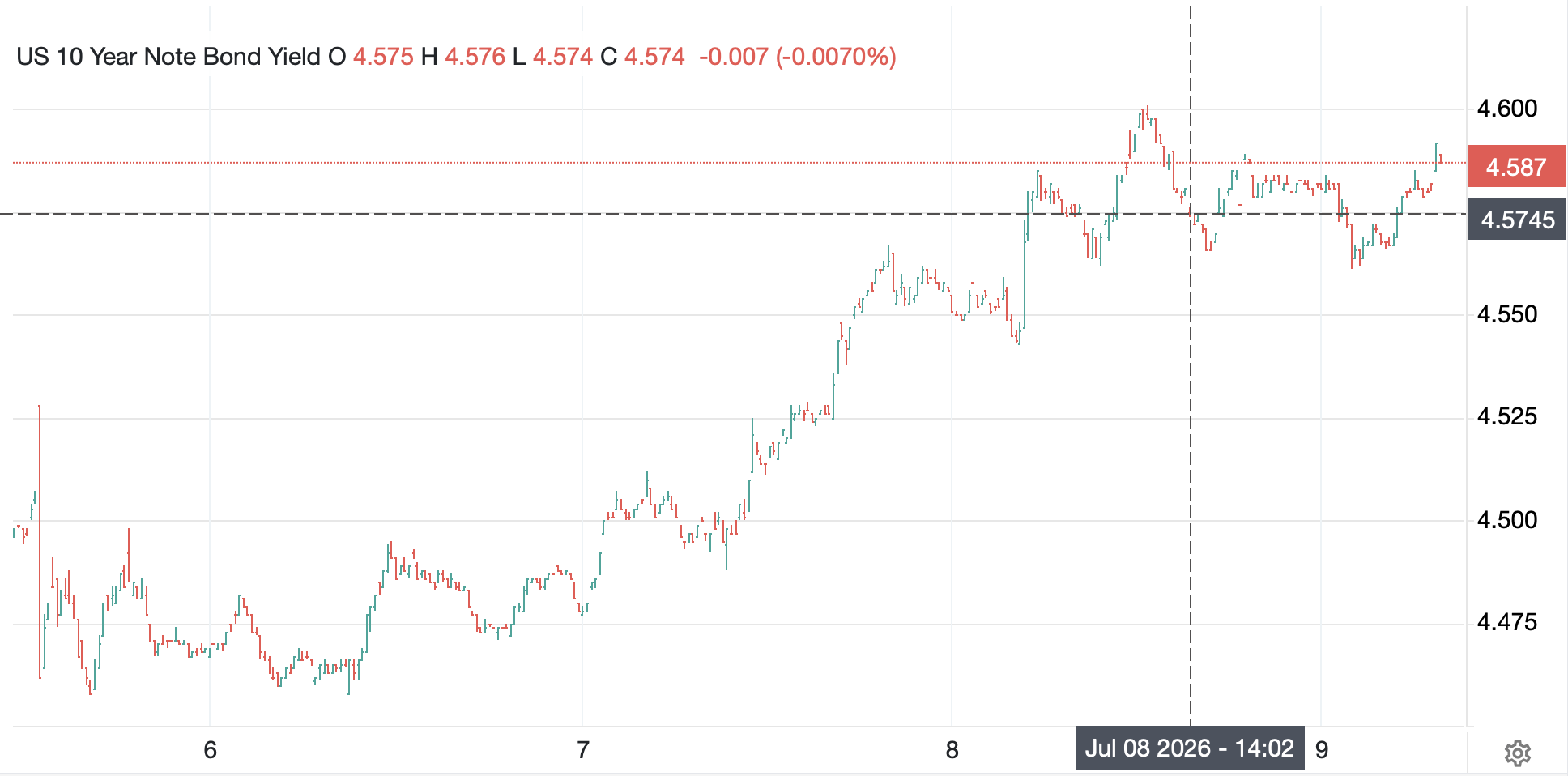
Bond markets seem to have stopped selling off as yields this morning are little changed (Treasury +1bp, Bunds +1bp, Gilts -3bps, OATs -3bps).  JGBs were unchanged overnight.  The 10-year auction yesterday went pretty well with a bid-to-cover ratio of 2.59, although with yields at 4.58%, it is not that surprising there was real demand.  I will say this, bonds, too, are a market with some smart folks with diametrically opposed views of the future outcome.  Both 3% and 6% are seen as the next major destination depending on the analyst.

Interestingly, metals markets are showing some life this morning with gold (+0.8%), silver (+1.4%) and copper (+2.2%) all bouncing off recent lows.  This is a bit out of character compared to recent price action relative to oil, but maybe we are putting in some bottoms here.

Finally, the dollar is, net, little changed this morning.  In the G10, NZD (+0.65%) is the big mover, which continues on the back of their rate hike from yesterday.  But otherwise, +/-0.1% is the norm here.  In the EMG bloc, KRW (-0.5%) is giving back some of its recent gains but continues to hover near multi-decade lows.  The recent gains have been on the back of a record current account surplus, but it remains an interesting conundrum that despite the massive gains in the Korean stock market, the currency has not attracted more buying interest.  Otherwise, modest EMG gains on the order of +0.1% are today’s story.

On the data front, we see Initial (218K) and Continuing (1820K) Claims as well as Existing Home Sales (4.20M) today.  In addition, there are two Fed speakers as I imagine getting them to shut up will take some time.  However, I wonder, will they really add to the discussion?

Oil continues to be the driving force in markets, but right now, my sense is eyes are turning to upcoming earnings releases.  Of course, we also get CPI next week, which will be a critical number for markets, at least for now.  

Good luck

Adf
Really Vexed

Said Warsh, when I think of what’s next
For prices, I’m not really vexed
The narrative’s starting,
A new view, imparting
That lower, is what it expects

While futures have yet to adjust
The more this idea gets discussed
The more it’s presumed
The hike story’s doomed
While negative vibes turn to dust

Fed Chair Warsh was in Sintra, Portugal yesterday on a panel with Madame Lagarde, BOE Governor Bailey and BOC Governor Macklem answering questions about monetary policy, forward guidance, and the future of economies as they are impacted by AI.  Now, despite Mr Warsh’s adamant explanation at the last FOMC presser that forward guidance was dead, that didn’t stop the interviewer from asking about the Fed’s likely future moves repeatedly.  This is getting tiresome.  

Nonetheless, here is the comment I believe was most important. “Expectations of future inflation [over the last four weeks] have come down. Inflation risks have come down,” and anyone expecting the Fed would tolerate inflation running above its 2% goal “would be disappointed,” he added.

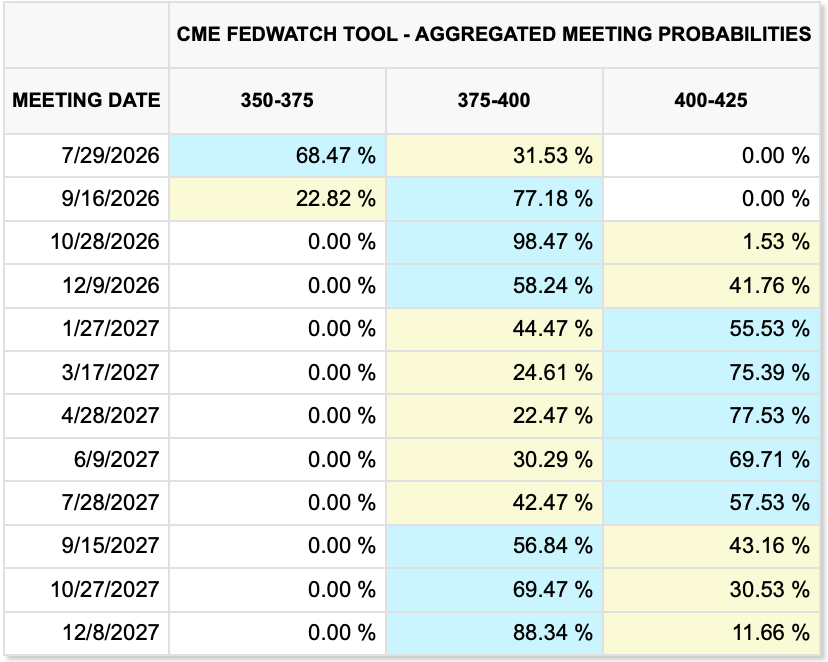
So, the first thing I did was look at the CME’s probability matrix based on its Fed funds futures contract, and there is no evidence to support Warsh’s comments there.  As you can see from the below table, it looks virtually identical to what we have seen over the past week, a hike in October and a 40% chance of a second one in December.

Now, I will cut him some slack because, while I agree with him and expect that we will see lower inflation readings this month, simply on the back of the decline in energy prices, the rate hike narrative has been building for a while and has many adherents.  My take is that the above table will not change very much until we have seen the two key data points this month, today’s NFP and CPI which is due to be released on Bastille Day.

While I’m on the subject, here is the current view of today’s median expectations according to tradingeconomics.com

Nonfarm Payrolls110K
Private Payrolls110K
Manufacturing Payrolls3K
Unemployment Rate4.3%
Average Hourly Earnings0.3% (3.5% Y/Y)
Average Weekly Hours34.3
Participation Rate61.7%
Initial Claims220K
Continuing Claims1810K
Factory Orders-1.8%
-ex Transport0.4%

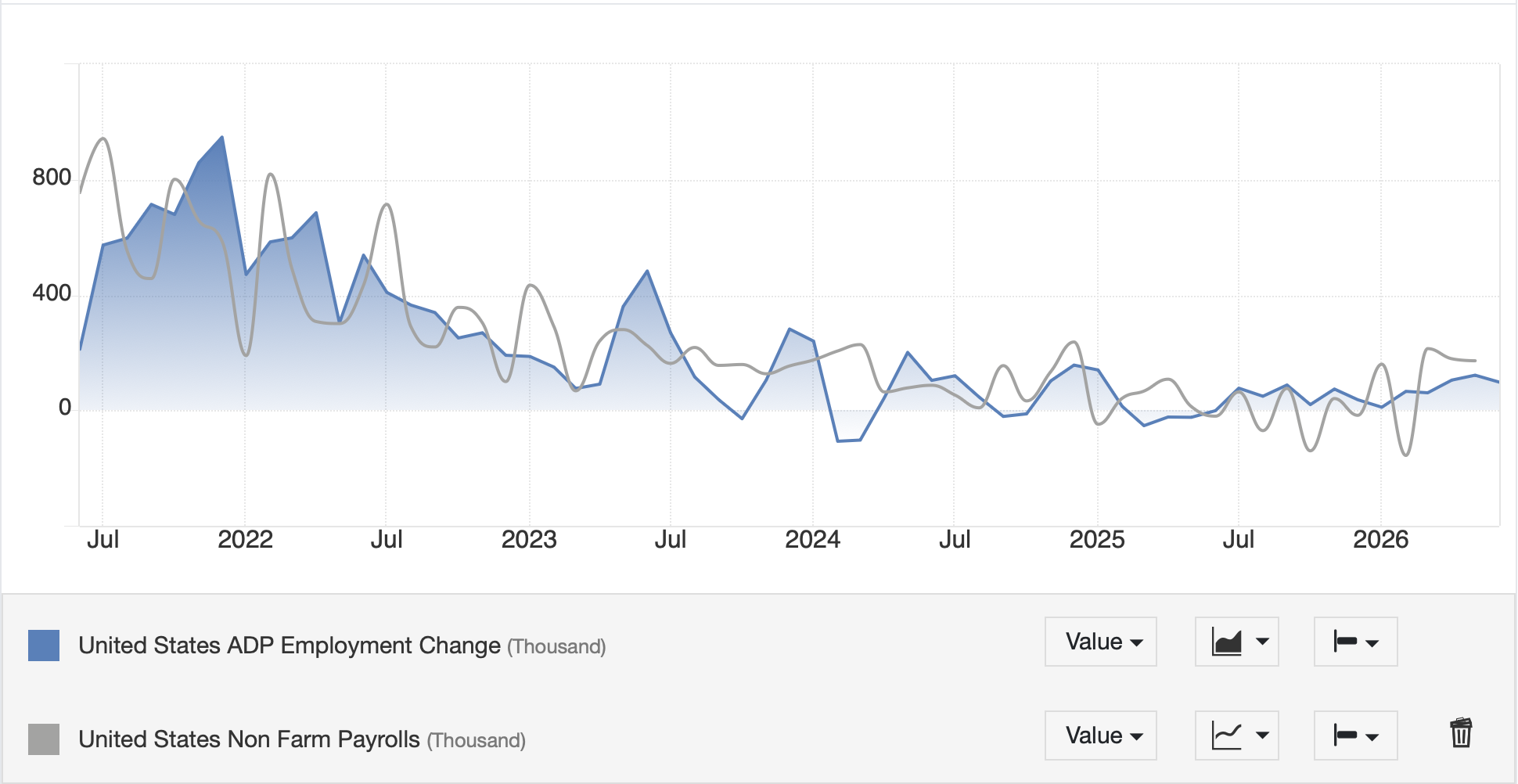
Yesterday saw a slightly softer than expected ADP employment number, 98K vs. the 113K expected and 122K last month, but as you can see from the chart below, comparing ADP to NFP, while the trend remains similar in both, there are an awful lot of wiggles in any given month.

Source: tradingeconomics.com

As things currently stand, the market’s strong Keynesian belief is if NFP is strong, that will be inflationary although it is quite clear that Chairman Warsh does not adhere strictly to that viewpoint (another reason I like him) as he anticipates significant productivity enhancements going forward on the back of AI adoption.  But my point is, if we see a strong print this morning, I would look for the market to price more aggressively for a rate hike.  I guess we’ll find out shortly.

In the meantime, let’s see what happened overnight.  Starting with commodity markets, oil (-1.5%) continues to slide regardless of the group of doomporners who insist that we are about to run out of oil, or that Iran now controls the Strait of Hormuz and will kill the global economy.  In fact, from a technical perspective, we have filled the gap that opened back on March 2nd, the first day markets were open after the conflict began.

Source: tradingeconomics.com

My question for all those who remain certain that we have merely delayed oilmageddon is, how low will prices need to fall before they are willing to admit they misread the reality of the global oil market?  And, with oil sliding, precious metals (Au +0.8%, Ag +1.1%) are finding support.  It seems to me there is a lot of wood left to chop in the PM market, but I maintain my longer-term bullish outlook.

Turning to the bond market, yields rose again yesterday in the US (10-year +6bps) and have edged higher again this morning by 1bp.  My sense is this is based on the idea that Warsh’s final comment from above about tolerating above-target inflation has the hawks all bulled up.  Perhaps, Sintra helped the hawkish case elsewhere as well as European sovereign yields are all higher this morning by between 4bps and 5bps and JGB yields overnight jumped 8bps.

But there is a kink in the narrative now as despite this perceived hawkishness in the bond market, the FX market clearly heard a different tune.  This is clearest in USDJPY, my favorite recent discussion, as you can see in the chart below.  The yen jumped 0.7% ostensibly on the idea that Warsh’s comments about reduced inflation expectations implied a less hawkish Fed, despite the bond market reading the comment about unwillingness to tolerate inflation as a more hawkish Fed.

Source: tradingeconomics.com

But it’s not just the yen.  The dollar is lower vs. virtually all its counterparts in both G10 and EMG spaces.  So, the question you need to ask yourself is, who do you believe?  Bond traders or FX traders?  Historically, observers call bond investors/traders the ‘smart’ money, but they have made plenty of mistakes in the past.  And the thing about FX traders is they seem to be far nimbler.  Of course, you know I am an FX guy, and as it happens, I think this is the market that has it right.

Finally, equity markets had a mixed performance in Asia (Japan -2.5%, China -3.0%, Korea -7.9%) as tech stocks have been feeling some pain, but we did see gains in HK (+0.8%), India (+0.8%) and Singapore (+1.1%) as a counterbalance.  That Korean number was impressive, but mostly what we are seeing there is serious volatility as the KOSPI is even more concentrated than the NASDAQ with just two companies, Samsung and SK Hynix, representing about 40% of the index.  If they have a bad day, the index does as well.

In Europe, though, things are brighter this morning with gains across the board (Germany +0.9%, Spain +0.9%, France +0.8%, UK +0.5%) although there is no obvious catalyst for the move.  There was no data of note (Eurozone Unemployment fell to 6.2% but that seems unlikely to be the driver) so perhaps the very fact there are no tech companies in Europe and tech is what is currently under pressure makes Europe seem a bargain.  As to US futures, ahead of all the data this morning, they are little changed.

And that’s really it for today.  As tomorrow is a holiday, there will be no poetry, so I wish you all a wonderful holiday weekend.  3 Cheers for the USMNT after their Round of 32 victory last night (alas it was on way too late for me to watch, but we will all be cheering on Monday night.

Good luck and good weekend

Adf

40-Year Nadir

Each day, one more pip
As the yen slides to the next
40-year nadir

The current blame is
The Fed’s recent hawkishness
What if that’s all wrong?

I feel like I must apologize by focusing on the yen again this morning, but quite frankly, there is not that much else to discuss.  And in fairness, it is not as though the yen’s move overnight, edging lower by a further -0.1%, is all that much to write about.  However, the yen has been getting a great deal of press as there is a cadre of analysts who are ‘certain’ that the MOF/BOJ is going to step in and intervene again soon, although I have seen more discussion of how 170 is in the cards as well.

Now, as it is the beginning of the second half of the year, I thought I might look at what I wrote at the beginning of the year regarding the yen to see how it’s going.  And while it is far too early to discern if I was prescient, things are looking pretty good right now.  Below, I have copied my yen discussion from back in January.  You decide if I’m on track.

A turn to the East where the Sun Also Rises
Will teach us that, really, there are no surprises
To date you’ve heard much ‘bout the rise in yen rates
With pundits opining the Carry Trades’ fates
This year, so they say, look for much stronger yen
As local investors buy yen bonds again
Thus, all the hedge funds who’ve been funding their trades
By borrowing yen, and they’ve done so in spades,
Will need to buy back all that Japanese Money
The outcome, for yen shorts, will not be so sunny
But what if this idea of yen heading home
Is wrong? This implies quite a different syndrome

At this point there’s no sign the government there
Is ready, more spending and debt, to forswear
Instead, what seems likely is more of the same
More government spending in all but its name
So, debt will continue to rise without end
And up to One-Eighty the buck will ascend

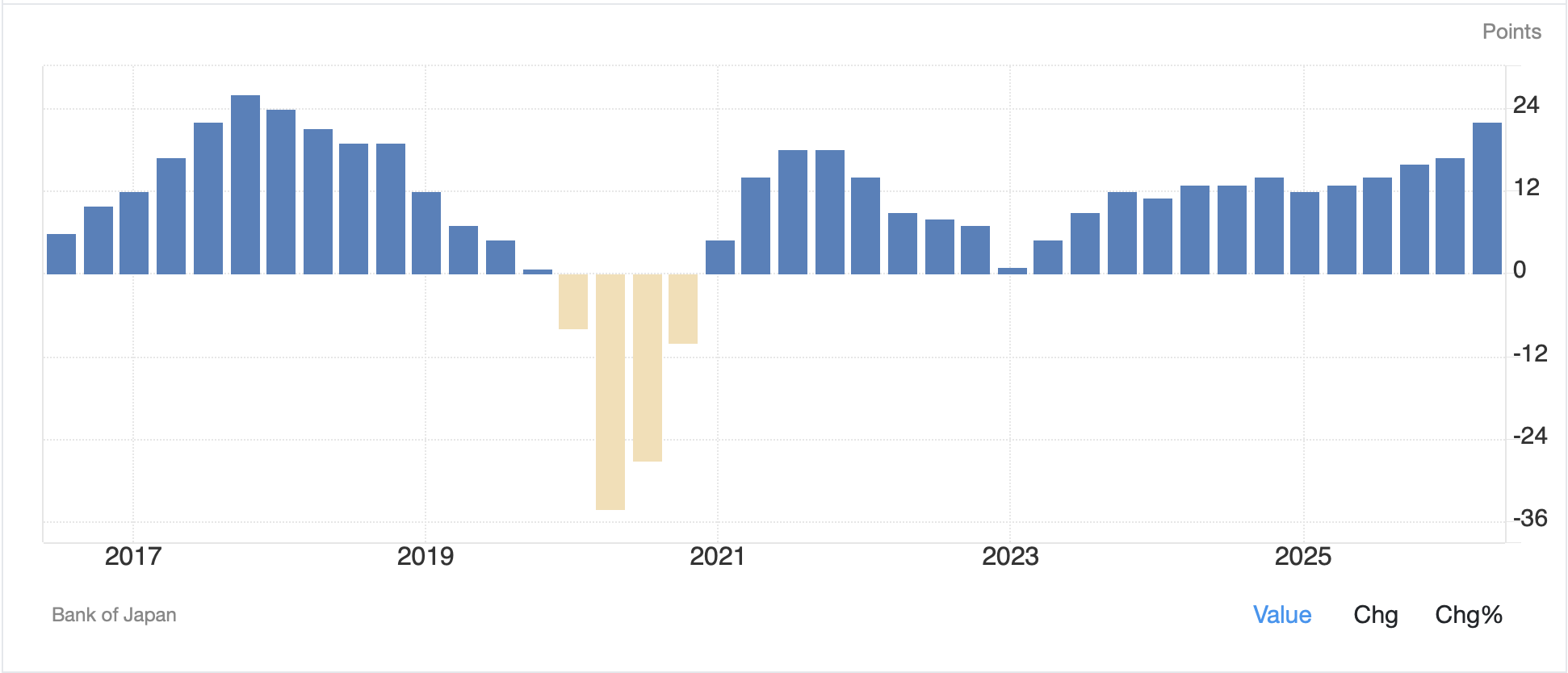
So, with that in mind, let’s see what we learned overnight.  First, Japanese Tankan data was released and the economy, or at least the corporate sector, seems in fine fettle.  The below chart of the Large Manufacturer’s Index shows the strongest reading since 2017.

Source: tradingeconomics.com

Clearly, the corporate set is not unhappy with the yen’s movement.  Now, there was yet another Bloomberg articlediscussing comments from the current Mr Yen, Atsushi Mimura, and reflecting on the fact that the MOF is in regular contact with Secretary Bessent and the Treasury department and there is no obvious concern on then US’s part with the current level of the yen.  

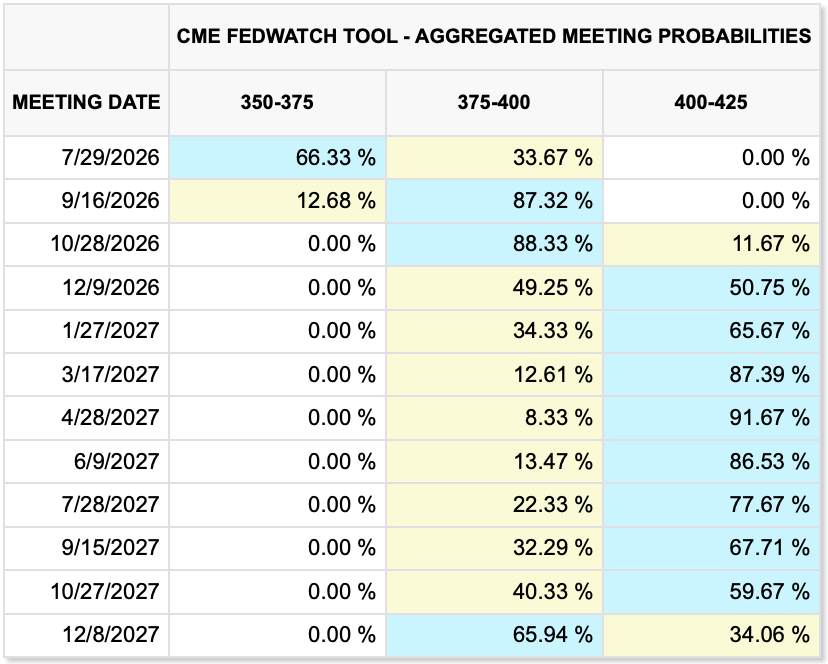
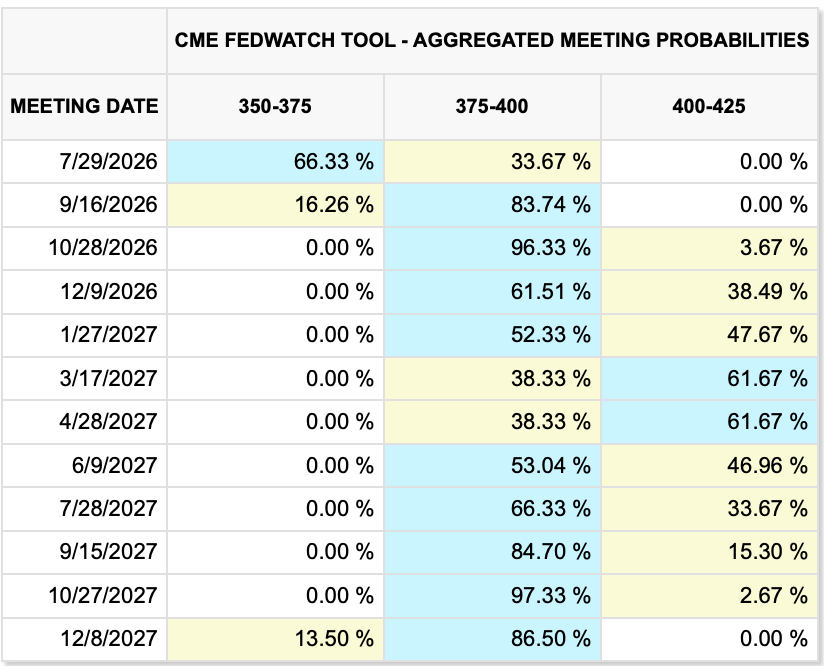
However, the consensus view is that the yen’s recent decline has been driven by the change in attitude regarding the FOMC.  The idea is that while the market was anticipating Fed rate cuts back in January, the comments by Chairman Warsh (more of which we will hear later this morning from Sintra, Portugal) have turned things around dramatically and we are now pricing a one-third chance of a hike at the end of July, a certain hike in October and another 40% probability of a second hike in December as per the below CME table.

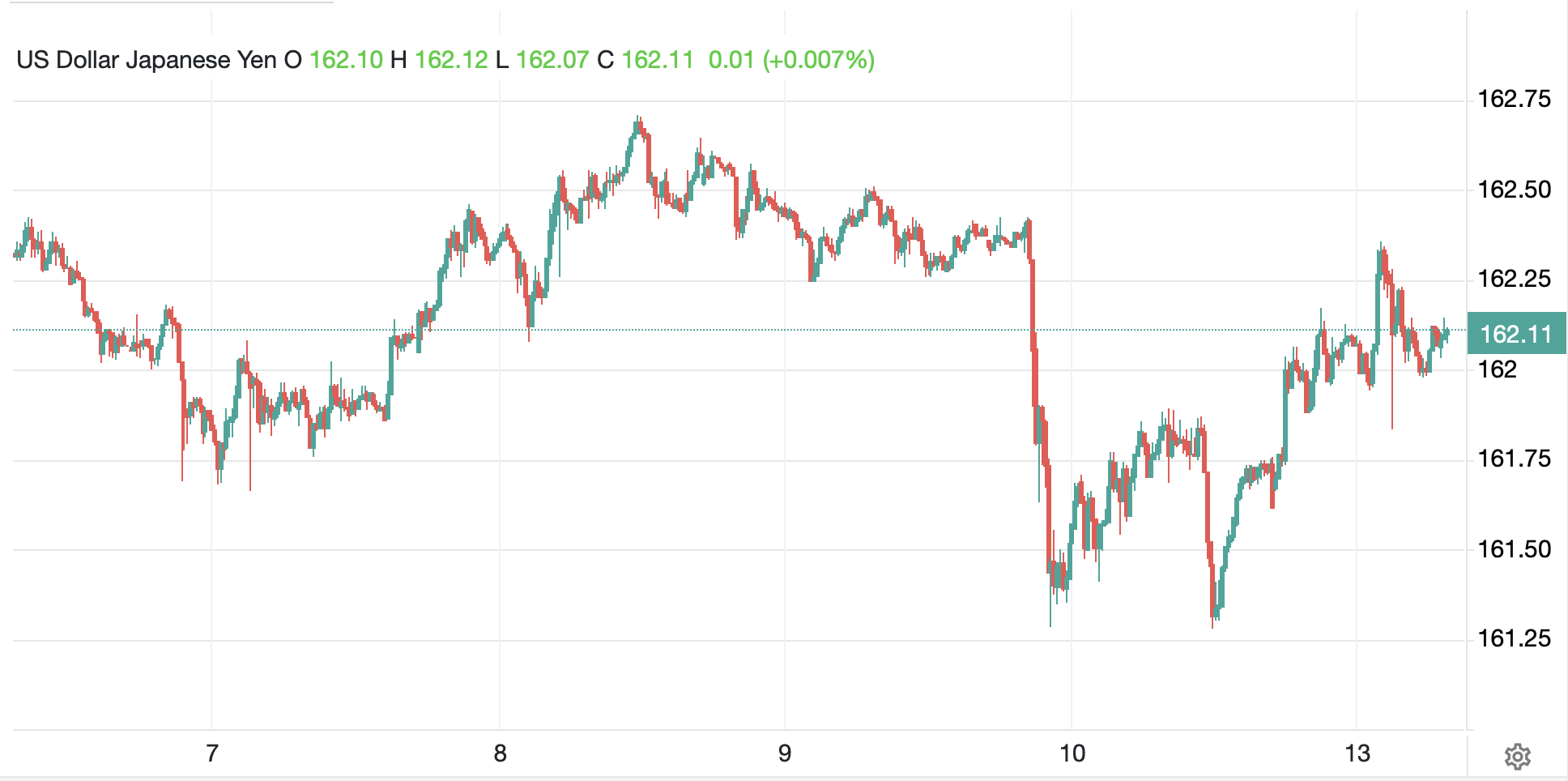
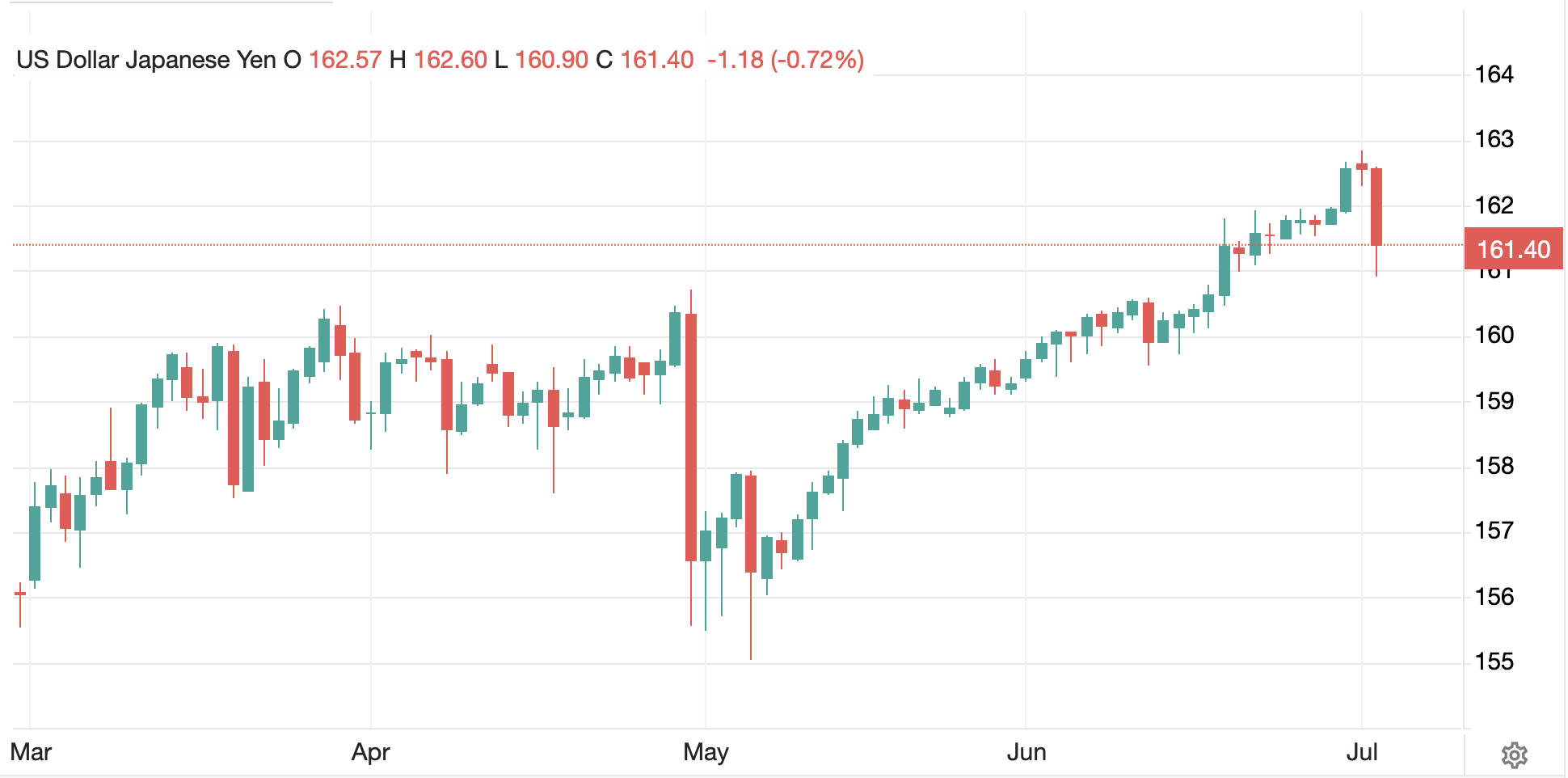
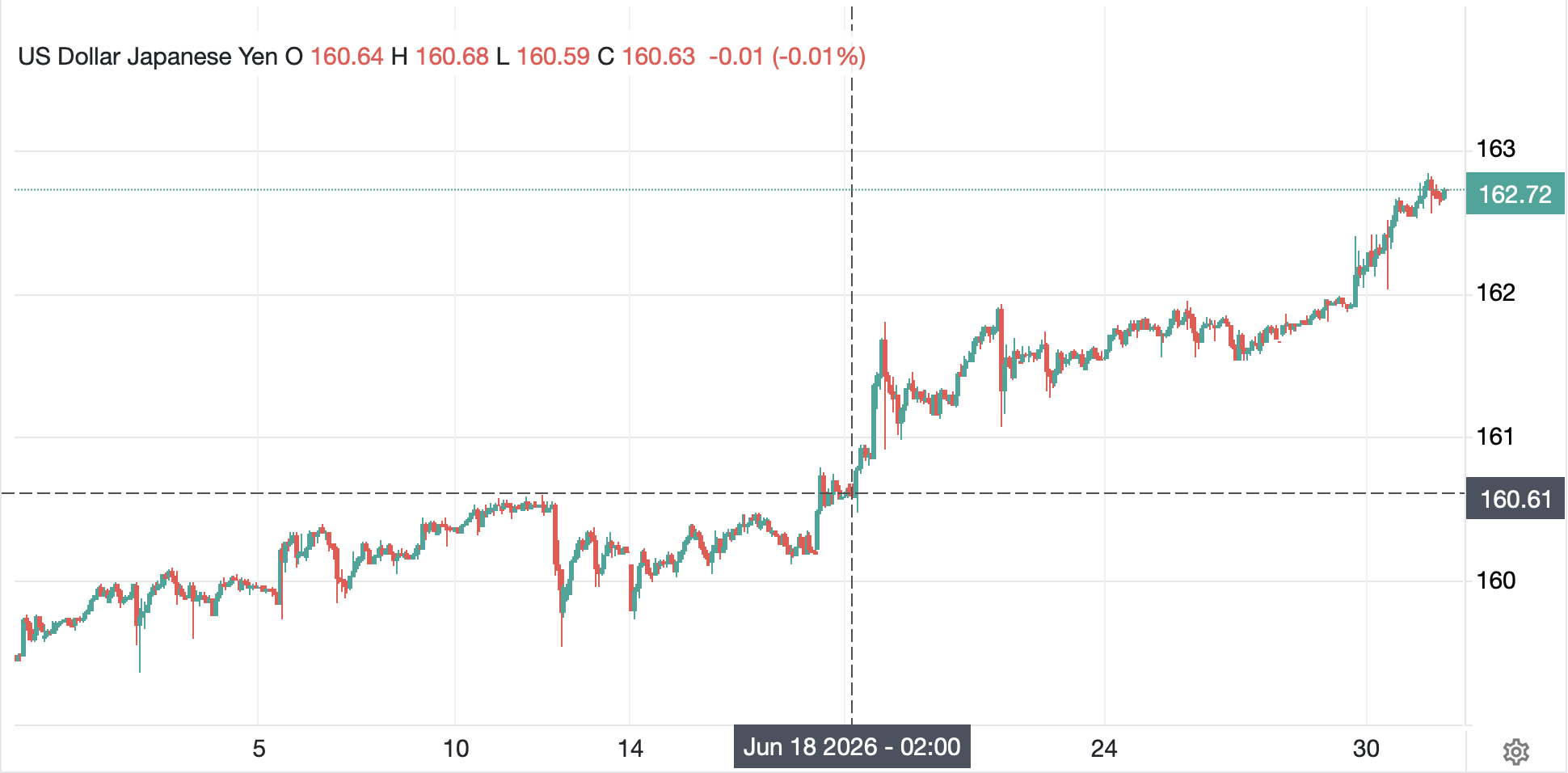
So, if we take this sentiment shift into account, we can look at the last month of trading in USDJPY, which basically encompasses two weeks before the FOMC meeting and two weeks since.

Source: tradingeconomics.com

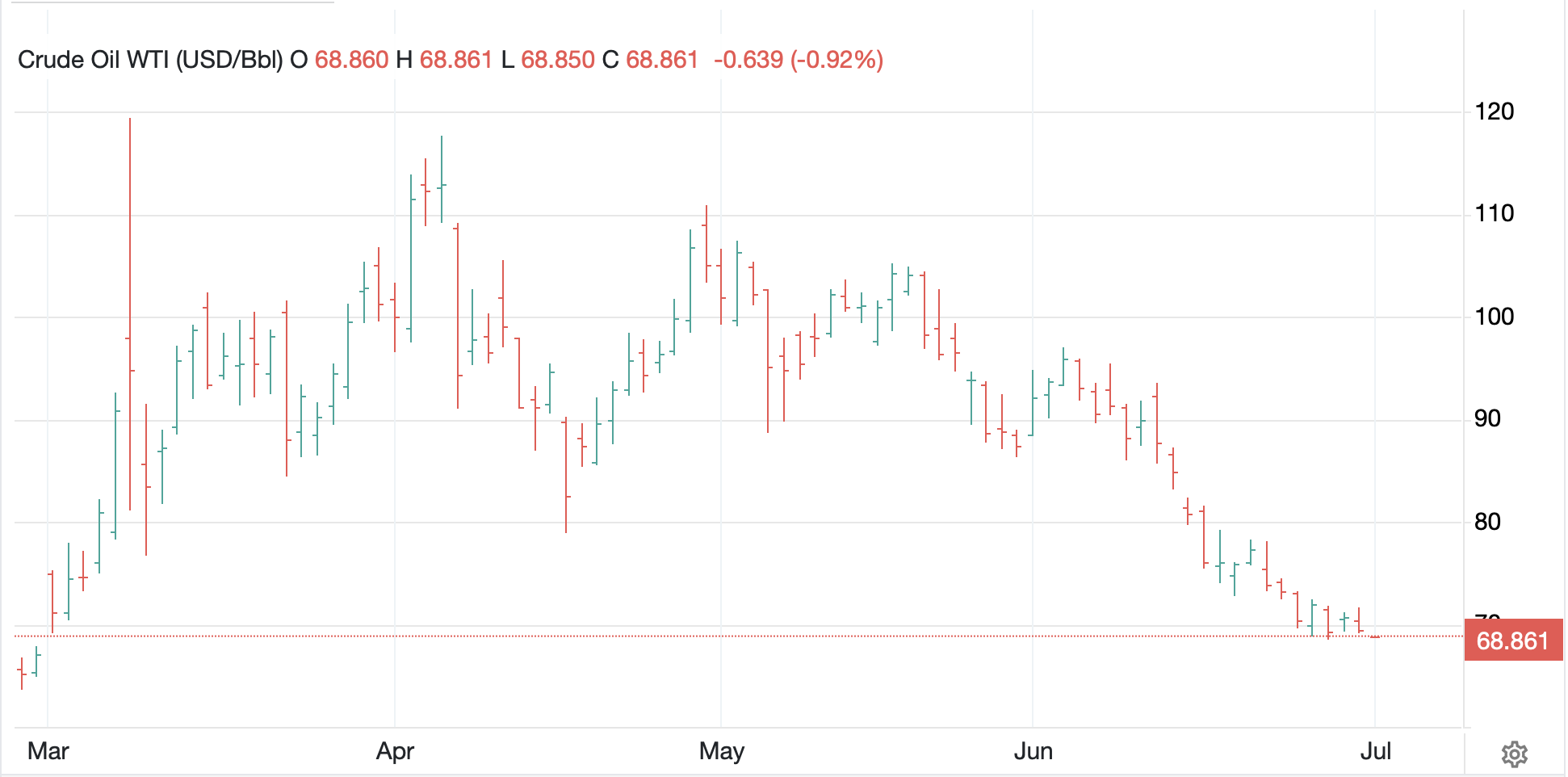
And, if you do the math, it seems that the yen weakened 0.72% (from 159.45 => 160.60) in the first two weeks of June and 1.32% (160.60 => 162.72) since the FOMC meeting.  I completely agree that modest change in trajectory is the result of this newfound belief in Fed hawkishness.  Of course, you all know that I don’t believe that is what the Fed is going to do, and in fact, my 180 call at the beginning of the year had nothing to do with the Fed raising rates, it was all about deterioration of Japan’s fiscal account.  However, as we learned this morning from Europe, where inflation fell to 2.8% headline, 2.4% core, both much lower than last month and forecasts (good thing the ECB hiked into the energy price shock, right?) we can look forward to at least a few months of softening inflation in the US as well based simply on the ongoing decline in oil prices (-1.0% this morning) and continuing to trend lower as per the below chart.

Source: tradingeconomics.com

Softer US inflation numbers are going to undermine the call for rate hikes, and I expect to see those hikes priced out of the markets by the end of July.  That alone should help prevent the yen from collapsing in the short-term, although their long-term problems remain extant.

But one thing to keep in mind is that we are coming up to a holiday weekend in the US with market liquidity impaired.  It would not be surprising to see the MOF step in to markets Friday when liquidity is thin and they will get more bang for their buck.  But the yen is a basket case regardless of US rates.  Like I said, short-term, maybe a dip in USDJPY back toward 155 on the back of intervention, but longer-term, unless they change their fiscal policies, lower the yen will go.

Otherwise, there is not much new to discuss.  Equity markets finished the quarter with their best result in forever, with the NASDAQ rising ~30%.  Seems like it will be hard to repeat that again, and this morning, futures are slightly in the red, about -0.3% or so.  As to the rest of the world (do we really care?) last night saw Tokyo (+0.6%) rally along with India (+0.6%) and Taiwan (+1.9%) but the rest of the region slumped led by Korea (-2.0%) which had been the leader, with China (-0.4%) and HK (-0.6%) also falling and the rest of the regional bourses seeing more red than green.  In Europe, there is more negativity than not with only the DAX (+0.2%) edging higher after their PMI release (50.3) was slightly better than expected, although still weak.  However, the rest of Europe is softer this morning (Spain -0.7%, France -0.65%, UK -0.4%) amid unimpressive PMI results.

In the bond market, yesterday saw US yields pop nearly 10bps in what appeared to be a major futures led move.   Certainly, yesterday’s data releases didn’t indicate dramatic strength in the economy, just that things are still fine.  But things being what they are as the Treasury market drives global bond yields, we did see yields climb everywhere yesterday and have followed on in Europe this morning with sovereign yields higher by between 3bps and 5bps across the board.  JGB yields (+3bps) rose overnight as well, although Treasury yields are little changed this morning.  I feel like this move will be reversed by month end, if not sooner.

In the metals markets, oil’s decline has seen support for both gold (+0.4%) and silver (+0.6%) although copper (-1.6%) is struggling this morning.  Nonetheless, I continue to like the long-term outlook for metals.

Finally, the rest of the dollar story is one of strength for the greenback with the euro (-0.25%) slipping back below 1.1400 and every G10 currency under pressure.  Meanwhile, in the EMG bloc, KRW (-0.7%) is today’s dog, as it approaches its GFC levels as the equity market selling weighed on the currency.  Otherwise, broad dollar strength, but nothing dramatic.

On the data front, ISM Manufacturing (exp 54.0) is coming later this morning as are the EIA oil inventory data. And, of course, Mr Warsh’s speech at 9:00am.  It will be quite interesting to hear what he has to say, as I think it will be the most critical thing for the session, and frankly, I have no idea where he may go.

So, as we head into a holiday weekend, less positioning is better, and choppiness is to be expected.

Good luck

Adf
Peace Was in Sight

The weekend saw missiles in flight
As both sides continued the fight
But just ere the open
The market put hope in
The idea that peace was in sight

So, here we are first thing today
And focus has moved far away
We’re back to AI
And pie in the sky
As stocks, once again, make more hay

Much has been made of the fact that President Trump is hyper aware of financial markets and seeks to ensure that whatever is happening in the world, it happens on weekends so that by the time markets reopen, the situation appears far less dire, hence less need to sell stocks.  This weekend is a perfect example as Friday after the close, it was announced that the US had responded to the several Iranian attacks on ships in the Strait of Hormuz last week with significant force.  The early punditry on Friday night and Saturday was that when markets reopened, the recent decline in oil prices would reverse as that has been predicated on a more lasting peace.  But then, last night shortly before futures markets opened, there were announcements that the US had finished its response and that the peace talks were back on under the guise of the 60-day ceasefire.  

I have to say, though, it almost appears as if Iran is in on the joke.  After all, if not, wouldn’t they try to force Trump’s hand during market hours?  Just asking.  Whatever the case, the situation as we wake up this morning is that oil (+0.8%) has edged back higher near $70/bbl but certainly doesn’t have the feel of breaking out higher.  Meanwhile, equity markets are generally positive and have been overnight while bond yields and the dollar are little changed.  in other words, there’s not much happening this morning.

In reality, it is not that surprising that things are quiet.  It is summer and summer markets are typically somewhat less active.  As well, away from the uncertainties of the Iran conflict, economic activity seems to be ticking along pretty well.  Arguably, the biggest story remains AI and both its potential impact on workers and the economy as well as the questions about its ability to generate sufficient revenue to repay the hundreds of billions of dollars being spent on it.  But those are longer-term stories, not day-to-day.

Which takes us to this morning.  Frankly, I don’t think there is an interesting market related them right now.  Instead, we have much time-biding until the next big thing.

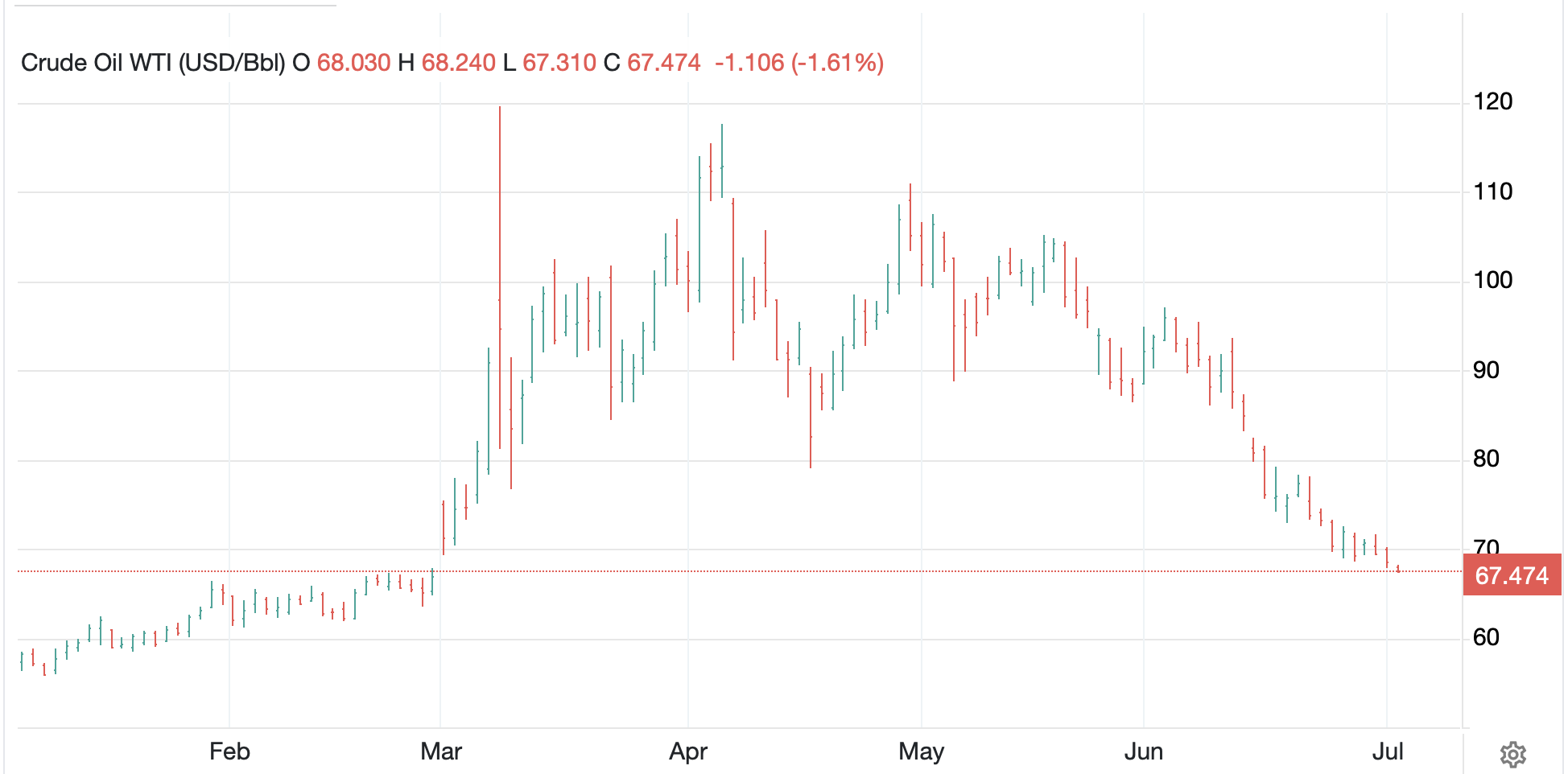
Let’s start with commodities as oil continues its multi-month decline from the early April peak.  it remains very difficult to look at the below daily chart and think, damn, oil is about to run away higher.  At least for me.

Source: tradingeconomics.com

There are still numerous analysts who maintain that the drawdown of reserves is going to come back and haunt the market, driving prices much higher as inventories fall and tank bottoms are reached.  And I am sure they earnestly believe those outcomes are ordained.  But the relative wisdom of market prices disagrees.

Remember back when this all started, there was another point that was made by these same analysts, that fertilizer shortages would be manifest and food prices would rise much higher.  The story was that the closing of the Strait would reduce the ability of Qatar to produce and ship LNG and that was a critical input into the making of Urea.  Let me show you the price chart for Urea.

Source: tradingeconomics.com

While it certainly rose initially, apparently there is sufficient urea around to continue with agriculture as we know it.  Again, much of the initial fear seems to have been misplaced.  I do not know if that is because analysts didn’t really understand the way these markets operated, or because they have models that they have used for years, and those models are no longer fit for purpose.  My observation is that many analysts try to determine the price trends by looking at their understanding of both supply and demand of a given commodity.  But I might argue that the price is what defines both supply and demand, and that at given prices, those two curves adjust to make the system work.  Think of it as price is the independent variable, not supply/demand.

Moving on to the metals markets, they remain under pressure this morning with both gold (-1.3%) and silver (-1.9%) unable to find support, especially the latter.  Copper (-0.3%) is holding up better and I continue to believe that all three will fare well over time, but not right now.

In the equity markets, Friday’s nondescript US markets were followed by more strength (Tokyo +0.15%, HK +1.6%, China +1.2%, Australia +0.7%, Taiwan +1.0%) than weakness (Korea -0.2%, India -0.5%, Indonesia -1.3%) in Asia.  The big news overnight was the South Korean government supporting a massive semiconductor investment by the two big Korean firms, SK Hynix and Samsung, to build four more fabs.  In Europe, though, things are less positive with Germany’s unchanged performance leading the way although the declines elsewhere (UK -0.2%, France -0.3%, Spain -0.4%) are hardly devastating.  We ought not be surprised that US futures are higher this morning as I type (7:25) led by the NASDAQ (+0.9%) as the AI/semiconductor theme continues.

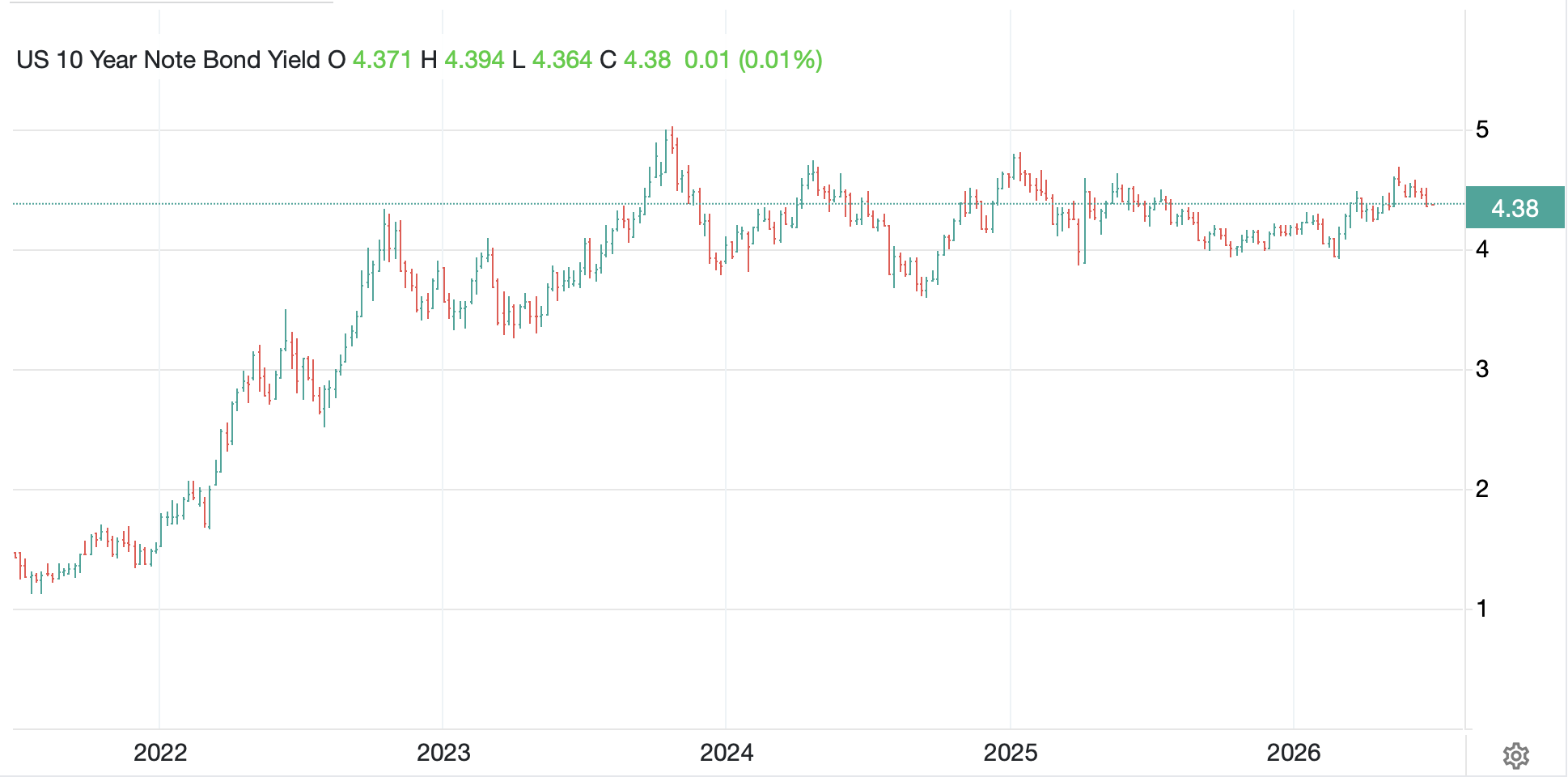
Bond markets continue to do very little with yields essentially unchanged on the day in Europe or the US.  10-year Treasury yields are currently 4.37%, well off the highs seem a month ago near 4.70% when there was much discussion about a breakout higher.  But look at the below longer-term chart of the 10-year Treasury yield and tell me that anything substantive has happened in the past 3+ years.  Since yields rise alongside the 2022 inflation surge, we have seen very little net movement.

Source: tradingeconomics.com

Finally, the dollar is a bit softer this morning but is clearly not the focus today.  I continue to read analyses about Chairman Warsh and what he is going to do and why he will not be able to achieve his goals.  The implication is that either he will need to be ultra hawkish, raise rates quickly and the dollar will soar, or he will wind up with QE 5 or 6 or whatever number we are on, and the dollar will collapse.  My personal view is neither of those scenarios will play out.  As I wrote in the wake of his first meeting, I expect inflation data will ease along with the recent decline in energy prices, and he will be able to do nothing without consequences as he works to change the way things work there.  In the meantime, the dollar will remain supported by real investment flows.

On the data front, even though it is a holiday-shortened week with markets closed Friday for July 4th, we get a lot of data.

TuesdayCase-Shiller Home Prices0.8%
 Chicago PMI60.0
 JOLTS Job Openings7.28M
 Consumer Confidence94.2
WednesdayADP Employment113K
 ISM Manufacturing54.0
 ISM Prices Paid79.0
ThursdayNonfarm Payrolls110K
 Private Payrolls115K
 Manufacturing Payrolls3K
 Unemployment Rate4.3%
 Average Hourly Earnings0.3% (3.5% Y/Y)
 Average Weekly Hours34.3
 Participation Rate61.7%
 Initial Claims220K
 Continuing Claims1825K
 Factory Orders-2.1%
 -ex Transport0.4%

Source: tradingeconomics.com

Obviously, all eyes will be on the payroll data on Thursday.  But Chairman Warsh will be at Europe’s version of Jackson Hole, in Sintra Portugal and speaking at 9am Wednesday morning.  It will certainly be interesting to hear what he has to say there.

It doesn’t seem like there is much about which to get excited today, or tomorrow frankly.  So, Warsh and then NFP will be this week’s story absent another major flareup in the gulf.

Good luck

Adf

My House

Said Kevin, the Fed’s now MY house
And views that we choose to espouse
Will no longer guide
So, when we decide
To move, we expect some to grouse

As well, we are set to review
Our policies all the way through
So, comms will be changed
And data arranged
In truth, it is quite the to-do

This is an evening note as I will be unavailable to write tomorrow morning as we head off to show GCH Nubia’s Take Your Breath Away, aka Marvel to a show.  That is his handler and the judge who awarded him Best of Breed that day.

But not surprisingly, the only thing that really mattered today was the FOMC meeting.  I have to say, having watched the entire press conference I am really impressed with Chairman Warsh.  I love the fact that he shortened the statement and that they are ending forward guidance.  And it was quite interesting that half the reporters’ questions were trying to get guidance about what the Fed may do in the future, despite him repeating that there was no more forward guidance.  My take is Fed reporters are going to have to learn about how markets work and more importantly, market practitioners are going to make up their own minds rather than rely on the Fed to bail them out.  This is all really positive!

The most noteworthy thing was the creation of five task forces to address issues with the way the Fed currently does things on the following subjects:

  1. Communications
  2. Balance Sheet
  3. Data Sources
  4. Productivity and Jobs
  5. Inflation Framework

So, it strikes me that Chairman Warsh is going to look to reprogram the Fed, something that has been sorely in need.  Do not be surprised when much of the commentary is negative on these subjects because those are the folks who benefitted from the old way of doing things.  They now need to change their models and their narratives and they are unhappy.  Another benefit.

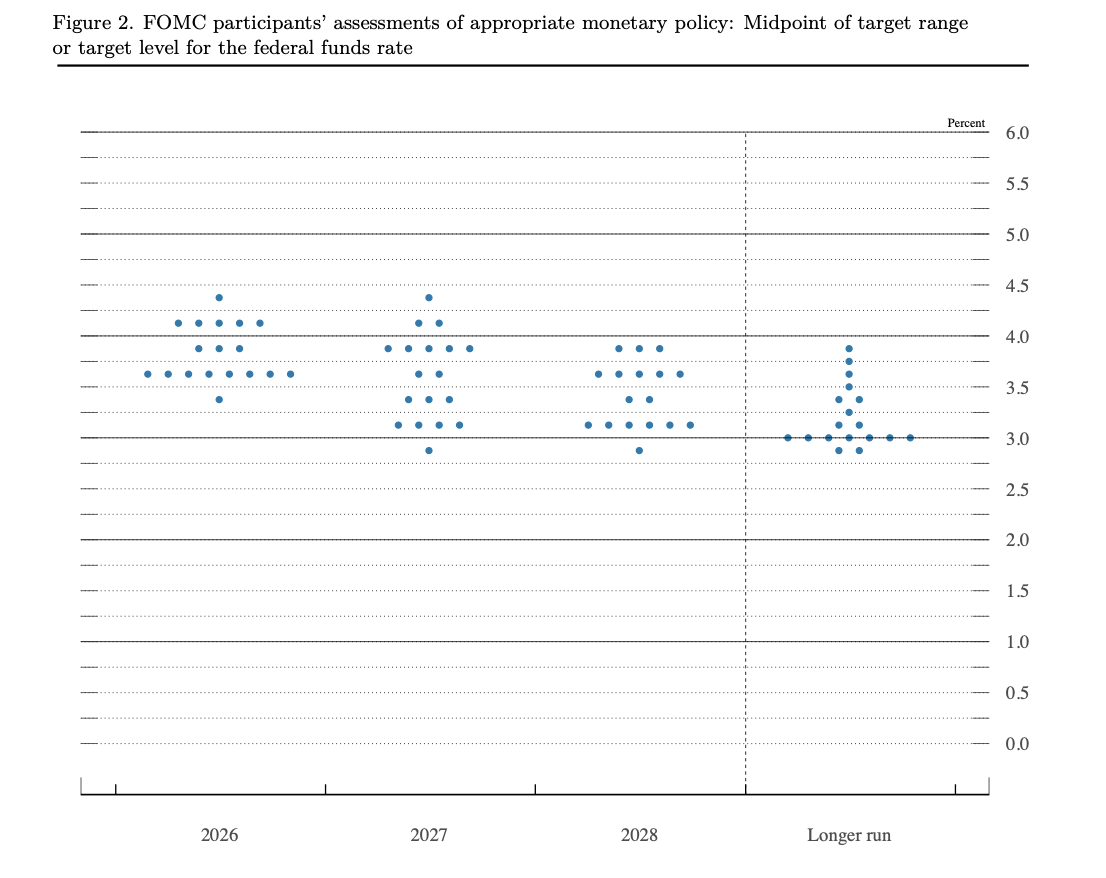
The upshot of the meeting was that rates were left on hold and the dot plot, where Warsh did not supply a dot, showed that half the committee thought rates appropriate, and half thought they would be higher by the end of the year.

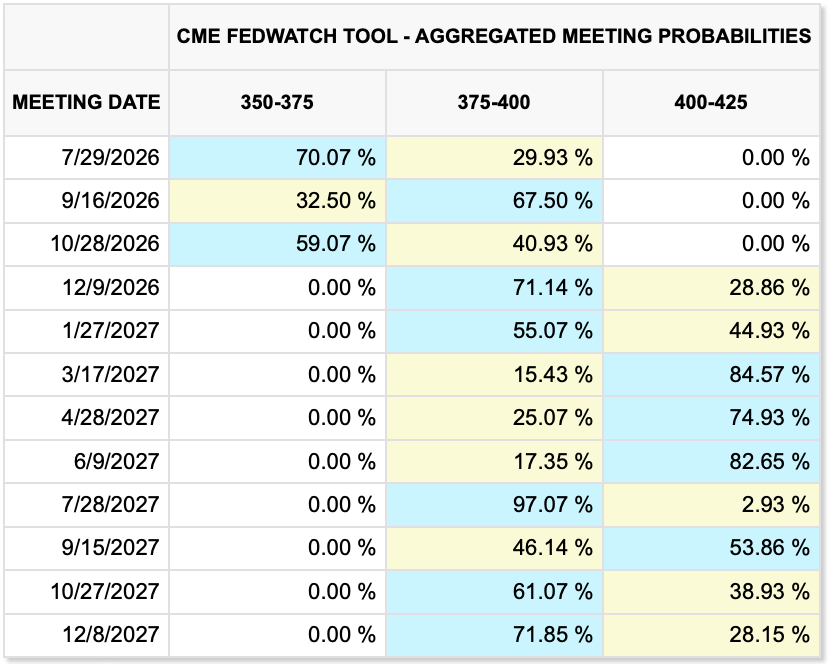
Of course, this largely jibes with the Fed funds futures market as you can see in the latest table from the CME.

Of course, looking at this table, something seems amiss for September, perhaps there was a large position put in place that drove the market.  At any rate stock markets were unhappy with the major indices slipping -1.0% or more after the FOMC although bonds did very little and commodities continue to show oil slipping while gold and silver rise.  As to the dollar, it rallied pretty much across the board.

It is way too early to anticipate exactly how things are going to play out, but I am encouraged.  I strongly believe a little price volatility is a small price to pay to reduce systemic risk by reducing leverage in the system, and that is very likely to be the outcome if Mr Warsh has his way.  My forecast is the “ample reserves” balance sheet program is going to change before he is done.  If that is the case, I think they will have a real opportunity to get inflation under control.  As well, I believe that prospect will undermine much of the ‘death of the dollar’ narrative.  It truly will be significant.  We shall see.

Good luck

Adf

Future With Dread

The story today is the Fed
And whether, when looking ahead
Inflation they see
Stays well above three
Or if it just might fall instead

Meanwhile, every comment I’ve read
Discussing the ‘deal’ have all said
Too much was conceded
The US retreated
And look to the future with dread

Starting with the MOU with Iran, and having read the text of the agreement, at least the one published by Bloomberg, Iran has sworn to never have a nuclear weapon and then will effectively be readmitted to polite society, with sanctions and restrictions eventually removed.  The several comments I have read on the deal highlight numerous potential loopholes and semantics regarding tolls and fees and are uniformly unhappy with the deal.  But I’ve also read that many on Iran’s side are unhappy with the deal.  Arguably, the best sign the deal is going to last is just that, neither side got everything they wanted, but both got some of the things they wanted.  Time will tell how this all plays out, but certainly the oil market remains positive that the direction of travel is toward a normalization of flows through the Strait of Hormuz.

However, while the political pundits are going to continue to focus on that issue, markets have turned their focus to the FOMC meeting and how things play out under new Chairman Kevin Warsh.  The previous Fed whisperer, Nick Timiraos at the WSJ, continues to push Governor Powell’s message as there is not yet a new Fed whisperer.  My take is Timiraos will not be the one simply because his loyalties will not lie with Warsh. 

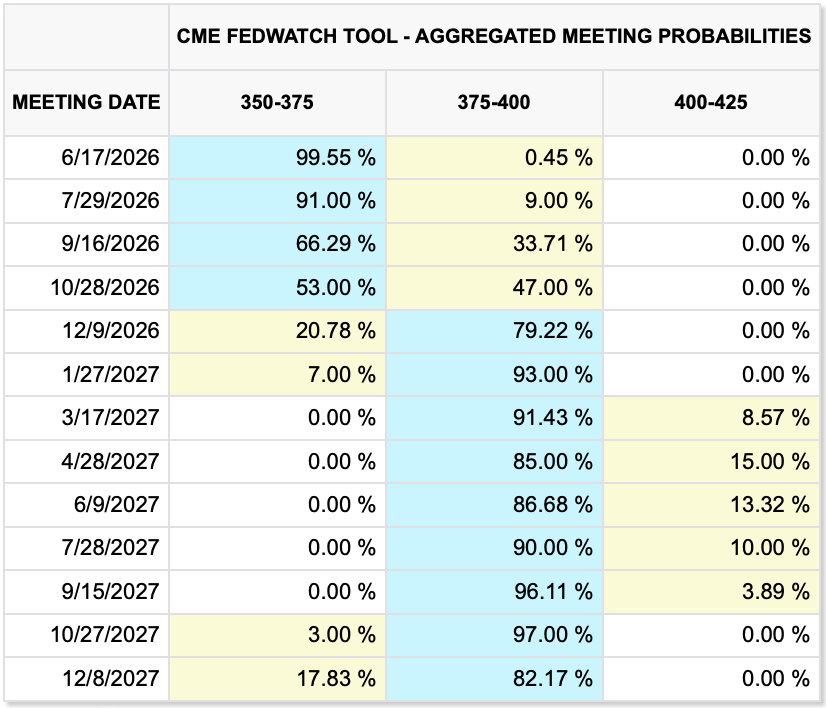
The thing in which we can be most confident is there will be no rate change at today’s meeting although the market continues to price a rate hike in December as per the below CME table.

All the drama will come with the release of the SEP (Summary of Economic Projections) which is the quarterly document the Fed publishes showing the range of economic forecasts by the individual FOMC members regarding GDP, Unemployment and interest rates.  This document also includes the dot plot.  It is important to note that the SEP only started to be released in 2007, so this is not a long-standing tradition, but part of Ben Bernanke’s changes to the institution.

And this is a key feature of what makes Kevin Warsh different.  He has indicated that the Fed talks too much (I agree) and believes that some ambiguity in what is going on is a desired outcome.  This is a controversial stance as Wall Street has minted money on the back of forward guidance, recognizing the Fed has their back whenever they blow up because they built up huge leverage and were wrong.  

While I completely understand the idea that political discussions need to be in the open, I am far more suspect with respect to monetary policy discussions.  Prior to forward guidance, market participants were far more cautious in their positioning as the probability of getting the direction of a trade wrong was far greater.  But once the Fed says, ‘rates are going to stay low for a very long time’, traders can lever up positions massively relying on the fact that their funding costs are going to remain in check.  And it is the massive leverage where the risks to the market lie, not the level of rates per se.

So, the question today is how Chairman Warsh will handle his desire to reduce communications compared to the previous actions of publishing the data and numerous FOMC members speeches.  One thought is he may refuse to put his own forecasts into the document, a sign of what he wants going forward but I am confident he has other ways to move forward.

The other issue is the question of the tone of the statement, which had ostensibly been leaning dovish but seems now likely to be neutral.  My sense is whatever he does, it will be incremental, at least at the beginning, but I anticipate that he is going to make substantial changes to the way the FOMC operates during his tenure as that is why he was put in the role. 

So, with that as our backdrop, let’s see how markets have absorbed the text of the deal as we all await the FOMC this afternoon.  Yesterday’s mixed US performance, with only the DJIA managing a gain while tech stocks dragged down both the NASDAQ and the S&P, was followed by more positivity than not in Asia with gains in Japan (+0.7%), China (+1.0%), Korea (+1.6%) and India (+0.5%) while HK (-0.75%) slipped a bit.  It is always a bit of a surprise when HK and China move in opposite directions, and it seems today’s split arose from different interpretations from a policy conference regarding future PBOC activities as well as potential future government support for a clearly weakening consumer economy.  Other regional exchanges had a mix of gainers and laggards as well, as the overall session was directionless.

In Europe, the picture is also mixed although the movement has been more muted than those in Asia.  Both Germany and the UK are flat to slightly lower this morning with the former under pressure after BMW offered a terrible profit forecast while the latter, despite lower-than-expected inflation readings, is lagging on growth concerns.  However, France (+0.2%) and Spain (+0.5%) have both managed to rally a bit on some slightly positive earnings news.  As to US futures, at this hour (7:15), they are modestly higher across the board.

Bond yields are generally little changed this morning with only UK gilts (-5bps) and JGBs (-4bps) showing any movement at all.  Gilts responded positively to the inflation data while JGBs seemed to take solace in the trade data showing Japan was back to a deficit.  

In the commodity markets, oil (+0.7%) is having a very quiet session after several sharp declines in a row while metals markets are largely unchanged this morning.  It appears even traders here are awaiting the FOMC outcome.  One thing I have seen is a recent report from the World Gold Council showing 45% of central banks surveyed plan to buy the barbarous relic in the next 12 months.

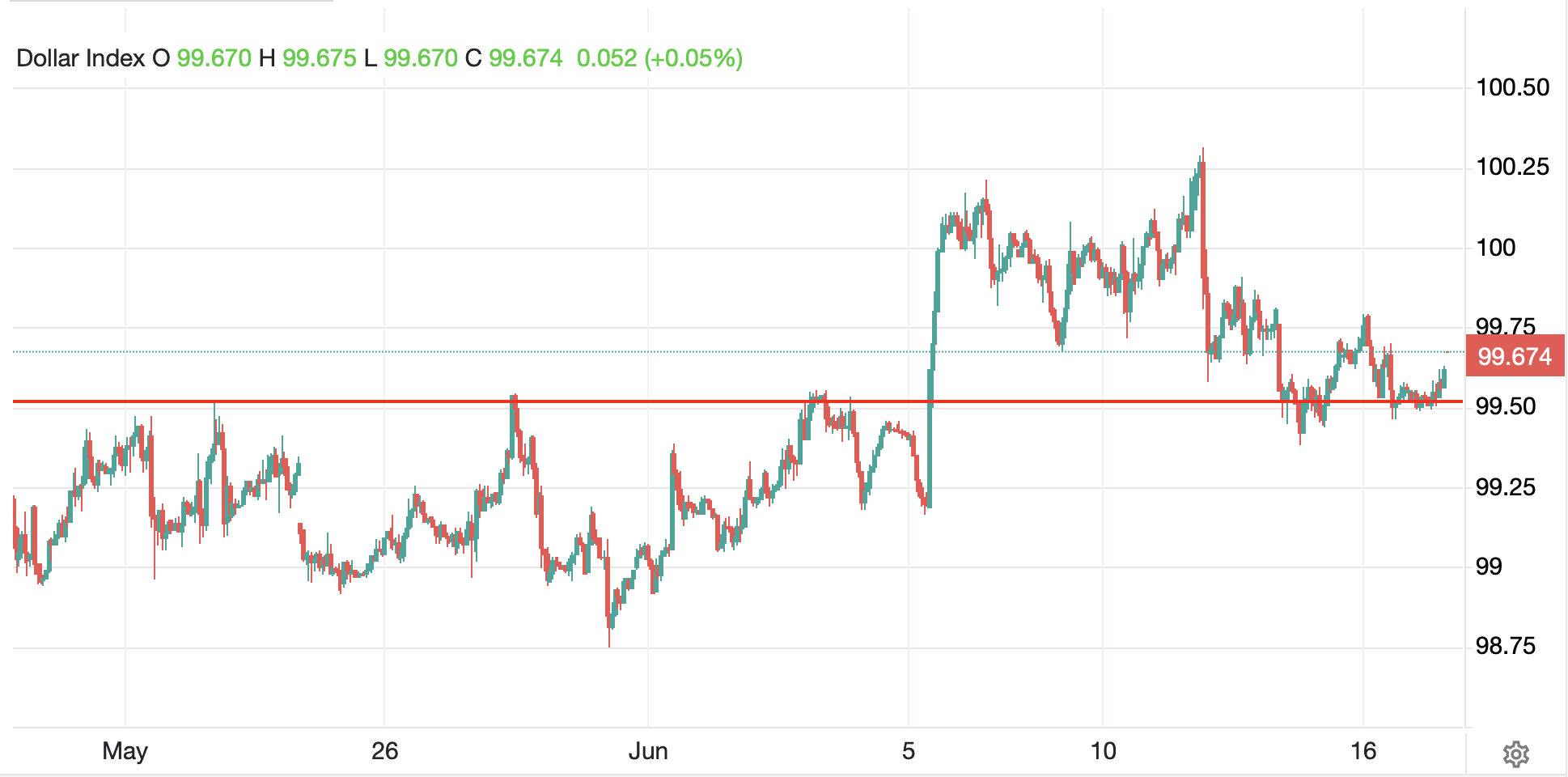
And finally, the dollar is slightly stronger this morning, but like most other markets, not showing much movement at all.  The below chart of the DXY for the past month shows just how lackluster price action has been with a total range of just 1.5%.  The red line is the midpoint of that range showing there is just not a lot of pressure in either direction right now.

Source: tradingeconomics.com

Meanwhile, USDJPY has basically spent the past two weeks hovering just above 160.00 with nary a peep from the MOF or BOJ.  Again, the situation there is the policy changes necessary to strengthen the yen are likely to have very negative economic consequences initially, and that is not something any government is likely to do.

On the data front, ahead of the Fed we see Retail Sales (exp +0.5%, +0.5% ex-autos) and then the EIA oil inventories with more draws expected.  And that’s really all there is.  I anticipate a very quiet session ahead of the Fed and then all will depend on how the market interprets Warsh’s signals.

Good luck

Adf